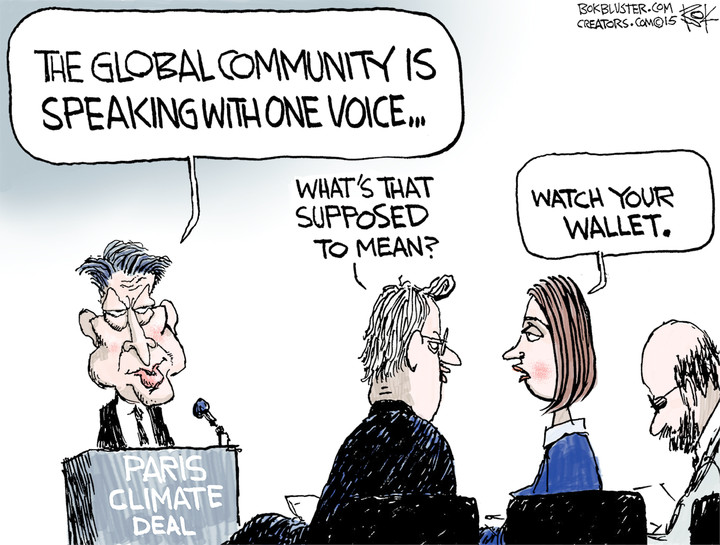
Climate Crisis Consultancy Race $$$

Consultants Race

Terence Corcoran writes at Financial Post Let the carbon consultancy games begin! Excerpts in italics with my bolds.

How does one avoid hell on earth? Who ya gonna call? Send in the consultants

After the release of the Intergovernmental Panel on Climate Change’s (IPCC) latest report, British Prime Minister Boris Johnson called it “sobering reading” and a “wake-up call” for the world’s politicians heading into the 26th Congress of the Parties (COP26), which is schedule to take place in Glasgow in November. Johnson, of course, did not intend his comments to be taken literally.

The IPCC report, formally titled “Climate Change 2021: The Physical Science Basis,” runs to 3,949 pages and contains approximately three million unreadable words from the deepest bowels of United Nations climate science that, if attempted, would induce readers to dip into the cabinet and ultimately leave them in the opposite condition, being neither sober nor awake.

UN Secretary General Antonio Guterres called the report a “code red” for humanity. I had to look up the meaning of “Code Red,” which turns out to have been the title of a 2020 blast from the heavy metal group AC/DC, with the opening lyrics:

Loading up the battery
Raising up insanity
Feeling like the old-time blues …
Don’t mess with fate
Hard fight, rough night
Dead in your sight
Fire light, a fire bright
Fire in the night

Maybe Guterres is hipper than we thought.  Not that it matters, since the dense content of the report, or even its 42-page “Summary for Policymakers,”  . . . is in fact irrelevant; the message is in the message carried by the media, which is that urgent action is needed at this “critical time,” to fight a crisis that requires a radical reduction of our greenhouse gas emissions to avoid the grave consequences of global warming.

Time Is Running Short To Avert ‘Hell On Earth,’ screamed a headline in the Financial Times.

How does one avoid hell on earth? Who ya gonna call? Send in the consultants.

The IPCC report was instantly seized upon by one sector of the economy that has been hyping itself up for one of the greatest money-making bonanzas of all time. Global consultancies — from big-names such as PwC, Deloitte, E&Y and KPMG, to the scores of less famous law firms and institutes — see the climate business as a profit-making bonanza.

At PwC’s United Kingdom office, the consultancy’s global sustainability and climate change leader instantly issued a response to the IPCC report that pumped up the firm’s net-zero agenda. Emma Cox urged all large businesses to engage with the IPCC’s monstrosity of a report. “For companies with a global footprint, the report provides the most detailed analysis of where and how your operations, supply chains and markets are vulnerable to the impacts of climate change,” she said.

The report actually does none of the above, but Cox continued: “Climate science should remain the hard basis for all decision making and target setting. In parallel, it must be used to inform and instigate a strong policy response to close the remaining ambition gap to keep the Paris Agreement objectives alive.”

How do corporations go about making climate science the basis for “all” decision making and target setting? No doubt PwC has an answer, as does Deloitte. A recent article on Deloitte’s website warned that the net-zero carbon target requires an urgency that exceeds previous industrial revolutions: “What’s needed is a more holistic system of systems approach that unlocks critical opportunities in the transition to a low-carbon economy by working at the intersection of emerging low-carbon initiatives.”

When consultants sound like UN bureaucrats, you know something is up.

The leadership at another global giant, KPMG, has created a management team called KPMG IMPACT that’s dedicated to pursuing the UN’s sustainability development goals, which is essentially a leftist takeover of world governance.

162477_image-1

In a report issued last November, the KPMG IMPACT team made its sales pitch to corporate executives and managers: “Business is not only a critical player in achieving the net zero goal; it is also at risk from the physical effects of the climate crisis and the economic impacts of transitioning to a net zero economy.”

The world’s corporate executives, managers and directors are ultimately caught between 3,949 pages of incomprehensible and speculative IPCC science pumped up by the media, and the exhortatory offerings of consultants eager to capitalize on IPCC climate alarmism.

And so, the great consultants’ Olympic are underway, a multi-year marathon competition among firms, legal teams and sustainability gurus to cash in on the promoted fears of hell on earth if corporations do not get behind net-zero with detailed planning, strategies and policy — and big dollars.

On your mark! Get set! Call your consultant!

7403a-money-down-the-drain

Socialists Command, Failures Ensue. Here’s why.

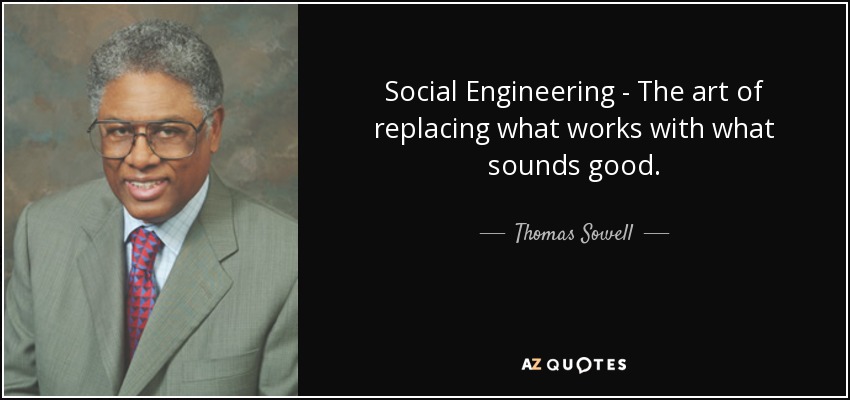
quote-social-engineering-the-art-of-replacing-what-works-with-what-sounds-good-thomas-sowell-133-50-80We are witnessing again politicians attempting to command social outcomes, which in market societies not only fails but makes matters worse.

An insight is provided by an observer of the “Blue State Model” example of NY under Cuomo and DeBlasio.  At AMAC newsline Cuomo Might Be Leaving Office, But His Failed Blue State Model Remains.  Excerpts in italics with my bolds.

Following a sexual harassment scandal that captured the attention of the nation over the past several months, New York Governor Andrew Cuomo announced Tuesday that he will resign as governor, effective two weeks from yesterday. But while New Yorkers may finally be rid of their creepy, handsy governor, the legacy of Cuomo’s disastrous policies will unfortunately continue its negative impact on the Empire State and weigh down attempts at economic recovery and growth.

Ironically, if Cuomo had prioritized working with small businesses, eliminating bureaucratic red tape, and removing onerous taxes, he could have had more small businesses and lower costs. But he instead chose to move in the opposite direction and, as is usually the case, more government involvement in private industry created a nightmare for companies and consumers.

One law in particular from earlier this year is a perfect case study, not only in Cuomo’s dreadful governing record, but in the bullying, Big Government, Blue State model that he so vividly represented. On April 16, 2021, Governor Cuomo signed legislation to impose price controls on high-speed internet. Under this bill, providers were only allowed to charge $15 a month to low-income residents, regardless of the cost of providing service. Governor Cuomo celebrated the law, stating, “This program – the first of its kind in the nation – will ensure that no New Yorker will have to forego having reliable home internet service and no child’s education will have to suffer due to their economic situation.

Almost immediately, the law was challenged by representatives of the telecommunications industry. They asserted that it was grossly illegal and that the state has no legal basis that would permit them to set or regulate the price of internet access.

Cuomo’s office was defiant. They immediately declared, “If these companies want to pick this fight, impede the ability of millions of New Yorkers to access this essential service, and prevent them from participating in our economic recovery, I say bring it on.” The infamously pugilistic Governor made it clear he wasn’t backing down – a trait that would again haunt him during his trial by media over sexual assault allegations a few months later.

In June, a federal court found merit in the industry’s challenge and temporarily banned the measure from being instituted. In the proceedings, it was revealed that the ban and its justification were almost ludicrously ill prepared and planned. When the state was challenged as to how it could legally set the price of a private industry service, they insisted that they weren’t actually setting the price at $15 because providers were free to charge less than $15. Additionally, the $15 price point wasn’t based on any research or knowledge. Even a cursory understanding of the telecom industry would reveal that many providers pay more than $15 per person in taxes and fees alone.

Needless to say, the judge wasn’t buying Cuomo’s argument. Within a matter of months of signing the bill, the state of New York abandoned it and chose to discontinue the case. The decision surprised few insiders. Some analysts theorized the Cuomo plan was mere “political theater.” They alleged that it was an attempt by the Governor to appear tough on corporations while accomplishing very little.

While Cuomo attempted to portray himself as standing up against “big business,” the truth is far more complicated. Many of the fiber optic cables laid across the country are not placed by large corporations. There are a number of small providers who specifically service areas that large providers ignore due to perceived inefficiency and cost. Currently, hundreds of thousands of homes are serviced by these small providers.

These companies had to spend millions of dollars and countless hours fighting Cuomo for their very survival. Additionally, although they technically won the battle, the legacy of the law could lead to a major chilling effect in which providers will be hesitant to provide low-cost fiber optic cables, out of fear they will be financially ruined should a future court rule in favor of a more cunning and well-prepared administration. In effect, Cuomo’s attempt to make internet access more ubiquitous and affordable would have made it more restricted and expensive.

Mercifully, with the three-term governor on his way out, New Yorkers will have a chance to pursue a different direction under hopefully more capable leadership. Unfortunately, however, the failed progressive model that tale exemplifies remains stubbornly in place in Blue State capitals across the country.

cg5bba871baa5aa

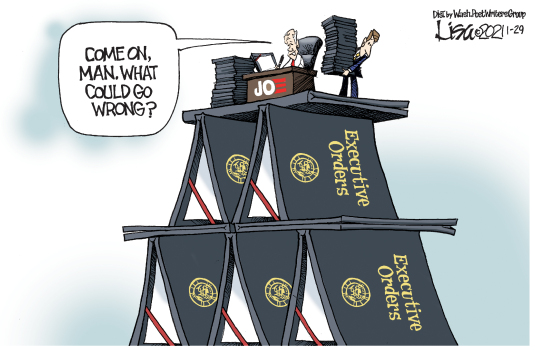
Of course the same Blue State model of governance has produced a mess in California, resulting in a recall campaign against the perpetrator, Gavin Newsom.  Meanwhile at the US federal level, 2021 has seen political command behavior on steroids, and social and economic destruction unprecedented in such a short period of time.
Lisa Benson cartoon

A deeper discussion of failed progressive administrative behavior is from a previous post reprinted below.

Why Technocrats Deliver Catastrophes
technorats-magazine-e1624833565281

Mark E. Jeftovic writes insightfully on the ways technology backfires when applied by bureaucrats in his article Why the Technocratic Mindset Produces Only Misery and Failure. H/T Tyler Durden at zerohedge. Excerpts in italics with my bolds.

Technocrats have the most fundamental aspect of reality backwards

Saw this article come across, come across my news alert for “Transhumanism”. In it Dr. David Eagleman talks about how not only can we augment human senses with fantastic new abilities (like to “see” heat and electromagnetic patterns), but how we’ll even be able to build machines that think too.

There is a line in his thinking that one can glean from the article: on one side of the line are enhancements and augmentations to the human experience which are startling and amazing and which will transform our societies: even more radical life extension will be in the cards quite soon (for those who can afford it).

Where Eagleman crosses into technocratic thinking is when he veers into the idea of being able to build thinking machines. The logic is that because we’ll be able to increasingly bioengineer our own living bodies, it means we should also be able to bioengineer a mind into machines using the same principles.

I think this is wrong and it’s the same theoretical mistake that leads directly to technocratically inspired catastrophes.

Yes, we continue to build on technological advancements, but we also commit a lot of unforced errors that inflict incalculable misery on humanity. These errors may manifest as policy blunders, economic crises and worse. Most recently, for example, we seem to have gotten ourselves into a global pandemic because a bunch of technocrats funded some gain-of-function experiments in hopes of preempting the next pandemic. Do you see the dynamic here?

Over the years a lot of thinkers have pointed out that technocratic policy tracks, devised by centralized groups of experts within an elite managerial class, often bring about the very conditions they were impaneled to obviate.

• Raising minimum wages increases unemployment.
• Holding interest rates to zero creates economic instability and increases wealth inequality.
• Forcing green energy initiatives creates systems with lower energy efficiency and higher carbon footprints.
• Banning guns increases gun violence.
• Censoring “hate” speech fosters more hatred and polarization.

It’s almost as if the managerial class has no awareness of second-order effects. When they inexorably come to pass they are often blamed on the very people who were counselling against the initial policy in the first place.

Thus, financial meltdowns are blamed on runaway free markets and capitalism gone wild. Global warming (if it truly plays out along prognosticated lines) is blamed on industries who are most rapidly transitioning toward greener energy anyway (like Bitcoin mining).

Climate change is another theme that exemplifies the technocratic dynamic: As a society we’re going to transition off of fossil fuels no matter what anybody thinks about the environment because we’re already past peak oil, and peak demand will probably flatline around 100M bpd and start coming down from there in a secular downtrend, for a variety of reasons (prolonged economic malaise and the ascent of green energy).

Yet the most viable pathway toward transitioning away from fossil fuels, nuclear (and in this I include Thorium), is currently relegated as problematic by technocrats and ideologues.

casper-landfill-2-e1624827835334

It all seems backwards and for a long time I’ve been positing a fundamental root cause of this backwardness. The premise is: We have the mind/matter equation completely backwards in the way we think about how the world works.

Conventional thought is that what we experience as consciousness is something that emanates from the brain. Like steam from a kettle. This is also the core assumption of AI. If we build something that resembles a brain, it’ll think. It’s a kind of Frankenstein approach that Eagleman alludes to in his article.

That won’t work and AI will never be achieved as long as the mechanistic, material reductionist worldview persists. Yet, technocrats put a lot of faith in AI, and they think models derived from AI are or will be superior to anything we can figure out on our own because they were outputted by machines with a bigger/faster/hardware brains.

It is completely… wrong.

I think that what we experience as matter are energy patterns that emanate from an underlying, and conscious sub-strata of reality. This is basic quantum theory. Quantum theory can be problematic because it opens the door to all kinds of New Age Woo Woo, which may not even be entirely wrong at its core, but is prone to deeply flawed implementations (like anything, I guess).

People, and probably most living things, have a sense, an intuitive awareness of this sub-strata of reality. Our mythology and sacred texts are probably the stories of sometimes being more attuned to it and sometimes less so. The late British writer Colin Wilson wrote at length on the consciousness of the Egyptians of the upper kingdom, possibly over 7500 years BC. Their consciousness and language was pictorial not linear. It may even be possible (my extrapolation, not his) that the demarcation point between conscious awareness between individuals was blurred somewhat. 

So what happened?

Into this awareness came religions. Organized structures that would begin to dictate the basis on which members of society were to comprehend and approach this Great Sub-Carrier. Priesthoods evolved – the first monopolies. Religions. Hierarchies. Rulers. Subjects.

One of the earliest forms of social deviance was heresy: approaching the Divine Sub-Carrier from a direction outside the religious structure. Can’t have that.

This dynamic is as old as humanity. It could even be argued that historical progress is the story of the public coming to realize that the monopoly thought structure they were in was flawed or obsolete and then society moving on to the next one. The elites of the day would endeavour to halt the progression or when that failed, co-opt whatever came next.

Then new elites would erect a new orthodoxy that placed them directly in the nexus of what was unknowable and what the rabble thought they needed to know in order to perform their primary function of ….servitude.

Today the great sub-carrier is best described by science, not religion. But again, the priesthood is saying that all knowledge of the sub-carrier should come through them. That’s Scientism. That’s Technocracy. Management by Experts.

The last two years of life on earth are a foretaste of a full blown technocracy. Follow The Science™, plebes.

Only our elites can fathom how to approach and extract knowledge from The Great Externality, but this time they’ve made things even worse because they have it exactly backwards. They think the Great Externality doesn’t even exist. It’s for flakes and Bible bangers. The technocratic priesthood holds that material reality is near completely understood and that our minds are side effects of chemical reactions in our brains.

They hold that if only we can crunch enough Big Data and calculate out all the models we’ll be, like God (who doesn’t exist), able to fix everything and eliminate all bad outcomes, for everybody, everywhere. We may even be able to eliminate death, and we could upload our consciousness (which is an illusion) into the cloud and live forever.

Because of this backwardation, we will always be careening from one catastrophe to the next, and most of them will be of our own making. We collectively suffer from an illusion that we are in control.

But we are not in control. We’re a pattern. A dance. A cycle. Waveforms. Vibrations. What we as humans do specifically well, which is our superpower and has led to our technological advancement which could conceivably continue on a trajectory that makes humanity an interstellar phenomenon, is adapt.

What technocrats can’t understand, or admit is that we can’t control what is going to happen. Either on an individual scale of people thinking in ways they’re not supposed to think, or geological, cultural, geopolitical or cosmic scales. We can’t get interest rates right, we can’t get everybody to agree on whether it’s “Gif” or “jif” and somehow we’re going to change the trajectory of the climate? Achieve immortality? Crank out a Singularity?

That is highly unlikely and in trying to preempt theoretical bad outcomes we typically bring about horrible actual outcomes.

The lab leak from the Wuhan Institute of Virology, if it occurred and it is looking increasingly likely that it did, was the result of gain-of-function studies on bat coronaviruses. They didn’t do it as a bioweapon. It’s not a global conspiracy to institute a Great Reset (all that talk is opportunism more than planning).

They were trying to figure out how to plan for a future global pandemic that may catch humanity off guard and cause incalculable damage. What did they accomplish? They unleashed a global pandemic that caught humanity off guard and caused incalculable damage. Soon to be compounded by global, de-facto compulsory inoculations with experimental vaccines that have a distinctly politicized impetus behind them.

That same dynamic is applied to economics (its where the .COM crash and Global Financial Crisis came from), and social policy (the Woke movement), to climate is all the same technocratic mindset that doesn’t understand the order of reality (mind, then matter) but even worse thinks it knows it.

We’re stuck with that for awhile because the technocratic mindset is incapable of introspection or entertaining the possibility of being wrong about anything. The only move it knows is to double-down on failure.

The antidote to all this is massive decentralization on a global scale, which has the added benefit that decentralization by definition, is not something that gets decided from the top (it never is). It just happens, even in spite of the people in the centre of power who may feel something about their gravitas melting away.

That’s what has started to happen. A global opt-out. The Great Reject. As sure as the Reformation gave way to the Enlightenment despite the protestations of the Church, we’re headed into a world of networks and the sunset of nations. All the while the propagandists of the old order shrieking that in this direction lies certain doom.

The Enlightenment arose from an increase in the level of abstraction, structurally the universe changed from the Ptolemaic worldview (the world as the centre of all existence) to the Heliocentric solar system.

Now we’re experiencing a similar shift away from static top-down hierarchical structures as the natural shape of civilization and toward shifting, impermanent, overlapping networks.

Footnote:  Another Example of Technocratic Adventurism

From American Thinker The Grave Perils of Genetic Editing.  Excerpts in italics with my bolds.

A company called Oxitec, based in the U.K., is piloting a program using gene-/information-modified mosquitos to eliminate the invasive female Aedes aegypti mosquitoes in the Florida Keys. The mosquitoes potentially spread diseases such as Dengue fever and Zika.

Dr. Nathan Rose, head regulator of Oxitec, said mosquito-borne diseases are likely to worsen as a result of climate change. According to the CDC, in a ten-year span between 2010 and 2020, there were 71 cases of Dengue fever transmitted in Florida. In essence, the experiment is being conducted for fear of climate change causing a drastic increase in incidence of Dengue fever. In the Fox article, Rose states that Oxitec will first experiment in Florida, collect data, then “go to the U.S. regulatory agencies to actually get a commercial registration to be able to release these mosquitoes more broadly within the United States.”

Don’t think the Florida Keys just opened their arms with a great big bear hug to this experiment. No, there were pushback and questions. In fact, Oxitec had been pushing this experiment to Key Haven and Key West for years, only to be rejected. Many other places have also declined this experiment. When it was conducted in Brazil, it initially seemed to work, but in the end, the mutated mosquitos transferred mutations to the general public. Thankfully, gene drive was not used in the Brazil experiment, for this type of gene manipulation cannot be reversed and can wipe out a species over time.

Evidently, Oxitec has created a second-generation “friendly mosquito” technology, where new male mosquitoes are programmed to kill only female mosquitoes, with males serving and passing on the modified genes to male offspring for generations. Yes, they are programmed to kill. Oxitec CEO Grey Frandsen announced in 2020 that Oxitec looked forward to working with the Florida Keys community to “demonstrate the effectiveness of our safe, sustainable technology in light of the growing challenges controlling this disease-spreading mosquito.”

Let’s hope the Florida mosquitoes experiment is truly a necessity and not some type of climate-change fear-mongering “sustainable” technology based on speculation.

Fear Not for Arctic Ice Mid August 2021

Arctic2021226

The graph above shows mid July to mid August daily ice extents for 2021 compared to 14 year averages, and some years of note.

The black line shows during this period on average Arctic ice extents decline from ~8.3M km2 down to ~5.9M km2.  The 2021 cyan MASIE line started ~400k km2 below average but as of yesterday was slightly surplus.  The Sea Ice Index in orange (SII from NOAA) started with a deficit to MASIE (in cyan) of ~300M km2.  August 14 saw the two indices mid August close together, close to average and surplus to 2007.

Why is this important?  All the claims of global climate emergency depend on dangerously higher temperatures, lower sea ice, and rising sea levels.  The lack of additional warming is documented in a post Adios, Global Warming

The lack of acceleration in sea levels along coastlines has been discussed also.  See USCS Warnings of Coastal Flooding

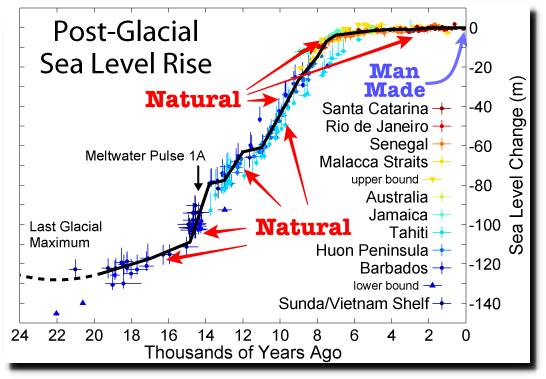
Also, a longer term perspective is informative:

post-glacial_sea_levelThe table below shows the distribution of Sea Ice across the Arctic Regions, on average, this year and 2007.

Region 2021226 Day 226 Average 2021-Ave. 2007226 2021-2007
 (0) Northern_Hemisphere 6066634 5889687 176947 5727937 338697
 (1) Beaufort_Sea 915133 688804 226329 777766 137366
 (2) Chukchi_Sea 572339 404505 167834 260048 312290
 (3) East_Siberian_Sea 624917 556990 67927 196982 427934
 (4) Laptev_Sea 52213 252434 -200221 316363 -264150
 (5) Kara_Sea 173342 88626 84716 201115 -27772
 (6) Barents_Sea 5256 29027 -23771 17324 -12068
 (7) Greenland_Sea 118995 224977 -105982 316155 -197160
 (8) Baffin_Bay_Gulf_of_St._Lawrence 23528 59670 -36142 86165 -62637
 (9) Canadian_Archipelago 465880 420722 45157 375241 90638
 (10) Hudson_Bay 83051 74370 8681 91653 -8603
 (11) Central_Arctic 3031058 3088557 -57499 3087868 -56810

The overall surplus to average is 177k km2, (3%).  Note large surpluses of ice in BCE (Beaufort, Chukchi and East Siberian seas).  Meanwhile Laptev on the Russian coast melted out early, as has Greenland Sea.  Kara and CAA (Canadian Arctic Archipelago) are holding considerable ice.  We are about a month away from the annual minimum mid September, but at this point it does not appear it will be out of the ordinary.

bathymetric_map_arctic_ocean


Illustration by Eleanor Lutz shows Earth’s seasonal climate changes. If played in full screen, the four corners present views from top, bottom and sides. It is a visual representation of scientific datasets measuring Arctic ice extents.

Climate Hysteria is a Global Psy-Op

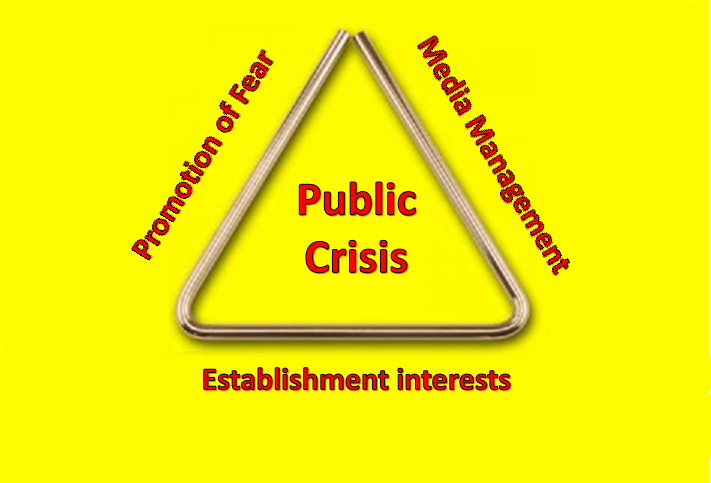
Iron triangle Crisis

Iron Triangle of Public Crises

Alasdair Macleod writes at Goldmoney The problem with climate change politics. Excerpts in italics with my bolds.

Climate change bears all the hallmarks of a state-sponsored crisis, useful to shift attention from other political failures. But the absence of financial accountability which characterises government actions also introduces behavioural errors.

The absence of a profit motive in any state action exposes the relationship between governments and their electors to psychological factors. We all know that governments use propaganda and other tools to manage crowd psychology and influence their electorates. What is less understood is that governments themselves are misled by a crowd psychology in its own ranks which contributes to policy failure.

This article does not question the climate change debate itself. Instead, it examines the debate in the context of the psychology driving it. The release of government-sponsored propaganda on climate change in the form of a unanimous IPCC report predicting the end of the world as we know it is the latest example of a political and bureaucratic phenomenon, making the timing of this article highly relevant.

Six psychological factors

 In Chapter 6 of Desrochers & Szurmak’s work, they identify six distinct psychological factors which we will take in turn to enhance our understanding of the psychology of climate change. I list them under the following headings:

♦ The iron triangle of crisis
♦ The psychology of entrenched arguments
♦ Motivated reasoning
♦ The core theoretical theme
The anointed elite and
♦ Optimism and pessimism

The Desrocher and Szurmak reference is to their book Population Bombed.  My synopsis with links is Control Population, Control the Climate. Not.

The iron triangle of crisis

Even from before the time of Malthus, there have been political influencers and activists who have promoted pessimistic assumptions about uncontrolled population expansion, and the ability of the planet’s resources to feed them. Despite these fears being subsequently proved to be unfounded they continue to prevail among those who don’t need to pursue profits for a living. It is a bias to which politicians and their advisers are especially vulnerable.

The public naturally expects its elected representatives’ unbiased endeavours when bringing national threats to its attention. After all, it is arguably a primary function of government to protect its population from dangers, real and potential. There are government departments tasked with assessing dangers to society, their likelihood, and in their event how government should respond. These are tasks that require unbiased research. But political guidance from the top is rarely neutral, seeking to influence outcomes.

And we now find that climate change science has become heavily politicised.

Climate change is the gift that goes on giving to politicians. It creates an impression of tackling the big issue of our times. And it is a source of crisis giving cover for failings over lesser priorities. Observing how Boris Johnson maintains his popularity through a combination of leading the world in the battle against climate change while seeking every photo opportunity possible and at the same time presiding over the Covid disaster has been a masterclass in practical politics. One is left wondering how vacuous his politics would appear without the prop of climate change.

On his watch, the politics of climate disaster have taken on a new life in the UK. Government spending plans angled at reducing carbon emissions has accelerated, as has the support and credibility given by state-funded scientists producing alarming forecasts. Radical environmentalism is not only embraced, but actively promoted through the media.

This trinity, this iron triangle of crisis as Desrochers and Szurmak put it, is therefore comprised of establishment interests, the promotion of fear, and media management. It focuses the public’s mind on a specific threat to the exclusion of others. It is a feedback loop of career and protectionism driven by the psychology of entrenched arguments, which is our next topic.

The psychology of entrenched arguments

A rational approach to absorbing and understanding new information would be to address it logically and without bias. Clearly, this does not happen. Our brains are still wired as they were in our hunter-gatherer days when our decisions were based on a choice of fight or flight. We therefore have a natural tendency to hold onto a protected position after it becomes untenable.

Imagine being part of a community of primitive cave-dwellers and fight or flight becomes a group decision. We will support each other in uncertainty well after a crisis point has passed, breaking ranks after flight has become the only option. It is survival by inward-looking mutual defence, not attack. It is the deep psychology behind groupthink, or the psychology of entrenched arguments. It leads to the cliff-edge of crisis.

Researchers from Cornell University have examined the phenomenon.[iii] They found that “participants prefer to learn information from in-group sources and agree more with in-group members on moral and political issues”. This takes groupthink into persistence territory after the flight option has long passed, and existing views become defensively entrenched. Awareness of the true situation becomes compromised through self-ignorance of the flaws in the group’s knowledge and judgement. It even has a name: the Dunning-Kruger effect.[iv]

To this self-ignorance can be added a group’s overestimation of its understanding of controversial issues, leading to the illusion of “understanding bias”. The more members of a group who debate an issue, the more understanding bias is reinforced. You see evidence of understanding bias in wider politics, particularly when opinions coalesce over time into different political ideologies. In America, the Democrats are as intellectually capable as the Republicans, yet the two parties have retreated into sharply differing understanding biases.

Entrenched arguments are reinforced by naïve realism. A naïve realist assumes he or she personally is both rational and unbiassed in the assimilation and assessment of the facts, and further assumes that those who do not reach the same conclusions are ignorant, biased or both. Naïve realism is the product of a false consensus, under which those that agree with the naïve realist are seen to be more rational than those that do not. Entrenched arguments and naïve realism become the driving force behind motivated reasoning.

Motivated reasoning

We naturally believe in scientific research, on the incorrect assumption that all those PhDs from top universities conduct experiments for the same reasons as we were taught at school in chemistry lessons. Unfortunately, the scientific community’s motivation, in both the natural and social sciences, is not so pure. Scientists are human and need to earn a living, which is far easier to do if they go with the general confirmation bias. In the post-education world, a scientist needs a paid position, recognition and to publish frequently in respected journals. Good ideas become suppressed and poor data to back bad ideas are too frequently the result of this motivated reasoning.[v]

It was best summed up by John Ioannidis, a professor of medicine at Stanford University:

“Scientists in a given field may be prejudiced purely because of their belief in a scientific theory or commitment to their own findings… Prestigious investigators may suppress via the peer review process the appearance and dissemination of findings that refute their findings, thus condemning their field to perpetuate false dogma. Empirical evidence on expert opinion shows that it is extremely unreliable.”[vi]

Admittedly, Professor Ioannidis was writing about research in the natural sciences, but the methods and empirical evidence extends to the social sciences as well. It describes well the research papers published by central banks and the economist professors in universities. It is also characteristic of the opinion silos in government departments.

Motivated reasoning, such as on climate change and political correctness, is all about building a core theoretical theme.

The core theoretical theme

One way in which experts refute opposing evidence is by sticking to a core theoretical theme. I recall email correspondence I had with a well-known financial journalist in 2016, which ground to a halt when he declared,

“In my view, the record global savings rate (27pc) is the root cause of our problems. Some way must be found to rotate this into consumption to rebalance the global economy.”

In other words, he adhered to a core theoretical theme common to neo-Keynesian economists. By expressing it as his view, he was obviously not prepared to debate why he held that the record global savings rate was the root cause of our problems. We are not judging whether it is correct, only that he holds it, he assumes it. He was signalling he will not be shifted, so further debate is pointless. This is true of all state-funded economics, which this opinion reflects. Numerous papers have been written to justify this stance. We have lived with this view since Keynes published his General Theory in 1936. As in Keynesian economics, a core theoretical theme has emerged in the climate change debate

But if Professor Ioannidis is right about empirical evidence showing expert opinion is extremely unreliable, and which appears to be confirmed in the fields of economics and monetary theory, it explains the closed minds to balanced debate in fields such as climate change. So long as a core theoretical theme is adhered to, it becomes almost impossible to overturn.

A determination to stick to the core Keynesian theme on the savings paradox is my journalist friend’s membership card for the anointed elite.

The anointed elite

Many of us want to belong, to make a difference, to enhance society. We know that to do so we must have influence and the best way to do that is to join and promote a cause that has the establishment’s support. And there is nothing like that comforting feeling of an open invitation into the parlours of the great and the good. Well-known figures in the media with this access use their fame and position to anoint themselves alongside the elite and continue to have a career for so long as they play the elite’s game.

The anointed elite was the description of the economist and political theorist, Thomas Sowell, Senior Fellow at the Hoover Institution, Stanford University. He came up with it in his pithily named 1995 book, The Vision of the Anointed: Self-congratulation as a basis for social policy.

Even though we may not recognise it at the time, we have all come across it: the independent expert frequently called on by the media for comment in a specialist field. These experts rely on being informed by government insiders. They adopt the expert mantle, but it is never made clear that they owe their media status almost entirely to their membership of a government-anointed elite and their support of the elite’s objectives. But if they are stupid enough to turn critic, they will be immediately unanointed and they know it.

It applies to ex-politicians and media correspondents alike. If, say, a correspondent for a national newspaper doesn’t play along, he risks being dropped from background briefings by the elite, while his confrères at other journals continue to be invited. “That journalist from the Daily Screech is unreliable. Best not include him in our off-the-record briefings.” The threat of exclusion is the surest way for the elite to ensure that its message is the one that prevails.

Optimists v. pessimists

The glass-half-full optimists and the glass-half-empty pessimists are not split evenly across two sides of an issue. In practice, the establishment and those with a position in society are protective and pessimistic about change because it is a threat to their established position, while commercially minded outsiders tend to take a more positive view.

Psychologists tell us that as humans we have two personalities. One half of us protects what we have, giving us a sense of location, property, and home. The other half is a traveller in search of new vistas, foreign relationships, and trade. Journalist and activist Jane Jacobs (of New York City and then Toronto) identified and described these two patterns of moral precepts as guardian and commercial syndromes.[vii]

According to Jacobs, we have a different mix of these characteristics as individuals, communities and even at national levels. The two syndromes show different characters, which is why some of us are adventurers and others home birds. Commercial relationships are outgoing, and honesty in business is rewarded, while guardians are protective, favour loyalty and support the establishment. Commercials shun force and come to voluntary agreements, while guardians shun trading and exert prowess. Commercials are collaborative, competitive and respect contracts, while guardians are exclusive, take vengeance and respect hierarchy. Commercials are open to inventiveness and novelty, while guardians expect obedience and discipline. And so on.

The commercials’ activities encompass work in making and trading, while the guardians are political leaders, administrators, educators, and upholders of the law. The two syndromes are a neat explanation for the different mindsets and social duties of the private sector compared with governments.

The consequences of climate change politics

The purpose of this article is not to enter the climate change debate but to examine the flaws in the process. Realistically, it is too late to question the line being pursued, having gone beyond any influencer’s control. It is common knowledge that the science is politically influenced by state funding. But it is not widely appreciated that the process of hyping up climate change into a full-blown crisis has become the consequence of a crowd psychology rather than a pursuit of the facts.

The political advantages of introducing legislative targets for climate policies in 2030 or 2040 is that they are sufficiently far away for current politicians to have dumped the problem onto their successors. Without carbon fuels and having subsidised unreliable wind and solar energy to the point where other energy sources, notably nuclear, are uneconomic, the cost of climate change politics threatens to be ruinous for economic activity in the future, threatening the tax base and therefore the expenditure of the governments which have thoughtlessly promoted it.

brain on climate alarm

This is your brain on climate alarm.  Just say NO!

Biden Drops the Ball in Afghanistan. How Many Fumbles is He Allowed?

TOPSHOT-AFGHANISTAN-CONFLICT

James Carafano writes at Daily Signal Don’t Blame Trump for Afghanistan’s Collapse. Blame Barack Obama. Excerpts in italics with my bolds.

President Joe Biden’s decision to withdraw abruptly from Afghanistan, without any discernable exit strategy, has plunged that nation into a bloody, ruinous chaos. After pleading with the Taliban to spare our embassy in Kabul, he has now redeployed 3,000 to conduct a hasty air evacuation of embassy staff.

At this stage, the only good that can come from this debacle is that our leaders might wake up and recognize that the Obama Doctrine of foreign policy is an abysmal failure and must be abandoned once and for all. Tragically, this lesson comes, yet again, at tremendous cost: widescale human misery and heightened threats to U.S. interests.

As we study what’s happened, let’s first dispense with the canards: that this fiasco was inevitable and that it’s all Donald Trump’s fault.

The reality is that, during Trump’s tenure and despite the Afghan government’s many imperfections, Afghanistan had made great strides. The government-controlled most of the country’s territory. There was real economic growth. Women could work. Children could go to school.

Further, the cost of fostering regional stability by maintaining a stable Afghanistan was well within reason. The U.S. was spending less in Afghanistan in a year than we used to spend in a week. American forces were training and advising Afghan forces. Our troops were not fighting wars and taking causalities. This was clearly sustainable.

And how, in heaven’s name, is Trump to blame for Biden’s disastrous decision to cut and run? Trump was negotiating with the Taliban, but there was nothing wrong with that. The negotiations were conditions-based, and Trump made clear the Taliban would be held accountable for their actions. Moreover, Trump’s team made sure that if, in the end, the Taliban proved untrustworthy, the remaining U.S. force had been sized and scoped to present a serious deterrent to the Taliban and be sufficient to protect U.S. interests.

Trump, in fact, handed Biden a problem mostly solved. All Biden had to do was negotiate a lasting settlement from a position of strength or maintain an economy of force presence in Afghanistan if the Taliban failed to deliver. Instead, Biden just decided to call it day and call the troops home regardless of what the Taliban did on the ground.

The Taliban’s offensive should surprise no one, given the conditions handed to them. Why would they not take advantage of Biden’s abandonment of Afghanistan? They knew full well the odds that this president would try to stop their orgy of murder, rape, forced marriages, and mayhem was near zero.

Of course, Biden will blame Trump. He will blame the Taliban. He can make all the excuses and spin all the narratives he wants, but a narrative can’t stop a bullet. This is a disaster. The situation did not collapse until he withdrew troops—and it is impossible not to conclude this happened because of what he decided.

Here is the bigger problem. This was not a one-off decision. This is part of a pattern of Obama-Biden foreign policy. And that should surprise no one since the current policies are being managed by much the same people.

In Iraq, after spending much time and effort stabilizing the country, Obama precipitously withdrew U.S. troops. It was like ordering firefighters who had extinguished a wildfire to not stick around after the wildfire in case the blaze rekindles. ISIS mushroomed overnight, creating the largest and most powerful terrorist state in modern history.

In Libya, Obama insisted on leading from behind. And once Gaddafi was gone from the picture, he ignored the spiraling decline in the security situation until our diplomatic facilities in Benghazi were smoking ruins.

This is the Obama-Biden playbook. Disengage in dangerous situations, and hope everything doesn’t go to hell in a handbasket. And when those fond hopes don’t pan out? Time to make excuses; shift blame; do anything but deal with the problem—unless there is absolutely no alternative.

In the face of America’s enemies, the default position of Obama-Biden foreign policy default is accommodation and appeasement. Unfortunately, the bad guys are not stupid. They had eight years to study the Obama playbook, and they know what to do with it: Exploit the deliberate self-weakening.

Biden is carrying on exactly the same foreign policy. Caving to Russia on Nord Stream 2. Refusing to confront China on the origins of COVID-19. Pleading with Tehran to let the U.S. back in the Iran nuclear deal.

No good will come of this.

Moving On Now Covid Pandemic is Over

cg60a31a950a20d-1

Before 2019, there were four coronviruses causing “common colds” world wide.  Now we have a fifth one joining the others in making infections of our respiratory systems.  It is important to understand how vaccines protect us, but do not prevent infections.  As explained below, there is a big difference between systemic immunity and mucosal immunity.  The first is the aim and largely successful outcome from the vaccines now available.  But equally important is the ability to stop the virus from multiplying at its entry point in the nose and mouth.

From Snithsonian Magazine:

In a collective display of scientific advancement, the Covid-19 vaccines from Pfizer, Moderna and Johnson & Johnson seem to be astoundingly effective at preventing severe disease and death from Covid-19. All are intramuscular, meaning they are injected into the muscle tissue. Once the vaccine materials seep into the bloodstream, they induce the creation of antibodies, which then circulate in the blood throughout the body, protecting some of the most vital organs and creating what’s called systemic immunity. This immune response protects the body from serious illness and death, but the response only builds after the virus has fully entered the body.

Their ability to protect the human body from Covid-19 illness is truly incredible, but the SARS-CoV-2 virus still has an entryway into the body left unprotected by the vaccines: the nose and mouth. Those two gateways, and their ability to transmit the virus, are what mask mandates are all about. Face coverings have been shown to impede the spread of the aerosol virus, protecting their wearers and those around them from infecting each other.

I won’t go into the question of mask symbolism vs. medical effectiveness, but readers can delve into this by a previous post Covid Masquerade.  Suffice it to say,  the attempt to prevent infections by masks, social distancing and lockdowns is doomed to fail, and take our society and economy down with it.  The realistic approach is the same as in the past to deter the spread of flu-like illnesses:  Good hygiene certainly, and vitamins needed by our immune systems.  Self-isolation when feverish. And provision of anti-viral medications under supervision of family doctors and clinics.

But the drive to Zero Covid Infections is dangerous and wrong.  And the nanny state dictates are increasingly violating the social contract of every free enterprise democracy.

Tyler C. Chrestman writes at American Thinker  The pandemic is over: Time to return to normal.  Excerpts in italics with my bolds.

The pandemic is over. This statement might seem counter-intuitive, as COVID cases are on the rise and the Delta mutation is sweeping through the state, but it is the truth. The pandemic is over, and it is time for life to return to normal.

At this point, half of the Missouri population is vaccinated, but the number of vaccinations does not accurately represent the risk still facing the general public. The people who are most at risk from the virus, those individuals over the age of 65, are vaccinated at a rate somewhere between 75–85%. According to the CDC, almost 80% of all the deaths from COVID in the country came from people within this demographic. So if our at-risk population is vaccinated at such a high rate, why should everyone else continue to worry?

A lot of the public hand-wringing over COVID comes from a poor grasp of the actual risk factors associated with the virus. Less than 3% of all the deaths from COVID in the U.S. occurred in people under the age of 45. Fifty-seven percent of Missouri’s population falls within this age bracket. Almost all cases of severe illness experienced by people under 45 included numerous comorbidities such as obesity, diabetes, and hypertension.

In other words, if you are young and healthy, the risk of being hospitalized or dying from COVID has always been remote.

Mask mandates, lockdowns, and vaccine passports should be off the table indefinitely. If a person is vaccinated, the virus poses him almost no risk of severe illness or death. If someone has chosen to remain unvaccinated, despite the fact that the vaccine is now widely available, then the rest of society should not be expected to mask for his benefit. The population that makes up the unvaccinated and the people who oppose further government intervention overlap heavily. The government should not attempt to impose its will on people who explicitly do not wish to be protected.

People are capable of assessing their own risk factors and deciding what to do with their health, and governmental paternalism is not needed, nor is it appreciated.

Let us look at the risk the unvaccinated present to those who chose to get the jab. Breakthrough cases of COVID, despite the fact that they are becoming more prevalent, remain rare. Those who do come down with an illness after vaccination tend to experience mild symptoms. Of the 164 million people in the country who have been vaccinated against COVID, there have been only 1,500 deaths. This means that the odds of dying from COVID post-vaccination are less than 0.0001%.

The unvaccinated pose no threat to those who have chosen to get vaccinated.
Segregating our society by vaccine status, via vaccine passports, is both divisive and unnecessary.

The peak week for COVID deaths in the United States came back in January of 2021, when 25 thousand people died in a single week. Last week, that number was down to 1,600. This 15-fold improvement cannot be overstated. In Missouri, 116 people died of COVID last week, which is not nothing but is much less than the height of the pandemic, when that number was 600. This is even less than the numbers from mid-July, which were closer to 150. This drop in deaths mirrors data from other countries, such as the U.K., and suggests that we may already be on the downslope of the delta mutation.

When the inevitable Echo, Foxtrot, and Golf mutations of the virus surface, Missouri will get through those as well.

If the goal of those in power is to see the virus eradicated entirely, it is a goal that is bound to fail. The government cannot mandate its way to zero COVID, and it is misguided to think otherwise. With booster shots for the vaccinated on the horizon, COVID appears poised to remain a daily part of life for the foreseeable future. Mask mandates, lockdowns, and being forced to show your papers in public are not the answer for how to live moving forward.

Learning to assess personal risk factors accurately, trusting in the protection the vaccine provides, and working on improving individual immune systems are the best things we can do to mitigate future risks.


“I am Non-racial”

How to stop the new “anti-racism racism”:

I am non-racial.  When you call me “X” (white, black, yellow, red or whatever) that is just a social construct. 
I do not identify as “X”.  I am not a member of that or any category.

Lynn Uzzell writes at Real Clear Politics Three Words to Defeat CRT: ‘I Am Non-Racial’.  Excerpts in italics with my bolds.  

Their apparent political success notwithstanding, foes of CRT warn that the only way to defeat the menace is through political activism, fundraising, and a cascade of litigation. And even then, they fear, the juggernaut that is CRT has become too powerful a force to be overcome in our public schools.

But there is a far simpler solution, and one that promises better success in the long run. It can be achieved through three simple words: “I am non-racial.”

For the past 20 years, CRT has achieved enormous success in placing race at the center of public discourse and convincing otherwise rational people that their race is the most important facet of their identity. If a substantial mass of Americans refused to identify as any race, the whole project would collapse.

Identifying as non-racial is morally right, politically expedient, socially advantageous, and it has the added benefit of conforming one’s identity to the racial reality of America.

The Morality of Being Non-Racial

Most of us, when we were little, were taught to believe that it was immoral to judge people according to their race. We were urged to share Martin Luther King’s famous dream, “that my four little children will one day live in a nation where they will not be judged by the color of their skin, but by the content of their character.” We understood that the dream was not fully realized in America, but nearly everyone felt committed to working toward that goal.

Critical race theory teaches a contrary vision of morality. It deliberately rejects the goal of a race-blind society. Authors of one textbook on CRT express their “deep dissatisfaction with traditional civil rights discourse.” They wish to replace it with an “explicit embrace of race-consciousness,” especially “among African-American and other peoples of color.”

This particular feature of the theory—the deliberate heightening of race consciousness—has been the most prominent aspect of CRT in schools today. One school district in Oregon has developed a “white identity development” strategy, because, after all, what could go wrong when white people are segregated from others and trained to view themselves as a unique interest group?

CRT has been remarkably successful in encouraging greater race-consciousness throughout America’s institutions. Use of the terms “racist” and “racism” have skyrocketed in the mainstream media in the last 15 years, especially in leading newspapers such as the Washington Post and the New York Times.

The moral choice is clear: Either we are aiming for a society where race no longer matters, or we are aiming for a society where race consciousness predominates. If the lessons we imbibed when we were young were correct, then refusing to identify as any race is the next logical step toward achieving true racial justice and harmony.

The Political Expedience of Being Non-Racial

American policy and public discourse have been focused on race for so long that it is easy to forget that it doesn’t have to be this way. France has long maintained an official stance of color-blindness: a law passed in 1978 explicitly bans most collections and computerized storage of race-based data.

In America, the collection of racial data is still voluntary, though it has become ubiquitous. But the march of CRT would be stopped dead in its tracks if Americans would stop volunteering any answer to the question of racial identity beyond “non-racial.” Imagine how transformative that option would be.

Schoolchildren could not be taught that they are “oppressors” on the basis of their “whiteness” if parents insist that their family opposes categorizing people by race and that their children do not identify as white.

Currently, the “Asian American penalty” means that Asians are significantly less likely to be accepted into elite universities than any other race, and it’s getting worse. California’s recent decision to do away with admissions tests for its UC schools is a barely disguised effort to reduce the number of “overrepresented” Asians admitted there. But the Asian American penalty would instantly evaporate if these students chose to be non-racial instead.

Seattle would not be able to hold training sessions exclusively for “city employees who identify as white” in order to teach them about their “complicity in the system of white supremacy,” if city employees, and all employees, would instead identify as non-racial.

Obviously, not everyone would benefit in the short term from the “non-racial” category. Currently, students, applicants, and workers who officially identify as historically marginalized races reap tangible benefits in admission, hiring, and professional advancement. And it is too much to ask that everyone would be willing to give up those privileges immediately. But in the long run, even those who now stand to benefit from the current brand of racialism will begin to see the benefits of working towards a truly post-racial society.

The Social Advantages of Being Non-Racial

Over the same period that CRT has achieved institutional hegemony in America, race relations have gotten much worse. As Charles Murray has shown, in just seven years—between 2013 and 2020—“Americans’ perceptions of race relationships had gone from solidly optimistic to solidly pessimistic.”

Correlation is not always causation, but in this case it is. Racial discord is not an unintended consequence of CRT; it is its lifeblood. As reductionist history, CRT teaches that America’s past and its essence are tethered to the unremitting march of white supremacy. As a reductionist political agenda, CRT teaches that underprivileged races must seize and redistribute the property and power hitherto accumulated by whites.

This teaching not only stokes racial competition, enmity, and grievance. It cannot survive without them. Just as Marxism is sustained by class conflict, CRT feeds off of racial conflict. If total racial harmony were ever achieved in this country—if all Americans of every race were ever to clasp hands in brotherly love—CRT would wither away and die.

The more that this hyper-racialized theory takes hold in our country, the more it drives a wedge between us and our in-laws, nephews, nieces, and neighbors.

Renouncing racial identities does not mean renouncing other social, religious and political identities that can actually draw us closer together. Those who choose to be non-racial do not have to give up celebrating Chinese New Year, St. Patrick’s Day, Cinco de Mayo, or Ethiopian Timkat. It simply means refusing to be subsumed under a contrived category that has always been more divisive than cohesive in America.

The Reality of Being Non-Racial

Although there is much to criticize in CRT, it contains some kernels of truth. In particular, it recognizes that race is “socially constructed (the idea of biological race is ‘false’)”; nevertheless, race has always been very “real” as an instrument of power.

Indeed, whatever scant biological reality might once have been attached to the idea of dividing humanity by races centuries ago, when peoples were divided by continents, race has never been a scientific way of categorizing the people who inhabit the United States. Take, as Exhibit A, the uniquely American and invidious “one-drop rule,” whereby a single ancestor from Africa could condemn a person to chattel slavery or to a subordinate caste. Racial categories in America have never been anything more than cynical attempts to advance one group’s interests over others.

Yet this acknowledgement of the unnaturalness of racial distinctions potentially posed a problem for CRT. Did it not follow that “it is theoretical and politically absurd to center race as a category of analysis or as a basis for political action,” if that category was nothing more than an artificial construct?

It is on this question that CRT takes a sharp turn against the traditional liberal order. Believing that systems ostensibly founded on the rule of law or meritocracy are actually blinds for consolidating and protecting structures of racial privilege (even if the racial categories benefiting from that privilege are arbitrary and artificial), CRT openly advocates distributing wealth, power, and privileges according to race (even if the newly privileged racial categories are based on no less arbitrary and artificial distinctions).

Hence, according to this logic, it makes perfect sense for Harvard to claim blue-eyed Sen. Elizabeth Warren as a diversity hire—even if her racial identity is based on no more than family lore and DNA evidence showing that her bloodlines can boast between 1/64 and 1/1032 indigenous ancestry. Today, we’re seeing one-drop redux in America. But now that single drop is being used to confer social, political, and economic advancement instead of stigma and exclusion.

According to this logic, even Rachel Dolezal’s choice to pass as black makes sense. If something as meaningless as a single drop can determine one’s racial status, why insist even on that single drop?

By refusing to identify as any race, we can stop this madness.

Choosing to be non-racial conforms to racial reality in this country. Most Americans, looking backwards toward their ancestors, see a mélange of nationalities, ethnicities, and races. Looking sideways, our own families are more racially diverse than ever before. And peering into the future, racial categorizations in America will become ever more absurd with every generation. It’s high time that our self-identities matched our objective reality.

Of course, we can expect that the same people who agree that race lacks any objective reality will also resist any attempts to banish self-identifications by race. And won’t it be ironic if the folks who insist that individuals be given the option to select “non-binary” when asked to choose between male and female are the same folks who object to the choice of “non-racial” when asked to choose a mere social construct?

Being Non-Racial in Practice

Our local school district’s anti-racism policy is just one example of the sort of policies being adopted across the country. It requires staff to “collect, review, and provide an annual report to the School Board on data regarding racial disparities in … student achievement.” The report must “also include evidence of growth” in reducing “equity gaps.”

Obviously, one way to reduce disparities between racial groups is to improve the academic achievement of historically under-performing races. However, parents beware: This aim can be achieved equally well—and at much less cost and effort—by diminishing the academic achievement of historically “over-performing” races. The goal of boosting one or more races’ standing—not in absolute terms, but only relative to the standing of other races—is wholly unrelated to, and potentially at odds with, the vocation of educating all children.

It may seem unfair to suppose that teachers and administrators might try to meet their “equity” goals by sacrificing the educational achievement of any portion of their students. Then again, it seems even more unfair that teachers—who have a hard enough job educating our youth—are now expected to single-handedly fix entrenched social problems that no one else has been able to solve.

Forcing schoolchildren to confess to “white privilege” is the poisonous fruit of CRT, and it’s understandable that such ripe, juicy stories receive the most notice. But the noxious weed invading our schools spreads underground, and parents could cut it off at the roots if they took the simple expedient of refusing to allow their children to be classified by race from the outset.

The beginning of the school year is an excellent opportunity to make this change.

Parents, remember, whenever you are asked to identify a race for you or your children, the most ethical and judicious answers are “Decline to answer,” “Other,” or “Non-racial.” Teach your children while they are yet babes: You are non-racial. Inoculate them early against the disease of racialism that has infected the schools, the universities, and the workplace. Don’t let anyone else saddle them with a racialized identity that will haunt them throughout their lives.

Lynn Uzzell is Visiting Assistant Professor of Politics at Washington and Lee University. She specializes in the Constitutional Convention of 1787 and the political thought of James Madison.


Punishing Climate Policies to Fix What’s Not Broken

barrel-poison-7388531rev

Ben Pile writes at Spiked Climate policy, not climate change, poses the biggest risk to our daily lives.  Excerpts in italics with my bolds.

Firstly, Ben provides evidence for a reasonable person to conclude the weather and climate is doing nothing out of the ordinary.  Drawing on this year’s UK State of the Climate report:

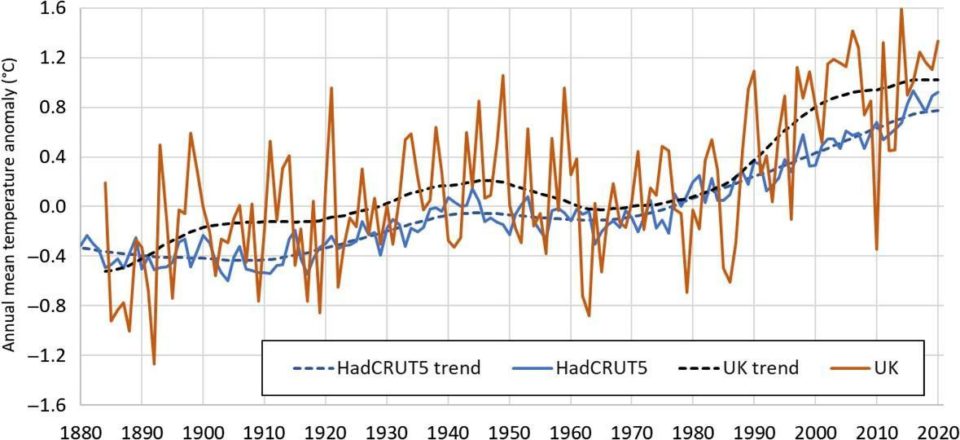
But how significant are these changes really? Take, for example, the claim that the UK’s temperatures have increased. Leaving aside the possibility that land-use change thanks to the UK’s economic development might influence temperatures, the report offers this chart depicting 140 years of anomalies in UK and global annual temperatures:

graph-1-960x440-1

Though the chart clearly shows that UK temperatures have risen, there is substantial year-to-year variability – far greater in the UK than for the world as a whole – that might make us wonder how impactful this extra warmth really is.

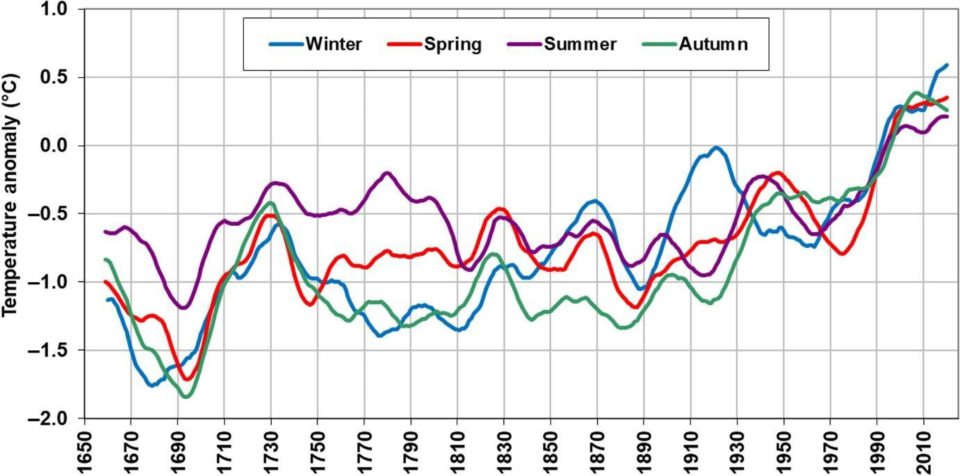
The point is shown more clearly by the report’s chart which shows temperature anomalies in each season:

graph-2-960x476-1

Over the past 370 years, winters appear to have become substantially warmer. Really what this means is that they have become substantially less cold, rather than actually warm. Autumn and spring also seem to have become milder, whereas the summer has warmed the least.

What’s more, each season shows remarkable changes over the decades and even centuries – showing large-scale change was occurring long before manmade climate change became an issue. The temperature changes of the 1990s are not unprecedented in their degree or speed.

Pile goes on to discuss the absence of facts for other claims regarding precipitation, storms, heatwaves. etc.  Then comes the meat of his argument.

casper-landfill-2-e1624827835334

Climate is Not the Problem:  It’s the so-called “solutions”

But the climate, again, is not the real issue here. An even more uncomfortable truth for environmentalists is that cheap, abundant and easy-to-use energy – ie, gas – has done and could continue to do far more to keep older and infirm people alive in the winter than milder weather ever could. In other words, fossil fuels save lives.

It is climate policy not climate change that wants to deny people the right to heat or cool their homes cheaply and efficiently. Just look at the exorbitant costs to households of Boris’s planned boiler ban. The weather itself does not play any significant role in daily life in historically wealthy, industrialised and liberal societies.

This fact is seen even more clearly in that other preoccupation of climate doomsayers: floods. The environmentalist argument is that warmer air carries more water, and so rainfall events have become more intense, leading to more flash flooding in particular. ‘The higher global warming, the more rainfall’, climate academic Friederike Otto told the Independent, in an article which tried to pin blame for the recent floods in Germany on climate change.

Floods certainly are disruptive. Unsurprisingly, this captures the news media’s attention. But proving a link to climate change is much harder than the media have made out. The most recent IPCC report, for instance, has ‘low confidence’ in the claim ‘that anthropogenic climate change has affected the frequency and the magnitude of floods’. Meanwhile, it has ‘high confidence’ that ‘streamflow trends since 1950 are not statistically significant in most of the world’s largest rivers’. Similarly, other research suggests that there is little evidence of flash floods getting worse in the UK.

What causes floods, then? In the recent case of the tragic floods in Germany, flood warnings were ignored by civil planners and politicians.

Floods in Britain are rarely fatal. But when horrendous flooding does occur, it should be seen as a result not of an altered climate, but of engineering, planning and policy failures. As the nearly three-centuries-long record in the Met Office’s possession clearly shows, various parts of the UK, from time to time, suffer periods of intense rainfall, causing floods. Any urban or infrastructure design that fails to take account of the likelihood of flooding makes flooding inevitable.

In other words, flooding is a manmade event – but not one caused by climate change. There is no such thing as a ‘natural disaster’ in a country as wealthy as the UK. Even if adverse weather events are made ‘more likely’ or even ‘more intense’ by CO2 emissions in the future, as the Met Office report argues, we already know what kind of policies and infrastructure we need to deal with this. There is no excuse for not building this infrastructure: warmer, wetter, colder and drier conditions all existed in the past, and so will likely appear again in the future. What’s past is prologue.

Ironically, it is environmentalism that makes the climate actually dangerous.

Green austerity will deny people the resources and technology they need and deserve to keep warm in winter and cool in summer. And it is environmentalism, with its promise to make the weather ‘safe’ and unchanging if we follow its agenda, that is selling us false hope. That is a much greater threat than climate change or extreme weather could ever be.

b45fee974eb5b959a6718fbac960afbc

See also my series World of Hurt from Climate Policies 

Climate Audit of the IPCC AR6 Hockey Stick

image

Stephen McIntyre has an interesting post today at his blog Climate Audit The IPCC AR6 Hockeystick  Excerpts in italics with my bolds.

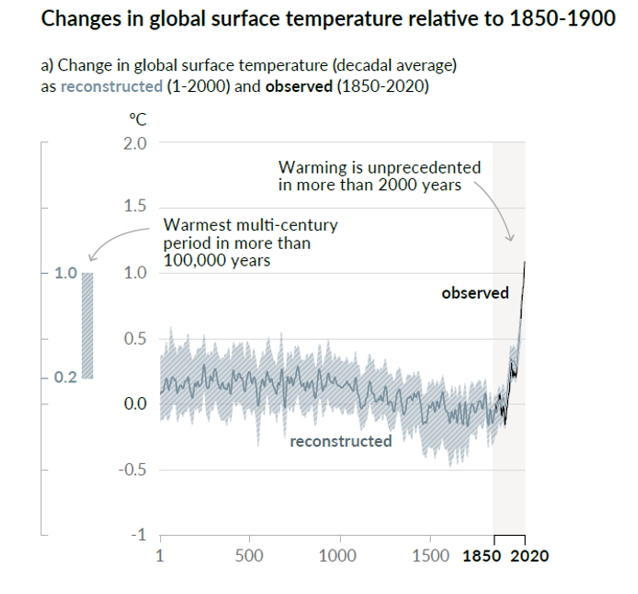
Although climate scientists keep telling us that defects in their “hockey stick” proxy reconstructions don’t matter – that it doesn’t matter whether they use data upside down, that it doesn’t matter if they cherry pick individual series depending on whether they go up in the 20th century, that it doesn’t matter if they discard series that don’t go the “right” way (“hide the decline”), that it doesn’t matter if they used contaminated data or stripbark bristlecones, that such errors don’t matter because the hockey stick itself doesn’t matter – the IPCC remains addicted to hockey sticks: lo and behold, Figure 1a of its newly minted Summary for Policy-makers contains what else – a hockey stick diagram. If you thought Michael Mann’s hockey stick was bad, imagine a woke hockey stick by woke climate scientists. As the climate scientists say, it’s even worse that we thought.

Curiously, this leading diagram of the Summary of Policy-Makers does not appear in the Report itself. (At least, I was unable to locate it in Chapter 2.) However, it is clearly the progeny of PAGES2K Consortium (Nature 2019) and Kaufman et al (2020), both of which I commented on briefly on Twitter (see here).

It’s hard to know where to begin.

The idea/definition of a temperature “proxy” is that it has some sort of linear or near-linear relationship to temperature with errors being white noise or low-order red noise. In other words, if you look at a panel of actual temperature “proxies”, you would expect to see series that look pretty similar and consistent.

But that’s not what you see with the data used by the IPCC. You’d never know this from the IPCC report or even from the cited articles, since authors of these one- and two-millennium temperature reconstructions scrupulously avoid plotting any of the underlying data. It’s hard for readers unfamiliar with the topic to fully appreciate the extreme inconsistency of underlying “proxy” data, given the faux precision of the IPCC diagram.

Many of the series discussed in this post, including nearly all of any HS-shaped series, have been previously discussed in Climate Audit blog posts (tag/pages2k) from 2, 5, 10 or even 15 years ago or in tweets from 2019 and 2020 (see here).

This post will be a work in progress for a few days, as I have some sections on special issues that I will try to add as I have time.CPS (to my knowledge) in all prior reconstructions by non-woke authors is an average of scaled data that has been oriented ex ante by known properties of the proxy. I.e. it won’t flip over an alkenone temperature estimate simply because it goes the wrong way. But this salutary property is not maintained in Neukom’s bastardized implementation of CPS – a bastardization that ought to have been resisted by reviewers somewhere along the line. PAGES2K produced temperature reconstructions by seven different methods, all of which yielded somewhat similar results to CPS – strongly suggesting that these other methods also flip series like Cape Ghir.

It’s not as though PAGES2K made a composite from 257 series that are two millennia long, all or a majority having a HS shape. One series in this sample does look a lot like the IPCC stick and will be discussed at length below, but the others look very different.

Four of the series in the sample are very short – three of them are actually shorter than the instrumental record. These are all coral Sr or coral d18O series, which make up 25% of the PAGES2019 data set. The extremely short records illustrated above are typical, indeed almost universal, in this class of proxy. They do have a pronounced trend in the instrumental period. This contrasts with the lack of trend that one sees in the two long proxies in the middle column above – a tree ring series from Mt Read, Tasmania (also used in MBH98) and a 1983 ice core series by Fisher from Devon Ice Cap on Baffin Island (also available to 1990s vintage multiproxy studies).

The short coral series do not contribute information to the medieval and earlier periods which one is trying to compare to the modern period. So what is their function? Do they contribute anything other than painting a moustache on the non-descript longer series?

The tree ring series in this sample are rather short; the screening procedures have somewhat concentrated series with slight upticks. (The stripbark bristlecone chronologies that were so prominent in the Mann et al Hockey Stick continue to be used in PAGES2019 – as discussed below.) I discussed the series in the left column with large uptick (Asi_MUSPIG aka paki033) in a 2019 tweet thread here. I located the underlying ring width measurements at NOAA and re-calculated the tree ring “chronology” using standard methodology – see below. The high-frequency details match, showing that the underlying measurement data is apples-to-apples. No chronology from original authors is archived at NOAA: so how did PAGES2K manage to get such a hockey stick? I have no idea.

The most “interesting” series in this sample batch is the borehole temperature reconstruction that has such an uncanny resemblance to the eventual IPCC reconstruction. By coincidence (or not), I wrote about this borehole temperature reconstruction (from WAIS Divide, Antarctica) in February 2019, a few months before publication of PAGES 2019 – see here – scroll down – for a more thorough analysis.

I’ve written multiple posts on the mathematics of borehole inversion calculations, which purport to estimate temperatures for thousands of years into the past from modern day temperatures measured downhole. These calculations require the inversion of a multicollinear matrix (with determinant close to 0). As far as I’m concerned, nearly all the details that specialists pontificate about are a sort of Chladni pattern artifact.

But that’s another story. Here the problem was much stranger. A few years earlier, I had (circuitously) managed to obtain a copy of the code used to calculate this borehole inversion (which is not archived anywhere.) The code showed that they had deleted the top 15 meters of the core from their calculation.

I’ve had a LOT of trouble getting the underlying borehole temperatures for some famous series. (The 2006 NAS panel cited one such result, but the original author (a US government employee) refused to make the data available, and, to my knowledge, it remains unavailable.) However, in this case, the underlying downhole temperatures had been archived, including the values had been deleted. Needless to say, they went down. An inversion using all the data would not have resulted in the impressive Hockey Stick in the PAGES2019 dataset, but a substantial recent decline.

Note that the blade on the hockey stick in this IPCC series is entirely dependent on the choice of 15 meters as a cutoff point for the borehole inversion. A choice of 20 meters would have probably eliminated the blade altogether.

The fact that the top portion of the core has to be excluded because of seasonal effects also creates a strange irony: the layers at 15 meters at WAIS date back to the 1960s. So IPCC has ended up relying on a series that purports to reconstruct temperature up to 2007, but without using any of the ice core dating from ~1965 to 2007. The calculation is entirely done from ice core layers dated prior to the 1960s. Does this seem reliable to any of you? Doesn’t to me.

Furthermore, the WAIS Divide borehole temperature reconstruction yields a totally different result than the widely replicated and well understood d18O isotope series.

Given the questions and defects surrounding the WAIS borehole inversion series, it is absurd that this series (a singleton, to boot) should be used in a policy-relevant document. That the final IPCC diagram is so similar to this garbage series also makes one wonder about what is happening under the hood of the multivariate calculations.

A Third Batch: PAGES2019 North American Tree Rings

North American tree rings (including some Arctic series) make up ~25% of PAGES2019 proxies. Here’s a random sample.The majority are short and rather non-descript – nothing like the final IPCC diagram.

There are one series with an enormous hockey stick: Mackenzie Delta (Porter 2013); and two series (“GB [Great Basin]” and nv512) with noticeable closing upticks. Sharp-eyed readers may have already figured out some of this story.

I discussed the Mackenzie Delta super-stick of Porter et al (2013), a new entry to hockey stick fabrication technology, in July 2019 here on Twitter. It comes from Yukon, Canada, an area that, in a 2004 study by d’Arrigo et al, had been a type location for the classic “divergence problem” – ring widths going down, while temperatures went up. So how did Porter et al manage to get a super-stick that had eluded Jacoby and d’Arrigo, long-time searchers for hockey sticks in tree ring data and not shy about picking cherries in order to make cherry pie?

They took “hide the decline” to extremes that had never been contemplated by prior practitioners of this dark art. Rather than hiding the decline in the final product, they did so for individual trees: as explained in the underlying article, they excluded the “divergent portions” of individual trees that had temerity to have decreasing growth in recent years. Even Briffa would never have contemplated such woke radical measures.

Stripbark Bristlecone Chronologies

As noted above, sharp-eyed readers may recall the identifier nv512. It is one of the classic Graybill stripbark bristlecone chronologies (Pearl Peak), which we had observed to dominate both the MBH98 PC1 and the final MBH98 reconstruction. It (and other key stripbark sites) was listed in McIntyre and McKitrick (2005 GRL) Table 1:

Readers will also recall that the 2006 NAS Panel recommended that “stripbark” chronologies be “avoided” in temperature reconstructions. Although the climate community has professed to implement the recommendations of the NAS Panel, they are addicted to stripbark chronologies, the properties of which are well known. Five different PAGES2019 series use stripbark bristlecones (three from original Graybill versions): nv512 (Pearl Peak); nv513 (Mount Washington); ca529 (Timber Gap Upper); SFP (an update of San Francisco Peaks, incorporating az510) and GB (a composite of Pearl Peak, Mount Washington and Sheep Mountain, using both Graybill and updated information).

In 2018, I looked at how North American tree ring networks had changed since MBH98. The one constant was the addiction of paleoclimatologists to stripbark chronologies– a phenomenon that I had commented on long before Climategate (citing Clapton et al and Paeffgen et al), much to the annoyance of dendros, but the comment remains as true now as it was then.

Conclusion

I discussed many of these problems in July 2019, within a couple of days of publication of the underlying article (see here). While I don’t necessarily expect IPCC reviewers to be paying rapt attention to my twitter feed, one surely presumes that IPCC climate scientists, who are employed full time on these topics, to be competent enough to notice things that I was able to observe in my first day or so of looking at PAGES2019. But their obtuseness never ceases to amaze.

Wokeness Worms Eating Science Academies

J. Scott Turner writes at American Mind The Brainworms Come For Big Science.  Excerpts in italics with my bolds.

pri_80176924
The parasite leucochloridium paradoxum, shown here infecting a snail, is a flatworm that takes over the brains of gastropods and forces them into self-destructive behaviors. As this essay demonstrates, woke social teaching has been known to do the same with academic departments.

Woke grievance is eating expert inquiry from the inside out.

A large gathering of scientists and engineers was brought together by the National Science Foundation (NSF). We were there to compete for a very large sum of money.

At stake was funding for a “research center,” something akin to national laboratories like Brookhaven Labs or Livermore Labs. Research centers are built around a strategic theme, like nuclear physics, and are intended to provide a venue for scientists nationwide to come together to explore that theme. Research centers are high-stakes competitions, involving tens of millions of dollars doled out over a term of ten years or so. The prizes are big, and the prestige immense. They are intended to go to the best of the best.

If a team is awarded a planning grant, the next step is a “planning meeting,” where the NSF gathers the successful teams together to provide detailed guidance on what might make for a successful proposal. I was on one of those teams, and that is how I came to be in that hotel ballroom.

At the opening session, we were told that proposals would be judged on four “foundational components,” or “pillars,” as they were styled in the PowerPoints. A successful proposal would be strong on all four: weakness in one would cast the proposal into the abyss, we were told, no matter how strong the other pillars might be. At the planning meeting, each pillar was to have a dedicated panel discussion, just to make clear to us what the NSF’s expectations were. Three of the four pillars were conventionally scientific and academic: innovation, training, etc. The remaining pillar was “Diversity and Culture of Inclusion” (DCI).

That was where things took a bizarre turn.

The DCI panel consisted of bureaucrats from the NSF’s Office of Diversity and Inclusion (ODI). Naturally, there were many questions from the floor about what the criteria for a strong DCI pillar would be. We are talking about engineers, remember, whose culture is: “give us ‘the specs’ and we will solve any problem.” The assembled engineers were looking for “the specs” they needed to build that DCI pillar.

I remember the scene. Each team was seated at its own round table on the ballroom floor. The DCI panel was seated on a raised platform, looking down on us, as from thrones on high. 

One engineer at a neighboring table kept trying to pin the DCI panel down on those DCI specs. They kept deflecting the question. We’ll know it when we see it, was the blithe answer, issued with the monotonous imperiousness of the entitled ruler indulging inconvenient questioning from the proles. Engineering is too white and too male, was one panelist’s message to us, and that needed to be corrected. Irony alert: the engineer pressing the point was not white, but an Indian immigrant.

It became clearer with every question that the specs not only would not be laid out: they would in any event change according to inscrutable whim of the ODI bureaucrats. Foolish engineers, one might imagine Jabba chortling, the “specs” are not to help you solve a problem: they are there to keep you off-balance, uncertain, and in my power. It is enough for you to know you depend upon my mercy for funding.

How the Parasite Takes Over

All are familiar with the Left’s “long march” through the institutions. What might not be so well known is just how thorough the conquest has been. Evidence of this sometimes pops up into prominent public view, as in the recent exposure of “critical race theory” training in federal agencies (including places like Sandia National Labs, where one would expect such hokum to be laughed out the door). Such incidents, though quite frequent, are only the tips of a very large iceberg.

In the academic sciences, where I have spent my career, “diversity, inclusion, and equity” (DIE) has become as pervasive as one might expect it to be in any grievance studies department.

How did this happen? More to the point, how could it happen to the supposedly sensible people that scientists are generally thought to be?

The concept of “zombie parasites” provides an apt metaphor for how things got to this point. These are parasites that colonize the brains and nervous systems of their hosts, taking the controls, so to speak, over the host’s behavior. One striking example of a zombie parasite is a worm that infects the brains of snails, which normally crawl around stealthily at night. A snail infected with the parasite crawls out onto a grass stalk during the day, where it is now visible to birds that gobble them up. The parasite then breeds in the bird’s digestive tract and deposits its eggs in the bird’s feces. When uninfected snails eat the feces, the parasite’s life cycle is completed.

DIE has spread into the academic sciences as a kind of zombie parasite. It is not a real worm at work, of course, but a metaphorical “brainworm”—three of them, in fact, that together spread a kind of altered cognitive reality through any institution that is infected by them.

The route of infection usually starts with a “study” that identifies a “problem” that no one knew existed: the overwhelming whiteness of, say, fishery science. Once an unwitting host takes the bait, the next phase of the infection kicks in: all are invited to contemplate with horror the dark future that awaits should fishery scientists not take immediate steps to correct the “problem.” In the final stage of the infection, the brainworm plants its “diversity is our strength” meme in the host’s nervous system. The infected now babble about solving the impending crisis through a crash outreach program to “under-represented” or “marginalized” groups, who, by virtue of their class membership, think differently about fisheries, and so can save the field from stultifying white maleness.

As in those parasitized snails, the DIE brainworm induces a cognitive disconnect in the infected. None of the assertions planted by the DIE zombie parasite have a sound basis in fact or reason. The accusation of too much whiteness usually is based upon a simple observation that the ethnic, gender, and sexual orientation mix in, say, fishery science, departs from the statistical distributions found in the general population. Why this should be, where it is considered at all, is usually buried under a panoply of repetitive charts and diagrams of dubious critical value.

What makes the DIE brainworm a zombie parasite is how it hijacks the host’s behavior to facilitate its spread, to the host’s ultimate detriment. Universities, where future scientists are trained, are a common target. Incubating a future scientist has traditionally involved a very close relationship between a professor and a student (“mentor” and “mentee,” in today’s clumsy parlance).

Fishery scientists, to trot them out again, become fishery scientists because, well, they love fish. They want to devote their lives to getting to know fish better. The same may be said of nearly every scientific endeavor in academia: at the vital core is a love that can verge into obsession. The genius of the academy is that it provides a place where that love can give value to the society that supports it. Disrupt that elemental drive, and you degrade the real social value of the sciences.

This almost primitive love provides a kind of immunity to the DIE brainworm, which makes it a particular target. To spread, the parasite must plant the idea that the familial network of relationships cloaks a hostile and dangerous climate, propped up by cronyism, privilege, racism, sexism, and hostility to the non-binary. The only way to make science “safe” for the marginalized, or excluded, or under-represented, is to disrupt the traditional mentoring family. Students and new faculty who are members of “under-represented” or “marginalized” groups are drawn from their intellectual families into self-referential bubbles of grievance: support groups, safe spaces, counseling services, etc., where the normal stresses of academic life can be transformed into evidence of the hostile climate without.

At some point, earnest administrators, who know nothing about science and understand even less how it works, are brought in to “listen” to the newly aggrieved. At that point, discontent is turned into actionable grievance: committees and study groups are appointed, action plans formulated. Excluded from all this, of course, are the keepers of the academic traditions which, inconveniently for them, have already been condemned in absentia as the problem.

Pressure is brought on these erstwhile traditionalists to conform, to “listen” to other voices, to “check your privilege,” to be “open” to different “perspectives.” If the brainworm has spread far enough to implant a DIE bureaucracy on campus, penalties for non-conformity will be quietly placed in a corner of the room, a visible reminder of the consequences of resistance to the brainworm. Once that happens, the path is open for the entire academic institution to become infected, triggering the next, and most dangerous, stage of the infection.

Follow the Money

Parasites do not simply invade a host: they require fertile ground and food. For the DIE brainworm, the mother’s milk is money. And it is the academic sciences, not the humanities, where the ground is lushest. Compare two sources of federal funds that are often tied to woke ideology on campuses: the National Endowment for the Arts (NEA) and the National Endowment for the Humanities (NEH). These are NSF-style agencies that fund academic work in the arts and humanities, and in similar ways. Artists and scholars submit proposals, these are scrutinized by peers, and funds are doled out to the successful proposals.

How much money? The NEA presently enjoys an annual appropriation of about $150 million. For the NEH, it is about $160 million. In contrast, the federal money directed to academic science in 2017 stood at around $40 billion: 250 times more. Over the course of the 50 years of its existence, the NEH has funded a cumulative total of roughly $4.7 billion dollars in grants. The cumulative tally of federal support of academic research over the same time span has been nearly $900 billion: about 200 times more.

It is to the sciences, then, that the DIE brainworm has gone to feed, and there it has spread as if it were an epidemic. Evidence for this can be ferreted out from the NSF’s searchable databases of its grant awards, by searching for keywords such as “under-represented,” “minority,” or “marginalized” in the grant documents. Prior to 2010, no award carried these keywords. The first to do so was in 2010, when the NSF awarded a large research center grant to MIT, which contained within it a significant program of outreach to marginalized groups.

Since that year, NSF expenditures on research grants containing the “woke” keywords have risen exponentially, doubling at a rate of about 50% each year, just as a novel virus would when spreading through a new population. In 2018, the last year for which a complete picture can be discerned, the NSF funded nearly a thousand research grants devoted in whole or part to DIE aims, to the tune of more than $1.3 billion. From 2010 to 2018, a total of more than $4 billion have been awarded to more than 2,200 DIE-oriented grants.

Which is how we get to that scene in the Arlington hotel ballroom, where DIE now holds the trump card in deciding what science is worthy of funding. No matter how stellar the science, the message is clear: gobble up the DIE brainworm, or your funding will dry up, and your career along with it.

Footnote:  The DIE acronym reminded me of this poem by e.e. cummings
nobody loses all the time

i had an uncle named
Sol who was a born failure and
nearly everybody said he should have gone
into vaudeville perhaps because my Uncle Sol could
sing McCann He Was A Diver on Xmas Eve like Hell Itself which
may or may not account for the fact that my Uncle

Sol indulged in that possibly most inexcusable
of all to use a highfalootin phrase
luxuries that is or to
wit farming and be
it needlessly
added

my Uncle Sol’s farm
failed because the chickens
ate the vegetables so
my Uncle Sol had a
chicken farm till the
skunks ate the chickens when

my Uncle Sol
had a skunk farm but
the skunks caught cold and
died and so
my Uncle Sol imitated the
skunks in a subtle manner

or by drowning himself in the watertank
but somebody who’d given my Uncle Sol a Victor
Victrola and records while he lived presented to
him upon the auspicious occasion of his decease a
scruptious not to mention splendiferous funeral with
tall boys in black gloves and flowers and everything and
i remember we all cried like the Missouri
when my Uncle Sol’s coffin lurched because
somebody pressed a button
(and down went
my Uncle
Sol

and started a worm farm)