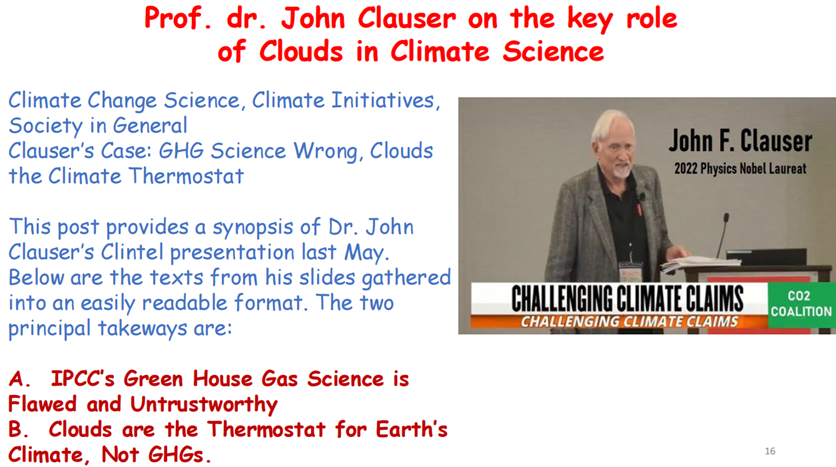
Good Reasons to Distrust Climatists
The most recent case of climatists’ bad behavior is the retraction of a peer-reviewed paper analyzing the properties of CO2 as an IR active gas, concluding that additional levels of atmospheric CO2 will have negligible effect on temperatures. From the Daily Sceptic:
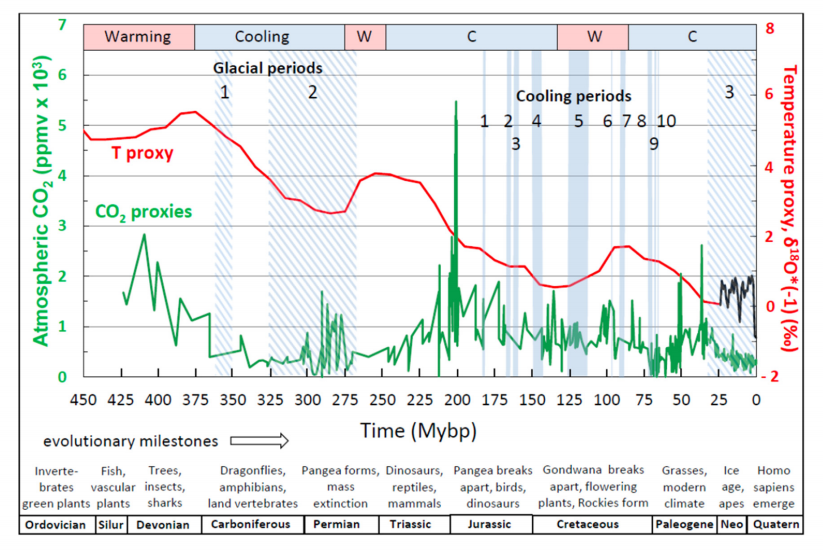
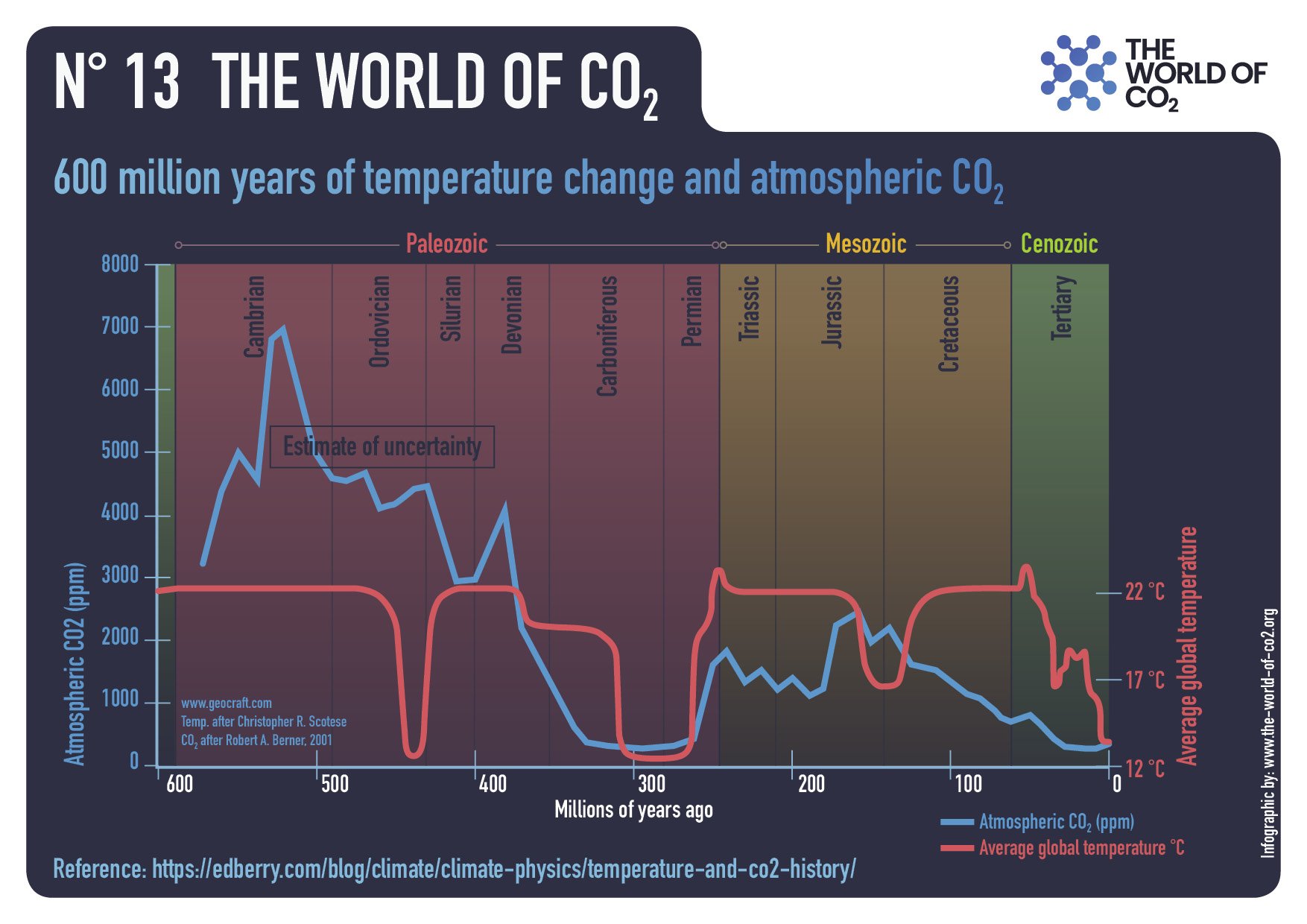
Another important paper taking issue with the ‘settled’ climate narrative has been cancelled following a report in the Daily Sceptic and subsequent reposts that went viral across social media. The paper discussed the atmospheric ‘saturation’ of greenhouse gases such as carbon dioxide and argued that higher levels will not cause temperatures to rise. The work was led by the widely-published Polish scientist Dr. Jan Kubicki and appeared on Elsevier’s ScienceDirect website in December 2023. The paper has been widely discussed on social media since April 2024 when the Daily Sceptic reported on the findings. Interest is growing in the saturation hypothesis not least because it provides a coherent explanation for why life and the biosphere grew and often thrived for 600 million years despite much higher atmospheric levels of greenhouse gases. Alas for control freaks, it also destroys the science backing for the Net Zero fantasy.
Below are some comments responding to a Quora question, text in italics with my bolds and added images:
What are some reasons why some people do not believe in climate change or global warming despite scientific evidence? Is there any additional information that could help us understand their perspective?
Answer from Mike Jonas, M.A. in Mathematics, Oxford University, UK,
Good scientists do not lie and cheat to protect their science, they are happy to discuss their evidence and their findings, and they always understand that everything needs to be replicable and verifiable.
When Climategate erupted on the scene, and the climate scientists behind the man-made global warming narrative were found to have lied and cheated, all honest scientists thought that would be the end of it. Instead, what happened was that those climate scientists closed ranks and carried on, supported by a massive amount of government (ie, the public’s) money. One of the first things they did was to deflect Climategate by saying the emails involved had been hacked so should be ignored, but some of the people involved confirmed that all of the emails really were genuine.

It has been about 15 years since Climategate, and study after study has shown virtually all of the components of the man-made global warming narrative to be incorrect, even that none of the computer models used by the IPCC are fit for purpose,
And yet they maintained their closed ranks,
and the government money kept pouring in.
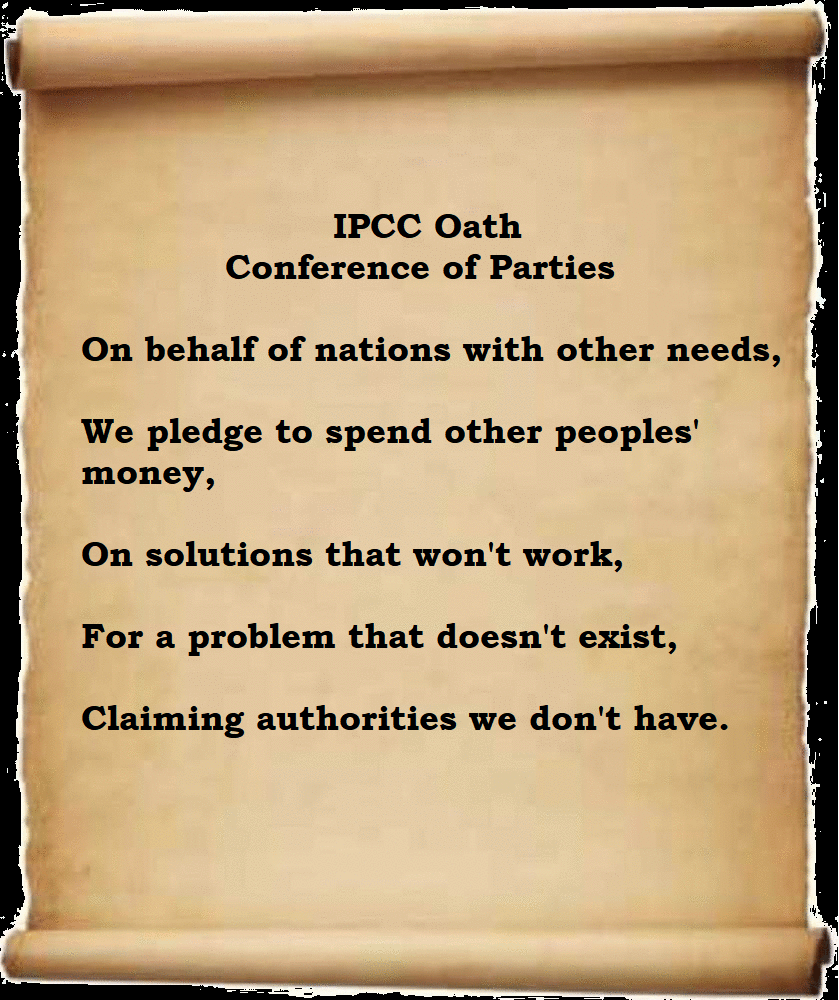
Did you know that the IPCC does not do any research (please do check that, on their web page About – IPCC they state “The IPCC does not conduct its own research”). It is, as its name says, an inter-governmental organisation, and it is run by and for governments. They say lots of persuasive sciency things, but the simple fact is that they cherry-pick and corrupt the science to achieve their ends. Regrettably, almost all the scientific societies are on the gravy train too. This is part of what the highly respected physicist Professor Hal Lewis said in his resignation letter to the American Physical Society (APS):
It is of course, the global warming scam, with the (literally) trillions of dollars driving it, that has corrupted so many scientists, and has carried APS before it like a rogue wave. It is the greatest and most successful pseudoscientific fraud I have seen in my long life as a physicist. Anyone who has the faintest doubt that this is so should force himself to read the ClimateGate documents, which lay it bare.
I don’t believe that any real physicist, nay scientist, can read that stuff without revulsion. I would almost make that revulsion a definition of the word scientist.
So what has the APS, as an organization, done in the face of this challenge?
It has accepted the corruption as the norm, and gone along with it.
If you want to find out more about this “greatest and most successful pseudoscientific fraud”, the website Watts Up With That? is a good place to start (the fraudsters absolutely hate it), and it links to many other good websites. It has the full text of Hal Lewis’ resignation letter at:
Answer from Susannah Moyer
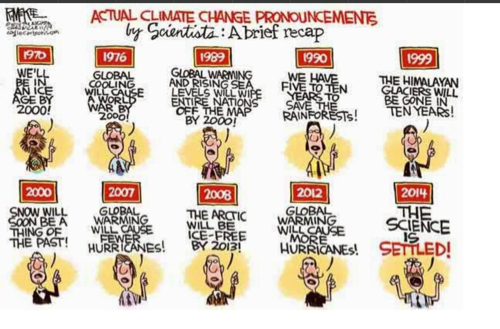
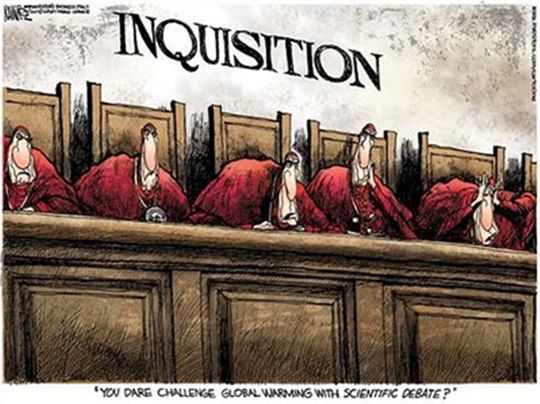
It’s curious that climate science is the rare scientific field where dissenting scientists, those with contrarian views, are unwelcome and even ostracized.
There are some well known climate scientists that have doubts about the role of CO2 and man made global warming as it pertains to global temperature. They have raised the issue that computer generated prediction models have been inaccurate in predicting temperature patterns because the modeling requires assumptions that have not been shown to be accurate.
Here is a contrarian view from climate scientists who have published climate research results in Nature, which is no small feat:
McNider and Christy are professors of atmospheric science at the University of Alabama in Huntsville and fellows of the American Meteorological Society. Mr. Christy was a member of the Intergovernmental Panel on Climate Change that shared the 2007 Nobel Peace Prize with former Vice President Al Gore.
It is not a known fact by how much the Earth’s atmosphere will warm in response to this added carbon dioxide. The warming numbers most commonly advanced are created by climate computer models built almost entirely by scientists who believe in catastrophic global warming. The rate of warming forecast by these models depends on many assumptions and engineering to replicate a complex world in tractable terms, such as how water vapor and clouds will react to the direct heat added by carbon dioxide or the rate of heat uptake, or absorption, by the oceans.
We might forgive these modelers if their forecasts had not been so consistently and spectacularly wrong. From the beginning of climate modeling in the 1980s, these forecasts have, on average, always overstated the degree to which the Earth is warming compared with what we see in the real climate.
For instance, in 1994 we published an article in the journal Nature showing that the actual global temperature trend was “one-quarter of the magnitude of climate model results.” As the nearby graph shows, the disparity between the predicted temperature increases and real-world evidence has only grown in the past 20 years.
“Consensus” science that ignores reality can have tragic consequences if cures are ignored or promising research is abandoned. The climate-change consensus is not endangering lives, but the way it imperils economic growth and warps government policy making has made the future considerably bleaker. The recent Obama administration announcement that it would not provide aid for fossil-fuel energy in developing countries, thereby consigning millions of people to energy poverty, is all too reminiscent of the Sick and Health Board denying fresh fruit to dying British sailors.
Another questioner, Dr. Koonin was undersecretary for science in the Energy Department during President Barack Obama’s first term and is currently director of the Center for Urban Science and Progress at New York University. His previous positions include professor of theoretical physics and provost at Caltech, as well as chief scientist of BP, where his work focused on renewable and low-carbon energy technologies.
But—here’s the catch—those questions are the hardest ones to answer. They challenge, in a fundamental way, what science can tell us about future climates.
Firstly, even though human influences could have serious consequences for the climate, they are physically small in relation to the climate system as a whole. For example, human additions to carbon dioxide in the atmosphere by the middle of the 21st century are expected to directly shift the atmosphere’s natural greenhouse effect by only 1% to 2%. Since the climate system is highly variable on its own, that smallness sets a very high bar for confidently projecting the consequences of human influences.

A second challenge to “knowing” future climate is today’s poor understanding of the oceans. The oceans, which change over decades and centuries, hold most of the climate’s heat and strongly influence the atmosphere. Unfortunately, precise, comprehensive observations of the oceans are available only for the past few decades; the reliable record is still far too short to adequately understand how the oceans will change and how that will affect climate.

A third fundamental challenge arises from feedbacks that can dramatically amplify or mute the climate’s response to human and natural influences. One important feedback, which is thought to approximately double the direct heating effect of carbon dioxide, involves water vapor, clouds and temperature.
Climate Science Is Not Settled
Another group questioning what some consider “settled science”:
- Claude Allegre, former director of the Institute for the Study of the Earth, University of Paris;
- J. Scott Armstrong, cofounder of the Journal of Forecasting and the International Journal of Forecasting;
- Jan Breslow, head of the Laboratory of Biochemical Genetics and Metabolism, Rockefeller University;
- Roger Cohen, fellow, American Physical Society;
- Edward David, member, National Academy of Engineering and National Academy of Sciences;
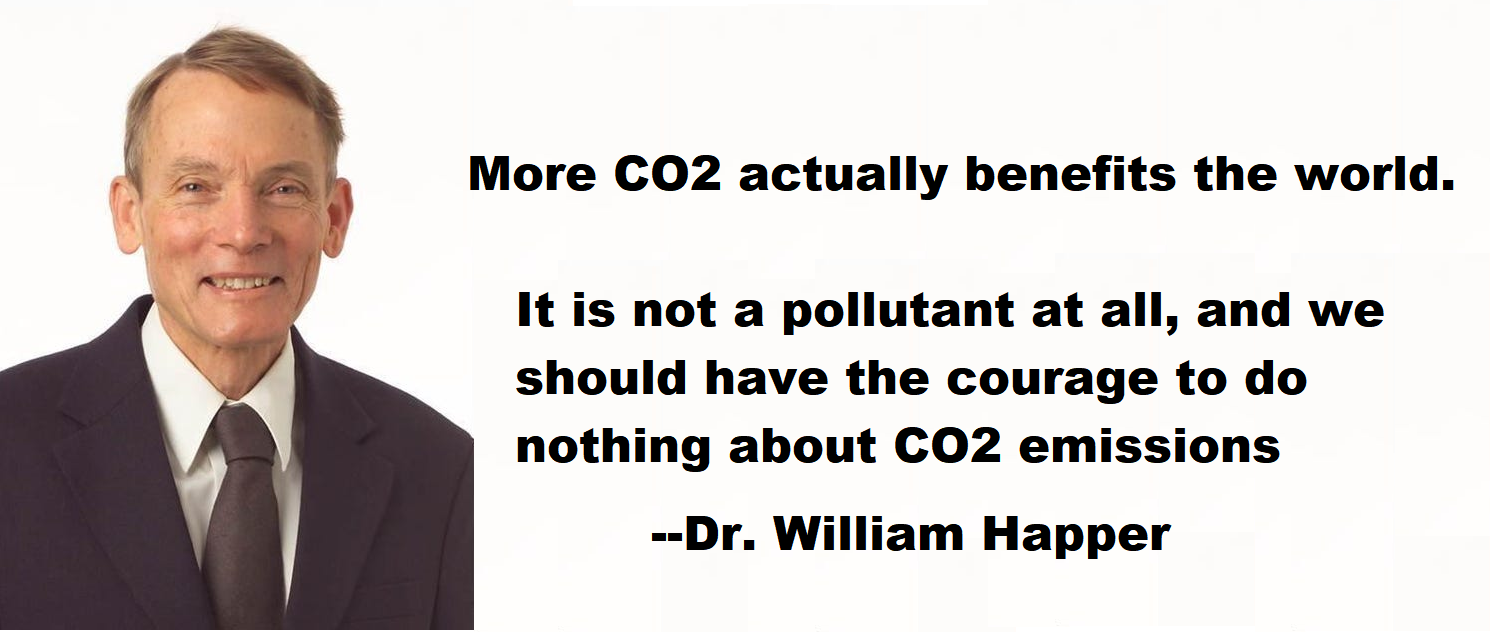
- William Happer, professor of physics, Princeton;
- Michael Kelly, professor of technology, University of Cambridge, U.K.;
- William Kininmonth, former head of climate research at the Australian Bureau of Meteorology;
- Richard Lindzen, professor of atmospheric sciences, MIT;
- James McGrath, professor of chemistry, Virginia Technical University;
- Rodney Nichols, former president and CEO of the New York Academy of Sciences;
- Burt Rutan, aerospace engineer, designer of Voyager and SpaceShipOne;
- Harrison H. Schmitt, Apollo 17 astronaut and former U.S. senator;
- Nir Shaviv, professor of astrophysics, Hebrew University, Jerusalem;
- Henk Tennekes, former director, Royal Dutch Meteorological Service;
- Antonio Zichichi, president of the World Federation of Scientists, Geneva.
Although the number of publicly dissenting scientists is growing, many young scientists furtively say that while they also have serious doubts about the global-warming message, they are afraid to speak up for fear of not being promoted—or worse. They have good reason to worry. In 2003, Dr. Chris de Freitas, the editor of the journal Climate Research, dared to publish a peer-reviewed article with the politically incorrect (but factually correct) conclusion that the recent warming is not unusual in the context of climate changes over the past thousand years. The international warming establishment quickly mounted a determined campaign to have Dr. de Freitas removed from his editorial job and fired from his university position. Fortunately, Dr. de Freitas was able to keep his university job.
This is not the way science is supposed to work, but we have seen it before—for example, in the frightening period when Trofim Lysenko hijacked biology in the Soviet Union. Soviet biologists who revealed that they believed in genes, which Lysenko maintained were a bourgeois fiction, were fired from their jobs. Many were sent to the gulag and some were condemned to death.
Why is there so much passion about global warming, and why has the issue become so vexing that the American Physical Society (APS), from which Dr. Giaever resigned a few months ago, refused the seemingly reasonable request by many of its members to remove the word “incontrovertible” from its description of a scientific issue?
There are several reasons, but a good place to start is the old question
“cui bono?” Or the modern update, “Follow the money.”
Happer: Cloud Radiation Matters, CO2 Not So Much (2025)
This month van Wijngaarden and Happer published a new paper Radiation Transport in Clouds.
Last year William Happer spoke on Radiation Transfer in Clouds at the EIKE conference, and the video is above. For those preferring to read, below is a transcript from the closed captions along with some key exhibits. I left out the most technical section in the latter part of the presentation. Text in italics with my bolds.
William Happer: Radiation Transfer in Clouds
People have been looking at Clouds for a very long time in in a quantitative way. This is one of the first quantitative studies done about 1800. And this is John Leslie, a Scottish physicist who built this gadget. He called it an Aethrioscope, but basically it was designed to figure out how effective the sky was in causing Frost. If you live in Scotland you worry about Frost. So it consisted of two glass bulbs with a very thin capillary attachment between them. And there was a little column of alcohol here.
The bulbs were full of air, and so if one bulb got a little bit warmer it would force the alcohol up through the capillary. If this one got colder it would suck the alcohol up. So he set this device out under the clear sky. And he described that the sensibility of the instrument is very striking. For the liquor incessantly falls and rises in the stem with every passing cloud. in fine weather the aethrioscope will seldom indicate a frigorific impression of less than 30 or more than 80 millesimal degrees. He’s talking about how high this column of alcohol would go up and down if the sky became overclouded. it may be reduced to as low as 15 refers to how much the sky cools or even five degrees when the congregated vapours hover over the hilly tracks. We don’t speak English that way anymore but I I love it.
The point was that even in 1800 Leslie and his colleagues knew very well that clouds have an enormous effect on the cooling of the earth. And of course anyone who has a garden knows that if you have a clear calm night you’re likely to get Frost and lose your crops. So this was a quantitative study of that.
Now it’s important to remember that if you go out today the atmosphere is full of two types of radiation. There’s sunlight which you can see and then there is the thermal radiation that’s generated by greenhouse gases, by clouds and by the surface of the Earth. You can’t see thermal radiation but you you can feel it if it’s intense enough by its warming effect. And these curves practically don’t overlap so we’re really dealing with two completely different types of radiation.
There’s sunlight which scatters very nicely and off of not only clouds but molecules; it’s the blue sky the Rayleigh scattering. Then there’s the thermal radiation which actually doesn’t scatter at all on molecules so greenhouse gases are very good at absorbing thermal radiation but they don’t scatter it. But clouds scatter thermal radiation and plotted here is the probability that you will find Photon of sunlight between you know log of its wavelength and the log of in this interval of the wavelength scale.
Since Leslie’s day two types of instruments have been developed to do what he did more precisely. One of them is called a pyranometer and this is designed to measure sunlight coming down onto the Earth on a day like this. So you put this instrument out there and it would read the flux of sunlight coming down. It’s designed to see sunlight coming in every direction so it doesn’t matter which angle the sun is shining; it’s uh calibrated to see them all.
Let me show you a measurement by a pyranometer. This is a actually a curve from a sales brochure of a company that will sell you one of these devices. It’s comparing two types of detectors and as you can see they’re very good you can hardly tell the difference. The point is that if you look on a clear day with no clouds you see sunlight beginning to increase at dawn it peaks at noon and it goes down to zero and there’s no sunlight at night. So half of the day over most of the Earth there’s no sunlight in the in the atmosphere.
Here’s a day with clouds, it’s just a few days later shown by days of the year going across. You can see every time a cloud goes by the intensity hitting the ground goes down. With a little clear sky it goes up, then down up and so on. On average at this particular day you get a lot less sunlight than you did on the clear day.
But you know nature is surprising. Einstein had this wonderful quote: God is subtle but he’s not malicious. He meant that nature does all of sorts of things you don’t expect, and so let me show you what happens on a partly cloudy day. Here so this is data taken near Munich. The blue curve is the measurement and the red curve is is the intensity on the ground if there were no clouds. This is a partly cloudy day and you can see there are brief periods when the sunlight is much brighter on the detector on a cloudy day than it is on the clear day. And that’s because coming through clouds you get focusing from the edges of the cloud pointing down toward your detector. That means somewhere else there’s less radiation reaching the ground. But this is rather surprising to most people. I was very surprised to learn about it but it just shows that the actual details of climate are a lot more subtle than you might think.
We know that visible light only happens during the daytime and stops at night. There’s a second type of important radiation which is the thermal radiation which is measured by a similar device. You have a silicon window that passes infrared, which is below the band gap of silicon, so it passes through it as though transparent. Then there’s some interference filters here to give you further discrimination against sunlight. So sunlight practically doesn’t go through this at all, so they call it solar solar blind since it doesn’t see the Sun.
But it sees thermal radiation very clearly with a big difference between this device and the sunlight sensing device I showed you. Because actually most of the time this is radiating up not down. Out in the open air this detector normally gets colder than the body of the instrument. And so it’s carefully calibrated for you to compare the balance of down coming radiation with the upcoming radiation. Upcoming is normally greater than down coming.
I’ll show you some measurements of the downwelling flux here; these are actually in Greenland in Thule and these are are watts per square meter on the vertical axis here. The first thing to notice is that the radiation continues day and night you can you if you look at the output of the pyrgeometer you can’t tell whether it’s day or night because the atmosphere is just as bright at night as it is during the day. However, the big difference is clouds: on a cloudy day you get a lot more downwelling radiation than you do on a clear day. Here’s a a near a full day of clear weather there’s another several days of clear weather. Then suddenly it gets cloudy. Radiation rises because the bottoms of the clouds are relatively warm at least compared to the clear sky. I think if you put the numbers In, this cloud bottom is around 5° Centigrade so it was fairly low Cloud. it was summertime in Greenland and this compares to about minus 5° for the clear sky.
So there’s a lot of data out there and there really is downwelling radiation there no no question about that you measure it routinely. And now you can do the same thing looking down from satellites so this is a picture that I downloaded a few weeks ago to get ready for this talk from Princeton and it was from Princeton at 6 PM so it was already dark in Europe. So this is a picture of the Earth from a geosynchronous satellite that’s parked over Ecuador. You are looking down on the Western Hemisphere and this is a filtered image of the Earth in Blue Light at 47 micrometers. So it’s a nice blue color not so different from the sky and it’s dark where the sun has set. There’s still a fair amount of sunlight over the United States and the further west.
Here is exactly the same time and from the same satellite the infrared radiation coming up at 10.3 which is right in the middle of the infrared window where there’s not much Greenhouse gas absorption; there’s a little bit from water vapor but very little, trivial from CO2.
As you can see, you can’t tell which side is night and which side is day. So even though the sun has set over here it is still glowing nice and bright. There’s sort of a pesky difference here because what you’re looking at here is reflected sunlight over the intertropical Convergence Zone. There are lots of high clouds that have been pushed up by the convection in the tropics and uh so this means more visible light here. You’re looking at emission of the cloud top so this is less thermal light so white here means less light, white there means more light so you have to calibrate your thinking. to
But the Striking thing about all of this: if you can see the Earth is covered with clouds, you have to look hard to find a a clear spot of the earth. Roughly half of the earth maybe is clear at any given time but most of it’s covered with clouds. So if anything governs the climate it is clouds and and so that’s one of the reasons I admire so much the work that Svensmark and Nir Shaviv have done. Because they’re focusing on the most important mechanism of the earth: it’s not Greenhouse Gases, it’s Clouds. You can see that here.
Now this is a single frequency let me show you what happens if you look down from a satellite and do look at the Spectrum. This is the spectrum of light coming up over the Sahara Desert measured from a satellite. And so here is the infrared window; there’s the 10.3 microns I mentioned in the previous slide it’s it’s a clear region. So radiation in this region can get up from the surface of the Sahara right up to outer space.
Notice that the units on these scales are very different; over the Sahara the top unit is 200, 150 over the Mediterranean and it’s only 60 over the South Pole. But at least the Mediterranean and the Sahara are roughly similar so the right side here these three curves on the right are observations from satellites and the three curves on the left are are calculations modeling that we’ve done. The point here is that you can hardly tell the difference between a model calculation and observed radiation.
So it’s really straightforward to calculate radiation transfer. If someone quotes you a number in watts per square centimeter you should take it seriously; that probably a good number. If they tell you a temperature you don’t know what to make about it. Because there’s a big step between going from watts per square centimeter to a temperature change. All the mischief in the whole climate business is going from watts per square centimeter to to Centigrade or Kelvin.
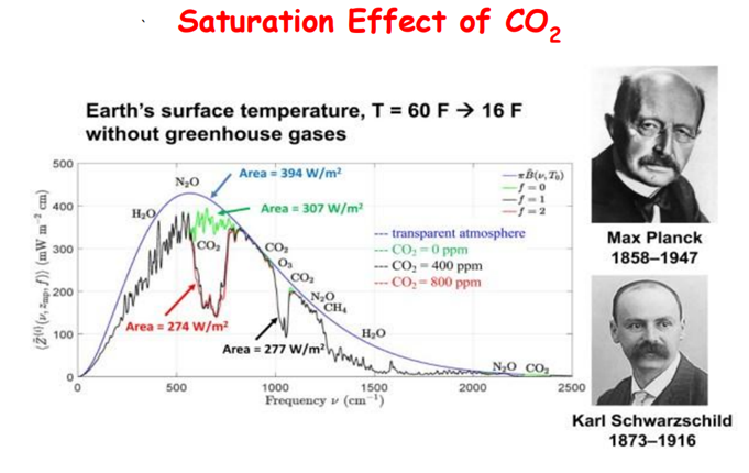
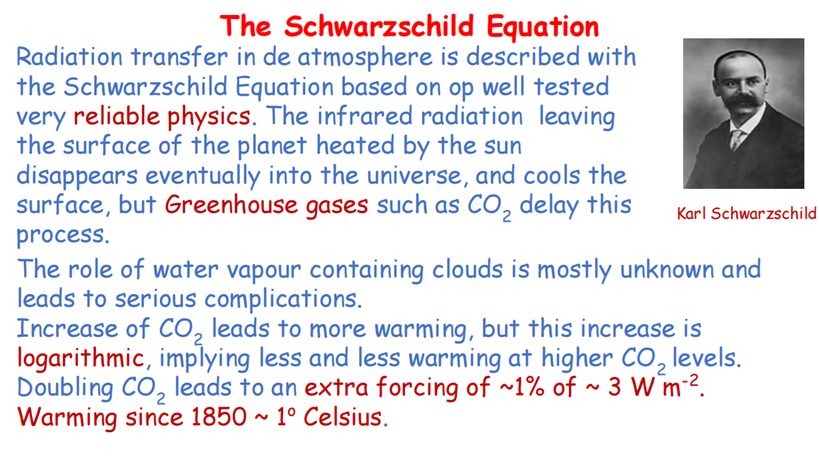
Now I will say just a few words about clear sky because that is the simplest. Then we’ll get on to clouds, the topic of this talk. This is a calculation with the same codes that I showed you in the previous slide which as you saw work very well. It’s worth spending a little time because this is the famous Planck curve that was the birth of quantum mechanics. There is Max Planck who figured out what the formula for that curve is and why it is that way. This is what the Earth would radiate at 15° Centigrade if there were no greenhouse gases. You would get this beautiful smooth curve the Planck curve. If you actually look at the Earth from the satellites you get a raggedy jaggedy black curve. We like to call that the Schwarzchild curve because Carl Schwarzchild was the person who showed how to do that calculation. Tragically he died during World War I, a Big Big loss to science.
There are two colored curves that I want to draw your attention. The green curve is is what Earth would radiate to space if you took away all the CO2 so it only differs from the black curve you know in the CO2 band here this is the bending band of CO2 which is the main greenhouse effect of CO2. There’s a little additional effect here which is the asymmetric stretch but it it doesn’t contribute very much. Then here is a red curve and that’s what happens if you double CO2.
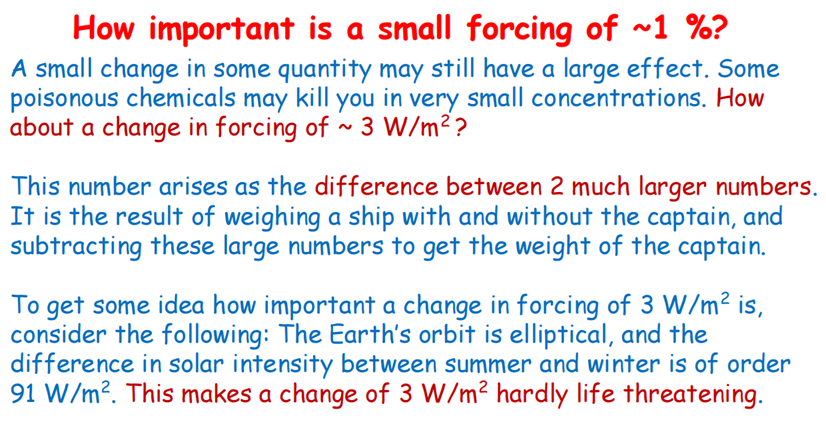
So notice the huge asymmetry. If taking all 400 parts per million of CO2 away from the atmosphere causes this enormous change 30 watts per square meter, the difference between this green 307 and and the black 277, that’s 30 watts per square meter. But if you double CO2 you practically don’t make any change. This is the famous saturation of CO2. At the levels we have now doubling CO2, a 100% Increase of CO2 only changes the radiation to space by 3 watts per square meter. The difference between 274 for the red curve and 277 for the curve for today. So it’s a tiny amount: for 100% increase in CO2 a 1% decrease of radiation to space.
That allows you to estimate the feedback-free climate sensitivity in your head. I’ll talk you through the feedback-free climate free sensitivity. So doubling CO2 is a 1% decrease of radiation to space. If that happens then the Earth will start to warm up. But it will radiate as the fourth power of the temperature. So temperature starts to rise but if you’ve got a fourth power, the temperature only has to rise by one-quarter of a percent absolute temperature. So a 1% forcing in watts per square centimeter is a one-quarter percent of temperature in Kelvin. Since the ambient Kelvin temperature is about 300 Kelvin (actually a little less) a quarter of that is 75 Kelvin. So the feedback free equilibrium climate sensitivity is less than 1 Degree. It’s 0.75 Centigrade. It’s a number you can do in your head.
So when you hear about 3 centigrade instead of .75 C that’s a factor of four, all of which is positive feedback. So how is there really that much positive feedback? Because most feedbacks in nature are negative. The famous Le Chatelier principle which says that if you perturb a system it reacts in a way to to dampen the perturbation not increase it. There are a few positive feedback systems that we’re familiar with for example High explosives have positive feedback. So if the earth’s climate were like other positive feedback systems, all of them are highly explosive, it would have exploded a long time ago. But the climate has never done that, so the empirical observational evidence from geology is that the climate is like any other feedback system it’s probably negative Okay so I leave that thought with you and and let me stress again:
This is clear skies no clouds; if you add clouds all this does is
suppress the effects of changes of the greenhouse gas.
So now let’s talk about clouds and the theory of clouds, since we’ve already seen clouds are very important. Here is the formidable equation of transfer which has been around since Schwarzchild’s day. So some of the symbols here relate to the intensity, another represents scattering. If you have a thermal radiation on a greenhouse gas where it comes in and immediately is absorbed, there’s no scattering at all. If you hit a cloud particle it will scatter this way or that way, or some maybe even backwards.
So all of that’s described by this integral so you’ve got incoming light at One Direction and you’ve got outgoing light at a second Direction. And then at the same time you’ve got thermal radiation so the warm particles of the cloud are are emitting radiation creating photons which are coming out and and increasing the Earth glow the and this is represented by two parameters. Even a single cloud particle has an albedo, this is is the fraction of radiation that hits the cloud that is scattered as opposed to absorbed and being converted to heat. It’s a very important parameter for visible light and white clouds, typically 99% of the encounters are scattered. But for thermal radiation it’s much less. So water scatters thermal radiation only half as efficiently as shorter wavelengths.
The big problem is that in spite of all the billions of dollars that we have spent, these things which should be known and and would have been known if there hadn’t been this crazy fixation on carbon dioxide and greenhouse gases. And so we’ve neglected working on these areas that are really important as opposed to the trivial effects of greenhouse gases. Attenuation in a cloud is both scattering and absorption. Of course you have to solve these equations for every different frequency of the light because especially for molecules, there’s a strong frequency dependence.
In summary, let me show you this photo which was taken by Harrison Schmitt who was a friend of mine on one of the first moonshots. It was taken in December and looking at this you can see that they were south of Madagascar when the photograph was taken. You can see it was Winter because here the Intertropical Convergence Zone is quite a bit south of the Equator; it’s moved Way South of India and Saudi Arabia. By good luck they had the sun behind them so they had the whole earth Irradiated.
There’s a lot of information there and and again let me draw your attention to how much of the Earth is covered with clouds. So only very small parts of the Earth can actually be directly affected by greenhouse gases, of the order of half. The takeaway message is that clouds and water vapor are much more important than greenhouse gases for earth’s climate. The second point is the reason they’re much more important: doubling CO2 as I indicated in the middle of the talk only causes a 1% difference of radiation to space. It is a very tiny effect because of saturation. You know people like to say that’s not so, but you can’t really argue that one, even the IPCC gets the same numbers that we do.
And you also know that covering half of the sky with clouds will decrease solar heating by 50%. So for clouds it’s one to one, for greenhouse gases it’s a 100 to one. If you really want to affect the climate, you want to do something to the clouds. You will have a very hard time making any difference with Net Zero with CO2 if you are alarmed about the warmings that have happened.
So one would hope that with all the money that we’ve spent trying to turn CO2 into a demon that some good science has come out of it. From my point of view this is a small part of it, this scattering theory that I think will be here a long time after the craze over greenhouse gases has gone away. I hope there will be other things too. You can point to the better instrumentation that we’ve got, satellite instrumentation as well as ground instrumentation. So that’s been a good investment of money. But the money we’ve spent on supercomputers and modeling has been completely wasted in my view.
World Institutions Pushing Pseudoscience

Since 1660, Nullius in verba was the Royal Society’s motto. “Don’t take anyone’s word for it.”
Yesterday’s post showed how American science societies have taken to parroting climatist suppositions rather than applying critical intelligence to claims of a “climate crisis.” That unquestioning attitude betrays the science method expressed in the Royal Society’s motto. Today presents Tilak Doshi describing how the same pattern appears in international institutions supposed to be objective reporters of natural conditions. His Daily Signal article is The Climate Agenda’s March Through the Institutions: Can It Be Stopped? Excerpts in italics with my bolds and added images.

A spate of stories in the media recently provides a remarkable illustration of how the globalist policy agenda of the climate-industrial complex has captured key international institutions and perverted their original organizational aims. From initially serving broad, laudable objectives for the welfare of their constituents, these institutions have been subverted over the years to serve the insistent pseudoscientific claims of climate alarmists.
The corruption of global institutions has, in turn, led to significant opposition that is becoming apparent. There is the prospect of an incoming Trump administration that is avowedly skeptical of the claims of an alleged climate crisis and is intent on exiting the U.N.’s Paris Agreement and its “net zero by 2050” policy target for a second time. This presents a welcome challenge to these corrupt institutions.
Will President Donald Trump and some of the populist parties in Europe
be capable of countering the entrenched globalist climate agenda?
The World Bank
On Oct. 17, Oxfam published a report that shockingly found that up to $41 billion in World Bank climate finance—nearly 40% of all climate funds disbursed by the World Bank over the past seven years—is “unaccounted for between the time projects were approved and when they closed.” In other words, no one knows how the money was used. There is no paper trail revealing where the money went or what the accomplished results were.

Green cronyism, ranging from the Solyndra debacle—the waste of almost half a billion dollars of taxpayers’ money on a failed solar farm project under President Barack Obama’s watch—to President Joe Biden’s duplicitously-named Inflation Reduction Act, which will unleash an estimated $1 trillion deluge of subsidies on favored “green” industries, is nothing new. But it is instructive to trace the World Bank’s decline from its honorable founding objectives to its current status as yet another institution advocating green causes.
Dr. Jim Yong Kim, reflecting the progressive virtues of Obama, who appointed him as president of the World Bank in 2012, imposed a ban on the financing of coal-fired power stations in 2013. This was followed by a ban on investments in all new upstream oil and gas resource development projects.
The distinguished economist Deepak Lal, a former research administrator of the World Bank, remarked that Kim incredulously “over-ruled the cost-benefit estimates of coal-based power over solar and wind-based power generation produced by his own economic staff, justifying this by reference to a wish to cut global emissions of greenhouse gases.”
The World Bank’s objections to the use of fossil fuels despite their importance to economic growth and poverty alleviation—which constitute its foundational institutional objectives—can be traced to the intellectual evolution of its management under James Wolfensohn during his decade as president (1995-2005).
Wolfensohn traced the arc from the old regime to the new. The old was represented by the “Washington consensus” of free markets, liberal trading regimes, sound money, and entrepreneurship associated with the classical liberalism of Adam Smith.
The new intellectual environment of the World Bank’s management—personified by Joseph Stiglitz, chief economist of the World Bank (1997-2000)—was defined by the theoretical failures of the free market, especially in accounting for the alleged negative climate impacts of fossil fuel use.
Stiglitz, a climate alarmist, wrote in a 2015 court brief for a failed climate lawsuit brought on behalf of a group of children against the U.S. federal government that “fossil fuel-based economies imposed ‘incalculable’ costs on society and shifting to clean energy will pay off.” [See Climatists Make Their Case by Omitting Facts]
Rupert Darwall, a former adviser to the United Kingdom’s chancellor of the exchequer and author of “Green Tyranny,” encapsulates the betrayal of the World Bank to its founding objectives as follows:
The World Bank’s mission has been subverted by green ideologues who assert that a low-carbon world benefits the world’s poor but fail to acknowledge that making energy much more costly increases poverty. The World Bank tags itself as ‘working for a world free of poverty’ … In making its choice between development and sustainability, the World Bank has decided it is going to try and ‘save the planet’ on the backs of the poor.

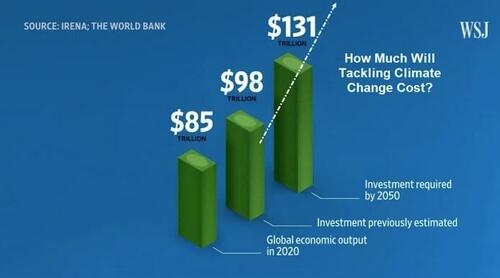
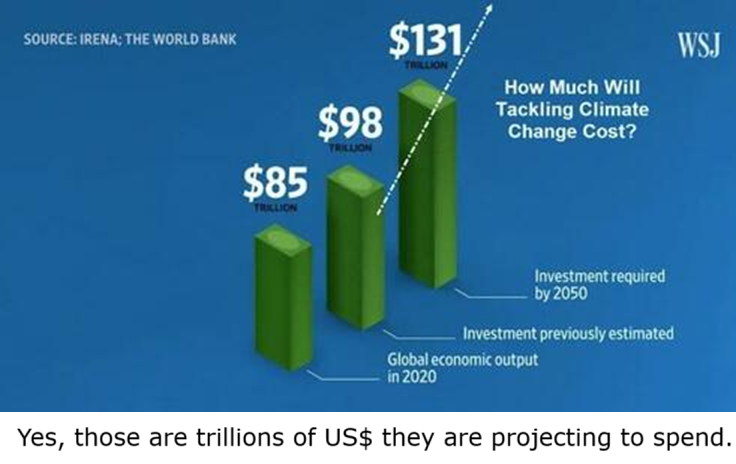
Yes, those are trillions of US$ they want to spend on an imaginary crisis.
By abdicating its founding principles for alleviating global poverty, the World Bank has taken a lead role among multilateral financial institutions in denying vast financial resources to poorer countries. It has hypocritically vetoed the right of developing countries to adopt the path of economic growth and environmental improvement that the now-rich countries had taken up successfully since the Industrial Revolution two centuries ago. The World Bank’s obsessive support for intermittent, low-yield renewable energy such as solar and wind power comes at the cost of its central charter to help the poor, an outcome that can only be described as egregiously unjust.
The UN Intergovernmental Panel on Climate Change
The U.N. IPCC issued a news release on Dec. 6 prior to the start of a “scoping” meeting in Kuala Lumpur of over 230 experts from 70 countries to draft outlines of working group contributions to the U.N. IPCC’s seventh Assessment Report (to be completed in 2029).
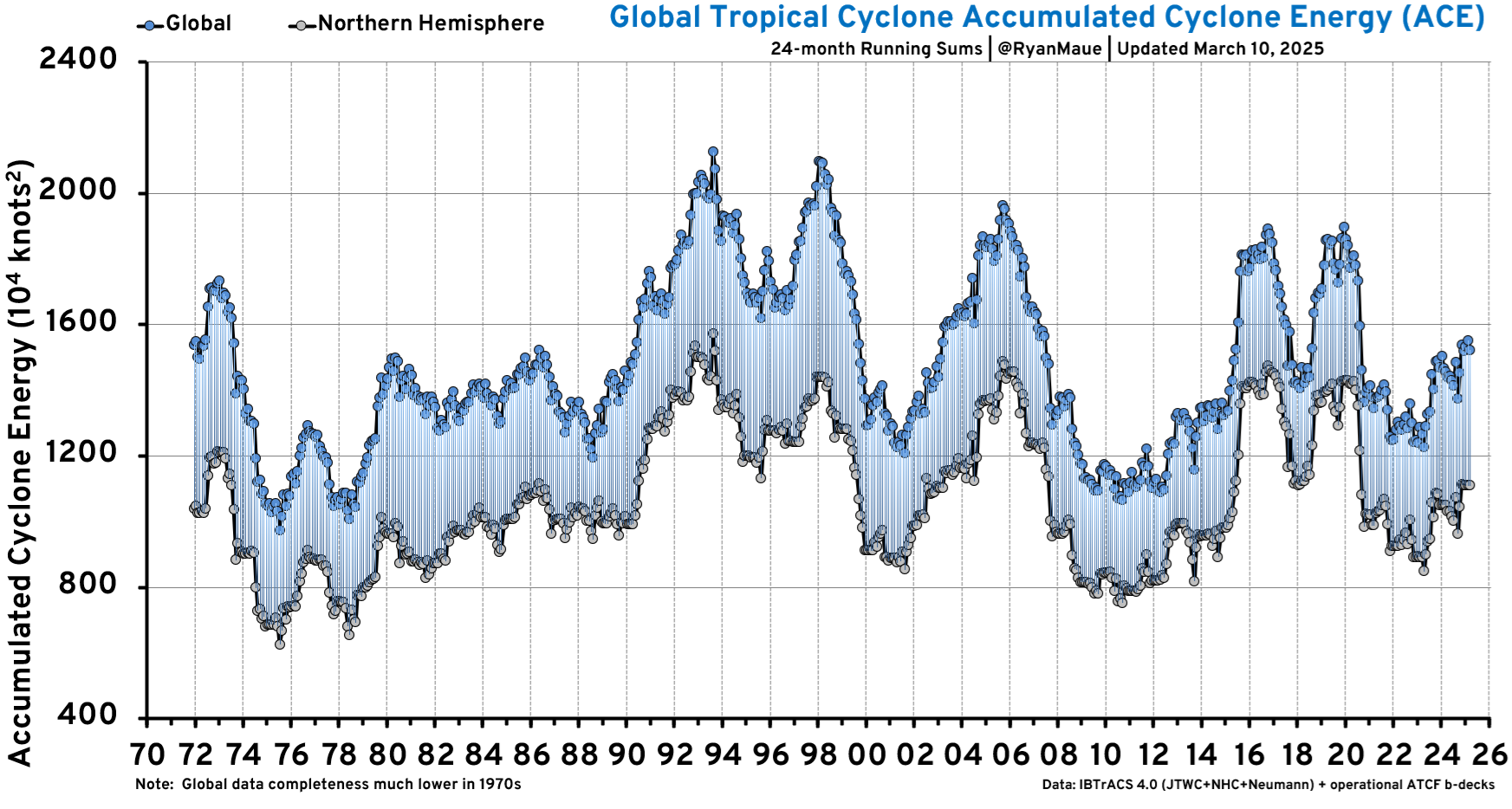
In the press release, the IPCC claimed that human combustion of fossil fuels “has resulted in more frequent and more intense extreme weather events that have caused increasingly dangerous impacts on nature and people in every region of the world.” This is contrary to the IPCC’s position hitherto, which is that almost all types of extreme weather events cannot be attributed with confidence to human activity.
The position of the IPCC regarding the lack of any link between climate change and extreme weather events is contrary to the almost daily headlines in the mainstream media attributing specific adverse weather events to “climate change.”
The work of eminent climate policy analysts Steve Koonin and Roger Pielke Jr. has done much to expose the pseudoscientific nature of what has been called “attribution studies.” These typically involve researchers who apply their climate models and historical observations to conclude that any particular weather event (say a hurricane or a drought) was made “more likely” or “more severe” by some magnitude in percentage units due to “human influence” (referring to the combustion of fossil fuels).

Based on the dubious claims of “attribution science,” New York Gov. Kathy Hochul signed a climate law last week that will require companies operating in New York state responsible for large amounts of planet-warming pollution to contribute to climate damage repair efforts. Under the new state law, companies responsible for the bulk of emissions from 2000 to 2018 will be on the hook for some $3 billion a year over the next 25 years.
Koonin cites the World Meteorological Organization that states that “any single event, such as tropical cyclone cannot be attributed to human-induced climate change, given the state of scientific understanding.” The IPCC’s “Special Report on Extreme Events” states that “Many weather and climate extremes are the result of natural climate variability … Even if there were no anthropogenic changes in climate, a wide variety of natural weather and climate extremes would still occur.”
Nonetheless, international organizations such as the World Bank and the IPCC have been increasingly politicized to serve climate hysteria. In this context, Chris Morrison of The Daily Sceptic finds that “[f]ears are growing that the IPCC could water down or even ditch its current finding that almost all types of extreme weather events have little or no sign of past human involvement, or any going forward to 2100.”

International Energy Agency
On Dec. 23, U.S. Sen. John Barrasso, R-Wyo., ranking member of the Senate Committee on Energy and Natural Resources, released a report documenting how the International Energy Agency “has moved away from its energy security mission to become an “energy transition” cheerleader.”
The report finds that “French President [Emmanuel] Macron’s observation that IEA has become the ‘armed wing for implementing the Paris Agreement’ is regrettably true. With the many serious energy security challenges facing the world, however, IEA should not be a partisan cheerleader. What the world needs from IEA—and what it is not receiving now—is sober and unbiased analyses and projections that educate and inform policymakers and investors. IEA needs to remember why it was established and return to its energy security mission.”
The divergence of the IEA away from its original mission to advise policymakers in its member countries with sound analysis of trends in global energy supply and demand to becoming a “cheerleader” for radical net-zero emission policy targets has not gone unnoticed over recent years. I have written on the ideological approach adopted by the IEA in its advocacy for green causes here, here, and here.
When ideological advocacy becomes the measure of achievement for the IEA, the loss of credibility and soundness of its policy advice is only to be expected. The IEA’s messianic fervour for green technologies such as solar and wind power, “green” hydrogen, batteries, and electric vehicles prevents it from asking basic questions.
If it is true that drastically cutting back on fossil fuels is consistent with higher economic growth and increased productive employment, why does the IEA recommend policymakers force countries along “net-zero” pathways? Surely, if replacing fossil fuels with wind and solar energy and electric vehicles promotes growth and employment, then wouldn’t countries such as China and India naturally race toward this best of all possible worlds without expensive green subsidies and punitive anti-fossil fuel policies?
The Trumpian Revolution Looms
Nonprofit organizations reflect the needs of their funding members, and organizations such as the World Bank, IPCC, and IEA are no different. As their funding is primarily from the U.S. and the EU, it is not surprising that they manifest the “climate emergency” predilections of the Biden administration and the largely left-socialist West European governments that see climate change as an existential threat and a national security priority. In taking up the mantle of green advocacy on behalf of their paymasters, these organizations have lost all credibility as independent and objective advisors for their member countries.
The climate-industrial complex fears the prospect of the Trump administration’s pullout of the Paris Agreement for the second time. Politico, a reliable mouthpiece for the climate establishment, expressed these fears soon after Trump’s election victory: “The world is bracing for President-elect Donald Trump to withdraw the U.S. from the Paris climate agreement for the second time—only this time, he could move faster and with less restraint.” In Europe, the emergence of populist parties has been partly propelled by the widespread rejection by EU citizens of the onerous fiscal burdens imposed by green policies.
The seismic change in policy direction that a second term “drill, baby, drill” Trump administration promises for the global climate juggernaut—represented by the three leading international agencies covered here—can only be seen as hopeful as we look forward to positive developments in energy policy in 2025.
Climatists Make Their Case by Omitting Facts

One of the world’s top economists has written an expert court report that forcefully supports a group of children and young adults who have sued the federal government for failing to act on climate change. (Source: Inside Climate News here) Excerpts in italics with my bolds.
Stiglitz, a Columbia University economics professor and former World Bank chief economist, concludes that increasing global warming will have huge costs on society and that a fossil fuel-based system “is causing imminent, significant, and irreparable harm to the Youth Plaintiffs and Affected Children more generally.” He explains in a footnote that his analysis also examines impacts on “as-yet-unborn youth, the so-called future generations.”
But, he says, acting on climate change now—by imposing a carbon tax and cutting fossil fuel subsidies, among other steps—is still manageable and would have net-negative costs. He argues that if the government were to pursue clean energy sources and energy-smart technologies, “the net benefits of a policy change outweigh the net costs of such a policy change.”
“Defendants must act with all deliberate speed and immediately cease the subsidization of fossil fuels and any new fossil fuel projects, and implement policies to rapidly transition the U.S. economy away from fossil fuels,” Stiglitz writes. “This urgent action is not only feasible, the relief requested will benefit the economy.”
Stiglitz has been examining the economic impact of global warming for many years. He was a lead author of the 1995 report of the UN’s Intergovernmental Panel on Climate Change, an authoritative assessment of climate science that won the IPCC the 2007 Nobel Peace Prize, shared with Al Gore.
The Stiglitz expert report submitted to the court is here.
An Example of Intentional Omissions
Since this is a legal proceeding, Stiglitz wrote a brief telling the plaintiffs’ side of the story. In a scientific investigation, parties would assert theories attempting to explain all of the evidence at hand. Legal theories have no such requirement to incorporate all the facts, but rather present conclusions informed by the evidence deemed strongest and most pertinent to one party’s interests.
![]()
While the Pope accuses us with the Sin of Emissions, we counter with the Sins of Omissions by him and his fellow activists.
Let’s consider the Stiglitz brief according to the three suppositions comprising the Climatist (Activists and Alarmists) position. Climate change is a bundle that depends on all three assertions to be true.

Supposition 1: Humans make the climate warmer.
As an economist, Stiglitz defers to the IPCC on this scientific point, with references to reports by those deeply involved and committed to Paris Accord and other UN climate programs. In the recent California District Court case (Cities suing Big Oil companies), both sides in a similar vein stipulated their acceptance of IPCC reports as authoritative regarding global warming/climate change.

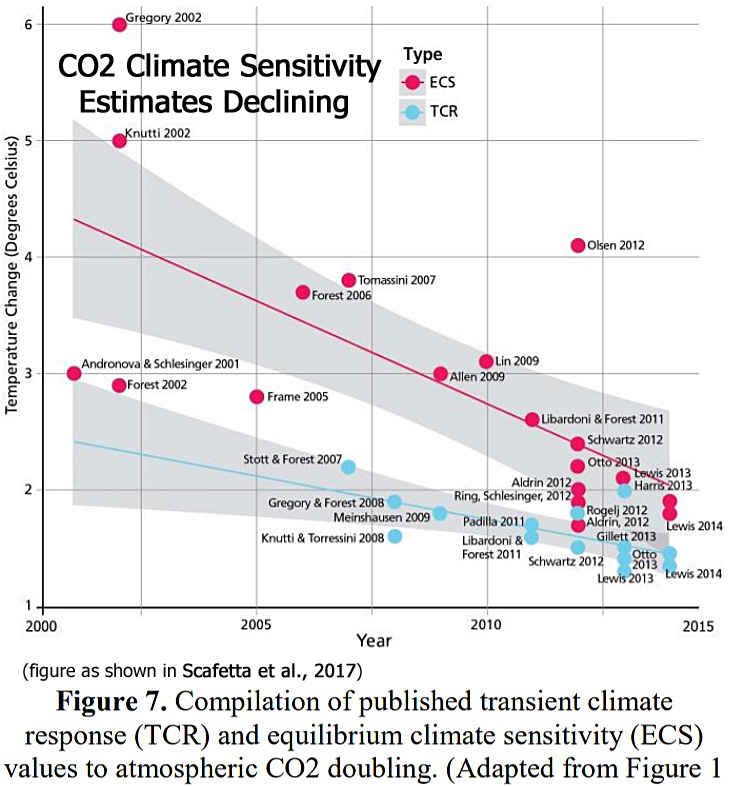
Skeptical observers must attend to the nuances of what is referenced and what is hidden or omitted in these testimonies. For example, Chevron’s attorney noted that IPCC’s reports express various opinions over time as to human influence on the climate. They noted that even today, the expected temperature effect from doubling CO2 ranges widely from 1.5C to 4.5C. No mention is made that several more recent estimates from empirical data (rather than GCMs) are at the low end or lower.
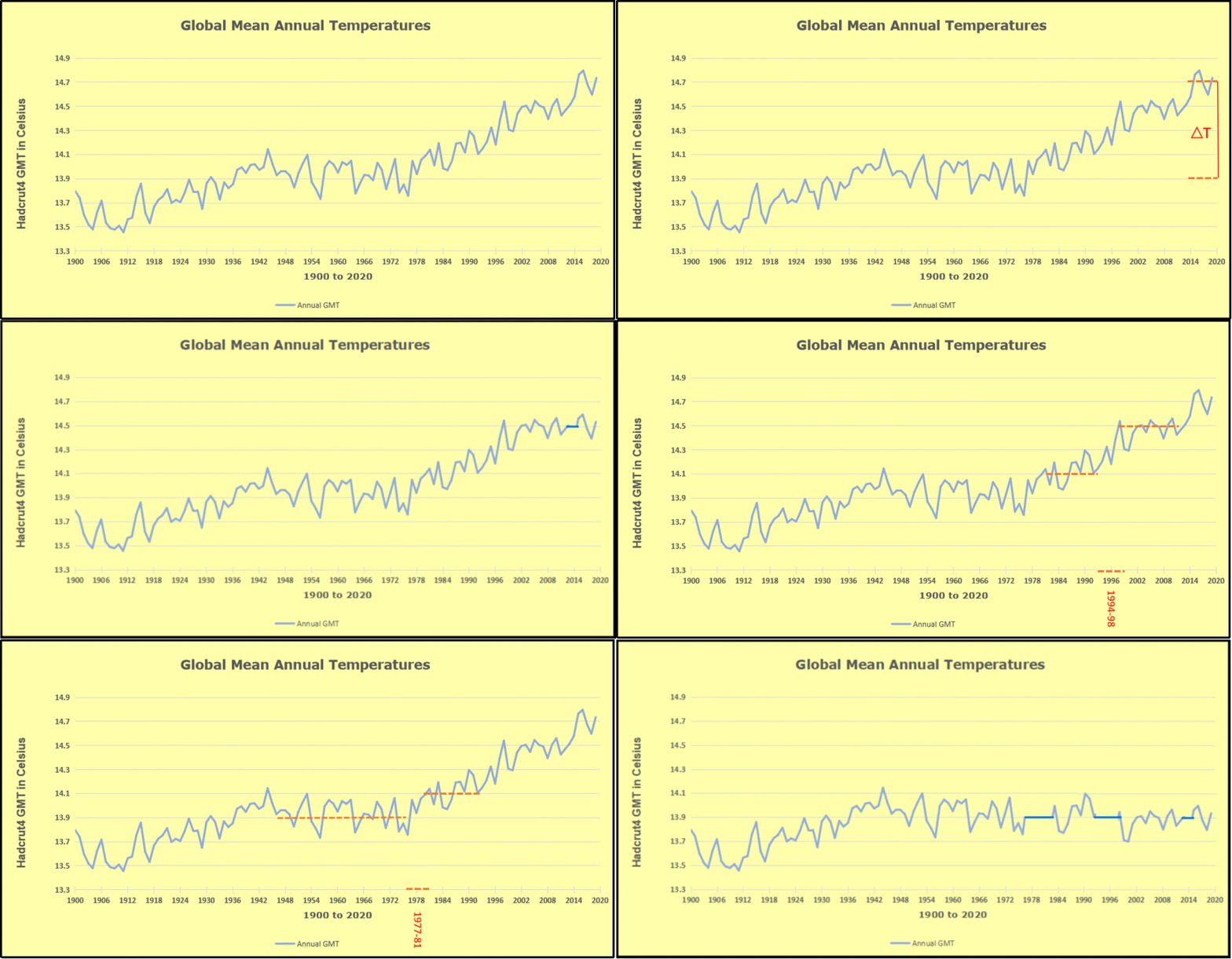
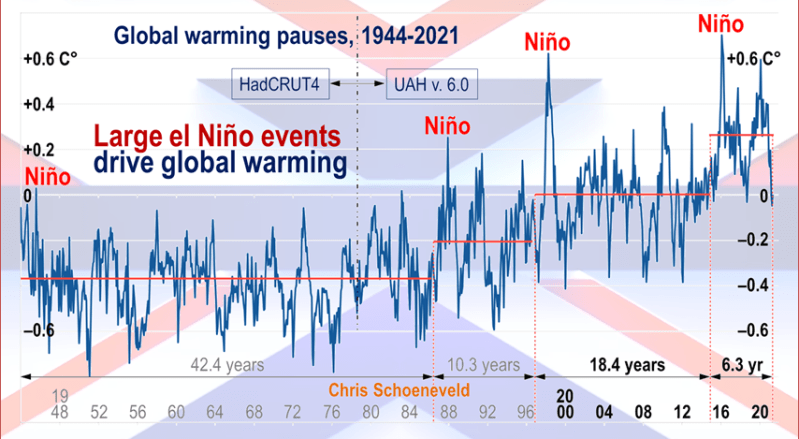
In addition, there is no mention that GCMs projections are running about twice as hot as observations. Omitted is the fact GCMs correctly replicate tropospheric temperature observations only when CO2 warming is turned off. In the effort to proclaim scientific certainty, neither Stiglitz nor IPCC discuss the lack of warming since the 1998 El Nino, despite two additional El Ninos in 2010 and 2016.

Figure 5. Simplification of IPCC AR5 shown above in Fig. 4. The colored lines represent the range of results for the models and observations. The trends here represent trends at different levels of the tropical atmosphere from the surface up to 50,000 ft. The gray lines are the bounds for the range of observations, the blue for the range of IPCC model results without extra GHGs and the red for IPCC model results with extra GHGs.The key point displayed is the lack of overlap between the GHG model results (red) and the observations (gray). The nonGHG model runs (blue) overlap the observations almost completely.
Further they exclude comparisons between fossil fuel consumption and temperature changes. The legal methodology for discerning causation regarding work environments or medicine side effects insists that the correlation be strong and consistent over time, and there be no confounding additional factors. As long as there is another equally or more likely explanation for a set of facts, the claimed causation is unproven. Such is the null hypothesis in legal terms: Things happen for many reasons unless you can prove one reason is dominant.

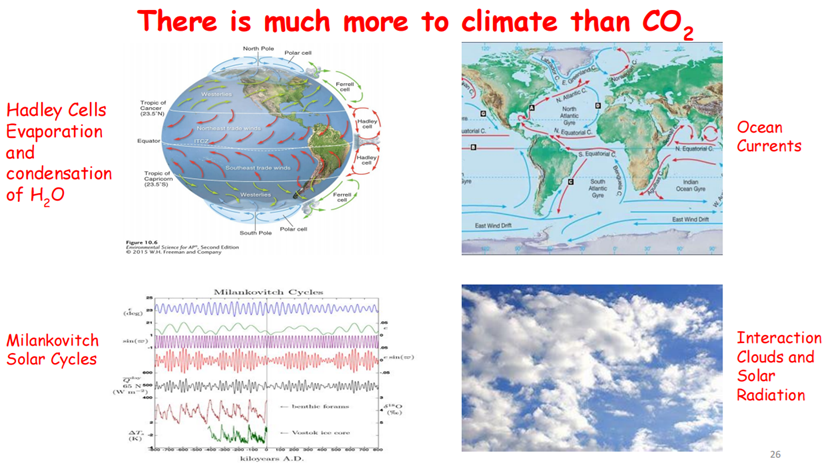
Finally, Stiglitz and IPCC are picking on the wrong molecule. The climate is controlled not by CO2 but by H20. Oceans make climate through the massive movement of energy involved in water’s phase changes from solid to liquid to gas and back again. From those heat transfers come all that we call weather and climate: Clouds, Snow, Rain, Winds, and Storms.
Esteemed climate scientist Richard Lindzen ended a very fine recent presentation with this description of the climate system:
I haven’t spent much time on the details of the science, but there is one thing that should spark skepticism in any intelligent reader. The system we are looking at consists in two turbulent fluids interacting with each other. They are on a rotating planet that is differentially heated by the sun. A vital constituent of the atmospheric component is water in the liquid, solid and vapor phases, and the changes in phase have vast energetic ramifications. The energy budget of this system involves the absorption and reemission of about 200 watts per square meter. Doubling CO2 involves a 2% perturbation to this budget. So do minor changes in clouds and other features, and such changes are common. In this complex multifactor system, what is the likelihood of the climate (which, itself, consists in many variables and not just globally averaged temperature anomaly) is controlled by this 2% perturbation in a single variable? Believing this is pretty close to believing in magic. Instead, you are told that it is believing in ‘science.’ Such a claim should be a tip-off that something is amiss. After all, science is a mode of inquiry rather than a belief structure.
Supposition 2: The Warming is Dangerous
Billions of dollars have been spent researching any and all negative effects from a warming world: Everything from Acne to Zika virus. Stiglitz links to a recent Climate Report that repeats the usual litany of calamities to be feared and avoided by submitting to IPCC demands. The evidence does not support these claims.
Stiglitz: It is scientifically established that human activities produce GHG emissions, which accumulate in the atmosphere and the oceans, resulting in warming of Earth’s surface and the oceans, acidification of the oceans, increased variability of climate, with a higher incidence of extreme weather events, and other changes in the climate.
Moreover, leading experts believe that there is already more than enough excess heat in the climate system to do severe damage and that 2C of warming would have very significant adverse effects, including resulting in multi-meter sea level rise.
Experts have observed an increased incidence of climate-related extreme weather events, including increased frequency and intensity of extreme heat and heavy precipitation events and more severe droughts and associated heatwaves. Experts have also observed an increased incidence of large forest fires; and reduced snowpack affecting water resources in the western U.S. The most recent National Climate Assessment projects these climate impacts will continue to worsen in the future as global temperatures increase.
Alarming Weather and Wildfires
But: Weather is not more extreme.

And Wildfires were worse in the past.
But: Sea Level Rise is not accelerating.
Litany of Changes
Seven of the ten hottest years on record have occurred within the last decade; wildfires are at an all-time high, while Arctic Sea ice is rapidly diminishing.
We are seeing one-in-a-thousand-year floods with astonishing frequency.
When it rains really hard, it’s harder than ever.
We’re seeing glaciers melting, sea level rising.
The length and the intensity of heatwaves has gone up dramatically.
Plants and trees are flowering earlier in the year. Birds are moving polewards.
We’re seeing more intense storms.
But: Arctic Ice has not declined since 2007.
But: All of these are within the range of past variability.

In fact our climate is remarkably stable.
And many aspects follow quasi-60 year cycles.
Climate is Changing the Weather
Stiglitz: Other potential examples include agricultural losses. Whether or not insurance
reimburses farmers for their crops, there can be food shortages that lead to higher food
prices (that will be borne by consumers, that is, Youth Plaintiffs and Affected Children).
There is a further risk that as our climate and land use pattern changes, disease vectors
may also move (e.g., diseases formerly only in tropical climates move northward).36 This
could lead to material increases in public health costs
But: Actual climate zones are local and regional in scope, and they show little boundary change.
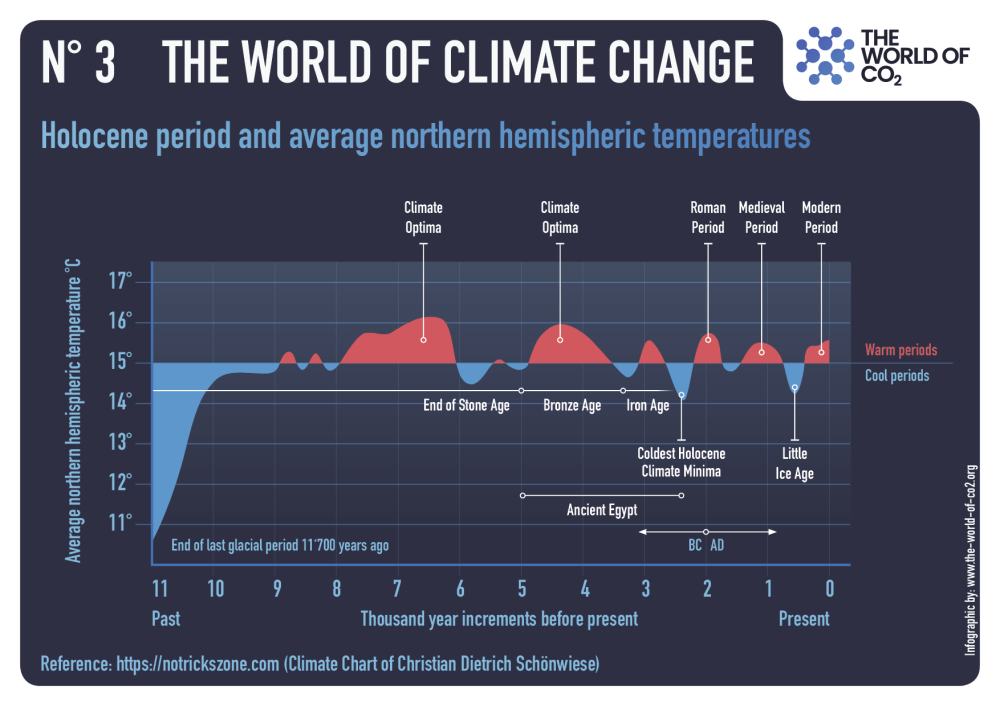
But: Ice cores show that it was warmer in the past, not due to humans.

Supposition 3: Government Can Stop it!
Here it is blithely assumed that the court can rule the seas to stop rising, heat waves to cease, and Arctic ice to grow (though why we would want that is debatable). All this will be achieved by leaving fossil fuels in the ground and powering civilization with windmills and solar panels. While admitting that our way of life depends on fossil fuels, they ignore the inadequacy of renewable energy sources at their present immaturity.

Stiglitz: Conclusion
The choice between incurring manageable costs now and the incalculable, perhaps even
irreparable, burden Youth Plaintiffs and Affected Children will face if Defendants fail to
rapidly transition to a non-fossil fuel economy is clear. While the full costs of the climate
damages that would result from maintaining a fossil fuel-based economy may be
incalculable, there is already ample evidence concerning the lower bound of such costs,
and with these minimum estimates, it is already clear that the cost of transitioning to a
low/no carbon economy are far less than the benefits of such a transition. No rational
calculus could come to an alternative conclusion. Defendants must act with all deliberate
speed and immediately cease the subsidization of fossil fuels and any new fossil fuel
projects, and implement policies to rapidly transition the U.S. economy away from fossil
fuels.
But CO2 relation to Temperature is Inconsistent.

But: The planet is greener because of rising CO2.

But: Modern nations (G20) depend on fossil fuels for nearly 90% of their energy.
But: Renewables are not ready for prime time.
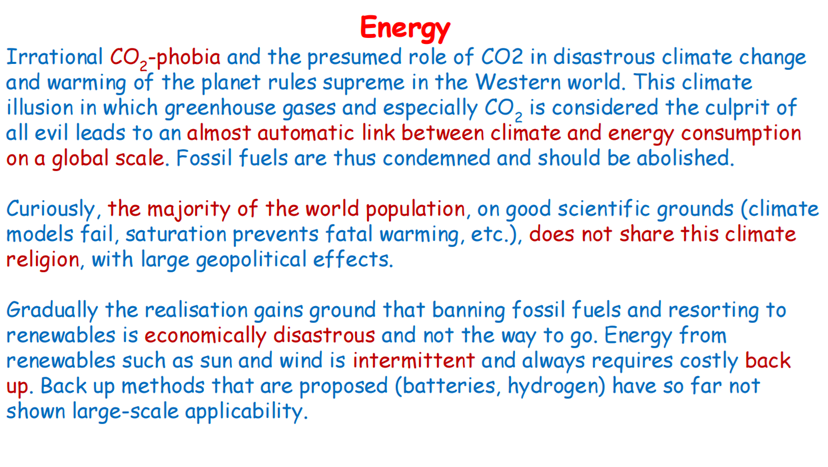
People need to know that adding renewables to an electrical grid presents both technical and economic challenges. Experience shows that adding intermittent power more than 10% of the baseload makes precarious the reliability of the supply. South Australia is demonstrating this with a series of blackouts when the grid cannot be balanced. Germany got to a higher % by dumping its excess renewable generation onto neighboring countries until the EU finally woke up and stopped them. Texas got up to 29% by dumping onto neighboring states, and some like Georgia are having problems.
But more dangerous is the way renewables destroy the economics of electrical power. Seasoned energy analyst Gail Tverberg writes:
In fact, I have come to the rather astounding conclusion that even if wind turbines and solar PV could be built at zero cost, it would not make sense to continue to add them to the electric grid in the absence of very much better and cheaper electricity storage than we have today. There are too many costs outside building the devices themselves. It is these secondary costs that are problematic. Also, the presence of intermittent electricity disrupts competitive prices, leading to electricity prices that are far too low for other electricity providers, including those providing electricity using nuclear or natural gas. The tiny contribution of wind and solar to grid electricity cannot make up for the loss of more traditional electricity sources due to low prices.
These issues are discussed in more detail in the post Climateers Tilting at Windmills
Footnote regarding mention of “multi-meter” sea level rise. It is all done with computer models. For example, below is San Francisco. More at USCS Warnings of Coastal Floodings
Scientific Societies Misstate “Climate Change”
Wallace Manheimer provides examples of the errors needing corrections in his American Thinker article Scientific Societies Err on ‘Climate Change’. Excerpts in italics with my bolds and added images.
Major scientific organizations’ statements on “climate change” and the conclusions therein form the basis of much of the scientific foundation for governmental, scientific, media, and public concerns on the use of fossil fuels. Trillions of public and private dollars are currently being spent on alternative fuels to “save the planet” from the alleged harm of increasing CO2, a gas which is vital for life on earth. If the evaluations of these societies are erroneous, these measures could impoverish much of the world, to say nothing of wasting trillions. Economic damage and social unrest are already evident in some countries, including the United States.
It is therefore imperative for all that their views be based on sound science,
and if not, these societies should change their statements.
A recent publication and podcast have examined the scientific organization’s climate statements, and have found numerous errors, errors which are easy to find by simply comparing the societies’ statements with data from such reliable sources as NOAA, NASA, and others. These societies are:
♦ American Physical Society (APS),
♦ American Meteorological Society (AMS),
♦ National Academy of Science (NAS),
♦ American Chemical Society (ACS), and
♦ American Geophysical Union (AGU).
[Manheimer refers to paper Science Societies Climate Statements: Some Concerns]
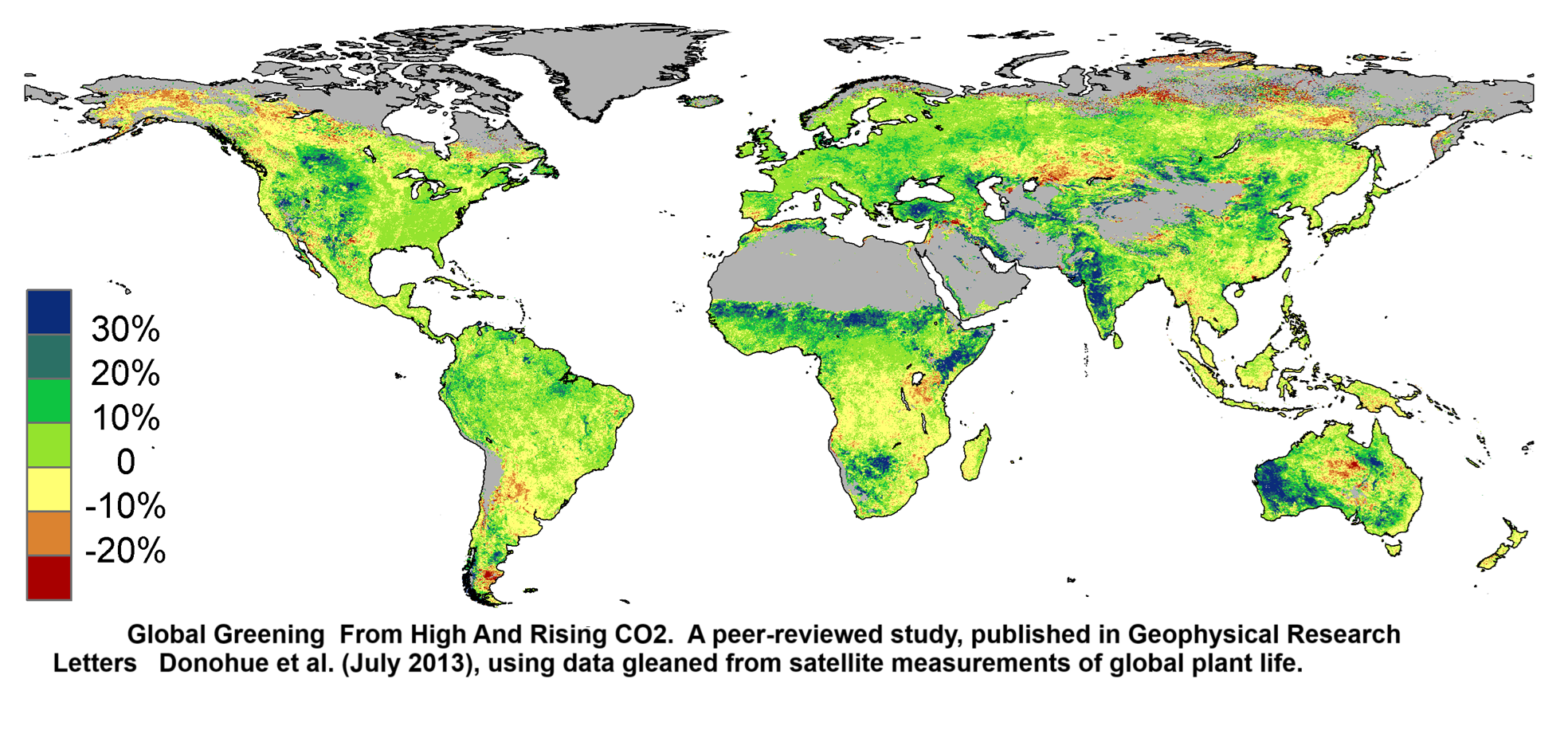
Here is one example. The AGU states “Greater CO2 concentrations in the atmosphere are also affecting the growth and nutritional value of land plants…” Numerous studies, including measurements of terrestrial plant life from space, and measurements of crop production, have shown that if anything, increasing CO2 has increased both plant life and crop production. After all, CO2 is a vital nutrient for plants, and the slight warming we have experienced, possibly in part due to the increased CO2, has increased the growing seasons in the temperate latitudes.
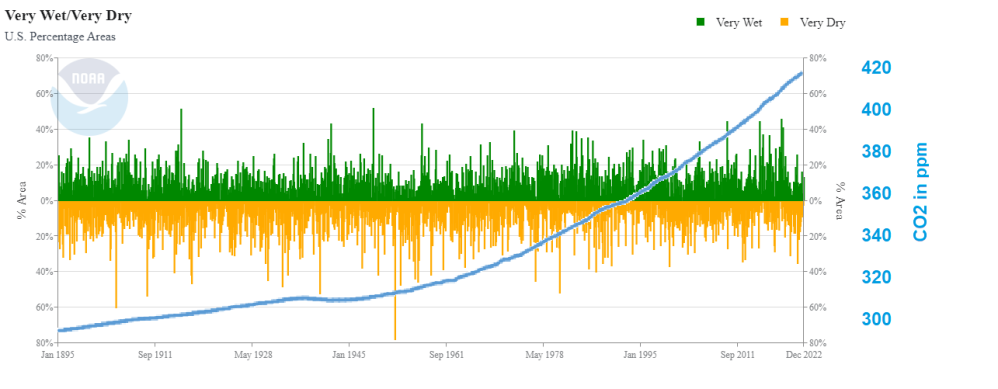
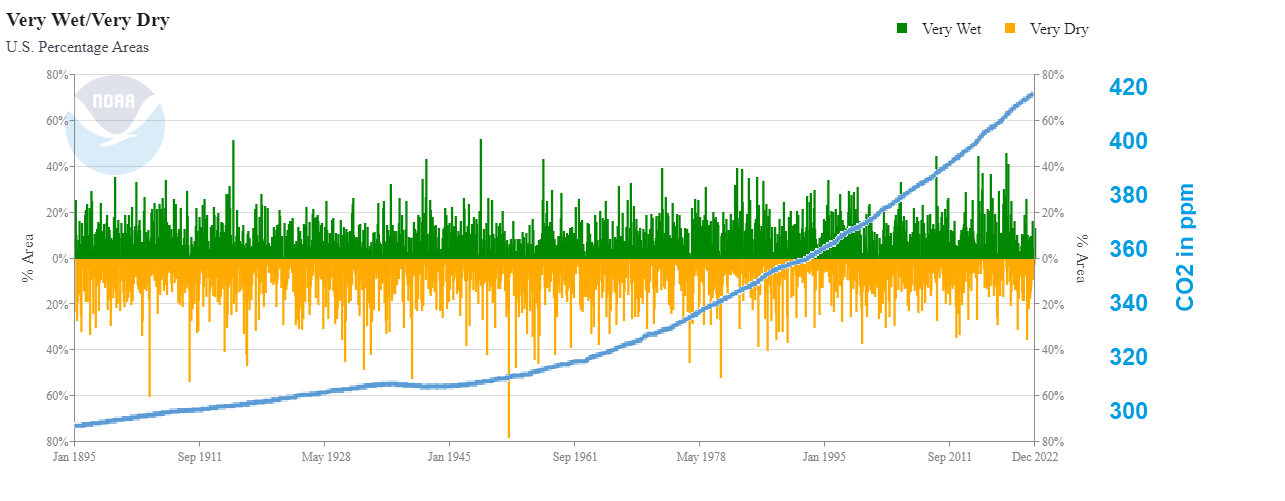
As another example, the ACS statement asserts: “Extreme weather and related events, such as floods, droughts… are increasing in frequency and intensity, threatening Americans’ physical, social, and economic well-being.”. The frequency and intensity of floods and droughts is measured by what is called NOAA’s Palmer drought index and this index is displayed as a graph vs of index versus year. It shows clearly, that in the United States the worst sustained droughts in the U.S. were in the 1930s and 1950s, and the worst sustained floods were in the 1970s through the 1990s.
Tens of thousands of scientists, including over 10,000 with Ph.Ds., have critically examined the evidence, and have concluded that a CO2-induced climate crisis is extremely unlikely. They have willingly and publicly asserted this, by adding their names to document such as, the Oregon petition, Clintel Climate Petition , and the CO2 Coalition. Among other things, the societies should not ignore these, professional conclusions of many of their members.
Accordingly, and with humility, I suggest that these societies do the following:
- Replace their climate statements with ones that say there is most likely an effect humans have on the changing climate, but its importance for humanity is uncertain and it is still being debated.
- Eliminate statements that are demonstrably incorrect, as shown by comparison with easily available and reliable data.
- Acknowledge in their statements that fossil fuels cannot be replaced in the next several decades without greatly endangering our civilization.
- Acknowledge in their statements that CO2 has obvious obvious benefit for human existence, as well as potential risks.
By changing their statements to ones that are more moderate and scientifically correct, these societies will not only be helping the professions they serve, but more important, will ultimately be aiding humanity. On the other hand, if they keep their statements as they are, they will remain on the wrong side of history, and posterity will not look kindly on them. And posterity may be arriving sooner than they think. With a Republican Congress and President Trump referring to the “green new scam,” these society presidents may find themselves hauled before Congress to receive the university president treatment.
After all, the APS statement says, “Multiple lines of evidence strongly support the finding that anthropogenic greenhouse gases have become the dominant driver of global climate warming observed since the mid-twentieth century.”
-
- What will its president say when the congressman puts up a graph showing that for 30 years in the early decades of the 20th century, the warming rate was the same or greater?
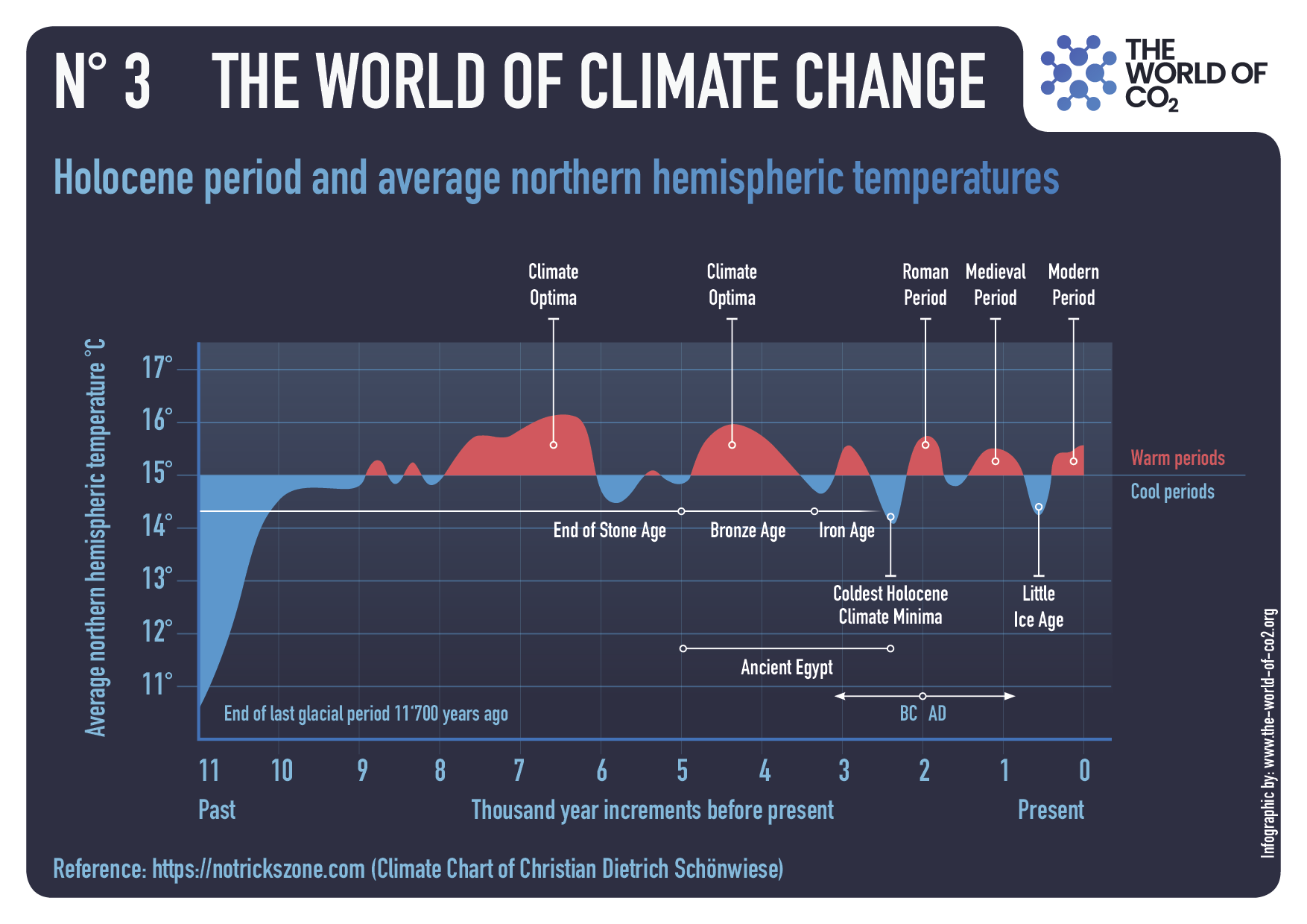
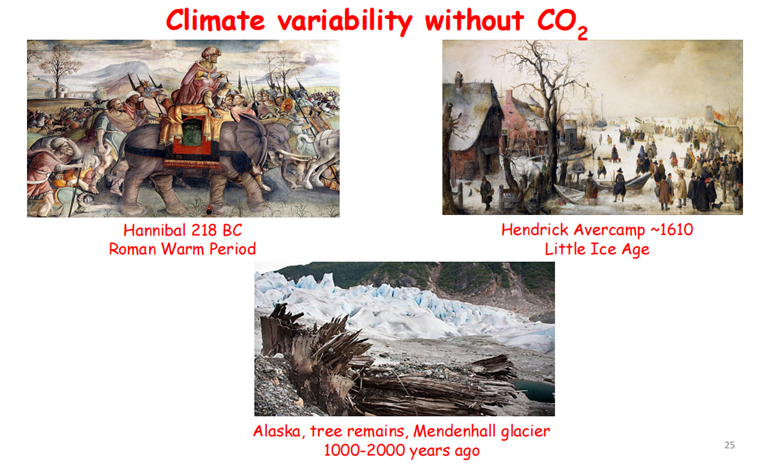
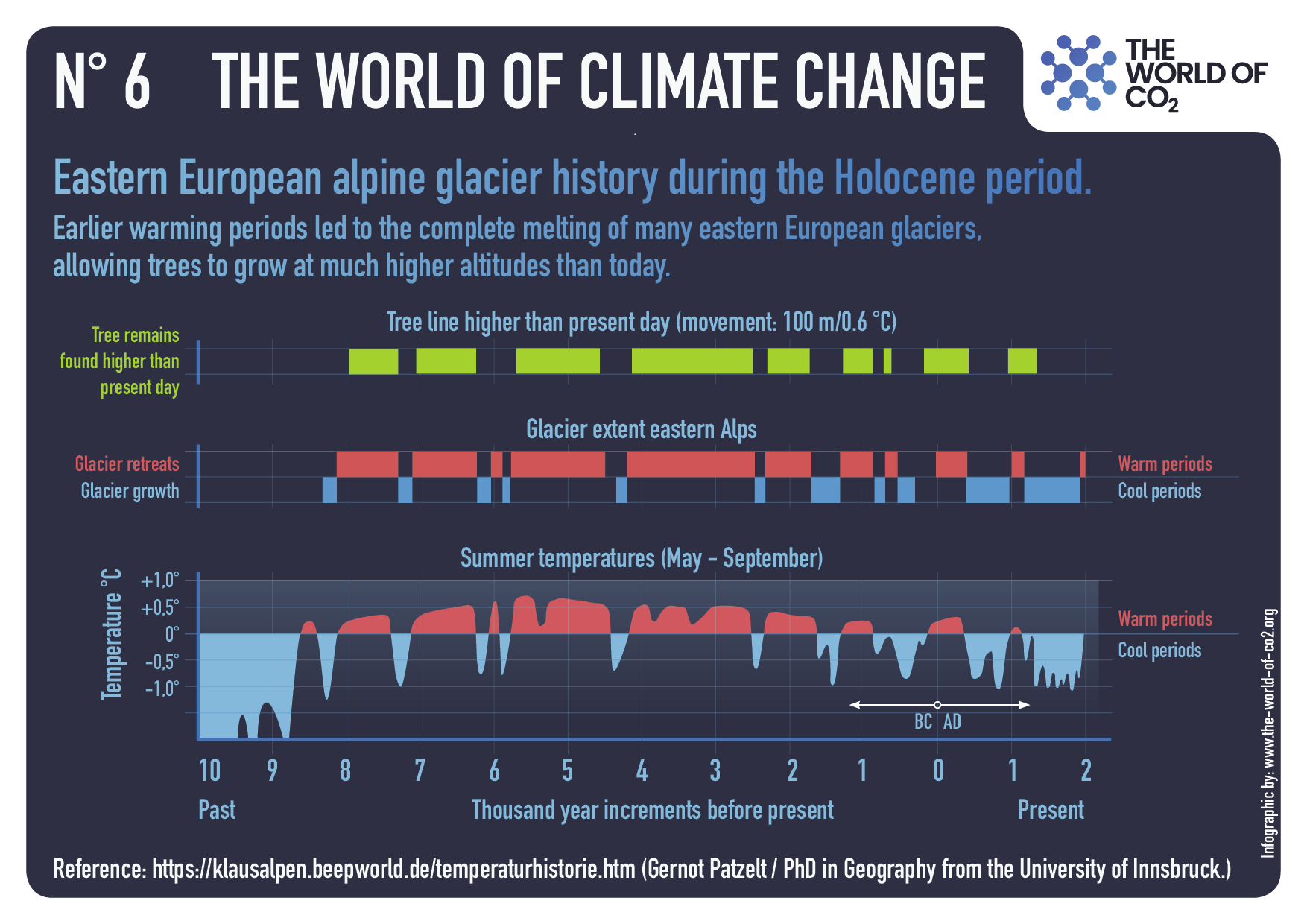
- Or when he puts up a map proving that the northern forests, 4000 years ago extended about 200 miles further north worldwide than they do today.
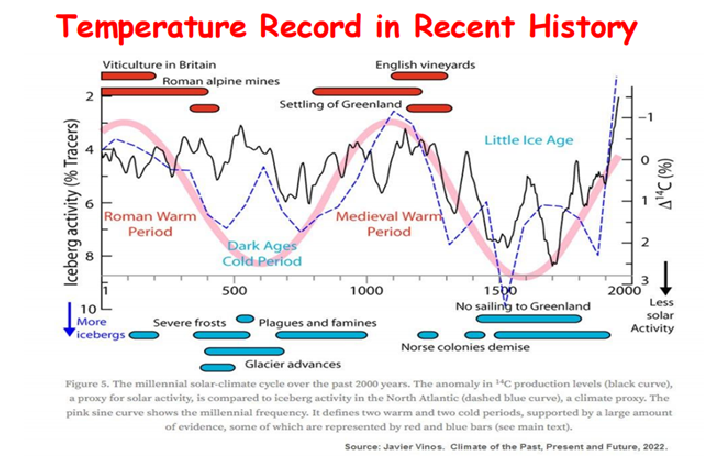
- Or shows that 2000 years ago, the Romans had vineyards in England extending all the way to Hadrian’s wall, millennia before cold weather grapes had been developed.
- Or when he shows evidence that 1000 years ago the Vikings grew barley in Greenland, something not possible today. Surely this proves that the world had many warmer periods without the help of extra CO2 in the atmosphere.
There are many such statements that Congress can quote, to very publicly humiliate these society presidents. As a committed life fellow of the APS, I hope these societies will change their statements now, before the roof collapses on them.
Background from Richard Lindzen
The above described changes in scientific culture were both the cause and effect of the growth of ‘big science,’ and the concomitant rise in importance of large organizations. However, all such organizations, whether professional societies, research laboratories, advisory bodies (such as the national academies), government departments and agencies (including NASA, NOAA, EPA, NSF, etc.), and even universities are hierarchical structures where positions and policies are determined by small executive councils or even single individuals. This greatly facilitates any conscious effort to politicize science via influence in such bodies where a handful of individuals (often not even scientists) speak on behalf of organizations that include thousands of scientists, and even enforce specific scientific positions and agendas. The temptation to politicize science is overwhelming and longstanding. Public trust in science has always been high, and political organizations have long sought to improve their own credibility by associating their goals with ‘science’ – even if this involves misrepresenting the science.
Professional societies represent a somewhat special case. Originally created to provide a means for communication within professions – organizing meetings and publishing journals – they also provided, in some instances, professional certification, and public outreach. The central offices of such societies were scattered throughout the US, and rarely located in Washington. Increasingly, however, such societies require impressive presences in Washington where they engage in interactions with the federal government. Of course, the nominal interaction involves lobbying for special advantage, but increasingly, the interaction consists in issuing policy and scientific statements on behalf of the society. Such statements, however, hardly represent independent representation of membership positions. For example, the primary spokesman for the American Meteorological Society in Washington is Anthony Socci who is neither an elected official of the AMS nor a contributor to climate science. Rather, he is a former staffer for Al Gore.
Returning to the matter of scientific organizations, we find a variety of patterns of influence. The most obvious to recognize (though frequently kept from public view), consists in prominent individuals within the environmental movement simultaneously holding and using influential positions within the scientific organization. Thus, John Firor long served as administrative director of the National Center for Atmospheric Research in Boulder, Colorado. This position was purely administrative, and Firor did not claim any scientific credentials in the atmospheric sciences at the time I was on the staff of NCAR. However, I noticed that beginning in the 1980’s, Firor was frequently speaking on the dangers of global warming as an expert from NCAR. When Firor died last November, his obituary noted that he had also been Board Chairman at Environmental Defense– a major environmental advocacy group – from 1975-1980 [5].
One could go on at some length with such examples, but a more common form of infiltration consists in simply getting a couple of seats on the council of an organization (or on the advisory panels of government agencies). This is sufficient to veto any statements or decisions that they are opposed to. Eventually, this enables the production of statements supporting their position – if only as a quid pro quo for permitting other business to get done. Sometimes, as in the production of the 1993 report of the NAS, Policy Implications of Global Warming, the environmental activists, having largely gotten their way in the preparation of the report where they were strongly represented as ‘stake holders,’ decided, nonetheless, to issue a minority statement suggesting that the NAS report had not gone ‘far enough.’ The influence of the environmental movement has effectively made support for global warming, not only a core element of political correctness, but also a requirement for the numerous prizes and awards given to scientists. That said, when it comes to professional societies, there is often no need at all for overt infiltration since issues like global warming have become a part of both political correctness and (in the US) partisan politics, and there will usually be council members who are committed in this manner.
Source: Climate Science: Is it Currently Designed to Answer Questions?
Comment: These bodies all claim to serve society, which as American institutions should primarily be concerned about American society. Funded by American taxpayers and donors, they should consider first and foremost their own country’s needs. That means stopping the fuzzy logic and blurring the truth about weather and climate. Otherwise they must fade into irrelevance.
And they must stop promoting the interests of a few colleagues at the expense of the many ordinary citizens.
L.A.’s Self-induced Fires Seen From the Ground

E.M. Smith provides a resident-level view of the California Calamity at his Chiefio blog Los Angeles Burning & Did It To Themselves. Excerpts in italics with my bolds and added images.
Check The News – L.A. Is On Fire
Yes, it is a disaster. Yes, $Billions of real estate going up in flames. Yes, “Stars” Losing everything; and normies too. No, it is not due to Global Warming. This is January and seasonal cool swamps any 1.5 C change.
It looks like not just Malibu, but several places all around Los Angeles, the hills, Hollywood, and more are having major fire problems.
Houses built too close together, using flammable materials. Trees and
shrubs that are flammable too. Then the Santa Ana Winds kick in.
Fire is an absolutely normal aspect of the Southern California landscape. When the Santa Ana winds blow (down slope wind that heats up from compression and gets funneled into a narrower space, so very fast) any fire becomes a blow torch. By then, there is not much you can do. Prevention is what matters, so now we wait for the winds to die down.

One TV Video showed a multi-lane major road, about 6 lanes across by the look of it. All abandoned cars. Folks trying to flee the fire, in a traffic jam, got out of their cars and ran. Firefighters had to take a bulldozer and push the cars off the road to make a lane for firetrucks.
This is the edge of insane.
So instead of mitigating fuel loads, assuring there are enough fire trucks, fire fighters, and water storage, Gavin Newsom & the L.A. area Mayors, were busy working on how to run for POTUS, and Get Trump, and assure the Unions donated a lot of money to Democrats. Hollywood “Names” were busy complaining about Republicans and having Panic Attacks about Global Warming instead of asking if their trees were Towering Infernos waiting to happen and replacing that Shake Roof with a metal one.

Distraction leads to destruction. They all knew they lived in a fire zone. PSAs have been running about it my whole life in California (at least 65 years). They chose parties with All The Right People over Prudent Planning and preparation. They chose “self actualization” over Situational Awareness and adaptation (and hard work). Now comes the consequences.
In Conclusion
BUT, fire awareness and risk has been true the entire life of California. Either you learn to mitigate fuel, provide for rapid and effective fire suppression, and harden you house against fire; or you burn. Has always been that way. Will be too.

Folks have known for generations how to harden, mitigate, and adapt. Have houses separated from each other by enough space that one can not start the next one on fire. Build with non-flammable materials (cinder block, concrete, stucco over wire with metal 2×4 studs, tile or metal roofs, and metal shutters to prevent IR ignition of drapes inside windows (or even fiberglass drapes). Install water sprinkler fire suppression systems. DO NOT PLANT FLAMMABLE TREES, BUSHES & GRASS around houses. Have wide firebreaks between buildings. And more.

Remaining trees and vegetation on the forest floor are more vigorous after removal of small trees for fuels reduction.
All of this has been known for 100 years.
But you get more houses built, so more money made, if you pack them 12 to an acre. Folks like the “look” of wood shake roofs, asphalt shingles are cheaper, nobody wants “stucco” anymore, but I LIKE eucalyptus! and on it goes.
Nobody wants to “damage the ecology” by taking out scrub and clearing forest liter. Paying for and planning large water sources, big pipes & pumps, and having all necessary equipment on standby for a decade (or two) “for that day” just seems wasteful; until you need it.
So call me hard-hearted. I grew up in Fire Country. I’ve fought grass fires and as a temporary Forest Fire Fighter climbed up and down hills with a Pulaski (axe hoe combo) on my shoulder, sleeping in a shredded newspaper stuffed sleeping bag for a weekend, working a fire. The home I grew up in had a metal roof. My present home has cinder block walls with stucco and faux brick over it. When this roof wears out in a few years, the replacement will be metal. I have hoses and nozzles ready to put out any sparks that blow in (old habits die hard…) Folks either prepare for fire, or they accept the consequences.

A feller buncher removing small trees that act as fuel ladders and transmit fire into the forest canopy.
So when the inevitable bleating and braying about Global Warming Oh Noes! and “More Fires!” starts: Just ask if they know how many of the homes had metal roofs & shutters and stucco over cinder block walls? How many homes had a 20 foot fire break of non-flammable area around them?
And answers came there none.
Democrats: You own this one 100% since you own ALL of California Government. You made all the building codes, water systems, fire departments, roads & infrastructure. Planned all of it. Permitted the “rack ’em, pack ’em & stack ’em” building permits. Made money off cheaper wood & asphalt shingle construction. Now you will reap the results.

Wyoming: Make Carbon Dioxide Great Again–No Net Zero
A bill is progressing through the Wyoming State Legislature, as described by the author in her op-ed Rethinking Carbon Dioxide – Wyoming’s Bold Move. Excerpts in italics with my bolds and added images.
Torrington, WY (State Senator Cheri Steinmetz) January 7th, 2025 — The people of Wyoming have always believed in the value of questioning conventional wisdom, looking at the bigger picture and finding solutions that are possible and actually work. That’s the purpose of the bill titled “Make Carbon Dioxide Great Again”. This legislation is not about denying science, it is about applying science, thoroughly reevaluating the ‘climate change’ scientific assumptions and advocating for policies grounded in practicality, reality, and achievability – common sense.
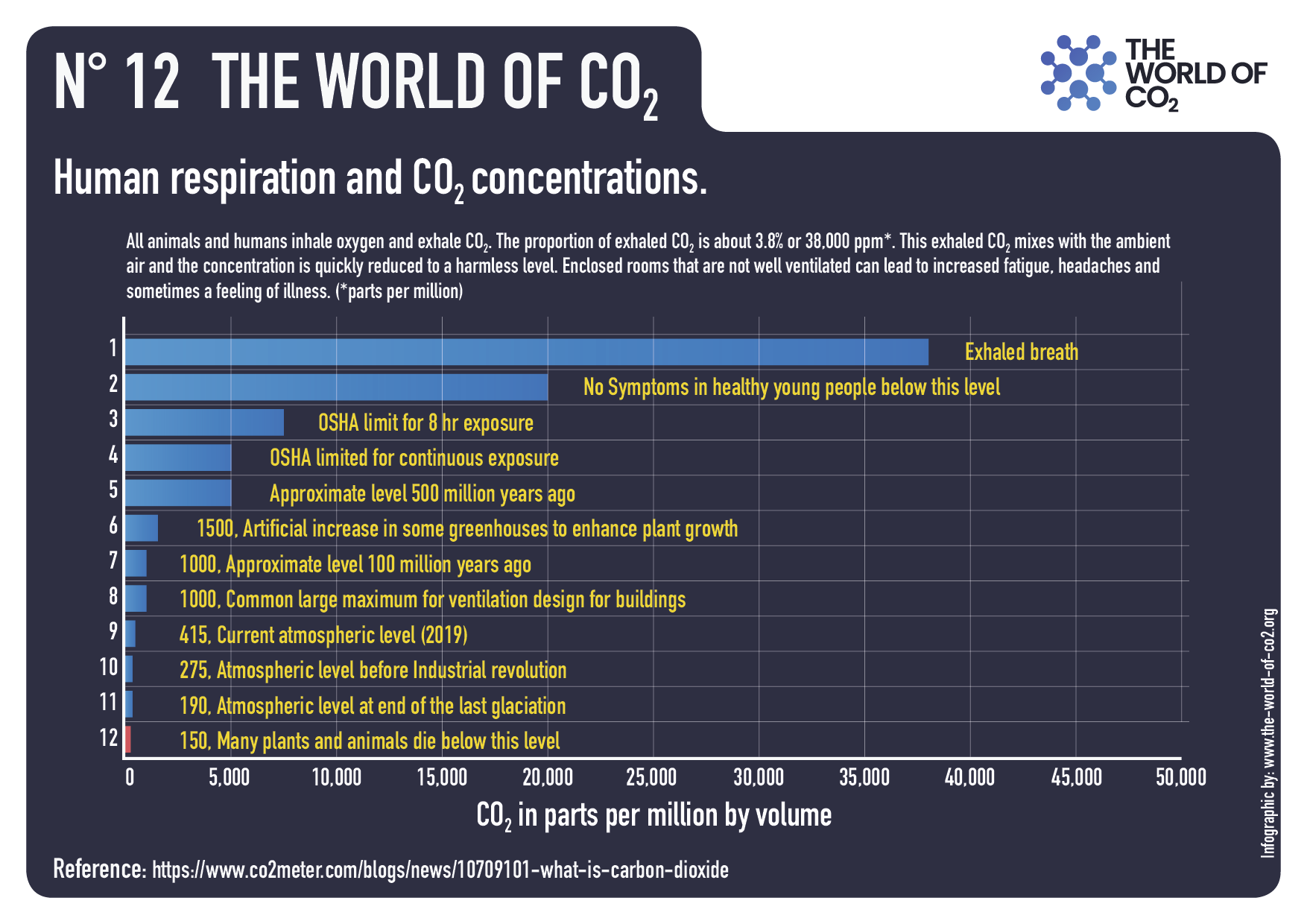
Carbon dioxide (CO2) is vital to life on Earth.
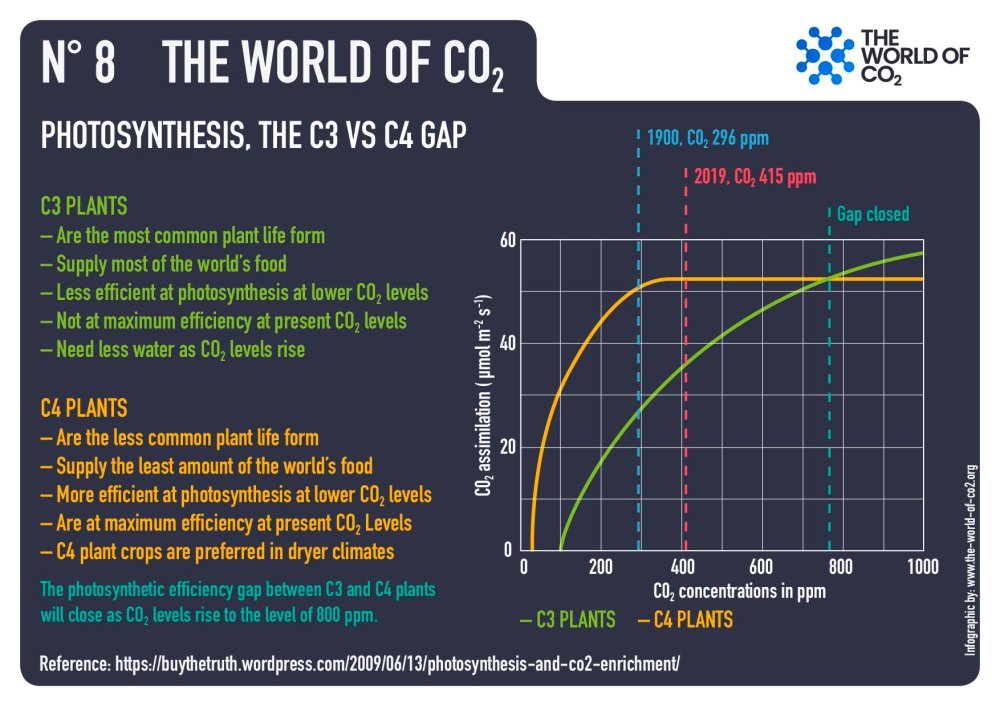
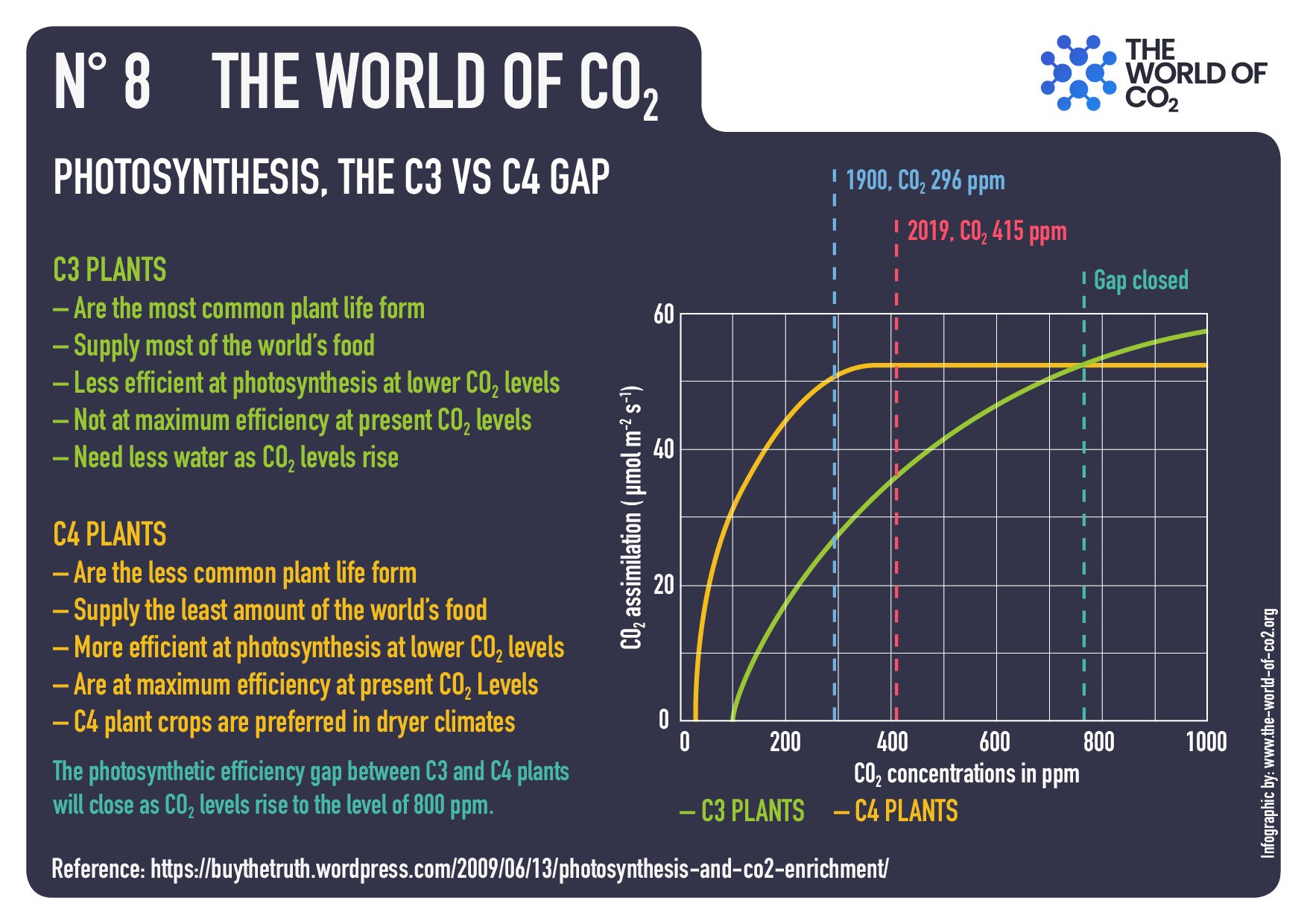
Without it, plants could not grow, and without plants, no life would survive. Scientists and farmers alike recognize that higher CO2 levels improve agricultural productivity. Plants thrive with more CO2 – they grow faster, use water more efficiently, and are more resilient to drought. NASA’s own research shows that rising CO2 has contributed to a global “greening” effect, expanding vegetation and helping ecosystems flourish. CO2 is plant food!
Yet, despite its essential role in sustaining life,
CO2 has been demonized as a pollutant.
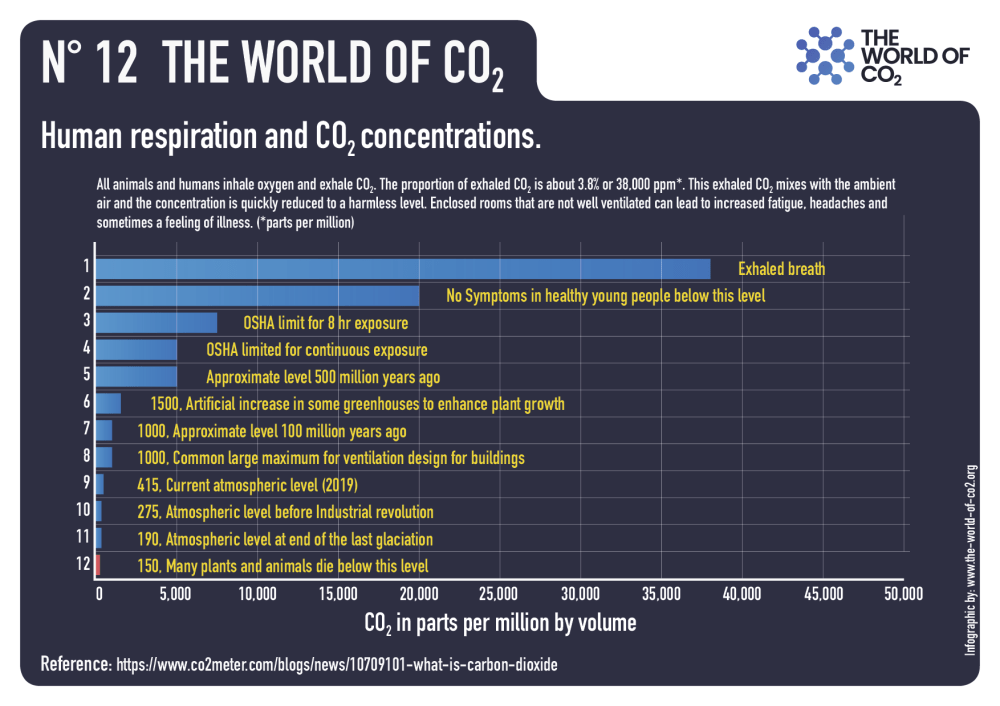
But what impact are human driven CO2 emissions actually capable of? We are contributing a very small part of the natural carbon cycle. Current CO2 levels are among the lowest Earth has seen over its long history. There were times in the past when ecosystems flourished under much higher CO2 concentrations. Instead of vilifying this essential gas, we should be acknowledging its role in our ecosystems and industries and protect the benefits it has in our lives.
Wyoming is uniquely positioned to lead this conversation.
Our state is vital to energy production, agriculture and food industries, transportation and energy reliability and stability. We understand the real-world importance of CO2. And we understand the benefits of CO2 used directly. Our industries already use it to enhance oil recovery, making energy production more efficient. This technology exemplifies what we are capable of when we treat CO2 as a resource rather than a liability.
The bill Make Carbon Dioxide Great Again shifts how we think about CO2.
It proposes that we stop treating the essential gas as a pollutant or contaminant. It requires a clear-eyed look at how policies aimed at eliminating CO2 emissions, such as decarbonizing the West, making Wyoming carbon negative or popular “net-zero” mandates. They may sound good on paper but often come with high economic costs and questionable environmental benefits, and clearly negative effects on our people and our industries.
Wyoming must refuse to jeopardize our economy and energy security
for initiatives that will yield – at best – questionable results.
Critics of “net-zero” strategies have highlighted the risks of pursuing policy goals without fully considering their consequences. These frequently require massive investments, disruption of reliable energy systems, and the forced undue burdens on families and businesses. Instead, Wyoming advocates for a balanced approach – one that evaluates the risks and possible rewards of any CO2 management plans that will safeguard our economic stability and way of life.
This approach challenges the status quo, and that is precisely the point. Now is the time to rethink how we talk about CO2 and climate change. This bill is not about ignoring environmental concerns; it is about addressing them with clear-eyed pragmatism and truth.
Wyoming is taking a bold step forward to lead a balanced, science-based dialogue. We all stand to benefit from this. Our energy sector, agriculture, transportation and all other industries, and even the broader environment, will gain when we use CO2 wisely.
This conversation is just beginning and must spark
a national debate about the fundamental role of CO2.
It is a debate we need to have – not just in Wyoming, with our own Governor and citizens – but across the nation and with all the organizations leading the charge to “net zero.” Let us challenge the assumptions, ask the hard questions, and make sure our policies truly serve the people, industry and the environment. After all, that is the Wyoming way.
Text of Wyoming Bill SF0092 Make carbon dioxide great again-no net zero.
AN ACT relating to environmental quality; providing legislative findings;
specifying that carbon dioxide is not a pollutant and is a beneficial substance;
providing policy statements of the state associated with carbon dioxide;
repealing low-carbon energy standard requirements; repealing conflicting provisions;
making conforming amendments; specifying applicability;
requiring reimbursement to utility customers as specified;
requiring rulemaking; and providing for an effective date.
Be It Enacted by the Legislature of the State of Wyoming:
Section 1. W.S. 35-11-215 is created to read:
1 SF0092
35-11-215. Carbon dioxide; beneficial treatment; state policy.
(a) The legislature finds that:
(i) Carbon dioxide is a foundational nutrient necessary for all life on earth. Plants need carbon dioxide along with sunlight, water and nutrients to prosper. The more carbon dioxide available for this, the better life can flourish;
(ii) The carbon cycle, where carbon dioxide is reused and transferred between the atmosphere and organisms on earth, is a biological necessity for life on earth;
(iii) Agricultural production worldwide is outpacing population growth and breaking production records primarily due to increasing atmospheric carbon dioxide;
(iv) More carbon dioxide allows plants to better resist drought by using water more efficiently;
(v) The national aeronautics and space administration has confirmed that global vegetation is increasing from the near-polar regions to the equator. The largest contributor to this greening of the earth is increasing carbon dioxide;
(vi) Carbon dioxide levels are currently at approximately four hundred twenty (420) parts per million, which is at near-historically low concentrations. The current carbon dioxide levels are one-sixth (1/6) of the average of two thousand six hundred (2,600) parts per million over geologic time;
(vii) It is estimated that carbon dioxide levels need to exceed one hundred fifty (150) parts per million to ensure the survival of plant life on earth;
(viii) The earth needs carbon dioxide to support life and to increase plant yields, both of which will contribute to the health and prosperity of all Wyoming citizens.
(b) It is the policy of the state of Wyoming that:
(i) Carbon dioxide is a foundational nutrient necessary for life on earth;
(ii) Carbon dioxide shall not be designated or treated as a pollutant or contaminant;
(iii) The state of Wyoming shall not pursue any targets or measures that support the reduction or elimination of carbon dioxide, including any “net-zero” targets.
Section 2. W.S. 37-1-101(a)(intro) and 37-2-134(a)(i) and (iv) are amended to read:
37-1-101. Definitions.
(a) As used in chapters 1, 2, 3, 12, and 17 and 18 of this title:
37-2-134. Electric generation facility closures; presumption; commission review
(a) As used in this section:
(i) “Dispatchable” means as defined in W.S. 37-18-101(a)(ii) a source of electricity that is available for use on demand and that can be dispatched upon request of a power grid operator or that can have its power output adjusted, according to market needs and includes dispatchability;
(iv) “Reliable” means as defined in W.S. 37-18-101(a)(iv) generated electricity that is not subject to intermittent availability.
Section 3. W.S. 37-1-101(a)(vi)(N), 37-18-101 and 37-18-102 are repealed.
Section 4. Not later than sixty (60) days after the effective date of this act each public utility that recovered rates from customers under W.S. 37-18-102(c)(i) or (iii), as repealed by section 3 of this act, shall refund those rates to customers who paid them, provided that the utility shall not be required to refund rates recovered under W.S. 37-18-102(c)(i) and (iii) that the utility had expended for carbon capture, utilization and storage technology before the effective date of this act. Refunds required under this section shall be in a form and manner specified by the public service commission
Section 5. The public service commission shall promulgate all rules necessary to implement this act.
Section 6. This act is effective immediately upon completion of all acts necessary for a bill to become law as provided by Article 4, Section 8 of the Wyoming Constitution.
(END)

Ocean Even Cooler December 2024

The best context for understanding decadal temperature changes comes from the world’s sea surface temperatures (SST), for several reasons:
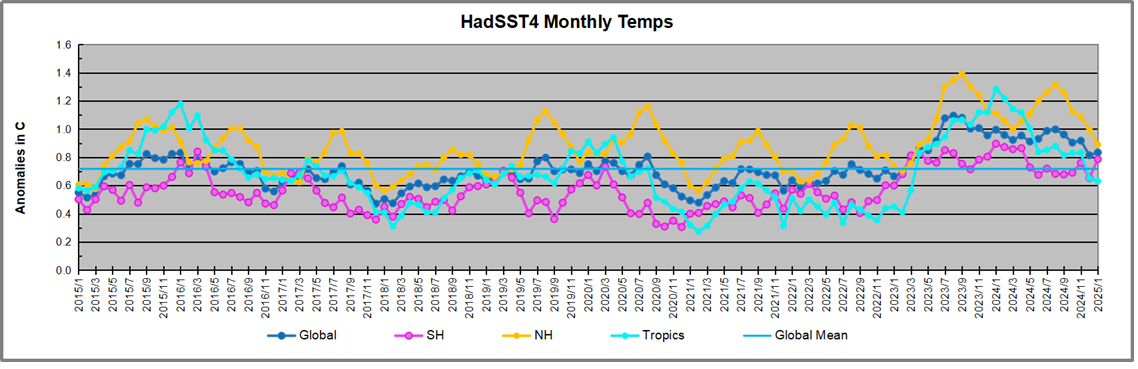
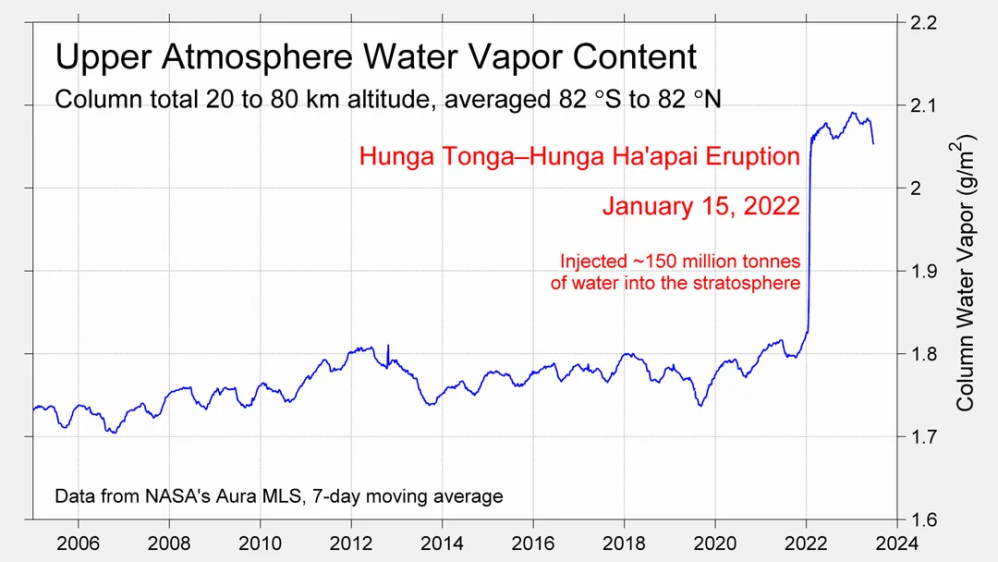
- The ocean covers 71% of the globe and drives average temperatures;
- SSTs have a constant water content, (unlike air temperatures), so give a better reading of heat content variations;
- Major El Ninos have been the dominant climate feature in recent years.
HadSST is generally regarded as the best of the global SST data sets, and so the temperature story here comes from that source. Previously I used HadSST3 for these reports, but Hadley Centre has made HadSST4 the priority, and v.3 will no longer be updated. HadSST4 is the same as v.3, except that the older data from ship water intake was re-estimated to be generally lower temperatures than shown in v.3. The effect is that v.4 has lower average anomalies for the baseline period 1961-1990, thereby showing higher current anomalies than v.3. This analysis concerns more recent time periods and depends on very similar differentials as those from v.3 despite higher absolute anomaly values in v.4. More on what distinguishes HadSST3 and 4 from other SST products at the end. The user guide for HadSST4 is here.
The Current Context
The chart below shows SST monthly anomalies as reported in HadSST4 starting in 2015 through December 2024. A global cooling pattern is seen clearly in the Tropics since its peak in 2016, joined by NH and SH cycling downward since 2016, followed by rising temperatures in 2023 and 2024.
Note that in 2015-2016 the Tropics and SH peaked in between two summer NH spikes. That pattern repeated in 2019-2020 with a lesser Tropics peak and SH bump, but with higher NH spikes. By end of 2020, cooler SSTs in all regions took the Global anomaly well below the mean for this period. A small warming was driven by NH summer peaks in 2021-22, but offset by cooling in SH and the tropics, By January 2023 the global anomaly was again below the mean.
Now in 2023-24 came an event resembling 2015-16 with a Tropical spike and two NH spikes alongside, all higher than 2015-16. There was also a coinciding rise in SH, and the Global anomaly was pulled up to 1.1°C last year, ~0.3° higher than the 2015 peak. Then NH started down autumn 2023, followed by Tropics and SH descending 2024 to the present. After 10 months of cooling in SH and the Tropics, the Global anomaly came back down, led by NH cooling the last 4 months from its peak in August. It’s now about 0.1C higher than the average for this period. Note that the Tropical anomaly has cooled from 1.29C in 2024/01 to 0.66C as of 2024/12.
Comment:
The climatists have seized on this unusual warming as proof their Zero Carbon agenda is needed, without addressing how impossible it would be for CO2 warming the air to raise ocean temperatures. It is the ocean that warms the air, not the other way around. Recently Steven Koonin had this to say about the phonomenon confirmed in the graph above:
El Nino is a phenomenon in the climate system that happens once every four or five years. Heat builds up in the equatorial Pacific to the west of Indonesia and so on. Then when enough of it builds up it surges across the Pacific and changes the currents and the winds. As it surges toward South America it was discovered and named in the 19th century It iswell understood at this point that the phenomenon has nothing to do with CO2.
Now people talk about changes in that phenomena as a result of CO2 but it’s there in the climate system already and when it happens it influences weather all over the world. We feel it when it gets rainier in Southern California for example. So for the last 3 years we have been in the opposite of an El Nino, a La Nina, part of the reason people think the West Coast has been in drought.
It has now shifted in the last months to an El Nino condition that warms the globe and is thought to contribute to this Spike we have seen. But there are other contributions as well. One of the most surprising ones is that back in January of 2022 an enormous underwater volcano went off in Tonga and it put up a lot of water vapor into the upper atmosphere. It increased the upper atmosphere of water vapor by about 10 percent, and that’s a warming effect, and it may be that is contributing to why the spike is so high.

A longer view of SSTs
The graph above is noisy, but the density is needed to see the seasonal patterns in the oceanic fluctuations. Previous posts focused on the rise and fall of the last El Nino starting in 2015. This post adds a longer view, encompassing the significant 1998 El Nino and since. The color schemes are retained for Global, Tropics, NH and SH anomalies. Despite the longer time frame, I have kept the monthly data (rather than yearly averages) because of interesting shifts between January and July. 1995 is a reasonable (ENSO neutral) starting point prior to the first El Nino.
The sharp Tropical rise peaking in 1998 is dominant in the record, starting Jan. ’97 to pull up SSTs uniformly before returning to the same level Jan. ’99. There were strong cool periods before and after the 1998 El Nino event. Then SSTs in all regions returned to the mean in 2001-2.
SSTS fluctuate around the mean until 2007, when another, smaller ENSO event occurs. There is cooling 2007-8, a lower peak warming in 2009-10, following by cooling in 2011-12. Again SSTs are average 2013-14.
Now a different pattern appears. The Tropics cooled sharply to Jan 11, then rise steadily for 4 years to Jan 15, at which point the most recent major El Nino takes off. But this time in contrast to ’97-’99, the Northern Hemisphere produces peaks every summer pulling up the Global average. In fact, these NH peaks appear every July starting in 2003, growing stronger to produce 3 massive highs in 2014, 15 and 16. NH July 2017 was only slightly lower, and a fifth NH peak still lower in Sept. 2018.
The highest summer NH peaks came in 2019 and 2020, only this time the Tropics and SH were offsetting rather adding to the warming. (Note: these are high anomalies on top of the highest absolute temps in the NH.) Since 2014 SH has played a moderating role, offsetting the NH warming pulses. After September 2020 temps dropped off down until February 2021. In 2021-22 there were again summer NH spikes, but in 2022 moderated first by cooling Tropics and SH SSTs, then in October to January 2023 by deeper cooling in NH and Tropics.
Then in 2023 the Tropics flipped from below to well above average, while NH produced a summer peak extending into September higher than any previous year. Despite El Nino driving the Tropics January 2024 anomaly higher than 1998 and 2016 peaks, following months cooled in all regions, and the Tropics continued cooling in April, May and June along with SH dropping. After July and August NH warming again pulled the global anomaly higher, September and October resumed cooling in all regions.
What to make of all this? The patterns suggest that in addition to El Ninos in the Pacific driving the Tropic SSTs, something else is going on in the NH. The obvious culprit is the North Atlantic, since I have seen this sort of pulsing before. After reading some papers by David Dilley, I confirmed his observation of Atlantic pulses into the Arctic every 8 to 10 years.
Contemporary AMO Observations
Through January 2023 I depended on the Kaplan AMO Index (not smoothed, not detrended) for N. Atlantic observations. But it is no longer being updated, and NOAA says they don’t know its future. So I find that ERSSTv5 AMO dataset has current data. It differs from Kaplan, which reported average absolute temps measured in N. Atlantic. “ERSST5 AMO follows Trenberth and Shea (2006) proposal to use the NA region EQ-60°N, 0°-80°W and subtract the global rise of SST 60°S-60°N to obtain a measure of the internal variability, arguing that the effect of external forcing on the North Atlantic should be similar to the effect on the other oceans.” So the values represent sst anomaly differences between the N. Atlantic and the Global ocean.
The chart above confirms what Kaplan also showed. As August is the hottest month for the N. Atlantic, its variability, high and low, drives the annual results for this basin. Note also the peaks in 2010, lows after 2014, and a rise in 2021. Then in 2023 the peak was holding at 1.4C before declining. An annual chart below is informative:
Note the difference between blue/green years, beige/brown, and purple/red years. 2010, 2021, 2022 all peaked strongly in August or September. 1998 and 2007 were mildly warm. 2016 and 2018 were matching or cooler than the global average. 2023 started out slightly warm, then rose steadily to an extraordinary peak in July. August to October were only slightly lower, but by December cooled by ~0.4C.
Then in 2024 the AMO anomaly started higher than any previous year, then leveled off for two months declining slightly into April. Remarkably, May showed an upward leap putting this on a higher track than 2023, and rising slightly higher in June. In July, August and September 2024 the anomaly declined, and despite a small rise in October, is now lower than the peak reached in 2023.
The pattern suggests the ocean may be demonstrating a stairstep pattern like that we have also seen in HadCRUT4.
The purple line is the average anomaly 1980-1996 inclusive, value 0.18. The orange line the average 1980-2024, value 0.39, also for the period 1997-2012. The red line is 2013-2024, value 0.67. As noted above, these rising stages are driven by the combined warming in the Tropics and NH, including both Pacific and Atlantic basins.
See Also:
2024 El Nino Collapsing
Curiosity: Solar Coincidence?
The news about our current solar cycle 25 is that the solar activity is hitting peak numbers now and higher than expected 1-2 years in the future. As livescience put it: Solar maximum could hit us harder and sooner than we thought. How dangerous will the sun’s chaotic peak be? Some charts from spaceweatherlive look familar to these sea surface temperature charts.
Summary
The oceans are driving the warming this century. SSTs took a step up with the 1998 El Nino and have stayed there with help from the North Atlantic, and more recently the Pacific northern “Blob.” The ocean surfaces are releasing a lot of energy, warming the air, but eventually will have a cooling effect. The decline after 1937 was rapid by comparison, so one wonders: How long can the oceans keep this up? And is the sun adding forcing to this process?

Space weather impacts the ionosphere in this animation. Credits: NASA/GSFC/CIL/Krystofer Kim
Footnote: Why Rely on HadSST4
HadSST is distinguished from other SST products because HadCRU (Hadley Climatic Research Unit) does not engage in SST interpolation, i.e. infilling estimated anomalies into grid cells lacking sufficient sampling in a given month. From reading the documentation and from queries to Met Office, this is their procedure.
HadSST4 imports data from gridcells containing ocean, excluding land cells. From past records, they have calculated daily and monthly average readings for each grid cell for the period 1961 to 1990. Those temperatures form the baseline from which anomalies are calculated.
In a given month, each gridcell with sufficient sampling is averaged for the month and then the baseline value for that cell and that month is subtracted, resulting in the monthly anomaly for that cell. All cells with monthly anomalies are averaged to produce global, hemispheric and tropical anomalies for the month, based on the cells in those locations. For example, Tropics averages include ocean grid cells lying between latitudes 20N and 20S.
Gridcells lacking sufficient sampling that month are left out of the averaging, and the uncertainty from such missing data is estimated. IMO that is more reasonable than inventing data to infill. And it seems that the Global Drifter Array displayed in the top image is providing more uniform coverage of the oceans than in the past.

USS Pearl Harbor deploys Global Drifter Buoys in Pacific Ocean
12/2024 Update–As Temperature Changes, CO2 Follows
Previously I have demonstrated that changes in atmospheric CO2 levels follow changes in Global Mean Temperatures (GMT) as shown by satellite measurements from University of Alabama at Huntsville (UAH). That background post is reprinted later below.
My curiosity was piqued by the remarkable GMT spike starting in January 2023 and rising to a peak in April 2024, and then declining afterward. I also became aware that UAH has recalibrated their dataset due to a satellite drift that can no longer be corrected. The values since 2020 have shifted slightly in version 6.1, as shown in my recent report Ocean Leads Cooling UAH December 2024.
In this post, I test the premise that temperature changes are predictive of changes in atmospheric CO2 concentrations. The chart above shows the two monthly datasets: CO2 levels in blue reported at Mauna Loa, and Global temperature anomalies in purple reported by UAHv6.1, both through December 2024. Would such a sharp increase in temperature be reflected in rising CO2 levels, according to the successful mathematical forecasting model? Would CO2 levels decline as temperatures dropped following the peak?
The answer is yes: that temperature spike resulted
in a corresponding CO2 spike as expected.
And lower CO2 levels followed the temperature decline.
Above are UAH temperature anomalies compared to CO2 monthly changes year over year.
Changes in monthly CO2 synchronize with temperature fluctuations, which for UAH are anomalies now referenced to the 1991-2020 period. CO2 differentials are calculated for the present month by subtracting the value for the same month in the previous year (for example December 2024 minus December 2023). Temp anomalies are calculated by comparing the present month with the baseline month. Note the recent CO2 upward spike and drop following the temperature spike and drop.
The final proof that CO2 follows temperature due to stimulation of natural CO2 reservoirs is demonstrated by the ability to calculate CO2 levels since 1979 with a simple mathematical formula:
For each subsequent year, the CO2 level for each month was generated
CO2 this month this year = a + b × Temp this month this year + CO2 this month last year
The values for a and b are constants applied to all monthly temps, and are chosen to scale the forecasted CO2 level for comparison with the observed value. Here is the result of those calculations.
In the chart calculated CO2 levels correlate with observed CO2 levels at 0.9987 out of 1.0000. This mathematical generation of CO2 atmospheric levels is only possible if they are driven by temperature-dependent natural sources, and not by human emissions which are small in comparison, rise steadily and monotonically. For a more detailed look at the recent fluxes, here are the results since 2015, an ENSO neutral year.
For this recent period, the calculated CO2 values match the annual lows, while some annual generated values of CO2 are slightly higher or lower than observed at other months of the year. Still the correlation for this period is 0.9931.
Key Point
Changes in CO2 follow changes in global temperatures on all time scales, from last month’s observations to ice core datasets spanning millennia. Since CO2 is the lagging variable, it cannot logically be the cause of temperature, the leading variable. It is folly to imagine that by reducing human emissions of CO2, we can change global temperatures, which are obviously driven by other factors.
Background Post Temperature Changes Cause CO2 Changes, Not the Reverse
This post is about proving that CO2 changes in response to temperature changes, not the other way around, as is often claimed. In order to do that we need two datasets: one for measurements of changes in atmospheric CO2 concentrations over time and one for estimates of Global Mean Temperature changes over time.
Climate science is unsettling because past data are not fixed, but change later on. I ran into this previously and now again in 2021 and 2022 when I set out to update an analysis done in 2014 by Jeremy Shiers (discussed in a previous post reprinted at the end). Jeremy provided a spreadsheet in his essay Murray Salby Showed CO2 Follows Temperature Now You Can Too posted in January 2014. I downloaded his spreadsheet intending to bring the analysis up to the present to see if the results hold up. The two sources of data were:
Temperature anomalies from RSS here: http://www.remss.com/missions/amsu
CO2 monthly levels from NOAA (Mauna Loa): https://www.esrl.noaa.gov/gmd/ccgg/trends/data.html
Changes in CO2 (ΔCO2)
Uploading the CO2 dataset showed that many numbers had changed (why?).
The blue line shows annual observed differences in monthly values year over year, e.g. June 2020 minus June 2019 etc. The first 12 months (1979) provide the observed starting values from which differentials are calculated. The orange line shows those CO2 values changed slightly in the 2020 dataset vs. the 2014 dataset, on average +0.035 ppm. But there is no pattern or trend added, and deviations vary randomly between + and -. So last year I took the 2020 dataset to replace the older one for updating the analysis.
Now I find the NOAA dataset starting in 2021 has almost completely new values due to a method shift in February 2021, requiring a recalibration of all previous measurements. The new picture of ΔCO2 is graphed below.
The method shift is reported at a NOAA Global Monitoring Laboratory webpage, Carbon Dioxide (CO2) WMO Scale, with a justification for the difference between X2007 results and the new results from X2019 now in force. The orange line shows that the shift has resulted in higher values, especially early on and a general slightly increasing trend over time. However, these are small variations at the decimal level on values 340 and above. Further, the graph shows that yearly differentials month by month are virtually the same as before. Thus I redid the analysis with the new values.
Global Temperature Anomalies (ΔTemp)
The other time series was the record of global temperature anomalies according to RSS. The current RSS dataset is not at all the same as the past.
Here we see some seriously unsettling science at work. The purple line is RSS in 2014, and the blue is RSS as of 2020. Some further increases appear in the gold 2022 rss dataset. The red line shows alterations from the old to the new. There is a slight cooling of the data in the beginning years, then the three versions mostly match until 1997, when systematic warming enters the record. From 1997/5 to 2003/12 the average anomaly increases by 0.04C. After 2004/1 to 2012/8 the average increase is 0.15C. At the end from 2012/9 to 2013/12, the average anomaly was higher by 0.21. The 2022 version added slight warming over 2020 values.
RSS continues that accelerated warming to the present, but it cannot be trusted. And who knows what the numbers will be a few years down the line? As Dr. Ole Humlum said some years ago (regarding Gistemp): “It should however be noted, that a temperature record which keeps on changing the past hardly can qualify as being correct.”
Given the above manipulations, I went instead to the other satellite dataset UAH version 6. UAH has also made a shift by changing its baseline from 1981-2010 to 1991-2020. This resulted in systematically reducing the anomaly values, but did not alter the pattern of variation over time. For comparison, here are the two records with measurements through December 2023.
Comparing UAH temperature anomalies to NOAA CO2 changes.
Here are UAH temperature anomalies compared to CO2 monthly changes year over year.
Changes in monthly CO2 synchronize with temperature fluctuations, which for UAH are anomalies now referenced to the 1991-2020 period. As stated above, CO2 differentials are calculated for the present month by subtracting the value for the same month in the previous year (for example June 2022 minus June 2021). Temp anomalies are calculated by comparing the present month with the baseline month.
The final proof that CO2 follows temperature due to stimulation of natural CO2 reservoirs is demonstrated by the ability to calculate CO2 levels since 1979 with a simple mathematical formula:
For each subsequent year, the co2 level for each month was generated
CO2 this month this year = a + b × Temp this month this year + CO2 this month last year
Jeremy used Python to estimate a and b, but I used his spreadsheet to guess values that place for comparison the observed and calculated CO2 levels on top of each other.
In the chart calculated CO2 levels correlate with observed CO2 levels at 0.9986 out of 1.0000. This mathematical generation of CO2 atmospheric levels is only possible if they are driven by temperature-dependent natural sources, and not by human emissions which are small in comparison, rise steadily and monotonically.
Comment: UAH dataset reported a sharp warming spike starting mid year, with causes speculated but not proven. In any case, that surprising peak has not yet driven CO2 higher, though it might, but only if it persists despite the likely cooling already under way.
Previous Post: What Causes Rising Atmospheric CO2?

This post is prompted by a recent exchange with those reasserting the “consensus” view attributing all additional atmospheric CO2 to humans burning fossil fuels.
The IPCC doctrine which has long been promoted goes as follows. We have a number over here for monthly fossil fuel CO2 emissions, and a number over there for monthly atmospheric CO2. We don’t have good numbers for the rest of it-oceans, soils, biosphere–though rough estimates are orders of magnitude higher, dwarfing human CO2. So we ignore nature and assume it is always a sink, explaining the difference between the two numbers we do have. Easy peasy, science settled.
What about the fact that nature continues to absorb about half of human emissions, even while FF CO2 increased by 60% over the last 2 decades? What about the fact that in 2020 FF CO2 declined significantly with no discernable impact on rising atmospheric CO2?

These and other issues are raised by Murray Salby and others who conclude that it is not that simple, and the science is not settled. And so these dissenters must be cancelled lest the narrative be weakened.
The non-IPCC paradigm is that atmospheric CO2 levels are a function of two very different fluxes. FF CO2 changes rapidly and increases steadily, while Natural CO2 changes slowly over time, and fluctuates up and down from temperature changes. The implications are that human CO2 is a simple addition, while natural CO2 comes from the integral of previous fluctuations. Jeremy Shiers has a series of posts at his blog clarifying this paradigm. See Increasing CO2 Raises Global Temperature Or Does Increasing Temperature Raise CO2 Excerpts in italics with my bolds.
The following graph which shows the change in CO2 levels (rather than the levels directly) makes this much clearer.

Note the vertical scale refers to the first differential of the CO2 level not the level itself. The graph depicts that change rate in ppm per year.
There are big swings in the amount of CO2 emitted. Taking the mean as 1.6 ppmv/year (at a guess) there are +/- swings of around 1.2 nearly +/- 100%.
And, surprise surprise, the change in net emissions of CO2 is very strongly correlated with changes in global temperature.

This clearly indicates the net amount of CO2 emitted in any one year is directly linked to global mean temperature in that year.
For any given year the amount of CO2 in the atmosphere will be the sum of
- all the net annual emissions of CO2
- in all previous years.
For each year the net annual emission of CO2 is proportional to the annual global mean temperature.
This means the amount of CO2 in the atmosphere will be related to the sum of temperatures in previous years.
So CO2 levels are not directly related to the current temperature but the integral of temperature over previous years.
The following graph again shows observed levels of CO2 and global temperatures but also has calculated levels of CO2 based on sum of previous years temperatures (dotted blue line).

Summary:
The massive fluxes from natural sources dominate the flow of CO2 through the atmosphere. Human CO2 from burning fossil fuels is around 4% of the annual addition from all sources. Even if rising CO2 could cause rising temperatures (no evidence, only claims), reducing our emissions would have little impact.

Atmospheric CO2 Math
Ins: 4% human, 96% natural
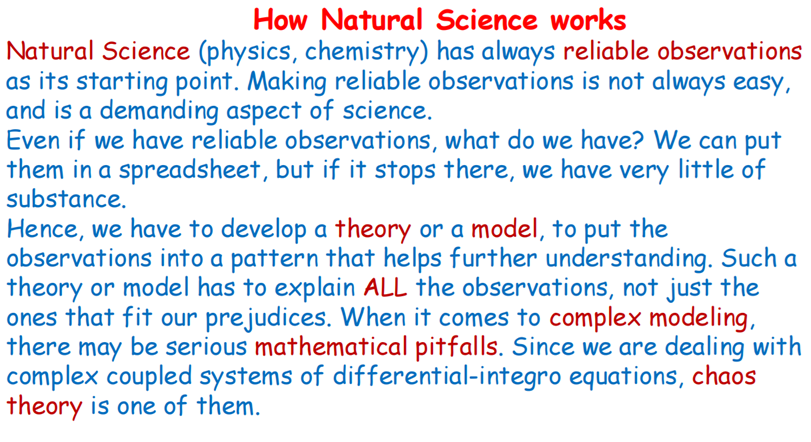
Outs: 0% human, 98% natural.
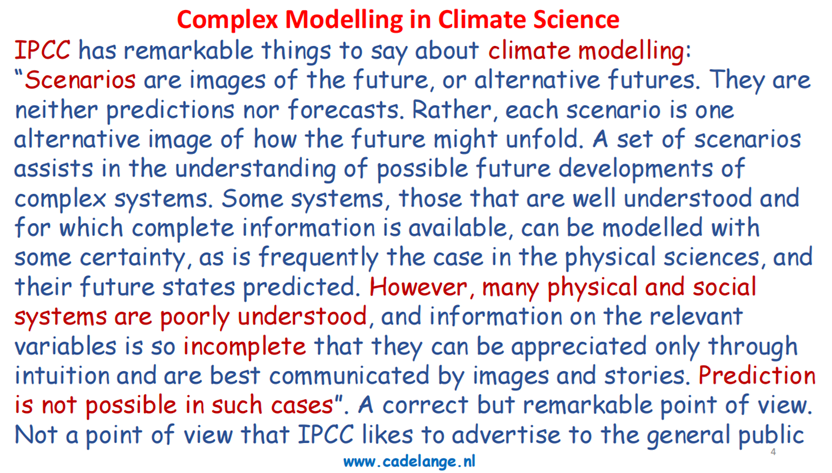
Atmospheric storage difference: +2%
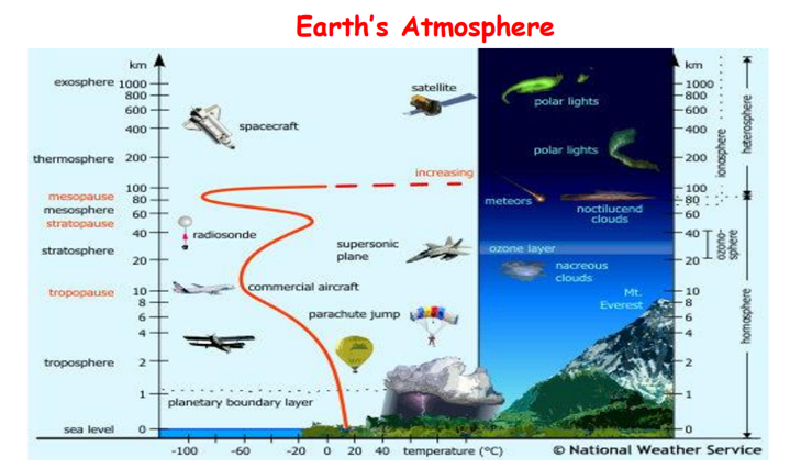
(so that: Ins = Outs + Atmospheric storage difference)
Balance = Atmospheric storage difference: 2%, of which,
Humans: 2% X 4% = 0.08%
Nature: 2% X 96 % = 1.92%
Ratio Natural:Human =1.92% : 0.08% = 24 : 1