Trudeau’s Damaged Canada

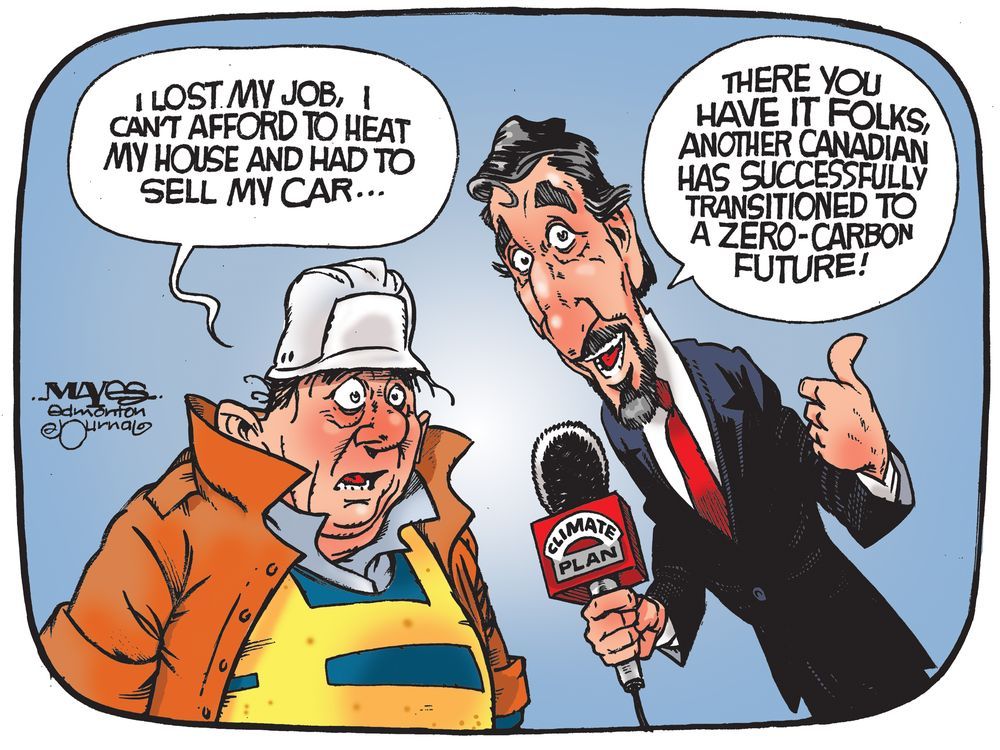
As Joe Oliver explains, national macroeconomics are not that complicated.  Good governance means taking care of the five pillars.  Regretably, Trudeau has failed Canada in every respect, outdone only by Biden’s performance in the USA.  Oliver explains at Financial Post Canada The Trudeau Liberals have eroded all five pillars of prosperity.  Excerpts in italics with my bolds.

Economics says the pillars are: spending restraint, low taxes,
minimal regulation, sound money, free trade. Ottawa is oh-for-five.

Canada’s standard of living is in decline, both in absolute terms and compared to our southern neighbour and other wealthy countries. A Fraser Institute analysis shows that real GDP per capita was lower during the pre-recession period 2016-19 than in any similar period since 1985. As of the last quarter of 2023 it was below its value for 2019:Q2. It’s no surprise that 44 per cent of Canadians now say money is their leading source of stress.

What explains Canada’s dreadful performance? As set out by Arthur Laffer, of Laffer Curve fame, prosperity has five pillars: restrained government spending, low taxes, minimal regulation, sound money and free trade. The Liberal government has rejected, undermined or neglected each of the five. Our weak record and disheartening prospects have not been caused by external forces but by dysfunctional government policies.

Canada is blessed by enviable geology and geography — immense natural resources and a friendly superpower next door — which Canadians too frequently take for granted. Because our border is safe and our population well off by world and historical standards, progressive politicians feel free to obsess about issues irrelevant or actually harmful to economic growth, jobs, affordability, a sound currency, security and national unity.

Let’s review the litany of debilitating missteps, starting with the size and role of government. The federal public service reached over 274,000 employees in 2023, an increase of 40.4 % since 2015. A bloated bureaucracy drains resources from the private sector, reducing economic efficiency. In the last eight years, the depletion has been rapid. Federal spending swelled from 12.8 per cent of GDP in 2015 to 16.1 per cent in 2023. Federal debt more than doubled, from $612 billion to a staggering $1.4 trillion — over $143,000 for a family of four. Interest now costs Ottawa $47.2 billion a year, rising to $64.3 billion by 2028-29. This is fiscal profligacy writ large.

Tax increases discourage economic growth. The Laffer curve demonstrates that taxes set too high can actually reduce tax revenue. Out of 61 US jurisdictions and Canadian provinces, the top three personal marginal income tax rates are imposed by Newfoundland and Labrador, Nova Scotia and Ontario. Nine Canadian provinces rank in the top 10, all are in the top 15, and Canada ranks fifth out of 38 OECD countries. Corporate income tax rates are also higher here than in the U.S., the U.K. and the OECD on average. High taxes damage affordability, reduce competitiveness, discourage innovation and entrepreneurship, accelerate capital flight and weaken productivity. The proposed increase in the capital gains inclusion rate for both individuals and companies and the phase-out of accelerated capital depreciation will seriously exacerbate those negatives.

Since 2015, intrusive regulations have proliferated across the economy, imposing burdensome compliance costs that are particularly harmful to small and medium- sized enterprises. The resource industry, which accounts for 19.2 per cent of GDP and 58 per cent of merchandise exports, has been targeted by draconian regulation deliberately designed to block energy projects. The result is an opportunity loss in the hundreds of billions of dollars and mounting.

A stable money supply is critical for economic stability. To cope with out-of- control government spending, the Bank of Canada expanded the money supply dramatically, pushing it to $3.6 trillion, 83 per cent more than when the Liberals took office. As a result, in 2022 inflation hit a 40-year peak of 6.8 per cent. Consumer prices are now 27 per cent higher than in 2015. Rising prices disproportionately affect low- and middle-income Canadians, who are also vulnerable to hikes in interest rates, including mortgage rates up 50 per cent from 2015. In aggregate, total mortgage payments could rise by as much as $4 billion this year.

Free trade had been a cornerstone of Canada’s economic policy for decades, promoting growth and prosperity. But last year Canada lost bragging rights as America’s biggest trade partner to Mexico. Instead of pursuing our comparative advantage in natural resources, Liberal policies purposely stymie the development and export of oil and gas. In a memorably inane comment, the prime minister claimed there was never a strong business case for liquified natural gas. The government should leave the assessment of business cases to business.

Barriers to interprovincial trade, a related problem, have continued to elude meaningful progress despite repeated promises. The Montreal Economic Institute estimates that removing those barriers would yield an average increase in Canadians’ incomes by 5.5 per cent, or $1,800. According to the IMF, it could boost GDP by $80 billion.

The government’s score for supporting the mainstays of prosperity is zero for five. Rather than correcting course, Justin Trudeau seems increasingly disconnected from reality and fixated on maintaining a perfect losing streak. Doubling down on big government, high taxes and hostility to resource development will do the trick.

Climatists Deny Natural Warming Factors

After a recent contretemps at Climate Etc. with CO2 warmists, I was again reminded how insistent are zero carbon zealots to deny multiple natural climate factors, in order to attribute all modern warming to humans burning hydrocarbons. A large part of this blindness comes from constraints dictated by the IPCC to climate model builders.  Simply put, natural causes of warming (and cooling) are systematically excluded from CIMP models for the sake of the narrative blaming humans for all climate activity: “Climate Change is real, dangerous and man-made.”  A previous post later on analyzes how models deceive by excluding natural forcings.

Let’s start with a paper that seeks objectively to consider both internal and external climate forcings, including human and natural processes.  The paper by Bokuchava & Semenov was published last October and is behind a paywall at Springer.  An open access copy is here:  Factors of natural climate variability contributing to the Early 20th Century Warming in the Arctic.  Excerpt in italics with my bolds and added images.

Abstract

The warming in the first half of the 20th century in the Northern Hemisphere (NH) (early 20th century warming (ETCW)) was comparable in magnitude to the current warming, but occurred at a time when the growth rate of the greenhouse gas (GG) concentration in the atmosphere was 4–5 times slower than in recent decades. The mechanisms of the early warming are still a subject of discussion. The ETCW was most pronounced in the high latitudes of the NH, and the recent reconstructions consistently indicate a significant negative anomaly of the Arctic sea ice area during early warming period linked with enhanced Atlantic water inflow to the Arctic and amplified warming in high latitudes of the NH.

Assessing the contributions of internal variability and external natural and anthropogenic factors to this climatic anomaly is key for understanding historical and modern climate dynamics. This paper considers mechanisms of ETCW associated with various internal variability and external anthropogenic and natural factors. An analysis of the findings on the topic of long-term studies of climate variations in the NH during the period of instrumental observations does not allow one to attribute the ETCW to one particular mechanism of internal climate variability or external forcing of the climate.

Most likely, this event was caused by a combined effect of long-term climatic fluctuations in the North Atlantic and the North Pacific with a noticeable contribution of external radiative forcing associated with a decrease in volcanic activity, changes in solar activity, and an increase in GG concentration in the atmosphere due to anthropogenic emissions. Furthermore, this climate variation in high latitudes of the NH has been enhanced by a number of positive feedbacks. An overview of existing research is given, as are the main mechanisms of internal and external climate variability in the NH in the early 20th century. Despite the fact that the internal variability of the climate system is apparently the main mechanism that explains the ETCW, the quantitative assessment of the contribution of each factor remains uncertain, since it significantly depends on the initial conditions in the models and the lack of instrumental data in the early 20th century, especially in polar latitudes.
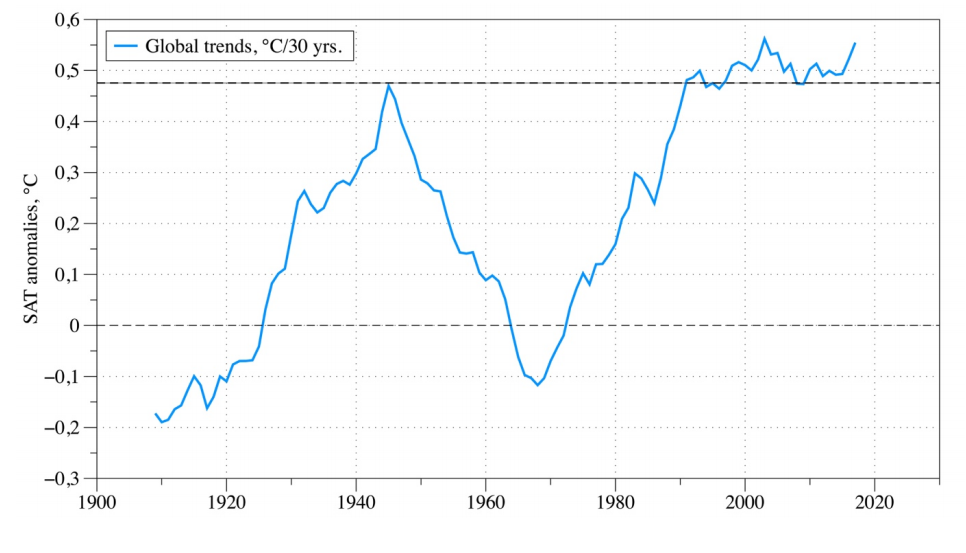
Figure 1. 30-year moving trends in global surface air temperature
(°C / 30 years) according to Berkley dataset [4]

The main cause of the recent warming is considered to be due to the anthropogenic forcing  primarily the carbon dioxide (CO2) concentration growth causing a greenhouse effect [5]. But the role of CO2 for ETCW could not be as important since this period precedes the time of the accelerating growth of radiative forcing by greenhouse gases (GHG). This GHG increase after 1950s is also inconsistent with the global SAT decline from 1940s to 1970s.

Numerical experiments with different climate model generations [6,7] show that modern warming is well reproduced when averaged over model ensembles (indicating external influence as major factor). The ETCW amplitude, despite the increasing accuracy of model simulations, still differs significantly in climate models. This may indicate the important role of internal climate variability [2], as well as the uncertainty of results of model experiments due to incorrectly specified forcing.

The majority of studies [8,9] agree that such a strong warming can be explained by a combination of internal climate system variability as quasi-periodic oscillation or random climate fluctuation with increasing global temperature in the background associated with external anthropogenic and natural forcings (increased GHGs emissions and a pause in volcanic eruptions, in particular).

This paper provides an overview of the existing hypotheses that may explain ECTW, describes the main mechanisms of internal climate variability during the twentieth century, in particular in the Arctic region.

Figure 2. Average annual SAT (°C) anomalies in the period 1900-2015,
according to Berkley observational dataset (5-year running mean), global (black curve),
Northern Hemisphere (blue curve), Southern Hemisphere (orange curve),
NH high latitudes (60°-90° N) (red curve), and NH high latitudes
without 5-yr running mean smoothing (gray curve)

Internal variability in the Arctic can be enhanced by positive radiation feedbacks [12], including surface albedo – temperature feedback, which can strongly impact the absorption of solar shortwave radiation. This mechanism manifests itself during prolonged warm periods, mainly in autumn, when a growing ice-free ocean surface with low albedo absorbs more solar radiation and warms the upper ocean layer that leads to further sea ice melting [10]. This positive radiation feedback contributes to the faster temperature increase in the Arctic. This phenomenon is now well-known as “Arctic (or Polar) Amplification”.

However, other positive feedbacks also play major roles in the Arctic Amplification. There are positive feedbacks related to long-wave radiation, for instance, an increase of water vapor content and cloud cover leads to a greenhouse effect, which is more pronounced at high latitudes [13], as well as dynamic feedbacks, which imply strengthened oceanic and atmospheric ocean heat transfer to the Arctic in the conditions of the shrinking sea ice extent [14,15].

Arctic Amplification may also be a consequence of non-local mechanisms such as enhanced northward latent heat transfer in the warmer atmosphere [16] Quasi-periodic fluctuations of North Atlantic sea surface temperature (SST) of 60-80 year time scale [17] suggest a possible role of oceanic heat transfer as a driver of long-term SAT anomalies in the Arctic that can be enhanced by positive feedbacks [18].

Thus, the amplitude of SST oscillations in the NH polar latitudes can be a combination of both regional response to global climate change and the formation of internal oscillations in the ocean atmosphere system.

Natural internal factors – ocean-atmosphere system variability
Atmosphere circulation variability

Figure 3. Winter Arctic (60°-90°N) SAT anomalies for according to
Berkley observations (5-year running mean) (black curve); NAO index (pink curve),
PNA index (blue curve) according to HadSLP2.0 dataset [25]

The North Atlantic Oscillation (NAO) and the closely related Arctic Oscillation (AO) is the dominant mode of large-scale winter atmospheric variability in the North Atlantic, characterized by sea level pressure dipole with one center over Greenland (Icelandic minimum) and another center of the opposite sign in the North Atlantic mid latitudes (Azores maximum). NAO controls the strength and direction of westerly winds and the position of storm tracks in the North Atlantic sector, thus crucially impacting the European climate [23].

During the first two decades of the 20th century, the positive phase of NAO was expressed in a stronger than usual zonal circulation over the North Atlantic (Fig. 3). The long-term dominance of these atmospheric circulation pattern led to an advection of heat to the northeastern part of the North Atlantic. However, the NAO transition to the negative phase after 1920s and in general inconsistency between NAO and Arctic SAT variations in the first half of the 20th century do not support an hypothesis of NAO contribution to the ETCW warming [24].

The Pacific North American Oscillation index (PNA) characterizes the pressure gradient between the North Pacific (Aleutian minimum) and the East of North America (Canadian maximum) and is related to fluctuations of North Pacific zonal flow. An important feature of PNA in the context of the ETCW is that both (positive and negative) PNA phases may contribute to atmospheric heat advection to the Arctic. In the 1930s and 1950s, the negative phase (Fig. 3) led to the transfer of warm air masses to the pole across the northwestern Pacific Ocean, and the positive phase of the 1940s forced increased zonal transfer to the Western coast of Canada and Alaska [8]. PNA is strongly influenced by the Pacific Southern Oscillation (El Nino Southern Oscillation – ENSO) – the positive index phase is associated with the El Nino phenomena, and the negative with La Niña events.

Atmospheric circulation in the mid-latitudes of the Pacific Ocean may also depend on fluctuations of the Pacific trade winds [28]. The trade winds weakening is manifested in the SAT growth in Pacific mid-latitudes, which coincides on the time scale with the warming of 1910-1940s in the high Arctic latitudes and in the lowering of temperatures during the cooling period between 1940s and 1970s when the strength of the trade winds had been increasing.

Ocean circulation variability

Figure 4. Winter Arctic (60°-90°N) SAT anomalies according to
Berkley dataset (5-year running mean, black curve); AMO index (pink curve),
PDO index (blue curve) according to HadiSST2.0 dataset [37]

Arctic Amplification in the 20th century, including ETCW period can be associated not only with an increase of atmospheric heat transport, but also with an enhancement of ocean heat inflow in the North Atlantic to the extratropical latitudes of the NH from its equatorial part [30].

Instrumental data show that SST variability in the North Atlantic during the 20th century was dominated by cyclic fluctuations on time scales of 50-80 years, showing two warm periods in the 1930s-1940s and at the end of the 20th century and two cold periods in the beginning of the century and in the 1960s-1970s. SST oscillations in the North Atlantic are called Atlantic Multidecadal Oscillation (AMO). The observational data also indicate AMO-like cycles in the Arctic SAT (Fig. 4).

Paleo-reconstructions of AMO [33] demonstrate that strong, low-frequency (60-100 years) SSTnvariability is a robust feature of the North Atlantic climate over the past five centuries. There are also indications of a significant correlation between Arctic sea ice area and AMO index including a sharp change during ECTW period [34].

There is another pronounced internal climate variability that may act synchronously with AMO. This is the Pacific Decadal Oscillation (PDO), which reflects a variability of the Pacific SSTs north of 20° N and has 20-40 years periodicity [35]. PDO might have played an equally important role in the heat advection to the Arctic in the middle of the century. Several current studies [36,29] suggest the synchronous phase shift of AMO and PDO largely contributed to the accelerated Arctic warming, both the ongoing and ETCW.

Сonclusions

Understanding the mechanisms of ETCW and subsequent cooling is a key to determine the relative contribution of internal natural variability to global climate change on multi-decadal time scale. Studies of climate changes in high latitudes in the mid-twentieth century allows us to identify a number of possible mechanisms involving natural variability and positive feedbacks in the Arctic climate system that may partially explain ETCW.

Based on the recent literature it can be concluded that internal oceanic variability, together with additional impact of natural atmospheric circulation variations are important factors for ETCW. Recently, a number of results indicating the Pacific Ocean as a source of multidecadal fluctuation both on a global scale and in high latitudes has increased. Howewer, assessment of a relative contribution to ETCW in the Atlantic and Pacific sectors remains uncertain.

Climate model simulations [9,43,44] argue that the internal variability of the ocean-atmosphere system cannot explain the entire amplitude of temperature fluctuations in the first half of the 20th century as a single factor, and must act in combination with external forcings (solar and volcanic activity), positive feedbacks in the Arctic climate system, and anthropogenic factors. Quantifying the contribution of each factor still remains a matter of debate.

Climate Deception:  Models Hide the Paleo Incline
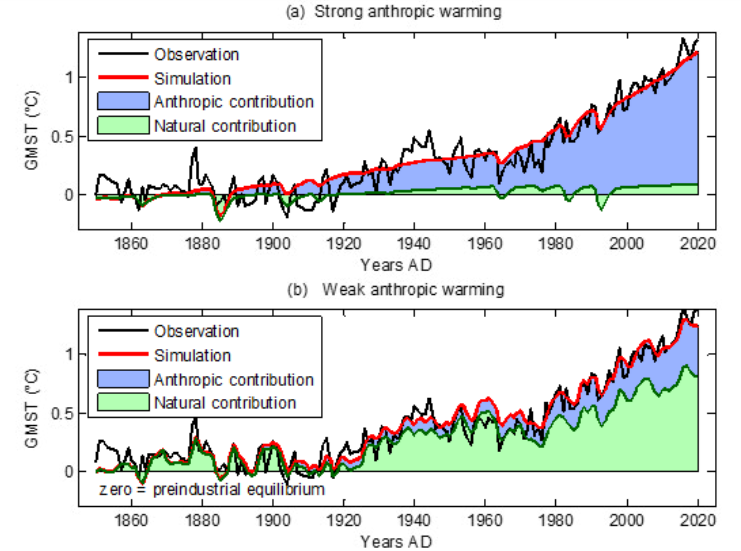
Figure 1. Anthropgenic and natural contributions. (a) Locked scaling factors, weak Pre Industrial Climate Anomalies (PCA). (b) Free scaling, strong PCA

In  2009, the iconic email from the Climategate leak included a comment by Phil Jones about the “trick” used by Michael Mann to “hide the decline,” in his Hockey Stick graph, referring to tree proxy temperatures  cooling rather than warming in modern times.  Now we have an important paper demonstrating that climate models insist on man-made global warming only by hiding the incline of natural warming in Pre-Industrial times.  The paper is From Behavioral Climate Models and Millennial Data to AGW Reassessment by Philippe de Larminat.  H/T No Tricks Zone. Excerpts in italics with my bolds.

Abstract

Context. The so called AGW (Anthropogenic Global Warming), is based on thousands of climate simulations indicating that human activity is virtually solely responsible for the recent global warming. The climate models used are derived from the meteorological models used for short-term predictions. They are based on the fundamental and empirical physical laws that govern the myriad of atmospheric and oceanic cells integrated by the finite element technique. Numerical approximations, empiricism and the inherent chaos in fluid circulations make these models questionable for validating the anthropogenic principle, given the accuracy required (better than one per thousand) in determining the Earth energy balance.

Aims and methods. The purpose is to quantify and simulate behavioral models of weak complexity, without referring to predefined parameters of the underlying physical laws, but relying exclusively on generally accepted historical and paleoclimate series.

Results. These models perform global temperature simulations that are consistent with those from the more complex physical models. However, the repartition of contributions in the present warming depends strongly on the retained temperature reconstructions, in particular the magnitudes of the Medieval Warm Period and the Little Ice Age. It also depends on the level of the solar activity series. It results from these observations and climate reconstructions that the anthropogenic principle only holds for climate profiles assuming almost no PCA neither significant variations in solar activity. Otherwise, it reduces to a weak principle where global warming is not only the result of human activity, but is largely due to solar activity.

Discussion

GCMs (short acronym for AOCGM: Atmosphere Ocean General Circulation Models, or for Global Climate model) are fed by series related to climate drivers. Some are of human origin: fossil fuel combustion, industrial aerosols, changes in land use, condensation trails, etc. Others are of natural origin: solar and volcanic activities, Earth’s orbital parameters, geomagnetism, internal variability generated by atmospheric and oceanic chaos. These drivers, or forcing factors, are expressed in their own units: total solar irradiance (W m–2), atmospheric concentrations of GHG (ppm), optical depth of industrial or volcanic aerosols (dimless), oceanic indexes (ENSO, AMO…), or by annual growth rates (%). Climate scientists have introduced a metric in order to characterize the relative impact of the different climate drivers on climate change. This metric is that of radiative forcings (RF), designed to quantify climate drivers through their effects on the terrestrial radiation budget at the top of the atmosphere (TOA).

However, independently of the physical units and associated energy properties of the RFs, one can recognize their signatures in the output and deduce their contributions. For example, volcanic eruptions are identifiable events whose contributions can be quantified without reference to either their assumed radiative forcings, or to physical modeling of aerosol diffusion in the atmosphere. Similarly, the Preindustrial Climate Anomalies (PCA) gathering the Medieval Warm Period (MWP) and the Little Ice Age (LIA), shows a profile similar to that of the solar forcing reconstructions. Per the methodology proposed in this paper, the respective contributions of the RF inputs are quantified through behavior models, or black-box models.

Now, Figures 1-a and 1-b presents simulations obtained from the models identified under two different sets of assumptions, detailed in sections 6 and 7 respectively.

Figure 1. Anthropgenic and natural contributions. (a) Locked scaling factors, weak Pre Industrial Climate Anomalies (PCA). (b) Free scaling, strong PCA

In both cases, the overall result for the global temperature simulation (red) fits fairly well with the observations (black).  Curves also show the forcing contributions to modern warming (since 1850). From this perspective, the natural (green) and anthropogenic (blue) contributions are in strong contradiction between panels (a) and (b). This incompatibility is at the heart of our work.

Simulations in panel (a) are calculated per section 6, where the scaling multipliers planned in the model are locked to unity, so that the radiative forcing inputs are constrained to strictly comply with the IPCC quantification. The remaining parameters of the black-box model are adjusted in order to minimize the deviation between the observations (black curve) and the simulated outputs (red). Per these assumptions, the resulting contributions (blue vs. green) comply with the AGW principle. Also, the conformity of the results with those of the CMIP supports the validity of the type of behavioral model adopted for our simulations.

Paleoclimate Temperatures

Although historically documented the Medieval Warm Period (MWP) and the Little Ice Age (LIA) don’t make consensus about their amplitudes and geographic extensions [2, 3]. In Fig. 7.1-c of the First Assessment Report of IPCC, a reconstruction from showed a peak PCA amplitude of about 1.2 °C [4]. Then later on, a reconstruction by the so-called ‘hockey stick graph’, was reproduced five times in the IPCC Third Assessment Report (2001), wherein there was no longer any significant MWP [5].

After, 2003 controversies reference to this reconstruction had disappeared from subsequent IPCC reports:it is not included among the fifteen paleoclimate reconstructions covering the millennium period listed in the fifth report (AR5, 2013) [6]. Nevertheless, AR6 (2021) revived a hockey stick graph reconstruction from a consortium initiated by a network “PAst climate chanGES” [7,8]. The IPCC assures (AR6, 2.3.1.1.2): “this synthesis is generally in agreement with the AR5 assessment”.

Figure 2 below puts this claim into perspective. It shows the fifteen reconstructions covering the preindustrial period accredited by the IPCC in AR5 (2013, Fig. 5.7 to 5.9, and table 5.A.6), compiled (Pangaea database) by [7]. Visibly, the claimed agreement of the PAGES2k reconstruction (blue) with the AR5 green lines does not hold.
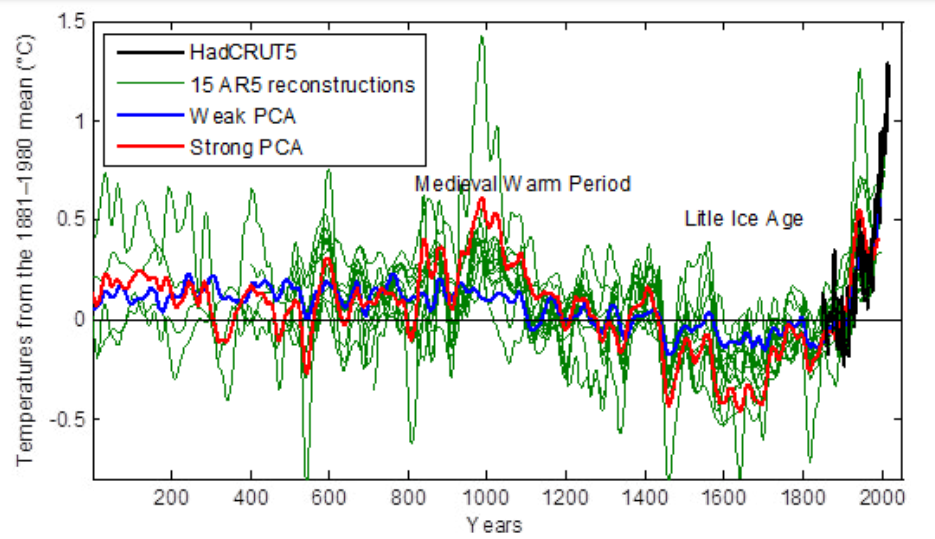
Figure 2. Weak and strong preindustrial climate anomalies, respectively from AR5 (2013) in green and AR6 (2021) in blue.

Conclusion

In section 8 above, a set of consistent climate series is explored, from which solar activity appears to be the main driver of climate change. To eradicate this hypothesis, the anthropogenic principle requires four simultaneous assessments:

♦  A strong anthropogenic forcing, able to account for all of the current warming.
♦  A low solar forcing.
♦  A low internal variability.
♦  The nonexistence of significant pre-industrial climate anomalies, which could indeed be explained by strong solar forcing or high internal variability.

None of these conditions is strongly established, neither by theoretical knowledge nor by historical and paleoclimatic observations. On the contrary, our analysis challenges them through a weak complexity model, fed by accepted forcing profiles, which are recalibrated owning to climate observations. The simulations show that solar activity contributes to current climate warming in proportions depending on the assessed pre-industrial climate anomalies.

Therefore, adherence to the anthropogenic principle requires that when reconstructing climate data, the Medieval Warming Period and the Little Ice Age be reduced to nothing, and that any series of strongly varying solar forcing be discarded. 

Background on Disappearing Paleo Global Warming

The first graph appeared in the IPCC 1990 First Assessment Report (FAR) credited to H.H.Lamb, first director of CRU-UEA. The second graph was featured in 2001 IPCC Third Assessment Report (TAR) the famous hockey stick credited to M. Mann.

Rise and Fall of the Modern Warming Spike


Stress Testing California’s Grid Batteries

Lots of PR coming out of the golden state regarding great strides in building battery capacity required by the green dream of 100% carbon free electrical power.

From Business Insider: 

Batteries briefly became the biggest source of power in California twice in the past week.

The first time — Tuesday last week around 8:10 p.m. PT, according to GridStatus.iobatteries reached a record peak output of 6,177 megawatts. For about two hours, that made electricity generated earlier and stored in batteries the single largest source of power in the Golden state, eclipsing real-time production from natural gas, nuclear, renewable sources like wind and solar, and all other sources of energy.

It happened again on Sunday evening, this time for a few hours around 7:10 p.m. PT, per data from GridStatus.io. In that instance, which broke Tuesday’s record, batteries reached a peak output of 6,458 megawatts.

Battery storage has become a key part of the push to produce more electricity using renewable sources. By connecting huge, rechargeable batteries to power grids, power utilities can store energy generated during the day by solar panels and wind turbines.

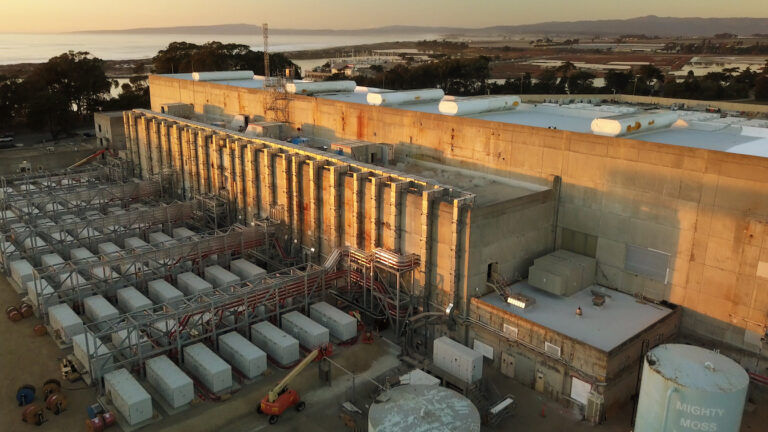
Augmentation at the Vistra Moss Landing Energy Storage Facility in California has been completed, with the world’s biggest battery energy storage system (BESS) now at 400MW / 1,600MWh. The batteries are housed in repurposed gas turbine halls. Image: Vistra Energy.

Note the BESS ratings for power (MW) and energy output (MWh).  In this case, Moss Landing has a maximum power of 400MW and a duration of 4 hours, or 1600MWh.  Such a factor of 4 seems typical for large scale BESS in California.  It also means that for a single peak hour demand, Moss Landing can only supply 400MW for that hour.  If more energy is needed, it will have to come from somewhere else.

Then in April we have the news from Gov. Newsome’s office California Achieves Major Clean Energy Victory: 10,000 Megawatts of Battery Storage.  

Let’s Apply Some Context to These Cheerful Reports

The California Energy Commission produced its electricity forecast end of 2022:

Note the graph is projecting hourly electricity demand, which peaks during hour 19.  Output levels approach and then exceed 50,000 MW demand that hour, or 50k MWh.

Cal matters raises concerns about state policy to phase out ICE vehicles in favor of EVs.

Again demand requires from the grid 50k MW per hour in 2022 with less than 1% for charging EVs.  That is projected to go 10 times higher in 13 years.

Summary

The excitement is about batteries supplying  6500 MW for a couple of hours when the peak demand is 50,000 MW.  The glorious achievement is building battery capacity up to 10,000 MW.  It doesn’t add up.


Climate Headlines Claim, But IPCC Details Deny

The advertising proverb says it all: “The large print giveth, and the small print taketh away.”

Unfortunately, climate science is rife with this. A research announcement is released and the same text appears in media articles everywhere, the only difference being who can attach the scariest headline. One list of things claimed to be caused by global warming numbers 883, including many head scratchers. By 2012, the warmlist at numberwatch.co.uk had the better part of a thousand links to claims of disaster linked to “climate change.” The author of the website stopped adding links because the project was taking too much time.

For example: species extinctions.

WWF claims “The rapid loss of species we are seeing today is estimated by experts to be between 1,000 and 10,000 times higher than the natural extinction rate. MSNBC laments the “fact” that 100,000 species of flora and fauna will no longer be with us by next Christmas. And yet, WWF also estimates the number of identified unique species to be between 1.4 to 1.8 million, an uncertainty of 400,000. As someone said, “Anytime extinctions are claimed, ask for the names.” The debunking is done in detail here:

Another Example: Extreme Weather

Now an article published in the Australian does the fine print analysis regarding extreme weather events.  Logic leaves ‘The Science’ of climate in the dust  Thanks to John Ray for providing the text at his blog, excerpts in italics with my bolds and added images.

It is the gag order of the pseudo eco-scholar: “The Science is settled.” This is not science as we once understood it. In that discipline something could be proved false through observation and experiment. No, this is “The Science”: science as deity.

In the 20th century Karl Popper transformed the philosophy of science around the idea of falsifiability, saying: “It must be possible for an empirical scientific system to be refuted by experience.”

The first rule in Popper’s The Logic of Scientific Discovery is: “The game of science is, in principle, without end. He who decides one day that scientific statements do not call for any further test, and that they can be regarded as finally verified, retires from the game.”

So, you can spend a lifetime counting white swans, but find one black one and the thesis that all swans are white is destroyed. The black swan event happened when Europeans first encountered the impossible animal in Australia.

Prove one assumption wrong and a whole set of conclusions collapses. The Science is not real science. It is a set of beliefs, a faith. Those who demand we agree it’s settled are no different from a Catholic bishop declaring: “Roma locuta est; causa finita est” – Rome has spoken; the cause is finished.

The zealots who invoke The Science as a gag order have never read the research or wilfully ignore its infuriating uncertainty. This uncountably large group includes battalions of politicians, academics, activists, journalists and a few dozen billionaire energy-hobbyist carpetbaggers.

Case in Poiint: Claim Global Warming is Causing More Extreme Weather

Take the deeply entrenched belief that global warming is causing more extreme weather. This is so ubiquitous as to be unquestioned. It is an article of faith and there is almost no weather event nowadays that does not come with a blizzard of declarations it is proof of climate change.

Among myriad examples, let’s pick Tropical Cyclone Jasper, which hit far north Queensland in December. It dumped a massive amount of rain and none of what follows denies the fact it caused great damage and suffering. In its wake the Red Cross released an Instagram video declaring “Disasters like Ex-Tropical Cyclone Jasper in Far North Queensland are happening more often due to climate change”. Greenpeace called it a “frightening portent of what’s to come under climate change”. The Climate Council warned “climate change is making (tropical cyclones) more destructive”.

None of this is true.

If The Science of global warming has a bible then surely it must be the Intergovernmental Panel on Climate Change (IPCC) report Climate Change 2021: The Physical Science Basis. It is the latest accumulation of all the best research and it runs to a mind-numbing 2391 pages.

Cyclones

On page 1586 it says: “(Tropical cyclone) landfall frequency over Australia shows a decreasing trend in Eastern Australia since the 1800s, as well as in other parts of Australia since 1982. A paleoclimate proxy reconstruction shows that recent levels of (tropical cyclone) interactions along parts of the Australian coastline are the lowest in the past 550-1500 years.”

Pause on that. Not only does observation show there are fewer cyclones since the industrial revolution began belching extra carbon dioxide into the atmosphere, there is evidence to suggest cyclone activity in Australia is at its lowest ebb since the days of the Tang dynasty and the decline of the Western Roman Empire.

The CSIRO echoes that finding in its State of the Climate Report 2022 and adds: “The trend in cyclone intensity in the Australian region is harder to quantify than cyclone frequency, due to uncertainties in estimating the intensity of individual cyclones and the relatively small number of intense cyclones.”

Droughts

What of droughts? The IPCC finds southwestern Australia has been drying out since the 1950s and there is evidence that the length of droughts in southeastern Australia has “increased significantly”. But it says “the Millennium drought in eastern Australia was not unusual in the context of natural variability reconstructed over the past millennium” and concludes “there is currently low confidence that recent droughts in eastern Australia can be clearly attributed to human influence” (p1089).

In summary, on page 1663, it says there is low confidence in observed trends, or projected changes, to droughts in central and eastern Australia as the climate warms. In northern Australia there is medium confidence of a “decrease in the frequency and intensity of meteorological droughts”. So, more rain for the Top End then.

The report notes the major drivers of drought in Australia as well-known natural climate events: “During the last millennium, the combined effect of a positive (Indian Ocean Dipole) and El Nino conditions have caused severe droughts over Australia” (p1104).

Bushfires

What of bushfires? “Extreme conditions, like the 2019 Australian bushfires and African flooding, have been associated with strong positive (Indian Ocean Dipole) conditions” (p1104).

And, in case you were wondering, “There is no evidence of a trend in the Indian Ocean Dipole mode and associated anthropogenic forcing” and “The amplitude of the El Nino–Southern Oscillation variability has increased since 1950 but there is no clear evidence of human influence” (p1104).

World is Warming But Not in Crisis

Let’s be clear. There is plenty of evidence in the IPCC report demonstrating the climate is changing, that the world and Australia are getting warmer, and that industrial activity has played a part in forcing some of it. We should take that seriously. In response Australia should do its proportionate share in cutting greenhouse gas emissions without destroying our local ecology or impoverishing the nation.

But here is the good news: we are not facing a climate Armageddon. Again, this is not just my view but one shared by British professor Jim Skea, who was appointed chairman of the IPCC last year.

“The world won’t end if it warms by more than 1.5 degrees,” Skea told German weekly magazine Der Spiegel last year. “It will however be a more dangerous world. Countries will struggle with many problems, there will be social tensions.

Skea worries the zealots are doing their cause a grave disservice. “If you constantly communicate the message that we are all doomed to extinction, then that paralyses people and prevents them from taking the necessary steps to get a grip on climate change,” he said.

What it is also designed to do is scare people out of questioning absurd statements and bad policies.

Here there is another assault on reason by ideologues. In this game of witch burning, questioning a policy response to global warming is evidence of the crime of climate change denial. Their argument can be expressed as a syllogism.

Premise 1: Climate change is real.

Premise 2: Renewable energy combats climate change.

Conclusion: Therefore, to question renewable energy is to deny climate change.

This is the logical fallacy of a false dichotomy; it ignores the possibility of neutrality or nuance.

But logic, like science, has long since departed
in this debate. This is all about faith.

Resources

On this blog, Science Matters, several posts address specific misleading and exaggerated claims made in the media:

Arctic Sea Ice Factors

Lawrence Lab Report: Proof of Global Warming?

The Permafrost Bogeyman


IPCC the Worst Offender

But the IPCC Assessment Reports display the worst abuse of headline claims denied by statements in the details. The headlines are in the Summary for Policy Makers (SPM) while scientists write the details in the Working Group reports, in particular WGII.

We see again a familiar pattern in the latest AR5 round of IPCC releases. As previously, the SPM features alarming statements, which are then second-guessed (undermined) by the actual science imbedded in the report details.

Example Ocean Acidification

For example, I looked at the topic of ocean acidification and fish productivity. The SPM asserts on Page 17 that fish habitats and production will fall and that ocean acidification threatens marine ecosystems.

“Open-ocean net primary production is projected to redistribute and, by 2100, fall globally under all RCP scenarios. Climate change adds to the threats of over-fishing and other non-climatic stressors, thus complicating marine management regimes (high confidence).” Pg 17 SPM

“For medium- to high-emission scenarios (RCP4.5, 6.0, and 8.5), ocean acidification poses substantial risks to marine ecosystems, especially polar ecosystems and coral reefs, associated with impacts on the physiology, behavior, and population dynamics of individual species from phytoplankton to animals (medium to high confidence).” Pg 17 SPM

WGII Report, Chapter 6 covers Ocean Systems. There we find more nuance and objectivity:

“Few field observations conducted in the last decade demonstrate biotic responses attributable to anthropogenic ocean acidification” pg 4

“Due to contradictory observations there is currently uncertainty about the future trends of major upwelling systems and how their drivers (enhanced productivity, acidification, and hypoxia) will shape ecosystem characteristics (low confidence).” Pg 5

“Both acclimatization and adaptation will shift sensitivity thresholds but the capacity and limits of species to acclimatize or adapt remain largely unknown” Pg 23

“Production, growth, and recruitment of most but not all non-calcifying
seaweeds also increased at CO2 levels from 700 to 900 µatm Pg 25

“Contributions of anthropogenic ocean acidification to climate-induced alterations in the field have rarely been established and are limited to observations in individual species” Pg. 27

“To date, very few ecosystem-level changes in the field have been attributed to anthropogenic or local ocean acidification.” Pg 39


Ocean Chemistry on the Record

Contrast the IPCC headlines with the the Senate Testimony of John T. Everett, in which he said:

“There is no reliable observational evidence of negative trends that can be traced definitively to lowered pH of the water. . . Papers that herald findings that show negative impacts need to be dismissed if they used acids rather than CO2 to reduce alkalinity, if they simulated CO2 values beyond triple those of today, while not reporting results at concentrations of half, present, double and triple, or as pointed out in several studies, they did not investigate adaptations over many generations.”

“In the oceans, major climate warming and cooling and pH (ocean pH about 8.1) changes are a fact of life, whether it is over a few years as in an El Niño, over decades as in the Pacific Decadal Oscillation or the North Atlantic Oscillation, or over a few hours as a burst of upwelling (pH about 7.59-7.8) appears or a storm brings acidic rainwater (pH about 4-6) into an estuary.”
http://www.epw.senate.gov/public/index.cfm?FuseAction=Files.View&FileStore_id=db302137-13f6-40cc-8968-3c9aac133b16

Conclusion

Many know of the Latin phrase “caveat emptor,” meaning “Let the buyer beware”.

When it comes to climate science, remember also “caveat lector”–”Let the reader beware”.

You Won’t Survive “Sustainability” Agenda 2024

Joel Kotkin explains in his Spiked article The inhumanity of the green agenda.  Excerpts in italics with my bolds and added images.

The ‘sustainability’ regime is impoverishing the world.

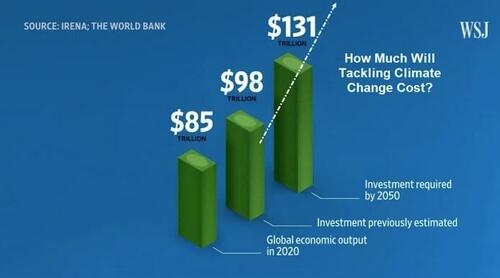
In recent years, the overused word ‘sustainability’ has fostered a narrative in which human needs and aspirations have taken a back seat to the green austerity of Net Zero and ‘degrowth’. The ruling classes of a fading West are determined to save the planet by immiserating their fellow citizens. Their agenda is expected to cost the world $6 trillion per year for the next 30 years.

Yes, those are Trillions of US$ they are projecting to spend.

Meanwhile, they will get to harvest massive green subsidies
and live like Renaissance potentates.

In Enemies of Progress, author Austin Williams suggests that ‘the mantra of sustainability’ starts with the assumption that humanity is ‘the biggest problem of the planet’, rather than the ‘creators of a better future’. Indeed, many climate scientists and green activists see having fewer people on the planet as a key priority. Their programme calls not only for fewer people and fewer families, but also for lower consumption among the masses. They expect us to live in ever smaller dwelling units, to have less mobility, and to endure more costly home heating and air-conditioning. These priorities are reflected in a regulatory bureaucracy that, if it does not claim justification from God, acts as the right hand of Gaia and of sanctified science.

The question we need to ask is: sustainability for whom?

US Treasury secretary Janet Yellen recently suggested that her department sees climate change as ‘the greatest economic opportunity of our time’. To be sure, there is lots of gold in green for the same Wall Street investors, tech oligarchs and inheritors who fund the campaigns of climate activists. They increasingly control the media, too. The Rockefellers, heirs to the Standard Oil fortune, and other ultra-wealthy greens are currently funding climate reporters at organs like the Associated Press and National Public Radio.

Under the new sustainability regime, the ultra-rich profit, but the rest of us not so much. The most egregious example may be the forced take-up of electric vehicles (EVs), which has already helped to make Elon Musk, CEO of Tesla, the world’s second-richest man. Although improvements are being made to low-emissions vehicles, consumers are essentially being frogmarched into adopting a technology that has clear technical problems, remains far more expensive than the internal-combustion engine and depends primarily on an electric grid already on the brink of blackouts. Green activists, it turns out, do not expect EVs to replace the cars of hoi polloi. No, ordinary people will be dragooned to use public transport, or to walk or bike to get around.  [BMW will come to mean “Bike, Metro, and Walking.”]

The shift to electric cars is certainly no win for the West’s working and middle classes. But it is an enormous boon to China, which enjoys a huge lead in the production of batteries and rare-earth elements needed to make EVs, and which also figure prominently in wind turbines and solar panels. China’s BYD, which is backed by Warren Buffett, has emerged as the world’s top EV manufacturer, with big export ambitions. Meanwhile, American EV firms struggle with production and supply-chain issues, in part due to green resistance to domestic mining for rare-earth minerals. Even Tesla expects much of its future growth to come from its Chinese factories.

Building cars from primarily Chinese components will have consequences for autoworkers across the West. Germany was once a car-manufacturing giant, but it is expected to lose an estimated 400,000 car-factory jobs by 2030. According to McKinsey, the US’s manufacturing workforce could be cut by up to 30 per cent. After all, when the key components are made elsewhere, far less labour is needed from US and European workers. It’s no surprise that some European politicians, worried about a popular backlash, have moved to slow down the EV juggernaut.

This dynamic is found across the entire sustainability agenda. The soaring energy costs in the West have helped China expand its market share in manufactured exports to roughly equal that of the US, Germany and Japan combined. American manufacturing has dropped recently to its lowest point since the pandemic. The West’s crusade against carbon emissions makes it likely that jobs, ‘green’ or otherwise, will move to China, which already emits more greenhouse gases than the rest of the high-income world.

Meanwhile, the Chinese leadership is looking to adapt to changes in the climate,
instead of undermining economic growth chasing implausible Net Zero targets.

There are clear class implications here. California’s regulators recently admitted that the state’s strict climate laws aid the affluent, but hurt the poor. These laws also have a disproportionate impact on ethnic-minority citizens, creating what attorney Jennifer Hernandez has labelled the ‘green Jim Crow’. As China’s increasingly sophisticated tech and industrial growth is being joyously funded by US venture capitalists and Wall Street, living standards among the Western middle class are in decline. Europe has endured a decade of stagnation, while Americans’ life expectancy has recently fallen for the first time in peacetime. Deutsche Bank’s Eric Heymann suggests that the only way to achieve Net Zero emissions by 2050 is by squelching all future growth, which could have catastrophic effects on working-class and middle-class living standards.

Rather than the upward mobility most have come to expect, much of the West’s workforce now faces the prospect of either living on the dole or working at low wages. Today, nearly half of all American workers receive low wages and the future looks worse. Almost two-thirds of all new jobs in recent months were in low-paying service industries. This is also true in Britain. Over recent decades, many jobs that might have once supported whole families have disappeared. According to one UK account, self-employment and gig work do not provide sustenance for anything like a comfortable lifestyle. Rates of poverty and food shortages are already on the rise.

As a result, most parents in the US and elsewhere doubt their children
will do better than their generation,
while trust in our institutions is at historic lows.

The fabulists at places like the New York Times have convinced themselves that climate change is the biggest threat to prosperity. But many ordinary folk are far more worried about the immediate effects of climate policy than the prospect of an overheated planet in the medium or long term. This opposition to the Net Zero agenda was first expressed by the gilet jaunes movement in France in 2018, whose weekly protests were initially sparked by green taxes. This has been followed by protests by Dutch and other European farmers in recent years, who are angry at restrictions on fertilisers that will cut their yields. The pushback has sparked the rise of populism in a host of countries, notably Italy, Sweden and France. Even in ultra-with-it Berlin, a referendum on tighter-emissions targets recently failed to win over enough voters.

This is class warfare obscured by green rhetoric.
It pits elites in finance, tech and the nonprofit world against
a more numerous, but less connected, group of ordinary citizens.

Many of these folk make their living from producing food and basic necessities, or from hauling these things around. Factory workers, truck drivers and farmers, all slated for massive green regulatory onslaughts, see sustainability very differently than the urban corporate elites and their woke employees. As the French gilets jaunes protesters put it bluntly: ‘The elites worry about the end of the world. We worry about the end of the month.’

This disconnect also exists in the United States, according to long-time Democratic analyst Ruy Teixeira. Attempts to wipe out fossil fuels may thrill people in San Francisco, but are regarded very differently in Bakersfield, the centre of the California oil industry, and in Texas, where as many as a million generally good-paying jobs could be lost. Overall, according to a Chamber of Commerce report, a full national ban on fracking, widely supported by greens, would cost 14 million jobs – far more than the eight million jobs lost in the Great Recession of 2007-09.

No surprise then that blue-collar workers are not so enthusiastic
about the green agenda.

Just one per cent, according to a new Monmouth poll, consider climate as their main concern. A new Gallup poll shows that just two per cent of working-class respondents say they currently own an electric vehicle and a mere nine per cent say they are ‘seriously considering’ purchasing one.

These Western concerns are nothing compared to how the sustainability agenda could impact the developing world. Developing countries are home to roughly 3.5 billion people with no reliable access to electricity. They are far more vulnerable to high energy and food prices than we are. For places like Sub-Saharan Africa, green admonitions against new agricultural technologies, fossil fuels and nuclear power undermine any hope of creating desperately needed new wealth and jobs. It’s no wonder that these countries increasingly ignore the West and are looking to China instead, which is helping the developing world to build new fossil-fuel plants, as well as hydroelectric and nuclear facilities. All of this is anathema to many Western greens.

To make matters worse, the EU is already considering carbon taxes on imports,
which could cut the developing world off from what remains of global markets.

More critical still could be the impact of the sustainability mantra on food production, particularly for Sub-Saharan Africa, which will be home to most of the world’s population growth over the next three decades, according to United Nations projections. These countries need more food production, either domestically or from rich countries like the US, the Netherlands, Canada, Australia and France. And they are acutely aware of what happened when Sri Lanka adopted the sustainability agenda. This led to the breakdown of Sri Lanka’s agricultural sector and, eventually, to the violent overthrow of its government.

We need to rethink the sustainability agenda. Protecting the environment cannot come at the cost of jobs and growth. We should also assist developing countries in achieving a more prosperous future. This means financing workable technologies – gas, nuclear, hydro – that can provide the reliable energy so critical for economic development. It does no good to suggest a programme that will keep the poor impoverished.

Unless people’s concerns about the green agenda are addressed, they will almost certainly seek to disrupt the best-laid plans of our supposedly enlightened elites. In the end, as Protagoras said, human beings are still the ultimate ‘measure’ of what happens in the world – whether the cognoscenti like it or not.


Arctic Ice Persists May 2024

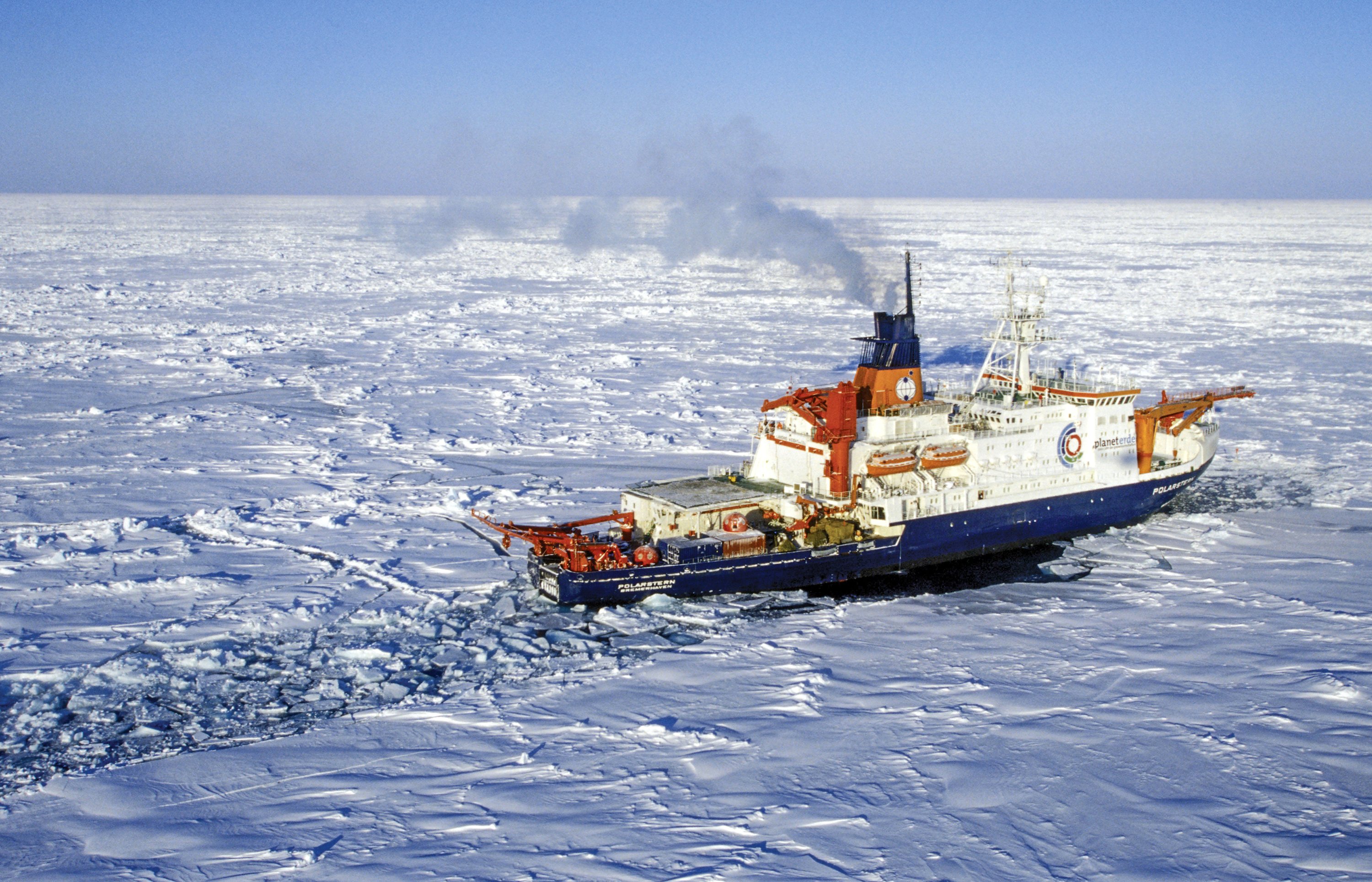
Research ship drifting along with Arctic ice, May 2019 US Naval Institute

In May, most of the Arctic ocean basins are still frozen over, while the melting of ice extent is underway in the marginal regions.   During May, on average according to MASIE, Arctic ice extents lose 1.7 M km2, and 2024 matched that.  The few basins where open water appears this time of year tend to fluctuate and alternate waxing and waning.  Unusual were the much greater extents estimated by SII (Sea Ice Index, the satellite dataset)

The graph below shows for the month of May patterns for ice extents on average, this year and some other years of note.

The graph shows the 18-year average loss for April is 1.7M km2.  2024 tracked nearly average this month throughout. Remarkably, SII showed higher all month, ~200k km2 on average and 315k km2 higher than MASIE yesterday. Other recent years have been nearly average, while 2006 ended with a large defict of ~300k km2 below average.

Region 2024152 Day 152 Ave 2024-Ave. 2006152 2024-2006
 (0) Northern_Hemisphere 11720589 11685746 34843 11391134 329455
 (1) Beaufort_Sea 1015932 1008887 7045 1063879 -47947
 (2) Chukchi_Sea 913510 866924 46586 907609 5900
 (3) East_Siberian_Sea 1072016 1065772 6244 1073889 -1873
 (4) Laptev_Sea 828093 828959 -866 856108 -28016
 (5) Kara_Sea 885435 822185 63250 848172 37263
 (6) Barents_Sea 444502 301553 142948 180906 263596
 (7) Greenland_Sea 641881 584813 57067 522040 119841
 (8) Baffin_Bay_Gulf_of_St._Lawrence 880982 888621 -7639 721606 159376
 (9) Canadian_Archipelago 777801 813422 -35621 800561 -22760
 (10) Hudson_Bay 902359 1082841 -180482 968121 -65762
 (11) Central_Arctic 3232002 3219651 12351 3188696 43306
 (12) Bering_Sea 102241 112773 -10532 166326 -64085
 (13) Baltic_Sea 285 177 108 720 -435
 (14) Sea_of_Okhotsk 22088 87670 -65582 89739 -67651

The table shows regional ice extents in km2.  Note that Hudson and Baffin Bays have started melting, and Hudson is ahead of normal and will likely go to open water in a few weeks. Sea of Okhotsk on the Pacific side is 66k in deficit, with little ice left to lose.  Note the huge surplus in Barents sea on the European side. Everywhere else is mostly in surplus, especially the seas of Barents, Greenland and Kara.  2006 had 329k km2 less ice extent than 2024 (one third of a Wadham).

The polar bears had a Valentine Day’s wish for Arctic Ice.

welovearcticicefinal

And Arctic Ice loves them back, returning every year so the bears can roam and hunt for seals.

Footnote:

Seesaw accurately describes Arctic ice in another sense:  The ice we see now is not the same ice we saw previously.  It is better to think of the Arctic as an ice blender than as an ice cap, explained in the post The Great Arctic Ice Exchange.

Sunrise over frozen Bering Sea

Biden’s Dangerous NatGas Game

Tristan Abbey exposes the feds war on NatGas in his Real Energy article Joe Biden’s Dangerous Natural Gas Game.  Excerpts in italics with my bolds and added images.

If the devil is in the details, bureaucracy is hell on earth. Though terrain familiar to the Biden administration, Republicans must prepare to navigate it.

Witness the debacle over liquefied natural gas exports, wherein the White House, by “pausing” most new approvals, has catapulted the energy security of key U.S. allies straight into the buzzsaw of its climate ambitions. (The category of exports that will continue to be authorized is tiny.) The Department of Energy claims that a multifactor impact study due in early 2025 is required to determine whether and how the moratorium will be lifted.

For the 58 year period, the net changes were: Oil 194%, Gas 525%, Coal 178%, WFFC 239%, Primary Energy 287%  Source: Energy Institute stats 2022

Under a certain conception of executive power, it should be simple enough for a second-term Trump administration to end this national embarrassment by pressing “resume” on the authorization process. But as analysts at the Center for Strategic and International Studies have suggested, merely setting aside the study could provide a basis, however tenuous, for future litigation. In the modern administrative state, it is easier to open than shut the procedural door to delays.

Previous administrations have already published macroeconomic impact studies on the question of LNG exports from the U.S. The Obama administration paused its authorizations until its first study was released in December 2012, for example—curious timing, considering the election the previous month and the study’s actual completion in July of that year. Virtually every scenario in every study, including additional analysis in 2015 and 2018, has found net benefits to accrue.

It’s possible reopening the Obama playbook was the Biden team’s plan all along. After all, Secretary Granholm didn’t commission a new study in 2021, or in 2022, or in 2023. By waiting so long, the DOE can now claim that the cumulative volume of its authorizations is approaching the upper limit of the range that the 2018 study examined. Under the duplicity theory, approvals resume under a second Biden term as soon as the study is released and the election fades away.

But maybe the administration doesn’t even have a plan. It could be sheer incompetence. Gas exports offend the sensibilities of the Democratic base, but Appalachian swing states reap the economic rewards and European allies are desperate to detach themselves from Russian energy. Political operators will try in vain to triangulate even if it is impossible. We can imagine them now, hunched over the asphalt between the West Wing and the Eisenhower building, desperately chalking angles with a compass and ruler.

Appliances are just the thin end of the wedge against NatGas.

More ominously, Energy Secretary Granholm may be laying the groundwork for a Kafkaesque application process designed to punish an industry this administration has only ever pretended to tolerate. The fact that DOE’s approving authority is now housed in the Office of Resource Sustainability is suggestive, as is the Fiscal Year 2025 budget request to triple programmatic funding for export authorizations, primarily in the form of “anticipated studies and environmental reviews.”

In any event, undoing what the Biden team has done will take careful work by a putative second-term Trump administration. Putting the matter to rest on a more permanent basis will require legislative action, chiefly amending the Natural Gas Act signed into law by President Franklin Roosevelt in 1938. In the meantime, “death by study” works both ways.


The Bigger Picture from Master Resource

The Fossil-fuel Era: Still Young

“Oil, gas, and coal are ascending despite determined government efforts to reverse energy progress. With criteria air pollutants on the wane and carbon dioxide (CO2) benefits laboratory-proven, the increasing sustainability of fossil fuels is evident.”

Each year brings record production of the three fossil fuels: oil, natural gas, and coal. Peak demand is not in sight–nor should it be in a world of rising population, the aspiring poor, and new ways to employ inanimate energy to improve living. But what about future supply to meet growing demand?

In most nations of the world, free-market energy
plenty is held back by government intervention.

Government ownership and operation of fossil fuels and related infrastructure impedes supply and demand. But fossil fuel plenty is very hard to hold back, and enough is produced to reasonably meet demand. Such is true in the United States despite two hundred impediments from the Biden Administration. “The U.S. now has 227 years of oil supply, 130 years of natural gas supply, and 485 years of coal supply,” the study below reports.

Canadian oil soldiers on despite the anti-energy
policies of Prime Minister Justin Trudeau
.

The Institute for Energy Research (IER) has just released an update to its 2011 study, 2024 North American Energy Inventory. As more oil, gas, and coal is produced, more is discovered to be produced, the amazing (but not biblical) story of resource expansion from free-market resourceship

The fossil fuel era is very young in human history, having eclipsed the renewable energy era just several centuries ago. IER’s recent inventory study confirms the benefits of even a quasi-free market can do. Resourceship forever!

Good and Bad Climate Models Simply Put

Thanks to John Shewchuk of ClimateCraze for explaining simply how climate models are evaluated and why most are untrustworthy in the above video. He also explains why worst performing model was prized rather than the one closest to the truth.  Below is a synopsis of a discussion by Patrick Michaels on the same point.

Background:  Nobel Prize for Worst Climate Model

Patrick J. Michaels reports at Real Clear Policy Nobel Prize Awarded for the Worst Climate Model. Excerpts in italics with my bolds and added images.

Given the persistent headlines about climate change over the years, it’s surprising how long it took the Nobel Committee to award the Physics prize to a climate modeler, which finally occurred earlier this month.

Indeed, Syukuro Manabe has been a pioneer in the development of so-called general circulation climate models (GCMs) and more comprehensive Earth System Models (ESMs). According to the Committee, Manabe was awarded the prize “For the physical modelling of the earth’s climate, quantifying variability, and reliably predicting global warming.”

What Manabe did was to modify early global weather forecasting models, adapting them to long-term increases in human emissions of carbon dioxide that alter the atmosphere’s internal energy balance, resulting in a general warming of surface temperatures, along with a much larger warming of temperatures above the surface over the earth’s vast tropics.

Unlike some climate modelers, like NASA’s James Hansen — who lit the bonfire of the greenhouse vanities in 1988, Manabe is hardly a publicity hound. And while politics clearly influences it (see Al Gore’s 2007 Prize), the Nobel Committee also respects primacy, as Manabe’s model was the first comprehensive GCM. He produced it at the National Oceanic and Atmospheric Administration’s Geophysical Fluid Dynamics Laboratory (GFDL) in Princeton NJ. The seminal papers were published in 1975 and 1980.

And, after many modifications and renditions, it is also the most incorrect of all the world’s GCMs at altitude over the vast tropics of the planet.

Getting the tropical temperatures right is critical. The vast majority of life-giving moisture that falls over the worlds productive midlatitude agrosystems originates as evaporation from the tropical oceans.

The major determinant of how much moisture is wafted into our region is the vertical distribution of tropical temperature. When the contrast is great, with cold temperatures aloft compared to the normally hot surface, that surface air is buoyant and ascends, ultimately transferring moisture to the temperate zones. When the contrast is less, the opposite occurs, and less moisture enters the atmosphere.

Every GCM or ESM predicts that several miles above the tropical surface should be a “hot spot,” where there is much more warming caused by carbon dioxide emissions than at the surface. If this is improperly forecast, then subsequent forecasts of rainfall over the world’s major agricultural regions will be unreliable.

That in turn will affect forecasts of surface temperature. Everyone knows a wet surface heats up (and cools down) slower than a dry one (see: deserts), so getting the moisture input right is critical.

Following Manabe, vast numbers of modelling centers popped up, mushrooms fertilized by public — and only public — money.

Every six years or so, the U.S. Department of Energy collects all of these models, aggregating them into what they call Coupled Model Intercomparison Projects (CMIPs). These serve as the bases for the various “scientific assessments” of climate change produced by the U.N.’s Intergovernmental Panel on Climate Change (IPCC) or the U.S. “National Assessments” of climate.

Figure 8: Warming in the tropical troposphere according to the CMIP6 models. Trends 1979–2014 (except the rightmost model, which is to 2007), for 20°N–20°S, 300–200 hPa. John Christy (2019)

In 2017, University of Alabama’s John Christy, along with Richard McNider, published a paper that, among other things, examined the 25 applicable families of CMIP-5 models, comparing their performance to what’s been observed in the three-dimensional global tropics. Take a close look at Figure 3 from the paper, in the Asia-Pacific Journal of Atmospheric Sciences, and you’ll see that the model GFDL-CM3 is so bad that it is literally off the scale of the graph. [See Climate Models: Good, Bad and Ugly]

At its worst, the GFDL model is predicting approximately five times as much warming as has been observed since the upper-atmospheric data became comprehensive in 1979. This is the most evolved version of the model that won Manabe the Nobel.

In the CMIP-5 model suite, there is one, and only one, that works. It is the model INM-CM4 from the Russian Institute for Numerical Modelling, and the lead author is Evgeny Volodin. It seems that Volodin would be much more deserving of the Nobel for, in the words of the committee “reliably predicting global warming.”

Might this have something to do with the fact that INM-CM4 and its successor models have less predicted warming than all of the other models?

Patrick J. Michaels is a senior fellow working on energy and environment issues at the Competitive Enterprise Institute and author of “Scientocracy: The Tangled Web of Public Science and Public Policy.”

Good News About Our Climate

The Good News about Climate Change by Judith Curry

Is climate change an existential crisis? Judith Curry, former Chair of the School of Earth and Atmospheric Sciences at the Georgia Institute of Technology, has spent her career studying this question. Her answer might surprise you.

A good and recent example of climate and energy realism.

Transcript

Let’s start with the good news.

All things considered, planet Earth is doing fine. In fact, humans are doing better than at any other time in history.  Over the last hundred years, when temperatures have warmed by about two degrees Fahrenheit:

Global population has increased by 6 billion people…

While Global poverty has substantially declined.

And the number of people killed from weather disasters has decreased by 97% on a per capita basis.

We are obviously not facing an existential crisis.

Anyone who tells you that we are is not paying attention to the historical data.  Instead, they are concerned about what “might” happen in the future, based on predictions from inadequate climate models, driven by unrealistic assumptions.

I offer this positive diagnosis after a lifetime of study on the issue. Until recently, I was a professor of climate science and Chair of the  School of Earth and Atmospheric Sciences at the Georgia Institute of Technology.

But it’s not all good news.

The biggest problem with climate change is not climate change, per se, it’s how we’re dealing with it.

We’re attempting to control the uncontrollable, at great cost, by urgently eliminating fossil fuels. We’ve failed to properly place the risks from climate change in context of other challenges the world is facing.

Climate change has become a convenient scapegoat.  As a result, we’re neglecting the real causes of these problems.

There are countless examples, but let me give you just one.

Lake Chad in Africa is shrinking. Nigeria’s president Muhammadu Buhari blames it on you-know-what. “Climate change,” he pronounced, “is largely responsible for the drying up of Lake Chad…”

But it’s not.

Yes, the initial water level decline was caused by long droughts in the 1970s and 1980s. But the lake has remained virtually empty over the past two decades, even while rainfall has recovered. During this time, rivers flowing into the lake from Cameroon, Chad, and Nigeria have been diverted by government agencies to irrigate inefficient rice farms.

In short, climate change has little to do with the declining water level of Lake Chad. Instead, bad human decisions are the cause. Climate Change is just a convenient excuse, hiding poor management and governance.

Blaming every major weather disaster on man-made global warming defies common sense, as well as the historical data record.

For the past 50 years, the global climate has been fairly benign. In the US, the worst heat waves, droughts, and hurricane landfalls occurred in the 1930s—much worse than anything we’ve experienced so far in the 21st century.

Population growth, where and how people live, and how governments manage resources are much more likely to create conditions for a disaster than the climate itself. We’ve always had hurricanes, droughts, and floods, and we always will.

Maybe you think I’m being too cavalier about the dangers we face. Isn’t it true that 97% of scientists agree that humans are causing dangerous climate change?

Well, here’s what all climate scientists actually agree on:

•  The average global surface temperature has increased over the last 150 years.

•  Humans are adding carbon dioxide to the atmosphere by burning fossil fuels.

•  And carbon dioxide emissions have a warming effect on the planet.

However, climate scientists disagree about the most consequential issues:

•  How much warming is associated with our emissions

•  Whether this warming is larger than natural climate variability.

•  And how much the climate will change in the future.

There’s a lot that we still don’t understand about how the climate works.  Ocean circulation patterns and variations in clouds have a large impact. But climate models do a poor job of predicting these.  Variations in the sun and volcanic eruptions also have a substantial impact, but these are simply unpredictable.

The fact is, we can’t predict the future climate. It’s simply not possible. And everybody should acknowledge that. And every scientist does.

While humans do influence the climate, we can’t control the climate. To think we can is the height of hubris, the Greek word for overconfidence.

What we can do is adapt to whatever Mother Nature throws our way. Human beings have a long history of being very good at that. We can build sea walls, we can better manage our water resources, and implement better disaster warning and management protocols.

These are things we can control.

If we focus on that, there’s every reason to be optimistic about our future.

I’m Judith Curry for Prager University.

Footnote:  Dr. Curry deals with alarmist pushback at her blog:

Fact checking the fact checkers on my Prager U video

Climate and Energy Realism


Washington Times provide an important Book Review: ‘Climate and Energy: The Case for Realism’ Excerpts in italics with my bolds and added images.

Flipping the script on popular climate change narrative. 

“Human emissions of greenhouse gases are causing long term catastrophic climate change.” This is the kind of “settled science” narrative that is countered by “Climate and Energy: The Case for Realism,” edited by E. Calvin Beisner and David R. Legates. Mr. Beisner is founder of the Cornwall Alliance for the Stewardship of Creation, and Mr. Legates, a veteran climatologist, is a senior fellow at the Cornwall Alliance.

There is much scientific evidence to challenge the climate change mantra. So, “why don’t you learn of climate realism from science journals or mainstream media?” The prologue to “Climate and Energy” answers this key question.

This aptly titled, cogent book further expands the real-world horizon of climate and energy knowledge and practice in 16 readable chapters.

These chapters cover the spectrum of climate and energy concerns. In addition to giving the history and politics of climate change, the book clearly explains the science of climate, climate models, the pertinence of the scientific method, and crucial aspects of the energy economy.

“Climate and Energy” clarifies the role of the sun, the oceans and the water cycle, and the clear and opaque connections between climate policy and energy economics, especially the economics that affect the poor in the developing world. After all, economists provide not only the budgetary balance to the climate change issue, but also broaden the understanding of the human toll of climate change.

Climate is largely set by water in all its forms: as liquid in oceans and clouds, as solid in ice sheets and snow, and as invisible vapor in air. In addition, as water changes phases, the process either cools or warms the atmosphere, depending on whether evaporation or condensation is occurring.

“Climate and Energy” addresses the role of water in climate change in lucid detail. For instance, climate scientist Roy Spencer discloses that water vapor is “the strongest of Earth’s greenhouse gases. Together with the clouds we see, water vapor accounts for about 75% of the greenhouse effect.” In addition, “the processes that limit how much water vapor accumulates in the atmosphere — precipitation — are not known in enough detail to predict how the weak direct-warming effect of CO2 will be either amplified or reduced by precipitation limits on water vapor.”

The book makes a strong case that the “uncertainties associated with water vapor, cloud, and precipitation processes regarding their impact on global warming estimates cannot be overemphasized.”

“Climate and Energy” includes further challenges to the oft-cited catastrophic climate change narrative such as discussions of the impact of urbanization on temperature records since the mid-1800s, when consistent, widespread surface-based measurements began, and the comparison of natural temperature oscillations with the established surface observations.

Not to be missed is the appendix prepared by Mr. Legates in which he provides individual synopses of 44 important historical scientific papers on climate change science, beginning with Svante Arrhenius’ 1896 work quantifying carbon dioxide’s impact on air temperatures.

The vast majority of papers explored are by authors who provide reasonable challenges to the popular climate storyline. The papers by these well-qualified atmospheric science and statistics authors were published in journals such as Science, Nature, Geophysical Research Letters and the Journal of Climate.

Subject matter includes early work on El Nino (the warming of ocean water off the coast of Peru that has a huge effect on weather across the globe including in the U.S.); air-sea interactions and their enormous impact on climate change; statistical analysis of the infamous “hockey-stick graph” that purportedly showed steady global temperatures for the past couple of thousand years until a dramatic uptick beginning the last half of the 20th century; the impact of the sun on Northern Hemisphere temperature trends; and other critical topics.

“Climate and Energy” is authored by exceptionally well-qualified climate scientists, economists and professionals immersed in climate and energy analysis and policy. The intelligent perspective delivered in this book is sorely needed to clear today’s climate change atmosphere polluted with too much politics and scientism. “Climate and Energy” proposes a return to hard science and solid reasoning when addressing one of the defining issues of our time.

Preface from Book Cover

Scientists and experts call it catastrophic. A U.S. president says it is “more frightening than a nuclear war.” Blamed for the deaths of millions, climate change is said to be an apocalyptic threat that requires government spending in the hundreds of trillions of dollars.

Anyone who dares to deny the “science” of climate change is banished to an intellectual gulag, but climate change policies shouldn’t be determined by a coterie of elites in New York or Davos. Decisions that would drastically change our way of life belong not to the experts but to the millions whose lives and livelihoods are on the line.

Climate and Energy: The Case for Realism is a daringly “heretical” scientific and rational discussion of the issue that affects every person on earth. Fourteen climate scientists, energy engineers, environmental economists, and a theologian offer a rigorous discussion of:

• The real causes of “global warming”
• How sensitive the climate actually is to greenhouse gases
• How the sun, oceans, clouds, and rain play a key role in climate change
• The benefits of human-generated CO2
• Why the abandonment of fossil fuels would leave developing countries perma nently impoverished and doom millions to an early death
• The failure of renewable energies—and the billion-dollar subsidies that fund them
• The ethics of climate and energy policy
• How climate change may actually leave man better off

Despite assertions of a “97 percent” consensus, the science of climate change isn’t settled. And neither are the policy solutions. A stark contrast to the “climate science” that is being force-fed to the public, Climate and Energy is a resource for CEOs and professors, policymakers and laymen, inviting readers to participate in a nuanced discourse—not a diatribe—and draw their own conclusions.