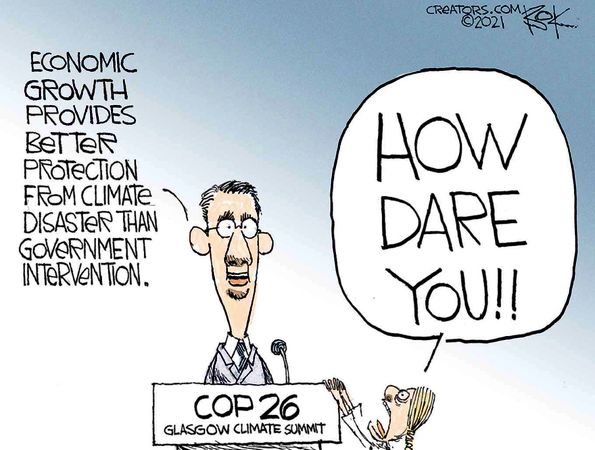
Yes, the carbon tax works great in a ‘first-best’ world where it’s the
only carbon policy. In the real world, carbon policies are piled high.
An open letter is circulating online among my economist colleagues aiming to promote sound thinking on carbon taxes. It makes some valid points and will probably get waved around in the House of Commons before long. But it’s conspicuously selective in its focus, to the point of ignoring the main problems with Canadian climate policy as a whole.
EV charging sign Electric-vehicle mandates and subsidies are among the mountain of climate policies that have been piled on top of Canada’s carbon tax. PHOTO BY JOSHUA A. BICKEL/THE ASSOCIATED PRESS
There’s a massive pile of boulders blocking the road to efficient policy, including:
subsidies for electric buses and emergency vehicles in Canadian cities,
new aviation and rail sector emission limits, and many more.
Not one of these occasioned a letter of protest from Canadian economists.
Beside that mountain of boulders there’s a twig labelled “overstated objections to carbon pricing.” At the sight of it, hundreds of economists have rushed forward to sweep it off the road. What a help!
To my well-meaning colleagues I say: the pile of regulatory boulders
long ago made the economic case for carbon pricing irrelevant.
Layering a carbon tax on top of current and planned command-and-control regulations does not yield an efficient outcome, it just raises the overall cost to consumers. Which is why I can’t get excited about and certainly won’t sign the carbon-pricing letter. That’s not where the heavy lifting is needed.
My colleagues object to exaggerated claims about the cost of carbon taxes. Fair enough. But far worse are exaggerated claims about both the benefits of reducing carbon dioxide emissions and the economic opportunities associated with the so-called “energy transition.” Exaggeration about the benefits of emission reduction is traceable to poor-quality academic research, such as continued use ofclimate models known to have large, persistent warming biasesand of the RCP8.5 emissions scenario, long since shown in the academic literature to be grossly exaggerated.
But a lot of it is simply groundless rhetoric. Climate activists, politicians and journalists have spent years blaming Canadians’ fossil fuel use for every bad weather event that comes along and shutting down rational debate with polemical cudgels such as “climate emergency” declarations. Again, none of this occasioned a cautionary letter from economists.
There’s another big issue on which the letter was silent. Suppose we did clear all the regulatory boulders along with the carbon-pricing-costs-too-much twig. How high should the carbon tax be? A few of the letter’s signatories are former students of mine so I expect they remember the formula for an optimal emissions tax in the presence of an existing tax system. If not, they can take their copy of Economic Analysis of Environmental Policy by Prof. McKitrick off the shelf, blow off the thick layer of dust and look it up. Or they can consult any of the half-dozen or so journal articles published since the 1970s that derive it. But I suspect most of the other signatories have never seen the formula and don’t even know it exists.
To be technical for a moment, the optimal carbon tax rate varies inversely with the marginal cost of the overall tax system. The higher the tax burden — and with our heavy reliance on income taxes our burden is high — the costlier it is at the margin to provide any public good, including emissions reductions. Economists call this a “second-best problem”: inefficiencies in one place, like the tax system, cause inefficiencies in other policy areas, yielding in this case a higher optimal level of emissions and a lower optimal carbon tax rate.
Based on reasonable estimates of the social cost of carbon and the marginal costs of our tax system, our carbon price is already high enough. In fact, it may well be too high. I say this as one of the only Canadian economists who has published on all aspects of the question. Believing in mainstream climate science and economics, as I do, does not oblige you to dismiss public complaints that the carbon tax is too costly.
Which raises my final point: the age of mass academic letter-writing has long since passed. Academia has become too politically one-sided. Universities don’t get to spend years filling their ranks with staff drawn from one side of the political spectrum and then expect to be viewed as neutral arbiters of public policy issues. The more signatories there are on a letter like this, the less impact it will have. People nowadays will make up their own minds, thank you very much, and a well-argued essay by an individual willing to stand alone may even carry more weight.
Online conversations today are about rising living costs, stagnant real wages and deindustrialization. Even if carbon pricing isn’t the main cause of all this, climate policy is playing a growing role and people can be excused for lumping it all together. The public would welcome insight from economists about how to deal with these challenges. A mass letter enthusing about carbon taxes doesn’t provide it.
There is no charge for content on this site, nor for subscribers to receive email notifications of postings.
This report refutes the popular but mistaken belief that today’s weather extremes are more common and more intense because of climate change, by examining the history of extreme weather events over the past century or so. Drawing on newspaper archives, it presents multiple examples of past extremes that match or exceed anything experienced in the present day. That so many people are unaware of this fact shows that collective memories of extreme weather are short-lived.
Heatwaves
Heatwavesof the last few decades pale in comparison to those of the 1930s – a period whose importance is frequently downplayed by the media and environmental activists. The evidence shows that the record heat of that time was not confined to the US ‘Dust Bowl’, but extended throughout much of North America, as well as to other countries, such as France, India and Australia. US heatwaves during July 2023, falsely trumpeted by the mainstream media as the hottest month in history, failed to exceed the scorching heat of 1934.
Figure1: US heatwaves in 1930. Left: sample maximum temperatures for selected cities in April heatwave; right: exceptionally warm July heatwave in New York city.
Figure5: Observed changes in heatwaves in the contiguous US, 1901–2018. Source: CSSR.99
Heatwaves lasting a week or longer in the 1930s were not confined to North America; the Southern Hemisphere baked too. Adelaide, on Australia’s south coast, experienced a heatwave at least 11 days long in 1930, and Perth on the west coast saw a 10-day spell in 1933. In August 1930, Australian and New Zealand (and presumably French) newspapers recounted a French heatwave that month, in which the temperature soared to a staggering 50°C (122°F) in the Loire valley – besting a purported record of 46°C (115°F) set in southern France in 2019. Many more examples exist of the exceptionally hot 1930s all over the globe. Even with modern global warming, there’s nothing unprecedented about current heatwaves, either in frequency or magnitude.
Floods
Major floods today are no more common nor deadly or disruptive than any of the thousands of floods in the past, despite heavier precipitation in a warming world (which has increased flash flooding in some regions). Many of the world’s countries regularly experience major floods, especially China, India and Pakistan. A significant 1931 flood in China covered a far greater area and affected many more people than the devastating 2022 floods in Pakistan.
Figure 8: Disastrous Yangtze River flood in China, 1931.
Figure 10: Annual number of deaths from major floods in Pakistan, 1950 to 2012. Source: M.J. Paulikas and M.K. Rahman.100
The Pakistan floods of 2022 were the nation’s sixth since 1950 to kill over 1,000 people, although the death toll from the 2022 floods was a comparable 1,739. Major floods which killed as many as 3,100 people afflicted the country in 1950, 1955, 1956, 1957, 1959, throughout the 1970s and in more recent years.
Monsoonal rains in 1950 led to flooding that killed an estimated 2,900 people across the country and caused the Ravi River in northeastern Pakistan to burst its banks; 10,000 villages were decimated and 900,000 people made homeless. In 1973, one of Pakistan’s worst-ever floods followed intense rainfall of 325 mm (13 inches) in Punjab (which means ‘Five Rivers’) province, affecting more than 4.8 million people out of a total population of about 65 million.
Droughts
Severe droughts have been a continuing feature of the Earth’s climate for millennia, despite the brouhaha in the mainstream media over the extended drought in Europe during the summer of 2022. Not only was the European drought not unprecedented, but there have been numerous longer and drier droughts throughout history, including during the past century.
Figure 12: Famine following drought in India, 1966–67
Figure14: Percentage of the US in drought 1895–2015. Based on the Palmer Drought Severity Index. Source: NOAA/NCEI.101
As an illustration that the 1930s and 1950s were not the only decades over the past century in which the US experienced significant droughts, Figure 14 depicts observational data showing the area of the contiguous US in drought from 1895 up until 2015. As can be seen, the long-term pattern in the US is featureless, despite global warming. Reconstructions of ancient droughts using tree rings or pollen as proxies reveal that historical droughts were even longer and more severe than those described here, many lasting for decades – so-called ‘megadroughts.’
Figure13: Texas drought, 1950–57. Left top photo: car being towed after becoming stuck in parched riverbed; left bottom photo: once lakeside cabins on shrinking Lake Waco; right top photo: dry lakebed; right bottom: newspaper excerpt.
Hurricanes
Hurricanes overall actually show a decreasing trend around the globe, and the frequency of their landfalling has not changed for at least 50 years. The deadliest US hurricane in recorded history, which killed an estimated 8–12,000 people, struck Galveston, Texas in 1900. As a comparison, the death toll of 2022’s Category 5 Hurricane Ian, which ldeluged much of Florida with a storm surge as high as Galveston’s, was just 156.
Figure 17: Annual number of North Atlantic hurricanes, 1851–2022. Source: NOAA Hurricane Research Division103 and Paul Homewood.104
Hurricanes have been a fact of life for Americans in and around the Gulf of Mexico since Galveston and before. The death toll has fallen over time, with improvements in planning and engineering to safeguard structures, and the development of early warning systems to allow evacuation of threatened communities. Nevertheless, the frequency of North Atlantic hurricanes has been essentially unchanged since 1851, as shown in Figure 17. The apparent heightened hurricane activity over the last 20 years, particularly in 2005 and 2020, simply reflects improvements in observational capabilities since 1970, and is unlikely to be a true climate trend, say a team of hurricane experts. The incidence of major North Atlantic hurricanes in recent decades is no higher than that in the 1950s and 1960s, when the Earth was actually cooling, unlike today.
Figure22: Hurricane Camille, 1969.
These are just a handful of hurricanes from our past, all as massive and deadly as Category 5 Hurricane Ian, which in 2022 deluged Florida with a storm surge as high as Galveston’s and rainfall up to 685 mm (27 inches); 156 were killed. Hurricanes are not on the rise today
Tornadoes
Likewise, there is no evidence that climate change is causing tornadoes to become more frequent and stronger. The annual number of strong (EF3 or greater) US tornadoes has in fact declined dramatically over the last 72 years, and there are ample examples of past tornadoes just as or more violent and deadly than today’s.
Figure26: Super Outbreak of tornadoes, 1974. Left: distribution and approximate path lengths of tornadoes; top right photo: F5 tornado approaching Xenia, Ohio (population 29,000); center right and bottom right photos: consequent wreckage in Xenia.
Figure27: Annual count of EF3 and above tornadoes in the US, 1950–2021. Source: Source: NOAA/NCEI.106, 107
After a flurry of tornadoes swarmed the central US in March 2023, the media quickly fell into the trap of linking the surge to climate change, as often occurs with other forms of extreme weather. But there is no evidence that climate change is causing tornadoes to become more frequent and stronger, any more than hurricanes are increasing in strength and number.
Wildfires
Wildfires are not increasing either. On the contrary, the area burned annually is diminishing in most countries. The total number of US fires and the area burned in 2022 were both 20% less than in 2007; data before 1983 that mysteriously disappeared recently from a government website shows an even larger historical decline. And, in spite of popular belief, ignition of wildfires by arson plays a larger role than sustained high temperatures and wind.
Figure30: Wildfires in northern California Left: near Auburn, Mt. Shasta and Yosemite, 1936; right: in Mendocino County, known for its redwood forests, 1945.
Figure32: Global forest area burned by wildfires, 1900–2010 Source: Jia Yang et al.108
Smoke that wafted over the US from extensive Canadian wildfires in 2023 has given credence to the mistaken belief that wildfires are intensifying because of climate change. However, just as with all the other examples of extreme weather, there is no scientific evidence that wildfires today are any more frequent or severe than anything experienced in the past. Although they can be exacerbated by weather extremes, such as heatwaves and droughts, we’ve already seen that those are not on the rise either.
In addition to examples of past weather extremes from newspaper archives, the report concludes with a short section on documented extreme weather events dating back centuries and even millennia.
Conclusion
The perception that extreme weather is increasing in frequency and severity is primarily a consequence of modern technology – the Internet and smart phones – which have revolutionised communication and made us much more aware of such disasters than we were 50 or 100 years ago. The misperception has only been amplified by the mainstream media, eager to promote the latest climate scare. And as psychologists know, constant repetition of a false belief can, over time, create the illusion of truth. But history tells a different story.
There is no charge for content on this site, nor for subscribers to receive email notifications of postings.
Below is an article describing how the woke industry started and expanded by advancing a fundamental lie about human happiness and social fairness. The image above calls attention to the notion that sorts individuals into classes and attributes inequalities in status or prosperity to oppression by others. The lie is that any disappointment or disadvantage is the fault of others, ie. privileged oppressors. Thus is swept away standards of performance, accountability and considerations of individual merit. As explained below the DEI bureaucracy emerged to reward so-called “protected classes” at the expense of “privileged classes.”
The diversity business originated in 1984, when R. Roosevelt Thomas, a Harvard business school graduate, founded the American Institute for Managing Diversity at Morehouse College. Corporations had been practicing affirmative action for years, but the women and minorities whom employers had hired to meet equal-opportunity obligations weren’t advancing up the career ladder in acceptable numbers. Thomas came up with a novel explanation. The problem wasn’t that preferentially admitted recruits were underqualified; the problem was that their supervisors didn’t know how to “manage diversity.” It was those supervisors who needed remedial training—lots of it—not the affirmative-action beneficiaries themselves.
Managerial expectations about merit and performance often reflected cultural prejudices, Thomas and the consultants who followed him insisted. “‘Qualifications’ is a code word in the business world with very negative connotations,” a consultant with the professional-services firm of Towers Perrin (as it was then called) said in 1993. If minorities don’t meet existing employment criteria, then corporations need to expand their definition of what it means to be employable, said Alan Richter, creator of the 1991 board game, The Diversity Game. Promptness, precision, and a cogent communications style were among the attributes that diversity advisors deemed likely expendable.
A lucrative new consulting practice was born, its growth driven by a constant churn in terminology. “Valuing diversity” was different from “managing diversity.” Each newly spawned phrase came with a cadre of high-priced tutors. Lewis Griggs currently offers video trainings in such subjects as “Communicating Across Differences,” “Supervising and Managing Differences,” and “Creating, Managing, Valuing, and Leveraging Diversity,” with each video purporting to contain specialized content appropriate for different parts of an organization.
“Diversity” was eventually joined by “inclusion.” “Equity” was then added, thus yielding today’s DEI (Diversity, Equity, and Inclusion) triumvirate (sometimes also going as “EDI”). The most cutting-edge organizations have lately appended a “B” (for Belonging), as at the Juilliard School in New York City. Distinguishing these terms is a core function of diversity training—and now, at Bentley, of diversity scholarship. The university’s new DEI major, the Chronicle of Higher Education reports, will help graduates understand the “nuances of and differences between diversity, equity, inclusion, and justice.”
Even by 1993, half of Fortune 500 companies had a designated diversity officer, and 40 percent of American companies had instituted diversity training. Diversity conferences were occurring regularly, attracting government and business attendees. And yet many reporters, academics, corporate consultants, and activists still insist that managers not only fail to “value diversity,” but remain complicit in creating a dangerous environment for women and racial minorities.
Example: Levi Strauss & Co., which was recognized on Forbes’s list of “Best Employers for Diversity” in 2019. The company itself boasts: “In the 1960s, we integrated our factories a decade before it was required by law. In the early 1980s, we joined the fight against HIV/AIDS early on. Furthermore, our president and CEO, Chip Bergh, was one of the first company leaders to join the CEO Action for Diversity & Inclusion™ [in 2017], and has been on the front lines of efforts to protect Dreamers knowing that diversity and inclusivity makes our company better and our country stronger (after all, Levi Strauss himself was an immigrant).”
And yet the situation for minority employees at Levi Strauss is still so dire that the company has been hosting racially segregated healing sessions with professional mental health experts. As the Washington Free Beacon recently reported, its chief executive for DEI is trying to provide a “safe space for employees to express themselves” without feeling “triggered.”
Bentley University itself has yet to yield dividends from its longstanding diversity efforts. The school has been “working for decades on issues, challenges, and opportunities” pertaining to diversity, according to its Office of Diversity and Inclusion. Over 900 faculty and administrators have attended two-day diversity retreats; numerous committees, departments, and offices have focused on improving the school’s “diversity climate.” Bentley even has its own diversity consulting outfit, the Center for Women and Business, which advises employees and managers on such diversity pitfalls as being a mere “performative ally” of oppressed colleagues (as opposed to an active ally).
And yet, despite this effort, a Bentley Racial Justice Task Force recently found that the campus still did not understand how “race and racism” operate at the university. So difficult is it to be a diverse member of Bentley that the task force, formed in July 2020, began with a moment of “restoration,” providing to all “those who had been traumatized” at the school a “time to heal” and a time to “process the pain of racial injustice.”
One of Bentley’s biggest failings, according to the task force, has been its “false confidence” in “objectivity and meritocracy.” These are the norms of a “historically and predominantly white institution (HWI/PWI),” per the task force members. Typical of HWIs/PWIs, Bentley does not pay sufficient attention to the “systemic inequality” that such white norms engender. Equally dismaying, many students and professors apparently would rather study subjects other than racism, the task force lamented, thereby betraying their “lack of understanding about why the study of race is critical to the creation of a full academic experience.”
Diversity industry proponents would argue that white supremacy is simply too ingrained in America’s institutions to be rooted out within a mere three to four decades of diversity work.
But another possible reason why diversity training has not met its stated goals is that the field is intellectually bankrupt: Its practitioners peddle empty verbiage to fix a problem that is largely imaginary. I asked Bentley’s press office what the difference is between “diversity, equity, and inclusion.” The answer was a dodge: “Rather than give students one particular view of diversity, equity, inclusion and justice, Bentley’s DEI major encourages students to compare and contrast approaches to diversity, equity, inclusion and justice from across disciplines and perspectives and show how they intersect with one another.” Other questions—how the school defines a “real discipline,” what are the core texts of this new discipline, and why Bentley’s decades of diversity work have not lessened the school’s purported racism—were ignored entirely.
Bentley sociologist Gary David says that “more and more studies have shown” that diversity training and DEI perspectives make “good business sense.” But this oft-asserted claim rests on a few studies of dubious experimental design, lacking control groups. The one thing diversity trainees reliably learn is how to answer post-training survey questions “in the way the training said they ‘should,’” reports sociologist Musa al-Gharbi. As for actually changing behaviors in a diversity-approved direction, the training is not only ineffective, it is often counterproductive, according to al-Gharbi.
Far from being institutionally racist, Bentley University, like virtually every other American college today, is filled with well-meaning adults who want all their students to succeed. Corporations, law firms, Big Tech, and government agencies are bending over backwards to hire and promote as many underrepresented minorities (i.e., blacks and Hispanics) as possible. If the number of those minorities in a college or business organization is not proportional to their population share, that underrepresentation is due first and foremost to the academic skills gap. Mention of the skills gap is taboo in diversity circles, but it is real—repeatedly documented by the National Assessment of Educational Progress exams, the SAT, the LSAT, the GREs, the GMAT, and the MCAT—and it is consequential.
Hiring based on any extraneous selection criterion inevitably lowers the average qualifications of the resulting employee group. Hiring based on race entails a particularly significant deviation from a meritocratic ideal, since the only reason why color-conscious hiring is implemented in the first place is that merit hiring often fails to produce a critical mass of black and Hispanic employees. In essence, the diversity conceit is a perpetual motion machine: If underqualified diversity hires are promoted out of diversity pressure, resentment and obfuscation follow. If they hit a glass ceiling, accusations of bias are inevitable. In either situation, a diversity consultant is waiting in the wings to teach managers that their expectations and standards are racist.
The increasing power of college diversity bureaucrats over academic affairs since the 1990s has been stunning. Diversity vice-chancellors oversee faculty hiring searches, mandate quotas regarding whom search committees may interview, and sometimes even mandate quotas regarding whom they must hire. Chief inclusion officers track departmental race and sex demographics, pressuring department chairs to correct diversity deficits. Associate provosts for diversity coordinate campaigns for required courses on identity and grievance within the curriculum. Deans of inclusion teach students to recognize their place on the great totem pole of victimization. Vice presidents for equity monitor campus speech, on the lookout for punishable microaggressions. Senior advisors on race and community lead crusades against faculty who have allegedly threatened the safety of campus victim groups through non-orthodox statements regarding race and sex.
Now that the fictions underpinning this enterprise are being enshrined as an academic discipline, the possibility that the university will return to its status as an institution dedicated to the unfettered search for knowledge—and even, dare one say it, objectivity and meritocracy—will grow yet more remote.
Postscript: When Graduates from DEI Institutions Go to Workplaces
Companies are struggling to operate as Gen Z enters the workforce at higher rates, and a growing majority of employers say the younger generation is toxic for their business.
That’s the latest from a new Freedom Economy Index report conducted by PublicSquare and RedBalloon this month. In the survey, 68 percent of small business owners said Gen Zers were the “least reliable” of all their employees. And 71 percent said these younger workers were the most likely to have a workplace mental health issue.
One of the surveyed employers spoke of Gen Z’s “absolute delusion, complete lack of common sense, and zero critical reasoning or basic analytical skills.”
The criticism for Gen Z workers was in full force, as less than 4 percent said Gen Z was the generation that most aligns with their workplace culture, and 62 percent said Gen Z was the most likely to create division and toxicity in the workplace.
Another employer noted the generation’s tendency for “expecting promotions for simply showing up every day.”
Footnote: Boeing Learning the Hard Way About DEI Hiring
There is no charge for content on this site, nor for subscribers to receive email notifications of postings.
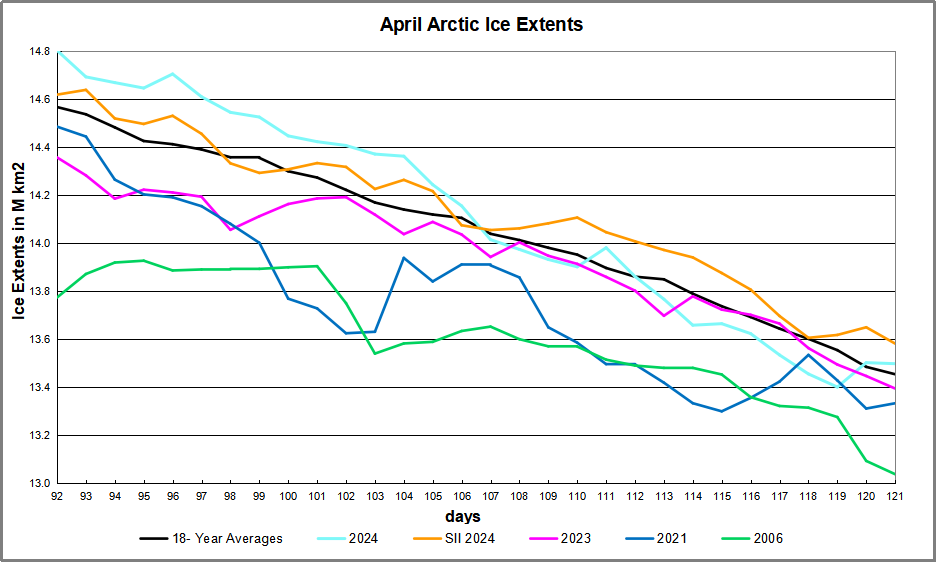
The animation shows end of March Arctic ice extents on day 91 over the last 19 years (length of MASIE dataset). Of course central Arctic basins are frozen solid, and the fluctuations are visible on the marginal basins both the Atlantic side (right) and the Pacific (left). Note the higher extents in 2012, followed by lesser ice, now overcome by 2024.
The graph below shows Monthly averages for March since 2007. March is the maximum month in the annual cycle in contrast to September being the minimum Arctic ice extents. Note the low 2007 extents followed by several years over15M km2, then lesser extents 2015 to 2018, and increasing extents up to 2024 nearly averaging 15M for the month.
The graph below shows March daily ice extents for 2024 compared to 18 year averages, and some years of note.
The black line shows during March on average Arctic ice extents nearly reach 15 Wadhams (15M km2) on Day 62, March 2. A slow decline is normal until Day 91, March 31. However, that period in 2024 saw Arctic ice go over 15M on day 68 and remain there until day 79. Afterward both MASIE and SII show above average extents to month end. 2006 was the first year in this dataset and ended March ~800k km2 in deficit to average. 2021 and 2023 were ~200k below average on Day 91 while 2024 ended 266k km2 surplus ice. As usual in transitional months like March and September, SII (Sea Ice Index) shows a similar pattern with generally lower extents.
Why is this important? All the claims of global climate emergency depend on dangerously higher temperatures, lower sea ice, and rising sea levels. The lack of additional warming prior to 2023 El Nino is documented in a post UAH February 2024: SH Saves Global Warming.
The table below shows the distribution of Sea Ice on day 91 across the Arctic Regions, on average, this year and 2006.
Region
2024091
Day 91 ave
2024-Ave.
2006091
2024-2006
(0) Northern_Hemisphere
14854967
14589377
265590
13821470
1033497
(1) Beaufort_Sea
1070983
1070226
758
1068683
2301
(2) Chukchi_Sea
966006
963401
2606
959091
6915
(3) East_Siberian_Sea
1087137
1086151
987
1084120
3017
(4) Laptev_Sea
897845
896053
1792
896510
1335
(5) Kara_Sea
935023
919656
15367
910487
24536
(6) Barents_Sea
845789
657875
187914
622588
223201
(7) Greenland_Sea
771533
661909
109624
601310
170223
(8) Baffin_Bay_Gulf_of_St._Lawrence
1238205
1384413
-146208
1003875
234330
(9) Canadian_Archipelago
854860
853089
1772
851691
3169
(10) Hudson_Bay
1260903
1255353
5551
1240389
20514
(11) Central_Arctic
3248013
3235452
12561
3239349
8664
(12) Bering_Sea
724493
703487
21006
658979
65514
(13) Baltic_Sea
50165
61636
-11471
114622
-64457
(14) Sea_of_Okhotsk
900660
831057
69602
558027
342633
The overall surplus to average is 266k km2, (2%). The only major deficit is in Baffin Bay, more than offset by surpluses everywhere, especially in Okhotsk, Barents and Greenland seas. Note Arctic ice yesterday was more than a Wadham greater than the same day in 2006.
Illustration by Eleanor Lutz shows Earth’s seasonal climate changes. If played in full screen, the four corners present views from top, bottom and sides. It is a visual representation of scientific datasets measuring Arctic ice extents.
This reportis written for people wishing to form their own opinion on issues relating to climate. Its focus is on publicly available observational datasets, and not on the output of numerical models, although there are a few exceptions, such as Figure 42. References and data sources are listed at the end.
The observational data presented here reveal a vast number of natural variations, some of which appear in more than one series. The existence of such natural climatic variations is not always fully acknowledged, and therefore generally not considered in contemporary climate conversations. The drivers of most of these climatic variations are not yet fully understood, but should represent an important focus for climatic research in future.
In this report, meteorological and climatic observations are described according to the following overall structure: atmosphere, oceans, sea level, sea ice, snow cover, precipitation, and storms. Finally, in the last section (below), the observational evidence as at 2023 is briefly summarised.
Ten facts about the year 2023
1. Air temperatures in 2023 were the highest on record (since 1850/1880/1979, according to the particular data series). Recent warming is not symmetrical, but is mainly seen in the Northern Hemisphere (Figures 1 and 13).
Figure 1: 2023 surface air temperatures compared to the average for the previous 10 years. Green-yellow-red colours indicate areas with higher temperature than the average, while blue colours indicate lower than average temperatures. Data source: Remote Sensed Surface Temperature Anomaly, AIRS/Aqua L3 Monthly Standard Physical Retrieval 1-degree x 1-degree V006 (https://airs.jpl.nasa.gov/), obtained from the GISS data portal (https://data.giss.nasa.gov/gistemp/maps/).
Figure 13: Zonal air temperatures. Global monthly average lower troposphere temperature since 1979 for the tropics and the northern and southern extratropics, according to University of Alabama at Huntsville, USA. Thin lines: monthly value; thick lines: 3-year running mean.
2. Arctic air temperatures have increased during the satellite era (since 1979), but Antarctic temperatures remain essentially stable (Figure 14).
Figure 14: Polar temperatures Global monthly average lower troposphere temperature since 1979 for the North and South Pole regions, according to University of Alabama at Huntsville (UAH), USA. Thick lines are the simple running 37-month average.
3. Since 2004, globally, the upper 1900m of the oceans has seen net warming of about 0.037°C. The greatest warming (of about 0.2°C) is in the uppermost 100m, and mainly in regions near the Equator, where the greatest amount of solar radiation is received (Figure 28).
Figure 28: Temperature changes 0–1900m Global ocean net temperature change since 2004 from surface to 1900m depth, using Argo-data. Source: Global Marine Argo Atlas.
4. Since 2004, the northern oceans (55–65°N) have, on average, experienced a marked cooling down to 1400m depth, and slight warming below that (Figure 29). Over the same period, the southern oceans (55–65°S) have, on average, seen some warming at most depths (above 1900m), but mainly near the surface.
Figure 29: Temperature changes 0–1900m Global ocean net temperature change since 2004 from surface to 1900m depth. Source: Global Marine Argo Atlas
5. Sea level globally is increasing at about 3.4 mm per year or more according to satellites, but only at 1-2 mm per year according to coastal tide gauges (Figures 39 and 41). Local and regional sea-level changes usually deviate significantly from such global averages.
Figure 39: Global sea level change since December 1992 The two lower panels show the annual sea level change, calculated for 1- and 10-year time windows, respectively. These values are plotted at the end of the interval considered. Source: Colorado Center for Astrodynamics Research at University of Colorado at Boulder. The blue dots are the individual observations (with calculated GIA e”ect removed), and the purple line represents the running 121-month (ca. 10-year) average.
Figure 41: Holgate-9 monthly tide gauge data from PSMSL Data Explorer The Holgate-9 are a series of tide gauges located in geologically stable sites. The two lower panels show the annual sea level change, calculated for 1- and 10-year time windows, respectively. These values are plotted at the end of the interval considered. Source: Colorado Center for Astrodynamics Research at University of Colorado at Boulder. The blue dots are the individual observations, and the purple line represents the running 121-month (ca. 10-year) average.
6. Global sea-ice extent remains well below the average for the satellite era (since 1979). Since 2018, however, it has remained quasistable, perhaps even exhibiting a small increase (Figure 43).
Figure 43: Global and hemispheric sea ice extent since 1979 12-month running means. The October 1979 value represents the monthly average of November 1978–October 1979, the November 1979 value represents the average of December 1978–November 1979, etc. The stippled lines represent a 61-month (ca. 5 years) average. The last month included in the 12-month calculations is shown to the right in the diagram. Data source: National Snow and Ice Data Center (NSIDC).
7. Global snow cover has remained essentially stable throughout the satellite era (Figure 47), although with important regional and seasonal variations.
Figure 47: Northern hemisphere weekly snow cover since 2000(a) Since January 2000 and (b) Since 1972. Source: Rutgers University Global Snow Laboratory. The thin blue line is the weekly data, and the thick blue line is the running 53-week average (approximately 1 year). The horizontal red line is the 1972–2022 average.
8. Global precipitation varies from more than 3000mm per year in humid regions to almost nothing in deserts. Global average precipitation exhibits variations from one year to the next, and from decade to decade, but since 1901 there has been no clear overall trend (Figure 50).
Figure 50: Global precipitation anomalies. Variation of annual anomalies in relation to the global average precipitation from 1901 to 2021 based on rainfall and snowfall measurements from land-based weather stations worldwide. Data source: United States Environmental Protection Agency (EPA).
9. Storms and hurricanes display variable frequency over time, but without any clear global trend towards higher or lower values (Figure 51).
Figure 51: Annual global accumulated cyclone energy Source: Ryan Maue.
10. Observations confirm the continuing long-term variability of average meteorological and oceanographic conditions, but do not support the notion of an ongoing climate crisis.
Summing up
The global climate system is multifaceted, involving sun, planets, atmosphere, oceans, land, geological processes, biological life, and complex interactions between them. Many components and their mutual coupling are still not fully understood or perhaps not even recognised.
Believing that one minor constituent of the atmosphere (CO2)controls nearly all aspects of climate is naïve and entirely unrealistic.
The global climate has remained in a quasi-stable condition within certain limits for millions of years, although with important variations playing out over periods ranging from years to centuries or more, but the global climate has never been in a fully stable state without change.
Modern observations show that this behaviour continues today;
there is no evidence of a global climate crisis.
There is no charge for content on this site, nor for subscribers to receive email notifications of postings.
Trudeau Turns the Carbon Tax Screws on Canadians April 1
Ross Mckitrick explains the smoke and mirrors in Trudeau’s justifications for his racheting carbon tax in a National Post article Wanted: A leader who is honest about climate policy. Excerpts in italics with my bolds and added images.
Pierre Poilievre is leading anti-carbon tax rallies around the country, ginning up support for an old-fashioned tax revolt. In response, Justin Trudeau went to Calgary and trumpeted — believe it or not! — his love of free markets. After explaining the economic logic of using a carbon tax to reduce greenhouse gases, the prime minister slammed regulatory approaches, which, he said, “all involve the heavy hand of government. I prefer a cleaner solution, a market-based solution and that is, if you’re behaving in a way that causes pollution, you should pay.” He added that the Conservatives would instead rely on the “heavy hand of government through regulation and subsidies to pick winners and losers in the economy as opposed to trusting the market.” Amen to all that!
But someone should tell Trudeau that his own government’s
Emission Reduction Plan mainly consists of heavy-handed
regulations, subsidies, mandates and winner-picking grants.
Within its 240 pages one does find a carbon tax. But also 139 additional policies, including:
♦ Clean Fuels Regulations, ♦ An electric vehicle mandate that will ban gasoline cars by 2035, ♦ Aggressive fuel economy standards that will hike such cars’ cost in the meantime, ♦ Costly new emission targets specifically for oil & gas, agriculture, heavy industry and waste management, ♦ Onerous new energy efficiency requirements both for new buildings and renovations of existing buildings, New electricity grid requirements, and page upon page of ♦ Subsidy funds for “clean technology” firms and other would-be winners in the sunlit uplands of the new green economy.
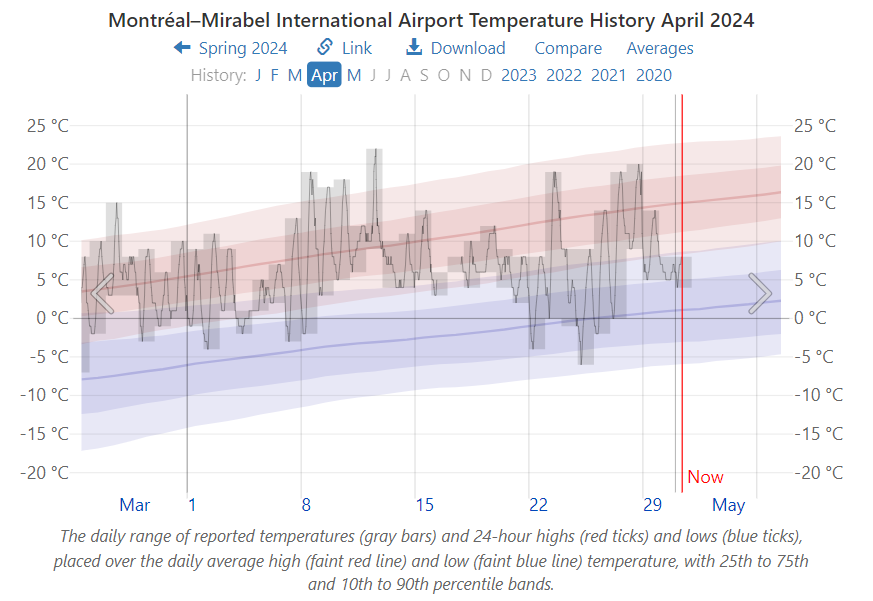
Does Trudeau oppose any of that? Hardly. But the economic logic of a carbon tax only applies when it is used on its own. He doesn’t get to boast about the elegance of market mechanisms on behalf of a policy package that starts with a price signal then destroys it with a massive regulatory apparatus. Trudeau also tried to warm his Alberta audience to the carbon tax by invoking the menace of mild weather and forest fires. In fairness it was an unusual February in Calgary. The month began with a week of above-zero temperatures, hitting five degrees Celsius at one point, then there was a brief cold snap before Valentine’s Day, then the daytime highs soared to the low teens for nine days and the month ended with soupy above-zero conditions. Weird.
Oops, that was 1981.This year was weirder: February highs were above zero for 25 out of 28 days, eight of which were even above 10 degrees C.
Oops again, that was 1991. Granted, February 2024 also had
its mild patches, but not like the old days.
Of course, back then warm weather was just weather. Now it’s a climate emergency and Canadians demand action. Except they don’t want to pay for it, which is the main problem for politicians when trying to come up with a climate policy that’s both effective and affordable. In fact, you can only have one of those two. Take your pick: effective or affordable, affordable or effective.
In practice, of course we typically end up zero for two,
with policies that are both ineffective and unaffordable.
You can claim your policy will yield deep decarbonization while boosting the economy, which almost all politicians in every western country have spent decades doing. But it’s not true. With current technology, affordable policies yield only small temporary emission reductions. Population and economic growth swamp their effects over time, which is why mainstream economists have long argued that while we can eliminate some lowvalue emissions, for the most part we will just have to live with climate change. Trying to stop it would cost far more than it’s worth.
Meanwhile the policy pantomime continues. Poilievre’s anti-carbon tax rallies are popular, but what happens after we axe the tax? If he plans to replace it with regulatory measures aimed at achieving the same emission cuts, he really should tell his rallygoers that what he has in mind will hit them even harder than the tax they’re so keen to scrap.
Or does he have the courage to do the sensible thing
and follow the mainstream economics advice?
If he wants to be honest with Canadians, he must explain that the affordable options will not get us to the Paris target, let alone to net-zero, and even if they did, what Canada does will have no effect on the global climate because we’re such small players. Maybe new technologies will appear over the next decade that change the economics, but until that day we’re better off fixing our growth problems, getting the cost of living down and continuing to be resilient to all the weather variations Canadians have always faced.
Addendum
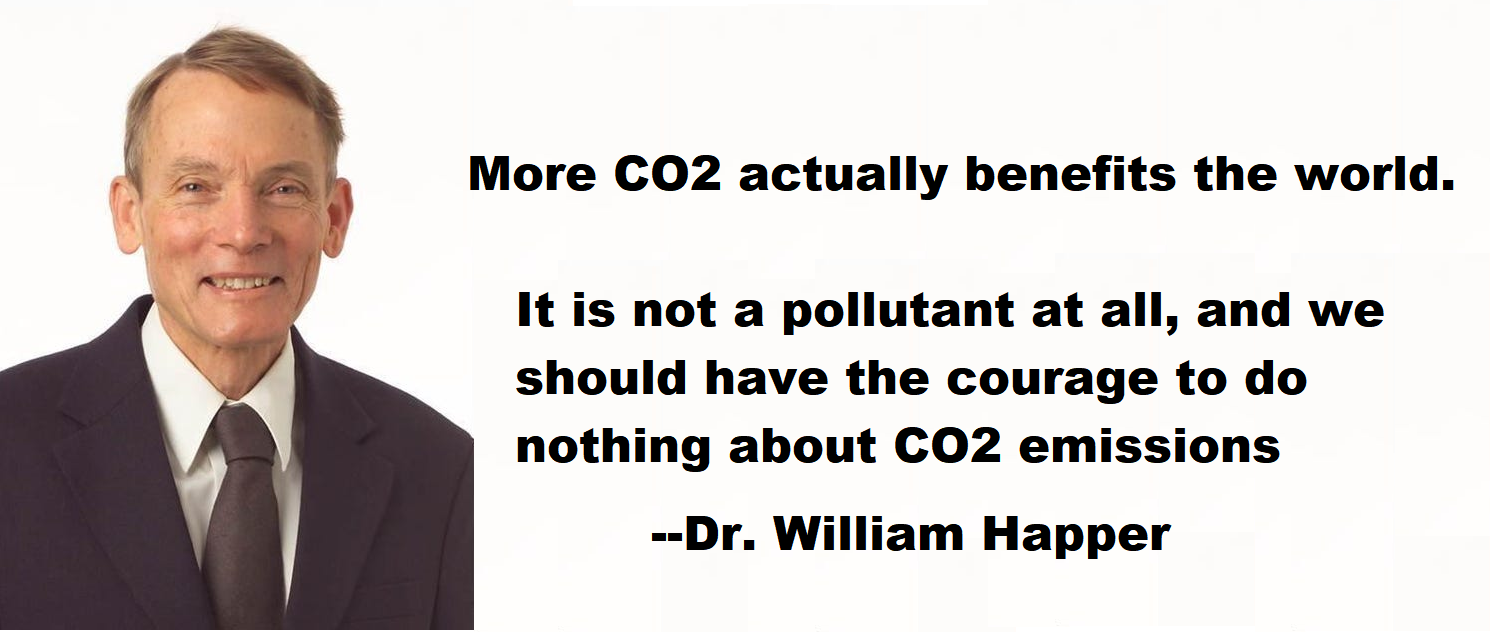
Notice that Trudeau asserts that his carbon tax is needed so that “polluters pay.” Millions of Canadian taxpayers’ dollars have been spent on prime time TV ads reminding viewers that we have to do something to stop “carbon pollution”, by which they mean CO2 emissions. No matter that CO2, far from being an unnatural contaminant, is plant food without which (less than 150 ppm) plants and animals die. No mention of thousands of scientists proclaiming that “There is No Climate Emergency,” and that global warming and rising CO2 since the Little Ice Age have led to unprecedented human flourishing.
So essential CO2 is labeled as a pollutant in order to insist that emissions from burning hydrocarbons must be reduced to avert a crisis: heat waves, forest fires, floods, droughts, etc. etc. The premise is “We have to do something to stop emitting CO2.” Politicians of all stripes dare not question it. And a video interview below demonstrates how that premise prevents any reasonable discussion of energy policy.
The Parliamentary Budget Officer released a report looking into how much the carbon tax is actually costing Canadian households. In the CBC interview, Parliamentary Budget Officer Yves Giroux breaks down the report. And, Dale Beugin, executive vice-president of the Canadian Climate Institute discusses the analysis his organization has conducted on the government’s emissions reduction plan. Note the PBO role is non-partisan, while the CCI agenda is open and obviously Gung Ho against CO2.
The discussion with the PBO ends at 11 minutes into the video, the remainder being CCI talking about ways to shape industrial policies to force additional emissions down to meet Paris targets. A few excerpts from the first part show how difficult it is to escape the premise that we have to do something about CO2.
CBC: I’m sure have been watching what’s been happening in the House of Commons the conclusions in your report they’re being cited by the conservatives in particular as proof that Canadians are worse off because of carbon pricing and that means this policy needs to go. Is that a fair representation of your findings?
PBO: Well it’s a representation of our findings once you also include the economic impacts of introducing a carbon tax. So there’s the fiscal impact on households paying the tax versus the amount of the rebate that households are receiving. But once you also include the economic impacts due to the introduction of a carbon tax, for example the reduction in activity or the slower growth in economic activity in some sectors then that’s the full impact.
CBC: The fiscal analysis is the financial analysis that the government points to. They say most families will still get more in rebates than they pay, sort of Straight Cash Out, Straight Cash in. Is that a fair representation?
PBO: The conclusion we arrived at if you take into consideration the carbon tax that households pay on their fossil fuels that they’re buying: gasoline, natural gas, diesel and so on, they pay that directly as well as the embedded energy component of whatever goods and services they buy and they subtract from that the the rebate then about 80% of households are better off.
CBC: It gets complicated and this is where it gets controversial because you took a look at the broader effect that carbon pricing, any kind of tax has on an economy, it can have an economic impact to the negative and this is the line from report that conservatives point to once you factor in the rebate but also the economic impacts the majority of the households will see a negative impact as a result of the carbon tax. The rebuttal to that conclusion is that it doesn’t tell the whole story it doesn’t look at other options and other impacts. What do you say in terms of people understanding the meaning of that analysis?
PBO: The analysis looks at the world where the we have a carbon tax versus the absence of a carbon tax which is how we do economic analysis. So the impact of a carbon tax on the economy will have impacts on some sectors; the transportation sector to take one example, or the oil and gas sector, lower employment than would otherwise be the case or lower profits than would otherwise be the case. So that translates into economic impacts on average for households: lower employment, lower profits, lower dividends for those who own stocks Etc. so these are the economic impacts.
CBC: This is where the analysis has caused some confusion and drawn some criticism because the analysis only compares the impact as you said of a carbon price versus nothing, and nothing isn’t an option right? It doesn’t compare carbon pricing versus other options that other experts would say could be even more expensive. So how should people assess the political arguments we’re seeing without a clear comparative analysis of the options?
PBO: So my mandate is to provide cost estimates of policy proposals by the government or policy measures that the government has introduced. My mandate does not include providing cost estimates of alternative scenarios or multiple options. So you’re right that doing something else to reach International targets or a Canada’s commitment under the Paris Accord would also have costs. For example if we were to introduce massive subsidies for new technologies to wean ourselves off fossil fuels, that would obviously have costs. Introducing regulations also has costs and these costs could could be measured if we knew exactly what these alternatives are but there’s no clear policy proposal from the government as what would be the alternative to a carbon tax. So it’s difficult to cost something that has not been proposed yet.
It’s true that the consensus among economists is generally speaking a carbon tax is probably the least disruptive way to reduce emissions. That being said we see that the government itself is not relying solely on a carbon tax for various reasons. So the government itself is introducing subsidies for clean fuel and many regulations.
CBC: So you can’t assess this compared to another proposal because there is no other proposal to assess. You also don’t factor in the cost of climate change. We’ve seen massive wildfires still burning from last year throughout the winter In British Columbia and in Alberta; you know the extreme weather on the East Coast, flooding and storms, all of that has a massive economic impact as well and a loss of productivity and cost to governments.
The idea is to stop that from getting worse or more frequent, how do we assess that versus the cost
of using carbon pricing to lower emissions.
PBO: That’s a very difficult field to to venture into because the number of unusual weather events that’s occurring. We don’t know which ones are due to climate change and which ones would have occurred anyways, or whether their extent would have been smaller or even worse, probably smaller especially in a short period of time. We’ve tried to estimate the impact of climate change between now and the year 2100 and we find that there is a cost to climate change but for the next few years between now and 2030 it’s very difficult to determine precisely the cost of climate change. It’s an area that we ventured into but it’s not easy and not that many institutions and organizations have established clear parameters under which to estimate the cost of climate change.
It’s very unlikely that there’ll be significant technological breakthroughs between now and 2030 sufficient to even partially offset the cost of a carbon tax for example, or any measures to mitigate or reduce our carbon emissions. But it’s quite possible that Beyond 2030 once technologies become more mature they’ll be able to offset some of the costs that we’ll we’ll have to incur to reduce our greenhouse gas emissions. So that’s why it’s difficult to say whether the costs will be offset by the benefits over the longer term but between now and 2030 it’s clearly not going to happen.
I’m providing unbiased nonpartisan information, information not pronouncements, not verdicts on policies. It’s up to decision makers and Canadians to make up their own minds based on the information we provide them so they can decide whether a carbon tax or other measures are the best way forward to reduce carbon emissions. We’re not passing judgments as to whether a policy is working or not.
My Observations
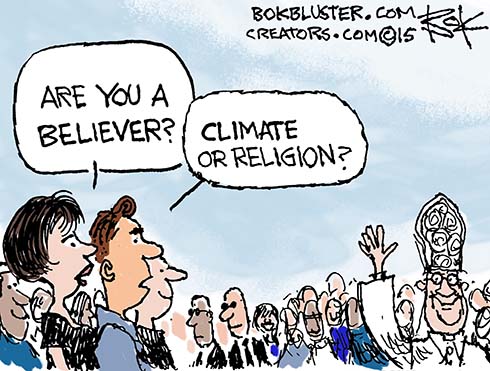
This interview shows that the carbon cult narrative
subverts rational policymaking in three significant ways.
Firstly, there is no accounting of all the economic and social damage done by the multitude of federal government climate policies and regulations (139 that McKitrick found in the Emission Reduction Plan). Secondly the benefits to offset the carbon tax costs consider only saving some damages from extreme weather. This is problematic in two ways. There is no certainty that imposing these costs on Canadians will have any effect on CO2 levels,orthat climate and weather will be any different for having made the effort.
Add to that the ignoring of actual benefits to humankind and to the biosphere from rising atmospheric CO2 and warming temperatures. Virtually every year global agricultural production sets records because of warming and CO2 enhancing photosynthesis. That puts food on the table for billions of people. What insanity to pursue things like carbon capture to rob the biosphere of CO2, while dreaming of a cooler future planet. Both objectives would threaten the world food supply and can hardly be benefits to justify emissions reductions.
Finally CCI gives the game away when they say, in effect:
“You don’t like the carbon tax, but doing nothing is not an option.”
In fact doing nothing to reduce CO2 emissions is the best option, though politicians are loath to admit it. Few nations are achieving their Paris Treaty targets, and their emissions dwarf Canada’s.
The prosperity that comes from hydrocarbons can serve to build and maintain robust infrastructure and means of production for humanity to adapt to any changes in the climate, such as those in the past likely to happen again beyond our ability to stop them.
There is no charge for content on this site, nor for subscribers to receive email notifications of postings.
Assessing human impacts on climate and biodiversity requires an understanding of the relationship between the concentration of carbon dioxide (CO2) in the Earth’s atmosphere and global temperature (T). Here I explore this relationship empirically using comprehensive, recently-compiled databases of stable-isotope proxies from the Phanerozoic Eon (~540 to 0 years before the present) and through complementary modeling using the atmospheric absorption/ transmittance code MODTRAN.
Atmospheric CO2 concentration is correlated weakly but negatively with linearly-detrended T proxies over the last 425 million years.
Of 68 correlation coefficients (half non-parametric) between CO2 and T proxies encompassing all known major Phanerozoic climate transitions, 77.9% are non-discernible (p > 0.05) and 60.0% of discernible correlations are negative. Marginal radiative forcing (ΔRFCO2), the change in forcing at the top of the troposphere associated with a unit increase in atmospheric CO2 concentration, was computed using MODTRAN. The correlation between ΔRFCO2 and linearly-detrended T across the Phanerozoic Eon is positive and discernible, but only 2.6% of variance in T is attributable to variance in ΔRFCO2.
Spectral analysis, auto- and cross-correlation show that proxies for T, atmospheric CO2 concentration and ΔRFCO2 oscillate across the Phanerozoic, and cycles of CO2 and ΔRFCO2 are antiphasic. A prominent 15 million-year CO2 cycle coincides closely with identified mass extinctions of the past, suggesting a pressing need for research on the relationship between CO2, biodiversity extinction, and related carbon policies.
This study demonstrates that changes in atmospheric CO2 concentration did not cause temperature change in the ancient climate.
Introduction
The role of atmospheric CO2 in climate includes short- and long-term aspects. In the short term, atmospheric trace gases including CO2 are widely considered to affect weather by influencing surface sea temperature anomalies and sea-ice variation, which are key leading indicators of annual and decadal atmospheric circulation and consequent rainfall, drought, floods and other weather extremes [33–37]. Understanding the role of atmospheric CO2 in forcing global temperature, therefore has the potential to improve weather forecasting.
In the long term, the Intergovernmental Panel on Climate Change (IPCC) promulgates a significant role for CO2 in forcing global climate, estimating a “most likely” sensitivity of global temperature to a doubling of CO2 concentration as 2–4 °C [29–31]. Policies intended to adapt to the projected consequences of global warming and to mitigate the projected effects by reducing anthropogenic CO2 emissions are on the agenda of local, regional and national governments and international bodies.
The compilation in the last decade of comprehensive empirical databases containing proxies of Phanerozoic temperature and atmospheric CO2 concentration enables a fresh analytic approach to the CO2/T relationship. The temperature-proxy databases include thousands of measurements by hundreds of investigators for the time period from 522 to 0 Mybp [28,38,39], while proxies for atmospheric CO2 from the Phanerozoic Eon encompass 831 measurements reported independently by hundreds of investigators for the time period from 425 to 0 Mybp [40]. Such an unprecedented volume of data on the Phanerozoic climate enables the most accurate quantitative empirical evaluation to date of the relationship between atmospheric CO2 concentration and temperature in the ancient climate, which is the purpose of this study.
I report here that proxies for temperature and atmospheric CO2 concentration are generally uncorrelated across the Phanerozoic climate, showing that atmospheric CO2 did not drive the ancient climate.
The concentration of CO2 in the atmosphere is a less-direct measure of its effect on global temperature than marginal radiative forcing, however, which is nonetheless also generally uncorrelated with temperature across the Phanerozoic. The present findings from the Phanerozoic climate provide possible insights into the role of atmospheric CO2 in more recent glacial cycling and for contemporary climate science and carbon policies. Finally, I report that the concentration of atmospheric CO2 oscillated regularly during the Phanerozoic and peaks in CO2 concentration closely match the peaks of mass extinctions identified by previous investigators. This finding suggests an urgent need for research aimed at quantifying the relationship between atmospheric CO2 concentration and past mass extinctions. I conclude that that limiting anthropogenic emissions of CO2 may not be helpful in preventing harmful global warming, but may be essential to conserving biodiversity.
Discussion of Temperature versus Atmospheric Carbon Dioxide
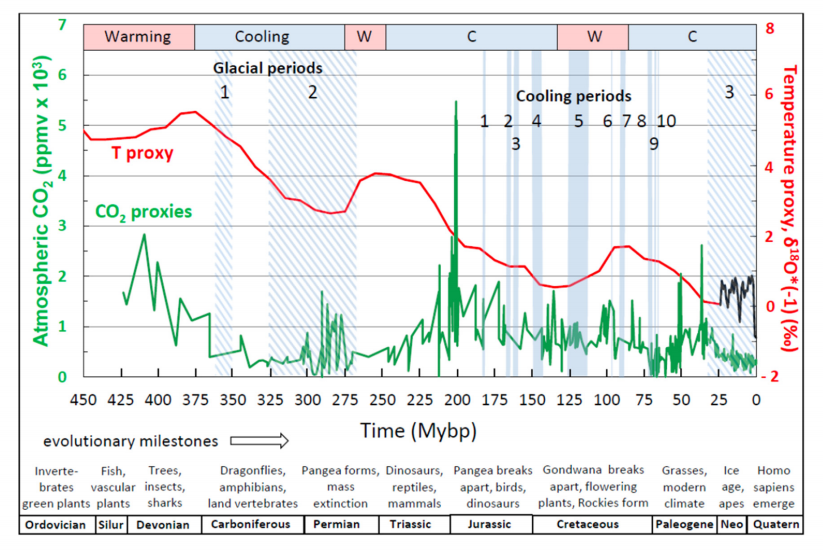
Temperature and atmospheric CO2 concentration proxies plotted in the same time series panel (Figure 5) show an apparent dissociation and even an antiphasic relationship. For example, a CO2 concentration peak near 415 My occurs near a temperature trough at 445 My. Similarly, CO2 concentration peaks around 285 Mybp coincide with a temperature trough at about 280 My and also with the Permo-Carboniferous glacial period (labeled 2 in Figure 5). In more recent time periods, where data sampling resolution is greater, the same trend is visually evident. The atmospheric CO2 concentration peak near 200 My occurs during a cooling climate, as does another, smaller CO2 concentration peak at approximately 37 My. The shorter cooling periods of the Phanerozoic, labeled 1–10 in Figure 5, do not appear qualitatively, at least, to bear any definitive relationship with fluctuations in the atmospheric concentration of CO2.
[My Comment: Antiphasic in this context refers to times when temperatures are rising while CO2 is declining, and also periods when temperatures are falling while CO2 is going higher. These negative correlations are to be expected if temperature is the leading variable and CO2 the dependent variable.]
Regression of linearly-detrended temperature proxies (Figure 3b, lower red curve) against atmospheric CO2 concentration proxy data reveals a weak but discernible negative correlation between CO2 concentration and T (Figure 6). Contrary to the conventional expectation, therefore, as the concentration of atmospheric CO2 increased during the Phanerozoic climate, T decreased. This finding is consistent with the apparent weak antiphasic relation between atmospheric CO2 concentration proxies and T suggested by visual examination of empirical data (Figure 5). The percent of variance in T that can be explained by variance in atmospheric CO2 concentration, or conversely, R2 × 100, is 3.6%. Therefore, more than 95% of the variance in T is explained by unidentified variables other than the atmospheric concentration of CO2.
Regression of non-detrended temperature against atmospheric CO2 concentration shows a weak but discernible positive correlation between CO2 concentration and T. This weak positive association may result from the general decline in temperature accompanied by a weak overall decline in CO2 concentration.
The correlation coefficients between the concentration of CO2 in the atmosphere and T were computed also across 15 shorter time segments of the Phanerozoic.
These time periods were selectedto include or bracket the three major glacial periods of the Phanerozoic, ten global cooling events identified by stratigraphic indicators, and major transitions between warming and cooling of the Earth designated by the bar across the top of Figure 5. The analysis was done separately for the most recent time periods of the Phanerozoic, where the sampling resolution was highest (Table 1), and for the older time periods of the Phanerozoic, where the sampling resolution was lower (Table 2).
For the most highly-resolved Phanerozoic data (Table 1), 12/15 (80.0%) Pearson correlation coefficients computed between atmospheric CO2 concentration proxies and T proxies are non-discernible (p > 0.05). Of the three discernible correlation coefficients, all are negative, i.e., T and atmospheric CO2 concentration are inversely related across the corresponding time periods.
For the less highly-resolved older Phanerozoic data (Table 2), 14/20 (70.0%)Pearson correlation coefficients computed between atmospheric CO2 concentration and T are non-discernible. Of the six discernible correlation coefficients, two are negative. For the less-sampled older Phanerozoic (Table 2), 17/20 (85.0%) Spearman correlation coefficients are non-discernible. Of the three discernible Spearman correlation coefficients, one is negative.
Combining atmospheric CO2 concentration vs. T correlation coefficients from both tables, 53/68 (77.9%) are non-discernible, and of the 15 discernible correlation coefficients, nine (60.0%) are negative.
These data collectively support the conclusion that the atmospheric concentration of CO2 was largely decoupled from T over the majority of the Phanerozoic climate.
The finding that periodograms of atmospheric CO2 concentration proxies and T proxies exhibit different frequency profiles implies that atmospheric CO2 concentration and T oscillated at different frequencies during the Phanerozoic, consistent with disassociation between the respective cycles. This conclusion is corroborated by auto- and cross-correlation analysis.
If ΔRFCO2 is a more direct indicator of the impact of CO2 on temperature than atmospheric concentration as hypothesized, then the correlation between ΔRFCO2 and T over the Phanerozoic Eon might be expected to be positive and statistically discernible. This hypothesis is confirmed (Figure 9). This analysis entailed averaging atmospheric CO2 concentration in one-My bins over the recent Phanerozoic and either averaging or interpolating CO2 values over the older Phanerozoic (Methods). Owing to the relatively large sample size, the Pearson correlation coefficient is statistically discernible despite its small value (R = 0.16, n = 199), with the consequence that only a small fraction (2.56%) of the variance in T can be explained by variance in ΔRFCO2 (Figure 9). Even though the correlation coefficient between ΔRFCO2 and T is positive and discernible as hypothesized, therefore, the correlation coefficient can be considered negligible and the maximum effect of ΔRFCO2 on T is for practical purposes insignificant (<95%).
Conclusions
The principal findings of this study are that neither the atmospheric concentration of CO2 nor ΔRFCO2 is correlated with T over most of the ancient (Phanerozoic) climate.
Over all major climate transitions of the Phanerozoic Eon, about three-quarters of 136 correlation coefficients computed here between T and atmospheric CO2 concentration, and between T and ΔRFCO2, are non-discernible, and about half of the discernible correlations are negative. Correlation does not imply causality, but the absence of correlation proves conclusively the absence of causality [63]. The finding that atmospheric CO2 concentration and ΔRFCO2 are generally uncorrelated with T, therefore, implies either that neither variable exerted significant causal influence on T during the Phanerozoic Eon or that the underlying proxy databases do not accurately reflect the variables evaluated.
The generally weak or absent correlations between the atmospheric concentration of CO2 and T,and between ΔRFCO2 and T, imply that other, unidentified variables caused most (>95%) of the variance in T across the Phanerozoic climate record. The dissimilar structures of periodograms for T and atmospheric CO2 concentration found here also imply that different but unidentified forces drove independent cyclic fluctuations in T and CO2. Since cycles in atmospheric CO2 concentrationoccur independently of temperature cycles, the respective rhythms must have a different etiology. It has been suggested that volcanic activity and seafloor spreading produce periodic CO2 emissions from the Earth’s mantle ([69] and references therein) which could in principle increase radiative forcing of temperature globally.
The present findings corroborate the earlier conclusion based on study of the Paleozoic climate that “global climate may be independent of variations in atmospheric carbon dioxide concentration.” [64] (p. 198). The present study shows further, however, that past atmospheric CO2 concentration oscillates on a cycle of 15–20 My and an amplitude of a few hundred to several hundreds of ppmv. A second longer cycle oscillates at 60–70 My. As discussed below, the peaks of the ~15 My cycles align closely with the times of identified mass extinctions during the Phanerozoic Eon, inviting further research on the relationship between atmospheric CO2 concentration and mass extinctions during the Phanerozoic.
My Added Comment
Some climatists will admit that CO2 changes did not cause ancient climate changes, but then assert that everything shifted when humans began burning hydrocarbons and releasing CO2. Somehow natural processes ceased and now only warming can occur due to CO2 added by humans. On the contrary, we can look more recently at the recovery from the LIA (Little Ice Age) to see the same antiphasic pattern described in the above paper.
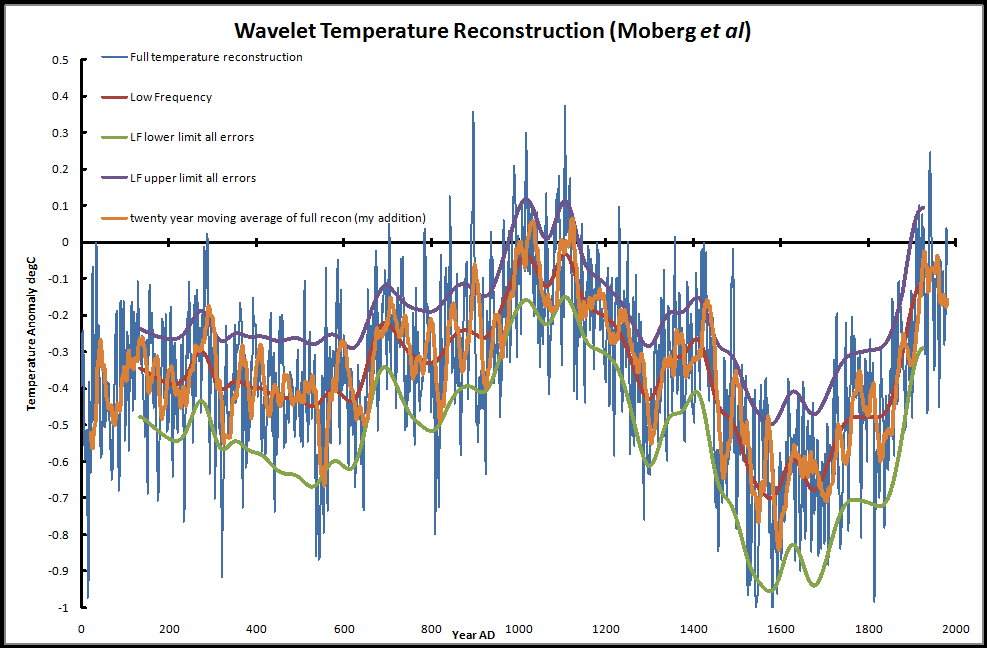
Moberg is a highly respected recontruction of NH temperatures over the last 2000 years. It shows peak warming after 1000, followed by a sharp cooling hitting bottom by 1600. Kouwenberg is a CO2 time series based on plant stomata proxies. For 250 years during the cooling, CO2 was rising, and then later CO2 was declining for 240 years while temperatures were rising.
As for the 20th century, consider the graph from climate4you (KNMI Climate Explorer)
Even with modern instrumental temperature records, correlation is inconsistent between temperature and CO2. Much ado is made about the happenstance of positive linking between the 1990s to 2007, while ignoring the negative relation earlier, and a weak connection since. The latter period is obviously driven by oceanic ENSO activity rather than CO2 radiation.
Mark Mills explains the many ways the deck is stacked against those gambling on Wind and Solar energy to replace hydrocarbon fuels. The transcript is below in italics with my bolds and added images.
Have you ever heard of “unobtanium”?
It’s the magical energy mineral found on the planet Pandora in the movie, Avatar. It’s a fantasy in a science fiction script. But environmentalists think they’ve found it here on earth in the form of wind and solar power.
They think all the energy we need can be supplied by building enough wind and solar farms; and enough batteries.
The simple truth is that we can’t. Nor should we want to—not if our goal is to be good stewards of the planet.
To understand why, consider some simple physics
realities that aren’t being talked about.
All sources of energy have limits that can’t be exceeded. The maximum rate at which the sun’s photons can be converted to electrons is about 33%. Our best solar technology is at 26% efficiency. For wind, the maximum capture is 60%. Our best machines are at 45%.
So, we’re pretty close to wind and solar limits. Despite PR claims about big gains coming, there just aren’t any possible. And wind and solar only work when the wind blows and the sun shines. But we need energy all the time. The solution we’re told is to use batteries.
Again, physics and chemistry make this very hard to do.
Consider the world’s biggest battery factory, the one Tesla built in Nevada. It would take 500 years for that factory to make enough batteries to store just one day’s worth of America’s electricity needs. This helps explain why wind and solar currently still supply less than 3% of the world’s energy, after 20 years and billions of dollars in subsidies.
Putting aside the economics, if your motive is to protect the environment, you might want to rethink wind, solar, and batteries because, like all machines, they’re built from nonrenewable materials.
Consider some sobering numbers:
A single electric-car battery weighs about half a ton. Fabricating one requires digging up, moving, and processing more than 250 tons of earth somewhere on the planet.
Building a single 100 Megawatt wind farm, which can power 75,000 homes requires some 30,000 tons of iron ore and 50,000 tons of concrete, as well as 900 tons of non-recyclable plastics for the huge blades. To get the same power from solar, the amount of cement, steel, and glass needed is 150% greater.
Then there are the other minerals needed, including elements known as rare earth metals. With current plans, the world will need an incredible 200 to 2,000 percent increase in mining for elements such as cobalt, lithium, and dysprosium, to name just a few.
Where’s all this stuff going to come from? Massive new mining operations. Almost none of it in America, some imported from places hostile to America, and some in places we all want to protect.
Australia’s Institute for a Sustainable Future cautions that a global “gold” rush for energy materials will take miners into “…remote wilderness areas [that] have maintained high biodiversity because they haven’t yet been disturbed.”
And who is doing the mining? Let’s just say that they’re not all going to be union workers with union protections.
Amnesty International paints a disturbing picture: “The… marketing of state-of-the-art technologies are a stark contrast to the children carrying bags of rocks.”
And then the mining itself requires massive amounts of conventional energy, as do the energy-intensive industrial processes needed to refine the materials and then build the wind, solar, and battery hardware.
Then there’s the waste. Wind turbines, solar panels, and batteries have a relatively short life; about twenty years. Conventional energy machines, like gas turbines, last twice as long.
With current plans, the International Renewable Energy Agency calculates that by 2050, the disposal of worn-out solar panels will constitute over double the tonnage of all of today’s global plastic waste.Worn-out wind turbines and batteries will add millions of tons more waste. It will be a whole new environmental challenge.
Before we launch history’s biggest increase in mining, dig up millions of acres in pristine areas, encourage childhood labor, and create epic waste problems, we might want to reconsider our almost inexhaustible supply of hydrocarbons—the fuels that make our marvelous modern world possible.
And technology is making it easier to acquire and cleaner to use them every day.
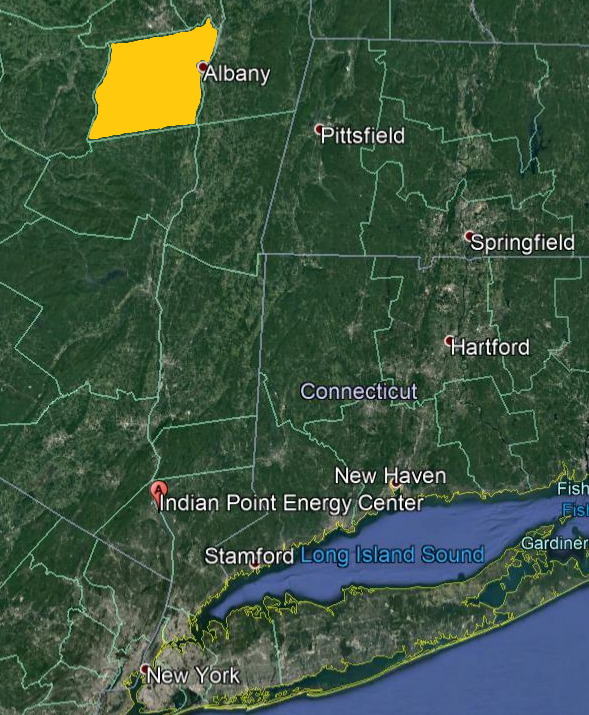
It would take a wind farm the size of Albany county NY to replace the now closed Indian Point nuclear power plant.
The following comparisons are typical—and instructive:
It costs about the same to drill one oil well as it does to build one giant wind turbine. And while that turbine generates the energy equivalent of about one barrel of oil per hour, the oil rig produces 10 barrels per hour. It costs less than 50 cents to store a barrel of oil or its equivalent in natural gas. But you need $200 worth of batteries to hold the energy contained in one oil barrel.
Next time someone tells you that wind, solar and batteries are
the magical solution for all our energy needs ask them
if they have an idea of the cost… to the environment.
“Unobtanium” works fine in the movies. But we don’t live in movies. We live in the real world.
I’m Mark Mills, Senior Fellow at the Manhattan Institute, for Prager University.
There is no charge for content on this site, nor for subscribers to receive email notifications of postings.
Wallace Manheimer provides the advice in his Daily Caller article Here’s A Better Way For Billionaires To Give Their Money. Excerpts in italics with my bolds and added images. In the second part of this post Dr. Manheimer explains how philantropists and many others have been duped by Net Zero claims.
Many of your fellow billionaires contribute large sums to “cure” a
nonexistent climate crisis, falsely naming it an “existential threat.”
They wrongly claim that wind and solar can support modern civilization. For instance, Michael Bloomberg has proudly committed $500 million to eliminate coal. Jeffery Bezos has committed $10 billion to a variety of climate causes and “clean energy” efforts. These billionsdwarf resources available to small groups fighting, for instance, degradation of their land by gigantic wind companies.
Furthermore, these philanthropists direct many dollars into foolishness like Critical Race Theory and a fabricated division of the world into oppressors and the oppressed. In addition to unnecessary climate panic, college campuses harbor harmful notions of “gender fluidity” and dangerous divisiveness among students that manifest as rampant antisemitism and hostility toward the deplorables du jour.
You know this is wrong but, despite your wealth, may feel powerless to stem the societal degradation. You make your own large contributions to hospitals, museums, medical schools, etc. Of course, that is very commendable. Still, you may be looking for other avenues for your generosity – perhaps actions that could not only help people but also challenge the promotion of negative forces.
Well, we have a few suggestions.
Let’s first consider possibilities within the U.S. As a private citizen or group of citizens, you can certainly place ads into major media to expose the fraudulence of scientifically invalid claims of a climate crisis. You could cite the mountain of scientific evidence that contradicts the popular apocalyptic narrative as well as the tens of thousands of prominent scientists attesting that there is no climate crisis. Sources include the CO2 Coalition, Global Warming Petition Projectand CLINTEL’s World Climate Declaration. Furthermore, you could partially balance the scales by financially supporting local groups fighting installation of hundreds of gigantic wind turbines, each the size of the Washington Monument; or square miles and miles of solar panels, which will permanently scar their land.
If you’re more inclined to support universities, then we suggest financing a faculty position about Washington, Jefferson, Hamilton, Madison, and Lincoln. Their accomplishments and documents are sources of inspiration worldwide. Alternatively, you might consider supporting nuclear science and engineering departments, or initiating an interdepartmental organization, for domestic and international students, in the disciplines of petroleum geology, engineering, and industry.
Internationally, there are many countries that suffer from a lack of energy. The less developed world is not giving up on fossil fuels regardless of pompous calls from the climate industrial complex for them to do so. “I firmly believe that no African country can be asked to halt the exploration of its natural resources, including fossil fuels,” says Kenyan President William Ruto.
Even the head of the United Nations’ most recent climate summit, Sultan Al-Jaber of the United Arab Emirates, said that use of fossil fuels cannot be discontinued “unless you want to take the world back into caves.”
Perhaps nobody exhibited resentment of meddling in Third World energy policy more than did Indian Prime Minister Narendra Modi: “The colonial mindset hasn’t gone. We are seeing from developed nations that the path that made them developed is being closed to developing nations.”
Lesser developed countries will continue to advance in ways they see fit, employing fossil fuels (and hopefully also nuclear power). China and India are building coal-fired power plants at a furious pace, and Africa and other regions will soon as well. There is no stopping it! Rather than utter hypocritical and futile pieties, let’s help them and, while doing so, also help promote sensible, clean energy technologies developed in the U.S.
Coal promises to be the salvation of more than half of sub-Saharan Africans — the number who labor daily with inadequate supplies of electricity. Cooking, heating and lighting are done with a combination of wood, charcoal and dried animal dung. The World Health Organization estimates that about half a million die each year from the resulting indoor air pollution.
Ultra-super critical coal-fired generating facilities, recently developed in the United States, are cleaner and more efficient than traditional plants. American billionaires investing in these sources of clean, affordable, reliable electricity could save the lives of untold numbers of sub-Saharan Africans.
Nigeria, once an important oil producer, never instituted effective pollution controls and, with the advent of hydrofracturing technology in the U.S., is hardly competitive on the world market. In fact, Exxon Mobil is considering pulling out of the country. The right investments could restore both Nigeria’s environment and oil industry.
There are many new things for rational, public-spirited billionaires to support.
Why leave the field to those pursuing the climate fetish
and promoting destructive ideologies and fads?
Dr. Wallace Manheimer is a life fellow of the American Physical Society, the Institute of Electrical and Electronic Engineers and is a member of the CO2.Coalition. He is the author of more than 150 refereed papers.
Background: Manheimer Steamrolls Net Zero Claims
Accomplished and distinguished physicist Wallace Manheimer published a crushing argument against the rationale for Net Zero claims and policies. His paper is While the Climate Always Has and Always Will Change, There Is no Climate Crisis. published in the Journal of Sustainable Development. In italics with my bolds and added images.
Abstract
The emphasis on a false climate crisis is becoming a tragedy for modern civilization, which depends on relible, economic, and environmentally viable energy. The windmills, solar panels and backup batteries have none if these qualities.
This falsehood is pushed by a powerful lobby which Bjorn Lomborg has called a climate industrial complex, comprising some scientists, most media, industrialists, and legislators. It has somehow managed to convince many that CO2 in the atmosphere, a gas necessary for life on earth, one which we exhale with every breath, is an environmental poison.
Multiple scientific theories and measurements show that there is no climate crisis. Radiation forcing calculations by both skeptics and believers show that the carbon dioxide radiation forcicng is about 0.3% of the incident radiation, far less than other effects on climate. Over the period of human civilization, the temperature has oscillated between quite a few warm and cold periods, with many of the warm periods being warmer than today. During geological times, it and the carbon dioxide level have been all over the place with no correlation between them.
A damning indictment of the Net Zero political project has been made by one of the world’s leading nuclear physicists. In a recently published science paper, Dr. Wallace Manheimer said it would be the end of modern civilisation. Writing about wind and solar power he argued it would be especially tragic “when not only will this new infrastructure fail, but will cost trillions, trash large portions of the environment, and be entirely unnecessary”. The stakes, he added, “are enormous”.
Dr. Manheimer holds a physics PhD from MIT and has had a 50-year career in nuclear research, including work at the Plasma Physics Division at the U.S. Naval Research Laboratory. He has published over 150 science papers. In his view, there is “certainly no scientific basis” for expecting a climate crisis from too much carbon dioxide in the atmosphere in the next century or so. He argues that there is no reason why civilisation cannot advance using both fossil fuel power and nuclear power, gradually shifting to more nuclear power.
There is of course a growing body of opinion that points out that the Emperor has no clothes when it comes to all the fashionable green technologies. Electric cars, wind and solar power, hydrogen, battery storage, heat pumps – all have massive disadvantages, and are incapable of replacing existing systems without devastating consequences.
Manheimer points out that before fossil fuel became widely used, energy was provided by people and animals. Because so little energy was produced, “civilisation was a thin veneer atop a vast mountain of human squalor and misery, a veneer maintained by such institutions as slavery, colonialism and tyranny”.
This argument hints at why so many rich, virtue-signalling celebrities argue not just for Net Zero but ‘Real’ Zero, with the banning of all fossil fuel use.
King Charles said in 2009 that the age of consumerism and convenience was over, although the multi-mansion owning monarch presumably doesn’t think such desperate restrictions apply to himself. Manheimer notes that fossil fuel has extended the benefits of civilisation to billions, but its job is not yet complete. “To spread the benefits of modern civilisation to the entire human family would require much more energy, as well as newer sources,” he adds.
In Manheimer’s view, the partnership among self-interested businesses, grandstanding politicians and alarmist campaigners, “truly is an unholy alliance”.The climate industrial complex does not promote discussion on how to overcome this challenge in a way that will be best for everyone. “We should not be surprised or impressed that those who stand to make a profit are among the loudest calling for politicians to act,” he added.
Perhaps one of the best voices to cast doubt on an approaching climate crisis, suggests the author, is Professor Emeritus Richard Lindzen of MIT, one of the world’s leading authorities on geological fluid motions:
“What historians will definitely wonder about in future centuries is how deeply flawed logic, obscured by shrewd and unrelenting propaganda, actually enabled a coalition of powerful special interests to convince nearly everyone in the world that CO2 from human industry was a dangerous planet-destroying toxin. It will be remembered as the greatest mass delusion in the history of the world – that CO2, the life of plants, was considered for a time to be a deadly poison.”
Figure 16. The geological history of CO2 level and temperature proxy for the past 400 million years. CO2 levels now are ~ 400ppm
Much of Dr. Manheimer’s interesting paper debunks many of the fashionable nostrums surrounding politicised ‘settled’ climate science. It is an excellent read. Discussing some of the contrary opinions that debunk obviously false claims, he says it is “particularly disheartening” to see learned societies make definitive claims when so much contrary information is readily available. He points out that over the last 10,000 years, the Earth has almost certainly been warmer. There have been warmer and colder periods, just like today.
To find the off-narrative information, even Google can be used, Manheimer says – though he does note that the company warns it will not provide information on “claims denying that long-term trends show that the global climate is warming”.
Figure 18. Per capita food production in kcal/(per-capita per day) from 1961 to 2009. Notice that there is a steadily increasing production, with no sign of any ‘slowly escalating but long-enduring global threat to food supplies.’
Considering the relentless fear mongering by the World Meteorological Organization (WMO), the acronym should be pronounced “Whaammo.” The latest is their hype about temperatures in 2023 as reported in the Daily Mail Climate change is ‘off the charts’:
Damning report reveals how records were smashed for greenhouse gas emissions, global temperatures and sea level rise in 2023 – and scientists warn ‘changes are speeding up’
Their killer graph is this one:
John Ray explains the exaggerations in comments at his blog In talics with my bolds and added images.
Here we go again. The temperature changes they are talking about are tiny and their link to human activities is just a wobbly theory. There is no proof that human activities had any impact at all.
All the warming since 1947 followed three strong El Nino events.
And note the chart. It is calibrated in TENTHS of one degree and has to go back to 1850 to show anything like a smooth rise. A more detailed chart would show long periods of stasis and falls, unlike CO emissions, which have been rising fairly steadily as industrial civilization has progressed. It is all just asssertion and even they admit that recent rises could be due to El Nino rather than CO2 emissions
And note that they show NO details of the CO2 changes which they allege to be at fault.
The sharp rise in ocean temps in 2023 has uncertain causes, but cannot be attributed to slow systemtic increases in CO2.