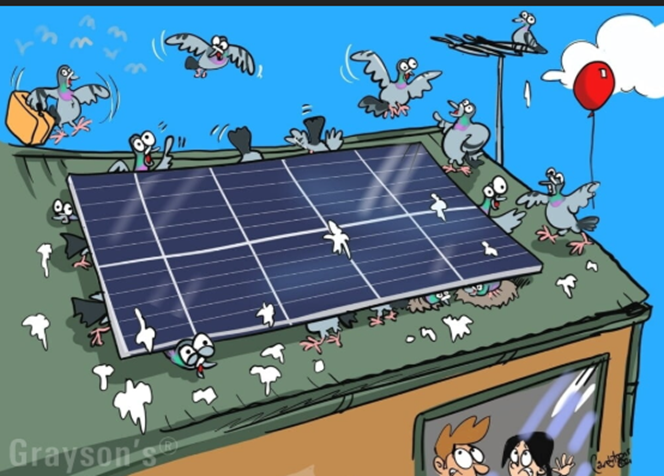
Your correspondent has a confession. I need to get up at least two hours earlier to keep abreast of all the current madness that is Net Zero. The un-walked dog will have to go back to resuming her slumbers on the best seat in the house while I digest the latest reports piling trillions of pounds onto the realistic cost of the Net Zero fantasy. Long hours must be spent trying to work out how the sinister Miliband plans to make household energy cheaper by giving billions to useless, unreliable wind and solar, and then sticking the horrendous costs straight onto consumer bills. “Cheaper than gas!” this still-at-large lunatic is apparently still howling. Then I would have time for a good laugh with the really dumb stuff. And none dafter than the recent suggestion from the Green Blob-funded Conservative Environment Network (CEN) to blanket inland water areas with solar panels, killing local aquatic life and tricking diving birds into crashing into them.
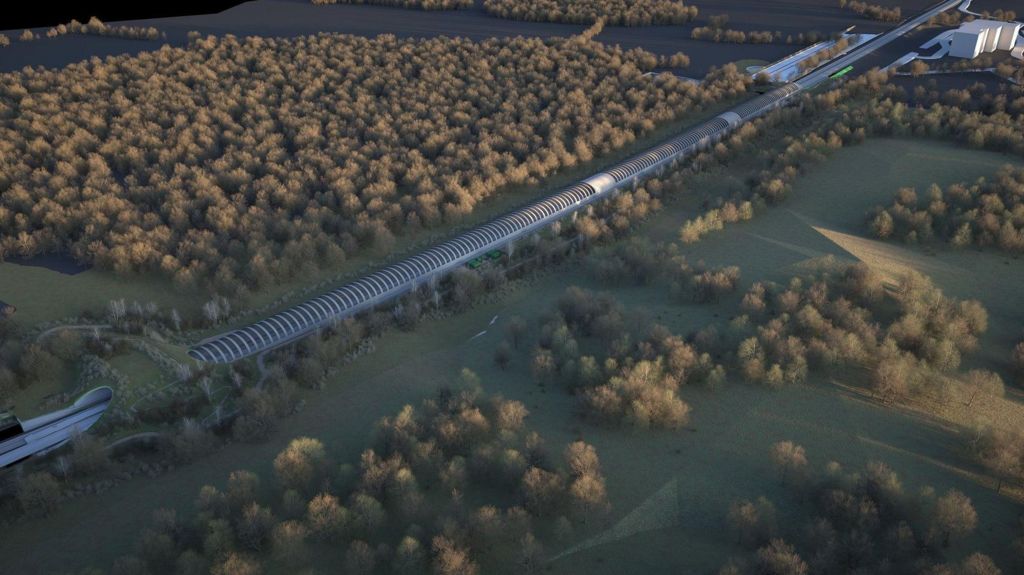
If they were bats mistaking floating solar panels for water, hundreds of millions, maybe billions, of pounds would need to be spent constructing elaborate protecting tunnels (okay, I know the Sun will not be able to shine on the panels, but it doesn’t much anyway in the winter, and I am just making it all up, like everyone else in the Net Zero business). The last Conservative government allowed spending of £120 million to protect a few rare bats by building a 1,000-metre tunnel on the new high-speed railway from London to Birmingham.
The bat protection structure runs for 1km over the railway line, costing £120m.
But then perhaps such magic money-tree largesse would not be available for water bird-whacking solar panels – ‘green’ technology is good and different rules apply. Bats are killed in their millions worldwide by giant wind turbines, but nobody gives a flying squeak about that.
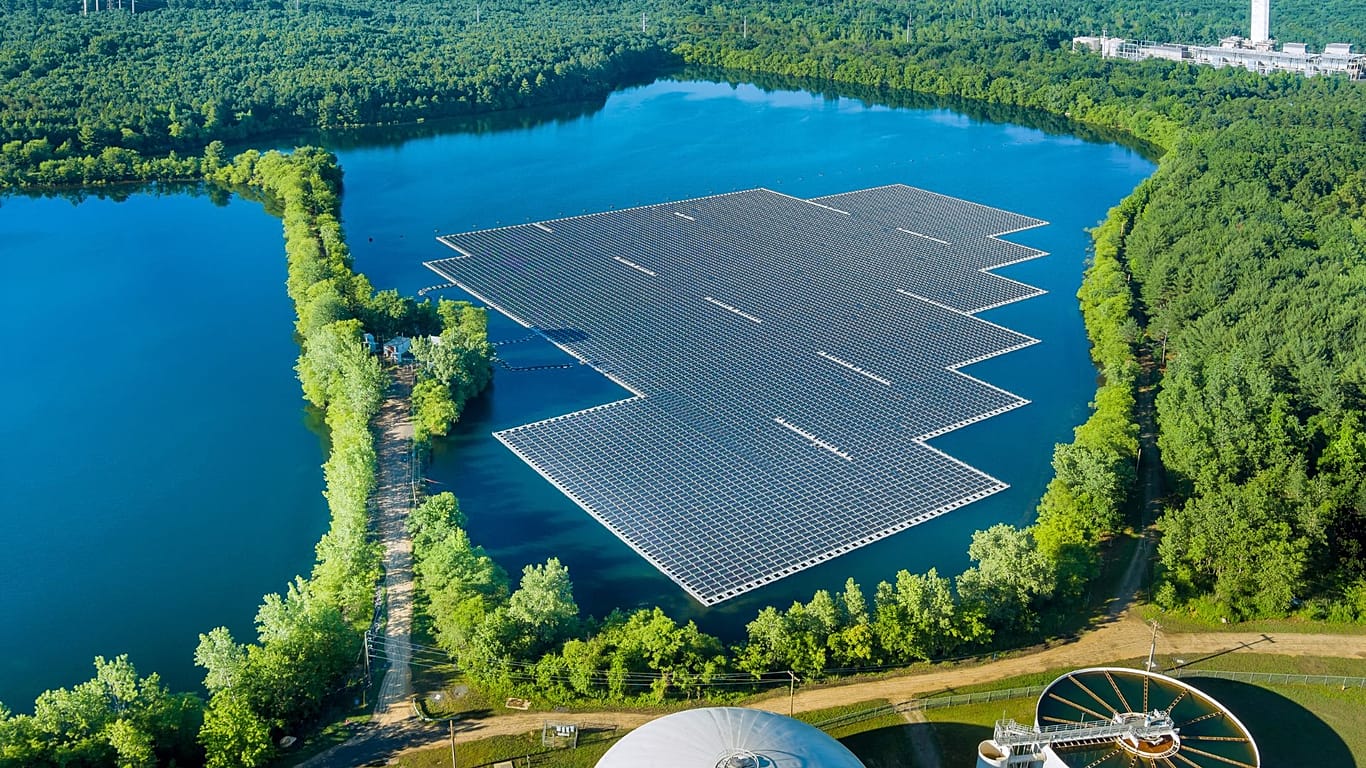
The CEN wants the UK Government to cut red tape to “unleash” solar farm developments on “man-made bodies of water” and to help projects selling power to the electricity grid. It is claimed that red tape has put a straitjacket on private investment in the UK floating solar industry. Man-made water areas are said to include disused docks and quarries along with on-farm reservoirs. CEN wants to encourage water companies to build solar farms on the 570 reservoirs that exist in the UK, potentially generating 2.7 terawatt-hours of electricity.
Waiving local planning rules for unreliable energy projects is much in fashion with the national political parties, particularly Labour and the Conservatives, who face forthcoming local election humiliation at the hands of the surging anti-Net Zero Reform Party.
Many long-standing pools of freshwater, whether originally man-made
or not, become vibrant centres of aquatic and avian life.
Dumping huge solar panels on the surface is a considerable nature killer. A paper published last month in Environmental Science and Technology examined the interaction of birds and floating solar panels and concluded that their industrial structure could pose “significant risk” to certain bird species, especially those with limited visual acuity and flight manoeuvrability adapted to aquatic habitats. Birds most at risk were said to be waterfowl, shorebirds and gulls.
The big danger for birds is one of fatal collision with solar panels that replicate the surface of water. It can affect birds diving for food but is a particular problem for aquatic species that land harder and faster on water. The panels also present problems for birds that require a ‘runway’ to take off. Overall, the survey suggests fatalities of around 11.61 birds per megawatt generated per year. Needless to say, there are other ecological concerns that will need to be ignored by Net Zero fanatics. With even limited panel coverage there will be changes in shading, dissolved oxygen levels and water temperature. These create altered microclimates and disrupt food chains.
The CEN looks forward to generating 2.7 terawatts from panelling over the ponds, a power source that, due to its appalling unreliability, will further destabilise Britain’s already creaking grid. It is the latest quack scheme produced by an operation supported by 49 Conservative MPs that remains dedicated to the Net Zero lunacy. This caucus, which represents a significant 41% of the current parliamentary party, is a substantial roadblock to attempts by the party’s leadership to move away from all the Net Zero hysteria that has engulfed the Conservatives over the last two decades. Attempts last year by the leader Kemi Badenoch to ditch the 2050 Net Zero commitment were met by the CEN director Sam Hall complaining to the Guardian that the move “undermines the significant environment legacy of successive Conservative governments”.
But politics is a fluid business in the modern Conservative party. The CEN parliamentary group includes Simon Hoare and Sir Roger Gale, the two midwit buffers who intended to vote last year for a society-destroying private bill that would have cut all hydrocarbon use in the UK to 10% within 10 years. On the other hand, it also counts Esther McVey, who recently informed Talk Radio that Net Zero was a “dud”.
Tom Harris and Todd Royal explain why “official” temperature history from Canada government is distorted to invent warming where very little has actually ocurred. Their article: Is Canada basing its climate policies on ‘decision-based evidence-making?’ Excerpts in italics with my bolds and added images.
Politicians want us to believe that they base their decisions on solid, verifiable evidence. “Evidence-based decision-making,” they call it. But what if the decision is made first and then the data is selected, or left uncorrected, in order to support the now politically correct decision? That would then be “decision-based evidence-making.” In other words, a complete corruption of honest decision-making.
It seems that Environment and Climate Change Canada (ECCC) is doing exactly thatwith the country’s temperature data in order to support the government’s mantra that Canada is “warming twice as fast as the global average.” For, if the one-degree anomalous spike in Canada’s “mean temperature” in 1998 is removed from the data, as even ECCC researchers themselves advocated previously should be done to preserve data integrity in cases like this, then Canada is not warming at all and much of the $200 billion spent on the climate file by the federal Liberal government since 2015 is a complete waste.
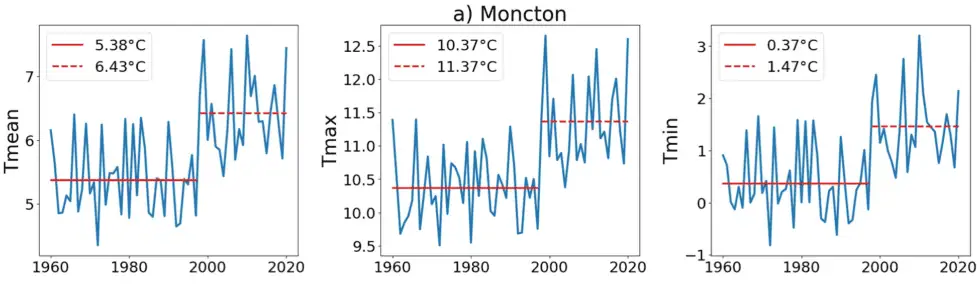
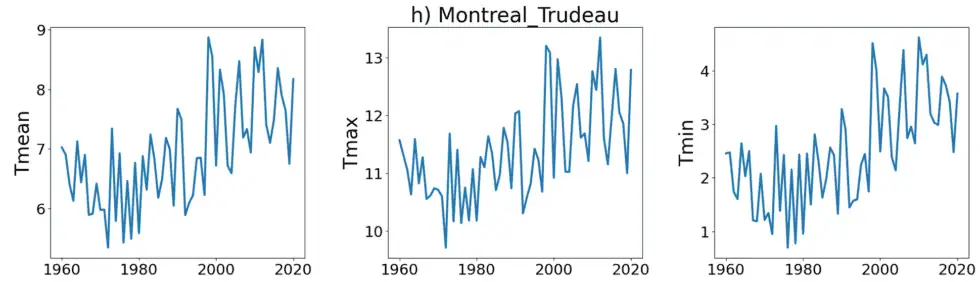
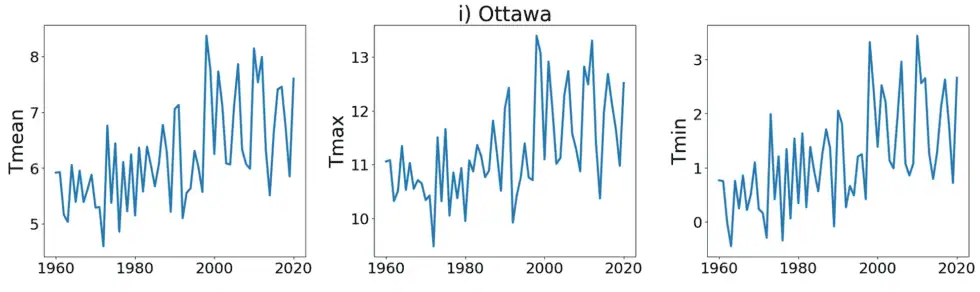
In 2021, Dr. Joseph Hickey, a data scientist with a PhD in Physics, specializing in complexity science, then an employee of the Bank of Canada, alerted ECCC to this one-degree jump in temperature data across much of Canada, and asked for an explanation. The below graphs of mean, maximum and minimum temperatures constructed with data from three Canadian cities—Moncton (on which Hickey illustrates the step change with red lines), Ottawa and Montreal—are samples of those created by Hickey using ECCC data downloaded on November 11, 2025, data that is the same as that he sent to ECCC researchers as an attachment to his email of June 24, 2021.
Ignoring their previous position about the need to remove such sudden discontinuities from the data, ECCC staff had little to say and left the anomaly in the record, asserting that it was “probably” a real sudden change in temperature.
Making matters worse, another Bank of Canada employee, economist Julien McDonald-Guimond, had already alerted ECCC by email on December 7, 2020, that he had found more than 10,000 instances of days for which the daily minimum temperature was greater than the daily maximum temperature. Again, ECCC staff had no reasonable justification.
Dr. Hickey shows that, if you apply ECCC’s trend analysis method to their data, you find an increase of 1.74° C (which is statistically significant) from 1948 to 2018. And then, he tells us, if you correct for the one-degree step increase in 1998, you find only a 0.29°C rise. That small change “is indistinguishable from zero,” explains Hickey. “There is no evidence of warming.”
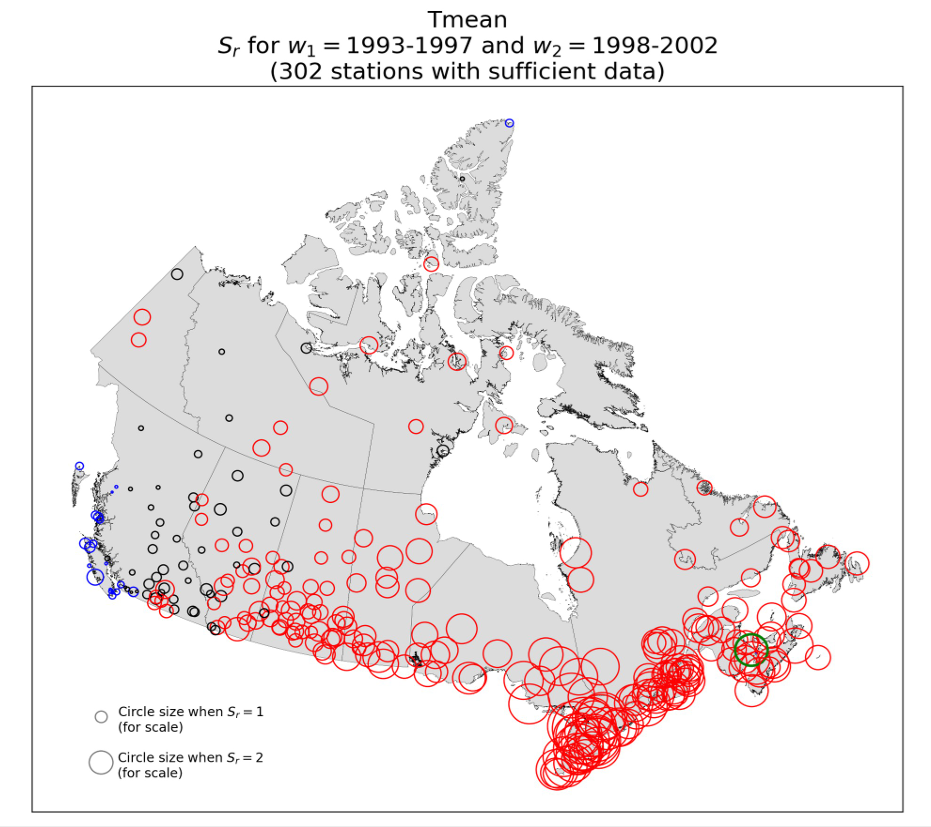
Figure 7: Map showing Sr calculated using Tmean, for the break year 1998 with two five-year windows (1993-1997 and 1998-2002) for the 302 3rd generation AHCCD stations with sufficient data. Circle radius is proportional to the absolute value of Sr. Circle colour indicates Sr ranges as follows: blue: Sr < 0; black: 0 ≤ Sr ≤ 1; red: Sr > 1. Moncton, NB (Sr = 2.74) is indicated with a green circle, for reference.
In Figure 7, AHCCD stations with Sr < 0 are coloured blue, while black indicates 0 ≤ Sr ≤ 1, and red indicates Sr > 1. The AHCCD records with the largest stepwise increases at 1998 are located in Eastern and Central Canada (including the stations listed in Table A), and there are many records with discernible steps at 1998 in the Prairies (provinces of Manitoba, Saskatchewan, and Alberta) and the north of the country. British Columbia remains the main outlier, with most ofits AHCCD stations having no discernible steps at 1998.
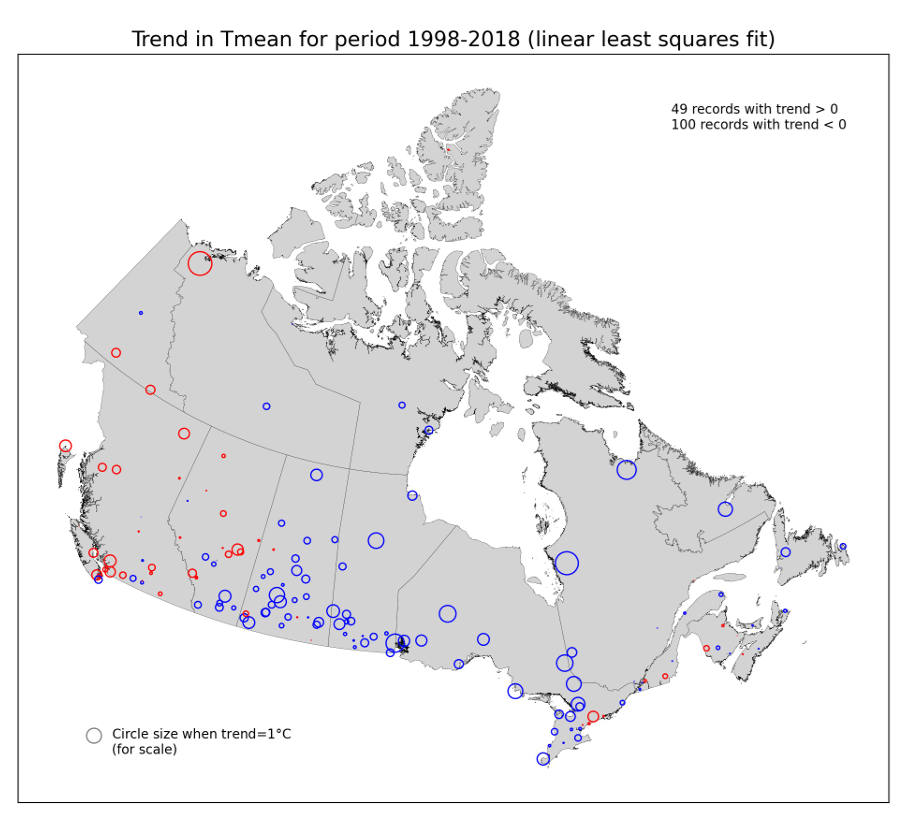
Figure 8: Map of trend in Tmean over the period 1998-2018, for the 3rd generation AHCCD stations with sufficient data, calculated using linear least-squares fitting. Circle radius is proportional to the absolute value of the trend. Blue circles correspond to negative trends (trend < 0) and red circles to positive trends (trend > 0).
In Figure 8, the trend for a particular Tmean record is equal to the slope (°C/year) from a linear least-squares fit to its data for 1998-2018, times 21 years. An AHCCD station was considered to have sufficient data if its record had at least 350 days of non-missing daily data per year for every year from 1998 2018. Approximately two thirds of the AHCCD records with sufficient data have negative trends for 1998-2018 using linear least-squares fitting.
Summation
This report demonstrates Environment Canada’s dismissive response to being alerted to a large, apparently non-climatic artifact in its flagship temperature time-series product, an artifact which could, on its own, be responsible for essentially all of the calculated warming for many Canadian locations over the past six or seven decades.
The said apparent artifact, referred to as the “1998 step-increase feature” in this report, is a stepwise increase of approximately 1°C in magnitude occurring at 1998 in the annual mean time-series of daily maximum, minimum, and mean temperatures for many stations across Canada in Environment Canada’s Adjusted and Homogenized Canadian Climate Data (AHCCD).
Canadian fearmongering about a “climate emergency” served only to empower a bureaucratic class intent on
controlling consumption and taxing lifestyles.
A recent memorandum of understanding between Canadian prime minister Mark Carney and Alberta premier Danielle Smith represents the inevitable reassertion of economic necessity over the fantasy of “decarbonization” that has gripped Ottawa for the past decade.
Allowing for the construction of a pipeline to transport Albertan oil to a Pacific export terminal, the agreement prompted the resignation of one liberal member of parliament and celebration from the province’s leader. “This is a great day for Alberta,” declared Smith.
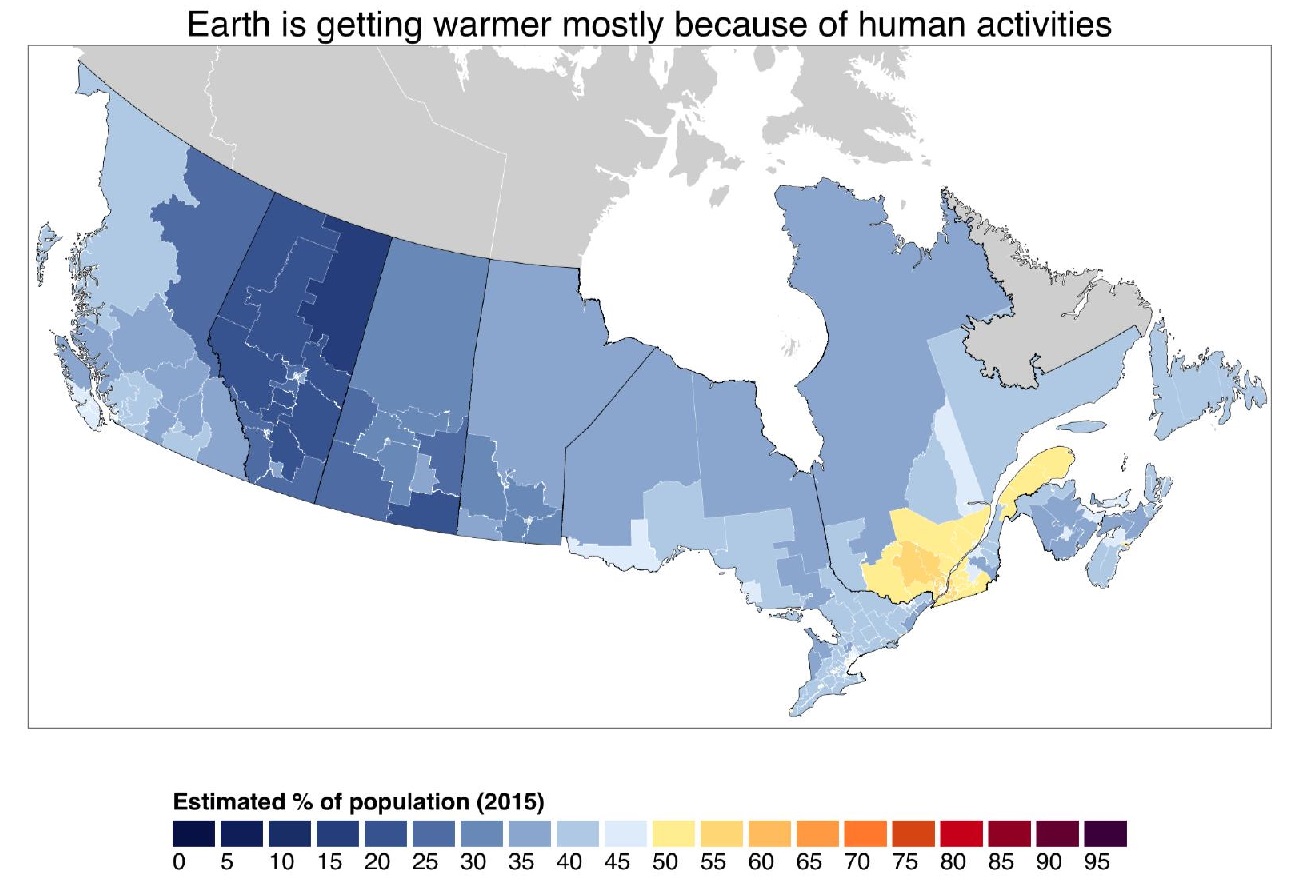
Global Warming survey of Canadians, twisted and ignored by Trudeau Liberals.
Atlantic Canada, parts of Quebec, and even Ontario benefit from royalties and tax revenues generated by hydrocarbons extracted thousands of miles away. So-called moral objections to oil sands development are often voiced by inhabitants of Halifax or Montreal, but rarely heard is a willingness to forgo the western revenue that keeps hospitals open and public payrolls funded.
So, it was financial reality that drove Carney to upend expectations established by countless government documents, climate pledges, and regulatory frameworks the previous government put in place to “save the planet” by discouraging the use of fossil fuels.
Canada’s climate industrial complex had predicted that pipelines would become stranded assets and that Alberta would fade into irrelevance as net zero became federal policy. However, the deal signed by Carney moves in the opposite direction, making provisions for new infrastructure and signaling that even Canada’s most climate-obsessed federal leadership cannot govern without fossil fuels.
In technical terms, the federal cap on oil and gas emissions has been suspended. The Clean Electricity Regulation — a proposed constraint on Alberta’s ability to generate affordable power — has been loosened. Timelines for reducing methane emissions have been extended beyond 2030. Yes, there are caveats that appear to impose a soft form of anti-carbon sentiment, but the overall picture has changed.
The Canadian Broadcasting Corporation (CBC), a publicly funded institution, has consistently parroted environmental advocates who treat fossil fuels as abominations rather than economic necessities. This messaging has convinced many Canadians that their government is committing a terrible sin by producing energy the world demands. Lost on them is the fact that Canadian oil and natural gas are produced under far more stringent standards than exist in the Middle East, Russia, or other regions.
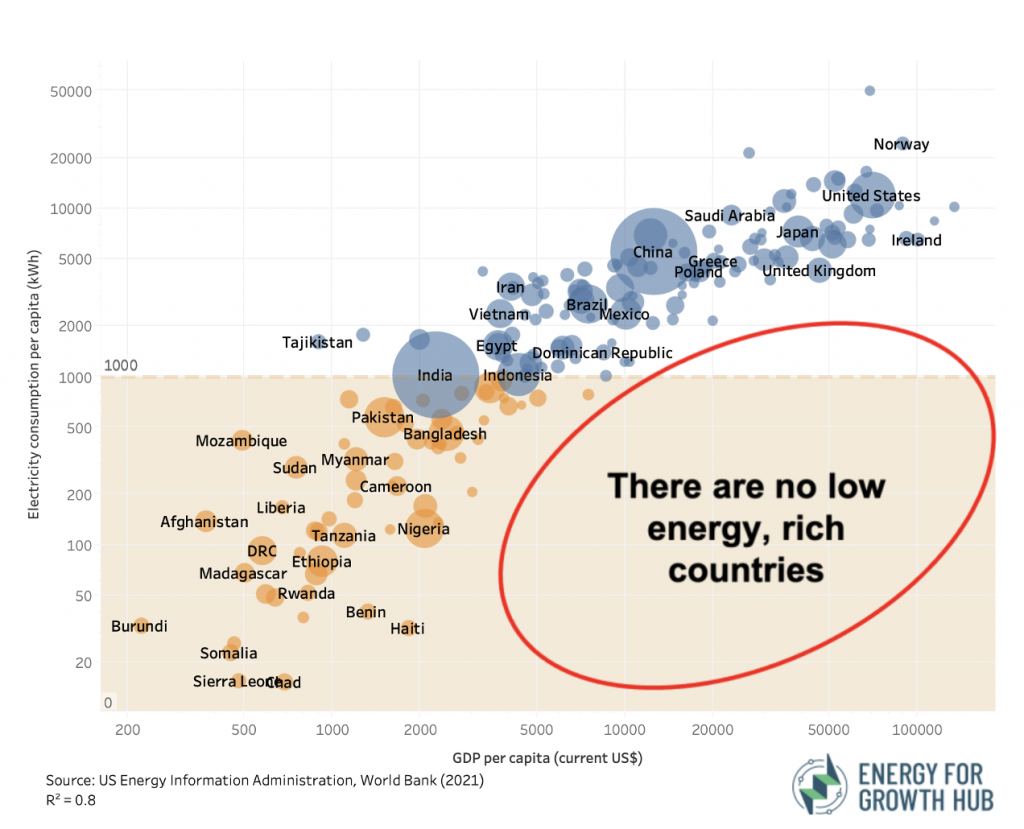
Energy abundance underpins prosperity. Nations that constrain their energy supply impoverish themselves. Nations that produce reliable, affordable energy benefit their populations and the broader world. Canada should produce the energy for itself and export the surplus to global markets.
Advertisement
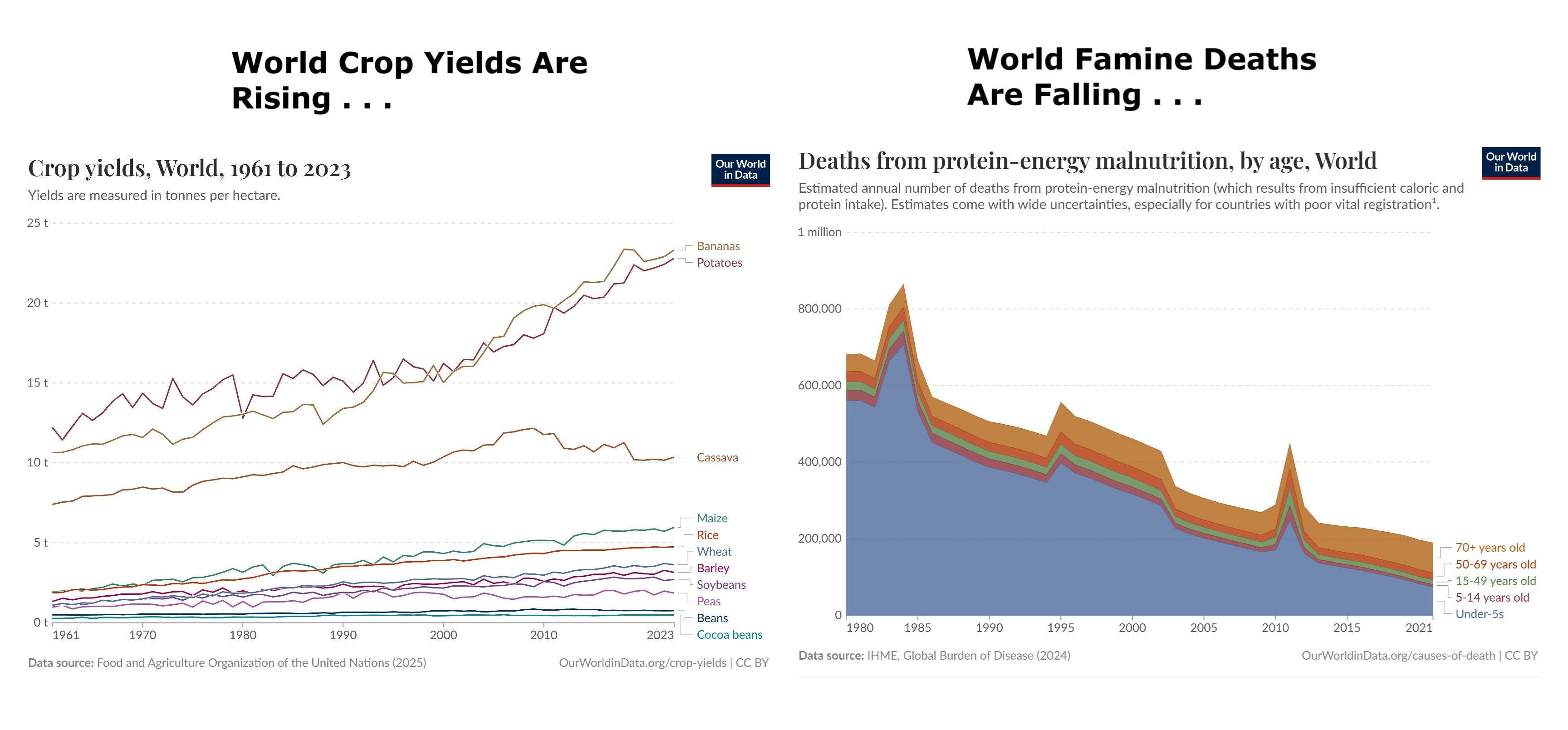
Beyond energy economics, there is another dimension to Canada’s economic future that the legacy climate orthodoxy dismisses: agriculture. Canada’s warming climate has extended growing seasons across the prairies and opened new agricultural possibilities.
According to official data, “total wheat production rose 11.2% year over year to a record 40 million (metric tons) in 2025, surpassing the previous record set in 2013.” Canola production rose 13%, surpassing a record set in 2017. Barley and oat production rose 19% and 17%, respectively.
In all, the output for all principal field crops increased by 4% year-over-year. For the next crop year (2025-2026), total production is projected to reach near record levels, up 3% year-over-year and 8% above the previous five-year average.
Historical analysis demonstrates that climate conditions across Canadian agricultural regions have shifted toward longer growing seasons, with more frost-free days and expanded viable crop zones.
Critics will claim that allowing a new pipeline is a betrayal of future generations. But what truly endangers posterity? A fraction of a degree of warming that extends growing seasons?Or a future of energy scarcity, deindustrialization, and economic stagnation?
Fearmongering about a “climate emergency” served only to empower a bureaucratic class intent on controlling consumption and taxing lifestyles. It did nothing to change atmospheric physics or the needs of people who rely on affordable energy to survive.
Previously I have demonstrated that temperature changes are predictive of changes in atmospheric CO2 concentrations. That includes the remarkable GMT spike starting in January 2023 and rising to a peak in April 2024, then dropping down to end of 2025. The most recent study was Yearend 2025, Cooling Temperatures Reducing CO2 Rise employing Mauna Loa CO2 data and UAH GMT data.
I noticed at WUWT my post was included in Weekly Climate and Energy News Roundup #674 with a comment attached: [SEPP Comment: The time period of the claimed lower CO2 rise is too short to be clear.] Now if that is referring to a table detailing the two variables during 2024 and 2025, I can understand it. But it also disregards the complete study covering UAH satellite temperature changes clearly leading Mauna Loa CO2 changes over a period of 45 years.
Along with some comments on my blog, I wondered whether the entire ML record of CO2 levels could be predicted from global temperature changes, which would require a GMT dataset covering 1959 to the present. This post shows that HADCRUT5 qualifies and indeed confirms other studies by researchers. I was particularly interested in the lack of warming in the 1960s and 70s, before the satellite temperature data became available.
The answer is yes: Just as temperature spikes result
in a corresponding CO2 spike as expected. Cooler temperatures are predictive of lower CO2 levels.
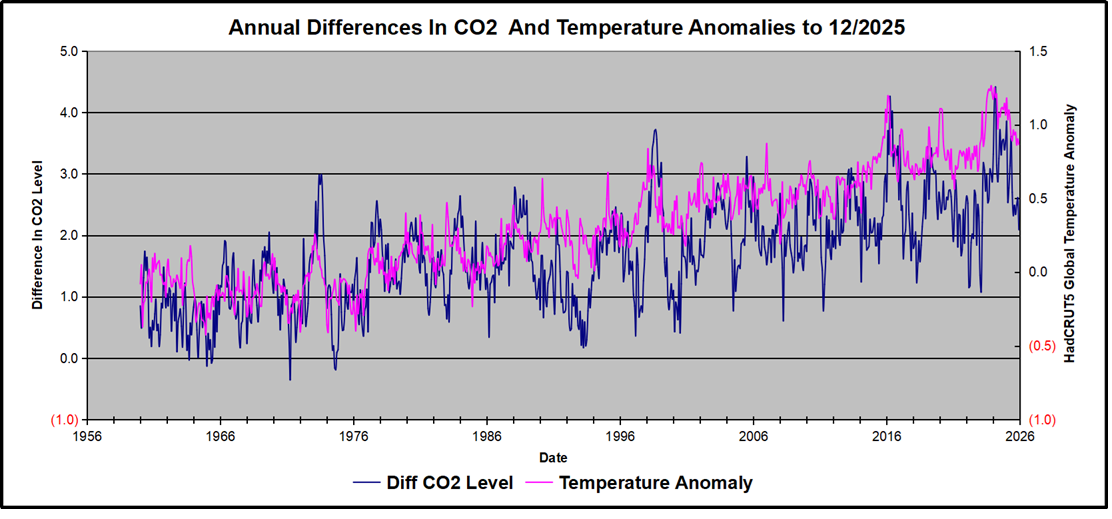
Above are HadCRUT5 temperature anomalies compared to CO2 monthly changes year over year during 65 years from 1959 to present.
Changes in monthly CO2 synchronize with temperature fluctuations, which for HadCRUT5 are anomalies referenced to the 1961-1990 period. CO2 differentials are calculated for the present month by subtracting the value for the same month in the previous year (for example December 2025 minus December 2024). Temp anomalies are calculated by comparing the present month with the baseline month. Note the recent CO2 upward spike and drop following the temperature spike and drop.
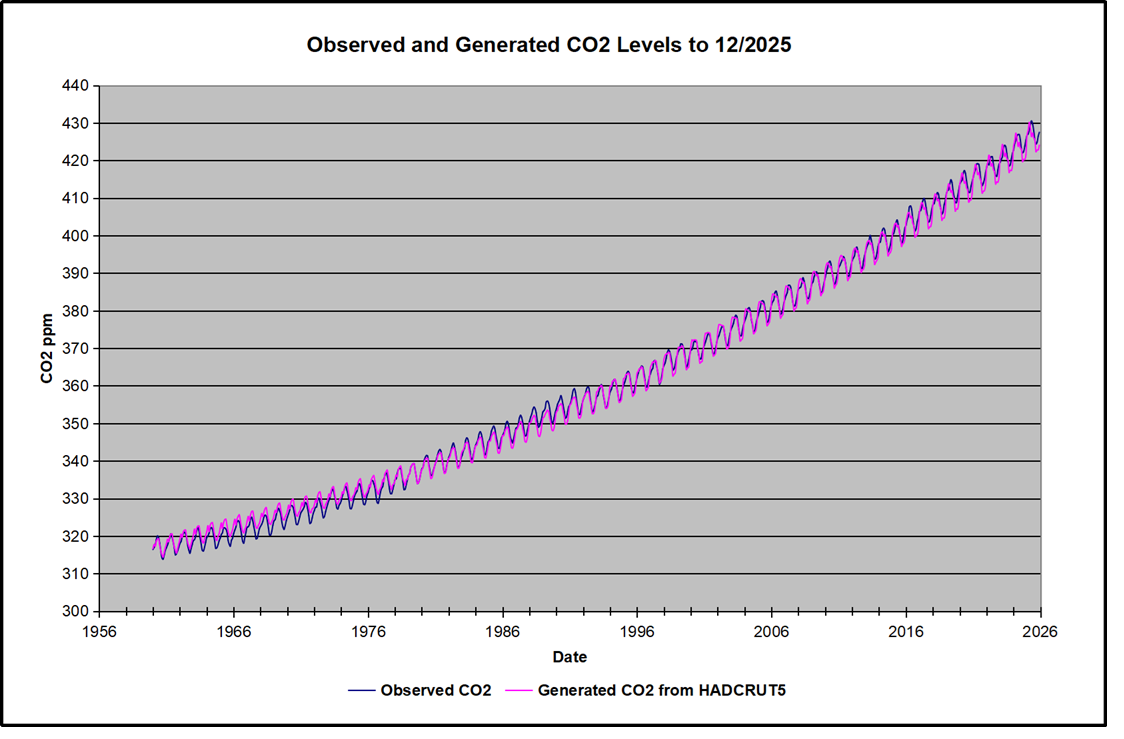
The final proof that CO2 follows temperature due to stimulation of natural CO2 reservoirs is demonstrated by the ability to calculate CO2 levels since 1959 with a simple mathematical formula:
For each subsequent year, the CO2 level for each month was generated
CO2 this month this year = a + b × Temp this month this year + CO2 this month last year
The values for a and b are constants applied to all monthly temps, and are chosen to scale the forecasted CO2 level for comparison with the observed value. The values for scaling HADCRUT5 and MLCO2 were “a” = 1.2 and “b” = 1.52 Here is the result of those calculations.
In the chart calculated CO2 levels correlate with observed CO2 levels at 0.9992 out of 1.0000. This mathematical generation of CO2 atmospheric levels is only possible if they are driven by temperature-dependent natural sources, and not by human emissions which are small in comparison, rise steadily and monotonically. For a more detailed look at the recent fluxes, here are the results since 2015, an ENSO neutral year.
For this recent period, the calculated CO2 values match well the annual lows, while some annual generated values of CO2 are slightly higher or lower than observed at other months of the year. Still the correlation for this period is 0.98
Footnote:
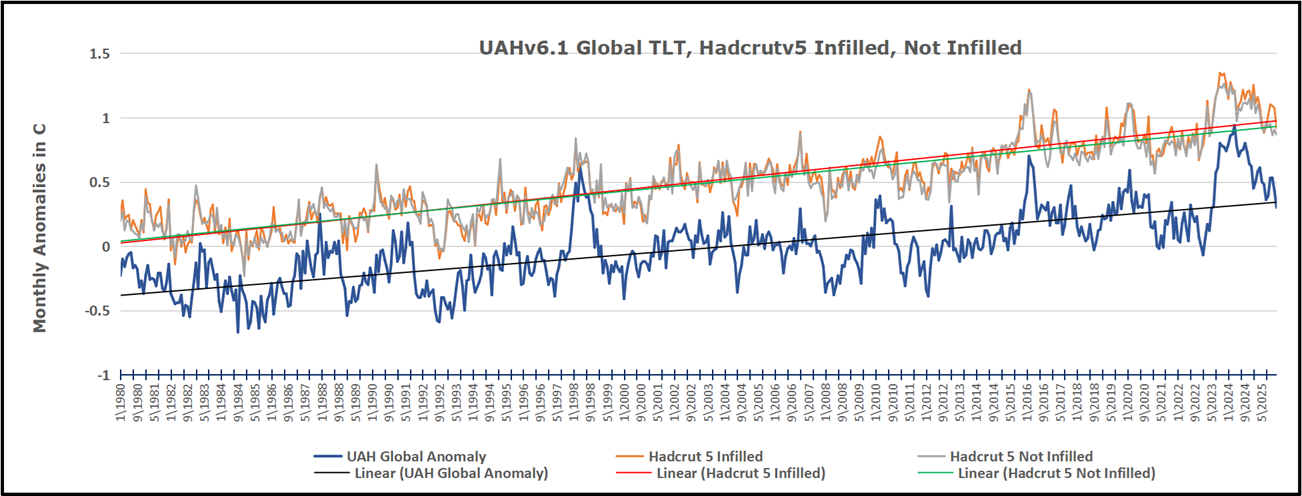
Hadcrut v5 offers a choice of two GMT data sets, one which infills grid cells lacking data and one which does not, compiling data only from cells with sufficient data. The analysis here shows data from Hadcrut 5 Not Filled In, though results from the Filled In dataset are virually the same with a slight upward bias. The overall lower anomalies in UAH are due to a later baseline, 1991 to 2020.
Key Point
Changes in CO2 follow changes in global temperatures on all time scales, from last month’s observations to ice core datasets spanning millennia. Since CO2 is the lagging variable, it cannot logically be the cause of temperature, the leading variable. It is folly to imagine that by reducing human emissions of CO2, we can change global temperatures, which are obviously driven by other factors.
The massive fluxes from natural sources dominate the flow of CO2 through the atmosphere. Human CO2 from burning fossil fuels is around 4% of the annual addition from all sources. Even if rising CO2 could cause rising temperatures (no evidence, only claims), reducing our emissions would have little impact.
For those who prefer reading, below is an excerpted transcript lightly edited from the interview, including my bolds and added images.
Hey everyone, it’s Andrew Klavan with this week’s interview with Bjorn Lomborg. I met Bjorn, he probably doesn’t remember this, but I met him many, many years ago at Andrew Breitbart’s house. Andrew brought Bjorn over to talk in LA and I listened to him talking about all the simple and inexpensive things that could be done to make actual change and do actual good in terms of climate change, which I think at that point was still global warming.
And you know, we had a small audience, and I asked the question, well, if these are so such smart, cheap ideas, why don’t politicians do them? And Bjorn said, well, because that wouldn’t give them the chance to display their virtue. And I thought, here’s a man who not only knows about science, but actually knows about human nature. And I’ve been following him ever since.
He is a president of the Copenhagen Consensus Center, a visiting fellow at Stanford University’s Hoover Institution, an author of False Alarm and Best Things First, the best writer, I think, on climate issues and other issues. Bjorn, it’s good to see you.
Andrew, it’s great to be here. And I do remember that event, although I remember it for seeing the guy who played on Airplane. Sorry. So I remember that because it was it’s still one of my favorite movies. It’s one of the greatest movies ever made, I think. It really is very, very funny. Yeah.
On a totally different direction. So I was watching with great approval Donald Trump’s appearance at the United Nations. I guess it would be when we’re playing this last week. And he he had this. I’m just going to read just a little bit of the speech. He said in the 1920s and the 1930s, they said global cooling will kill the world. We have to do something.Then they said global warming will kill the world. But then it started getting cooler. So now they could just call it climate change because that way they can’t miss if it goes higher or lower, whatever the hell happens. It’s climate change. It’s the greatest con job ever perpetrated on the world, in my opinion. Do you agree with that?
So I get where he’s coming from. And I think there’s some some truth to this. I mean, Donald Trump always speaks in larger than real life words. Yes. So it’s not a con job. There is a problem. And actually, in some sense, bizarrely, as it may sound, you know, the world is built all of our infrastructure is built to live at the temperature that we’ve had for the last hundred or two hundred years. That’s true in Los Angeles. That’s true in Boston. It’s true everywhere in the world. And so if it gets colder or if it gets warmer, that will be a problem. So there is an issue here.
But obviously, it’s vastly exaggerated when people then talk about the end of the world. You may remember that this was one of the favorite terms of Biden, but not just Biden, but pretty much everyone for the last four years and certainly more as well. That this is an existential crisis. There was a recent survey by the OECD, so in all rich countries in the world, where they found that percent of all peoplebelieve that unmitigated climate change, so climate change we don’t fix, will likely or very likely lead to the end of mankind. And that, of course, is a very different statement.
There is a problem, that’s true. It’s not the end of the world. But the end of the world is a great way to get funding.
And that’s why people are playing it out. But it doesn’t make for good policy. Remember, if you think the end of the world is near, you’re going to throw everything in the kitchen sink at this, which, of course, is what the campaigners would like you to do. But you will probably waste an incredible amount of resources because you’re just going to try everything.
Climate change is a problem. So I disagree with Trump there. But yes, there is an incredible amount of exaggeration. And I agree with him there. So there’s I mean, the climate changes but we’re not living in a glass bubble. And we’ve even in I don’t know, I guess it was the late 19th century, the Thames in London froze over and people went skating on it. It’s so there are these big changes and there have been ice ages, obviously. How much of this or do we know how much of this is is caused by human beings?
I have to preface this with saying I’m a social scientist, so I work a lot on the costs and the benefits of us doing policies against climate change. I’ve met with a lot of the natural scientists who study all this. Please don’t do this at home, but I’ve read the UN climate panel report, most of the pages, not all of them. And it’s incredibly boring, but it’s also very, very informative. So so I have a reasonably good take on this. And what they tell us is that the majority of the recent warming that we’ve seen is due to climate change.
I have no idea to evaluate that, no way of independently evaluating that is due to natural climate change or is manmade, due to mankind. So is it mostly due to us emitting CO from burning fossil fuels?
So there is a significant part of what’s changed over the last century or thereabouts, which is about two degrees Fahrenheit or one degree Celsius. So that’s something and that’s something we should look at. But also, we should get a sense of what’s the total impact of this. Well, actually, climate economics have spent the last three decades trying to estimate: what’s the total cost of everything that happens with climate change.
So, you know, there are lots of negatives. There’ll be more heat waves. There’ll possibly be stronger storms. There’s also going to be fewer cold waves, which is actually a good thing. There’s also going to be CO2 fertilization. So we’ll have more greenery. You know, if you add all the negatives and all the positives, it become a net negative. That’s why it’s a problem. But also get a sense of this.
If you look across all of the studies that we’ve done, we estimate the net negative impact today is about 0.3% of GDP. So yeah, a problem, not the end of the world. And it’s crucial to say, if you look out till 2100 which is sort of the standard time frame, which is a long time from now, we estimate if we do nothing more about climate change, so we end up with three degrees Celsius, so about degrees 5.6 Fahrenheit, then the cost will be about to 2 to 3% of global GDP every year.
That’s certainly not nothing. That’s a lot of trillions of dollars. But again, it’s 2 to 3%. It’s not, you know, the end of mankind, It’s not anywhere near a hundred percent. And this is not me saying this. This is the guy William Nordhaus from Yale university, the only guy to get the Nobel prize in climate economics. And Richard Tol one of the most quoted climate economists in the world. They’ve done separate studies. One to find 2%, the other one to find 3%. That’s the order of magnitude we’re talking about. And just for, for added emphasis, remember by then everyone in the world will be much, much better off.
Just like if you compared people from back in 1925 and until today, the UN on its standard trajectory estimate, the average person in the world by the end of the century will be somewhere around 450% as rich as he or she is today. That’s not the US that will. And you know, people come from Denmark and other rich countries might only be 200% as rich, but many in Africa and elsewhere will be a thousand percent richer. So on average, because of climate change, it will feel like they’re only 435% as rich, which sort of emphasizes, yes, that’s a problem. I would rather have a world that’s 450% as rich trather than one that’s 435%. But it’s not the end of the world.
It’s still a fantastically much better world, just a slightly less fantastically much better world. And that less money that people will have will mean less money you have to spend, what, shoring up buildings. And so the way they measure that is actually in equivalence of how much you would need to get compensated to live with the problems.
So we don’t actually look at whether people will fix it or not. You know, it’s a bit like, if you have a slightly dangerous job, you get more money. And that’s basically a way of saying, but you’ll also have to live with that constant slightly higher risk of dying. Right. So we’re compensating you for that. That’s the, that’s the amount that we’re talking about. So it’ll feel like you’re only % as rich, although you’ll probably in reality, get all that, that slight extra money to get up to 450%, but then you will also have to live with some problems from climate change.
This week I was arguing with a socialist, lovely guy, but just the guy who believes that like all money should be redistributed. And I was pointing out that this was giving a lot of power to the people in power. And one of the things I sent him was this article you wrote in the, in the New York Post, which was exactly the kind of article that makes me angry. And I mean, it makes me frustrated with our politics. I want to read just a couple of sentences. Last year, the world spent over $2 trillion on climate policies. This is Bjorn Lomberg writing in the New York Post. By 2050 net zero carbon emissions will cost an impossible $27 trillion every year. So this, this will choke growth, spike energy costs and hit the poor hardest and still will deliver only 17 cents back on every dollar spent. Meanwhile, mere billions of dollars could save millions of lives. I’d like to take this apart a little bit, but to begin with all the stuff that we are spending this money on, is it doing anything? Will it have any effect?
It will. I mean, what, what are we spending money on and what will it do? So these $2 trillion, that’s sort of the official number from the International Energy Agency and many others. It’s a very soft number because obviously what goes into all this money, surprisingly, it’s also all the cost into EVs or electric cars, which of course gives you a thing that can drive you from place A to B, at least if it’s been charged. So, I mean, there are some benefits to this. It’s also spending on solar panels and wind turbines, which again, obviously gives you electricity when the sun is shining and the wind is blowing. It actually also gives you higher electricity costs all the other times, because you now need to have backup power for when it’s not shining or windy, and that capital is being used less.
So there’s a lot of spending, it’s a very big headline number. There’s $2 trillion, everyone uses it, but it, but it’s not all that informative, because the global economy is about a hundred trillion dollars. It means we’re spending 2% on stuff that we probably wouldn’t have done had we not been scared witless on climate change. And that’s a waste. I mean, remember the total spend on healthcare is perhaps 8%. The total spend on education globally is about 5%.
These are big numbers. This is something that could have done a lot of good elsewhere. But I think the real point here is to say people want to take us to a cost that’s much, much, much higher. Remember all the world’s governments, almost all the world’s government now, not Donald Trump and the US, but most governments have pledged in one form or another that we’re going to go net zero around 2050 or shortly thereafter. But nobody looked at what the cost of this will be, which is a little surprising. Because the numbers I’m going to show you suggest that this one single promise is about a thousand times more expensive than the second costliest policy to which the world has ever committed, which was the Versailles treaty back in 1919, had Germany actually paid all the money it was supposed to. That cost was about half a trillion dollars in today’s money, which of course is why Germany never paid it. But now we’re talking about something that is going to be in the order of a thousand to two to 3000 times more costly.
Yet nobody’s looked at what the cost will be and what will be the benefits?
There’s no official estimate of this.
So two years ago, a professor from Yale university, Robert Mendelsohn, gathered a lot of really smart climate economists to try to estimate what’s the cost, and what’s the benefit of net zero. A lot of those really, really smart economists ended up chickening out. You can understand why it’s a really hard question. You’re also asking what will happen in the next hundred years and you’re trying to put estimates on it. At the end of the day, they published a big study published in the journal of climate change economics, which is a period article.
And they had one benefit estimate and three cost estimates. So this is obviously not great, but it’s the only thing the world has. And so that gives you a sense of how much will this cost and how much good will do. If you take the average of these three cost estimates, that gives you $27 trillion in cost per year throughout the 21st century. That’s where that number comes from. $27 trillion. So that’s about a quarter of global GDP right now, because we’re going to be much richer, that is only going to be about 7% of global GDP across the 21st century. But you know, that’s an enormous cost that’s on the magnitude of bigger than education, a bit smaller than healthcare and for everyone in the world, that’s a lot of money.
Now, if this gave you a lot of benefits that might be worthwhile. I mean, we pay a lot of money for stuff that’s good, but we’ve already established that even if we could entirely get rid of climate change, it would only reduce costs by two to 3%. So spending 7% to get rid of two to 3% is a bad deal, but unfortunately net zero by 2050 means we’ll only get rid of part of it, right? Because we’ll already have cost a lot of climate change. So the net benefit is only about 1% of GDP across the century or about four and a half trillion dollars.
So there’s a real benefit. That’s why climate change is real. There’s a real benefit to net zero, but the benefit is much, much lower than the cost. So $4.5 trillion in benefits, $27 trillion in cost every year in the 21st century, we’ll be paying much, much more than the benefits will generate for the world. That’s just a bad deal. There’s no other way to put it.
And the fact that we’re not honest about this and that most people just are not honest about it is one of the reasons why we’re wasting money and spending it so badly. The last bit of the quote that you just said was we could do so many other good things. Remember, most people in the world are not living in nice countries like the US or Denmark. Most people are not considering, you know, the biggest problem which of the many programs and series they want to follow are, am I going to take first or watch first? Or, you know, what kind of takeout am I going to have? They worry about their kids dying from easily curable infectious diseases, not having enough food, having terrible education, not enough jobs, corruption, all these other things. And the truth is we could solve many of these problems, not all of them, but many of them to save millions of lives at a fraction, a tiny, tiny fraction of this cost. So instead of talking trillions, we’re talking billions.
Why is it that we’re so obsessed with spending trillions to do almost no good a hundred years from now, instead of spending billions and doing a lot of good right now to avoid people dying from tuberculosis and malaria, avoid people having terrible education, getting better economies, all these things that we know work at much lower cost. That’s my central question to all these feel gooders. I mean, I know that they want to feel good about themselves, but in some sense, I would like to believe that they actually want to have done good at the end of the day.
I think it’s much more a question of saying, if I am doing effective policies, there’s not much money to hand out to friends and to buy more votes and all that kind of stuff. Whereas if I am overseeing, you know, an enormous amount of spending on stuff that doesn’t really matter. So I can just spend it on whatever. Then clearly I have a lot more latitude and a lot more opportunity to get people to like me and to show what a good person I am. So I think in some sense, it’s just plain politics. You know, if you’re saying the world is on fire and you’re at risk. But vote for me and I can save your kids. And it’s only going to cost you 7%. I can see, you know, why people want to vote for that. But if you’re saying, look, things are fine and just give me a little bit of money and I’ll fix the rest of the problems. It doesn’t quite have the same ring to it, does it?
So, so if, if we were to get to net zero, wouldn’t that cripple poor countries? I mean, in other words, it seems to me that people who burn the most fossil fuels are the people who are building up most and the people who are developing most. Whereas we’re sort of, we’ve sort of leveled off, haven’t we?
Yes. So the truth about the $27 trillion is that this is an optimistic estimate, sort of assuming that we’re going to be smart. But I don’t know what the climate future is going to look like. I don’t think anyone really knows, but we have a good sense that we’re good at, you know, innovating stuff. And we know how to get CO2 free energy. We can do it with nuclear. We also know we can get some from solar and wind. We’ll probably have more batteries. We’ll have lots of things. I think the world was sort of, you know, stumble through and we’ll be okay. But the point is we could have been much, much better off.
Does that affect your sense of politics at all? Oh, of course it does. And I’m disappointed that half the world would tend to dismiss a lot of this because these are inconvenient facts, With that said though I also talk about all the incredibly important things we could do in the poor part of the world. This is not true for most of the world, this is a very Western, kind of rich world situation where we have this very clear distinction between right and left. And, and a lot on the left, I think have sort of gone off on the deep end on some of these things.
For instance, on climate change, which has become this identifying totem, that they worship, and not in a smart way. Remember a lot of standard left-wing belief was about helping the downtrodden, which I perfectly agree with. And I think a lot of people would agree, we need to get poor people out of poverty. That’s a terrible situation and it destroys human dignity and liberty and all kinds of things. We should absolutely do something about that. But the truth is that’s where, you know, seven eighths of the world’s population is because they know poverty and they want to get out of it.
Although when you go to these events in New York and, and elsewhere, even politicians from Africa and elsewhere, they’ll of course say all the platitudes that come along with getting some funding from rich Western nations. But in the private cocktail conversations afterwards, you know, they don’t look at Germany and the UK and say: oh yes, deindustrialization and incredibly high energy costs, that’s what we want. No, they look at China because they want to get rich like China did.
And China of course got rich famously by dramatically increasing its energy consumption through coal. At its lowest China’s energy from renewables was 7.5%, and now it’s up to about 11%. So people think, oh China is this green giant, but no it’s not. It gets the vast majority of its energy from coal. And not surprisingly, because that has been historically the cheap opportunity to drive your economy and development.
The best context for understanding decadal temperature changes comes from the world’s sea surface temperatures (SST), for several reasons:
The ocean covers 71% of the globe and drives average temperatures;
SSTs have a constant water content, (unlike air temperatures), so give a better reading of heat content variations;
A major El Nino was the dominant climate feature in recent years.
Previously I used HadSST3 for these reports, but Hadley Centre has made HadSST4 the priority, and v.3 will no longer be updated. I’ve grown weary of waiting each month for HadSST4 updates, so the July and August reports were based on data from OISST2.1. This dataset uses the same in situ sources as HadSST along with satellite indicators. Now however, the US government is shut down and updates to climate datasets are likely to be delayed. Reminds of what hospitals do when their budgets are slashed: They close the Maternity Ward to get public attention.
This December report is based again on HadSST 4, but with a twist. The data is slightly different in the new version, 4.2.0.0 replacing 4.1.1.0. Product page is here.
The Current Context
The chart below shows SST monthly anomalies as reported in HadSST 4.2 starting in 2015 through December 2025. A global cooling pattern is seen clearly in the Tropics since its peak in 2016, joined by NH and SH cycling downward since 2016, followed by rising temperatures in 2023 and 2024 and cooling in 2025.
Note that in 2015-2016 the Tropics and SH peaked in between two summer NH spikes. That pattern repeated in 2019-2020 with a lesser Tropics peak and SH bump, but with higher NH spikes. By end of 2020, cooler SSTs in all regions took the Global anomaly well below the mean for this period. A small warming was driven by NH summer peaks in 2021-22, but offset by cooling in SH and the tropics, By January 2023 the global anomaly was again below the mean.
Then in 2023-24 came an event resembling 2015-16 with a Tropical spike and two NH spikes alongside, all higher than 2015-16. There was also a coinciding rise in SH, and the Global anomaly was pulled up to 1.1°C in 2023, ~0.3° higher than the 2015 peak. Then NH started down autumn 2023, followed by Tropics and SH descending 2024 to the present. During 2 years of cooling in SH and the Tropics, the Global anomaly came back down, led by Tropics cooling from its 1.3°C peak 2024/01, down to 0.6C in September this year. Note the smaller peak in NH in July 2025 now declining along with SH and the Global anomaly cooler as well. In December the Global anomaly exactly matched the mean for this period, with all regions converging on that value, led by a 6 month drop in NH. Essentially, all the warming since 2015 is now gone.
Comment:
The climatists have seized on this unusual warming as proof their Zero Carbon agenda is needed, without addressing how impossible it would be for CO2 warming the air to raise ocean temperatures. It is the ocean that warms the air, not the other way around. Recently Steven Koonin had this to say about the phonomenon confirmed in the graph above:
El Nino is a phenomenon in the climate system that happens once every four or five years. Heat builds up in the equatorial Pacific to the west of Indonesia and so on. Then when enough of it builds up it surges across the Pacific and changes the currents and the winds. As it surges toward South America it was discovered and named in the 19th century It iswell understood at this point that the phenomenon has nothing to do with CO2.
Now people talk about changes in that phenomena as a result of CO2 but it’s there in the climate system already and when it happens it influences weather all over the world. We feel it when it gets rainier in Southern California for example. So for the last 3 years we have been in the opposite of an El Nino, a La Nina, part of the reason people think the West Coast has been in drought.
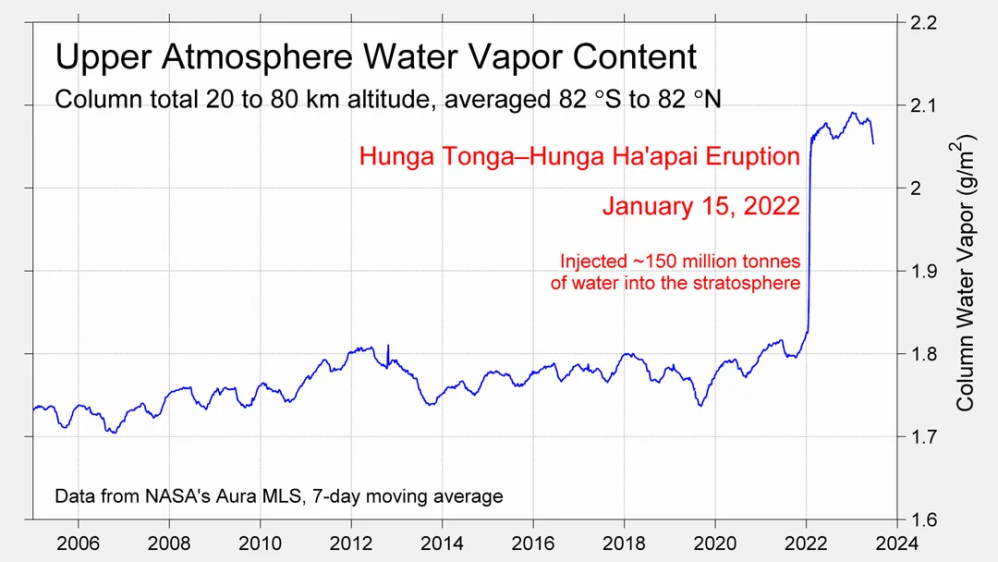
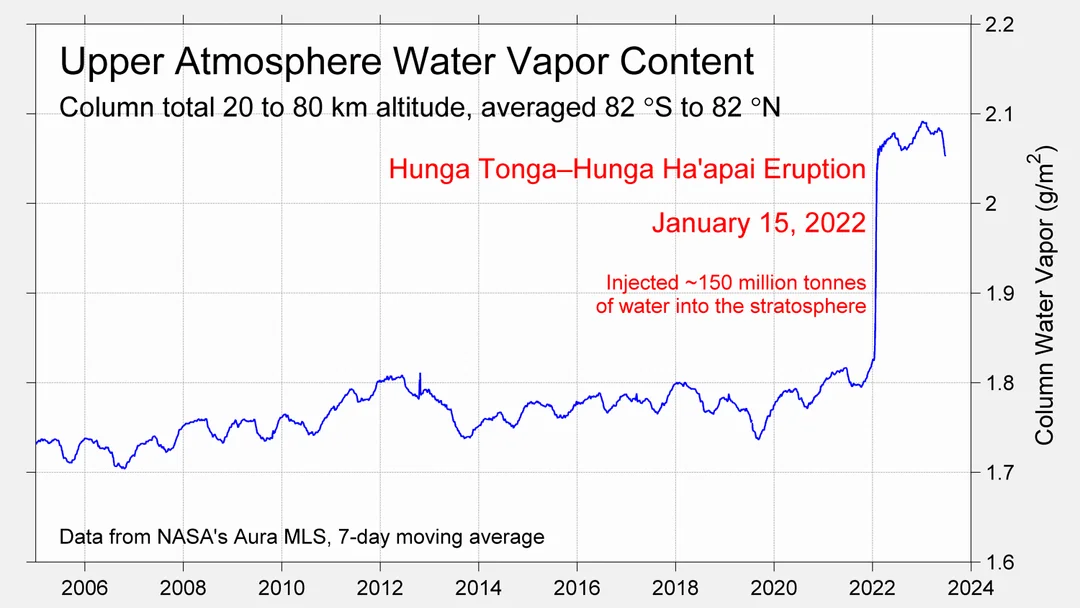
It has now shifted in the last months to an El Nino condition that warms the globe and is thought to contribute to this Spike we have seen. But there are other contributions as well. One of the most surprising ones is that back in January of 2022 an enormous underwater volcano went off in Tonga and it put up a lot of water vapor into the upper atmosphere. It increased the upper atmosphere of water vapor by about 10 percent, and that’s a warming effect, and it may be that is contributing to why the spike is so high.
A longer view of SSTs
To enlarge, open image in new tab.
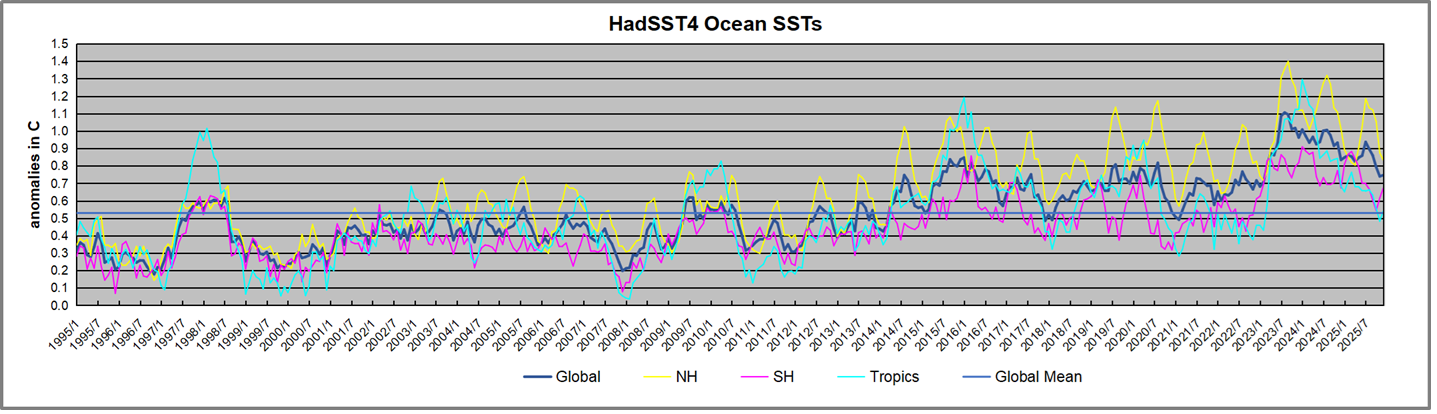
The graph above is noisy, but the density is needed to see the seasonal patterns in the oceanic fluctuations. Previous posts focused on the rise and fall of the last El Nino starting in 2015. This post adds a longer view, encompassing the significant 1998 El Nino and since. The color schemes are retained for Global, Tropics, NH and SH anomalies. Despite the longer time frame, I have kept the monthly data (rather than yearly averages) because of interesting shifts between January and July. 1995 is a reasonable (ENSO neutral) starting point prior to the first El Nino.
The sharp Tropical rise peaking in 1998 is dominant in the record, starting Jan. ’97 to pull up SSTs uniformly before returning to the same level Jan. ’99. There were strong cool periods before and after the 1998 El Nino event. Then SSTs in all regions returned to the mean in 2001-2.
SSTS fluctuate around the mean until 2007, when another, smaller ENSO event occurs. There is cooling 2007-8, a lower peak warming in 2009-10, following by cooling in 2011-12. Again SSTs are average 2013-14.
Now a different pattern appears. The Tropics cooled sharply to Jan 11, then rise steadily for 4 years to Jan 15, at which point the most recent major El Nino takes off. But this time in contrast to ’97-’99, the Northern Hemisphere produces peaks every summer pulling up the Global average. In fact, these NH peaks appear every July starting in 2003, growing stronger to produce 3 massive highs in 2014, 15 and 16. NH July 2017 was only slightly lower, and a fifth NH peak still lower in Sept. 2018.
The highest summer NH peaks came in 2019 and 2020, only this time the Tropics and SH were offsetting rather adding to the warming. (Note: these are high anomalies on top of the highest absolute temps in the NH.) Since 2014 SH has played a moderating role, offsetting the NH warming pulses. After September 2020 temps dropped off down until February 2021. In 2021-22 there were again summer NH spikes, but in 2022 moderated first by cooling Tropics and SH SSTs, then in October to January 2023 by deeper cooling in NH and Tropics.
Then in 2023 the Tropics flipped from below to well above average, while NH produced a summer peak extending into September higher than any previous year. Despite El Nino driving the Tropics January 2024 anomaly higher than 1998 and 2016 peaks, following months cooled in all regions, and the Tropics continued cooling in April, May and June along with SH dropping. After July and August NH warming again pulled the global anomaly higher, September through January 2025 resumed cooling in all regions, continuing February through April 2025, with little change in May,June and July despite upward bumps in NH. Now temps in all regions have cooled led by NH from August through December 2025.
What to make of all this? The patterns suggest that in addition to El Ninos in the Pacific driving the Tropic SSTs, something else is going on in the NH. The obvious culprit is the North Atlantic, since I have seen this sort of pulsing before. After reading some papers by David Dilley, I confirmed his observation of Atlantic pulses into the Arctic every 8 to 10 years.
Contemporary AMO Observations
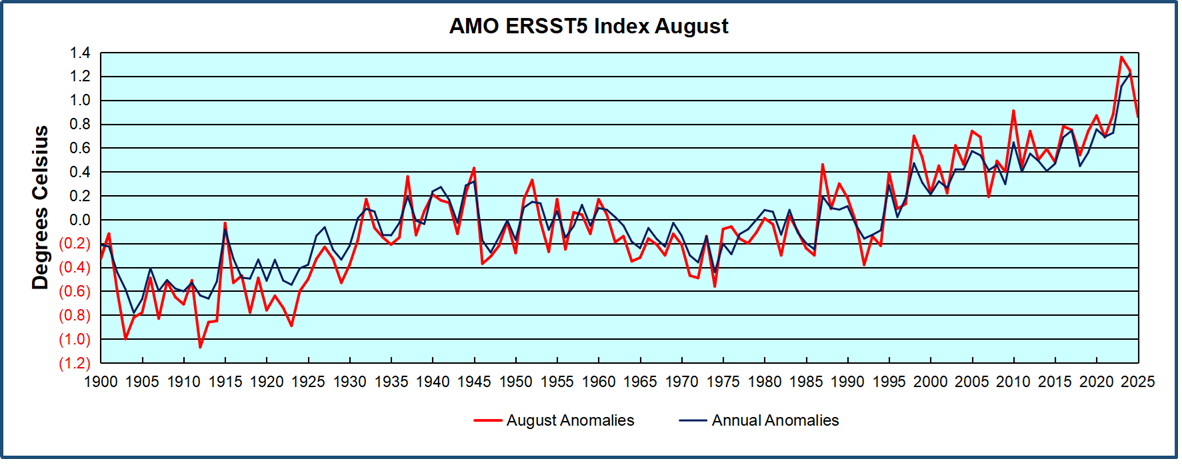
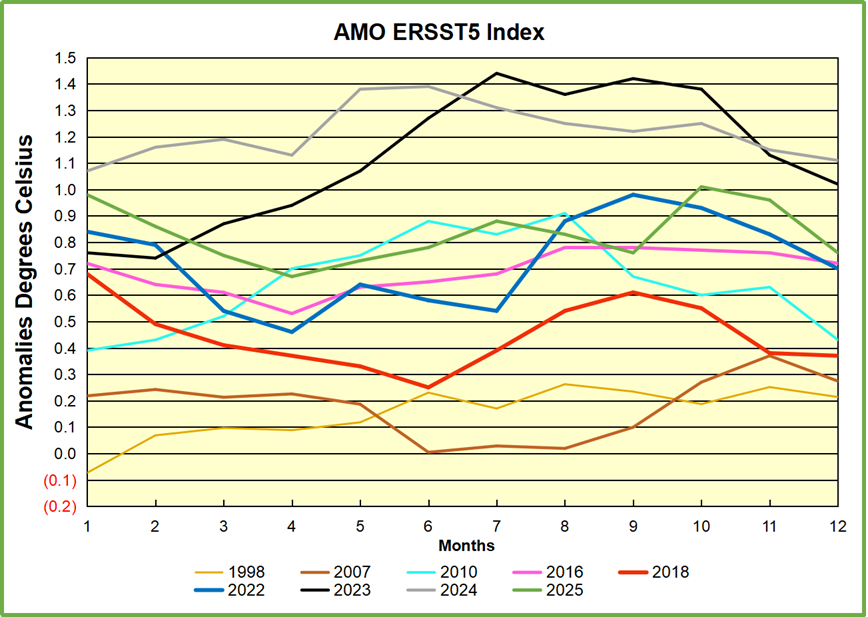
Through January 2023 I depended on the Kaplan AMO Index (not smoothed, not detrended) for N. Atlantic observations. But it is no longer being updated, and NOAA says they don’t know its future. So I find that ERSSTv5 AMO dataset has current data. It differs from Kaplan, which reported average absolute temps measured in N. Atlantic. “ERSST5 AMO follows Trenberth and Shea (2006) proposal to use the NA region EQ-60°N, 0°-80°W and subtract the global rise of SST 60°S-60°N to obtain a measure of the internal variability, arguing that the effect of external forcing on the North Atlantic should be similar to the effect on the other oceans.” So the values represent SST anomaly differences between the N. Atlantic and the Global ocean.
The chart above confirms what Kaplan also showed. As August is the hottest month for the N. Atlantic, its variability, high and low, drives the annual results for this basin. Note also the peaks in 2010, lows after 2014, and a rise in 2021. Then in 2023 the peak reached 1.4C before declining to 0.9 last month. An annual chart below is informative:
Note the difference between blue/green years, beige/brown, and purple/red years. 2010, 2021, 2022 all peaked strongly in August or September. 1998 and 2007 were mildly warm. 2016 and 2018 were matching or cooler than the global average. 2023 started out slightly warm, then rose steadily to an extraordinary peak in July. August to October were only slightly lower, but by December cooled by ~0.4C.
Then in 2024 the AMO anomaly started higher than any previous year, then leveled off for two months declining slightly into April. Remarkably, May showed an upward leap putting this on a higher track than 2023, and rising slightly higher in June. In July, August and September 2024 the anomaly declined, and despite a small rise in October, ended close to where it began. Note 2025 started much lower than the previous year and headed sharply downward, well below the previous two years, then since April through September aligning with 2010. In October there was an unusual upward spike, now reversed down to match September 2025.
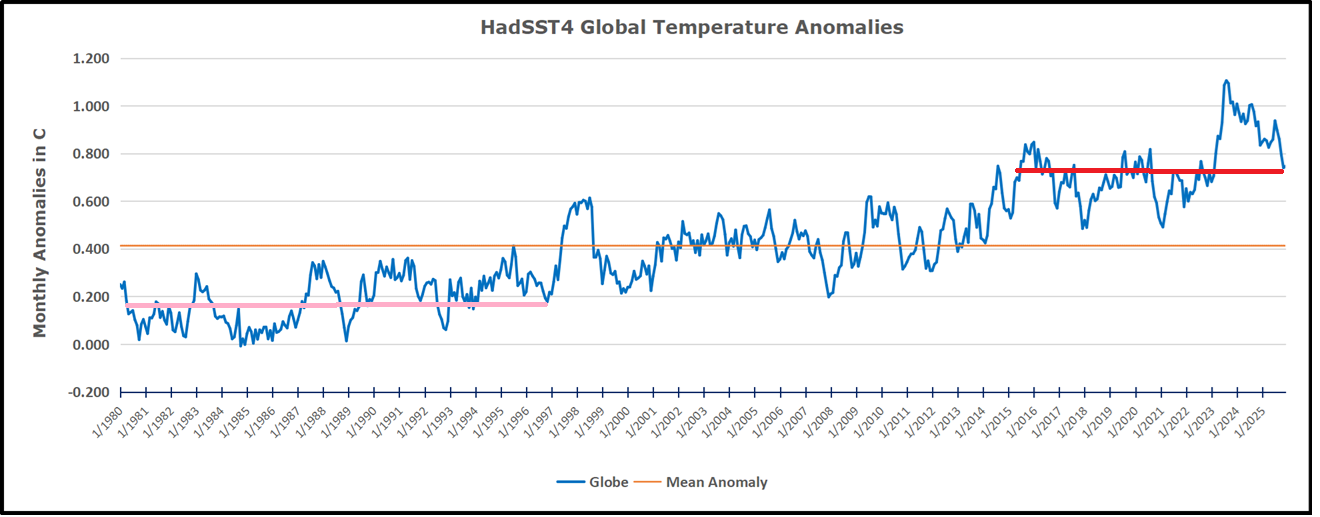
The pattern suggests the ocean may be demonstrating a stairstep pattern like that we have also seen in HadCRUT4.
The rose line is the average anomaly 1982-1996 inclusive, value 0.18. The orange line the average 1982-2025, value 0.41 also for the period 1997-2012. The red line is 2015-2025, value 0.74. As noted above, these rising stages are driven by the combined warming in the Tropics and NH, including both Pacific and Atlantic basins.
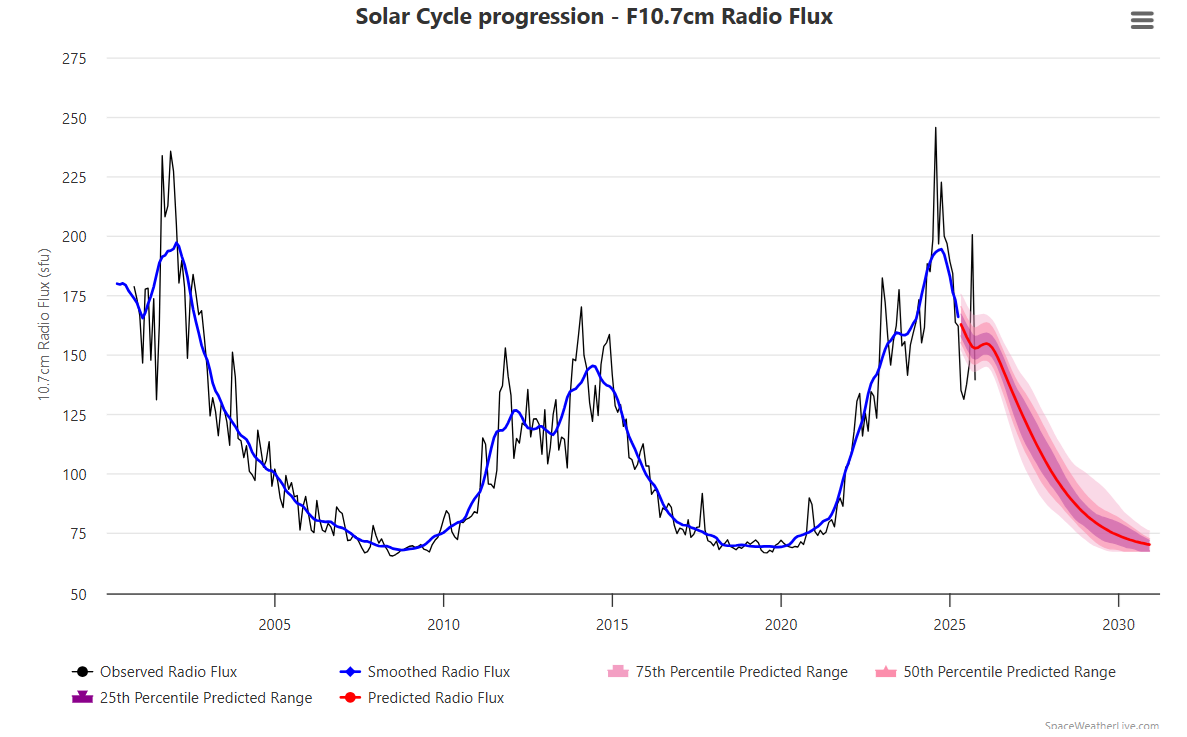
The oceans are driving the warming this century. SSTs took a step up with the 1998 El Nino and have stayed there with help from the North Atlantic, and more recently the Pacific northern “Blob.” The ocean surfaces are releasing a lot of energy, warming the air, but eventually will have a cooling effect. The decline after 1937 was rapid by comparison, so one wonders: How long can the oceans keep this up? And is the sun adding forcing to this process?
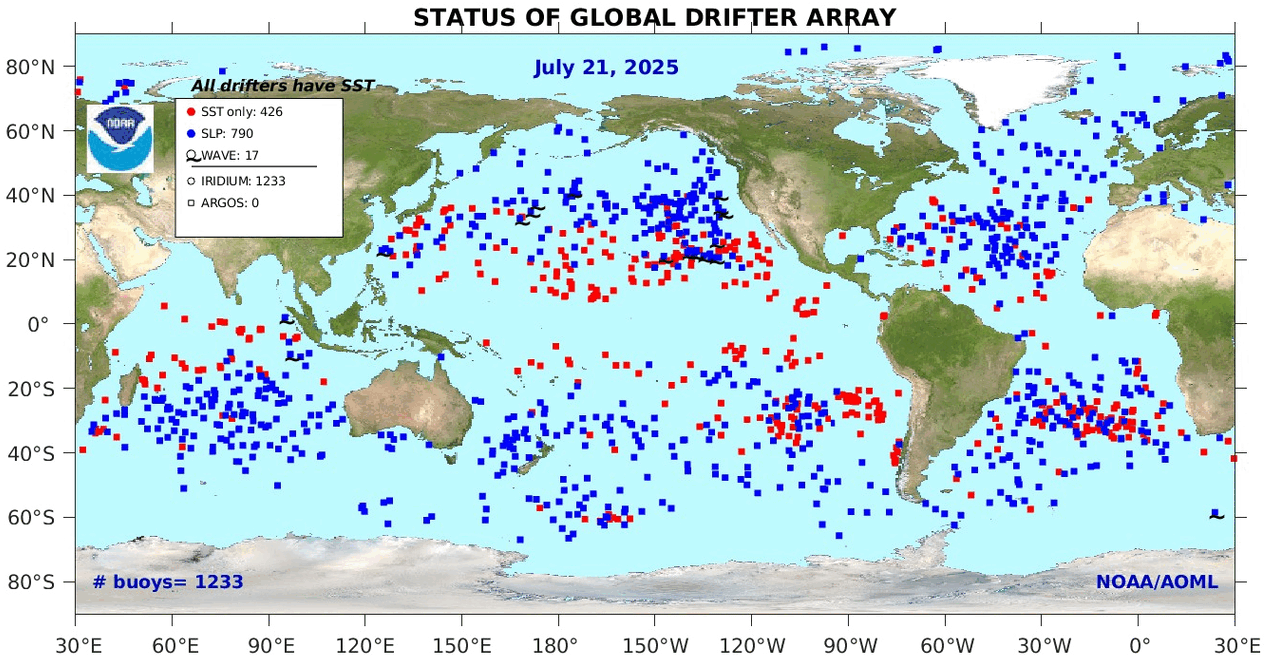
USS Pearl Harbor deploys Global Drifter Buoys in Pacific Ocean
The agreement in question is the United Nations Framework Convention on Climate Change, or UNFCCC, which the US joined and Congress ratified in 1992, when George H.W. Bush was in the White House. The agreement does not require the US to cut fossil fuels or pollution, but rather sets a goal of stabilizing the amount of climate pollution in the atmosphere at a level that would “prevent dangerous anthropogenic (human-caused) interference with the climate system.”
It also set up a process for negotiations between countries that have come to be known as the annual UN climate summits. It was under the UNFCCC’s auspices that the Kyoto Protocol was negotiated in 1995, and the Paris Agreement in 2015 — two monumental moments of global cooperation and progress toward limiting harmful climate pollution.
In addition, the agreement requires the submission of an annual national climate pollution inventory, which the Trump administration notably skipped this year.
President Trump withdrew the US from the Paris Agreement for a second time on his first day in office. With Wednesday’s move,the US will now become the first country to withdraw from the climate treaty, since virtually every country is a member, according to the Natural Resources Defense Council, an environmental group.
Because the Senate ratified the UNFCCC in 1992, it is a legal gray area as to whether President Donald Trump can unilaterally pull the country out of it. However, if Congress plays a role, the Republican majority would presumably back the move.
If successful, the withdrawal would prevent the US from officially participating in subsequent annual climate summits and could call into question the country’s commitment to other longstanding agreements to which it is a party. It may also prompt other nations to reevaluate their commitments to the UNFCCC and UN climate talks, risking not just US climate progress but that of others.
A US withdrawal could make it difficult for a future president to rejoin the Paris Agreement, since that agreement was struck under the auspices of the UNFCCC.
Trump also moved to withdraw the US from the UN Intergovernmental Panel on Climate Change, or IPCC — a Nobel Prize-winning group that publishes reports on global warming. While the president likely can’t bar US scientists from participating in IPCC reports, the move could have ramifications for federal scientists who would otherwise contribute. A White House fact sheet stated:
“Many of these bodies promote radical climate policies, global governance, and
ideological programs that conflict with U.S. sovereignty and economic strength.”
So, it’s a trifeca: UNFCC, IPCC, and Paris Accord
“The Paris Parrot is not dead, it’s just resting.”
The post below updates the UAH record of air temperatures over land and ocean. Each month and year exposes again the growing disconnect between the real world and the Zero Carbon zealots. It is as though the anti-hydrocarbon band wagon hopes to drown out the data contradicting their justification for the Great Energy Transition. Yes, there was warming from an El Nino buildup coincidental with North Atlantic warming, but no basis to blame it on CO2.
As an overview consider how recent rapid cooling completely overcame the warming from the last 3 El Ninos (1998, 2010 and 2016). The UAH record shows that the effects of the last one were gone as of April 2021, again in November 2021, and in February and June 2022 At year end 2022 and continuing into 2023 global temp anomaly matched or went lower than average since 1995, an ENSO neutral year. (UAH baseline is now 1991-2020). Then there was an usual El Nino warming spike of uncertain cause, unrelated to steadily rising CO2, and now dropping steadily back toward normal values.
For reference I added an overlay of CO2 annual concentrations as measured at Mauna Loa. While temperatures fluctuated up and down ending flat, CO2 went up steadily by ~65 ppm, an 18% increase.
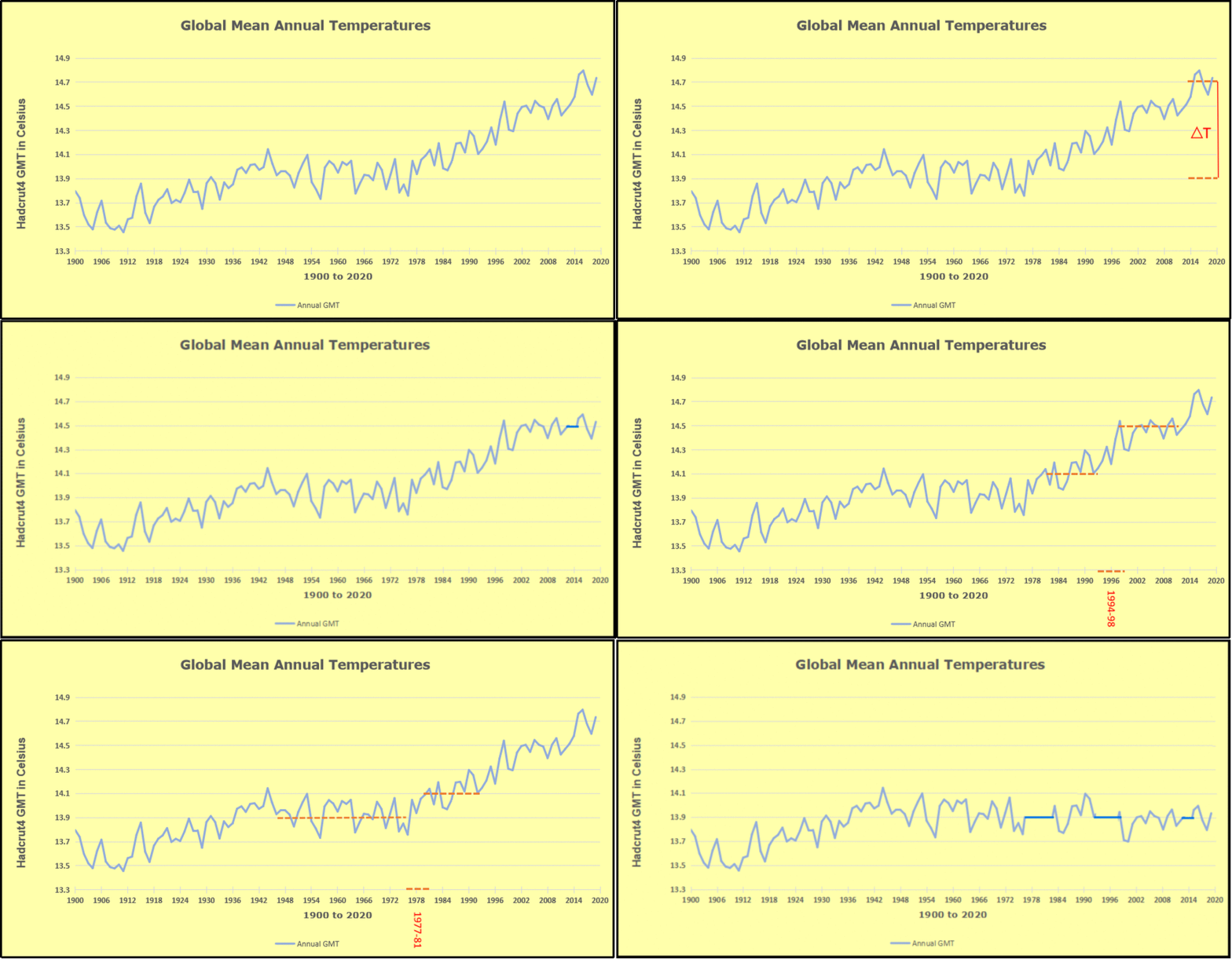
Furthermore, going back to previous warmings prior to the satellite record shows that the entire rise of 0.8C since 1947 is due to oceanic, not human activity.
The animation is an update of a previous analysis from Dr. Murry Salby. These graphs use Hadcrut4 and include the 2016 El Nino warming event. The exhibit shows since 1947 GMT warmed by 0.8 C, from 13.9 to 14.7, as estimated by Hadcrut4. This resulted from three natural warming events involving ocean cycles. The most recent rise 2013-16 lifted temperatures by 0.2C. Previously the 1997-98 El Nino produced a plateau increase of 0.4C. Before that, a rise from 1977-81 added 0.2C to start the warming since 1947.
Importantly, the theory of human-caused global warming asserts that increasing CO2 in the atmosphere changes the baseline and causes systemic warming in our climate. On the contrary, all of the warming since 1947 was episodic, coming from three brief events associated with oceanic cycles. And in 2024 we saw an amazing episode with a temperature spike driven by ocean air warming in all regions, along with rising NH land temperatures, now dropping well below its peak.
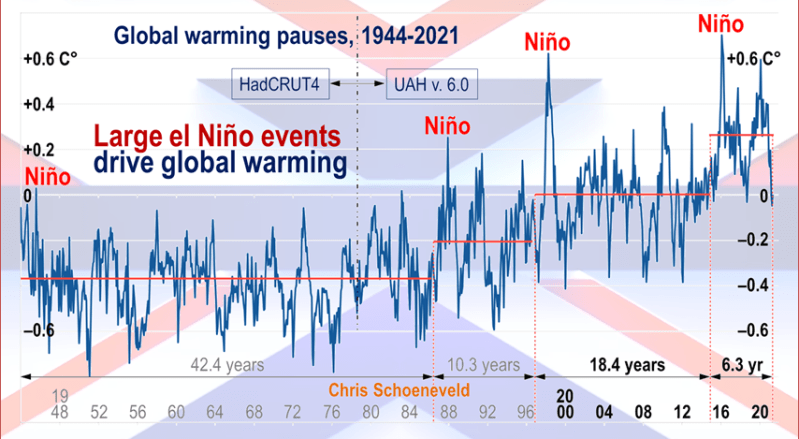
Chris Schoeneveld has produced a similar graph to the animation above, with a temperature series combining HadCRUT4 and UAH6. H/T WUWT
December 2025 UAH Temps: Cooling Everywhere Led by SH
With apologies to Paul Revere, this post is on the lookout for cooler weather with an eye on both the Land and the Sea. While you heard a lot about 2020-21 temperatures matching 2016 as the highest ever, that spin ignores how fast the cooling set in. The UAH data analyzed below shows that warming from the last El Nino had fully dissipated with chilly temperatures in all regions. After a warming blip in 2022, land and ocean temps dropped again with 2023 starting below the mean since 1995. Spring and Summer 2023 saw a series of warmings, continuing into 2024 peaking in April, then cooling off to the present.
UAH has updated their TLT (temperatures in lower troposphere) dataset for December 2025. Due to one satellite drifting more than can be corrected, the dataset has been recalibrated and retitled as version 6.1 Graphs here contain this updated 6.1 data. Posts on their reading of ocean air temps this month are ahead the update from HadSST4 or OISST2.1. I posted recently on SSTs October 2025 Ocean SST Cools to MeanThese posts have a separate graph of land air temps because the comparisons and contrasts are interesting as we contemplate possible cooling in coming months and years.
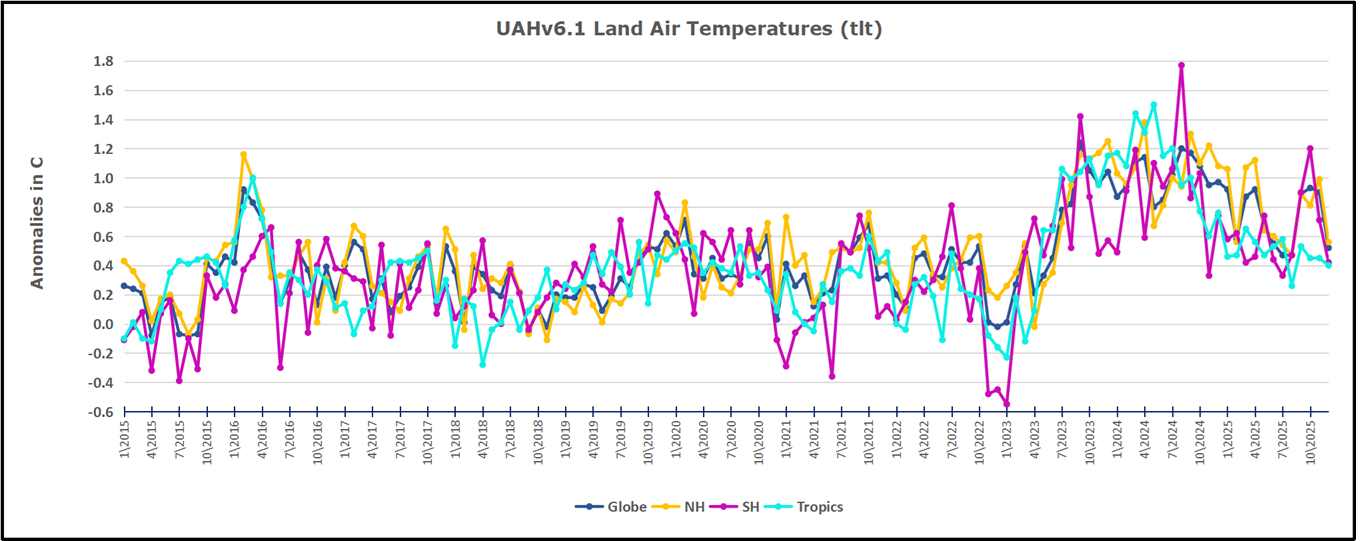
Sometimes air temps over land diverge from ocean air changes. In July 2024 all oceans were unchanged except for Tropical warming, while all land regions rose slightly. In August we saw a warming leap in SH land, slight Land cooling elsewhere, a dip in Tropical Ocean temp and slightly elsewhere. September showed a dramatic drop in SH land, overcome by a greater NH land increase. 2025 has shown a sharp contrast between land and sea, first with ocean air temps falling in January recovering in February. Now in November and December SH land temps have spiked while ocean temps showed litle change. As a result of larger ocean surface, Global temps remained cool.
Note: UAH has shifted their baseline from 1981-2010 to 1991-2020 beginning with January 2021. v6.1 data was recalibrated also starting with 2021. In the charts below, the trends and fluctuations remain the same but the anomaly values changed with the baseline reference shift.
Presently sea surface temperatures (SST) are the best available indicator of heat content gained or lost from earth’s climate system. Enthalpy is the thermodynamic term for total heat content in a system, and humidity differences in air parcels affect enthalpy. Measuring water temperature directly avoids distorted impressions from air measurements. In addition, ocean covers 71% of the planet surface and thus dominates surface temperature estimates. Eventually we will likely have reliable means of recording water temperatures at depth.
Recently, Dr. Ole Humlum reported from his research that air temperatures lag 2-3 months behind changes in SST. Thus cooling oceans portend cooling land air temperatures to follow. He also observed that changes in CO2 atmospheric concentrations lag behind SST by 11-12 months. This latter point is addressed in a previous post Who to Blame for Rising CO2?
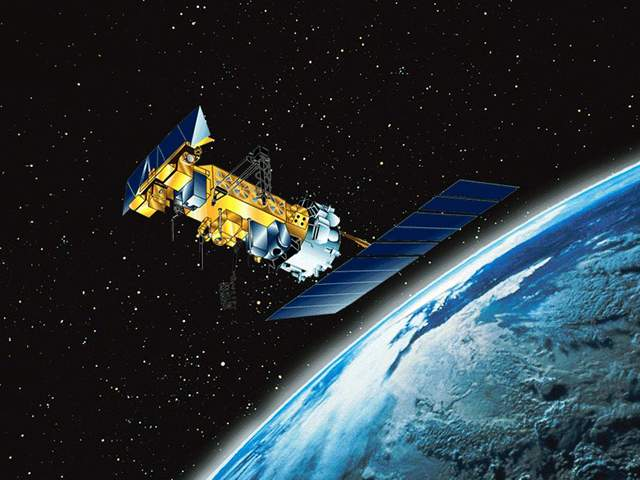
After a change in priorities, updates are now exclusive to HadSST4. For comparison we can also look at lower troposphere temperatures (TLT) from UAHv6.1 which are now posted for December 2025. The temperature record is derived from microwave sounding units (MSU) on board satellites like the one pictured above. Recently there was a change in UAH processing of satellite drift corrections, including dropping one platform which can no longer be corrected. The graphs below are taken from the revised and current dataset.
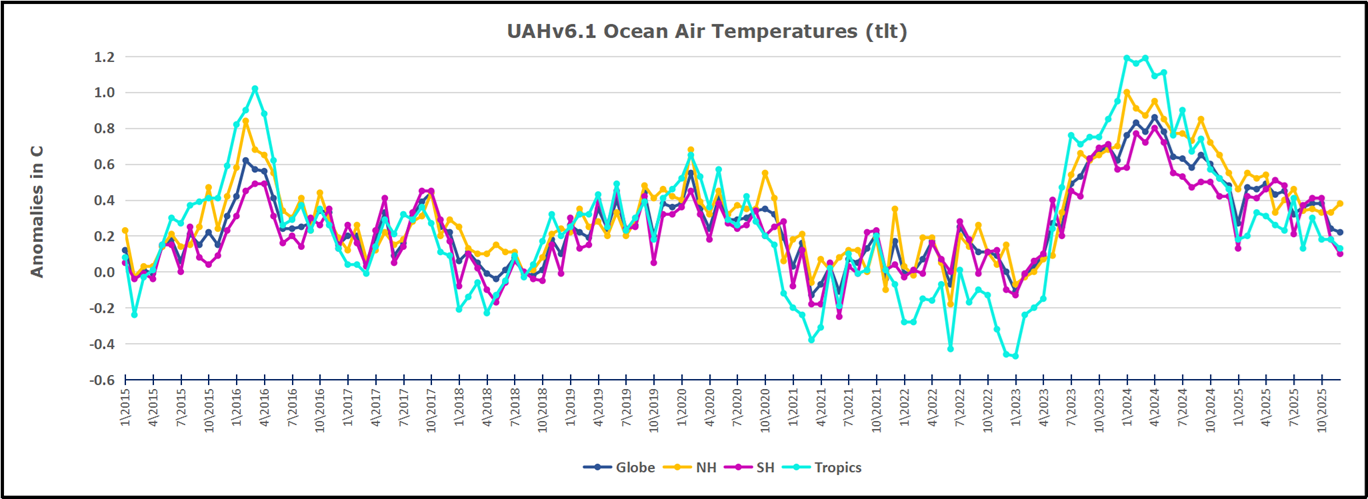
The UAH dataset includes temperature results for air above the oceans, and thus should be most comparable to the SSTs. There is the additional feature that ocean air temps avoid Urban Heat Islands (UHI). The graph below shows monthly anomalies for ocean air temps since January 2015.
In 2021-22, SH and NH showed spikes up and down while the Tropics cooled dramatically, with some ups and downs, but hitting a new low in January 2023. At that point all regions were more or less in negative territory.
After sharp cooling everywhere in January 2023, there was a remarkable spiking of Tropical ocean temps from -0.5C up to + 1.2C in January 2024. The rise was matched by other regions in 2024, such that the Global anomaly peaked at 0.86C in April. Since then all regions have cooled down sharply to a low of 0.27C in January. In February 2025, SH rose from 0.1C to 0.4C pulling the Global ocean air anomaly up to 0.47C, where it stayed in March and April. In May drops in NH and Tropics pulled the air temps over oceans down despite an uptick in SH. At 0.43C, ocean air temps were similar to May 2020, albeit with higher SH anomalies. Now in November/December all regions are cooler, led by a sharp drop in SH bringing the Global ocean anomaly down to 0.02C. 1/4 of what it was in April 2024.
Land Air Temperatures Tracking in Seesaw Pattern
We sometimes overlook that in climate temperature records, while the oceans are measured directly with SSTs, land temps are measured only indirectly. The land temperature records at surface stations sample air temps at 2 meters above ground. UAH gives tlt anomalies for air over land separately from ocean air temps. The graph updated for December is below.
Here we have fresh evidence of the greater volatility of the Land temperatures, along with extraordinary departures by SH land. The seesaw pattern in Land temps is similar to ocean temps 2021-22, except that SH is the outlier, hitting bottom in January 2023. Then exceptionally SH goes from -0.6C up to 1.4C in September 2023 and 1.8C in August 2024, with a large drop in between. In November, SH and the Tropics pulled the Global Land anomaly further down despite a bump in NH land temps. February showed a sharp drop in NH land air temps from 1.07C down to 0.56C, pulling the Global land anomaly downward from 0.9C to 0.6C. Some ups and downs followed with returns close to February values in August. A remarkable spike in October was completely reversed in November/December, along with NH dropping sharply bringing the Global Land anomaly down to 0.52C, half of its peak value of 1.17C 09/2024.
The Bigger Picture UAH Global Since 1980
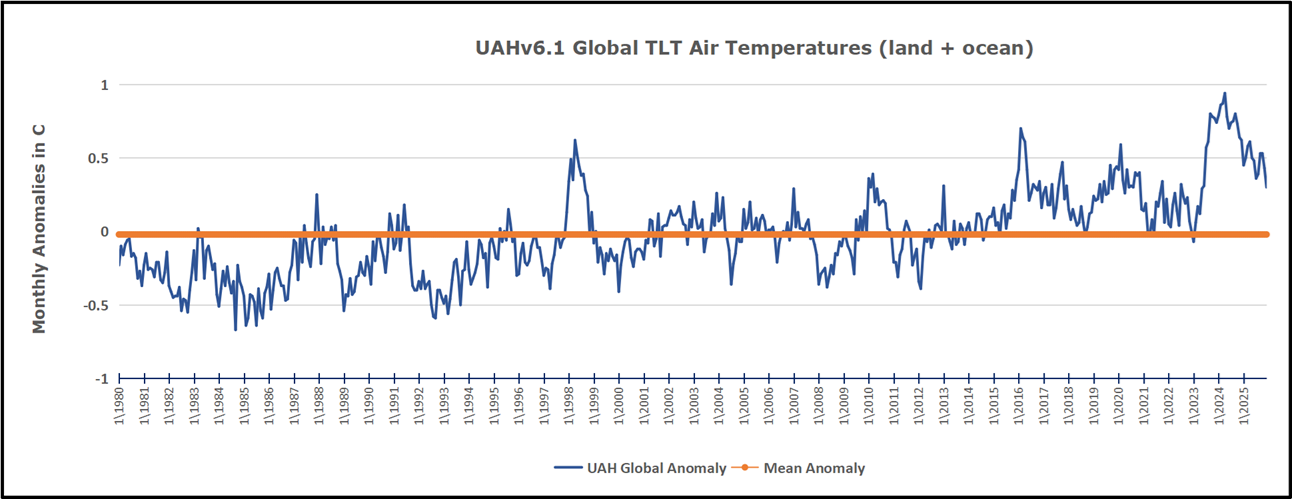
The chart shows monthly Global Land and Ocean anomalies starting 01/1980 to present. The average monthly anomaly is -0.02 for this period of more than four decades. The graph shows the 1998 El Nino after which the mean resumed, and again after the smaller 2010 event. The 2016 El Nino matched 1998 peak and in addition NH after effects lasted longer, followed by the NH warming 2019-20. An upward bump in 2021 was reversed with temps having returned close to the mean as of 2/2022. March and April brought warmer Global temps, later reversed
With the sharp drops in Nov., Dec. and January 2023 temps, there was no increase over 1980. Then in 2023 the buildup to the October/November peak exceeded the sharp April peak of the El Nino 1998 event. It also surpassed the February peak in 2016. In 2024 March and April took the Global anomaly to a new peak of 0.94C. The cool down started with May dropping to 0.9C, and in June a further decline to 0.8C. October went down to 0.7C, November and December dropped to 0.6C.In August Global Land and Ocean went down to 0.39C, then rose slightly to 0.53 in October.
The graph reminds of another chart showing the abrupt ejection of humid air from Hunga Tonga eruption.
TLTs include mixing above the oceans and probably some influence from nearby more volatile land temps. Clearly NH and Global land temps have been dropping in a seesaw pattern, nearly 1C lower than the 2016 peak. Since the ocean has 1000 times the heat capacity as the atmosphere, that cooling is a significant driving force. TLT measures started the recent cooling later than SSTs from HadSST4, but are now showing the same pattern. Despite the three El Ninos, their warming had not persisted prior to 2023, and without them it would probably have cooled since 1995. Of course, the future has not yet been written.
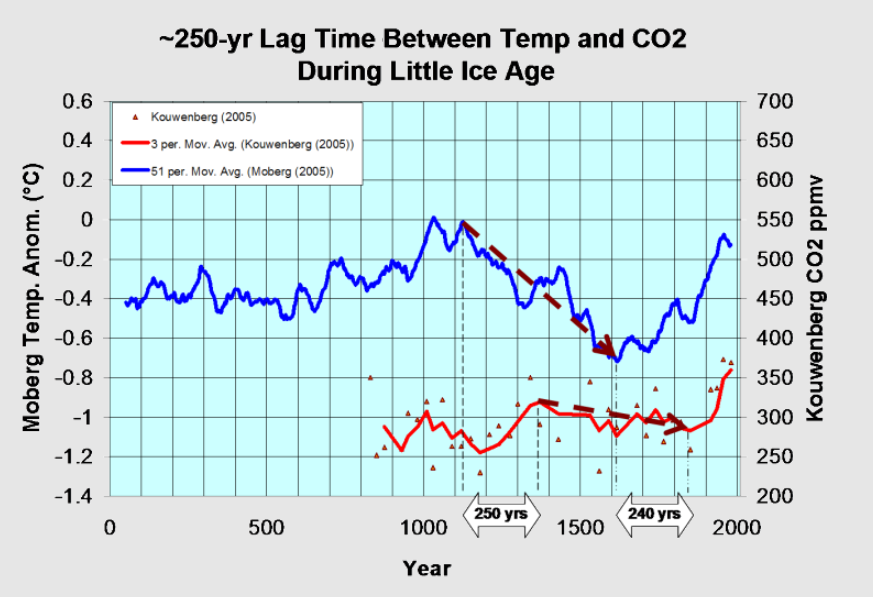
2025 ended with a steadily declining rate of rising CO2 in the atmosphere following a 20 month cooling since April 2024, peak of an unusual and unexplained warming spike. Historical records show that around 1875 was the coldest time in the last 10,000 years. That was the end of the Little Ice Age (LIA), and since then temperatures have warmed at an average rate of about 0.5C per century. The recovery of the biosphere and ocean warming resulted in rising levels of CO2 in the atmosphere.
Syun-Ichi Akasofu, founder of the University of Alaska Fairbanks’ Geophysical Institute reported on this pattern in 2009.
At times, there are warming spikes, in the 1930s and 40s for example, and the rate of rising CO2 goes up. At other times, such as 1950s and 60s, temperatures cool, and rising CO2 slows down. More recently, in 2023 and 24, we saw temperatures spike up before falling back down in 2025. [Note: A study of ocean biochemistry processes confirms that since the end of the LIA rising temperatures have been accompanied by rising CO2 at a rate of ~2 ppm per year. [ See: Slam Dunk: Δtemp Drives Δco2, Ocean Biochemistry at Work ]
Furthermore, going back to previous warmings prior to the satellite record shows that the entire rise of 0.8C since 1947 is due to oceanic, not human activity.
Importantly, the theory of human-caused global warming asserts that increasing CO2 in the atmosphere changes the baseline and causes systemic warming in our climate. On the contrary, all of the warming since 1947 was episodic, coming from three brief events associated with oceanic cycles. And in 2024 we saw an amazing episode with a temperature spike driven by ocean air warming in all regions, along with rising NH land temperatures, now dropping well below its peak.
Previously I have demonstrated that changes in atmospheric CO2 levels follow changes in Global Mean Temperatures (GMT) as shown by satellite measurements from University of Alabama at Huntsville (UAH). A link to that background post is provided later below.
My curiosity was piqued by the remarkable GMT spike starting in January 2023 and rising to a peak in April 2024. GMT has declined steadily, and now 20 months later, the anomaly is 0.30C down from 0.94C. I also became aware that UAH has recalibrated their dataset due to a satellite drift that can no longer be corrected. The values since 2020 have shifted slightly in version 6.1, as shown in my recent report UAH Ocean Stays Cool, SH Land Warms, October 2025, The data here comes from UAH record of temperatures measured in the lower troposphere (TLT).
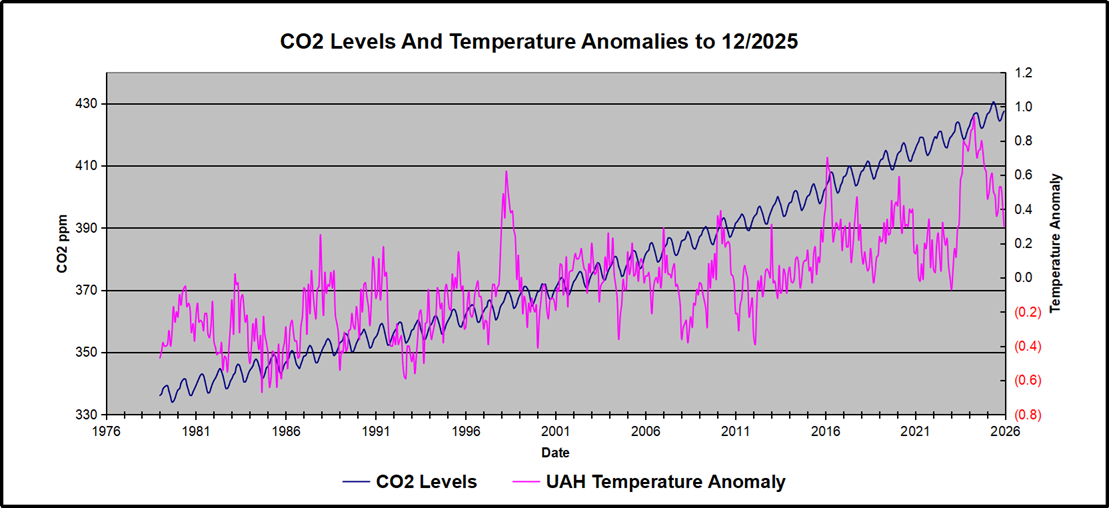
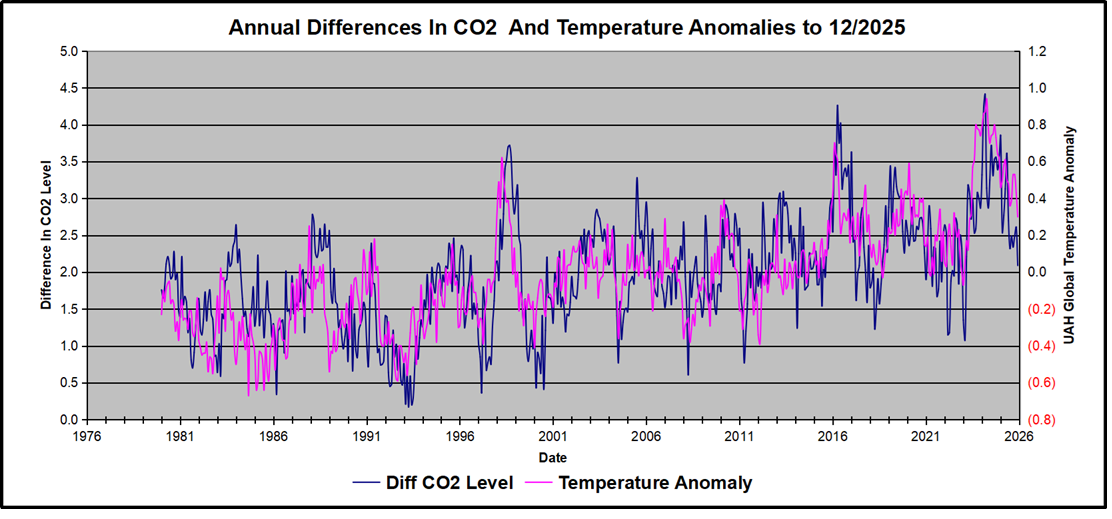
This post updates the analysis with the complete observations for 2025, testing the premise that temperature changes are predictive of changes in atmospheric CO2 concentrations. The chart at the top shows the two monthly datasets: CO2 levels in blue reported at Mauna Loa, and Global temperature anomalies in purple reported by UAHv6.1, both through December 2025. Would such a sharp increase in temperature be reflected in rising CO2 levels, according to the successful mathematical forecasting model? Would CO2 levels decline as temperatures dropped following the peak?
The answer is yes: that temperature spike resulted
in a corresponding CO2 spike as expected.
And lower CO2 levels followed the temperature decline.
Above are UAH temperature anomalies compared to CO2 monthly changes year over year.
Changes in monthly CO2 synchronize with temperature fluctuations, which for UAH are anomalies referenced to the 1991-2020 period. CO2 differentials are calculated for the present month by subtracting the value for the same month in the previous year (for example December 2025 minus December 2024). Temp anomalies are calculated by comparing the present month with the baseline month. Note the recent CO2 upward spike and drop following the temperature spike and drop.
The table below shows clearly the pattern of observed temperatures declining along with declining rates of rising observed CO2. The CO2 rate peaked at 4.41 ppm, then declined over the next 21 months to 2.09 ppm, nearly the baseline rate since the LIA. There are fluctuations in the CO2 monthly response since the differential is influenced by the previous year as well as current year. By 2025/12, the rate of 2.09 ppm was less than half the peak rate of 4.41 ppm.
Month
temperature anomaly
co2 Diff. from previous year
2024\1
0.79
3.32
2024\2
0.86
4.23
2024\3
0.87
4.41
2024\4
0.94
3.14
2024\5
0.78
2.87
2024\6
0.70
3.25
2024\7
0.74
3.72
2024\8
0.75
3.31
2024\9
0.80
3.53
2024\10
0.73
3.56
2024\11
0.64
3.39
2024\12
0.62
3.54
2025\1
0.46
3.85
2025\2
0.50
2.54
2025\3
0.58
2.77
2025\4
0.61
3.13
2025\5
0.50
3.61
2025\6
0.48
2.70
2025\7
0.36
2.32
2025\8
0.39
2.49
2025\9
0.53
2.34
2025\10
0.53
2.49
2025\11
0.43
2.61
2025\12
0.30
2.09
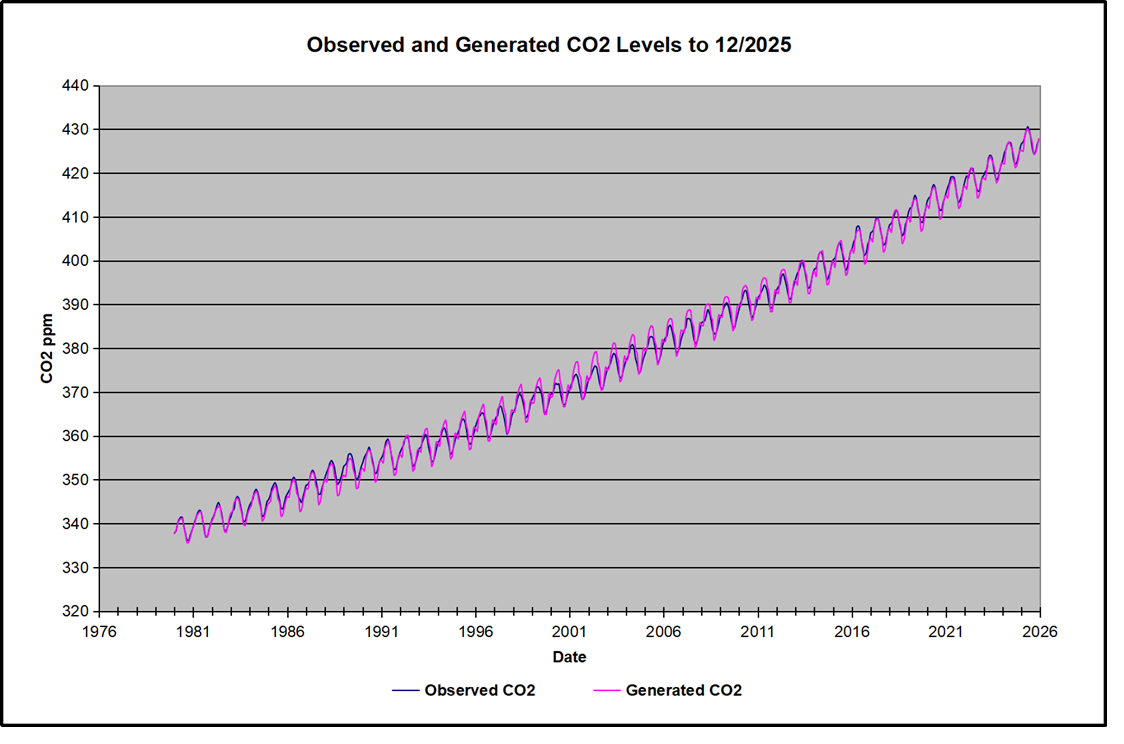
The final proof that CO2 follows temperature due to stimulation of natural CO2 reservoirs is demonstrated by the ability to calculate CO2 levels since 1979 with a simple mathematical formula:
For each subsequent year, the CO2 level for each month was generated
CO2 this month this year = a + b × Temp this month this year + CO2 this month last year
The values for a and b are constants applied to all monthly temps, and are chosen to scale the forecasted CO2 level for comparison with the observed value. Here is the result of those calculations.
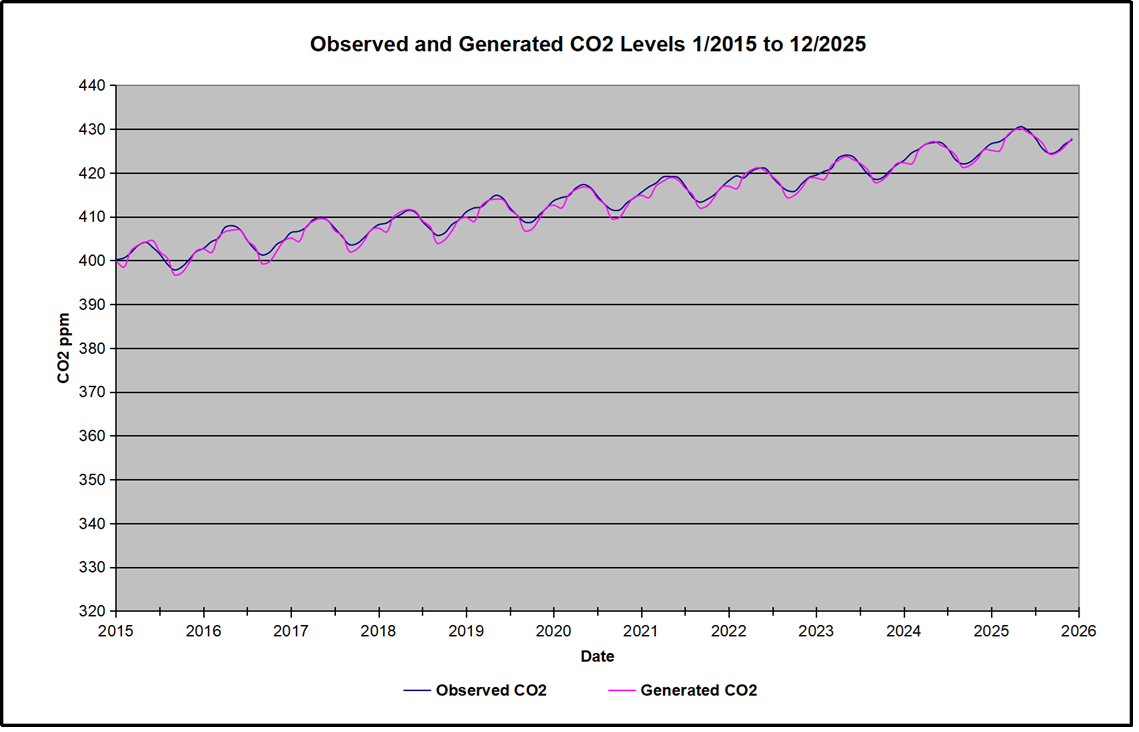
In the chart calculated CO2 levels correlate with observed CO2 levels at 0.9988 out of 1.0000. This mathematical generation of CO2 atmospheric levels is only possible if they are driven by temperature-dependent natural sources, and not by human emissions which are small in comparison, rise steadily and monotonically. For a more detailed look at the recent fluxes, here are the results since 2015, an ENSO neutral year.
For this recent period, the calculated CO2 values match well the annual highs, while some annual generated values of CO2 are slightly higher or lower than observed at other months of the year. Still the correlation for this period is 0.9942.
Key Point
Changes in CO2 follow changes in global temperatures on all time scales, from last month’s observations to ice core datasets spanning millennia. Since CO2 is the lagging variable, it cannot logically be the cause of temperature, the leading variable. It is folly to imagine that by reducing human emissions of CO2, we can change global temperatures, which are obviously driven by other factors.
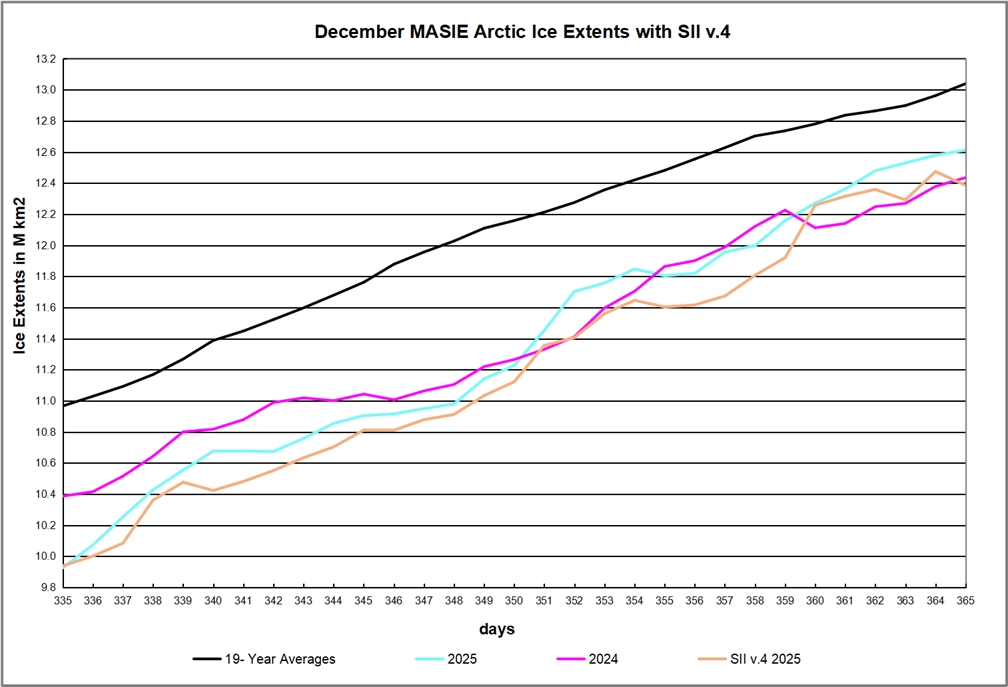
The Arctic ice extents are now fully reported for 2025, ending the year below average despite a higher rate of growth through December.
Note MASIE 2025 started 1M km2 (or 1 Wadham) below the 19 year average, but cut the deficit to 428k km2, or a gap of 3%. SII v.4 tracked lower than MASIE during December, drawing closer the last week. The chart below shows the distribution of ice extent across the Arctic regions at yearend 2025.
Region
2025365
Day 365 Average
2025-Ave.
2024365
2025-2024
(0) Northern_Hemisphere
12611676
13039302
-427626
12435177
176499
(1) Beaufort_Sea
1071070
1070458
612
1071001
69
(2) Chukchi_Sea
966006
964771
1235
965989
17
(3) East_Siberian_Sea
1087137
1087133
4
1087137
0
(4) Laptev_Sea
897845
897841
4
897845
0
(5) Kara_Sea
867623
887208
-19585
876527
-8904
(6) Barents_Sea
254882
423978
-169096
345715
-90832
(7) Greenland_Sea
668550
595658
72891
574537
94013
(8) Baffin_Bay_Gulf_of_St._Lawrence
768306
982649
-214343
982716
-214409
(9) Canadian_Archipelago
854931
853618
1313
854878
53
(10) Hudson_Bay
1256284
1215695
40589
922416
333868
(11) Central_Arctic
3174354
3206560
-32206
3207164.49
-32811
(12) Bering_Sea
350519
403002
-52483
325489.93
25029
(13) Baltic_Sea
14031
31873
-17843
15271.77
-1241
(14) Sea_of_Okhotsk
366812
393742
-26929
302941
63871
The major deficits are in Barents Sea and Baffin Bay (Atlantic basins), along with smaller losses in Bering and Okhotsk (Pacific basins).
Background from Previous Post Updated to Year-End 2025
Some years ago reading a thread on global warming at WUWT, I was struck by one person’s comment: “I’m an actuary with limited knowledge of climate metrics, but it seems to me if you want to understand temperature changes, you should analyze the changes, not the temperatures.” That rang bells for me, and I applied that insight in a series of Temperature Trend Analysis studies of surface station temperature records. Those posts are available under this heading. Climate Compilation Part I Temperatures
This post seeks to understand Arctic Sea Ice fluctuations using a similar approach: Focusing on the rates of extent changes rather than the usual study of the ice extents themselves. Fortunately, Sea Ice Index (SII) from NOAA provides a suitable dataset for this project. As many know, SII relies on satellite passive microwave sensors to produce charts of Arctic Ice extents with complete coverages going back to 1989. Version 3 was more closely aligned than Version 4 with MASIE, the modern form of Naval ice charting in support of Arctic navigation. The SII User Guide is here.
There are statistical analyses available, and the one of interest (table below) is called Sea Ice Index Rates of Change (here). As indicated by the title, this spreadsheet consists not of monthly extents, but changes of extents from the previous month. Specifically, a monthly value is calculated by subtracting the average of the last five days of the previous month from this month’s average of final five days. So the value presents the amount of ice gained or lost during the present month.
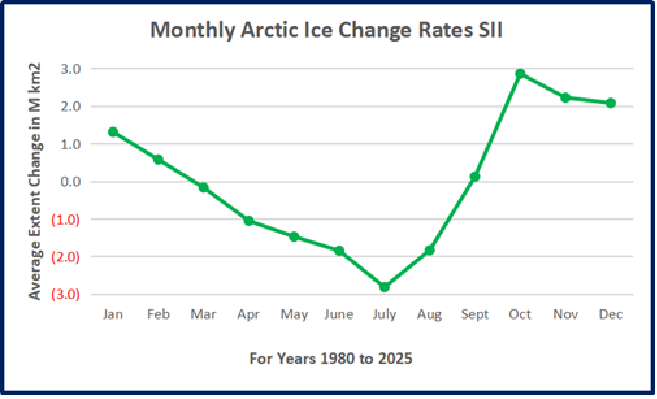
These monthly rates of change have been compiled into a baseline for the period 1980 to 2010, which shows the fluctuations of Arctic ice extents over the course of a calendar year. Below is a graph of those averages of monthly changes up to and including this year. Those familiar with Arctic Ice studies will not be surprised at the sine wave form. December end is a relatively neutral point in the cycle, midway between the September Minimum and March Maximum.
The graph makes evident the six spring/summer months of melting and the six autumn/winter months of freezing. Note that June-August produce the bulk of losses, while October-December show the bulk of gains. Also the peak and valley months of March and September show very little change in extent from beginning to end.
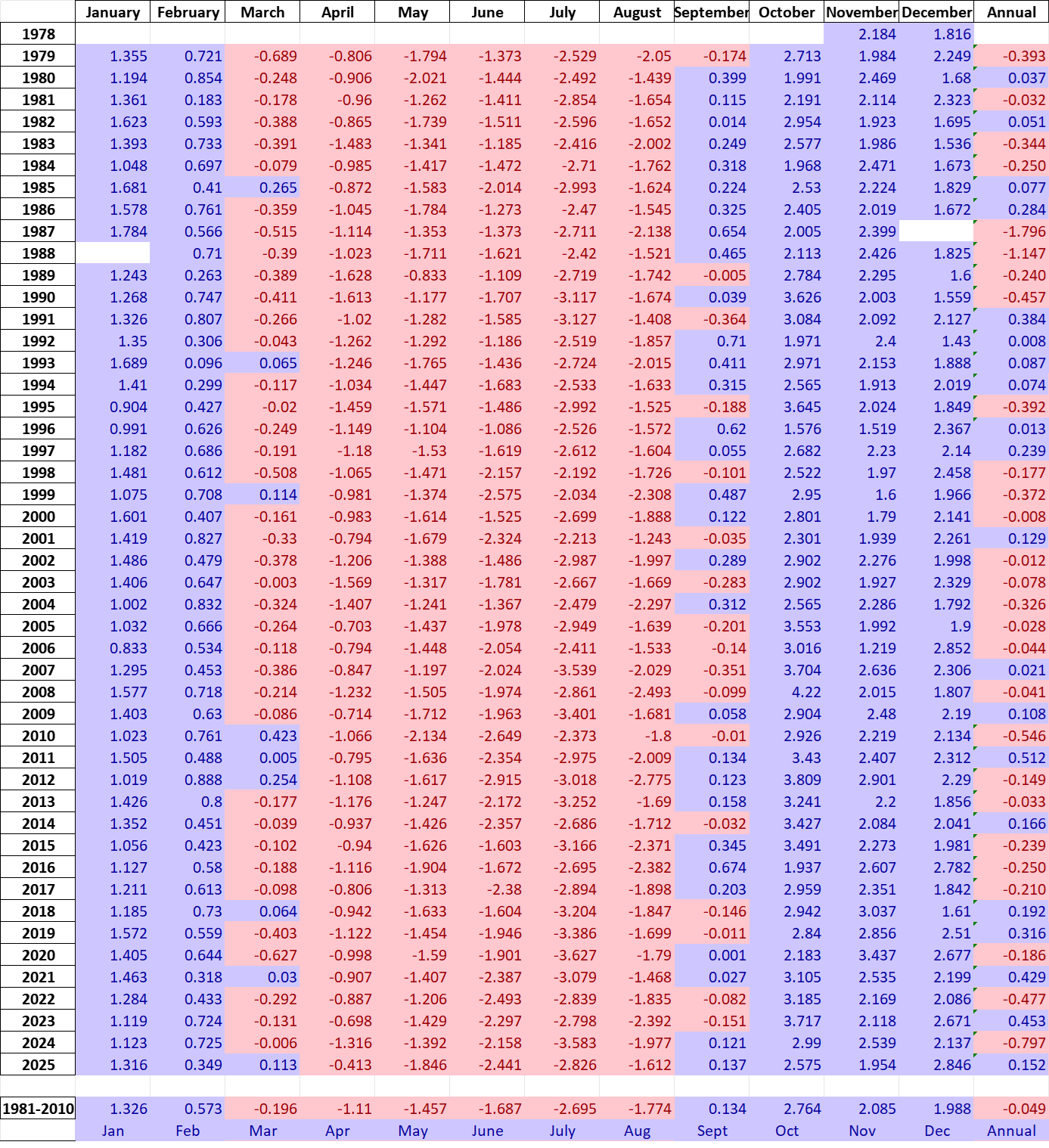
The table of monthly data reveals the variability of ice extents over the last 4 decades, with gains in blue cells and losses in red cells.
The values in January show changes from the end of the previous December, and by summing twelve consecutive months we can calculate an annual rate of change for the years 1980 to 2025.
As many know, there has been a decline of Arctic ice extent over these 40 years, averaging 70k km2 per year. But year over year, the changes shift constantly between gains and losses, ranging up to +/- 500k km2, (2024 being exceptional). Since 1989 the average yearend gain/loss is nearly zero, -0.049k km2 to be exact.
Moreover, it seems random as to which months are determinative for a given year. For example, much ado was printed about 2023 losing more ice than usual June through September. But then the final 3 months of 2023 more than made up for those summer losses, resulting in a sizeable gain for the year.
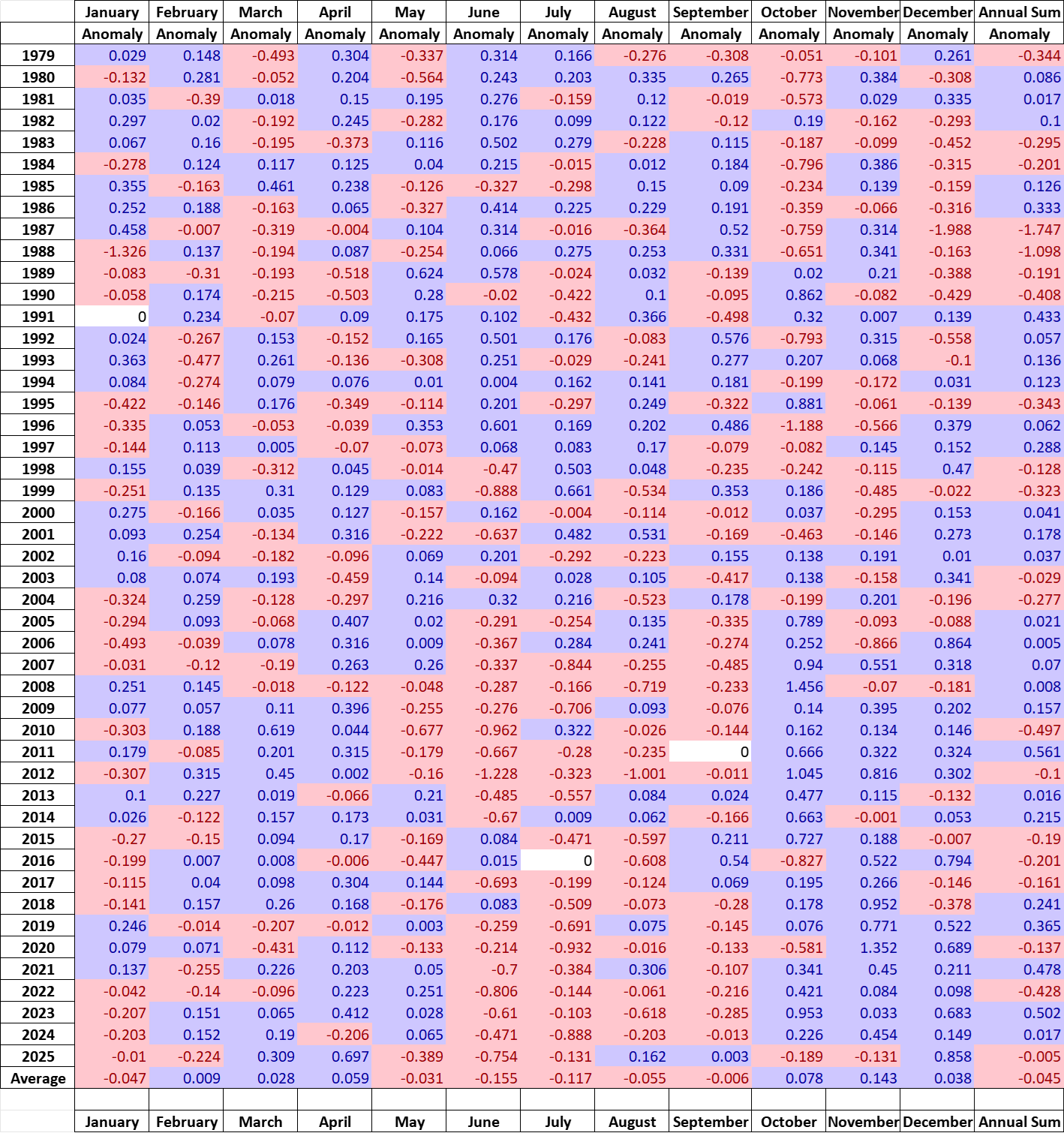
As it happens in this dataset, October has the highest rate of adding ice. The table below shows the variety of monthly rates in the record as anomalies from the 1980-2010 baseline. In this exhibit a red cell is a negative anomaly (less than baseline for that month) and blue is positive (higher than baseline).
Note that the +/ – rate anomalies are distributed all across the grid, sequences of different months in different years, with gains and losses offsetting one another. As noted earlier, in 2023 the outlier negative months were June through September where unusual amounts of ice were lost. Then unusally strong gains in October to December resulted in a large annual gain, compared to the baseline. The bottom line presents the average anomalies for each month over the period 1979-2025. Note the rates of gains and losses mostly offset, and the average of all months in the bottom right cell is virtually zero.
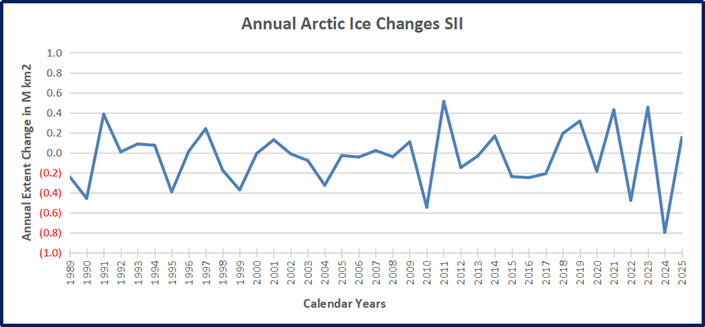
A final observation: The graph below shows the Yearend Arctic Ice Extents for the last 35 years.
Year-end Arctic ice extents (last 5 days of December) show three distinct regimes: 1989-1998, 1998-2010, 2010-2025. The average year-end extent 1989-2010 is 13.4M km2. In the last decade, 2011 was 13.0M km2, and six years later, 2017 was 12.3M km2. 2021 rose back to 13.0 2024 slipped back to 12.2M, and 2025 is back up to 12.4M. So for all the the fluctuations, the net is virually zero, or a loss of one tenth of a Wadham (0.1M) from 2010. Talk of an Arctic ice death spiral is fanciful.
These data show a noisy, highly variable natural phenomenon. Clearly, unpredictable factors are in play, principally water structure and circulation, atmospheric circulation regimes, and also incursions and storms. And in the longer view, today’s extents are not unusual.







 Beyond energy economics, there is another dimension to Canada’s economic future that the legacy climate orthodoxy dismisses: agriculture. Canada’s warming climate has extended growing seasons across the prairies and opened new agricultural possibilities.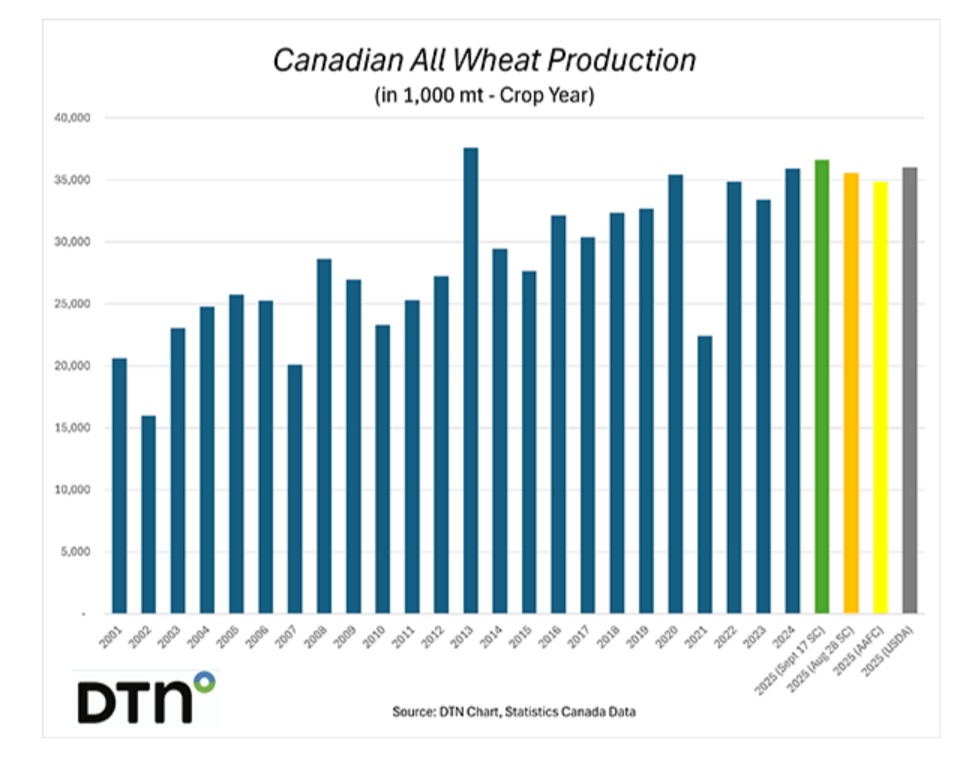

 a
a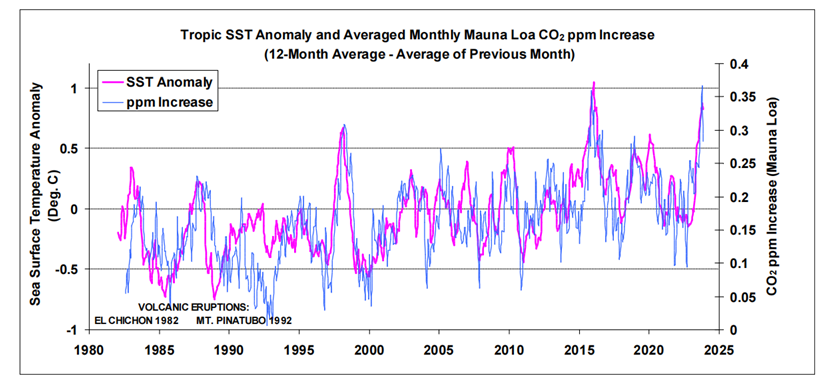 Recently another researcher, Bernard Robbins, found similar causation between ML CO2 and SST fluctuations reported by NOAA Global SST dataset.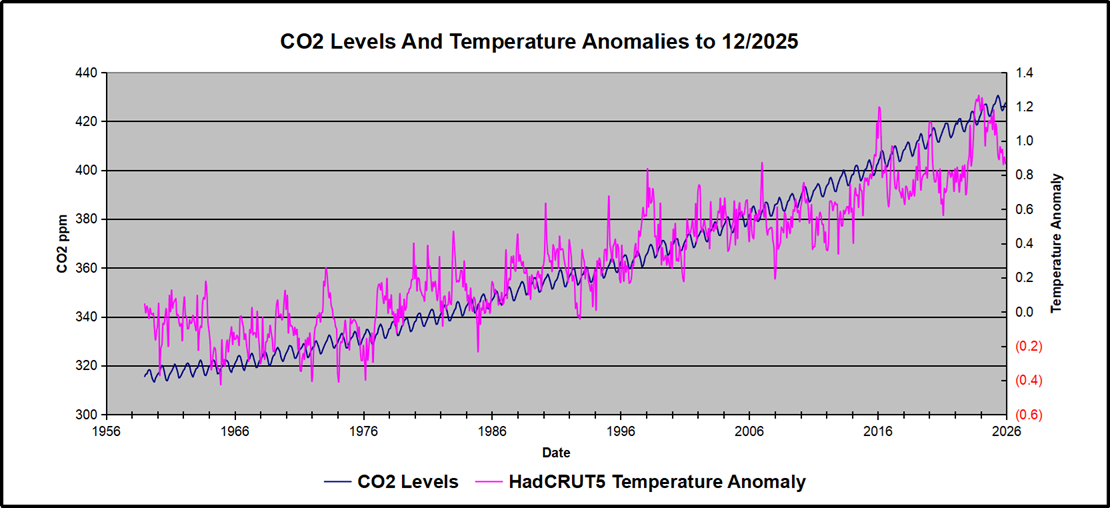





 The best context for understanding decadal temperature changes comes from the world’s sea surface temperatures (SST), for several reasons: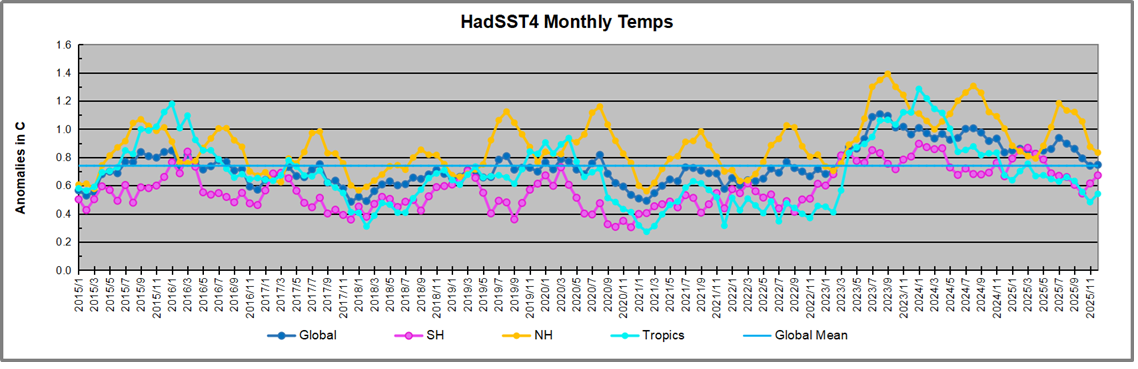









 Science Matters