Why Milei is Argentina’s Last, Best Hope

Finally, an intelligent explanation of why Argentines chose Milei as their champion.  G. Patrick Lynch cuts through the smoke and mirrors in his Law and Liberty article Misunderstanding Milei.  Excerpts in italics with my bolds and added images.

It took almost 80 years. That’s how long Argentina’s economy and society have been in free fall. In some ways, it’s a testament to our greatest fears about democracy and self-government that no political leader had the political incentives and simple nerve to buck the status quo. Eighty years of relentless, grinding inflation and spiraling deficits, followed by defaults, currency devaluations, and restarts before November 19. But finally, the people of Argentina have rejected a failed status quo. Javier Milei publicly won a near landslide by Argentinian standards, and when one considers the probability of Peronist cheating at approximately 100%, the margin was likely much higher. Whether or not the alternative Argentinians have chosen will “fix the situation” is for now beside the point.

They have exercised the one option they have—rejecting the incumbents
for the promise of something different. That’s all that democracy promises.

Javier MIlei, who today is being called “far right,” “radical,” and (by the very lazy) a “far-right libertarian,” is now the president-elect of one of the greatest failed states of our lifetimes. It’s hard to fully explain how badly governed Argentina has been by its long line of Peronist governments distinguished for their lavish spending, stunning corruption, autocratic tendencies, and economic nationalism. The economic statistics are mind-boggling. Defaults, regular annual inflation rates in excess of 100%, a resulting enormous welfare state, parasitic public sector unions, and largely complicit “centrist” politicians: all these are now the depressing landscape of the Argentine political economy.

Indeed, it was the world’s 10th-richest country when Perón took over. And Hong Kong was relatively poor. But look at what’s happened over time. Perón’s statist policies produced a steady decline while Hong Kong’s laissez-faire approach has now made it one of the richest jurisdictions on the planet.

However, if one did not live this reality but were to simply draw conclusions about the election and Milei from the international (particularly American) press, one might think Argentina had fallen into a state of collective delusion, choosing an insane, sideburn-covered Latin American version of Trump without any reason other than some vague references to inflation and debt payments. As the saying goes, the international press has buried the lede.

Milei is trying to address the disastrous situation in Argentina, but outlets such as Reuters described it as “shock therapy” in a not-so-subtle reference to Naomi Klein’s book Shock Doctrine. Klein argues that nature or war can create disasters and give opportunities for “capitalism,” (anthropomorphized through Milton Friedman) to engage in exploitation by establishing extremist policies like private property rights and markets. In this case, however, it’s the legacy of the exact policies that Klein and her ilk support that has created the unmitigated disaster.

Money printing, a bloated welfare state, an emphasis on economic “independence”
and other prominent leftwing economic prescriptions have made this disaster,
but the irony is lost on the folks at Reuters.

Milei’s main, nay fundamental, policy proposals are all in the context of this backdrop. His firm commitment to abolishing Argentine central banking and cutting social spending is straight out of Ludwig von Mises and Milton Friedman, and it is completely appropriate given the circumstances. The only way that an “anarcho-capitalist” could be elected was in a situation of failed governance and welfare statism so dire that he could crack the door open slightly and introduce ideas unknown by the mainstream intelligentsia, let alone the average Argentine on the street.

The language used by the international media, the gigantic “blob” of interests in the World Bank and international aid community, and the mainstream economists who oppose him is designed to delegitimize Milei. They don’t want another success story like Chile in the region. Two nations that adopt “neoliberal” policies that work mean their jobs and narratives are at risk. They are and should be terrified.

The problem is their terms are like insults thrown around in a schoolyard. They are neither coherent nor consistent. Consider the three most prominent politicians to be given the “far right” treatment by the mainstream press, El Salvador’s Nayib Bukele, Italy’s Giorgia Meloni, and now Milei. What do they have in common? Substantively the answer is very little. Bukele is engaged in a crackdown on gangs and crime that involves widespread violations of due process and civil rights, but has led to a plummeting of crime rates. Meloni is known as an anti-immigrant crusader, but she also supports the Ukraine war and like Bukele has sky-high approval ratings. Milei wants to abolish central banking, and while he’s pro-life, he’s also a bachelor who brags about his sex life and argues for open markets and trade with the United States of all places. Yet to a journalist in the legacy media, they are all part of what has become known as the “far right.” Not satisfied that describing politicians as “conservative” or “right” is enough to scare their readers, the network news, national newspapers, and news services have decided to add a qualifier to the term. 

The growth in the use of the term “far right” is yet another example
how intellectual honesty, philosophical consistency, and respect
for liberal discourse are completely absent from our public debates.

But when we see the media force these politicians into a two-dimensional straightjacket, it doesn’t just present a problem of categories. It’s also about the limits of elite background and education. As David Brooks’ recent New York Times column rightly noted, the national news media are very much alike in background and education. The educational institutions that produced these figures support consensus views and expert policy creation, which accord with their own preferences. Briefly, that means government solutions to government problems. Those solutions involve hiring policy people to “fix” things. But what about when the consensus is wrong? What if the theory doesn’t fit the reality? What happens when crime runs rampant in El Salvador despite the best intentions of Western policymakers? What happens when Argentina’s central bank drives inflation to unimaginable levels at immense social cost? Unconventional answers emerge and democracy gives it energy.

The press and policy elites cannot address who Milei is or what he’s proposing on the merits because it does not fit their world view. Hyperinflation is not caused by climate change, racism, or opposition to gender displacement. It is not a social construct or a random event, particularly when it happens continuously for almost 80 years and destroys a largely upper-middle-class society. It is the political and economic failure that results from political exploitation and central planning. The Argentine bureaucracy and the chattering classes have failed citizens for decades. We know the cause, and so does Milei. His opponents wanted to make things a little less bad, possibly for a few years until they once again made things much worse.

Peronism is the abusive relationship, the addiction, the concept
that no responsibility is necessary after years of irresponsibility.
Milei is the medicine, and he will not be an easy pill to swallow.

The possibility of Galt’s Gulch in Argentina is basically zero. He faces nearly intractable political challenges in achieving even a small percentage of his legislative agenda. And yet if he can achieve one goal he might allow Argentina to start down a different path. Dollarizing the economy might force the state into fiscal responsibility and end the monetary insanity that currently reigns. It will be painful, but perhaps not as painful as decades more of the numbing effect of more stimulus that ultimately debases the currency.

There are no easy solutions here, which is part of the reason the media
and its stale-minded intellectual influences have no solutions to offer.

They are left with nothing but vague language, scare tactics, and labeling. What took 80 years to destroy will take decades, perhaps centuries to recreate. Well before he won the first round of voting back in September, Milei was asked what his model for Argentina was. He replied, Ireland. Ireland of course famously cut taxes and regulation, freeing its economy and spurring rapid economic growth.

Argentina could do worse than Ireland, but anything
different than its current path will be an improvement.

 

Assessing Risk and Climate Science (Quora Discussion)

Excerpted below is a Quora discussion with illuminating commentary from  Aaron Brown, former asset risk manager. AB responds to Topic Question and related comments, text in italics with my bolds and added images.

Quora? What will make conservatives accept climate change as real science?

AB: There are scientists who study cloud formation, ocean currents, rainfall patterns and other aspects of climate. Some are good, some not so much. Most people, liberal or conservative, accept that much of this is science.

Then there are scientists who build climate models and make predictions about things like global average temperature from 2081 to 2100 under different assumptions about human emissions and other factors. The people doing this work are considered scientists, but the conclusions are not science in the sense of empirically verifiable facts or consensus theories with strong empirical confirmation.

It’s a semantic game whether you call the conclusions “science” or not, but either way they are not as certain as scientific laws about gravity or momentum. People who like the predictions will embrace them, people who don’t like the predictions will resist them.

Liberals tend to be open to new ideas, conservatives tend to be more skeptical. That means many liberals are more willing to take strong action based on model predictions than are most conservatives. Skeptics tend to accept models if they make useful, non-obvious predictions that turn out to be true. Unfortunately it will take at least a century to gather that kind of evidence for climate models.

One possible breakthrough would be improvements in forecasting weather. You can prove a weather model in months rather than decades or centuries. But the fundamental claim of climate science is that it’s easier to predict global decadal averages in fifty years than next month’s weather in New York’s Central Park. That kind of claim—”I can’t predict the stuff you can check but trust me on stuff you can’t check”—makes skeptics skeptical.

A more likely breakthrough would be the the people making climate predictions proving their modeling ability by making useful, non-obvious predictions in other fields that can be validated. So far we have not seen this—successful modelers in other fields moving to climate science, or climate modelers proving success in other fields. This is a major point of skepticism for skeptics.

Finally, many conservatives are skeptical due to the big money involved in climate change combined with intense government interest and possibilities for vast wealth from subsidies and other programs. This is called Big Science and it’s often been dead wrong in the past, not to mention occasionally threatening all life on Earth. There are some successes of Big Science as well but skeptics will note the temptation to skew climate science for money or to push policies the advocates wanted before any climate support showed up.

None of this is relevant for policy decisions. If we somehow knew for certain today what the global mean temperature would be from 2081 – 2100, it wouldn’t tell us whether it was a good idea to ban coal or impose a carbon tax today. Conservatives are apt to assume any legislation will be written by lobbyists paid by cronies and empire-building bureaucrats rather than any kind of scientist. The laws will have unintended consequences, and send the economy and technology down unpredictable novel paths. We can’t estimate the effect on the human environmental footprint, we have only limited ability to relate the human environmental footprint to climate, and even less to relate climate to human welfare.

In such circumstances, the conservative inclination is to wait until you’re sure you’re helping things before spending a lot of money and writing a bunch of rules. The liberal tendency is to use your best judgement today, and expand the stuff that works tomorrow, while fixing or abandoning the stuff that doesn’t. This choice has nothing to do with climate science.

Comment: A model is just a theory put into numbers.

AB: Agreed, but the problem is lack of data. You can’t check 80 year in the future predictions with 30 years of data; and the global climate is so complex you need far more data even than we have with current measurements.

The data from more than 150 years or so is local data averaged over centuries or longer, useless for predicting global shorter-term data. Prior to 1990 we have very noisy data that is broader and available daily or sometimes even more often, but only since 1990 do we have anything like reliable, consistent global data.

People do calibrate their models to be consistent with the past, sometimes with more success than others. But there are so many parameters to global climate that this is not a useful check.

Comment: The required accuracy of your data and models grows exponentially with the amount of time you are predicting. It’s practically impossible to improve weather models beyond a certain point, so it’s not fair to consider this a failing of climate science.

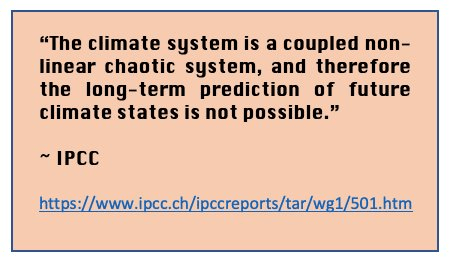
AB: This is the central claim of climate science, but it remains unproven. Chaotic systems are not inherently unpredictable—for example the multibody solar system—and three or more bodies under gravity are chaotic—appears to have remained stable and pretty easy to predict for billions of years.

Attempts to predict weather in the most straightforward way, breaking the atmosphere down into small parts and applying rules of physics, have not succeeded in precise or long-range predictions—but there clearly are weather patterns that repeat often enough they must have some explanation. Modern weather prediction relies mainly on observed regularities without firm theoretic explanations.

You may be right that weather prediction will always be intractable, but perhaps some out-of-the-box idea will change that. If it did, we’d probably understand a lot more about climate.

It’s not obvious that long-term averages are more stable and predictable than shorter-term ones. In the stock market, for example, prices are pretty close to a random walk and uncertainty increases pretty steadily with the square root of time interval.

If you look at actual temperature measurements over local areas or global, over time scales from days to millions of years, uncertainty seems to increase with time, but slower than the square root. The unit of most certainty seems to be a year—predicting the average temperature over the next year has less uncertainty than predicting tomorrow’s temperature, but also less uncertainty than predicting the average temperature over the next decade or century.

Trajectories of a double pendulum. The simple predictable behavior of a pendulum appears chaotic when a second pendulum is attached. How many factors interact in our climate system?

This is a pure statistical observation, ignoring all climate science. The claim of climate science is models that incorporate things like solar variation, volcanoes, human emissions and so forth can make long-range averages less uncertain than annual averages. But we’ll need a lot of examples of long-range predictions—centuries of data—to confirm that directly, without resorting to climate theory; meaning that’s unlikely to convince skeptics in this century.

Of course you’re right that there seem to be physical limits that cause climate to move in cycles rather than drifting off to entirely new regimes—but regimes do change, and on planets other than Earth perhaps to extremes like losing the atmosphere.

Long exposure of double pendulum exhibiting chaotic motion (tracked with an LED)

But conservation of energy, for example, does not necessarily impose a constraint. There are many ways for energy to be removed from or added to global temperatures. It’s not necessarily true that, say, reducing incoming solar radiation cools the planet. In a simple system, reducing heat input lowers temperature. But in a complex system you could touch off any number of positive and negative feedback effects that could lead to any outcome.

Comment: I think this group is under valuing the large amount of research that has been predicting increases in global temperatures and the effects it will cause. There is ample data on the rate of increase in green house gases [CO2 and Methane] caused by humans lately.

AB: Are you saying that the predictions will convince skeptics? I disagree for several reasons.

1. There have been many predictions, many of which were spectacularly wrong, none of which were spectacularly right. The more catastrophic the prediction, the more often it turned out to be spectacularly wrong. Now you can go back after-the-fact and say the people making the worst predictions were nuts and other people made predictions that were not spectacularly wrong, but skeptics will find this unconvincing—like someone sifting through horoscope predictions to find some that seemed to come true.

2. The more sober predictions have merely been extrapolations of the recent past, too obvious to convince skeptics. Every time anything happens lots of people claim to have predicted it, and that it will continue in the future until disaster. Skeptics think that if temperatures started falling tomorrow, the predictions would quickly shift to predicting global cooling.

3.  Yes, atmospheric CO2 levels have gone up, and those could cause temperature increases, and humans are emitting CO2, and there’s no other obvious explanation for the increases in CO2. But those are simple observations. To convince skeptics of your explanations and predictions, you have to do more. If temperature increases tracked CO2 increases—rather than CO2 going up steadily and temperature bouncing up and down with more down months than up months—but an overall increase, the connection is not obvious.

4. Videos like the one you posted that tell us what things will be like decades in the future, something we cannot check, will not convince skeptics.

I think I outlined the main things likely to convince skeptics in my answer.

Comment: Many of the inter related factors determining climate have non linear relationships so modeling is extremely challenging and in order to produce sensible sounding outputs, tuning software is used to produce an answer deemed politically correct. If funding agencies would ban the use of tuning software the model funding would soon stop because of the self evident garbage answers.

AB: I agree and would go even further. I think climate is chaotic, and cannot be usefully modeled.

Everyone agrees that weather is chaotic, so only tentative short-term predictions are useful. But the defining claim of climate science is that if you average parameters like temperature over the entire globe over 20-year periods, it becomes predictable.

But if you check that assumption by comparing the standard deviation of temperature changes over larger regions and longer periods, you see it hits a minimum at single locations over one year. You can predict the average temperature in Central Park over the next year more accurately than tomorrow’s average temperature over New York State, or 20-years’ average temperature in Central Park.

It’s possible that casual models driven entirely by physics could surmount that issue, but so far these have been entirely unsuccessful without statistical tuning—tuning that does not improve ability for future predictions. Moreover you would expect such a model to predict weather better than climate, and no models can do that—they can only claim successful predictions over periods too long for practical testing.

That doesn’t mean climate models are worthless, but they are less reliable than weather reports, not more reliable.

Comment: In the case of climate, it’s the case that a large chunk of conservatives are still conservationists, who don’t get counted as environmentalists because of the heavy left (Marxist, even) bent of the green movement over the last several decades. Why not appeal to this perspective?

AB: I think you’re focusing on the wrong issue. You don’t have to convince anyone that protecting the environment is important, you have to convince them you have a plan that will do more good than harm.

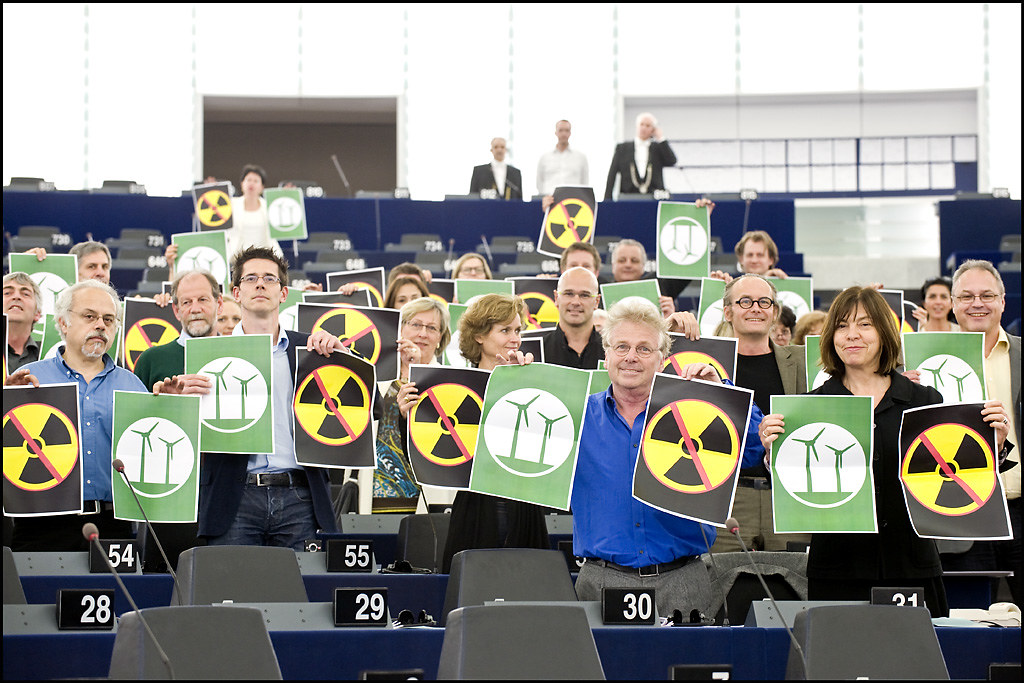
Nuclear power is a great example. It reduces CO2, but also other forms of pollution. It doesn’t require decades and trillions of dollars to build a new power-grid infrastructure, it’s plug-and-play with the existing system (almost, anyway). The technology is well-understood, safe and efficient. You won’t find opposition from conservatives, only from some liberals.

Several MEPs (mainly Greens) hold up anti-nuclear posters at the debate.

But other tactics will require more argument. A carbon tax, for example, would send technology and the economy down an entirely new path, with entirely unpredictable consequences. It would seem to increase uncertainty about future climate rather than decrease it. It has other issues as well. To gain support for one from skeptics, you’ll have to convince them that you can predict the effects of such a tax on human welfare in 2100 well enough to make it a good bet.

Geoengineering is the cheapest and surest way to reduce global temperatures, but it controversial on both left and right for its possible unintended consequences. Here you have to convince people the gain is worth the risk.

The single best no-brainer solution is to work for world peace and cooperation. War is the biggest threat to the environment and climate. Solutions to climate change and dozens of equally consequential global issues will require cooperation—or at least less conflict—among nations. Redirecting military spending to climate research and mitigation would do tremendous good. Best of all, world peace and global cooperation have many direct advantages, not just vastly improving our ability to respond rationally to issues like climate change.

Biden Declares National Emergency for War on Energy

Washington Examiner reports Biden’s war on energy: President invokes wartime powers to speed up end to gas-powered home appliance.  Excerpts in italics with my bolds and added images.

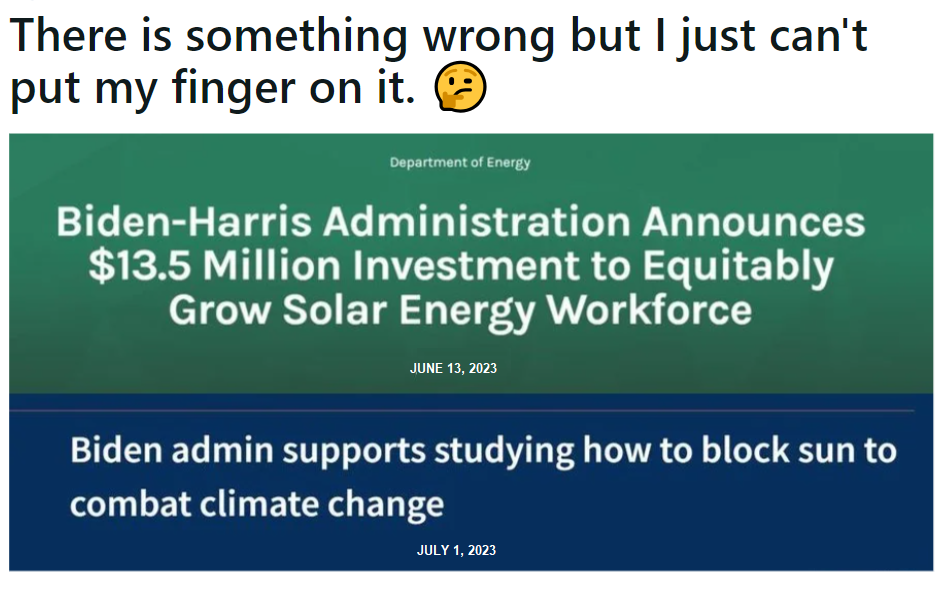
President Joe Biden allotted $169 million for electric heat pump projects with his emergency authority on the basis of climate change.

This is the first time a president classified climate change as an emergency by utilizing the Defense Production Act, which was established during the Cold War. Now, the money stemming from the Inflation Reduction Act will be divided among 15 sites dedicated to manufacturing the necessary parts and entire units of a variety of heat pumps.

“The President is using his wartime emergency powers under the Defense Production Act to turbocharge U.S. manufacturing of clean technologies and strengthen our energy security,” Biden’s National Climate Advisor Ali Zaidi said in a statement.

John Podesta, senior adviser to the president for clean energy innovation and implementation, similarly celebrated the move, applauding the president for “treating climate change as the crisis it is.”

However, American Gas Association President and CEO Karen Harbert disagreed with the recent move from the White House, writing in a statement, “We are deeply disappointed to see the Defense Production Act, which is intended as a vital tool for advancing national security against serious outside threats, being used as an instrument to advance a policy agenda contradictory to our nation’s strong energy position.”

“Increased use of natural gas has been responsible for 60% of the electrical grid’s CO2 emissions reductions. This vital tool for emissions reductions and energy system resilience should not be unfairly undermined through misuse of the Defense Production Act.”

Among the facilities, two new factories will be constructed: a Treau, Inc. DBA Gradient plant in Michigan and a Mitsubishi Electric plant in Kentucky. Neither company has announced exact locations yet. Treau will receive over $17 million, and Mitsubishi will receive $50 million toward construction.

The Energy Department predicts roughly 1,700 jobs will be created in the various projects to promote more heat pump products. All the sites are centered in “disadvantaged communities” for their benefit.

Last year, the Energy Information Administration reported that natural gas was the water and space heating source of about 42% of U.S. residential spaces. The residential sector makes up 15% of overall natural gas consumption. However, heating and cooling across residential and commercial buildings drive more than 35% of the country’s energy consumption.

Footnote on Declaring Climate Emergency for Spending Purposes

This report on the German High Court ruling on this matter Europe Plunges Into Chaos After Germany Freezes Public Spending Following Shock Top Court Decision.  Excerpts in italiics with my bolds.

Germany’s economy, Europe’s largest, is contracting as surging energy prices and trade tensions cast doubt on its export-oriented business model. Chancellor Olaf Scholz’s government had been counting on that old virtue signaling switcheroo – a flood of spending on “green-energy projects and technology”, from chips to batteries, to revive the old model. That way, if anyone asks why Germany is deficit-spending its way to mercantilist utopia, Berlin could always lie and say it was doing the right thing for the world and wasn’t interested in a debt-funded stimulus. Alas, now the “Cardinals of Karlsruhe” have made this impossible.

Berlin’s decision to freeze all federal spending for the rest of the year came after the court defunded the government’s €60 billion —the equivalent of more than $65 billion—green-transition project. The court said Berlin couldn’t repurpose unspent credits originally earmarked to tackle the Covid-19 pandemic to fund environmental and energy projects. It said Berlin was bound by the country’s constitutionally enshrined fiscal rules that limit budget deficits to 0.35% of gross domestic product in normal times.

Senior government officials said one option under consideration would be to retroactively declare a state of budgetary emergency for 2023, invoking a clause in the fiscal rules that allows for a suspension of the spending limits in exceptional circumstances. Previous governments invoked the exception during the pandemic.

Unfortunately, for Germany’s stimmy-starved politicians, the plan is fraught with legal difficulties, in part because the constitutional court prepared for just this eventuality when it raised the bar for declaring such emergencies, according to Lars Feld, an economist who advises the government.

Strengthening resilience and transforming the economy amid geopolitical crises and climate change was seen as a necessity that required taking on debt, but the court ruling has challenged those assumptions, Feld wrote in the Frankfurter Allgemeine newspaper.

Hilariously, the court said that unlike war and natural disasters, climate change was a foreseeable crisis that had been long in the making and could no longer justify emergency spending. Which, however, means that all Germany will have to do is politely request that the CIA start a new war… or that Fauci mail orders a new virus from Wuhan.


Climate Tipping Points Are Fantasy, Not Science

Sahara has been shrinking over the past decades. Image: NASA

P Gosselin provides an english translation for an interview with prominent German geologist and Sahara expert Dr. Stefan Kröpelin.  The NoTricksZone article is Sahara Expert Says Desert Shrinking, Calls Alarmist Tipping Points “Complete Nonsense”.  Excerpts in italics with my bolds.

Climate tipping points are much more fantasy than science

Dr. Kröpelin is an award-wining geologist and climate researcher at the University of Cologne and specializes in studying the eastern Sahara desert and its climatic history. He’s been active out in the field there for more than 40 years.

In the Auf 1 interview, Dr. Kröpelin contradicts the alarmist claims of growing deserts and rapidly approaching climate tipping points. He says that already in the late 1980s rains had begun spreading into northern Sudan and have since indeed developed into a trend. Since then, rains have increased and vegetation has spread northwards. “The desert is shrinking; it is not growing.”

Kröpelin confirms that when the last ice age ended some 12,000 years ago, the eastern Sahara turned green with vegetation, teemed with wildlife and had numerous bodies of water 5000 – 10,000 years ago (more here).

Later in the interview Kröpelin explains how the eastern Sahara climate was reconstructed using a vast multitude of sediment cores and the proxy data they yielded. According to the German geology expert: “The most important studies that we conducted all show that after the ice age, when global temperatures rose, the Sahara greened”…”the monsoon rains increased, the ground water rose”. This all led to vegetation and wildlife taking hold over thousands of year.

Then over the past few thousands of years, the region dried out. It didn’t happen all of a sudden like climate models suggest.

Modelers don’t understand climate complexity

When asked about dramatic tipping points (8:00) such as those claimed to be approaching by the Potsdam Institute (PIK), Kröpelin says he’s very skeptical and doesn’t believe crisis scenarios such as those proposed by former PIK head, Hans-Joachim Schellnhuber. He says people making such claims “never did any studies themselves in any climate zone on the earth and they don’t understand how complex climate change is.”

Except for catastrophic geological events, “it’s not how nature works,” Kröpelin says. “Things change gradually.”

The claims that “we have to be careful that things
don’t get half a degree warmer, otherwise everything will collapse,
is of course complete nonsense.

“I would say this concept [tipping points] is baseless. Much more indicates that they won’t happen than that they will happen.”

Late last year in Munich, he called the notion of CO2-induced climate tipping points scientifically outlandish. He also called the prospect of the Sahara spreading into Europe preposterous.

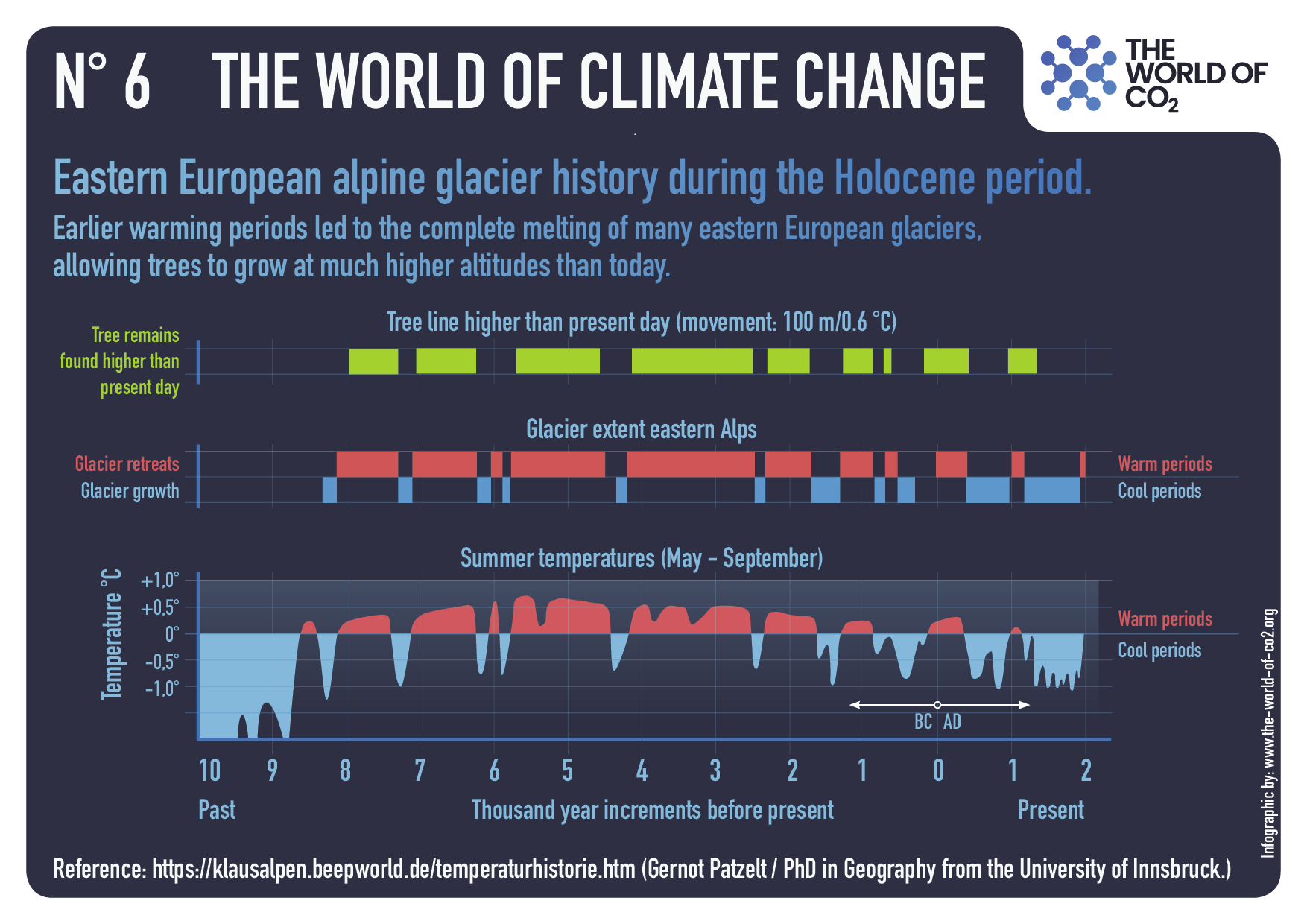
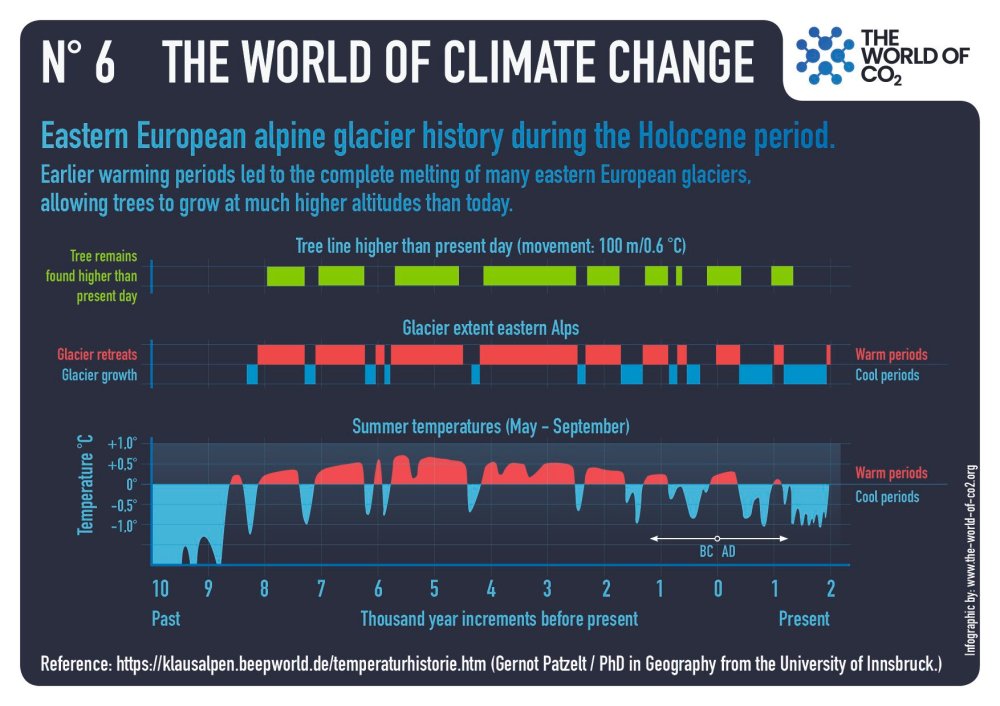
Another example is the fluctuating cycles of Alpine glaciers, waxing and waning over periods of time.

Background Post

Bogus Talk about Climate Tipping Points

Finally, as the critique shows, tipping points are like climate change itself: Applying labels to something that has already happened, with no predictive utility.


Climatists Deniers of Reality

Glenn Spitzer turns the table on alarmists in his American Thinker article Who Are the Real Climate Change Deniers? Excerpts in italics with my bolds and added images.

Who are these “climate change deniers” we hear so much about? Does anyone really doubt the climate changes?   Well, yes.  There are climate change deniers — a lot of them.  They live right under our noses, and they are celebrated.  Here’s a quote from one of the most famous climate change deniers:

Our civilization has never experienced any environmental shift remotely similar to this. Today’s climate pattern has existed throughout the entire history of human civilization.

That was Al Gore in 2007.  According to Gore, the climate was “shiftless” for thousands of years — a paradigm of stability.

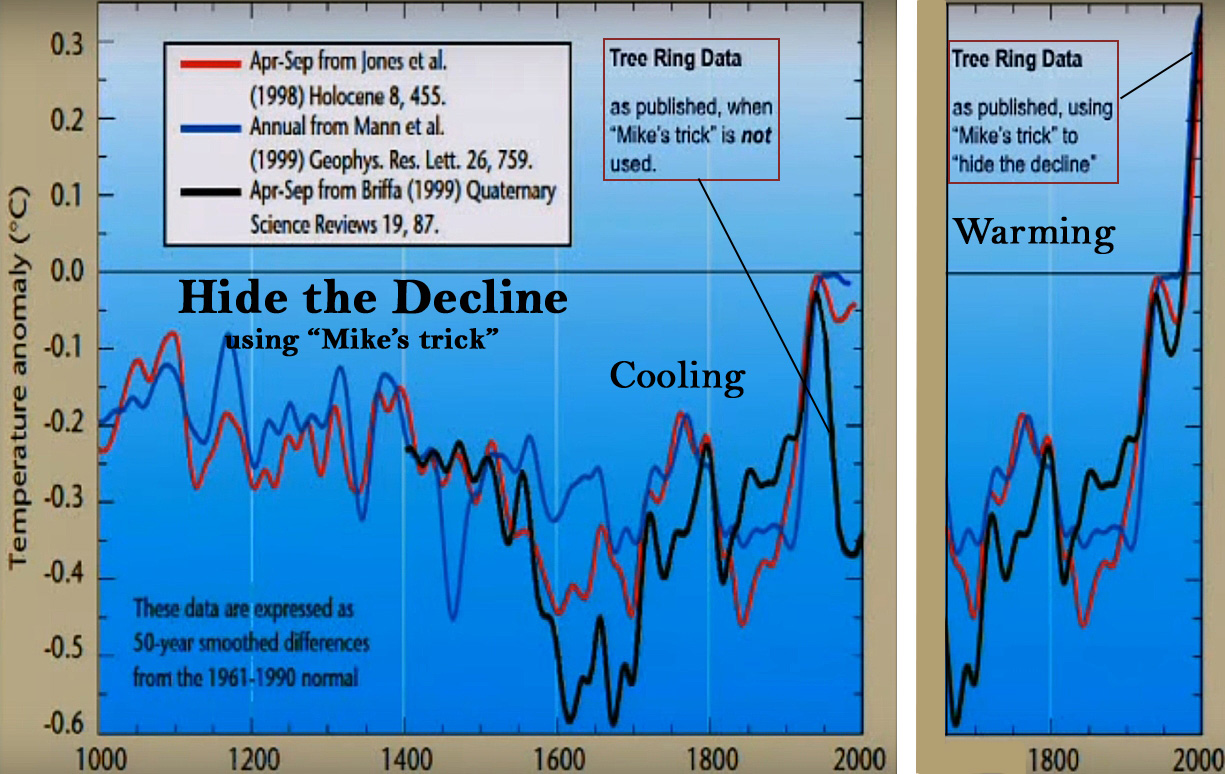
Gore’s quote was a restatement of Michael Mann’s 1998 “hockey stick.”  Mann argued that the Earth’s climate held steady for all of human history (the hockey stick handle), until suddenly, in the 1900s, the temperatures increased, representing the upturned blade of the hockey stick.

Mann’s theory is the basis of the modern CO2-focused “global warming” movement, which ironically morphed into the “climate change” movement.  Mann’s theory informs the positions taken by the Intergovernmental Panel on Climate Change (IPCC), the agency dictating policy to your local, state, and federal governments.
The most important assumption in Mann’s theory is that there was no climate change prior to the 20th century.  But this assumption is false.  It is climate change denial; it is the sacrifice of truth for a desired outcome.

The first graph appeared in the IPCC 1990 First Assessment Report (FAR) credited to H.H.Lamb, first director of CRU-UEA. The second graph was featured in 2001 IPCC Third Assessment Report (TAR) the famous hockey stick credited to M. Mann.

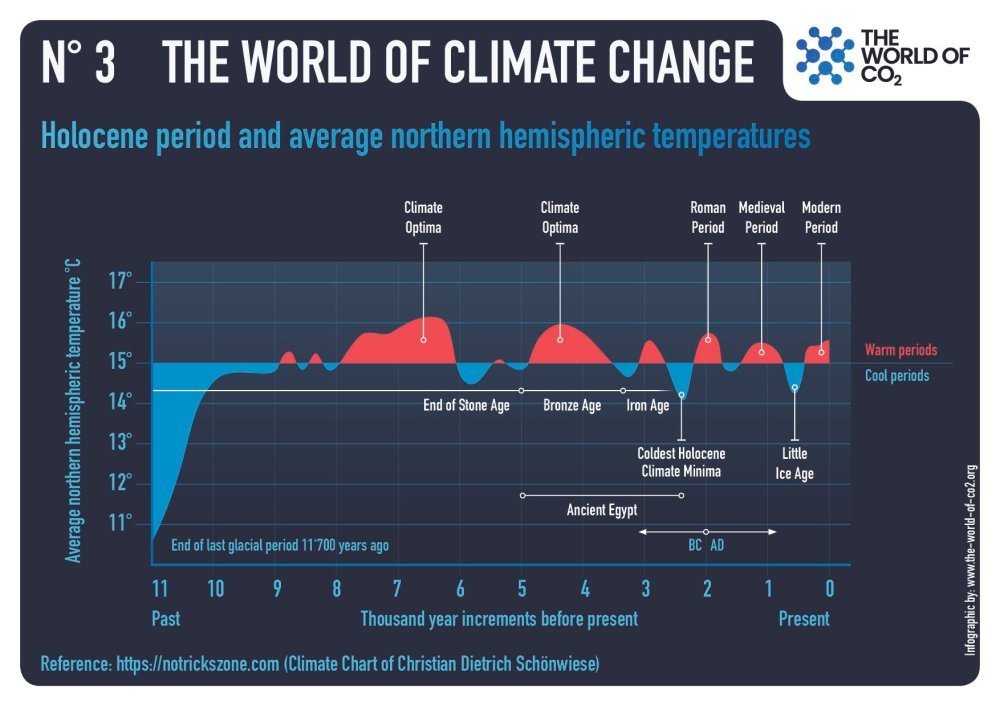
Mann’s 1998 study intentionally ignored several thousand scientific publications showing other periods of climate change throughout human history, such as the Medieval Warm Period (about A.D. 900 to 1300), the Little Ice Age (about 1300 to 1915), and the Roman Warm Period (about A.D. 1 to 500).  Despite claims of perpetual stability, it turns out the climate is always changing.

Scientists estimate that, during the Medieval Warm Period, for example, the temperatures in parts of Europe were 1.0–1.4° Celsius (1.8–2.5° Fahrenheit) warmer than they are now.  Oxygen isotope studies in China, Germany, Greenland, Ireland, New Zealand, Switzerland, and Tibet, as well as tree ring data from many sites throughout the world, confirm the Medieval Warm Period.  The studies are so numerous (several thousand published papers confirming this warming) that it raises the obvious question: “Why do climate activists deny that the climate is always changing?”


There are two important reasons why activists deny climate change.  First, the acceptance of prior warming periods undermines the argument that a modern warming is an existential threat, and second, prior warming periods undermine the idea that anthropogenic (man-made) CO2 is the primary cause of climate change.

The Medieval Warm Period is a particularly inconvenient truth for the modern climate activists because it shows that warming has beneficial effects on humanity.  As the European region became warmer, agriculture spread and generated food surpluses.  The European population doubled.  In short, the Medieval Warm Period underscores the reality that, while humans struggle in colder weather, we generally thrive in warmer weather.

In other words: no crisis justifying extraordinary intervention.

But more importantly, what does a constantly changing climate say about the effects of anthropogenic CO2?

The fact that the climate has been changing significantly for thousands of years (actually millions) raises the question: what causes climate change?  This is a messy question.  Activists seek to foreclose options by addressing causation through simple correlation.  If climate change is only a recent phenomenon, one that began coincidentally with the rise in anthropogenic CO2, then causation is simple.

However, if this fact pattern is a fiction, then the correlation argument falls apart.  When we understand the climate is always changing, and was changing well before the rise of anthropogenic CO2, then we are confronted with the reality that other factors are at play.  Anthropogenic CO2 is placed in proper context as a potential factor of uncertain significance.  Importantly, when simple correlation no longer drives our analysis, we are freed to assess other causal factors more seriously.

When people acknowledge that anthropogenic CO2 could not possibly cause climate change throughout human history, they are forced to question their religion.  When guided by truth instead of ideology, the following questions become more interesting:

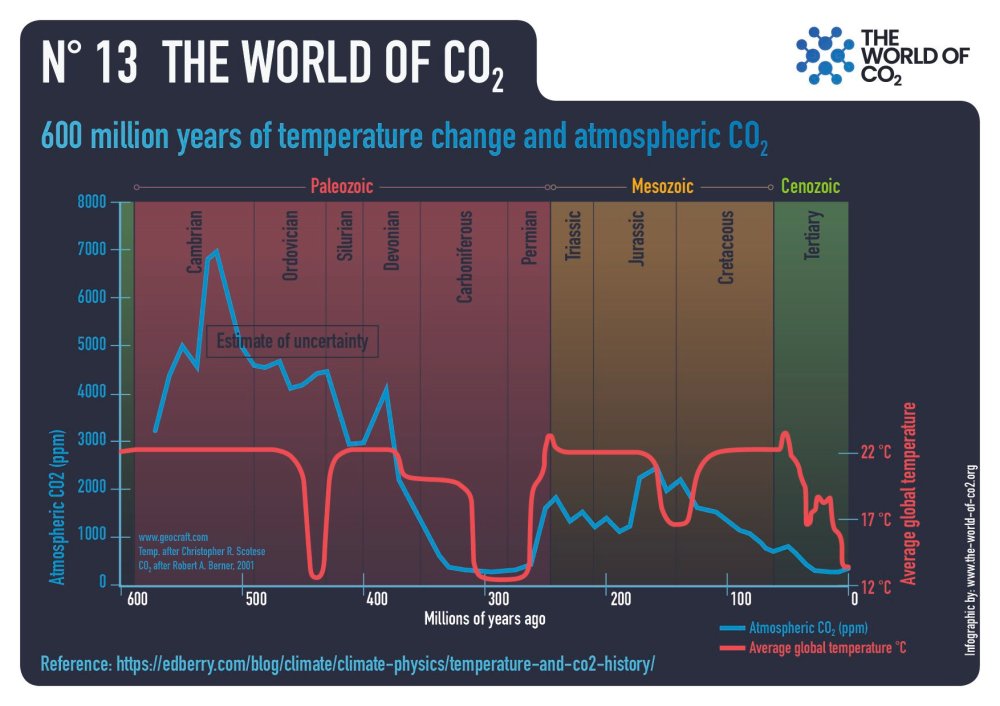
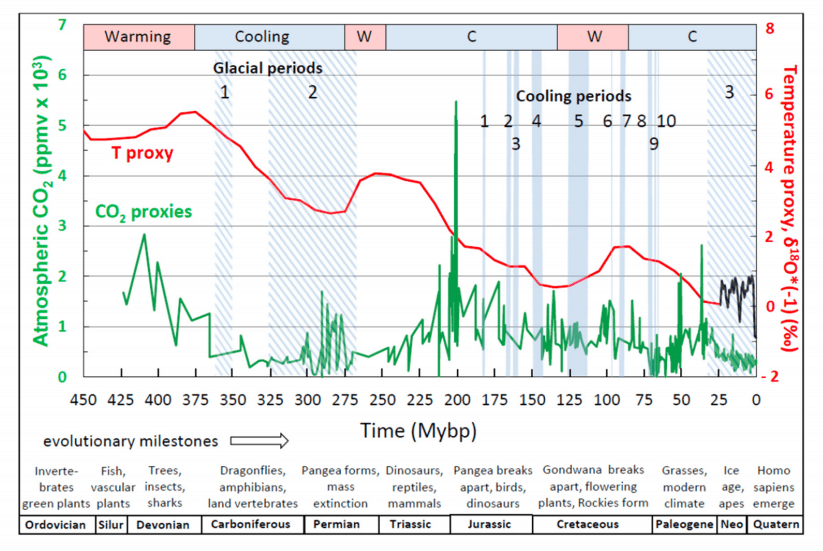
  • How is it that the last six great ice ages started with far more CO2 in the atmosphere than we have now?

Figure 16. The geological history of CO2 level and temperature proxy for the past 400 million years. CO2 levels now are ~ 400ppm

  • Is it true, as many experts note, that temperatures drive CO2 levels, and not the other way around?

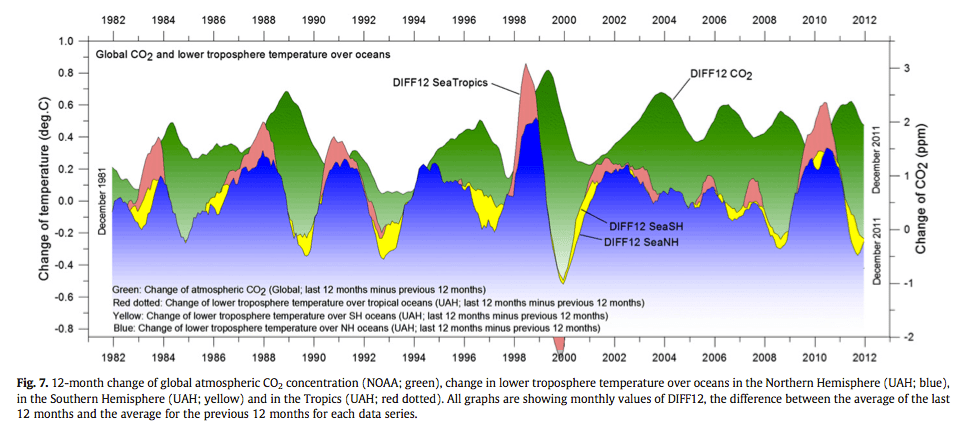
Highlights ► Changes in global atmospheric CO2 are lagging 11–12 months behind changes in global sea surface temperature. ► Changes in global atmospheric CO2 are lagging 9.5–10 months behind changes in global air surface temperature. ► Changes in global atmospheric CO2 are lagging about 9 months behind changes in global lower troposphere temperature. ► Changes in ocean temperatures explain a substantial part of the observed changes in atmospheric CO2 since January 1980. ► Changes in atmospheric CO2 are not tracking changes in human emissions.

  • How does anthropogenic CO2 drive climate when it makes up less than 5% of total CO2 (with most coming from the oceans, volcanoes, decaying vegetation, and forest fires)?

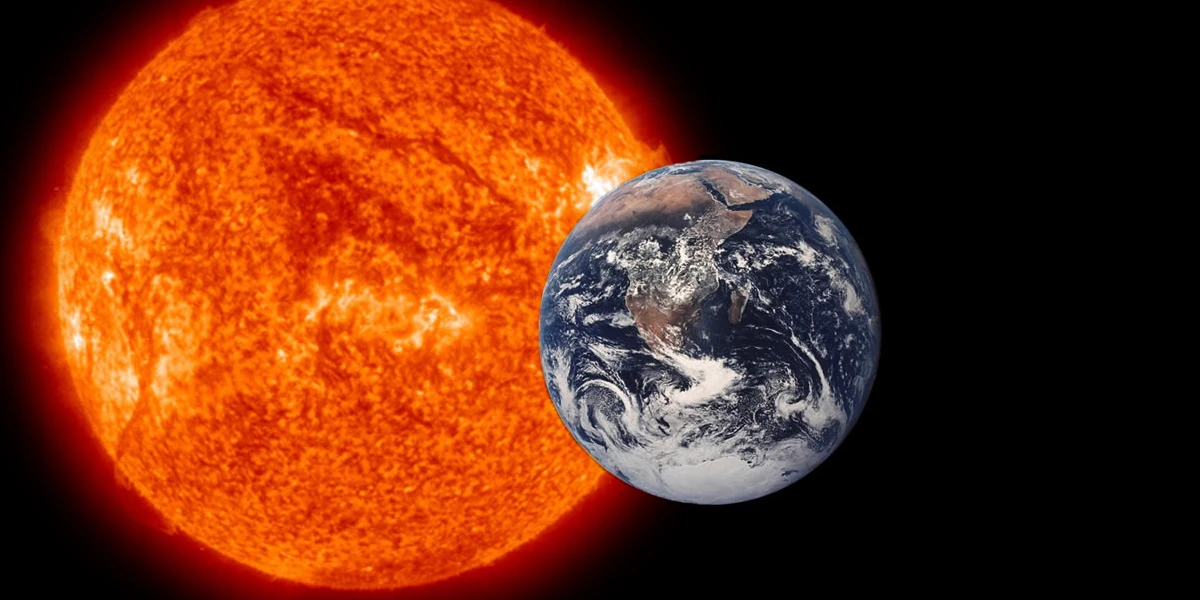
  • Isn’t the sun the most important cause of climate, and what effects follow from sun spots and solar flares?

  • If greenhouse gases (GHGs) are the most significant drivers of climate change, then why do we focus on CO2, when water vapor (i.e., clouds) is a far more impactful GHG?  (In fact, there have been a flurry of recent published studies on the effects of clouds.)

For many in science, self-preservation and status remain subordinate to truth and courage.  Many have sacrificed research funding and reputation to criticize Mann’s theories, including IPCC lead authors John Christy (former NASA climatologist) and Richard Lindzen (former MIT professor).  In fact, numerous climate experts upended their professional lives by pointing out that Mann’s theory is more activism than fact (including Professors Tim Ball, Ian Clark, Ian Plimer, NirShaviv, Piers Corbyn, Steven Koonin, Judith Curry, and William Happer — to name a few).

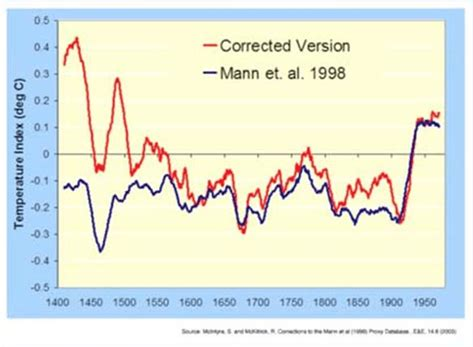
Experts Steve McIntyre and Ross McKitrick presented a detailed analysis of the flaws of Mann’s 1998 theory in a series of studies in 2003 and 2005, detailing the numerous technical flaws with Mann’s analysis.  They found that Mann’s theory was invalid “due to collation errors, unjustifiable truncation or extrapolation of source data, obsolete data, geographical location errors, incorrect calculation of principal components and other quality control defects.”

Hockey stick graph corrected by McKitrick and McIntyre after removing Mann’s errors.

In a 2014 paper, McKitrick summarized the theory’s most significant problem as an issue of unreliable proxy data.  Namely, Mann relied on a small and controversial subset of tree ring records of bristlecone pine cores from high and arid mountains in the U.S. Southwest.  The scientists who published the tree ring data on which Mann relied (published by Graybill and Idso in 1993) specifically warned that the data should not be used for temperature reconstruction and that the 20th-century data had regional anomalies.

The overarching takeaway here is that we cannot cede the power of thought to the  “experts.” Experts serve an important role in that they assist us in analyzing matters beyond our common understanding.  But experts are mere fallible humans.  When they are controlled by their biases, flawed in their analysis, or misguided by incorrect data, then we must reject their conclusions.


Green Crash Ahead

Duggan Flanakin writes at Real Clear Energy Climate Enron May Be Heading for a Crash.  Excerpts in italics with my bolds and added images.

Today, the collapse of FTX and the recent criminal conviction of founder and CEO Sam Bankman-Fried (who is facing a lifetime behind bars) brings Enron, Skilling, and Lay to mind. But, despite the magnitude of SBF’s fraud, it pales in comparison to the ongoing fraud being perpetrated mostly on America and its Western allies in the name of “climate change.”

A bit like FTX, but unlike Enron, there are plenty of warning signs that the “Green Revolution” is about to come tumbling down and its loudest advocates brought to account. The main thing keeping the mirages afloat today is the massive egos and their investments in folly that may leave them going down with the ship.

While the “Green Revolution” has been under way for decades, it is the Biden Administration that has imposed mandates, attacked popular energy sources and transportation options, and waged war against traditional industrial development. Europeans and states like California had earlier imposed their own mandates with supposedly “hard” deadlines for abolishing the use of oil, natural gas, coal, and every tool or vehicle that uses them.

The green war on fossil fuels, as fleshed out in the “Net Zero” campaign,
is perhaps history’s greatest example of philosophical fraud.

And the corollary: Reality is also that which happens instead of what you wanted and expected. 

“To dream the impossible dream” and turn it into reality would mean sacrificing an estimated 6,000 useful products that rely on byproducts from crude oil refineries – products that range from asphalt for highways to fertilizers, cosmetics, synthetic rubber, medicines and medical devices, cleaning products, plastics, so many more. The 3 billion who live without the benefits fossil fuels have provided are also the poorest, sickest, and most vulnerable humans on the planet.

Cracks are already developing in the “Net Zero” world, what with countries backing away from the mandates they so recently touted while marching around like peacocks in mating season. In March the European Union reached an agreement with Germany to formally back away from its total ban on internal combustion engines in 2035.

Still, 30 countries are signatories to the Glasgow Declaration that would force all vehicles sold by 2040 to have zero carbon dioxide emissions, and 21 others have crafted plans to ban new ICE vehicle sales earlier than 2040. Dozens of major cities and states, most notably California and the California clone states, intend to disallow new ICE vehicles by 2035.

Several problems stand in the way of their utopian dream. Even EV advocates are now admitting the “EV-olution” has to overcome “serious issues” – like the use of child labor in lithium mining, the woefully inadequate EV charging infrastructure, and an unprepared power grid. Yet the biggest obstacle is that a majority of the Earth’s people object to having EVs – or heat pumps, or electric stoves, and so on — shoved down their throats.

EVs may be fine for short-trip urban travel but not for construction equipment, airplanes, or even urban buses, as evidenced by the recent horrific scene in San Francisco when a Google-operated electric bus lost power and slid backwards downhill into nine vehicles. Today’s EVs are wholly impractical for mountain and prairie residents or others making long trips (worse with children).

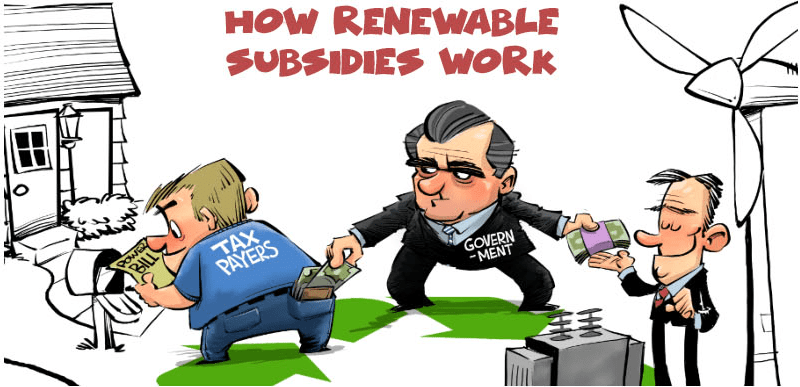
Like Ken Lay with Enron, the Green revolution has relied heavily on government subsidies and a “revolution always” business philosophy aimed at making pariahs of anyone who dares oppose the grandiose – but fatally flawed – plan.

During the Obama Administration, Solyndra went under despite a $535 million government-guaranteed loan, none of which was paid back. Forbes, citing OpenTheBooks.com, noted that taxpayers were left holding the notes for $400 million given to Abound Solar, $280 million wasted by CaliSolar, $193 million doled out to Fisker Automotive (with another $336 million canceled), and $132 million to A123 Systems (a failed battery maker).

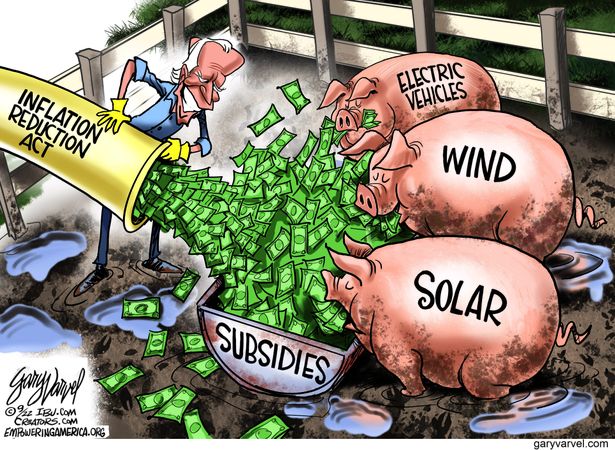
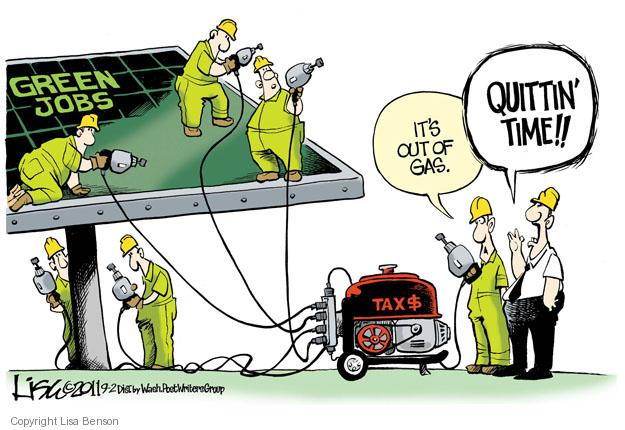
Undaunted, the Biden Administration’s $2.3 trillion “jobs” package was rife with more subsidies for technologies that by their own admission are unsustainable. Yet despite all the free money, Ford, General Motors, and many other automakers are backing away from multibillion-dollar investments in new EV factories as new EV sales have slowed despite increased rebates.

Ford in March projected a loss of $3 billion on electric vehicles in 2023, offsetting profits of as much as $14 billion from its other divisions. Ford also admitted losses of $900 million in 2021 and $2.1 billion in 2022 in its EV division. Ford and GM believe their EV fortunes will turn around by 2025, but those rosy scenarios seem wholly dependent upon Biden (or an even “greener” Democrat) winning the White House next November.

Even with a Green win in 2024, reality will still bite the EV dream. China has been quietly moving toward total dominance in the global EV marketplace – largely because it controls the lithium battery market. Financial Times wrote in September that China is so far ahead in the EV market that its competitors are trailing in the dust.

Biden’s reliance on huge subsidies to underwrite the “Green Revolution” has brought soaring inflation to the U.S. that is taking away purchasing power faster than it can increase subsidies and Mafia-style “incentives” (you will buy what we want you to buy, or else!).

Lay died of a heart attack shortly after his trial, leaving behind “a legacy of shame” characterized by “mismanagement and dishonesty” that led Politico to rank him as the third-worst American CEO of all time.

America’s doddering President Biden, now facing pre-impeachment hearings for other alleged mistakes, may not live to see his name smeared as Lay’s once was. But does anyone truly believe Biden is calling all the shots here?

Who will, then, get the blame if America’s forced march to
EV subservience to Xi’s China brings an end to
America’s hegemony on the world stage?

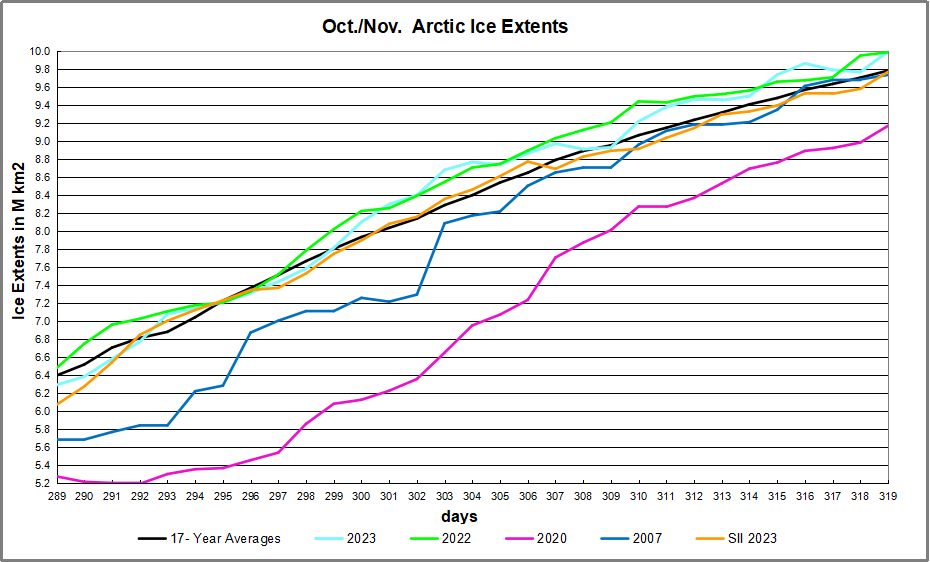
Mid-Nov. 2023 Arctic Ice Grows to 10 Wadhams

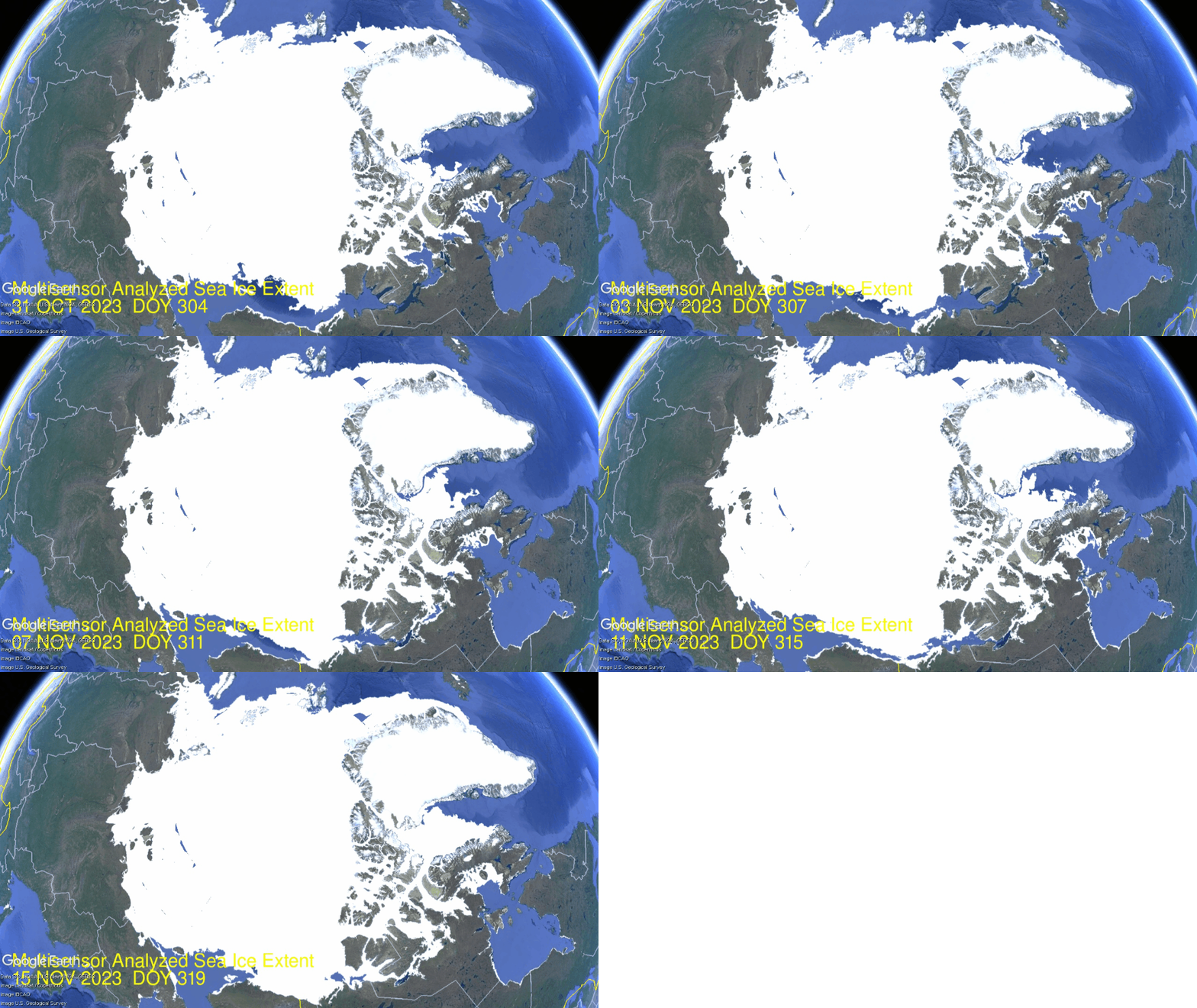
The animation shows the rapid growth of Arctic ice extent during November 2023, from day 304 to yesterday, day 319.  For all of the fuss over the September minimum, little is said about Arctic ice growing back rapidly; that’s 4 Wadhams in October, plus another 1.3M in Nov to total 10M km2, or 10 Wadhams.  The Russian side on the left froze over in October, and now at the center bottom you can see Beaufort sea and Canadian Archipelago icing up. Center right is Baffin Bay growing ice as well.

The graph below shows the last 30 days of 2023 compared to the 17 year average (2006 to 2022 inclusive), to SII (Sea Ice Index) and some notable years.


From Mid October to Mid November 2023, MASIE shows NH ice extent growing from 6.3 M km2 to 10M.  That matches 2022 and exceeds the 17 year average by more than 200K km2.   SII (Sea Ice Index) is only slightly lower.

The table below shows the distribution of ice in the Arctic Ocean basins.

Region 2023319 Day 319 Ave. 2023-Ave. 2007319 2023-2007
 (0) Northern_Hemisphere 9997068 9784253  212815  9737614 259454 
 (1) Beaufort_Sea 1051194 1063450  -12257  1053727 -2533 
 (2) Chukchi_Sea 596947 629695  -32748  503783 93164 
 (3) East_Siberian_Sea 1064913 1075985  -11072  1043952 20960 
 (4) Laptev_Sea 897845 897217  628  897845
 (5) Kara_Sea 696199 658489  37710  765376 -69177 
 (6) Barents_Sea 245998 154920  91078  145438 100560 
 (7) Greenland_Sea 613312 460620  152692  527575 85737 
 (8) Baffin_Bay_Gulf_of_St._Lawrence 536576 526706  9870  533931 2645 
 (9) Canadian_Archipelago 841536 850736  -9200  852539 -11003 
 (10) Hudson_Bay 161371 234076  -72704  231544 -70173 
 (11) Central_Arctic 3236821 3174741  62081  3156228 80594 

Overall ice extent has 212k km2 above average or 2%.  The only sizeable deficit is in Hudson Bay,  more than offset by surpluses elsewhere, especiallly in Greenland and Barents seas, along with the Central Arctic.


Climate Alarmists Ignore Nitrogen Deficiency

From the Advanced Science Research Center, GC/CUNY Earth Has Too Much Nitrogen – and Too Little Nitrogen – at the Same Time.  Excerpts in italics with my bolds

Multi-institutional research team finds declining
nitrogen availability in a nitrogen-rich world.

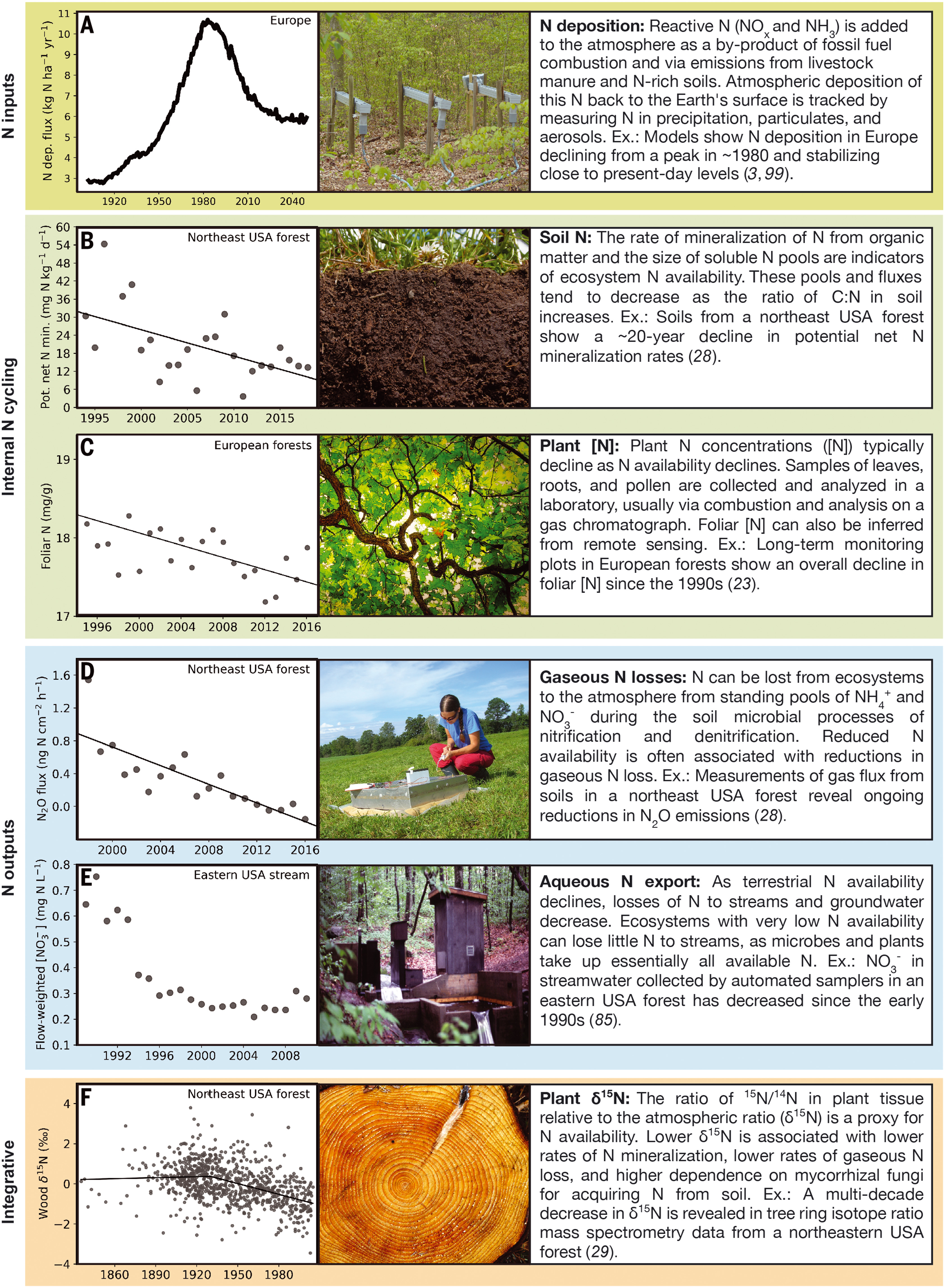
Since the mid-20th century, research and discussion have focused on the negative effects of excess nitrogen on terrestrial and aquatic ecosystems. However, new evidence indicates that the world is now experiencing a dual trajectory in nitrogen availability. Following years of attention to surplus nitrogen in the environment, our evolving understanding has led to new concerns about nitrogen insufficiency in areas of the world that do not receive significant inputs of nitrogen from human activities. In a new review paper, “Evidence, Causes, and Consequences of Declining Nitrogen Availability in Terrestrial Ecosystems,” in the journal Science, a multi-institutional team of researchers describes the causes of declining nitrogen availability and how it affects ecosystem function.

Over the last century, humans have more than doubled the global supply of reactive nitrogen through industrial and agricultural activities. This nitrogen becomes concentrated in streams, inland lakes, and coastal bodies of water, sometimes resulting in eutrophication, low-oxygen dead zones, and harmful algal blooms. These negative impacts of excess nitrogen have led scientists to study nitrogen as a pollutant. However, rising carbon dioxide and other global changes have increased demand for nitrogen by plants and microbes, and the research team’s newly published paper demonstrates that nitrogen availability is declining in many regions of the world, with important consequences for plant growth.

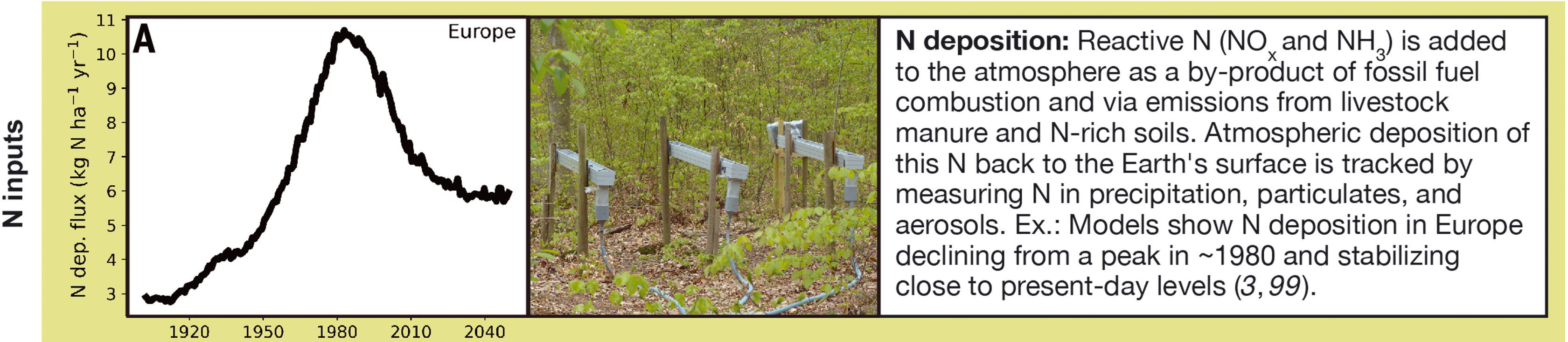
[Note the Nitrogen Deposition graph in the top diagram. It peaked in the 1980s, yet in 2023 it is being used to force farmers off their land in the Netherlands,Canada, Ireland and other nations to come]

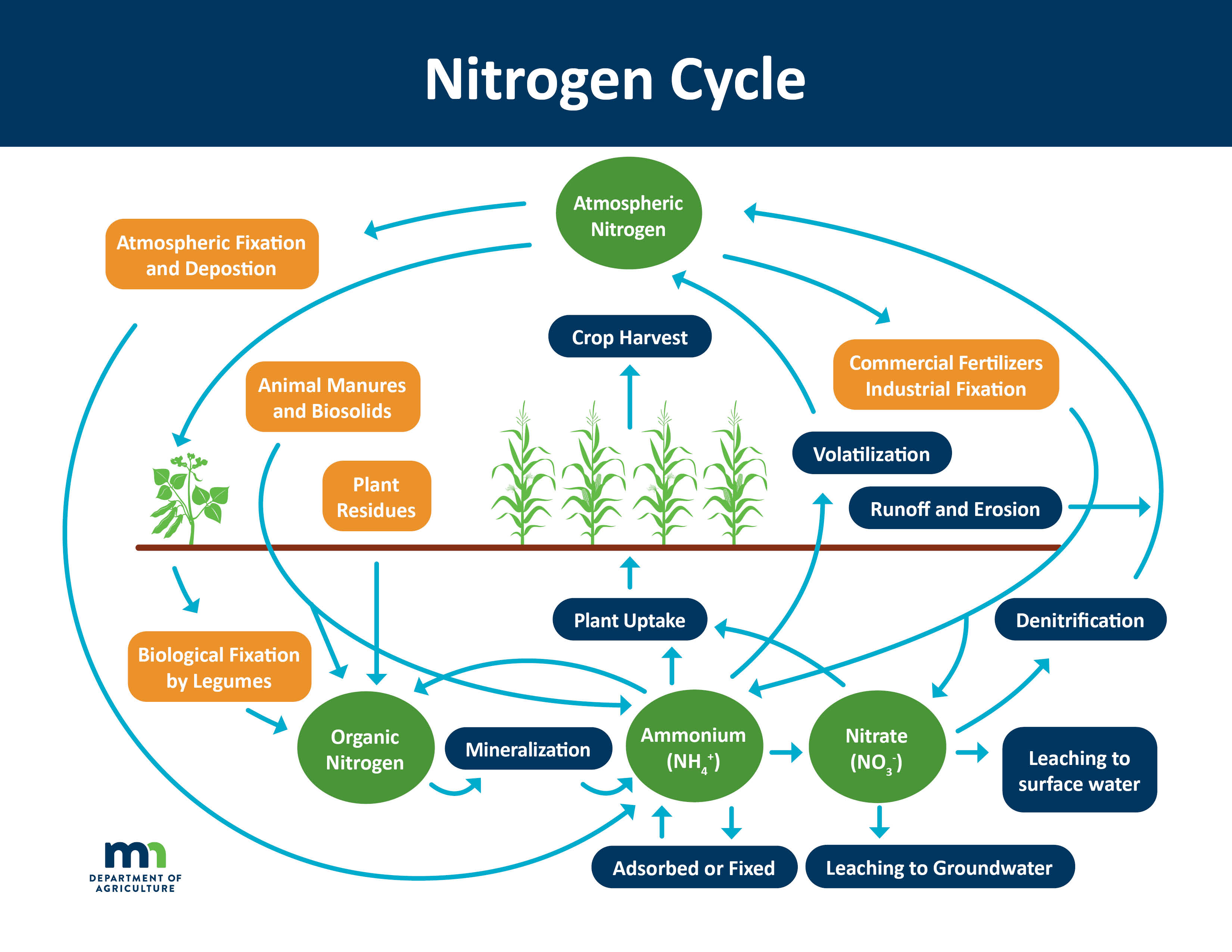
Nitrogen is an essential element for plants and the animals that eat them. Gardens, forests, and fisheries are all more productive when they are fertilized with nitrogen. If plant nitrogen becomes less available, trees grow more slowly and their leaves are less nutritious to insects, potentially reducing growth and reproduction, not only of insects, but also the birds and bats that feed on them.

“When nitrogen is less available, every living thing holds on to the element for longer, slowing the flow of nitrogen from one organism to another through the food chain. This is why we can say that the nitrogen cycle is seizing up,” said Andrew Elmore, senior author on the paper, and a professor of landscape ecology at the University of Maryland Center for Environmental Science and at the National Socio-Environmental Synthesis Center.

On top of increasing atmospheric carbon dioxide, rising global temperatures also affect plant and microbial processes associated with nitrogen supply and demand. Warming often improves conditions for growth, which can result in longer growing seasons, leading plant nitrogen demand to exceed the supply available in soils. Disturbances, including wildfires, can also remove nitrogen from systems and reduce availability over time.

Intercalibration of isotopic records from leaves, tree rings, and lake sediments suggests that N availability in many terrestrial ecosystems has steadily declined since the beginning of the industrial era. Reductions in N availability may affect many aspects of ecosystem functioning, including carbon sequestration and herbivore nutrition. Shaded areas indicate 80% prediction intervals; marker size is proportional to the number of measurements in each annual mean.Isotope data: (tree ring) K. K. McLauchlan et al., Sci. Rep.7, 7856 (2017); (lake sediment) G. W. Holtgrieve et al., Science334, 1545–1548 (2011); (foliar) J. M. Craine et al., Nat. Ecol. Evol.2, 1735–1744 (2018)

Our evolving understanding of the Earth system has led to new concerns about N insufficiency after years of attention to surplus N in the environment. An integrated suite of responses will be needed to simultaneously manage both of these problems. Given the potential implications of declining N availability for food webs, carbon sequestration, and other ecosystem functions and services, it is important that research, management, and policy actions be taken before the consequences of declining N availability become more severe. It can be difficult to create a shared understanding of the N cycle and the many effects of N on ecosystem health and human well-being. The combination of excess N and declining N availability, in which outcomes vary widely across landscapes, adds to this challenge. Developing dialogues among diverse stakeholders—scientists, ecosystem managers, and others—will be necessary for alleviating and adapting to declining N availability in an N-rich world.
 

Phony Nitrogen Crisis for Making War on Farmers

A war against farmers has emerged, threatening to push them off the land they’ve farmed for generations. As small and mid-sized farms close their doors, governments and corporate entities can scoop up the land.  Those in control of the land control the food supply and, along with it, the people.

In Canada,  Trudeau’s Liberals have announced a goal of a 50 percent reduction in emissions from fertilizer, a major producer of nitrous oxide, over the next seven years.

“Fertilizer Canada slammed the government’s short-sighted approach, arguing that reducing nitrogen fertilizer use “will have considerable impact on Canadian farmers’ incomes and reduce overall Canadian exports and GDP.”

They may as well slam their heads against a barn door. When it comes to Canada’s re-invention as a socialist state, nothing will knock the communist ship off its course.

“A report compiled by Meyers Norris Penny suggests that regulated fertilizer reduction could cost Canadian farmers $48 billion by 2030 and reduce crop sizes.”

Justin Trudeau has waged war against his own country since the day he became PM in 2015. This man doesn’t like our country very much, and in particular, maintains an innate hatred toward working class Canadians. Perhaps it’s because he has never been one. Then again, it could be part of a larger plot unfolding within society.

It was destined to roll around eventually: an attack on Canadian farmers under that gloriously green, climate emergency banner. This recent Trudeau move involves limiting the usage of fertilizer — a substance, when delivered in its most smelly, natural form, reminds us of what the federal Liberals have long shoveled upon Alberta.

Cutting the bull and arriving at the meat, so to speak: the government intends to effectively reduce farmers’ use of fertilizer by 50 per cent — in scientific terms by limiting the use of the key ingredient nitrous oxide — as part of its bid to severely reduce carbon emissions and thereby fight accelerating climate change.

Farmers, instead, want any fertilizer reductions measured by how much food is produced compared to the amount of fertilizer used, something western growers are striving for already, as growing more for less saves them money in addition to curbing emissions.

Now, when there’s a global food emergency looming due to the ongoing war in Ukraine, such a practical step would seem eminently sensible. But no, Trudeau is demanding an absolute reduction in usage, which will naturally result in less food being produced.

Contributing to global starvation has now become
part of current Canadian public policy.

This latest stupidity was undoubtedly spawned when our prime minister — always looking to one-up any country competing in the green-morality sweepstakes — learned the Dutch government intended such a move.

In the Netherlands that immediately resulted in mass protests by furious farmers, who closed highways with tractors, brought cows to the capital, threatening to slaughter them on parliamentary steps, while blocking vital food distribution centres.

Is the Nitrogen Crisis Real?

“In 2021, the European Union’s Natura 2000 network released a map of areas in the Netherlands that are now protected against nitrogen emissions. Any Dutch farmer who operates their farm within 5 kilometers of a Natura 2000 protected area would now need to severely curtail their nitrogen output, which in turn would limit their production”

Dutch dairy farmer Nynke Koopmans with the Forum for Democracy believes the nitrogen problem is made up. “It’s one big lie,” she says. “The nitrogen has nothing to do with environmental. It’s just getting rid of farmers.” Another farmer said if new nitrogen rules go into effect, he’d have to reduce his herd of 58 milking cows down to six.

Nitrogen scientist Jaap C. Hanekamp was working for a government committee to study nitrogen, tasked with analyzing the government’s nitrogen model. He told Balmakov:8

“The whole policy is based on the deposition model about how to deal with nitrogen emissions on nature areas. And I looked at the validation studies and show that the model is actually crap. It doesn’t work. And doesn’t matter. They still continue using it, which is, in a sense, unsettling. I mean, really, can we do such a thing in terms of policy? Use a model which doesn’t work? It’s never about innovation, it’s always about getting rid of farmers.”

Nitrous Oxide and Climate

Paper  by C. A. de Lange, J. D. Ferguson, W. Happer, and W. A. van Wijngaarden.  Excerpts in italics with my bolds.

Higher concentrations of atmospheric nitrous oxide (N2O) are expected to slightly warm Earth’s surface because of increases in radiative forcing. Radiative forcing is the difference in the net upward thermal radiation flux from the Earth through a transparent atmosphere and radiation through an otherwise identical atmosphere with greenhouse gases. Radiative forcing, normally measured in Wm−2, depends on latitude, longitude and altitude, but it is often quoted for the tropopause, about 11 km of altitude for temperate latitudes, or for the top of the atmosphere at around 90 km.

For current concentrations of greenhouse gases, the radiative forcing per added N2O molecule is about 230 times larger than the forcing per added carbon dioxide (CO2) molecule. This is due to the heavy saturation of the absorption band of the relatively abundant greenhouse gas, CO2, compared to the much smaller saturation of the absorption bands of the trace greenhouse gas N2O.

But the rate of increase of CO2 molecules, about 2.5 ppm/year (ppm = part per million by mole), is about 3000 times larger than increase of N2O molecules, which has held steady at around 0.00085 ppm/year since the year 1985. So, the contribution of nitrous oxide to the annual increase in forcing is 230/3000 or about 1/13 that of CO2. If the main greenhouse gases, CO2, CH4 and N2O have contributed about 0.1 C/decade of the warming observed over the past few decades, this would correspond to about 0.00064 K per year or 0.064 K per century of warming from N2O.

Proposals to place harsh restrictions on nitrous oxide emissions
because of warming fears are not justified by these facts.
Restrictions would cause serious harm;
for example, by jeopardizing world food supplies.

Resource: Flawed Science Behind Nitrogen “Crisis” (Briggs and Hanekamp)

Footnote:  The “nitrogen war” in Netherlands, an anticipation of times to come

It all looks as the “nitrogen war” in the Netherlands is an anticipation of the conflict between environment awareness organizations and agriculture, industry over production systems and its consequences.

“I really understand their anger,” Marcel Crok, a Dutch science writer and co-founder of the Climate Intelligence Foundation, said in an interview. “The farmers are also angry because they say, ‘we are the only sector who get all the blame.’ What about industry? What about the traffic? Maybe we should just ban all the cars in the Netherlands because they also emit nitrogen.”

“This plan as announced in practice means that, in certain areas, farmers have to reduce their nitrogen emissions by 70%,” he continued. “That means they simply have to quit.”

The proposal to sharply cut nitrogen emissions is tied to a 2019 Dutch court decision forcing the nation’s government to take more aggressive measures to curb nitrogen emissions. The Netherlands, though, has heavily regulated agriculture emissions since the 1990s and farmers have largely complied with such rules, Crok said.

Netherlands emits a large quantity of nitrogen because of its massive agriculture industry which accounts for about 87% of the country’s 124 million kilograms of annual ammonia emissions, a US Department of Agriculture report showed. The nation exported US$26.8 billion worth of food products despite having a relatively tiny population compared to other major producers, according to World Bank data.

“It is not very rational to curb the Dutch agriculture if you realize that they have the highest production per acre in the world and therefore the environmental load per kilogram food is lower than elsewhere,” Simon Rozendaal, a Dutch journalist and chemists said. “So, in a sense Dutch agriculture is a benefit for climate as well as biodiversity.”

“This will definitely affect ordinary civilians and is part of a global agenda, so everyone around the world, especially Western countries, should be aware that this is something that is not just about the Dutch government. This is part of the ‘2030 agenda,’ this is part of the ‘great reset.’

”Similar protests could soon happen in the U.K. and parts of the European Union where natural gas and energy costs are near historic levels, according to Benny Peiser, the director of the London-based Global Warming Policy Foundation. In the U.K., increased prices are expected to send 24% of households, or about 6.5 million households, into fuel poverty.

“The issue is that despite this growing energy crisis in Europe, some governments still prioritize the climate agenda which makes energy ever more expensive, or which forces farmers to close their farms because that is the top priority, still, for a number of governments,” Peiser argued. “This whole green agenda is causing huge burdens.”

“The Dutch are driven mad by these policies because it’s killing their businesses and the farmers are fighting back big time,” he said. “This is what’s going to happen all over Europe. I have no doubt that, come winter and millions of families can’t heat their homes or pay their bills anymore, that there will be unrest all over Europe.”

UAH: Amazing Air Warming Spike October 2023

The post below updates the UAH record of air temperatures over land and ocean. Each month and year exposed again the growing disconnect between the real world and the Zero Carbon zealots.  It is as though the anti-hydrocarbon band wagon hopes to drown out the data contradicting their justification for the Great Energy Transition.  Yes, there is warming from an El Nino buildup coincidental with North Atlantic warming, but no basis to blame it on CO2.  

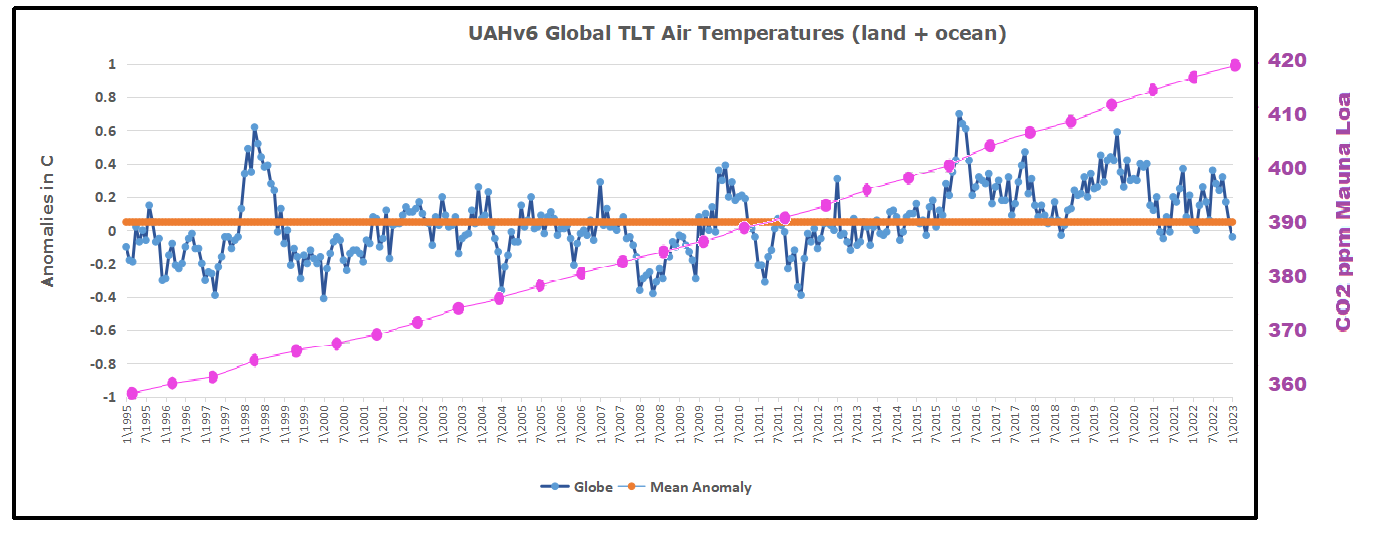
As an overview consider how recent rapid cooling  completely overcame the warming from the last 3 El Ninos (1998, 2010 and 2016).  The UAH record shows that the effects of the last one were gone as of April 2021, again in November 2021, and in February and June 2022  At year end 2022 and continuing into 2023 global temp anomaly matched or went lower than average since 1995, an ENSO neutral year. (UAH baseline is now 1991-2020).

For reference I added an overlay of CO2 annual concentrations as measured at Mauna Loa.  While temperatures fluctuated up and down ending flat, CO2 went up steadily by ~60 ppm, a 15% increase.

Furthermore, going back to previous warmings prior to the satellite record shows that the entire rise of 0.8C since 1947 is due to oceanic, not human activity.

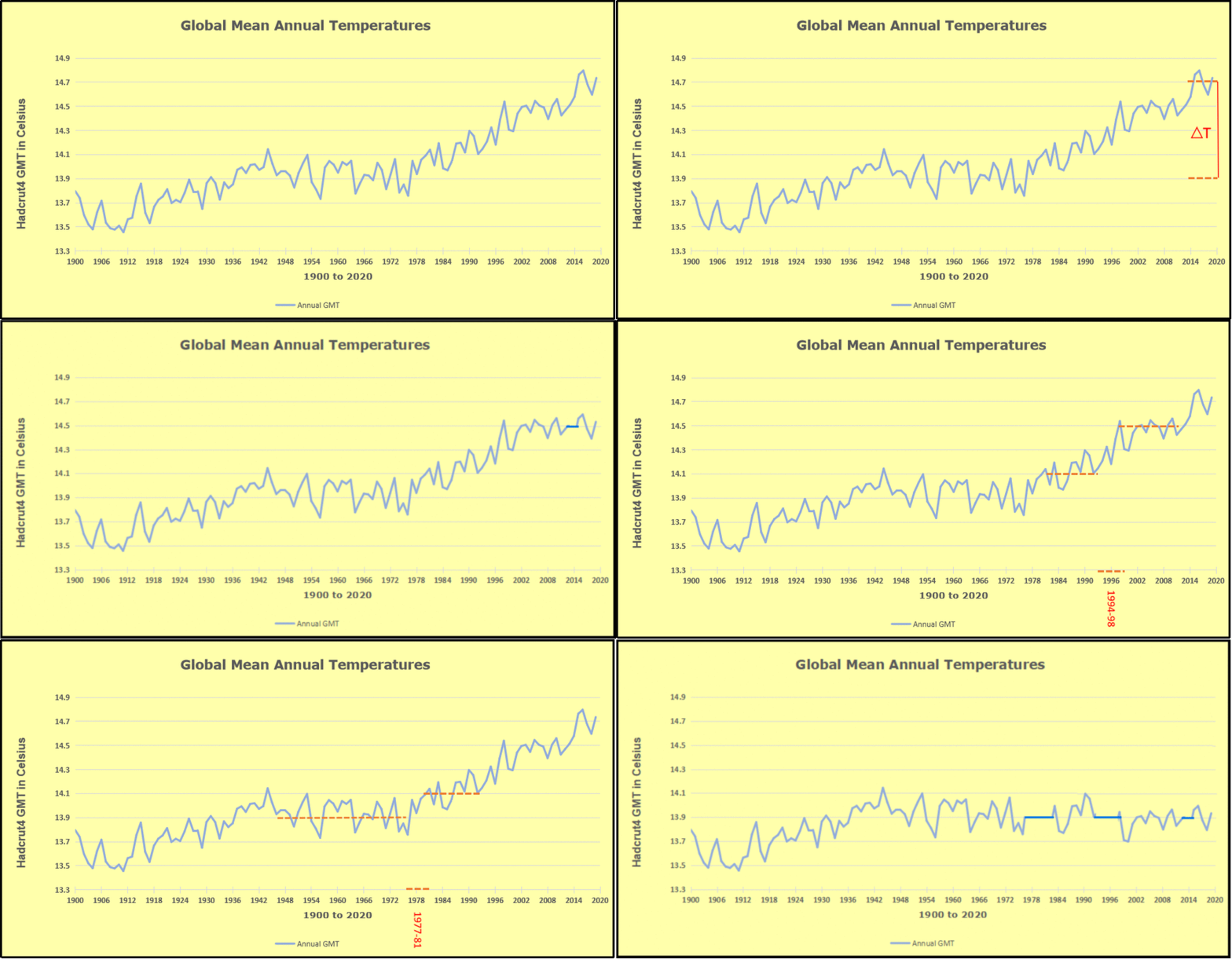
gmt-warming-events

The animation is an update of a previous analysis from Dr. Murry Salby.  These graphs use Hadcrut4 and include the 2016 El Nino warming event.  The exhibit shows since 1947 GMT warmed by 0.8 C, from 13.9 to 14.7, as estimated by Hadcrut4.  This resulted from three natural warming events involving ocean cycles. The most recent rise 2013-16 lifted temperatures by 0.2C.  Previously the 1997-98 El Nino produced a plateau increase of 0.4C.  Before that, a rise from 1977-81 added 0.2C to start the warming since 1947.


Importantly, the theory of human-caused global warming asserts that increasing CO2 in the atmosphere changes the baseline and causes systemic warming in our climate.  On the contrary, all of the warming since 1947 was episodic, coming from three brief events associated with oceanic cycles. And now in 2023 we are seeing an amazing episode with a temperature spike driven by ocean air warming along with higher land air temps.

Update August 3, 2021

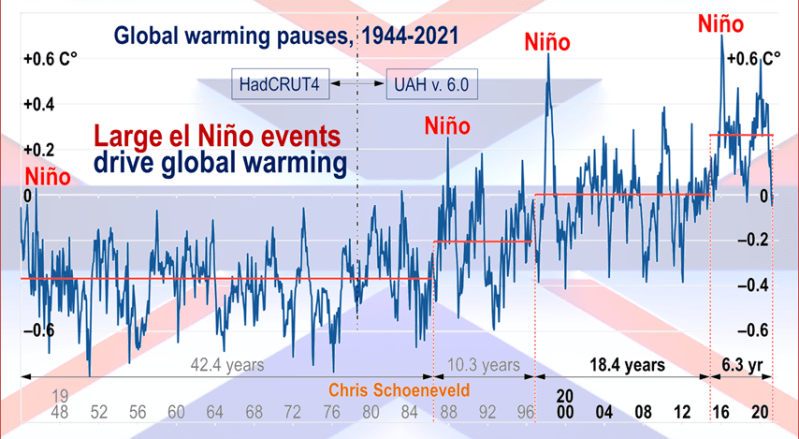
Chris Schoeneveld has produced a similar graph to the animation above, with a temperature series combining HadCRUT4 and UAH6. H/T WUWT

image-8


mc_wh_gas_web20210423124932

See Also Worst Threat: Greenhouse Gas or Quiet Sun?

October 2023 Update New Warming Spike Led by Tropics High

banner-blog

With apologies to Paul Revere, this post is on the lookout for cooler weather with an eye on both the Land and the Sea.  While you will hear a lot about 2020-21 temperatures matching 2016 as the highest ever, that spin ignores how fast the cooling set in.  The UAH data analyzed below shows that warming from the last El Nino had fully dissipated with chilly temperatures in all regions. After a warming blip in 2022, land and ocean temps dropped again with 2023 starting below the mean since 1995.  Spring and Summer 2023 saw a series of warmings.  Now in October a new high resulted from a major rise in ocean air temps in all regions, along with higher land air temps in NH and Tropics. 

UAH has updated their tlt (temperatures in lower troposphere) dataset for October 2023. Posts on their reading of ocean air temps this month preceded updated records from HadSST4.  I last posted on SSTs using HadSST4 September 2023 Ocean Warming Crests, Solar Coincidence? This month also has a separate graph of land air temps because the comparisons and contrasts are interesting as we contemplate possible cooling in coming months and years. Sometimes air temps over land diverge from ocean air changes.  For example in October 2023, a new warming high was driven by ocean air temps despite SH land temps dropping back down. The Tropics and NH showed warming in both land and sea air.

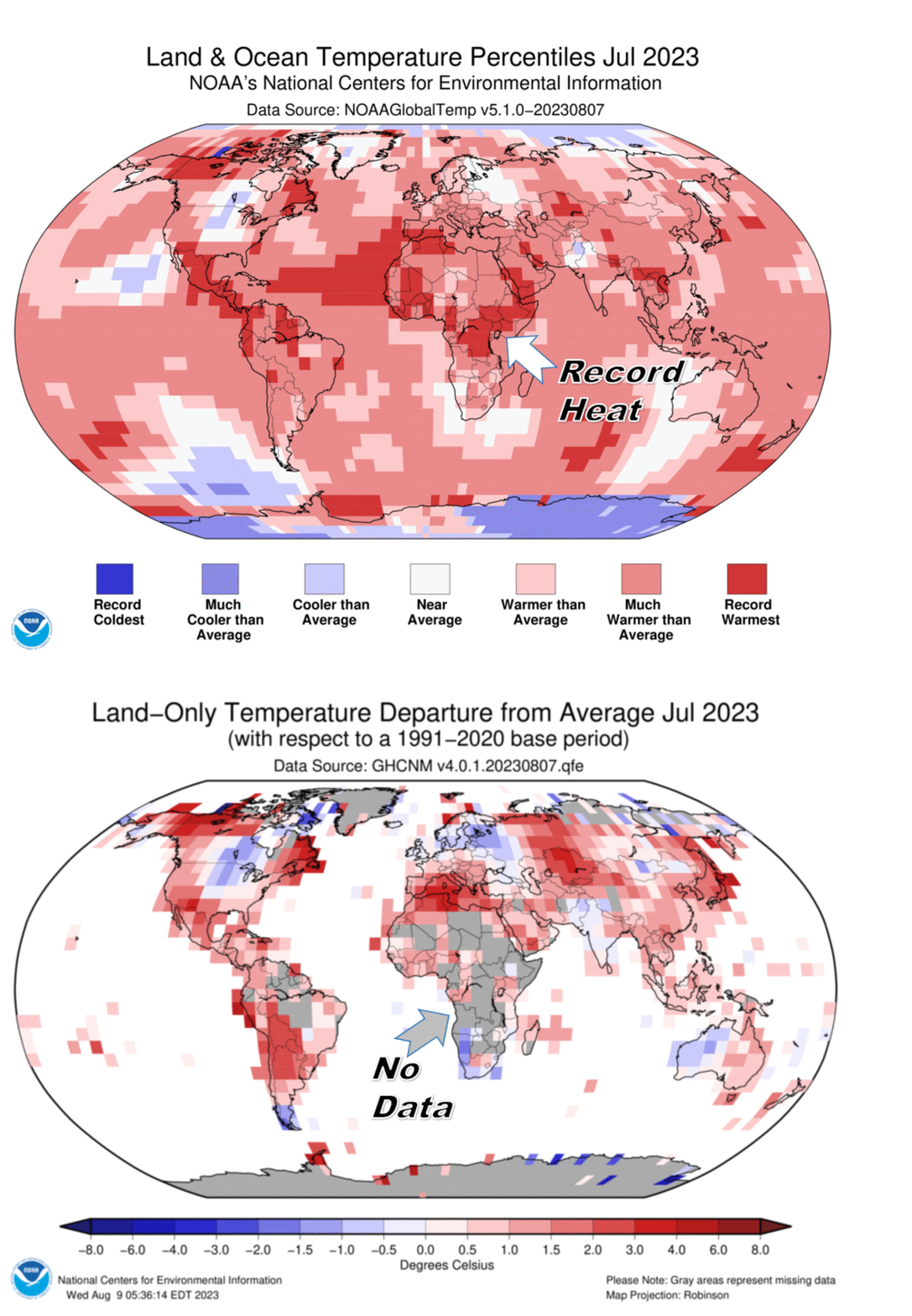
In October, as shown later on, Global ocean air reached a record high peak with all regions warming, especially Tropics. Land air temps rose in NH and Tropics, with a SH dropping down.   Thus the land + ocean Global UAH temperature is now exceeding the 2016 peak.

Note:  UAH has shifted their baseline from 1981-2010 to 1991-2020 beginning with January 2021.  In the charts below, the trends and fluctuations remain the same but the anomaly values change with the baseline reference shift.

Presently sea surface temperatures (SST) are the best available indicator of heat content gained or lost from earth’s climate system.  Enthalpy is the thermodynamic term for total heat content in a system, and humidity differences in air parcels affect enthalpy.  Measuring water temperature directly avoids distorted impressions from air measurements.  In addition, ocean covers 71% of the planet surface and thus dominates surface temperature estimates.  Eventually we will likely have reliable means of recording water temperatures at depth.

Recently, Dr. Ole Humlum reported from his research that air temperatures lag 2-3 months behind changes in SST.  Thus the cooling oceans now portend cooling land air temperatures to follow.  He also observed that changes in CO2 atmospheric concentrations lag behind SST by 11-12 months.  This latter point is addressed in a previous post Who to Blame for Rising CO2?

After a change in priorities, updates are now exclusive to HadSST4.  For comparison we can also look at lower troposphere temperatures (TLT) from UAHv6 which are now posted for September.  The temperature record is derived from microwave sounding units (MSU) on board satellites like the one pictured above. Recently there was a change in UAH processing of satellite drift corrections, including dropping one platform which can no longer be corrected. The graphs below are taken from the revised and current dataset.

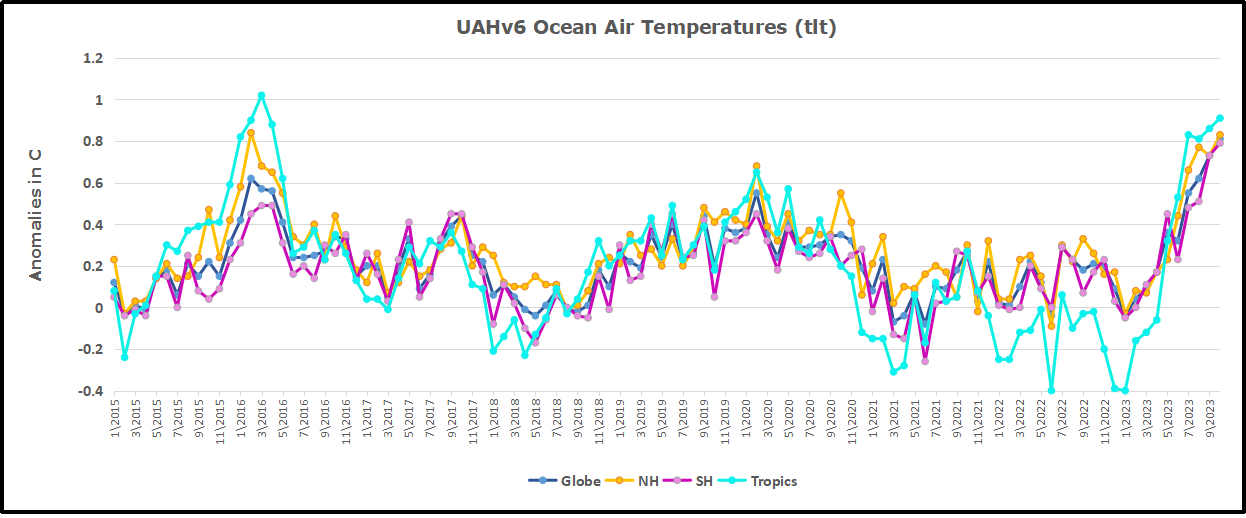
The UAH dataset includes temperature results for air above the oceans, and thus should be most comparable to the SSTs. There is the additional feature that ocean air temps avoid Urban Heat Islands (UHI).  The graph below shows monthly anomalies for ocean air temps since January 2015.

Note 2020 was warmed mainly by a spike in February in all regions, and secondarily by an October spike in NH alone. In 2021, SH and the Tropics both pulled the Global anomaly down to a new low in April. Then SH and Tropics upward spikes, along with NH warming brought Global temps to a peak in October.  That warmth was gone as November 2021 ocean temps plummeted everywhere. After an upward bump 01/2022 temps reversed and plunged downward in June.  After an upward spike in July, ocean air everywhere cooled in August and also in September.   

After sharp cooling everywhere in January 2023, all regions were into negative territory. Note the Tropics matched the lowest value, but since have spiked sharply upward +1.26C, with the largest increases in April to July 2023.  NH also warmed 0.7C in the last 4 months, while SH ocean air rose the same. Global Ocean air October 2023 is now exceeding 2016, the main difference being the much higher rise in SH anomalies since April.  The strength of the El Nino will determine the latter part of this year.

Land Air Temperatures Tracking Downward in Seesaw Pattern

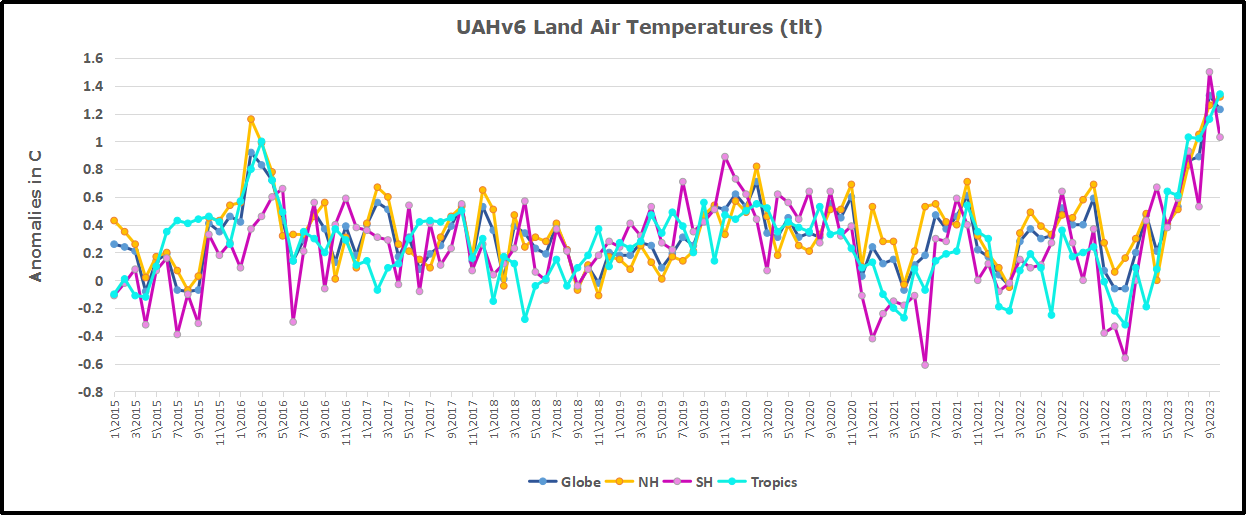
We sometimes overlook that in climate temperature records, while the oceans are measured directly with SSTs, land temps are measured only indirectly.  The land temperature records at surface stations sample air temps at 2 meters above ground.  UAH gives tlt anomalies for air over land separately from ocean air temps.  The graph updated for September is below.

Here we have fresh evidence of the greater volatility of the Land temperatures, along with extraordinary departures by SH land.  Land temps are dominated by NH with a 2021 spike in January,  then dropping before rising in the summer to peak in October 2021. As with the ocean air temps, all that was erased in November with a sharp cooling everywhere.  After a summer 2022 NH spike, land temps dropped everywhere, and in January, further cooling in SH and Tropics offset by an uptick in NH. 

Remarkably, in 2023, SH land air anomaly shot up 1.5C, from  -0.56C in January to +0.93 in July, then dropped to 0.53 in August. In September SH shot up again to 1.5C.  Tropical land temps are up 1.48 since January and NH Land air temps rose 0.9, mostly since May. Despite SH land air dropping in October, the consolidated rise greatly exceeds the upward spikes peaking in  2016.

The Bigger Picture UAH Global Since 1980

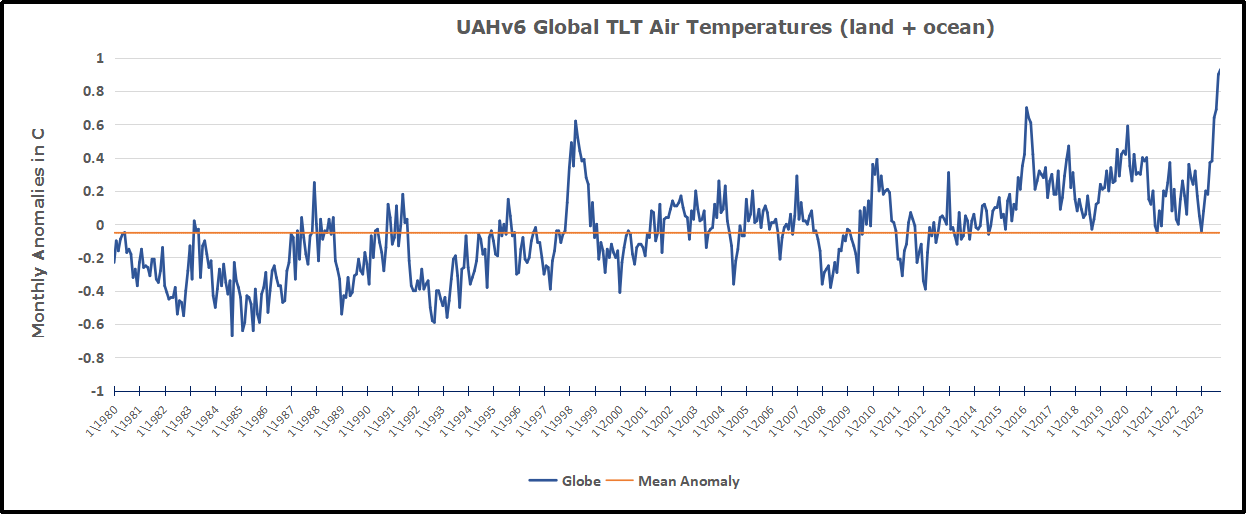
The chart shows monthly Global anomalies starting 01/1980 to present.  The average monthly anomaly is -0.06, for this period of more than four decades.  The graph shows the 1998 El Nino after which the mean resumed, and again after the smaller 2010 event. The 2016 El Nino matched 1998 peak and in addition NH after effects lasted longer, followed by the NH warming 2019-20.   An upward bump in 2021 was reversed with temps having returned close to the mean as of 2/2022.  March and April brought warmer Global temps, later reversed.

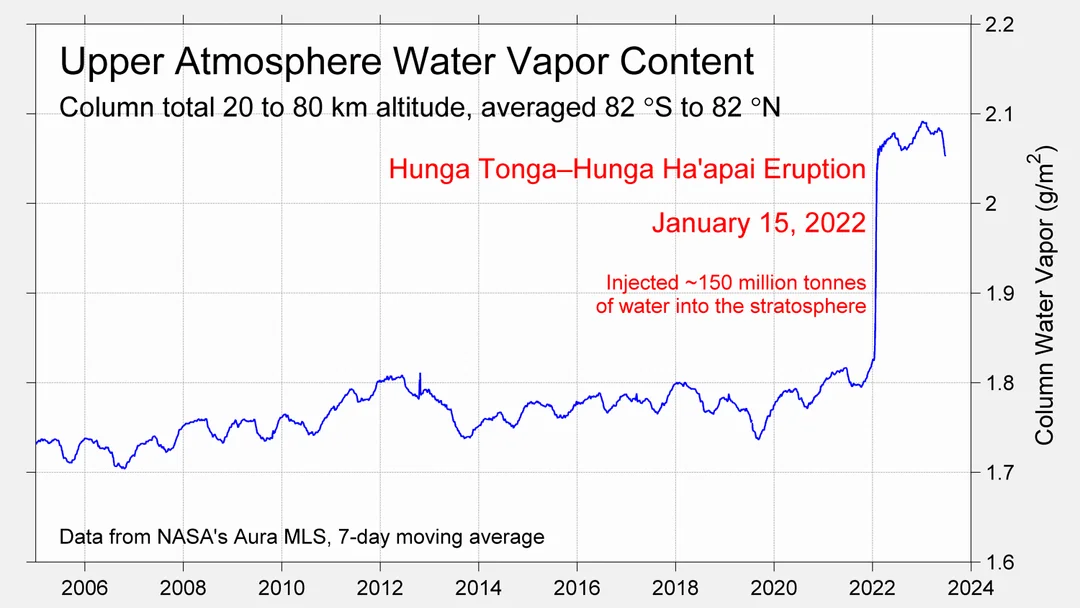
With the sharp drops in Nov., Dec. and January 2023 temps, there was no increase over 1980. Now in 2023 the buildup to the October peak exceeds the sharp April peak of the El Nino 1998 event. It also surpasses the February peak in 2016.  Where it goes from here, up or down, remains to be seen.

The graph reminds of another chart showing the abrupt ejection of humid air from Hunga Tonga eruption.

TLTs include mixing above the oceans and probably some influence from nearby more volatile land temps.  Clearly NH and Global land temps have been dropping in a seesaw pattern, nearly 1C lower than the 2016 peak.  Since the ocean has 1000 times the heat capacity as the atmosphere, that cooling is a significant driving force.  TLT measures started the recent cooling later than SSTs from HadSST3, but are now showing the same pattern. Despite the three El Ninos, their warming has not persisted prior to 2023, and without them it would probably have cooled since 1995.  Of course, the future has not yet been written.