Follow the Climate Money Updated

To enlarge, open image in new tab.

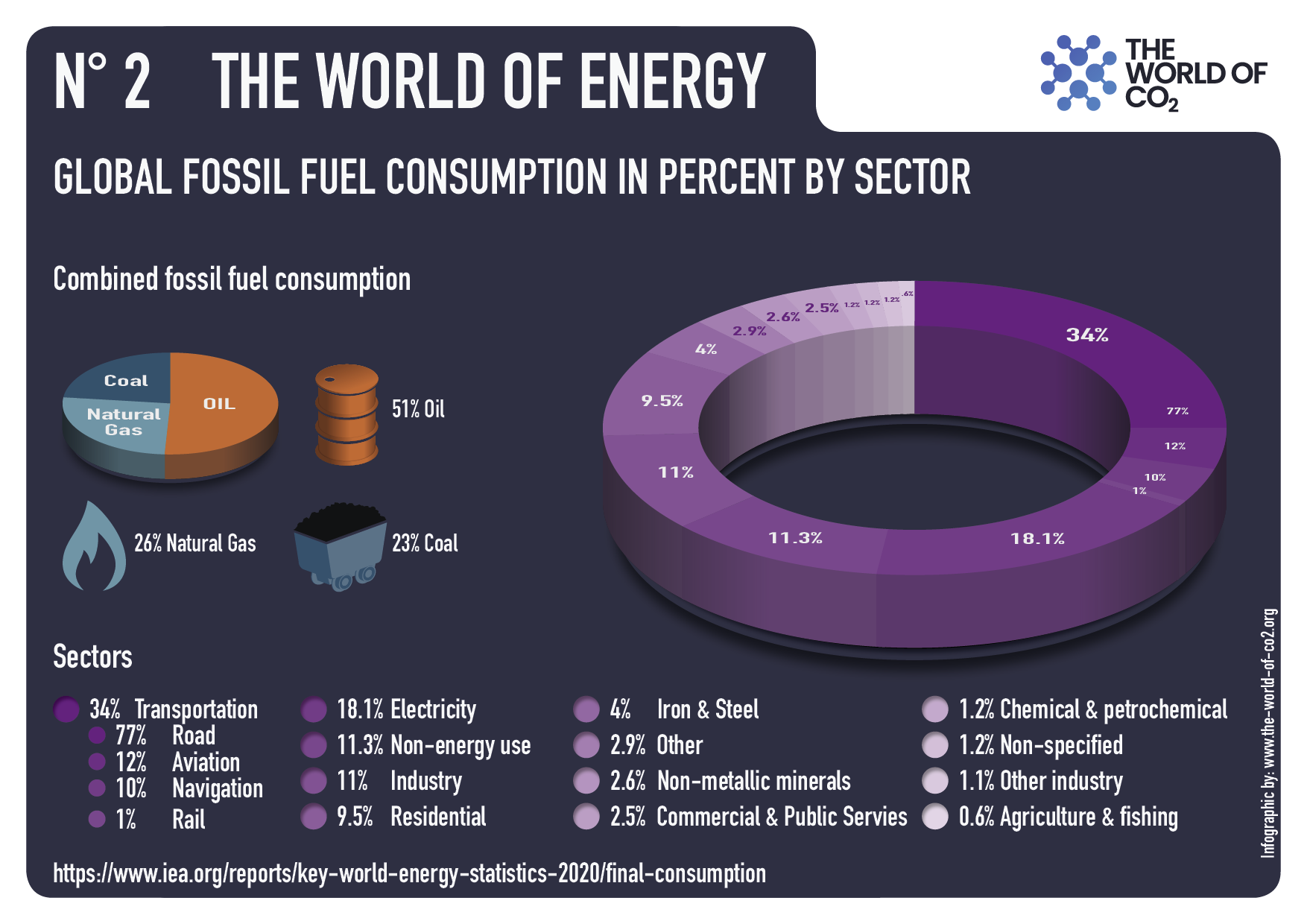
Why climate-finance ‘flows’ are falling short of $100bn pledge  is an informative article from CarbonBrief.  Excerpts below in italics followed by a comment from Bjorn Lomborg.

One of the biggest and most contentious issues in climate politics is the provision of money to help poorer countries cut emissions and protect themselves from climate impacts.  In 2009, wealthy nations pledged to “mobilise” $100bn in “climate finance” annually by 2020 to help vulnerable nations deal with climate change.  As the title notes, even now the target has not been met.

Politicians and observers have warned that this failure could undermine trust between nations as they head into negotiations in Dubai. What is more, there are widespread concerns about the quality of finance being offered, with questions surrounding the use of loans instead of grants, different definitions of “climate finance” and insufficient funding for adaptation efforts.

In this article, which updates and builds on a previous analysis published in 2018, Carbon Brief assesses the state of international climate finance as nations prepare for the next COP.  It uses the latest numbers collated by the Organisation for Economic Co-operation and Development (OECD), a club of mostly wealthy nations, many of which are responsible for contributing climate finance.

The OECD, a Paris-based intergovernmental economic organisation, asks its 36 member countries to report on their foreign aid, including climate finance. The data captures climate finance that is both bilateral (country to country) and multilateral (via international institutions) It also gives detailed information about funded projects. (The OECD calls this database “climate-related development finance” rather than strictly climate finance).

Key takeaways from 2015-2016 Report
  • Donor governments gave climate finance totalling $34bn in 2015 and $37bn in 2016, according to OECD estimates (note that this is not a full estimate of money counting towards the $100bn pledge – see below for more).
  • Japan was the largest donor, giving $10.3bn per year (bn/yr) on average over the two years. It was followed, in order, by Germany, France, the UK and the US.
  • India was the largest recipient on average, receiving $2.6bn/yr. It was followed, in order, by Bangladesh, Vietnam, the Philippines and Thailand
  • The single largest “country-to-country” flow was an average yearly $1.6bn from Japan to India.
  • The US was the top contributor to the multilateral Green Climate Fund (GCF) in 2016. (However, the US has now ended its support for the GCF).
  • Around $16bn/yr went to mitigation-only projects, compared to $9bn for adaptation-only projects.
    Around 42% of the finance consisted of “debt instruments”, such as loans.

Key takeaways from 2018-2019 Report
  • In 2019, the OECD found that climate finance had reached $79.6bn, up just 2% from 2018, and while official figures for 2020 are not yet available, Bloomberg reported that rich countries reckon they had raised $88-90bn, as of October 2021.
  • The shares attributed to countries are based on analysis by the World Resources Institute (WRI) of bilateral and multilateral development funds that can be traced to Annex II nations. These roughly align with the OECD’s figures, which are not broken down by country but, like the WRI’s, are partly derived from Annex II nations’ reports to the UNFCCC.
  • The remaining finance, indicated by the grey bars in the chart above, is made up of export credits, additional outflows from multilateral institutions and, most of all, private contributions by businesses and philanthropic groups (this is an approximation based on the OECD’s total values with the WRI estimates removed).
  • Private funds count towards the $100bn target, but the WRI did not include them in its analysis as the data is less complete and difficult to attribute to individual nations. The OECD estimates that annual private finance has been stable at around $14bn since 2017.
  • The top five finance providers – Japan, Germany, France, the UK and the US – have remained the same since Carbon Brief’s last analysis for 2015/16. These five nations contributed more than 60% of the 2018/19 finance.  While Japan, Germany and France appear to be by far the biggest contributors, the WRI warns that the lack of clarity around climate finance reporting means the numbers should be approached with caution.
  • As in Carbon Brief’s previous analysis, India was by far the biggest recipient of climate finance, with more than double the funds received by the next largest, Bangladesh. Japan and Germany provided about 94% of the funds to India, almost all in the form of loans.
Implications

Climate finance figures are widely contested, with many global-south nations questioning how much funding is new and not simply diverted from other development funds. Criticism has also been levelled at the overreliance on loans and the inclusion of support for “high-efficiency” coal plants by Japan and Australia.

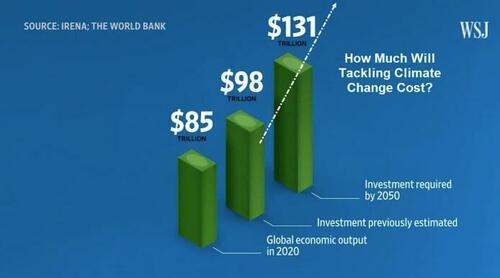
A recent assessment prepared by the UNFCCC’s Standing Committee on Finance concluded that developing countries require $5.8-5.9tn up to 2030 in order to fund less than half of the actions outlined in their official climate plans – although some of this would be funded domestically.

This year’s negotiations are likely to spark calls for a significant scaling up of finance, although the slow pace of proceedings means that, for the time being, the focus of new goal discussions will primarily be on agreeing a framework for future talks.

Nevertheless, there are various issues that could be on the table during this next phase, including ensuring that more money is spent on adaptation.

The Paris Agreement specifies that climate finance should aim for an even split between these two categories, but funding has long been skewed towards mitigation. According to Jan Kowalzig, a senior policy adviser at Oxfam, governments often tend to view such projects as more attractive investments:

“Since [mitigation projects] often have to do with energy, they seem to be more directly linked to a country‘s development, even though, of course, this is a huge misconception given the central (but, for politicians, often less visible) role of adaptation.”

Of the roughly $40bn average for the 2018/19 period, 39% of money went on mitigation, while just 25% went on adaptation – a slightly more even split than was recorded in Carbon Brief’s previous analysis for 2015/16.

However, other estimates, including the OECD’s own climate finance report, suggest a more pronounced split, with around three times as much finance going to mitigation than adaptation in 2018 and 2019.

This imbalance is a major concern amid rapidly escalating climate costs. The UN Environment Programme places current annual adaptation costs for “developing countries” at $70bn, but says they will reach $140-300bn by 2030.

Ensuring adequate adaptation finance in the coming years is, therefore, seen by many vulnerable nations as a key priority for post-2025 climate finance plans as they are developed.

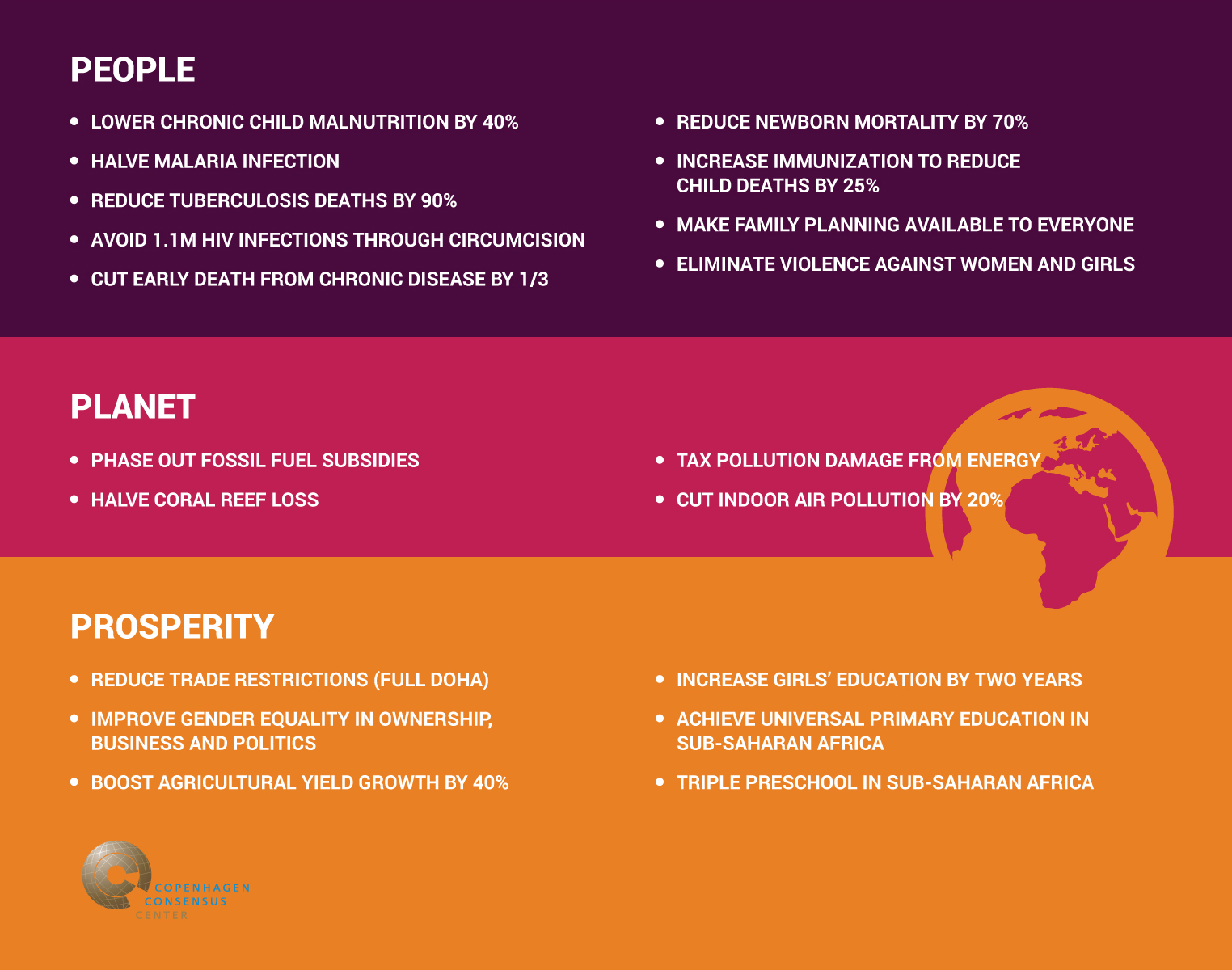
Climate Money Could Be Better Spent

Bjorn Lomborg When it comes to climate change, let’s get our priorities straight

We must also bear in mind that global warming is not the planet’s only challenge. We often hear that it is the defining issue of our time, but it is no such thing. By the 2070s, the IPCC — the U.N. climate change panel — estimates that warming will cost between 0.2 and 2 percent of global GDP. This is certainly a problem, but not the end of world.

Speaking of climate change in catastrophic terms easily makes us ignore bigger problems, including malnutrition, tuberculosis, malaria and corruption. The World Health Organization estimates that climate change since the 1970s causes about 140,000 additional deaths each year, and toward the middle of the century will kill 250,000 people annually, mostly in poor countries. This pales in comparison with much deadlier environmental problems such as indoor air pollution, claiming 4.3 million lives annually, outdoor air pollution killing 3.7 million and lack of water and sanitation killing 760,000. Outside of environment, the problems are even bigger: Poverty arguably kills 18 million each year.

Every dollar spent on climate change could instead help save many more people from these more tractable problems. The current approach to subsidize solar and wind arguably saves one life across the century for every $4 million spent — the same expenditure on vaccinations could save 4,000 lives. Each person — and the next president — needs to decide his or her legacy.

Postscript: Financing for Climate Aid is a Fraction of the Full Cost of Climate Crisis Inc.

A fuller accounting of the climate crisis industry more likely exceeds 2,000,000,000,000 US$ per year (2 Trillion)
See Climate Crisis Inc. Update

What You’re Told About Greenhouse Gases is Wrong

Mark Adams explains the deceptions in his American Thinker article The fables about greenhouse gases, especially about methane  Excerpts in italics with my bolds and added images.

“Climate change” is in the news daily, with each featured story getting an attention-grabbing sensationalist headline. The frenzy is at its peak now because it’s the time of year for tropical storms and wildfires.

However, to appreciate that these stories are pure narratives,
it’s a good time to consider the facts behind
the so-called “greenhouse gases.”

Several atmospheric gases, including carbon dioxide, methane, and water vapor, absorb light in the infrared region. These are collectively known as the “greenhouse gases” because absorbing infrared energy warms up the air—hence the name greenhouse effect.

Carbon dioxide, on a per-molecule basis, is six times as effective an absorber as water is. However, that’s offset by the fact that carbon dioxide is only about 0.04% of the atmosphere (400 parts per million). This means that, overall, it’s much less important than water vapor in terms of its ability to warm the atmosphere.

And then there’s methane. Pound-for-pound methane can trap 25 times more heat than carbon dioxide. However, there are two reasons why scientists say it will never significantly contribute to global warming. Primarily, it is by far the rarest of the green house gases. [Note that weight is the wrong metric for radiation properties of gases, volume is what matters.  The 25 times CO2 is exaggerated because CH4 molecular weight is only 16 compared to 44 for CO2.]

But there is another reason why we will probably never have to worry about methane being a major contributor to global warming: Methane’s narrow absorption bands, at 3.3 microns and 7.5 microns , perfectly match…water’s! Did you catch that? It’s worth emphasizing: “The ratio of the percentages of water to methane is such that the effects of methane are completely masked by water.”

Nor is methane a cow problem that humans can remediate by going meatless. Instead, wetlands and termites are the real methane producers: “When it comes to methane, another greenhouse gas, termites are responsible for 11 percent of the world’s production from natural sources. Seventy-six percent comes from wetlands…”

Image: Termites in a wetland by AI.

Many studies have attributed a methane spike to soaring emissions from tropical wetlands, predominantly in Africa. “A ‘significant change’ in tropical weather ascribed to human-caused climate change has led wetlands to get bigger and more plants to grow there, thus leading to more decomposition — a process that produces methane.”

You noted, of course, how the quoted language blames methane on human-caused climate change. Yet this same “human-caused” climate change is also blamed for transforming lush Hawaii into an arid ticking time bomb that, in the summer of 2023, erupted into a devastating inferno. Moreover, it seems like it wasn’t that long ago when environmentalists were ardent supporters of wetlands.

Meanwhile, ignoring the predominance of naturally occurring methane, a band of climate fanatics wants to eliminate traditional farming and ranching because they are sources of methane, primarily from ruminant livestock and paddy rice. Rice growing produces methane gas by feeding microbes that live under the rice paddies. Cattle produce methane during their digestive process.

In Ireland, farmers may be forced to kill some of their livestock to meet government requirements:

Greenhouse gas emissions in Ireland’s agriculture industry must be reduced by 25 per cent by 2030. This is part of the country’s latest Climate Action Plan, which pledges to halve overall carbon emissions by 2030 and reach net zero by 2050.

Current initiatives to cut methane gas emissions from domestic livestock like cows and pigs by culling them, a potentially famine-inducing policy, fail to take into account the sheer volume of feral animals. For example, in Australia, “there is 10 times the number of feral pigs … than domestic.”

By some estimates, Australia contains “ 400,000 wild horses,
five million donkeys, 150,000 water buffalo, one million camels,
and 24 million feral pigs—in comparison,
the United States contains just six million feral pigs.”

To put things in perspective, let’s go back to the lowly termites. Consider that, in 1992, “it was estimated that the digestive tracts of termites produce about 50 billion tons of CO2 and methane annually. That was more than the world’s production from burning fossil fuel.”

In 1982, the journal Science published an article titled “Termites: A Potentially Large Source of Atmospheric Methane, Carbon Dioxide, and Molecular Hydrogen.” Here is the key sentence: “The estimate gross amount of carbon dioxide produced is more than twice the net global input from fossil fuel production.”

That same year, the New York Times ran an article titled: “Termite gas exceeds smokestack pollution.”

None of this information stops the Biden administration. In November 2021, it “proposed regulations on methane emissions by the U.S. oil and gas industry, at a direct cost of more than $1 billion annually, to deal with a nonexistent problem.”

Wouldn’t it be nice if a little science got through to
the policy-makers behind so-called “climate science”?

See Also:

Confirmed: Temperature Drives CO2, not the Reverse


Briefing for COP28 Dubai 2023

Presently the next climate Conference of Parties is scheduled for Dubai with United Arab Emirates as hosts this November 30 to December 12.  According to the UAE government, COP28 in Dubai will welcome “over 140 heads of state, senior government leaders, over 70,000 participants and more than 5,000 media professionals.” One can imagine the carbon footprint of the international travel of the delegates involved.

Some Statements Suggest the COP28 Challenges

What the alarmists want summarized by Flynn:

A good outcome at Cop28, which will take place at Expo City Dubai from November 30 to December 12, would have three components: the first would “reinforce the 1.5ºC goal”, the second would enhance adaptation and support vulnerable countries, and the third would focus on finance “We have to see not just the $100 billion,” she said, referring to the missed target pledged by developing countries for climate finance.

Why a COP Briefing?

Actually, climate hysteria is like a seasonal sickness.  Each year a contagion of anxiety and fear is created by disinformation going viral in both legacy and social media in the run up to the annual autumnal COP.  Since the climatists have put themselves at the controls of the formidable US federal government, we can expect the public will be hugely hosed with alarms over the next few months.  Before the distress signals go full tilt, individuals need to inoculate themselves against the false claims, in order to build some herd immunity against the nonsense the media will promulgate. This post is offered as a means to that end.

Media Climate Hype is a Cover Up

Back in 2015 in the run up to Paris COP, French mathematicians published a thorough critique of the raison d’etre of the whole crusade. They said:

Fighting Global Warming is Absurd, Costly and Pointless.

  • Absurd because of no reliable evidence that anything unusual is happening in our climate.
  • Costly because trillions of dollars are wasted on immature, inefficient technologies that serve only to make cheap, reliable energy expensive and intermittent.
  • Pointless because we do not control the weather anyway.

The prestigious Société de Calcul Mathématique (Society for Mathematical Calculation) issued a detailed 195-page White Paper presenting a blistering point-by-point critique of the key dogmas of global warming. The synopsis with links to the entire document is at COP Briefing for Realists

Even without attending to their documentation, you can tell they are right because all the media climate hype is concentrated against those three points.

Finding: Nothing unusual is happening with our weather and climate.
Hype: Every metric or weather event is “unprecedented,” or “worse than we thought.”

Finding: Proposed solutions will cost many trillions of dollars for little effect or benefit.
Hype: Zero carbon will lead the world to do the right thing.  Anyway, the planet must be saved at any cost.

Finding: Nature operates without caring what humans do or think.
Hype: Any destructive natural event is blamed on humans burning fossil fuels.

How the Media Throws Up Flak to Defend False Suppositions

The Absurd Media:  Climate is Dangerous Today, Yesterday It was Ideal.

Billions of dollars have been spent researching any and all negative effects from a warming world: Everything from Acne to Zika virus.  A recent Climate Report repeats the usual litany of calamities to be feared and avoided by submitting to IPCC demands. The evidence does not support these claims. An example:

 It is scientifically established that human activities produce GHG emissions, which accumulate in the atmosphere and the oceans, resulting in warming of Earth’s surface and the oceans, acidification of the oceans, increased variability of climate, with a higher incidence of extreme weather events, and other changes in the climate.

Moreover, leading experts believe that there is already more than enough excess heat in the climate system to do severe damage and that 2C of warming would have very significant adverse effects, including resulting in multi-meter sea level rise.

Experts have observed an increased incidence of climate-related extreme weather events, including increased frequency and intensity of extreme heat and heavy precipitation events and more severe droughts and associated heatwaves. Experts have also observed an increased incidence of large forest fires; and reduced snowpack affecting water resources in the western U.S. The most recent National Climate Assessment projects these climate impacts will continue to worsen in the future as global temperatures increase.

Alarming Weather and Wildfires

But: Weather is not more extreme.


And Wildfires were worse in the past.
But: Sea Level Rise is not accelerating.

post-glacial_sea_level

Litany of Changes

Seven of the ten hottest years on record have occurred within the last decade; wildfires are at an all-time high, while Arctic Sea ice is rapidly diminishing.

We are seeing one-in-a-thousand-year floods with astonishing frequency.

When it rains really hard, it’s harder than ever.

We’re seeing glaciers melting, sea level rising.

The length and the intensity of heatwaves has gone up dramatically.

Plants and trees are flowering earlier in the year. Birds are moving polewards.

We’re seeing more intense storms.

But: Arctic Ice has not declined since 2007.

But: All of these are within the range of past variability.In fact our climate is remarkably stable, compared to the range of daily temperatures during a year where I live.

And many aspects follow quasi-60 year cycles.

The Impractical Media:  Money is No Object in Saving the Planet.

Here it is blithely assumed that the UN can rule the seas to stop rising, heat waves to cease, and Arctic ice to grow (though why we would want that is debatable).  All this will be achieved by leaving fossil fuels in the ground and powering civilization with windmills and solar panels.  While admitting that our way of life depends on fossil fuels, they ignore the inadequacy of renewable energy sources at their present immaturity.

An Example:
The choice between incurring manageable costs now and the incalculable, perhaps even irreparable, burden Youth Plaintiffs and Affected Children will face if Defendants fail to rapidly transition to a non-fossil fuel economy is clear. While the full costs of the climate damages that would result from maintaining a fossil fuel-based economy may be incalculable, there is already ample evidence concerning the lower bound of such costs, and with these minimum estimates, it is already clear that the cost of transitioning to a low/no carbon economy are far less than the benefits of such a transition. No rational calculus could come to an alternative conclusion. Defendants must act with all deliberate speed and immediately cease the subsidization of fossil fuels and any new fossil fuel projects, and implement policies to rapidly transition the U.S. economy away from fossil fuels.

But CO2 relation to Temperature is Inconsistent.

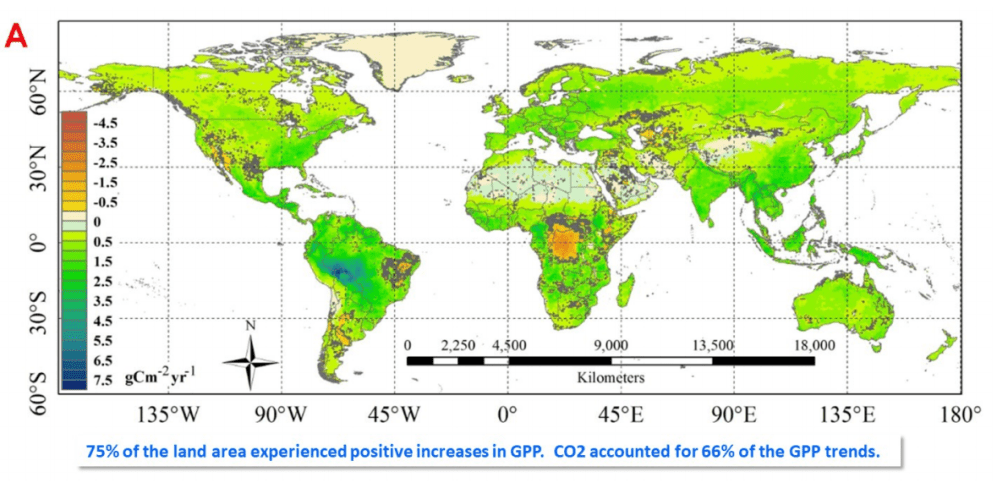
But: The planet is greener because of rising CO2.

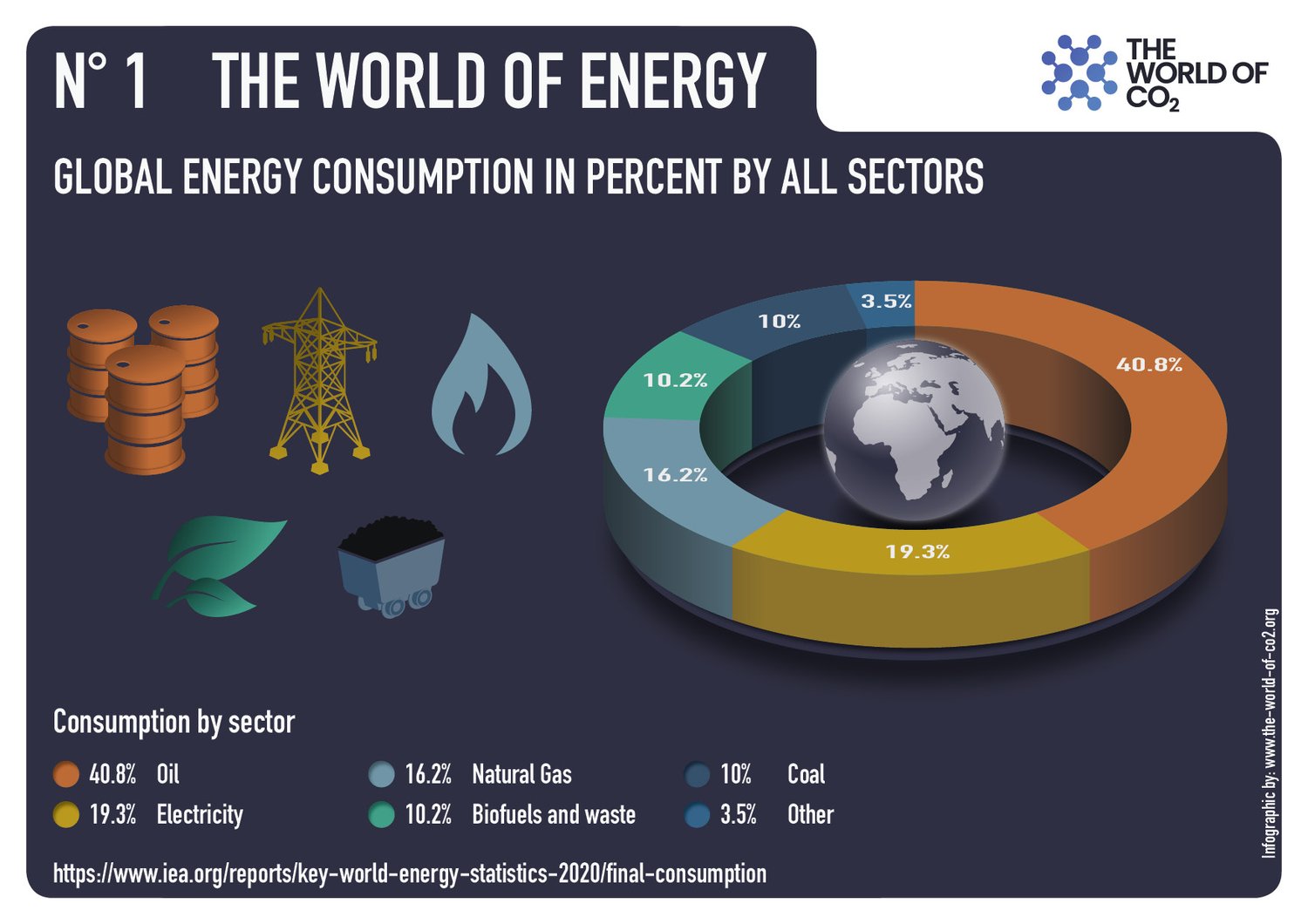
But: Modern nations (G20) depend on fossil fuels for nearly 90% of their energy.

But: Renewables are not ready for prime time.

People need to know that adding renewables to an electrical grid presents both technical and economic challenges.  Experience shows that adding intermittent power more than 10% of the baseload makes precarious the reliability of the supply.  South Australia is demonstrating this with a series of blackouts when the grid cannot be balanced.  Germany got to a higher % by dumping its excess renewable generation onto neighboring countries until the EU finally woke up and stopped them. Texas got up to 29% by dumping onto neighboring states, and some like Georgia are having problems.

But more dangerous is the way renewables destroy the economics of electrical power.  Seasoned energy analyst Gail Tverberg writes:

In fact, I have come to the rather astounding conclusion that even if wind turbines and solar PV could be built at zero cost, it would not make sense to continue to add them to the electric grid in the absence of very much better and cheaper electricity storage than we have today. There are too many costs outside building the devices themselves. It is these secondary costs that are problematic. Also, the presence of intermittent electricity disrupts competitive prices, leading to electricity prices that are far too low for other electricity providers, including those providing electricity using nuclear or natural gas. The tiny contribution of wind and solar to grid electricity cannot make up for the loss of more traditional electricity sources due to low prices.

These issues are discussed in more detail in the post Climateers Tilting at Windmills

The Irrational Media:  Whatever Happens in Nature is Our Fault.

An Example:

Other potential examples include agricultural losses. Whether or not insurance
reimburses farmers for their crops, there can be food shortages that lead to higher food
prices (that will be borne by consumers, that is, Youth Plaintiffs and Affected Children).
There is a further risk that as our climate and land use pattern changes, disease vectors
may also move (e.g., diseases formerly only in tropical climates move northward).36 This
could lead to material increases in public health costs

But: Actual climate zones are local and regional in scope, and they show little boundary change.

But: Ice cores show that it was warmer in the past, not due to humans.

The hype is produced by computer programs designed to frighten and distract children and the uninformed.  For example, there was mention above of “multi-meter” sea level rise.  It is all done with computer models.  For example, below is San Francisco.  More at USCS Warnings of Coastal Floodings

In addition, there is no mention that GCMs projections are running about twice as hot as observations.

Omitted is the fact GCMs correctly replicate tropospheric temperature observations only when CO2 warming is turned off.

Figure 5. Simplification of IPCC AR5 shown above in Fig. 4. The colored lines represent the range of results for the models and observations. The trends here represent trends at different levels of the tropical atmosphere from the surface up to 50,000 ft. The gray lines are the bounds for the range of observations, the blue for the range of IPCC model results without extra GHGs and the red for IPCC model results with extra GHGs.The key point displayed is the lack of overlap between the GHG model results (red) and the observations (gray). The nonGHG model runs (blue) overlap the observations almost completely.

In the effort to proclaim scientific certainty, neither the media nor IPCC discuss the lack of warming since the 1998 El Nino, despite two additional El Ninos in 2010 and 2016.

Further they exclude comparisons between fossil fuel consumption and temperature changes. The legal methodology for discerning causation regarding work environments or medicine side effects insists that the correlation be strong and consistent over time, and there be no confounding additional factors. As long as there is another equally or more likely explanation for a set of facts, the claimed causation is unproven. Such is the null hypothesis in legal terms: Things happen for many reasons unless you can prove one reason is dominant.

Finally, advocates and IPCC are picking on the wrong molecule. The climate is controlled not by CO2 but by H20. Oceans make climate through the massive movement of energy involved in water’s phase changes from solid to liquid to gas and back again. From those heat transfers come all that we call weather and climate: Clouds, Snow, Rain, Winds, and Storms.

Esteemed climate scientist Richard Lindzen ended a very fine recent presentation with this description of the climate system:

I haven’t spent much time on the details of the science, but there is one thing that should spark skepticism in any intelligent reader. The system we are looking at consists in two turbulent fluids interacting with each other. They are on a rotating planet that is differentially heated by the sun. A vital constituent of the atmospheric component is water in the liquid, solid and vapor phases, and the changes in phase have vast energetic ramifications. The energy budget of this system involves the absorption and reemission of about 200 watts per square meter. Doubling CO2 involves a 2% perturbation to this budget. So do minor changes in clouds and other features, and such changes are common. In this complex multifactor system, what is the likelihood of the climate (which, itself, consists in many variables and not just globally averaged temperature anomaly) is controlled by this 2% perturbation in a single variable? Believing this is pretty close to believing in magic. Instead, you are told that it is believing in ‘science.’ Such a claim should be a tip-off that something is amiss. After all, science is a mode of inquiry rather than a belief structure.

Summary:  From this we learn three things:

Climate warms and cools without any help from humans.

Warming is good and cooling is bad.

The hypothetical warming from CO2 would be a good thing.


September 2023 Ocean Warming Crests, Solar Coincidence?
The best context for understanding decadal temperature changes comes from the world’s sea surface temperatures (SST), for several reasons:

  • The ocean covers 71% of the globe and drives average temperatures;
  • SSTs have a constant water content, (unlike air temperatures), so give a better reading of heat content variations;
  • Major El Ninos have been the dominant climate feature in recent years.

HadSST is generally regarded as the best of the global SST data sets, and so the temperature story here comes from that source. Previously I used HadSST3 for these reports, but Hadley Centre has made HadSST4 the priority, and v.3 will no longer be updated.  HadSST4 is the same as v.3, except that the older data from ship water intake was re-estimated to be generally lower temperatures than shown in v.3.  The effect is that v.4 has lower average anomalies for the baseline period 1961-1990, thereby showing higher current anomalies than v.3. This analysis concerns more recent time periods and depends on very similar differentials as those from v.3 despite higher absolute anomaly values in v.4.  More on what distinguishes HadSST3 and 4 from other SST products at the end. The user guide for HadSST4 is here.

The Current Context

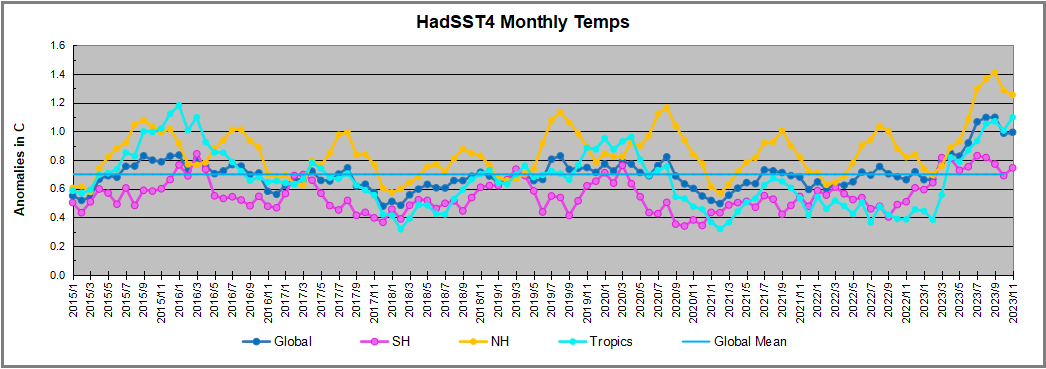
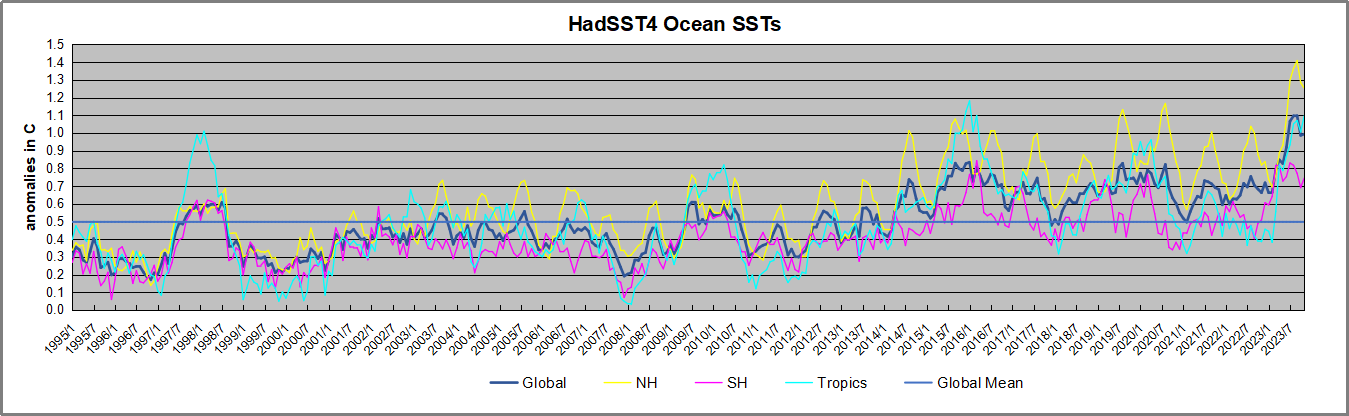
The chart below shows SST monthly anomalies as reported in HadSST4 starting in 2015 through August 2023.  A global cooling pattern is seen clearly in the Tropics since its peak in 2016, joined by NH and SH cycling downward since 2016. 

Note that in 2015-2016 the Tropics and SH peaked in between two summer NH spikes.  That pattern repeated in 2019-2020 with a lesser Tropics peak and SH bump, but with higher NH spikes. By end of 2020, cooler SSTs in all regions took the Global anomaly well below the mean for this period.  In 2021 the summer NH summer spike was joined by warming in the Tropics but offset by a drop in SH SSTs, which raised the Global anomaly slightly over the mean.

Then in 2022, another strong NH summer spike peaked in August, but this time both the Tropic and SH were countervailing, resulting in only slight Global warming, later receding to the mean.   Oct./Nov. temps dropped  in NH and the Tropics took the Global anomaly below the average for this period. After an uptick in December, temps in January 2023 dropped everywhere, strongest in NH, with the Global anomaly further below the mean since 2015.

Now comes El Nino as shown by the upward spike in the Tropics since January, the anomaly nearly tripling from 0.38C to 1.06C.  In August 2023, all regions rose, especially NH up from 0.70C to 1.37C, pulling up the global anomaly to a new high for this period. September shows a new peak for NH at 1.41, but both SH and the Tropics cooled enough to bring the Global anomaly back down.

Comment:

The climatists have seized on this unusual warming as proof of their Zero Carbon agenda, without addressing how impossible it would be for CO2 warming the air to raise ocean temperatures.  It is the ocean that warms the air, not the other way around.  Recently Steven Koonin had this to say about the phonomenon confirmed in the graph above:

El Nino is a phenomenon in the climate system that happens once every four or five years.  Heat builds up in the equatorial Pacific to the west of Indonesia and so on.  Then when enough of it builds up it surges across the Pacific and changes the currents and the winds.  As it surges toward South America it was discovered and named in the 19th century  It is well understood at this point that the phenomenon has nothing to do with CO2.

Now people talk about changes in that phenomena as a result of CO2 but it’s there in the climate system already and when it happens it influences weather all over the world.   We feel it when it gets rainier in Southern California for example.  So for the last 3 years we have been in the opposite of an El Nino, a La Nina, part of the reason people think the West Coast has been in drought.

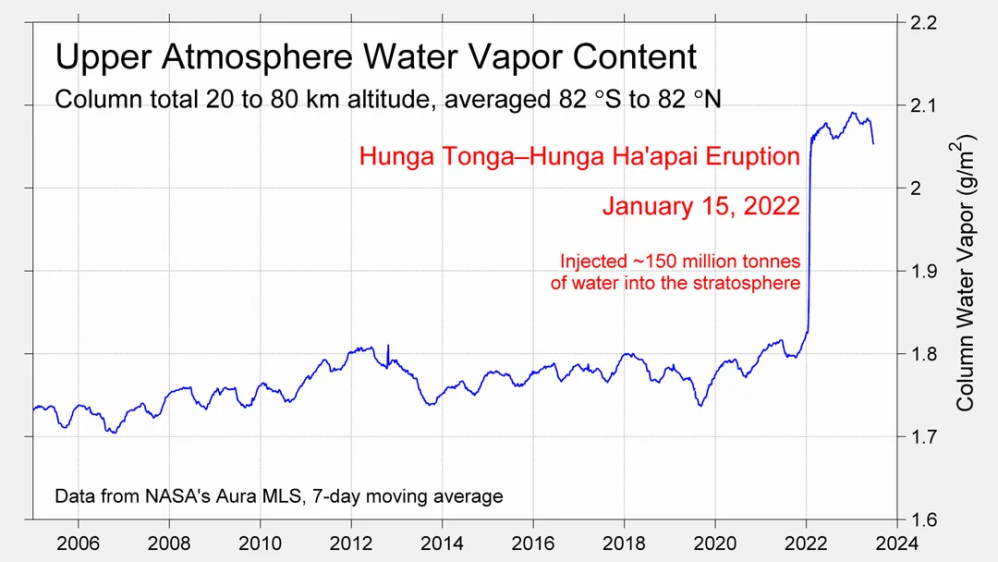
It has now shifted in the last months to an El Nino condition that warms the globe and is thought to contribute to this Spike we have seen. But there are other contributions as well.  One of the most surprising ones is that back in January of 2022 an enormous underwater volcano went off in Tonga and it put up a lot of water vapor into the upper atmosphere. It increased the upper atmosphere of water vapor by about 10 percent, and that’s a warming effect, and it may be that is contributing to why the spike is so high.

A longer view of SSTs

To enlarge, open image in new tab.

The graph above is noisy, but the density is needed to see the seasonal patterns in the oceanic fluctuations.  Previous posts focused on the rise and fall of the last El Nino starting in 2015.  This post adds a longer view, encompassing the significant 1998 El Nino and since.  The color schemes are retained for Global, Tropics, NH and SH anomalies.  Despite the longer time frame, I have kept the monthly data (rather than yearly averages) because of interesting shifts between January and July.1995 is a reasonable (ENSO neutral) starting point prior to the first El Nino. 

The sharp Tropical rise peaking in 1998 is dominant in the record, starting Jan. ’97 to pull up SSTs uniformly before returning to the same level Jan. ’99. There were strong cool periods before and after the 1998 El Nino event. Then SSTs in all regions returned to the mean in 2001-2. 

SSTS fluctuate around the mean until 2007, when another, smaller ENSO event occurs. There is cooling 2007-8,  a lower peak warming in 2009-10, following by cooling in 2011-12.  Again SSTs are average 2013-14.

Now a different pattern appears.  The Tropics cooled sharply to Jan 11, then rise steadily for 4 years to Jan 15, at which point the most recent major El Nino takes off.  But this time in contrast to ’97-’99, the Northern Hemisphere produces peaks every summer pulling up the Global average.  In fact, these NH peaks appear every July starting in 2003, growing stronger to produce 3 massive highs in 2014, 15 and 16.  NH July 2017 was only slightly lower, and a fifth NH peak still lower in Sept. 2018.

The highest summer NH peaks came in 2019 and 2020, only this time the Tropics and SH were offsetting rather adding to the warming. (Note: these are high anomalies on top of the highest absolute temps in the NH.)  Since 2014 SH has played a moderating role, offsetting the NH warming pulses. After September 2020 temps dropped off down until February 2021.  In 2021-22 there were again summer NH spikes, but in 2022 moderated first by cooling Tropics and SH SSTs, then in October to January 2023 by deeper cooling in NH and Tropics.  

Now in 2023 the Tropics flipped from below to well above average, while NH has produced a summer peak with August higher than any previous year. In fact, the summer warming peaks in NH have occurred in August or September, so this number is likely the crest.

What to make of all this? The patterns suggest that in addition to El Ninos in the Pacific driving the Tropic SSTs, something else is going on in the NH.  The obvious culprit is the North Atlantic, since I have seen this sort of pulsing before.  After reading some papers by David Dilley, I confirmed his observation of Atlantic pulses into the Arctic every 8 to 10 years.

Contemporary AMO Observations

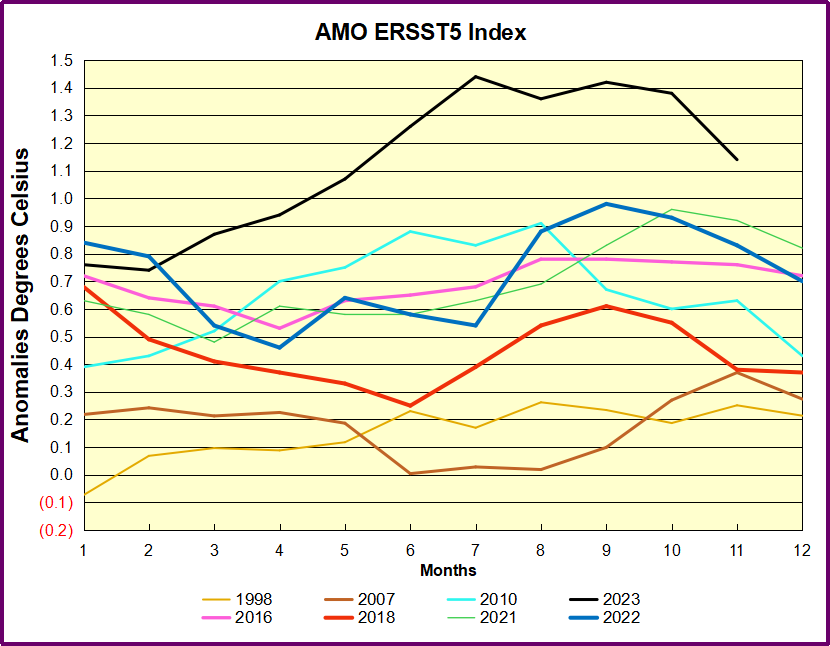
Through January 2023 I depended on the Kaplan AMO Index (not smoothed, not detrended) for N. Atlantic observations. But it is no longer being updated, and NOAA says they don’t know its future.  So I find that ERSSTv5 AMO dataset has data through August.  It differs from Kaplan, which reported average absolute temps measured in N. Atlantic.  “ERSST5 AMO  follows Trenberth and Shea (2006) proposal to use the NA region EQ-60°N, 0°-80°W and subtract the global rise of SST 60°S-60°N to obtain a measure of the internal variability, arguing that the effect of external forcing on the North Atlantic should be similar to the effect on the other oceans.”  So the values represent sst anomaly differences between the N. Atlantic and the Global ocean.

The chart above confirms what Kaplan also showed.  As August is the hottest month for the N. Atlantic, its varibility, high and low, drives the annual results for this basin.  Note also the peaks in 2010, lows after 2014, and a rise in 2021. Now in 2023 the peak is holding at 1.4C.  An annual chart below is informative:

Note the difference between blue/green years, beige/brown, and purple/red years.  2010, 2021, 2022 all peaked strongly in August or September.  1998 and 2007 were mildly warm.  2016 and 2018 were matching or cooler than the global average.  2023 started out slightly warm, then in May and June spiked to match 2010. Now there is a peak in July, with August and September only slightly lower.

The pattern suggests the ocean may be demonstrating a stairstep pattern like that we have also seen in HadCRUT4. 

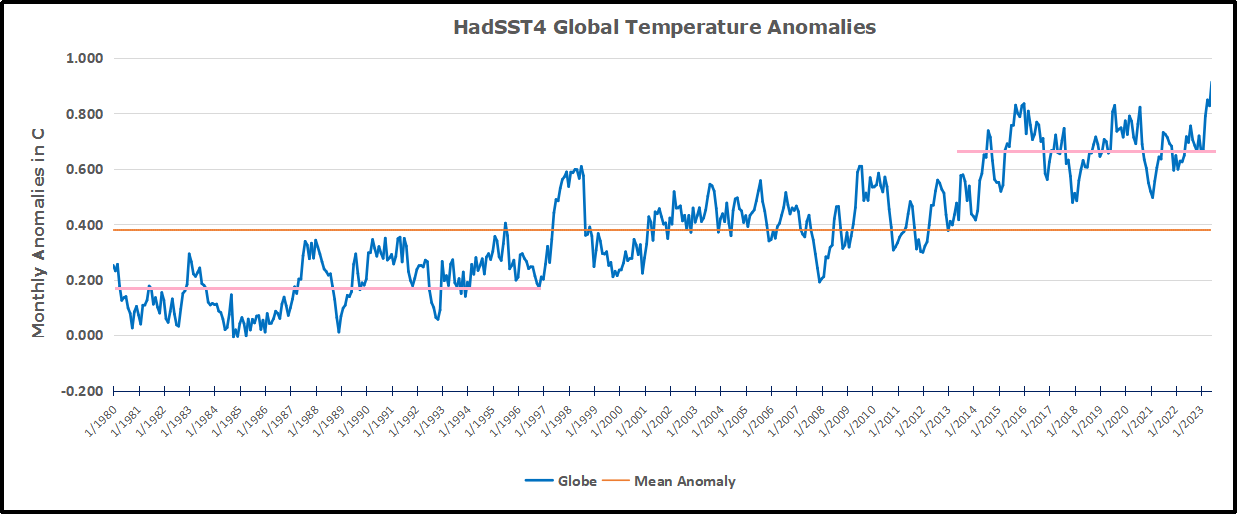
The purple line is the average anomaly 1980-1996 inclusive, value 0.18.  The orange line the average 1980-202306, value 0.38, also for the period 1997-2012. The red line is 2013-202306, value 0.64. As noted above, these rising stages are driven by the combined warming in the Tropics and NH, including both Pacific and Atlantic basins.

Curiosity:  Solar Coincidence?

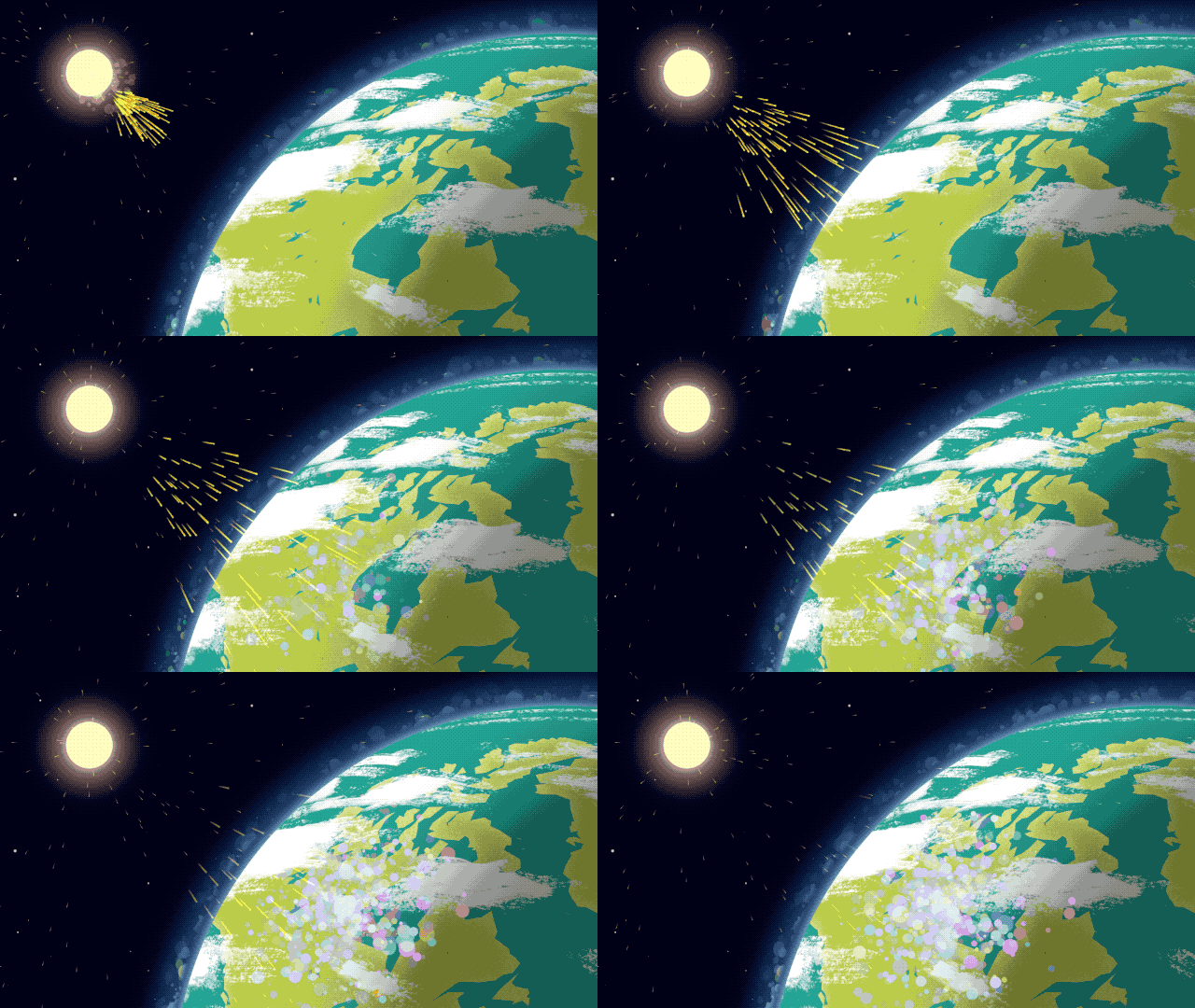
The news about our current solar cycle 25 is that the solar activity is hitting peak numbers now and higher  than expected 1-2 years in the future.  As livescience put it:  Solar maximum could hit us harder and sooner than we thought. How dangerous will the sun’s chaotic peak be?  Some charts from spaceweatherlive look familar to these sea surface temperature charts.

Summary

The oceans are driving the warming this century.  SSTs took a step up with the 1998 El Nino and have stayed there with help from the North Atlantic, and more recently the Pacific northern “Blob.”  The ocean surfaces are releasing a lot of energy, warming the air, but eventually will have a cooling effect.  The decline after 1937 was rapid by comparison, so one wonders: How long can the oceans keep this up? And is the sun adding forcing to this process?

Space weather impacts the ionosphere in this animation. Credits: NASA/GSFC/CIL/Krystofer Kim

Footnote: Why Rely on HadSST4

HadSST is distinguished from other SST products because HadCRU (Hadley Climatic Research Unit) does not engage in SST interpolation, i.e. infilling estimated anomalies into grid cells lacking sufficient sampling in a given month. From reading the documentation and from queries to Met Office, this is their procedure.

HadSST4 imports data from gridcells containing ocean, excluding land cells. From past records, they have calculated daily and monthly average readings for each grid cell for the period 1961 to 1990. Those temperatures form the baseline from which anomalies are calculated.

In a given month, each gridcell with sufficient sampling is averaged for the month and then the baseline value for that cell and that month is subtracted, resulting in the monthly anomaly for that cell. All cells with monthly anomalies are averaged to produce global, hemispheric and tropical anomalies for the month, based on the cells in those locations. For example, Tropics averages include ocean grid cells lying between latitudes 20N and 20S.

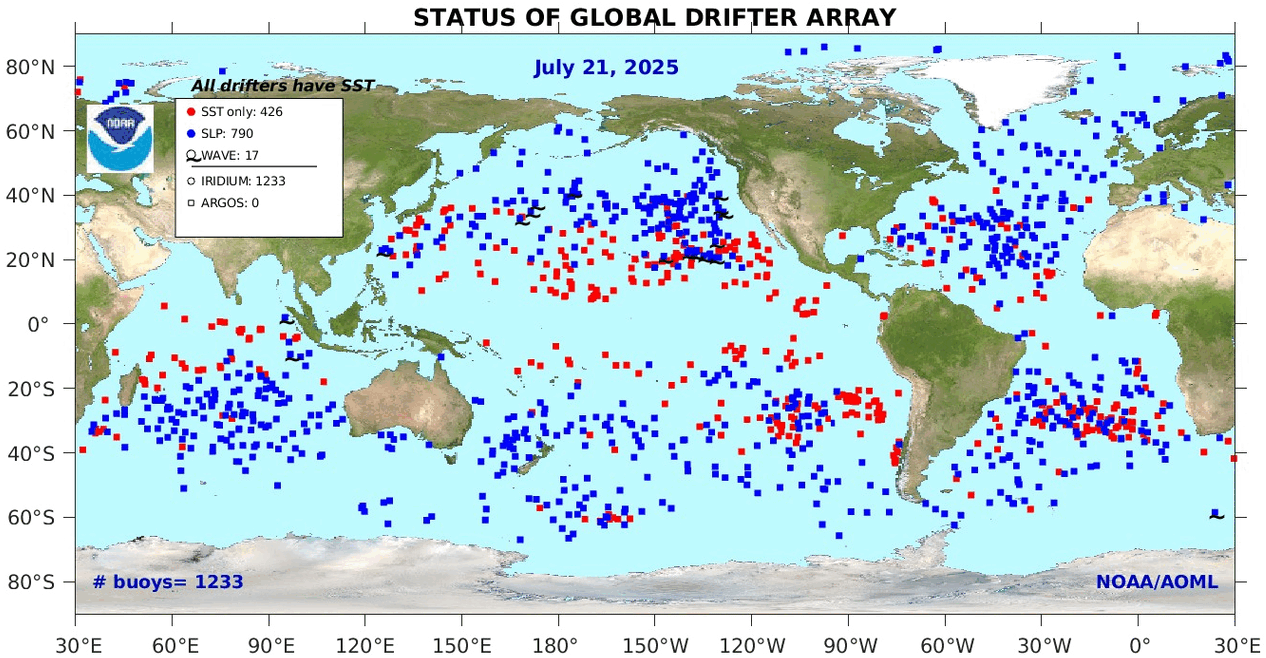
Gridcells lacking sufficient sampling that month are left out of the averaging, and the uncertainty from such missing data is estimated. IMO that is more reasonable than inventing data to infill. And it seems that the Global Drifter Array displayed in the top image is providing more uniform coverage of the oceans than in the past.

uss-pearl-harbor-deploys-global-drifter-buoys-in-pacific-ocean

USS Pearl Harbor deploys Global Drifter Buoys in Pacific Ocean


Mid October 2023 Arctic Ice Recovering Rapidly


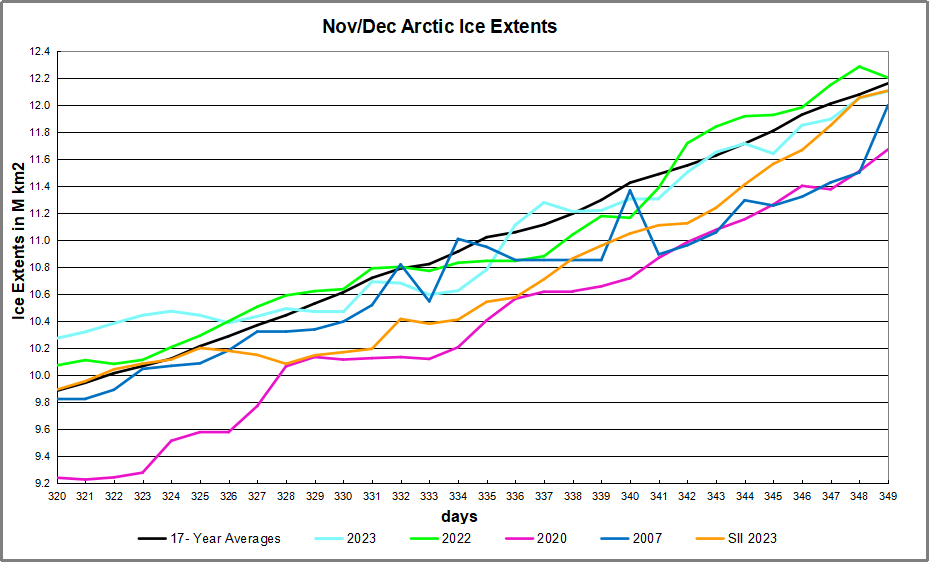
The animation shows Arctic ice rapidly growing from September 30 to yesterday October 16.  Despite much ado about September minimums, in fact the ice recovers quickly from its annual low extent.  Several days exceeded the 17 year average with yesterday slightly in deficit. The graph below shows the distribution of ice across the Arctic Regions with 2023 compare to average, to some notable years and to estimates from SII (Sea Ice Index)

Note that refreezing starts mid September and accelerates upward.  October has already added 1.4M km2 and will likely end up 3M higher than end of September. As the table below shows, the ice extents are tracking the 17 year average and 600k km2 greater than 2007.

Region 2023289 Day 289 2023-Ave. 2007289 2023-2007
 (0) Northern_Hemisphere 6291575 6397434  -105859  5685365 606210 
 (1) Beaufort_Sea 545048 740358  -195309  815519 -270471 
 (2) Chukchi_Sea 399345 309528  89817  98615 300730 
 (3) East_Siberian_Sea 495351 569412  -74061  32547 462804 
 (4) Laptev_Sea 578928 453308  125620  553919 25009 
 (5) Kara_Sea 178575 148145  30430  170928 7647 
 (6) Barents_Sea 22291 42524  -20233  25377 -3086 
 (7) Greenland_Sea 422335 341130  81206  446006 -23670 
 (8) Baffin_Bay_Gulf_of_St._Lawrence 103295 100033  3262  92878 10416 
 (9) Canadian_Archipelago 362514 583556  -221042  502605 -140091 
 (10) Hudson_Bay 208 10894  -10686  1936 -1729 
 (11) Central_Arctic 3179853 3096957  82896  2943760 236093 

Yesterday the overall extent was ~6.30M km2, ~100k km2 below average (2%).  Deficits were mostly in Beaufort Sea and CAA, offset by surpluses in Chukchi,Laptev, and Greenland seas, along with Central Arctic.

Previous post:  2023 September Arctic Outlook and Results Not Scary

The graph above shows the monthly averages for September Arctic ice extents including 2023 compared to previous years back to 2007.  This year is slightly below the 17 year average of 4.63M km2;  MASIE shows 4.43M and SII shows 4.37.  For comparison the 2007 September values were 4.30M for MASIE and 4.27M for SII.  The predictions below refer to the SII value.

2023: August Report from Sea Ice Prediction Network

The August median forecasted value for pan-Arctic September sea-ice extent is 4.60 million square kilometers with interquartile values of 4.35 and 4.80 million square kilometers, while individual forecasts range from 2.88 to 5.47 million square kilometers. We note that the lowest two forecasts predict a new record September sea-ice extent value (current record is September 2012, with a sea-ice extent of 3.57 million square kilometers), but these forecasts are outliers relative to the other contributions.

These are predictions for the September 2023 monthly average ice extent as reported by NOAA Sea Ice Index (SII). This post provides a look at the 2023 Year To Date (YTD) based on monthly averages comparing MASIE and SII datasets. (17 year average is 2006 to 2022 inclusive).

The graph puts 2023 into recent historical perspective. Note how 2023 was slightly below the 17-year average for the first 5 months, then recovered to match average in May and has maintained or exceeded average through August. September was below average slightly and above 2007. The outlier 2012 provided the highest March maximum as well as the lowest September minimum, coinciding with the Great Arctic Cyclone that year.  2007 began the period with the lowest minimum except for 2012.  SII 2023 was running below MASIE except for May/June and is currently just below MASIE and above 2007 and 2012.


Blinded by Antarctica Reports 2023

Special snow goggles for protection in polar landscapes.

Climate Crisis Central apparently triggered Antarctica for this week’s media alarm blitz.

Antarctic Ice Shelves Suffer Staggering Losses | Weather.com

‘Shrinking with no sign of recovery’: Scientists issue warning on Antarctic ice shelves
YAHOO!News

Scientists count huge melts in many protective Antarctic ice shelves. Trillions of tons of ice lost.
Associated Press

Antarctica’s Shrinking Sea Ice Hits a Record Low, Alarming Scientists Bloomberg

Melting Antarctic Ice Shelves Have Dumped More Than 7 Trillion Metric Tons of Water Into the Ocean  The Messenger

Etc., Etc. Etc.

Looks like it’s time yet again to play Climate Whack-A-Mole.  That means stepping back to get some perspective on the reports and the interpretations applied by those invested in alarmism.

Antarctic Basics

The Antarctic Ice Sheet extends almost 14 million square kilometers (5.4 million square miles), roughly the area of the contiguous United States and Mexico combined. The Antarctic Ice Sheet contains 30 million cubic kilometers (7.2 million cubic miles) of ice. (Source: NSIDC: Quick Facts Ice Sheets)

Highly active volcano Mt. Erebus, Ross Island, Antarctica

The Antarctic Ice Sheet covers an area larger than the U.S. and Mexico combined. This photo shows Mt. Erebus rising above the ice-covered continent. Credit: Ted Scambos & Rob Bauer, NSIDC

The study of ice sheet mass balance underwent two major advances, one during the early 1990s, and again early in the 2000s. At the beginning of the 1990s, scientists were unsure of the sign (positive or negative) of the mass balance of Greenland or Antarctica, and knew only that it could not be changing rapidly relative to the size of the ice sheet.

Advances in glacier ice flow mapping using repeat satellite images, and later using interferometric synthetic aperture radar SAR methods, facilitated the mass budget approach, although this still requires an estimate of snow input and a cross-section of the glacier as it flows out from the continent and becomes floating ice. Satellite radar altimetry mapping and change detection, developed in the early to mid-1990s allowed the research community to finally extract reliable quantitative information regarding the overall growth or reduction of the volume of the ice sheets.

By 2002, publications were able to report that both large ice sheets were losing mass (Rignot and Thomas 2002). Then in 2003 the launch of two new satellites, ICESat and GRACE, led to vast improvements in one of the methods for mass balance determination, volume change, and introduced the ability to conduct gravimetric measurements of ice sheet mass over time. The gravimetric method helped to resolve remaining questions about how and where the ice sheets were losing mass. With this third method, and with continued evolution of mass budget and geodetic methods it was shown that the ice sheets were in fact losing mass at an accelerating rate by the end of the 2000s (Veliconga 2009, Rignot et al. 2011b).

Fig. 1. Antarctic Ice Sheet Regions and Drainage Systems (DS). East Antarctica (EA) is divided into EA1 (DS2 to DS11) and EA2 (DS12 to DS17). The Antarctic Peninsula (AP) includes DS24 – 27. West Antarctica (WA) is divided into WA1 (Pine Island Glacier DS22, Thwaites and Smith Glaciers DS21, and the coastal DS20) and WA2 (inland DS1, DS18, and DS19 and coastal DS23). Includes grounded ice within ice shelves and contiguous islands.

Contradictory Findings

A 2021 paper by H. J. Zwally describes the waxing and waning of the Antarctic ice sheet NASA Study: Excess of Mass Gains of the Antarctic Ice Sheet over Mass Losses during 1992 to 2008 Eliminated by Increasing Dynamic Losses to 2016.  Excerpts in italics with my bolds.

A new NASA study [Antarctic Mass Balance] confirms that an increase in Antarctic snow accumulation [Siegert, 2003] that began 10,000 years ago in East Antarctica (EA) [Fig. 1] was adding enough ice to the continent during 1992 to 2008 to outweigh increased losses from its increasing glacier discharge into the ocean from West Antarctica (WA) as previously reported [2015 JOG paper]. Since most other studies reported that the Antarctic ice sheet was losing mass, those 2015 results on gaining mass were controversial. The new study derives consistent rates of mass changes over 24 years (1992 to 2016) using radar-altimetry data from ESA’s Envisat (2003-10) and gravimetry data from NASA’s GRACE (2003-16), in addition to the prior use of radar-altimetry data from ERS1/2 (1992-2001) of the European Space Agency (ESA) and laser-altimetry from NASA’s ICESat (2003-08).

However, the new study shows that beginning in 2009, the dynamic losses from the outlet glaciers in the WA1 part of WA strongly increased by 119 Gt a-1 (from 95 to 214 Gt a-1), which was further enhanced by an accumulation mass decrease of 39 Gt a-1 in the inland WA2 part of WA. Nevertheless, that total decrease of 158 Gt a-1 was not enough to bring the whole ice sheet into balance (input equals output), because there was a concurrent accumulation mass increase of 107 Gt a-1 in EA for three years (2009-11). While that temporary EA accumulation increase diminished, the loss from WA reduced by 71 Gt a-1 and the total ice sheet came into balance at -12 ± 46 Gt a-1 during 2012-16, thereby eliminating its effect on sea level rise.

Fig. 2. M(t) mass time series for West Antarctica (WA), East Antarctica (EA), Antarctica Peninsula (AP), and the total Antarctic Ice Sheet (AIS) from ICESat (blue) and GRACE (red) using the derived equalizing corrections (dBcor and GIAcor) for sub-glacial changes in volume and mass of the Earth’s fluid mantle.

Fig. 3. ICESat map of dM/dt total rate of mass change for 2003-2008 with adjusted correction for bedrock motion.

“We now have an accurate record of how the mass balance of the Antarctic ice sheet has changed over 24 years and the causes of those changes. Short-term changes for 3 to 8 years have been caused by fluctuations in snowfall and accumulation, but there is no significant trend during 1992 to 2016. Mass losses have increased from the dynamic thinning and faster ice discharge of outlet glaciers in West Antarctic, and the large long-term mass gain in East Antarctica has continued”, said lead author Jay Zwally. “However, our findings and those of others [e.g. Barletta and others, 2018] also include some good signs about the future stability of the West Antarctic ice sheet, about which there has been much concern and predictions of increasing mass loss”.

NASA aerial images record West Antarctica melting ice (2016)

Keeping Things in Perspective

Source: NASA

Such reports often include scary graphs like this one and the reader is usually provided no frame of reference or context to interpret the image. First, the chart is showing cumulative loss of mass arising from an average rate of 100 Gt lost per year since 2002. Many years had gains, including 2002, and the cumulative loss went below zero only in 2006.  Also, various methods of measuring and analyzing give different results, as indicated by the earlier section.

Most important is understanding the fluxes in proportion to the Antarctic Ice Sheet.  Let’s do the math.  Above it was stated Antarctica contains ~30 million cubic kilometers of ice volume.  One km3 of water is 1 billion cubic meters and weighs 1 billion tonnes, or 1 gigatonne.  So Antarctica has about 30,000,000 gigatonnes of ice.  Since ice is slightly less dense than water, the total should be adjusted by 0.92 for an estimate of 27.6 M Gts of ice comprising the Antarctic Ice Sheet.

So in the recent decade, an average year went from 27,600,100 Gt to 27,600,000, according to one analysis.  Other studies range from losing 200 Gt/yr to gaining 100 Gt/yr.

Even if Antarctica lost 200 Gt/yr. for the next 1000 years,
it would only approach 1% of the ice sheet.

If like Al Gore you are concerned about sea level rise, that calculation starts with the ocean area estimated to be 3.618 x 10^8 km2 (361,800,000 km2). To raise that area 1 mm requires 3.618×10^2 km3 or 361.8 km3 water (1 km3 water=1 Gt.) So 200 Gt./yr is about 0.55mm/yr or 6 mm a decade, or 6 cm/century.

By all means let’s pay attention to things changing in our world, but let’s also notice the scale of the reality and not make mountains out of molehills.

Let’s also respect the scientists who study glaciers and their subtle movements over time (“glacial pace”).  Below is an amazing video showing the challenges and the beauty of working on Greenland Glacier.

From Ice Alive: Uncovering the secrets of Earth’s Ice

For more on the Joys of Playing Climate Whack-A-Mole 


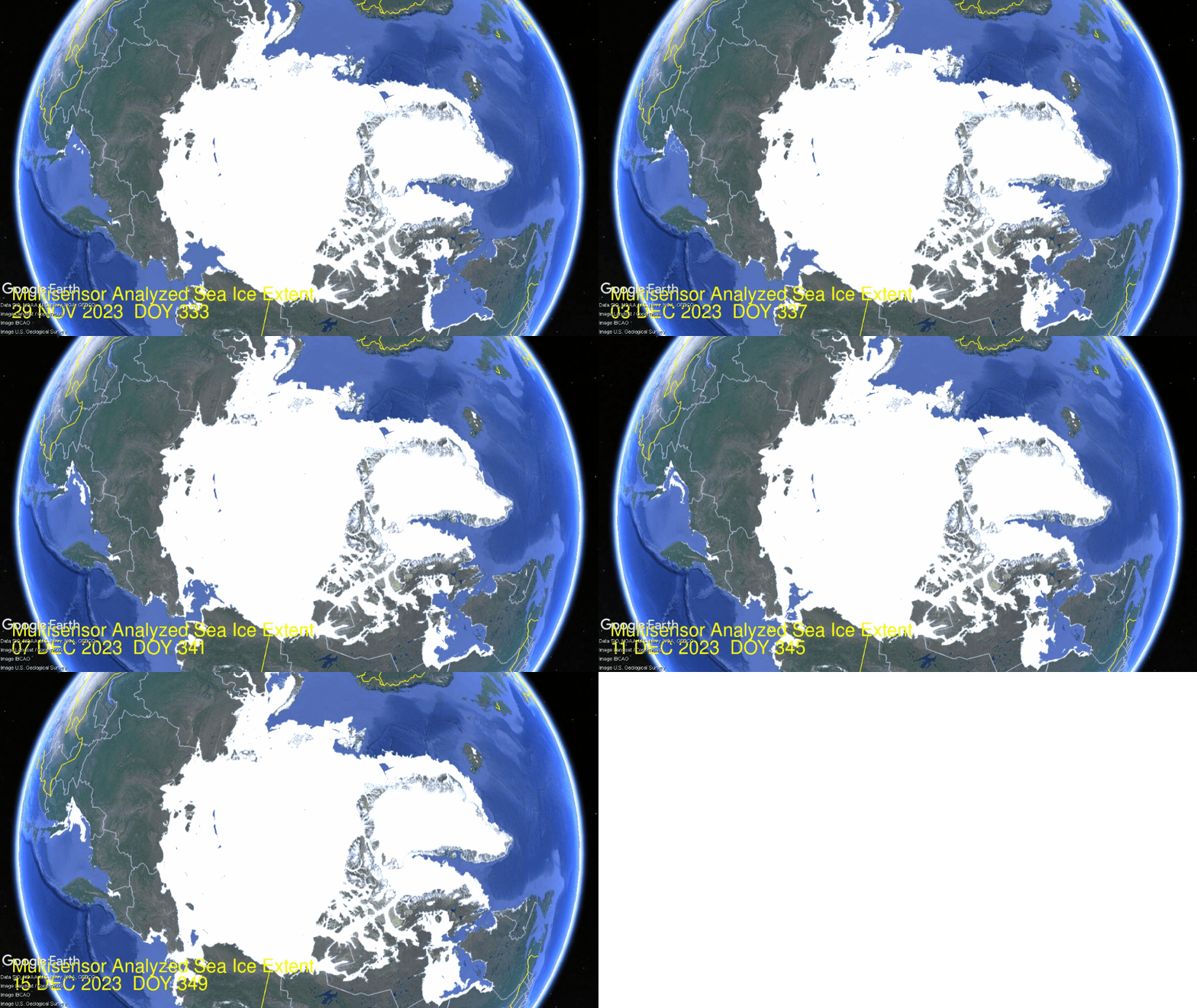
October 2023 Arctic Ice Flash Freezing

The animation shows the rapid refreezing of Arctic ice from September 30 to yesterday October 9.  Despite much ado about September minimums, in fact the ice recovers quickly from its annual low extent.  As of yesterday, Day 282, this year has again exceeded the 17 year average.

Previous post:  2023 September Arctic Outlook and Results Not Scary

The graph above shows the monthly averages for September Arctic ice extents including 2023 compared to previous years back to 2007.  This year is slightly below the 17 year average of 4.63M km2;  MASIE shows 4.43M and SII shows 4.37.  For comparison the 2007 September values were 4.30M for MASIE and 4.27M for SII.  The predictions below refer to the SII value.

2023: August Report from Sea Ice Prediction Network

The August median forecasted value for pan-Arctic September sea-ice extent is 4.60 million square kilometers with interquartile values of 4.35 and 4.80 million square kilometers, while individual forecasts range from 2.88 to 5.47 million square kilometers. We note that the lowest two forecasts predict a new record September sea-ice extent value (current record is September 2012, with a sea-ice extent of 3.57 million square kilometers), but these forecasts are outliers relative to the other contributions.

These are predictions for the September 2023 monthly average ice extent as reported by NOAA Sea Ice Index (SII). This post provides a look at the 2023 Year To Date (YTD) based on monthly averages comparing MASIE and SII datasets. (17 year average is 2006 to 2022 inclusive).

The graph puts 2023 into recent historical perspective. Note how 2023 was slightly below the 17-year average for the first 5 months, then recovered to match average in May and has maintained or exceeded average through August. September was below average slightly and above 2007. The outlier 2012 provided the highest March maximum as well as the lowest September minimum, coinciding with the Great Arctic Cyclone that year.  2007 began the period with the lowest minimum except for 2012.  SII 2023 was running below MASIE except for May/June and is currently just below MASIE and above 2007 and 2012.

The table below provides the numbers for comparisons (all are M km2)

Monthly MASIE 2023 SII 2023 MASIE -SII MASIE 2023-17 YR AVE SII 2023-17 YR AVE MASIE 2023-2007
Jan 13.579 13.347 0.232 -0.207 -0.250 -0.183
Feb 14.481 14.177 0.304 -0.207 -0.292 -0.171
Mar 14.655 14.440 0.215 -0.212 -0.248 0.032
Apr 13.979 13.992 -0.013 -0.120 -0.025 0.283
May 11.866 12.159 -0.293 -0.742 -0.492 -0.561
June 11.044 10.963 0.081 0.242 0.099 0.218
July 8.431 8.183 0.248 0.152 0.150 0.439
Aug 5.825 5.561 0.264 -0.062 -0.083 0.241
Sept 4.430 4.371 0.059 -0.285 -0.360 0.132

The first two columns are the 2023 YTD shown by MASIE and SII, with the MASIE surpluses in column three.  Column four shows MASIE 2023 compared to MASIE 17 year average, while column five shows SII 2023 compared to SII 17 year average.  YTD September both MASIE and SII ~300k km2 below average. The last column shows MASIE 2023 holding a September surplus of 132k km2 over 2007.

Summary and Update

The experts involved in SIPN were expecting SII 2023 September to be higher than 2007 and somewhat lower than 2022.  The way it came out MASIE September was 285k km2 below average and 132 above 2007.  The Chart below shows the October ice recovery is well under way, now exceeding the average. 

The table shows Day 282 (October 9) ice extents for NH overall and the regions, comparing 2023 to average and several years.

Region 2023282 Day 282 2023-Ave. 2007282 2023-2007
 (0) Northern_Hemisphere 5663965 5537300  126665  4794178 869787 
 (1) Beaufort_Sea 473472 641789  -168317  639935 -166464 
 (2) Chukchi_Sea 323215 255140  68075  14061 309154 
 (3) East_Siberian_Sea 257832 407159  -149327  35 257797 
 (4) Laptev_Sea 471460 252642  218818  340943 130518 
 (5) Kara_Sea 117555 66310  51245  82407 35148 
 (6) Barents_Sea 29729 22272  7457  12933 16796 
 (7) Greenland_Sea 424861 289801  135061  400747 24115 
 (8) Baffin_Bay_Gulf_of_St._Lawrence 90677 67480  23197  73481 17195 
 (9) Canadian_Archipelago 305206 485343  -180137  424350 -119144 
 (10) Hudson_Bay 104 5030  -4926  4163 -4059 
 (11) Central_Arctic 3167292 3043182  124110  2799828 367464 

On Day 282 Arctic ice was 127k km2 above average and nearly 870k km2 above 2007. The major deficits were in Beaufort, East Siberian seas and Canadian Archipelago.  They were more than offset by surpluses in Laptev, Greenland sea and Central Arctic as well as smaller surpluses elsewhere.  From previous years we can expect that October 2023 will gain more than 3M km2 of ice extent over the ending extent in September.


2023 September Arctic Outlook and Results Not Scary

The graph above shows the monthly averages for September Arctic ice extents including 2023 compared to previous years back to 2007.  This year is slightly below the 17 year average of 4.63M km2;  MASIE shows 4.43M and SII shows 4.37.  For comparison the 2007 September values were 4.30M for MASIE and 4.27M for SII.  The predictions below refer to the SII value.

2023: August Report from Sea Ice Prediction Network

The August median forecasted value for pan-Arctic September sea-ice extent is 4.60 million square kilometers with interquartile values of 4.35 and 4.80 million square kilometers, while individual forecasts range from 2.88 to 5.47 million square kilometers. We note that the lowest two forecasts predict a new record September sea-ice extent value (current record is September 2012, with a sea-ice extent of 3.57 million square kilometers), but these forecasts are outliers relative to the other contributions.

These are predictions for the September 2023 monthly average ice extent as reported by NOAA Sea Ice Index (SII). This post provides a look at the 2023 Year To Date (YTD) based on monthly averages comparing MASIE and SII datasets. (17 year average is 2006 to 2022 inclusive).

The graph puts 2023 into recent historical perspective. Note how 2023 was slightly below the 17-year average for the first 5 months, then recovered to match average in May and has maintained or exceeded average through August. September was below average slightly and above 2007. The outlier 2012 provided the highest March maximum as well as the lowest September minimum, coinciding with the Great Arctic Cyclone that year.  2007 began the period with the lowest minimum except for 2012.  SII 2023 was running below MASIE except for May/June and is currently just below MASIE and above 2007 and 2012.

The table below provides the numbers for comparisons (all are M km2)

Monthly MASIE 2023 SII 2023 MASIE -SII MASIE 2023-17 YR AVE SII 2023-17 YR AVE MASIE 2023-2007
Jan 13.579 13.347 0.232 -0.207 -0.250 -0.183
Feb 14.481 14.177 0.304 -0.207 -0.292 -0.171
Mar 14.655 14.440 0.215 -0.212 -0.248 0.032
Apr 13.979 13.992 -0.013 -0.120 -0.025 0.283
May 11.866 12.159 -0.293 -0.742 -0.492 -0.561
June 11.044 10.963 0.081 0.242 0.099 0.218
July 8.431 8.183 0.248 0.152 0.150 0.439
Aug 5.825 5.561 0.264 -0.062 -0.083 0.241
Sept 4.430 4.371 0.059 -0.285 -0.360 0.132

The first two columns are the 2023 YTD shown by MASIE and SII, with the MASIE surpluses in column three.  Column four shows MASIE 2023 compared to MASIE 17 year average, while column five shows SII 2023 compared to SII 17 year average.  YTD September both MASIE and SII ~300k km2 below average. The last column shows MASIE 2023 holding a September surplus of 132k km2 over 2007.

Summary and Update

The experts involved in SIPN were expecting SII 2023 September to be higher than 2007 and somewhat lower than 2022.  The way it came out MASIE September was 285k km2 below average and 132 above 2007.  The Chart below shows the October ice recovery is well under way, reaching average briefly.

The table shows Day 281 (October 8) ice extents for NH overall and the regions, comparing 2023 to average and several years.

Region 2023281 Day 281 2023-Ave. 2007281 2023-2007
 (0) Northern_Hemisphere 5349225 5448341 -99116 4653544 695681
 (1) Beaufort_Sea 429938 633800 -203862 618242 -188304
 (2) Chukchi_Sea 301437 249878 51559 27562 273875
 (3) East_Siberian_Sea 180747 397106 -216358 311 180436
 (4) Laptev_Sea 423091 235120 187971 302924 120168
 (5) Kara_Sea 97994 54598 43396 22717 75277
 (6) Barents_Sea 15003 21167 -6164 3580 11423
 (7) Greenland_Sea 414298 285893 128405 414576 -278
 (8) Baffin_Bay_Gulf_of_St._Lawrence 74944 64730 10214 71399 3545
 (9) Canadian_Archipelago 266487 468946 -202459 408841 -142354
 (10) Hudson_Bay 744 4166 -3423 1936 -1193
 (11) Central_Arctic 3142582 3031785 110797 2780181 362401

On Day 281 Arctic ice was 100k km2 below average and nearly 700k km2 above 2007. The major deficits were in Beaufort, East Siberian seas and Canadian Archipelago.  Offsetting were surpluses in Laptev, Greenland sea and Central Arctic as well as smaller surpluses elsewhere.  From previous years we can expect that October 2023 will gain more than 3M km2 of ice extent over the ending extent in September.


UAH: Amazing SH Land Air Spike September 2023

The post below updates the UAH record of air temperatures over land and ocean. Each month and year exposed again the growing disconnect between the real world and the Zero Carbon zealots.  It is as though the anti-hydrocarbon band wagon hopes to drown out the data contradicting their justification for the Great Energy Transition.  Yes, there is warming from an El Nino buildup coincidental with North Atlantic warming, but no basis to blame it on CO2.  

As an overview consider how recent rapid cooling  completely overcame the warming from the last 3 El Ninos (1998, 2010 and 2016).  The UAH record shows that the effects of the last one were gone as of April 2021, again in November 2021, and in February and June 2022  At year end 2022 and continuing into 2023 global temp anomaly matched or went lower than average since 1995, an ENSO neutral year. (UAH baseline is now 1991-2020).

For reference I added an overlay of CO2 annual concentrations as measured at Mauna Loa.  While temperatures fluctuated up and down ending flat, CO2 went up steadily by ~60 ppm, a 15% increase.

Furthermore, going back to previous warmings prior to the satellite record shows that the entire rise of 0.8C since 1947 is due to oceanic, not human activity.

gmt-warming-events

The animation is an update of a previous analysis from Dr. Murry Salby.  These graphs use Hadcrut4 and include the 2016 El Nino warming event.  The exhibit shows since 1947 GMT warmed by 0.8 C, from 13.9 to 14.7, as estimated by Hadcrut4.  This resulted from three natural warming events involving ocean cycles. The most recent rise 2013-16 lifted temperatures by 0.2C.  Previously the 1997-98 El Nino produced a plateau increase of 0.4C.  Before that, a rise from 1977-81 added 0.2C to start the warming since 1947.

Importantly, the theory of human-caused global warming asserts that increasing CO2 in the atmosphere changes the baseline and causes systemic warming in our climate.  On the contrary, all of the warming since 1947 was episodic, coming from three brief events associated with oceanic cycles. 

Update August 3, 2021

Chris Schoeneveld has produced a similar graph to the animation above, with a temperature series combining HadCRUT4 and UAH6. H/T WUWT

image-8


mc_wh_gas_web20210423124932

See Also Worst Threat: Greenhouse Gas or Quiet Sun?

September 2023 Update New Summer High Driven by SH Spike 

banner-blog

With apologies to Paul Revere, this post is on the lookout for cooler weather with an eye on both the Land and the Sea.  While you will hear a lot about 2020-21 temperatures matching 2016 as the highest ever, that spin ignores how fast the cooling set in.  The UAH data analyzed below shows that warming from the last El Nino had fully dissipated with chilly temperatures in all regions. After a warming blip in 2022, land and ocean temps dropped again with 2023 starting below the mean since 1995.  Spring and Summer 2023 saw a series of warmings.  Now in September a new summer high resulted from a major upward spike in SH, especially the land temps. 

UAH has updated their tlt (temperatures in lower troposphere) dataset for September 2023. Posts on their reading of ocean air temps this month preceded updated records from HadSST4.  I last posted on SSTs using HadSST4 Ocean Warming Crest August 2023, Solar Coincidence?  This month also has a separate graph of land air temps because the comparisons and contrasts are interesting as we contemplate possible cooling in coming months and years. Sometimes air temps over land diverge from ocean air changes.  For example in September 2023, SH land temps leaped upward almost unbelievably.

In September, as shown later on, Global ocean air reached a slightly higher peak led by SH, but with NH easing down. OTOH  Land air temps rose in all regions, with a SH rising dramatically.   Thus the land + ocean Global UAH temperature is now exceeding the 2016 peak.

Note:  UAH has shifted their baseline from 1981-2010 to 1991-2020 beginning with January 2021.  In the charts below, the trends and fluctuations remain the same but the anomaly values change with the baseline reference shift.

Presently sea surface temperatures (SST) are the best available indicator of heat content gained or lost from earth’s climate system.  Enthalpy is the thermodynamic term for total heat content in a system, and humidity differences in air parcels affect enthalpy.  Measuring water temperature directly avoids distorted impressions from air measurements.  In addition, ocean covers 71% of the planet surface and thus dominates surface temperature estimates.  Eventually we will likely have reliable means of recording water temperatures at depth.

Recently, Dr. Ole Humlum reported from his research that air temperatures lag 2-3 months behind changes in SST.  Thus the cooling oceans now portend cooling land air temperatures to follow.  He also observed that changes in CO2 atmospheric concentrations lag behind SST by 11-12 months.  This latter point is addressed in a previous post Who to Blame for Rising CO2?

After a change in priorities, updates are now exclusive to HadSST4.  For comparison we can also look at lower troposphere temperatures (TLT) from UAHv6 which are now posted for September.  The temperature record is derived from microwave sounding units (MSU) on board satellites like the one pictured above. Recently there was a change in UAH processing of satellite drift corrections, including dropping one platform which can no longer be corrected. The graphs below are taken from the revised and current dataset.

The UAH dataset includes temperature results for air above the oceans, and thus should be most comparable to the SSTs. There is the additional feature that ocean air temps avoid Urban Heat Islands (UHI).  The graph below shows monthly anomalies for ocean air temps since January 2015.

Note 2020 was warmed mainly by a spike in February in all regions, and secondarily by an October spike in NH alone. In 2021, SH and the Tropics both pulled the Global anomaly down to a new low in April. Then SH and Tropics upward spikes, along with NH warming brought Global temps to a peak in October.  That warmth was gone as November 2021 ocean temps plummeted everywhere. After an upward bump 01/2022 temps reversed and plunged downward in June.  After an upward spike in July, ocean air everywhere cooled in August and also in September.   

After sharp cooling everywhere in January 2023, all regions were into negative territory. Note the Tropics matched the lowest value, but since have spiked sharply upward +1.26C, with the largest increases in April to July 2023.  NH also warmed 0.7C in the last 4 months, while SH ocean air rose the same. Global Ocean air September 2023 is now matching 2016, the main difference being the much higher rise in SH anomalies since April.  The strength of the El Nino will determine the latter part of this year.

Land Air Temperatures Tracking Downward in Seesaw Pattern

We sometimes overlook that in climate temperature records, while the oceans are measured directly with SSTs, land temps are measured only indirectly.  The land temperature records at surface stations sample air temps at 2 meters above ground.  UAH gives tlt anomalies for air over land separately from ocean air temps.  The graph updated for September is below.

Here we have fresh evidence of the greater volatility of the Land temperatures, along with extraordinary departures by SH land.  Land temps are dominated by NH with a 2021 spike in January,  then dropping before rising in the summer to peak in October 2021. As with the ocean air temps, all that was erased in November with a sharp cooling everywhere.  After a summer 2022 NH spike, land temps dropped everywhere, and in January, further cooling in SH and Tropics offset by an uptick in NH. 

Remarkably, in 2023, SH land air anomaly shot up 1.5C, from  -0.56C in January to +0.93 in July, then dropped to 0.53 in August.  Now in September SH shot up again to 1.5C.  Tropical land temps are up 1.48 since January and NH Land air temps rose 0.9, mostly since May. The consolidated rise greatly exceeds the upward spikes peaking in  2016.

The Bigger Picture UAH Global Since 1980

The chart shows monthly Global anomalies starting 01/1980 to present.  The average monthly anomaly is -0.06, for this period of more than four decades.  The graph shows the 1998 El Nino after which the mean resumed, and again after the smaller 2010 event. The 2016 El Nino matched 1998 peak and in addition NH after effects lasted longer, followed by the NH warming 2019-20.   An upward bump in 2021 was reversed with temps having returned close to the mean as of 2/2022.  March and April brought warmer Global temps, later reversed.

With the sharp drops in Nov., Dec. and January 2023 temps, there was no increase over 1980. Now in 2023 the buildup to the September peak exceeds the sharp April peak of the El Nino 1998 event. It also surpasses the February peak in 2016.  Where it goes from here, up or down, remains to be seen.

TLTs include mixing above the oceans and probably some influence from nearby more volatile land temps.  Clearly NH and Global land temps have been dropping in a seesaw pattern, nearly 1C lower than the 2016 peak.  Since the ocean has 1000 times the heat capacity as the atmosphere, that cooling is a significant driving force.  TLT measures started the recent cooling later than SSTs from HadSST3, but are now showing the same pattern. Despite the three El Ninos, their warming has not persisted prior to 2023, and without them it would probably have cooled since 1995.  Of course, the future has not yet been written.


Doomsday Climate Talk, Deja Vu

At Quora, Dan Gracia responds to this question: (in italics with my bolds)

Q: Why did people start using the term “climate change”
instead of the previous term “global warming”?

I’m 73 now and I remember on April 22, 1970 carrying the totally green American Flag (stars and stripes but in green) at college in a parade celebrating that first Earth Day. Problem then was that we were causing the earth to slip into an ice age due to the use of fluorocarbons as a propellant in spray cans of all types but the most significant factor was their use in hair spray cans. So it was an “Pending Ice Age Alarm”. Well, of course, that didn’t happen as actual temperatures didn’t sink and actually raised very, very slightly (less than a fraction of a degree over the next 10, or was it 20 years?) .

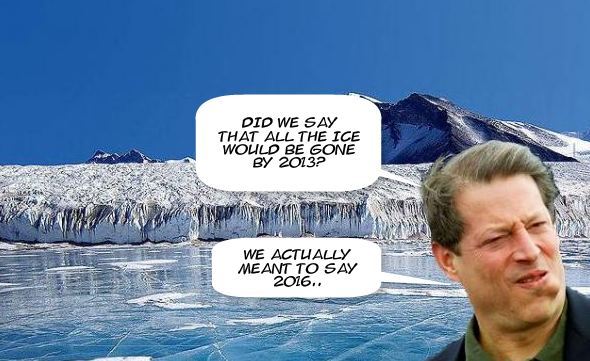
Then it turned into a “Global Warming Alarm” because there was some evidence of an increase in temperatures, regardless of how minuscule it was. So “Global Warming” is the earliest term most people remember now. Then the warming not only did not fit any of the climate models they were/are basing their alarmist claims on, it stopped warming entirely for about 20-years despite Al Gore’s claims the ice-cap would melt and our coasts would be underwater within 10-years.. And then temperatures sank slightly again.
Figure 1: The measured (symbols on left) and modeled (lines) temperature trends vs. altitude. The Russian model comes closest to the data, and the worst fit is GFDL-CM3, Manabe’s model for which he was awarded a Nobel prize. (Fig. 3 from John R. Christy and Richard T. McNider, DOI:10.1007/s13143-017-0070-z, annotated.)

None of these changes fit any of the computer models that were generating the Alarmist predictions. At that point, instead of trying to find out what variable(s) they were missing, the alarmists finally decided to just call it “climate change”. And now they could blame anything even slightly out of the ordinary as due to climate change. It’s a great catch-all term that you can claim regardless of what the temperatures actually show and also because the global climate is in a almost constant state of change. You’d be a fool to deny climate change because the climate is constantly changing and has been for over 4-billion years now. The trick is proving that human interaction is contributing to it in a meaningful and detrimental way. There are so many more powerful forces at play.

Add to that the fact that the earth was in its most prolific state millions of years ago when the Co2 ratio was much higher. Remember those elementary school science lessons that taught you that plants consume (ingest) Co2 (carbon dioxide) and exhaust O2 (oxygen)? Or perhaps that’s not common knowledge anymore? Plants and trees proliferated because growing conditions were better suited for them.

But regardless of weather getting warmer or colder,
climate alarmists are able to blame it all on climate change.

So it’s a catch-all phrase and anyone can chant it for any reason and claim there is a consensus among scientists that this it is a real threat. Unfortunately included in that “consensus” are medical doctors, dentists, Mechanical Engineers, Electrical Engineers, Biologists, Chemists, etc. – basically anyone who has a Bachelor of Science degree or higher. The thing that is missing is a consensus from climatologists. Many of these Bachelor of Science degrees may deal with some fringe parts of the problem but Climatology is an incredibly detailed with ever-changing data field and none of the others have the depth of knowledge to make an accurate claim of cause and effect with enough data and knowledge to make valid predictions.

Would you want a microbiologist to perform open heart surgery on you? Undeniably a scientific background but certainly not enough knowledge and practice to perform a long and complex surgery. Would you look to a Electrical Engineer for that? Definitely a scientist because he/she has at least a bachelor of science degree, ore perhaps a masters or even a doctorate degree. But would you trust that “Doctor” of engineering to perform open-heart surgery on you. Of course not. They don’t have the specialized education, ability to analyze relevant data, or even determine what data was relevant, let alone the fine motor skills needed to successfully complete open heart surgery.

To further muddy the waters, there’s huge amounts of money being spent on climate change research, and if they reach the conclusion that it is not a main ingredient in climate change, that research money dries up and goes away. So actually reaching a provable conclusion whose computer models can be born out with actual evidence instead of speculation, is working towards the elimination of their jobs. Plus, there’s real money to be made outside of climate research projects and grants. There’s the “Carbon TAX”.

Al Gore was one of if not the earliest proponent for “Carbon Credits”. If an industry or installation was generating too much Carbon Dioxide, they would have to purchase the carbon credits to offset their pollution. Ideally this money would then be spent to further other methods of Co2 control. And of course, you would purchase them from Al Gore’s carbon credits company. So then, if the installation had the credits, they could go ahead and continue polluting. As if Al Gore didn’t get enough money from his climate alarmism over the many years he’s been involved this is a Bonanza for him. And how much of that money is actually spent to improve methods and machinery to reduce the carbon levels? How much goes to the top executives of those companies and the people working for them…?

And of course, government has to get in on this cash cow too. A recent carbon tax was imposed on businesses in Washington state. The carbon tax basically requires companies to buy “greenhouse gas allowances,” sold at auction by Washington state, if they emit more than 25,000 metric tons of carbon dioxide per year. The law took effect on Jan. 1, 2023. The first of 4 “auctions” of “greenhouse gas allowances” raised over $300 million dollars. The remaining 3 auctions for the year are expected to raise at least as much resulting in over $1.2 billion dollars for 2023.

Washington State Senator Ericksen said it best, “This legislation will raise billions of dollars from the people of Washington state. Now, who’s going to pay those billions of dollars? It’s not going to be the oil refineries, it’s not going to be the manufacturers, it’s going to be the people of Washington state who will pay through increased costs for their energy.” Anyone who’s had any experience in business from employee to CEO knows that if a company is to stay in business when their costs increase, they either have to raise their prices or decrease their costs. The first place they go to decrease cost is to chop hours and to let people go. Since it’s an industry-wide expense, they all raise their prices because they all have to do so to stay in business – competition doesn’t have a lot to do with this. If they delay raising their prices, then people lose their jobs instead.

As a result of this carbon tax, energy prices have skyrocketed. Promises were made that it certainly wouldn’t raise the price of gas by more than perhaps 5¢ per gallon because it was a tax on businesses, not a raise in the gas tax. In the first 3-weeks of 2023 it went up 25¢ per gallon and now has exceeded a 50¢ per gallon increase. Pricing of Diesel is even worse. Politicians who have never worked a “real job” for a “real business” don’t have much common sense when it comes to raising taxes.

Energy prices have also risen and continue to rise and since virtually everything moves by truck, that drives up the cost of all goods driving inflation even higher. And of course, now that the government has it, they will never let go of that tax regardless of how it hurts their residents.

So this is a self-perpetuating process originated by well meaning folks
who just didn’t have the knowledge or data to back it up.

Absolutely on that first Earth-day in 1970 everyone was concerned for the earth and wanted to find ways to help make it better. Since then it’s become a self-perpetuating scheme with prediction models that have consistently failed over the last 50-years raising alarms which still can’t be proven.

And people seem to forget that Science is not an absolute. What we believe is true today may be disproven tomorrow. THAT is the scientific method regardless of how many people believe in something. At one time virtually all the people in the world believed the earth is flat and the son revolves around the earth. Folks who disagreed were called heretics and persecuted.

The scientific method requires an proposal of what they believes is a reasonable hypothesis that can be proven or disproven. Then through a series of “repeatable” experiments the hypothesis is proven out and published for peer review. If the technique of proving the hypothesis does not generate the same result, then the hypothesis is not proven. Peer review invites dissent, opposing views, and proof of the ability or inability to reach the same result.

NOTE that peer review means scientists who are the peers of those offering the hypothesis with the ability to repeat the experiments used to prove it. You do not solicit or consider the opinion of a medical doctor to a hypothesis put forward by a climatologist, just as you don’t consider the opinion of a climatologist regarding a surgical procedure for a surgeon. Neither are actual peers in the other field of study. They can have opinions, but they are not “peer review”.

As a result I am far more interested in the opinions and research of Dr. Judith Curry and her true peers, than I am of a screaming media darling.

I’m not particularly fond of people
who fly in private jets to a meeting
where they discuss how to take away
my car and feed me bugs . . . but that’s just me.