Arctic Sea Ice Linked to Little Ice Age

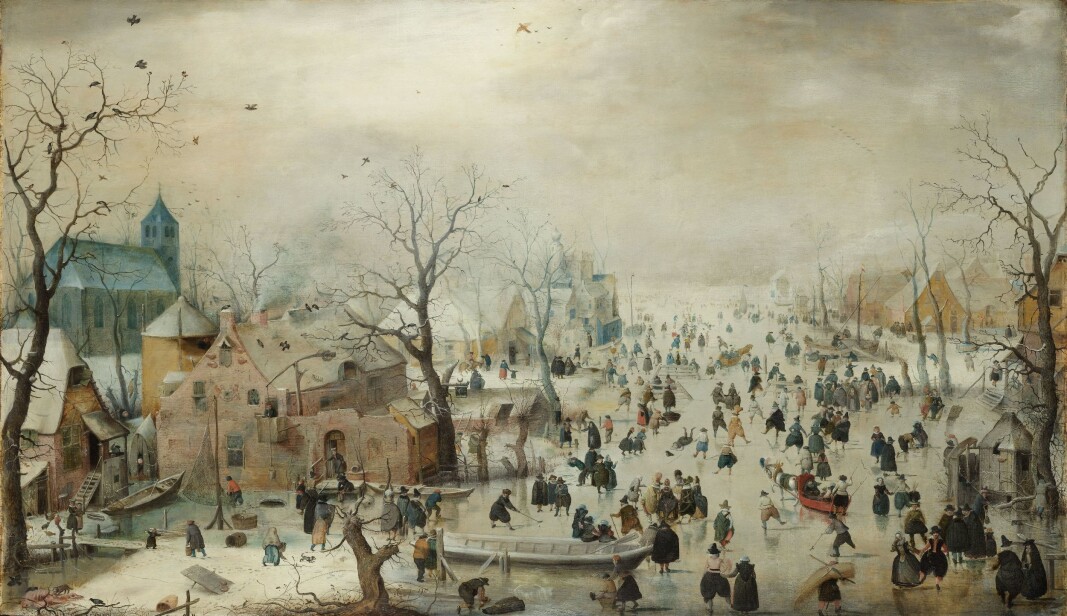
The Dutch artist Hendrick Avercamp painted winter activity on the ice during the first half of the 17th century, when it was quite cold in Central and Northern Europe. (Image: Henrik Avercamp / Wikimedia Commons)

Elise Kjørstad writes at Science Norway What actually started the Little Ice Age? Excerpts in italics with my bolds.

It all may have started with sea ice, and the changes may have happened all by themselves without the influence of volcanoes or the Sun, researchers behind a new study say.


The ninth century seems to have experienced a warmer climate, which has been called the Medieval Warm Period.

But from the 14th century things were different. It rained “without stopping” in 1315, and grain didn’t ripen. The situation was much the same the following year. Later in the 14th century there were several episodes of wild weather and cold periods.

The Little Ice Age can be divided into two phases, according to an article in The New Yorker. It began with a cooling period in 1300 – 1400. The coldest period was from the end of the 1500s to 1850.

This cooling caused glaciers to expand in Scandinavia, the Alps, in Iceland, Alaska, China, in the southern Andes and in New Zealand.

Generally speaking, the Little Ice Age is said to have begun because of an increase in volcanism and reduced activity of the Sun.

“The timing agrees quite well with the great eruptions from the 13th century. So there is good empirical evidence that this could be true,” said Martin Miles, a researcher at NORCE Norwegian Research Centre, and the Bjerknes Centre for Climate Research in Bergen, and at the University of Colorado at Boulder in the USA.

But in a new study, Miles and his colleagues have looked at another possibility.

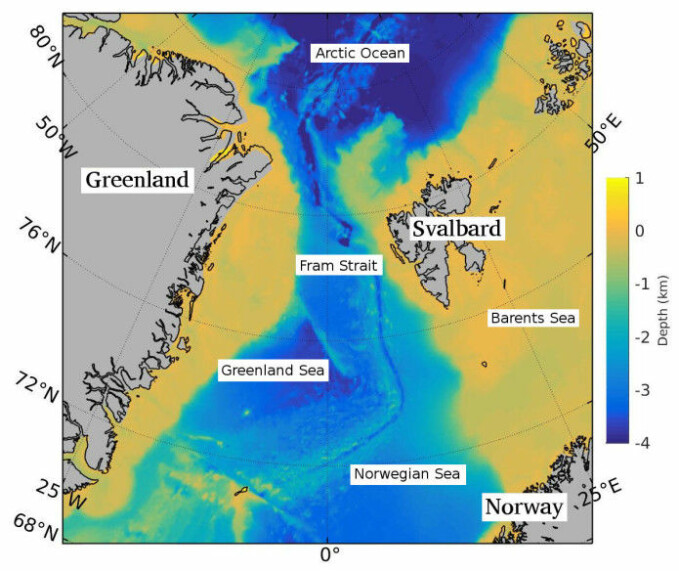
The strait between Greenland and Svalbard is the only deep connection between the Arctic Ocean and the world’s oceans. (Image: Bdushaw / CC BY-SA 3.0 / Wikimedia Commons)

Lots of ice on the go

In their new study, Miles and his colleagues looked at the transport of sea ice from the Arctic over a 1400 year period.

They compiled data from seabed samples from areas outside Greenland, the eastern part of the Fram Strait, the Greenland Sea and off Iceland. The samples contained small fossils that give researchers information about sea temperatures and loose material that sea ice had carried with it.

In several of these areas, ice will only be found if there is an especially large amount flowing out of the Arctic Ocean. This is particularly true during cold periods and when there is also a lot of sea ice formation.

“We discovered that an unusually large amount of sea ice flowed out of the Arctic Ocean from the beginning of the 14th century. It is very interesting, and the biggest event we found during the last 1400 years,” says Miles.

Can’t explain everything

Miles says sea ice may have affected the climate in Europe in the 14th century in this way.

The ice that melts and turns into fresh water can affect ocean currents, which in turn affect the atmosphere and climate, he says.

“Ocean currents are very important for transporting heat to Europe. If the currents weaken a little, it will be much colder than usual,” he said.

Sea ice is not only a reaction to climate change, but can also trigger climate change, Miles says.

The paper is Evidence for extreme export of Arctic sea ice leading the abrupt onset of the Little Ice Age  Martin W. Miles et. al. (2020).

Abstract

Arctic sea ice affects climate on seasonal to decadal time scales, and models suggest that sea ice is essential for longer anomalies such as the Little Ice Age. However, empirical evidence is fragmentary. Here, we reconstruct sea ice exported from the Arctic Ocean over the past 1400 years, using a spatial network of proxy records. We find robust evidence for extreme export of sea ice commencing abruptly around 1300 CE and terminating in the late 1300s. The exceptional magnitude and duration of this “Great Sea-Ice Anomaly” was previously unknown. The pulse of ice along East Greenland resulted in downstream increases in polar waters and ocean stratification, culminating ~1400 CE and sustained during subsequent centuries. While consistent with external forcing theories, the onset and development are notably similar to modeled spontaneous abrupt cooling enhanced by sea-ice feedbacks. These results provide evidence that marked climate changes may not require an external trigger.

Background Post with Supporting Information

The Climate System is Self-Oscillating: Sea Ice Proves It.

Scientists have studied the Arctic for a long time at the prestigious AARI: Arctic and Antarctic Research Institute St. Petersburg, Russia. V. F. Zakharov has published a complete description supported by research findings under this title: Sea Ice In the Climate System A Russian View (here)

Below I provide excerpts from this extensive analysis to form a synopsis of their view: Component parts of the climate system interact so that Arctic Sea Ice varies within a range constrained by those internal forces.

Self-Oscillating Sea Ice System

Self-Oscillating Sea Ice System

The most probable regulator of the physical geographical process can be found from analysis of the relationships between the components of the climate system. It is not necessary to investigate the cause-effect relationships between all these components in succession. It is sufficient to choose one of them, let us say sea ice, and consider its direct interaction with the atmosphere and the ocean – in the climate system and the significance of internal mechanisms in the natural process. Pg 1

The idea that the ice area growth at present can be achieved by changes in only the haline structure of the upper ocean layer, as a result of surface Arctic water overflowing onto warmer but more saline water, is supported both by calculations and empirical data. Pg. 46

First of all, it should be noted that the signs of temperature and salinity anomalies coincide in most cases: a decreased salinity corresponds to enhanced temperature and vice versa. Such similarity in the change of these parameters is impossible to explain from the point of view of the governing role of thermal conditions in the atmosphere with regard to the ocean, as the air temperature increase and decrease can result only in the change of the thermal state of sea surface layer not its salinity. Pgs. 48-49

Thus, the presented facts suggest that the most significant cause of changes in the ice cover extent are the changes in the vertical water structure in the upper ocean layer, rather than the changes of thermal conditions in the atmosphere. These changes are induced by fluctuations in the horizontal dimensions of the halocline, which are governed in turn by the expansion or reduction of the surface Arctic water mass. Pg. 49

It follows from the above that, under present day conditions, the changes in the area of the Arctic sea ice during the colder period of the year can be induced only by the change in the haline structure of the upper ocean layer. Indirectly, this change will also affect the thermal state of the atmosphere. Pg. 56

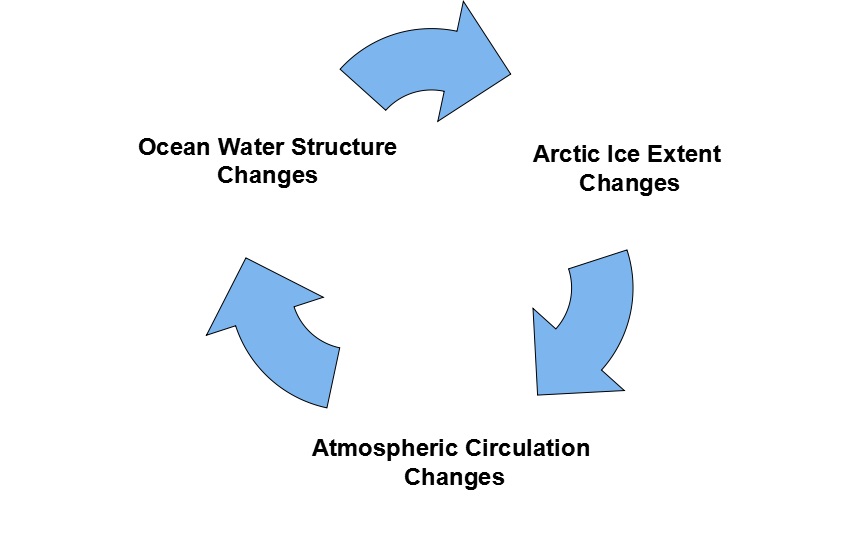
It is important to note that the ice effect on the atmosphere is not limited to the thermal effect. That it can produce a significant effect on atmospheric circulation is already evident from the fact that the Arctic anticyclone, considered by Viese [13] as a regulator of atmospheric processes in the Northern polar region, could form as a pressure formation only in the conditions of the ice regime in the Arctic. Pg. 56


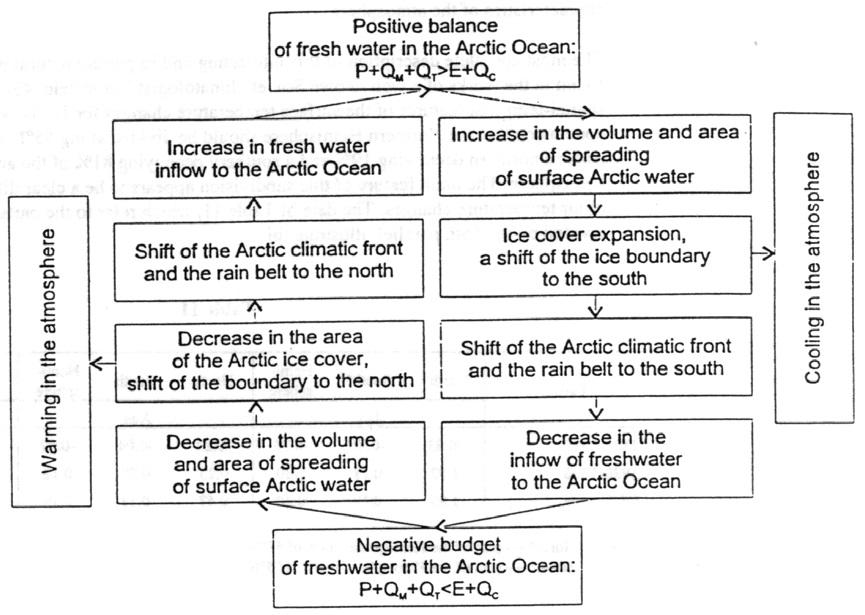
Zacharov fig.24

Zakharov fig.24

An analysis of cause-effect relationships does not leave any doubt in what direction and in what order the climate signal propagates in the atmosphere-ocean-polar ice system. This is not the direction and order usually assumed to cause present climate change. When it has become clear that the changes in the ocean, caused by disturbances of its freshwater balance, precede changes in the extent of sea ice, and the latter the changes in the atmosphere, then there was nothing left but for us to acknowledge self oscillation to be the most probable explanation for the development of the natural process. Pg. 58

Maybe the most convincing evidence of the Arctic sea ice stability is its preservation during the last 700,000 years despite vast glacial- interglacial fluctuations. The surface air temperature in the Arctic during the interglacial periods was higher by several degrees than present day temperatures. Pg. 44

Conclusion:

The remarkable stability of our planetary climate system derives from feedbacks between internal parts of the system, providing the oscillations we observe as natural variability. Arctic Sea Ice is a prime example. Bottom line:  A bit less ice in the Arctic indicates that we are not yet slipping into an ice age, little or otherwise. 

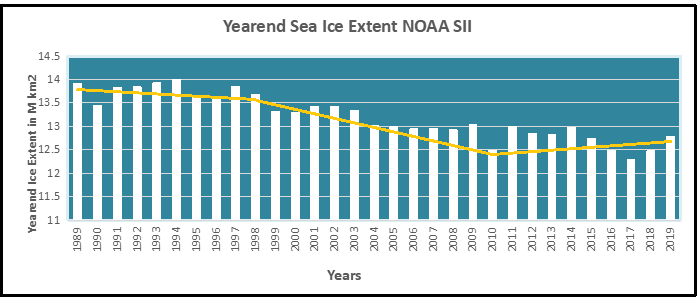
See also The Great Arctic Ice Exchange

Figure 4.12. Mean resulting ice-drift pattern for summer (a) and winter (b) during the warm epoch and the difference between ice-drift vectors during the warm and cold epochs for summer (c) and winter (d).

Arctic September Ice Dip Is Over

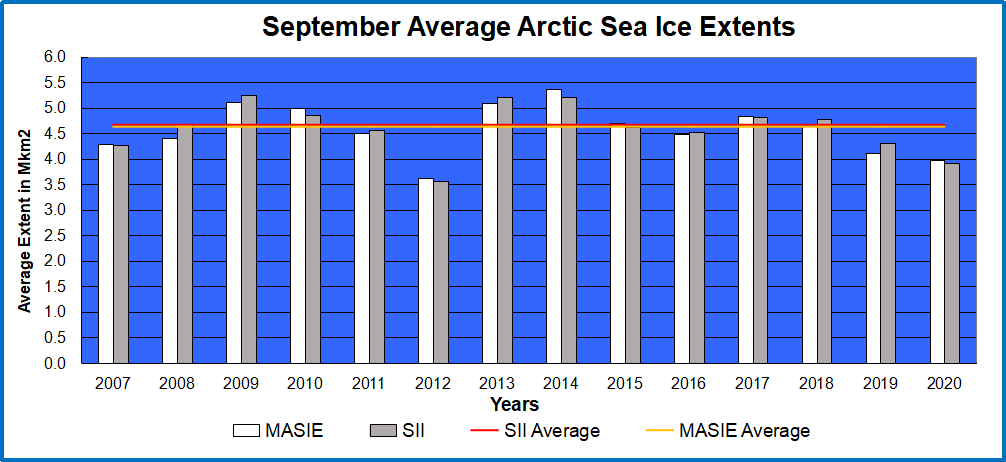
Just like the Arizona road in the image,  Arctic ice extent has dipped in September and is on the rise again.  The graph below shows how September monthly extent averages compare for the years since 2007. 

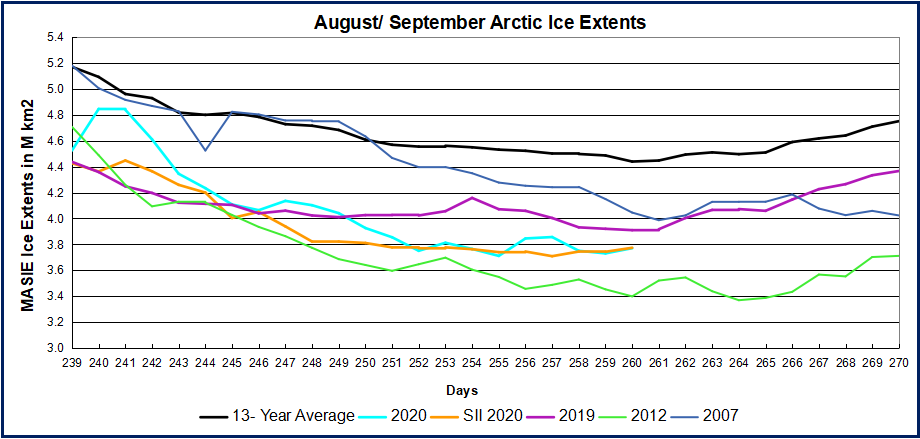
Overall it resembles the Arizona roadway.  Two low years are followed by two high years, then two low years and so on.  The last two years are low, comparable to 2007, and may portend higher ice extent ahead. As usual MASIE and SII are showing for 2020 nearly the same monthly averages, 4.0M km2 for MASIE and 3.9M km2 for SII. The graph below shows how the ice dipped and recovered in 2020 compared to the 13-year average and some notable years.

September 2020 daily minimum was lower than all previous years except for 2012.  As noted previously this year’s anomaly was the hot Siberian summer melting out the Eurasian shelf seas and the bordering parts of the Central Arctic Sea.  In 2012 it was the Great Arctic Cyclone in August of that year.  After day 255, ice recovered strongly in 2020 ending the month higher than 2007, close to 2019 and about 150k km2 less than the average daily minimum on day 260, 4.4M km2

The table shows monthly extent averages for the regions with ice in September for several years and the 13-year average for each region.

Sept. Monthly Averages 2007 2012 2019 2020 Average SD %
 (0) Northern_Hemisphere 4286957 3622648 4124035 3969085 4630779 10%
 (1) Beaufort_Sea 558424 212051 382779 620409 487498 31%
 (2) Chukchi_Sea 49690 52539 111412 77598 172143 53%
 (3) East_Siberian_Sea 1251 53411 73023 121408 287777 63%
 (4) Laptev_Sea 246278 44336 87121 28 141604 81%
 (5) Kara_Sea 49502 717 166 13063 24612 102%
 (6) Barents_Sea 6782 0 13238 0 18757 183%
 (7) Greenland_Sea 334147 263899 173116 235216 197263 33%
 (8) Baffin_Bay_Gulf_of_St._Lawrence 33043 15591 16589 20361 32926 50%
 (9) Canadian_Archipelago 252140 198502 265335 339996 299817 30%
 (10) Hudson_Bay 10998 9502 0 2783 7947 135%
 (11) Central_Arctic 2743433 2771014 3000459 2537271 2959458 6%

The last column shows the Standard Deviation % for each region and for NH as a whole.  Over this period the NH fluctuations have been +/- 10%.  The most variable is Barents Sea, which can be zero or over 100k km2.  Hudson Bay and Kara likewise either melt out or retain significant ice. The Central Arctic varies little from year to year.

Illustration by Eleanor Lutz shows Earth’s seasonal climate changes. If played in full screen, the four corners present views from top, bottom and sides. It is a visual representation of scientific datasets measuring Arctic ice extents.
Arctic Ice Bottoms at 3.7 Wadhams

The animation above shows Arctic ice extents from Sept. 1 to 16, 2020.  On the left are the Russian shelf seas already ice-free, and the Central Arctic retreating as well. Bottom left is Beaufort Sea losing ice. In the last week CAA in the center starts refreezing, and just above it Baffin Bay starts to add ice back.  At the top right Greenland Sea starts to refreeze.

Prof. Peter Wadhams made multiple predictions of an ice-free Arctic (extent as low as 1M km2), most recently to happen in 2015.  Thus was born the metric: 1 Wadham = 1M km2 Arctic ice extent. The details are provided on 2020 minimum below.  Though there could be a dip lower in the next few days, the record shows a daily minimum of 3.7M km2 on September 11 (MASIE) and September 13 (SII).  While BCE (Beaufort, Chukchi, East Siberian seas) may lose more ice,  gains have appeared on the Canadian side: CAA, Baffin Bay and Greenland Sea. So 3.7 Wadhams may well hold up as the daily low this year.  Note that day 260, September 16, 2020, is the date for the lowest annual extent averaged over the last 13-years.

The discussion later on refers to the September monthly average extent serving as the usual climate metric.  That stands presently at 3.9M km2 for MASIE and 3.8M km2 for SII, with both expected to rise slightly by month end as ice extent typically recovers.

The melting season this year showed ice extents briefly near the 13-year average on day 241, then dropping rapidly to go below all other years except 2012.  That year was exceptional due to the 2012 Great Arctic August Cyclone that pushed drift ice around producing a new record minimum.  The anomaly this year was the high pressure ridge persisting over Siberia producing an extremely hot summer there.  This resulted in early melting of the Russian shelf seas along with bordering parts of the Central Arctic.


As discussed below, the daily minimum on average occurs on day 260, but a given year may be earlier or later.  The 2020 extent began to flatten from day 248 onward in SII (orange) while MASIE showed stabilizing from day 252 with an upward bump in recent days.  Both lines are drawing near 2019 and 2007 while departing from 2012. The table below shows the distribution of ice in the various regions of the Arctic Ocean.

Region 2020260 Day 260 Average 2020-Ave. 2012260 2020-2012
 (0) Northern_Hemisphere 3770950 4483942 -712991 3398785 372165
 (1) Beaufort_Sea 503701 471897 31804 214206 289495
 (2) Chukchi_Sea 49625 143329 -93704 52708 -3084
 (3) East_Siberian_Sea 97749 278150 -180400 47293 50456
 (4) Laptev_Sea 0 124811 -124811 21509 -21509
 (5) Kara_Sea 12670 19162 -6492 0 12670
 (6) Barents_Sea 0 20787 -20787 0 0
 (7) Greenland_Sea 258624 191964 66660 253368 5256
 (8) Baffin_Bay_Gulf_of_St._Lawrence 20839 31394 -10555 12695 8144
 (9) Canadian_Archipelago 328324 269950 58374 154875 173449
 (10) Hudson_Bay 104 6195 -6092 3863 -3759
 (11) Central_Arctic 2498209 2925271 -427062 2637199 -138990

The extent numbers show that this year’s melt is dominated by the surprisingly hot Siberian summer, leading to major deficits in all the Eurasian shelf seas–East Siberian, Laptev, Kara.  As well, the bordering parts of the Central Arctic show a sizeable deficit to average. The main surpluses to average and to 2012 are Beaufort, Greenland Sea and CAA. Overall 2020 is 713k km2 below the 13-year average a deficit of 16%.

Background from Previous Post Outlook for Arctic Ice Minimum

The annual competition between ice and water in the Arctic ocean is approaching the maximum for water, which typically occurs mid September.  After that, diminishing energy from the slowly setting sun allows oceanic cooling causing ice to regenerate. Those interested in the dynamics of Arctic sea ice can read numerous posts here.  Note that for climate purposes the annual minimum is measured by the September monthly average ice extent, since the daily extents vary and will go briefly lower on or about day 260.

The Bigger Picture 

We are close to the annual Arctic ice extent minimum, which typically occurs on or about day 260 (mid September). Some take any year’s slightly lower minimum as proof that Arctic ice is dying, but the image above shows the Arctic heart is beating clear and strong.

Over this decade, the Arctic ice minimum has not declined, but since 2007 looks like fluctuations around a plateau. By mid-September, all the peripheral seas have turned to water, and the residual ice shows up in a few places. The table below indicates where we can expect to find ice this September. Numbers are area units of Mkm2 (millions of square kilometers).

Day 260 13 year
Arctic Regions 2007 2010 2012 2014 2015 2016 2017 2018 2019 Average
Central Arctic Sea 2.67 3.16 2.64 2.98 2.93 2.92 3.07 2.91 2.97 2.93
BCE 0.50 1.08 0.31 1.38 0.89 0.52 0.84 1.16 0.46 0.89
LKB 0.29 0.24 0.02 0.19 0.05 0.28 0.26 0.02 0.11 0.16
Greenland & CAA 0.56 0.41 0.41 0.55 0.46 0.45 0.52 0.41 0.36 0.46
B&H Bays 0.03 0.03 0.02 0.02 0.10 0.03 0.07 0.05 0.01 0.04
NH Total 4.05 4.91 3.40 5.13 4.44 4.20 4.76 4.56 3.91 4.48

The table includes three early years of note along with the last 6 years compared to the 13 year average for five contiguous arctic regions. BCE (Beaufort, Chukchi and East Siberian) on the Asian side are quite variable as the largest source of ice other than the Central Arctic itself.   Greenland Sea and CAA (Canadian Arctic Archipelago) together hold almost 0.5M km2 of ice at annual minimum, fairly consistently.  LKB are the European seas of Laptev, Kara and Barents, a smaller source of ice, but a difference maker some years, as Laptev was in 2016.  Baffin and Hudson Bays are inconsequential as of day 260.

For context, note that the average maximum has been 15M, so on average the extent shrinks to 30% of the March high before growing back the following winter.  In this context, it is foolhardy to project any summer minimum forward to proclaim the end of Arctic ice.

Resources:  Climate Compilation II Arctic Sea Ice

August 29, 2020 Arctic Ice Returns to Mean


To enlarge, open image in new tab.

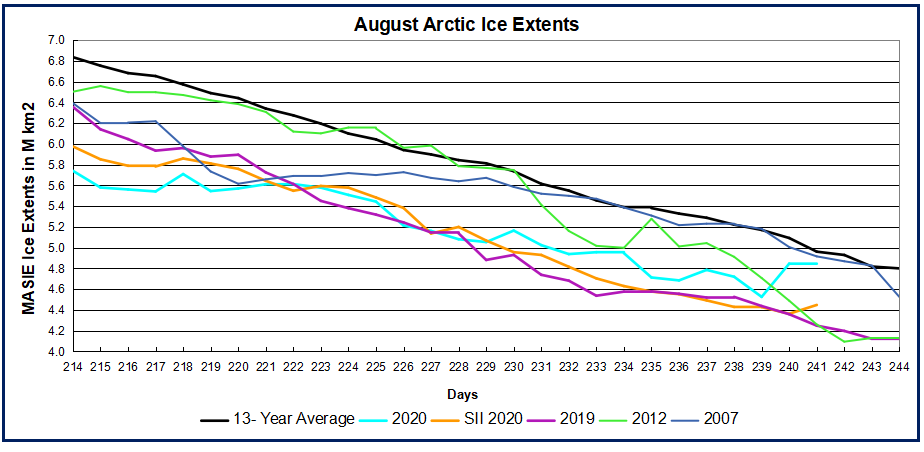
The melting season this year showed ice extents much below the 13-year average, but the decline moderated in August and presently is close to the mean and to 2007.

As discussed below, the daily minimum on average occurs on day 260, but a given year may be earlier or later.  The 2020 minimum on day 239 will not likely stand, but stranger things have happened.  For now, MASIE is showing a jump of almost 300k km2 bringing yesterday very close to the 13-year average (-3.5%).  SII also stopped declining, but as is often the case, started 11 days ago showing less ice than MASIE.  The table below shows the distribution of ice in the various regions of the Arctic Ocean.

Region 2020241 Day 241 Average 2020-Ave. 2007241 2020-2007
 (0) Northern_Hemisphere 4839354 5017305 -177952 4916182 -76829
 (1) Beaufort_Sea 806154 554434 251720 707135 99019
 (2) Chukchi_Sea 354686 257290 97396 142656 212030
 (3) East_Siberian_Sea 235822 363889 -128067 311 235511
 (4) Laptev_Sea 7420 192875 -185455 279554 -272133
 (5) Kara_Sea 31679 46675 -14996 112935 -81256
 (6) Barents_Sea 0 23436 -23436 10037 -10037
 (7) Greenland_Sea 262773 189236 73536 332635 -69863
 (8) Baffin_Bay_Gulf_of_St._Lawrence 7586 32270 -24684 39777 -32191
 (9) Canadian_Archipelago 342594 317798 24795 271603 70991
 (10) Hudson_Bay 23922 26315 -2393 51493 -27571
 (11) Central_Arctic 2766030 3012169 -246139 2966791 -200761

The extent numbers show that this year’s melt is dominated by the surprisingly hot Siberian summer, leading to major deficits in all the Eurasian shelf seas–East Siberian, Laptev, Kara.  As well, the bordering parts of the Central Arctic show a sizeable deficit to average. These deficits are partly offset by surpluses on the CanAm side: Beaufort, Chukchi, Greenland Sea and CAA.

It is also the case that many regions have already registered their 2020 minimums.  And as discussed below, the marginal basins have little ice left to lose.

Background from Previous Post Outlook for Arctic Ice Minimum

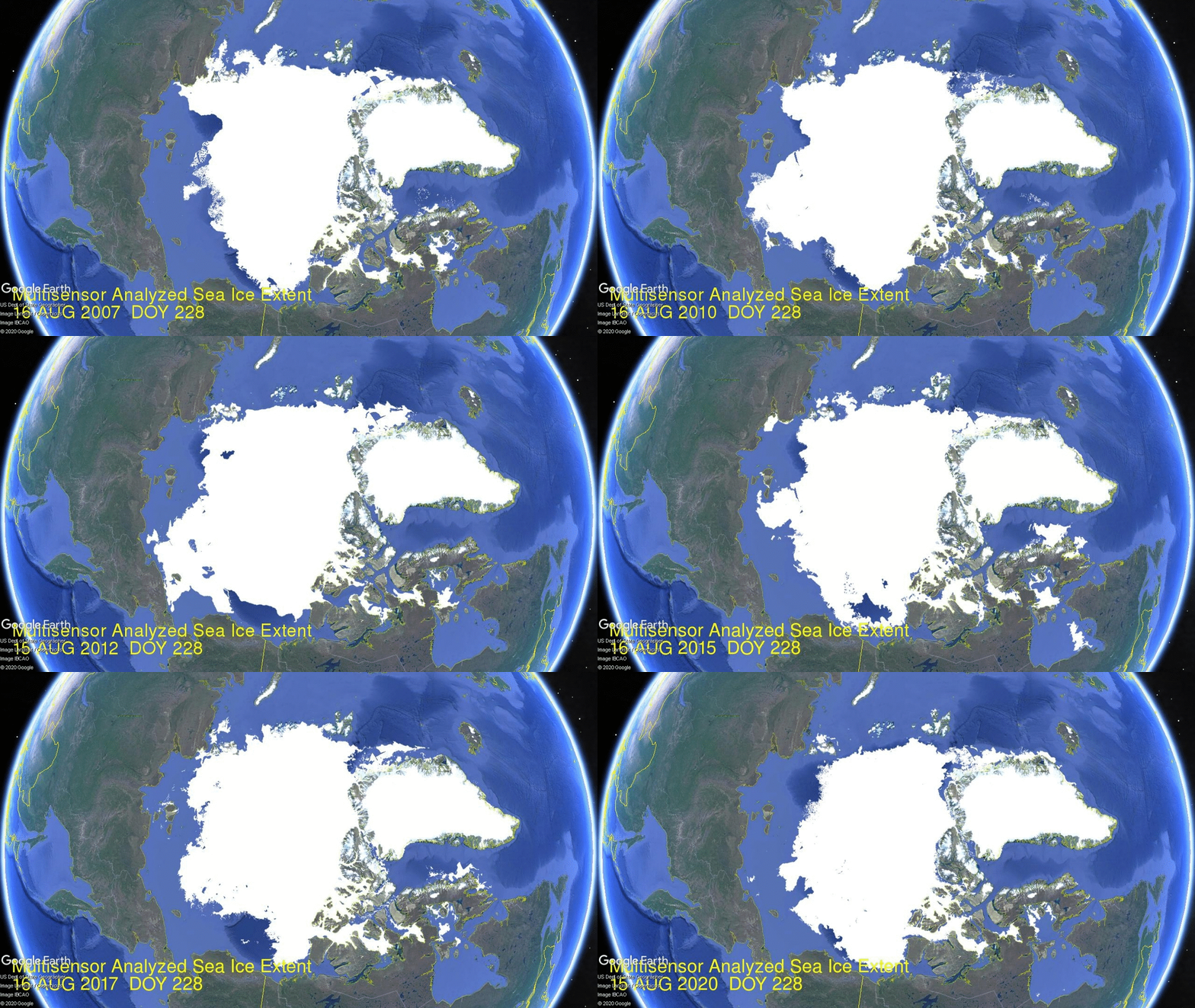
The annual competition between ice and water in the Arctic ocean is approaching the maximum for water, which typically occurs mid September.  After that, diminishing energy from the slowly setting sun allows oceanic cooling causing ice to regenerate. Those interested in the dynamics of Arctic sea ice can read numerous posts here.  The image at the top provides a look at mid August from 2007 to 2020 as a context for anticipating this year’s annual minimum.  Note that for climate purposes the annual minimum is measured by the September monthly average ice extent, since the daily extents vary and will go briefly lower on or about day 260.

The Bigger Picture 

We are close to the annual Arctic ice extent minimum, which typically occurs on or about day 260 (mid September). Some take any year’s slightly lower minimum as proof that Arctic ice is dying, but the image above shows the Arctic heart is beating clear and strong.

Over this decade, the Arctic ice minimum has not declined, but since 2007 looks like fluctuations around a plateau. By mid-September, all the peripheral seas have turned to water, and the residual ice shows up in a few places. The table below indicates where we can expect to find ice this September. Numbers are area units of Mkm2 (millions of square kilometers).

Day 260 13 year
Arctic Regions 2007 2010 2012 2014 2015 2016 2017 2018 2019 Average
Central Arctic Sea 2.67 3.16 2.64 2.98 2.93 2.92 3.07 2.91 2.97 2.93
BCE 0.50 1.08 0.31 1.38 0.89 0.52 0.84 1.16 0.46 0.89
LKB 0.29 0.24 0.02 0.19 0.05 0.28 0.26 0.02 0.11 0.16
Greenland & CAA 0.56 0.41 0.41 0.55 0.46 0.45 0.52 0.41 0.36 0.46
B&H Bays 0.03 0.03 0.02 0.02 0.10 0.03 0.07 0.05 0.01 0.04
NH Total 4.05 4.91 3.40 5.13 4.44 4.20 4.76 4.56 3.91 4.48

The table includes three early years of note along with the last 6 years compared to the 13 year average for five contiguous arctic regions. BCE (Beaufort, Chukchi and East Siberian) on the Asian side are quite variable as the largest source of ice other than the Central Arctic itself.   Greenland Sea and CAA (Canadian Arctic Archipelago) together hold almost 0.5M km2 of ice at annual minimum, fairly consistently.  LKB are the European seas of Laptev, Kara and Barents, a smaller source of ice, but a difference maker some years, as Laptev was in 2016.  Baffin and Hudson Bays are inconsequential as of day 260.

For context, note that the average maximum has been 15M, so on average the extent shrinks to 30% of the March high before growing back the following winter.  In this context, it is foolhardy to project any summer minimum forward to proclaim the end of Arctic ice.

Resources:  Climate Compilation II Arctic Sea Ice

Outlook 2020 Arctic Ice Minimum

To enlarge, open image in new tab.

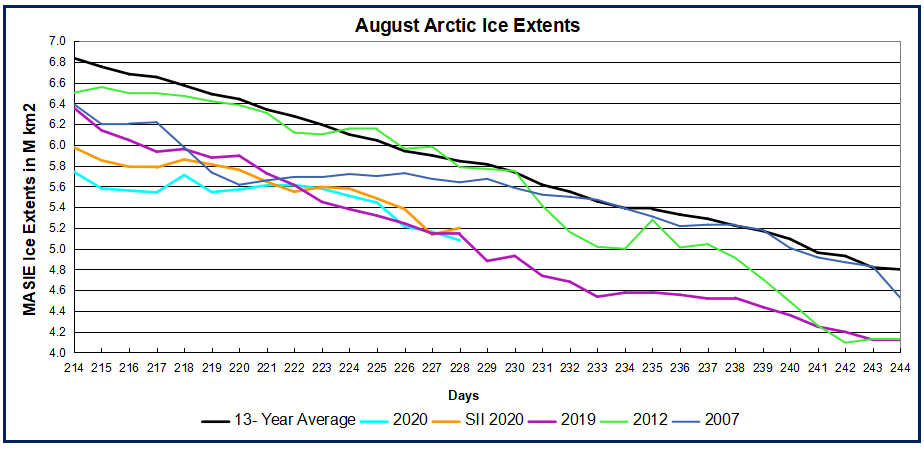
The annual competition between ice and water in the Arctic ocean is approaching the maximum for water, which typically occurs mid September.  After that, diminishing energy from the slowly setting sun allows oceanic cooling causing ice to regenerate. Those interested in the dynamics of Arctic sea ice can read numerous posts here.  This post provides a look at mid August from 2007 to yesterday as a context for anticipating this year’s annual minimum.  Note that for climate purposes the annual minimum is measured by the September monthly average ice extent, since the daily extents vary and will go briefly lower on or about day 260.

The melting season in August up to yesterday shows 2020 below average but appearing to consolidate in the recent days.

Both MASIE and SII show 2020 ice extents below average and other years beginning August and matching 2019 by mid month. In contrast 2007 melted more slowly than other years reaching average later in August before dropping at the end.  2012 was an average year until the 2012 Great Cyclone, whose effects started after day 230 precipitating a drop of 1.7M km2 of ice in just two weeks. And as we know, 2012 went on to record the lowest September in the record.

The table for day 228 shows how the ice is distributed across the various seas comprising the Arctic Ocean.

Region 2020228 Day 228 Average 2020-Ave. 2007228 2020-2007
 (0) Northern_Hemisphere 5081593 5844411 -762818 5640240 -558648
 (1) Beaufort_Sea 831909 664315 167594 769154 62755
 (2) Chukchi_Sea 405793 398698 7094 256889 148903
 (3) East_Siberian_Sea 274583 552107 -277523 163257 111326
 (4) Laptev_Sea 21598 253760 -232161 292592 -270994
 (5) Kara_Sea 17604 86914 -69311 192800 -175196
 (6) Barents_Sea 3285 27907 -24622 15859 -12574
 (7) Greenland_Sea 235942 221912 14030 308560 -72618
 (8) Baffin_Bay_Gulf_of_St._Lawrence 11620 55856 -44236 81722 -70102
 (9) Canadian_Archipelago 359629 415244 -55615 379795 -20166
 (10) Hudson_Bay 48519 71815 -23296 90668 -42149
 (11) Central_Arctic 2870439 3094846 -224407 3087687 -217247

The extent numbers show that this year’s melt is dominated by the surprisingly hot Siberian summer, leading to major deficits in all the Eurasian shelf seas–East Siberian, Laptev, Kara.  As well, the bordering parts of the Central Arctic show a sizeable deficit to average.

It is also the case that many regions have already registered their 2020 minimums.  And as discussed below, the marginal basins have little ice left to lose.

The Bigger Picture 

We are close to the annual Arctic ice extent minimum, which typically occurs on or about day 260 (mid September). Some take any year’s slightly lower minimum as proof that Arctic ice is dying, but the image above shows the Arctic heart is beating clear and strong.

Over this decade, the Arctic ice minimum has not declined, but since 2007 looks like fluctuations around a plateau. By mid-September, all the peripheral seas have turned to water, and the residual ice shows up in a few places. The table below indicates where we can expect to find ice this September. Numbers are area units of Mkm2 (millions of square kilometers).

Day 260 13 year
Arctic Regions 2007 2010 2012 2014 2015 2016 2017 2018 2019 Average
Central Arctic Sea 2.67 3.16 2.64 2.98 2.93 2.92 3.07 2.91 2.97 2.93
BCE 0.50 1.08 0.31 1.38 0.89 0.52 0.84 1.16 0.46 0.89
LKB 0.29 0.24 0.02 0.19 0.05 0.28 0.26 0.02 0.11 0.16
Greenland & CAA 0.56 0.41 0.41 0.55 0.46 0.45 0.52 0.41 0.36 0.46
B&H Bays 0.03 0.03 0.02 0.02 0.10 0.03 0.07 0.05 0.01 0.04
NH Total 4.05 4.91 3.40 5.13 4.44 4.20 4.76 4.56 3.91 4.48

The table includes three early years of note along with the last 6 years compared to the 13 year average for five contiguous arctic regions. BCE (Beaufort, Chukchi and East Siberian) on the Asian side are quite variable as the largest source of ice other than the Central Arctic itself.   Greenland Sea and CAA (Canadian Arctic Archipelago) together hold almost 0.5M km2 of ice at annual minimum, fairly consistently.  LKB are the European seas of Laptev, Kara and Barents, a smaller source of ice, but a difference maker some years, as Laptev was in 2016.  Baffin and Hudson Bays are inconsequential as of day 260.

For context, note that the average maximum has been 15M, so on average the extent shrinks to 30% of the March high before growing back the following winter.  In this context, it is foolhardy to project any summer minimum forward to proclaim the end of Arctic ice.

Resources:  Climate Compilation II Arctic Sea Ice

Siberian Arctic Ice Melt July 2020

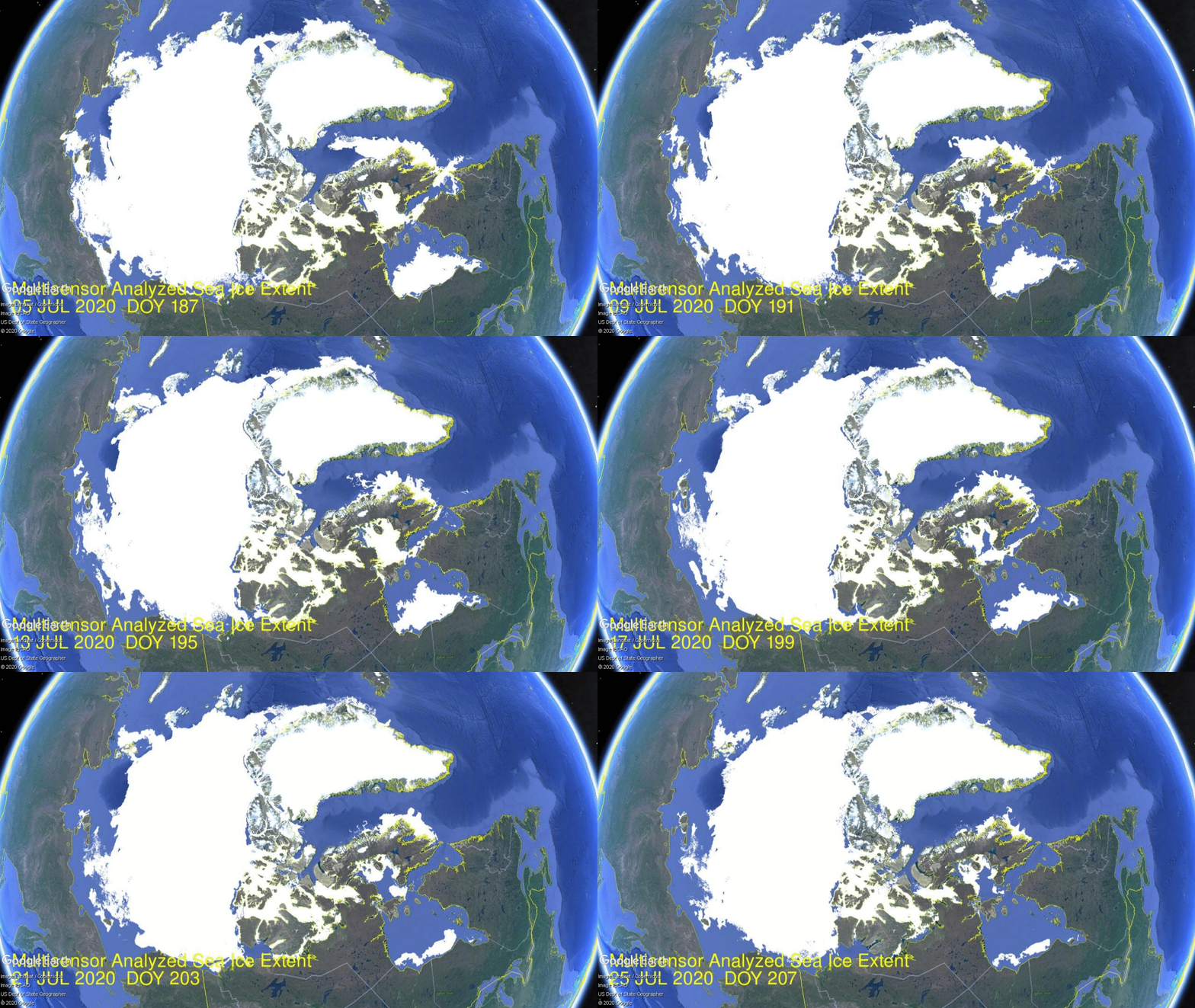
The image above shows melting of Arctic sea ice extent over the last 20 days, July 5 to 25, 2020.  At the bottom right, the shallow Hudson Bay goes to water rapidly, losing 500k km2 of ice.  Even so, at 172k km2 that region is nearly average.  The remarkable 2020 event is the effect of high Siberian temperatures causing extensive melting of the nearby shelf seas, seen on the left vertical. Already on July 5, Laptev was mostly water, and now has only 5% ice. Neighboring seas East Siberian and Kara also melted rapidly. The other feature is Baffin Bay, center right, losing 300k km2 to retain only 7% of its maximum ice extent.

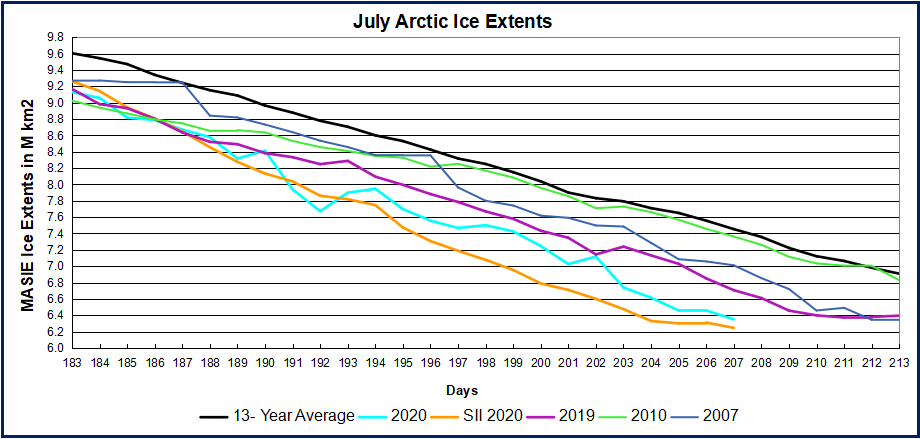
The graph below shows the ice extent retreating during July compared to some other years and the 13 year average (2007 to 2019 inclusive).

Note that the  MASIE NH ice extent 13 year average loses about 2.6M km2 during July, down to 7M km2. MASIE 2020 started nearly 500k km2 lower and lost ice at a higher rate, now 1.1M km2 below average.  Both MASIE and SII show this year below other recent years, reaching the present ice extent 7 days ahead of 2019 and 14 days ahead of average.

The table shows where the ice is distributed compared to average.  Bering and Okhotsk are open water at this point no longer shown in these updates. The deficit of 1.1M km2 represents 15% of the total, or an ice extent melting 14 days ahead of average.

Region 2020207 Day 207 Average 2020-Ave. 2007207 2020-2007
 (0) Northern_Hemisphere 6350401 7453623  -1103222  7011118 -660717 
 (1) Beaufort_Sea 892059 794821  97238  748948 143111 
 (2) Chukchi_Sea 542328 559045  -16717  440010 102318 
 (3) East_Siberian_Sea 460336 853373  -393037  647006 -186670 
 (4) Laptev_Sea 50561 485152  -434591  389317 -338756 
 (5) Kara_Sea 122978 215126  -92147  265137 -142159 
 (6) Barents_Sea 33044 37953  -4910  38346 -5302 
 (7) Greenland_Sea 342772 335165  7607  353806 -11034 
 (8) Baffin_Bay_Gulf_of_St._Lawrence 115572 198402  -82831  231942 -116371 
 (9) Canadian_Archipelago 570728 614794  -44067  595262 -24534 
 (10) Hudson_Bay 172014 203861  -31847  114225 57789 
 (11) Central_Arctic 3047196 3154007  -106811  3185794 -138598 

Note that all of the deficit to average is accounted for by the Russian shelf seas of East Siberian, Laptev and Kara, along with Baffin Bay

Illustration by Eleanor Lutz shows Earth’s seasonal climate changes. If played in full screen, the four corners present views from top, bottom and sides. It is a visual representation of scientific datasets measuring Arctic ice extents.

Arctic Ice Usual June Swoon


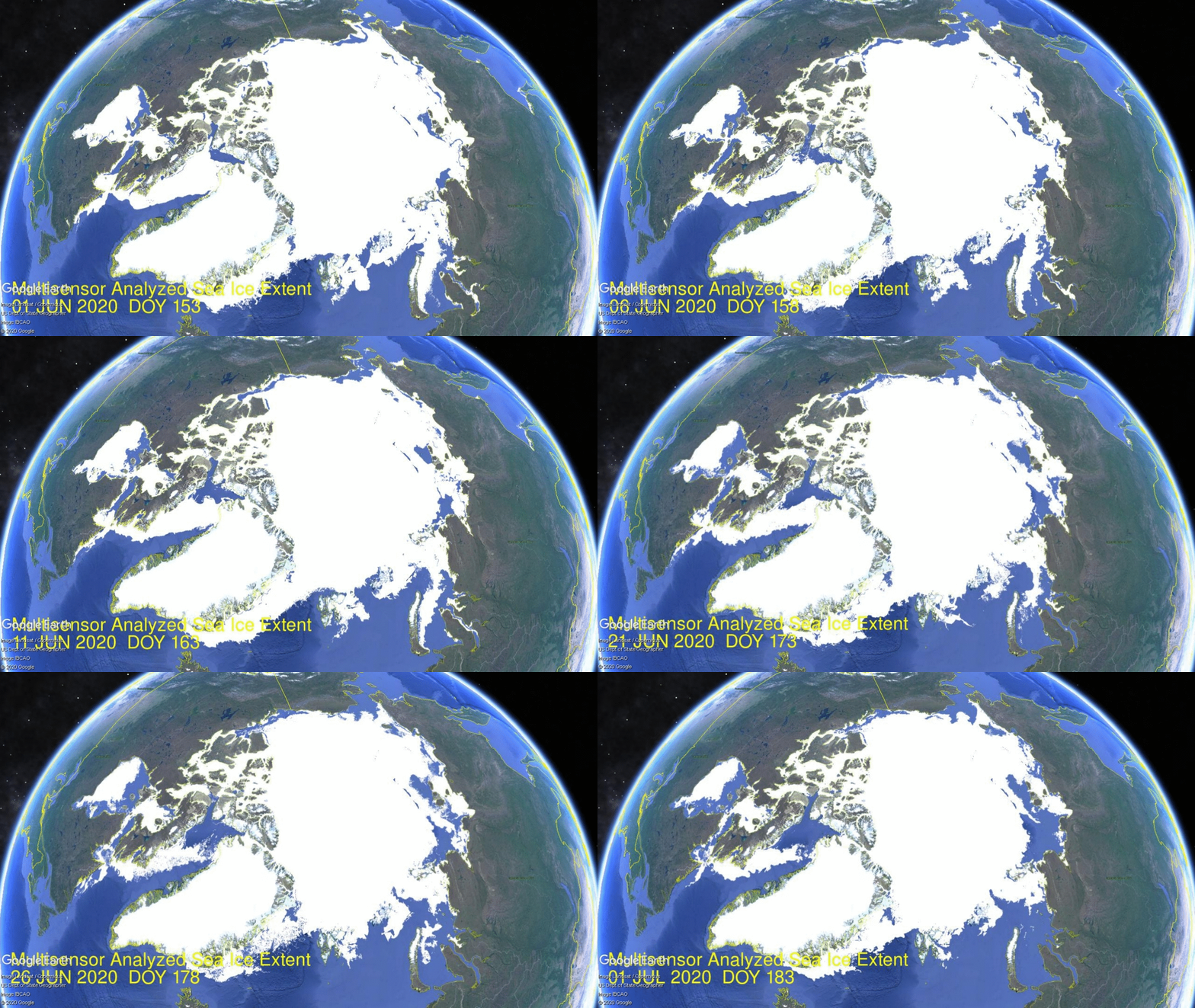
The image above shows melting of Arctic sea ice extent over the month of June 2020.  As usual the process of declining ice extent follows a LIFO pattern:  Last In First Out.  That is, the marginal seas are the last to freeze and the first to melt.  Thus at the top center and right of the image, the Pacific basins of Bering and Okohtsk seas lost what little ice they had.  Meanwhile at extreme left, Hudson Bay ice retreats 300k km2 from north to south.  Note center left Baffin Bay loses 320k km2 of ice during the month.  The most dramatic melting is in the Russian shelf seas at the center right.  Laptev and Kara Seas combined to lose 600k km2 of ice extent. The central mass of Arctic ice is intact with some fluctuations back and forth, and as well Greenland Sea and CAA (Canadian Arctic Archipelago) were slow to melt in June

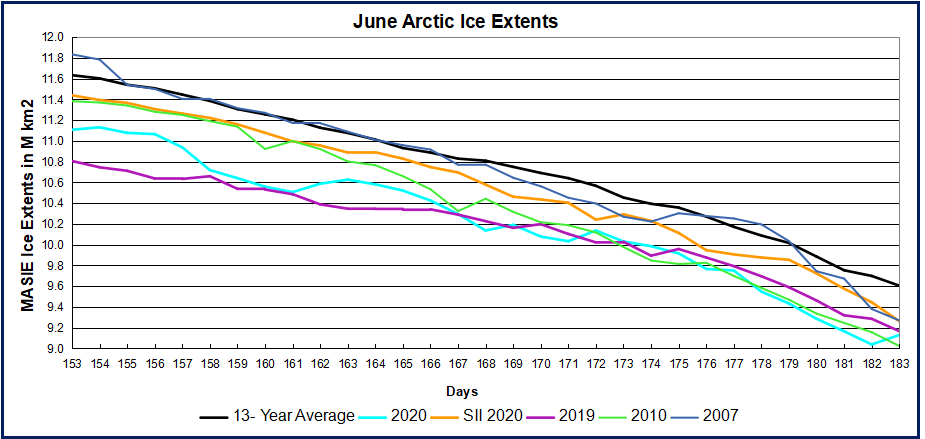
The graph below shows the ice extent retreating during June compared to some other years and the 13 year average (2007 to 2019 inclusive).

Note that the  MASIE NH ice extent 13 year average loses about 2M km2 during June, down to 9.6M km2. MASIE 2019 started nearly 500k km2 lower and lost ice at a similar rate, ending 476 km2 below average.  The most interesting thing was the wide divergence between SII and MASIE reports during June, SII starting the month about 500k km2 higher before narrowing at the end to exceed MASIE by 133k km2.  I inquired whether NIC had experienced any measurement issues, but their response indicated nothing remarkable.  It is unusual for MASIE to be the lower estimate of the two.

The table shows where the ice is distributed compared to average.  Bering and Okhotsk are open water at this point and will be dropped from future monthly updates. The deficit of 476k km2 represents 5% of the total, or an ice extent melting 5 days ahead of average.

Region 2020183 Day 183 Average 2020-Ave. 2007183 2020-2007
 (0) Northern_Hemisphere 9128615 9604642  -476028  9269301 -140686 
 (1) Beaufort_Sea 982475 882878  99597  891858 90617 
 (2) Chukchi_Sea 730000 703162  26838  637536 92464 
 (3) East_Siberian_Sea 885090 1014587  -129497  855267 29823 
 (4) Laptev_Sea 469839 704231  -234392  646683 -176844 
 (5) Kara_Sea 274007 535421  -261414  596916 -322909 
 (6) Barents_Sea 111016 106522  4494  97267 13749 
 (7) Greenland_Sea 474331 498794  -24463  548566 -74236 
 (8) Baffin_Bay_Gulf_of_St._Lawrence 438007 479675  -41668  414283 23724 
 (9) Canadian_Archipelago 780765 774360  6405  759177 21589 
 (10) Hudson_Bay 739422 686381  53041  613940 125482 
 (11) Central_Arctic 3235174 3202495  32679  3202330 32844 
 (12) Bering_Sea 315 3673  -3357  981 -665 
 (13) Baltic_Sea 0 -4  0
 (14) Sea_of_Okhotsk 7051 11237  -4185  2983 4068 

Note that all of the deficit to average is accounted for by the Russian shelf seas of East Siberian, Laptev and Kara. Beaufort and Hudson Bay are slightly surplus.

Illustration by Eleanor Lutz shows Earth’s seasonal climate changes. If played in full screen, the four corners present views from top, bottom and sides. It is a visual representation of scientific datasets measuring Arctic ice extents.

April Arctic Ice Melting as Usual

The image above shows springtime melting of Arctic sea ice extent over the month of April 2020.  As usual the process of declining ice extent follows a LIFO pattern:  Last In First Out.  That is, the marginal seas are the last to freeze and the first to melt.  Thus at the top of the image, the Pacific basins of Bering and Okohtsk seas show a steady decline in ice.  Meanwhile at bottom left, Baffin Bay ice retreats from south to north.  Note center left Hudson Bay loses very little ice during the month.  The central mass of Arctic ice is  intact with some fluctuations back and forth bottom right, as patches of water appear in Barents and Kara Seas.

The graph below shows the ice extent retreating during April compared to some other years and the 13 year average (2007 to 2019 inclusive).

Note that the  MASIE NH ice extent 13 year average loses about 1.2M km2 during April, down to 13.5M km2. MASIE 2019 started much lower and lost ice at a similar rate, ending nearly 800k km2 below average.  This year started in the middle of the other tracks, the most interesting thing being the wide divergence between SII and MASIE reports for April, with a sawtooth pattern alternating loses and gains.  The two indices were close in the beginning, but the gap grew to 600k km2 before narrowing at the end.  I inquired whether NIC had experienced any measurement issues, but their response indicated nothing remarkable.  It is notable that MASIE is the low estimate of the two.

Region 2020121 Day 121 Average 2020-Ave. 2019121 2020-2019
 (0) Northern_Hemisphere 13091644 13517638  -425994  12730893 360751 
 (1) Beaufort_Sea 1070307 1067944  2363  1070463 -156 
 (2) Chukchi_Sea 961124 952949  8175  909505 51619 
 (3) East_Siberian_Sea 1081646 1085858  -4212  1082230 -585 
 (4) Laptev_Sea 851288 891300  -40012  897845 -46557 
 (5) Kara_Sea 860722 909170  -48448  917303 -56581 
 (6) Barents_Sea 588361 546921  41440  557814 30547 
 (7) Greenland_Sea 769073 634171  134902  487626 281446 
 (8) Baffin_Bay_Gulf_of_St._Lawrence 1001748 1240703  -238955  1113262 -111514 
 (9) Canadian_Archipelago 849940 848790  1150  853337 -3397 
 (10) Hudson_Bay 1209082 1242060  -32978  1255410 -46328 
 (11) Central_Arctic 3245999 3236485  9514  3245152 846 
 (12) Bering_Sea 337849 466262  -128413  93641 244208 
 (13) Baltic_Sea 5973 20676  -14703  10318 -4345 
 (14) Sea_of_Okhotsk 257268 371173  -113905  235299 21969 

The table shows where the ice is distributed compared to average.  Baffin Bay has the largest deficit to average followed by Bering and Okhotsk. Greenland Sea and Barents Sea are in surplus, offsetting small deficits in Kara, Laptev and Hudson Bay.

Footnote:  Interesting comments recently by Dr. Judah Cohen at his blog regarding the Arctic fluctuations this winter and spring. Excerpts with my bolds.

As I sit here in home, enduring a second day of cloudy, wet, relatively cold and windy weather from a storm passing to our south and had this been winter would have brought a crippling snowstorm. And this storm or pattern isn’t unique. It seems that every few days here in the Northeastern US we get a rainstorm that had it been winter would have produced a snowstorm, though even these late season storms are bringing snow to the higher elevations of the Northeast. I find myself asking (and I realize that I am not unique asking this question) – where was this pattern in winter?

I reflexively look to the PV for answers. The winter was characterized by a stronger than normal stratospheric PV that was hostile to meridional (north to south), large amplitude flow and high latitude blocking that is so favorable for sustained cold air outbreaks and snowstorms. Instead the strong PV supported fast zonal flow of the Jet Stream that was displaced to the north that favored overall mild temperatures and rainfall across the US except for higher elevations and near the Canadian border. Similarly, an even milder and snowless pattern persisted across Europe all winter.

Then once winter was over, high pressure/blocking returned to the North Atlantic sector that excited the vertical transfer of energy from the troposphere to the stratosphere and has weakened the stratospheric PV. This increase in vertical energy transfer has decelerated a hyperactive PV and it does appear that the weakening of the PV will actually overshoot the typical weakening resulting in stronger easterly winds in the polar stratosphere than the climatological average (see Figure i). Easterly winds in the polar stratosphere are the telltale sign of the Final Warming (where the stratospheric PV disappears until the fall).

Illustration by Eleanor Lutz shows Earth’s seasonal climate changes. If played in full screen, the four corners present views from top, bottom and sides. It is a visual representation of scientific datasets measuring Arctic ice extents.

Meet Bering and Okhotsk Seas

Now that Arctic ice peak has passed, the Pacific basins of Bering and Okhotsk take center stage, providing most of the open water reducing ice extents.  The animation above shows in the last 3 weeks Bering on the right lost half of its ice, down from 820k km2 to 450k km2 yesterday.  Meanwhile Okhotsk on the left declined from 1080k km2 to 650k km2.  Those losses make up entirely the 530k km2 Arctic deficit to average at this time.

Background on Okhotsk Sea

NASA describes Okhotsk as a Sea and Ice Factory. Excerpts in italics with my bolds.

The Sea of Okhotsk is what oceanographers call a marginal sea: a region of a larger ocean basin that is partly enclosed by islands and peninsulas hugging a continental coast. With the Kamchatka Peninsula, the Kuril Islands, and Sakhalin Island partly sheltering the sea from the Pacific Ocean, and with prevailing, frigid northwesterly winds blowing out from Siberia, the sea is a winter ice factory and a year-round cloud factory.

The region is the lowest latitude (45 degrees at the southern end) where sea ice regularly forms. Ice cover varies from 50 to 90 percent each winter depending on the weather. Ice often persists for nearly six months, typically from October to March. Aside from the cold winds from the Russian interior, the prodigious flow of fresh water from the Amur River freshens the sea, making the surface less saline and more likely to freeze than other seas and bays.


Map of the Sea of Okhotsk with bottom topography. The 200- and 3000-m isobars are indicated by thin and thick solid lines, respectively. A box denotes the enlarged portion in Figure 5. White shading indicates sea-ice area (ice concentration ⩾30%) in February averaged for 2003–11; blue shading indicates open ocean area. Ice concentration from AMSR-E is used. Color shadings indicate cumulative ice production in coastal polynyas during winter (December–March) averaged from the 2002/03 to 2009/10 seasons (modified from Nihashi and others, 2012, 2017). The amount is indicated by the bar scale. Source: Cambridge Core

Bering Sea Ice is Highly Variable

The animation above shows Bering Sea ice extents at April 2 from 2007 to 2020.  The large fluctuation is evident, much ice in 2012 -13 and almost none in 2018, other years in between.  Given the alarmist bias, it’s no surprise which two years are picked for comparison:

Source: Seattle Times ‘We’ve fallen off a cliff’: Scientists have never seen so little ice in the Bering Sea in spring.

Taking a boat trip from Hokkaido Island to see Okhotsk drift ice is a big tourist attraction, as seen in the short video below.  Al Gore had them worried back then, but not now.

Drift ice in Okhotsk Sea at sunrise.

March Arctic Ice Plentiful

Previous posts showed 2020 Arctic Ice breaking the 15M km2 ceiling mid March before starting the Spring melt as usual later in the month. The graph above shows that the March monthly average has varied little since 2007, typically around the SII average of 14.7 Mkm2 +/-  a few %.  Of course there are regional differences as described below.

The graph above shows ice extent through March comparing 2020 MASIE reports with the 13-year average, other recent years and with SII.  After exceeding the average the first half, extents fell off the last 10 days, principally due to melting in the Pacfic basins of Bering and Okhotsk.

The table below shows the distribution of sea ice across the Arctic regions.

Region 2020091 Day 091 Average 2020-Ave. 2007091 2020-2007
 (0) Northern_Hemisphere 14282630 14713851 -431221 14158467 124163
 (1) Beaufort_Sea 1070655 1070176 479 1069711 944
 (2) Chukchi_Sea 963163 963149 14 966006 -2844
 (3) East_Siberian_Sea 1086324 1086066 258 1074213 12111
 (4) Laptev_Sea 897668 895482 2186 867162 30506
 (5) Kara_Sea 928986 916178 12808 908181 20805
 (6) Barents_Sea 688659 648978 39681 469156 219503
 (7) Greenland_Sea 709503 656533 52970 670061 39442
 (8) Baffin_Bay_Gulf_of_St._Lawrence 1320493 439783 -119290 1232093 88399
 (9) Canadian_Archipelago 854282 852731 1552 849011 5271
 (10) Hudson_Bay 1260152 1254854 5298 1229963 30189
 (11) Central_Arctic 3248013 3235482 12531 3245424 2589
 (12) Bering_Sea 484084 744587 -260503 721969 -237885
 (13) Baltic_Sea 8975 65202 -56227 45656 -36682
 (14) Sea_of_Okhotsk 753705 874501 -120796 797516 -43812

Overall NH extent March 31 was below average by 431k km2, or 3%.  The bulk of the deficit is seen in Bering and Okhotsk seas, along with Baffin Bay.  Everywhere else is slightly surplus, with the exception of the Baltic, which never froze completely this year.