Arctic Ice Melting 4 Days Faster Mid-July 2025

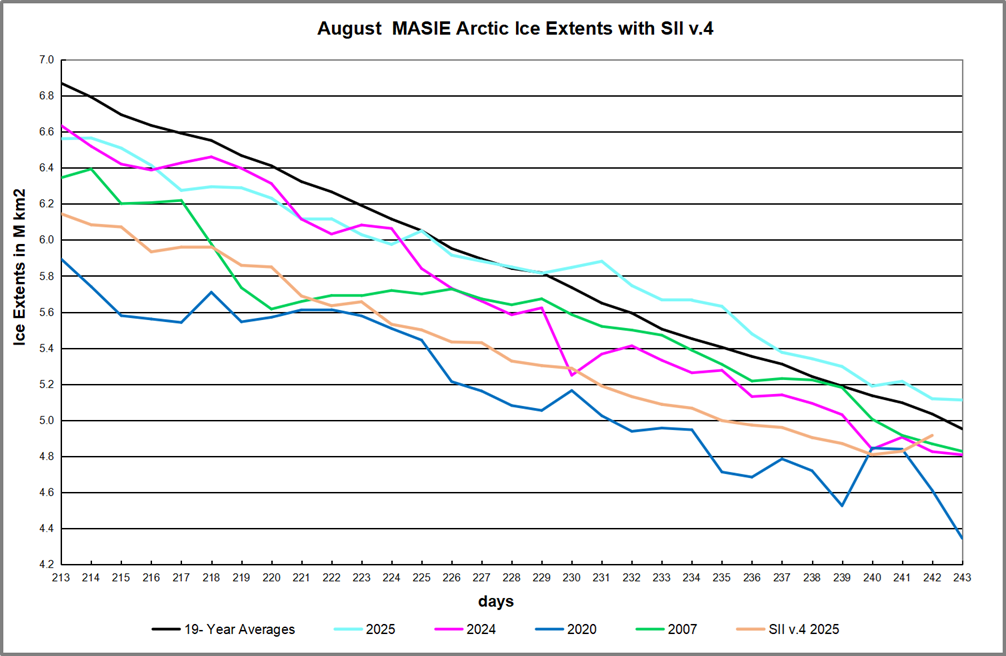
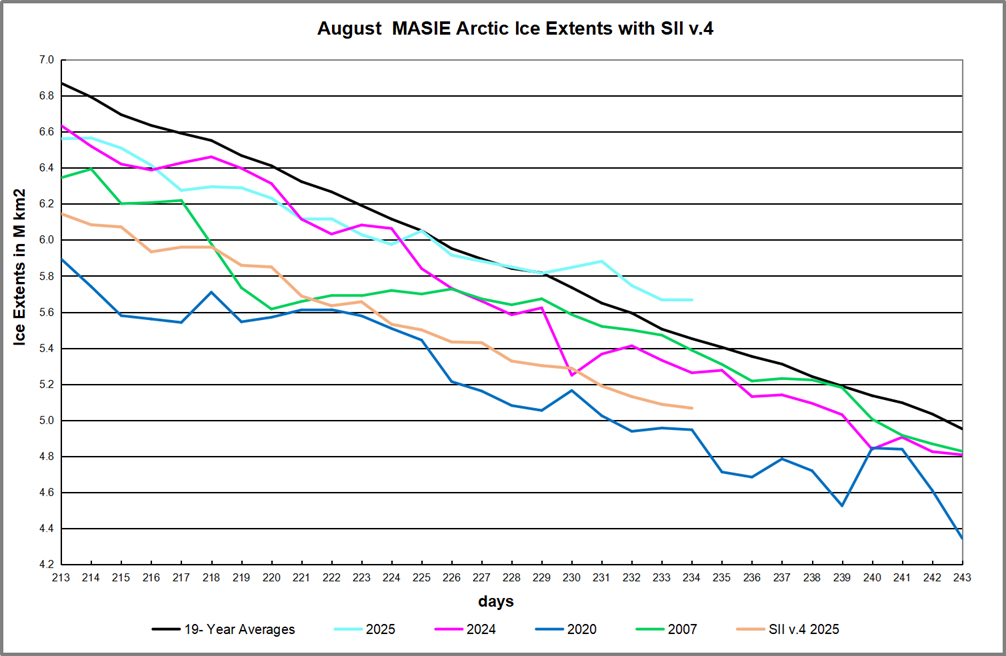
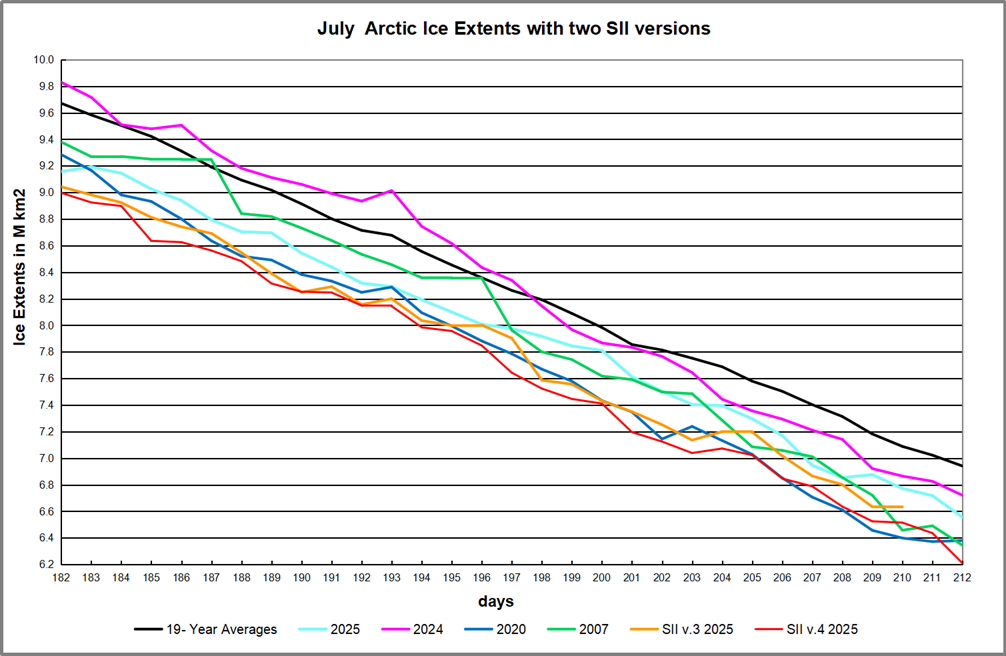
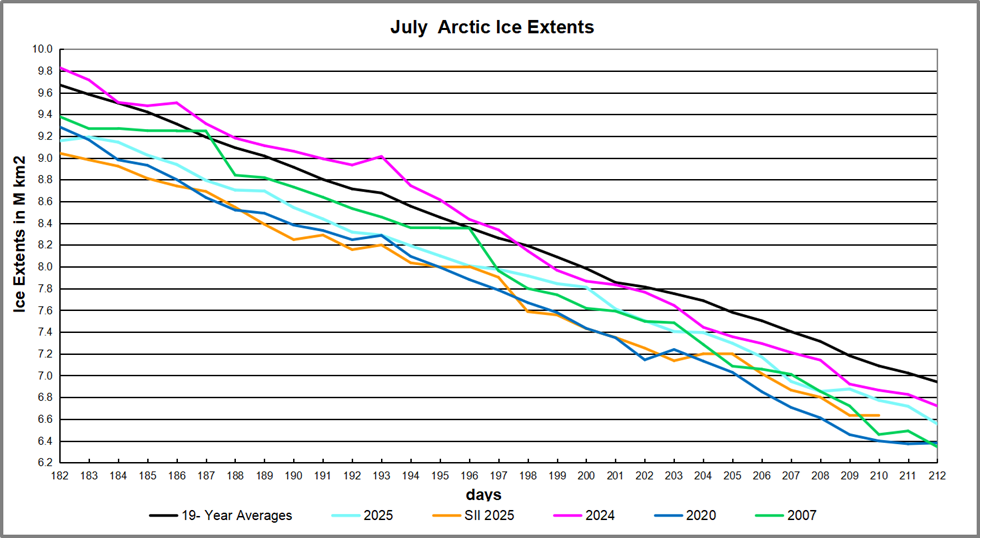
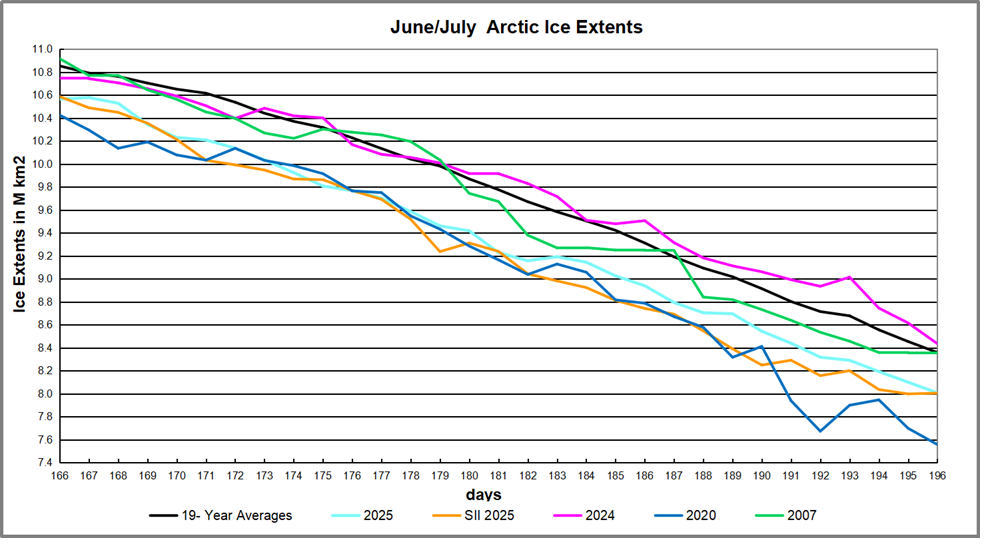
After a sub-par March maximum, by end of May 2025 Arctic ice closed the gap with the 19-year average. Then in June the gap reopened and in July the melting pace matched the average, abeit four days in advance of average.

During this period the average year loses ~2.5M km2 of ice extent.   MASIE on day 166 was ~300k km2 down, and the gap increased to almost 550k km2 by June 30 (day 181). The deficit to average then reduced to ~350k km2, which persisted over the last 12 days

including yesterday, day 196. The graph shows MASIE 2025 matching the average on day 192, four days in advance.

The regional distribution of ice extents is shown in the table below. (Bering and Okhotsk seas are excluded since both are now virtually open water.)

Region 2025196 Day 196 2025-Ave. 2020196 2025-2020
 (0) Northern_Hemisphere 8007061 8358377 -351316 7556873 450188
 (1) Beaufort_Sea 1022304 866531 155773 931056 91248
 (2) Chukchi_Sea 718615 643869 74745 612932 105683
 (3) East_Siberian_Sea 976061 921340 54721 659117 316945
 (4) Laptev_Sea 645741 559270 86471 174286 471454
 (5) Kara_Sea 153545 360645 -207100 159679 -6134
 (6) Barents_Sea 14342 56080 -41738 39446 -25105
 (7) Greenland_Sea 387402 402761 -15359 400498 -13096
 (8) Baffin_Bay_Gulf_of_St._Lawrence 268783 311662 -42878 232167 36616
 (9) Canadian_Archipelago 630633 711293 -80660 733866 -103233
 (10) Hudson_Bay 155460 349275 -193815 520027 -364567
 (11) Central_Arctic 3032353 3171652 -139299 3093040.21 -60687

The table shows  the two largest deficits, the Atlantic Kara basin combined with Hudson Bay, exceed the total difference from average. In addition are lower ice extents in Central Arctic and Canadian Archipelago, offset by surpluses in Beaufort Sea and other Eurasian shelf basins.  Note that Hudson Bay with 350k km2 average ice extent yesterday will have less than 100k in three weeks.

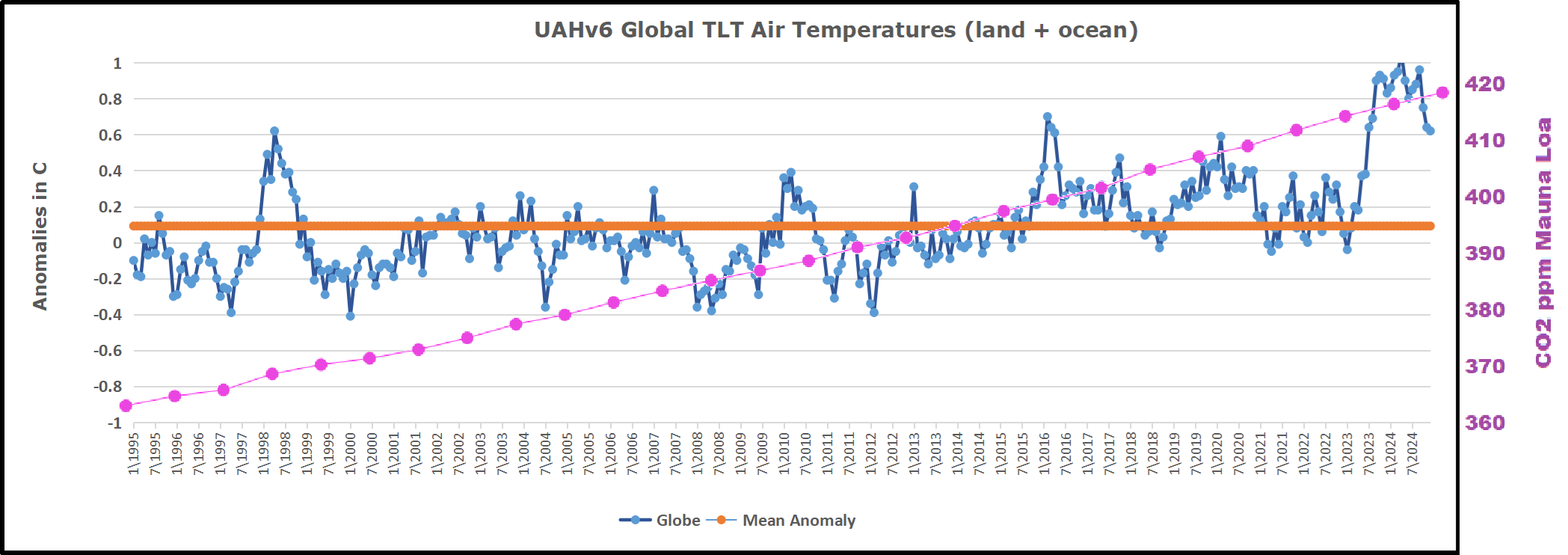
Why is this important?  All the claims of global climate emergency depend on dangerously higher  temperatures, lower sea ice, and rising sea levels.  The lack of additional warming prior to 2023 El Nino is documented in a post NH and Tropics Lead UAH Temps Lower May 2025.

The lack of acceleration in sea levels along coastlines has been discussed also.  See Observed vs. Imagined Sea Levels 2023 Update

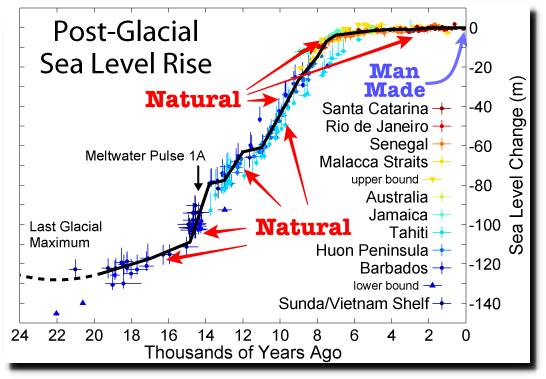
Also, a longer term perspective is informative:

post-glacial_sea_level

Near Normal Arctic Ice End of May 2025

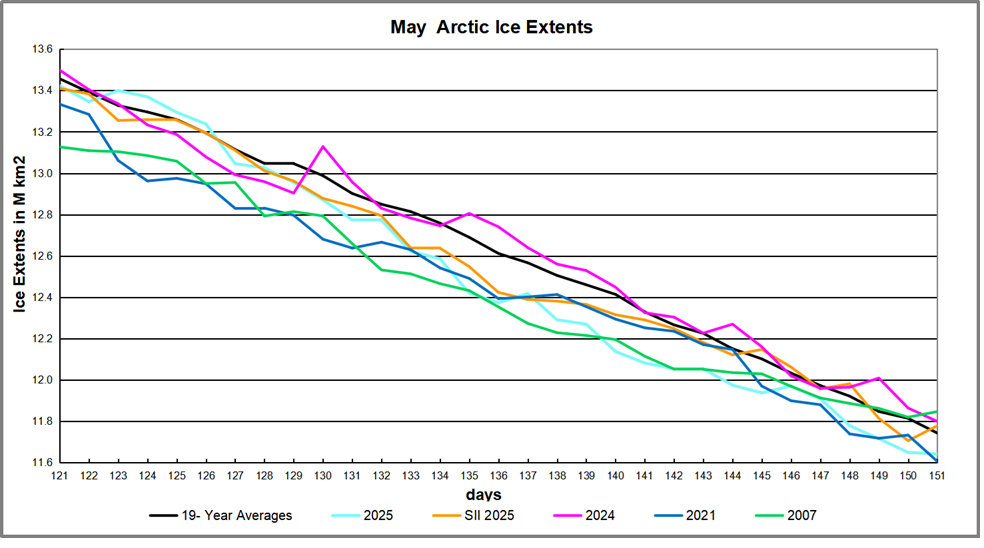
After a sub-par March maximum, in April and now in May 2025, Arctic ice has closed the gap with the 19-year average.

During May the average year loses 1.71 M km2 of ice extent.   MASIE showed 2025 losing slightly more, 1.78 M km2, while SII showed close to average at month end.   Throughout May both MASIE and SII tracked close to the 19 year average with a dipping lower mid month.

The regional distribution of ice extents is shown in the table below.

Region 2025151 Day 151 2025-Ave. 2007151 2025-2007
 (0) Northern_Hemisphere 11641897 11739951 -98055 11846659 -204762
 (1) Beaufort_Sea 1066232 1010120 56112 1059461 6771
 (2) Chukchi_Sea 941331 872869 68462 894617 46714
 (3) East_Siberian_Sea 1074738 1065906 8832 1069198 5540
 (4) Laptev_Sea 779394 828746 -49352 754651 24744
 (5) Kara_Sea 736946 831977 -95031 895678 -158732
 (6) Barents_Sea 291895 315440 -23544 323801 -31906
 (7) Greenland_Sea 670528 584085 86443 591919 78609
 (8) Baffin_Bay_Gulf_of_St._Lawrence 853619 904731 -51112 934257 -80637
 (9) Canadian_Archipelago 843914 812776 31138 818055 25859
 (10) Hudson_Bay 1046462 1081957 -35494 1077744 -31282
 (11) Central_Arctic 3216938 3220915 -3977 3230109.43 -13171
 (12) Bering_Sea 73534 115851 -42316 112352.8 -38819
 (13) Baltic_Sea 0 6015 -6015 0 0
 (14) Sea_of_Okhotsk 44702 175668 -130966 83076 -38375

The table shows  major deficits in the Pacific basins of Okhotsk and Bering combined are 173k km2. On the Atlantic side, Kara and Laptev combined to lose 144k km2.  The other regions are a mix of surpluses and deficits giving an overall result about 100k km2 below average or 0.8%.

Why is this important?  All the claims of global climate emergency depend on dangerously higher  temperatures, lower sea ice, and rising sea levels.  The lack of additional warming prior to 2023 El Nino is documented in a post April 2025 UAH Temps Little Changed For Now.

The lack of acceleration in sea levels along coastlines has been discussed also.  See Observed vs. Imagined Sea Levels 2023 Update

Also, a longer term perspective is informative:

post-glacial_sea_level

Arctic Ice: All’s Well Ending April 2025

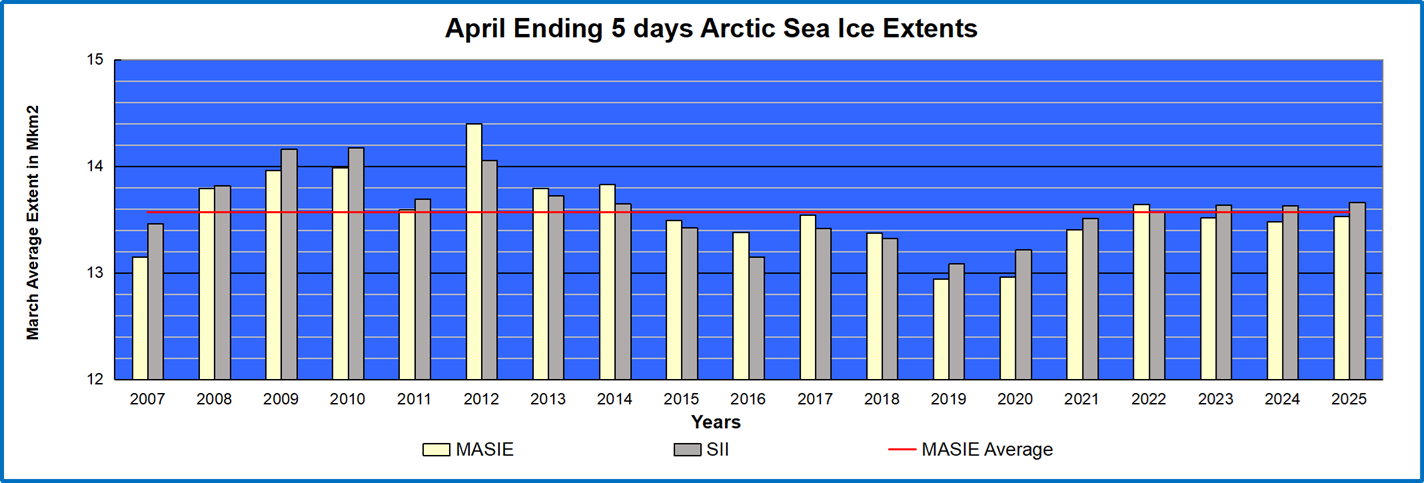
NOAA refers to the Month end Arctic ice extent by averaging the last five days extents.  Thus monthly gains and losses of ice can be obtained by subtracting the previous month end ice amount.  The chart above shows the April month end Arctic ice extents since 2007, comparing the two relevant datasets: Sea Ice Index (SII, based on satellite microwave sensors) and Multisensor Analyzed Sea Ice Extent (MASIE, based on multiple sources including several satellite sensors and visual analysis).

A sine wave pattern is evident starting after the low 2007 extent, rising to a peak in 2012, declining to 2019, before returning to the mean the last four years.

After a sub-par March maximum, now in April, 2025, Arctic ice has closed the gap with the 19-year average.

During April the average year loses 1.1M km2 of ice extent.  Meanwhile 2025 lost only 0.538 M km2, about half as much.  The end result is MASIE showing a slight deficit and SII a small surplus at end of April.

The regional distribution of ice extents is particularly revealing, as shown in the table below.

Region 2025120 Day 120 Ave. 2025-Ave. 2007120 2025-2007
 (0) Northern_Hemisphere 13428208 13510326 -82118 13108068 320140
 (1) Beaufort_Sea 1071001 1068240 2761 1059189 11811
 (2) Chukchi_Sea 963094 957153 5942 949246 13848
 (3) East_Siberian_Sea 1087137 1085746 1391 1080176 6961
 (4) Laptev_Sea 893105 891206 1899 875661 17444
 (5) Kara_Sea 927530 915007 12523 864664 62866
 (6) Barents_Sea 563013 552738 10275 396544 166470
 (7) Greenland_Sea 703059 661036 42023 644438 58621
 (8) Baffin_Bay_Gulf_of_St._Lawrence 1129634 1194283 -64650 1147115 -17481
 (9) Canadian_Archipelago 854878 849548 5330 838032 16846
 (10) Hudson_Bay 1249532 1238910 10622 1222074 27458
 (11) Central_Arctic 3244486 3231137 13349 3241034.13 3452
 (12) Bering_Sea 441499 477412 -35913 475489 -33990
 (13) Baltic_Sea 11180 21561 -10382 14683.79 -3504
 (14) Sea_of_Okhotsk 287204 363423 -76219 295743 -8539

The table shows only three significant deficits to average; Okhotsk is -72k km2, and Bering adds -40k, together greater than the overall -82k km2, which is 0.6% below average.  The other deficit in Baffin Bay is  offset by surpluses in nearly every other Arctic basin with the exception of Baltic Sea. Clearly the core Arctic ocean is solidly frozen, with a few fringe seas going to open water slightly ahead of schedule.

Why is this important?  All the claims of global climate emergency depend on dangerously higher temperatures, lower sea ice, and rising sea levels.  The lack of additional warming prior to 2023 El Nino is documented in a post March 2025 UAH Yo-yo Temps.

The lack of acceleration in sea levels along coastlines has been discussed also.  See Observed vs. Imagined Sea Levels 2023 Update

Also, a longer term perspective is informative:

post-glacial_sea_level

Arctic Ice Normal Mid-April 2025

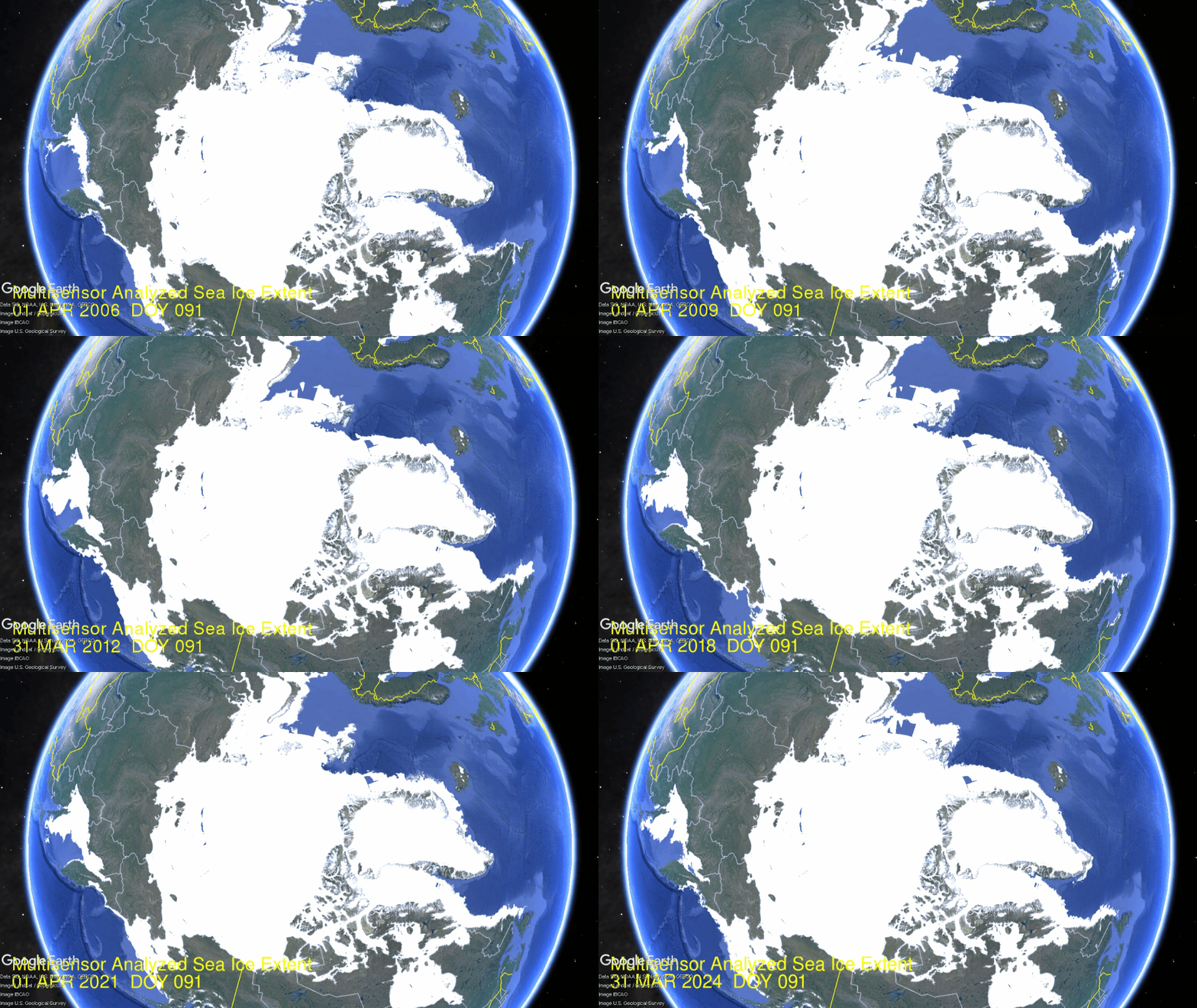
The animation shows end of March Arctic ice extents on day 91 over the last 19 years (length of MASIE dataset). Of course central Arctic basins are frozen solid, and the fluctuations are visible on the marginal basins both the Atlantic side (right) and the Pacific (left). Note the higher extents in 2012, followed by lesser ice, then overcome by 2024.

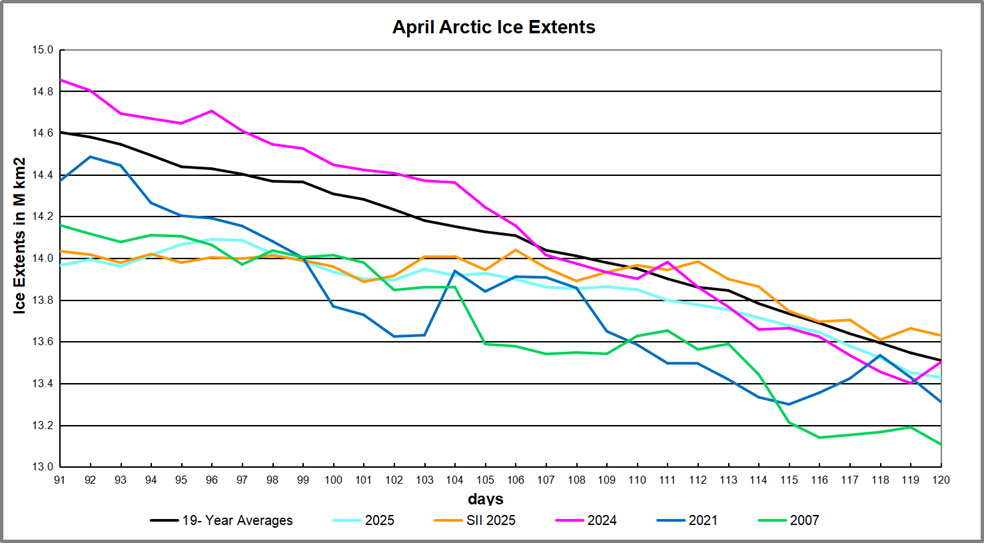
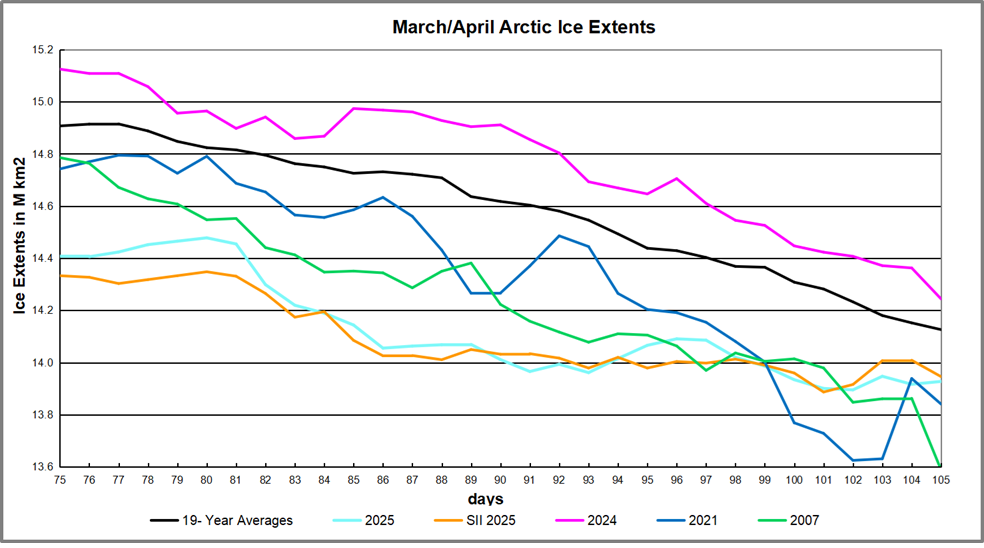
After a sub-par March maximum, now in mid-April, 2025 Arctic ice has mostly closed the gap with the 19-year average.

Day 75 is mid-March, typically near the highest daily extents of the year.  At that time 2025 was ~500k km2 below average, or Half a Wadham in deficit. By end of March this year the gap below average reached 600k km2.  However, note that over these 30 days MASIE shows an average ice extent loss of 781k km2, while 2025 lost almost no ice in April, hanging around the 14M km2 mark.  Both MASIE and SII showed the same resilience pattern in April 2025, well above 2021 and especially 2007.  The regional distribution of ice extents is particularly revealing.

Region 2025105 Day 105 Ave. 2025-Ave. 2007105 2025-2007
 (0) Northern_Hemisphere 13927695 14126275 -198580 13588722 338973
 (1) Beaufort_Sea 1071001 1069881 1119 1068692 2309
 (2) Chukchi_Sea 965989 964751 1238 961638 4352
 (3) East_Siberian_Sea 1087137 1085653 1484 1078666 8471
 (4) Laptev_Sea 897845 893756 4089 843501 54344
 (5) Kara_Sea 921800 923592 -1792 890594 31206
 (6) Barents_Sea 517245 621900 -104655 439904 77341
 (7) Greenland_Sea 710333 661040 49293 673585 36749
 (8) Baffin_Bay_Gulf_of_St._Lawrence 1306106 1274576 31530 1215526 90580
 (9) Canadian_Archipelago 854878 853052 1826 848812 6066
 (10) Hudson_Bay 1248738 1246317 2422 1208588 40150
 (11) Central_Arctic 3246240 3234033 12206 3235648.34 10591
 (12) Bering_Sea 657229 646796 10433 600281.22 56948
 (13) Baltic_Sea 13278 43789 -30511 23534.37 -10256
 (14) Sea_of_Okhotsk 427895 601889 -173994 491121 -63226

The table shows only two significant deficits to average; Okhotsk alone is -174k km2, nearly matching the overall total of -199k km2, which is 1.4% below average.  The other deficit in Barents is mostly offset by surpluses in nearly every other Arctic basin with the exception of Baltic Sea. Clearly the core Arctic ocean is solidly frozen, with a few fringe seas going to open water slightly ahead of schedule.

Why is this important?  All the claims of global climate emergency depend on dangerously higher temperatures, lower sea ice, and rising sea levels.  The lack of additional warming prior to 2023 El Nino is documented in a post Ocean Warms, Land Cools UAH February 2025.

The lack of acceleration in sea levels along coastlines has been discussed also.  See Observed vs. Imagined Sea Levels 2023 Update

Also, a longer term perspective is informative:

post-glacial_sea_level

Arctic Ice March Maximum 2025 in Perspective

The animation shows end of March Arctic ice extents on day 91 over the last 19 years (length of MASIE dataset). Of course central Arctic basins are frozen solid, and the fluctuations are visible on the marginal basins both the Atlantic side (right) and the Pacific (left). Note the higher extents in 2012, followed by lesser ice, then overcome by 2024.

Climatology takes the March monthly average to indicate the annual maximum and September average as the minimum.  Dynamically, the Arctic gains and loses ice extents in this pattern:

The values in the chart are the month ending ice extents (last five days average) minus the ice extents at end of the previous month.  Thus positive numbers show ice gained each month, negative numbers ice lost in a given month.  SII (Sea Ice Index) provides a data file calculating and updating these results since 1980. Note that the peak month of March on average declines very slightly, while the minimum month of September on average gains a little ice extent.  Also the greatest average gain of ice is in October and the greatest loss of extent is in July.

Above is a chart of March Monthly averages since 2007. The variability shows, including 2024 well above the 19-year average and 2025 well below.

This graph shows variations of ice extents during March, on average and for some recent years along with 2007.  The exceptional extents in 2024 stand out, along with the more typical 2021 and 2007.  On average during March the Arctic loses about 400k km2 of ice.  2025 started March at 14M km2, about 900k km2 in deficit, and ended virtually the same 14M, 600k km2 below average on day 90. SII was slightly lower than MASIE for three weeks, then ended about the same.

The table below shows the distribution of ice extents across the Arctic regions.

Region 2025090 Ave Day 090 2025-Ave. 2007090 2025-2007
 (0) Northern_Hemisphere 14011379 14617665 -606287 14222916 -211537
 (1) Beaufort_Sea 1071001 1070241 760 1069711 1290
 (2) Chukchi_Sea 965989 964237 1752 966006 -17
 (3) East_Siberian_Sea 1087137 1086266 871 1074908 12229
 (4) Laptev_Sea 897845 897098 747 884340 13505
 (5) Kara_Sea 885597 920703 -35106 892157 -6560
 (6) Barents_Sea 450824 664324 -213500 441970 8854
 (7) Greenland_Sea 703578 665146 38433 686312 17266
 (8) Baffin_Bay_Gulf_of_St._Lawrence 1350818 1386137 -35320 1217467 133351
 (9) Canadian_Archipelago 854878 853269 1609 850127 4751
 (10) Hudson_Bay 1260903 1255273 5631 1229995 30908
 (11) Central_Arctic 3237488 3234612 2876 3242236.7 -4749
 (12) Bering_Sea 593465 711340 -117875 814787.71 -221323
 (13) Baltic_Sea 20341 62183 -41842 45896.93 -25556
 (14) Sea_of_Okhotsk 628758 836750 -207992 794657 -165899

Overall 2025 Arctic ice is 4% below the 19 year average and 1% below 2007.  About half of the 606k km2 deficit is in the Pacific basins of Bering and Okhotsk, typically the first to go to open water. The other major case of early melting is in the Atlantic Barents Sea.

Why is this important?  All the claims of global climate emergency depend on dangerously higher temperatures, lower sea ice, and rising sea levels.  The lack of additional warming prior to 2023 El Nino is documented in a post Ocean Warms, Land Cools UAH February 2025.


The lack of acceleration in sea levels along coastlines has been discussed also.  See Observed vs. Imagined Sea Levels 2023 Update

Also, a longer term perspective is informative:

post-glacial_sea_level

Arctic Ice Recovery Stalls January 2025

Arctic ice recovered more slowly than usual in December and January, likely due to polar vortex pulling freezing air from the Arctic down into lower latitudes, replaced by warmer southern air.  A post at Severe Weather Europe is February 2025 Forecast, describing the dynamics this winter.  

After a mild start, a new Polar Express is looming
for the United States and Canada mid-month.

As January is slowly ending, we can look at preliminary surface temperature data for the month so far. Below is the CDAS analysis, and you can see that January was colder than normal across the entire United States, apart from California and parts of Nevada. But these anomalies do not show the full picture of just how cold some days in the month were, breaking records for several years and even decades in the past.

On the other hand, we can see that Canada had warmer than normal temperatures. This is an expected pattern, as while the colder air was transported further south into the United States, it was replaced by high-pressure and a warmer-than-normal airmass.

The movement of the pressure systems drives these temperature patterns and weather changes. Pairs of pressure systems are also known as Rossby Waves. You can see an example of Rossby waves in the image below by NOAA and how they are all connected and function with the jet stream.

The purple line connecting these pressure systems is called the jet stream. This rapid stream of air is found around 9 to 14 kilometers (6 to 9 miles) above sea level.

In late January, the average temperatures in the northern United States and southern Canada are still around or below freezing, so even a strong positive anomaly does not actually mean warm temperatures in that region. But, it is interesting to see the rapid shift in temperature anomalies as the pressure systems reposition.

February 2025 is about to start, with the latest weather forecasts indicating a very dynamic month over the United States and Canada. After the power struggle between the cold and warmth at the start of the month, another Polar Vortex lobe looms for the United States around mid-month.

Below is the surface temperature anomaly, averaged for next week. You can see the large supply of colder air over the northern United States and western Canada. Another cooler area is forecast for eastern Canada and the northeastern United States.

But most of the central and southern half of the United States is forecast to have above-normal temperatures. We often see such a division in the weather patterns, where the colder and warmer air separate along the jet stream.

Going into the weather trend for the second half of February, we will use the extended-range ensemble forecasts. These forecasts serve as trends that show the prevailing idea of where the pressure systems are positioned and how the airmass is expected to move.

The continuous low-pressure systems over Canada helped to initiate large-scale cold air transport from the Arctic into the United States and Canada, also powered by the Polar Vortex in the stratosphere.

We continue to see the presence of the low-pressure area over Canada in the forecast for February. But the forecast now indicates an interesting core movement of the Polar Vortex in the stratosphere, likely to initiate another deep cold event around mid-month over the United States and Canada.

Impact on Arctic Ice Extents

The 19-year average for January shows Arctic ice extents started at 13.13M km2 and ended the month at 14.36M km2.  2024 started somewhat higher and matched average at the end.  Other recent years have been lower, and 2025 started 540k km2 in deficit and 818k km2 below average at month end. The gap had closed to 400k km2 before losing extents at the end.  SII and MASIE tracked closely this month.

The table below shows year-end ice extents in the various Arctic basins compared to the 19-year averages and some recent years.  2007 seven was close to the average, so 2018 is shown for comparison.

Region 2025031 Ave Day 031 2025-Ave. 2018031 2025-2018
 (0) Northern_Hemisphere 13543740 14362137 -818398 13792271 -248532
 (1) Beaufort_Sea 1071001 1070386 614 1070445 556
 (2) Chukchi_Sea 965989 965974 15 965971 18
 (3) East_Siberian_Sea 1087137 1087063 74 1087120 18
 (4) Laptev_Sea 897845 897824 21 897845 0
 (5) Kara_Sea 921520 917381 4139 895363 26157
 (6) Barents_Sea 428814 563859 -135044 481947 -53133
 (7) Greenland_Sea 614789 613370 1418 501411 113378
 (8) Baffin_Bay_Gulf_of_St._Lawrence 1080930 1328380 -247450 1406903 -325972
 (9) Canadian_Archipelago 854878 853510 1368 853109 1769
 (10) Hudson_Bay 1260903 1260778 125 1260838 66
 (11) Central_Arctic 3211379 3210507 872 3184817 26562
 (12) Bering_Sea 534452 648807  -114354 382206 152245
 (13) Baltic_Sea 39334 62876  -23542 41713.99 -2380
 (14) Sea_of_Okhotsk 559692 823877  -264185 704398 -144707

This year’s ice extent is 818k km2 or 5.7% below average.  About half of the deficit comes from the Pacific basins of Bering and Okhotsk sea.  The other two major losses are in Barents Sea and Baffin Bay.  With the annual maximum typically occurring mid-March, it is likely the ice then will also be lower than usual.   


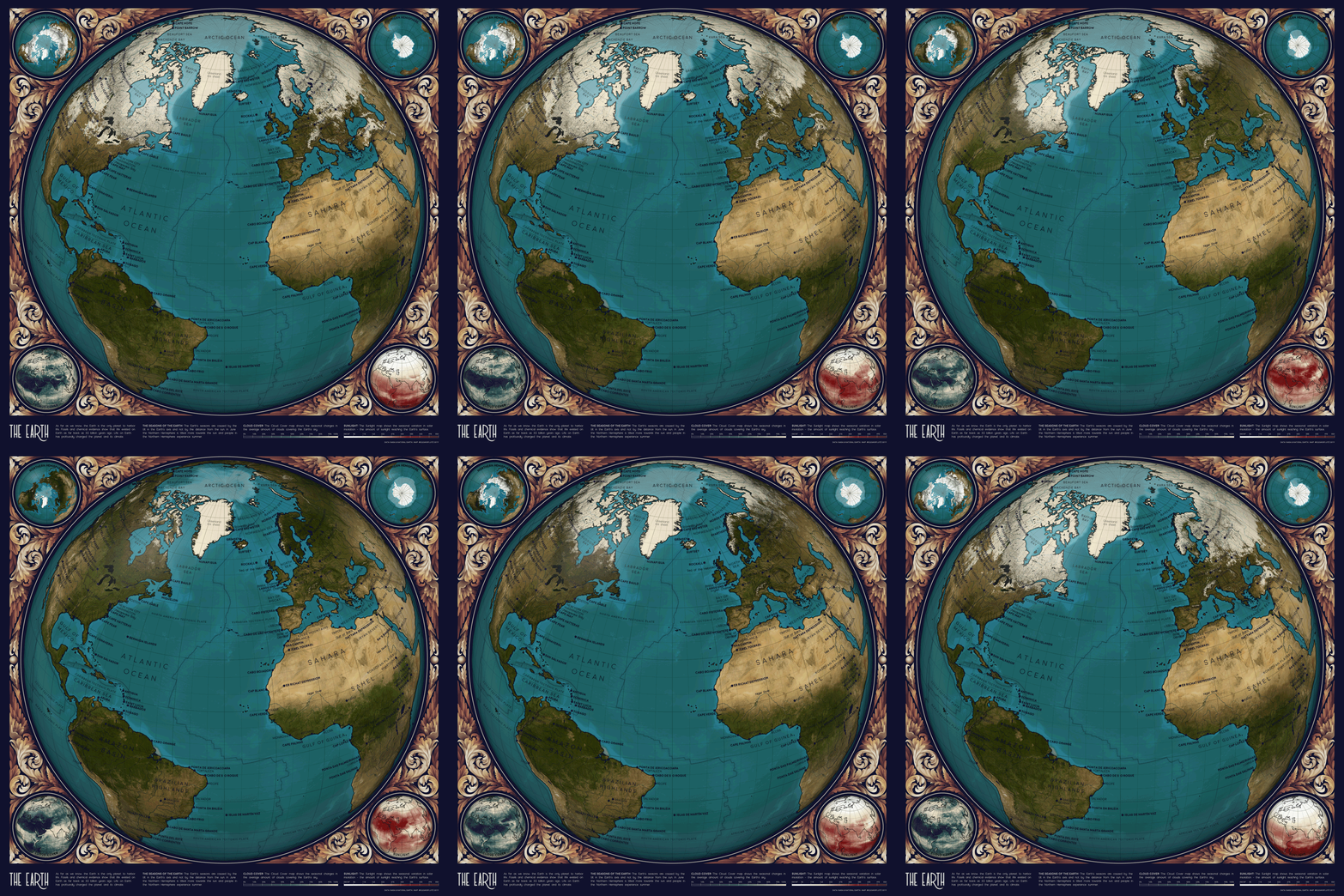
Illustration by Eleanor Lutz shows Earth’s seasonal climate changes. If played in full screen, the four corners present views from top, bottom and sides. It is a visual representation of scientific datasets measuring Arctic ice extents and NH snow cover.


Arctic Shipping Update: NSR Freezes in 10 Days

The previous post below sounded the alarm about ice halting Arctic shipping early.  October 14, the two Northern Sea Route choke points are in place:  Chukchi (bottom left) blocking entrance to Bering sea, and Laptev (upper left) stopping traffic to European seas. By yesterday  Laptev and East Siberian seas are completely covered, each over 95% of last March max extents. Chukchi is at 50% with its coastline covered. Kara (top left) is also adding ice rapidly. Less obviously Canadian Archipelago (lower center) doubled in 10 days up to 300k km2.

The graph below shows October ice extents on average and for some notable years.

The October gain in ice extents averages ~3.5M km2 up to 8.6M km2.  It is the month adding the most ice each year.  2024 has recovered more slowly than usual or than 2023, tracking along with 2007. The re-freezing has accelerated in the last 10 days.

Ice-strengthened supramax Kumpula (Arc 4) on the NSR being escorted by nuclear icebreaker Vaygach. (Source: Courtesy of ESL Shipping)

The report comes from Malte Humpert at gCaptain  Early Winter Ice Halts Arctic Shipping Traffic Weeks Ahead of Schedule.  Excerpts in italics with my bolds.

The summer shipping window on Russia’s Northern Sea Route is coming to a rapid close weeks ahead of schedule. A number of vessels and convoys are rushing to complete their transits before the route shuts down in the next three weeks.

Source: Northern Sea Route Information Office

Unlike the last couple of summers when Russia’s Arctic coastal waterways were fully clear of sea ice, residual winter ice persisted in the eastern section this year. This has resulted in the early onset of ice formation especially in the Laptev, East Siberian, and Chukchi Seas.

NSRIO: Ice is still present in the eastern sector of the NSR preventing free passage of ships without ice class. The nuclear icebreaker Sibir has been operating in the East Siberian and Chukchi Seas since the end of June together with the nuclear icebreaker Vaygach, which has been in the area since mid-July. In several areas of the Chukchi and East Siberian Seas heavy ice conditions are still observed, which directly affects the admission of low ice class vessels to these areas. The western part of the NSR is mostly ice-free. Above is a map of ice conditions as of August 7, 2024.

Russia’s Northern Sea Route Administration announced that vessels with no ice class will have to vacate the waterway by October 15, around 2-3 weeks ahead of schedule. For vessels with light and medium ice classifications the navigation season will end on October 20 and October 31 respectively.

The last permitted start of convoys heading east will be October 10, leaving just one more week for vessels to begin their Arctic transit.

This year’s early shutdown comes three years after narrowly avoiding a major incident three years ago. In October 2021 Russian authorities reacted too late to begin closing down the NSR as winter sea ice drifted into the main shipping channel and trapped two dozen vessels for more than a month. A 30 centimeter or one foot thick ice layer had formed by the end of October across hundreds of miles of Arctic Ocean.
 
Several icebreakers, including the powerful nuclear vessel Yamal, rushed to the scene from Murmansk over 3,000 nautical miles away to help free the stranded vessels. Over the course of more than 6 weeks several icebreakers worked to break the vessels free and escort them to safety out of the eastern section of the Northern Sea Route. The situation did not fully resolve until the end of December when the last vessels were freed.

Vessels stuck in thick winter sea ice in November 2021 awaiting rescue. (Source: Rosatomflot)

Currently a number of container ships, oil tankers, bulk carriers
and LNG tankers are passing through the route.

In the Far East two LNG carriers and two oil tankers, including the Suezmax tanker Sai Baba, are currently passing through the waters adjacent to the Bering Strait. They are staying clear of multi-year ice around Wrangel Island which has persisted and troubled shipping all summer. A nuclear icebreaker had remained on standby for much of the summer keeping the shipping lane open.

Select container ships, crude oil tankers, and bulk and LNG carriers currently on the NSR. (Source: Shipatlas)

Further west along the route, the first-ever conventional Panamax container ship in the Arctic is about halfway through its transit. The vessel had originally intended to also conduct its return voyage via the Arctic, but will now likely have to return to Asia via the Suez Canal or South Africa route.

A massive Capesize bulk carrier without any ice class, Dodo, is also rushing to complete its eastbound voyage to Caofeidian, China.


Arctic Shipping Update: NSR Flash Freezing

The previous post below sounded the alarm about ice halting Arctic shipping early.  Now the two choke points are blocked nine days later. Chukchi sea (left) is blocking entrance to Bering sea.  Laptev (right) is blocking traffic into European Barents and Kara seas.

Ice-strengthened supramax Kumpula (Arc 4) on the NSR being escorted by nuclear icebreaker Vaygach. (Source: Courtesy of ESL Shipping)

The report comes from Malte Humpert at gCaptain  Early Winter Ice Halts Arctic Shipping Traffic Weeks Ahead of Schedule.  Excerpts in italics with my bolds.

The summer shipping window on Russia’s Northern Sea Route is coming to a rapid close weeks ahead of schedule. A number of vessels and convoys are rushing to complete their transits before the route shuts down in the next three weeks.

Source: Northern Sea Route Information Office

Unlike the last couple of summers when Russia’s Arctic coastal waterways were fully clear of sea ice, residual winter ice persisted in the eastern section this year. This has resulted in the early onset of ice formation especially in the Laptev, East Siberian, and Chukchi Seas.

NSRIO: Ice is still present in the eastern sector of the NSR preventing free passage of ships without ice class. The nuclear icebreaker Sibir has been operating in the East Siberian and Chukchi Seas since the end of June together with the nuclear icebreaker Vaygach, which has been in the area since mid-July. In several areas of the Chukchi and East Siberian Seas heavy ice conditions are still observed, which directly affects the admission of low ice class vessels to these areas. The western part of the NSR is mostly ice-free. Above is a map of ice conditions as of August 7, 2024.

Russia’s Northern Sea Route Administration announced that vessels with no ice class will have to vacate the waterway by October 15, around 2-3 weeks ahead of schedule. For vessels with light and medium ice classifications the navigation season will end on October 20 and October 31 respectively.

The last permitted start of convoys heading east will be October 10, leaving just one more week for vessels to begin their Arctic transit.

This year’s early shutdown comes three years after narrowly avoiding a major incident three years ago. In October 2021 Russian authorities reacted too late to begin closing down the NSR as winter sea ice drifted into the main shipping channel and trapped two dozen vessels for more than a month. A 30 centimeter or one foot thick ice layer had formed by the end of October across hundreds of miles of Arctic Ocean.
 
Several icebreakers, including the powerful nuclear vessel Yamal, rushed to the scene from Murmansk over 3,000 nautical miles away to help free the stranded vessels. Over the course of more than 6 weeks several icebreakers worked to break the vessels free and escort them to safety out of the eastern section of the Northern Sea Route. The situation did not fully resolve until the end of December when the last vessels were freed.

Vessels stuck in thick winter sea ice in November 2021 awaiting rescue. (Source: Rosatomflot)

Currently a number of container ships, oil tankers, bulk carriers
and LNG tankers are passing through the route.

In the Far East two LNG carriers and two oil tankers, including the Suezmax tanker Sai Baba, are currently passing through the waters adjacent to the Bering Strait. They are staying clear of multi-year ice around Wrangel Island which has persisted and troubled shipping all summer. A nuclear icebreaker had remained on standby for much of the summer keeping the shipping lane open.

Select container ships, crude oil tankers, and bulk and LNG carriers currently on the NSR. (Source: Shipatlas)

Further west along the route, the first-ever conventional Panamax container ship in the Arctic is about halfway through its transit. The vessel had originally intended to also conduct its return voyage via the Arctic, but will now likely have to return to Asia via the Suez Canal or South Africa route.

A massive Capesize bulk carrier without any ice class, Dodo, is also rushing to complete its eastbound voyage to Caofeidian, China.

Here’s ice activity in last week in the NSR from Chukchi Sea in the east (left side), and threatening in Laptev Sea (right).

Arctic Ice In Perspective 2024

With Arctic ice melting season winding down, warmists again stoked fears about ice disappearing in the North. In fact, the pattern of Arctic ice seen in historical perspective is not alarming. People are over-thinking and over-analyzing Arctic Ice extents, and getting wrapped around the axle (or should I say axis).  So let’s keep it simple and we can all readily understand what is happening up North.

I have noticed at some other blogs people complain about my monthly Arctic ice updates focusing on extents starting in 2007. This post will show why that time period is entirely reasonable as a subject for analysis. I will use the ever popular NOAA dataset derived from satellite passive microwave sensors.  It sometimes understates the ice extents, but everyone refers to it and it is complete from 1981 to present.  Here’s what NOAA reports (in M km2):

We are frequently told that only the March maximums and the September minimums matter, since the other months are only transitional between the two.  So the graph above shows the mean ice extent, averaging the two months March and September.  The data comes from Sea Ice Index (SII).

If I were adding this to the Ice House of Mirrors, the name would be The X-Ray Ice Mirror, because it looks into the structure of the time series.   For even more clarity and simplicity, here is the table:

NOAA NH Annual Average Ice Extents (in M km2).  Sea Ice Index v3.0 (here)

Year Average Change Rate of Change
1981 11.385    
1997 11.077 -0.308 -0.019 per year
2007 9.405 -1.672 -0.167 per year
2024 9.626  +0.221 +0.013 per year

The satellites involve rocket science, but this does not.  There was a small loss of ice extent over the first 16 years, then a dramatic downturn for 10 years, 9 times the rate as before. That was followed by the current 17-year plateau with a slight gain comparable to the beginning loss.  All the fuss is over that middle period, and we know what caused it.  A lot of multi-year ice was flushed out through the Fram Strait, leaving behind more easily melted younger ice. The effects from that natural occurrence bottomed out in 2007.

Kwok et al say this about the Variability of Fram Strait ice flux:

The average winter area flux over the 18-year record (1978–1996) is 670,000 km2, ;7% of the area of the Arctic Ocean. The winter area flux ranges from a minimum of 450,000 km2 in 1984 to a maximum of 906,000 km2 in 1995. . .The average winter volume flux over the winters of October 1990 through May 1995 is 1745 km3 ranging from a low of 1375 km3 in the 1990 flux to a high of 2791 km3 in 1994.

https://www.researchgate.net/publication/261010602/download

Conclusion:

Some complain it is too soon to say Arctic Ice is recovering, or that 2007 is a true change point.  The same people were quick to jump on a declining period after 1996 as evidence of a “Death Spiral.”

Footnote:

No one knows what will happen to Arctic ice.

Except maybe the polar bears.

And they are not talking.

Except, of course, to the admen from Coca-Cola


Arctic Shipping Ends Early Due to Growing Ice

Ice-strengthened supramax Kumpula (Arc 4) on the NSR being escorted by nuclear icebreaker Vaygach. (Source: Courtesy of ESL Shipping)

The report comes from Malte Humpert at gCaptain  Early Winter Ice Halts Arctic Shipping Traffic Weeks Ahead of Schedule.  Excerpts in italics with my bolds.

The summer shipping window on Russia’s Northern Sea Route is coming to a rapid close weeks ahead of schedule. A number of vessels and convoys are rushing to complete their transits before the route shuts down in the next three weeks.

Source: Northern Sea Route Information Office

Unlike the last couple of summers when Russia’s Arctic coastal waterways were fully clear of sea ice, residual winter ice persisted in the eastern section this year. This has resulted in the early onset of ice formation especially in the Laptev, East Siberian, and Chukchi Seas.

NSRIO: Ice is still present in the eastern sector of the NSR preventing free passage of ships without ice class. The nuclear icebreaker Sibir has been operating in the East Siberian and Chukchi Seas since the end of June together with the nuclear icebreaker Vaygach, which has been in the area since mid-July. In several areas of the Chukchi and East Siberian Seas heavy ice conditions are still observed, which directly affects the admission of low ice class vessels to these areas. The western part of the NSR is mostly ice-free. Above is a map of ice conditions as of August 7, 2024.

Russia’s Northern Sea Route Administration announced that vessels with no ice class will have to vacate the waterway by October 15, around 2-3 weeks ahead of schedule. For vessels with light and medium ice classifications the navigation season will end on October 20 and October 31 respectively.

The last permitted start of convoys heading east will be October 10, leaving just one more week for vessels to begin their Arctic transit.

This year’s early shutdown comes three years after narrowly avoiding a major incident three years ago. In October 2021 Russian authorities reacted too late to begin closing down the NSR as winter sea ice drifted into the main shipping channel and trapped two dozen vessels for more than a month. A 30 centimeter or one foot thick ice layer had formed by the end of October across hundreds of miles of Arctic Ocean.
 
Several icebreakers, including the powerful nuclear vessel Yamal, rushed to the scene from Murmansk over 3,000 nautical miles away to help free the stranded vessels. Over the course of more than 6 weeks several icebreakers worked to break the vessels free and escort them to safety out of the eastern section of the Northern Sea Route. The situation did not fully resolve until the end of December when the last vessels were freed.

Vessels stuck in thick winter sea ice in November 2021 awaiting rescue. (Source: Rosatomflot)

Currently a number of container ships, oil tankers, bulk carriers
and LNG tankers are passing through the route.

In the Far East two LNG carriers and two oil tankers, including the Suezmax tanker Sai Baba, are currently passing through the waters adjacent to the Bering Strait. They are staying clear of multi-year ice around Wrangel Island which has persisted and troubled shipping all summer. A nuclear icebreaker had remained on standby for much of the summer keeping the shipping lane open.

Select container ships, crude oil tankers, and bulk and LNG carriers currently on the NSR. (Source: Shipatlas)

Further west along the route, the first-ever conventional Panamax container ship in the Arctic is about halfway through its transit. The vessel had originally intended to also conduct its return voyage via the Arctic, but will now likely have to return to Asia via the Suez Canal or South Africa route.

A massive Capesize bulk carrier without any ice class, Dodo, is also rushing to complete its eastbound voyage to Caofeidian, China.

Here’s ice activity in last week in the NSR from Chukchi Sea in the east (left side), and threatening in Laptev Sea (right).