Climate Chaos


Foucault’s pendulum in the Panthéon, Paris

h/t tom0mason for inspiring this post, including his comment below

The Pendulum is Settled Science

I attended North Phoenix High School (Go Mustangs!) where students took their required physics class from a wild and crazy guy. Decades later alumni who don’t remember his name still reminisce about “the crazy science teacher with the bowling ball.”

To demonstrate the law of conservation of energy, he required each and every student to stand on a ladder in one corner of the classroom. Attached to a hook in the center of the rather high ceiling was a rope with a bowling ball on the other end. The student held the ball to his/her nose and then released it, being careful to hold still afterwards.

The 16 pound ball traveled majestically diagonally across the room and equally impressively returned along the same path. The proof of concept was established when the ball stopped before hitting your nose (though not by much).  In those days we learned to trust science and didn’t need to go out marching to signal some abstract virtue.

The equations for pendulums are centuries old and can predict the position of the ball at any point in time based on the mass of the object, length of the rope and starting position.

Pictured above is the currently operating Foucault pendulum that exactly follows these equations. While it had long been known that the Earth rotates, the introduction of the Foucault pendulum in 1851 was the first simple proof of the rotation in an easy-to-see experiment. Today, Foucault pendulums are popular displays in science museums and universities.

What About the Double Pendulum?

Trajectories of a double pendulum

Just today a comment by tom0mason at alerted me to the science demonstrated by the double compound pendulum, that is, a second pendulum attached to the ball of the first one. It consists entirely of two simple objects functioning as pendulums, only now each is influenced by the behavior of the other.

Lo and behold, you observe that a double pendulum in motion produces chaotic behavior. In a remarkable achievement, complex equations have been developed that can and do predict the positions of the two balls over time, so in fact the movements are not truly chaotic, but with considerable effort can be determined. The equations and descriptions are at Wikipedia Double Pendulum

Long exposure of double pendulum exhibiting chaotic motion (tracked with an LED)

But here is the kicker, as described in tomomason’s comment:

If you arrive to observe the double pendulum at an arbitrary time after the motion has started from an unknown condition (unknown height, initial force, etc) you will be very taxed mathematically to predict where in space the pendulum will move to next, on a second to second basis. Indeed it would take considerable time and many iterative calculations (preferably on a super-computer) to be able to perform this feat. And all this on a very basic system of known elementary mechanics.

And What about the Climate?

This is a simple example of chaotic motion and its unpredictability. How predictable is our climate with so many variables and feedbacks, some known some unknown? Consider that this planet’s weather/climate system is chaotic in nature with many thousands (millions?) of loosely coupled variables and dependencies, and many of these variables have very complex feedback features within them.

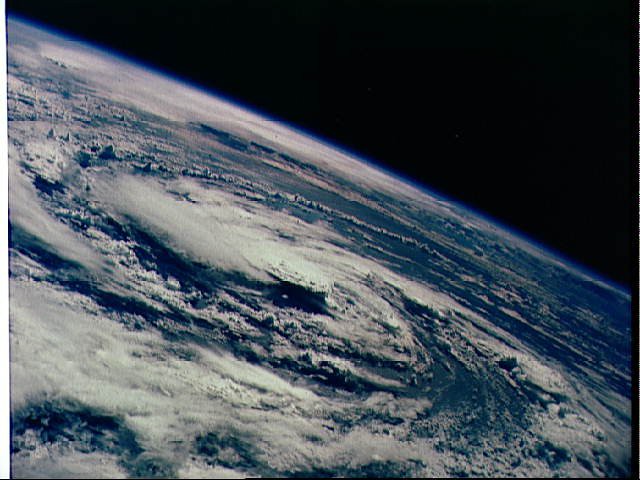
Hurricane Gladys, photographed from orbit by Apollo 7 in 1968 (Photo: NASA)

Summary

To quote the IPCC:

The climate system is a coupled non-linear chaotic system, and therefore the long-term prediction of future climate states is not possible. Rather the focus must be upon the prediction of the probability distribution of the system’s future possible states by the generation of ensembles of model solutions.

A recent National Review article draws the implications:
The range of predicted future warming is enormous — apocalyptism is unwarranted.

But as the IPCC emphasizes, the range for future projections remains enormous. The central question is “climate sensitivity” — the amount of warming that accompanies a doubling of carbon dioxide in the atmosphere. As of its Fifth Assessment Report in 2013, the IPCC could estimate only that this sensitivity is somewhere between 1.5 and 4.5°C. Nor is science narrowing that range. The 2013 assessment actually widened it on the low end, from a 2.0–4.5°C range in the prior assessment. And remember, for any specific level of warming, forecasts vary widely on the subsequent environmental and economic implications.

For now, though, navigating the climate debate will require translating the phrase “climate denier” to mean “anyone unsympathetic to the most aggressive activists’ claims.” This apparently includes anyone who acknowledges meaningful uncertainty in climate models, adopts a less-than-catastrophic outlook about the consequences of future warming, or opposes any facet of the activist policy agenda. The activists will be identifiable as the small group continuing to shout “Denier!” The “deniers” will be identifiable as everyone else.

Update May 2

Esteemed climate scientist Richard Lindzen ends a very fine recent presentation (here) with this description of the climate system:

I haven’t spent much time on the details of the science, but there is one thing that should spark skepticism in any intelligent reader. The system we are looking at consists in two turbulent fluids interacting with each other. They are on a rotating planet that is differentially heated by the sun. A vital constituent of the atmospheric component is water in the liquid, solid and vapor phases, and the changes in phase have vast energetic ramifications. The energy budget of this system involves the absorption and reemission of about 200 watts per square meter. Doubling CO2 involves a 2% perturbation to this budget. So do minor changes in clouds and other features, and such changes are common. In this complex multifactor system, what is the likelihood of the climate (which, itself, consists in many variables and not just globally averaged temperature anomaly) is controlled by this 2% perturbation in a single variable? Believing this is pretty close to believing in magic. Instead, you are told that it is believing in ‘science.’ Such a claim should be a tip-off that something is amiss. After all, science is a mode of inquiry rather than a belief structure.

Flow Diagram for Climate Modeling, Showing Feedback Loops

The Limitations of Climate Science

1viw84

Here is a fine exposition of Bob Carter’s thoughts on the field of climate science and why we should not jump to conclusions concerning global warming/climate change.  The text and some illustrations are provided by Russ Swan in his post (here).  I added one at the end.

Have you ever wondered about these people when they are so definite about mankind causing climate change? Have you ever wondered how much of the information is from their own expertise and how much is what they’ve learned from someone else? Are they really passing on real proven scientific facts or just what they believe to be true from information provided by someone else?

Or do you just accept what they are telling you?

The average person on the street might be forgiven for thinking that climate change scientists are primarily meteorologists or climatologists plus perhaps some others with supporting expertise.  But that would be only partially right.

The subjects relating to climate change actually diverge into more than 100 scientific sub-disciplines, the elements of which can be exceptionally intricate, highly complicated and intertwined.  Just changing one of the many data inputs e.g. the output chemistry of sub-sea volcanoes to a climate change puzzle can flow-on to incorrect or at least misleading changes in the final solution. And the answer will still be a “best probable” result – not fact.

At most there may be a handful of scientists that have mastery of two or three scientific disciplines such as Professor Robert M. Carter (decd) who was a qualified palaeontogist, stratigrapher and marine geologist.  Yet even if a scientist does have expertise in two or more of the climate change elements, he/she still needs to find and use data from other sources to cover the gaps in his/her own knowledge. Such data may in turn only be a “best probable” solution as opposed to fact(s) as will be explained further below.

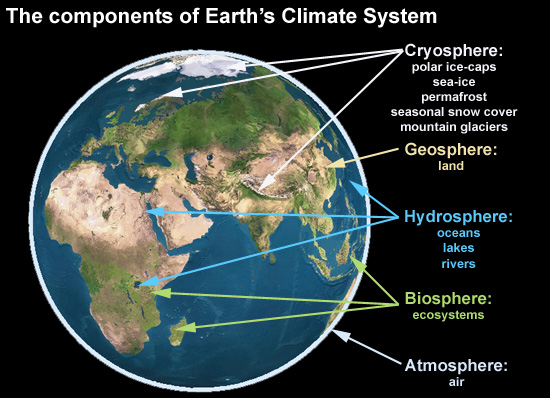
climate-components

No Such Thing as a Climate Expert

It must therefore be obvious that there can be no such thing as an “expert” simply because no one can fully comprehend the entirety of it all.

This doesn’t stop the media, in particular the TV media in regularly presenting interviewees as experts to lend credibility to their show. But anyone who claims or admits to being an expert in climate change is either kidding themselves, egocentric or is being deceitful.

The bottom line is that when a supposed expert fronts up in the media – watch it guardedly or else switch the channel.   At the end of the day everyone, including the scientists themselves are basically amateurs when a topic is outside their own field of expertise – even if they are an educated amateur.

But having someone with at least some scientific background involved in climate change discussions has got to be far more preferable than pulling celebrities into the debate. These people despite their best intentions, are simply promoting their own views and muddying the waters for the public to make a realistic conclusion in their own minds.

042-decaprio-300x298

Conclusion

Apart from that all three groups of scientists generally DO agree that the Earth’s climate has always changed, that human emissions affect local climates e.g. urban areas and have a summed potential to affect climate globally, and that carbon dioxide is a mild greenhouse house – note the word “mild”.

The real argument then is not about whether the Earth is heating up, but about how relevant is AGW when considered against natural climate change processes.

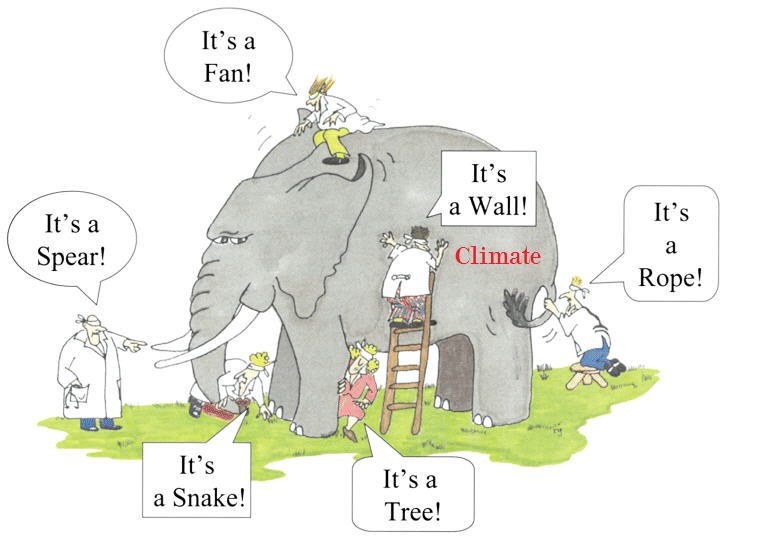
The Blind Men and the Elephant (Indian Fable)

Elephant2

Footnote:  For more on science as knowledge rather than opinion see Yellow Climate Journalism


Precipitation Misunderstandings


A previous post on Temperature Misunderstandings addressed mistaken notions about the meaning of temperature measurements and records. This post looks at rainfall, the other primary determinant of climates. For this topic California provides the means for everyone to see how misconceptions arise, and how to see precipitation statistics in context.

Lessons learned from the end of California’s “permanent drought”

A report by Larry Kummer documents how extensively California’s recent shortage of water was proclaimed as a “permanent drought”. And it goes on to document how El Nino conditions have ended the water shortage.

Status of the California drought

“During the past week, a series of storms bringing widespread rain and snow showers impacted the states along the Pacific Coast and northern Rockies. In California, the cumulative effect of several months of abundant precipitation has significantly improved drought conditions across the state.”
— US Drought monitor – California, February 9.

Precipitation over California in the water year so far (October 1 to January 31) is 178% of average for this date. The snowpack is 179% of average, as of Feb 8. Our reservoirs are at 125% of average capacity. See the bottom line summary as of February 7, from the US Drought monitor for California.

The improvement has been tremendous. The area with exceptional drought conditions have gone year over year from 38% of California to 0%, extreme drought from 23% to 1%, severe drought from 20% to 10% — while dry and moderate drought went from 18% to 48%, and no drought from <1% to 41%. See the map below. And the rain continues to fall.

In addition there is the saga of Oroville dam threatened by its reservoir overfilling.

Confusing Weather and Climate

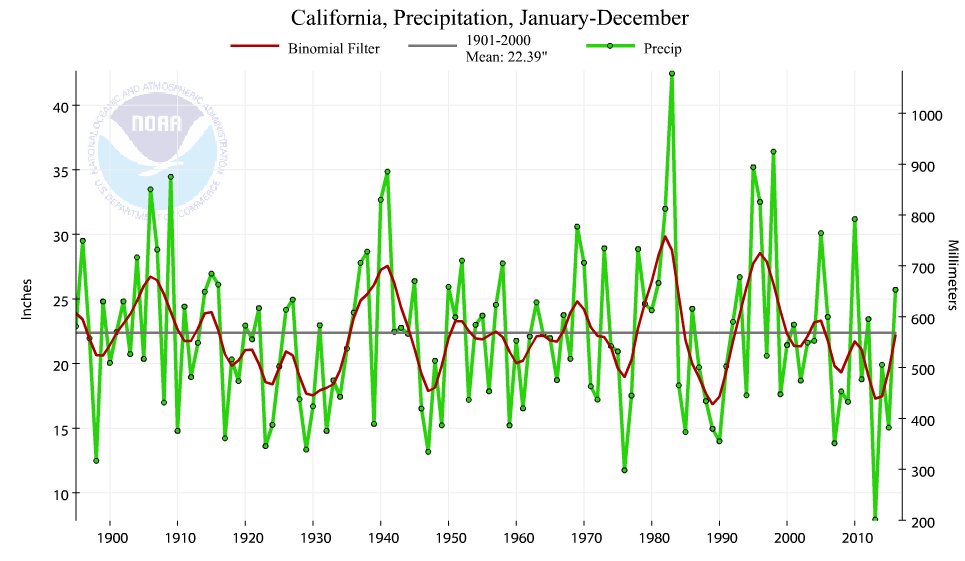
As with temperature, rainy weather is not climate. Neither is fair, sunny weather permanent. Precipitation is variable in any particular climate, with the seasons and on decadal and mult-decadal bases. For a context on precipitation patterns around the world see Here Comes the Rain Again.

It is a mistake to call a temporary lack of rain a drought, or worse a permanent drought, and equally a mistake to call a return of rainfall the end of a drought. California’s history as a desert environment does not change just because politicians and the public have short memories.

H/T to Eric Simpson for reminding us of that history:

There is also this perceptive comment by tomholsinger

I wouldn’t be so quick about the drought ending. Droughts are ALWAYS multi-season events. I was very impressed by the references below, which made the point that the 20th Century average of ~200 million acre feet of precipitation in California (rain and snow combined) is way more than the average of ~140 million acre feet over the last 2000 years.

Drying of the West, National Geographic

The West without Water: What Past Floods, Droughts, and Other Climatic Clues Tell Us about Tomorrow, Ingram, B. Lynn, and Malamud-Roam, Frances, 2013, University of California Press

Tom goes on to quote himself from a Modesto Bee op-ed almost two years ago.

Global warming has nothing to do with this – history is bad enough. A long-standing pre-industrial regional climate fluctuation seems underway, returning us from the wettest century in the past 1000 years to at least the historic average of much less (~70%) rain and snow. Many paleoclimatologists believe we are entering a still worse mega-drought .

An extreme drought by historic standards means a drop to 35-40% of the 20th Century average for 10-20 years. California has experienced two centuries-long such extreme mega-droughts in the past 2000 years.

Our average 20th Century precipitation (rain and snow combined) produced about 200 million acre feet of water annually over the whole state. 118 million acre feet went to nature in 2000, and 82 million was allocated by humans – the first 39 million for federal mandates, 9 million was used by people and industry, and the last 34 million for irrigation. A drop to the historic average of ~140 million acre feet over the past 2000 years means extinction for California agriculture – it would bear almost all the burden of the decrease even if the federal water is released. An extreme drought means a drop to about 75 million acre feet, and we might be starting 1-2 centuries of that.

This is happening to the entire Southwest . ~20 million acre feet of the Southwest’s precipitation annually entered the Colorado River in the 20th Century, of which ~12 million is currently withdrawn by Americans. Colorado River flow too has averaged much less over the past 2000 years (12-14 million acre fee annually), and it drops to 7-8 million in droughts which sometimes last centuries.

A drop to only the historic average precipitation over the past 2000 years means catastrophe for the Southwest. 2/3 of the very wet 20th Century average is normal for the entire area. We can expect ALL of California’s allotment of Colorado River to be diverted to urban areas in Arizona and Nevada in the decades of drought the region seems to be entering.

Summary

As with temperatures, changes in precipitation are misinterpreted when taken out of historical context. This is usually done to hype a sociopolitical agenda by distracting people from the baseline realities to which we can only adapt, not prevent.

The rainfall measures above show that California enjoyed an unusually wet century and it would have been prudent to take advantage of it by storing water resources. As the fable tells us, grasshoppers live for today, ants prepare for tomorrow.

Climate Debate Is On

Senator Malcolm Roberts:
ON CLIMATE, CSIRO LACKS EMPIRICAL PROOF

H/t Jo Nova

Finally, a public airing of empirical flaws in consensus climate science. Senator Malcolm Roberts is doing Australia and the entire world a service by applying critical intelligence to IPCC climate science as espoused by CSIRO, Australia’s climate agency.

The scientific debate between Roberts et al. and CSIRO is documented in depth for all to peruse at Climate Change – One Nation’s response to CSIRO  (here).

Overview:

Senator Malcolm Roberts in his maiden speech asserted that CSIRO had no empirical evidence that human emissions of CO2 caused any significant global warming.  A meeting was arranged between CSIRO and Senator Roberts’ staff where CSIRO presented their empirical evidence.  The linked document is a detailed review of that empirical evidence and has raised many questions, as well as indicating some points of agreement.

Excerpts below with images suggest that finally we have an intensive and worthwhile debate about the state of climate science, and a reasonable assessment of uncertainties in our present levels of human understanding of climate operations. Statements and images below are only examples of the extensive commentary and numerous exhibits provided.

CSIRO: Carbon dioxide is a greenhouse gas.

The natural greenhouse effect makes the planet habitable: the average temperature of the earth is 33°C warmer than it would be in the absence of greenhouse gases.

The laws of physics and direct measurements confirm that carbon dioxide is a greenhouse gas.

Roberts: Accepted that CO2 is a Greenhouse Gas if that just means it absorbs long wave infra-red radiation.

We will not contest the use of the term greenhouse effect but are unaware of any evidence that the atmosphere behaves similarly to a physical greenhouse. Some reasons for our hesitation follow.

The Greenhouse effect, as a product of back radiation heating against the thermal gradient and in violation of Fourier’s Law, is yet to be confirmed by explicitly relevant and controlled experiment.

CSIRO: Carbon dioxide concentrations in the atmosphere have increased.

Atmospheric carbon dioxide levels have increased by more than 40% since pre-industrial times

Roberts: Accepted that CO2 levels have risen since 1800 but this benefits plants and animals.

Annual atmospheric CO2 background level from 1856 to 2008 compared to SST (Kaplan, KNMI); red line, CO2 MBL reconstruction from 1826 to 1959 (Beck 2010); CO2 1960-2008: (Mauna Loa); blue line, annual SST (Kaplan) from 1856 -2003; SST= sea surface temperature

Increase in dry weight of major crop plants when atmospheric CO2 concentrations are raised. The data presented is based on large numbers of scientific studies.

CSIRO: The extra carbon dioxide in the atmosphere comes from human activities.

CO2 in the atmosphere has increased as human emissions have increased (the two are correlated).

Roberts: It is accepted that much of the recent extra CO2 probably comes from human activities but the CSIRO evidence does not seem to support the implied certainty.


These estimates of CO2 sinks are not empirical evidence and will more likely be revised as more data comes in from the Orbiting Carbon Observatory 2 satellite system

Deriving an average CO2 concentration for the whole world may be as controversial as the temperature average.

CSIRO: The additional carbon dioxide added to the atmosphere by human activities has enhanced the greenhouse effect: less energy is leaving the top of the atmosphere in the wavelengths absorbed by carbon dioxide and other greenhouse gases.

Roberts: The evidence provided doesn’t seem to support the stated conclusion.

The IRIS instrument was 1970 and the IMG instrument 1997. There is only the slightest change in methane and no significant change in CO2. [link]. This would seem be be empirical evidence that CO2 has no effect on brightness temperature.

Decadal variations in atmospheric water vapor.

Even a two percent variation in atmospheric water vapor will equal the total amount of supposed greenhouse effect of all human CO2 production.

CSIRO: The earth has warmed.

Graph: Global Surface temperature vs Time 1900 – 2015 increasing 1°C per century

Roberts: independent replication of experiment, observation and analysis is a vital part of the scientific method.

Maximum temperature is generally considered a better measure of regional temp variability and this allows better comparison with the following graph.

A trend of 0.44°C per century is indicated.
The reanalysis tried to be free of arbitrary adjustments and the trend per century was reduced from 0.88°C to 0.44°C.  The methodology of the reanalysis is explained in the attachment to this point.

CSIRO Graph: Ocean Heat Content increasing since 1975

Roberts: Accepted that the earth has warmed since the Little Ice Age but is still cooler than the Roman Warm Period and much cooler than the Holocene Thermal Maximum.

Pacific Ocean Heat Content is at the lowest for 8,000 years


We show that water masses linked to North Pacific and Antarctic intermediate waters were warmer by 2.1°C and 1.5°C, respectively, during the middle Holocene Thermal Maximum than over the past century. Both water masses were ~0.9°C warmer during the Medieval Warm period than during the Little Ice Age and ~0.65° warmer than in recent decades.”

CSIRO: Observed changes in the climate system are consistent with an enhanced greenhouse effect. Other forcings (e.g. volcanoes, the sun, internal variability) cannot explain the magnitude, timing and distribution of observed trends.

Roberts:  While there is strong correlation between CO2 and temperature when looking at the four last ice ages, CO2 does not appear to lead temperature. Looking at shorter timescales the correlation disappears and in the short satellite age data there appears to be no correlation with any greenhouse effect, enhanced or otherwise.

CO2 and temperature swings post 1850 show some correlation and some divergence

CO2 and temperature swings in the satellite age show little short term correlation


El Nino temperatures correlate well with satellite temperatures

CSIRO: Models can reproduce the record of global averaged temperature if we include the effects of increased greenhouse gas forcing, but cannot do so with natural forcings alone.


Roberts: It is the model predictions that seem to be inconsistent with the observed changes which rather disqualifies the models as a basis for expensive action.

Only the Russian model INM-CM4.0 can approximately reproduce the record of global averaged temperatures since 1977.

Summary — On the topic of dangerous warming from fossil fuel emissions

MR: Well, Greg Hunt – and I’m looking at Alex here, not for an explanation but just to emphasise that Greg Hunt in particular has said that his climate policies rely entirely on the CSIRO, the Bureau of Meteorology and the IPCC. And so he’s saying, we will end up in danger unless we do something to cut the use of hydrocarbon fuels. And so, if he relies upon the CSIRO’s advice, is that where he’s getting his imminent danger from?
CSIRO said that the interpretation of danger is up to the Australian public, and the Minister

MR: So, the Minister has drawn those conclusions. ….. independent of the CSIRO. You’ve presented him with the temperature changes and the causal analysis and he’s gone: Oh my God, we’ve got to do something.
CSIRO said it’s probably best to ask the Minister if he’s done that.

MR: Okay.
Ministerial Adviser indicated that the Minister would be happy to have a conversation about that and advised that’s definitely a conversation for the Minister not for the CSIRO.

MR: Sure. Okay. So, the CSIRO just presents the data and leaves the policy decisions to the Ministers?
CSIRO confirmed that is correct.


Overview: Seafloor Eruptions and Ocean Warming

Global heat flux of the Earth combining heat flux measurements on land and continental margins with a thermal model for the cooling of the oceanic lithosphere. The Earth loses energy as heat flows out through its surface. The total energy loss of the Earth has been estimated at 46 ± 2 TW, of which 14 TW comes through the continents and 32 TW comes from the seafloor. By Jean-Claude Mareschal

From the Unsettled Science File (h/t to Paul Homewood for posting on this subject recently)

Little attention is paid to geothermal heat fluxes warming the ocean from below, mostly because of limited observations and weak understanding about the timing and extent of eruptions.

The existence of heat rising through earth’s crust is evident to all, and the large majority of vents are under the ocean. Consider the image above, and notice at the top center is the small black island off the east coast of Greenland, right on top of the orange mid-ocean ridge. Iceland produces more than 50% of its electricity from geothermal, as well as heating numerous buildings from the same source.

In addition, farther up under the north pole, scientists discovered an eruption of intense seismic activity beginning in Gakkel Ridge in January of 1999 and continuing for seven months.  That happens to be about the time Arctic ice extent took a nosedive, stabilizing after 2007.
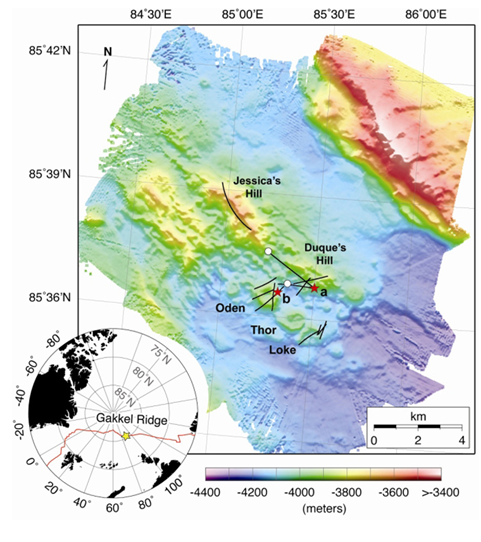
Researchers have considered the importance of this source of energy into the climate system from various points of view. Some abysmal studies (pun intended) were motivated to look in the ocean depths for the missing heat not appearing in the surface temperature records since 1998. Some warming was found but the case was weak since the Argo records showed no passage of heat between upper and lower ocean strata. Of course no thought was given to the seafloor being the warming source.  However, much more serious and extensive research has been done by marine geologists wanting to better understand the cooling of the earth itself.
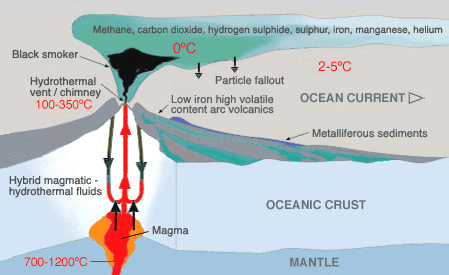
There appear to be three major issues around heating of the ocean from below through the seafloor:

1.  Is geothermal energy powerful enough to make a difference upon the vast ocean heat capacity?
2.  If so, Is geothermal energy variable enough to create temperature differentials?
3.  Most of the ocean floor is unexplored, so how much can we generalize from the few places we  have studied?

1. Some researchers conclude that geothermal heating of the oceans can not be ignored as trivial.

J. G. Sclater et al (here)

The total heat loss of the earth is 1002 × 10^10 cal/s (42.0 × 10^12 W), of which 70% is through the deep oceans and marginal basins and 30% through the continents and continental shelves. The creation of lithosphere accounts for just under 90% of the heat lost through the oceans and hence about 60% of the worldwide heat loss. Convective processes, which include plate creation and orogeny on continents, dissipate two thirds of the heat lost by the earth. Conduction through the lithosphere is responsible for 20%, and the rest is lost by the radioactive decay of the continental and oceanic crust.

Maqueda et al. (here)

Without geothermal heat fluxes, the temperatures of the abyssal ocean would be up to 0.5 C lower than observed, deep stratification would be reinforced by about 25%, and the strength of the abyssal circulation would decrease by between 25% and 50%, substantially altering the ability of the deep ocean to transport and store not only heat but also carbon and other climatically important tracers (Adcroft et al., 2001, Hofmann and Morales Maqueda, 2009, Mashayek et al., 2013). It has been hypothesised that interactions between the ocean circulation and geothermal heating are responsible for abrupt climatic changes during the last glacial cycle (Adkins et al, 2005).

Matthias Hofmann et al. (here)

Geothermal heating of abyssal waters is rarely regarded as a significant driver of the large-scale oceanic circulation. Numerical experiments with the Ocean General Circulation Model POTSMOM-1.0 suggest, however, that the impact of geothermal heat flux on deep ocean circulation is not negligible. Geothermal heating contributes to an overall warming of bottom waters by about 0.4◦C, decreasing the stability of the water column and enhancing the formation rates of North Atlantic Deep Water and Antarctic Bottom Water by 1.5 Sv (10% ) and 3 Sv (33% ), respectively. Increased influx of Antarctic Bottom Water leads to a radiocarbon enrichment of Pacific Ocean waters, increasing ∆14C values in the deep North Pacific from -269◦/◦◦when geothermal heatingis ignored in the model, to -242◦/◦◦when geothermal heating is included. A stronger and deeper Atlantic meridional overturning cell causes warming of the North Atlantic deep western boundary current by up to 1.5◦C
7f649a28fd11f9a721dd999cb3cd9c9d

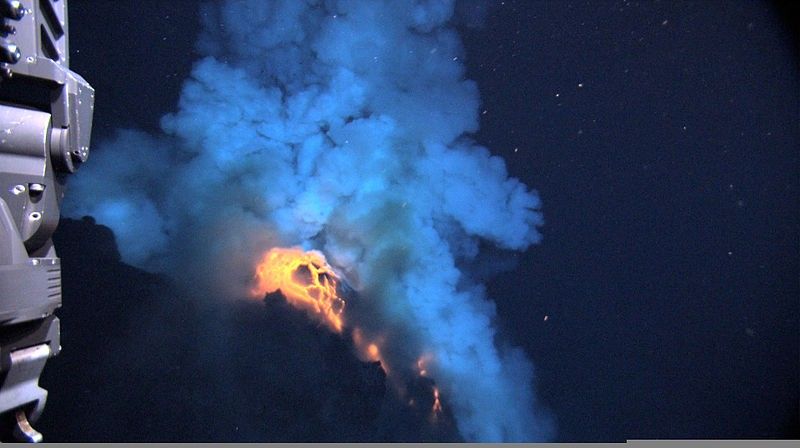
During the 2009 expedition, superheated molten lava, about 1,204ºC (2,200ºF) erupts, producing a bright flash as hot magma that is blown up into the water before settling back to the sea floor. Notice the front of the remotely operated vehicle (foreground, left). High resolution (Credit: Image courtesy of NSF and NOAA)

2.  Seafloor eruptions are quite variable and unpredictable, and while localized, can influence ocean circulation patterns.

Jess F. Adkins et al. (here)

The solar energy flux of 200 W/m2 at the ocean’s surface (Peixoto and Oort, 1992) is much larger than the next largest potential source of energy to drive climate changes, geothermal heating at the ocean’s bottom (50–100 mW/m2 ) (Stein and Stein, 1992), but this smaller heat input might still play an important role in rapid climate changes.

It is clear that variations in the solar flux pace the timing of glacial cycles (Hays et al., 1976), but these Milankovitch time scales are too long to explain the decadal transitions found in the ice cores. Another, higher frequency, source of solar variability that would directly drive the observed climate shifts has yet to be demonstrated. Therefore, mechanisms to explain the abrupt shifts all require the climate system to store potential energy that can be catastrophically released during glacial times, but not during interglacials (Stocker and Johnsen, 2003).

At the Last Glacial Maximum (LGM), when the deep ocean was filled with salty water from the Southern Ocean, geothermal heating may have been an important source of this potential energy.

In modern ocean studies there is an increasing awareness of the effect of geothermal heating on the overturning circulation. As an alternative to solar forcing, Huang (1999) has recently pointed out that geothermal heat, while small in magnitude, can still be important for the modern overturning circulation because it warms the bottom of the ocean, not the top. Density gradients at the surface of the ocean are not able to drive a deep circulation without the additional input of mechanical energy to push isopycnals into the abyss (Wunsch and Ferrari, 2004). Heating from below, on the other hand, increases the buoyancy of the deepest waters and can lead to large scale overturning of the ocean without additional energy inputs. Several modern ocean general circulation models have explored the overturning circulation’s sensitivity to this geothermal input. In the MIT model a uniform heating of 50 mW/m2 at the ocean bottom leads to a 25% increase in AABW overturning strength and heats the Pacific by 0.5 1C (Adcroft et al., 2001; Scott et al., 2001). In the ORCA model, applying a more realistic bottom boundary condition that follows the spatial distribution of heat input from Stein and Stein (1992) gives similar results (Dutay et al., 2004). In both models, most of the geothermal heat radiates to the atmosphere in the Southern Ocean, as this is the area where most of the world’s abyssal isopycnals intersect the surface.

The area of the modern ocean is 350×10^6 km2 . The area of the Southern Ocean between 80–85S (the region around Antarctica) is 0.4×10^6 km2 . This factor of 1000 means that the focused geothermal heating of 50 mW/m2 is locally of the same order as the total heat exchange at high southern latitudes. The focusing effect of geothermal heating can cause this heat flux to be a significant fraction of the total heat loss in the crucial deep-water formation zones in the glacial Southern Ocean. This suggests that the geothermal heat is potentially relevant for determining the heat content of the abyssal waters.
seamount-map

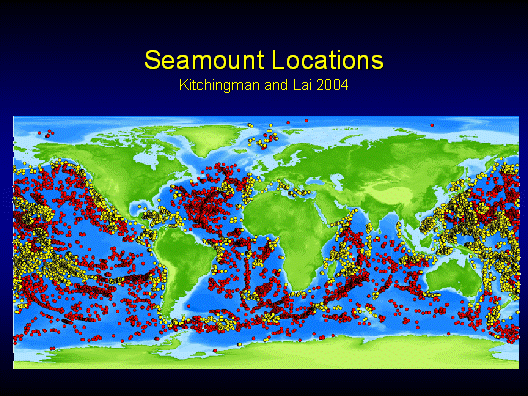
3. The number of hydrothermally active seamounts is estimated to be somewhere between 100,000 and 10,000,000.

Andrew T. Fisher and C. Geoffrey Wheat (here)

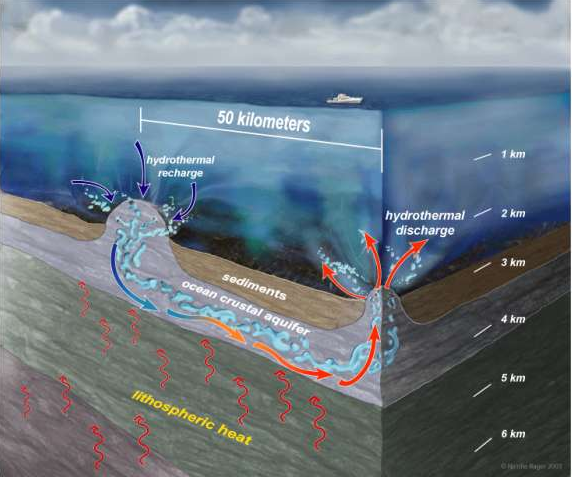
Thus, most of the thermally important fluid exchange between the crust and ocean must occur where volcanic rocks are exposed at the seafloor; little fluid exchange on ridge flanks occurs through seafloor sediments overlying volcanic crustal rocks. Seamounts and other basement outcrops focus ridge-flank hydrothermal exchange between the crust and the ocean. We describe the driving forces responsible for hydrothermal flows on ridge flanks, and the impacts that these systems have on crustal heat loss, fluid composition, and subseafloor microbiology.

Earth’s geothermal heat output is about 44 TW, with most heat loss occurring through ocean basins (e.g., Sclater et al., 1980; Pollack et al., 1993). Seafloor hydrothermal heat output is on the order of 10 TW, ~ 25% of Earth’s total geothermal heat output, and ~ 30% of the oceanic lithospheric heat output (Figure 1A). Only a small fraction of this advective heat output occurs at high temperatures at mid-ocean ridges; the vast majority occurs at lower temperatures (generally 5–20°C) on ridge flanks, suggesting an associated fluid discharge of ~ 10^16 kg yr-1 (Figure 1B) (C. Stein et al., 1995; Mottl, 2003; Wheat et al., 2003). This low-temperature flow rivals the discharge of all rivers to the ocean (4 x 10^16 kg yr-1), and is about three orders of magnitude greater than the sum of high-temperature hydrothermal discharges at mid-ocean ridges (~ 10^13 kg yr-1).

Networks of seamounts permit rapid fluid circulation to bypass thick and relatively continuous sediment across much of the deep seafloor. Fluid recharges into the crust as oceanic bottom seawater, being relatively cold and dense. As the fluid penetrates more deeply into the crust, it warms and reacts with the surrounding basalt, and interacts with the overlying sediments through diffusive exchange across the sediment-basalt interface. Fluid can flow laterally for tens of kilometers through the oceanic crust, with the extent of heating and reaction dependent on the flow rate, crustal age, and other factors. Weaker circulation systems can result in significant local rock alteration and heat extraction, but are unlikely to have a large impact on lithospheric heat loss on a regional scale.

The number of hydrothermally active seamounts is estimated to be somewhere between 100,000 and 10,000,000 , based on mapping and seamount population estimates by Wessel (2001) and Hillier and Watts (2007), and the observation that, of the seamounts and outcrops that have been surveyed, a significant fraction appear to be hydrothermally active (Fisher et al., 2003a, 2003b; Hutnak et al., 2008; Villinger et al., 2002).
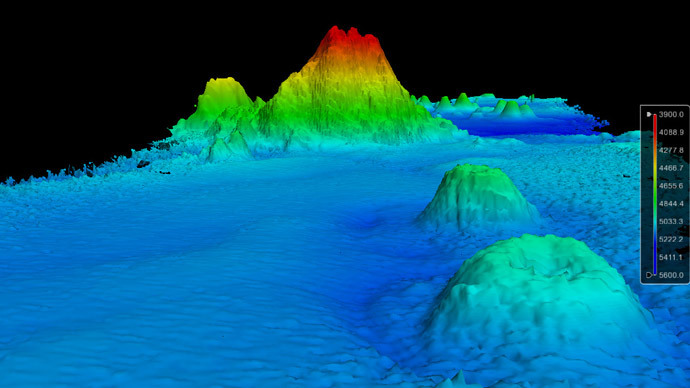
Monster mountain discovered lurking in depths of Pacific Ocean

Monster mountain discovered lurking in depths of Pacific Ocean

Without seamounts and other basement outcrops, it would not be possible for ridge-flank hydrothermal circulation to mine a significant fraction of lithospheric heat once sediments become thick and continuous on a regional basis. Thus, ridge-flank hydrothermal activity would be very different on an Earth without seamounts

Analyses of satellite gravimetric and ship track data suggest that there could be as many as 1,000,000 seamounts having a radius of ≥ 3.5 km and height ≥ 2 km (Wessel, 2001), and perhaps 10^6 to 10^7 features > 100 m in height (Hillier and Watts, 2007). Given the ubiquity of these features on ridge flanks, it is surprising how little we know about which seamounts are hydrologically active—how many recharge and how many discharge.

The thermobaric capacitor has enough energy to overturn the water column, can be triggered by regular oceanic processes, and charges over a time scale that is relevant to the climate record.

Conclusion

This source of heat has been dismissed because it is poorly known, and because its eruptive events are unpredictable and can not therefore be represented in climate models.  Despite geothermal eruptions having only localized effects, the impact on ocean circulations is significant.

John Reid (here)

Volcanic activity does not fit this neat picture. Volcanic behaviour is random, i.e. it is “stochastic” meaning “governed by the laws of probability”. For fluid dynamic modellers stochastic behaviour is the spectre at the feast. They do not want to deal with it because their models cannot handle it. We cannot predict the future behaviour of subaqueous volcanoes so we cannot predict future behaviour of the ocean-atmosphere system when this extra random forcing is included.

To some extent, chaos theory is called in as a substitute, but modellers are very reticent about describing and locating (in phase space) the strange attractors of chaos theory which supposedly give their models a stochastic character. They prefer to avoid stochastic descriptions of the real world in favour of the more precise but unrealistic determinism of the Navier-Stokes equations of fluid dynamics.

This explains the reluctance of oceanographers to acknowledge subaqueous volcanism as a forcing of ocean circulation.  Unlike tidal forcing, wind stress and thermohaline forcing, volcanism constitutes a major, external, random forcing which cannot be generated from within the model. It has therefore been ignored.
But the science is advancing.

Maya Tolstoy (here)

Vast ranges of volcanoes hidden under the oceans are presumed by scientists to be the gentle giants of the planet, oozing lava at slow, steady rates along mid-ocean ridges. But a new study shows that they flare up on strikingly regular cycles, ranging from two weeks to 100,000 years—and, that they erupt almost exclusively during the first six months of each year. The pulses—apparently tied to short- and long-term changes in earth’s orbit, and to sea levels–may help trigger natural climate swings. Scientists have already speculated that volcanic cycles on land emitting large amounts of carbon dioxide might influence climate; but up to now there was no evidence from submarine volcanoes. The findings suggest that models of earth’s natural climate dynamics, and by extension human-influenced climate change, may have to be adjusted. The study appears this week in the journal Geophysical Research Letters .

The idea that remote gravitational forces influence volcanism is mirrored by the short-term data, says Tolstoy. She says the seismic data suggest that today, undersea volcanoes pulse to life mainly during periods that come every two weeks. That is the schedule upon which combined gravity from the moon and sun cause ocean tides to reach their lowest points, thus subtly relieving pressure on volcanoes below. Seismic signals interpreted as eruptions followed fortnightly low tides at eight out of nine study sites. Furthermore, Tolstoy found that all known modern eruptions occur from January through June. January is the month when Earth is closest to the sun, July when it is farthest—a period similar to the squeezing/unsqueezing effect Tolstoy sees in longer-term cycles. “If you look at the present-day eruptions, volcanoes respond even to much smaller forces than the ones that might drive climate,” she said.

We are left with a philosophical conundrum:

If heat comes from the seafloor and no one is around to measure it, does it make the ocean warmer?

The classic form of this question was first posed by Bishop George Berkeley (1685 – 1753), one of the Top Ten Philosophical Questions:

“If a tree falls in a forest and no one is around to hear it, does it make a sound?”

Updated by Steven Wright
If a tree falls in the forest and no one is around to see it, do the other trees make fun of it?

A variation from my personal experience:
If a man says something and his wife is not around to hear it, is he still wrong?

Steven Wright (on the urban cooling effect)
I turned my air conditioner the other way around, and it got cold out. The weatherman said, ‘I don’t understand it. It was supposed to be 80 degrees out today.’ I said, ‘Oops … ‘

Reference:

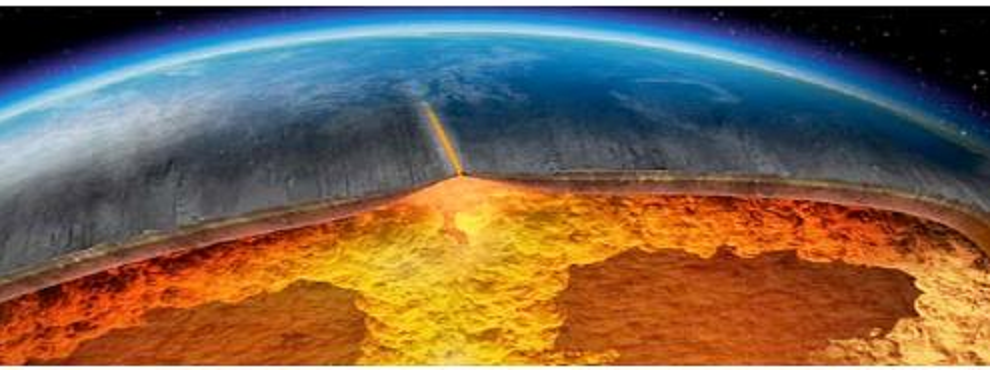
A complete presentation of Plate Tectonics Theory of Climatology is by James Edward Kamis (here)
plateclimatologytheory2


Autumn Climate Change


geese-in-v-formation

Originally posted September 2015

Seeing a lot more of this lately, along with hearing the geese  honking. And in the next month or so, we expect that trees around here will lose their leaves. It definitely is climate change of the seasonal variety.

Interestingly, the science on this is settled: It is all due to reduction of solar energy because of the shorter length of days (LOD). The trees drop their leaves and go dormant because of less sunlight, not because of lower temperatures. The latter is an effect, not the cause.

Of course, the farther north you go, the more remarkable the seasonal climate change. St. Petersburg, Russia has their balmy “White Nights” in June when twilight is as dark as it gets, followed by the cold, dark winter and a chance to see the Northern Lights.

And as we have been monitoring, the Arctic ice has been melting from sunlight in recent months, but will now begin to build again in the darkness to its maximum in March.

We can also expect in January and February for another migration of millions of Canadians (nicknamed “snowbirds”) to fly south in search of a summer-like climate to renew their memories and hopes. As was said to me by one man in Saskatchewan (part of the Canadian wheat breadbasket region): “Around here we have Triple-A farmers: April to August, and then Arizona.” Here’s what he was talking about: Quartzsite Arizona annually hosts 1.5M visitors, mostly between November and March.

Of course, this is just North America. Similar migrations occur in Europe, and in the Southern Hemisphere, the climates are changing in the opposite direction, Springtime currently. Since it is so obviously the sun causing this seasonal change, the question arises: Does the sunlight vary on longer than annual timescales?

The Solar-Climate Debate

And therein lies a great, enduring controversy between those (like the IPCC) who dismiss the sun as a driver of multi-Decadal climate change, and those who see a connection between solar cycles and Earth’s climate history. One side can be accused of ignoring the sun because of a prior commitment to CO2 as the climate “control knob”.

The other side is repeatedly denounced as “cyclomaniacs” in search of curve-fitting patterns to prove one or another thesis. It is also argued that a claim of 60-year cycles can not be validated with only 150 years or so of reliable data. That point has weight, but it is usually made by those on the CO2 bandwagon despite temperature and CO2 trends correlating for only 2 decades during the last century.

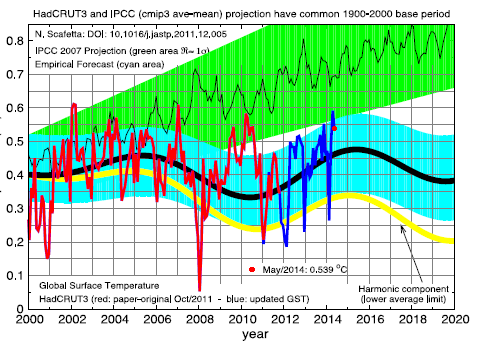
One scientist in this field is Nicola Scaffeta, who presents the basic concept this way:

“The theory is very simple in words. The solar system is characterized by a set of specific gravitational oscillations due to the fact that the planets are moving around the sun. Everything in the solar system tends to synchronize to these frequencies beginning with the sun itself. The oscillating sun then causes equivalent cycles in the climate system. Also the moon acts on the climate system with its own harmonics. In conclusion we have a climate system that is mostly made of a set of complex cycles that mirror astronomical cycles. Consequently it is possible to use these harmonics to both approximately hindcast and forecast the harmonic component of the climate, at least on a global scale. This theory is supported by strong empirical evidences using the available solar and climatic data.”

He goes on to say:

“The global surface temperature record appears to be made of natural specific oscillations with a likely solar/astronomical origin plus a noncyclical anthropogenic contribution during the last decades. Indeed, because the boundary condition of the climate system is regulated also by astronomical harmonic forcings, the astronomical frequencies need to be part of the climate signal in the same way the tidal oscillations are regulated by soli-lunar harmonics.”

He has concluded that “at least 60% of the warming of the Earth observed since 1970 appears to be induced by natural cycles which are present in the solar system.” For the near future he predicts a stabilization of global temperature until about 2016 and cooling until 2030-2040.

https://tallbloke.wordpress.com/2014/07/28/nicola-scafetta-global-temperatures-and-sunspot-numbers-are-they-related-yes-but-non-linearly/

A Deeper, but Accessible Presentation of Solar-Climate Theory

I have found this presentation by Ian Wilson to be persuasive while honestly considering all of the complexities involved.

The author raises the question: What if there is a third factor that not only drives the variations in solar activity that we see on the Sun but also drives the changes that we see in climate here on the Earth?

The linked article is quite readable by a general audience, and comes to a similar conclusion as Scaffeta above: There is a connection, but it is not simple cause and effect. And yes, length of day (LOD) is a factor beyond the annual cycle.

Click to access IanwilsonForum2008.pdf

It is fair to say that we are still at the theorizing stage of understanding a solar connection to earth’s climate. And at this stage, investigators look for correlations in the data and propose theories (explanations) for what mechanisms are at work. Interestingly, despite the lack of interest from the IPCC, solar and climate variability is a very active research field these days.

A summary of recent studies is provided at NoTricksZone: Already 23 papers in 2015 Supporting Sun as Major Climate Factor

Ian Wilson has much more to say at his blog: http://astroclimateconnection.blogspot.com.au/

Once again, it appears that the world is more complicated than a simple cause and effect model suggests.

For everything there is a season, a time for every purpose under heaven.

What has been will be again, what has been done will be done again;
there is nothing new under the sun.
(Ecclesiastes 3:1 and 1:9)

Update Sept. 17: Commentary with Dr. Arnd Bernaerts

ArndB comments:

Fine writing, Ron, well done!
No doubt the sun is the by far the most important factor for not living on a globe with temperatures down to minus 200°C. That makes me hesitating to comment on „solar and climate variability” or “the sun drives climate” (currently at NTZ – link above), but today merely requesting humbly that the claimed correlation should be based at least on some evidence showing that the sun has ever caused a significant climatic shift during the last one million years, which was not only a bit air temperature variability due to solar cycles that necessarily occur in correlation with the intake and release of solar-radiation by the oceans and seas.

Interestingly the UK MetOffice just released a report (Sept.2015, pages 21) titled:
“Big Changes Underway in the Climate System?”
by attributing the most possible and likely changes to the current status of El Niño, PDO, and AMO, and – of course – carbon dioxide -, and a bit speculation on less sun-energy (see following excerpt at link)

Click to access Changes_In_The_Climate_System.pdf

From p. 13: “It is well established that trace gases such as carbon dioxide warm our planet through the “greenhouse effect”. These gases are relatively transparent to incoming sunlight, but trap some of the longer-wavelength radiation emitted by the Earth. However, other factors, both natural and man-made, can also change global temperatures. For example, a cooling could be caused by a downturn of the amount of energy received from the sun, or an increase in the sunlight reflected back to space by aerosol particles in the atmosphere. Aerosols increase temporarily after volcanic eruptions, but are also generated by pollution such as sulphur dioxide from factories.
These “external” factors are imposed on the climate system and may also affect the ENSO, PDO and AMO variations……

My Reply:

Thanks Arnd for engaging in this topic.

My view is that the ocean makes the climate by means of its huge storage of solar energy, and the fluctuations, oscillations in the processes of distributing that energy globally and to the poles. In addition, the ocean is the most affected by any variation in the incoming solar energy, both by the sun outputting more or less, and also by clouds and aerosols blocking incoming radiation more or less (albedo or brightness variability).

https://rclutz.wordpress.com/2015/04/21/the-climate-water-wheel/

The oscillations you mention, including the present El Nino (and Blob) phenomenon, show natural oceanic variability over years and decades. Other ocean cycles occur over multi-decadal and centennial scales, and are still being analyzed.

At the other end of the scale, I am persuaded that the earth switches between the “hot house” and the “ice house” mainly due to orbital cycles, which are an astronomical phenomenon. These are strong enough to overwhelm the moderating effect of the ocean thermal flywheel.

The debate centers on the extent to which solar activity has contributed to climate change over the last 3000 years of our current interglacial period, including current solar cycles.

Update September 19

Additional studies showing a solar-climate connection are here: https://translate.google.com/translate?hl=&sl=de&tl=en&u=http%3A%2F%2Fwww.kaltesonne.de%2Fsonne-macht-klima-neues-aus-europa%2F

Climate Whack-A-Mole

The Joys of Playing Climate Whack-A-Mole

Dealing with alarmist claims is like playing whack-a-mole. Every time you beat down one bogeyman, another one pops up in another field, and later the first one returns, needing to be confronted again. I have been playing Climate Whack-A-Mole for a while, and if you are interested, there are some hammers supplied below.

The alarmist methodology is repetitive, only the subject changes. First, create a computer model, purporting to be a physical or statistical representation of the real world. Then play with the parameters until fears are supported by the model outputs. Disregard or discount divergences from empirical observations. This pattern is described in more detail at Chameleon Climate Models

A series of posts here apply reality filters to attest climate models.  The first was Temperatures According to Climate Models where both hindcasting and forecasting were seen to be flawed.

Others in the Series are:

Sea Level Rise: Just the Facts

Data vs. Models #1: Arctic Warming

Data vs. Models #2: Droughts and Floods

Data vs. Models #3: Disasters

Data vs. Models #4: Climates Changing

Climate Medicine

Climates Don’t Start Wars, People Do

virtual-reality-1920x1200

Beware getting sucked into any model, climate or otherwise.

Radiation Myopia

A recent thread comment illustrates how the global warming PR campaign has installed a bogus climate paradigm in public awareness: The Supremacy of Infrared Radiation. In a discussion about clouds and the Arctic, this comment appeared:

I disagree with the comments that clouds at the poles should cause cooling.
In general the earth absorbs heat from the sun near the equator and expels it near the poles via up welling radiation. A low humidity clear sky near the poles allows most gray body radiation from the ice/oceans/land to emit directly to space. Clouds at the poles would interfere with that process and the poles would warm thus melting the ice faster. And in a general sense, that is what we’ve seen over the last 40 years. (linked to a graph of declining ice extent since 1979).

Heat Transfer Mechanisms

It takes some work to untangle the problems with this statement. Because it is true that earth’s climate system takes in solar energy mostly at the equator, which is then transported and expelled mostly at the poles. The myopia is in the notion that this is a purely radiative heat transfer. The misconception arises from confusing the view from the top of the atmosphere (TOA) with the view at the surface where we live. The TOA energy balance is purely radiative.  Incoming: Short Wave (SW) in, minus Outgoing: (SW) reflected/scattered out, and minus Long Wave (LW, mostly Infrared) emitted out.

Nearer the surface, the movement of energy is dominated by other more powerful heat transfers: Conduction (from warm to cool by direct contact), Convection (air moving from warm to cool objects) and Latent Heat (water changing phases from ice to liquid to gas and back again). These processes move massive amounts of energy upward from the surface toward the nearly absolute cold of space. IR active gases, mainly H2O and the minor trace gas CO2, do absorb and re-emit some LW energy, but at a scale orders of magnitude less.

Polar Heat Exchanges

The comment above attributes warming in the Arctic to the radiative properties of H20 in clouds. There is no claim that CO2 is a factor, since it acknowledges that clear dry skies offer no significant impediment to the cooling processes. But do water vapor and clouds delay cooling in the Arctic?

While it is true that moist air in the tropics makes for mild evenings after sundown, the Arctic situation differs. There is a short season when the summer sun shines, and most of the year is dark and extremely cold.

Most people fail to appreciate the huge heat losses at the Arctic pole. Mark Brandon has an excellent post on this at his wonderful blog, Mallemaroking.

By his calculations the sensible heat loss in Arctic winter ranges 200-400 Wm2.

The annual cycle of sensible heat flux from the ocean to the atmosphere for 4 different wind speeds.

As the diagram clearly shows, except for a short time in high summer, the energy flow is from the water heating the air. Transfers by latent heat are in addition to the above.

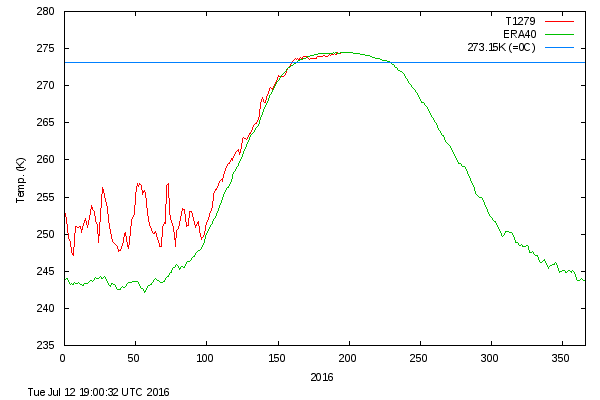
For a long time I misinterpreted the meaning of charts like the current one below from DMI:

meanT_2016DMI

Those are air temperatures, and if they are above average, it means that the water is losing more heat than past normals. It’s not that warmer air causes ice melt, but the other way around: Oceans are always moving heat, and more open water means more heat loss into the air, resulting in higher air temperatures, though still way below zero most of the year.

For comparison, look at the same chart from 1977 when ice extent was much higher the entire year:

Summary

So if there is to be any warming effect on ice formation from clouds, it can only happen in peak summer, the precise time when their shading effect exceeds any radiative warming.  And the existence of clouds indicates moisture in the air which came from the ocean evaporating.

The myopic focus on radiation and air temperatures leads into a false analogy:  thinking the Arctic is a kind of refrigerator. I explained in some detail why this is not so:  Arctic Is Not a Refrigerator

If one wants to use the refrigerator analogy in relation to earth’s climate, at least do it correctly as Dr. Salby does:

From Physics of the Atmosphere and Climate, pg.82

A closed system that performs work through a conversion of heat that is absorbed by it is a heat engine. Conversely, a system that rejects heat through a conversion of work that is performed on it is a refrigerator.

In Chap. 6, we will see that individual air parcels comprising the circulation of the troposphere behave as a heat engine. By absorbing heat at the Earth’s surface, through transfers of radiative, sensible, and latent heat, individual parcels perform net work as they evolve through a thermodynamic cycle (2.13). Ultimately realized as kinetic energy, the heat absorbed maintains the circulation against frictional dissipation. It makes the circulation of the troposphere thermally driven.

In contrast, the circulation of the stratosphere behaves as a radiative refrigerator. For motion to occur, individual air parcels must have work performed on them. The kinetic energy produced is eventually converted to heat and rejected to space through LW cooling. It makes the circulation of the stratosphere mechanically driven. Gravity waves and planetary waves that propagate upward from the troposphere are dissipated in the stratosphere. Their absorption exerts an influence on the stratosphere analogous to paddle work. By forcing motion that rearranges air, it drives the stratospheric circulation out of radiative equilibrium, which results in net LW cooling to space.

Troposphere=Heat Engine

Stratosphere = Refrigerator


Alarmist Heads in the Clouds

A new study from Scripps at UC San Diego claims proof of greenhouse gas warming by means of changes to the clouds. The paper is behind a paywall, so the reasoning is not accessible, but the media releases will ensure wide repetition.

From the news release July 11, 2016 (here)
Clouds Are Moving Higher, Subtropical Dry Zones Expanding, According to Satellite Analysis
Scripps-led study confirms computerized climate simulations projecting effects of global warming

Inconsistent satellite imaging of clouds over the decades has been a hindrance to improving scientists’ understanding. Records of cloudiness from satellites originally designed to monitor weather are prone to spurious trends related to changes in satellite orbit, instrument calibration, degradation of sensors over time, and other factors.

When the researchers removed such artifacts from the record, the data exhibited large-scale patterns of cloud change between the 1980s and 2000s that are consistent with climate model predictions for that time period, including poleward retreat of mid-latitude storm tracks, expansion of subtropical dry zones, and increasing height of the highest cloud tops. These cloud changes enhance absorption of solar radiation by the earth and reduce emission of thermal radiation to space. This exacerbates global warming caused by increasing greenhouse gas concentrations.

The researchers drew from several independent corrected satellite records in their analysis. They concluded that the behavior of clouds they observed is consistent with a human-caused increase in greenhouse gas concentrations and a planet-wide recovery from two major volcanic eruptions, the 1982 El Chichón eruption in Mexico and the 1991 eruption of Mt. Pinatubo in the Philippines. Aerosols ejected from those eruptions had a net cooling effect on the planet for several years after they took place.

Barring another volcanic event of this sort, the scientists expect the cloud trends to continue in the future as the planet continues to warm due to increasing greenhouse gas concentrations. (My bolds)

Another Example of Lop-sided Myopia and Confirmation Bias

The report above violates basic physics, resulting in a gross distortion. Two points are critical. When it comes to clouds, the greenhouse gas that matters is H2O, not CO2. Any IR effects are 96% due to the presence of water vapor and the droplets in the clouds.

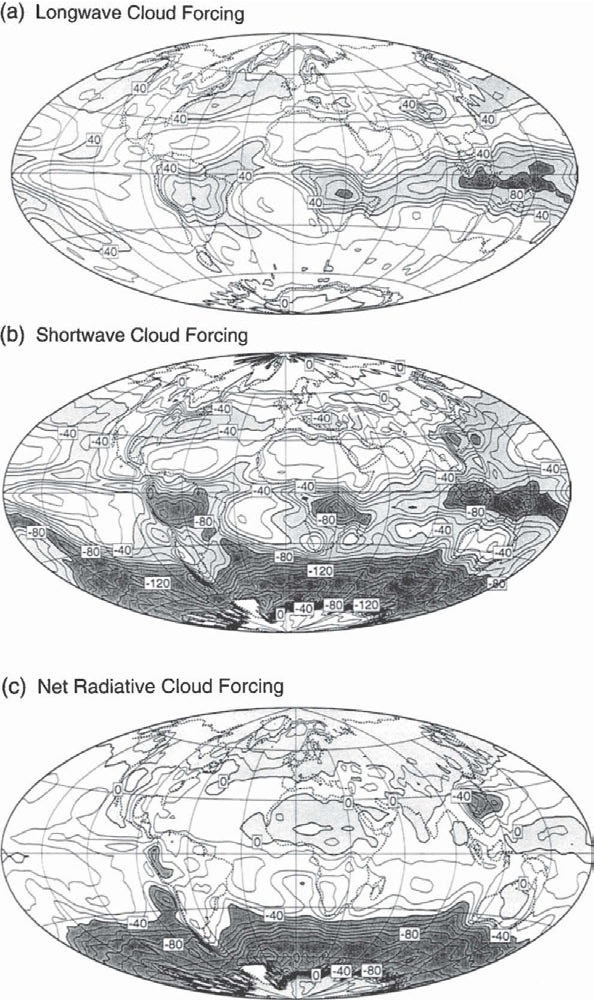
And even more importantly, as Dr. Salby illustrated (here), the net effect from clouds is cooling, not warming.

Net cloud forcing is then −15 W m−2. It represents radiative cooling of the Earth-atmosphere system. This is four times as great as the additional warming of the Earth’s surface that would be introduced by a doubling of CO2. Latent heat transfer to the atmosphere (Fig. 1.32) is 90 W m−2. It is an order of magnitude greater. Consequently, the direct radiative effect of increased CO2 would be overshadowed by even a small adjustment of convection (Sec. 8.7).

Convective clouds forming over the Amazon in a blanket smoke. Credit: Prof. Ilan Koren

This is confirmed by other researchers, such as I. Koren, G. Dagan, and O. Altaratz. From aerosol-limited to invigoration of warm convective clouds. Science, 2014; 344 (6188) here.

They then looked at another source of data: that of the Clouds’ and Earth’s Radiant Energy System (CERES) satellite instruments which measure fluxes of reflected and emitted radiation from Earth to space, to help scientists understand how the climate varies over time. When analyzed together with the aerosol loading over the same area at the same time, the outcome, says Koren, was a “textbook demonstration of the invigoration effect” of added aerosols on clouds. In other words, the radiation data fit the unique signature of clouds that were growing higher and larger. Such clouds show a strong increase in cooling due to the reflected short waves, but that effect is partly cancelled out by the enhanced, trapped, long-wave radiation coming from underneath. (My bold)

More info on clouds is here:Climate Partly Cloudy 

Summary

Once again, atmospheric physics is willfully distorted in order to get a headline and burnish credentials in support of man-made climate change. They promote a myopic and lop-sided picture to frighten a public mostly ill-equipped to see through their mumbo-jumbo.

mumbo_jumbo_flamingo-land1

Warm is Cold, and Down is Up

Paul Homewood has a post today: Who Is Lying? John Holdren, Jennifer Francis, Or NOAA?

The issue revolves around claims of global warming changing the jet stream, resulting in extreme weather, including colder winters in the US. That’s a neat trick: Getting global warming to produce cold weather.
.
Lying presumes they know the truth and speak falsely. This is more a case of saying what they believe but being wrong. (“Love of Theory is the Root of all Evil” –William Briggs)

Seasoned meteorologist Judah Cohen of AER sees it differently.

My colleagues, at AER and at selected universities, and I have found a robust relationship between two October Eurasian snow indices and the large-scale winter hemispheric circulation pattern known as the North Atlantic or Arctic Oscillation pattern (N/AO).

The N/AO is more highly correlated with or explains the highest variance of winter temperatures in eastern North America, Europe and East Asia than any other single or combination of atmospheric or coupled ocean-atmosphere patterns that we know of. Therefore, if we can predict the winter N/AO (whether it will be negative or positive) that provides the best chance for a successful winter temperature forecast in North America but certainly does not guarantee it.

He goes on to say that precipitation is the key, not air temperatures, and ENSO is a driving force:

As long as I have been a seasonal forecaster, I have always considered El Nino/Southern Oscillation (ENSO) as a better predictor of precipitation than temperature across the Eastern US. I think this is supported by the observational or statistical analysis as well as the skill or accuracy of the climate models.

There have been recent modeling studies that demonstrate that El Nino modulates the strength and position of the Aleutian Low that then favors stratospheric warmings and subsequently a negative winter N/AO that are consistent with our own research on the relationship between snow cover and stratospheric warmings. So the influence of ENSO on winter temperatures in the Mid-Atlantic and the Northeast may be greater than I acknowledge or that is represented in our seasonal forecast model.

Summary

As Cohen’s diagram shows, there is an effect from warming, but in the stratosphere. Global warming theory claims CO2 causes warming in the troposphere and cooling in the stratosphere. So whatever is going on, it is not due to CO2.

Cohen’s interview with the Washington Post.

its-easier-to-fool-people-than-to-convince-them-that-they-have-been-fooled