Overview: Seafloor Eruptions and Ocean Warming

Global heat flux of the Earth combining heat flux measurements on land and continental margins with a thermal model for the cooling of the oceanic lithosphere. The Earth loses energy as heat flows out through its surface. The total energy loss of the Earth has been estimated at 46 ± 2 TW, of which 14 TW comes through the continents and 32 TW comes from the seafloor. By Jean-Claude Mareschal

From the Unsettled Science File (h/t to Paul Homewood for posting on this subject recently)

Little attention is paid to geothermal heat fluxes warming the ocean from below, mostly because of limited observations and weak understanding about the timing and extent of eruptions.

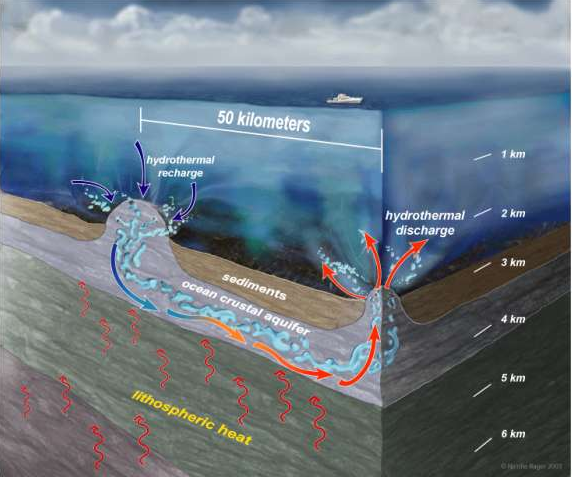
The existence of heat rising through earth’s crust is evident to all, and the large majority of vents are under the ocean. Consider the image above, and notice at the top center is the small black island off the east coast of Greenland, right on top of the orange mid-ocean ridge. Iceland produces more than 50% of its electricity from geothermal, as well as heating numerous buildings from the same source.

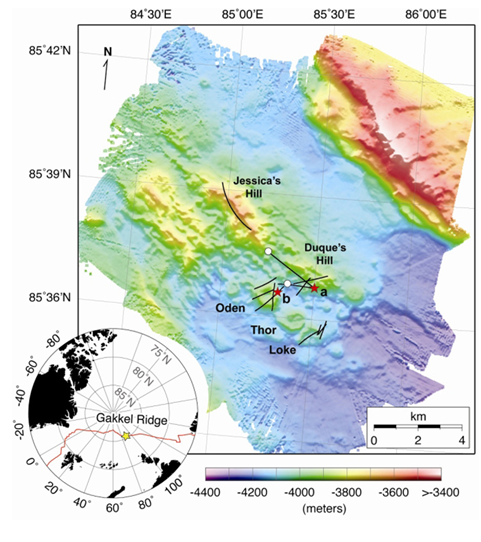
In addition, farther up under the north pole, scientists discovered an eruption of intense seismic activity beginning in Gakkel Ridge in January of 1999 and continuing for seven months.  That happens to be about the time Arctic ice extent took a nosedive, stabilizing after 2007.
Researchers have considered the importance of this source of energy into the climate system from various points of view. Some abysmal studies (pun intended) were motivated to look in the ocean depths for the missing heat not appearing in the surface temperature records since 1998. Some warming was found but the case was weak since the Argo records showed no passage of heat between upper and lower ocean strata. Of course no thought was given to the seafloor being the warming source.  However, much more serious and extensive research has been done by marine geologists wanting to better understand the cooling of the earth itself.
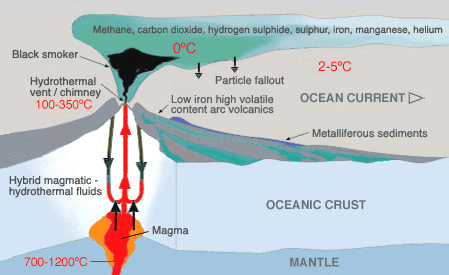
There appear to be three major issues around heating of the ocean from below through the seafloor:

1.  Is geothermal energy powerful enough to make a difference upon the vast ocean heat capacity?
2.  If so, Is geothermal energy variable enough to create temperature differentials?
3.  Most of the ocean floor is unexplored, so how much can we generalize from the few places we  have studied?

1. Some researchers conclude that geothermal heating of the oceans can not be ignored as trivial.

J. G. Sclater et al (here)

The total heat loss of the earth is 1002 × 10^10 cal/s (42.0 × 10^12 W), of which 70% is through the deep oceans and marginal basins and 30% through the continents and continental shelves. The creation of lithosphere accounts for just under 90% of the heat lost through the oceans and hence about 60% of the worldwide heat loss. Convective processes, which include plate creation and orogeny on continents, dissipate two thirds of the heat lost by the earth. Conduction through the lithosphere is responsible for 20%, and the rest is lost by the radioactive decay of the continental and oceanic crust.

Maqueda et al. (here)

Without geothermal heat fluxes, the temperatures of the abyssal ocean would be up to 0.5 C lower than observed, deep stratification would be reinforced by about 25%, and the strength of the abyssal circulation would decrease by between 25% and 50%, substantially altering the ability of the deep ocean to transport and store not only heat but also carbon and other climatically important tracers (Adcroft et al., 2001, Hofmann and Morales Maqueda, 2009, Mashayek et al., 2013). It has been hypothesised that interactions between the ocean circulation and geothermal heating are responsible for abrupt climatic changes during the last glacial cycle (Adkins et al, 2005).

Matthias Hofmann et al. (here)

Geothermal heating of abyssal waters is rarely regarded as a significant driver of the large-scale oceanic circulation. Numerical experiments with the Ocean General Circulation Model POTSMOM-1.0 suggest, however, that the impact of geothermal heat flux on deep ocean circulation is not negligible. Geothermal heating contributes to an overall warming of bottom waters by about 0.4◦C, decreasing the stability of the water column and enhancing the formation rates of North Atlantic Deep Water and Antarctic Bottom Water by 1.5 Sv (10% ) and 3 Sv (33% ), respectively. Increased influx of Antarctic Bottom Water leads to a radiocarbon enrichment of Pacific Ocean waters, increasing ∆14C values in the deep North Pacific from -269◦/◦◦when geothermal heatingis ignored in the model, to -242◦/◦◦when geothermal heating is included. A stronger and deeper Atlantic meridional overturning cell causes warming of the North Atlantic deep western boundary current by up to 1.5◦C
7f649a28fd11f9a721dd999cb3cd9c9d

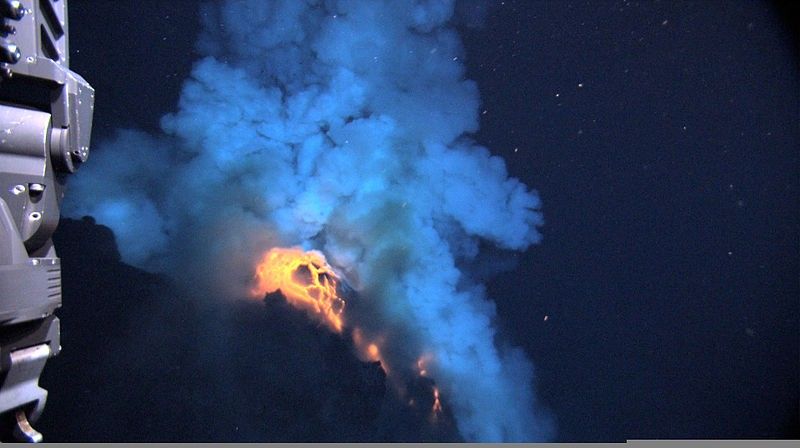
During the 2009 expedition, superheated molten lava, about 1,204ºC (2,200ºF) erupts, producing a bright flash as hot magma that is blown up into the water before settling back to the sea floor. Notice the front of the remotely operated vehicle (foreground, left). High resolution (Credit: Image courtesy of NSF and NOAA)

2.  Seafloor eruptions are quite variable and unpredictable, and while localized, can influence ocean circulation patterns.

Jess F. Adkins et al. (here)

The solar energy flux of 200 W/m2 at the ocean’s surface (Peixoto and Oort, 1992) is much larger than the next largest potential source of energy to drive climate changes, geothermal heating at the ocean’s bottom (50–100 mW/m2 ) (Stein and Stein, 1992), but this smaller heat input might still play an important role in rapid climate changes.

It is clear that variations in the solar flux pace the timing of glacial cycles (Hays et al., 1976), but these Milankovitch time scales are too long to explain the decadal transitions found in the ice cores. Another, higher frequency, source of solar variability that would directly drive the observed climate shifts has yet to be demonstrated. Therefore, mechanisms to explain the abrupt shifts all require the climate system to store potential energy that can be catastrophically released during glacial times, but not during interglacials (Stocker and Johnsen, 2003).

At the Last Glacial Maximum (LGM), when the deep ocean was filled with salty water from the Southern Ocean, geothermal heating may have been an important source of this potential energy.

In modern ocean studies there is an increasing awareness of the effect of geothermal heating on the overturning circulation. As an alternative to solar forcing, Huang (1999) has recently pointed out that geothermal heat, while small in magnitude, can still be important for the modern overturning circulation because it warms the bottom of the ocean, not the top. Density gradients at the surface of the ocean are not able to drive a deep circulation without the additional input of mechanical energy to push isopycnals into the abyss (Wunsch and Ferrari, 2004). Heating from below, on the other hand, increases the buoyancy of the deepest waters and can lead to large scale overturning of the ocean without additional energy inputs. Several modern ocean general circulation models have explored the overturning circulation’s sensitivity to this geothermal input. In the MIT model a uniform heating of 50 mW/m2 at the ocean bottom leads to a 25% increase in AABW overturning strength and heats the Pacific by 0.5 1C (Adcroft et al., 2001; Scott et al., 2001). In the ORCA model, applying a more realistic bottom boundary condition that follows the spatial distribution of heat input from Stein and Stein (1992) gives similar results (Dutay et al., 2004). In both models, most of the geothermal heat radiates to the atmosphere in the Southern Ocean, as this is the area where most of the world’s abyssal isopycnals intersect the surface.

The area of the modern ocean is 350×10^6 km2 . The area of the Southern Ocean between 80–85S (the region around Antarctica) is 0.4×10^6 km2 . This factor of 1000 means that the focused geothermal heating of 50 mW/m2 is locally of the same order as the total heat exchange at high southern latitudes. The focusing effect of geothermal heating can cause this heat flux to be a significant fraction of the total heat loss in the crucial deep-water formation zones in the glacial Southern Ocean. This suggests that the geothermal heat is potentially relevant for determining the heat content of the abyssal waters.
seamount-map

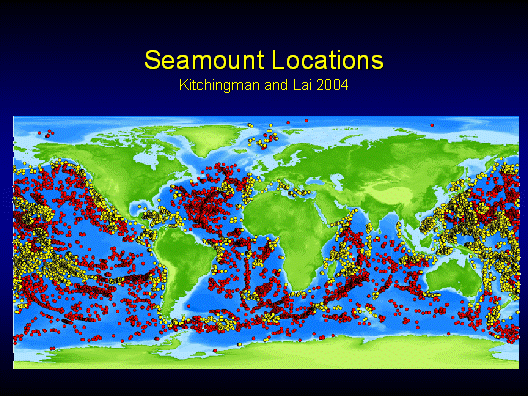
3. The number of hydrothermally active seamounts is estimated to be somewhere between 100,000 and 10,000,000.

Andrew T. Fisher and C. Geoffrey Wheat (here)

Thus, most of the thermally important fluid exchange between the crust and ocean must occur where volcanic rocks are exposed at the seafloor; little fluid exchange on ridge flanks occurs through seafloor sediments overlying volcanic crustal rocks. Seamounts and other basement outcrops focus ridge-flank hydrothermal exchange between the crust and the ocean. We describe the driving forces responsible for hydrothermal flows on ridge flanks, and the impacts that these systems have on crustal heat loss, fluid composition, and subseafloor microbiology.

Earth’s geothermal heat output is about 44 TW, with most heat loss occurring through ocean basins (e.g., Sclater et al., 1980; Pollack et al., 1993). Seafloor hydrothermal heat output is on the order of 10 TW, ~ 25% of Earth’s total geothermal heat output, and ~ 30% of the oceanic lithospheric heat output (Figure 1A). Only a small fraction of this advective heat output occurs at high temperatures at mid-ocean ridges; the vast majority occurs at lower temperatures (generally 5–20°C) on ridge flanks, suggesting an associated fluid discharge of ~ 10^16 kg yr-1 (Figure 1B) (C. Stein et al., 1995; Mottl, 2003; Wheat et al., 2003). This low-temperature flow rivals the discharge of all rivers to the ocean (4 x 10^16 kg yr-1), and is about three orders of magnitude greater than the sum of high-temperature hydrothermal discharges at mid-ocean ridges (~ 10^13 kg yr-1).

Networks of seamounts permit rapid fluid circulation to bypass thick and relatively continuous sediment across much of the deep seafloor. Fluid recharges into the crust as oceanic bottom seawater, being relatively cold and dense. As the fluid penetrates more deeply into the crust, it warms and reacts with the surrounding basalt, and interacts with the overlying sediments through diffusive exchange across the sediment-basalt interface. Fluid can flow laterally for tens of kilometers through the oceanic crust, with the extent of heating and reaction dependent on the flow rate, crustal age, and other factors. Weaker circulation systems can result in significant local rock alteration and heat extraction, but are unlikely to have a large impact on lithospheric heat loss on a regional scale.

The number of hydrothermally active seamounts is estimated to be somewhere between 100,000 and 10,000,000 , based on mapping and seamount population estimates by Wessel (2001) and Hillier and Watts (2007), and the observation that, of the seamounts and outcrops that have been surveyed, a significant fraction appear to be hydrothermally active (Fisher et al., 2003a, 2003b; Hutnak et al., 2008; Villinger et al., 2002).
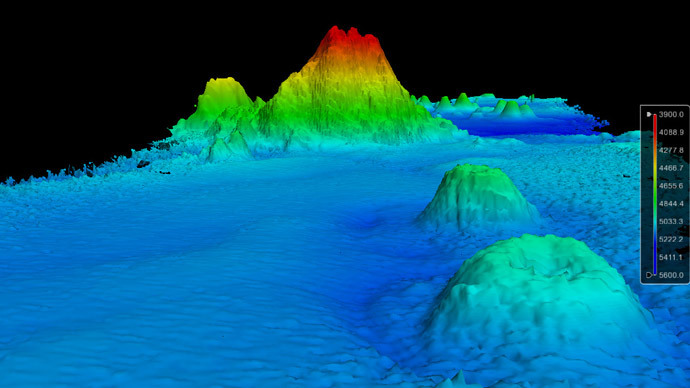
Monster mountain discovered lurking in depths of Pacific Ocean

Monster mountain discovered lurking in depths of Pacific Ocean

Without seamounts and other basement outcrops, it would not be possible for ridge-flank hydrothermal circulation to mine a significant fraction of lithospheric heat once sediments become thick and continuous on a regional basis. Thus, ridge-flank hydrothermal activity would be very different on an Earth without seamounts

Analyses of satellite gravimetric and ship track data suggest that there could be as many as 1,000,000 seamounts having a radius of ≥ 3.5 km and height ≥ 2 km (Wessel, 2001), and perhaps 10^6 to 10^7 features > 100 m in height (Hillier and Watts, 2007). Given the ubiquity of these features on ridge flanks, it is surprising how little we know about which seamounts are hydrologically active—how many recharge and how many discharge.

The thermobaric capacitor has enough energy to overturn the water column, can be triggered by regular oceanic processes, and charges over a time scale that is relevant to the climate record.

Conclusion

This source of heat has been dismissed because it is poorly known, and because its eruptive events are unpredictable and can not therefore be represented in climate models.  Despite geothermal eruptions having only localized effects, the impact on ocean circulations is significant.

John Reid (here)

Volcanic activity does not fit this neat picture. Volcanic behaviour is random, i.e. it is “stochastic” meaning “governed by the laws of probability”. For fluid dynamic modellers stochastic behaviour is the spectre at the feast. They do not want to deal with it because their models cannot handle it. We cannot predict the future behaviour of subaqueous volcanoes so we cannot predict future behaviour of the ocean-atmosphere system when this extra random forcing is included.

To some extent, chaos theory is called in as a substitute, but modellers are very reticent about describing and locating (in phase space) the strange attractors of chaos theory which supposedly give their models a stochastic character. They prefer to avoid stochastic descriptions of the real world in favour of the more precise but unrealistic determinism of the Navier-Stokes equations of fluid dynamics.

This explains the reluctance of oceanographers to acknowledge subaqueous volcanism as a forcing of ocean circulation.  Unlike tidal forcing, wind stress and thermohaline forcing, volcanism constitutes a major, external, random forcing which cannot be generated from within the model. It has therefore been ignored.
But the science is advancing.

Maya Tolstoy (here)

Vast ranges of volcanoes hidden under the oceans are presumed by scientists to be the gentle giants of the planet, oozing lava at slow, steady rates along mid-ocean ridges. But a new study shows that they flare up on strikingly regular cycles, ranging from two weeks to 100,000 years—and, that they erupt almost exclusively during the first six months of each year. The pulses—apparently tied to short- and long-term changes in earth’s orbit, and to sea levels–may help trigger natural climate swings. Scientists have already speculated that volcanic cycles on land emitting large amounts of carbon dioxide might influence climate; but up to now there was no evidence from submarine volcanoes. The findings suggest that models of earth’s natural climate dynamics, and by extension human-influenced climate change, may have to be adjusted. The study appears this week in the journal Geophysical Research Letters .

The idea that remote gravitational forces influence volcanism is mirrored by the short-term data, says Tolstoy. She says the seismic data suggest that today, undersea volcanoes pulse to life mainly during periods that come every two weeks. That is the schedule upon which combined gravity from the moon and sun cause ocean tides to reach their lowest points, thus subtly relieving pressure on volcanoes below. Seismic signals interpreted as eruptions followed fortnightly low tides at eight out of nine study sites. Furthermore, Tolstoy found that all known modern eruptions occur from January through June. January is the month when Earth is closest to the sun, July when it is farthest—a period similar to the squeezing/unsqueezing effect Tolstoy sees in longer-term cycles. “If you look at the present-day eruptions, volcanoes respond even to much smaller forces than the ones that might drive climate,” she said.

We are left with a philosophical conundrum:

If heat comes from the seafloor and no one is around to measure it, does it make the ocean warmer?

The classic form of this question was first posed by Bishop George Berkeley (1685 – 1753), one of the Top Ten Philosophical Questions:

“If a tree falls in a forest and no one is around to hear it, does it make a sound?”

Updated by Steven Wright
If a tree falls in the forest and no one is around to see it, do the other trees make fun of it?

A variation from my personal experience:
If a man says something and his wife is not around to hear it, is he still wrong?

Steven Wright (on the urban cooling effect)
I turned my air conditioner the other way around, and it got cold out. The weatherman said, ‘I don’t understand it. It was supposed to be 80 degrees out today.’ I said, ‘Oops … ‘

Reference:

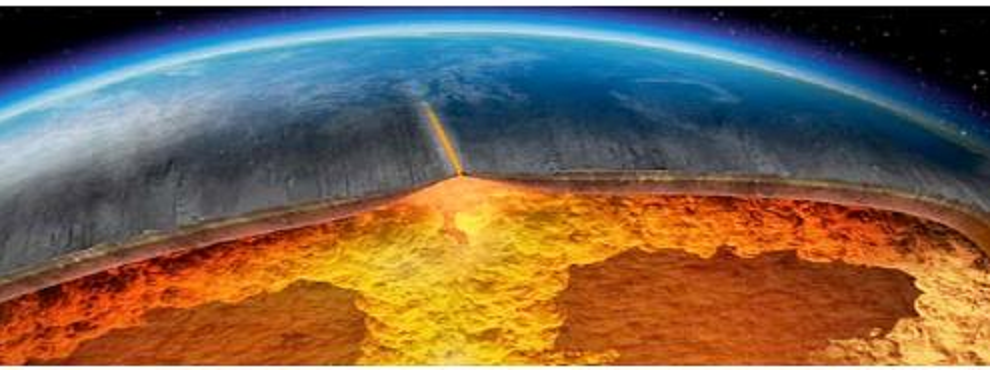
A complete presentation of Plate Tectonics Theory of Climatology is by James Edward Kamis (here)
plateclimatologytheory2


Autumn Climate Change


geese-in-v-formation

Originally posted September 2015

Seeing a lot more of this lately, along with hearing the geese  honking. And in the next month or so, we expect that trees around here will lose their leaves. It definitely is climate change of the seasonal variety.

Interestingly, the science on this is settled: It is all due to reduction of solar energy because of the shorter length of days (LOD). The trees drop their leaves and go dormant because of less sunlight, not because of lower temperatures. The latter is an effect, not the cause.

Of course, the farther north you go, the more remarkable the seasonal climate change. St. Petersburg, Russia has their balmy “White Nights” in June when twilight is as dark as it gets, followed by the cold, dark winter and a chance to see the Northern Lights.

And as we have been monitoring, the Arctic ice has been melting from sunlight in recent months, but will now begin to build again in the darkness to its maximum in March.

We can also expect in January and February for another migration of millions of Canadians (nicknamed “snowbirds”) to fly south in search of a summer-like climate to renew their memories and hopes. As was said to me by one man in Saskatchewan (part of the Canadian wheat breadbasket region): “Around here we have Triple-A farmers: April to August, and then Arizona.” Here’s what he was talking about: Quartzsite Arizona annually hosts 1.5M visitors, mostly between November and March.

Of course, this is just North America. Similar migrations occur in Europe, and in the Southern Hemisphere, the climates are changing in the opposite direction, Springtime currently. Since it is so obviously the sun causing this seasonal change, the question arises: Does the sunlight vary on longer than annual timescales?

The Solar-Climate Debate

And therein lies a great, enduring controversy between those (like the IPCC) who dismiss the sun as a driver of multi-Decadal climate change, and those who see a connection between solar cycles and Earth’s climate history. One side can be accused of ignoring the sun because of a prior commitment to CO2 as the climate “control knob”.

The other side is repeatedly denounced as “cyclomaniacs” in search of curve-fitting patterns to prove one or another thesis. It is also argued that a claim of 60-year cycles can not be validated with only 150 years or so of reliable data. That point has weight, but it is usually made by those on the CO2 bandwagon despite temperature and CO2 trends correlating for only 2 decades during the last century.

One scientist in this field is Nicola Scaffeta, who presents the basic concept this way:

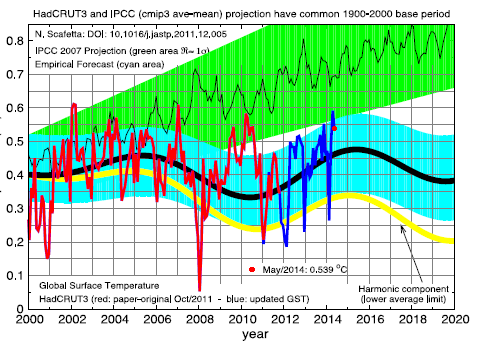
“The theory is very simple in words. The solar system is characterized by a set of specific gravitational oscillations due to the fact that the planets are moving around the sun. Everything in the solar system tends to synchronize to these frequencies beginning with the sun itself. The oscillating sun then causes equivalent cycles in the climate system. Also the moon acts on the climate system with its own harmonics. In conclusion we have a climate system that is mostly made of a set of complex cycles that mirror astronomical cycles. Consequently it is possible to use these harmonics to both approximately hindcast and forecast the harmonic component of the climate, at least on a global scale. This theory is supported by strong empirical evidences using the available solar and climatic data.”

He goes on to say:

“The global surface temperature record appears to be made of natural specific oscillations with a likely solar/astronomical origin plus a noncyclical anthropogenic contribution during the last decades. Indeed, because the boundary condition of the climate system is regulated also by astronomical harmonic forcings, the astronomical frequencies need to be part of the climate signal in the same way the tidal oscillations are regulated by soli-lunar harmonics.”

He has concluded that “at least 60% of the warming of the Earth observed since 1970 appears to be induced by natural cycles which are present in the solar system.” For the near future he predicts a stabilization of global temperature until about 2016 and cooling until 2030-2040.

https://tallbloke.wordpress.com/2014/07/28/nicola-scafetta-global-temperatures-and-sunspot-numbers-are-they-related-yes-but-non-linearly/

A Deeper, but Accessible Presentation of Solar-Climate Theory

I have found this presentation by Ian Wilson to be persuasive while honestly considering all of the complexities involved.

The author raises the question: What if there is a third factor that not only drives the variations in solar activity that we see on the Sun but also drives the changes that we see in climate here on the Earth?

The linked article is quite readable by a general audience, and comes to a similar conclusion as Scaffeta above: There is a connection, but it is not simple cause and effect. And yes, length of day (LOD) is a factor beyond the annual cycle.

Click to access IanwilsonForum2008.pdf

It is fair to say that we are still at the theorizing stage of understanding a solar connection to earth’s climate. And at this stage, investigators look for correlations in the data and propose theories (explanations) for what mechanisms are at work. Interestingly, despite the lack of interest from the IPCC, solar and climate variability is a very active research field these days.

A summary of recent studies is provided at NoTricksZone: Already 23 papers in 2015 Supporting Sun as Major Climate Factor

Ian Wilson has much more to say at his blog: http://astroclimateconnection.blogspot.com.au/

Once again, it appears that the world is more complicated than a simple cause and effect model suggests.

For everything there is a season, a time for every purpose under heaven.

What has been will be again, what has been done will be done again;
there is nothing new under the sun.
(Ecclesiastes 3:1 and 1:9)

Update Sept. 17: Commentary with Dr. Arnd Bernaerts

ArndB comments:

Fine writing, Ron, well done!
No doubt the sun is the by far the most important factor for not living on a globe with temperatures down to minus 200°C. That makes me hesitating to comment on „solar and climate variability” or “the sun drives climate” (currently at NTZ – link above), but today merely requesting humbly that the claimed correlation should be based at least on some evidence showing that the sun has ever caused a significant climatic shift during the last one million years, which was not only a bit air temperature variability due to solar cycles that necessarily occur in correlation with the intake and release of solar-radiation by the oceans and seas.

Interestingly the UK MetOffice just released a report (Sept.2015, pages 21) titled:
“Big Changes Underway in the Climate System?”
by attributing the most possible and likely changes to the current status of El Niño, PDO, and AMO, and – of course – carbon dioxide -, and a bit speculation on less sun-energy (see following excerpt at link)

Click to access Changes_In_The_Climate_System.pdf

From p. 13: “It is well established that trace gases such as carbon dioxide warm our planet through the “greenhouse effect”. These gases are relatively transparent to incoming sunlight, but trap some of the longer-wavelength radiation emitted by the Earth. However, other factors, both natural and man-made, can also change global temperatures. For example, a cooling could be caused by a downturn of the amount of energy received from the sun, or an increase in the sunlight reflected back to space by aerosol particles in the atmosphere. Aerosols increase temporarily after volcanic eruptions, but are also generated by pollution such as sulphur dioxide from factories.
These “external” factors are imposed on the climate system and may also affect the ENSO, PDO and AMO variations……

My Reply:

Thanks Arnd for engaging in this topic.

My view is that the ocean makes the climate by means of its huge storage of solar energy, and the fluctuations, oscillations in the processes of distributing that energy globally and to the poles. In addition, the ocean is the most affected by any variation in the incoming solar energy, both by the sun outputting more or less, and also by clouds and aerosols blocking incoming radiation more or less (albedo or brightness variability).

https://rclutz.wordpress.com/2015/04/21/the-climate-water-wheel/

The oscillations you mention, including the present El Nino (and Blob) phenomenon, show natural oceanic variability over years and decades. Other ocean cycles occur over multi-decadal and centennial scales, and are still being analyzed.

At the other end of the scale, I am persuaded that the earth switches between the “hot house” and the “ice house” mainly due to orbital cycles, which are an astronomical phenomenon. These are strong enough to overwhelm the moderating effect of the ocean thermal flywheel.

The debate centers on the extent to which solar activity has contributed to climate change over the last 3000 years of our current interglacial period, including current solar cycles.

Update September 19

Additional studies showing a solar-climate connection are here: https://translate.google.com/translate?hl=&sl=de&tl=en&u=http%3A%2F%2Fwww.kaltesonne.de%2Fsonne-macht-klima-neues-aus-europa%2F

Climate Whack-A-Mole

The Joys of Playing Climate Whack-A-Mole

Dealing with alarmist claims is like playing whack-a-mole. Every time you beat down one bogeyman, another one pops up in another field, and later the first one returns, needing to be confronted again. I have been playing Climate Whack-A-Mole for a while, and if you are interested, there are some hammers supplied below.

The alarmist methodology is repetitive, only the subject changes. First, create a computer model, purporting to be a physical or statistical representation of the real world. Then play with the parameters until fears are supported by the model outputs. Disregard or discount divergences from empirical observations. This pattern is described in more detail at Chameleon Climate Models

A series of posts here apply reality filters to attest climate models.  The first was Temperatures According to Climate Models where both hindcasting and forecasting were seen to be flawed.
Others in the Series are:

Sea Level Rise: Just the Facts

Data vs. Models #1: Arctic Warming

Data vs. Models #2: Droughts and Floods

Data vs. Models #3: Disasters

Data vs. Models #4: Climates Changing

Climate Medicine

Climates Don’t Start Wars, People Do

virtual-reality-1920x1200

Beware getting sucked into any model, climate or otherwise.

Radiation Myopia

A recent thread comment illustrates how the global warming PR campaign has installed a bogus climate paradigm in public awareness: The Supremacy of Infrared Radiation. In a discussion about clouds and the Arctic, this comment appeared:

I disagree with the comments that clouds at the poles should cause cooling.
In general the earth absorbs heat from the sun near the equator and expels it near the poles via up welling radiation. A low humidity clear sky near the poles allows most gray body radiation from the ice/oceans/land to emit directly to space. Clouds at the poles would interfere with that process and the poles would warm thus melting the ice faster. And in a general sense, that is what we’ve seen over the last 40 years. (linked to a graph of declining ice extent since 1979).

Heat Transfer Mechanisms

It takes some work to untangle the problems with this statement. Because it is true that earth’s climate system takes in solar energy mostly at the equator, which is then transported and expelled mostly at the poles. The myopia is in the notion that this is a purely radiative heat transfer. The misconception arises from confusing the view from the top of the atmosphere (TOA) with the view at the surface where we live. The TOA energy balance is purely radiative.  Incoming: Short Wave (SW) in, minus Outgoing: (SW) reflected/scattered out, and minus Long Wave (LW, mostly Infrared) emitted out.

Nearer the surface, the movement of energy is dominated by other more powerful heat transfers: Conduction (from warm to cool by direct contact), Convection (air moving from warm to cool objects) and Latent Heat (water changing phases from ice to liquid to gas and back again). These processes move massive amounts of energy upward from the surface toward the nearly absolute cold of space. IR active gases, mainly H2O and the minor trace gas CO2, do absorb and re-emit some LW energy, but at a scale orders of magnitude less.

Polar Heat Exchanges

The comment above attributes warming in the Arctic to the radiative properties of H20 in clouds. There is no claim that CO2 is a factor, since it acknowledges that clear dry skies offer no significant impediment to the cooling processes. But do water vapor and clouds delay cooling in the Arctic?

While it is true that moist air in the tropics makes for mild evenings after sundown, the Arctic situation differs. There is a short season when the summer sun shines, and most of the year is dark and extremely cold.

Most people fail to appreciate the huge heat losses at the Arctic pole. Mark Brandon has an excellent post on this at his wonderful blog, Mallemaroking.

By his calculations the sensible heat loss in Arctic winter ranges 200-400 Wm2.

The annual cycle of sensible heat flux from the ocean to the atmosphere for 4 different wind speeds.

As the diagram clearly shows, except for a short time in high summer, the energy flow is from the water heating the air. Transfers by latent heat are in addition to the above.

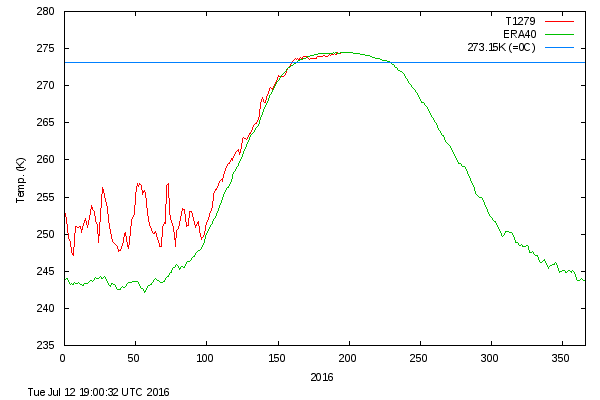
For a long time I misinterpreted the meaning of charts like the current one below from DMI:

meanT_2016DMI

Those are air temperatures, and if they are above average, it means that the water is losing more heat than past normals. It’s not that warmer air causes ice melt, but the other way around: Oceans are always moving heat, and more open water means more heat loss into the air, resulting in higher air temperatures, though still way below zero most of the year.

For comparison, look at the same chart from 1977 when ice extent was much higher the entire year:

Summary

So if there is to be any warming effect on ice formation from clouds, it can only happen in peak summer, the precise time when their shading effect exceeds any radiative warming.  And the existence of clouds indicates moisture in the air which came from the ocean evaporating.

The myopic focus on radiation and air temperatures leads into a false analogy:  thinking the Arctic is a kind of refrigerator. I explained in some detail why this is not so:  Arctic Is Not a Refrigerator

If one wants to use the refrigerator analogy in relation to earth’s climate, at least do it correctly as Dr. Salby does:

From Physics of the Atmosphere and Climate, pg.82

A closed system that performs work through a conversion of heat that is absorbed by it is a heat engine. Conversely, a system that rejects heat through a conversion of work that is performed on it is a refrigerator.

In Chap. 6, we will see that individual air parcels comprising the circulation of the troposphere behave as a heat engine. By absorbing heat at the Earth’s surface, through transfers of radiative, sensible, and latent heat, individual parcels perform net work as they evolve through a thermodynamic cycle (2.13). Ultimately realized as kinetic energy, the heat absorbed maintains the circulation against frictional dissipation. It makes the circulation of the troposphere thermally driven.

In contrast, the circulation of the stratosphere behaves as a radiative refrigerator. For motion to occur, individual air parcels must have work performed on them. The kinetic energy produced is eventually converted to heat and rejected to space through LW cooling. It makes the circulation of the stratosphere mechanically driven. Gravity waves and planetary waves that propagate upward from the troposphere are dissipated in the stratosphere. Their absorption exerts an influence on the stratosphere analogous to paddle work. By forcing motion that rearranges air, it drives the stratospheric circulation out of radiative equilibrium, which results in net LW cooling to space.

Troposphere=Heat Engine

Stratosphere = Refrigerator


Alarmist Heads in the Clouds

A new study from Scripps at UC San Diego claims proof of greenhouse gas warming by means of changes to the clouds. The paper is behind a paywall, so the reasoning is not accessible, but the media releases will ensure wide repetition.

From the news release July 11, 2016 (here)
Clouds Are Moving Higher, Subtropical Dry Zones Expanding, According to Satellite Analysis
Scripps-led study confirms computerized climate simulations projecting effects of global warming

Inconsistent satellite imaging of clouds over the decades has been a hindrance to improving scientists’ understanding. Records of cloudiness from satellites originally designed to monitor weather are prone to spurious trends related to changes in satellite orbit, instrument calibration, degradation of sensors over time, and other factors.

When the researchers removed such artifacts from the record, the data exhibited large-scale patterns of cloud change between the 1980s and 2000s that are consistent with climate model predictions for that time period, including poleward retreat of mid-latitude storm tracks, expansion of subtropical dry zones, and increasing height of the highest cloud tops. These cloud changes enhance absorption of solar radiation by the earth and reduce emission of thermal radiation to space. This exacerbates global warming caused by increasing greenhouse gas concentrations.

The researchers drew from several independent corrected satellite records in their analysis. They concluded that the behavior of clouds they observed is consistent with a human-caused increase in greenhouse gas concentrations and a planet-wide recovery from two major volcanic eruptions, the 1982 El Chichón eruption in Mexico and the 1991 eruption of Mt. Pinatubo in the Philippines. Aerosols ejected from those eruptions had a net cooling effect on the planet for several years after they took place.

Barring another volcanic event of this sort, the scientists expect the cloud trends to continue in the future as the planet continues to warm due to increasing greenhouse gas concentrations. (My bolds)

Another Example of Lop-sided Myopia and Confirmation Bias

The report above violates basic physics, resulting in a gross distortion. Two points are critical. When it comes to clouds, the greenhouse gas that matters is H2O, not CO2. Any IR effects are 96% due to the presence of water vapor and the droplets in the clouds.

And even more importantly, as Dr. Salby illustrated (here), the net effect from clouds is cooling, not warming.

Net cloud forcing is then −15 W m−2. It represents radiative cooling of the Earth-atmosphere system. This is four times as great as the additional warming of the Earth’s surface that would be introduced by a doubling of CO2. Latent heat transfer to the atmosphere (Fig. 1.32) is 90 W m−2. It is an order of magnitude greater. Consequently, the direct radiative effect of increased CO2 would be overshadowed by even a small adjustment of convection (Sec. 8.7).

Convective clouds forming over the Amazon in a blanket smoke. Credit: Prof. Ilan Koren

This is confirmed by other researchers, such as I. Koren, G. Dagan, and O. Altaratz. From aerosol-limited to invigoration of warm convective clouds. Science, 2014; 344 (6188) here.

They then looked at another source of data: that of the Clouds’ and Earth’s Radiant Energy System (CERES) satellite instruments which measure fluxes of reflected and emitted radiation from Earth to space, to help scientists understand how the climate varies over time. When analyzed together with the aerosol loading over the same area at the same time, the outcome, says Koren, was a “textbook demonstration of the invigoration effect” of added aerosols on clouds. In other words, the radiation data fit the unique signature of clouds that were growing higher and larger. Such clouds show a strong increase in cooling due to the reflected short waves, but that effect is partly cancelled out by the enhanced, trapped, long-wave radiation coming from underneath. (My bold)

More info on clouds is here:Climate Partly Cloudy 

Summary

Once again, atmospheric physics is willfully distorted in order to get a headline and burnish credentials in support of man-made climate change. They promote a myopic and lop-sided picture to frighten a public mostly ill-equipped to see through their mumbo-jumbo.

mumbo_jumbo_flamingo-land1

Warm is Cold, and Down is Up

Paul Homewood has a post today: Who Is Lying? John Holdren, Jennifer Francis, Or NOAA?

The issue revolves around claims of global warming changing the jet stream, resulting in extreme weather, including colder winters in the US. That’s a neat trick: Getting global warming to produce cold weather.
.
Lying presumes they know the truth and speak falsely. This is more a case of saying what they believe but being wrong. (“Love of Theory is the Root of all Evil” –William Briggs)

Seasoned meteorologist Judah Cohen of AER sees it differently.

My colleagues, at AER and at selected universities, and I have found a robust relationship between two October Eurasian snow indices and the large-scale winter hemispheric circulation pattern known as the North Atlantic or Arctic Oscillation pattern (N/AO).

The N/AO is more highly correlated with or explains the highest variance of winter temperatures in eastern North America, Europe and East Asia than any other single or combination of atmospheric or coupled ocean-atmosphere patterns that we know of. Therefore, if we can predict the winter N/AO (whether it will be negative or positive) that provides the best chance for a successful winter temperature forecast in North America but certainly does not guarantee it.

He goes on to say that precipitation is the key, not air temperatures, and ENSO is a driving force:

As long as I have been a seasonal forecaster, I have always considered El Nino/Southern Oscillation (ENSO) as a better predictor of precipitation than temperature across the Eastern US. I think this is supported by the observational or statistical analysis as well as the skill or accuracy of the climate models.

There have been recent modeling studies that demonstrate that El Nino modulates the strength and position of the Aleutian Low that then favors stratospheric warmings and subsequently a negative winter N/AO that are consistent with our own research on the relationship between snow cover and stratospheric warmings. So the influence of ENSO on winter temperatures in the Mid-Atlantic and the Northeast may be greater than I acknowledge or that is represented in our seasonal forecast model.

Summary

As Cohen’s diagram shows, there is an effect from warming, but in the stratosphere. Global warming theory claims CO2 causes warming in the troposphere and cooling in the stratosphere. So whatever is going on, it is not due to CO2.

Cohen’s interview with the Washington Post.

its-easier-to-fool-people-than-to-convince-them-that-they-have-been-fooled


The Coming Climate July 4 Update

Update July 4 below

When you see a graph like that below, it is obvious that an unusually strong El Nino just happened in our climate system. It resulted in higher global temperatures the last two years and so far in 2016. But that event is over now, and naturally we wonder what to expect in the months and years ahead.

cdas_v2_hemisphere_2016june2
For example some comments from a recent thread at WUWT (here) were intriguing:

It will be interesting to see what comes next. The major difference between the 1998 el nino and this one is that in 1998 the sun was increasing in solar activity, while this one solar activity is decreasing. (rishrac)

Nino3,4 and UAH LT dC Anomalies, and UAH LT Scaled *3 and Lagged 4 Months h/t Allan MacRae

And richard takes the long view of the situation:

While we all stare at the short-term ups and downs of the global temperatures, pay a little thought to the fact that the Earth’s orbit around the Sun causes snow in the winter and warmth during the summer, so it may be important?

Perihelion presently occurs around January 3, (Northern hemisphere winter, Southern summer) while aphelion is around July 4. Therefore, the southern hemisphere receives more solar radiation and is therefore warmer in summer and colder in winter (aphelion). The Northern hemisphere has cooler summers and milder winter (solar radiation-wise).

Also the northern hemispheres autumn and winter are slightly shorter than spring and summer, because the Earth is moving faster around the Sun in winter slower in summer.

This alone could account for “Global Warming” attributed to CO2, (which no doubt plays some part in it).

Over the next 10,000 years, northern hemisphere winters will become gradually longer and summers will become shorter, due to the change in the Earth’s Orbital Eccentricity.

Couple this with changes in the Earth’s tilt, which varies from 22.1 degrees to 24.5 degrees, (currently at 23.4 degrees). More tilt means more solar radiation gets to the poles (global warming) and less tilt means less radiation gets to the poles (global cooling). The last maximum tilt occurred in 8700 BC (Holocene maximum) and the next minimum tilt will happen in 11,800 AD (the advance of the ice sheets), precisely at the time of longer northern winters and shorter summers.

Orbital Climate Factors: E for eccentricity, T for tilt, and P for precession

Predicting the Future is Tough

Chiefio (E.M. Smith) has a good post (here) reminding us that statistical projections do not help us much in this case. Temperature series produced by our climate system have special qualities. The patterns are auto-correlated, meaning that tomorrow’s weather will be similar to today’s; the occurrence is not totally independent, like the flip of coin. IOW there is momentum in the climate characteristics, which can and do fluctuate over seasons, decades, centuries and more. Our attempts to use linear regressions to forecast are thwarted by temperature time series that do not follow a normal gaussian distribution, and are semi-chaotic and non-stationary.

Four Possibilities Forward From Today

From past experience, the next few years could logically follow one of four temperature scenarios:
1. The Plateau since 1998 continues.
2. The Warming prior to 1998 resumes.
3. A new Plateau begins with 2016 at a higher (step up) level.
4. A Cooling begins comparable to the years after 1940.

All of these have analogues in our recent climate observations. If this now finished El Nino triggers a regime change comparable to the 1998 event, then a step-up plateau can result. If warmists are right, and there is a release of pent-up heat in the system, then a warming trend would resume.

If this El Nino is not strong enough to shift the regime, then the Plateau could continue at the same level. Finally, it could be that several factors align to reverse the warming since the 1970’s, and bring a return to cooler 1950’s weather.

Those who see a quasi-60 year cycle in weather patterns note that it is about time for the PDO in the Pacific and the AMO in the Atlantic to be in cooler phases, along with a quiet sun, which went spotless last week. There are also those attending to orbital climate patterns, which gave us the Modern Warming Period and will eventually take it away.


Changes in climate due to earth’s orbit around the sun

Update July 4

In the previous thread is a chart from J. Martin displaying the effects of the changing tilt of earth’s axis.  As shown, the long term pattern is toward cooling.

J. Martin: Tilt (obliquity) has a 41k yr cycle and prior to the arrival of 100,000 year glaciations, the 41k year world dominated with short sharp glaciations every 41 thousand years. The 41k influence us still there. Javier has done a graph which overlays the obliquity cycle on top of a graph of the holocene which produces a perfect match. So it would seem that interstitial temperatures are largely governed by obliquity, but glaciation temperatures are governed by eccentricity with occasional disturbances from precession .

In addition, ren provides interesting links to studies showing SA (Sunspot numbers) correlating to Middle Ages Warm period and LIA, and a 2012 study forecasting the next 2 cycles.

shepherd etalfig1

Figure 1. Bottom plot: the summary component of the two PCs (solid curve) and the decaying component (dashed curves) for the “historical” data (cycles 21–23) and predicted data (cycles 24–26). The cycle lengths (about 11 yr) are marked with different colors.

Abstract: We can conclude with a sufficient degree of confidence that the solar activity in cycles 24–26 will be systematically decreasing because of the increasing phase shift between the two magnetic waves of the poloidal field leading to their full separation into opposite hemispheres in cycles 25 and 26. This separation is expected to result in the lack of their subsequent interaction in any of the hemispheres, possibly leading to a lackof noticeable sunspot activity on the solar surface lasting for a decade or two, similar to those recorded in the medieval period.

Again, to the extent that SSNs are a proxy for changes in heat content within the earth’s climate system, the graph is also indicating future cooling.

For an approach to quantifying climate effects from Solar Activity, as well as oceanic cycles, see:
Quantifying Natural Climate Change

Think Global Act Local, or Not

The slogan “Think Global, Act Local” began with multinational corporations realizing that national and regional markets around the world had distinct needs and preferences requiring accommodations. As the name implies it refers to the corporate strategy by which a global viewpoint is adopted in terms of formulating company vision, long-term aims and objectives and devising effective programs to achieve these aims and objectives, however, adaptations are made in each market according to the culture and specifications of any specific market.

Environmental activists took the notion on board during the first wave becoming aware of globalization. Early bearers of the catchphrase were for the most part supporters of an environmental movement that supported individual activism. The theory behind the saying was that in order to make large-scale global movements stick, the responsibility lay on individuals to carry out progressive practices – like environmental stewardship – in their own homes. The globe had become the new frame of reference for some far-thinking activists.

Clearly “climate change” activism operates in this mode. But as we shall see in this essay, the top-down, Global-Local approach to understanding climate and weather leads to distortions and misconceptions. In fact, climate science itself is best served by observing and establishing principles from the bottom up.

It turns out that the climate system is one of those things where averages do not tell very much, and can be misleading. For example:

Look at precipitation around the world

About 1 meter a year is the nominal average of all rain over all surfaces. Some places get up to 10 meters of rain (about 400 inches ) and others get near none. 47% of the earth is considered dryland, defined as anyplace where the rate of evaporation/transpiration exceeds the rate of precipitation. A desert is defined as a dryland with less than 25 cm of precipitation. In the image above, polar deserts are remarkably defined. It just does not have much hope of precipitation as there is little heat to move the water. More heat in, more water movement. Less heat in, less water movement.

Then there’s the seasonal patterns. The band of maximum rains moves with the sun: More north in June, more south in December. More sun, more heating, more rain. Movement in sync with the sun, little time delay. Equatorial max solar heat has max rains. Polar zones minimal heating, minimal precipitation. It’s a very tightly coupled system with low time lags.

Then Look at Temperatures

Average temperatures in F at sea level by longitude and latitude. Source: Lyndon State College Meteorology

Notice:

  • latitudinal change
  • N.H. – difference between land and ocean
  • U.S. west coast (upwelling and cold current) v.s. U.S. east coast (gulf stream)
  • influence of gulf stream in north Atlantic
  • highest temps are in the subtropical N.H. desert regions
  • west coast of S. America is cool while the east coast is warm, due to the ocean currents
  • much less variability in the zonal direction in the S. H.

And look at clouds and their radiative effects

The large opacity of cloud increases the optical depth of the atmosphere, introducing warming in the LW energy budget. This warming varies with cloud-top temperature and height. For SW radiation, the high reflectivity of cloud decreases the incoming solar flux, favoring reduced surface temperature. Cloud routinely covers about 50% of the Earth. It accounts for about half of the Earth’s albedo (eg, for ∼0.15). Source: Salby 2012 pg315

Globally averaged values of CLW and CSW are about 30 and −45 W m−2, respectively. Net cloud forcing is then −15 W m−2. It represents radiative cooling of the Earth-atmosphere system. This is four times as great as the additional warming of the Earth’s surface that would be introduced by a doubling of CO2.

But clearly during Northern winter (diagrams above), that net cooling occurs largely over the Southern Ocean around Antarctica.

What happens when you average all this diversity?

We have all seen graphs showing how climate models project unrealistic global mean temperatures higher than those measured by stations or satellites. But Dr. Salby in his textbook points to a more fundamental failing of the climate simulations.  By construction they balance global average energy budgets, but regional realities are grossly distorted.

From IPCC Working Group 1 AR4

Figure 8.4. Root-mean-square (RMS) model error, as a function of latitude, in simulation of (a) outgoing SW radiation reflected to space and (b) outgoing LW radiation. The RMS error is calculated over all longitudes and over all 12 months of a climatology formed from several years of data. . .The Earth Radiation Budget Experiment (ERBE; Barkstrom et al., 1989) observational estimates used here are for the period 1985 to 1989 from satellite-based radiometers, and the model results are for the same period in the 20th-century simulations in the MMD at PCMDI.

Symbolizing the local energy budget is net radiation (Fig. 1.34c), which represents the local imbalance between the SW and LW fluxes F0 and F ↑(0) in the TOA energy budget (8.82). Local values of those fluxes have been measured around the Earth by the three satellites of ERBE. The observed fluxes, averaged over time, have then been compared against coincident fluxes from climate simulations, likewise averaged. Figure 8.34 plots, for several GCMs, the rms error in simulated fluxes, which have been referenced against those observed by ERBE.

Values represent the regional error in the (time-mean) TOA energy budget. The error in reflected SW flux, Fs 4 − F0 in the global mean (8.82), is of order 20 Wm−2 (Fig. 8.34a). Such error prevails at most latitudes. Differences in error between models (an indication of intermodel discrepancies) are almost as large, 10–20 Wm−2. The picture is much the same for outgoing LW flux (Fig. 8.34b). For F ↑(0), the rms error is of order 10–15 Wm−2. It is larger for all models in the tropics, where the error exceeds 20 Wm−2. . .Consequently, the simulated change introduced by increased CO2 (2–4 Wm−2), even inclusive of feedback, is overshadowed by error in the simulated change of major absorbers.

By construction, GCMs achieve global-mean energy balance. How faithfully the energy budget is represented locally, however, is another matter. The local energy budget forces regional climate, along with the gamut of weather phenomena that derive from it. This driver of regional conditions is determined internally – through the simulation of local heat flux, water vapor, and cloud.  (My bold)

Conclusion

A common expression is: “The devil is in the details.” When it comes to climate, it is truer to say that we humans are bedeviled (thwarted) by nature’s details refusing to fit into our global generalities. The proper role of science is to investigate those details and revise our mental constructs.

“Global Climate” is an oxymoron.
(oxymoron: A figure of speech in which two words with opposing meanings are used together intentionally for effect; IOW a contradiction in terms. From the Greek: pointed foolishness).

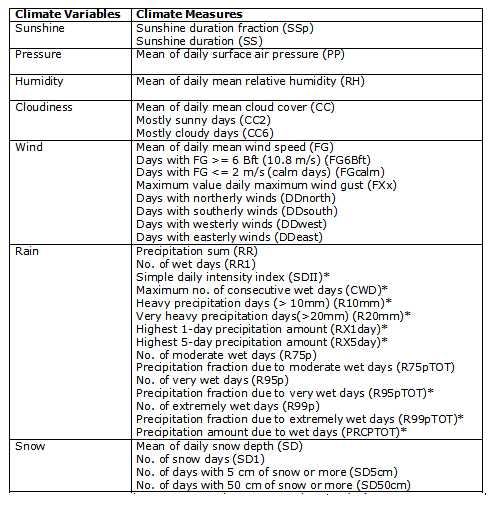
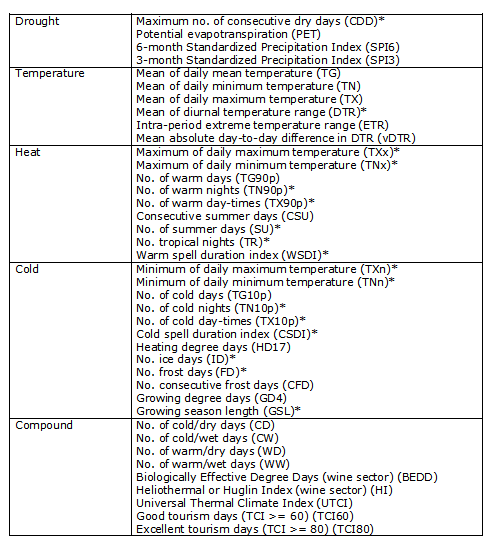
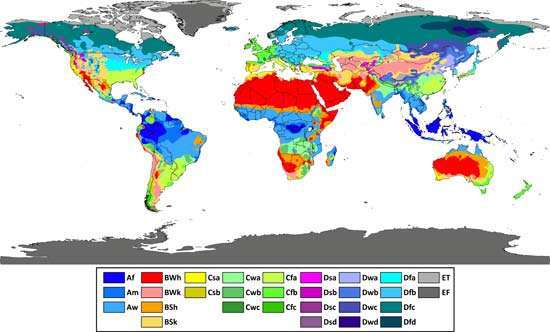
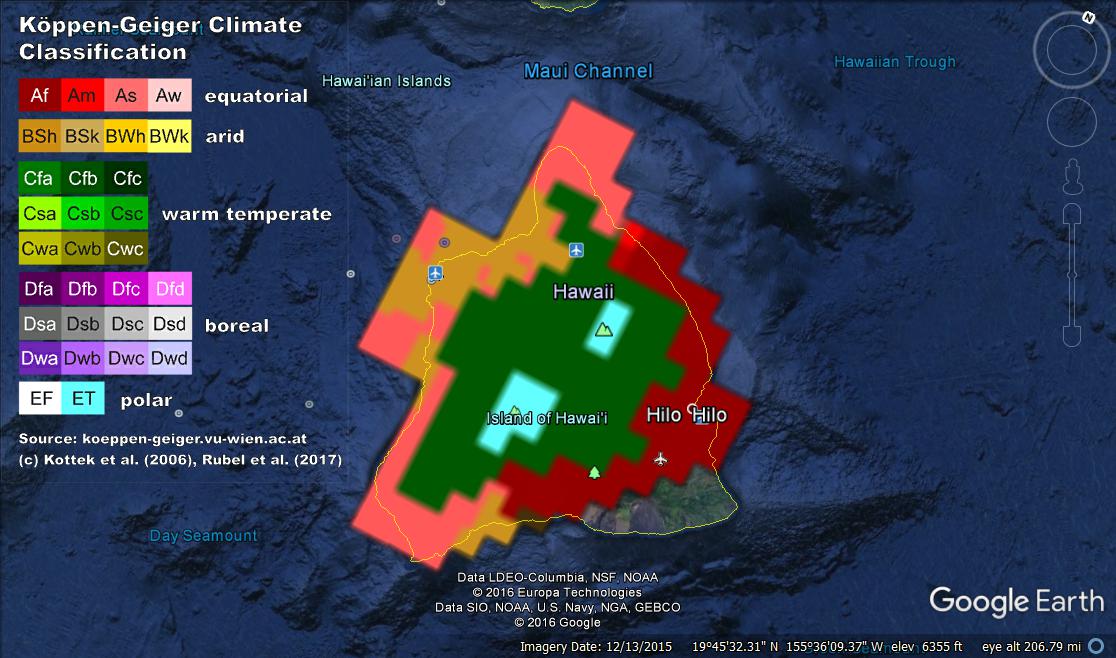
Climates are plural, not global, as the Koppen system makes clear. There are hundreds of regional climate zones defined empirically by temperature and precipitation patterns. And the observational data shows those zones are highly stable; that is, fears of climate change rarely appear in any actual climates showing shifting boundaries. See post: Data vs. Models 4: Climates Changing

Thus, we are better advised to:

Think Local Climates,
Prepare Local Adaptations
for the range of future weather consequences.

Fearless Physics from Dr. Salby


“Fearless Felix” Baumgartner ascended to the stratosphere and stepped into the void from 24.2 miles above the Earth. His speed during the fall reached Mach 1.24, and the Austrian adventurer nailed the landing. October 14, 2012 Wired 

Introduction
Murry Salby is also totally committed to the atmosphere. He is a scientist with such deep and broad knowledge of atmospheric physics that he has written multiple textbooks on the subject. And yet he is not fearful for the future of our climate system, in contrast to many of his colleagues. By stepping away from “consensus” climate alarms, he has shown unusual courage by speaking plainly about the atmosphere and climate, despite attempts to silence him.

Dr. Salby’s latest textbook is entitled Physics of the Atmosphere and Climate (here). I got a copy and have been reading in it to understand where he comes down on various issues related to climate change. In particular I wanted to know what explains his divergence from IPCC climate scientists.
H/T to Kenneth Richard and No Tricks Zone

Synopsis

In reading the textbook, I find two main reasons why Salby is skeptical of AGW (anthropogenic global warming) alarm. This knowledgeable book is an antidote to myopic and lop-sided understandings of our climate system.

  1. CO2 Alarm is Myopic: Claiming CO2 causes dangerous global warming is too simplistic. CO2 is but one factor among many other forces and processes interacting to make weather and climate.

Myopia is a failure of perception by focusing on one near thing to the exclusion of the other realities present, thus missing the big picture. For example: “Not seeing the forest for the trees.”  AKA “tunnel vision.”

2. CO2 Alarm is Lopsided: CO2 forcing is too small to have the overblown effect claimed for it. Other factors are orders of magnitude larger than the potential of CO2 to influence the climate system.


Lop-sided refers to a failure in judging values, whereby someone lacking in sense of proportion, places great weight on a factor which actually has a minor influence compared to other forces. For example: “Making a mountain out of a mole hill.”

Overview

Salby’s textbook presents all of the physical complexity of the climate system in contrast to simplistic global warming theory. And he provides his sense of the Scales of the various processes, balancing any lopsided overemphasis on CO2 effects.

From the Preface:
Despite technological advances in observing the Earth-atmosphere system and in computing power, strides in predicting its evolution reliably – on climatic time scales and with regional detail – have been limited. The pace of progress reflects the interdisciplinary demands of the subject. Reliable simulation, adequate to reproduce the observed record of climate variation, requires a grasp of mechanisms from different disciplines and of how those mechanisms are interwoven in the Earth-atmosphere system.

What is today labeled climate science includes everything from archeology of the Earth to superficial statistics and a spate of social issues. Yet, many who embrace the label have little more than a veneer of insight into the physical processes that actually control the Earth-atmosphere system, let alone what is necessary to simulate its evolution reliably. Without such insight and its application to resolve major uncertainties, genuine progress is unlikely.

The atmosphere is the heart of the climate system, driven through interaction with the sun, continents, and ocean. It is the one component that is comprehensively observed. For this reason, the atmosphere is the central feature against which climate simulations must ultimately be validated.

The treatment focuses upon physical concepts, which are developed from first principles. It integrates five major themes:
1. Atmospheric Thermodynamics;
2. Hydrostatic Equilibrium and Stability;
3. Radiation, Cloud, and Aerosol;
4. Atmospheric Dynamics and the General Circulation;
5. Interaction with the Ocean and Stratosphere.

Lessons from Dr. Salby:  Essential Elements of a Balanced Climate Understanding

Below I show some of the written statements from the textbook to illustrate how his knowledge counteracts myopic and lopsided thinking.

Focusing on CO2 from burning fossil fuels is myopic: A multitude of natural sources drive atmospheric concentrations.

Plate 24 Estimated global carbon cycle, illustrating stores of carbon,
in GtC, and transfers in GtC/yr, where 1 GtC=109 tons of carbon.
Source: Design by Philippe Rekacewicz, UNEP/GRID-Arendal (11.07.10).

Pg.545-6
The storage of CO2 is illustrated in Fig. 17.11. Except for deep sedimentary rock, which is sequestered, most of the carbon is stored in the ocean. It accounts for some 40,000 gigatons (1012 kg) of carbon (GtC), in the form of dissolved CO2 and organic matter. Most resides in the deep ocean, where cold water supports the greatest observed concentrations. There, dissolved CO2 is controlled by the thermohaline circulation. Land and the adjoining biosphere account for only about 2000 GtC. The atmosphere contains less than 1000 GtC, concentrated in CO2. Hence, the store of carbon in the ocean is two orders of magnitude greater than the store in the atmosphere.

Equally significant are transfers of carbon into and out of the ocean. Of order 100 GtC/yr, they exceed those into and out of land. Together, emission from ocean and land sources (∼150 GtC/yr) is two orders of magnitude greater than CO2 emission from combustion of fossil fuel. These natural sources are offset by natural sinks, of comparable strength. However, because they are so much stronger, even a minor imbalance between natural sources and sinks can overshadow the anthropogenic component of CO2 emission (cf Secs 1.6.2, 8.7.1).

The values in Fig. 17.11 can be used to estimate the effective turnover time of atmospheric CO2. At an absorption rate of 100 GtC/yr, the ocean will absorb the atmospheric store of CO2 of 1000 GtC in about a decade. That absorption of CO2, which is concentrated in cold SST at polar latitudes, is nearly offset by emission of CO2 from warm SST at tropical latitudes. Warming of SST (by any mechanism) will increase the outgassing of CO2 while reducing its absorption. Owing to the magnitude of transfers with the ocean, even a minor increase of SST can lead to increased emission of CO2 that rivals other sources (Sec. 8.7.1). Further, if the increase of SST involves heat transfer with the deep ocean, the time for equilibrium to be reestablished would be centuries (Sec. 17.1.2).

Attributing rising temperatures to fossil fuels is lop-sided: Natural sinks respond to warming by releasing CO2 in far greater quantities.

Net emission rate of CO2, r˙ CO2 = d dt rCO2 (ppmv/yr), derived from the Mauna Loa record (Fig. 1.15), lowpass filtered to changes that occur on time scales longer than 2 years (solid). Superimposed is the satellite record of anomalous Global Mean Temperature (Fig. 1.39), lowpass filtered likewise and scaled by 0.225 (dashed). Trend in GMT over 1979–2009 (not included) is ∼0.125 K/decade.

Pg.65ff
Net emission of CO2 closely tracks the evolution of GMT. Achieving a correlation of 0.80, the variation of GMT accounts for most of the variance in CO2 emission.

Plotted in Fig. 1.43b is the rate of change in isotopic composition, d dt δ13C = ˙ δ13C (solid).12 Its mean is negative, consistent with the long-term decline of δ13C in ice cores (Fig. 1.14). However, like emission of CO2, differential emission of 13CO2 varies substantially from one year to the next. It too tracks the evolution of GMT – just out of phase. When GMT increases, emission of 13CO2 decreases and vice versa. The records achieve a correlation of −0.86. Hence the variation of GMT, which accounts for most of the variance in emission of CO2, also accounts for most of the variance in differential emission of 13CO2.

The out-of-phase relationship between rCO2 and δ13C in the instrumental record (Fig. 1.43) is the same one evidenced on longer time scales by ice cores (Fig. 1.14). The out-of-phase relationship in ice cores is regarded as a signature of anthropogenic emission, subject to uncertainties (Sec. 1.2.4). The out-of-phase relationship in the instrumental record, however, is clearly not anthropogenic. Swings of GMT following the eruption of Pinatubo and during the 1997–1998 El Nino were introduced through natural mechanisms (cf. Figs 1.27; 17.19, 17.20). Changes in Fig. 1.43 reveal that net emission of CO2, although 13C lean, is accelerated by increased surface temperature. Outgassing from ocean, which increases with temperature (Sec. 17.3), is consistent with the observed relationship – if the source region has anomalously low δ13C. So is the decomposition of organic matter derived from vegetation. Having δ13C comparable to that of fossil fuel, its decomposition is likewise accelerated by increased surface temperature.

Focusing on CO2 as the greenhouse gas of concern is both myopic and lop-sided: H20 makes 98% of the IR radiative activity in the atmosphere.

Pg. 47
The radiative-equilibrium surface temperature Ts is significantly warmer than that in the absence of an atmosphere.

The discrepancy between Ts and Te follows from the different ways the atmosphere processes SW and LW radiation. Although nearly transparent to SW radiation (wavelengths λ ∼ 0.5 μm), the atmosphere is almost opaque to LW radiation (λ ∼ 10 μm) that is re-emitted by the Earth’s surface. For this reason, SW radiation passes relatively freely to the Earth’s surface, where it can be absorbed. However, LW radiation emitted by the Earth’s surface is captured by the overlying air, chiefly by the major LW absorbers: water vapor and cloud. Energy absorbed in an atmospheric layer is reemitted, half upward and half back downward. The upwelling re-emitted radiation is absorbed again in overlying layers, which subsequently re-emit that energy in similar fashion. This process is repeated until LW energy is eventually radiated beyond all absorbing components of the atmosphere and rejected to space. By inhibiting the transfer of energy from the Earth’s surface, repeated absorption and emission by intermediate layers of the atmosphere traps LW energy, elevating surface temperature over what it would be in the absence of an atmosphere.

Pg. 247ff
The residual, +1.5 Wm−2, represents net warming. It is about 0.5% of the 327 Wm−2 of overall downwelling LW radiation that warms the Earth’s surface (Fig. 1.32). The vast majority of that warming is contributed by water vapor. Together with cloud, it accounts for 98% of the greenhouse effect. How water vapor has changed in relation to changes of the comparatively minor anthropogenic species (Fig. 8.30) is not known. The additional surface warming introduced by anthropogenic increases in greenhouse gases amounts to about 75% of that which would be introduced by a doubling of CO2. Arrhenius’ estimate of 5–6◦ K for the accompanying increase of surface temperature (Sec. 1.2.4) then translates into ∼4◦ K. Yet, the observed change of global-mean temperature since the mid nineteenth century is only about 1◦ K (Sec. 1.6.1). The discrepancy points to changes of the Earth-atmosphere system (notably, involving the major absorbers, water vapor and cloud) that develop in response to imposed perturbations, like anthropogenic emission of CO2.

Focusing on CO2 radiative activity is myopic: The tropospheric heat engine comprises many powerful heat transfer processes.

Cloud Forcing

Figure 9.40 Cloud radiative forcing during northern winter derived from ERBE measurements on board the satellites ERBS and NOAA-9 for the (a) LW energy budget, (b) SW energy budget, and (c) net radiative energy budget. Courtesy of D. Hartmann (U. Washington).

Pg. 318ff
A quantitative description of how cloud figures in the global energy budget is complicated by its dependence on microphysical properties and interactions with the surface. These complications are circumvented by comparing radiative fluxes at TOA under cloudy vs clear-sky conditions. Over a given region, the column-integrated radiative heating rate must equal the difference between the energy flux absorbed and that emitted to space.

The components of cloud forcing (9.53) can be evaluated directly from broadband fluxes of outgoing LW and SW radiation that are measured by satellite. Figure 9.40 shows time-averaged distributions of CSW , CLW , and C. Longwave forcing (Fig. 9.40a) is large in centers of deep convection over tropical Africa, South America, and the maritime continent, where CLW approaches 100 W m−2 (cf. Fig. 1.30b). Secondary maxima appear in the maritime ITCZ and in the North Pacific and North Atlantic storm tracks (Sec. 1.2.5). Shortwave forcing (Fig. 9.40b) is strong in the same regions, where CSW < −100 W m−2. Negative SW forcing is also strong over extensive marine stratocumulus in the eastern oceans and over the Southern Ocean, coincident with the storm track of the Southern Hemisphere. Inside the centers of deep tropical convection, SW and LW cloud forcing nearly cancel. They leave small values of C throughout the tropics (Fig. 9.40c). Negative CSW in the storm tracks and over marine stratocumulus then dominates positive CLW , especially over the Southern Ocean. It prevails in the global-mean cloud forcing. Globally averaged values of CLW and CSW are about 30 and −45 W m−2, respectively.

Net cloud forcing is then −15 W m−2. It represents radiative cooling of the Earth-atmosphere system. This is four times as great as the additional warming of the Earth’s surface that would be introduced by a doubling of CO2. Latent heat transfer to the atmosphere (Fig. 1.32) is 90 W m−2. It is an order of magnitude greater. Consequently, the direct radiative effect of increased CO2 would be overshadowed by even a small adjustment of convection (Sec. 8.7).

Trusting climate models driven by CO2 sensitivity is lop-sided: Natural climate factors are poorly quantified but are orders of magnitude larger than estimated CO2 effects.

Pg. 260
Global climate models are sophisticated extensions of the idealized models considered above. Treatments of climate properties in different GCMs are as varied as they are complex. For some properties, like cloud cover, ice, and vegetation, they must resort to empirical relationships or simply ad hoc parameterization. For others, the governing equations cannot even be defined. Together with the ocean simulation, these limitations introduce errors, which can be substantial. Along with discrepancies between GCMs, they leave in question how faithfully climate feedbacks are represented (see, e.g., Tsushima and Manabe, 2001; Lindzen and Choi, 2009).

fig-8-04-724x1024

The accuracy of GCMs is reflected in the skill with which they simulate the TOA energy budget: the driver of climate. By construction, GCMs achieve global-mean energy balance. How faithfully the energy budget is represented locally, however, is another matter. The local energy budget forces regional climate, along with the gamut of weather phenomena that derive from it. This driver of regional conditions is determined internally – through the simulation of local heat flux, water vapor, and cloud. Symbolizing the local energy budget is net radiation (Fig. 1.34c), which represents the local imbalance between the SW and LW fluxes F0 and F ↑(0) in the TOA energy budget (8.82). Local values of those fluxes have been measured around the Earth by the three satellites of ERBE. The observed fluxes, averaged over time, have then been compared against coincident fluxes from climate simulations, likewise averaged. Figure 8.34 plots, for several GCMs, the rms error in simulated fluxes, which have been referenced against those observed by ERBE.

Values represent the regional error in the (time-mean) TOA energy budget. The error in reflected SW flux, Fs 4 − F0 in the global mean (8.82), is of order 20 Wm−2 (Fig. 8.34a). Such error prevails at most latitudes. Differences in error between models (an indication of intermodel discrepancies) are almost as large, 10–20 Wm−2. The picture is much the same for outgoing LW flux (Fig. 8.34b). For F ↑(0), the rms error is of order 10–15 Wm−2. It is larger for all models in the tropics, where the error exceeds 20 Wm−2.

The significance of these discrepancies depends on application. Overall fluxes at TOA are controlled by water vapor and cloud (Fig. 1.32) – the major absorbers that account for the preponderance of downwelling LW flux to the Earth’s surface. Relative to those fluxes, the errors in Fig. 8.34 are manageable: Of order 10% for outgoing LW and 20% for reflected SW. Relative to minor absorbers, however, this is not the case. The entire contribution to the energy budget from CO2 is about 4 Wm−2. Errors in Fig. 8.34 are an order of magnitude greater. Consequently, the simulated change introduced by increased CO2 (2–4 Wm−2), even inclusive of feedback, is overshadowed by error in the simulated change of major absorbers.

Conclusion:

Pg. 262
Discrepancies between GCMs arise from inaccuracies in climate properties and from differences in how those properties are represented. Much of the discrepancy surrounds the representation of convection and its influence on water vapor and cloud, the absorbers that account for most of the downwelling LW flux to the Earth’s surface. The involvement of convection is strongly suggested by models of radiative-convective equilibrium. Those simulations are inherently sensitive to how convection and cloud are prescribed. Cloud is especially significant to radiative considerations because it sharply modifies the atmosphere’s scattering characteristics, which determine albedo, and its absorption characteristics, which determine optical depth.

Footnote:

Best wishes to Dr. Salby and much appreciation for telling it like it is.  May you also nail your landing as did Fearless Felix.

h/t malagabay

Historic Climate Change

Orbital Climate Factors: E for eccentricity, T for tilt, and P for precession

My recent post The Coming Climate included a description of the orbital factors inducing natural cycles of warming and cooling far larger than any possible effect from CO2.

Yesterday commenter Alberto Zaragoza Comendador took this further into a discussion of the uncertainties in paleoclimatology. He started by referring to a paper by Lindzen, which focused on only one of these dynamics: fluxes of equator-to-pole heat transport.

Lindzen et al. 1993 concluded:
The present note shows the importance of aspects of the forcing which lead to changes in meridional (i.e., tropics to higher latitudes) heat fluxes. These aspects are seasonal, and involve the distribution of heating; they do not necessarily involve changes in globally and/or annually averaged insolation. Thus, simple, commonly used notions of climate sensitivity as employed in Houghton et al. (1990) are not relevant. Indeed, the present mechanism can readily produce major changes in climate (including, as a by product, changes in the globally averaged temperature) in systems which are profoundly insensitive to a doubling of CO2. To assume (as was done in Hoffert and Covey 1992, for example) that major climate changes necessarily require high sensitivity to such changes in gross averaged forcing is clearly inappropriate.

The full text of comment by Comendador is below from Climate Etc. (here)

Alberto Zaragoza Comendador | June 11, 2016 at 3:19 pm |

Somebody mentioned Milankovitch which reminded me of other thing.

http://www-eaps.mit.edu/faculty/lindzen/171nocephf.pdf (Lindzen et al 1993)

Check out the last paragraph. It explains why every paleo estimate of sensitivity is hopeless: even if you knew the temperatures, which you don’t really but even if you did, you’d have no idea what caused them. Lindzen uses the example of equator-to-pole heat transport but there are many more things that can cause climate to change, and we mostly know nothing about how they affected climate in the past.

We have records of methane and CO2, but we don’t have records of cloud albedo, ozone, water vapor, vegetation… someone might quibble that we do have some records of vegetation and dust for example, but unlike CH4 and CO2 you cannot assume these dust or vegetation ‘levels’ applied globally.

(Hell, until recently the greening trend of the last half-century was in dispute, even though we can look at the world’s plants and trees with seven billion pairs of eyes plus a few billion cameras, including some mounted on satellites. To assume we can now estimate greening or browning trends from twenty thousand years ago is preposterous.)

And we have estimates of how much area was covered in ice, but we have no idea how much dust that ice was covered with, or if the radiative forcing one could expect from the ice was really ‘apples to apples’ (i.e. of the same efficacy) as that of CO2. Now we know that as sea ice recedes the Arctic gets cloudier so the overall effect is about 1/3 of what you would expect simply looking at the decline in ice; we have no idea if the same thing would happen upon the disappearance of an ice sheet because we have never observed such a thing. Until recently we thought Greenland was reflecting less sunlight because it was getting dustier; it then turned out that, rather, the satellites’ sensors were getting degraded.

We still have little idea how aerosols affect climate… yet some guys are trying to model the aerosols of the past. And they’re not even the same kind (today the main agent is sulphuric acid, before dust).

(It’s funny that the ‘forcing efficacy’ issue has been raised about instrumental studies, and not about paleo papers that would be devastated if efficacy really changed much between forcing agents. For example, only about 20% of the forcing in LGM reconstructions is CO2).

You cannot simply assume that whatever change in GHG concentration (or other ‘forcings’) took place at the time of these temperature changes was responsible for said changes. In fact, by excluding other factors (which you know nothing about) you will systematically overestimate sensitivity. That’s why paleo sensitivity disagrees with both energy budget and inter-annual (ERBE/CERES) estimates. It also explains in part why the range of sensitivity in paleo is so wide.

Admittedly this is also a strike against sensitivity estimates using the instrumental record, but less so – because we have observations that allow us to rule out a good many ‘natural’ causes of climate change. We know that in the last 150 years the AMOC hasn’t shut down and there hasn’t been a massive change in equator-to-pole heat transfer. We know that since 1980 the amount of cloud cover has remained more or less the same, within a 5% band; the warming trend since then would be very difficult to explain from changes in cloud cover alone. And so on.

Whenever one mentions natural climate change the response from a certain side is something like ‘the ocean cannot create heat’ or ‘the clouds cannot change by themselves’. While technically true these statements are meaningless and reveal at best ignorance and at worst deception. All climate changes will involve a radiative change at some point, but said radiative change (forcing, feedback, whatever you call it) does NOT have to originate from a radiative source. It can all start with a change in air currents, or ocean currents, or tree cover, or sea ice, or methane emissions from bacteria, or…

Asking ‘yeah but what caused the clouds to change?’ is like asking why are there planets.

The best example of non-radiative climate change is in fact Milankovitch cycles, which affect not the amount but the distribution of sunlight (well eccentricity changes the amount of sunlight, but precession and tilt don’t). Technically speaking, the forcing is zero; paleo estimates consider GHGs, ice sheets and vegetation/dust forcings but if one is strict they should be considered feedbacks. Sensitivity, calculated the way it’s done for observational estimates, would be infinite.

You can also see how simply switching one of these radiative ‘things’ from forcing to feedback, or viceversa, can allow a researcher to arrive at a radically different sensitivity number. It’s all meaningless.

The one advantage of the paleo method is that since there is enough time for the ocean to reach equilibrium you avoid that source of uncertainty. But that also means you cannot use it to estimate TCR.

Anyway, as time goes on the estimates of aerosol forcing and heat uptake will get better and better. The instrumental studies will arrive at a number, if not for what sensitivity ‘is’, at least for what it has been for the last 150 years. The paleos will never arrive at anything.

Conclusion:

Thanks Alberto for that summation.  It deserves wide appreciation

Geological Time Spiral

Geological Time Spirial