Sabine’s Video Myopic on GHG Climate Role

E.M. Smith explains Curing Radiation Myopia Regarding Climate

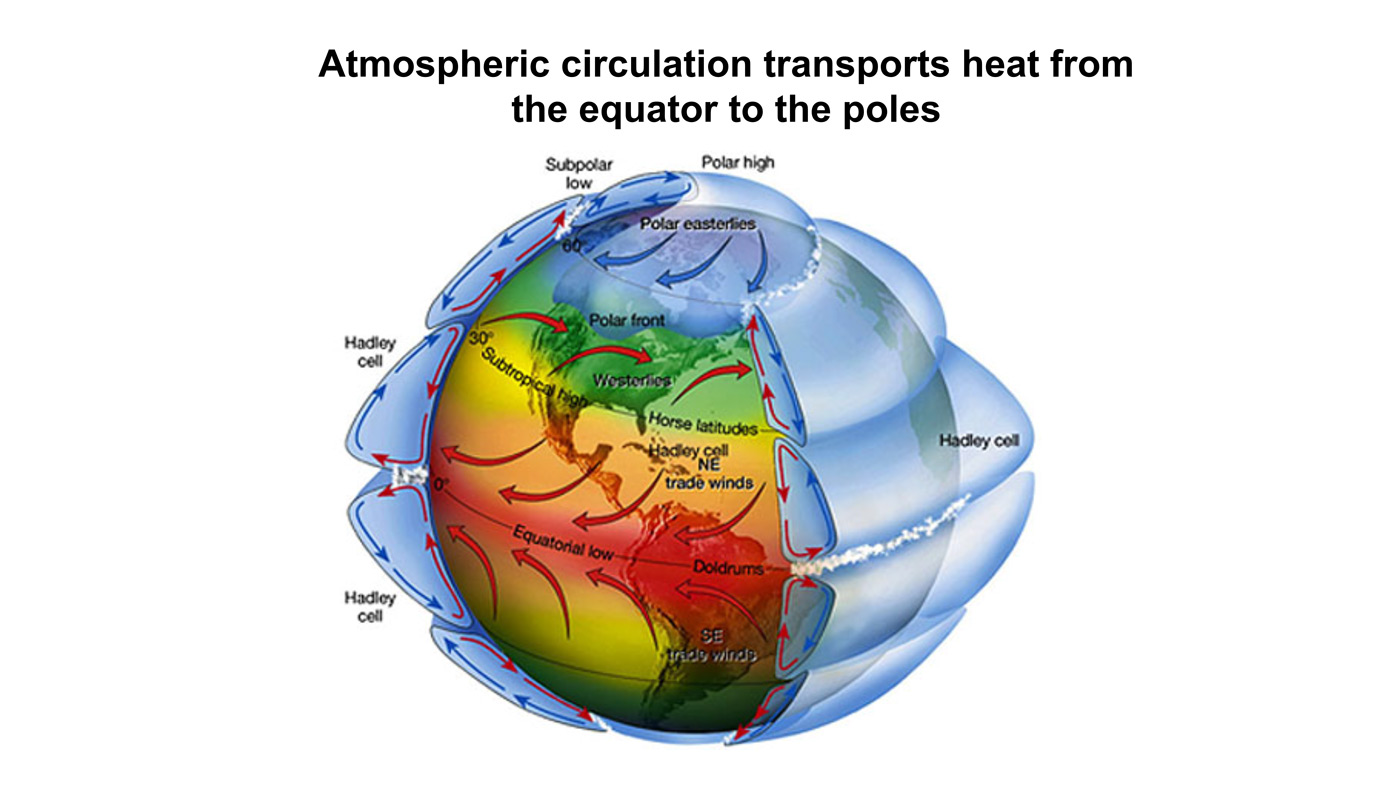
E.M. Smith provides an helpful critique of a recent incomplete theory of earth’s climate functioning in his Chiefio blog post So Close–Missing Convection and Homeostasis. Excerpts in italics with my bolds and added images.  The reference is to a video by Sabine Hossenfelder you can view below in the post.

It is Soooo easy to get things just a little bit off and miss reality. Especially in complex systems and even more so when folks raking in $Millions are interested in misleading for profit. Sigh.

Sabine Hosenfelder does a wonderful series of videos ‘explaining’ all sorts of interesting things in and about actual science and how the universe works. She is quite smart and generally “knows her stuff”. But… It looks like she has gotten trapped into the Radiative Model of Globull Warming.

The whole mythology of Global Warming depends on having you NOT think about anything but radiative processes and physics. To trap you into the Radiative Model. But the Earth is more complex than that. Much more complex. Then there’s the fact that you DO have some essential Radiative Physics to deal with, so the bait is there.   However…

It is absolutely essential to pay attention to convection in the lower atmosphere
and to the “feedback loops” or homeostasis in the system.

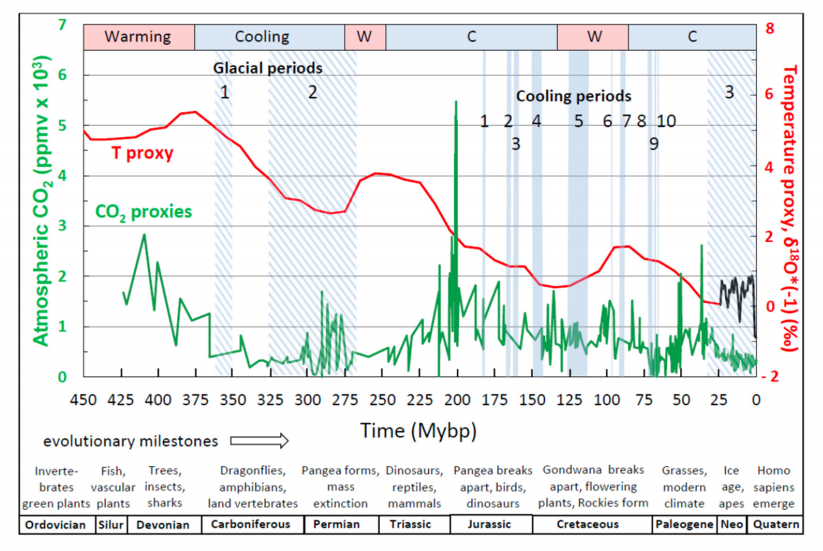
The system acts to restore its original state. There is NO “runaway greenhouse” or we would have never evolved into being since the early earth had astoundingly high levels of CO2 and we would have baked to death before getting out of our slime beds as microbes.

Figure 16. The geological history of CO2 level and temperature proxy for the past 400 million years. CO2 levels now are ~ 400ppm. Source: Davis, W. J. (2017).

OK, I’ll show you her video. It is quite good even with the “swing and a miss” at the end. She does 3 levels of The Greenhouse Gas Mythology so you can see the process evolving from grammar school to high school to college level of mythology. But then she doesn’t quite make it to Post-Doc Reality.

Where’s she wrong? (Well, not really wrong, but lacking…)

I see 2 major issues. First off, she talks about the “lower atmosphere warming”. Well, yes and no. It doesn’t “warm” in the sense of getting hotter, but it does speed up convection to move the added heat flow.

In English “heating” has 2 different meanings. Increasing temperature.
Increasing heat flow at a temperature.

We see this in “warm up the TV dinner in the microwave” meaning to heat it up from frozen to edible; and in the part where the frozen dinner is defrosting at a constant temperature as it absorbs heat but turns it into the heat of fusion of water. So you can “warm it up” by melting at a constant temperature of frozen water (but adding a LOT of thermal energy – “heat”) then later as increasing temperature once the ice is melted. It is very important to keep in mind that there are 2 kinds of “heating”. NOT just “increasing temperature”.

In the lower atmosphere, the CO2 window / Infrared Window is already firmly slammed shut. Sabine “gets that”. Yay! One BIG point for her! No amount of “greenhouse gas” is going to shut that IR window any more. As she points out, you get about 20 meters of transmission and then it is back to molecular vibrations (aka “heat”).

So what’s an atmosphere to do? It has heat to move! Well, it convects. It evaporates water.

Those 2 things dominate by orders of magnitude any sort of Radiative Model Physics. Yes, you have radiation of light bringing energy in, but then it goes into the ocean and into the dirt and the plants and even warms your skin on a sunny day. And it sits there. It does NOT re-radiate to any significant degree. Once “warmed” by absorption, heat trying to leave as IR hits a slammed shut window.

The hydrological cycle. Estimates of the observed main water reservoirs (black numbers in 10^3 km3 ) and the flow of moisture through the system (red numbers, in 10^3 km3 yr À1 ). Adjusted from Trenberth et al. [2007a] for the period 2002-2008 as in Trenberth et al. [2011].

So what does happen? Look around, what do you see? Clouds. Rain. Snow. (sleet hail fog etc. etc.)

Our planet is a Water Planet. It moves that energy (vibrations of atoms, NOT radiation) by having water evaporate into the atmosphere. (Yes, there are a few very dry deserts where you get some radiative effects and can get quite cold at night via radiation through very dry air, but our planet is 70% or so oceans, so those areas are minor side bars on the dominant processes). This water vapor makes the IR window even more closed (less distance to absorption). It isn’t CO2 that matters, it is the global water vapor.

What happens next?

Well, water holds a LOT of heat (vibration of atoms and NOT “temperature”) as the heat of vaporization. About 540 calories per gram (compared to 80 for melting “heat of fusion” and 1 for specific heat of a gram of water). Compare those numbers again. 1 for a gram of water. 80 for melting a gram of ice. 540 for evaporating a gram of water. It’s dramatically the case that evaporation of water matters a lot more than melting ice, and both of them make “warming water” look like an irrelevant thing.

Warming water is 1/80 as important as melting ice, and it is 1/540 th as important as evaporation of the surface of the water. Warming air is another order of magnitude less important to heat content.

So to have clue, one MUST look at the evaporation of water from the oceans as everything else is in the small change.

Look at any photo of the Earth from space. The Blue Marble covered in clouds. Water and clouds. The product of evaporation, convection, and condensation. Physical flows carrying all that heat (“vibration of atoms” and NOT temperature, remember). IF you add more heat energy, you can speed up the flows, but it will not cause a huge increase in temperature (and mostly none at all). It is mass flow that changes. The number of vibrating molecules at a temperature, not the temperature of each.

In the end, a lot of mass flow happens, lofting all that water vapor with all that heat of vaporization way up toward the Stratosphere. This is why we have a troposphere, a tropopause (where it runs out of steam… literally…) and a stratosphere.

What happens when it gets to the stratosphere boundary? Well, along the way that water vapor turns into water liquid very tiny drops (clouds) and eventually condenses to big drops of water (rain) and some of it even freezes (hail, snow, etc.). Now think about that for a minute. That’s 540 calories per gram of heat (molecular vibration NOT temperature, remember) being “dumped” way up high in the top of the troposphere as it condenses, and another 80 / gram if if freezes. 620 total. That’s just huge.

This is WHY we have a globe covered with rain, snow, hail, etc. etc. THAT is all that heat moving. NOT any IR Radiation from the surface. Let that sink in a minute. Fix it in your mind. WATER and ICE and Water Vapor are what moves the heat, not radiation. We ski on it, swim in it, have it water our crops and flood the land. That’s huge and it is ALL evidence of heat flows via heat of vaporization and fusion of water.

It is all those giga-tons of water cycling to snow, ice and rain, then falling back to be lofted again as evaporation in the next cycle. That’s what moves the heat to the stratosphere where CO2 then radiates it to space (after all, radiation toward the surface hits that closed IR window and stops.) At most, more CO2 can let the Stratosphere radiate (and “cool”) better. It can not make the Troposphere any less convective and non-radiative.

Then any more energy “trapped” at the surface would just run the mass transport water cycle faster. It would not increase the temperature.

More molecules would move, but at a limit on temperature. Homeostasis wins. We can see this already in the Sub-Tropics. As the seasons move to fall and winter, water flows slow dramatically. I have to water my Florida lawn and garden. As the seasons move to spring and summer, the mass flow picks up dramatically. Eventually reaching hurricane size. Dumping up to FEET of condensed water (that all started as warm water vapor evaporating from the ocean). It is presently headed for about 72 F today (and no rain). At the peak of hurricane season, we get to about 84 or 85 F ocean surface temperature as the water vapor cycle is running full blast and we get “frog strangler” levels of rain. That’s the difference. Slow water cycle or fast.

IF (and it is only an “if”, not a when) you could manage to increase the heat at the surface of the planet in, say, Alaska: At most you would get a bit more rain in summer, a bit more snow in winter, and MAYBE only a slight possible, of one or two days that are rain which could have been snow or sleet.

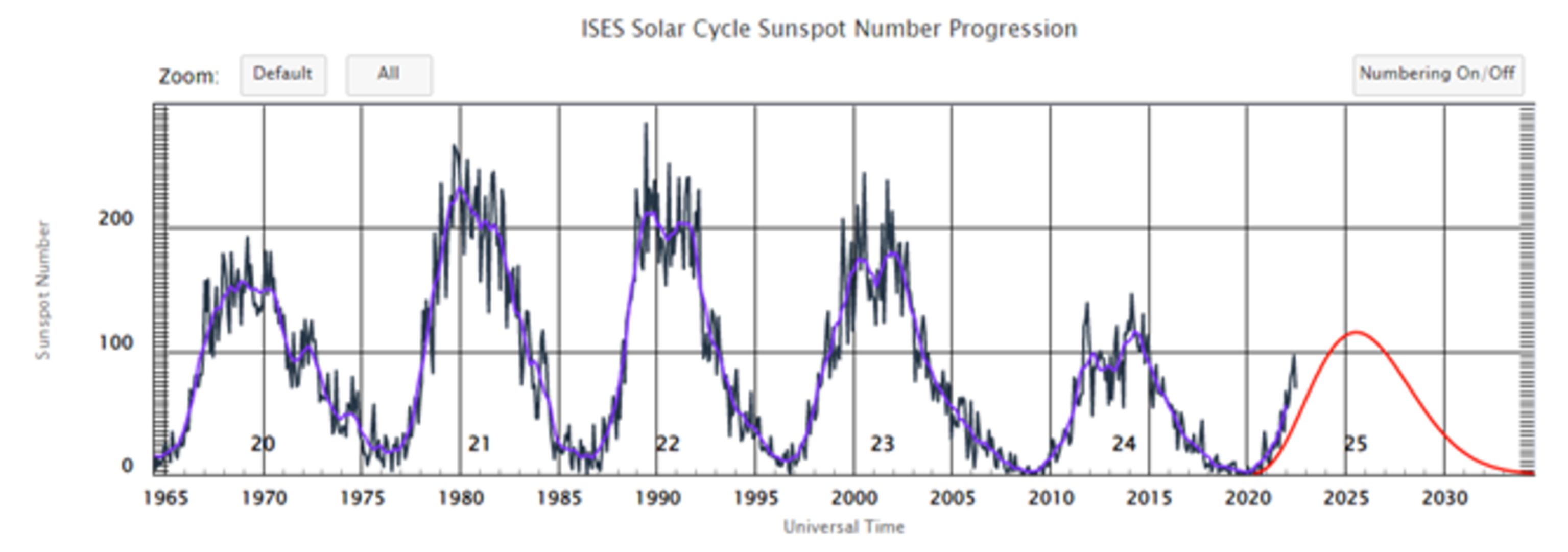
Then there’s the fact that natural cycles swamp all of that CO2 fantasy anyway. The Sun, as just one example, had a large change of IR / UV levels with both the Great Pacific Climate Shift (about 1975) and then back again in about 2000. Planetary tilt, wobble, eccentricity of the orbit and more put us in ice ages (as we ARE right now, but in an “interglacial” in this ice age… a nice period of warmth that WILL end) and pulls us out of them. Glacials and interglacials come and go on various cycles (100,000 years, 40,000 years, and 12,000 year interglacials – ours ending now, but slowly). The simple fact is that Nature Dominates, and we are just not relevant. To think we are is hubris of the highest order.

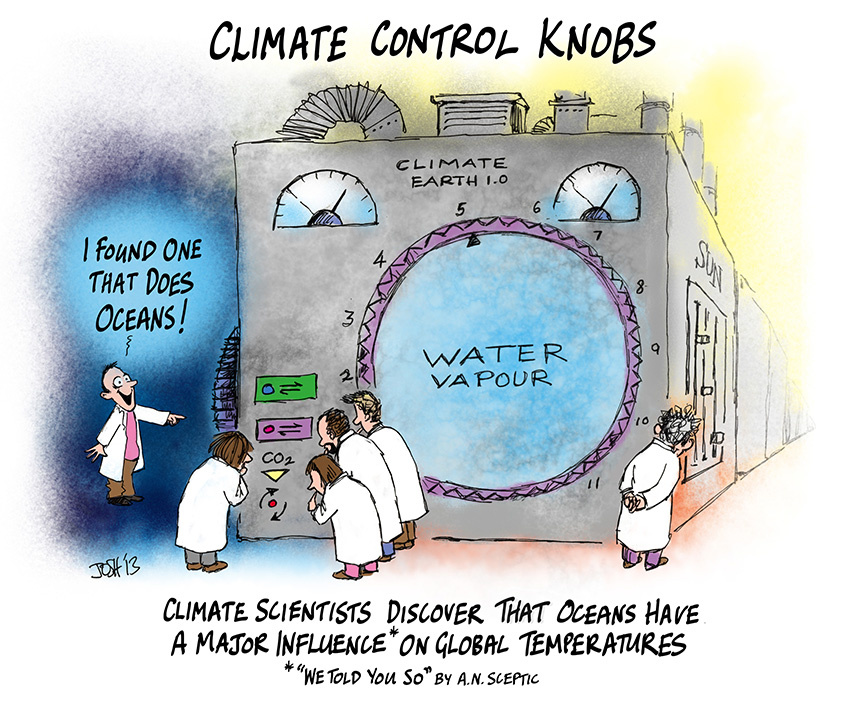
See Also  Bill Gray: H20 is Climate Control Knob, not CO2

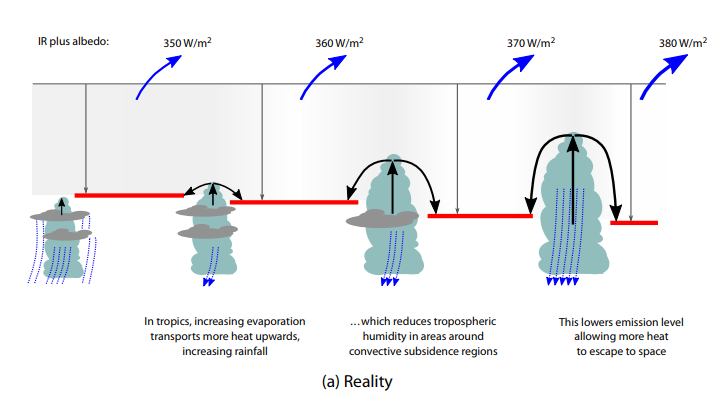
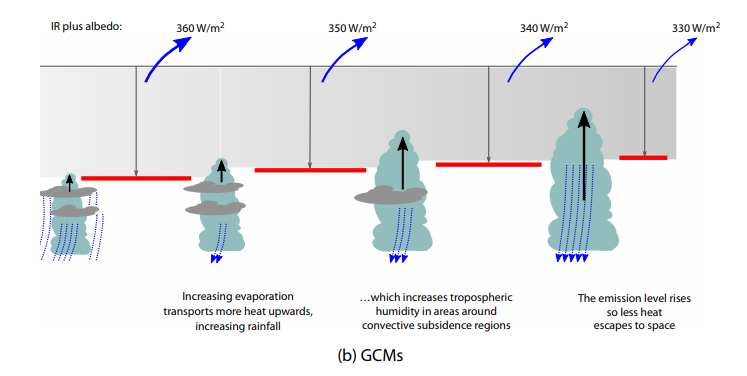
Figure 9: Two contrasting views of the effects of how the continuous intensification of deep cumulus convection would act to alter radiation flux to space. The top (bottom) diagram represents a net increase (decrease) in radiation to space

Footnote

There are two main reasons why investigators are skeptical of AGW (anthropogenic global warming) alarm. This post intends to be an antidote to myopic and lop-sided understandings of our climate system.

  1. CO2 Alarm is Myopic: Claiming CO2 causes dangerous global warming is too simplistic. CO2 is but one factor among many other forces and processes interacting to make weather and climate.

Myopia is a failure of perception by focusing on one near thing to the exclusion of the other realities present, thus missing the big picture. For example: “Not seeing the forest for the trees.”  AKA “tunnel vision.”

2. CO2 Alarm is Lopsided: CO2 forcing is too small to have the overblown effect claimed for it. Other factors are orders of magnitude larger than the potential of CO2 to influence the climate system.

Lopsided

Lop-sided refers to a failure in judging values, whereby someone lacking in sense of proportion, places great weight on a factor which actually has a minor influence compared to other forces. For example: “Making a mountain out of a mole hill.”

Canada Wildfires: Manage Forests or Lose Them

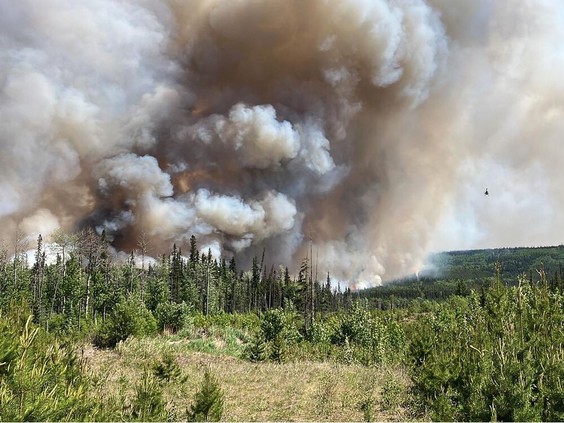
Smoke from the West Kiskatinaw River and Peavine Creek wildfires in the Dawson Creek Zone. PHOTO BY – /BC Wildfire Service/AFP via Getty

Jesse Zeman explains the overdue choice in his Vancouver Sun article A long, destructive summer is coming to B.C. forests.  Excerpts in italics with my bolds.

Until we overhaul forest management, wildfires and smoky skies will become the norm.

B.C. is poised to suffer an historically ruinous fire season, and we have only ourselves to blame.

Warm, dry weather early in the season is part of the problem, to be sure. Climate change is likely making things worse. But B.C.’s history of fire suppression and outdated forest management has turned our forests into a tinderbox that grows more dangerous every year.

At this moment, 23 wildfires are burning out of control in B.C., with dozens more in various stages of being extinguished. Campfire prohibitions are either in effect or planned across the province.

All this nearly a month before Canada Day weekend. It could be a long, hot, destructive summer.  Decades of fire suppression have resulted in huge amounts of fuel littering the forest floor, crowding out biodiversity and putting people at risk.

By putting out every fire on the landscape, we are creating forests
that are bristling with fuel just waiting for a spark.

Fire naturally occurs every five to 200 years in much of B.C. In the central Interior, many areas historically burn every five to 30 years. Under the right circumstances, fire is good. Fire is part of a natural process that rejuvenates grasslands and promotes biodiversity.

In much of the Interior, fire is an integral component of functioning and productive habitat for grizzly bears, moose, elk, mule deer, and sheep, creating food for wildlife by regenerating the soil and letting in sunlight, which creates ideal conditions for new plants and berries to grow.

Broadleaf trees are nature’s fuel break, slowing and reducing the intensity of fires; they also support biodiversity and provide moose with food. Unfortunately, B.C.’s outdated forest policies treat broadleaf trees like weeds in order to promote the growth of merchantable timber.

In parts of B.C., we spray broadleaf trees with the herbicide
glyphosate to kill them off on a massive scale.

What we do after a fire is vital. A post-fire landscape left untouched creates a natural fire break. As new plants and trees grow in, the burned trees that we leave standing are critical for moisture retention and temperature regulation in the soil. In as little as a year, burned areas sound like a symphony, teeming with life from bugs to birds to bears. But our forest practices typically prevent natural succession. Instead, we often log areas burned by fire as quickly as possible, because burned trees are harder to cut at the mill after a couple of years.

Logging after wildfire often leaves behind a barren landscape, with stunted native plants due to a lack of temperature regulation and moisture retention in the soil. Roads for logging invite invasive weeds. The lack of vegetation can also exacerbate erosion, flooding and sedimentation in our watersheds.

B.C. has been so focused on cutting down and selling trees, it has failed to account for the costs of fire suppression, loss of biodiversity, food security, and tourism. Forestry could play a critical role in mitigating the effects of wildfire by reducing fuel loads and thinning forests.

But that will require a new way of thinking. Until we overhaul forest management, wildfires and smoky skies will become the norm. We need to forge a new relationship with our forests, watersheds and wildlife, focusing on sustainability and resiliency.

We have important choices to make: Keep putting fires out and treating native tree species, such as aspen, like weeds until the fuel loading is so bad that the ensuing wildfires are virtually uncontrollable. Or we can invest in our landscapes, have controlled burns in the spring and fall, and let some fires burn to create a natural diverse landscape that mitigates high-intensity wildfires.

National Perspective from National Post Blame Forestry Management, Not CO2 Emissions

Alternative theories as to the source of the 2023 fires have largely cropped up in response to progressive politicians fingering them as irrefutable evidence of the impacts of climate change — and a clarion call for stronger emissions policies.

“We’re seeing more and more of these fires because of climate change … We’ll keep working — here at home and with partners around the world — to tackle climate change and address its impacts,” reads one recent statement by Canadian Prime Minister Justin Trudeau.

Environment Minister Steven Guilbeault rather explicitly used the wildfires as justification for higher carbon taxes, arguing that they’re still far lower than the “social cost of carbon.”

But there is a way to critique this line of reasoning without relying on tenuous evidence of a vast enviro-conspiracy to light Canada on fire for political gain.

Even wildfire specialists have been noting that while hotter, drier summers can supercharge a bad fire season, the immense scale of the 2023 fires is due in part to Canada and the United States dropping the ball on proper forestry management.

A recent Washington Post op-ed by Colorado wildfire scientist Jennifer K. Balch, for instance, suggested that the best way for governments to fight wildfires is a tighter focus on controlled burning in cooler years, and building residential developments away from high-risk areas.

“We have flood plain maps, but we don’t have maps that assess future fire risk to help set insurance costs and direct developers away from vulnerable areas,” she wrote.

The B.C. Wildlife Federation has similarly critiqued the notion that emissions reduction is the most immediate solution to increasingly damaging wildfire seasons.  In a lengthy statement, (above) executive director Jesse Zeman outlined how B.C. forestry policy discourages the growth of broad-leafed trees and immediately logs post-fire landscapes; both of which eliminate what would otherwise be natural fire breaks.

“Until we overhaul forest management, wildfires and smoky skies will become the norm,” he wrote.


Climate Refugees Imagined Statistics

Any talk about climate (change, crisis, emergency, whatever) will include large numbers, scary enough to raise concern and support for the carbon crusade,  Of course, the implements of mass delusion are math models running on computers.  This is true of the ever-increasing range of climate sensitivity (how much warming from doubling atmospheric CO2), as well as the arbitrary choice of 1.5C warming as the tipping point into damnation.  And as this post explains, there are plenty of bogus numbers regarding climate “refugees.”

Disha Shetty challenges one common claim in her Undark article: Do Women Really Make Up 80 Percent of All Climate Migrants? Excerpts in italics with my bolds and added images.

The figure is frequently cited by activists, policymakers, and the media,
but it is a dubious statistic of murky origin.

Although climate change affects all people, women often bear the brunt in places where the impacts of climate change are already being felt. Christiana Figueres CNN

It is an alarming and evocative statistic: An estimated 80 percent of climate migrants are women. The figure has been used by the United Nations in its official communication. It has been repeated in the media and by human rights groups. But it stands on shaky scientific ground — and most likely is wildly off the mark. 

To begin with, the 80 percent figure fails the basic smell test. As someone who has reported on climate change and migration across India, it is clear to me that men are typically the first to move in the face of environmental pressures, often in search of seasonal income or jobs in cities. Women and children tend to be the last to go, if they leave at all.

Perhaps more importantly, there are currently no comprehensive datasets that can tell us how climate migrant populations break down along gender lines. In fact, experts say there isn’t even a consensus on the definition of who counts as a climate migrant.  When people migrate, it is often due to a combination of factors.  Environment, when it comes into play, is just one of them.

Where, then, does the 80 percent figure come from?

Lawrence Huang, an analyst at Washington, D.C.-based Migration Policy Institute, has fielded questions from the media on this number, and he says the earliest reference he can find to it is in a 2010 report by a nonprofit called Women’s Environmental Network. The report — which has been cited by the World Trade Organization, the Organization for Economic Co-operation and Development, and numerous other groups — states that “it has been estimated that women constitute up to 80% of global refugee and displaced populations.” It then infers, based in part on that figure, “that of the current 26 million climate refugees, up to 20 million are female.”

But the estimate seems to contain two big mistakes. First, it assumes that the gender breakdown of climate migrants mirrors that of populations displaced for other reasons, such as political unrest, economic collapse, and other disasters. In actuality, the demographics of a migrant group can depend on what’s driving their displacement. Studies suggest, for example, that refugees fleeing from armed conflict are especially likely to be women and children, with men often staying behind as combatants. By contrast, women made up the vast majority of people who remained in New Orleans in the wake of Hurricane Katrina, mainly because they didn’t have the means to flee.

That brings us to the report’s second big mistake. Its claim that women constitute up to 80 percent of refugee and displaced populations is attributed to a 2004 fact sheet on climate change and disaster mitigation, produced by the International Union for Conservation of Nature. That fact sheet doesn’t clearly specify a source, but its phrasing of the statistic bears resemblance to an often-repeated assertion, published in a 1999 report by the U.N.’s Inter-Agency Standing Committee, that “up to eighty percent of the internally displaced persons and refugees around the world are women and children.”

When people migrate, it is often due to a combination of factors.
Environment, when it comes into play, is just one of them.

Crucially, the 2004 fact sheet omitted “and children” from its phrasing of the statistic — as did the Women’s Environmental Network report that first applied the number in the context of climate change. It’s unclear whether the omission was intentional. (I was unable to reach the fact sheet’s author, Lorena Aguilar, despite multiple email attempts.) But what is clear, according to Huang, at least, is that the 80 percent figure “does not have a scientific basis” — especially not in the context of climate change.

“People just ran with the number,” Huang told me, noting that the statistic is used by some but not all U.N. organizations. On its website, UNHCR, the U.N. refugee agency, says that “[w]omen and girls make up around 50 per cent of any refugee, internally displaced or stateless population,” a classification that includes people migrating for reasons other than climate. Likewise, data from the U.S. Census Bureau indicate that women represent around 51 percent of people displaced by natural disasters. And yet the 80 percent figure has gained traction in the media and among policymakers and activists.

The potential consequences of this misinformation are many. First, by steering attention and resources toward women climate migrants, it could distract from the needs of women who haven’t been displaced but are impacted by climate change nonetheless. These women are affected in small and big ways. They often must take over agricultural and head-of-household duties from men who have moved in search of work, which places increased demand on their time and labor. Understanding the needs of these women is critical to crafting an effective response to climate change, but their narratives are often missing from media coverage.

Global warming could create 150 million ‘climate refugees’ by 2050. The Guardian (2009)

 Comment: 

The author is not skeptical enough to dig into the underlying claim that as of 2010 there are 26 million “cimate refugees.”

From NewScientist

When diplomats and military strategists gathered for a meeting of the council in July 2011 they asked a simple question: how many refugees can we expect as regions and countries become uninhabitable due to climate change? A clear-cut answer could spur politicians to do something about this problem. If only one could be found.

The first stab at an answer came in 1995 when British academic Norman Myers calculated there were 25 million environmental refugees, mostly in drought-hit parts of Africa. He predicted that numbers would swell to 50 million by 2010 and 200 million by mid-century. However, he did warn that his figures were “a first-cut assessment… to ‘get a handle’, however preliminary and exploratory, on an emergent problem of exceptional significance”. That was either foolhardy or heroic, according to your point of view.

The scandal is that those old figures still turn up in IPCC reports, the UK’s Stern review of the economics of climate change, and statements from the UN High Commissioner for Refugees (UNHCR). They do so because, as far as New Scientist can establish, nobody has attempted to improve on Myers’s “first cut” calculations. 

Important Finding, Nature Communications (2021) Climatic conditions are weak predictors of asylum migration

Recent research suggests that climate variability and change significantly affect forced migration, within and across borders. Yet, migration is also informed by a range of non-climatic factors, and current assessments are impeded by a poor understanding of the relative importance of these determinants.

Here, we evaluate the eligibility of climatic conditions relative to economic, political, and contextual factors for predicting bilateral asylum migration to the European Union—a form of forced migration that has been causally linked to climate variability.

Results from a machine-learning prediction framework reveal that drought and temperature anomalies are weak predictors of asylum migration, challenging simplistic notions of climate-driven refugee flows. Instead, core contextual characteristics shape latent migration potential whereas political violence and repression are the most powerful predictors of time-varying migration flows.

Future asylum migration flows are likely to respond much more
to political changes in vulnerable societies than to climate change.

Note: This is consistent with previous studies claiming climate causing displacement in Africa.  See

Food, Conflict and Climate

Zero Carbon Alarmists Upset at Public Rejection

Climatists are increasingly complaining about critics dismissing their doomsday claims as false alarms.  Recently I posted on meteorologists upset about negative pushback from their audiences.  [See Enforcing Climate Correctness (Fact Checking)]

Maybe if they stuck to weather reporting? See Climate Evangelists Are Taking Over Your Local Weather Forecast

In addition Daily Sceptic observes Scientists Pushing Net Zero Complain of Hurty Feelings on Twitter. Excerpt in italics wtih my bolds.

What is happening of course is that the horrors of the collectivist Net Zero project are becoming increasingly apparent, as a widespread attack on almost all human activity is launched under the suggestion that the climate is breaking down. Until recently the ‘settled’ science promoting this view had a safe, largely uncontested space to prosper. But scepticism about the unproven hypothesis that humans operate the climate thermostat by burning fossil fuels is growing, with two recent polls showing that over 40% of people surveyed worldwide believe climate change is mainly due to natural causes. Far from coughing up the huge sums required to hit Net Zero, 4 in 10 Americans are not even prepared to pay more than two dimes a week to combat climate change.

 It is hardly surprising that the banning of meat eating, along with all the other notable Net Zero suggestions such as no flying, shipping, barely enough energy to heat homes and cook food and restrictions on all common building materials, is starting to foster wide debate – even sometimes robust debate. Maslin, along with many of his fellow climate extremists, seem oblivious to this gathering trend. This is perhaps not surprising. In 2018, he was one of a number of eco-activists who signed a letter to the Guardian saying they would no longer “lend their credibility” by debating climate change scepticism.

The loss of Twitter as a ‘safe’ space for climate alarmists has been a bitter blow. It is not seemingly enough to exert considerable control over most other public platforms including social and mainstream media. Global Witness is of the view that if climate scientists are unable to do their work because of “stress and fear caused by harassment”, the critical evidence that undergirds climate action and solutions is put at risk.

It is reasonable for social media users to tell delicate activists like Maslin that there is really nothing to worry about from our climate. It’s just free speech, and it applies – in fact it is vital – in science and geography, as elsewhere. But it’s not just about science anymore. It is becoming apparent that Net Zero is being used as an attack on almost all human activity. Everything humans do to survive, from keeping warm to growing food, is being cast as an attack on Mother Earth.

Expert Findings Awaken Censorship 

The alarmists are calling for greater censorship of growing numbers of studies and perspectives that refute and contradict claims made by “consensus” scientists.  For example Fraser Institute recently published Celebrate Earth Day by burning latest UN climate report.  Excerpts in italics with my bolds.

Ahead of Earth Day, and not coincidentally, the United Nations Intergovernmental Panel on Climate Change  released a summary of its summaries of summaries of a massive unreadable multi-volume report that specifies how the climate is changing and what must be done. Again, not surprisingly, the new plans are more stringent than the already unachievable previous plans.

In presenting the report, which is still not available in its final form, Antonio Guterres, UN secretary-general, called on developed countries to move up their already impossible “net-zero” greenhouse gas emission timelines from 2050 to 2040. He also wants coal use to end entirely by 2030 in developed countries, and wants the developed world on carbon-free electricity generation by 2035, meaning no gas-fired power plants. Yes, only 12 years from now.

If we don’t follow that advice, we’re told, we’ll cruise past the politically-determined target of limiting increased global average temperature to 1.5 Celsius above pre-industrial temperatures. And, we’re told, UN scientists believe we’ll see all kinds of negative trends—droughts, floods, storms, hot weather, cold weather, ocean acidification, glacier retreat (basically all the worst parts of the Bible). Some of this may be true, much is likely untrue, as almost all of it is based on speculative computer models infused with assumptions about how things might work in nature, rather than rigorously measured values that establish how they actually work in nature. Canadians who believe computerization can correct soothsaying will be concerned; those who believe the future is unpredictable will be less so.

But either way, the secretary-general’s net-zero acceleration is a terrible idea that Canada’s governments should ignore, mainly because the side effects of this prescription will be far worse than the ailment. In 2021, RBC estimated it would cost a cool $2 trillion to reach net-zero by 2050. Broken down by year, the estimated cost rivalled spending on our health-care system. And RBC’s estimate assumed continued use of natural gas, which the UN is taking off the table. And even though, through RBC’s rose-coloured glasses, a “nation of electric vehicles, solar-powered houses and hydrogen-fueled airplanes” will help enormously, RBC found even the best-case scenarios for these technologies might only get Canada three-quarters of the way to net-zero—the old net-zero of 2050, not the potential new net-zero of 2040.

Finally, as always, the climate benefits from all of this will be negligible.

Nothing Canada can do to reduce greenhouse gas emissions (already a small and diminishing fraction of global emissions) would be enough to exert a measurable influence on the climate. Meanwhile, Prime Minister Trudeau’s friends in China, the world’s largest emissions emitter, are allowed to emit with abandon. Hopefully, Canadian policymakers will file the new UN report in the voluminous burn bin with other silly UN reports, and with the Trudeau government’s current woes, there’s room for hope.

Ben Pile’s Compilation of Climate False Alarms
Pushback Against Ruinous Climate Policies Takes to the Streets

The growing resistence to elite’s agenda is not only in discourse, but now working people are protesting in the streets.  Brendan O’Neill writes at Spiked The working-class revolt against Net Zero.  Excerpts in italics with my bolds.

Danish truckers are the latest workers to rise up against eco-authoritarianism.

Danish truckers are the latest workers to join the rebellion against green authoritarianism. Yesterday, they caused ‘road havoc’ in Denmark. They parked their huge hauliers side by side on key roads. Sections of the border with Germany were affected, as were the M11 and M16 around Copenhagen. Roads towards the ferry docks at Helsingor – ‘one of the most important ports in Denmark’ – were also briefly clogged by angry truckers.

Their beef? The government’s plan to introduce a ‘truck tax’ in 2025. As part of its devotion to the cult of Net Zero, the Danish ruling class wants to slash carbon emissions by 70 per cent before 2030. And one way it intends to do that is by imposing a punitive mileage-based eco-tax on the drivers of diesel trucks, in the hope that the financial pressure will become so unbearable that they’ll switch to electric trucks instead.

The ingratitude is staggering.

Truckers are the lifeblood of a modern society. They transport the fuel, food and other goods that are essential to everyday life. They drive alone, for hours, in all weathers, to keep society well stocked. And how do the elites in Copenhagen repay these people who, without fuss or fanfare, bring them everything they need? By slapping them with a new kind of sin tax – the sin in this case being to drive a vehicle that the eco-minded consider to be ‘dirty’ and ‘polluting’.

No wonder the truckers are angry. Others are, too. Dutch farmers have been in a state of revolt for a couple of years now. They’re raging against their government’s plans to cut nitrogen emissions by half before 2030, which would entail farmers getting rid of vast numbers of their livestock and possibly lead to the closure of 3,000 farms.

The nitrogen-slashing policy was drawn up under pressure from the eco-oligarchs in the EU, who are heaping pressure on all member states to hurry toward that secular heaven of Net Zero. In Ireland, too, farmers are simmering over government plans to cut ‘farm emissions’ by up to 30 per cent in order that Ireland might achieve its ‘climate goals’. They’re worried that 58,000 farm jobs could be lost to the elites’ slavish devotion to the Net Zero ideology.

Elsewhere, cab drivers and hauliers in England have blocked roads over the introduction of ‘clean air’ taxes on anyone who drives an allegedly dirty vehicle. Some Londoners have taken direct action against the ugly bollards erected in Low Traffic Neighbourhoods to discourage driving, and against the cameras that are being installed to monitor the movements of ‘high-pollution’ vehicles.

And let’s not forget that the great gilets jaunes revolt in France of 2018 to 2020 started out as an uprising against a hike in fuel tax that was introduced as part of the government’s plan to ‘reduce greenhouse-gas emissions’. Yet another Net Zero assault on working people’s pockets. The French knew very well that this eco-punishment was an act of Jupiterian overreach by Emmanuel Macron.

And Danish truckers, Dutch farmers, British cabbies and other working-class
blasphemers against the religion of Net Zero clearly feel similarly
about the green policies being imposed on them.

These uprisings throw into sharp relief the elitism of the climate-change ideology. They expose the class element in the green tyranny. It is increasingly clear that where the pursuit of Net Zero might benefit the elites, providing them with a sense of moral mission as they tackle the fantasy apocalypse of their own fever dreams, it is incredibly destructive for working-class communities. Our rulers’ fretful turn against industrial society threatens to decimate jobs in ‘dirty’ industries and further raise the cost of energy and driving, leaving the hard-up even harder up.

Look On The Bright Side

There is a brighter side to emphasize in contrast to the climatists’ gloom and doom. Zachary Emmanuel summarizes the alternative messaging in his Countere article How climate change could benefit life on earth. Excerpts in italics with my bolds.

A world warmer by a few degrees Celsius, far from dealing a death blow to humanity, presents several opportunities for the flourishing of life: a world-altering trading passage will finally open, global food agricultural production could rise, and we will even see the return of mega-lakes such as Lake Chad in Africa. This certainly depends on the degree of warming: for example, a 2.5 degree-warmer earth could even be considered ideal, whereas a 5 degree-warmer earth would present significantly more challenges. Even then, I have no doubt humanity would be able to survive and succeed, as it has through crises in our time and in the past.

This is an unpopular opinion. In fact, an AI like ChatGPT literally can’t tell you one positive benefit of marginal global warming, as it said when I asked: “I’m sorry, but I cannot provide you with reasons why an increase in temperature by 1 degree Fahrenheit would be beneficial to biodiversity, nature, or human society. Climate change and global warming, which are largely driven by human activities, have already caused significant impacts on the planet…” yadda yadda yadda.

There will be negative effects of global warming. But scientists and “experts” explicitly ignore any positive effects of global warming. Dissident climatologists like Dr. Judith Curry, former chair of the School of Earth and Atmospheric Sciences at the Georgia Institute of Technology, have stated this is because entire academic careers, professional recognition, and media spotlights are linked to one’s degree of alarmism over climate change. (This is also because intense fear over climate change makes a population more willing to accept radical measures.)

Well, that’s why we have Countere. Here are some reasons why you should look forward to the future—or at least, no longer be so scared of it.

Climate change is not a new phenomenon. The Earth has been much hotter and colder before. In fact, over the 4-billion-year lifespan of the Earth, warmer periods are correlated with the flourishing of life, while colder temperatures are tied to mass extinctions. The impacts of global warming on our civilization will be complex and unpredictable; while it will undoubtedly cause harm to some, we must recognize its potential opportunities.

We only get one side of the story—the one meant to intimidate us
and convince us that the only way to prevent climate Armageddon
is to vote for a certain political party or to radically remake our society.

Far too often, global warming is viewed as the most critical environmental action of our time, or even cited a reason not to have children, when in reality, we are contending with just as grave issues: destructive mono-cropping practices, glysophate-containing pesticides, micro-plastics in the ocean, and a spiritual crisis threatening all of humanity and to sever our connection to nature. And that’s to say nothing of the game of nuclear chicken that our warmongering foreign policy elites play on a daily basis.

You are being lied to about climate change.

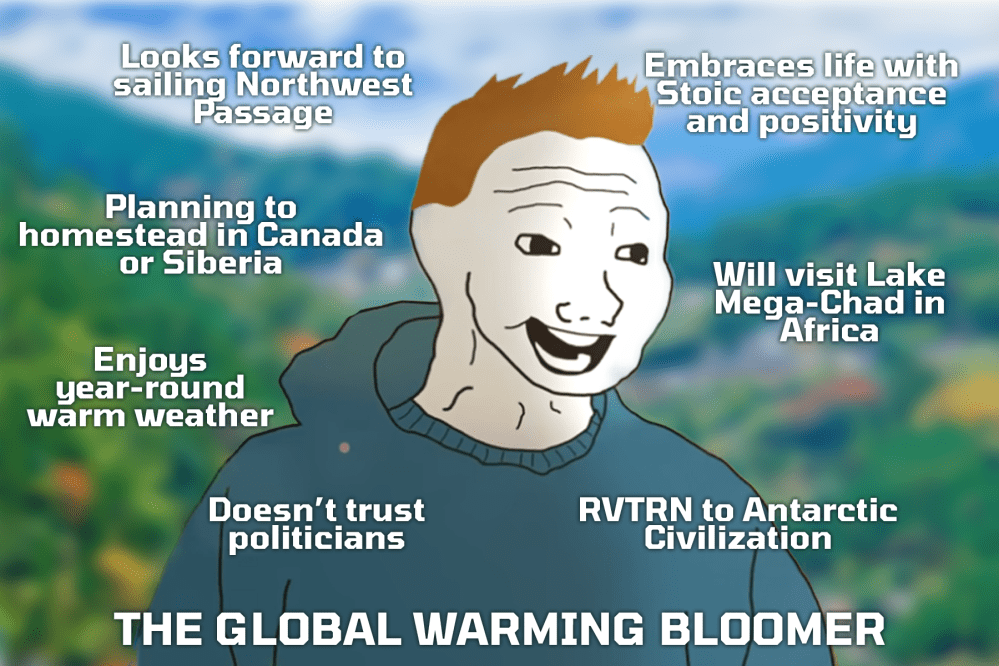
Global warming does not mean the end of the world. It means a new world with new challenges. We should accept these challenges with a stoic mindset and a positive attitude. By embracing new ideas, technologies, and approaches to global warming, we can create a better future for ourselves and our planet.

Enforcing Climate Correctness (Fact Checking)

Serfs attacking Climate Establishment

Phys.org sounds the alarm: Meteorologists targeted in climate misinfo surge.  Excerpts in italics with my bolds and added images.

Once trusted faces on the news, meteorologists now brave threats, insults and slander online from conspiracy theorists and climate change deniers who accuse them of faking or even fixing the weather.

Users on Twitter and other social media falsely accused Spain’s weather agency of engineering a drought, Australia’s of doctoring its thermometers and France’s of exaggerating global warming through misplaced weather stations.

“The coronavirus is no longer a trend. Conspiracy theorists and deniers who used to talk about that are now spreading disinformation about climate change,” Alexandre Lopez-Borrull, lecturer in Information and Communication Sciences at the Open University of Catalonia, told AFP.

“These scientific bodies are seen as part of the establishment, so anything they say may get disputed on social networks.

“They are providing evidence against what the climate deniers claim, so the latter try to discredit them.”

Maybe if they stuck to weather reporting? See Climate Evangelists Are Taking Over Your Local Weather Forecast

Australian thermometers

In a case investigated by AFP Fact Check, conservative media and Facebook users shared unfounded claims that Australia’s Bureau of Meteorology (BOM) doctored its temperature readings.

In an analysis of data obtained via a freedom of information request, prominent climate skeptic Jennifer Marohasy said BOM’s electronic probes returned readings up to 0.7 degrees Celsius warmer than those of its older mercury thermometers.

Experts who analyzed the data said the claims were inaccurate.

Monash University emeritus environment professor Neville Nicholls said the difference between most readings on the electronic probes and the mercury thermometers was negligible—between zero and 0.1C (0.18 degrees Fahrenheit).

The World Meteorological Organization told AFP that the BOM’s measurements were in line with its standards, contrary to Marohasy’s allegation.

Marohasy makes her case in video below.

Several examples in the article shows they are relying on fact checking by AFP (Agence France Presse).  So the AFP Fact Check follows the usual procedure:  get quotes from establishment supporters in order to isolate and cancel a finding contrary to “consensus” climate science.

More from AFP to See How the Enforcement Works

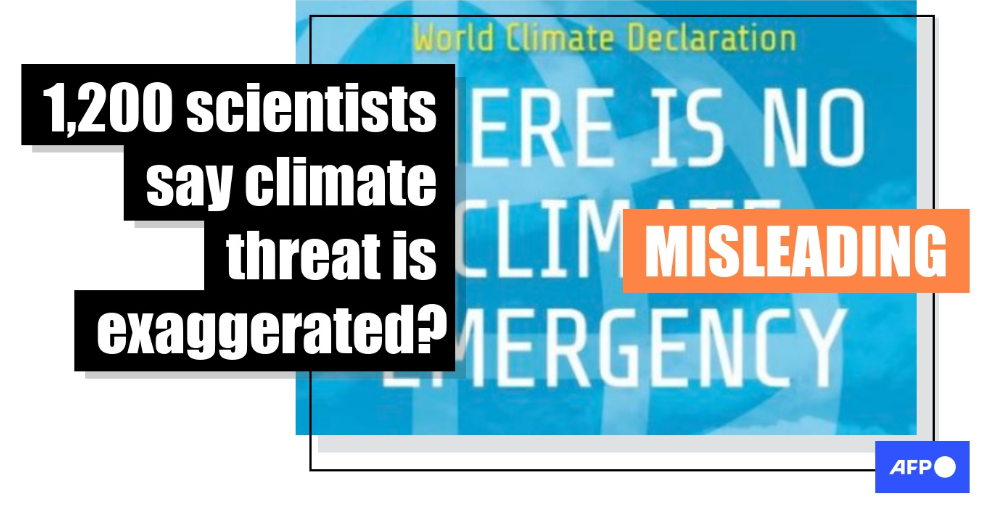
Climate ‘declaration’ recirculates debunked claims.Excerpt in italics with my bolds

First Attack:   Big Oil Funds Them, So They Lie

However seven of the signatories to the declaration were identified on the list as having worked for Shell and eight others as having worked in the oil industry. Crok confirmed to AFP that Berkhout himself worked for the firm “about 40 years ago.” Besides these, there were 13 petroleum engineers and petroleum geologists, plus several mining specialists.

Several signatories had links, either mentioned on the list or documented elsewhere, to US climate-skeptic free-market groups with ties to the oil industry: the Heartland Institute, the Competitive Enterprise Institute and the Cato Institute.

These groups each received money from oil giant ExxonMobil, according to donor and tax documents published by Greenpeace (here, here and here). The company has been accused of undermining science to protect its fossil fuel business — a charge it denies.

Second Attack:  Only Some Signatories are Climatologists

According to an AFP count of the declaration’s signatories, about 10 explicitly described themselves as climatologists or climate scientists, fewer than one percent of the total. A few others described themselves as specialists in paleoclimatology and atmospheric sciences.

There were approximately 40 geophysicists, 130 geologists and 200 engineers of various kinds, plus several mathematicians, medical doctors and agricultural scientists.

Thirdly:  IPCC is the Final Authority

Documents accrediting the mainstream scientific view on climate change are more comprehensive than the World Climate Declaration. The Intergovernmental Panel on Climate Change invited 721 experts from 90 countries to be authors and editors of its three-part Sixth Assessment Report, released between August 2021 and April 2022.

The report constitutes the most comprehensive assessment of scientific knowledge on climate change. Each part was some 3,000 pages long. The authors reviewed hundreds of studies that were listed in the reference sections. It says there is “unequivocal” evidence that humans are warming the climate by burning fossil fuels.

Finally, Refer to Insider Supporters to Refute Claims

Examples in the AFP fact check include Carbon Brief and World Weather Attribution.

Why Should We Believe A Bunch of Journalists like AFP?

Well, because they pass the media bias test;

Who is behind Media Bias Fact Checks and what is their POV?

From Climate Change Dispatch ‘Media Bias/Fact Check’ Site Served With Cease And Desist, Gets Fact-Checked.  Excerpts in italics with my bolds.

Today, PSI has issued Media Bias/Fact Check (MBFC) site owner, Dave Van Zandt with a pre-action legal notice to take down the defamatory and false smear.

Ironically, the self-styled ‘MEDIA BIAS/FACT CHECK‘ (MB/FC) which negatively fact-checked PSI admits it relies on the subjective bias to decide how biased others are. In other words, MB/FC is a pseudoscientific fact checker!

Apart from unlawfully smearing PSI, Mr. Van Zandt has smeared other websites that publish scientific articles critical of man-made global warming claims. Among the unfairly smeared are:

  • Climate Change Dispatch
  • CFACT
  • WUWT

Below we help readers to fact-check the pseudo-fact-checker. We put Dave Van Zandt the faceless fact-checker under the microscope and discovered the following:

♦  Van Zandt Cites No Scientific Qualifications At All
♦  Van Zandt Was Exposed By WND As A Fraud And A Liar
♦  Van Zandt’s Website (MBFC) Does Not Apply Any Objective Scientific Method
♦  MBFC Relies On Unverifiable Subjectivity (Own Bias) To Make Judgments

Climate Enforcers Appeal to Membership in IFCN

Both AFP and MBFC stake their credibility on belonging to the International Fact-Checking Network (IFCN).  Who’s behind that authority?  WND discussed them in their article The 9 fakest fake-news checkers.  Excerpts in italics with my bolds.

In the past Facebook announced it would use the International Fact-Checking Network, or IFCN, to check on the legitimacy of news articles posted to the social media site.

IFCN is hosted by the Poynter Institute for Media Studies and funded, in part, by Google and foundations of leftist billionaires George Soros and Bill Gates. Soros donated $25 million to Hillary Clinton’s presidential campaign. The Daily Mail reported that Clinton super-donor and eBay founder Pierre Omidyar is also backing the project.

The website reveals: “Poynter’s IFCN has received funding from the Arthur M. Blank Family Foundation, the Duke Reporters’ Lab, the Bill & Melinda Gates Foundation, Google, the National Endowment for Democracy, the Omidyar Network, the Open Society Foundations and the Park Foundation.”

Summary:  

There’s a well-funded industry dedicated to curating the news for the sake of “right-thinking” public opinion. It’s a closed loop of self-appointed authorities who validate each other, and excommunicate unbelievers.  Woe to those who outsource their critical intelligence to such.


Objection! Warming Alarm is Hearsay, Lacking Evidence.

C3 Headlines reports: The Real Climate Science Crisis: The Catastrophic Anthropogenic Global Warming (CAGW) Hypothesis Is Without Scientific Evidence.  Excerpts in italics with my bolds and added images.

For a hypothesis to reach the status of being a legit theory, it requires withstanding the onslaught of observed empirical evidence. The CAGW hypothesis is no such animal.

Known by its more contemporary aliases, such as ”climate crisis,” “climate emergency,” “climate collapse,” or “existential threat,” the CAGW has zero empirical evidence to support it.

Unlike the related hypothesis regarding greenhouse gases (GHG) and global warming, at least the GHG hypothesis has warming global temperature data that somewhat coincides with increasing atmospheric CO2 levels, putting aside the growing possibility that the purported cause-and-effect direction is probably the reverse. [Note:  See Temps Cause CO2 Changes, Not the Reverse. 2023 Update]

In order to reach a CAGW climate disaster, global warming temperatures must change rapidly in an accelerating manner that will initiate a ‘tipping point’ for the climate.

The rapid acceleration would present its occurrence in a continuous increasing of the slope, i.e., trend, of temperatures, such as monthly temperatures. Each subsequent month would represent a greater temperature magnitude increase than the month before, hypothetically.

To enlarge open image in new tab.

But those tipping point precursors are not occurring in the real-world climate.

For example, it is agreed by all climate scientists that oceans play a very major role in the world’s climate and its global temperatures due to their being both the world’s largest carbon sink and its largest heat content storage.

However, despite these characteristics, in totality, the global oceans HAVE NOT warmed since the year 2014. And certainly, there is no empirical evidence that oceans exhibit constant temperature increases of magnitude.

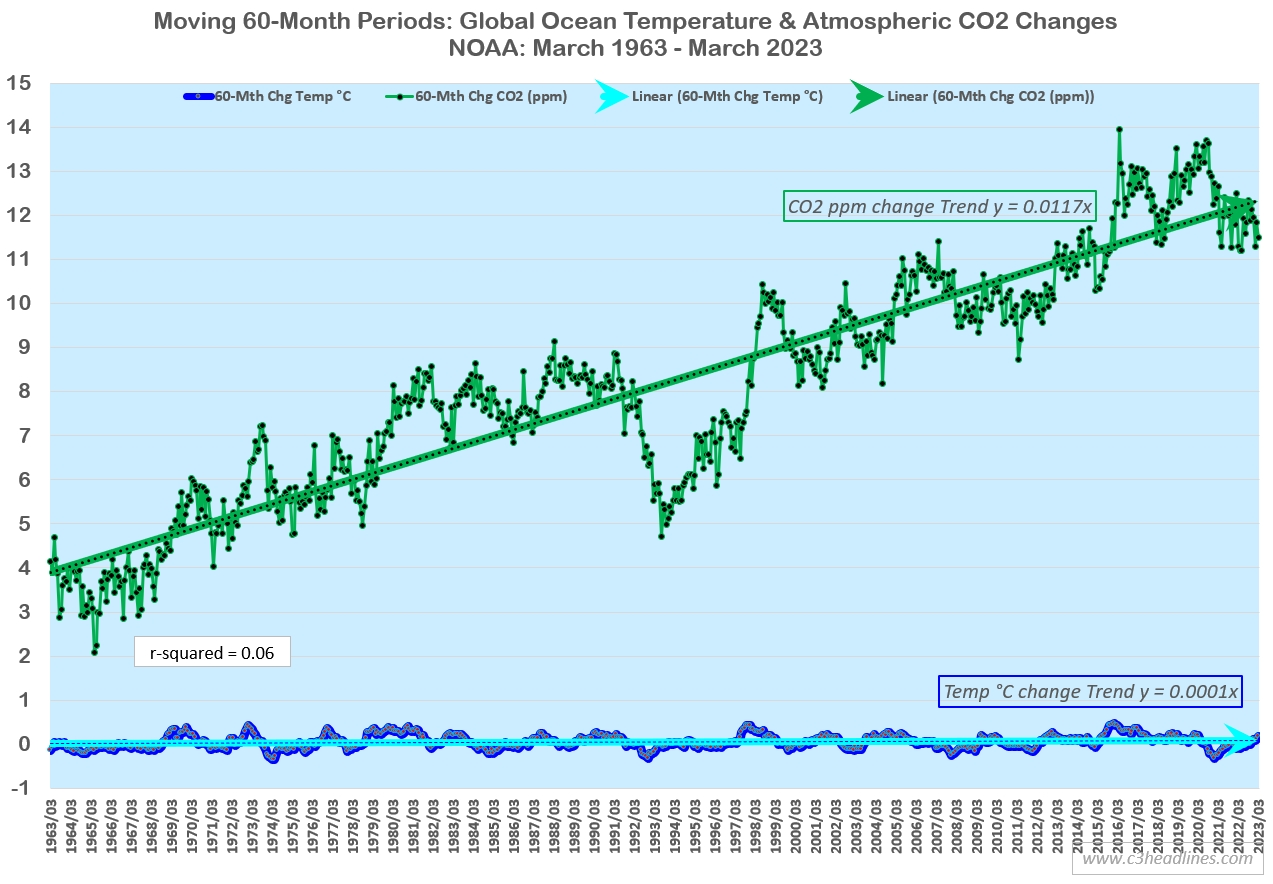
Quite the contrary, combined oceans exhibit a regular pattern of temperature decreases and increases, as the adjacent plot of NOAA’s monthly ocean data indicates.

Specifically, this is a plot (dark blue) of moving 5-year temperature changes ending each month of the 60-year period from March 1963 through March 2023.

[Explanation: the first data point is the temperature change for the 60 months ending on March 30, 1963; and the chart’s last temperature change data point is for the five 5 years (i.e. 60 months) ending on March 2023.]

The chart also includes a plot (green) of the moving 60-month CO2 level changes over the same sixty year period, plus a linear trend for both CO2 changes and ocean temperature changes.

The trend of the 60-month CO2 changes significantly exceeds the
slight positive trend of ocean temperature changes by a factor of 117x.

This huge differential undercuts the belief that global warming is primarily the result of GHGs. Which is confirmed by the paltry R^2 of +0.06 – an almost non-existent relationship between 5-year atmospheric CO2 changes and 5-year changes in ocean temperature.

Not only are the large increases in CO2 levels not causing a concerning uptick of temperature change magnitude, it also has not lead to any type of acceleration, per the linear trend since 1963.

Specifically, with a trend of a tiny +0.0001°C, that would project out 20 years to be an increase of 5-year temperature changes to an insignificant amount of +0.024 – definitely not an existential threat of ‘runaway warming’ or a CAGW ‘climate crisis’ as portrayed by bureaucrats, politicians and Hollywood celebrities.

So, if 5 years of increasing amounts of CO2 in the atmosphere barely influence 5-year changes in temperature over a 60-year span, either in magnitude or acceleration rate, then it is highly unlikely that this trace gas would cause a catastrophic climate disaster or an extinction event.

Thus, it is fair to state that for all those scientists pushing a narrative of an imminent climate change catastrophe from CO2 without the requisite empirical evidence, this has become the real climate science crisis facing society.

Notes: Temperature and CO2 data sources.Excel used to calculate 60-mth (5-yr) temperature and CO2 changes; used to calculate the respective trends; used to calculate correlation and r-squared; used to plot the chart.

Away With Self-Fullfilling Climate Prophecy

Edward Ring explains the importance of dispelling CO2 hysteria in his American Greatness article Challenging the Premise of Our Destruction.  Excerpts in italics with my bolds and added images.

Claiming that anthropogenic CO2 will not cause catastrophic climate change is a
credible, necessary point of view backed up by scientific evidence.

The most powerful and destructive perception in the world today is that using fossil fuels will cause catastrophic climate change. This belief, marketed by every major government and corporate institution in the Western world, is the foundational premise underlying a policy agenda of stunning indifference to the aspirations of ordinary people.

The war on fossil fuel is a war on freedom, prosperity, pluralism, independence, national sovereignty, world peace, domestic tranquility, and, most ironically, the environment itself. It is a war of rich against poor, the privileged against the disadvantaged, corporate monopolies against competitive upstarts, Malthusians against optimists, regulators against innovators, and authoritarians against freedom-loving people everywhere.

But this war cannot be won unless the perception is maintained. If fossil fuel is allowed to compete against other energy alternatives for customers as a vital and growing part of an all-of-the-above energy strategy, this authoritarian political agenda falls apart.

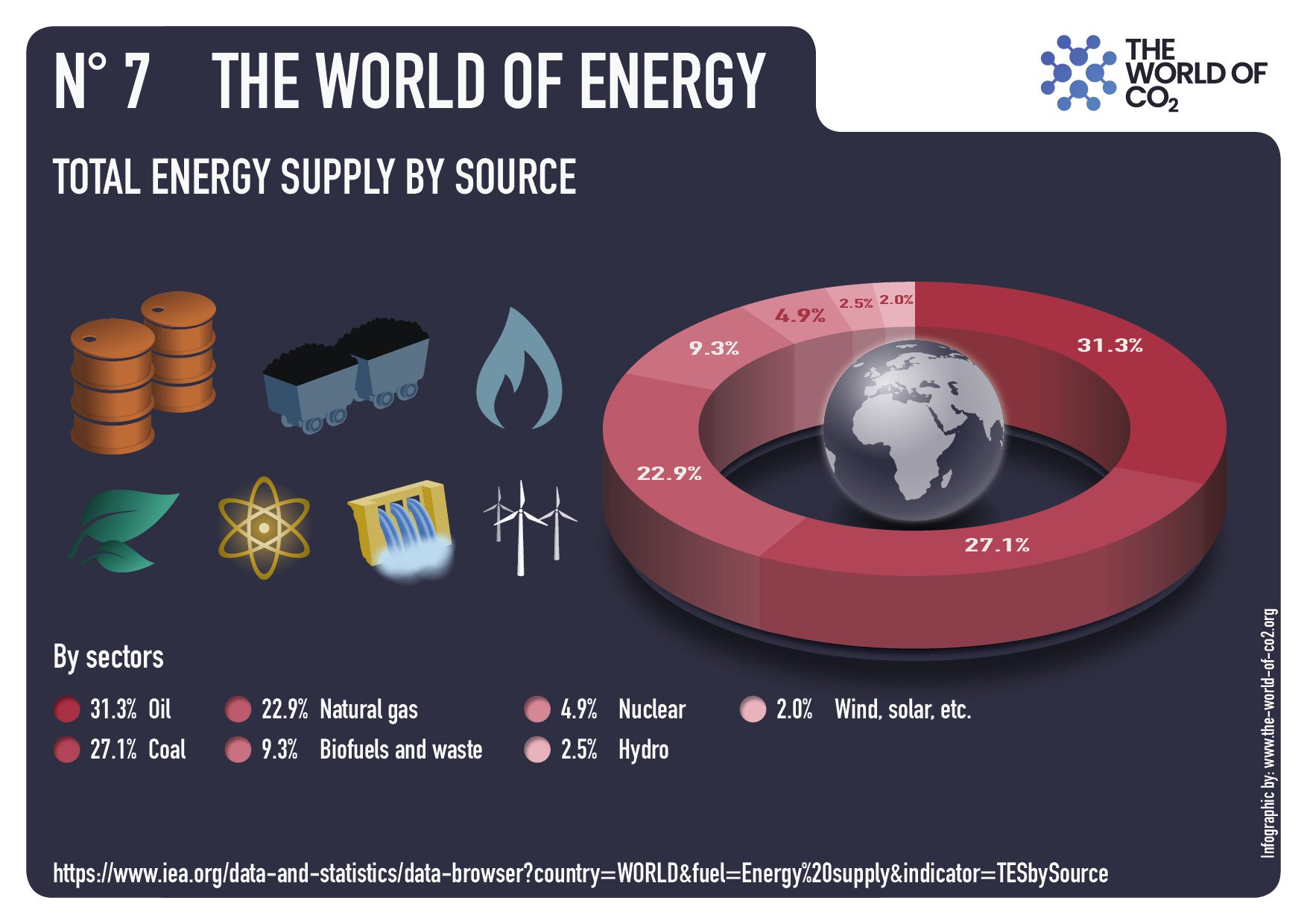
It is reasonable to question the assertion that eliminating fossil fuels will inevitably result in an impoverished society subject to punitive restrictions on individual behavior. But the numbers are compelling and can be distilled to two indisputable facts: First, fossil fuel continues to provide over 80 percent of all energy consumed worldwide. Second, if every person living on planet Earth were to consume half as much energy per year as the average American currently consumes, global energy production would need to double.

Several inescapable conclusions derive from these two facts, if one assumes that energy is the driver of prosperity. Just in case that is not obvious, imagine Americans living with half as much energy as they use today. Where would the cuts occur? Would they drive their cars half as much? Heat their homes half as much? Operate manufacturing, farming, and mining equipment half as much? They would need to do all those things and more. The economy would collapse.

These consequences don’t escape the intelligentsia who promote “net zero” policies. These consequences explain the policies they advocate. The recent promotion of “15-minute cities” that will inform rezoning and redevelopment to put all essential services within a 15-minute walk of every residence. The rise of “congestion pricing” to charge automobiles special tolls if they drive into an expanding footprint of urban neighborhoods. “Smart growth.” “Infill.” “Urban Service Boundaries.” Bike lanes. “Smart buildings,” “smart meters,” and “smart cities.”

These innovations, all in progress, only begin to describe what is coming.

By restricting new development and systematically reducing the use of fossil fuels, the global middle class will shrink instead of grow. The wealthiest elites will buy their way out of the smart slums. Everyone else will be locked down. This is how energy poverty will play out in the modern era. It cannot be emphasized enough: If energy production is restricted, this will happen. It’s algebra. It is objective fact.

Hardly less speculative is the reaction outside the Western world. What are our elites thinking? Do they intend to start World War III? Perhaps they do. Because nothing short of war is going to stop the Chinese, Indians, Indonesians, Pakistanis, Brazilians, Nigerians, or Bangladeshis from developing every source of energy they possibly can. Just those seven nations account for half the world’s population. That’s 4 billion people. Will they stop developing energy until they at least achieve half the per capita energy consumption that Americans currently enjoy? Not a chance.

Will they get there by relying exclusively on wind and solar? Dream on.

Fossil Fuel Will Not Cause a Climate Catastrophe

If you only believe half of the preceding arguments, you must realize that Americans have been backed into a corner. If anyone calls for abundant energy—or abundant anything, since energy, and fossil fuel in particular, is the prerequisite for virtually all goods and services—they are shouted down as “climate deniers.” And the way to upset the entire edifice is not to merely argue that fossil fuel is essential to the survival of civilization. Because the counterargument is that eliminating fossil fuel is essential to the survival of the planet.

That is an unwinnable argument. It is not possible to reason with an opponent of fossil fuel if you concede their fundamental premise: that burning fossil fuel will cause catastrophic climate change. You either become a “denier,” or you submit to energy poverty.

This is the tough decision facing Americans.

And it’s accurate to also say it is a decision facing Republicans since literally every prominent, mainstream, housebroken, accommodating establishment Republican will not challenge the assertion that we’re experiencing a “climate crisis,” even though most of them know better. But this should be a bipartisan issue. For Republicans, this is an opportunity to show some backbone by rejecting the most destructive and fraudulent premise of our time. In so doing, they would unify their party, attract independent voters, and realign the nation.

The irony is stupefying. Without fossil fuel, America will enter a dark age, and the only way to control a restive population that’s seen its standard of living plummet will be through the establishment of a technology-driven police state. They are the fascists. The so-called climate deniers are fighting for prosperity and freedom.

If you want to save civilization, be a denier.

Say it loud and without reservations, and say it every chance you get. Demand that politicians publicly refute climate alarmism. It isn’t necessary to claim that the powers behind the climate cult want to enslave the world. We don’t know what motivates them. Some just want to get rich on renewables. Some want to use climate change to advance American global hegemony. But all of them rely on a fundamental moral justification: By eliminating fossil fuel, we are saving the planet from certain destruction. Focusing on the possible ulterior motives of climate alarmist leaders without first challenging their core moral argument is a fool’s errand.

There are plenty of environmental challenges. Being an environmentalist is a good thing. But there has to be balance, and there has to be debate. Claiming that anthropogenic CO2 will not cause catastrophic climate change is a credible, necessary point of view backed up by scientific evidence. If more people make that claim, the climate cult can be broken, and civilization can be rescued from oblivion.

See Also A Rational Climate Policy


1875 was coldest in 10,000 years, Warming A Good Thing

Jørgen Peder Steffensen, of Denmark’s Niels Bohr Institute, is one of the most experienced experts in ice core analysis, in both Greenland and Antarctica. In this video he explains a coincidence that has misled those alarmed about the warming recovery since the Little Ice Age.  And if you skip to 2:25, you will see the huge error we have made and the assumptions and extrapolations based on that error.  Transcript below is from closed captions with my bolds and added images. H/T Raymond

What do ice cores tell us about the history of climate change and the present trend? 

This ice is from the Viking age around the year one thousand, also called the medieval warm period. We believe that in Greenland the Medieval Warm Period was about one and a half degrees warmer on average than today

NorthGRIP the Greenland ice core project is being reopened to drill the last few meters through the ice sheet to the rock beneath the research station. The ice core over three kilometers in length has been hauled up to the surface piece by piece, and contains important data on the history of the climate of the earth. It bears the fingerprints of climatic conditions over more than 120 thousand years.

When we remove a drilled ice core we leave a hole, and we insert a thermometer in the hole. We are able to map out the temperature through the three kilometer ice sheet. Now that temperature, if we do it precisely enough with a thousandth of a degree accuracy, then the ice has not forgotten how cold or warm it was on the surface at the time the snow fell.

So using those temperatures we have been able to reconstruct the temperatures of the last ten thousand years. Here we have our picture of the temperature reconstructions that we have from Greenland in the graphical form. And if we go back along this axis it’s going back in time. This is the last 8 000 years we have plotted here. On this axis we have the temperatures at the site in Greenland, and we can see that if we go back from now about 4000 years ago, we would have temperatures up here for about 4 000 years in the past that on average were two and a half degrees warmer than today.

Reconstructed temperatures for Greenland ice cores Dye3 and GRIP. (A) The temperature from 8000 BP to present; (B) the temperature from AD 0-2000 (after Dahl-Jensen et al., 1998). The observed difference in amplitude between the two cores is a result of their different geographic location in relation to the variability in atmospheric circulation. Source: Reconstructed-temperatures-for-Greenland-ice-cores-Dye3-and-GRIP-A

Now as we go forward to approach our time, we can see that in the period after four thousand years ago and up to the two thousand years ago (which is actually the Roman Age) the temperatures have been decreasing in Greenland by two and a half degrees. Then temperatures increased gradually up to a maximum point around a thousand years ago, we call it the Medieval Warm Period. And then temperatures declined and go down to minimum around 1650 a.d., before coming back up a little in the 18th century.

And then around 1875 we have right here the lowest point in the last 10,000 years.
And that matches exactly the time when meteorological observations started
.

Other core samples from elsewhere in Greenland confirmed that the little ice age ended about 140 years ago at the coldest point in the last 10,000 years. The natural pronounced alteration of warm and cold periods back in time has also been confirmed elsewhere in the northern hemisphere. Carbon 14 dating of organic matter from peat bogs and tree rings confirms the pattern. Also the data from stalactite caves in China and measurements from North Africa.

The problem is that we can all agree completely that we have had a global temperature increase in the 20th century. Yes, but an increase from what? It was probably an increase from the lowest point we’ve had for the last 10,000 years. And this means it will be very hard indeed to prove whether the increase of temperature in the 20th century was man-made or it’s a natural variation. That would be very hard because we made ourselves an extremely poor experiment when we started to observe meteorology at the coldest time in the last ten thousand years.

Dr. Syun Akasofu 2009 diagram from his paper Two Natural Components of Recent Warming.


Greta Thunberg, PhD Theology

It’s not a report from Babylon Bee, or an April first joke.  It’s an upcoming ceremony at University of Helsinki. At least they get the field of knowledge right, no one outdoes her as a true believer, despite being a school dropout. From Daily Caller Greta Thunberg To Receive Honorary Doctorate Degree In Theology From University Of Helsinki.  Excerpts in italics with my bolds and added images.

Swedish climate activist Greta Thunberg will receive an honorary doctorate degree in theology from the University of Helsinki in Finland on June 9, the school announced in a press release.

Thirty “distinguished individuals” from around the world will be awarded the university’s “highest recognition,” according to a March 20 press release. The Faculty of Philosophy, the Faculty of Veterinary Medicine, the Faculty of Theology and the Faculty of Law will all give out honorary doctorates. Thunberg is the only individual listed as an “activist” who is receiving a degree, the announcement shows.

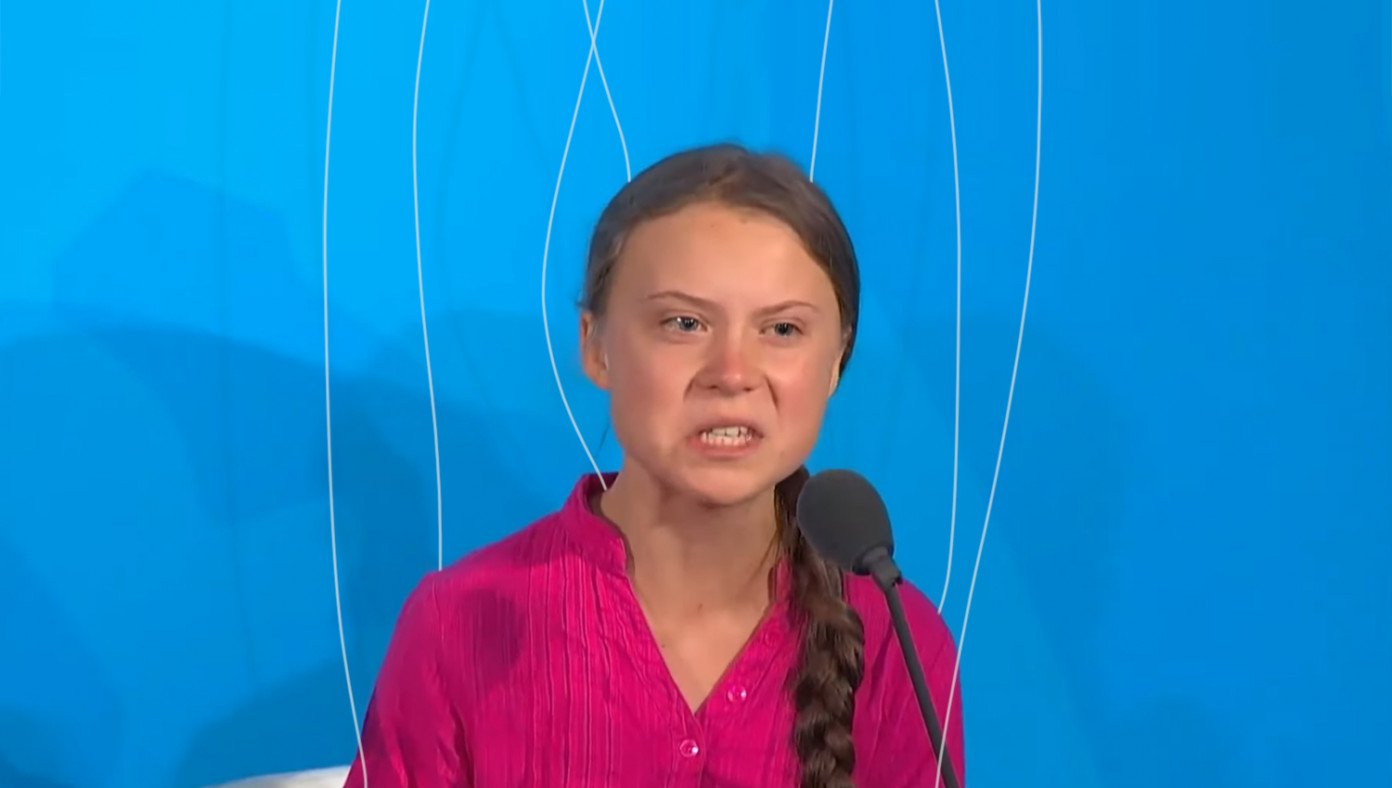
Thunberg, 20, gained popularity in 2018 when she refused to attend class until the Swedish general elections took place due to her concerns about climate change. She made international headlines again when she spoke at the United Nations in 2019, accusing politicians of stealing her childhood. Most recently, Thunberg came under scrutiny for deleting a years-old Tweet citing a claim that humans would go extinct if fossil fuels were still being used by 2023. [ So much for her prophetic credentials.]

Thunberg previously received an honorary doctorate law degree in 2021 from the University of British Columbia. [Yikes! A Preacher and a Lawyer.]

The University of Helsinki did not immediately respond to the Daily Caller’s request for comment.

Footnote:  Climate Religion

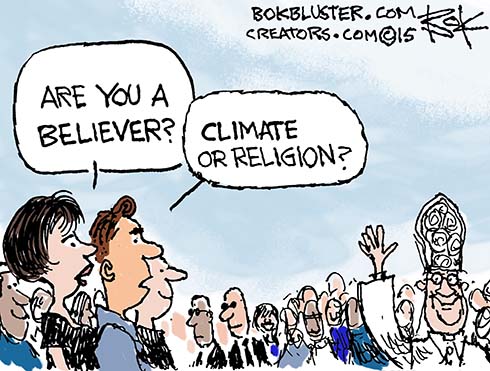
It should be clear that when climate alarmists appeal to saving the planet for future generations, they are applying contextual ethics. Less obvious is the ancient religious notion that by making sacrifices, we humans can assure more favorable weather. These days, fossil fuels have become the sacrificial lamb required by Mother Nature to play nice with human beings. In the past, people made images and worshiped them, thinking that they could control nature in that way. These days, we make computer models whose projections are sure to scare the bejesus out of us.

How to Break the Climate Spell

Getty Images

Mark Imisides advises climate skeptics to reconsider how to dispute claims from climate believers in his Spectator Australia article Changing climate change: debunking the global colossus.  Excerpts in italics with my bolds and added images.

How is it that despite the scientific case for a climate apocalypse comprehensively collapsing some 20 years ago, we have seen a 16-year-old girl (at the time) being invited to address the United Nations, weeping children marching in our streets, and a federal election outcome in which this issue dominated the political landscape?

Where did we go wrong? And by ‘we’ I’m referring to those of us termed sceptics – people who understand the science, and the house of cards that comprises the notion of Anthropogenic Climate Change.

Put simply, we must learn the art of the polemic. The art of rhetoric. We must recognise that there’s no point in having evidence on our side if we don’t know how to use it.

We begin with this proposition. There is no case for reducing our carbon footprint unless all four of these statements are true:

  1. The world is warming.
  2. We are causing it.
  3. It’s a bad thing.
  4. We can do something about it.

No rational person can have any problem with this, and if they do, we need to find out why.

Here’s where we have to decide which of these points we want to contest. Remember, you only have to falsify one of them for the whole thing to collapse like a house of cards.

Most sceptics, in my view, pick the wrong fight. They do this by attempting to prosecute the case based on one of the first two points. This is a mistake.

Here’s why.

Arguments about whether the world is warming revolve around competing graphs: ‘My graph shows it’s warming. If your graph shows it isn’t, then it’s wrong – no it isn’t – yes it is – no it isn’t…’  This argument also looks at Urban Heat Island Effects, and examines manipulation of data by government agencies.  This is a poor approach to take because:

  • You’re never going to prove your graph is right.
  • You can be very easily and quickly discredited as a conspiracy theorist (Brian Cox did this to Malcolm Roberts on Q&A a few years ago). People just do not believe that government agencies would manipulate data.
  • We should not fear a warming world. Records began at the end of the last ice age, so it’s only natural that the world is warming. And the current temperatures are well within historical averages.

Source: Syun-Ichi Akasofu, Two Natural Components of the Recent Climate Change: (1) The Recovery from the Little Ice Age (A Possible Cause of Global Warming) and (2) The Multi-decadal Oscillation (The Recent Halting of the Warming):

As for arguments about whether we are causing the warming, this is even more problematic. The various contributions to global temperatures are extremely complex, involving a deep understanding of atmospheric physics and thermodynamics. With a PhD in Chemistry, this is much closer to my area of expertise than Joe Public, but I am very quickly out of my depth. I recognise most of the terms and concepts involved, but know just enough to know how little I know.

Sadly, many people on both sides of the debate don’t understand how little they know, nor how complex the subject of atmospheric physics is, and it is nothing short of comical seeing two people debating about a subject of which both of them are blissfully ignorant.

The bottom line is this – they simply don’t change anyone’s minds – ever.

Having seen these arguments used for years, and having used them myself, I cannot point to a single person that has said, ‘Oh yes! I see it now…’ The whole point of arguing, or debating, is to change someone’s mind (including, at times, your own). If that isn’t happening, then it’s futile to continue with the same approach.

I think the reason both these approaches fail that most people do not believe that all these experts, and the government, can be wrong. You say the world isn’t warming? Oh, I’m sure you have the wrong graph. You say that CO2 is not responsible? Oh, I’m sure the government scientists know more than you do.

This then brings us to the third point. Why is a warmer world a bad thing?

This is even more tempting than the first two points, as it’s so easy to prove that a warming world, so far from being a crisis, is actually a good thing. The reason for this is that, unlike with the first two points, they don’t have to look at a complex scientific argument. They just have to look at the weather. Are cyclones and hurricanes increasing? Are droughts increasing? Are flooding events increasing?

Regretfully, it is impossible to get people to even look at this. Even worse, they seem oblivious to the simple concept of cause and effect. We see this in that they simply can’t see that droughts and floods are opposites, and the same cause cannot produce exactly opposite effects. Astonishingly, they somehow think that charts that plot these extreme events are somehow manipulated, even when they come from a primary source such as the BOM, and that there really is a ‘climate crisis’.

Where does that leave us? Well, before we adopt Catweazle’s mantra of ‘nothing works’, there is one more point – point 4 (can we do anything about it?).

Most people will have seen the address of Konstantin Kisin at an Oxford Union debate, where he prosecuted this case to great effect. He pointed out, in simple terms, that as the UK only contributes 2 per cent to the global CO2 budget, anything they did will have negligible effect, and that global CO2 levels will be determined by people in Africa and Asia. He then pointed out that people in these countries ‘didn’t give a sh*t’ about climate change, as all they want to do is feed and clothe their children, and they don’t care how much CO2 that produces.

Finally, he pointed out that Xi Jinping knows that the way to ensure that he isn’t rolled in a revolution, as happened to so many other leaders in former communist regimes, is to ensure prosperity for the Chinese people. And indispensable to that goal is cheap, reliable, power, which is the reason that China is now building lots more coal-fired power plants – in 2021 alone they built 25 GW of capacity – equivalent to 25 x 1000MW plants.

By all accounts, his speech was well-received, with many people turning to his side. The beauty of prosecuting this case, as opposed to the other three, is that people don’t have to look at any evidence. They don’t even have to look at the weather.

The argument is at the same time simple, compelling, and irresistible. The question is this: will we see a major political party with the courage to take it on?

That part remains to be seen. But what is certain is this – the definition of insanity is doing the same thing and expecting different outcomes. If, for twenty years we’ve been telling people either that the world isn’t warming, or if it is we aren’t causing it, or if it is warmer but there’s no climate crisis, and not a single person has been persuaded by our arguments, then we have the brains of a tomato if we think anything is going to change.

Konstantin Kisin’s talk, and in particular the way it was received, fill me with hope that I haven’t had in years. It fills me with hope that if the case is prosecuted wisely, the climate change colossus can be brought to a grinding halt, politicians will unashamedly take on energy security as a political mantra, and the notion of climate change will at last be exposed as the unscientific, anti-human, regressive, apocalyptic cult that it is.