Judges Now Deciding US Energy Policy

Petroleum Engineer or Federal Judge?

A previous post World Energy Policies A Minefield  reported on mistaken climate policies and their threat to our energy system.  Adding to the danger are actions by courts meddling in energy affairs on behalf of anti-fossil fuel activists.  Nicholas Kusnetz writes at alarmist website Inside Climate News U.S. Suspends More Oil and Gas Leases Over What Could Be a Widespread Problem. Excerpts in italics with my bolds.

Fossil Fuel leases totaling hundreds of thousands of acres have been suspended as courts rule against the BLM for ignoring climate impact. 

The federal Bureau of Land Management’s (BLM) Utah office in September voluntarily suspended 130 oil and gas leases after advocacy groups sued, arguing that BLM hadn’t adequately assessed the greenhouse gas emissions associated with drilling and extraction on those leases as required by law.

Nearly a quarter of the nation’s carbon dioxide emissions come from fossil fuels developed on federal lands, according to a government report. Credit: Bureau of Land Management.

The move was unusual because BLM suspended the leases on its own, without waiting for a court to rule.

Some environmental advocates say it could indicate a larger problem for the bureau.

“It is potentially a BLM-wide issue,” said Jayni Hein, natural resources director at the Institute for Policy Integrity at NYU School of Law, which has been involved in similar litigation in other states. “It could have the effect of suspending even more leases across the West, and not just for oil and gas, for coal as well.”

Officials in Utah had already pulled back several other lease sales earlier this year. In effect, BLM appears to be trying to get ahead of potential court rulings, advocates say.

A series of court rulings have established that BLM must conduct a thorough analysis of the climate impacts of drilling before it allows development in order to comply with the National Environmental Policy Act (NEPA).

In the latest ruling, a federal district court in Washington, D.C., in March ordered the bureau to redo its environmental analysis for a slate of leases in Wyoming to better assess climate impacts. In response, BLM suspended the Wyoming leases, as well as leases in Utah and Colorado that were included in the lawsuit but not directly addressed by the ruling.

The new Utah suspensions cover a different set of leases, including many sold last year. In letters sent in September to energy companies that had bought the leases, BLM said it was suspending them “based on the parallels” between the lawsuit over them and the case that resulted in the March ruling in Washington, D.C.

All told, nearly 1 million acres may now be suspended across the West, said Rebecca Fischer, an attorney with WildEarth Guardians, which filed the lawsuit in the Washington, D.C., circuit, including more than 460,000 acres covered by that lawsuit and some 300,000 acres that Utah’s BLM office has suspended since the March ruling.

Environmental advocates say the Trump administration is unlikely to cancel the leases. In Wyoming, BLM issued a new analysis soon after the Washington, D.C., court’s decision in March, arguing that there were no significant climate impacts. Fischer’s group has challenged that new assessment, saying that it too fails to meet the legal requirements. The court has yet to rule on the latest challenge.

Fischer said the lawsuits are part of a larger strategy by advocacy groups to try to block fossil fuel development that they say is incompatible with the need to rapidly cut greenhouse gas emissions to slow climate change. They say the bureau has the authority to deny leases based on their climate impacts, and those climate impacts would become apparent if it conducted a thorough analysis.

“That is our ultimate goal,” she said. “That we can start to keep these oil and gas leases in the ground and start to transition away from dirty fossil fuels.”

FootnoteAttorney General William Barr addressed the intrusion of judges upon Presidential authority as part of his recent speech on the Constitution’s approach to executive power. (here). Some pertinent excerpts in italics with my bolds.

In recent years, both the Legislative and Judicial branches have been responsible for encroaching on the Presidency’s constitutional authority. . .Let me turn now to what I believe has been the prime source of the erosion of separation-of-power principles generally, and Executive Branch authority specifically. I am speaking of the Judicial Branch. checks-and-balances

Apart from their overzealous role in interbranch disputes, the courts have increasingly engaged directly in usurping Presidential decision-making authority for themselves. One way courts have effectively done this is by expanding both the scope and the intensity of judicial review.

In recent years, we have lost sight of the fact that many critical decisions in life are not amenable to the model of judicial decision-making. They cannot be reduced to tidy evidentiary standards and specific quantums of proof in an adversarial process. They require what we used to call prudential judgment. They are decisions that frequently have to be made promptly, on incomplete and uncertain information and necessarily involve weighing a wide range of competing risks and making predictions about the future. Such decisions frequently call into play the “precautionary principle.” This is the principle that when a decision maker is accountable for discharging a certain obligation – such as protecting the public’s safety – it is better, when assessing imperfect information, to be wrong and safe, than wrong and sorry.

It was once well recognized that such matters were largely unreviewable and that the courts should not be substituting their judgments for the prudential judgments reached by the accountable Executive officials. This outlook now seems to have gone by the boards. Courts are now willing, under the banner of judicial review, to substitute their judgment for the President’s on matters that only a few decades ago would have been unimaginable – such as matters involving national security or foreign affairs.

What is true of police officers and gerrymanderers is equally true of the President and senior Executive officials. With very few exceptions, neither the Constitution, nor the Administrative Procedure Act or any other relevant statute, calls for judicial review of executive motive. They apply only to executive action. Attempts by courts to act like amateur psychiatrists attempting to discern an Executive official’s “real motive” — often after ordering invasive discovery into the Executive Branch’s privileged decision-making process — have no more foundation in the law than a subpoena to a court to try to determine a judge’s real motive for issuing its decision. And courts’ indulgence of such claims, even if they are ultimately rejected, represents a serious intrusion on the President’s constitutional prerogatives.

The impact of these judicial intrusions on Executive responsibility have been hugely magnified by another judicial innovation – the nationwide injunction. First used in 1963, and sparely since then until recently, these court orders enjoin enforcement of a policy not just against the parties to a case, but against everyone. Since President Trump took office, district courts have issued over 40 nationwide injunctions against the government. By comparison, during President Obama’s first two years, district courts issued a total of two nationwide injunctions against the government. Both were vacated by the Ninth Circuit.

IT is no exaggeration to say that virtually every major policy of the Trump Administration has been subjected to immediate freezing by the lower courts. No other President has been subjected to such sustained efforts to debilitate his policy agenda.

New York AG’s Disgraceful Exxon Trial

The New York Post Editorial Board reviews the New York Attorney General’s blundering performance before the Judge in their investor fraud case against Exxon.  Their article is New York AG’s office totally disgraced itself in the Exxon trial.  Excerpts in italics with my bolds.

Closing arguments finished up Thursday in the People of New York v. ExxonMobil — a trial that has utterly disgraced the people’s representatives, prosecutors from the state Attorney General’s Office.

Time and again, state Supreme Court Justice Judge Barry Ostrager chided the prosecution — for being unprepared, for indulging in “agonizing, repetitious questioning about documents that are not being disputed”; for pretending a witness was an expert when she wasn’t; for presenting an expert (paid $1,050 an hour) who wouldn’t stop “rambling” and more.

At one point, he snapped: “OK, that’s the fifth time that he has given you the same answer.” At another, he all but accused the state of manipulating Exxon’s stock price on the basis of false information — in a trial where the state was trying to show that Exxon was doing that.

In a final bit of self-disgrace, late Thursday the prosecutors dropped two of their three main charges — the ones that required proving intent.

All that’s left is a charge under the Martin Act, which allows for criminal guilt for an accidental misrepresentation that might mislead the public. But the state failed to even produce any clear evidence that Exxon ever misled the public in any respect, even inadvertently.

That’s a huge comedown for a prosecution that opened under the banner “#ExxonKnew.”

To be clear, the main blame for this debacle falls on disgraced former AG Eric Schneiderman, who started the whole thing as an exercise in headline-hunting back in 2015. He handed off the actual work to subordinates who repeatedly revised the entire theory of the case — that is, the wrong they claimed Exxon had committed — with the charges growing less explosive every time.

They originally claimed Exxon had suppressed research — when in fact its scientists have always published freely, and the company has openly discussed the risks of climate change and so on in its annual reports and on its website.

Then they suggested the company had deceived investors by “overstating” its assets by “trillions.” But it turned out Exxon had clearly disclosed all the relevant info.

Finally, they claimed it used one risk-assessment standard in public, another in private. But the Securities and Exchange Commission cleared Exxon on that front before this trial even opened.

It seems the prosecutors feared it would just be too humiliating to admit they had nothing, and hoped they’d somehow stumble on . . . something.

Still, Thursday’s final retreat, dropping most charges at the very end, was a shocker. It left the judge dismissing those charges “with prejudice,” so the state can never refile them. And Exxon’s infuriated lawyers say those claims “have cost in many respects the most severe reputation harm to the company and to the executives,” so they want still stronger sanctions.

Judge Ostrager has 30 days to issue a decision. The prosecutors are surely praying he’ll find the Martin Act gives them so much leeway that he actually has to find Exxon guilty. If so, it’ll be a blaring alarm to businesses to have nothing to do with New York, because they have no hope of a fair break here.

Otherwise, the judge should explore every possible option for censuring the state’s attorneys — whose abuse of power here has been utterly mind-blowing.

Background from Previous Post

A legal summary of this week’s proceedings comes from Seth Kerschner Laura Mulry article at White & Case
Trial Concludes for Exxon in New York Climate Change Investor Fraud Case. Excerpts in italics with my bolds.

Overview

In New York Supreme Court, Exxon was on trial for allegedly misleading investors about the business costs of climate change. The central allegation was that Exxon fraudulently used two distinct sets of metrics to calculate financial risks relating to climate change: one that was shared with investors and another that was used internally. New York State alleged that the practice exposed investors to greater risks than Exxon had disclosed and inflated the company’s value. Exxon maintained that it made accurate disclosures about the two cost metrics to investors, that the state was conflating the two metrics, and that there was no material impact to Exxon regardless of which metric it applies. The state is seeking between $476 million and $1.6 billion as the basis for a shareholder restitution fund, among other relief. The outcome of the case could have significant implications going forward on (i) how companies disclose and internally account for climate change risks and (ii) the outcomes of future climate change litigation.

(Left) New York Attorney General Barbara Underwood announced her office’s lawsuit against Exxon for climate fraud. October 24, 2018. (Right) Attorney General of New York, Letitia James took over January 6, 2019 and has also opened a civil investigation into President Donald Trump’s business dealings.

The bench trial commenced on October 22, 2019 and was the first lawsuit to go to trial in the United States that addresses how companies manage and disclose climate change-related risks. The New York Attorney General (NYAG) filed the civil lawsuit against Exxon Mobil Corporation (Exxon) in October 2018; it was the culmination of an investigation by NYAG that began in 2015. NYAG alleged statutory and common law securities fraud claims, however, in its closing remarks on November 7, 2019, NYAG dropped two of the four fraud claims. NYAG’s remaining claims include alleged violations of the state’s Martin Act, one of the strictest anti-fraud laws in the country that does not require an intent to defraud or knowledge of fraud for there to be a violation of the law, and a persistent fraud claim. NYAG requests injunctive relief, damages, disgorgement of all amounts gained as a result of the alleged fraud, and restitution.

NYAG asserted that Exxon engaged in a “longstanding fraudulent scheme” to deceive investors by providing misleading statements that (i) Exxon was effectively managing risks posed by regulations to address climate change, such as carbon taxes, and (ii) such regulations did not pose a significant risk to the company. NYAG asserted that Exxon’s internal practices were inconsistent with these statements, were undisclosed to investors, and exposed the company to greater risk from climate change regulation than investors were led to believe.

According to the NYAG complaint, Exxon used internal climate change cost projections that differed from publicly-disclosed projections and are in alleged violation of US Generally Accepted Accounting Principles. Exxon claimed NYAG is trying to show a false discrepancy by conflating two cost projections that serve different purposes. NYAG claimed that Exxon provided misleading statements to investors in reports that Exxon drafted in response to shareholder proposals and resolutions requesting information about climate change-related risks, its 2015 Corporate Citizen Report, and in its 2014 and 2016 proxy statements, among other public documents. NYAG asserted that Exxon’s alleged climate cost misrepresentations are material to the company’s investors, who include public pension funds in New York and around the United States that hold billions of dollars of Exxon stock.

To account for the impact of future climate change regulations, Exxon stated that it “rigorously and consistently” applied an escalating proxy cost of carbon dioxide and other greenhouse gases (together, GHGs) to its business, according to NYAG’s complaint. NYAG claimed, however, that Exxon’s GHG proxy cost representations were materially false and misleading because Exxon did not in fact apply the GHG proxy cost it represented to investors in its business decisions. NYAG claimed that, in projecting its future costs for purposes of making investment decisions, conducting business planning, and assessing oil and gas reserves, Exxon applied either (i) an undisclosed, lower set of GHG proxy costs in its internal corporate guidance, (ii) an even-lower cost based on existing climate regulations that held flat for decades into the future or (iii) no GHG-related costs at all. Exxon maintained that it made accurate disclosures about the two cost metrics to investors and claimed that NYAG is manipulating the content of such disclosures to make it appear as though Exxon misled the public.

The linchpin of the case may rest on whether Exxon conflated two distinct climate change cost projections. Exxon’s publicly-disclosed GHG proxy cost assumed carbon costs would be significantly higher than the internal GHG cost estimate. Exxon did not dispute that it used two distinct projections for the future impacts of climate regulations and argued that each had a legitimate business purpose: the publicly-disclosed GHG proxy cost was used to project global energy demand (and future prices) and the GHG cost was a proprietary internal number used to evaluate investment opportunities. Exxon representatives, including former Chairman and CEO Rex Tillerson, testified that Exxon’s publicly-disclosed GHG proxy cost represented a “macro level” assessment of climate change mitigation policies that Exxon expects to see adopted around the world, from fuel efficiency standards in the United States to carbon taxes in Europe, and was used in a data guide used by the company. Exxon’s position is that the different, lower GHG costs that Exxon used internally represented “micro level” direct costs and capital projects at specific Exxon facilities and were informed by a more limited set of regulations applicable to specific projects. Exxon has contended in court that the publicly-disclosed GHG proxy cost, which is a purported demand-side estimate of how future regulations, like a carbon tax, would depress global demand for oil, is only one part of its climate cost calculations. NYAG argued that Exxon obfuscated differences in the two accounting projections and a reasonable investor had every reason to believe that Exxon was using the two sets of costs interchangeably.

Exxon maintains that there was and would be no impact on its value or finances, including corporate earnings, regardless of whether it applied a higher or lower GHG cost estimate. Exxon asserted that NYAG failed to identify a specific oil or gas project investment decision that would have been swayed by applying the higher GHG proxy cost and that the practice of having two distinct cost metrics had no impact on how investors assessed the company.

Richard Auter, the head of the Exxon audit team at PricewaterhouseCoopers (PwC), testified that (i) he was not aware of any attempt by Exxon to conceal or manipulate the two cost metrics and (ii) GHG proxy costs do not have a material impact on Exxon’s financial health. Mr. Auter stated that the publicly-disclosed GHG proxy costs “were part of management’s planning and budgeting process, but they do not reflect real costs in many situations.”

NYAG claimed that Exxon’s failure to employ the publicly-disclosed GHG proxy costs was most prevalent in its projections for investments with high GHG emissions. Applying the publicly-disclosed GHG proxy costs to these investments would have had a particularly significant negative impact on the company’s economic and financial projections and assessments, according to NYAG. NYAG alleged that using the lower cost estimate for future GHG costs made projects with high GHG emissions look more attractive than those projects would have looked if the higher GHG proxy cost were applied. NYAG stated that Exxon chose not to use the higher, publicly-disclosed GHG proxy costs in connection with 14 oil sands projects in Canada, which allegedly resulted in understating costs in the company’s cash flow projections by more than $25 billion. Bitumen from oil sands is harder to extract and then must be upgraded into synthetic crudes, so the extraction process from oil sands projects typically emits higher GHG emissions than other oil and gas upstream operations. NYAG claimed that, while corporate estimates projected GHG prices continuing to rise up to $80 per ton in 2040, Exxon planners in Canada applied a cost estimate that held flat at $24 per ton through to the end of the assets’ projected life (decades into the future) and didn’t apply to all of the assets’ GHG emissions.

Throughout the three-year probe and trial, NYAG claimed that Exxon senior management sanctioned the alleged fraudulent conduct, including Mr. Tillerson. NYAG stated that Mr. Tillerson knew for years that the company’s GHG proxy cost representations were misleading, but allowed the gap between the two cost metrics to persist. NYAG alleged that, in May 2014, Exxon’s corporate greenhouse gas manager gave a presentation to the company’s senior management, including Mr. Tillerson, that warned that the way the company had been accounting for climate risks was misleading and recommended aligning the cost metrics in evaluating investments. NYAG asserted that, after Exxon revised its internal guidance, Exxon’s planners realized that applying the increased GHG proxy cost figures would result in severe consequences to its economic and financial projections, such as “massive GHG costs” and “large write-downs” (i.e., reductions in estimated volume) of company reserves. NYAG claimed that, when confronted with the negative impacts from applying GHG proxy costs in a manner consistent with the company’s representations to investors, Exxon’s management directed the company’s planners to adopt what an Exxon employee allegedly called an “alternate methodology.” NYAG claimed that Exxon then applied only the existing GHG-related costs presently imposed by governments (i.e., legislated costs) and assumed that those existing costs would remain in effect indefinitely into the future, contrary to the company’s repeated representations to investors that it expects governments to impose increasingly stringent climate regulations in the future. By applying this “alternate methodology,” NYAG alleged that Exxon (i) avoided the significant write-downs it would have incurred had it abided by its stated risk management practices and (ii) failed to take into account significant GHG costs resulting from expected climate change regulation.

Climate Activists storm the bastion of Exxon Mobil, here seen without their shareholder disguises.

Exxon’s counsel argued that certain of NYAG’s key Exxon investor witnesses are politically-motivated and bought the company’s stock with the sole purpose to lobby the company on climate change issues. Exxon noted that one such investor, the New York City comptroller’s office, supports efforts to divest from fossil fuels.

In its closing remarks, NYAG abruptly dropped its common law fraud and equitable fraud claims. Exxon’s counsel responded that NYAG dropped the claims for strategic purposes before the judge could rule against them due to a lack of evidence and indicated that the two dropped claims caused severe reputational harm to the company and its executives, including Mr. Tillerson in particular. Exxon’s counsel stated that Exxon and its officials deserved a ruling to clear their reputations. The court dismissed the two claims with prejudice and invited Exxon’s counsel to submit post-trial briefing on whether Exxon had a right to a stipulation stating that NYAG lacked evidence to prove the dismissed fraud claims at trial.

Exxon and other energy companies are also the subject of other climate change lawsuits brought by (i) local and state governments seeking damages to help pay for the costs imposed by rising seas and extreme weather caused by climate change and (ii) children and non-profit organizations that claim that the federal and state governments are responsible for preventing and addressing the consequences of climate change. [For more information on climate change litigation see links at end.]

The Commonwealth of Massachusetts Attorney General commenced an investigation of Exxon in 2015 similar to that of NYAG’s and filed a lawsuit against Exxon on October 24, 2019 for alleged violations of Massachusetts’ investor and consumer protection laws relating to the company’s climate change-related disclosure and advertising. Exxon has fought the New York and Massachusetts investigations in courtrooms. In a New York federal court, a judge earlier this year rejected Exxon’s plea to block the dual investigations. Exxon has argued that the states’ attorneys general were violating Exxon’s First Amendment right to free speech relating to climate change. Exxon has asserted that the claims are politically-motivated, targeting energy companies to be held accountable for climate change.

The three-week bench trial in New York began on October 22, 2019 and the parties have until November 18, 2019 to file post-trial submissions. The presiding Justice Barry Ostrager has said that he will issue a ruling within 30 days after such submission deadline, with a verdict expected sometime in mid-December. NYAG requested that the court (i) enjoin Exxon from violating New York law, (ii) direct a comprehensive review of Exxon’s failure to apply a proxy cost consistent with its representations and the economic and financial consequences of that failure, (iii) award damages caused, directly or indirectly, by the fraudulent and deceptive acts, (iv) award disgorgement of all amounts obtained in connection with the alleged violations of law and all amounts by which Exxon has been unjustly enriched, (v) award restitution of all funds obtained from investors in connection with or as a result of the alleged fraudulent and deceptive acts, and (vi) award the state its costs and fees, including attorney’s fees.

The decision reached in this case is likely to be cited in future climate change litigation. If Exxon prevails, litigation over companies’ climate change-related disclosure could wane.

Companies should be on alert that they could be scrutinized by shareholders, governmental officials, and the public for how they disclose and internally account for climate change-related risks. It may be prudent for companies to align publicly-disclosed climate-related metrics and methodologies with their internal climate-related risk management and accounting practices. At a minimum, companies should ensure that their public disclosure is not misleading and consider any appropriate disclosure on internal climate-related metrics used in business decisions or in the preparation of publicly-disclosed financial information.

The case is People of the State of New York v. ExxonMobil Corp., case number 452044/2018, in the Supreme Court of the State of New York, County of New York. NYAG’s October 24, 2018 complaint can be found here. Exxon’s October 7, 2019 pre-trial memorandum can be found here.

Click here to download PDF.

Background:  Inside “Blame Big Oil” Litigation

Legal Calamity: Climate Nuisance Lawsuits

Critical Climate Intelligence for Jurists (and others)


Update: Climate Hail Mary by Broke Cities

Previous post is reprinted later on.  This update is an article at Issues and Insights last week by Horace Cooper The Shameless Hypocrisy Of Cities Suing For Climate Change ‘Damages’.   Excerpts in italics with my bolds.

North and South American natives once spoke of the mythical El Dorado, a sacred city made entirely of gold. History records that conquistadors embarked on expeditions throughout the Americas in pursuit of El Dorado and legendary riches. Ultimately their quests yielded nothing but misery and loss.

Conquistador Francisco Vázquez de Coronado went through Arizona seeking in vain untold golden treasures to make them all rich.

A modern-day parallel exists among several municipal governments and Rhode Island, which have set out on an equally unrealistic quest for a modern-day “jackpot justice” – a scheme to reap billions from several energy companies.

Using an already discredited “public nuisance” legal claim, Rhode Island and several cities have filed lawsuits that blame all of Earth’s climate change on a few profitable energy companies. The suits allege that, by producing oil, these energy companies have contributed to climate change, which, they argue, may cause damage to their communities in the future. Their cases, incidentally, fail to mention the large amounts of fossil fuels used by these same cities for public transportation, municipal airports, city buildings, and public improvement projects.

sierra-2018-11-internationalcarboncourt-wb

Litigants point to a July ruling in which an activist Rhode Island judge overturned a previous decision to move Rhode Island’s climate change case to federal court. Having watched federal courts dismiss many of these claims outright, the plaintiffs believe they have a better chance of success in lower, state courts. Baltimore was also successful in blocking a motion to move its lawsuit to federal court.

Still, climate litigants would be wise to keep the champagne firmly corked as these recent rulings in Rhode Island and Baltimore will likely be overturned. In North Dakota earlier this year, a similar nuisance case against Purdue Pharma was dismissed by a judge who found the plaintiffs failed to meet the required burden of proof. Moreover, the courts reviewing the Oklahoma case are likely to take a more skeptical view of the nuisance tactic, which has generally fared poorly on appeal. For example, a nuisance suit against lead paint manufacturers initially succeeded, only to fail on appeal in 2009, ironically before the Rhode Island Supreme Court.

A major driver of legal precedent denying the use of nuisance ordinances comes from an Obama-era Supreme Court ruling. In the 8-0 American Electric Power v. Connecticut decision in 2011, the U.S. Supreme Court ruled that corporations cannot be sued for greenhouse gas emissions because the Clean Air Act specifically tasks the Environmental Protection Agency and Congress with the proper regulatory authority. Put another way, only the executive and legislative branches – not the judicial branch – may regulate and impose climate change policy. That precedent was properly cited last year when New York City’s climate lawsuit was bounced out of court. Also last year, a federal judge dismissed Oakland and San Francisco’s lawsuit for being outside the court’s authority.

In addition to the utter lack of legal substantiation, these lawsuits reveal how these municipalities are speaking out of both sides of their mouths. In one setting they downplay risks of climate change and in other settings they pretend the risks have never been higher.

Consider San Francisco’s 2017 municipal bond offering which reassuringly told potential investors, “The City is unable to predict whether sea-level rise or other impacts of climate change or flooding from a major storm will occur, when they may occur, and if any such events occur, whether they will have a material adverse effect on the business operations or financial condition of the City and the local economy.” Yet in its multi-billion-dollar climate lawsuit, the city went full-on Chicken Little, warning, “Global warming-induced sea level rise is already causing flooding of low-lying areas of San Francisco.”

The example isn’t isolated. Marin County, California’s lawsuit alarmingly asserted that there’s a 99-percent risk of an epic climate-change-related flood by 2050. But a municipal bond offering to potential investors failed to warn of any potential climate change dangers claimed within its lawsuit. San Mateo County’s prospectus advising bond investors that it’s “unable to predict whether sea-level rise or other impacts of climate change or flooding from a major storm will occur” didn’t stop it from forecasting a 93-percent chance cataclysmic flood by 2050 in its lawsuit against oil companies. The examples go on.

Aside from the shameless hypocrisy of mayors wooing potential investors while claiming pending climate disaster in court, the motivation behind these lawsuits is clear. Many cities filing lawsuits against energy companies are financial train wrecks, seeking billions to offset their mismanagement. Huge legal awards – enough to make their fiscal troubles vanish – have a powerful allure.

The prospect of jackpot justice has fogged their judgment just as surely as the conquistadors who vainly searched for El Dorado.

If anything, the mayors of Oakland, New York, San Diego, and others are seeking pots of Fool’s Gold. These greedy politicians should stop abusing the legal system, wasting taxpayer dollars, and put a halt to their fantasy gold-digging.

Previous Post:  Climate Hail Mary by Inept Cities

Some cities in desperate financial straits due to their own mismanagement are hoping to bail out by suing oil companies. Several are in California where the current governor blames droughts, fires and mudslides on climate change. So Governor Brown is a role model for all politicians how to scapegoat nature instead of taking responsibility for their own failings as leaders. As I have long said, COP stands not only for UN Conference of Parties, but also for the ultimate political COP-Out. (Note: A “Hail Mary” is a desperate football pass into the end zone as the game ends.)

A recent editorial in the Washington Times exposes the ruse Big talk at City Hall isn’t likely to replace oil, natural gas and coal Excerpts below with my bolds.

The civic shakedown of the oil and gas producers continues, and the frenzy has spread to California. Mayor Bill de Blasio of New York started it in January when he said he would seek billions of dollars in reparations from five major companies, including Exxon, BP and Chevron.

“It’s time for Big Oil to take responsibility for the devastation they have wrought,” he said, “and to start paying for the damage they have done.” He blames the devastation from the 2012 Superstorm Sandy on climate change, “a tragedy that was wrought by the actions of the fossil-fuel companies.” The Sierra Club and other radical environmental groups couldn’t have said it better. These greens have long sought to shut down the oil and coal-mining companies.

San Francisco, Oakland and Los Angeles now threaten similar lawsuits to extort money from the reliable producers of cheap energy. These cities claim that the forest fires and mudslides that devastated Southern California were caused by greenhouse gas emissions. Coal companies are now joining the mayor’s conspiracy. Forest fires in the West? Hurricanes in the East? Heaven forfend. Surely that never happened before.

Many big cities have been living beyond their means for years, running up billion dollar pension liabilities. Someone has to pay the tab for the fiscal hangover, and extortion may be the way to require others to pay the bills. What better target than Big Oil? Attempting extortion has got so out of hand that Richmond, Calif., one of whose largest employers is a large oil refinery, is eager to join the extortion racket.

Even if every American energy company shut down entirely — which may be the hidden agenda here — the enormous increase in carbon emissions from China and India alone would swamp the effects of American fossil-fuel production and consumption. If global warming was actually causing forest fires and hurricanes, Mayor de Blasio should be suing China, not British Petroleum.

Even more fraudulent is that New York City, Oakland, San Francisco and other plaintiffs have been burning fossil fuels for decades to provide power for their cities. Exxon only drills the oil. It’s the cities of New York, San Francisco and Oakland that burn it and send the carbon into the atmosphere. And what about the police cars, trucks, buses, ambulances and thousands of other city-owned vehicles? They use the fuels that Exxon and Chevron produce, and even the batteries in electric vehicles that must be frequently recharged use recharging stations powered mostly by fossil fuels. In the first six months of 2017 more than 70 percent of all the electricity produced in the United States came from coal and natural gas.

Fossil fuel starvation diets are available to all. But the mayors know very well that without cheap and abundant oil, coal and natural gas, their cities and the commerce that springs from there would come to a grinding halt. The schools, factories, shelters, shopping centers, restaurants, apartment buildings and skyscrapers would shut down without the energy from the oil and gas produced by the companies the mayors are suing. The cities wouldn’t survive for a day. Big talk, like oil, gas and coal, is cheap. It’s too bad that all that hot air at City Hall can’t be harnessed to produce electricity. If it could, there’s enough of it to put oil, gas and coal companies out of business.


Harnessing hot air for a useful purpose.

See also Is Global Warming A Public Nuisance?

New York Vs. Exxon Trial Hearings End

A legal summary of the proceedings comes from Seth Kerschner Laura Mulry article at White & Case
Trial Concludes for Exxon in New York Climate Change Investor Fraud Case. Excerpts in italics with my bolds.

Overview

In New York Supreme Court, Exxon was on trial for allegedly misleading investors about the business costs of climate change. The central allegation was that Exxon fraudulently used two distinct sets of metrics to calculate financial risks relating to climate change: one that was shared with investors and another that was used internally. New York State alleged that the practice exposed investors to greater risks than Exxon had disclosed and inflated the company’s value. Exxon maintained that it made accurate disclosures about the two cost metrics to investors, that the state was conflating the two metrics, and that there was no material impact to Exxon regardless of which metric it applies. The state is seeking between $476 million and $1.6 billion as the basis for a shareholder restitution fund, among other relief. The outcome of the case could have significant implications going forward on (i) how companies disclose and internally account for climate change risks and (ii) the outcomes of future climate change litigation.

(Left) New York Attorney General Barbara Underwood announced her office’s lawsuit against Exxon for climate fraud. October 24, 2018. (Right) Attorney General of New York, Letitia James took over January 6, 2019 and has also opened a civil investigation into President Donald Trump’s business dealings.

The bench trial commenced on October 22, 2019 and was the first lawsuit to go to trial in the United States that addresses how companies manage and disclose climate change-related risks. The New York Attorney General (NYAG) filed the civil lawsuit against Exxon Mobil Corporation (Exxon) in October 2018; it was the culmination of an investigation by NYAG that began in 2015. NYAG alleged statutory and common law securities fraud claims, however, in its closing remarks on November 7, 2019, NYAG dropped two of the four fraud claims. NYAG’s remaining claims include alleged violations of the state’s Martin Act, one of the strictest anti-fraud laws in the country that does not require an intent to defraud or knowledge of fraud for there to be a violation of the law, and a persistent fraud claim. NYAG requests injunctive relief, damages, disgorgement of all amounts gained as a result of the alleged fraud, and restitution.

NYAG asserted that Exxon engaged in a “longstanding fraudulent scheme” to deceive investors by providing misleading statements that (i) Exxon was effectively managing risks posed by regulations to address climate change, such as carbon taxes, and (ii) such regulations did not pose a significant risk to the company. NYAG asserted that Exxon’s internal practices were inconsistent with these statements, were undisclosed to investors, and exposed the company to greater risk from climate change regulation than investors were led to believe.

According to the NYAG complaint, Exxon used internal climate change cost projections that differed from publicly-disclosed projections and are in alleged violation of US Generally Accepted Accounting Principles. Exxon claimed NYAG is trying to show a false discrepancy by conflating two cost projections that serve different purposes. NYAG claimed that Exxon provided misleading statements to investors in reports that Exxon drafted in response to shareholder proposals and resolutions requesting information about climate change-related risks, its 2015 Corporate Citizen Report, and in its 2014 and 2016 proxy statements, among other public documents. NYAG asserted that Exxon’s alleged climate cost misrepresentations are material to the company’s investors, who include public pension funds in New York and around the United States that hold billions of dollars of Exxon stock.

To account for the impact of future climate change regulations, Exxon stated that it “rigorously and consistently” applied an escalating proxy cost of carbon dioxide and other greenhouse gases (together, GHGs) to its business, according to NYAG’s complaint. NYAG claimed, however, that Exxon’s GHG proxy cost representations were materially false and misleading because Exxon did not in fact apply the GHG proxy cost it represented to investors in its business decisions. NYAG claimed that, in projecting its future costs for purposes of making investment decisions, conducting business planning, and assessing oil and gas reserves, Exxon applied either (i) an undisclosed, lower set of GHG proxy costs in its internal corporate guidance, (ii) an even-lower cost based on existing climate regulations that held flat for decades into the future or (iii) no GHG-related costs at all. Exxon maintained that it made accurate disclosures about the two cost metrics to investors and claimed that NYAG is manipulating the content of such disclosures to make it appear as though Exxon misled the public.

The linchpin of the case may rest on whether Exxon conflated two distinct climate change cost projections. Exxon’s publicly-disclosed GHG proxy cost assumed carbon costs would be significantly higher than the internal GHG cost estimate. Exxon did not dispute that it used two distinct projections for the future impacts of climate regulations and argued that each had a legitimate business purpose: the publicly-disclosed GHG proxy cost was used to project global energy demand (and future prices) and the GHG cost was a proprietary internal number used to evaluate investment opportunities. Exxon representatives, including former Chairman and CEO Rex Tillerson, testified that Exxon’s publicly-disclosed GHG proxy cost represented a “macro level” assessment of climate change mitigation policies that Exxon expects to see adopted around the world, from fuel efficiency standards in the United States to carbon taxes in Europe, and was used in a data guide used by the company. Exxon’s position is that the different, lower GHG costs that Exxon used internally represented “micro level” direct costs and capital projects at specific Exxon facilities and were informed by a more limited set of regulations applicable to specific projects. Exxon has contended in court that the publicly-disclosed GHG proxy cost, which is a purported demand-side estimate of how future regulations, like a carbon tax, would depress global demand for oil, is only one part of its climate cost calculations. NYAG argued that Exxon obfuscated differences in the two accounting projections and a reasonable investor had every reason to believe that Exxon was using the two sets of costs interchangeably.

Exxon maintains that there was and would be no impact on its value or finances, including corporate earnings, regardless of whether it applied a higher or lower GHG cost estimate. Exxon asserted that NYAG failed to identify a specific oil or gas project investment decision that would have been swayed by applying the higher GHG proxy cost and that the practice of having two distinct cost metrics had no impact on how investors assessed the company.

Richard Auter, the head of the Exxon audit team at PricewaterhouseCoopers (PwC), testified that (i) he was not aware of any attempt by Exxon to conceal or manipulate the two cost metrics and (ii) GHG proxy costs do not have a material impact on Exxon’s financial health. Mr. Auter stated that the publicly-disclosed GHG proxy costs “were part of management’s planning and budgeting process, but they do not reflect real costs in many situations.”

NYAG claimed that Exxon’s failure to employ the publicly-disclosed GHG proxy costs was most prevalent in its projections for investments with high GHG emissions. Applying the publicly-disclosed GHG proxy costs to these investments would have had a particularly significant negative impact on the company’s economic and financial projections and assessments, according to NYAG. NYAG alleged that using the lower cost estimate for future GHG costs made projects with high GHG emissions look more attractive than those projects would have looked if the higher GHG proxy cost were applied. NYAG stated that Exxon chose not to use the higher, publicly-disclosed GHG proxy costs in connection with 14 oil sands projects in Canada, which allegedly resulted in understating costs in the company’s cash flow projections by more than $25 billion. Bitumen from oil sands is harder to extract and then must be upgraded into synthetic crudes, so the extraction process from oil sands projects typically emits higher GHG emissions than other oil and gas upstream operations. NYAG claimed that, while corporate estimates projected GHG prices continuing to rise up to $80 per ton in 2040, Exxon planners in Canada applied a cost estimate that held flat at $24 per ton through to the end of the assets’ projected life (decades into the future) and didn’t apply to all of the assets’ GHG emissions.

Throughout the three-year probe and trial, NYAG claimed that Exxon senior management sanctioned the alleged fraudulent conduct, including Mr. Tillerson. NYAG stated that Mr. Tillerson knew for years that the company’s GHG proxy cost representations were misleading, but allowed the gap between the two cost metrics to persist. NYAG alleged that, in May 2014, Exxon’s corporate greenhouse gas manager gave a presentation to the company’s senior management, including Mr. Tillerson, that warned that the way the company had been accounting for climate risks was misleading and recommended aligning the cost metrics in evaluating investments. NYAG asserted that, after Exxon revised its internal guidance, Exxon’s planners realized that applying the increased GHG proxy cost figures would result in severe consequences to its economic and financial projections, such as “massive GHG costs” and “large write-downs” (i.e., reductions in estimated volume) of company reserves. NYAG claimed that, when confronted with the negative impacts from applying GHG proxy costs in a manner consistent with the company’s representations to investors, Exxon’s management directed the company’s planners to adopt what an Exxon employee allegedly called an “alternate methodology.” NYAG claimed that Exxon then applied only the existing GHG-related costs presently imposed by governments (i.e., legislated costs) and assumed that those existing costs would remain in effect indefinitely into the future, contrary to the company’s repeated representations to investors that it expects governments to impose increasingly stringent climate regulations in the future. By applying this “alternate methodology,” NYAG alleged that Exxon (i) avoided the significant write-downs it would have incurred had it abided by its stated risk management practices and (ii) failed to take into account significant GHG costs resulting from expected climate change regulation.

Climate Activists storm the bastion of Exxon Mobil, here seen without their shareholder disguises.

Exxon’s counsel argued that certain of NYAG’s key Exxon investor witnesses are politically-motivated and bought the company’s stock with the sole purpose to lobby the company on climate change issues. Exxon noted that one such investor, the New York City comptroller’s office, supports efforts to divest from fossil fuels.

In its closing remarks, NYAG abruptly dropped its common law fraud and equitable fraud claims. Exxon’s counsel responded that NYAG dropped the claims for strategic purposes before the judge could rule against them due to a lack of evidence and indicated that the two dropped claims caused severe reputational harm to the company and its executives, including Mr. Tillerson in particular. Exxon’s counsel stated that Exxon and its officials deserved a ruling to clear their reputations. The court dismissed the two claims with prejudice and invited Exxon’s counsel to submit post-trial briefing on whether Exxon had a right to a stipulation stating that NYAG lacked evidence to prove the dismissed fraud claims at trial.

Exxon and other energy companies are also the subject of other climate change lawsuits brought by (i) local and state governments seeking damages to help pay for the costs imposed by rising seas and extreme weather caused by climate change and (ii) children and non-profit organizations that claim that the federal and state governments are responsible for preventing and addressing the consequences of climate change. [For more information on climate change litigation see links at end.]

The Commonwealth of Massachusetts Attorney General commenced an investigation of Exxon in 2015 similar to that of NYAG’s and filed a lawsuit against Exxon on October 24, 2019 for alleged violations of Massachusetts’ investor and consumer protection laws relating to the company’s climate change-related disclosure and advertising. Exxon has fought the New York and Massachusetts investigations in courtrooms. In a New York federal court, a judge earlier this year rejected Exxon’s plea to block the dual investigations. Exxon has argued that the states’ attorneys general were violating Exxon’s First Amendment right to free speech relating to climate change. Exxon has asserted that the claims are politically-motivated, targeting energy companies to be held accountable for climate change.

The three-week bench trial in New York began on October 22, 2019 and the parties have until November 18, 2019 to file post-trial submissions. The presiding Justice Barry Ostrager has said that he will issue a ruling within 30 days after such submission deadline, with a verdict expected sometime in mid-December. NYAG requested that the court (i) enjoin Exxon from violating New York law, (ii) direct a comprehensive review of Exxon’s failure to apply a proxy cost consistent with its representations and the economic and financial consequences of that failure, (iii) award damages caused, directly or indirectly, by the fraudulent and deceptive acts, (iv) award disgorgement of all amounts obtained in connection with the alleged violations of law and all amounts by which Exxon has been unjustly enriched, (v) award restitution of all funds obtained from investors in connection with or as a result of the alleged fraudulent and deceptive acts, and (vi) award the state its costs and fees, including attorney’s fees.

The decision reached in this case is likely to be cited in future climate change litigation. If Exxon prevails, litigation over companies’ climate change-related disclosure could wane.

Companies should be on alert that they could be scrutinized by shareholders, governmental officials, and the public for how they disclose and internally account for climate change-related risks. It may be prudent for companies to align publicly-disclosed climate-related metrics and methodologies with their internal climate-related risk management and accounting practices. At a minimum, companies should ensure that their public disclosure is not misleading and consider any appropriate disclosure on internal climate-related metrics used in business decisions or in the preparation of publicly-disclosed financial information.

The case is People of the State of New York v. ExxonMobil Corp., case number 452044/2018, in the Supreme Court of the State of New York, County of New York. NYAG’s October 24, 2018 complaint can be found here. Exxon’s October 7, 2019 pre-trial memorandum can be found here.

Click here to download PDF.

Background:  Inside “Blame Big Oil” Litigation

Legal Calamity: Climate Nuisance Lawsuits

Critical Climate Intelligence for Jurists (and others)


Inside “Blame Big Oil” Litigation

Spencer Walrath writes at Energy In Depth Activist Updates Climate Attribution Study to Aid Climate Lawsuits. Excerpts in italics with my bolds

The climate liability litigation campaign is recycling old, debunked research in another attempt to make the case for investor-owned oil and gas companies to be sued for climate change. The updated research comes from the Climate Accountability Institute (CAI), one of the organizers of the infamous 2012 La Jolla conference – a gathering held specifically to design a legal strategy against oil companies.

CAI’s Rick Heede quietly released a “training manual” for his Carbon Majors database on Monday and appears to be calling it quits, noting that he has launched “the search for a long-term and durable institutional host to take on the responsibility of updating the Carbon Majors database that I started working on fifteen years ago.” In the manual’s acknowledgements, Heede notes that without the support of his generous anti-fossil fuel donors, he’d “be sipping rum at some beachfront on Bora Bora…Bring the rum!”

Heede’s training manual explicitly notes that the purpose of the Carbon Majors database is to support efforts “to hold oil, gas, and coal companies morally, financially, and legally responsible for exacerbating foreseeable climate damages.” Notably, the new CAI research suffers from the same flaws as the old research:

    • It’s funded by anti-oil and gas groups,
    • it attributes consumers’ emissions back to energy producers,
    • it ignores broad swaths of the economy, and
    • it gives state-owned companies a pass.

The end goal of Heede’s and UCS’s research was to allow their papers to be used as evidence in complaints filed against oil and gas companies. “Big Oil must pay for climate change. Now we can calculate how much,” reads the headline of an opinion piece published by UCS’s Peter Frumhoff in The Guardian on the same day their study was published. Vic Sher, the plaintiffs’ attorney representing the majority of plaintiffs that have brought climate liability litigation against energy companies, gave a presentation in 2017 where he said he worked directly with Rick Heede to build his case.

Heede’s updated paper, which was funded and commissioned by the Union of Concerned Scientists, emphasizes that the purpose of this research is to support litigation.

Climate Attribution – Everything’s Made Up and the Points Don’t Matter

But no one can say with a straight face that CAI has any credibility because of its known bias against energy producers. For example, CAI has received funding from the Rockefeller Brothers Fund – the primary funders of the entire #ExxonKnew campaign.

The key flaw in Heede’s research is that it relies heavily on Scope 3 emissions and a lot of estimation.

Scope 1 emissions are a company’s direct emissions, while Scope 2 emissions are those indirect greenhouse gases emitted by others to generate electricity to power the company’s operations. Scope 3 emissions are by far the biggest piece of the emissions pie and are those that come from the end-users of energy companies’ products. When you fill up your gas tank and burn that fuel, you’re generating the Scope 3 emissions. Multiply that by the 7.7 billion people on the planet and you can see why Scope 3 represents the lion’s share (88.5%!) of emissions catalogued in Heede’s report.

Global Greenhouse Gas Emissions by Source 2013

The problem with Scope 3 emissions, if you’re Heede, is that Scope 3 emissions are not under the company’s control and they are nearly impossible to account for. Companies cannot accurately track Scope 3 emissions, which is probably why they’re not required to report them. So, when Heede claims to have calculated a company’s total emissions, understand that he’s just making an educated guess, similar to how Drew Carrey awarded points on “Whose Line Is It Anyway?”

That’s a problem for the validity of his study, and for the lawsuits relying on his research, because it attributes the estimated emissions generated by consumers back to energy companies.

In other words, when Vic Sher says he’s identified the companies responsible for 25 percent of historic emissions, roughly 88.5 percent of those emissions are not generated by the companies.

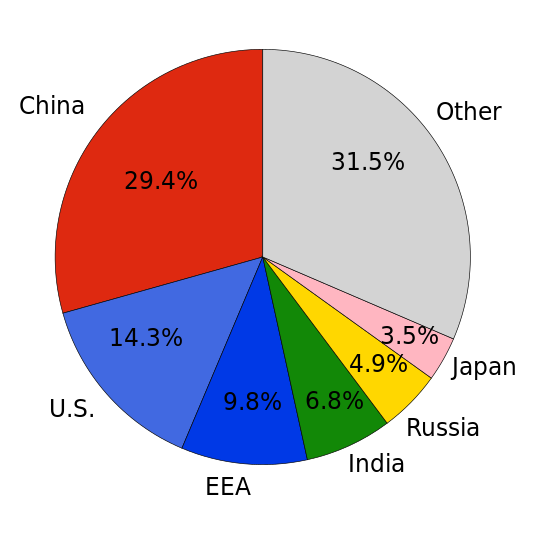
Global CO2 gas emissions in the year 2015 by country.

Other Rockefeller-funded groups, like CDP, have also alleged that major oil companies are responsible for the vast majority of historic greenhouse gas emissions. But CDP’s work is based on CAI’s flawed research and singles out publicly-listed companies like ExxonMobil, Shell, and BP, while ignoring state-owned entities like Russia’s Gazprom and National Iranian Oil, which allegedly contributed 59 percent of emissions since 1988. The Carbon Majors report also completely ignores high-emitting sectors of the economy, such as agriculture.

Heede appears to be handing off the Carbon Majors database to the Union of Concerned Scientists or another pro-climate litigation group to carry on his legacy. No doubt, they will continue to misrepresent the emissions of energy producers in hopes of holding a handful of companies responsible for the world’s emissions.

Update: Children’s Climate Crusade

The Greta phenomenon is only the latest example of climate activists using children as human shields in their war against fossil fuels, as a previous post showed (reprinted below).  The satirical blog Bablyon Bee is on target with two skewers into recent events.  Firstly Marionette Strings Clearly Visible During Greta Thunberg Testimony  Excerpts in italics with my bolds.

NEW YORK, NY—Climate activist and adolescent Greta Thunberg gave a passionate speech at the UN Climate Action Summit in New York, declaring, “How dare you? You have stolen my dreams and my childhood with your empty words, and yet I’m one of the lucky ones. People are suffering. People are dying. Entire ecosystems are collapsing.”

“This is all wrong,” she declared, clearly on the verge of tears.

Savvy viewers, however, noticed there were marionette strings attached to the 16-year-old throughout her speech.

“Hey, wait a minute!” one attendee shouted. “Those are puppet strings, kinda like on Thunderbirds!” This caused some uproar, with everyone tracing the strings to see who had brainwashed this young girl into thinking the world was ending and pulling her strings. Some people got bored with the speech after that and just went and watched Thunderbirds, which had more interesting puppets and better acting.

Then there was this report on government action on climate change: Panel Of Third Graders To Dictate Nation’s Climate Change Policy  Excerpts in italics with my my bolds.

WASHINGTON, D.C.—At a panel on climate change held yesterday, the Senate brought in a group of excited third graders for ideas on fighting climate change.

“These kids have ideas and they are passionate, so we must listen to them,” said Sen. Brian Schatz of Hawaii. “There are no possible downsides to taking kids who have been told the world is ending by the public school system and allowing them to dictate national policies on important issues.

The kids came up with the following list so far, though they say they’re “just spitballing” and the ideas need some fleshing out:

  • Bribing the climate with cookies and candy
  • Putting the climate on time-out
  • Just ignoring climate change and playing Fortnite
  • Building a giant magnet and sucking up all the bad climate stuff
  • Buying a Nintendo Switch for every person in the nation (so they’ll stay inside and play Nintendo instead of driving cars)
  • Making a big freeze ray gun like in Despicable Me and shooting the climate
  • Pointing and laughing at cows who fart so they’ll be embarrassed and stop farting
  • Hey do you guys want to play some Minecraft? This is boring.

“It’s incredibly brave for these kids to volunteer to take over our government’s climate change policies,” said Schatz as the panel convened for its seventh Fortnite break of the morning. “I’m not sure why we didn’t think of this before.

The kids will also be asked to make policies on bedtime, homework, and candy.

Background from previous post Climate War Human Shields

In Massachusetts, four teenagers, the Conservation Law Foundation and the Mass Energy Consumer Alliance brought the climate action case to court. “The global climate change crisis is a threat to the well being of humanity, and to my generation, that has been ignored for too long,” said one of the young prosecutors, Shamus Miller.

On Tuesday, the Massachusetts (MA) Supreme Court mandated the MA Department of Environmental Protection (DEP) to promote impactful climate legislation. The court deemed that the DEP failed to uphold climate change agreements outlined in the Global Warming Solutions Act of 2008 and “requires the department to promulgate regulations that establish volumetric limits on multiple greenhouse gas emissions sources, expressed in carbon dioxide equivalents, and that such limits must decline on an annual basis.”

This case is in accordance with “youth around the country and internationally…bringing their governments to court to secure their rights to a healthy atmosphere and stable climate,” commented Julia Olson, executive director of Our Children’s Trust (an organization that helps youth fight “game-changing” legal battles around the world).Source: Planetexperts 

And who are the adults involved in  Our Children’s Trust?

Supporting Experts (the usual suspects)

Dr. James Hansen
Dr. Ove Hoegh-Guldberg
Dr. Sivan Kartha
Dr. Pushker Kharecha
Dr. David Lobell
Dr. Arjun Makhijani
Dr. Jonathan Overpeck
Dr. Camille Parmeson
Dr. Stefan Rahmstorf
Dr. Steven Running
Dr. James Gustave Speth
Dr. Kevin Trenberth
Dr. Lise Van Susteren
Dr. Paul Epstein (1943-2011)
Etc

Campaign Partners (Allies whose funding depends on CO2 Hysteria)

Climate Reality Project,
Western Environmental Law Center,
Crag Law Center,
Texas Environmental Law Center,
Cottonwood Environmental Law Center,
WildEarth Guardians,
Clean Air Council,
Global Campaign for Climate Action,
Chasing Ice,
Environmental Law Alliance Worldwide,
TERRA,
Sierra Club,
350.org,
Climate Solutions,
Greenwatch,
Center for International Environmental Law..
Greenpeace
etc.

Conclusion

This is as obscene as brainwashing young Muslims to be suicide bombers. Or terrorists hiding among families to deter the drone strikes. The fact that the kids are willing is no excuse.

Think of the children! How will they feel a decade from now when they realize they have been duped and exploited by activists who figured judges would be more sympathetic to young believers?

Gifted kids


Update June 24

Some addition background in response to questions from Frederick Colbourne.

Frederick, they are employing a creative approach to the “Public Trust Doctrine”. From their website:
“Specifically, these court decisions have rejected many legal defenses raised by our opponents, including non-justiciability, standing, separation of powers and sovereign immunity. In support of our youths’ positions, and in face of argument to the contrary, the courts have validated critical climate science and reserved for the courts the exclusive right to determine whether a particular commons resource is protected by the Public Trust Doctrine for benefit of present and future generations, and whether there has been a breach of that trust. Our cases are now progressing to the next phases where the courts will make those determinations relative to our atmosphere.”

Massachusetts is ripe for this legal suit because the state passed legislation endorsing the threat of climate change and subscribing to targets for reducing emissions.

From the Court decision: “the Climate Protection and Green Economy Act, G. L. c. 21N (statute)”
“The act established a comprehensive framework to address the effects of climate change in the Commonwealth by reducing emissions to levels that scientific evidence had suggested were needed to avoid the most damaging impacts of climate change. . .In accordance with these findings, the statute requires that, by 2050, greenhouse gas emissions be reduced by at least eighty per cent below 1990 levels. G. L. c. 21N, § 3 (b).”

Note that it was Massachusetts that acted to get EPA jurisdiction over GHGs. Again from the Court decision: “See also Massachusetts v. Environmental Protection Agency, 549 U.S. 497, 505 (2007) (petition by Massachusetts, with other States, local governments, and private organizations, arguing Environmental Protection Agency abdicated responsibility under Clean Air Act to regulate emissions of four greenhouse gases, including carbon dioxide).”

This legal strategy is along the lines of “Sue and Settle” tactic employed in the past to expand the regulatory scope of the EPA. Part of this latest charade is for the state to offer a token defense so that the court requires them to do what they want to do anyways, but now armed with additional ammunition against resisters.

Note also the bait and switch: Climate change is not at issue, it is all about meeting emissions targets.  It should serve also as a cautionary tale to any jurisdiction that thinks they can pass lip-service legislation and get away with politically-correct posturing.

Footnote for those not aware of Aliases for the Usual Suspects:

James “Death Trains” Hansen
Ove “Reefer Mad” Hoegh-Guldberg
Jonathan “Water Torture” Overpeck
Camille “The Extincter” Parmeson
Stefan “No Tommorow” Rahmstorf
Kevin “Hidden Heat” Trenberth

Legal Calamity: Climate Nuisance Lawsuits

I am suing you

It has come to this:  Sue anyone doing anything you don’t like for profit as a “Public Nuisance.”  Further on is reprinted a previous post explaining why it is legally wrongheaded to claim damages against purveyors of fossil fuels because of global warming/climate change.  What is news today is a federal judge making exactly that mistake.

Michael I. Krauss writes at Forbes Federal Judge Allows Misuse Of Public Nuisance Doctrine. Excerpts in italics with my bolds.

I have written, in this column and elsewhere, about the threat to the Rule of Law created by the misuse and abuse of Public Nuisance doctrine. Now I write to bemoan a federal judge’s tolerance of a particularly egregious effort by a state to invoke this ancient tort (typically used to sanction those who blocked the public roads) to judicially create legislative policy.

In State of Rhode Island v Chevron Corp. et al, [decided July 22, 2019], Chief Judge William Smith of the United States District Court in Rhode Island (appointed by President Bush) was presented with a suit launched by the Ocean State against energy companies it says are “partly responsible for our once and future climate crisis.” Rhode Island isn’t claiming that Defendants broke its laws, but that its behavior is “greedy” and suboptimal for the future of the Rhode Island. Of course the same might be said about Rhode Island farmers (who “greedily” raise beef for profit, and contribute methane to the environment) and about Rhode Island car dealers (who “greedily” market expellers of CO2), but I digress.

It is true that, eleven years ago, the Rhode Island Supreme Court unanimously rejected a similar public nuisance suit by the state against three former manufacturers of lead paint. That suit, the court held in 2008, represented an abuse of the public nuisance doctrine. But of course, that was eleven years ago. Times (and the judicial composition of many state courts) have changed. The defendants in this petrochemicals case, understandably wary about being sued in Rhode Island courts in front of state-appointed judges, in a suit launched by the state and aiming to transfer billions into the state, removed the case to federal court on the grounds that federal issues totally pre-empted Rhode Island’s claim. In his July 22, 2019 ruling, Judge Smith decided that the case should be returned to state court and there decided under state law. Here is the remarkable language the judge used to describe what he called the “background” of Rhode Island’s lawsuit — language the judge admitted he cribbed directly from Rhode Island’s complaint!

“…Defendants in this case… have extracted, advertised, and sold a substantial percentage of the fossil fuels burned globally since the 1960s. This activity has released an immense amount of greenhouse gas into the Earth’s atmosphere, changing its climate and leading to all kinds of displacement, death (extinctions, even), and destruction. … Defendants understood the consequences of their activity decades ago, when transitioning from fossil fuels to renewable sources of energy would have saved a world of trouble. But instead of sounding the alarm, Defendants went out of their way to becloud the emerging scientific consensus and further delay changes — however existentially necessary — that would in any way interfere with their multi-billion-dollar profits.”

Judge Smith may believe that his ruling is an example of judicial restraint. But to refuse to recognize the basic constitutional structure of the country is not laudable restraint, but rather timidity. As Justice Felix Frankfurter once explained in a different context: “The easy but timid way out for a trial judge is to leave all cases … for jury determination. A timid judge, like a biased judge, is intrinsically a lawless judge.”

In a virtually identical case to Rhode Island’s, City of New York v BP et al, decided on July 18 2018, Judge John F. Keenan of the United States District Court for the Southern District of New York (appointed by President Reagan) ruled on the city’s public nuisance suit against petrochemical manufacturers:

“The Court agrees that the City’s claims are governed by federal common law…. Where “the interstate or international nature of the controversy makes it inappropriate for state law to control . . . our federal system does not permit the controversy to be resolved under state law.” [citing Banco Nacional de Cuba v. Sabbatino, 376 U.S. 398, 426 (1964)).

“To the extent that the City brings [public] nuisance and trespass claims against Defendants for domestic greenhouse gas emissions, the Clean Air Act displaces such federal common law claims under American Electric Power Co. v. Connecticut, 564 U.S. 410 (2011).

And two weeks before the New York case, United States District Court Judge William Alsup of the Northern District of California (appointed by President Clinton) used the following language in dismissing San Francisco’s and Oakland’s climate liability lawsuits against the top five investor-owned fossil fuel producers:

“With respect to balancing the social utility against the gravity of the anticipated harm, it is true that carbon dioxide released from fossil fuels has caused (and will continue to cause) global warming. But against that negative, we must weigh this positive: our industrial revolution and the development of our modern world has literally been fueled by oil and coal. Without those fuels, virtually all of our monumental progress would have been impossible. All of us have benefitted. Having reaped the benefit of that historic progress, would it really be fair to now ignore our own responsibility in the use of fossil fuels and place the blame for global warming on those who supplied what we demanded? Is it really fair, in light of those benefits, to say that the sale of fossil fuels was unreasonable?… In our industrialized and modern society, we need (and still need) oil and gas to fuel power plants, vehicles, planes, trains, ships, equipment, homes and factories.”

As Judge Alsup impliedly states, it is absurd to allow a state jury to decide questions of national and international energy policy that the Constitution has clearly left to other branches of government. Rhode Island profits enormously from the products of the very same petrochemical industry that it now claims constitutes a nuisance.

Their suit is an invitation to legislate from the bench, or perhaps from the jury room.

The District of Columbia has recently solicited bids for a contingent fee public nuisance lawsuit against petroleum companies (despite the fact that DC itself has purchased millions of gallons of fuel from these same companies). This kind of “lawfare” can only survive if rulings like that of judge Smith prevail over those of judges Keenan and Alsup. It may be time for the Supreme Court to reiterate the holding of American Electric Power Co. v. Connecticut and to end this abuse.

Is Global Warming A Public Nuisance?

Several posts have discussed activist attempts to use legal actions to press their agenda.  Now we have a fine article by Richard A. Epstein of Hoover Institution, published January 15, 2018
Is Global Warming A Public Nuisance?  
Text below in italics with my bolds and images.
H/T Jeffrey Taylor

New York City and a number of California municipalities, including San Francisco and Oakland, have filed law suits against five major oil companies—BP, Chevron, ConocoPhillips, Exxon Mobil, and Royal Dutch Shell—for contributing to the increased risk of global warming. These complaints cite recent scientific reports that project that sea levels will rise from 0.2 meters to 2.0 meters (or 0.66 to 6.6 feet) by 2100, with a major loss of land surface area and serious climate disruptions. They further allege that the “Defendants had full knowledge that the fossil fuels would cause catastrophic harm.” The complaints rely chiefly upon public nuisance law, which prohibits unreasonably interfering with public rights in air and water through discharges of dangerous substances—in this instance, carbon dioxide and other greenhouse gases. These cities are demanding that each oil company named in the complaint contribute to an abatement fund to counteract the perceived future threats to the environment from global warming.

In this essay, I confine my attention to the soundness of the public nuisance theory offered by San Francisco and New York in order to explain why private lawsuits are the wrong instrument for dealing with the global warming threat. In full disclosure, in this essay, I provide my own independent legal analysis of these complaints, which I prepared for the Manufacturer’s Accountability Project, an organization that focuses on the impact of litigation on the manufacturing industry.

The basic law of nuisance is divided into two parts, public and private, which complement each other. Private nuisances require at a minimum “an invasion of another’s interest in the private use and enjoyment of land.” The defendant must release, emit, or discharge the offensive materials—such as filth, odors, or noise—onto the plaintiff’s property. The relevant causal connection has to be so tight that there are no intervening forces between the discharge and the ensuing physical invasion of the plaintiff’s property. So, for example, the supplier of various materials and chemicals is not responsible for the waste that a manufacturer emits from their use.

The typical private nuisance dispute usually involves one party (or a very few) who either makes the discharges or suffers consequences from them. The basic intuition behind this limitation on private suits is that administrative costs balloon out of control when the number of parties who suffer some degree of harm increases, as happens when pollution is discharged into a public waterway used by hundreds of different people. Yet it is a mistake to ignore large pollution discharges simply because private law suits are an ineffective instrument to secure damages, an injunction, or both. As early as 1536, the English judges filled this gap by developing the law of public nuisances that rested, both then and now, on the key distinction between general and special damages. Thus, if the defendant erected an obstruction along a public road, none of the parties delayed by the blockage had a private right of action. But any individual who ran into the obstacle and suffered physical injuries or property damage could recover in tort. Now, the shortfall in deterrence attributable from not compensating the delayed travelers was offset by a fine against the wrongdoer, the money from which could be used to remove the obstacle or placed in the public treasury.

Woman on a ducking stool. Historical punishment for ‘common scold’ – woman considered a public nuisance. (Welsh/English heritage)

It is important to understand the enormous stretch in moving from traditional public nuisances to the modern global warming cases. The first point of difference is that only five companies—but no other carbon-dioxide-emitting polluter in the world—are joined as defendants. That is to say, the cities are apparently seeking to recover virtually all of their alleged abatement costs from the five named oil companies, instead of holding each only for its pro rata share of total emissions from all sources. But just what fraction of total carbon dioxide emissions can be traced to the named defendants? Note first that any release of carbon dioxide into the atmosphere has the same impact on global warming regardless of its source.

These five oil companies are responsible at most for a tiny fraction of the global total of carbon dioxide emissions. First, just looking at the American scene, some good chunk of the carbon dioxide releases are from other oil companies not named in the complaint. Another, probably larger, chunk comes from burning coal, making cement, and human and animal respiration. Carbon dioxide is also released in large quantities by forest fires, including those that recently overwhelmed Northern and Southern California. And that’s just in America; vast amounts of carbon dioxide are released from a similar range of human activities all across the globe.

Global Greenhouse Gas Emissions by Source 2013

Here are some numbers: As of 2015, all carbon dioxide emissions from the United States comprised 14.34 percent of the global total, while China’s emissions stood at 29.51 percent. Even if the five oil companies were somehow responsible for, say, 10 percent of the United States’ carbon dioxide emissions, that would be less than one percent of the total human releases. Under standard tort rules, the liability of each defendant must be limited to its own pro rata share of the total harm given that under Section 433A of the Restatement of Torts, there is a “reasonable basis for determining the contribution of each cause to a single harm,” in this instance measured by market shares.
Indeed, these public nuisance lawsuits are especially dubious, given that the oil companies did not by their sales emit any carbon dioxide into the atmosphere. The dangerous releases came from many different parties, both private and public, including the municipalities bringing these lawsuits. These numerous parties used these products in countless different ways, with as much knowledge of their asserted effects on global warming as these five defendants. How could the oil companies have known about the anticipated course of global warming forty years ago when key government studies done today are uncertain about the magnitude of the effects of emissions on sea levels and the economic consequences?

The first paragraph of the New York City complaint ducks these factual complexities by insisting, falsely, that crude oil was “a product causing severe harm when used exactly as intended.” But the end uses of crude oil are so varied (including, for example, the creation of various plastics in common use today) that the effective control of emissions is best done through the regulation of these end users and not the oil companies. Indeed, even for gasoline, the level of carbon dioxide emissions critically depends on the operation and maintenance of the many different types of facilities, equipment, and vehicles, all of which are beyond the direct control of the oil companies. Yet all these end users are already subject to extensive emissions controls under the Clean Air Act and countless other environmental directives, both at the state and federal level.

This sensible distribution of regulatory authority rests on the superior ability of government agencies (at least compared to the courts), often in cooperation with each other, to formulate and maintain coherent policies to regulate the emissions of carbon dioxide, as well as methane, nitrous oxide, and fluorinated gases, which the EPA calculates account for 18 percent of greenhouse gas emissions.

The issues here are especially complex for many technical and logistical reasons. One critical task is to decide the optimal level of emissions. The implicit assumption of the New York and San Francisco lawsuits is that the world would become a better place if all emissions of carbon dioxide were stopped. But that position ignores the enormous benefits that come from the use of fossil fuels, which continue to supply over 80 percent of the nation’s energy needs. No other fuel source could keep manufacturing, transportation, and commerce alive. And it is just exaggeration to claim, as the city plaintiffs do, that these oil companies “have done nearly all they could to create [the] existential threat” of global warming when in fact energy efficiency in the United States has consistently improved, particularly in generating electrical power.

No public nuisance suits for global warming can solve a problem that must be addressed by a coherent regulatory program. Instead, chaos will follow if hundreds of different states, counties, and cities are allowed to bring separate actions under state law. It bears emphasis that in 2011, a unanimous Supreme Court decision in American Electric Power Co. v. Connecticut held that the combination of the Clean Air Act and actions by the Environmental Protection Agency “against carbon-dioxide emitters . . . displace the claims that the plaintiffs seek to pursue” under a public nuisance theory brought under federal law. The Court left open the question of whether the federal regulation at the time preempted any state law cause of action for public nuisance.

Summary

But, as I argued at the time, the only viable solution was for the federal government and the EPA to “orchestrate” the effort to control emissions. The point is doubly true against these remote, upstream defendants who have not emitted anything themselves. The standard analysis of federal preemption has long held that states may not engage in their own remedial efforts, even by actions in tort, when extensive federal regulation occupies the field, or when state activity either frustrates federal action or is in conflict with it. If anything, the scope of federal oversight, actual and prospective, is far more comprehensive than it was when American Electric Power was decided. And so federal preemption alone should block a set of dubious public nuisance claims that should never have been brought in the first place.

Background:  Critical Climate Intelligence for Jurists (and others)

Climate Hype is a Cover Up

Back in 2015 in the run up to Paris COP, French mathematicians published a thorough critique of the raison d’etre of the whole crusade. They said:

Fighting Global Warming is Absurd, Costly and Pointless.

  • Absurd because of no reliable evidence that anything unusual is happening in our climate.
  • Costly because trillions of dollars are wasted on immature, inefficient technologies that serve only to make cheap, reliable energy expensive and intermittent.
  • Pointless because we do not control the weather anyway.

The prestigious Société de Calcul Mathématique (Society for Mathematical Calculation) issued a detailed 195-page White Paper presenting a blistering point-by-point critique of the key dogmas of global warming. The synopsis with links to the entire document is at COP Briefing for Realists

Even without attending to their documentation, you can tell they are right because all the media climate hype is concentrated against those three points.

Finding: Nothing unusual is happening with our weather and climate.
Hype: Every metric or weather event is “unprecedented,” or “worse than we thought.”

Finding: Proposed solutions will cost many trillions of dollars for little effect or benefit.
Hype: Zero carbon will lead the world to do the right thing.  Anyway, the planet must be saved at any cost.

Finding: Nature operates without caring what humans do or think.
Hype: Any destructive natural event is a result of humans burning fossil fuels.

How the Media Throws Up Flak to Defend False Suppositions

The Absurd Media:  Climate is Dangerous Today, Yesterday It was Ideal.

Billions of dollars have been spent researching any and all negative effects from a warming world: Everything from Acne to Zika virus.  A recent Climate Report repeats the usual litany of calamities to be feared and avoided by submitting to IPCC demands. The evidence does not support these claims. An example:

 It is scientifically established that human activities produce GHG emissions, which accumulate in the atmosphere and the oceans, resulting in warming of Earth’s surface and the oceans, acidification of the oceans, increased variability of climate, with a higher incidence of extreme weather events, and other changes in the climate.

Moreover, leading experts believe that there is already more than enough excess heat in the climate system to do severe damage and that 2C of warming would have very significant adverse effects, including resulting in multi-meter sea level rise.

Experts have observed an increased incidence of climate-related extreme weather events, including increased frequency and intensity of extreme heat and heavy precipitation events and more severe droughts and associated heatwaves. Experts have also observed an increased incidence of large forest fires; and reduced snowpack affecting water resources in the western U.S. The most recent National Climate Assessment projects these climate impacts will continue to worsen in the future as global temperatures increase.

Alarming Weather and Wildfires

But: Weather is not more extreme.


And Wildfires were worse in the past.
But: Sea Level Rise is not accelerating.

post-glacial_sea_level
Litany of Changes

Seven of the ten hottest years on record have occurred within the last decade; wildfires are at an all-time high, while Arctic Sea ice is rapidly diminishing.

We are seeing one-in-a-thousand-year floods with astonishing frequency.

When it rains really hard, it’s harder than ever.

We’re seeing glaciers melting, sea level rising.

The length and the intensity of heatwaves has gone up dramatically.

Plants and trees are flowering earlier in the year. Birds are moving polewards.

We’re seeing more intense storms.

But: Arctic Ice has not declined since 2007.

But: All of these are within the range of past variability.

In fact our climate is remarkably stable, compared to the range of daily temperatures during a year where I live.

And many aspects follow quasi-60 year cycles.

The Impractical Media:  Money is No Object in Saving the Planet.

Here it is blithely assumed that the court can rule the seas to stop rising, heat waves to cease, and Arctic ice to grow (though why we would want that is debatable).  All this will be achieved by leaving fossil fuels in the ground and powering civilization with windmills and solar panels.  While admitting that our way of life depends on fossil fuels, they ignore the inadequacy of renewable energy sources at their present immaturity.

An Example:
The choice between incurring manageable costs now and the incalculable, perhaps even
irreparable, burden Youth Plaintiffs and Affected Children will face if Defendants fail to
rapidly transition to a non-fossil fuel economy is clear. While the full costs of the climate
damages that would result from maintaining a fossil fuel-based economy may be
incalculable, there is already ample evidence concerning the lower bound of such costs,
and with these minimum estimates, it is already clear that the cost of transitioning to a
low/no carbon economy are far less than the benefits of such a transition. No rational
calculus could come to an alternative conclusion. Defendants must act with all deliberate
speed and immediately cease the subsidization of fossil fuels and any new fossil fuel
projects, and implement policies to rapidly transition the U.S. economy away from fossil
fuels.

But CO2 relation to Temperature is Inconsistent.

But: The planet is greener because of rising CO2.

But: Modern nations (G20) depend on fossil fuels for nearly 90% of their energy.

But: Renewables are not ready for prime time.

People need to know that adding renewables to an electrical grid presents both technical and economic challenges.  Experience shows that adding intermittent power more than 10% of the baseload makes precarious the reliability of the supply.  South Australia is demonstrating this with a series of blackouts when the grid cannot be balanced.  Germany got to a higher % by dumping its excess renewable generation onto neighboring countries until the EU finally woke up and stopped them. Texas got up to 29% by dumping onto neighboring states, and some like Georgia are having problems.

But more dangerous is the way renewables destroy the economics of electrical power.  Seasoned energy analyst Gail Tverberg writes:

In fact, I have come to the rather astounding conclusion that even if wind turbines and solar PV could be built at zero cost, it would not make sense to continue to add them to the electric grid in the absence of very much better and cheaper electricity storage than we have today. There are too many costs outside building the devices themselves. It is these secondary costs that are problematic. Also, the presence of intermittent electricity disrupts competitive prices, leading to electricity prices that are far too low for other electricity providers, including those providing electricity using nuclear or natural gas. The tiny contribution of wind and solar to grid electricity cannot make up for the loss of more traditional electricity sources due to low prices.

These issues are discussed in more detail in the post Climateers Tilting at Windmills

The Irrational Media:  Whatever Happens in Nature is Our Fault.

An Example:

Other potential examples include agricultural losses. Whether or not insurance
reimburses farmers for their crops, there can be food shortages that lead to higher food
prices (that will be borne by consumers, that is, Youth Plaintiffs and Affected Children).
There is a further risk that as our climate and land use pattern changes, disease vectors
may also move (e.g., diseases formerly only in tropical climates move northward).36 This
could lead to material increases in public health costs

But: Actual climate zones are local and regional in scope, and they show little boundary change.

But: Ice cores show that it was warmer in the past, not due to humans.

The hype is produced by computer programs designed to frighten and distract children and the uninformed.  For example, there was mention above of “multi-meter” sea level rise.  It is all done with computer models.  For example, below is San Francisco.  More at USCS Warnings of Coastal Floodings

sf-ca-past-projected

In addition, there is no mention that GCMs projections are running about twice as hot as observations.

Omitted is the fact GCMs correctly replicate tropospheric temperature observations only when CO2 warming is turned off.

Figure 5. Simplification of IPCC AR5 shown above in Fig. 4. The colored lines represent the range of results for the models and observations. The trends here represent trends at different levels of the tropical atmosphere from the surface up to 50,000 ft. The gray lines are the bounds for the range of observations, the blue for the range of IPCC model results without extra GHGs and the red for IPCC model results with extra GHGs.The key point displayed is the lack of overlap between the GHG model results (red) and the observations (gray). The nonGHG model runs (blue) overlap the observations almost completely.

In the effort to proclaim scientific certainty, neither the media nor IPCC discuss the lack of warming since the 1998 El Nino, despite two additional El Ninos in 2010 and 2016.

Further they exclude comparisons between fossil fuel consumption and temperature changes. The legal methodology for discerning causation regarding work environments or medicine side effects insists that the correlation be strong and consistent over time, and there be no confounding additional factors. As long as there is another equally or more likely explanation for a set of facts, the claimed causation is unproven. Such is the null hypothesis in legal terms: Things happen for many reasons unless you can prove one reason is dominant.

Finally, advocates and IPCC are picking on the wrong molecule. The climate is controlled not by CO2 but by H20. Oceans make climate through the massive movement of energy involved in water’s phase changes from solid to liquid to gas and back again. From those heat transfers come all that we call weather and climate: Clouds, Snow, Rain, Winds, and Storms.

Esteemed climate scientist Richard Lindzen ended a very fine recent presentation with this description of the climate system:

I haven’t spent much time on the details of the science, but there is one thing that should spark skepticism in any intelligent reader. The system we are looking at consists in two turbulent fluids interacting with each other. They are on a rotating planet that is differentially heated by the sun. A vital constituent of the atmospheric component is water in the liquid, solid and vapor phases, and the changes in phase have vast energetic ramifications. The energy budget of this system involves the absorption and reemission of about 200 watts per square meter. Doubling CO2 involves a 2% perturbation to this budget. So do minor changes in clouds and other features, and such changes are common. In this complex multifactor system, what is the likelihood of the climate (which, itself, consists in many variables and not just globally averaged temperature anomaly) is controlled by this 2% perturbation in a single variable? Believing this is pretty close to believing in magic. Instead, you are told that it is believing in ‘science.’ Such a claim should be a tip-off that something is amiss. After all, science is a mode of inquiry rather than a belief structure.

Footnote:

Say what you want about the liberal arts, but they’ve found a cure for common sense.

By Robert Curry writes at American Thinker Making Sense of Common Sense. Excerpts in italics with my bolds.

As we all know, acquiring common sense can be a matter of life and death. I’m thinking, for example, of the teenage boy who swallowed a garden slug on a dare, became paralyzed, and died recently. Because children lack common sense, parents must do what they have always done, trying to instill common sense in their children while at the same time using their own common sense to encompass the growing child.

Becoming a person of common sense has always been a life-defining challenge, but acquiring common sense has gotten a lot more difficult for young people in our time, especially if they have spent some time in our institutions of higher learning. My witty friend Robert Godwin has this to say about that: “Say what you want about the liberal arts, but they’ve found a cure for common sense.”

When I headed off to college, my high school teacher who was my mentor offered me two commonsense rules to follow: “Take care to stay well, and choose professors, not courses.” Because of my high regard for him, I took his words to heart. Later, when I saw the problems my fellow students brought on themselves by not getting enough sleep and generally being careless about their health, I understood the practical wisdom of what he had told me. And the second rule helped me more quickly understand the value of navigating my way through college by who was teaching the course rather than by the course title.

For years, I handed on the same commonsense wisdom to young folks I knew when they headed off to college. But I have not offered that advice for some years now. Here is what I tell them now: “They are going to try to knock common sense out of you; don’t let them.”

Post script: From the comments below, Otto was pushing for info regarding volcanoes and the Holocene Climate Optimum. I responded thus:

Otto, I don’t see volcanoes causing the HTM (Holocene Thermal Maximum).
The HTM ended at different times in different parts of the world, but it had ended everywhere by 4,000 BP (BP here means the number of years before 2000) and the world began to cool. Your link refers to the Santorini eruption ending the Minoan warming as well as that civilization.

From Renssen et al. 2012:
“The Holocene Thermal Maximum (HTM) was a relatively warm climatic phase between 11 and 5 ka BP, as indicated by numerous proxy records (Kaufman et al., 2004; Jansen et al., 2007, 2008; Wanner et al., 2008; Miller et al., 2010a; Bartlein et al., 2011). The relatively warm conditions during the HTM are commonly associated with the orbitally-forced summer insolation maximum (Wanner et al., 2008; Bartlein et al., 2011). However, proxy records suggest that both the timing and magnitude of maximum warming varied substantially between different regions across the globe, suggesting involvement of additional forcings and feedbacks (Jansen et al., 2007; Bartlein et al., 2011). One important additional factor affecting the early Holocene climate is the remnant Laurentide Ice sheet (LIS).
https://dial.uclouvain.be/pr/boreal/object/boreal%3A112248/datastream/PDF_01/view

From this we learn three things:

Climate warms and cools without any help from humans.

Warming is good and cooling is bad.

The hypothetical warming from CO2 would be a good thing.

It’s just common sense, after all.

Fort Lauderdale Repels Climate Pirates

This just in from Erin Mundahl writing at Energy In Depth Fort Lauderdale Deals Another Blow to Climate Litigation Campaign. The article will appear below in italics with my bolds. But first some background.

Background on Climate Piracy

Those paying attention have noticed for some years now a new type of pirate has emerged: Climate Lawyers. Taking their game plan from the Tobacco Pirates, they are now targeting a different set of deep pockets: Big Oil Companies. Since 30+ Billion US dollars were extracted from tobacco companies (including contingency fees to lawyers), a comparable, if not larger payday is sought by these new corporate raiders. Unlike Somali pirates who attacked the tankers themselves, Climate Lawyers are using the courts to sue Big Oil for damages their products cause consumers. In order to succeed in these lawsuits, they recruit jurisdictions like states or cities to claim they have been victimized by having fossil fuel products imposed upon them.

[Full Disclosure: The photo above symbolically depicts Climate Lawyers in the boat confronting an oil tanker, when in fact they won’t get their suits wet. The original image was a Greenpeace zodiac]

Fort Lauderdale Stands Up Against Pressure from Climate Lawyers

It’s a bright day for Fort Lauderdale. Despite a full-court press by climate activists, city officials have decided not to pursue a climate liability lawsuit. This is a blow for climate activists, who are hoping to expand their litigation campaign into Florida.

Over the past six months, lawyers and environmental groups have devoted considerable time and effort to persuading cities in the Sunshine State to join their quixotic climate litigation campaign. Despite their efforts, Fort Lauderdale was not convinced.

EarthRights International hides behind NGO to lobby city officials.

Released emails show that EarthRights International, the Rockefeller-funded organization representing the City and County of Boulder and San Miguel County in their climate change lawsuit, and the Institute for Governance and Sustainable Development (IGSD) coordinated to lobby Fort Lauderdale city officials throughout 2018.

In June, Mayor Dean Trantalis and his chief of staff, Scott Wyman, received emails from a Miami Beach lobbyist, Seth Platt. Platt was hired to represent IGSD, which runs the Center for Climate Integrity, a project that “supports meritorious climate cases aimed at holding fossil fuel companies and other climate polluters liable for the damages they have caused.” The emails show that Platt was eager to introduce Trantalis and Wyman to EarthRights International (ERI) and their agent, Jorge Musuli, who Platt said was working with the City of Miami to file a climate nuisance lawsuit:

“I have invited Jorge Mursuli to the meeting as his group, [ERI], is working with the City of Miami to file a lawsuit. We are trying to collaborate on advocacy in Broward.”

Sher Edling joins EarthRights International in their pursuit

In a surprising twist of fate, ERI added another plaintiffs’ attorney firm involved in climate litigation, Sher Edling, as co-counsel in their pursuit of the city. By July, Seth Platt had arranged for Vic Sher and Matt Edling, who represent more than a dozen cities in climate cases, to join ERI for a meeting with Fort Lauderdale City Attorney Alain Boileau. After the meeting, Boileau followed up with the mayor, telling his boss about the “positive meeting” he had had with Sher, Edling, Marco Simons (general counsel for ERI), and Mursuli, all thanks to Platt.

Records show that Platt conducted all of these meetings on behalf of the Institute for Governance & Sustainable Development – not ERI. When pressed on this by local reporters, Platt did not respond.

IGSD finds itself at the center of the climate litigation campaign…. again

Platt’s lobbying affiliation highlights the well-coordinated network of climate activism aimed at taking down fossil fuels by any means necessary. IGSD is a key player in a carefully organized media campaign that rehashes a stale, repeatedly debunked story for the sake of silencing dissent . Richard Wiles, who serves as the ringleader for their climate litigation campaign, produced the IGSD-funded podcast Drilled and published Climate Liability News, an activist site designed to promote climate litigation.

ERI fails to impress the City Commission

In October ERI General Counsel Marco Simons gave a presentation to Trantalis and the Fort Lauderdale City Commission. The meeting was a full court press that emphasized how climate change could hurt city finances and how wealthy anti-fossil fuel foundations were willing to foot the bill for the lawsuit. Simons explained their strategy during the pitch:

At the litigation stage it would be necessary to join together with co-counsel from private firms. They would be interested in pursuing this on a contingency fee-basis… And it would be a combination of our pro-bono representation and a private firm, contingent fee representation, again with no up-front cost to the city and that’s the model that’s been done in all of these cases so far.”

Thankfully, Fort Lauderdale decided to resist the pressure. Despite the focus Simons put on how the lawsuit could financially benefit the city, it would tie the city up in litigation for months or years, taking attention away from much needed resiliency projects. So far, none of the plaintiffs – or the cities – pursuing climate litigation across the country have seen a dime. Meanwhile, the major green donors financing the pro bono legal work are using the lawsuits to promote their own climate agenda, both in the courtroom and the court of public opinion.

Local voices also reject lawsuits

Over the past several months, op-ed pieces in papers around Florida have emphasized that suing energy companies distracts attention from the harms of climate change and discourages cooperation between industry and government. In a Naples Daily News op-ed this spring, Sal Nuzzo of the Tallahassee-based James Madison Institute, criticized using lawsuits to develop state policy, instead pushing for cooperation between businesses and government for environmental issues:

“For policies to succeed, public officials must work with business…Florida’s unemployment rate is low and our economy is growing at a faster pace than the U.S. economy overall in part because our tax and regulatory burdens are lower than many other states. A hostile approach toward manufacturers would ill serve our state and hinder efforts to address environmental issues.”

Not only does litigation waste taxpayer money, it also distracts from state-level policies that are making meaningful improvements to Florida’s environment. Florida Governor Ron DeSantis (R) “went green” in the words of political columnist Barney Bishop, who wrote in the Sunshine State News to praise the governor for his plan to invest heavily in resiliency efforts and Everglades restoration and water cleanup, an approach he contrasted with that of “public officials working hand in hand with activists”:

“The reality is that real-life actions like the ones being taken by Gov. Ron DeSantis are the best way to help our environment. Lawsuits such as these offer no real benefit and only serve to threaten American companies and American jobs.”

It’s a good thing Fort Lauderdale saw through the scam.

See also US State Attorneys Push Back on Climate Lawsuits

See also Is Global Warming A Public Nuisance?

Kids Fortune Tellers Vs. US Update

The 21 young people suing the U.S. government for exacerbating climate change hope the Ninth Circuit Court of Appeals sends their case to trial.

By Karen Savage writes at Climate Liability News Ninth Circuit Judges Appear Skeptical of Role in Kids Climate Suit vs. U.S. Government. Excerpts in italics with my bolds

A three-judge panel of the Ninth Circuit Court of Appeals on Tuesday appeared skeptical of the courts’ role in dealing with climate change in the landmark constitutional climate case brought by 21 young people against the U.S. government. But the kids’ attorneys argued in a pivotal hearing that they are only asking the court to apply rights already laid out in the Fifth Amendment.

The hearing, held in Portland, Ore., will decide whether the case, Juliana v. United States, continues on toward trial. The suit has been vehemently opposed by the Justice Department since it was filed in 2015, and this hearing could grant the government an extraordinary measure by granting an appeal before the trial even began.

Judges Mary H. Murguia and Andrew D. Hurwitz of the Ninth Circuit Court of Appeals, and Josephine L. Staton of District Court for the Central District of California presided over the hearing and are expected to issue their ruling in the next few months.

Hurwitz summed up the issues the court is wrestling with, primarily whether the courts should intervene in a subject ordinarily left to the executive and legislative branches.

“I’m sympathetic to the problems you point out,” he said. “But you shouldn’t say this is just an ordinary suit. … You’re asking us to do a lot of new stuff, aren’t you?”

Julia Olson, lead attorney for the young plaintiffs, disagreed.

“It would be the first time that it would have been done, your Honor, as to this factual context where the government admits the monumental threat to people and to lives and that their acts in promoting fossil fuels and allowing for the extraction and all the affirmative things they do cause the emissions that are a substantial cause of climate change,” Olson said.

Hurwitz pushed back on Olson’s assertion, saying it appeared as if the plaintiffs were asking the court to break new ground by allowing the case to continue.

“The issue here is whether this branch of government, embodied by the three of us today, has the ability to issue the relief that your clients seek,” said Hurwitz to Olson during her arguments, adding that he doesn’t doubt that Congress and the president could give the plaintiffs the relief they seek.

“I don’t think Congress and the president ever will,” said Olson in response.

“Well then we may have the wrong Congress and the wrong president. That’s occurred from time to time over history,” said Hurwitz.

“You present compelling evidence that we have a real problem. You present compelling evidence that we have inaction by the other two branches of government. It may even rise to the level of criminal neglect. But the tough question for me is do we get to act because of that.”

The plaintiffs allege in the suit that the federal government is violating their Constitutional rights to life, liberty and property by promoting an energy system that exacerbates climate change. They also say the government is failing to protect essential public trust resources and are asking for a science-based program to reduce carbon emissions and protect the climate for future generations.

The federal government has tried numerous times to shake the case since it was first filed in 2015. The Ninth Circuit has rejected four petitions for an extraordinary writ of mandamus by the government and the Supreme Court has rejected additional requests. The Ninth Circuit eventually granted a final, last-ditch effort to hear a pre-trial appeal late last year, and this hearing was their chance to hear oral arguments from both sides.

“The outcome of this hearing will determine the future of our case and whether or not there will be justice for young people in this country, who are disproportionately impacted by the climate crisis,” said Vic Barrett, a 20-year-old plaintiff from White Plains, NY.

“Our fundamental constitutional rights, including our right to a climate system capable of sustaining human life, are being violated by our government,” said Barrett.

In November 2016, U.S. District Court Judge Ann Aiken became the first to rule that “the right to a climate system capable of sustaining human life is fundamental to a free and ordered society” and ordered the case to trial.

Aiken’s ruling prompted the National Association of Manufacturers (NAM), the American Fuel & Petrochemical Manufacturers (AFPM), and the American Petroleum Institute (API) to intervene on behalf of the federal government, but the industry groups quickly withdrew after Judge Coffin ruled that the groups must intervenors take a joint position on climate science.

Attorneys for the Trump administration contend there is “no fundamental constitutional right to a ‘stable climate system’ and maintain that because “global climate change affects everyone in the world,” the plaintiffs are not suffering from a legally actionable injury, but from “generalized grievances.”

“This action is one that appears to enforce the Constitution, but in reality it’s nothing more than a direct assault on the constitutional design,“ said Jeffrey Bossert Clark, lead attorney for the Department of Justice.

One district court judge in the country is acting to impose a plan on the entire executive branch in the country, to tell them to stop having inaction on climate change, to do additional things to combat it,” Clark said. “That’s sort of something that’s radical, its anathema.”

The government also maintains that even if that right existed, and the plaintiffs have been harmed, the government is not responsible.

Plaintiffs say the actions by the Trump administration are continuing to harm them by further damaging the climate.

“The U.S. government has known for nearly four years that my co-plaintiffs and I are being personally harmed by their actions,” Barrett said. “Yet it continues to use public resources for fossil fuel extraction and production, and give legal sanction to the national fossil fuel energy system, completely abdicating its responsibility to protect us from the dangers it helped perpetuate.”

The government has argued that the suit falls under the Administrative Procedures Act (APA), which outlines procedures for judicial review when plaintiffs make claims against a federal agency, and said that the “plaintiffs have refused to comply with the requirements of the APA.”

That premise was rejected by Aiken, who said that the APA does not address the plaintiffs’ claims because they seek review of “aggregate action by multiple agencies, something the APA’s judicial review provisions do not address.”

In a trial, the young plaintiffs plan to call expert climate science witnesses, as well as experts in attribution science, who have researched how much of global warming can be attributed to particular countries and industries.

Much of the evidence already submitted by the young plaintiffs comes from the government itself, with extensive research into climate impacts coming NASA and NOAA, as well as the release last year of the Fourth National Climate Assessment.

In her closing arguments, Olson asked the court to lift the stay and remand the case to trial.

When our great grandchildren look back on the 21st century, they will see that government sanctioned climate destruction was the constitutional issue of this century,” Olson said.

“We must be a nation that applies the rule of law to harmful government conduct that threatens the lives of our children so that they can grow up safe and free and pursue their happiness. That is what the founders intended.”

Footnote:

How amazing that the kid’s lawyer is able to see into the future so clearly!  Did she learn that in law school, is it a gift, or does she have a crystal ball?