Climate Derangement in NYC

Jude Clemente writes at Real Clear Energy One Year Later, NYC’s Climate Lawsuit Wastes Taxpayer Money Excerpts below in italics with my bolds.

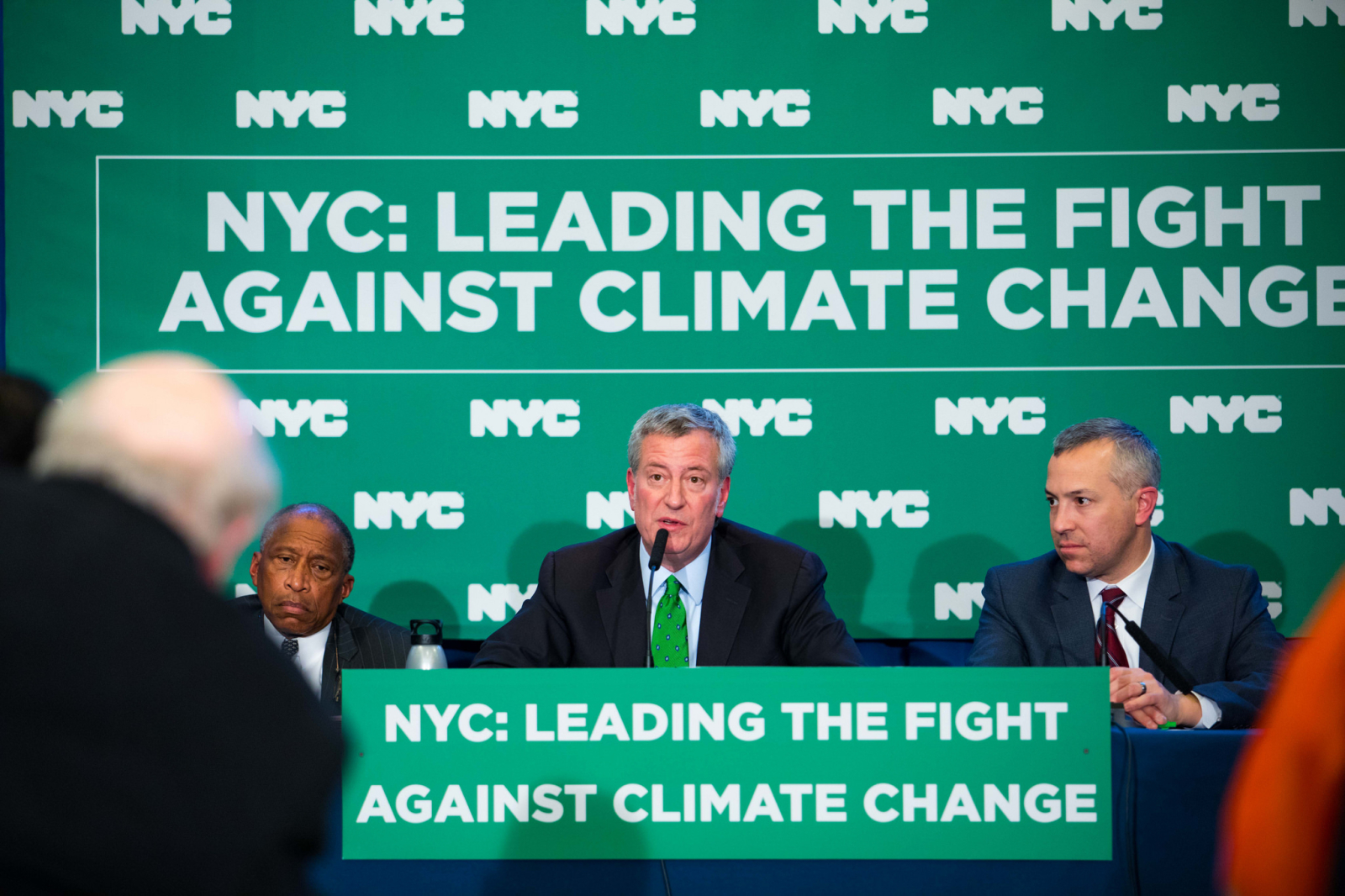
On January 10, 2018, New York City Mayor Bill de Blasio announced that he was suing five energy companies, seeking damages to pay for harm the city has faced as a result of climate change. In conjunction, the city also announced that it planned to divest its pension fund from fossil fuels. A year later, the city is seeking to revamp its legal strategy after the lawsuit’s swift dismissal in federal court and is no closer to divesting than it was before its big announcement.

While New York City has failed to achieve actionable results on these fronts, Mayor de Blasio has succeeded in one regard: boosting his liberal credentials as he contemplates a 2020 presidential run, a goal that may have been the motivation behind both announcements in the first place.

U.S. District Judge John Keenan dismissed New York City’s lawsuit shortly after it was filed, in part citing the hypocrisy of the city suing companies for producing a product it continues to rely on. “Does the city have clean hands?” Judge Keenan asked the city’s attorney, noting that Mayor de Blasio’s government, too, produces the emissions they say are responsible for the city’s climate change-related impacts.

Judge Keenan was not the first to rule in favor of the energy companies either. Less than one month before the New York City judge made his decision, U.S. District Court Judge William Alsup dismissed nearly identical lawsuits brought in California by the cities of San Francisco and Oakland. All three lawsuits are now being heard on appeal. Although, a recent change of counsel in California suggests that the New York case could stand less of chance now than it did the first time around.

In late November, the plaintiffs’ firm representing all three cities when they first filed their cases, Hagens Berman, was fired by San Francisco and Oakland and replaced with Sher Edling, Hagens Berman’s direct competitor in the climate litigation space. Mayor de Blasio, meanwhile, has continued to retain Hagens Berman, perhaps unconcerned with the final result of his case, so long as it attracts positive headlines praising his “climate leadership.”

That’s the take of at least one group who issued a statement critical of Mayor de Blasio on the anniversary of his announcement. “City officials, including Mayor de Blasio, have made clear that the true purpose of the lawsuit is to attack manufacturers and manufacturing workers,” said Linda Kelly, Senior Vice President and General Counsel of the National Association of Manufacturers.

Indeed, shortly after the city filed its climate lawsuit, Mayor de Blasio appeared as a guest on U.S. Senator Bernie Sanders’s (D-VT) podcast where he spoke about the case. “Let’s help bring the death knell to this industry that’s done so much harm,” Mayor de Blasio said of the recent announcements. His sentiments were echoed by New York City’s chief environmental lawyer, Susan Amron, who told a friendly crowd at last year’s Climate Week NYC, “[R]eally what we’re trying to do is affect the bottom line – the financial equation for the use of fossil fuels.”

This language – both from Mayor de Blasio and Amron – would seem to contradict the language of the city’s lawsuit. The case’s complaint reads, “The City does not seek to impose liability on Defendants for their direct emissions of greenhouse gases, and does not seek to restrain Defendants from engaging in their business operations.” New York City’s lawsuit explicitly denies that the city is seeking to restrict ongoing business operations, but Mayor de Blasio and Amron have both made comments publicly that imply otherwise.

Speculation that Mayor de Blasio has larger political aspirations – including a run for the White House – in his sights has been a through line throughout his tenure- a fact New Yorkers were quick to note at the time that his lawsuit was filed, calling it “more posturing than substance.” Before he seeks out Pennsylvania Avenue, however, Mayor de Blasio reportedly has room to focus on fulfilling the duties of his current office.

A recent article from The New York Times slammed “New York’s Vanishing Mayor” for being absent from work, finding that he averaged ten days in City Hall per month in 2018 and consequently “the practical mechanics of government are running less smoothly.” De Blasio responded by saying he has a “huge, ambitious agenda,” which he was working “at a great level of intensity…to get it done.”

There’s no doubt about the mayor’s ambitions, but attacking the energy companies that will keep his constituents warm through the winter and fuel his caravan of SUVs is a misguided approach to tackling climate change. There are many actions that can be taken to mitigate and address its effects. Spending taxpayer money to boost Mayor de Blasio’s national profile surely isn’t one of them.

Jude Clemente is the Editor at RealClearEnergy.

At this rate we are all going to freeze in the dark.

Kids Climate Case to be Appealed Before Trial

A monkey wrench in the Works.

Previous posts have followed the twists and turns of the lawsuit Juliana vs. US, initiated and funded by Our Children’s Trust.  In November the Supreme Court signaled their desire that lower courts rein in the scope of the lawsuit.  The District Court backed off and now the Ninth Circuit Court will take up the appeal in advance of any trial activity.  The significance and implications are described in an article by Karen Savage at Climate Liability News Appeals Court OKs Pre-Trial Appeal of Kids Climate Case, Siding With Government  Excerpts in italics with my bolds.

The Ninth Circuit Court of Appeals has granted a petition by the Trump administration for a rare pre-trial appeal in the landmark constitutional climate lawsuit, Juliana v. United States. The appeals court agreed to the interlocutory appeal, which leaves the future progress of the case unclear.

Generally, interlocutory appeals consider certain aspects of a case while allowing other issues to proceed. The young plaintiffs in the case, 21 young people from around the country, have asked District Court Judge Ann Aiken to clarify how the case will move forward while the Ninth Circuit considers its appeal. They argue that they should be allowed to continue the discovery process and other pre-trial proceedings.

The Ninth Circuit’s decision came as somewhat of a surprise because it had denied repeated attempts by the government to short-circuit the case before trial. A three-judge panel voted 2-1 to grant this request, while denying other motions, including the government’s fourth writ of mandamus request. The writ of mandamus is even rarer than an interlocutory appeal because it requires the higher court to decide the lower court clearly abused its judicial power.

But granting the interlocutory appeal still throws the case into uncertainty.

Chief Judge Sidney Thomas and Circuit Judge Marsha Berzon voted for the government’s motion while Circuit Judge Michelle Friedland dissented.

The Ninth Circuit Dec.26, 2018 ruling (here) states:

An interlocutory appeal under 28 U.S.C. § 1292(b) is authorized when a district court order “‘involves a controlling question of law as to which there is substantial ground for difference of opinion’ and where ‘an immediate appeal from the order may materially advance the ultimate termination of the litigation.’” Reese v. BP Expl. (Alaska) Inc., 643 F.3d 681, 687–88 (9th Cir. 2011) (quoting 28 U.S.C. § 1292(b)). The district court properly concluded that the issues presented by this case satisfied the standard set forth in § 1292(b) and properly exercised its discretion in certifying this case for interlocutory appeal.

The petition for permission to appeal pursuant to 28 U.S.C. § 1292(b) is granted. Within 14 days after the date of this order, petitioners shall perfect the appeal in accordance with Federal Rule of Appellate Procedure 5(d). All pending motions are denied as moot.

Previously, the petitioners (Our Children’s Trust) have repeatedly argued for a 50 day trial first and then appeal afterward.

In a reply brief, the federal government pushed back, telling the justices that it had made every possible effort in the lower courts to avoid reaching this point, but had been unsuccessful. The government emphasized that what the plaintiffs are asking the federal courts to do is extraordinary, “nothing less than a complete transformation of the American energy system – including the abandonment of fossil fuels.” Such a request, the government continued, “has no place in federal court,” so that granting the government a reprieve from the upcoming trial would “preserve the judiciary’s essential role under the Constitution.”

The government added that, contrary to the plaintiffs’ assurances, the prospect winning on appeal after an “extensive” trial had already taken place would provide little comfort to the government, because of the enormous amount of resources that would have to be devoted to pretrial preparations and the trial itself.

Summary:

What a concept!  Let’s have judges decide national energy policy.  And when the economy fails because energy supply is too expensive and unreliable, will the black robes be accountable to the public?  Nope.  And let’s turn a courtroom over to members of a doomsday cult for 50 days so they can persuade the public of their beliefs and fears. Even worse idea. Let’s hope even the Ninth Circuit can see the folly in this proceeding.

For background on the lawsuit see:  Supremes Kick Kids Lawsuit Down the Road

For background on the false GHG Endagerment Finding see: GHGs Endangerment? Evidence?

i

Courts Still Shielding Mann from Climate Exposure


An editorial from National Review summarizing how the courts function as Michael Mann’s protective shield  NR Won’t Be Cowed by a Litigious Michael Mann  December 21, 2018.  Excerpts below with my bolds.

At this rate, Jarndyce v. Jarndyce will be replaced in the Western canon as the go-to example of the court case that never ends by National Review, Inc. v. Michael E. Mann, which is now well into its seventh year as a live proposition and, alas, showing no end in sight.

For those who have forgotten, this is the 2012 case in which Mann sued National Review for libel over a 270-word blog post that criticized his infamous “hockey stick” graph portraying global warming, in response to which National Review refused to acquiesce to what was, and remains, nothing less than an attempt to use the law to bully the press into submission. That this case is both frivolous in nature and clear-cut in National Review’s favor seems to be obvious to everyone except for Michael Mann and the D.C. Court of Appeals. Indeed, in the years since Mann made his play, National Review has been joined by a veritable Who’s Who of American media organizations — including, but not limited to, the ACLU, the National Press Club, Comcast, the Cato Institute, the Washington Post, Time Inc., Reporters Committee for Freedom of the Press, and the Electronic Frontier Foundation, all of which have filed amicus briefs on NR’s side. Tellingly, National Review has also been supported by the City of Washington, D.C., in which jurisdiction the case was brought. And yet, inexplicably, the D.C. Court of Appeals continues to drag its feet.

This is extraordinary, especially given that at stake here is the integrity of the First Amendment. It is extraordinary foremost because National Review’s case is both straightforward and strong: that it is not, and it has never been, the role of the courts to settle literary or scientific disputes. But it is also extraordinary because National Review’s case is being heard under rules laid out by Washington, D.C.’s robust “anti-SLAPP” law, the explicit purpose of which is to make it more difficult to harass people and organizations with frivolous libel threats and thereby to protect a sturdy culture of free speech. How, we ask, can this be reconciled with a case such as ours, in which, among other inexplicable delays, the court has taken two years to add a single footnote to the records (and modify another)? That a slam-dunk case that is being examined under an expedited process should have yielded so many years of expensive radio static is a genuine national disgrace, and should be widely regarded as such.

National Review neither encourages nor enjoys protracted, expensive, tedious litigation. Indeed, it is our resolute view that questions such as these must be resolved outside of the courtroom. But we will be cowed neither by pressure nor by the passage of time, and we are proud of our role as a champion of the First Amendment. To those who would abridge, undermine, or attempt to circumvent that bulwark of free expression, our response is, as it ever was: Get Lost.

See also:  Rise and Fall of the Modern Warming Spike

Kid’s Climate Lawsuit Update Nov. 24


img

Updated Nov 23, 2018

As of Friday, Oregon District Court Judge Aiken has given into the Supreme Court suggestion and defendant’s request that a stay for interlocutory appeal be accepted by the lower court.  The Order by Judge Aiken is here The key excerpt is in italics with my bolds.

This Court stands by its prior rulings on jurisdictional and merits issues, as well as its belief that this case would be better served by further factual development at trial. The Court has, however, reviewed the record and takes particular note of the recent orders issued by the United States Supreme Court on July 30, 2018, and November 2, 2018, as well as the extraordinary Order of the United States Court of Appeals for the Ninth Circuit in United States v. USDC-ORE, Case No. 18-73014 issued on November 8, 2018. At this time, the Court finds sufficient cause to revisit the question of interlocutory appeal as to its previous orders, and upon reconsideration, the Court finds that each of the factors outlined in § 1292(b) have been met regarding the previously mentioned orders. Thus, this Court now exercises its discretion and immediately certifies this case for interlocutory appeal. The Court does not make this decision lightly. Accordingly, this case is STAYED pending a decision by the Ninth Circuit Court of Appeals.

This means activity in preparation for an estimated 50 day trial is suspended while the higher Court of Appeals considers whether the lawsuit is out of bounds.  See Background below.

Background from Previous Post on Nov. 5

As predicted in an earlier post (reprinted at the end), US lawyers are following the Supreme’s lead by again asking the Ninth Circuit Court of Appeals to dismiss the case.  At the same time, one motion filed at the Oregon District Court asks for a stay of proceedings there pending a ruling by the Appeals Court.  Another motion asks the Oregon court to again consider narrowing the scope of the lawsuit.  The documents can be accessed at Columbia’s climate litigation website for Juliana vs. United States  Some excerpts in italics with my bolds, followed by the Nov. 2 post.

From Petition to Court of Appeals:

If the district court grants certification and stays all proceedings, as the Supreme Court has signaled that it should, it will obviate the need for this Court’s intervention by way of mandamus. If, however, the district court declines to grant certification (despite the Supreme Court’s clear guidance to the contrary), this Court would need to intervene to provide the pretrial appellate review contemplated by the Supreme Court. 

To be clear, the government hopes that this Court’s intervention through extraordinary relief will not be necessary. The government is doing everything in its power to persuade the district court to follow the Supreme Court’s guidance and to certify its decisions for interlocutory appeal. But if the district court declines to do so, this Court should intervene to provide the relief that the Supreme Court has expressly stated “may be available in” this Court — and that is plainly warranted given the fundamental defects in Plaintiffs’ action. ECF No. 416, at 2.

Previous Post Nov. 2, 2018:  Supremes Kick Kids Lawsuit Down the Road

Last night the US Supreme justices refused the federal government’s petition to end the Oregon district court case. The media headlines will say this action allows the case to start, but that is not what happened. The real story concerns procedural hurdles and comes from Scotusblog, not from the green industry PR department (when did yellow journalism change colors?).

Everyone knows this issue will eventually come to the Supreme Court for a ruling. Some judges in black robes will take the heat for telling the truth about the case’s fatal legal flaws. So the Supremes will allow (not prevent) the lower courts to do their job to declare the suit out of bounds. All the while they know any lower ruling will be appealed by the losing side to the top later on.

As you will see, there are probably two more procedural maneuvers before the case can proceed to address the merits, or lack thereof. Yesterday, the Supremes noted that the Ninth District Court of Appeals twice refused the fed’s petition on grounds that no longer pertain. Thus, they suggest that the Ninth take a third kick at this can, perhaps this time actually engaging the issues.

If, as everyone expects, the Ninth follows their San Francisco-based leftist leanings and summarily grants no relief, then the feds can come back to the Supremes having no longer any recourse at lower levels. BTW, two Supreme Justices said they were ready now to grant the federal petition as it stands.

Amy Howe writes truthfully Justices refuse to block climate-change trial. Excerpts below in italics with my bolds.

Tonight the Supreme Court declined to intervene to block the trial in a lawsuit filed by a group of children and teenagers who have asked a federal district court in Oregon to order the federal government to prepare and put in place a plan to phase out fossil-fuel emissions. Although the justices’ ruling formally cleared the way for a trial in the case to go forward, the court stressed that the government may be able to get the relief that it is seeking in the U.S. Court of Appeals for the 9th Circuit, and it did not foreclose the possibility that the government could return to the Supreme Court yet again.

Text of Supreme Court Order ORDER IN PENDING CASE

This afternoon’s order was the latest chapter in the climate-change lawsuit, which was originally filed in 2015, during the Obama administration. The plaintiffs contend that the federal government’s conduct has led to a “dangerous climate system,” in conflict with their constitutional right to a “climate system capable of sustaining human life.”

The federal government first came to the Supreme Court in the case last summer, asking the justices to block discovery and a trial until the U.S. Court of Appeals for the 9th Circuit could rule on the government’s request to have the case dismissed or, at the very least, put on hold. But the justices declined to step in, describing the government’s request as “premature.” At the same time, the justices acknowledged that the plaintiffs’ claims are “striking” and that there are “substantial grounds for difference of opinion” on whether those claims belong in court at all; they also emphasized that the district court should “take these concerns into account in assessing the burdens of discovery and trial, as well as the desirability of a prompt ruling on” other motions that the government had filed seeking dismissal of the plaintiffs’ claims.

With a trial looming, the government returned to the Supreme Court again last week, complaining that the district court had declined to “meaningfully narrow” the scope of the case. It asked the justices to either end the lawsuit altogether or, at a minimum, review the district court’s rulings allowing the case to go forward. Chief Justice John Roberts, who at the time handled emergency requests from the geographic area that includes Oregon, agreed to put discovery and the trial on hold temporarily to give the plaintiffs an opportunity to respond to the government’s application.

In their response, the plaintiffs urged the justices to allow the trial to go forward. They noted that most pretrial fact-finding had already been completed, with the only remaining discovery “extremely limited.” The only harm that the government has cited to justify putting the trial on hold, the plaintiffs argued, is that it would otherwise be required to “participate in the normal process of trial and await appellate consideration until after final judgment” – which, in the plaintiffs’ view, is an “ordinary” burden rather than the kind of irreparable harm necessitating emergency relief. By contrast, they suggested, stopping the trial now “will disrupt the integrity of the judiciary’s role as a check on the political branches and will irreparably harm these children.” Indeed, the plaintiffs asserted, discovery and a trial are essential because the district court can’t decide the questions presented by their lawsuit, involving the plaintiffs’ legal right to bring the lawsuit and the allocation of power between the different branches of government, until the facts have been better developed.

In a reply brief, the federal government pushed back, telling the justices that it had made every possible effort in the lower courts to avoid reaching this point, but had been unsuccessful. The government emphasized that what the plaintiffs are asking the federal courts to do is extraordinary, “nothing less than a complete transformation of the American energy system – including the abandonment of fossil fuels.” Such a request, the government continued, “has no place in federal court,” so that granting the government a reprieve from the upcoming trial would “preserve the judiciary’s essential role under the Constitution.”

The government added that, contrary to the plaintiffs’ assurances, the prospect winning on appeal after an “extensive” trial had already taken place would provide little comfort to the government, because of the enormous amount of resources that would have to be devoted to pretrial preparations and the trial itself.

In an unsigned three-page order issued tonight, the Supreme Court explained that it would block the proceedings in the district court only if the government were likely to prevail on its request for an order of the Supreme Court, in particular, requiring the district court to dismiss the case. But the government cannot meet that standard, the justices continued, because it may be able to get the relief that it is seeking in the 9th Circuit. The court acknowledged that the 9th Circuit has twice turned down requests from the government to order the district court to dismiss the case, but it reasoned that the 9th Circuit did so because of the prospect that the plaintiffs’ claims against the government might eventually be dismissed through more conventional avenues. The justices concluded that those “reasons are, to a large extent, no longer pertinent” with a 50-day trial – which had been scheduled for October 29 – looming.

The court therefore denied the federal government’s request to keep the trial on hold “without prejudice” – that is, leaving open the possibility that the dispute could return to the Supreme Court again. The justices’ earlier order putting the trial on hold temporarily, to give them time to consider the government’s request, is terminated. Justices Clarence Thomas and Neil Gorsuch indicated that they would have granted the government’s request.

Background from previous post Supreme Justice Grants Stay of Kids Lawsuit

On Friday, Chief Justice Roberts stayed the discovery and trial of Juliana vs. US, pending responses from the plaintiffs to issues raised by the defense.  Report from The News Review in italics with my bolds.

The U.S. Supreme Court on Friday granted a stay in the climate trial, Juliana v. United States, pending a response from the plaintiffs.

The Department of Justice asked the Supreme Court on Tuesday to dismiss the case brought by 21 young plaintiffs Thursday.

In a news release issued Friday afternoon, Meg Ward with Our Children’s Trust said the plaintiff’s legal team is working on its response, which it will file Monday.

The Supreme Court order states a response is due by Oct. 24.

Julia Olson, one of the lawyers representing the young plaintiffs, said the prosecution is confident that once the court receives the response the trial will proceed.

“As the Supreme Court has recognized in innumerable cases, review of constitutional questions is better done on a full record where the evidence is presented and weighed by the trier of fact,” Olson said in a news release.

The lawsuit alleges the federal government has violated young people’s constitutional rights through policies that have caused a dangerous climate.

They have said their generation bears the brunt of climate change and that the government has an obligation to protect natural resources for present and future generations.

The young people say government officials have known for more than 50 years that carbon pollution from fossil fuels was causing climate change and that policies on oil and gas deprive them of life, liberty and property. They also say the government has failed to protect natural resources as a “public trust” for future generations.

The lawsuit wants a court to order the government to stop permitting and authorizing fossil fuels, quickly phase out carbon dioxide emissions to a certain level by 2100 and develop a national climate recovery plan.

The Trump administration got a temporary reprieve on the case after also asking the 9th U.S. Circuit Court of Appeals, which rejected the request in July.

“The latest attempt to get the U.S. Supreme Court to stop the trial does not appear to be based on any new evidence or arguments. The only new element is an additional Supreme Court justice,” said Melissa Scanlan, a professor at Vermont Law School, who is not involved in the case.

Kavanaugh replaced the more moderate Anthony Kennedy.

Scanlan said the Trump administration is trying to avoid “what they’re expecting to be a 50-day trial focused on climate disruption.” The trial in Eugene was expected to wrap up in January.

CNN added this:

Solicitor General Noel Francisco asked the justice to stop any further discovery and the pending trial while the government appeals the lower court opinion.

In his filing, Francisco lambasted the suit, calling it “an attempt to redirect federal environmental and energy policies through the courts rather than through the political process, by asserting a new and unsupported fundamental due process right to certain climate conditions.”

Francisco’s language echoes some of the remarks Attorney General Jeff Sessions made before the conservative Heritage Foundation on Monday. “Judicial activism is therefore a threat to our representative government and the liberty it secures,” Sessions said. “In effect, activist advocates want judges who will do for them what they have been unable to achieve at the ballot box. It is fundamentally undemocratic.”

The filings may be welcomed by some of the justices but they also put others in an uncomfortable position, and there’s a risk of going to the well too often.

“The Supreme Court unquestionably has the authority to provide the extraordinary relief the government is seeking in these cases,” said Steve Vladeck, CNN Supreme Court analyst and professor at the University of Texas School of Law.

“That said, it tends to exercise that authority sparingly,” he added,” and there’s reason to wonder if the government, by repeatedly asking for such unusual relief, might be perceived by at least some of the justices as the boy who cried wolf.”

The text of the  US filing is PETITION FOR A WRIT OF MANDAMUS Contents:

Reasons for granting the petition

A. The government has a clear and indisputable
right to relief from the district court’s refusal to
dismiss this fundamentally misguided suit

1. The district court clearly and indisputably
erred by exercising jurisdiction over the suit
2. The district court clearly and indisputably
erred by allowing the claims to proceed
outside the binding framework of the APA
3. The district court clearly and indisputably
erred by allowing the claims to proceed on the
merits

B. The government has no other adequate means to
attain relief from a fundamentally misguided and
improper trial

C. Mandamus relief is appropriate under the
circumstances

Excerpt from page 26:

Remarkably, the district court rooted its recognition of a fundamental due process right to “a climate system capable of sustaining human life,” App., infra, 141a, in this Court’s recognition of a fundamental right to samesex marriage in Obergefell v. Hodges, 135 S. Ct. 2584 (2015). There is no relationship, however, between a distinctly personal and circumscribed right to same-sex marriage and the alleged right to a climate system capable of sustaining human life that apparently would run indiscriminately to every individual in the United States. The right recognized by the district court has no relationship to any right as “fundamental as a matter of history and tradition” as the right to marry recognized in Obergefell. Id. at 2602.

Background from previous post Supremes Looking at Kids Lawsuit

An Oregon liberal judge is determined to put climate change on trial in Juliana vs US, scheduled to start on October 29, 2018.  But now another pitfall stands in the way.  The Trump administration has asked the Supreme Court to review the legitimacy of the scope of the kids’ claims they have a right to an unchanging favorable climate provided to them by the federal government.  Here is the update from Scotusblog by Amy Howe Government returns in climate change lawsuit  Excerpts in italics with my bolds.

In July, the Supreme Court declined to intervene in a lawsuit filed by a group of 21 children and teenagers who allege that they have a constitutional right to a “climate system capable of sustaining human life.” The justices rejected the federal government’s request to block discovery and a trial until the U.S. Court of Appeals for the 9th Circuit could rule on the government’s petition seeking to have the case dismissed or, at a minimum, to block discovery and the trial temporarily. Today the Trump administration returned to the Supreme Court, asking it once again to put discovery and the trial – now scheduled for the end of October – on hold.

The case was originally filed in 2015 against the Obama administration. The plaintiffs argue that the federal government’s actions are causing a “dangerous climate system,” and they have asked a federal district court in Oregon to order various federal agencies to prepare and implement a remedial plan to phase out fossil-fuel emissions.

When the government asked the justices to step in over the summer, they rejected the request, which they described as “premature.” But the justices also seemed to express some skepticism about the “breadth” of the plaintiffs’ claims, calling them “striking” and observing that there are “substantial grounds for difference of opinion” on whether those claims belong in court at all. The justices instructed the district court to “take these concerns into account in assessing the burdens of discovery and trial, as well as the desirability of a prompt ruling on the” federal government’s other pending motions, which could result in dismissal of some or all of the plaintiffs’ claims.

The government is now back at the court, telling the justices that earlier this week the district court “declined to meaningfully narrow” the plaintiffs’ claims, instead rejecting various government motions that would have ended the case. The government is now asking the court to order the district court to “end this profoundly misguided suit” or, at the very least, review the district court’s rulings allowing the case to go forward; moreover, the government again urges, the Supreme Court should put discovery and the trial on hold while it considers these requests. There would be no real harm to the plaintiffs from doing so, the government stresses, because the plaintiffs are claiming that they have been harmed by the cumulative effects of carbon dioxide emissions over several decades.

The government’s request, signed by U.S. solicitor general Noel Francisco, goes to Chief Justice John Roberts, who currently serves as the circuit justice for the 9th Circuit. Roberts can act on the government’s application immediately or refer it to the full court.

Economist Joseph Stiglitz writes of climate change: “There is a point at which, once this harm occurs, it cannot be undone at any reasonable cost or in any reasonable period of time. Based on the best available science, our country is close to approaching that point.” Credit: Win McNamee/Getty Images

For an insight into the claims being made on behalf of the kids, here is a reprint of a previous post analyzing a brief filed by an IPCC insider.

Climatists Make Their Case by Omitting Facts

One of the world’s top economists has written an expert court report that forcefully supports a group of children and young adults who have sued the federal government for failing to act on climate change. (Source: Inside Climate News  here) Excerpts in italics with my bolds.

Stiglitz, a Columbia University economics professor and former World Bank chief economist, concludes that increasing global warming will have huge costs on society and that a fossil fuel-based system “is causing imminent, significant, and irreparable harm to the Youth Plaintiffs and Affected Children more generally.” He explains in a footnote that his analysis also examines impacts on “as-yet-unborn youth, the so-called future generations.”

But, he says, acting on climate change now—by imposing a carbon tax and cutting fossil fuel subsidies, among other steps—is still manageable and would have net-negative costs. He argues that if the government were to pursue clean energy sources and energy-smart technologies, “the net benefits of a policy change outweigh the net costs of such a policy change.”

“Defendants must act with all deliberate speed and immediately cease the subsidization of fossil fuels and any new fossil fuel projects, and implement policies to rapidly transition the U.S. economy away from fossil fuels,” Stiglitz writes. “This urgent action is not only feasible, the relief requested will benefit the economy.”

Stiglitz has been examining the economic impact of global warming for many years. He was a lead author of the 1995 report of the UN’s Intergovernmental Panel on Climate Change, an authoritative assessment of climate science that won the IPCC the 2007 Nobel Peace Prize, shared with Al Gore.

The Stiglitz expert report submitted to the court is here.

An Example of Intentional Omissions

Since this is a legal proceeding, Stiglitz wrote a brief telling the plaintiffs’ side of the story. In a scientific investigation, parties would assert theories attempting to explain all of the evidence at hand. Legal theories have no such requirement to incorporate all the facts, but rather present conclusions informed by the evidence deemed strongest and most pertinent to one party’s interests.

While the Pope accuses us with the Sin of Emissions, we counter with the Sins of Omissions by him and his fellow activists.

Let’s consider the Stiglitz brief according to the three suppositions comprising the Climatist (Activists and Alarmists) position. Climate change is a bundle that depends on all three assertions to be true.

Supposition 1: Humans make the climate warmer.

As an economist, Stiglitz defers to the IPCC on this scientific point, with references to reports by those deeply involved and committed to Paris Accord and other UN climate programs. In the recent California District Court case (Cities suing Big Oil companies), both sides in a similar vein stipulated their acceptance of IPCC reports as authoritative regarding global warming/climate change.

Skeptical observers must attend to the nuances of what is referenced and what is hidden or omitted in these testimonies. For example, Chevron’s attorney noted that IPCC’s reports express various opinions over time as to human influence on the climate. They noted that even today, the expected temperature effect from doubling CO2 ranges widely from 1.5C to 4.5C. No mention is made that several more recent estimates from empirical data (rather than GCMs) are at the low end or lower.

In addition, there is no mention that GCMs projections are running about twice as hot as observations. Omitted is the fact GCMs correctly replicate tropospheric temperature observations only when CO2 warming is turned off. In the effort to proclaim scientific certainty, neither Stiglitz nor IPCC discuss the lack of warming since the 1998 El Nino, despite two additional El Ninos in 2010 and 2016.

Figure 5. Simplification of IPCC AR5 shown above in Fig. 4. The colored lines represent the range of results for the models and observations. The trends here represent trends at different levels of the tropical atmosphere from the surface up to 50,000 ft. The gray lines are the bounds for the range of observations, the blue for the range of IPCC model results without extra GHGs and the red for IPCC model results with extra GHGs.The key point displayed is the lack of overlap between the GHG model results (red) and the observations (gray). The nonGHG model runs (blue) overlap the observations almost completely.

Further they exclude comparisons between fossil fuel consumption and temperature changes. The legal methodology for discerning causation regarding work environments or medicine side effects insists that the correlation be strong and consistent over time, and there be no confounding additional factors. As long as there is another equally or more likely explanation for a set of facts, the claimed causation is unproven. Such is the null hypothesis in legal terms: Things happen for many reasons unless you can prove one reason is dominant.

Finally, Stiglitz and IPCC are picking on the wrong molecule. The climate is controlled not by CO2 but by H20. Oceans make climate through the massive movement of energy involved in water’s phase changes from solid to liquid to gas and back again. From those heat transfers come all that we call weather and climate: Clouds, Snow, Rain, Winds, and Storms.

Esteemed climate scientist Richard Lindzen ended a very fine recent presentation with this description of the climate system:

I haven’t spent much time on the details of the science, but there is one thing that should spark skepticism in any intelligent reader. The system we are looking at consists in two turbulent fluids interacting with each other. They are on a rotating planet that is differentially heated by the sun. A vital constituent of the atmospheric component is water in the liquid, solid and vapor phases, and the changes in phase have vast energetic ramifications. The energy budget of this system involves the absorption and reemission of about 200 watts per square meter. Doubling CO2 involves a 2% perturbation to this budget. So do minor changes in clouds and other features, and such changes are common. In this complex multifactor system, what is the likelihood of the climate (which, itself, consists in many variables and not just globally averaged temperature anomaly) is controlled by this 2% perturbation in a single variable? Believing this is pretty close to believing in magic. Instead, you are told that it is believing in ‘science.’ Such a claim should be a tip-off that something is amiss. After all, science is a mode of inquiry rather than a belief structure.

Supposition 2: The Warming is Dangerous

Billions of dollars have been spent researching any and all negative effects from a warming world: Everything from Acne to Zika virus. Stiglitz links to a recent Climate Report that repeats the usual litany of calamities to be feared and avoided by submitting to IPCC demands. The evidence does not support these claims.

Stiglitz: It is scientifically established that human activities produce GHG emissions, which accumulate in the atmosphere and the oceans, resulting in warming of Earth’s surface and the oceans, acidification of the oceans, increased variability of climate, with a higher incidence of extreme weather events, and other changes in the climate.

Moreover, leading experts believe that there is already more than enough excess heat in the climate system to do severe damage and that 2C of warming would have very significant adverse effects, including resulting in multi-meter sea level rise.

Experts have observed an increased incidence of climate-related extreme weather events, including increased frequency and intensity of extreme heat and heavy precipitation events and more severe droughts and associated heatwaves. Experts have also observed an increased incidence of large forest fires; and reduced snowpack affecting water resources in the western U.S. The most recent National Climate Assessment projects these climate impacts will continue to worsen in the future as global temperatures increase.

Alarming Weather and Wildfires

But: Weather is not more extreme.
And Wildfires were worse in the past.
But: Sea Level Rise is not accelerating.
Litany of Changes

Seven of the ten hottest years on record have occurred within the last decade; wildfires are at an all-time high, while Arctic Sea ice is rapidly diminishing.

We are seeing one-in-a-thousand-year floods with astonishing frequency.

When it rains really hard, it’s harder than ever.

We’re seeing glaciers melting, sea level rising.

The length and the intensity of heatwaves has gone up dramatically.

Plants and trees are flowering earlier in the year. Birds are moving polewards.

We’re seeing more intense storms.

But: Arctic Ice has not declined since 2007.
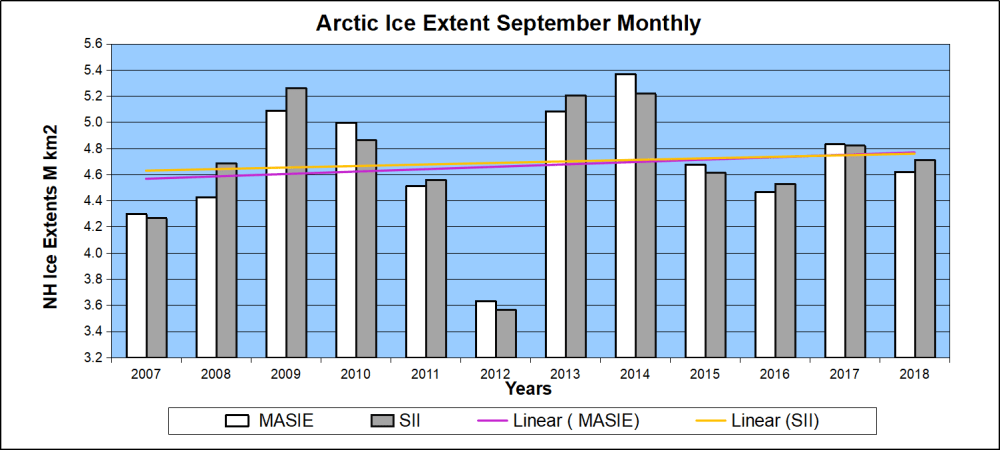
arctic-sept-2007-to-20181

But: All of these are within the range of past variability.

In fact our climate is remarkably stable.
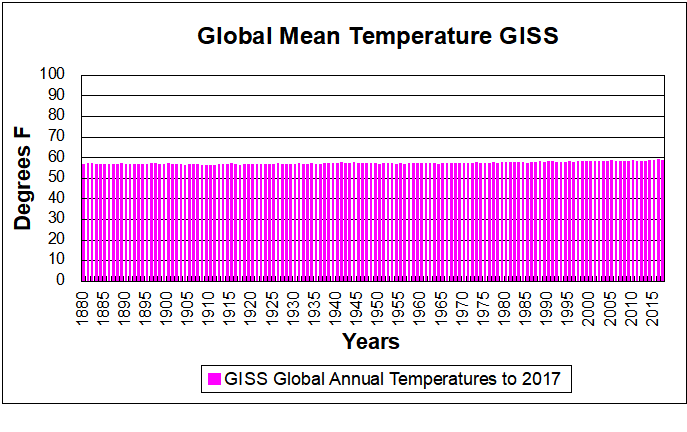
And many aspects follow quasi-60 year cycles.

Climate is Changing the Weather

Stiglitz:  Other potential examples include agricultural losses. Whether or not insurance
reimburses farmers for their crops, there can be food shortages that lead to higher food
prices (that will be borne by consumers, that is, Youth Plaintiffs and Affected Children).
There is a further risk that as our climate and land use pattern changes, disease vectors
may also move (e.g., diseases formerly only in tropical climates move northward).36 This
could lead to material increases in public health costs

But: Actual climate zones are local and regional in scope, and they show little boundary change.


But: Ice cores show that it was warmer in the past, not due to humans.

Supposition 3:  Government Can Stop it!

Here it is blithely assumed that the court can rule the seas to stop rising, heat waves to cease, and Arctic ice to grow (though why we would want that is debatable).  All this will be achieved by leaving fossil fuels in the ground and powering civilization with windmills and solar panels.  While admitting that our way of life depends on fossil fuels, they ignore the inadequacy of renewable energy sources at their present immaturity.

Stiglitz: Conclusion
The choice between incurring manageable costs now and the incalculable, perhaps even
irreparable, burden Youth Plaintiffs and Affected Children will face if Defendants fail to
rapidly transition to a non-fossil fuel economy is clear. While the full costs of the climate
damages that would result from maintaining a fossil fuel-based economy may be
incalculable, there is already ample evidence concerning the lower bound of such costs,
and with these minimum estimates, it is already clear that the cost of transitioning to a
low/no carbon economy are far less than the benefits of such a transition. No rational
calculus could come to an alternative conclusion. Defendants must act with all deliberate
speed and immediately cease the subsidization of fossil fuels and any new fossil fuel
projects, and implement policies to rapidly transition the U.S. economy away from fossil
fuels.

But CO2 relation to Temperature is Inconsistent.

But: The planet is greener because of rising CO2.

But: Modern nations (G20) depend on fossil fuels for nearly 90% of their energy.

But: Renewables are not ready for prime time.

People need to know that adding renewables to an electrical grid presents both technical and economic challenges.  Experience shows that adding intermittent power more than 10% of the baseload makes precarious the reliability of the supply.  South Australia is demonstrating this with a series of blackouts when the grid cannot be balanced.  Germany got to a higher % by dumping its excess renewable generation onto neighboring countries until the EU finally woke up and stopped them. Texas got up to 29% by dumping onto neighboring states, and some like Georgia are having problems.

But more dangerous is the way renewables destroy the economics of electrical power.  Seasoned energy analyst Gail Tverberg writes:

In fact, I have come to the rather astounding conclusion that even if wind turbines and solar PV could be built at zero cost, it would not make sense to continue to add them to the electric grid in the absence of very much better and cheaper electricity storage than we have today. There are too many costs outside building the devices themselves. It is these secondary costs that are problematic. Also, the presence of intermittent electricity disrupts competitive prices, leading to electricity prices that are far too low for other electricity providers, including those providing electricity using nuclear or natural gas. The tiny contribution of wind and solar to grid electricity cannot make up for the loss of more traditional electricity sources due to low prices.

These issues are discussed in more detail in the post Climateers Tilting at Windmills

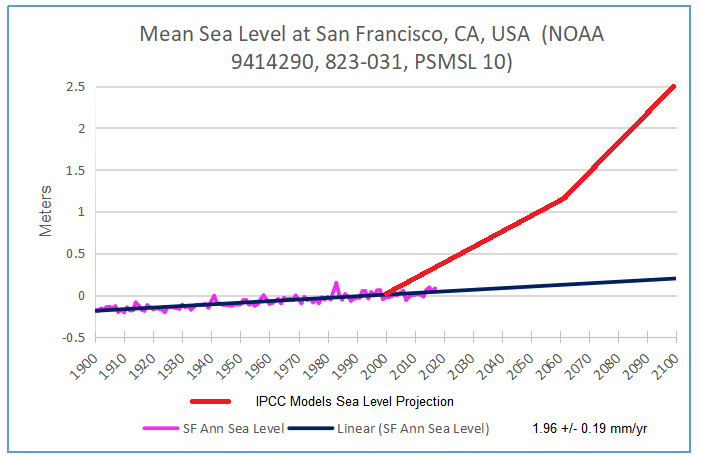
Footnote regarding mention of “multi-meter” sea level rise.  It is all done with computer models.  For example, below is San Francisco.  More at USCS Warnings of Coastal Floodings
sf-ca-past-projected

dilbert-sins-of-omission-and-comission

Will the Courts Shut Off Energy Supplies?

Numerous posts here have reported on efforts by climate lawyers to stop use of fossil fuels (FF) to prevent imaginary global warming. The failure of rising CO2 to cause warming in the atmosphere is confirmed yet again by a detailed study of the last 40 years of satellite measurements. My synopsis with links is Atmospheric Observations Contradict Global Warming Theory.

Despite no apparent global warming, climatists (alarmists/activists) are determined that fossil fuels be “left in the ground.” Actually, everyone knows it is not illegal to sell and use fossil fuel products. Of course there are attempts to change that, the current example being the kids lawsuit, destined eventually to go before the US Supreme Court. See Kid’s Climate Lawsuit Update Nov. 5.

Even before that long-shot case started in 2015, climate lawyers have been busy applying another strategy. Since it is legal (still) to sell and use FF, the idea is to prevent the transport of such energy by pipelines, thereby blocking sale and usage and eventually making extraction and production of FF uneconomic. Hence, numerous legal actions have been mounted to prevent or shut down gas and/or oil pipelines.

An insight into their thinking is provided by the recent Montana District judge stopping the Keystone pipeline project that was expressly approved by President Trump. The District Court Order is published at Sierra Club website, since they are a major employer of climate lawyers. (SEIS means the final Supplemental Environmental Impact Statement; ROD means Record of Decision by the Department authority (State Dept. In this case)). The order (here) is written by Judge Brian Morris, excerpts in italics with my bolds.

2. The Department’s Conclusions on Climate Change

The 2014 SEIS determined that the pipeline would not affect significantly oil extraction in Canada. As a result of this determination, the 2014 SEIS reasoned that the emissions associated with transporting 830,000 bpd of tar sands crude oil (Keystone’s capacity), would occur regardless of the pipeline’s existence. To reach this conclusion, the 2014 SEIS analyzed numerous factors, including the price of oil, transportation costs, and supply and demand for oil.

The Court must limit its review to determining whether the 2014 SEIS took a “hard look” at the effects of Keystone on oil markets. The Department met this “hard look” requirement in its market analysis and its conclusion that Keystone would not impact the rate of tar sands extraction. The Department provided sufficient analysis that went beyond mere assumptions of the rate of oil sands extraction rates in 2014. The Court finds no error in the Department’s 2014 analysis of the rate of tar sands extraction and its impact on climate change.

The Department denied the permit in its 2015 ROD. The Department relied heavily on the United States’s role in climate leadership.

[My Comment: That 2014 Keystone project SEIS statement proved embarrassing to then-President Obama, who was gearing up for the 2015 do-or-die Paris Accord conference. He directed State Dept. to reconsider, and they did in the 2015 ROD.]

The Department issued a new ROD in 2017. The new ROD noted that “there have been numerous developments related to global action to address climate change, including announcements by many countries of their plans to do so” since the 2015 ROD. Moreover, the new ROD suggested that “a decision to approve [the] proposed Project would support U.S. priorities relating to energy security, economic development, and infrastructure.” The Department argues that this about-face constitutes a mere policy shift, and that on its own, cannot be found arbitrary and capricious.

The Department possesses the authority to give more weight to energy security in 2017 than it had in 2015. Kake and State Farm make clear, however, that “even when reversing a policy after an election, an agency may not simply discard prior factual findings without a reasoned explanation.” The Department did not merely make a policy shift in its stance on the United States’s role on climate change. It simultaneously ignored the 2015 ROD’s Section 6.3 titled “Climate Change-Related Foreign Policy Considerations.” Section 6.3 of the 2015 ROD determined that the United States’s climate change leadership provided a significant basis for denying the permit. The Department acknowledged science supporting a need to keep global temperature below two degrees Celsius above pre-industrial levels Id. at 1182-83. The Department further recognized the scientific evidence that human activity represents a dominant cause of climate change. The Department cited transboundary impacts including storm surges and intense droughts. And finally, the Department accepted the United States’s impact as the world’s largest economy and second-largest greenhouse gas emitter.

[My comment: Note that President’s Obama’s personal desire to be a global leader on climate change is referred to as a “factual finding” and President Trump’s alternate policy is called “capricious.” President Obama’s personal beliefs then serve to justify introducing a bunch of UN-IPCC assertions to override US sovereignty.]

The 2017 ROD initially tracked the 2015 ROD nearly word-for-word. The 2017 ROD, without explanation or acknowledgment, omitted entirely a parallel section discussing “Climate Change-Related Foreign Policy Considerations.” The 2017 ROD ignores the 2015 ROD’s conclusion that 2015 represented a critical time for action on climate change. The 2017 ROD avoids this conclusion with a single paragraph. The 2017 ROD simply states that since 2015, there have been “numerous developments related to global action to address climate change, including announcements by many countries of their plans to do so.”

Once again, this conclusory statement falls short of a factually based determination, let alone a reasoned explanation, for the course reversal. “An agency cannot simply disregard contrary or inconvenient factual determinations that it made in the past, any more than it can ignore inconvenient facts when it writes on a blank slate.”

Blaming FF Pipelines for Global Warming/Climate Change

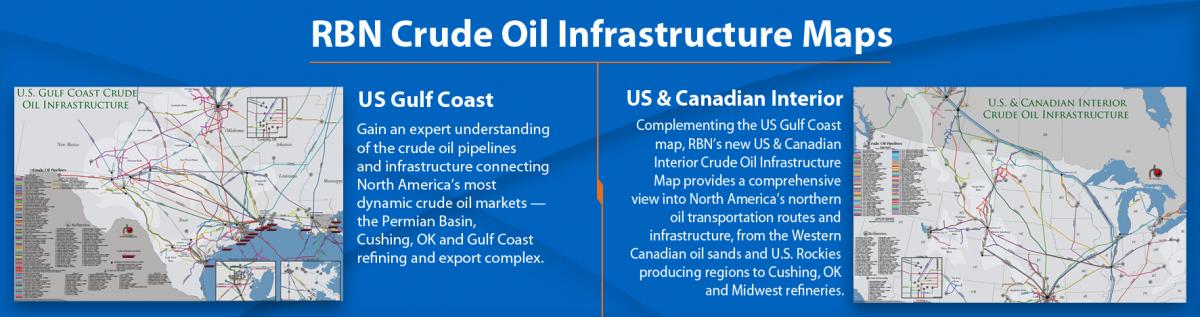
The Trump administration will be considering the most effective response to the above latest judicial creativity.  Meanwhile, a look into the saga of the Sabal Trail pipeline shows how climate lawyers are beavering away to undermine and blockade FF energy infrastructure. Overview and current pipeline status is from RBN Energy Northeast Gas Pulled South By Florida Power Plants And Sabal Trail. Excerpts in italics with my bolds.

Florida’s electric utilities are turning to natural gas-fired power and renewables for all their incremental generation needs and as replacements for the older coal units they’ve been retiring. The state’s big bet on natural gas has been spurring the development of new pipelines. And, because of big shifts in where gas is being produced and where it’s flowing, the Sunshine State will soon be receiving an increasing share of its gas needs from the Marcellus region. Today, we discuss the slew of new gas-fired power plants that have come online, the additional plants planned, and gas flows on Sabal Trail, the first new gas mainline into the state in almost two decades.

Open image in new tab to enlarge.

With more than a year of Sabal Trail operational history in the books and Florida’s seasonal weather as hot and humid as modern man and woman can bear, we decided it was time for an update. As we said in Part 1 of this two-part series, Florida is a leading generator of electricity — second only to Texas, in fact — and in recent years its electric utilities have been particularly aggressive in their shift from coal (and nuclear) generation to gas. That spurred the development of the 1.1-Bcf/d Sabal Trail Pipeline, which runs more than 500 miles from an interconnect with Williams’s Transcontinental Gas Pipeline (Transco) in west-central Alabama to the Orlando-area gas hub (black dot in Figure 1). A related pipeline called Florida Southeast Connection delivers gas from that hub into South Florida. Sabal Trail — in service since May 2017 — increased to three the number of gas mainlines serving the state, the other two being the 3.1-Bcf/d Florida Gas Transmission and the 1.3-Bcf/d Gulfstream Natural Gas System.

Obstructing Sabal Trail

Climate lawyers have opposed and obstructed Sabal Trail pipeline for years, and their arguments are seen in the most recent ruling by FERC, the Federal Energy Regulatory Commission, August 10, 2018 Order Denying Rehearing. Excerpts in italics with my bolds.

Sierra Club claims that the Commission has entirely ignored downstream emissions. This is not true. The Commission fully considered GHG emissions in the Final SEIS by quantifying them and providing information that put the GHG emissions in context. In this case, having confirmed, following review of the Final SEIS, that the SMP Project remains an environmentally acceptable action, the Commission has no need to effectively re-open its balancing to determine whether the environmental consequences outweigh the previously-identified benefits. The fact that, explained above, the Final SEIS was unable to determine whether the quantified GHG emissions were significant, does not vitiate the fact that we analyzed them and concluded that the identified quantity of GHG emissions does not support a finding that the SMP Project is environmentally unacceptable.

Sierra Club further states that nothing in the NGA (National Gas Act) precludes consideration of downstream emissions. This is correct. We have never suggested to the contrary. Whether such consideration is required by law and whether such consideration compels an outcome of denial of pipeline infrastructure, is a different question. The Commission’s public interest balancing includes a wide-range of factors, but the “principal aim” of the NGA, as determined by Congress, is to “encourag[e] the orderly development of plentiful supplies of . . . natural gas at reasonable prices,” and “protect[] consumers against exploitation at the hands of natural gas companies.” As the Commission explained in the Remand Order, “the public interest that the Commission must protect always includes the interest of consumers in having access to an adequate supply of gas at a reasonable price.”

It is within the policy framework established by Congress in the NGA that the Commission determines whether a proposed project is “environmentally acceptable.” As we explain herein, that determination included consideration of downstream GHG emissions and their secondary effects. We acknowledge that there may be disagreement with the policy choice expressed in the NGA; however, the Remand Order correctly found that “it is for Congress or the Executive Branch to decide national policy on the use of natural gas and that the Commission’s job is to review applications before it on a case-by-case basis.”

57.Congress has not granted the Commission the responsibility to affirmatively establish federal climate policy. Accordingly, we believe the Commission’s proper role is to implement federal climate policies—as established by Congress and those Executive departments to which Congress has delegated the requisite authority—in discharging its duties under the NGA and other statutes the Commission administers, including the Federal Power Act (FPA). The D.C. Circuit has explained that, “[a]s a federal agency, FERC is a ‘creature of statute,’ having ‘no constitutional or common law existence or authority, but only those authorities conferred upon it by Congress.’”

Whether Congress’s directive for the Commission “to encourage the orderly development of plentiful supplies of . . . natural gas at reasonable prices,” is outweighed by the need to address the problem of global climate change is “a question of deep ‘economic and political significance’ that is central to this statutory scheme; had Congress wished to assign that question to an agency, it surely would have done so expressly.” The lack of such an express grant does not necessarily preclude the Commission from considering the impacts of climate change in its assessment of the public interest. But it does mean that the Commission may not flip the NGA on its head, by using it as a vehicle to regulate climate change—and the numerous upstream and downstream activities that contribute thereto—rather than the transportation and sale of natural gas in interstate commerce.

The rehearing requests filed by Sierra Club, G.B.A. Associates, and K. Gregory Issacs are hereby denied. (B) The request for stay filed by Sierra Club is dismissed as moot.

A more precise explanation of the issues in play is provided by a dissenting opinion written by Judge Brown at the DC Court of Appeals in 2017 regarding Sabal Trail pipeline.

Overview of the August 22, 2017 Ruling on Sabal Trail Florida Pipeline Project

Media Report: Activists won a huge victory when a Washington, D.C. appellate court panel sided with the Sierra Club, saying the federal agency that reviewed the project had made a huge error. In the narrow 2-1 decision, U.S. Circuit Judge Thomas B. Griffith wrote that the Federal Energy Regulatory Commission (FERC) should have considered the impact of the pipeline’s added greenhouse gas emissions.

BROWN, Circuit Judge, concurring in part and dissenting in part (in italics with my bolds)

I join today’s opinion on all issues save the Court’s decision to vacate and remand the pipeline certificates on the issue of downstream greenhouse emissions. Case law is clear: When an agency “‘has no ability to prevent a certain effect due to’ [its] ‘limited statutory authority over the relevant action[],’ then that action ‘cannot be considered a legally relevant cause’” of an indirect environmental effect under the National Environmental Policy Act (“NEPA”).

Here, FERC declined to engage in an in-depth examination of downstream greenhouse gas emissions because there is no causal relationship between approval of the proposed pipelines and the downstream greenhouse emissions; and, even if a causal relationship exists, any additional analysis would not meaningfully contribute to its decision making. Both determinations were reasonable and entitled to deference.

Regarding causation, the Court is correct that NEPA requires an environmental analysis to include indirect effects that are “reasonably foreseeable,” Freeport, 827 F.3d at 46, but it misunderstands what qualifies as reasonably foreseeable. The Court blithely asserts it is “not just the journey,” it is “also the destination.” Maj. Op. at 18. In fact, NEPA is a procedural statute that is all about the journey. It compels agencies to consider all environmental effects likely to result from the project under review, but it “does not dictate particular decisional outcomes.”

While the Court concludes FERC’s approval of the proposed pipelines will be the cause of greenhouse gas emissions because a significant portion of the natural gas transported through the pipeline will be burned at power plants, see Maj. Op. at 19, the truth is that FERC has no control over whether the power plants that will emit these greenhouse gases will come into existence or remain in operation.

Even if the Court is correct that the Commission has the power to deny pipeline certificates based on indirect environmental concerns, such a denial represents the limit of the Commission’s statutory power. Nothing would prevent the Florida Board from independently approving the construction or expansion of the power plants at issue. In fact, the record shows the Board has already approved some of these projects prior to the Commission reaching a decision on the proposed pipelines. JA 910–11. Moreover, there is also nothing preventing the Intervenors from pursuing an alternative method of delivery to account for the same amount of natural gas. Practical considerations point in the opposite direction. Both the Board and the Commission have concluded Florida has a need for additional natural gas, and nothing in today’s opinion takes issue with those holdings.

Thus, just as FERC in the DOE cases and the Federal Motor Carrier Safety Administration in Public Citizen did not have the legal power to prevent certain environmental effects, the Commission here has no authority to prevent the emission of greenhouse gases through newly-constructed or expanded power plants approved by the Board.

Summary

Climate lawyers funded by Sierra Club and other activists are attempting to load upon pipelines the guilt by association with fossil fuels. That their global warming fears are unfounded does not deter them. And they attempt to twist regulatory statutes to their purpose rather than what was congressional intent. As Judge Kavanaugh put it in a different DC Court of Appeals ruling: They are jamming a square peg (addressing climate change) in a round hole (eg.limiting ozone-destroying chemicals).

Kid’s Climate Lawsuit Update Nov. 5


img

As predicted in the previous post (reprinted below), US lawyers are following the Supreme’s lead by again asking the Ninth Circuit Court of Appeals to dismiss the case.  At the same time, one motion filed at the Oregon District Court asks for a stay of proceedings there pending a ruling by the Appeals Court.  Another motion asks the Oregon court to again consider narrowing the scope of the lawsuit.  The documents can be accessed at Columbia’s climate litigation website for Juliana vs. United States  Some excerpts in italics with my bolds, followed by the Nov. 2 post.

From Petition to Court of Appeals:

If the district court grants certification and stays all proceedings, as the Supreme Court has signaled that it should, it will obviate the need for this Court’s intervention by way of mandamus. If, however, the district court declines to grant certification (despite the Supreme Court’s clear guidance to the contrary), this Court would need to intervene to provide the pretrial appellate review contemplated by the Supreme Court. 

To be clear, the government hopes that this Court’s intervention through extraordinary relief will not be necessary. The government is doing everything in its power to persuade the district court to follow the Supreme Court’s guidance and to certify its decisions for interlocutory appeal. But if the district court declines to do so, this Court should intervene to provide the relief that the Supreme Court has expressly stated “may be available in” this Court — and that is plainly warranted given the fundamental defects in Plaintiffs’ action. ECF No. 416, at 2.

Previous Post Nov. 2, 2018:  Supremes Kick Kids Lawsuit Down the Road

Last night the US Supreme justices refused the federal government’s petition to end the Oregon district court case. The media headlines will say this action allows the case to start, but that is not what happened. The real story concerns procedural hurdles and comes from Scotusblog, not from the green industry PR department (when did yellow journalism change colors?).

Everyone knows this issue will eventually come to the Supreme Court for a ruling. Some judges in black robes will take the heat for telling the truth about the case’s fatal legal flaws. So the Supremes will allow (not prevent) the lower courts to do their job to declare the suit out of bounds. All the while they know any lower ruling will be appealed by the losing side to the top later on.

As you will see, there are probably two more procedural maneuvers before the case can proceed to address the merits, or lack thereof. Yesterday, the Supremes noted that the Ninth District Court of Appeals twice refused the fed’s petition on grounds that no longer pertain. Thus, they suggest that the Ninth take a third kick at this can, perhaps this time actually engaging the issues.

If, as everyone expects, the Ninth follows their San Francisco-based leftist leanings and summarily grants no relief, then the feds can come back to the Supremes having no longer any recourse at lower levels. BTW, two Supreme Justices said they were ready now to grant the federal petition as it stands.

Amy Howe writes truthfully Justices refuse to block climate-change trial. Excerpts below in italics with my bolds.

Tonight the Supreme Court declined to intervene to block the trial in a lawsuit filed by a group of children and teenagers who have asked a federal district court in Oregon to order the federal government to prepare and put in place a plan to phase out fossil-fuel emissions. Although the justices’ ruling formally cleared the way for a trial in the case to go forward, the court stressed that the government may be able to get the relief that it is seeking in the U.S. Court of Appeals for the 9th Circuit, and it did not foreclose the possibility that the government could return to the Supreme Court yet again.

Text of Supreme Court Order ORDER IN PENDING CASE

This afternoon’s order was the latest chapter in the climate-change lawsuit, which was originally filed in 2015, during the Obama administration. The plaintiffs contend that the federal government’s conduct has led to a “dangerous climate system,” in conflict with their constitutional right to a “climate system capable of sustaining human life.”

The federal government first came to the Supreme Court in the case last summer, asking the justices to block discovery and a trial until the U.S. Court of Appeals for the 9th Circuit could rule on the government’s request to have the case dismissed or, at the very least, put on hold. But the justices declined to step in, describing the government’s request as “premature.” At the same time, the justices acknowledged that the plaintiffs’ claims are “striking” and that there are “substantial grounds for difference of opinion” on whether those claims belong in court at all; they also emphasized that the district court should “take these concerns into account in assessing the burdens of discovery and trial, as well as the desirability of a prompt ruling on” other motions that the government had filed seeking dismissal of the plaintiffs’ claims.

With a trial looming, the government returned to the Supreme Court again last week, complaining that the district court had declined to “meaningfully narrow” the scope of the case. It asked the justices to either end the lawsuit altogether or, at a minimum, review the district court’s rulings allowing the case to go forward. Chief Justice John Roberts, who at the time handled emergency requests from the geographic area that includes Oregon, agreed to put discovery and the trial on hold temporarily to give the plaintiffs an opportunity to respond to the government’s application.

In their response, the plaintiffs urged the justices to allow the trial to go forward. They noted that most pretrial fact-finding had already been completed, with the only remaining discovery “extremely limited.” The only harm that the government has cited to justify putting the trial on hold, the plaintiffs argued, is that it would otherwise be required to “participate in the normal process of trial and await appellate consideration until after final judgment” – which, in the plaintiffs’ view, is an “ordinary” burden rather than the kind of irreparable harm necessitating emergency relief. By contrast, they suggested, stopping the trial now “will disrupt the integrity of the judiciary’s role as a check on the political branches and will irreparably harm these children.” Indeed, the plaintiffs asserted, discovery and a trial are essential because the district court can’t decide the questions presented by their lawsuit, involving the plaintiffs’ legal right to bring the lawsuit and the allocation of power between the different branches of government, until the facts have been better developed.

In a reply brief, the federal government pushed back, telling the justices that it had made every possible effort in the lower courts to avoid reaching this point, but had been unsuccessful. The government emphasized that what the plaintiffs are asking the federal courts to do is extraordinary, “nothing less than a complete transformation of the American energy system – including the abandonment of fossil fuels.” Such a request, the government continued, “has no place in federal court,” so that granting the government a reprieve from the upcoming trial would “preserve the judiciary’s essential role under the Constitution.”

The government added that, contrary to the plaintiffs’ assurances, the prospect winning on appeal after an “extensive” trial had already taken place would provide little comfort to the government, because of the enormous amount of resources that would have to be devoted to pretrial preparations and the trial itself.

In an unsigned three-page order issued tonight, the Supreme Court explained that it would block the proceedings in the district court only if the government were likely to prevail on its request for an order of the Supreme Court, in particular, requiring the district court to dismiss the case. But the government cannot meet that standard, the justices continued, because it may be able to get the relief that it is seeking in the 9th Circuit. The court acknowledged that the 9th Circuit has twice turned down requests from the government to order the district court to dismiss the case, but it reasoned that the 9th Circuit did so because of the prospect that the plaintiffs’ claims against the government might eventually be dismissed through more conventional avenues. The justices concluded that those “reasons are, to a large extent, no longer pertinent” with a 50-day trial – which had been scheduled for October 29 – looming.

The court therefore denied the federal government’s request to keep the trial on hold “without prejudice” – that is, leaving open the possibility that the dispute could return to the Supreme Court again. The justices’ earlier order putting the trial on hold temporarily, to give them time to consider the government’s request, is terminated. Justices Clarence Thomas and Neil Gorsuch indicated that they would have granted the government’s request.

Background from previous post Supreme Justice Grants Stay of Kids Lawsuit

On Friday, Chief Justice Roberts stayed the discovery and trial of Juliana vs. US, pending responses from the plaintiffs to issues raised by the defense.  Report from The News Review in italics with my bolds.

The U.S. Supreme Court on Friday granted a stay in the climate trial, Juliana v. United States, pending a response from the plaintiffs.

The Department of Justice asked the Supreme Court on Tuesday to dismiss the case brought by 21 young plaintiffs Thursday.

In a news release issued Friday afternoon, Meg Ward with Our Children’s Trust said the plaintiff’s legal team is working on its response, which it will file Monday.

The Supreme Court order states a response is due by Oct. 24.

Julia Olson, one of the lawyers representing the young plaintiffs, said the prosecution is confident that once the court receives the response the trial will proceed.

“As the Supreme Court has recognized in innumerable cases, review of constitutional questions is better done on a full record where the evidence is presented and weighed by the trier of fact,” Olson said in a news release.

The lawsuit alleges the federal government has violated young people’s constitutional rights through policies that have caused a dangerous climate.

They have said their generation bears the brunt of climate change and that the government has an obligation to protect natural resources for present and future generations.

The young people say government officials have known for more than 50 years that carbon pollution from fossil fuels was causing climate change and that policies on oil and gas deprive them of life, liberty and property. They also say the government has failed to protect natural resources as a “public trust” for future generations.

The lawsuit wants a court to order the government to stop permitting and authorizing fossil fuels, quickly phase out carbon dioxide emissions to a certain level by 2100 and develop a national climate recovery plan.

The Trump administration got a temporary reprieve on the case after also asking the 9th U.S. Circuit Court of Appeals, which rejected the request in July.

“The latest attempt to get the U.S. Supreme Court to stop the trial does not appear to be based on any new evidence or arguments. The only new element is an additional Supreme Court justice,” said Melissa Scanlan, a professor at Vermont Law School, who is not involved in the case.

Kavanaugh replaced the more moderate Anthony Kennedy.

Scanlan said the Trump administration is trying to avoid “what they’re expecting to be a 50-day trial focused on climate disruption.” The trial in Eugene was expected to wrap up in January.

CNN added this:

Solicitor General Noel Francisco asked the justice to stop any further discovery and the pending trial while the government appeals the lower court opinion.

In his filing, Francisco lambasted the suit, calling it “an attempt to redirect federal environmental and energy policies through the courts rather than through the political process, by asserting a new and unsupported fundamental due process right to certain climate conditions.”

Francisco’s language echoes some of the remarks Attorney General Jeff Sessions made before the conservative Heritage Foundation on Monday. “Judicial activism is therefore a threat to our representative government and the liberty it secures,” Sessions said. “In effect, activist advocates want judges who will do for them what they have been unable to achieve at the ballot box. It is fundamentally undemocratic.”

The filings may be welcomed by some of the justices but they also put others in an uncomfortable position, and there’s a risk of going to the well too often.

“The Supreme Court unquestionably has the authority to provide the extraordinary relief the government is seeking in these cases,” said Steve Vladeck, CNN Supreme Court analyst and professor at the University of Texas School of Law.

“That said, it tends to exercise that authority sparingly,” he added,” and there’s reason to wonder if the government, by repeatedly asking for such unusual relief, might be perceived by at least some of the justices as the boy who cried wolf.”

The text of the  US filing is PETITION FOR A WRIT OF MANDAMUS Contents:

Reasons for granting the petition

A. The government has a clear and indisputable
right to relief from the district court’s refusal to
dismiss this fundamentally misguided suit

1. The district court clearly and indisputably
erred by exercising jurisdiction over the suit
2. The district court clearly and indisputably
erred by allowing the claims to proceed
outside the binding framework of the APA
3. The district court clearly and indisputably
erred by allowing the claims to proceed on the
merits

B. The government has no other adequate means to
attain relief from a fundamentally misguided and
improper trial

C. Mandamus relief is appropriate under the
circumstances

Excerpt from page 26:

Remarkably, the district court rooted its recognition of a fundamental due process right to “a climate system capable of sustaining human life,” App., infra, 141a, in this Court’s recognition of a fundamental right to samesex marriage in Obergefell v. Hodges, 135 S. Ct. 2584 (2015). There is no relationship, however, between a distinctly personal and circumscribed right to same-sex marriage and the alleged right to a climate system capable of sustaining human life that apparently would run indiscriminately to every individual in the United States. The right recognized by the district court has no relationship to any right as “fundamental as a matter of history and tradition” as the right to marry recognized in Obergefell. Id. at 2602.

Background from previous post Supremes Looking at Kids Lawsuit

An Oregon liberal judge is determined to put climate change on trial in Juliana vs US, scheduled to start on October 29, 2018.  But now another pitfall stands in the way.  The Trump administration has asked the Supreme Court to review the legitimacy of the scope of the kids’ claims they have a right to an unchanging favorable climate provided to them by the federal government.  Here is the update from Scotusblog by Amy Howe Government returns in climate change lawsuit  Excerpts in italics with my bolds.

In July, the Supreme Court declined to intervene in a lawsuit filed by a group of 21 children and teenagers who allege that they have a constitutional right to a “climate system capable of sustaining human life.” The justices rejected the federal government’s request to block discovery and a trial until the U.S. Court of Appeals for the 9th Circuit could rule on the government’s petition seeking to have the case dismissed or, at a minimum, to block discovery and the trial temporarily. Today the Trump administration returned to the Supreme Court, asking it once again to put discovery and the trial – now scheduled for the end of October – on hold.

The case was originally filed in 2015 against the Obama administration. The plaintiffs argue that the federal government’s actions are causing a “dangerous climate system,” and they have asked a federal district court in Oregon to order various federal agencies to prepare and implement a remedial plan to phase out fossil-fuel emissions.

When the government asked the justices to step in over the summer, they rejected the request, which they described as “premature.” But the justices also seemed to express some skepticism about the “breadth” of the plaintiffs’ claims, calling them “striking” and observing that there are “substantial grounds for difference of opinion” on whether those claims belong in court at all. The justices instructed the district court to “take these concerns into account in assessing the burdens of discovery and trial, as well as the desirability of a prompt ruling on the” federal government’s other pending motions, which could result in dismissal of some or all of the plaintiffs’ claims.

The government is now back at the court, telling the justices that earlier this week the district court “declined to meaningfully narrow” the plaintiffs’ claims, instead rejecting various government motions that would have ended the case. The government is now asking the court to order the district court to “end this profoundly misguided suit” or, at the very least, review the district court’s rulings allowing the case to go forward; moreover, the government again urges, the Supreme Court should put discovery and the trial on hold while it considers these requests. There would be no real harm to the plaintiffs from doing so, the government stresses, because the plaintiffs are claiming that they have been harmed by the cumulative effects of carbon dioxide emissions over several decades.

The government’s request, signed by U.S. solicitor general Noel Francisco, goes to Chief Justice John Roberts, who currently serves as the circuit justice for the 9th Circuit. Roberts can act on the government’s application immediately or refer it to the full court.

Economist Joseph Stiglitz writes of climate change: “There is a point at which, once this harm occurs, it cannot be undone at any reasonable cost or in any reasonable period of time. Based on the best available science, our country is close to approaching that point.” Credit: Win McNamee/Getty Images

For an insight into the claims being made on behalf of the kids, here is a reprint of a previous post analyzing a brief filed by an IPCC insider.

Climatists Make Their Case by Omitting Facts

One of the world’s top economists has written an expert court report that forcefully supports a group of children and young adults who have sued the federal government for failing to act on climate change. (Source: Inside Climate News  here) Excerpts in italics with my bolds.

Stiglitz, a Columbia University economics professor and former World Bank chief economist, concludes that increasing global warming will have huge costs on society and that a fossil fuel-based system “is causing imminent, significant, and irreparable harm to the Youth Plaintiffs and Affected Children more generally.” He explains in a footnote that his analysis also examines impacts on “as-yet-unborn youth, the so-called future generations.”

But, he says, acting on climate change now—by imposing a carbon tax and cutting fossil fuel subsidies, among other steps—is still manageable and would have net-negative costs. He argues that if the government were to pursue clean energy sources and energy-smart technologies, “the net benefits of a policy change outweigh the net costs of such a policy change.”

“Defendants must act with all deliberate speed and immediately cease the subsidization of fossil fuels and any new fossil fuel projects, and implement policies to rapidly transition the U.S. economy away from fossil fuels,” Stiglitz writes. “This urgent action is not only feasible, the relief requested will benefit the economy.”

Stiglitz has been examining the economic impact of global warming for many years. He was a lead author of the 1995 report of the UN’s Intergovernmental Panel on Climate Change, an authoritative assessment of climate science that won the IPCC the 2007 Nobel Peace Prize, shared with Al Gore.

The Stiglitz expert report submitted to the court is here.

An Example of Intentional Omissions

Since this is a legal proceeding, Stiglitz wrote a brief telling the plaintiffs’ side of the story. In a scientific investigation, parties would assert theories attempting to explain all of the evidence at hand. Legal theories have no such requirement to incorporate all the facts, but rather present conclusions informed by the evidence deemed strongest and most pertinent to one party’s interests.

While the Pope accuses us with the Sin of Emissions, we counter with the Sins of Omissions by him and his fellow activists.

Let’s consider the Stiglitz brief according to the three suppositions comprising the Climatist (Activists and Alarmists) position. Climate change is a bundle that depends on all three assertions to be true.

Supposition 1: Humans make the climate warmer.

As an economist, Stiglitz defers to the IPCC on this scientific point, with references to reports by those deeply involved and committed to Paris Accord and other UN climate programs. In the recent California District Court case (Cities suing Big Oil companies), both sides in a similar vein stipulated their acceptance of IPCC reports as authoritative regarding global warming/climate change.

Skeptical observers must attend to the nuances of what is referenced and what is hidden or omitted in these testimonies. For example, Chevron’s attorney noted that IPCC’s reports express various opinions over time as to human influence on the climate. They noted that even today, the expected temperature effect from doubling CO2 ranges widely from 1.5C to 4.5C. No mention is made that several more recent estimates from empirical data (rather than GCMs) are at the low end or lower.

In addition, there is no mention that GCMs projections are running about twice as hot as observations. Omitted is the fact GCMs correctly replicate tropospheric temperature observations only when CO2 warming is turned off. In the effort to proclaim scientific certainty, neither Stiglitz nor IPCC discuss the lack of warming since the 1998 El Nino, despite two additional El Ninos in 2010 and 2016.

Figure 5. Simplification of IPCC AR5 shown above in Fig. 4. The colored lines represent the range of results for the models and observations. The trends here represent trends at different levels of the tropical atmosphere from the surface up to 50,000 ft. The gray lines are the bounds for the range of observations, the blue for the range of IPCC model results without extra GHGs and the red for IPCC model results with extra GHGs.The key point displayed is the lack of overlap between the GHG model results (red) and the observations (gray). The nonGHG model runs (blue) overlap the observations almost completely.

Further they exclude comparisons between fossil fuel consumption and temperature changes. The legal methodology for discerning causation regarding work environments or medicine side effects insists that the correlation be strong and consistent over time, and there be no confounding additional factors. As long as there is another equally or more likely explanation for a set of facts, the claimed causation is unproven. Such is the null hypothesis in legal terms: Things happen for many reasons unless you can prove one reason is dominant.

Finally, Stiglitz and IPCC are picking on the wrong molecule. The climate is controlled not by CO2 but by H20. Oceans make climate through the massive movement of energy involved in water’s phase changes from solid to liquid to gas and back again. From those heat transfers come all that we call weather and climate: Clouds, Snow, Rain, Winds, and Storms.

Esteemed climate scientist Richard Lindzen ended a very fine recent presentation with this description of the climate system:

I haven’t spent much time on the details of the science, but there is one thing that should spark skepticism in any intelligent reader. The system we are looking at consists in two turbulent fluids interacting with each other. They are on a rotating planet that is differentially heated by the sun. A vital constituent of the atmospheric component is water in the liquid, solid and vapor phases, and the changes in phase have vast energetic ramifications. The energy budget of this system involves the absorption and reemission of about 200 watts per square meter. Doubling CO2 involves a 2% perturbation to this budget. So do minor changes in clouds and other features, and such changes are common. In this complex multifactor system, what is the likelihood of the climate (which, itself, consists in many variables and not just globally averaged temperature anomaly) is controlled by this 2% perturbation in a single variable? Believing this is pretty close to believing in magic. Instead, you are told that it is believing in ‘science.’ Such a claim should be a tip-off that something is amiss. After all, science is a mode of inquiry rather than a belief structure.

Supposition 2: The Warming is Dangerous

Billions of dollars have been spent researching any and all negative effects from a warming world: Everything from Acne to Zika virus. Stiglitz links to a recent Climate Report that repeats the usual litany of calamities to be feared and avoided by submitting to IPCC demands. The evidence does not support these claims.

Stiglitz: It is scientifically established that human activities produce GHG emissions, which accumulate in the atmosphere and the oceans, resulting in warming of Earth’s surface and the oceans, acidification of the oceans, increased variability of climate, with a higher incidence of extreme weather events, and other changes in the climate.

Moreover, leading experts believe that there is already more than enough excess heat in the climate system to do severe damage and that 2C of warming would have very significant adverse effects, including resulting in multi-meter sea level rise.

Experts have observed an increased incidence of climate-related extreme weather events, including increased frequency and intensity of extreme heat and heavy precipitation events and more severe droughts and associated heatwaves. Experts have also observed an increased incidence of large forest fires; and reduced snowpack affecting water resources in the western U.S. The most recent National Climate Assessment projects these climate impacts will continue to worsen in the future as global temperatures increase.

Alarming Weather and Wildfires

But: Weather is not more extreme.
And Wildfires were worse in the past.
But: Sea Level Rise is not accelerating.
Litany of Changes

Seven of the ten hottest years on record have occurred within the last decade; wildfires are at an all-time high, while Arctic Sea ice is rapidly diminishing.

We are seeing one-in-a-thousand-year floods with astonishing frequency.

When it rains really hard, it’s harder than ever.

We’re seeing glaciers melting, sea level rising.

The length and the intensity of heatwaves has gone up dramatically.

Plants and trees are flowering earlier in the year. Birds are moving polewards.

We’re seeing more intense storms.

But: Arctic Ice has not declined since 2007.
arctic-sept-2007-to-20181

But: All of these are within the range of past variability.

In fact our climate is remarkably stable.

And many aspects follow quasi-60 year cycles.

Climate is Changing the Weather

Stiglitz:  Other potential examples include agricultural losses. Whether or not insurance
reimburses farmers for their crops, there can be food shortages that lead to higher food
prices (that will be borne by consumers, that is, Youth Plaintiffs and Affected Children).
There is a further risk that as our climate and land use pattern changes, disease vectors
may also move (e.g., diseases formerly only in tropical climates move northward).36 This
could lead to material increases in public health costs

But: Actual climate zones are local and regional in scope, and they show little boundary change.


But: Ice cores show that it was warmer in the past, not due to humans.

Supposition 3:  Government Can Stop it!

Here it is blithely assumed that the court can rule the seas to stop rising, heat waves to cease, and Arctic ice to grow (though why we would want that is debatable).  All this will be achieved by leaving fossil fuels in the ground and powering civilization with windmills and solar panels.  While admitting that our way of life depends on fossil fuels, they ignore the inadequacy of renewable energy sources at their present immaturity.

Stiglitz: Conclusion
The choice between incurring manageable costs now and the incalculable, perhaps even
irreparable, burden Youth Plaintiffs and Affected Children will face if Defendants fail to
rapidly transition to a non-fossil fuel economy is clear. While the full costs of the climate
damages that would result from maintaining a fossil fuel-based economy may be
incalculable, there is already ample evidence concerning the lower bound of such costs,
and with these minimum estimates, it is already clear that the cost of transitioning to a
low/no carbon economy are far less than the benefits of such a transition. No rational
calculus could come to an alternative conclusion. Defendants must act with all deliberate
speed and immediately cease the subsidization of fossil fuels and any new fossil fuel
projects, and implement policies to rapidly transition the U.S. economy away from fossil
fuels.

But CO2 relation to Temperature is Inconsistent.

But: The planet is greener because of rising CO2.

But: Modern nations (G20) depend on fossil fuels for nearly 90% of their energy.

But: Renewables are not ready for prime time.

People need to know that adding renewables to an electrical grid presents both technical and economic challenges.  Experience shows that adding intermittent power more than 10% of the baseload makes precarious the reliability of the supply.  South Australia is demonstrating this with a series of blackouts when the grid cannot be balanced.  Germany got to a higher % by dumping its excess renewable generation onto neighboring countries until the EU finally woke up and stopped them. Texas got up to 29% by dumping onto neighboring states, and some like Georgia are having problems.

But more dangerous is the way renewables destroy the economics of electrical power.  Seasoned energy analyst Gail Tverberg writes:

In fact, I have come to the rather astounding conclusion that even if wind turbines and solar PV could be built at zero cost, it would not make sense to continue to add them to the electric grid in the absence of very much better and cheaper electricity storage than we have today. There are too many costs outside building the devices themselves. It is these secondary costs that are problematic. Also, the presence of intermittent electricity disrupts competitive prices, leading to electricity prices that are far too low for other electricity providers, including those providing electricity using nuclear or natural gas. The tiny contribution of wind and solar to grid electricity cannot make up for the loss of more traditional electricity sources due to low prices.

These issues are discussed in more detail in the post Climateers Tilting at Windmills

Footnote regarding mention of “multi-meter” sea level rise.  It is all done with computer models.  For example, below is San Francisco.  More at USCS Warnings of Coastal Floodings

sf-ca-past-projected

dilbert-sins-of-omission-and-comission

Supremes Kick Kids Lawsuit Down the Road


img

Last night the US Supreme justices refused the federal government’s petition to end the Oregon district court case. The media headlines will say this action allows the case to start, but that is not what happened. The real story concerns procedural hurdles and comes from Scotusblog, not from the green industry PR department (when did yellow journalism change colors?).

Everyone knows this issue will eventually come to the Supreme Court for a ruling. Some judges in black robes will take the heat for telling the truth about the case’s fatal legal flaws. So the Supremes will allow (not prevent) the lower courts to do their job to declare the suit out of bounds. All the while they know any lower ruling will be appealed by the losing side to the top later on.

As you will see, there are probably two more procedural maneuvers before the case can proceed to address the merits, or lack thereof. Yesterday, the Supremes noted that the Ninth District Court of Appeals twice refused the fed’s petition on grounds that no longer pertain. Thus, they suggest that the Ninth take a third kick at this can, perhaps this time actually engaging the issues.

If, as everyone expects, the Ninth follows their San Francisco-based leftist leanings and summarily grants no relief, then the feds can come back to the Supremes having no longer any recourse at lower levels. BTW, two Supreme Justices said they were ready now to grant the federal petition as it stands.

Amy Howe writes truthfully Justices refuse to block climate-change trial. Excerpts below in italics with my bolds.

Tonight the Supreme Court declined to intervene to block the trial in a lawsuit filed by a group of children and teenagers who have asked a federal district court in Oregon to order the federal government to prepare and put in place a plan to phase out fossil-fuel emissions. Although the justices’ ruling formally cleared the way for a trial in the case to go forward, the court stressed that the government may be able to get the relief that it is seeking in the U.S. Court of Appeals for the 9th Circuit, and it did not foreclose the possibility that the government could return to the Supreme Court yet again.

Text of Supreme Court Order ORDER IN PENDING CASE

This afternoon’s order was the latest chapter in the climate-change lawsuit, which was originally filed in 2015, during the Obama administration. The plaintiffs contend that the federal government’s conduct has led to a “dangerous climate system,” in conflict with their constitutional right to a “climate system capable of sustaining human life.”

The federal government first came to the Supreme Court in the case last summer, asking the justices to block discovery and a trial until the U.S. Court of Appeals for the 9th Circuit could rule on the government’s request to have the case dismissed or, at the very least, put on hold. But the justices declined to step in, describing the government’s request as “premature.” At the same time, the justices acknowledged that the plaintiffs’ claims are “striking” and that there are “substantial grounds for difference of opinion” on whether those claims belong in court at all; they also emphasized that the district court should “take these concerns into account in assessing the burdens of discovery and trial, as well as the desirability of a prompt ruling on” other motions that the government had filed seeking dismissal of the plaintiffs’ claims.

With a trial looming, the government returned to the Supreme Court again last week, complaining that the district court had declined to “meaningfully narrow” the scope of the case. It asked the justices to either end the lawsuit altogether or, at a minimum, review the district court’s rulings allowing the case to go forward. Chief Justice John Roberts, who at the time handled emergency requests from the geographic area that includes Oregon, agreed to put discovery and the trial on hold temporarily to give the plaintiffs an opportunity to respond to the government’s application.

In their response, the plaintiffs urged the justices to allow the trial to go forward. They noted that most pretrial fact-finding had already been completed, with the only remaining discovery “extremely limited.” The only harm that the government has cited to justify putting the trial on hold, the plaintiffs argued, is that it would otherwise be required to “participate in the normal process of trial and await appellate consideration until after final judgment” – which, in the plaintiffs’ view, is an “ordinary” burden rather than the kind of irreparable harm necessitating emergency relief. By contrast, they suggested, stopping the trial now “will disrupt the integrity of the judiciary’s role as a check on the political branches and will irreparably harm these children.” Indeed, the plaintiffs asserted, discovery and a trial are essential because the district court can’t decide the questions presented by their lawsuit, involving the plaintiffs’ legal right to bring the lawsuit and the allocation of power between the different branches of government, until the facts have been better developed.

In a reply brief, the federal government pushed back, telling the justices that it had made every possible effort in the lower courts to avoid reaching this point, but had been unsuccessful. The government emphasized that what the plaintiffs are asking the federal courts to do is extraordinary, “nothing less than a complete transformation of the American energy system – including the abandonment of fossil fuels.” Such a request, the government continued, “has no place in federal court,” so that granting the government a reprieve from the upcoming trial would “preserve the judiciary’s essential role under the Constitution.”

The government added that, contrary to the plaintiffs’ assurances, the prospect winning on appeal after an “extensive” trial had already taken place would provide little comfort to the government, because of the enormous amount of resources that would have to be devoted to pretrial preparations and the trial itself.

In an unsigned three-page order issued tonight, the Supreme Court explained that it would block the proceedings in the district court only if the government were likely to prevail on its request for an order of the Supreme Court, in particular, requiring the district court to dismiss the case. But the government cannot meet that standard, the justices continued, because it may be able to get the relief that it is seeking in the 9th Circuit. The court acknowledged that the 9th Circuit has twice turned down requests from the government to order the district court to dismiss the case, but it reasoned that the 9th Circuit did so because of the prospect that the plaintiffs’ claims against the government might eventually be dismissed through more conventional avenues. The justices concluded that those “reasons are, to a large extent, no longer pertinent” with a 50-day trial – which had been scheduled for October 29 – looming.

The court therefore denied the federal government’s request to keep the trial on hold “without prejudice” – that is, leaving open the possibility that the dispute could return to the Supreme Court again. The justices’ earlier order putting the trial on hold temporarily, to give them time to consider the government’s request, is terminated. Justices Clarence Thomas and Neil Gorsuch indicated that they would have granted the government’s request.

Background from previous post Supreme Justice Grants Stay of Kids Lawsuit

On Friday, Chief Justice Roberts stayed the discovery and trial of Juliana vs. US, pending responses from the plaintiffs to issues raised by the defense.  Report from The News Review in italics with my bolds.

The U.S. Supreme Court on Friday granted a stay in the climate trial, Juliana v. United States, pending a response from the plaintiffs.

The Department of Justice asked the Supreme Court on Tuesday to dismiss the case brought by 21 young plaintiffs Thursday.

In a news release issued Friday afternoon, Meg Ward with Our Children’s Trust said the plaintiff’s legal team is working on its response, which it will file Monday.

The Supreme Court order states a response is due by Oct. 24.

Julia Olson, one of the lawyers representing the young plaintiffs, said the prosecution is confident that once the court receives the response the trial will proceed.

“As the Supreme Court has recognized in innumerable cases, review of constitutional questions is better done on a full record where the evidence is presented and weighed by the trier of fact,” Olson said in a news release.

The lawsuit alleges the federal government has violated young people’s constitutional rights through policies that have caused a dangerous climate.

They have said their generation bears the brunt of climate change and that the government has an obligation to protect natural resources for present and future generations.

The young people say government officials have known for more than 50 years that carbon pollution from fossil fuels was causing climate change and that policies on oil and gas deprive them of life, liberty and property. They also say the government has failed to protect natural resources as a “public trust” for future generations.

The lawsuit wants a court to order the government to stop permitting and authorizing fossil fuels, quickly phase out carbon dioxide emissions to a certain level by 2100 and develop a national climate recovery plan.

The Trump administration got a temporary reprieve on the case after also asking the 9th U.S. Circuit Court of Appeals, which rejected the request in July.

“The latest attempt to get the U.S. Supreme Court to stop the trial does not appear to be based on any new evidence or arguments. The only new element is an additional Supreme Court justice,” said Melissa Scanlan, a professor at Vermont Law School, who is not involved in the case.

Kavanaugh replaced the more moderate Anthony Kennedy.

Scanlan said the Trump administration is trying to avoid “what they’re expecting to be a 50-day trial focused on climate disruption.” The trial in Eugene was expected to wrap up in January.

CNN added this:

Solicitor General Noel Francisco asked the justice to stop any further discovery and the pending trial while the government appeals the lower court opinion.

In his filing, Francisco lambasted the suit, calling it “an attempt to redirect federal environmental and energy policies through the courts rather than through the political process, by asserting a new and unsupported fundamental due process right to certain climate conditions.”

Francisco’s language echoes some of the remarks Attorney General Jeff Sessions made before the conservative Heritage Foundation on Monday. “Judicial activism is therefore a threat to our representative government and the liberty it secures,” Sessions said. “In effect, activist advocates want judges who will do for them what they have been unable to achieve at the ballot box. It is fundamentally undemocratic.”

The filings may be welcomed by some of the justices but they also put others in an uncomfortable position, and there’s a risk of going to the well too often.

“The Supreme Court unquestionably has the authority to provide the extraordinary relief the government is seeking in these cases,” said Steve Vladeck, CNN Supreme Court analyst and professor at the University of Texas School of Law.

“That said, it tends to exercise that authority sparingly,” he added,” and there’s reason to wonder if the government, by repeatedly asking for such unusual relief, might be perceived by at least some of the justices as the boy who cried wolf.”

The text of the  US filing is PETITION FOR A WRIT OF MANDAMUS Contents:

Reasons for granting the petition

A. The government has a clear and indisputable
right to relief from the district court’s refusal to
dismiss this fundamentally misguided suit

1. The district court clearly and indisputably
erred by exercising jurisdiction over the suit
2. The district court clearly and indisputably
erred by allowing the claims to proceed
outside the binding framework of the APA
3. The district court clearly and indisputably
erred by allowing the claims to proceed on the
merits

B. The government has no other adequate means to
attain relief from a fundamentally misguided and
improper trial

C. Mandamus relief is appropriate under the
circumstances

Excerpt from page 26:

Remarkably, the district court rooted its recognition of a fundamental due process right to “a climate system capable of sustaining human life,” App., infra, 141a, in this Court’s recognition of a fundamental right to samesex marriage in Obergefell v. Hodges, 135 S. Ct. 2584 (2015). There is no relationship, however, between a distinctly personal and circumscribed right to same-sex marriage and the alleged right to a climate system capable of sustaining human life that apparently would run indiscriminately to every individual in the United States. The right recognized by the district court has no relationship to any right as “fundamental as a matter of history and tradition” as the right to marry recognized in Obergefell. Id. at 2602.

Background from previous post Supremes Looking at Kids Lawsuit

An Oregon liberal judge is determined to put climate change on trial in Juliana vs US, scheduled to start on October 29, 2018.  But now another pitfall stands in the way.  The Trump administration has asked the Supreme Court to review the legitimacy of the scope of the kids’ claims they have a right to an unchanging favorable climate provided to them by the federal government.  Here is the update from Scotusblog by Amy Howe Government returns in climate change lawsuit  Excerpts in italics with my bolds.

In July, the Supreme Court declined to intervene in a lawsuit filed by a group of 21 children and teenagers who allege that they have a constitutional right to a “climate system capable of sustaining human life.” The justices rejected the federal government’s request to block discovery and a trial until the U.S. Court of Appeals for the 9th Circuit could rule on the government’s petition seeking to have the case dismissed or, at a minimum, to block discovery and the trial temporarily. Today the Trump administration returned to the Supreme Court, asking it once again to put discovery and the trial – now scheduled for the end of October – on hold.

The case was originally filed in 2015 against the Obama administration. The plaintiffs argue that the federal government’s actions are causing a “dangerous climate system,” and they have asked a federal district court in Oregon to order various federal agencies to prepare and implement a remedial plan to phase out fossil-fuel emissions.

When the government asked the justices to step in over the summer, they rejected the request, which they described as “premature.” But the justices also seemed to express some skepticism about the “breadth” of the plaintiffs’ claims, calling them “striking” and observing that there are “substantial grounds for difference of opinion” on whether those claims belong in court at all. The justices instructed the district court to “take these concerns into account in assessing the burdens of discovery and trial, as well as the desirability of a prompt ruling on the” federal government’s other pending motions, which could result in dismissal of some or all of the plaintiffs’ claims.

The government is now back at the court, telling the justices that earlier this week the district court “declined to meaningfully narrow” the plaintiffs’ claims, instead rejecting various government motions that would have ended the case. The government is now asking the court to order the district court to “end this profoundly misguided suit” or, at the very least, review the district court’s rulings allowing the case to go forward; moreover, the government again urges, the Supreme Court should put discovery and the trial on hold while it considers these requests. There would be no real harm to the plaintiffs from doing so, the government stresses, because the plaintiffs are claiming that they have been harmed by the cumulative effects of carbon dioxide emissions over several decades.

The government’s request, signed by U.S. solicitor general Noel Francisco, goes to Chief Justice John Roberts, who currently serves as the circuit justice for the 9th Circuit. Roberts can act on the government’s application immediately or refer it to the full court.

Economist Joseph Stiglitz writes of climate change: “There is a point at which, once this harm occurs, it cannot be undone at any reasonable cost or in any reasonable period of time. Based on the best available science, our country is close to approaching that point.” Credit: Win McNamee/Getty Images

For an insight into the claims being made on behalf of the kids, here is a reprint of a previous post analyzing a brief filed by an IPCC insider.

Climatists Make Their Case by Omitting Facts

One of the world’s top economists has written an expert court report that forcefully supports a group of children and young adults who have sued the federal government for failing to act on climate change. (Source: Inside Climate News  here) Excerpts in italics with my bolds.

Stiglitz, a Columbia University economics professor and former World Bank chief economist, concludes that increasing global warming will have huge costs on society and that a fossil fuel-based system “is causing imminent, significant, and irreparable harm to the Youth Plaintiffs and Affected Children more generally.” He explains in a footnote that his analysis also examines impacts on “as-yet-unborn youth, the so-called future generations.”

But, he says, acting on climate change now—by imposing a carbon tax and cutting fossil fuel subsidies, among other steps—is still manageable and would have net-negative costs. He argues that if the government were to pursue clean energy sources and energy-smart technologies, “the net benefits of a policy change outweigh the net costs of such a policy change.”

“Defendants must act with all deliberate speed and immediately cease the subsidization of fossil fuels and any new fossil fuel projects, and implement policies to rapidly transition the U.S. economy away from fossil fuels,” Stiglitz writes. “This urgent action is not only feasible, the relief requested will benefit the economy.”

Stiglitz has been examining the economic impact of global warming for many years. He was a lead author of the 1995 report of the UN’s Intergovernmental Panel on Climate Change, an authoritative assessment of climate science that won the IPCC the 2007 Nobel Peace Prize, shared with Al Gore.

The Stiglitz expert report submitted to the court is here.

An Example of Intentional Omissions

Since this is a legal proceeding, Stiglitz wrote a brief telling the plaintiffs’ side of the story. In a scientific investigation, parties would assert theories attempting to explain all of the evidence at hand. Legal theories have no such requirement to incorporate all the facts, but rather present conclusions informed by the evidence deemed strongest and most pertinent to one party’s interests.

While the Pope accuses us with the Sin of Emissions, we counter with the Sins of Omissions by him and his fellow activists.

Let’s consider the Stiglitz brief according to the three suppositions comprising the Climatist (Activists and Alarmists) position. Climate change is a bundle that depends on all three assertions to be true.

Supposition 1: Humans make the climate warmer.

As an economist, Stiglitz defers to the IPCC on this scientific point, with references to reports by those deeply involved and committed to Paris Accord and other UN climate programs. In the recent California District Court case (Cities suing Big Oil companies), both sides in a similar vein stipulated their acceptance of IPCC reports as authoritative regarding global warming/climate change.

Skeptical observers must attend to the nuances of what is referenced and what is hidden or omitted in these testimonies. For example, Chevron’s attorney noted that IPCC’s reports express various opinions over time as to human influence on the climate. They noted that even today, the expected temperature effect from doubling CO2 ranges widely from 1.5C to 4.5C. No mention is made that several more recent estimates from empirical data (rather than GCMs) are at the low end or lower.

metofffig3iIn addition, there is no mention that GCMs projections are running about twice as hot as observations. Omitted is the fact GCMs correctly replicate tropospheric temperature observations only when CO2 warming is turned off. In the effort to proclaim scientific certainty, neither Stiglitz nor IPCC discuss the lack of warming since the 1998 El Nino, despite two additional El Ninos in 2010 and 2016.

Figure 5. Simplification of IPCC AR5 shown above in Fig. 4. The colored lines represent the range of results for the models and observations. The trends here represent trends at different levels of the tropical atmosphere from the surface up to 50,000 ft. The gray lines are the bounds for the range of observations, the blue for the range of IPCC model results without extra GHGs and the red for IPCC model results with extra GHGs.The key point displayed is the lack of overlap between the GHG model results (red) and the observations (gray). The nonGHG model runs (blue) overlap the observations almost completely.

Further they exclude comparisons between fossil fuel consumption and temperature changes. The legal methodology for discerning causation regarding work environments or medicine side effects insists that the correlation be strong and consistent over time, and there be no confounding additional factors. As long as there is another equally or more likely explanation for a set of facts, the claimed causation is unproven. Such is the null hypothesis in legal terms: Things happen for many reasons unless you can prove one reason is dominant.

Finally, Stiglitz and IPCC are picking on the wrong molecule. The climate is controlled not by CO2 but by H20. Oceans make climate through the massive movement of energy involved in water’s phase changes from solid to liquid to gas and back again. From those heat transfers come all that we call weather and climate: Clouds, Snow, Rain, Winds, and Storms.

Esteemed climate scientist Richard Lindzen ended a very fine recent presentation with this description of the climate system:

I haven’t spent much time on the details of the science, but there is one thing that should spark skepticism in any intelligent reader. The system we are looking at consists in two turbulent fluids interacting with each other. They are on a rotating planet that is differentially heated by the sun. A vital constituent of the atmospheric component is water in the liquid, solid and vapor phases, and the changes in phase have vast energetic ramifications. The energy budget of this system involves the absorption and reemission of about 200 watts per square meter. Doubling CO2 involves a 2% perturbation to this budget. So do minor changes in clouds and other features, and such changes are common. In this complex multifactor system, what is the likelihood of the climate (which, itself, consists in many variables and not just globally averaged temperature anomaly) is controlled by this 2% perturbation in a single variable? Believing this is pretty close to believing in magic. Instead, you are told that it is believing in ‘science.’ Such a claim should be a tip-off that something is amiss. After all, science is a mode of inquiry rather than a belief structure.

Supposition 2: The Warming is Dangerous

Billions of dollars have been spent researching any and all negative effects from a warming world: Everything from Acne to Zika virus. Stiglitz links to a recent Climate Report that repeats the usual litany of calamities to be feared and avoided by submitting to IPCC demands. The evidence does not support these claims.

Stiglitz: It is scientifically established that human activities produce GHG emissions, which accumulate in the atmosphere and the oceans, resulting in warming of Earth’s surface and the oceans, acidification of the oceans, increased variability of climate, with a higher incidence of extreme weather events, and other changes in the climate.

Moreover, leading experts believe that there is already more than enough excess heat in the climate system to do severe damage and that 2C of warming would have very significant adverse effects, including resulting in multi-meter sea level rise.

Experts have observed an increased incidence of climate-related extreme weather events, including increased frequency and intensity of extreme heat and heavy precipitation events and more severe droughts and associated heatwaves. Experts have also observed an increased incidence of large forest fires; and reduced snowpack affecting water resources in the western U.S. The most recent National Climate Assessment projects these climate impacts will continue to worsen in the future as global temperatures increase.

Alarming Weather and Wildfires

But: Weather is not more extreme.
And Wildfires were worse in the past.
But: Sea Level Rise is not accelerating.
Litany of Changes

Seven of the ten hottest years on record have occurred within the last decade; wildfires are at an all-time high, while Arctic Sea ice is rapidly diminishing.

We are seeing one-in-a-thousand-year floods with astonishing frequency.

When it rains really hard, it’s harder than ever.

We’re seeing glaciers melting, sea level rising.

The length and the intensity of heatwaves has gone up dramatically.

Plants and trees are flowering earlier in the year. Birds are moving polewards.

We’re seeing more intense storms.

But: Arctic Ice has not declined since 2007.
arctic-sept-2007-to-20181

But: All of these are within the range of past variability.

US Wet Dry CO2revIn fact our climate is remarkably stable.

And many aspects follow quasi-60 year cycles.

Climate is Changing the Weather

Stiglitz:  Other potential examples include agricultural losses. Whether or not insurance
reimburses farmers for their crops, there can be food shortages that lead to higher food
prices (that will be borne by consumers, that is, Youth Plaintiffs and Affected Children).
There is a further risk that as our climate and land use pattern changes, disease vectors
may also move (e.g., diseases formerly only in tropical climates move northward).36 This
could lead to material increases in public health costs

But: Actual climate zones are local and regional in scope, and they show little boundary change.


But: Ice cores show that it was warmer in the past, not due to humans.

Supposition 3:  Government Can Stop it!

Here it is blithely assumed that the court can rule the seas to stop rising, heat waves to cease, and Arctic ice to grow (though why we would want that is debatable).  All this will be achieved by leaving fossil fuels in the ground and powering civilization with windmills and solar panels.  While admitting that our way of life depends on fossil fuels, they ignore the inadequacy of renewable energy sources at their present immaturity.

Stiglitz: Conclusion
The choice between incurring manageable costs now and the incalculable, perhaps even
irreparable, burden Youth Plaintiffs and Affected Children will face if Defendants fail to
rapidly transition to a non-fossil fuel economy is clear. While the full costs of the climate
damages that would result from maintaining a fossil fuel-based economy may be
incalculable, there is already ample evidence concerning the lower bound of such costs,
and with these minimum estimates, it is already clear that the cost of transitioning to a
low/no carbon economy are far less than the benefits of such a transition. No rational
calculus could come to an alternative conclusion. Defendants must act with all deliberate
speed and immediately cease the subsidization of fossil fuels and any new fossil fuel
projects, and implement policies to rapidly transition the U.S. economy away from fossil
fuels.

But CO2 relation to Temperature is Inconsistent.

But: The planet is greener because of rising CO2.

But: Modern nations (G20) depend on fossil fuels for nearly 90% of their energy.

But: Renewables are not ready for prime time.

People need to know that adding renewables to an electrical grid presents both technical and economic challenges.  Experience shows that adding intermittent power more than 10% of the baseload makes precarious the reliability of the supply.  South Australia is demonstrating this with a series of blackouts when the grid cannot be balanced.  Germany got to a higher % by dumping its excess renewable generation onto neighboring countries until the EU finally woke up and stopped them. Texas got up to 29% by dumping onto neighboring states, and some like Georgia are having problems.

But more dangerous is the way renewables destroy the economics of electrical power.  Seasoned energy analyst Gail Tverberg writes:

In fact, I have come to the rather astounding conclusion that even if wind turbines and solar PV could be built at zero cost, it would not make sense to continue to add them to the electric grid in the absence of very much better and cheaper electricity storage than we have today. There are too many costs outside building the devices themselves. It is these secondary costs that are problematic. Also, the presence of intermittent electricity disrupts competitive prices, leading to electricity prices that are far too low for other electricity providers, including those providing electricity using nuclear or natural gas. The tiny contribution of wind and solar to grid electricity cannot make up for the loss of more traditional electricity sources due to low prices.

These issues are discussed in more detail in the post Climateers Tilting at Windmills

Footnote regarding mention of “multi-meter” sea level rise.  It is all done with computer models.  For example, below is San Francisco.  More at USCS Warnings of Coastal Floodings

sf-ca-past-projected

dilbert-sins-of-omission-and-comission

The Supreme Court’s Next Climate Change Case?

Phil Goldberg writes at RealClearPolicy The Supreme Court’s Next Climate Change Case?  Excerpts in italics with my bolds.

The U.S. Supreme Court is about to get a look at the latest attempt by environmentalists and their political allies to bypass legislatures and use the courts to enact their climate-change agenda. So far, they have sued America’s energy producers in hopes of having judges, not regulators, set carbon emission limits and making energy producers pay for local infrastructure projects to deal with the impacts of climate change. As the Progressive Policy Institute has explained, selling fossil fuels is not illegal, and sensible people on both sides of the aisle have long agreed that these actions have no foundation in the law.

Indeed, this litigation has already percolated up to the U.S. Supreme Court once. In a unanimous ruling authored by Justice Ruth Bader Ginsburg, the Court made it clear that Congress and the EPA, not the courts, are the appropriate branches of government to regulate greenhouse gas emissions. Justice Ginsburg understood, as have other progressive legal scholars, that suing energy producers over climate change is not the proper way to set American energy policy, which must balance many factors including environmental concerns, energy independence, and affordability.

In this latest case, ExxonMobil is asking the Supreme Court to stop what many have characterized as a politically motivated investigation by the Massachusetts attorney general into what ExxonMobil knew about climate change and when. In the company’s briefing to the Supreme Court, ExxonMobil asserts that Massachusetts Attorney General Maura Healey launched her investigation to make good on her promise to take “quick, aggressive action” in order to “speed our transition to a clean energy future.”

It is certainly understandable that environmentalists are frustrated by the Trump administration’s lack of progress in dealing with climate change, just as they have been with other administrations. Since the 1970s, they have been sounding the alarm and calling for regulations on greenhouse gasses. But, as Judge William Alsup, a Clinton appointee, stated at a hearing in a different climate-change lawsuit in March, it is “hard to say that [energy producers] were secretly aware” of climate change. Judge Alsup later dismissed that lawsuit, which was brought by the City of Oakland.

Meanwhile, the legal issue in ExxonMobil’s case against Attorney General Healey is whether the state even has the jurisdiction to conduct this investigation. Under the Constitution, states have jurisdiction only over certain legal matters. There are two ways a state can get jurisdiction over a private company. Here, ExxonMobil would have to be “at home” (think legal resident) in Massachusetts, which it is not. Or, Massachusetts would have to show that the conduct at issue — the company’s statements and knowledge related to climate change — occurred within Massachusetts or were sufficiently tied to Massachusetts such that the state has “specific jurisdiction” over them.

Andrew Pincus, the Commerce Department’s General Counsel under President Clinton, filed a “friend of the court” brief on behalf of the National Association of Manufacturers and U.S. Chamber of Commerce explaining the importance of these constitutional limits. Pincus writes that if Massachusetts is allowed to exercise jurisdiction to pursue this investigation, “States would be newly empowered to initiate investigations and regulate conduct that occurred entirely outside their borders.” As a result, “[c]ompanies that do business in a large number of States would have no ability to predict where, and to what extent, they might be haled into court or subjected to burdensome investigations.”

Jurisdictional issues aside, sending a civil investigative demand to a private business is a powerful law enforcement tool. It should be reserved for only those situations where there is evidence suggesting a material violation of law. They should not be used for political purposes. Progressives who would cheer General Healey should keep in mind that, if successful, the authority she is asserting could easily be used by conservative attorneys general or conservative judges to impose conservative agendas. That’s why former Clinton Labor Secretary Robert Reich years ago called these types of actions “faux democracy.” The right way to impose a political agenda is to win elections and control Congress and the presidency.

The Supreme Court should consider taking this case. It speaks to foundational issues of our representative democracy.

Phil Goldberg is the Director of the Progressive Policy Institute’s Center for Civil Justice and Office Managing Partner for Shook Hardy & Bacon LLP in Washington, 


Judicial Empathy is Not Justice

We are witnessing the spectacle of a high-ranking Federal District Court Judge twisting the law to suit her empathy for climate activists. This is playing out as a lawsuit brought by Our Children’s Trust with kids as willing human shields in the “fight against climate change.” (Background resources at the end) The proceedings have gone on for several years with no end in sight unless a higher court stops it. The next segment is a long (50 courtroom days) hearing on the merits scheduled to begin October 29, 2018.

The latest filings provide a view into how the legal system is being manipulated to support climatist beliefs and biases. The petition filed by the US is  PETITION FOR A WRIT OF MANDAMUS 

Excerpts in italics with my bolds first from the federal defendants and later from the District Judge’s latest order (Respondents refers to the plaintiffs bringing the lawsuit)

From the US Petition for Dismissal: 

With respect to standing, the district court concluded that respondents had adequately alleged injuries in the form of increased droughts, wildfires, flooding, and other effects of climate change, and that those injuries were caused by the government’s regulation of (and failure to further regulate) fossil fuels. App., infra, 125a-134a. The court further concluded that it could redress respondents’ alleged injuries by granting the relief sought, including ordering the federal government “to cease [its] permitting, authorizing, and subsidizing of fossil fuels and, instead, move to swiftly phase out CO2 emissions” and to “take such other action necessary to ensure that atmospheric CO2 is no more concentrated than 350 ppm by 2100, including to develop a national plan to restore Earth’s energy balance, and implement that national plan so as to stabilize the climate system.” Id. at 137a (citation omitted); see id. at 134a-137a.

On the merits, the district court concluded that respondents had stated a claim under the Fifth Amendment’s Due Process Clause. App., infra, 137a-147a. Relying primarily on this Court’s decision in Obergefell v. Hodges, 135 S. Ct. 2584 (2015), as well as Roe v. Wade, 410 U.S. 113 (1973), and a 1993 decision from the Supreme Court of the Philippines, the district court found in the Fifth Amendment’s protection against the deprivation of “life, liberty, or property, without due process of law,” U.S. Const. Amend. V, a previously unrecognized “fundamental right * * * to a climate system capable of sustaining human life.” App., infra, 142a; see id. at 140a-142a.

The district court further determined that respondents had adequately stated a claim under a federal publictrust theory. App., infra, 147a-167a. The court acknowledged this Court’s statement that “the public trust doctrine remains a matter of state law,” PPL Montana, LLC v. Montana, 565 U.S. 576, 603 (2012), as well as the D.C. Circuit’s rejection of a federal public-trust doctrine, see Alec L. ex rel. Loorz v. McCarthy, 561 Fed. Appx. 7, 8 (per curiam), cert. denied, 135 S. Ct. 774 (2014). But the court nevertheless concluded that a public-trust doctrine imposes a judicially enforceable prohibition on the federal government against “depriving a future legislature of the natural resources necessary to provide for the well-being and survival of its citizens.” App., infra, 148a (citation omitted).

The district court acknowledged the government’s arguments that “recognizing [respondents’] standing to sue, deeming the controversy justiciable, and recognizing a federal public trust and a fundamental right to a climate system capable of sustaining human life would be unprecedented,” but rejected the premise that the unprecedented nature of those decisions “alone requires * * * dismissal.” App., infra, 167a. The court expressed its view that “[f]ederal courts too often have been cautious and overly deferential in the arena of environmental law, and the world has suffered for it.” Id. at 167a-168a. The court invoked the “failure of the legal system to protect humanity from the collapse of finite natural resources by the uncontrolled pursuit of shortterm profits,” and stated that the “third branch can, and should, take another long and careful look at the barriers to litigation created by modern doctrines of subject matter jurisdiction and deference to the legislative and administrative branches.”

Respondents’ position amounts to the astounding assertion that permitting or encouraging the combustion of fossil fuels violates the Due Process Clause of the Constitution and a single district court in a suit brought by a handful of plaintiffs may decree the end of the carbon-based features of the United States’ energy system, without regard to the statutory and regulatory framework Congress enacted to address such issues with broad public input. Months ago, this Court flagged the “striking” breadth of those claims and the “substantial” doubts about their justiciability, reciting the standard for interlocutory certification and thereby indicating that appellate review is warranted before trial. United States v. U.S. Dist. Court, No. 18A65, 2018 WL 3615551, at *1 (July 30, 2018). But the district court nevertheless refused to meaningfully narrow respondents’ claims, to certify its orders for interlocutory appeal, or to halt the trial now set to begin in less than two weeks. The government therefore has no choice but to ask this Court once again to intervene— and to end this profoundly misguided suit.

In its most recent order, the court contemplates some of the “actions” that petitioners could take to redress respondents’ asserted injuries, including drastic measures like phasing out all greenhouse gas emissions “within several decades” or converting the Nation’s entire electricity generation infrastructure to “100 percent clean, renewable wind, water, and sunlight” sources. Id. at 54a (brackets and citation omitted). But neither respondents nor the court has cited any legal authority that would permit such an unprecedented usurpation of legislative and executive authority by an Article III court, essentially placing a single district court in Oregon—acting at the behest of a few plaintiffs having one particular perspective on the complex issues involved—in charge of directing American energy and environmental policy. Nor have respondents or the district court grappled with the fact that the carbon emissions arguably within the control of petitioners “may become an increasingly marginal portion of global emissions” as developing countries increase their own emissions, thereby making it all the more speculative and uncertain that even respondents’ unprecedented remedy would actually redress their asserted injuries.

Respondents’ suit is not a case or controversy cognizable under Article III. Respondents ask the district court to review and assess the entirety of Congress’s and the Executive Branch’s programs and regulatory decisions relating to climate change and then to undertake to pass upon the comprehensive constitutionality of all of those policies, programs, and inaction in the aggregate. See, e.g., Am. Compl. ¶¶ 277-310. No federal court, nor the courts at Westminster, has ever purported to use the “judicial Power” to perform such a sweeping policy review—and for good reason: the Constitution commits to Congress the power to enact comprehensive government-wide measures of the sort respondents seek. And it commits to the President the power to oversee the Executive Branch in its administration of existing law and to draw on its expertise and formulate policy proposals for changing existing law. Such functions are not the province of Article III courts. The district court’s contrary assertion constitutes a “judicial ‘usurpation of power.’”

From District Court Judge Ann Aiken October 15, 2018 Order:

This is no ordinary lawsuit. Plaintiffs challenge the policies, acts, and omissions of the President of the United States, the Council on Environmental Quality, the Office of Management and Budget, the Office of Science and Technology Policy, the Department of Energy, the Department of the Interior, the Department of Transportation (‘‘DOT’’), the Department of Agriculture, the Department of Commerce, the Department of Defense, the Department of State, and the Environmental Protection Agency (‘‘EPA’’). This lawsuit challenges decisions defendants have made across a vast set of topics—decisions like whether and to what extent to regulate CO2 emissions from power plants and vehicles, whether to permit fossil fuel extraction and development to take place on federal lands, how much to charge for use of those lands, whether to give tax breaks to the fossil fuel industry, whether to subsidize or directly fund that industry, whether to fund the construction of fossil fuel infrastructure such as natural gas pipelines at home and abroad, whether to permit the export and import of fossil fuels from and to the United States, and whether to authorize new marine coal terminal projects. Plaintiffs assert defendants’ decisions on these topics have substantially caused the planet to warm and the oceans to rise. They draw a direct causal line between defendants’ policy choices and floods, food shortages, destruction of property, species extinction, and a host of other harms.

This lawsuit is not about proving that climate change is happening or that human activity is driving it. For the purposes of this motion, those facts are undisputed.3 The questions before the Court are whether defendants are responsible for some of the harm caused by climate change, whether plaintiffs may challenge defendants’ climate change policy in court, and whether this Court can direct defendants to change their policy without running afoul of the separation of powers doctrine.

Unlike in the constitutional provisions at issue Nixon and Passman, the constitutional provisions cited here contain nothing approaching a clear reference to the subject matter of this case. The Constitution does not mention environmental policy, atmospheric emissions, or global warming. And unlike in Zivotofksy, climate change policy is not a fundamental power on which any other power allocated exclusively to other branches of government rests.

The question is not whether a case implicates issues that appear in the portions of the Constitution allocating power to the Legislative and Executive Branches—such a test would, by definition, shield nearly all legislative and executive action from legal challenge, Rather, the question is whether adjudicating a claim would require the Judicial Branch to second-guess decisions committed exclusively to another branch of government.

State-Created Danger Theory

Federal defendants urge that plaintiffs’ claims based on the state created danger doctrine must fail. First, they argue that plaintiffs do not show a special relationship between themselves and the government. More importantly, federal defendants argue that plaintiffs cannot show that government conduct proximately caused a dangerous situation in deliberate indifference to plaintiffs’ safety or that harm or loss of life has resulted from such conduct. Plaintiffs contend that they have proffered ample evidence to show genuine issues of material fact as to whether federal defendants have liability for the conduct alleged in their complaint.

Federal defendants’ main argument is that plaintiffs’ allegations regarding the government’s knowledge of the dangers posed to plaintiffs by climate change do not rise to the required level of “deliberate indifference.”Plaintiffs specifically refer to the declaration from their expert Gus Speth, former chairman of the Council on Environmental Quality under President Jimmy Carter. Mr. Speth’s declaration examines a historical record spanning ten presidential administrations and references a number of documents, statements of government officials, and federal policy actions that go directly to the government’s knowledge of the links between fossil fuels and increasing global mean temperature and the dangers associated therein, such as sea level rise to Americans at the time and in future.

For example, in 1969 Daniel Moynihan, then counselor to the President Richard Nixon, wrote to John Ehrlichman, President Nixon’s Assistant for Domestic Affairs, summarizing the climate problem:

The process is a simple one. Carbon dioxide in the atmosphere has the effect of a pane of glass in a greenhouse. The CO2 content is normally in a stable cycle, but recently man has begun to introduce instability through the burning of fossil fuels. At the turn of the century several persons raised the question whether this would change the temperature of the atmosphere. Over the years the hypothesis has been refined, and more evidence has come along to support it. It is now pretty clearly agreed that the CO2 content will rise 25 [percent] by 2000. This could increase the average temperature near the earth’s surface by 7 degrees Fahrenheit. This in turn could raise the level of the sea by 10 feet. Goodbye New York. Goodbye Washington, for that matter.

In 1977, President Jimmy Carter’s science advisor Frank Press wrote to the President explaining: Fossil fuel combustion has increased at an exponential rate over the last 100 years. As a result, the atmospheric concentration of CO2 is now 12 percent above the pre-industrial revolution level and may grow 1.5 to 2.0 times that level within 60 years. Because of the greenhouse effect of atmospheric CO2, the increased concentration will induce a global climatic warming of anywhere from 0.5° to 5° C.

Injuries

Federal defendants argue that these declarations fail to show that plaintiffs’ injuries are concrete and particularized to them; rather federal defendants’ contend that the injuries alleged are generalized widespread environmental phenomena which affect all other humans on the planet, making them nonjusticiable.

The most recent Supreme Court precedent appears to have rejected the notion that injury to all is injury to none for standing purposes.”); Pye v. United States, 269 F.3d 459, 469 (4th Cir. 2001) (“So long as the plaintiff . . . has a concrete and particularized injury, it does not matter that legions of other persons have the same injury.”). Indeed, even if the experience at the root of [the] complaint was shared by virtually every American,” the inquiry remains whether that shared experience caused an injury that is concrete and particular to the plaintiff. Jewel, 673 F.3d at 910.

Causation

Plaintiffs submit evidence that fossil fuel emissions are responsible for most of the increase in atmospheric CO2, and that increasing CO2, in turn, is the main cause of global warming, and that atmospheric concentrations of greenhouse gasses, due to fossil fuel combustion, are increasing quickly such that planetary warming is accelerating at rates never before seen in human history. Hansen Decl. Ex. A, at 38. Further, not only are concentrations of atmospheric CO2 continuing to increase, but the rate of increase has also nearly doubled since measurements began being recorded pushing humanity closer to the “point of no return.” Id. at 29, 38. Estimates show that extreme weather events are likely to continue to increase as the global surface temperature continues to rise. Id. at 35; Trenberth Decl. Ex. 1, at 1, 8, 13. Indeed, the five hottest years in the 123 years of record-keeping in the United States have all occurred in the past decade. Trenberth Decl. Ex. 1, at 3. Plaintiffs present evidence that 2017 saw record setting events such as extreme wildfires in the western United States8 and abnormally strong hurricanes in the southeastern United States and Gulf of Mexico (Hurricanes Harvey, Irma, and Maria), all of which were exacerbated by climate change. Id. at 7-11.

Further, plaintiffs offer that global sea level rise will continue unabated under current conditions. Plaintiffs’ expert Dr. James Hansen has submitted video animations showing how the future impacts of seal level rise will flood or impact the livability of the homes of plaintiffs in Louisiana, Oregon, Washington, Florida,New York, and Hawaii based on current assumptions about carbon emission. Hansen Decl. Ex. E-R. The most recent projections from the National Oceanic and Atmospheric Administration (“NOAA”) provide that global mean sea level will rise between 1.5-2.5 m (5-8.2 ft.) by 2100 and that it is expected to continue to rise and even accelerate more after 2100. Wanless Decl. Ex. 1 at 12.

In sum, the Court is left with plaintiffs’ sworn affidavits attesting to their specific injuries, as well as a swath of extensive expert declarations showing those injuries are linked to fossil fuel-induced climate change and if current conditions remain unchanged, these injuries are likely to continue or worsen.

Here, federal defendants argue again that the association between the conduct of which plaintiffs complain, namely the government’s subsidizing the fossil fuel industry; allowing the transportation, exportation, and importation of fossil fuels; setting of energy and efficiency standards for vehicles, appliances, and buildings; reducing carbon sequestration capacity and expanding areas for fossil fuel extraction and production through federal land leasing policies is tenuous and filled with many intervening actions by third parties. Thus, they argue that plaintiffs have failed to tether their injuries, both direct and indirect, to specific actions of the United States.

However, plaintiffs challenge not only the direct emissions of federal defendants through their use of fossil fuels to power its buildings and vehicles10, but also the emissions that are caused and supported by their policies. Plaintiffs have alleged that federal defendants’ systematic conduct, which includes “government policies practices, and actions, showing how each Defendant permits, licenses, leases, authorizes, and/or incentivizes the extraction, development, processing, combustion, and transportation of fossil fuel” caused plaintiffs’ injuries.

At this stage of the proceedings, the Court finds that plaintiffs have provided sufficient evidence showing that causation for their claims is more than attenuated. Plaintiffs’ “need not connect each molecule” of domestically emitted carbon to their specific injuries to meet the causation standard. Bellon, 732 F.3d 1142-43. The ultimate issue of causation will require perhaps the most extensive evidence to determine at trial, but at this stage of the proceedings, plaintiffs have proffered sufficient evidence to show that genuine issues of material fact remain on this issue. A final ruling on this issue will benefit from a fully developed factual record where the Court can consider and weigh evidence from both parties.

Remedy

Federal defendants contend that there is no possible redress in this case because the remedies sought by plaintiffs are beyond the Court’s authority to provide.12 Further, they argue that even if this Court did find in favor of plaintiffs, any remedy it fashioned would not redress the harms alleged by plaintiffs, because fossil fuel emissions from other entities would still contribute to continuing global warming. Thus, they argue that there is no evidence that any immediate reduction in emissions caused by the United States would manifest in a reduction of climate change induced weather phenomena. As the Court has stated before, whether the Court could guarantee a reduction in greenhouse gas emission is the wrong inquiry because redressability does not require certainty. Rather, at this stage, it only requires a substantial likelihood that the Court could provide meaningful relief. Moreover, the possibility that some other individual or entity might later cause the same injury does not defeat standing; the question remains whether the injury caused by the defendants in this suit can be redressed.

Instead, plaintiffs urge that their request for relief, at its core, is one for a declaration that their constitutional rights have been violated and an order for federal defendants to develop their own plan, using existing resources, capacities, and legal authority, to bring their conduct into constitutional compliance. Plaintiffs point to various statutory authorities by which they claim federal defendants could affect the relief they request.

The Court has considered the summary judgment record regarding traceability and plaintiffs’ experts’ opinions that reducing domestic emissions, which plaintiffs contend are controlled by federal defendants’ actions, could slow or reduce the harm plaintiffs are suffering. The Court concludes, for the purposes of this motion, that plaintiffs have shown an issue of material fact that must be considered at trial on full factual record.

Background

Climate War Human Shields

The Children’s Climate Lawsuit Harms The Children

Does the Constitution Provide a Substantive Due-Process Right to a Stable Climate System?

Judging objectively is not a sexist matter.  Judge Judy proves women judges can be skeptical as well.


Supreme Justice Grants Stay of Kids Lawsuit

Supreme Stay order

On Friday, Chief Justice Roberts stayed the discovery and trial of Juliana vs. US, pending responses from the plaintiffs to issues raised by the defense.  Report from The News Review in italics with my bolds.

The U.S. Supreme Court on Friday granted a stay in the climate trial, Juliana v. United States, pending a response from the plaintiffs.

The Department of Justice asked the Supreme Court on Tuesday to dismiss the case brought by 21 young plaintiffs Thursday.

In a news release issued Friday afternoon, Meg Ward with Our Children’s Trust said the plaintiff’s legal team is working on its response, which it will file Monday.

The Supreme Court order states a response is due by Oct. 24.

Julia Olson, one of the lawyers representing the young plaintiffs, said the prosecution is confident that once the court receives the response the trial will proceed.

“As the Supreme Court has recognized in innumerable cases, review of constitutional questions is better done on a full record where the evidence is presented and weighed by the trier of fact,” Olson said in a news release.

The lawsuit alleges the federal government has violated young people’s constitutional rights through policies that have caused a dangerous climate.

They have said their generation bears the brunt of climate change and that the government has an obligation to protect natural resources for present and future generations.

The young people say government officials have known for more than 50 years that carbon pollution from fossil fuels was causing climate change and that policies on oil and gas deprive them of life, liberty and property. They also say the government has failed to protect natural resources as a “public trust” for future generations.

The lawsuit wants a court to order the government to stop permitting and authorizing fossil fuels, quickly phase out carbon dioxide emissions to a certain level by 2100 and develop a national climate recovery plan.

The Trump administration got a temporary reprieve on the case after also asking the 9th U.S. Circuit Court of Appeals, which rejected the request in July.

“The latest attempt to get the U.S. Supreme Court to stop the trial does not appear to be based on any new evidence or arguments. The only new element is an additional Supreme Court justice,” said Melissa Scanlan, a professor at Vermont Law School, who is not involved in the case.

Kavanaugh replaced the more moderate Anthony Kennedy.

Scanlan said the Trump administration is trying to avoid “what they’re expecting to be a 50-day trial focused on climate disruption.” The trial in Eugene was expected to wrap up in January.

CNN added this:

Solicitor General Noel Francisco asked the justice to stop any further discovery and the pending trial while the government appeals the lower court opinion.

In his filing, Francisco lambasted the suit, calling it “an attempt to redirect federal environmental and energy policies through the courts rather than through the political process, by asserting a new and unsupported fundamental due process right to certain climate conditions.”

Francisco’s language echoes some of the remarks Attorney General Jeff Sessions made before the conservative Heritage Foundation on Monday. “Judicial activism is therefore a threat to our representative government and the liberty it secures,” Sessions said. “In effect, activist advocates want judges who will do for them what they have been unable to achieve at the ballot box. It is fundamentally undemocratic.”

The filings may be welcomed by some of the justices but they also put others in an uncomfortable position, and there’s a risk of going to the well too often.

“The Supreme Court unquestionably has the authority to provide the extraordinary relief the government is seeking in these cases,” said Steve Vladeck, CNN Supreme Court analyst and professor at the University of Texas School of Law.

“That said, it tends to exercise that authority sparingly,” he added,” and there’s reason to wonder if the government, by repeatedly asking for such unusual relief, might be perceived by at least some of the justices as the boy who cried wolf.”

The text of the  US filing is PETITION FOR A WRIT OF MANDAMUS Contents:

Reasons for granting the petition

A. The government has a clear and indisputable
right to relief from the district court’s refusal to
dismiss this fundamentally misguided suit

1. The district court clearly and indisputably
erred by exercising jurisdiction over the suit
2. The district court clearly and indisputably
erred by allowing the claims to proceed
outside the binding framework of the APA
3. The district court clearly and indisputably
erred by allowing the claims to proceed on the
merits

B. The government has no other adequate means to
attain relief from a fundamentally misguided and
improper trial

C. Mandamus relief is appropriate under the
circumstances

Excerpt from page 26:

Remarkably, the district court rooted its recognition of a fundamental due process right to “a climate system capable of sustaining human life,” App., infra, 141a, in this Court’s recognition of a fundamental right to samesex marriage in Obergefell v. Hodges, 135 S. Ct. 2584 (2015). There is no relationship, however, between a distinctly personal and circumscribed right to same-sex marriage and the alleged right to a climate system capable of sustaining human life that apparently would run indiscriminately to every individual in the United States. The right recognized by the district court has no relationship to any right as “fundamental as a matter of history and tradition” as the right to marry recognized in Obergefell. Id. at 2602.

Background from previous post Supremes Looking at Kids Lawsuit

An Oregon liberal judge is determined to put climate change on trial in Juliana vs US, scheduled to start on October 29, 2018.  But now another pitfall stands in the way.  The Trump administration has asked the Supreme Court to review the legitimacy of the scope of the kids’ claims they have a right to an unchanging favorable climate provided to them by the federal government.  Here is the update from Scotusblog by Amy Howe Government returns in climate change lawsuit  Excerpts in italics with my bolds.

In July, the Supreme Court declined to intervene in a lawsuit filed by a group of 21 children and teenagers who allege that they have a constitutional right to a “climate system capable of sustaining human life.” The justices rejected the federal government’s request to block discovery and a trial until the U.S. Court of Appeals for the 9th Circuit could rule on the government’s petition seeking to have the case dismissed or, at a minimum, to block discovery and the trial temporarily. Today the Trump administration returned to the Supreme Court, asking it once again to put discovery and the trial – now scheduled for the end of October – on hold.

The case was originally filed in 2015 against the Obama administration. The plaintiffs argue that the federal government’s actions are causing a “dangerous climate system,” and they have asked a federal district court in Oregon to order various federal agencies to prepare and implement a remedial plan to phase out fossil-fuel emissions.

When the government asked the justices to step in over the summer, they rejected the request, which they described as “premature.” But the justices also seemed to express some skepticism about the “breadth” of the plaintiffs’ claims, calling them “striking” and observing that there are “substantial grounds for difference of opinion” on whether those claims belong in court at all. The justices instructed the district court to “take these concerns into account in assessing the burdens of discovery and trial, as well as the desirability of a prompt ruling on the” federal government’s other pending motions, which could result in dismissal of some or all of the plaintiffs’ claims.

The government is now back at the court, telling the justices that earlier this week the district court “declined to meaningfully narrow” the plaintiffs’ claims, instead rejecting various government motions that would have ended the case. The government is now asking the court to order the district court to “end this profoundly misguided suit” or, at the very least, review the district court’s rulings allowing the case to go forward; moreover, the government again urges, the Supreme Court should put discovery and the trial on hold while it considers these requests. There would be no real harm to the plaintiffs from doing so, the government stresses, because the plaintiffs are claiming that they have been harmed by the cumulative effects of carbon dioxide emissions over several decades.

The government’s request, signed by U.S. solicitor general Noel Francisco, goes to Chief Justice John Roberts, who currently serves as the circuit justice for the 9th Circuit. Roberts can act on the government’s application immediately or refer it to the full court.

Economist Joseph Stiglitz writes of climate change: “There is a point at which, once this harm occurs, it cannot be undone at any reasonable cost or in any reasonable period of time. Based on the best available science, our country is close to approaching that point.” Credit: Win McNamee/Getty Images

For an insight into the claims being made on behalf of the kids, here is a reprint of a previous post analyzing a brief filed by an IPCC insider.

Climatists Make Their Case by Omitting Facts

One of the world’s top economists has written an expert court report that forcefully supports a group of children and young adults who have sued the federal government for failing to act on climate change. (Source: Inside Climate News  here) Excerpts in italics with my bolds.

Stiglitz, a Columbia University economics professor and former World Bank chief economist, concludes that increasing global warming will have huge costs on society and that a fossil fuel-based system “is causing imminent, significant, and irreparable harm to the Youth Plaintiffs and Affected Children more generally.” He explains in a footnote that his analysis also examines impacts on “as-yet-unborn youth, the so-called future generations.”

But, he says, acting on climate change now—by imposing a carbon tax and cutting fossil fuel subsidies, among other steps—is still manageable and would have net-negative costs. He argues that if the government were to pursue clean energy sources and energy-smart technologies, “the net benefits of a policy change outweigh the net costs of such a policy change.”

“Defendants must act with all deliberate speed and immediately cease the subsidization of fossil fuels and any new fossil fuel projects, and implement policies to rapidly transition the U.S. economy away from fossil fuels,” Stiglitz writes. “This urgent action is not only feasible, the relief requested will benefit the economy.”

Stiglitz has been examining the economic impact of global warming for many years. He was a lead author of the 1995 report of the UN’s Intergovernmental Panel on Climate Change, an authoritative assessment of climate science that won the IPCC the 2007 Nobel Peace Prize, shared with Al Gore.

The Stiglitz expert report submitted to the court is here.

An Example of Intentional Omissions

Since this is a legal proceeding, Stiglitz wrote a brief telling the plaintiffs’ side of the story. In a scientific investigation, parties would assert theories attempting to explain all of the evidence at hand. Legal theories have no such requirement to incorporate all the facts, but rather present conclusions informed by the evidence deemed strongest and most pertinent to one party’s interests.

While the Pope accuses us with the Sin of Emissions, we counter with the Sins of Omissions by him and his fellow activists.

Let’s consider the Stiglitz brief according to the three suppositions comprising the Climatist (Activists and Alarmists) position. Climate change is a bundle that depends on all three assertions to be true.

Supposition 1: Humans make the climate warmer.

As an economist, Stiglitz defers to the IPCC on this scientific point, with references to reports by those deeply involved and committed to Paris Accord and other UN climate programs. In the recent California District Court case (Cities suing Big Oil companies), both sides in a similar vein stipulated their acceptance of IPCC reports as authoritative regarding global warming/climate change.

Skeptical observers must attend to the nuances of what is referenced and what is hidden or omitted in these testimonies. For example, Chevron’s attorney noted that IPCC’s reports express various opinions over time as to human influence on the climate. They noted that even today, the expected temperature effect from doubling CO2 ranges widely from 1.5C to 4.5C. No mention is made that several more recent estimates from empirical data (rather than GCMs) are at the low end or lower.

In addition, there is no mention that GCMs projections are running about twice as hot as observations. Omitted is the fact GCMs correctly replicate tropospheric temperature observations only when CO2 warming is turned off. In the effort to proclaim scientific certainty, neither Stiglitz nor IPCC discuss the lack of warming since the 1998 El Nino, despite two additional El Ninos in 2010 and 2016.

Figure 5. Simplification of IPCC AR5 shown above in Fig. 4. The colored lines represent the range of results for the models and observations. The trends here represent trends at different levels of the tropical atmosphere from the surface up to 50,000 ft. The gray lines are the bounds for the range of observations, the blue for the range of IPCC model results without extra GHGs and the red for IPCC model results with extra GHGs.The key point displayed is the lack of overlap between the GHG model results (red) and the observations (gray). The nonGHG model runs (blue) overlap the observations almost completely.

Further they exclude comparisons between fossil fuel consumption and temperature changes. The legal methodology for discerning causation regarding work environments or medicine side effects insists that the correlation be strong and consistent over time, and there be no confounding additional factors. As long as there is another equally or more likely explanation for a set of facts, the claimed causation is unproven. Such is the null hypothesis in legal terms: Things happen for many reasons unless you can prove one reason is dominant.

Finally, Stiglitz and IPCC are picking on the wrong molecule. The climate is controlled not by CO2 but by H20. Oceans make climate through the massive movement of energy involved in water’s phase changes from solid to liquid to gas and back again. From those heat transfers come all that we call weather and climate: Clouds, Snow, Rain, Winds, and Storms.

Esteemed climate scientist Richard Lindzen ended a very fine recent presentation with this description of the climate system:

I haven’t spent much time on the details of the science, but there is one thing that should spark skepticism in any intelligent reader. The system we are looking at consists in two turbulent fluids interacting with each other. They are on a rotating planet that is differentially heated by the sun. A vital constituent of the atmospheric component is water in the liquid, solid and vapor phases, and the changes in phase have vast energetic ramifications. The energy budget of this system involves the absorption and reemission of about 200 watts per square meter. Doubling CO2 involves a 2% perturbation to this budget. So do minor changes in clouds and other features, and such changes are common. In this complex multifactor system, what is the likelihood of the climate (which, itself, consists in many variables and not just globally averaged temperature anomaly) is controlled by this 2% perturbation in a single variable? Believing this is pretty close to believing in magic. Instead, you are told that it is believing in ‘science.’ Such a claim should be a tip-off that something is amiss. After all, science is a mode of inquiry rather than a belief structure.

Supposition 2: The Warming is Dangerous

Billions of dollars have been spent researching any and all negative effects from a warming world: Everything from Acne to Zika virus. Stiglitz links to a recent Climate Report that repeats the usual litany of calamities to be feared and avoided by submitting to IPCC demands. The evidence does not support these claims.

Stiglitz: It is scientifically established that human activities produce GHG emissions, which accumulate in the atmosphere and the oceans, resulting in warming of Earth’s surface and the oceans, acidification of the oceans, increased variability of climate, with a higher incidence of extreme weather events, and other changes in the climate.

Moreover, leading experts believe that there is already more than enough excess heat in the climate system to do severe damage and that 2C of warming would have very significant adverse effects, including resulting in multi-meter sea level rise.

Experts have observed an increased incidence of climate-related extreme weather events, including increased frequency and intensity of extreme heat and heavy precipitation events and more severe droughts and associated heatwaves. Experts have also observed an increased incidence of large forest fires; and reduced snowpack affecting water resources in the western U.S. The most recent National Climate Assessment projects these climate impacts will continue to worsen in the future as global temperatures increase.

Alarming Weather and Wildfires

But: Weather is not more extreme.
And Wildfires were worse in the past.
But: Sea Level Rise is not accelerating.
Litany of Changes

Seven of the ten hottest years on record have occurred within the last decade; wildfires are at an all-time high, while Arctic Sea ice is rapidly diminishing.

We are seeing one-in-a-thousand-year floods with astonishing frequency.

When it rains really hard, it’s harder than ever.

We’re seeing glaciers melting, sea level rising.

The length and the intensity of heatwaves has gone up dramatically.

Plants and trees are flowering earlier in the year. Birds are moving polewards.

We’re seeing more intense storms.

But: Arctic Ice has not declined since 2007.
arctic-sept-2007-to-20181

But: All of these are within the range of past variability.

In fact our climate is remarkably stable.

And many aspects follow quasi-60 year cycles.

Climate is Changing the Weather

Stiglitz:  Other potential examples include agricultural losses. Whether or not insurance
reimburses farmers for their crops, there can be food shortages that lead to higher food
prices (that will be borne by consumers, that is, Youth Plaintiffs and Affected Children).
There is a further risk that as our climate and land use pattern changes, disease vectors
may also move (e.g., diseases formerly only in tropical climates move northward).36 This
could lead to material increases in public health costs

But: Actual climate zones are local and regional in scope, and they show little boundary change.


But: Ice cores show that it was warmer in the past, not due to humans.

Supposition 3:  Government Can Stop it!

Here it is blithely assumed that the court can rule the seas to stop rising, heat waves to cease, and Arctic ice to grow (though why we would want that is debatable).  All this will be achieved by leaving fossil fuels in the ground and powering civilization with windmills and solar panels.  While admitting that our way of life depends on fossil fuels, they ignore the inadequacy of renewable energy sources at their present immaturity.

Stiglitz: Conclusion
The choice between incurring manageable costs now and the incalculable, perhaps even
irreparable, burden Youth Plaintiffs and Affected Children will face if Defendants fail to
rapidly transition to a non-fossil fuel economy is clear. While the full costs of the climate
damages that would result from maintaining a fossil fuel-based economy may be
incalculable, there is already ample evidence concerning the lower bound of such costs,
and with these minimum estimates, it is already clear that the cost of transitioning to a
low/no carbon economy are far less than the benefits of such a transition. No rational
calculus could come to an alternative conclusion. Defendants must act with all deliberate
speed and immediately cease the subsidization of fossil fuels and any new fossil fuel
projects, and implement policies to rapidly transition the U.S. economy away from fossil
fuels.

But CO2 relation to Temperature is Inconsistent.

But: The planet is greener because of rising CO2.

But: Modern nations (G20) depend on fossil fuels for nearly 90% of their energy.

But: Renewables are not ready for prime time.

People need to know that adding renewables to an electrical grid presents both technical and economic challenges.  Experience shows that adding intermittent power more than 10% of the baseload makes precarious the reliability of the supply.  South Australia is demonstrating this with a series of blackouts when the grid cannot be balanced.  Germany got to a higher % by dumping its excess renewable generation onto neighboring countries until the EU finally woke up and stopped them. Texas got up to 29% by dumping onto neighboring states, and some like Georgia are having problems.

But more dangerous is the way renewables destroy the economics of electrical power.  Seasoned energy analyst Gail Tverberg writes:

In fact, I have come to the rather astounding conclusion that even if wind turbines and solar PV could be built at zero cost, it would not make sense to continue to add them to the electric grid in the absence of very much better and cheaper electricity storage than we have today. There are too many costs outside building the devices themselves. It is these secondary costs that are problematic. Also, the presence of intermittent electricity disrupts competitive prices, leading to electricity prices that are far too low for other electricity providers, including those providing electricity using nuclear or natural gas. The tiny contribution of wind and solar to grid electricity cannot make up for the loss of more traditional electricity sources due to low prices.

These issues are discussed in more detail in the post Climateers Tilting at Windmills

Footnote regarding mention of “multi-meter” sea level rise.  It is all done with computer models.  For example, below is San Francisco.  More at USCS Warnings of Coastal Floodings

sf-ca-past-projected

dilbert-sins-of-omission-and-comission