Can Justice Be Blind, But Not Illiterate?

Previous posts have discussed how the Judiciary seems unprepared for the mounting caseload of climate legal actions. Some background links are at the end, but this post is an update on two important court proceedings, thanks to Manhattan Contrarian Francis Menton. The essay is Complete Polarization In The World Of Politics: Climate Change Edition Excerpts in italics below with my bolds.

Menton provides examples of political polarization regarding climate, the first two being:

  • The polls showing Republicans and Democrats holding widely different opinions on climate concerns;
  • The recent confirmation battle over James Bridenstine, nominated to lead NASA, including GISS headed by climate alarmist Gavin Schmidt.

Then Menton gets into the contrary behavior of court decisions, two recent examples being:

  • Ruling involving Exxon’s countersuits against criminal investigations by several State Attorneys General;
  • Ruling involving Exxon’s legal claims against lawsuits from California cities.

And then we have the courts. You know — the places where the lady holding the scales of justice wears a blindfold to indicate that she won’t even peak to see whether politics would dictate a preferred result here. If you believe that, consider two recent results from two different courts.

As background, you probably are aware that the major oil companies, and most notably Exxon Mobil, have come under siege recently from government lawyers in deep blue jurisdictions, including the Attorneys General of New York (Schneiderman) and Massachusetts (Healey) and certain County and City Attorneys in California. In 2015 Schneiderman and Healey initiated what they claim to be “criminal” investigations, although three years in no charges have been filed (and no plausible potential charges have even been suggested). The Counties and Cities in California have brought civil lawsuits, sounding in common law “nuisance,” claiming potentially billions of dollars in damages from what they assert will be rising sea levels caused by climate change.

1. Exxon versus Attorneys General of New York and Massachusetts

In June 2016, Exxon tried a counterstrike by filing a lawsuit in federal court in Dallas, Texas seeking discovery against Schneiderman and Healey as to what it claimed was the political motives behind the supposed criminal investigation. Exxon supported its complaint with a litany detailing meetings between and among the AGs and climate activists, where the activists urged the AGs to use their powers to investigate oil companies. The Dallas judge (Kinkeade) initially issued an opinion containing some statements favorable to Exxon’s position, but then in March 2017 Judge Kinkeade transferred the case to the Southern District of New York. Transferring a case from one state to another is something that federal judges can do within the federal court system. Upon transfer, Exxon’s case came before Obama-appointee Valerie Caproni. On March 29 this year, Judge Caproni dismissed the case with an opinion that was highly critical of Exxon’s gambit. Key quote:

Exxon’s allegations that the AGs are pursuing bad faith investigations in order to violate Exxon’s constitutional rights are implausible and therefore must be dismissed for failure to state a claim.

From Judge Caponi’s Order (full text here) with my bolds.

Exxon contends the investigations are being conducted to retaliate against Exxon for its views on climate change and thus violate Exxon’s constitutional rights. The relief requested by Exxon in this case is extraordinary: Exxon has asked two federal courts—first in Texas, now in New York—to stop state officials from conducting duly-authorized investigations into potential fraud.

It has done so on the basis of extremely thin allegations and speculative inferences. The factual allegations against the AGs boil down to statements made at a single press conference and a collection of meetings with climate-change activists. Some statements made at the press conference were perhaps hyperbolic, but nothing that was said can fairly be read to constitute declaration of a political vendetta against Exxon.

2. Exxon versus California Cities and Counties

Meanwhile, in January of this year, Exxon initiated a similar gambit with regard to the California nuisance lawsuits. This time it brought its claim in the District Court of Tarrant County, Texas (Fort Worth) — that is, a state court, rather than a federal court. Like the previous case against Schneiderman and Healey, this complaint again seeks discovery against government lawyers responsible for the claims against the company; and also like the previous case, this one goes through the litany of efforts by activist environmental lawyers to induce the government agencies to use their powers to go after the oil companies. The new case also added a series of allegations from bond prospectuses of the California cities and counties seemingly in direct contradiction of their assertions in their complaints of imminent destructive sea level rise.

In this new Texas case, the California cities and counties did not “remove” to federal court (I don’t know why not), but rather moved to dismiss for lack of jurisdiction over them. The Fort Worth judge, Wallace, denied those motions in “Findings of Fact and Conclusions of Law” dated April 25. It’s fair to say that Judge Wallace’s conclusions are about the opposite of those of Judge Caproni on mostly the same allegations.

From the text of Judge Wallace Findings of Fact and Conclusions of Law  with my bolds.

ExxonMobil’s potential claims arise from an alleged conspiracy by California municipalities to suppress Texas-based speech and associational activities on climate policy that are out-of-step with the prevailing views of California public officials. According to ExxonMobil’s petition, the California municipalities alleged facts in their lawsuits against the Texas energy sector that are contradicted by contemporaneous disclosures to municipal bond investors. ExxonMobil seeks pre-suit discovery on whether the lawsuits were brought in bad faith as a pretext to suppress Texas-based speech and associational activities by members of Texas’s energy sector.

Findings of Fact
Pawa and Others Develop a Climate Change Strategy
State Attorneys General Adopt the Climate Change Strategy
State Attorneys General Conceal Ties to Pawa
State Attorneys General Target Texas-based Speech, Activities, and Property

Conclusions of Law
56. Texas has a substantial state interest in adjudicating claims concerning constitutional torts committed in Texas against Texas residents.

57.ExxonMobil has an inherent interest in obtaining convenient and effective relief by litigating its potential claims in Texas.

58.Exercising jurisdiction in this potential action would comport with the interstate judicial system’s interest in obtaining the most efficient resolution of controversies because ExxonMobil’s anticipated action encompasses claims and parties that are not part of the Potential Defendants’ California nuisance suits and ExxonMobil has objected to the exercise of personal jurisdiction in those suits.

59. Exercising jurisdiction in this potential action would support the shared interest of the several states in furthering substantive social policies because ExxonMobil’s anticipated action concerns a conspiracy to suppress and chill speech and associational activities of the Texas energy sector. Texas has an inherent interest in exercising jurisdiction over actions that concern the infringement of constitutional rights within its borders.

Menton Concludes: The issues for decision before the two judges were not completely congruent, but it’s fair to say that they viewed very similar matters from a completely opposite perspective based on the polarized political situation.

Anyway, I can’t wait for the California government lawyers and the environmental activists to get deposed by Exxon in their Texas case.

Background:

Judiciary Climate Confusion

Critical Climate Intelligence for Jurists (and others)

Is Global Warming a Necessity Defense?

On April 23, the Minnesota valve turners gained permission from the state appellate court to claim their admittedly illegal actions were necessary in light of global warming from pipeline fuels.  But there are still several slips between this cup and their lips.  In the report below from Minnesota Star Tribune there are several points of interest:

First, the ruling did not support defendants’ claims, only that the prosecution did not prove that allowing the defense would damage the trial process.

Second, prosecutors may appeal this ruling to the Supreme court.

Third, the district court judge who will preside over the trial says there is a high standard for that defense to succeed.

Fourth, as the dissenting appellate justice said: “This case is about whether respondents have committed the crimes of damage to property and trespass. It is not about global warming.”

A three-judge appeals panel ruled 2-1 Monday that the prosecutor has failed to show that allowing the necessity defense will have a “critical impact” on the outcome of the protesters’ trials. The decision was labeled “unpublished,” which means it sets no binding precedent for other cases.

The appellate court allowed the so-called “necessity” defense to go forward. In a pretrial hearing in District Court, the protesters testified about their “individual perceptions of the necessity of their actions in preventing environmental harm caused by the use of fossil fuels, particularly the tar sands oil carried by the pipeline with which they interfered.”

The state objected to the defense, and the appeals court, on a 2-1 vote, has now dismissed that objection. The state can ask the Supreme Court to take up the issue.

The Court of Appeals didn’t rule on whether the defendants’ actions were necessary but said the state failed to show that allowing the defense would significantly reduce the likelihood of a successful prosecution. The court said state law doesn’t allow objections to the necessity defense before trial.

In a pretrial ruling, Clearwater County District Judge Robert Tiffany allowed the defense but said the necessity evidence must be “focused, direct, and presented in a noncumulative manner.” The state argued that the necessity defense would “unnecessarily confuse the jury.”

The defendants have said they intend to call expert witnesses to testify about global warming and their belief the federal government’s response has been ineffective.

Connolly’s dissent cited a 1971 state court ruling that said the necessity defense “applies only in emergency situations where the peril is instant, overwhelming, and leaves no alternative but the conduct in question.” The defendants in this case cannot meet that requirement, Connolly wrote.

Footnote: In a previous valve turner trial, the judge refused to have testimony from witnesses such as James Hansen unless they could testify regarding defendants’ state of mind.  In other words, that judge was willing to consider global warming as a plea of temporary insanity.

US State Attorneys Push Back on Climate Lawsuits

A friend of the court brief has been filed by Attorneys for States of Indiana, Alabama, Arkansas, Colorado, Georgia, Kansas, Louisiana, Nebraska, Oklahoma, South Carolina, Texas, Utah, West Virginia, Wisconsin, and Wyoming.  They urge the federal Ninth District Court to dismiss the lawsuit against five major oil companies for claimed climate damages.  Previous posts discussed the scientific briefs against these lawsuits, and this post adds the legal reasons why these court actions are unreasonable.

An article in Forbes summarizes: As Boulder Sues, 15 States – Including Colorado – Oppose Global Warming Lawsuits

On April 19, Colorado Attorney General Cynthia Coffman joined 14 colleagues in a friend-of-the-court brief filed in the California litigation that finds fault with the idea of using public nuisance lawsuits to address climate change. The text of the pleading is AMICUS BRIEF OF INDIANA AND FOURTEEN OTHER STATES IN SUPPORT OF DISMISSAL  Excerpts in italics below from Forbes with my bolds.

“Plaintiffs’ theory of liability involves nothing more specific than promoting the use of fossil fuels,” the brief says.

“As utility owners, power plant operators and generally significant users of fossil fuels (through facilities, vehicle fleets and highway construction, among other functions), States and their political subdivisions themselves may be future defendants in similar actions.”

For now, those political subdivisions are plaintiffs – and the newest are the city and county of Boulder and San Miguel County. Their lawsuit was filed April 17 by two environmental firms and a Denver environmental/personal injury lawyer.

According to the Boulder County website, private attorneys will charge up to a 20% contingency fee. The City of Boulder has not yet produced a copy of its contract with these attorneys. Legal Newsline requested it April 18.

The City of Boulder was tight-lipped in the months leading up to the lawsuit, saying only that the City Council had approved a plan to hire a Washington, D.C., firm on a pro bono basis.

Like the California cases, Boulder’s makes a claim under the public nuisance theory. Climate change has caused a nuisance in the Boulder area, and the plaintiffs have to mitigate its impacts, the suit alleges.
The states, led by Indiana, say that theory isn’t good enough. Federal judges should not be asked to establish emissions policy, the brief says.

“But the questions of global climate change and its effects – and the proper balance of regulatory and commercial activity – are political questions not suited for resolution by any court,” the states say.
“Indeed, such judicial resolution would trample Congress’ carefully calibrated process of cooperative federalism where States work in tandem with EPA to administer the federal Clean Air Act.”

Background Is Global Warming A Public Nuisance?

Footnotes:  Notable quotes in italics from the State Attorneys’ brief (with my bolds):

To permit federal adjudication of claims for abatement fund remedies would disrupt carefully calibrated state regulatory schemes devised by politically accountable officials. Federal courts should not use public nuisance theories to confound state and federal political branches’ legislative and administrative processes by establishing emissions policy (or, as is more likely, multiple conflicting emissions policies) on a piecemeal, ad hoc, case-bycase basis under the aegis of federal common law.

As utility owners, power plant operators, and generally significant users of fossil fuels (through facilities, vehicle fleets and highway construction, among other functions), States and their political subdivisions themselves may be future defendants in similar actions.

Similarly, they request relief in the form of an “abatement fund remedy” rather than outright abatement, but the Ninth Circuit has already said that the remedy requested is irrelevant to the displacement issue. Ultimately, neither stratagem changes the essential nature of Plaintiffs’ claim or of the liability that they are asking the court to impose—liability that could serve as the predicate for myriad remedies in future cases or even in this one.

Plaintiffs are asking the court to order Defendants to pay to build sea walls, raise the elevation of low-lying property and buildings, and construct other infrastructure projects necessary to combat the effects of global climate change for the major cities of Oakland and San Francisco. Such a remedy could cost several billion dollars and seriously impact Defendants’ ability to provide energy to the rest of the country.

As the weight of authority demonstrates, Plaintiffs claims in this case may be styled as torts, but they are in substance political, and thus nonjusticiable.

To determine liability, the court would need to determine that plaintiffs have a “right” to the climate—in all of its infinite variations—as it stood at some unspecified time in the past, then find not only that this idealized climate has changed, but that Defendants caused that change through “unreasonable” action that deprived Plaintiffs of their right to the idealized climate.

Plaintiffs’ desired remedies are nothing more than a form of regulatory enforcement and creation of policy through the use of judicial remedies. Plaintiffs seek to inject their political and policy opinions into the national regulatory scheme of energy production, promotion, and use. Yet all States play a critical regulatory role within their borders, and Congress has leveraged and augmented that authority by way of the Clean Air Act, a cooperative federalist program designed to permit each State to achieve its optimal balance of regulation and commercial activity. Cooperative federalism in the environmental and energy production policy arena underscores the political nature of this case.

Thus, through the cooperative federalism model, States use their political bodies to secure environmental benefits for their citizens without sacrificing their livelihoods, and each does so in a different fashion—a natural result of the social, political, environmental, and economic diversity that exists among States. A plan to modify greenhouse gas emissions that is acceptable to California or Vermont may be unacceptable to Indiana, Georgia, or Texas, for example.

Plaintiffs are worried not about national climate change, but about global climate change. And, indeed, the global nature of concerns over anthropogenic climate change has spawned a variety of treaties and other international initiatives aimed at addressing air emissions. This activity has been multifaceted, balancing a variety of economic, social, geographic, and political factors and emphasizing multiparty action rather than arbitrarily focusing on a single entity or small group of entities.

The past two decades have thus seen four Presidencies with widely divergent views of what the United States’ foreign policy on climate change and greenhouse gas emissions should be. These shifts in direction further demonstrate the political nature of environmental and fossil fuel regulation and reaffirm the need for such decisions to be the subject of political debate and accountability.

Focusing on energy production rather than emissions does not make this case any less inherently political. If anything, it underscores the political nature of the global climate change problem by casting a spotlight on yet more political choices that bear on the issue. In some instances States themselves promote the very energy production and marketing targeted in this case. For example, the California State Oil and Gas Supervisor is charged with “encourag[ing] the wise development of oil and gas resources” and “permit[ing] the owners or operators of the wells to utilize all methods and practices known to the oil industry for the purpose of increasing the ultimate recovery of underground hydrocarbons[.]” Cal. Pub. Res. Code §§ 3004, 3106(b).

California cannot evade the application of the Commerce Clause by using common law rather than state statutory law to regulate commerce occurring outside its borders. The constitutional restrictions on California’s ability to regulate out-of-state commerce “reflect the Constitution’s special concern both with the maintenance of a national economic union unfettered by state imposed limitations on interstate commerce and with the autonomy of the individual States within their respective spheres.” Healy v. Beer Inst., Inc., 491 U.S. 324, 335–36 (1989).

At the most basic level, such remedies represent an effort by one state to occupy the field of environmental and energy production regulation across the nation, and to do so by superseding sound, reasonable, and longstanding standards adopted by other states in a system of cooperative federalism and by the federal government. Indeed, even if the Plaintiffs’ desired remedies do not directly conflict with other states’ existing laws and regulatory framework, it nonetheless would “arbitrarily . . . exalt the public policy of one state over that of another” in violation of the Commerce Clause.

By asking a single federal judge to impose energy production penalties on defendant companies, each of which is presumably compliant with the regulations of each state in which it operates, Plaintiffs are attempting to export their preferred environmental policies and their corresponding economic effects to other states. Allowing them to do so would be detrimental to state innovation and regional approaches that have prevailed through the political branches of government to date. California’s attempt to regulate out-of-state production of fossil fuels and by suing producers with common law cause of action implicates the constitutional doctrine against extraterritorial regulation. This is yet another reason to reject Plaintiffs’ novel theory of liability.

Courtroom Climate Science

atmprofile

This is an update to a previous post on the climate science brief submitted to Judge Alsup’s tutorial.  In a recent article, Dr. Fred Singer draws some implications from one of the many points in the brief written by Happer, Koonin and Lindzen.  The Singer essay is Does the Greenhouse Gas CO2 cool the climate? in the American Thinker.

First the pertinent paragraph from the legal brief.  In responding to Judge Alsup’s eighth question the scientists said this (my bolds):

On average, the absorption rate of solar radiation by the Earth’s surface and atmosphere is equal to emission rate of thermal infrared radiation to space. Much of the radiation to space does not come from the surface but from greenhouse gases and clouds in the lower atmosphere, where the temperature is usually colder than the surface temperature, as shown in the figure on the previous page. The thermal radiation originates from an “escape altitude” where there is so little absorption from the overlying atmosphere that most (say half) of the radiation can escape to space with no further absorption or scattering. Adding greenhouse gases can warm the Earth’s surface by increasing the escape altitude. To maintain the same cooling rate to space, the temperature of the entire troposphere, and the surface, would have to increase to make the effective temperature at the new escape altitude the same as at the original escape altitude. For greenhouse warming to occur, a temperature profile that cools with increasing altitude is required.

Over most of the CO2 absorption band (between about 580 cm-1 and 750 cm-1 ) the escape altitude is the nearly isothermal lower stratosphere shown in the first figure. The narrow spike of radiation at about 667 cm-1 in the center of the CO2 band escapes from an altitude of around 40 km (upper stratosphere), where it is considerably warmer than the lower stratosphere due heating by solar ultraviolet light which is absorbed by ozone, O3. Only at the edges of the CO2 band (near 580 cm-1 and 750 cm-1 ) is the escape altitude in the troposphere where it could have some effect on the surface temperature. Water vapor, H2O, has emission altitudes in the troposphere over most of its absorption bands. This is mainly because water vapor, unlike CO2, is not well mixed but mostly confined to the troposphere.

Dr. Singer picks up on this and comments (my bolds):

“Greenhouse gas” only means that CO2 absorbs some infrared (IR) radiation; it does not guarantee climate warming.

In fact, the outcome depends mostly on atmospheric structure, measured by balloon-borne radiosondes. It is expressed by the so-called atmospheric lapse rate (ALR), defined as change in atmospheric temperature with altitude.[ii] [Note that “lapse rate” has nothing to do with back-sliding alcoholics and smokers.]

Physicists who have examined our counter-intuitive hypothesis, all agree with the science — albeit somewhat reluctantly. Such is the power of group-think that even experts, with some exception, find the idea that CO2 might cool the climate difficult to accept.

STRATOSPHERE ALR is positive Temperature increases
with altitude
TROPOPAUSE ALR is zero Temperature is constant
TROPOSPHERE ALR is negative Temperature decreases
with altitude

The ALR is generally negative in the troposphere[iii] as much as [minus] -6.5 degree C per km of altitude. [The troposphere is the lowest atmospheric layer, from zero up to about 50,000 foot altitude.]

ALR goes through zero in the tropopause region, the layer that separates the troposphere from the overlying stratosphere. The ALR turns positive in the stratosphere, just above [see schematic nearby.[iv] [The warming of the stratosphere is produced by absorption of energy by stratospheric ozone.]

The key result

Adding a tiny increment of CO2 raises slightly the “effective” altitude for emitting Outgoing Long-wave (OLR), the Radiation (IR), going out to space from a CO2 molecule.

Because of the reversal in the atmospheric temperature structure, OLR is:

1. of lower energy than normal if the effective altitude remains in the troposphere; and

2. a bit higher than normal if this effective altitude is in the stratosphere.

In case 2., the stratospheric CO2 emission “borrows” some energy from the surface emission — hence “cooling” the surface.

The previous post Cal Climate Tutorial: The Meat appears below as background.

An overview of a submission by Professors Happer, Koonin and Lindzen was in Climate Tutorial for Judge Alsup

This post goes into the meat and potatoes of that submission with excerpts from Section II: Answers to specific questions (my bolds)

Question 1: What caused the various ice ages (including the “little ice age” and prolonged cool periods) and what caused the ice to melt? When they melted, by how much did sea level rise?

The discussion of the major ice ages of the past 700 thousand years is distinct from the discussion of the “little ice age.” The former refers to the growth of massive ice sheets (a mile or two thick) where periods of immense ice growth occurred, lasting approximately eighty thousand years, followed by warm interglacials lasting on the order of twenty thousand years. By contrast, the “little ice age” was a relatively brief period (about four hundred years) of relatively cool temperatures accompanied by the growth of alpine glaciers over much of the earth.

Tutorial 1

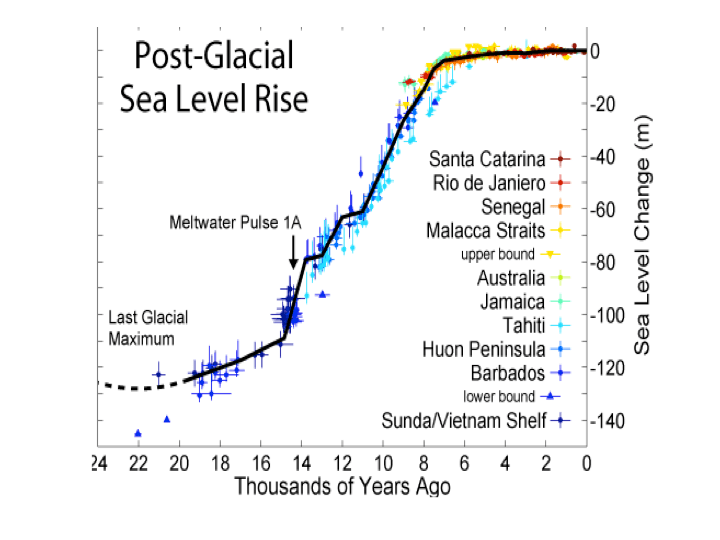
The last glacial episode ended somewhat irregularly. Ice coverage reached its maximum extent about eighteen thousand years ago. Melting occurred between about twenty thousand years ago and thirteen thousand years ago, and then there was a strong cooling (Younger Dryas) which ended about 11,700 years ago. Between twenty thousand years ago and six thousand years ago, there was a dramatic increase in sea level of about 120 meters followed by more gradual increase over the following several thousand years. Since the end of the “little ice age,” there has been steady increase in sea-level of about 6 inches per century.
slide12

As to the cause of the “little ice age,” this is still a matter of uncertainty. There was a long hiatus in solar activity that may have played a role, but on these relatively short time scales one can’t exclude natural internal variability. It must be emphasized that the surface of the earth is never in equilibrium with net incident solar radiation because the oceans are always carrying heat to and from the surface, and the motion systems responsible have time scales ranging from years (for example ENSO) to millennia.

The claim that orbital variability requires a boost from CO2 to drive ice ages comes from the implausible notion that what matters is the orbital variations in the global average insolation (which are, in fact, quite small) rather than the large forcing represented by the Milankovitch parameter. This situation is very different than in the recent and more modest shorter-term warming, where natural variability makes the role of CO2 much more difficult to determine.

Question 2: What is the molecular difference by which CO2 absorbs infrared radiation but oxygen and nitrogen do not?

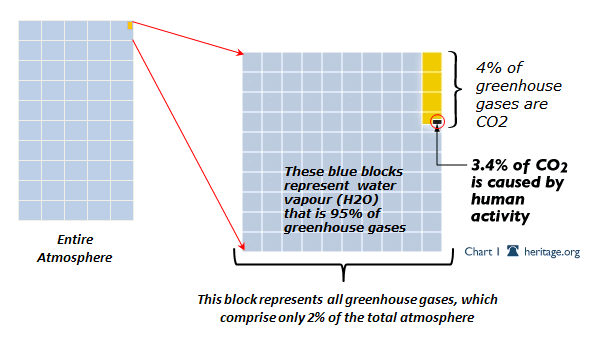
Molecules like CO2, H2O, CO or NO are called a greenhouse-gas molecules, because they can efficiently absorb or emit infrared radiation, but they are nearly transparent to sunlight. Molecules like O2 and N2 are also nearly transparent to sunlight, but since they do not absorb or emit thermal infrared radiation very well, they are not greenhouse gases. The most important greenhouse gas, by far, is water vapor. Water molecules, H2O, are permanently bent and have large electric dipole moments.
 

Question 3: What is mechanism by which infrared radiation trapped by CO2 in the atmosphere is turned into heat and finds its way back to sea level?

Unscattered infrared radiation is very good at transmitting energy because it moves at the speed of light. But the energy per unit volume stored by the thermal radiation in the Earth’s atmosphere is completely negligible compared to the internal energy of the air molecules.

Although CO2 molecules radiate very slowly, there are so many CO2 molecules that they produce lots of radiation, and some of this radiation reaches sea level. The figure following shows downwelling radiation measured at the island of Nauru in the Tropical Western Pacific Ocean, and at colder Point Barrow, Alaska, on the shore of the Arctic Ocean.

So the answer to the last part of the question, “What is the mechanism by which … heat … finds its way back to sea level?” is that the heat is radiated to the ground by molecules at various altitudes, where there is usually a range of different temperatures. The emission altitude is the height from which radiation could reach the surface without much absorption, say 50% absorption. For strongly absorbed frequencies, the radiation reaching the ground comes from low-altitude molecules, only a few meters above ground level for the 667 cm-1 frequency at the center of the CO2 band. More weakly absorbed frequencies are radiated from higher altitudes where the temperature is usually colder than that of the surface. But occasionally, as the data from Point Barrow show, higher-altitude air can be warmer than the surface.

Closely related to Question 3 is how heat from the absorption of sunlight by the surface gets back to space to avoid a steadily increasing surface temperature. As one might surmise from the figure, at Narau there is so much absorption from CO2 and by water vapor, H2O, that most daytime heat transfer near the surface is by convection, not by radiation. Especially important is moist convection, where the water vapor in rising moist air releases its latent heat to form clouds. The clouds have a major effect on radiative heat transfer. Cooled, drier, subsiding air completes the convection circuit. Minor changes of convection and cloudiness can have a bigger effect on the surface temperature than large changes in CO2 concentrations.

Question 4: Does CO2 in the atmosphere reflect any sunlight back into space, such that the reflected sunlight never penetrates the atmosphere in the first place?

The short answer to this question is “No”, but it raises some interesting issues that we discuss below.

Molecules can either scatter or absorb radiation. CO2 molecules are good absorbers of thermal infrared radiation, but they scatter almost none. Infrared radiant energy absorbed by a CO2 molecule is converted to internal vibrational and rotational energy. This internal energy is quickly lost in collisions with the N2 and O2 molecules that make up most of the atmosphere. The collision rates, billions per second, are much too fast to allow the CO2 molecules to reradiate the absorbed energy, which takes about a second. CO2 molecules in the atmosphere do emit thermal infrared radiation continuously, but the energy is almost always provided by collisions with N2 and O2 molecules, not by previously absorbed radiation. The molecules “glow in the dark” with thermal infrared radiation.
H2O CO2 absorption spectrums

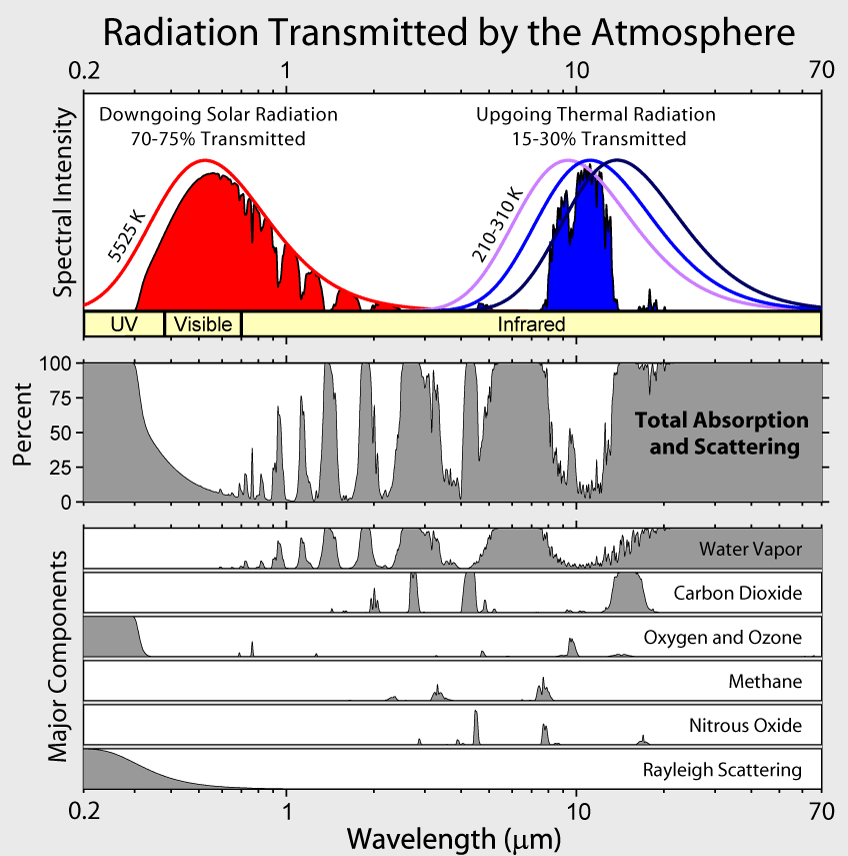
The figure shows that water vapor is by far the most important absorber. It can absorb both thermal infrared radiation from the Earth and shorter-wave radiation from the Sun. Water vapor and its condensates, clouds of liquid or solid water (ice), dominate radiative heat transfer in the Earth’s atmosphere; CO2 is of secondary importance.

If Question 4 were “Do clouds in the atmosphere reflect any sunlight back into space, such that the reflected sunlight never penetrates the atmosphere in the first place?” the answer would be “Yes”. It is common knowledge that low clouds on a sunny day shade and cool the surface of the Earth by scattering the sunlight back to space before it can be absorbed and converted to heat at the surface.

The figure shows that very little thermal radiation from the surface can reach the top of the atmosphere without absorption, even if there are no clouds. But some of the surface radiation is replaced by molecular radiation emitted by greenhouse molecules or cloud tops at sufficiently high altitudes that the there are no longer enough higher-altitude greenhouse molecules or clouds to appreciably attenuate the radiation before it escapes to space. Since the replacement radiation comes from colder, higher altitudes, it is less intense and does not reject as much heat to space as the warmer surface could have without greenhousegas absorption.

As implied by the figure, sunlight contains some thermal infrared energy that can be absorbed by CO2. But only about 5% of sunlight has wavelengths longer than 3 micrometers where the strongest absorption bands of CO2 are located. The Sun is so hot, that most of its radiation is at visible and near-visible wavelengths, where CO2 has no absorption bands.

Question 5: Apart from CO2, what happens to the collective heat from tail pipe exhausts, engine radiators, and all other heat from combustion of fossil fuels? How, if at all, does this collective heat contribute to warming of the atmosphere?

After that energy is used for heat, mobility, and electricity, the Second Law of Thermodynamics guarantees that virtually all of it ends up as heat in the climate system, ultimately to be radiated into space along with the earth’s natural IR emissions. [A very small fraction winds up as visible light that escapes directly to space through the transparent atmosphere, but even that ultimately winds up as heat somewhere “out there.”]


How much does this anthropogenic heat affect the climate? There are local effects where energy use is concentrated, for example in cities and near power plants. But globally, the effects are very small. To see that, convert the global annual energy consumption of 13.3 Gtoe (Gigatons of oil equivalent) to 5.6 × 10²⁰ joules. Dividing that by the 3.2 × 10⁷ seconds in a year gives a global power consumption of 1.75 × 10¹³ Watts. Spreading that over the earth’s surface area of 5.1 × 10¹⁴ m2 results in an anthropogenic heat flux of 0.03 W/m2 . This is some four orders of magnitude smaller than the natural heat fluxes of the climate system, and some two orders of magnitude smaller than the anthropogenic radiative forcing.

Question 6: In grade school many of us were taught that humans exhale CO2 but plants absorb CO2 and return oxygen to the air (keeping the carbon fiber). Is this still valid? If so why hasn’t plant life turned the higher levels of CO2 back into oxygen? Given the increase in population on earth (four billion), is human respiration a contributing factor to the buildup of CO2?

If all of the CO2 produced by current combustion of fossil fuels remained in the atmosphere, the level would increase by about 4 ppm per year, substantially more than the observed rate of around 2.5 ppm per year, as seen in the figure above. Some of the anthropogenic CO2 emissions are being sequestered on land or in the oceans.

high_resolution1

There is evidence that primary photosynthetic productivity has increased somewhat over the past half century, perhaps due to more CO2 in the atmosphere. For example, the summerwinter swings like those in the figure above are increasing in amplitude. Other evidence for modestly increasing primary productivity includes the pronounced “greening” of the Earth that has been observe by satellites. An example is the map above, which shows a general increase in vegetation cover over the past three decades.

The primary productivity estimate mentioned above would also correspond to an increase of the oxygen fraction of the air by 50 ppm, but since the oxygen fraction of the air is very high (209,500 ppm), the relative increase would be small and hard to detect. Also much of the oxygen is used up by respiration.

The average human exhales about 1 kg of CO2 per day, so the 7 billion humans that populate the Earth today exhale about 2.5 x 10⁹ tons of CO2 per year, a little less than 1% of that is needed to support the primary productivity of photosynthesis and only about 6% of the CO2 “pollution” resulting from the burning of fossil fuels. However, unlike fossil fuel emissions, these human (or more generally, biological) emissions do not accumulate in the atmosphere, since the carbon in food ultimately comes from the atmosphere in the first place.

Question 7: What are the main sources of CO2 that account for the incremental buildup of CO2 in the atmosphere?

The CO2 in the atmosphere is but one reservoir within the global carbon cycle, whose stocks and flows are illustrated by Figure 6.1 from IPCC AR5 WG1:

There is a nearly-balanced annual exchange of some 200 PgC between the atmosphere and the earth’s surface (~80 Pg land and ~120 Pg ocean); the atmospheric stock of 829 Pg therefore “turns over” in about four years.

Human activities currently add 8.9 PgC each year to these closely coupled reservoirs (7.8 from fossil fuels and cement production, 1.1 from land use changes such as deforestation). About half of that is absorbed into the surface, while the balance (airborne fraction) accumulates in the atmosphere because of its multicentury lifetime there. Other reservoirs such as the intermediate and deep ocean are less closely coupled to the surface-atmosphere system.

Much of the natural emission of CO2 stems from the decay of organic matter on land, a process that depends strongly on temperature and moisture. And much CO2 is absorbed and released from the oceans, which are estimated to contain about 50 times as much CO2 as the atmosphere. In the oceans CO2 is stored mostly as bicarbonate (HCO3 – ) and carbonate (CO3 – – ) ions. Without the dissolved CO2, the mildly alkaline ocean with a pH of about 8 would be very alkaline with a pH of about 11.3 (like deadly household ammonia) because of the strong natural alkalinity.

Only once in the geological past, the Permian period about 300 million years ago, have atmospheric CO2 levels been as low as now. Life flourished abundantly during the geological past when CO2 levels were five or ten times higher than those today.

Question 8: What are the main sources of heat that account for the incremental rise in temperature on earth?

The only important primary heat source for the Earth’s surface is the Sun. But the heat can be stored in the oceans for long periods of time, even centuries. Variable ocean currents can release more or less of this stored heat episodically, leading to episodic rises (and falls) of the Earth’s surface temperature.

Incremental changes of the surface temperature anomaly can be traced back to two causes: (1) changes in the surface heating rate; (2) changes in the resistance of heat flow to space. Quasi periodic El Nino episodes are examples of the former. During an El Nino year, easterly trade winds weaken and very warm deep water, normally blown toward the coasts of Indonesia and Australia, floats to the surface and spreads eastward to replace previously cool surface waters off of South America. The average temperature anomaly can increase by 1 C or more because of the increased release of heat from the ocean. The heat source for the El Nino is solar energy that has accumulated beneath the ocean surface for several years before being released.

On average, the absorption rate of solar radiation by the Earth’s surface and atmosphere is equal to emission rate of thermal infrared radiation to space. Much of the radiation to space does not come from the surface but from greenhouse gases and clouds in the lower atmosphere, where the temperature is usually colder than the surface temperature, as shown in the figure on the previous page. The thermal radiation originates from an “escape altitude” where there is so little absorption from the overlying atmosphere that most (say half) of the radiation can escape to space with no further absorption or scattering. Adding greenhouse gases can warm the Earth’s surface by increasing the escape altitude. To maintain the same cooling rate to space, the temperature of the entire troposphere, and the surface, would have to increase to make the effective temperature at the new escape altitude the same as at the original escape altitude. For greenhouse warming to occur, a temperature profile that cools with increasing altitude is required.

Over most of the CO2 absorption band (between about 580 cm-1 and 750 cm-1 ) the escape altitude is the nearly isothermal lower stratosphere shown in the first figure. The narrow spike of radiation at about 667 cm-1 in the center of the CO2 band escapes from an altitude of around 40 km (upper stratosphere), where it is considerably warmer than the lower stratosphere due heating by solar ultraviolet light which is absorbed by ozone, O3. Only at the edges of the CO2 band (near 580 cm-1 and 750 cm-1 ) is the escape altitude in the troposphere where it could have some effect on the surface temperature. Water vapor, H2O, has emission altitudes in the troposphere over most of its absorption bands. This is mainly because water vapor, unlike CO2, is not well mixed but mostly confined to the troposphere.

Summary

To summarize this overview, the historical and geological record suggests recent changes in the climate over the past century are within the bounds of natural variability. Human influences on the climate (largely the accumulation of CO2 from fossil fuel combustion) are a physically small (1%) effect on a complex, chaotic, multicomponent and multiscale system. Unfortunately, the data and our understanding are insufficient to usefully quantify the climate’s response to human influences. However, even as human influences have quadrupled since 1950, severe weather phenomena and sea level rise show no significant trends attributable to them. Projections of future climate and weather events rely on models demonstrably unfit for the purpose. As a result, rising levels of CO2 do not obviously pose an immediate, let alone imminent, threat to the earth’s climate.

Full text of submission is here
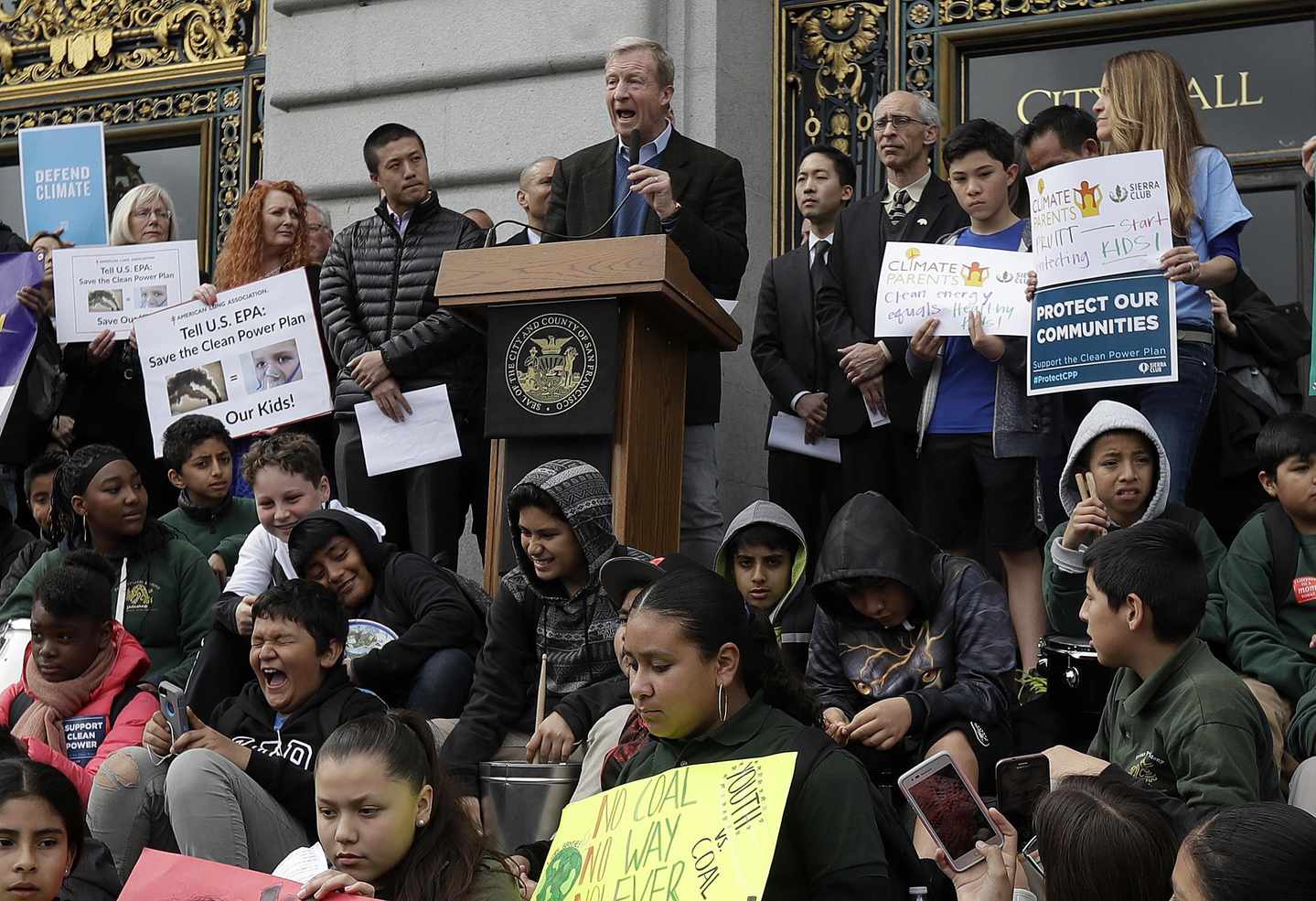
Climate Change Movement Retreats to California Courts

The title comes from this article by Richard O. Faulk in RealClearPolitics
March 30, 2018.  Text below with my bolds.

After failing in every American political forum since the Paris climate accord was reached two years ago, the climate change movement has once again retreated to the courts. Not surprisingly, these advocates selected California’s federal courts as the forum of choice, counting on their comparatively liberal dispositions to breathe new life into their agenda. Pursuant to this initiative, several California counties and cities have sued numerous defendants, including major oil and gas companies, for emitting and exacerbating emissions of greenhouse gases.

In doing so, the plaintiffs based their claims on the tort of public nuisance, the broadest and vaguest remedy available. Public nuisance has been condemned by legal scholars as “notoriously contingent and unsummarizable” and a “wilderness of law.” William Prosser, one of America’s most famous law professors, wrote that nuisance was an “impenetrable jungle” and a “legal garbage can” full of “vagueness, uncertainty and confusion.”

Richard Epstein, another noted legal authority, concluded that nuisance “does not work on a moral or deductive principle.” U.S. Supreme Court Justice Harry Blackmun famously remarked that “one searches in vain for anything resembling a principle in the law of nuisance,” and even the California Supreme Court has rejected the remedy when it threatened to impose “standardless liability.”

Given this history, it is especially alarming that the climate change movement now seeks legal judgments in the absence of objective standards derived from the legislative or regulatory process. Even more incredibly, this persistent excursion has already been rejected by not only the Ninth Circuit Court of Appeals – the reviewing court that will decide any appeal from these judgments – but also by the Supreme Court of the United States.

Controversies such as climate change concern policy choices and value determinations that are constitutionally reserved to the executive branch or Congress and are especially ill-suited for judges. The Supreme Court has held that courts are fundamentally unequipped to formulate national polices or develop standards for matters, such as climate change, that are not legal in nature. As Justice Felix Frankfurter cautioned, “A court is likely to lose its way if it strays outside the modest bounds of its own special competency” and adjudicates only the legal phases of a broad social problem into an “opportunity for formulating judgments of social policy.” Although such “political questions” cannot be resolved constitutionally by judges, the climate movement seeks that precise result in California.

Even more curiously, the movement seeks monetary judgments for the California cities’ and counties’ own pockets – judgments supposedly intended to pay for adaptation and abatement of the alleged worldwide nuisance. Such money, if awarded as damages, would comprise gigantic windfalls allocated by unelected federal judges and spent at each plaintiff’s discretion. The judgments could never be implemented in a manner reasonably calculated to reverse global warming unless they were accompanied by a bureaucracy created, elected and funded to supervise the work internationally and ensure against waste and abuse. Since neither Congress, the California legislature, the county and city governments, nor any other elected bodies are willing to serve in these roles, the plundering of America’s energy enterprises is entirely unwarranted.

Under controlling Supreme Court authority, even when the political branches have not acted, common law courts are not necessarily free to “fill the void.” Irrespective of whether the executive or legislative branches have spoken, due respect for their constitutional responsibilities – combined with awareness of the judiciary’s own limitations – should motivate judicial restraint. Although the ancients concluded that “nature abhors a vacuum,” there are circumstances in the law, as here, where uncharted voids should be eschewed. In the absence of guiding principles, errors are as likely to fill the jurisprudential void as wisdom.

Richard Faulk is a lawyer at Davis Wright Tremaine in Washington, D.C.

Mixed Judicial Rulings on Pipeline Protests

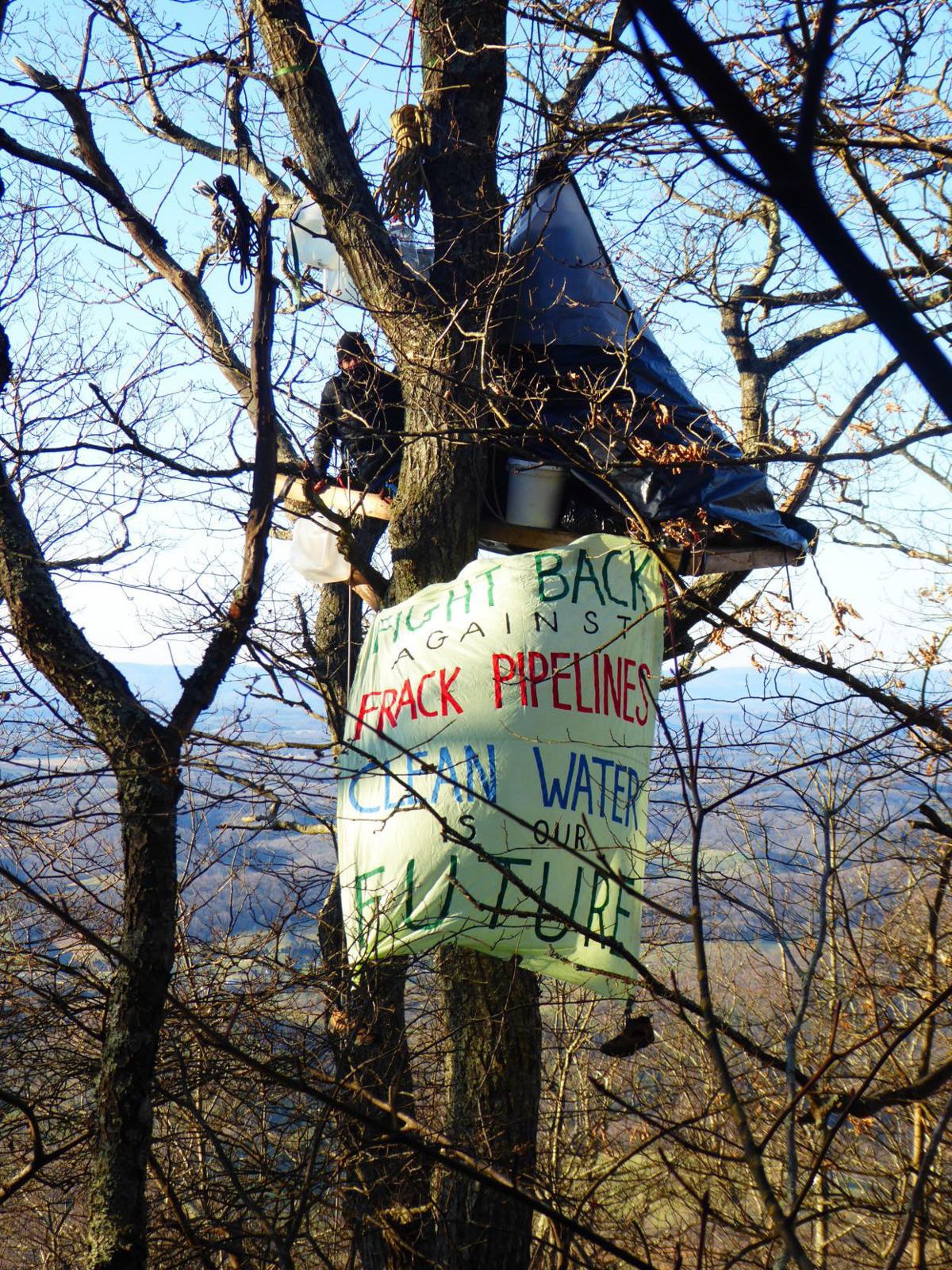
Since Feb. 26, two protesters have been on platforms in two trees on Peters Mountain with hopes of preventing the Mountain Valley Pipeline from moving forward.

Boston Judge Goes Easy on Protesters

Green activists are extremely excited to hear a Boston judge yesterday acquitted 13 protesters who attempted to block construction of a fracking gas pipeline in 2015. Posts at various activist sites repeat an article from the Independent which says:

More than a dozen protesters who clambered into holes dug for a high pressure gas pipeline said they had been found not responsible by a judge after hearing them argue their actions to try and stop climate change were a legal “necessity”.

Karenna Gore, the daughter of former Vice President Al Gore, was among more than 198 people who were arrested because of their 2015 actions protesting the pipeline in West Roxbury, Massachusetts, a suburb of Boston. Thirteen people were to go on trial this week, though prosecutors downgraded their original criminal charges to one of civil infraction.

On Tuesday, Judge Mary Ann Driscoll of West Roxbury District Court, found all 13 defendants not responsible, the equivalent of not guilty in a criminal case. She did so after each of the defendants addressed the judge and explained why they were driven to try and halt the pipeline’s construction.

Roanoke Judge Declares Protesters Acting Illegally

Earlier this month in Roanoke West Virginia, a judge issued a restraining order against protesters lodged in trees trying to prevent logging for constructing a gas pipeline. From the Roanoke Times:

Judge issues restraining order against pipeline protesters sitting in trees

A West Virginia judge has granted a temporary restraining order against pipeline protesters sitting in trees, leaving unanswered the question of how to remove them.

The protesters are “temporarily restrained from impeding … access” to a section of the Jefferson National Forest where construction of a natural gas pipeline is planned, the order from Monroe County Circuit Court Judge Robert Irons states.

In seeking the order, Mountain Valley Pipeline said in court papers that the “tree sit” protest could prevent it from cutting trees along the pipeline’s path in time to meet a March 31 deadline imposed by federal wildlife protections.

That is just what the protesters intend. If members of the group, assisted by a network of supporters, remain perched on wooden platforms in two trees about 60 feet above the ground, law enforcement officials could be asked to get them down.

“It’s a very good question,” Monroe County Sheriff Ken Hedrick said. “I’ve been puzzling over the answer myself. How in the world would you get them out of the trees?”

Hedrick said his office has received no instructions from the judge to serve or enforce the order — leaving matters up in the air for now.

The temporary restraining order, dated Thursday, is effective for 10 days. Additional details could come out Tuesday, when a hearing is scheduled on Mountain Valley’s request for a preliminary injunction, which could carry more weight and last longer.

Hedrick said it’s possible that the U.S. Forest Service — essentially the landowner that granted Mountain Valley a right of way through about 3.5 miles of woods — could take the lead in enforcing the order.

Forest Service officials have said only that they are monitoring the situation.

Meanwhile, the loosely organized group of protesters says it has no plans to back down from stands in two trees along the ridgeline of Peters Mountain, where the pipeline would pass under the Appalachian Trail.

Summary

Some points should be considered. Unlike the valve turners, the Boston protesters did not vandalize private property and equipment. Also, the pipeline was built anyway. These facts may have led to the leniency.

In the West Virginia case, the main concern seems to be conserving the forest and water purity, rather than claiming to stop global warming. Still that state may be less tolerant of obstruction by greens.

Update: May 21

Judge lifts restraining order against pipeline protesters

News outlets report Judge Robert Irons denied the injunction, reversing course less than two weeks after granting Mountain Valley Pipeline a 10-day restraining order against the protesters.

Mountain Valley Pipeline had sought the order, saying the protest could prevent cutting trees along the pipeline’s path in time to meet a March 31 federal wildlife protection deadline. A licensed surveyor testified the protesters were outside of the no-cut zone and inside the company’s right of way, but the protesters’ attorney, William DePaulo, pointed out mapping inconsistencies.

In his ruling, Irons highlighted concerns over the map data’s accuracy and questioned the urgency to reach a decision over two trees along the 300-mile (480-kilometer) pipeline.

Footnote:

Speaking of leaving matters up in the air, the pipeline protesters have been in the trees for a month, which is impressive.  But they are far from setting a record for moral pedestals.  That honor goes to Simeon the Stylite (390-459), an ascetic saint who achieved notability for living 37 years on a small platform on top of a pillar near Aleppo, Syria.

A Third Brief to Climate Tutorial

I just found out, thanks to Francis Menton, that a third skeptical brief was submitted to Judge Alsup in reference to his tutorial.  The thrust apparently is to show that the temperature record does not support the claim that recent variability is anything out of the ordinary.

The article by Francis Menton is Klimate Kraziness: A California Judge Holds A “Tutorial” On Climate Science  posted at Manhatton Contrarian.

The third friend of the court brief  was by  The Concerned Household Electricity Consumers Council, which presented work of many scientists, most notably James Wallace III, Joseph D’Aleo, John Christie, and Craig Idso.  Menton’s explanation below from his article.

Not to downplay the work of my co-amici, but we are the one of the three groups that emphatically made the essential scientific point that the most credible data as to world temperatures, properly analyzed, preclude rejection of the null hypothesis that natural factors are the predominant if not only cause of the observed warming. As stated in our submission:

The conclusion of the work is that each of EPA’s “lines of evidence” has been invalidated by the best empirical evidence, and therefore the attribution of any observed climate change, including global warming, to rising atmospheric CO2 concentrations has not been established.

And, further on in our presentation:

[T]hese natural factor impacts fully explain the trends in all relevant temperature data sets over the last 50 or more years. This research, like Wallace (2016), found that rising atmospheric concentrations did not have a statistically significant impact on any of the (14) temperature data sets that were analyzed. Wallace 2017 concludes that, “at this point, there is no statistically valid proof that past increases in atmospheric CO2 concentrations have caused what have been officially reported as rising, or even record setting, temperatures.”

As they say, read the whole thing (here)

Footnote:

The post The Climate Story (Illustrated) provides a set of graphics making the same argument:  The temperature record does not support climate alarm.

Independently the prestigious Société de Calcul Mathématique (Society for Mathematical Calculation) has written a detailed 195-page White Paper that presents a blistering point-by-point critique of the key dogmas of global warming, starting with the temperature record.  See Bonn COP23 Briefing for Realists

Inside the Climate Tutorial

Thanks to an article at Wired, we get a first glimpse into what transpired at the March 21 courtroom tutorial called by Federal District court  Judge Alsup.  From a science perspective, it looks at the moment like a missed opportunity.  The oil company lawyers sat in silence, allowing Chevron’s lead attorney to speak for them, and he mainly quoted from IPCC documents.  The calculation seems to be taking a position that we didn’t know more and not any sooner than the IPCC came to conclusions in their series of assessment reports.  The plaintiffs let alarmist scientists present on their behalf, and can now claim their opinions were not refuted.

The Wired article is In the Courtroom, Climate Science Needs Substance–and Style Excerpts below with my bolds.

Outside the usual procedural kabuki of the courtroom, the truth is no one really knew what to expect from this court-ordered “tutorial.” For a culture based in large measure on precedent, putting counsel and experts in a room to hash out climate change for a trial—putting everyone on the record, in federal court, on what is and is not true about climate science—was literally unprecedented.

What Alsup got might not have been a full on PowerPoint-powered preview of the trial. But it did reveal a lot about the styles and conflicts inherent in the people who produce the carbon and the people who study it.

The other petrochemists put forth Theodore Boutrous, an AC-130 gunship of a lawyer who among other things got the US Supreme Court to overturn the California law against same-sex marriage. Here, retained specifically by Chevron, Boutrous argued what seemed to be climate change’s chapter-and-verse. He extolled the virtues of the several IPCC reports, 2013 most recently, and quoted them liberally. Boutrous talked about how the reports’ conclusions have gotten more and more surefooted about “anthropogenic” causes of climate change—it’s people!—and outcomes like sea level rise. “From Chevron’s perspective, there’s no debate about climate science,” Boutrous said. “Chevron accepts what this scientific body—scientists and others—what the IPCC has reached consensus on.”

Still, over the course of the morning, Boutrous nevertheless tried to neg the IPCC in two specific ways. One was a classic: He challenged the models that climate scientists use to attempt to predict the future. These computer models, Boutrous said, are “increasingly complex. That can make the modeling more powerful.” But with great power comes great potential wrongness. “Because it’s an attempt to represent things in the real world, the complexity can bring more risk.” He assured the court that Chevron agreed with the IPCC approach—posting up a slide pulled from an IPCC report that showed the multicolored paths of literally hundreds of models, using different emissions scenarios and essentially describing the best case and worst case (and a bunch of in-between cases). It looked like a blast of fireworks emerging from observed average temperature, headed chaotically up and to the right.

So here comes the crux of the thing—a question not of whether climate change is real, but whether you can ascribe blame for it. Leaning heavily on more IPCC quotes, Boutrous showed slides and statistics saying that climate change is a global problem that doesn’t differentially affect the West Coast of North America and isn’t caused by any one emitter. Or even any one source of emissions. Anthropogenic emissions are driven by things like population size, economic activities, lifestyle, energy use, land use patterns, and technology and climate policy, according to the IPCC. “The IPCC does not say it’s the extraction and production of oil,” Boutrous said. “It’s economic activity that creates the demand for energy and that leads to emissions.”

If that seems a little bit like the “guns don’t kill people; people kill people” of petrochemical capitalism, well, Judge Alsup did start the morning by saying today was a day for science, not politics.

So what knives did the representatives of the state of California bring to this oil-fight? Here’s where style is interesting. California didn’t front lawyers. For the science tutorial, the municipalities fronted scientists—people who’d been first authors on chapters in the IPCC reports from which Boutrous quoted, and one who’d written a more recent US report and a study of sea level rise in California. They knew their stuff and could answer all of Judge Alsup’s questions … but their presentations were more like science conference fodder than well-designed rhetoric.

For example, Myles Allen, leader of the Climate Research Program at the University of Oxford, gave a detailed, densely-illustrated talk on the history and science of climate change…but he also ended up in an extended back and forth with Alsup about whether Svante Arrhenius’ 1896 paper hypothesizing that carbon dioxide in Earth’s atmosphere warmed the planet explicitly used the world “logarithmic.” Donald Wuebbles, an atmospheric scientist at the University of Illinois and co-author of the Nobel Prize-winning 2007 IPCC report, mounted a grim litany of all the effects scientists can see, today, of climate, but Alsup caught him up asking for specific things he disagreed with Boutrous on—a tough game since Boutrous was just quoting the IPCC.

Then Alsup and Wuebbles took a detour into naming other renewable power sources besides solar and wind. “Nuclear would not put out any CO2, right? We might get some radiation as we drive by, but maybe in retrospect we should have taken a hard look at nuclear?” Alsup interrupted. “No doubt solar is good where you can use it, but do you really think it could be a substitute for supplying the amount of power America used in the last 30 years?”

“I think solar could be a significant factor of our energy future,” Wuebbles said. “I don’t think there’s any one silver bullet.”

In part, one might be tempted to put some blame on Alsup here. You might remember him from such trials as Uber v. Waymo, where he asked for a similar tutorial on self-driving car technology. Or from Oracle v. Google, a trial for which Alsup taught himself a little of the programming language Java so he’d understand the case better. Or from his intercession against the Trump administration’s attempt to cancel the Deferred Action for Childhood Arrivals program, protecting the immigration status of so-called Dreamers. “He’s kind of quirky and not reluctant to do things kind of outside the box,” said Deborah Sivas, Director of the Environmental and Natural Resource Law & Policy Program at Stanford Law School. “And I think he sees this as a precedent-setting case, as do the lawyers.”

It’s possible, then, to infer that Alsup was doing more than just getting up to speed on climate change on Wednesday. The physics and chemistry are quite literally textbook, and throughout the presentations he often seemed to know more than he was letting on. He challenged chart after chart incisively, and often cut in on history. When Allen brought up Roger Revelle’s work showing that oceans couldn’t absorb carbon—at least, not fast enough to stave off climate change, Alsup interrupted.

“Is it true that Revelle initially thought the ocean would absorb all the excess, and that he came to this buffer theory a little later?” Alsup asked.

“You may know more of this history than I do,” Allen said.

But on the other hand, some of what the litigators seemed to not know sent the scientists in the back in literal spasms. When Boutrous couldn’t answer Alsup’s questions about the specific causes of early 20th-century warming (presumably before the big industrial buildup of the 1950s), Allen and Wuebbles, sitting just outside the gallery, clenched fists and looked like they were having to keep from shouting out the answer. Later, Alsup acknowledged that he’d watched An Inconvenient Truth to prepare, and Boutrous said he had, too.

All of which makes it hard to tell whether bringing scientists to this table was the right move. And maybe that has been the problem all along. The interface where utterly flexible law and policy moves against the more rigid statistical uncertainties of scientific observation has always been contested space. The practitioners of both arts seem foreign to each other; the cultural mores differ.

Maybe that’s what this “tutorial” was meant for. As Sivas says, the facts aren’t really in doubt here. Or rather, most of them aren’t, and maybe Alsup will use today as a kind of discovery process, a way to crystalize the difference between uncertainty in science and uncertainty under the law. “That’s what judges do. They decide the credibility of one expert over another,” Sivas says. “That doesn’t mean it’s scientific truth. It means it’s true as a legal claim.”

The skeptical scientific brief was filed by esteemed scientists Happer, Koonin and Lindzen, but its effect is not yet evident.  More details are at Cal Climate Tutorial: The Meat

Cal Climate Tutorial: The Meat

Prevous posts provided the context regarding the Climate Tutorial requested by Judge Alsup in the lawsuit case filed by California cities against big oil companies: Cal Court to Hear Climate Tutorial

An overview of a submission by Professors Happer, Koonin and Lindzen was in Climate Tutorial for Judge Alsup

This post goes into the meat and potatoes of that submission with excerpts from Section II: Answers to specific questions (my bolds)

Question 1: What caused the various ice ages (including the “little ice age” and prolonged cool periods) and what caused the ice to melt? When they melted, by how much did sea level rise?

The discussion of the major ice ages of the past 700 thousand years is distinct from the discussion of the “little ice age.” The former refers to the growth of massive ice sheets (a mile or two thick) where periods of immense ice growth occurred, lasting approximately eighty thousand years, followed by warm interglacials lasting on the order of twenty thousand years. By contrast, the “little ice age” was a relatively brief period (about four hundred years) of relatively cool temperatures accompanied by the growth of alpine glaciers over much of the earth.

Tutorial 1

The last glacial episode ended somewhat irregularly. Ice coverage reached its maximum extent about eighteen thousand years ago. Melting occurred between about twenty thousand years ago and thirteen thousand years ago, and then there was a strong cooling (Younger Dryas) which ended about 11,700 years ago. Between twenty thousand years ago and six thousand years ago, there was a dramatic increase in sea level of about 120 meters followed by more gradual increase over the following several thousand years. Since the end of the “little ice age,” there has been steady increase in sea-level of about 6 inches per century.

slide12

As to the cause of the “little ice age,” this is still a matter of uncertainty. There was a long hiatus in solar activity that may have played a role, but on these relatively short time scales one can’t exclude natural internal variability. It must be emphasized that the surface of the earth is never in equilibrium with net incident solar radiation because the oceans are always carrying heat to and from the surface, and the motion systems responsible have time scales ranging from years (for example ENSO) to millennia.

The claim that orbital variability requires a boost from CO2 to drive ice ages comes from the implausible notion that what matters is the orbital variations in the global average insolation (which are, in fact, quite small) rather than the large forcing represented by the Milankovitch parameter. This situation is very different than in the recent and more modest shorter-term warming, where natural variability makes the role of CO2 much more difficult to determine.

Question 2: What is the molecular difference by which CO2 absorbs infrared radiation but oxygen and nitrogen do not?

Molecules like CO2, H2O, CO or NO are called a greenhouse-gas molecules, because they can efficiently absorb or emit infrared radiation, but they are nearly transparent to sunlight. Molecules like O2 and N2 are also nearly transparent to sunlight, but since they do not absorb or emit thermal infrared radiation very well, they are not greenhouse gases. The most important greenhouse gas, by far, is water vapor. Water molecules, H2O, are permanently bent and have large electric dipole moments.

GHG blocks

Question 3: What is mechanism by which infrared radiation trapped by CO2 in the atmosphere is turned into heat and finds its way back to sea level?

Unscattered infrared radiation is very good at transmitting energy because it moves at the speed of light. But the energy per unit volume stored by the thermal radiation in the Earth’s atmosphere is completely negligible compared to the internal energy of the air molecules.

Although CO2 molecules radiate very slowly, there are so many CO2 molecules that they produce lots of radiation, and some of this radiation reaches sea level. The figure following shows downwelling radiation measured at the island of Nauru in the Tropical Western Pacific Ocean, and at colder Point Barrow, Alaska, on the shore of the Arctic Ocean.

So the answer to the last part of the question, “What is the mechanism by which … heat … finds its way back to sea level?” is that the heat is radiated to the ground by molecules at various altitudes, where there is usually a range of different temperatures. The emission altitude is the height from which radiation could reach the surface without much absorption, say 50% absorption. For strongly absorbed frequencies, the radiation reaching the ground comes from low-altitude molecules, only a few meters above ground level for the 667 cm-1 frequency at the center of the CO2 band. More weakly absorbed frequencies are radiated from higher altitudes where the temperature is usually colder than that of the surface. But occasionally, as the data from Point Barrow show, higher-altitude air can be warmer than the surface.

Barrow Nauru Radiance

Closely related to Question 3 is how heat from the absorption of sunlight by the surface gets back to space to avoid a steadily increasing surface temperature. As one might surmise from the figure, at Narau there is so much absorption from CO2 and by water vapor, H2O, that most daytime heat transfer near the surface is by convection, not by radiation. Especially important is moist convection, where the water vapor in rising moist air releases its latent heat to form clouds. The clouds have a major effect on radiative heat transfer. Cooled, drier, subsiding air completes the convection circuit. Minor changes of convection and cloudiness can have a bigger effect on the surface temperature than large changes in CO2 concentrations.

Question 4: Does CO2 in the atmosphere reflect any sunlight back into space, such that the reflected sunlight never penetrates the atmosphere in the first place?

The short answer to this question is “No”, but it raises some interesting issues that we discuss below.

Molecules can either scatter or absorb radiation. CO2 molecules are good absorbers of thermal infrared radiation, but they scatter almost none. Infrared radiant energy absorbed by a CO2 molecule is converted to internal vibrational and rotational energy. This internal energy is quickly lost in collisions with the N2 and O2 molecules that make up most of the atmosphere. The collision rates, billions per second, are much too fast to allow the CO2 molecules to reradiate the absorbed energy, which takes about a second. CO2 molecules in the atmosphere do emit thermal infrared radiation continuously, but the energy is almost always provided by collisions with N2 and O2 molecules, not by previously absorbed radiation. The molecules “glow in the dark” with thermal infrared radiation.

H2O CO2 absorption spectrums

The figure shows that water vapor is by far the most important absorber. It can absorb both thermal infrared radiation from the Earth and shorter-wave radiation from the Sun. Water vapor and its condensates, clouds of liquid or solid water (ice), dominate radiative heat transfer in the Earth’s atmosphere; CO2 is of secondary importance.

If Question 4 were “Do clouds in the atmosphere reflect any sunlight back into space, such that the reflected sunlight never penetrates the atmosphere in the first place?” the answer would be “Yes”. It is common knowledge that low clouds on a sunny day shade and cool the surface of the Earth by scattering the sunlight back to space before it can be absorbed and converted to heat at the surface.

The figure shows that very little thermal radiation from the surface can reach the top of the atmosphere without absorption, even if there are no clouds. But some of the surface radiation is replaced by molecular radiation emitted by greenhouse molecules or cloud tops at sufficiently high altitudes that the there are no longer enough higher-altitude greenhouse molecules or clouds to appreciably attenuate the radiation before it escapes to space. Since the replacement radiation comes from colder, higher altitudes, it is less intense and does not reject as much heat to space as the warmer surface could have without greenhousegas absorption.

As implied by the figure, sunlight contains some thermal infrared energy that can be absorbed by CO2. But only about 5% of sunlight has wavelengths longer than 3 micrometers where the strongest absorption bands of CO2 are located. The Sun is so hot, that most of its radiation is at visible and near-visible wavelengths, where CO2 has no absorption bands.

Question 5: Apart from CO2, what happens to the collective heat from tail pipe exhausts, engine radiators, and all other heat from combustion of fossil fuels? How, if at all, does this collective heat contribute to warming of the atmosphere?

After that energy is used for heat, mobility, and electricity, the Second Law of Thermodynamics guarantees that virtually all of it ends up as heat in the climate system, ultimately to be radiated into space along with the earth’s natural IR emissions. [A very small fraction winds up as visible light that escapes directly to space through the transparent atmosphere, but even that ultimately winds up as heat somewhere “out there.”]

How much does this anthropogenic heat affect the climate? There are local effects where energy use is concentrated, for example in cities and near power plants. But globally, the effects are very small. To see that, convert the global annual energy consumption of 13.3 Gtoe (Gigatons of oil equivalent) to 5.6 × 10^20 joules. Dividing that by the 3.2 × 10^7 seconds in a year gives a global power consumption of 1.75 × 10^13 Watts. Spreading that over the earth’s surface area of 5.1 × 10^14 m2 results in an anthropogenic heat flux of 0.03 W/m2 . This is some four orders of magnitude smaller than the natural heat fluxes of the climate system, and some two orders of magnitude smaller than the anthropogenic radiative forcing.

Question 6: In grade school many of us were taught that humans exhale CO2 but plants absorb CO2 and return oxygen to the air (keeping the carbon fiber). Is this still valid? If so why hasn’t plant life turned the higher levels of CO2 back into oxygen? Given the increase in population on earth (four billion), is human respiration a contributing factor to the buildup of CO2?

If all of the CO2 produced by current combustion of fossil fuels remained in the atmosphere, the level would increase by about 4 ppm per year, substantially more than the observed rate of around 2.5 ppm per year, as seen in the figure above. Some of the anthropogenic CO2 emissions are being sequestered on land or in the oceans.

high_resolution1

There is evidence that primary photosynthetic productivity has increased somewhat over the past half century, perhaps due to more CO2 in the atmosphere. For example, the summerwinter swings like those in the figure above are increasing in amplitude. Other evidence for modestly increasing primary productivity includes the pronounced “greening” of the Earth that has been observe by satellites. An example is the map above, which shows a general increase in vegetation cover over the past three decades.

The primary productivity estimate mentioned above would also correspond to an increase of the oxygen fraction of the air by 50 ppm, but since the oxygen fraction of the air is very high (209,500 ppm), the relative increase would be small and hard to detect. Also much of the oxygen is used up by respiration.

The average human exhales about 1 kg of CO2 per day, so the 7 billion humans that populate the Earth today exhale about 2.5 x 10^9 tons of CO2 per year, a little less than 1% of that is needed to support the primary productivity of photosynthesis and only about 6% of the CO2 “pollution” resulting from the burning of fossil fuels. However, unlike fossil fuel emissions, these human (or more generally, biological) emissions do not accumulate in the atmosphere, since the carbon in food ultimately comes from the atmosphere in the first place.

Question 7: What are the main sources of CO2 that account for the incremental buildup of CO2 in the atmosphere?

The CO2 in the atmosphere is but one reservoir within the global carbon cycle, whose stocks and flows are illustrated by Figure 6.1 from IPCC AR5 WG1:

There is a nearly-balanced annual exchange of some 200 PgC between the atmosphere and the earth’s surface (~80 Pg land and ~120 Pg ocean); the atmospheric stock of 829 Pg therefore “turns over” in about four years.

Human activities currently add 8.9 PgC each year to these closely coupled reservoirs (7.8 from fossil fuels and cement production, 1.1 from land use changes such as deforestation). About half of that is absorbed into the surface, while the balance (airborne fraction) accumulates in the atmosphere because of its multicentury lifetime there. Other reservoirs such as the intermediate and deep ocean are less closely coupled to the surface-atmosphere system.

Much of the natural emission of CO2 stems from the decay of organic matter on land, a process that depends strongly on temperature and moisture. And much CO2 is absorbed and released from the oceans, which are estimated to contain about 50 times as much CO2 as the atmosphere. In the oceans CO2 is stored mostly as bicarbonate (HCO3 – ) and carbonate (CO3 – – ) ions. Without the dissolved CO2, the mildly alkaline ocean with a pH of about 8 would be very alkaline with a pH of about 11.3 (like deadly household ammonia) because of the strong natural alkalinity.

Only once in the geological past, the Permian period about 300 million years ago, have atmospheric CO2 levels been as low as now. Life flourished abundantly during the geological past when CO2 levels were five or ten times higher than those today.

Question 8: What are the main sources of heat that account for the incremental rise in temperature on earth?

The only important primary heat source for the Earth’s surface is the Sun. But the heat can be stored in the oceans for long periods of time, even centuries. Variable ocean currents can release more or less of this stored heat episodically, leading to episodic rises (and falls) of the Earth’s surface temperature.

Incremental changes of the surface temperature anomaly can be traced back to two causes: (1) changes in the surface heating rate; (2) changes in the resistance of heat flow to space. Quasi periodic El Nino episodes are examples of the former. During an El Nino year, easterly trade winds weaken and very warm deep water, normally blown toward the coasts of Indonesia and Australia, floats to the surface and spreads eastward to replace previously cool surface waters off of South America. The average temperature anomaly can increase by 1 C or more because of the increased release of heat from the ocean. The heat source for the El Nino is solar energy that has accumulated beneath the ocean surface for several years before being released.

On average, the absorption rate of solar radiation by the Earth’s surface and atmosphere is equal to emission rate of thermal infrared radiation to space. Much of the radiation to space does not come from the surface but from greenhouse gases and clouds in the lower atmosphere, where the temperature is usually colder than the surface temperature, as shown in the figure on the previous page. The thermal radiation originates from an “escape altitude” where there is so little absorption from the overlying atmosphere that most (say half) of the radiation can escape to space with no further absorption or scattering. Adding greenhouse gases can warm the Earth’s surface by increasing the escape altitude. To maintain the same cooling rate to space, the temperature of the entire troposphere, and the surface, would have to increase to make the effective temperature at the new escape altitude the same as at the original escape altitude. For greenhouse warming to occur, a temperature profile that cools with increasing altitude is required.

Over most of the CO2 absorption band (between about 580 cm-1 and 750 cm-1 ) the escape altitude is the nearly isothermal lower stratosphere shown in the first figure. The narrow spike of radiation at about 667 cm-1 in the center of the CO2 band escapes from an altitude of around 40 km (upper stratosphere), where it is considerably warmer than the lower stratosphere due heating by solar ultraviolet light which is absorbed by ozone, O3. Only at the edges of the CO2 band (near 580 cm-1 and 750 cm-1 ) is the escape altitude in the troposphere where it could have some effect on the surface temperature. Water vapor, H2O, has emission altitudes in the troposphere over most of its absorption bands. This is mainly because water vapor, unlike CO2, is not well mixed but mostly confined to the troposphere.

Summary

To summarize this overview, the historical and geological record suggests recent changes in the climate over the past century are within the bounds of natural variability. Human influences on the climate (largely the accumulation of CO2 from fossil fuel combustion) are a physically small (1%) effect on a complex, chaotic, multicomponent and multiscale system. Unfortunately, the data and our understanding are insufficient to usefully quantify the climate’s response to human influences. However, even as human influences have quadrupled since 1950, severe weather phenomena and sea level rise show no significant trends attributable to them. Projections of future climate and weather events rely on models demonstrably unfit for the purpose. As a result, rising levels of CO2 do not obviously pose an immediate, let alone imminent, threat to the earth’s climate.

Full text of submission is here

Climate Tutorial for Judge Alsup

H/T tomomason for noticing this document submitted to Judge Alsup’s requested tutorial

ADMINISTRATIVE MOTION OF WILLIAM HAPPER, STEVEN E. KOONIN, AND RICHARD S. LINDZEN FOR LEAVE TO SUBMIT PRESENTATION IN RESPONSE TO THE COURT’S TUTORIAL QUESTIONS
The Honorable William H. Alsup

The covering letter and the submission itself are here.  Below are excerpts of introductory and overview comments.

The Court has invited a tutorial on global warming and climate change, which is set to occur March 21, 2018. The Court also identified specific questions to be addressed at the tutorial. Pursuant to Civil L.R. 7-11, Professors William Happer, Steven E. Koonin, and Richard S. Lindzen respectfully ask the Court to accept their presentation (attached to this motion as Exhibit A) in response to the Court’s questions. The professors would be honored to participate directly in the tutorial if the Court desires.

The Court’s specified questions include topics that have been the subject of the professors’ study and analysis for decades. These men have been thought and policy leaders in the scientific community and in the administrations of two different U.S. Presidents. They have extensive research experience with the specific issues the Court identified. As such, they offer a valuable perspective on these issues. The attached presentation contains three sections: (1) an overview; (2) responses to the Court’s questions; and (3) biographies of the professors.

Overview from the Submission

Our overview of climate science is framed through four statements:

1. The climate is always changing; changes like those of the past half-century are common in the geologic record, driven by powerful natural phenomena

2. Human influences on the climate are a small (1%) perturbation to natural energy flows

3. It is not possible to tell how much of the modest recent warming can be ascribed to human influences

4. There have been no detrimental changes observed in the most salient climate variables and today’s projections of future changes are highly uncertain

We offer supporting evidence for each of these statements drawn almost exclusively from the Climate Science Special Report (CSSR) issued by the US government in November, 2017 or from the Fifth Assessment Report (AR5) issued in 2013-14 by the UN’s Intergovernmental Panel on Climate Change or from the refereed primary literature.

To summarize this overview, the historical and geological record suggests recent changes in the climate over the past century are within the bounds of natural variability. Human influences on the climate (largely the accumulation of CO2 from fossil fuel combustion) are a physically small (1%) effect on a complex, chaotic, multicomponent and multiscale system. Unfortunately, the data and our understanding are insufficient to usefully quantify the climate’s response to human influences. However, even as human influences have quadrupled since 1950, severe weather phenomena and sea level rise show no significant trends attributable to them. Projections of future climate and weather events rely on models demonstrably unfit for the purpose. As a result, rising levels of CO2 do not obviously pose an immediate, let alone imminent, threat to the earth’s climate.

The submission includes detailed responses to each of the judge’s questions and are well worth reading.

A synopsis of responses to the judge’s questions is here: Cal Climate Tutorial: The Meat