Cal Court to Hear Climate Tutorial

Recent events in the legal claims against oil companies for climate damages feature both a setback for anti fossil fuel activists, and also scheduling for the court to hear both sides regarding the linkage between fossil fuels and climate effects like glaciers melting. First the ruling against the cities’ attempt to take the case out of federal court into state jurisdiction. (with my bolds)

People of State of California v. BP p.l.c. (Oakland) Notice 02/27/2018

The federal district court for the Northern District of California denied Oakland’s and San Francisco’s motions to remand their climate change public nuisance lawsuits against five major fossil fuel producers to state court.

The court held that federal common law necessarily governed the nuisance claims because “[a] patchwork of fifty different answers to the same fundamental global issue would be unworkable” and “the extent of any judicial relief should be uniform across our nation.” The court stated: “Plaintiffs’ claims for public nuisance, though pled as state-law claims, depend on a global complex of geophysical cause and effect involving all nations of the planet (and the oceans and atmosphere). It necessarily involves the relationships between the United States and all other nations. It demands to be governed by as universal a rule of apportioning responsibility as is available.” The court dispensed with the cities’ three primary arguments for remanding the cases.

First, the court said the cities’ novel theories of liability based on the defendants’ sales of their product did not differentiate their claims from earlier transboundary pollution suits in which the Supreme Court (American Electric Power Co. v. Connecticut) and Ninth Circuit (Native Village of Kivalina v. ExxonMobil Corp.) applied federal common law.

Second, the court said the Clean Air Act did not displace the plaintiffs’ federal common law claims, allowing state law to govern; the court said that while the Clean Air Act spoke directly to the “domestic emissions” issues presented in American Electric Power and Kivalina, “[h]ere, the Clean Air Act does not provide a sufficient legislative solution to the nuisance alleged to warrant a conclusion that this legislation has occupied the field to the exclusion of federal common law.”

Third, the court said the well-pleaded complaint rule did not bar removal. The court also indicated in dicta that “the very instrumentality of plaintiffs’ alleged injury — the flooding of coastal lands — is, by definition, the navigable waters of the United States. Plaintiffs’ claims therefore necessarily implicate an area quintessentially within the province of the federal courts.” The court said defendants had not waived this issue.

The court certified the decision for interlocutory appeal, finding that the issue of whether the nuisance claims were removable because such claims are governed by federal common law was a controlling question as to which there is substantial ground for difference of opinion and that resolution by the court of appeals would materially advance the litigation. The court’s order also noted that six similar actions brought by other California municipalities were pending before another judge in the district and those actions asserted additional non-nuisance claims.

Federal Court Requested “Tutorial” on Climate Change.

Then we have an intriguing ruling by the court mandating a climate tutorial to educate the court on these matters. On the same day that it denied Oakland’s and San Francisco’s motions to remand their climate change lawsuits against fossil fuel producers, the court issued a “Notice re Tutorial” that invited counsel for the parties to conduct a two-part tutorial on global warming and climate change on March 21. The court gave each side an hour to “trace the history of scientific study of climate change” and an hour to “set forth the best science now available on global warming, glacier melt, sea rise, and coastal flooding.” The court indicated that counsel could either use experts to conduct the tutorial or conduct the tutorial themselves.

NOTICE RE TUTORIAL
The Court invites counsel to conduct a two-part tutorial on the subject of global
warming and climate change:

(1) The first part will trace the history of scientific study of
climate change, beginning with scientific inquiry into the
formation and melting of the ice ages, periods of historical cooling
and warming, smog, ozone, nuclear winter, volcanoes, and global
warming. Each side will have sixty minutes. A horizontal
timeline of major advances (and setbacks) would be welcomed.

(2) The second part will set forth the best science now
available on global warming, glacier melt, sea rise, and coastal
flooding. Each side will again have another sixty minutes.

The tutorial will be on MARCH 21, 2018, AT 8:00 A.M. AND RUN UNTIL ABOUT 1:00 P.M.
Experts may be used to present but counsel will also be welcome to conduct the tutorial.
IT IS SO ORDERED.
Dated: February 27, 2018. WILLIAM ALSUP
UNITED STATES DISTRICT JUDGE

Summary

Many of us have wanted to see a red and blue team confrontation, but did not see it coming in this way. As you see from the text of the ruling, it is two hours for each side, first on climate history and then on current global warming science. It has been a long time since climatists and skeptics faced off in a neutral venue. Hopefully people in the bay area will witness the proceedings.

Footnote:

Brian Potts writing in Forbes totally misinterprets the ruling, stating as a result the very thing the court prevented.

A California Court Might Have Just Opened The Floodgates For Climate Litigation

Background Resources:

On Coastal Climate Risk

Climate Hail Mary by Inept Cities

Is Global Warming A Public Nuisance?

Climate Hail Mary by Inept Cities

sierra-2018-11-internationalcarboncourt-wb


Some cities in desperate financial straits due to their own mismanagement are hoping to bail out by suing oil companies. Several are in California where the current governor blames droughts, fires and mudslides on climate change. So Governor Brown is a role model for all politicians how to scapegoat nature instead of taking responsibility for their own failings as leaders. As I have long said, COP stands not only for UN Conference of Parties, but also for the ultimate political COP-Out. (Note: A “Hail Mary” is a desperate football pass into the end zone as the game ends.)

A recent editorial in the Washington Times exposes the ruse Big talk at City Hall isn’t likely to replace oil, natural gas and coal Excerpts below with my bolds.

The civic shakedown of the oil and gas producers continues, and the frenzy has spread to California. Mayor Bill de Blasio of New York started it in January when he said he would seek billions of dollars in reparations from five major companies, including Exxon, BP and Chevron.

“It’s time for Big Oil to take responsibility for the devastation they have wrought,” he said, “and to start paying for the damage they have done.” He blames the devastation from the 2012 Superstorm Sandy on climate change, “a tragedy that was wrought by the actions of the fossil-fuel companies.” The Sierra Club and other radical environmental groups couldn’t have said it better. These greens have long sought to shut down the oil and coal-mining companies.

San Francisco, Oakland and Los Angeles now threaten similar lawsuits to extort money from the reliable producers of cheap energy. These cities claim that the forest fires and mudslides that devastated Southern California were caused by greenhouse gas emissions. Coal companies are now joining the mayor’s conspiracy. Forest fires in the West? Hurricanes in the East? Heaven forfend. Surely that never happened before.

Many big cities have been living beyond their means for years, running up billion dollar pension liabilities. Someone has to pay the tab for the fiscal hangover, and extortion may be the way to require others to pay the bills. What better target than Big Oil? Attempting extortion has got so out of hand that Richmond, Calif., one of whose largest employers is a large oil refinery, is eager to join the extortion racket.

Even if every American energy company shut down entirely — which may be the hidden agenda here — the enormous increase in carbon emissions from China and India alone would swamp the effects of American fossil-fuel production and consumption. If global warming was actually causing forest fires and hurricanes, Mayor de Blasio should be suing China, not British Petroleum.

Even more fraudulent is that New York City, Oakland, San Francisco and other plaintiffs have been burning fossil fuels for decades to provide power for their cities. Exxon only drills the oil. It’s the cities of New York, San Francisco and Oakland that burn it and send the carbon into the atmosphere. And what about the police cars, trucks, buses, ambulances and thousands of other city-owned vehicles? They use the fuels that Exxon and Chevron produce, and even the batteries in electric vehicles that must be frequently recharged use recharging stations powered mostly by fossil fuels. In the first six months of 2017 more than 70 percent of all the electricity produced in the United States came from coal and natural gas.

Fossil fuel starvation diets are available to all. But the mayors know very well that without cheap and abundant oil, coal and natural gas, their cities and the commerce that springs from there would come to a grinding halt. The schools, factories, shelters, shopping centers, restaurants, apartment buildings and skyscrapers would shut down without the energy from the oil and gas produced by the companies the mayors are suing. The cities wouldn’t survive for a day. Big talk, like oil, gas and coal, is cheap. It’s too bad that all that hot air at City Hall can’t be harnessed to produce electricity. If it could, there’s enough of it to put oil, gas and coal companies out of business.

Harnessing hot air for a useful purpose.


Global Warming Contingency Fees

John O’Brien of Forbes legal news line has the story: Oakland Would Pay 23.5% Of Recovery From Its Global Warming Lawsuit To Private Lawyers Excerpts below with my bold.

The City of Oakland – one of eight California governments going big-game hunting by suing the energy industry over climate change – will pay private lawyers almost one-quarter of any recovery and says it does not have to disclose any communication with the firm it hired.

In response to a Legal Newsline request under the California Public Records Act, the city says it is prohibited from releasing “communications between an attorney and his or her clients.

What Oakland did disclose was a contingency fee agreement that provides for 23.5% of the net recovery to be paid to the firm Hagens Berman Sobol Shapiro. Oakland City Attorney Barbara Parker and Steve Berman signed the document on Sept. 8.

Oakland, CA, is paying private lawyers nearly one-quarter of any funds it receives from its climate change lawsuit against the energy industry. Photographer: David Paul Morris/Bloomberg

“The defendants include some of the world’s largest corporations and are well-funded adversaries with histories of a willingness to engage in costly and protracted litigation,” the agreement says.

In Texas, Exxon is seeking to depose many public officials and a Hagens Berman attorney over why these lawsuits allege disasters that will cause damage to the cities and counties, but why those officials didn’t disclose that to potential investors in bond offerings.

Chevron has devised its own strategy, filing a third-party complaint against Norway’s state-owned oil company, Statoil. If it should have to pay for the effects of climate change, so should everyone else, the company appears to be saying.

A finding that Chevron and other fossil fuel companies are liable would implicate others, the company says, like promoters (the makers of automobiles, aircraft, farm equipment and heating equipment); emitters (individuals around the world who consume and burn fossil fuels); and the plaintiffs themselves.

“This third-party complaint is one of many that Chevron expects to file should this case proceed past motions to dismiss,” Chevron said.

Oakland’s lawsuit was filed in 2017, as were cases filed by the counties of Marin, Santa Cruz and San Mateo and the cities of San Francisco, Santa Cruz and Imperial Beach.

This year, Richmond, CA, and New York City have filed lawsuits, and Boulder, CO, is planning one.

Why these lawsuits should be dismissed:Is Global Warming A Public Nuisance?

Climate Lawyers to the Rescue!

Valve Turners Brought to Justice

BISMARCK, N.D. — An environmental activist from Seattle has been sentenced to one year in prison for targeting an oil pipeline in North Dakota.

From the Crime Archives, Bismark ND KVRR Local News  Men Sentenced for Shutting Down Keystone Pipeline The objective facts are provided by Alison Voorhees February 6, 2018

Michael Foster in October 2016 cut through a chain link fence near Walhalla and turned a shut-off valve on the Keystone Pipeline.

He was convicted last October of conspiracy, criminal mischief and trespass but acquitted of reckless endangerment.

Samuel Jessup of Vermont, who filmed Foster’s protest, was sentenced to two years of probation for conspiracy.

A more sympathetic report from Seattle Met Seattle Activist Who Shut Off Keystone Pipeline Sentenced to One Year in Prison  Excerpts below with my bolds.

Foster, along with activists in three other states, in a coordinated effort turned the valves off the tar sands crude pipelines entering the U.S. from Canada. Foster stopped the flow of oil for seven hours, allegedly costing TransCanada $50,000. The pipeline transports an estimated 590,000 barrels of oil a day from Canada to refineries in Texas’s Gulf Coast.

Foster was convicted in October of misdemeanor trespass, felony criminal mischief, and conspiracy to commit criminal mischief. (He was acquitted of the reckless endangerment charge.) The crimes carried a potential maximum penalty of 21 years in prison. TransCanada and the state of North Dakota recommended five in the hopes a harsh sentence would discourage future climate activists.

“It’s gonna suck being a little old vegan in prison,” Foster told Seattle Met months earlier. “But honestly? Living in this system of overconsumption, beside this concrete river of CO2 that is always flowing on I-5—everywhere I go in this town that I love feels like prison. So the idea of living in prison? It doesn’t bother me the way it should.”

The Pembina County Court judge in Cavalier, North Dakota, sentenced Foster to one year in prison and two years deferred. He begins his sentence Tuesday. Sam Jessup of Vermont, who livestreamed Foster turning the North Dakota valve, was sentenced to supervised probation for conspiracy.

Elsewhere we have:  “Michael Foster isn’t a criminal; he’s a hero.” —Dr. James Hansen, climate expert.

What Was Said in Court

Some of the courtroom record is provided by ABC affiliate WDAZ under the category Crime and Courts:

The men and their lawyers brought up everything from slavery to the election in their sentencing hearing — all in an effort to stay out of jail.

“You have not expressed any remorse or any regret ever, any time at all,” said Judge, Laurie Fontaine.

That’s the message from judge Laurie Fontaine to Michael Foster — the man who shut off an emergency pipeline valve two years ago.

“We are not in a democracy today. Because if it was a democracy, Mrs. Clinton would be president. She got 3 million more votes,” said Attorney, William Kirschner.

Their lawyers say majority of people support action on climate change — their voices won’t likely be heard, as, he says, was the case in the last election.

But the judge says turning the valve on the Keystone Pipeline cost the company more than a million dollars — and anxiety for people living in Pembina County.

“Can’t some of these people come up with a marketing plan to convince the population to make a change?” Asked Judge Fontaine.

The County State’s attorney hopes this sentencing serves as a lesson to any would-be valve turners.

“It is very important for everyone to understand if they come here to perpetrate injustice in violation of our laws, it will be dealt with accordingly. And we will pursue it. It is one of a kind and we hope that it remains that way,” said Pembina County States Attorney, Rebecca Flanders.

The state is recommending each of the men pay 20 thousand dollars in restitution, but that will be decided at a later date.

Summary

You do the crime, you do the time.  These are crimes and jail time is what the law requires.  Journalists downplay that the sentence is three years, with two of them deferred.  As posted previously, Iowa state senators are considering a law to increase penalties on such crimes considerably.

See Upping the Stakes for Ecoterrorists


Upping the Stakes for Ecoterrorists

Protesters admit to pipeline vandalism before vandalizing IUB

Previous posts have covered the trials of  “valve turners”, showing the legal maneuvers required to bring them to justice.  Now we have a report that Iowa lawmakers intend on raising the stakes for those taking this path to “save the planet” from fossil fuel energy.  From the Des Moines Register Iowa Senate bill would ban sabotage of pipelines, other ‘critical infrastructure’ Excerpts below with my bolds.

Criminal acts against pipelines, telecommunications facilities, water treatment plants, and a long list of other critical infrastructure would result in a long prison sentence and a steep fine under legislation advancing in the Iowa Senate.

Senate Study Bill 3062, proposed by the Iowa Department of Homeland Security and Emergency Management, appears to be a response to millions of dollars in damage inflicted by protesters on Iowa sections of the Dakota Access Pipeline, prior to the crude oil pipeline becoming operational last year across four states.

Explanation of the proposed legislation, Senate Study Bill 3062 from the Iowa Bill book: (full text here)

This bill creates the crime of critical infrastructure sabotage.

The bill defines critical infrastructure property as property and public utility property, both as defined in Code 9 section 716.7, that is considered critical infrastructure. The bill defines critical infrastructure to include electrical critical infrastructure, gas, oil, refined petroleum products, or chemical critical infrastructure, telecommunications or broadband critical infrastructure, wastewater critical infrastructure, and water supply critical infrastructure.

The bill additionally defines critical infrastructure sabotage to mean any unauthorized act that is intended to or does in fact cause a substantial interruption or impairment of service rendered to the public relating to critical infrastructure property. The bill provides that a person who commits critical infrastructure sabotage commits a class “B” felony, punishable by confinement for no more than 25 years. The bill also subjects a person who commits critical infrastructure sabotage to a fine of $100,000.

Jeff Boeyink, a lobbyist for Energy Transfer, the developer of the $3.8 billion Dakota Access Pipeline, told a Senate subcommittee Thursday he considers his company’s project to be the “poster child” of why the legislation is necessary.”This is not only dangerous, but it has huge monetary implications,” Boeyink said.

John Benson, a legislative liaison for the Department of Homeland Security and Emergency Management, said Iowa law currently allows criminal charges for terrorism, arson, burglary and criminal mischief. However, these charges do not specifically include “critical infrastructure,” he said, and operators of these facilities want criminal charges that are appropriate for such actions.

The Senate subcommittee voted 3-0 Thursday to advance the measure to the full Senate Judiciary Committee. Sen. Tom Shipley, R-Nodaway, said the bill needs to be amended, but he believes it’s a step in the right direction.

“There is no question about it that we have people who are looking to do others harm,” Shipley said. That’s evidenced by “terrorist activities on pipelines” and other threats to infrastructure that can damage the nation’s economy and put lives in peril, he remarked.

Hundreds of Iowans protested the construction of the Dakota Access Pipeline, and many were arrested in demonstrations along the pipeline route over the past two years. Most of the protests were peaceful, but in July 2017, two activists with a history of arrests for political dissent claimed responsibility for repeatedly damaging the Dakota Access Pipeline while the project was being built in Iowa.

Ruby Montoya, 27, and Jessica Reznicek, 35, who both resided in Des Moines at the time, described their pipeline sabotage as a “direct action” campaign that began in November 2016. They said their first incident of destruction involved burning at least five pieces of heavy equipment on the pipeline route in northwest Iowa’s Buena Vista County.

The two women said they researched how to pierce the steel pipe used for the pipeline and in March 2017 they began using oxyacetylene cutting torches to damage exposed, empty pipeline valves. They said they started deliberately vandalizing the pipeline in southeast Iowa’s Mahaska County, delaying completion for weeks.

Reznicek and Montoya said they subsequently used torches to cause damage up and down the pipeline throughout Iowa and into part of South Dakota, moving from valve to valve until running out of supplies. They said their actions were rarely reported in the media.

The bill says that a person who sabotages critical infrastructure could be charged with a Class B felony, punishable by no more than 25 years in prison, plus a $100,000 fine.

Postscript:

Is Global Warming A Public Nuisance?

I am suing you

Several posts have discussed activist attempts to use legal actions to press their agenda.  Now we have a fine article by Richard A. Epstein of Hoover Institution, published January 15, 2018
Is Global Warming A Public Nuisance?  
Text below in italics with my bolds and images.
H/T Jeffrey Taylor

New York City and a number of California municipalities, including San Francisco and Oakland, have filed law suits against five major oil companies—BP, Chevron, ConocoPhillips, Exxon Mobil, and Royal Dutch Shell—for contributing to the increased risk of global warming. These complaints cite recent scientific reports that project that sea levels will rise from 0.2 meters to 2.0 meters (or 0.66 to 6.6 feet) by 2100, with a major loss of land surface area and serious climate disruptions. They further allege that the “Defendants had full knowledge that the fossil fuels would cause catastrophic harm.” The complaints rely chiefly upon public nuisance law, which prohibits unreasonably interfering with public rights in air and water through discharges of dangerous substances—in this instance, carbon dioxide and other greenhouse gases. These cities are demanding that each oil company named in the complaint contribute to an abatement fund to counteract the perceived future threats to the environment from global warming.

In this essay, I confine my attention to the soundness of the public nuisance theory offered by San Francisco and New York in order to explain why private lawsuits are the wrong instrument for dealing with the global warming threat. In full disclosure, in this essay, I provide my own independent legal analysis of these complaints, which I prepared for the Manufacturer’s Accountability Project, an organization that focuses on the impact of litigation on the manufacturing industry.

The basic law of nuisance is divided into two parts, public and private, which complement each other. Private nuisances require at a minimum “an invasion of another’s interest in the private use and enjoyment of land.” The defendant must release, emit, or discharge the offensive materials—such as filth, odors, or noise—onto the plaintiff’s property. The relevant causal connection has to be so tight that there are no intervening forces between the discharge and the ensuing physical invasion of the plaintiff’s property. So, for example, the supplier of various materials and chemicals is not responsible for the waste that a manufacturer emits from their use.

The typical private nuisance dispute usually involves one party (or a very few) who either makes the discharges or suffers consequences from them. The basic intuition behind this limitation on private suits is that administrative costs balloon out of control when the number of parties who suffer some degree of harm increases, as happens when pollution is discharged into a public waterway used by hundreds of different people. Yet it is a mistake to ignore large pollution discharges simply because private law suits are an ineffective instrument to secure damages, an injunction, or both. As early as 1536, the English judges filled this gap by developing the law of public nuisances that rested, both then and now, on the key distinction between general and special damages. Thus, if the defendant erected an obstruction along a public road, none of the parties delayed by the blockage had a private right of action. But any individual who ran into the obstacle and suffered physical injuries or property damage could recover in tort. Now, the shortfall in deterrence attributable from not compensating the delayed travelers was offset by a fine against the wrongdoer, the money from which could be used to remove the obstacle or placed in the public treasury.

Woman on a ducking stool. Historical punishment for ‘common scold’ – woman considered a public nuisance. (Welsh/English heritage)

It is important to understand the enormous stretch in moving from traditional public nuisances to the modern global warming cases. The first point of difference is that only five companies—but no other carbon-dioxide-emitting polluter in the world—are joined as defendants. That is to say, the cities are apparently seeking to recover virtually all of their alleged abatement costs from the five named oil companies, instead of holding each only for its pro rata share of total emissions from all sources. But just what fraction of total carbon dioxide emissions can be traced to the named defendants? Note first that any release of carbon dioxide into the atmosphere has the same impact on global warming regardless of its source.

These five oil companies are responsible at most for a tiny fraction of the global total of carbon dioxide emissions. First, just looking at the American scene, some good chunk of the carbon dioxide releases are from other oil companies not named in the complaint. Another, probably larger, chunk comes from burning coal, making cement, and human and animal respiration. Carbon dioxide is also released in large quantities by forest fires, including those that recently overwhelmed Northern and Southern California. And that’s just in America; vast amounts of carbon dioxide are released from a similar range of human activities all across the globe.

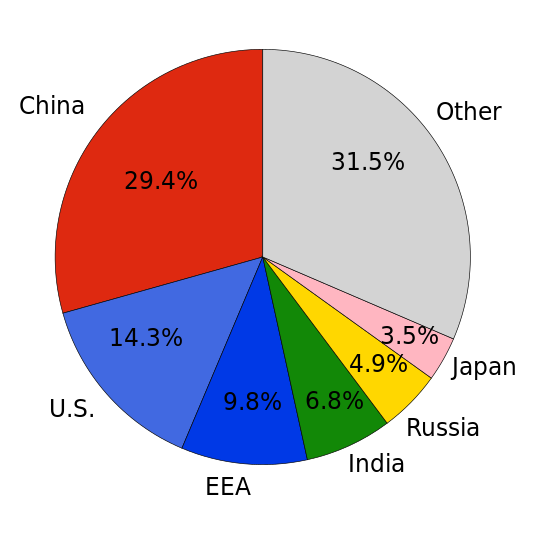
Global Greenhouse Gas Emissions by Source 2013

Here are some numbers: As of 2015, all carbon dioxide emissions from the United States comprised 14.34 percent of the global total, while China’s emissions stood at 29.51 percent. Even if the five oil companies were somehow responsible for, say, 10 percent of the United States’ carbon dioxide emissions, that would be less than one percent of the total human releases. Under standard tort rules, the liability of each defendant must be limited to its own pro rata share of the total harm given that under Section 433A of the Restatement of Torts, there is a “reasonable basis for determining the contribution of each cause to a single harm,” in this instance measured by market shares.
Indeed, these public nuisance lawsuits are especially dubious, given that the oil companies did not by their sales emit any carbon dioxide into the atmosphere. The dangerous releases came from many different parties, both private and public, including the municipalities bringing these lawsuits. These numerous parties used these products in countless different ways, with as much knowledge of their asserted effects on global warming as these five defendants. How could the oil companies have known about the anticipated course of global warming forty years ago when key government studies done today are uncertain about the magnitude of the effects of emissions on sea levels and the economic consequences?

The first paragraph of the New York City complaint ducks these factual complexities by insisting, falsely, that crude oil was “a product causing severe harm when used exactly as intended.” But the end uses of crude oil are so varied (including, for example, the creation of various plastics in common use today) that the effective control of emissions is best done through the regulation of these end users and not the oil companies. Indeed, even for gasoline, the level of carbon dioxide emissions critically depends on the operation and maintenance of the many different types of facilities, equipment, and vehicles, all of which are beyond the direct control of the oil companies. Yet all these end users are already subject to extensive emissions controls under the Clean Air Act and countless other environmental directives, both at the state and federal level.

This sensible distribution of regulatory authority rests on the superior ability of government agencies (at least compared to the courts), often in cooperation with each other, to formulate and maintain coherent policies to regulate the emissions of carbon dioxide, as well as methane, nitrous oxide, and fluorinated gases, which the EPA calculates account for 18 percent of greenhouse gas emissions.

The issues here are especially complex for many technical and logistical reasons. One critical task is to decide the optimal level of emissions. The implicit assumption of the New York and San Francisco lawsuits is that the world would become a better place if all emissions of carbon dioxide were stopped. But that position ignores the enormous benefits that come from the use of fossil fuels, which continue to supply over 80 percent of the nation’s energy needs. No other fuel source could keep manufacturing, transportation, and commerce alive. And it is just exaggeration to claim, as the city plaintiffs do, that these oil companies “have done nearly all they could to create [the] existential threat” of global warming when in fact energy efficiency in the United States has consistently improved, particularly in generating electrical power.

No public nuisance suits for global warming can solve a problem that must be addressed by a coherent regulatory program. Instead, chaos will follow if hundreds of different states, counties, and cities are allowed to bring separate actions under state law. It bears emphasis that in 2011, a unanimous Supreme Court decision in American Electric Power Co. v. Connecticut held that the combination of the Clean Air Act and actions by the Environmental Protection Agency “against carbon-dioxide emitters . . . displace the claims that the plaintiffs seek to pursue” under a public nuisance theory brought under federal law. The Court left open the question of whether the federal regulation at the time preempted any state law cause of action for public nuisance.

Summary

But, as I argued at the time, the only viable solution was for the federal government and the EPA to “orchestrate” the effort to control emissions. The point is doubly true against these remote, upstream defendants who have not emitted anything themselves. The standard analysis of federal preemption has long held that states may not engage in their own remedial efforts, even by actions in tort, when extensive federal regulation occupies the field, or when state activity either frustrates federal action or is in conflict with it. If anything, the scope of federal oversight, actual and prospective, is far more comprehensive than it was when American Electric Power was decided. And so federal preemption alone should block a set of dubious public nuisance claims that should never have been brought in the first place.

Background:  Critical Climate Intelligence for Jurists (and others)

The Children’s Climate Lawsuit Harms The Children

When launching a boomerang, watch out when it comes back on you.

This post provides further perspective and some legal background regarding the lawsuit campaign by Hansen et al fronted by idealistic children.  First an article at Investor’s Business Daily points out how the lawsuit is not in the best interest of present or future generations: The Children’s Climate Lawsuit Against The Children  Excerpts with my bolds below from Benjamin Zycher Jan. 12, 2018

Litigation may be as American as apple pie, but some lawsuits are so destructive that they stand out even among the hugely expensive wreckage wrought by our legal system. The most prominent current example is the “children’s” climate lawsuit (Juliana v U.S.): A group of kids, including “future generations, through their guardian Dr. James Hansen,” claim that the government’s actions and failures to act have caused climate change, thus violating the youngest generation’s constitutional rights to life, liberty and property, and have failed to protect essential public trust resources.

First the Policy Concerns the People’s Interest not the Judges

I leave the numerous legal issues to the lawyers (see backgrounder further on), although precisely how the ineffable Hansen came to be the “guardian” for future generations is a question both fascinating and amusing. Instead, it is crucial to recognize first that the fundamental policy assumption underlying this lawsuit — we can make “the children” better off by making them poorer — is preposterous.

More generally, the lawsuit is a blatant attempt to circumvent democratic processes, in terms of both the Congressional power to make policy and the authority of the president to implement it.

Climate policies — mandated reductions in greenhouse gas (GHG) emissions — by and large are energy policies, and the constitution is silent on which such policies would serve the interests of future generations, or on the appropriate tradeoffs between the interests of “the children” and the adults alive in the here and now.

Those are policy questions, and this attempt to induce judges to interfere with Congress’ legislative powers is deeply destructive of our constitutional institutions. Should “the children” not be concerned about that? Why are “the children” not suing about, say, the national debt?

Second CO2 is Not a Pollutant

The claim about the protection of “essential public trust resources” boils down to an assertion that carbon dioxide is a “pollutant.” No, it is not: A certain minimum atmospheric concentration of it is necessary for life itself. (Merely look at NASA’s time-lapse photo of the earth’s greening over the last 30-plus years.) By far the most important GHG is water vapor; does anyone claim that it is a “pollutant?” Obviously not, and not because ocean evaporation is a natural process; so are volcanic eruptions, and the massive amounts of effluents emitted by volcanoes are pollutants by any definition.

Third Energy Poverty Shortens Lives 

Consider a homo sapiens baby born in a cave some tens of thousands of years ago, in a world with environmental quality effectively untouched by mankind. That child at birth would have had a life expectancy on the order of ten years; had it been able to choose, it is obvious that it willingly would have given up some environmental quality in exchange for better housing, food, water, medical care, safety, ad infinitum. That is, it is obvious that people willingly choose to give up some environmental quality in exchange for a life both longer and wealthier.

The Lawsuit Will Make Future Generations Worse Off

In other words, the children’s lawsuit is inconsistent with actual interests of future generations, as the obvious underlying assumption is that future generations would prefer the purest possible environmental quality. That is not correct: Future generations want to inherit the most valuable possible capital stock in all of its myriad dimensions, among which environmental quality is one important component among many, and among all of which there are tradeoffs that cannot be avoided.

Is it the position of the attorneys representing “the children” that making energy more rather than less expensive unambiguously would make future generations better off? In order for future generations to receive the most valuable possible capital stock, the current generation must consume and invest resources most productively.

If regulatory and other policies implemented by the current generation yield less wealth now and a smaller total capital stock for future generations, then more resource consumption and more emissions of effluents currently would be preferred from the viewpoint of those future generations.

Lawsuit Asserts Facts Not in Evidence

That is only the beginning of the problematic factual assertions and assumptions underlying the children’s lawsuit. The measurable effects of increasing GHG concentrations are far smaller than the climate models would lead one to believe. The degree to which recent warming has been anthropogenic is unsettled in the scientific literature; and the Intergovernmental Panel on Climate Change (IPCC) in its fifth assessment report (AR5) has reduced its estimated range of the effect in 2100 of a doubling of GHG concentrations from 2.0–4.5 to 1.5–4.5 degrees C.

There actually is little evidence of strong climate effects attendant upon increasing GHG concentrations, in terms of sea levels; Arctic and Antarctic sea ice; tornado activity; tropical cyclones; U.S. wildfires; drought; and flooding. IPCC in the AR5 is deeply dubious (Table 12.4) about the various severe effects often hypothesized (or asserted) as future impacts of increasing GHG concentrations.

One might assume that the facts underlying a lawsuit ought to be consistent with its central claims; one would be wrong. And wrong again if one assumes that the policy objective would make an actual difference: The Paris agreement with full U.S. participation would reduce temperatures by 2100 by seventeen one-hundredths of a degree. The U.S. contribution would be fifteen one-thousandths of a degree. Add another one one-hundredth of a degree if you believe that the Obama pseudo-agreement with China is meaningful. (It is not.)

Children Used by Environmental Ideologues

Precisely what is the children’s climate lawsuit trying to achieve? It cannot be protection of our constitutional principles, or protection of future generations, or environmental improvement. Only one possibility remains: It is part of the long-term effort by the environmental left to use any means possible to exert control over other people’s property, economic choices, and lifestyles. The plaintiff attorneys are happy to participate in a litigation process in which “the children” are irrelevant.

Legal Context

For those interested in the legalities Andrew Varcoe provides a Legal Backgrounder published at the Washington Legal Foundation Does the Constitution Provide a Substantive Due-Process Right to a Stable Climate System?  Excepts below with my bolds.

Americans have many views on the causes and severity of climate change—and on the pros and cons of conceivable policy responses. But most Americans would likely react with some measure of surprise to one suggested solution—the notion that individual citizens have a constitutional right, enforceable by judicial diktat, to a stable climate system. Surprising or no, this suggestion has landed in the lap of the U.S. Court of Appeals for the Ninth Circuit. In June, the Department of Justice (DOJ) filed a mandamus petition in that court in Juliana v. United States, a lawsuit pending in federal district court in Oregon.

The Juliana plaintiffs claim a substantive due-process right— a fundamental, unenumerated right—to a stable climate. They also argue that the federal government has an enforceable public-trust duty to protect the atmosphere and other resources from climate change. DOJ’s mandamus petition asks the Ninth Circuit to direct the district court to dismiss the Juliana case. Although the Trump Administration filed the mandamus petition, the Obama Administration had asserted the same basic jurisdictional and merits arguments before the district court.

The Ninth Circuit may rule on the petition soon. While this litigation presents several important questions, this Legal Backgrounder focuses only on the core merits question whether there is a fundamental, unenumerated right to a stable climate system protected by the Due Process Clause of the Fifth Amendment.

1. It seems unlikely that a Ninth Circuit panel would recognize a constitutional right to a stable climate system.

A mandamus petition is a request for extraordinary relief. The Ninth Circuit has various options for ruling on the government’s petition without reaching the merits. That said, if the court were to reach the merits now, it seems likely that the court would hold that there is no fundamental right to be protected against climate change. As a general matter, federal courts are rightly reluctant to create or recognize new fundamental rights protected by substantive due process. As the Supreme Court has said, judges must “exercise the utmost care whenever we are asked to break new ground in this field, lest the liberty protected by the Due Process Clause be subtly transformed” into judges’ “policy preferences,” and place great public questions “outside the arena of public debate and legislative action.

Older lower court decisions are consistent with the view that interests related to pollution and climate change are not protected by substantive due process. See Nat’l Sea Clammers Ass’n v. City of New York, 616 F.2d 1222, 1238 (3d Cir. 1980) (Constitution protects no “right to a pollution-free environment”), vacated in part on other grounds sub nom. Middlesex Cty. Sewerage Auth. v. Nat’l Sea Clammers Ass’n, 453 U.S. 1 (1981).

Prudential factors militate against crafting a new constitutional right in the air pollution context. Congress has already enacted a comprehensive statute to regulate air pollution—the Clean Air Act (CAA)—and has amended it over several decades. After the Supreme Court held that the Act authorizes federal regulation of greenhouse gas (GHG) emissions, see Massachusetts v. EPA, 549 U.S. 497, 532 (2007), the Environmental Protection Agency (EPA) began regulating such emissions. Despite recent political changes, EPA has not proposed to stop regulating GHG emissions.

Congress is free to override federal common law, but not a constitutional precedent. For example, the plaintiffs want the district court to determine “the minimum safe level of atmospheric CO2 concentrations” and the “timeframe” for achieving that level. But what if the court misses the mark in doing so? Congress and the President would have no power to override such an error.

2. It also seems unlikely that the Ninth Circuit would extend the state-created danger doctrine to climate change.

The Juliana plaintiffs invoke a different strand of substantive due process when they rely on the state-created danger doctrine. Under that doctrine, a governmental entity takes on a constitutional duty to an individual whom it places in peril in deliberate indifference to his or her safety.5 The Juliana plaintiffs argue that the defendants or their predecessors assumed such a duty when they “authorized, permitted, and promoted the extraction, transportation, and combustion of fossil fuels for decades with full knowledge that such activities would manifest unique and personalized injuries to individuals.” This argument could be seen as an extrapolation from the constitutional rights to life, liberty, and property. Nonetheless, as applied to climate change, the argument is fundamentally problematic for several reasons.

First, the state-created danger doctrine covers dangers attributable to government actions, not to government omissions. See DeShaney v. Winnebago County Dept. of Social Services, 489 U.S. 189, 195, 197-203 (1989). The doctrine provides no remedy for failures to regulate private activity. Second, even when limited to government actions, the plaintiffs’ argument would expand the state-created danger doctrine so radically as to make it unrecognizable and unworkable. The argument proves too much. Courts have applied the doctrine to government actions that cause direct physical harm to individuals— typically, actions by law enforcement officers or other government agents. But climate change is immeasurably more complex than such incidents. Climate change is a kind of global mass tort, with diffuse and innumerable causes and impacts, involving a very large number of potential wrongdoers and victims.

Andrew R. Varcoe is a Partner with Boyden Gray & Associates, PLLC, in Washington, D.C. The firm’s clients and lawyers have a mix of views on climate change policy issues. Mr. Varcoe thanks his colleagues, and Professor Douglas A. Kysar, for their contributions to the ideas in this Legal Backgrounder; he alone is responsible for any errors.

Footnote:  More on Children’s Trust and Lawsuits see Climate War Human Shields

Pipeline Justice Grinding Slowly

Wheels of justice grind slow but grind fine — Sun Tzu, Art of War

An update on pipeline disruption cases is provided by Blake Nicholson, Associated Press, January 9, 2018, in Great Falls Tribune: Court cases from coordinated 2016 pipeline protest delayed. Excerpts below with my bolds.

BISMARCK, N.D. — Several court cases stemming from a coordinated pipeline protest in four states have been delayed, including one where an appeals court is deciding whether to allow two women to argue their law-breaking was necessary to prevent a greater harm.

Eleven activists with the group Climate Direct Action were arrested on Oct. 11, 2016, when they tried to either shut down pipelines in North Dakota, Minnesota, Montana and Washington state or film the attempts. The activists said they were protesting fossil fuels and supporting people demonstrating against the Dakota Access oil pipeline, which was still under construction.

The activists broke into private property and turned shutoff valves at five pipelines that moved oil from Canada to the U.S.

In Minnesota, prosecutors have asked a state appeals court to reverse a judge’s ruling that would allow two women to use the so-called necessity defense. The defense is popular among environmental activists who argue that global warming caused by fossil fuels is the greater harm, though legal experts say it’s a long-shot defense.

The appeal delayed the December trial of Seattle-area residents Emily Johnston and Annette Klapstein, who are accused of closing valves on two pipelines in northwestern Minnesota. The trial hasn’t been rescheduled, and their attorney said he doesn’t expect a resolution on the appeal until spring.

Sentencing has been delayed for two men who were barred from using necessity-defense arguments. Leonard Higgins of Portland, Oregon, was convicted in November of criminal mischief and trespassing in Montana; his January sentencing was pushed to March 20 after his attorneys asked for more time, according to court documents. Seattle resident Michael Foster also was set for sentencing this month in North Dakota but the hearing was moved to February because of a timing conflict.

A Washington state case was resolved last year when Ken Ward, of Corbett, Oregon, was convicted of burglary and sentenced to two days in jail plus community supervision and community service. He, too, wasn’t allowed to use the necessity defense.

The six other arrested activists were accused of filming the vandalism. Prosecutors dropped charges against two of them in Washington. Trials are pending for two others in Minnesota and one in Montana, and one activist is to be sentenced in North Dakota the same day as Foster.

Summary

Actually, I don’t mind them taking it slow, so long as they get it right.  Still, putting global warming on trial during this winter weather would have provided at least poetic justice, less so in springtime.

Background:

On civil disobedience by climate activists:

A Valve Turner’s Trial: Mostly guilty

Minnesota judge allows ‘necessity defense’ in pipeline case

On the Judiciary unprepared for such cases: Critical Climate Intelligence for Jurists (and others)


Will Lawyers Destroy Science?

Justice: Blind and scientifically illiterate. (Credit: Storyblocks)

Several posts on this blog report on legal maneuvers as anti-fossil fuel activists turn to the courts to advance their agenda.  Now we have an article questioning whether legal thinking is relevant to scientific issues.  From Alex Berezow, editor of RealClearScience: (Full text below in italics with my bolds)

Will Lawyers Destroy Science?

Scientists and lawyers do not get along. There’s a reason for that. Simply put, scientists and lawyers do not think alike.

I was smacked in the face by this reality when I was called into jury duty in 2011. The case involved a car accident, and the standard in Washington State for the jury to decide in favor of the plaintiff is a “preponderance of evidence,” which is a fancy way of saying, “51 percent.” Essentially, a coin toss decides if the plaintiff wins a bunch of money.

The judge asked if any of the potential jurors objected to that. I did. “I’m a scientist,” I explained, “and I need more evidence than that.” So, I was shown the door.*

That experience taught me that scientists and lawyers live in two completely different worlds. Scientists want 95% confidence and margins of error; lawyers want 51% confidence. Scientists want all evidence to be considered; lawyers do everything in their power to dismiss evidence they don’t like. Scientists rely on reports written by experts; lawyers often consider them inadmissible hearsay. At their best, scientists pursue truth; at their best, lawyers pursue the truth, so long as it benefits the client.

These are fundamentally irreconcilable worldviews that are forever destined to be in conflict. And the lawyers are winning.

Scales of justice Alaska Commons

Will Lawyers Destroy Science?

Consider Mark Jacobson, the climate scientist who is suing a prestigious journal for $10 million because it hurt his feelings. There is good reason to believe that the lawsuit will be dismissed, but not before lawyers have collected a nice fee for themselves. Jacobson’s attorneys and the journal’s attorneys can both make a lot of money arguing with each other, even if the suit never actually goes to trial. Routinely, lawyers are required to solve problems that they themselves created. If something like this were to occur in any other area of life, it would be called racketeering.

Recently, RealClearScience wrote an article that covered a paper published in the journal Case Reports in Gastrointestinal Medicine about how a particular herbal tea was linked to acute liver failure. The maker of the tea threatened to sue RealClearScience, which pulled the article because it didn’t want to deal with a lawyer.

In both examples, the scientific enterprise is collateral damage. The mere threat of a lawsuit can be used to shut down scientific debate. This is deeply troubling.

A Lawsuit-Happy Nation

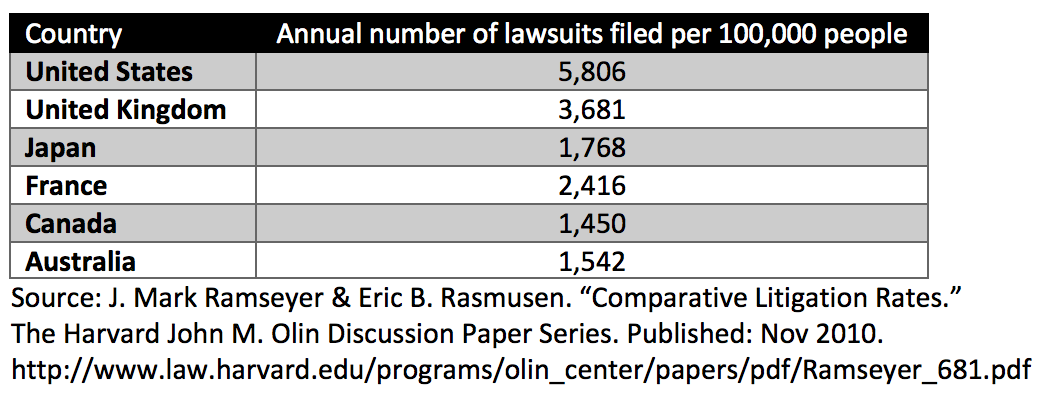
Unfortunately, there are no signs of such lawsuit abuse stopping. Researchers at Harvard’s John M. Olin Center for Law, Economics, and Business published a report that showed that the number of lawsuits filed in the United States far exceeds those of similar countries:

On a per capita basis, the lawsuit rate in the U.S. is higher than Canada (by 4 times), Australia (3.8x), Japan (3.3x), France (2.4x), and the UK (1.6x).

Beware, science. A lawsuit-happy nation turns its eyes to you.

*Note: Mission accomplished. I didn’t want to be there, anyway.

Dr. Alex Berezow is the Founding Editor of RealClearScience and Assistant Editor of RealClearWorld. He also is a member of the USA Today Board of Contributors. Furthermore, he co-authored the book Science Left Behind, which sold more than 5,000 copies. His work regularly appears in USA Today and The Economist, among other publications. In 2010, he earned a Ph.D. in microbiology from the University of Washington.

See Also:

Critical Climate Intelligence for Jurists (and others)

Climate Scientist Sues Over Hurt Feelings


Judge delivers crushing blow to Washington Clean Air Rule

h/t GWPF for breaking this story  The WSJ article is parywalled, so here is an article from the Bellevue Reporter Judge delivers crushing blow to (Governor) Inslee’s Clean Air Rule Full text below with my bolds

Twenty-seven months ago Gov. Jay Inslee set out to curb emission of carbon pollutants through a sweeping rewrite of the state’s clean air rules.

A week ago a Thurston County judge said Inslee’s executive fiat went too far.

Superior Court Judge James Dixon concluded the governor’s Department of Ecology exceeded its authority with the regulatory scheme it developed and had been taking steps to put in place.

Inslee didn’t issue a statement on receiving this legal lump of coal.

His spokeswoman, Jaime Smith, said in an email that the ruling is “disappointing” and they are looking into options the department can pursue.

The rule targeted the state’s largest emitters of greenhouse gases, such as natural gas distributors, petroleum product producers and importers, power plants, metal manufacturers, and landfill operators. Large manufacturing operations, such as the Boeing Co. plant in Everett, also made the list of those expected to be affected at some point in the future.

Inslee wanted to require those large polluters to reduce carbon emissions by an average of 1.7 percent annually. Initially, the rule would apply to those that release at least 100,000 metric tons of carbon a year. Every three years the threshold would drop and as a result more companies would be subject to the requirements.

From the outset, the Association of Washington Business (AWB) opposed the approach as an overreach from the executive branch. Two years and 29,000 pages of legal filings later, a judge agreed.

Dixon, ruling from the bench, concluded the department’s regulatory reach is limited to those companies that directly introduce contaminates into the air, said Bob Battles, AWB’s general counsel. It lacked authority to regulate suppliers of natural gas and petroleum products because they are not an emitting party, he said.

This is a crushing blow for the governor.

The clean air rule is the centerpiece of Inslee’s legislative and political crusade against climate change. He’s called it “the nation’s first Clean Air Rule, to cap and reduce carbon pollution.” He touted it on college campuses around the state and at international conferences around the globe.

Now it’s gone.

There may be an appeal. Ecology’s lawyers want to see if at least the portion of the rule applying to emitters such as refineries can go forward.

But adjudicating this matter further will take time. If there are appeals, it’s unlikely the regulation as now written could be enforced before the end of the governor’s second, and possibly last, term as governor.

At this point, he’s got to be looking to the Legislature or the electorate for an assist.

Democratic lawmakers could provide it by using their majorities in the House and Senate to send him legislation directing new regulations be imposed on carbon polluters.

And it’s probably just a happy coincidence that Dec. 14, one day before the judge put the kibosh on his rule, Inslee said he’ll put forth a new carbon pricing scheme sometime next month which they’ll be able to consider.

But Dems have struggled mightily to agree among themselves on what to do on climate change so don’t count on 2018 being much different.

Voters seem like the best bet at this point.

If environmentalists can get a measure on next November’s ballot and wealthy Inslee friends like billionaire Tom Steyer cq JC pony up enough dough, it could pass.

That certainly would ease the sting of getting the lump of coal.

In olden days kings ruled by fiat, but nowadays you need the people’s consent, disappointing to Obama and now Inslee.