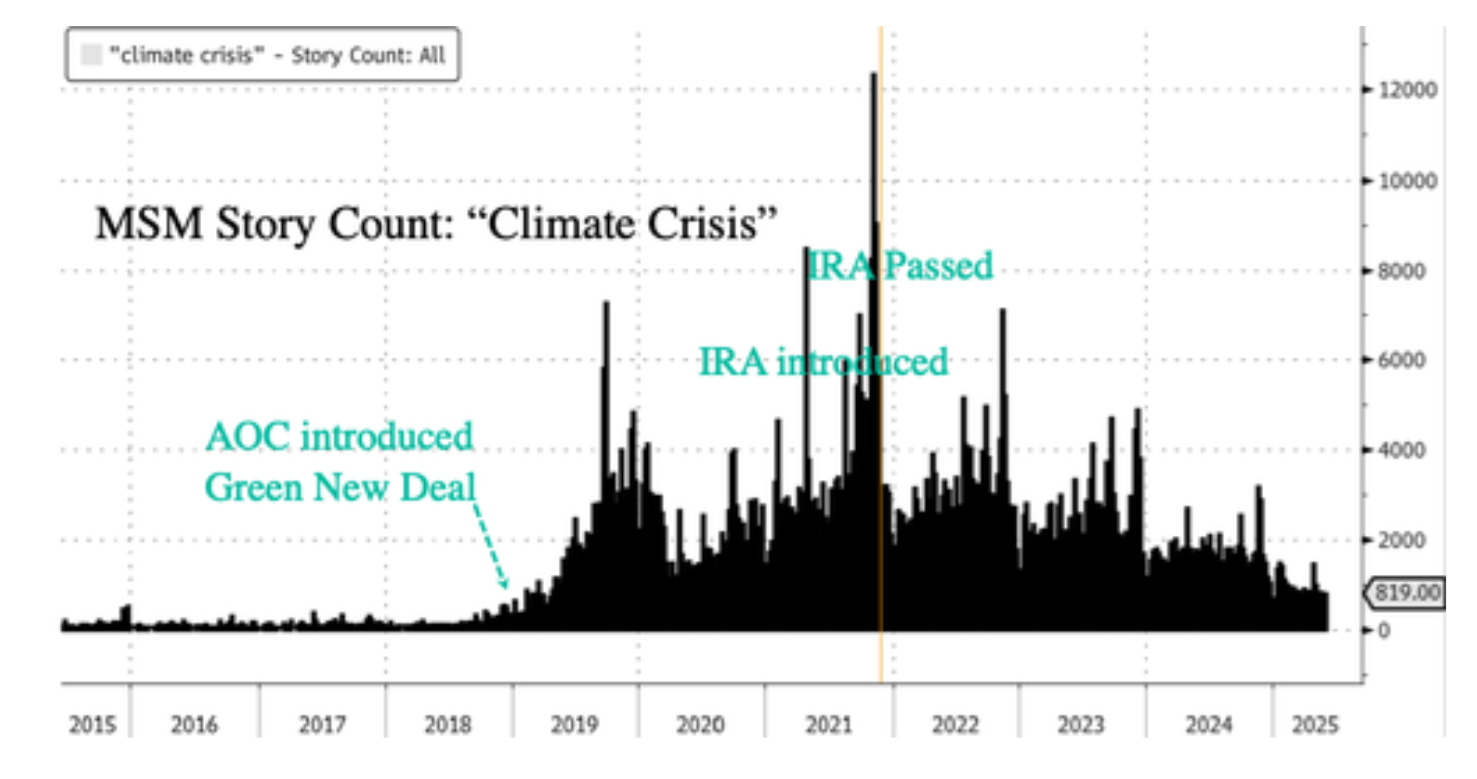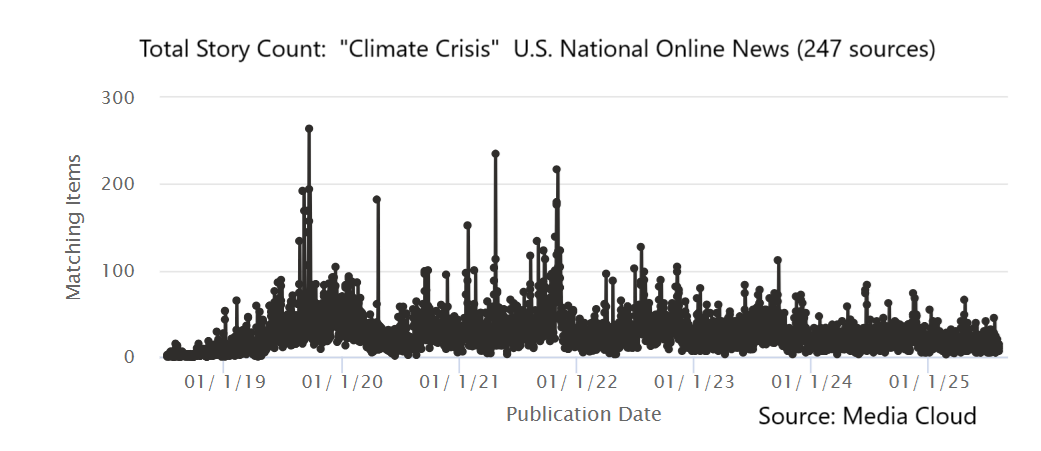
It’s Summertime, Hottest Year Claims Ensue

Matthew Wielicki explains the scientific malpractice in his Financial Post article Junk Science Week: The hottest year ever?.  Excerpts in italics wtih my bolds and added images

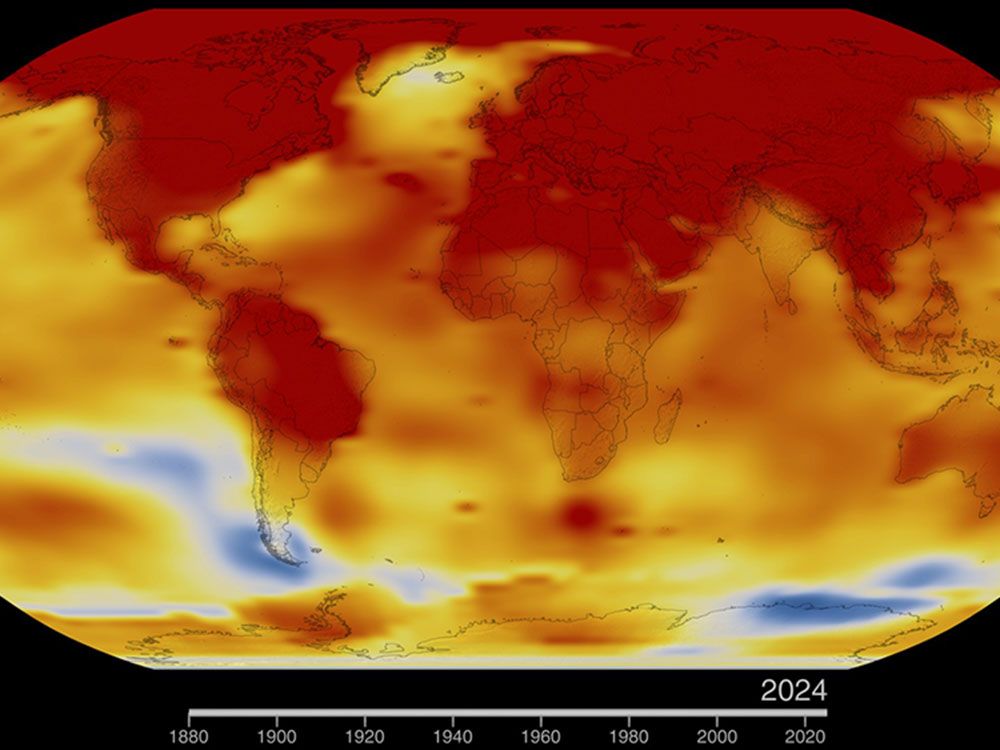
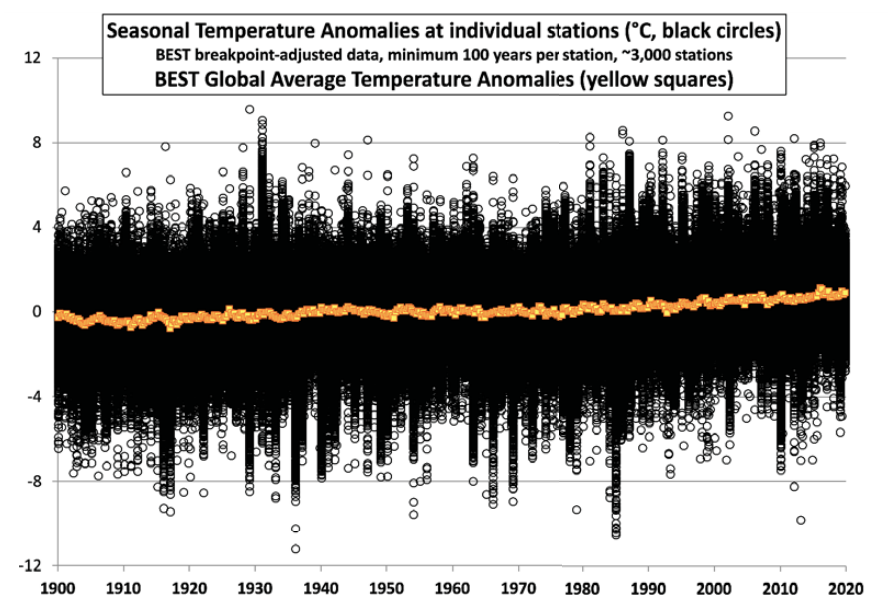
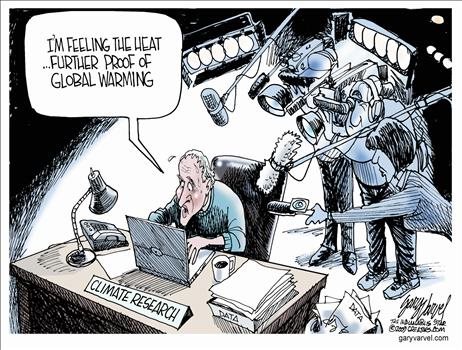
Advocates and the media claim 2024 was the hottest year ever.
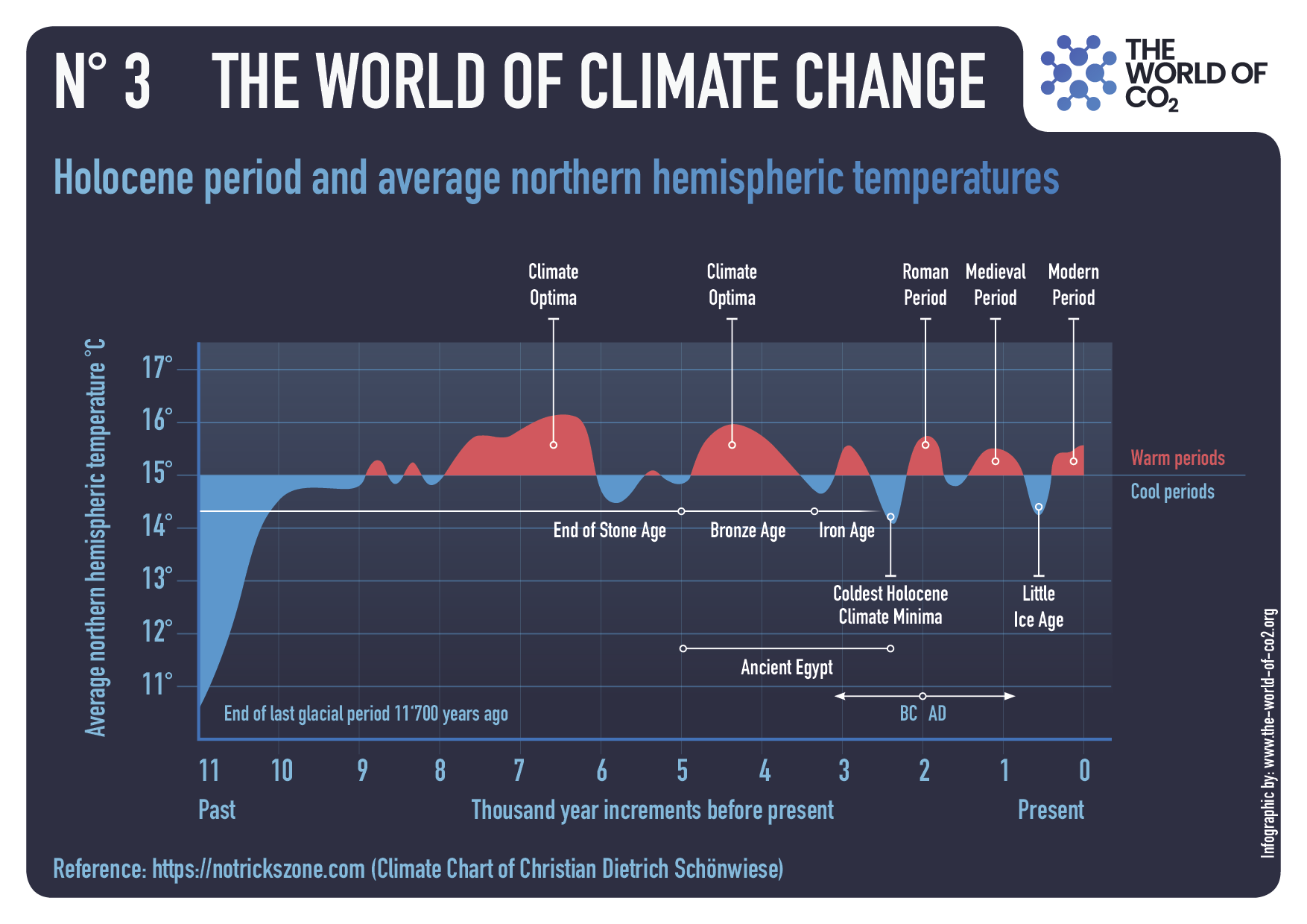
Archeological data suggest it wasn’t,
while modern data suffer from biases

An image produced by NASA and used when it declared 2024 as the warmest year on record. Photo by NASA

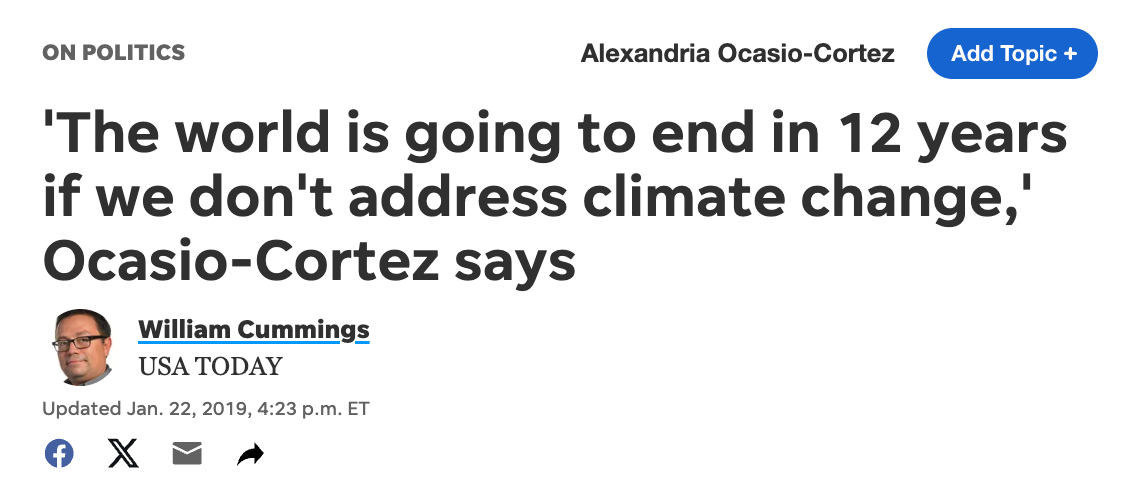
In 2024, mainstream media and political leaders aggressively promoted the alarming narrative that Earth had just experienced its hottest year ever recorded. National Geographic dramatically proclaimed, “2024 was the hottest year ever … and the coldest year of the rest of your life,” while the Vancouver Sun declared unequivocally, “Scientists confirm 2024 was Canada’s and world’s hottest year on record.” Canadian political figures reinforced this narrative, with prime minister Justin Trudeau characterizing the year’s warmth as an urgent call for immediate climate action.

I’m an earth science professor-in-exile. Claims such as these
immediately provoke critical skepticism.

This persistent narrative, relentlessly advanced by a powerful climate-industrial complex comprising governments, activist organizations and the media, is designed not merely to inform, but to generate a state of perpetual urgency. As global greenhouse gas (GHG) emissions continue to rise despite decades of climate policy interventions, the need to claim climate conditions are increasingly severe becomes a strategic imperative, regardless of scientific accuracy or historical context. This approach not only distorts genuine scientific inquiry but fosters anxiety and despair, particularly affecting young people already inundated with predictions of catastrophe.

The answers to four fundamental questions expose the weaknesses and biases inherent in the mainstream climate narrative:

1. Can we accurately measure historical global temperatures?

Claims about unprecedented global heat depend heavily on comparing modern temperature records, which are gathered by instrument and capture annual or monthly fluctuations, to historical temperature estimates derived from proxy data such as ice cores, tree rings, sediment layers and coral reefs. But proxy data inherently smooths out short-term fluctuations, providing generalized temperature estimates spanning centuries or millennia. This mismatch between high-resolution modern data and low-resolution historical proxies inevitably exaggerates the perceived severity of contemporary warming.

For example, widely cited reconstructions and favourites of The Intergovernmental Panel on Climate Change (IPCC) explicitly acknowledge their inability to capture temperature variability occurring over periods shorter than 300 years. The rapid temperature changes of recent decades appear unprecedented when put side by side with these smoothed historical averages. This methodological flaw significantly undermines the credibility of claims asserting that current global temperatures are historically unique or alarming.

2. Was 2024 really unprecedentedly warm?

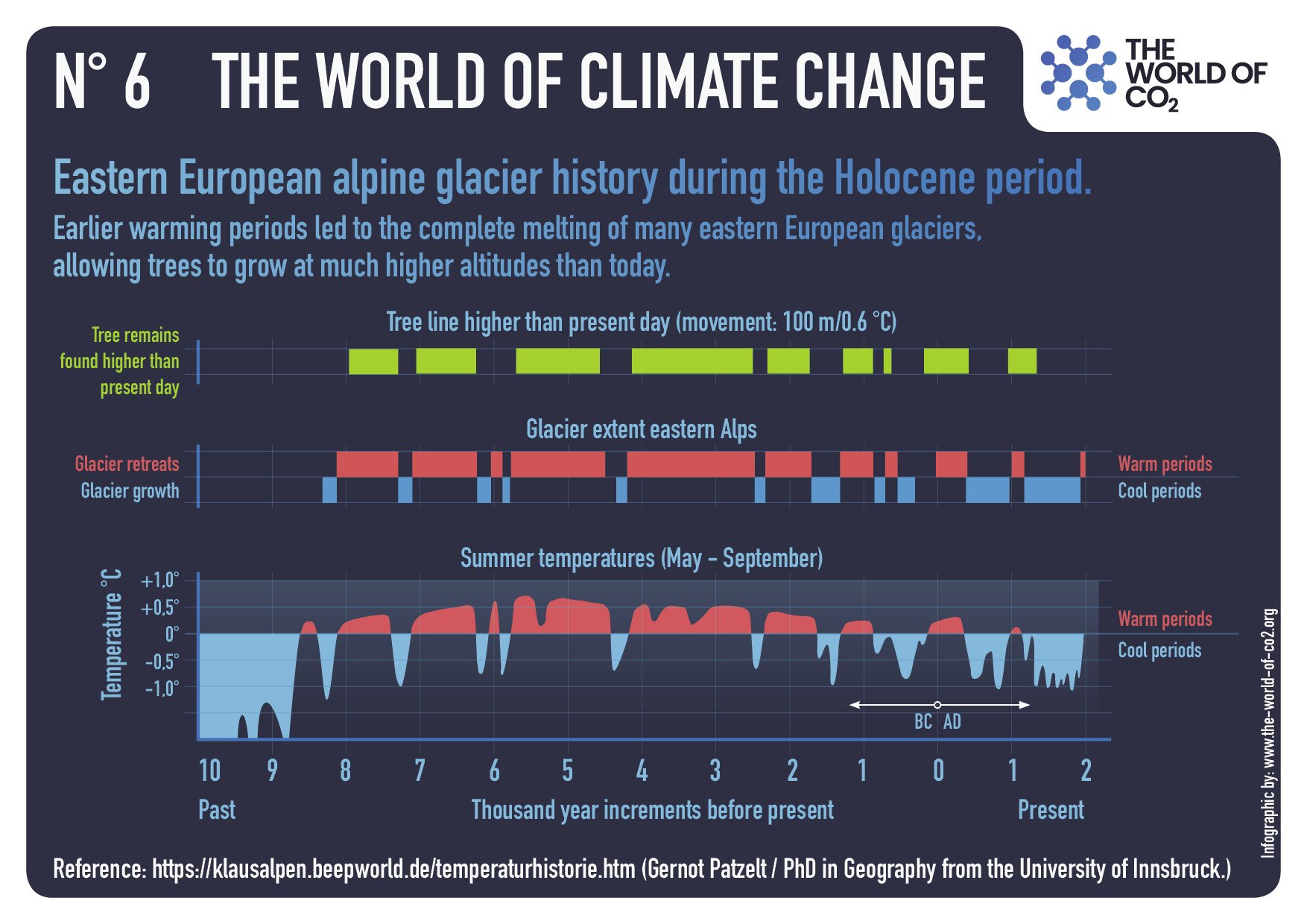
Extensive historical and geological evidence demonstrates significant natural warming vastly exceeding modern temperatures. The Holocene Thermal Maximum (five to nine thousand years ago) saw temperatures significantly warmer than today, including in Canada. Archeological evidence, such as ancient forests revealed by retreating glaciers in the Rockies, conclusively supports periods of substantial natural warmth.

During the Eemian interglacial period (115-130 thousand years ago), Greenland experienced temperatures three to five degrees C warmer than now, despite substantially lower CO₂ concentrations in the atmosphere. These scientifically documented periods confirm that Earth’s climate naturally experiences considerable variability, rendering claims of unprecedented modern warmth scientifically untenable and historically uninformed.

3. Are we measuring the effects of CO₂ or urban heat islands

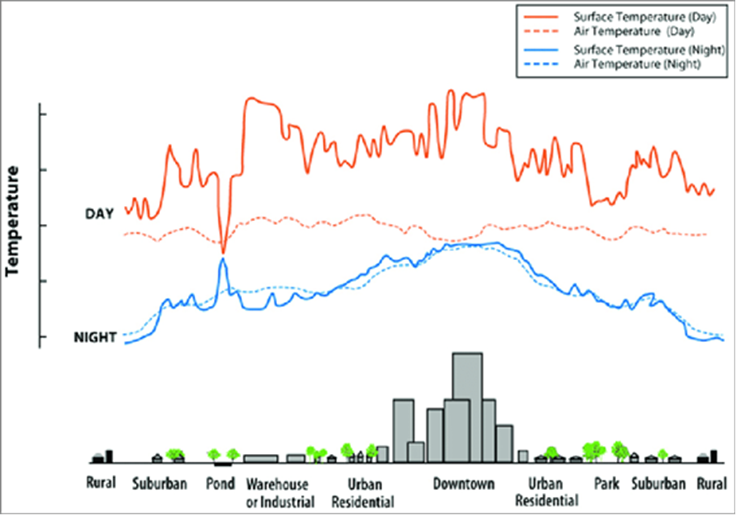
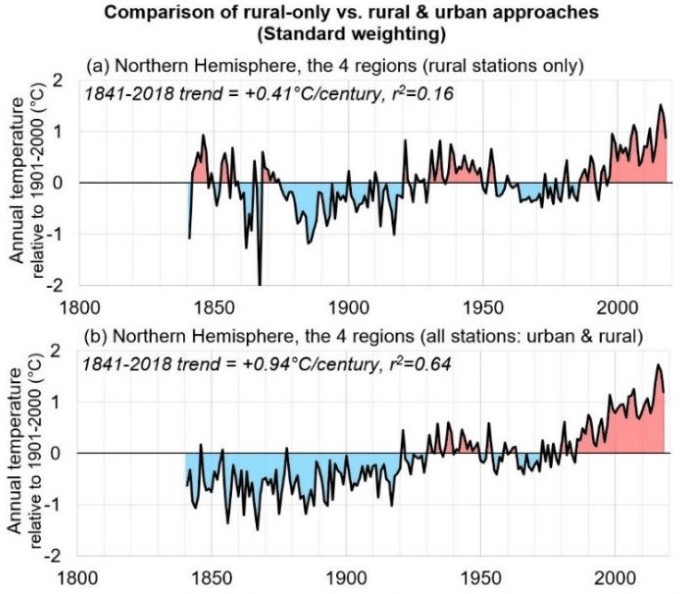
Most modern temperature records fuelling alarmist headlines originate from urban areas influenced by the Urban Heat Island Effect (UHIE). UHIE results from urban infrastructure, such as concrete, asphalt and buildings, retaining and radiating heat, significantly increasing local temperatures independent of broader climate trends. Toronto’s significant infrastructure growth has noticeably raised local temperatures, heavily skewing data. Similarly, Las Vegas’ highest recorded temperatures coincided with significant expansion around Harry Reid International Airport, illustrating the dominant role of urbanization rather than atmospheric CO₂ emissions.

Recent research indicates that up to 65 per cent of urban warming is from local urbanization rather than global greenhouse gas increases. Attributing urban heat predominantly to CO₂ emissions significantly misrepresents the true dynamics of local temperature increases.

4. Do rising CO2 levels really heat the oceans?

Recent alarmist coverage in outlets like the Financial Times highlights near-record ocean temperatures, linking them directly to rising CO₂ levels. The EU’s Copernicus programme noted that May 2025 ocean temperatures were the second highest ever recorded, with scientists raising concerns about the oceans’ diminishing capacity to absorb CO₂ and excess heat.

But this narrative critically overlooks fundamental scientific facts. Oceans possess a heat capacity orders of magnitude greater than the atmosphere. The notion that atmospheric CO₂ significantly heats ocean water directly is scientifically unfounded, as infrared radiation from CO₂ penetrates mere millimetres into the ocean’s surface, not nearly deep enough to meaningfully alter ocean temperature. Ocean temperature fluctuations are primarily driven by natural phenomena such as El Niño.

Furthermore, going back to previous warmings prior to the satellite record shows that the entire rise of 0.8C since 1947 is due to oceanic, not human activity.

Moreover, historical data on ocean temperatures is highly uncertain, relying predominantly on sparse measurements and indirect proxies. Claiming near-record ocean temperatures without acknowledging these substantial uncertainties misleads the public about the robustness and reliability of these measurements.

Critical conclusion: One thing remains certain: it will never be “too hot” in Canada, despite alarmist rhetoric suggesting otherwise. The exaggerated claims that 2024 was “the hottest year ever” are not grounded in rigorous scientific analysis but serve primarily as political and ideological propaganda. This relentless propagation of fear fosters anxiety, despair, and nihilism, especially among young people — serious consequences largely ignored by climate alarmists.

The scientific community, policy-makers and the public at large need to insist on transparency, rigour and honesty in climate discourse. Recognizing the motivations behind alarmist claims is essential to ensuring public trust and effective policy. Climate science should strive to educate, not frighten, promoting balanced understanding rather than catastrophic narratives disconnected from historical context and scientific rigour.

Matthew Wielicki, Ph.D. in geochemistry from UCLA, publishes the Substack site Irrational Fear, which provides data-driven critiques aimed at fostering a balanced and scientifically grounded understanding of climate science.

Climate Policies to What End?

Oren Cass writes at Commonplace Who Is Climate Policy For?  Not workers. Excerpts in italics with my bolds and added images.

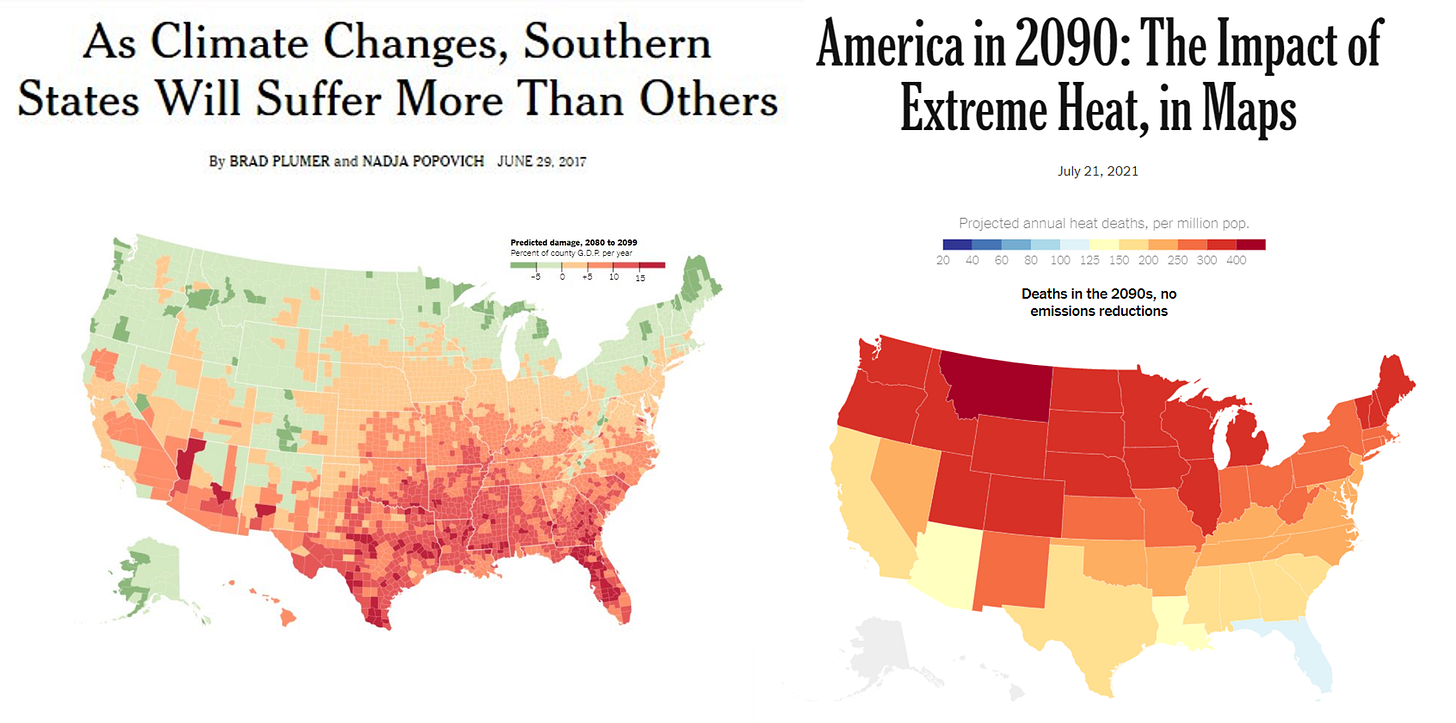
I mostly stopped writing about climate change in 2018, when actual analysis lost all relevance to the increasingly unmoored claims of climate activists. The frequently cited estimates of catastrophic cost, I showed in published reports and congressional testimony, were simply nonsensical. One prominent model relied upon by the EPA predicted that heat deaths in northern cities in the year 2100 would be 50 times higher than they had been in southern cities in the year 2000, despite the northern cities never reaching the temperatures that the southern cities were already experiencing. Another study, published in Nature, predicted that warming would boost Mongolia’s GDP per capita to more than four times America’s. But no one cared; no one was held accountable.

When subsequent research flipped the claims on their head, no one even flinched. Here’s the New York Times, four years apart:

(Technically, the first chart is GDP loss, while the second is heat deaths. But as the Times explained, the main driver of GDP loss in that first chart is heat deaths: “The greatest economic impact would come from a projected increase in heat wave deaths as temperatures soared, which is why states like Alabama and Georgia would face higher risks while the cooler Northeast would not.”) [Note:  Observations actually show a “warming hole” in Southeast US, perhaps due in part to reforestation efforts.]

Discussion of solutions, meanwhile, became entirely performative. So many climate agreements were signed, none had the prospect of substantially shifting the trajectory of global emissions, which is driven overwhelmingly by growth in the developing world. The Biden administration spent four years trumpeting unprecedented investment in fighting climate change. Try to find a comment linking that action to a downward shift in future temperatures or a reduction in any of the purportedly existential harms repeated ad nauseum as the basis for the action. I’ll wait.

The climate lectures had become the equivalent of the parent telling his children to eat their vegetables, because children in Africa are starving.

So now I encounter climate change mostly in the context of discussions about how best to build a policy agenda that serves the interests of American workers, and the working class broadly. Along with the refusal to enforce immigration law and the passion for shoveling hundreds of billions of dollars into a higher education system that fails most young people, the obsession with fighting climate change is a quintessential tradeoff preferred by progressives that they are of course welcome to make, but that cannot be squared with a commitment to working-class interests.

Progressives tend not to appreciate this observation,
or the cognitive dissonance that it triggers.

As I wrote in The Once and Future Worker, “People know how they want society ordered and wish desperately for that same thing to be good for everyone else.” Our 20-year-old texter feels this strongly. Fighting the climate crisis and providing for working families are not mutually exclusive. But the belief in a mythological crisis goes forever unsubstantiated. What is the ongoing devastation of communities that Biden-style policy action will mitigate?

To be clear, when I say mythological crisis, I don’t mean that climate change is a myth. I think climate change is a very serious challenge with which the United States, and the world, must find ways to cope. I’d also like to see us pursuing aggressive public investment in next-generation nuclear technology, and in the industrial precursors to strong electric vehicle supply chains—both of which are smart industrial policy regardless of climate implications.

But in the broader scheme of a century of economic, technological,
and geopolitical changes and challenges, the gradual increase
in global temperatures does not rank high.

This is not my opinion, it is the conclusion of the climate models, the UN’s Intergovernmental Panel on Climate Change, and the analyses that attempt to translate these forecasts into economic impacts. Climate change is not one of the top challenges facing working families in America. Solving it, if we could, which we can’t, would do little to move the needle in helping them achieve middle-class security.

But what about the “Green New Deal”? It has “New Deal” right in the title, suggesting a clear commitment to improving economic opportunity! That’s true, as far as it goes. Indeed, we could launch a “Purple New Deal” dedicated to knocking down all buildings that are not purple and replacing them with purple ones, which would also have many jobs associated with it.  Unfortunately, that’s not good economic policy.

What the Green New Deal—and climate policy, generally—attempts to do is shut down the existing energy industry and much of the industrial economy that relies on cheap and reliable energy, and replace it all with new “green” jobs. This should not require saying, but apparently does: Supplanting an existing, robust energy sector and industrial economy that provides a lot of very good jobs outside of our knowledge economy and superstar cities, with a new set of industries that hopes to do the same, does not in fact deliver economic gains.

The stated goal of climate policy is to replace things we already have. Anything new it creates is an attempt to climb back out of a hole it has dug itself. And unfortunately, the new tends to be less good, economically speaking, than the old. That reality in the auto industry is what drove the UAW strike last year.

The best way to understand all this is with a simple hypothetical: Let’s say we didn’t have to worry about climate change. A neat little box sucked greenhouse gases out of the atmosphere for free; problem solved. Would anyone still propose the Green New Deal? No climate change to worry about, you need to propose an agenda to support working families, how high on the list is “spend trillions of dollars shutting down the industrial economy and attempting to replace it with a set of less efficient and unproven technologies in which the United States has a much weaker position”?

It’s nowhere on the list.
Because climate policy does not help the working class.

For whatever reason, the project of decarbonizing the economy captures the progressive mind like no other. Ezra Klein and Derek Thompson’s Abundanceopens with a paragraph about waking up in the year 2050 in a cool bedroom powered by clean energy sources—a bedroom no cooler than the one you would wake up in today. Their abundant future is, first and foremost, not a more abundant one at all—merely one whose energy system they have transformed. Discussing scarcities, they start with, “We say that we want to save the planet from climate change.” When they enthuse that “new technologies create new possibilities and allow us to solve once-impossible problems,” they are thinking first of greenhouse gas emissions. “We worry,” first, “over climate change.” And “this book is motivated in no small part by our belief that we need to decarbonize the global economy.”

In my podcast with Klein, I asked him whether combatting climate change might represent a tradeoff in his agenda, rather than item one for bringing abundance to America. “For most, certainly, liberals who think about this and have studied this,” he responded, “the decarbonization is just central to the idea of what it would mean for our descendants to live a flourishing life.” Pitched this way, it fits perfectly the ideological template of most neoliberal missteps of the past 30 years: a purported win-win that serves the priorities of highly educated, high-income elites, who then instruct everyone else that the same thing should be their priority too. Like globalization, and unrestricted immigration, and free college.

Fool me once… Climate policy imposes massive costs, and damages the industrial economy, in pursuit of a specific goal: reducing carbon dioxide emissions. And if that’s your goal, that’s fine. Fight for it! Make the case for the tradeoff. But don’t pretend there’s no tradeoff, and certainly don’t tell the people you’re trading off that you’re really doing it for them.


See Also 

Eco-Loons War on Productive Working Class


Sea Level Rise Hype from Climatists Lying by Omission Again

From Inside Climate News comes this example, New Study Projects Climate-Driven Flooding for Thousands of New Jersey Homes.

Sea-level rise threatens coastal communities even if global emissions drop.

Of course the alarm is picked up everywhere:

As Summer Approaches, New Jersey’s Shore Towns Confront an Unrelenting Foe: Sea Level Rise Inside Climate News

US East Coast faces rising seas as crucial Atlantic current slows, New Scientist

Sea level rise creates a crisis at US coasts: What to know, USA Today

Map Shows US Cities Where Sea Level Rise Is Accelerating, Newsweek

Global sea levels are rising faster and faster. It spells catastrophe for coastal towns and cities, CNN

Etc., Etc., Etc.

Climatists Make Their Case by Omitting Facts

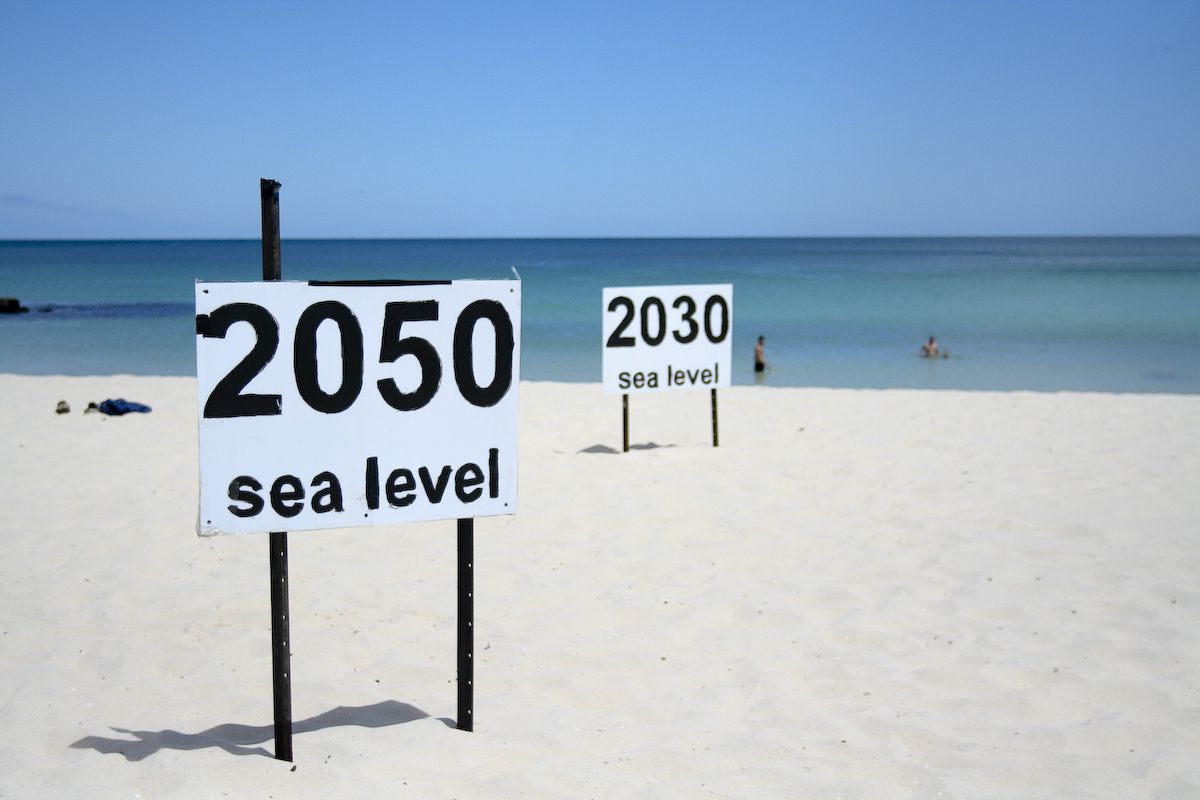
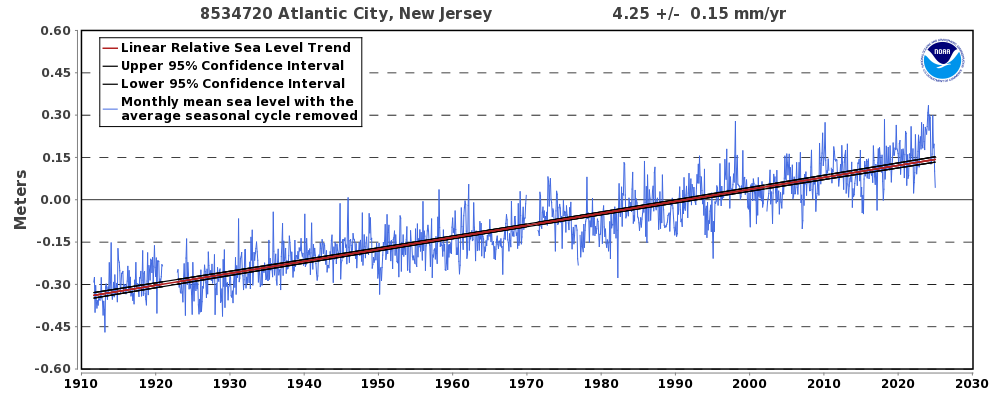
A previous post documented this pattern, of which we have this fresh example.  Let’s start with the tidal gauge at Atlantic City, New Jersey.

It presents a long record of steadily rising levels for more than a century.  The rate is 4.25 mm per year, or a rise of about 1 inch every six years.  The lie is in attributing all of that to sea level rising, and adding in burning of hydrocarbons as the cause.  What’s left out is the well known and documented subsidence of land along the US Eastern seaboard.

Vertical land motion (VLM) across the US Atlantic coast (a) Estimated VLM rate. The circles show the location of GNSS validation observations color-coded with their respective vertical velocities. (b) Histogram comparing GNSS vertical rates with estimated VLM rates. The standard deviation (SD) of the difference between the two datasets is 1.3 mm per year. (c) Land subsidence (representing negative VLM) across the US Atlantic Coast.

The black rectangles indicate the extent of study areas for Chesapeake Bay area and Georgia, South Carolina, and North Carolina (GA-SC-NC) area shown in Fig. 4. State Codes: ME Maine, NH New Hampshire, VT Vermont, MA Massachusetts, RI Rhode Island, NY New York, PA Pennsylvania, NJ New Jersey, WV West Virginia, OH Ohio, DE Delaware, VA Virginia, NC North Carolina, SC South Carolina, GA Georgia, and FL Florida. National, state, and great lakes boundaries in a, c are based on public domain vector data by World DataBank (https://data.worldbank.org/) generated in MATLAB.

Abstract from paper Hidden vulnerability of US Atlantic coast to sea-level rise due to vertical land motion

The vulnerability of coastal environments to sea-level rise varies spatially, particularly due to local land subsidence. However, high-resolution observations and models of coastal subsidence are scarce, hindering an accurate vulnerability assessment. We use satellite data from 2007 to 2020 to create high-resolution map of subsidence rate at mm-level accuracy for different land covers along the ~3,500 km long US Atlantic coast. Here, we show that subsidence rate exceeding 3 mm per year affects most coastal areas, including wetlands, forests, agricultural areas, and developed regions. Coastal marshes represent the dominant land cover type along the US Atlantic coast and are particularly vulnerable to subsidence. We estimate that 58 to 100% of coastal marshes are losing elevation relative to sea level and show that previous studies substantially underestimate marsh vulnerability by not fully accounting for subsidence.

A further reference to causes of land subsidence:

Land subsidence, in particular, deserves special attention because it can significantly magnify the relative sea-level rise (RSLR) to several times beyond the global average sea-level rise, which usually amounts to just a few mm/yr on its own (Shirzaei et al. 2021). Land subsidence results from various factors encompassing both natural processes and human activities that operate at local or regional scales (Ohenhen et al., 2023). Globally, groundwater extraction is the primary cause of land subsidence (Coplin and Galloway, 1999;Shastri et al., 2023).

Finally, we can observe that the Atlantic City sea level rise of 4.25 mm per year measured at the gauge is close to the subsidence rate shown in the right hand panel.  So yes, authorities in that area need to address the problem with hydro engineering and zoning laws.  But no, reducing CO2 emissions is not the solution.

See Also:

Observed vs. Imagined Sea Levels 2023 Update

Media’s at Fault for Liberals’ Climate Anxiety


Linnea Lueken explains in her Climate Realism article Liberals May Be Suffering from Climate Anxiety, but if So, It’s The Media’s Fault. Excerpts in italics with my bolds and added images.

A recent article at the Washington Free Beacon, titled “Great News for Humanity: Depressed Liberals Are Increasingly Suicidal Due to ‘Climate Anxiety,’ Study Finds,” takes a humorous approach (black humor, to be sure) to discussing a study that found liberals are increasingly suffering from climate anxiety and depression, leading the climate-anxious to refrain from having children and even contemplating and, in some cases, committing suicide. The article makes light of it, but it is a widely reported trend. Since climate change does not threaten human existence or flourishing, and extreme weather is not worsening, their fears and anxiety are unjustified by the actual state of the climate. Unfortunately, climate alarm has been foisted upon people, especially on children and mentally unwell adults, despite evidence indicating climate change is not anything to be alarmed about.

The Washington Free Beacon reports:

“Negative psychological responses related to the observed and anticipated impacts of climate change, such as climate anxiety, eco-anxiety and climate-related guilt have … emerged as a potential risk factor for poor mental health and suicide-related behaviors,” the authors wrote last month in Nature Medicine. “International surveys show that concern about climate change is associated with feelings of despair, hopelessness, anger, frustration and guilt, especially among younger populations.”

The findings of this study, published in Nature, are not unique. Other research has come to similar conclusions: a study conducted by Save the Children found that 70 percent of kids they surveyed struggle with what they dubbed “climate anxiety,” as discussed in this Climate Realism post. Other surveys show similarly sad results.

Each time these results are presented, the media and the researchers involved frame the story as climate change and its impacts are causing fear and anxiety, and the lack of action is causing deep feelings of hopelessness and despair for people worried about climate change. Yet it is the false tales that the media, politicians, and green interest groups are telling about climate change motivating anxiety and mental distress, not the actual conditions of the planet.

For instance, in the media coverage of the Save the Children survey, the UK website Future Net Zero implies that without immediate societal scale action, the present generation of children “stand to inherit a deeply unequal world,” and that their terror is “warranted.”

Likewise, articles from The Hill and The Conversation discussing a study attributing adult PTSD to climate change assert that climate change is impacting people through increased wildfires and other disasters. This is false, the framing of their research is built on falsehoods.

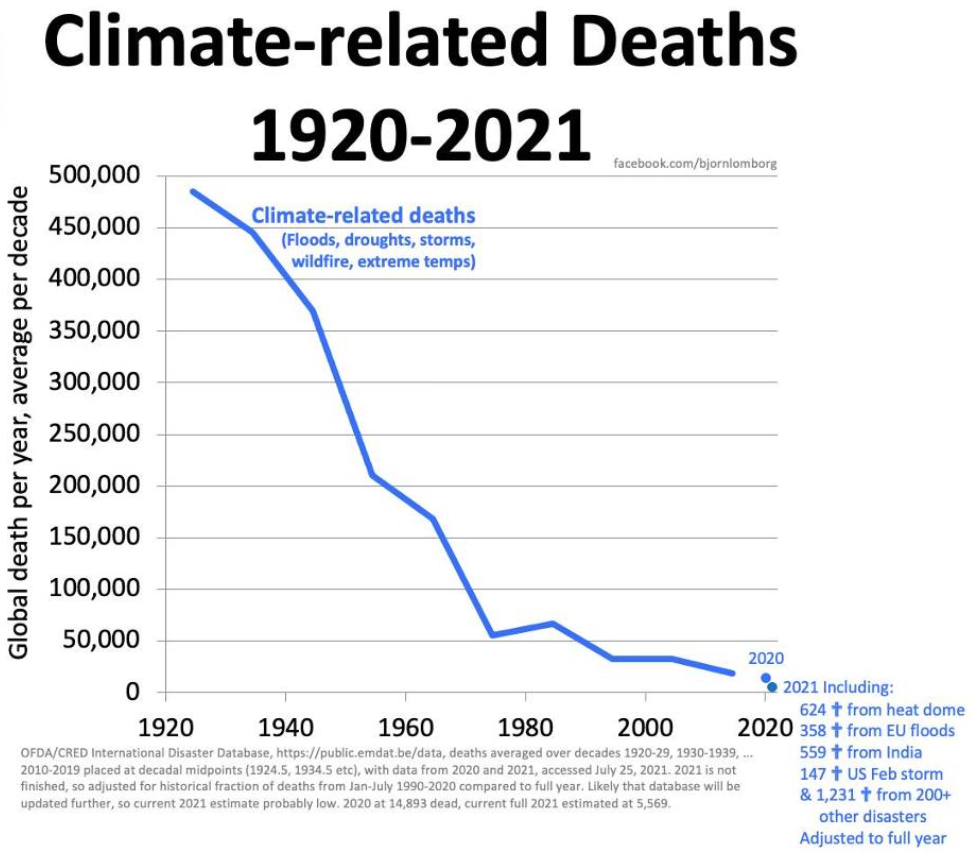
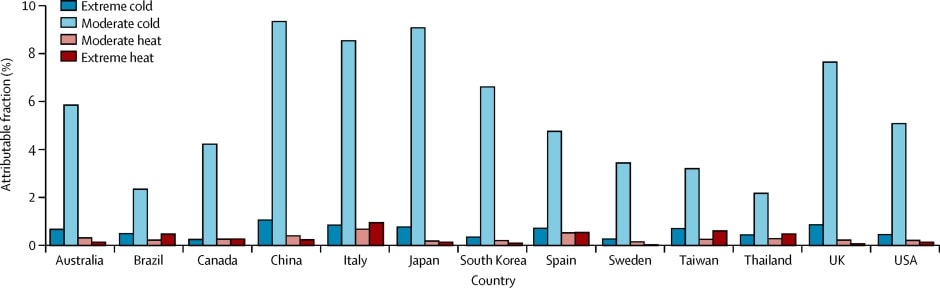
Climate change is not causing worsening weather disasters. Data show that not only are events like wildfires not increasing, but the number of all climate-related deaths are declining because of improvements to infrastructure, healthcare, technology, and yes, better climatic conditions. (See figure below)

The real reason so many impressionable people are depressed and anxious about climate change is because the media and governments relentlessly push and promote false and alarming misinformation and fake news about extreme weather and climate change. It is no wonder that children are afraid, when their teachers are telling them that the world will end in short order unless dramatic global reforms are made. When people don’t see the supposedly climate saving reforms being made, they are left hopeless and despondent. But it is an unnecessary misery – there has never been a safer time period for humans to live in.

The Washington Free Beacon made light of the situation, but it is no laughing matter. Children in particular are being traumatized by adults in their lives over the climate issue. Climate change is not harming mental health, but climate alarmism, built on falsehoods, hysteria, and hyperbole, certainly is.

Can You Trust an AI/ML Model to Forecast?

The latest fashion in model building is adding AI/ML (Artificial Intelligence/Machine Learning) technology to numerical models for weather forecasting.  No doubt soon there will be climate models also claiming improved capability by doing this.  A meteorological example is called Aardvark Weather and a summary is provided at Tallbloke’s Talkshop Scientists say fully AI-driven weather prediction system delivers accurate forecasts faster with less computing power.

Like all inventions there are weaknesses along with the claimed benefits.  Here’s a short list of the things that can go wrong with these new gadgets. The concerns below are listed along with some others in a paper Understanding the Weaknesses of Machine Learning: Challenges and Limitations by Oyo Jude. Excerpts in italics with my bolds.

Introduction

Machine learning (ML) has become a cornerstone of modern technological advancements, driving innovations in areas such as healthcare, finance, and autonomous systems. Despite its transformative potential, ML is not without its flaws. Understanding these weaknesses is crucial for developing more robust and reliable systems. This article delves into the various challenges and limitations faced by ML technologies, providing insights into areas where improvements are needed

Data Quality and Bias

Data Dependency

Machine learning models are highly dependent on the quality and quantity of data used for training. The performance of an ML model is only as good as the data it is trained on. Common issues related to data quality include:

Incomplete Data: Missing or incomplete data can lead to inaccurate models and predictions. Incomplete datasets may not represent the full spectrum of possible inputs, leading to biased or skewed outcomes.
Noisy Data: Noise in data refers to irrelevant or random information that can obscure the underlying patterns the model is supposed to learn. Noisy data can reduce the accuracy of ML models and complicate the learning process.

Data Bias

Bias in data can significantly impact the fairness and accuracy of ML systems. Key forms of data bias include:

Selection Bias: Occurs when the data collected is not representative of the target population. For example, if a model is trained on data from a specific demographic group, it may not perform well for individuals outside that group.
Label Bias: Arises when the labels or categories used in supervised learning are subjective or inconsistent. Label bias can skew the model’s understanding and lead to erroneous predictions.

Model Interpretability and Transparency

Complexity of Models

Many advanced ML models, such as deep neural networks, are often described as “black boxes” due to their complexity. The lack of transparency in these models presents several challenges:

Understanding Model Decisions: It can be difficult to understand how a model arrived at a specific decision or prediction, making it challenging to diagnose errors or biases in the system.
Trust and Accountability: The inability to interpret model decisions can undermine trust in ML systems, particularly in high-stakes applications such as healthcare or criminal justice. Ensuring accountability and fairness becomes challenging when the decision-making process is opaque.
Explainability:  Efforts to improve model interpretability focus on developing techniques and tools to make complex models more understandable. Techniques such as feature importance analysis, surrogate models, and visualization tools aim to provide insights into model behavior and decisions. However, achieving a balance between model performance and interpretability remains an ongoing challenge.

Generalization and Overfitting

Overfitting

Overfitting occurs when a model learns not only the underlying patterns in the training data but also the noise, resulting in poor performance on new, unseen data. This issue can be particularly problematic with complex models and limited data. Strategies to mitigate overfitting include:

Cross-Validation: Using techniques like k-fold cross-validation helps assess model performance on different subsets of the data, reducing the risk of overfitting.
Regularization: Regularization methods, such as L1 and L2 regularization, add penalties to the model’s complexity to prevent it from fitting noise in the training data.

Generalization

Generalization refers to a model’s ability to perform well on unseen data that was not part of the training set. Achieving good generalization is crucial for the practical application of ML models. Challenges related to generalization include:

Domain Shift: When the distribution of the data changes over time or across different domains, a model trained on one dataset may not generalize well to new data. Addressing domain shift requires continuous monitoring and updating of models.
Data Scarcity: In scenarios where limited data is available, models may struggle to generalize effectively. Techniques such as data augmentation and transfer learning can help address data scarcity issues.

Comment:

Many similar issues have been raised against climate models, undermining claims their outputs are valid projections of future climate states.  For example, the issue of detailed and reliable data persists.  It appears that even the AI/ML weather forecasting inventions are dependent on ERA5, which has a record of only ~40 years to use for training purposes.  I’m suspending belief in these things for now–new improved black boxes sound too much like the Sorcerer’s Apprentice.

Disney’s portrayal of the Sorcerer’s Apprentice in over his head.

It Must Be Climate Change

Prager U video can be seen at this link: https://www.prageru.com/video/it-must-be-climate-change

Transcript is below in italics with my bolds and some added images.

Have you noticed that every extreme weather event is blamed on climate change formerly known as global warming?

Every. . . Single. . .One. 

Can you think of an exception?

Too hot — climate change.    Too cold – climate change. 

Previously, cold spells were termed “Weather” in contrast to “Global Warming.” Now it’s all “Climate Change.”

Drought – climate change.   Too much rainfall – climate change. 

And there’s always a climate scientist at some university who’s willing to make a statement blaming the current catastrophe on our profligate use of fossil fuel. 

Some years ago, on The Late Show with David Letterman, MSNBC host Rachel Maddow made the definitive statement on this issue. She said, “I think global warming probably means extreme weather events of all kinds.” Naturally, Dave agreed.

What’s behind all these confident assertions? 

As a PhD in geochemistry, former member of the University of Alabama Department of Geological Sciences and someone who has written and lectured widely on the subject of climate and geology, I can tell you that it comes down to two things: 

Obscure metrics and highly speculative models.

Mix these ingredients together and voila! You can get any result you want. The scarier, of course, the better. “Torrential rain” makes a much better headline than “heavy rain.” 

To show you how this works, let’s look at a recent example. 

Here’s the assertion:   Climate change is making air turbulence more volatile and thus air travel more dangerous. 

Scary, right?   But is it true?  No. Not if we look at the observable data; that is, hard data we can easily verify. 

Here’s a chart of the number of turbulence-related accidents in the US from 1989 to 2018. 

Despite the rise in annual US airline passengers from about 400 million in 1989 to nearly one billion by 2018, turbulence-related accidents have remained constant. If climate change were indeed making turbulence significantly worse, we would expect to see a corresponding increase in these accidents.

Yet, the data does not support this assertion. Instead, it suggests that the relationship between turbulence and climate change is either negligible or nonexistent.

In fact, the co-author of the original study cited in a BBC article admitted as much.

“When we add [data back to 2002] to the previous results, the statistical significance assigned to the…North Atlantic winter jet stream…disappears.”

This was conveniently left out of the BBC article.

This disconnect between obscure metrics and highly speculative models, and observable data is not limited to turbulence. 

The broader climate crisis narrative is built on similar shaky foundations. 

Let’s look at three more examples. 

No Increase in Extreme Weather: The number of hydrological, meteorological, and climatological disasters has remained relatively flat since 2000. If climate change were causing more extreme weather events, we would expect to see a clear increase in these numbers. Instead, the data, again, reflects no such increase.

No Increase in Loss of Life: Deaths from meteorological, hydrological, and climatological disasters have not increased. This is a critical metric because it directly reflects the human impact of these events. Despite frequent claims that climate change is making weather more deadly, the data does not bear this out.

No Increase in Costs: Global weather losses as a percent of global GDP have not risen significantly. This is another crucial metric because it accounts for the economic impact of climate-related disasters. If climate change were truly making these events more severe, we would expect to see a rising trend in economic losses relative to global GDP.

We are left with this conclusion:

The reliance on obscure metrics and highly speculative models
to support the climate crisis narrative often serves
to cloud the truth rather than illuminate it. 

By focusing on projections and models rather than observable data, environmental activists, climate scientists, attention-seeking politicians and click bait media make claims that are difficult to verify and easy to manipulate. 

The fear that fuels the “climate crisis” is simply not justified by the data. That’s why — over and over again — end-of-the-world predictions don’t pan out. 

This does not mean that we should ignore environmental issues. We live on the same planet. We all want clean air and water. 

However, it does mean that we should approach claims of climate catastrophe with a healthy dose of skepticism and demand that assertions be backed up by observable, measurable data. Given that politicians and government agencies are spending tens of billions of our tax dollars every year to “save the planet” that would seem to be the least they could do: give us some hard facts, rather than unproven assertions. 

And the hard facts are, turbulence-related accidents have not increased despite a massive rise in airline passengers. Extreme weather events, loss of life, and economic costs have not shown the dramatic increases that alarmists would have us believe. 

By focusing on observable data we can have a more grounded, rational discussion about our environmental challenges and how best to address them.

That’s the way to practical, real-world solutions.  The blame game — “it’s climate change” — gets us nowhere. 

I’m Matthew Wielicki for Prager University.

No, Grist, MSN, et al: CO2 Is Not Making Oceans Boil


The Climate Crisis media network is announcing a new claim that rising CO2 is causing recent ocean warming, proving it’s dangerous and must be curtailed.  Examples in the last few days include these:

Finally, an answer to why Earth’s oceans have been on a record hot streak Grist

Ocean warming 4 times faster than in 1980s — and likely to accelerate in coming decades MSN

News spotlight: Fossil fuels behind extreme ocean temperatures, study says. Conservation International

Ocean temperature rise accelerating as greenhouse gas levels keep rising UK Natural History Museum

The surface of our oceans is now warming four times faster than it was in the late 1980s The Independent UK

Oceans Are Warming Four Times Faster as Earth Traps More Energy Bloomberg Law News

All this hype deriving from one study,
and ignoring the facts falsifying that narrative.

Fact:  Historically, ocean natural oscillations drive observed global warming.

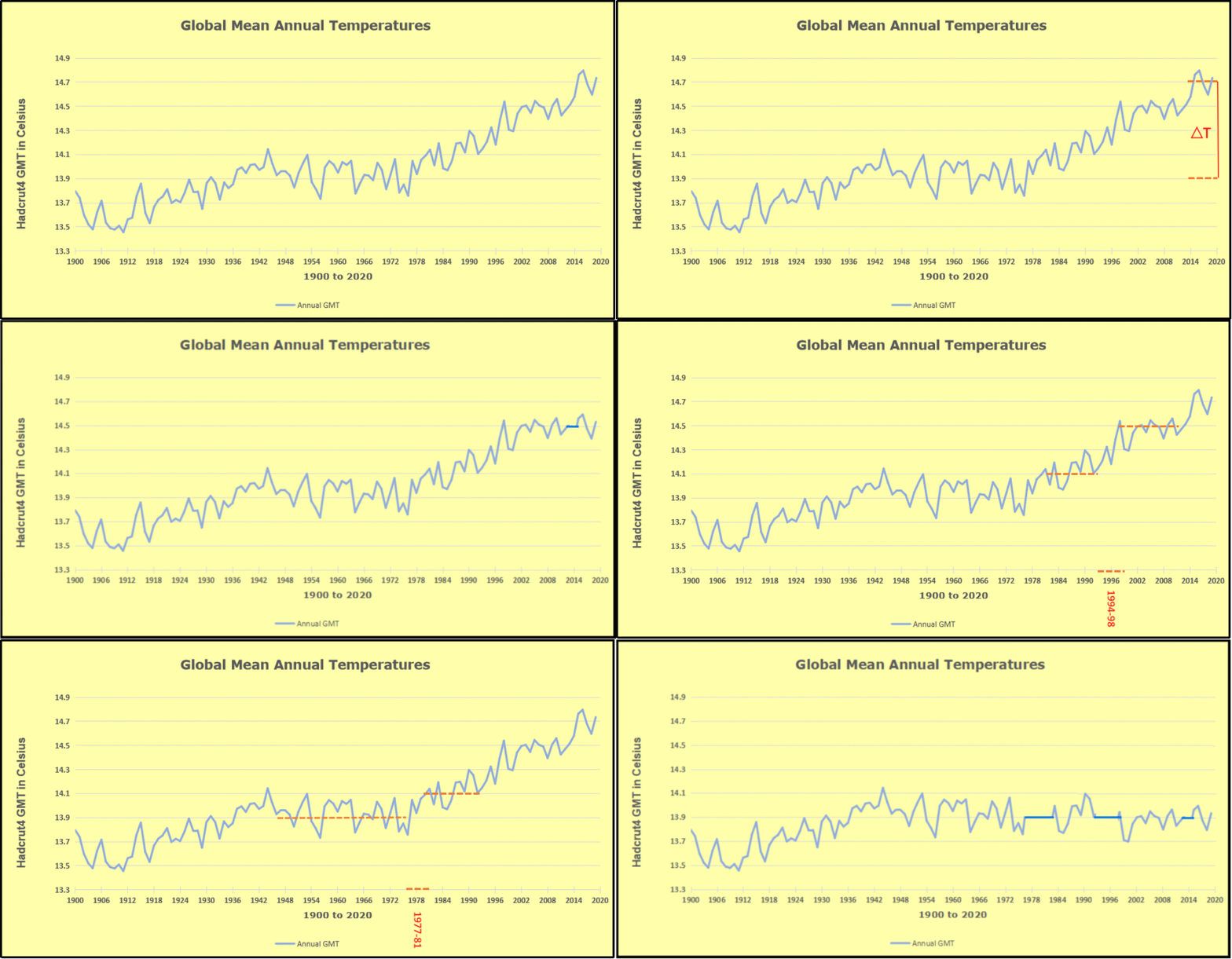
The long record of previous warmings prior to the satellite record shows that the entire rise of 0.8C since 1947 is due to oceanic, not human activity.

The animation is an update of a previous analysis from Dr. Murry Salby.  These graphs use Hadcrut4 and include the 2016 El Nino warming event.  The exhibit shows since 1947 GMT warmed by 0.8 C, from 13.9 to 14.7, as estimated by Hadcrut4.  This resulted from three natural warming events involving ocean cycles. The most recent rise 2013-16 lifted temperatures by 0.2C.  Previously the 1997-98 El Nino produced a plateau increase of 0.4C.  Before that, a rise from 1977-81 added 0.2C to start the warming since 1947.

Importantly, the theory of human-caused global warming asserts that increasing CO2 in the atmosphere changes the baseline and causes systemic warming in our climate.  On the contrary, all of the warming since 1947 was episodic, coming from three brief events associated with oceanic cycles.

FactRecent rise in SST was driven by ENSO and N. Atlantic Anomalies.

And now in 2024 we have seen an amazing episode with a temperature spike driven by ocean warming in all regions, along with rising NH land temperatures, now dropping below its peak.

The chart below shows SST monthly anomalies as reported in HadSST4 starting in 2015 through December 2024.  A global cooling pattern is seen clearly in the Tropics since its peak in 2016, joined by NH and SH cycling downward since 2016, followed by rising temperatures in 2023 and 2024.

To enlarge, open image in new tab.

Note that in 2015-2016 the Tropics and SH peaked in between two summer NH spikes.  That pattern repeated in 2019-2020 with a lesser Tropics peak and SH bump, but with higher NH spikes. By end of 2020, cooler SSTs in all regions took the Global anomaly well below the mean for this period.  A small warming was driven by NH summer peaks in 2021-22, but offset by cooling in SH and the tropics, By January 2023 the global anomaly was again below the mean.

Now in 2023-24 came an event resembling 2015-16 with a Tropical spike and two NH spikes alongside, all higher than 2015-16. There was also a coinciding rise in SH, and the Global anomaly was pulled up to 1.1°C last year, ~0.3° higher than the 2015 peak.  Then NH started down autumn 2023, followed by Tropics and SH descending 2024 to the present. After 10 months of cooling in SH and the Tropics, the Global anomaly came back down, led by NH cooling the last 4 months from its peak in August. It’s now about 0.1C higher than the average for this period. Note that the Tropical anomaly has cooled from 1.29C in 2024/01 to 0.66C as of 2024/12.

FactEmpirical measurements show ocean warms the air, not the other way around.

One can read convoluted explanations about how rising CO2 in the atmosphere can cause land surface heating which is then transported over the ocean and causes higher SST. But the interface between ocean and air is well described and measured. Not surprisingly it is the warmer ocean water sending heat into the atmosphere, and not the other way around.

The graph displays measures of heat flux in the sub-tropics during a 21-day period in November. Shortwave solar energy shown above in green labeled radiative is stored in the upper 200 meters of the ocean. The upper panel shows the rise in SST (Sea Surface Temperature) due to net incoming energy. The yellow shows latent heat cooling the ocean, (lowering SST) and transferring heat upward, driving convection. [From An Investigation of Turbulent Heat Exchange in the Subtropics by James B. Edson]

As we see in the graphs ocean circulations change sea surface temperatures which then cause global land and sea temperatures to change. Thus, oceans make climate by making temperature changes.

FactOn all time scales, from last month’s observations to ice core datasets spanning millennia, temperature changes first and CO2 changes follow.

Previously I have demonstrated that changes in atmospheric CO2 levels follow changes in Global Mean Temperatures (GMT) as shown by satellite measurements from University of Alabama at Huntsville (UAH). That background post is included in the posting referenced later below.

My curiosity was piqued by the remarkable GMT spike starting in January 2023 and rising to a peak in April 2024, and then declining afterward.  I also became aware that UAH has recalibrated their dataset due to a satellite drift that can no longer be corrected. The values since 2020 have shifted slightly in version 6.1, as shown in my recent report  Ocean Leads Cooling UAH December 2024.

I tested the premise that temperature changes are predictive of changes in atmospheric CO2 concentrations.  The chart above shows the two monthly datasets: CO2 levels in blue reported at Mauna Loa, and Global temperature anomalies in purple reported by UAHv6.1, both through December 2024. Would such a sharp increase in temperature be reflected in rising CO2 levels, according to the successful mathematical forecasting model? Would CO2 levels decline as temperatures dropped following the peak?

The answer is yes: that temperature spike resulted
in a corresponding CO2 spike as expected.
And lower CO2 levels followed the temperature decline.

Above are UAH temperature anomalies compared to CO2 monthly changes year over year.

Changes in monthly CO2 synchronize with temperature fluctuations, which for UAH are anomalies now referenced to the 1991-2020 period. CO2 differentials are calculated for the present month by subtracting the value for the same month in the previous year (for example December 2024 minus December 2023).  Temp anomalies are calculated by comparing the present month with the baseline month. Note the recent CO2 upward spike and drop following the temperature spike and drop.

Summary

Changes in CO2 follow changes in global temperatures on all time scales, from last month’s observations to ice core datasets spanning millennia. Since CO2 is the lagging variable, it cannot logically be the cause of temperature, the leading variable. It is folly to imagine that by reducing human emissions of CO2, we can change global temperatures, which are obviously driven by other factors.

12/2024 Update–As Temperature Changes, CO2 Follows


Devious Climate Attribution Studies

Patrick Brown raises the question Do Climate Attribution Studies Tell the Full Story? Excerpts in italics with my bolds and added images, his analysis concluding thusly:

How a cascade of selection effects bias
the collective output of extreme event attribution studies.

Weather and climate extremes—such as high temperatures, floods, droughts, tropical cyclones, extratropical cyclones, and severe thunderstorms—have always threatened both human and natural systems. Given their significant impacts, there is considerable interest in how human-caused climate change influences these extremes. This is the focus of the relatively new discipline of Extreme Event Attribution (EEA).

Over the past couple of decades, there has been an explosion in EEA studies focusing on (or, “triggered by”) some prior notable weather or climate extreme. Non-peer-reviewed reports from World Weather Attribution (e.g., herehere, and here) represent some of the most notable examples of these kinds of analyses, and many similar studies also populate the peer-reviewed literature. The Bulletin of the American Meteorological Society’s “Explaining Extreme Events From a Climate Perspective” annual series compiles such studies, as does the Sabin Center for Climate Change Law, and they are also synthesized in reports like those from the IPCC (IPCC WG1 AR6 Chapter 11.2.3) and the United States National Climate Assessment.

The collective output of these kinds of studies certainly gives the impression that human-caused climate change is drastically changing the frequency and intensity of all kinds of weather extremes. Indeed, Carbon Brief recently published an extensive summary of the science of EEA studies, which begins with the proclamation, “As global temperatures rise, extreme weather events are becoming more intense and more frequent all around the world.”

However, these numbers cannot be taken as an accurate quantification of the influence of climate change on extreme weather because they are heavily influenced by a cascade of selection biases originating from the physical climate system, as well as researcher and media incentives. Identifying and understanding these biases is a prerequisite for properly interpreting the collective output of EEA studies and, thus, what implications they hold for general scientific understanding, as well as political and legal questions.

The large apparent discrepancy between the size of the influence of human-caused climate change on extreme weather reported in EEA studies (like those compiled by Carbon Brief) compared to more comprehensive systematic analyses (like those compiled by the IPCC) can, in large part, be attributed to the many layers of Selection Biases that influence the EEA literature’s collective output.

Selection Bias is a broad term that refers to any bias that arises from a process that selects data for analysis in a way that fails to ensure that data is representative of the broader population that the study wishes to describe.

Selection biases in the context of EEA studies include those associated with the physical climate system itself, those concerning proclivities and incentives facing researchers/journals, and those concerning the proclivities and incentives facing the media. They include
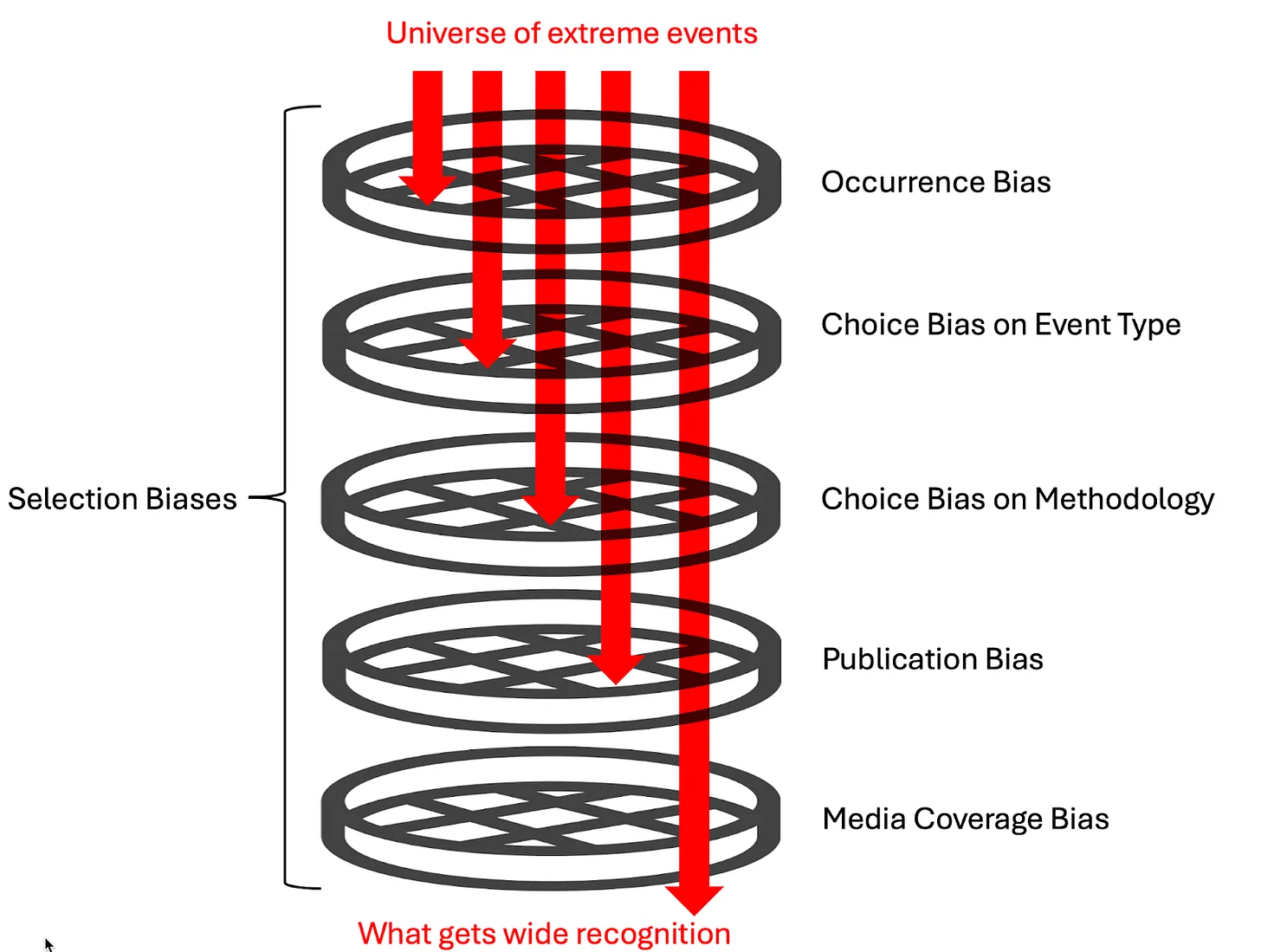
Occurrence Bias is a bias introduced by the physical climate system. Since EEA studies tend to be triggered by extreme events that have actually occurred, there is reason to believe that these studies will disproportionately sample events that are more likely than average to be exacerbated by climate change because the events occurred in the first place. Essentially, extreme events that are more likely to occur under climate change—and thus more likely to be observed—are going to be overrepresented in EEA studies, and extreme events that are less likely to occur under climate change—and thus less likely to be observed—are going to be underrepresented in EEA studies.

The map below illustrates this phenomenon. It shows changes in the magnitude of extreme drought under climate change. Specifically, it shows the fractional change in the intensity of once-per-50-year droughts (as quantified by monthly soil moisture) between a preindustrial and 21st-century run (SSP2-4.5 emissions) of the highly-regarded NCAR CESM2 Climate Model. Blue areas represent locations where the model simulates that extreme droughts become less frequent and intense with enhanced greenhouse gas concentrations, and red areas represent locations where the model simulates that extreme droughts become more frequent and intense with enhanced greenhouse gas concentrations. It is notable that overall, this model simulates that warming decreases the frequency and intensity of extreme drought in more locations than it increases it (consistent with soil moistening under warming simulated by other models).
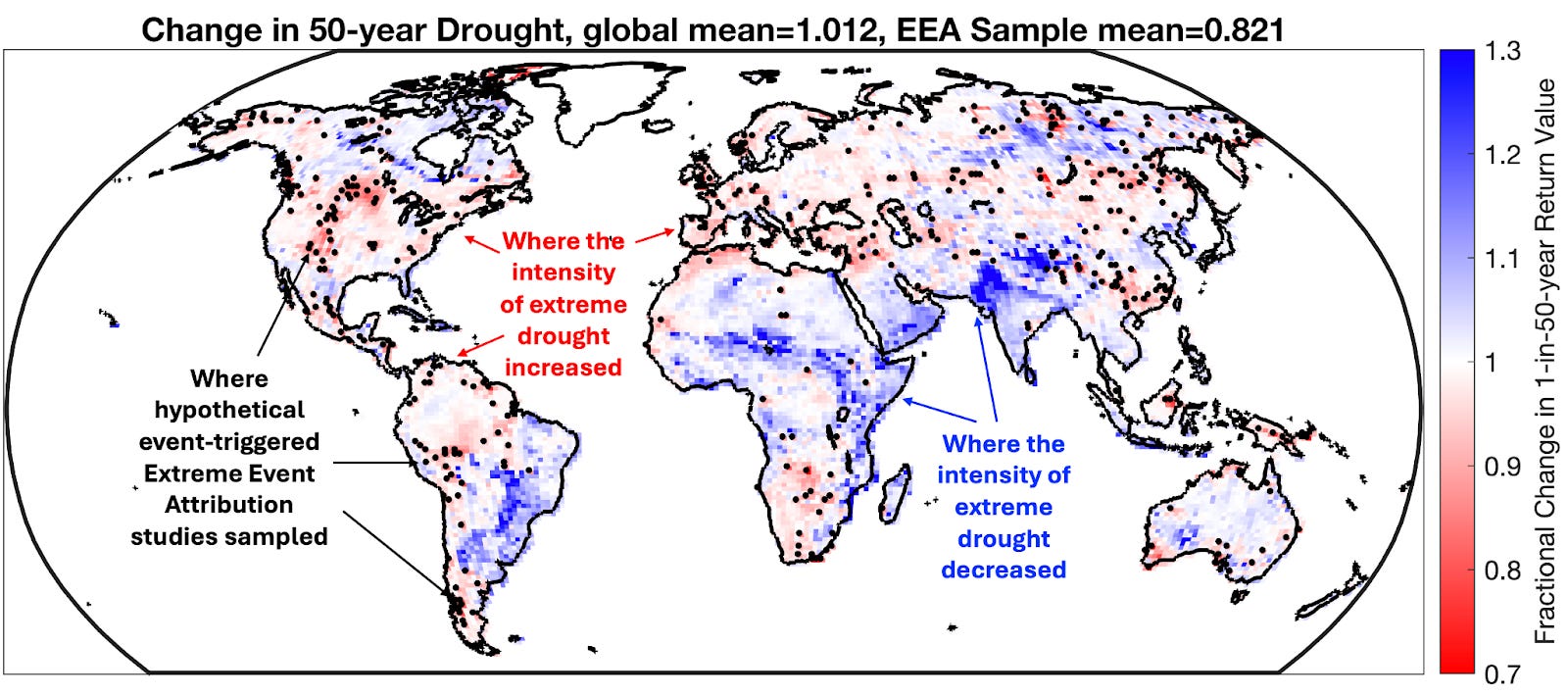
Now, here’s the kicker: The black dots show locations where once-per-50-year droughts actually occurred in the 21st-century simulation and thus represent events that would plausibly trigger EEA studies.

What do you notice about where the dots are compared to where the red is? That’s right; the simulated EEA studies overwhelmingly sample areas where droughts are getting more intense and more frequent by the very nature that those are the types of droughts that are more likely to occur in the warming climate. The result is that the EEA sample is majorly biased: warming decreased the intensity of once-per-50-year droughts by about 1% overall, but it increased their intensity within the EEA sample by 18%!

Thus, if you just relied on the EEA sample, you would come away with an
incorrect impression not only on the magnitude of change in extreme droughts
but also on the sign of the direction of change!

Choice Bias arises when researchers use prior knowledge to choose events for EEA studies that are more likely to have been made more severe by climate change. A clear example of Choice Bias pervading the Carbon Brief database is there have been 3.6 times more studies on extreme heat than there have been on extreme winter weather (205 vs. 57). Another example would be the dearth of EEA studies on extratropical cyclones (the kinds of low-pressure systems with cold and warm fronts that are responsible for most of the dramatic weather outside of the tropics). The IPCC states that the number of extratropical cyclones associated with intense surface wind speeds is expected to decrease strongly in the Northern Hemisphere with warming. Yet, it is relatively rare for EEA attribution studies to be done on these types of systems, which results in an exclusion of this good news from the EEA literature.
Publication Bias could be playing a role, too, where researchers are more likely to submit, and journals are likely to publish studies that report significant effects on salient events compared to studies that find null effects.
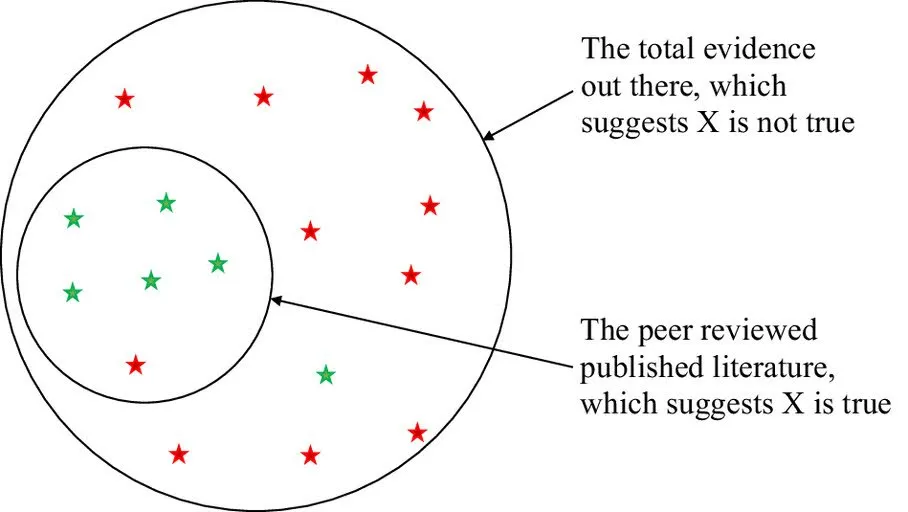
From Clark et al., 2023

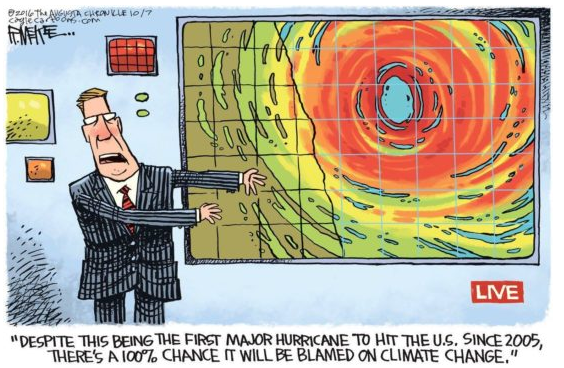
Finally, the climate reporting media ecosystem is characterized by actors whose explicit mission is to raise awareness of the negative impacts of climate change, and thus, there will be a natural Media Coverage Bias with a tendency to selectively highlight EEA studies where climate change is found to be a larger driver than EEA studies that do not reach such a conclusion. These selection biases are apparent at the aggregate level, but there is also strong evidence of their presence in individual studies.
A more recent specific example suggestive of many of these dynamics is a study, Gilford et al. (2024), titled “Human-caused ocean warming has intensified recent hurricanes”. This study was conducted by three researchers at Climate Central, which summarizes the study’s findings with the following infographic:
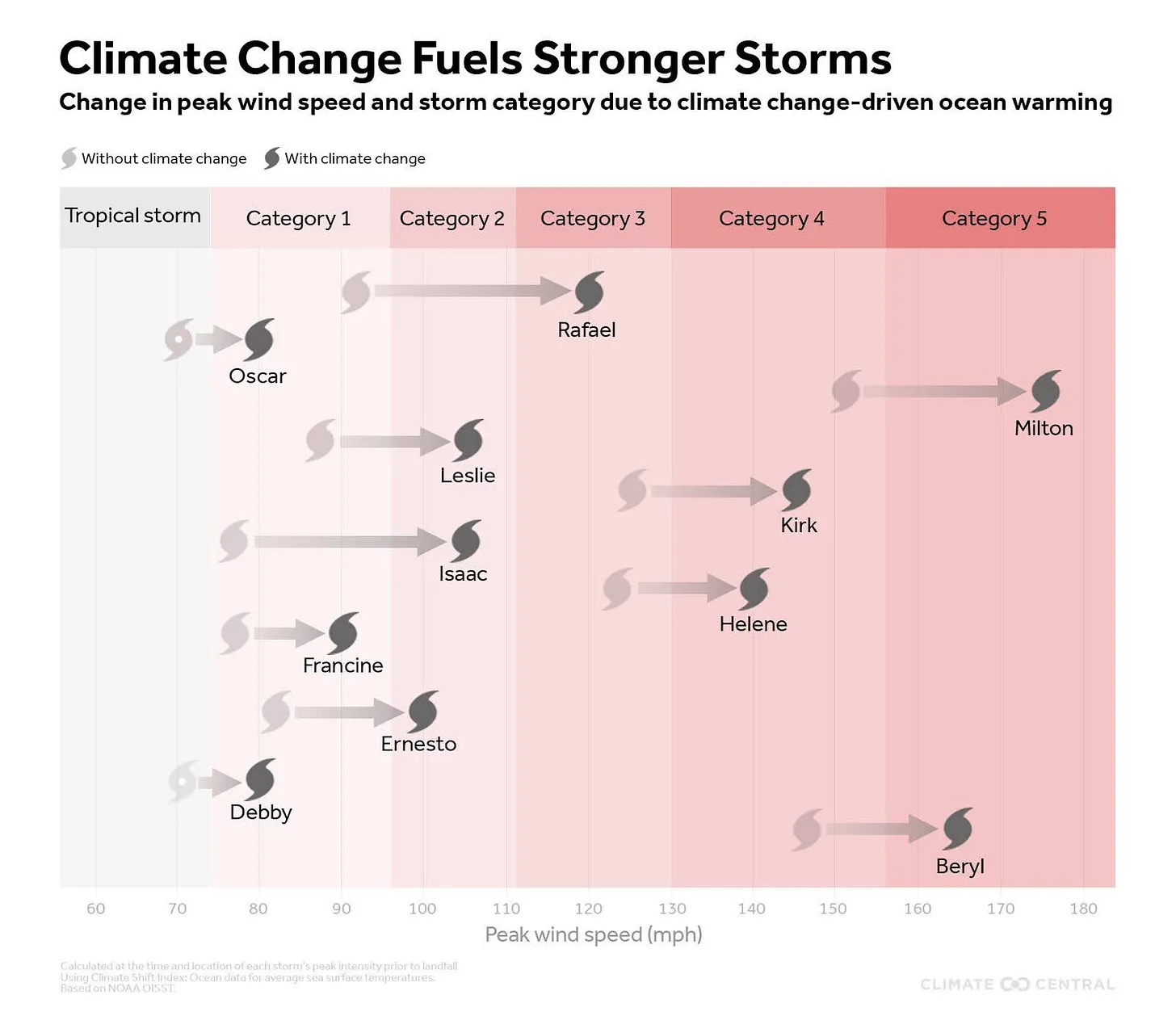
From Climate Central press release on Gilford et al. (2024).

Essentially, they claim that climate change is enhancing the intensity of all hurricanes and that the enhancement is quite large: Storms today are calculated to be an entire Category stronger than they would have been in a preindustrial climate.

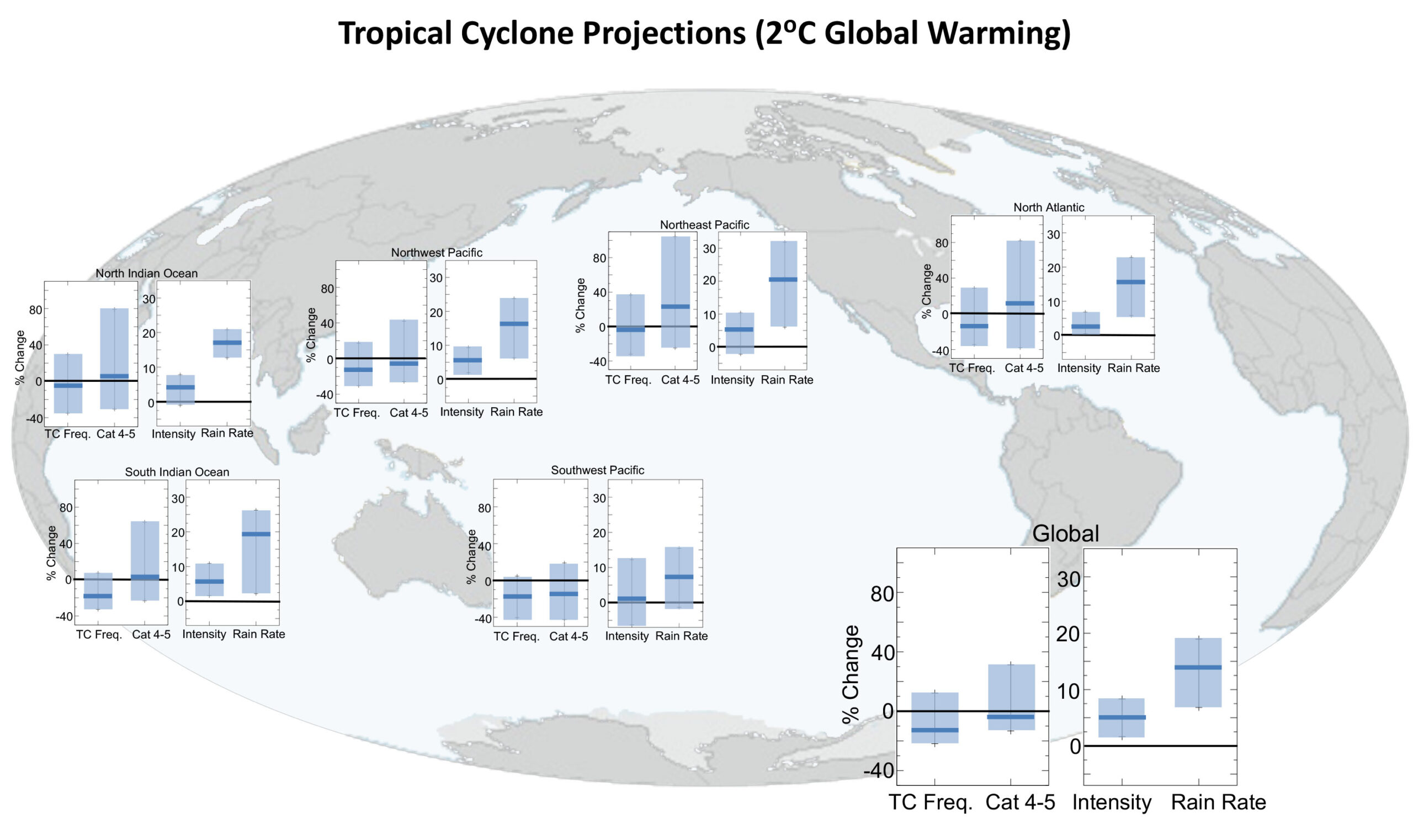
This is a huge effect, and thus, if it were real, it is reasonable to expect to see clear long-term trends in metrics of tropical cyclone (hurricane) intensity like the accumulated number of major (Category 3+) hurricane days or the accumulated cyclone energy from all tropical cyclones (which is proportional to the square of hurricane windspeed accumulated over their lifetimes). However, any long-term trends in such metrics are subtle at best, both globally and over the North Atlantic.
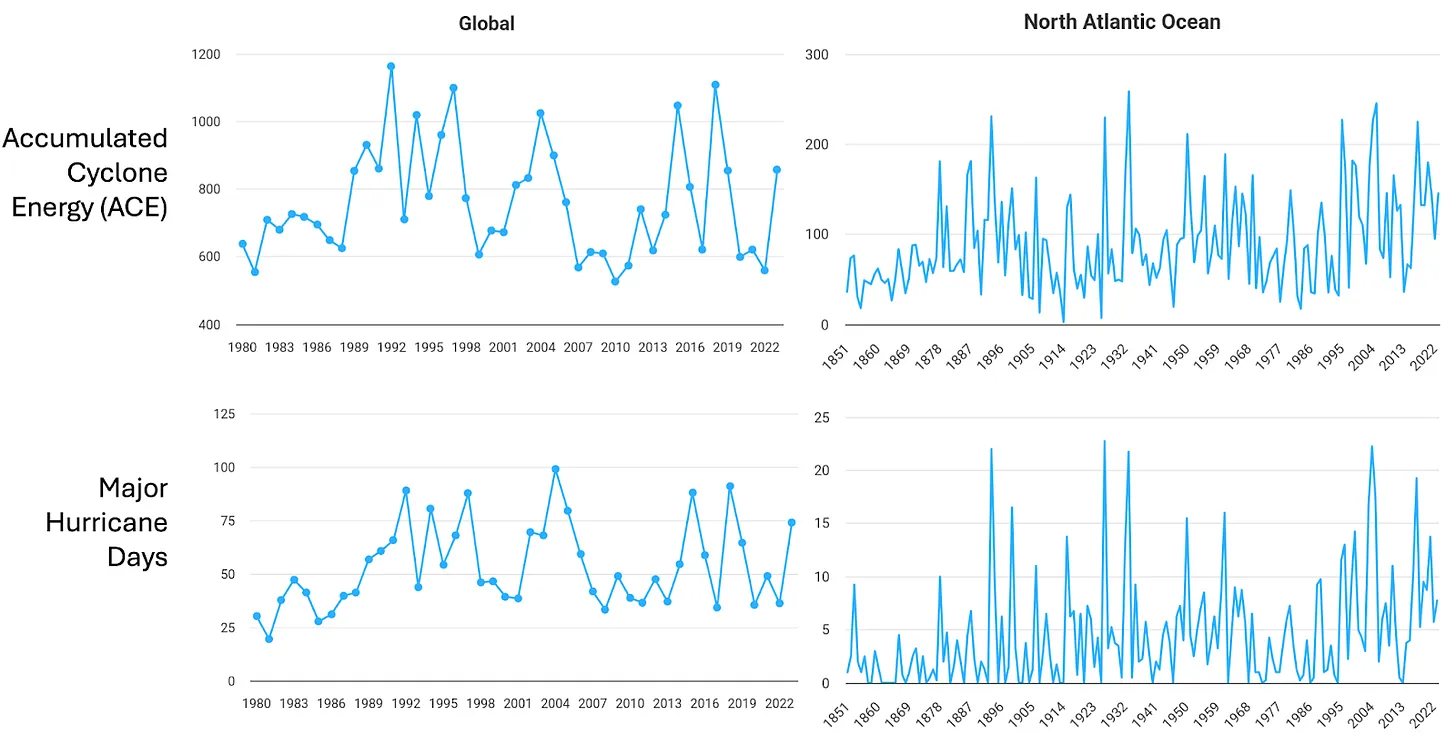
From Colorado State University Department of Atmospheric Science Tropical Meteorology Project.

So, this is a microcosm of the aforementioned apparent discrepancy between more broad quantifications of changes in extremes and their associated EEA counterparts, and again, I’d argue there are several selection biases at play affecting the production and dissemination of the EEA study.

Let’s start with Choice Bias on methodology. Human-caused warming changes the environment in some ways that work to enhance hurricanes and in other ways that diminish them. The main way that hurricanes are enhanced is via the increase in sea surface temperatures (which provides the fundamental fuel for hurricanes), and the main way that hurricanes are diminished is via changes in atmospheric wind shear and humidity.

The net result of these countervailing factors pulling in opposite directions is that we expect fewer hurricanes overall, but when hurricanes are able to form, they can be stronger than they would otherwise. These factors, though, are small relative to natural random variability, and thus, they are difficult to detect in observations.

However, the Climate Central researchers made the methodological choice
to largely exclude the influence of factors that diminish
hurricane development from the study.

Are these Choice Biases in event type and methodology an accident? There are many reasons to believe they are not.

The research paper itself spells out that the motivation of the study is to “connect the dots” between climate change and hurricanes because “landfalling hurricanes with high intensities—can act as ‘focusing events’ that draw public attention” and that “Increased attention during and in wake of storms creates opportunities for public and private discourse around climate and disaster preparedness.”
Then, there is the extensive media coverage of this study. It was picked up by 134 news outlets and ranked in the 99.95th percentile of research articles (across all journals) of similar age in terms of online attention. Further, it was immediately incorporated into seven Wikipedia articles (likely having high leverage on AI queries, which would make its findings indistinguishable from scientific “fact”). This is affected by the aforementioned Media Coverage Bias, but it is also undoubtedly directly influenced by the efforts of Climate Central, which is explicitly an advocacy organization whose self-described specialty is media placement and dissemination. 
The above sheds light on the reasons for certain choice biases in a particular study, but there is plenty of evidence that these selection biases are pervasive in the EEA field. After all, Dr. Myles Allen essentially founded the field with the motivation of answering the question, “Will it ever be possible to sue anyone for damaging the climate?”. This same motivation seems to animate many of the most high-profile scientists in the field today, like Allen’s protege, Dr. Friederike Otto (co-founder and leader of World Weather Attribution). She and her organization are frequently cited as bringing the necessary intellectual authority to credibly sue fossil fuel companies. She states the motivation of her work explicitly:

“Attributing extreme weather events to climate change, as I do
through my work as a climatologist, means we can hold
countries and companies to account for their inaction.”

Given the explicitly stated motivation of those in the EEA field, it is quite reasonable to suppose that there are major selection biases at play, and thus, it is not at all surprising that the collective output of the EEA field would look so different from more broad comprehensive assessments.

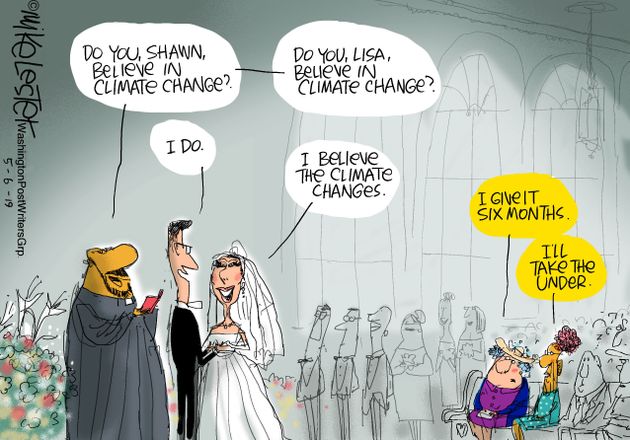


Koonin: Reckless Claim of Climate Emergency

Transcript

Hubris is a Greek word that means dangerously overconfident. Based on my research, hubris fairly describes our current response to the issue of climate change.

Here’s what many people believe:

One: The planet is warming catastrophically because of certain human behaviors.
Two: Thanks to powerful computers we can project what the climate will be like
20, 40, or even 100 years from now.
Three: That if we eliminate just one behavior, the burning of fossil fuels,
we can prevent the climate from changing for as long we like.

Each of these presumptions—together, the basis of our hubris regarding the changing climate—is either untrue or so far off the mark as to be useless.

Yes, it’s true that the globe is warming, and that humans are exerting a warming influence upon it. But beyond that, to paraphrase a line from the classic movie The Princess Bride, “I do not think ‘The Science’ says what you think it says.”

For example, government reports state clearly that heat waves in the US are now no more common than they were in 1900.

Hurricane activity is no different than it was a century ago.

Floods have not increased across the globe over more than seventy years.

Source: Voice of International Affairs

Greenland’s ice sheet isn’t shrinking any more rapidly today than it was 80 years ago.

Why aren’t these reassuring facts better known?

Because the public gets its climate information almost exclusively from the media.

And from a media perspective, fear sells.

“Things aren’t that bad” doesn’t sell.

Very few people, and that includes journalists who report on climate news, read the actual science. I have. And what the data—the hard science—from the US government and UN Climate reports say is that… “things aren’t that bad.”

Nor does the public understand the questionable basis of all catastrophic climate change projections: computer modeling.

Projecting future climate is excruciatingly difficult. Yes, there are human influences, but the climate is complex. Anyone who says that climate models are “just physics” either doesn’t understand them or is being deliberately misleading. I should know: I wrote one of the first textbooks on computer modeling.

While modelers base their assumptions upon both fundamental physical laws and observations of the climate, there is still considerable judgment involved. And since different modelers will make different assumptions, results vary widely among different models.

Let’s just take one simple, but significant assumption modelers must make: the impact of clouds on the climate.

Natural fluctuations in the height and coverage of clouds have at least as much of an impact on the flows of sunlight and heat as do human influences. But how can we possibly know global cloud coverage say 10, let alone 50 years from now? Obviously, we can’t. But to create a climate model, we have to make assumptions. That’s a pretty shaky foundation on which to transform the world’s economy.

By the way, creating more accurate models isn’t getting any easier. In fact, the more we learn about the climate system, the more we realize how complex it is.

Rather than admit this complexity, the media, the politicians, and a good portion of the climate science community attribute every terrible storm, every flood, every major fire to “climate change.” Yes, we’ve always had these weather events in the past, the narrative goes, but somehow “climate change” is making everything “worse.”

Even if that were true, isn’t the relevant question, how much worse? Not to mention that “worse” is not exactly a scientific term.  And how would we make it better?  For the alarmists, that’s easy: we get rid of fossil fuels.

Not only is this impractical—we get over 80% of the world’s energy from fossil fuels—it’s not scientifically possible. That’s because CO2 doesn’t disappear from the atmosphere in a few days like, say, smog. It hangs around for a really long time.

About 60 percent of any CO2 that we emit today will remain in the atmosphere 20 years from now, between 30 and 55 percent will still be there after a century, and between 15 and 30 percent will remain after one thousand years.

In other words, it takes centuries for the excess carbon dioxide to vanish from the atmosphere. So, any partial reductions in CO2 emissions would only slow the increase in human influences—not prevent it, let alone reverse it.

CO2 is not a knob that we can just turn down to fix everything. We don’t have that ability. To think that we do is… hubris.

Hubris leads to bad decisions.  A little humility and
a little knowledge would lead to better ones.

I’m Steve Koonin, former Undersecretary for Science in the Obama Administration, and author of Unsettled: What Climate Science Tells Us, What It Doesn’t, and Why It Matters, for Prager University.

Addendum  Fossil Fuels and Greenhouse Gases (GHGs) Climate Science

Professors Lindzen, Happer and Koonin CO2 Coalition Paper April 2024

Table of Contents

I. THERE WILL BE DISASTROUS CONSEQUENCES FOR THE POOR, PEOPLE WORLDWIDE, FUTURE GENERATIONS AND THE WEST IF FOSSIL FUELS, CO2 AND OTHER GHG EMISSIONS ARE REDUCED TO “NET ZERO”

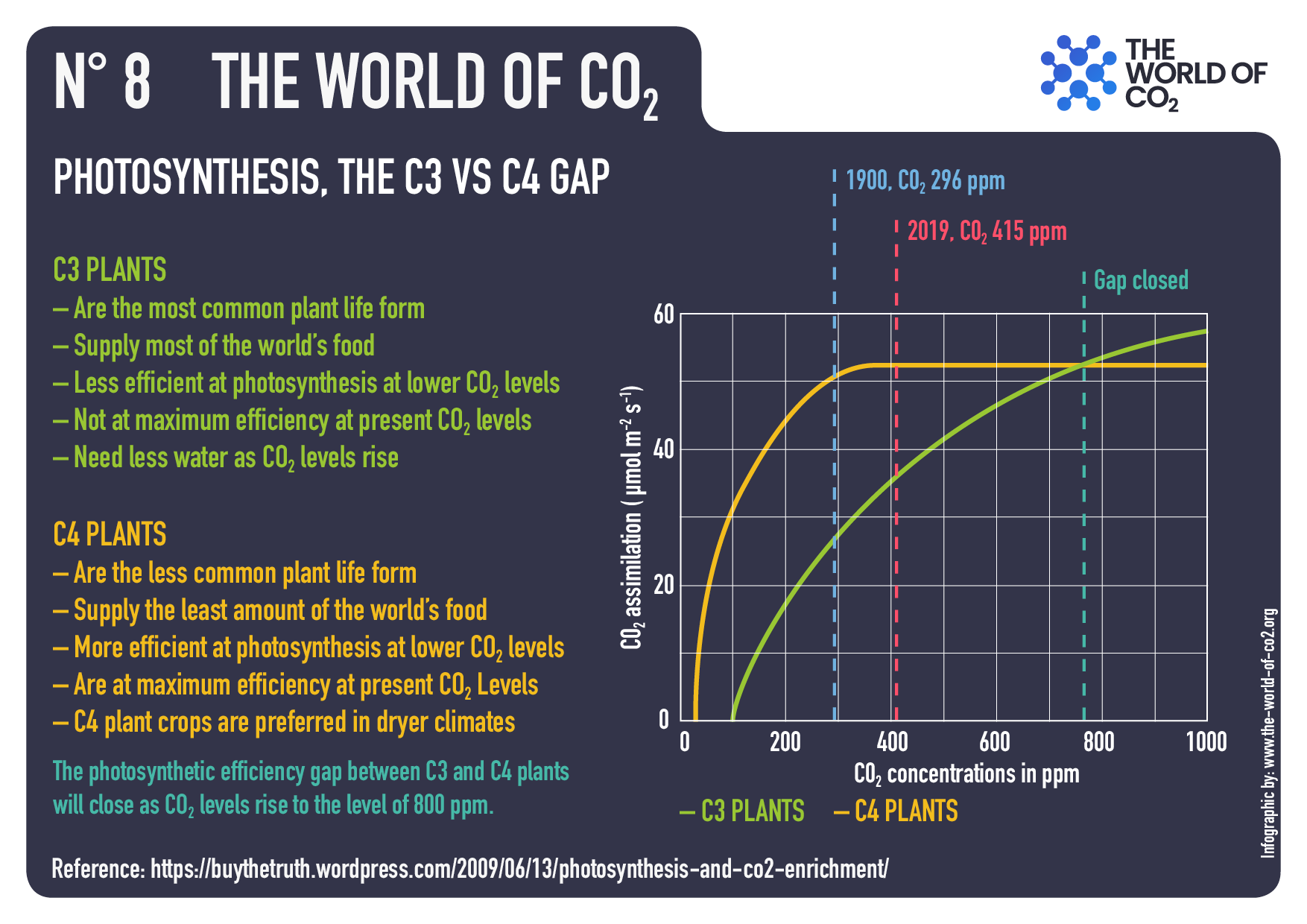
A. CO2 is Essential to Our Food, and Thus to Life on Earth
B. More CO2, Including CO2 from Fossil Fuels, Produces More Food.
C. More CO2 Increases Food in Drought-Stricken Areas.
D. Greenhouse Gases Prevent Us from Freezing to Death
E. Enormous Social Benefits of Fossil Fuels
F. “Net Zeroing” Fossil Fuels Will Cause Massive Human Starvation by Eliminating Nitrogen Fertilizer

II. THE IPCC IS GOVERNMENT CONTROLLED AND THUS ONLY ISSUES GOVERNMENT OPINIONS, NOT SCIENCE

III. SCIENCE DEMONSTRATES FOSSIL FUELS, CO2 AND OTHER GHGs WILL NOT CAUSE CATASTROPHIC GLOBAL WARMING AND EXTREME WEATHER

A. Reliable Science is Based on Validating Theoretical Predictions With Observations, Not Consensus, Peer Review, Government Opinion or Cherry-Picked or Falsified Data
B. The Models Predicting Catastrophic Warming and Extreme Weather Fail the Key Scientific Test: They Do Not Work, and Would Never Be Used in Science.
C. 600 Million Years of CO2 and Temperature Data Contradict the Theory That High Levels of CO2 Will Cause Catastrophic Global Warming.
D. Atmospheric CO2 Is Now “Heavily Saturated,” Which in Physics Means More CO2 Will Have Little Warming Effect.
E. The Theory Extreme Weather is Caused by Fossil Fuels, CO2 and Other GHGs is Contradicted by the Scientific Method and Thus is Scientifically Invalid


World Institutions Pushing Pseudoscience


Since 1660, Nullius in verba was the Royal Society’s motto.  “Don’t take anyone’s word for it.”

Yesterday’s post showed how American science societies have taken to parroting climatist suppositions rather than applying critical intelligence to claims of a “climate crisis.” That unquestioning attitude betrays the science method expressed in the Royal Society’s motto.  Today presents Tilak Doshi describing how the same pattern appears in international institutions supposed to be objective reporters of natural conditions. His Daily Signal article is The Climate Agenda’s March Through the Institutions: Can It Be Stopped? Excerpts in italics with my bolds and added images.

A spate of stories in the media recently provides a remarkable illustration of how the globalist policy agenda of the climate-industrial complex has captured key international institutions and perverted their original organizational aims. From initially serving broad, laudable objectives for the welfare of their constituents, these institutions have been subverted over the years to serve the insistent pseudoscientific claims of climate alarmists.

The corruption of global institutions has, in turn, led to significant opposition that is becoming apparent. There is the prospect of an incoming Trump administration that is avowedly skeptical of the claims of an alleged climate crisis and is intent on exiting the U.N.’s Paris Agreement and its “net zero by 2050” policy target for a second time. This presents a welcome challenge to these corrupt institutions.
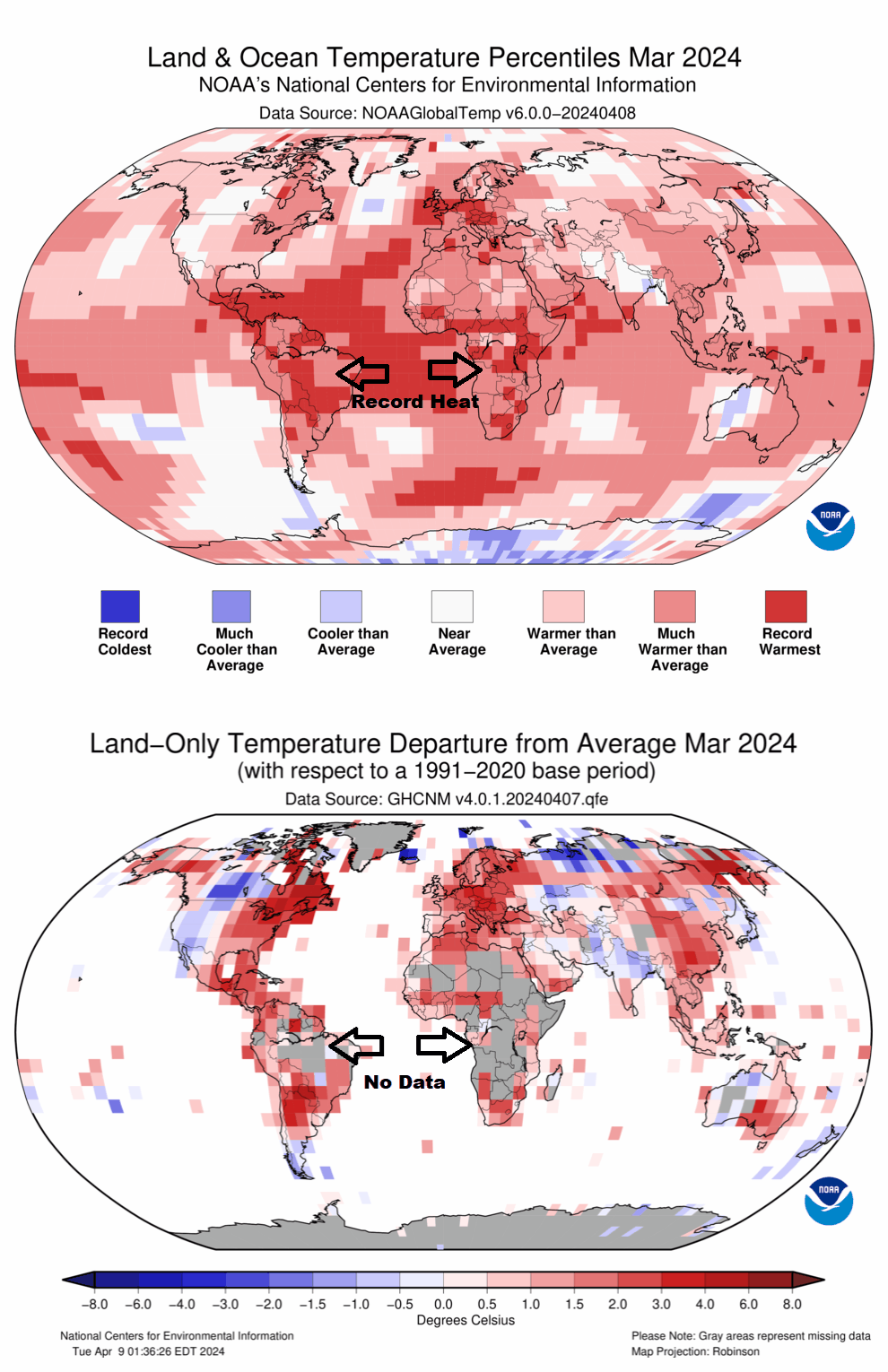
Will President Donald Trump and some of the populist parties in Europe
be capable of countering the entrenched globalist climate agenda?

The World Bank

On Oct. 17, Oxfam published a report that shockingly found that up to $41 billion in World Bank climate finance—nearly 40% of all climate funds disbursed by the World Bank over the past seven years—is “unaccounted for between the time projects were approved and when they closed.” In other words, no one knows how the money was used. There is no paper trail revealing where the money went or what the accomplished results were.
Green cronyism, ranging from the Solyndra debacle—the waste of almost half a billion dollars of taxpayers’ money on a failed solar farm project under President Barack Obama’s watch—to President Joe Biden’s duplicitously-named Inflation Reduction Act, which will unleash an estimated $1 trillion deluge of subsidies on favored “green” industries, is nothing new. But it is instructive to trace the World Bank’s decline from its honorable founding objectives to its current status as yet another institution advocating green causes.

Dr. Jim Yong Kim, reflecting the progressive virtues of Obama, who appointed him as president of the World Bank in 2012, imposed a ban on the financing of coal-fired power stations in 2013. This was followed by a ban on investments in all new upstream oil and gas resource development projects.

The distinguished economist Deepak Lal, a former research administrator of the World Bank, remarked that Kim incredulously “over-ruled the cost-benefit estimates of coal-based power over solar and wind-based power generation produced by his own economic staff, justifying this by reference to a wish to cut global emissions of greenhouse gases.”

The World Bank’s objections to the use of fossil fuels despite their importance to economic growth and poverty alleviation—which constitute its foundational institutional objectives—can be traced to the intellectual evolution of its management under James Wolfensohn during his decade as president (1995-2005).

Wolfensohn traced the arc from the old regime to the new. The old was represented by the “Washington consensus” of free markets, liberal trading regimes, sound money, and entrepreneurship associated with the classical liberalism of Adam Smith.

The new intellectual environment of the World Bank’s management—personified by Joseph Stiglitz, chief economist of the World Bank (1997-2000)—was defined by the theoretical failures of the free market, especially in accounting for the alleged negative climate impacts of fossil fuel use.

Stiglitz, a climate alarmist, wrote in a 2015 court brief for a failed climate lawsuit brought on behalf of a group of children against the U.S. federal government that “fossil fuel-based economies imposed ‘incalculable’ costs on society and shifting to clean energy will pay off.” [See Climatists Make Their Case by Omitting Facts]

Rupert Darwall, a former adviser to the United Kingdom’s chancellor of the exchequer and author of “Green Tyranny,” encapsulates the betrayal of the World Bank to its founding objectives as follows:

The World Bank’s mission has been subverted by green ideologues who assert that a low-carbon world benefits the world’s poor but fail to acknowledge that making energy much more costly increases poverty. The World Bank tags itself as ‘working for a world free of poverty’ … In making its choice between development and sustainability, the World Bank has decided it is going to try and ‘save the planet’ on the backs of the poor.

Yes, those are trillions of US$ they want to spend on an imaginary crisis.

By abdicating its founding principles for alleviating global poverty, the World Bank has taken a lead role among multilateral financial institutions in denying vast financial resources to poorer countries. It has hypocritically vetoed the right of developing countries to adopt the path of economic growth and environmental improvement that the now-rich countries had taken up successfully since the Industrial Revolution two centuries ago. The World Bank’s obsessive support for intermittent, low-yield renewable energy such as solar and wind power comes at the cost of its central charter to help the poor, an outcome that can only be described as egregiously unjust.

The UN Intergovernmental Panel on Climate Change

The U.N. IPCC issued a news release on Dec. 6 prior to the start of a “scoping” meeting in Kuala Lumpur of over 230 experts from 70 countries to draft outlines of working group contributions to the U.N. IPCC’s seventh Assessment Report (to be completed in 2029).

In the press release, the IPCC claimed that human combustion of fossil fuels “has resulted in more frequent and more intense extreme weather events that have caused increasingly dangerous impacts on nature and people in every region of the world.” This is contrary to the IPCC’s position hitherto, which is that almost all types of extreme weather events cannot be attributed with confidence to human activity.

The position of the IPCC regarding the lack of any link between climate change and extreme weather events is contrary to the almost daily headlines in the mainstream media attributing specific adverse weather events to “climate change.”

The work of eminent climate policy analysts Steve Koonin and Roger Pielke Jr. has done much to expose the pseudoscientific nature of what has been called “attribution studies.” These typically involve researchers who apply their climate models and historical observations to conclude that any particular weather event (say a hurricane or a drought) was made “more likely” or “more severe” by some magnitude in percentage units due to “human influence” (referring to the combustion of fossil fuels).

Based on the dubious claims of “attribution science,” New York Gov. Kathy Hochul signed a climate law last week that will require companies operating in New York state responsible for large amounts of planet-warming pollution to contribute to climate damage repair efforts. Under the new state law, companies responsible for the bulk of emissions from 2000 to 2018 will be on the hook for some $3 billion a year over the next 25 years.

Koonin cites the World Meteorological Organization that states that “any single event, such as tropical cyclone cannot be attributed to human-induced climate change, given the state of scientific understanding.” The IPCC’s “Special Report on Extreme Events” states that “Many weather and climate extremes are the result of natural climate variability … Even if there were no anthropogenic changes in climate, a wide variety of natural weather and climate extremes would still occur.”

Nonetheless, international organizations such as the World Bank and the IPCC have been increasingly politicized to serve climate hysteria. In this context, Chris Morrison of The Daily Sceptic finds that “[f]ears are growing that the IPCC could water down or even ditch its current finding that almost all types of extreme weather events have little or no sign of past human involvement, or any going forward to 2100.”

International Energy Agency

On Dec. 23, U.S. Sen. John Barrasso, R-Wyo., ranking member of the Senate Committee on Energy and Natural Resources, released a report documenting how the International Energy Agency “has moved away from its energy security mission to become an “energy transition” cheerleader.”

The report finds that “French President [Emmanuel] Macron’s observation that IEA has become the ‘armed wing for implementing the Paris Agreement’ is regrettably true. With the many serious energy security challenges facing the world, however, IEA should not be a partisan cheerleader. What the world needs from IEA—and what it is not receiving now—is sober and unbiased analyses and projections that educate and inform policymakers and investors. IEA needs to remember why it was established and return to its energy security mission.”

The divergence of the IEA away from its original mission to advise policymakers in its member countries with sound analysis of trends in global energy supply and demand to becoming a “cheerleader” for radical net-zero emission policy targets has not gone unnoticed over recent years. I have written on the ideological approach adopted by the IEA in its advocacy for green causes herehere, and here.

When ideological advocacy becomes the measure of achievement for the IEA, the loss of credibility and soundness of its policy advice is only to be expected. The IEA’s messianic fervour for green technologies such as solar and wind power, “green” hydrogen, batteries, and electric vehicles prevents it from asking basic questions.

If it is true that drastically cutting back on fossil fuels is consistent with higher economic growth and increased productive employment, why does the IEA recommend policymakers force countries along “net-zero” pathways? Surely, if replacing fossil fuels with wind and solar energy and electric vehicles promotes growth and employment, then wouldn’t countries such as China and India naturally race toward this best of all possible worlds without expensive green subsidies and punitive anti-fossil fuel policies?

The Trumpian Revolution Looms

Nonprofit organizations reflect the needs of their funding members, and organizations such as the World Bank, IPCC, and IEA are no different. As their funding is primarily from the U.S. and the EU, it is not surprising that they manifest the “climate emergency” predilections of the Biden administration and the largely left-socialist West European governments that see climate change as an existential threat and a national security priority. In taking up the mantle of green advocacy on behalf of their paymasters, these organizations have lost all credibility as independent and objective advisors for their member countries.

The climate-industrial complex fears the prospect of the Trump administration’s pullout of the Paris Agreement for the second time. Politico, a reliable mouthpiece for the climate establishment, expressed these fears soon after Trump’s election victory: “The world is bracing for President-elect Donald Trump to withdraw the U.S. from the Paris climate agreement for the second time—only this time, he could move faster and with less restraint.” In Europe, the emergence of populist parties has been partly propelled by the widespread rejection by EU citizens of the onerous fiscal burdens imposed by green policies.

The seismic change in policy direction that a second term “drill, baby, drill” Trump administration promises for the global climate juggernaut—represented by the three leading international agencies covered here—can only be seen as hopeful as we look forward to positive developments in energy policy in 2025.