Ruinous Folly of CO2 Pricing

Dr. Lars Schernikau is an energy economist explaining why CO2 pricing (also falsely called “carbon pricing”) is a terrible idea fit only for discarding.  His blog article is The Dilemma of Pricing CO2.  Excerpts below in italics with my bolds and added images.

1.Understanding CO₂ pricing
2.Economic and environmental impact
3.Global economic impact
4.Alternative solutions
5.Conclusion
6.Additional comments and notes
7.References

Introduction

As an energy economist I am confronted daily with questions about the “energy transition” away from conventional fuels. As we know, the discussion about the “energy transition” stems from concerns about climatic changes.

The source of climatic changes is a widely discussed issue, with numerous policies and measures proposed to mitigate its impact. One such measure is the current and future pricing of carbon dioxide (CO₂) emissions. The logic followed is that if human CO₂ emissions are reduced, future global temperatures will be measurably lower, extreme weather events will be reduced, and sea-levels will rise less or stop rising all together.

Although intended to reduce greenhouse gases, this approach has sparked considerable debate. In this blog post I discuss the controversial topic of CO₂ pricing, examining its economic and environmental ramifications.

However, this article is not about the causes of climatic changes, nor is it about the negative or positive effects of a warming planet and higher atmospheric CO₂ concentrations. It is also not about the scientifically undisputed fact that we don’t know how much warming CO₂ causes (a list of recent academic research on CO₂’s climate sensitivity can be found at the end of this blog).

Nor do I unpack the undisputed and IPCC confirmed fact that each additional ton of CO₂ in the atmosphere has less warming effect than the previous ton as the climate sensitivity of CO₂ is a logarithmic function irrespective of us not knowing what that climate sensitivity is. I also don’t discuss the NASA satellite confirmed greening of the world over the past decades partially driven by higher atmopheric CO₂ concentrations (see sources inc Chen et al. 2024).

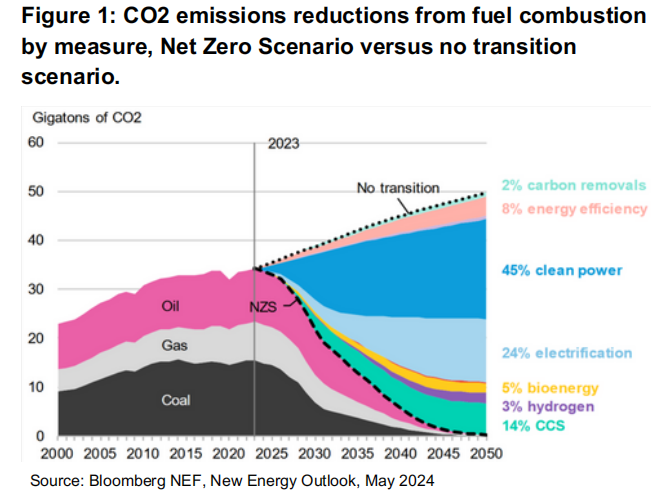
Instead, this blog post is about the environmental and economic “sense”, or lack thereof, of pricing CO₂ emissions as currently practiced in most OECD countries and increasingly seen in developing nations. It is about the “none-sense” of measuring practically all human activity with a “CO₂ footprint”, often mistakenly called “carbon footprint”, and having nearly every organization set claims for current or future “Net-Zero” (Figure 1).
1.Understanding CO₂ Pricing

CO₂ pricing aims to internalize the external costs of CO₂ emissions, thereby encouraging businesses and individuals to reduce their “carbon footprint”. The concept is straightforward: by assigning a cost to CO₂ emissions, it becomes financially advantageous to emit less CO₂.

However, this simplistic view overlooks
significant complexities and unintended consequences.

Our entire existence is based on drawing from nature (“renewable” or not), so the “Net-Zero” discussion ignores a fundamental requirement for our survival. I agree that it should be our aim to reduce the environmental footprint as much as possible but only if our lives, health, and wealth don’t deteriorate as a result.

Now, I am sure, some readers and many “activists” may disagree, which I respect but, at a global level, find unrealistic. However, I would assume that most agree that no-one’s life ought to be harmed or shortened for the sake of reducing the environmental impact made. Otherwise, there is little room for a conversation.

BloombergNEFs “New Energy Outlook” from May 2024 should possibly be called “CO₂ Outlook”, as there is little to be found about energy and its economics but rather all about CO₂ emissions and the so called “Net-Zero” (Figure 1), which is in line with media, government, and educational focus on primarily carbon dioxide emissions.

2.Economic and Environmental Impacts

One of the primary criticisms of CO₂ pricing is that it addresses only one environmental externality while ignoring others. This narrow focus can lead to economic distortions, as it fails to account for the full spectrum of environmental and social impacts. For instance, while CO₂ pricing might reduce emissions, it can also drive-up energy costs, disproportionately affecting lower-income populations and hindering economic development in lesser developed countries.

It is by now undisputed amongst energy economists that, large-scale “Net-Zero” intermittent and unpredictable wind and solar power generation increases the total or “full” cost of electricity, primarily because of their low energy density, intermittency, inherent net energy and raw material inefficiency, mounting integration costs for power grids, and the need for a drastic overbuild installation system plus an overbuild backup/storage system because of their intermittency.

CO₂ pricing can also result in environmental trade-offs. For example, the shift towards “renewable” energy sources like wind and solar, incentivized by CO₂ pricing, has its own set of environmental impacts, including land use, resource extraction, energy footprint, and energy storage challenges.

When BloombergNEF (Figure 1) displays
how clean power and electrification
will directly reduce CO₂ emissions to zero,
then they are clearly mistaken.

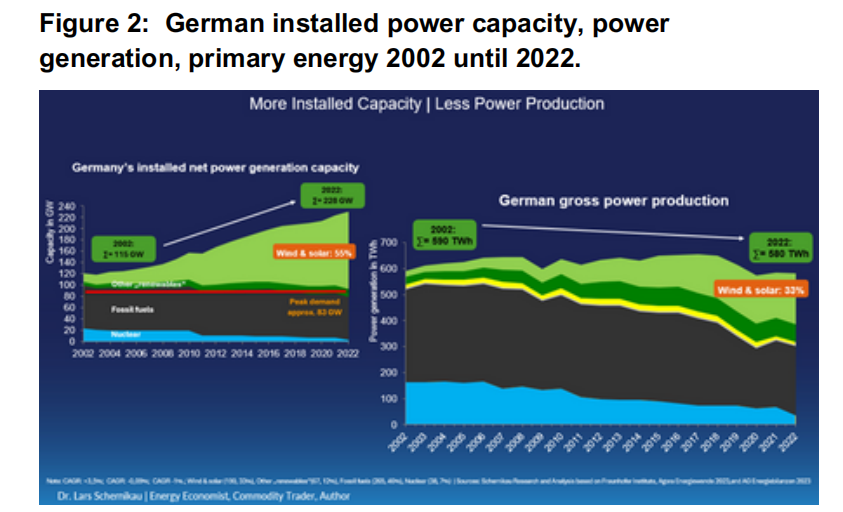
My native country Germany provides a notable example of the complexities involved in transitioning to “renewable” energy. The country has invested heavily in wind and solar power, leading to the highest electricity costs among larger nations. Germany’s installed wind and solar capacity is now twice the total peak power demand. This variable “renewable” wind and solar power capacity now produces about a third of the country’s electricity and contributes about 6% to Germany’s primary energy supply (Figure 2).

Sources: Schernikau based on Fraunhofer, Agora, AG Energiebilanzen. See also www.unpopular-truth.com/graphs.

3.Global Economic Implications

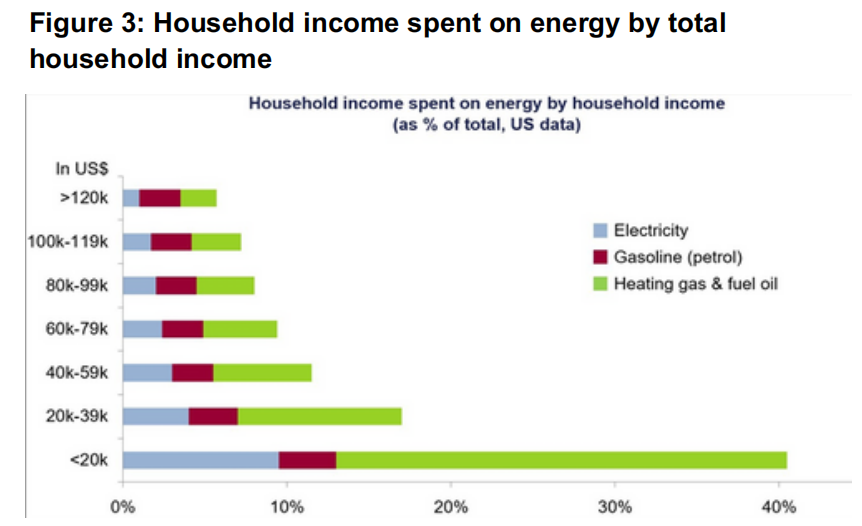
Higher energy costs, obviously and undisputedly, hurt less affluent people and stifles the development of poorer nations (Figure 3). Thus, a move to more expensive wind and solar energy has “human externalities”. The less fortunate will be “starved of” energy as they wouldn’t be able to afford it, leading to literal reduction in life expectancy.
Source: Eschenbach 2017; Figure 38 in Book “The Unpopular Truth… about Electricity and the Future of Energy”

CO₂ pricing typically focuses only on emissions during operation,
neglecting significant environmental and economic costs
incurred during other stages or by the entire system.

For instance, the production of solar panels involves substantial energy and raw material inputs. Today there is not one single solar panel that is produced without coal. Similarly, the manufacturing and transportation processes of wind turbines and electric vehicles are energy-intensive and environmentally impactful. These stages are rarely accounted for in CO₂ pricing schemes, leading to a distorted view of their true environmental footprint. Also not accounted for are:

a) the required overbuild,
b) short and long duration energy storage,
c) backup facilities, or
d) larger network integration and transmission infrastructure.
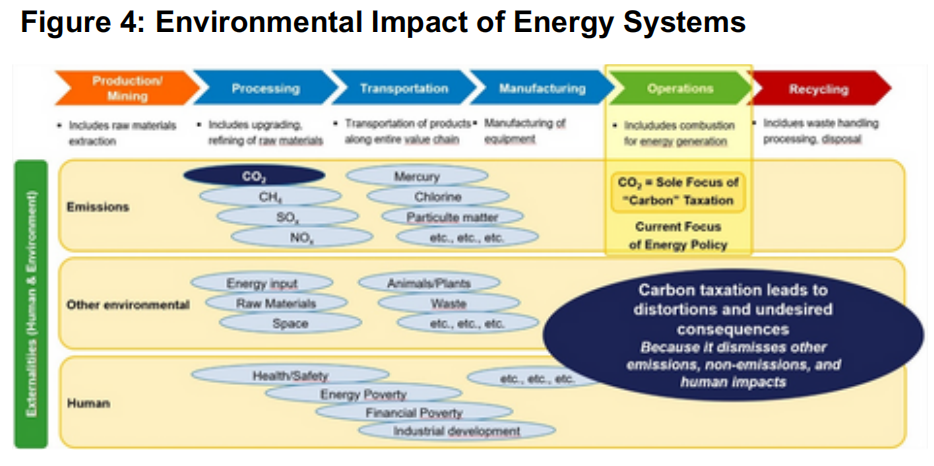
Source: Schernikau, adapted from Figure 39 in Book “The Unpopular Truth… about Electricity and the Future of Energy“

Figure 4 illustrates how virtually all CO₂ pricing or taxation happens only at the stage of “operation” or combustion. How else could a “Net-Zero” label be assigned to a solar panel produced from coal and minerals extracted in Africa with diesel-run equipment, transported to China on a vessel powered by fuel-oil, and processed with heat and electricity from coal- or gas-fired power partially using forced labour? All this energy-intensive activity and not a single kilogram of CO₂ is taxed (see my recent article on this subject here) The same applies to wind turbines, hydro power, biofuel, or electric vehicles.

It turns out, CO₂ tax is basically just a means to redistribute wealth, with the collecting agency (government) deciding where the funds go. Yes, a CO₂ tax does incentivize industry to reduce CO₂ emissions at their taxed operations only, but this comes at a cost to economies, the environment, and often people. . . Any economist will confirm that pricing one externality but not others leads to economic distortions and, many would say, worse environmental impacts.

4.Alternative Approaches

Distortion, in this case, is just another word for unintended consequences to the environment, our economies, and the people. Pricing CO₂ only during combustion but failing to price methane, raw material and recycling, inefficiency, or embodied energy, or energy shortages, or land requirement, or greening from CO₂… will cause undesirable outcomes. The world will be worse off economically and environmentally.

Protest if you must, but let me offer a simple example. The leaders of the Western world seem to have united around abandoning coal immediately, because it is the highest CO₂ emitter during combustion (UN 2019). Instead, demanding reliable and affordable energy, Bangladesh, Pakistan, Germany, and so many more nations have embraced liquified natural gas (LNG) as a “bridge” fuel to replace coal. This “switch” is taking place despite questions about LNG’s impact on the environment, including the “climate”. This policy, supported by almost all large consultancies, indirectly caused blackouts affecting over 150 million people in Bangladesh in October 2022 (Reuters and Bloomberg).

So, the world is embarking on an expensive venture
to replace as much coal as possible with
more expensive liquified natural gas LNG.

On top of that, wind and solar are given preference. For example, the IEA recently confirmed that 2024 sparks the first year where investments in solar outstrip the combined investments in all other power generation technologies. As a result, energy costs go up, dependencies increase, lights go off, and, as per the UN’s IPCC, the “climate gets worse.”

Now imagine what would happen if we would truly take into account all environmental and human impacts, both negative and positive, along the entire value chain of energy production, transportation, processing, generation, consumption, and disposal… we would all be surprised! You would look at fossil fuels and certainly nuclear through different eyes. Instead we should simply incentivize resource and energy efficiency which will truly make a positive difference!
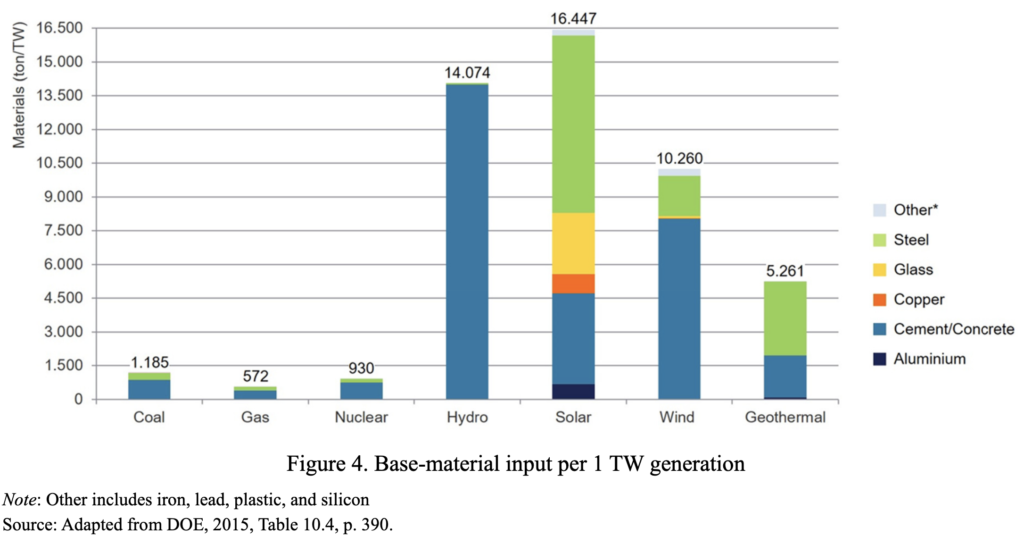
From Schernikau et al. 2022.

5.Conclusion

No matter what your view on climate change is, pricing CO₂ is harmful… why?
Answer: … because pricing one externality but not others leads to economic and environmental distortions…causing human suffering.

That is why, even considering the entire value chain, I do not support any CO₂ pricing.. That is why I fight for environmental and economic justice so we can, by avoiding energy starvation and resulting poverty, make a truly positive difference not only for ourselves but also for future generations to come.. . We need INvestment in, not DIvestment from 80% of our energy supply to rationalize our energy systems and to allow people and the planet to flourish.

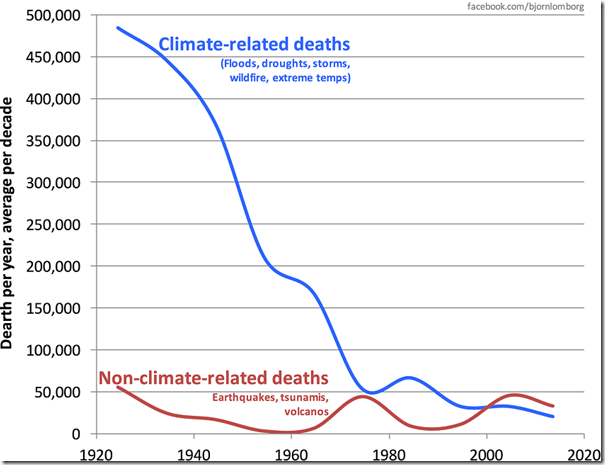
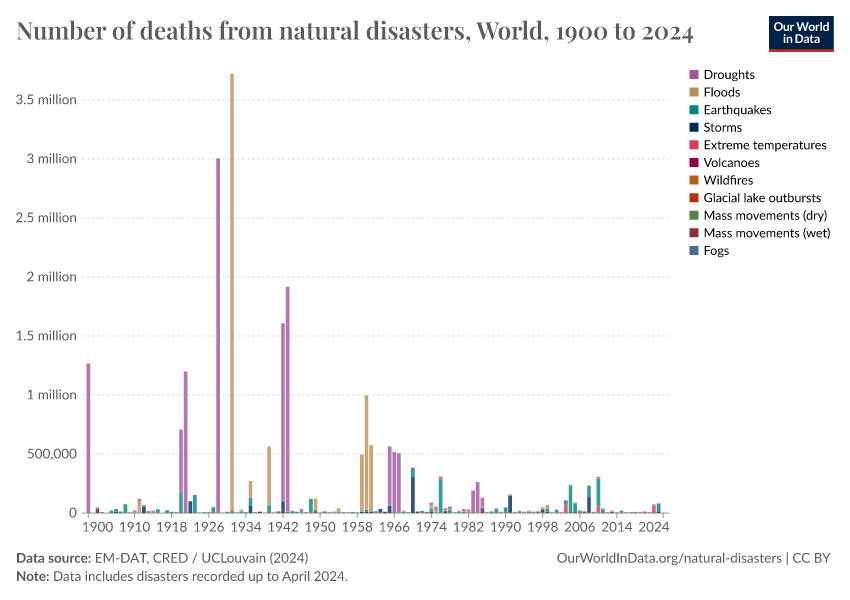
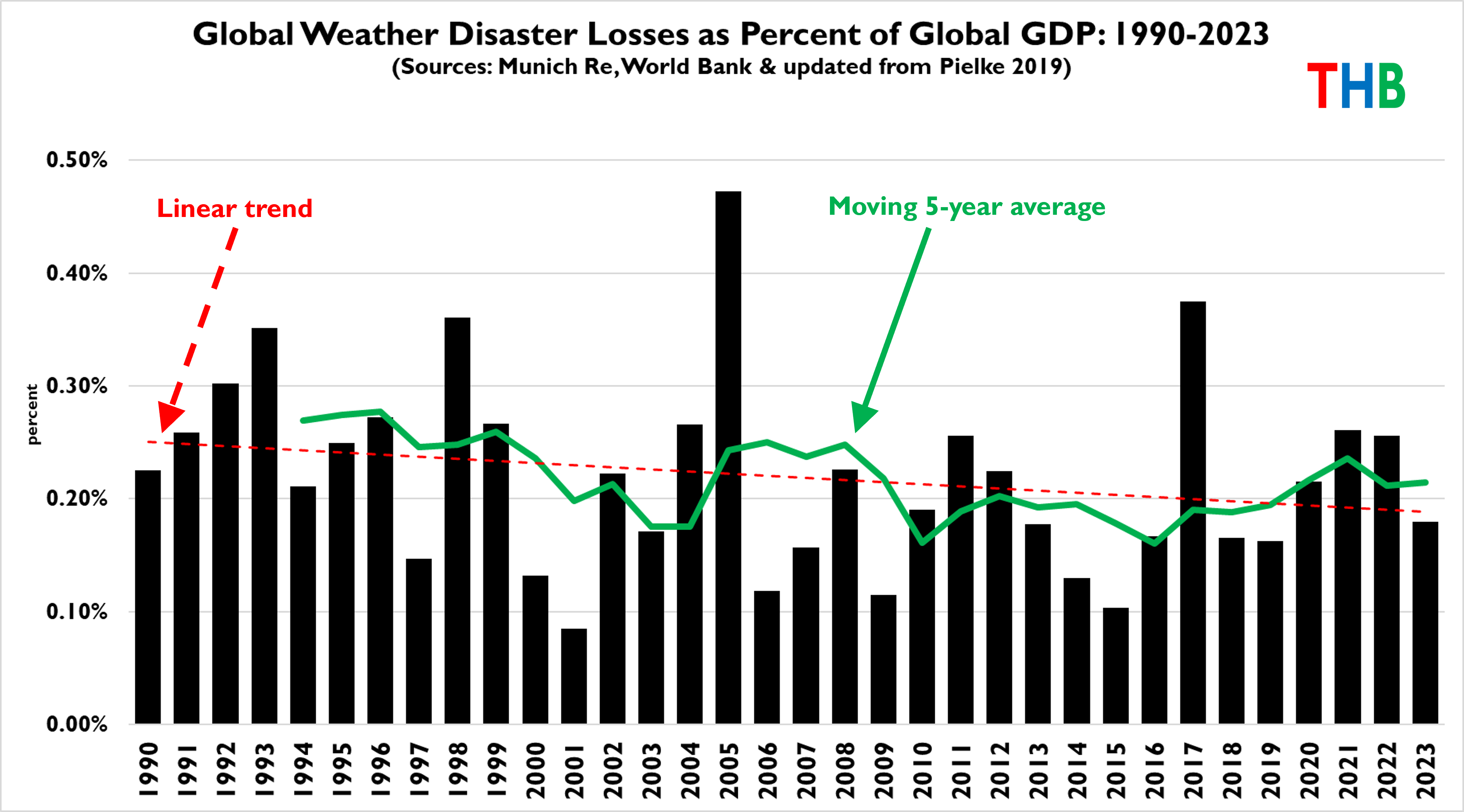
I strongly support increasing adaptation efforts, which have already been successful in drastically reducing the death rate and GDP adjusted financial damage from natural disasters during the past
100 years (OurWorldInData, Pielke 2022, Economist).


Polar Bears, Dead Coral and Other Climate Fictions

Bjorn Lomborg calls out climate alarmist nonsense in his WSJ article Polar Bears, Dead Coral and Other Climate Fictions.  Excerpts in italics with my bolds and added images.

Activists’ tales of doom never pan out,
but they leave us poorly informed and feed bad policy.

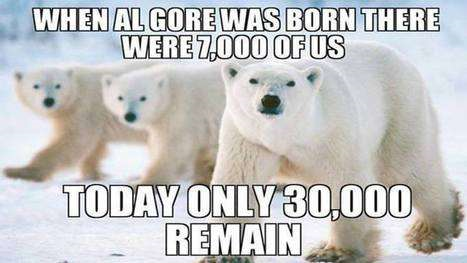
Whatever happened to polar bears? They used to be all climate campaigners could talk about, but now they’re essentially absent from headlines. Over the past 20 years, climate activists have elevated various stories of climate catastrophe, then quietly dropped them without apology when the opposing evidence becomes overwhelming. The only constant is the scare tactics.

Protesters used to dress up as polar bears. Al Gore’s 2006 film, “An Inconvenient Truth,” depicted a sad cartoon polar bear floating away to its death. The Washington Post warned in 2004 that the species could face extinction, and the World Wildlife Fund’s chief scientist claimed some polar bear populations would be unable to reproduce by 2012.

Then in the 2010s, campaigners stopped talking about them.

After years of misrepresentation, it finally became impossible to ignore the mountain of evidence showing that the global polar-bear population has increased substantially. Whatever negative effect climate change had was swamped by the reduction in hunting of polar bears. The population has risen from around 12,000 in the 1960s to about 26,000.

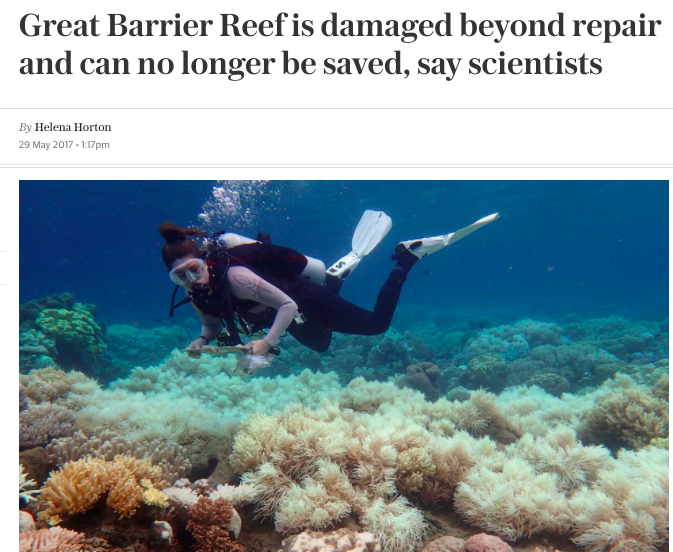
The same thing has happened with activists’ outcry about Australia’s Great Barrier Reef. For years, they shouted that the reef was being killed off by rising sea temperatures. After a hurricane extensively damaged the reef in 2009, official Australian estimates of the percent of reef covered in coral reached a record low in 2012. The media overflowed with stories about the great reef catastrophe, and scientists predicted the coral cover would be reduced by another half by 2022. The Guardian even published an obituary in 2014.

The percentage of coral cover in the northern and central Great Barrier Reef has increased.(Supplied: Australian Institute of Marine Science)

The latest official statistics show a completely different picture. For the past three years the Great Barrier Reef has had more coral cover than at any point since records began in 1986, with 2024 setting a new record. This good news gets a fraction of the coverage that the panicked predictions did.

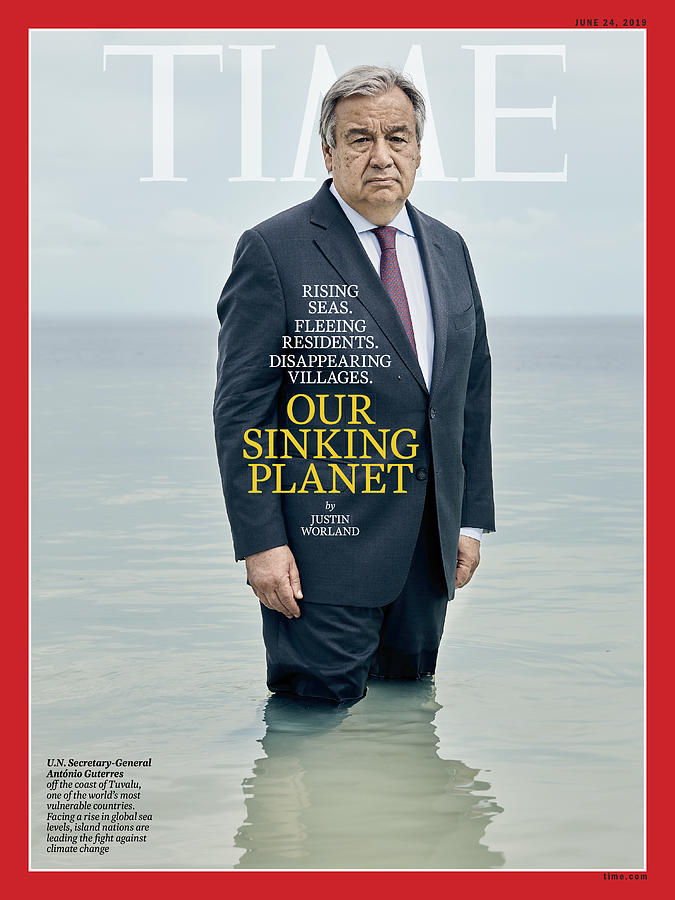
More recently, green campaigners were warning that small Pacific islands would drown as sea levels rose. In 2019 United Nations Secretary-General António Guterres flew all the way to Tuvalu, in the South Pacific, for a Time magazine cover shot. Wearing a suit, he stood up to his thighs in the water behind the headline “Our Sinking Planet.” The accompanying article warned the island—and others like it—would be struck “off the map entirely” by rising sea levels.

Hundreds of Pacific Islands are growing, not shrinking. No habitable island got smaller.

About a month ago, the New York Times finally shared what it called“surprising” climate news: Almost all atoll islands are stable or increasing in size. In fact, scientific literature has documented this for more than a decade. While rising sea levels do erode land, additional sand from old coral is washed up on low-lying shores. Extensive studies have long shown this accretion is stronger than climate-caused erosion, meaning the land area of Tuvalu and many other small islands is increasing.

Today, killer heat waves are the new climate horror story. In July President Biden claimed “extreme heat is the No. 1 weather-related killer in the United States.”

He is wrong by a factor of 25. While extreme heat kills nearly 6,000 Americans each year, cold kills 152,000, of which 12,000 die from extreme cold. Even including deaths from moderate heat, the toll comes to less than 10,000. Despite rising temperatures, age-standardized extreme-heat deaths have actually declined in the U.S. by almost 10% a decade and globally by even more, largely because the world is growing more prosperous. That allows more people to afford air-conditioners and other technology that protects them from the heat.

My Mind is Made Up, Don’t Confuse Me with the Facts. H/T Bjorn Lomborg, WUWT

The petrified tone of heat-wave coverage twists policy illogically. Whether from heat or cold, the most sensible way to save people from temperature-related deaths would be to ensure access to cheap, reliable electricity. That way, it wouldn’t be only the rich who could afford to keep safe from blistering or frigid weather. Unfortunately, 

Activists do the world a massive disservice by refusing to acknowledge
facts that challenge their intensely doom-ridden worldview.

There is ample evidence that man-made emissions cause changes in climate, and climate economics generally finds that the costs of these effects outweigh the benefits. But the net result is nowhere near catastrophic. The costs of all the extreme policies campaigners push for are much worse. All told, politicians across the world are now spending more than $2 trillion annually—far more than the estimated cost from climate change that these policies prevent each year.

Yes, those are Trillions of US$ they are projecting to spend.

Scare tactics leave everyone—especially young people—distressed and despondent. Fear leads to poor policy choices that further frustrate the public. And the ever-changing narrative of disasters erodes public trust.

Telling half-truths while piously pretending to “follow the science” benefits activists with their fundraising, generates clicks for media outlets, and helps climate-concerned politicians rally their bases. But it leaves all of us poorly informed and worse off.

Mr. Lomborg is president of the Copenhagen Consensus, a visiting fellow at Stanford University’s Hoover Institution and author of “Best Things First: The 12 Most Efficient Solutions for the World’s Poorest and our Global SDG Promises.”

See Also:

You Won’t Survive “Sustainability” Agenda 2024

Fantasies of Clever Climate Policies

Chris Kenny writes at The Australian Facts at a premium in blustery climate debate. Excerpts in italics from text provided by John Ray at his blog, Greenie Watch.  My bolds and added images.

Collective Idiocy From Intellectual Vanity

We think we are so clever. The conceit of contemporary humankind is often unbearable.  Yet this modern self-regard has generated a collective idiocy, an inane confusion between feelings and facts, and an inability to distinguish between noble aims and hard reality.

This preference for virtue signalling over practical action can be explained only by intellectual vanity, a smugness that over-estimates humankind’s ability to shape the world it inhabits.

As a result we have a tendency to believe we are masters of the universe, that we can control the climate and regulate natural disasters. Too lazy or spoiled to weigh facts and think things through, we are more susceptible than ever to mass delusion.

We have seen this tendency play out in deeply worrying ways, such as the irrational belief in the communal benefits of Covid vaccination despite the distinct lack of scientific evidence. Too many people just wanted to believe the vaccine had this thing beaten.

Still, there is no area of public debate where rational thought is more readily cast aside than in the climate and energy debate. This is where alarmists demand that people “follow the science” while they deploy rhetoric, scare campaigns and policies that turn reality and science on their heads.

This nonsense is so widespread and amplified by so many authoritative figures that we have become inured to it. Teachers and children break from school to draw attention to what the UN calls a “climate emergency” as the world lives through its most populous and prosperous period in history, when people are shielded from the ill-effects of weather events better than they ever have been previously.

Politicians tell us in the same breath that producing clean energy is the most urgent and important task for the planet and reject nuclear energy, the only reliable form of emissions-free energy. The activists argue that reducing emissions is so imperative it is worth lowering living standards, alienating farmland, scarring forests and destroying industries, but it is not worth the challenge of boiling water to create energy-generating steam by using the tried and tested technology of nuclear fission.

Our acceptance of idiocy, unchecked and unchallenged, struck me in one interview this week given by teal MP Zali Steggall. In many ways it was an unexceptional interview; there are politicians and activists saying this sort of thing every day somewhere, usually unchallenged.

Steggall was preoccupied with Australia’s emissions reduction targets. “If we are going to be aligned to a science-based target and keep temperatures as close to 1.5 degrees as we can, we must have a minimum reduction of 75 per cent by 2035 as an interim target,” she said.

Steggall then patronised her audience by comparing meeting emissions targets to paying down a mortgage. The claim about controlling global temperatures is hard to take seriously, but to be fair it is merely aping the lines of the UN, which argues the increase in global average temperatures can be held to 1.5 degrees with emissions reductions of that size – globally.

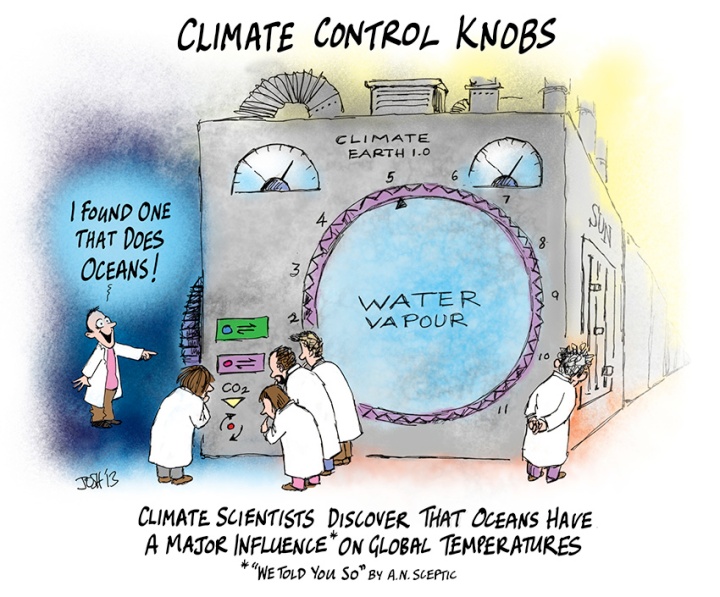
We could talk all day about the imprecise nature of these calculations, the contested scientific debate about the role of other natural variabilities in climate, and the presumption that humankind, through policy imposed by a supranational authority, can control global climate as if with a thermostat. The simplistic relaying of this agenda as central to Australian policy decisions was not the worst aspect of Steggall’s presentation.

“The Coalition has no policy, so let’s be really clear, they are taking Australia out of the Paris Agreement if they fail to nominate an improvement with a 2035 target,” Steggall lectured, disingenuously.

This was Steggall promulgating the central lie of the national climate debatethat Australia’s emissions reduction policies can alter the climate. It is a fallacy embraced and advocated by Labor, the Greens and the teals, and which the Coalition is loath to challenge for fear of being tagged into a “climate denialism” argument.

It is arrant nonsense to suggest our policies can have any discernible effect on the climate or “climate risk”. Any politician suggesting so, directly or by implication, is part of a contemporary, fake-news-driven dumbing down of the public square, and injecting an urgency into our policy considerations that is hurting citizens already with high electricity prices, diminished reliability and a damaged economy.

Steggall went on to claim we were feeling the consequences of global warming already. “And for people wondering ‘How does that affect me?’, just look at your insurance premiums, our insurance premiums around Australia are going through the roof,” she extrapolated, claiming insurance costs were keeping people out of home ownership. “This is not a problem for the future,” Steggall stressed, “it is problem for now.”

It is a problem all right – it is unmitigated garbage masquerading as a policy debate. Taking it to its logical conclusion, Steggall claims if Australia reduced its emissions further we would lower the risk of natural disasters, leading to lower insurance premiums and improved housing affordability – it is surprising that world peace did not get a mention.

Mind you, these activists do like to talk about global warming as a security issue. They will say anything that heightens fears, escalates the problem and supports their push for more radical deindustrialisation.

Our national contribution to global emissions
is now just over 1 per cent and shrinking.

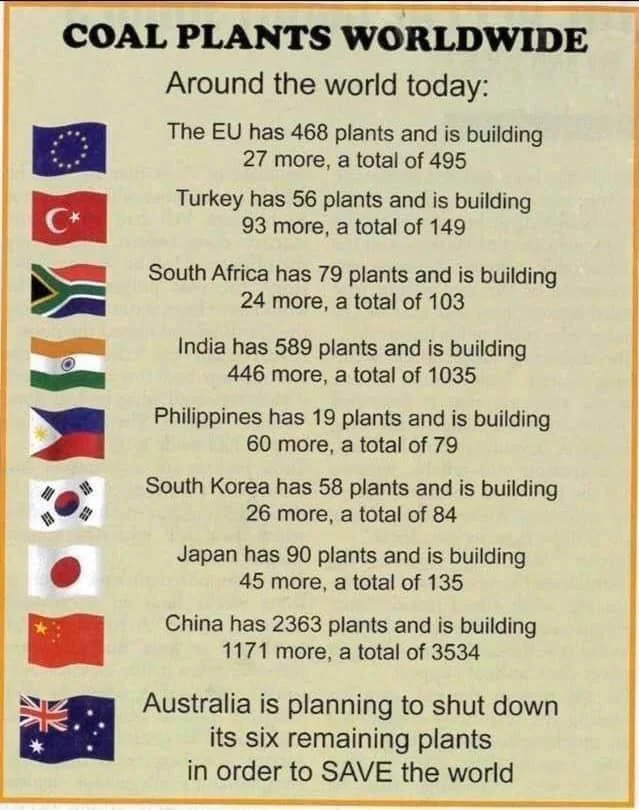
Australia’s annual emissions total less than 400 megatonnes while China’s are rising by more than that total each year and are now at 10,700Mt or about 30 times Australia’s. While our emissions reduce, global emissions are increasing. We could shut down our country, eliminating our emissions completely, and China’s increase would replace ours in less than a year.

So, whatever we are doing, it is not changing and cannot change the global climate. Our national chief scientist, Alan Finkel, clearly admitted this point in 2018, even though he was embarrassed by its implications in the political debate. Yet the pretence continues.

And before critics suggest I am arguing for inaction, I am not. But clearly, the logical and sensible baseline for our policy consideration should be a recognition that our national actions cannot change the weather. Therefore we should carefully consider adaptation to measured and verified climate change, while we involve ourselves as a responsible nation in global negotiations and action.

Obviously, we should not be leading that action but acting cautiously to protect our own interests and prosperity.

It is madness for us to undermine our cheap energy advantage to embark on a renewables-plus-storage experiment that no other country has dared to even try, when we know it cannot shift the global climate one iota. It is all pain for no gain.

Yet that is what this nation has done. So my question today is what has happened to our media, academia, political class and wider population so that it allows this debate and policy response to occur in a manner that is so divorced from reality?

Are we so complacent and overindulged that we accept post-rational debate to address our post-material concerns? Even when it is delivering material hardship to so many Australians and jeopardising our long-term economic security?

Should public debate accept absurd baseline propositions such as the idea that our energy transition sacrifice will improve the weather and reduce natural disasters, simply because they are being argued by major political groupings or the UN? Or should we not try to impose a dose of reality and stick to the facts?

This feebleness of our public debate has telling ramifications – there is no way this country could have embarked on the risky, expensive and doomed renewables-plus-storage experiment if policies and prognostications had been subject to proper scrutiny and debate.

Our media is now so polarised that the climate activists of Labor, the Greens and the teals are able to ensure their nonsensical advocacy is never challenged, and the green-left media, led by the publicly funded ABC, leads the charge in spreading misinformation.

Clearly, we are not as clever as we think. Our children need us to wise up.

You Won’t Survive “Sustainability” Agenda 2024

Joel Kotkin explains in his Spiked article The inhumanity of the green agenda.  Excerpts in italics with my bolds and added images.

The ‘sustainability’ regime is impoverishing the world.

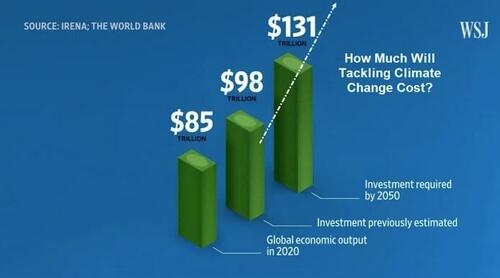
In recent years, the overused word ‘sustainability’ has fostered a narrative in which human needs and aspirations have taken a back seat to the green austerity of Net Zero and ‘degrowth’. The ruling classes of a fading West are determined to save the planet by immiserating their fellow citizens. Their agenda is expected to cost the world $6 trillion per year for the next 30 years.

Yes, those are Trillions of US$ they are projecting to spend.

Meanwhile, they will get to harvest massive green subsidies
and live like Renaissance potentates.

In Enemies of Progress, author Austin Williams suggests that ‘the mantra of sustainability’ starts with the assumption that humanity is ‘the biggest problem of the planet’, rather than the ‘creators of a better future’. Indeed, many climate scientists and green activists see having fewer people on the planet as a key priority. Their programme calls not only for fewer people and fewer families, but also for lower consumption among the masses. They expect us to live in ever smaller dwelling units, to have less mobility, and to endure more costly home heating and air-conditioning. These priorities are reflected in a regulatory bureaucracy that, if it does not claim justification from God, acts as the right hand of Gaia and of sanctified science.

The question we need to ask is: sustainability for whom?

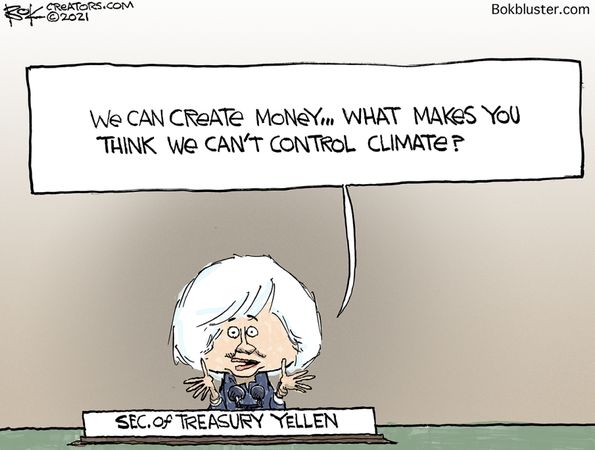
US Treasury secretary Janet Yellen recently suggested that her department sees climate change as ‘the greatest economic opportunity of our time’. To be sure, there is lots of gold in green for the same Wall Street investors, tech oligarchs and inheritors who fund the campaigns of climate activists. They increasingly control the media, too. The Rockefellers, heirs to the Standard Oil fortune, and other ultra-wealthy greens are currently funding climate reporters at organs like the Associated Press and National Public Radio.

Under the new sustainability regime, the ultra-rich profit, but the rest of us not so much. The most egregious example may be the forced take-up of electric vehicles (EVs), which has already helped to make Elon Musk, CEO of Tesla, the world’s second-richest man. Although improvements are being made to low-emissions vehicles, consumers are essentially being frogmarched into adopting a technology that has clear technical problems, remains far more expensive than the internal-combustion engine and depends primarily on an electric grid already on the brink of blackouts. Green activists, it turns out, do not expect EVs to replace the cars of hoi polloi. No, ordinary people will be dragooned to use public transport, or to walk or bike to get around.  [BMW will come to mean “Bike, Metro, and Walking.”]

The shift to electric cars is certainly no win for the West’s working and middle classes. But it is an enormous boon to China, which enjoys a huge lead in the production of batteries and rare-earth elements needed to make EVs, and which also figure prominently in wind turbines and solar panels. China’s BYD, which is backed by Warren Buffett, has emerged as the world’s top EV manufacturer, with big export ambitions. Meanwhile, American EV firms struggle with production and supply-chain issues, in part due to green resistance to domestic mining for rare-earth minerals. Even Tesla expects much of its future growth to come from its Chinese factories.

Building cars from primarily Chinese components will have consequences for autoworkers across the West. Germany was once a car-manufacturing giant, but it is expected to lose an estimated 400,000 car-factory jobs by 2030. According to McKinsey, the US’s manufacturing workforce could be cut by up to 30 per cent. After all, when the key components are made elsewhere, far less labour is needed from US and European workers. It’s no surprise that some European politicians, worried about a popular backlash, have moved to slow down the EV juggernaut.

This dynamic is found across the entire sustainability agenda. The soaring energy costs in the West have helped China expand its market share in manufactured exports to roughly equal that of the US, Germany and Japan combined. American manufacturing has dropped recently to its lowest point since the pandemic. The West’s crusade against carbon emissions makes it likely that jobs, ‘green’ or otherwise, will move to China, which already emits more greenhouse gases than the rest of the high-income world.

Meanwhile, the Chinese leadership is looking to adapt to changes in the climate,
instead of undermining economic growth chasing implausible Net Zero targets.

There are clear class implications here. California’s regulators recently admitted that the state’s strict climate laws aid the affluent, but hurt the poor. These laws also have a disproportionate impact on ethnic-minority citizens, creating what attorney Jennifer Hernandez has labelled the ‘green Jim Crow’. As China’s increasingly sophisticated tech and industrial growth is being joyously funded by US venture capitalists and Wall Street, living standards among the Western middle class are in decline. Europe has endured a decade of stagnation, while Americans’ life expectancy has recently fallen for the first time in peacetime. Deutsche Bank’s Eric Heymann suggests that the only way to achieve Net Zero emissions by 2050 is by squelching all future growth, which could have catastrophic effects on working-class and middle-class living standards.

Rather than the upward mobility most have come to expect, much of the West’s workforce now faces the prospect of either living on the dole or working at low wages. Today, nearly half of all American workers receive low wages and the future looks worse. Almost two-thirds of all new jobs in recent months were in low-paying service industries. This is also true in Britain. Over recent decades, many jobs that might have once supported whole families have disappeared. According to one UK account, self-employment and gig work do not provide sustenance for anything like a comfortable lifestyle. Rates of poverty and food shortages are already on the rise.

As a result, most parents in the US and elsewhere doubt their children
will do better than their generation,
while trust in our institutions is at historic lows.

The fabulists at places like the New York Times have convinced themselves that climate change is the biggest threat to prosperity. But many ordinary folk are far more worried about the immediate effects of climate policy than the prospect of an overheated planet in the medium or long term. This opposition to the Net Zero agenda was first expressed by the gilet jaunes movement in France in 2018, whose weekly protests were initially sparked by green taxes. This has been followed by protests by Dutch and other European farmers in recent years, who are angry at restrictions on fertilisers that will cut their yields. The pushback has sparked the rise of populism in a host of countries, notably Italy, Sweden and France. Even in ultra-with-it Berlin, a referendum on tighter-emissions targets recently failed to win over enough voters.

This is class warfare obscured by green rhetoric.
It pits elites in finance, tech and the nonprofit world against
a more numerous, but less connected, group of ordinary citizens.

Many of these folk make their living from producing food and basic necessities, or from hauling these things around. Factory workers, truck drivers and farmers, all slated for massive green regulatory onslaughts, see sustainability very differently than the urban corporate elites and their woke employees. As the French gilets jaunes protesters put it bluntly: ‘The elites worry about the end of the world. We worry about the end of the month.’

This disconnect also exists in the United States, according to long-time Democratic analyst Ruy Teixeira. Attempts to wipe out fossil fuels may thrill people in San Francisco, but are regarded very differently in Bakersfield, the centre of the California oil industry, and in Texas, where as many as a million generally good-paying jobs could be lost. Overall, according to a Chamber of Commerce report, a full national ban on fracking, widely supported by greens, would cost 14 million jobs – far more than the eight million jobs lost in the Great Recession of 2007-09.

No surprise then that blue-collar workers are not so enthusiastic
about the green agenda.

Just one per cent, according to a new Monmouth poll, consider climate as their main concern. A new Gallup poll shows that just two per cent of working-class respondents say they currently own an electric vehicle and a mere nine per cent say they are ‘seriously considering’ purchasing one.

These Western concerns are nothing compared to how the sustainability agenda could impact the developing world. Developing countries are home to roughly 3.5 billion people with no reliable access to electricity. They are far more vulnerable to high energy and food prices than we are. For places like Sub-Saharan Africa, green admonitions against new agricultural technologies, fossil fuels and nuclear power undermine any hope of creating desperately needed new wealth and jobs. It’s no wonder that these countries increasingly ignore the West and are looking to China instead, which is helping the developing world to build new fossil-fuel plants, as well as hydroelectric and nuclear facilities. All of this is anathema to many Western greens.

To make matters worse, the EU is already considering carbon taxes on imports,
which could cut the developing world off from what remains of global markets.

More critical still could be the impact of the sustainability mantra on food production, particularly for Sub-Saharan Africa, which will be home to most of the world’s population growth over the next three decades, according to United Nations projections. These countries need more food production, either domestically or from rich countries like the US, the Netherlands, Canada, Australia and France. And they are acutely aware of what happened when Sri Lanka adopted the sustainability agenda. This led to the breakdown of Sri Lanka’s agricultural sector and, eventually, to the violent overthrow of its government.

We need to rethink the sustainability agenda. Protecting the environment cannot come at the cost of jobs and growth. We should also assist developing countries in achieving a more prosperous future. This means financing workable technologies – gas, nuclear, hydro – that can provide the reliable energy so critical for economic development. It does no good to suggest a programme that will keep the poor impoverished.

Unless people’s concerns about the green agenda are addressed, they will almost certainly seek to disrupt the best-laid plans of our supposedly enlightened elites. In the end, as Protagoras said, human beings are still the ultimate ‘measure’ of what happens in the world – whether the cognoscenti like it or not.


Why Unintended Consequences from Pushing Green Energy

We have been treated to multiple reports of negative consequences unforeseen by policymakers pushing the Green Energy agenda. A sample of the range:

Ford ready to restrict UK sales of petrol models to hit electric targets, Financial Times

Why US offshore wind energy is struggling—the good, the bad and the opportunity, Tech Xplore

Another solar farm destroyed by a hail storm—this time in Texas, OK Energy Today

Storm Ravages World’s Largest Floating Solar Plant, Western Journal

DOE Finalizes Efficiency Standards for Clothes Washers and Dryers, Energy.Gov

Strict new EPA rules would force coal-fired power plants to capture emissions or shut down, AP news

Companies Are Balking at the High Costs of Running Electric Trucks, Wall Street Journal

Landmark wind turbine noise ruling from High Court referred to attorney general, Irish Times

Etc., Etc.

These reports point to regulators again attempting to force social and economic behavorial changes against human and physical forces opposing the goals. A detailed explanation of one such failure follows.

Background Post:  Why Raising Auto Fuel (CAFE) Standards Failed

There are deeper reasons why US auto fuel efficiency standards are counterproductive and should be rolled back.  They were instituted in denial of regulatory experience and science.  First, a parallel from physics.

In the sub-atomic domain of quantum mechanics, Werner Heisenberg, a German physicist, determined that our observations have an effect on the behavior of quanta (quantum particles).

The Heisenberg uncertainty principle states that it is impossible to know simultaneously the exact position and momentum of a particle. That is, the more exactly the position is determined, the less known the momentum, and vice versa. This principle is not a statement about the limits of technology, but a fundamental limit on what can be known about a particle at any given moment. This uncertainty arises because the act of measuring affects the object being measured. The only way to measure the position of something is using light, but, on the sub-atomic scale, the interaction of the light with the object inevitably changes the object’s position and its direction of travel.

Now skip to the world of governance and the effects of regulation. A similar finding shows that the act of regulating produces reactive behavior and unintended consequences contrary to the desired outcomes.

US Fuel Economy (CAFE) Standards Have Backfired

An article at Financial Times explains about Energy Regulations Unintended Consequences  Excerpts below with my bolds.

Goodhart’s Law holds that “any observed statistical regularity will tend to collapse once pressure is placed upon it for control purposes”. Originally coined by the economist Charles Goodhart as a critique of the use of money supply measures to guide monetary policy, it has been adopted as a useful concept in many other fields. The general principle is that when any measure is used as a target for policy, it becomes unreliable. It is an observable phenomenon in healthcare, in financial regulation and, it seems, in energy efficiency standards.

When governments set efficiency regulations such as the US Corporate Average Fuel Economy standards for vehicles, they are often what is called “attribute-based”, meaning that the rules take other characteristics into consideration when determining compliance. The Cafe standards, for example, vary according to the “footprint” of the vehicle: the area enclosed by its wheels. In Japan, fuel economy standards are weight-based. Like all regulations, fuel economy standards create incentives to game the system, and where attributes are important, that can mean finding ways to exploit the variations in requirements. There have long been suspicions that the footprint-based Cafe standards would encourage manufacturers to make larger cars for the US market, but a paper this week from Koichiro Ito of the University of Chicago and James Sallee of the University of California Berkeley provided the strongest evidence yet that those fears are likely to be justified.

Mr Ito and Mr Sallee looked at Japan’s experience with weight-based fuel economy standards, which changed in 2009, and concluded that “the Japanese car market has experienced a notable increase in weight in response to attribute-based regulation”. In the US, the Cafe standards create a similar pressure, but expressed in terms of size rather than weight. Mr Ito suggested that in Ford’s decision to end almost all car production in North America to focus on SUVs and trucks, “policy plays a substantial role”. It is not just that manufacturers are focusing on larger models; specific models are also getting bigger. Ford’s move, Mr Ito wrote, should be seen as an “alarm bell” warning of the flaws in the Cafe system. He suggests an alternative framework with a uniform standard and tradeable credits, as a more effective and lower-cost option. With the Trump administration now reviewing fuel economy and emissions standards, and facing challenges from California and many other states, the vehicle manufacturers appear to be in a state of confusion. An elegant idea for preserving plans for improving fuel economy while reducing the cost of compliance could be very welcome.

The paper is The Economics of Attribute-Based Regulation: Theory and Evidence from Fuel-Economy Standards Koichiro Ito, James M. Sallee NBER Working Paper No. 20500.  The authors explain:

An attribute-based regulation is a regulation that aims to change one characteristic of a product related to the externality (the “targeted characteristic”), but which takes some other characteristic (the “secondary attribute”) into consideration when determining compliance. For example, Corporate Average Fuel Economy (CAFE) standards in the United States recently adopted attribute-basing. Figure 1 shows that the new policy mandates a fuel-economy target that is a downward-sloping function of vehicle “footprint”—the square area trapped by a rectangle drawn to connect the vehicle’s tires.  Under this schedule, firms that make larger vehicles are allowed to have lower fuel economy. This has the potential benefit of harmonizing marginal costs of regulatory compliance across firms, but it also creates a distortionary incentive for automakers to manipulate vehicle footprint.

Attribute-basing is used in a variety of important economic policies. Fuel-economy regulations are attribute-based in China, Europe, Japan and the United States, which are the world’s four largest car markets. Energy efficiency standards for appliances, which allow larger products to consume more energy, are attribute-based all over the world. Regulations such as the Clean Air Act, the Family Medical Leave Act, and the Affordable Care Act are attribute-based because they exempt some firms based on size. In all of these examples, attribute-basing is designed to provide a weaker regulation for products or firms that will find compliance more difficult.

Summary from Heritage Foundation study Fuel Economy Standards Are a Costly Mistake Excerpt with my bolds.

The CAFE standards are not only an extremely inefficient way to reduce carbon dioxide emission but will also have a variety of unintended consequences.

For example, the post-2010 standards apply lower mileage requirements to vehicles with larger footprints. Thus, Whitefoot and Skerlos argued that there is an incentive to increase the size of vehicles.

Data from the first few years under the new standard confirm that the average footprint, weight, and horsepower of cars and trucks have indeed all increased since 2008, even as carbon emissions fell, reflecting the distorted incentives.

Manufacturers have found work-arounds to thwart the intent of the regulations. For example, the standards raised the price of large cars, such as station wagons, relative to light trucks. As a result, automakers created a new type of light truck—the sport utility vehicle (SUV)—which was covered by the lower standard and had low gas mileage but met consumers’ needs. Other automakers have simply chosen to miss the thresholds and pay fines on a sliding scale.

Another well-known flaw in CAFE standards is the “rebound effect.” When consumers are forced to buy more fuel-efficient vehicles, the cost per mile falls (since their cars use less gas) and they drive more. This offsets part of the fuel economy gain and adds congestion and road repair costs. Similarly, the rising price of new vehicles causes consumers to delay upgrades, leaving older vehicles on the road longer.

In addition, the higher purchase price of cars under a stricter CAFE standard is likely to force millions of households out of the new-car market altogether. Many households face credit constraints when borrowing money to purchase a car. David Wagner, Paulina Nusinovich, and Esteban Plaza-Jennings used Bureau of Labor Statistics data and typical finance industry debt-service-to-income ratios and estimated that 3.1 million to 14.9 million households would not have enough credit to purchase a new car under the 2025 CAFE standards.[34] This impact would fall disproportionately on poorer households and force the use of older cars with higher maintenance costs and with fuel economy that is generally lower than that of new cars.

CAFE standards may also have redistributed corporate profits to foreign automakers and away from Ford, General Motors (GM), and Chrysler (the Big Three), because foreign-headquartered firms tend to specialize in vehicles that are favored under the new standards.[35] 

Conclusion

CAFE standards are costly, inefficient, and ineffective regulations. They severely limit consumers’ ability to make their own choices concerning safety, comfort, affordability, and efficiency. Originally based on the belief that consumers undervalued fuel economy, the standards have morphed into climate control mandates. Under any justification, regulation gives the desires of government regulators precedence over those of the Americans who actually pay for the cars. Since the regulators undervalue the well-being of American consumers, the policy outcomes are predictably harmful.

What’s Next?

Wind Power for Beginners

H/T maxyhoge

Robert Bryce explains the basics at his substack blog Build It, And The Wind Won’t Come.  Excerpts in italics with my bolds and added images.

Weather-dependent generation sources are…weather dependent:
Last year, despite adding 6.2 GW of new capacity,
U.S. wind production dropped by 2.1%.

Three years ago, in the wake of Winter Storm Uri, the alt-energy lobby and their many allies in the media made sure not to blame wind energy for the Texas blackouts. The American Clean Power Association (2021 revenue: $32.1 million) declared frozen wind turbines “did not cause the Texas power outages” because they were “not the primary cause of the blackouts. Most of the power that went offline was powered by gas or coal.”

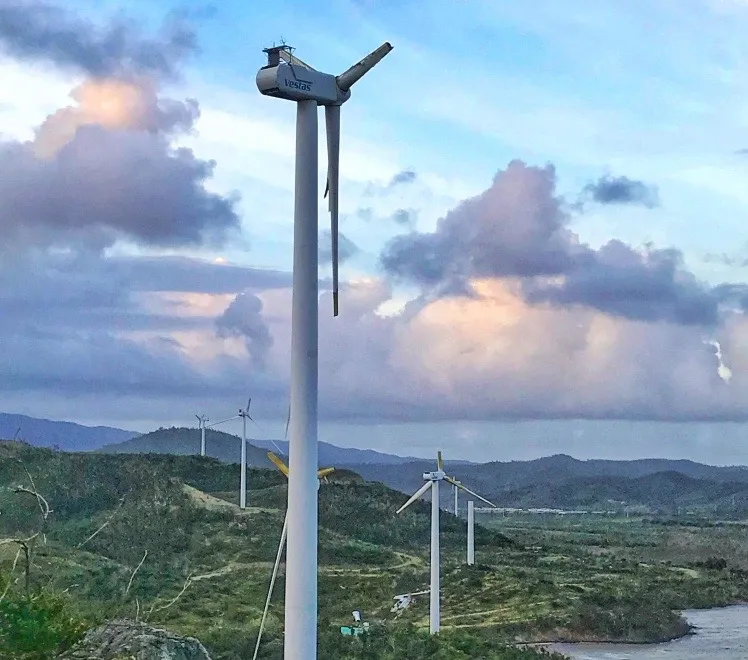
Damaged wind turbines at the Punta Lima wind project, Naguabo, Puerto Rico, 2018. Photo: Wikipedia.

NPR parroted that line, claiming, “Blaming wind and solar is a political move.” The Texas Tribune said it was wrong to blame alt-energy after Winter Storm Uri because “wind power was expected to make up only a fraction of what the state had planned for during the winter.” The outlet also quoted one academic who said that natural gas was “failing in the most spectacular fashion right now.” Texas Tribune went on to explain, “Only 7% of ERCOT’s forecasted winter capacity, or 6 gigawatts, was expected to come from various wind power sources across the state.”

In other words, there was no reason to expect the 33 GW of wind capacity that Texas had to deliver because, you know, no one expected wind energy to produce much power. Expectations? Mr. October? Playoff Jamal? Who needs them?

But what happens when you build massive amounts of
wind energy capacity and it doesn’t deliver —
not for a day or a week, but for six months, or even an entire year?

That question is germane because, on Wednesday, the Energy Information Administration published a report showing that U.S. wind energy production declined by 2.1% last year. Even more shocking: that decline occurred even though the wind sector added 6.2 GW of new capacity!

A hat tip to fellow Substack writer Roger Pielke Jr., who pithily noted on Twitter yesterday, “Imagine if the U.S. built 6.2 GW new capacity in nuclear power plants and after starting them up, overall U.S. electricity generation went down. That’d be a problem, right?”

Um, yes. It would. And the EIA made that point in its usual dry language. “Generation from wind turbines decreased for the first time since the mid-1990s in 2023 despite the addition of 6.2 GW of new wind capacity last year,” the agency reported. The EIA also explained that the capacity factor for America’s wind energy fleet, also known as the average utilization rate, “fell to an eight-year low of 33.5%.” That compares to 35.9% capacity factor in 2022 which was the all-time high. The report continued, “Lower wind speeds than normal affected wind generation in 2023, especially during the first half of the year when wind generation dropped by 14% compared with the same period in 2022.”

Read that again. For half of last year, wind generation was down by a whopping 14% due to lower wind speeds. Imagine if that wind drought continued for an entire year. That’s certainly possible. Recall that last summer, the North American Electric Reliability Corporation warned that U.S. generation capacity “is increasingly characterized as one that is sensitive to extreme, widespread, and long duration temperatures as well as wind and solar droughts.”

According to Bloomberg New Energy Finance, corporate investment in wind energy between 2004 and 2022 totaled some $278 billion. In addition, according to data from the Treasury Department, the U.S. government spent more than $30 billion on the production tax credit over that same period. Thus, over the last two decades, the U.S. has spent more than $300 billion building 150 GW of wind capacity that has gobbled up massive amounts of land, garnered enormous (and bitter) opposition from rural Americans, and hasn’t gotten more efficient over time.

Wednesday’s EIA report is a stark reminder that all of that generation capacity is subject to the vagaries of the wind. Imagine if the U.S. had spent that same $300 billion on a weather-resilient form of generation, like, say, nuclear power. That’s relevant because Unit 4 at Plant Vogtle in Georgia came online on Monday. With that same $300 billion, the U.S. could have built 20, 30, or maybe even 40 GW of new nuclear reactors with a 92% capacity factor that wouldn’t rely on the whims of the wind. In addition, those dozens of reactors would have required a tiny fraction of the land now covered by thousands of viewshed-destroying, bat-and-bird-killing wind turbines.

If climate change means we will face more extreme weather in the years ahead — hotter, colder, and/or more severe temperatures for extended periods — it’s Total Bonkers CrazytownTM to make our electric grid dependent on the weather. But by lavishing staggering amounts of money on wind and solar energy, and in many cases, mandating wind and solar, that’s precisely what we are doing.


IPCC Uses Overblown Global Warming Potentials

H. Douglas Lightfoot and Gerald Ratzer published their paper Reliable Physics Demand Revision of the IPCC Global Warming Potentials in Environmental Science April 15, 2024.  Excerpts in italics with my bolds and added images.  H\T Patrick Moore.

Abstract

The Global Warming Potentials (GWP) of the Intergovernmental Panel on Climate Change (IPCC) in Table 2.14 of the Fourth Assessment Report (AR4) show the increase in warming by methane (CH4) and nitrous oxide (N2O) is 21 and 310 times respectively that of CO2. There has been wide acceptance of these values since publishing in 2007. Nevertheless, they are inaccurate.

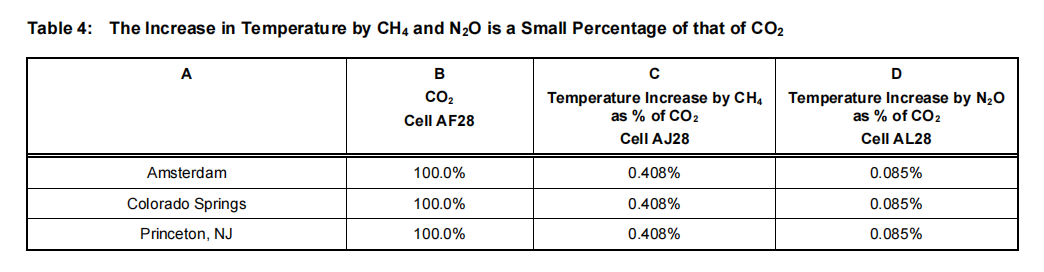
This study uses accurate methods to calculate the impacts of CO2, CH4, and N2O on the warming of the atmosphere. For example, this quantitative analysis from reliable physics shows the contribution of CO2 to warming at Amsterdam is 0.0083°C out of a difference of 26°C. The warming effect of CH4 on the Earth’s atmosphere is 0.408% of that of CO2, and the warming by N2O is 0.085% of that of CO2.

Thus, the warming effects of CO2, CH4, and N2O are too small to measure. The invalidity of the methane and nitrous oxide values indicates the GWPs of the remaining approximately sixty chemicals in the Table 2.14 list are also invalid. A recommendation is that the IPCC consider revising or retracting the GWP values in Table 2.14.

Introduction

The purpose of this paper is to examine the Global Warming Potentials (GWPs) in Table 2.14 of the Fourth Assessment Report [1] of the Intergovernmental Panel on Climate Change (IPCC), Figure 1.The Global Warming Potentials (GWP) of methane and nitrous oxide calculated by the IPCC in Table2.14 have profoundly affected the decisions made by elected officials worldwide.

Nitrogen fertilizers have been restricted or banned in several countries because they emit a small amount of nitrous oxide. Nitrogen fertilizers are essential for the growth of plants, and nitrogen is often the limiting nutrient [2]. Restricting their use affects food production adversely and can cause food shortages. The IPCC claims that nitrous oxide has up to 310 times the warming effect of CO2. This value is so significant that we must determine whether or not this value of 310 is valid.

A similar situation occurs with methane, which is claimed to have 21 times the warming effect of CO2. Natural gas is virtually all methane transported widely by pipelines and pumping stations. The claim is that methane leaks from natural gas pipeline systems and processing are warming the Earth. Periodically, a scientist will quote Table 2.14 and raise the alarm about methane and the possibility of significant methane releases from the Arctic Tundra caused by the warming of the Earth [3].

The methodology of this study answers the question: “Of the temperature difference between two weather stations, how many degrees Celsius do CO2, CH4, and N2O contribute?” Four weather stations—Pond Inlet, Amsterdam, Colorado Springs, and Princeton, NJ—were selected to provide the answers. The temperature and relative humidity are recorded within the same.

Calculations for Table 2 Column D

In Row 5, the grams of CO2 per kilogram (kg) of dry air is (0.00041806 x 44 x (1000/29) = 0.630, where 44 and 29 are the molecular weights of CO2 and air, respectively. In Row 9, the grams of CH4 per kg of dry air are (0.000001927 x 16 x (1000/29)) = 0.001063, where 16 is the molecular weight of methane. Similarly, in Row 12, Column E, the grams of N2O per kg of dry air are (0.00000033675 x 44 x (1000/29) = 0.000511, where 44 is the molecular weight of nitrous oxide.There are 0.630/0.00106 = 594 grams of CO2 per gram of methane. Thus, there are (594 x 44)/16) = 1634 molecules of CO2 per methane molecule. Thus, because the molecular weights of CO2 and N2O are the same at 44, there are (0.630/0.000511) = 1235 molecules of CO2 for each molecule of N2O in the Earth’s atmosphere. Thus, in September 2023, CO2 molecules outnumber CH4 molecules by 1634 and N2O molecules by 1235.

Measuring the Contribution of CO2, CH4 and N2O to Temperature in the Earth’s Atmosphere

It is essential to understand that the measured and recorded temperature is the sum of all the factors affecting Earth’s temperature. These include warming caused by radiation from the Sun absorbed by CO2, CH4, N2O, feedback, and other warming or cooling effects. These factors also apply to temperature differences. The recorded temperature is input to the Humidair psychrometric program, which includes these factors in the heat content (enthalpy) and specific volume.

The following method quantifies the contribution of carbon dioxide, methane, and nitrous oxide to the difference in temperature between three weather stations and Pond Inlet.Table 3 is a summary of the Excel calculations. The file for the Excel calculations is: “Excel calculations for GWP Mar 102024.xlsx.” From the Excel spreadsheet, Column H, the temperatures measured at Pond Inlet, Amsterdam, Colorado Springs, and Princeton on December 30, 2023, were -18°C, 8°C, 3°C, and 4°C, respectively. We set the recorded level of CO2 at 418.06 at the location with the lowest of the four temperatures, i.e., at Pond Inlet. This is because the number of molecules of CO2 per cubic meter falls as the temperature rises.

The grams of CO2 per kg of dry air in the Pond Inlet row of Table 3 are the same as in Column D of Table 2. The temperature contributions of CO2, CH4, and N2O to the difference in temperature in °C between Pond Inlet and the weather stations in Column A are in Columns G, H, and I. The total is in Column J. The upper lines in the titles of the columns are the locations in the Excel spreadsheet calculations. Note that the average CO2 for Table 2 was 418.06 in August 2023, and the level of CO2 during the recording of the values for the Excel spreadsheet was 422.3 ppm. The difference of 4.24 ppm has no significant effect on the results of this study.

As shown in Table 4, the temperature increase caused by CH4 and N2O is a small percentage of the temperature rise caused by CO2.The warming effect of CO2 is too small to measure [9, 10].Thus, the warming effects of CH4 and N2O are also too small. The data in IPCC Table 2.14, showing that CH4 has 21 times the warming effect of CO2 and that N2O has 310 times the warming effect of CO2, are grossly incorrect.

Summary and Conclusions

This study provides evidence that the IPCC Global Warming Potentials are incorrect. It starts with the levels of carbon dioxide (CO2), methane (CH4), and nitrous oxide (N2O) measured as molecules per million molecules of dry air, which is the molar fraction. Then, quantitative results from reliable physics establish the enthalpy and specific volume at four weather stations. Chemistry determines the grams of each gas per kg of dry air. The increase in the temperature bycurrent levels of methane (CH4) and nitrous (N2O) in the Earth’s atmosphere isa small percentage of that of CO2.Conclusions 6.1, 6.2, and 6.3 answer, “Of the temperature difference between two weather stations, how many degrees Celsius do CO2, CH4, and N2O contribute?”

6.1.In this study, the difference in temperature between Pond Inlet and Amsterdam is 26°C. The contribution of CO2 to this difference is 0.0083°C, but this amount is too small to measure.

6.2.The contribution of CH4 to the 26°C difference between Pond Inlet and Amsterdam is 0.0000338°C.This current level of methane in the atmosphere increases the temperature by 0.408% of that of CO2. It does not have 21 times the warming of CO2 as claimed by the IPCC.

6.3.N2O’s contribution to the 26°C difference between Pond Inlet and Amsterdam is 0.00000705oC. This is 0.085% of that of CO2. It does not have 310 times the warming of CO2, as claimed by the IPCC

6.4.The total contribution of all three gases to the 26°C difference between Pond Inlet and Amsterdam is 0.00833oC. This is a typical result; this difference is too small to measure.

6.5.The warming of the Earth’s atmosphere by CH4 and N2O is 0.408% and 0.085% respectively of that of CO2.

6.6.The warming by CH4 and N2O is so tiny in the Earth’s atmosphere that the IPCC estimates of warming by GWP over several years are irrelevant.

6.7.It is reasonable for the IPCC to consider revising or withdrawing Table 2.14 in the Fourth Assessment Report

Footnote:  

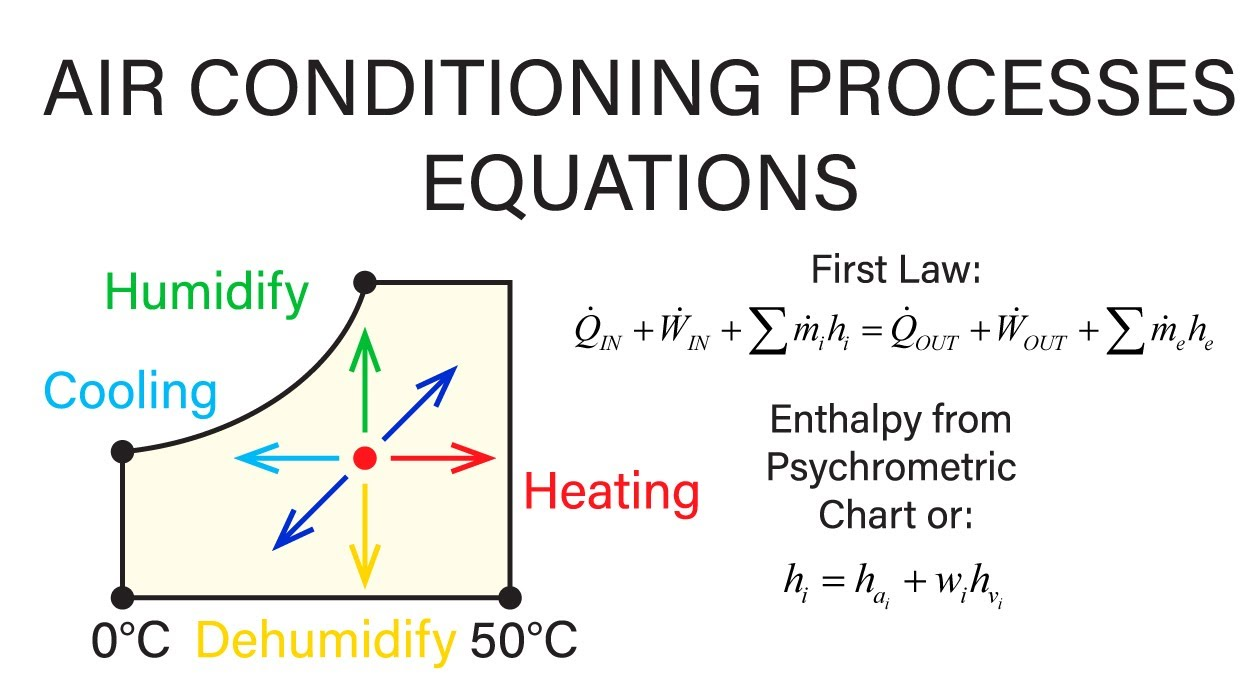
If like me you are new to the term “psychrometrics”, it refers to an engineering method for assessing the thermodynamic properties of moist air.  From Understanding The Psychrometric Chart

The psychrometric chart is a tool commonly used in the field of engineering to understand and analyze the properties of air. This chart provides valuable information about the thermodynamic properties of moist air, which is crucial for various applications such as heating, ventilation, and air conditioning (HVAC) systems. By understanding the psychrometric chart, engineers can make more informed decisions and optimize their designs for enhanced efficiency and comfort.

In addition to temperature, the psychrometric chart also includes other properties such as humidity ratio, enthalpy, and specific volume. The humidity ratio represents the mass of moisture present in the air per unit mass of dry air, while enthalpy is the total heat content of the air including both sensible and latent heat. Specific volume, on the other hand, is the volume occupied by a unit mass of air. Together, these properties provide a comprehensive understanding of the thermodynamic behavior of moist air.

The Herd Shuns Climate Lunatics

Charles MacKay: “Men, it has been well said, think in herds; it will be seen that they go mad in herds, while they only recover their senses slowly, and one by one.”

Conrad Black writes at National Post Washing away the climate lunatics.  Excerpts in italics with my bolds and added images.

I have written here and elsewhere countless times before of the dangers of responding prematurely to alarmist concerns about climate change. Dr. Benny Peiser of the British Global Warming Policy Foundation spoke to the Friends of Science Society in Calgary earlier this month, warning that Europe’s extremist net zero carbon emission policies may get to Canada even though they are now running into extreme problems in Europe. The North American media has not much reported on the widespread and often violent farmer protests in Europe, which has caused every government that has been put to the test to scale back their aggressive climate change policies.

Tractors stand on a street during a protest by Belgian farmers over price pressures, taxes and green regulation, on the day of an EU agriculture ministers’ meeting in Brussels, Belgium March 26, 2024. REUTERS/Yves Herman/File Photo

For a long time, it was a political free lunch: everybody loves the environment, and the climate change issue was very skillfully transformed by the left into an assault on the capitalist system from a new angle in the name of saving the planet. As long as the heavy costs of displacing fossil fuels by so-called renewable energy were carefully disguised and diffused, everybody could wallow in collective self-praise for doing the healthy and environmentally responsible thing.

The burden of subsidized wind and solar farms didn’t appear on peoples’ energy bills, though eventually they were placed on the back of the taxpayer. Now, however, net zero policies are directly eating into the earnings and savings of the public and in most of Europe, the taxpayer rebellion is exploding, and the advantages of democracy are being reaffirmed as elected governments scamper to the rear, explaining that there has been a misunderstanding. When the German government tried to compel the people of that country to change their gas boilers for heat pumps at a cost of thousands of dollars per home, what critics called “boilergeddon,” it produced a so-called green-lash.

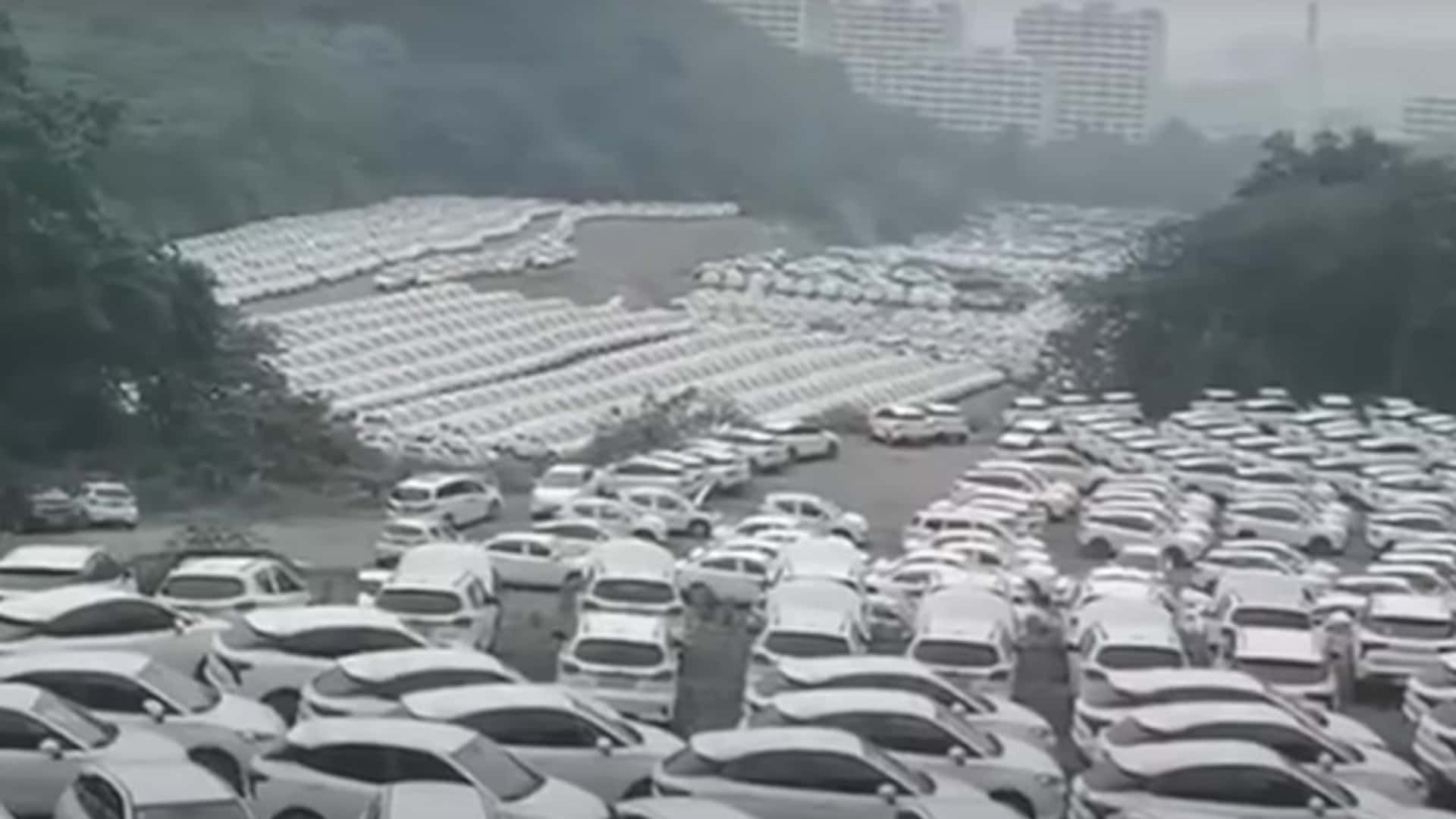
Another political disaster has befallen the western European governments that had rolled over like poodles in front of the climate change alarmists: once they had fully committed themselves to the boondoggle of electric vehicles (EV’s), and forced the powerful automobile industries of Germany, France, and Italy into conversion of gas powered vehicles to EV’s, sales of EV’s plummeted after the customary faddish start, just as much cheaper Chinese EV’s flooded into Europe. Germany and Italy forced the European Union into delaying its ill-considered ban on internal combustion engine vehicles past 2035. Those who jubilantly imagined that Europe would commit industrial suicide by destroying its own automobile industry, will have to revise their plans. There are now thousands of cheap Chinese EV’s parked at the main ports of Europe with no buyers in sight. As Dr. Peiser pointed out in Calgary, “If this was really about climate change, wouldn’t you want the cheapest EV’s, the cheapest wind, and solar, all from China?”

China’s Abandoned EV Graveyard: Thousands Of Cars Rot In Huge Fields

It is now clear in Europe, as it long has been in the private sector of the United States, that with whole industries and millions of jobs at stake, implementation of net zero policies in the West would make China the dominant economic and industrial power of the world. Even our most naïve and insipid global warming crusaders are unenthused by that bone-chilling prospect. Although Germany has finally acted to protect its auto industry, it is not yet doing the same for the public. It is still officially planning to ban weekend driving to meet climate targets. If the federal German government proceeds with such an insane plan, it will sink without a ripple at the next election.

There have even been some murmurings of emulation of this course in Canada; on Sept. 14, 2021, Journal Metro of Quebec proposed pre-emptively moving against a climate crisis by lockdown measures, an emulation of the Covid lockdown then ending, but including rations and limitations on personal travel. This proposal comes from the same sort of thinking that seeks to eliminate meat by a war on bovine flatulence.

Placid and docile toward virtue-posturing though Canadians are,
insane measures like these to mitigate climate change would surely
prove to be the funeral pyre of the coercive climate change terrorists.

For notorious historic reasons, Europe is always vulnerable to the madnesses and outrages of the left. The senior human rights court in Europe ruled three weeks ago in a lawsuit brought by 2000 elderly Swiss women against the Swiss government that it had violated the human rights of the plaintiffs by insufficiently mitigating climate change. Switzerland is a very small country but is responsible for between two and three per cent of global carbon dioxide emissions, while Canada, a huge country with a much larger population, emits only 1.5 per cent of global emissions, compared to 27 percent for China. The European Court of Human Rights crossed the jurisdictional Rubicon by overruling the voters of a democratic country.

The rationale for hurling millions of auto workers into unemployment and
shutting down Europe’s greatest industry in order to profit the Chinese
is a case that even the most ardent climate-zealots will find challenging.

At the same time that the climate fanatics are encountering irresistible political headwinds, the intellectual arguments of the climate skeptics are becoming steadily more unanswerable. A brief filed with the court of appeals in The Hague in November by three eminent, American climate-related academics, Richard Lindzen of MIT, William Happer of Princeton, and Steven Koonin of New York University, the Hoover Institute, and former climate adviser to President Obama, challenged the finding of a lower court and held that scientific analysis, as opposed to an aggregation of “government opinion, consensus, peer review, and cherry-picked or falsified data,” shows that “Fossil fuels and CO2 will not cause dangerous climate change, there will be disastrous consequences for people worldwide if fossil fuels in CO2 emissions are reduced to net zero, including mass starvation.” They assert that the poor, future generations, and the entire West will suffer profoundly from any such policy. which “will undermine human rights and cripple the realization of the first three UN sustainable development goals-no poverty, zero hunger, and good health and well-being.”

The three experts warn against equating “the state of climate science with the reports of the Intergovernmental Panel on Climate Change,” which “have no value as science, because the IPCC is government-controlled and represents only government opinions, not science.” It also denounced the lower court verdict that “dangerous climate change and extreme weather are caused by CO2 emissions from fossil fuels… We demonstrate that these conclusions are contradicted by the scientific method, and only supported by the unscientific methods mentioned. Hundreds of research papers confirm the highly beneficial effects of the increased concentration of atmospheric CO2, especially in dry farming areas.”

They go on to represent the CO2 as essential to food, and thus to life on earth, and that the more there is of CO2, the more food there will be, especially in drought-stricken areas. They also make the case that greenhouse gases prevent us from freezing to death, that there are “enormous social benefits to fossil fuels and that net zero will expand human starvation by eliminating nitrogen fertilizer.”

This highly recondite and meticulously documented paper states that “600 million years of carbon dioxide in temperature data contradict the theory of catastrophic global warming being caused by high levels of CO2, and that the atmospheric CO2 is now heavily saturated, which means that more will have little warming effect.” Up until recently, the zealots pretended that such opinions are held only by the uninformed, or the paid lobbyists of the oil industry, but they are not going to be able to get away with this much longer The ranks of the critics are swelling every week with aggrieved members of the voting public distressed by completely unnecessary skyrocketing costs generated by the fear-mongering climate zealots.

With any luck, the tide of logical evidence will wash away the
climate lunatics of this country before the damage becomes irreparable.

Addendum:  Contents of Brief Filed at the Hague

Shell v. Milieudefensie et al. – Expert Opinion

I. THERE WILL BE DISASTROUS CONSEQUENCES FOR THE POOR, PEOPLE
WORLDWIDE, FUTURE GENERATIONS AND THE WEST IF FOSSIL FUELS AND
CO2 EMISSIONS ARE REDUCED TO “NET ZERO”

A. CO2 is Essential to Our Food, and Thus to Life on Earth
B. More CO2, Including CO2 from Fossil Fuels, Produces More Food.
C. More CO2 Increases Food in Drought-Stricken Areas.
D. Greenhouse Gases Prevent Us from Freezing to Death
E. Enormous Social Benefits of Fossil Fuels
F. “Net Zeroing” Fossil Fuels Will Cause Massive Human Starvation by
Eliminating Nitrogen Fertilizer

II. THE IPCC IS GOVERNMENT CONTROLLED AND THUS ONLY ISSUES
GOVERNMENT OPINIONS, NOT SCIENCE, THUS PROVIDES NO SCIENTIFIC
BASIS FOR THE COURT’S OPINION

III. SCIENCE DEMONSTRATES FOSSIL FUELS AND CO2 WILL NOT CAUSE
DANGEROUS CLIMATE CHANGE AND EXTREME WEATHER

A. Reliable Science is Based on Validating Theoretical Predictions With Observations,
Not Consensus, Peer Review, Government Opinion or Cherry-Picked or Falsified
Data
B. The Models Predicting Catastrophic Warming and Extreme Weather Fail the Key
Scientific Test: They Do Not Work, and Would Never Be Used in Science.
C. 600 Million Years of CO2 and Temperature Data Contradict the Theory That High
Levels of CO2 Will Cause Catastrophic Global Warming.
D. Atmospheric CO2 Is Now “Heavily Saturated,” Which in Physics Means More CO2
Will Have Little Warming Effect.
E. The Theory Extreme Weather is Caused by Fossil Fuels and CO2 is Contradicted by
the Scientific Method and Thus is Scientifically Invalid

Earth Day 2024: Plastics Miracle Saving People and the Planet

Benjamin Zycher celebrates how plastics benefit humans and the environment, in case this earth saver be overlooked by the Greens.  His Real Energy article is Earth Day 2024: How Plastic Can the Enviros Get?
Excerpts in italics with my bolds and added images.

It is Earth Day 2024, an annual exercise in self-applause that always is too much fun because of the inanities, hypocrisies, mendacities, and sheer stupidity of the Earth Day slogans, arguments, propaganda, and exhortations. And also because of the embarrassing spectacle of long queues of corporate officials and public relations gasbags desperate to advertise their environmental bona fides so that the green alligators might eat them last.

The Earth Day slogan for this year is “Planet vs Plastics,” and the list of horror stories is staggering. Plastics “flow through our blood stream, adhere to our internal organs, and carry with [them] heavy metals known to cause cancer and disease.” They “transmit hormone-disrupting chemicals.” They “can starve birds and suffocate sea life.” They “are a dangerous blight.”

One would think that this horror parade would have made life on earth ever more sickly, disease-ridden, and short. And one would be wrong: human life expectancy at birth now is 73.33 years, an increase of over 61% from the life expectancy of 45.51 years in 1950. Has the production of plastics  declined? Of course not: From 2 million metric tons in 1950, production in 2019 was 459.8 million metric tons. Why else would the environmental left find plastics worthy of its annual screaming?

Such as: “More plastic has been produced in the last ten years than in the entire 20th century, and the industry plans to grow explosively for the indefinite future.” “More than 500 billion plastic bags … were produced worldwide last year.” “100 billion plastic beverage containers were sold last year in the United States.”

One would think that such massive output just might lead the Earth Day sloganeers to hypothesize that plastics offer real benefits for ordinary people. Again one would be wrong. And if you think that the wreckage wrought by plastics is limited to such direct effects, think again. According to Earth Day 2024 propaganda — remember the slogan is Planet vs. Plastics — the fashion industry produces over 100 billion garments per year, 85% of which “end up in landfills or incinerators,” people buy 60% more clothing than was the case fifteen years ago, and over two-thirds of clothing is made “from” (that is, with the use of) crude oil, that evil of evils. The clothing industry is characterized by “exploitative working conditions, low wages, and widespread child labor.”

What does this have to do with plastics? The Earth Day 2024 rant about garments — inserted amid the larger rant about plastics — fails to mention plastics at all, a curiosity fully consistent with the disinterest on the part of the environmental left in rigorous thinking.

What is not so curious is the deafening Earth Day sermonizing about the evils of plastics, the importance of wind and solar power, and the worsening climate crisis, even as the scientific literature increasingly challenges the central Earth Day assumptions. Nonetheless, the Earth Day proponents applaud themselves for their devotion to science, that is, Science! So what does actual scientific research tell us about the relative greenhouse gas emissions engendered by plastics and the important alternatives? In brief:

We assess 16 applications where plastics are used across five key sectors: packaging, building and construction, automotive, textiles, and consumer durables. These sectors account for about 90% of the global plastic volume. Our results show that in 15 of the 16 applications a plastic product incurs fewer GHG emissions than their alternatives. In these applications, plastic products release 10% to 90% fewer emissions across the product life cycle. Furthermore, in some applications, such as food packaging, no suitable alternatives to plastics exist.

Maybe ensuing research will yield different conclusions — although the common argument that GHG emissions have created a crisis is supported by no evidence whatever — but the Earth Day cacophony ignores such subtleties, because Earth Day is the central religious holiday of modern left-wing environmentalism. But it reverses the traditional introspection, repentance, self-improvement, service to others, and faith in the moral requirements imposed by a higher authority. Instead, under the religious dogma of modern left-wing environmentalism generally and on Earth Day in particular, it is others who must examine their lifestyles, repent, purify themselves, suffer economically, and answer to the ideological demands of elite superiors. As I have noted many times, Dogbert perceived matters correctly: “You can’t save the Earth unless you’re willing to make other people sacrifice.”

Just as the pagans for millennia attempted to prevent destructive weather by worshiping golden idols, so do modern left-wing environmentalists now attempt to prevent destructive weather by bowing down before recycling bins. And so the Earth Day 2024 environmentalist Book of Genesis now begins as follows: “In the beginning, Earth was the Garden of Eden. But Mankind, having consumed the forbidden fruit of the Tree of Technological Knowledge, has despoiled it. After all, Plastics! And only through Repentance and economic suffering can Mankind return to the loving embrace of Mother Gaia.”

That loving embrace is fundamentally totalitarian. Reject it and Earth Day and all that it represents.

See Also 

Insane War on Plastics Resumes


Canadians Not Warming to Zero Carbon

This report is produced by re.Climate, who are disappointed in Canadians weakening support for Net Zero alarm and expensive emissions initiatives.  More on the findings, but first some facts about the source.

About Re.Climate

Re.Climate is Canada’s go-to centre for training, research and strategy on Climate Change communications and public engagement. We provide strategic services to help practitioners reach new audiences, overcome polarization, communicate urgency, and motivate change.

Re.Climate works closely with experts conducting research in misinformation and climate change communications.

Re.Climate Major Funders with mission slogans

Environment Funders Canada:  A national network of philanthropic foundations and other organizations supporting efforts to transition toward a more sustainable world.

Ivey Foundation: A private charitable foundation dedicated to supporting Canada’s transition to a net-zero future while ensuring the country’s long-term economic competitiveness.

McConnell Foundation:  We are dedicated to tackling the climate crisis and supporting communities coast to coast to coast in transitioning to net-zero carbon.

Donner Canada Foundation:  Supporting Canada’s Transition to a Net-zero Carbon Future While Fostering Economic Prosperity

Clean Economy Fund:  Supporting giant leaps toward net zero.

European Climate Foundation:  Help tackle the climate crisis by fostering the development of a net zero emissions society at the national, European and global level.

The report is a meta-analysis by people dedicated to reduce hydrocarbon energy use in Canada.  So while they claim to be non-partisan, their advocacy is aligned with the Trudeau government.  Public opinion organizations conducted surveys in the last year, and Re.Climate consolidated and interpreted the findings.

Executive Summary

Canadians report high levels of concern about climate change and are connecting the dots between wildfires, extreme weather and global warming. But the affordability crisis has displaced climate action on the list of priorities while concerted opposition has dampened support for key policies.

The world is experiencing record temperatures and we are skirting 1.5 C above pre-industrial levels over a full year for the first time. But climate policies and actions are hindered by narratives framing them as costly, unfair and ineffective.

The competing concerns and undermining narratives are impacting public attitudes. Many Canadians say they do not believe we can meet our energy and climate objectives, even when they agree
that climate change is a serious threat that requires concerted effort. There is a worrying gap between general concern about climate change and the erosion of support for specific climate actions.

Theme:  Mind the Gaps

The report contains communications advice to activists concerning declines in support and shifts away from desired initiatives.  Examples of some of the gaps are excerpted below.

My Comment:

All opinion surveys are testing the effectiveness of media messaging upon public awareness.  This one seems to show that Canadians have been frightened by what they are told, but are not convinced that current and proposed actions will be practical and effective solutions to the claimed problem.

Addendum:  And Then There’s Climate Science Facts

Outside the scope of these surveys: