UK Crippled by Own Climate Policy (Darwall)

In the video Rupert Darwall is interviewed by Lee Hall discussing the plight of UK obsessing over global warming/climate change.  For those preferring to read, below is an excerpted transcript lightly edited from closed captions.  In italics with my bolds and added images. (RD is Rupert Darwall and LH is Lee Hall)

Keynotes

Britain is in a deep in a growth trap and we’ll remain in this growth trap. You know someone says if you’re in a hole stop digging. What we’re doing with Net Zero, we’re just digging harder and harder.


Today environmentalism is against economic growth and the green policies allow the ultra wealthy to feel virtuous. If you’re a multi-billionaire, like say Mike Bloomberg, you love it. Because what can you do to protect yourself from people complaining about your wealth? Well I’m saving the planet he says.


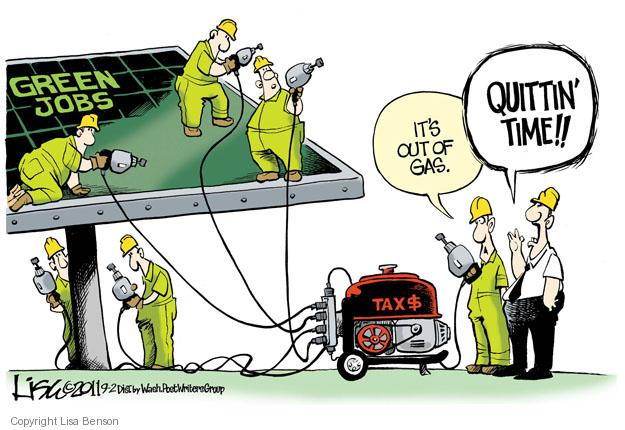
Europe’s green push is bringing economic benefit but not to Europe. German trade unions were promised during at the beginning of the energy transition there would be lots of green jobs and there were . . . in China. That’s where the green jobs went.

Green Policies and Economics

LH:  Let’s talk about green policies and economics and how to really understand it all.

RD: So setting the scene: 2008 was quite a tough year and we had the financial crisis but then we also had the Climate Change Act. And was there a connection between Britain’s economic woes and then the introduction of what was arguably the most extreme green policies in the world.

The British economy was deeply scarred by the financial crisis and its trend growth of productivity has basically flatlined since 2008, and as you point out 2008 is the same year that parliament passed the Climate Change Act. Which as a result saw huge amounts of capital deployed on very low yielding to negative yielding assets in the power generation sector; namely wind and solar.

It’s very difficult to disentangle the long-term effects of the financial crisis and the so-called energy transition. But it is unquestionably the case that mandating very aggressive decarbonization worsens the productive potential of the economy. To give you an idea of how bad is the energy transition for a Net Zero: The International Energy Agency produced a net zero plan, and by 2030 under its Net Zero assumptions, the global energy sector will be employing 25 million more people using 16 and a half trillion more dollars of capital. 16 and a half trillion dollars more Capital using vast land areas of the combined size of Mexico, France, California, New Mexico and Texas to produce 7% less energy.

So the the critical thing to understand about the energy transition
is it means you need more more resources to produce less.

That’s exactly what we’re seeing, what effect the push for Renewables has had on our Energy prices, and thus on our economy and our competitiveness. Well it’s made Britain one of the most expensive places in the world for businesses in terms of of the electricity bills. We’re seeing steel making basically being put out of business in this country. We’re seeing oil refining with the Grangemouth oil refinery being closed. The petrochemical industry is going to have a very hard time to survive.

So a lot of industry is basically going to be wiped out. But then you look at the automotive industry where we have effectively mandates for EV adoption requiring rising proportions of car sales must be EV. If car manufacturers don’t meet those targets, they get taxed and that will basically lead to almost obliterating the British automotive industry, apart from some really very upscale names like Bentley. Essentially you’re looking at the death of the British automotive sector.

LH: Could you give us a a Layman’s introduction to what’s happened with wind power in Britain and what this teaches us about environmentalism?

RD: In 2022 Boris Johnson said offshore wind is the the cheapest form of electricity in the country. It was a line fed to him by Carbon Brief, which is heavily funded by the European Climate Foundation, which in turn is funded by multi-billion philanthropic foundations in the US. It is pure propaganda; there is not any basis for saying that.

Remember that at the time of the energy crisis following Russia’s invasion of Ukraine, then about 40% of the increase of the natural gas price was actually artificial carbon taxes and the price of carbon. So take that that out; these are completely artificial. This cost isn’t about supply and demand of fossil fuels, it is simply government imposed taxes to basically tax natural gas production out of the system.

Then offshore wind is inherently expensive. If you think about it, putting very large wind turbines in the middle of a hostile marine environment like the North Sea you need to have a big question mark over it. This defies common sense. What happened was the wind industry telling the government and the government believing that the cost of offshore wind was about 50 pounds per megawatt hour. In fact analysis of the accounting data for the financial entities shows that the break even price of North Sea power above 100 pounds per megawatt hour.

Basically the wind industry had conned the government into saying wind is cheap. And of course then they’ve now turned around and said actually our costs are a lot higher than you thought. But you’ve got the climate change act which gives a legal Duty on the government to reach Net Zero. So if you don’t give us more subsidy you’ll be defying your legal duty to reach Net Zero, and we just might take you to court to to have the courts decide whether you are.

LH: We heard recently Constraint Payments that there may be a watchdog investigation into wind farms for overcharging on constraint payments, the constraint payments being getting paid to not produce electricity. Can you help us understand the logic behind this? So they get paid to not produce something then they’re overcharging on the nothing?

RD: Yes, the problem is kind of obvious when you see that the more wind capacity you have, when the wind’s blowing the more electricity is produced and that creates two problems. It may be in excess of demand so you have a sharp fall in the wholesale price of electricity. Which incidentally means that gas generators start to be loss making, and it’s very bad for the economics of the power stations that are needed to keep the lights on. It can actually go negative so you pay them to constrain.

The other thing is that the wind turbines are in remote windy locations and they have to be connected to the grid and there’s simply not enough grid connection. So the wind operators are saying well you need to you need more grid infrastructure. Well that’s not free, but they won’t pay for it, they’re expecting consumers to to pick up the tab. And indeed ofgem the energy regulator has a sort of policy, what they call socializing the cost of grid connection, so they’re picked up by customers rather than by the investors.

LH: People that push Green Growth, the green policies, are talking about green growth and green jobs a lot of the time. It seems they they don’t really materialize and we end up paying more to produce less in a less efficient way. I mean is the environmentalism actually an anti-growth strategy?

RD: In Germany for example the German trade unions were promised during at the beginning of the so-called energy transition there’ll be lots of green jobs. And there’s workers in China, that’s where the green jobs are, they’re not in Europe. I mean Europe is not competitive, doesn’t have the low energy cost that China has. To make this kit is very, very energy intensive.
Since the limits to growth debates of the early 1970s in fact limits to growth came out in 1972, greens have argued that economic growth will destroy the planet. And therefore growth is bad. Now they’re turning around and saying well we’re going to have green growth. Well don’t believe it, you should really believe that they are against growth and that their policies are designed have to knock growth on the head. That’s what we’re seeing now.

This kind of degrowth, anti-growth push is very bad news, for people’s living standards, for their aspirations, for their wanting to have a better life for their children; having greater opportunities, more enjoyable ways to to spend money, to spend your life. All that’s true but also growth is needed to fund the state and to fund fund public services. Having had very little growth since 2008, essentially green policies mean endless austerity, it means extremely high tax rates. The tax burden in Britain is the highest it’s been since since I think the late 1940s, since the post war period. So yes it’s very bad both for private consumption but also for public consumption, also public investment.

Britain has a very low level of public investment. Also we have a very low level of private investment So all together in Britain we find ourselves deep in a growth trap. And we’ll remain in this growth trap. You know someone says if you’re in a hole stop digging. What we’re doing with Net Zero is we’re just digging harder and harder.

LH: Marxism policy is to take the means of production away from private ownership whereas what we’re looking at now is to almost destroy the means of production. I often make the point, that in some respects environmentalism is a more radical ideology. Marxism is about changing the ownership of the means of production. This is about changing the means of production themselves.

RD: The early marxists like Karl Marx and Friedrich Engels, actually if you look at the Communist Manifesto, there’s this great Paean of praise to capitalism and the Bourgeois for creating these fantastic means of production that that have unlocked hitherto unknown levels of prosperity. Of course as we just discussed the greens are very much against that. But what where the greens score is although it’s a radical ideology in terms of changing the means of production and degrading the means of production, it is very socially conservative. It doesn’t challenge the existing social hierarchy.

So if you’re a member of the a feudal royal family like King Charles, you like green stuff. It doesn’t say Dethrone him or cut off their heads. If you’re a plutocrat, if you’re a multi-billionaire like say Mike Bloomberg in the US, you love it because again is what you do to protect yourself from people complaining about your wealth. You say well I’m I’m saving the planet. I’m using my money, my business and my philanthropy is about saving the planet.

So on the one hand, economically it’s very radical, but socially it’s all about
maintaining existing social stratifications and of course denying
people lower down the means
to rise up, to better themselves.

LH: So in the original Marxism the rich guy or the top was the bad guy, but now those Rich guys can actually be the good guys in the environmentalism.

RD: The way I put it is that green policies and decarbonization are ethics for the super wealthy. You see Bill Gates when he gets asked in interviews, what about your carbon foot footprint, he’s got so much money he pays an enormous amount to have carbon dioxide sucked out of the air, direct air capture. Well of course you can do that if you’re if you’re one of the richest people on the planet. But of course but for ordinary people when they take their holiday to the Mediterranean if you’re going to expect them to pay hundreds of pounds extra, I mean it’s not going to happen. So yes this is about the super wealthy.

Another example of virtuous contradictions would be to look at say wind farms or solar panel farms. That’s supposed to be good for the environment but they’re destroying the landscape and they’re destroying the habitats and they’re chopping up birds, killing insects and threatening whales.

LH: This environmentalism expects us to suspend our beliefs to some degree yeah this is what you pointed out is a fundamental contradiction deep in the heart of modern environmentalism. It’s like saying, to save the village we had to destroy it.

RD: It is absolutely clear that the environmentalists don’t care about this. Fundamentally it’s about the precautionary principle so you’ve got to be extra specially careful. But not when it comes to wind power; they’re perfectly okay with with wind turbines destroying nature, since they see it as saving the planet.

So for the greater good we need to ruin some of the planet
to save the the greater Planet.

The error is that as soon as you go from the local to the global, you sacrifice the local. And of course the global is an aggregate of the locals but for them it isn’t. This maniacal obsession with carbon dioxide emissions which has led to this tragedy that so much nature is being destroyed in the name of saving nature which it won’t do.

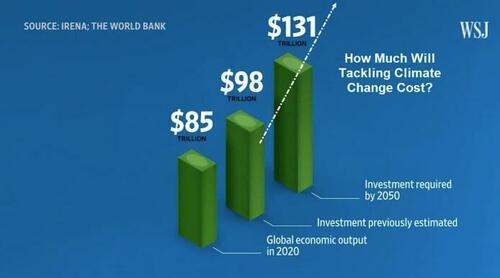
LH: When Rishi Sunak was Chancellor Exchequer he talked about rewiring the global financial system for Net Zero and then redeploying $130 trillion dollar of assets can you help us understand like how that would be possible and and tell us about the role that ESG is playing.

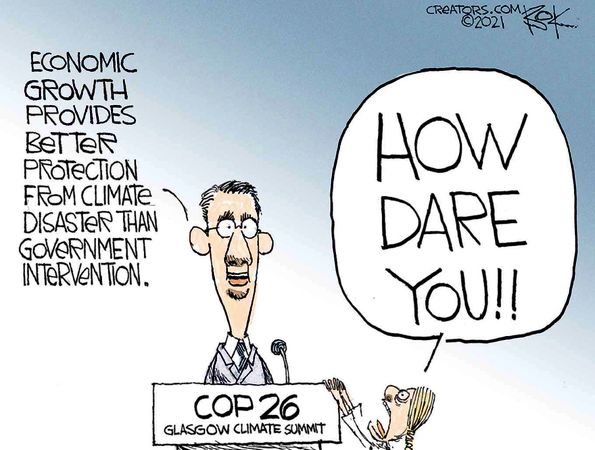
RD: He made that that speech at the Glasgow climate conference, in my opinion the single worst speech ever given by any Chancellor of Exchequer of either party. It was an absolutely appalling speech because essentially he’s saying private savings should be socialized to meet public policy objectives.  ESG is very much a part of the socialization of private savings. ESG is basically politics by other means Instead of government saying we’re going to pass laws and regulations and raise taxes and spend lots of money ourselves doing it. We are going to pass regulations and we’re going to browbeat business to do this for us.

There’s a twofold cost in that. One is to investors whose capital is being basically expropriated, is being used by politicians. And the other is to Consumers who pay higher prices as a result. ESG is a very malign trend in in finance. It’s very interesting to look what’s been happening in the United States where it’s in retreat for for basically two reasons. First of all because the anti-green stocks, if you like, that is the oil and gas sector suddenly in the covid recovery suddenly put on great growth spurt in the stock market. So if you weren’t in oil and gas stocks you lost out.

And secondly there’s been a big reaction in in Republican states against these ESG mandates. However in Britain and Europe ESG continues. The government is effectively telling businesses they have to come up with Net Zero transition plans, so ESG is alive well and doing a lot of damage in Britain and Europe. In the US we saw Texas divest about 8 billion dollars from Black Rock because of their ESG measures.

LH: I mean do you think we we’ll see anything like that here or is that very much an American approach

RD: If you like the strength and vibrancy of capitalism in America there is not a peep of that in the UK or Europe. Britain’s largest asset manager is LGIM, Legal & General Investment Management, and it is completely signed up to the Net Zero ESG agenda. There’s very little sign of a backlash. Local authorities turn to be green they want to they say they want they invest want to invest their pension funds in in some nice ESG ways. You have the university superannuation funds. Universities are all kind of green and woke and so forth. so there there is unfortunately.  You’ve seen that the London Stock Market until just recently, the last few weeks or so, has massively under performed the S&P 500 in the states.

LH: We seeing this contradiction again, but if I invest some money in a big investment firm, I’d expect them to use it to make money instead they’re using it for ideological means.

RD: There was this the ESG sales patter that it was doing well by doing good. They said we’ll use your money to do good and by the way you will make more money doing that than you otherwise would. That was always rubbish, it defied modern Financial portfolio Theory. But they got away with it until about 2022 when oil stocks did extremely well, had a very strong run on on the stock market.
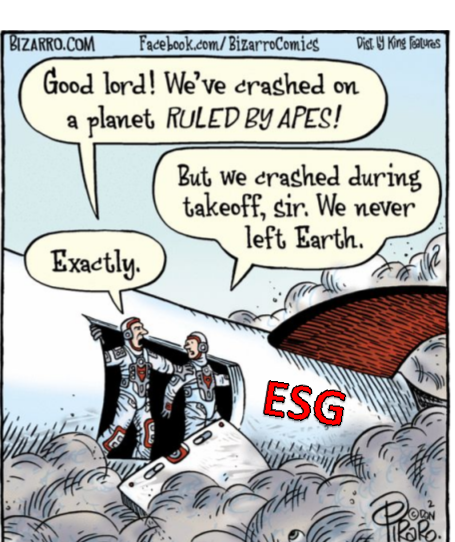
The other thing to point out, ESG used to exclude any defense stocks because armor manufacturers are evil and so forth. Then Putin invades Ukraine and they suddenly wake up saying, well actually we should have defense contractors in there. So it’s completely muddled, an ill-defined concept that is made up as it goes along.

And there’s also why should it be fund managers taking these really important decisions about things like defense and National Security. These are preeminently decisions and policies for politicians not for market traders.

LH: You’ve very much got your finger on Green and economic issues. Are there any things coming up that you think we should keep an eye out for that are going surprises in the coming year?

RD: The big thing will be what happens in the American elections in November. On the one hand you have the Biden Administration which has set itself a net zero policy goal. The EPA is making a rule which will really take coal Off the Grid. It will cut massively the amount of natural gas power they’ve got on the grid. Biden has imposed a moratorium on new permits for export of natural gas.

On the other hand you have Trump who believes in what he calls American Energy dominance, he’s a hydrocarbon politician. He’s actually the only Western leader of the last couple of decades who is what I call an energy realist, who really understands energy. In his first term as president he pulled out of the Paris climate agreement. I think he would do the same again, and if that happens it will raise a huge question mark. What is the sense of persisting with Net Zero if the second largest emitter in the world pulls out of the the Paris agreement?

LH: I think it will it really kill Net Zero to anyone intelligent looking at it. We already had India and China not really buying in, but for America to join them?

RD: There is the conceit of the structure of the Paris agreement in these nationally determined contributions. So what China and India have been doing is they they’re not pledging any Cuts. They say well the carbon intensity of our economy will decline over time, which it will do anyway. One of the interesting facts of Britain is that when Rishi Sunak and British politicians boast about Britain cutting its carbon emissions. Britain’s CO2 emissions peaked in 1972 and you know as economies mature they tend to become less carbon intensive; that’s been the case in Britain.

What has happened since 2008 as we discussed at the beginning, that has been massively accelerated with quite a lot of damaging effect on manufacturing, on Energy prices um on the grid reliability and so forth.

LH: If Trump did get in and and pulled out of the agreement in that way, do you think the UK will follow along or oppose? What do you think will happen here?

RD: I don’t think a Keir Starmer government would follow particularly given Ed Miliband in the position of Energy Secretary, who was Energy Secretary when the 2008 climate Act was passed. He was at the Copenhagen conference in 2009 and played quite an important part there. There is no way they are going to have second thoughts on it.

What will change or what could change is the conservatives in opposition might actually begin to smell the coffee and say actually this is this is a really bad idea this Net Zero costs us votes, it costs people money, and therefore we need to question it. so I think the I think it will change the dynamic of politics in this country particularly if Trump were to repeat what he did between 2016 and 2020.

LH: Will there be an opposition Conservative party think in like five years time we could be seeing an opposition conservative party that’s against a lot of the green policies and quite different from what it is now?

RD: That’s a possibility. The problem is that when when a party goes into opposition quite often as happened in 1997 essentially the conservative party had a collective nervous breakdown and gave up on conservatism. That’s essentially what happened and it went through that long period and it was completely enamored with with Tony Blair and the promise of David Cameron and George Osborne.

Well are we are going to emulate Tony Blair and we’re going to get the conservative party to love the leftward drift of British politics?  Will that happen again? Well Keir Starmer is no Tony Blair is he? But on the other hand the ability of the conservative party to really screw things up should never be underestimated.

There is no charge for content on this site, nor for subscribers to receive email notifications of postings.

Helter Skelter Climate Policies

Ross McKitrick explains the dangers of making climate policies willy-nilly in his Financial Post article Economists’ letter misses the point about the carbon tax revolt.  Excerpts in italics with my bolds and added images.

Yes, the carbon tax works great in a ‘first-best’ world where it’s the
only carbon policy. In the real world, carbon policies are piled high.

An open letter is circulating online among my economist colleagues aiming to promote sound thinking on carbon taxes. It makes some valid points and will probably get waved around in the House of Commons before long. But it’s conspicuously selective in its focus, to the point of ignoring the main problems with Canadian climate policy as a whole.


EV charging sign Electric-vehicle mandates and subsidies are among the mountain of climate policies that have been piled on top of Canada’s carbon tax. PHOTO BY JOSHUA A. BICKEL/THE ASSOCIATED PRESS

There’s a massive pile of boulders blocking the road to efficient policy, including:

    • clean fuel regulations,
    • the oil-and-gas-sector emissions cap,
    • the electricity sector coal phase-out,
    • strict energy efficiency rules for new and existing buildings,
    • new performance mandates for natural gas-fired generation plants,
    • the regulatory blockade against liquified natural gas export facilities,
    • new motor vehicle fuel economy standards,
    • caps on fertilizer use on farms,
    • provincial ethanol production subsidies,
    • electric vehicle mandates and subsidies,
    • provincial renewable electricity mandates,
    • grid-scale battery storage experiments,
    • the Green Infrastructure Fund,
    • carbon capture and underground storage mandates, 
    • subsidies for electric buses and emergency vehicles in Canadian cities,
    • new aviation and rail sector emission limits,
      and many more.

Not one of these occasioned a letter of protest from Canadian economists.

Beside that mountain of boulders there’s a twig labelled “overstated objections to carbon pricing.” At the sight of it, hundreds of economists have rushed forward to sweep it off the road. What a help!

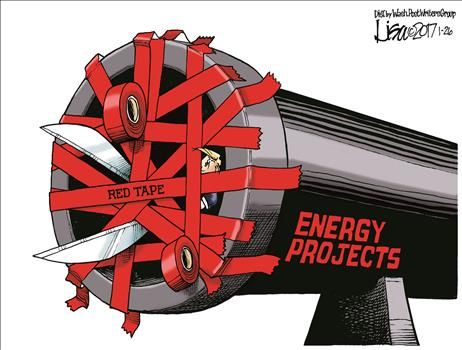
To my well-meaning colleagues I say: the pile of regulatory boulders
long ago made the economic case for carbon pricing irrelevant.

Layering a carbon tax on top of current and planned command-and-control regulations does not yield an efficient outcome, it just raises the overall cost to consumers. Which is why I can’t get excited about and certainly won’t sign the carbon-pricing letter. That’s not where the heavy lifting is needed.

My colleagues object to exaggerated claims about the cost of carbon taxes. Fair enough. But far worse are exaggerated claims about both the benefits of reducing carbon dioxide emissions and the economic opportunities associated with the so-called “energy transition.” Exaggeration about the benefits of emission reduction is traceable to poor-quality academic research, such as continued use of climate models known to have large, persistent warming biases and of the RCP8.5 emissions scenario, long since shown in the academic literature to be grossly exaggerated.

But a lot of it is simply groundless rhetoric. Climate activists, politicians and journalists have spent years blaming Canadians’ fossil fuel use for every bad weather event that comes along and shutting down rational debate with polemical cudgels such as “climate emergency” declarations. Again, none of this occasioned a cautionary letter from economists.

There’s another big issue on which the letter was silent. Suppose we did clear all the regulatory boulders along with the carbon-pricing-costs-too-much twig. How high should the carbon tax be? A few of the letter’s signatories are former students of mine so I expect they remember the formula for an optimal emissions tax in the presence of an existing tax system. If not, they can take their copy of Economic Analysis of Environmental Policy by Prof. McKitrick off the shelf, blow off the thick layer of dust and look it up. Or they can consult any of the half-dozen or so journal articles published since the 1970s that derive it. But I suspect most of the other signatories have never seen the formula and don’t even know it exists.

To be technical for a moment, the optimal carbon tax rate varies inversely with the marginal cost of the overall tax system. The higher the tax burden — and with our heavy reliance on income taxes our burden is high — the costlier it is at the margin to provide any public good, including emissions reductions. Economists call this a “second-best problem”: inefficiencies in one place, like the tax system, cause inefficiencies in other policy areas, yielding in this case a higher optimal level of emissions and a lower optimal carbon tax rate.

Based on reasonable estimates of the social cost of carbon and the marginal costs of our tax system, our carbon price is already high enough. In fact, it may well be too high. I say this as one of the only Canadian economists who has published on all aspects of the question. Believing in mainstream climate science and economics, as I do, does not oblige you to dismiss public complaints that the carbon tax is too costly.

Which raises my final point: the age of mass academic letter-writing has long since passed. Academia has become too politically one-sided. Universities don’t get to spend years filling their ranks with staff drawn from one side of the political spectrum and then expect to be viewed as neutral arbiters of public policy issues. The more signatories there are on a letter like this, the less impact it will have. People nowadays will make up their own minds, thank you very much, and a well-argued essay by an individual willing to stand alone may even carry more weight.

Online conversations today are about rising living costs, stagnant real wages and deindustrialization. Even if carbon pricing isn’t the main cause of all this, climate policy is playing a growing role and people can be excused for lumping it all together. The public would welcome insight from economists about how to deal with these challenges. A mass letter enthusing about carbon taxes doesn’t provide it.

There is no charge for content on this site, nor for subscribers to receive email notifications of postings.
CO2 Coalition Does Climate Reveal in Wyoming

The CO2 Coalition article is CO2 Coalition Takes the Science to Wyoming.  Excerpts in italics with my bolds and added images.

Wyoming has vast resources of coal, oil and natural gas. With 40% of the nation’s coal resources, the state has been the United States’ top producer since 1986, primarily from the Powder River Basin located in the northeastern part of the state. It is also a national leader in the production of oil and natural gas, ranking in the top 10 in production of both products. 

Yet, even though the Wyoming economy is heavily dependent on the mining and extraction of fossil fuels, its governor, Mark Gordon, has adopted a strong “decarbonization” policy. The science tells us that this is not a winning strategy for the people of Wyoming. 

The CO2 Coalition believes that public policy on such matters should be driven by scientific review and analysis, not political agendas. To provide such an analysis, we have produced this report, Wyoming and Climate Change: CO2 Should Be Celebrated, Not Captured

We also sent a team of climate experts from the CO2 Coalition,  including Dr. William Happer, Dr. Byron Soepyan and Gregory Wrightstone to Wyoming to provide the facts concerning the huge benefits of carbon dioxide. This team presented the science at a hearing of the Wyoming Senate Agriculture Committee (pictured above.)

The team also presented accurate science regarding Wyoming’s climate to students at Gillette College, Laramie County Community College, and at the University of Wyoming.

Temperature Data Shows Good News for Wyoming

Data for Wyoming contradict the 4th National Climate Assessment (NCA4) assertion that “the frequency and intensity of extreme high temperature events are virtually certain to increase.”

Our data analysis shows that high daily temperatures peaked during the Dust Bowl years of the 1930s and have been in a 90-year decline. This is confirmed by reviewing the percentage of days that were reported to be hotter than 100°F (37.8°C) by Wyoming temperature stations. There is no discernible increase, and the largest numbers occurred in the first half of the 20th century when CO2 levels were 70% of recent measurements.

There has been, however, a beneficial increase in the minimum nighttime temperatures, which has led to a lengthening of the Wyoming growing season. Since the late 1800s, these nighttime temperatures have increased about 2°F (1.1°C).

The slight increase of about 1.2°F (0.7°C) in the average temperature
in the last 120 years is being driven by reductions in extreme cold
rather than increases in extreme heat.

Full Report:  Wyoming and Climate Change

Conclusion From Full Report 

The recent proposal by Wyoming Governor Mark Gordon to use “carbon capture” to achieve what he terms “negative net zero” (Gordon 2021) is based on a flawed theory that increasing CO2 in the atmosphere is leading to harmful effects on Wyoming’s environment and its people. Within this report, we have documented that modest warming and increasing carbon dioxide are clearly beneficial for the Cowboy State’s ecosystems and citizenry.

The data tell us the following:

• Current levels of carbon dioxide are at near historically low concentrations.
• Adjustments to historic temperature records have artificially amplified modern warming.
• Wyoming temperatures have increased a modest 1.2°F (0.7°C) since 1895.
• Heat waves peaked in the 1930s and have been in slight decline since that period.
• Nightime low temperatures have increased, lengthening growing seasons.
• Precipitation data, while varying greatly from year-to-year, show no increasing or decreasing trend.
• Droughts are not increasing in Wyoming.
• Severe weather and natural disasters are declining.
• Agricultural production, globally and in Wyoming, is thriving due to modest warming and more CO2.
• Vegetation in Wyoming and around the world is increasing.
• Greenhouse-induced warming that would be averted (< 0.003°F) by eliminating Wyoming’s CO2 emissions would be too small to measure and achieved, if at all, at enormous cost.
• Models used to project future temperatures significantly overpredict the amount of warming in coming decades.

CO2 Should Be Celebrated, Not Captured

Four Ways Net Zero Ruins Us

This is a beginning post toward infographics exposing the damaging effects of Climate Policies upon the lives of ordinary people.  And all of the pain is for naught in fighting against global warming/climate change, as shown clearly in the image above.  This post presents graphics to illustrate the first of four themes:

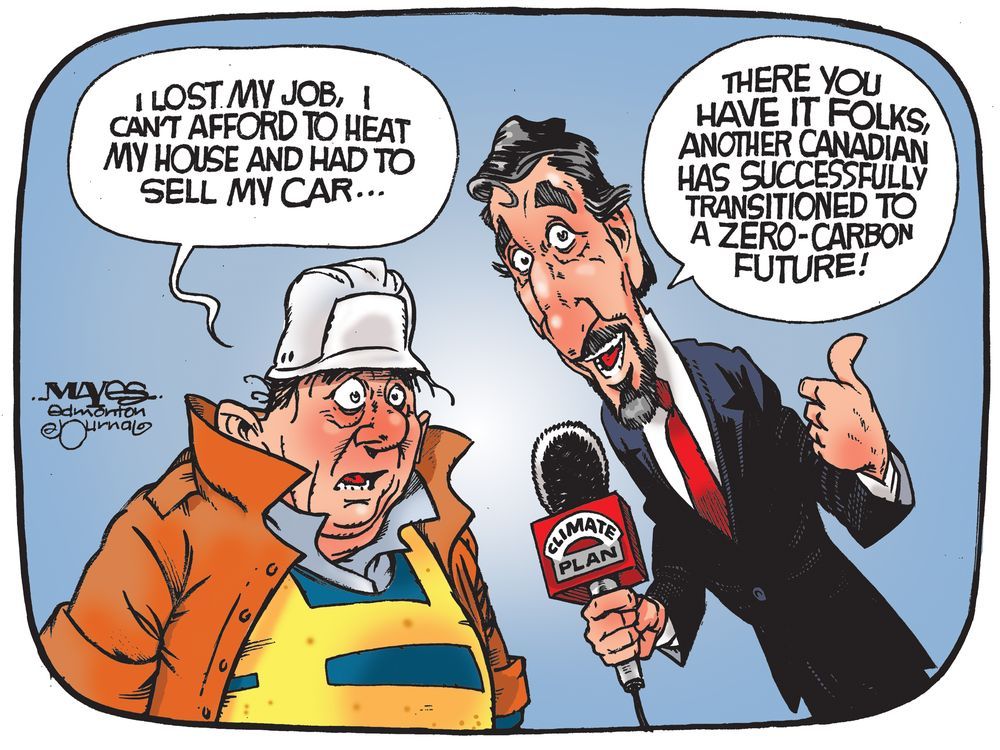
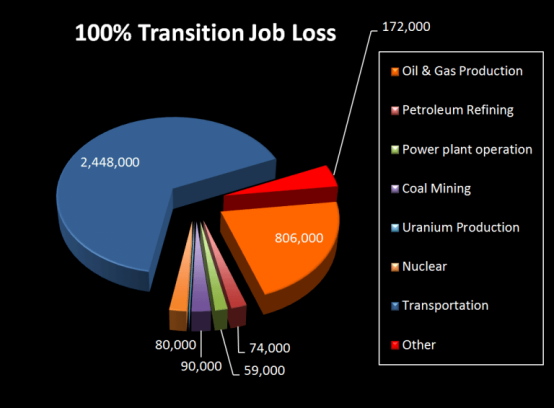
  • Zero Carbon Means Killing Real Jobs with Promises of Green Jobs
  • Reducing Carbon Emissions Means High Cost Energy Imports and Social Degradation
  • 100% Renewable Energy Means Sourcing Rare Metals Off-Planet
  • Leave it in the Ground Means Perpetual Poverty
Part 1:  Zero Carbon will Decimate US Workforce

WHCP fig1r

WHCP fig1ar

WHCP fig2ar

WHCP fig3a

WHCP fig3

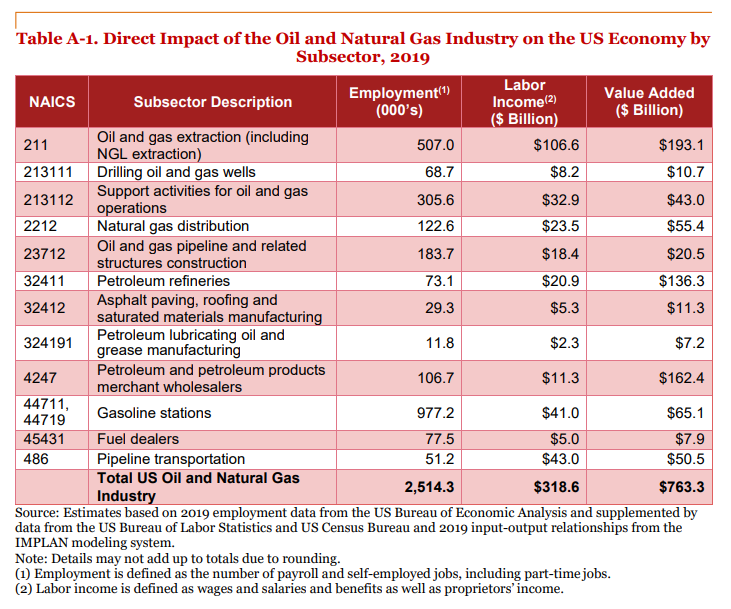
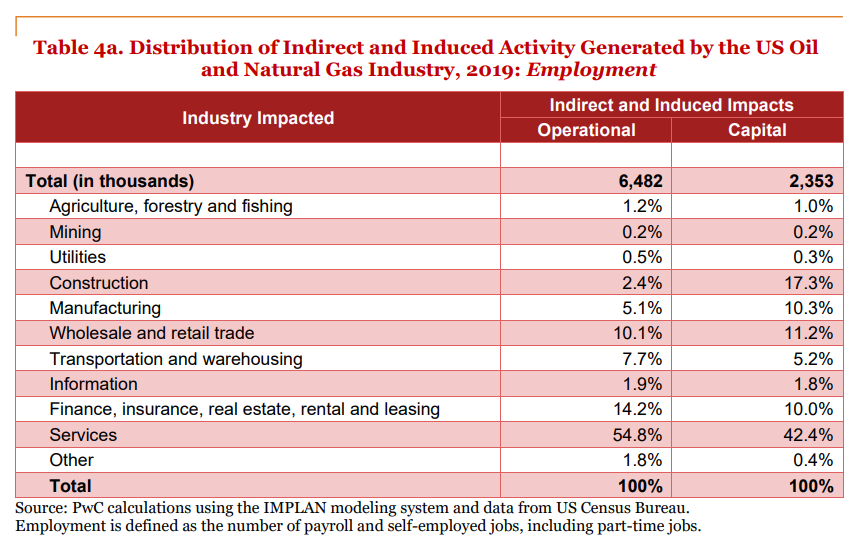
Tables of Oil and Natural Gas Employment and Economic Impact come from API Price Waterhouse Cooper  Impacts of the Oil and Natural Gas Industry on the US Economy in 2019    As for Coal, EIA estimates the industry lost 75% of its workforce down to 53,000 employees (2019) working in coal mines, and the number has stabilized with exports offsetting declines in domestic consumption.  The losses of jobs in oil and gas come from EID (Energy in Depth) CLIMATE ACTIVISTS PUSH STUDY SHOWING 3.8 MILLION LOST JOBS FROM RENEWABLE ENERGY TRANSITION.

“While many experts dispute the feasibility of Jacobson’s plan for a renewables-only energy grid, the severe job losses are far more difficult to dispute, given that they come directly from Jacobson’s research. Those job losses would undoubtedly be devastating for millions of American families.”

cb020621dapc20210206014624

And about Those Promised Green Jobs to replace the lost ones:  

In February 2009, the last time Democrats controlled the White House and both chambers of Congress, President Barack Obama and Vice President Joe Biden flew to Colorado to sign their $787 billion stimulus package into law.

The plan was to invest $150 billion over 10 years that would advance a “clean energy” economy built around biofuels, hybrid cars, low-emission coal plants, and renewable sources such as solar and wind. Obama and Biden promised to create five million green jobs that would specifically benefit low-income earners, claiming that the stimulus package included “help for those hit hardest by our economic crisis.”

mrz041312dapr20120413044622

A decade later, we now know that the 2009 green jobs program was a complete failure. The Department of Labor (DoL) and the Bureau of Labor Statistics (BLS) issued several reports on the green jobs program. Each report was an indictment on the program, as job placement met only 10 percent of the targeted level, and many of those who were hired remained employed for less than six months.

Even the new, redefined green jobs did not reach the five million promised in February 2009. According to a study by the Brookings Institution, the Obama–Biden administration identified nearly 2.7 million green jobs, but most were bus drivers, sewage workers, and other types of work that do not match the “green jobs of the future” that the administration promised. Most of them were preexisting jobs, which were simply re-characterized by the government, apparently in an effort to boost the numbers.  Source: If at First You Don’t Succeed, Try ‘Green Jobs’ Again

See also Green Energy Failures Redux

Parts Two, Three and Four

World of Hurt from Climate Policies-Part 2

World of Hurt from Climate Policies-Part 3

World of Hurt from Climate Policies-Part 4


What Big Climate Wants to Censor

(Photo by Craig Barritt/Getty Images for Oceana)

Nick Pope writes at Daily Caller Foreign Billionaire-Backed Climate Org Pressuring Broadcasters To Censor Ads Critical Of Biden’s EV Mandate.  Excerpts in italics with my bolds and added images.

A green nonprofit that is indirectly funded by a foreign billionaire is pressuring broadcasters to drop advertisements that criticize the Biden administration’s massive electric vehicle (EV) agenda.

Climate Power wrote to numerous broadcasters this week demanding that they stop airing American Fuel and Petrochemicals Manufacturers (AFPM)-funded advertisements in swing state markets that rail against President Joe Biden’s plans to impose widespread EV adoption in the coming years. The charitable organization affiliated with Hansjorg Wyss, a Swiss health care mogul and billionaire philanthropist, donates millions of dollars to the Fund for a Better Future, which was the fiscal sponsor for Climate Power until 2023, a spokesperson for Climate Power previously told the Daily Caller News Foundation.

AFPM launched its seven-figure ad campaign designed to highlight and criticize the administration’s EV policies on Tuesday. The ads, which describe Biden’s policies as an EV mandate, are airing in Pennsylvania, Wisconsin, Michigan, Nevada, Arizona, Ohio, Montana and Washington, D.C.

Climate Power’s warning letter to local affiliates states that the broadcasters “must remove these ads from the air immediately” because “there is no pending federal ‘car ban,’ and to claim otherwise is patently false and intentionally misleading.” The letter suggests that AFPM’s ads could be in violation of Federal Communications Commission (FCC) rules, and instructs the broadcasters to contact Climate Power — an Internal Revenue Service-recognized 501(c)4 that is spending more than $80 million to tout Biden’s climate policies ahead of the 2024 presidential election — to confirm that the ads are no longer running on their stations.

What Big Climate Wants to Hide

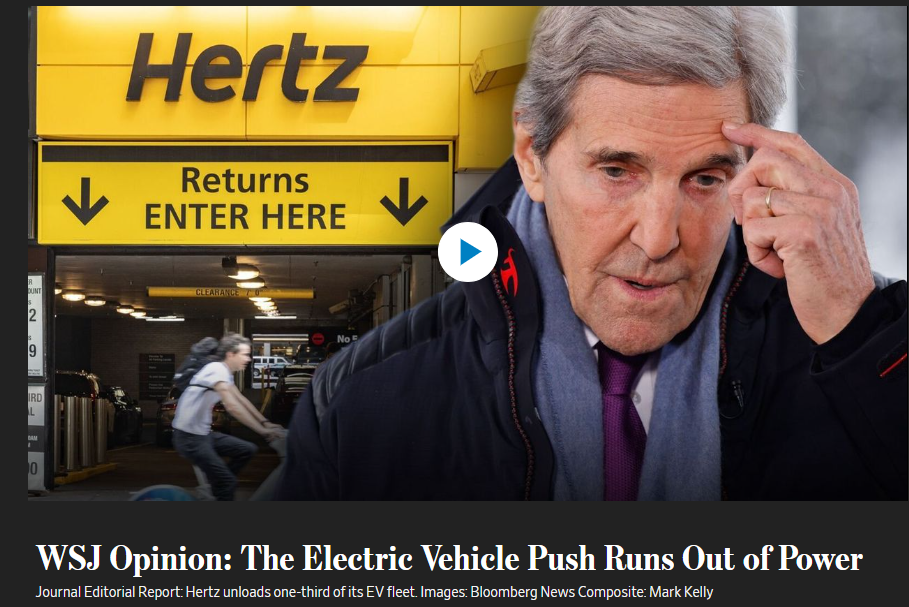
A recent Wall Street Journal video says it out loud: EVs are not practical for most people.  The short video can be seen here.  A transcript is below for those who prefer to read.

Hertz announced last week that it is selling one third of its EV fleet, about 20.000 vehicles, and will replace them with gas powered cars, citing weaker demand for electrics and their higher operating and repair costs. The car rental giant had previously vowed to convert 25% of its fleet to electric by the end of 2024. In an interview in Davos this week, President Biden’s soon to be former climate envoy,

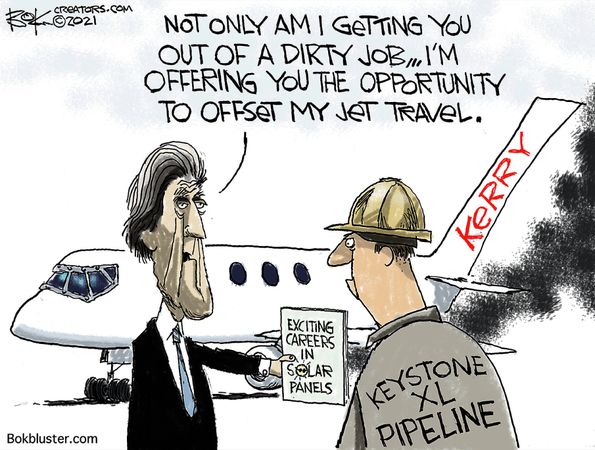
John Kerry, blamed recent setbacks in the industry on electric car critics,
accusing them of engaging in “high levels of disinformation.”

Kerry also told the panel at the World Economic Forum that the green energy transition will continue no matter who wins the 2024 presidential race. “You think those CEOs are gonna say, Oh My God, they just elected a new president. Let’s go back and build internal combustion engine cars. Not on your life. This economic revolution is underway and it’s much bigger than any politician, any one person.”

We’re back with Dan Henniger, Kim Strassel, and Wall Street Journal columnist, Allysia Finley. So Allysia, also this week Ford announced that it is cutting back on production of its Lightning 150 electric trucks. So this is a pretty broad cutback in production.

Well, the biggest reason is there’s flagging demand. So there were a lot of, “early adopters. It was people who lived in California and big cities who bought EVs. Especially Teslas which make up about 60% of sales. And so there was a big rush of automakers, and partly propelled by the government mandates, both California’s Air Resources Board and the Biden administration’s coming mandate, which ratchets up to two thirds of all sales to be EVs by 2032.

And so they all rushed in, they started mass producing EVs. And all of a sudden they’re realizing demand’s actually softening for the mainstream public because they’re actually not ready.

And suffering difficulties. And what we saw in Chicago with the lines of people and the cold weather.  It’s cold weather and EVs don’t really work in the north very well. It’s repair costs. So it’s not easy to go long distances. It’s charging station availability, and people want sometimes to go long distances. Are those the reasons consumers are resisting?

I mean the costs are still about $20,000 higher on average, and the have to factor repair costs, yes. But also insurance costs, which are about 20% higher. In part because they’re more expensive, but also because the replacement parts are more expensive. And so they’re just not really practical for most people. This isn’t to say that someday then they’ll be much more practical and popular.

Maybe, but it doesn’t make sense to be mandating and subsidizing them at this juncture. Dan, what do you make of John Kerry’s line that this reluctance is just all disinformation by critics?

When Kerry said that, I thought he might take a side trip from Davos, Switzerland, to Germany to see what’s happening with EVs there. In December EV sales in Germany dropped by 50%. The auto industry there is really on the brink of collapse because people are simply not buying electric vehicles. And as Allysia was just describing, it that happens here, and it could, people simply say, “I’m not gonna put up , Ford and GM are really gonna get strung out and hit hard by the refusal of people.

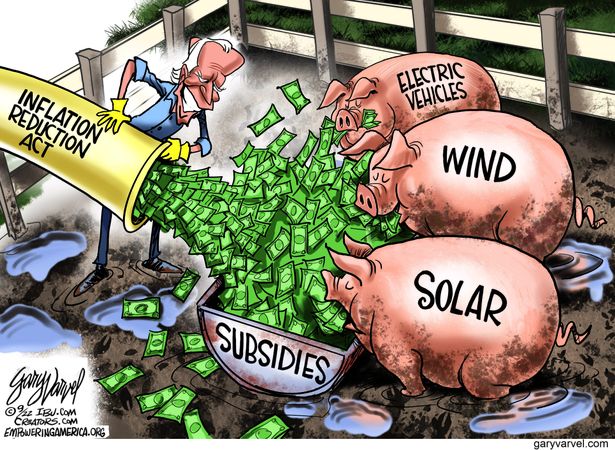
Allysia, the one thing Kerry has going for his prediction is EVs which are being mandated by the government is that the flow of money from the Inflation Reduction Act will be so great, how much money they’re throwing at charging stations and subsidies for consumers and subsidies for production. It’s astonishing, even subsidies for batteries. Will that ultimately push EVs over the top?

Well, that is the risk in my mind, that consumers at the moment don’t want them. But the plan on the left is always that you get something in motion, you make the industry change its standards and retool and regear itself toward this goal. You put money out there as incentive for them to keep doing it and for buyers to get them. And then you can’t reverse it.

And you hope that it trundles along of its own accord. Which is why there’s growing attention in Washington, especially among Republicans, that if they’re going to try to claw back money, it ought to be more out of this area. Because if they really do care about issues like consumer choice, giving people the ability to drive what they want to drive, you’ve got to remove this government distortion that is creating this supposed economic revolution.

It’s not an economic revolution, it’s a government imposed transition.

Allysia, you wrote an interesting column about how CEOs not too long ago were cheering on this and all thinking alike about the great EV future. One of those was the Hertz CEO, another one, the Ford CEO. Are they really having second thoughts?

Well, it’s funny now in recent months, they’ve all been coming out saying, “Oh well, we need to cut production”, and “This is just not sustainable.” Across the industry, they’re definitely having second thoughts, and some of their statements are more public than others. And they’re pleading to the administration. Again this is representative of the auto industry, not the individual automakers, but they’ve sent a letter saying, please, we cannot do this. These aggressive goals are not achievable and auto workers would lose their jobs.

Climatists Mistake Means for Ends

Roy Gilbert exposes the fundamental mistaken thinking regarded global warming/climate change.  His Spectator Australia article is Conceptual Error in Climate Change Analysis.  H/T John Ray  Excerpts in italics with my bolds and added images.

It is often said that the ‘science is in on climate change’. Is it? We should always adhere to the principle of the ‘working hypothesis’ and have an open mind on scientific questions no matter how well-recognised the researchers are. In the study of science, there is always the chance new information can come along to cause a rethink.

A common error in problem-solving and policy development is to confuse
a technical strategy for a desired client outcome.

Our Climate Change Minister could be accused of this. Reducing emissions is a ‘strategy’, not the fundamental desired client outcome. With the mission ‘to reduce carbon emissions’ by increasing renewable energy, the way to assess performance is to concentrate on measuring emission reduction, and then to follow this up with how quickly the renewables are built and their cost (wind farms, solar panels, transmission lines).

Instead of the current strategy-driven mission, a fundamental client outcome statement would be:To protect against, and where possible, prevent damage from extreme off-trend fluctuations in climate.’ How would you go about managing your program using this mission statement?

First, you gather accurate temperature, rainfall, and weather measurements. They are the valid and fundamental ‘outcome’ measures – not data on CO2 emissions. If there is an undeniable and dangerous increase in temperature and rainfall, more cyclones, and a clear and unabated rise in sea level, then the possible cause must be thoroughly identified. Depending on the answer, you would adopt appropriate mitigation strategies, or strategies that adapt to weather patterns and temperature levels.

Another principle of problem-solving is to map out the total picture and not be driven by ideology. The Climate Change Minister should consider possible causes other than human-induced emissions. It was announced in April 2023 that coronal cones 20 times larger than Earth have been discovered and may cause a massive outburst of energy from the sun. What could be the implications for our planet? Ask solar physicists.

Chief scientist in applied helio-physics at John Hopkins, Ian Cohen, has suggested that solar storms could take out satellites, cut power and shut down the internet. In 1972 a solar storm caused 4,000 magnetically sensitive mines in water off Vietnam to detonate. Earth is said to be entering a period of peak activity as part of an eleven-year cycle. It is suggested this potentially could be more violent than the solar cycles of the past three decades. Now that would be something for climate scientists to really worry about…

With respect to the world’s temperature, there are several sources that claim to present the precise figure. One says the 2023 average global temperature was 1.45c above the 1950-90 average. Another says since 1880, Earth’s temperature has increased by 0.08c. Another says during the last 50 years the increase is 0.13c. To the unscientific mind, these temperatures do not appear to be verging on catastrophic boiling us all to death.

As of 2024, data on natural changes in temperature, rainfall, and sea level
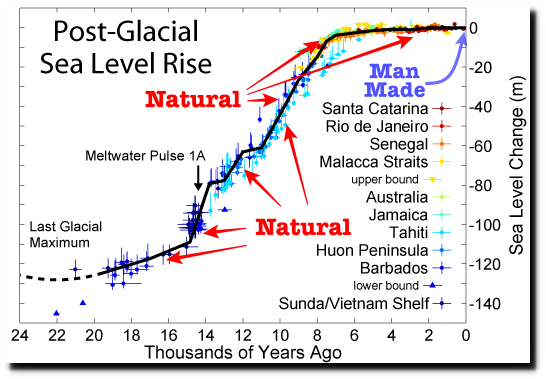
do not show any statistically significant difference to historical records.

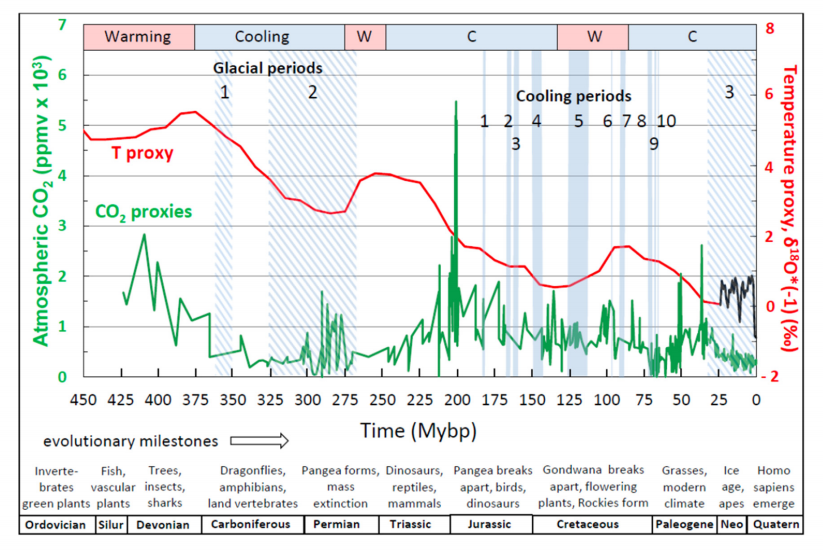
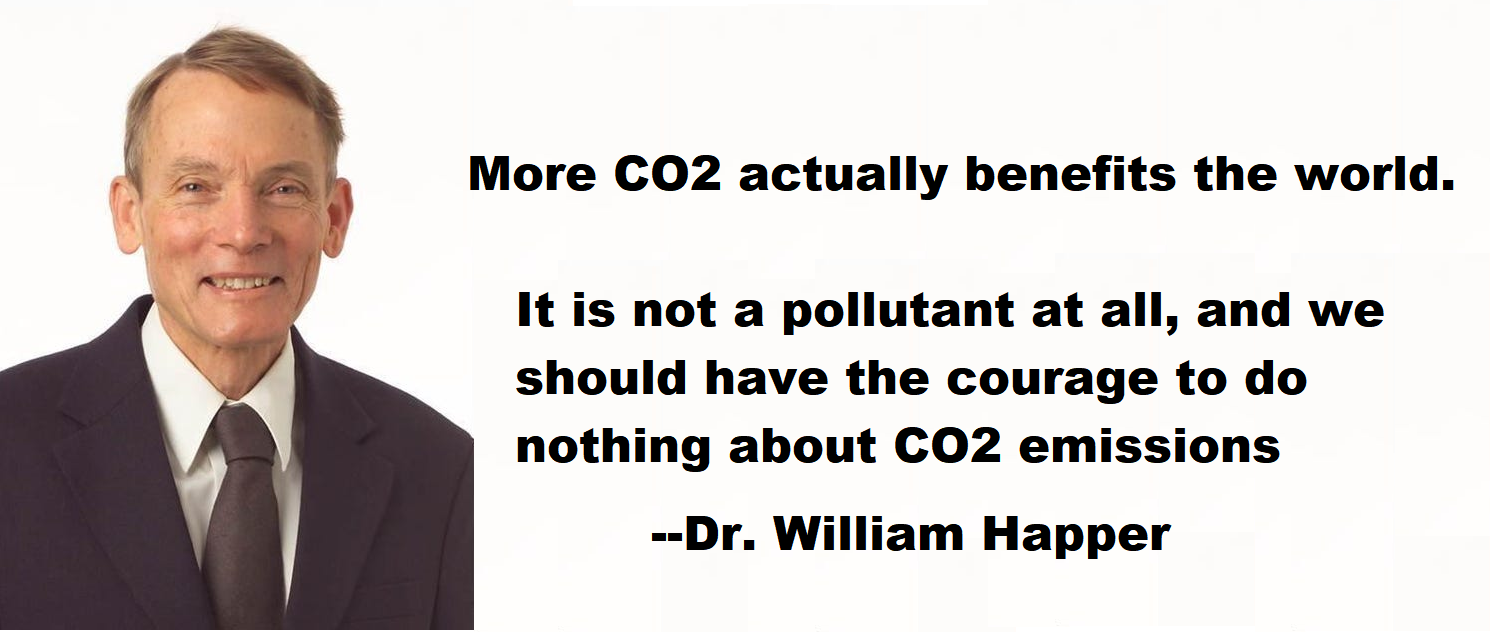
There are respected scientists who question the current climate orthodoxy. Physicist Prof. William Happer of Princeton University and Prof. Richard Lindzen, Earth, Atmospheric and Planetary Sciences at MIT have argued science demonstrates there is no climate-related risk caused by fossil fuels and CO2, and that 600 million years of CO2 and temperature data contradicts the theory that high levels of CO2 will cause catastrophic global warming. They state reliable scientific theories come from validating theoretical predictions with observations, not consensus, peer review, government opinion, or manipulated data.

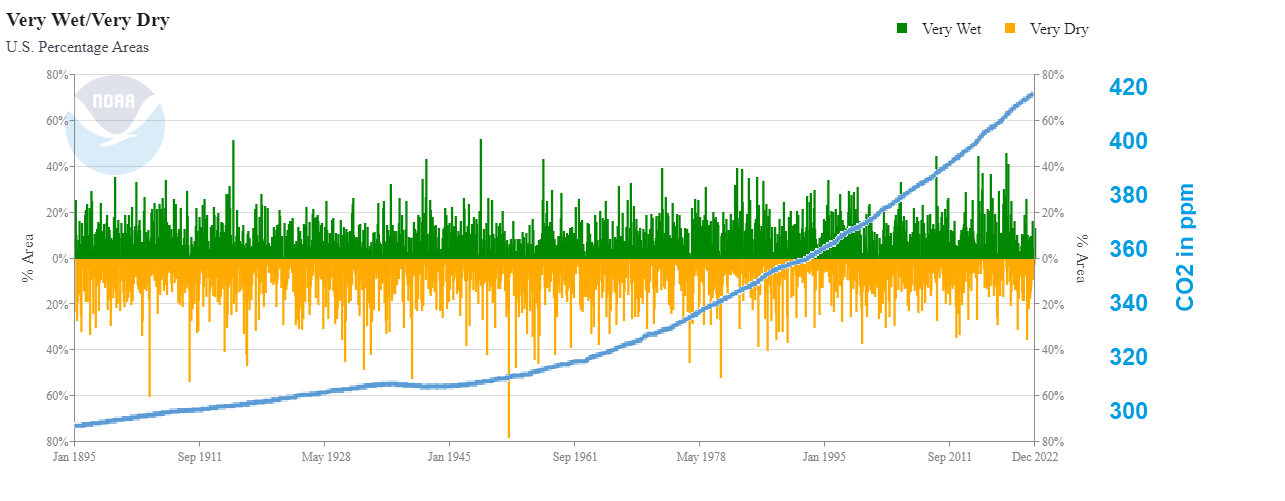
In July 2023, the International Monetary Fund cancelled a planned talk on climate change by 2022 Nobel physicist John Clauser when they learned he had stated publicly: ‘I can confidently say there is no real climate crisis, and that climate change does not cause extreme weather events. The IPCC is one of the worst sources of dangerous disinformation.’  Clauser pointed out that the US Environmental Protection Authority has charts that show a heatwave Index going back to 1895, showing heatwaves were more common before the 1960s and especially in the 1930s.

In addition to these physicists, there are eminent Australian geologists who challenge the CO2 cause theory. Emeritus Prof. Ian Pilmer of the University of Melbourne, and Prof. Michael Asten of Monash University, have argued that throughout the history of the planet, there have been long periods of major change in climate due to natural forces. This would indicate recent human-based emissions may not be the important factor that we have been led to believe.

With respect to measuring emissions (nitrous oxide and methane), there is an expectation that the Intergovernmental Panel on Climate Change would have collected accurate data. Then one reads an independent 2023 report of these greenhouse gas emissions from farm dams in Australia’s irrigation regions, that the measurements had been massively over-estimated by the IPCC by 4 to 5 per cent.

To add further confusion to the issue, a 2023 research paper submitted to the European Physical Journal Plus claimed climate science has become ‘highly politicised’. Italian scientists analysed long-term data on heat, droughts, floods, hurricanes, tornadoes, and ecosystem productivity, and found no clear trend of extreme events. The statements by these scientists would appear worthy of examination. Unfortunately, comments to the publisher by other climate scientists caused the withdrawal of the article.

If activists are correct, and if temperatures and rainfall start to show a significant increase without any influence from natural factors such as the sun or outer atmospheric disturbances, the second ‘outcome’ mission opens your mind to several strategies that could be compared against each other on cost and effectiveness – renewables, outer space satellites capturing solar energy and transmitting to Earth, small nuclear, carbon capture, examine possibility of amalgamating carbon and turning it into a useful product, lower emission coal-fired power stations, hydro, hydrogen fuel cells, a scientific search for a predator for carbon other than trees (or the planting of more trees), and so on.

A valid client ‘outcome’ statement encourages you not to jump to a conclusion
in the initial stages of critical thinking about the cause of any global warming.

If you make a mistake at that point, there are significant productivity implications. Governments could waste a significant amount of money (a catastrophic amount) on a less than optimum strategy. Rather than relying almost entirely on climate scientists who concentrate on carbon emissions, a politician with a mind focused on validity could bring together an inter-disciplinary team – climate scientists, nuclear physicists, solar physicists, atmospheric physicists, examine the moon’s behaviour, plant technologists, oceanographers, geologists, volcanologists, botanists, bushfire specialists and so on. Has any national government followed this approach? Has any Minister for Energy, in any country, expanded their vision beyond their own narrow ideology is a potential danger to their country…?

There are very obvious reasons why some politicians and many rich investors in renewable energy would oppose a serious questioning of the renewable strategy and switching to nuclear instead. If small nuclear was introduced – as is being done in many countries – it would make current renewable energy strategies redundant. That would mean all the billions of dollars spent on wind and solar would have been a waste of money. We wouldn’t need them. Admitting that would be far too embarrassing for any ideological politician and far too financially damaging to any rich wind farm investor obtaining government grants.

If the Sun is found to be the fundamental cause of the problem (variations in energy output, massive infrequent solar flares, and/or variations in distance between Earth and Sun), or if there is a slight tilting of the Earth on its axis, or the Moon changes position, or even disturbance further out in our solar system, you would evaluate adaptation strategies.

It seemed reasonable for some people to assume the vast flooding in 2022 could be attributed to human-induced climate change. There is however, a different possibility … nature. Environment analyst Graham Lloyd explained.

‘The meteorological processes at play are well understood. Three consecutive La Nina weather patterns have left the eastern seaboard soaked and prone to flooding. Triple La Ninas have happened four times in the Bureau of Meteorology’s 120-year record … The Southern Annular Mode is a climate driver that can influence rainfall and temperature. Although wet, the latest BoM figures show that 2022 was the ninth wettest year on record (not the wettest).’

fWhen the above material, stressing the need to examine the total picture in any critical thinking, was shown to a high school Principal, to a high school science teacher and to an environmental engineer, they were all surprised and quite critical that one would want to show this to students. Annoyed actually. One was emphatic…

‘Why waste the students’ time having them look at irrelevant issues?
We KNOW what the problem is. It is CO2 emissions.
And we KNOW what the solution is. It is 100 per cent renewables.’

My answer to them was:

‘The difference between you and me, is that you want to tell the students WHAT to think. I want to teach them HOW to think. I want them to understand insightful thinking. Not to be indoctrinated’.  You can be the judge as to who is on the right track.

See Also

Answers Before Climate Action


Green Electrical Shocks in 2024

These days electrical grid managers are shocked and sounding alarms, not about climate itself, but about dangerous energy policies by ignorant politicians rendering the grid unstable and supply unpredictable.  For example today’s Just The News article Analysts: ‘Irrational’ policies drive coal plant shutdowns, incentivize overbuilding wind farms.  Excerpts in italics with my bolds

The South Dakota Public Utilities Commission told the utility that the “premature closure of these [coal] plants adds to the uncertainty of electrical generation resource adequacy in the upper Midwest.” Some energy experts call the government’s policies “irrational.”

Despite ongoing warnings that the electricity grid of the United States is becoming increasingly unstable, a major utility is moving forward with the elimination of two major coal-fired power plants in the upper Midwest. Energy analysts say the instability is a byproduct of the shutdown of reliable generation sources.

In its latest assessment, the North American Electric Reliability Corporation, a grid watchdog, warned that the MISO region is under some of the highest risks for resource inadequacy, which means that during peak demand periods, rolling blackouts are a possibility. Xcel Energy, according to the Energy News Network, is even looking at variable rates to encourage customers to conserve energy and use it during off-peak periods.

Michigan, Minnesota, Illinois and Nebraska have all set goals to decarbonize their grid by 2040 or 2050, which will mean eliminating coal-fired power plants entirely. These goals are on top of federal green energy mandates.

The Public is Blissfully Unaware–That Needs to Change

Some years ago, a weekly news program aired in the Netherlands on the subject Green Electrical Shocks. It employed images and humor to reveal electrical realities to an audience burdened with misconceptions.  The video clip is below with English subtitles. For those who prefer reading, I provide the substantial excerpts from the program with my bolds.

How many of you have Green Electricity? I will estimate 69%
And how much nationally? Oh, 69%!
So we are very average, and in a good way, because the climate is very important.

Let me ask: Green electricity comes from . . .?
Yes, electricity produced from windmills and solar panels.
Nearly 2/3 of the Dutch are using it. That’s the image.

Well I have green news and bad news.
The green news: Well done!
The bad news: It is all one big lie.
Time for the Green Electrical Shocks.

Shock #1: The green electricity from your socket is not green.
When I switched to green electricity I was very proud.
I thought, Yes, well done! The climate is getting warmer, but not any more thanks to me.

Well, that turned out to be untrue.
All producers deliver to one communal grid. Green and grey electricity all mix.
The electricity you use is always a mix of various sources.
OK. It actually makes sense not to have separate green and grey cables for every house.
So it means that of all electricity, 69% is produced in a sustainable way. But then:


Shock #2: Green Electricity is mostly fake.
Most of the green electricity we think we use comes from abroad.
You may think: So what. Green is green.

But that electricity doesn’t come from abroad, it stays abroad.
If you have green electricity at home, it may mean nothing more than that your supplier has bought “green electricity certificates”.

In Europe green electricity gets an official certificate,
Instead of selling on the electricity, they sell on those certificates.
Norway, with its hydro power, has a surplus of certificates.
Dutch suppliers buy them on a massive scale, while the electricity stays in Norway.

The idea was: if countries can sell those certificates, they can make money by producing more green electricity.
But the Norwegians don’t produce more green electricity.
But they do sell certificates.

The Dutch suppliers wave with those certificates, and say Look! Our grey electricity is green.
Only one country has produced green electricity: Norway.
But two countries take the credit.
Norway, because they produce green electricity, and the Netherlands because, on paper, we have green electricity. Get it? That’s a nice deal.

More and more countries sell those certificates. Italy is now the top supplier.
We buy fake green electricity from Italy, like some kind of Karma ham.

Now, let’s look again at the green electricity we all think we use.
So the real picture isn’t 69%. If you cancel the certificates, only 21% of electricity is really green.
Nowadays you can even order it separately if you don’t want to be part of that Norway certificates scam.
You may think: 21% green is still quite a lot. But it is time for:

Shock #3: Not all energy is electricity.
If you talk about the climate, you shouldn’t just consider electricity but all energy.
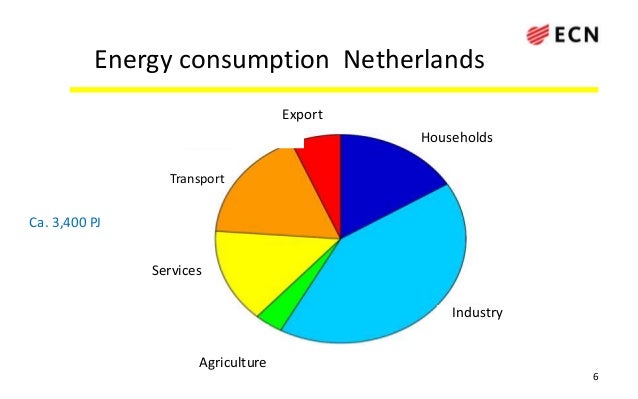
When you look at all energy, like factories, cars, trains, gas fires, then the share of consumer electricity is virtually nothing.
If you include everything in your calculation, it turns out that only 6% of all the energy we use in the Netherlands is green. It is a comedy, but wait:

Trees converted into pellets by means of petroleum powered machinery.

Shock #4: Most green energy doesn’t come from sun or wind, like you might think.
Even the 6%, our last green hope, is fake. According to the CBS we are using more sun and wind energy, but most of the green energy is produced by the burning of biomass.
Ah, more than half of the 6% green energy is biomass.

Ridiculous. What is biomass really? It is organic materials that we encounter every day.
Like the content of a compost heap. How about maize leaves or hay?
The idea behind burning organic materials is that it will grow up again.
So CO2 is released when you burn it, but it will be absorbed again by new trees.

However, there is one problem. The forest grows very slowly and our power plants burn very fast.
This is the fatal flaw in the thinking about biomass. Power plants burn trees too fast, so my solution: slow fire. Disadvantage: it doesn’t exist. So this is our next shock.

Shock#5: Biomass isn’t all that sustainable.
It’s getting worse. There aren’t enough trees in the Netherlands for biomass.
We can’t do it on our own. We don’t have enough wood, so we get it from America.

In the USA forests are cut at a high rate, Trees are shredded and compressed into pellets.
These are shipped to the Netherlands and end up in the ovens of the coal plants.
It’s a disaster for the American forests, according to environmental groups.

So we transport American forests on diesel ships to Europe.
Then throw them in the oven because it officially counts as green energy.
Only because the CO2 released this way doesn’t count for our total emissions.

In reality biomass emits more CO2 than natural gas and coal.
These are laws of nature, no matter what European laws say.
At the bottom line, how much sustainable energy do we really have in the Netherlands?
Well, the only real green energy from windmills, solar panels etc. Is only 2.2%. of all the energy we use.

In Conclusion
So the fact that 2/3 of the audience and of all Dutch people use green electricity means absolutely nothing. It’s only 2.2%, and crazier still, the government says it should be at 14% by 2020.
They promised: to us, to Europe, to planet Earth: 14 instead of 2.2.

Instead of making a serious attempt to save the climate, they are only working on accounting tricks, like buying pieces of paper in Norway and burning American forests.
They are only saving the climate on paper.

Summary Comment

As the stool above shows, the climate change package sits on three premises. The first is the science bit, consisting of an unproven claim that observed warming is caused by humans burning fossil fuels. The second part rests on impact studies from billions of research dollars spent uncovering any and all possible negatives from warming. And the third leg is climate policies showing how governments can “fight climate change.”

It is refreshing to see more and more articles by people reasoning about climate change/global warming and expressing rational positions. Increasingly, analysts are unbundling the package and questioning not only the science, but also pointing out positives from CO2 and warming.  And as the Dutch telecast shows, ineffective government policies are also fair game.

More on flawed climate policies at Reasoning About Climate

McKitrick: COP28 Worse Threat Than You Think

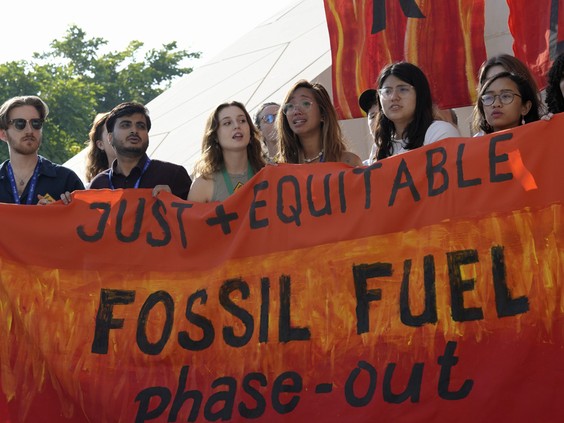
A demonstration against fossil fuels at the COP28 United Nations climate summit in Dubai, United Arab Emirates. PHOTO BY PETER DEJONG/AP

Ross McKitrick writes at Financial Post: The only thing wrong with the globalist climate agenda — the people won’t have it  Excerpts in italics with my bolds and added images.

Phasing out fossil fuels is going to cost way more than ordinary people
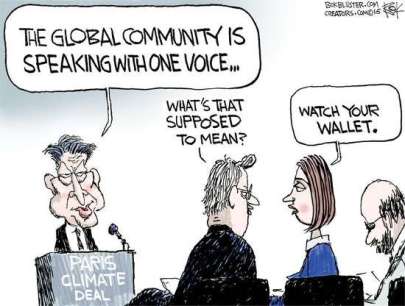
will accept.  Delegates to COP28 clearly didn’t understand that

It’s tempting to dismiss the outcome of COP28, the recent United Nations climate change conference in the United Arab Emirates, as mere verbiage, especially the “historic” UAE Consensus about transitioning away from fossil fuels. After all, this is the 28th such conference and the previous ones all pretty much came to nothing. On a chart showing the steady rise in global CO2 emissions since 1950 you cannot spot when the 1997 Kyoto Protocol entered into force (2002), with its supposedly historic language binding developed countries to cap their CO2 emissions at five per cent below 1990 levels by 2012, which they didn’t do. The 2015 Paris Agreement also contained “historic” language that bound countries to further deep emission reductions. Yet the COP28 declaration begins with an admission that the parties are not on track for compliance.

Still, we should not overlook the real meaning of the UAE Consensus.

COP agreements used to focus on one thing: targets for reducing greenhouse gases. The UAE Consensus is very different. Across its 196 paragraphs and 10 supplementary declarations it’s a manifesto for global central planning. In their own words, some 90,000 government functionaries aspire to oversee and micromanage agriculture, finance, energy, manufacturing, gender relations, health care, air conditioning, building design and countless other economic and social decisions. It’s all supposedly in the name of fighting climate change, but that’s just the pretext. Take climate away and they’d likely appeal to something else.

Climate change doesn’t necessitate such plans.

Economists have been studying climate change for many decades and have never considered it grounds to phase out fossil fuels, micromanage society, manage gender relations and so on. Mainstream scientific findings, coupled with mainstream economic analysis, prescribe moderate emission-pricing policies that rely much more on adaptation than mitigation.

The fact that the UAE Consensus is currently non-binding is beside the point. What matters is what the COP28 delegates have said they want to achieve. Two facts stand out: the consensus document announced plans that would cause enormous economic harm if implemented, and it was approved unanimously — yes, by everyone in the room.

The first point is best illustrated by the language around eliminating fossil fuels. Climate policy is supposed to be about optimally reducing greenhouse gas (GHG) emissions. As technology gradually allows emissions to be de-coupled from fuel use, there may eventually be no need to cut back on fuels. But activist delegates insisted on abolitionist language anyway, making elimination of fossil fuels an end in itself. Such fuels are of course essential for our economic standard of living, and 30 years of economic analysis has consistently shown that, even taking account of emissions, phasing out fuels would do humanity far more harm than good. The Consensus statement ignores this, even while claiming to be guided by “the science.”

The second point refers to the fact that all representatives of all governments worldwide endorsed policies that will, if implemented, do extraordinary harm to their own people. Where governments have made even small attempts to take these radical steps, the public has rebelled. This calls into question whom the COP28 delegates actually “represent.” A few elected officials did attend, but no one voted for the great majority of attendees. And have no doubt: even if some heads of state, whether courageous or foolhardy, did go to COP intent on opposing the overall agenda, they would almost certainly be browbeaten into signing the final package.

The UAE Consensus is the latest indication that the real fault line in contemporary society is not right versus left, it’s the people versus (for lack of a better word) the globalists. A decade ago this term was only heard on the conspiracy fringe. It has since migrated to the mainstream as the most apt descriptor of a permanent transnational bureaucracy that aspires to run everything, even to the public’s detriment, while insulating themselves from democratic limits.

A hallmark of globalists is their credo of “rules for thee but not for me.” Thousands of delegates fly to Davos or to the year’s COP, many on private jets, to be wined and dined as they advise the rest of us to learn to do without.

Two sides of the same coin.

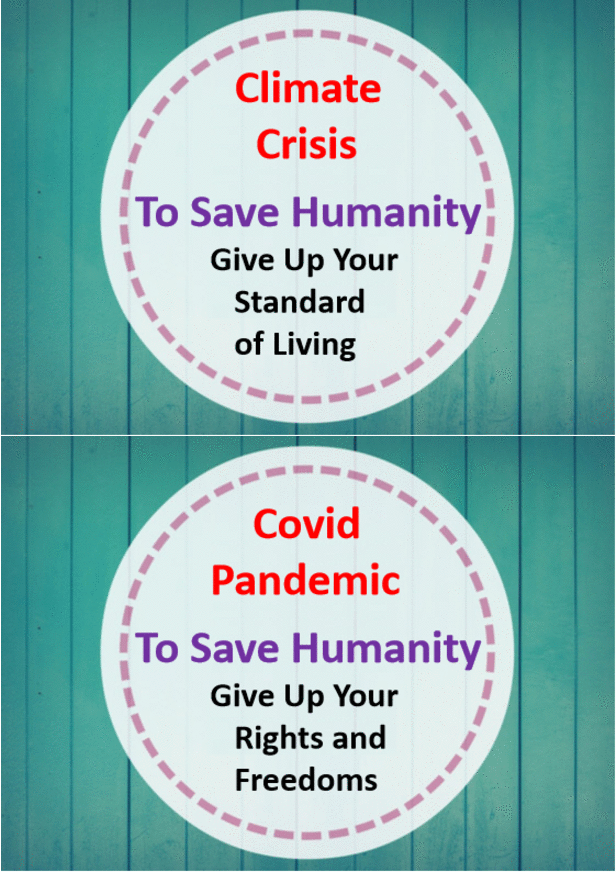
On both COVID-19 and climate change, the same elite has invoked “the science,” not in support of good decision-making, but as a talisman to justify everything they do, including censoring public debate. Complex and uncertain matters are reduced to dogmatic slogans by technocrats who force-feed political leaders a one-sided information stream. Experts outside the process are accorded standing based solely on their obeisance to the preferred narrative, not their knowledge or qualifications. Critics are attacked as purveyors of “misinformation” and “disinformation.” Any opposition to government plans therefore proves the need to suppress free speech.

Eventually, however, the people get the last word. And despite nonstop fear-mongering about an alleged climate crisis, the people tolerate climate policy only insofar as it costs almost nothing.

The climate movement may think that by embedding itself in the globalist elite it can accelerate policy adoption without needing to win elections. In fact, the opposite is happening. Globalists have co-opted the climate issue to try to sell a grotesque central planning agenda that the public has repeatedly rejected. If the UAE Consensus is the future of climate policy, climate policy’s failure is guaranteed.

Keep Your Head, Others are Losing Theirs Over Climate

John Stossel’s interview with Bjorn Lomborg is featured in his article at Reason The Media’s Misleading Fearmongering Over Climate Change. Excerpts in italics with my bolds and added images.

“Over the last 20 years, because of temperature rises, we have seen about 116,000 more people die from heat. But 283,000 fewer people die from cold.”

United States Special Presidential Envoy for Climate John Kerry says it will take trillions of dollars to “solve” climate change. Then he says, “There is not enough money in any country in the world to actually solve this problem.”

Yes, they are projecting more than 100 Trillion US$.

Kerry has little understanding of money or how it’s created. He’s a multimillionaire because he married a rich woman. Now he wants to take more of your money to pretend to affect climate change.

Bjorn Lomborg points out that there are better things society should spend money on.

Lomberg acknowledges that a warmer climate brings problems. “As temperatures get higher, sea water, like everything else, expands. So we’re going to maybe see three feet of sea level rise. Then they say, ‘So everybody who lives within three feet of sea level, they’ll have to move!’ Well, no. If you actually look at what people do, they built dikes and so they don’t have to move.”

Rotterdam Adaptation Policy–Ninety years thriving behind dikes and dams.

People in Holland did that years ago. A third of the Netherlands is below sea level. In some areas, it’s 22 feet below. Yet the country thrives. That’s the way to deal with climate change: adjust to it.

“Fewer people are going to get flooded every year, despite the fact that you have much higher sea level rise. The total cost for Holland over the last half-century is about $10 billion,” says Lomberg. “Not nothing, but very little for an advanced economy over 50 years.”

For saying things like that, Lomberg is labeled “the devil.”

“The problem here is unmitigated scaremongering,” he replies. “A new survey shows that 60 percent of all people in rich countries now believe it’s likely or very likely that unmitigated climate change will lead to the end of mankind. This is what you get when you have constant fearmongering in the media.”

Some people now say they will not have children because they’re convinced that climate change will destroy the world. Lomborg points out how counterproductive that would be: “We need your kids to make sure the future is better.”

He acknowledges that climate warming will kill people.

“As temperatures go up, we’re likely to see more people die from heat. That’s absolutely true. You hear this all the time. But what is underreported is the fact that nine times as many people die from cold…. As temperatures go up, you’re going to see fewer people die from cold. Over the last 20 years, because of temperature rises, we have seen about 116,000 more people die from heat. But 283,000 fewer people die from cold.”

A 2015 study by 22 scientists from around the world found that cold kills over 17 times more people than heat. Source: The Lancet

That’s rarely reported in the news.

When the media doesn’t fret over deaths from heat,
they grab at other possible threats.

CNN claims, “Climate Change is Fueling Extremism.”

The BBC says, “A Shifting Climate is Catalysing Infectious Disease.

U.S. News and World Report says, “Climate Change will Harm Children’s Mental Health.”

Lomborg replies, “It’s very, very easy to make this argument that everything is caused by climate change if you don’t have the full picture.”

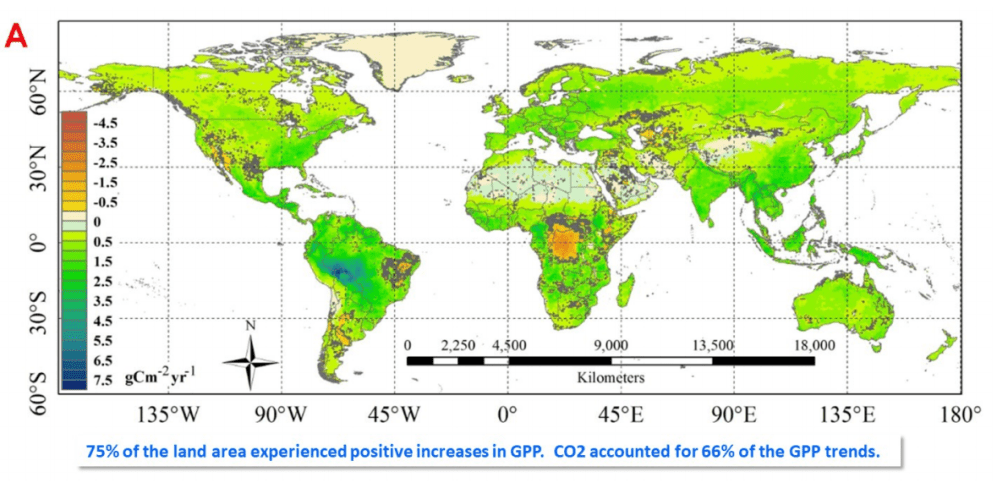
He points out that we rarely hear about positive effects of climate change, like global greening.

Spatial pattern of trends in Gross Primary Production (1982- 2015). Source: Sun et al. 2018.


“That’s good! We get more green stuff on the planet. My argument is not that climate change is great or overall positive. It’s simply that, just like every other thing, it has pluses and minuses…. Only reporting on the minuses, and only emphasizing worst-case outcomes, is not a good way to inform people.”

Synopsis of Lomborg’s Policy Recommendation (excerpted transcription)

If you’re a politician and you look at ten different problems, you’re natural inclination is to say, “Let’s give 1/10 to each one of them.” And economists would tend to say, “No, let’s give all of the money to the most efficient problem first and then to the second most efficient problem, and so on. I’m simply suggesting there’s a way that we could do much better with much less.

Of course if you feel very strongly about your particular area, when I come and say, “Actually, this is not a very efficient use of resources.” I get why people get upset. But for our collective good, for all the stuff that we do on the planet, we actually need to consider carefully where do we spend money well, compared to where do we just spend money and feel virtuous about ourselves.

If we spend way too much money ineffectively on climate, not only
are we not fixing climate, but we’re also wasting an enormous amount
of money that could have been spent on all these other things.
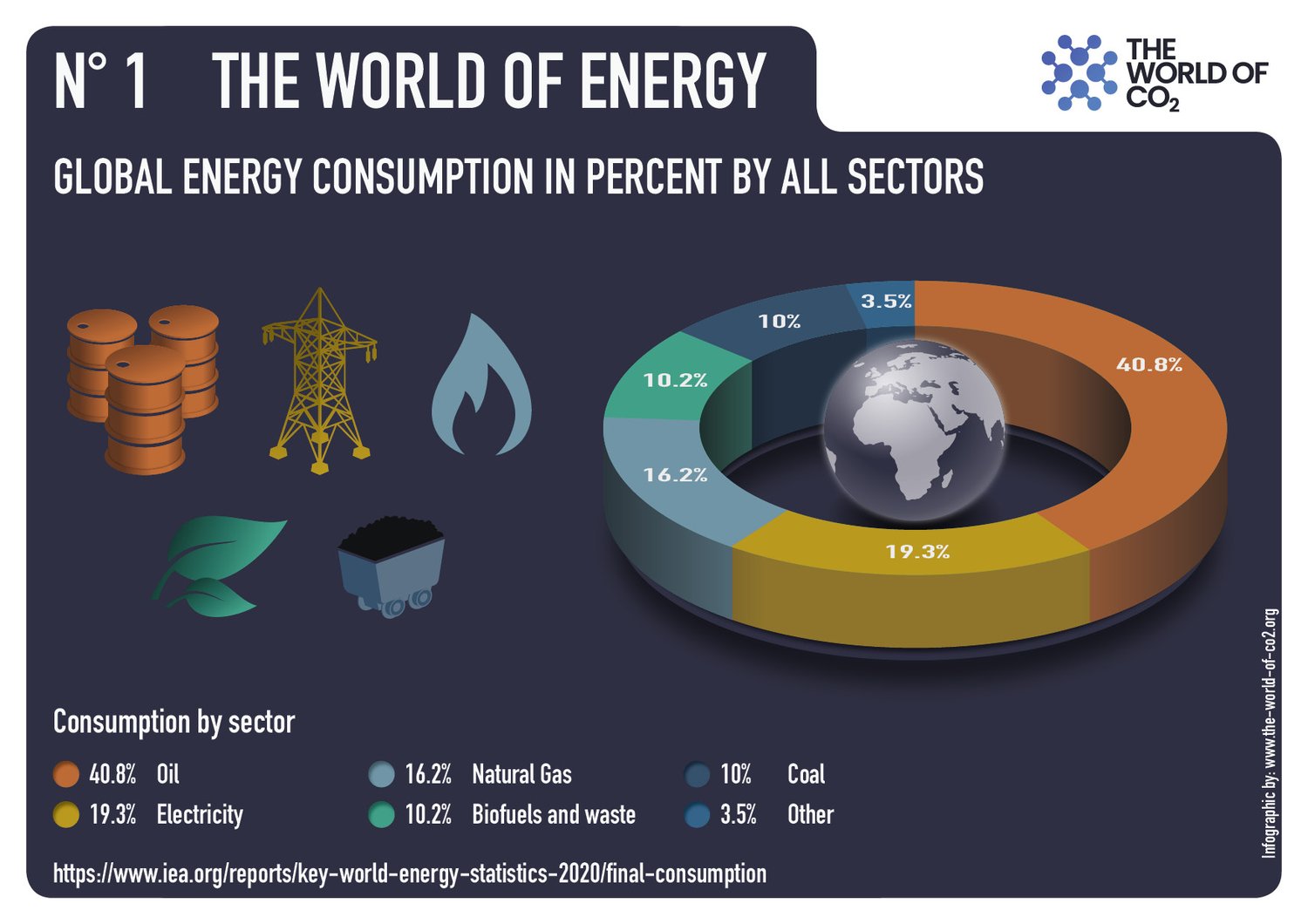
I’m simply trying to make that simple point, and I think most people kind of get that.  Remember, electricity is about a fifth of our total energy consumption. So, all everybody’s talking about is all the electricity, which is the easiest thing to switch over. But we don’t know anything about how we’re going to, know very, very little about how we’re going to deal with the other 4/5. This is energy that we use on things that are very, very hard to replace. So it’s a fertilizer that keeps 4 billion people alive. Making the fertilizer. It’s steel, cement, it’s industrial processes. Most of heating we use comes from fossil fuels, most transportation, that’s fossil fuels.

Know that if the U.S. went entirely net zero today and stayed that way for the rest of the century, consider how incredibly extreme this would be. First of all, you would not be able to feed everyone in the U.S. The whole economy would break down. You wouldn’t know how to get transportation. A lot of people would freeze. Some people would fry. There would be lots and lots of problems. But even if you did this and managed to do it, the net impact, if you run it through the U.N. climate model, is that you would reduce temperatures by the end of the century by 0.3 degrees Fahrenheit. We would almost not be able to measure it by the end of the century. It would have virtually no impact.

Look, again, we’re rich and so a lot of people feel like you can spend money on many different things. And that’s true. I’m making the argument that for fairly little money, we could do amazing good. If we spent $35 billion, not a trillion dollars, just $35 billion, which is not nothing. I don’t think, neither you or I have that amount of money. But, you know, in the big scheme of things, this is a rounding error. $35 billion could save 4.2 million lives in the poor part of the world, each and every year and make the poor world $1.1 trillion richer.
I think we have a moral responsibility to remember, that there are lots and lots of people, so mostly about 6 billion people out there, who don’t have this luxury of being able to think 100 years ahead and think about a little bit of a fraction of a degree, who wants to make sure that their kids are safe.
And so, the next money we spend should probably be on these very simple and cheap policies.


Inside the Hydrogen Fuel Project Bubbles

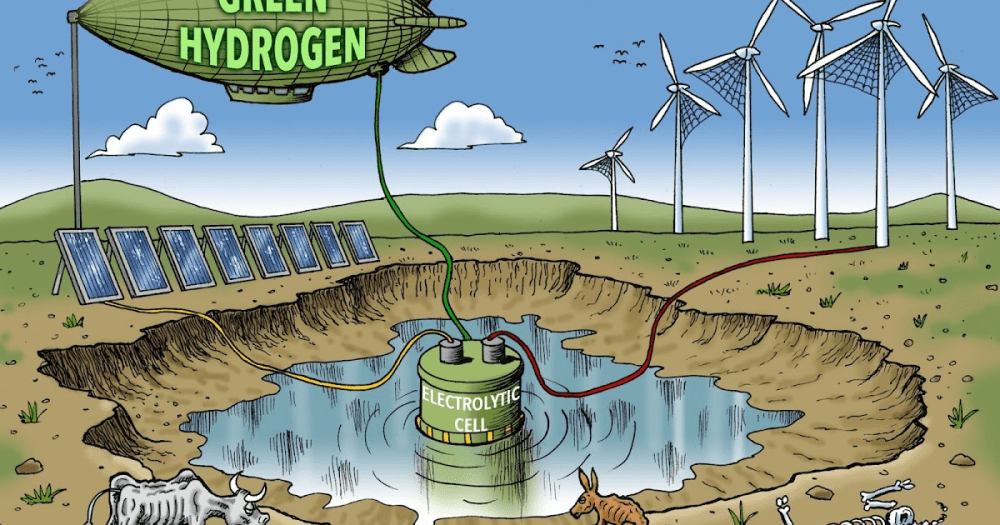
The map above from IEA shows almost 2000 hydrogen fuel projects around the world, intending to replace hydrocarbon fuels to save the planet.  They dream of being operational by 2030 claiming that real world obstacles will be overcome if enough taxpayer dollars are thrown at the problems.  The whole notion is fantastic (in the literal sense) for reasons detailed in a previous post.

Replace Carbon Fuels with Hydrogen? Absurd, Exorbitant and Pointless

But realities be damned, there’s virtue to be displayed, money to be made and no accountability for failure, so the charade will go on.  On the map are some bubbles off the coast of Canadian maritime provinces, so let’s take a peek into how these projects are conceived and realized. Rod Nickel reports at the Globe and Mail Canadian wind-hydrogen project delayed one year in race to first European exports.  Excerpts in italics with my bolds and added images.

Green Hydrogen Project in Atlantic Provinces Delayed

One of Canada’s first projects to produce emissions-free hydrogen with wind energy has delayed its start by one year because operator World Energy GH2’s European customers need more time to develop special infrastructure to handle the product, the company said.

The delays illustrate the difficulties companies face in introducing a nascent product to replace high-emitting forms of fuel for transport, industry and homes. [The background post above notes how hydrogen makes containers and conduits brittle, not to mention its explosive potential.]

Have we learned nothing from the Hindenburg Disaster?

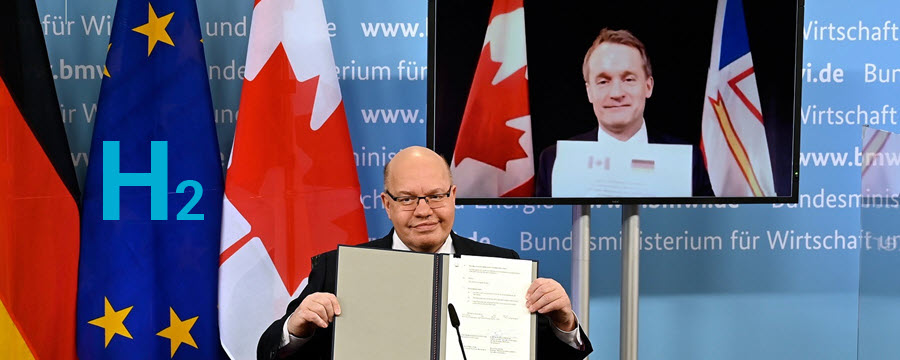
Half a dozen companies are advancing projects in the gusty Atlantic provinces of Newfoundland and Labrador and Nova Scotia to harness winds to power production of Canada’s first exports of emissions-free hydrogen. Canada signed a non-binding agreement in 2022 to ship green hydrogen to Germany starting in 2025.

But World Energy GH2, an affiliate of Boston-based renewable fuels producer World Energy, won’t make that timeline, managing director Sean Leet told Reuters.

“The offtakers are not going to be ready to accept product within 2025, actually not until 2027,” Leet said, referring to buyers who would pre-purchase some of the project’s hydrogen.

The challenges for prospective buyers involve developing new technology to ship, further process and transport the hydrogen by pipeline at its last destination, Leet said.

World Energy GH2 now hopes to start production in late 2026, he said. It requires approval from Newfoundland’s environmental department and strong pre-purchase interest to attract financing before starting production.

Those buyer commitments hinge on the Canadian government
finalizing details of a tax credit for up to 40% of the
capital cost of building hydrogen plants, Leet said.

The company intends to build three onshore wind farms in Newfoundland to power production of 250,000 metric tons per year of hydrogen, at a total cost of $12 billion.

Advocacy group EnviroWatch NL, however, questions the efficiency of building wind turbines in Canada to produce hydrogen that will ultimately generate power for Europe thousands of kilometres away.

EverWind Fuels is on track to start production in Nova Scotia in 2025, said CEO Trent Vichie.  Its plant, a converted fuel storage facility, would eventually produce 1 million metric tons annually of ammonia, a compound that is a practical form of transporting hydrogen.

EverWind, which declined to disclose the project’s capital budget, expects to strike firm buyer agreements in the first half of 2024, a spokesperson said, and has memorandums of understanding to sell hydrogen to German power companies Uniper and E.ON.

The Canadian government agreed in November to loan EverWind $125 million to build its project, which still requires provincial approval of its wind farms. EverWind’s hydrogen plant has already received environmental approval.

Germany-based ABO Wind is applying for permits and land for a Newfoundland onshore wind farm that will provide electricity to produce hydrogen for Braya Renewable Fuels’ refinery as early as 2027, Robin Reese, director of development for ABO Wind Canada said.

Newfoundland selected EverWind, World Energy GH2, ABO and Exploits Valley Renewable Energy Corp in August to proceed with their wind-hydrogen projects on government land.

U.S.-based Pattern Energy plans to secure European buying agreements in mid-2024 and start construction in 2025 for its wind-hydrogen project on private land in Newfoundland, Canada country head Frank Davis said.

Some Skeptical Comments on the article

EnviroWatch is asking the right question. Why use all this great wind energy to electrolyze water to make hydrogen to convert it (presumably) to ammonia for shipping to Europe to produce energy. It makes absolutely no thermodynamic sense whatsoever. I highly doubt ANY of these projects get built. To quote Susan Powter from the 90s, “Stop the insanity!”.

It makes no economic, thermodynamic or business sense. But it’s great politics.

I’m not thinking Billions but rather Trillions to be wasted on wind power before the world comes to its senses! Twenty- thirty years of spending. Reminds me of the treasure supposedly buried at Oak Island!

Problem is, the alternatives are all expensive mega-projects. Darlington was 5 years late and $10 billion over budget, and we haven’t built a new nuclear plant since then (30 years ago). New hydro dams have similar problems. Wind is small and cheap enough to actually get built in large numbers. Have to expand the energy supply somehow.

The actual Darlington nuke plants were 20% over budget not bad for a first of a kind. The rest was caused by government foolish delays in a high interest rate environment. The next 8 Candu’s were built on time in under 4 years and on budget at under $2/watt average the latest just completed in India.

The $25B refurb project is also on time and under budget.

Actually wind is of little use in Canada as it disappears in summer doldrums and winter cold snaps but maximizes during springtime when hydro flows max out. Its intermittancy makes it 10 times the cost of Candu.