5 Signs Eco-pessimists are Wrong

This video accompanied an editorial at Investor’s Business Daily Climate Hoax: Global CO2 Emissions Spike, Despite Paris Climate Pledges.  Excerpts in italics with my bolds.

Climate Change: Three years after leaders from around the world signed on to the Paris climate agreement, pledging to cut their carbon footprints, global CO2 emissions accelerated. Does anyone still think President Donald Trump was wrong for pulling the U.S. out of this sham agreement?

According to the Global Carbon Project, which monitors this, global CO2 emissions climbed by 1.6% last year. They are on track to shoot up by 2.7% this year. That’s after three years of annual emissions remaining flat.

Worse After Paris Deal

Wait a minute. The accelerating growth in carbon emissions came after some 200 countries signed the Paris agreement?

At the time, Barack Obama called the Paris agreement “an enduring agreement that reduces global carbon pollution and sets the world on a course to a low-carbon future. ”

It “sends a powerful signal that the world is firmly committed to a low-carbon future,” Obama said. He even called the agreement “a turning point for the world.”

Annual CO2 measured at Mauna Loa through 2017.

Right.

The reality is that nations need energy to grow. And the best and most economical forms of energy are oil, natural gas and coal.

CO2 ppm added in the last three years.
(60-year rate 1.53ppm)

2015   2.18ppm
2016   3.38ppm
2017   2.32ppm

So, while all those leaders were making promises and bragging about how they were saving the planet, their economies were increasing the use of fossil fuels.

As the New York Times laments in its front-page story, “Even as coal has fallen out of favor in some markets, the rise in emissions has been driven by stronger demand for natural gas and oil, scientists said. And even as the use of renewable energy like solar and wind power has expanded exponentially, it has not been enough to offset the increased use of fossil fuels.”
China Builds Coal Plants
China — already the single largest contributor of CO2 emissions — will see emissions climb by 4.7%. It continues to build coal-fired plants within its borders, as well as in sub-Saharan Africa, the Times notes.

India’s emissions will likely shoot up by more than 6% this year, as the country tries to do things like bring electricity to 300 million people — almost equal to the entire population of the U.S. — who don’t have it.

As we noted in this space recently, not one of the G20 countries is close to meeting the CO2 emissions targets they pledged to reach in the Paris deal.

This is all further evidence that whatever these leaders claim, and no matter how many end-of-the-world predictions environmentalists make, nobody is serious about drastically cutting CO2 emissions by anywhere near the levels climate scientists say is needed to prevent “global catastrophe.”

Witness the retreat this week by climate-change champion and French President Emmanuel Macron, who suspended the country’s relatively modest carbon tax plan — which would have raised gas prices by 12 cents a gallon — after violent protests broke out across the country.

Or look at liberal Washington state, whose voters overwhelmingly rejected a carbon tax in the midterm elections.

Or look at any poll that measures public priorities and see how low climate change ranks. The latest IBD/TIPP poll found that only 17% ranked dealing with climate change as a top priority for the new Congress.

The Wrong Approach

We’re not complaining about this, mind you. We think all the doom-and-gloom scenarios are wild speculations based on dubious 100-year computer forecasts. And the environmentalist agenda has less to do with saving the planet and more to do with controlling everyone’s lives.

Even if the climate does warm as predicted, the better approach is to adapt to changing environments, if and when they occur. Not wreck entire economies in a futile attempt to stop it.

If nothing else, mankind has proved its remarkable ability to survive and thrive in the harshest environments on Earth.

The sooner world leaders come realize this, the better.

See also UN “Stretches” CO2 Goals
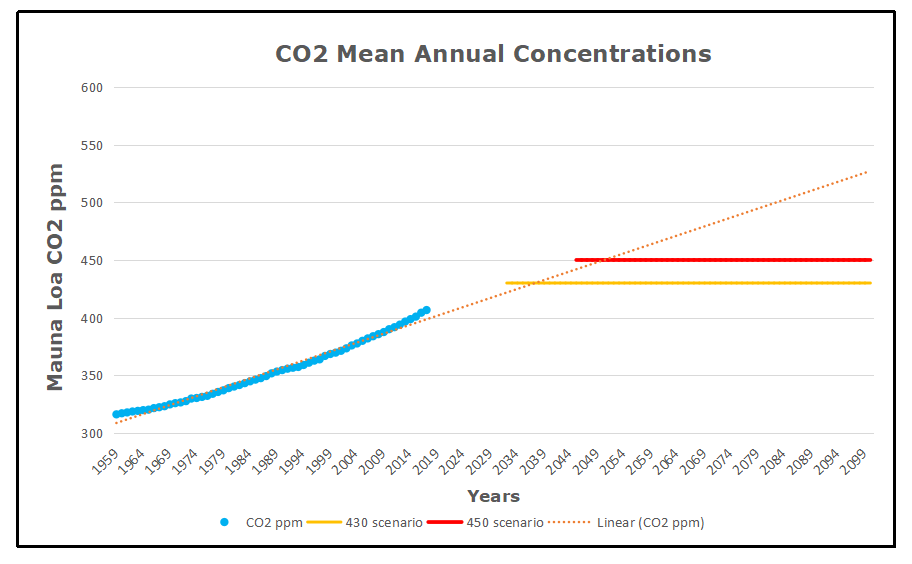
The blue line is CO2 in ppm observed at Mauna Loa. The linear regression line shows the continuation of the 1.53 ppm per year rate projected to the end of this century. As noted above the blue line is already exceeding the earlier rate. The orange line shows CO2 hitting 430 ppm in 2032 at the 1.53 rate, or earlier if more recent rates continue. For example, if the 2.14 ppm per year rate continues, 430 ppm is reached by 2028. The red 450 scenario is reached in 2045. Both scenarios presume zero additional CO2 after those dates.


 

Katawice COP24 Briefing for Realists

czestochowska

The Black Madonna of Częstochowa is just nearby.

The upcoming COP24 will be dramatic with the host country Poland resolute on continuing to burn coal.  Comments by the Polish Minister of Environment have been aimed at lowering expectations in advance of the meeting, in stark contrast to the recent over-the-top IPCC SR15 climate horror movie.  See UN Horror Show

Polish coal miners 2015 protest against liquidation of Polish coal mines. Note the vests like those now seen all over France.

In addition, Brazil is canceling their invitation to host next year’s COP 25.  Considering the obstacles along with the location, COP24 could be considered a “Hail Mary” gathering.  Three years ago French Mathematicians spoke out prior to COP21 in Paris, and their words provide a rational briefing for COP24 beginning in Katawice this weekend. In a nutshell:

Fighting Global Warming is Absurd, Costly and Pointless.

  • Absurd because of no reliable evidence that anything unusual is happening in our climate.
  • Costly because trillions of dollars are wasted on immature, inefficient technologies that serve only to make cheap, reliable energy expensive and intermittent.
  • Pointless because we do not control the weather anyway.

The prestigious Société de Calcul Mathématique (Society for Mathematical Calculation) issued a detailed 195-page White Paper that presents a blistering point-by-point critique of the key dogmas of global warming. The synopsis is blunt and extremely well documented.  Here are extracts from the opening statements of the first three chapters of the SCM White Paper with my bolds and images.

Sisyphus at work.

Chapter 1: The crusade is absurd
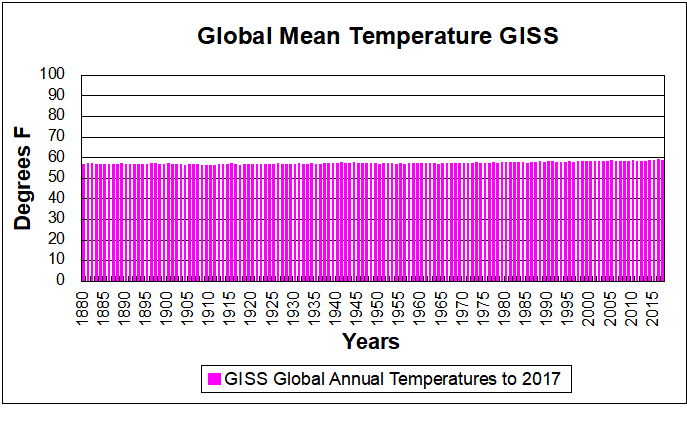
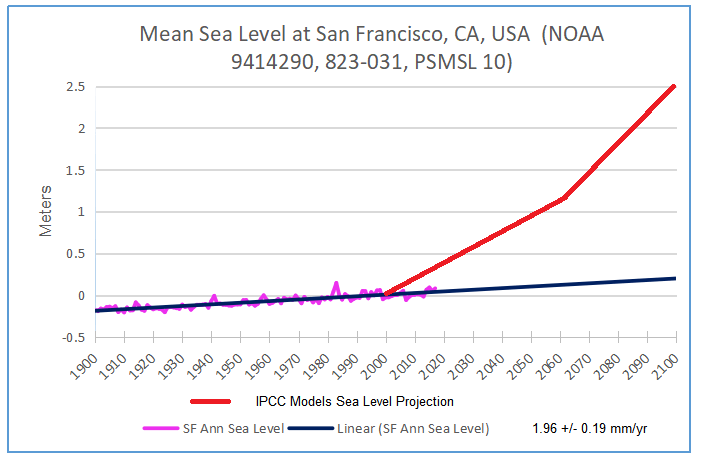
There is not a single fact, figure or observation that leads us to conclude that the world‘s climate is in any way ‘disturbed.’ It is variable, as it has always been, but rather less so now than during certain periods or geological eras. Modern methods are far from being able to accurately measure the planet‘s global temperature even today, so measurements made 50 or 100 years ago are even less reliable. Concentrations of CO2 vary, as they always have done; the figures that are being released are biased and dishonest. Rising sea levels are a normal phenomenon linked to upthrust buoyancy; they are nothing to do with so-called global warming. As for extreme weather events — they are no more frequent now than they have been in the past. We ourselves have processed the raw data on hurricanes….

Chapter 2: The crusade is costly
Direct aid for industries that are completely unviable (such as photovoltaics and wind turbines) but presented as ‘virtuous’ runs into billions of euros, according to recent reports published by the Cour des Comptes (French Audit Office) in 2013. But the highest cost lies in the principle of ‘energy saving,’ which is presented as especially virtuous. Since no civilization can develop when it is saving energy, ours has stopped developing: France now has more than three million people unemployed — it is the price we have to pay for our virtue….

Chapter 3: The crusade is pointless
Human beings cannot, in any event, change the climate. If we in France were to stop all industrial activity (let’s not talk about our intellectual activity, which ceased long ago), if we were to eradicate all trace of animal life, the composition of the atmosphere would not alter in any measurable, perceptible way. To explain this, let us make a comparison with the rotation of the planet: it is slowing down. To address that, we might be tempted to ask the entire population of China to run in an easterly direction. But, no matter how big China and its population are, this would have no measurable impact on the Earth‘s rotation.

Full text in pdf format is available in English at link below:

The battle against global warming: an absurd, costly and pointless crusade
White Paper drawn up by the Société de Calcul Mathématique SA
(Mathematical Modelling Company, Corp.)

cg565e788a82606

A Second report was published in 2016 entitled: Global Warming and Employment, which analyzes in depth the economic destruction from ill-advised climate change policies.

The two principal themes are that jobs are disappearing and that the destructive forces are embedded in our societies.

Jobs are Disappearing discusses issues such as:

The State is incapable of devising and implementing an industrial policy.

The fundamental absurdity of the concept of sustainable development

Biofuels an especially absurd policy leading to ridiculous taxes and job losses.

EU policy to reduce greenhouse gas emissions by 40% drives jobs elsewhere while being pointless: the planet has never asked for it, is completely unaware of it, and will never notice it!

The War against the Car and Road Maintenance undercuts economic mobility while destroying transportation sector jobs.

Solar and wind energy are weak, diffuse, and inconsistent, inadequate to power modern civilization.

Food production activities are attacked as being “bad for the planet.”

So-called Green jobs are entirely financed by subsidies.

The Brutalizing Whip discusses the damages to public finances and to social wealth and well-being, including these topics:

Taxes have never been so high

The Government is borrowing more and more

Dilapidated infrastructure

Instead of job creation, Relocations and Losses

The wastefulness associated with the new forms of energy

Return to the economy of an underdeveloped country

What is our predicament?
Four Horsemen are bringing down our societies:

  • The Ministry of Ecology (climate and environment);
  • Journalists;
  • Scientists;
  • Corporation Environmentalist Departments.

Steps required to recover from this demise:

  • Go back to the basic rules of research.
  • Go back to the basic rules of law
  • Do not trust international organizations
  • Leave the planet alone
  • Beware of any premature optimism

Conclusion

Climate Lemmings

The real question is this: how have policymakers managed to make such absurd decisions, to blinker themselves to such a degree, when so many means of scientific investigation are available? The answer is simple: as soon as something is seen as being green, as being good for the planet, all discussion comes to an end and any scientific analysis becomes pointless or counterproductive. The policymakers will not listen to anyone or anything; they take all sorts of hasty, contradictory, damaging and absurd decisions. When will they finally be held to account?


Footnote:

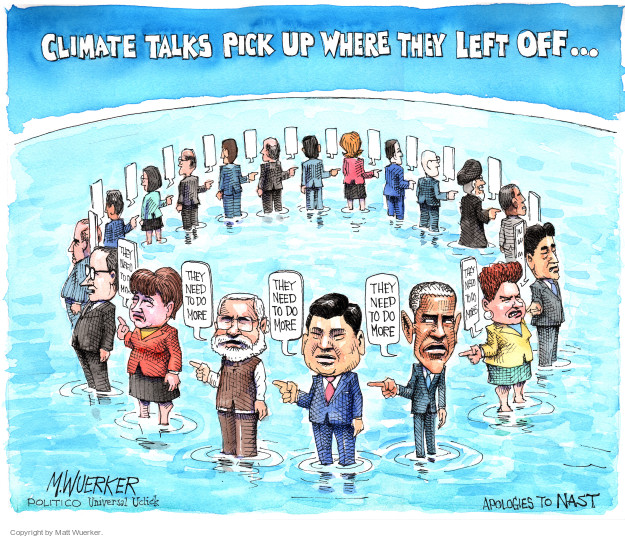
The above cartoon image of climate talks includes water rising over politicians’ feet.  But actual observations made in Fiji (presiding over talks last year in Bonn) show sea levels are stable (link below).

Fear Not For Fiji

In 2016 SCM issued a report Global Temperatures Available data and critical analysis

It is a valuable description of the temperature metrics and issues regarding climate analysis.   They conclude:

None of the information on global temperatures is of any scientific value, and it should not
be used as a basis for any policy decisions. It is perfectly clear that:

  • there are far too few temperature sensors to give us a picture of the planet’s temperature;
  • we do not know what such a temperature might mean because nobody has given it
    any specific physical significance;
  • the data have been subject to much dissimulation and manipulation. There is a
    clear will not to mention anything that might be reassuring, and to highlight things
    that are presented as worrying;
  • despite all this, direct use of the available figures does not indicate any genuine
    trend towards global warming!

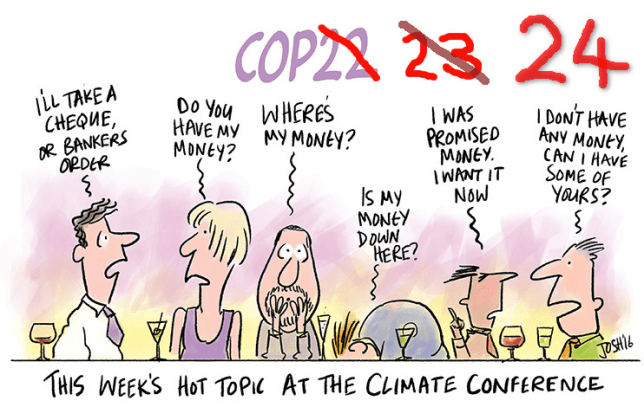
cop-wheres-my-money

Climatist Logic Fail


Abe Greenwald writes in the Commentary The Paris Climate Discord Not in my wallet. Excerpts in italics with my bolds.

Global-warming activists predicted that Donald Trump’s withdrawal from the Paris agreement on climate change would claim innocent lives. Trump pulled out over a year ago, and the death toll from the American snub stands at zero. In France, however, violent protests against President Emmanuel Macron’s efforts to mitigate climate change have killed one person and injured 227.

On Saturday, French mobs were protesting a tax hike on fuel. And they, not Macron, are directly to blame for the death and destruction. But the fact that these massive demonstrations happened at all—that they involved some 283,000 protestors—shows how little anyone really worries about climate change.

Macron is trying to get France off of fossil fuels. The French government recently raised diesel taxes by seven euro cents and had planned to raise the gasoline tax by four euro cents. But it turns out that people—not just Americans—care deeply about melting ice caps and rising sea levels only under specific circumstances. Namely, when they can be blamed on the greed and stupidity of their political enemies. They find that they suddenly care a lot less when addressing climate change means shelling out a few extra euro cents. So the French came out in droves, lit bonfires, tore up some buildings, blocked streets, and chanted slogans.

Last year, Trump fought back against critics of the Paris withdrawal by saying, “I was elected to represent the citizens of Pittsburgh, not Paris.” But he might have represented the citizens of Paris, too. “We no longer know what kind of car to buy, petrol, diesel, electric, who knows?” said one protester interviewed by the Guardian. “I have a little diesel van, and I don’t have the money to buy a new one, especially as I’m about to retire. We have the feeling those from the countryside are forgotten.

Another protestor said that “the fuel tax was just the final straw.” He went on: “All we can do is show that people are angry, that they are not alone and that they can do something about it. I hope there is no violence, but people are angry. I can understand why, for years they have voted for things and nothing has changed for them.” The protestors, known as gilets jaunes, for their signature yellow vests, enjoy 79-percent support among the French working class, according to IFOP.

Meanwhile, as Parisians turn against the core ideas of the Paris agreement, Americans are worked up over the Trump administration’s seeming indifference to a new U.S. government report on climate change. The Fourth National Climate Assessment was prepared by “300 leading scientists,” according to CNN. And like all sober scientific documents, it’s packed to the gills with apocalyptic predictions for the coming century.

The U.S. economy could lose 10 percent of its GDP; crops will shrink, much ocean life will die off, and more people will have less food. Illness will spread, pollution will get worse, floods and wildfires will increase, and, naturally, many people will die. Now, imagine the public response in our own low-trust, grievance-obsessed nation if the Trump administration actually instituted a policy that required every American to pay up to keep that theoretical future at bay.

There’s a curious contradiction in climate activism. On the one hand, we’re told that the effects of climate change are already happening all around us—that we no longer have to wait for signs of devastation. On the other hand, huge resources swing into action to lay out disaster-movie scenarios of a dystopian future. If the effects of climate change are already so evident, why go to all the trouble of scaring us about what’s going to happen? Maybe because even sympathetic people don’t really believe—in their marrow—that anything alarming is currently happening. If they did, perhaps they’d give up their cars and shrink their lifestyles on the spot. But as it stands, they scream for government intervention and then protest when called to share in the cost.

Don’t Base Policies on Climate Hysteria

Noah Rothman writes at Commentary: Climate Hysterics and Their Advocates
Satisfying histrionics never solved anything. Excerpts in italics with my bolds.

Exhuming this [fourth National Climate Assessment] report from its early grave, NBC’s “Meet the Press” focused on it extensively—probing lawmakers about the issue and devoting a panel segment to the political implications of its findings. American Enterprise Institute scholar Danielle Pletka attracted an unusual amount of attention for her remarks on the subject. In a brief soliloquy, she said that she doesn’t believe “we can have any doubt” about the existence of climate change, though we can join the scientific community in speculating about the precise degree to which human activity contributes to that change.

Pletka went on to note mitigating phenomena that, in her view, don’t receive due attention. The last two years were typified by the “biggest drop in global temperatures that we have had since the 1980s,” she said. Pletka added that carbon dioxide emissions in the U.S. are declining even after America pulled out of the Paris accords, and American industry has shifted away from burning so-called “dirty coal,” unlike its European counterparts.

The AEI scholar’s critics noted that extreme temperature fluctuation doesn’t tell us much about the climate, which is fair. But “dirty coal” burning in America is declining at a terminal rate despite the loosening regulatory climate, and the United States has led the world in CO2 emissions reductions even without a non-binding international treaty compelling it to do so. Pletka observed in closing that this was the work of industry, consumer preference, and capitalist innovation, and not oppressive central planning (which is entirely correct).

“We shouldn’t be hysterical” about the problem of climate change, Pletka concluded. You’d think she shot someone’s dog on live television.

On Twitter, investigative reporter Alex Kotch insisted that this “non-scientist” perspective was advanced in service to “the biggest fossil fuel polluters in the world, Koch Industries.” Attorney Max Kennerly contended that it was “inexcusable” to allow Pletka to opine at all on this subject. “This is PR for polluters, not journalism,” he barked. “This is crazy,” ABC News analyst Matt Dowd said. “Balance shouldn’t be the goal, truth should.” “People tune in to be informed not be subjected to propaganda,” former Think Progress founder Judd Legum tweeted. Former Vermont Gov. Howard Dean, Hawaii Sen. Brian Schatz, and controversial climatologist Michael Mann all attacked the network for giving Pletka a platform to discuss climate as it relates to public policy.

There was no such outrage over the response from Pletka’s counterpart, New York Times columnist and fellow “non-scientist” Helene Cooper, which tells you all you need to know about this ginned-up controversy. “I actually think we should be hysterical,” she said. “I think anybody who has children or anybody who can imagine having children and grandchildren, how can you look at them and think this is the kind of world that through our own inaction and our inability to do something, that we’re going to leave them?”

It’s a struggle to think of a long-term public policy crisis that was mitigated by mass hysteria, which is perhaps why Pletka’s many detractors can’t explain why Cooper’s brand of lay advocacy is more acceptable than her counterpart’s. Cooper also said that it was time for the political class to “force corporate leadership” to do something about climate change, demonstrating that she either hadn’t heard a word Pletka said or couldn’t refute her claims. But none of the usual suspects have expressed so much as a hint of disapproval over the gauzy sentimentalism and histrionics expressed by Cooper. That sort of dilettantism serves their purposes.

For Pletka’s detractors, the likely source of consternation wasn’t her professional expertise but her refusal to accept a straight-line projection at face value. That is, however, the only prudent course considering how many climate-related prognostications have not panned out. In 1990, the Intergovernmental Panel on Climate Change’s First Assessment Report’s predictions related to rates of warming and temperature changes were erroneous. The IPCC’s 2001 assessment that climate change would reduce the severity of snow storms did not materialize. The Arctic should be ice-free by now if climate scientists’ predictions were always accurate. As Abe Greenwald noted just last week, the scientific consensus around the rate of oceanic warming was successfully challenged not by the deliberate process of peer review but by a freelancing skeptic with time enough to critically parse the data. Given the failure of these near-term predictions to manifest, it’s only reasonable not to lend too much credence to a projection that takes us nearly 100 years into the future.

You might see now why some advocates prefer hysteria to caution and skepticism, and why those who shatter the serenity of the echo chamber are so valuable.

See also: The Problem with Climate Chicken Littles

Climate Tipping Points Quiz

Update Regulatory Backfire

Update Nov. 22, 2018

With the Democrats taking control of the US House of Representatives, we can expect attempts to again “fight climate change” by means of counter productive regulations.  This post explains why such policies are ineffective and produce unintended consequences, with results worse than doing nothing.

Background:  Heisenberg Uncertainty

In the sub-atomic domain of quantum mechanics, Werner Heisenberg, a German physicist, determined that our observations have an effect on the behavior of quanta (quantum particles).

The Heisenberg uncertainty principle states that it is impossible to know simultaneously the exact position and momentum of a particle. That is, the more exactly the position is determined, the less known the momentum, and vice versa. This principle is not a statement about the limits of technology, but a fundamental limit on what can be known about a particle at any given moment. This uncertainty arises because the act of measuring affects the object being measured. The only way to measure the position of something is using light, but, on the sub-atomic scale, the interaction of the light with the object inevitably changes the object’s position and its direction of travel.

Now skip to the world of governance and the effects of regulation. A similar finding shows that the act of regulating produces reactive behavior and unintended consequences contrary to the desired outcomes.

An article at Financial Times explains about Energy Regulations Unintended Consequences  Excerpts below with my bolds.

Goodhart’s Law Regarding Policy Effects

Goodhart’s Law holds that “any observed statistical regularity will tend to collapse once pressure is placed upon it for control purposes”. Originally coined by the economist Charles Goodhart as a critique of the use of money supply measures to guide monetary policy, it has been adopted as a useful concept in many other fields. The general principle is that when any measure is used as a target for policy, it becomes unreliable. It is an observable phenomenon in healthcare, in financial regulation and, it seems, in energy efficiency standards.

When governments set efficiency regulations such as the US Corporate Average Fuel Economy standards for vehicles, they are often what is called “attribute-based”, meaning that the rules take other characteristics into consideration when determining compliance. The Cafe standards, for example, vary according to the “footprint” of the vehicle: the area enclosed by its wheels. In Japan, fuel economy standards are weight-based. Like all regulations, fuel economy standards create incentives to game the system, and where attributes are important, that can mean finding ways to exploit the variations in requirements. There have long been suspicions that the footprint-based Cafe standards would encourage manufacturers to make larger cars for the US market, but a paper this week from Koichiro Ito of the University of Chicago and James Sallee of the University of California Berkeley provided the strongest evidence yet that those fears are likely to be justified.

Mr Ito and Mr Sallee looked at Japan’s experience with weight-based fuel economy standards, which changed in 2009, and concluded that “the Japanese car market has experienced a notable increase in weight in response to attribute-based regulation”. In the US, the Cafe standards create a similar pressure, but expressed in terms of size rather than weight. Mr Ito suggested that in Ford’s decision to end almost all car production in North America to focus on SUVs and trucks, “policy plays a substantial role”. It is not just that manufacturers are focusing on larger models; specific models are also getting bigger. Ford’s move, Mr Ito wrote, should be seen as an “alarm bell” warning of the flaws in the Cafe system. He suggests an alternative framework with a uniform standard and tradeable credits, as a more effective and lower-cost option. With the Trump administration now reviewing fuel economy and emissions standards, and facing challenges from California and many other states, the vehicle manufacturers appear to be in a state of confusion. An elegant idea for preserving plans for improving fuel economy while reducing the cost of compliance could be very welcome.

The paper is The Economics of Attribute-Based Regulation: Theory and Evidence from Fuel-Economy Standards Koichiro Ito, James M. Sallee NBER Working Paper No. 20500.  The authors explain:

An attribute-based regulation is a regulation that aims to change one characteristic of a product related to the externality (the “targeted characteristic”), but which takes some other characteristic (the “secondary attribute”) into consideration when determining compliance. For example, Corporate Average Fuel Economy (CAFE) standards in the United States recently adopted attribute-basing. Figure 1 shows that the new policy mandates a fuel-economy target that is a downward-sloping function of vehicle “footprint”—the square area trapped by a rectangle drawn to connect the vehicle’s tires.  Under this schedule, firms that make larger vehicles are allowed to have lower fuel economy. This has the potential benefit of harmonizing marginal costs of regulatory compliance across firms, but it also creates a distortionary incentive for automakers to manipulate vehicle footprint.

Attribute-basing is used in a variety of important economic policies. Fuel-economy regulations are attribute-based in China, Europe, Japan and the United States, which are the world’s four largest car markets. Energy efficiency standards for appliances, which allow larger products to consume more energy, are attribute-based all over the world. Regulations such as the Clean Air Act, the Family Medical Leave Act, and the Affordable Care Act are attribute-based because they exempt some firms based on size. In all of these examples, attribute-basing is designed to provide a weaker regulation for products or firms that will find compliance more difficult.

Summary from Heritage Foundation study Fuel Economy Standards Are a Costly Mistake Excerpt with my bolds.

The CAFE standards are not only an extremely inefficient way to reduce carbon dioxide emission but will also have a variety of unintended consequences.

For example, the post-2010 standards apply lower mileage requirements to vehicles with larger footprints. Thus, Whitefoot and Skerlos argued that there is an incentive to increase the size of vehicles.

Data from the first few years under the new standard confirm that the average footprint, weight, and horsepower of cars and trucks have indeed all increased since 2008, even as carbon emissions fell, reflecting the distorted incentives.

Manufacturers have found work-arounds to thwart the intent of the regulations. For example, the standards raised the price of large cars, such as station wagons, relative to light trucks. As a result, automakers created a new type of light truck—the sport utility vehicle (SUV)—which was covered by the lower standard and had low gas mileage but met consumers’ needs. Other automakers have simply chosen to miss the thresholds and pay fines on a sliding scale.

Another well-known flaw in CAFE standards is the “rebound effect.” When consumers are forced to buy more fuel-efficient vehicles, the cost per mile falls (since their cars use less gas) and they drive more. This offsets part of the fuel economy gain and adds congestion and road repair costs. Similarly, the rising price of new vehicles causes consumers to delay upgrades, leaving older vehicles on the road longer.

In addition, the higher purchase price of cars under a stricter CAFE standard is likely to force millions of households out of the new-car market altogether. Many households face credit constraints when borrowing money to purchase a car. David Wagner, Paulina Nusinovich, and Esteban Plaza-Jennings used Bureau of Labor Statistics data and typical finance industry debt-service-to-income ratios and estimated that 3.1 million to 14.9 million households would not have enough credit to purchase a new car under the 2025 CAFE standards.[34] This impact would fall disproportionately on poorer households and force the use of older cars with higher maintenance costs and with fuel economy that is generally lower than that of new cars.

CAFE standards may also have redistributed corporate profits to foreign automakers and away from Ford, General Motors (GM), and Chrysler (the Big Three), because foreign-headquartered firms tend to specialize in vehicles that are favored under the new standards.[35] 

Conclusion

CAFE standards are costly, inefficient, and ineffective regulations. They severely limit consumers’ ability to make their own choices concerning safety, comfort, affordability, and efficiency. Originally based on the belief that consumers undervalued fuel economy, the standards have morphed into climate control mandates. Under any justification, regulation gives the desires of government regulators precedence over those of the Americans who actually pay for the cars. Since the regulators undervalue the well-being of American consumers, the policy outcomes are predictably harmful.


Midterms: Voters Rejected Most Climate Energy Propositions


Nevada voters passed Question 6 on Tuesday, which calls for the state to use 50 percent renewable energy by the year 2030. Supporters say Question 6 will generate hundreds of millions of dollars in economic activity and create thousands of new Nevada jobs (sic)

“Clean energy is putting Nevadans to work, with more than 25,000 strong employed in 2017,” said Ray Fakhoury, state policy manager with the national business group Advanced Energy Economy, in statement. “By increasing the state’s renewable standard, Nevada has set itself up to continue reaping the economic benefits for years to come.”

Major corporations, including casinos and data centers, have recently been investing heavily in renewable energy in Nevada. With the passage of Question 6, Alli Gold Roberts, senior manager of state policy with Ceres, said the state is “poised to continue to attract corporate renewable energy investment.”

Question 6, to boost the RPS to 50 percent, will now have to pass again in 2020 in order to become law. AEE’s Fakhoury said consumers could see benefits sooner than that. “Passing with wide support, the legislature and governor-elect should move forward in the upcoming legislative session to enact this landmark increase,” he said.

Corporate clean energy buyers invested heavily in a separate Nevada ballot measure, Question 3, which sought to deregulate Nevada’s retail electricity market, but the measure was ultimately unsuccessful. Question 3 was the subject of fierce debate. According to the Nevada Independent, it was backed by Sheldon Adelson’s Sands Corp. (Adelson also happens to be a major Republican donor) and the data company Switch, as well as many clean energy and environmental groups.

But there were also concerns about how Question 3 would affect electricity rates and clean energy adoption. The Natural Resources Defense Council, the Sierra Club, Southwest Energy Efficiency Project, and Western Resource Advocates came out against deregulating Nevada’s electricity market because of the disruption they said it would cause to the state’s clean energy progress. NV Energy also opposed Question 3, and planned to spend $30 million on defeating it.

Arizona rejects 50% RPS
Arizona voters overwhelmingly rejected Proposition 127 on Tuesday, a constitutional amendment that would have required 50 percent of the state’s electricity to come from renewable sources by 2030. It’s a significant victory for the state’s largest utility, Arizona Public Service (APS), which spent heavily to oppose the measure. California billionaire Tom Steyer’s political group NextGen America funded efforts in support of the measure.

Proposition 127 was by far the most expensive ballot initiative in Arizona state history. Opponents said the measure would increase electric bills by forcing utilities to build new solar and wind plants, which would result in the early closure of coal plants and the state’s lone nuclear plant. Supporters argued those claims were unfounded given that renewable energy resources are now competitive with fossil fuels, even when coupled with battery storage.

APS was particularly outspoken about losing the Palo Verde nuclear plant if the RPS measure passed. If that plant goes offline, the utility argued, greenhouse gas emissions in the state would rise.

While Proposition 127 has failed, Arizona regulators are still considering a proposal to increase Arizona’s RPS to 80 percent by 2050 and broaden it to also include nuclear power. APS generally supports that plan.

Colorado votes down a fracking ban
Colorado voters rejected a measure Tuesday that would have blocked new oil and gas drilling within 2,500 feet of homes, schools and other occupied areas.

Proposition 112 stemmed from complaints that fracking was encroaching on populated areas, creating health and safety concerns. An analysis showed that the measure would have blocked new oil and gas wells on 85 percent of nonfederal land in Colorado, which is America’s fifth-largest gas-producing and seventh-largest oil-producing state.

Washington state rejects a carbon price — again
Washington state has failed, once again, to pass a carbon tax. Initiative 1631, the Carbon Emissions Fee Measure, would have set a carbon fee starting at $15 per ton in 2020, rising to around $55 per ton in 2035, depending on inflation.

This is the second major election in a row in which Washington voters have rejected a ballot initiative that would put a price on carbon emissions. The first such ballot was proposed in 2016 and failed.

Tuesday’s loss may cast doubt on the broader narrative that states will lead on climate action in the absence of federal leadership, or it could signal that Americans simply aren’t ready to get behind a carbon tax. Alternatively, it could have all come down to spending. Supporters of Initiative 1631 spent at least $12 million to advance the measure, while opponents spent more than $25 million.

Source: Greentech Media  Midterms 2018: Mixed Results for the Renewable Energy Agenda

Background: Five States to Vote on Futile Climate Proposals

Taxing Carbon is Bad Economics

At Institute of Economic Affairs, IEA’s Director of Research Dr Jamie Whyte explains (here) why taxing carbon is a bad economic idea. Excerpts in italics with my bolds.

The emission of greenhouse gases – CO2 from burning fossil fuels and methane from flatulent livestock – is warming the global climate. Let’s not quibble about this scientific consensus, even if there are grounds for scepticism. The question for economists is the proper policy response.

The standard view is that greenhouse emissions are a classic negative externality, and that a Pigouvian tax should be applied. For example, farmers should pay a “fart tax” for each cow they own. This would internalise the external cost of the farts, and cows would be farmed only when the total benefits of doing so exceeded the total cost.

This is preferable to a cap-and-trade system, because the cap is arbitrary. If the price of emitting CO2 under such a scheme were to exceed the external cost (the Pigouvian tax), then too little CO2 would be emitted.

Ronald Coase’s insights about managing external costs through private bargaining are irrelevant here because no one owns the climate and, even if such rights were assigned, the owners would be so numerous and dispersed that the costs of bargaining would be prohibitive.


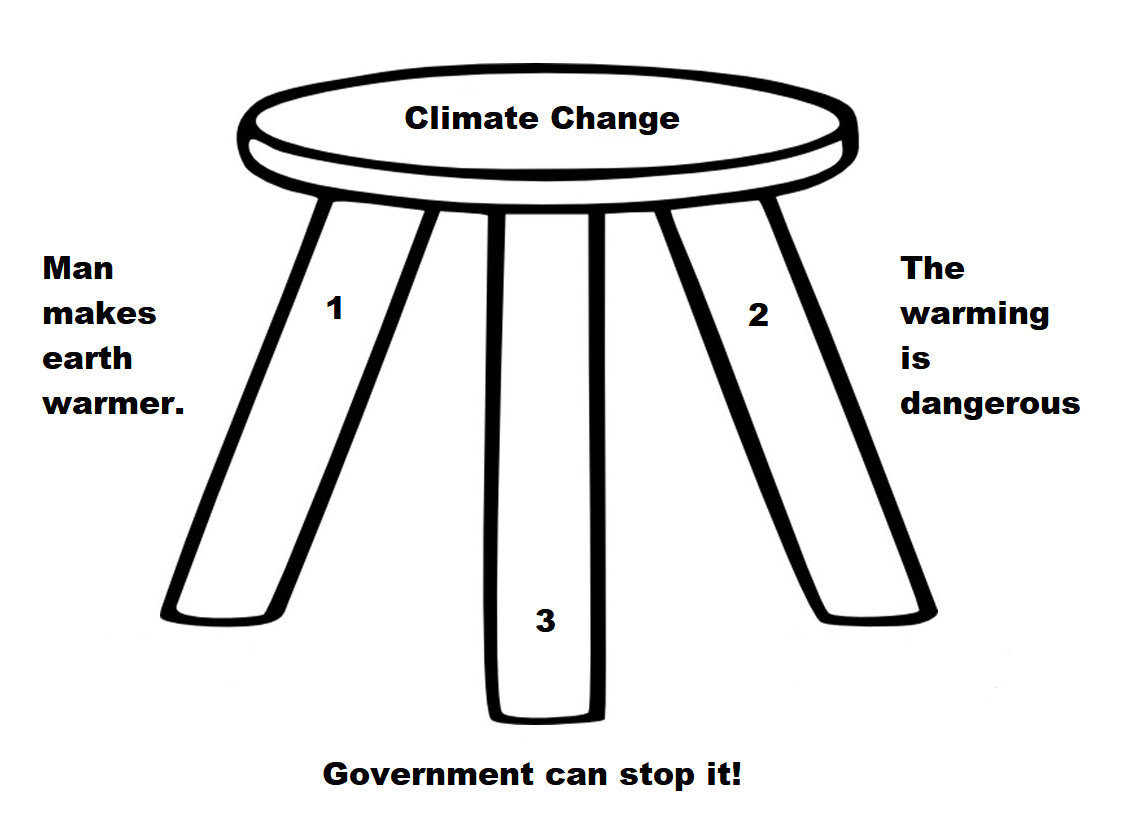
Climate change is a stool standing only if all three assertions are true. This post is addressing the last one.

But does anthropogenic global warming warrant a Pigouvian tax on the emission of greenhouse gases?

The first difficulty is estimating the external cost of greenhouse gas emissions and, hence, the size of the tax. Begin by noting that global warming will have benefits. Increased CO2 emissions have caused a great greening of the planet over the last 20 years. If the climate warms as predicted, vast tracts of land in Russia and Canada, now too cold for agriculture, will become arable. We should expect food to become more abundant and cheaper. More generally, the costs created by cold weather – heating, delays in construction work, etc – should decline. Many people like warm weather. They pay good money to travel to it. I would willingly pay £2,000 a year to make London five degrees warmer.

Of course, there will be costs too. Sea levels may rise, swamping some now inhabited areas. Some places may become too hot for comfortable habitation or agriculture (though these are sure to be smaller than the cold areas made usable). The number of storms may increase, destroying property and interrupting economic activity.

So what is the net cost? No one knows. They don’t even know if it is negative or positive. So they don’t know if greenhouse gas emissions should be taxed or subsidised.

This not an anti-science position. Scientists can predict physical outcomes (with varying degrees of certainty, which, in the case of climate science, is low). But they cannot predict economic outcomes. They cannot tell you the value of those physical outcomes. Global warming will have many effects – some positive, some negative – on a vast number of people with very different environmental circumstances, incomes and preferences. Anyone who claims to know the net aggregate value of global warming displays amazing overconfidence.

Some will say that ignorance itself gives us reason to impose the Pigouvian tax (at some arbitrarily chosen level, as is unavoidable given our ignorance). We should think of it as an insurance policy. The dire warnings may be true and, just in case they are, we should take measures to reduce emissions. Think of the tax as an insurance premium paid against the risk of global warming being net negative.

Yet this logic fails by simply reversing the argument. Global warming might benefit mankind. It would be a tragedy if we didn’t take the opportunity this presents. To avoid this risk, we should tax people to subsidise greenhouse gas emissions. Think of the tax as an insurance premium paid against the risk of missing out on global warming.

This ignorance argument against taxing or subsidising greenhouse gas emissions applies to many things with spill-over effects. Revealing clothes, for example. They affect people besides those who choose to wear them. Are these external effects positive or negative? The answer differs from beholder to beholder and context to context.

There is also a political problem to applying Pigouvian taxes to greenhouse gas emissions – namely, that it is likely to simply relocate emissions rather than cut them. A carbon tax applied in the US will shift (marginal) industrial production to places that don’t apply it. Carbon taxes are one of those cases where there is no point doing something unless (almost) everyone else does it too. Those who advocate applying one in their own country are implicitly committed to the idea that all other relevant countries will also apply one. But that is implausible. The gains from breaking ranks are too great.

Given our ignorance and the implausibility of a globally enforced Pigouvian tax, we should just wait and see. We can adapt to the ill-effects of global warming – relocating activities if need be or building sea defences – while taking advantage of the gains. And we can do this without incurring any immediate cost. Let future people, who will be richer than us, pay for the costs that may arise.

UN “Stretches” CO2 Goals

Several articles are in the media discussing UN meetings in progress to move the climate change goal posts from preventing 2C of warming to a goal of 1.5C additional warming. The US have questioned the plausibility of such an ambition, and this post goes into some of the reasons why. At the bottom I shall raise several skeptical points about this whole enterprise, but first we should look at the data UN uses as a trampoline for leaps of faith.

Data on Annual CO2 Concentrations

The annual average concentrations of atmospheric CO2 are reported from Mauna Loa in a dataset accessed from NOAA here. The graph below shows the record.
Note that in 1959 there was 316 ppm of CO2 according to this dataset, and in 2017 the annual average CO2 was 407 ppm. So the rise of 91 ppm over 59 years is a rate of 1.53 ppm per year. Of course the actual interannual differences vary from that average rate, and as we shall see, many recent years have exceeded 2 ppm per year additional CO2. The table below shows all years in the record that added more than 2 ppm of CO2.

Year Added ppm
1973 2.23
1988 2.38
1998 2.97
2003 2.52
2005 2.28
2006 2.1
2010 2.47
2012 2.2
2013 2.67
2014 2.13
2015 2.18
2016 3.38
2017 2.32

Note that as warming increased so also did CO2 in ppm. You can pick out El Nino years in the list, suggesting that ocean outgassing has a large impact on atmospheric CO2.

The larger point is that, for whatever reasons, the annual addition of CO2 has increased this century to a rate of 2.14 over the last 20 years.

UN Aspirational Goalposts

UN insiders have been making a simple case for some years preceding the Paris 2015 accord. IPCC has claimed that in their judgement keeping atmospheric CO2 less than 450 ppm ensures future warming will not exceed 2C. I don’t buy it, but that has been sold to Paris signatories. Now comes increasing the ambition to limit warming to 1.5C, and the same authorities translate that into a limit of 430 ppm of CO2.

These numbers and their logic can be seen in a document from Climate Analytics: Timetables for Zero emissions and 2050 emissions reductions  Excerpts in italics with my bolds.

This briefing note outlines suggested time frames for reaching zero global CO2 and total greenhouse gas emissions for the ‘below 2 °C’ and ‘below 1.5 °C by 2100’ limits based on the findings of the Fifth Assessment Report of the Intergovernmental Panel on Climate Change (IPCC AR5) and the 2014 UNEP Emissions Gap Report.

Emissions scenarios leading to GHG concentrations in 2100 of about 450 ppm CO2eq or lower are likely to maintain warming below 2 °C over the 21st century relative to pre-industrial levels. These scenarios are characterized by 40% to 70% global anthropogenic GHG emissions reductions by 2050 compared to 2010, and emissions levels near zero or below in 2100.” (IPCC AR5 SYR) Information in Table SPM.1 of the IPCC AR5 SYR

“A limited number of studies provide scenarios that are more likely than not to limit warming to 1.5 °C by 2100; these scenarios are characterized by concentrations below 430 ppm CO2eq by 2100 and 2050 emission reduction between 70% and 95% below 2010.” (IPCC AR5 SYR)

UN Goals Stretch Beyond Credibility

So let’s look at these two scenarios in relation to observed CO2 in the atmosphere.

The blue line is CO2 in ppm observed at Mauna Loa.  The linear regression line shows the continuation of the 1.53 ppm per year rate projected to the end of this century.  As noted above the blue line is already exceeding the earlier rate.  The orange line shows CO2 hitting 430 ppm in 2032 at the 1.53 rate, or earlier if more recent rates continue.  For example, if the 2.14 ppm per year rate continues, 430 ppm is reached by 2028. The red 450 scenario is reached in 2045. Both scenarios presume zero additional CO2 after those dates.

UN Piles Supposition on Top of Supposition

Previous posts here have taken issue with UN IPCC assertions that rising CO2 causes temperatures to rise and that human fossil fuel emissions cause CO2 to rise.

See: Who to Blame for Rising CO2

CO2 Fluxes, Sources and Sinks

How Climate Law Relies on Paris

No Mention of climate or warming in New NA Trade Accord 

Hats off to all for arriving at an agreement for economic transactions unburdened by obsessions with CO2 and unfounded claims of humans controlling the weather. A survey of the text shows the terms “climate” and “warming” do not appear even once. Good job!

Of course, greens are up in arms. Imagine signing a trade agreement that does nothing to destroy our economies in order to save the planet from CO2.

The deal does have a chapter on the environment, but critics such as the Council of Canadians call it weak and unenforceable.

It mentions pollution, marine traffic, endangered animals and ozone, but ignores what many call the world’s largest environmental challenge.

“The deal doesn’t even mention climate change,” Stewart said.

What has been thrown out is a provision in the old North American Free Trade Agreement that allowed corporations to sue governments for lost profits if they were injured by public-interest regulations such as environmental laws. The Council of Canadians pointed out that Canada was sued 37 times, mostly by American companies, under the old clause.

Update October 2, 2018

The new NA trade accord also strengthens energy security and trade. From offshore-technology.com:

The US oil and gas industry has urged Congress to approve the Trump administration’s renegotiated North American Free Trade Agreement (NAFTA), saying that the deal will support US oil and gas exports across North and South America.

American Petroleum Institute president and CEO Mike Sommers said: “We urge Congress to approve the United States-Mexico-Canada-Agreement (USMCA). Having Canada as a trading partner and a party to this agreement is critical for North American energy security and US consumers. Retaining a trade agreement for North America will help ensure the US energy revolution continues into the future.”

There were concerns in the industry that Trump would scrap the NAFTA, which was pivotal in making Mexico the largest exporter of US oil, transportation fuel, and natural gas.

Meanwhile, with support from the trade agreement, Canada is the largest supplier of foreign oil and a significant exporter of electricity to the US.

The deal also makes Canada’s heavier crude oil more attractive to refiners in the Mexican Gulf, especially at a time when Venezuela’s production has reduced amid political and financial worries. Fracked US crude oil is lighter, and refineries in the Gulf, which traditionally deal with heavier crude, are still adjusting their processing practices.

The new NAFTA deal ensures a ‘zero-tariff’ on energy products traded between the US, Mexico and Canada.


Ontario to Scrap Green Energy Act

Update September 21, 2018 at bottom

Global News reports on today;s proposed legislation: Ontario PCs introduce legislation to scrap Green Energy Act.  Excerpts in italics with my bolds.

Doug Ford‘s Progressive Conservative government has introduced legislation to put an end to the province’s Green Energy Act.

The legislation was tabled just before 1:30 p.m. ET Thursday. A formal announcement was made by energy minister, Greg Rickford, and infrastructure minister, Monte McNaughton.

“The Green Energy Act represents the largest transfer of money from the poor and middle class to the rich in Ontario’s history,” Rickford said.

Killing the former Liberal government’s Green Energy Act — passed in 2009 when Dalton McGuinty was premier — was a major campaign promise for Ford.

He said that the GEA had resulted in fewer manufacturing jobs in Ontario and that regulations around renewable energy projects had led to higher electricity prices for consumers.

Reddy the shiv

The move comes after the PC government had already introduced legislation cancelling hundreds of wind energy projects approved under the act.

Scrapping the GEA will likely mean major changes for the province’s energy sector.

For example, under the GEA, municipalities were essentially barred from disallowing renewable energy projects – such as wind farms – from being built within their territory. Many people opposed to these projects criticized this section of the GEA, saying it prohibited local communities from deciding their own futures.

The GEA also gave special powers to the minister of energy to green light certain projects, such as transmission lines, without conducting a full economic review prior to approval.

But proponents of the GEA, including former energy minister George Smitherman, who helped pass the legislation, have called the GEA and renewable energy projects in the province a big success.

Meanwhile, Liberal interim leader, John Fraser, says cancellation of the GEA could see Ontario move backward on renewable energy when compared to the rest of the world. He also fears scrapping the act could mean job losses

“My biggest concern this afternoon is jobs. What’s going to happen to people’s jobs in this industry that we’ve built up – tens of thousands of jobs,” Fraser said.

But the PCs say this isn’t true.

They say that the GEA was responsible for the “disastrous” feed-in-tariff program that contributed significantly toward skyrocketing electricity prices and that the bill’s repeal is necessary to prevent “unneeded” renewable energy projects being approved in the future.

“We believe the people of Ontario should have the final say about what gets built in their communities,” McNaughton said.

Update September 21, 2018

Some news reports have given more air time to reaction from greens.  Lorrie Goldstein at Toronto Sun instead goes into more detail why the Ontario Green Act is a failure: Good riddance to toxic Green Energy Act  Excerpts in italics with my bolds.

By scrapping the Green Energy Act, passed by former Liberal premier Dalton McGuinty in 2009, Premier Doug Ford is ending one of the worst legislative disasters ever inflicted on the people of Ontario.

The GEA is largely responsible for Ontario’s skyrocketing electricity prices.

It’s the reason we’re paying outrageously high prices for green energy the Liberals didn’t need in order to eliminate coal power, which was actually done using nuclear power and natural gas.

The jobs the Liberals promised under the GEA never materialized, according to former Ontario auditor general Jim McCarter in his 2011 annual report.

The GEA made Ontario’s energy grid less efficient because it required the province to buy expensive and unreliable wind and solar power from green energy developers under 20-year contracts, before purchasing other forms of energy.

Auditor General Bonnie Lysyk reported in 2016 that Ontario electricity consumers had overpaid $9.2 billion for green energy, because the Liberals ignored the advice of their own experts on how to price it.

Under the GEA, the Liberals abdicated from the proper role of government, which is to balance public and private interests.

Instead, they became cheerleaders for the wealthy green energy lobby.

Citizens opposed to green energy projects imposed on their communities faced the impossible task of fighting the industry and the Liberal government.

Ford is right to scrap the GEA.

The tragedy is that the economic damage it caused under the McGuinty/Wynne Liberals will be felt for decades to come.