UN’s Guterres: Head in Oven, Feet in Freezer

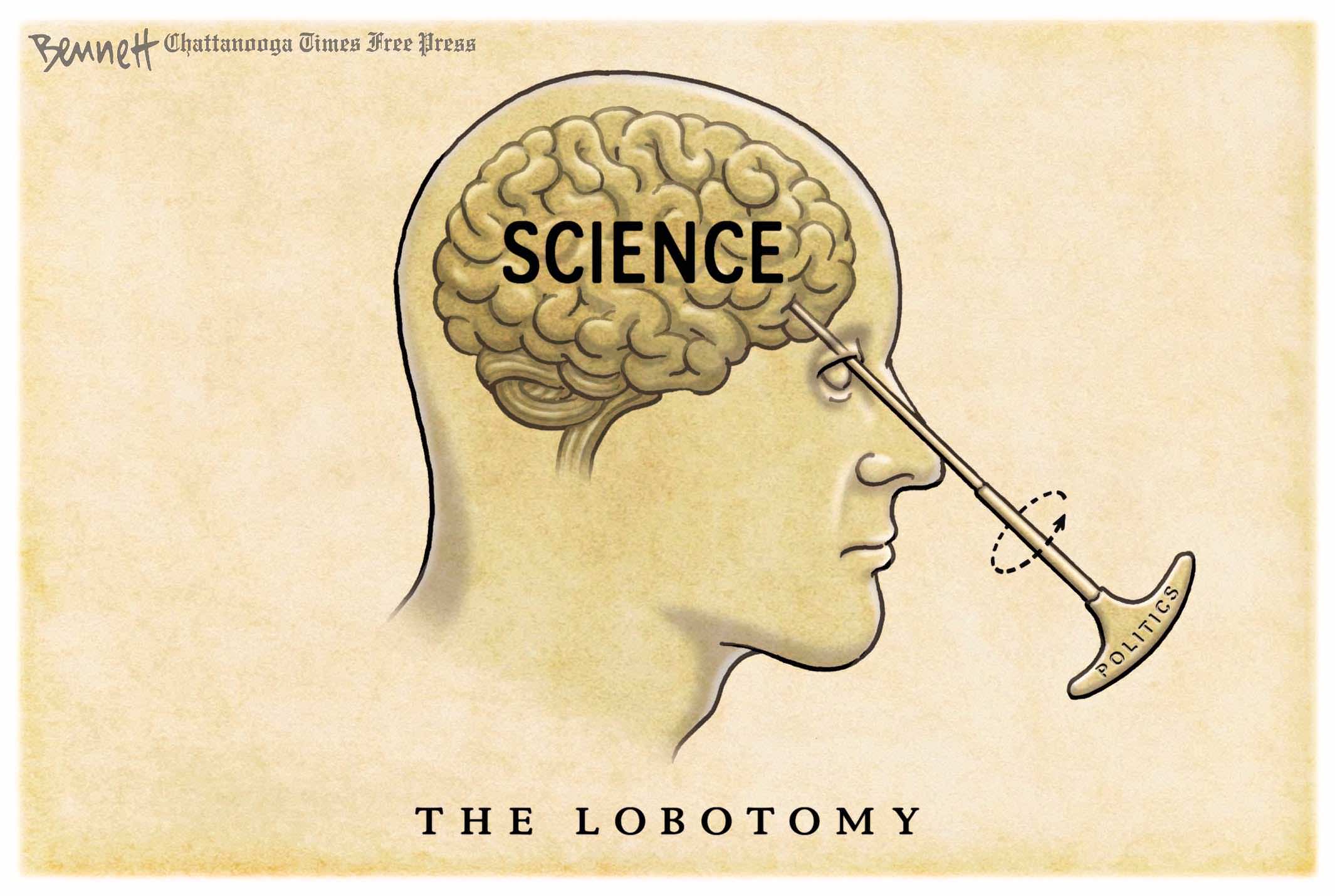
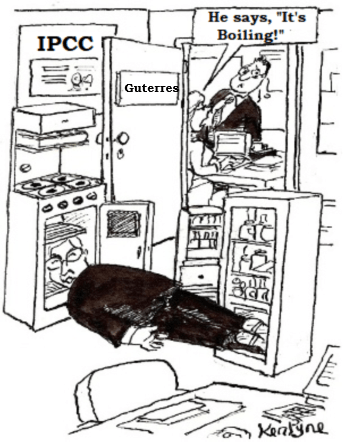
The image is based on a criticism of statisticians:  “If my head is in the oven and my feet are in the freezer, my temperature may be on average normal.”  UN Chief Guterres presumes to speak for the planet when he claims we are experiencing “Global Boiling.”  Apparently, his feet are too numb to register any of the many cold temperatures in places around the world, so he is a victim fearing a runaway average warming.  Let’s inform him and others similarly misled about the facts on the ground they are missing.

Australia

Why Is It So Cold Right Now? A Weather Expert Explains

Temperatures plummeted across southeast Australia this week, with Weatherzone reporting Canberra’s low of -7.2ºC was “its lowest temperature since 2018 and the lowest for June since 1986.”

Sydney experienced its coldest June morning today since 2010, with a temperature of 5.2ºC. In Victoria, temperatures of -7.2ºC were recorded.

Australia just had one of its coolest and wettest summers of the last decade. 

Snow settled on the Stirling Range in WA on Thursday morning after a frigid polar air mass travelled from Antarctica to Australia.

A long fetch of southerly winds has been blowing across the Southern Ocean during the past week, carrying polar air from the ice sheets of Antarctica into unusually low latitudes.

On Thursday morning, this Antarctic air mass reached the Stirling Range in WA and caused snow to settle on Bluff Knoll.

United Kingdom

Met Office explains why the weather is so miserable this May

‘High-pressure systems have been generally located over southern continental Europe and also to the far east of Europe’, they told Metro.co.uk.

The spokesperson continued: ‘As these high-pressure systems interacted through the season, the UK is positioned between them, leading to periods of cool, cloudy, and wet conditions for the UK.  ‘These have generally either swept in from the Atlantic or slipped between the high-pressure systems to reach the UK.

‘Warmer-than-average sea temperatures also provided the necessary fuel for clouds to develop, which has been quite persistent in spring.’

Met Office meteorologist Clare Nasir said: ‘Showers over the next few days could be heavy with the risk of thunder and hail.’   She added that the risk of thunder and hail persist through Wednesday and Thursday.

Where has the UK summer gone

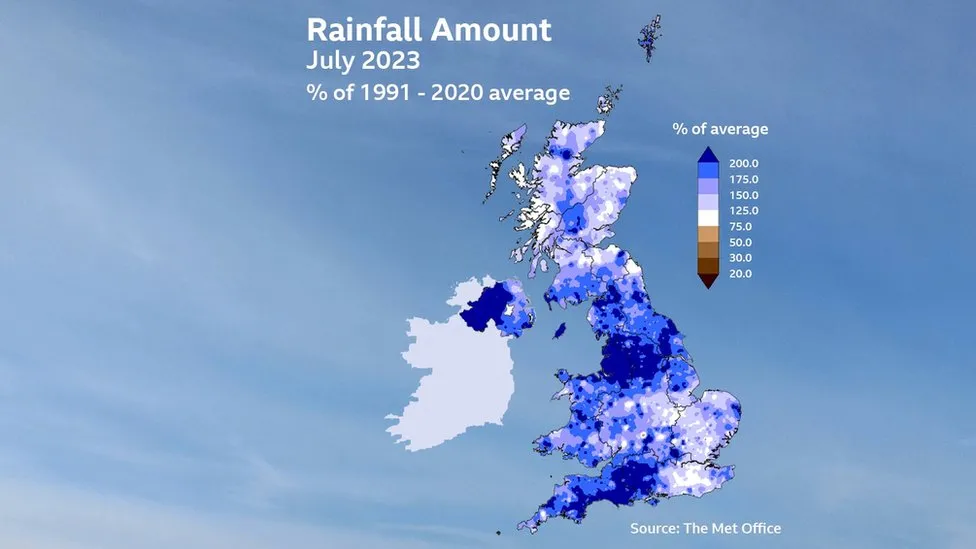
Summer 2023 so far has been one of contrasts – after the warmest June on record we had an exceptionally wet July.  Northern Ireland and much of north-west England had their wettest July on record. Looking ahead there is no immediate end to the distinctly un-summery conditions. So what is going on?

Any spring warmth was hard to come by. After a cool April, very warm weather was distinctly lacking in May. Nowhere reached 24°C until the month was nearly over, on the 27th.

However, that theme changed dramatically in June. Temperatures soared to 32.2°C, with a heatwave being declared in many places and becoming the warmest June on record which, according to the Met Office, bears the “fingerprint of climate change”.

It was all change again in early July with low pressure setting in, and staying put. While much of Europe sweltered in a blistering heatwave the UK sat under cool, wet weather which looks set to stay for the first part of August too.

India

Is January 2023 going to be the coldest year in the 21st century?

There may be no relief from the ongoing spell of cold wave with minimum temperatures hovering below normal limits at most places, reports suggested. If a weather expert is believed, it has been predicted that temperatures in the plains are going to dip as far as -4 degrees Celsius next week.

Large parts of north India are still reeling under numbing cold with the mercury remaining below freezing point at most places in Jammu and Kashmir, while dense fog in the early hours of the morning hit road and rail traffic movement. Cold wave conditions abated in Delhi due to a fresh western disturbance affecting northwest India, even as a dense layer of fog lowered visibility to just 50 metres.

Northern India braces for coldest weather in years as dense fog, poor air quality linger

A new wave of cold weather is headed into northern India and could drop temperatures to levels not seen there in over three years, according to AccuWeather forecasters.

The cold weather shot will be the latest, and perhaps most significant, of many recent waves of chilly weather that have also led to travel-disrupting dense fog and poor air quality over parts of the Indian subcontinent since late December.

The temperature in New Delhi, the capital city of India and home to more than 18 million people, has the potential to drop as low as 2 degrees Celsius (35 degrees Fahrenheit) on Sunday night and Monday morning. While the record low for this coming Monday of 1.3 degrees Celsius below zero (29.7 degrees Fahrenheit) appears safe, it will be well below the average low of 6 degrees Celsius (42 degrees Fahrenheit) for the date.

Temperatures at this level would be the coldest readings in New Delhi since December 2019,” said Nicholls.

Ahead of the cold wave, the IMD has issued a cold wave warning for Sunday and Monday for the northern Indian states of Punjab, Haryana, Chandigarh, Delhi and Rajasthan. The warning was issued to give residents advance notice of a level of cold that could adversely impact human health and property.

Canada

Spring forecast 2023: The La Nina Winter pattern is forecast to extend as we head into Spring despite the breakdown of the cold ocean anomalies

Spring season 2023 is nearing, with forecasts revealing the jet stream pattern over the North Pacific and the Atlantic to be influenced by the diminishing La Nina. A high-pressure system in the Pacific will define the weather patterns over North America, with a potential Stratospheric warming event playing a role early in the season.

The cold ocean phase in the equatorial Pacific is already in breakdown mode. It is expected to decline rapidly towards early Spring.

But, despite the breakdown of these cold ocean anomalies (La Nina), its influence can still persist in global weather circulation. Long-range weather calculations also see this, extending the La Nina jet stream pattern from Winter into Spring 2023.

Spring sits on the sidelines with Winter’s wild ride to the finish line

USA

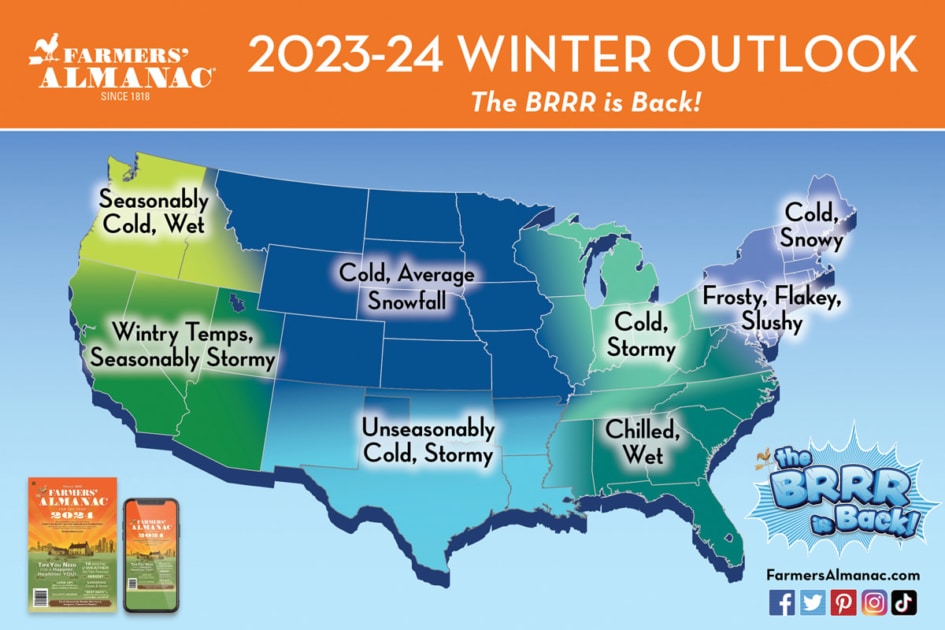
Winter Forecast 2024: The Brrr Is Back

The Brrr is Back!
“After a weird and warm winter season last year, this winter should make cold weather fans rejoice—especially those in the Great Lakes, Midwest, and northern New England areas,” shares editor Pete Geiger, adding “the ‘brrr’ is coming back! We expect more snow and low temperatures nationwide.”

East Coast Snow?
Folks living along the I-95 corridor from Washington to Boston, who saw a lack of wintry precipitation last winter, should experience quite the opposite, with lots of rain/sleet and snowstorms to contend with.

Texans Beware!
According to Farmers’ Almanac 2024, Texans should prepare for an unseasonably cold and stormy winter season ahead

Frosts in Florida?
Winter will be wet in the Southeast region however a few frosts are forecast to bring the “brrrs” to Floridians and its snowbirds.

Asia

As Asian countries hit by extreme cold snap, here’s what life is like at -53C

An intense cold spell is gripping east Asia, with temperatures plunging and hazardous conditions reported across China, the Koreas and Japan.

On Monday one of China’s northern-most cities broke its lowest ever recorded temperature, with the mercury hitting -53C at 7am on the first day of the Lunar New Year in Mohe, Heilongjiang province.

Japan and the Korean peninsula have also issued warnings over freezing temperatures and gales that have killed at least one person, while at least 57 people have been reported dead in Afghanistan as the wintry conditions stretch across into central Asia.

Europe

Record-Challenging Cold Sweeps Europe

It’s been cold — ask a European, ask me…

We’ve enjoyed a ‘comfortably cool’ July here in Central Portugal (thus far), it’s been great. Same with my old haunt, the UK. July 2023 there is on course to be colder-than-average–and vs the historically cool 1961-1990 era that the Met Office still insist on using, no less.

Looking ahead, and particularly at central/eastern nations, those summer chills are about to take another step down.

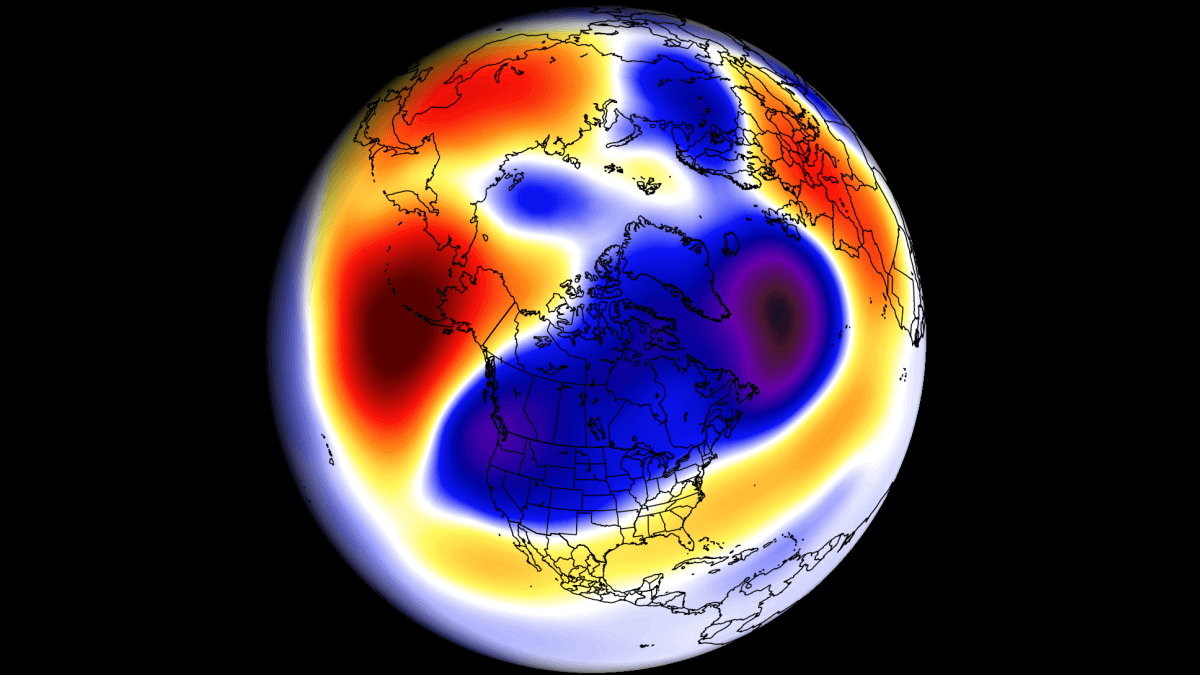
As per the latest GFS run (shown below), ‘pinks’ and ‘purples’ are forecast to engulf the likes of Poland, Slovakia, Hungary, Croatia, Serbia, Albania, Belarus, Ukraine and Romania this week, sending temperatures crashing by as much as 18C below the seasonal norm.

Record summer lows are expected, an unbiased media would report on them (not holding my breath).

Russia

Extreme cold grips Siberia, as temperatures fall to lowest levels since 2002

The coldest air on Earth plunged into Siberia this week, dropping temperatures to as low as 80 degrees Fahrenheit below zero. An expansion of that cold is expected across eastern Asia into early next week and eventually North America, according to AccuWeather forecasters.

The bitter cold not only allowed temperature benchmarks that have not been hit in decades in some parts of Russia, but the extreme weather also created an icy spectacle as firefighters battled a fire in subzero temperatures on Jan. 8 in Ufa, Russia. Massive icicles clung to the home amid the anomalous cold.

The same Arctic blast dropped temperatures in Moscow to their lowest levels in years this past weekend, while even parts of northern India will get a taste of the cold beginning later this weekend.

Antarctica

Antarctica Plunges to -83.2C (-117.8F)–Earth’s Lowest Temperature Since 2017

While the media tricks the dumb and the gullible into believing the world is on fire –with poverty-inducing CO2 reductions their only savior– Antarctica is shivering through an extreme bout of cold, even by South Pole standards.

The Italian-French research station ‘Concordia’ posted a reading of -83.2C (-117.8F) on July 25. This ranks as the fifth coldest daily value in the operational life of the station, bested only by Aug 2010’s -84.7C; July 2010’s -84.6C; and June 2017’s -83.9C and -83.5C.

As discussed recently, Antarctic sea ice’s tough time of it in 2023 isn’t related to temperature, that correlation simply doesn’t exist. The Antarctic continent continues to cool, the data are very clear on that, yet ice is taking a proverbial beating this season.

South America

Fierce frosts have gripped areas of Argentina and Chile

Some of that aforementioned Antarctic cold has been spun northward over Southern Hemisphere land masses.

Fierce frosts have gripped areas of Argentina and Chile of late, as South America’s topsy–turvy ‘meridional jet stream‘-fueled winter drags on. Looking ahead, more of the same is on the cards, too, as we head into August:

Southern Africa

Southern Africa Freezes, Rare Snowfall Hits Johannesburg

Southern Africa is enduring fierce freeze this week as a blast of polar air engulfs the likes of SA, Namibia, Botswana, Zimbabwe, Mozambique, as well as Angola, Zambia and Malawi.

Coastal regions are struggling to climb above 10C (50F), while at higher-elevations and inland, frosts are proving widespread, with reports of rare snowfall coming out of some unusual spots such as Zimbabwe and South Africa, such as Johannesburg.

Several regions of South Africa are enduring a harsh winter this year, according to local media outlets, with this past weekend delivering an intensification. Sub-zero (C) lows struck Johannesburg and surrounding areas over the past few mornings, with daytime highs of just 4C (39.2F) noted–where the July average is closer to 17C (62.6F).

Temperatures also held low enough to keep the snow lying on the ground throughout the morning, bringing joyous scenes to many a school playground — this would have been the first time many children have seen snow (Prof David Viner take note).

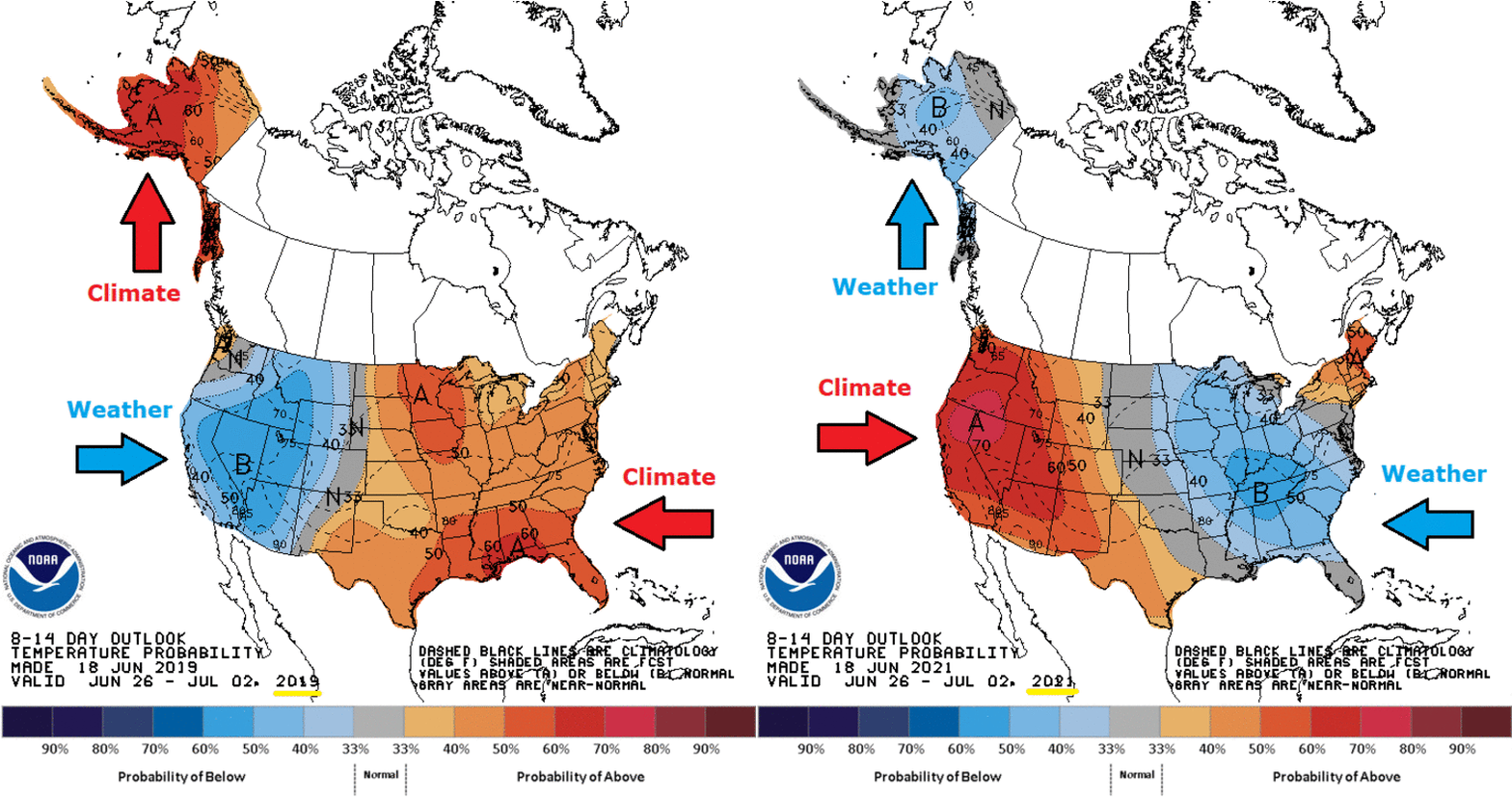
Footnote:  Climate is Dynamic: Hot Today, Cold Tomorrow

And the same goes for precipitation:


So Many Global Parts Not Boiling

Australia

Why Is It So Cold Right Now? A Weather Expert Explains

Temperatures plummeted across southeast Australia this week, with Weatherzone reporting Canberra’s low of -7.2ºC was “its lowest temperature since 2018 and the lowest for June since 1986.”

Sydney experienced its coldest June morning today since 2010, with a temperature of 5.2ºC. In Victoria, temperatures of -7.2ºC were recorded.

Australia just had one of its coolest and wettest summers of the last decade. 

Snow settled on the Stirling Range in WA on Thursday morning after a frigid polar air mass travelled from Antarctica to Australia.

A long fetch of southerly winds has been blowing across the Southern Ocean during the past week, carrying polar air from the ice sheets of Antarctica into unusually low latitudes.

On Thursday morning, this Antarctic air mass reached the Stirling Range in WA and caused snow to settle on Bluff Knoll.

United Kingdom

Met Office explains why the weather is so miserable this May

‘High-pressure systems have been generally located over southern continental Europe and also to the far east of Europe’, they told Metro.co.uk.

The spokesperson continued: ‘As these high-pressure systems interacted through the season, the UK is positioned between them, leading to periods of cool, cloudy, and wet conditions for the UK.  ‘These have generally either swept in from the Atlantic or slipped between the high-pressure systems to reach the UK.

‘Warmer-than-average sea temperatures also provided the necessary fuel for clouds to develop, which has been quite persistent in spring.’

Met Office meteorologist Clare Nasir said: ‘Showers over the next few days could be heavy with the risk of thunder and hail.’   She added that the risk of thunder and hail persist through Wednesday and Thursday.

Where has the UK summer gone

Summer 2023 so far has been one of contrasts – after the warmest June on record we had an exceptionally wet July.  Northern Ireland and much of north-west England had their wettest July on record. Looking ahead there is no immediate end to the distinctly un-summery conditions. So what is going on?

Any spring warmth was hard to come by. After a cool April, very warm weather was distinctly lacking in May. Nowhere reached 24°C until the month was nearly over, on the 27th.

However, that theme changed dramatically in June. Temperatures soared to 32.2°C, with a heatwave being declared in many places and becoming the warmest June on record which, according to the Met Office, bears the “fingerprint of climate change”.

It was all change again in early July with low pressure setting in, and staying put. While much of Europe sweltered in a blistering heatwave the UK sat under cool, wet weather which looks set to stay for the first part of August too.

India

Is January 2023 going to be the coldest year in the 21st century?

There may be no relief from the ongoing spell of cold wave with minimum temperatures hovering below normal limits at most places, reports suggested. If a weather expert is believed, it has been predicted that temperatures in the plains are going to dip as far as -4 degrees Celsius next week.

Large parts of north India are still reeling under numbing cold with the mercury remaining below freezing point at most places in Jammu and Kashmir, while dense fog in the early hours of the morning hit road and rail traffic movement. Cold wave conditions abated in Delhi due to a fresh western disturbance affecting northwest India, even as a dense layer of fog lowered visibility to just 50 metres.

Northern India braces for coldest weather in years as dense fog, poor air quality linger

A new wave of cold weather is headed into northern India and could drop temperatures to levels not seen there in over three years, according to AccuWeather forecasters.

The cold weather shot will be the latest, and perhaps most significant, of many recent waves of chilly weather that have also led to travel-disrupting dense fog and poor air quality over parts of the Indian subcontinent since late December.

The temperature in New Delhi, the capital city of India and home to more than 18 million people, has the potential to drop as low as 2 degrees Celsius (35 degrees Fahrenheit) on Sunday night and Monday morning. While the record low for this coming Monday of 1.3 degrees Celsius below zero (29.7 degrees Fahrenheit) appears safe, it will be well below the average low of 6 degrees Celsius (42 degrees Fahrenheit) for the date.

Temperatures at this level would be the coldest readings in New Delhi since December 2019,” said Nicholls.

Ahead of the cold wave, the IMD has issued a cold wave warning for Sunday and Monday for the northern Indian states of Punjab, Haryana, Chandigarh, Delhi and Rajasthan. The warning was issued to give residents advance notice of a level of cold that could adversely impact human health and property.

Canada

Spring forecast 2023: The La Nina Winter pattern is forecast to extend as we head into Spring despite the breakdown of the cold ocean anomalies

Spring season 2023 is nearing, with forecasts revealing the jet stream pattern over the North Pacific and the Atlantic to be influenced by the diminishing La Nina. A high-pressure system in the Pacific will define the weather patterns over North America, with a potential Stratospheric warming event playing a role early in the season.

The cold ocean phase in the equatorial Pacific is already in breakdown mode. It is expected to decline rapidly towards early Spring.

But, despite the breakdown of these cold ocean anomalies (La Nina), its influence can still persist in global weather circulation. Long-range weather calculations also see this, extending the La Nina jet stream pattern from Winter into Spring 2023.

Spring sits on the sidelines with Winter’s wild ride to the finish line

USA

Winter Forecast 2024: The Brrr Is Back

The Brrr is Back!
“After a weird and warm winter season last year, this winter should make cold weather fans rejoice—especially those in the Great Lakes, Midwest, and northern New England areas,” shares editor Pete Geiger, adding “the ‘brrr’ is coming back! We expect more snow and low temperatures nationwide.”

East Coast Snow?
Folks living along the I-95 corridor from Washington to Boston, who saw a lack of wintry precipitation last winter, should experience quite the opposite, with lots of rain/sleet and snowstorms to contend with.

Texans Beware!
According to Farmers’ Almanac 2024, Texans should prepare for an unseasonably cold and stormy winter season ahead

Frosts in Florida?
Winter will be wet in the Southeast region however a few frosts are forecast to bring the “brrrs” to Floridians and its snowbirds.

Asia

As Asian countries hit by extreme cold snap, here’s what life is like at -53C

An intense cold spell is gripping east Asia, with temperatures plunging and hazardous conditions reported across China, the Koreas and Japan.

On Monday one of China’s northern-most cities broke its lowest ever recorded temperature, with the mercury hitting -53C at 7am on the first day of the Lunar New Year in Mohe, Heilongjiang province.

Japan and the Korean peninsula have also issued warnings over freezing temperatures and gales that have killed at least one person, while at least 57 people have been reported dead in Afghanistan as the wintry conditions stretch across into central Asia.

Europe

Record-Challenging Cold Sweeps Europe

It’s been cold — ask a European, ask me…

We’ve enjoyed a ‘comfortably cool’ July here in Central Portugal (thus far), it’s been great. Same with my old haunt, the UK. July 2023 there is on course to be colder-than-average–and vs the historically cool 1961-1990 era that the Met Office still insist on using, no less.

Looking ahead, and particularly at central/eastern nations, those summer chills are about to take another step down.

As per the latest GFS run (shown below), ‘pinks’ and ‘purples’ are forecast to engulf the likes of Poland, Slovakia, Hungary, Croatia, Serbia, Albania, Belarus, Ukraine and Romania this week, sending temperatures crashing by as much as 18C below the seasonal norm.

Record summer lows are expected, an unbiased media would report on them (not holding my breath).

Russia

Extreme cold grips Siberia, as temperatures fall to lowest levels since 2002

The coldest air on Earth plunged into Siberia this week, dropping temperatures to as low as 80 degrees Fahrenheit below zero. An expansion of that cold is expected across eastern Asia into early next week and eventually North America, according to AccuWeather forecasters.

The bitter cold not only allowed temperature benchmarks that have not been hit in decades in some parts of Russia, but the extreme weather also created an icy spectacle as firefighters battled a fire in subzero temperatures on Jan. 8 in Ufa, Russia. Massive icicles clung to the home amid the anomalous cold.

The same Arctic blast dropped temperatures in Moscow to their lowest levels in years this past weekend, while even parts of northern India will get a taste of the cold beginning later this weekend.

Antarctica

Antarctica Plunges to -83.2C (-117.8F)–Earth’s Lowest Temperature Since 2017

While the media tricks the dumb and the gullible into believing the world is on fire –with poverty-inducing CO2 reductions their only savior– Antarctica is shivering through an extreme bout of cold, even by South Pole standards.

The Italian-French research station ‘Concordia’ posted a reading of -83.2C (-117.8F) on July 25. This ranks as the fifth coldest daily value in the operational life of the station, bested only by Aug 2010’s -84.7C; July 2010’s -84.6C; and June 2017’s -83.9C and -83.5C.

As discussed recently, Antarctic sea ice’s tough time of it in 2023 isn’t related to temperature, that correlation simply doesn’t exist. The Antarctic continent continues to cool, the data are very clear on that, yet ice is taking a proverbial beating this season.

South America

Fierce frosts have gripped areas of Argentina and Chile

Some of that aforementioned Antarctic cold has been spun northward over Southern Hemisphere land masses.

Fierce frosts have gripped areas of Argentina and Chile of late, as South America’s topsy–turvy ‘meridional jet stream‘-fueled winter drags on. Looking ahead, more of the same is on the cards, too, as we head into August:

Southern Africa

Southern Africa Freezes, Rare Snowfall Hits Johannesburg

Southern Africa is enduring fierce freeze this week as a blast of polar air engulfs the likes of SA, Namibia, Botswana, Zimbabwe, Mozambique, as well as Angola, Zambia and Malawi.

Coastal regions are struggling to climb above 10C (50F), while at higher-elevations and inland, frosts are proving widespread, with reports of rare snowfall coming out of some unusual spots such as Zimbabwe and South Africa, such as Johannesburg.

Several regions of South Africa are enduring a harsh winter this year, according to local media outlets, with this past weekend delivering an intensification. Sub-zero (C) lows struck Johannesburg and surrounding areas over the past few mornings, with daytime highs of just 4C (39.2F) noted–where the July average is closer to 17C (62.6F).

Temperatures also held low enough to keep the snow lying on the ground throughout the morning, bringing joyous scenes to many a school playground — this would have been the first time many children have seen snow (Prof David Viner take note).


Canada Wildfires: Manage Forests or Lose Them

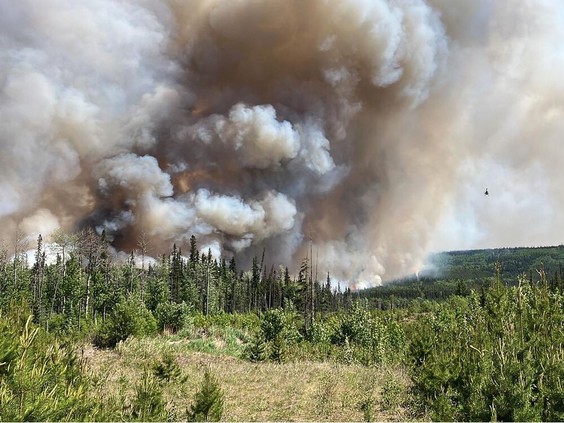
Smoke from the West Kiskatinaw River and Peavine Creek wildfires in the Dawson Creek Zone. PHOTO BY – /BC Wildfire Service/AFP via Getty

Jesse Zeman explains the overdue choice in his Vancouver Sun article A long, destructive summer is coming to B.C. forests.  Excerpts in italics with my bolds.

Until we overhaul forest management, wildfires and smoky skies will become the norm.

B.C. is poised to suffer an historically ruinous fire season, and we have only ourselves to blame.

Warm, dry weather early in the season is part of the problem, to be sure. Climate change is likely making things worse. But B.C.’s history of fire suppression and outdated forest management has turned our forests into a tinderbox that grows more dangerous every year.

At this moment, 23 wildfires are burning out of control in B.C., with dozens more in various stages of being extinguished. Campfire prohibitions are either in effect or planned across the province.

All this nearly a month before Canada Day weekend. It could be a long, hot, destructive summer.  Decades of fire suppression have resulted in huge amounts of fuel littering the forest floor, crowding out biodiversity and putting people at risk.

By putting out every fire on the landscape, we are creating forests
that are bristling with fuel just waiting for a spark.

Fire naturally occurs every five to 200 years in much of B.C. In the central Interior, many areas historically burn every five to 30 years. Under the right circumstances, fire is good. Fire is part of a natural process that rejuvenates grasslands and promotes biodiversity.

In much of the Interior, fire is an integral component of functioning and productive habitat for grizzly bears, moose, elk, mule deer, and sheep, creating food for wildlife by regenerating the soil and letting in sunlight, which creates ideal conditions for new plants and berries to grow.

Broadleaf trees are nature’s fuel break, slowing and reducing the intensity of fires; they also support biodiversity and provide moose with food. Unfortunately, B.C.’s outdated forest policies treat broadleaf trees like weeds in order to promote the growth of merchantable timber.

In parts of B.C., we spray broadleaf trees with the herbicide
glyphosate to kill them off on a massive scale.

What we do after a fire is vital. A post-fire landscape left untouched creates a natural fire break. As new plants and trees grow in, the burned trees that we leave standing are critical for moisture retention and temperature regulation in the soil. In as little as a year, burned areas sound like a symphony, teeming with life from bugs to birds to bears. But our forest practices typically prevent natural succession. Instead, we often log areas burned by fire as quickly as possible, because burned trees are harder to cut at the mill after a couple of years.

Logging after wildfire often leaves behind a barren landscape, with stunted native plants due to a lack of temperature regulation and moisture retention in the soil. Roads for logging invite invasive weeds. The lack of vegetation can also exacerbate erosion, flooding and sedimentation in our watersheds.

B.C. has been so focused on cutting down and selling trees, it has failed to account for the costs of fire suppression, loss of biodiversity, food security, and tourism. Forestry could play a critical role in mitigating the effects of wildfire by reducing fuel loads and thinning forests.

But that will require a new way of thinking. Until we overhaul forest management, wildfires and smoky skies will become the norm. We need to forge a new relationship with our forests, watersheds and wildlife, focusing on sustainability and resiliency.

We have important choices to make: Keep putting fires out and treating native tree species, such as aspen, like weeds until the fuel loading is so bad that the ensuing wildfires are virtually uncontrollable. Or we can invest in our landscapes, have controlled burns in the spring and fall, and let some fires burn to create a natural diverse landscape that mitigates high-intensity wildfires.

National Perspective from National Post Blame Forestry Management, Not CO2 Emissions

Alternative theories as to the source of the 2023 fires have largely cropped up in response to progressive politicians fingering them as irrefutable evidence of the impacts of climate change — and a clarion call for stronger emissions policies.

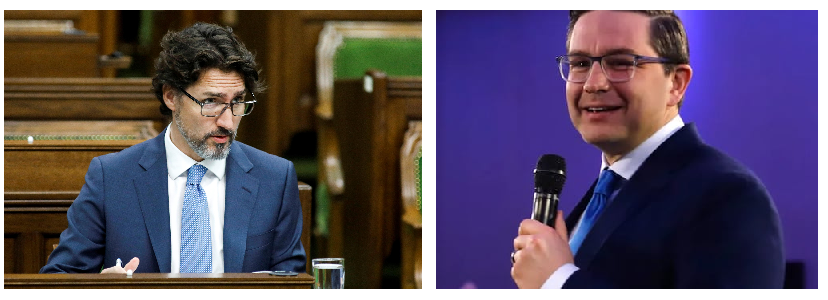
“We’re seeing more and more of these fires because of climate change … We’ll keep working — here at home and with partners around the world — to tackle climate change and address its impacts,” reads one recent statement by Canadian Prime Minister Justin Trudeau.

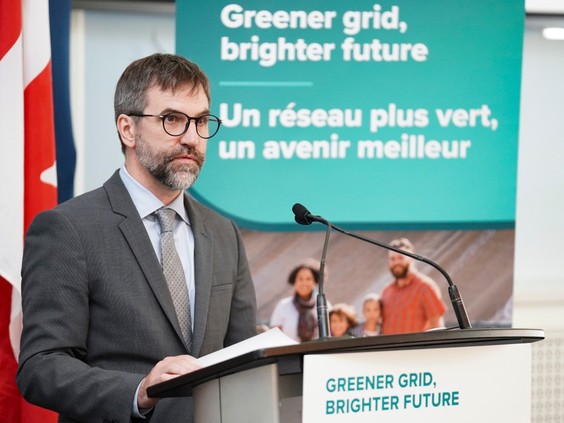
Environment Minister Steven Guilbeault rather explicitly used the wildfires as justification for higher carbon taxes, arguing that they’re still far lower than the “social cost of carbon.”

But there is a way to critique this line of reasoning without relying on tenuous evidence of a vast enviro-conspiracy to light Canada on fire for political gain.

Even wildfire specialists have been noting that while hotter, drier summers can supercharge a bad fire season, the immense scale of the 2023 fires is due in part to Canada and the United States dropping the ball on proper forestry management.

A recent Washington Post op-ed by Colorado wildfire scientist Jennifer K. Balch, for instance, suggested that the best way for governments to fight wildfires is a tighter focus on controlled burning in cooler years, and building residential developments away from high-risk areas.

“We have flood plain maps, but we don’t have maps that assess future fire risk to help set insurance costs and direct developers away from vulnerable areas,” she wrote.

The B.C. Wildlife Federation has similarly critiqued the notion that emissions reduction is the most immediate solution to increasingly damaging wildfire seasons.  In a lengthy statement, (above) executive director Jesse Zeman outlined how B.C. forestry policy discourages the growth of broad-leafed trees and immediately logs post-fire landscapes; both of which eliminate what would otherwise be natural fire breaks.

“Until we overhaul forest management, wildfires and smoky skies will become the norm,” he wrote.


Choices Usurped by Self Righteous Tyrants

William Watson writes at Financial Post Self-righteous totalitarian tinkering and the end of gas-powered cars.  Excerpts in italics with my bolds and added images.

Canadians often get to vote on important local projects.
When did we all vote on abolishing gas engines?

I am happy to report that democracy is alive and well in the Montreal suburb where I live and by all appearances completely uninfluenced by the Chinese Communist Party.

My evidence is purely anecdotal: the steady stream of voters arriving at the advance poll held Sunday at the almost 60-year-old town arena to cast their ballot in a referendum on whether we should replace that self-same arena — famous as being the coldest in all of Montreal — with a new almost $40-million sports complex that would include a new arena. The federal and provincial governments have pledged $12.5 million and private fundraising has brought in a few million more but the bulk of the money would be provided by the town, partly through new debt issue.

Getting citizen approval (or rejection) of that issue was the purpose of the referendum,
which was called after the requisite number of voters registered their request for it.

My guess is the new arena won’t pass. It has been discussed for several years and the amount that was always mentioned was at most $20 million so when this spring the lowest contractor bid came in at $38 million, that was a shock. There has been lots of back and forth at various meetings and a flurry of flyers in the mail debating pros and cons, including what the effect on property taxes will be. I suspect the strong turnout means people don’t want to pay more to service the higher debt. But we’ll know when the final vote takes place next week. What’s most important is that there seems to be widespread agreement that the vote is the final word — though in this litigious age it’s not inconceivable that whichever side loses may try their luck in the courts.

Whatever the outcome, it has been a great exercise in democracy. And it has left me feeling I’d like to have a direct say in other decisions that will have an important effect on my life. One that comes to mind immediately is Ottawa’s decision to do away with gasoline-powered cars.

By 2035, ministers Steven Guilbeault and Jonathan Wilkinson decreed in 2021,
the “mandatory target,” i.e., the requirement, for all new
“light-duty cars and passenger trucks” is that they be zero-emission.

Thus will end, in this country at least, the widespread use of the internal-combustion engine for personal transportation, a technology that since its first commercially successful use in the 19th century, has brought unprecedented prosperity and freedom of movement to literally billions of people around the world and largely made possible the much-decried suburban lifestyle that is currently under all-out attack from car-less urban sophisticates. It has also over the decades undergone continuous and considerable refinement in terms of efficiency, noise and exhaust, so that modern combustion engines are barely recognizable compared to early versions.

In 2021, Statistics Canada tells us, more than 26.2 million “road motor vehicles” were registered in this country, which works out to not quite one car per adult Canadian (depending where you draw the age line for adult, of course).

Of those 26.2 million registered motor vehicles, 303,073 were hybrid-electric, 152,685 battery-electric and 95,896 plug-in electric — so some 551,000 in total, or a little over two per cent, were low or no emissions. Except that net-zero absolutists really don’t like hybrid vehicles, which run part of the time on fossil fuels, so the true proportion of elite-acceptable net-zero vehicles was under one per cent. And we’re now in 2023, which means 2035 is just 12 years away. What contortions will the car industry, not to mention the economy, have to be put through so that in those 12 short years all new cars are net-zero? The hubris of people willing to impose such contortions is breathtaking.

Whether or not my town gets a new arena will in fact have much less impact on my life than whether in 12 years we Canadians will be forbidden from acquiring a newly produced internal combustion engine car. Yet while my opinion on the arena is being sought and respected nobody ever asked my opinion about whether or not to ban gas cars.

As Lionel Shriver, one of my favourite columnists, put it in London’s Spectator magazine last week: “We’ve entered an era of unaccountable bureaucratic imposition that’s only going to get worseBans on the sale of new petrol cars by 2030 and gas boilers in new homes by 2025 that no one voted for are just the beginning of a self-righteous totalitarian tinkering with our daily lives that makes a mockery of the notion that democracies are governed by consent.”

She was writing about Britain and in particular London’s “ultra-low emissions zone,” in which non-complying cars pay a charge of £12.50 a day. But she could have been writing about this country or indeed any western democracy, in all of which officials seem firmly in control and voters essentially powerless.

“Self-righteous totalitarian tinkering” is a phrase that
these days echoes familiarly in Canada.

Absurd Climate Blame Game

Lorrie Goldstein explains.at Toronto Sun in above video Guilbeault  Plays Absurd Blame Game–Attacks Conservatives, but not China, on climate change.  Transcript from closed captions in italics with my bolds and added images.

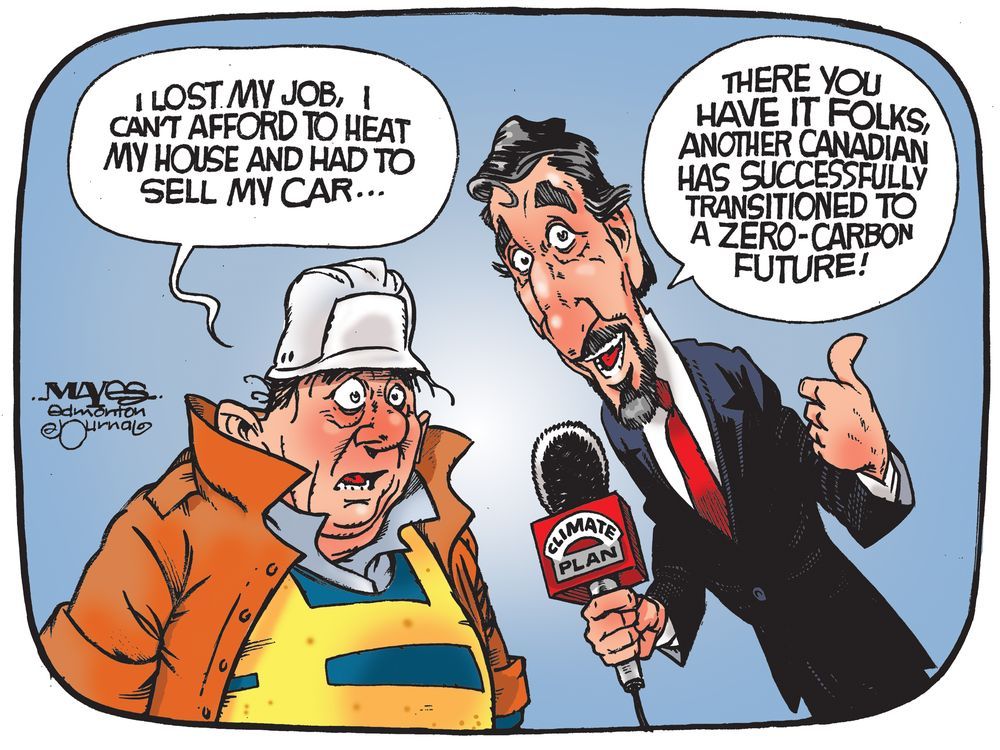
PM Trudeau: We will raise Canada’s price on carbon pollution Rising by 15 a ton starting in 2023 and rising to 170 Canadian dollars per ton by 2030.

Federal environment Minister Stephen Guilbeault says the Trudeau government could be more effective in fighting climate change were it not for the opposition of the federal conservatives. He told CTV news that he would like to do things like, for example, speeding up Canada’s goal of net zero emissions, possibly lowering it to 2040 instead of the current 2050.

Now his argument is absurd on a number of fronts. First of all Stephen Guilbeault and the Trudeau government don’t need the permission of the conservatives to lower our emissions targets to 2040 instead of 2050. He didn’t need them to set the 2050 Target; why would he need them for the 2040 Target?

And in terms of keeping in power to fight climate change, his government doesn’t need the support of the federal conservatives. So far the NDP are supporting him. And if anything they want the government to go faster in fighting climate change.

But the more important issue is that it doesn’t matter what Canada’s Target is. It also doesn’t matter how much we pay in carbon taxes or clean fuel regulations or subsidies to corporate green companies. None of that matters, the reason being Canada’s emissions are a rounding error in terms of global emissions.

Nothing Canada does on its own is going to slow the rate of wildfires or floods
or wind storms or severe weather in Canada. Zero Effect.

Why? Here’s a few numbers according to the federal government. In 2019 our emissions were 724 million tons of greenhouse gas emissions. The global total is 48,000 million tons. China’s total, as the largest single emitter in the world, was about 12,700 million tons. Tony Keller in the Globe and Mail made a good analogy about this. He said to think of the world’s greenhouse gas emissions as water in a swimming pool. What’s happening is that in Canada we’re trying to lower the level of the water using a soup spoon, and meanwhile China and other countries are filling up the pool using a fire hose.

Now if Stephen Guilbeault and Trudeau really want to be more effective in fighting climate change, they shouldn’t be attacking the conservatives; they should be attacking China’s dictators.

Now we’re always accused, even by our own government, that Canadians are wanton wasters of energy because we are the highest per capita emitters in the world. That’s an absurd metric to use particularly for Canada. Because we are the second coldest country on Earth, the second largest country on Earth, and we have a relatively small population.

Use another metric that has been used, emissions per square kilometer. Lo and behold Canada becomes one of the lowest emitters in the developed world. It’s true that what you get always depends on what you measure.

The only practical effect of our emission targets and paying more for oil and gas to heat our homes and everything else is: In theory it gives Justin Trudeau the moral authority to attempt to use moral persuasion on countries like China to lower their emissions.

Of course we already know from experience how well Canada’s
moral influence works on China’s dictators.

Postscript:  A Voice from Silent Canadians


Net Zero Zealots are Treating the Public Like Fools

A summary at The Telegraph of David Frost’s recent lecture, in italics with my bolds.

Some of the worst policies ever pursued in this country have been those which nearly all politicians supported at the time. Keeping Britain on the gold standard. Running down our Armed Forces in the 1930s. Demolishing our historic cities and replacing them with concrete. Joining the EU’s Exchange Rate Mechanism. Only a handful of free thinkers questioned these at the time. But when the disastrous results became clear, suddenly few people wanted to defend them.

Now, of course, consensuses can be correct, too. Most people agree that free trade is a good thing. But no one could say that that policy has been unchallenged. Indeed, although it is repeatedly attacked, both intellectual argument and real life keep proving it right.

That is why challenge and argument are so important. When everyone agrees on a policy, it is never seriously questioned. The arguments for it become ritualised. Zombie numbers get repeated from one document to another, however feeble their real underpinning – remember the three million jobs we were told for 20 years depended on EU membership? And its advocates don’t feel the need to invest any effort in defending it, because it’s easier just to smear its opponents.

So the cross-party agreement on the totemic policy of our time –
net zero 2050 – is troubling.

By all means accept the scientific consensus: it doesn’t seem to me to depict “climate catastrophe”. But net zero 2050 isn’t science. It’s a political goal enshrining a particular view of the trade-offs facing us as a result of climate change. It makes assumptions about how our economies and societies work which must be open to question. If no one ever does question it, we will inevitably end up with bad policy and bad results. That’s why I refuse to remain silent.

All these economic assumptions seem to me to be highly suspect. That’s partly because predicting the future is very difficult, and in this case we can prove that, because so many of the predictions in Labour’s Energy White Paper 20 years ago turned out to be wrong.

You might think, therefore, that the right thing for governments to do would be to invest in basic scientific research, to establish a simple regime for taxing the externality of carbon emissions at whatever level we think justified – and then stand back and let the market sort out how best to meet the policy goal.

You might think that, but you would be wrong. Governments have all decided
that they know best and can pick the technologies, the subsidies,
and the targets to get us to net zero.

That’s why you will be forced to buy ineffective boilers and expensive electric cars. That’s why you’re made to pay for windmills, a technology that was cutting-edge just after the Norman Conquest. That’s why our electricity grid is getting less reliable while at the same time energy bills go ever higher.

Some voters are clearly doubtful. So Western governments now go further, and argue that all these inferior technologies will actually improve economic growth – by a grand total of 2 per cent in 2050, according to reports quoted in Chris Skidmore’s Net Zero Review.

Sorry, but I don’t believe it. This whole area is riddled with economic fallacies:
counting benefits but not the costs; optimism bias;
illusory certainty and misplaced confidence in prediction.

There’s the belief that raising taxes to pay subsidies will not damage the wider economy. There’s the “broken windows fallacy”: just as repairing a broken window does not make you any better off, and you also lose the chance to spend the money on something more productive, so scrapping one system of energy production and replacing it with another does not make us richer – especially when the new system is worse than its predecessor.

There’s the faith that massive projects like insulating every house in the country can be undertaken simply and speedily with just an effort of will. And finally there’s the view that “green jobs”, many of them required to install all those less efficient technologies, are somehow a benefit rather than a cost. If you believe that, you must think we could make ourselves wealthier by sending everyone back into the fields to work the land.

Stop treating us like idiots. If we are told things will get better, and then they get worse, voters will in the end rebel against the policy. Look at the migration figures if you doubt that. I personally believe we will have to rethink the net zero methods and the timetable. Of course I might be wrong. But let’s have a proper debate and real honesty, not smears and cancellations.

One of Bob Dylan’s greatest songs, Not Dark Yet, is a reflection on his own waning powers and mortality. We need to make the same reflection about our society. Not only whether we literally go dark, because we can’t keep the lights on any more, but whether we in the West can actually summon the strength to resist degrowth, miserabilism and economic decline. “It’s not dark yet, but it’s getting there.” Time to stop, and rethink.

The text of David Frost’s lecture ‘Not Dark Yet’ is available at GWPF

Green Schemes Broken by Reality

James E. Hanley provides a roundup of failed Green expensive ventures in his Real Clear Policy article Green Projects Hit Iron Wall.  Excerpts in italics with my bolds and added images.

Developers looking to build thousands of wind turbines off the Mid-Atlantic and New England coast are coming up against a force even more relentless than the Atlantic winds: the Iron Law of Megaprojects, offering a warning of the trouble ahead for green-energy projects.

The Iron Law, coined by Oxford Professor Bent Flyvbjerg, says that “megaprojects” — which cost billions of dollars, take years to complete, and are socially transformative — reliably come in over budget, over time, over and over.

From Boston’s Big Dig to California’s high-speed rail to
New York’s 12 years-overdue and 300% over-budget East Side Access rail project,
big boondoggles routinely demonstrate the validity of the rule.

Offshore wind projects are not immune to the Iron Law, regularly experiencing vast cost overruns before a single watt is generated.

The New York state government, looking to replace oil- and gas-fired powerplants with hundreds of wind towers off Long Island, set out in 2019 to create an offshore wind supply chain from scratch, beginning with a massive state-funded turbine fabrication facility about 100 miles north of New York City on the Hudson River.

Port of Albany factory’s fate at stake as leaders race for a solution The $700 million-plus project is expected to create work for generations, but hopes are dwindling that more funding will become available

Ground still hasn’t even been broken, but the budget certainly has: The price of that Port of Albany facility has already doubled from $350 million to $700 million. An additional $100 million may be needed for equipment costs, raising the final price tag to $800 million.

It’s been billed the future hub for wind power infrastructure. So far, though, the only thing that continues to get billed over and over in recent years is the Connecticut taxpayer.

A similar situation is playing out in New London, Connecticut, where a state-funded pier facility being built to support that state’s offshore wind buildout has more than doubled in price from an original estimate of $95 million to $250 million.

Commonwealth Wind Declares that the largest offshore wind farm in the state’s pipeline “cannot be financed and built” under existing contracts,

And in Massachusetts, developer Commonwealth Wind has asked the state to scrap its power purchase guarantees and rebid the project, arguing that inflation and supply chain problems mean the project is not financially viable under its current contracts.

Big projects tend to exceed their cost projections for many reasons. One is the unanticipated, and sometimes unprecedented, complexity of these projects. Further uncertainties and costs arise from the challenge of navigating the red tape of the modern regulatory state. In addition, there is the risk of inflation for projects that take years, sometimes decades, to develop.

Underlying all these is often a failure to spend enough time on careful planning
that treats reality as a fundamental constraint.

But sometimes project sponsors may simply worry that accurate cost projections could scare away public support at the outset, and choose to employ what Prof. Flyvbjerg politely calls “strategic misrepresentation.”

As former San Francisco Mayor Willie Brown said, “If people knew the real cost from the start, nothing would ever be approved. . . . Start digging a hole and make it so big, there’s no alternative to coming up with the money to fill it in.”

If that sounds too cynical, note that the current Chair of the Connecticut Port Authority has admitted that when officials first proposed the pier facility, they already knew it would cost more than they were claiming.

Ironically, the New York and Connecticut projects aren’t even big enough to be considered megaprojects, and yet even they have run into the Iron Law of being over budget and behind schedule. The challenges won’t diminish with bigger and more ambitious green energy projects.

In New York, the state’s huge Climate Leadership and Community Protection Act — of which the Port of Albany project is the first substantial investment — is projected to cost between $270 and $290 billion. At that price it is a gigaproject composed of numerous individual megaprojects.

The benefits, mostly in the form of greenhouse gas reductions, are supposed to be up to $415 billion. But if the overall cost of the policy climbs by merely 55 percent, which is in the normal range for megaprojects (and much less than the Port of Albany cost overrun), the costs will exceed the benefits, creating a net loss for New Yorkers.

If costs balloon to twice the initial estimates, which is not uncommon, the state stands to spend more than more than a hundred billion dollars more than gained in benefits That would be a loss of over $30,000 per New York household by 2050.

And that’s assuming the benefits are as good as promised. It gets even worse if,
as is common, the benefits have been overstated.

The tale of megaprojects is a cautionary one for the whole country as we attempt to transition away from fossil fuels. Cost estimates for a nationwide transition span from $4.7 trillion to over $60 trillion – almost three times U.S. GDP. Such uncertainty should give us pause for thought before jumping wildly into the financial unknown.

If we’re not careful, we may be digging Willie Brown-style holes, and politically and financially we may find ourselves in too deep to ever get ourselves out.

We’re Betrayed by Decarbonists and Cowardly Energy Companies

Edward Ring writes at American Greatness The Corruption of Climate Science.  Excerpts in italics with my bolds.

Instead of fighting anti-civilization lunacy,
corporations are taking their money off the table,
along with their life-affirming affordable fuel.

We need to criticize the people who got us here,” says Alex Epstein, founder of the Center for Industrial Progress and author of Fossil Future. “We can’t keep treating these designated experts as real experts. They are not real experts, they are destroyers. They are anti-energy, non-experts. And that needs to be made clear.”

Epstein is right, and his advice has never been more urgent—or as difficult to make people understand. It is no exaggeration that every major institution in America has now committed itself to the elimination of affordable and abundant energy. If it isn’t stopped, this commitment, motivated by misguided concern for the planet but also by a lust for power and money and enabled by moral cowardice and intellectual negligence, will destroy Western civilization.

For over 50 years, with increasing frequency, corrupted, careerist scientists have produced biased studies that, amplified by agenda-driven corporate and political special interests, constitute a “consensus” that is supposedly “beyond debate.” We are in a “climate crisis.” To cope with this climate emergency, all measures are justifiable.  This is overblown, one-sided, distorted, and manipulative propaganda.

It is the language of authoritarians and corporatists bent on achieving
even more centralized political power and economic wealth.

It is a scam, perhaps the most audacious, all-encompassing fraud in human history. It is a scam that explicitly targets and crushes the middle class in developed nations and the entire aspiring populations in developing nations, at the same time as its messaging is designed to secure their fervent acquiescence.

What is actually beyond debate is not that we are in a climate crisis but that if we don’t stop destroying our conventional energy economy, we are going to be in a civilizational crisis.

Energy is the foundation of everything—prosperity, freedom, upward mobility, national wealth, individual economic independence, functional water and transportation infrastructure, commercial-scale agriculture, mining, and industry. Without energy, it all goes dark. And “renewables” are not even remotely capable of replacing oil, gas, coal, nuclear, and hydroelectric power. It’s impossible.

The only people who think renewables are capable of replacing conventional energy
are either uninformed, innumerate, or corrupt. Period.

But to cope with the apocalyptic messaging of climate catastrophists, it isn’t enough to debunk the potential of renewables. It is also necessary to challenge the underlying climate “science.” The biased, corrupt, unceasing avalanche of expert “studies” serving up paid-for ideas to special interests that use them as bludgeons to beat into the desired shape every relevant public policy and popular narrative. So here goes.

Biased, Flawed Studies

A new study, released May 16, deserves far more criticism than it’s going to get. Authored by seven ridiculously credentialed experts and primarily affiliated with the leftist Union of Concerned Scientists, this study has the rather innocuous title: “Quantifying the contribution of major carbon producers to increases in vapor pressure deficit and burned area in western US and southwestern Canadian forests.” Bursting with charts and equations, and too many links to corroborating sources to count, the study has all the accouterments of intimidating credibility. But serious questions may be raised as to its logic as well as its objectivity.

For starters, this study doesn’t restrict itself to “Quantifying the contribution of major carbon producers to increases in vapor pressure deficit.” The authors can’t resist attacking these “major carbon producers.” In this revealing paragraph, the study’s true intent becomes apparent: it is fodder for litigation.

To explain what the authors got wrong, it is first necessary to summarize what they did. In plain English, the authors claim that hotter summers in recent years have caused more severe forest fires in the western United States, and fossil fuel emissions are causing the hotter summers.  That’s it.

But what if it isn’t just heat, but dry heat, that is unprecedented today? What if the “vapor pressure deficit” is worse today than it has been at any time in 20 million years? That is a huge assumption, probably impossible to verify. Even if it’s true, it doesn’t make up for the study’s other flaw, which is the density of forests in California today, which is truly unprecedented. The study’s authors acknowledge they don’t take this variable into account.

In California, wildlife biologists and forest ecologists who spend their lives studying and managing these timberlands unanimously agree that tree density has increased, thanks to “non-climatic factors such as the prohibition of Indigenous burning, and legacies of fire suppression.” The increase is not subtle. Without small, naturally occurring fires that clear underbrush and smaller trees, forests become overgrown. Controlled burns and responsible logging are absolutely necessary to maintain forest health.

This is not an isolated finding. Observations of excessive tree density are corroborated by numerous studies, testimony, and journalistic investigations. Unlike the subjectively defined algorithms plugged into a climate model, excessive tree density is an objective fact, verified repeatedly by people on the ground. To imply by omission that more than tripling the density of trees across millions of acres of forest would not leave them stressed and starved for soil nutrients, sunlight, and water from rain and atmospheric moisture is scientific malpractice.

Without taking these additional factors into account, it is deceptive
to indict fossil fuel emissions for causing wildfires.

Perhaps some indirect connection can be established of debatable relevance, but for this study to assign specific percentages and acreages suggests a premeditated purpose: creating material for expert testimony for litigation against oil companies.

The monolithic alignment of the scientific and journalistic community in support of an authoritarian, utterly impractical “climate” agenda reveals a misunderstanding if not outright betrayal of scientific and journalistic core values. Both disciplines are founded on the bedrock of skepticism and debate. Without nurturing those values, the integrity of these disciplines is undermined. When it comes to issues of climate and energy policy in America, science and journalism are compromised.

Carbon Fuel Industry Fails to Step Up

The real crime, if you want to call it that, isn’t that oil and gas companies
questioned climate change theories back in the 1960s or ’70s.
It’s that they’re accepting them now.

Oil and gas companies today are not willing to challenge the climate crisis orthodoxy, or the myth of cost-effective renewables at scale. They aren’t willing to devote their substantial financial resources to debunking this agenda-driven madness that is on the verge of taking down our entire civilization. The fact that America’s oil and gas companies have adopted a strategy of appeasement is a crime against humanity. The fact that these companies are failing to make long-term investments to develop new oil and gas fields, and instead are reaping windfall profits as they sell existing production at politically inflated prices, that, too, is a crime against civilization.

Ultimately, the Union of Concerned Scientists and the major oil companies
are complicit in the destruction of America’s energy economy.

Because rather than declaring total war on these paid-for, flawed scientific studies and the special interests that fund them, oil companies will engage in theatrical litigation, knowing that the cost of settlements won’t even come close to the short-term profits to be had by slowly asset stripping their companies while selling diminishing quantities of fuel at punitive rates.

Epstein is right that we must criticize the “experts” that want to destroy human civilization with climate alarmism. But we must also recognize and criticize the institutions targeted for destruction. Instead of fighting this lunacy, they are taking their money off the table, along with their life-affirming affordable fuel, and heading for the hills.


Google Screens Your Climate Info

Jimmy Dore reports in the above video on collusion between UN and Google to control public access to climate information .  Below is a transcript from the closed captions.  JD is the host with some asides from Kurt Metzger (KM)  The UN spokesperson is Melissa Fleming (MF), United Nations Under-Secretary-General for Global Communications. Text in italics with my bolds and added images.
JD: It turns out Google is the richest company in the history of humanity–did you know that Google gets more money than Exxon, more money than Apple. They have more money than Tesla, they have a lot of money.   “Google teams up with the UN for verified climate information.” So this is an article from the United Nations, This is from April 22nd of last year.

KM: Well I hope they fight nitrogen deniers.

JD:  So I don’t know if we covered this, which is why I want to cover it now. Did you know that if you Google climate change, Google has now rigged it. It’s not just, well whatever the most popular websites are that talk about climate change come up; the order of the 10 most popular articles.

That’s not what they’re doing. They’re making sure that the popular articles don’t show up and they’re trying to control the narrative. They only want certain ones, only articles the United Nations approves of. That’s what Google’s doing.

KM  Look, millions of people around the world go to Google to get information about climate change and sustainability.  Nobody is going: What about sustainability? What about that word you just invented a couple years ago? Sustainability, sustainability.

JD:  In addition to organic search results, Google is surfacing short and easy to understand information panels and visuals on the causes and effects of climate change as well as individual actions that people can take to help tackle the climate crisis

KM  Should I glue my head to a painting?

JD:  So here is the under Secretary General for Global Communications at the UN;  ready.

MF: Served with Google for example. If you Google climate change, at the top of your search you will get all kinds of UN resources. We started this partnership when we were shocked to see that when we googled , climate change we were getting incredibly distorted information right at the top.

JD: So when she Googled climate change, she was getting a lot of articles that she didn’t agree with. They would come up because what Google is supposedly doing is just showing you what’s the most popular articles, without an editorial input. She’s saying we didn’t like that people were getting to see those articles that were popular that we disagree with. So we went to Google and we told them artificially manufacture your Google results when people Google climate change. And have these special articles that we like come up, those that push a specific agenda about climate change. And they say it right out in public, she’s saying it on camera.

KM  I’m relieved.  It was about time they started doing this, so I was happy to hear it

MF:  So we’re becoming much more proactive. You know, we own the science and we think that the world should know.

JD:  Like the Vatican, we own the science. You mean like Tony fauci did. And then he had to admit that he was lying constantly during covid because he was. We Own the science, we own the science: Nobody owns the science, science doesn’t work like that, there’s no such thing. It’s always: Question science. Science always needs to be questioned and tested, always. That’s why Einstein didn’t trust what Newton said about gravity, he had his own ideas. And now we know about E equals m c squared.

MF: And the platforms themselves also do, but again it’s a huge, huge challenge, that I think all sectors of society need to be very active in. We need total control.

JD:  We own the science sounds about right. So if you thought when you Google something you’re getting organic natural results, no you’re getting propaganda selected by people like her, articles they want you to have. They want to control your thoughts, and they are. And that’s what propaganda is. They’re all propaganda and they just brag about doing propaganda right in the open.

KM:  I’ve heard we own the Sciences, the second time I heard it that sounds like a catchphrase or something.

JD:  Someone says we own the science, we own the science. No what you own is the Google results on the science. So that means you own the conversation and the narrative in the culture. But you don’t own the science. Own the science, what kind of a thing is that to say I don’t know.


Enforcing Climate Correctness (Fact Checking)

Serfs attacking Climate Establishment

Phys.org sounds the alarm: Meteorologists targeted in climate misinfo surge.  Excerpts in italics with my bolds and added images.

Once trusted faces on the news, meteorologists now brave threats, insults and slander online from conspiracy theorists and climate change deniers who accuse them of faking or even fixing the weather.

Users on Twitter and other social media falsely accused Spain’s weather agency of engineering a drought, Australia’s of doctoring its thermometers and France’s of exaggerating global warming through misplaced weather stations.

“The coronavirus is no longer a trend. Conspiracy theorists and deniers who used to talk about that are now spreading disinformation about climate change,” Alexandre Lopez-Borrull, lecturer in Information and Communication Sciences at the Open University of Catalonia, told AFP.

“These scientific bodies are seen as part of the establishment, so anything they say may get disputed on social networks.

“They are providing evidence against what the climate deniers claim, so the latter try to discredit them.”

Maybe if they stuck to weather reporting? See Climate Evangelists Are Taking Over Your Local Weather Forecast

Australian thermometers

In a case investigated by AFP Fact Check, conservative media and Facebook users shared unfounded claims that Australia’s Bureau of Meteorology (BOM) doctored its temperature readings.

In an analysis of data obtained via a freedom of information request, prominent climate skeptic Jennifer Marohasy said BOM’s electronic probes returned readings up to 0.7 degrees Celsius warmer than those of its older mercury thermometers.

Experts who analyzed the data said the claims were inaccurate.

Monash University emeritus environment professor Neville Nicholls said the difference between most readings on the electronic probes and the mercury thermometers was negligible—between zero and 0.1C (0.18 degrees Fahrenheit).

The World Meteorological Organization told AFP that the BOM’s measurements were in line with its standards, contrary to Marohasy’s allegation.
Marohasy makes her case in video below.

Several examples in the article shows they are relying on fact checking by AFP (Agence France Presse).  So the AFP Fact Check follows the usual procedure:  get quotes from establishment supporters in order to isolate and cancel a finding contrary to “consensus” climate science.

More from AFP to See How the Enforcement Works

Climate ‘declaration’ recirculates debunked claims.Excerpt in italics with my bolds

First Attack:   Big Oil Funds Them, So They Lie

However seven of the signatories to the declaration were identified on the list as having worked for Shell and eight others as having worked in the oil industry. Crok confirmed to AFP that Berkhout himself worked for the firm “about 40 years ago.” Besides these, there were 13 petroleum engineers and petroleum geologists, plus several mining specialists.

Several signatories had links, either mentioned on the list or documented elsewhere, to US climate-skeptic free-market groups with ties to the oil industry: the Heartland Institute, the Competitive Enterprise Institute and the Cato Institute.

These groups each received money from oil giant ExxonMobil, according to donor and tax documents published by Greenpeace (here, here and here). The company has been accused of undermining science to protect its fossil fuel business — a charge it denies.

Second Attack:  Only Some Signatories are Climatologists

According to an AFP count of the declaration’s signatories, about 10 explicitly described themselves as climatologists or climate scientists, fewer than one percent of the total. A few others described themselves as specialists in paleoclimatology and atmospheric sciences.

There were approximately 40 geophysicists, 130 geologists and 200 engineers of various kinds, plus several mathematicians, medical doctors and agricultural scientists.

Thirdly:  IPCC is the Final Authority

Documents accrediting the mainstream scientific view on climate change are more comprehensive than the World Climate Declaration. The Intergovernmental Panel on Climate Change invited 721 experts from 90 countries to be authors and editors of its three-part Sixth Assessment Report, released between August 2021 and April 2022.

The report constitutes the most comprehensive assessment of scientific knowledge on climate change. Each part was some 3,000 pages long. The authors reviewed hundreds of studies that were listed in the reference sections. It says there is “unequivocal” evidence that humans are warming the climate by burning fossil fuels.

Finally, Refer to Insider Supporters to Refute Claims

Examples in the AFP fact check include Carbon Brief and World Weather Attribution.

Why Should We Believe A Bunch of Journalists like AFP?

Well, because they pass the media bias test;

Who is behind Media Bias Fact Checks and what is their POV?

From Climate Change Dispatch ‘Media Bias/Fact Check’ Site Served With Cease And Desist, Gets Fact-Checked.  Excerpts in italics with my bolds.

Today, PSI has issued Media Bias/Fact Check (MBFC) site owner, Dave Van Zandt with a pre-action legal notice to take down the defamatory and false smear.

Ironically, the self-styled ‘MEDIA BIAS/FACT CHECK‘ (MB/FC) which negatively fact-checked PSI admits it relies on the subjective bias to decide how biased others are. In other words, MB/FC is a pseudoscientific fact checker!

Apart from unlawfully smearing PSI, Mr. Van Zandt has smeared other websites that publish scientific articles critical of man-made global warming claims. Among the unfairly smeared are:

  • Climate Change Dispatch
  • CFACT
  • WUWT

Below we help readers to fact-check the pseudo-fact-checker. We put Dave Van Zandt the faceless fact-checker under the microscope and discovered the following:

♦  Van Zandt Cites No Scientific Qualifications At All
♦  Van Zandt Was Exposed By WND As A Fraud And A Liar
♦  Van Zandt’s Website (MBFC) Does Not Apply Any Objective Scientific Method
♦  MBFC Relies On Unverifiable Subjectivity (Own Bias) To Make Judgments

Climate Enforcers Appeal to Membership in IFCN

Both AFP and MBFC stake their credibility on belonging to the International Fact-Checking Network (IFCN).  Who’s behind that authority?  WND discussed them in their article The 9 fakest fake-news checkers.  Excerpts in italics with my bolds.

In the past Facebook announced it would use the International Fact-Checking Network, or IFCN, to check on the legitimacy of news articles posted to the social media site.

IFCN is hosted by the Poynter Institute for Media Studies and funded, in part, by Google and foundations of leftist billionaires George Soros and Bill Gates. Soros donated $25 million to Hillary Clinton’s presidential campaign. The Daily Mail reported that Clinton super-donor and eBay founder Pierre Omidyar is also backing the project.

The website reveals: “Poynter’s IFCN has received funding from the Arthur M. Blank Family Foundation, the Duke Reporters’ Lab, the Bill & Melinda Gates Foundation, Google, the National Endowment for Democracy, the Omidyar Network, the Open Society Foundations and the Park Foundation.”

Summary:  

There’s a well-funded industry dedicated to curating the news for the sake of “right-thinking” public opinion. It’s a closed loop of self-appointed authorities who validate each other, and excommunicate unbelievers.  Woe to those who outsource their critical intelligence to such.