Putting Down Climate Virtue Signaling

This exchange occurred yesterday in the debate between Arizona Senatorial candidates:

Democrat Kyrsten Sinema: “I do believe that climate change is real.”

Republican Martha McSally: “I can’t believe this is the last question.”

MARIA POLLETTA: Congresswoman Sinema, this comes from one of our readers, viewers. With climate change, number one: Do you believe it is a manmade problem, caused by humans? Number two: What are your plans in terms of combating climate change, particularly with regard to water and possible water shortages?

KYRSTEN SINEMA: Why, I do believe that climate change is real. And I think it doesn’t make a lot of sense for us to spend time debating how we got to the place that we are today. What does make sense is for individuals who have the ability to make a difference moving forward to work together to make that difference. And here in Arizona, water is of grave concern to our state. As a United States senator, I’ll hope to work with Sen. Jon Kyl, who’s been a leader on the issue of water during his time in the United States Senate. It’s our duty to not only preserve our own water supply for the next 100 years, but to partner with states in the region — Colorado, New Mexico, Nevada, and California — to ensure that we have a regional strategy to move forward and protect our state in future years. It’s working together — Republicans and Democrats from these states across the region — that’s how we’ll find the solution to these challenges.

But I firmly believe that as Arizonans, as Americans, we have the resources, we have the tools, we have the skills, and we have the knowledge. We can address issues of climate change together, and do so without harming our business prospects and without harming what makes Arizona so amazing. You know, folks know this about me, but I’m an outdoor enthusiast. So, every morning, I get up and I go outside to either run, hike, bike, swim, every day. And I want to make sure that we can protect that beauty, why we all love Arizona so much, for our future generations.

MARTHA McSALLY (R): Ted and Maria, I can’t believe this is the last question. I mean, we do have to address the issues of climate, and water is so important for Arizona; it’s our lifeline. But I worked for Sen. Jon Kyl when I was a legislative fellow as a major, and it’s so important that we follow his lead — and he is my mentor — to be able to move forward to address these really important issues. But we have to talk about the military. We have to talk about our veterans.

TED SIMONS (MODERATOR): Quickly, please.

McSALLY: We haven’t had any opportunity.

SIMONS: You have it right now.

McSALLY: That’s what brought me to Arizona, like 500,000 of our veterans, for our national security treasures that are here. I fought for to make sure that the A-10 was preserved, that we fight for Luke Air Force Base. My opponent advocated to shut down Luke Air Force Base. While we were in harm’s way, she was protesting our troops in a pink tutu. And I’ll tell you what, if these are not disqualifying enough, Kyrsten, what came out last week, CNN reported that in 2003, when she was on the radio, you said it was OK for Americans to join the Taliban to fight against us. You said you had no problem with that. Kyrsten, I want to ask right now whether you’re going to apologize to the veterans and me for saying it’s OK to commit treason, Kyrsten?

Ontario has to Launder $1B in cap-and-trade money

CBC has the story: Ford government sitting on $1B in cap-and-trade money
Excerpts in italics with my bolds.

Environmental commissioner says by law it can only be spent on reducing greenhouse gases

Context: No one is talking about the reason Ford canceled cap and trade the first day on the job. It was to eliminate the 4.3 cents/liter gasoline tax. At the same time, spending on schemes to “fight climate change” was stopped.  By skimming a few cents off every liter sold, pretty soon you have billions of dollars in the pot. The law ending cap and trade did not reimburse gasoline retailers who had bought carbon allowances in the past, because they already passed on the cost to customers. Those who bought in advance to avoid higher carbon prices later are now caught and want the government to reimburse them, since they lost the opportunity to stick it to their customers. What a great idea is cap and trade: A market to sell a non-good at arbitrary prices paid by other people’s money. What could go wrong?

As much as $1 billion in Ontario’s cap-and-trade fund is sitting unspent, and questions are swirling about what Premier Doug Ford’s government will do with it.

The money was brought into provincial coffers under a law that says it can only be spent on measures that reduce greenhouse gas emissions. However, Ford has dismissed the money as a “slush fund,” and his government is pushing forward legislation to use some of it to cover the costs of cancelling the cap-and-trade program.

The dedicated fund for reducing greenhouse gases had a balance of $553 million at the end of March, when the last fiscal year ended, according to the province’s newly released public accounts. Another $476 million was added in May from the final cap-and-trade auction of carbon allowances, before Ford’s PCs won the election and quickly scrapped the Liberals’ climate-change plan.

That would put the account at more than $1 billion. What remains unclear is how much of that has been spent in the past six months, and how much will be used to wind up cap-and-trade.

CBC News asked the Environment Ministry for the current balance of the greenhouse gas fund, but officials did not provide an answer.

Ontario’s environmental commissioner Dianne Saxe believes there’s still $1 billion in the account because she has seen no evidence that money has been dispersed since the end of March.

Saxe — an independent officer of the Legislature like the auditor general and ombudsman — says the costs of winding up cap-and-trade ought to be small enough that the bulk of the $1 billion will remain.

“They will have quite a bit of money left,” said Saxe in an interview. “That can be money they can use to invest in [climate-change] solutions.”

She is warning the government that it cannot spend the money however it wishes, but only on initiatives to reduce carbon emissions. “That was the legal basis on which the money was collected, and that remains the law,” she said.

Liberal MPP Nathalie Des Rosiers said Monday she fears the government will not spend the money on cutting greenhouse gases but on lawsuits arising from cancelling cap-and-trade.

That fear is unfounded, said Environment Minister Rod Phillips.

“The money will be used for the purpose it was collected,” said Phillips in an interview Monday at Queen’s Park.

He declined to estimate how much of the $1 billion will remain in the fund once the cap-and-trade program is wound up. Nor did he agree that the figure will be in the hundreds of millions of dollars.

“I don’t think it would be fair to speculate at this point,” said Phillips. “We will make it clear how much money was spent and where it was spent.”

Ford made cancelling the cap-and-trade program a central election promise, calling it the “cap-and-trade carbon tax” during and after the campaign. Within days of taking power, his government shut down rebates to homeowners for making energy efficiency improvements, such as installing new windows, and ended rebates for buying electric cars. Those rebates came from the greenhouse gas reduction fund.

The government won’t be able to say how much remains in the greenhouse gas fund until all the programs wind up, said Phillips. He also said the government is allocating $5 million to compensate companies that bought cap-and-trade allowances, which are now worthless.

Phillips is promising a plan to tackle climate change this fall, including an “emissions-reductions fund” but says it will not come from a carbon-tax model.

The province is challenging Ottawa in court over the Trudeau government’s plan to impose a carbon tax on Ontario in the absence of a provincial carbon-pricing program.

Meanwhile, environmental groups led by Greenpeace are suing the province over cancelling cap-and-trade, alleging that the Ford government broke the law by failing to consult Ontarians on the move.

Breaking the Climate Spell


Rupert Darwall is one of the more knowledgeable people concerning how the world came under the spell of global warming/climate change. This post features his recent article regarding how the worldwide delusion may be losing its power. Breaking the Climate Spell. appeared today in the Weekly Standard.  Excerpts below in italics with my bolds.

Getting out of the Paris Agreement was just the first step on the road to a realist global energy policyThirteen years ago, a Republican president who had pulled the United States out of an onerous climate treaty faced isolation at the annual gathering of Western leaders. “Tony Blair is contemplating an unprecedented rift with the U.S. over climate change at the G8 summit next week, which will lead to a final communiqué agreed by seven countries with President George Bush left out on a limb,” the Guardian reported of the meeting at Glen­eagles, Scotland. France and Germany preferred an unprecedented split communiqué to a weak one, the article said.

George W. Bush, who had pulled the country out of the Kyoto Protocol in 2003, blinked and agreed to an official document that affirmed global warming was occurring and that “we know enough to act now.” The 2005 G8 put the United States back on the path that ultimately led through the Copenhagen climate summit—when China and India thwarted U.S.-led attempts at a global climate treaty—to the Paris Agreement 11 years later.

There was a very different American president this June at the Charlevoix G7 (as it has been since Russia’s suspension in 2014). Had it not been for the row with Justin Trudeau, when the Canadian prime minister responded to President Trump’s steel and aluminum tariffs with retaliatory tariffs of his own, the big story would have been the climate split. Where 15 years ago the mere possibility of isolation pushed Bush to compromise, Trump embraced the isolation and inserted an America-only paragraph into the summit communiqué outlining a position fundamentally contradicting the rest of the group’s.

Donald Trump with G7 leaders in Charlevoix, Canada, June 9. Credit: Jesco Denzel / Bundesregierung / Getty

“The United States believes sustainable economic growth and development depends on universal access to affordable and reliable energy resources,” it reads, going on to offer a manifesto for global energy realism. That single paragraph is more definitive than the president’s announcement last August that the United States would be withdrawing from the Paris treaty. After all, George W. Bush nixed the Kyoto Protocol that Bill Clinton signed. And Trump, when announcing the Paris withdrawal, left the door open to U.S. participation in a renegotiated climate deal. At Charlevoix, he closed it. Unlike in 2005, it’s very hard now to see any way back.

This is about far more than process. Trump is breaking the spell of inevitability of the transition to renewable energy. The impression of irresistible momentum has been one of the most potent tools in enforcing compliance with the climate catechism. Like socialism, the clean-energy transition will fail because it doesn’t work. But it requires strong leadership to avoid the ruin that will disprove the false promise of cost-free decarbonization.

That reality is already hurting those countries that are farther down the renewable-energy path of ruin than the United States—and, when offered the chance, voters are taking it out on politicians. In March, a fanatically pro-wind and solar energy Labor government in South Australia, one of the eight states and territories that make up the country, decided to make the state elections a referendum on renewable energy. With some of the world’s most expensive electricity and a serious blackout in 2016, South Australia voters kicked out Labor and voted in a government vowing to repeal the state’s renewable-energy target.

Days before Justin Trudeau took the center of the global stage as host of the G7 summit, his Liberal party was trounced in provincial elections in Ontario. The province’s party had won four consecutive terms in office and had pressed virtually every pro-renewable, anti-hydrocarbon policy imaginable. In the June 7 elections, they took just seven seats in the 124-seat legislature. “I made a promise to the people that we would take immediate action to scrap the cap-and-trade carbon tax and bring their gas prices down,” newly elected premier Doug Ford announced.


Nowhere has confrontation with the physical and economic realities of renewable energy been more painful than Germany, the birthplace of renewable-energy ideology. As party leaders negotiated a new coalition agreement after the September 2017 elections, they acknowledged for the first time that Germany was going to miss the sacrosanct 2020 target to cut greenhouse gas emissions by 40 percent from 1990 levels. This had been set in 2007, and the first 20 percent had been easy. Thanks to German reunification, the former East Germany had seen its industries collapse, and there were plenty of inefficient power stations to close. It had always been clear, Angela Merkel declared three weeks after the September federal elections, that it was not going to be easy to cut the other 20 percent “at a time of relatively strong economic growth.” Note: Stronger growth equals higher emissions.

Launching the German renewables transition in 2004, energy minister Jürgen Trittin promised that it would put no more than the cost of an ice cream on monthly electricity bills. Nine years later, his successor, Peter Alt­maier, admitted that the costs could amount to $1.34 trillion by the end of the 2030s. At a meeting in June of E.U. energy ministers, Germany ran up the white flag. Altmaier shocked fellow E.U. energy ministers by rejecting higher renewable-energy targets. “We’re not going to manage that,” he told them. “Nowhere in Europe is going to manage that. Even if we did manage to get enough electric cars, we wouldn’t have enough renewable energy to keep them on the road.”

No country has a greater abundance of hydrocarbon energy than the United States. The corollary is that no country was as big a loser from participating in the Paris Agreement and its intention to progressively decarbonize the world’s hydrocarbon superpower. On July 10, the Energy Information Administration forecast that next year, the United States will produce 12 million barrels of oil a day and overtake Saudi Arabia to be the world’s number-one producer. When it comes to the politics of energy, the interests of the United States and European green ideology are irreconcilable.

Donald Trump understands this. “Our country is blessed with extraordinary energy abundance, which we didn’t know of even 5 years ago and certainly 10 years ago,” the president said in 2017. Those remarks were not only a paean to America’s energy resources, they were a full-dress rejection of the policies of his predecessor and of the Democrats’ goal of Europeanizing American energy policy.

“We have nearly 100 years’ worth of natural gas and more than 250 years’ worth of clean, beautiful coal. We are a top producer of petroleum and the number-one producer of natural gas. We have so much more than we ever thought possible. We are really in the driving seat. And you know what? We don’t want to let other countries take away our sovereignty and tell us what to do and how to do it. That’s not going to happen. With these incredible resources, my administration will seek not only American energy independence that we’ve been looking for for so long, but American energy dominance. And we’re going to be an exporter—exporter. We will be dominant. We will export American energy all over the world, all around the globe. These energy exports will create countless jobs for our people, and provide true energy security to our friends, partners, and allies all across the globe.”

For the first time since 1992, when George H.W. Bush went to the Rio Earth Summit, an American president was outlining a global energy strategy diametrically opposed to the tenets underlying the U.N. climate process. Trump was establishing a rival pole based on energy realism and energy abundance.

The Rio Summit was the brainchild of Canadian ­Maurice Strong, and he understood that what most motivates political leaders, bureaucrats, and corporate CEOs is the fear of being left out. “The process is the policy,” Strong said, and the annual climate conferences that have been held since the U.N. Framework Convention on Climate Change was adopted in Rio created a sense of irresistible momentum. It’s that spell Trump is now breaking. Countries around the world are being damaged by the anti-hydrocarbon policies encouraged by the U.N., but leaving the Paris Agreement was a step only the United States was strong enough to take. Now it is up to the Trump administration to help other countries act in their economic interests.

Energy secretary Rick Perry has talked of U.S. willingness to lead a global alliance of countries wanting to make fossil fuels cleaner rather than abandoning them. Of the G7, Japan has traditionally been most leery of decarbonization, and after the 2011 Fukushima accident Japan decided to expand its coal-fired generating capacity by half, building 45 new coal power stations.

Poland is another coal-based economy that has no intention of phasing out coal. Of all energy-realist nations, Poland is the one that sees eye to eye with the Trump administration. During the Brezhnev years, Poland—alone of the Eastern Bloc nations—refused to sign up to sulphur-emission cuts designed to isolate the U.K. and the United States at the height of the acid rain scare. As host of the next round of U.N. climate talks, at Katowice in December, Poland is more than usually important as a U.S. energy ally. Australia, the world’s largest coal exporter, is another obvious U.S. partner.

Where the United States can make the biggest difference, though, is with the developing nations who depend on overseas finance to build out their electrical grids and need the cheap, reliable energy only coal can supply. Last September, Southeast Asian energy ministers, noting the rising use of coal in the region, called for greater promotion of clean coal. In June, India struck a strategic energy partnership with the United States, described by Perry as an “amazing opportunity for U.S. energy” to sell clean coal, nuclear technology, oil, and gas.

In October 2016, Nigeria’s finance minister, Kemi Adeosun, railed against the West’s energy imperialism and the hypocrisy of using coal to industrialize and then denying it to Africans. “By telling us not to use coal they are pushing us into the destructive cycle of underdevelopment; while you have the competitive advantages, you tie our hands behind us,” she said.

Denying the world’s poor cheap electricity is the official policy of the World Bank. In 2012, Barack Obama agreed to the appointment of Jim Yong Kim as president of the World Bank, and the next year, the bank stopped the financing of coal-fired generation. Although the Trump administration publicly opposes the coal ban and the United States has the largest number of votes at the World Bank, the institution is doubling down on its anti-fossil-fuel agenda. At Emmanuel Macron’s climate summit in December 2017, Kim announced the bank was extending the financing ban to upstream oil and gas. Here is the first order of business for a global energy alliance—to pressure the World Bank to lift its hydrocarbon financing bans and serve the world’s poor rather than sacrifice them to a regressive climate agenda.

As it is, China is the biggest winner from the World Bank’s energy policies. A June 2017 World Bank report notes China’s “global dominance” in the supply of materials needed by renewable energy technologies. In addition to China’s control over the supply of base and rare-earth metals, last year 7 of the top 10 global suppliers of solar panels were headquartered in China. An eighth is in Hong Kong and a ninth in Canada, but with Chinese links. For as long as the World Bank’s hydrocarbon-financing bans remain, American taxpayers will be funding a war on American coal and subsidizing China’s solar industry. If this seems an unappealing prospect, the Trump administration should move fast to assemble the necessary votes ahead of the World Bank meeting in October.

Domestically, the climate caravan keeps rolling. At the beginning of June, 13 Republican senators wrote to the president urging him to submit the Kigali Amendment to the Montreal Protocol, described by the U.N. as “another global commitment to stop climate change,” for the Senate’s advice and consent. Two weeks later, the New York Times carried a report and associated op-ed by former senators Trent Lott and John Breaux on a new group, Americans for Carbon Dividends, which has hired the bipartisan pair to lobby for a carbon tax. “We must put a meaningful price on carbon,” they wrote, arguing for a $40 per ton tax “high enough to encourage a turn to cleaner energy sources.”

Former Fed chair Janet Yellen, another member of the group, told the Times that taxing carbon emissions is “absolutely standard textbook economics.” The textbook actually teaches that a carbon tax would be efficient if it replaced all the tax credits, subsidies, portfolio standards, and regulations supporting the expansion of uneconomic wind and solar energy. Their inherent defect is that the amount of energy they produce depends on the weather, not on demand. Because of the way the electrical grid works, they dump their intermittency costs on other generators, particularly the reliable coal and nuclear plants. It is not surprising that the backers of Americans for Carbon Dividends and its seven-figure annual budget include First Solar, Inc. and the American Wind Energy Association.

Only a small portion of the putative climate benefits of a carbon tax would ever flow back to the United States in the form of avoided climate impacts. Insofar as cutting greenhouse gas emissions creates environmental benefits, it’s a vast foreign aid program in which costs are incurred domestically and most of the benefits go abroad. Worse still, federal government estimates of the social costs of carbon still rely on climate models using computer-simulated data. These produce higher values than estimates based on actual climate data. According to a 2017 paper by the economists Kevin Dayaratna, Ross McKitrick, and David Kreutzer, a $37 per ton carbon tax using model-based estimates for the climate sensitivity of carbon dioxide would be halved if based on empirical data. Dayaratna, a fellow at the Heritage Foundation, has also noted that one of the impact assessment models used by the Obama administration even produces a negative estimate for the social cost of carbon under “very reasonable assumptions.” A negative carbon tax—subsidizing carbon emissions—is hardly what First Solar and the American Wind Energy Association are funding some of Washington’s most expensive lobbyists for.

For all the energy revolution so far, the Trump administration’s energy agenda remains incomplete. The Clean Power Plan is being rolled back, but the EPA’s 2009 greenhouse-gas endangerment finding on which it stood remains in place. There has been talk from the administration of creating red and blue opposing teams of climate scientists to give politicians and the public a more balanced view of our understanding of climate. On energy policy, Rick Perry’s grid-security study can be extended to examine how wind and solar subsidies distort the costs of electricity. That way, Americans will begin to see the true price of renewables and the extra they’ll have to pay to keep the lights on thanks to the intermittency problem of generating energy from the winds and the sun.

Exiting Paris was the first step. The president has also ended his predecessor’s war on coal. Globally, the administration’s continued advocacy for energy realism can win friends among the world’s poor and make allies of some of the world’s most dynamic economies. The geostrategic potential of American energy is already being felt. American gas is being shipped to Poland and American coal to Ukraine—reducing the region’s dependence on Russian gas. As the president pointed out at the NATO summit in early July, Germany’s pipeline will see it paying “billions of dollars” a year to Russia, although he subsequently undercut the strategic logic of his argument at the disastrous press conference with Vladimir Putin in Helsinki on July 16. The Trump administration should now formalize its ties with other energy-realistic nations and show the world the benefits of America’s energy exceptionalism—jobs at home, booming exports, and an escape from dismal energy policies predicated on bogus resource shortages. Having broken the spell, America and its friends around the world can reap the benefits.

Rupert Darwall is the author of Green Tyranny: Exposing the Totalitarian Roots of the Climate Industrial Complex.

Kavanaugh’s EPA Opinions Already Endorsed by Supremes

Adam J. White wrote in Real Clear Policy July 31, 2018 Brett Kavanaugh’s Past Opinions Endorsed by Supreme Court  Excerpts below in italics with my bolds.

If all goes according to plan, Brett Kavanaugh will soon join the Supreme Court. But his ideas arrived at the Court well before him.

For 12 years, Judge Kavanaugh has served on the U.S. Court of Appeals for the D.C. Circuit, often considered the “second-highest court in the land” because of its heavy portion of constitutional and regulatory cases. On those issues, Kavanaugh has become the intellectual leader of his generation of judges on the lower courts. And the best evidence of this are those cases in which Judge Kavanaugh’s analysis was adopted by the Supreme Court even after Kavanaugh’s colleagues on the D.C. Circuit rejected it.

Through eloquent judicial opinions and nuanced law review articles, Kavanaugh has challenged, in particular, today’s increasingly unaccountable administrative state. His uncanny ability to identify fundamental threats to our Constitution’s republican institutions, and to anticipate the Supreme Court’s own eventual response, is exemplified by three cases.

The first involved so-called “independent” agencies. Since the New Deal, the Supreme Court has recognized Congress’s discretion to create agencies with a measure of insulation against day-to-day presidential control. But when Congress attempted to layer one independent agency within another — i.e., the Sarbanes-Oxley Act’s creation of the Public Company Accounting Oversight Board, inside the SEC — Kavanaugh recognized that a line must be drawn.

“By restricting the President’s authority over the Board,” he wrote in a 2008 case, “the Act renders this Executive Branch agency unaccountable and divorced from Presidential control to a degree not previously countenanced in our constitutional structure.” Recognizing that “upholding the PCAOB here would green-light Congress to create a host of similar entities,” Kavanaugh dissented from his colleagues’ decision affirming the agency. The Supreme Court then reversed the D.C. Circuit, largely adopting Kavanaugh’s approach.

The second case involved an agency’s assertion of immense power in lieu of — or even contrary to — the laws enacted by Congress. When the Environmental Protection Agency imposed its initial suite of regulations for greenhouse gas emissions, the agency attempted to “tailor” the Clean Air Act to suit its climate policy. The EPA recognized that applying various parts of the Act to GHG emissions would lead to “absurd” results that Congress specifically sought to avoid when it created the Act in the first place. So the agency attempted simply to nullify those parts of the Act in order to maintain its climate policy.

As Kavanaugh explained in a dissenting opinion, the EPA was putting the regulatory cart before the legislative horse. If the EPA’s climate policy didn’t fit the Clean Air Act, then the EPA needed to change its policy, not the Act. Once again, Kavanaugh’s colleagues disagreed — and once again, the Supreme Court reversed the D.C. Circuit, largely adopting his approach in a 2014 case.

The third case involves judicial deference to an agency’s implausible and self-serving statutory interpretation. The Clean Air Act allows the EPA to impose certain air quality regulations when the agency concludes that such regulations are “appropriate.” When the EPA created new mercury restrictions for utilities, it refused to consider the enormous cost of those rules, claiming that such costs have no bearing on whether the rules are “appropriate.” Citing many scholars and judges, Kavanaugh concluded that it “is entirely unreasonable for EPA to exclude consideration of costs in determining whether” the regulation is “appropriate.” His colleagues rejected his approach and deferred instead to the agency. But in 2015 the Supreme Court reversed the D.C. Circuit and followed Kavanaugh.

In each of these cases, Kavanaugh sensed that the administrative state was pushing matters to a breaking point. Each time, his circuit colleagues rejected his approach, but the Supreme Court embraced it.

If Kavanaugh’s nomination succeeds and he winds up joining the Court, where his ideas already have had such influence, there are at least three places where he will likely have significant impact in reforming and modernizing the judicial doctrines surrounding the administrative state.

First, Kavanaugh has expressed reservations about the degree of “deference” that courts now give agencies’ legal interpretations. (The best example of this is his 2016 article in the Harvard Law Review.) This is an increasingly common theme among conservative judges — indeed, the justice whom Kavanaugh would replace (and for whom he once clerked), Justice Kennedy, raised the same concerns in one of his own last judicial opinions.

Second, and relatedly, Kavanaugh has been called on courts to be more skeptical of agencies’ assertions of power over the most significant economic and political issues of our times. In an opinion dissenting from the D.C. Circuit’s deference to the Obama FCC’s “net neutrality” rules, Kavanaugh argued that courts should presume that Congress did not commit such vast regulatory powers to bureaucratic agencies, absent a clear statement to the contrary. In this respect, Kavanaugh echoes Chief Justice Roberts’s own un-deferential opinion in one of the Affordable Care Act cases, where Roberts — joined by the Court’s four liberal justices — agreed with the Obama administration but expressly refused to approach the case with any interpretive “deference” to the agencies’ claims of authority.

Finally, Kavanaugh raises serious questions about novel forms of agency “independence.” In a case involving the Consumer Financial Protection Bureau, Kavanaugh wrote a majority opinion holding the CFPB’s structure unconstitutional. The reason? The Dodd-Frank Act gave the CFPB an unprecedented measure of independence without the usual multimember agency structure that disperses in independent agency’s power among more deliberative body (as in the Federal Trade Commission). Kavanaugh’s majority opinion — which echoed themes raised by Chief Justice Roberts in an earlier Supreme Court cases — was eventually vacated by the full D.C. Circuit, where Democratic appointees enjoy a strong majority. But even then, Kavanaugh’s intellectual influence among other judges was made evident when his approach to the CFPB case was adopted by the federal district court in Manhattan in a different challenge to the CFPB. Even more recently, the U.S. Court of Appeals for the Fifth Circuit applied a similar analysis to the Federal Housing Finance Agency, holding the FHFA’s structure unconstitutional with a judicial opinion replete with citations to Kavanaugh.

At the Scalia Law School, I direct the Center for the Study of the Administrative State. It is no exaggeration to say that for the past decade, to study the administrative state has been, in no small part, to study Judge Kavanaugh’s D.C. Circuit opinions. With an appointment to the Supreme Court, his official title will finally match his real-world influence.

Adam J. White is research fellow at the Hoover Institution, and director of the C. Boyden Gray Center for the Study of the Administrative State. Previously, as a lawyer, he participated in some of the mentioned cases.

Postscript: A Majority Kavanaugh EPA Opinion

Last year DC Court of Appeals struck down EPA rules regarding HFCs and Judge Kavanaught wrote the majority opinion:

“EPA’s novel reading of Section 612 is inconsistent with the statute as written. Section 612 does not require (or give EPA authority to require) manufacturers to replace non ozone-depleting substances such as HFCs,” said the opinion, written by Judge Brett Kavanaugh.

“In any event, the legislative history strongly supports our conclusion that Section 612(c) does not grant EPA continuing authority to require replacement of non-ozone-depleting substitutes.. . In short, although Congress contemplated giving EPA broad authority under Title VI to regulate the replacement of substances that contribute to climate change, Congress ultimately declined.”

“However, EPA’s authority to regulate ozone-depleting substances under Section 612 and other statutes does not give EPA authority to order the replacement of substances that are not ozone depleting but that contribute to climate change. Congress has not yet enacted general climate change legislation. Although we understand and respect EPA’s overarching effort to fill that legislative void and regulate HFCs, EPA may act only as authorized by Congress. Here, EPA has tried to jam a square peg (regulating non-ozone depleting substances that may contribute to climate change) into a round hole (the existing statutory landscape).”

More at Gamechanger: DC Appeals Court Denies EPA Climate Rules

Footnote:

More and more likely we are witnessing a return to Constitutional separation of powers.

EU Seeks “Populist-Proof” Carbon Reductions

Polish coal miners protest against liquidation of Polish coal mines.

The story July 10, 2018 by Sonja van Renssen EU wants new climate policy to be “populism-proof” [EPW] Excerpts from energypost, who like the idea, with my bolds.

van Renssen: No new targets, gas is in, jobs and growth are key: the EU is designing a new climate and energy strategy for the coming decades that must reflect a new EU identity post-Brexit – and must drive economic opportunity to ensure it is “populism-proof”.

Brussels is usually deserted in summer. The institutions shut down and everyone takes a break. This year, there are two big energy projects that will keep some people busy however.

First, the Austrian EU Presidency, which took over from Bulgaria on 1 July, will lead technical talks on a new electricity market design for Europe. This is part of the EU’s Clean Energy Package. With new laws on renewables, energy efficiency and governance concluded last month, market design is the Package’s last outstanding file. Austria wants to wrap it – and therefore the EU’s climate and energy framework fror 2030 – up by the end of the year.

It organised a first “trilogue” or negotiating session between Member States, the European Parliament and the European Commission on 27 June. This was basically a “meet and greet” session. Work will now get underway at a technical level over the summer ahead of a second trilogue scheduled for 11 September.

The second big topic this summer is a new EU climate and energy strategy for 2050. European heads of state and government called for it by next spring; the European Commission aims to deliver it by November. It is holding a big two-day stakeholder conference on it in Brussels on 10-11 July – in a room big enough for 1000 people, an official said (see programme).

Next week, the Commission will launch a 3-month public consultation on the strategy, ensuring that stakeholders as well as officials are kept busy over the summer months…

Estimating Cost of Trudeau’s Carbon Tax

We’re finally told what the carbon tax will cost us. Are you sitting down?
Kenneth Green writes in Financial Post.  Excerpts below in italics with my bolds.
Households in Alberta, Saskatchewan and Nova Scotia will be hit with more than $1,000 of carbon tax per year, while those in British Columbia, Quebec and Manitoba will pay around $650

It took some poking and prodding and (finally) committee testimony, but now we know what the bill will be for a $50-per-tonne carbon tax, similar to one the federal Liberals plan to impose. In a report to the Senate Standing Committee on Energy, the Environment and Natural Resources, University of Calgary economics professor Jennifer Winter revealed the bottom line of a $50-per-tonne carbon price.

Tax advocates say it is a small % of GDP. But it is still $10 Billion extracted from Canadian households.

Using energy-consumption data from Statistics Canada, and imputing prices from average household expenditure on transportation fuels and provincial gasoline prices, Winter calculated the impact of a a $50-per-tonne model of a carbon tax on a typical Canadian household across different provinces. Far from being painless as advertised, the costs to households will be significant.

Three provinces — Alberta, Saskatchewan and Nova Scotia — will be hit with more than $1,000 of carbon tax per year to comply with the $50-per-tonne carbon tax Ottawa has mandated for 2022. Nova Scotia ($1,120) and Alberta ($1,111) will have the highest bills, followed by Saskatchewan ($1,032), New Brunswick ($963), Newfoundland ($859) and Prince Edward Island ($788). The average household in Ontario will pay $707 a year to comply with the carbon tax once its fully implemented.

Who gets the lowest bill? British Columbia ($603 per year), Quebec ($662) and Manitoba ($683). Simply put, households in provinces with the lowest bills will pay just a bit more than half compared to households in the hardest-hit provinces.

But it gets worse, since most experts say carbon prices must continue to increase sharply to effectively lower emissions. At $100 a tonne, for example, households in Alberta will pony up $2,223, in Saskatchewan they’ll pay $2,065 and in Nova Scotia, $2,240. In fact, at $100 a tonne, the average price for households in all provinces is well north of $1,000 per year.

Already across Canada, particularly in the Maritimes, a significant number of households fit the definition of “energy poverty” — that is, 10 per cent or more of household expenditures are spent simply procuring the energy needed to live (to power the home and transportation). In 2016, the Fraser Institute measured energy poverty in Canada and found that when you add up the costs to power the home and cars, 19.4 per cent of Canadian households devoted at least 10 per cent or more of their expenditures to energy.


NOAA Climate Intrigue

Defenders of the Federal status quo (AKA swamp denizens) are aroused over an apparent move to refocus the mission statement of National Oceanic and Atmospheric Administration (NOAA). UCS raised the alarm which was, as usual, taken up by the New York Times. At a recent Department of Commerce summit, the acting head of the National Oceanic and Atmospheric Administration (NOAA), Rear Admiral Timothy Gallaudet, proposed a new mission statement for the agency. The proposed change in wording is as follows.

The mission of NOAA has been:

  • To understand and predict changes in climate, weather, oceans and coasts;
  • To share that knowledge and information with others; and
  • To conserve and manage coastal and marine ecosystems and resources.

In his presentation, Rear Admiral Gallaudet suggested the mission statement would change to:

  • To observe, understand and predict atmospheric and ocean conditions;
  • To share that knowledge and information with others; and
  • To protect lives and property, empower the economy, and support homeland and national security.

Comment on NOAA Mission Statement

Note the word “observe” is added to give emphasis to NOAA’s responsibility to obtain and maintain data records relating to the ocean and atmosphere. Instead of the words “changes to climate, weather, oceans and coasts,” NOAA is tasked to predict “atmospheric and ocean conditions.” This suggest a move away from climatological considerations to more immediate support for adapting to natural events. It also suggests that coastal land management is outside NOAA’s scope.

Readers will note the proposed wording drops “conserve and manage” from the mission, replaced by the more explicit “To protect lives and property, empower the economy, and support homeland and national security.” The latter phase would be consistent with the larger thrust of the Commerce Department. (See Commerce priorities at end.)

Background:

September 1, 2017, Rear Admiral Gallaudet was nominated by President Trump and was warmly welcomed by scientists.

The University Corporation for Atmospheric Research (UCAR) congratulates Rear Admiral Timothy Gallaudet, a former oceanographer of the Navy, on his nomination to assistant secretary of commerce for oceans and atmosphere. In that position, Gallaudet will serve as the second-in-command at the National Oceanic and Atmospheric Administration (NOAA).

Gallaudet, who also served as commander of the Navy’s Meteorology and Oceanography Command, is a 32-year Navy veteran. He holds master’s and doctoral degrees in oceanography from the Scripps Institution of Oceanography.

“Tim’s mixture of operational expertise and scientific knowledge make him an ideal choice for this position,” said UCAR President Antonio Busalacchi. “His understanding of the vital collaborations between NOAA, private forecasting companies, and the academic community can help foster the movement of research to operational forecasting and advance the nation’s weather prediction capabilities. Furthermore, his knowledge of Earth system science and his ability to align that science with budget and programs will be essential to moving NOAA forward in the next few years.”

NOAA runs the National Weather Services, engages in weather and climate research, and operates weather satellites and a climate data center. The agency also works to better understand and protect the nation’s coasts, oceans, and fisheries.

UCAR is a nonprofit consortium of more than 100 colleges and universities focused on research and training in the atmospheric and related sciences.

September 25, 2017

In his answers to the confirmation committee’s questionnaire, Gallaudet listed the top three challenges he sees facing NOAA. He identified the first challenge as implementing the Weather Research and Forecasting Innovation Act that Congress passed earlier this year.

“If confirmed, I would make it my top priority to meet the intent of this law, especially the aspects concerning improvement to severe weather, tornado and hurricane warnings, and satellite data collection program management. … Finally I will need to work with the NOAA Administrator as well as NESDIS and NWS leadership to focus on the NOAA satellite programs which are growing at an unsustainable rate and that have been delayed numerous times.”

October 2017

Gallaudet was confirmed and on October 11, President Trump nominated Barry Myers, chief executive of the private weather forecasting company AccuWeather, to run NOAA. The appointment breaks from the recent precedent of scientists leading the agency tasked with a large, complex, and technically demanding portfolio. Myers has a bachelor’s degree in business administration and economics, a master’s degree in business from Pennsylvania State University, and a law degree from Boston University School of Law. Myers has been an adviser to five directors of NOAA’s National Weather Service and a representative of the U.N. World Meteorological Organization, according to a biography from AccuWeather. He must be confirmed by the Senate before taking the post.

December 17, 2017

In his Senate Confirmation hearing, Myers sought to assure members of the Senate Commerce, Science, and Transportation Committee that he has a deep appreciation for NOAA’s scientific mission. In response to pointed questions from Democratic senators, Myers vowed to uphold NOAA’s scientific integrity policies and champion free and open data. And, for the first time in public since his nomination, he concurred with the mainstream scientific consensus on climate change and promised to support NOAA’s climate research portfolio. The full inquisition is described by the American Institute of Physics NOAA Nominee Barry Myers Embraces Science at Confirmation Hearing

April 11, 2018

Timothy Gallaudet testifies at Budget hearings.NOAA Budget Cuts Get Chilly Reception in Congress

In his opening statement at the April 11 hearing, Gallaudet explained that the $4.5 billion budget request for NOAA focuses on two priorities. The first is “reducing the impacts of extreme weather and water events, by implementing the Weather Research and Forecasting Innovation Act,” which was enacted last April. The second is increasing sustainable economic contributions of U.S. fisheries and other ocean resources.

Gallaudet also touted NOAA’s successes over the last year in responding effectively to the record-setting hurricane season, saying the agency’s efforts “saved thousands of lives despite Hurricanes Harvey, Irma, [and] Maria, being three of the five most costly hurricanes in history.” He also highlighted the “perfect” recent launches of two flagship weather satellites — Geostationary Operational Environmental Satellite-S (GOES-S) and Joint Polar Satellite System-1 (JPSS-1).

Later in the hearing, Gallaudet described further investments NOAA is making in high-performance computing and modeling to support operational weather prediction. In describing the Global Forecast System FV3 experimental model that is being transitioned to the National Weather Service, Gallaudet said,

This model out-performed the European models for the hurricane track forecasts for the three Category 4 hurricanes that made landfall [last year]. Our goal is to regain world leadership, take number one back for our weather modeling. We’re on track to do it. We expect to do that before 2020.

Gallaudet assured Cartwright that climate is “embedded” within NOAA’s weather and water forecasting priority, explaining that it includes consideration of “scales that are in weeks to seasonal and even sub-seasonal and climate types of scales.”

Although the administration has proposed deep cuts for climate research and grant programs, including termination of the $48 million Competitive Climate Research grant program and the $6 million Arctic Climate Research Program, Gallaudet assured members that climate research would continue, “because there’s much we still don’t know.”

When Cartwright pressed further on his concerns about the White House’s treatment of climate change, Gallaudet reassured him that the White House has “not zeroed out our climate work,” pointing to the Climate Prediction Center’s publication of seasonal and long-range outlooks as well as recent collaboration between NOAA and the U.S. Navy on Arctic sea ice forecasting. In addressing similar concerns brought up by Sen. Maggie Hassan (D-NH) at the April 12 hearing, he added that the White House is “supporting much of our Arctic-related research that is driven primarily by climate change,” and that he has not been directed to eliminate or remove the phrase “climate change” from reports.

May 14, 2018

Senate Should Confirm Barry Myers to Lead NOAA

NOAA – the National Oceanic and Atmospheric Administration – needs its leader! President Trump nominated Barry Lee Myers, the CEO of AccuWeather, to the post in mid-October. The Senate Commerce Committee has twice advanced Myers’ nomination to the full Senate. All that’s needed to fill this important job is a majority vote on the Senate floor, which both Democrats and Republicans expect to happen. Unfortunately, partisan politics keeps getting in the way, delaying the vote.

Senate offices have received more than 60 letters from individuals and organizations supporting his confirmation, including strong backing from the past four leaders of the U. S. National Weather Service who served under both Democratic and Republican administrations. In addition, the seafood industry has overwhelmingly advocated his confirmation with letters of support from seafood processors and others in the fisheries industry ranging from ship captains to sport fishermen.

Also, as a recognized leader in the sciences, Myers has demonstrated respect for quality-tested science when making decisions related to all areas of the agencies’ responsibilities, including the nation’s fisheries, weather, oceanographic and climate challenges.

Myers worked closely with lawmakers to help secure enactment of last year’s Weather Research and Forecasting Innovation Act. The American Meteorological Society conferred its highest award for Excellence in Meteorology on him. He also has demonstrated a deep knowledge about NOAA and is committed to making the agency the best it can be, second to none in the world.

Prompt confirmation of Myers will benefit the public and the U.S. economy in the days, weeks and months ahead by solidifying the NOAA leadership team. With the unprecedented threat of catastrophic storms, the agency’s mission – protecting life and property and expanding American economic competitiveness – is on the line. The Senate should quickly confirm Barry Myers as NOAA administrator.

Conrad C. Lautenbacher Jr. VADM USN (ret.), CEO of GeoOptics, is a former under secretary of commerce for oceans and atmosphere and administrator of NOAA.

Robert Vanasse is executive director of the National Coalition for Fishing

Overview of Strategic Plan of US Department of Commerce 2018 to 2022

Knowing that innovation is a key driver of economic advancement, we are placing an increased emphasis on the commercial opportunities of space exploration and aquaculture while our scientists are conducting foundational research in areas ranging from artificial intelligence to quantum computing. Our patent professionals are also working to improve the protection of intellectual property so that creators can profit from their inventions.

U.S. businesses must export more, and our workers deserve a level playing field. Enforcing our trade laws to ensure that trade is free, fair, and reciprocal is a top priority of the Department. We are also joining with all federal agencies in cutting red tape that drives up costs and puts American workers and businesses at a disadvantage.

To maintain America’s leadership in next-generation technologies, we are making important advances in data, cybersecurity, and encryption technology. Our economists and statisticians are improving Commerce data that American businesses and communities use to plan investments and identify growth opportunities. Every level of the Department will be engaged to ensure that we conduct the most accurate, secure, and technologically-advanced decennial census in history.

Finally, teams across the Department are working to keep Americans safe by predicting extreme weather events earlier and more accurately, preventing sensitive technology from getting in the hands of terrorists, rogue regimes, and strategic competitors, and deploying a nationwide public safety broadband network that allows better coordination among first responders.

Thank you to every employee at the Department and to our industry and government partners for your dedication to our mission.

Post by Wilbur Ross Secretary of Commerce

Canadian Climate Turns Against Activists


In olden days kings ruled by fiat, but nowadays you need the people’s consent,
disappointing to Obama and now Trudeau.

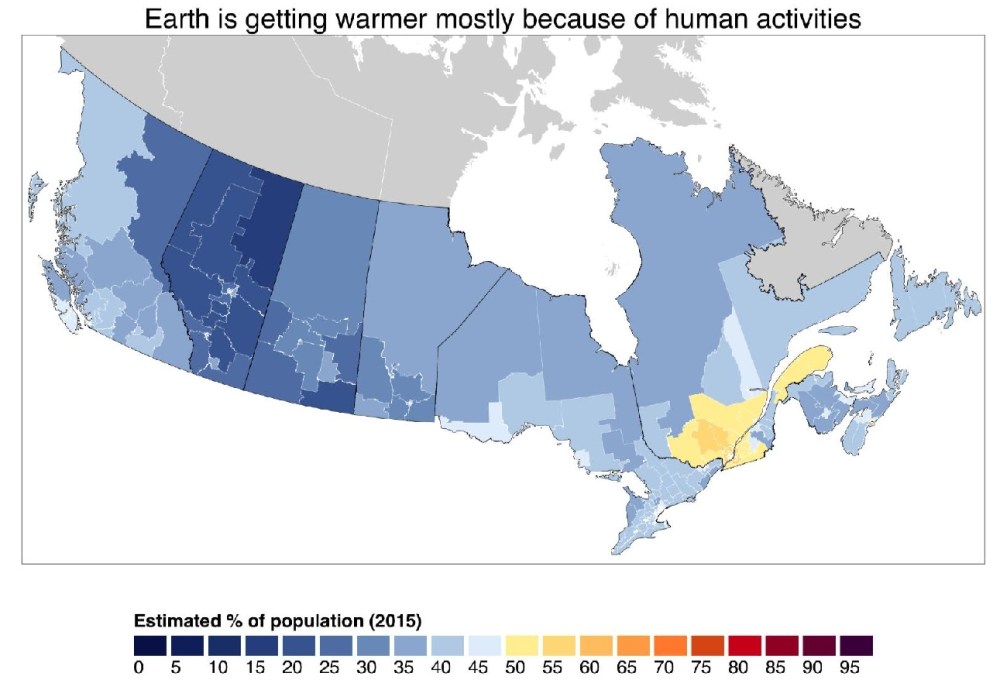
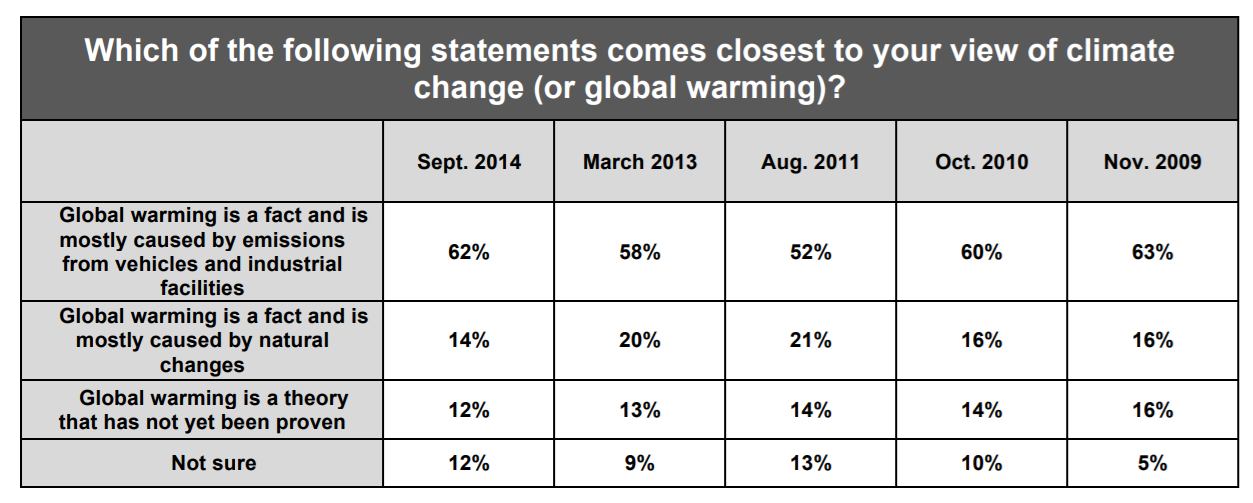
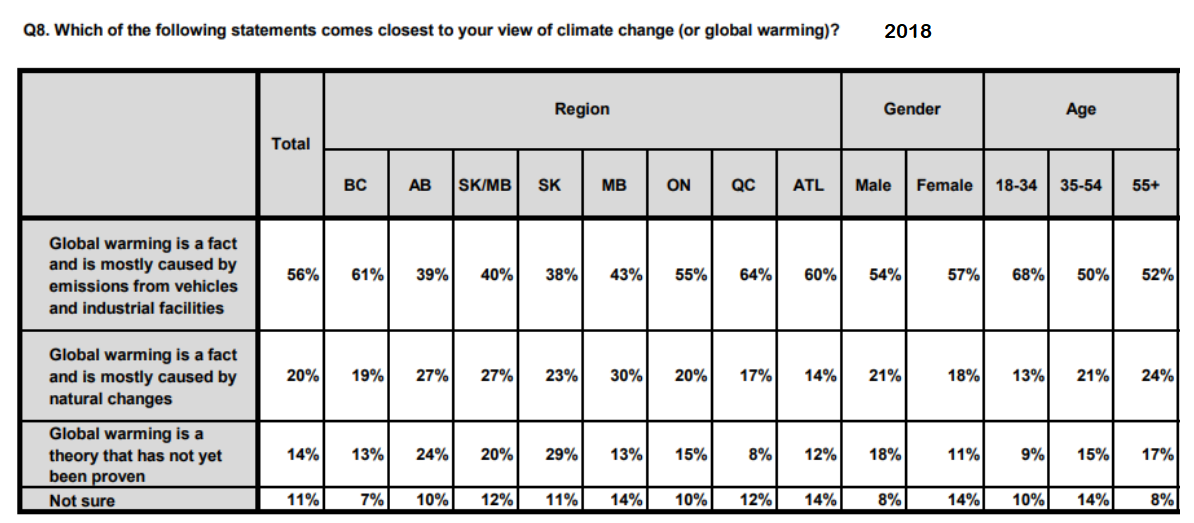
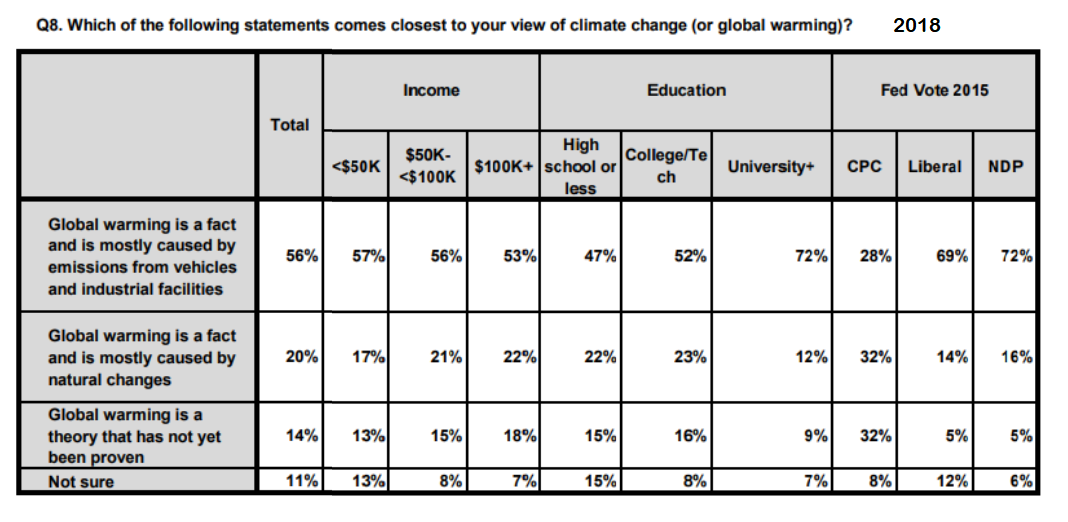
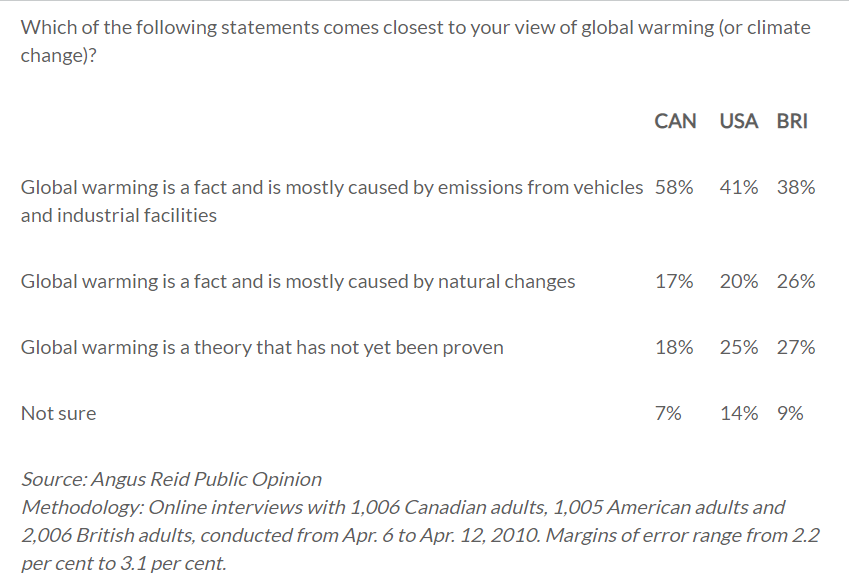
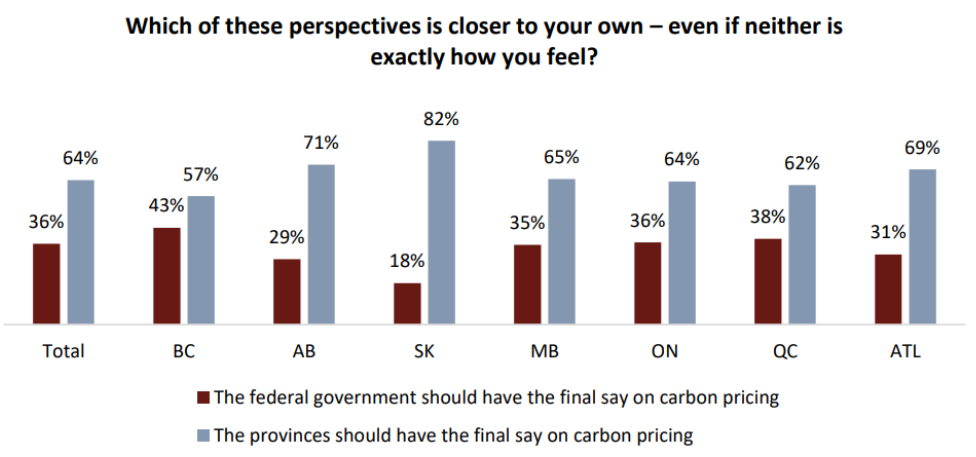
The Liberal federal government led by Justin Trudeau is running up against a deeply ingrained and widespread skepticism in the population.  In a previous post Uncensored: Canadians View Global Warming  I noted that the principle finding in a recent survey was buried in the report and hidden by the media.  Belief in man made global warming is a minority view in Canada, as shown below:
The political implications of that lack of support for climate activism are starting to become manifest.  Ed Whitcomb writes in the Ottawa Citizen Climate change politics are undermining federalism  Excerpts in italics below with my bolds and images

Prime Minister Trudeau between BC Premier John Horgan and Alberta Premier Rachel Notley. The 2 provinces are at war over expanding the oil pipeline.

Canada’s largest province is about to reject the federal climate change policy. Saskatchewan never accepted it and Alberta could reject it in 2019. Maybe it’s time for reflection.

The current policy calls for the provinces to implement a federal government plan. That, however, is a contradiction of federalism, a system which reflects the fact that the feds and the provinces have different interests. Policies to deal with pollution in Ontario may be inappropriate for Newfoundland or Saskatchewan. The current federal government overlooked such differences when it decided that there was only one solution to global warming, a carbon tax, and only two acceptable ways to implement it, cap-and-trade or a carbon levy. Unfortunately, not all Canadians and provinces accept these assumptions, and the consensus is shrinking.

In 2015, Saskatchewan’s then-premier Brad Wall pointed out that his economy was far more dependent on fossil fuels than were other provinces. A carbon tax would be disproportionately costly, which was unacceptable. That dispute is going to court and no one knows what the outcome will be.

Alberta’s NDP government endorsed the federal scheme, providing the federal government got a pipeline built. That linked dealing with climate change to increasing energy production, linked reducing gas emissions to raising them. But the pipeline has not been built, and bitumen is unlikely to flow before a provincial election which could empower the United Conservative Party. The UCP is strongly opposed to the federal climate plan. It, and the incoming Ontario Conservative government, oppose carbon taxes because everyone will pay them whether or not that reduces their consumption of carbon. The two parties believe governments always spend any money that is available (and in fact Alberta, British Columbia and Ontario have not returned all their carbon tax revenue to taxpayers).

Federal Environment Minister Catherine McKenna preaching with Justin Trudeau in the choir.

In challenging Ontario’s upcoming withdrawal from cap-and-trade, the federal government is introducing a new and very dangerous interpretation of federalism. No one questioned that Ontario’s program was within its jurisdiction. Now the federal government is saying that if Ontario repeals its own law, it will be replaced by the imposition of a federal tax exclusively within Ontario’s borders. In effect it will be a “provincial” tax, not a “national” or “federal” one applied to all Canadians.

But the federal government has no mandate to force Ontario to retain one of its own programs if its government wants to repeal it. In effect, the federal level is trying to use its taxation power to make the environment an exclusive federal responsibility.

The courts might uphold the federal government’s right to collect such a tax but the political battle could be fatal. If it can prevent Doug Ford repealing an existing Ontario law, then it can prevent other provinces repealing other provincial laws. In that case, there is no federalism, no division of power, and no independent provincial jurisdiction. Quebec could not repeal its cap-and-trade law – just the threat the separatists need to rise from their death-bed.

The federal government can forge ahead with a series of political and court battles, or it can go back to the drawing board, in which case there seem to be two options. One is co-operative federalism – namely, call a heads-of-government meeting and confirm Canada’s Paris goals; each provinces’ share of those goals; the federal right to implement policies within its jurisdiction; each province’s right to implement their own policies as they wish; and confirm that they will all co-operate to avoid duplication or contradictory policies.

The second option is for the federal government to raise its existing national carbon tax on gasoline and other forms of fossil fuel. It has full constitutional power to do so, can do it any time, the revenue can be returned to taxpayers, and it could be completely transparent. Actually, if it had done this in 2016, Canada would already be on the way to meeting its Paris goals, rather than locked in an increasingly ugly and unnecessary federal-provincial, regional, political and ideological battle.

It’s not too late to get it right but that does mean going back to the drawing board.

Ed Whitcomb is the author of Rivals for Power: Ottawa and the Provinces, the contentious history of the Canadian federation, and of short histories of all 10 provinces.

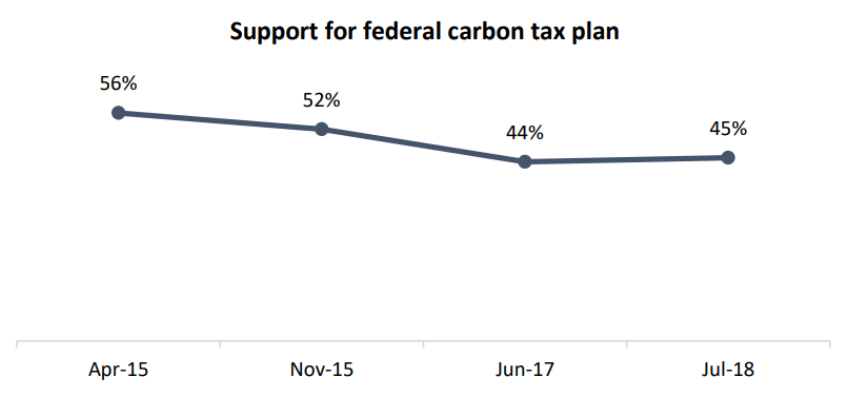
Comment:  Whitcomb does not question the climate change ideology or see the uselessness of the Paris Accord.  In the event Trudeau imposes a widely unpopular federal tax on carbon emissions, the backlash could overturn his administration.

More Good News: Ontario Reversing Carbon Tokenism

The story comes from Bloomberg, where they regard the event as lamentable: Ontario Scraps Carbon-Reduction Plan as It Expands Elsewhere.  Excerpts below with my bolds.

Ontario will scrap the province’s cap-and-trade program and pull out of the carbon-trading market with Quebec and California even as pollution pricing expands in other regions of the world.

Ontario’s Progressive Conservatives will follow through on a campaign promise to withdraw from the environmental program that required companies to buy credits to offset pollution blamed for global warming. Premier-designate Doug Ford also said he will challenge Prime Minister Justin Trudeau’s authority to make local governments put a price on greenhouse-gas emissions.

The move comes as carbon-pricing programs are expanding in the U.S. even as President Donald Trump seeks to ease restrictions on coal companies. Europe already has a large regional cap-and-trade system while China, the world’s biggest polluter, has committed to a national pollution program that could open by 2020.

Ontario’s election results were largely priced into California’s carbon market. Despite Friday’s announcement, emitters in Ontario remain obligated to manage their carbon pollution until the province formally withdraws from the system, said John Battaglia, head of carbon markets at BGC Environmental Brokerage Services LP.

“The market is stable here,” Battaglia said in an interview. “We expect a bit of short-term volatility, but long term, the show will go on.” (Comment:  It is all about the show, isn’t it?)

Ontario’s PCs will be sworn in June 29 after defeating the Liberals in an election earlier this month. Ending what Ford called a job-killing carbon tax was one of his major commitments during the campaign. Ontario will also quit the Western Climate Initiative, Ford said Friday from Toronto.

Trudeau Plan

Eliminating the carbon tax and cap-and-trade is the right thing to do and is a key component in our plan to bring your gas prices down by 10 cents per liter,” Ford said in a statement.

But the move may not spare Ontario from a carbon price. Trudeau’s government is bringing in carbon pricing rules to cover all provinces and a “backstop” for local governments that don’t come up with their own plans this year.

“Ontario is going to still have an obligation under the federal architecture and the cost of meeting that obligation could be higher,” said Dallas Burtraw, a senior fellow at Resources for the Future. “The costs of the cap-and-trade program are small on retail gasoline rates.”

Another wheel comes off the Ontario Green Energy bus.

Ontario Voters Sack Climate-Obsessed Premier

A number of posts here (linked at bottom) described how Ontario’s liberal government spent taxpayers’ and ratepayers’ money like drunken sailers looking to score in International circles.  It seems chickens do come home to roost, and those politicians are out in a landslide.  The story from CBC (warmists all) is Ontario vote will hamper prime minister’s efforts on climate change (Ya think?) Excerpts below with my bolds.

Voters in the province of Ontario have sent a stinging rebuke to the ruling Liberal Party reducing it to a rump, and they voted massively for populist Doug Ford and his Progressive Conservatives. Ford has promised to take Ontario out of its carbon cap-and-trade agreement with California and the province of Quebec, and he is against Prime Minister Justin Trudeau’s plan to oblige all provinces to levy a carbon tax.

“Now what you have is Doug Ford leading…the biggest province in the country…Now as premier of Ontario, he has one of the largest voices in the country when it comes to issues on the environment, the economy—all of these things that the premiers of the country and the prime minister have to sit down and talk about. Doug Ford now has the biggest voice at that table,” says Jordan Press, parliamentary reporter with The Canadian Press.

‘How do you meet..international agreements?’

“In much the same way that he (Trudeau) has an issue dealing with (U.S. President) Donald Trump on the environment, now Justin Trudeau faces a domestic issue as well, that how do you meet those international agreements that you have promoted. How do you continue to be that progressive leader on the world stage when at home, you are facing opposition to some of your plans,” asks Press.

Environment Minister Catherine McKenna with Justin Trudeau in the choir.

Less tax, cheaper beer promised

During the election campaign, Ford promised to cut taxes, reduce gasoline prices by 10 cents a litre, reduce the high price of electricity and offer beer for one dollar a bottle. He was criticized for not providing a clear plan for how he would pay for these promises. The province of Ontario already carries a massive debt load.

But people seem to have appreciated his promise to defend “the little guy” and ignored a lawsuit launched by his brother’s widow alleging Ford mismanaged the family’s business costing millions from the estate.

Some people compare Ford to Trump and debate about that will likely be vigorous long into the future.

In the final tally, Progressive Conservatives were elected in 76 ridings and the New Democratic Party took 40. After ruling for 15 years, the Liberal Party lost official party status and the funding that comes with it by winning only seven seats. The Green Party took one.

Former Ontario Premier Kathleen Wynne.

Background

Electrical Madness in Green Ontario

Ontario Jammed by Rent-Seekers and Ratepayers

Ontario Climate Policy Refugees

Ontario Coal Phase-out: All Pain, No Gain

Another wheel flies off Ontario’s green energy bus