Climate Change No Longer a US Security Threat


The news was reported by the Federalist Trump Admin To Remove Climate Change From List Of National Security Threats. Excerpts below with my bolds.

The Trump administration will reverse course from previous Obama administration policy, eliminating climate change from a list of national security threats. The National Security Strategy to be released on Monday will emphasize the importance of balancing energy security with economic development and environmental protection, according to a source who has seen the document and shared excerpts of a late draft.

“Climate policies will continue to shape the global energy system,” a draft of the National Security Strategy slated to be released on Monday said. “U.S. leadership is indispensable to countering an anti-growth, energy agenda that is detrimental to U.S. economic and energy security interests. Given future global energy demand, much of the developing world will require fossil fuels, as well as other forms of energy, to power their economies and lift their people out of poverty.”

President Obama made climate change, and the burdensome regulations that accompany its focus, a primary focus of his administration, including in his National Security Strategy released in 2015. “[W]e are working toward an ambitious new global climate change agreement to shape standards for prevention, preparedness, and response over the next decade,” that report said.

“In some ways, [climate change] is akin to the problem of terrorism and ISIL,” Obama said at climate talks in Paris in 2015. During a weekly address, Obama said “Today, there is no greater threat to our planet than climate change.”

In September 2016, President Obama released a memorandum requiring federal agencies to consider the effects of climate change in the development of national security-related doctrine, policies, and plans. All of this alarmed critics concerned with more pressing security risks.

By contrast, President Trump’s National Security Strategy will focus on conventional and immediate national security risks. The draft says, in part:

North Korea seeks the capability to kill millions of Americans with nuclear weapons. Iran supports terrorist groups and openly calls for our destruction. Jihadist terrorist organizations such as ISIS and al Qaeda are determined to attack the United States and radicalize Americans with their hateful ideology. States and non-state actors undermine social order with drug and human trafficking networks, which drive violent crimes and cause thousands of American deaths each year…. Strengthening control over our borders and immigration system is central to national security, economic prosperity, and the rule of law. Terrorists, drug traffickers, and criminal cartels exploit porous borders and threaten U.S. security and public safety. These actors adapt quickly to outpace our defenses.

As for climate change, the draft report says “The United States will remain a global leader in reducing traditional pollution, as well as greenhouse gases, while growing its economy. This achievement, which can serve as model to other countries, flows from innovation, technology breakthroughs, and energy efficiency gains –not from onerous regulation.”

See also: Climates Don’t Start Wars, People Do

Astronaut Grinds Climate Axe

Meet Julie Payette, Canada’s next Governor General

One month into her new job as Canada’s Governor General, Julie Payette was the keynote speaker at the ninth annual Canadian Science Policy Convention in Ottawa Nov. 1 where she urged her friends and former colleagues to take responsibility to shut down the misinformation about everything from health and medicine to climate change and even horoscopes that has flourished with the explosion of digital media.

“Can you believe that still today in learned society, in houses of government, unfortunately, we’re still debating and still questioning whether humans have a role in the Earth warming up or whether even the Earth is warming up, period,” she asked, her voice incredulous.

As the photo suggests, Payette has an impressive CV, but she appears not to know the difference between being Governor General and a Liberal cheerleader. I referred to “climate axe” purposely because leftist politicians in both Canada and US have employed global warmism as a wedge issue to split the electorate in their favor by marginalizing the skeptics.

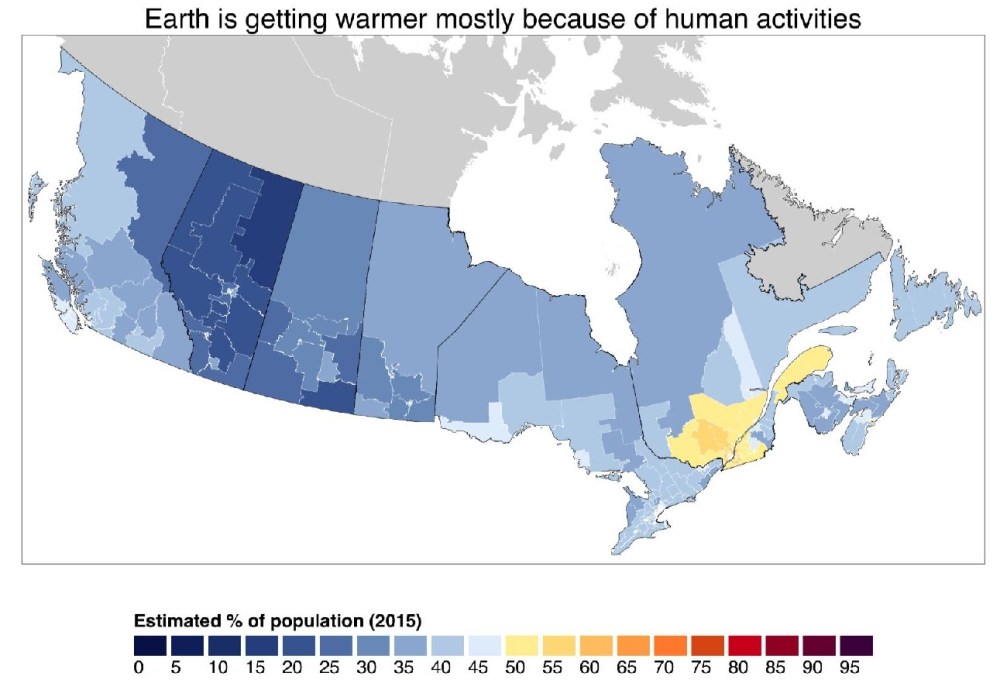
Firstly, her speech shows her ignorance of the people she represents. The most recent survey of Canadian public opinion on global warming gave this result:

Sponsors of the survey and media reporting (eg. CBC) believe 100% in man-made global warming, so were disappointed in the public’s dissent and tried to hide and misconstrue the survey results. But buried in the details is the above finding showing that Payette has thrown under the bus more than half of Canadians.  Even in her home city Montreal, hotbed of climatism, she belittles 40% of the population. Details of the survey are in Uncensored: Canadians View Global Warming

Secondly, pronouncements on scientific issues should be based on personal critical examination of the facts for and against a position. Her space experience was made possible by pioneering NASA scientists who have done their homework and come to the opposite conclusion.  She is also dumping on colleagues who have actually studied the data.

NASA retirees organized TRCS research team in the Spring of 2012 and developed a website that documents our progress into understanding the AGW issue over the last 5 years. http://www.TheRightClimateStuff.com We set as our initial goal: “Determine to what extent unrestricted burning of fossil fuels can cause harmful climate change.” We have concluded that the computer model analyses used in the IPCC reports, estimating global warming increases up to 4.5 degrees C for doubling atmospheric CO2 concentration, are in error because the models do not agree with empirical data as required by the principles of the Scientific Method. Our analysis, based on principles of conservation of energy, uses well-known, measured data and predicts no more than 1.2 degrees C increase in global warming due to burning all currently known world-wide reserves of fossil fuels. Our simple model is validated by the rigor of its derivation and agreement with 167 years of empirical data since 1850. This analysis was completed with the same rigor and attention to detail used in our manned space program, where the lives of astronauts depended on our accuracy.

Excerpt with my bolds from letter to President Donald J Trump by The Right Climate Stuff Research Team. Led by Harold H Doiron, signed by 22 others including Astronauts Walter Cunningham and Charles Duke.

More information and the complete report is at The Right Climate Stuff

Has Payette done her own analysis and written a report, or is she taking someone’s word about global warming theory and its effects? That would be a secondhand opinion, an appeal to authority rather than science.

Thirdly, it is not the Governor General’s role to champion political correctness. Rex Murphy explains it clearly in his National Post article  Governor General appoints herself umpire of questions of faith and science  Excerpts below with my bolds.

In this wonderfully diverse Canada that Ms. Payette now represents, was it her intent to ridicule the religious beliefs of so very many faiths?

Merely as prelude, we should point out that the difference between elected and selected is more than a matter of the letter “s,” and add that being assigned to a state ceremonial office does not confer oracular status on a person. On the first, it must be clearly acknowledged that it is the elected, not the selected, who argue and debate the issues of the day and determine the worth and truth of the policies that emerge from that process. They write the laws: the GG, as ceremonial totem, the stand-in for an absent Regent of a hollowed-out Monarchy, affixes her signature to them.

Secondly, elevation to the GG office, delight and honour that it undoubtedly is, does not come with a certificate of intellectual authority, or the prerogative to delimit the scope of inquiry and debate on any issue the Commons or the citizenry may wish to engage. It is not at all evident that Ms. Payette is clear on these points.

Her speech had a scattering, pinball machine trajectory. In the space of a few sentences it went from climate change, to the origin of life, to newspaper horoscopes; from dicta on the “denialism” sometimes confronting the first, to the religious understandings of the second, and the vacuous absurdity of the third. The problem with this neat triad is that, while a tirade against horoscopy might be perfectly agreeable to most everyone (being a machine gun attack on a whole field of straw men — who reads horoscopes save for feeble amusement?), assertions on life and climate are on another plane entirely.

Conclusion

Naturally, Ms. Payette opined on climate science, and equally naturally placed inquiry and skepticism on what is proclaimed the consensus of that but emergent discipline as denialism – thereby endorsing the ugliest rhetorical term in this entire, explosive issue, which summons the butchery and cruelty of History’s greatest crime as a spurious backdrop to debate on an unresolved public issue. We have a right to expect better from Her Majesty’s representative.

Blatant Hypocrisy re. Social Cost of Carbon


Update of  post from last December, triggered by Michael Greenstone’s comments on the EPA Proposed Repeal of CO2 emissions regulations.  A Washington Post article today, October 11, 2017, includes this:

“My read is that the political decision to repeal the Clean Power Plan was made and then they did whatever was necessary to make the numbers work,” added Michael Greenstone, a professor of economics at the University of Chicago who worked on climate policy during the Obama years.

Activists are frightened about the Clean Power Plan under serious attack along three lines:
1. No federal law governs CO2 emissions.
2. EPA regulates sites, not the Energy Sector.
3. CPP costs are huge, while benefits are marginal.

Complete discussion at CPP has Three Fatal Flaws.

Read below how Greenstone and a colleague did exactly what he now complains about.

Social Cost of Carbon: Origins and Prospects

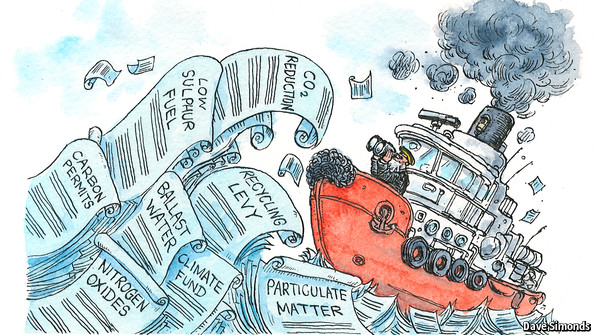
The Obama administration has been fighting climate change with a rogue wave of regulations whose legality comes from a very small base: The Social Cost of Carbon.

The purpose of the “social cost of carbon” (SCC) estimates presented here is to allow agencies to incorporate the social benefits of reducing carbon dioxide (CO2) emissions into cost-benefit analyses of regulatory actions that impact cumulative global emissions. The SCC is an estimate of the monetized damages associated with an incremental increase in carbon emissions in a given year. It is intended to include (but is not limited to) changes in net agricultural productivity, human health, property damages from increased flood risk, and the value of ecosystem services due to climate change. From the Technical Support Document: -Technical Update of the Social Cost of Carbon for Regulatory Impact Analysis -Under Executive Order 12866

A recent Bloomberg article informs on how the SCC notion was invented, its importance and how it might change under the Trump administration.
How Climate Rules Might Fade Away; Obama used an arcane number to craft his regulations. Trump could use it to undo them. (here). Excerpts below with my bolds.

scc-working-group

In February 2009, a month after Barack Obama took office, two academics sat across from each other in the White House mess hall. Over a club sandwich, Michael Greenstone, a White House economist, and Cass Sunstein, Obama’s top regulatory officer, decided that the executive branch needed to figure out how to estimate the economic damage from climate change. With the recession in full swing, they were rightly skeptical about the chances that Congress would pass a nationwide cap-and-trade bill. Greenstone and Sunstein knew they needed a Plan B: a way to regulate carbon emissions without going through Congress.

Over the next year, a team of economists, scientists, and lawyers from across the federal government convened to come up with a dollar amount for the economic cost of carbon emissions. Whatever value they hit upon would be used to determine the scope of regulations aimed at reducing the damage from climate change. The bigger the estimate, the more costly the rules meant to address it could be. After a year of modeling different scenarios, the team came up with a central estimate of $21 per metric ton, which is to say that by their calculations, every ton of carbon emitted into the atmosphere imposed $21 of economic cost. It has since been raised to around $40 a ton.

Trump can’t undo the SCC by fiat. There is established case law requiring the government to account for the impact of carbon, and if he just repealed it, environmentalists would almost certainly sue.

There are other ways for Trump to undercut the SCC. By tweaking some of the assumptions and calculations that are baked into its model, the Trump administration could pretty much render it irrelevant, or even skew it to the point that carbon emissions come out as a benefit instead of a cost.

The SCC models rely on a “discount rate” to state the harm from global warming in today’s dollars. The higher the discount rate, the lower the estimate of harm. That’s because the costs incurred by burning carbon lie mostly in the distant future, while the benefits (heat, electricity, etc.) are enjoyed today. A high discount rate shrinks the estimates of future costs but doesn’t affect present-day benefits. The team put together by Greenstone and Sunstein used a discount rate of 3 percent to come up with its central estimate of $21 a ton for damage inflicted by carbon. But changing that discount just slightly produces big swings in the overall cost of carbon, turning a number that’s pushing broad changes in everything from appliances to coal leasing decisions into one that would have little or no impact on policy.

According to a 2013 government update on the SCC, by applying a discount rate of 5 percent, the cost of carbon in 2020 comes out to $12 a ton; using a 2.5 percent rate, it’s $65. A 7 percent discount rate, which has been used by the EPA for other regulatory analysis, could actually lead to a negative carbon cost, which would seem to imply that carbon emissions are beneficial. “Once you start to dig into how the numbers are constructed, I cannot fathom how anyone could think it has any basis in reality,” says Daniel Simmons, vice president for policy at the American Energy Alliance and a member of the Trump transition team focusing on the Energy Department.

David Kreutzer, a senior research fellow in energy economics and climate change at Heritage and a member of Trump’s EPA transition team, laid out one of the primary arguments against the SCC. “Believe it or not, these models look out to the year 2300. That’s like effectively asking, ‘If you turn your light switch on today, how much damage will that do in 2300?’ That’s way beyond when any macroeconomic model can be trusted.”

Another issue for those who question the Obama administration’s SCC: It estimates the global costs and benefits of carbon emissions, rather than just focusing on the impact to the U.S. Critics argue that this pushes the cost of carbon much higher and that the calculation should instead be limited to the U.S.; that would lower the cost by more than 70 percent, says the CEI’s Mario Lewis.

Still, by narrowing the calculation to the U.S., Trump could certainly produce a lower cost of carbon. Asked in an e-mail whether the new administration would raise the discount rate or narrow the scope of the SCC to the U.S., one person shaping Trump energy and environmental policy replied, “What prevents us from doing both?”

drain-the-swamp

Canada  Ends Probe Against Climate Change Doubters

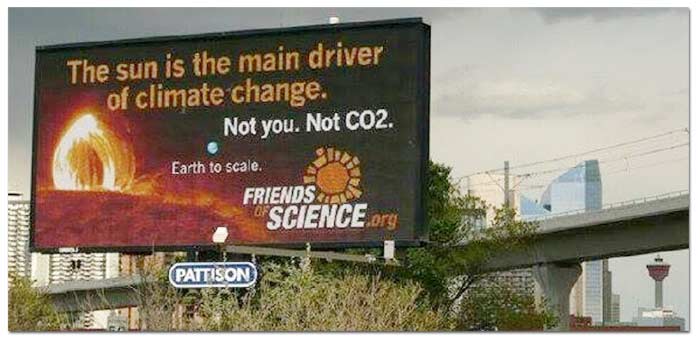
Billboard in Calgary Alberta gives rise to complaint to Canada’s Competition Bureau.

The vigilantes report on their setback in this National Observer article Feds halt probe of climate doubters.  Some excerpts give the flavor of their perspective.

After more than a year of investigating, the Competition Bureau abruptly dropped its inquiry earlier this summer into three groups that had displayed information in public raising doubts about the international scientific consensus on climate change.

The groups put up websites and billboards that promoted statements like, “the sun is the main driver of climate change,” and “carbon dioxide is not a pollutant,” according to an application filed with the bureau, a Canadian independent law enforcement agency.

Those views are contrary to mainstream climate science and the government of Canada itself, which states that “changes in solar irradiance have contributed to climate trends over the past century but since the industrial revolution, the effect of additions of greenhouse gases to the atmosphere has been over 50 times that of changes in the sun’s output.”

From the Bureau letter to the Complainant:

The inquiry concerned allegations that Friends of Science Society, International Climate
Science Coalition and Heartland Institute made misleading representations regarding climate change on their respective websites and, in the case of Friends of Science Society, on billboards.

At this time, considering the available evidence, the assessment of the facts in this case, and
to ensure the effective allocation of limited resources, the Commissioner has discontinued the
inquiry. 

A statement was provided to National Observer by Tom Harris, executive director of the International Climate Science Coalition, but was incompletely quoted in the article. The full statement posted at International Science Coalition is below:

“The complainants apparently think that they know the truth about the causes and consequences of climate change. But this makes no sense. This is not just because the science is enormously complicated with scientists holding at times radically different points of view. It is also because scientific hypotheses, and even scientific theories, are not truth; they can be, and often are, wrong. Truth applies to things like mathematics or chess in which we write the rules. But truth never applies to our findings about nature, which are merely educated opinions based on scientists’ interpretations of observations.”

“When authorities promote truth about science, progress stops. I am glad the Competition Bureau did not fall into this trap. Its time to open up, not shut down, the debate about climate change, one of the most complex and costly issues of our age.”

More complete account of this encounter from Friends of Science:  Responding to the National Observer Article on the Competition Bureau/Ecojustice Call for Inquiry

Key Points:

  • First, Ecojustice asked for an honest debate. We provided one.[1] They never responded.
  • Secondly, presently there is no such thing as a ‘low-carbon economy’ because everything in the modern world is made from or powered by fossil fuels – even hydro dams, nuclear facilities and geothermal require fossil fuels to create the power plant.
  • Thirdly, climate change is mostly driven by natural factors and might only be marginally mitigated by the Paris Agreement.
  • Fourthly, despite claiming humans caused most of the recent warming, the IPCC, perhaps inadvertently, revealed in its 2013 AR5 report that climate change was mostly due to natural factors. (This point is more fully explained in post Warming from CO2 Unlikely
  • Finally, the Paris Agreement targets are unattainable and if attempted, would lead to the complete destruction of the Canadian economy. This is contrary to the UN Charter’s explicit principles. 

These are our opinions, protected by the Charter of Rights.

For examples of proven false advertising by climate activists, see Truth in Climate Advertising

Summary

The complaint was filed by an “ecojustice” lawyer. Free speech about a matter of opinion is attacked as false advertising. Sad. We are still waiting for the evidence supporting global warming claims. Keep on firing away, Tom Harris and Friends of Science.


Why the US letter re. Paris Accord

August 5, 2017 Update to Climate Law post

Media are reporting on the State Department letter informing the UN that the US will be withdrawing from the Paris Accord.  Some climatists are encouraged that the three-year waiting period is acknowledged and that the next president could return to the fold.  Others are disappointed that the Trump administration is not more assertive against both the accord and the United Nations Framework Convention on Climate Change (UNFCCC) itself.

Everyone should breathe through the nose and recognize the game and the stakes.  Paris agreement is not binding and is without penalties (except for blame and shame).  So following the protocol costs the US nothing, and does provide some opportunities.  As the world’s leader in actually reducing CO2 emissions, the US wants and needs to be at the table to convince others to follow the US example.  There is also 1 billion US$ from Obama put into the green fund that could be disbursed in accordance with US current priorities regarding energy and climate.

But the most important reason for this letter is to document that the Paris accord does not have legal authority for and within the United States.  Putting the US intent in writing is necessary to deter legal claims to hold the US accountable to Paris terms and conditions.  The post below explains why Paris accord is so important to legal climate actions around the world.

Climate Activists storm the bastion of Exxon Mobil, here seen without their shareholder disguises.

On the same day POTUS announced US withdrawal from Paris accord, a majority of Exxon Mobil shareholders approved a resolution asking management to assess the value of corporate assets considering a global move toward a low-carbon future. Here is the resolution, filed by the New York State Comptroller:

RESOLVED: Shareholders request that, beginning in 2018, ExxonMobil publish an annual assessment of the long-term portfolio impacts of technological advances and global climate change policies, at reasonable cost and omitting proprietary information. The assessment can be incorporated into existing reporting and should analyze the impacts on ExxonMobil’s oil and gas reserves and resources under a scenario in which reduction in demand results from carbon restrictions and related rules or commitments adopted by governments consistent with the globally agreed upon 2 degree target. This reporting should assess the resilience of the company’s full portfolio of reserves and resources through 2040 and beyond, and address the financial risks associated with such a scenario.

Background:

This century climatists woke up to their losing the battle for public opinion for onerous and costly reductions to fossil fuel usage. They turned toward the legal system to achieve their agenda, and the field of Climate Law has become another profession corrupted by climate cash, along side of Climate Medicine.

In addition to numerous court lawsuits, and also civil disobedience cases, there has been a concerted, well-funded and organized divestment move against companies supplying fossil fuels to consumers. The intention is to at least tie up in red tape Big Oil, indeed Small Oil as well. The real hope is to weaken energy producers by depriving them of investors to the point that reserves are left in the ground, as desired by such activists as 350.org.

In 2016 virtually the same resolution was dismissed by shareholders with only 38% approving. The difference this year was the switch by BlackRock Inc. and Vanguard Group, two of the world’s largest asset managers. As reported by Fox News (here):

Investment products such as exchange-traded funds that track the performance of indexes often come at a lower cost than traditional mutual funds and have gathered assets at a clip in recent years. That growth has given firms like BlackRock and Vanguard increasing sway on shareholder votes. But the firms in turn have come under activist pressure to take stances on issues such as climate disclosure.

When BlackRock sided with Exxon and against a similar proposal at the company’s annual meeting a year ago, it faced backlash from investors and environmental activists. This year BlackRock said the disclosure of climate risks would be among its key engagement priorities with senior executives.

Exxon Mobil board must now show they are taking this proposal seriously, and activists will be looking for company assets to be “stress tested” with the hope that the shares become more risky. At the very least, management will have to put more time and energy into opining on various scenarios of uncertain content and probabilities relating to the wish dreams of climatists.

Balancing on a cascade of suppositions.

We can look into the climate activist mental frame thanks to documents supporting the current strategy using the legal system to implement actions against fossil fuel consumption.

For example, there is this recent text explaining the shareholder proposal tabled at ExxonMobil annual meeting. From Attorney Sanford Lewis:

The Proposal states:

“RESOLVED: Shareholders request that by 2017 ExxonMobil publish an annual assessment of long term portfolio impacts of public climate change policies, at reasonable cost and omitting proprietary information. The assessment can be incorporated into existing reporting and should analyze the impacts on ExxonMobil’s oil and gas reserves and resources under a scenario in which reduction in demand results from carbon restrictions and related rules or commitments adopted by governments consistent with the globally agreed upon 2 degree target. The reporting should assess the resilience of the company’s full portfolio of reserves and resources through 2040 and beyond and address the financial risks associated with such a scenario.

Now let’s unbundle the chain of suppositions that comprise this proposal.

  • Supposition 1: A 2C global warming target is internationally agreed.
  • Supposition 2: Carbon Restrictions are enacted by governments to comply with the target.
  • Supposition 3: Demand for oil and gas products is reduced due to restrictions
  • Supposition 4: Oil and gas assets become uneconomic for lack of demand.
  • Supposition 5: Company net worth declines by depressed assets and investors lose value.

1.Suppose an International Agreement to limit global warming to 2C.

From the supporting statement to the above proposal, Sanford Lewis provides these assertions:

Recognizing the severe and pervasive economic and societal risks associated with a warming climate, global governments have agreed that increases in global temperature should be held below 2 degrees Celsius from pre-industrial levels (Cancun Agreement).

Failing to meet the 2 degree goal means, according to scientists, that the world will face massive coastal flooding, increasingly severe weather events, and deepening climate disruption. It will impose billions of dollars in damage on the global economy, and generate an increasing number of climate refugees worldwide.

Climate change and the risks it is generating for companies have become major concerns for investors. These concerns have been magnified by the 21st Session of the Conference of the Parties (COP 21) in Paris, where 195 global governments agreed to restrict greenhouse gas (GHG) emissions to no more than 2 degrees Celsius from pre-industrial levels and submitted plans to begin achieving the necessary GHG emission reductions. In the agreement, signatories also acknowledged the need to strive to keep global warming to 1.5 degrees, recognizing current and projected harms to low lying islands.

Yet a careful reading of UN agreements shows commitment is exaggerated:
David Campbell (here):

Neither 2°C nor any other specific target has ever been agreed at the UN climate change negotiations.

Article 2 of the Paris Agreement in fact provides only that it ‘aims to strengthen the global response to the threat of climate change … including by the holding the increase to well below 2°C’. This is an expression, not of setting a concrete limit, but merely of an aspiration to set such a limit. It is true that Article 2 is expressed in a deplorably equivocatory and convoluted language which fails to convey this vital point, indeed it obscures it. But nevertheless that is what Article 2 means.

Dieter Helm (here):

Nothing of substance has been achieved in the last quarter of a century despite all the efforts and political capital that has been applied. The Paris Agreement follows on from Kyoto. The pledges – in the unlikely event they are met – will not meet the 2C target, shipping and aviation are excluded, and the key developing countries (China and India) are not committed to capping their emission for at least another decade and a half (or longer in India’s case)

None of the pledges is, in any event, legally binding. For this reason, the Paris Agreement can be regarded as the point at which the UN negotiating approach turned effectively away from a top down approach, and instead started to rely on a more country driven and hence bottom up one.

Paul Spedding:

The international community is unlikely to agree any time soon on a global mechanism for putting a price on carbon emissions.

2: Suppose Governments enact restrictions that limit use of fossil fuels.

Despite the wishful thinking in the first supposition, the activists proceed on the basis of aspirations and reporting accountability. Sanford Lewis:

Although the reduction goals are not set forth in an enforceable agreement, the parties put mechanisms in place for transparent reporting by countries and a ratcheting mechanism every five years to create accountability for achieving these goals. U.N. Secretary General Ban Ki-moon summarized the Paris Agreement as follows: “The once Unthinkable [global action on climate change] has become the Unstoppable.”

Now we come to an interesting bait and switch. Since Cancun, IPCC is asserting that global warming is capped at 2C by keeping CO2 concentration below 450 ppm. From Summary for Policymakers (SPM) AR5

Emissions scenarios leading to CO2-equivalent concentrations in 2100 of about 450 ppm or lower are likely to maintain warming below 2°C over the 21st century relative to pre-industrial levels. These scenarios are characterized by 40 to 70% global anthropogenic GHG emissions reductions by 2050 compared to 2010, and emissions levels near zero or below in 2100.

Thus is born the “450 Scenario” by which governments can be focused upon reducing emissions without any reference to temperature measurements, which are troublesome and inconvenient.

Sanford Lewis:

Within the international expert community, “2 degree” is generally used as shorthand for a low carbon scenario under which CO2 concentrations in the earth’s atmosphere are stabilized at a level of 450 parts per million (ppm) or lower, representing approximately an 80% reduction in greenhouse gas emissions from current levels, which according to certain computer simulations would be likely to limit warming to 2 degrees Celsius above pre-industrial levels and is considered by some to reduce the likelihood of significant adverse impacts based on analyses of historical climate variability. Company Letter, page 4.

Clever as it is to substitute a 450 ppm target for 2C, the mathematics are daunting. Joe Romm:

We’re at 30 billion tons of carbon dioxide emissions a year — rising 3.3% per year — and we have to average below 18 billion tons a year for the entire century if we’re going to stabilize at 450 ppm. We need to peak around 2015 to 2020 at the latest, then drop at least 60% by 2050 to 15 billion tons (4 billion tons of carbon), and then go to near zero net carbon emissions by 2100.

And the presumed climate sensitivity to CO2 is hypothetical and unsupported by observations:

3.Suppose that demand for oil and gas products is reduced by the high costs imposed on such fuels.

Sanford Lewis:

ExxonMobil recognized in its 2014 10-K that “a number of countries have adopted, or are considering adoption of, regulatory frameworks to reduce greenhouse gas emissions,” and that such policies, regulations, and actions could make its “products more expensive, lengthen project implementation timelines and reduce demand for hydrocarbons,” but ExxonMobil has not presented any analysis of how its portfolio performs under a 2 degree scenario.

Moreover, the Company’s current use of a carbon proxy price, which it asserts as its means of calculating climate policy impacts, merely amplifies and reflects its optimistic assessments of national and global climate policies. The Company Letter notes that ExxonMobil is setting an internal price as high as $80 per ton; in contrast, the 2014 Report notes a carbon price of $1000 per ton to achieve the 450 ppm (2 degree scenario) and the Company reportedly stated during the recent Paris climate talks that a 1.5 degree scenario would require a carbon price as high as $2000 per ton within the next hundred years.

Peter Trelenberg, manager of environmental policy and planning at Exxon Mobil reportedly told the Houston Chronicle editorial board: Trimming carbon emissions to the point that average temperatures would rise roughly 1.6 degrees Celsius – enabling the planet to avoid dangerous symptoms of carbon pollution – would bring costs up to $2,000 a ton of CO2. That translates to a $20 a gallon boost to pump prices by the end of this century… .

Even those who think emissions should be capped somehow see through the wishful thinking in these numbers. Dieter Helm:

The combination of the shale revolution and the ending of the commodity super cycle probably point to a period of low prices for sometime to come. This is unfortunate timing for current decarbonisation policies, many of which are predicated on precisely the opposite happening – high and rising prices, rendering current renewables economic. Low oil prices, cheap coal, and falling gas prices, and their impacts on driving down wholesale electricity prices, are the new baseline against which to consider policy interventions.

With existing technologies, it is a matter of political will, and the ability to bring the main polluters on board, as to whether the envelope will be breached. There are good reasons to doubt that any top down agreement will work sufficiently well to achieve it.

The end of fossil fuels is not about to happen anytime soon, and will not be caused by running out of any of them. There is more than enough to fry the planet several times over, and technological progress in the extraction of fossil fuels has recently been at least as fast as for renewables. We live in an age of fossil fuel abundance.

We also live in a world where fossil fuel prices have fallen, and where the common assumption that prices will bounce back, and that the cycle of fossil fuel prices will not only reassert itself but also continue on a rising trend, may be seriously misguided. It is plausible to at least argue that the oil price may never regain its peaks in 1979 and 2008 again.

A world with stable or falling fossil fuel prices turns the policy assumptions of the last decade or so on their heads. Instead of assuming that rising prices would ease the transition to low carbon alternatives, many of the existing technologies will probably need permanent subsidies. Once the full system costs are incorporated, current generation wind (especially offshore) and current generation solar may be out of the market except in special locations for the foreseeable future. In any event, neither can do much to address the sheer scale of global emissions.

Primary Energy Demand Projection

4.Suppose oil and gas reserves are stranded for lack of demand.

Sanford Lewis:

Achievement of even a 2 degree goal requires net zero global emissions to be attained by 2100. Achieving net zero emissions this century means that the vast majority of fossil fuel reserves cannot be burned. As noted by Mark Carney, the President of the Bank of England, the carbon budget associated with meeting the 2 degree goal will “render the vast majority of reserves ‘stranded’ – oil, gas, and coal that will be literally unburnable without expensive carbon capture technology, which itself alters fossil fuel economics.”

A concern expressed by some of our stakeholders is whether such a “low carbon scenario” could impact ExxonMobil’s reserves and operations – i.e., whether this would result in unburnable proved reserves of oil and natural gas.

Decisions to abandon reserves are not as simple or have the effects as desired by activists.

Financial Post (here):

The 450 Scenario is not the IEA’s central scenario. At this point, government policies to limit GHG emissions are not stringent enough to stimulate this level of change. However, for discussion purposes let’s use the IEA’s 450 Scenario to examine the question of stranded assets in crude oil investing. Would some oil reserves be “stranded” under the IEA’s scenario of demand reversal?

A considerable amount of new oil projects must be developed to offset the almost 80 per cent loss in legacy production by 2040. This continued need for new oil projects for the next few decades and beyond means that the majority of the value of oil reserves on the books of public companies must be realized, and will not be “stranded”.

While most of these reserves will be developed, could any portion be stranded in this scenario? The answer is surely “yes.” In any industry a subset of the inventory that is comprised of inferior products will be susceptible to being marginalized when there is declining demand for goods. In a 450 ppm world, inferior products in the oil business will be defined by higher cost and higher carbon intensity.

5.Suppose shareholders fear declining company net worth.

Now we come to the underlying rationale for this initiative.

Paul Spedding:

Commodity markets have repeatedly proved vulnerable to expectations that prices will fall. Given the political pressure to mitigate the impact of climate change, smart investors will be watching closely for indications of policies that will lead to a drop in demand and the possibility that their assets will become financially stranded.

Equity markets are famously irrational, and if energy company shareholders can be spooked into selling off, a death spiral can be instigated. So far though, investors are smarter than they are given credit.

Bloomberg:

Fossil-fuel divestment has been a popular issue in recent years among college students, who have protested at campuses around the country. Yet even with the movement spreading to more than 1,000 campuses, only a few dozen schools have placed some restrictions on their commitments to the energy sector. Cornell University, Massachusetts Institute of Technology and Harvard University are among the largest endowments to reject demands to divest.

Stanford Board of Trustees even said:

As trustees, we are convinced that the global community must develop effective alternatives to fossil fuels at sufficient scale, so that fossil fuels will not continue to be extracted and used at the present rate. Stanford is deeply engaged in finding alternatives through its research. However, despite the progress being made, at the present moment oil and gas remain integral components of the global economy, essential to the daily lives of billions of people in both developed and emerging economies. Moreover, some oil and gas companies are themselves working to advance alternative energy sources and develop other solutions to climate change. The complexity of this picture does not allow us to conclude that the conditions for divestment outlined in the Statement on Investment Responsibility have been met.

Update:  Universities are not the exception in finding the alarmist case unconvincing, according to a survey:

Almost half of the world’s top 500 investors are failing to act on climate change — an increase of 6 percent from 236 in 2014, according to a report Monday by the Asset Owners Disclosure Project, which surveys global companies on their climate change risk and management.

The Abu Dhabi Investment Authority, Japan Post Insurance Co Ltd., Kuwait Investment Authority and China’s SAFE Investment Company, are the four biggest funds that scored zero in the survey. The 246 “laggards” identified as not acting hold $14 trillion in assets, the report said.

Summary

Alarmists have failed to achieve their goals through political persuasion and elections. So they are turning to legal and financial tactics. Their wishful thinking appears as an improbable chain of events built upon a Paris agreement without substance.

Last word to David Campbell:

International policy has so far been based on the premise that mitigation is the wisest course, but it is time for those committed to environmental intervention to abandon the idea of mitigation in favour of adaptation to climate change’s effects.

For more on adapting vs. mitigating, see Adapting Works, Mitigating Fails
EventChain

Trump’s Climate Clarity


Delingpole gets the back story from Chris Horner on Trump’s climate position. How Donald Trump Got to be so Amazing on Climate Change  Excerpts:

Horner understands the magnitude of Trump’s achievement so far. Even Trump announcing his plan to pull out of the UN Paris climate agreement required immense determination and moral courage. After all his decision wasn’t only resisted by the usual Democrat suspects and green lobbyists: it also came up against stiff opposition from key members of the Administration, among them, Secretary of State Rex Tillerson and Economics Advisor Gary Cohn.

In fact, argues Horner, probably nowhere in DC is the swamp more heavily defended by the liberal politico-media establishment than the EPA and the climate change industry.

No other GOP presidential candidate – not Rubio, not Cruz – would have delivered on climate change in the same way as Trump has. They would, quite simply, have been overwhelmed by the swamp. So how come Trump has proved so exceptional in tackling the Green Blob? It’s not like he’ll have read lots of books on the subject because his attention span just doesn’t allow for it. No, according to Horner it’s much simpler than that. It’s because Trump does not think like a politician. Rather, Trump made his decision using much the same gut feeling he uses on his business deals – which he wasn’t sidetracked by any of the “green jobs” “save the world” crap which other politicians find so seductive…

Horner: “Here’s what I firmly believe. I’m convinced that the penny dropped for others, as it did me, when Donald Trump gave his editorial board interview to the Washington Post. It’s often mocked – where he said: “I’m not a big believer in global warming. Not a big believer.” And then he continued in a very important way. And if you follow the way Donald Trump speaks it’s perfectly clear what he’s saying. He said, “You know, a lot of people are making a lot of money off of this.”

“He was not saying this as a politician says it. (‘And if we use spoons not shovels we can create even more jobs…’ That sort of playground thinking is very common among politicians.) And whatever anybody thinks about Donald Trump you can be confident of this. At 21, at Le Cirque, somewhere at some point, somebody who is making a killing off the rents of the global warming industry laughed it up a little too loudly or once too many times around Donald Trump. Because what he said to the Washington Post was “You’re robbing Peter to pay Paul. Goldmans is making a killing out of this.” That’s what I heard him say. Politicians normally fall for this. But not Donald.

You can take his Chinese hoax comments, you can take hoax in any context but the fact is the way they’re playing out the global warming industry there are many scams involved and I think he was aware of this. I do think at one point somebody laughed a little too loudly…”

Summary

A politician would have been sidetracked by all the talk of “green jobs” or “saving the planet.” But Trump made his decision using much the same gut feeling he uses on his business deals. “Something about this climate change business stinks,” he probably said to himself at some stage.

And if so, he would have been quite right, it does.

To follow the money see also Climate Crisis Inc.


Sucking Green Monster

Draining the swamp is one thing, difficult enough to do and then contend with the alligators nesting there. Caleb Rossiter is even more concerned about the infiltration of climate change activists into every branch of federal bureaucracy.  His POV is explained in a Washington Examiner article Trump’s agenda faces climate deep state by John Siciliano | Jun 25, 2017.

Background

Rossiter, whose left-liberal credentials included a stint as counsel to former Rep. Bill Delahunt, D-Mass., who was one of Nancy Pelosi’s lieutenants after she swept to power in 2006, is a fervent supporter of clean fossil fuel development, and is sympathetic to Trump’s agenda. He made a name for himself for being a Democrat who is also a fervent critic of alarmist climate policy. His willingness to reject an article of faith in leftist and Democratic circles got him ousted a few years back from the Institute for Policy Studies, a progressive think tank, where he was an associate fellow.

The Herculean Challenge

“So, there wasn’t much change at EPA this year, not much change at [the] State” Department, Rossiter says. People say Trump will “get it right next time” when it comes to the budget, Rossiter adds, but he isn’t convinced.

“It’s going to be hard … and this stuff is really deeply embedded in the budget. People are doing National Science Foundation studies, transportation studies based on the assumption that carbon dioxide is a clear and present danger to our country.”

Another long-term problem is that Obama planted climate change offices in Cabinet agencies all over the federal government. These climate offices are meant to direct, advise on, and recommend actions that have climate change as their guiding star. Their whole point is to ensure that federal agencies only approve projects that consider the climate consequences of government action.

Deep Green Climate Network

Tentacles are attached everywhere, but Rossiter provides examples of some the most obvious larger and more developed suckers.

The State Department‘s Office of the Special Envoy for Climate Change, or the SECC, which is responsible for negotiating climate deals and implementing U.S. policy on climate change.

The State Department also has an Office of Global Change, which represents the nation in any negotiations under the United Nations Framework Convention on Climate Change, which is the same convention that handled the Paris negotiations with 194 other countries. It also handles negotiations with other international organizations that handle climate change policymaking, including the International Civil Aviation Organization and the International Maritime Organization.

The U.S. Agency for International Development also has its own specialized Office of Climate Change. USAID is the nation’s primary distributor of foreign aid, and climate change is seen by the agency as one of the primary reasons its services are in greater need than ever before. USAID spends more than $300 million per year in 50 countries for “climate-smart development,” according to the agency.

The U.S. Department of Agriculture has its Climate Change Program Office, which also guides the agency’s response by focusing on how global warming will affect agriculture, forests, grazing lands, and rural communities. It works to ensure that climate change is recognized and “fully integrated” into research, planning, and “decision-making processes,” according to the USDA website.

The Energy Department has at least two climate change or climate-related offices within its Office of International Affairs, overseen by the deputy assistant secretary for International Climate and Technology.  First, there is the Office of International Climate and Clean Energy, which coordinates clean energy development programs to reduce greenhouse gas emissions.  Second, there is the Office of International Science and Technology Collaboration, which oversees a number of programs with other countries to develop clean energy programs.

The Department of Transportation is another big Cabinet level agency with climate change policy strewn through it. One of its main initiatives is the Transportation and Climate Change Clearinghouse, which is designed as a “one-stop source of information on transportation and climate change issues,” according to the agency. “It includes information on greenhouse gas (GHG) inventories, analytic methods and tools, GHG reduction strategies, potential impacts of climate change on transportation infrastructure, and approaches for integrating climate change considerations into transportation decision making.”

The list goes on, according to Rossiter. The Department of Justice has its own programs, as does the Centers for Disease Control and Prevention and the Department of Education, he said.

Another large organization that the U.S. government is a part of is the World Bank. It is set up to fund projects all over the world, but has been known to hold up coal-fired power plant projects because of the threat of “climate catastrophe,” Rossiter said.

“A big one is at the bottom of your list at the Department of Transportation,” Rossiter said. “They put a lot of limitations on public transport, what can be approved, and they are very fixated on the greenhouse gas hypothesis.”

Tree growth in Queens sewer.

Next steps for Trump

Trump has taken some actions to disconnect the climate network, primarily by rolling back climate change regulations, land management decisions and international agreements such as the Paris climate change agreement. But all of these actions just scratch the surface, according to critics of Obama’s policies.

They say Trump hasn’t even begun to address the real grip that climate change alarmism had put in place within the government. Trump can turn off the engine, but other presidents can just as easily turn them on again if they are still there, which would leave Trump’s climate agenda in tatters.

Trump is attempting to strike out climate regulations painstakingly one at a time, which will take years, with no guarantee that a new president wouldn’t reverse all Trump’s actions. Revoking the endangerment finding would be a more secure method, because it would eliminate the raison d’etre for carbon dioxide regulation. At least, that’s what climate skeptics hope.

Rossiter said one of the weaknesses in Trump’s decision to leave Paris was that he failed to mention global warming science. “I wish Mr. Trump would have really cut the Gordian Knot by saying for scientific reasons it’s way too premature to restrict our economy on the basis of fears of climate catastrophe,” he said.

Rossiter believes the science isn’t as strong as most people say it is for taking action to stop global warming. “The 98 percent consensus is carbon dioxide is a warming gas. And it has, probably, some impact on the temperature,” but that “doesn’t mean you are immediately creating floods, hurricanes and droughts and locusts.

“This creates a problem because what we are trying to do, what we need to do, is defang the concept that has spread through the federal government. Once it’s defanged, it’s much easier to go through the executive branch agencies and say ‘look, our goal here is clean as possible generation of electricity for the wealth of the United States and the world.'”

Washington’s Future?

Angkor Wat Ta Prohm Temple overgrown with tree roots.

Updated: EPA Swamp Life (Climategaters)

Update June 21, 2017

A leaked EPA memo (standard journalism these days) reveals that more members of the Board of Scientific Counselors (BOSC) will not be renewed in their contracts and roles.

The new wave of dismissals brings the total number of BOSC members who will be out of a job in August to 47, which will leave just 11 members serving on the BOSC and its five subcommittees. None of the subcommittees will have a chair or vice chair, and all committee meetings scheduled for late summer and fall have been cancelled.

“Pruitt has pulled off a devious process here: he’s signaled that he intends to dismiss experienced advisors whose terms are expiring over the next year — and he’s using the fact that he’s dismissing them to immediately block them from doing any more work,” UCS’s Kimmell said.

Sign to be posted soon at the EPA

Background

An update on the power struggle inside the EPA is provided by Ronald Bailey’s May. 9, 2017 article EPA Bureaucracy Strikes Back: The Case of the Board of Scientific Counselors  How will the struggle between the permanent bureaucracy and the EPA’s new leadership play out?  Excerpts below.

The efforts of the permanent bureaucracy at the Environmental Protection Agency to hand the the new political leadership a fait accompli regarding the membership of that agency’s Board of Scientific Counselors (BOSC) brought to mind the antics of Yes, Minister. The civil servants at the EPA had apparently assured the members of the BOSC whose three-year terms were ending that they could stay on for another term just as the Obama administration was winding down in January. Since the terms for more than half of the BOSC’s members ran out in late April, the agency bureaucrats essentially went to the new EPA leadership with the old list of Obama administration appointees at the last minute and said, “Sign this.”

The new team appointed by Trump declined to do so. Scorned bureaucrats then leaked the decision to the media shaping the narrative as a Trumpian anti-science “firing” of brave truth-tellers. The Washington Post and the New York Times duly reported just that story. But is it so? “We’re not going to rubber-stamp the last administration’s appointees. Instead, they should participate in the same open competitive process as the rest of the applicant pool,” EPA spokesperson J.P. Freire told the Post. “This approach is what was always intended for the board, and we’re making a clean break with the last administration’s approach.”

Rifling through the Federal Advisory Committee Act database, I find that the terms of 12 members of the BOSC officially expired on April 27, 2017. Another ended in March. Composed of outside researchers, the 18-member BOSC is supposed to provide objective and independent counsel to the agency’s Office of Research and Development (ORD). The committee aids the ORD on research and development with the aim of identifying, understanding, and solving current and future environmental problems; by reviewing ORD’s technical support to EPA’s program and regional offices; by providing leadership in assisting ORD in identifying emerging environmental issues; and by helping to advance the science and technology of risk assessment and risk management.

BOSC members are must be nationally recognized experts in science or engineering. The board should be balanced in disciplines, diversity, and geographic distribution area and include representatives from academia, government, industry, environmental consulting firms, and environmental associations.

As the Membership Balance Plan notes the list of nominees is reviewed by “different levels of EPA managers” before formal letters of invitation are sent out. The Plan notes that “members are usually appointed for a three-year term. Generally, members may be reappointed for a total of 6 years.”

In this case, the EPA bureaucrats in charge of finding and vetting nominees for the BOSC were evidently satisfied with the members who had been appointed during the Obama administration. Spot checking the BOSC’s history, it does appear that in recent years, committee members have generally served two 3-year terms.

EPA spokesperson J.P. Freire released this statement: “Advisory panels like BOSC play a critical role reviewing the agency’s work. EPA received hundreds of nominations to serve on the board, and we want to ensure fair consideration of all the nominees – including those nominated who may have previously served on the panel – and carry out a competitive nomination process.” The EPA plans solicit nominees through the Federal Register and to select new board members quickly. (I reached out to the agency to clear up which and how many BOSC members are not being re-appointed. I have not heard back yet.)

So which members are not being re-appointed? The news reports say that the appointments of up to 9 members are not being renewed. According to the database these 13 members terms are over.

Viney Aneja – North Carolina State University professor of air quality

Shahid Chaudhry – California Energy Commission mechanical engineer

Susan Cozzens – Georgia Tech Sociologist of science

Courtney Flint – Utah State University Natural Resource Sociologist

Earthea Nance – Texas Southern University Civil & Environmental Engineering

Paula Olsiewski – Sloan Foundation Biochemist

Kenneth Reckhow – Center for Environmental Implications of Nanotechnology at Duke University

Robert Richardson – Michiagan State University Ecological Economist

Sandra Smith – Principal Toxicologist AECOM Consultancy

Gina Solomon – California EPA (Former senior scientist at the Natural Resources Defense Council)

Ponisseril Somasundaran- Columbia University Professor of Mineral Engineering

John Thakaran – Howard University Biochemical engineering

Tammy Taylor – Chief Operating Officer of the National Security Directorate at the Pacific Northwest National Laboratory

The terms of three other members will expire this summer.

Lisa Dilling – University of Colorado biologist

Diane Pataki – University of Utah ecologist

Joseph Rodricks – Principal Arlington of Environ International Corporation toxicologist

Predictably, activists are outraged. “This is completely part of a multifaceted effort to get science out of the way of a deregulation agenda,” said Ken Kimmell, the president of the Union of Concerned Scientists to the Times. Clearly to Kimmel’s mind, science could never support deregulation or declining to regulate.

Cleaning BOSC is only scratching the surface

In addition to these few entitled scientists, there are a raft of others filling the SAB (Scientific Advisory Board) which of course has numerous committees, including the notorious CASAC (Clean Air Scientific Advisory Committee).  A look at the EPA website shows another 47 scientists working on the taxpayers’ dime. Apparently there are briefings where both BOSC and SAB members participate. The article above does not talk about conflicts of interest, but the EPA has been frequently criticized about the activities of SAB and CASAC.

Senator James A. Inhofe, Chair of the Senate Environment and Energy Committee wrote this in a formal letter to the Obama EPA Director last year:

The new CASAC panel further illustrates EPA’s disregard for policies requiring EPA shift membership on CASAC. Specifically, EPA’s Peer Review Handbook advises membership rotation on standing committees, such as CASAC, “to obtain fresh perspectives and reinforce the reality and perception of independence from the Ageney.”I3 However, the chartered CASAC includes four of seven members that have already served on CASAC.14 Among the three who have not served on the chartered CASAC, two have served on CASAC subcommittees15 while the other one has served on EPA’s Advisory Council on Clean Air Compliance Analysis (Council)16 which is also designed to advise the Administrator on the impacts of the Clean Air Act on the public health, economy, and environment of the U.S.I7 Given the number of well-qualified nominees and thousands of scientific experts across the country, it is deeply concerning EPA continues to select the same people. This practice runs counter to EPA policy and unnecessarily blocks other experts from serving as advisors.

The majority of CASAC members have also received considerable financial support from EPA, which calls into question their independence and therefore the integrity of the overall panel. While EPA has taken the position that receipt of grants do not constitute a financial conflict of interest, the NAS and EPA’s own Peer-Review Handbook state that grants can constitute a conflict or lack of impartiality.I8 For the newly appointed panel this conflict is on full display–six of the seven members have received a total of $119,217,008 in EPA research grants.

Much to my dismay, three of the seven members have received in excess of $25 million each. This is not limited to the chartered CASAC as 22 of the 26 newly appointed members to the CASAC subcommittee on particulate matter have received more than $330 million in EPA grants. These vast sums of money certainly constitute a conflict of interest and at a minimum give the appearance of a lack of impartiality.

Another investigative journalist added:

Among the members of the EPA’s Science Advisory Board (SAB), CASAC and subcommittees, 60 percent of them have received research grants from the EPA costing taxpayers more than $140 million. Many are involved in research, funded by those grants, while they are serving on their committees in a role advising the EPA on clean air policy.

CASAC’s chairman, Chris Frey, is also a representative on the SAB. While serving on SAB, the EPA extended his $893,439 grant to study the heath effects of air pollution and approved about $2.9 million in grants to North Carolina State University, where he teaches as a professor of environmental engineering.

All eight members on the EPA’s Clean Air Scientific Advisory Committee (CASAC) have extended, been recipients of or are overseeing more than $19 million in agency grants earmarked to the institutions they work for or directly to themselves, procurement records show. Outside science advisers collect EPA grants while guiding agency 


Entitled scientific bureaucrats rise up to defend their nest.

Footnote 1:

In Ottawa, the problem is somewhat different. There we have an infestation of bureaucrabs. The term refers to a creature that appears to be making progress, but on closer inspection is moving sideways.

There is also a rumor that increasingly in Ottawa lawyers are being used for scientific experiments instead of rats.  There appear to be three reasons for this:

  1.  There are more lawyers than rats in Ottawa.
  2. People sometimes get emotionally attached to a rat.
  3. There are some things the rats won’t do.

Footnote 2:

For a scientific analysis of how government works, we have a paper reprinted below:

New chemical Element Discovered

The new element is Governmentium (Gv). It has one neutron, 25 assistant neutrons, 88 deputy neutrons and 198 assistant deputy neutrons, giving it an atomic mass of 312, the heaviest of all. These 312 particles are held together by forces called morons, which are surrounded by vast quantities of lefton-like particles called peons.

Since Governmentium has no electrons or protons, it is inert. However, it can be detected, because it impedes every reaction with which it comes into contact. A tiny amount of Governmentium can cause a reaction normally taking less than a second to take from four days to four years to complete.

Governmentium has a normal half-life of 3-6 years. It does not decay but instead undergoes a reorganization in which a portion of the assistant neutrons and deputy neutrons exchange places. In fact, Governmentium’s mass will actually increase over time, since each reorganization will cause more morons to become neutrons, forming isodopes.

This characteristic of moron promotion leads some scientists to believe that Governmentium is formed whenever morons reach a critical concentration. This hypothetical quantity is referred to as critical morass.

When catalyzed with money, Governmentium becomes Administratium, an element that radiates just as much energy as Governmentium since it has half as many peons but twice as many morons. All of the money is consumed in the exchange, and no other byproducts are produced. It tends to concentrate at certain points such as government agencies, large corporations, and universities. Usually it can be found in the newest, best appointed, and best maintained buildings.

Scientists point out that administratium is known to be toxic at any level of concentration and can easily destroy any productive reaction where it is allowed to accumulate. Attempts are being made to determine how administratium can be controlled to prevent irreversible damage, but results to date are not promising.

Credit: William DeBuvitz, http://www.lhup.edu/~dsimanek/administ.htm

Footnote 3:

The article above mentioned Yes Minister classic British tv series, but readers may not be aware that the last season of the show, Yes Prime Minister ended with an hilarious send up of the global warming scare. BBC blocks the video outside of UK, but the best parts of the transcript are at Climate Alarms LOL

Trump Did the Right Thing in the Right Way

So yesterday President Trump announced that the US will withdraw from the Paris crusade against fossil fuels.  Effective immediately his administration will cease implementation of any aspects of the Accord and suspend compliance with any of its regulations or obligations.

His speech did not take issue with the scientific claims of global warming.  Rather Trump’s position is based on the small projected benefits from the hugely expensive program, and the unfair burden placed on the US compared with other nations.  As noted here before, the climatist case is a three-legged stool:

  • Humans are warming the climate.
  • The warming is dangerous.
  • Government can stop it.

The third point is about climate policy and is even weaker than the science beneath the first two.  The programs currently advocated are woefully inadequate even if you believe the scientific house of cards.  After the US announcement yesterday, Mike Hulme weighed in (here) with a balanced reaction from his POV as one who thinks global warming could become a future problem.

Overstating the significance of Trump’s announcement also mis-reads the nature of the Paris Agreement and its efficacy in ‘governing’ the world’s climate. The Paris Agreement is already a voluntary arrangement of self-determined and self-policed intentions to reduce greenhouses gas emissions from different national jurisdictions. There are no penalties, no sanctions for states which fail to meet their Intended Nationally Determined Contribution (INDC).

Even if, following Trump’s announcement, the USA now fails to secure its own INDC – and this if far from certain for reasons below – the projections of how this might alter the average global temperature by 2100 reveal the sleight of hand. Projections suggest a warming of about 3.6°C (without the USA in Paris) rather than 3.3°C (with the USA in Paris), a reduction of just 0.3°C and well-within the random noise in the system. The fact is, all the INDCs declared by nations leave the world well short of the declared goal of 2 degrees of warming, let alone the aspirational target of 1.5°C.

We should not fall for the hype of defenders of the Paris Agreement and its own self-pronounced historic status. Neither therefore should we despairingly denounce Trump for declaring he will remove the USA from the Agreement. Such reactions give too much weight to the actions of one man to shape the world and they place too much faith in the Paris Agreement to effect change in societies around the world.

This is not a defeatist position to hold. And I am certainly no defender of Donald Trump. It is rather a position that recognises the limited powers that Trump holds over his own economy and the limited effectiveness of any single global treaty to “govern” the world’s climate. What matters far more are the thousand and one sites around the world where change is taking place, the thousands of different political actors, social movements and loci of innovation and change which are shaping the trajectory of future world development.

Footnote:
Building the climate science house of cards is described in the post  Climate Reductionism

Background from Yesterday’s Post:

The rational for rejecting the UNFCCC and the Paris Accord is expressed clearly and concisely by the French Mathematical Modelling Company following their exhaustive study.  Title is link to their document, the executive summary is presented below.

The battle against global warming is an absurd, costly and pointless crusade.

The crusade is absurd

There is not a single fact, figure or observation that leads us to conclude that the world‘s climate is in any way “disturbed”. It is variable, as it has always been, but rather less so now than during certain periods or geological eras. Modern methods are far from being able to accurately measure the planet‘s global temperature even today, so measurements made 50 or 100 years ago are even less reliable.

Concentrations of CO2 vary, as they always have done; the figures that are being released are biased and dishonest. Rising sea levels are a normal phenomenon linked to upthrust buoyancy; they are nothing to do with so-called global warming. As for extreme weather events – they are no more frequent now than they have been in the past. We ourselves have processed the raw data on hurricanes.

We are being told that “a temperature increase of more than 2ºC by comparison with the beginning of the industrial age would have dramatic consequences, and absolutely has to be prevented”. When they hear this, people worry: hasn‘t there already been an increase of 1.9ºC? Actually, no: the figures for the period 1995-2015 show an upward trend of about 1ºC every hundred years! Of course, these figures, which contradict public policies, are never brought to public attention.

The crusade is costly

Direct aid for industries that are completely unviable (such as photovoltaics and wind turbines) but presented as “virtuous” runs into billions of euros, according to recent reports published by the Cour des Comptes (French Audit Office) in 2013. But the highest cost lies in the principle of “energy saving”, which is presented as especially virtuous. Since no civilization can develop when it is saving energy, ours has stopped developing: France now has more than three million people unemployed – it is the price we have to pay for our virtue.

We want to cut our CO2 emissions at any cost: it is a way of displaying our virtue for all to see. To achieve these reductions, we have significantly cut industrial activity and lost jobs. But at least we have achieved our aim of cutting CO2 emissions, haven‘t we? The answer is laughable: apparently not. Global emissions of CO2 have continued to rise, including those generated by France in designing and manufacturing its own products, as the Cour des Comptes clearly states. Quite simply, manufacturing that is held to be environmentally damaging has been relocated. So the same products are now being manufactured in countries that are far less respectful of the environment, and we have lost all the associated jobs. As Baudelaire says, “Nature‘s irony combines with our insanity”.

The crusade is pointless

Human beings cannot, in any event, change the climate. If we in France were to stop all industrial activity (let‘s not talk about our intellectual activity, which ceased long ago), if we were to eradicate all trace of animal life, the composition of the atmosphere would not alter in any measurable, perceptible way. To explain this, let us make a comparison with the rotation of the planet: it is slowing down. To address that, we might be tempted to ask the entire population of China to run in an easterly direction. But, no matter how big China and its population are, this would have no measurable impact on the Earth‘s rotation.

French policy on CO2 emissions is particularly stupid, since we are one of the countries with the cleanest industrial sector.

This just goes to show the truth of the matter: we are fighting for a cause (reducing CO2 emissions) that serves absolutely no purpose, in which we alone believe, and which we can do nothing about. You would probably have to go quite a long way back in human history to find such a mad obsession.

Gouda tulip bulb prices in guilders. In the background- The Viceroy- one of the most expensive specimens depicted in a Dutch catalogue from 1637. A single bulb reached 3.000-4.200 guilders. A yearly salary of a skilled craftsman equalled approximately 300 guilders.


EPA Swamp Life: Climategaters

An update on the power struggle inside the EPA is provided by Ronald Bailey’s May. 9, 2017 article EPA Bureaucracy Strikes Back: The Case of the Board of Scientific Counselors  How will the struggle between the permanent bureaucracy and the EPA’s new leadership play out?  Excerpts below.

The efforts of the permanent bureaucracy at the Environmental Protection Agency to hand the the new political leadership a fait accompli regarding the membership of that agency’s Board of Scientific Counselors (BOSC) brought to mind the antics of Yes, Minister. The civil servants at the EPA had apparently assured the members of the BOSC whose three-year terms were ending that they could stay on for another term just as the Obama administration was winding down in January. Since the terms for more than half of the BOSC’s members ran out in late April, the agency bureaucrats essentially went to the new EPA leadership with the old list of Obama administration appointees at the last minute and said, “Sign this.”

The new team appointed by Trump declined to do so. Scorned bureaucrats then leaked the decision to the media shaping the narrative as a Trumpian anti-science “firing” of brave truth-tellers. The Washington Post and the New York Times duly reported just that story. But is it so? “We’re not going to rubber-stamp the last administration’s appointees. Instead, they should participate in the same open competitive process as the rest of the applicant pool,” EPA spokesperson J.P. Freire told the Post. “This approach is what was always intended for the board, and we’re making a clean break with the last administration’s approach.”

Rifling through the Federal Advisory Committee Act database, I find that the terms of 12 members of the BOSC officially expired on April 27, 2017. Another ended in March. Composed of outside researchers, the 18-member BOSC is supposed to provide objective and independent counsel to the agency’s Office of Research and Development (ORD). The committee aids the ORD on research and development with the aim of identifying, understanding, and solving current and future environmental problems; by reviewing ORD’s technical support to EPA’s program and regional offices; by providing leadership in assisting ORD in identifying emerging environmental issues; and by helping to advance the science and technology of risk assessment and risk management.

BOSC members are must be nationally recognized experts in science or engineering. The board should be balanced in disciplines, diversity, and geographic distribution area and include representatives from academia, government, industry, environmental consulting firms, and environmental associations.

As the Membership Balance Plan notes the list of nominees is reviewed by “different levels of EPA managers” before formal letters of invitation are sent out. The Plan notes that “members are usually appointed for a three-year term. Generally, members may be reappointed for a total of 6 years.”

In this case, the EPA bureaucrats in charge of finding and vetting nominees for the BOSC were evidently satisfied with the members who had been appointed during the Obama administration. Spot checking the BOSC’s history, it does appear that in recent years, committee members have generally served two 3-year terms.

EPA spokesperson J.P. Freire released this statement: “Advisory panels like BOSC play a critical role reviewing the agency’s work. EPA received hundreds of nominations to serve on the board, and we want to ensure fair consideration of all the nominees – including those nominated who may have previously served on the panel – and carry out a competitive nomination process.” The EPA plans solicit nominees through the Federal Register and to select new board members quickly. (I reached out to the agency to clear up which and how many BOSC members are not being re-appointed. I have not heard back yet.)

So which members are not being re-appointed? The news reports say that the appointments of up to 9 members are not being renewed. According to the database these 13 members terms are over.

Viney Aneja – North Carolina State University professor of air quality

Shahid Chaudhry – California Energy Commission mechanical engineer

Susan Cozzens – Georgia Tech Sociologist of science

Courtney Flint – Utah State University Natural Resource Sociologist

Earthea Nance – Texas Southern University Civil & Environmental Engineering

Paula Olsiewski – Sloan Foundation Biochemist

Kenneth Reckhow – Center for Environmental Implications of Nanotechnology at Duke University

Robert Richardson – Michiagan State University Ecological Economist

Sandra Smith – Principal Toxicologist AECOM Consultancy

Gina Solomon – California EPA (Former senior scientist at the Natural Resources Defense Council)

Ponisseril Somasundaran- Columbia University Professor of Mineral Engineering

John Thakaran – Howard University Biochemical engineering

Tammy Taylor – Chief Operating Officer of the National Security Directorate at the Pacific Northwest National Laboratory

The terms of three other members will expire this summer.

Lisa Dilling – University of Colorado biologist

Diane Pataki – University of Utah ecologist

Joseph Rodricks – Principal Arlington of Environ International Corporation toxicologist

Predictably, activists are outraged. “This is completely part of a multifaceted effort to get science out of the way of a deregulation agenda,” said Ken Kimmell, the president of the Union of Concerned Scientists to the Times. Clearly to Kimmel’s mind, science could never support deregulation or declining to regulate.

Cleaning BOSC is only scratching the surface

In addition to these few entitled scientists, there are a raft of others filling the SAB (Scientific Advisory Board) which of course has numerous committees, including the notorious CASAC (Clean Air Scientific Advisory Committee).  A look at the EPA website shows another 47 scientists working on the taxpayers’ dime. Apparently there are briefings where both BOSC and SAB members participate. The article above does not talk about conflicts of interest, but the EPA has been frequently criticized about the activities of SAB and CASAC.

Senator James A. Inhofe, Chair of the Senate Environment and Energy Committee wrote this in a formal letter to the Obama EPA Director last year:

The new CASAC panel further illustrates EPA’s disregard for policies requiring EPA shift membership on CASAC. Specifically, EPA’s Peer Review Handbook advises membership rotation on standing committees, such as CASAC, “to obtain fresh perspectives and reinforce the reality and perception of independence from the Ageney.”I3 However, the chartered CASAC includes four of seven members that have already served on CASAC.14 Among the three who have not served on the chartered CASAC, two have served on CASAC subcommittees15 while the other one has served on EPA’s Advisory Council on Clean Air Compliance Analysis (Council)16 which is also designed to advise the Administrator on the impacts of the Clean Air Act on the public health, economy, and environment of the U.S.I7 Given the number of well-qualified nominees and thousands of scientific experts across the country, it is deeply concerning EPA continues to select the same people. This practice runs counter to EPA policy and unnecessarily blocks other experts from serving as advisors.

The majority of CASAC members have also received considerable financial support from EPA, which calls into question their independence and therefore the integrity of the overall panel. While EPA has taken the position that receipt of grants do not constitute a financial conflict of interest, the NAS and EPA’s own Peer-Review Handbook state that grants can constitute a conflict or lack of impartiality.I8 For the newly appointed panel this conflict is on full display–six of the seven members have received a total of $119,217,008 in EPA research grants.

Much to my dismay, three of the seven members have received in excess of $25 million each. This is not limited to the chartered CASAC as 22 of the 26 newly appointed members to the CASAC subcommittee on particulate matter have received more than $330 million in EPA grants. These vast sums of money certainly constitute a conflict of interest and at a minimum give the appearance of a lack of impartiality.

Another investigative journalist added:

Among the members of the EPA’s Science Advisory Board (SAB), CASAC and subcommittees, 60 percent of them have received research grants from the EPA costing taxpayers more than $140 million. Many are involved in research, funded by those grants, while they are serving on their committees in a role advising the EPA on clean air policy.

CASAC’s chairman, Chris Frey, is also a representative on the SAB. While serving on SAB, the EPA extended his $893,439 grant to study the heath effects of air pollution and approved about $2.9 million in grants to North Carolina State University, where he teaches as a professor of environmental engineering.

All eight members on the EPA’s Clean Air Scientific Advisory Committee (CASAC) have extended, been recipients of or are overseeing more than $19 million in agency grants earmarked to the institutions they work for or directly to themselves, procurement records show. Outside science advisers collect EPA grants while guiding agency 


Entitled scientific bureaucrats rise up to defend their nest.

Footnote 1:

In Ottawa, the problem is somewhat different. There we have an infestation of bureaucrabs. The term refers to a creature that appears to be making progress, but on closer inspection is moving sideways.

There is also a rumor that increasingly in Ottawa lawyers are being used for scientific experiments instead of rats.  There appear to be three reasons for this:

  1.  There are more lawyers than rats in Ottawa.
  2. People sometimes get emotionally attached to a rat.
  3. There are some things the rats won’t do.

Footnote 2:

For a scientific analysis of how government works, we have a paper reprinted below:

New chemical Element Discovered

The new element is Governmentium (Gv). It has one neutron, 25 assistant neutrons, 88 deputy neutrons and 198 assistant deputy neutrons, giving it an atomic mass of 312, the heaviest of all. These 312 particles are held together by forces called morons, which are surrounded by vast quantities of lefton-like particles called peons.

Since Governmentium has no electrons or protons, it is inert. However, it can be detected, because it impedes every reaction with which it comes into contact. A tiny amount of Governmentium can cause a reaction normally taking less than a second to take from four days to four years to complete.

Governmentium has a normal half-life of 3-6 years. It does not decay but instead undergoes a reorganization in which a portion of the assistant neutrons and deputy neutrons exchange places. In fact, Governmentium’s mass will actually increase over time, since each reorganization will cause more morons to become neutrons, forming isodopes.

This characteristic of moron promotion leads some scientists to believe that Governmentium is formed whenever morons reach a critical concentration. This hypothetical quantity is referred to as critical morass.

When catalyzed with money, Governmentium becomes Administratium, an element that radiates just as much energy as Governmentium since it has half as many peons but twice as many morons. All of the money is consumed in the exchange, and no other byproducts are produced. It tends to concentrate at certain points such as government agencies, large corporations, and universities. Usually it can be found in the newest, best appointed, and best maintained buildings.

Scientists point out that administratium is known to be toxic at any level of concentration and can easily destroy any productive reaction where it is allowed to accumulate. Attempts are being made to determine how administratium can be controlled to prevent irreversible damage, but results to date are not promising.

Credit: William DeBuvitz, http://www.lhup.edu/~dsimanek/administ.htm

Footnote 3:

The article above mentioned Yes Minister classic British tv series, but readers may not be aware that the last season of the show, Yes Prime Minister ended with an hilarious send up of the global warming scare. BBC blocks the video outside of UK, but the best parts of the transcript are at Climate Alarms LOL