Climate Undamaged

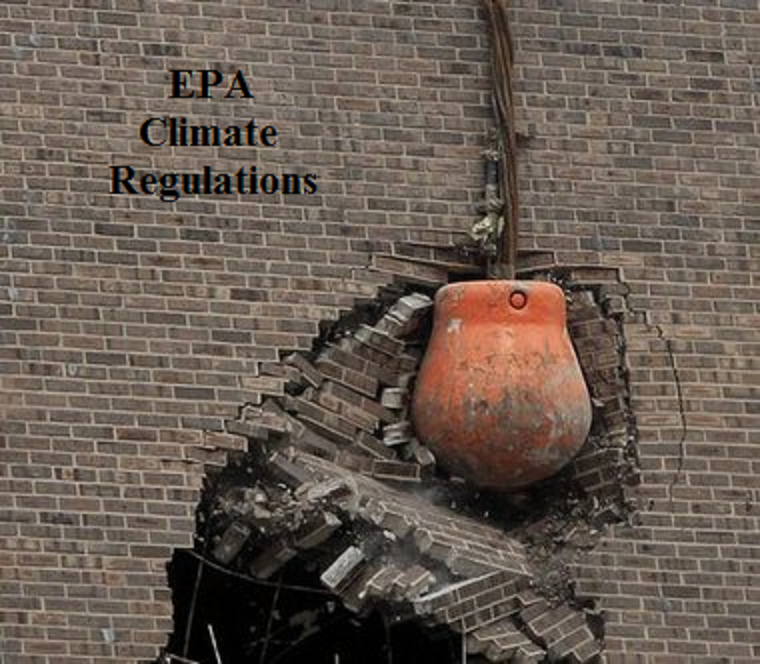
The fake news outrage over POTUS Executive Order this week obscured the fact that the wrecking ball is applied to a wall of regulations, not the climate or the planet, which are doing just fine, thank you very much.

Overlooked entirely is the fact that all government actions enacted or under consideration are projected to have a negligible effect on the climate.  So undoing them will hardly be noticed by the climate.  For example, some excerpts from a recent Wall Street Journal article:

The oddest criticism of Donald Trump’s climate action this week was the claim, mentioned almost triumphantly by every news source, that it would save few coal jobs. The economic and technological forces, especially the flood of low-carbon natural gas from fracking, are just too powerful.

Of course the news reports are right: “The regulatory changes are entirely outweighed by these technological changes, not to mention the price of natural gas or renewables,” Mark Muro of the Brookings Institution was quoted telling the New York Times .

So potent and large are these global forces that repealing the Obama rules, costly as they are, not only won’t affect coal jobs, it won’t affect climate.

Gina McCarthy, Mr. Obama’s EPA administrator, admitted as much when confronted, during a 2015 House hearing, with the fact that, by the agency’s own climate models, the effect would be only 1/100th of a degree Celsius. Instead, she said success should be measured in terms of “positioning the U.S. for leadership in an international discussion.”

Pile up all the government policies enacted or seriously on the table, and their net effect is zilch. A new McKinsey study, that would be hilarious if it weren’t so sad, points out that Germany’s switch to renewables has been a success by almost every metric except CO2 output—which is up instead of down. (my bold)

Rising energy prices to support this energy transition have had one measurable effect—more than 330,000 German households have had their electricity shut off in the past year from nonpayment of bills almost three times as high as those paid by U.S. households.

Germany, needless to add, is many greens’ idea of a country “positioned for leadership in international discussions.” (my bold)

No rational consideration, however, will abate the torrent of priestly imprecations hurled by green activists this week at Mr. Trump. The New York Times insists that Trumpian action “risks the planet”—plainly false since nothing either Mr. Trump or Mr. Obama did will make a difference to the planet. (my bold)

Tempest in a teapot (American English), or storm in a teacup (British English), is an idiom meaning a small event that has been exaggerated out of proportion.

The article is The Climate Yawns
Donald Trump is no more a planet wrecker than Barack Obama (as measured to the third decimal). By Holman W. Jenkins, Jr. At Wall Street Journal.  Full text below (with an image I added at the end.)

The oddest criticism of Donald Trump’s climate action this week was the claim, mentioned almost triumphantly by every news source, that it would save few coal jobs. The economic and technological forces, especially the flood of low-carbon natural gas from fracking, are just too powerful.

Then why, if you’re a Democrat, put yourself in that position in the first place to take blame for killing coal jobs? Why enact a costly regulation to do what the market was doing for free? When everybody else wanted to blame the Florida recount for his 2000 defeat, Al Gore was smart enough privately to blame gun control. When you lose your home state as presidential candidate, something is wrong. The same blundering ineptitude explains how the Obama alliance with the greens threw away first Congress and then a presidency.

Of course the news reports are right: “The regulatory changes are entirely outweighed by these technological changes, not to mention the price of natural gas or renewables,” Mark Muro of the Brookings Institution was quoted telling the New York Times .

So potent and large are these global forces that repealing the Obama rules, costly as they are, not only won’t affect coal jobs, it won’t affect climate.

Gina McCarthy, Mr. Obama’s EPA administrator, admitted as much when confronted, during a 2015 House hearing, with the fact that, by the agency’s own climate models, the effect would be only 1/100th of a degree Celsius. Instead, she said success should be measured in terms of “positioning the U.S. for leadership in an international discussion.”

Even so, many climate activists felt the need to walk back Ms. McCarthy’s concession by insisting Obama policies would have a measurable effect—on the amount of CO 2 released. Yes, the relative decrease would be tiny but measurable, though the climate effect would be zip. This is akin to medical researchers claiming a drug a success because it’s detectable in the bloodstream, not because it improves health.

And don’t get us started on the “social cost of carbon,” a mechanism of policy justification created by the Obama EPA to assign a dollar-value benefit to carbon abatement rules that, in total, will produce zero impact on climate.

Pile up all the government policies enacted or seriously on the table, and their net effect is zilch. A new McKinsey study, that would be hilarious if it weren’t so sad, points out that Germany’s switch to renewables has been a success by almost every metric except CO 2 output—which is up instead of down.

Rising energy prices to support this energy transition have had one measurable effect—more than 330,000 German households have had their electricity shut off in the past year from nonpayment of bills almost three times as high as those paid by U.S. households.

Germany, needless to add, is many greens’ idea of a country “positioned for leadership in international discussions.”

No rational consideration, however, will abate the torrent of priestly imprecations hurled by green activists this week at Mr. Trump. The New York Times insists that Trumpian action “risks the planet”—plainly false since nothing either Mr. Trump or Mr. Obama did will make a difference to the planet.

Literally no amount of money dissipated on climate policy is excessive to such people, because their shamanistic status is directly proportional to the social waste they can conjure. In the realm of religion are we called upon to perform symbolic actions whose purpose (and cost) is aimed at testifying to our membership in the elect.

The most poignant question, however, is what happened to Democrats? They were once a party whose members cared whether policy was efficient and produced benefits for the American people.

Democrats deserve a large share of the credit for the rescue of the failing U.S. economy of the 1970s by throwing out a host of perverse regulatory policies, not that they embrace or even acknowledge this legacy today—which is the problem.

Airline deregulation was born in Ted Kennedy’s administrative practice subcommittee. His aide, Stephen Breyer, now a Supreme Court justice, recalled a working-class Boston constituent asking why the senator was focused on airline issues when this voter could never afford to fly. “That is why,” said Kennedy.

The Democratic Party once had a brain where regulation was concerned, understanding that the ultimate purpose was a net public good, not an in-gathering of power to Washington for the benefit of lobbyists and influence peddlers.

It was not yet today’s Democratic Party of Chuck Schumer, who isn’t stupid and yet is associated with no body of policy thought or analysis. If he even has anybody on his staff deputized to think about the results of policy, it probably is the lowliest intern.

A wrecking ball of a president was the Trump electorate’s answer to this problem. It’s hard even now to say they were wrong. If he delivers nothing in the next four years, it is alarming to suspect that this likely would still be a better result than we would have gotten under Hillary Clinton.

CO2 ≠ Pollutant

My university degree is a Bachelors in Organic Chemistry from Stanford. For that and other reasons, it always annoyed me that some lawyers decided CO2 can be called a “pollutant”, all the while exhaling the toxic gas themselves.

This nonsense forms the root of all the ridiculous regulations that POTUS ordered reviewed and rescinded yesterday. Thus I agree completely with this Wall Street Journal article by Paul Tice Trump’s Next Step on Climate Change. Full text below.

Reconsider the EPA’s labeling of carbon dioxide as a pollutant, based on now-outdated science.

By PAUL H. TICE
March 28, 2017 6:41 p.m. ET

The executive orders on climate change President Trump signed this week represent a step in the right direction for U.S. energy policy and, importantly, deliver on Mr. Trump’s campaign promise to roll back burdensome regulations affecting American companies. But it will take more than the stroke of a pen to make lasting progress and reverse the momentum of the climate-change movement.

On Tuesday, in a series of orders, Mr. Trump instructed the Environmental Protection Agency to rework its Clean Power Plan, which would restrict carbon emissions from existing power plants, mainly coal-fired ones. Last year the U.S. Supreme Court stayed enforcement of the CPP pending judicial review.

Mr. Trump also directed the Interior Department to lift its current moratorium on federal coal leasing and loosen restrictions on oil and gas development (including methane flaring) on federal lands. And he instructed all government agencies to stop factoring climate change into the environmental-review process for federal projects. The federal government will recalculate the “social cost of carbon.”

These actions are a good start, but all they do is reverse many of the executive orders President Obama signed late in his second term. While easy to implement and theatrical to stage, such measures are largely superficial and may prove as temporary as the decrees they rescind.

Because they don’t attack the climate-change regulatory problem at its root, Mr. Trump’s orders will not provide enough clarity to U.S. energy companies—particularly electric utilities and coal-mining companies—for their long-term business forecasting or short-term capital investment and head-count planning.

To accomplish that, the Trump administration, led by EPA Administrator Scott Pruitt, needs to target the EPA’s 2009 “endangerment finding,” which labeled carbon dioxide as a pollutant. That foundational ruling provided the legal underpinnings for all of the EPA’s follow-on carbon regulations, including the CPP.

It also provided the rationale for the previous administration’s anti-fossil-fuel agenda and its various climate-change initiatives and programs, which spanned more than a dozen federal agencies and cost the American taxpayer roughly $20 billion to $25 billion a year during Mr. Obama’s presidency.

The endangerment finding was the product of a rush to judgment. Much of the scientific data upon which it was predicated—chiefly, the 2007 Fourth Assessment Report of the U.N.’s Intergovernmental Panel on Climate Change—was already dated by the time of its publication and arguably not properly peer-reviewed as federal law requires.

With the benefit of hindsight—including more than a decade of actual-versus-modeled data, plus the insights into the insular climate-science community gleaned from the University of East Anglia Climategate email disclosures—there would seem to be strong grounds now to reconsider the EPA’s 2009 decision and issue a new finding.

In 2013, the IPCC issued a more circumspect Fifth Assessment Report, which noted a hiatus in global warming since 1998 and a breakdown in correlation between the world’s average surface temperatures and atmospheric carbon dioxide levels, causing the U.N. body to revise down its 2007 projections for the rate of planetary warming over the first half of the 21st century.

Although this initially reported “pause” was subsequently eliminated through the downward manipulation of historical temperature data, this latest IPCC assessment calls into question both the predictive power and input data quality of most global climate models, and further highlights the scientific uncertainty surrounding the basic premise of anthropogenic climate change.

An updated EPA endangerment finding based on an objective review of the latest available scientific data is warranted, along with a more sober discussion of the threat posed by carbon dioxide and other greenhouse gases to the “public health and welfare of current and future generations,” in the words of the original endangerment finding.

As long as the 2009 finding remains on the books, it will provide legal ammunition for environmentalists, academics and state government officials seeking to sue the administration for any actions related to climate change, including this week’s executive orders.

Issuing a new endangerment finding would be a bold move requiring thorough work, but the Trump EPA would be well within its legal rights to undertake such an updated review process. In Massachusetts v. EPA (2007), the Supreme Court ruled that the Clean Air Act gives the EPA the authority, but not the obligation, to regulate carbon dioxide and other greenhouse gases. The EPA needs to “ground its reasons for action or inaction” with “reasoned judgment” and scientific analysis.

Addressing the 2009 endangerment finding head-on would show that Mr. Trump is serious about challenging climate-change orthodoxy. Thus far he has sent a mixed message, as demonstrated by this week’s ambivalence on CPP (reworking rather than repealing) and his administration’s silence on U.S. participation in the U.N.’s 2015 Paris Agreement.

Simply standing down on regulatory enforcement, cutting government funding for climate-change research and stopping data collection for the next four years will not suffice. Ignoring the EPA’s 2009 endangerment finding would mean that it is only a matter of time before another liberal-minded occupant of the White House reasserts this regulatory power, bringing the country and the domestic energy sector back where Mr. Obama left them.

Mr. Tice is an executive-in-residence at New York University’s Stern School of Business and a former Wall Street energy research analyst.

Trump’s EO on Energy Independence

Coal miners watch as Trump signs EO on Energy Independence.

What’s in it?  The text is hard to find.

First and most prominently, the executive order directs the Environmental Protection Agency to review the Clean Power Plan, one of Obama’s key regulatory actions to drive down greenhouse gas emissions in the electric power sector. Because an executive order cannot directly overturn a regulation, the EPA will have to come to a finding about whether the CPP should be revised or repealed.

The Supreme Court ruled in a 7-to-2 decision in June 2014 that the Obama administration’s Environmental Protection Agency is free to regulate carbon dioxide in the atmosphere, as long as the source of emissions in question is a traditional polluter, like a factory or a power plant, rather than a school or a shopping mall. The decision was largely written by conservative Justice Antonin Scalia. However, the Court also chastised the EPA for acting without a clear directive from Congress.

Some claim that the Supreme Court requires EPA to regulate greenhouse gases, but that is not correct. The Court ruled that CO2 can be considered a “pollutant” under the Clear Air Act, but EPA decides what, if anything to do about it. Expect lots of legal activity around this, including EPA seeking congressional legislation before regulating.

While determining the fate of the CPP could end up being a complex multi-year undertaking, the order also includes the following actions that can be carried out quickly:

  • Reversing Obama’s moratorium on new coal mining leases on federal lands;
  • Removing the consideration of greenhouse gases from permit reviews under the National Environmental Policy Act;
  • Formally abandoning Obama’s roadmap on how to achieve U.S. emissions reductions
  • Eliminating a tool for cost-benefit analysis in regulatory review called the “Social Cost of Carbon”

Finally, although Trump’s directive does not directly address American engagement in the Paris Agreement or other international climate agreements, it does have some implications for broader U.S. engagement in international climate policy. Rolling back the CPP would remove an important component of the American climate strategy and make it more difficult to achieve Obama’s U.S. climate targets. Other players, including big emitters like China, the European Union, and India, are aware of Trump’s stance on climate and will not be surprised by this action: most countries have committed to continuing to pursue their own goals in development as well as climate actions.

Thanks to Junk Science for putting up the full text (here)

Update March 29

Lots of freaking out by true believers.  Here is a balanced review of this EO.

Trump’s Executive Order On Energy: This Time, He Listened To The Lawyers

President Donald Trump’s executive order dismantling large chunks of Barrack Obama’s environmental legacy is a cleverly written document that avoids the pitfalls of Trump’s controversial orders on immigration. Unlike those orders, which have been suspended by federal courts, this one bears the clear stamp of experienced government lawyers and leaves the administration with a rich variety of tactical choices on how to eliminarte Obama-era regulations on fossil fuels.

Eliminating the previous administration’s legal memorandum could be a speedier way to get rid of the CPP, although it would still have to go through a notice and comment period as well as the inevitable legal challenges. The government wouldn’t have to delve as deeply into the scientific record, however, which the Obama administration provided in ample detail to justify its plan. Instead, the Trump administration would argue the CPP, which takes a systemwide approach toward reducing CO2 emissions, is based on an incorrect reading of federal law.

The order also calls for the elimination of the Interagency Working Group on Social Cost of Greenhouse Gases, as well as its findings on the cost of global warming, which it pegged at $42 a ton by 2020. Effective immediately, the administration will use Bush-era standards to judge the cost of carbon emissions.

Environmentalists and states can and will sue to try and force the administration to stick to the Obama-era goals for reducing CO2 emissions. But the EPA can only work with the tools Congress gave it, and Chevron deference allows the agency to determine how powerful those tools are. So it can simply say that federal statutes don’t give it the power to reorder the electric grid to cut emissions by 30%; perhaps the limit, by ordering existing plants to the highest levels of efficiency achievable with current technology, is a few percent. The agency can then argue further cuts have to come from Congress.

The Weathermen vs. EPA’s Scott Pruitt

This week the AMS (American Meteorological Society) sent a letter chastising Scott Pruitt for keeping an open mind on the question of man-made global warming/climate change. The letter (here) referred to the AMS institutional statement on the matter, and summarized their position in this paragraph:

In reality, the world’s seven billion people are causing climate to change and our emissions of carbon dioxide and other greenhouse gases are the primary cause. This is a conclusion based on the comprehensive assessment of scientific evidence. It is based on multiple independent lines of evidence that have been affirmed by thousands of independent scientists and numerous scientific institutions around the world. We are not familiar with any scientific institution with relevant subject matter expertise that has reached a different conclusion.

Background on AMS and Climate Science

Firstly, not all the weathermen are contrary to EPA Chief Scott Pruitt.  The statement announced in 2012 can only be seen as a Council Statement resulting from a process initiated and controlled by AMS council.

The Council puts out a call for volunteers for the writing teams, and approves the make-up of those teams. A Council member serves as a liaison to the team. The writing team’s initial draft is put out to the entire membership for a comment period. The writing team responds to those comments and executes a redraft. The Council, meeting in person or in teleconference, may make final edits before voting to approve or disapprove the statements.  With some over-simplification the process is driven by the AMS Council; the resulting products are Council statements.

Secondly, a subsequent survey showed that the views expressed by the AMS Council have mixed support among AMS members. Respondents numbered 1827 and 52% said “Yes, Most of the warming since 1850 is due to humans.” The other responses included: Insufficient Evidence, Equally Human and Natural, Not Sure It is Happening, and Mostly Natural (in order of frequency). Clearly almost half of the membership sample do not agree with the IPCC position endorsed by AMS Council.

A more recent 2016 survey got a higher number of agreeable members (67%), but it is still the case that 47% of 4092 members contacted did not respond to the questionnaire.

Further, these surveys are now being conducted in the context of the Council already committing the society prior to seeking the views of members. Finally, the whole exercise demonstrates that global warming/climate change is clearly a matter of opinion, not knowledge.

Of course, the questionnaires are superficial and geared to produce a “consensus” support for policy action and for project funding. In depth surveys show much more the complexity of the issues and range of opinions.

Climate Etc. Has several posts going into the details of the AMS maneuvers.

AMS Statement on Climate Change

The 52% Consensus

New AMS Survey on Climate Change

For another assessment including a comment and references by Roger Pielke Sr. See:
AMS Letter to Pruitt,How Ideologues Abuse Power in Professional Associations

Running the Climate Gauntlet

Several Native American tribes of the Eastern Woodlands culture forced prisoners to run the gauntlet (notables included Daniel Boone). Forced to run between two rows of people repeatedly striking him, the runner could only survive by taking the blows while moving forward and avoiding a stumble. No mercy is shown to one who loses his footing and falls to the ground.

Currently US Senators are putting Scott Pruitt through their gauntlet, called the Confirmation Hearing for the Nominated Director of the EPA. Pruitt recently provided 242 pages of written responses to hundreds of questions from senators. Below are extracted many of the substantial questions and answers regarding climate change. The interchanges reveal the preoccupations of climate activists and the contrasting worldviews of climate alarmists and skeptics.
H/T to Steve Milloy for links to the document at Junk Science EPA nominee Pruitt doubles down on climate skepticism

In the text below, the question number comes from a particular senator’s list, the answer paragraph is Scott Pruitt’s response.  (Many questions were not specific to climate change per se.)  I have bolded some notable themes and put some key statements into italics.

Senator Booker:

3. Climate change is one of the most pressing issues currently facing the planet. Rising sea levels and extreme weather are currently threatening the safety and security of my constituents in New Jersey. Lower income and vulnerable communities are disproportionately impacted by the extreme heat and flooding events that are becoming more common and more severe. Given the immediate and increasing threat to my constituents and to people everywhere, what is your plan to address climate change?

If confirmed, I will work to achieve the objectives of EPA-administered laws consistent with the process and framework established by Congress. I will work closely with the states in establishing and implementing regulatory standards to ensure a meaningful and effective advancement of these objectives.

Senator Cardin:

31.What is your understanding of the role of climate change in algal blooms?

EPA identifies the following as causes of harmful algal blooms: sunlight, slow-moving water, and excess nutrients. For climate change to have a role, it would first have to have an impact on one of these three causes.

74.How does your position that EPA should ostensibly recuse itself from State Department responsibilities and engagements on the Paris Agreement comport with any plans that you, as the next EPA administrator, may execute to rescind or alter domestic policies that affect the US National Determined Contribution (NDC) to the Paris Agreement?

As I stated in a previous answer, should the State Department decide to continue to participate in the Paris Agreement and if I am confirmed as Administrator, I will work with all involved agencies to ensure that commitments made on behalf of the United States are achievable and consistent with requisite legal authorities delegated by Congress.

75.Recently at the World Economic Forum in Davos, Switzerland, Chinese President Xi Jinping expressed China’s great interest in being the world’s leader on a number of issues including action to address climate change. Do you believe it is the U.S.’s national interest to cede leadership to the Chinese on global action to address climate change?

It is the mission of the State Department to advance our national interests within the realm of foreign policy. If confirmed, I will work to advance the mission of the EPA, which is to protect human health and the environment, consistent with the State Department’s strategy for international engagement on climate change.

76.Do you believe climate change is a real and serious threat to the planet?

The climate is changing and human activity impacts our changing climate in some manner. The ability to measure with precision the degree and extent of that impact, and what to do about it, are subject to continuing debate and dialogue.

77.Do you accept the scientific consensus that should average global temperatures reach or exceed +2 degrees Celsius that many regions of the world will very likely experience catastrophic changes in the environment that may very likely impact the safety and prosperity of many people?

  • Do you believe that uncertainty in climate science warrants greater study before the U.S. takes significant action to reduce greenhouse gas pollution?
  • If so, are you aware that the portion of the scientific community that claims there is uncertainty in the science is limited to limited to about 5% of climate science communities?
  • If you believe that the very small portion of the world’s climate science community who hold outlier opinions on the severity of climate change justifies inaction, why wouldn’t you give similar credence to other outlying opinions in the climate science community that hold that global average temperatures may exceed 10 degrees Celsius and that catastrophic events may occur as soon as five or ten years?

The climate is changing and human activity impacts our changing climate in some manner. The ability to measure with precision the degree and extent of that impact, and what to do about it, are subject to continuing debate and dialogue. If confirmed, I will work to ensure that any regulatory actions are based on the most up to date and objective scientific data.

78.Our ability to predict the weather has improved dramatically over the last 20 years with the advent of supercomputers, new satellite monitoring options, and vastly superior atmospheric models. But still floods, droughts, hurricanes and similar phenomena occur and cause damage with sometimes only limited warning. What precision of prediction do you require before you are willing to accept the scientific community’s overwhelming consensus that unchecked increases in greenhouse gas emissions will very likely have catastrophic effects, many of which the National Climate Assessment has described in detail every 4 years since 1990?

The ability to measure with precision the degree and extent of human activity on our changing climate, and what to do about it, are subject to continuing debate and dialogue. If confirmed, I will work to ensure that any regulatory actions are based on the most up to date and objective scientific data.

80.What would have to change about our ability to predict the effect of increasing greenhouse gas emissions in Earth’s atmosphere for you to consider it adequate?

If confirmed, I will work to ensure that any regulatory actions are based on the most up to date and objective scientific data, including the ever-evolving understanding of the impact increasing greenhouse gases have on our changing climate.

87.Do you trust the analysis, concerns and recommendations of security experts at the State Department, Department of Defense, Central Intelligence Agency, The Navy War College, UN Security Council, and the World Bank, who have expressed growing concerns over the threat climate change poses to national and global security?

I have no reason to disagree with the statements from the listed security experts, although I have not made any attempt to independently verify their accuracy.

Senator Carper

15.Mr. Pruitt, my State of Delaware is already seeing the adverse effects of climate change with sea level rise, ocean acidification, and stronger storms. While all states will be harmed by climate change, the adverse effects will vary by state and region. Can you comment on why it is imperative that we have national standards for the reduction in carbon pollution?

If confirmed, I will fulfill the duties of the Administrator consistent with Massachusetts v. EPA and the agency’s Endangerment Finding on Greenhouse Gases respective of the relative statutory framework established by Congress.

60.As you are well aware, on April 2, 2007, in Massachusetts v. EPA, 549 U.S. 497 (2007), the Supreme Court determined that sufficient information existed then for EPA to make an endangerment finding with respect to the combined emissions of six greenhouse gases from new motor vehicles and new motor vehicle engines under CAA section 202(a). On December 7, 2009, the Administrator determined that those gases/sources contribute to greenhouse gas pollution that endangers public health and welfare. How do you plan to execute your legal authority to protect the public health and welfare from greenhouse gas pollution?

The Supreme Court held that GHGs are an air pollutant under the Clean Air Act. It did not address the question of whether regulation of GHGs under the Clean Air Act is warranted. In the subsequent UARG decision, the Supreme Court cautioned EPA that there are significant limits on EPA’s authority to regulate GHGs under the Clean Air Act. The unprecedented Supreme Court stay of EPA’s so-called “Clean Power Plan” was predicated upon a finding that the plaintiffs in the case were likely to prevail on the merits. In light of these holdings, I will hew closely to the text and intent of the Clean Air Act when considering further regulation of GHGs under that law if confirmed as Administrator.

63.As you know, the Renewable Fuels Standard, as amended by Congress in 2007, requires the blending of 36 billion gallons of renewable fuel into conventional gasoline and diesel by 2022. In order to add that many renewable fuel gallons to our fuel supply, do you agree that EPA must approve the sale of fuels blended with greater than 10-percent renewable content?

While Congress included “applicable volume” levels in the RFS statute, Congress also took care to expressly authorize the EPA Administrator to reduce volumetric requirements below the statute’s default levels in light of real-world conditions from year to year. Specifically, the Administrator may waive the statute’s volume requirements if he determines “that implementation of the requirement would severely harm the economy or environment of a State, a region, or the United States, or “that there is an inadequate domestic supply.” The EPA already has granted such waivers based on real-world conditions in recent years and, if confirmed, I would take care to administer the statute in accordance with the statutory objectives. While no statute mandates the sale of fuels blended with greater than 10 percent renewable content, statutes do vest the Administrator with discretion to authorize a variety of fuel blends.

132.Do you agree with this statement from NASA: “97 percent or more of actively publishing climate scientists agree: Climate-warming trends over the past century are extremely likely due to human activities.” If not, please explain why you do not agree.

I have no reason to disagree with NASA’s statement, although I have not made any attempt to independently verify its accuracy.

Senator Gillibrand:

37.What is the scientific basis for sea level rise, which we have experienced along the coast of New York State?

If confirmed as Administrator, I will work to ensure EPA regulatory actions are based on the most up to date and objective scientific data, including the ever-evolving understanding of the changes in our climate and sea level rise.

38.Do you agree with the National Climate Assessment that human-induced climate change has already increased the number and strength of extreme weather events?

I am aware of the broad range of views within the scientific community regarding the relationship between human activity on changes in the climate and any resulting impact on extreme weather events. If confirmed as Administrator, I will work to ensure EPA regulatory actions are based on the most up to date and objective scientific data.

Senator Markey:

23.The greenhouse gas effect traps outgoing longwave radiation causing a radiative imbalance of Earth, ultimately leading to the warming of the globe. The fundamental physics of climate change are well settled.

  • Are you aware of the theory of radiative balance of the Earth? Can you briefly describe it?
  • Do you understand Planck’s law and the difference between shortwave vs. longwave radiation, and how that relates to Earth’s energy balance?
  • Do you agree that disturbances to this equilibrium can warm or cool the Earth?
  • Are you aware of the atmospheric circulation and oceanic currents that transport heat from the Equator to the poles?
  • Due to the complexity of the climate system, there are lag times between changes in certain conditions, such as the amount of carbon dioxide in the atmosphere, and other observable changes, such as the temperature of the deep ocean. If an action by the United States or world today, could positively or negative benefit the future, say 50 to 100 years down the road, is that an important consideration?
  • Are you aware that there is less ice on land in such places as Antarctica and Greenland than in previous years since the Industrial Revolution? What do you believe is causing this decrease in mass of ice on land?
  • To where do you believe the water from ice melt on land goes, and do you believe that could cause global sea levels to rise?
  • Do you disagree that additional greenhouse gases in Earth’s atmosphere, such as carbon dioxide, will cause a smaller magnitude outgoing longwave radiation to escape to space? Please explain.
  • Do you disagree that the burning of fossil fuels, such as oil or natural gas, cause carbon dioxide to be released into the atmosphere? Please explain.
  • Do you disagree that if fossil fuels were not extracted and burned, less carbon dioxide would be released into the atmosphere? Please explain.
  • Therefore, is it possible, if not probable, that humans releasing greenhouse gases into the atmosphere could cause more heat to be trapped by the atmosphere? Please explain.
  • Do you understand that the concept address is the previous question is the basis of human-caused climate change? Please explain.
  • If not human burning of fossil fuels, how do you explain the observed increase in carbon dioxide in atmosphere?
  • What is a safe level of carbon dioxide in the atmosphere? Please provide this number in parts per million. Please explain.
  • If states want to individually take measures to curb greenhouse gas emissions will you allow them to do so? If yes, how will you support them? If not, why does the EPA have the authority to stop a state from implementing measures to curb greenhouse gases?

If confirmed, I will work to ensure that any regulatory actions are based on the most up to date and objective scientific data, including the ever-evolving understanding of the impact increasing greenhouse gases have on our changing climate. I will also adhere to the applicable statutory authorities to fulfill EPA’s mission to protect human health and the environment consistent with the process and rule of law established by congress. I also believe the Administrator has an important role when it comes to the regulation of carbon dioxide, which I will fulfill consistent with Massachusetts v. EPA and the agency’s Endangerment Finding on Greenhouse Gases respective of the applicable statutory framework established by Congress. I believe the most effective path towards achieving these objectives is through close partnership with the states granting them regulatory leeway as ascribed by the rule of law.

Senator Merkley:

11.There are many groups within the Christian community — and groups from other faiths — in the United States who agree with the overwhelming scientific consensus that climate change is a danger to our country, and who strongly support taking action to mitigate the causes and impacts of climate change. For example, the Southern Baptist Convention made a statement in 2007 saying that Christians are responsible for caring for creation, and emphasized the importance of acting to prevent climate change. The President of the Southern Baptist Theological Seminary, has also issued a statement echoing these views. As EPA Administrator, would you share the view that, in the interest of caring for creation, that action should be taken to prevent climate change?

I believe we can grow our economy, harvest the resources God has blessed us with, while also being good stewards of the air, land, and water by which we have been favored. If confirmed, I will work to advance the mission of EPA to protect human health and the environment within the framework established by Congress.

13. 97% of publishing climate scientists support the idea the climate change is real and man-made. You are an attorney, but have questioned the reality of climate change. Do you currently agree that climate change is real and manmade? If not do you believe the 97% of climate scientists that do hold that view are wrong, or lying?

The ability to measure with precision the degree and extent of human activity on our changing climate, and what to do about it, are subject to continuing debate and dialogue. If confirmed, I will make sure the agency’s regulatory actions are based on the most up to date and objective scientific data.

14.What scientific organizations do you personally trust when it comes to the science of climate change? Please explain why you trust any organization(s) you list.

If confirmed as EPA Administrator, I will adhere to the applicable statutory authorities to fulfill EPA’s mission to protect human health and the environment and will base my decisions on sound science, including advice provided by agency experts and advisory personnel.

15.Below is a list of statements from the Intergovernmental Panel on Climate Change’s Fifth Assessment Report. For each statement, please indicate your agreement or disagreement and explain your reasoning:
• “Warming of the climate system is unequivocal.”
• “The atmosphere and ocean have warmed, the amounts of snow and ice have diminished, sea level has risen, and the concentrations of greenhouse gases have increased.”
• “The atmospheric concentrations of carbon dioxide, methane, and nitrous oxide have increased to levels unprecedented in at least the last 800,000 years.”
• “Carbon dioxide concentrations have increased by 40% since pre-industrial times, primarily from fossil fuel emissions and secondarily from net land use change emissions.”
• “The ocean has absorbed about 30% of the emitted anthropogenic carbon dioxide, causing ocean acidification.”
• “The largest contribution to total radiative forcing is caused by the increase in the atmospheric concentration of CO2 since 1750.”
• “It is extremely likely that human influence has been the dominant cause of the observed warming since the mid-20th century.”
• “Continued emissions of greenhouse gases will cause further warming and changes in all components of the climate system.”
• “It is very likely that the Arctic sea ice cover will continue to shrink and thin and that Northern Hemisphere spring snow cover will decrease during the 21st century as global mean surface temperature rises. Global glacier volume will further decrease.”
• “Global mean sea level will continue to rise during the 21st century…. [T]he rate of sea level rise will very likely exceed that observed during 1971 to 2010 due to increased ocean warming and increased loss of mass from glaciers and ice sheets.”
• “Limiting climate change will require substantial and sustained reductions of greenhouse gas emissions.”

There is a diverse range of views regarding the key drivers of our changing climate among scientists. I believe that these differences should be the subject of robust and open debate free from intimidation. If confirmed, I will continue to encourage an honest debate on our changing climate, the role of human activity, our ability to measure the degree and extent of human activity, and what to do about it. If confirmed, I will work to ensure that any regulatory actions are based on the most up to date and objective scientific data. I will also adhere to the applicable statutory authorities to fulfill EPA’s mission to protect human health and the environment consistent with the process and rule of law established by congress.

16.Are you aware that each of the past three decades has been warmer than the one before, and warmer than all the previous decades since record keeping began in the 1880s? This trend is based on actual temperature measurements. Do you believe that there is uncertainty in this warming trend that has been directly measured? If so, please explain.

I am aware of a diverse range of conclusions regarding global temperatures, including that over the past two decades satellite data indicates there has been a leveling off of warming, which some scientists refer to as the “hiatus.” I am also aware that the discrepancy between land-based temperature stations and satellite temperature stations can be attributed to expansive urbanization within in our country where artificial substances such as asphalt can interfere with the accuracy of land-based temperature stations and that the agencies charged with keeping the data do not accurately account for this type of interference. I am also aware that ‘warmest year ever’ claims from NASA and NOAA are based on minimal temperature differences that fall within the margin of error. Finally, I am aware that temperatures have been changing for millions of years that predate the relatively short modern record keeping efforts that began in 1880.

17.Is there a scientific basis, based on the best available science and the weight of scientific evidence, for revoking or revising the finding that greenhouse gases endanger public health and welfare?

To my knowledge, there is nothing currently pending before the EPA that would require I take any additional actions on the Endangerment Finding on Greenhouse Gases and if there were, it would not be wise to prejudge the outcome.

39.The 2014 U.S. National Climate Assessment concludes that climate change will impact every community in the United States, and that low-income communities and communities of color will be the hardest hit. These vulnerable communities will feel the impacts of climate change more severely due to lower quality housing, which is often less equipped to safely weather severe storms, severe heat, and freezing temperatures. How will you work to reduce climate change risks in low-income communities and communities of color?

I believe environmental justice for low-income and minority communities is an important role of the EPA Administrator. If confirmed, I will adhere to the applicable statutory authorities to fulfill EPA’s mission to protect human health and the environment for all of our nation’s citizens.

Senator Sanders:

12.As Administrator, will you recognize the findings of the U.S. Climate Change Science Program/U.S. Global Change Research Program and the National Research Council of the U.S. National Academy of Sciences on the science of climate change, including its anthropogenic causes?

If confirmed, I will work to ensure that any regulatory actions are based on the most up to date and objective scientific data, including the ever-evolving understanding of the impact increasing greenhouse gases have on our changing climate.

14.Do you support the Paris Climate Agreement?

The role of the United States in the Paris Agreement is a State Department matter. If confirmed, I will work to advance the mission of the EPA, which is to protect human health and the environment, consistent with the State Department’s strategy for international engagement on climate change.

15.What are your plans for implementing the Paris Climate Agreement?

Should the government decide to continue to participate in the Paris Agreement and if I am confirmed as Administrator, I will collaborate with all involved agencies to ensure that commitments made on behalf of the United States are achievable and consistent with requisite legal authorities delegated by Congress.

16.You have written that the climate change “… debate is far from settled. Scientists continue to disagree about the degree and extent of global warming and its connection to the actions of mankind.” What would it take for you to admit that all three of these allegations are incorrect?

If confirmed, I will work to ensure that any regulatory actions are based on the most up to date and objective scientific data, including the ever-evolving understanding of the impact increasing greenhouse gases have on our changing climate.

18.If Harold Hamm told you he was no longer a climate change denier, would you believe him?

I do not believe he is a climate change “denier.”

19.President Elect Trump’s Secretary of State nominee, Rex Tillerson, is no longer a climate change denier. Why do you disagree with Tillerson?

There is a diverse range of views regarding the key drivers of our changing climate among scientists, policy-makers and President Trump’s nominees. I believe that these differences should be the subject of robust and open debate free from intimidation. If confirmed, I will continue to encourage an honest debate on our changing climate, the role of human activity, our ability to measure the degree and extent of human activity, and what to do about it.

Senator Whitehouse:

6.Do you accept the science of ocean acidification that has directly connected the increase in human-caused carbon dioxide emissions with decreases in ocean pH?

First, I would note that the oceans are alkaline and are projected to remain so. Second, it is my understanding that the degree of alkalinity in the ocean is highly variable and therefore it is difficult to attribute that variability to any single cause.

7.Do you accept that the oceans are currently acidifying at a rate unprecedented in tens of millions of years?

First, I would note that the oceans are alkaline and are projected to remain so. Second, it is my understanding that the degree of alkalinity in the ocean is highly variable and therefore it is difficult to attribute that variability to any single cause. I am unaware of tens of millions of years of data on the pH of oceans.

11.Both states and some Members of Congress have for years criticized EPA for “one-size-fits-all approaches” and failing to give adequate flexibility to states. Yet in challenging EPA’s Clean Power Plan, you attacked EPA for just that – giving states and regions too much latitude in administering the Clean Air Act. Wouldn’t that take the Agency in the wrong direction?

I, along with the Supreme Court, which issued a stay against the Clean Power Plan in February 2016, believe the EPA exceeded the bounds of authority established by Congress in the Clean Air Act. In particular, the Rule attempted to supplant decisions traditionally preserved for the states, including the establishment of intrastate energy policies, for agency mandated alternatives that would have increased the price of electricity for local citizens and reduced reliability. The notion of flexibility in the Clean Power Plan was conceptual at best. If confirmed, I will work to achieve the objectives of EPA-administered laws consistent with the process and framework established by Congress abiding by the bedrock principle of cooperative federalism, which relies on meaningful collaboration between the EPA and the states to achieve important environmental objectives.

13.In 2014, four Republican former EPA Administrators – Bill Reilly, Bill Ruckelshaus, Lee Thomas, Governor Christine Todd Whitman – testified before EPW that climate change is real, EPA regulations do not end up costing as much as industry initially estimates, and EPA has clear authority under the Clean Air Act to curb carbon pollution. In a 2015 interview with Climate Progress, Governor Whitman said: “The idea the EPA is a job killer is false” and with regard to the Clean Power Plan “what EPA did was to allow as much flexibility as frankly I’ve ever seen them be able to create in a regulation.” Do you think that the former Administrators are correct in their assessment that regulations do not cost as much as industry initially estimates? If not, can you explain why not?

I am not sure what specific regulations the former EPA Administrators were referring to and accordingly lack sufficient information to answer the specific question. Generally speaking, if confirmed, I will work to ensure that EPA regulatory actions accurately account for the costs and benefits across all impacted stakeholders.

14.Carbon Capture Utilization and Storage is a bipartisan policy area that I am working on with my Republican colleagues. Senator Graham and I visited the world’s first Carbon Capture project in Canada that has been operational since 2014. In 2016, SaskPower successfully captured and injected 800,000 metric tons of carbon dioxide and the facility has operated nearly 85 percent of the time. Recently, Petra Nova in Texas became the first United States first post-combustion carbon capture project to begin operation. SaskPower and Petra Nova are listed in the Clean Power Plan as viable options for helping states reach their Clean Power Plan targets. Do you believe that CCUS is a viable technology for reducing emissions from power plants?

I believe CCUS technology can play an important role in the development of our future coal fleet, however it is not yet a viable option. Both the SaskPower and Petra Nova plants referenced in your question relied on significant support from their respective governments to become operational. Forcing private businesses to use unproven, expensive technology would be unfair, which is why Congress provided for protections against the EPA embracing such a practice in the Energy Policy Act of 2005.

18.According to the Wind Energy Association and Solar Energy Industries Association, in 2016 the United States had 400,000 wind and solar jobs–310,000 solar, 88,000 wind. In contrast, according to 2016 DOE Energy Employment Report, employment in oil and gas extraction was 388,000 and 53,000 in coal mining. The Energy Information Administration (EIA) just found that coal production continued to decline in 2016 down nearly 17% from 2015 production. Its Annual Energy Outlook in 2017 reports that declining cost of natural gas is still encouraging utilities to shift away from coal over the long-term. The change is expected under our existing policies regardless of the Clean Power Plan. Do you believe that dismantling the Clean Power Plan and cutting back on environmental regulations will bring back the coal industry? Specifically, will it bring back coal jobs and make coal the dominate source of electricity in the U.S. again?

I am unable to say whether United States utilities and electric cooperatives would or would not return to coal as a predominant portion of their fuel mix if the Clean Power Plan were revoked or other regulations were cut back. The federal Energy Information Administration projects that coal will be an important part of the American fuel mix for the foreseeable future.

20.Improved environmental quality and economic growth aren’t mutually exclusive. Since 2009, the states participating in the Regional Greenhouse Gas Initiative (RGGI) have seen carbon pollution fall by 18% while their economies grew by 9.2%. Emissions in the other 41 states fell by 4% while their economies grew by 8.8%. Do you agree that RGGI has developed a successful model for growing our states’ economies and cutting carbon pollution at the same time? Will you commit to maintaining funding levels for EPA grant programs that fund state level initiatives to reduce their emissions?

While the agreement between the states participating in RGGI appears to be successful, what works for the Northeast may not achieve the same success in, for example, the Southwest. If confirmed, I look forward to working with EPA’s budget staff and program offices to develop a budget focused on protecting human health and the environment for all populations. I will work to ensure that the limited resources appropriated to EPA by Congress are managed wisely in pursuit of that important mission and in accordance with all applicable legal authorities.

32.The State Department and others have assessed life-cycle emissions for various crude oils and found tar sands crude is one of the dirtiest crudes on the planet from a GHG perspective. Do you agree tar sands crude has significantly higher life-cycle emissions than Oklahoma Sweet and most other crude oils?

The lifetime emissions of any energy source should be considered in the context of necessary extraction techniques as well as transportation of the fuel, among other issues. For example, transporting crude via pipeline clearly creates fewer emissions than transporting it via other sources in terms of fossil fuel energy. Without knowing the specifics of all of these factors in a given instance, it is difficult to identify which sources may result in greater emissions.

35.The State Department found that the emissions associated with the production, refining and combustion of the tar sands in Keystone XL would result in 147 to 168 million metric tons (MMT) CO2e per year (equivalent to the emissions from as many as 35.5 million cars). The State Department also found that by displacing conventional crude with dirtier tar sands, the project would result in 1.3 – 27.4 MMT CO2e of additional emissions (equivalent to the emissions from as many as 5.7 million cars). Do you agree? If you disagree, please identify any research studies or experts you have consulted to form your opinion.

I am familiar with multiple State Department determinations that the Keystone XL pipeline would not significantly impact climate change.

36.In a recent study, the National Academy of Sciences (NAS) concluded that diluted bitumen—the type of crude that would be primarily transported by Keystone XL—has a series of properties that, taken together, make tar sands spills of greater concern for spill responders than spills of other, commonly transported crude oils. Both EPA and the Coast Guard advised the scientists on the NAS committee. Do you agree with their conclusion that tar sands spills pose greater risks and challenges for spill responders than other crude oil spills? If you disagree, please identify any research studies or experts you have consulted to form your opinion.

Diluted bitumen has been transported safely by pipeline in the United States for more than 40 years. It is my understanding that he NAS report did not infer that the Keystone XL pipeline posed significant concerns or that diluted bitumen could not be safely transported via pipelines or other forms of transportation.

42.Based on the climate change implications, spill potential, and other factors, the Obama Administration determined Keystone XL isn’t in our nation’s best interest. Do you agree? If not, why?

While the Obama Administration failed to grant the cross-border permit required to complete the Keystone XL pipeline, much of the pipeline was built in accordance with applicable laws and permits both federal and state. A large portion of the Keystone XL pipeline safely operates through Oklahoma and I believe that safely and efficiently moving natural resources through the country is very important.

Footnote:  If you want to run the whole gauntlet, the complete set of Pruitt responses is (here).  Again, H/T to Junk Science

Summary

This is the closest thing to a debate on climate change since 2008. Debates stopped when alarmists discovered audiences came away more skeptical from the experience. These hearings are not really a fair and open discussion of the topic, since the Senators have nothing to lose while the Nominee faces rejection.

In 2010 the Hartwell paper observed:

Climate change was brought to the attention of policy-makers by scientists. From the outset, these scientists also brought their preferred solutions to the table in US Congressional hearings and other policy forums, all bundled. The proposition that ‘science’ somehow dictated particular policy responses, encouraged –indeed instructed – those who found those particular strategies unattractive to argue about the science.

So, a distinctive characteristic of the climate change debate has been of scientists claiming with the authority of their position that their results dictated particular policies; of policy makers claiming that their preferred choices were dictated by science, and both acting as if ‘science’ and ‘policy’ were simply and rigidly linked as if it were a matter of escaping from the path of an oncoming tornado.

The Senate hearings show that nothing has changed. Leftist politicians invest into their climate beliefs way more certainty than the facts support. They quote from the IPCC as though presenting Scriptural references. Even the Bible is invoked in support of their environmentalist agenda.  They seem unable to process new information this century casting doubt upon their assumptions.

In the face of this, it is good to see Scott Pruitt maintaining his balance and moving ahead. Many of his responses would win debating points in an open dialogue. Pruitt was once owner and general manager of the Oklahoma Redhawks, a AAA professional baseball team. Maybe he has some Chickasaw blood in his veins equipping him to be such a Brave running this gauntlet.

Senators Sing from Climate Hymnbook

More from true believers in climatism during today’s Senate confirmation hearings, featuring Bernie Sanders and Ed Markey.

Ryan Zinke, nominee for Secretary of the Interior appeared before the Senate Energy and Natural Resources Committee for his confirmation hearing Tuesday.

Senator Bernie Sanders of Vermont:
Is President Elect Trump right? Is climate change a hoax?

Secretary of the Interior Nominee Ryan Zinke:
First of all, the climate is changing. That’s indisputable. Secondly, man is having an influence. I think the debate is about what is that influence, and what can we do about it.

If confirmed I will inherit the USGS, where there are a lot of great scientists. I am not a climate scientist, but I will become a lot more familiar with it, and it will be based on objective science. I don’t believe it is a hoax.

I believe we should be prudent, I don’t know definitively. There is a lot of debate on both sides of the aisle.

Senator Sanders:
Actually, there is not a whole lot of debate now, the scientific community is virtually unanimous that climate change is real and causing devastating problems. There is a debate within this committee, but not in the scientific community.

If climate change is already causing devastating problems, should we be drilling for fossil fuels on public lands?

Nominee Zinke:
We need an economy and jobs too. I support an “all of the above” approach to energy sources. I think that is the better way forward.

Scott Pruitt Nominee for Director of EPA appeared before the Senate Committee on Environment and Public Works.

Senator Ed Markey, Massachusetts:
NOAA, NASA have declared that 2016 is the hottest year in the 137 year record that has been kept. Donald Trump has said that global warming is a hoax caused by the Chinese. Do you agree that global warming is a hoax?

Nominee Scott Pruitt: I do not, Senator.

Senator Markey: So, Donald Trump is wrong.

Nominee Pruitt: I do not believe climate change is a hoax.

Senator Markey: OK, I think that is important for the President to hear.

Senator Bernie Sanders:
As you may know, some 97% of scientists who have written articles for peer-reviewed journals have concluded that climate change is real, it is caused by human activity, and it is already causing devastating problems in the US and around the world. Do you believe that climate change is caused by carbon emissions from human activity?

Nominee Scott Pruitt
As I said in my opening statement, the climate is changing and human activity contributes to that in some manner.

Senator Sanders:
97% of the scientists who publish in this field believe that human activity is the fundamental reason we see climate change. Do you disagree with that?

Nominee Pruitt:
I believe that the ability to measure with precision the degree of human activity to impact the climate is subject to more debate on whether the climate is changing and whether the human activity contributes to it.

Senator Sanders:
While you are uncertain, the vast majority of scientists are telling us, if we do not get our act together, and transform our energy system away from fossil fuel, there is a real question as to the quality of the planet we will be leaving to our children and our grandchildren.

The overwhelming majority of scientists say we have to act boldly, and you are saying more debate is needed on this issue, and we should not be acting boldly.

Nominee Pruitt:
No Senator, as I said the climate is changing.

Senator Sanders:
Why do you think the climate is changing?

Nominee Pruitt:
In response to the CO2 issue, the EPA administrator is constrained by statutes passed by this body.

Senator Sanders:
I am asking for your personal opinion.

Nominee Pruitt:
My personal opinion is immaterial.

Senator Sanders:
Really. You’re going to be the head of the agency to protect the environment, and your personal feelings about whether climate change is caused by human activity and carbon emissions is immaterial?

Nominee Pruitt:
Senator, I have acknowledged to you that human activity impacts on the climate.

Senator Sanders:
The scientific community doesn’t tell us that it impacts, they say human activity is the cause of climate change and we have to transform our energy system. Do you believe we have to transform our energy system in order to protect the planet for future generations?

Nominee Pruitt:
I believe the EPA has a very important role in regulating emissions.

Senator Sanders:
You haven’t answered my question.

Summary

Again the 97%, though Sanders is more circumspect in linking that to scientists publishing in the climate field. He doesn’t let on that it originated from 75 out 77 respondents, culled from more than 3000.  Furthermore, he greatly exaggerates their views when he says climate change is already causing “devastating problems.”

From these interrogations, we see that Senators are seeking personal opinions on a subject not of knowledge but of belief. That is actually an unconstitutional basis for qualifying a federal appointee. (Article Six)

The whole emphasis on 97%, vast, or overwhelming majority is to distract you from the fact that these are opinions.  Neither scientists nor senators know the future, since we lack sufficient knowledge of the climate system to predict its behavior.

Global warming/climate change is a matter of opinion in several respects:
No one knows as a matter of fact whether additional CO2 will result in warmer or cooler temperatures, or make any noticeable difference at all.

It is also anyone’s guess what we can do today to ensure desirable temperatures in the future.

If we had the power to determine future temperatures, opinions vary as to what temperature level would be ideal for everyone living around the world at different  latitudes.

It is hubris to think that government can control the weather and climate. (King Canute, where are you when you are so needed?)  Wise political leaders would realize that there will likely be future periods both colder and warmer than the present. They would also recognize that cold is the greater threat to human health and prosperity. Planning for future climates focuses resources on two priorities:  Robust infrastructures and reliable affordable energy.

Climate Dogma Tests

Article Six of the US Constitution says:

No religious Test shall ever be required as a Qualification to any Office or public Trust under the United States.

In that context, what do we make of questions being put to federal government appointees at their confirmation hearings?

Mike Pampeo, CIA Director nominee at the Senate Intelligence Committee

California Senator, Kamala Harris
In the past you have questioned the scientific consensus on change. Nevertheless, according to NASA, multiple studies published in peer reviewed scientific journals, showed 97% or more of actively published, um, climate scientists agree that climate warning trends over the past century are extremely likely due to human activities. In addition, most of the leading scientific organizations worldwide have issued public statements endorsing this position. Do you have any reason to doubt NASA’s findings?

CIA Director Nominee, Mike Pompeo:
Senator, I’ve actually spoken to this in my political life some. My commentary, most all has been directed to ensuring the policies that America put in place, uh, actually achieve the objective of ensuring we didn’t have catastrophic harm that resulted from changing climate. I continue to hold that view.

Senator Harris
Do you believe that NASA’s findings are debatable?

Nominee Pompeo:
I have not looked at NASA’s findings in particular. I can’t give you any judgment on that today.

Rex Tillerson, Secretary of State nominee at the Senate Foreign Relations Committee

Senator Bob Corker, Committee Chair:
Would you state your personal position as it relates to climate change?

Secretary of State nominee Rex Tillerson:
I came to the position over about 20 years as an engineer and a scientist. I came to the conclusion a few years ago that the risk of climate change does exist and the consequences could be large enough that action should be taken.

Senator Corker:
Do you believe that human activity, based on your belief in science, is contributing to climate change?

Nominee Tillerson:
The increase in the greenhouse gas concentrations in the atmosphere are having an effect. Our ability to predict that effect is very limited.

Senator Tim Kaine:
Exxon-Mobil had a history of funding and promoting climate science denial, despite its internal awareness of the reality of climate change, during your tenure with the company, true or false?

Nominee Tillerson:
Since I am no longer with Exxon-Mobil, I am in no position to speak on their behalf. The question would have to be put to them.

Senator Kaine:
The allegations are about Exxon’s knowledge of climate science and decision to fund and promote a view contrary to its awareness of the science, are those allegations true or false?

Nominee Tillerson: That question will have to be put to Exxon.

Senator Kaine: Do you lack the knowledge to answer my question, or do you refuse to answer?

Nominee Tillerson: A little of both.

Senator Jeff Merkley:
Do you agree with the viewpoint that the odds of dramatic events occurring, whether more forest fires, or more hurricanes with more power, is a rational observation from the scientific literature?

Nominee Tillerson:
As you indicated, there is some literature out there that suggests that. Other literature says that it is inconclusive.

Senator Jeff Merkley: I am sorry to hear that viewpoint. Overwhelmingly, the scales are on one side of this argument.

Senator Tom Udall: Do you plan or would you support any efforts to persecute, sideline, or otherwise retaliate against career state department employees who have worked on climate change in the past?

Nominee Tillerson: No sir, that would be a pretty unhelpful way to get started.

Summary

The climate dogma is captured in a famous tweet:
Ninety-seven percent of scientists agree: climate change is real, man-made and dangerous. Barack Obama

Since that is not what the scientists said, nor what say many other scientists (who were not asked), this is clearly a creed of some kind of religion, call it climatism.

Asking nominees whether they subscribe to a creed or not violates Article Six of the Constitution. Inquisitors can claim there’s no formal religious organization, but they are still looking to disqualify based on dissent in a matter of belief.

Unforeseen Climate Debates Coming

The Trump administration is rolling out nominees for various cabinet positions and the transition team is submitting questions to federal departments required for their due diligence prior to the handover of executive responsibility.

All this is normal procedure, yet the climate establishment is going ballistic. The Progress websites have gone into overdrive, led by Podesta and funded by Soros and Steyer. It is a massive outpouring of articles intended to inflame and incite outrage against anything the Trumpers are up to in taking up their mandate.

Other alarmists are producing reports like this recent one: Trump’s transition: sceptics guide every agency dealing with climate change, from the Guardian (here).  In all such communications, the appointees are profiled, and denigrated:

Trump has assembled a transition team in which at least nine senior members deny basic scientific understanding that the planet is warming due to the burning of carbon and other human activity. These include the transition heads of all the key agencies responsible for either monitoring or dealing with climate change. None of these transition heads have any background in climate science.

Trump has also nominated Oklahoma attorney general Scott Pruitt to lead the EPA and is expected to pick congresswoman Cathy McMorris Rodgers to head the interior department. Pruitt has claimed that scientists “continue to disagree” about the causes and extent of global warming while McMorris Rodgers has said that former vice-president Al Gore, who has championed climate action, “deserves an ‘F’ in science.”

Time for Climatists to Put Up or Shut Up

Amazingly, these long-entitled activists are blind to the opportunity now presented to them. For many years, climate alarmists have refused to debate the science of their position, declaring that the “science is settled.” People like John Christy suggested that there could be at least a little funding for “red teams” to present the counter view to IPCC consensus science. All was for naught when true believers were in power.

Now there will be roundtable discussions at the highest levels of powerful departments and agencies, such as Energy, Interior, NASA, and EPA. If the incoming powers-to-be are uneducated in climate science, let those concerned about global warming make their case, show their facts, convince skeptical people through reason and persuasion. It is now time to put up or shut up. It is exactly the wrong time to be appealing to emotions and trying to stir up craziness. Moral indignation and trash-talking the other side is the opposite of engaging in discussion and debate over what is claimed to be an essential issue of our times.

We may yet have the great climate debates so long avoided by those convinced they had all the answers and the others should just trust them. If climatists have something reasonable to say and not just fear and bullying, it is time to step up to the plate.

As Greg Sorrell writes at the Federalist (here), the Trump administration is right to take emotion out of climate policy.

One of the last formal debates was prior to 2009 Copenhagen COP. Pre-debate the audience was 61% Pro and 39% Con on the premise: Climate change is mankind’s defining crisis, and demands a commensurate response. Post-debate, it was 53% Pro and 47% Con.  With such results occurring frequently, climatists stopped participating.

Political Climate Action

The current world political climate is shame-and-blame in order to gain approvals for the Paris accord. Thus pressure is applied to political officials at every level to show their colors on acting to “fight climate change.”

For example, Hillary declared to great applause: “I believe in Science.” (I don’t know where to start on that.) This week Canada PM Trudeau announced he would impose a federal carbon tax of $10 a tonne starting in 2018, rising to $50 a tonne in 2022 on any province that did not enact its own equivalent carbon pricing. Several provincial premiers walked out at that point, disappointed that collaboration and consensus-building had only one predetermined outcome.

There is no place to hide these days, and politicians who have a rational position on climate science (in contrast to Hillary) had better legislate on the issue. A common sense legislative motion could read something like this (followed by supporting documentation and references).

Whereas, Extent of global sea ice is at or above historical averages;

Whereas, Populations of polar bears are generally growing;

Whereas, Sea levels have been slowly rising at the same rate since the Little Ice Age ended 150 years ago;

Whereas, Oceans will not become acidic due to buffering from extensive mineral deposits and marine life is well adapted to pH fluctuations that do occur;

Whereas, Extreme weather events have not increased in recent decades and such events are more associated to periods of cooling rather than warming;

Whereas, Cold spells, not heat waves, are the greater threat to human life and prosperity;

Therefore, This chamber agrees that climate is variable and prudent public officials should plan for future periods both colder and warmer than the present. Two principle objectives will be robust infrastructure and reliable, affordable energy.

Comment:

The underlying issue is the assumption that the future can only be warmer than the present. Once you accept the notion that CO2 makes the earth’s surface warmer (an unproven conjecture), then temperatures can only go higher since CO2 keeps rising. The present plateau in temperatures is inconvenient, but actual cooling would directly contradict the CO2 doctrine. Some excuses can be fabricated for a time, but an extended period of cooling undermines the whole global warming mantra.

It’s not a matter of fearing a new ice age. That will come eventually, according to our planet’s history, but the warning will come from increasing ice extent in the Northern Hemisphere. Presently infrastructures in many places are not ready to meet a return of 1950s weather, let alone something unprecedented.

Public policy must include preparations for cooling since that is the greater hazard. Cold harms the biosphere: plants, animals and humans. And it is expensive and energy intensive to protect life from the ravages of cold. Society can not afford to be in denial about the prospect of the current temperature plateau ending with cooling.

Footnote:

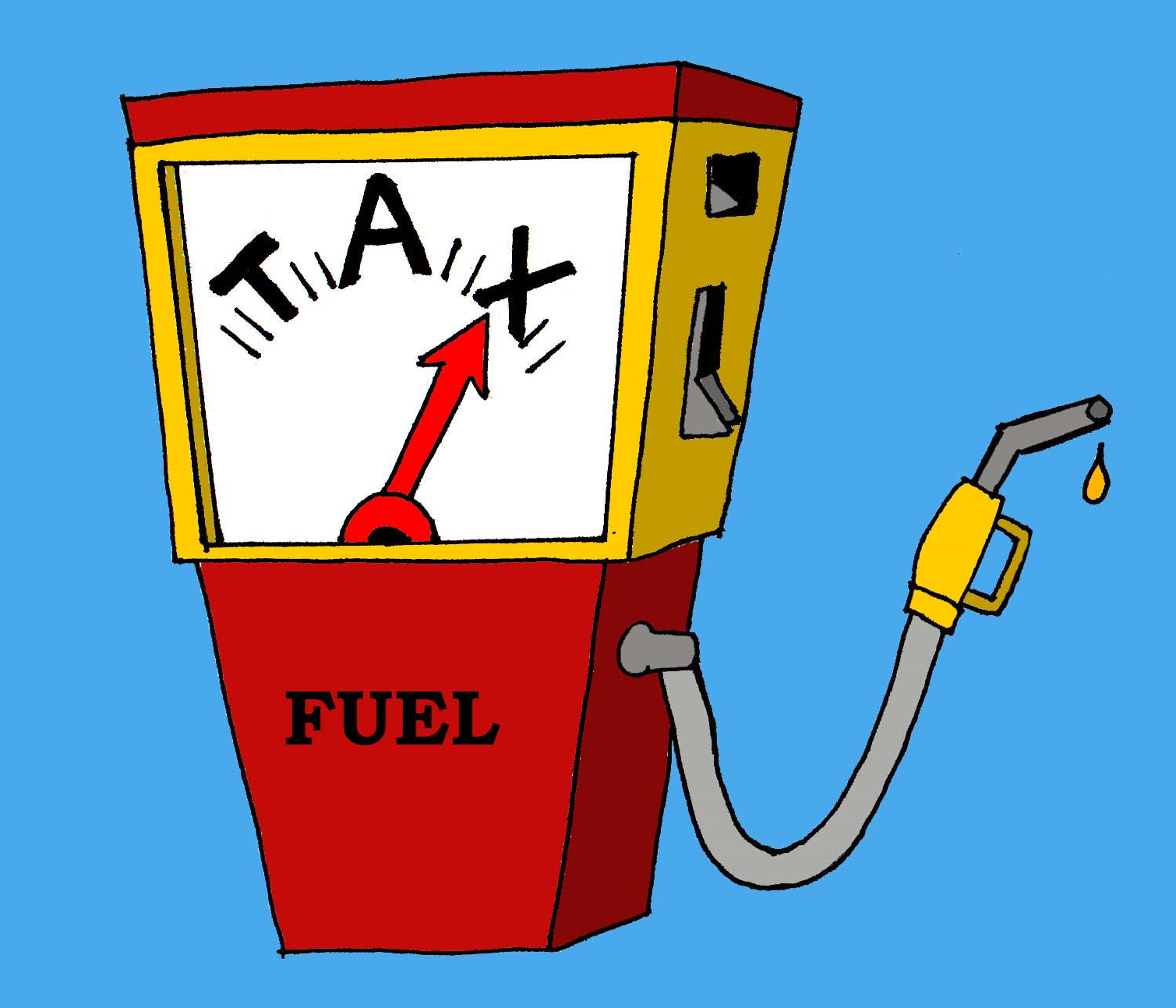
The Trudeau initiative is an example of the alternative to legislating a rational position. It is virtue-signalling by adopting a token carbon price, which will not lower CO2 concentrations, nor reduce temperatures. The tax will enrich government coffers, which is a key motivation for politicians hiding behind this noble cause.

In 2015, gasoline taxes in Canada represented on average 38.5 cents per litre, which is approximately 35% of the pump price. That includes 10¢/litre federal tax, provincial fuel taxes ranging from 6 to 19 ¢/litre, plus sales taxes. Taxing at $10 a tonne starting in 2018 would add a carbon tax on top as shown below:

Fuel Type UNITS FOR TAX 2018 Added Tax
Gasoline ¢/litre 2.22
Diesel (light fuel oil) ¢/litre 2.56
Jet Fuel ¢/litre 2.61
Natural Gas ¢/litre 1.90
Propane ¢/litre 1.54
Coal – high heat value $/tonne 20.77
Coal – low heat value $/tonne 17.77

These pennies added on top will not change behavior, but millions of consumers’ dollars will be skimmed in a hidden way, including rising transportation costs of everything.

If this was anything other than a tax grab, they would do one or both of two things:

  • Make the tax revenue neutral by paying the monies collected back to consumers; and
  • Make the increases in the carbon tax rate conditional upon rising temperatures as measured by satellites. (as proposed by economist Ross McKitrick)

fuel-tax

Making the Climate Case

This post is to highlight two recent high quality documents making the case against climate alarms. These are important additions to anyone’s library of climate science resources.

Jamal Munshi has published papers on atmospheric ozone, and as a professor emeritus is free to speak his mind on the UN Environmental Program. His paper is entitled The United Nations: An Unconstrained Bureaucracy 

He provides the history of the UN’s self-serving growth by exploiting two false alarms, first the “ozone hole”, and then “climate change.” The story needs to be remembered and retold against the tide of alarming claims. Since this paper is posted at Tallbloke’s Talkshop, it will likely be part of the intellectual framework for the rising CLEXIT campaign.

Synopsis of The United Nations: An Unconstrained Bureaucracy

The case study takes a close look at the United Nations Environment Program (UNEP) by tracing its history from its humble and noble beginnings to the phenomenal growth in size, wealth, reach, and power of this taxpayer funded public sector bureaucracy.

Ozone Depletion:
For the UNEP to achieve its ambition of being the EPA for the world it needed a global catastrophic pollution problem which it could tackle and clean up just as the EPA had cleaned up the air and water in the USA. A series of events that began in the 1970s and culminated in 1985 provided them with just such an opportunity.

In view of the data presented here and in the prior studies we would like to think that the theory of ozone depletion by HHC and the ban on HHC to save the ozone layer are derived from bad science by good people who felt that they had to act quickly in accordance with the precautionary principle. However, because of the enormous gains made by the UNEP in implementing a program to solve a nonexistent problem and in view of a history of corrupt practices at the UN (Zaruk, 2014) (Ball, 2015) (Lynch, 2006) (Schaefer, 2012) (Dewar, 1995) (Rossett, 2006) (Rossett, 2008), intentional fraud and corruption for financial and bureaucratic gains by the United Nations cannot be ruled out.

Planetary Environmentalism: Climate Change
For the UNEP the frightening new global warming and climate change narrative served as yet another planetary air pollution crisis in which it could seize global leadership and grow in terms of size, funding, and power at the expense of taxpayers in donor countries. In this case, the global “air pollutant” was identified as the unnatural and extraneous new carbon dioxide from the combustion of fossil fuels. The UNEP responded to the events of 1988 almost immediately. It saw its opportunity and seized it having tasted great success in this kind of situation in the case of HHC pollution and ozone depletion.

The IPCC AR reports are biased. They are primarily concerned with selling the idea of climate change calamity and its mitigation by emission reduction. .Their use of science is limited to its utility in supporting that primary purpose. The bias in IPCC AR documents is documented in a 2010 commentary by the Netherlands Environmental Assessment Agency which took it upon itself to audit the IPCC AR4 WG2 forecasts and concluded that “The IPCC systematically favors adverse outcomes in a way that goes beyond serving the needs of policymakers.” (PBL, 2010). . .Yet another independent audit of the IPCC AR4 was carried out in 2011 by the Inter Academy Council (IAC), an international scientific body. The deficiencies are enumerated below. . . 

From the Summary:
They sold fear of catastrophic global warming and climate change allegedly caused by fossil fuel emissions but failed to duplicate their success in the first episode (ozone depletion) because of methodological flaws and also because their own bureaucratic incompetence created an emissions reduction plan that was too complicated to implement. The complication ensures an endless series of annual meetings of thousands of delegates at exotic locations with the only concrete achievement of each meeting being that of setting the date and place for the next meeting.

These episodes serve as evidence that unconstrained and undisciplined public sector bureaucracies do not serve the interest of the public. We conclude that such UN bureaucracies can safely be dismantled without any harm to the public interest.

The second document is a well-reasoned, well-referenced submission by CEI and allies Coalition Letter against the Council on Environmental Quality’s Draft Guidance on consideration of greenhouse gas emissions and climate change effects in enivronmental (NEPA) Reviews. The Final Guidance has just been proclaimed by the White House, despite the strong evidence presented in their submission.

Synopsis of Coalition Letter Against the CEQ Guidance for Environmental Reviews

National Environmental Policy Act (NEPA) review is an inappropriate framework for making climate policy. Project-related greenhouse gas (GHG) emissions should not be a factor determining whether agencies grant or deny permits for individual projects. The Guidance endorses the alarmist perspective of EPA’s GHG endangerment finding, instructs agencies to quantify indirect (upstream and downstream) as well as direct emissions of individual projects, and recommends the use of social cost of carbon (SCC) calculations in cost-benefit analysis of projects. Each of those elements separately, and especially all in combination, will embolden anti-development groups and politicize rather than improve agency decisions. The Draft Guidance should be withdrawn. A summary of key points follows.(Full text includes extensive supporting evidence)

1.EPA’s greenhouse gas endangerment finding is an inappropriate starting point for project-related environmental risk assessments.

2. NEPA review of project-related GHG emissions will politicize, not improve, agency decisions.

3. Incorporating social cost of carbon (SCC) analysis will turn NEPA review into a pseudo-science.

Conclusion
NEPA review is an inappropriate basis for determining climate change policy, and project-related GHG emissions should not be a factor determining whether agencies grant or deny permits for individual projects.

The Draft Guidance instructs agencies to incorporate analysis of project-related GHG emissions and climate effects in NEPA reviews. That will embolden anti-development groups and politicize rather than improve agency decisions. The Draft Guidance should be withdrawn.