Europe Energy Stress Test Under Way
Update Sept. 28  Additional commentary in Footnote at end

Europeans are going to get a strong dose of energy cuts Greta has long called for since starting her Fridays for the Future.  Shortages of fossil fuels are in the outlook and already reflected in skyrocketing prices. Tyler Durden explains at zerohedge All Hell Is Breaking Loose In Energy Markets.  Excerpts in italics with my bolds.

By now readers are well aware that Europe is suffering from a historic gas crisis, one which according to Rabobank is now even more extreme than the US oil price shock.
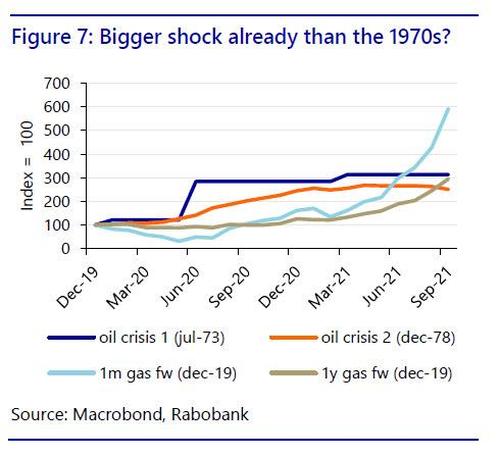
And unfortunately for Europe’s population, with every passing day – and to a lesser extent hedge funds such as Statar Capital which suffered a big loss in the past few days – it’s only getting worse. As Bloomberg’s Javier Blas notes today, both UK NBP and Dutch TTF natural gas benchmarks have closed the day at their highest ever settlement level, up ~11% on the day (to a closing price equal to more than $26 per mBtu).
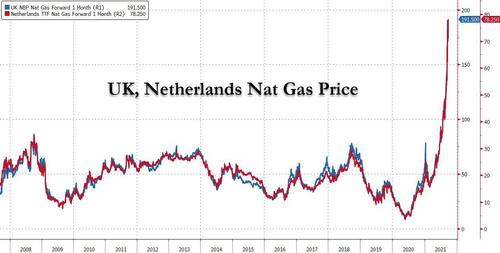
Natural gas prices in Europe have surged past $25 per million British thermal unit, more than 400% higher than the 2010-2020 average, and significantly higher than in the U.S., where the commodity trades at around $5 per million Btu. In Asia, liquefied natural gas has recently changed hands at around $27 per million Btu, a seasonal record high, as China has also been hit by a widespread energy crisis (see “Millions Of Chinese Residents Lose Power After Widespread, “Unexpected” Blackouts; Power Company Warns This Is “New Normal””). Also, for those who haven’t read it yet, please check out Rabobank’s extensive recap of Europe’s energy crisis which we posted over the weekend.

Europe’s energy crisis is not contained to nat gas, and as we discussed over the weekend in another flashback to the 1970s US, UK gas station pumps are running dry in British cities on Monday with vendors rationing sales as a shortage of truckers strained supply chains to breaking point. Pumps across British cities were either closed or had signs saying fuel was unavailable on Monday, Reuters reporters said, with some limiting the amount of fuel each customer could buy.

The Petrol Retailers Association (PRA), which represents independent fuel retailers accounting for 65% of all the 8,380 UK forecourts, said members had reported that 50% to 90% of pumps were dry in some areas.

A post-Brexit shortage of truck drivers as the COVID-19 pandemic eases has sown chaos through British supply chains in everything from food to fuel, raising the specter of disruptions and price rises in the run-up to Christmas. Drivers lined up for hours to fill their cars at petrol stations that were still selling fuel, albeit often rationed. There were also calls for National Health Service (NHS) staff and other emergency workers to be given priority.

Hauliers, gas stations and retailers said there were no quick fixes as the shortfall of truck drivers – estimated to be around 100,000 – was so acute, and because transporting fuel demands additional training and licensing. “We need some calm,” Gordon Balmer, executive director of the PRA, told Reuters. “Please don’t panic buy: if people drain the network then it becomes a self-fulfilling prophecy.”

Shifting from gasoline and nat gas to oil, the near-term outlook is looking even more grim. According to Trafigura, one of the world’s largest commodity trading houses, the world faces higher oil and gas prices this winter and beyond as supply struggles to catch up with fast-rising demand.

“We’re going to see higher oil prices,” Ben Luckock, Trafigura’s co-head of oil trading said in an interview with Bloomberg.

Luckock said the market was mispricing forward oil contracts for the next couple of years because traders hadn’t yet woken up to the fact the supply-demand balance will remain tight for some time. Translation: even higher prices are coming with no easing in sight.

“I struggle to see anything but higher prices going forward in the next two years,” he said, one day after Goldman hiked its price target, now predicting that Brent would hit $90 some time in December. On Monday, Brent crude for immediate delivery surged toward $80 a barrel, setting its highest price in nearly three years.

On natural gas, he said prices could shoot up even more this winter if cold weather forces demand higher in Europe and Asia.

The bullish outlook comes as oil demand fast recovers toward its pre-pandemic level, with most traders expecting that consumption will reach the 2019 by early-to-mid 2022. As demand rebounds, supply has struggled to keep up: U.S. shale companies have kept a lid on spending, preferring to pay dividends to shareholders. With U.S. shale reacting slowly to higher prices, the OPEC+ oil cartel has been able to keep control of the market.

The U.S. shale industry is showing very strong discipline. Oil prices are roughly double what they were a year ago and despite that we’re not seeing a huge increase in drilling,” Luckock said.

Luckock said that it was difficult to see lower natural gas prices this winter in Europe, despite the commodity trading at a record high already: “If it’s a cold winter in Europe or Asia, we have a big problem,” he said. “If it’s cold, and on top, it isn’t windy, then we have a much bigger problem. We will face shortages.”

Notably, Luckock said he was skeptical that Russia, the biggest gas supplier to Europe, was intentionally tightening the market for political gain, suggesting that Moscow was already pumping as much gas as it could right now.

“It’s easy to say that’s politically motivated, but I think it’s simpler than that: Russia is facing maintenance in many gas fields, very low domestic inventories, substantially increased flows to Turkey, and Gazprom is struggling to increase production,” he said.

Footnote: Commentary from Bloomberg Green and National Review

Ewa Krukowska at Bloomberg Green Energy Crisis Puts World’s Most Ambitious Climate Plan to Test.  Excerpts in italics with my bolds.

  • Soaring power and gas prices shoot up EU political agenda
  • Governments across EU fear backlash over costs of green shift

Natural gas and power prices are surging to all-time highs in the 27-nation region, as the bloc’s economies rebound from the Covid-19 pandemic. The surge in demand comes amid limited gas imports from Norway and Russia, with some countries accusing Moscow of manipulating supplies. At the same time, the EU strategy to accelerate emissions cuts in every sector from transport to manufacturing and agriculture boosted demand for carbon permits, with prices more than doubling over the past two years to new records.

The green package unveiled in July aims to align the economy with a 2030 stricter binding goal of reducing emissions by at least 55% from 1990 levels. The laws need to be approved by the European Parliament and member states in the Council of the EU, with each institution entitled to amending the plan, in a process likely to take around two years.

But for Europe’s lower-income countries — as well for the continent’s energy-intensive industries — the pain of any transition will be significant, and the EU will be under pressure to help cushion the blow from the current price jump.

But European governments are limited in what they can do to tackle the power crunch — without making their climate goals even harder to reach.

“It feels unlikely that politicians will reverse track and go back to coal generation or make changes to the approach to carbon,” said John Musk, an analyst at RBC Europe Ltd. “It is hard to see what measures can be adopted to alleviate near term supply-demand constraints on gas and power. There are likely be a couple of difficult years to navigate in terms of consumer prices and there may have to be some measures to help consumers here and there.”

Andres Stuttaford adds an essay at National Review The Gathering Storm (But with Not Enough Wind): Europe’s Energy Mess Gets Worse — a Lesson the U.S. Looks Set to Ignore.  Excerpts in italics with my bolds.

Instead of looking at these alternative approaches, the EU, the U.K., and, soon enough, the U.S., seem set on what is looking more and more like a headlong rush into disaster.

To understand why this might be, it is important to understand that for many climate warriors a “bloody hard” transition is a feature, not a bug.

I wrote about this a week or so back:

Concentrating on resilience and adaptation do not follow the millenarian narrative that is an unmistakable subtext of the message now being sent out by many climate warriors, whether inside government, linked to government, or outside it. Underpinned by the expectation of apocalypse, this narrative, which has repeatedly demonstrated its dangerously persuasive power over the centuries, is based on the thought that a wicked humanity faces punishment and must, with the assistance of a morally superior, enlightened vanguard, be made to change its dreadful (often self-indulgent) behavior. Adaptation and resilience, by contrast, offer the prospect that our species will muddle on through, living pretty much as it has been doing, except even better, and without donning the hairshirt integral to so many climate warriors’ faith. Theirs has the characteristics of a religion, and there is little that is original about it. Pointless asceticism comes with the territory.

Questioning whether those setting the climate agenda are going about things the right way is not a matter of climate “denial,” but simple common sense. It is not, however, a conversation that the climate establishment wants to have. Fundamentalists are like that.

They may not want to have that conversation, but, as winter approaches, the growing crisis in Europe suggests that it is a conversation that may be difficult to avoid.


What If It’s Global Cooling, Not Warming?

IOGP oil and gas plumbing

Chris MacIntosh has an article at zerohedge Global warming or cooling? Excerpts in italics with my bolds.

Wouldn’t it be ironic that instead of the planet-warming over the next 30 years, it actually went into a cooling phase?

When we first heard of sunspot activity and forecasting climate based on the level of solar spot activity we thought this was pixyland stuff.

However, when we “opened our minds” and started to dig deeper we realized there was something going on here. Make your own minds up. We aren’t trying to change anyone’s view but rather encourage you to open your perspectives.

You might like to read this:
“THE NEXT 30 YEARS WILL BE COLD,” SAYS CLIMATE SCIENTIST DR. WILLIE SOON

And this:
NEW PAPER USES AI TO PREDICT THE SUNSPOT CYCLES: LOW SOLAR ACTIVITY UNTIL 2050

Frankly, I’m no scientist but I ran a VC firm for some years, and I’ll tell you what. You are presented with such a ton of “opportunities” that it will make your head spin.

Sorting the wheat from the chaff is quite literally a full time role, and one thing that gets honed like a sword on an anvil is the skeptical critical thinking part of our brain.

Trust but verify is so very important. And what I do know is that the entire global warming narrative, together with “the science is settled,” is complete utter nonsense. It has been extraordinarily successful, too.

Kids these days are being taught it. Mind you, my daughter, who had to present a project on it at school, provided a shocking red pill (Dad helped her on her project) to the class and her teacher.   We literally have a class of people in the world today who are successful as professional hysterics.

However, what we do know is that global energy markets (and a whole host of other second order consequences) are not priced for a cooling of the planet over the next 30 years.

That is why we can get a payback of our investment in coal assets after about 5 years but it will take 100 years to get a payback from investing in Tesla.

What would happen to energy prices (natgas, coal, oil) if the world did in fact get colder over the next 30 years?

Well, the world would start using more fossil fuels and ditch the renewable thing faster than that crazy ex girlfriend/boyfriend that stalks you.

But after years of under investment in fossil fuels (particularly outside of shale), the supply would not be able to be increased meaningfully (i.e. prices would rocket higher and stay there for as long as it takes to bring on more supply), and given the underinvestment and treatment of anyone who would suggest doing so as if they’ve committed mortal sin… well, it’s not coming back in a hurry.

Now, think of every good and service that is tied to the price of fossil fuels. This picture should illustrate the point — life as we know it.

IOGP oil and gas plumbingHmmm… isn’t the rising price of all the “stuff” mentioned above a good definition of inflation? But isn’t the world perfectly positioned for deflation?

Global cooling and inflation… what a toxic cocktail. But we are perfectly positioned for both. Ah, such poetry. Bring it on!

See also Worst Threat: Greenhouse Gas or Quiet Sun?

Elite Consensus Opinion Minority Contrary Opinion
Expect +1C Warmer from now to 2050 Expect -1C Colder from now to 2050
Mitigate Warming by Stopping Fossil Fuels Adapt to Cooling from Quiet Sun
Goal is Net Zero CO2 Emissions by 2050 Goal Robust Energy supply and Infrastructure Now

World of Hurt from Climate Policies-Part 4

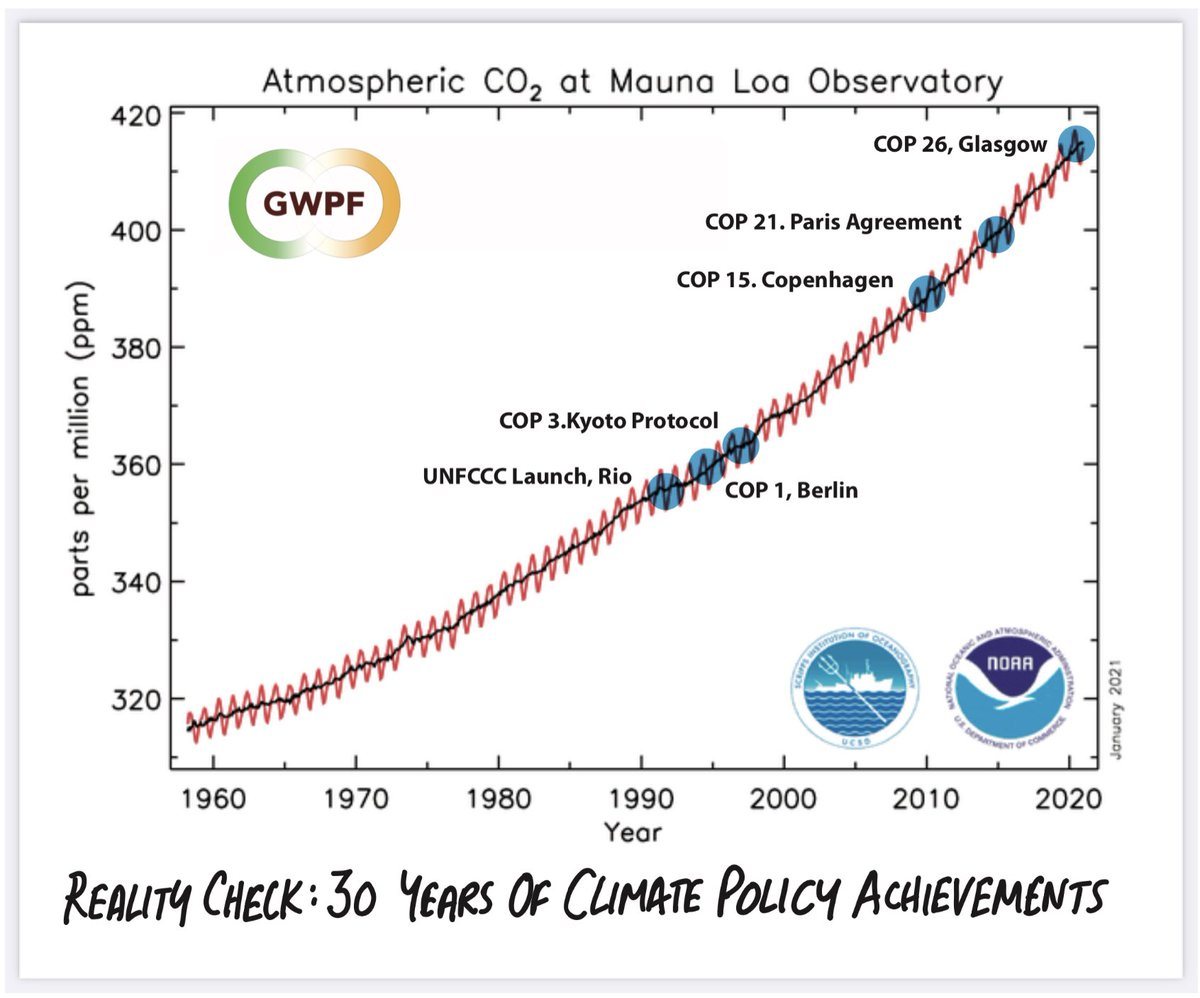
CO2 and COPs

Leave it in the Ground Means Perpetual Poverty


This is a fourth post toward infographics exposing the damaging effects of Climate Policies upon the lives of ordinary people.  (See World of Hurt Part 1Part 2, and Part 3 )  And all of the pain is for naught in fighting against global warming/climate change, as shown clearly in the image above.  This post presents graphics to illustrate the fourth of four themes:

  • Zero Carbon Means Killing Real Jobs with Promises of Green Jobs
  • Reducing Carbon Emissions Means High Cost Energy Imports and Social Degradation
  • 100% Renewable Energy Means Sourcing Rare Metals Off-Planet
  • Leave it in the Ground Means Perpetual Poverty
The War Against Carbon Emissions Diminishes Efforts to Lift People Out of Poverty

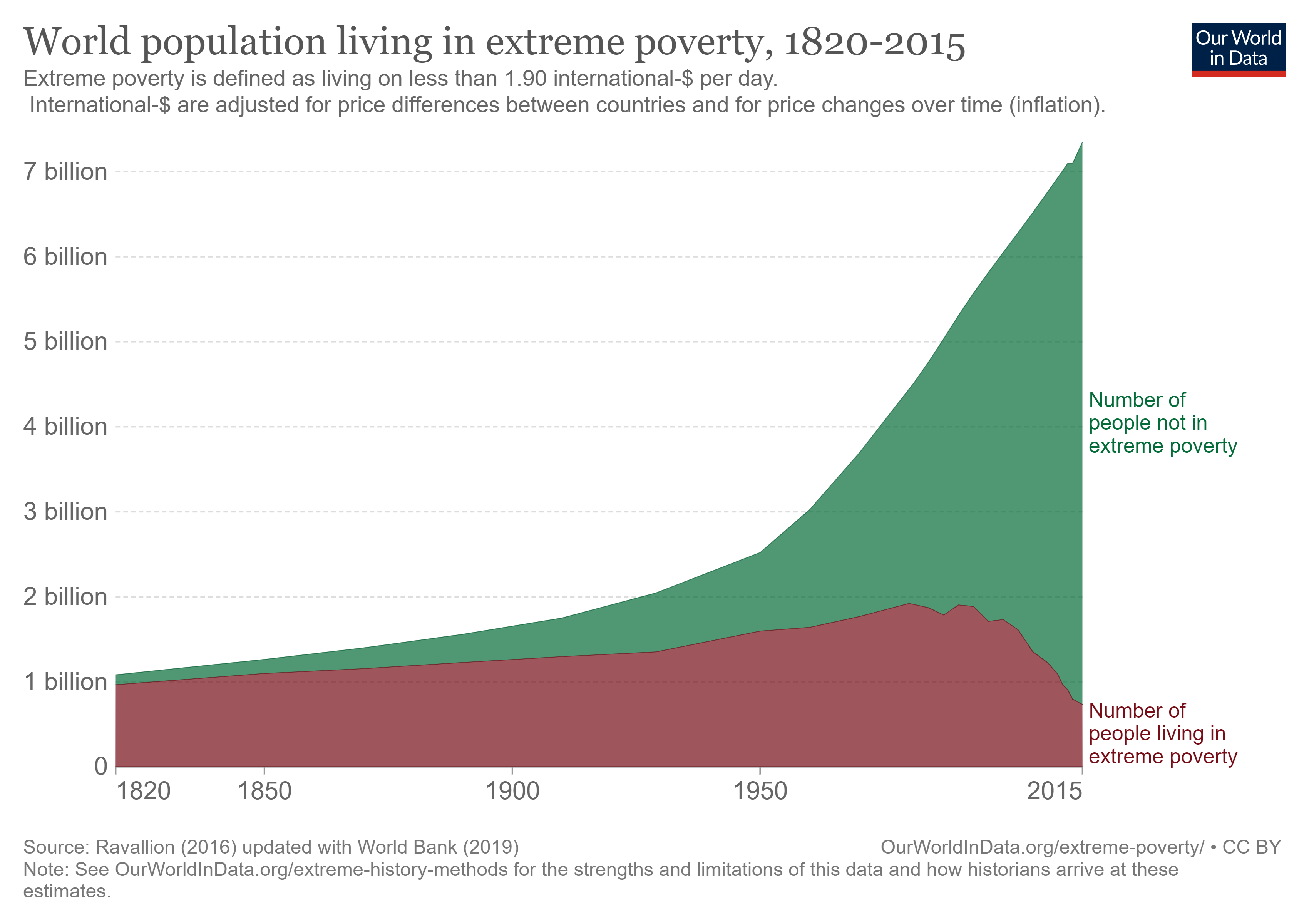
world-population-in-extreme-poverty-absolute
The OurWorldinData graph shows how half a billion people have risen out of extreme poverty in recent decades.  While much needs to be done, it is clear that the world knows the poverty factors to be overcome.

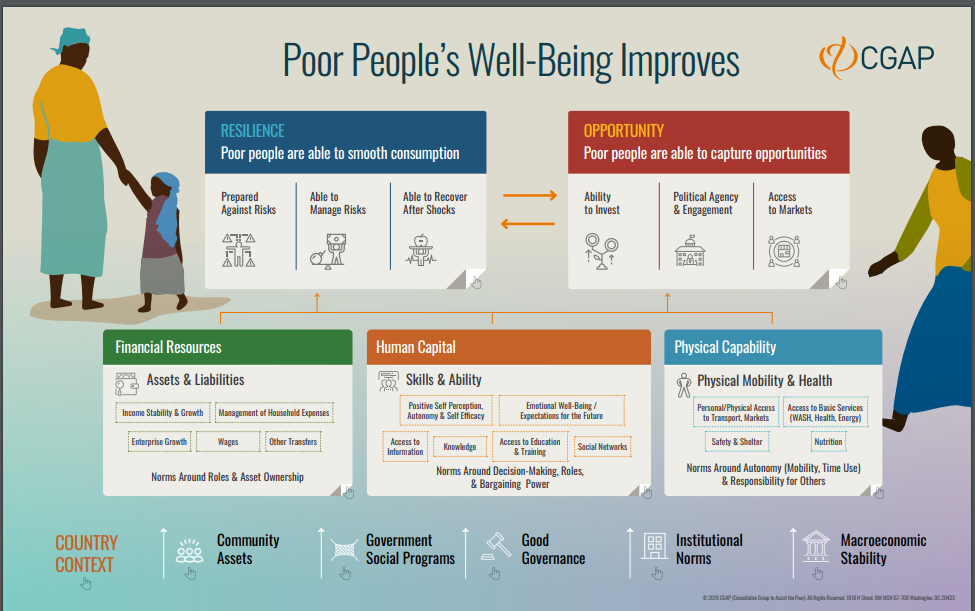
wellbeing improves

That comprehensive diagram from CGAP shows numerous elements that contribute to rising health and prosperity, but there is one resource underlying and enabling everything:  Access to affordable, reliable energy.  From Global Energy Assessment: 

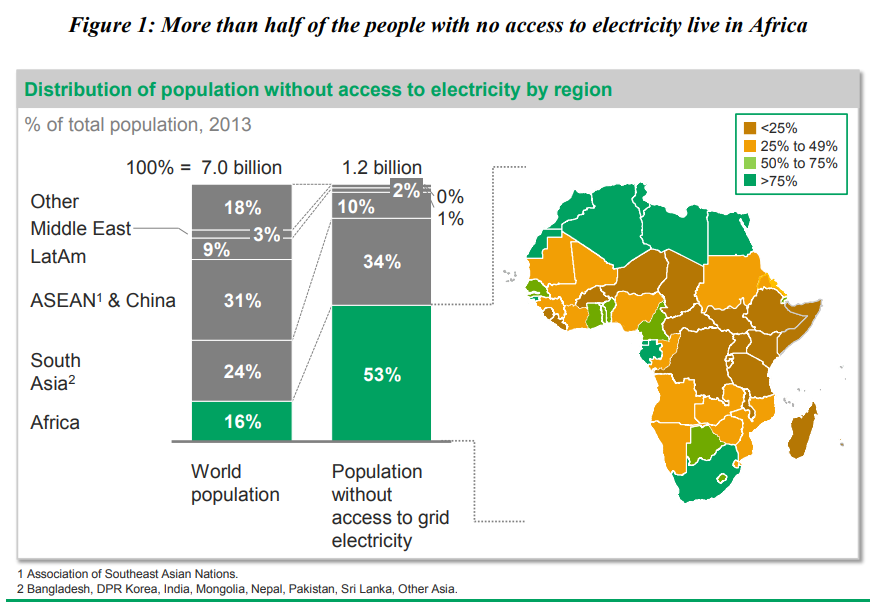
“Access to cleaner and affordable energy options is essential for improving the livelihoods of the poor in developing countries. The link between energy and poverty is demonstrated by the fact that the poor in developing countries constitute the bulk of an estimated 2.7 billion people relying on traditional biomass for cooking and the overwhelming majority of the 1.4 billion without access to grid electricity. Most of the people still reliant on traditional biomass live in Africa and South Asia.

The relationship is, in many respects, a vicious cycle in which people who lack access to cleaner and affordable energy are often trapped in a re-enforcing cycle of deprivation, lower incomes and the means to improve their living conditions while at the same time using significant amounts of their very limited income on expensive and unhealthy forms of energy that provide poor and/or unsafe services.”

The moral of this is very clear. Where energy is scarce and expensive, people’s labor is cheap and they live in poverty. Where energy is reliable and cheap, people are paid well to work and they have a better life.

adb fig.1
adb fig.2
adb fig.3
adb fig.4
adb fig.5
adb fig.7

How Climate Policies Keep People Poor

Note that the vision for 100% access to electric power was put forward by the African Development Bank in 2016.  (Above slides come from The Bank Group’s Strategy for The New Deal on Energy for Africa 2016 – 2025).  Instead of making finances available for such a plan, an International Cabal organized to deny any support for coal, the most available and inexpensive way to electrify Africa.
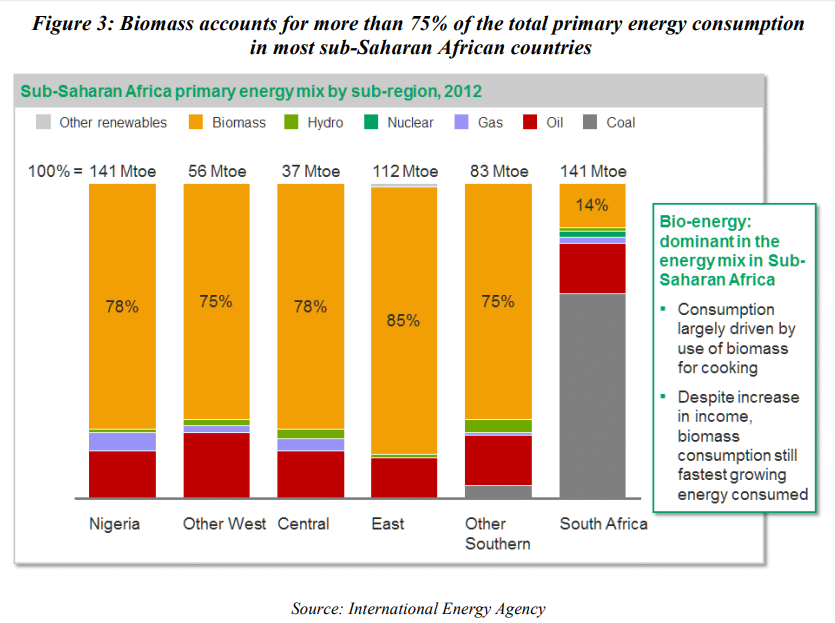
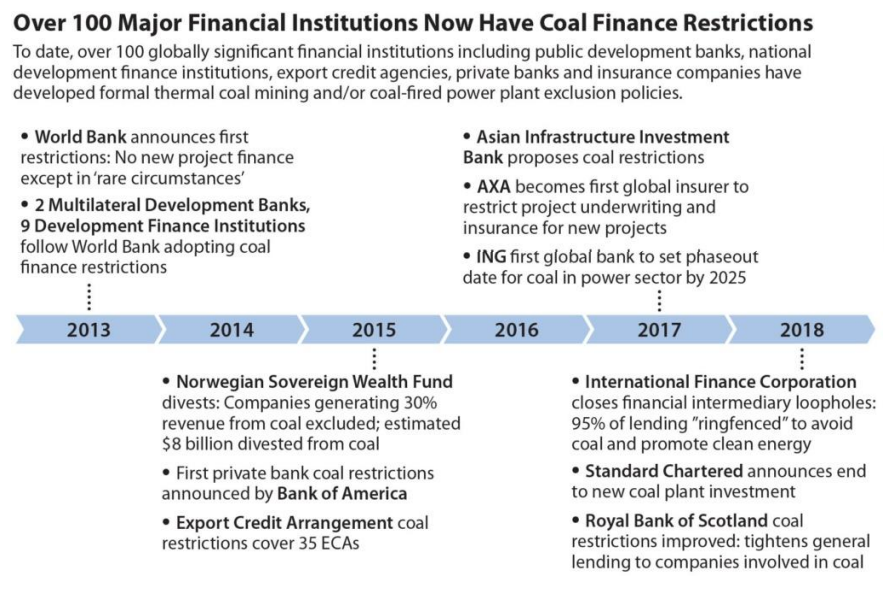
ieefa coal restrictionsThis is an organized campaign to deny coal-fired power anywhere in the world, despite coal being the starting point in the development pathway for every modern society, and currently the success model for Asia, and China in particular.  [Note in Figure 3 above that South Africa, the most advanced of African nations gets the majority of its power from coal.] The chart above comes from IEEFA 2019 report Over 100 Global Financial Institutions Are Exiting Coal, With More to Come.  Their pride in virtue-signaling is expressed in the subtitle:
Every Two Weeks a Bank, Insurer or Lender Announces New Restrictions on Coal.

How Climate Policies Waste Resources that could Improve Peoples’ Lives

The Climate Crisis Industry costs over 2 Trillion US dollars every year, and is estimated to redirect 30% of all foreign aid meant for developing countries into climate projects like carbon offsets and off-grid wind and solar. 

A much better plan is put forward by the Copenhagen Consensus Center.  A panel of social and economic development experts did cost/benefit analyses of all the Millenium Goals listed by the UN working groups, including climate mitigation and adaption goals along with all the other objectives deemed desirable. They addressed the question: 

What are the best ways of advancing global welfare, and particularly the welfare of developing  countries, illustrated by supposing that an additional $75 billion of resources were at their disposal  over a 4‐year initial period?

These challenges were examined:

  1. Armed Conflict
  2. Biodiversity
  3. Chronic Disease
  4. Climate Change
  5. Education
  6. Hunger and Malnutrition
  7. Infectious Disease
  8. Natural Disasters
  9. Population Growth
  10. Water and Sanitation

CCC budget

Imagine how much good could be done by diverting some of the trillions wasted trying to bend the curve at the top of the page?


Better to do nothing than try to reach UN climate targets

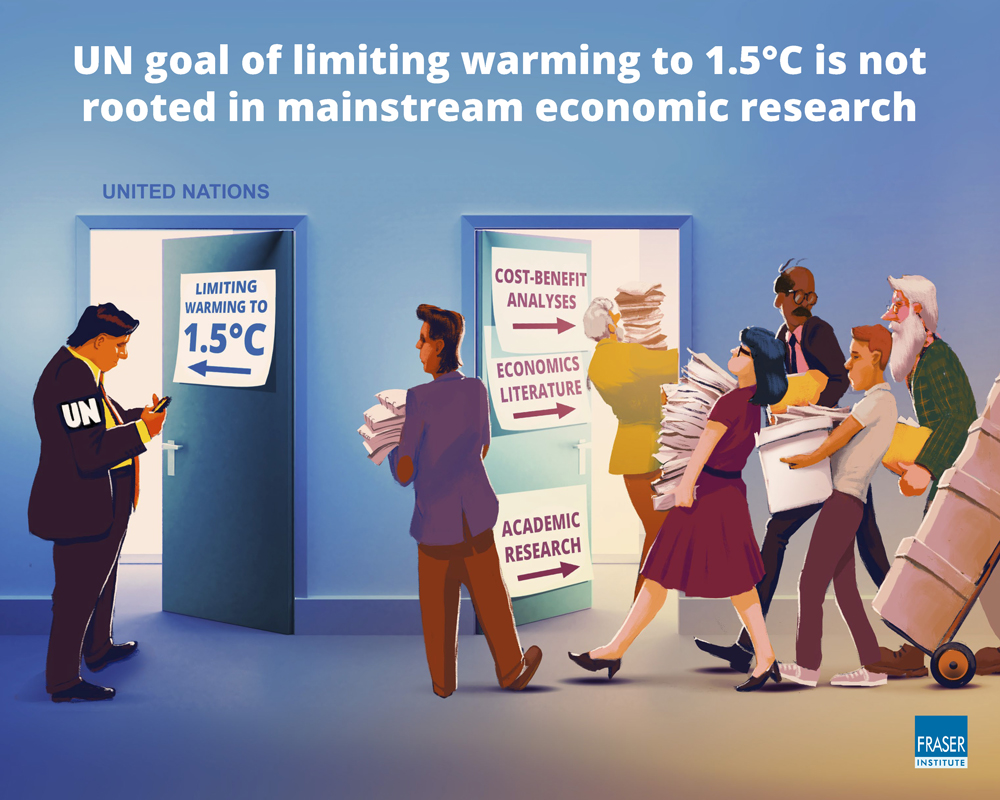
economics-literature-does-not-support-1.5c-climate-goal

Lorrie Goldstein writes a review of a new Fraser Institute study by McKitrick and Murphy.  The study is Off Target: The Economics Literature Does Not Support the 1.5C Climate Ceiling.  Excerpts from Goldstein’s article in italics with my bolds.

Trying to achieve the United Nations’ target of limiting global temperature increases to 1.5 C above pre-industrial levels will do more social and economic harm than good, says a new study by the Fraser Institute released Tuesday.

“Although advocacy of aggressive climate-change policies is often draped with the mantel of science … the popular 1.5C policy target will pose costs that far exceed the benefits,” the study says.

“Emission reductions flowing from strict adherence to the 1.5C target would be worse for the world than doing nothing at all.”

Study authors Ross McKitrick and Robert P. Murphy argue in Off Target: The Economics Literature Does Not Support the 1.5C Climate Ceiling, that the 1.5C target “did not arise … from formal cost-benefit analysis.”

In fact, a 2018 report by the UN’s Intergovernmental Panel on Climate Change that argued there would be net societal benefits to achieving the 1.5C target — used by Canada and other countries to justify the public cost of lowering greenhouse gas emissions — “expressly stated” it did not do a cost-benefit analysis.

The 2018 UN study, Global Warming of 1.5°C — An IPCC Special Report, said because the calculations were so complex, “standard cost–benefit analyses become difficult to justify and are not used as an assessment tool in this report.”

Instead, the UN report cited a range of studies that have estimated the global cost of carbon pricing (expressed here in current Canadian dollars) to meet the UN’s target of limiting global temperature increases to 1.5C above pre-industrial levels by 2100.

They went from a low of $170 per tonne of emissions, to a high of $6,900 per tonne by 2030; $307 per tonne to $16,300 per tonne by 2050; $527 to $21,955 by 2070 and $865 to $33,873 by 2100.  Given such numbers, Murphy argues in the Fraser report, “it would be better if governments did nothing at all about climate change than to try to achieve the 1.5C target because the costs so outweigh the estimated benefits.

(Prime Minister Justin Trudeau’s current carbon price is $40 per tonne of emissions, rising to $170 per tonne in 2030.)

In the real world, no government is going to impose a carbon tax/price of up to $6,900 per tonne of emissions by 2030 — with more hikes after that — because it would be political and economic suicide.

No one knows what global temperatures are going to be in 2100, nor what the global carbon price on emissions would have to be by then to meet the UN’s target of limiting warming to 1.5C above pre-industrial levels.

What we do know for a fact today is that global emissions are steadily rising. The only exceptions in the modern era occurred in 2008-09 and 2020, when they fell dramatically not because of carbon pricing, but because of global recessions, before resuming their upward climb the following year.

We also know that as of 2021, we are so far behind the UN’s target of reducing emissions to 45% below 2010 levels by 2030, that achieving that goal would require lowering emissions globally by 7.6% annually every year between now and 2030.

And finally, we know that, since almost all goods and services consume fossil fuel energy, a 7.6% annual reduction in emissions every year from now until 2030, would provoke an unprecedented global recession in which the social and economic costs would far outweigh the benefits.

economics-literature-does-not-support-1.5c-climate-ceiling-infographic

Four Blunders in EU Climate Plan

theherculeantaskofkeepingco2emissionsdown_800x533_l_1626765909

Pieter Cleppe writes at Real Clear Energy Four Flaws With the EU’s New Climate Plans Excerpts in italics wtih my bolds and images.

Last week, the European Commission presented its so-called Fit for 55 proposals, a raft of legislative initiatives intended to adapt EU law to the 2030 target of reducing CO2 emissions by 55 percent from 1990 levels. The idea is to adapt legislation originally intended to achieve a 40% reduction.

This undertaking, however, is marked by serious shortcomings. Herewith, I summarize what’s wrong with it, listing four main flaws.

  1.  The European Commission is employing a top-down approach, riddled with taxes and spending

The European Commission seems to take former U.S. president Ronald Reagan’s characterization of “government’s view of the economy” as a manual, rather than as a warning. As Reagan summarized government’s approach: “If it moves, tax it. If it keeps moving, regulate it. And if it stops moving, subsidize it.”

2615928-milton-friedman-quote-the-big-problem-for-a-democratic-government

Most remarkable here is the Commission’s intention to impose a de facto ban on gasoline and diesel cars by 2035, even if France seems keen to extend this until 2040. When even France is less restrictive, you’re not in a good place. Feeling the need to resort to outright prohibition, the Commission is clearly not putting great trust in innovation to come up with economically efficient, CO2-neutral cars.

A notable change is the expansion of the EU’s cap and trade scheme, which puts a price on emitting CO2 but allows companies to buy and sell their right to do so. The Commission wants to expand this so-called Emissions Trading System (ETS) – set up 16 years ago and covering power plants, intra-EU aviation, and energy-intensive industries – to include buildings, road transport, and shipping. The expansion would start gradually in 2023 and be phased in over three years, as the emission-rights regime for aviation is being tightened up and sectors not covered by ETS are made subject to emission-reduction targets, with binding targets per member state. EU minimum excise-duty rates on various energy sources, like motor or heating fuel, would also need to be increased, and a jet-fuel tax would need to be introduced on intra-EU flights, on top of a tax on maritime fuel.

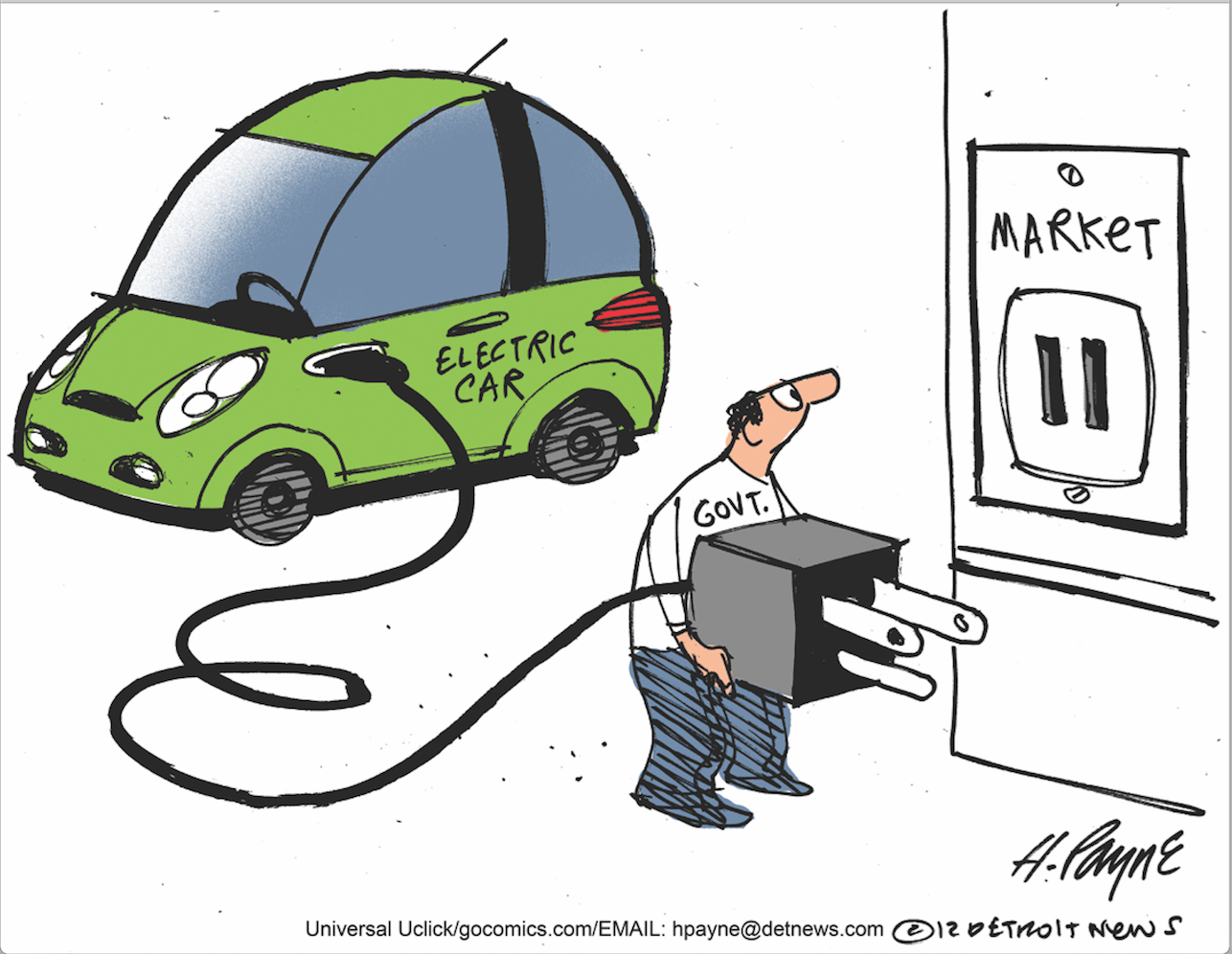
taxcartoon

Opponents of the proposals, which still need to be approved by both EU member states and the European Parliament, include the shipping industry, which hasn’t exactly welcomed its inclusion into the ETS system. The International Chamber of Shipping described the proposal as “an ideological revenue raising exercise, which will greatly upset the EU’s trading partners,” as it would involve “non-EU shipping companies to be forced to pay billions of euros to support EU economic recovery plans.”

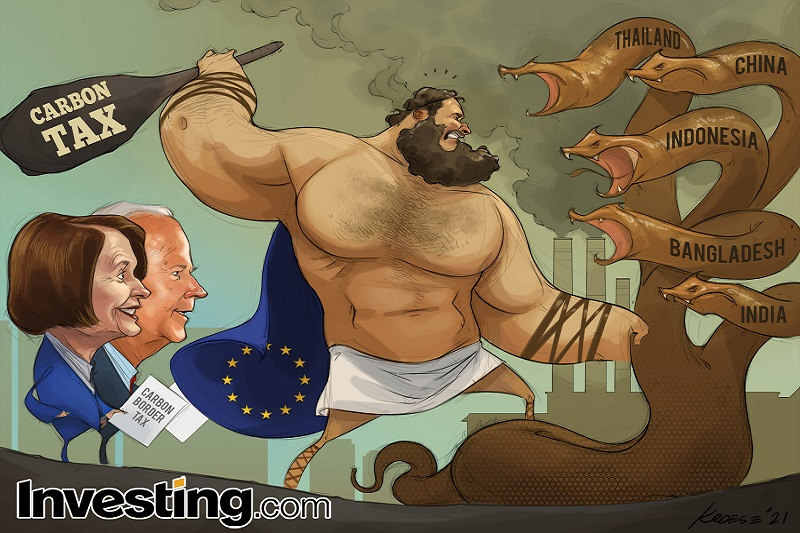
This doesn’t even account for another part of Fit for 55, whereby the Commission intends to create the world’s first carbon border tariff, to be levied on imports of goods including steel, cement, and aluminum, to be phased in from 2026. This step is deemed necessary because two-thirds of CO₂-emissions are likely to continue, only now outside of the EU, causing “carbon leakage” – a phenomenon notably hard to estimate, although we know that China has long outpaced the U.S. and the EU in terms of carbon emission.

border-carbon-taxes

In response, Belgian employer federation VBO-FEB issued a warning about this “carbon border adjustment mechanism,” stating that “policy makers must be careful that (…) this will not cause other countries to impose countermeasures or cause supply chain distortions, leading us to import more finished products than raw resources.” The question remains as to whether this is not a protectionist measure in violation of the WTO agreement – especially when certain European producers would be exempt. In any case, it will unleash lots of extra bureaucracy, especially for small companies.

Also in line with Reagan’s description of government thinking is the European Commission’s plan to spend billions of euros to compensate for the damage done by its own measures – such as its proposal for a new “social climate fund” “to prevent fuel poverty,” using one-fifth of ETS revenue, on top of another fund, the €100 billion Just Transition Mechanism to help coal-dependent countries like Poland make the transition away from coal. Combined with the Commission’s demand to get at least 50% of the income derived from the new ETS transport and buildings revenue, this would mean that the ETS system would morph into an outright EU tax – a dream eurocrats have been pursuing for years.

2.  The proposed measures disproportionately hurt the poor

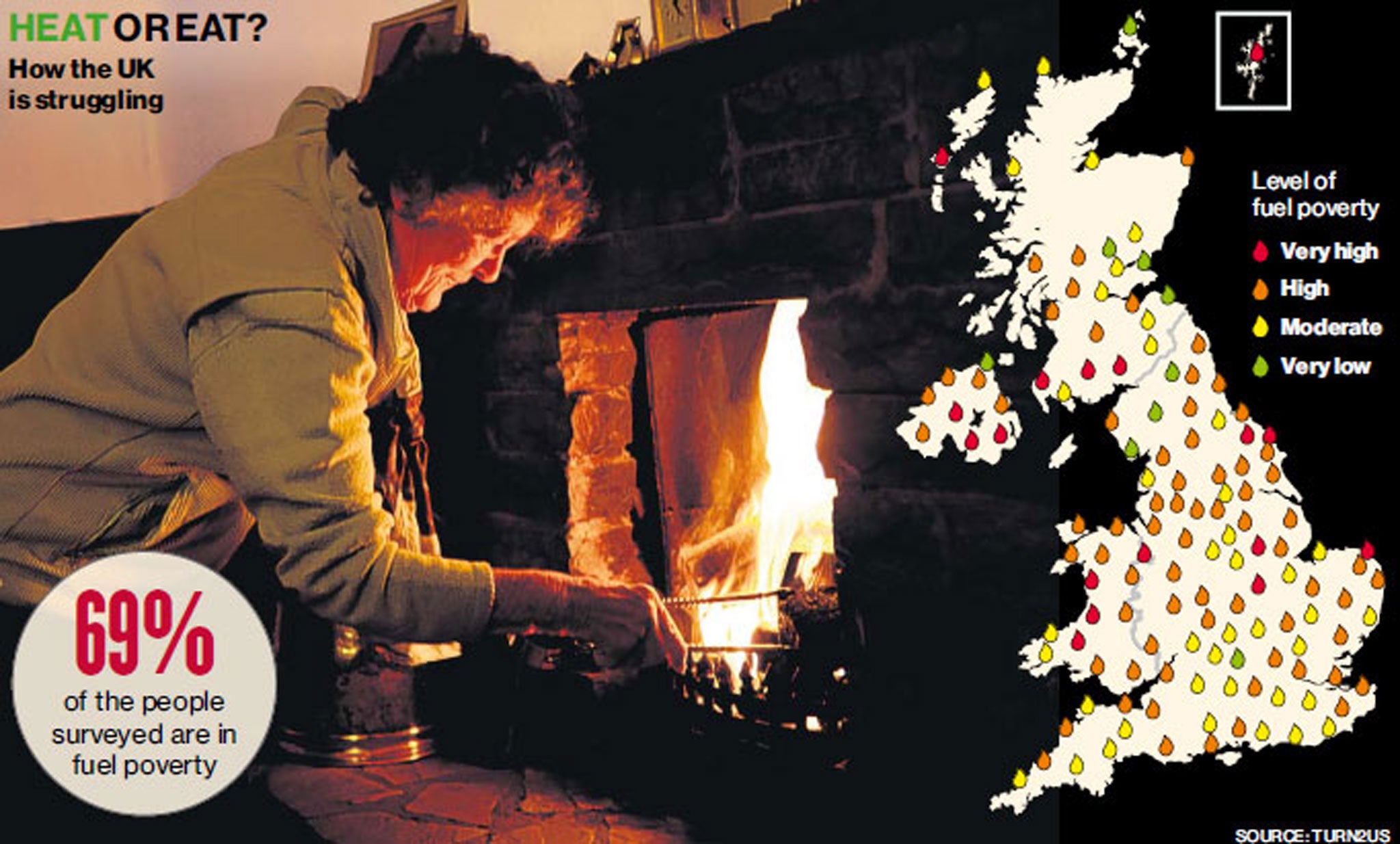
The European Commission itself has admitted that measures like putting a carbon price on heating fuels “will not affect households equally, but would likely have a regressive impact on disposable income, as low-income households tend to spend a greater proportion of their income on heating.” It is testimony to how divided opinion is even within the Commission, where many are questioning the rather extreme approach of EU Climate Commissioner Frans Timmermans.

fuel_poverty

The predicted hardship for the poor then serves as yet another excuse to spend money – now to alleviate the damage done by the measures. The Commission is seemingly unaware that to finance spending, taxes are needed, and even corporate taxes are ultimately disproportionately borne by low-skilled workers. There is no free lunch, even when paying tribute to the Climate Gods.

Over the last few years, as exemptions for the CO2 emission-trading system have been reduced, this scheme has put upward pressure on energy prices, so it can be feared that this will cause more damage to the economy, particularly hurting the poor. The Commission thinks that CO2 prices in Europe will increase by 50 percent by 2030 if its plans are implemented – but some hedge funds already project an increase of almost 100% by the end of this year, with the more modest current arrangement in place.

france3

Pascal Canfin, chair of the European parliament’s environment committee, who started his career with the greens but is now a key ally of French president Emmanuel Macron, has called the plan to create an emissions trading system (ETS) for transport and buildings “politically suicidal” and “a huge political mistake.” He stated: “It’s a very bad idea,” adding that the Commission was “going to trap” lower middle-class families, noting that those hit the hardest would be people in regions with poor public transport and residents who could not pay for energy-efficiency upgrades to their homes. This follows the French government’s experience with the “gilets jaunes” (yellow vest) protesters, who managed to get Macron to abandon a fuel-tax hike in 2018.

France will take over the EU’s rotating presidency in 2022; let’s see how much then remains of the European Commission’s grand plans.

473193-14713695863266695_origin

Germany’s automobile industry has also warned that the proposed measures may have a “substantial” impact on jobs at auto suppliers – so even if the greens form part of the new German government, this may not all sail through so smoothly.

3.  The European Commission is not respecting the idea of “tech neutrality”

It’s one thing to impose a target to reduce CO2 emissions. It is quite another to try to micromanage how this can be achieved. Nevertheless, that is what the European Commission is doing with its so-called “EU taxonomy for sustainable activities,” a classification system meant to clarify which investments are environmentally sustainable, in the context of the “European Green Deal,” of which Fit for 55 forms a part.

5595539040_f33f4eb050_b

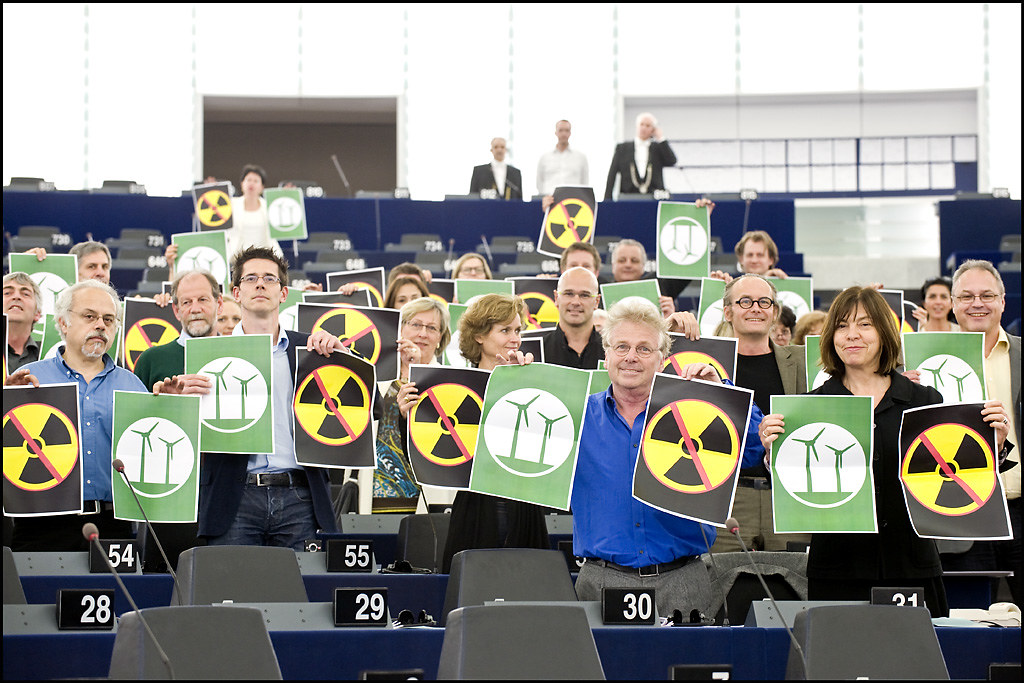
Several MEPs (mainly Greens) hold up anti-nuclear posters at the debate.

Despite all the evidence that nuclear power is CO2 neutral, the Commission refuses to acknowledge this reality. This denialism is the result of pressure by Germany, which decided to shut down all its nuclear plants, a policy that has driven energy prices in that country to record levels while also supporting the coal-energy sector. Germany thereby goes against the in-house scientific body of the European Commission, the Joint Research Centre, which declared earlier this year that nuclear power is a safe and climate-friendly energy source and should be considered as “green” under the EU’s classification system.

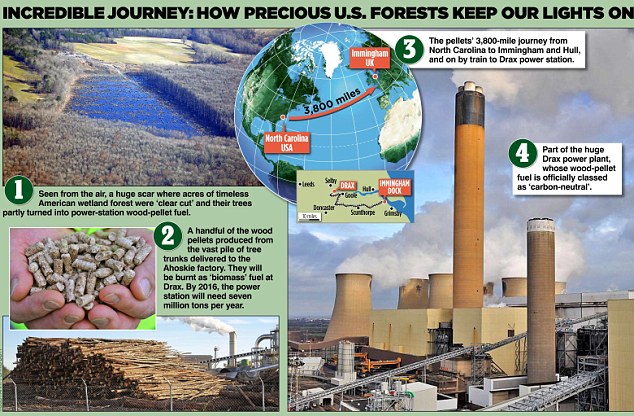
To add insult to injury, the Commission considers biomass a renewable energy – despite the fact that burning wood for energy, which is what biomass is ultimately all about, typically emits 1.5 times more CO2 than coal and three times more than natural gas. The EU is the world’s largest net importer of wood pellets; the main net exporters are the United States, Canada, and Russia.

MoS2 Template Master

Green campaigners have been complaining about EU member states like Estonia that allow intensive clear-cutting of trees in forests protected under EU Natura 2000 rules. One NGO, the Estonian Fund for Nature, has also pointed out there is a direct connection between the subsidized growth in the biomass industry and EU renewable-energy policies.

More than 500 scientists have urged the EU to stop treating biomass as carbon-neutral. Even if one disagrees, and believes that biomass can be sustainable and renewable, it still doesn’t make sense to privilege biomass over nuclear power.

Biomass represents almost 60% of renewable-energy consumption in the EU, so the implications of no longer considering it as renewable energy would be grave: wind and solar power contribute only marginally to the EU’s energy provision, irrespective of their environmental downsides. Changing biomass’s renewable status would make it almost unavoidable to recognize nuclear power, which would be embarrassing for the likes of German chancellor Angela Merkel, who has been putting so much political capital into defending Germany’s nuclear exit.

4.  The EU’s grand plans may not do that much for climate change

At the end of the day, the goal of all this is to counter CO2 emissions in a bid to halt climate change.

Here, an interesting contrarian view comes from Danish economist Bjørn Lomborg, author of the bestseller “The Skeptical Environmentalist.”

Lomborg has highlighted UN Climate Panel estimates that the negative impact of climate change in the 2070s would be equivalent to reducing the average income between 0.2% and 2% – meaning that global incomes would increase only by 356% by then, and not by 362%. He then contrasts this with the enormous cost of EU climate policies, which would “quadruple electricity wholesale prices in just a decade,” and he cites academic studies showing the real costs of EU climate policies to be four times higher than optimistic EU estimates, ultimately amounting to a whopping €4 trillion to €5 trillion.

Lomborg estimates that the new EU target of 55% carbon-emission reduction will reduce the global temperature by the end of the century by an immeasurable 0.004°C – “equivalent to postponing global warming by six weeks in 2100.”

Surely we can agree that it is hard for both proponents and skeptics of expensive climate policies to provide hard proof that they are right in their arguments. But these estimates should make even the most committed EU Commission climate fanatic pause for reflection.

msfig7-1

screenshot-2019-09-24-09.03.15-768x266-1

Global warming is in our mental models.

Gruesome Climate Crisis Talk at Davos

the-great-reset-by-the-world-economic-forum-prism-ua-world-economic-forum-great-resetMichelle Stirling explains what is terribly wrong about their train of thinking in the video below.  For those who prefer reading a transcript, I have provided one below, in italics with my bolds along with some images.
Davos climate crisis talk is disturbing and inaccurate

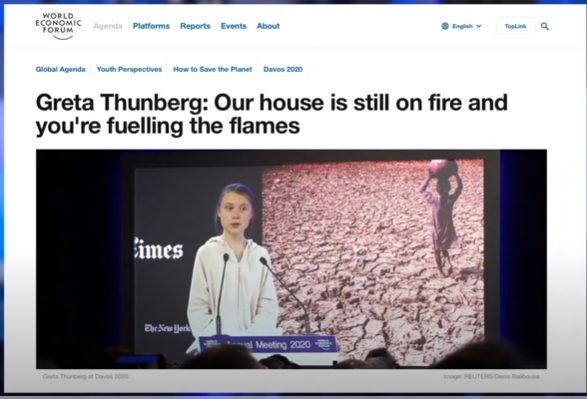
Hi, I’m Michelle Stirling for Friends of Science Society. I love life, I enjoy this beautiful world and I think being alive is a wonderful gift. That’s why it’s so disturbing to read some of the comments from the recent World Economic Forum in Davos. The conference concluded leaving some commentators concerned about depopulation talk from high profile individuals like Jane Goodall and misinterpreted IPCC SR 1.5 findings by Greta Thunberg, and talk of doomsday battles by Al Gore.

MSfig-2

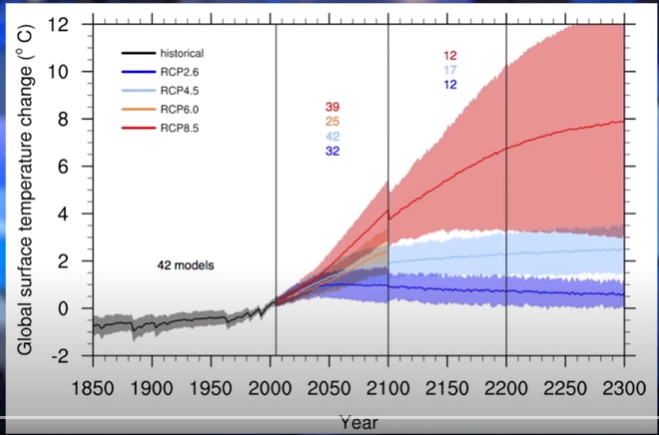
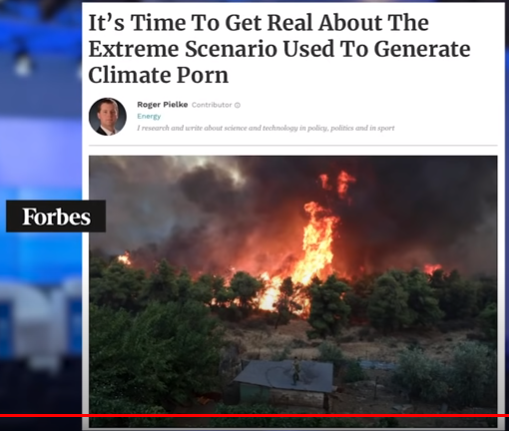
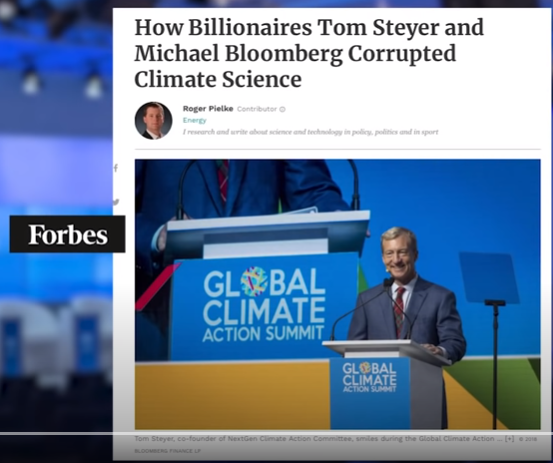
Goodell’s statement shocked many people when she said all these environmental things we talk about wouldn’t be a problem if there was the size of population that there was 500 years ago. The world’s population is estimated to have been about 500 million people then, or 6.7 billion less than today. Depopulation notions stem from apocalyptic climate visions but Roger Pielke jr. explains in a January 2nd, 2020, article in forbes that climate science has been corrupted by the influential risky business report of 2014. This report was funded by green billionaires and proliferated into the media and scientific domains by powerful environmental groups. Pielke jr. says the report misattributes the proposed pathways, focusing on the most extreme scenario called the representative concentrated Pathway 8.5, something that is far from a business-as-usual case relevant to the Davos set of bankers and billionaires.

MSfig0

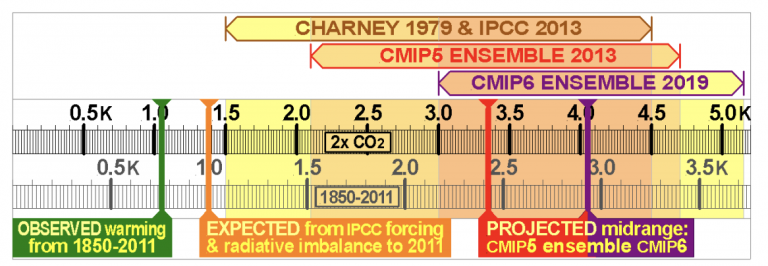
Mark Carney’s infamous speech to Lloyd’s of London of 2015 breaking the tragedy of the horizon that Also invoked the risky business report that Pielke jr. says has corrupted climate Science. RCP 8.5 is used in an influential graph on page 105 in the IPCC SR 1.5 report that Greta Thunberg refers to in her speeches at Davos. Greta referred to a table on page 108 of theIPCC SR 1.5 report for her crisis comments, but most of the scientific papers referred to in that table were published in or before 2013. And in 2013 the IPCC AR 5 report in box 9.2 chapter 9 stated there had been a hiatus in warming since before Kyoto. That’s like 15 years despite a dramatic rise in carbon dioxide concentration from human industry and activity.

MSfig2

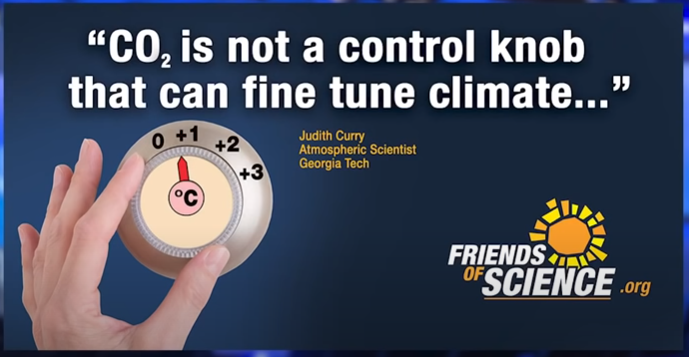
Dr Judith Curry testified to the US Senate on January 16, 2014, that based on that IPCC AR-5 evidence, carbon dioxide is not the control knob that can fine-tune climate. Curry noted that the science of climate change is not settled and evidence reported by the IPCC AR-5 weakens the case for human factors dominating climate change.

Nevertheless well-known climate scientists like professor Katherine Hayhoe continue to present proposed mitigation pathways as she did at the University of Calgary wherein she stated that she considered China to be a leader in climate mitigation.

MSfig1

We are just starting now to curve off the higher scenario if you notice here we’re almost here we’re just starting to curve off the higher scenario. When I say we I actually mean it’s mostly, get this, it’s mostly good in China. China has more wind and solar energy than any other country in the world. And you know I’m not a hundred percent confident in their emission estimates, so keep this with a bit of a grain of salt. But at least what we’re working with in the global level suggests that we’re starting to peel off the higher scenario, but not fast enough to get down to a lower scenario or meet the pair of targets. That’s absurd: a month of China’s emissions equal a whole year of emissions by Canada.

MSfig3

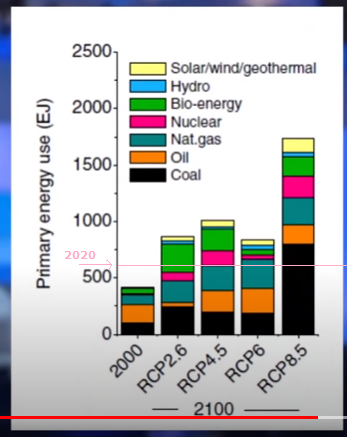
World Primary Energy consumed in 2020 was 567 Exajoules (BP Statistics)

Hayhoe advocated for rapid decarbonization referring to the RCP 8.5 versus a lower RCP. But a chart from the original report from Van Viren et al shows that no RCP scenario is fossil fuel free, debunking the notion that net zero 2050 should even be part of public policy or that rapid decarbonization is necessary. Roger Pielke jr. says these RCP models cannot be compared to each other, and even the RCP authors state they’re not meant to be used in this way. For instance all the RCP pathways other than 8.5 represent a world with billions fewer people.

MSfig-1

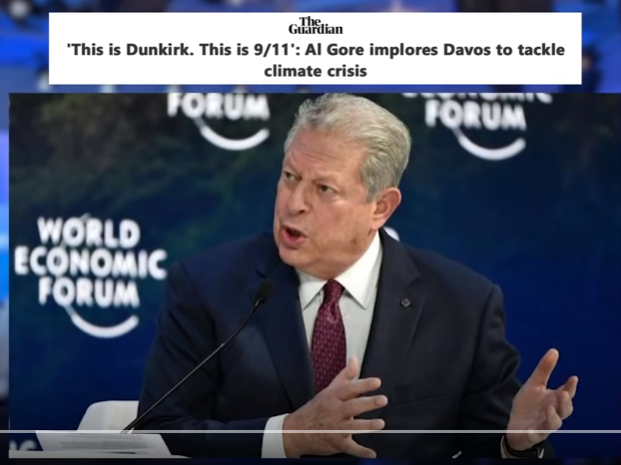
Another highlight at Davos was Al Gore’s fear-infested closing as noted by Hans Rosling and family in their book Factfulness. In 2009 Rosling met Al Gore who told him then we have to create fear, an approach that that medical doctor and international public health policy expert Rosling rejected. Rosling wrote that fear plus urgency makes for stupid drastic decisions with unpredictable side effects. And contrary to the doom and gloom of Davos, Factfulness shows how the world is improving for all people despite certain inequities, contrary to the doom and gloom of Davos. A decade later Al Gore continues with his apocalyptic approach, and at Davos he claimed the climate crisis was equivalent to historic wars even invoking 9 /11 again.

MSfig4

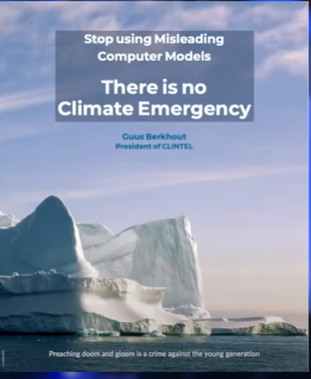
As Roger Pielke jr. notes in an earlier Forbes article, this is nothing but climate porn and is not supported by the scientific evidence in IPCC reports But fortunately there is a global pushback on this damaging depopulation and doom and gloom fear-mongering. CLINTEL, the climate intelligence organization based in the Netherlands, representing more than 800 global scientists, sent a letter to the World Economic Forum stating there’s no climate emergency and insisting that we do have time.

MSfig6

And pointing out the uncertainties of climate models that Greta and Al Gore use for their apocalyptic statements. A commentary has been posted on CFACT that summarizes the CLINTEL manifesto and Friends of Science Society. We’ve published the CLINTEL document and videos on our blog.

It is deeply disturbing that depopulation talk has become part of mainstream climate policy discussions with even a Quebec politician suggesting that medically assisted suicide could be available to those who want to die to save the planet. We were given this gift of life in a beautiful world, one that has problems, but I believe we are up to the challenge. There’s no climate emergency so let us live with hope and joy.

For Friends of Science Society, I’m Michelle Stirling

MSfig7

My Summary

Clearly, the 1% are fearful of losing their planetary playground because the other 99% of us consume too much.  So they want there to be fewer of us and to constrain our personal mobility and choices.  Not so long ago, Romanians has strict quotas for their daily calorie intake.  Several countries plan to scrap gasoline autos and affordable air travel. This is the driving force behind the Great Reset.  Who knows how this mindset translates into actions on the ground?

jimbob 15M people

See also Resist the Great Reset

gdundvquwzb21

Climate Kool-Aid

Climate Kool-Aid

Johnathan DuHamel has another fine article at his blog Wry Heat  The Biden Administration Has Swallowed the Climate Kool-Aid.  Excerpts in italics with my bolds and some images.
The Biden administration thinks they can stop global warming (aka climate change) by eliminating carbon dioxide emissions from burning fossil fuels and switching electrical generation to wind and solar installations. Biden says “follow the science.” If he did follow the science he would realize that there is no physical evidence that carbon dioxide plays a significant role in controlling global temperature (see posts at the end of this article).

Biden wants 80% hydrocarbon-free electricity generation by 2030, 100% by 2035 and elimination of fossil fuels from all sectors of the U.S. economy by 2050.

According to Paul Driessen (senior policy analyst for the Committee For A Constructive Tomorrow), “ this would send the nation’s annual electricity requirement soaring from about 2.7 billion megawatt-hours (the fossil fuel portion of total U.S. electricity) to almost 7.5 billion MWh per year by 2050. Substantial additional generation would be required to constantly recharge backup batteries for windless, sunless days, to safeguard society against blackouts, cyberattacks and wholesale collapse. Generating all that electricity without new nuclear and hydroelectric plants would require tens of thousands of 850-foot-tall offshore wind turbines, hundreds of thousands (perhaps millions) of somewhat smaller onshore turbines, and billions of photovoltaic solar panels. All these turbines, panels, batteries and power lines would require tens of billions of tons of non-renewable iron, copper, aluminum, cobalt, lithium, rare earth elements, plastics, limestone and other materials. That would necessitate mining, crushing, processing, refining and transporting tens of billions of tons of ores – from thousands of mines and quarries, using gigantic gasoline and diesel equipment – followed by smelting and manufacturing, all with fossil fuels.

None of this is clean, green or sustainable.”

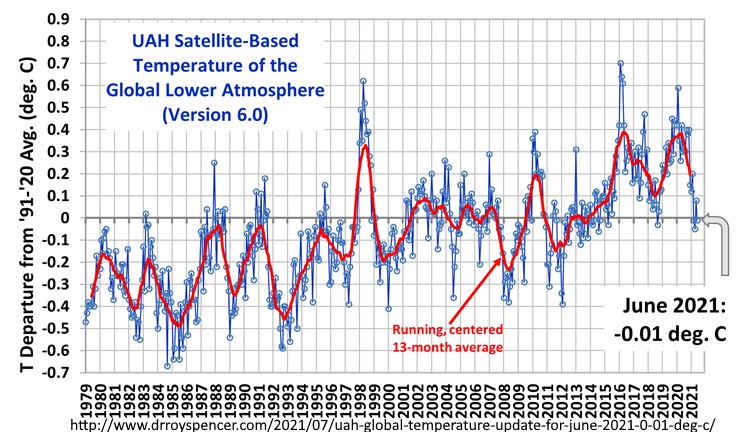
So, how is “global warming” doing. We can consult with Dr. Roy Spencer who manages the Advanced Microwave Scanning Radiometer flying on NASA’s Aqua satellite. This satellite system measures global atmospheric temperature daily. The latest results are seen here:

uah_lt_1979_thru_june_2021_v6


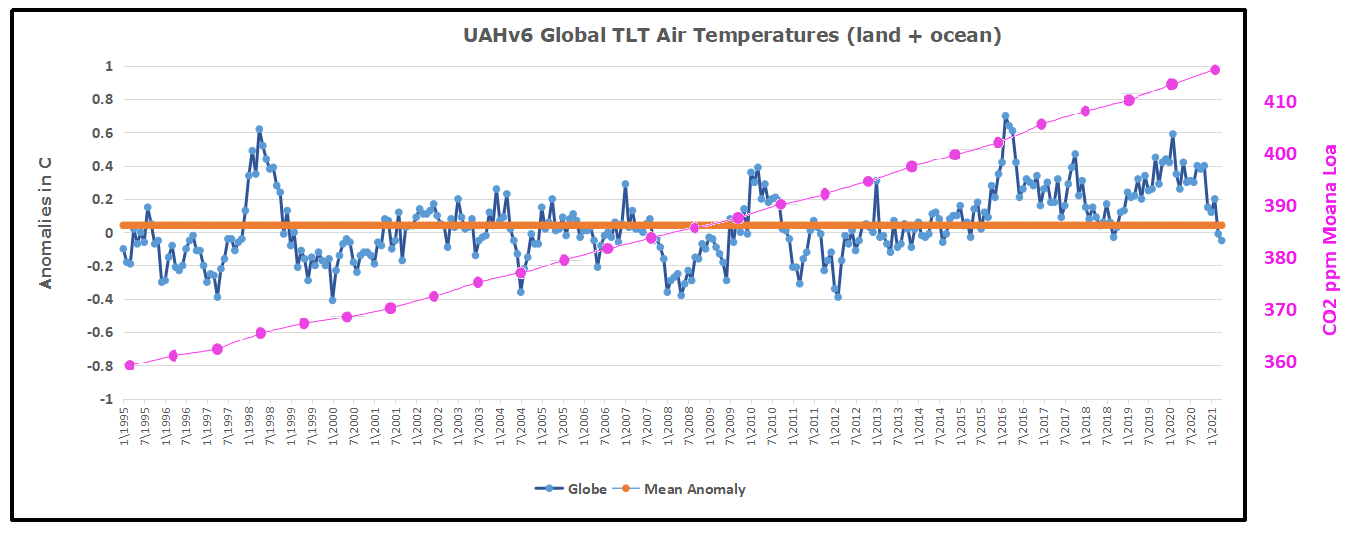
You should notice that global atmospheric temperatures in April, May, and June, 2021, were below the 1991-2020 average and similar to temperatures in 1983. According to the Global Monitoring Laboratory of NOAA at Mauna Loa, Hawaii, atmospheric carbon dioxide was about 340ppm in 1983 versus about 418ppm now. Although there has been deviation from the average due to things like the El Nino-La Nina cycles, there has not been any overall warming in spite of the increase in carbon dioxide.

uah-global-1995to202104-w-co2-overlay

Biden and other climate alarmists have swallowed the climate “Kool-Aid” and claim that reducing just one, small, insignificant factor will be the panacea in controlling global temperature, but it’s not that simple:

“The forcings that drive long-term climate change are not known with an accuracy sufficient to define future climate change.” — James Hansen, “Climate forcings in the Industrial era”, PNAS, Vol. 95, Issue 22, 12753-12758, October 27, 1998.

“In climate research and modeling, we should recognize that we are dealing with a coupled non-linear chaotic system, and therefore that the prediction of a specific future climate state is not possible.” — Final chapter,Third Assessment Report, IPCC 2000.

While controlling CO2 emissions from burning fossil fuels may have some beneficial effects on air quality, it will have no measurable effect on climate, but great detrimental effects on the economy and our standard of living. The greatest danger of climate change is that politicians think they can stop it. But the climate has always been in a state of flux. In my opinion, the debate over global warming is truly a scam designed to control (and tax) production and use of energy from fossil fuels.

The alleged “climate crisis” is just a scam perpetrated for political gain.
“The whole aim of practical politics is to keep the populace alarmed (and hence clamorous to be led to safety) by menacing it with an endless series of hobgoblins, all of them imaginary.” —H. L. Mencken (1880-1956)

(Note to younger readers: The term “Kool-Aid” used in this context refers to cult leader Jim Jones who, on November 18, 1978, instructed all members living in the Jonestown, Guyana compound to commit an act of “revolutionary suicide,” by drinking poisoned punch. Link )

For the real science, see these articles from my blog

See also Biden Climate Agenda Heads into Perfect Storm

gang-green

Green Energy Failures Redux

I was going to end the title of this post with “Deja Vu”, but then changed it to “Redux”, because in this case the return of the past is not an illusion, but an actual imitation of failed policies.  David Blackmon writes in Forbes Biden Seems Determined To Replay Obama Era Green Energy Failures.  Excerpts in italics with my bolds and images.

mrz041312dapr20120413044622

Over the last few weeks, President Joe Biden and members of his administration have mounted a focused effort to sell massive new green energy spending to the American people.

Former Obama-era EPA Administrator Gina McCarthy, now the Biden White House climate adviser, is pushing Congress to include a federal clean electricity standard (CES) to drive investment in renewable energy and billions in subsidies to incentivize changeover further. Secretary of Energy Jenifer Granholm is doing the same.

wind-energy-myth

The fact McCarthy, and an official like Granholm who has a track record of failed green energy subsidies — are leading this effort makes this massive push all the more frustrating. These officials, well-meaning though they may be, should know by now that government energy subsidies overwhelmingly end up financing the well-connected rather than the most innovative, a concern I wrote about in a recent piece. The end result is wasted funds and harm to the sector that the government wants to help.

The trial that Elon Musk’s SolarCity has found itself in this week serves as a timely reminder of just how poorly the Obama-Biden green energy agenda went last time around. Beyond the regulatory and quality assurance issues his space company SpaceX and car company Tesla currently face, including recently violating an FAA launch license, Musk is now actively tangled in a legal battle from the solar panel manufacturer’s merger with Tesla. The billionaire stands accused of defrauding investors by not disclosing that the company was on the verge of bankruptcy and that it was highly risky for Tesla — itself a struggling company at the time — to take on SolarCity’s debt.

cg546ac53103664

SolarCity’s struggles were containable partly because it was awarded federal subsidies and nearly $500 million in Treasury grants. The Obama-Biden administration ended up wasting billions of taxpayer dollars with companies like SolarCity and Solyndra going broke or facing significant trouble soon after receiving the helping hand.

To give you an idea of the program’s effectiveness, the fact that SolarCity still technically exists despite its near-bankruptcy and $29 million settlement with the Department of Justice over the fraud case makes it one of the success stories.

Even when investments turn into actual infrastructure, consumers will be unlikely to reap the benefits. Many have championed the “progress” green energy has made over the last decade in providing a more competitive product, but the facilities are still failing, and the progress has been de minimis in terms of capturing global energy market share.

1l-image-17

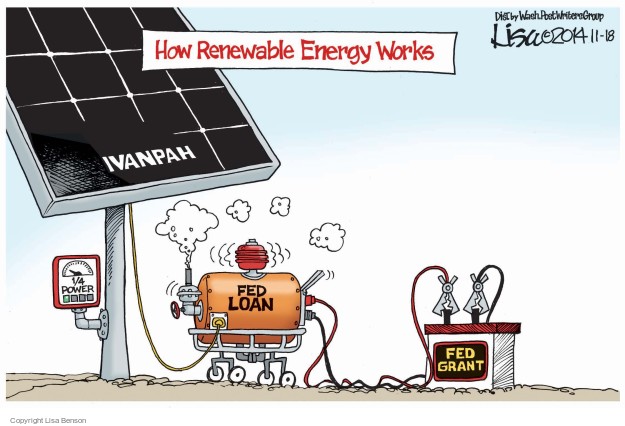
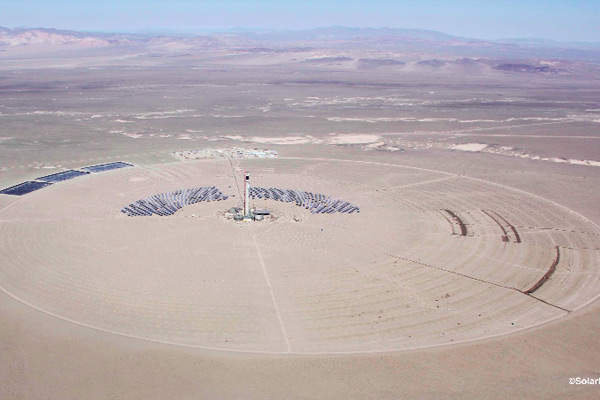
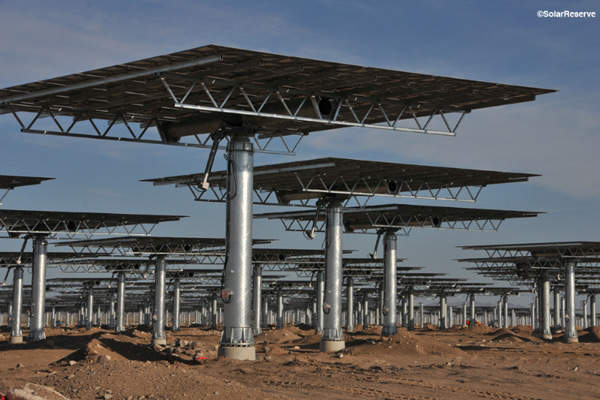
Just last year, the Department of Energy watched as Tonopah Solar Energy LLC in Nevada declared bankruptcy after receiving a $737 million loan from one of their green energy programs. If you can’t make solar panels work in present-day Nevada, how do you expect them to fuel the energy needs of places like Colorado, where Sec. Granholm and Senator John Hickenlooper recently toured a solar garden?

4l-image-9

Utility companies that stand to receive billions in subsidies to upgrade their infrastructure support the measure because it will raise rates on consumers while reducing operating costs. Green energy is less efficient and less reliable, so the cost of operations will undoubtedly go up. But with the government covering the costs of setup and repair, it means more revenue with fewer expenses. This will help stockholders far more than working people.

But the calls from the climate change lobby for action are growing louder. Despite not making it into last month’s bipartisan infrastructure deal, many Democrats hope billions of dollars in green subsidies will find their way into a second infrastructure bill that party officials plan to pass through reconciliation. In fact, some Democrats are threatening to withhold their votes for the bipartisan bill unless they receive guarantees of energy provisions.

energy67_05

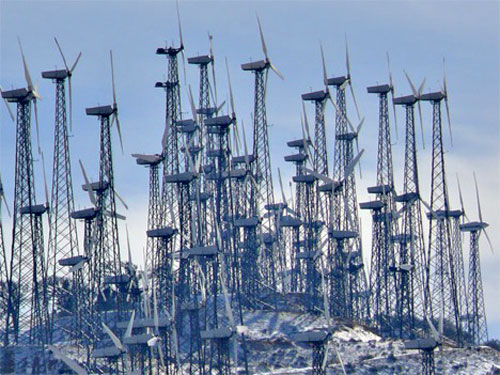
Tehachapi’s dead turbines

Democrats have to pass these measures by party-line vote not because Republicans hate the environment (the GOP has a climate change caucus) but due to the fact that their plan is so costly and ill-advised that even moderate Republicans like Susan Collins and Mitt Romney can’t devise a rationale to reasonably offer support. The hard truth is that renewable energy technology isn’t currently capable of handling America’s growing energy demands and remains unlikely to do so in the future.

While the idea of renewable energy remains appealing, the reality is that fossil fuels, natural gas, and nuclear power will all be necessary to power our nation for decades to come.

Everyone should support innovation in the energy sector, but the subsidy-heavy plan that Democrats continue to push will only lead to wasted dollars and public backlash against a policy of failed projects. Congress has been down this road before. When the Green New Deal first came up, the bill was seen as so ridiculous that Speaker Pelosi wouldn’t even bring it up for a vote. Congressional Democrats should stick to that past wisdom and avoid falling back into this green subsidy trap.

As REN21, an advocacy group consisting of actors from science, governments, NGOs and industry, recently reported, this is a strategy that, from 2009 through 2019, produced virtually no real gain in overall green energy market share despite trillions of dollars in global targeted subsidies. A replaying of this same failed Obama-era strategy, managed by some of the very same officials, promises only to produce similarly failed results, albeit on an even grander scale.

Footnote Q & A:

Q:  What is the difference between Golf and Government?

A:  In Government you can always improve your lie.

–Anonymous Source

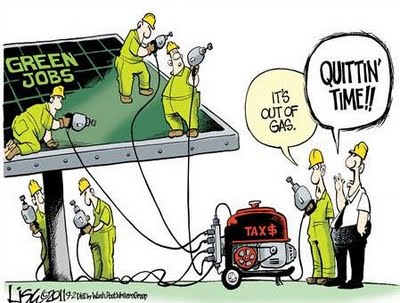
greenjobs

2021 Update: Fossil Fuels ≠ Global Warming

gas in hands

Previous posts addressed the claim that fossil fuels are driving global warming. This post updates that analysis with the latest (2020) numbers from BP Statistics and compares World Fossil Fuel Consumption (WFFC) with three estimates of Global Mean Temperature (GMT). More on both these variables below.

WFFC

2020 statistics are now available from BP for international consumption of Primary Energy sources. 2021 Statistical Review of World Energy. 

The reporting categories are:
Oil
Natural Gas
Coal
Nuclear
Hydro
Renewables (other than hydro)

Note:  British Petroleum (BP) now uses Exajoules to replace MToe (Million Tonnes of oil equivalents.) It is logical to use an energy metric which is independent of the fuel source. OTOH renewable advocates have no doubt pressured BP to stop using oil as the baseline since their dream is a world without fossil fuel energy.

From BP conversion table 1 exajoule (EJ) = 1 quintillion joules (1 x 10^18). Oil products vary from 41.6 to 49.4 tonnes per gigajoule (10^9 joules).  Comparing this annual report with previous years shows that global Primary Energy (PE) in MToe is roughly 24 times the same amount in Exajoules.  The conversion factor at the macro level varies from year to year depending on the fuel mix. The graphs below use the new metric.

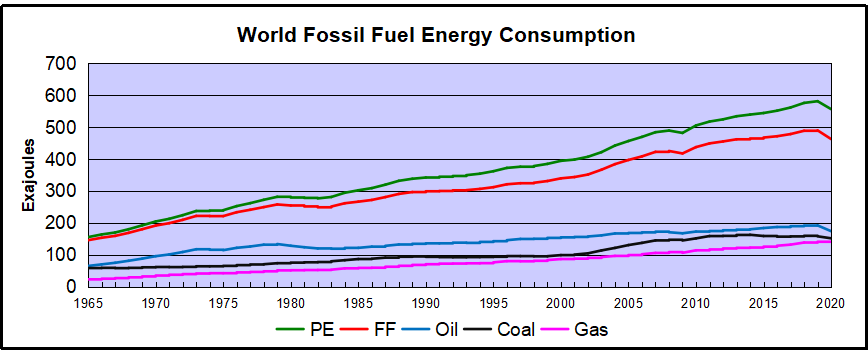
This analysis combines the first three, Oil, Gas, and Coal for total fossil fuel consumption world wide (WFFC).  The chart below shows the patterns for WFFC compared to world consumption of Primary Energy from 1965 through 2020.

WFFC 2020

The graph shows that global Primary Energy (PE) consumption from all sources has grown continuously over 5 decades. Since 1965  oil, gas and coal (FF, sometimes termed “Thermal”) averaged 89% of PE consumed, ranging from 94% in 1965 to 84% in 2019.  Note that last year, 2020, PE dropped 25 EJ (4%) slightly below 2017 consumption.  WFFC for 2020 dropped 27 EJ (6%), 83% of PE and matching 2013 WFFC consumption. For the 55 year period, the net changes were:

Oil 168%
Gas 506%
Coal 161%
WFFC 218%
PE 259%
Global Mean Temperatures

Everyone acknowledges that GMT is a fiction since temperature is an intrinsic property of objects, and varies dramatically over time and over the surface of the earth. No place on earth determines “average” temperature for the globe. Yet for the purpose of detecting change in temperature, major climate data sets estimate GMT and report anomalies from it.

UAH record consists of satellite era global temperature estimates for the lower troposphere, a layer of air from 0 to 4km above the surface. HadSST estimates sea surface temperatures from oceans covering 71% of the planet. HADCRUT combines HadSST estimates with records from land stations whose elevations range up to 6km above sea level.

Both GISS LOTI (land and ocean) and HADCRUT4 (land and ocean) use 14.0 Celsius as the climate normal, so I will add that number back into the anomalies. This is done not claiming any validity other than to achieve a reasonable measure of magnitude regarding the observed fluctuations.

No doubt global sea surface temperatures are typically higher than 14C, more like 17 or 18C, and of course warmer in the tropics and colder at higher latitudes. Likewise, the lapse rate in the atmosphere means that air temperatures both from satellites and elevated land stations will range colder than 14C. Still, that climate normal is a generally accepted indicator of GMT.

Correlations of GMT and WFFC

The next graph compares WFFC to GMT estimates over the five decades from 1965 to 2020 from HADCRUT4, which includes HadSST3.

WFFC and Hadcrut 2020

Since 1965 the increase in fossil fuel consumption is dramatic and monotonic, steadily increasing by 218% from 146 to 463 exajoules.  Meanwhile the GMT record from Hadcrut shows multiple ups and downs with an accumulated rise of 0.9C over 55 years, 7% of the starting value.

The graph below compares WFFC to GMT estimates from UAH6, and HadSST3 for the satellite era from 1980 to 2020, a period of 40 years.

WFFC and UAH HadSST 2020

In the satellite era WFFC has increased at a compounded rate of nearly 2% per year, for a total increase of 82% since 1979. At the same time, SST warming amounted to 0.52C, or 3.7% of the starting value.  UAH warming was 0.7C, or 5% up from 1979.  The temperature compounded rate of change is 0.1% per year, an order of magnitude less than WFFC.  Even more obvious is the 1998 El Nino peak and flat GMT since.

Summary

The climate alarmist/activist claim is straight forward: Burning fossil fuels makes measured temperatures warmer. The Paris Accord further asserts that by reducing human use of fossil fuels, further warming can be prevented.  Those claims do not bear up under scrutiny.

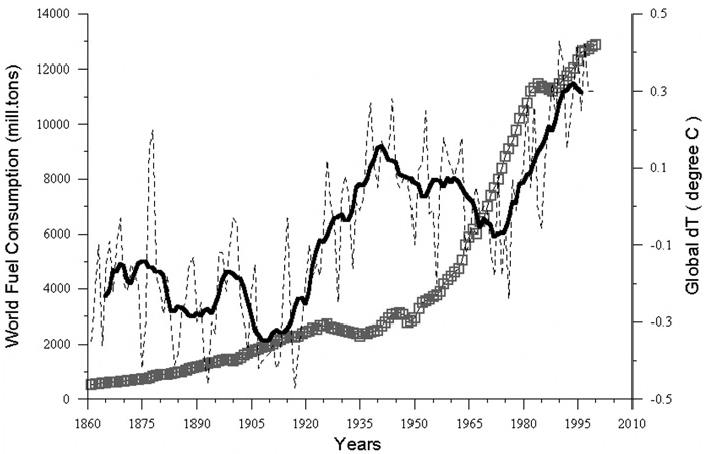
It is enough for simple minds to see that two time series are both rising and to think that one must be causing the other. But both scientific and legal methods assert causation only when the two variables are both strongly and consistently aligned. The above shows a weak and inconsistent linkage between WFFC and GMT.

Going further back in history shows even weaker correlation between fossil fuels consumption and global temperature estimates:

wfc-vs-sat

Figure 5.1. Comparative dynamics of the World Fuel Consumption (WFC) and Global Surface Air Temperature Anomaly (ΔT), 1861-2000. The thin dashed line represents annual ΔT, the bold line—its 13-year smoothing, and the line constructed from rectangles—WFC (in millions of tons of nominal fuel) (Klyashtorin and Lyubushin, 2003). Source: Frolov et al. 2009

In legal terms, as long as there is another equally or more likely explanation for the set of facts, the claimed causation is unproven. The more likely explanation is that global temperatures vary due to oceanic and solar cycles. The proof is clearly and thoroughly set forward in the post Quantifying Natural Climate Change.

Background context for today’s post is at Claim: Fossil Fuels Cause Global Warming.

Alex Epstein on Energizing Puerto Rico

The video covers Alex Epstein’s full Congressional testimony on energy in Puerto Rico — including Q&A.  For those who prefer reading text, I provide below a transcript of most of it, with light editing transposing a spoken presentation into a written one.

Thank you for the honor of testifying before this committee.  What I say today will shock many of you. My views on energy are indeed unconventional, but I hope you hear me out with an open mind since we share the same goal: which is a flourishing and prosperous Puerto Rico.

I want to make the case that the one thing that will most help the people of Puerto Rico lift themselves out of crushing poverty is the thing many of you believe should be eliminated; and that’s low-cost reliable fossil fuel energy.

For just a brief moment I’d like to ask all of you to close your eyes. I’d like you to imagine an ambitious young Puerto Rican woman. I’ll call her Mia. Mia studied hard at the Emilio Delgado high school in Corusol. Mia’s passion is artificial intelligence, and she dreams of working at a high-tech startup. Sadly opportunities are sparse because many companies have fled Puerto Rico, and many more avoid it due to high cost and unreliable energy. So Mia applies for a remote job at a silicon valley tech incubator. But during her interview the electricity suddenly cuts out. The screen goes blank; she hopes it comes back quickly but hours go by with no internet as she waits in the sweltering heat with no AC. Think of Mia’s despair in those moments. Think of how much low-cost reliable energy could have helped her when she needed it most.

I know that every member of this committee shares the same goal I do: A healthy, prosperous and flourishing Puerto Rico. In order to help millions of talented and passionate people like Mia, we must look carefully at the full context of facts about Puerto Rico’s energy options. Here are three crucial facts that i almost never hear discussed about Puerto Rico and I want to highlight them.

First, the percentage of Puerto Ricans currently living in poverty is 43 percent.

Second, the cost of energy in Puerto Rico versus the states is up to three times higher

Third, the per capita income in Puerto Rico is $13, 000.

Honorable members does it strike you as fair that someone earning $13,000 per year should be paying three times what you and I pay for the energy that powers our homes? I don’t think that’s fair and I’m guessing you don’t think so either.

So what’s the solution? While we’re told that solar and wind can provide low-cost reliable energy, nothing could be further from the truth. Because solar and wind are unreliable; they don’t replace reliable power plants, they add to the cost of reliable power plants. The more wind and solar that grids use, the higher their electricity prices. German households have seen prices double in 20 years due to wasteful unreliable solar and wind infrastructure. Their electricity prices are three times ours, which are already too high due to solar and wind.

The only way for Puerto Rico to get low-cost reliable electricity anytime soon is using low-cost reliable fossil fuel energy sources like natural gas and coal, along with some massive regulatory reforms. I discuss in my written testimony actions such as scrapping the Jones act. We owe it to the people of Puerto Rico to give them the full context: The benefits and drawbacks of all their options. This includes recognizing any real coal ash problems, but also recognizing that there are many solutions to coal ash used around the world that don’t require shutting down power plants. Giving Puerto Ricans the full context also includes recognizing that fossil fuels CO2 emissions do impact climate. But it also includes being precise not hysterical about that impact. As I explain in my written testimony there is climate change, but not a climate crisis; and certainly not one that justifies condemning generations of Puerto Ricans to endless poverty by denying them low-cost reliable fossil fuel energy.

The stakes could not be higher. I think about Ellaria Davila who was breathing with the help of a mechanical ventilator. During prolonged blackouts her ventilator shut down and tragically she died. Her autopsy noted plainly that a ventilator “does not work without power.” Ladies and gentlemen: Nothing works without power, not the ventilators, not incubators, not farms nor schools. Not the millions of brave and passionate people who want to provide for their families and live lives of dignity and opportunity. You have it in your power today to help Puerto Ricans gain the power, the low-cost reliable power they need to escape crushing poverty.

I hope that any of you who are interested in this mission will join me on a fact-finding trip to Puerto Rico in the coming weeks. We will have an honest open discussion with Puerto Rican energy experts who are all too often left out of important policy discussions like this one. I would be honored to work with all of your offices, Democrat and Republican, to help the people of Puerto Rico flourish. I look forward to your questions and thank you again for the opportunity to share my perspective with you,

Q: Can you describe the benefits that affordable reliable energy has for communities in general?
A: Sure. Energy is the industry that powers every other industry; the lower cost and more reliable energy is the lower cost and more reliable everything is and vice versa. I just want to stress that Puerto Rico’s energy situation is terrible, and one of the reasons I want to testify today is because nobody is talking about that. They’re talking about, How do we maintain the status quo? The status quo is terrible in Puerto Rico. They desperately need more low-cost reliable energy.

And just a further comment. It doesn’t seem that people here know the facts and the percentages I noted about Puerto Ricans’ situation. For instance, I’m really disappointed that representative Ocasio-Cortez talks about shutting down the coal plant tomorrow. I don’t know if anyone knows what percentage of renewables the whole island has. So its’ 2.5%.

This is so disappointing that we’re talking about this so unseriously, when we really need to highlight the value of low-cost reliable energy and really talk about why Puerto Rico needs much more of it.

Q: In your opinion how will the Biden energy policies impact Puerto Rico?
A: It seems they’re going to make the rest of the US like Puerto Rico. I’m in California, and we’re already seeing this. In my work, I had two projects disrupted last year by blackouts.

We’re also seeing it in Texas. I don’t mean to pick on Representative Ocasio-cCortez, but she tweeted the infrastructures failures in Texas are quite literally what happens when you don’t pursue a green new deal. No, in fact plenty of places around the world can deal with hot and cold when they have enough reliable resilient electricity. Texas defunded reliable resilient electricity including winterization to pay tens of billions of dollars for unreliable solar and wind that don’t work when you need them the most. This energy policy is really the existential threat to talk about. It’s a threat to the US and to make Puerto Rico into a truly and consistently third world county.

Q: Mr Epstein in your testimony you noted that the most promising step that can be taken to lower emissions long term is the development of nuclear. Can you explain a little bit further why you believe nuclear energy Is more effective as a good alternative energy choice?

A: Sure.  It is so wrong that when we talk about potential alternatives to fossil fuels that nuclear is ruled out. You saw with the proposal of the green new deal there was anti-nuclear insistence on renewables which in practice means solar and wind. Renewable mandates usually exclude hydro as well.

This is totally the wrong approach if you’re looking for low carbon alternatives you have to be open to everything. And unfortunately the world is so anti-nuclear today that we’re shutting down record amounts of nuclear capacity this year, even though everyone claims to care about CO2 emissions.  In fact, nuclear provides extremely reliable on-demand power. Every grid in the world that works has on-demand power backing up solar and wind, since batteries do not exist anywhere.

If you’re concerned about coal ash, first of all you need to do real scientific studies that are systematic not just anecdotes and correlations. But if there’s a real problem we know how to solve coal ash problems. There are lots of ways to do that and if you don’t want to use coal in a given location, use natural gas or use nuclear. But the idea of mandating these unreliable solar and wind farms that make energy more expensive wherever they’re used, and then just manipulating data to ignore that fact, that policy is just absolutely devastating for Puerto Rico and anywhere else it’s applied.

In my testimony I noted this is being encouraged around the world by the US. We’re telling India to do this, and Indonesia to do this, places in Africa to do this to try to eliminate fossil fuels when that’s what they need to make their lives better. I think that’s really shameful and and I hope it stops.

Q: Mr. Epstein, you mentioned the need to consider the full context as we assess Puerto Rico’s energy generation. What what are the factors we should consider to understand the full context of the consequences that would stem from closing the AES coal plant?

A: Well, in general we just need to recognize that fossil fuels are the only way for them to get low-cost reliable energy for the foreseeable future. They need far more of it and there are very clear well-documented ways of using fossil fuels in a clean and responsible way. So the fact that there may be a problem with this particular plant, and again that needs to be scientifically studied so you come with a solution. It doesn’t mean we should shut it down; it means we should deal with the problems.

But more broadly, get rid of all the bad regulations and limitations that are preventing Puerto Rico from having low-cost reliable energy and flourishing.

Q: Are these things mutually exclusive? Can there be affordable and reliable energy today relying completely on renewable energy? 

A: I approach it a little bit differently because I think the world just undervalues low-cost reliable energy. Again this is fundamental to human flourishing, and this is something desperately needed around the world. Without low-cost reliable energy from fossil fuels people here can’t claim to care about life expectancy and health. These energy sources have driven down the rate of extreme poverty from over 40 percent people making less than two dollars a day to less than 10% in my lifetime. Access to energy is so important, yet billions of people still lack it. Four and a half billion people are living on less than ten dollars a day.

So my view is the world needs way more energy, and yes, we fortunately have modern technology that can produce it more and more cleanly. But to just look at the side effects of fossil fuels and not look at the benefits, you are condemning people to poverty, to suffering, condemning them to danger.

And I want to just remind everyone: A natural environment is not a good environment. Nature doesn’t give us a clean healthy environment, it gives us a very dirty and unhealthy environment. We need low-cost reliable energy to make the world a very livable place, and those of us who benefit from that in the US should really have sympathy for those in Puerto Rico, let alone the rest of the world that’s really really poor. And we should be doing nothing to impede them from using the most cost effective energy they can.

In conclusion, I would really welcome going on a fact-finding mission with many of you to look into the different energy realities. I think that we can see a way to move forward with cleaner coal, natural gas and nuclear instead of having this crazy dogma that we must rely on unreliable renewables. We should use the most cost-effective energy, and Puerto Rico needs far more of it not less.