Previous posts addressed the claim that fossil fuels are driving global warming. This post updates that analysis with the latest (2024) numbers from Energy Institute and compares World Fossil Fuel Consumption (WFFC) with three estimates of Global Mean Temperature (GMT). More on both these variables below. Note: Previously these same statistics were hosted by BP.
WFFC
2024 statistics are now available from Energy Institute for international consumption of Primary Energy sources. Statistical Review of World Energy.
The reporting categories are:
Oil
Natural Gas
Coal
Nuclear
Hydro
Renewables (other than hydro)
Note: Energy Institute began in 2023 to use Exajoules to replace MToe (Million Tonnes of oil equivalents.) It is logical to use an energy metric which is independent of the fuel source. OTOH renewable advocates have no doubt pressured EI to stop using oil as the baseline since their dream is a world without fossil fuel energy.
From BP conversion table 1 exajoule (EJ) = 1 quintillion joules (1 x 10^18). Oil products vary from 41.6 to 49.4 tonnes per gigajoule (10^9 joules). Comparing this annual report with previous years shows that global Primary Energy (PE) in MToe is roughly 24 times the same amount in Exajoules. The conversion factor at the macro level varies from year to year depending on the fuel mix. The graphs below use the new metric.
This analysis combines the first three, Oil, Gas, and Coal for total fossil fuel consumption world wide (WFFC). The chart below shows the patterns for WFFC compared to world consumption of Primary Energy from 1965 through 2024.
The graph shows that global Primary Energy (PE) consumption from all sources has grown continuously over nearly 6 decades. Since 1965 oil, gas and coal (FF, sometimes termed “Thermal”) averaged 88% of PE consumed, ranging from 93% in 1965 to 81% in 2024. Note that in 2020, PE dropped 21 EJ (4%) below 2019 consumption, then increased 31 EJ in 2021. WFFC for 2020 dropped 24 EJ (5%), then in 2021 gained back 26 EJ to slightly exceed 2019 WFFC consumption. For the 60 year period, all net changes were increases from previous years and were:
Oil
207%
Gas
555%
Coal
183%
WFFC
252%
PE
308%
Global Mean Temperatures
Everyone acknowledges that GMT is a fiction since temperature is an intrinsic property of objects, and varies dramatically over time and over the surface of the earth. No place on earth determines “average” temperature for the globe. Yet for the purpose of detecting change in temperature, major climate data sets estimate GMT and report anomalies from it.
UAH record consists of satellite era global temperature estimates for the lower troposphere, a layer of air from 0 to 4km above the surface. HadSST estimates sea surface temperatures from oceans covering 71% of the planet. HadCRUT combines HadSST estimates with records from land stations whose elevations range up to 6km above sea level.
Both GISS LOTI (land and ocean) and HadCRUT4 (land and ocean) use 14.0 Celsius as the climate normal, so I will add that number back into the anomalies. This is done not claiming any validity other than to achieve a reasonable measure of magnitude regarding the observed fluctuations.[Note: HadCRUT4 was discontinued after 2021 in favor of HadCRUT5.]
No doubt global sea surface temperatures are typically higher than 14C, more like 17 or 18C, and of course warmer in the tropics and colder at higher latitudes. Likewise, the lapse rate in the atmosphere means that air temperatures both from satellites and elevated land stations will range colder than 14C. Still, that climate normal is a generally accepted indicator of GMT.
Correlations of GMT and WFFC
The next graph compares WFFC to GMT estimates over the decades from 1965 to 2024 from HadCRUT5, which includes HadSST4.
Since 1965 the increase in fossil fuel consumption is dramatic and monotonic, steadily increasing by 252% from 146 to 513 exajoules. Meanwhile the GMT record from Hadcrut shows multiple ups and downs with an accumulated rise of 1.4C over 60 years, 10% of the starting value.
The graph below compares WFFC to GMT estimates from UAH6, and HadSST4 for the satellite era from 1980 to 2024 a period of 45 years.
In the satellite era WFFC has increased at a compounded rate of 1.5% per year, for a total increase of 99% since 1980. At the same time, SST warming amounted to 0.8C, or 5.6% of the starting value. UAH warming was 1.1C, or 8% up from 1979. The temperature compounded rate of change is 0.1% per year for HadSST4, and 0.2% per year for UAH, an order of magnitude less than WFFC. Even more obvious is the 1998 El Nino peak and flat GMT until 2023-24.
Summary
The climate alarmist/activist claim is straight forward: Burning fossil fuels makes measured temperatures warmer. The Paris Accord further asserts that by reducing human use of fossil fuels, further warming can be prevented. Those claims do not bear up under scrutiny.
It is enough for simple minds to see that two time series are both rising and to think that one must be causing the other. But both scientific and legal methods assert causation only when the two variables are both strongly and consistently aligned. The above shows a weak and inconsistent linkage between WFFC and GMT.
Going further back in history shows even weaker correlation between fossil fuels consumption and global temperature estimates:
Figure 5.1. Comparative dynamics of the World Fuel Consumption (WFC) and Global Surface Air Temperature Anomaly (ΔT), 1861-2000. The thin dashed line represents annual ΔT, the bold line—its 13-year smoothing, and the line constructed from rectangles—WFC (in millions of tons of nominal fuel) (Klyashtorin and Lyubushin, 2003). Source: Frolov et al. 2009
In legal terms, as long as there is another equally or more likely explanation for the set of facts, the claimed causation is unproven. The more likely explanation is that global temperatures vary due to oceanic and solar cycles. The proof is clearly and thoroughly set forward in the post Quantifying Natural Climate Change.
Footnote: CO2 Concentrations Compared to WFFC
Contrary to claims that rising atmospheric CO2 consists of fossil fuel emissions, consider the Mauna Loa CO2 observations in recent years.
Despite the drop in 2020 WFFC, atmospheric CO2 continued to rise steadily, demonstrating that natural sources and sinks drive the amount of CO2 in the air.
Negotiators from across the globe will gather in Baku, Azerbaijan, for the twenty-ninth annual UN climate change conference on November 11. COP29 marks the midpoint of the “COP Presidencies Troika,” a collaborative effort between the United Arab Emirates (UAE, host to COP28) and Brazil (host to COP30 in 2025) aimed at accelerating progress toward the 1.5°C goal. Unlike COP28 in Dubai last year, which hosted a record hundred thousand attendees, COP29 will be smaller, with Baku expected to host around fifty thousand participants.
The selection of Azerbaijan as the host country has raised concerns about the credibility and integrity of the COP process. COP29 marks the third time a significant fossil fuel-producing country has hosted the conference, and the second time in two years. Azerbaijani President Ilham Aliyev has announced plans to increase gas production in part to satisfy European Union (EU) demands and referred to the country’s oil and gas reserves as “a gift from God.”
What’s on the Agenda–Three Pledges Are Proposed
Reducing emissions and increasing green energy.The presidency has put forward a series of commitments for investing in renewable energy, such as a Global Energy Storage and Grids Pledge, which aims to enhance energy infrastructure and storage capabilities worldwide, an ambitious Hydrogen Declaration, and a Declaration on Reducing Methane from Organic Waste. With the Green Digital Action Declaration, COP29 leadership seeks to reduce emissions in the information and communication sectors. The agenda, however, makes no direct mention of a transition from fossil fuels.
Building climate resilience. The COP presidency has put forth a climate initiative for farmers and a declaration calling for integrated approaches to combating climate threats to water basins and ecosystems. Additionally, Baku aims to present the Initiative on Human Development for Climate Resilience, which focuses on education, skills, health, and well-being, and the COP29 Multisectoral Actions Pathways (MAP) Declaration that aims to enhance urban climate resilience.
New climate finance targets. Nations are expected to replace the previous $100 billion annual commitment to developing countries from the 2009 Copenhagen Accord. The new target, known as the New Collective Quantified Goal (NCQG), will be under discussion at November’s COP and is intended to take effect from 2025 onwards. A 2022 report[PDF] by the Independent High-level Expert Group on Climate Finance found that developing countries need around $1 trillion per year by 2025, and $2.4 trillion by 2030 to meet their climate finance needs. Among the most contentious issues that remain are how much money developed nations will provide, and who should provide climate finance.
Yes, those are Trillions of US$ they are projecting to spend.
My Comments
Since there is a big push on climate funding, maybe they could get to the bottom of this:
Maybe donors are put off by no one knowing who gets the money and for what it is spent. And while they are investigating, how about understanding Energy Return on Investment (EROI): you know, the notion that an energy project is worth doing if the energy produced is greater than energy spent. The windmills in the logo at the top reminded me of this:
Why a COP Briefing?
Actually, climate hysteria is like a seasonal sickness. Each year a contagion of anxiety and fear is created by disinformation going viral in both legacy and social media in the run up to the annual autumnal COP. Since the climatists have put themselves at the controls of the formidable US federal government, we can expect the public will be hugely hosed with alarms over the next few weeks. Before the distress signals go full tilt, individuals need to inoculate themselves against the false claims, in order to build some herd immunity against the nonsense the media will promulgate. This post is offered as a means to that end.
Media Climate Hype is a Cover Up
Back in 2015 in the run up to Paris COP, French mathematicians published a thorough critique of the raison d’etre of the whole crusade. They said:
Fighting Global Warming is Absurd, Costly and Pointless.
Absurd because of no reliable evidence that anything unusual is happening in our climate.
Costly because trillions of dollars are wasted on immature, inefficient technologies that serve only to make cheap, reliable energy expensive and intermittent.
Pointless because we do not control the weather anyway.
The prestigious Société de Calcul Mathématique (Society for Mathematical Calculation) issued a detailed 195-page White Paper presenting a blistering point-by-point critique of the key dogmas of global warming. The synopsis with links to the entire document is at COP Briefing for Realists
Even without attending to their documentation, you can tell they are right because all the media climate hype is concentrated against those three points.
Finding: Nothing unusual is happening with our weather and climate. Hype: Every metric or weather event is “unprecedented,” or “worse than we thought.”
Finding: Proposed solutions will cost many trillions of dollars for little effect or benefit. Hype: Zero carbon will lead the world to do the right thing. Anyway, the planet must be saved at any cost.
Finding: Nature operates without caring what humans do or think. Hype: Any destructive natural event is blamed on humans burning fossil fuels.
How the Media Throws Up Flak to Defend False Suppositions
The Absurd Media: Climate is Dangerous Today, Yesterday It was Ideal.
Billions of dollars have been spent researching any and all negative effects from a warming world: Everything from Acne to Zika virus. A recent Climate Report repeats the usual litany of calamities to be feared and avoided by submitting to IPCC demands. The evidence does not support these claims. An example:
It is scientifically established that human activities produce GHG emissions, which accumulate in the atmosphere and the oceans, resulting in warming of Earth’s surface and the oceans, acidification of the oceans, increased variability of climate, with a higher incidence of extreme weather events, and other changes in the climate.
Moreover, leading experts believe that there is already more than enough excess heat in the climate system to do severe damage and that 2C of warming would have very significant adverse effects, including resulting in multi-meter sea level rise.
Experts have observed an increased incidence of climate-related extreme weather events, including increased frequency and intensity of extreme heat and heavy precipitation events and more severe droughts and associated heatwaves. Experts have also observed an increased incidence of large forest fires; and reduced snowpack affecting water resources in the western U.S. The most recent National Climate Assessment projects these climate impacts will continue to worsen in the future as global temperatures increase.
Alarming Weather and Wildfires
But: Weather is not more extreme.
And Wildfires were worse in the past. But: Sea Level Rise is not accelerating.
Litany of Changes
Seven of the ten hottest years on record have occurred within the last decade; wildfires are at an all-time high, while Arctic Sea ice is rapidly diminishing.
We are seeing one-in-a-thousand-year floods with astonishing frequency.
When it rains really hard, it’s harder than ever.
We’re seeing glaciers melting, sea level rising.
The length and the intensity of heatwaves has gone up dramatically.
Plants and trees are flowering earlier in the year. Birds are moving polewards.
We’re seeing more intense storms.
But: Arctic Ice has not declined since 2007.
But: All of these are within the range of past variability.In fact our climate is remarkably stable, compared to the range of daily temperatures during a year where I live.
And many aspects follow quasi-60 year cycles.
The Impractical Media: Money is No Object in Saving the Planet.
Here it is blithely assumed that the UN can rule the seas to stop rising, heat waves to cease, and Arctic ice to grow (though why we would want that is debatable). All this will be achieved by leaving fossil fuels in the ground and powering civilization with windmills and solar panels. While admitting that our way of life depends on fossil fuels, they ignore the inadequacy of renewable energy sources at their present immaturity.
An Example: The choice between incurring manageable costs now and the incalculable, perhaps even irreparable, burden Youth Plaintiffs and Affected Children will face if Defendants fail to rapidly transition to a non-fossil fuel economy is clear. While the full costs of the climate damages that would result from maintaining a fossil fuel-based economy may be incalculable, there is already ample evidence concerning the lower bound of such costs, and with these minimum estimates, it is already clear that the cost of transitioning to a low/no carbon economy are far less than the benefits of such a transition. No rational calculus could come to an alternative conclusion. Defendants must act with all deliberate speed and immediately cease the subsidization of fossil fuels and any new fossil fuel projects, and implement policies to rapidly transition the U.S. economy away from fossil fuels.
But CO2 relation to Temperature is Inconsistent.
But: The planet is greener because of rising CO2.
But: Modern nations (G20) depend on fossil fuels for nearly 90% of their energy.
But: Renewables are not ready for prime time.
People need to know that adding renewables to an electrical grid presents both technical and economic challenges. Experience shows that adding intermittent power more than 10% of the baseload makes precarious the reliability of the supply. South Australia is demonstrating this with a series of blackouts when the grid cannot be balanced. Germany got to a higher % by dumping its excess renewable generation onto neighboring countries until the EU finally woke up and stopped them. Texas got up to 29% by dumping onto neighboring states, and some like Georgia are having problems.
But more dangerous is the way renewables destroy the economics of electrical power. Seasoned energy analyst Gail Tverberg writes:
In fact, I have come to the rather astounding conclusion that even if wind turbines and solar PV could be built at zero cost, it would not make sense to continue to add them to the electric grid in the absence of very much better and cheaper electricity storage than we have today. There are too many costs outside building the devices themselves. It is these secondary costs that are problematic. Also, the presence of intermittent electricity disrupts competitive prices, leading to electricity prices that are far too low for other electricity providers, including those providing electricity using nuclear or natural gas. The tiny contribution of wind and solar to grid electricity cannot make up for the loss of more traditional electricity sources due to low prices.
The Irrational Media: Whatever Happens in Nature is Our Fault.
An Example:
Other potential examples include agricultural losses. Whether or not insurance reimburses farmers for their crops, there can be food shortages that lead to higher food prices (that will be borne by consumers, that is, Youth Plaintiffs and Affected Children). There is a further risk that as our climate and land use pattern changes, disease vectors may also move (e.g., diseases formerly only in tropical climates move northward).36 This could lead to material increases in public health costs
But: Actual climate zones are local and regional in scope, and they show little boundary change.
But: Ice cores show that it was warmer in the past, not due to humans.
The hype is produced by computer programs designed to frighten and distract children and the uninformed. For example, there was mention above of “multi-meter” sea level rise. It is all done with computer models. For example, below is San Francisco. More at USCS Warnings of Coastal Floodings
In addition, there is no mention that GCMs projections are running about twice as hot as observations.
Omitted is the fact GCMs correctly replicate tropospheric temperature observations only when CO2 warming is turned off.
Figure 5. Simplification of IPCC AR5 shown above in Fig. 4. The colored lines represent the range of results for the models and observations. The trends here represent trends at different levels of the tropical atmosphere from the surface up to 50,000 ft. The gray lines are the bounds for the range of observations, the blue for the range of IPCC model results without extra GHGs and the red for IPCC model results with extra GHGs.The key point displayed is the lack of overlap between the GHG model results (red) and the observations (gray). The nonGHG model runs (blue) overlap the observations almost completely.
In the effort to proclaim scientific certainty, neither the media nor IPCC discuss the lack of warming since the 1998 El Nino, despite two additional El Ninos in 2010 and 2016.
Further they exclude comparisons between fossil fuel consumption and temperature changes. The legal methodology for discerning causation regarding work environments or medicine side effects insists that the correlation be strong and consistent over time, and there be no confounding additional factors. As long as there is another equally or more likely explanation for a set of facts, the claimed causation is unproven. Such is the null hypothesis in legal terms: Things happen for many reasons unless you can prove one reason is dominant.
Finally, advocates and IPCC are picking on the wrong molecule. The climate is controlled not by CO2 but by H20. Oceans make climate through the massive movement of energy involved in water’s phase changes from solid to liquid to gas and back again. From those heat transfers come all that we call weather and climate: Clouds, Snow, Rain, Winds, and Storms.
Esteemed climate scientist Richard Lindzen ended a very fine recent presentation with this description of the climate system:
I haven’t spent much time on the details of the science, but there is one thing that should spark skepticism in any intelligent reader. The system we are looking at consists in two turbulent fluids interacting with each other. They are on a rotating planet that is differentially heated by the sun. A vital constituent of the atmospheric component is water in the liquid, solid and vapor phases, and the changes in phase have vast energetic ramifications. The energy budget of this system involves the absorption and reemission of about 200 watts per square meter. Doubling CO2 involves a 2% perturbation to this budget. So do minor changes in clouds and other features, and such changes are common. In this complex multifactor system, what is the likelihood of the climate (which, itself, consists in many variables and not just globally averaged temperature anomaly) is controlled by this 2% perturbation in a single variable? Believing this is pretty close to believing in magic. Instead, you are told that it is believing in ‘science.’ Such a claim should be a tip-off that something is amiss. After all, science is a mode of inquiry rather than a belief structure.
Summary: From this we learn three things:
Climate warms and cools without any help from humans.
Warming is good and cooling is bad. The hypothetical warming from CO2 would be a good thing.
Previous posts addressed the claim that fossil fuels are driving global warming. This post updates that analysis with the latest (2023) numbers from Energy Institute and compares World Fossil Fuel Consumption (WFFC) with three estimates of Global Mean Temperature (GMT). More on both these variables below. Note: Previously these same statistics were hosted by BP.
WFFC
2023 statistics are now available from Energy Institute for international consumption of Primary Energy sources. Statistical Review of World Energy.
The reporting categories are:
Oil
Natural Gas
Coal
Nuclear
Hydro
Renewables (other than hydro)
Note: Energy Institute began last year to use Exajoules to replace MToe (Million Tonnes of oil equivalents.) It is logical to use an energy metric which is independent of the fuel source. OTOH renewable advocates have no doubt pressured EI to stop using oil as the baseline since their dream is a world without fossil fuel energy.
From BP conversion table 1 exajoule (EJ) = 1 quintillion joules (1 x 10^18). Oil products vary from 41.6 to 49.4 tonnes per gigajoule (10^9 joules). Comparing this annual report with previous years shows that global Primary Energy (PE) in MToe is roughly 24 times the same amount in Exajoules. The conversion factor at the macro level varies from year to year depending on the fuel mix. The graphs below use the new metric.
This analysis combines the first three, Oil, Gas, and Coal for total fossil fuel consumption world wide (WFFC). The chart below shows the patterns for WFFC compared to world consumption of Primary Energy from 1965 through 2023.
The graph shows that global Primary Energy (PE) consumption from all sources has grown continuously over nearly 6 decades. Since 1965 oil, gas and coal (FF, sometimes termed “Thermal”) averaged 88% of PE consumed, ranging from 93% in 1965 to 82% in 2023. Note that in 2020, PE dropped 21 EJ (4%) below 2019 consumption, then increased 31 EJ in 2021. WFFC for 2020 dropped 24 EJ (5%), then in 2021 gained back 26 EJ to slightly exceed 2019 WFFC consumption. For the 59 year period, all net changes were increases from previous years and were:
Oil
203%
Gas
536%
Coal
182%
WFFC
246%
PE
297%
Global Mean Temperatures
Everyone acknowledges that GMT is a fiction since temperature is an intrinsic property of objects, and varies dramatically over time and over the surface of the earth. No place on earth determines “average” temperature for the globe. Yet for the purpose of detecting change in temperature, major climate data sets estimate GMT and report anomalies from it.
UAH record consists of satellite era global temperature estimates for the lower troposphere, a layer of air from 0 to 4km above the surface. HadSST estimates sea surface temperatures from oceans covering 71% of the planet. HadCRUT combines HadSST estimates with records from land stations whose elevations range up to 6km above sea level.
Both GISS LOTI (land and ocean) and HadCRUT4 (land and ocean) use 14.0 Celsius as the climate normal, so I will add that number back into the anomalies. This is done not claiming any validity other than to achieve a reasonable measure of magnitude regarding the observed fluctuations.[Note: HadCRUT4 was discontinued after 2021 in favor of HadCRUT5.]
No doubt global sea surface temperatures are typically higher than 14C, more like 17 or 18C, and of course warmer in the tropics and colder at higher latitudes. Likewise, the lapse rate in the atmosphere means that air temperatures both from satellites and elevated land stations will range colder than 14C. Still, that climate normal is a generally accepted indicator of GMT.
Correlations of GMT and WFFC
The next graph compares WFFC to GMT estimates over the decades from 1965 to 2023 from HadCRUT4, which includes HadSST4.
Since 1965 the increase in fossil fuel consumption is dramatic and monotonic, steadily increasing by 246% from 146 to 505 exajoules. Meanwhile the GMT record from Hadcrut shows multiple ups and downs with an accumulated rise of 0.8C over 56 years, 6% of the starting value.
The graph below compares WFFC to GMT estimates from UAH6, and HadSST4 for the satellite era from 1980 to 2023 a period of 44 years.
In the satellite era WFFC has increased at a compounded rate of 1.5% per year, for a total increase of 97% since 1979. At the same time, SST warming amounted to 0.76C, or 5% of the starting value. UAH warming was 0.85C, or 6% up from 1979. The temperature compounded rate of change is 0.1% per year, an order of magnitude less than WFFC. Even more obvious is the 1998 El Nino peak and flat GMT since.
Summary
The climate alarmist/activist claim is straight forward: Burning fossil fuels makes measured temperatures warmer. The Paris Accord further asserts that by reducing human use of fossil fuels, further warming can be prevented. Those claims do not bear up under scrutiny.
It is enough for simple minds to see that two time series are both rising and to think that one must be causing the other. But both scientific and legal methods assert causation only when the two variables are both strongly and consistently aligned. The above shows a weak and inconsistent linkage between WFFC and GMT.
Going further back in history shows even weaker correlation between fossil fuels consumption and global temperature estimates:
Figure 5.1. Comparative dynamics of the World Fuel Consumption (WFC) and Global Surface Air Temperature Anomaly (ΔT), 1861-2000. The thin dashed line represents annual ΔT, the bold line—its 13-year smoothing, and the line constructed from rectangles—WFC (in millions of tons of nominal fuel) (Klyashtorin and Lyubushin, 2003). Source: Frolov et al. 2009
In legal terms, as long as there is another equally or more likely explanation for the set of facts, the claimed causation is unproven. The more likely explanation is that global temperatures vary due to oceanic and solar cycles. The proof is clearly and thoroughly set forward in the post Quantifying Natural Climate Change.
Footnote: CO2 Concentrations Compared to WFFC
Contrary to claims that rising atmospheric CO2 consists of fossil fuel emissions, consider the Mauna Loa CO2 observations in recent years.
Despite the drop in 2020 WFFC, atmospheric CO2 continued to rise steadily, demonstrating that natural sources and sinks drive the amount of CO2 in the air.
Well since this question has only been answered by those who want to say no such science exists It has to be answered.
Here is an absolute proof that there is no global warming going on. It absolutely has no denial possible.
In 1899 there was a large swath of the Southern USA that was used for Commercial Citrus Growing. Citrus Trees do not tolerate hard freezing. In fact they are tropical plants with only very slight ability to withstand freezing conditions. Their fruit is even more tender, and so a Commercial Producer cannot tolerate any significant extended freezing. In Florida for example the Citrus producers have methods to withstand FROST. These are pretty amazing. (See photo above)
They literally spray their trees with water so that as the water freezes it prevents the citrus from freezing as the sugar content keeps the freezing point slightly lower than water. This method only works against light freezes of short duration. It often results in having to sell the crop in a rush to juice operations at loss of value.
So Citrus Commercial Production is prevented in all but areas with 365 day growing seasons.
The large swath of growing included about 1/2 of eastern Texas essentially south of Tyler Texas. It included almost all of Louisiana south of Interstate 20. It included Most of Mississippi south of Jackson and across Alabama up to Evergreen. It then extended across Georgia essentially from Columbus to Augusta and then up South Carolina all the way to North Carolina and a coastal strip of North Carolina up to almost Virginia. It also included All of Florida.
Basically this map shows in Zone 8b and slightly into Zone 8a the region that used to raise citrus. Today none can be raised outside of Zone 9b or higher. Actually the only safe in zone 10.
Today due to severe cooling of the environment, it only includes 4 of the most southern counties along the Rio Grande Valley in Texas and the southern part of Florida. Over the past 120 years, this has almost deleted Citrus growing from much of the southern part of North America.
This is the remaining Florida range of Citrus.
There is no remaining commercial citrus in Louisiana, Mississippi, Alabama, Georgia, South Carolina or North Carolina.
Now if you were to pick any location that was better for determining the global temperature you could not do it. This is the focal point for all of the global heat circulation of the world’s oceans. The heat focuses on the Yucatan Channel, goes through into the Gulf of Mexico forms a loop, shearing off much rainfall and heat into the Southeastern USA and subsequently going out the Florida Strait as the Gulf Stream, the world’s largest and warmest ocean current.
As such the temperature and climate of the area is the best representation of the world climate condition.
This is the reason that of the wettest states in the USA 4 of the top 5 are in this area.
Now that is fact. That is solid evidence. Silly claims and graphs cannot refute it.
Now some may point to an occasional remaining group of trees or such , but the fact is that commercial citrus is out of that region. The remnants are proof of exactly what I have said here.
Probability of a Hard Freeze under ENSO neutral conditions. Source: National Weather Service
The latest edition of the State of the Climate Report, published this week in the journal BioScience, begins rather ominously: “Life on planet Earth is under siege. We are now in an uncharted territory.” These sentences are meant to instill abject fear and evoke a sense of doom in the general public. However, they are patently absurd and ought to be disregarded outright.
Like almost every climate change report I’ve come across, the 2023 State of the Climate Report is full of red herrings and bombastic assertions that are intended to alarm the public into believing that climate change is an existential threat that must be stopped at all costs, regardless of the collateral damage and unintended consequences that their so-called solutions would inevitably bring to bear.
But what I find most alarming about this particular report, which 15,000 scientists signed, is the anti-human and anti-progress message that lies at the heart of it.
These messages are most prevalent in the part of the report titled “Scientists’ warning recommendations,” which includes “coordinated efforts” intended to “support a broader agenda focused on holistic and equitable climate policy.”
The authors erroneously claim that “economic growth” is the driver of the climate crisis and that it prevents them from achieving their “social, climate, and biodiversity goals.” Unsurprisingly, they lay the blame on the world’s most prosperous nations, particularly those located in the “global north,” which they argue are preventing the need for “decoupling economic growth from harmful environmental impacts.” As such, they suggest we “change our economy to a system that supports meeting basic needs for all people instead of excessive consumption by the wealthy.”
As it turns out, this type of economic system has been implemented
many times over, most notably in the Soviet Union.
The results, in every single case, were downright dreadful.
In other words, these scientists dismiss the fact that economic growth under a free-market capitalist system, which has produced myriad technological advancements and innovations that have significantly improved the human experience in recent centuries, is a net positive. Casting economic growth and free enterprise in a mostly negative light is ludicrous. Thanks to economic growth over the past few decades alone, humans are living longer than ever before, in less poverty than ever before, are able to communicate across the world in the blink of an eye, and live more comfortably than ever before.
In their misguided worldview, economic growth is a net harm because it does not automatically allocate resources in an equitable manner.Spoiler alert: neither does socialism. Apparently, these scientists are unaware that as President John F. Kennedy famously put it, “a rising tide lifts all boats.”
Aside from their anti-economic growth stance, the authors also recommend “eliminating” “fossil fuels” and “transitioning away from coal” while calling for “funding to build out renewable energy capacity.” Based on statements like these, I wonder if the scientists who produce these types of reports are delusional.
If we were to eliminate fossil fuels and stop using coal as a fuel source,
the entire global economy would grind to a halt,
billions of people would suffer, and millions would die.
But maybe that is the point, or at least a part of it. One of the last recommendations the scientists make is downright chilling: “gradually decrease the human population.”
Make no mistake, for decades, climate-change zealots have been calling for degrowth and depopulation. From Paul Ehrlich to Rep. Alexandria Ocasio-Cortez (D-NY), the list is too long to catalogue. For some strange reason, this call for depopulation and degrowth is resonating across academia and the illiberal Left. Even worse, it seems to be in vogue among today’s youth.
Across the West or “global north,” birth rates have been declining precipitously. In many countries, including the United States, the birth rate has dropped below the level of replacement.
Sadly, the climate change-industrial complex, a multi-trillion-dollar money machine, has irrevocably corrupted the once-hallowed scientific community. As most scientists know, though are probably less-than-willing to go on record for fear of cancelation and loss of grants and such, climate change is not an existential threat. However, if we unflinchingly take their recommendations as gospel, and plow forward with their idiotic degrowth and depopulation agenda, you better believe humanity will face an existential crisis like none before: the possible extinction of the human species.
Addendum: Zero CO2 is a Suicide Pact (Dr. Happer)
Biznews published excerpts from an interview with Dr. William Happer Sign Elimination of CO2 is a suicide pact. Text below in italiics with my bolds and added images.
Overview
It’s safe to assume no one consciously sets out to challenge a narrative as deeply entrenched and emotionally charged as climate change. Dr William Happer, an American physicist and Professor Emeritus in the Department of Physics at Princeton University, certainly didn’t. It was only in 1991, upon Happer’s appointment by President George W Bush as director of Energy Research in the US Department of Energy, that his interaction with climate change authorities – and their refusal to engage in customary scientific debate on climate change – piqued his interest.
Thereafter, Happer was dismissed for his contrarian views and ‘head butting’ with climate change luminary Al Gore, only to be brought back to Washington by former president Donald Trump in 2018. BizNews spoke to Happer about his prodigious career and discovery that the burgeoning climate change hysteria had no scientific basis. Happer meticulously detailed why and how CO2, the “demon gas”, is not a pollutant but is essential to mankind’s prosperity.
Professor William Happer on the effect of carbon dioxide on planet Earth
Carbon dioxide is what drives life on Earth. The growth of plants depends on carbon dioxide. The carbon dioxide in the air diffuses into the leaves of plants through little holes, and the plants combine this with water and it requires energy. This energy comes from sunlight. So, the combination of carbon dioxide, the so-called pollutant, water and sunlight is what makes life. You know, that’s what we live on. And carbon dioxide at the present time is much lower [in] concentration than has prevailed over most of geological history. [During] most of geological history, it’s pretty clear from proxy records, CO2 levels have been two or three times greater than they are now.
We probably don’t have enough fossil fuels around to restore those levels
where plants evolve and where they function best.
But even the relatively small increases we’ve had – from maybe 280, 300 parts per million 200 years ago to a little over 400 today – that’s not a big increase. It’s 35%, maybe. But it has caused greening all around the Earth. You can see that from satellites looking down over the last two or three decades. Earth is getting greener. Especially arid regions are getting greener. You know, the edges of the great deserts of the Earth are shrinking. They’re not growing, they are shrinking.
They’re shrinking because of more CO2. And the reason is that there are a number of benefits from more CO2, but one of the most important ones is that if there’s more CO2, plants can live with less water. They don’t waste as much water with more CO2 in the air, because they grow leaves with fewer holes in them so they don’t leak as much water. And the little holes, the stomata – the little mouths, that’s what it means and it’s where the CO2 comes in – don’t open as wide. So, the problem with sucking CO2 out of the air, which is what plants have to do, is for every CO2 molecule that diffuses into your leaf, you lose a hundred water molecules diffusing the other way. This is a real dilemma for the planet.
It’s true. CO2 is a greenhouse gas and it warms the Earth,
but the warming isn’t enough to matter.
It’s very small. And so, it’s probably beneficial on balance. If you double CO2, it seems like a lot, that’s a 100% increase of CO2. How much does that affect the cooling radiation that goes off to space? That sounds like a lot, but in effect it only decreases the radiation to space by 1%. So, 100% increase of CO2, 1% decrease in radiation to space. It’s a very small effect, and you don’t have to change the Earth’s temperature very much or cloudiness very much to bring it back into equilibrium with the situation before you increase the CO2.
So, it’s an ineffective climate influencer. Yet you get this demon gas that is going to cause us all to boil to death or something like that. Nothing could be further from the truth. It’s a trivial gas, but it’s very, very good for life on Earth. More CO2 has been wonderful for mankind because it helps provide the abundance of food we have today and it’s caused no harm, whatsoever.
On climate change activism having become like a religious cult
It is a religious cult for many people. Many people have stopped believing in traditional religions, you know? So, they don’t believe in God, but they need something beyond themselves to believe in. What could be more noble than saving the planet? “The planet is threatened by the demon gas CO2, so we’re going to save it.” The fact that it means essentially suicide for the human race doesn’t get into their brains. But that is what it means.
You cannot immediately eliminate CO2 and let the human population survive.
It can’t be done. So, it’s a suicide pact, you know, what is being proposed.
The movement is a joke – a little bit – but it’s not so different from a coalition of organised crime and religious fanaticism. And the religious fanatics … You know, you don’t argue with someone about their religion. This is not a joking matter. It brings crusades and religious wars and God knows what. So, that’s a big problem. There is this religious aspect; so many people now have been brainwashed into thinking there really is an emergency. And anyone who stands in the way of saving the planet is Satan incarnate. They are sincere people but they’re just badly misled.
Many of the most vociferous climate emergency folks; if you press them, they say, “Yes, the real problem is not fossil fuels, it’s human beings. You know, there are just too many people. We should not have more than a billion people.” We’re roughly eight billion now, so that means seven out of eight of us should disappear from the planet. This is extremely dangerous. It’s an evil cult.
On what has been lost owing to climate hysteria
The alarmist community recognised 20 years ago that the warming is a lot less than their models had predicted. “Just you wait,” they’d say, “Sooner or later it will warm. But in the meantime, we need something else to keep the alarm going.” And they seized on extreme weather and rising sea levels and ocean acidification… Things that really were not warming. And they changed the name from global warming to climate change because warming wasn’t going to cut it. There wasn’t enough warming.
Earth has an unstable climate which isn’t very well understood to this day, and it would be wonderful if we understood it better. But I think our ability to understand it has been set back very badly by the climate hysteria. So, what could’ve been 20, 30 years of good, basic research and real understanding of the climate has been wasted with hysteria about this false climate emergency, which does not exist. In the meantime, the real parts of the climate – which would be good to understand – have been ignored.
Presently the next climate Conference of Parties is scheduled for Dubai with United Arab Emirates as hosts this November 30 to December 12. According to the UAE government, COP28 in Dubai will welcome “over 140 heads of state, senior government leaders, over 70,000 participants and more than 5,000 media professionals.” One can imagine the carbon footprint of the international travel of the delegates involved.
Some Statements Suggest the COP28 Challenges
What the alarmists want summarized by Flynn:
A good outcome at Cop28, which will take place at Expo City Dubai from November 30 to December 12, would have three components: the first would “reinforce the 1.5ºC goal”, the second would enhance adaptation and support vulnerable countries, and the third would focus on finance. “We have to see not just the $100 billion,” she said, referring to the missed target pledged by developing countries for climate finance.
Why a COP Briefing?
Actually, climate hysteria is like a seasonal sickness. Each year a contagion of anxiety and fear is created by disinformation going viral in both legacy and social media in the run up to the annual autumnal COP. Since the climatists have put themselves at the controls of the formidable US federal government, we can expect the public will be hugely hosed with alarms over the next few months. Before the distress signals go full tilt, individuals need to inoculate themselves against the false claims, in order to build some herd immunity against the nonsense the media will promulgate. This post is offered as a means to that end.
Media Climate Hype is a Cover Up
Back in 2015 in the run up to Paris COP, French mathematicians published a thorough critique of the raison d’etre of the whole crusade. They said:
Fighting Global Warming is Absurd, Costly and Pointless.
Absurd because of no reliable evidence that anything unusual is happening in our climate.
Costly because trillions of dollars are wasted on immature, inefficient technologies that serve only to make cheap, reliable energy expensive and intermittent.
Pointless because we do not control the weather anyway.
The prestigious Société de Calcul Mathématique (Society for Mathematical Calculation) issued a detailed 195-page White Paper presenting a blistering point-by-point critique of the key dogmas of global warming. The synopsis with links to the entire document is at COP Briefing for Realists
Even without attending to their documentation, you can tell they are right because all the media climate hype is concentrated against those three points.
Finding: Nothing unusual is happening with our weather and climate. Hype: Every metric or weather event is “unprecedented,” or “worse than we thought.”
Finding: Proposed solutions will cost many trillions of dollars for little effect or benefit. Hype: Zero carbon will lead the world to do the right thing. Anyway, the planet must be saved at any cost.
Finding: Nature operates without caring what humans do or think. Hype: Any destructive natural event is blamed on humans burning fossil fuels.
How the Media Throws Up Flak to Defend False Suppositions
The Absurd Media: Climate is Dangerous Today, Yesterday It was Ideal.
Billions of dollars have been spent researching any and all negative effects from a warming world: Everything from Acne to Zika virus. A recent Climate Report repeats the usual litany of calamities to be feared and avoided by submitting to IPCC demands. The evidence does not support these claims. An example:
It is scientifically established that human activities produce GHG emissions, which accumulate in the atmosphere and the oceans, resulting in warming of Earth’s surface and the oceans, acidification of the oceans, increased variability of climate, with a higher incidence of extreme weather events, and other changes in the climate.
Moreover, leading experts believe that there is already more than enough excess heat in the climate system to do severe damage and that 2C of warming would have very significant adverse effects, including resulting in multi-meter sea level rise.
Experts have observed an increased incidence of climate-related extreme weather events, including increased frequency and intensity of extreme heat and heavy precipitation events and more severe droughts and associated heatwaves. Experts have also observed an increased incidence of large forest fires; and reduced snowpack affecting water resources in the western U.S. The most recent National Climate Assessment projects these climate impacts will continue to worsen in the future as global temperatures increase.
Alarming Weather and Wildfires
But: Weather is not more extreme.
And Wildfires were worse in the past. But: Sea Level Rise is not accelerating.
Litany of Changes
Seven of the ten hottest years on record have occurred within the last decade; wildfires are at an all-time high, while Arctic Sea ice is rapidly diminishing.
We are seeing one-in-a-thousand-year floods with astonishing frequency.
When it rains really hard, it’s harder than ever.
We’re seeing glaciers melting, sea level rising.
The length and the intensity of heatwaves has gone up dramatically.
Plants and trees are flowering earlier in the year. Birds are moving polewards.
We’re seeing more intense storms.
But: Arctic Ice has not declined since 2007.
But: All of these are within the range of past variability.In fact our climate is remarkably stable, compared to the range of daily temperatures during a year where I live.
And many aspects follow quasi-60 year cycles.
The Impractical Media: Money is No Object in Saving the Planet.
Here it is blithely assumed that the UN can rule the seas to stop rising, heat waves to cease, and Arctic ice to grow (though why we would want that is debatable). All this will be achieved by leaving fossil fuels in the ground and powering civilization with windmills and solar panels. While admitting that our way of life depends on fossil fuels, they ignore the inadequacy of renewable energy sources at their present immaturity.
An Example: The choice between incurring manageable costs now and the incalculable, perhaps even irreparable, burden Youth Plaintiffs and Affected Children will face if Defendants fail to rapidly transition to a non-fossil fuel economy is clear. While the full costs of the climate damages that would result from maintaining a fossil fuel-based economy may be incalculable, there is already ample evidence concerning the lower bound of such costs, and with these minimum estimates, it is already clear that the cost of transitioning to a low/no carbon economy are far less than the benefits of such a transition. No rational calculus could come to an alternative conclusion. Defendants must act with all deliberate speed and immediately cease the subsidization of fossil fuels and any new fossil fuel projects, and implement policies to rapidly transition the U.S. economy away from fossil fuels.
But CO2 relation to Temperature is Inconsistent.
But: The planet is greener because of rising CO2.
But: Modern nations (G20) depend on fossil fuels for nearly 90% of their energy.
But: Renewables are not ready for prime time.
People need to know that adding renewables to an electrical grid presents both technical and economic challenges. Experience shows that adding intermittent power more than 10% of the baseload makes precarious the reliability of the supply. South Australia is demonstrating this with a series of blackouts when the grid cannot be balanced. Germany got to a higher % by dumping its excess renewable generation onto neighboring countries until the EU finally woke up and stopped them. Texas got up to 29% by dumping onto neighboring states, and some like Georgia are having problems.
But more dangerous is the way renewables destroy the economics of electrical power. Seasoned energy analyst Gail Tverberg writes:
In fact, I have come to the rather astounding conclusion that even if wind turbines and solar PV could be built at zero cost, it would not make sense to continue to add them to the electric grid in the absence of very much better and cheaper electricity storage than we have today. There are too many costs outside building the devices themselves. It is these secondary costs that are problematic. Also, the presence of intermittent electricity disrupts competitive prices, leading to electricity prices that are far too low for other electricity providers, including those providing electricity using nuclear or natural gas. The tiny contribution of wind and solar to grid electricity cannot make up for the loss of more traditional electricity sources due to low prices.
The Irrational Media: Whatever Happens in Nature is Our Fault.
An Example:
Other potential examples include agricultural losses. Whether or not insurance reimburses farmers for their crops, there can be food shortages that lead to higher food prices (that will be borne by consumers, that is, Youth Plaintiffs and Affected Children). There is a further risk that as our climate and land use pattern changes, disease vectors may also move (e.g., diseases formerly only in tropical climates move northward).36 This could lead to material increases in public health costs
But: Actual climate zones are local and regional in scope, and they show little boundary change.
But: Ice cores show that it was warmer in the past, not due to humans.
The hype is produced by computer programs designed to frighten and distract children and the uninformed. For example, there was mention above of “multi-meter” sea level rise. It is all done with computer models. For example, below is San Francisco. More at USCS Warnings of Coastal Floodings
In addition, there is no mention that GCMs projections are running about twice as hot as observations.
Omitted is the fact GCMs correctly replicate tropospheric temperature observations only when CO2 warming is turned off.
Figure 5. Simplification of IPCC AR5 shown above in Fig. 4. The colored lines represent the range of results for the models and observations. The trends here represent trends at different levels of the tropical atmosphere from the surface up to 50,000 ft. The gray lines are the bounds for the range of observations, the blue for the range of IPCC model results without extra GHGs and the red for IPCC model results with extra GHGs.The key point displayed is the lack of overlap between the GHG model results (red) and the observations (gray). The nonGHG model runs (blue) overlap the observations almost completely.
In the effort to proclaim scientific certainty, neither the media nor IPCC discuss the lack of warming since the 1998 El Nino, despite two additional El Ninos in 2010 and 2016.
Further they exclude comparisons between fossil fuel consumption and temperature changes. The legal methodology for discerning causation regarding work environments or medicine side effects insists that the correlation be strong and consistent over time, and there be no confounding additional factors. As long as there is another equally or more likely explanation for a set of facts, the claimed causation is unproven. Such is the null hypothesis in legal terms: Things happen for many reasons unless you can prove one reason is dominant.
Finally, advocates and IPCC are picking on the wrong molecule. The climate is controlled not by CO2 but by H20. Oceans make climate through the massive movement of energy involved in water’s phase changes from solid to liquid to gas and back again. From those heat transfers come all that we call weather and climate: Clouds, Snow, Rain, Winds, and Storms.
Esteemed climate scientist Richard Lindzen ended a very fine recent presentation with this description of the climate system:
I haven’t spent much time on the details of the science, but there is one thing that should spark skepticism in any intelligent reader. The system we are looking at consists in two turbulent fluids interacting with each other. They are on a rotating planet that is differentially heated by the sun. A vital constituent of the atmospheric component is water in the liquid, solid and vapor phases, and the changes in phase have vast energetic ramifications. The energy budget of this system involves the absorption and reemission of about 200 watts per square meter. Doubling CO2 involves a 2% perturbation to this budget. So do minor changes in clouds and other features, and such changes are common. In this complex multifactor system, what is the likelihood of the climate (which, itself, consists in many variables and not just globally averaged temperature anomaly) is controlled by this 2% perturbation in a single variable? Believing this is pretty close to believing in magic. Instead, you are told that it is believing in ‘science.’ Such a claim should be a tip-off that something is amiss. After all, science is a mode of inquiry rather than a belief structure.
Summary: From this we learn three things:
Climate warms and cools without any help from humans.
Warming is good and cooling is bad. The hypothetical warming from CO2 would be a good thing.
Biznews published excerpts from an interview with Dr. William Happer Sign Elimination of CO2 is a suicide pact. Text below in italiics with my bolds and added images.
Overview
It’s safe to assume no one consciously sets out to challenge a narrative as deeply entrenched and emotionally charged as climate change. Dr William Happer, an American physicist and Professor Emeritus in the Department of Physics at Princeton University, certainly didn’t. It was only in 1991, upon Happer’s appointment by President George W Bush as director of Energy Research in the US Department of Energy, that his interaction with climate change authorities – and their refusal to engage in customary scientific debate on climate change – piqued his interest.
Thereafter, Happer was dismissed for his contrarian views and ‘head butting’ with climate change luminary Al Gore, only to be brought back to Washington by former president Donald Trump in 2018. BizNews spoke to Happer about his prodigious career and discovery that the burgeoning climate change hysteria had no scientific basis. Happer meticulously detailed why and how CO2, the “demon gas”, is not a pollutant but is essential to mankind’s prosperity.
Professor William Happer on the effect of carbon dioxide on planet Earth
Carbon dioxide is what drives life on Earth. The growth of plants depends on carbon dioxide. The carbon dioxide in the air diffuses into the leaves of plants through little holes, and the plants combine this with water and it requires energy. This energy comes from sunlight. So, the combination of carbon dioxide, the so-called pollutant, water and sunlight is what makes life. You know, that’s what we live on. And carbon dioxide at the present time is much lower [in] concentration than has prevailed over most of geological history. [During] most of geological history, it’s pretty clear from proxy records, CO2 levels have been two or three times greater than they are now.
We probably don’t have enough fossil fuels around to restore those levels
where plants evolve and where they function best.
But even the relatively small increases we’ve had – from maybe 280, 300 parts per million 200 years ago to a little over 400 today – that’s not a big increase. It’s 35%, maybe. But it has caused greening all around the Earth. You can see that from satellites looking down over the last two or three decades. Earth is getting greener. Especially arid regions are getting greener. You know, the edges of the great deserts of the Earth are shrinking. They’re not growing, they are shrinking.
They’re shrinking because of more CO2. And the reason is that there are a number of benefits from more CO2, but one of the most important ones is that if there’s more CO2, plants can live with less water. They don’t waste as much water with more CO2 in the air, because they grow leaves with fewer holes in them so they don’t leak as much water. And the little holes, the stomata – the little mouths, that’s what it means and it’s where the CO2 comes in – don’t open as wide. So, the problem with sucking CO2 out of the air, which is what plants have to do, is for every CO2 molecule that diffuses into your leaf, you lose a hundred water molecules diffusing the other way. This is a real dilemma for the planet.
It’s true. CO2 is a greenhouse gas and it warms the Earth,
but the warming isn’t enough to matter.
It’s very small. And so, it’s probably beneficial on balance. If you double CO2, it seems like a lot, that’s a 100% increase of CO2. How much does that affect the cooling radiation that goes off to space? That sounds like a lot, but in effect it only decreases the radiation to space by 1%. So, 100% increase of CO2, 1% decrease in radiation to space. It’s a very small effect, and you don’t have to change the Earth’s temperature very much or cloudiness very much to bring it back into equilibrium with the situation before you increase the CO2.
So, it’s an ineffective climate influencer. Yet you get this demon gas that is going to cause us all to boil to death or something like that. Nothing could be further from the truth. It’s a trivial gas, but it’s very, very good for life on Earth. More CO2 has been wonderful for mankind because it helps provide the abundance of food we have today and it’s caused no harm, whatsoever.
On climate change activism having become like a religious cult
It is a religious cult for many people. Many people have stopped believing in traditional religions, you know? So, they don’t believe in God, but they need something beyond themselves to believe in. What could be more noble than saving the planet? “The planet is threatened by the demon gas CO2, so we’re going to save it.” The fact that it means essentially suicide for the human race doesn’t get into their brains. But that is what it means.
You cannot immediately eliminate CO2 and let the human population survive.
It can’t be done. So, it’s a suicide pact, you know, what is being proposed.
The movement is a joke – a little bit – but it’s not so different from a coalition of organised crime and religious fanaticism. And the religious fanatics … You know, you don’t argue with someone about their religion. This is not a joking matter. It brings crusades and religious wars and God knows what. So, that’s a big problem. There is this religious aspect; so many people now have been brainwashed into thinking there really is an emergency. And anyone who stands in the way of saving the planet is Satan incarnate. They are sincere people but they’re just badly misled.
Many of the most vociferous climate emergency folks; if you press them, they say, “Yes, the real problem is not fossil fuels, it’s human beings. You know, there are just too many people. We should not have more than a billion people.” We’re roughly eight billion now, so that means seven out of eight of us should disappear from the planet. This is extremely dangerous. It’s an evil cult.
On what has been lost owing to climate hysteria
The alarmist community recognised 20 years ago that the warming is a lot less than their models had predicted. “Just you wait,” they’d say, “Sooner or later it will warm. But in the meantime, we need something else to keep the alarm going.” And they seized on extreme weather and rising sea levels and ocean acidification… Things that really were not warming. And they changed the name from global warming to climate change because warming wasn’t going to cut it. There wasn’t enough warming.
Earth has an unstable climate which isn’t very well understood to this day, and it would be wonderful if we understood it better. But I think our ability to understand it has been set back very badly by the climate hysteria. So, what could’ve been 20, 30 years of good, basic research and real understanding of the climate has been wasted with hysteria about this false climate emergency, which does not exist. In the meantime, the real parts of the climate – which would be good to understand – have been ignored.
Previous posts addressed the claim that fossil fuels are driving global warming. This post updates that analysis with the latest (2022) numbers from Energy Institute and compares World Fossil Fuel Consumption (WFFC) with three estimates of Global Mean Temperature (GMT). More on both these variables below. Note: Previously these same statistics were hosted by BP.
WFFC
2022 statistics are now available from Energy Institute for international consumption of Primary Energy sources. Statistical Review of World Energy.
The reporting categories are:
Oil
Natural Gas
Coal
Nuclear
Hydro
Renewables (other than hydro)
Note: Energy Institute began last year to use Exajoules to replace MToe (Million Tonnes of oil equivalents.) It is logical to use an energy metric which is independent of the fuel source. OTOH renewable advocates have no doubt pressured EI to stop using oil as the baseline since their dream is a world without fossil fuel energy.
From BP conversion table 1 exajoule (EJ) = 1 quintillion joules (1 x 10^18). Oil products vary from 41.6 to 49.4 tonnes per gigajoule (10^9 joules). Comparing this annual report with previous years shows that global Primary Energy (PE) in MToe is roughly 24 times the same amount in Exajoules. The conversion factor at the macro level varies from year to year depending on the fuel mix. The graphs below use the new metric.
This analysis combines the first three, Oil, Gas, and Coal for total fossil fuel consumption world wide (WFFC). The chart below shows the patterns for WFFC compared to world consumption of Primary Energy from 1965 through 2022.
The graph shows that global Primary Energy (PE) consumption from all sources has grown continuously over nearly 6 decades. Since 1965 oil, gas and coal (FF, sometimes termed “Thermal”) averaged 88% of PE consumed, ranging from 93% in 1965 to 82% in 2022. Note that in 2020, PE dropped 21 EJ (4%) below 2019 consumption, then increased 31 EJ in 2021. WFFC for 2020 dropped 24 EJ (5%), then in 2021 gained back 26 EJ to slightly exceed 2019 WFFC consumption. For the 58 year period, the net changes were:
Oil
194%
Gas
525%
Coal
178%
WFFC
239%
PE
287%
Global Mean Temperatures
Everyone acknowledges that GMT is a fiction since temperature is an intrinsic property of objects, and varies dramatically over time and over the surface of the earth. No place on earth determines “average” temperature for the globe. Yet for the purpose of detecting change in temperature, major climate data sets estimate GMT and report anomalies from it.
UAH record consists of satellite era global temperature estimates for the lower troposphere, a layer of air from 0 to 4km above the surface. HadSST estimates sea surface temperatures from oceans covering 71% of the planet. HadCRUT combines HadSST estimates with records from land stations whose elevations range up to 6km above sea level.
Both GISS LOTI (land and ocean) and HadCRUT4 (land and ocean) use 14.0 Celsius as the climate normal, so I will add that number back into the anomalies. This is done not claiming any validity other than to achieve a reasonable measure of magnitude regarding the observed fluctuations.[Note: HadCRUT4 was discontinued after 2021 in favor of HadCRUT5.]
No doubt global sea surface temperatures are typically higher than 14C, more like 17 or 18C, and of course warmer in the tropics and colder at higher latitudes. Likewise, the lapse rate in the atmosphere means that air temperatures both from satellites and elevated land stations will range colder than 14C. Still, that climate normal is a generally accepted indicator of GMT.
Correlations of GMT and WFFC
The next graph compares WFFC to GMT estimates over the decades from 1965 to 2022 from HadCRUT4, which includes HadSST4.
Since 1965 the increase in fossil fuel consumption is dramatic and monotonic, steadily increasing by 239% from 146 to 494 exajoules. Meanwhile the GMT record from Hadcrut shows multiple ups and downs with an accumulated rise of 0.8C over 56 years, 6% of the starting value.
The graph below compares WFFC to GMT estimates from UAH6, and HadSST4 for the satellite era from 1980 to 2022, a period of 43 years.
In the satellite era WFFC has increased at a compounded rate of nearly 2% per year, for a total increase of 92% since 1979. At the same time, SST warming amounted to 0.53C, or 3.7% of the starting value. UAH warming was 0.52C, or 3.8% up from 1979. The temperature compounded rate of change is 0.1% per year, an order of magnitude less than WFFC. Even more obvious is the 1998 El Nino peak and flat GMT since.
Summary
The climate alarmist/activist claim is straight forward: Burning fossil fuels makes measured temperatures warmer. The Paris Accord further asserts that by reducing human use of fossil fuels, further warming can be prevented. Those claims do not bear up under scrutiny.
It is enough for simple minds to see that two time series are both rising and to think that one must be causing the other. But both scientific and legal methods assert causation only when the two variables are both strongly and consistently aligned. The above shows a weak and inconsistent linkage between WFFC and GMT.
Going further back in history shows even weaker correlation between fossil fuels consumption and global temperature estimates:
Figure 5.1. Comparative dynamics of the World Fuel Consumption (WFC) and Global Surface Air Temperature Anomaly (ΔT), 1861-2000. The thin dashed line represents annual ΔT, the bold line—its 13-year smoothing, and the line constructed from rectangles—WFC (in millions of tons of nominal fuel) (Klyashtorin and Lyubushin, 2003). Source: Frolov et al. 2009
In legal terms, as long as there is another equally or more likely explanation for the set of facts, the claimed causation is unproven. The more likely explanation is that global temperatures vary due to oceanic and solar cycles. The proof is clearly and thoroughly set forward in the post Quantifying Natural Climate Change.
Footnote: CO2 Concentrations Compared to WFFC
Contrary to claims that rising atmospheric CO2 consists of fossil fuel emissions, consider the Mauna Loa CO2 observations in recent years.
Despite the drop in 2020 WFFC, atmospheric CO2 continued to rise steadily, demonstrating that natural sources and sinks drive the amount of CO2 in the air.
Robert Bradley at Master Resource reports on how cognitive dissonance can be pushed below the level of awareness in his article “Cognitive Dissonance” and Climate Change: A Takedown. Excerpts in italics with my bolds and added images.
Sometimes a rebuttal on social media is just too good to not memorialize. This one concerns a post about “Cognitive Dissonance” in reference to a 49-minute Apple Podcast, “Hidden Brain: When You Need It to Be True.” Its synopsis states:
When we want something very badly, it can be hard to see warning signs that might be obvious to other people. This week, we revisit a favorite episode from 2021, bringing you two stories about how easy it can be to believe in a false reality — even when the facts don’t back us up.
The upshot (see below) is that since we know climate science is settled and the verdict is a crisis (ahem), psychological explanations are necessary to understand why so many of us (the silent majority?) are not in anguish and demanding a transformation of modern life (like crying Peter Kalmus).
Susan Krumdieck, Research Director, Islands Centre for Net Zero, interpreted “When You Need It to Be True” as follows:
Cognitive Dissonance is a phenomena those of us in Energy Transition need to understand and develop ways to deal with in ourselves and others.
The first big dissonance was 40 years ago when the belief that scientific observations warning of environmental damage would cause the necessary change. I still want it to be true. But I look at data and evidence to determine what is most likely. And then I investigate how changes can work and how different people play a part.
Purposeful questions about assumptions is necessary. Questioning widely held assumptions about what can and can’t be done in what timeframe by whom means you are awake to facts.
This story about people believing alien guardians were going to come save them from the destruction of the earth should be of interest.
I see ‘Cognitive Dissonance’ as the problem with climate alarmism and forced energy transformation. Waste, futile –and a mindset geared toward unnecessary ‘climate anxiety’.
But a comment before mine was the real takedown. Stated Richard Lyon of Lyon Energy Futures Ltd.:
Thanks, Susan. One of the first warnings 40 years ago was from prominent climate catastrophist Paul Ehrlich that “everyone will disappear in a cloud of blue steam by 1989”.
Since then, we’ve thrilled to warnings that the oceans would be “As dead as Lake Erie by 1980” (Ehrlich, 1970), that there would be a new Ice Age in 10 years (NASA, 1971), that England would cease to exist by 2000 (Ehrlich, 1971), that there was “no end in sight of the cooling trend” (New York Times, 1978), that the Maldives would be “completely underwater in 30 years (1989), that UK snowfalls were a thing of the past (University of East Anglia, 2000), that Britain would be “Siberian” by 2025 (Pentagon, 2004), that the Arctic would be ice free by 2013/2014/2016/2018 (Gore, US Navy, NASA), etc.
What you note as “warnings” 40 years ago are more accurately labelled as falsified speculations produced by climate models observably unfit for duty.
That is producing severe Cognitive Dissonance in an industry that depends on the hypothesis being true that there is a climate crisis, and is manifesting itself most visibly in the proliferation of what Lakatos proposes as “Auxiliary Theory” in his account of pseudoscience – “theory to explain the failure of the theory”
Bravo … And here we are where Richard Lyons (et al.) are arguing and winning the intellectual debate, while the alarmist believers of a Cognitive Dissonance are stuck in their own … cognitive dissonance. Message to Susan Krumdieck, who has bought into the climate alarm. Check your premises rather than try to find psychological explanations for the world not heeding the climate alarm.
Start with the time series data with each weather extreme,
as well as the satellite data on global warming.
[The graph above shows exhibit 2a from Truchelut and Staehling overlaid with the record of atmospheric CO2 concentrations. From NOAA combining Mauna Loa with earlier datasets.] To determine Integrated Storm Activity Annually over the Continental U.S. (ISAAC) from 1900 through 2017, we summed this landfall ACE spatially over the entire continental U.S. and temporally over each hour of each hurricane season. We used the same methodology to calculate integrated annual landfall ACE for five additional geographic subsets of the continental U.S.
Presently the next climate Conference of Parties is scheduled for Sharm El-Sheikh in Egypt this November. Post Covid pandemic, this gathering could well exceed the estimated record attendance of 40,000 at Glasgow last year.
Some 90 heads of state have been confirmed for next month’s UN climate conference, with host country Egypt sending a warning shot to Britain – from whom it will inherit the Cop27 presidency – not to backtrack on its commitments to fight global warming.
An Egyptian government spokesperson said Cairo was “disappointed” by reports that King Charles III, who’d been due to give a speech at the event, had been told not to attend by British Prime Minister Liz Truss.
“The Egyptian presidency of the climate conference acknowledges the longstanding and strong commitment of His Majesty to the climate cause, and believes that his presence would have been of great added value to the visibility of climate action at this critical moment,” the spokesperson said.
“We hope that this doesn’t indicate that the UK is backtracking from the global climate agenda after presiding over Cop26.”
Concerns over net zero
The comments come amid concerns that Britain’s new leadership is less committed to the country’s target of reaching net zero greenhouse gas emissions by 2050.
Truss is already looking to increase domestic gas supplies through increased North Sea drilling
It is hoped that Cop27, taking place from 6-18 November in the resort city of Sharm el Sheikh, will see richer nations finally commit to financing climate adaptation and mitigation efforts in poorer countries already reeling from the impacts of rising temperatures.
Will climate justice be yet another victim of the energy crisis?
Despite climate stress, Africa is in ‘unique’ position to fight global warming
Egypt is pushing to include the so-called “loss and damage” compensation on the summit’s formal agenda. Securing that money is a thorny issue, with the United States and the European Union last year rejecting calls for a compensation fund at Cop26 in Glasgow.
“We strongly believe that we need all the political will and momentum and direction coming from heads of state to push the process forward,” said Wael Aboulmagd, special representative for the Cop27 presidency, adding the funding issue had become “very, very adversarial”.
Why a COP Briefing?
Actually, climate hysteria is like a seasonal sickness. Each year a contagion of anxiety and fear is created by disinformation going viral in both legacy and social media in the run up to the autumnal COP (postponed in 2020 due to pandemic travel restrictions). Now that climatists have put themselves at the controls of the formidable US federal government, we can expect the public will be hugely hosed with alarms over the next few months. Before the distress signals go full tilt, individuals need to inoculate themselves against the false claims, in order to build some herd immunity against the nonsense the media will promulgate. This post is offered as a means to that end.
Media Climate Hype is a Cover Up
Back in 2015 in the run up to Paris COP, French mathematicians published a thorough critique of the raison d’etre of the whole crusade. They said:
Fighting Global Warming is Absurd, Costly and Pointless.
Absurd because of no reliable evidence that anything unusual is happening in our climate.
Costly because trillions of dollars are wasted on immature, inefficient technologies that serve only to make cheap, reliable energy expensive and intermittent.
Pointless because we do not control the weather anyway.
The prestigious Société de Calcul Mathématique (Society for Mathematical Calculation) issued a detailed 195-page White Paper presenting a blistering point-by-point critique of the key dogmas of global warming. The synopsis with links to the entire document is at COP Briefing for Realists
Even without attending to their documentation, you can tell they are right because all the media climate hype is concentrated against those three points.
Finding: Nothing unusual is happening with our weather and climate. Hype: Every metric or weather event is “unprecedented,” or “worse than we thought.”
Finding: Proposed solutions will cost many trillions of dollars for little effect or benefit. Hype: Zero carbon will lead the world to do the right thing. Anyway, the planet must be saved at any cost.
Finding: Nature operates without caring what humans do or think. Hype: Any destructive natural event is blamed on humans burning fossil fuels.
How the Media Throws Up Flak to Defend False Suppositions
The Absurd Media: Climate is Dangerous Today, Yesterday It was Ideal.
Billions of dollars have been spent researching any and all negative effects from a warming world: Everything from Acne to Zika virus. A recent Climate Report repeats the usual litany of calamities to be feared and avoided by submitting to IPCC demands. The evidence does not support these claims. An example:
It is scientifically established that human activities produce GHG emissions, which accumulate in the atmosphere and the oceans, resulting in warming of Earth’s surface and the oceans, acidification of the oceans, increased variability of climate, with a higher incidence of extreme weather events, and other changes in the climate.
Moreover, leading experts believe that there is already more than enough excess heat in the climate system to do severe damage and that 2C of warming would have very significant adverse effects, including resulting in multi-meter sea level rise.
Experts have observed an increased incidence of climate-related extreme weather events, including increased frequency and intensity of extreme heat and heavy precipitation events and more severe droughts and associated heatwaves. Experts have also observed an increased incidence of large forest fires; and reduced snowpack affecting water resources in the western U.S. The most recent National Climate Assessment projects these climate impacts will continue to worsen in the future as global temperatures increase.
Alarming Weather and Wildfires
But: Weather is not more extreme.
And Wildfires were worse in the past. But: Sea Level Rise is not accelerating.
Litany of Changes
Seven of the ten hottest years on record have occurred within the last decade; wildfires are at an all-time high, while Arctic Sea ice is rapidly diminishing.
We are seeing one-in-a-thousand-year floods with astonishing frequency.
When it rains really hard, it’s harder than ever.
We’re seeing glaciers melting, sea level rising.
The length and the intensity of heatwaves has gone up dramatically.
Plants and trees are flowering earlier in the year. Birds are moving polewards.
We’re seeing more intense storms.
But: Arctic Ice has not declined since 2007.
But: All of these are within the range of past variability.In fact our climate is remarkably stable, compared to the range of daily temperatures during a year where I live.
And many aspects follow quasi-60 year cycles.
The Impractical Media: Money is No Object in Saving the Planet.
Here it is blithely assumed that the court can rule the seas to stop rising, heat waves to cease, and Arctic ice to grow (though why we would want that is debatable). All this will be achieved by leaving fossil fuels in the ground and powering civilization with windmills and solar panels. While admitting that our way of life depends on fossil fuels, they ignore the inadequacy of renewable energy sources at their present immaturity.
An Example: The choice between incurring manageable costs now and the incalculable, perhaps even irreparable, burden Youth Plaintiffs and Affected Children will face if Defendants fail to rapidly transition to a non-fossil fuel economy is clear. While the full costs of the climate damages that would result from maintaining a fossil fuel-based economy may be incalculable, there is already ample evidence concerning the lower bound of such costs, and with these minimum estimates, it is already clear that the cost of transitioning to a low/no carbon economy are far less than the benefits of such a transition. No rational calculus could come to an alternative conclusion. Defendants must act with all deliberate speed and immediately cease the subsidization of fossil fuels and any new fossil fuel projects, and implement policies to rapidly transition the U.S. economy away from fossil fuels.
But CO2 relation to Temperature is Inconsistent.
But: The planet is greener because of rising CO2.
But: Modern nations (G20) depend on fossil fuels for nearly 90% of their energy.
But: Renewables are not ready for prime time.
People need to know that adding renewables to an electrical grid presents both technical and economic challenges. Experience shows that adding intermittent power more than 10% of the baseload makes precarious the reliability of the supply. South Australia is demonstrating this with a series of blackouts when the grid cannot be balanced. Germany got to a higher % by dumping its excess renewable generation onto neighboring countries until the EU finally woke up and stopped them. Texas got up to 29% by dumping onto neighboring states, and some like Georgia are having problems.
But more dangerous is the way renewables destroy the economics of electrical power. Seasoned energy analyst Gail Tverberg writes:
In fact, I have come to the rather astounding conclusion that even if wind turbines and solar PV could be built at zero cost, it would not make sense to continue to add them to the electric grid in the absence of very much better and cheaper electricity storage than we have today. There are too many costs outside building the devices themselves. It is these secondary costs that are problematic. Also, the presence of intermittent electricity disrupts competitive prices, leading to electricity prices that are far too low for other electricity providers, including those providing electricity using nuclear or natural gas. The tiny contribution of wind and solar to grid electricity cannot make up for the loss of more traditional electricity sources due to low prices.
The Irrational Media: Whatever Happens in Nature is Our Fault.
An Example:
Other potential examples include agricultural losses. Whether or not insurance reimburses farmers for their crops, there can be food shortages that lead to higher food prices (that will be borne by consumers, that is, Youth Plaintiffs and Affected Children). There is a further risk that as our climate and land use pattern changes, disease vectors may also move (e.g., diseases formerly only in tropical climates move northward).36 This could lead to material increases in public health costs
But: Actual climate zones are local and regional in scope, and they show little boundary change.
But: Ice cores show that it was warmer in the past, not due to humans.
The hype is produced by computer programs designed to frighten and distract children and the uninformed. For example, there was mention above of “multi-meter” sea level rise. It is all done with computer models. For example, below is San Francisco. More at USCS Warnings of Coastal Floodings
In addition, there is no mention that GCMs projections are running about twice as hot as observations.
Omitted is the fact GCMs correctly replicate tropospheric temperature observations only when CO2 warming is turned off.
Figure 5. Simplification of IPCC AR5 shown above in Fig. 4. The colored lines represent the range of results for the models and observations. The trends here represent trends at different levels of the tropical atmosphere from the surface up to 50,000 ft. The gray lines are the bounds for the range of observations, the blue for the range of IPCC model results without extra GHGs and the red for IPCC model results with extra GHGs.The key point displayed is the lack of overlap between the GHG model results (red) and the observations (gray). The nonGHG model runs (blue) overlap the observations almost completely.
In the effort to proclaim scientific certainty, neither the media nor IPCC discuss the lack of warming since the 1998 El Nino, despite two additional El Ninos in 2010 and 2016.
Further they exclude comparisons between fossil fuel consumption and temperature changes. The legal methodology for discerning causation regarding work environments or medicine side effects insists that the correlation be strong and consistent over time, and there be no confounding additional factors. As long as there is another equally or more likely explanation for a set of facts, the claimed causation is unproven. Such is the null hypothesis in legal terms: Things happen for many reasons unless you can prove one reason is dominant.
Finally, advocates and IPCC are picking on the wrong molecule. The climate is controlled not by CO2 but by H20. Oceans make climate through the massive movement of energy involved in water’s phase changes from solid to liquid to gas and back again. From those heat transfers come all that we call weather and climate: Clouds, Snow, Rain, Winds, and Storms.
Esteemed climate scientist Richard Lindzen ended a very fine recent presentation with this description of the climate system:
I haven’t spent much time on the details of the science, but there is one thing that should spark skepticism in any intelligent reader. The system we are looking at consists in two turbulent fluids interacting with each other. They are on a rotating planet that is differentially heated by the sun. A vital constituent of the atmospheric component is water in the liquid, solid and vapor phases, and the changes in phase have vast energetic ramifications. The energy budget of this system involves the absorption and reemission of about 200 watts per square meter. Doubling CO2 involves a 2% perturbation to this budget. So do minor changes in clouds and other features, and such changes are common. In this complex multifactor system, what is the likelihood of the climate (which, itself, consists in many variables and not just globally averaged temperature anomaly) is controlled by this 2% perturbation in a single variable? Believing this is pretty close to believing in magic. Instead, you are told that it is believing in ‘science.’ Such a claim should be a tip-off that something is amiss. After all, science is a mode of inquiry rather than a belief structure.
Summary: From this we learn three things:
Climate warms and cools without any help from humans.
Warming is good and cooling is bad. The hypothetical warming from CO2 would be a good thing.


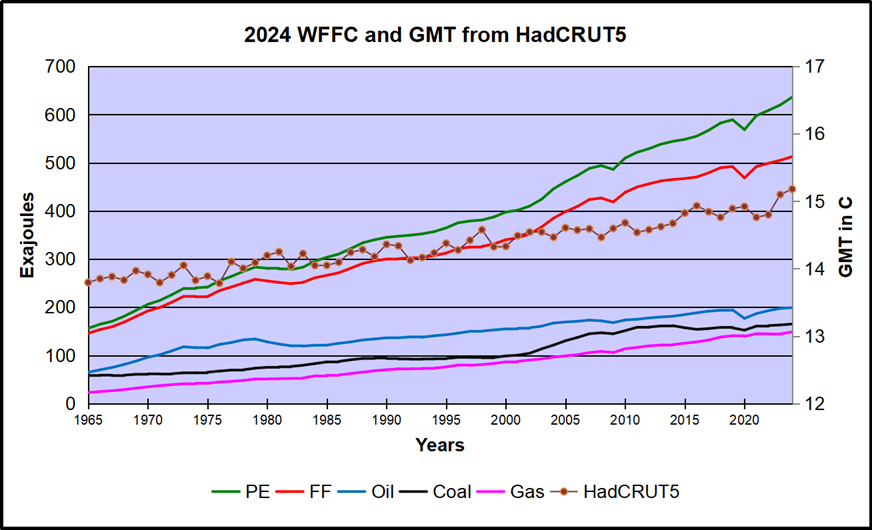
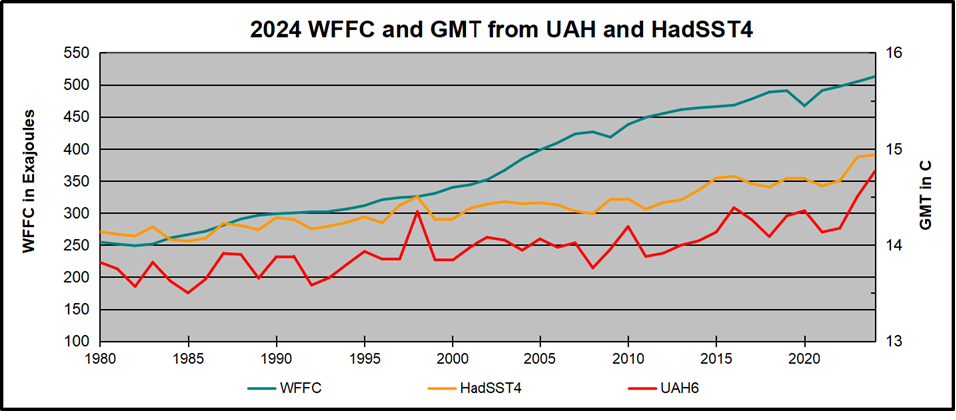


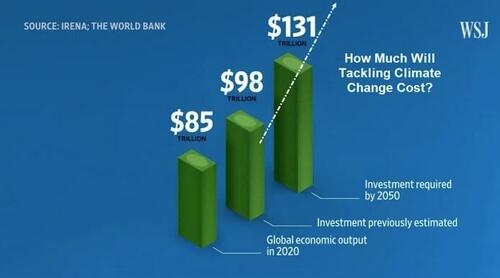


 But: Sea Level Rise is not accelerating.


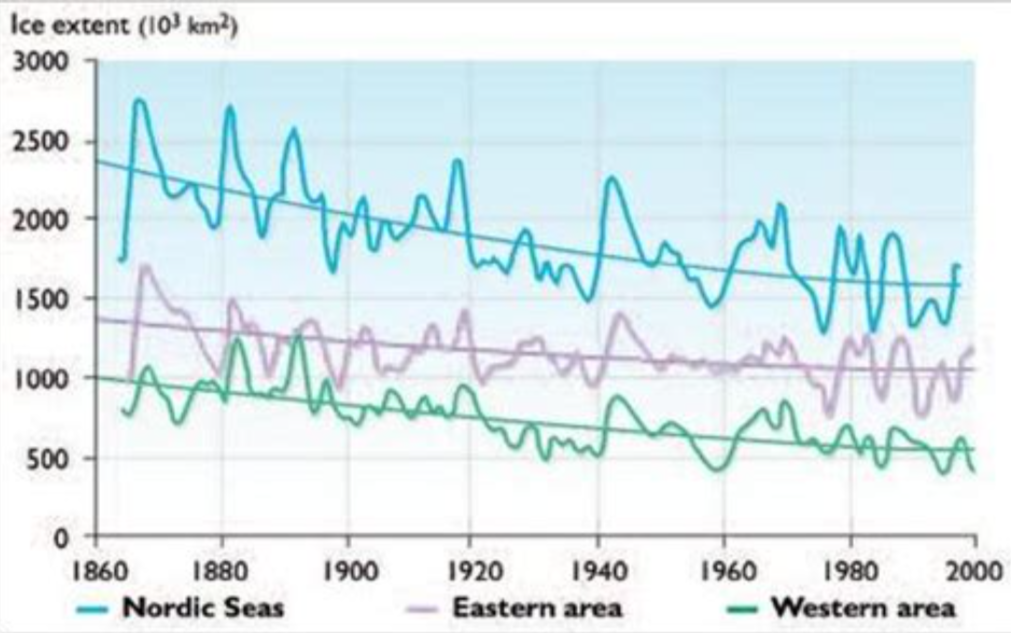




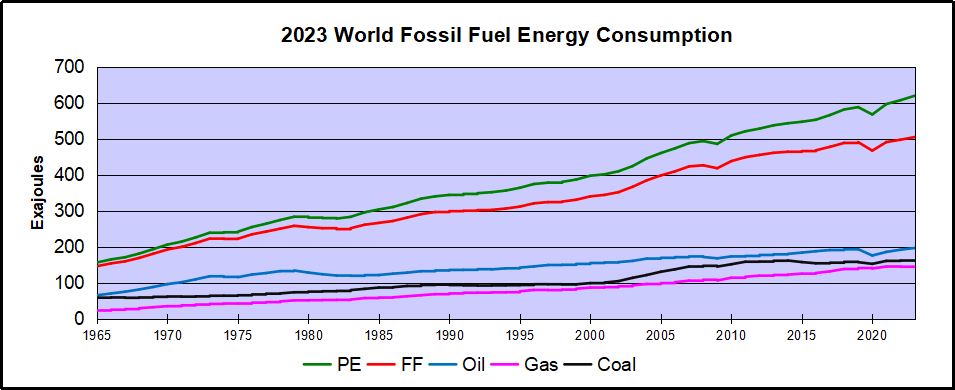
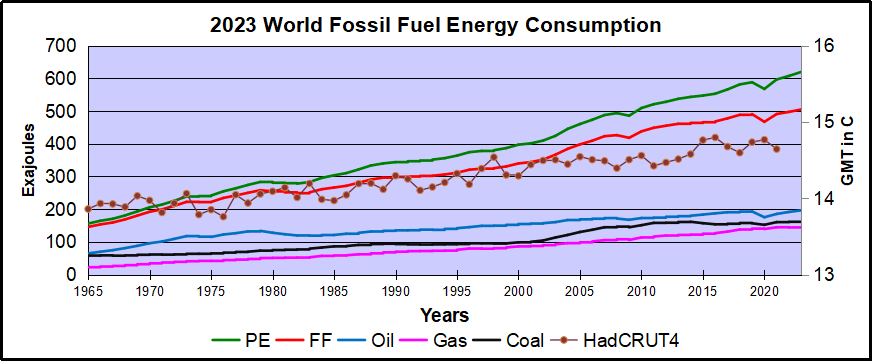
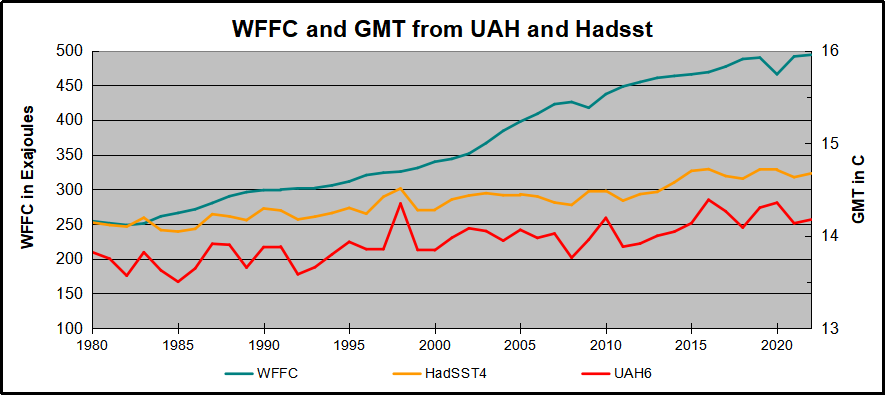
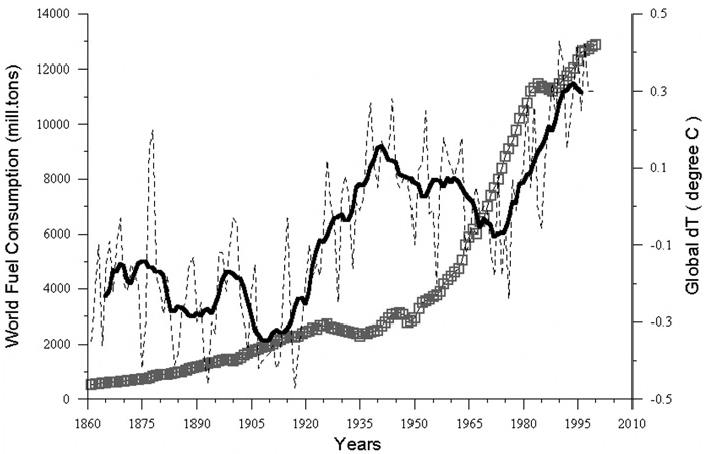
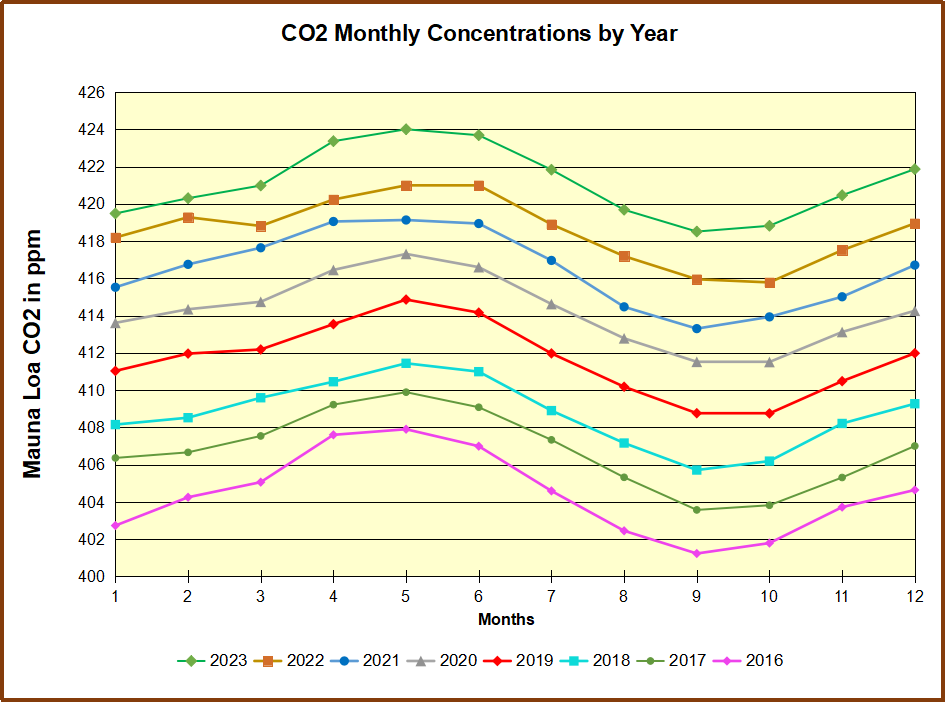

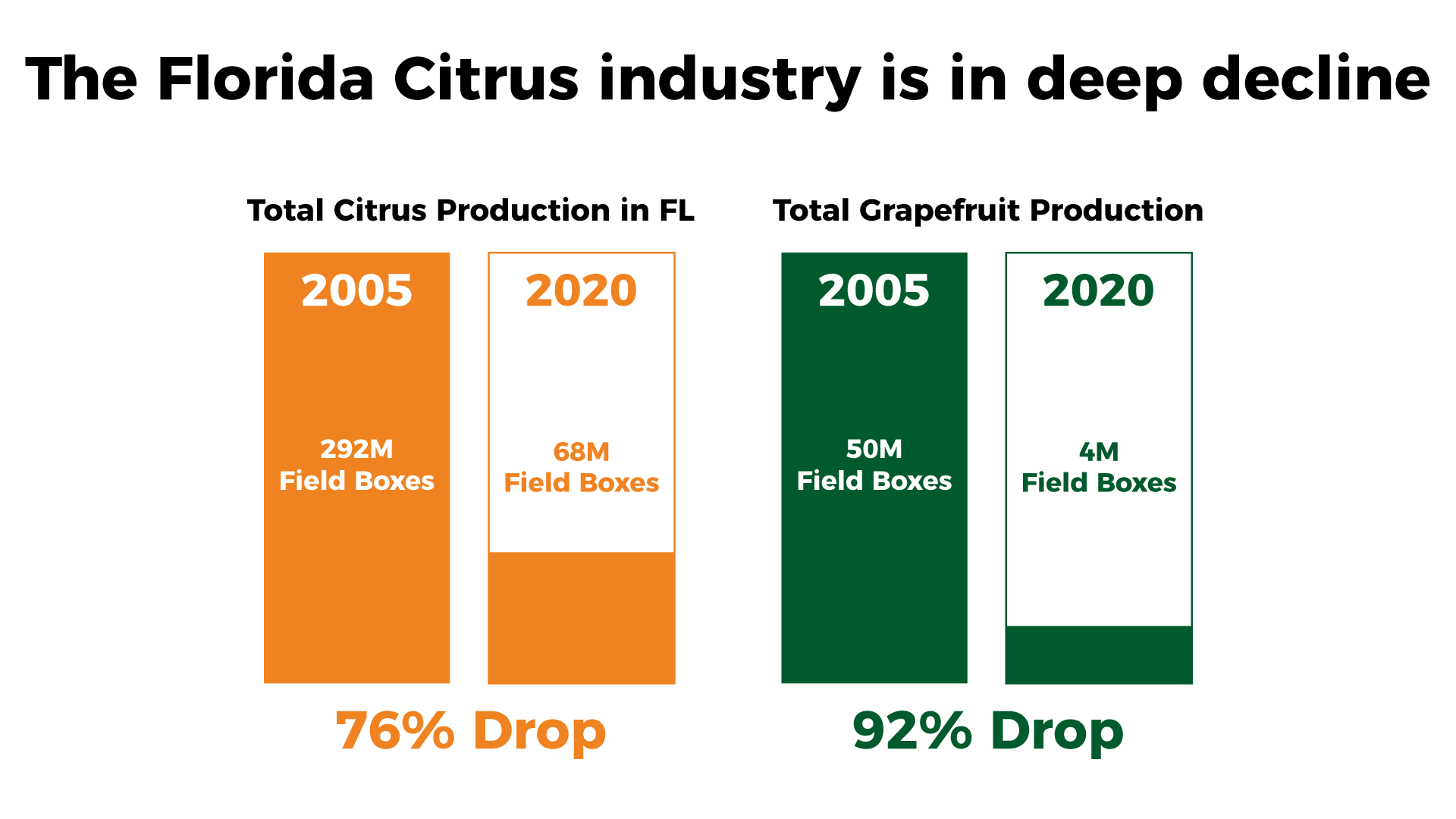
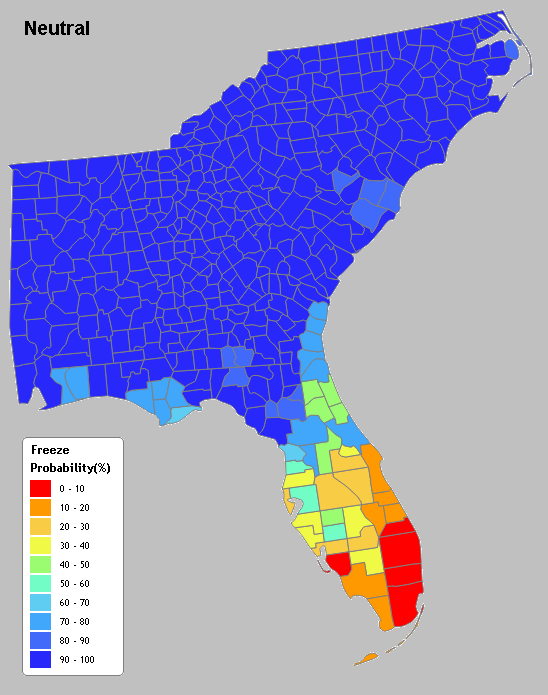
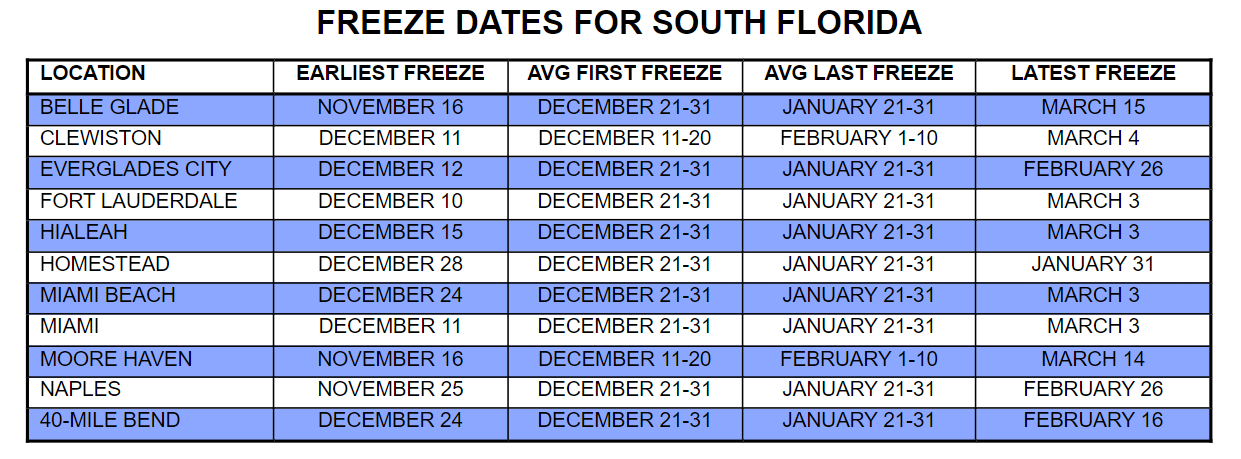
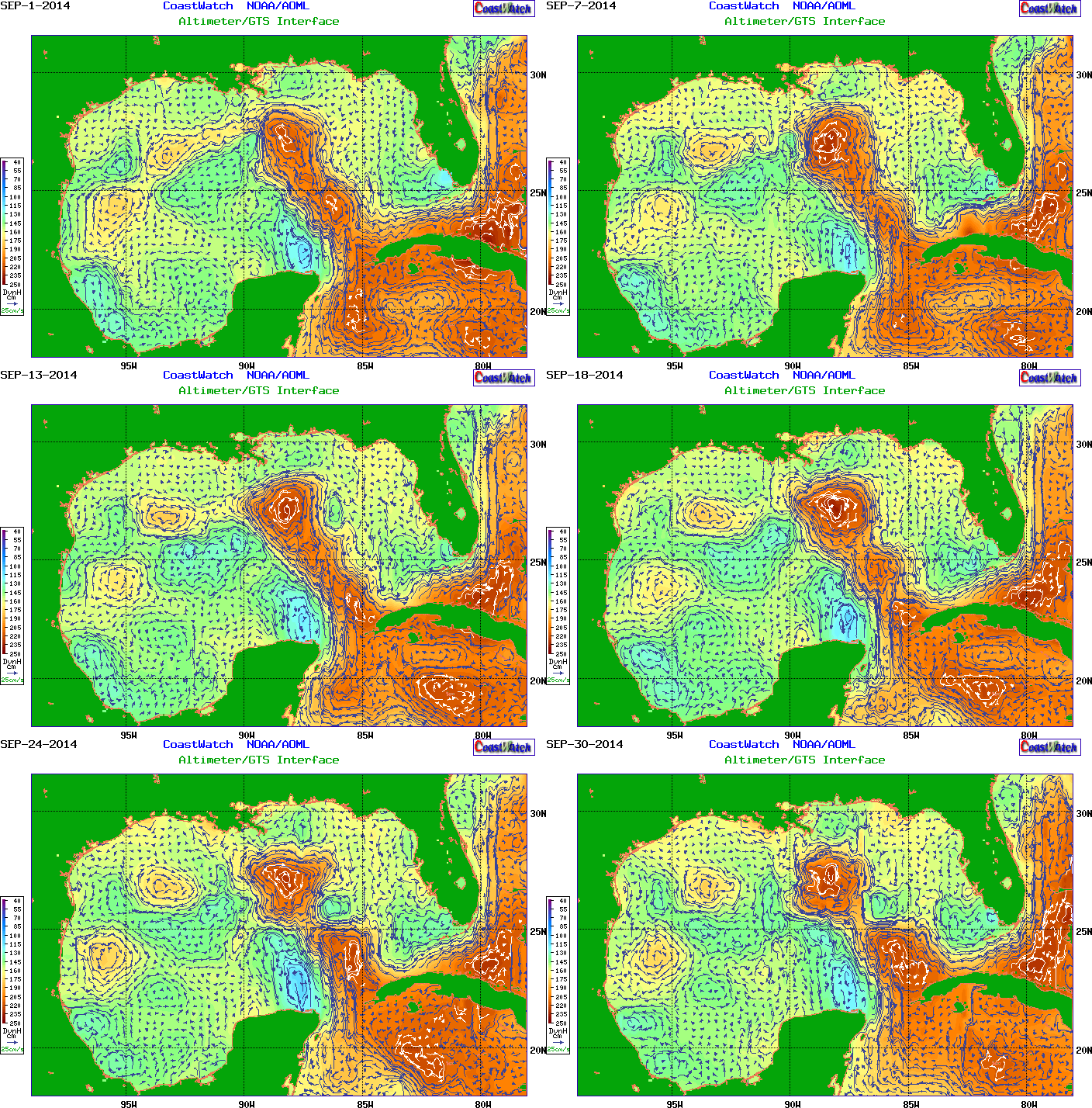

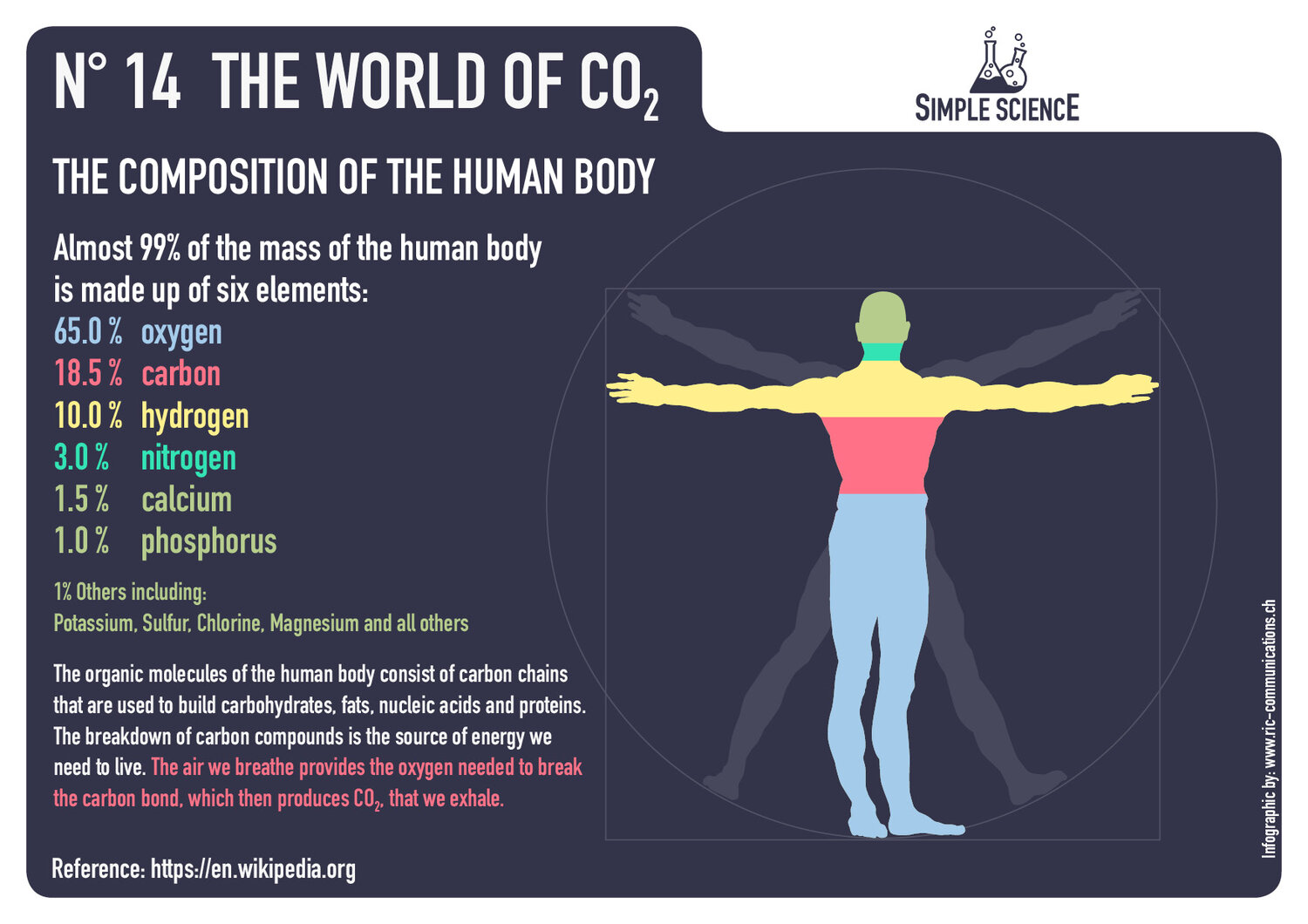
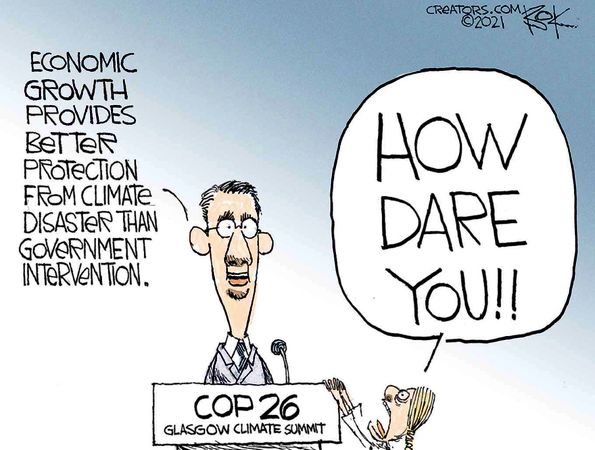


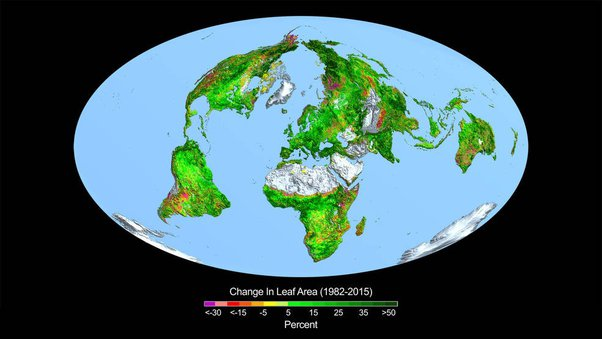
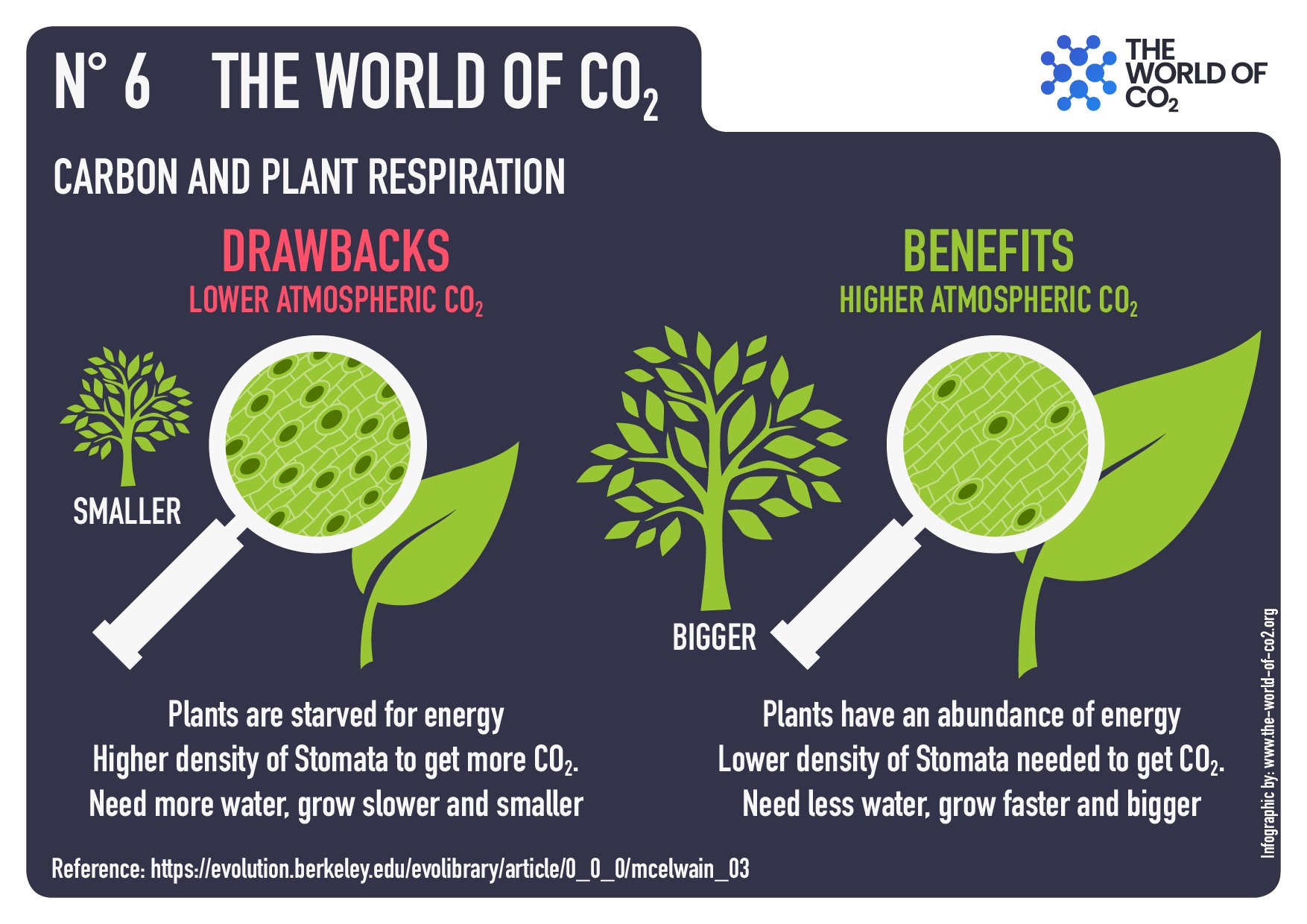

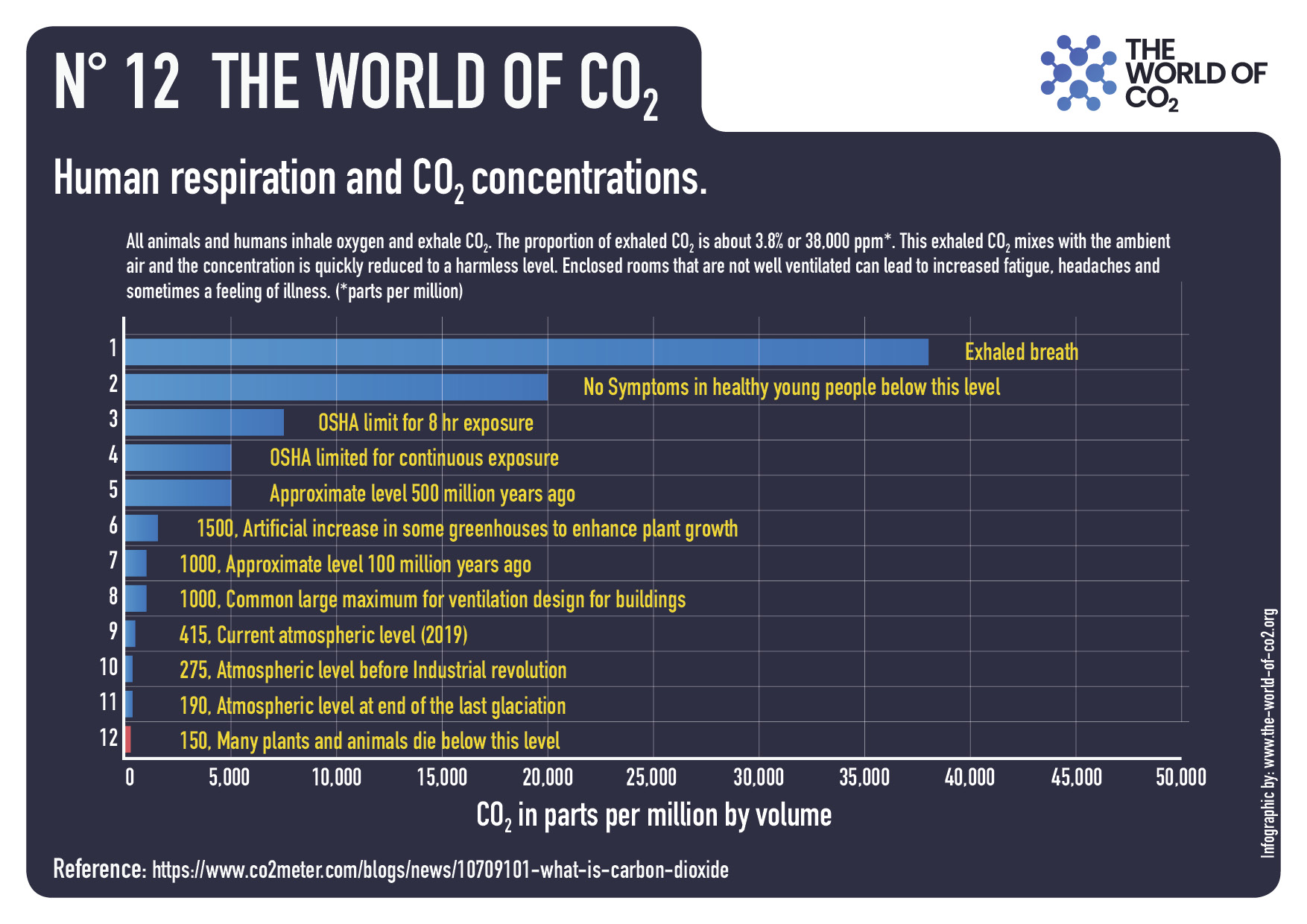


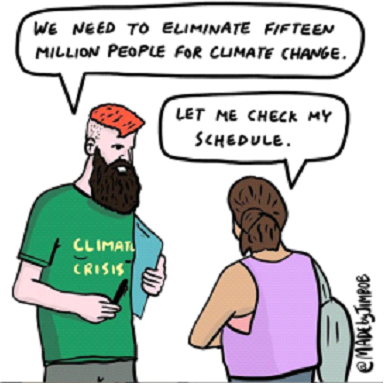
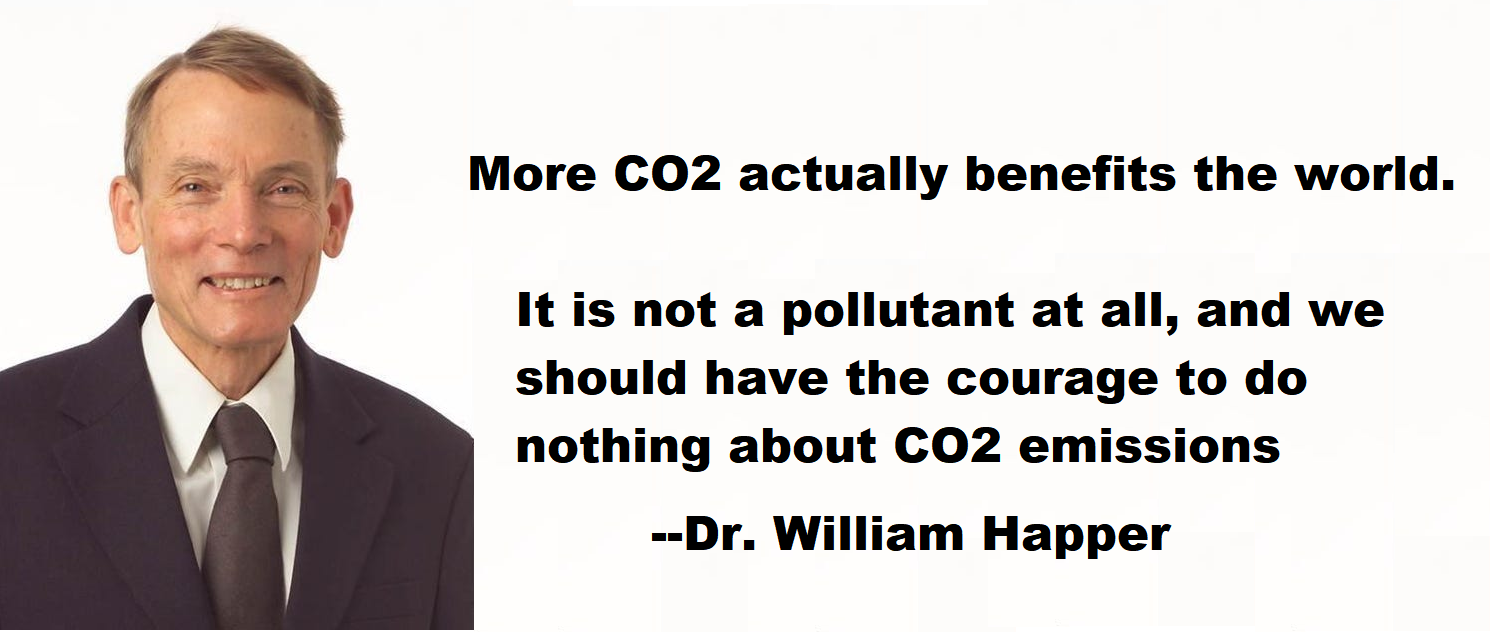

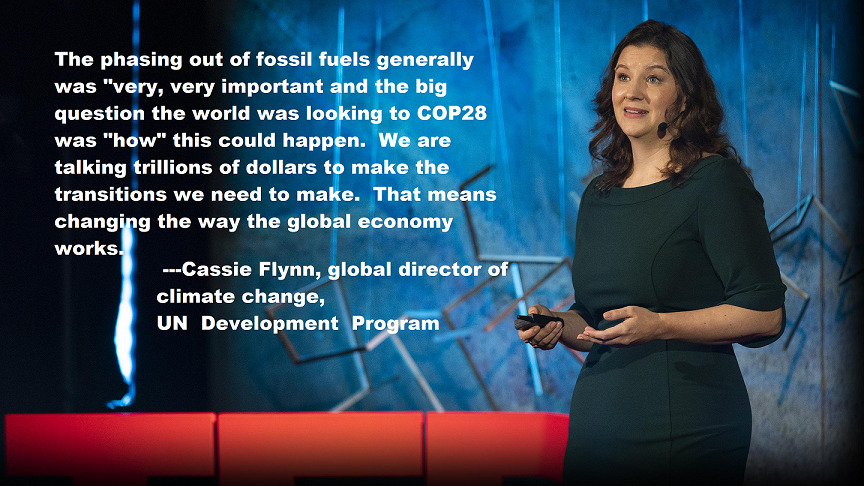
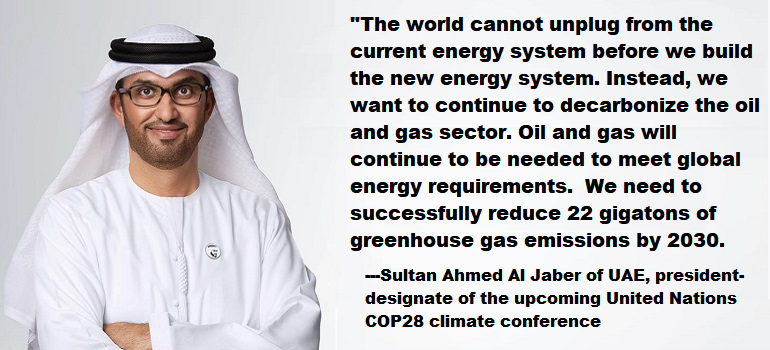
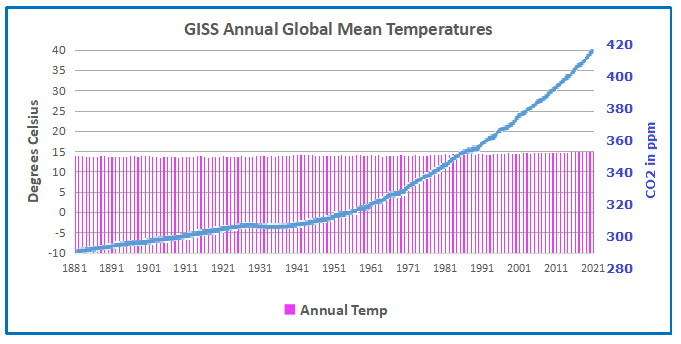

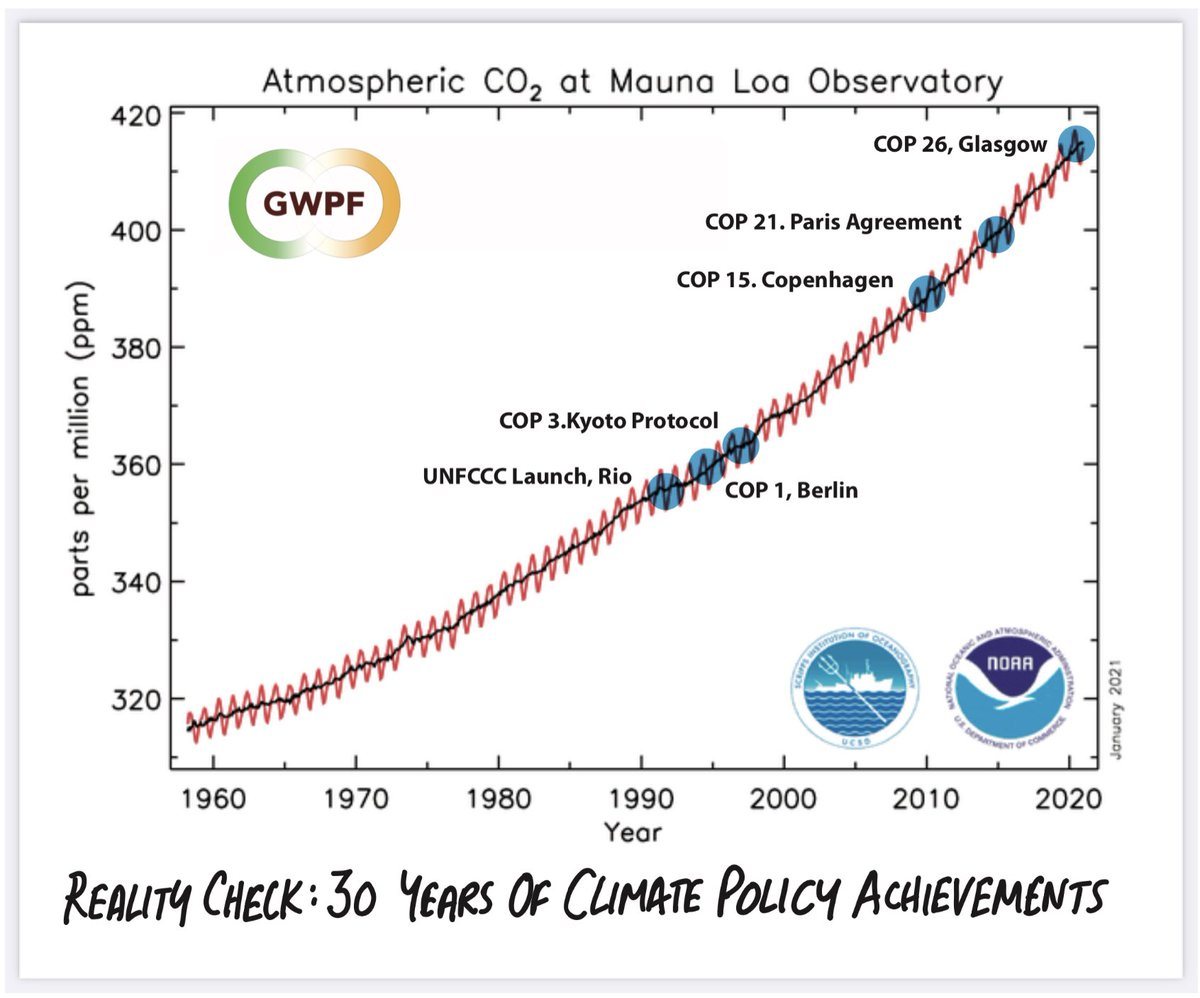

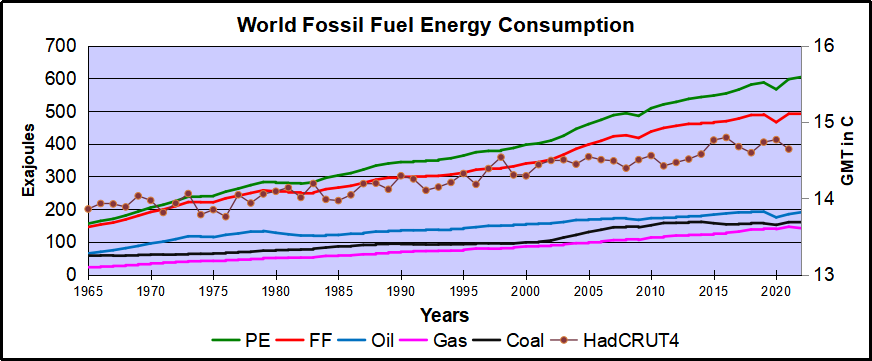
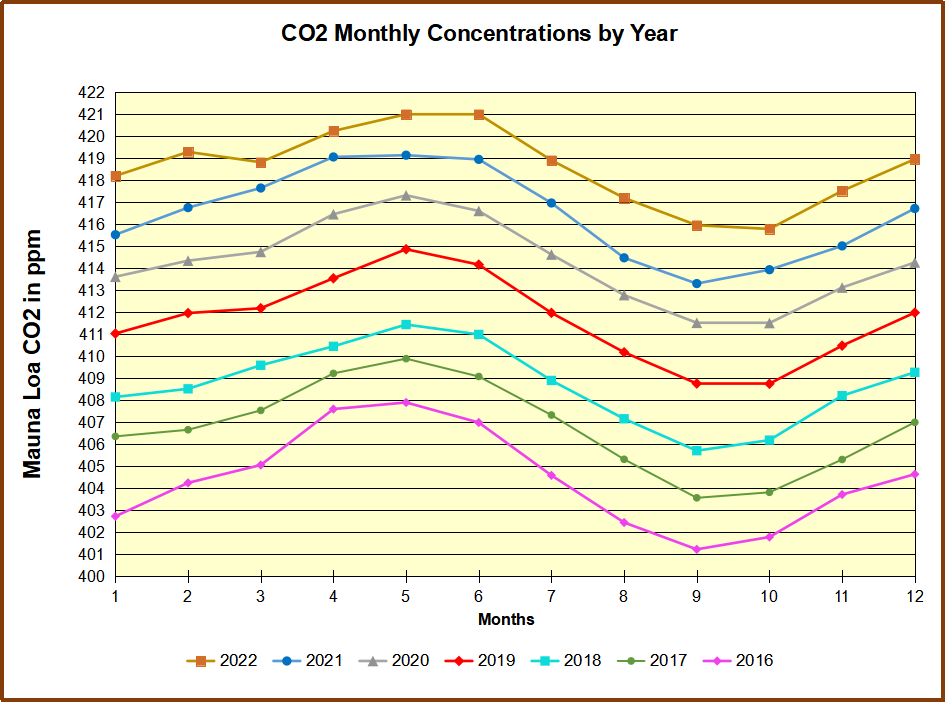


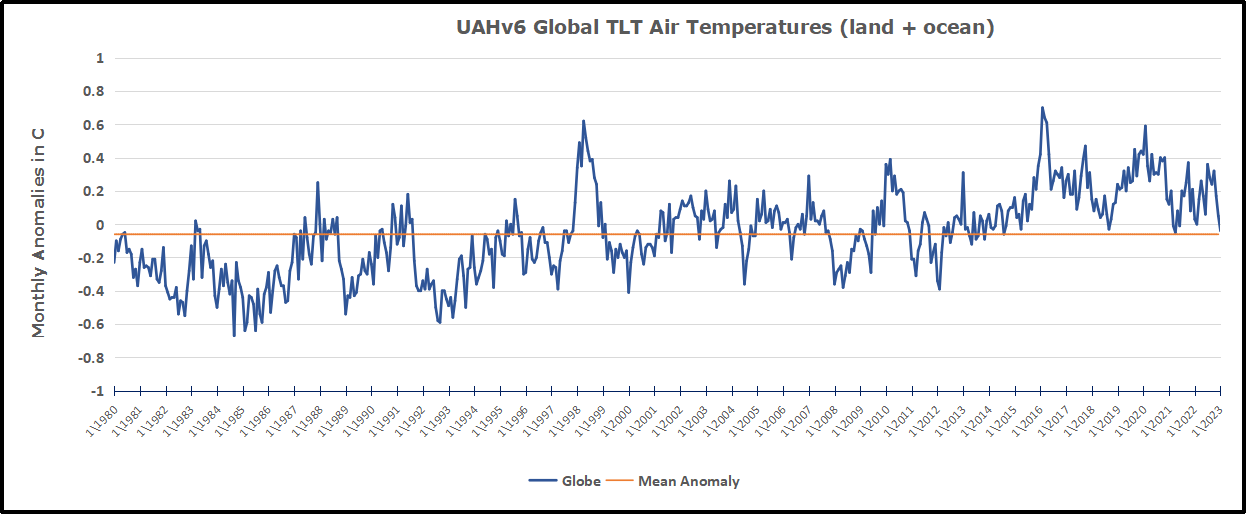
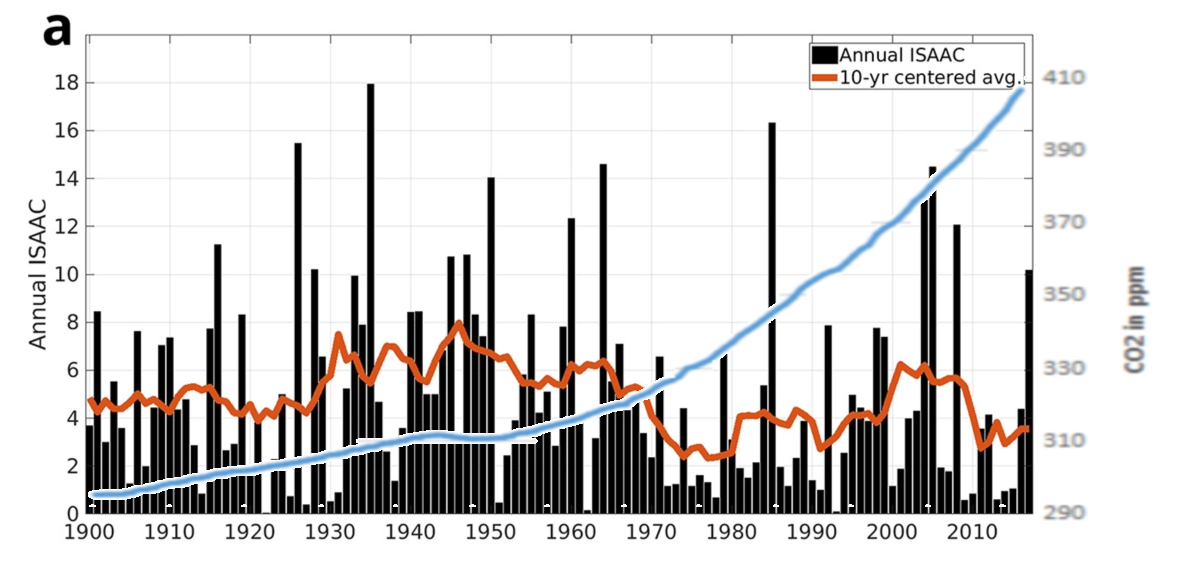



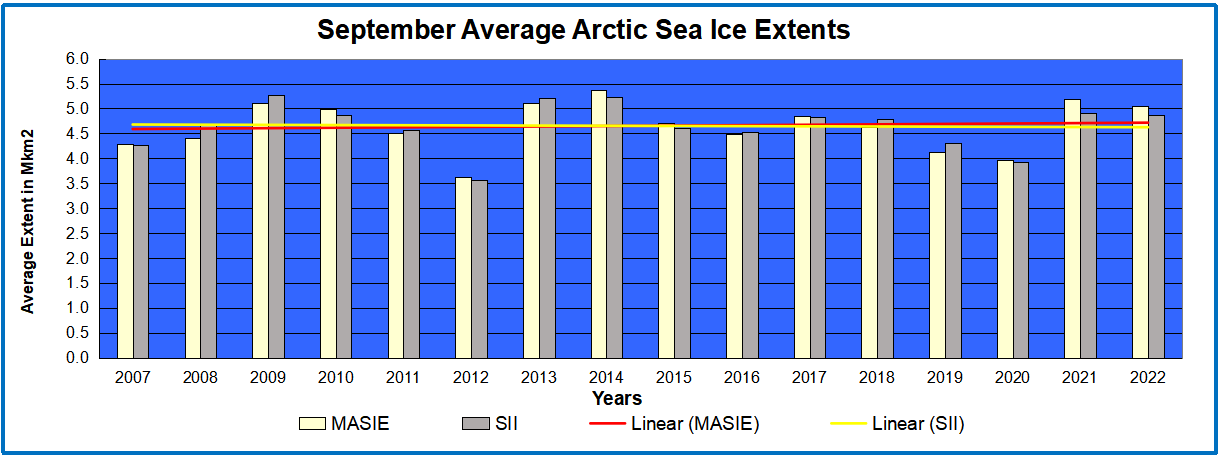
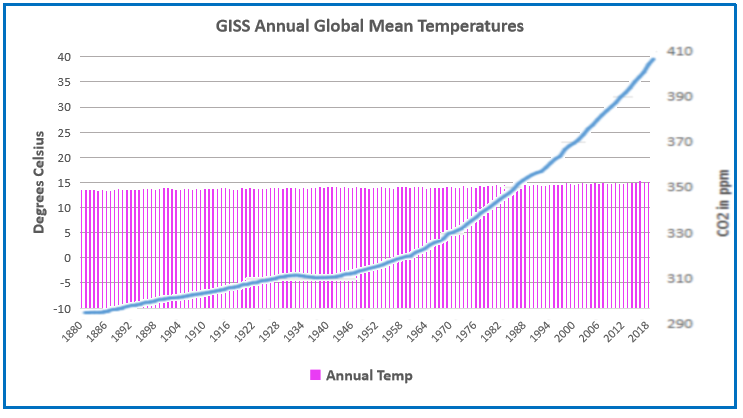
 Science Matters