Hollywood’s Climate Fantasy

At the DNC this week, the symbolism was perfect when Hollywood introduced a film presentation on climate change. The classic movie drama arises from one fundamental predicament: the hero confronts the villain threatening the town. It is all make-believe, as when actor Gary Cooper at high noon went out on a stage set to meet his scripted destiny, with the cameras rolling.

Of course, the retelling of the same story requires adding twists and expanded stakes, along with special effects. Now it is the global village at risk, and nature itself turning cancerous because of us. Good people want to stop the industrial poisonous machine, but evil deniers stand in the way. It is a cause for all time, to save the future for our children, and get people into the streets to make the difference.

But it is not science, it is fantasy. Nothing unusual is happening with the weather. There will be cooling as well as warming in the future, and we will need affordable reliable energy, as well as robust infrastructures, to survive and prosper. That will take sustained effort and practical, day-in, day-out attention to details. Not very dramatic stuff.

There is a word for the mental state of confusing make-believe with reality: It is called Delusion. It works as entertainment, but It is not a good frame of mind for policymakers.

Footnote:

If you have been taken in by global warming claims, you should know that temperature records show no unusual warming is occurring. (link below)

The Climate Story (Illustrated)

Climatism and Virtual Virtues


Following an alert posted by Lubos Motl, I upgraded my windows operating system from #7 to #10, since the grace period is ending August 1. And it went quite smoothly in retrospect, but with much anxiety in the process. It seems that Windows Defender latest version doesn’t play as nice with other anti-malware programs. Also some head-scratching as to the usage of cpu by strangely named programs that may or may not be malware. And there are the inevitable hiccups and tweaks needed to restore operations as before.

It occurred to me in this process that the internet and the associated tools have become for us a kind of utility, like electricity. When we flip the light switch, the room should light up. And when we boot up our home computers, we expect to be on line and wired in. Any upgrade introduces uncertainty into that dependency, and is uncomfortable.

It also reflects on how much we modern urban dwellers exist within a cocoon of man-made structures, both physical and cyberspace. Extrapolating from our daily experience, it is a small step to thinking that the larger environment beyond our cocoons, if not entirely man-made, is at least hugely subject to human influence. And from that premise comes the climatism faith: the belief that mother Nature is being ruined by humans burning fossil fuels, that the planet will burn up, glaciers will melt, cities and islands will submerge, etc. etc. etc.

For centuries those who farm or otherwise make a living from the land or ocean have accepted and adapted to the uncertainties of weather and variable harvests. They are among the most skeptical concerning man-made climate change.

But the majority of university educated urban dwellers are converts to climatism, and participate more or less in a range of Virtual Virtues; i.e. Supporting abstract causes to protect Nature from humans. Some examples:
Save the Arctic: Support Greenpeace.:
Stop Rising CO2: Support 350.org.
Save Animals from extinction: Support WWF.
Etc.

These and other variations of “fighting Climate Change” give the illusion of “making a difference”, and thus feeling good about doing good. It is truly not about Science any more, it is about being Virtually Virtuous.

Footnote: In his lifetime, Marshall McLuhan foresaw the rise of the Global Village along with the return of tribalism, pre-conditions for the present obsession with climatism. Quotations:

“All media are extensions of some human faculty-psychic or physical.”

“The new electronic interdependence recreates the world in the image of a global village.”

“The world is now like a continually sounding tribal drum, where everybody gets the message…. all the time.”

“Our technology forces us to live mythically.”

“Politics will eventually be replaced by imagery.  The politician will be only too happy to abdicate in favor of his image, because the image will be much more powerful than he could ever be.”

“The more you create village conditions, the more discontinuity and division and diversity. The global village absolutely insures maximal disagreement on all points. It never occurred to me that uniformity and tranquility were the properties of the global village. It has more spite and envy. The spaces and times are pulled out from between people. A world in which people encounter each other in depth all the time. The tribal-global village is far more divisive — full of fighting — than any nationalism ever was. Village is fission, not fusion, in depth all the time.” (McLuhan “The Hot and Cool Interview” 57–58)

That full interview is the best summary of McLuhan’s views and is here.

Climate Lemmings (h/t Beth)


Think Global Act Local, or Not

The slogan “Think Global, Act Local” began with multinational corporations realizing that national and regional markets around the world had distinct needs and preferences requiring accommodations. As the name implies it refers to the corporate strategy by which a global viewpoint is adopted in terms of formulating company vision, long-term aims and objectives and devising effective programs to achieve these aims and objectives, however, adaptations are made in each market according to the culture and specifications of any specific market.

Environmental activists took the notion on board during the first wave becoming aware of globalization. Early bearers of the catchphrase were for the most part supporters of an environmental movement that supported individual activism. The theory behind the saying was that in order to make large-scale global movements stick, the responsibility lay on individuals to carry out progressive practices – like environmental stewardship – in their own homes. The globe had become the new frame of reference for some far-thinking activists.

Clearly “climate change” activism operates in this mode. But as we shall see in this essay, the top-down, Global-Local approach to understanding climate and weather leads to distortions and misconceptions. In fact, climate science itself is best served by observing and establishing principles from the bottom up.

It turns out that the climate system is one of those things where averages do not tell very much, and can be misleading. For example:

Look at precipitation around the world

About 1 meter a year is the nominal average of all rain over all surfaces. Some places get up to 10 meters of rain (about 400 inches ) and others get near none. 47% of the earth is considered dryland, defined as anyplace where the rate of evaporation/transpiration exceeds the rate of precipitation. A desert is defined as a dryland with less than 25 cm of precipitation. In the image above, polar deserts are remarkably defined. It just does not have much hope of precipitation as there is little heat to move the water. More heat in, more water movement. Less heat in, less water movement.

Then there’s the seasonal patterns. The band of maximum rains moves with the sun: More north in June, more south in December. More sun, more heating, more rain. Movement in sync with the sun, little time delay. Equatorial max solar heat has max rains. Polar zones minimal heating, minimal precipitation. It’s a very tightly coupled system with low time lags.

Then Look at Temperatures

Average temperatures in F at sea level by longitude and latitude. Source: Lyndon State College Meteorology

Notice:

  • latitudinal change
  • N.H. – difference between land and ocean
  • U.S. west coast (upwelling and cold current) v.s. U.S. east coast (gulf stream)
  • influence of gulf stream in north Atlantic
  • highest temps are in the subtropical N.H. desert regions
  • west coast of S. America is cool while the east coast is warm, due to the ocean currents
  • much less variability in the zonal direction in the S. H.

And look at clouds and their radiative effects
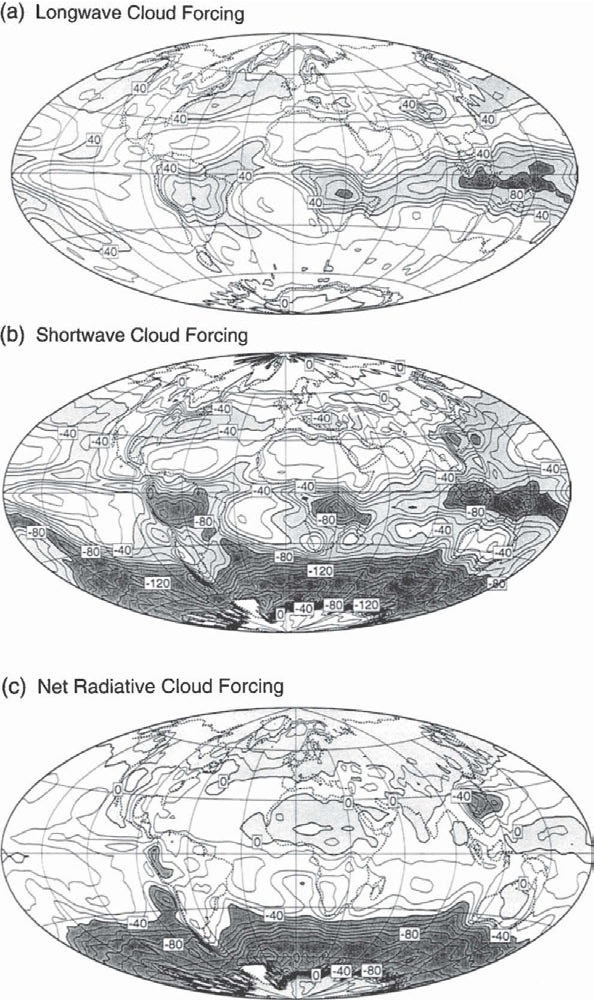
The large opacity of cloud increases the optical depth of the atmosphere, introducing warming in the LW energy budget. This warming varies with cloud-top temperature and height. For SW radiation, the high reflectivity of cloud decreases the incoming solar flux, favoring reduced surface temperature. Cloud routinely covers about 50% of the Earth. It accounts for about half of the Earth’s albedo (eg, for ∼0.15). Source: Salby 2012 pg315

Globally averaged values of CLW and CSW are about 30 and −45 W m−2, respectively. Net cloud forcing is then −15 W m−2. It represents radiative cooling of the Earth-atmosphere system. This is four times as great as the additional warming of the Earth’s surface that would be introduced by a doubling of CO2.

But clearly during Northern winter (diagrams above), that net cooling occurs largely over the Southern Ocean around Antarctica.

What happens when you average all this diversity?

We have all seen graphs showing how climate models project unrealistic global mean temperatures higher than those measured by stations or satellites. But Dr. Salby in his textbook points to a more fundamental failing of the climate simulations.  By construction they balance global average energy budgets, but regional realities are grossly distorted.

From IPCC Working Group 1 AR4

Figure 8.4. Root-mean-square (RMS) model error, as a function of latitude, in simulation of (a) outgoing SW radiation reflected to space and (b) outgoing LW radiation. The RMS error is calculated over all longitudes and over all 12 months of a climatology formed from several years of data. . .The Earth Radiation Budget Experiment (ERBE; Barkstrom et al., 1989) observational estimates used here are for the period 1985 to 1989 from satellite-based radiometers, and the model results are for the same period in the 20th-century simulations in the MMD at PCMDI.

Symbolizing the local energy budget is net radiation (Fig. 1.34c), which represents the local imbalance between the SW and LW fluxes F0 and F ↑(0) in the TOA energy budget (8.82). Local values of those fluxes have been measured around the Earth by the three satellites of ERBE. The observed fluxes, averaged over time, have then been compared against coincident fluxes from climate simulations, likewise averaged. Figure 8.34 plots, for several GCMs, the rms error in simulated fluxes, which have been referenced against those observed by ERBE.

Values represent the regional error in the (time-mean) TOA energy budget. The error in reflected SW flux, Fs 4 − F0 in the global mean (8.82), is of order 20 Wm−2 (Fig. 8.34a). Such error prevails at most latitudes. Differences in error between models (an indication of intermodel discrepancies) are almost as large, 10–20 Wm−2. The picture is much the same for outgoing LW flux (Fig. 8.34b). For F ↑(0), the rms error is of order 10–15 Wm−2. It is larger for all models in the tropics, where the error exceeds 20 Wm−2. . .Consequently, the simulated change introduced by increased CO2 (2–4 Wm−2), even inclusive of feedback, is overshadowed by error in the simulated change of major absorbers.

By construction, GCMs achieve global-mean energy balance. How faithfully the energy budget is represented locally, however, is another matter. The local energy budget forces regional climate, along with the gamut of weather phenomena that derive from it. This driver of regional conditions is determined internally – through the simulation of local heat flux, water vapor, and cloud.  (My bold)

Conclusion

A common expression is: “The devil is in the details.” When it comes to climate, it is truer to say that we humans are bedeviled (thwarted) by nature’s details refusing to fit into our global generalities. The proper role of science is to investigate those details and revise our mental constructs.

“Global Climate” is an oxymoron.
(oxymoron: A figure of speech in which two words with opposing meanings are used together intentionally for effect; IOW a contradiction in terms. From the Greek: pointed foolishness).

Climates are plural, not global, as the Koppen system makes clear. There are hundreds of regional climate zones defined empirically by temperature and precipitation patterns. And the observational data shows those zones are highly stable; that is, fears of climate change rarely appear in any actual climates showing shifting boundaries. See post: Data vs. Models 4: Climates Changing

Thus, we are better advised to:

Think Local Climates,
Prepare Local Adaptations
for the range of future weather consequences.

The Climate Fuss

Definition Fussbudget:  A person who fusses over trifles. Also called fusspot.

In the last week, Richard Lindzen has a new youtube video which explains briefly and clearly who is making a fuss about climate and why. (Hint: It is not primarily from climate physicists). The video deserves to go viral, since the presentation is brief, informative and accessible to anyone.

Why are so many people worried, indeed panic-stricken about this issue?
It’s due not so much to climate physicists, as to politicians, environmentalists and media. Global warming alarmism provides the things they most want:

  • For politicians, it’s money and power;
  • For environmentalists, it’s money for their organizations and confirmation of their near-religious devotion to the idea that man is a destructive force acting upon nature;
  • For the media, it’s ideology, money and headlines.
  • And crony capitalists have eagerly grabbed for the subsidies that governments have so lavishly provided.

Beyond the Lindzen video, we can also include lawyers who want to make money off the climate fuss. The legal attack on Big Oil (ExxonMobil, and others to follow) is modeled after the Big Tobacco campaign, and is intended to apply a defacto tax on consumers of fossil fuels. That’s what happened with the settlements by Tobacco companies, with an immediate jump in cigarette prices.

Not only is this an end run around the legislative branch, a lot of the money will be paid to lawyers working on contingency for the state AGs who are prosecuting this. To activists, lining the pockets of class-action lawyers is not a problem, as long as fossil fuels cost more, and thus will be used less. The tactic and the players are exposed here:
The Climate Change Inquisition, Part II—The Scandal Unfolds
Margaret A. Little April 20, 2016

Summary: How can we let the hot air out of the Global Warming balloon when they have so much to gain by inflating it?


Climate Science Was Broken

Natural scientists have sought to understand the workings of the climate system and its various parts. But in recent decades the process of discovery has been subverted, and the science is going in circles. Richard Lindzen tells how it came to this in his essay: Climate Science: Is it Currently Designed to Answer Questions?

As you might guess, the title is a rhetorical question. From his long and deep experience with the field, Richard Lindzen can and does describe in detail how and why climatology is failing as a natural science. The machinations and convolutions bring to mind the quotation:
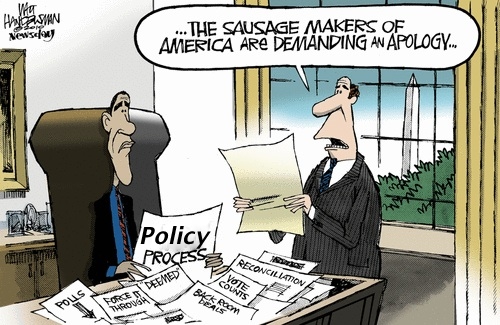
Laws are like sausages, it is better not to see them being made.
– Otto von Bismarck

Perhaps because the field was contaminated with political aims early on, the whole enterprise has come to resemble a legislative process:


Lindzen sets the record straight with names and maneuvers which have crippled efforts to answer questions about the functioning of earth’s climate system.

When an issue becomes a vital part of a political agenda, as is the case with climate, then the politically desired position becomes a goal rather than a consequence of scientific research. This paper will deal with the origin of the cultural changes and with specific examples of the operation and interaction of these factors. In particular, we will show how political bodies act to control scientific institutions, how scientists adjust both data and even theory to accommodate politically correct positions, and how opposition to these positions is disposed of.

By taking a few minutes to read his text (here), you can learn from Lindzen some important truths:

  • How science was perverted from a successful mode of enquiry into a source of authority;
  • What are the consequences when fear is perceived to be the basis for scientific support rather than from gratitude and the trust associated with it;
  • How incentives are skewed in favor of perpetuating problems rather than solving them;
  • Why simulation and large programs replaced theory and observation as the basis of scientific investigation;
  • How specific institutions and scientific societies were infiltrated and overtaken by political activists;
  • Specific examples where data and analyses have been manipulated to achieve desired conclusions;
  • Specific cases of concealing such truths as may call into question gobal warming alarmism;
  • Examples of the remarkable process of “discreditation” by which attack papers are quickly solicited and published against an undesirable finding;
  • Cases of Global Warming Revisionism, by which skeptical positions of prominent people are altered after they are dead;
  • Dangers to societies and populations from governments, NGOs and corporations exploiting climate change.

Summary:

Thanks to Richard Lindzen and others for putting on the record how broken is the field of climate science. It is dangerous in itself, and it also extends into other domains, threatening the scientific basis of modern civilization. Fixing such scientific perversions will be difficult and lengthy, but it can only start with acknowledging how bad it is. It truly is worse than we thought.

No matter that these contortions extend back for some years; there is no statute of limitations on crimes against science. And the bad behavior is unabated: witness the fresh Revisionism of attacks in 2016 against Exxon and other oil companies for not proclaiming warming alarms in the 1970’s.

Was there ever a field of knowledge so abused, corrupted and corrosive? Who will drain the swamp of Climate Science and contend with the alligators there?