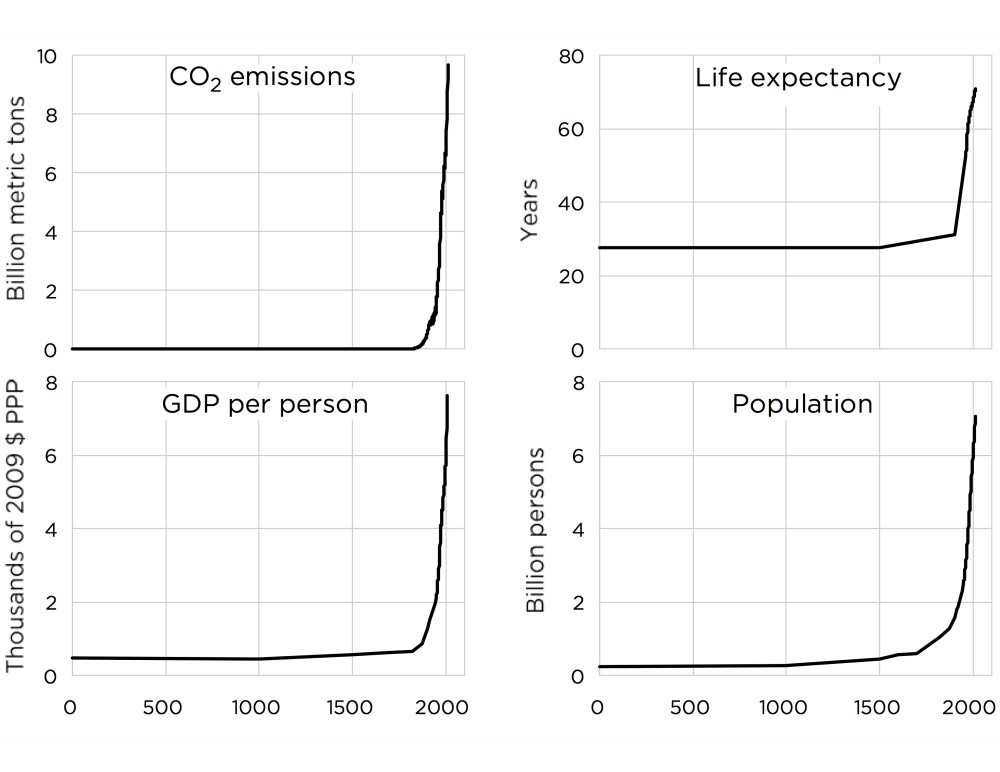
Big Climate, Internally Conflicted, Descending into Farce


Please, let this be the final farce on the 33rd try

Raymond J. de Souza asks a good question at National Post: Is Big Climate over? That would be good for the environment.  Excerpts in italics with my bolds and added images.

Backing away from absurd, grandiose policies would
shift attention toward more practical measures

Is the era of Big Climate over? It may be that Prime Minister Justin Trudeau has implicitly declared as much.

He would not say such a thing, as when Bill Clinton emphatically declared the “era of big government over” in the 1990s. Clinton was trying to show that he was a different kind of progressive, leaving behind the activist government of the 1960s. In contrast, the Vogue-photographed Trudeau was Big Climate’s most glamorous spokesmodel.

His absence at the UN climate jamboree in Dubai is thus striking.

Instead, conservative premiers Danielle Smith and Scott Moe are both on hand to promote oil and gas deals in the petro-state, but not the prime minister. Was it only eight years ago that a newly elected Trudeau descended upon the climate summit in Paris with a bloated retinue of hundreds, all the better to declare that “Canada is back?” He has now backed away.

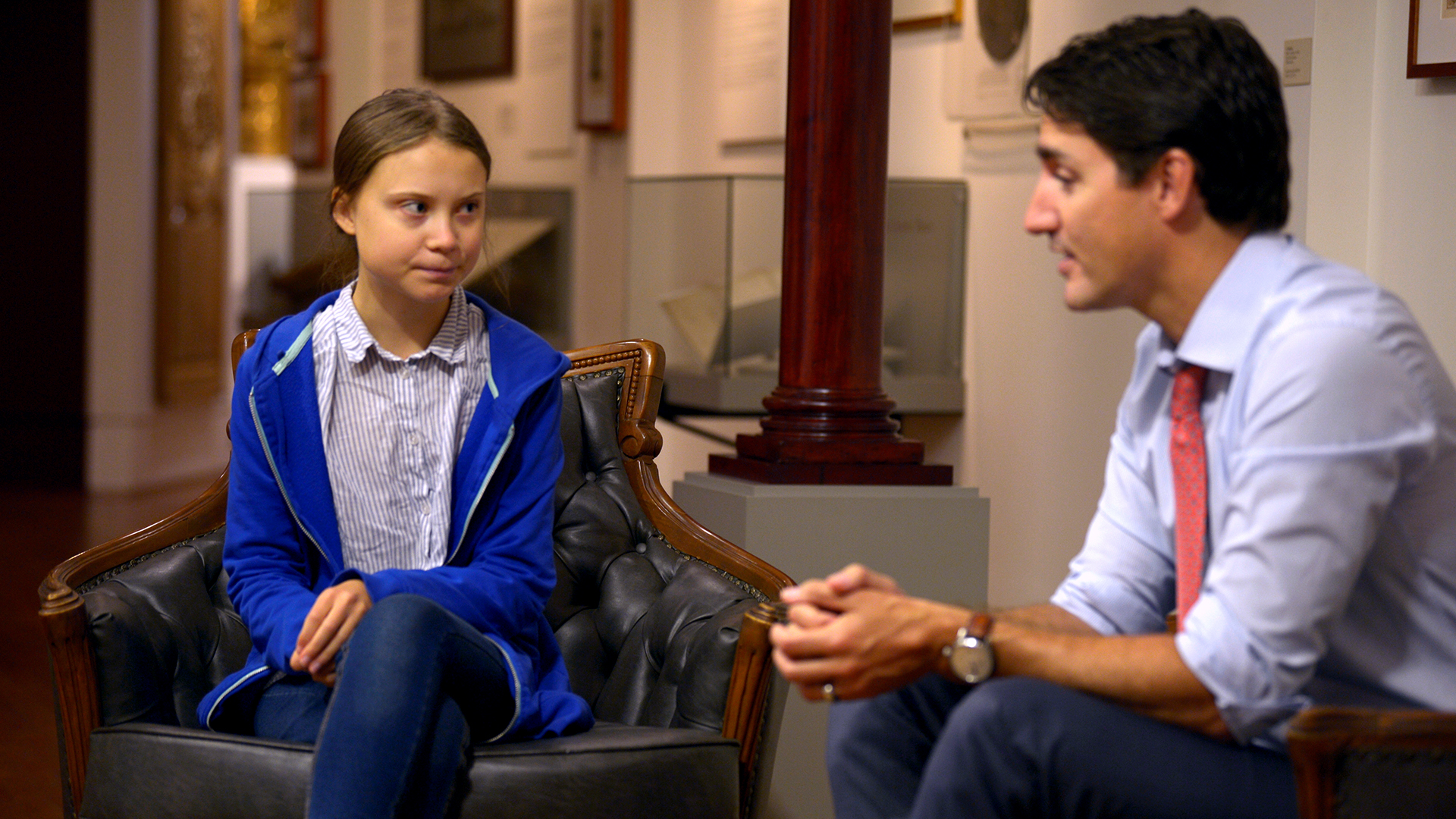
Canada really isn’t back — we have never been quite so marginal in international relations as we are now — but certainly we were celebrated in Big Climate circles. In the heady days of 2019 Trudeau was even granted an audience with Greta Thunberg.

That was a sign, in retrospect, that Big Climate was in decline.
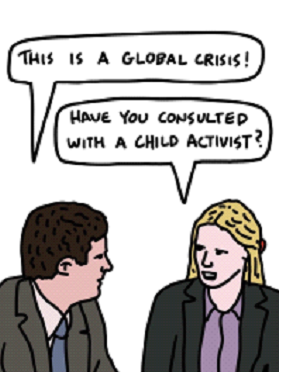
Inviting a Swedish teenager to indignantly lecture global leaders
indicated that Big Climate was entering its absurd phase.

Big Government, Big Tobacco, Big Pharma, Big Football (FIFA now, NFL in future) are behemoths that seem unstoppable, commanding all they survey. Then they enter their absurd phase, when their excesses become increasingly implausible. They don’t disappear. The advantage of being big is a certain momentum that carries forward, albeit diminished.

There is a point though when there is a qualitative change, even if massive quantity endures for a while. For Big Government, perhaps it was Clinton’s declaration. For Big Tobacco, it was when the assembled chief executives swore under oath that they had no idea that smoking could be addictive.

Big Climate had a good run. Ecological consciousness has been growing since the late 1960s. It’s a relatively easy sell. Everyone desires clean air, clean water, parks and natural beauty. Conservatives like conservation, after all, and progressives like government regulation to get there.

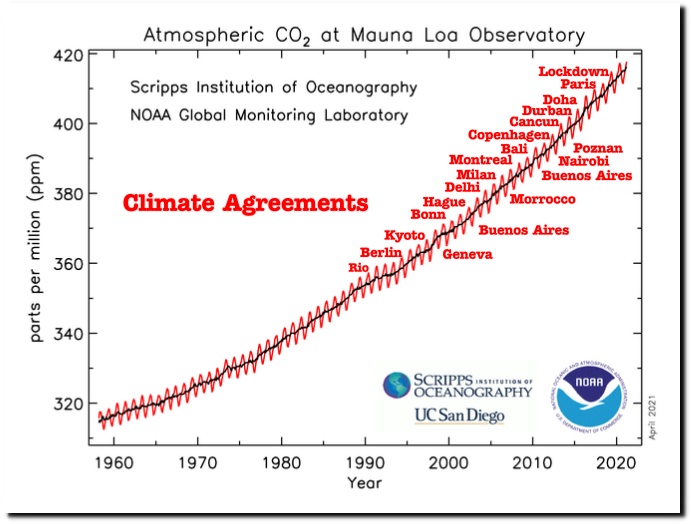
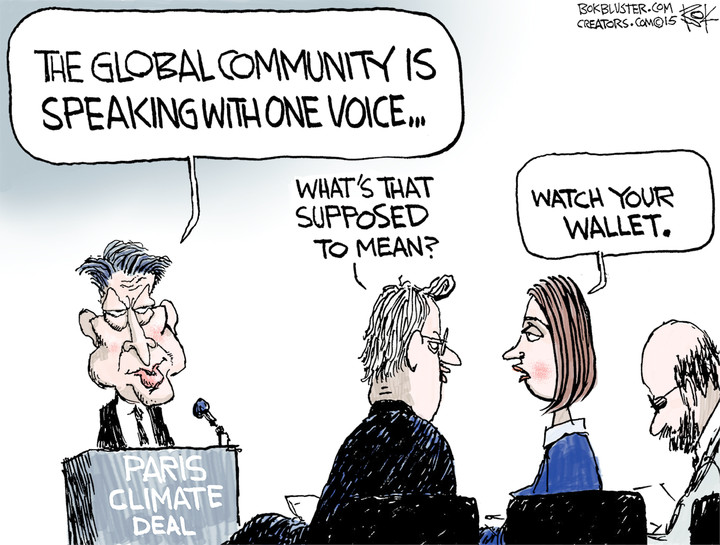
Big Climate was born out of that wider ecological movement, specifically at the 1992 “Earth summit” in Rio. The current Dubai “COP28” conference is the 28th “conference of the parties” that grew out of Rio 1992. Big Climate grew ever bigger, so much so that 70,000 delegates landed in Dubai this year. Along the way were milestones, such as Kyoto 1997 and Paris 2015, in which Big Climate managed to get wide agreement on re-ordering the global economy in principle, if not practice.

This year, though, one gets the sense that Big Climate has become wrapped in too many contradictions, capped off with a farcical conference in the petro-state’s air-conditioned desert. The incongruity of it all was nicely highlighted by the brouhaha that erupted when the Emirati conference chairman blithely declared that there was no real scientific basis to phase out fossil fuels.

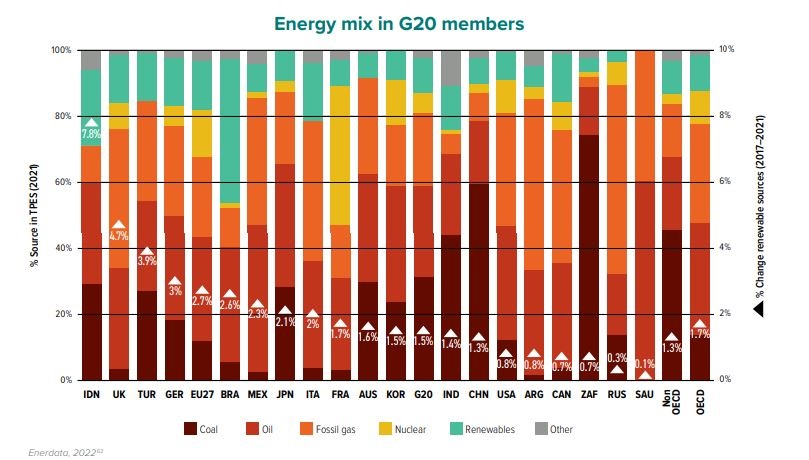
Consider the Germans, Big Climate’s biggest booster in the heart of Europe. This year marked the end of German nuclear power, with the last reactors closed. Germany has now moved to a higher carbon future, burning coal and natural gas.

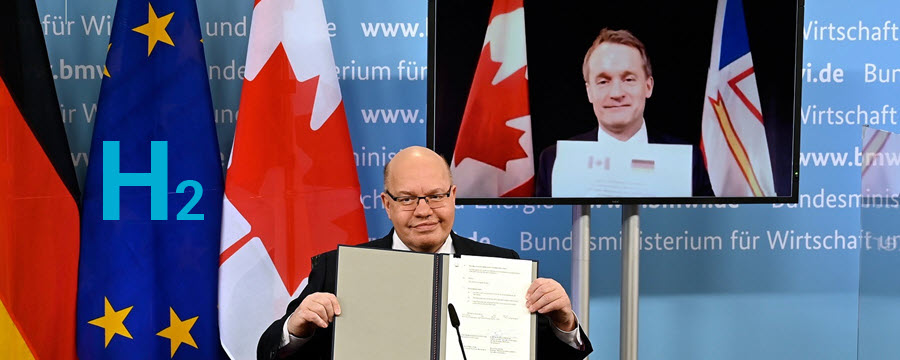
That proved a bit tricky when at war with Russia in Ukraine, so Germany turned to Canada for natural gas supplies. Trudeau refused to sell Germans our natural gas, directing them instead to Qatar. That strikes most folks as absurd.

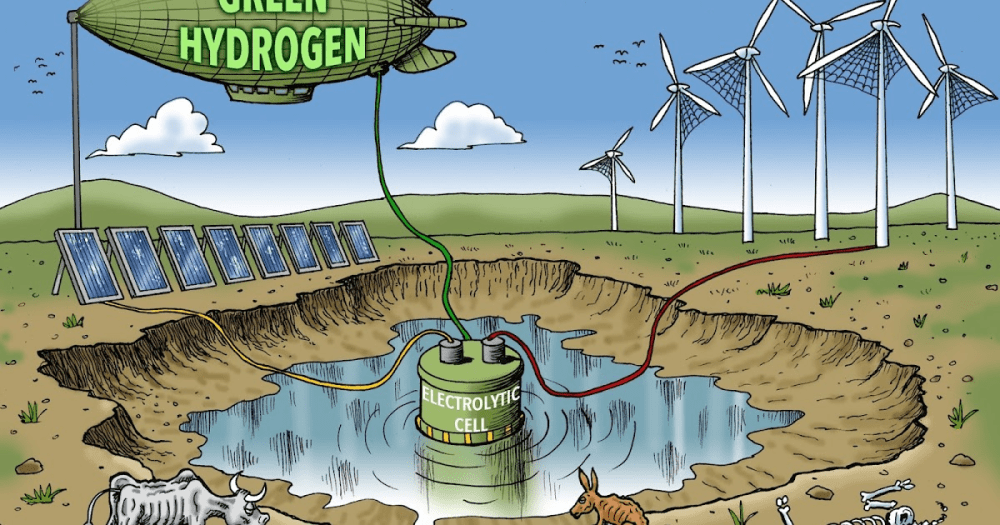
Canada and Germany Sign Agreement to Enhance German Energy Security with Clean Canadian Hydrogen August 2022.  And the hydrogen energy project is still pie in the sky.

Meanwhile, President Joe Biden, who began his administration with an ostentatious cancellation of the Keystone XL pipeline, lest Canadian resources pollute the American energy grid, has now decided to increase imports of Venezuelan oil and gas. That, too, is absurd.

Then there are billions upon billions of dollars — with Canada and the EU scrambling to match American subsidies — being lavished upon electric battery manufacturers, making “green jobs” a giant tax-funded boondoggle. That the great climate villain in the auto sector, Volkswagen, is a beneficiary of such largesse only makes the absurdity more galling.
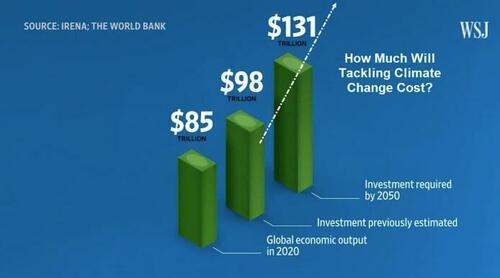
Yes, those are trillions of dollars they are projecting.
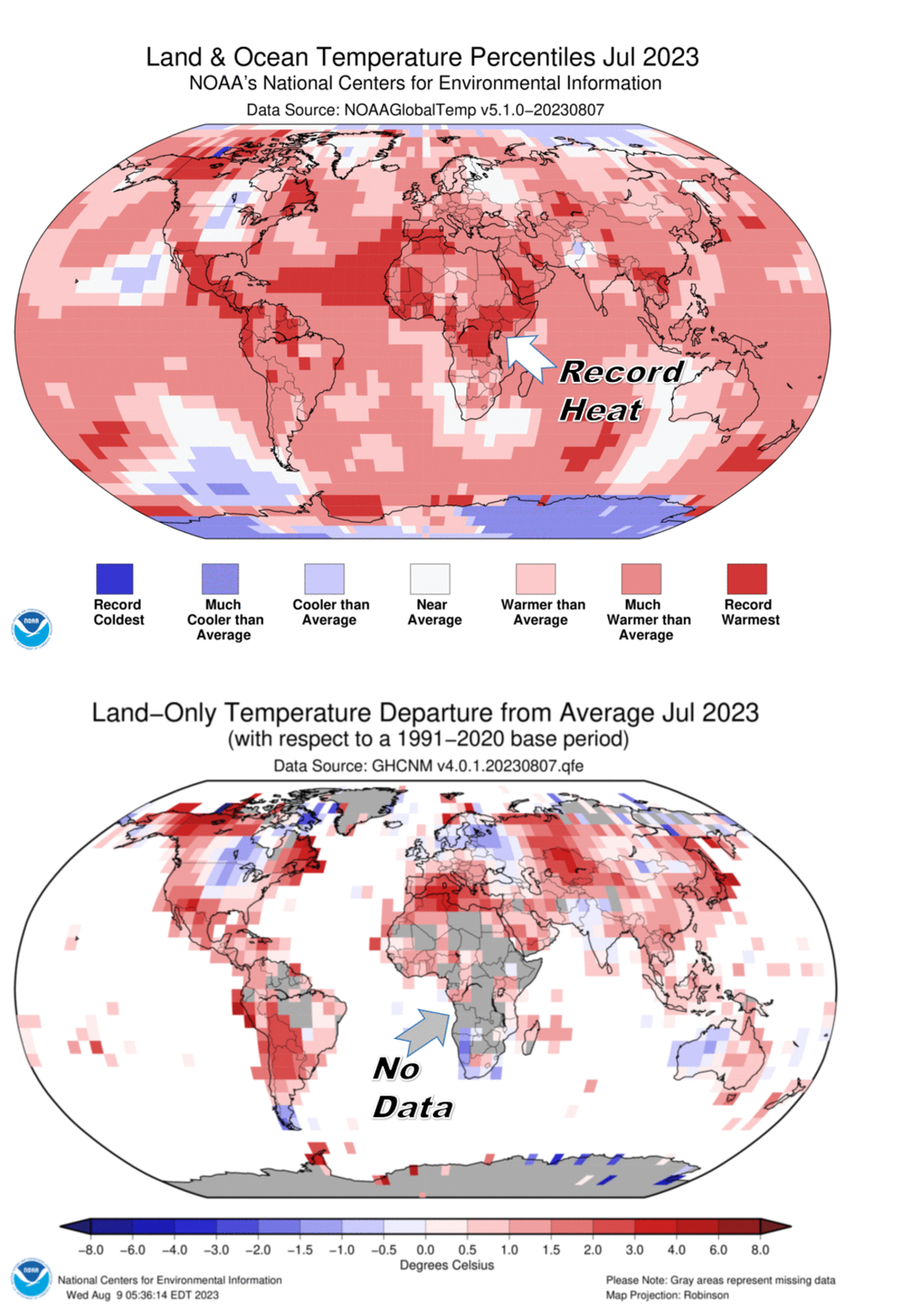
Against all that, Trudeau’s decision to compromise his climate agenda to save a few Atlantic ridings is a rather low-voltage issue. Yet it shows that Big Climate is losing its power.

The end of Big Climate may be good for the climate. Backing away from grandiose and absurd policies shifts attention toward more practical and reasonable measures that will garner wider public support.

COP28 in the desert is a suitable end to Big Climate.
It ends with a bang, as it were. And Trudeau withdraws with a whimper.


COP28 Showcases Globalist Agenda 2030

Two Sides of the Same Coin

Kit Knightly writes at off-guardian COP28: The Globalist Agenda Has Never Been More Obvious.  Excerpts in italics with my bolds and added images.  H/T Tyler Durden

As of this morning, we are four days into the two-week climate change summit in Dubai.

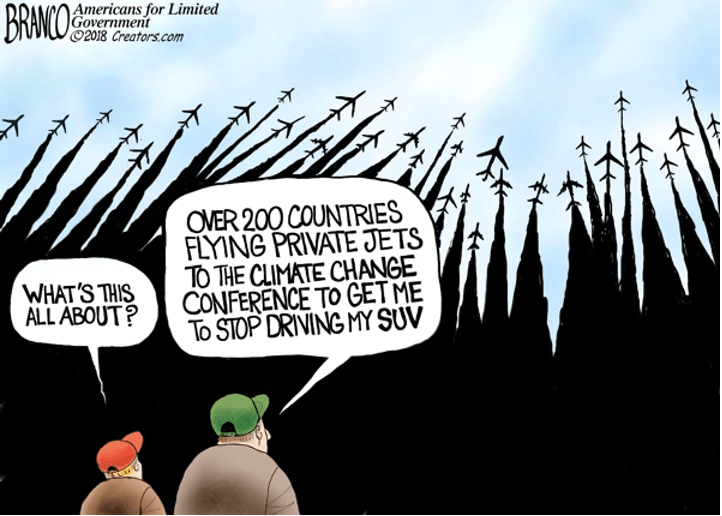
Yes, as we can all note for the thousandth time, literal fleets of private jets have descended on the desert so that bankers and billionaires can talk about making sure we don’t drive anymore or eat too much cheese.

What’s on the agenda? Globalism – and it’s never been more obvious.

President of Brazil Luiz Inácio Lula da Silva essentially said as much:

The planet is fed up with unfulfilled climate agreements. Governments cannot escape their responsibilities. No country will solve its problems alone. We are all obliged to act together beyond our borders,”

Thursday’s opening remarks were predictably doom-laden, with His Royal Highness Charles III and UN Secretary-General António Guterres falling into a traditional good cop/bad cop hustle.

Charlie warned that we are embarking on a “vast, frightening experiment”, asking “how dangerous are we actually prepared to make our world?”

While Tony offered just the barest, thinnest slice of hope to world leaders:

It is not too late […] You can prevent planetary crash and burn. We have the technologies to avoid the worst of climate chaos – if we act now.”

The rest of the two weeks will doubtless be committed to lobbyists, bankers, royals and politicians deciding exactly how they are going to “act”. Or, more accurately, how they are going to sell their pre-agreed actions to their cattle-like populations.

They are literally telling us their plans, all we have to do is listen.

For example, Friday and Saturday were given over to the “World Climate Action Summit”, at which over 170 world leaders pledged support for Agenda 2030.

Among the agreements and pledges signed at the summit so far is the “Emirates Declaration on Sustainable Agriculture, Resilient Food Systems and Climate Action”. Which, according to the BBC, pledges to:

take aim at planet-warming food”

We’ve all played this game long enough to know what that means, haven’t we?  It means no more meat and dairy, and a lot more bugs and GMO soy cubes.

They never say that, of course. Instead, they just use phrases like “orient policies [to] reduce greenhouse gas emissions”, or “shifting from higher greenhouse gas-emitting practices to more sustainable production and consumption approaches.”  Maintaining plausible deniability via vague language is part of the dance, but anyone paying attention knows exactly what they are talking about.

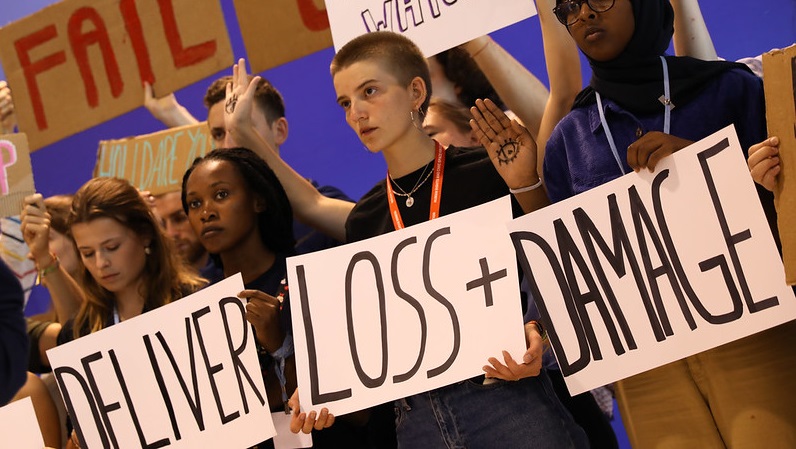
It doesn’t stop there. World leaders have also agreed to establish a “loss and damage fund”, a 430 million dollar resource for developing countries that need to “recover” after being “damaged” by climate change.

Ajay Banga, head of noted charitable organisation the World Bank, is all in favour of the idea and will be supporting the plan by agreeing to “pause” debt repayments from any government impacted by climate change.

Yes, those are trillions of US$ they are projecting.

We know how this works, we saw the same thing in the IHR amendments following Covid – it’s a bribe pool. One that serves to both further the narrative of climate change and instruct policy in the third world. Any developing nation’s government that wants a slice of that pie will have to publicly talk about all the negative impacts climate change has on their country.  At the same time, to get the money, they will almost certainly have to agree to “adopt climate-friendly policies” and/or submit their climate policies to an “independent panel of experts” appointed by the UN.

Alongside the food pledge and loss fund, we have the Global Renewables and Energy Efficiency Pledge, which aims to increase reliance on “green energy”. Over 120 countries signed that one.

And then there’s the Global Methane Pledge, which has been signed by 155 governments as well as 50 oil companies.  These companies represent around half the world’s oil production, and just want to help the planet, they have no financial stake in this situation at all.

There’s the smaller Declaration on Climate, Relief, Recovery and Peace, which was signed by only 70 countries (and 39 NGOs). That one emphasizes the link between war and carbon emissions and aims to “boost financial support for climate resilience in war-torn and fragile settings”, whatever that means in real terms I’m not sure.

And, of course, 124 countries (including the EU and China) have signed the inevitable ‘Declaration on Climate and Health’.

It is funded to the tune of 1 BILLION dollars from donors such as the Rockefeller Foundation, and supposedly aims to:

better leverage synergies at the intersection of climate change and health to improve the efficiency and effectiveness of finance flows.”

…which might be the worst sentence anyone has ever written.

All this is going to culminate in what they call the “Global Stocktake”. Essentially this is a mid-term report for the Paris Agreements, which can be “leveraged to accelerate ambition in their next round of climate action plans due in 2025”.

Whatever “leveraged to accelerate ambition” turns out to mean, you can be sure all of the attending governments will happily comply.  That includes every government in NATO, the European Union and BRICS by the way.  That includes the USA and China. That includes Russia and Ukraine.  That includes Israel…and Palestine.

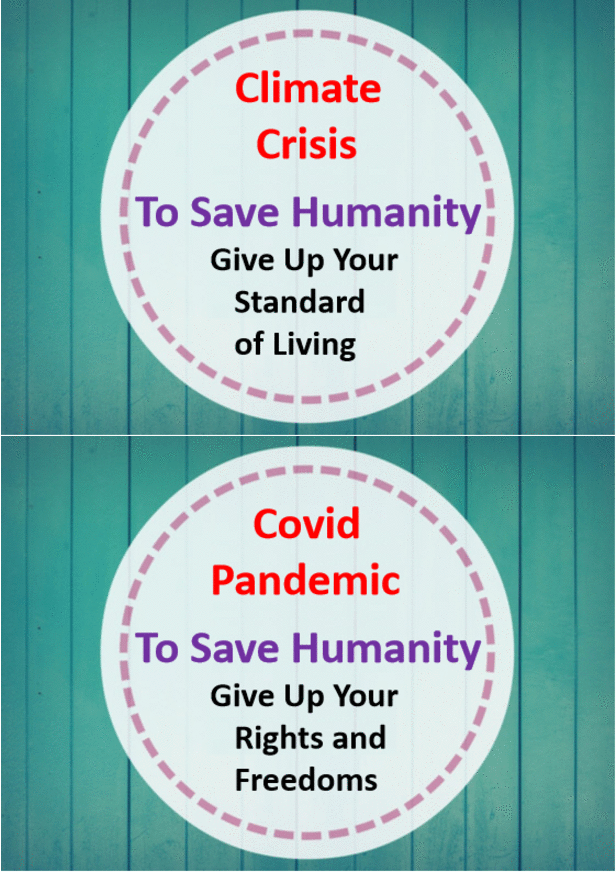
It’s basically covid all over again.

♦   We know, just like Covid, the official narrative of climate change is a lie.

♦   We know, just like Covid, climate change is being used as an excuse to usher in massive social control and global governance.

♦   And we know, just like Covid, almost every world government on both sides of every divide is backing it.

Even if they don’t always agree, even if they are happy to kill each other’s citizens in large numbers, they are all on board the same globalist gravy train, all going in the same direction to the same destination, and it has never been more obvious.

COP28 Mind-Boggling Numbers

The Green Mirage recedes as you approach it.

Robert Lyman exposes the freakish math swirling around Dubai COP this fortnight in his Financial Post article COP28 by the (very big) numbers.  Excerpts in italics with my bolds and added images.

This weekend’s climate meeting will discuss trillions of dollars.
No one will mention its chance of success is zero.

Neuroscience tells us the human brain is very bad at interpreting large numbers. Most people know that million, billion and trillion are all big numbers but can’t really understand what the difference between them is. Answer: it’s big. A million seconds is 12 days. A billion seconds is 31 years. A trillion seconds is 31,688 years, which is a lot more than 12 days.
Our cognitive difficulties with large numbers will be a problem when reading the news from the COP28 climate conference that convenes in Dubai on Thursday.

The conference has a wide-ranging agenda. It also will be attended by a large number of people — over 70,000 at last count. There’s the first large-number problem for COP28. How does a group of 70,000 people possibly discuss anything in a coherent way?

The organizers have identified five themes on which they would like to see agreement among the almost 190 governments that will be represented. When you’re talking governments, 190 is yet another brain-challenging number.

To oversimplify, there are four main themes:

♦  how to accelerate all countries’ efforts to reduce greenhouse gas emissions so as to meet a proposed 2050 “net-zero” target (zero not being a large number);
♦  how to induce wealthier countries to give much more money to poorer countries to help them both mitigate and adapt to climate change;
♦  how to persuade all countries to phase out production of fossil fuels by 2050; and, finally,
♦  how to increase the UN’s role as central coordinator and global regulator of climate efforts.

Most discussions behind closed doors will be about money. Rich countries are now paying about US$70 billion in climate aid, mostly to help finance GHG emissions reduction. The developing countries want this raised to at least US$1.4 trillion per year by 2026, 20 times higher. Twenty is not actually that large a number, except when talking about multiplying already very big dollar amounts by it. Developing countries have also demanded that funding for adaptation rise to at least US$600 billion per year. At last year’s COP27 in Egypt, they got agreement in principle for a new fund to pay for the “loss and damages” they will incur from adverse weather events they attribute to the historic GHG emissions of the industrialized countries, though no dollar amounts were agreed to. Finally, developing countries are pushing for a new Global Biodiversity Fund, to which developed countries would donate a mere US$20 billion per year.

Round numbers: rich countries would be on the hook for US$2 trillion per year. If allocations were based on GDP, Canada would owe three per cent of the total — or US$60 billion per year. In Canadian dollars, that’s roughly 78 billion CAN$. There are about 16 million households in Canada so (do the math) each household would owe $4,875. Per year. That’s a number the average person can easily understand. He or she can also understand there is absolutely no way the Canadian public or voters in any other OECD country would ever agree to such a thing. Not even if they didn’t know (but they do) that China, producer of 30 per cent of the world’s GHG emissions, not only would not be contributing but might well qualify as a recipient.

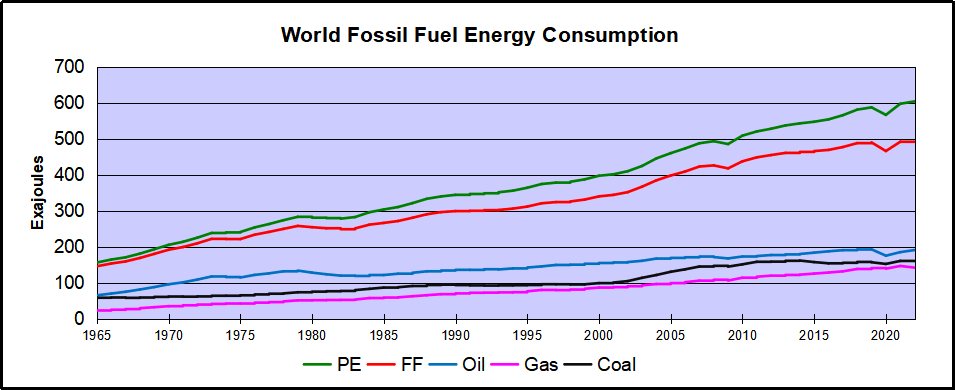
The previous 27 COPs (for Conference of the Parties) have all promoted ever-more ambitious emissions reductions. But since the first COP global emissions have risen 60 per cent, driven by developing countries’ relentless efforts to achieve more economic development for their burgeoning populations. There is no evidence that trend will change. China, India, Russia, Saudi Arabia, Iran, Iraq and others all see fossil fuel production as key to their economic development and energy security. They are unlikely to commit to production declines even if a few OECD countries do.

The United Nations secretariat will lobby hard at COP28 to expand the role of existing institutions, including even more climate summits to place even more political pressure on leaders, and they may succeed in this (though many of us feel just one a year is already more than enough). How difficult can it be to convince tens of thousands of climate stakeholders to travel to exotic conference locales each year? Especially if the general public cannot grasp the numbers they’re playing with.

Yes, those are trillions of dollars in the projection.

This weekend the media in general will report in glowing terms on the energy and enthusiasm of conference participants, especially those representing environmental NGOs. The communiqué will note every new commitment made yet entirely ignore that the probability the entire process will meet its objectives is a very, very small number not significantly different from zero.


Climate Loss and Damage Fails Again

The big news this week is the  breakdown of Climate “Loss and Damge” talks in preparation for the Dubai COP to start end of November.  The news report is repeated widely with the same headline and content. Example from Jakarta Post, Oct. 21, 2023:  Climate ‘loss and damage’ talks end in failure

A crucial meeting on climate “loss and damages” ahead of COP28 ended in failure Saturday, with countries from the global north and south unable to reach an agreement, according to sources involved in the talks. The agreement to set up a dedicated fund to help vulnerable countries cope with climate “loss and damage” was a flagship achievement of last year’s COP27 talks in Egypt.

But countries left the details to be worked out later. A series of talks held this year have tried to tease out consensus on fundamentals like the structure, beneficiaries and contributors — a key issue for richer nations who want China to pay into the fund.

The failure “is a clear indication of the deep chasm between rich and poor nations”, Harjeet Singh, head of global political strategy for Climate Action Network International, said in a statement to AFP on Saturday. “Developed countries must be held accountable for their shameless attempts to push the World Bank as the host of the fund, their refusal to discuss the necessary scale of finance, and their blatant disregard for their responsibilities” under the terms of already established international climate agreements, he said.

More in depth reporting comes from Climate Home News article World Bank controversy sends loss and damage talks into overtime

At Cop27 in Sharm el-Sheikh, governments tasked the committee with working out what a new loss and damage fund for climate victims should look like and present their proposals to Cop28 in November.

The fund is supposed to channel money to people who have suffered
loss and damage caused by climate change. This could mean rebuilding homes
after a hurricane or supporting farmers displaced by recurrent drought.
Failure to reach consensus risks delaying support to those in need.

But developing countries were incensed by a proposal to host the fund at the World Bank, painting it as a US power grab. And rich-poor divides persisted on how to define the “vulnerable” groups eligible for funds and who gets to control spending.

Pedro Luis Pedroso Cuesta is a Cuban diplomat and chair of the G77+China bloc, which represents all the developing countries.

Speaking from Aswan, he told reporters on Thursday: “At this late hour, a small group of nations responsible for the most significant proportion of the stock of greenhouse gases have tried to bargain potential support for a Fund on one side with eligibility and administrative arrangements.”

Developing nations have argued that the World bank is too slow, inefficient,
unaccountable and lacks the organisational culture to tackle climate change.

He said that consultations with the Washington-DC based bank had “displayed clearly” that it was “not fit for purpose in relation to what we’re looking for” and the fund should be set up as part of the United Nations instead.

Who benefits?

The second main division is over which countries are prioritised for funding. Developed countries want the funds to be allocated “based on vulnerability”.

There is no clear definition of vulnerability and Cuesta said this criteria would impede the fund’s ability to respond to recent climate-related floods in middle-income countries like Pakistan and Libya.

Developing countries fear that in practice “vulnerability” criteria mean funds will be restricted to just the world’s least developed countries (LDCs) and small islands developing states (Sids).

The 46 LDCS are mostly in Africa and parts of Asia. Major nations like
China, India, Brazil, Nigeria and South Africa are neither LDCs or Sids.

Further splits include developing nations wanting a target of $100 billion of funding a year by 2030 to be included and developed countries wanting to earmark budgets for slow onset events, recovery and reconstruction and small countries.

Negotiators have almost agreed one thorny issue though. The US had pushed for the fund’s board to include seats for nations that paid into the fund, sparking accusations that they were trying to rig the board in rich nations’ favour.

Friday morning’s draft said there would be 12 board members from developed countries and 14 from developing ones. There could also be non-voting members representing indigenous peoples and climate-induced migrants, although negotiators have yet to agree that.

Climate Loss and Damage is a Legal and Moral House of Cards

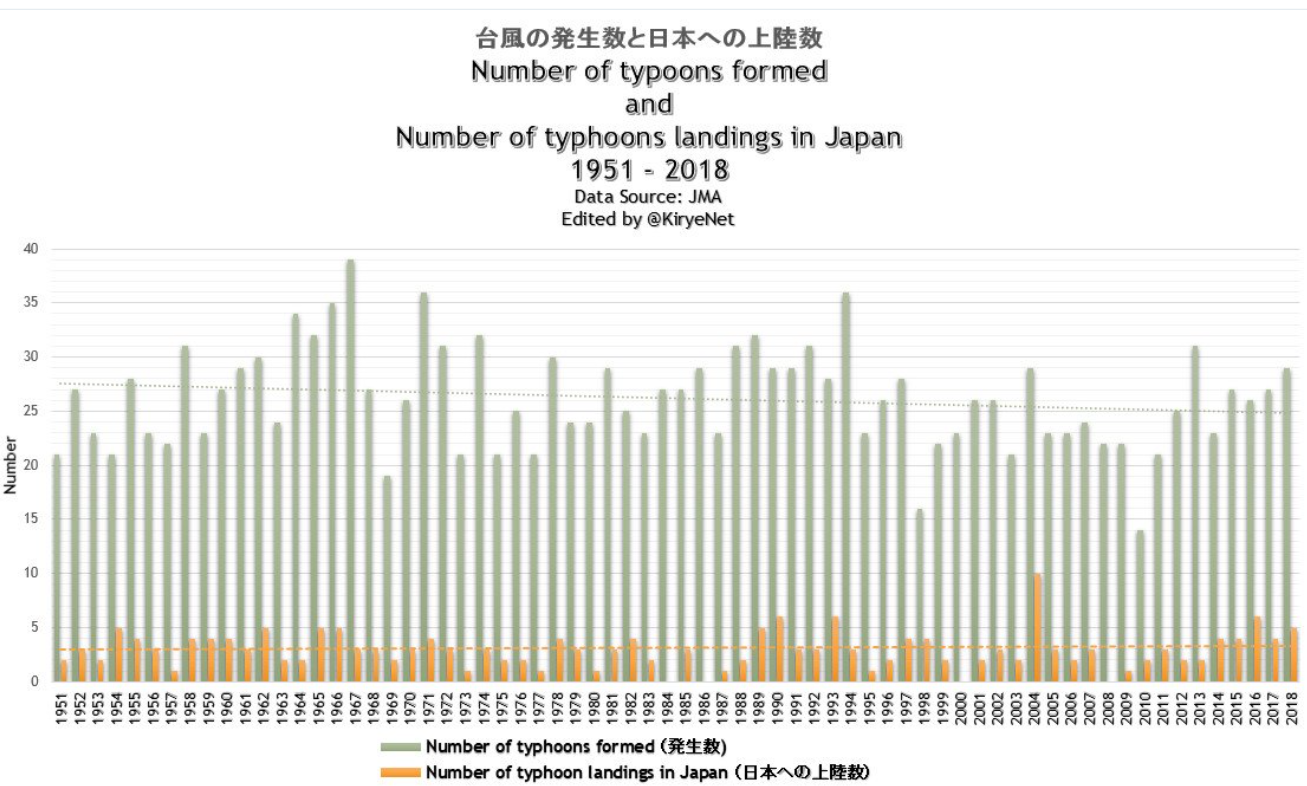
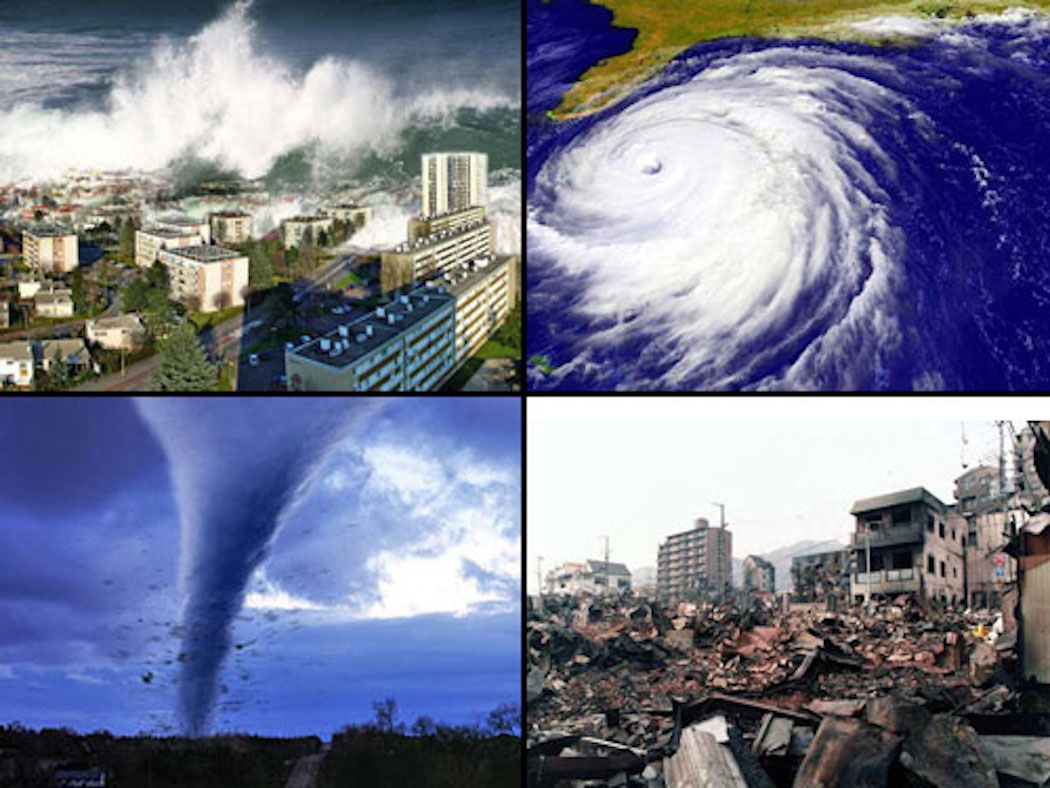
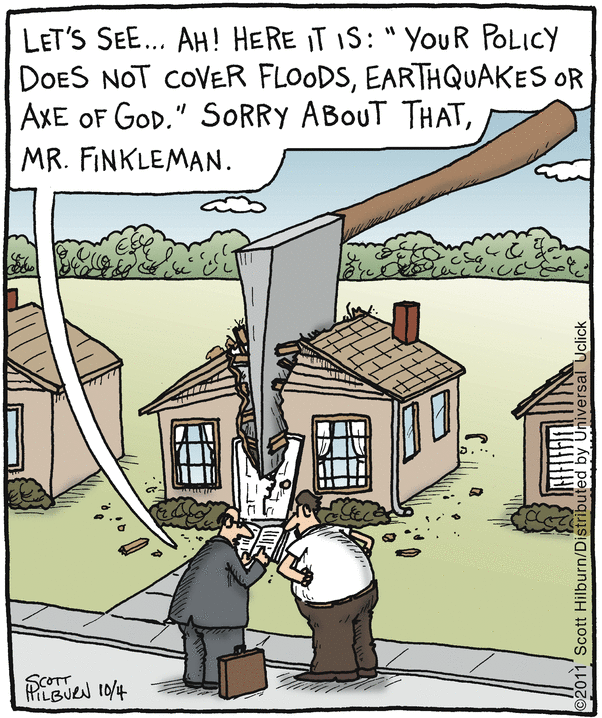
Mike Hulme explained the house of cards underlying the claims for compensation from extreme weather loss and damage.  He addressed this directly in his 2016 article Can (and Should) “Loss and Damage” be Attributed to Climate Change?.  Excerpts in italics with my bolds and added images.

One of the outcomes of the eighteenth negotiating session of the Conference of the Parties (COP18) to the UN Framework Convention on Climate Change, held in Doha last December, was the agreement to establish institutional arrangements to “address loss and damage associated with the impacts of climate change.” This opens up new possibilities for allocating international climate adaptation finance to developing countries. A meeting this week in Bonn (25–27 February), co-organized by the UN University Institute for Environmental and Human Security and the Loss and Damage in Vulnerable Countries Initiative, is bringing together various scholars and policymakers to consider how this decision might be implemented, possibly by as early as 2015.

At the heart of the loss and damage (L&D) agenda is the idea of attribution—that specific losses and damages in developing countries can be “associated with the impacts of climate change,” where “climate change” means human-caused alterations to climate. It is therefore not just any L&D that qualify for financial assistance under the Convention; it is L&D attributable to or “associated with” a very specific causal pathway.

Developing countries face some serious difficulties—at best, ambiguities—
with this approach to directing climate adaptation finance.

This is particularly so given the argument that the new science of weather attribution opens the possibility for a framework of legal liability for L&D, which has recently gained prominence (see here and here). Weather attribution science seeks to generate model-based estimates of the likelihood that human influence on the climate caused specific weather extremes.

Weather attribution should not, however, be used to make the funding of climate adaptation in developing countries dependent on proving liability for weather extremes.

There are four specific problems with using the post-Doha negotiations on L&D to advance the legal liability paradigm for climate adaptation. First, with what level of confidence can it be shown that specific weather or climate hazards in particular places are caused by anthropogenic climate change, as opposed to a naturally varying climate? Weather attribution scientists claim that such knowledge is achievable, but this knowledge will be partial, probabilistic, and open to contestation in the courts.

Second, even if such scientific claims were defendable, how will we define “anthropogenic?” Weather attribution science—if it is to be used to support a legal liability paradigm—needs to be capable of distinguishing between the meteorological effects of carbon dioxide emissions from fossil fuels and those from land use change, and between the effects of carbon dioxide and other greenhouse gases, black carbon (soot), and aerosol emissions. Each of these sources and types of climate-altering agents implicates different social and political actors and interests, so to establish liability in the courts, any given weather or climate hazard would need to be broken down into a profile of multiple fractional attributions. This adds a further layer of complexity and contestation to the approach.

Third, L&D may often be as much—or more—a function of levels of social and infrastructural development as it is a function of weather or climate hazard. Whether or not an atmospheric hazard is (partially) attributable to a liable human actor or institution is hardly the determining factor on the extent of the L&D. A legal liability framework based on attribution science promotes a “pollutionist approach” to climate adaptation and human welfare rather than a “developmentalist approach.” Under a pollutionist approach, adaptation is primarily about avoiding the dangers of human-induced climate change rather than building human resilience to a range of weather risks irrespective of cause. This approach has very specific political ramifications, serving some interests rather than others (e.g., technocratic and centralized control of adaptation funding over values-centered and decentralized control).

Finally, if such a legal framework were to be adopted, then what account should be taken of “gains and benefits” that might accrue to developing countries as a result of the impacts of climate change? Not all changes in weather and climate hazard as a result of human influence are detrimental to human welfare, and the principle of symmetry would demand that a full cost-benefit analysis lie at the heart of such a legal framework. This introduces another tier of complexity and contestation.

Following Doha and the COP18, the loss and damage agenda now has institutional force, and the coming months and years will see rounds of technical and political negotiation about how it may be put into operation. This agenda, however, should not place climate adaptation funding into the framework of legal liability backed by the new science of weather attribution.

Hulme goes more deeply into the Loss and Damage difficulties in his 2014 paper Attributing Weather Extremes to ‘Climate Change’: a Review.  Excerpts in italics with my bolds.

In this third and final review I survey the nascent science of extreme weather event attribution. The article proceeds by examining the field in four stages: motivations for extreme weather attribution, methods of attribution, some example case studies and the politics of weather event Attribution.

Hulme concludes by discussing the political hunger for scientific proof in support of policy actions.

But Hulme et al. (2011) show why such ambitious claims are unlikely to be realised. Investment in climate adaptation, they claim, is most needed “… where vulnerability to meteorological hazard is high, not where meteorological hazards are most attributable to human influence” (p.765). Extreme weather attribution says nothing about how damages are attributable to meteorological hazard as opposed to exposure to risk; it says nothing about the complex political, social and economic structures which mediate physical hazards.

And separating weather into two categories — ‘human-caused’ weather
and ‘tough-luck’ weather – raises practical and ethical concerns about
any subsequent investment allocation guidelines which excluded
the victims of ‘tough-luck weather’ from benefiting from adaptation funds.

Synopsis of this paper is at X-Weathermen are Back!

Integrated Storm Activity Annually over the Continental U.S. (ISAAC)

See also Data vs. Models #3: Disasters


IPCC Guilty of “Prosecutor’s Fallacy”

IPCC made an illogical argument in a previous report as explained in a new GWPF paper The Prosecutor’s Fallacy and the IPCC Report.  Excerpts in italics with my bolds and added images.

London, 13 September – A new paper from the Global Warming Policy Foundation reveals that the IPCC’s 2013 report contained a remarkable logical fallacy.

The author, Professor Norman Fenton, shows that the authors of the Summary for Policymakers claimed, with 95% certainty, that more than half of the warming observed since 1950 had been caused by man. But as Professor Fenton explains, their logic in reaching this conclusion was fatally flawed.

“Given the observed temperature increase, and the output from their computer simulations of the climate system, the IPCC rejected the idea that less than half the warming was man-made. They said there was less than a 5% chance that this was true.”

“But they then turned this around and concluded that there was a 95% chance
that more than half of observed warming was man-made.”

This is an example of what is known as the Prosecutor’s Fallacy, in which the probability of a hypothesis given certain evidence, is mistakenly taken to be the same as the probability of the evidence given the hypothesis.

As Professor Fenton explains

“If an animal is a cat, there is a very high probability that it has four legs.
However, if an animal has four legs, we cannot conclude that it is a cat.
It’s a classic error, and is precisely what the IPCC has done.”

Professor Fenton’s paper is entitled The Prosecutor’s Fallacy and the IPCC Report.

What the number does and does not mean

Recall that the particular ‘climate change number’ that I was asked to explain was the number 95: specifically, relating to the assertion made in the IPCC 2013 Report of ‘at least 95% degree of certainty that more than half the recent warming is man-made’.  The ‘recent warming’ related to the period 1950–2010. So, the assertion is about the probability of humans causing most of this warming.

Before explaining the problem with this assertion, we need to make clear that (although superficially similar) it is very different to another more widely known assertion (still promoted by NASA) that ‘97% of climate scientists agree that humans are causing global warming and climate change’. That assertion was simply based on a flawed survey of authors of published papers and has been thoroughly debunked.

The 95% degree of certainty is a more serious claim.
But the  case made for it in the IPCC report is also flawed.

[Commment: In the short video above, Norman Fenton explains the fallacy IPCC committed.  Synopsis of example.  A man dies is a very rowdy gathering of young men.  A size 13 footprint is found on the body.  Fred is picked up by the police.  He admits to being there but not to killing anyone, despite wearing size 13 shoes.  Since statistics show that only 1% of young men have size 13 feet, the prosecutor claims a 99% chance Fred is guilty.  The crowd was reported to be on the order of 1000, so  there were likely 10 others with size 13 shoes.  So in fact there is only a 10% chance Fred is guilty.]

The flaw in the IPCC summary report

It turns out that the assertion that ‘at least 95% degree of certainty that more than half the recent warming is man-made’ is  based on the same fallacy. In my article about the programme, I highlighted this concern as follows:

The real probabilistic meaning of the 95% figure. In fact it comes from a classical hypothesis test in which observed data is used to test the credibility of the ‘null hypothesis’. The null hypothesis is the ‘opposite’ statement to the one believed to be true, i.e. ‘Less than half the warming in the last 60 years is man-made’. If, as in this case, there is only a 5% probability of observing the data if the null hypothesis is true, the statisticians equate this figure (called a p-value) to a 95% confidence that we can reject the null hypothesis.

But the probability here is a statement about the data given the hypothesis. It is not generally the same as the probability of the hypothesis given the data (in fact equating the two is often referred to as the ‘prosecutors fallacy’, since it is an error often made by lawyers when interpreting statistical evidence).

IPCC defined ‘extremely likely’ as at least 95% probability.  The basis for the claim is found in Chapter 10 of the detailed Technical Summary, which describes various climate change simulation models, which reject the null hypothesis (that more than half the warming was not man-made) at the 5% significance level. Specifically, in the simulation models, if you assumed that there was little man-made impact, then there was less than 5% chance of observing the warming that has been measured. In other words, the models do not support the null hypothesis of little man-made climate change. The problem is that, even if the models were accurate (and it is unlikely that they are) we cannot conclude that there is at least a 95% chance that more than half the warming was man-made, because doing so is the fallacy of the transposed conditional.

The illusion of confidence in the coin example comes from ignoring (the ‘prior probability’) of how rare the double-headed coins are. Similarly, in the case of climate change there is no allowance made for the prior probability of man-made climate change, i.e. how likely it is that humans rather than other factors such as solar activity cause most of the warming. After all, previous periods of warming certainly could not have been caused by increased greenhouse gases from humans, so it seems reasonable to assume – before we have considered any of the evidence – that the probability humans caused most of the recent increase in temperature to be very low. 

Only the assumptions of the simulation models are allowed,
and other explanations are absent.

In both of these circumstances, classical statistics can then be used to deceive you into presenting an illusion of confidence when it is not justified.

See Also 

Beliefs and Uncertainty: A Bayesian Primer


You pick one unopened door. Monty opens one other door. Do you stay with your choice or switch?

Monty Hall Problem Simulator


Great News! IPCC Final Warning Now!

OK, they’ve exaggerated before, so could be that “final” may not stick.  For anyone following climate science and politics, this is not their first rodeo (or circus, if you prefer.)  But we can hope for peace at last from the doomsters.  Chris Morrison goes into what’s unconvincing about this final warning in his Daily Sceptic article Latest UN Climate Doom Report Falsely Claims Global Temperatures Are “Highest for 125,000 Years”.  Excerpts in italics with my bolds and added images.

Doomsday had to be postponed for five months, but ‘pausing’ IPCC writers have finally delivered another ‘Net Zero or Else’ report highlighting increasingly improbable climate change scenarios. Every IPCC report ramps up the desperation, and this latest ‘Synthesis Report‘ known as SYR is long on opinions, attributions and modelled results, but somewhat shorter on actual scientific facts.

The latest document collates the IPCC’s sixth assessments reports (AR6) into a short format that was originally scheduled to ramp up fears ahead of last year’s COP27 meeting in Sharm el-Sheikh. But in May and June last year, the planet-saving authors seem to have gone on strike. A few details about the incident are referred to in recently published IPCC minutes, which record how attempts were made with the writers to “rebuild the trust required to have them end their pause in writing, and to engage in the SYR production process”. Not before time, since IPCC reports need to be agreed with large numbers of interested parties, including almost 200 member governments. ‘Settled’ science, it need hardly be added, demands a lot of happy and settled funders.

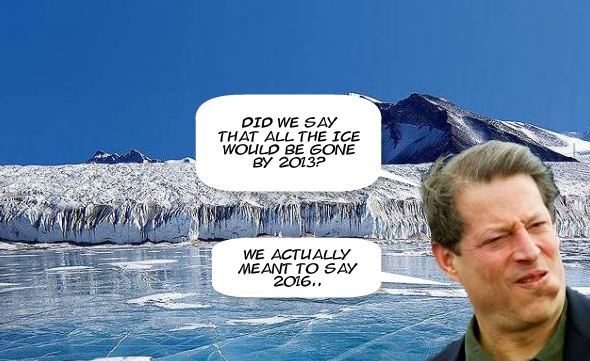
Disappearing Arctic Sea Ice

Current global temperatures are said by the IPCC to be the highest for 125,000 years, an astonishing claim given the many scientific surveys that show much higher temperatures in the recent past. It is also claimed that temperatures will rise by 0.4°C in around a decade, an interesting opinion, based presumably on surface records that can be retrospectively adjusted, but an unlikely scenario given global warming ran out of steam over two decades ago. By 2100, the IPCC says global warming could rise to 4.4°C, although things need to be moving on a bit smartish given barely 0.1°C warming in the first two decades of the century.

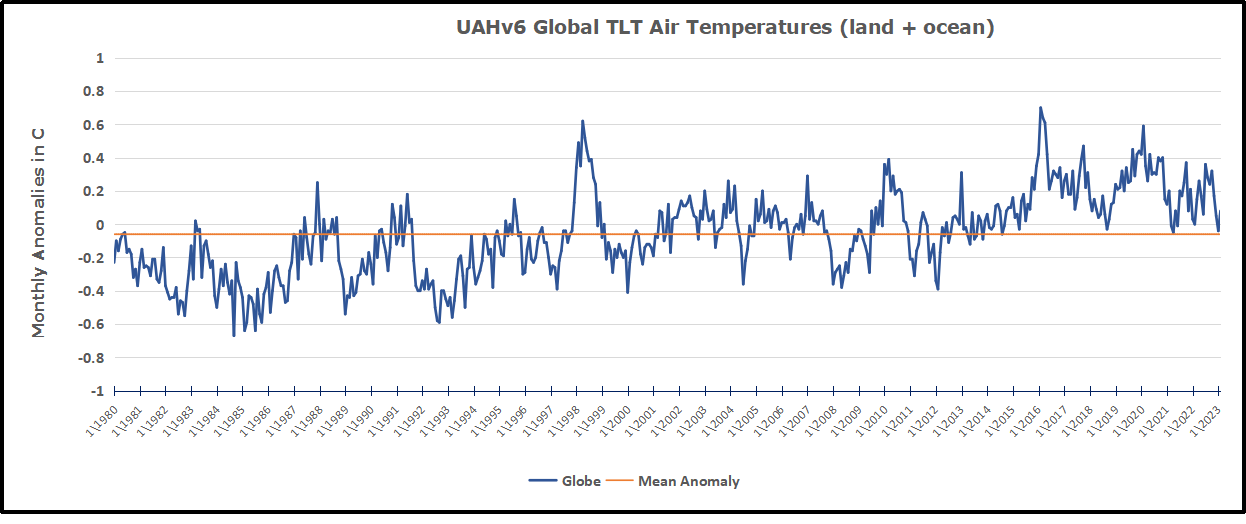
Satellite Global Warming Up and Down

There have been one or two concerns of late that the IPCC’s scare tactics have sent half the world doolally with climate fear, especially the impressionable young. These criticisms seem to have been taken on board. UN Secretary General Antonio ‘Code Red’ Guterres hailed SYR as a “survival guide to humanity”. All we need to do, continued the Left-wing Portuguese radical, is for all countries to bring forward their Net Zero plans by a decade. Dr. Friederike Otto from Imperial College specialises in so-called ‘attribution’ studies and the pseudoscience of claiming specific weather events are caused by the activities of humans. She helped write the latest report and was also in optimistic mood telling the BBC: “If we aim for 1.5°C and achieve 1.6°C, that is still much better than saying, it’s too late and we are doomed and I’m not even trying. And I think what this report shows very, very clearly is there is so much to win by trying.”

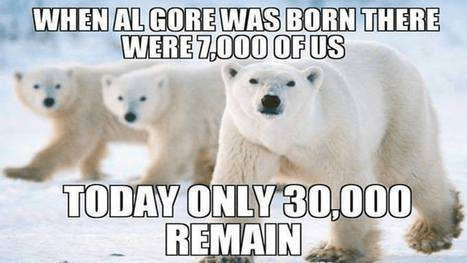
Extinctions Overblown

Back on Planet Reality, it might be noted that there are a number of possible disadvantages connected to removing fossil fuels, a reliable, inexpensive energy supply that powers 80% of global needs, within less than 17 years.

Starvation, death, widespread warfare, societal and economic breakdown and rampant disease being just a few that come immediately to mind.

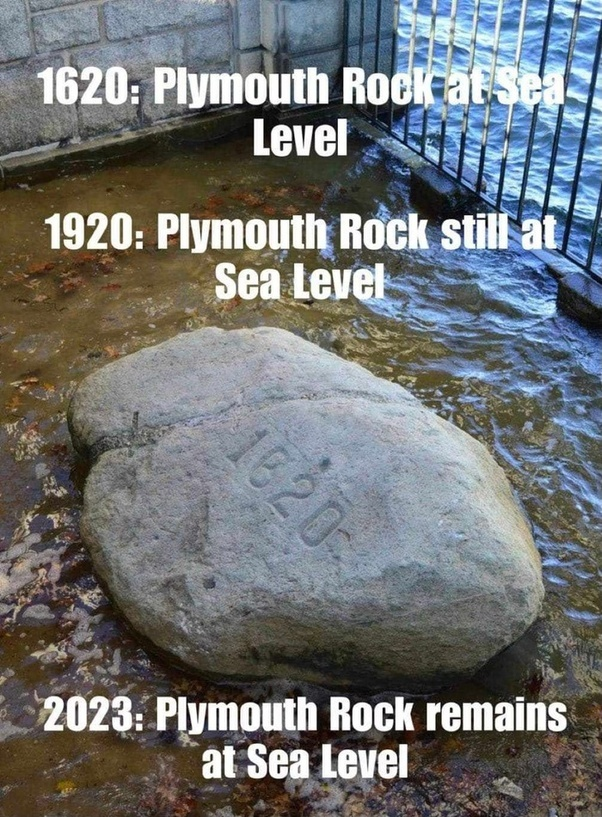
Coastal Flooding, Not

Traditional Landing Site of Mayflower Pilgrims.

It is not difficult to see why the IPCC continues to claim current global temperatures are the highest for 125,000 years, despite overwhelming scientific evidence that shows this is untrue. The rebound rise of about 1°C seen over the last 200 years is very small, and similar changes have obviously occurred countless times in the historical and paleo past, sometimes over even shorter time periods. It is difficult to worry too much about something that seems natural and in fact is beyond the control of humans. Placing the rise in the longer context of 125,000 years and adding all manner of invented weather event attribution and ‘tipping’ point stories adds some firepower to a political narrative ultimately designed to move society towards the collectivist Net Zero agenda.

Net Zero:  Who Gains, Who Loses

The Daily Sceptic has reported on a number of science papers that track the higher temperatures in the past, in particular the period since the last ice age started to lift about 12,000 years ago. A sample can be read here, here and here.

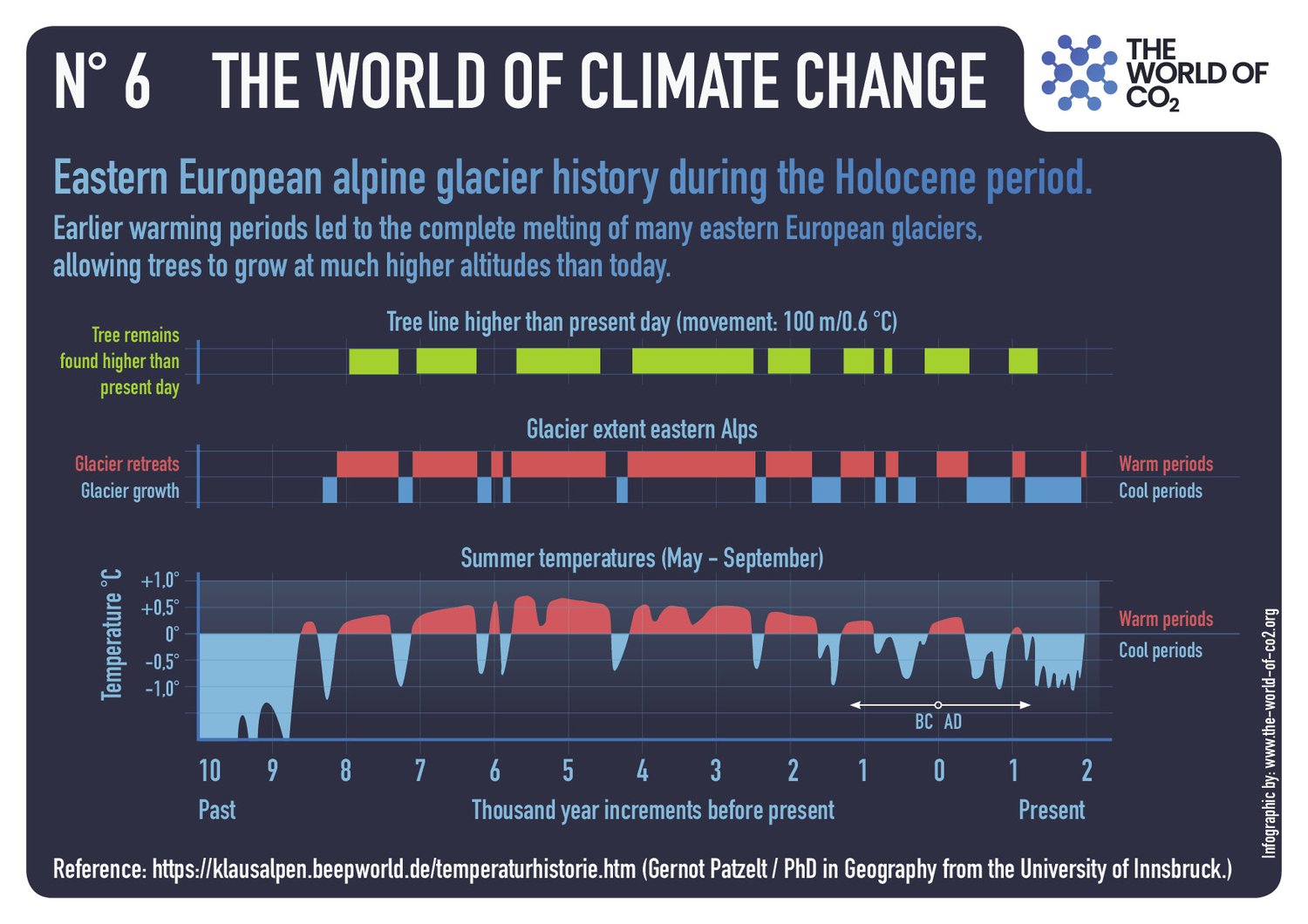
Earlier this year, a group of European scientists published a paper analysing tree remains that suggested there was a much warmer climate in the Alps during most of the last 10,000 years.

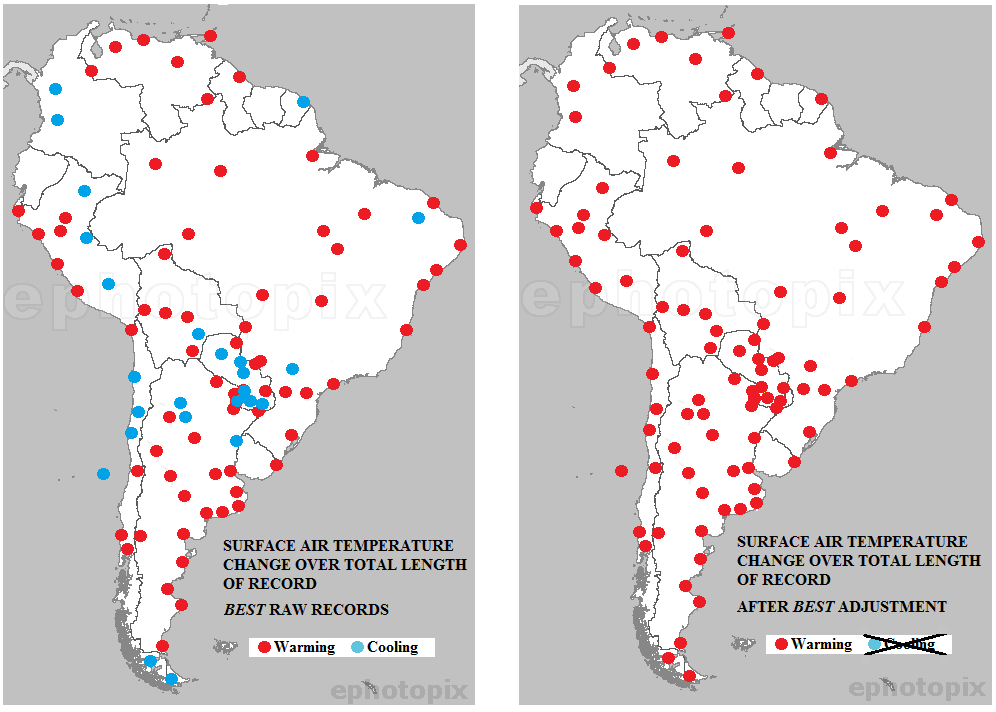
Adjusting Temperature Records.

‘Settled’ science, it might be observed, needs consensus from the world and his wife. The recent IPCC minutes, for instance, noted that the SYR team, “should ensure policy relevance and usefulness for policymakers”. Needless to say this is not to the taste of some independent-minded scientists, especially those retired with no need to hustle for state research or Left-wing foundation funds. In fact they can be quite disobliging about the entire IPCC process. In a recent paper titled ‘Challenging “Net Zero” with Science‘, Emeritus Professors William Happer and Richard Lindzen of Princeton and MIT respectively called Net Zero “scientifically invalid and a threat to the lives of billions of people”. In fact they have previously dismissed the peer review system around climate change as a “joke” – pal review, not peer review, they quipped. The IPCC is “government controlled and only issues government-dictated findings”.

Sketchy Warming Evidence

“Climate science is awash with manipulated data, which provides no reliable scientific evidence,” they added.

Footnote: So What Happens Next

As I said above, we’ve seen this show before.  Caleb Rossiter explains how it goes down:

For years I assigned statistics students to pick any apocalyptic climate claim in the media and trace it back through the UN reports to its genesis in a scientific study. I knew they would discover that these reports are not scientific documents based on the peer review process, but political documents “approved by governments” and intended to scare the public into supporting constraints on the production and use of energy.

A powerful publicity machine magnifies the alarm, bombarding citizens with exaggerations and claims of certainty that are proven wrong as you dig down to their underlying scientific studies:

  • Public figures, news editors, and commentators make claims that are more alarmist than what individual IPCC authors say at the release of the report.
  • Individual IPCC authors make claims at the release of the report that are more alarmist than what the official press release says.
  • The official press release makes claims that are more alarmist than what the report’s summary for policy-makers says.
  • The summary for policy-makers makes claims that are more alarmist than the various chapters of the reports.
  • The chapters of the report make claims that are more alarmist than the studies they reference in the footnotes.

More at

UN Horror Show

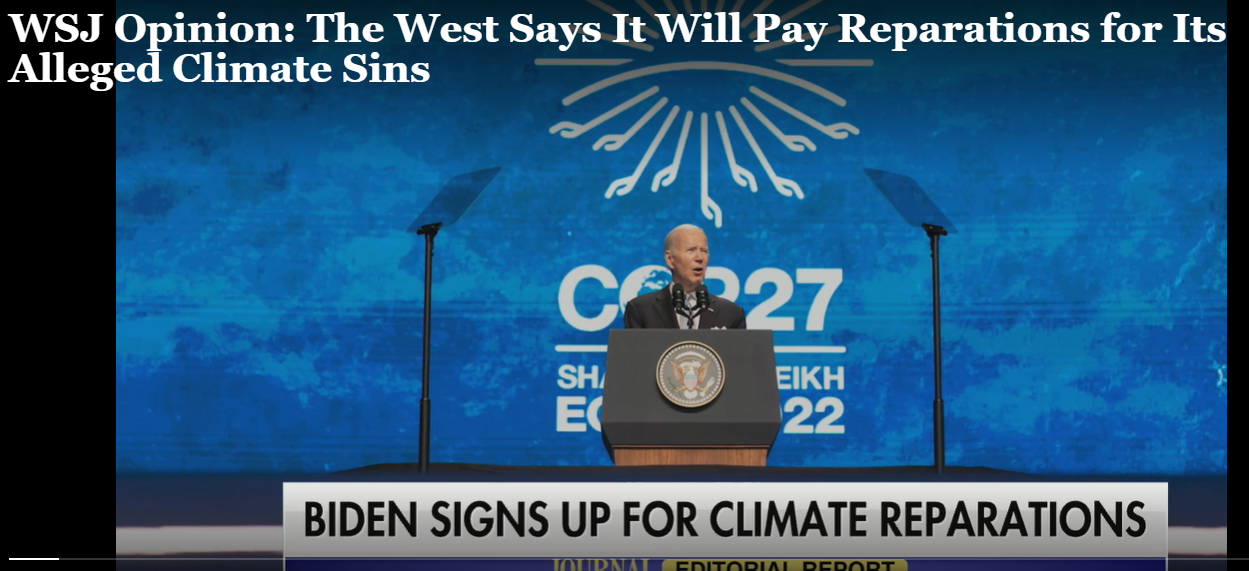
Climate Reparations a Lose-Lose-Lose Deal

https://video-api.wsj.com/api-video/player/v3/iframe.html?guid=E6B05E12-0E60-4B80-A8A2-565460ABABF5

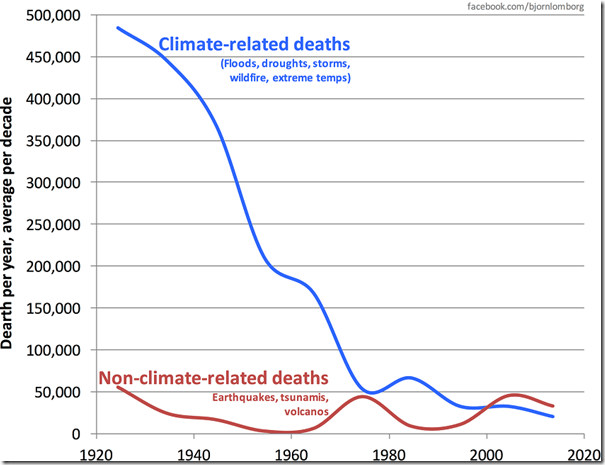
At the recently concluded UN climate summit, wealthy nations agreed to pay climate reparations to poor countries. Unfortunately, this could ultimately be a bad deal even for the recipients, if the West expects developing nations to forego fossil fuels that would help them to develop and get more resilient towards natural disasters. Bjorn Lomborg also discussed the topic on The Journal Editorial Report with Wall Street Journal editor Paul Gigot.

The link to the video clip of the interview is in red above, and below a lightly edited transcript of the conversation.  PG refers to Paul Gigot and BL to Bjorn Lomborg.  Transcript is in italics with my bolds and added images.

PG: The COP27 conference in Egypt wrapped up last week with President Biden signing on to a climate reparations plan. Under the agreement wealthy countries would pay into a new fund to compensate poor countries for supposed damage caused by rich country use of fossil fuels. The move represents a major reversal in U.S. policy with the Biden administration’s climate envoy John Kerry dismissing the idea just weeks ago, saying that a compensation fund was “just not happening.”

Let’s bring in Bjorn Lomborg, President of the Copenhagen Consensus Center and a visiting fellow at the Hoover Institution. He’s also author of the book False Alarm: How Climate Change Panic Costs Us Trillions, Hurts the Poor and Fails to Fix the Planet.

Welcome back, Bjorn. So first of all, what do you make of climate reparations fund idea? Is it a good idea, or not?

BL: No it’s mostly a bad idea. Look, there’s a lot of different things you can think about it. But first and foremost, if you step back, we’ve been trying to solve climate, which is a real issue, for what, 30 years now. It’s the 27th Conference. And now we’re basically moving from fixing climate–Which would obviously entail, How do we get technologies out so people actually cut their carbon emissions–to now saying, no, let’s just make it about money.

The second part is, of course, this is payback for the incredible amount of exaggeration that’s been going on for the last 30 years. If you tell everyone that this is terribly dangerous and it’ll endanger basically the survival of the human race. Don’t be surprised when most people are gonna say, “Well then, you know, give me some money, for putting me in this dangerous situation.” That’s not the right way to look at this. The economic estimates show that global warming will be a problem; we’re talking about perhaps 4% of GDP by the end of the century, not a wipe out.

And then the really damaging thing is that much of this money, if it at all materializes, it will be spent on rich countries paying poor countries not to use fossil fuels. Which essentially means not developing. And of course that will leave them undeveloped. That will leave them in poverty. And why is it that these countries like Pakistan are vulnerable to flooding? Remember most of Pakistani floods came from bad governance, lots of bad infrastructure and lots of people. It’s because they’re vulnerable, because they’re poor. So leaving them poor is the worst way to help fix the problem of climate change.

So this will leave the world worse off, and of course leave rich countries with a huge bill.

PG: I find your arguments compelling, Bjorn, but then why did the Europeans decide, in the first instance, to change their minds on this, to go ahead and endorse this reparations fund. And that isolated the U.S., which I gather felt then they couldn’t be isolated and had to go along. Why did the Europeans insist on this?

BL: It’s hard to tell. My gut feeling, and I wasn’t there, my gut feeling is they realized that nothing was coming out of the Sharm El-Sheikh meeting of the COP 27. So we need to have some sort of success. So let’s say yes to this, which the developing world was very strongly pushing. Look if you go to all of these meeting, and virtually nothing comes out of it; if there’s the possibility of getting trillions out of it, I can understand why a lot of leaders would sign up for basically free money.

But the reality is, much of this could end up not happening, because remember the U.S. Congress has to appropriate: That does not seem plausible. The New York Times said, “We now have a fund but there is no money in it. So it seems likely this will not come true. Most countries are not feeling very flush right now. I can’t imagine most countries saying, “ Sure, let ‘s pay another couple of trillion dollars to the developing world.

First and foremost let’s remember that if this actually happened, it would likely prevent poor countries from using fossil fuels, which is one of the key ways to get out of poverty. Remember China dramatically industrialized by using lots and lots of fossil fuels, and almost lifted a billion people out of poverty. That’s an amazing achievement. And most people in the developing world want to do the exact same thing. So in a sense, we are setting all of ourselves up for really bad outcomes in the future.

PG: There’s kind of a guilt tax quality to this, where the West is supposed to pay for the sin of having actually developed first, and for being prosperous in part by using fossil fuels. But China isn’t tapped to pay into this fund at all. And it’s building coal plants at a rapid pace, to the point where its projected new plants are going to dwarf all of the U.S. current coal production by 2025. How can China remain out of all of this?

BL: Well, first of all, because that would be really convenient for China. They are categorized as a developing country in the UNFCCC agreement that encompasses the COP negotiations. And of course, it you’re China, you wanna stay that way. I think it’s also fair to say that China has still only historically emitted only about half of what the U.S. or Europe has done. So there is some justification to this. But we have to very clearly separate the fact that you could make the argument that a little bit of reparations make philosophical sense.

But if you start in letting that genie out of the bottle, you’ll make the whole conversation about that, and forgetting to actually fix climate change.

Which is about making green energy much cheaper in the future through innovation. That’s what we should be focusing on if we actually want to fix this. And secondly, you’ll also have this situation where India, China and almost everyone else is not going to pay into this potentially enormous cost.

Summation

Climate reparations is a move in which rich nations lose, poor nations lose and energy innovation loses,  And as noted previously, the winners will be lawyers and accountants, as well as sovereign hydrocarbon producers.

Climate Loss and Damage, Legal House of Cards


Climate Truth Science Soundbites

The climate realists at Creative Society have put together a short video with pithy statements skewering the CO2 theory of climate change.  Above is the video and below a transcript with exhibits and the speakers’ identities.

Dr. Harold Burnett
Over time the atmospheric levels of carbon dioxide have radically fluctuated throughout the earth’s geologic history. They have been in the past as much as 5000 parts per million. Currently they are about 420 parts per million. So over long periods of time they have fluctuated, but in general they have fallen.

Gregory Wrightstone
There doesn’t seem to be any correlation whatsoever with increasing CO2 and temperature. And in fact one of the things we’re being asked to believe is that our modern temperatures are unusual and unprecedented, as thought we’ve never seen temperatures like this in thousands of years. That’s just not the case.

Prof. Ole Ellestad
We have a map showing temperature changes over the last 11,000 years. These are Greenland ice cores and we can see a thousand years ago, about 2000 years ago and about 3000 years ago we had warm periods. And everything indicates that these were periods of global warming.

Hans Borge
It was long before man-made CO2 emissions had any considerable volume. Therefore we know that the natural variability can be large.

Jan-Eric Solheim
In this graph we also show what the IPCC does. It prolongs more or less this curve going to infinite.  So it becomes warmer and warmer because of the CO2 release or climate. And that’s what we think is wrong. Our prediction is that it will soon start Cooling and we have to be prepared for that.

Gregory Wrightstone
The warming trend we’re in right now though started more than 300 years ago. But again 250 years of warming took place before we started adding CO2. But we’re asked to believe that those natural forces that have been driving temperatures since the dawn of time suddenly ceased in the 20th century.

Hans Borge
CO2 is a gas that has very little effect on the climate. The IPCC models assume that the higher the CO2 level, the higher the water vapor level, and water vapor is a gas with the greatest impact on the climate. But the assumption that the more CO2, the more water vapor, has never been proved.

Jan-Eric Solheim
With some colleagues I have done experiments to see if CO2 can heat or carry heat. So we have built small greenhouses and tried to heat it by the sun outside or inside with artificial heating. We were able to show that carbon dioxide stops radiation, but we were not able to show any heating. So it’s a mystery how CO2 cannot heat, but what can heat is the water.

Gregory Wrightstone
The water vapor temperature changes first and then CO2 levels follow that. It’s not the other way around. If man increasing CO2 is going to drive temperature, CO2 should change first and then temperature should change.

Jan-Eric Solheim
The blue curve is the temperature of the sea that is the ocean surface temperatures. The red is the land temperature which we get in this case from HadCRUT, which is an official temperature series. First comes the change in the sea temperature, a little bit later the land temperature (red) and then about one year, 10 or 11 months the carbon dioxide changes. And when temperature at the sea surface goes down, the carbon dioxide goes down 10 or 11 months later.

Hans Borge
Well let me show you another table that might tell you a little bit about the CO2 content. Take a look:  there are 3 000 billion tons of CO2 in the atmosphere and the total man-made emissions per year are 20 to 30 billion tons. But if you look at the ocean, it has far more CO2. So the exchange of CO2 between the ocean and the atmosphere totally overshadows human activity.

Jan-Eric Solheim
So a more detailed analysis telling that this red part here is apparently what anthropogenic yes or mankind produced carbon dioxide, which is about three percent of the increase from 1960. But nature produces the rest, this variable curve here. So 97 percent of the increase comes from nature, according to these scientists.

Prof. Ole Ellestad
The IPCC also claims that the sun has no effect on us. It’s a great paradox; not clear how they arrive at that. Moreover today we see that the warming is happening not only on our planet but also on other planets and on the moon too, where there’s a completely different atmosphere that has nothing to do with CO2. So clearly there is a sun factor which is missing in their model.

Gregory Wrightstone
Well, the iIPCC if you look back on their charter it was formed to present the data that supports warming. They weren’t tasked to provide all the data. They started with an assumption and went from there. So if that’s their task, they’re doing a darn good job at it. You better have some good science behind you, and it’s just not there.

Dr. Harold Burnett
The world’s governments through the UN formed the UN Framework Convention on Climate Change. Now you would think that would be studying climate change, but they specified that you study the human causes of climate change. So they ruled out all natural factors. They said no no: we’re not going to study whether the sun plays a role; we’re not going to study whether volcanoes play a role; we’re not going to study whether ocean current shifts play a role. And we really don’t understand clouds, so we’re not going to count them much. What we’re going to study is human CO2 emissions because that’s what we can get a handle on.

That’s not the way science is supposed to work. If you make faulty or incomplete assumptions, your models are going to be weak, because they’re only as good as the accuracy of the stuff that’s put in them. Now climate models have failed to accurately reflect past temperatures; they fail to accurately represent present temperatures; but we’re told we can trust their projections of future temperatures.  That doesn’t seem reasonable to me.

Gregory Wrightstone
If on the other hand, you like the scientific process, we’re not getting much data out there. Dr Will Happer is our chairman here at the CO2 coalition and he’s got a paper that he and Dr. Van Wijngaarden have done on climate sensitivities. They’re not able to get it in any prestigious journals, yet it’s a landmark study. They need to shut people like me down: I was just banned on linkedin, which should be a professional network, a social media network. I don’t talk those things that are controversial; I post scientific facts, and they were being removed. And they came back and said: No, you’re done. We don’t allow that kind of information on linkedin.

Prof. Ole Ellestad
This debate is so violent that if you go to the media you can express your opinion, but you will be strongly criticized, and then you won’t really have an opportunity to defend yourself. But most importantly, you won’t get into the media with your first articles.

Hans Borge
This is what we see now in the academic world, for example at universities. Academic freedom is so endangered. I have to say that many people who joined the ranks of climate realists do so when they retire; because until retirement they just don’t dare. Researchers who claim something different don’t get grants; they don’t have their say in either published media or in edited journals.

Dr. Harold Burnett
First off you’re having a difficult time getting published because journals won’t hear it. Well, that affects your tenure track position and your colleagues are frowning at you. And you’re not getting government grants because government doesn’t give grants to study natural factors for climate change or to study things that prove humans aren’t causing climate change. Because government has a motive: expanding its its reach. I know researchers who’ve left the field because they feel like they can’t give their honest assessment and get it either published or get tenure.

Prof. Ole Ellestad
Climate and environment are often lumped together. But being against climate doesn’t mean being against the environment. That is, we are not against climate, but we are skeptical of CO2, which is not the same as being skeptical of the environment. So important environmental issues should be discussed and resolved.

Dr. Harold Burnett
That subsurface volcanic activity in Antarctica and even in parts of Greenland and Iceland are contributing to the melting of the glaciers there. That is not controlled by CO2. We don’t control the ocean currents; we don’t control the magnetism of the earth’s magnetic poles and how it shifts or can shift over time. We don’t control our orbit.

We don’t control those things and they’re really what’s driving things. That’s why we should study them, because they’re really what’s driving climate change. And if we think it’s bad, we should know that too.

I want an adaptable society. An adaptable society is one that does not lock us into solving the wrong problem.


Lomborg & Peterson: COP27 Proposing Insane Emissions Policies

Bjorn Lomborg and Jordan Peterson wrote in The Telegraph Pushing the same old climate policies at COP27 is simply insane.  Excerpts in italics with my bolds and added images.

After decades of failure to curb emissions, let’s accept that capitalist investment is not the problem: it’s the solution

“Insanity is doing the same thing over and over again and expecting different results.” This famous quote – often misattributed to Albert Einstein – might very well become the unofficial motto of the UN Climate Change Conference in Egypt, the 27th session of the Conference of the Parties (Cop27).

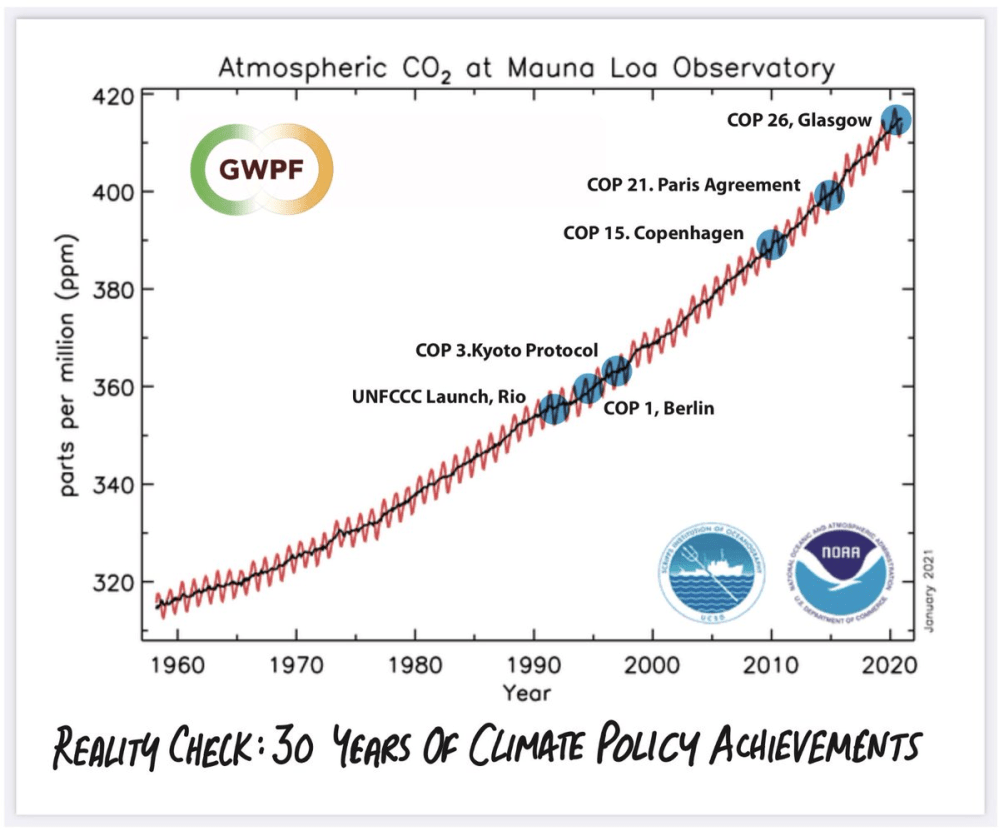
Global CO₂ emissions have kept increasing since the world’s nations first committed to rein in climate change at the Earth Summit in Rio de Janeiro in 1992 – despite dozens of climate summits and the global climate agreements struck in Kyoto and Paris. This is the case, once again, in 2022, when we will collectively set a new emissions record. While rich countries increasingly promise draconian cuts (and then generally backtrack, as they import huge amounts of oil, gas and coal to save their citizens from energy poverty, as they have done most recently to address the current energy crisis), most of the future emissions will come from the currently poorer countries in Asia and Africa, as they power their climb out of abject poverty.

In the previous ten years, the world has focused more on remediating climate change than ever before. Despite this, we are not achieving anything, although no shortage of money has been wasted. In a surprisingly honest review of climate policies, the UN revealed a “lost decade”: The report found that it couldn’t tell the difference between what has happened and a world that adopted no new climate policies since 2005.

Consider that: all those climate summits and grandiose promises – all that expense and trouble – and no measurable difference whatsoever.

This state of affairs is unsurprising, unfortunately, because today’s renewable energy sources have two big problems. First, they occupy a vast amount of space, often displacing nature: replacing a square yard of a gas-fired power plant requires 73 square yards of solar panels, 239 square yards of on-shore wind turbines, or an astonishing 6,000 square yards of biomass. One study found that the United States would have to devote a land area four times the size of the United Kingdom to “clean power” to fulfill President Biden’s promise of a carbon-free economy by 2050.

Land in grey required for wind farms to power London UK, solar panels covering the yellow space.

Second – and of even greater importance – the two renewable energy technologies favoured by the vast majority of environmental activists are intermittent or unreliable. Solar energy simply isn’t produced when it is overcast or at nighttime. Wind energy requires a breeze. We are often told by green energy boosters that wind and solar energy are cheaper than fossil fuels. At best, that is only true when the wind is blowing, or the sun is shining. On a windless, dark night, the cost of wind and solar power rises to the infinite.

It is for such reasons that it is deeply misleading (although highly convenient) to compare the energy costs of wind or solar to fossil fuels only when it is windy and sunny. It is also important to note that since all solar energy is sold at essentially the same time (when the sun is up and shining), its value drops dramatically. When solar reaches 30% market share in California, as one study revealed, it loses two-thirds of its value.

Furthermore: because modern societies require 24 hours of non-stop power, backup is not optional – and that means reliance on fossil fuels, when there’s no sun or wind. As more solar and wind is introduced, moreover, fossil fuel backups become ever more expensive as they offer their services for fewer hours, to produce the necessary return on capital. And what of batteries? Globally, we have battery storage with the current capacity to store one minute and 15 seconds of the world’s electricity consumption. And that problem will not be ameliorated soon – even by 2030, global batteries will only cover less than 11 minutes of the global electricity consumption.

The scale of the challenge

All of this shows just the problems with moving electricity away from fossil fuel. When Biden promises ambitiously that all of America’s electricity will come from renewable sources by 2035, he is addressing the comparatively simple part of the climate challenge. Electricity constitutes just 19% of total energy use. We’re far further behind in developing solutions for agriculture, manufacturing, construction, and transportation. Of these, the latter is most often discussed by environmentalists and virtue-signaling politicians, who insist that a solution is already at hand: electric vehicles. Despite massive subsidies, however, just 1.4% of cars globally are electric, and that number is not going up quickly. The Biden Administration itself estimates that battery-electric cars will make up less than 10 percent of total US automobile stock – by 2050.

The scenario for the entire world is that less than one-fifth of all global cars will be battery-electric by 2050. We should remember, as well, that we do not yet have electric tractors, or heavy trucks, or airplanes, or ships – and that means that all the fossil fuel infrastructure that allows such machinery to operate will have to stay intact for our supply chains to continue their necessary operations.

And our current turbo-charge on electric cars will have very little impact on climate. The International Energy Agency estimates that the world would produce 231 million fewer tons of C02 if we achieve all our ambitious stated transport electrification targets in this decade. This reduction will lower global temperatures by one-ten thousandth of a degree Celsius (0.0001°C) by the end of the century, according to the UN’s own Climate Panel’s model.

Tackling climate change with current technology is essentially impossible.

This means that climate policy-makers tinker at the margins, offering deceptive solutions, and morally grandstanding. This pattern has repeated for three decades. Most of the promises made in Rio de Janeiro in 1992 and in Kyoto in 1997 were disregarded. A 2018 study found that only 17 of the 157 countries that pledged emissions cuts in Paris passed laws mandating the required action. Which nations? Algeria, Canada, Costa Rica, Ethiopia, Guatemala, Indonesia, Japan, North Macedonia, Malaysia, Mexico, Montenegro, Norway, Papua New Guinea, Peru, Samoa, Singapore, and Tonga. These are not the nations that will change global emissions. Even if every country did everything promised in the original Paris agreement, the emission cuts by 2030 would constitute just 1% of what is necessary to keep temperature rising under the 2°C target.

Failure, however, has not made politicians or the people they serve more careful and or more adamant about searching for better solutions. Instead, they (we) have doubled down, making ever-more ludicrous but emotionally attractive pledges, despite zero chance of either their implementation or their success if implemented. Attempting to implement the much-heralded and oft-trumpeted vision of a zero C02-emission world – whether by 2035 or 2050 – would be so ruinously expensive that extensive gilets-jaunes-style riots are certain long before the “goal” is reached.

A different approach

If we do care about fixing this challenge, we need to change course. Pretending that the proper technological answer currently exists, and is not being implemented because we lack conviction and willpower is reckless and misleading. Worse, it stops us from pursuing real solutions to the many problems that confront us – only one of which is climate change.

Dozens of the world’s top climate economists and three Nobel Laureates in Economics evaluated a whole gamut of climate solutions for the think tank Copenhagen Consensus. If we continued to do what the EU has been doing – cutting carbon with a mix of market and planning diktats – means spending one pound to avoid a mere three pence of long-term climate damage. That’s partly because cutting CO₂ output in the rich and already efficiently-producing EU is impractically expensive, and partly because EU climate policies are much more inefficient than necessary (the EU prefers using wind and solar, for example, to cut a ton of CO₂, over the more efficient option of switching from coal to natural gas).

The Nobel laureates and climate economists instead determined that investment in green innovation comprised the best long-term investment. Why? Consider how the world worried over starvation in the 1960-70s. If we had approached that problem like we are approaching climate remediation, we would have required the rich to eat less, while serving their leftovers to the poor. That would have failed – as our current approaches will fail – disastrously. What worked instead? The Green Revolution: the innovative development of higher-yielding crops. We thereby increased world grain production by 250% between 1950 and 1984, raising the calorie intake of the world’s poorest people and reducing the incidence of serious famines.

Innovative thinkers tackled the problem head-on, instead of tinkering around the edges. Innovation meant producing more with less, instead of requiring people to make do, with less. Would-be and even genuinely looming catastrophes have been continually pushed aside throughout human history because of innovation and technological development. Innovation gave us security and prosperity, and continues to drive the growth and the increased efficiency of the world’s largest economies.

In general, unfortunately, investment in long-term innovation is underfunded because it is hard for private investors to capture benefits. In areas where long-term innovation on the private front can be underfunded (because of difficulties of monetising benefits in a sufficiently short time frame), public investment and support is often warranted. A recent example – and a stellar success on the climate innovation front? The ten-year $10 billion US public investment in shale gas, which originated under President George W. Bush. Remarkably, this was not planned as part of the policy of climate change remediation. Nonetheless, it led the way for a production surge (with all the attendant economic benefits, particularly for the poor) that allowed natural gas to become cheaper than the dirtier coal it partially replaced. Energy derived from natural gas produces approximately half the CO₂ of coal. The consequence? The US has the best record of C02 emission reduction of any country in the past decade – and simultaneously reduced its reliance on foreign suppliers of uncertain reliability and cost.
Investing in innovation

Everyone, in principle, agrees that we should be spending much more on R&D. However, the fraction of rich countries’ GDP actually invested into R&D has halved since the 1980s. Why? Putting up inefficient solar panels and wind turbines offers the opportunity for good photo ops, and allows those who lead to convince us of their dedication to action, while funding researchers requires a more subtle and mature understanding and approach. We might remember, however, when considering such things, that our economic stability and opportunity is now at serious risk, and we are simultaneously not currently doing the planet any favors.

According to the Copenhagen Consensus Nobel Laureates, we should increase our current spending five-fold, to $100 billion per year. This doesn’t mean that in total we should spend more. We already devote $600 billion per year to financing ineffective climate remediation strategies. We could instead take a mere sixth of that poorly spent money and direct it toward the most effective means of addressing our problems.

A genuine innovation-led response would require the consideration of multiple solutions. We should improve today’s technologies rather than erecting currently inefficient turbines and solar panels. We should devote more attention to nuclear fission (perhaps in the form of modular reactors), and continue to explore fusion, hydrogen generation from water, and more. The geneticist who spearheaded development of the first draft sequence of the human genome – a technological tour-de-force, completed far earlier and at less cost than originally estimated – makes the case for research into algae that produces oil, grown on the ocean surface. Because such algae simply converts sunlight and CO₂ to oil, when producing it, burning it would be CO₂-free. Oil algae are far from cost-effective now, but researching this and many other solutions is not only inexpensive but offers our best opportunity to find real breakthrough technologies.

If we innovate the price of green energy down below fossil fuels, everyone will switch. This would be a far better solution, particularly for the poor, than increasing the cost of fossil fuel to the point of general penury to disincentivise use. The Copenhagen Consensus experts calculated returns from green energy R&D at eleven pounds for every pound invested – hundreds of times more effective than current climate policies.

Finding the breakthroughs that will power the rest of the 21st century could require a decade, or it could take four. But no other genuine solutions beckon, and we have already had three decades of spectacular failure pursuing the policies that are currently in place. We know that the world leaders gathered at COP27 won’t solve the problems that beset us with the same empty promises offered twenty-six times previously. Are we doing the same thing yet again? Remember the definition of insanity…

But innovation beckons, as it has so reliably in the past. We have better options, and ignore them at the cost of our economy, our opportunity, and the environment.

Dr. Bjorn Lomborg is President of the Copenhagen Consensus and Visiting Fellow at Stanford University’s Hoover Institution. His latest book is “False Alarm: How Climate Change Panic Costs Us Trillions, Hurts the Poor, and Fails to Fix the Planet.” A collection of his writings for the Telegraph can be found here.
Dr. Jordan B. Peterson is Professor Emeritus at the University of Toronto, and the author of three books: “Maps of Meaning: the Architecture of Belief”, “12 Rules for Life: an Antidote to Chaos” and “Beyond Order: 12 More Rules for Life”. A collection of his writings for the Telegraph can be found here.

Climate Loss and Damage, Legal House of Cards

The big news out of COP27 Sharm El-Sheikh concerns funding for climate “loss and damage.”

Reuters  At COP27, climate ‘loss and damage’ funding makes it on the table

Columbia Climate School Loss and Damage: What Is It, and Will There Be Progress at COP27?

CarbonBrief COP27: Why is addressing ‘loss and damage’ crucial for climate justice?

Etc., Etc., Etc.

Mike Hulme explained the house of cards underlying the claims for compensation from extreme weather loss and damage.  He addressed this directly in his 2016 article Can (and Should) “Loss and Damage” be Attributed to Climate Change?.  Excerpts in italics with my bolds and added images.

One of the outcomes of the eighteenth negotiating session of the Conference of the Parties (COP18) to the UN Framework Convention on Climate Change, held in Doha last December, was the agreement to establish institutional arrangements to “address loss and damage associated with the impacts of climate change.” This opens up new possibilities for allocating international climate adaptation finance to developing countries. A meeting this week in Bonn (25–27 February), co-organized by the UN University Institute for Environmental and Human Security and the Loss and Damage in Vulnerable Countries Initiative, is bringing together various scholars and policymakers to consider how this decision might be implemented, possibly by as early as 2015.

At the heart of the loss and damage (L&D) agenda is the idea of attribution—that specific losses and damages in developing countries can be “associated with the impacts of climate change,” where “climate change” means human-caused alterations to climate. It is therefore not just any L&D that qualify for financial assistance under the Convention; it is L&D attributable to or “associated with” a very specific causal pathway.

Developing countries face some serious difficulties—at best, ambiguities—
with this approach to directing climate adaptation finance.

This is particularly so given the argument that the new science of weather attribution opens the possibility for a framework of legal liability for L&D, which has recently gained prominence (see here and here). Weather attribution science seeks to generate model-based estimates of the likelihood that human influence on the climate caused specific weather extremes.

Weather attribution should not, however, be used to make the funding of climate adaptation in developing countries dependent on proving liability for weather extremes.

There are four specific problems with using the post-Doha negotiations on L&D to advance the legal liability paradigm for climate adaptation. First, with what level of confidence can it be shown that specific weather or climate hazards in particular places are caused by anthropogenic climate change, as opposed to a naturally varying climate? Weather attribution scientists claim that such knowledge is achievable, but this knowledge will be partial, probabilistic, and open to contestation in the courts.

Second, even if such scientific claims were defendable, how will we define “anthropogenic?” Weather attribution science—if it is to be used to support a legal liability paradigm—needs to be capable of distinguishing between the meteorological effects of carbon dioxide emissions from fossil fuels and those from land use change, and between the effects of carbon dioxide and other greenhouse gases, black carbon (soot), and aerosol emissions. Each of these sources and types of climate-altering agents implicates different social and political actors and interests, so to establish liability in the courts, any given weather or climate hazard would need to be broken down into a profile of multiple fractional attributions. This adds a further layer of complexity and contestation to the approach.

Third, L&D may often be as much—or more—a function of levels of social and infrastructural development as it is a function of weather or climate hazard. Whether or not an atmospheric hazard is (partially) attributable to a liable human actor or institution is hardly the determining factor on the extent of the L&D. A legal liability framework based on attribution science promotes a “pollutionist approach” to climate adaptation and human welfare rather than a “developmentalist approach.” Under a pollutionist approach, adaptation is primarily about avoiding the dangers of human-induced climate change rather than building human resilience to a range of weather risks irrespective of cause. This approach has very specific political ramifications, serving some interests rather than others (e.g., technocratic and centralized control of adaptation funding over values-centered and decentralized control).

Finally, if such a legal framework were to be adopted, then what account should be taken of “gains and benefits” that might accrue to developing countries as a result of the impacts of climate change? Not all changes in weather and climate hazard as a result of human influence are detrimental to human welfare, and the principle of symmetry would demand that a full cost-benefit analysis lie at the heart of such a legal framework. This introduces another tier of complexity and contestation.

Following Doha and the COP18, the loss and damage agenda now has institutional force, and the coming months and years will see rounds of technical and political negotiation about how it may be put into operation. This agenda, however, should not place climate adaptation funding into the framework of legal liability backed by the new science of weather attribution.

Hulme goes more deeply into the Loss and Damage difficulties in his 2014 paper Attributing Weather Extremes to ‘Climate Change’: a Review.  Excerpts in italics with my bolds.

In this third and final review I survey the nascent science of extreme weather event attribution. The article proceeds by examining the field in four stages: motivations for extreme weather attribution, methods of attribution, some example case studies and the politics of weather event Attribution.

Hulme concludes by discussing the political hunger for scientific proof in support of policy actions.

But Hulme et al. (2011) show why such ambitious claims are unlikely to be realised. Investment in climate adaptation, they claim, is most needed “… where vulnerability to meteorological hazard is high, not where meteorological hazards are most attributable to human influence” (p.765). Extreme weather attribution says nothing about how damages are attributable to meteorological hazard as opposed to exposure to risk; it says nothing about the complex political, social and economic structures which mediate physical hazards.

And separating weather into two categories — ‘human-caused’ weather and ‘tough-luck’ weather – raises practical and ethical concerns about any subsequent investment allocation guidelines which excluded the victims of ‘tough-luck weather’ from benefiting from adaptation funds.

Contrary to the claims of some weather attribution scientists, the loss and damage agenda of the UNFCCC, as it is currently emerging, makes no distinction between ‘human-caused’ and ‘tough-luck’ weather. “Loss and damage impacts fall along a continuum, ranging from ‘events’ associated with variability around current climatic norms (e.g., weather-related natural hazards) to [slow-onset] ‘processes’ associated with future anticipated changes in climatic norms” (Warner et al., 2012:21). Although definitions and protocols have not yet been formally ratified, it seems unlikely that there will be a role for the sort of forensic science being offered by extreme weather attribution science.

Synopsis of this paper is at X-Weathermen are Back!

Integrated Storm Activity Annually over the Continental U.S. (ISAAC)

See also Data vs. Models #3: Disasters