Lots we don’t know and may never know, but one explanation is the most plausible, considering all the blowback DOJ will unsurprisingly take in coming weeks (months?). I am invoking the principle that high risks are taken only when high rewards can be gained. So what was at stake in this extremely high risk action? I suspect that despite all the hype and spin you will see and hear, this was mainly about FBI and DOJ doing damage control in their own interests. My theory is that Trump has/had documents proving criminal behavior by the FBI, aided and abetted by DOJ. The raid was not so much to seize exonerating evidence, but rather to seize evidence whose disappearance will let the perpetrators off the hook.
The highly suspicious FBI raid on President Donald J. Trump’s Florida home, Mar-a-Lago, exposes some long-anticipated details about the country’s top law enforcement agency that show the FBI is a danger to freedom and liberty.
Reports from Wednesday set the tone for exposing the FBI’s real motives for the raid on Trump, reminding readers about Trump’s declassification of a binder of documents on January 19th, 2021, which contains hundreds of pages about the Crossfire Hurricane scandal and the Russia hoax.
Two different DOJ Attorney Generals have defied President Trump’s direct lawful order to publish the documents in the Federal Register: Attorney Generals William J. Barr, and Merrick Garland.
“The DOJ had already made redactions to protect sources & methods, and returned the binder back to the White House. But the corrupt FBI also wanted to hide names. So at the last minute, the DOJ demanded the binder comply with the 1974 Privacy Act. The Act requires any “agency” that releases records to also hide personal or identifiable name information. The DOJ knew this Act doesn’t apply to the White House, it was a stall tactic. The courts decided this 22 years ago that the Privacy Act was based around FOIA requests, and the White House is not an agency,” Hoft reported.
Trump’s Chief of Staff, Mark Meadows, gave the binder back to the DOJ, along with this memo on Jan. 20, 2021:
By the authority vested in me as President by the Constitution and the laws of the United States of America, I hereby direct the following:
Section 1. Declassification and Release. At my request, on December 30, 2020, the Department of Justice provided the White House with a binder of materials related to the Federal Bureau of Investigation’s Crossfire Hurricane investigation. Portions of the documents in the binder have remained classified and have not been released to the Congress or the public. I requested the documents so that a declassification review could be performed and so I could determine to what extent materials in the binder should be released in unclassified form.
I hereby declassify the remaining materials in the binder. This is my final determination under the declassification review and I have directed the Attorney General to implement the redactions proposed in the FBI’s January 17 submission and return to the White House an appropriately redacted copy.
My decision to declassify materials within the binder is subject to the limits identified above and does not extend to materials that must be protected from disclosure pursuant to orders of the Foreign Intelligence Surveillance Court and does not require the disclosure of certain personally identifiable information or any other materials that must be protected from disclosure under applicable law. Accordingly, at my direction, the Attorney General has conducted an appropriate review to ensure that materials provided in the binder may be disclosed by the White House in accordance with applicable law.
Donald J. Trump
“Meadows admits in interviews various agencies often stalled or defied Trump’s orders.
Meadows knew better than to rely on the DOJ to release this damaging binder after they left the White House. He should have released the binder to the public himself. But in doing so, there was a chance he would become a target of the DOJ and FBI.
In Support of this Suspicion
“DEVELOPING: Sources say the FBI agents and officials who were involved in the raid on former President Trump’s home work in the same CounterIntelligence Division of the FBI that investigated Trump in the Russiagate hoax and are actively under criminal investigation by Special Counsel John Durham for potentially abusing their power investigating Trump in the Russian fraud and therefore have a potential conflict of interest and should have been RECUSED from participating in this supposed “espionage” investigation at Mar-a-Lago.”
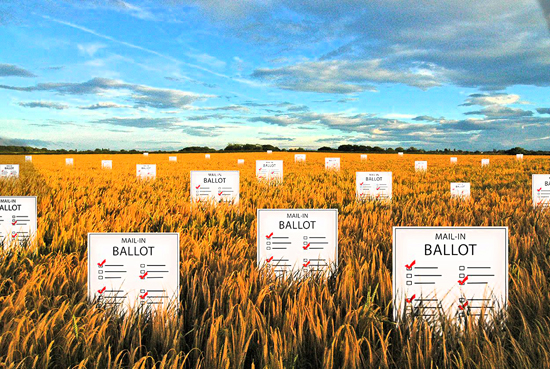
On July 8, the Wisconsin Supreme Court ruled that ballot harvesting
and the use of unsupervised ballot boxes is not consistent with
the statutes governing Wisconsin election law and must be discontinued.
The decision in Teigen and Thom v. Wisconsin Election Commission represents the latest skirmish in the national debate over election integrity versus ballot access. It also represents further evidence that a backlash against the exercise of extraordinary powers justified by COVID is well underway.
In the weeks following the 2020 general election,Donald Trump brought a suit against Wisconsin, ultimately asking the Wisconsin Supreme Court to nullify absentee votes that had been delivered through means not approved in state law. The court dismissed the suit by a 4-3 vote without reaching the merits. Instead, the court ruled that it was simply too late. Hundreds of thousands of people had voted in good faith according to the rules promulgated by their local election clerk consistent with guidance provided by the Wisconsin Election Commission. The time for Trump to have challenged those rules was well before the election. Another flaw in Trump’s suit was that it only applied to Milwaukee County, though the commission’s guidance was statewide, and several counties had acted on it.
Now, with time to adapt before the next scheduled election,
the court did address the merits of the statutory claim:
Wisconsin law governing absentee ballots states that they must either be mailed by the voter or returned to an official election office by the voter. There is no provision in statute for depositing absentee ballots anywhere other than an election office. Moreover, although the case was explicitly about collection boxes, the implication for ballot harvesting is also clear: statute does not endow individuals or activist groups with the right to collect and deliver multiple ballots.
Supporters and opponents of the ruling did not hesitate to repeat their well-rehearsed arguments. Opponents claimed that the decision was an affront to democracy inspired by baseless fears of voter fraud, and another attempt to suppress Democratic-leaning voters. Supporters of the decision note that fears of voter fraud, far from being baseless, are grounded in reality; just since 2018, there have been large-scale episodes of voter fraud uncovered in Paterson, New Jersey, the 9th Congressional District of North Carolina, and Wisconsin itself, where an investigation uncovered absentee ballot fraud in nearly 100 nursing homes in 2020. However much or little voter fraud takes place in absolute terms, it is clearly sometimes enough to alter the outcome of a close election. It is also clear that among all possible voting modes, it is, relatively speaking, easiest to perpetrate fraud in mail ballot elections featuring ballot harvesting and unsupervised ballot collection boxes. Voters in Wisconsin should be able to enjoy greater confidence in the integrity of the state’s elections as a result of the Teigen decision.
However, focusing on these arguments would miss the most essential feature of the decision. The Supreme Court of Wisconsin struck a blow for the principles of the rule of law and of government by officials who are accountable to the electorate. In actuality, the court took no stand on the efficacy or desirability of the mechanisms it ruled out of bounds. It simply compared those mechanisms to the statutes passed by the duly-elected legislature of the state of Wisconsin and found that the statutes (i.e., the law) did not authorize the mechanisms. Should the duly-elected legislature and governor of the state of Wisconsin decide tomorrow that they want an unsupervised ballot collection box in every park and honky-tonk in Wisconsin, they can change the law to say so. Until then, Teigen says, the law is the law. Courts are not free to ignore it, and unelected, unaccountable bureaucrats are not free to rewrite it. The elected branches are the ones properly tasked with sorting out the issues and ascertaining the appropriate balance between the competing (though also potentially complementary) values of ballot access and ballot security. They may also be the only ones capable of it.
In this sense, the Teigen decision bears a structural resemblance to the recent U.S. Supreme Court decisions in the Dobbs abortion case and the West Virginia case stemming from Barack Obama’s Clean Power Plan. In those cases, the majority of the Supreme Court took no stand on what the appropriate abortion or climate change policy should be. Rather, the Court held that elected officials, rather than federal courts or unelected bureaucrats, should be the ones making policy. The Constitution and the law must rule. It is more than a little ironic that the harshest critics of all three decisions–they tend to be the same people—accuse the courts in Wisconsin and Washington, D.C. of threatening democracy by transferring power from the unelected to the elected. The “day of enlightened administration,” as Franklin Roosevelt predicted (and hoped) in 1932, did indeed come. Perhaps it has now begun to go.
Moreover, in the Wisconsin case, the state Supreme Court reasserted the rule of law in the face of extraordinary regulatory overreach that had been justified by reference to the pandemic emergency. Not only in Wisconsin but around the country elections rules were altered in 2020, usually by state or local election offices or commissions. Sometimes they acted on their own, sometimes they play-acted as the defendants in collusive litigation brought by advocacy groups on the left. A large part of the state legislative election reform activity over the last 18 months has been a response to these extra-legal or quasi-legal maneuvers. The Wisconsin case should be seen in conjunction with this pattern, and with the more general national backlash against executive COVID overreach. Nearly everyone from Joe Biden down claims they want a “return to normalcy” after two and a half years of COVID. The Wisconsin Supreme Court has now actually walked the talk. Of course, the Wisconsin court’s decision has no legal authority outside of Wisconsin itself. It may, however, add to the moral authority of Americans who are saying “enough.”
Andrew E. Busch is Crown professor of government and George R. Roberts fellow at Claremont McKenna College.
Dr. Thomas Sowell writes at Creators.com The Point of No Return. Excerpts in italics with my bolds and added images. H\T Tyler Durden
This is an election year. But the issues this year are not about Democrats and Republicans. The big issue is whether this nation has degenerated to a point of no return — a point where we risk destroying ourselves, before our enemies can destroy us.
If there is one moment that symbolized our degeneration, it was when an enraged mob gathered in front of the Supreme Court and a leader of the United States Senate shouted threats against Supreme Court Justice Brett Kavanaugh, saying “You won’t know what hit you!”
There have always been irresponsible demagogues. But there was once a time when anyone who shouted threats to a Supreme Court Justice would see the end of his own political career, and could not show his face in decent society again.
You either believe in laws or you believe in mob rule.
It doesn’t matter whether you agree with the law or agree with the mob on some particular issue. If threats of violence against judges — and publishing where a judge’s children go to school — is the way to settle issues, then there is not much point in having elections or laws.
There is also not much point in expecting to have freedom. Threats and violence were the way the Nazis came to power in Germany. Freedom is not free. If you can’t be bothered to vote against storm-trooper tactics — regardless of who engages in them, or over what issue — then you can forfeit your freedom.
Worse yet, you can forfeit the freedom of generations not yet born.
Some people seem to think that the Supreme Court has banned abortions. It has done nothing of the sort.
The Supreme Court has in fact done something very different, something long overdue and potentially historic. It has said that their own court had no business making policy decisions which nothing in the Constitution gave them the authority to make.
Get out a copy of the Constitution — and see if you can find anything in there that says the federal government is authorized to make laws about abortion.
Check out the 10th Amendment, which says that the federal government is limited to the specific powers it was granted, with all other powers going to the states or to the people.
Why do we elect legislators to do what the voters want done, if unelected judges are going to make up laws on their own, instead of applying the laws that elected officials passed?
This is part of a very long struggle that has been going on for more than 100 years. Back in the early 20th century, Progressives like President Woodrow Wilson decided that the Constitution put too many limits on the powers they wanted to use.
Claiming that it was nearly impossible to amend the Constitution, Progressives advocated that judges “interpret” the Constitutional limits out of the way.
This was just the first in a long series of sophistries.
In reality, the Constitution was amended 4 times in 8 years — from 1913 through 1920 — during the heyday of the Progressive era.
When the people wanted the Constitution amended, it was amended. When the elites wanted the Constitution amended, but the people did not, that is called democracy.
Another great sophistry was the federal government’s authority to regulate interstate commerce to call all sorts of other things interstate commerce. In 1995, elites were shocked when the Supreme Court ruled — 5 to 4— that carrying a gun near a school was not interstate commerce.
States had a right to ban carrying a gun near a school, and most of them did. But the federal government had no such authority. Nor did the Constitution give the federal government the right to make laws about abortion, one way or the other.
What both state and federal laws do have the right to stop is threats against judges and their families.
This is not a partisan issue. The Republican governor of Virginia is providing protection to Supreme Court Justices who live in that state. But the Republican governor of Maryland seems to think that harassing judges and their families is no big deal.
Voters need to find out who is for or against mob rule, whether they are Democrats or Republicans. We are not going to be a free or decent society otherwise.
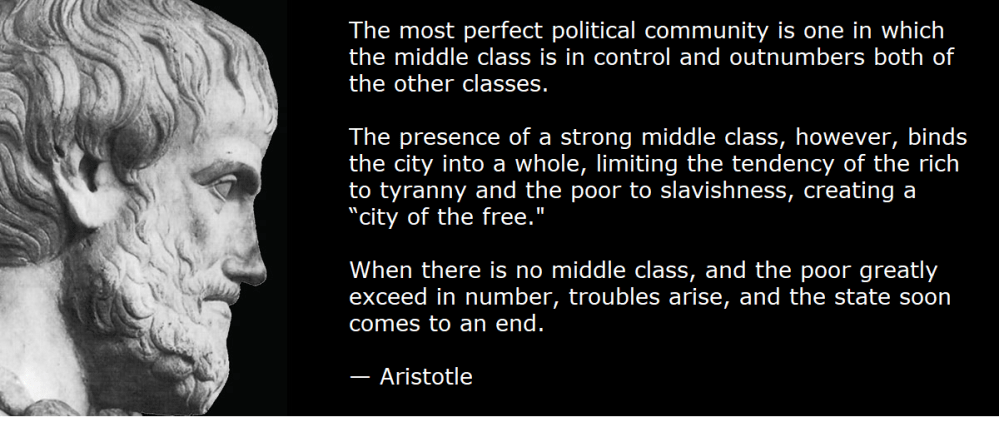
After 19 months of Biden administration, we can see clearly the shape of tactics for making war on the middle class. The World Bank has come to see personal transportation as key for individuals to overcome poverty by accessing opportunities for work, education and services outside their birthplaces. So choking off supplies of gasoline (in the name of climate change) keeps the serfs in their place. The rising underclass is most vulnerable in their transition to financial stability, so policies wreaking inflation take away the middle class dream. Of course guns must be confiscated lest there be any effective resistance to governmental coercion. Those who are outspoken against the elite narrative, and who protest injustice against ordinary citizens, must themselves be imprisoned without any of their entitled legal protections. And the nation is flooded with illegal aliens to drive down the working class income, and to create a permanent underclass dependent and subservient to government largess. Leftist prosecutors condone widespread theft and drug dealing, undermining the ability to gain property security and the motivation to even work productively.
Justin Trudeau’s confrontation with the Canadian truckers may be the single most significant event of the Covid pandemic – not because of its eventual outcome, whatever that may be, but because of what it symbolises. It captures, in perfect microcosm, the tensions between the competing imperatives of the age:
♦ freedom versus security; ♦ the rule of law versus flexible ‘responsive’ governance; ♦ the priorities of the workers versus those of the Zooming bourgeoisie; ♦ the need for real-world human interaction and belonging versus the promises of splendid online isolation; ♦ the experiences of the common man, who knows where it hurts, versus those of the professional expert class, who know nothing that cannot be expressed as a formula.
More than all of that, though, it gives us a lens through which to view a much deeper, much older conflict of much larger scope – one which underlies not just the struggles of the Covid age, but of modernity itself. On the one hand, the state, which seeks to make all of society transparent to its power. On the other, alternative sources of authority – the family, the church, the community, the firm, the farm, and the human individual herself.
For centuries, the state has waged a quiet war against those competitors,
and bent them to its will.
It has done this not through conspiracy or deliberate strategy but merely through the single-minded pursuit, across generation after generation of political leaders, of one goal: legitimacy. Governments and other state organs derive their legitimacy, and therefore their positions of rulership, from convincing the population that they are necessary.
They do this by suggesting that without their intervention, things will go badly;
left to their own devices, ordinary people will suffer.
The family, the church, the community, the firm, the farm, the human individual – these are inadequate to the task of securing human well-being. That task, only the state is equipped to achieve, for only the state can keep the population educated, healthy, safe, prosperous and satisfied. Since this is the case, only the state is fit to deploy power – and only those who govern the state are fit to rule.
The logic of this argument is writ large, of course, in the Covid response across the developed world. What will keep us ‘safe?’ Certainly not traditional sources of succour, such as the church or the family. Certainly not individual people, who cannot be trusted to behave responsibly or assess risks for themselves.
No – it is only the state, first with its lockdowns, then with its social distancing, its mask mandates, its vaccine programs, and lately its vaccine mandates and ‘passports.’ It is only the state’s power that saves and secures. And since only the state can save, it is the only legitimate source of authority – along, of course, with its leaders.
The state portraying itself as saviour in this fashion is patently false and absurd given what has taken place over the past two years.
But as false and absurd as it is, it remains the subtext behind all of Covid policy. Justin Trudeau must derive his legitimacy from somewhere to maintain power. And he senses – political animal that he is – that he can derive it from displaying the Canadian state (with himself at the helm, of course) as the only thing standing between the Canadian public and suffering and death.
It is the state, remember – in this case with its vaccine mandates – that saves and secures. Without it, the reasoning goes, the population would suffer and die as Covid ran riot. The political logic is inescapable. For a man like Trudeau, without principle except that he alone is fit to govern, there is only one path to follow. Insist that it is the state that saves and secures, and that anything that stands in its way – truckers beware – must therefore be crushed beneath its heel.
The truckers, for their part, represent everything that the state despises.
They have a social and political power that is independent from it, and hence form one of the alternative sources of power which it hates and fears. This power derives not from some institution which the truckers dominate, but simply from their status amongst what I will refer to as the yeomanry classes – almost the last bastion of self-sufficiency and independence in a modern society such as Canada.
In a developed economy, most of the professional classes – doctors, academics, teachers, civil servants and the like – derive their incomes and status entirely or partially, directly or indirectly, from the existence of the state. If they are not civil servants, their status is built on regulatory apparatus which only the state can build and enforce. This is also, of course, true of the underclass, who are often almost totally reliant on the state for the meeting of their needs. The members of these classes pose no threat to the state’s legitimacy, because, simply put, they need it. It, as a consequence, is perfectly happy to tolerate their existence – and, indeed, it wishes all of society were that way inclined.
A population entirely reliant on the state is one which will never question the necessity of the growth of its power and hence its capacity to buttress its own legitimacy.
But in the middle are those people, the modern yeomanry, who derive their incomes from private sources, as sole traders, owners of small businesses, or employees of SMEs. Independent-minded, seeing self-sufficiency as a virtue, and relying on themselves and their relationships with others rather than the state, these modern yeomen represent a natural barrier to its authority. Simply put, they do not need it. They earn their money through the use of a particular skill which others value and hence pay for on the open market.
Whether or not the state exists is immaterial to their success – and, indeed, it very frequently stands in their way. These are the type of people who, seeing a problem, tend to want to find a solution for themselves. And they are precisely the kind of people who want to make up their own minds about whether to take a vaccine, and to assess health-related risks in general.
The modern state has waged incessant and covert war against the yeomanry in particular.
At every step, it seeks to regulate their business affairs, restrict their liberty, and confiscate their prosperity. There is always a purportedly ‘good’ reason for this. But it contributes to an incessant whittling away of their independence and strength. It is no accident that they are described in British parlance as the ‘squeezed middle’ – squashed as they are between the welfare-reliant underclass on the one hand, and the white-collar professionals who draw their wealth, directly or indirectly, from the state on the other.
It is also no accident that these modern yeomen have gradually seen their political representation diminish over the course of the last 100 years, in whichever developed society one cares to name; the politicians they would elect would be mostly interested in getting the state out of the way, and modern politicians’ incentives all incline in the opposite direction. Their interest is in the inexorable growth of state power, because that is from where their legitimacy derives.
Justin Trudeau’s contempt for the truckers is therefore genuine and profound.
He sees in them not an obstacle to Covid policy or a potential threat to public health. Not even he could possibly be so stupid as to think it matters whether or not these people take their vaccines. No: he identifies in them a barrier to forces in which his political future is entwined – an ever-increasing scope and scale for governmental authority, and the opportunities to buttress his own legitimacy that would follow from it.
And his contempt for them is outweighed, of course, by his fear. Because he surely recognises that his authority is wafer-thin. Legitimacy cuts both ways. If he fails to suppress the truckers’ revolt, the entire edifice on which his authority rests – as the helmsman of the Canadian state and its purported capacity to protect the population from harm – will come tumbling down.
This conflict is therefore not about Covid – it’s existential. Does it matter if the truckers win or lose? No. What matters is what their efforts have revealed to us about the relationship between the state and society in 2022.
The editors of IBD explain at Issues and Insights Climate Emergency? What a Crock. Excerpts in italics with my bolds and added images.
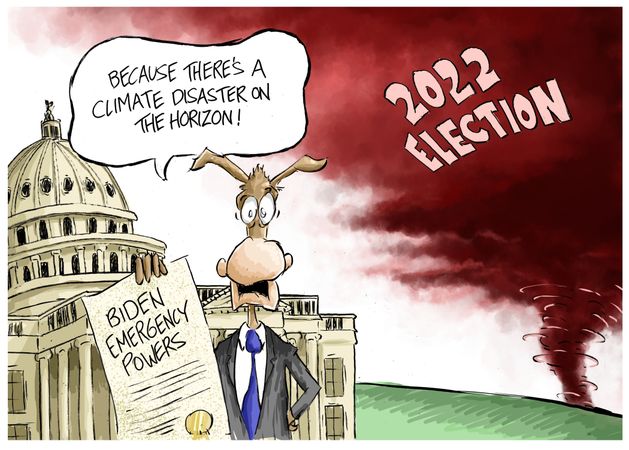
Joe Biden did not declare a climate emergency last week, as many in his party urged him to do. One Democratic senator claimed that the changing climate required “bold, intense executive action” from the president. Another said Biden needed to move because “the climate crisis is a threat to national security.” But there’s no emergency. It’s a wholly manufactured charade.
Though he put off an executive action, Biden said last Wednesday that he has “a responsibility to act with urgency and resolve when our nation faces clear and present danger. And that’s what climate change is about. It is literally, not figuratively, a clear and present danger. The health of our citizens and our communities is literally at stake.”
His non-COVID fever continued:
“Climate change is literally an existential threat to our nation and to the world. … Right now, 100 million Americans are under heat alert – 100 million Americans. Ninety communities across America set records for high temperatures just this year, including here in New England as we speak.”
On the same day Biden issued an authoritarian’s threat:
“Since Congress is not acting on the climate emergency, I will,” he tweeted. “And in the coming weeks my Administration will begin to announce executive actions to combat this emergency.”
Most Americans who aren’t named Barack Obama like to think that the U.S. is the center of our world if not the universe. But just because much of the country has been hot, it doesn’t mean the entire Earth is on fire. Yet our politicians and media focus on unusual heat despite the obvious:
If the global temperature “is just about average” – and it is –
“then clearly it must be well below average somewhere else.”
The facts, not the Democrats and activists’ political desperation, show that global temperatures have gone nowhere over the past four decades, which is the only period of time they can be accurately measured and compared. Anyone who believes that the temperature record before 1979 is reliable is fooling themselves (and also a blind ideologue).
The only data that can be trusted, that makes a genuine apples-to-apples comparison, are the measurements from satellites. All other temperature reconstructions require faith in subjective readings of often poorly placed primitive instruments, and compromised tree ring signals.
So, then what do the satellite data tell us? That we just went through “the coolest monthly anomaly in over 10 years, the coolest June in 22 years, and the ninth coolest June in the 44 year satellite record,” says University of Alabama at Huntsville climate scientist Roy Spencer. [See Tropics Lead Remarkable Cooling June 2022] Repeat the line:
Last month was “the coolest monthly anomaly in over 10 years,
the coolest June in 22 years,
and the ninth coolest June in the 44 year satellite record.”
Yeah, that’s some emergency.
But then June 2022 is just one month of many. What about the rest of the record? While global temperature based on satellite readings has trended upward, the increase has been slight. “The linear warming trend since January 1979” is a mere 0.13 of a degree Celsius per decade, says Spencer. June 2022 was also cooler than a number of months on Spencer’s chart, quite a few of them going back more than 20 years.
Other evidence than the emergency exists only in the overly political minds of Democrats, their communications department (the mainstream media), and the usual zealots include:
♦ “Despite rhetoric to the contrary, there is still plenty of sea ice over Arctic regions this summer, supplying feeding platforms for polar bears, ice-dependent seals, and walrus cows nursing their young calves.” – Watts Up With That?
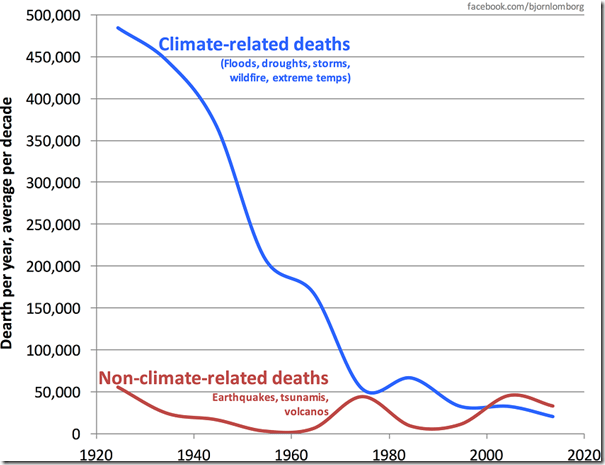
♦ “If you took a very careful look with consistent data over long periods of time, you will find that these (natural) disasters are not increasing. In fact, the health of the world is increasing tremendously. For example, deaths from weather disasters and so forth have gone down about 95% in the last hundred years. … They really aren’t increasing in frequency or intensity.” – John Christy, University of Alabama at Huntsville climatologist
♦ “The ice caps on Mars have been shrinking in sync with ice caps on earth. To me, that’s fairly good evidence that the sun is involved but NASA assures us that’s not so.” – Bookworm Room
♦ “Natural variability of the atmosphere was the proximate cause of the (recent) warmth and does not represent an existential threat to the population of Europe. Clearly, there’s no cause for alarm, no matter what the media says. But the media won’t tell you any of that, because it ruins their narrative of being able to blame the heatwave on climate change, while hoping you don’t notice their distortion of the truth about ordinary weather events we see every summer.” – Anthony Watts
It’s probably an even bet that Biden will eventually declare a climate emergency. His handlers probably think doing so would help pull his miserable ratings out of their tailspin. But we don’t think Americans want their presidents to act like dictators, especially when they are as feeble of mind as Biden is.
Jay Valentine reports what is known about the phantom voting industry and those fighting it for the sake of US election integrity. His American Thinker article is Election Heroes Are Stopping Fraudulent Voting…Right Now. Excerpts in italics with my bolds and added images.
The soul of phantom voter fraud is the occasional, non-committed voter.
They show up at the last minute, delivering winning margins.
Actually, nobody shows up. Nor does anyone return an absentee ballot. That magic comes from a wonderful customer service innovation, the Phantom Voter Concierge, who casts the non-committed voters’ votes for them.
1. Building Reserves of Phantom Voter Identities
Let’s go there. Voter rolls are crammed with millions of voters who seldom, occasionally, or never vote. Democrat-leaning organizations run voter registration drives in edge communities, collecting identities they expect will never vote. You remember ACORN registering drug addicts on city streets? You might have said, “Why? They will never vote!”
They aren’t expected to vote. They are simply voter identity placeholders
later used by vote-harvesters.
State-funded groups like ERIC are paid by a dozen state governments, some with clueless Republican governors, to make sure almost nobody is ever taken off voter rolls. The Electronic Registration Information Center (ERIC) provides institutional cover to this national phantom voter scam.
During early voting, vote-harvesters track those who never voted
or have not voted yet and vote for them.
In some states, like Wisconsin, leftist groups had access to the online voter rolls — something nobody else had. They could track every voter and vote for all of them if they did not show up in 2020.
Remember the stories in 2020 of people coming out to vote, often for the first time in years, to be told, “Sorry, you already voted”? Your Voter Concierge voted for you! Saved you the gas money to drive to the polls!
There are people voting from Salvation Army Food Banks who registered at that address twelve years ago. Those people are likely dead or living in a tent in Austin now — but still voting.
There are people at the Alabama college dorm, registered since 1984, still active and voting.
In Wisconsin, the Voter Concierges went to cognitive care facilities, where the patients did not recognize their own children. Their Voter Concierge voted them. Now part of a criminal investigation, this is how it’s done.
So how bad is the problem?
The Wisconsin voter integrity team did a deep dive, using U.S. government and state databases, and found 225,000 active, current voters who had “issues.” Those included addresses that did not exist; locations that could not be a true registration address, like a jail; and scores of others.
Elections are often decided by 1% of the vote. The Wisconsin team identified potential phantom voters easily able to impact an election.
2. Creating a Surplus of Empty Ballots
The other half of the scam is sending out absentee ballots to addresses that don’t line up.
For instance, there may be an apartment building at 145 Essex Street. The ballot-harvesting industry registers people there, deliberately skipping their apartment number.
Their mail gets returned to — you guessed it, smarty-pants! Those absentee ballots accumulate at the local Post Office.
The Wisconsin voter integrity team, one of the best in the country, found evidence that the Post Office collected those ballots and gave them to the Voter Concierges — to vote. Pretty good USPS customer service!
You might think this would be caught with signature matching. Right! That is why so many states or counties eliminate the signature match — like Maricopa County in Arizona.
If your blood is boiling right now, you just don’t get it. This is customer service on a whole new level. The Voter Concierge gets votes counted – even if the voter never casts that vote.
3. Scrubbing Clean the Voter Rolls
Voter integrity teams are now applying advanced computer technology to thwart the Voter Concierge by deep-cleaning the rolls.
In 2022, the vote-harvesting industry will again flood the zone in swing counties with over 250,000 new registrants from September to November.
Several voter integrity teams, using advanced artificial intelligence technology, can check every registrant, at silicon speed, against over 30 databases, with a billion records, ensuring that the registrant is not living in an R.V. park, a church, or a UPS store, and that his address meets current legal standards.
Sorry, Beto, but registering every itinerant is no longer the key to the Texas Governor’s Mansion.
For the first time, phantom voters are being identified before their registrations take effect.
Living in an apartment where you do not designate the apartment number? Sorry, pal — you aren’t voting this year. Registering from a church? There had better be enough bathrooms to meet the certificate of occupancy requirements for that county.
More voters showing up in a county than there are eligible citizens? Flagged hourly! Alert issued before the ballots are counted!
4. Applying Real-Time Voter Integrity Technology
As ballots arrive during early voting, artificial intelligence snapshots aggregate voter identities. That guy who voted on day 2 in person, disappeared on snapshot 8, reappeared on snapshot 11 with his ballot changed to absentee…is identified. Before that ballot is tabulated, it is red-flagged, and the voter integrity team files a protest.
Thirty-five thousand inactive voters, changed to active — then voted, then changed to inactive again? The A.I. systems pick this up with snapshot analysis. That scam is over!
For the first time, voter integrity teams have technology ballot-harvesters cannot outrun.
When Sheriff Clarke and Mike Lindell started supporting these kinds of technologies, after the 2020 election, the focus was voter roll anomalies. Anomalies were abundant.
The battlefield has changed to real-time analysis, driven by artificial intelligence.
The combined knowledge of a dozen gifted voter integrity teams, with 16 months of experience, is built into an artificial intelligence engine, identifying phantom voters before they are registered, before they can illegally vote.
Every time a fake vote is cast by a Voter Concierge, an American is disenfranchised. Artificial intelligence helps the good guys protect the vote and gives confidence to all Americans that their elections are legit.
Voter integrity teams learned that chasing 2020 voter fraud after the election is too late. Some leading election integrity teams are stopping phantom voter fraud before it impacts elections. Cleaning up voter rolls just became an A.I.-driven, real time endeavor.
Jay Valentine led the team that built the eBay fraud detection engine and the TSA No-Fly List. Jay’s website is JayValentine.com. He can be reached at Jay@ContingencySales.com.
The phrase “New World Order” (“NWO”) is a loaded term. For starters, the people who are pushing for a single world government prefer to call it “The Great Reset.” Additionally, NWO sounds like the ultimate conspiracy theory, complete with indivisible dots, imaginary lines, and tin foil hats. And yet there’s no doubt that the self-anointed elites across the world have coalesced around a single vision that involves ending fossil fuel and achieving total control over individuals to “protect” them from COVID. Still, people across the globe are pushing back and one group has a global vision of what this pushback can look like.
During COVID’s first two years, we learned that most First World governments happily embraced tyranny. Even in the face of mountains of evidence that the lockdowns and mask and vaccine mandates did nothing to improve the situation, governments not only didn’t stop, but they also dug in deeper, systematically taking away people’s rights.
No person embodied this more than Canada’s Justin Trudeau, who went from fuzzy tree hugger to steely-eyed tyrant overnight. Canada is still in deep lockdown mode, right there with China, with millions of gleeful fascist apparatchiks happily imposing the government’s diktats:
With COVID losing its power to frighten people, the world’s budding dictators are reverting to Climate Change to clamp down on power. The most recent outburst of this madness was in Holland, where the government announced that it was shutting down farmland (i.e., the place where food is grown) essentially to stop fertilizer and cow farts. (I simplify a bit but you know what I mean.) The farmers pushed back hard.
The Hague: Thousands of farmers drove their tractors along roads and highways across the Netherlands, snarling morning traffic as they headed for a mass protest against the Dutch government’s plans to rein in emissions of nitrogen oxide and ammonia.
And indeed, although it never makes it to the New York Times or Washington Post unless they can no longer avoid the topic, people all over the world are pushing back at COVID and Climate Change totalitarianism:
When vaccine passports were being implemented, protests took place around the world – but there was hardly any coverage from the media.
Due to the cost of living crisis, protests are happening around the world – but again, the media turns a blind eye.
According to the Carnegie Endowment for International Peace, which records protests worldwide, 11 countries are currently seeing protests of more than 1,000 people in response to the rising cost of living and other economic woes in 2022. As of July 5, Carnegie had recorded protests of more than 120,000 people in France, 100,000 in Spain, 10,000 in Greece, 10,000 in Kazakhstan, 10,000 in Sri Lanka, 10,000 in India, 5,000 in Iran, 5,000 in Peru, 1,000 people in Argentina, 1,000 in Morocco, and 1,000 in the U.K.
It’s Americans who are behind the curve on this one for two possible reasons. One, we believe ourConstitution will protect us. And while it certainly offers protections in theory, there’s every reason to believe that the Democrats currently controlling the federal government have no intention of letting it offer those protections in fact. Two, the Democrats’ January 6 “insurrection” hysteria has frightened Americans into abandoning their First Amendment rights.
But just as the tech world offers governments unprecedented power to control individuals by monitoring their every word, thought, and move, technology also can still be used to bring people across the world together in one giant, peaceful “NO!” against the gathering forces of tyranny. That’s the goal of an organization called Reignite World Freedom.
The organization’s mission is simple: End the globalism that is wrapping itself around the earth like a giant chain, magnifying the power of world governments stealing away their citizens’ liberty. The organization hopes to have what it calls a “global walk out.”
A unified, global event and convoy to your capital city.
Unelected bureaucracies like The World Health Organization (WHO) and The World Economic Forum (WEF) should not have the power to dictate policies in our countries.
Let’s send them a clear message they can’t ignore.
It’s time for governments around the world to consider replacing and leaving these ‘globalist’ organizations.
I.How will the Global Walkout work?
1.A global WALK OUT from the society they’re trying to enslave us into, including an optional convoy to occupy your capital city. The length of the walkout will depend on the momentum built in each country.
2.We will not announce the walk out dates until we have enough pledges worldwide.
3.If you can’t participate in the convoy, that’s fine. You can still commit to walk out for as long as you can.
4.You can choose one or more of these options when you pledge;
Walk out of work and have a holiday.
Walk your children out of school.
Walk away from spending money at corporations that support globalism.
Walk away from consuming any mainstream media or streaming channels.
Convoy to your capital city on the scheduled dates (yet to be announced). Read more here.
The organizers want people to sign a pledge before setting a date.
I don’t know how well this fascinating idea will work in the U.S., especially because of the January 6 crackdown. Still, if people don’t push back against the COVID and Climate Change cudgels, we will enter a new dark age (literally dark, as in no fossil fuels) in which most Westerners, after decades of prosperity, live in squalor and despair.
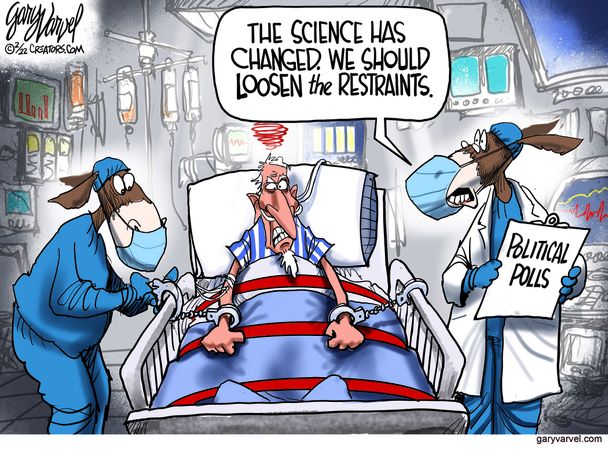
Marty Makary and Tracy Beth Høeg write at commonsense.news U.S. Public Health Agencies Aren’t ‘Following the Science,’ Officials Say. It’s another stark example how politicizing institutions by requiring fidelity to the party line leads to paralysis and dysfunction. Excerpts in italics with my bolds and added images.
‘People are getting bad advice and we can’t say anything.’
The calls and text messages are relentless. On the other end are doctors and scientists at the top levels of the NIH, FDA and CDC. They are variously frustrated, exasperated and alarmed about the direction of the agencies to which they have devoted their careers.
“It’s like a horror movie I’m being forced to watch and I can’t close my eyes,” one senior FDA official lamented. “People are getting bad advice and we can’t say anything.”
That particular FDA doctor was referring to two recent developments inside the agency. First, how, with no solid clinical data, the agency authorized Covid vaccines for infants and toddlers, including those who already had Covid. And second, the fact that just months before, the FDA bypassed their external experts to authorize booster shots for young children.
That doctor is hardly alone.
At the NIH, doctors and scientists complain to us about low morale and lower staffing: The NIH’s Vaccine Research Center has had many of its senior scientists leave over the last year, including the director, deputy director and chief medical officer. “They have no leadership right now. Suddenly there’s an enormous number of jobs opening up at the highest level positions,” one NIH scientist told us. (The people who spoke to us would only agree to be quoted anonymously, citing fear of professional repercussions.)
The CDC has experienced a similar exodus. “There’s been a large amount of turnover. Morale is low,” one high level official at the CDC told us. “Things have become so political, so what are we there for?” Another CDC scientist told us: “I used to be proud to tell people I work at the CDC. Now I’m embarrassed.”
Why are they embarrassed? In short, bad science.
The longer answer: that the heads of their agencies are using weak or flawed data to make critically important public health decisions. That such decisions are being driven by what’s politically palatable to people in Washington or to the Biden administration. And that they have a myopic focus on one virus instead of overall health.
Nowhere has this problem been clearer—or the stakes higher—than on official public health policy regarding children and Covid.
First, they demanded that young children be masked in schools. On this score, the agencies were wrong. Compelling studies later found schools that masked children had no different rates of transmission. And for social and linguistic development, children need to see the faces of others.
Next came school closures. The agencies were wrong—and catastrophically so. Poor and minority children suffered learning loss with an 11-point drop in math scores alone and a 20% drop in math pass rates. There are dozens of statistics of this kind.
Then they ignored natural immunity. Wrong again. The vast majority of children have already had Covid, but this has made no difference in the blanket mandates for childhood vaccines. And now, by mandating vaccines and boosters for young healthy people, with no strong supporting data, these agencies are only further eroding public trust.
One CDC scientist told us about her shame and frustration about what happened to American children during the pandemic: “CDC failed to balance the risks of Covid with other risks that come from closing schools,” she said. “Learning loss, mental health exacerbations were obvious early on and those worsened as the guidance insisted on keeping schools virtual. CDC guidance worsened racial equity for generations to come. It failed this generation of children.”
An official at the FDA put it this way: “I can’t tell you how many people at the FDA have told me, ‘I don’t like any of this, but I just need to make it to my retirement.’”
Three weeks ago, the CDC vigorously recommended mRNA Covid vaccines for 20 million children under five years of age. Dr. Rochelle Walensky, director of the CDC, declared that the mRNA Covid vaccines should be given to everyone six months or older because they are safe and effective.
The trouble is that this sweeping recommendation was based on extremely weak,
inconclusive data provided by Pfizer and Moderna.
Start with Pfizer. Using a three-dose vaccine in 992 children between the ages of six months and five years, Pfizer found no statistically significant evidence of vaccine efficacy. In the subgroup of children aged six months to two years, the trial found that the vaccine could result in a 99% lower chance of infection—but that they also could have a 370% increased chance of being infected. In other words, Pfizer reported a range of vaccine efficacy so wide that no conclusion could be inferred. No reputable medical journal would accept such sloppy and incomplete results with such a small sample size. More to the point, these results should have given pause to those who are in charge of public health.
Referring to Pfizer’s vaccine efficacy in healthy young children, one high-level CDC official—whose expertise is in the evaluation of clinical data—joked: “You can inject them with it or squirt it in their face, and you’ll get the same benefit.”
Moderna’s results—they conducted a study on 6,388 children with two doses—were not much better. Against asymptomatic infections, they claimed a very weak vaccine efficacy of just 4% in children aged six months to two years. They also claimed an efficacy of 23% in children between two and six years old—but neither result was statistically significant. Against symptomatic infections, Moderna’s vaccine did show efficacy that was statistically significant, but the efficacy was low: 50% in children aged six months to two years, and 42% in children between two and six years old.
Then there’s the matter of how long a vaccine gives protection. We know from data in adults that it’s generally a matter of months. But we have no such data for young children.
“It seems criminal that we put out the recommendation to give mRNA Covid vaccines to babies without good data. We really don’t know what the risks are yet. So why push it so hard?” a CDC physician added. A high-level FDA official felt the same way: “The public has no idea how bad this data really is. It would not pass muster for any other authorization.”
This isn’t the first time that Covid vaccines recommendations based on scant evidence have been pushed through these agencies.
Most recently, back in May, the lack of clinical evidence for booster shots in young people created a stir at the FDA. The White House promoted it hard even before FDA regulators had seen any data. Once they saw the data, they weren’t impressed. It showed no clear benefit against severe disease for people under 40.
The FDA’s two top vaccine regulators—Dr. Marion Gruber, director of the FDA’s vaccine office, and her deputy director, Dr. Philip Krause—quit the agency last year over political pressure to authorize vaccine boosters in young people. After their departure they wrote scathing commentaries explaining why the data did not support a broad booster authorization, arguing in the Washington Post that “the push for boosters for everyone could actually prolong the pandemic,” citing concerns that boosting based on an outdated variant could be counterproductive.
“It felt like we were a political tool” a CDC scientist told us about the issue. That insider went on to explain that he got vaccinated early but chose not to get boosted based on the data. Ironically, that person was unable to go on a trip with a group of parents because proof of being boosted was required. “I asked for someone to show me the data. They said the policy was based on the CDC recommendation.”
As one NIH scientist told us: “There’s a silence, an unwillingness for agency scientists to say anything. Even though they know that some of what’s being said out of the agency is absurd.”
That was a theme we heard over and over again—people felt like they couldn’t speak freely, even internally within their agencies. “You get labeled based on what you say. If you talk about it you will suffer, I’m convinced,” an FDA staffer told us. Another person at that agency added: “If you speak honestly, you get treated differently.”
It is statistically impossible for everyone who works inside of our health agencies to have 100% agreement about such a new and knotty subject. The fact that there is no public dissent or debate can only be explained by the fact that they are—or at least feel that they are—being muzzled.
It is an ancient, moral requirement of our profession to speak up when we believe questionable treatments are being proposed. It is also good for the public. Imagine, for example, a world in which those scientists who suggested that masking for children and school lockdowns were worse for public health were not smeared but instead debated?
The official public health response to Covid has undermined
the public’s belief in public health itself.
This is a terrible outcome with potentially disastrous consequences. For one thing, because of these sloppy and politicized policies, we run the risk of parents rejecting routine vaccines for their children—ones we know are safe, effective and life-saving.
The leaders of the CDC, the FDA and the NIH should welcome internal discussion—even dissension—based on the evidence. Silencing physicians is not “following the science.” Less absolutism and more humility by the men and women running our public health agencies would go a long way in rebuilding public trust.
MN Gordon explains the financial debacle in his Economic Prism article Modern Monetary Theory Bites the DustExcerpts in italics with my bolds and added images.
Just a couple of years ago Modern Monetary Theory (MMT) was all the rage. But that was before rampant money printing triggered an official consumer price inflation rate, as measured by the consumer price index (CPI), of 9.1 percent.
Hindsight is always 20/20. Yet, sometimes, foresight is 20/20 too. In the case of MMT, practically everyone could see there would be hell to pay…even through broken spectacles.
The future consequences were crystal clear. Printing up money and passing it out around town, thus entitling people to claims on goods and services without commensurate production, is fundamentally foolish, reckless, and outright suicidal.
Only academics and central bankers were blind to the arrival of today’s inflation.
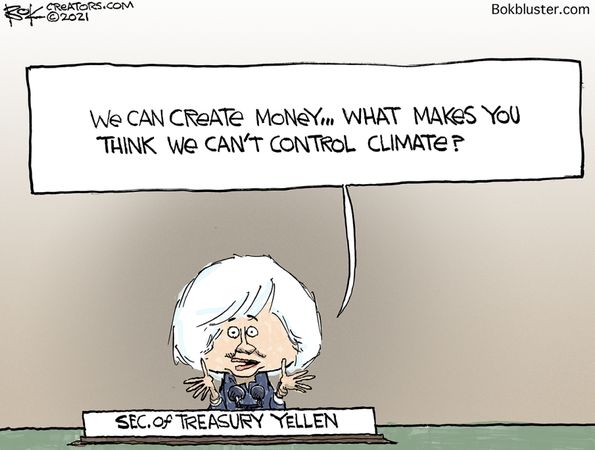
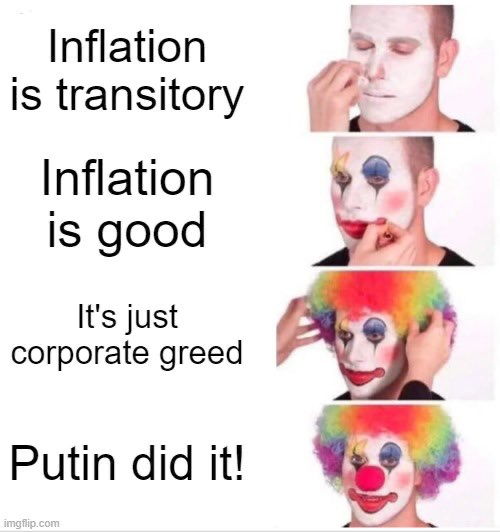
If you recall, as inflation was heating up during the second part of 2021, Federal Reserve Chairman Jerome Powell and Treasury Secretary Janet Yellen told everyone it was transitory. Then, as inflation continued unabated, Powell finally admitted in December 2021 that inflation was no longer transitory and that the word needed to be retired.
Powell and Yellen have their finger prints all over this consumer price inflation mess. Yet they didn’t act alone. Advocates of MMT cheered on their mass money printing with righteous assurances. They said inflation wouldn’t be a problem.
But now that consumer price inflation is raging at a 40 year high, where did the promoters of MMT go? Why aren’t they tackling inflation with the same enthusiasm?
Fanciful schemes offering the more abundant life always yield the unsuspecting and outright gullible to the assurances of dreamers, schemers, theorists, reformers, and scoundrels of all stripes. Promises of something for nothing are too intoxicating to pass up.
For several years Alexandria Ocasio-Cortez, Bernie Sanders, and other American socialists, served up fresh pitchers of grape Flavor-Aid laced with MMT as a solution to all the downtrodden’s problems. To join the cult all you had to do was drink from their cup.
MMT, as you may have heard, offers booms without busts, and money without limits.
The nuts and bolts of the theory state that a government that creates its own money, like the USA, cannot default on its dollar based debts. Therefore, the USA can print all the money it needs to amplify the economy – debts and deficits be damned.
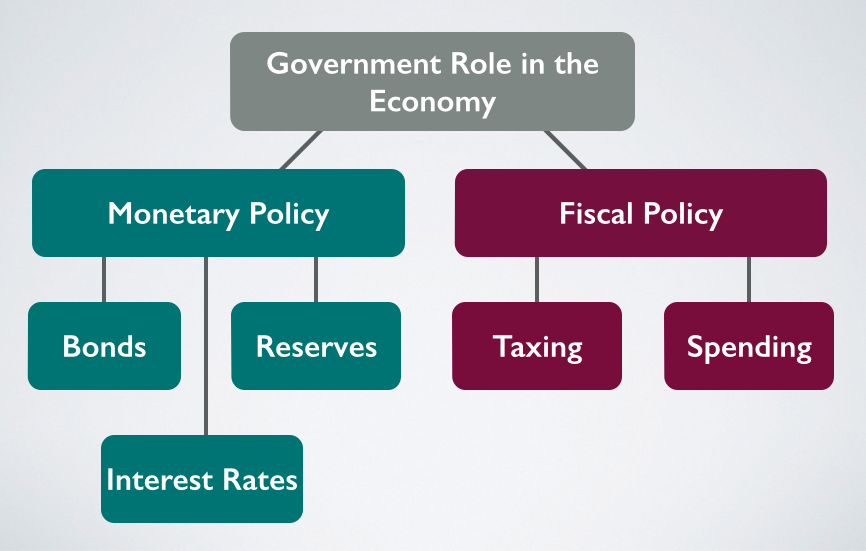
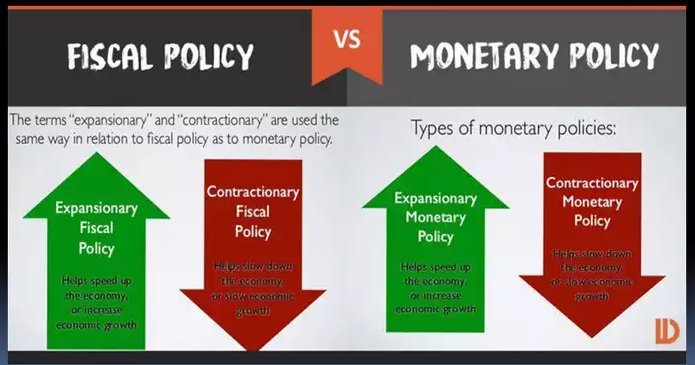
Should such overt dollar debasement lead to price inflation, MMT has just the solution. Raise taxes and issue bonds to remove the excess money from circulation.
Taxes, you see, are not for funding government spending. Rather, they’re for throttling back the money supply to attain the magical balance of growth and inflation. With MMT, big government statists can hatch boondoggles first, and leave taxation for later.
The whole theory, or lack thereof, is abundantly retarded. Yet in early 2020, something abundantly retarded was precisely what was needed.
When quantitative tightening (QT) was abruptly terminated and reversed in September 2019, the Fed’s balance sheet was $3.7 trillion. Soon after, in the face of the fabricated coronavirus hysteria, the Fed jacked up its balance sheet by $5.2 trillion to a high of $8.9 trillion. A good part of this took place between March and June 2020.
What happened next…
Cult of MMT
At first, the consequences were nonexistent. In February 2021, after nearly a year of monster money printing, the CPI showed an annual rate of inflation of just 1.7 percent. MMT supporters were riding high.
By that point, the U.S. government, and by extension the American people, were fully committed to a program of currency debasement to finance government mandated lockdowns. Washington was also attempting to inflate away its debt burden. The authorities prefer an implicit default via inflation as opposed to missing bond payments to creditors.
…all so governments, and individuals, can spend well above what they can afford, and then welsh on the debt without consequences.
During the rampant money printing of 2020 and 2021 Stephanie Kelton emerged as the MMT messiah. In June 2020, her book, “The Deficit Myth: Modern Monetary Theory and the Birth of the People’s Economy,” was published.
It quickly became a New York Times Bestseller. And it also received rave reviews from unlikely places. Upon reading the book, gangsta rap pioneer, Ice Cube, for example, tweeted on September 3, 2020, the following means of salvation:
“America loves to cry broke. But in America money does grow on trees.”
“America is a currency creator so there’s no reason for people to live like this. Government and the banks have made a deal to keep the people in debt. They always say if you print money it will cause inflation. They just printed 3 trillion. Little or no inflation.”
Does a 9.1 percent CPI reading, with an unofficial reading of nearly 18 percent,
constitute little or no inflation?
Modern Monetary Theory Bites the Dust
Currently, the Fed’s balance sheet is roughly $8.9 trillion. And consumer price inflation is raging at a 40 year high. What’s more, the Fed is hiking rates with the purpose of containing inflation. But the only way for the Fed to contain inflation is to trigger a massive, 1930s-style depression.
The cult of MMT, like most cults, has proven to be lacking for the general populace. Instead of bringing wealth and abundance to the American worker it has brought wealth and abundance to the elites and central planners who first receive and direct the flow of the newly minted fake money.
Moreover, like most cults, when MMT’s leaders are needed most, they conveniently disappear.
Is Kelton not a true believer in MMT, after all? Because if Kelton was a true believer, wouldn’t she be advocating for higher taxes right now?
That’s how MMT is supposed to work, right? When inflation heats up, taxes are supposed to be raised to remove excess money from circulation? Isn’t that the MMT solution to inflation?
Kelton, however, is not banging the drum for higher taxes. Perhaps, this is because higher taxes are perennially unpopular. Similarly, promoting money printing is much more hip and cool than promoting higher taxes.
Did MMT just bite the dust?
For now, it appears to have. We suspect it will be gone until a massive depression wipes away inflation.
Then it will be resurrected to great folly so the money printers can really get to work.
Background on Magical Money Theory
Pardon me for mixing up acronyms. Somehow the increasing mention of MMT (Modern Monetary Theory) made me think of the classic Beatles trip album. Perhaps that association was triggered by today’s suddenly fashionable socialists relying on MMT to pay for their “everything free for everybody” political visions. (Maybe one of the Ms could stand for ‘mushrooms”.)
A primer on what MMT is and is not, is an article by Karl Smith (descendant of Adam?) in National Review The Uses and Abuses of Modern Monetary Theory. Excerpts in italics with my bolds.
MMT advocates overlook its flaws.
Newly elected representative Alexandria Ocasio-Cortez (D., N.Y.) argued on Monday that Modern Monetary Theory (MMT) ought to be a part of the conversation when it comes to funding major social-policy initiatives, such as her proposed Green New Deal. Stephanie Kelton, former economic advisor to Bernie Sanders, has likewise insisted that MMT should replace our current thinking about government finance. Yet what is MMT? And is it really as revolutionary as its proponents claim?
At its heart, MMT is a way of describing the federal budget and the Federal Reserve as if they were unified under a single executive authority. In describing the system so, the dangers of federal deficit spending are no longer that it crowds out private investment and slows economic growth, but that it leads potentially to excess inflation.
Yet Modern Monetary Theorists then invariably argue that inflation is not, and indeed could not be, a major problem for the United States. Many hard-core adherents go so far as to propose a job-guarantee program paid for by the federal government, which, they argue, will virtually eliminate both unemployment and the possibility of runaway inflation.
The tenets of MMT should be familiar to an older generation of fiscal conservatives. Before the 1980s, central banks such as the Federal Reserve were controlled far more directly by their governments. As a result, they could — and often did — bail out profligate governments by simply printing more money to cover the government’s debt.
This led to massive currency devaluation, runaway inflation, or both. In the early 1980s, however, central banks in the developed world were granted independence in the hopes that doing so would stop the spiraling inflation of the late 1960s and 1970s.
In the U.S., Fed chairman Paul Volcker was spectacularly successful at this. So were, to varying degrees, most central banks in the developed world. Some holdouts existed, notably in Southern Europe — a situation that would come back to haunt them decades later.
But MMT waves away the significance of these developments, instead focusing attention on several technical facts. First, when the federal government wants to spend money, it does so by having the Treasury issue checks. These checks are processed by the Federal Reserve Bank of New York (FRBNY). Second, the FRBNY does this literally by marking up the value of digital reserves in an account belonging to the check recipients’ bank and marking down the account of the Treasury by an equal amount.
These two operations are, in theory, separate. There is no technical reason why the FRBNY has to mark down the Treasury account. It only does so because laws require the federal government to meet all of its obligations. Such laws, argue Modern Monetary Theorists, cannot bind Congress, which after all has the power to alter them.
MMT advocates argue that Congress should ask the Treasury to sell Treasury bonds to cover any of its outstanding obligations. This is not, however, because they think it is necessary to fulfill the government’s obligations, but because doing so would help stabilize the macroeconomy.
All well and good. But at some point, won’t the debt become so large that merely paying interest on it will require issuing additional debt? Won’t this process feed on itself until all the borrowing capacity in the economy is soaked up?
No, MMT advocates reply, because the government can simply stop issuing debt — meeting its obligations instead by having the Federal Reserve simply create money on its behalf.
Indeed, this is what distressed governments have traditionally done when their liabilities add up — and the result has typically been hyperinflation. Modern Monetary Theorists argue that this need not be the case. Their exact reasoning differs.
At times, they argue that hyperinflation only occurs in countries that borrow from abroad in debt denominated in a foreign government’s currency. I don’t know enough about every single instance of hyperinflation to verify this claim, but it is true that the worst incidences of hyperinflation are typically associated with borrowing from abroad.
When a country prints money in an attempt to fund the government, the international exchange value of its currency collapses. If the country owes debt denominated in a foreign currency, that debt becomes more difficult to pay down as its own currency falls. Then the country has to print even more money to meet its debt payments, which of course causes the exchange value of its currency to fall further, creating a vicious circle that ends in hyperinflation.
Modern Monetary Theorists argue that this can’t happen to the United States because all of our debt is in the form of Treasury bonds that are denominated in dollars. If the international exchange value of the dollar falls, that does not change the value of our debt.
It does, however, mean that foreigners will be repaid in a currency that will be worth much less to them. Foreign bondholders are not stupid; they would regard this as a type of unofficial default. After experiencing this type of default through currency devaluation, they would be much less willing to buy Treasury bonds or indeed any type of American security again. This is precisely the situation that Italy, Spain, and Greece found themselves in during the 1980s.
Both countries had regularly devalued their currency as a way to get out from underneath foreign debts and were increasingly locked out of international markets. The euro was created, at least in part, in an effort to solve this. It could ultimately be printed only with the authority of the European Central Bank, meaning that neither Italy, Spain, Greece, nor any other member country could avert a debt crisis by devaluing its currency. Instead, they would have to raise taxes to meet their obligations.
That brings us to the second argument MMT advocates invoke when arguing that we should not worry about excessive debt leading to inflation: If inflation becomes a problem, the federal government can simply raise taxes, slowing down the economy which, in turn, will cool inflation.
But there are two problems with this approach. First, it is political suicide. At a time when consumers are facing ever-rising prices, it would seem cruel beyond measure to slap them with a tax increase. Very few governments would have the nerve to do this. If anything, history shows us that governments will instead resort to spending money on subsidies to ease the burden of rapidly rising prices.
Second, committing to this approach would risk an economic calamity. In 1973, OPEC placed an embargo on the United States that resulted in the price of oil quadrupling overnight. The sharply rising price of oil led both to a slowing economy and an increase in inflation — a dangerous mix.
A slowing economy lowers tax revenues, making it more difficult for the government to meet its debt payments. Suppose, at a time when the economy was slowing but inflation was rising, the U.S. government had firmly committed itself to MMT principles and refused to waver. In that case, it would not be able to resort to money printing because inflation was rising. Instead, it would be obligated to raise taxes both to meet its debt payments and to slow the rate of inflation.
Sharp increases in taxes during a recession, however, can be self-defeating. This is exactly the situation that Greece, and to a lesser extent Italy and Spain, found themselves in during the Great Recession. The crises lowered revenue, which worsened their budget deficits.
As a result, the government was forced to raise taxes and lower spending during the recession. This caused the economy to contract further, which caused tax revenue to fall so much that the budget deficit actually rose. In the case of Greece, this self-defeating cycle of higher taxes and lower revenues caused the government to ultimately default on its debts anyway. That, of course, worsened the economic crisis the country was already facing.
In the face of such a calamity, no sovereign government would or perhaps even should refrain from devaluing its currency and inflating away at least some of its debts. For that reason, governments have designed institutions to avoid falling into this trap.
In the United States, that means both making the Federal Reserve independent and not subject to the direct authority of the Treasury, and requiring the Treasury to meet all of its obligations with cash raised from tax revenues or Treasury-bond sales. In effect, we’ve outlawed the methods of Modern Monetary Theory — and with good reason.
KARL SMITH — Karl Smith is a senior fellow at the Niskanen Center. He was previously Assistant Professor of Economics and Government at the University of North Carolina (UNC) School of Government.
Walter Russell Mead explains in his Hudson Institute article End of the German Idyll. Excerpts in italics with my bolds. H/T John Ray
G7 leaders during a working session at the G7 summit in Schloss Elmau on June 28, 2022 near Garmisch-Partenkirchen, Germany. (Photo by Stefan Rousseau via Pool/Getty Images)
Germany looked normal over the weekend as a genial Chancellor Olaf Scholz welcomed the Group of Seven leaders and their guests to the luxurious Schloss Elmau in the Bavarian Alps. But those appearances are deceiving. Germany is facing its gravest challenges since the foundation of the Federal Republic following World War II.
This is very sudden. As recently as 2020, almost the entire world agreed with the smug German self-assessment that Germany had the world’s most successful economic model, was embarking on the most ambitious—and largely successful—climate initiative in the world, and had perfected a values-based foreign policy that ensured German security and international popularity at extremely low cost.
None of this was true.
The German economic model was based on unrealistic assumptions about world politics and is unlikely to survive the current turmoil.
German energy policy is a chaotic mess, a shining example to the rest of the world of what not to do.
Germany’s reputation for a values-based foreign policy has been severely dented by Berlin’s waffling over aid to Ukraine. And German security experts are coming to terms with a deeply unwelcome truth:
Confronted with an aggressive Russia, Germany, like Europe generally, is utterly reliant on the U.S. for its security. At a time when American foreign policy increasingly prioritizes Asia and isolationist sentiment among both Republicans and Democrats appears to be rising, if Donald Trump returns to the White House in 2025, German security will depend on his goodwill.
Mr. Scholz and his coalition government have responded to Vladimir Putin ‘s invasion of Ukraine with a series of, by German standards, revolutionary changes. Germany is beginning to rearm. It is, with some false starts, sending weapons to Ukraine. It has taken the first steps toward energy independence from Russia, even at the cost of its ambitious climate agenda. Coal plants will lumber back to life, new gas-processing plants will be built, and Germany is asking Europe to delay decarbonization mandates that no longer seem realistic.
But the real work remains to be done.
Modern Germany was above all an economic project.
The collapse of the Third Reich left Germany morally devastated, physically wrecked and economically bankrupt. From the moment of its foundation in 1949, the country ‘s central goal was economic growth. That growth could:
repair the destruction of the war,
promote Germany ‘s peaceful integration into Western Europe,
blunt the appeal of communism, and
build a national identity independent of the malignant fantasies of the Hitler era and the bombast of Wilhelm II.
The hard work of the German people, the pragmatic policies of the political class, the skills and determination of German management, and the favorable international climate resulting from the development of the American-led world order took Germany to economic heights.
In recent years, the German economic miracle depended on a combination of industrial prowess, cheap energy from Russia, and access to global markets, particularly in China. Today every one of those pillars is under threat. German mastery of automobile technology through a century of engineering is challenged by the shift to electric vehicles. The chemicals industry, in which German technology has led the world since the 19th century, is coming under environmental challenges as global competition intensifies.
Those challenges are exacerbated by the loss of cheap and secure Russian natural gas.
Green energy, despite massive German investment, will be unable to supply German industry with reliable and cheap power for a long time. In the meantime, the alternatives to Russian pipeline gas are expensive and controversial. Nuclear power gives Greens the willies; coal is unbearable; liquefied natural gas requires long-term commitments and massive capital expenditures.
Beyond that, Germany ‘s economic relationship with China is changing for the worse. China was long the ideal customer for German products. Its newly affluent middle class fell in love with German luxury cars. Its rapidly growing manufacturing sector voraciously consumed German machine tools and other capital goods. But China ‘s growth is decelerating. Its maturing industrial economy seeks to compete with high-end German producers, often based on tools reverse-engineered from German imports.
Those in the Biden administration who dream that Germany will wholeheartedly join a new global American crusade for values should keep their enthusiasm in check.
Mr. Scholz may agree in the abstract with President Biden about the importance of liberal values and the danger of climate change, but his calculations must reflect the economic facts of German life. This naturally leads to thoughts about how to patch things up with Russia and China.
Mr. Biden ‘s job is not to sing hymns about Western values with Mr. Scholz; it is to make Berlin understand that U.S. security guarantees come at a price. Given the realities of American politics, Germany cannot count on continued American support unless it does more to back the U.S. at a time of grave and growing danger world-wide.
Footnote:
Mead’s essay focused on the challenges of German leader Scholz, but consider the various predicaments self-induced by other members of this G7 gang who can neither talk nor shoot straight. Mr. Biden increasingly struggles to even read or sign what they write for him, followed by observers noting that it is all lies and mean-spirited malarkey. UK PM Johnson is a lame duck in political limbo, only in office until his Tory replacement is chosen. President of Italy, 80 yr. old Sergio Mattarella wanted to retire, but agreed to a second term in January when ruling parties couldn’t agree on his successor. Justin “Fidel” Castreau of Canada has disgraced himself and his office, clinging to power by colluding with the equally unpopular NDP party leader. Japan’s nation building leader Abe was just assassinated, leaving the current novice Japan PM much lesser known or appreciated by Japanese people. Macron of France won his personal election, but his party lost bigtime in legislative seats.
Any bets on who has the right stuff to restore and advance Western Civilization?






















 Science Matters