Climate Geopolitics

A recent interview by Drieu Godefridi was translated and full text provided by Friends of Science under the title Outcome of the Paris Accord: a re-founding act of American democracy?

This post shares Dr. Godefridi’s views of the geopolitical frame built upon the climate change issue shifting due to US withdrawal from the Paris accord. Later on are excerpts from an article by Jon Huntsman sketching a future world shaped by global trade rather than global government.
Modern Condition of Globalization

We live in a reality that we know that has become strongly globalized economically. There has been much less attention to the other globalization that has taken place before our eyes, that of an extremely dense network of international organizations and institutions that has increasingly been given the power to create standards by right.

The difficulty is that these global organizations are not subject to the same democratic requirements – election and accountability – as well as separation of powers, as are our democratic national institutions. We have denounced so much the “democratic deficit” of the European institutions! Indeed, it is wrong that the faceless and very ideological judges – here I point at the European Court of Human Rights and the Court of Justice of the EU – decide on the future of Europe in such major areas as immigration or terrorism. They do so, completely apart from the wishes of European citizenry.

But this deficit is nothing compared to that of the other international organizations, which generally have only a vague idea of democracy (and often appoint despots to human rights commissions, for instance)! One notes here, above all, the United Nations, whose umbrella organization in the field of climate, the UNFCCC, is just one manifestation.

What we have been seeing for the past two decades, in the areas of climate, gender theory, immigration and terrorism, and so on, is that activist minority ideologues have confiscated democratic debate. By acting at the international level, they have an enormous advantage. As soon as such an unaccountable international body has seized a cause, its standards prevail over national parliaments!

When gender theory was enshrined in its most radical version in 2011 by a Council of Europe Convention, it became virtually impossible to dislodge it. When, in cases such as HIRSI (2012), the European Courts devoted the “no border” ideology, it became almost impossible for the national ministers who wished to defend their own borders to do so. Examples that come to mind are Francken in Belgium, his British and Austrian counterpart, or the countries of the Visegrád group – a handful able to oppose it effectively.

But it is in the domain of climate that this confiscation of democratic debate is the most masterful, reaching a kind of virtuosity. Why? By the effect of science! The theory of gender is meant to be scientific, but it does not deceive anyone: it is an ideology, assumed as such by authors like Judith Butler. The ideology of the “no border” is moral, it does not claim to be scientific.

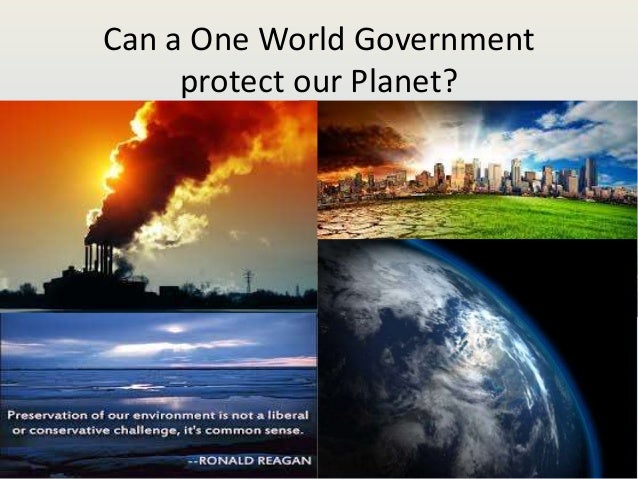
Climate is something else! Every time since its birth in the fold of the IPCC, the ideology of the climate has claimed science as its foundational authority – and science in its most precise version! Physics! The politicized IPCC has never stopped claiming it is presenting science since. So, it is this second globalization, a prelude to a world government that is openly called for by the elites of internationalist socialism, which is threatened today by the American exit of the Paris Agreement.

The Paris Accord

The Paris Accord marks the apotheosis, not of “globalism,” but of a particular version of globalism, which one should rather qualify as socialist. Indeed, let us recall the actual content of the Paris Agreement! What does it foresee? Essentially, two things: the drastic reduction of CO2 emissions in the West, right away, with the possibility for states such as China – the world’s largest CO2 emitter – to continue to increase emissions to 2030, with no requirement whatsoever to reduce emissions. The second essential component of “Paris” is the Green Fund, which provides for the transfer of $ 100 billion a year from the West to the rest of the world. “Paris” is therefore, first and foremost, the triumph of what was called “support for the Third World” in the 70s and 80s, that is to say, a massive and permanent transfer of wealth from the West to the rest of the world.

“Paris” is doubly globalist: first, because the transfer of wealth will be done through a clever network of international institutions, such as the United Nations Framework Convention on Climate Change (UNFCCC), the Green Fund — an institution, with a secretariat, directors, exotic meeting places, etc. —and all the intermediate institutions created by the Paris Agreement.

Secondly, “Paris” is driven by “morality” with the IPCC itself employing the services of moral philosophers to help them make their political case. The founding moral intuition which presides over the Paris Agreement is internationalist socialism. International socialism has always considered that the differential of wealth that benefits the West results from the pillage of the rest of the planet. This is described in terms of imperialism, colonization, exploitation of weaker partners. In that world view, the only “just” solution (aka “climate justice”) to this is the immediate and unconditional transfer of a substantial portion of these wealth to the rest of the world. Thus, the Paris Accord discloses itself clearly as a matter of globalism, but of a very particular vision of it – internationalist socialism.

The founding thesis of universalist socialism is that the wealth of the West is born of the plunder of the rest of the world. This is obviously false, and this has been demonstrated time and time again. The West owes its surplus of wealth to the preference given over five centuries to a particular economic system, capitalism! [1] The West has rejected the alternatives, socialism or subsistence. Moreover, the falsehood about the capitalist West as simple global robber barons is so well entrenched in leftist/socialist/globalists that even the concessions and foreign aid made to date by the West on are never enough to satisfy the transfer of wealth desired by the Third Worldists.

With the Paris Accord, which is not born from nothing, we enter a completely different dimension. This time, it is no longer morality, generosity or compassion (i.e. disaster relief) that requires the transfer of the wealth of the West. It’s science! It is the idea that because the Western industrial world has polluted the world for so many years should mean that the West must transfer its wealth to the rest of the world, which can continue to pollute. Further, this guilt money must be paid into the Green Fund which puts unaccountable, unelected green groups and green rent-seekers an opportunity to exploit this ultimate global subsidy for renewable-intermittent energies! Admire the finesse of the process: it employs the very strength of the West — capitalism — to show that the West has sinned. How naive and amateur are the Third Worldists of the past, with their moral arguments, faced with the omnipotence of the scientific argument!

However, you likely will have noticed, like me, that the climate debate does not deserve to be described as scientific in any way, anymore. What is the matrix of climate science? That is the IPCC, the UN Intergovernmental Panel on Climate Change. As early as 2010, I demonstrated in the book “Le GIEC est mort, vive la science”/ “The IPCC: A Scientific Body?” that by its composition, competences and functioning, the IPCC is a totally political organization, and not a scientific one as it claims. I do not have the competence to pronounce on the science of climate as such, nor do I need it: for it is easy to understand that a political organization can only produce political reports. The current “science” of climate is that of a scholar steeped in science… and politics – with a dominant political gene.

The Future of Paris Accord

In my humble opinion, two things will happen: first, “Paris” is dead. We are going to witness a form of hysterical “debate” in Europe. It is clear that France, Belgium and Germany will compete as to who is more virtuous, climate-wise, and that they are supported by the gigantic economic sector of the $1.5 trillion/year sector of “Big Climate” – that of industries and investors in Renewable-intermittent energies, and by high finance helped by ‘green’ groups, which would have had control over the massive transfers of the Green Fund. Of course, economically, the European position is not tenable. The Paris Accord would have been the bank heist of the millennium had Americans complied, is not possible with only the funds of European states such as France, Belgium or the countries of the Southern Europe. These are completely drained financially. These countries are over-indebted, have historically unprecedented levels of taxation, they owe a large amount of money to NATO, how could they finance the Green Fund? Through the EU climate policies, they are increasing the price of their energy every day while the rest of the world – beginning with the Americans – will now lower the price of theirs? Simply stating it this way exposes the lack of serious intent.

As for the science of climate, we are going to experience interesting developments. For example, the head of the American environmental agency, Scott Pruitt, announced the setting up of working groups to disentangle the Science from the Ideology in climate science.

What Future for the Global Economy

The Future of Global Trade: Jon Huntsman on the Radical Change Ahead was published at Wall Street Journal

Thirty years from now, world trade will be in the midst of another radical transformation—one no less critical to America’s 21st century leadership or to the expansion of global growth prospects.

For millennia, international commerce has focused on the exchange of physical goods (including people when there was slavery). More recently, services have become an ever-increasing component of advanced economies and world trade. This trend will continue and bring with it greater complexity for those setting the rules and negotiating the deals.

In general, manufacturing will be more localized; services, especially health and retail, more personalized; today’s ubiquitous shipping containers will be replaced by 3-D and 4-D printers, and the designs for making physical goods locally will move at the speed of light over airwaves just as financial flows do today. As urban farming gets going, food will be produced closer to the market, cutting transportation costs and reducing trade in agriculture.

Urbanization will produce a shift in populations and create more global centers of excellence for innovation. Whereas today we have a handful, 30 years from now there will be dozens of cities that serve as hubs of global trade in ideas. This proliferation of empowered megacities and centers of creative innovation will challenge geographic borders, making it hard for capitals to call the shots.

Trade flows will reflect the realities of global power as well as demographics. The Pacific will no longer be the dominant trade hub. Instead, the focus will shift to the Indian Ocean region, which upward of eight billion people—mainly in China, India and Africa—will call home. The U.S. may not be in a position to influence trade the way it did. For the past 200 years, Britain, after the Industrial Revolution, and the U.S. after the two world wars, fought for an open trading system to promote growth. None of the emerging countries have thus far shown that same commitment, even though they—particularly China—are increasingly setting the pace in world trade. China eclipsed the U.S. as the biggest trading country in 2013.

While mostly positive, the transformation of global trade will also create challenges. For one, how will a country attract and retain the world’s best and brightest talent? There will be no guarantee that people will stay if your country isn’t moving toward competitive best practices.

Combined with other future trends, our prospects are bright. There is good news for the environment. . . People will also live longer. There will be less disease. Consumers will benefit enormously from the changes in world trade that will deliver, among other things, personalized medicine and greater access to life-changing science and pharmaceuticals. Choices will be expanded, distances shortened, and manufacturing will be cheaper and tailored to specific needs.

Summary

What a contrast between the doomsayers lamenting the collapse of global climatism and the visionaries seeing the world developing through free and mutually beneficial trade.

Drieu Godefridi born in 1972 is a liberal Belgian writer, founder of the Hayek Institute in Brussels. He holds a doctorate in Philosophy from Paris Sorbonne.

Jon Huntsman, chairman of the Atlantic Council, has served as governor of Utah, U.S. ambassador to China and Singapore, and deputy U.S. trade representative.
 

Greenland Viking Science


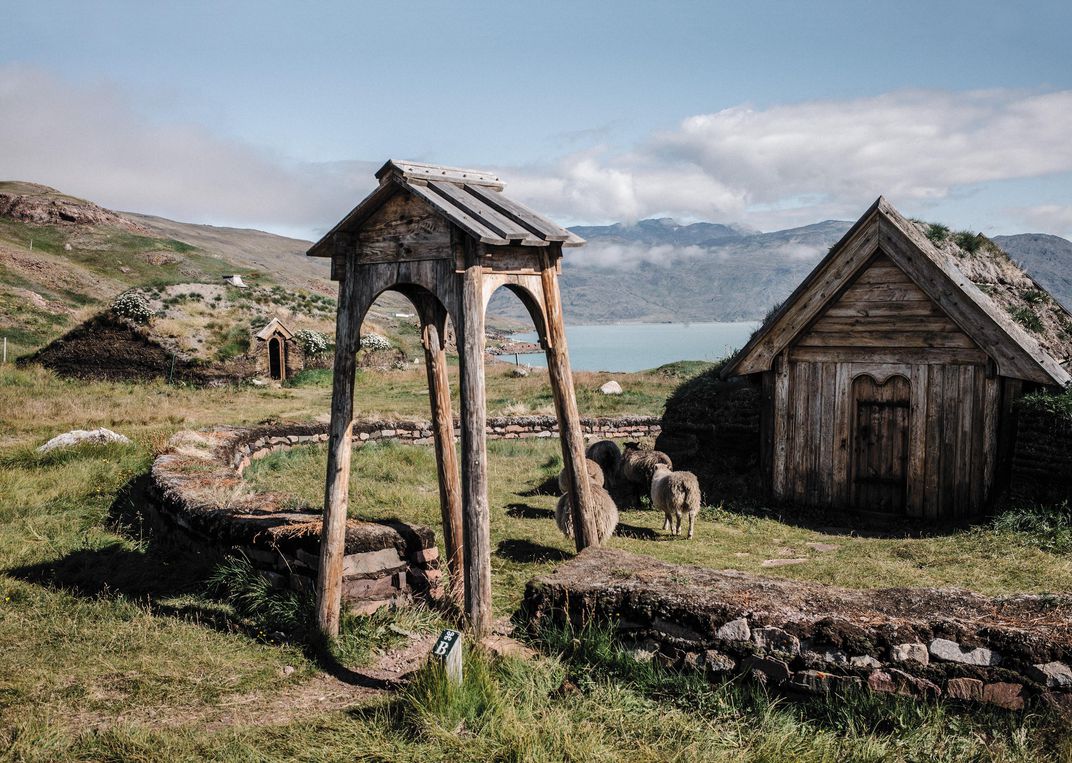
Eric the Red slept here: Qassiarsuk features replicas of a Viking church and longhouse. (Ciril Jazbec)

It is refreshing to come across scientists researching a question without the corrupting need to scare the public or to confirm some personal, professional or moral fear of the future. In this case I refer to a wonderful Smithsonian article on the question: Why Did Greenland’s Vikings Vanish? Newly discovered evidence is upending our understanding of how early settlers made a life on the island — and why they suddenly disappeared.

Some excerpts below give the flavor of this persistent effort by researchers unrewarded by the availability of huge grants that now flow to the once-lowly climatologists.  The whole article is fascinating to anyone with curiosity.

The Mystery of Greenland Vikings

But the documents are most remarkable—and baffling—for what they don’t contain: any hint of hardship or imminent catastrophe for the Viking settlers in Greenland, who’d been living at the very edge of the known world ever since a renegade Icelander named Erik the Red arrived in a fleet of 14 longships in 985. For those letters were the last anyone ever heard from the Norse Greenlanders.

They vanished from history.

Europeans didn’t return to Greenland until the early 18th century. When they did, they found the ruins of the Viking settlements but no trace of the inhabitants. The fate of Greenland’s Vikings—who never numbered more than 2,500—has intrigued and confounded generations of archaeologists.

Those tough seafaring warriors came to one of the world’s most formidable environments and made it their home. And they didn’t just get by: They built manor houses and hundreds of farms; they imported stained glass; they raised sheep, goats and cattle; they traded furs, walrus-tusk ivory, live polar bears and other exotic arctic goods with Europe. “These guys were really out on the frontier,” says Andrew Dugmore, a geographer at the University of Edinburgh. “They’re not just there for a few years. They’re there for generations—for centuries.”

So what happened to them?

The Conventional Wisdom

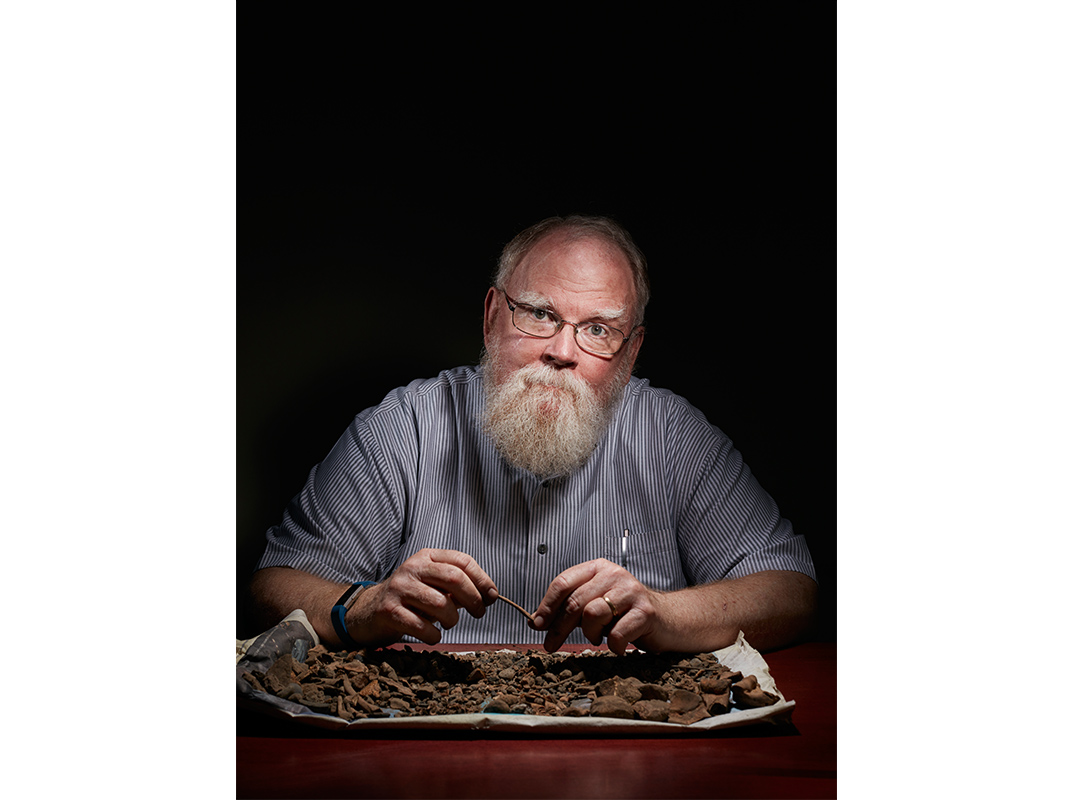
Thomas McGovern used to think he knew. An archaeologist at Hunter College of the City University of New York, McGovern has spent more than 40 years piecing together the history of the Norse settlements in Greenland. With his heavy white beard and thick build, he could pass for a Viking chieftain, albeit a bespectacled one. Over Skype, here’s how he summarized what had until recently been the consensus view, which he helped establish: “Dumb Norsemen go into the north outside the range of their economy, mess up the environment and then they all die when it gets cold.”

Thomas McGovern (with Viking-era animal bones); The Greenlanders’ end was “grim.” (Reed Young)

Accordingly, the Vikings were not just dumb, they also had dumb luck: They discovered Greenland during a time known as the Medieval Warm Period, which lasted from about 900 to 1300. Sea ice decreased during those centuries, so sailing from Scandinavia to Greenland became less hazardous. Longer growing seasons made it feasible to graze cattle, sheep and goats in the meadows along sheltered fjords on Greenland’s southwest coast. In short, the Vikings simply transplanted their medieval European lifestyle to an uninhabited new land, theirs for the taking.

But eventually, the conventional narrative continues, they had problems. Overgrazing led to soil erosion. A lack of wood—Greenland has very few trees, mostly scrubby birch and willow in the southernmost fjords—prevented them from building new ships or repairing old ones. But the greatest challenge—and the coup de grâce—came when the climate began to cool, triggered by an event on the far side of the world.

In 1257, a volcano on the Indonesian island of Lombok erupted. Geologists rank it as the most powerful eruption of the last 7,000 years. Climate scientists have found its ashy signature in ice cores drilled in Antarctica and in Greenland’s vast ice sheet, which covers some 80 percent of the country. Sulfur ejected from the volcano into the stratosphere reflected solar energy back into space, cooling Earth’s climate. “It had a global impact,” McGovern says. “Europeans had a long period of famine”—like Scotland’s infamous “seven ill years” in the 1690s, but worse. “The onset was somewhere just after 1300 and continued into the 1320s, 1340s. It was pretty grim. A lot of people starving to death.”

Amid that calamity, so the story goes, Greenland’s Vikings—numbering 5,000 at their peak—never gave up their old ways. They failed to learn from the Inuit, who arrived in northern Greenland a century or two after the Vikings landed in the south. They kept their livestock, and when their animals starved, so did they. The more flexible Inuit, with a culture focused on hunting marine mammals, thrived.

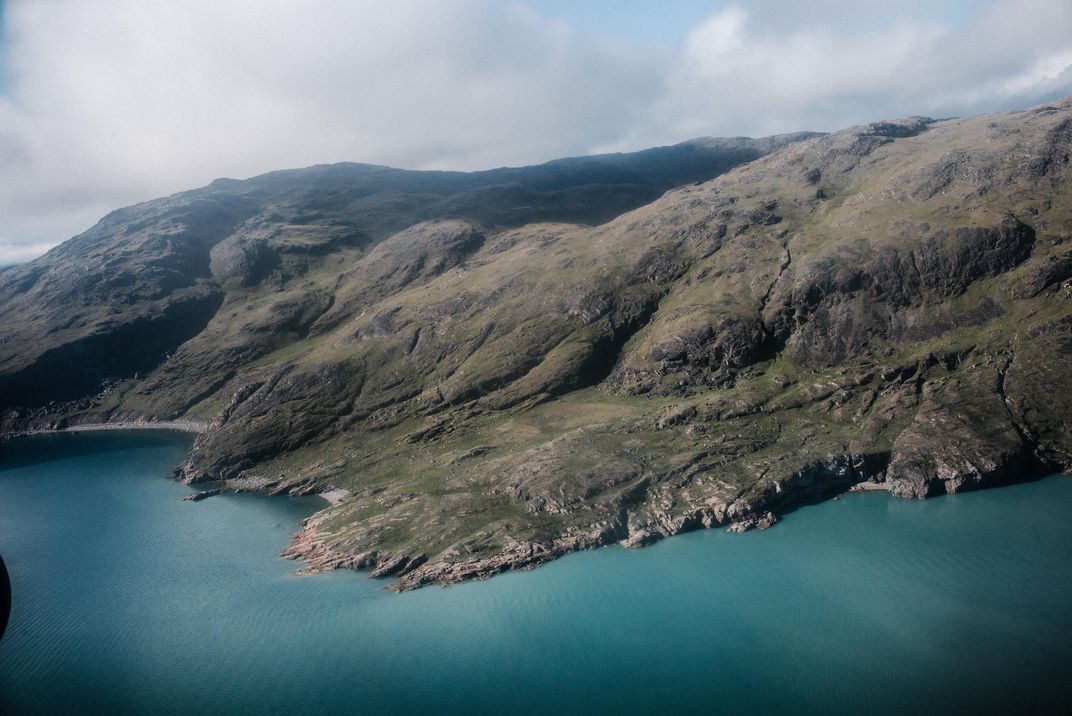
An aerial photograph of southern Greenland. (Ciril Jazbec)

New Evidence Overturns Past Conceptions

But over the last decade a radically different picture of Viking life in Greenland has started to emerge from the remains of the old settlements, and it has received scant coverage outside of academia. “It’s a good thing they can’t make you give your PhD back once you’ve got it,” McGovern jokes. He and the small community of scholars who study the Norse experience in Greenland no longer believe that the Vikings were ever so numerous, or heedlessly despoiled their new home, or failed to adapt when confronted with challenges that threatened them with annihilation.

“It’s a very different story from my dissertation,” says McGovern. “It’s scarier. You can do a lot of things right—you can be highly adaptive; you can be very flexible; you can be resilient—and you go extinct anyway.” And according to other archaeologists, the plot thickens even more: It may be that Greenland’s Vikings didn’t vanish, at least not all of them.

A New Understanding How Vikings Lived on Greenland


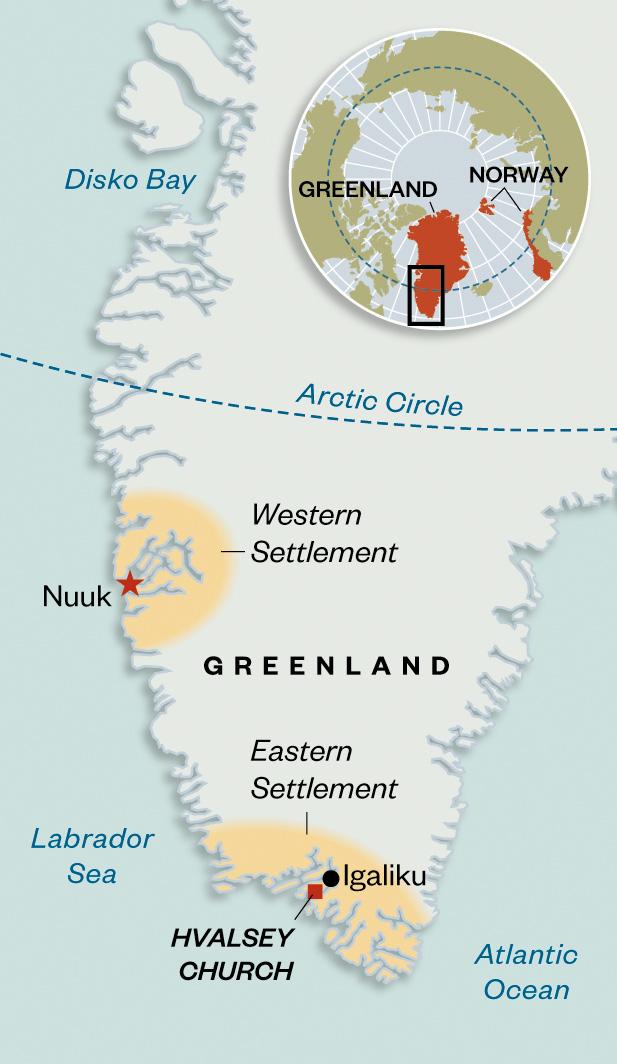
The Vikings established two outposts in Greenland: one along the fjords of the southwest coast, known historically as the Eastern Settlement, where Gardar is located, and a smaller colony about 240 miles north, called the Western Settlement. Nearly every summer for the last several years, Konrad Smiarowski has returned to various sites in the Eastern Settlement to understand how the Vikings managed to live here for so many centuries, and what happened to them in the end.

“Probably about 50 percent of all bones at this site will be seal bones,” Smiarowski says as we stand by the drainage ditch in a light rain. He speaks from experience: Seal bones have been abundant at every site he has studied, and his findings have been pivotal in reassessing how the Norse adapted to life in Greenland. The ubiquity of seal bones is evidence that the Norse began hunting the animals “from the very beginning,” Smiarowski says. “We see harp and hooded seal bones from the earliest layers at all sites.”

A seal-based diet would have been a drastic shift from beef-and-dairy-centric Scandinavian fare. But a study of human skeletal remains from both the Eastern and Western settlements showed that the Vikings quickly adopted a new diet. Over time, the food we eat leaves a chemical stamp on our bones—marine-based diets mark us with different ratios of certain chemical elements than terrestrial foods do. Five years ago, researchers based in Scandinavia and Scotland analyzed the skeletons of 118 individuals from the earliest periods of settlement to the latest. The results perfectly complement Smiarow­ski’s fieldwork: Over time, people ate an increasingly marine diet, he says.

Judging from the bones Smiarowski has uncovered, most of the seafood consisted of seals—few fish bones have been found. Yet it appears the Norse were careful: They limited their hunting of the local harbor seal, Phoca vitulina, a species that raises its young on beaches, making it easy prey. (The harbor seal is critically endangered in Greenland today due to overhunting.) “They could have wiped them out, and they didn’t,” Smiarowski says. Instead, they pursued the more abundant—and more difficult to catch—harp seal, Phoca groenlandica, which migrates up the west coast of Greenland every spring on the way from Canada. Those hunts, he says, must have been well-organized communal affairs, with the meat distributed to the entire settlement—seal bones have been found at homestead sites even far inland. The regular arrival of the seals in the spring, just when the Vikings’ winter stores of cheese and meat were running low, would have been keenly anticipated.

The Vikings Were Players in the Ivory Trade

The Norse harnessed their organizational energy for an even more important task: annual walrus hunts. Smiarowski, McGovern and other archaeologists now suspect that the Vikings first traveled to Greenland not in search of new land to farm—a motive mentioned in some of the old sagas—but to acquire walrus-tusk ivory, one of medieval Europe’s most valuable trade items. Who, they ask, would risk crossing hundreds of miles of arctic seas just to farm in conditions far worse than those at home? As a low-bulk, high-value item, ivory would have been an irresistible lure for seafaring traders.

After hunting walruses to extinction in Iceland, the Norse must have sought them out in Greenland. They found large herds in Disko Bay, about 600 miles north of the Eastern Settlement and 300 miles north of the Western Settlement. “The sagas would have us believe that it was Erik the Red who went out and explored [Greenland],” says Jette Arneborg, a senior researcher at the National Museum of Denmark, who, like McGovern, has studied the Norse settlements for decades. “But the initiative might have been from elite farmers in Iceland who wanted to keep up the ivory trade—it might have been in an attempt to continue this trade that they went farther west.”

A bishop’s ring and top of his crosier from the Gardar ruins. (Ciril Jazbec)

How profitable was the ivory trade? Every six years, the Norse in Greenland and Iceland paid a tithe to the Norwegian king. A document from 1327, recording the shipment of a single boatload of tusks to Bergen, Norway, shows that that boatload, with tusks from 260 walruses, was worth more than all the woolen cloth sent to the king by nearly 4,000 Icelandic farms for one six-year period.

Archaeologists once assumed that the Norse in Greenland were primarily farmers who did some hunting on the side. Now it seems clear that the reverse was true. They were ivory hunters first and foremost, their farms only a means to an end. Why else would ivory fragments be so prevalent among the excavated sites? And why else would the Vikings send so many able-bodied men on hunting expeditions to the far north at the height of the farming season? “There was a huge potential for ivory export,” says Smiarowski, “and they set up farms to support that.” Ivory drew them to Greenland, ivory kept them there, and their attachment to that toothy trove may be what eventually doomed them.

A New Theory Why Viking Greenland Settlements Failed

For all their intrepidness, though, the Norse were far from self-sufficient, and imported grains, iron, wine and other essentials. Ivory was their currency. “Norse society in Greenland couldn’t survive without trade with Europe,” says Arneborg, “and that’s from day one.”

Then, in the 13th century, after three centuries, their world changed profoundly. First, the climate cooled because of the volcanic eruption in Indonesia. Sea ice increased, and so did ocean storms—ice cores from that period contain more salt from oceanic winds that blew over the ice sheet. Second, the market for walrus ivory collapsed, partly because Portugal and other countries started to open trade routes into sub-Saharan Africa, which brought elephant ivory to the European market. “The fashion for ivory began to wane,” says Dugmore, “and there was also the competition with elephant ivory, which was much better quality.” And finally, the Black Death devastated Europe. There is no evidence that the plague ever reached Greenland, but half the population of Norway—which was Greenland’s lifeline to the civilized world—perished.

The Norse probably could have survived any one of those calamities separately. After all, they remained in Greenland for at least a century after the climate changed, so the onset of colder conditions alone wasn’t enough to undo them. Moreover, they were still building new churches—like the one at Hvalsey—in the 14th century. But all three blows must have left them reeling. With nothing to exchange for European goods—and with fewer Europeans left—their way of life would have been impossible to maintain. The Greenland Vikings were essentially victims of globalization and a pandemic.

Summary

So there is a climate angle to the story of Greenland Vikings. Unlike climate alarmists, these scientists looked deeper and found a more complicated truth. Of course, even this explanation is provisional, because we are talking about science, after all.

OLYMPUS DIGITAL CAMERA

Time Mag Misreads Science


This blog is dedicated to science as a process of discovery, rather than a catechism of truths to be embraced.  This article in the Washington Times discussed that issue in relation to a recent Time Magazine essay that comes down on the catechism side.

Time’s Misreading of Science, The magazine would rather settle than search

As demonstrated by the confirmation hearings of Scott Pruitt for new Environmental Protection Agency chief, all-out war is being waged against the Trump administration by leftists who believe science is under attack from the evil empire.

Belief that this new administration puts science in jeopardy is not surprising given the fact that so many are confused about what science is, how it is practiced, and what it can tell us about the future.

The popular press adds to the confusion about science. Take the Feb. 13 issue of Time magazine, for example. In an article titled “How a war on science could hurt the U.S. — and its citizens,” the authors open with this assessment of science: “The discipline of science is one where the facts, once they are peer-reviewed and published in scientific journals, are fixed. They’re not open to interpretation, or at least not much.”

There are numerous problems with this confused understanding of science. Regardless, the authors continue by contrasting “science” with politics “in which nearly everything can be negotiated. But as the first days of the Trump administration have shown, many of those seemingly settled scientific facts — the ones that have informed countless policies from previous U.S. administrations — are once more up for debate.”

tall-stack-booksrev

Science can be defined at its most basic level as “knowledge,” or what we think we know about a given topic. Since absolute truth on a subject is elusive, science is tentative, adjusted as additional information is accumulated through more research and wider perspective and, yes, even debate.

In practice, science can certainly be influenced by politics or, essentially, ideology. Those on the left apparently do not see a leftist ideology permeating certain areas of contemporary scientific practice and so equate scientific conclusions that endorse their beliefs as being absolutely irrefutable.

This blinkered perception manifests itself as “settled science” and is apparent in climate change science, and especially the power of this science to ascertain Earth’s future climate.

Accurate prediction is one of the biggest challenges in scientific practice, and indeed an accurate prediction for the right reasons is one of the conditions for a scientific assertion to be correct.

Here’s where climate science has fallen woefully short in recent decades.

The prediction that man-made carbon-dioxide emissions drive catastrophic climate change beginning with mounting global temperatures has been proven paltry at best. Yet, the dire global warming prediction, years ago, evolved into a belief and brandished as a proselytizing mantra by climate change crusaders.

Now the current climate change hypothesis is struggling and can use some insight from qualified, skeptical scientists to broaden the ambient landscape.

That broadening is difficult with a Time-skewed understanding of science and scientific practice. To say that the discipline of science is where facts are fixed once they are peer-reviewed and published is confused at best. Scientists use facts (like those associated with the fundamental principles of physics) as they observe natural events, propose hypotheses, and test their explanations of what they observe. Hypotheses are submitted to peer-reviewed scientific journals for critique.

The peer-review process is assumed to be rigorous, fair and balanced; however, that is not always the case. Documented instances have occurred where data in published reports were discovered to be falsified, or when work described was never actually performed, or when only friendly reviewers were chosen to assure acceptance of the conclusions, and the like. So, facts cannot be determined by peer review any more than real truth can be decide by an ad hoc committee. And published results are always open to further review, challenges and certainly interpretation.

True believers trust that their concept of science is rock-solid, especially when the science they choose to believe conforms to their preconceived notions.

But, the current world of climate science has been astutely branded by some challengers as a “climate-industrial complex.” The moniker may be well suited to describe the seemingly enormous political and monetary influence of this particular field by left-leaning vested interests.

Perhaps, with the arrival of the pragmatic Trump team, including Scott Pruitt, the climate world of “seemingly settled scientific facts” is about to be rocked by a bit more conservative assessment.

• Anthony J. Sadar is a Certified Consulting Meteorologist and author of “In Global Warming We Trust: Too Big to Fail” (Stairway Press, 2016).

Bertrand Russell makes a related point with his solar teapot.

To enlarge image, open it in new tab.

More on the Climate Crisis industry

Climate Crisis Inc.

For more on belief related to science and religion:

Head, Heart and Science

Yellow Climate Journalism


Definition of “Fake News”:  When reporters state their own opinions instead of bearing witness to observed events.

We are now fully entrenched in an age of “yellow” journalism, especially regarding the issue of global warming/climate change. Below I will deconstruct a recent egregious example, but first we need a background from renowned philosopher Mortimer Adler.

On the Difference Between Knowledge and Opinion

Knowledge refers to knowing the truth, that is understanding reality independent of the person and his/her ideas. By definition, there is no such thing as “false knowledge.”

When I show you two marbles then add two more marbles and ask you how many marbles there are, the answer is not a matter of opinion. You have no freedom to assert any opinion other than the answer “four”.  By the axioms of mathematics we know the true answer to this question.

A great many other issues in human society, politics and culture are matters of opinion, and each is free to hold an opinion different from others. In such cases, the right opinion is usually determined by counting noses with the majority view ruling.

Note that school children are taught right opinions. That is, they are told what their elders and betters have concluded are the right answers to many questions about life and the world. Those children do not yet possess knowledge, because as Socrates well demonstrated, you have knowledge when you have both the right opinion and also know why it is right. Only when you have consulted the evidence and done your own analysis does your opinion serve as knowledge for you, rather than submission to an authority.

John R. Christy is a professor of Atmospheric Science and Director of the Earth System Science Center of the University of Alabama in Huntsville.

On Climate Knowledge, Dr. John Christy (here)

Climate science is a murky science. When dealing with temperature variations and trends, we do not have an instrument that tells us how much change is due to humans and how much to Mother Nature. Measuring the temperature change over long time periods is difficult enough, but we do not have a thermometer that says why these changes occur.

We cannot appeal to direct evidence for the cause of change, so we argue.

The real climate system is so massively complex we do not have the ability to test global-size theories in a laboratory. Without this ability, we tend to travel all sorts of other avenues to confirm what are essentially our unprovable views about climate. These avenues tend to comfort our souls because we crave certainty over ambiguity.

Without direct evidence and with poor model predictability, what other avenues are available to us? This is where things get messy because we are humans, and humans tend to select those avenues that confirm their biases. (It seems to me that the less direct evidence there is for a position, the more passion is applied and the more certainty is claimed.)

One avenue many folks tend to latch onto is the self-selected “authority.” Once selected, this “authority” does the thinking for them, not realizing that this “authority” doesn’t have any more direct evidence than they do.

Other avenues follow a different path: Without direct evidence, folks start with their core beliefs (be they political, social or religious) and extrapolate an answer to climate change from there. That’s scary.

Exhibit A of Yellow Climate Journalism

Unfortunately we see that climate journalists often distort their articles by confusing factual reporting of events with their own opinions.

“In the conduct of trials before judges in our courts there is a famous rule called the opinion rule. The opinion rule says that a witness giving testimony must report what he saw or what he heard. He must not report what he thinks happened, because that would be giving an opinion, not knowledge by observation.”
~ Mortimer J. Adler

One of many typical articles on climate is this one from Wired: Tillerson’s Hearing Seals It: the US Won’t Lead on Climate Change 

See how the author forces his own opinions to subvert what he observed.

After more than six hours of testimony, Tillerson backtracked even further, telling senator Jeff Merkley (D-OR) that though the evidence of a changing climate was clear, the cause wasn’t. “The science behind the clear connection (to human activity) is not conclusive,” Tillerson said, an assertion as false as the scientific consensus is clear. (my bold)

Tillerson said that he and the president elect would do a “fulsome review” of US climate change policies. “I also know that the president, as part of his priority in campaigning, was ‘America First,’ so there is important considerations as we commit to such accords, and as those accords are executed over time: are there any elements of that that put America at a disadvantage?” he said. The negative effects of climate change, of course, don’t discriminate on the basis of national borders(my bold)

Senator John Barrasso (R-WY), who believes government money currently spent fighting climate change could be “better spent” elsewhere, pushed Tillerson to commit to abandoning US funding for anti-climate change initiatives. Specifically, Barrasso opposes support for the Green Climate Fund, an international program set up to help developing nations deal with the effects of climate change. The US under Obama has pledged $3 billion.

“In consultation with the president, my expectation is that we are going to look at these things from the bottom up in terms of funds we’ve committed toward this effort,” Tillerson said.

Even in his non-answer, it’s clear Tillerson was open to dropping such funding. Instead, he opined on the power of electricity to lift people out of poverty. A noble aspiration, perhaps, but one that would provide little consolation to communities ravaged by climate change now and in the future. (my bold)

Summary, Five criteria for distinguishing between knowledge and opinion:

1. Whether or not everyone must agree.
2. Doubt and belief are relative only to opinion, never to knowledge;
3. We can have freedom of thought only about matters of opinion, never knowledge.
4. Consensus differentiates between knowledge and opinion; only with respect to opinion do we talk about consensus.
5. Matters of opinion are subject to conflict, knowledge is not.

By all criteria, global warming/climate change is a matter of opinion, not knowledge.

Any teacher will tell you it is much easier to teach a student who is ignorant than one who is in error, because the student who is in error on a given point thinks that he knows whereas in fact he does not know. . .It is almost necessary to take the student who is in error and first correct the error before you can teach him. . .The path from ignorance to knowledge is shorter than the path from error to knowledge.
Mortimer Adler

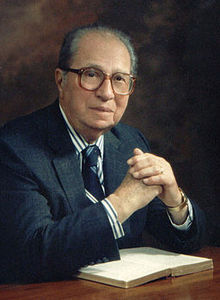
Mortimer J. Adler, Founder of the Center for the Study of the Great Ideas

From “Show me the money” to “Show me your work”

Much of what is wrong with climate science started when they switched from real world observations to building and playing with computer toy models of the world. Much of the research money has gone into climate modelling, which has yet to show skill in predicting changes in weather patterns on any time scale beyond a few weeks. The models themselves are confused by their makers with the real world, and they even refer to computer runs as “experiments.”

Almost 2 years ago I became aware of Dr. Arnd Bernaerts’ insightful phrase, “Climate is the continuation of the ocean by other means.” From oceanographic observations, he has long been persuaded the climate changes because of ocean oscillations, and I learned a lot from him while writing a number of posts here collected under the category Oceans Make Climate.

Arnd is also persuaded that humans are impacting on the oceans, and thereby upon the climate, but by obvious maritime activities and not by CO2 emissions. For his impertinence, he was “disappeared” from Wikipedia by the zealots there who purge that website from sources and information skeptical of global warming dogma.

As happened in Soviet history, climate revisionists are rewriting history.

As happened in Soviet history, climate revisionists are rewriting history.

Dr. Bernaerts continues to write on climate and ocean matters, most recently at his website: Oceans Govern Climate

Ironically, alarmists are crowing right now about Arctic ice extent being a little lower this year, while not mentioning most of the deficit is due to Barents Sea, and secondly to less ice in Bering Sea. Both of those places are subject to extensive maritime activity–shipping, fishing, oil and mineral exploration and extraction, and icebreaking to support year-round operations. Bernaerts explains: Man-Made Ocean Warming? Yes, but it’s not CO2.

Activist scientists, fixated on models and global warming, are indifferent to the correlation between WWI Atlantic naval warfare and unprecedented warming at Spitzbergen (Svalbard). Only an evidence-based scientist like Bernaerts is paying attention, as I have reported previously (here).

Another example of how science is perverted to support a political climate agenda was provided by commenter crypto666 referring to Matt Lachniet’s research into the former ocean basin in Nevada. By happenstance, Bernaerts had visited the Great basin last September (If you’re devoted to the oceans, I guess you are interested even in prehistoric, dried-out basins.)

Lachniet is properly circumspect in his writing and presentations, noting his findings pertain to a particular location, and suggesting several possible explanations for anomalous warming starting 1600 years ago. Yet his research was twisted into a climate change warning by journalists writing in the Las Vegas Sun (here).

As crypto points out, this is not what Lachniet himself has said. He is as clear as anyone that warming starting in the Fifth century did not come from people driving SUVs, so some natural oscillations must be in play. (California terminology: SUV=Axle of Evil).

Summary

My hope for 2017 is to begin seeing a regime shift in climate science from “Show me the money” to “Here are my data and work, Let the chips fall where they may.” Natural scientists have always owned a sense of awe alongside their curiosity, appreciating the enormity of the world they seek to understand. Dr. Bernaerts is right to remind us that even with modern technologies, our hard-won observational data is a minuscule sampling of oceanic and atmospheric activities. Any conclusions to be drawn should be put forward with humility. The dogmatic positions of climate alarmists are a disgrace to the profession.

Footnote: Below are reprinted relevant comments from Bernaerts and crypto.

Arnd Bernaerts said:

Hi Ron, having been to the Great Basin/NV recently, I couldn’t resist asking: what have 3,500 Argo floats and other ocean sensors (image caption) and the Matt Lachniet „nevada-caves-climate-change” (link in one of your comments) in common?
In – MHO – a lot, as they are both of little help to understand how to prevent anthropogenic climate change sufficiently. Recalling my visit of the Lehman caves a few days earlier or later (on 9th September) as Matt Lachniet, the cave formation was impressive, but hardly of any use for current concern.

3,500 Argo floats are certainly a more promising approach. But if one considers the dimension (& temperatures) in which they operate; nicely outlined recently at https://wattsupwiththat.com/2016/12/26/warming-by-less-upwelling-of-cold-ocean-water/, it is like reading from stalactite about AGW matters.

The use of Argo floats is an achievement, but by far too small. Observations below the sea surface would require a number of several hundred thousand, if not millions of devices (and the capability to process the data sufficiently). After all we need to understand the role of the oceans, and whether they bring a severe cooling, which is possible at any time.

Ron, to you, your family and everybody calling at this site:
HAPPY NEW YEAR

crypto666 said:

Thanks for pointing that out Ron. All I can say is unbelievable.

“Lachniet’s Great Basin research suggests that, based on the Earth’s orbit, the region should not be in a dry period. But it is. In any scenario, human-caused climate change, amplified over the next few centuries by natural warming, could be troublesome for a place that’s already notoriously dry and hot.”

The first thing I will point out however, is that those are not his words. Those are the words of the article writer. It is also either an outright lie, or a mistake. Another writer from the UNLV paper tried saying that Matt’s research suggests humans started changing the climate 1,600ybp, which again is not the case.

I know Matt, and he delivered his 2014 study to my colleagues and myself personally. After we talked for a bit, and surprised him by identifying that change in trend before he did in his work, which he identified as being 1,600 ybp, I asked him what his thoughts were on co2. What I vividly remember is Matt pointing to his chart and stating that he doesn’t think anyone will be able to identify co2’s contribution to climate change until we reached the point of his finger, which is where we should start the long road back to glaciation. It may have 2ky or maybe it was 55ky, at any rate what he says in person isn’t exactly what you get from news articles and twitter feeds.
I will also point out this:

A Speleothem Record of Great Basin Paleoclimate
January 2016
DOI: 10.1016/B978-0-444-63590-7.00020-2
In book: Lake Bonneville – A Scientific Update, pp.551-569

https://www.researchgate.net/publica…n_Paleoclimate

“The lag behind NHSI of d18O variations suggests that the forcing is indirect. Several possible forcings are associated with the Great Basin d18O variations. First, it is clear that CO2 concentrations increase abruptly around the MIS 2/1 and MIS 6/5d transitions, which may explain some of the warming over Terminations I and II. However, Nevada d18O values drop steadily throughout the Holocene, whereas CO2 remains high and even increases slightly over the last 8000 years (Ruddiman, 2003). Similarly, the strongly low d18O values during MIS 5d and MIS 7 happen during intervals with intermediate to high CO2 values.

Thus, the CO2 changes may amplify a warming already in progress around ice volume terminations but are unlikely to be the source of the climate change, because they are decoupled during prominent intervals such as MIS 1 and 5d. A related hypothesis suffers from similar problems: the extent of the Laurentide Ice Sheet (LIS). The LIS retreated over the MIS 2/1 and MIS 6/5 transitions when temperatures in the Great Basin warmed (as inferred by increasing d18O values). However, decreasing d18O values from 8 ka to modern happened in the absence of any ice-sheet regrowth, and the prominent MIS 5d and MIS 7 minima also happened when ice sheets were small. Thus ice-sheet extent cannot be the primary driver of Great Basin d18O variations. The clear conclusion is that neither CO2 nor ice-sheet extent were the sole or dominant controls on Great Basin paleoclimate over orbital timescales.”

That conclusion doesn’t strike me as coming from someone who believes co2 controls climate.  There is a big leap from believing that co2 could cause increased heating of the atmosphere, and thinking co2 controls climate and/or we can control climate with co2.

I have actually had people try to use Mr. Lachniet’s twitter account in an attempt to change the conclusion of his studies. Which is always entertaining.

Save the Reindeer!

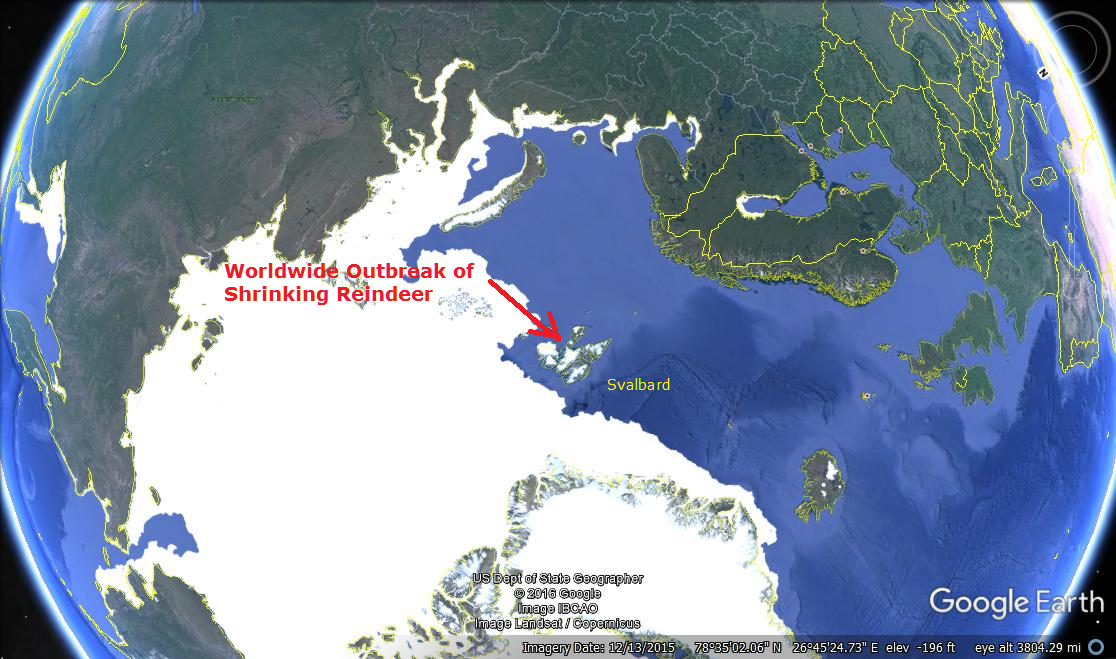
google-svalbard

Just in time for Christmas, we have news of a worldwide outbreak of shrinking reindeer caused by global warming/climate change. A websearch of “shrinking reindeer” returns links to hundreds of media reports from everywhere, evidence of the global nature of this event.

That is, until you read past the scary headlines and discover that it is one story repeated endlessly. Once again, the internet serving as the global village rumor mill. We can relax somewhat in that reports from places like Malaysia, India and California do not mention the local reindeer, so they must be OK.

All of this attention and alarm arises from one report about one place: Svalbard (Arctic islands belonging to Norway). Moreover, the animals are not going extinct yet, rather a decline of 12% of adult body weight has been observed over the last 30 years. Project that out to the end of the century though, and the reindeer are toast, unless we do something.

On the other hand, there are facts and circumstances to consider.  From the Reindeer Fact sheet (here)

The females usually measure 162–205 cm (64–81 in) in length and weigh 79–120 kg (170–260 lb). The males (or “bulls”) are typically larger (although the extent to which varies in the different subspecies), measuring 180–214 cm (71–84 in) in length and usually weighing 92–210 kg (200–460 lb), though exceptionally large males have weighed as much as 318 kg (700 lb). Shoulder height typically measure from 85 to 150 cm (33 to 59 in), and the tail is 14 to 20 cm (5.5 to 7.9 in) long. The subspecies R. t. platyrhynchus from Svalbard Island is very small compared to other subspecies.

Svalbard reindeer running in snow.

Svalbard reindeer running in snow.

From the Norwegian Polar Institute (here)

The subspecies is endemic to the Svalbard islands, where it has lived for at least 5,000 years, and become well adapted to the harsh climate, being found on nearly all non-glaciated areas of the archipelago. It is the most northern living herbivore mammal in the world.

The Svalbard reindeer is adapted to survive the variable climatic conditions and the high degree of seasonality in Svalbard. They are very sedentary and thus have low energy demands, and they have an outstanding ability to use their own body reserves (both fat and muscle tissue) when access to food is limited in the winter. The thick fur contributes to insulation against low temperatures and wind. Starvation is the most common cause of mortality. This occurs due to worn out teeth from grazing on sparse vegetation among stones and gravel or due to lack of food when ice locks pastures – caused by ‘rain-on-snow’ events in winter. The population dynamics of the Svalbard reindeer is regulated by a combination of density dependent processes and climatic variability causing high mortality and low reproduction.

And there are large populations of reindeer outside of Svalbard, exhibiting remarkable hardiness.

Some populations of the North American caribou migrate the furthest of any terrestrial mammal, travelling up to 5,000 km (3,100 mi) a year, and covering 1,000,000 km2 (390,000 sq mi). Other populations (e.g., in Europe) have a shorter migration, and some, for example the subspecies R. t. pearsoni and R. t. platyrhynchus (both restricted to islands), are residents that only make local movements. Normally travelling about 19–55 km (12–34 mi) a day while migrating, the caribou can run at speeds of 60–80 km/h (37– 50 mph). During the spring migration smaller herds will group together to form larger herds of 50,000 to 500,000 animals, but during autumn migrations the groups become smaller, and the reindeer begin to mate.

Summary

And the hype goes on, amplified if anything to counteract the effect of an incoming US administration who dares to disbelieve in climatism.

Last year there was much ado about Siberian reindeer infected with ricin and humans (one) dying from eating the meat. It turned out to be a report that is put out periodically, the timing associated with the governmental planning and budgeting cycle. Perhaps we will hear about this again in five years. Or sooner if Trump pursues a rational energy policy.  One also wonders where Norway is in planning and budgeting for polar research activities.

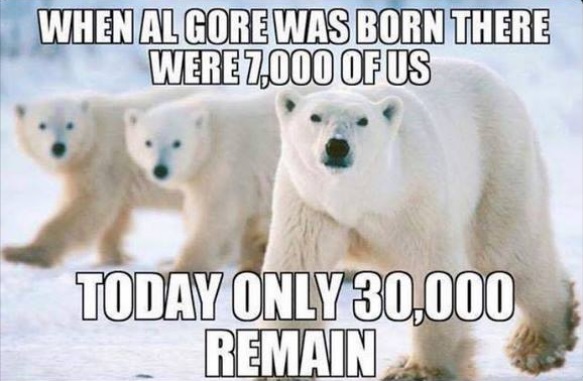
Of course, the reindeer are being recruited to replace the polar bears, who did not get the memo and instead multiplied their way out of endangerment.


Three Wise Men Talking Climate

Everyone is entitled to their opinion on climate change, although renowned theoretical physicists may be especially persuasive. This post compares quotes from 3 of the most distinguished: Stephen Hawking (much in the news lately since Trump’s election), Freeman Dyson and Richard Feynman. Hawking is an alarmist, Dyson a skeptic and Feynman concerned about scientific integrity.

Stephen Hawking is a phenomenal human being, original thinker on grand design and genuinely concerned about humanity and our planetary home. His own battle with frailty gives weight to his opinions and observations. Thus when he meets with the Pope or Al Gore and warns about future global warming, many people will take his words seriously.

Comments on Climate Change by Stephen Hawking

On May 31, 2016 he said: “A more immediate danger is runaway climate change,” Hawking said. “A rise in ocean temperature would melt the ice-caps, and cause a release of large amounts of carbon dioxide from the ocean floor. Both effects could make our climate like that of Venus, with a temperature of 250 degrees.”

“Six years ago I was warning about pollution and overcrowding, they have gotten worse since then,” Hawking said. “The population has grown by half a billion since our last meeting with no end in sight. At this rate, it will be 11 billion by 2100. Air pollution has increased by 8 percent over the past five years.”

Elsewhere he has said, “I don’t think we will survive another 1,000 years without escaping beyond our fragile planet,” going on express concerns about consuming earth’s natural resources, nuclear war, climate change, genetically-engineered viruses and the rise of artificial intelligence spelling planetary doom.

Those are his opinions, not shared by other equally distinguished theoretical physicists, two examples being Freeman Dyson and Richard Feynman.

Freeman Dyson is best known for his contribution to Quantum Electrodynamics. Quantum Electrodynamics is the field where scientists study the interaction of electromagnetic radiation with electrically charged matter within the framework of relativity and quantum mechanics. Dyson wrote two books on the subject of Quantum Electrodynamics. His books influence many branches of modern day theoretical physics.

In his quest to expand our world of knowledge, properly control nuclear power, and discover more information on quantum electrodynamics, Freeman Dyson has written a large collection of books that explains how he believes that the world should grow more efficiently.

Comments on Climate Change by Freeman Dyson

I was in the business of studying climate change at least 30 years ago before it became fashionable. The idea that global warming is the most important problem facing the world is total nonsense and is doing a lot of harm. It distracts people’s attention from much more serious problems.

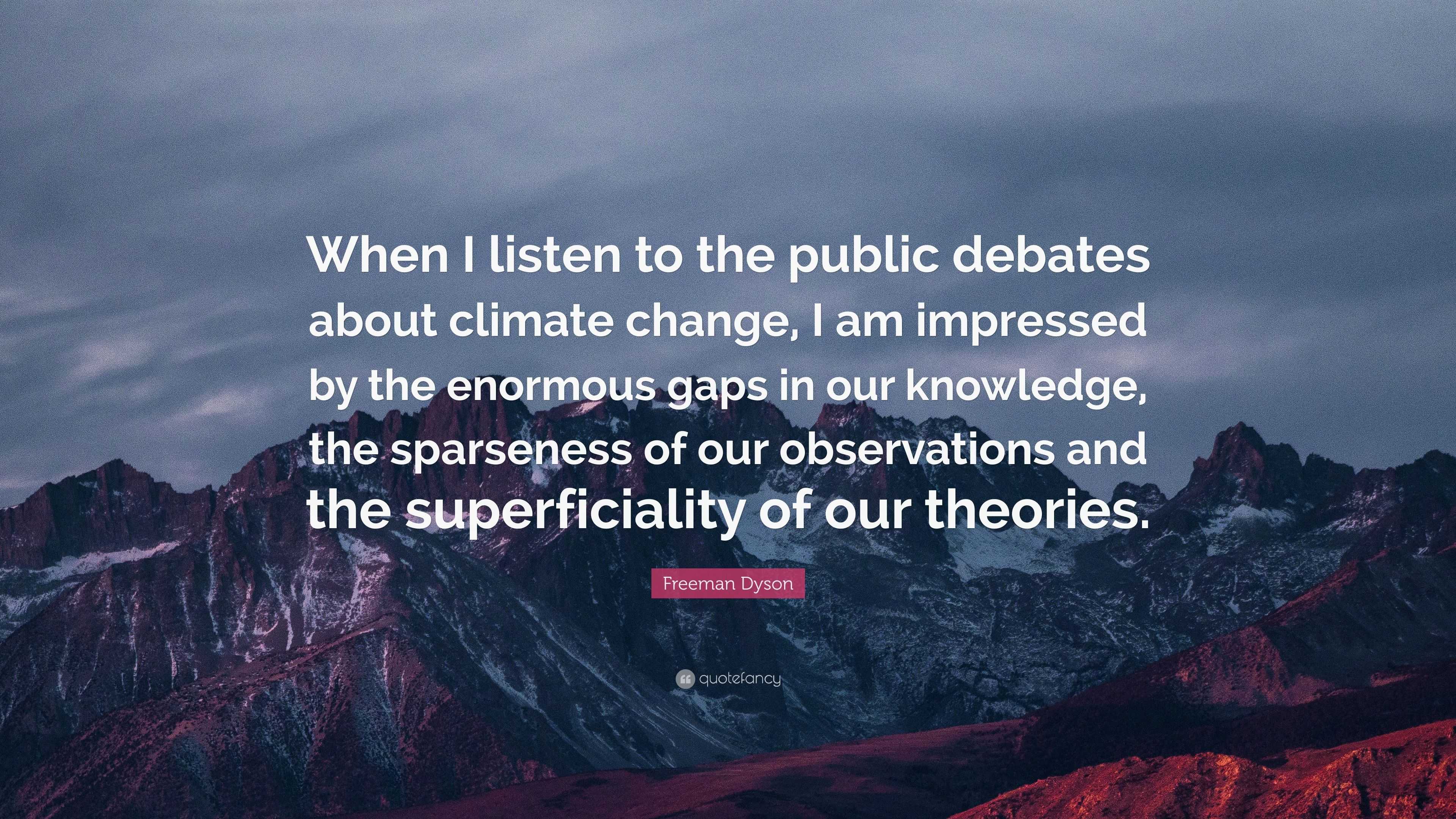
When I listen to the public debates about climate change, I am impressed by the enormous gaps in our knowledge, the sparseness of our observations and the superficiality of our theories.

We simply don’t know yet what’s going to happen to the carbon in the atmosphere.

We do not know how much of the environmental change is due to human activities and how much [is due] to long-term natural processes over which we have no control.

Computer models of the climate….[are] a very dubious business if you don’t have good inputs.

To any unprejudiced person reading this account, the facts should be obvious: that the non-climatic effects of carbon dioxide as a sustainer of wildlife and crop plants are enormously beneficial, that the possibly harmful climatic effects of carbon dioxide have been greatly exaggerated, and that the benefits clearly outweigh the possible damage.

The people who are supposed to be experts and who claim to understand the science are precisely the people who are blind to the evidence. Those of my scientific colleagues who believe the prevailing dogma about carbon dioxide will not find Goklany’s evidence convincing. . .That is to me the central mystery of climate science. It is not a scientific mystery but a human mystery. How does it happen that a whole generation of scientific experts is blind to obvious facts?

Richard Feynman revolutionized the field of quantum mechanics through conceiving the Feynman path integral, and by inventing Feynman diagrams for doing relativistic quantum mechanical calculations. Further he won the Nobel prize for his theory of quantum electrodynamics, and finally in particle physics he proposed the parton model to analyze high-energy hadron collisions.  He died in 1988 before global warming obsession was popularized, and so his comments apply mainly to how scientific theories should be treated with integrity.

Comments on Scientific Integrity by Richard Feynman

How Science Works: “In general, we look for a new law by the following process. First, we guess it (audience laughter), no, don’t laugh, that’s really true. Then we compute the consequences of the guess, to see what, if this is right, if this law we guess is right, to see what it would imply and then we compare the computation results to nature, or we say compare to experiment or experience, compare it directly with observations to see if it works.  If it disagrees with experiment, it’s wrong. In that simple statement is the key to science. It doesn’t make any difference how beautiful your guess is, it doesn’t matter how smart you are, who made the guess, or what his name is… If it disagrees with experiment, it’s wrong. That’s all there is to it.”

It’s a kind of scientific integrity, a principle of scientific thought that corresponds to a kind of utter honesty–a kind of leaning over backwards. For example, if you’re doing an experiment, you should report everything that you think might make it invalid–not only what you think is right about it: other causes that could possibly explain your results; and things you thought of that you’ve eliminated by some other experiment, and how they worked–to make sure the other fellow can tell they have been eliminated.

Details that could throw doubt on your interpretation must be given, if you know them. You must do the best you can–if you know anything at all wrong, or possibly wrong–to explain it. If you make a theory, for example, and advertise it, or put it out, then you must also put down all the facts that disagree with it, as well as those that agree with it. There is also a more subtle problem. When you have put a lot of ideas together to make an elaborate theory, you want to make sure, when explaining what it fits, that those things it fits are not just the things that gave you the idea for the theory; but that the finished theory makes something else come out right, in addition.

Summary

Hawking has gone to the dark side, foreseeing disaster from numerous modern developments, and includes climate change without challenging the precepts with his considerable critical intelligence. Dyson has analyzed radiative activity in quantum electrodynamics and sees clearly that effects from humanity’s minuscule addition to the trace gas CO2 does far more good for the biosphere than it does harm. Feynman encourages us not to accept answers claimed to be unquestionable.

This post was inspired by Lubos Motl, who blogged similarly on another issue (here), and Ivar Giaever who has long spoken out against alarmist claims. Two more outstanding physicists who have actually examined global warming claims and found them wanting.

Climate Folklore on Halloween

The Legend of Sleepy Hollow

The Legend of Sleepy Hollow

This blog is devoted to discussion of science, especially climate science. But in the run up to US Presidential election, along with the drive to enforce the Paris Accord (not a treaty), most of what is appearing in the media has zero scientific content. The discourse now consists almost entirely of climate folklore.

What is Folklore?

Folklore is the traditional art, literature, knowledge, and practice that is disseminated largely through oral communication and behavioral example. Every group with a sense of its own identity shares, as a central part of that identity, folk traditions–the things that people traditionally believe (planting practices, family traditions, and other elements of worldview), do (dance, make music, sew clothing), know (how to build an irrigation dam, how to nurse an ailment, how to prepare barbecue), make (architecture, art, craft), and say (personal experience stories, riddles, song lyrics). (From American Folklore Society)

From the above, it is clear that folklore expresses a community’s understanding of the way things are, and how things work. Each society passes along its wisdom, most pointedly in proverbs or fables. It thus includes scientific principles of the day as they pertain to an average person’s life experience.

Some weather examples include:
“Red sky in the morning sailors (farmers) take warning.”
“Red sky at night, sailors’ (farmers’) delight.”
“If the groundhog sees its shadow on February 2nd, there will be 6 more weeks of winter.”
“When the clouds look like horsetails, rain or snow will come in 3 days.”
“A ring around the sun or moon means a storm is coming. Count the stars within the ring and rain will come in that many days.”

Climate Change Folklore and Empirical Science

The intersection of folk and scientific wisdom is demonstrated in a case regarding an Arizona Navajo reservation.

Government officials in the 1950’s proposed to get rid of prairie dogs on some parts of the reservation in order to protect the roots of the sparse desert grass and thereby maintain at least marginal grazing for sheep.

Navajos objected strongly, insisting, “If you kill off all the prairie dogs, there will be no one to cry for the rain.” Of course they were assured by the amused government men that there was no conceivable connection between rain and prairie dogs, a fact that could be proven easily by a simple scientific experiment: a specific area would be set aside and all the burrowing animals there would be exterminated.

The experiment was carried out, over the continued objections of the Navajos, and its outcome was surprising only to the white scientists.  Today, the area […] has become a virtual wasteland with very little grass.  Apparently, without the ground-turning processes of the little burrowing animals, the sand in the area becomes solidly packed, causing a fierce runoff whenever it rains.

It would be incautious to suggest in this instance that the Navajos were possessed of a clear, conscious objective theory about water retention and absorption in packed sand. On the other hand, it would be difficult to ignore the fact that the Navajo myth system, which insists on delicate reciprocal responsibilities among elements of nature, dramatized more accurately than our science the results of an imbalance between principals in the rain process. (Barre Toelken here p. 21)

But folk wisdom is an unreliable, inconsistent kind of wisdom. For one thing, most proverbs coexist with their exact opposites, or at least with proverbs that give somewhat different advice. Now that climate change has passed into social discourse, proverbs and unsubstantiated claims are voiced among like-minded people, thereby reinforcing shared beliefs without any critical analysis to verify an objective reality to the sayings.

Playing the Climate Change Game

Dr. Eric Berne was the author of Games People Play, the 1960s groundbreaking book in which he introduced Games and Transactional Analysis to the world. According to Dr. Berne, games are ritualistic transactions or behavior patterns between individuals that can indicate hidden feelings or emotions. A runaway success, Games People Play spent more than two years on the New York Times bestseller list in the mid 1960s – longer than any non-fiction book over the preceding decade.

Dr. Berne explained (here) numerous games in several categories. Life games are those where someone exhibits life-long behaviors to play out a theme such as:

Kick Me,
Now I’ve Got You, You Son of a Bitch, or
See What You Made Me Do.

He also describes other types of games (underworld, sexual, marital games, etc.). But for this post it is obvious that most of the discourse on Climate Change fits into a party game called Ain’t It Awful.

Party games are pastimes where participants chat among themselves, filling the social time by recounting stories and experiences following a theme, in this case how awful things are. It doesn’t take much exposure to mass media, social or face-to-face conversations to recognize that climate is now usually raised in the context of Ain’t It Awful:
Storms are getting worse;
Arctic ice is melting;
Sea Levels are rising;
We keep on polluting the air with carbon;
Etc. Etc. Etc.

Celebrity alarmist Leonardo DiCaprio exemplifies playing this game in his recently released documentary Before the Flood. This trailer clip shows DiCaprio engaged in Ain’t Climate Change Awful

Summary

Lubos Motl reviewed the movie (here) and rates it “the most superficial movie on the climate issue so far.”  A perfect contribution to climate folklore.  Modern folklore must sound “sciencey” to be taken seriously.  In this folklore you hear the refrain, “scientists tell us . . . “, much as in a previous age “thus spake the prophet . . .”  As the Navajo example shows, sciencey beliefs have no guarantee of validity.

As Dr. Berne observes: In the pastimes there is no denouement or payoff, but much unworthy feeling. Of course, if climatists go beyond talking and succeed enacting ruinous energy policies, we will all suffer from economic declines, lower standards of living, along with associated social frictions.  Bad feelings will be widespread, albeit from real self-inflicted calamities rather than imaginary ones.

Happy Holloween

Happy Holloween

Climate Advocacy Posing as Science

From The World’s Biggest Gamble by Johan Rockstöm et al. (here)

The scale of the decarbonisation challenge to meet the Paris Agreement is underplayed in the public arena. It will require precipitous emission reductions and a new carbon sink on the scale of the ocean sink within 40 years. Even then, the world is extremely likely to overshoot. A catastrophic failure of policy, for example waiting another decade for transformative policy and full commitments to fossil-free economies, will have irreversible and deleterious repercussions for humanity’s remaining time on Earth. Only a global zero carbon roadmap will put the world on a course to phase-out greenhouse gas emissions and create the essential carbon sinks for Earth-system stability, without which, world prosperity is not possible.

The 450 Scenario

Background for this and other such climate alarms is an activist assumption not often openly proclaimed because it is so clearly a leap of faith, not science.

Now we come to an interesting bait and switch. Since Cancun, IPCC is asserting that global warming is capped at 2°C by keeping CO2 concentration below 450 ppm. From Summary for Policymakers (SPM) AR5

Emissions scenarios leading to CO2-equivalent concentrations in 2100 of about 450 ppm or lower are likely to maintain warming below 2°C over the 21st century relative to pre-industrial levels. These scenarios are characterized by 40 to 70% global anthropogenic GHG emissions reductions by 2050 compared to 2010, and emissions levels near zero or below in 2100.

Thus is born the “450 Scenario” by which governments can be focused upon reducing emissions without any reference to temperature measurements, which are stubbornly failing to rise alarmingly.

Within the international expert community, “2 degrees” is generally used as shorthand for a low carbon scenario under which CO2 concentrations in the earth’s atmosphere are stabilized at a level of 450 parts per million (ppm) or lower, representing approximately an 80% reduction in greenhouse gas emissions from current levels, which according to certain computer simulations would be likely to limit warming to 2 degrees Celsius above pre-industrial levels and is considered by some to reduce the likelihood of significant adverse impacts based on analyses of historical climate variability.

Clever as it is to substitute a 450 ppm target for 2°C, the mathematics are daunting. Joe Romm:
We’re at 30 billion tons of carbon dioxide emissions a year — rising 3.3% per year — and we have to average below 18 billion tons a year for the entire century if we’re going to stabilize at 450 ppm. We need to peak around 2015 to 2020 at the latest, then drop at least 60% by 2050 to 15 billion tons (4 billion tons of carbon), and then go to near zero net carbon emissions by 2100.

And the presumed climate sensitivity to CO2 is hypothetical and unsupported by observations:

Calvin Beisner at CFACT (here) provides a full rebuttal of the alarmist logic embodied in the above “Gamble” paper.

Synopsis

First, predictions of rapid warming from enhanced atmospheric greenhouse gas concentration are based on computer climate models that “run hot,” two to three times the warming actually observed over relevant periods, and therefore provide no rational basis for predicting future GAT.

Second, nobody—but nobody—has demonstrated scientifically that global average temperature (GAT) is optimal up to 2°C above the pre-industrial average (the limit aimed for by the Paris agreement) , or that GAT higher than that will even be net harmful, let alone catastrophic.

Third, the aim of “Earth-system stability” is scientifically absurd—undefined, unnatural, and unachievable. Natural systems—especially coupled non-linear chaotic fluid-dynamic systems like Earth’s climate—are not, never have been, and never will be stable.

Fourth, it is sheer fear-mongering without a shred of scientific evidence to say that “waiting another decade for transformative policy and full commitments to fossil-free economies” would be a “catastrophic failure of policy” with “irreversible and deleterious repercussions for humanity’s remaining time on Earth”.

Fifth, even if real scientific investigation (which doesn’t stop with modeling but tests models by empirical observation) could tell us what future temperatures will be and the positive and negative impacts, that wouldn’t tell us how we ought to respond, i.e. what policies to pursue.  While science can inform policymakers, it can’t determine policy.

Summary

Even assuming the IPCC’s exaggerated estimates of CO2’s warming effect and assuming full implementation of all nations’ commitments under the Paris agreement, at a cost of $1 to $2 trillion annually from 2030 onward, Björn Lomborg calculates it would reduce GAT in 2100 by just 0.17° C, an amount too little to be noticed or have significant impact.

It is more evidence of Climateers Tilting at Windmills


Brad Keyes, Climatism Fortune Teller

It is a wickedly satirical look into the future of the climate debate by Brad Keyes (here). The comic relief is welcome as a refreshment from pushing back against the relentless fictional claims and alarms. Lots of inside jokes and sceptics’ wish dreams concerning future misfortunes of leading alarmist figures.

The post covers a lot of ground as Keyes looks into his crystal ball and reports on happenings he sees from 2017 up to 2052. Everyone’s funny bone is different, but these were especially entertaining, IMO:

2017 – Michael Mann’s courtroom loss decried as “a death knell for free speech.”

2018 – ECHR agrees “Holocaust denier” is an intentionally demeaning reference to climate denial.

2018 – James Hansen blames eclipse on global warming, but others hesitate to attribute any specific EAE (extreme astronomical event) to carbon emissions.

2019 – The Trenberth Travesty is captured by satellite imagery.

2020 – Psychiatric Manual of Mental Disorders updated to deal with Weather control delusional disorder, Munchhausen’s by proxy and Medieval global warming denial.

2023 – Weary of the emotive, polarizing nature of the debate, scientists will now refer to global warming as “climate 9/11.”

2024 – Drawing heavily on the principles of the Delphi Technique, Naomi Oreskes changes the scientific method to the Delphi Technique.

2025 – In simultaneous media releases around the globe, every scientific body of international or national standing announces that the only safe atmospheric CO2 concentration is zero ppm. They explain: “Lowballing” is the only way to achieve 300-400 ppm.

2027 – The first climatically-correct chemistry textbooks appear in Australian high schools. The dioxide anion has been renamed ‘pollution’; chemical symbol C now stands for ‘cancer.’

2028 – It’s official: reputable science website SkepticalScience quietly removes “Consensus levels have plateaued” from its list of myths.

2031 – A Climateball stadium becomes the scene of ugly rioting today after a supporter of the denier (pro-cancer-pollutionist) side is overheard using the hate term “w_rmist.”

2034 – Spring is silent this year after a wind turbine kills the last American bald eagle.

2037 – As sea level rise continues to defy expectations, tracking almost 1m (3ft.) below ensemble model projections, science’s newest fear is that the Earth’s surface will be completely dry by the year 51000.

2038 – An attempt to replicate the Doran and Zimmermann [2009] consensus survey instead finds most of the scientists now deny the science, with almost 85% endorsing the statement that “According to the weight of the data, the evidence is wrong.”