Climate Realist for Canada PM, Please!

Published at CO2 Coalition A Plea To Pierre Poilievre, A Climate Realist for Prime Minister of Canada by Ron Barmby.  Excerpts in italics with my bolds and added images.

Dear Pierre,

There will probably be a federal election in Canada in the coming months as Justin Trudeau’s government is in a minority position with waning support.

His past three successful elections have all included fighting climate change as a key and winning platform. His current legislative agenda indicates his next campaign will have the same focus.

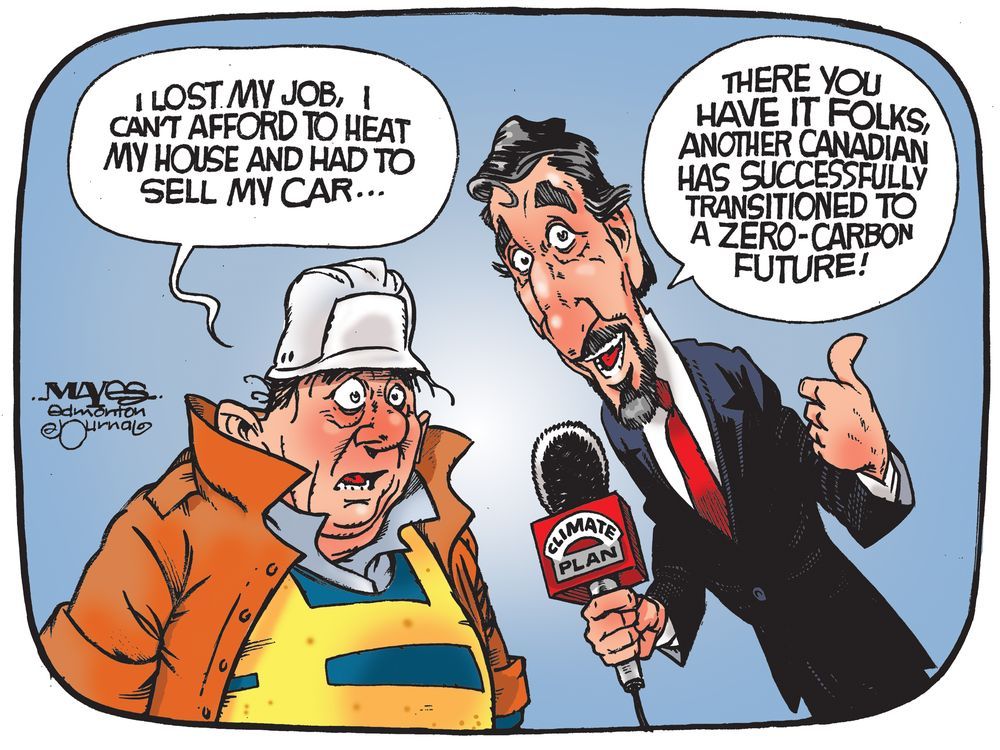
As Leader of the Official Opposition [pictured above], and in the best position to form a new government, you are currently advocating eliminating Trudeau’s national carbon tax and “letting technology handle CO2 emissions.”

That is probably a strategy to avoid playing to Trudeau’s strength, which is instilling fear of climate change in the voting public. But you could take it further by highlighting Trudeau’s main climate weakness: he misrepresents or is willingly ignorant of, the science of climate change.

Election campaigns require talking points, but I can offer you the following thinking points on the science of climate change that I hope you will find useful.

1500+ Scientists agree and disclared No Climate Emergency

1500+ Scientists Agreed and Declared No Climate Emergency

The Climate Changes but There Is No Climate Emergency.

Trudeau’s declaration of a national climate emergency is based on the United Nations Intergovernmental Panel on Climate Change (IPCC) forecasts of between 2.5°C and 3.5°C warming between now and the year 2100 (intermediate and high emissions scenarios).

If those forecasts—which are not compliant with the scientific method—were reasonable, surely the planet would be on that warming trend now. It’s not.

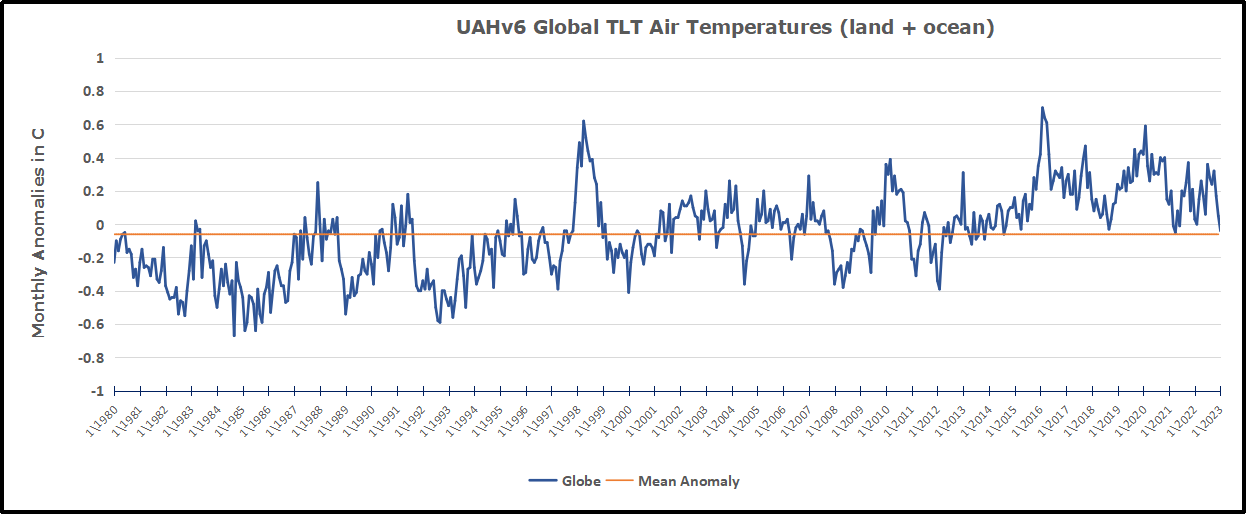
The most accurate and complete temperature survey of the planet comes from satellites, beginning in 1979. Over the past 44 years, satellite data reveals that the trend of global warming has been 0.13°C per decade, which if continued would add only 1°C by 2100.
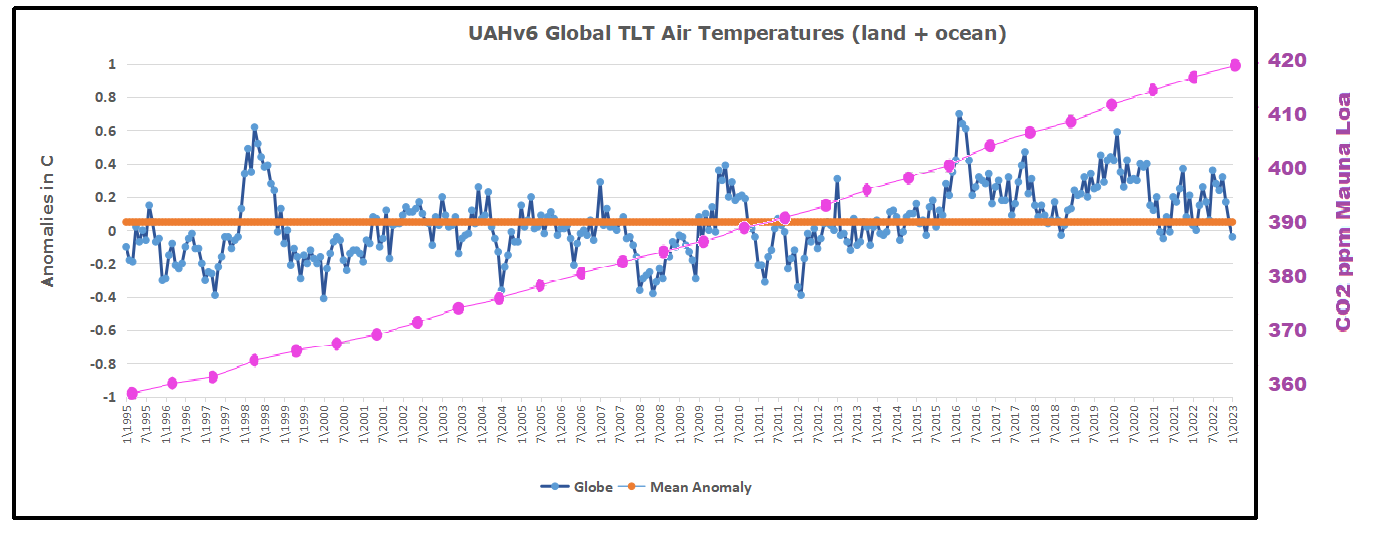
Interestingly, the CO2 concentration in the atmosphere increased by 25% over those four decades. CO2 doesn’t seem to have caused much warming during that time.

The warmest year on the satellite record is 1998 (caused by an El Nino event) indicating no current warming trend for the last 24 years. And CO2 concentrations have since increased by 14%.

This satellite data is backed up by the world’s most sophisticated land-based temperature survey designed for scientific research. The United States Climate Reference Network (USCRN) was set up to provide continental U.S. temperature data using state-of-the-art triple redundant instruments in pristine locations unaffected by human activity.

There has been no warming trend in the continental United States since USCRN data collection began 18 years ago. Interestingly again, CO2 concentrations were up 10% during that period.

Mr. Poilievre, this lack of warming is well-known and documented in the public domain. The limitations of CO2 causing global warming are also well-known and documented in the scientific domain and even accepted by the IPCC.

That is why Trudeau, with only tepid backing from the IPCC, is now claiming increased extreme weather events as the new basis for fear of climate change.
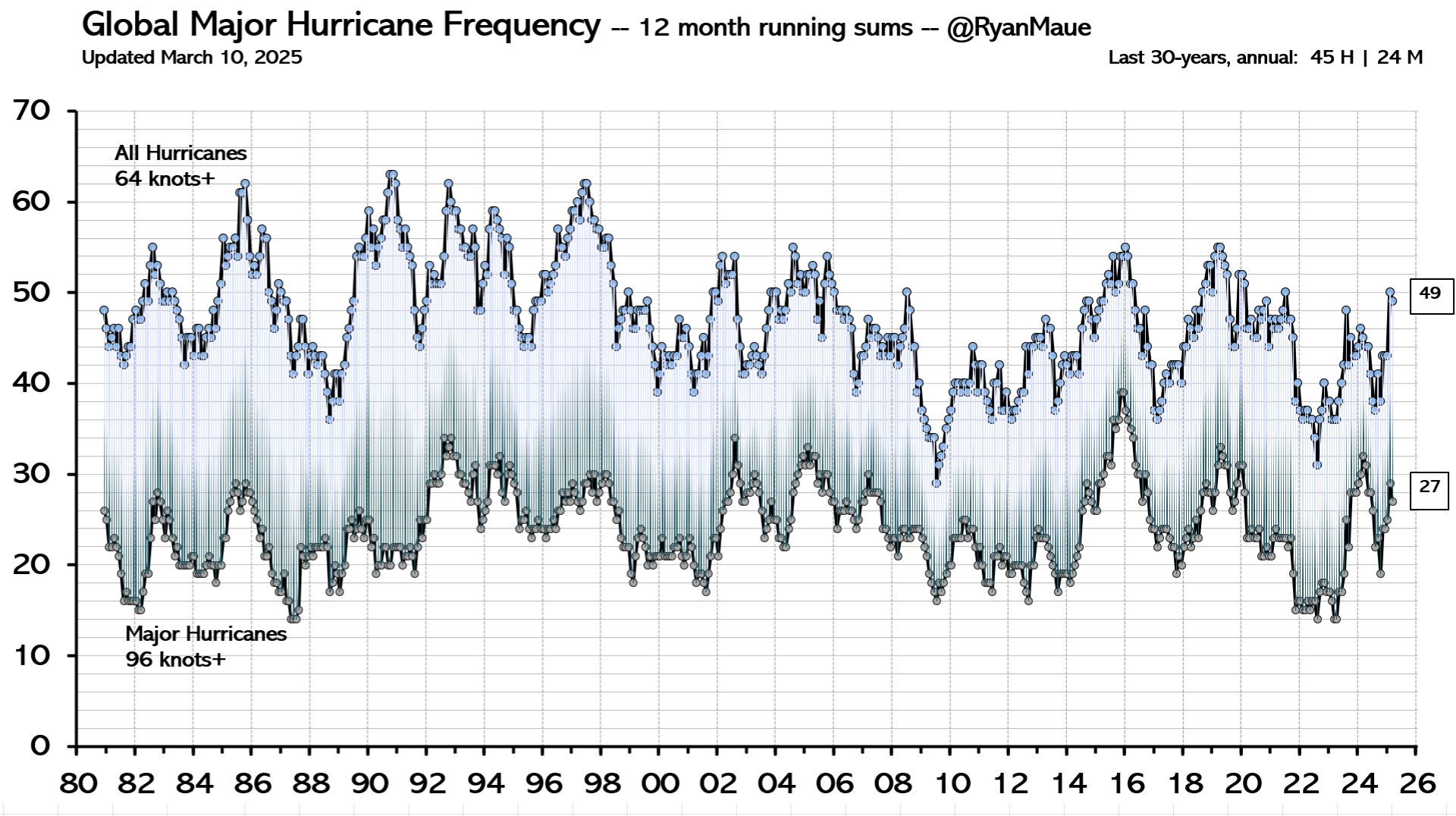
Except it’s not true that we’re experiencing increased extreme weather events. A recent study using established and accepted international databases saw no statistically significant increasing trends in the intensity of heatwaves, hurricanes and/or tropical storms, tornadoes, global and extreme precipitation, droughts, or floods.

On a Canadian note, the 2021/22 extreme weather events in central British Columbia consisting of a succession of a polar vortex, heat dome, wildfires, and flooding were not a result of CO2-induced climate change. They are all linked to instability in the jet stream, solidly backed up by meteorological science.

The Natural Causes of Climate Change Are Very Large.

The sun provides the Earth with almost all of its surface heat. On the time scale of recent human history, changes in the output of the sun are the smoking gun for climate change.

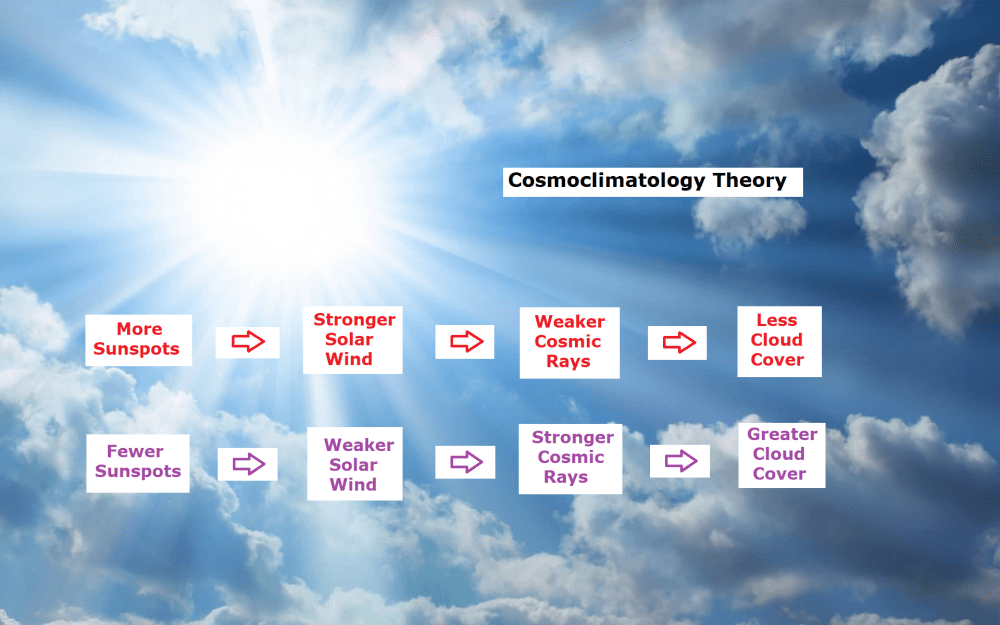
A less active sun has a weakened magnetic field, which allows more galactic cosmic rays to hit our atmosphere and ionize molecules. These ionized molecules become cloud-building sites. Low, dense clouds block the sun’s heat from reaching the surface of the Earth, causing temperatures to drop.

The opposite is true; a more active sun has a stronger magnetic field that shields the Earth from cosmic rays. This means less ionization and cloud-building, so more of the sun’s warming energy reaches the surface.
When the sun’s activity is low for many decades it is called a Grand Solar Minimum. During the Little Ice Age of 1300 to 1850, we experienced four consecutive Grand Solar Minimums; at that time the average global temperature was about 1°C lower than today.

Conversely, sustained high solar activity is called a Grand Solar Maximum and the most recent occurrence was during much of the 20th century when we experienced about 1°C of global warming.

The IPCC, with Trudeau‘s adherence, dismiss solar changes even though a 1% reduction in cloud cover could explain the global warming of the past century.

Eliminating The Carbon Tax is a Great Idea.

As Dr. Lars Schernikau, Ph.D. in Energy Economics and who grew up in the centrally planned economy of East Germany points out “…because pricing one externality but not others leads to economic and environmental distortions… causing human suffering.”

His example is particularly applicable to Canada where CO2 pricing is only on combustion, but green technology is exempt:

“How else could a ‘Net-Zero’ label be assigned to a solar panel produced from coal and minerals extracted in Africa with diesel-run equipment, transported to China on a vessel powered by fuel oil, and processed with energy from coal- or gas-fired power using partially with forced labor?”

Technology Cannot Handle CO2 Emissions.

In fact, technology is rather bad at handling CO2 emissions. Let’s look at wind power first. A 15% drop in wind speed equates to a 40% drop in electrical generation. Europe is a prime example of the failure of wind power.

That failure transferred European energy security to Russia which enabled it to invade Ukraine. American solar power failures became the highlight of Michael Moore’s documentary Planet of the Humans.

Hydrogen fuel cells were aptly described by Elon Musk as “mind-bogglingly stupid.” Burning hydrogen directly is not only an extreme safety risk (leaks from plastic local distribution pipelines), but it produces six times the smog-causing nitrous oxides that natural gas does.

Many hydroelectric dams produce more greenhouse gases than the burning of coal due to the cement-related CO2 and methane emissions from the artificial lakes.

Fully electric vehicles are a bad idea for Canada because (a) in very cold weather their driving range is halved while the charging time is doubled and (b) we don’t have the grid capacity to charge them anyway.

Adding ethanol to gasoline does not reduce CO2 emissions. That’s just an accounting trick, but not much of a trick because ethanol emissions are simply not counted. However, it does drive up food prices significantly, as food is converted to fuel. This is devastating to the world’s poor.

Carbon capture and storage in Canada’s oil sector would divert large sums of money away from being available for health care and reducing taxes while providing no impact on the steadily increasing atmospheric CO2 concentration (which incidentally is also driving up global crop yields).

Capping CO2 emissions from Canada’s oil industry just means a dictator’s oil will fill the market gap we could have ethically and responsibly filled.

Canada’s Next Election.

A global fear of climate change has led to panic, panic has led to bad decisions, and bad decisions have led to failure. The result is energy poverty, hunger, massive distortions of the free market, and a shooting war in Europe. That’s a far cry from the United Nations’ mandate of promoting peace.

Trudeau’s game plan for climate change is more fear, more panic, and more failure. Meanwhile, not a single signatory to the 2015 Paris Agreement is on track to meet their 1.5°C emissions reductions target. Additionally, Canada now holds the title of the world’s most useful climate idiot and we have become a house divided.

A rational game plan would include only facts established by the scientific method, and dispassionate deliberation from the larger scientific and engineering community (wherein Canadians still enjoy a respected reputation).

Canadians should not fear climate change; they should understand it and prepare as necessary. We need a new plan based on evident realities, not science “experienced differently” by Trudeau.

What we should truly fear is Trudeau’s fight against climate change.

Best regards,

CO2 Coalition Member Ron Barmby (www.ronaldbarmby.ca) is a Professional Engineer with a Bachelor’s and Master’s degree, whose 40+ year career in the energy sector has taken him to over 40 countries on five continents. His book, Sunlight on Climate Change: A Heretic’s Guide to Global Climate Hysteria (Amazon, Barnes & Noble), explains in layman’s terms the science of how natural and human-caused global warming work.
Official Censors Misinform on Covid, Climate

Ross McKitrick writes at Financial Post Policing misinformation from the misinformation police.  Excerpt in italics with my bolds and added images.
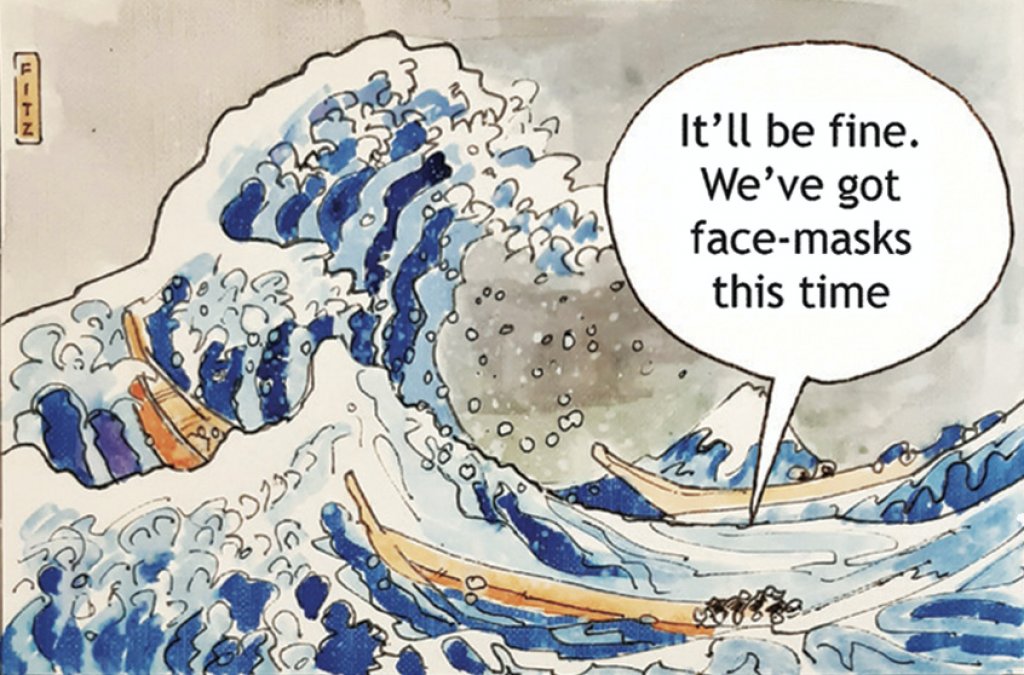
State-sponsored ‘experts’ on ‘misinformation’ are typically the worst offenders

As citizens of a liberal democracy Canadians have long believed that only the free contest of differing points of view can produce genuine intellectual progress. But now we are told we face a crisis of “misinformation” that calls for vigorous censorship of heretical opinion. On all of today’s major public controversies, we are asked to believe, all of us would enthusiastically assent to the one obviously correct view (which happens to be the view promulgated by the governing class) were it not for the pernicious influence of a shadowy conspiracy of social-media traffickers in misinformation — voices that must be suppressed for the good of society.

In his 1859 essay On Liberty, John Stuart Mill decisively rebutted this argument. “Complete liberty of contradicting and disproving our opinion,” he wrote, “is the very condition which justifies us in assuming its truth for purposes of action; and on no other terms can a being with human faculties have any rational assurance of being right.” It is one thing, Mill argues, if the holders of received opinion conclude their view is correct because, though challenged, it has not been refuted; but another thing altogether if it’s simply assumed true and challenge is therefore forbidden.

Yet that’s precisely the position of today’s would-be “misinformation” police.

In reality, state-sponsored “experts” on “misinformation” are typically the worst offenders. Presuming themselves infallible, they call for new laws to shut everyone else up.

In the climate domain, a group called the Institute for Strategic Dialogue (ISD) boasts a Climate Disinformation Team consisting of five staff members, all trained in arts or political science (none in economics or physical sciences) who have put out a long report (and follow-up) supposedly documenting these networks of online misinformation and calling for new legislation and stricter rules for social media companies to combat it.

The reports feature screenshots of social media posts that critique
alarmist climate claims or the high costs of climate policy.

The ISD does not rebut but simply displays these posts — as if their mere existence is proof censorship is needed. For instance, they say “Calling into question the viability and effectiveness of renewable energy sources is a common practice among climate sceptics and delayist actors,” and then show a series of social media posts pointing out problems associated with wind and solar power systems. But wind and solar power systems do have problems, including intermittency and the need for costly fossil-fuel backups. To suggest otherwise is itself misinformation.

Closer to home, an organization called the Council of Canadian Academies (CCA), which purports to draw on top experts in Canada to give guidance to policy-makers, recently issued a report on “science and health misinformation” that concludes society would benefit from more vigorous efforts to suppress debate and ban more people from social media.

Much of the report consists of finger-wagging against anyone
who questioned anti-COVID public health measures.

For instance: “(O)ngoing claims that mask wearing is ineffective or even harmful have shifted firmly into the realm of misinformation.” Meanwhile, back in science, a newly-published, peer-reviewed meta-analysis summarizing 10 randomized control trials involving nearly 277,000 people concludes that “Wearing masks in the community probably makes little or no difference to the outcome of influenza-like illness (ILI)/COVID-19 like illness compared to not wearing masks.” So who’s spreading misinformation?

The CCA report also has much to say about supposed climate misinformation. But again none of the authors is an economist or climate scientist. The closest they come to an “expert” is a psychologist who has spent years studying, or more precisely denigrating, skeptical climate blogs and their contributors. In several places, the CCA report relies on his 2012 article asserting that climate skepticism is correlated with a wide set of dubious conspiracies, such as believing the moon landing was a hoax. But it fails to mention a 2015 statistical critique published in the same journal that showed its conclusions “are not supported by the data.”

CCA brags about its peer review process, saying reviewers were selected for their “diverse perspectives and areas of expertise.” But again the reviewers did not include climate scientists or economists; nor is there any evidence of diversity of perspectives. As a rule, one-sided and unimpressive polemicists constitute the CCA’s “expert team.”

And yet CCA complains (at length) about the public’s declining trust in scientific institutions.

To the extent the CCA report offers any factual assertions about climate change, it points to “catastrophic events” such as “droughts, floods, and wildfires exacerbated by climate change.” It fails to mention, however, that Chapter 11 of the most recent Intergovernmental Panel on Climate Change report says, concerning droughts, that “Global studies generally show no significant trends” and that in most places around the world there’s “inconclusive evidence” tying droughts to human-induced climate change. In North America in particular there’s “low confidence in the attribution of long-term changes in meteorological drought.”

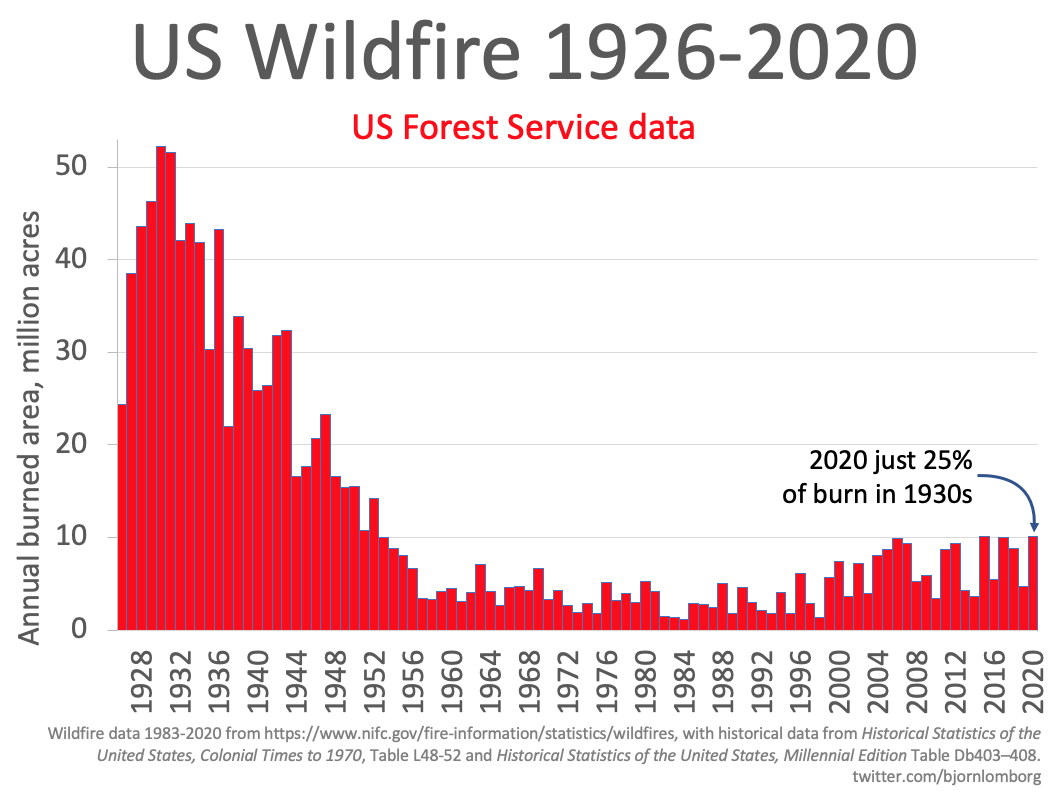
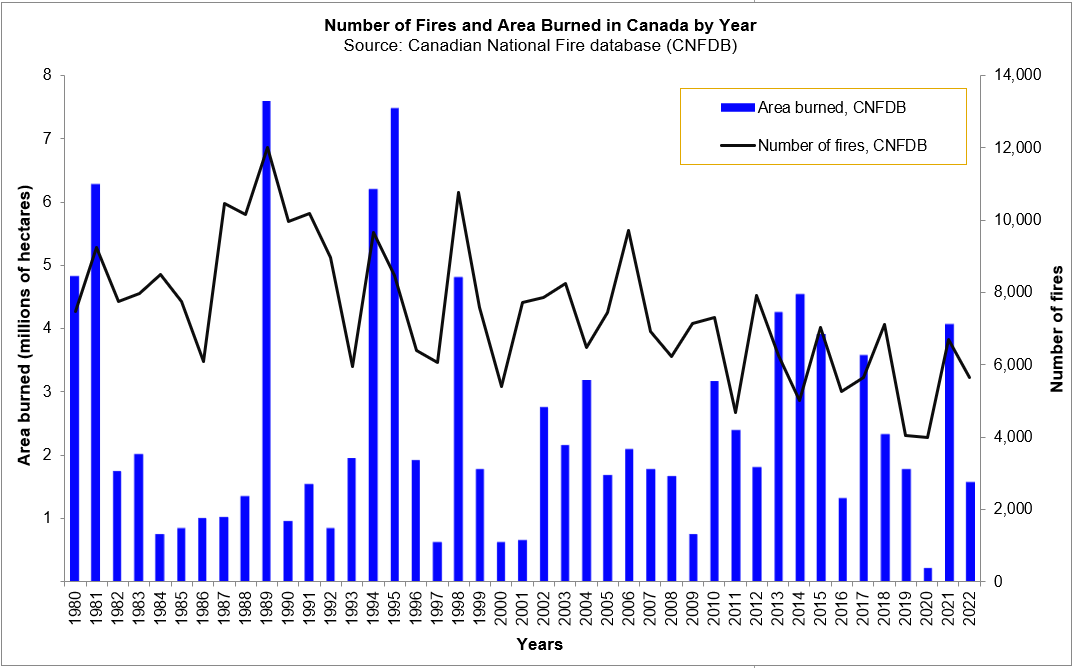
Regarding floods, “In general, there is low confidence in attributing changes in the probability or magnitude of flood events to human influence because of a limited number of studies, differences in the results of these studies and large modelling uncertainties.” As for wildfires, they have been trending down globally for the past decade. In Canada, according to the Canadian National Fire Database, both the number of forest fires and total area burned peaked in the late 1980s and has been declining ever since. Yet again the CCA offers misinformation to support its case for more censorship.

Here’s a better idea. Ignore the CCA and the ISD
and all the other would-be enforcers of orthodoxy.

Drop the fixation on “misinformation,” which is just the latest iteration of the same old desire of governments to censor their opponents. Allow the public the freedom, as Mill counselled, to hear arguments “from persons who actually believe them; who defend them in earnest, and do their very utmost for them.” A dangerous thought in 1859, and judging by the current misinformation craze, an utter heresy today; yet true nonetheless.

Ross McKitrick is a professor of economics at the University of Guelph and senior fellow of the Fraser Institute.


10 Times Covid Experts Failed Us

Marty Makary presents a list of failures in his NY Post article 10 myths told by COVID experts — and now debunked.  Excerpts in italics with my bolds and added images.

In the past few weeks, a series of analyses published by highly respected researchers have exposed a truth about public health officials during COVID:   Much of the time, they were wrong.

To be clear, public health officials were not wrong for making recommendations based on what was known at the time.  That’s understandable. You go with the data you have.

No, they were wrong because they refused to change their directives
in the face of new evidence.

When a study did not support their policies, they dismissed it and censored opposing opinions.

At the same time, the Centers for Disease Control and Prevention weaponized research itself by putting out its own flawed studies in its own non-peer-reviewed medical journal, MMWR.

In the final analysis, public health officials actively propagated misinformation
that ruined lives and forever damaged public trust in the medical profession.

Here are 10 ways they misled Americans:

Misinformation #1: Natural immunity offers little protection compared to vaccinated immunity

A Lancet study looked at 65 major studies in 19 countries on natural immunity. The researchers concluded that natural immunity was at least as effective as the primary COVID vaccine series.  In fact, the scientific data was there all along — from 160 studies, despite the findings of these studies violating Facebook’s “misinformation” policy.

Since the Athenian plague of 430 BC, it has been observed that those who recovered after infection were protected against severe disease if reinfected.  That was also the observation of nearly every practicing physician during the first 18 months of the COVID pandemic.

Most Americans who were fired for not having the COVID vaccine already had antibodies that effectively neutralized the virus, but they were antibodies that the government did not recognize.

Misinformation #2: Masks prevent COVID transmission

Cochran Reviews are considered the most authoritative and independent assessment of the evidence in medicine.  And one published last month by a highly respected Oxford research team found that masks had no significant impact on COVID transmission.

When asked about this definitive review, CDC Director Dr. Rochelle Walensky downplayed it, arguing that it was flawed because it focused on randomized controlled studies.

But that was the greatest strength of the review! Randomized studies are considered the gold standard of medical evidence.

If all the energy used by public health officials to mask toddlers could have been channeled to reduce child obesity by encouraging outdoor activities, we would be better off.

Misinformation #3: School closures reduce COVID transmission

The CDC ignored the European experience of keeping schools open, most without mask mandates. Transmission rates were no different, evidenced by studies conducted in Spain and Sweden.

Misinformation #4: Myocarditis from the vaccine is less common than from the infection

Public health officials downplayed concerns about vaccine-induced myocarditis — or inflammation of the heart muscle.  They cited poorly designed studies that under-captured complication rates.

A flurry of well-designed studies said the opposite.  We now know that myocarditis is six to 28 times more common after the COVID vaccine than after the infection among 16- to 24-year-old males.

Tens of thousands of children likely got myocarditis, mostly subclinical, from a COVID vaccine they did not need because they were entirely healthy or because they already had COVID.

Misinformation #5: Young people benefit from a vaccine booster

Boosters reduced hospitalizations in older, high-risk Americans. But the evidence was never there that they lower COVID mortality in young, healthy people.

That’s probably why the CDC chose not to publish its data on hospitalization rates among boosted Americans under 50, when it published the same rates for those over 50.

Ultimately, White House pressure to recommend boosters for all was so intense that the FDA’s two top vaccine experts left the agency in protest, writing scathing articles on how the data did not support boosters for young people.

Misinformation #6: Vaccine mandates increased vaccination rates

President Biden and other officials demanded that unvaccinated workers, regardless of their risk or natural immunity, be fired.  They demanded that soldiers be dishonorably discharged and nurses be laid off in the middle of a staffing crisis.

The mandate was based on the theory that vaccination reduced transmission rates
— a notion later proven to be false.

But after the broad recognition that vaccination does not reduce transmission, the mandates persisted, and still do to this day.

A recent study from George Mason University details how vaccine mandates in nine major US cities had no impact on vaccination rates.  They also had no impact on COVID transmission rates.

Misinformation #7: COVID originating from the Wuhan lab is a conspiracy theory

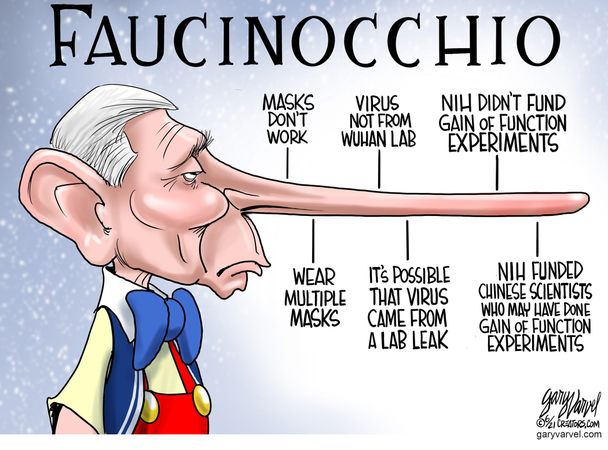
Google admitted to suppressing searches of “lab leak” during the pandemic.  Dr. Francis Collins, head of the National Institutes of Health, claimed (and still does) he didn’t believe the virus came from a lab.

Ultimately, overwhelming circumstantial evidence points to a lab leak origin — the same origin suggested to Dr. Anthony Fauci by two very prominent virologists in a January 2020 meeting he assembled at the beginning of the pandemic.

According to documents obtained by Bret Baier of Fox News, they told Fauci and Collins that the virus may have been manipulated and originated in the lab, but then suddenly changed their tune in public comments days after meeting with the NIH officials.

The virologists were later awarded nearly $9 million from Fauci’s agency.

Misinformation #8: It was important to get the second vaccine dose three or four weeks after the first dose

Data were clear in the spring of 2021, just months after the vaccine rollout, that spacing the vaccine out by three months reduces complication rates and increases immunity.

Spacing out vaccines would have also saved more lives when Americans were rationing a limited vaccine supply at the height of the epidemic.

Misinformation #9: Data on the bivalent vaccine is ‘crystal clear’

Dr. Ashish Jha famously said this, despite the bivalent vaccine being approved using data from eight mice.  To date, there has never been a randomized controlled trial of the bivalent vaccine.

In my opinion, the data are crystal clear that young people should not get the bivalent vaccine. It would have also spared many children myocarditis.

Misinformation #10: One in five people get long COVID

The Centers for Disease Control and Prevention claims that 20% of COVID infections can result in long COVID.

But a UK study found that only 3% of COVID patients had residual symptoms lasting 12 weeks. What explains the disparity?

It’s often normal to experience mild fatigue or weakness for weeks after being sick and inactive and not eating well.  Calling these cases long COVID is the medicalization of ordinary life.

Summary

What’s most amazing about all the misinformation conveyed by CDC and public health officials is that there have been no apologies for holding on to their recommendations for so long after the data became apparent that they were dead wrong.

Public health officials said “you must” when the correct answer
should have been “we’re not sure.”

Early on, in the absence of good data, public health officials chose a path of stern paternalism.

Today, they are in denial of a mountain of strong studies showing that they were wrong.


Covid Coercion Coverup in Canada

In recent months, some demonstrators in Quebec have denounced what they consider government fear campaigns over COVID-19. The new measures included a mandatory rule on wearing masks during demonstrations. Sept. 2020 (Graham Hughes/The Canadian Press)

John Hardie et al. dissect a recent publication attempting to whitewash blacken over suspension of citizens’ rights as well public health principles during the pandemic.  Their Epoch Times article is Pandemic Performance Study Blatant Attempt to Justify Feds’ Actions? Excerpts in italics with my bolds and added images.

The Public Health Agency of Canada study’s conclusions are a fantasy,
quite divorced from reality

Rather than learning from the painful lessons of the past three years, it’s obvious that we’ve entered a post-pandemic phase of government-led alarmism.

The Public Health Agency of Canada (PHAC)—including Theresa Tam—has published a study in a Canadian public health journal declaring that pandemic-inspired restrictions substantially reduced the impact of COVID-19 in Canada. “Counterfactuals of effects of vaccination and public health measures on COVID-19 cases in Canada: What could have happened?” asks us to believe an imagined story about what may have happened had Canada’s public health measures not been implemented.

However, the result is a counterfactual narrative of a fantasized Canada quite divorced from reality.

An elementary school in Montreal North is seen, Thursday, May 14, 2020 in Montreal. PHOTO BY RYAN REMIORZ /THE CANADIAN PRESS

Recent debate on the study’s findings has made it evident that Theresa Tam and her collaborators (“the authors”) are victims of common modelling pitfalls that have stripped their objectivity and, accordingly, affected the quality of their model and its output.

Instead of relying on modelling forecasts, the authors resort to “back-casting” to state “what may have happened” or “what could have been” had governments not acted on our behalf.

However, giving credence to such questionable results occurs all too often when sensational outcomes are observed. Unfortunately for any modelling study, the historical path—the one involving no interventions—was foreclosed the moment pandemic responses began. Neither the authors, nor anyone else, can ever observe the simultaneous response and non-response of Canada’s experience with COVID-19.

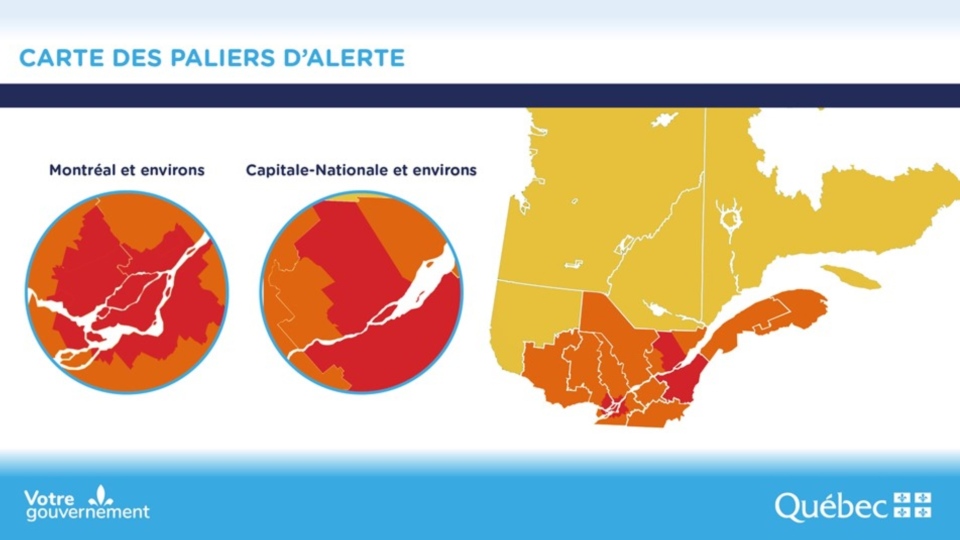
Quebec Premier François Legault says police in the province’s red zones — regions where COVID-19 cases are surging — will be issuing $1,000 fines to those who violate newly strengthened public health rules.  With fees, those fines will top $1,500 and can be issued for gathering in private residences or protesting without a face covering.

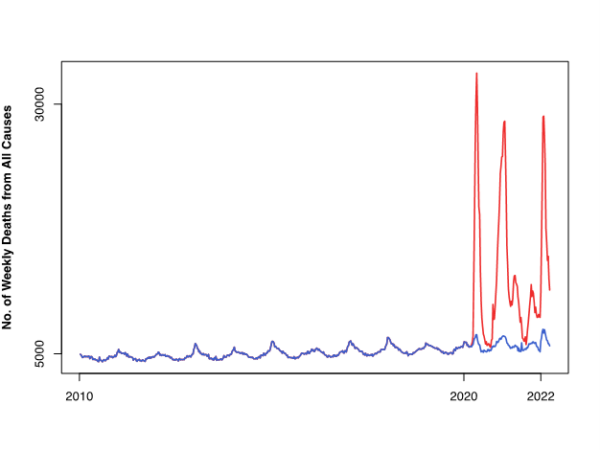
Their most dramatic claim is that, without social restrictions and vaccines, up to 800,000 COVID-related deaths could have occurred. The figure below shows 12 years of all-cause mortality data in Canada (blue line), with the authors’ “worst case” superimposed (red line).

The figure shows 12 years of all-cause mortality data in Canada (blue line), with the authors’ “worst case” superimposed (red line).

For us, two things make the authors’ assertion incompatible with any reasonable view: one, there was no obvious increase in all-cause mortality between 2020 and 2021 that exceeded historical trends (blue line), and two, the death count of “up to 800,000 people” (red line) surpasses the number of Canadians killed in the 1918 influenza pandemic and two World Wars—combined. It begs the question:

Could an infection with a survival rate >99 percent really have been
the single most devastating health event in a century?
The reader can decide if they find these results plausible, or fantastic.

All models are unrealistic to a degree (although this is not a “fatal flaw”). However, models are only as good as the assumptions upon which they are based. Unfortunately, the authors have hung their results on assumptions that underestimate the acquisition, extent, and durability of natural immunity and that very likely overestimate early viral spread and the duration of vaccine-acquired immunity.

The authors also assume that the spread of infection dropped consistently with the stringency of closures and other social restrictions: when strict, transmission was low; when relaxed, transmission increased. However, there is evidence that these measures didn’t work “as advertised.” In many provinces, their effect may have plateaued by April 2020.

Stricter measures did not translate into a proportionately slower spread.

Unfortunately, this didn’t stop the authors from forcing their model to respond as if they had. In their “worst case” scenario, large amounts of infection and disease are—conveniently—a foregone conclusion unless they get flattened by top-down government actions. The agency of Canadians and its bottom-up influences on transmission, such as people’s natural tendency to avoid contagion, are never considered.

Their least subtle omission was the failure to disclose conflicts of interest. While PHAC scientists might claim they only provide guidance on sub-national pandemic responses, the interests of many federal health-related agencies are certainly evident.

For example, the federal government’s purchase of COVID-19 vaccines preceded their approval by Health Canada, and some of the most restrictive measures imposed on Canadians (such as vaccine requirements for commercial travel) came from the federal level. As it happens, four of the authors are also directly employed by the federal government.

The study’s authors can hardly be viewed as not having competing interests
in favourably evaluating pandemic policies.

All this leads us to wonder: was their article a genuine evidence-based analysis of government policies? Or, rather, a blatant attempt to justify these policies? To their credit, the authors admit that Canada’s response to the pandemic was imperfect and any unintended consequences need to be investigated. It will truly be a measure of the honesty and integrity of PHAC and their provincial partners if the latter is ever realized.

Footnote Quebec Covid Situation October 1, 2020

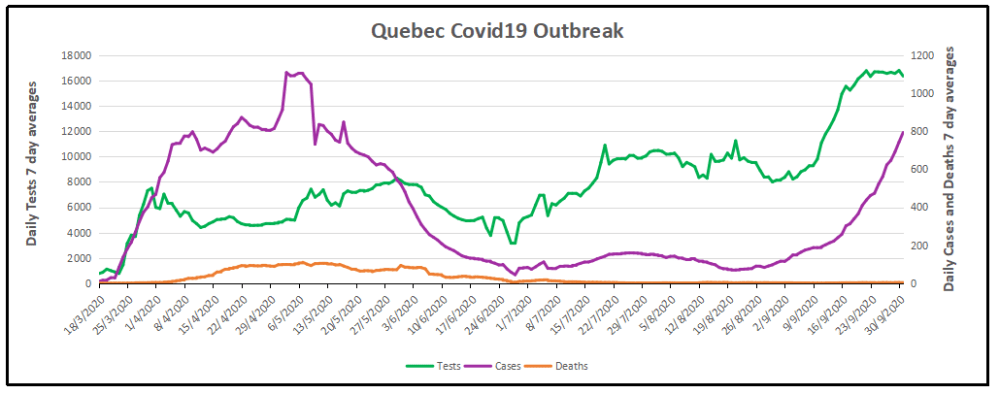
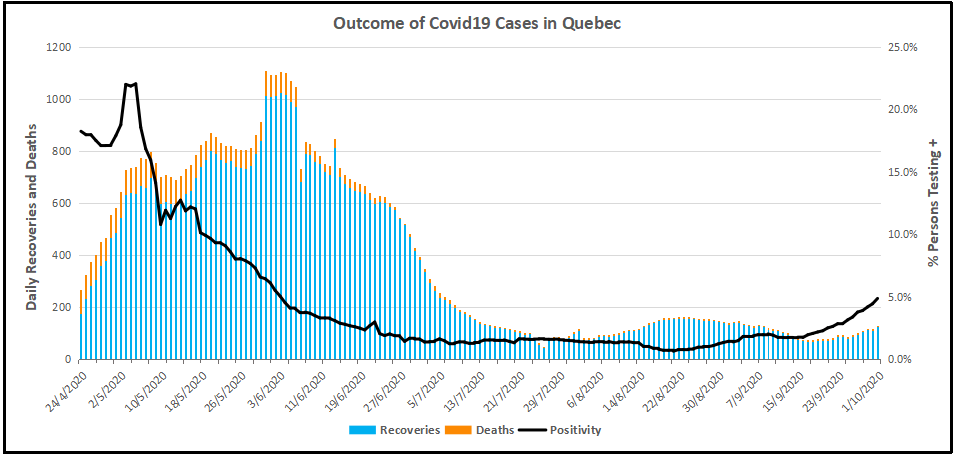
Note that testing has quadrupled since July and the number of new cases followed, especially in the last month.  Meanwhile daily deaths are unchanged at less than five a day, compared to Quebec losing 186 lives every day from all causes..  Recoveries are not reported to the public, perhaps due to the large number of people testing positive but without symptoms or only mild illness and no professional treatment.  The graph below estimates recoveries assuming that people not dying 28 days after a positive test can be counted as cured or in recovery.

Recoveries are the number of people testing positive (misleadingly termed “cases”) minus deaths 28 days later.  Obviously, the death rate was high early on, and now is barely visible.  Meanwhile the Positivity rate (% of people testing positive out of all subjects) went down to 1% for several months before rising recently.  Since there is a lag of 28 days, we don’t yet see the outcome of the rise in positives along with the increased testing.

And yet, with an edict, as of October 1 the government of Quebec put 60% of the provincial population under strict restrictions, about 4.8 million people.  The article from CBC News provides the details Quebec gives police legal tools to enter homes quickly to stop gatherings during COVID-19

Cognitive Climate Games

Robert Bradley at Master Resource reports on how cognitive dissonance can be pushed below the level of awareness in his article “Cognitive Dissonance” and Climate Change: A Takedown.  Excerpts in italics with my bolds and added images.

Sometimes a rebuttal on social media is just too good to not memorialize. This one concerns a post about “Cognitive Dissonance” in reference to a 49-minute Apple Podcast, “Hidden Brain: When You Need It to Be True.” Its synopsis states:

When we want something very badly, it can be hard to see warning signs that might be obvious to other people. This week, we revisit a favorite episode from 2021, bringing you two stories about how easy it can be to believe in a false reality — even when the facts don’t back us up.

The upshot (see below) is that since we know climate science is settled and the verdict is a crisis (ahem), psychological explanations are necessary to understand why so many of us (the silent majority?) are not in anguish and demanding a transformation of modern life (like crying Peter Kalmus).

Susan Krumdieck, Research Director, Islands Centre for Net Zero, interpreted “When You Need It to Be True” as follows:

Cognitive Dissonance is a phenomena those of us in Energy Transition need to understand and develop ways to deal with in ourselves and others.

The first big dissonance was 40 years ago when the belief that scientific observations warning of environmental damage would cause the necessary change. I still want it to be true. But I look at data and evidence to determine what is most likely. And then I investigate how changes can work and how different people play a part.

Purposeful questions about assumptions is necessary. Questioning widely held assumptions about what can and can’t be done in what timeframe by whom means you are awake to facts.

This story about people believing alien guardians were going to come save them from the destruction of the earth should be of interest.

To which I commented:

I see ‘Cognitive Dissonance’ as the problem with climate alarmism and forced energy transformation. Waste, futile –and a mindset geared toward unnecessary ‘climate anxiety’.

But a comment before mine was the real takedown. Stated Richard Lyon of Lyon Energy Futures Ltd.:

Thanks, Susan. One of the first warnings 40 years ago was from prominent climate catastrophist Paul Ehrlich that “everyone will disappear in a cloud of blue steam by 1989”.

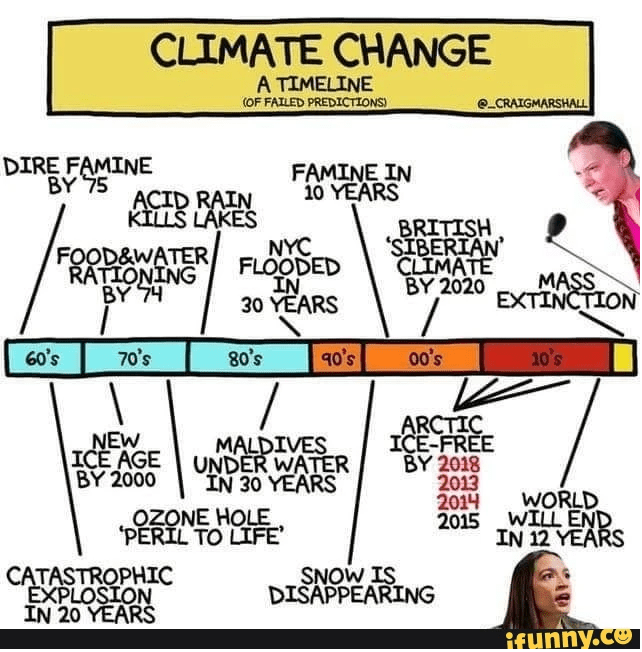
Since then, we’ve thrilled to warnings that the oceans would be “As dead as Lake Erie by 1980” (Ehrlich, 1970), that there would be a new Ice Age in 10 years (NASA, 1971), that England would cease to exist by 2000 (Ehrlich, 1971), that there was “no end in sight of the cooling trend” (New York Times, 1978), that the Maldives would be “completely underwater in 30 years (1989), that UK snowfalls were a thing of the past (University of East Anglia, 2000), that Britain would be “Siberian” by 2025 (Pentagon, 2004), that the Arctic would be ice free by 2013/2014/2016/2018 (Gore, US Navy, NASA), etc.

What you note as “warnings” 40 years ago are more accurately labelled as falsified speculations produced by climate models observably unfit for duty.

That is producing severe Cognitive Dissonance in an industry that depends on the hypothesis being true that there is a climate crisis, and is manifesting itself most visibly in the proliferation of what Lakatos proposes as “Auxiliary Theory” in his account of pseudoscience – “theory to explain the failure of the theory”

Bravo … And here we are where Richard Lyons (et al.) are arguing and winning the intellectual debate, while the alarmist believers of a Cognitive Dissonance are stuck in their own … cognitive dissonance. Message to Susan Krumdieck, who has bought into the climate alarm. Check your premises rather than try to find psychological explanations for the world not heeding the climate alarm.

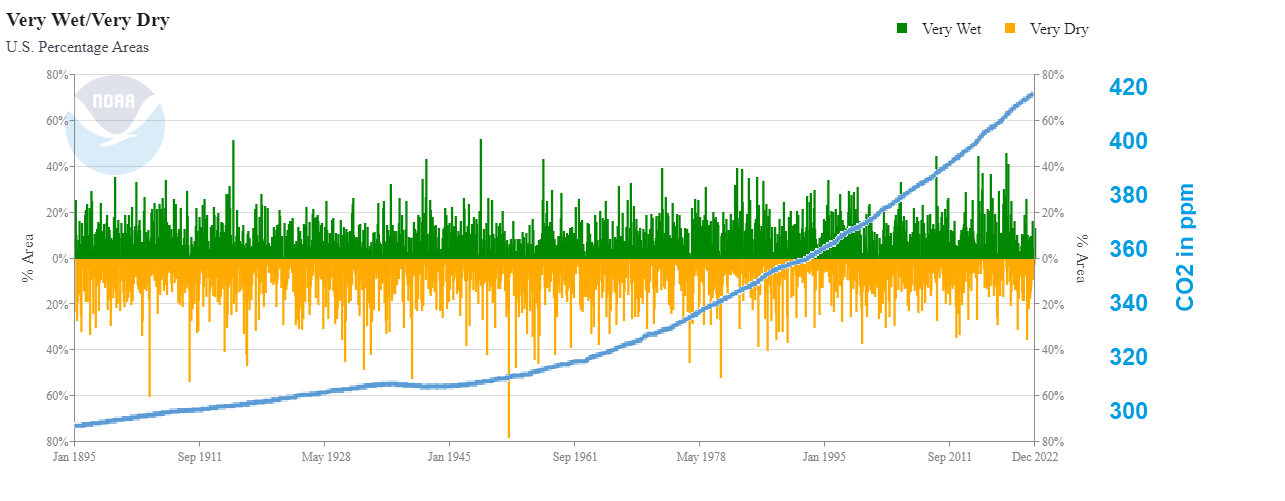
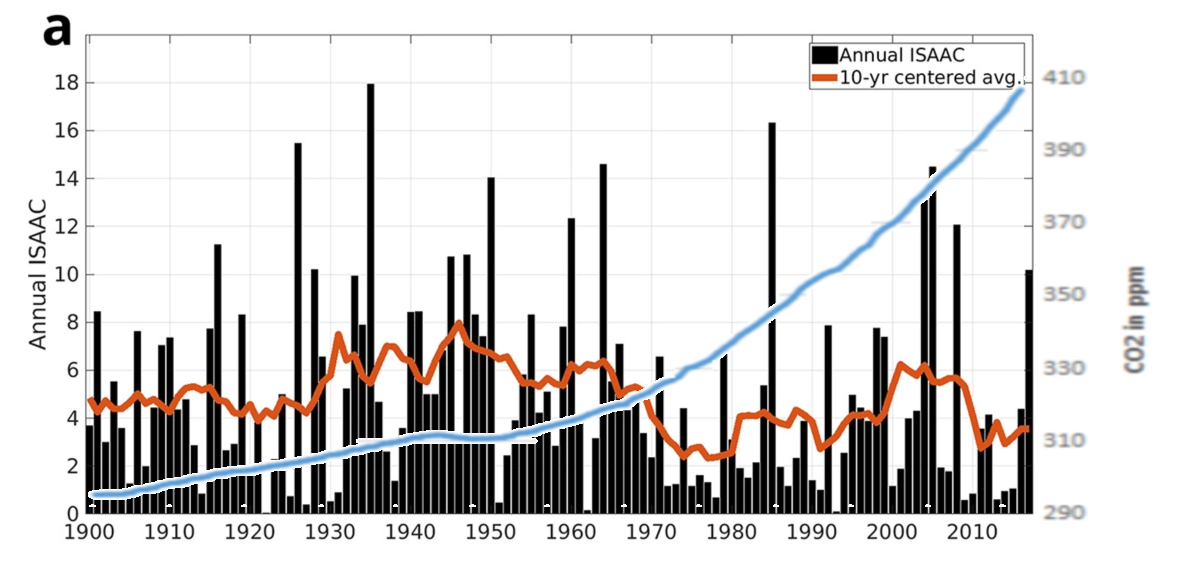
Start with the time series data with each weather extreme,
as well as the satellite data on global warming.


[The graph above shows exhibit 2a from Truchelut and Staehling overlaid with the record of atmospheric CO2 concentrations.  From NOAA combining Mauna Loa with earlier datasets.]
To determine Integrated Storm Activity Annually over the Continental U.S. (ISAAC) from 1900 through 2017, we summed this landfall ACE spatially over the entire continental U.S. and temporally over each hour of each hurricane season. We used the same methodology to calculate integrated annual landfall ACE for five additional geographic subsets of the continental U.S.

Climate optimism, anyone?

Testimonial: No Climate Emergency

Recently OAN’s Stella Escobedo interviewed Dr. Matthew Weilicki concerning his joining the declaration against any climate “emergency.”  The video can be accessed by clicking on the red link above.  Below I provide a transcript with my bolds along with some exhibits. SE refers to Stella Escobedo and MW to Matthew Weilicki

SE:  Well, you have probably heard that climate change is an existential threat and we need to do something about it right away. The World Economic Forum was just held in Davos, Switzerland, with discussions of the climate crisis front and center. Biden has persuade Democrats in Congress to provide hundreds of billions of dollars to fight climate change.

But there are hundreds of scientists around the world who say there is no climate emergency. In fact, they have signed the World Climate Declaration. And one of the biggest things they say is climate science should be less political. And I’d like to welcome to the show Dr. Matthew Weilicki. He’s currently a professor in the Department of Geological Sciences at the University of Alabama. Dr. Weilicki., thank you so much for joining us.

MW: Thank you. Thank you for having me.

SE: Of course..So before we get started, Dr. Weilicki, I want you to tell our viewers a little bit about your educational background and why you’re educated enough to to have this conversation and to talk about this topic.

MW:  Yes, absolutely. So my original bachelor’s degree is actually biochemistry and cellular biology. I worked in four novel vaccine companies for them through my original degree, and I went on to kind of shift gears and I went and got a Ph.D. in geochemistry from UCLA. And because I don’t really work in climate science per se, and I also don’t work in oil and gas exploration, I am an Earth scientist that uses a lot of the same tools that both of these types of fields will use. But I felt that I could take an objective look in and offer my expert opinion without really having any kind of, you know, any sort of motivation on either side. And I thought that would allow me to take an objective view. But the background that I have is very similar to the way that we try to identify what the climate looked like in the past, which is mainly through geochemistry.

SE: So, Dr. Weilicki, you are one of more than a thousand scientists who have signed this petition that says there is no climate emergency. Explain why you say that.

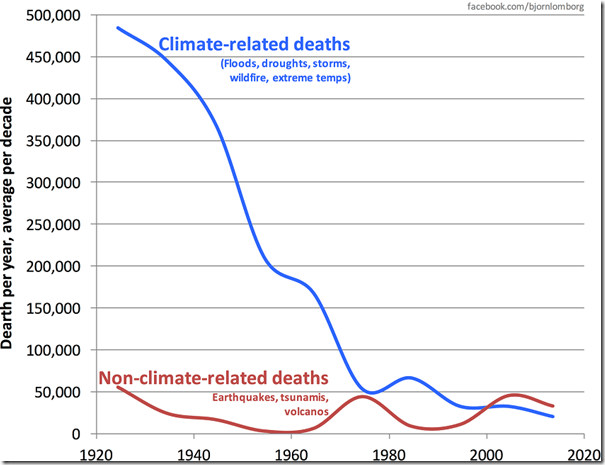
MW:  I think if we take an objective look at the data, it’s very difficult to see any metric that would allow us to explain the state of the climate as in an emergency or in a crisis, as you commonly hear. If we look at, for example, human lives lost from natural disasters, I ask my students this all the time and they are convinced that there has been significantly more lives being lost in natural disasters today than over the last hundred years. Let’s say that number has decreased by something like 97%.

Source: Bjorn Lomborg

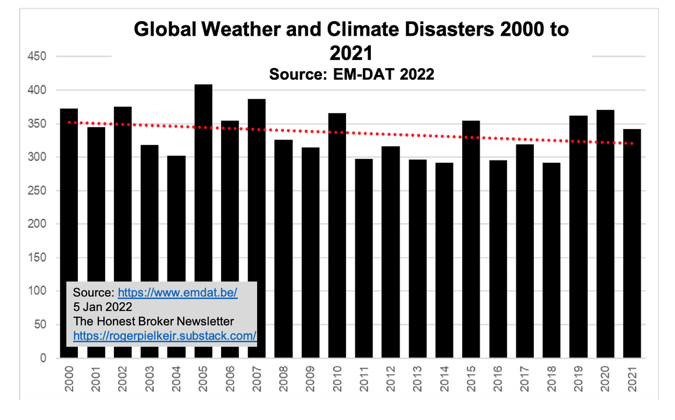
And so it’s clear. And the graphic you’re showing now, another question that I ask is how often are how many natural disasters are occurring? And so these students are usually freshmen and sophomores and things like that. And I ask them these questions about about the state of the climate. And I’m noticing that they have the exact wrong view of what’s happening. They’re convinced that more people are dying, more disasters are happening. And if you look at the empirical evidence, the data just doesn’t support that claim. And I think that the mental health effects are really damaging to these young people.

Source: Roger Pielke, Jr.

SE: Well, any time we do have massive flooding, heat waves or wildfires, as you just mentioned, we’re constantly being told it is climate change. Even the World Meteorological Organization has legitimized it. What are your thoughts on that?

MW: This is really part of the problem. This is this is why I blame these organizations. I don’t blame these young people for for believing this. I think if I was in my twenties, I would probably believe that the world is in catastrophe mode. But, you know, these these constant catastrophizing of weather events, weather is not climate. And to to harp and to take advantage of every extreme event to try to push your narrative is so disingenuous.

And these are smart people. They know that weather is not climate. Climate is very different. We’re talking about long term trends and variability in weather patterns and to try to catastrophize a single flood or a single hurricane and make the claim that if we didn’t burn fossil fuels or if we lowered atmospheric greenhouse gas emissions, somehow the flood wouldn’t have occurred or the hurricane wouldn’t have occurred. That is absurd. We know in the geologic record that these events happen. Sometimes they happen worse more than other times. But these happen. This is not has nothing to do with the amount of atmospheric greenhouse gas in the atmosphere.  This is a much larger issue.

And to suggest that we wouldn’t have extreme weather if we could just change
one trace gas in the atmosphere is absolutely not scientific.

SE: Well, you have so many smart people like yourself who are speaking up saying there is no climate emergency. And yet do you feel like people like yourself are getting any real attention? In fact, many scientists get defunded for speaking out, get called climate deniers. How do you respond to that?

MW:  Yes, absolutely. I think that’s such a it’s such a derogatory term. It’s. Clearly trying to link people that are skeptical about climate and making questions about science with Holocaust deniers. I was born in Poland, just a few hours from the gates of Auschwitz. I lost many family members in the Holocaust. To try to link me because I have questions about science to denying the Holocaust is absolutely disingenuous. It’s an ad hominem attack because people realize that the empirical evidence doesn’t support what they’re saying and how catastrophize they’re trying to make the climate and such. They don’t want to discuss the actual data, so they’d rather label you a name and try to deplatform you or defund you. And, you know, I find it to be a very disingenuous way of having a scientific discussion.

SE: You know, just a few days ago, you announced you’re leaving the university and a post on Twitter. I saw you say some of it is personal family related. But you also mentioned it’s no longer a place that embraces freedom of exchanging ideas. Can you elaborate?

MW:  Yes. My life dream was to be a professor. My father was a professor ever since I was about 12 years old. And we made a pretty big sacrifice by moving from all of our families in California. We moved to Alabama because I really wanted to pursue this career, and I really started to realize pretty quickly that it wasn’t the way that my father remembered it. And when we would have discussions and this rise of illiberalism, that’s what I like to call it, this idea, these ideological ideas, the fact that there are certain things that are undiscussed that you can’t discuss.

What I was talking about was DEI, diversity, equity and inclusion.
And even having a discussion about this is very similar to climate.

If you just want to look and investigate whether something that’s probably has good intentions like inclusivity. I understand it’s a noble cause, but if we don’t look at the outcomes, it’s very difficult to figure out whether this is having the intent that we want. And I started to realize that just speaking out about some of these things was really enough to get you labeled, you know, a certain degree bigotry term, whichever one it is, a denier or sometimes even a racist, because you’re having questions about the outcomes of some of these diversity equity inclusion policies.

And it was clear to me once I made my my Twitter thread, I was attacked by faculty members from all over the place, even UA, calling me a racist. They tried to link me to some anti-Semitic writings that happened on the sidewalk somewhere on campus. It just made it prove to me very clearly that if you have genuine questions and you see negative impacts on students, even bringing that up is, is is, you know, paradigm to being a heretic and you get ostracized and people call you out. And so that’s definitely one of the reasons that made it easier for me to start walking away from from this profession.

SE: Well, you’re not alone. And it’s unfortunate that this is happening. It’s happening in your industry. It’s happening to parents who are speaking out, you know, for their children in schools. So it’s unfortunate. But I do hope that this doesn’t push smart people like you completely out of science. Dr. Weiliki, thank you so much for being here.

Dr. Matthew M. Weilicki Homepage

Footnote:


Background   

Click to access WCD-version-100122.pdf


On Climate Grooming the Children

A man who has not been a socialist before 25 has no heart.
If he remains one after 25 he has no head.—King Oscar II of Sweden

One of the observations about the 2022 midterms was how strongly young unmarried women voted for the socialist agenda of today’s Democratic party.  I recall a video clip of two university students saying their vote was all about women’s abortion rights, and thinking these two male nerds’ politics might be biased by their desire to get lucky some night.  But beyond that issue is the campaign of brainwashing children regarding global warming/climate change.

Benjamin Khoshbin shines some light into this climate political grooming in his Real Clear Energy article The Electoral Case for Commonsense Environmentalism  Somewhere Between “No More Meat” and “It’s a Hoax:”  Excerpts in italics with my bolds.

We’ve all heard the adage, that a young person not thinking socialist has no heart, while an older person still a socialist has no head.  It sounds true, but it’s not — young voters are no longer aging into conservatism. While Gen X and Boomers did trend more conservative as they aged, Millennials in the U.S. are becoming more liberal as they age, and are estimated to be the most liberal 35-year-olds in recorded U.S. history.

Based on their behavior in the 2022 midterms, Gen Z is likely to follow suit.

According to the Edison Research National Election Pool exit poll, 63% of Gen Z voted for Democrats in House races, compared to just 35% who voted for Republicans — a whopping 28-point gap. While many salient issues for young voters are likely driving this, one stands out: climate change.

Millennials and Gen Z are more concerned about climate change than any other generation. A Harris Poll survey of American 13–19 year-olds found that more than 8 in 10 teens believed that if climate change isn’t addressed today, it will be too late for future generations as some parts of the planet will become unlivable. Nearly 80% of teens in the survey also believed that protecting the environment should take priority over economic growth.

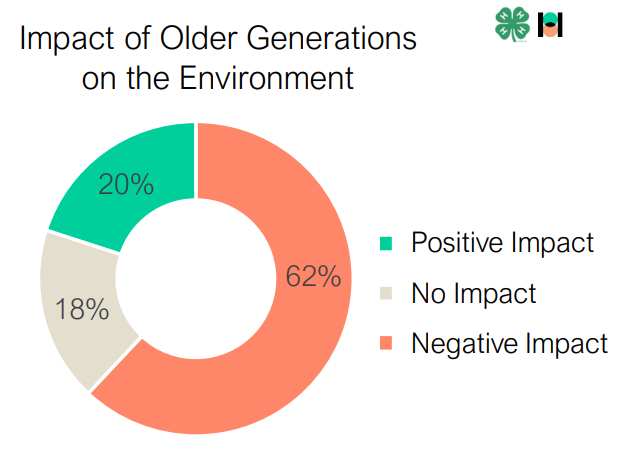
My deeper look into the 4H/Harris Survey

I have posted before on climate push polls designed to get results supporting a political agenda.  What participants say is shaped by how questions are asked and answered. This survey was conducted online within the United States by The Harris Poll on behalf of 4-H from January 5 to January 18, 2022, among 1,500 respondents ages 13-19.   The age cohort is interesting to show how successfully has been the educating of children regarding environmental concerns, and especially climate change.  The survey content is here Environmental Impact Survey  Exploring the impact of the environment on teens.

Indeed the title of the report refers not to impact upon nature, but rather the impact of environmental messaging upon impressionable teenagers.  The survey itself consisted of stating preferred conclusions and offering agree/disagree options.  Typically strongly and somewhat agree responses are lumped together into agree percentages.  Some Examples:

84% of teens agree, “I am concerned that if we don’t do more to protect the environment, humans and other species, wildlife will suffer and possibly go extinct.”

82% of teens agree, “If we don’t do more to protect the environment today, I expect to have to make future life decisions based on the state of the environment, including where I live, what kinds of jobs will be available, or if I will have children.”

56% of teens agree, “International governments are working towards global initiatives and policies to protect our planet.”

84% of teens agree, “Climate change will impact everyone in my generation through global political instability.”

84% of teens agree, “If we don’t address climate change today, it will be too late for future generations, making some parts of the planet unlivable.”

69% of teens agree, “I am worried that my family and I will be affected by climate change in the near future.”

77% of teens agree, “I feel responsible to protect the future of our planet.”

84% of teens agree, “We need more corporate action from companies today to improve our climate for tomorrow.”

83% of teens agree, “We need more legislative action from government today to improve our climate for tomorrow.”

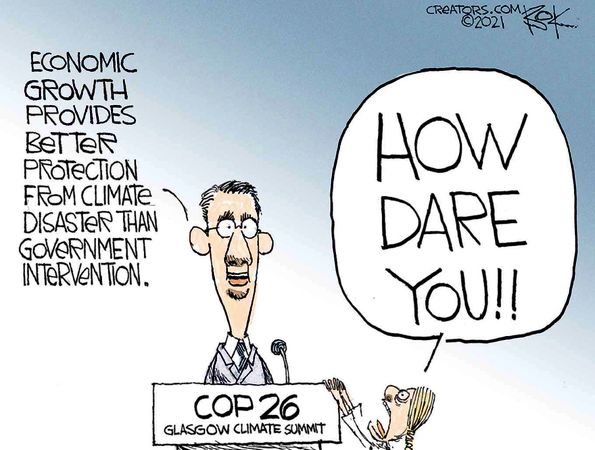
79% of teens agree, “Protecting the environment should take priority over economic growth.

Khoshbin: These findings should trouble Republicans. Young voters believe that climate change is an existential threat, but they mistakenly think that environmental protection and economic growth are mutually exclusive. In reality, since 2005, 32 countries — both developing and developed — have absolutely decoupled carbon emissions from GDP growth, having successfully grown their economies while simultaneously reducing carbon emissions.

My Comment:

That is not the only mistaken perception among these teens.  Mind you, they were only exposed to the alarmist POV, and followed their hearts and feelings.  Note the repeated 84% agreement percentage suggests a central tendency in responses with little if any consideration of nuances between statements.  Basically this survey confirms that a narrative is embedded in these people.

An interesting contradiction appears here:

• Over 9 in 10 teens grew up engaging in a number of outdoor activities, yet today a majority of teens spend 5 hours or less outside per week – or less than 11 days a year

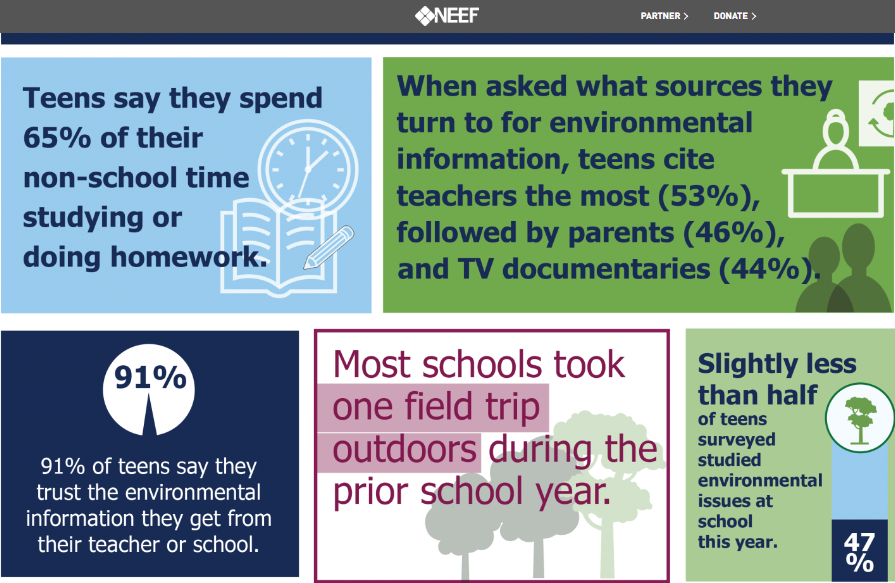
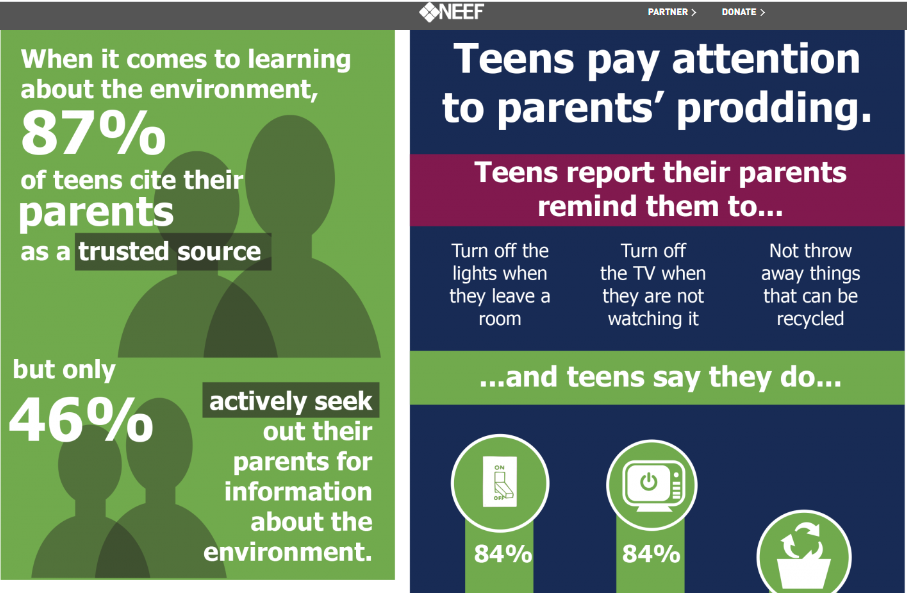
Another survey source indicates where children get information NEEF Teen Benchmark Survey National Environmental Education Foundation (NEEF): Some relevant findings:

See Also

The Art of Rigging Climate Polls

YouGov Climate Push Poll: Still no Believer Majority


Decolonizing Attack on Science

Update Dec. 30 at end

Rex Murphy writes at National Post Science does not need to be ‘decolonized’.  Excerpts in italics with my bolds and added images.

Does Concordia University wish to be an instrument of learning, or a funnel for wokeness?

Scholars at Montreal’s Concordia University are planning to trace and counter what they say is colonialism in physics, which they describe as a “social field” rather than one of “pure knowledge.” — True North, Campus Watch

How would a person decolonize penicillin? Or anesthesia? Or open-heart surgery? Or the miracle advances the past century gave the world through the understandings — still not complete — of quantum physics?

First of all, you would have to ask the question: what could “decolonize” even mean in these miracle domains?

(I use miracle here only as metaphor, or in its now weaker and more normal usage as an advance scarcely dreamed of but brought on by science, science which is the application of mind, of intellect — not politics — to the understanding of nature.)

Scientific truth is the truth of bare fact. The only reverence science knows is the genuflection before hard, physical reality. Science wears no ribbons of fealty to causes, colours or the predispositions of any mentality or ideology, other than the asking of questions and the submission to the answers provided by absolutely neutral inquiry — answers always tentative, always open to revision or correction; science is never final.

Short form: Science does not wear badges.

There have been instances where science has been forced to wear a political coat. A certain regime in Germany during the 1930s, under the tenure of a racist madman, declared that there was no such a thing as “Jewish” science. And, therefore, it was innately false, to be banned, alas along with the great Jewish scientists.

That Einstein was Jewish, therefore he was wrong,
has to have been the most warped equation ever.

There was in Hitler’s imperium, room for only “Aryan” science. And there was the deadly flaw. Science allows no qualifying epithets, no qualificatory precedent adjectives.

(I dare say Whoopi Goldberg doesn’t know this, but then, there is much that Whoopi Goldberg doesn’t know. That’s why she’s on The View.)

Communism in the hard days of ruthless Stalin also had a Marxist “line” on what science had to be. In both cases, radical and totalitarian regimes tried to subdue thought itself, the functioning of intellect, to their grim, idiotic and malign ideologies.
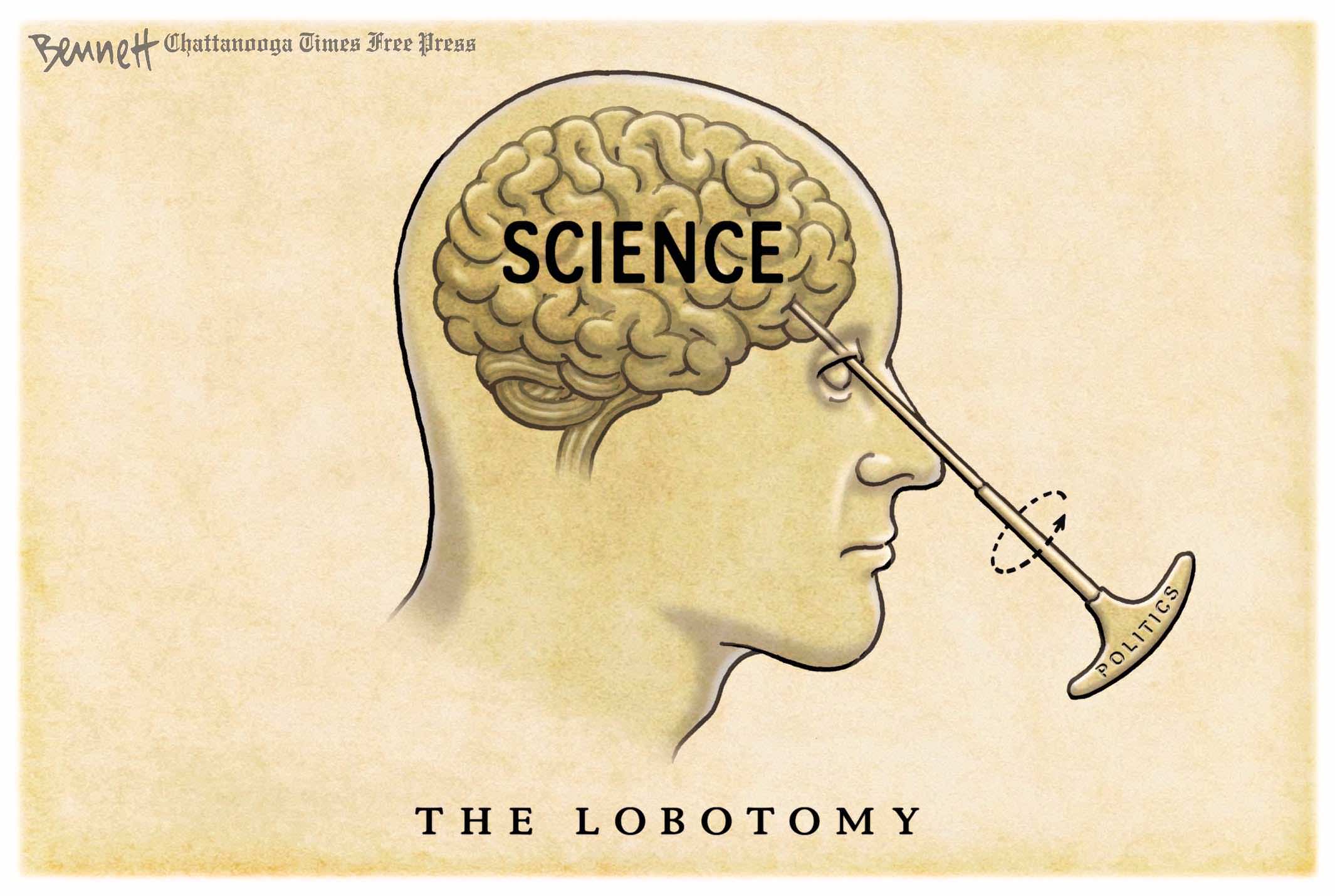
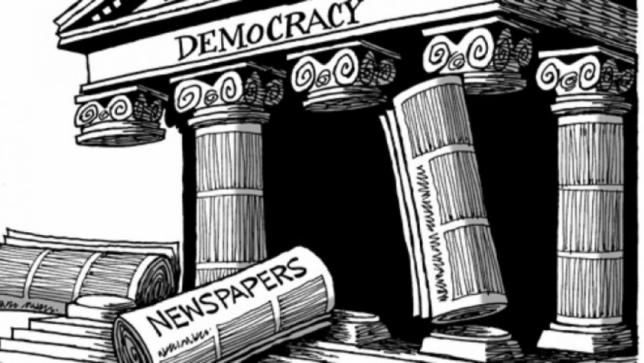
Science is science, and it is only science, or it is not science: with any limiting descriptive it is just a rigged machine for producing approved results. Politics acts on science as an acid to truth: it distorts inquiry and banishes rigour and dispassion — the core qualities of science.

So let me curl back to the otiose question of “decolonizing” science. What can Concordia possibly mean by such a project?

Is the university, directly or indirectly, saying that the manifold revelations brought about by adherence to scientific methodology, since the days of Isaac Newton — the premier figure in the advance of empirical thought — are wrong? Is Concordia saying Western science is bent by racial considerations and thereby should be dismissed? Side-stepped? Layered over?

Does the university agree with the judgment that since science is “colonized,” it must be “corrected?” That E = mc², perhaps the most basic equation of the whole universe, proceeds from a “colonialist” mentality?Is it saying that because much, but by no means all, of the science came from people with a certain colour of skin — that would be white — it is therefore not only fallible but an imposition of “colonial” understanding on young minds, whatever that ridiculous phrase may be taken to mean?

Concordia has a fairly well known project called Decolonizing light. And what could that mean? Does it challenge the speed limit of the universe, that light travels at 186,000 miles per second? What alternative measurement is it offering from its decolonized science?

And most pertinently how can it be that a university — an institution for the transmission of knowledge and truth — would bend to the woke notions of our over-politicized times and offer that the progress of scientific truth is but one more unfolding of “imperialist,” “colonizing” white thought?

Speak up Concordia. Or trim your fees.

There are few things that offer more despair in these fad-ridden times than the easy, cowardly concessions to racial and ethic politicization by (once) prestigious institutions.

Penicillin works. Anesthesias have saved millions from pain. The second law of thermodynamics has no reference to race or creed. The scientific method is the very closest attempt in all of history to remove all prejudice, of any kind, from the attempt to answer any question. Its kernel, its very ultimate idea, is submission to what is really seen, what is really there, what is really to be understood.

Most important of all, the colour of the skin of a discoverer has no bearing on the discovery.

You cannot “decolonize” science, because science has no colonies, it wishes none, and would lose all verity if it owed any allegiance except to cold observation, relentless questioning, and the utter exclusion of secondary impulses, most particularly those of race and activism.

Concordia has a choice to make, a choice many other universities must also face. Does it wish to be an instrument of learning, or a funnel for the trite obsessions of a very particular moment?

Update Dec. 30

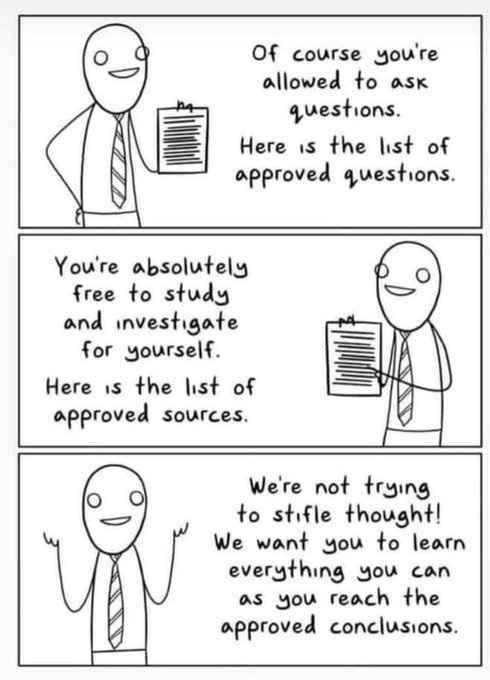
I am prompted to add a clarification to this post.  By attacking historic findings of scientists, the aim is to discredit the scientific process.  That is, the real threat to institutional power over individuals is “sciencing”, the activity of asking skeptical questions and independently thinking and seeking answers.  When people on the left say we should trust the “science,” they mean trust the institutional authorities who approve and disapprove the ideas and conclusions.

If  literate people are allowed to do “sciencing”,  they can and do arrive at ideas and findings not approved, or even disapproved by the authorities.  We have seen how this works in the censorship of highly qualified immunologists who disagreed with rationales for Covid poliicies.  Also highly credentialed climate scientists have been demeaned and demonized for contradicting the global warming/climate change narrative.

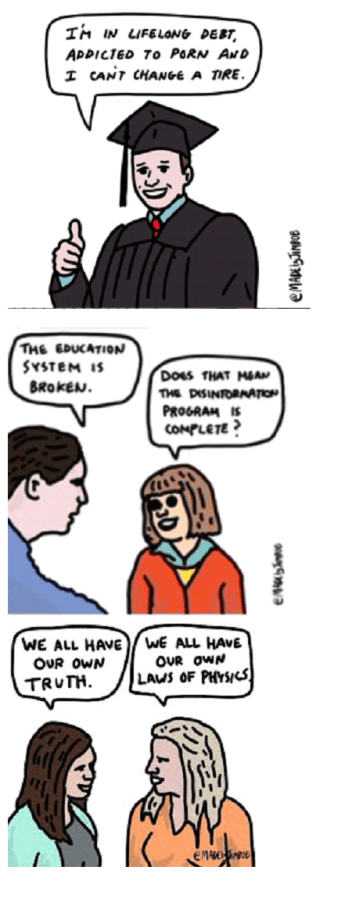
Instead of “sciencing,” here is their idea of “research”

See also Sciencing Vs. Scientism

Hey Princeton, On climate change, as on all else, hear both sides

Masthead of the student newspaper at Princeton University.

Lord Monckton has written a reply to the juveniles at the Princetonian.  H/T John Ray

On climate change, as on all else, hear both sides

By Christopher Monckton of Brenchley, special to The Daily Princetonian.  Excerpts in italics with my bolds.

The English-speaking jurisdictions recognize just two principles of natural law. One of these is audiatur et altera pars: let both sides be heard. On the climate question, though, the promoters of the official narrative are strikingly – and revealingly – intolerant of dissent.

Recently, in this column, two climate campaigners were allowed to attack three eminent Princeton-bred professors, the late Fred Singer, the late Fred Seitz and Professor Will Happer. I had the honor to know Professor Fred Singer, an exceptional rocket scientist and founder of the U.S. Satellite Weather Service. I had the further honor of working with him on a paper discussing the intersection between chaos theory and climate prediction. It was one of the last papers he wrote.

And I have the honor to know Will Happer, a formidable radiation physicist, exceptionally well qualified to write about the influence of heteroatomic molecules on global temperature. Will has published a string of distinguished papers on the subject in recent years.

The climate fanatics described the three professors as having used Princeton’s “name and prestige” to “open doors, grab headlines, mislead the public and grant legitimacy to their climate-denial claims … helping put us on the pathway to today’s existential global crisis”. Oh, pur-leaze!

The editors of this journal should in future eschew such hate-speech terms
as “climate denial” or “denier” or “denialist”.

None of the three professors denies that there is a climate, or even that we are capable of influencing it. Fred Singer’s paper on chaos theory pointed out that, precisely because the climate behaves as a mathematically-chaotic system, even a small perturbation, whether natural or anthropogenic, might cause unforeseeable effects. But it is the property of a chaotic object that, unless the initial conditions are known to a precision that is and will aye be unattainable in climate, the long-term prediction of future climate states is not possible. In this, Professor Singer swam in the mainstream: IPCC says the same.

Will Happer’s recent detailed paper studying the radiative effects of greenhouse-gas enrichment, far from “climate denial”, powerfully endorsed the conclusion that that enrichment – beneficial though it is for the net primary productivity of plants (their total global green biomass has increased by 15-30% in recent decades thanks to CO2 fertilization detectable from space as chlorophyll fluorescence) – will cause about 2 degrees’ global warming per doubling of concentration, a value within the official uncertainty interval.

All three professors were and are right to point out that the mildly warmer worldwide weather that is occurring does not and will not pose any “global existential threat”.

Such childish, anti-scientific slogans, bandied about by the extremist classes, are devoid of meaning and should be forsworn forthwith and for aye. The OFDA/CRED international disaster database shows that, despite a tripling of global population, weather-related deaths have plummeted throughout the past 100 years. And a string of learned papers in the medical journal The Lancet establishes that in all regions deaths from cold outstrip deaths from heat tenfold.

Finally, let us hear no more nonsense about such towering professors as these “preventing climate action”. For such action would expensively do far more harm than good. Since 1990 our influence on climate has increased linearly at 1 unit per decade, driving 0.4 degrees’ warming.

Even if the whole world were to move linearly to net zero emissions by 2050, only half the next unit would be abated by then, preventing just 0.2 degrees’ warming.

The cost of global net zero, according to McKinsey Consulting, will be $275 trillion in capex alone. Even ignoring opex, typically at least twice capex, and even allowing for no price increases in the desperately scarce techno-metals needed to reach net zero (one would need 67,000 years’ worth of the entire 2019 global annual production of vanadium, for instance, so good luck with that), each $1 billion spent on attempted mitigation would prevent less than a millionth of a degree of future warming. Value for money it isn’t. And the climate won’t notice either way.

Like it or not, it is legitimate for men of learning gently to correct the moralizing screechers by drawing their attention to elementary, verifiable facts such as these. As it is, only the West is making any attempt to attain net zero. But the net effect of our supererogatory sacrifice of our own workers’ jobs is to price our energy-intensive manufacturing industries out to far Eastern nations whose emissions per unit of production are considerably above ours. Climate campaigners, then, are adding to the very non-problem they are clamoring to solve. Making things in China rather than Chattanooga is good for Communism but bad for the planet.

So let the skeptical scientists be fairly heard, and let us cease to turn
universities like Princeton into mere pietistic indoctrinators.

Learning advances not by cloying “consensus”, roundly and rightly rejected by Aristotle 4500 years ago, but by diligent research, free publication and open debate. It is only those who know they would lose a debate who seek to silence their opponents. The hysterical malevolence of the screaming campaigners shows the world they know full well that they would lose. Indeed, they have already lost.

Christopher Monckton of Brenchley, a Cambridge alumnus and former adviser to Margaret Thatcher, is the author of two dozen learned papers on climate sensitivity and mitigation economics.

Footnote:  The writers of the article critiqued by Christopher Monckton should attend to this presentation by William Happer Climate Change Thinking for Open or Locked-Down Minds


Left Replaces Thinking with the “Stochastic Terror” Lie

Christopher F. Rufo explains in his City Journal article The “Stochastic Terror” Lie  Excerpts in italics with my bolds and added images.

The Left’s latest gambit for suppressing speech is built on preposterous grounds.

[Note: Those of us who follow the global warming/climate change alarmists see how the same mentality operates in order to avoid proving cause and effect.  Just watch how climate reparations are being pushed presuming that any loss or damage from natural events is caused by humans using fossil fuels.]

I browsed the news recently only to discover that, according to a popular science magazine, I was responsible for the attempted murder of Paul Pelosi, husband to House Speaker Nancy Pelosi.

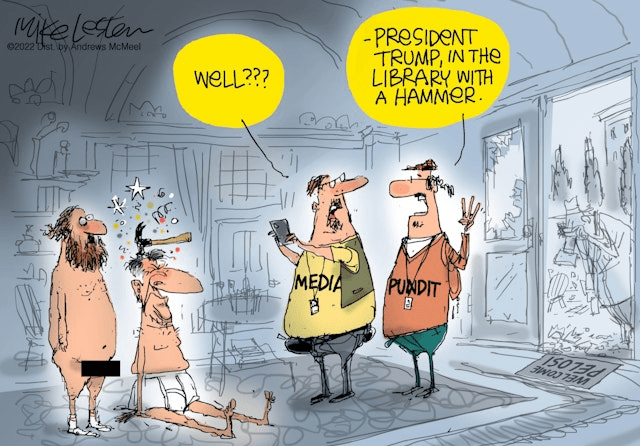
In an opinion piece for Scientific American, writer Bryn Nelson insinuated that my factual reporting on Drag Queen Story Hour was an example of “stochastic terrorism,” which he defines as “ideologically driven hate speech” that increases the likelihood of unpredictable acts of violence. On the night of the attack, Nelson argued, I had appeared on Tucker Carlson Tonight to discuss my reporting, and, hours later, the alleged attacker, David DePape, radicalized by “QAnon” conspiracy theories about “Democratic, Satan-worshipping pedophiles,” broke into the Pelosi residence and attacked Paul Pelosi with a hammer.

This is a bizarre claim that, for a magazine supposedly dedicated to “science,”
hardly meets a scientific standard of cause and effect.

There is no evidence that DePape watched or was motivated by Tucker Carlson’s program; moreover, nothing in my reporting on Drag Queen Story Hour encourages violence or mentions Nancy Pelosi, QAnon, or Satan-worshipping pedophiles. My appearance on Tucker Carlson Tonight and DePape’s attack against Paul Pelosi are, in reality, two unrelated incidents in a large and complex universe.

And Nelson, a microbiologist specializing in human excrement, is full of it.  But Nelson isn’t trying to prove anything in a scientific sense. Under the concept of “stochastic terrorism,” logic, evidence, and causality are irrelevant. Any incident of violence can be politicized and attributed to any ideological opponent, regardless of facts.

The scheme works like this: left-wing media, activists, and officials designate a subject of discourse, such as Drag Queen Story Hour, off-limits; they treat any reporting on that subject as an expression of “hate speech”; and finally, if an incident of violence emerges that is related, even tangentially, to that subject, they assign guilt to their political opponents and call for the suppression of speech. The statistical concept of “stochasticity,” which means “randomly determined,” functions as a catch-all: the activists don’t have to prove causality—they simply assert it with a sophisticated turn of phrase and a vague appeal to probability.

Though framed in scientific terms, this gambit is a crude political weapon.

In practice, left-wing media, activists, and officials apply the “stochastic terrorism” designation only in one direction: rightward. They never attribute fire-bombings against pro-life pregnancy centers, arson attacks against Christian churches, or the attempted assassination of a Supreme Court justice to mere argumentation of left-wing activists, such as, say, opposition to the Court’s decision in Dobbs. In those cases, the Left correctly adopts the principle that it is incitement, rather than opinion, that constitutes a crime—but conveniently forgets that standard as soon as the debate shifts to the movement’s conservative opponents.

In recent years, the Left has not only monopolized the concept of “stochastic terrorism”
but also built a growing apparatus for enforcing it.

Last year, left-wing organizations and the Department of Justice collaborated on a campaign to suppress parents who oppose critical race theory, under the false claim that sometimes-heated school-board protests were incidents of “domestic terrorism.” Earlier this year, left-wing activists and medical associations called on social media companies and the Department of Justice to censor, investigate, and prosecute journalists who question.

If this process is left unchecked, the consequences will be disastrous.

Left-wing NGOs, social media companies, and federal security apparatchiks will gain unprecedented power to police speech and criminalize political opposition. Conservatives and old-line liberals who still care about civil liberties must expose the scheme and work to dismantle the apparatus that supports it. The line of argument is simple: speech is not violence; statistical abstraction is not a substitute for evidence; and free-association fantasies cannot determine guilt. But the politics of fighting back are more complex. It will require dislodging a network of professionals who see the concept of “stochastic terror” as a path to power.

That concept is built on a lie. It deserves to be exposed and discredited.

See also Science + Politics = Politics

Climate Reductionism