Beliefs and Uncertainty: A Bayesian Primer

Those who follow discussions regarding Global Warming and Climate Change have heard from time to time about the Bayes Theorem. And Bayes is quite topical in many aspects of modern society:

Bayesian statistics “are rippling through everything from physics to cancer research, ecology to psychology,” The New York Times reports. Physicists have proposed Bayesian interpretations of quantum mechanics and Bayesian defenses of string and multiverse theories. Philosophers assert that science as a whole can be viewed as a Bayesian process, and that Bayes can distinguish science from pseudoscience more precisely than falsification, the method popularized by Karl Popper.

Named after its inventor, the 18th-century Presbyterian minister Thomas Bayes, Bayes’ theorem is a method for calculating the validity of beliefs (hypotheses, claims, propositions) based on the best available evidence (observations, data, information). Here’s the most dumbed-down description: Initial belief plus new evidence = new and improved belief.   (A fuller and more technical description is below for the more mathematically inclined.)

Now that doesn’t sound so special, but in fact as you will see below, our intuition about probabilities is often misleading. Consider the classic Monty Hall Problem.

The Monty Hall Game is a counter-intuitive statistics puzzle:

There are 3 doors, behind which are two goats and a car.
You pick a door (call it door A). You’re hoping for the car of course.
Monty Hall, the game show host, examines the other doors (B & C) and always opens one of them with a goat (Both doors might have goats; he’ll randomly pick one to open)
Here’s the game: Do you stick with door A (original guess) or switch to the other unopened door? Does it matter?

Surprisingly, the odds aren’t 50-50. If you switch doors you’ll win 2/3 of the time!

Don’t believe it? There’s a Monty Hall game (here) where you can prove it to yourself by experience that your success doubles when you change your choice after Monty eliminates one of the doors. Run the game 100 times either keeping your choice or changing it, and see the result.

The game is really about re-evaluating your decisions as new information emerges. There’s another example regarding race horses here.

The Principle Underlying Bayes Theorem

Like any tool, Bayes method of inference is a two-edged sword, explored in an article by John Horgon in Scientific American (here):
“Bayes’s Theorem: What’s the Big Deal?
Bayes’s theorem, touted as a powerful method for generating knowledge, can also be used to promote superstition and pseudoscience”

Here is my more general statement of that principle: The plausibility of your belief depends on the degree to which your belief–and only your belief–explains the evidence for it. The more alternative explanations there are for the evidence, the less plausible your belief is. That, to me, is the essence of Bayes’ theorem.

“Alternative explanations” can encompass many things. Your evidence might be erroneous, skewed by a malfunctioning instrument, faulty analysis, confirmation bias, even fraud. Your evidence might be sound but explicable by many beliefs, or hypotheses, other than yours.

In other words, there’s nothing magical about Bayes’ theorem. It boils down to the truism that your belief is only as valid as its evidence. If you have good evidence, Bayes’ theorem can yield good results. If your evidence is flimsy, Bayes’ theorem won’t be of much use. Garbage in, garbage out.

Embedded in Bayes’ theorem is a moral message: If you aren’t scrupulous in seeking alternative explanations for your evidence, the evidence will just confirm what you already believe. Scientists often fail to heed this dictum, which helps explains why so many scientific claims turn out to be erroneous. Bayesians claim that their methods can help scientists overcome confirmation bias and produce more reliable results, but I have my doubts.

Horgon’s statement comes very close to the legal test articulated by Bradford Hill and widely used by courts to determine causation of liability in relation to products, medical treatments or working conditions.

By way of context Bradford Hill says this:

None of my nine viewpoints can bring indisputable evidence for or against the cause-and-effect hypothesis and none can be required as a sine qua non. What they can do, with greater or less strength, is to help us to make up our minds on the fundamental question – is there any other way of explaining the set of facts before us, is there any other answer equally, or more, likely than cause and effect?

Such is the legal terminology for the “null” hypothesis: As long as there is another equally or more likely explanation for the set of facts, the claimed causation is unproven.  For more see the post: Claim: Fossil Fuels Cause Global Warming

Limitations of Bayesian Statistics

From the above it should be clear that Bayesian inferences can be drawn when there are definite outcomes of interest and historical evidence of conditions that are predictive of one outcome or another. For example, my home weather sensor from Oregon Scientific predicts rain whenever air pressure drops significantly because that forecast will be accurate 75% of the time, based on that one condition. The Weather Network will add several other variables and will increase the probability, though maybe not always in predicting the outcomes in my backyard.

When it comes to the response of GMT (Global Mean Temperatures) to increasing CO2 concentrations, or many other climate concerns, we currently lack the historical probabilities because we have yet to untangle the long-term secular trends from the noise of ongoing, normal and natural variability.

Andrew Gelman writes on Bayes statistical methods and says this:

In short, I think Bayesian methods are a great way to do inference within a model, but not in general a good way to assess the probability that a model or hypothesis is true (indeed, I think ‘the probability that a model or a hypothesis is true’ is generally a meaningless statement except as noted in certain narrow albeit important examples).

A Fuller (more technical) Description of Bayes Theorem

The probability that a belief is true given new evidence
equals
the probability that the belief is true regardless of that evidence
times
the probability that the evidence is true given that the belief is true
divided by
the probability that the evidence is true regardless of whether the belief is true.
Got that?

The basic mathematical formula takes this form: P(B|E) = P(B) * P(E|B) / P(E), with P standing for probability, B for belief and E for evidence. P(B) is the probability that B is true, and P(E) is the probability that E is true. P(B|E) means the probability of B if E is true, and P(E|B) is the probability of E if B is true.
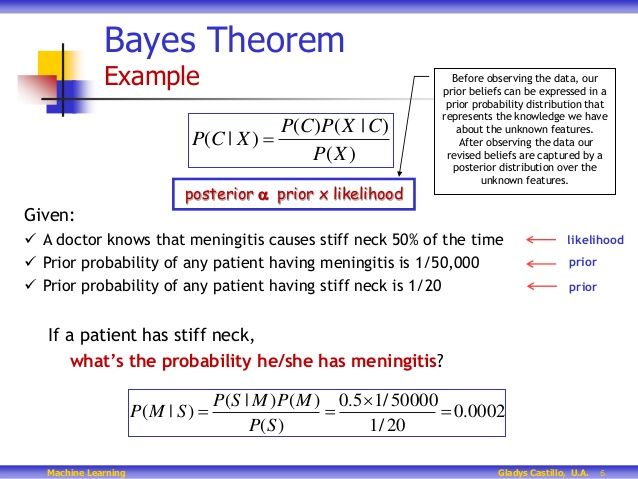
lesson-72-bayesian-network-classifiers-6-638

The application above shows some important facts to remember about Beliefs and Uncertainties:

Tests are not the event. We have a cancer test, separate from the event of actually having cancer. We have a test for spam, separate from the event of actually having a spam message.

Tests are flawed. Tests detect things that don’t exist (false positive), and miss things that do exist (false negative).

Tests give us test probabilities, not the real probabilities. People often consider the test results directly, without considering the errors in the tests.

False positives skew results. Suppose you are searching for something really rare (1 in a million). Even with a good test, it’s likely that a positive result is really a false positive on somebody in the 999,999.
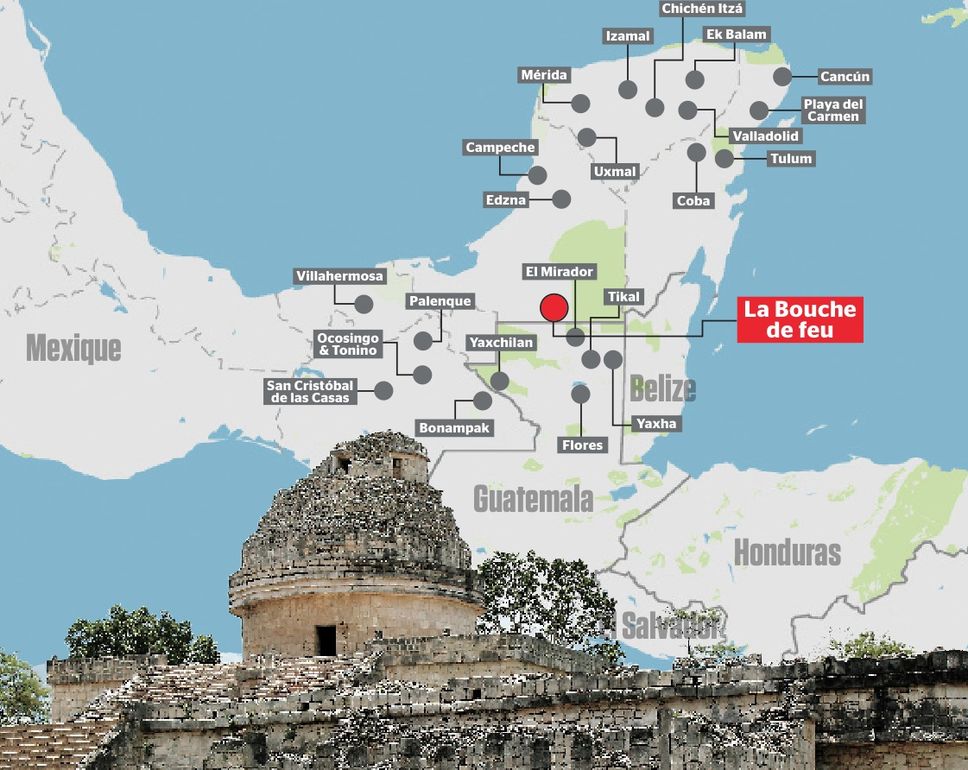
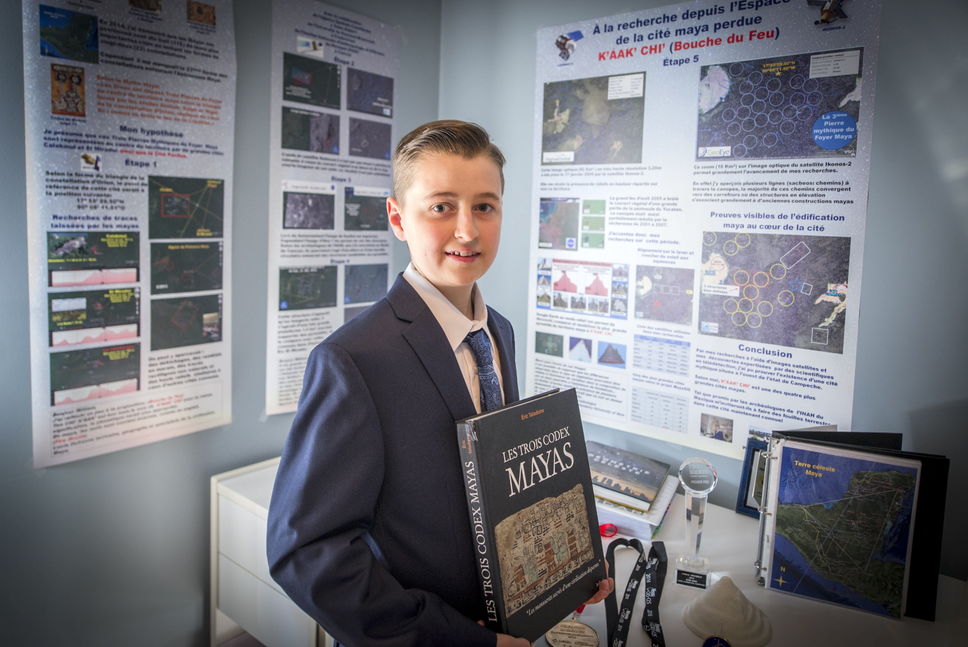
Cool: Quebec teen Studies Stars, Discovers Ancient Mayan City


Mouth of Fire

William Gadoury is a 15-year-old student from Saint-Jean-de-Matha in Lanaudière, Quebec. The precocious teen has been fascinated by all things Mayan for several years, devouring any information he could find on the topic.

During his research, Gadoury examined 22 Mayan constellations and discovered that if he projected those constellations onto a map, the shapes corresponded perfectly with the locations of 117 Mayan cities. Incredibly, the 15-year-old was the first person to establish this important correlation.

Then Gadoury took it one step further. He examined a twenty-third constellation which contained three stars, yet only two corresponded to known cities.

Gadoury’s hypothesis? There had to be a city in the place where that third star fell on the map.

Satellite images later confirmed that, indeed, geometric shapes visible from above imply that an ancient city with a large pyramid and thirty buildings stands exactly where Gadoury said they would be. If the find is confirmed, it would be the fourth largest Mayan city in existence.

Once Gadoury had established where he thought the city should be, the young man reached out to the Canadian Space Agency where staff was able to obtain satellites through NASA and JAXA, the Japanese space agency.

“What makes William’s project fascinating is the depth of his research,” said Canadian Space Agency liaison officer Daniel de Lisle. “Linking the positions of stars to the location of a lost city along with the use of satellite images on a tiny territory to identify the remains buried under dense vegetation is quite exceptional.”

Gadoury has decided to name the city K’ÀAK ‘CHI, a Mayan phrase which in English means “Mouth of Fire.”

Gadoury

Summary

Now that is the way you do science: Find a correlation, form a theory explaining it, make a prediction, and verify it in the real world.  The preliminary confirmation is by remote sensing with satellite images showing the geometrical shapes.

“I did not understand why the Maya built their cities away from rivers, on marginal lands, and in the mountains. They had to have another reason, and as they worshiped the stars, the idea came to me to verify my hypothesis,” Gadoury told Le Journal de Montreal.

“I was really surprised and excited when I realized that the most brilliant stars of the constellations matched the largest Maya cities,” he added.

The next step for Gadoury will be seeing the city in person. He’s already presented his findings to two Mexican archaeologists, and has been promised that he’ll join expeditions to the area.

What a delightful young scientist and a wonderful achievement.

Sources: Earth Mystery NewsEpoch Times.

Head, Heart and Science

A man who has not been a socialist before 25 has no heart. If he remains one after 25 he has no head.—King Oscar II of Sweden

Recently I had an interchange with a friend from high school days, and he got quite upset with this video by Richard Lindzen. So much so, that he looked up attack pieces in order to dismiss Lindzen as a source.  This experience impressed some things upon me.

Climate Change is Now Mostly a Political Football (at least in USA)

My friend attributed his ill humor to the current political environment. He readily bought into slanderous claims, and references to being bought and paid for by the Koch brothers. At this point, Bernie and Hilliary only disagree about who is the truest believer in Global Warming. Once we get into the general election process, “Fighting Climate Change” will intensify as a wedge issue, wielded by smug righteous believers on the left against the anti-science neanderthals on the right.

So it is a hot label for social-media driven types to identify who is in the tribe (who can be trusted) and the others who can not.  For many, it is not any deeper than that.

The Warming Consensus is a Timesaver

My friend acknowledged that his mind was made up on the issue because 95+% of scientists agreed. It was extremely important for him to discredit Lindzen as untrustworthy to maintain the unanimity. When a Warmist uses: “The Scientists say: ______” , it is much the same as a Christian reference: “The Bible says: _______.” In both cases, you can fill in the blank with whatever you like, and attribute your idea to the Authority. And most importantly, you can keep the issue safely parked in a No Thinking Zone. There are plenty of confusing things going on around us, and no one wants one more ambiguity requiring time and energy.

Science Could Lose the Delicate Balance Between Head and Heart

Decades ago Arthur Eddington wrote about the tension between attitudes of artists and scientists in their regarding nature. On the one hand are people filled with the human impulse to respect, adore and celebrate the beauty of life and the world. On the other are people driven by the equally human need to analyze, understand and know what to expect from the world. These are Yin and Yang, not mutually exclusive, and all of us have some of each.

Most of us can recall the visceral response in the high school biology lab when assigned to dissect a frog. Later on, crayfish were preferred (less disturbing to artistic sensibilities). For all I know, recent generations have been spared this right of passage, to their detriment. For in the conflict between appreciating things as they are, and the need to know why and how they are, we are exposed to deeper reaches of the human experience. If you have ever witnessed, as I have, a human body laid open on an autopsy table, then you know what I mean.

Anyone, scientist or artist, can find awe in contemplating the mysteries of life. There was a time when it was feared that the march of science was so advancing the boundaries of knowledge that the shrinking domain of the unexplained left ever less room for God and religion. Practicing scientists knew better. Knowing more leads to discovering more unknowns; answers produce cascades of new questions. The mystery abounds, and the discovery continues. Eddington:

It is pertinent to remember that the concept of substance has disappeared from fundamental physics; what we ultimately come down to is form. Waves! Waves!! Waves!!! Or for a change — if we turn to relativity theory — curvature! Energy which, since it is conserved, might be looked upon as the modern successor of substance, is in relativity theory a curvature of space-time, and in quantum theory a periodicity of waves. I do not suggest that either the curvature or the waves are to be taken in a literal objective sense; but the two great theories, in their efforts to reduce what is known about energy to a comprehensible picture, both find what they require in a conception of “form”.

What do we really observe? Relativity theory has returned one answer — we only observe relations. Quantum theory returns another answer — we only observe probabilities.

It is impossible to trap modern physics into predicting anything with perfect determinism because it deals with probabilities from the outset.
― Arthur Stanley Eddington

Works by Eddington on Science and the Natural World are here.

Summary

The science problem today is not the scientists themselves, but with those attempting to halt its progress for the sake of political power and wealth.

Eddington:
Religious creeds are a great obstacle to any full sympathy between the outlook of the scientist and the outlook which religion is so often supposed to require … The spirit of seeking which animates us refuses to regard any kind of creed as its goal. It would be a shock to come across a university where it was the practice of the students to recite adherence to Newton’s laws of motion, to Maxwell’s equations and to the electromagnetic theory of light. We should not deplore it the less if our own pet theory happened to be included, or if the list were brought up to date every few years. We should say that the students cannot possibly realise the intention of scientific training if they are taught to look on these results as things to be recited and subscribed to. Science may fall short of its ideal, and although the peril scarcely takes this extreme form, it is not always easy, particularly in popular science, to maintain our stand against creed and dogma.
― Arthur Stanley Eddington

But enough about science. It’s politicians we need to worry about:

Footnote:

“Asked in 1919 whether it was true that only three people in the world understood the theory of general relativity, [Eddington] allegedly replied: ‘Who’s the third?”