CO2 Rise ≠ Sea Level Rise
1-s2-0-s1674987118300446-gr6

This recent paper is very topical, since several US coastal states are suing oil companies for damages expected from rising sea levels. Some Alaskan teenagers are making similar claims in a separate lawsuit against the US federal government. The study is Why would sea-level rise for global warming and polar ice-melt? By Aftab Alam Khan published in Geoscience Frontiers. Excerpts below with my bolds. H/T to NoTricksZone

IPCC Alarms over Sea Level Rise

Sea Level Change in the Fifth Assessment Report includes detailed explanation of the changes in the global mean sea level, regional sea level, sea level extremes, and waves (Church et al., 2013). Anthropogenic greenhouse gas emissions are causing sea-level rise (SLR) (Church and White, 2006; Jevrejeva et al., 2009). It is also claimed that ocean thermal expansion and glacier melting have been the dominant contributors to 20th century global mean sea level rise. It is further opined that global warming is the main contributor to the rise in global sea level since the Industrial Revolution (Church and White, 2006). According to Cazenave and Llovel (2010) rising of air temperature can warm and expand ocean waters wherein thermal expansion was the main driver of global sea level rise for 75 to 100 years after the start of the Industrial Revolution.

However, the share of thermal expansion in global sea level rise has declined in recent decades as the shrinking of land ice has accelerated (Lombard et al 2005). Lombard et al. (2006) opined that recent investigations based on new ocean temperature data sets indicate that thermal expansion only explains part (about 0.4 mm/yr) of the 1.8 mm/yr observed sea level rise of the past few decades. However, observation claim of 1.8 mm/yr sea level rise is also limited in scope and accuracy.

Fundamentals of Sea Level Variability

Mean Sea Level (MSL) is defined as the zero elevation for a local area. The zero surface referenced by elevation is called a vertical datum. Since sea surface conforms to the earth’s gravitational field, MSL has also slight hills and valleys that are similar to the land surface but much smoother. The MSL surface is in a state of gravitational equilibrium. It can be regarded as extending under the continents and is a close approximation of geoid. By definition geoid describes the irregular shape of the earth and is the true zero surface for measuring elevations. Because geoid surface cannot directly be observed, heights above or below the geoid surface can’t be directly measured and are inferred by making gravity measurements and modeling the surface mathematically.

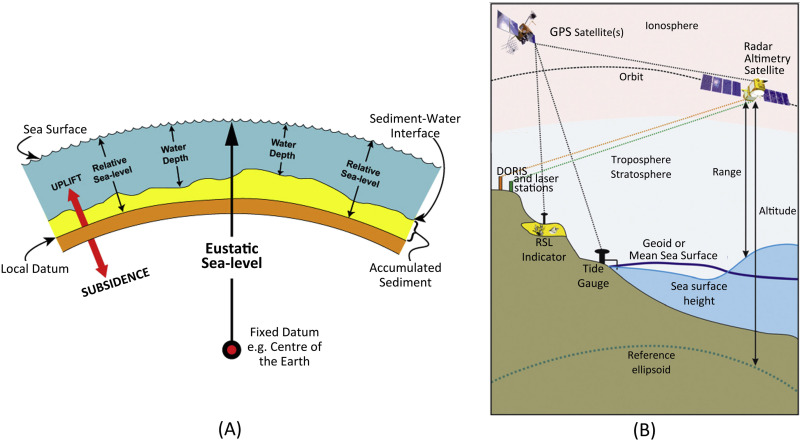
Previously, there was no way to accurately measure geoid so it was roughly approximated by MSL. Although for practical purposes geoid and MSL surfaces are assumed to be essentially the same, but in reality geoid differs from MSL by several meters. Geoid moves above MSL where mass is excess and moves below MSL where mass is deficient. Distribution of mass in the crust in terms of ‘excess’ and ‘deficient’ can cause volume expansion and contraction for relative sea-level change. Height of the ocean surface at any given location, or sea level, is measured either with respect to the surface of the solid Earth i.e., relative sea level (RSL) or a eustatic sea level (ESL) (Fig. 1A).

Relative sea level (RSL) change can differ significantly from global mean sea level (GMSL) because of spatial variability in changes of the sea surface and ocean floor height. RSL change over the ocean surface area gives the change in ocean water volume, which is directly related to the sea level change. Sea level changes can be driven either by variations in the masses or volume of the oceans, or by changes of the land with respect to the sea surface. In the first case, a sea level change is defined ‘eustatic’; otherwise, it is defined ‘relative’ (Rovere et al., 2016). According to Kemp et al. (2015) land uplift or subsidence can result in, respectively, a fall or rise in sea level that cannot be considered eustatic as the volume or mass of water does not change. Any sea level change that is observed with respect to a land-based reference frame is defined a relative sea level (RSL) change. Eustatic Sea Level (ESL) changes also occur when the volume of the ocean basins changes due to tectonic seafloor spreading or sedimentation.
1-s2-0-s1674987118300446-gr1

Figure 1. (A) Definition of sea level i.e., eustatic sea level and relative sea level (B) Different types of sea level observation techniques: satellite altimetry (based on NASA educational material), tide gauge and paleo sea level indicators (see text for details). Modern tide gauges are associated with a GPS station that records land movements.

Sea Level Observations

Changes in sea level can be observed at very different time scales and with different techniques (Fig. 1B). Regardless of the technique used, no observation allows to record purely eustatic sea level changes. At multi-decadal time scales, sea level reconstructions are based on satellite altimetry/gravimetry and landbased tide gauges (Cabanes et al., 2001). At longer time scales (few hundreds, thousands to millions of years), the measurement of sea level changes relies on a wide range of sea level indicators (Shennan and Horton, 2002; Vacchi et al., 2016; Rovere et al., 2016a). One of the most common methods to observe sea level changes at multi-decadal time scales is tide gauges.

Modern tide gauges are associated with a GPS station that records land movements (Fig. 1B). However, tide gauges have three main disadvantages: (i) they are unevenly distributed around the world (Julia Pfeffer and Allemand, 2015); (ii) the sea level signal they record is often characterized by missing data (Hay et al., 2015); and (iii) accounting for ocean dynamic changes and land movements might prove difficult in the absence of independent datasets (Rovere et al., 2016). Since 1992, tide gauge data are complemented by satellite altimetry datasets (Cazenave et al., 2002).

The altitude of the satellite is established with respect to an ellipsoid, which is an arbitrary and fixed surface that approximates the shape of the Earth. The difference between the altitude of the satellite and the range is defined as the sea surface height (SSH) (Fig. 1B). Subtracting from the measured SSH a reference mean sea surface (e.g. the geoid), one can obtain a ‘SSH anomaly’. The global average of all SSH anomalies can be plotted over time to define the global mean sea level change, which can be considered as the eustatic, globally averaged sea level change.

The shape of the geoid is crucial for deriving accurate measurements of seasonal sea level variations (Chambers, 2006). According to Rovere et al. (2016) measurements of paleo eustatic sea level (ESL) changes bear considerable uncertainty. Further, sea level changes on Earth cannot be treated as a rigid container although eustasy is defined in view of Earth as a rigid container. In reality, internal and external processes of the earth such as tectonics, dynamic topography, sediment compaction and melting ice all trigger variations of the container and these ultimately affect any sea level observation.

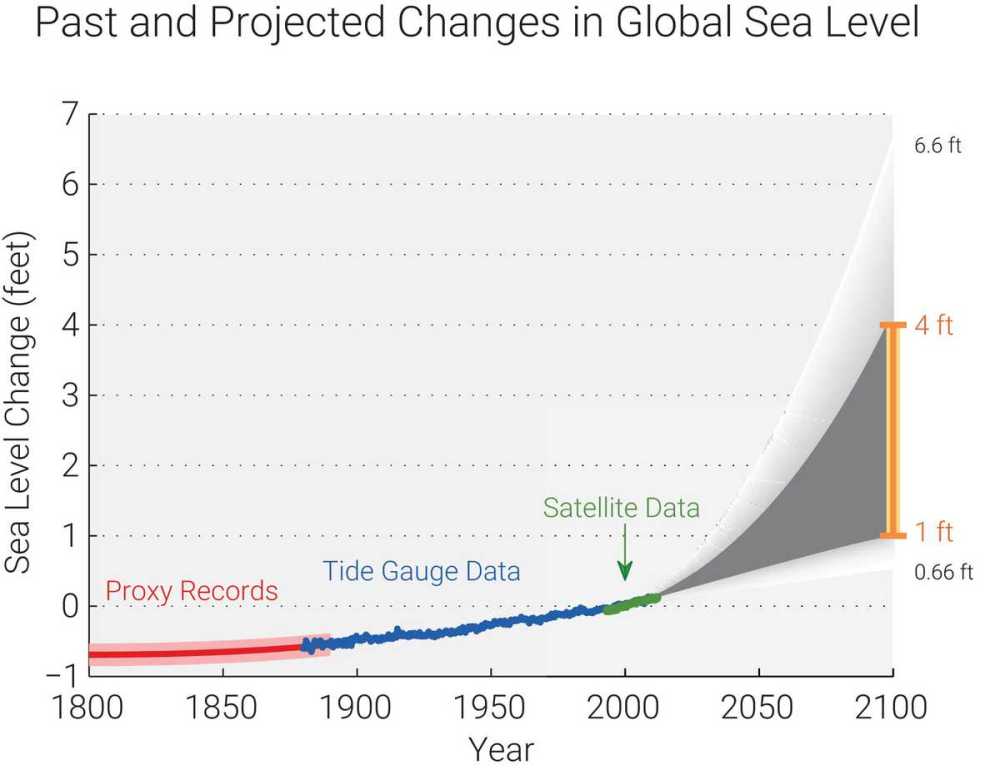
An estimated, observed, and possible future amounts of global sea level rise from 1800 to 2100, relative to the year 2000 has been proposed by Melillo et al. (2014) based on the works of Church and White (2011), Kemp et al. (2011) and Parris et al. (2012) (Fig. 2). The main concern of the predicted future global sea level rise shown in Melillo et al. (2014) is the forecast beyond 2012 up to 2100. Although sea level rise is shown by 0.89 ft in 209 years (between 1800 and 2009) at the rate of 0.0043 ft/yr, the prediction of 4–6 ft at the rate of 0.044 ft/yr and 0.066 ft/yr respectively in 91 years between 2009 and 2100) is highly questionable. An abrupt jump in the sea level rise after 2009 is definitely a conjecture.
ak-figure-7-1200

Figure 2. Estimated, observed, and predicted global sea level rise from 1800 to 2100. Estimates from proxy data are shown in red between 1800 and 1890, pink band shows uncertainty. Tide gauge data is shown in blue for 1880–2009. Satellite observations are shown in green from 1993 to 2012. The future scenarios range from 0.66 ft to 6.6 ft in 2100 (Redrawn from Melillo et al., 2014).

Sea Level Distribution is Determined by the Earth Surface

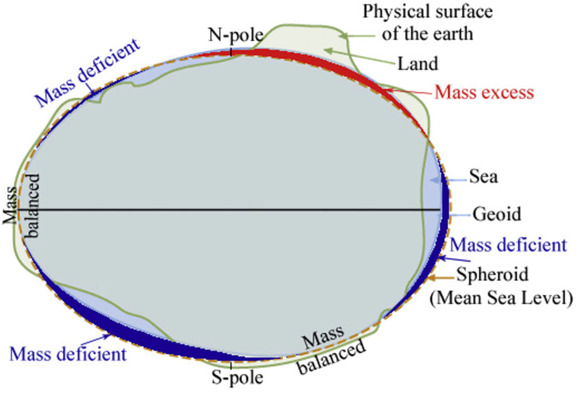
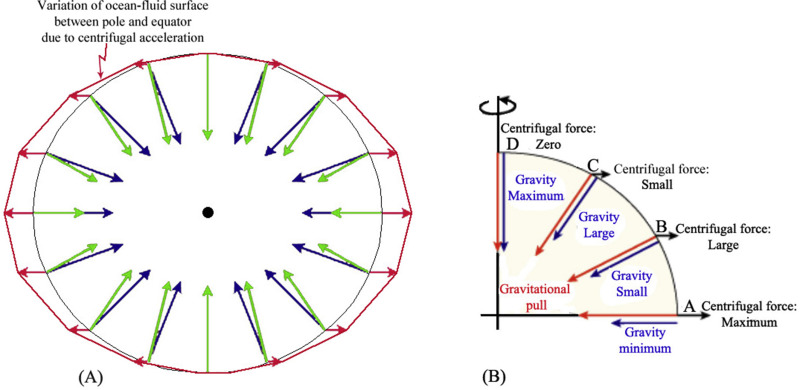
This study is based on the geophysical aspects of the earth wherein shape of the earth is the fundamental component of global sea level distribution. The physical surface of the earth adjusted to the mathematical surface of the earth is spheroidal. This spheroidal surface always coincides with the global mean sea level (Fig. 3). Having relationship between the shape of the earth and the global sea level, gravitational attraction of the earth plays a dominant role against sea level rise. Gravity is a force that causes earth to form the shape of a sphere by pulling the mass of the earth close to the center of gravity i.e., each mass-particle is attracted perpendicular towards the center of gravity of the earth (Fig. 4A).
1-s2-0-s1674987118300446-gr3

Figure 3. Physical surface (light green undulating line) of the earth adjusted to spheroidal surface (yellow broken line) by removing mass from continent above mean sea level and filling same mass in ocean below mean sea level. Geoid surface (light blue solid line), on the other hand, depends on the internal mass distribution i.e., geoid moves below spheroid where mass is deficient and it moves above spheroid where mass is excess. Where geoid surface and spheroidal surface coincides is accounted for mass balanced. By definition geoid describes the irregular shape of the earth and is the true zero surface for measuring elevations. Because geoid surface cannot be directly observed, heights above or below the geoid surface can’t be directly measured and are inferred by making gravity measurements and modeling the surface mathematically. MSL surfaces are assumed to be essentially the same, at some spots the geoid can actually differ from MSL by several meters.

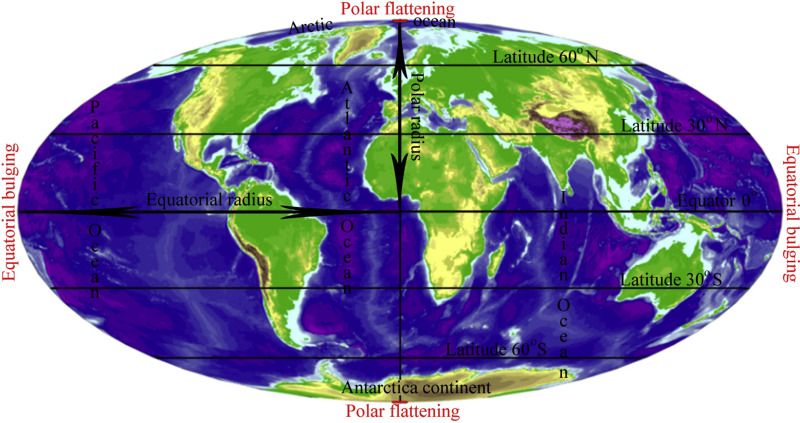
The sphere-like shape of the earth is distorted by (i) greater gravity attraction of the polar region causing polar flattening and lesser gravity attraction of the equatorial region causing equatorial bulging, and (ii) the centrifugal force of its rotation. This force causes the mass of the earth to move away from the center of gravity, which is located at the equator. Ocean-fluid surface takes a outward normal vector due to centrifugal force which is maximum at the equator and zero at the poles (Fig. 4B). Mathematical surface, an imaginary surface coinciding with the mean sea level of the Earth is a spheroidal surface due to its spin, and it is the centrifugal force due to the Earth’s spin caused polar flattening and equatorial bulge. The polar flattening ratio (eccentricity) of 1/298 implied that sea level at the equator is about 21 km further from the center of the Earth than it is at the poles. Water would find its hydrostatic level which is curvilinear, and this level is influenced by the gravity as well as centrifugal force. Centrifugal force acts as much on the oceans as it does on the solid Earth, which is maximum at the equator and minimum at the pole (Fig. 4B). Any addition of water to the oceans is supposed to flow uphill towards equator from the poles causing sea level rise everywhere, but it does not. Hence, although ocean water at the equator makes a level difference of 21 km higher than at the poles, it is the centrifugal force maximum at the equator and zero at the poles would prevent ocean water-column from moving down-hill toward poles effectively restricting sea level rise at the higher latitudes. On the other hand high gravity attraction and zero centrifugal force at the poles and low gravity attraction and maximum centrifugal force at the equator effectively balance sea-level and restrict sea-level rise. While, equatorial ocean-fluid surface always attains relatively higher altitude than that of polar ocean-fluid surface, ocean water column from polar region would not move towards equatorial region.
1-s2-0-s1674987118300446-gr4

Figure 4. The shape of a sphere by pulling the mass of the earth close to the center of gravity. Blue arrows point from Earth’s surface toward its center. Their lengths represent local gravitational field strength. Gravity is strongest at the poles because they are closest to the center of mass. This difference is enhanced by the increasing density toward the center. Red arrows show the direction and magnitude of the centrifugal effect. On the equator, it is large and straight up. Near the poles, it is small and nearly horizontal. Vector addition of the blue and red arrows gives the net result of gravity plus centrifugal effect. This is shown by the green arrows. Rotation of the earth produces more centrifugal force at the equator, less as latitude increases, and zero at pole.

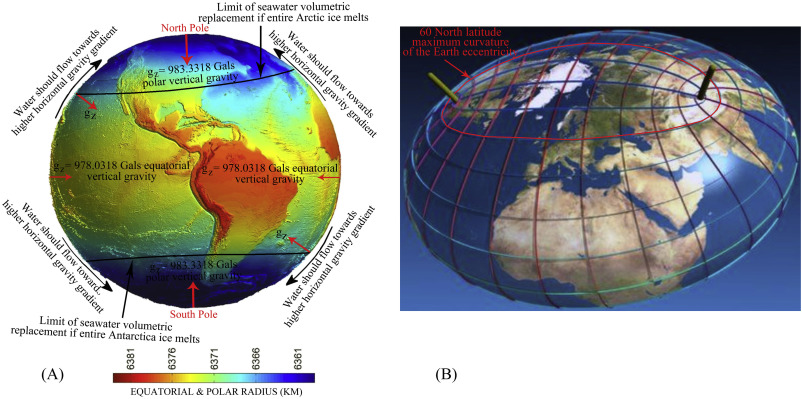
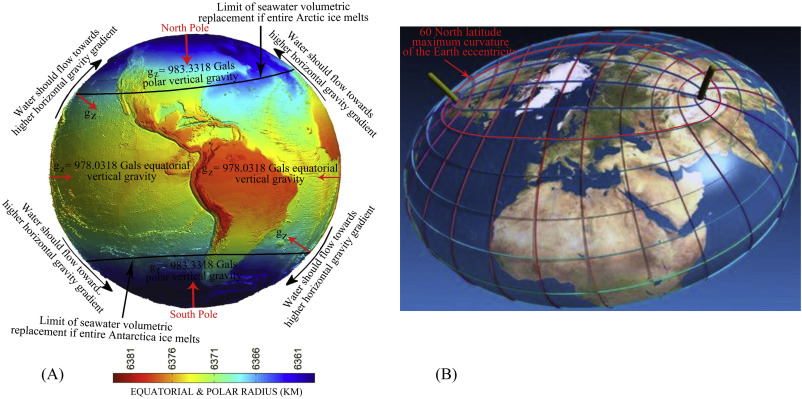
A mass of fluid under the rotation assumes a form such that its external form is an equipotential of its own attraction and the potential of the centripetal acceleration. Above analogy reveals that even if entire polar-ice melts due to the global warming, the melt-water will not flow towards equatorial region where surface has an upward gradient and gravity attraction is also significantly low in comparison to the polar region. However, conditions at both the poles are different. Arctic Ocean in the north is surrounded by the land mass thus can restrict the movement of the floating ice, while, Antarctic in the south is surrounded by open ocean thus floating ice can freely move to the north. But this movement is likely to be limited maximum up to 60°S latitude where spheroidal surface has the maximum curvature (Fig. 6B). As usual, water can not flow from higher gravity attraction to lower gravity attraction rather it is other way around wherein higher gravity attraction of the poles would attract water from moving towards equatorial region and water column would be static at every ‘gz’ direction. Further, greater horizontal gravity gradient toward poles would also help melt-water to remain attracted toward polar region.
1-s2-0-s1674987118300446-gr61

Figure 6. (A) Surface of the earth is defined in terms of gravity values at all surface points known as the reference spheroid. It is related to the mean sea-level (MSL) surface with excess land masses removed and ocean deeps filled. Thus it is an equipotential surface, that is, the force of gravity (gz) (red arrows) is everywhere normal to this surface, or the plumb line is vertical at all points directed to the center of the earth having maximum at the poles and minimum at the equator. Two components work against sea level rise i.e., greater gravity attraction of the polar region and the equatorial bulge (B) Maximum curvature of the spheroidal surface of the Earth coincides with 60oN latitude. Floating ice from Antarctica surrounded by open ocean can freely move to the north likely to be limited maximum upto 60oS latitude where spheroidal surface has the maximum curvature.

A geoid surface thus prepared exhibits bulges and hollows of the order of hundreds of kilometers in diameter and up to hundred meter in elevation occurring in the zone mostly between 60°N and 60°S latitudes. Marked changes in the contour pattern of the geoid height in the zone between 60°N and 60°S suggests maximum curvature along 60°N and 60°S. Hence any change of the global sea level due to the predicted ice melt would not extend beyond 60°N and 60°S. However the reality is that no sea-level rise actually would occur due to ice melt as a result of same volumetric replacement between melt-water and floating ice.

Lindsay and Schweiger (2015) provide a longer-term view of ice thickness, compiling a variety of subsurface, aircraft, and satellite observations. They found that ice thickness over the central Arctic Ocean has declined from an average of 3.59 m (11.78 ft) to only 1.25 m (4.10 ft), a reduction of 65% over the period 1975 to 2012. Map shows sea ice thickness in meters in the Arctic Ocean from March 29, 2015 to April 25, 2015 (Fig. 9B). Total volume of ice-melt water of more than 2,500,000 km3 has been added to ocean water over an area more than 14,500,000 km2 of the central Arctic Ocean (Fig. 9B blue shaded area). By now this additional water should have caused sea level rise more than 178 mm which is much greater than what has been projected and predicted. However there is no record of such sea level rise.

Arctic sea-ice has already reduced its volume due to melting from 33,000 km3 in 1979 to 16,000 km3 in 2016 without showing any sea level rise. Although Arctic sea-ice has reduced its volume, Antarctic has gained (Zhang and Rothrock, 2003) (http://psc.apl.uw.edu). In contrast to the melting of the Arctic sea-ice, sea-ice around Antarctica was expanding as of 2013 (Bintanja et al., 2013). NASA study shows an increase in Antarctic snow accumulation that began 10,000 years ago is currently adding enough ice to the continent to outweigh the increased losses from its thinning glaciers.

From the above statement it is clearly understood that about 23,000 km3 sea-ice of Antarctica can freely float northward into the warmer water where it eventually melts every year without showing any sea level rise in the lower latitudes. Further, melting of such a huge volume of floating sea-ice of Antarctica not only can reoccupy volume of the displaced water but also can cool ocean-water in the lower latitudes of the southern oceans thus can prevent sea level rise due to thermal expansion of the ocean water. According to Zhang (2007) thermal expansion in the lower latitude is unlikely because of the reduced salt rejection and upper-ocean density and the enhanced thermohaline stratification tend to suppress convective overturning, leading to a decrease in the upward ocean heat transport and the ocean heat flux available to melt sea ice. The ice melting from ocean heat flux decreases faster than the ice growth does in the weakly stratified Southern Ocean, leading to an increase in the net ice production and hence an increase in ice mass.

Both the polar regions exhibit reduction in ice-load in the crust due to melting and removal of ice-cover from the continental blocks every year. Reduction of such weight in the continent thus can cause isostasy to come into play and land start to uplift due to elastic rebound to maintain its isostatic equilibrium which is load-dependent and would prevent sea level rise.
1-s2-0-s1674987118300446-gr13

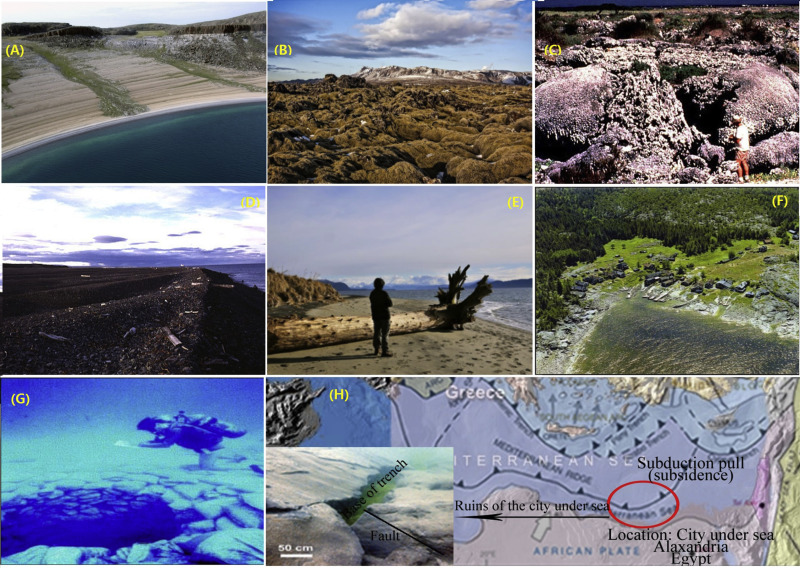
Figure 13. (A) Layered beach at Bathurst Inlet, Nunavut signifying post-glacial isostatic rebound (B) Some of the most dramatic uplift is found in Iceland. Evidence of isostatic rebound (C) Massive coral (Pavona clavus) exposed in 1954 by tectonic uplift in the Galapagos Islands, Ecuador (D) Beach ridges on the coast of Novaya Zemlya in arctic Russia, an example of Holocene glacio-isostatic rebound (E) A beach in Juneau, Alaska where sea level is not rising, but dropping due to glacial isostatic adjustment (F) Boat-houses in Scandinavia now considerably farther away from the water’s edge where they were built demonstrates land uplift (G) An 8000-year old-well off the coast of Israel now submerged, which is a land mark of crustal subsidence (H) The “City beneath the Sea”; Port Alexandria on the Nile delta and the drowned well off the coast of Israe (panel (G), both subsided due to subduction-pull of the downgoing African crustal slab as it enters trench.

Postglacial rebound continues today albeit very slowly wherein the land beneath the former ice sheets around Hudson Bay and central Scandinavia, is still rising by over a centimetre a year, while those regions which had bulged upwards around the ice sheet are subsiding such as the Baltic states and much of the eastern seaboard of North America. Snay et al. (2016) have found large residual vertical velocities, some with values exceeding 30 mm/yr, in southeastern Alaska. The uplift occurring here is due to present-day melting of glaciers and ice fields formed during the Little Ice Age glacial advance that occurred between 1550 A.D. and 1850 A.D.

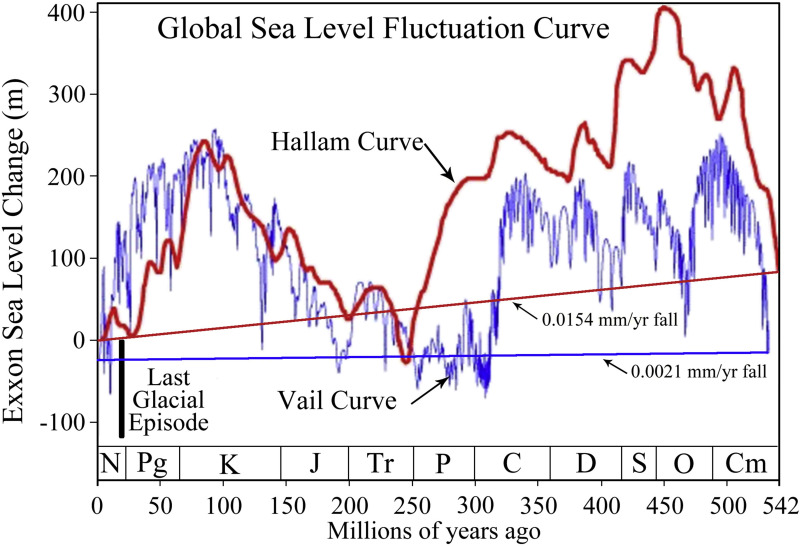
When the land area shrinks globally, this corresponds to a global rise in sea level. From the curve it is certain that sea level has changed in geologic time scale due to geologic events. Hence, polar ice-melting would not contribute to sea-level rise rather sea-level would drop around the Arctic region as long as isostatic rebound will continue. Claim and prediction of 3 mm/yr rise of sea-level due to global warming and polar ice-melt is definitely a conjecture. Prediction of 4–6.6 ft sea level rise in the next 91 years between 2009 and 2100 is highly erroneous.
1-s2-0-s1674987118300446-gr12

Figure 12. Vail and Hallam curves of global paleo sea level fluctuations from the last 542 million years (Copied and redrawn from https://en.wikipedia.org/wiki/Sea-level_curve).

A negative sea level trend implied that Alaska is being uplifted continuously and corresponding sea level is dropping. However, permanent uplift and corresponding sea level drop of Alaska will occur through ultimate fault rupture between land and sea. Until that time it will continue to show the pattern of sea level as of Fig. 14A.

Conclusion
Geophysical shape of the earth is the fundamental component of the global sea level distribution. Global warming and ice-melt, although a reality, would not contribute to sea-level rise. Gravitational attraction of the earth plays a dominant role against sea level rise. As a result of low gravity attraction in the region of equatorial bulge and high gravity attraction in the region of polar flattening, melt-water would not move from polar region to equatorial region. Further, melt-water of the floating ice-sheets will reoccupy same volume of the displaced water by floating ice-sheets causing no sea-level rise. Arctic Ocean in the north is surrounded by the land mass thus can restrict the movement of the floating ice, while, Antarctic in the south is surrounded by open ocean thus floating ice can freely move to the north. Melting of huge volume of floating sea-ice around Antarctica not only can reoccupy volume of the displaced water but also can cool ocean-water in the region of equatorial bulge thus can prevent thermal expansion of the ocean water. Melting of land ice in both the polar region can substantially reduce load on the crust allowing crust to rebound elastically for isostatic balancing through uplift causing sea level to drop relatively. Palaeo-sea level rise and fall in macro-scale are related to marine transgression and regression in addition to other geologic events like converging and diverging plate tectonics, orogenic uplift of the collision margin, basin subsidence of the extensional crust, volcanic activities in the oceanic region, prograding delta buildup, ocean floor height change and sub-marine mass avalanche.

Summary

This  research paper reads like a tutorial on sea level rise, and explains the geoscience behind fluctuations in observed sea levels over all time scales.  It should be required reading for Judge Alsup, lawyers and litigants in these multiple lawsuits.
1-s2-0-s1674987118300446-gr5

Sea Level Hype

It seems that alarmists get their exercise mainly by jumping to conclusions. Using datasets as trampolines they make great leaps of faith, oftentimes turning reality upside down in the process.

Update Feb. 17 at bottom

The latest example is the mass media excitement and exaggerations concerning sea level rise. Just consider the listing from Google News Feb. 13:

Miami could be underwater in your kid’s lifetime as sea level rise accelerates
USA Today

Yes, sea level rise really is accelerating
Ars Technica

Study: Sea level rise is accelerating and its rate could double in next century
Chicago Tribune

“It’s a big deal”: Melting ice sheets are accelerating sea level rise
CBS News Feb 13, 201

Satellites: Sea level rise to reach 2 feet by 2100
Minnesota Public Radio News (blog)

Satellite observations show sea levels rising, and climate change is accelerating it
CNN

The sea is coming for us
The Outline

Etc. Etc.Etc.

Although the principle author gave those juicy sound bites so craved by unreflective journalists, still the actual paper is quite restrained in its claims.  After all, they are only looking at 25 years of a very noisy dataset which has a quasi 60-year oscillation.  The paper is:

Climate-change–driven accelerated sea-level rise detected in the altimeter era By R. S. Nerem et al.

Abstract

Using a 25-y time series of precision satellite altimeter data from TOPEX/Poseidon, Jason-1, Jason-2, and Jason-3, we estimate the climate-change–driven acceleration of global mean sea level over the last 25 y to be 0.084 ± 0.025 mm/y2. Coupled with the average climate-change–driven rate of sea level rise over these same 25 y of 2.9 mm/y, simple extrapolation of the quadratic implies global mean sea level could rise 65 ± 12 cm by 2100 compared with 2005, roughly in agreement with the Intergovernmental Panel on Climate Change (IPCC) 5th Assessment Report (AR5) model projections.

Dr. John Ray provides a skeptical commentary, writing from Brisbane, Australia, at his blog (here) with my bolds.

Dedicated Warmist Seth Borenstein sets out a coherent story about warming causing sea-level rise. He regurgitates all the usual Warmist talking points regardless of their truth. He says, for instance, that the Antarctic is melting when it is not.

So we have to go back to the journal article behind Seth’s splurge to see what the scientists are saying.

And what we see there is very different from Seth’s confident pronouncements. We see a very guarded article indeed which rightly lists many of the difficulties in measuring sea level rise. And they can surmount those difficulties only by a welter of estimates and adjustments. Anywhere in that process there could be errors and biases. And as a result, we see that the journal authors describe their findings as only a”preliminary estimate” of sea level rise.

And it gets worse. When we look further into the journal article we see that the sea level rise is measured in terms of only 84 thousandths of one millimeter. So we are in the comedy of the absurd. Such a figure is just a statistical artifact with no observable physical equivalent.

So the sea level rise Seth talks about with great confidence ends up being an unbelievably small quantity measured with great imprecision! Amazing what you find when you look at the numbers, isn’t it?

Many advances in science start with a leap of imagination.  I seem to remember a chemist who woke up one morning with the first correct diagram of benzene.  And a man I admired said before sleeping he brought to mind things that were puzzling him.  Often in the morning he found answers combing out his hair.  Of course any such notions must then be validated through experimentation and measurement to become scientific knowledge.  A leap of faith is another matter altogether.

Sea Level Measurement Contortions

What’s involved in estimating sea level by means of satellites? Albert Parker is a seasoned researcher and explains to us laymen in this interview, followed by links to his recent publications. Senior Researcher Questions Satellite Measurements of Global Sea-Level By Ernest Dempsey with my bolds.

With a lot of rhetoric about the claimed sea-level rise and threat of global warming due to carbon emissions from human activities, the actual science of sea-level measurements and scientific inquiry of the verifiable degree of climate change has been lost in the noise. The following correspondence with Albert Parker, PhD, author of the 2014 paper Problems and reliability of the satellite altimeter based Global Mean Sea Level computation casts light on how reliable the various sea-level measurements are and whether the actual, on-ground science verifies the narrative of carbon-based climate change and alarming sea-level rise.

Ernest: Albert, thanks for taking my call for this Q&A. Would you please tell us about your academic and research background briefly?

Albert Parker: I received my MSc and PhD in Engineering many years ago, before the age of the commercial universities. I have been working after the PhD for 30 years in companies and universities. I started to work on climate change as an independent scientist, for my personal understanding, after the leaked Climategate emails in 2009, as I was curious to see what was really going on in the raw data.

Ernest: Can you please tell our readers the various methods scientists have used to measure the mean sea level at any point?

Albert Parker: Relative sea levels have been locally measured by tidal gauges for many years. A tidal gauge signal is characterized by oscillations on many different time scales. The tidal gauge signal is monthly averaged. A linear fitting of the monthly average values collected over a sufficiently long time window returns the trend. As the tide gauge instrument can move up and down, these sea levels are relative to the instrument.

The absolute global sea level is a hypothetical measure of the status of the ocean waters. Somebody has produced global mean sea level reconstructions from tide gauges since the 1700 or the 1800. These reconstructions are not reliable. Before the end of the 1800s, there was for example not a single tide gauge covering all the southern hemisphere. To compute a proper global mean sea level from tide gauges, you should need many gridded tide gauges along the world coastline, and a measure of their absolute vertical motion, both based on a sufficiently long common time window. There is not such a thing yet. As the trends significantly vary from one location to the other, it therefore only makes sense to focus on the average acceleration rather than the global mean sea level trend.

Ernest: In your 2014 paper, you inform that tide gauge measurements of mean sea level show negligibly small annual rise in mean sea level while satellite measurements give us a notably larger rise in sea level globally. Which of these two would you call more reliable and why?

Albert Parker: The only results to consider are local and global average trends and accelerations from tidal gauges of sufficient quality and length. If a global mean sea level from tide gauges can hardly be computed, you may still look at the individual tide gauges of enough length and quality to understand if there is acceleration or not. And so far, there has been very little acceleration in any tide gauge record over the 20th century and what is passed of the 21th century. Therefore, coastal management can be local, with adaptation measures needed where the sea level rises significantly because of extreme subsidence, and not certainly where the sea levels are rising slowly or are falling.

Regarding the satellite global mean sea level, this result is more a computation than a true measurement and it is not reliable. If you try to track by global positioning system (GPS) the position of selected fixed points, such as few GPS domes on land, and you try to compute the GPS time series to derive a GPS velocity, you may then discover that this much simpler computation, also constrained by the geodetic dimensions, still suffers significant uncertainties, because of satellite drift and other technicalities. It is therefore impossible to measure with nanometric precision the instantaneous height of all the water volume to then derive a time rate of change. The only thing that you can get from the satellite altimeter measurements is an almost detrended, noisy signal, as it was clear in the first results of the project. If subjective corrections are then applied to this signal, for any reason you get the satellite altimeter results that is not a measure, it is a computation, that lacking validation has very little value.

Ernest: Tell us about calibration and its role in sea level readings.

Albert Parker: It is not just a problem of calibration. You are trying to measure with a satellite altimeter the instantaneous, absolute, height, with accuracy up to the nanometer, of a continuously oscillating mass of water bounded by an irregular, continuously moving surface. With the much more established and reliable GPS system that serves many more goals than the monitoring of a climate change parameter, it is hard to compute with accuracy better than a couple of millimeters per year the time rate of change of the position of fixed GPS domes. The global mean sea level results of the satellite altimeter are unfortunately never validated computations, not certainly very accurate measurements.

Ernest: The observable change in sea level can be due to increase in amount of water in the oceans or upward tectonic movement of the seafloor, right? Is there any way to tell how much rise resulted from either?

Albert Parker: The situation is little bit more complicated. If you look at the relative sea level trends across the world, they rise and fall because of changing water conditions and land movements. If you are along the Pacific coast of the US for example, in Alaska, the sea levels are generally falling because the land is moving up (uplift). Conversely, if you look at California, the sea levels are rising mostly because the land is moving down (subsidence). Local factors produce significant differences in between the rates of sea level rise (trends).

Changes in tide levels over time evidenced in Fiji.

To get an accurate measure of the sea level rise by thermal expansion and mass addition from tide gauges, this is not easy. What we can see from the individual tide gauges, is that the contribution from mass addition and thermal expansion is about constant since the start of the 20th century. Since the year 1900, the warming of the oceans and the melting of the ices on land has therefore basically provided an almost constant contribution to the rate of rise of sea levels. Same time, the anthropogenic carbon dioxide emission has increased exponentially. This would be enough to conclude that the anthropogenic carbon dioxide emissions have from very little influence to no influence at all on the rate of rise of sea levels.

Ernest: Then there is the question of periodicity. Far as I get it from your paper, it is more scientific or reasonable to look at sea level change over the past least 60 years. Why is that?

Albert Parker: The sea levels are very well known to oscillate with many periodicities up to a quasi-60 years well shown in almost all the world tide gauges. If you study a tide gauge record and you want to compute a trend by linear fitting, you do need data collected over a time window long enough to understand what is a multidecadal natural oscillation and what is a sea level acceleration produced by intensifying mass addition and thermal expansion. It is unfortunately common to find peoples who cherry pick the short-term positive oscillation in selected locations to sell this result as the proof that global warming is real.

Obviously, the cherry pickers do not pick up the cherries in areas of opposite short-term oscillation where same approach could prove there is global cooling equally real. Similarly, they do not consider the fact that in the long-term locations, positive and negative phases of the oscillations have regularly followed each other over the time, and “unprecedented” short term sea level rises have been measured already about 60 years ago.

Ernest: Since you pointed out the shortcomings in sea level measurements by satellite altimetry and GPS, has the environmental science community responded to your work?

Albert Parker: The shortcomings of satellite altimetry to compute sea levels are very well known. The most part of the independent scientists, unfortunately mostly retired, acknowledges that there is something not that straight going on in the satellite altimeter result. Nils-Axel Morner and many others have written wonderful papers questioning the sea level claims. Problem are the dependent scientists, working in a commercial academy, and more than them, the general press and the politicians that have a clear interest to force the peoples to believe that global warming is real and they need more administration and control and more taxes.

Ernest: Speaking of press, we hear a lot in media about new researches finding links between anthropogenic carbon in atmosphere and sea level rise. And some have claimed disastrous consequences of this supposedly impending sea level threat. What’s your response when you read those stories?

Albert Parker: In the recent scientific paper reference [1], that of course will not receive any attention by the alarmists, we discuss how different experimental data sets of tide gauges show relatively small sea level trends, from +0.4 to +2 millimeters per year, and negligibly small sea level accelerations, just a few micrometers per year squared. These results demonstrate that the sea levels have not been driven by the anthropogenic carbon dioxide emission over the last 120 years, and it is very unlikely they will start be driven by magic right now. These trends and accelerations translate in forecasts to the year 2100 of 100-200 mm sea level rise, not certainly the 850 mm by the IPCC, nor the 1,670 or the 3,050 mm of works such as reference [2] or [3].

The figures below are a comparison of sea level measurements vs. sea level computations over the time window 1970 to 2017, and evidence based forecasts to the year 2100 vs. the model predictions. The difference amongst latest models and reality is increasing as opposed to being lessened. It should be the opposite. Many may certainly claim new links between the anthropogenic carbon dioxide in the atmosphere and the sea level rise, with disastrous consequences of this supposedly impending sea level threat. This does not mean they are correct.

Fig. 1 – Comparison of sea level rises predicted by the local panels [2] (BOS-NRC) and [3] (H++), predicted by the IPCC AR5 RCP8.5 (IPCC RCP8.5), and measured by the tide gauges (averages of different data sets, California-8, PSMSL-301, Mitrovica-23, Holgate-9, NOAA-199, US-71). Further details in [1].

From these graphs, we already know that up to 2017 the models have been wrong, and it is increasingly unlikely to expect more rather than less sea level rise by 2100 vs. the already exaggerated IPCC predictions.

Fig. 2 – Comparison of sea level rises by 2100 predicted by the local panels [2] (BOS-NRC) and [3] (H++), predicted by the IPCC AR5 RCP8.5 (IPCC RCP8.5), and inferred from tide gauge measurements of different data sets (California-8, PSMSL-301, Mitrovica-23, Holgate-9, NOAA-199, US-71). Further details in [1].

[1] Parker, A. & Ollier, C.D., CALIFORNIA SEA LEVEL RISE: EVIDENCE BASED FORECASTS VS. MODEL PREDICTIONS, Ocean and Coastal Management, Ocean & Coastal Management, Available online 19 July 2017, In Press, Corrected Proof. doi: 10.1016/j.ocecoaman.2017.07.008

More Resources:

Sea Level Rise: Just the Facts

Cutting Edge Sea Level Data

Fear Not For Fiji

Footnote:  Climate alarmists may be jumping the shark as well as jumping to conclusions.
“Jumping the shark” is attempting to draw attention to or create publicity for something that is perceived as not warranting the attention, especially something that is believed to be past its peak in quality or relevance. The phrase originated with the TV series “Happy Days” when an episode had Fonzie doing a water ski jump over a shark. The stunt was intended to perk up the ratings, but it marked the show’s low point ahead of its demise.

Update Feb. 17

Prompted by a question from hunter, I found this informative recent letter on this topic(my bolds):

From Reply from Nils-Axel Mörner on the problems of estimating Future Sea Level Changes as asked by Albert Parker in letter of January 2, 2018

There are physical frames to consider. Ice melting requires time and heating, strictly bounded by physical laws. At the largest climatic jump in the last 20,000 years – viz. at the Pleistocene/Holocene boundary about 11,000 years BP – ice melted under extreme temperature forcing; still sea level only rose at a rate of about 10 mm/yr (or just a little more if one would consider more extreme eustatic reconstructions). Today, under interglacial climatic conditions with all the glacial ice caps gone climate forcing can only rise global sea level by a fraction of the 11,000 BP rate, which in comparison with the values of Garner et al. [1] would imply:
well below 0.4 m at 2050 instead of +0.6 m
well below 0.9 m at 2100 instead of +2.6 m
well below 2.9 m at 2300 instead of +17.5 m

Consequently, the values given by Garner et al. [1] violate physical laws and common glaciological knowledge. Therefore, their values must not be set as standard in coastal planning (point 2 above).

The mean sea level rise over the last 125 years is +0.81 ±0.18 mm/yr. At Stockholm in Sweden, the absolute uplift over the last 3000 years is strictly measured at +4.9 mm/yr. The mean tide-gauge change is -3.8 mm/yr, giving a eustatic component of +1.1 mm/yr for the last 150 years. In Amsterdam, the long-term subsidence is known as +0.4 mm/yr. The Amsterdam/Ijmuiden stations record a relative rise of +1.5 mm/yr, which give a eustatic component of +1.1 mm/yr.

Global Loading Adjustment has been widely used in order to estimate global sea level changes. Obviously, the globe must adjust its rate of rotation and geoid relief in close agreement with the glacial eustatic rise in sea level after the last Ice Age. The possible internal glacial loading adjustment is much more complicated, and even questionable, however.

Direct coastal analysis of morphology, stratigraphy, biological criteria, coastal dynamics, etc usually offers the far best means of recording the on-going sea level variations in a correct and meaningful way. It calls for hard work in the field and deep knowledge in a number of subjects. We have, very successfully, applied it in the Maldives, in Bangladesh, in Goa in southern India, and now also in the Fiji Islands. In all these sites, direct coastal analyses indicate full eustatic stability over the last 50-70 years, and long-term variations over the last 500 years that are consistent with “rotational eustasy” or “Global Solar Cycle Oscillations” (GSCO).


On Coastal Climate Risk

Matthew Kahn raises the question at his blog Is Oakland “Inconsistent” as it Sues Fossil Fuel Companies While Downplaying Climate Risk in its Municipal Bond Prospectus? Excerpts below with my bolds.

Wall Street Journal: California localities warn of disaster when suing oil companies. So how come they don’t tell investors?

The WSJ has published a fascinating piece that points out an inconsistency in the expressed views of the leaders of Oakland’s city government. This coastal city is suing Exxon and other fossil fuel companies for engaging in business that threatens Oakland’s future (i.e fossil fuel burning causes sea level rise that will impose costs on Oakland). Oakland’s inconsistency occurs in the municipal bond market. Oakland seeks to borrow a large amount of $ by selling bonds. In the bond risk disclosures, climate change is played down. In this setting, Oakland has a strong incentive to state that it is a low risk because low risk borrowers can borrow at a lower interest rate.

The author of the WSJ asks a simple question; which truth does Oakland believe? Is it over-exaggerating the risk it faces to win the Exxon law suit while simultaneously downplaying a possible risk in the municipal bond market? Did Oakland’s officials anticipate that they could engage in such “mixed messaging”?

In truth, Oakland will need to borrow $ to help it engage in capital upgrades to prepare for sea level rise. The market will set the equilibrium interest rate to reflect the risk. If investors know that coastal cities have an incentive to lie and understate the true risk then new risk providers such as the nascent Jupiter project will emerge to provide this information. To put this simply, when you buy a used car — do you just ask the current owner for her assessment of its quality? Don’t be a sucker, do your homework.

The Exxon lawsuit raises major issues. I understand transaction costs but why aren’t the litigants suing gasoline car makers and gasoline car buyers? This lawsuit is an indirect court induced carbon tax. If the litigants succeed, what would be the economic incidence of this tax? Would Exxon’s profit decline? (More on the legal issues below)

A good debater might argue that the municipal bonds are issued for 30 years and over this time horizon, coastal cities do not face a serious challenge and thus the bond default risk is low. But, as you make these arguments think back in time. 1988 was 30 years ago. Technology has made some progress. By the year 2048, I have a feeling that our technological frontier will have leaped forward to help us to adapt to the new normal. The coastal capital stock will be less durable and we will be prepared.

Note: By the term “durable” in the last sentence, Kahn refers to the possibility of structures in vulnerable places being movable in the face of erosion or flooding. He and Devin Bunten discuss how developers are likely to adapt to localized climate risks in their paper Optimal Real Estate Capital Durability and Localized Climate Change Disaster Risk Devin Bunten and Matthew E. Kahn January 2017
(Board of Governors of the Federal Reserve System, University of Southern California and NBER)

Abstract
The durability of the real estate capital stock could hinder climate change adaptation because past construction anchors the population in beautiful and productive but increasingly-risky coastal areas. However, coastal developers anticipate that their assets face increasing risk and this creates an incentive to seek adaptation strategies. This paper models climate change as a joint process of (1) increasingly destructive storms and (2) a risk of sea-level rise that submerges coastal property. We study how forward-looking developers and real estate investors respond to the new risks along a number of dimensions including their choices of location, capital durability, capital mobility (modular real estate), and maintenance of existing properties. The net effect of such investments is a more resilient urban population.

The above referenced WSJ article is paywalled, but this post by CEI gets at the securities fraud issue: SEC Should Investigate California Municipalities for Climate-Related Securities Fraud

It appears a variety of California municipalities have gotten themselves in hot water. To investors of their bonds, they have claimed that they are unable to predict sea level rise or other climate risks. But they recently filed suit against a variety of oil and gas companies claiming the companies are causing the sea level to rise. The municipalities in their lawsuits give very explicit predictions as to how much they think the sea level will rise.

Today CEI asked the Securities and Exchange Commission to investigate these activities as possible securities fraud. Federal law prohibits deceiving investors through untrue material facts or material omissions. The municipalities claim to the court that they are able to predict these sea level changes. If that is true, then they are deceiving investors. The SEC’s mission is to protect investors from such false statements.

A few examples of the conflicting statements:

  • The City of San Francisco to bond investors: “The City is unable to predict whether sea-level rise or other impacts of climate change or flooding from a major storm will occur, when they may occur.” But to the court, the city predicts “0.3 to as much as 0.8 feet of additional sea level rise.”
  • The City of Oakland to bond investors: “The City is unable to predict when seismic events, fires or other natural events, such as sea rise or other impacts of climate change or flooding from a major storm, could occur, when they may occur.” But to the court, the city predicts “66 inches of sea level rise.”
  • The County of San Mateo to bond investors: “County is unable to predict whether sea-level rise or other impacts of climate change or flooding from a major storm will occur, when they may occur.” But to the court, the county states: “The County anticipates and is planning for significant sea level rise.”
  • The County of Santa Cruz to bond investors states that “may be subject to unpredictable climatic conditions, such as flood.” But to the court, the county states that there is a “98% chance that the County experiences a devastating three-foot flood before the year 2050.”

There are two possible reasons why these municipalities have told the courts different statements than investors. First the municipalities may be trying to get more money from bonds then they would be able to get if they were honest about their true beliefs. For instance, the City of Oakland predicts the costs of “between $22 and $38 billion.” Would the city even be solvent trying to pay those costs? No investor would give their money to a city which expects not to be able to pay them back. If the municipalities were forced to explain what they claim are the expected impacts of climate change to their budget, they would no longer be able to raise as much money from bonds.

The second possible reason is that these municipalities are actually lying to the courts instead of investors by fabricating their predictions of sea level rise. Or perhaps they’re misrepresenting things to both investors and the courts.

Regardless, we hope the SEC can get to the bottom of this.

On the legal flaws with these lawsuits by cities: Is Global Warming A Public Nuisance?

Fear Not For Fiji

Fiji Map from Turtle Airways Seaplanes. Fiji International Airport is at Nadi.

Published this month is an update on sea levels at Fiji, and thankfully the threat level can be dialed way down.  (H/T Tallbloke)  The Research Article:  Our Oceans-Our Future: New Evidence-based Sea Level Records from the Fiji Islands for the Last 500 years Indicating Rotational Eustasy and Absence of a Present Rise in Sea Level by Nils-Axel Mörner, Paleogeophysics & Geodynamics, Stockholm, Sweden. Excerpts with my bolds.

Update Feb. 17 at bottom

Abstract:

Previously, no study in the Fiji Islands had been devoted to the sea level changes of the last 500 years. No serious prediction can be made unless we have a good understanding of the sea level changes today and in the past centuries. Therefore, this study fills a gap, and provides real observational facts to assess the question of present sea level changes.

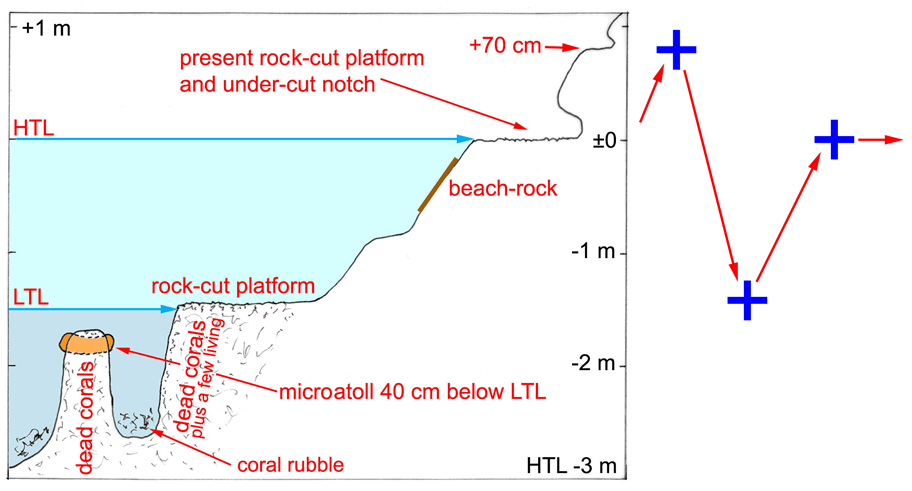
There is a total absence of data supporting the notion of a present sea level rise; on the contrary all available facts indicate present sea level stability. On the centennial timescale, there was a +70 cm high level in the 16th and 17th centuries, a -50 cm low in the 18th century and a stability (with some oscillations) in the 19th, 20th and early 21st centuries. This is almost identical to the sea level change documented in the Maldives, Bangladesh and Goa (India).

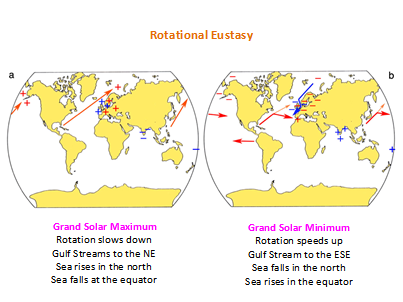
This seems to indicate a mutual driving force. However, the recorded sea level changes are anti-correlated with the major changes in climate during the last 600 years. Therefore, glacial eustasy cannot be the driving force. The explanation seems to be rotational eustasy with speeding-up phases during Grand Solar Minima forcing ocean water masses to the equatorial region, and slowing-down phases during Grand Solar Maxima forcing ocean waster massed from the equator towards the poles.

Background

The Intergovernmental Panel on Climate Change [1] has claimed that sea level is rising and that an additional acceleration is soon to be expected as a function of global warming. This proposition only works if the present warming would be a function of increased CO2 content in the atmosphere (an hypothesis termed AGW from Anthropogenic Global Warming). On a longer-term basis, it seems quite clear, however, that the dominant factor of global changes in temperature is changes in solar variability [2-3]. Regardless of what actually is driving climate change and sea level changes, the proposition of a rapidly rising sea level grew to a mantra in media and politics. This initiated a flood of papers rather based on models and statistics, however, than on actual field observations.

The Fiji government will be the chair-nation at the next international climate conference; COP23 in Bonn in November 2017 [4].  This paper represents a detailed analysis of available field  observation on sea level changes in the Fiji Islands over the last 500 Years.

Figure 1.

Sea level changes as documented in the Yasawa Islands, Fiji, composed of 3 main segments: a high level (1), a low level (2) and a more or less constant level (3), which might be subdivided in an early high level, a main level just above the present level and a lowering to the present level generating microatoll growth in the last 60 years (based on data from [13]). (Subdivisions shown in Figure 3 below)

Figure 2.

The long-term changes during the last 500 years – i.e. a high, a low and a present level – is recorded in the Maldives [16], in Bangladesh [17-18] and in Goa, India, [15,18], as illustrated in Figure 3. A present long-term stability is also recorded in Qatar [19].

Figure 3.

The general agreement between the observed sea level changes in Fiji during the last 500 years, and those recorded in the three Indian Ocean sites: the Maldives, Goa and Bangladesh is striking, which is a very strong (even conclusive) argument that the recorded sea level change are of regional eustatic origin [20].

All four records show a high in the 17th century (which was a period of Little Ice Age conditions), a low in the 18th century (which was a period nearly as warm as today) and a high in the early 19th century (which was the last period of Little Ice Age conditions). This means that the Figure 3 sea level changes are almost directly opposite to the general changes in global climate. Consequently, the eustatic changes recorded cannot refer to glacial eustasy, but must be understood in terms of rotational eustasy.

Figure 4

This calls for some explanation. The idea that oceanic water masses may be dislocated horizontally by rotational–dynamical forces was launched in 1984 [21] and more extensively presented in 1988 [22].  Later, is was proposed that changes in the Solar Wind strongly affects the Earth’s rate of rotation [23] (with a deeper analysis in [24]) leading to a beat in the Gulf Stream with alternations between a dominant northeastward flow during rotational slowing-down periods of Grand Solar Maxima, and dominant east-south eastward flow during rotational seeding-up periods of Grand Solar Minima [25].

The sea level changes in the Indian Ocean, were therefore proposed [26,15] to be driven by rotational eustasy; i.e. the interchanges of water masses between high-latitudes and the equatorial region as a function of the speeding-up during Grand Solar Minima with Little Ice Age conditions and slowing down during Grand Solar Maxima with generally warm climatic conditions.

In the post-Little Ice Ages period from 1850 up to 1930-1940 there was a global glacial eustatic rise in the order of 11 cm [28]. For the rest of the last 500 years, rotational eustasy seems to have been the dominant factor as documented in Figure 3 and illustrated in Figure 4.

CONCLUSIONS

(1)– sea level is not at all in a rising mode in the Fiji area
(2) – on the contrary it has remained stable in the last 50-70 years
(3) – rotational eustasy has dominated the sea level changes in Fiji
(4) – the same changes are recorded in the Indian Ocean

Previously, the changes in sea level during the last 500 years were not covered by adequate research in the Fiji Islands. The present paper provides a detailed analyses documenting a +70 cm high level in the 16th and 17th centuries, a -50 cm low in the 18th century and a period of virtually stability in the 19th to early 21st centuries, the last period of which may be subdivided into an early 19th century +30 cm high, a long period of stability and a 10-20 cm fall in sea level in the last 60 years forcing corals to grew into microatolls under strictly stable sea level conditions. This means there are no traces of a present rise in sea level; on the contrary: full stability.

The long-term trend is almost identical to the trends documented in the Indian Ocean in the Maldives, Goa and Bangladesh. This implies a eustatic origin of the changes recorded; not of glacial eustatic origin, however, but of rotational eustatic origin. The rotational eustatic changes in sea level are driven by the alternations of speeding-up during Grand Solar Minima (the Maunder and Dalton Solar Minima) forcing water towards the equator, and slowing-down during Grand Solar Maxima (in the 18th century, around 1930-1940 and at about 1970-2000).

Update Feb. 17

Prompted by a question from hunter, I found this informative recent letter on this topic (my bolds):

From Reply from Nils-Axel Mörner on the problems of estimating Future Sea Level Changes as asked by Albert Parker in letter of January 2, 2018

There are physical frames to consider. Ice melting requires time and heating, strictly bounded by physical laws. At the largest climatic jump in the last 20,000 years – viz. at the Pleistocene/Holocene boundary about 11,000 years BP – ice melted under extreme temperature forcing; still sea level only rose at a rate of about 10 mm/yr (or just a little more if one would consider more extreme eustatic reconstructions). Today, under interglacial climatic conditions with all the glacial ice caps gone climate forcing can only rise global sea level by a fraction of the 11,000 BP rate, which in comparison with the values of Garner et al. [1] would imply:
well below 0.4 m at 2050 instead of +0.6 m
well below 0.9 m at 2100 instead of +2.6 m
well below 2.9 m at 2300 instead of +17.5 m

Consequently, the values given by Garner et al. [1] violate physical laws and common glaciological knowledge. Therefore, their values must not be set as standard in coastal planning (point 2 above).

The mean sea level rise over the last 125 years is +0.81 ±0.18 mm/yr. At Stockholm in Sweden, the absolute uplift over the last 3000 years is strictly measured at +4.9 mm/yr. The mean tide-gauge change is -3.8 mm/yr, giving a eustatic component of +1.1 mm/yr for the last 150 years. In Amsterdam, the long-term subsidence is known as +0.4 mm/yr. The Amsterdam/Ijmuiden stations record a relative rise of +1.5 mm/yr, which give a eustatic component of +1.1 mm/yr.

Global Loading Adjustment has been widely used in order to estimate global sea level changes. Obviously, the globe must adjust its rate of rotation and geoid relief in close agreement with the glacial eustatic rise in sea level after the last Ice Age. The possible internal glacial loading adjustment is much more complicated, and even questionable, however.

Direct coastal analysis of morphology, stratigraphy, biological criteria, coastal dynamics, etc usually offers the far best means of recording the on-going sea level variations in a correct and meaningful way. It calls for hard work in the field and deep knowledge in a number of subjects. We have, very successfully, applied it in the Maldives, in Bangladesh, in Goa in southern India, and now also in the Fiji Islands. In all these sites, direct coastal analyses indicate full eustatic stability over the last 50-70 years, and long-term variations over the last 500 years that are consistent with “rotational eustasy” or “Global Solar Cycle Oscillations” (GSCO).


Climate Poppycock

Definition
pop·py·cock ˈpäpēˌkäk/informal noun meaning nonsense.
Synonyms: nonsense, rubbish, claptrap, balderdash, blather, moonshine, garbage;

Origin: mid 19th century: from Dutch dialect pappekak, from pap ‘soft’ + kak ‘dung.’

This is obviously the linguistically correct term for most of the articles on climate published in the mainstream media. And it serves to describe perfectly the output from alarmist activists.

Exhibit A is provided by Ken Ward, leader of the “valve turners” and defendant facing felony charges in Washington state.

This week he succeeded to convince a juror to refuse him conviction because in his defense he “put up a map of Skagit County, about a third of which will be under water in 2050.”

I call “Poppycock.”  A study from U. of Washington came up with a range of 1″ to 18″ SLR by 2050 for coastal Washington state. Not only will that not flood the place, the range tells you they are shooting in the dark.

http://www.cses.washington.edu/db/pdf/moteetalslr579.pdf

For a deeper look into this phenomenon, see Post-Truth Climatism

Data vs. Models #2: Droughts and Floods

This post compares observations with models’ projections regarding variable precipitation across the globe.

There have been many media reports that global warming produces more droughts and more flooding. That is, the models claim that dry places will get drier and wet places will get wetter because of warmer weather. And of course, the models predict future warming because CO2 continues to rise, and the model programmers believe only warming, never cooling, can be the result.

Now we have a recent data-rich study of global precipitation patterns and the facts on the ground lead the authors to a different conclusion.

Stations experiencing low, moderate and heavy annual precipitation did not show very different precipitation trends. This indicates deserts or jungles are neither expanding nor shrinking due to changes in precipitation patterns. It is therefore reasonable to conclude that some caution is warranted about claiming that large changes to global precipitation have occurred during the last 150 years.

The paper (here) is:

Changes in Annual Precipitation over the Earth’s Land Mass excluding Antarctica from the 18th century to 2013 W. A. van Wijngaarden, Journal of Hydrology (2015)

Study Scope

Fig. 1. Locations of stations examined in this study. Red dots show the 776 stations having 100–149 years of data, green dots the 184 stations having 150–199 years of data and blue dots the 24 stations having more than 200 years of data.

Fig. 1. Locations of stations examined in this study. Red dots show the 776 stations having 100–149 years of data, green dots the 184 stations having 150–199 years of data
and blue dots the 24 stations having more than 200 years of data.

This study examined the percentage change of nearly 1000 stations each having monthly totals of daily precipitation measurements for over a century. The data extended from 1700 to 2013, although most stations only had observations available beginning after 1850. The percentage change in precipitation relative to that occurring during 1961–90 was plotted for various countries as well as the continents excluding Antarctica. 

There are year to year as well as decadal fluctuations of precipitation that are undoubtedly influenced by effects such as the El Nino Southern Oscillation (ENSO) (Davey et al., 2014) and the North Atlantic Oscillation (NAO) (Lopez-Moreno et al., 2011). However, most trends over a prolonged period of a century or longer are consistent with little precipitation change.Similarly, data plotted for a number of countries and or regions thereof that each have a substantial number of stations, show few statistically significant trends.

Fig. 8. Effect of total precipitation on percentage precipitation change relative to 1961–90 for stations having total annual precipitation (a) 1000 mm. The red curve is the moving 5 year average while the blue curve shows the number of stations. Considering only years having at least 10 stations reporting data, the trends in units of % per century are: (a) 1.4 ± 2.8 during 1854–2013, (b) 0.9 ± 1.1 during 1774–2013 and (c) 2.4 ± 1.2 during 1832–2013.

Fig. 8. Effect of total precipitation on percentage precipitation change relative to 1961–90 for stations having total annual precipitation (a) less than 500 mm, (b) 500 to 1000 mm, (c) more than 1000 mm. The red curve is the moving 5 year average while the blue curve shows the number of stations. Considering only years having at least 10 stations reporting data, the trends in units of % per century are: (a) 1.4 ± 2.8 during 1854–2013, (b) 0.9 ± 1.1 during 1774–2013 and (c) 2.4 ± 1.2 during 1832–2013.

Fig. 8 compares the percentage precipitation change for dry stations (total precipitation <500 mm), stations experiencing moderate rainfall (between 500 and 1000 mm) and wet stations (total precipitation >1000 mm). There is no dramatic difference. Hence, one cannot conclude that dry areas are becoming drier nor wet areas wetter.

Summary

The percentage annual precipitation change relative to 1961–90 was plotted for 6 continents; as well as for stations at different latitudes and those experiencing low, moderate and high annual precipitation totals. The trends for precipitation change together with their 95% confidence intervals were found for various periods of time. Most trends exhibited no clear precipitation change. The global changes in precipitation over the Earth’s land mass excluding Antarctica relative to 1961–90 were estimated to be:

Periods % per Century
 1850–1900 1.2 ± 1.7
 1900–2000 2.6 ± 2.5
 1950–2000 5.4 ± 8.1

A change of 1% per century corresponds to a precipitation change of 0.09 mm/year or 9 mm/century.

As a background for how precipitation is distributed around the world, see the post: Here Comes the Rain Again. Along with temperatures, precipitation is the other main determinant of climates, properly understood as distinctive local and regional patterns of weather.  As the above study shows, climate change from precipitation change is vanishingly small.

Data vs. Models #1 was Arctic Warming.