Kids Getting Dumber and Fearful

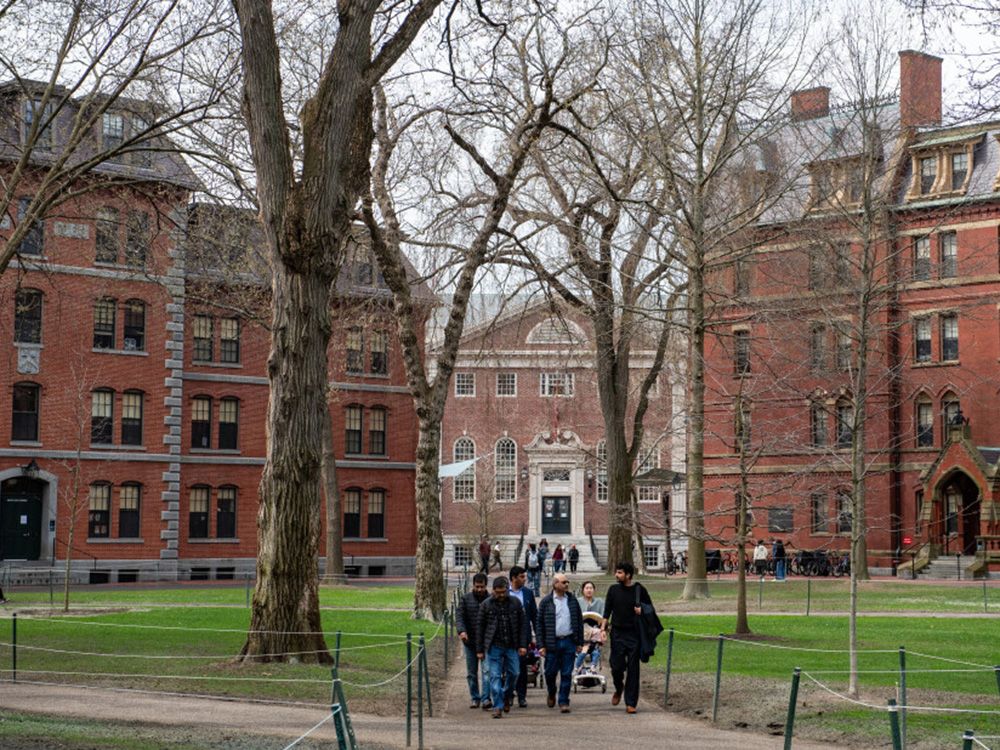
Even Harvard University is suffering from the scourge of grade inflation, according to a recent report. Photo by JOSEPH PREZIOSO/AFP via Getty Images

Chris Selley points to evidence of our youngsters dumbing down in his National Post article Who will stop our kids from getting dumber?  Excerpts in italics with my bolds and added images.  Later on is a post  regarding the descent of youth into climate insecurity and fanaticism.

It really feels like we could be at a tipping point. We risk creating generations
of people who don’t know how to think critically, laterally, or at all.

Not-so-surprising news arrived recently from the University of California at San Diego: Academically, the kids are not all right. Not even close. “Between 2020 and 2025, the number of freshmen whose math placement exam results indicate they do not meet middle school standards grew nearly thirtyfold,” a report from the university’s senate finds. “A similarly large share of students must take additional writing courses to reach the level expected of high school graduates.”

The university launched a remedial math course in 2016, designed for “a very small number of first-year students (less than 100 students a year or around one per cent of the incoming class) who were not prepared to start in our standard precalculus courses.” As of this autumn, there were 665 students in that course, representing 8.5 per cent of the freshman class.

UCSD is no slouch in the college rankings: U.S. News and World Report pegs it as the sixth-best public university in the country, in the lofty company of Berkeley, UCLA, the University of North Carolina, and Michigan. It picks students from relatively high up the tree. And a fair few of them can’t do middle-school math.

The report tags dead-obvious suspects in this crime: Against its own board of regents’ advice, the University of California system no longer uses the SAT or ACT as part of the admissions process, because standardized tests are supposedly “racist.” That means the associated colleges (including Berkeley, UCLA and UCSD) have to rely more heavily on high-school grades. But high-school grades have inflated so much in recent years that they’re largely meaningless.

And with significant numbers of kids effectively ChatGPT-ing their way
through K-12, the writing problem especially is only bound to get worse.

I’m generally not an alarmist on such matters, but it really feels like we could be at a tipping point. We risk creating generations of people who don’t know how to think critically, laterally, or at all — and couldn’t successfully articulate what they think in a work email, let alone an essay, if they had to. The most frustrating thing is how easily this all could have been avoided, and how simply it could all be solved, if only the education bureaucracy could get its act together.

The solution to the AI crisis is in-class exams, which is what 49-year-old geezers like me used to know as “exams.” Just do it, for God’s sake.  The solution to the standardized-testing issue is standardized testing.

We need to permanently marginalize the well-lettered
and influential voices who see it as a form of violence.

Grade inflation is a tougher nut to crack, perhaps. It’s much easier to inflate than deflate, and the problem goes well beyond high school. Harvard University’s Office of Undergraduate Education released a report this month assailing the scourge of grade inflation at Harvard. This revelation melted some students — the cream of America’s crop, we are led to believe — into a puddle of tears, the Harvard Crimson reports.

The whole entire day, I was crying,” one undergrad told the student newspaper of the day the report dropped. “I skipped classes on Monday, and I was just sobbing in bed because I felt like I try so hard in my classes, and my grades aren’t even the best.”

Universities have all the data they need to at least measure grade inflation at the high-school level. They know which schools their students attended; they know what their grades are; and they find out pretty quickly every autumn whether they’re literate and numerate.

Here in Canada, the University of Waterloo was a pioneer in keeping a list of the worst grade-inflation offenders among Ontario’s high schools — a perfectly defensible practice, though Waterloo seemed almost ashamed of it. It actually went to court to prevent releasing the contents of that list under a freedom-of-information request from Global News, citing dubious concerns about privacy. Yet the people who should be most interested in such lists are students at the most grade-inflated schools and their parents; a mighty shock awaits them the first day they show up for university.

The educational damage caused by pandemic-era school closures and often-slipshod remote learning is, alas, impossible to remedy. “This year’s high-school seniors (graduating 2026) began remote learning in spring of their 6th Grade year, often one of the most critical in student development for math skills,” the UCSD report notes.
In California, as in Canada, absenteeism rates soared during the pandemic and haven’t recovered. That deficit is baked into an entire cohort of students for life, now. And in California, as in Canada, it’s the least advantaged students who took it hardest on the chin.

If there’s nothing we can do about that, we can at least make the people who cheered it on feel bad, and ensure we never again treat school closures and half-assed online learning so casually. Of all the cockamamie arguments flying around during COVID, “kids will be fine” was one of the weirdest. And “we must keep schools closed to protect our children,” who weren’t at any significant risk at all, was one of the most disreputable.

To be fair, we were flying blind in a crisis none of us had lived through before. We can’t say that about grade inflation, or cheating, or standardized testing. Those are longstanding problems that solving simply requires some grownups with an ounce or two of principle and courage to spare.
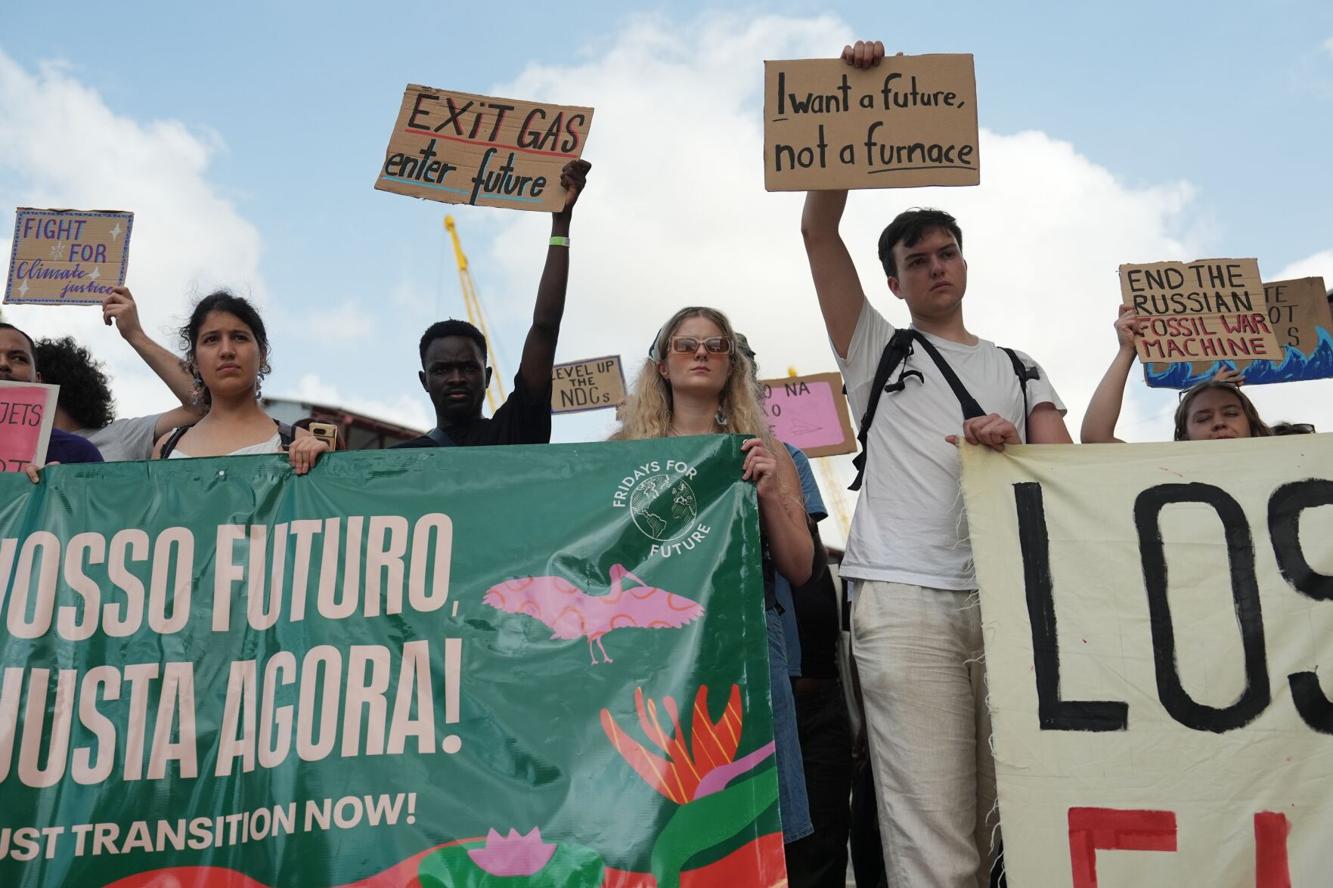
Activists participate in a youth climate demonstration during the COP30 U.N. Climate Summit, Friday, Nov. 14, 2025, in Belem, Brazil. Joshua A. Bickel – AP

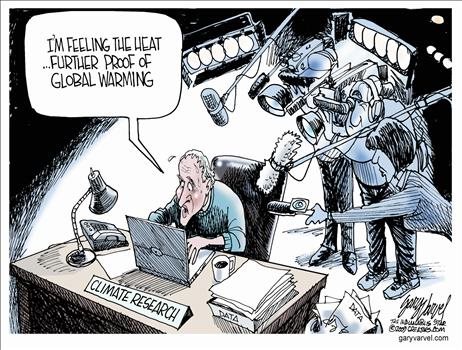
Nate Myers reports from COP30: The kids are not alright: COP30’s youth-led “climate crisis” struggle.  Sadly, youth lacking in critical intelligence are at risk of activists exploiting them for an agenda. Excerpts in italics with my bolds and added images.

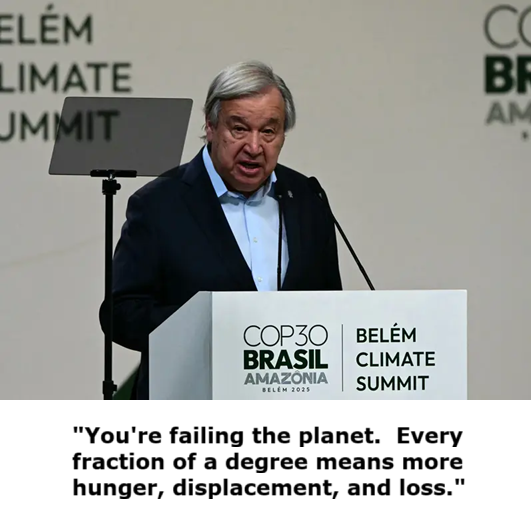
With climate anxiety now affecting an estimated half of young people worldwide, COP30 arrived in Belém, Brazil, promising to “elevate youth voices.” What I witnessed instead, by attending some of the side events, was a well-funded pipeline of fear, guilt, and political indoctrination aimed squarely at children and teenagers who have been convinced the world is ending.
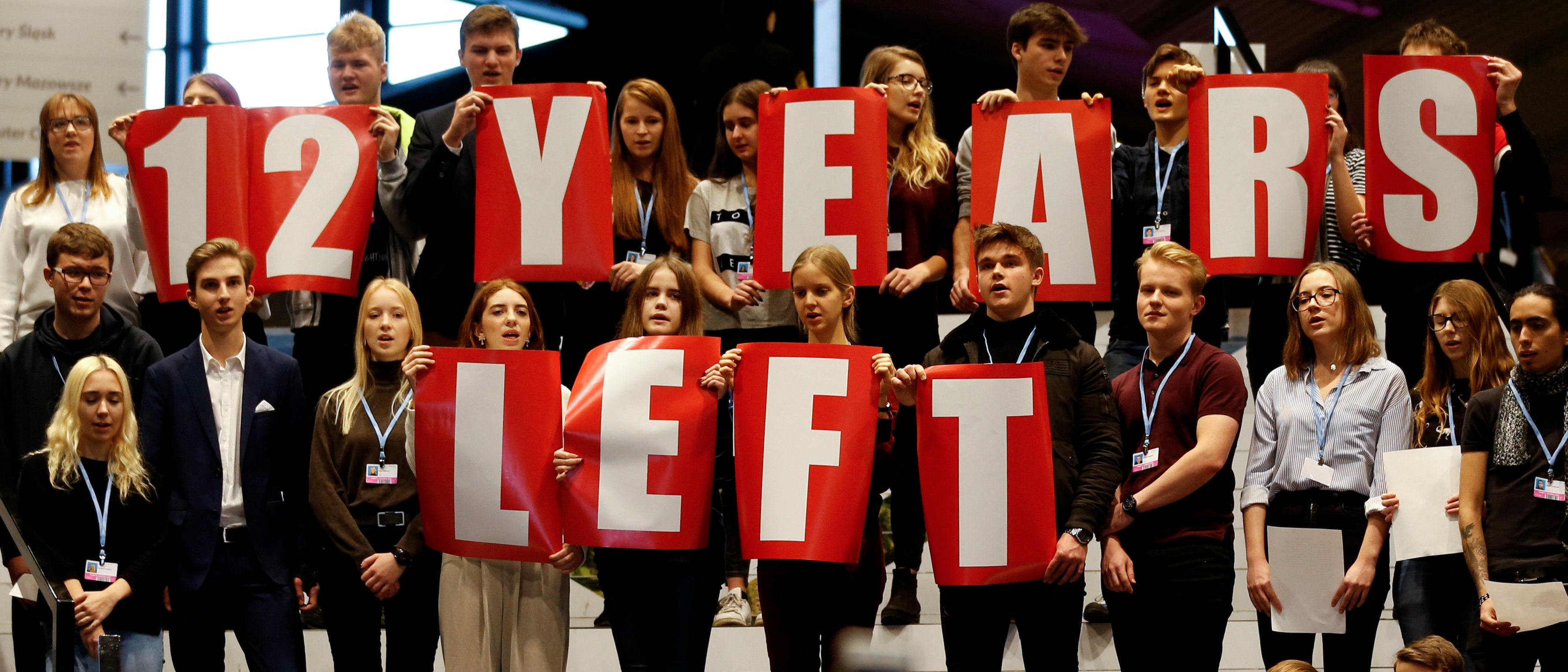
And that was in 2019!

Over several days, I sat through hours of youth-led and youth-themed panels — panels that were supposedly about empowering the next generation but in reality offered little more than emotionally charged rhetoric, self-congratulatory monologues, and wild ideological claims completely detached from scientific or historical context.

By the end, one thing was very clear: The kids are not alright,
and the adults running these sessions know exactly what they’re doing.

Inside the COP30 Youth-Centric Panels:

One of the first sessions I attended was titled “A Legacy for Children and Youth in Climate Policies.” The premise sounded harmless enough — encouraging young people to engage in politics and science. But the execution was anything but.

Representatives from Our Kids Climate, ChildFund Alliance, Child Rights International Network, and Plant-for-the-Planet took turns celebrating how many children their organizations have managed to bring into the movement and how there’s always more work to be done to make the conversation “more inclusive” to “marginalized groups.”

What they didn’t talk about were scientific principles,
energy systems, or practical solutions.

Instead, panelists repeated the talking point that “children are the most affected by climate change” — a phrase that now functions as a moral shield to deflect scrutiny.  The adults paneling the discussion pontificated endlessly about “youth inclusion in climate justice,” never once explaining what “climate justice” actually means or how any of their lofty goals would be achieved. Their message was simple: get more children involved as early as possible.

The moderator even closed with an open call to bring more kids to future COPs. She wasn’t subtle about it. The aim is to expose children to the climate-justice worldview before they have the emotional maturity, economic literacy, or scientific grounding to question it — or even properly understand the conversation.
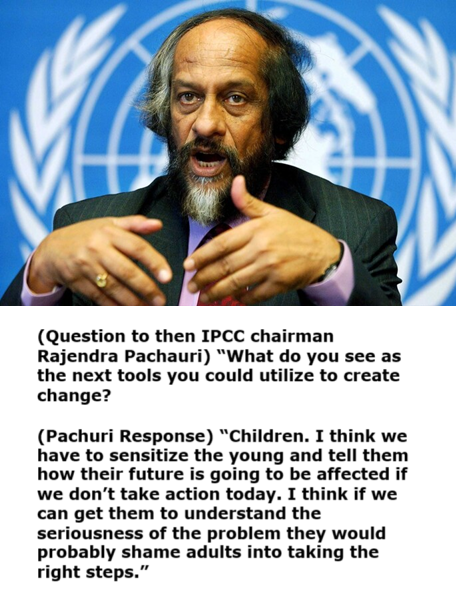
Youth-Led Climate Forum

The flagship youth session at COP30, the “Youth-Led Climate Forum,” made the earlier panels look calm by comparison. Held over the course of the week in four separate installments that felt more like struggle sessions than intellectual debate and conversation, students repeated sweeping, dramatic lines like:

“We’re just trying to save the world,” followed by, “It’s our responsibility to fix this.”

Someone has convinced these kids that the world is ending — and that they are personally responsible for preventing it. That kind of psychological burden would crush an adult, let alone a teenager.

One young woman even described how her entry into the movement began after watching the apocalyptic thriller “2012.” Sometime later, she experienced a perfectly normal flood — an event that has occurred throughout human history — and interpreted it as confirmation that the “climate crisis” was accelerating.

It was the perfect microcosm of what’s happening to young people worldwide:
propaganda scares them into believing natural disasters are unprecedented,
and any routine weather event becomes proof that doom is approaching.

A representative from World Youth for Climate Justice took it a step further, declaring:

“Countries authorizing new oil leases should be held criminally responsible.”

The entire forum was drenched in ideological buzzwords. “Solidarity” and “intersectional” were used dozens of times. References to Indigenous communities, women, and LGBTQ groups were thrown around like confetti, to the point of unintended comedy.

Yet amid all the emotional rhetoric, no one offered scientific nuance, historical context, or even a basic acknowledgment of natural climate cycles. In fact, no one cited or discussed a single statistic, figure, or model.   It was all emotion, no wisdom. All fear, no facts. And these are the voices COP30 proudly elevates as the “leaders of tomorrow” — leading us to what, I wonder?

And Then Came the Demands…

To top it all off, the Child Rights International Network (CRIN) proudly released a global letter of demands allegedly “developed by young people at COP30.” They issued these demands to every nation on Earth.

Among the most extreme:

    • End all fossil fuel leasing and extraction.
    • Replace global energy systems with “justice-based alternatives.”
    • Mandate climate reparations across nations and generations.
    • Create youth committees with power to oversee national climate policy.

The adults behind these groups know exactly what they’re doing. No child wrote this without intense indoctrination and adult influence. The youth participants are being used — emotionally and politically — to advance an agenda they don’t fully understand.

After countless hours of youth programming at COP30, the conclusion was unavoidable:

These are scared children seeking comfort and direction — yet they’re being fed panic, ideology, and guilt. The same groups that claim to “empower” young people are the ones frightening them into the movement in the first place. That’s not stewardship. That’s emotional exploitation.
 

Who Knew? Western Societies Growing More Equal, Not Less

Daniel Waldenstrom makes the case at Foreign Affairs The Inequality Myth.  Excerpts in italics with my bolds and added images.

Western Societies Are Growing More Equal, Not Less

Spend a few minutes browsing political commentary or scrolling social media and you will discover a seemingly settled truth: inequality in the West is soaring, the middle class is being hollowed out, and democracies stand on the brink of oligarchy. The idea is seductive because it fits everyday anxieties in many Western countries—housing has grown increasingly unaffordable, billionaire wealth mushrooms unfathomably, and the pandemic exposed yawning gaps in social safety nets. Yet the most influential claims about inequality rest on selective readings of history and partial measurements of living standards. When the full balance sheet of modern economies is tallied—including taxes, transfers, pension entitlements, homeownership, and the fact that people move through income brackets across their lives—the story looks markedly different. Western societies are not nearly as unequal as many believe them to be.

Getting the facts right matters because bad diagnosis breeds bad prescriptions. If governments assume that capitalism is inexorably recreating the disparities of the Gilded Age, they will reach for wealth confiscations, price controls, or ever-larger public sectors funded by fragile tax bases. If, instead, the evidence shows that free-market economies have enriched middle classes by expanding asset ownership, that entrepreneurs’ fortunes are associated with advances shared with the broader public, and that much of the post-1980 rise in recorded inequality reflects methodological quirks, then a different agenda follows: states should encourage ambition, protect competition, widen access to wealth-building, and ensure that public services complement—not smother—private prosperity.

In short, before treating inequality as an existential crisis,
it is worth double-checking the thermometer.

Conventional Wisdom Overturned by Evidence

The canonical data tell only part of the story, and the least flattering part at that. A growing body of scholarship reassesses the long-run distribution of wealth by adding what earlier studies neglected. Three findings stand out.

First, private wealth has exploded—but so has broad ownership of it.

Reconstructed national balance sheets for France, Germany, Spain, Sweden, the United Kingdom, and the United States show real per-adult wealth roughly tripling since 1980 and rising more than sevenfold since 1950. Crucially, an increasing share of that capital sits in the homes and pension funds of ordinary households. In 1900, assets held by the elite—agricultural domains and shares in industrial or financial corporations—dominated; today, residential property and funded retirement accounts represent the majority of private assets. That shift parallels mass homeownership: in most Western countries, 60 to 70 percent of households now own the roof over their heads—an equity stake unavailable to their great-grandparents. Most workers hold pension claims in mutual funds or index funds, granting them the high returns of stock markets at low risk—what amounts to financial democratization.

Second, wealth concentration has fallen—not risen—over the past century.

In Europe, the top one percent now owns barely a third of the share it held in 1910, right before the beginning of the transformative era of world wars, democratization, and the growth of governmental capacity, and since the 1970s that share has been essentially flat, even as real wealth—that is, wealth adjusted for inflation—has tripled with rising asset prices. The United States shows a clearer uptick beginning in the 1970s, most visible among the spectacular fortunes of tech and finance titans, whose gains have outpaced even the impressive wealth growth of the middle class. Yet U.S. concentration remains closer to its 1960 level than to its pre-1914 peak.

The dominant quantitative fact of the century, therefore,
is not a new Gilded Age but a dramatic wealth equalization
propelled by mass asset ownership.

Third, the fact that people move through different income brackets over the course of their lives should temper typical measures of inequality.

So, too, should the effects of welfare payments. Annual snapshots lump graduate students with retirees living off savings, making income and wealth gaps appear wider than lifetime consumption gaps. When studies in different countries instead follow individuals over time, they typically find that within only a few years, half the households in the bottom income decile have climbed to higher levels. Many top-decile households can drop to lower rungs of the ladder after business or investment setbacks. Government welfare programs further compress differences. In Sweden, when public pension entitlements are capitalized and added to assessments of personal wealth, this alone cuts the measured wealth inequality—known as the Gini coefficient—by almost half. In the United States, the market’s redistributive role is smaller, but when Social Security, Medicare, and employer-provided health insurance are treated as in-kind income, median households fare far better than raw wage data suggest.

Social Alarmists Out of Touch with Today’s Realities

These facts undermine the image of an inexorably widening chasm between a plutocratic elite and the rest. Yes, superstar entrepreneurs have amassed fortunes measured in tens of billions. But that outcome signals success, not failure: they furnished goods and services that millions freely bought. Their booming companies also supply jobs, higher wage earnings, and substantial tax revenue—directly through profits and payrolls and indirectly by raising the broader tax base. Over the past four decades, life expectancy in advanced economies (including in the United States despite the much-noted increase in “deaths of despair”) rose roughly six years, high school completion became nearly universal, and personal computers once reserved for elites went mainstream.

Those who typically bemoan the rise of inequality
don’t correctly weigh the size and division of the pie.

Rising real incomes and higher asset values are preconditions for mass prosperity and for a well-funded public sector. Even advocates of government intervention should champion efficient growth: every percentage point of GDP adds billions to tax revenue. The West’s most durable path to fairness, then, is to scale up the channels through which ordinary households acquire assets—including affordable housing supply, portable retirement accounts, and low-fee index funds—and to keep markets open so new firms can challenge incumbents.

That perspective should also moderate calls for annual taxes on the stock of net wealth, which have recently been proposed by some politicians and researchers, and have even been discussed officially at G-20 and UN meetings. These so-called wealth taxes are problematic because they hit illiquid assets, forcing entrepreneurs or farmers to borrow or liquidate. Scandinavian experience of such taxes shows that they produce meager revenues, come with high administrative costs, and encourage capital flight. If capital is to be taxed, a more efficient and equitable way is to tax capital income—such as dividends, realized gains, and corporate profits.

Evidence-based Priorities for Policymakers

Misreading inequality courts several risks. It diverts energy from the real challenges to Western economies, which include lax productivity growth, aging populations, and the imperatives of climate adaptation. These problems will strain public budgets. But excessive state-centrism and confiscatory wealth taxes impede capital formation and make financing those tasks harder, not easier. Misunderstanding inequality also breeds regressivity: taxing housing wealth indiscriminately can hit asset-rich but cash-poor retirees; taxing private firms can force sales to multinational giants with cheaper credit. And it corrodes trust: when citizens hear that capitalism benefits only the elite—even as their own living standards rise—they may grow cynical about official statistics and susceptible to populist cures worse than the disease.
A more accurate reading of the data supports a balanced agenda. To be clear, excessive wealth concentration poses risks—most notably to political integrity. Transparent rules for campaign financing and party contributions are essential to minimize the undue influence of money. Core welfare services, such as education and health care, should not become overly dependent on private funding, otherwise they would tie the quality of care to personal wealth—and in the process deepen inequality. The solution is not to curb wealth itself but to safeguard the integrity of political institutions and ensure equitable access to public goods.

States should celebrate entrepreneurial success and foster competition by reducing regulatory burdens—especially those that disproportionately affect smaller and younger firms. Taxation on labor income should be modest enough to incentivize hard work and also allow for the accumulation of new wealth, while capital taxation should target income rather than wealth or inheritances. Public investment should focus on building the capabilities that let households become stakeholders—education, infrastructure, and a rules-based climate that rewards risk-taking. Such an agenda accepts that inequality can coexist with, and even flow from, broad prosperity. Frustration with privilege should be channeled into reforms that expand opportunity rather than cap success.

This agenda advances neither laissez-faire complacency nor egalitarian maximalism. It is an acknowledgment that the West’s most remarkable achievement is not the fortune of a Jeff Bezos or Bernard Arnault but the mundane riches enjoyed by millions whose grandparents lived without antibiotics, central heating, or college degrees. Policymakers would do well to remember that progress before they diagnose calamity—and nurture the conditions that make it possible: secure property rights, open markets, and an efficient public sector powered by the very economic growth its advocates sometimes disparage.

Footnote: The issue of adapting to climate change, raised in the article, perfectly illustrates the dichotomy of social perspectives regarding equality.


Battle to Open Closed-Minded Universities

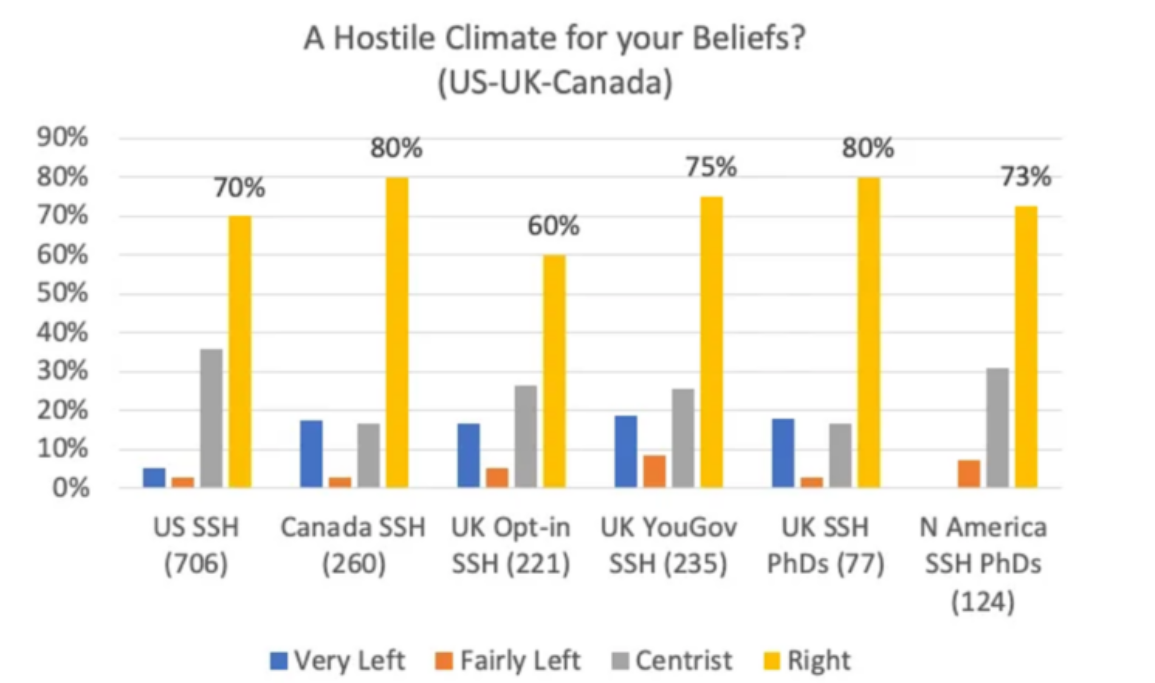
Research by U.K. politics professor Eric Kaufmann (top left) showed that 80 percent of Canada’s right-leaning academics report a hostile environment for their beliefs. The proportion was the same in the UK and was 70 percent in the U.S. In all three countries, the percentage of “very left” academics reporting hostility towards their beliefs was less than 20 percent.

James Piereson writes at City Journal Trump Is Likely to Win His Fight with Universities.  Excerpts in italics with my bolds and added images.

The administration holds many cards,
and it seems determined to play them all.

The universities have compromised themselves with the alliance they have formed with the Democratic Party and their dependency on taxpayer funds provided by Democrats, Independents, and Republicans alike. Universities should not have let themselves become so attached to any political party or ideological point of view, lest they compromise the intellectual integrity of their institutions or jeopardize the taxpayer funding that they badly need. But that is precisely what has happened at Harvard, Columbia, Northwestern, and other leading institutions. It is something the Trump administration hopes to change.

Trump has said that he wants to use the lever of federal funding to force university leaders to confront several issues: the lack of intellectual diversity on their campuses, with upward of 80 percent of faculty members identifying as liberals or progressives, and less than 2 percent as conservatives; the refusal to enforce race- and gender-blind civil rights laws, and the continued use of preferences in admissions and employment, in violation of the 2023 Supreme Court decision in Students for Fair Admissions v. Harvard University; the failure to protect the rights of Jewish students amid demonstrations on campus of anti-Semitism and hatred of Israel; administrative “bloat,” reflected in how college campuses today employ more administrators than professors teaching courses; tuition increases that far outpace inflation, leading to ever more student borrowing and debt underwritten by federal loan programs; and the continued presence of ideological departments and programs on campuses that do not allow for diversity of intellectual approaches.

The Trump administration has tried to influence institutions by freezing payment of federal funds, but there is a more effective way to do this—one less likely to cause mayhem in scientific programs and medical schools and less prone to being overturned by the courts: Trump should use the leverage of prospective grants to induce institutions to abide by federal law and begin reforming their internal operations.

These institutions will come back to the federal government every year with proposals for new funding. The Trump administration is not required to make new awards to these institutions. These can be made on the condition that the institutions are taking concrete steps to reform themselves. If they thumb their noses at Trump, then the administration can decide that grants and contracts that have gone to Harvard, Columbia, and Johns Hopkins in the past might be given in the future to the University of Alabama, Ohio State, or the University of Montana. Such a redistribution of federal funds might even bring about a useful realignment in the scientific prestige of American universities, as some move down and others move up the reputational ladder.

Some of Trump’s goals in regard to higher-education reform are already subsumed under grant participation agreements that institutional representatives must sign before federal departments can sign off on grants and awards. Those agreements oblige recipients to comply with provisions of the Civil Rights Act (1964), the Title IX educational amendments (1972), and other regulations in regard to discrimination by age and handicap status. In light of the Supreme Court decision in the SFFA  v.  Harvard case, along with Trump’s executive orders in regard to civil rights, those agreements oblige recipient institutions to abandon all preference programs, including DEI programs created to advance preferences in university life. More than a few institutional representatives will have a hard time signing these agreements going forward because of lingering preference programs on their campuses. In any case, the administration can supplement those agreements with addenda that include other issues it wants universities to address.

The questions asked of institutional representatives might include:

Does the institution pledge to abide by federal civil rights laws that forbid group preferences in admissions and employment?

Has the institution taken steps to guarantee the rights of Jewish students against attacks arising out of anti-Semitism or hatred of Israel?

What steps has the institution taken to create greater intellectual diversity on its campus?

Has the institution adopted measures to reduce the number of administrators on campus and to eliminate administrative departments that try to enforce group preferences in violation of federal law?

Has the institution limited tuition increases to the level of inflation in order to reduce expenses for students?

These questions should clarify the choice Trump is asking these institutions to make:
either change current practices or forgo federal research funds
.

Over the four years of this second Trump administration, such an approach might have genuine and constructive consequences for the operation of American universities. Will Johns Hopkins University spurn $3.3 billion in federal grants next year in order to preserve its DEI bureaucracy? Will NYU give up $879 million in research grants next year in order to maintain its gender studies programs, or programs in the law school that advocate for group preferences? Universities may have to make hard choices between future federal funding and ideological programs currently in place.

This is precisely what liberals, feminists, and other activists did in the 1970s when they forced universities to sign “affirmative action” pledges, which soon turned into agreements to enforce group preferences in faculty hiring and employment. That approach evolved into the campaign for diversity later in that decade, when the Supreme Court ruled that preferences might be used to advance diversity in colleges and universities, and more recently into the DEI crusade that emerged in the wake of the George Floyd incident. That crusade proved to many that the entire enterprise had gone way too far. After five decades, with much academic mischief to show for it, the approach has hit a wall with the Trump administration.

Harvard and other universities are likely to find that they
are fighting a losing battle against the federal government.

Harvard has an endowment of $53 billion, by far the largest among the nation’s universities, but that’s little more than a rounding error in the government’s $7 trillion budget. Here the government negotiates from a strong position because, while federal grants loom large in university budgets, they are only a small fraction of the government’s budget.

The government has other weapons at its disposal. There is the tax exemption, for starters, which, if lost, will mean that schools cannot receive tax-deductible donations.. The government can stop the flow of international students to the schools, a move that would be costly in terms of foregone tuition payments. Trump can also ask Congress to slap a hefty tax on university endowments, another step his administration is already considering. At some point, Harvard and other elite institutions will have to sue for peace rather than continue an argument they cannot win.

In any case, the Trump administration holds many cards in this showdown with the universities, and it seems ready to play them all.

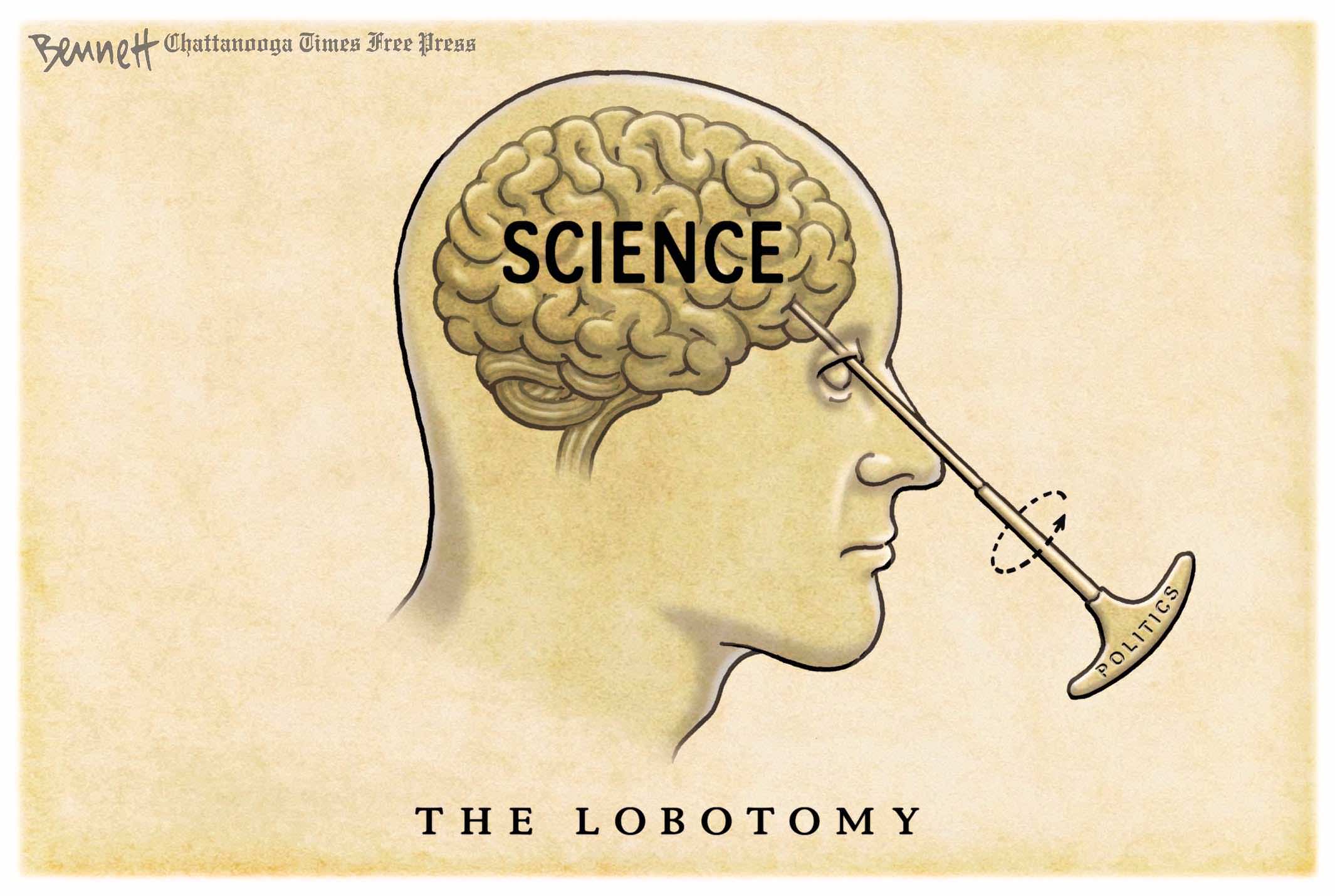
Funding for University Wokism Cut

William M Briggs explains in his blog article Trump Slashing The Cancerous “The Science” Bloat: Cut Cut Cut! Excerpts in italics with my bolds and added images.

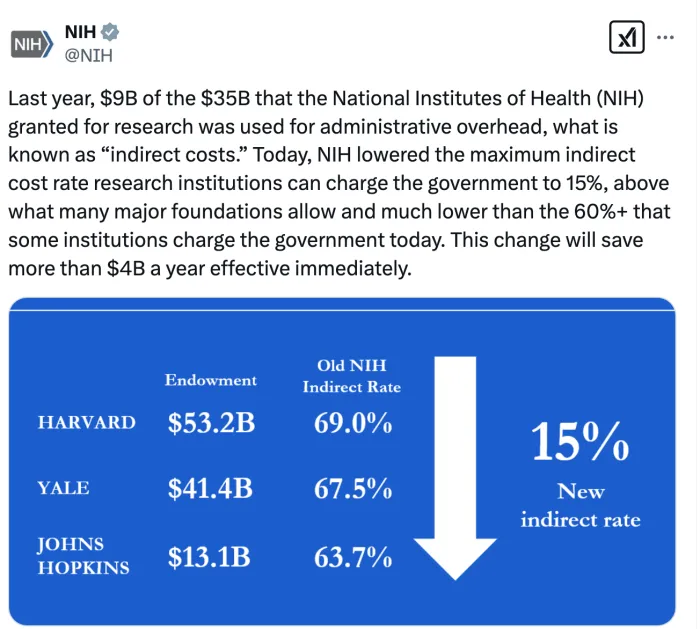
I responded on Twitter (follow me): “You might not know it, but this is a MAJOR VICTORY of outstanding proportions. Overhead is what fed the administrative beast. Overhead paid for DIE. Overhead paid for assistants to the assistants to the assistant Deans for development. Kill the Beast by starving it.”

For those new to grants, the overhead is the amount tacked on by the researchers’ institution to a researcher’s grant. If a Harvard grant is for, say, $1 million, an amount already bloated for all the usual reasons of excess, then the amount NIH pays to Harvard is $1,690,000. That extra $690,000 feeds the Beast. The Beast grows and causes the original grant totals to swell, for reasons not directly related to the research, like increased salaries for all and such like. Bureaucrats are spawned from the overhead funds. They emerge from their pods with gaping maws mewing to be fed—fed—fed! Overhead is a slow-motion monster movie.

(If you want more detail on overhead, this is a good article.)

Now I know this next part will make no sense to you, but not all are taking well the splendiferous news overhead will be treated like a bikinied teenager in a Wes Craven movie. The far-left politics journal Science screamedNIH slashes overhead payments for research, sparking outrage“.

“Outrage”, as we have said many times, is the second of only
two emotions a woke can express. The first being smug self-satisfaction.

They don’t get the first anymore, though.

Or take as representative lead covid panicker Eric Fing-Ding. Through sweet, sweet tears, he tweeted (among other things) that the cuts will “COMPLETELY DECIMATE MEDICAL & PUBLIC HEALTH RESEARCH”.

Bad news, because we’d like the effect to be greater than a mere measly ten percent. We need to whack, with pitiless remorseless brutality, at least half of governmental science funding. The Science article was more hopeful. They said “‘This is a surefire way to cripple lifesaving research and innovation,’ said a statement from the Council on Governmental Relations (COGR)”.

Crippling is much better than decimating.

Bring on the pain. Their pain. Universities have had it good too long. And we’ve had it bad.  It’s not only your old Uncle Sergeant Briggs saying this.

Here’s a ripe pull from “The natural selection of bad science” by Paul E Smaldino and Richard McElreath. These fellas are not critiquing cellar-dwelling simulacra of science, like say sociology, but what’s taken as the good stuff, like medicine.

These are not the only ones on the inside saying these things. The word is out. Science has gone bad: “A 2015 British Academy of Medical Sciences report suggested that the false discovery rate in some areas of biomedicine could be as high as 69 percent.”

Data Republican says: “Universities are among the largest drains on taxpayer money in my dataset. They receive massive funding from NGOs and USAID, and they take more government grants on top of that. Meanwhile, anonymous professors have reported to me that true scientific research is stagnating due to DEI mandates and administrative bloat.”

Understand: universities were ground zero for the DIE zombie invasion. And much worse. A tsunami of bad ideas flowed from universities over the last century. Many of those responsible are still employed there. These people need to be made to go. It’s not only DIE, but the base bloat caused by government micro-managing science. It is government, almost completely, that decided what got funded, and funded to ridiculous levels. This forced consensus-based science upon us. This has stifled much innovation, as we have seen time and again. It must be made to change, for change won’t come from within.

Now that 15% might eventually rise, given the wounded howling coming from universities (an AFMR email said “We have also launched an E-Action Alert to engage the broader scientific community and mobilize support for advocacy efforts to reverse or mitigate these changes.”).  But the rate must fall. The NIH and NSF budgets need to treated like the mess they are.

The only way to rid ourselves of this stuff is to stop feeding those producing it. We need to force a restructuring and rethinking. The old ways need to go. The only way to do this is to cause pain. Minor course corrections are not enough. Cut, cut, and cut some more. Make it sting.

See Also:

Examples of Debased Government Science

Trust Me, I’m a Scientist. Really?

Why Federalized Science is Rotten

DEI Days are Numbered in Ivory Towers

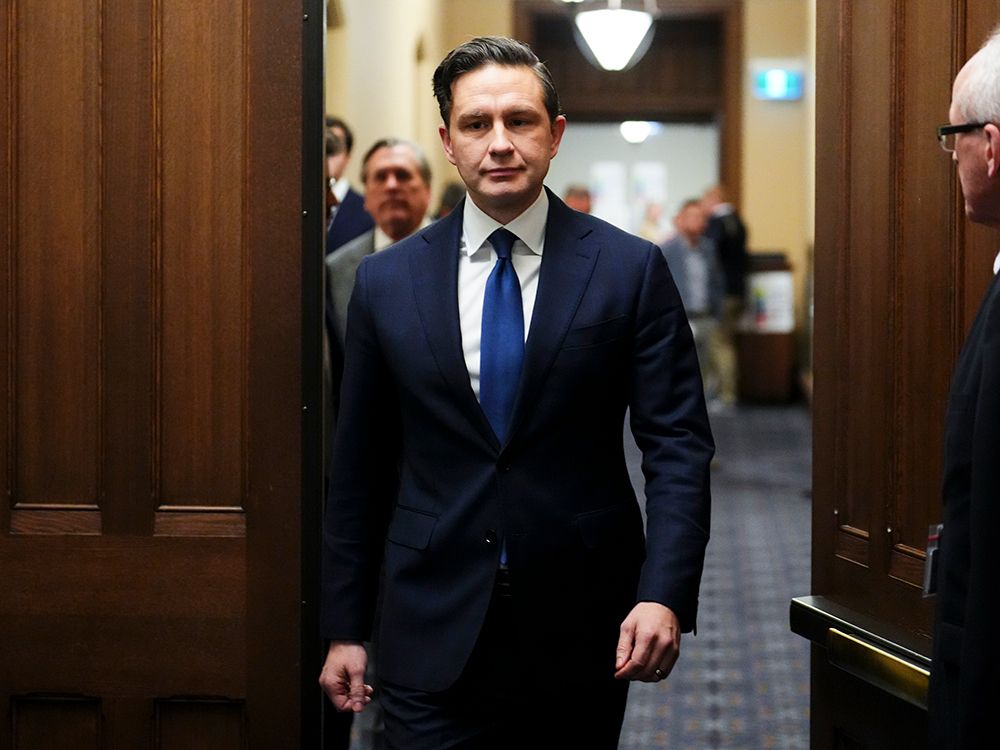
Leigh Revers writes at National Post Canada Universities better get prepared for Poilievre’s anti-woke agenda.  Excerpts in italics with my bolds and added images.

‘Even the dullest minds in the upper administrations of Canada’s top universities
— and trust me, they are spectacularly dull — must see the writing on the wall’

Conservative Leader Pierre Poilievre leaves after a meeting with Prime Minister Justin Trudeau and fellow opposition leaders on Parliament Hill in early December. Photo by Sean Kilpatrick/The Canadian Press

The recent spectacular and decisive presidential election victory by Donald Trump — a self-styled benevolent “dictator” swept to power with an unequivocal mandate from U.S. voters — has become what can only be described as a political tsunami for left-leaning observers.

Vast change is in the offing. The political tectonic plates have shifted, prompting shattering eruptions along a number of predictable fault lines.

One such fiery volcano is gender ideology, a demonstrable fantasy that, mercifully, will soon be banished from American institutions, its many purveyors quickly to be bankrupted by Trump’s proposed state-assisted lawsuits brought by the swelling ranks of detransitioners.

A second is education, a metaphorical marshmallow that is no longer merely the artificially-sweetened confection promised to so many young people, but has instead become more like a skewered and charred husk grilled remorselessly on the three-pronged toasting fork of diversity, equity and inclusion (DEI).

Americans need worry no longer, however. In a recent post on X, Elon Musk shared Donald Trump’s radical vision of a reformed college education system — one that demands the eradication of all DEI and its apparatchiks, and even threatens uncompliant institutions with severe taxation or complete forfeiture of their sprawling endowments. Inevitably, we will witness brazen back-peddling by the cadre of top-tier administrators desperate to remain gainfully employed. Harvard’s board, sitting on a treasure horde of US$53.2B (C$74.8B), will doubtless respond accordingly.

How will Canadian universities survive? While plunging needles into voodoo dolls of Pierre Poilievre, the left will eschew the ‘scary’ stateside politics, make accusations of neo-fascism, and point to Canada as a progressive retreat, a haven for the many orphans of woke ideology who, even now, are threatening on their social feeds to lay siege to our border, waving their American passports.

But what is far more likely, judging from predictions by even the state-sponsored CBC which suggest with 99 per cent certainty a Conservative win in 2025, is that the Canadian government in a year’s time will follow suit. Even the dullest minds in the upper administrations of Canada’s top universities — and trust me, they are spectacularly dull — must see the writing on the wall.

Here is the unvarnished reality in Canada in higher education in 2024. Students are being ripped off. Their degrees have been continuously devalued by the twin cudgels of enrolment inflation, as ballooning cohorts are funnelled through our universities, and the softening of standards in the face of academic appeasement and growing accommodations.

You might raise an eyebrow at that last remark. Academic accommodations are a form of concessionism where, according to a recent report at Queen’s University, nearly one in four students (22 per cent) gain some kind of benefit, usually in the shape of extended time allotments for examinations, to correct for what is often a largely imagined state of mental impairment.

In short, if you get anxious, the university concedes that you deserve more time than everyone else. This hardly constitutes quality education, and it inevitably dilutes academic standards. Obsequious compassion is showered on the deserving minorities; but if you are a hard-working student with no stakes in the victimhood game, well, you just have to suck it up.

Universities have consequently become expensive pre-adulthood training grounds that now choose to deride diligence, talent, and commitment in favour of equitable practices that attempt to champion anyone choosing to identify into minorities defined by inherent characteristics — gender, race, and sexuality. Indeed, their compulsive obsession with “belonging” — cited a mere 27 times, for example, in UofT’s most recent 17-page DEI report — has all the allure of a brain hemorrhage.

It will be interesting to see how they adapt to this new, inclement climate. For instance, in my own department, there are 40 staffers who support a suite of professional graduate programs.  Based on published United Steel Workers’ pay scales and benefit rates, this costs the university — a taxpayer-funded enterprise — well in excess of $3.5M per year. For a typical program, a quarter of the allotted budget is sucked up by administrative overhead. All of the appointees would doubtless declare graduate-school exceptionalism and, in the same breath, grouse about the ever-present patriarchy. But inspection shows only 24 per cent are men, and 40 per cent are, unsurprisingly, white women.

Now, sandwiched between provincial funding cuts and a collapse in international student admissions, campuses like mine will have to muster major savings as budget holes dilate in an ever-gloomier climate. Punitive financial incentives imposed by an incoming Conservative government will doubtless see a rapid turnaround as academics and administrators alike rush to gaslight everyone claiming that woke waste — characterized so effectively by journalist Charlotte Gill in Britain — was all “unintentional.”

Pull the other one. Recent propaganda sheets such as The Bulletin of the Canadian Association of University Teachers and Academic Matters, the journal of the Ontario Confederation of University Faculty Associations, which purport to represent professors like myself, are awash with racist DEI and tout a slavish fealty to obsessive and damaging social justice ideology. If you belong to the editorial team of either of these absurd political pamphlets, please drop me from your mailing list.

There is hope for students. Jordan Peterson has lately launched his academy, which, though limited to the social sciences so far, has breached the universities’ monopoly and comes at a bargain price. And the content is excellent, featuring such stellar authorities as Andrew Roberts, James Orr, John Vervaeke, Eric Kaufmann and a host of others. I’ve signed up.

Time is running out for legacy universities across Canada. I have a fancy next year we will see the same wave of comedy meltdowns that followed Trump’s re-election, just this time by an army of capitulating academics. “We didn’t mean to indoctrinate you with our untested ideology — Please give us more money.” Clink-clink. Too bad. It’s not in the cards.

Leigh Revers is associate professor with the Institute for Management and Innovation at the University of Toronto.


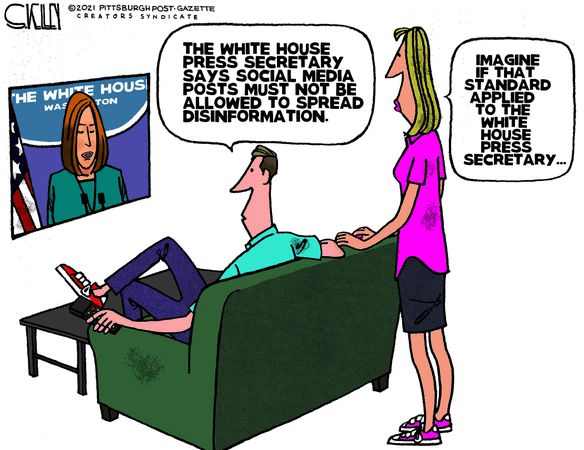
“Misinformation” Means “Shut Up”

Daniel B. Klein reveals the power play currently destroying our civil discourse in his Brownstone article Misinformation is a Word We Use to Shut You Up. Excerpt in italics with my bolds and added images.

Writing at Discourse, published by the Mercatus Center, Martin Gurri describes “disinformation” as follows:

The word means, ‘Shut up, peasant.’ It’s a bullet aimed at killing the conversation. It’s loaded with hostility to reason, evidence, debate and all the stuff that makes our democracy great. (Gurri 2023)
That is from Gurri’s excellent piece, “Disinformation Is the Word I Use When I Want You to Shut Up.” The piece prompted the present essay, the title of which is a variation on his.

With such titles, Gurri and I are being polemical, of course. Not all usages of “disinformation” and “misinformation” come from people intent on shutting someone up. But a lot are. The “anti-misinformation” and “anti-disinformation” projects now afoot or in effect are about shutting up opponents.

In 2019 the Poynter Institute for Media Studies published “A Guide to Anti-misinformation Actions around the World.” There you survey examples of anti-misinformation and anti-disinformation projects and policies, which have no doubt soared further since 2019.

The policing of ‘information’ is the stuff of Naziism, Stalinism, Maoism, and similar anti-liberal regimes. In my title “Misinformation Is a Word We Use to Shut You Up,” anti-liberals are the “We.” To repress criticism of their dicta and diktats, they stamp criticism as “misinformation” or “disinformation.” Those stamps are Orwellian tools that anti-liberals wield in the hope of stamping out Wrongthink—for example, on:

  • climate,
  • election integrity,
  • origins of the Covid virus,
  • therapeutics such as Ivermectin and Hydroxychloroquine,
  • effectiveness of masking,
  • effectiveness of the Covid injections,
  • safety of the Covid injections, and
  • effectiveness of lock-downs.

“Anti-misinformation” could be deployed in keeping with whatever the next THE CURRENT THING might be, with associated slogans against, say, China, Putin, Nord Stream, racists, white supremacists, MAGA Republicans, “deniers,” et cetera. And then, of course, there’s all that “misinformation” disseminated by “conspiracy theorists”.

In speaking of “policing,” I mean government throwing its weight and its coercion around against “misinformation” or “disinformation.” And, besides government coercion, there are allies. These allies often enjoy monopolistic positions, stemming either from government handouts, privileges, and sweetheart deals, as with broadcasters, universities, and pharmaceutical companies, or from having cornered certain network externalities, as with certain huge media platforms. Allies of various sorts sometimes do the bidding of the despots because they themselves are threatened and intimidated. The ecosystem leads to their debasement.

To support governmental policing of “information”
is to confess one’s anti-liberalism and illiberality.

Even worse, it is to flaunt them. The motive is to make and signal commitment to anti-liberalism, in a manner parallel to how religious cults set up rituals and practices for making and signaling commitments (Iannaccone 1992). Vice signals vice, the ticket in some spheres to promotion and advancement.

Also, vicious action spurs more of the same to defend against exposé and accountability for past wrongs. In protecting their rackets, the wrongdoers verge upon a downward spiral.

When despots label opposition “misinformation” or “disinformation” they abuse language. They invoke presuppositions built into the word information, presuppositions that are false. When despots label opposition “mis-” or “disinformation, they are, at best, objecting in the interpretation and judgment dimensions of knowledge, or, at worst, they are speaking in a way that has abandoned civil engagement altogether, instead using words as instruments of wickedness.

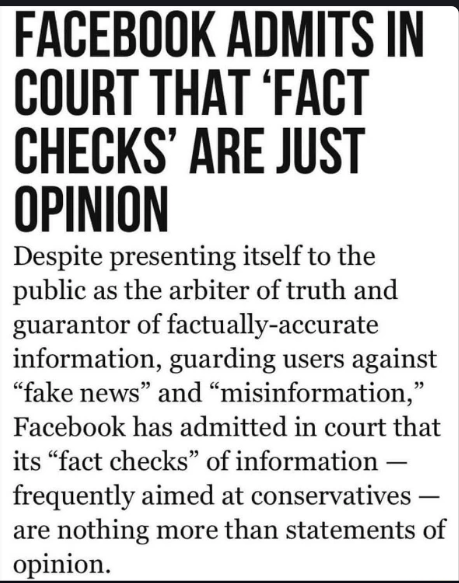
Defence offered by Facebook in Stossel defamation lawsuit.

Usually, what people argue fervently over is not information, but interpretations and judgments as to which interpretations to act on. What is being labeled and attacked as “misinformation” is not a matter of true or false information, but of true or false knowledge. The projects and policies now afoot styled “anti-misinformation” and “anti-disinformation” are dishonest, as it should be obvious to all that those projects and policies would, if advanced honestly, be called “anti-falsehood” or “anti-falseness” or “anti-foolishness” or “anti-untruth” campaigns. But to prosecute an “anti-falsehood” campaign would make obvious the true nature of what is afoot: The persecution and silencing of Wrongthink. In misrepresenting matters of interpretation and judgment as one of “misinformation,” they misrepresent the nature of their projects and dodge the responsibility to account for how they judge among vying interpretations.
In ordinary private-sector affairs, outside of politics and outside of
heavily governmentalized affairs, lying at the level of information
is naturally checked and counteracted.

Again, the “information” implies reference to working interpretations. Getting things rights should not be difficult or tricky—issues there are all within the working interpretation. Sure, mistakes are made; but such mistakes are readily and easily corrected.

Liars about information lose the trust of their voluntary associates, whether those voluntary associates are friends, customers, trading partners, or employees. If liars lie about simple features of their products or their services, they could be subject to law suits from their trading partners, to public criticism, and to rival exposé by competitors. In ordinary private-sector affairs, everyone has reputational incentives not to lie systematically, and especially not to lie about information, and most of us have strong moral incentives within ourselves against lying. We dread the disapproval of “the man within the breast”—an expression Adam Smith used for the conscience.

So, you might ask: If private actors without government privileges and immunities scarcely spread false information dishonestly and programmatically, is disinformation really a thing? Before addressing that question directly, let’s turn to the Godzilla of programmatic lying.

Propaganda: Government’s programmatic lies

It is government, especially, that lies programmatically. The lying can be at the level of information, but it usually makes more sense to say that its lying is at the level of interpretation: The government promotes interpretations—for example, The Covid virus came from nature—, interpretations that it, the government, itself does not particularly believe. It lies about the virus having come from nature, as it lies about many other big interpretations. It propagates big lies.

And it lies with confidence. Government is the only player in society that initiates coercion in an institutionalized way. Its coercion is overt. What’s more, it does so on a colossal scale. That is the most essential feature of government. Every government is a Godzilla, and we must learn to live with our Godzilla and mitigate the destruction it wreaks.

The traditional term for government’s programmatic lying is propaganda—a word that once did not necessarily imply falseness (instead meaning simply ideas propagated), but is now generally used in that necessarily-pejorative sense. The falsehoods of propaganda are typically lies, in that the propagandizers usually do not particularly believe the claims they propagate.

Government can lie programmatically because it does not depend on voluntary participation for its support. It subsists on coercion, including restrictions on competitors and opponents, and takings from taxpayers. Organizations in heavily governmentalized settings can also lie programmatically. Crony private-organizations sustain large programmatic lying only when they enjoy privileges, immunities, and protections from the government.

Base humans tend to weaponize things

But aren’t governments accountable to checks and balance, divisions of power, and the rule of law? Haven’t we learned to tame Godzilla, to chain down Leviathan?

It is true that the government of a rule-of-law republic, checked by an honest media, might be quite limited in its programmatic lying. But that’s not how it is today, where dissent is being tarred as “mis-” and “disinformation,” and where the legacy media is morally base in the extreme. Today, regimes are increasingly despotic, and despotic regimes are much less checked and limited.

The rule of law means, first and foremost, the government
living up to the rules posted on its own website.
Governments today don’t do that.

Law is applied politically, that is, with extreme partiality, upon a double-standard. Laws are selectively enforced and punishments are selectively meted out. Despots avail themselves of show trials, kangaroo bodies, and galleries filled with stooges. The “anti-misinformation” agenda is misrule.

Despotism despoils checks and balances. Despotism centralizes power formerly divided. It destroys the independency and autonomy that, theoretically, branches and units, divided and balanced, had once enjoyed. Despotism usurps powers once distributed and balanced. Despotism is unbalanced power.

Under a despotic regime, the coercive institutions unique to government become weaponized by the despots and their allies. They turn them against their opponents. But weaponization is itself always somewhat constrained by cultural norms. The existence of government implies the existence of a governed society, and the existence of society implies the existence of some basic norms, for example against theft, murder, and lying. David Hume famously pointed out that the governed always vastly outnumber the governors, and hence government depends on “opinion”—if only the opinion to acquiesce to those governors.

The contested claims go far beyond information

The despots tend to invoke certain organizations as the definitive, authoritative sources of “information.” They say, in effect: “The CDC, the WHO, the FDA says the mRNA injections are safe and effective, so anything that suggests otherwise is misinformation.” The farce here is pretending that everyone’s working interpretation consists of the dicta of some such particular organization. Never has an organization or agency had such a Mount-Olympus status for determining, throughout society, working interpretations of complex matters, and particularly not an organization with the foul characters and track-records of the CDC, WHO, FDA, and similar highly governmentalized organizations. The similitude to the Soviet Union under Stalin is obvious.

Despotic contempt for our circle of “we”

Again, what is labeled and attacked as “misinformation” or “disinformation” is not a matter of true or false information, but of true or false knowledge. Recognizing that knowledge, not merely information, is at issue is a matter of common decency.

The dignity of sincere discourse involves an openness, in principle a universal openness, to other human “we’s” and their pursuits upward in wisdom and virtue. As we can see, the chief facets of knowledge—information, interpretation, and judgment—operate both behind and ahead of our current position in the spiral. Trying to shut us up is to show a despotic contempt for our way of weaving through the phases of knowledge. It is contemptuous towards the development of the many loops within which our sense-making has made a home and now operates.

By weighing interpretations and making judgments, we establish certain beliefs as fact, to predicate our further conversation. Those beliefs reflect a “we” with those beliefs. Meanwhile, in the wider world, different “we’s” are forming and are addressing the public at large, representing different sets of belief, different ways of making sense of the world. We might call a “we” a distinct sense-making community.

The sincere human of any one of these communities is eager to learn from other communities. The sincere human has certain commitments which make it belong to the sense-making community it belongs to, but it is not wedded to that community. In fact, the entire population of that community—that is, the set of people who currently share that way of sense-making—may remake their community’s way of sense-making. Those who learn from other communities may become leaders of intellectual change within their own community.

Thus, sincere humans favor the freedom of speech and the norms of frank and open discourse for all communities. Besides favoring that freedom, they welcome engagement across communities, for all the reasons given earlier.

The “anti-misinformation” despots show contempt for communities at odds with their dicta and diktats. Not only are the members of the “anti-misinformation” community unwilling to engage in civil debate, but they promulgate “anti-misinformation” propaganda so as to intimidate their adversaries, to crush dissent.

I have explained that the “misinformation” characterization of the disagreement is false. The anti-liberals are presupposing that it is a matter within the information dimension of knowledge, when clearly the disagreement involves contentions in the interpretation and judgment dimensions. Under pretense of combatting misinformation, they are really just stomping on adversaries. As I said at the outset, it is akin to Naziism, Stalinism, and Maoism, regimes that likewise showed despotic contempt for sense-making communities at odds with their own. “Anti-misinformation” projects are a sham, just as “anti-racism” projects are a sham.

Concluding remarks

The “anti-misinformation” projects are obvious miscarriages of civility, decency, and the rule of law. We must rediscover the norms of openness, tolerance, and free speech that dignify humankind. Science depends on confidence, and confidence depends on those liberal norms. Those norms are the parents of good science, healthy sense-making, and civil tranquility. There are two roads here, namely:

    1.  Freedom —> openness —> confidence —> truth-tracking —> dignity;
    2. Despotism —> concealment —> diffidence —> bad science —> serfdom and servility

Let’s get back to the right road.

White Guys, it’s not personal. It’s Western Civilization They Hate.

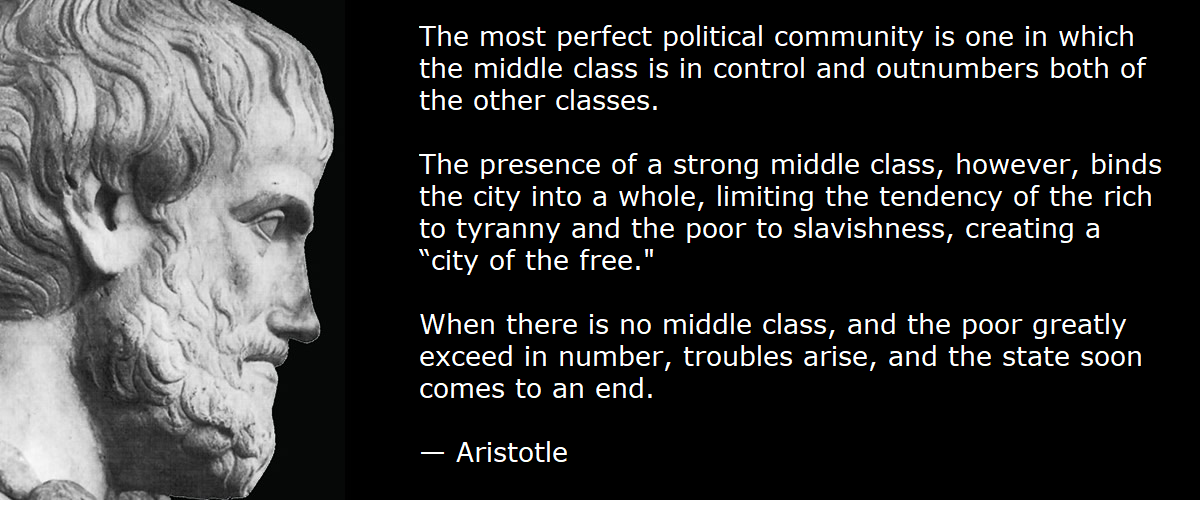
White privilege gave us Western civilization, the middle class,
and the nuclear family—you’re welcome! This book is dedicated
to the very fine people that made it all happen.

I just became aware of A.J. Rice from this American Greatness article Rice: Woke initiatives were ‘one uppercut to the face after another’ for Gen Z.  Excerpts in italics with my bolds and added images.

A J Rice said Gen Z is a generation that struggles with human connection because of the mass social justice movements they grew up with. He made the comments on a recent episode of The Greatness Conversation.

“You had one uppercut to the face after another here for Gen Z where, first, it’s the Me Too movement, males are told to take it down a notch, toxic masculinity,” Rice said on a recent episode of The Greatness Conversation. “You might be a predator, you might be a rapist. And then, and then all of a sudden, George Floyd dies. You’re now a racist. All of your history stinks.”

“And then when that’s all over, they’re going to drop on you that there are 72 genders and Gary and Tim and Bill are coming into the women’s locker room and the girl’s bathroom,” Rice said. “So, you know, if you wonder why Gen Z has a hard time being authentically human.”

Rice joined the podcast to discuss his new book, “The White Privilege Album,” the use of comedy to talk about progressive “wokeness,” and the future of what society looks like for younger generations.

Who’s A. J. Rice? More from American Spectator A.J. Rice’s White Privilege Album Is a Vaccine for the Woke Mind Virus. Excerpts in italics with my bolds and added images.

Rice exposes what actual white privilege looks like
and why you don’t have it.

You already know this, but we live in deeply stuffy, oppressive times. You can get canceled for saying the wrong thing, not saying the right thing, or even looking at someone in a way they don’t like. Don’t believe me? Go to the gym and glance for more than three seconds at that 20-something girl in the bralette and bike shorts; woe betide you if you’re not in better shape than she is.

One minute you’re on top of the world — the next minute, you’re canceled and your whole world is turned upside down. It would be no small thing to just say forget all this and say and do whatever you want without fear. A younger Mel Brooks or Woody Allen might relish taking the fight to wokeness, but few others around would.

The digital gulag awaits us all, it seems. A hunger for thus imprisoning one’s fellow man is what the woke mind virus instills in its victims.

Into this climate of fear and loathing comes a writer, an entrepreneur, a madcap thinker with the sand to call the entire woke-industrial complex “zombies” and then follow that up with a book that quotes from Blazing Saddles on its opening page.

You remember Blazing Saddles, don’t you? It’s one of the funniest and most controversial movies ever made, a cultural sacrament for Generation X if ever there was one. It uses racism to mock racism, stupidity to rip stupidity, and comedy to take a sledgehammer to anyone who takes themselves too seriously — and in ways and from angles that make it an impossible movie to get produced today.

But back to the book. Its title is — mischievously —The White Privilege Album, and it’s A.J. Rice’s newest exploration of the insanity of our times.

The Worst of Times and the Worse of Times

According to Rice, we live in the worst of times, and, well, also the worse of times. Sure, we have all the technology we’ll probably ever need and the whole world’s knowledge at our fingertips at any given moment. You can explore the finest works of art, delve into the achievements of the Maya, study the miraculous founding of America — anything you want.

But millions merely use all this technology and knowledge we’re privileged to have to attack America relentlessly every hour of the day. We pay for public schools through our taxes, and those schools are filled with woke activists masquerading as teachers, indoctrinating our kids with ESG, DEI, and transgenderist trash and telling them that every generation before them was hopelessly racist and evil.

Well, only if they were white. Everyone else gets a free pass even if their ancestors owned slaves, committed genocide, or did other terrible things. Only white people need apply for the re-education camps Hillary Clinton wants, and only white people would be subject to the censorship regime that the entire Democratic Party so openly wants.

There’s your white privilege, Rice says. You’ll be subject to the whims of woke wackos and their digital shock troops. Your leaders will be cast as villains. You’ll be lied to, hoaxed, and perhaps doxxed and canceled. And you’ll like it or they’ll call you a racist and cancel you again.

Rice Exposes Hoaxes and Lies as the Foundation of the Left

As Rice documents and exposes in this extremely well-researched and written book, the major movements of our time are based on hoaxes, lies, smears, and bullying. Wokeness incorporates all of that — it’s a hoax against America and Western values, based on lies and half-truths taken out of context, aimed at smearing and undermining our history and culture, and weaponizes organized bullying to intimidate the weak-minded into submission.

Likewise, Joe Biden’s very reason for running for president was, according to him, based on the Trump “very fine people” quote — which was torn out of context and twisted into a hoax in which he is said to have praised neo-Nazis.Spoiler: He didn’t. Biden lied. A lot.

These hoaxes and lies are the foundation of the entire left now, Rice writes. Chapter by chapter, Rice takes on and tears apart the woke NBA, California Gov. Gavin Newsom’s Marxist racism, Barack Obama’s stealth wokeness, Ibrahim X. Kendi’s lucrative race-hustling grift, and so much more. Along the way, you will see actual white privilege, in the form of a ne’er-do-well crackhead who suspiciously stays out of jail no matter what while black and brown offenders end up in prison for years on similar offenses. You’ll also learn why Aunt Jemima and Uncle Ben were really fired. In fact, you’ll get 12 months of “white privilege” in this amazing book.

But The White Privilege Album isn’t just about mowing down woke zombies. There’s plenty of that, but it’s also about lifting up heroes who deserve it and rebuilding the sense that America is great and good and always has been. A.J. Rice delivers the triumphs amid the seemingly overwhelming evil, through chapter after chapter that you won’t be able to put down.

Rice: The left hates Western civilization, the middle class, children

“Here’s the takeaway,” he said. “I’m abducting their language and using it against them.”

It started with so-called “white privilege,” he said.

“When you hear these terms, ‘white privilege,’ ‘intersectionality,’ or ‘check your privilege,’ or these constructs of white privilege, when you hear the left, do that what they’re really talking about is three things,” he said.

“One, Western civilization, and I mean Greco-Roman Judeo-Christian civilization, which has to go, they want it to go away,” the author said. “That’s why it’s not just about tearing down statues. It’s everything from Columbus to Winston Churchill — it has to go.”

The second thing is the middle class, Rice said. “The left cultural Marxists and economic Marxists have been trying to destroy the middle class for 100 years,” he said.

“They know to do that because they want a peasant class because Marxism has never thrived,” he said. “Not in Venezuela, not North Korea, none of these places when there’s been a healthy middle class — so middle class has to go.”

The third thing is children, he said.  “I believe happy people have more children; of course, more children mean more global warming, so the third thing that they have to destroy is the nuclear family,” he said.

“We know they have to destroy it because Black Lives Matter told us that they wanted to destroy it on their website.”

Rice: America is a multi-ethnic country

Rice said he is trying to untangle Americans from the labels that the left uses to confuse us.

“Let me just say, we are not a multicultural country,” he said.

We are a multi-ethnic country, and the middle class and Western civilization in the nuclear family are colorblind,” he said.

“They’re not white, black, or anything else, and if you want to come here and you do it legally, you can come here and participate in this great experiment,” Rice said.

“As long as the cultural Marxists don’t destroy it.”

Propaganda Machine is Failing, Beware the Jackboots

Matthias Desmet previously alerted us to the appearance of mass formation supporting totalitarian Covid controls.  Now he writes a warning concerning popular rejection of the elite propaganda machine. His Brownstone article is The Propaganda Model Has Limits.  Excerpts in italics with my bolds and added images.  H/T Tyer Durden.

Normally, I let my pen rest during the summer months, but for some things, you set aside your habits. What has been happening in the context of the US presidential elections over the past few weeks is, to say the least, remarkable. We are witnessing a social system that – to use a term from complex dynamic systems theory – is heading toward a catastrophe.

And the essence of the tipping point we are approaching is this:
the propaganda model is beginning to fail.

It started a few weeks ago like this: Trump, the presidential candidate who must not win, is up against Biden, the presidential candidate who must win. After the first debate, it was immediately clear: Trump will win against Biden. The big problem: Biden and Jill are about the only ones who don’t realize this.

The media then turned against Biden. That, in itself, is a revolution. They had praised President Biden to the skies for four years, turning a blind eye to the fact that the man either seemed hardly aware of what he was saying or was giving speeches that could only be described as having the characteristics of a fascist’s discourse.

In any case, the media’s love for Biden was suddenly over when it became clear that he could not possibly win the election, even not with a little help from the media. If you want to know how that ‘little help’ worked in 2020, look at one of the most important interviews of the past year, where Mike Benz – former director of the cyber portfolio of the US government – explains to Tucker Carlson in detail how information flows on the internet were manipulated during the 2020 elections (and the Covid crisis).

After the first debate, the media realized that even they could not help Biden win the election. They changed their approach. Biden was quickly stripped of his saintly status. The Veil of Appearances was pulled away, and he suddenly stood naked and vulnerable in the eye of the mainstream – a man in the autumn of his life, mentally confused, addicted to power, and arrogant. Some journalists even started attributing traits of the Great Narcissistic Monster Trump to him.

Then things took another turn, a turn so predictable that one is astonished that it actually happened. An overaged teenager calmly climbed onto a roof with a sniper rifle, under the watchful eyes of the security services, and nearly shot Trump in the head. The security services, which initially did not respond for minutes when people tried to draw attention to the overaged teenager with an assault rifle, suddenly reacted decisively: they shot the overaged teenager dead seconds after the assassination attempt.

What happened there? There are many reasons to have reservations about Trump, but one thing we cannot help but say: if Trump becomes president, the war in Ukraine will be over. Anyone who does not attribute any weight to that should subject themselves to a conscience examination. And no, Trump will not have to give half of Europe to Putin for that. My cautious estimate, for what it’s worth: It will suffice for NATO to stop and partially reverse its eastward expansion, for Russia to retain access to the Black Sea via Crimea (something everyone with historical awareness knows that denying would mean the death blow to Russia as a great power and thus a direct declaration of war), and for the population of the Russian-speaking part of Ukraine to choose in a referendum whether to belong to Russia or Ukraine.

So, I repeat my point: with Trump, the provocation of Russia stops, and the war in Ukraine ends. Presidents who threaten to end wars are sometimes shot at by lone gunmen. And those lone gunmen are, in turn, shot dead. And the archives about that remarkable act of lone gunmen sometimes remain sealed for a remarkably long time, much longer than they usually do.

The news reaction was predictable. We are used to the media. Some journalists even suggested that Trump had been shot with a paintball, others thought the most accurate way to report was that someone ‘wounded Trump on the ear.’

In any case, after the assassination attempt, the situation became even more dire for the mainstream: the presidential candidate who must not win is now even more popular, and his victory in a race with Biden is almost inevitable.

Then the next chapter begins. Biden suddenly changes his mind: he has come to his senses and drops out of the race. He announces this – of all things – in a letter with a signature that, even for his shaky condition, looked quite clumsy. Then he stayed out of the public eye for a few days. We are curious about what exactly happened there.

But the media are compliant again. Biden has now been sanctified again. Just like Kamala Harris, of course. They are already mentioning polls showing she will beat Trump. With a little help from the media, of course. Curious how this will continue, but I would be surprised if the rest of the campaign will be a walk in the park. Trump is not safe after the first attempt, that’s for sure. And to Kamala Harris, I say this: when totalitarian systems go into a chaotic phase, they become monsters that devour their own children.

Case in Point 1: Orbán: The West Sees Immigration As A “Way Of Getting Rid Of The Ethnic Homogeneity That Is The Basis Of The Nation-State”


From Zerohedge:  In Hungarian Prime Minister Viktor Orbán’s speech at Tusványos in Romania, he focuses on the intractable differences developing between the East and West of Europe, with immigration one of the key divisions. He not only rejects the Western view on immigration, but sees it as an agenda with a very specific ideology behind it, which is designed to erode the nation-state entirely.

“But Westerners, quite differently, believe that nation-states no longer exist. They therefore deny that there is a common culture and a public morality based on (the nation-state). There is no public morality, if you watched the Olympic opening yesterday, you saw it. So, they also think differently about migration. They believe that migration is not a threat or a problem, but in fact a way of getting rid of the ethnic homogeneity that is the basis of a nation. This is the essence of the progressive liberal international concept. That is why the absurdity does not occur to them, or they do not see it as absurd,” he said.

This dramatic ideological cleavage is not a “secret,” according to Orbán. He said that the documents and policy papers coming out of the EU show that the “clear aim is to transcend the nation.”

“But the point is that the powers, the sovereignty, should be transferred from the nation-states to Brussels. This is the logic behind all major measures. In their minds, the nation is a historical, or transitional, formation of the 18th and 19th centuries — as it came, so it may go. They are already in a post-national state in the Western half of Europe. It’s not just a politically different situation, but what I’m trying to talk about here is that it’s a new mental space.

And finally, the last element of reality is that this post-national situation that we see in the West has a serious, I would say dramatic, political consequence that is shaking democracy. Societies are increasingly resistant to migration, gender, war and globalism. And this creates the political problem of elites and the people, elitism and populism. This is a dominant phenomenon in Western politics today…This means that the elites condemn the people for drifting to the right. The feelings and ideas of the people are labeled xenophobia, homophobia and nationalism. The people, meanwhile, in response, accuse the elite of not caring about what is important to them, but of sinking into some kind of mindless globalism.

Case in Point 2: UK Prime Minister Calls For Crackdown On Angry Brits – Violent Migrants Get A Pass


From Zerohedge: Beyond the obvious Cloward-Piven agenda in play throughout most of Europe and the US, open border policies accomplish much more than simply erasing western culture with third-world migrants. The introduction of violent peoples from violent countries and ideologies is a perfect way to generate public hostility and getting them to react in anger. When a government refuses to represent the interests of actual citizens that are under attack by foreign elements the only avenue left to that populace is self defense.

Establishment elites understand very well that their malicious activities are going to generate a vengeful response. Their first measure is to shame the public with accusations of “extremism” when the public fights back. When that doesn’t work, the next measure is to use popular riots as an excuse to impose authoritarian controls “in the name of safety.”

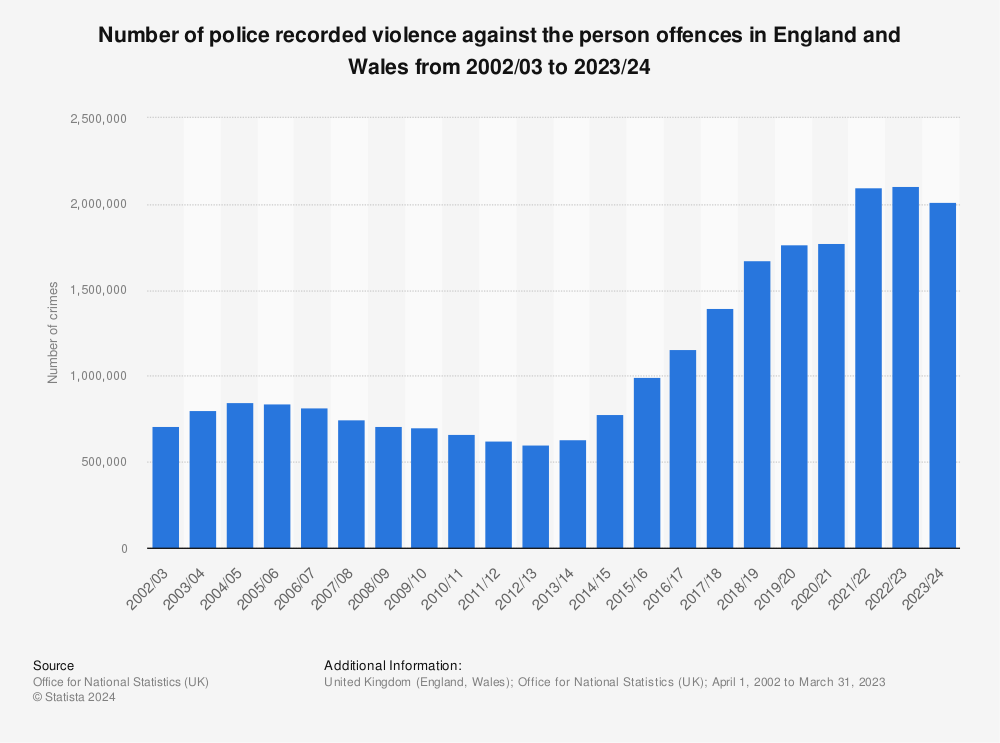
UK police and political authorities specifically avoid keeping a record of the migrant status of most perpetrators, making it difficult to directly prove who is responsible for the crime spike.  Correlation is not necessarily causation, but there were no other dramatic changes to UK society during that time period that would account for the crime spike.  The only thing that changed was the type of migrants the UK government was accepting and the amount of people they were allowing in.

Remove the migrants and watch crime numbers plummet; it’s that simple.
The UK public knows it and those in power choose to ignore it.
This has led to predictable conflict.

Keep in mind, leftist protests and riots have been ongoing in the UK for the past year in the name of Gaza, among other causes.  The law enforcement response to these situations has been minimal.  It is clear that there is a grotesque double standard when it comes to conservative or nationalist protests – If you aren’t on Team Progressive, then you aren’t allowed a redress of grievances.  The left is allowed to riot, conservatives are not even allowed to take to the streets.  This is what happened after January 6th in the US and it’s happening right now in the UK.

If the goal is a dystopian nightmare state then the UK is well on its way.  The public has made clear that they will no longer be abused.  The question is, who will blink first – The populace under threat of Orwellian surveillance and lockdowns, or the establishment fearing that the civil unrest they so hoped to trigger might grow out of their control.  


Four Outlandish Narratives Compared to Realities

James Rickards posted Four Unblievable Narratives at his blog Daily Reckoning.  Excepts in italics with my bolds and added images.

Everyday Americans and investors in particular are confronted with “narratives” daily. Many include hidden agendas that are politically, ideologically or financially driven.  The key for investors is to see the narrative for what it is, avoid the mass psychosis, position yourself for reality and succeed in the end.

Following are four reigning narratives.

In each case, I sketch these narratives (and what the media wants you to believe),
then contrast that sketch with reality supported by hard data
.

COVID: The Narrative

The pandemic narrative was straightforward: It was caused by a virus of natural origin that passed from animals to humans through exotic game, such as bats and pangolins, that were sold in a wet market in Wuhan, China. It spread quickly and was highly fatal.

The solution was to isolate individuals through lockdowns, social distancing, school closures and masks. Eventually a vaccine became available that would “stop the spread.” Over time, the virus mutated into less dangerous forms, immunity from the vaccine increased and the restrictions were relaxed.

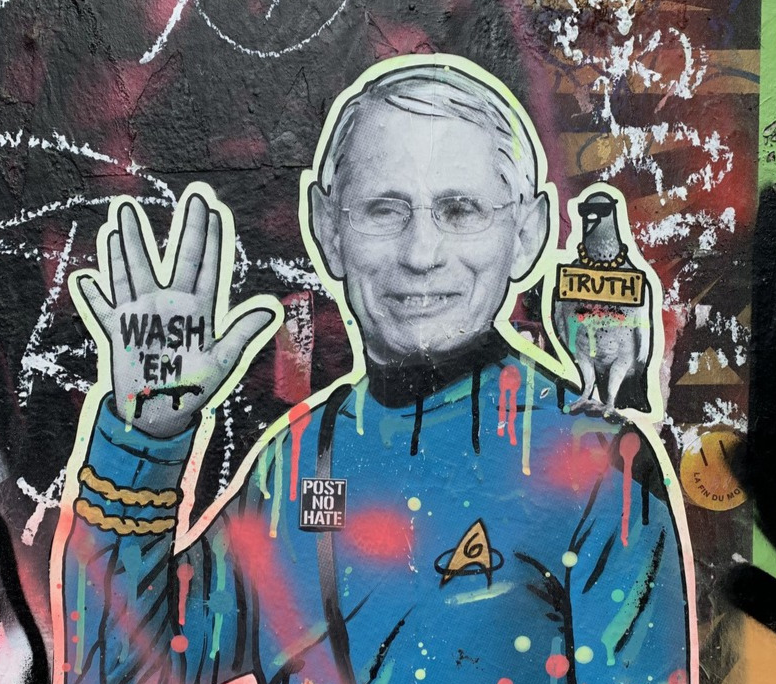
The heroes were Anthony Fauci, who led the lockdown response, and Joe Biden, who forced mass vaccination programs on everyday Americans. The economic costs were worth it. Today, all is well.

Covid: The Reality

The virus was created by Communist Chinese scientist Shi Zhengli, known as the “Bat Woman of Wuhan.” It leaked from the Wuhan Institute of Virology. China immediately banned academic papers pointing to their culpability and created the “wet market” myth.

The Wuhan gain-of-function research that created the virus was funded by Anthony Fauci using a cutout called EcoHealth Alliance. Once the virus leaked, Fauci spent more time covering up his involvement than helping Americans cope with the disease.

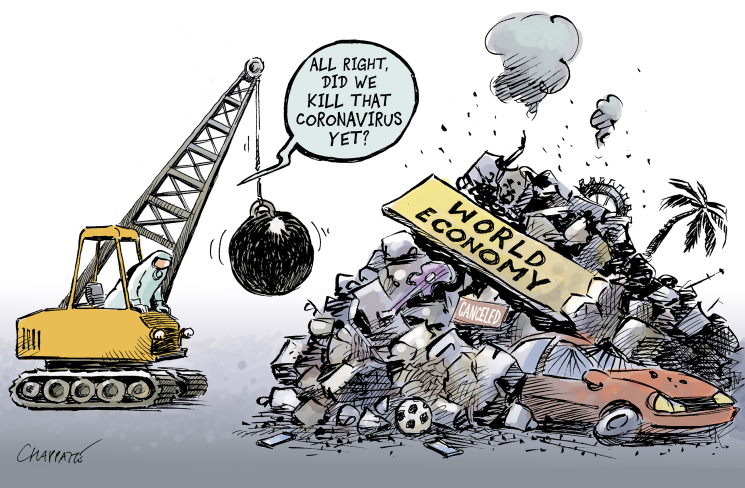
Fauci closed schools and workplaces and destroyed the economy all for no good reason. The pandemic policy response was the greatest, most dangerous and costliest hoax in human history.

Ukraine: The Narrative

Since the beginning of the Russian Special Military Operation in Ukraine in February 2022, the narrative has been that Russia began the war as part of a wider ambition to recapture all of Eastern Europe and the Baltic states.

It was essential that the U.S. and NATO allies support Ukraine with as much money and materiel as needed to defeat Russian ambitions. The West was considered to be fighting for democracy and freedom in Ukraine.

The unrelenting financial and weapons support combined with the impact of sanctions and Russian incompetence would lead to an ultimate Ukrainian victory.

Russian dissatisfaction with Putin would lead to a popular uprising that would overthrow him and make Russia a more democratic country friendly to the U.S.

Ukraine: The Reality

Russia didn’t provoke the war. It was provoked by the U.S. in 2008 with George W. Bush’s Bucharest Declaration that Ukraine should join NATO. The provocation continued through a U.S./U.K.-sponsored coup d’etat in 2014 that overthrew a duly elected president and replaced him with a U.S. puppet regime.

The U.S. and NATO then lied to the Russians in the course of negotiating the Minsk agreements in 2014 and 2015, which German Chancellor Angela Merkel admitted the West had no intention of honoring.

The idea that the U.S. is fighting for democracy in Ukraine is a farce. President Zelenskyy declared martial law, suspended elections and imprisoned his political opponents. Zelenskyy’s elected term expired in May 2024, so he now rules as an unelected dictator propped up by a corrupt military.

Meanwhile, U.S. and NATO financial sanctions on Russia due to the war in Ukraine have failed miserably. Russian growth now exceeds U.S. growth. Russia is growing at 5.4% (annualized) while U.S. growth in the most recent quarter was only 1.4%.  Unemployment in Russia is only 2.7% while the unemployment rate in the U.S. is 4.1%. The most recent growth forecasts for 2024 from the IMF show Russia growing at 3.2% and the U.S. growing only 2.7%.

The war isn’t over but Russia will clearly win. The remnants of Ukraine will be a landlocked rump state with no productive economy.

Climate Change: The Narrative

Climate change advocates have a straightforward narrative. Carbon dioxide (CO2) and methane (CH4) are both greenhouse gasses that trap heat within the atmosphere. CO2 and CH4 are created by emissions from the burning of “fossil fuels.”

This climate change caused by fossil fuels will have highly deleterious effects on human life and civilization. All types of natural disasters will result. The solution is to lower the global temperature or at least slow the increase.

This can be done by replacing fossil fuels with renewable energy generation including wind and solar. With enough time, effort and money global warming can be curtailed.

Climate Change: The Reality

The climate alarmists have been wrong for 40 years and they’re wrong now. Ice caps are expanding in many places, and no nations are underwater. Climate change is real, but it’s a natural phenomenon that arises slowly and lasts for centuries. These phenomena include solar cycles, volcanic eruptions and ocean currents.

It has nothing to do with CO2, automobiles or the use of natural gas and coal to generate electricity. In fact, the best evidence is not that CO2 causes warming, but that warming causes the release of CO2. The alarmists have the cause and effect exactly backward.

Climate alarmists are an ideological cult driven by a desire to destroy U.S. independence and the U.S. economy in pursuit of neo-Marxist dreams. The U.S. has more than enough energy, technology and ability to create an optimal carbon-based future while remaining open to other solutions.

U.S. Economy: The Narrative

Perhaps no narrative is more ubiquitous and persistently touted than the idea that the U.S. economy has dodged a global recession and high inflation at the same time. The economy has come in for a “soft landing” and is headed for a future of strong growth, low unemployment, low inflation and higher stock prices.

This is all due to the brilliant finesse of monetary policy by the Federal Reserve and the Biden administration’s generous fiscal policies.

This narrative is promoted by Wall Street and the White House operating almost in lockstep. Wall Street wants to sell you stocks and has to keep the soft landing narrative alive. The White House wants to win the election in November and has to sell Americans on the idea that the economy is strong and the future is bright.

The two are joined by the mainstream media that has a strong pro-Biden tilt. The result is a trifecta of banks, government and the media all telling you that all is well.

U.S. Economy: The Reality

The U.S. is likely in a recession today or, if not, soon will enter recession. Here’s the data to support the reality: The Federal Reserve Bank of Atlanta GDP Nowcast projects Q2 growth at 1.5% annualized, down from an estimate of 4.2% growth as recently as May 14.

The unemployment rate ticked up to 4.1% in the June employment report. Headline job creation was 206,000 jobs, but if the more reliable alternate household survey is used, the economy actually lost 408,000 jobs in May.

Most job creation is in part-time jobs and almost all new jobs are going to illegal aliens. Real wages are stagnant. Meanwhile, if workers not in the workforce were counted as unemployed, the actual unemployment rate today would be about 8.0%, consistent with recession levels.

Oil prices have also trended down over the last couple of months, a sign both of reduced consumer demand and a slowing economy. Consumer savings are also largely depleted and credit cards are maxed out.

Debunking Narratives

It can be difficult to refute narratives. Every propagandist and master of the Big Lie from Joseph Goebbels to Alex Soros has admitted that repetition is the key to making citizens believe the lie.

Narratives find willing amplification and repetition in the mainstream media. They’re also made effective by mixing lies with truth.

The best set of tools to identify a false narrative includes education, a skeptical attitude and close attention to hard data.

My role is to subject narratives to critical scrutiny, develop my own data sources and apply independent analysis without ideological filters or political bias.

I’m confident this will help you acquire “narrative resistance” and position you to profit when reality reasserts itself.

Discovering Anti-Woke Allies

As noted in the definition, Wokists are doomsters bound up in an ideology that delivers discontent and endless social conflict.  You can recognize wokists by their dominent traits: drama queens, know-it-alls and control freaks.

They possess no sense of gratitude for the benefits and potentials available in modern society, existing only because of the efforts and creativity of previous generations.  Instead wokists display righteous outage, antagonism and destructive acts against the heritage so meaningful to others.

We have also noticed major corporations, like Disney and Bud Light, as well as sport leagues like the NFL and NBA, wrapping themselves in rainfow pride flags and espousing woke platitudes.  So imagine my surprise upon discovering an ally for common sense and positive thinking right under my nose, so to speak.

For many years, I have used Splenda to sweeten my coffee in the morning. Upon opening the last box of Splenda packets, I noticed on one side of each little paper wrapping, a message like you used to get in a fortune cookie.  Each slogan is different, and they are all positive, uplifting and life-affirming.  None are political or divisive, in contrast to most of today’s public discourse.  It’s like finding a current copy of Reader’s Digest, featuring wholesome, common sense articles, including of course my favorite section, “Laughter is the Best Medicine.” (April 2024 was the last edition of Canada’s Reader’s Digest)

For example, this morning, I was treated to this:” Be Happy!  It drives other people crazy!”  My wife got a packet declaring: “The Perfect Moment is NOW

I found these waiting for future mornings to come:

Life is Short make it Sweet

Every Day is a New opportunity

Leave a little Sparkle wherever you go

Find the sweet side in all things

The best way to get there is to Start

There are people and organizations that embrace values and behaviors that build up rather than tear down relationships and institutions.  Hopefully more and more of them will espouse those positive attitudes and shift the public mood away from its current downward spiral.