Degrees of Climate Truth

Previous posts have dealt with science as a mode of inquiry, and described the process of theory and observation by which scientific knowledge is obtained. This post presents work by Andy May to classify the degrees of scientific certainty or truth, and apply these to climate claims.

The essay Facts and Theories comes from his blog Andy May Petrophysicist.
Excerpts below with my bolds.

Categories of Scientific Knowledge

Newton provided us with his descriptive “Law of Gravitation.” Newton’s law tells us what gravity does and it is very useful, but it tells us nothing about how it works. For that we need Einstein’s theory of relativity. Theories and laws are not necessarily related in science. A law simply describes what happens without describing why. A scientific theory attempts to explain why a relationship holds true.

In the scientific community, for both a law and a theory, a single conflicting experiment or observation invalidates them. Einstein once said:

“No amount of experimentation can ever prove me right; a single experiment can prove me wrong.”

So, let’s examine our topics in that light. Newton’s descriptive law of gravity, based on mass and distance, are there any exceptions? Not to my knowledge, except possibly on galactic sized scales, black holes and probably on very, very small sub-atomic scales. In everyday life, Newton’s law works fine. How about Einstein’s theory of gravity (Relativity), any exceptions? None that I know of at any scale.

How about evolution? Species evolve, we can see that in the geological record. We can also watch it happen in some quickly reproducing species. Thus we could describe evolution as a fact. It happens, but we cannot describe how without more work. Early theories of the evolutionary process include Darwin’s theory of natural selection and Lamarck’s theory of heritable species adaptation due to external stresses. Due to epigenetic research we now know that Darwin and Lamarck were both right and that evolution involves both processes. For a summary of recent research into the epigenetic component of evolution see this Oxford Journal article. Thus well-established facts and scientific laws rarely change but theories do evolve. I might add that while facts and laws don’t often change, they are easily dismissed when contradictory data are gathered. The modern theory of evolution is a good example of where competing theories can merge into one.

Most scientific theories begin as hypotheses. A hypothesis is best described as an idea of what might be causing a specific event to occur. A proper scientific hypothesis, like a theory, must be falsifiable. That is, we must be able to design an experiment or foresee an observation that will make the hypothesis false. “Climate change” is not falsifiable, it is not a scientific hypothesis or a theory. “Man-made climate change” is a scientific hypothesis since it is falsifiable. Hypotheses and theories are evolving things, new facts and observations cause them to change. In this way we build the body of science. Science is mostly skepticism. We look for what does not fit, we poke at established facts and laws, at theories and hypotheses. We try and find flaws, we check the numbers. Worse, science done properly means we spend more time proving ourselves wrong than we do proving we are right. Life is tough sometimes.

So how does this fit with the great climate change debate. I’ve made a table of phrases and identified each common phrase as a fact, theory, law, hypothesis, or simply an idea. These are my classifications and certainly open for debate.

In Table 1 we can see that the comparison of man-made climate change and the possibility of a man-made climate catastrophe are not really comparable to the theories of gravity and evolution. Man-made climate change is more than an idea, it is based on some observations and reasonable models of the process have been developed and can be tested. But, none of the models have successfully predicted any climatic events. Thus, they are still a work-in-progress and not admissible as evidence supporting a scientific theory.

The idea of man-made climate change causing a catastrophe at the scale of Islamic terrorism is pure speculation. The models used to compute man’s influence don’t match any observations, this is easily seen in Figure 1 which is Dr. John Christy’s graph of the computer model’s predictions versus satellite and weather balloon observations. I should mention that satellite and weather balloon measurements are independent of one another and they are independent of the various surface temperature datasets, like HADCRUT and GHCN-M. All of the curves on the plot have been smoothed with five year averages.

The purple line going through the observations is the Russian model “INM-CM4.” It is the only model that comes close to reality. INM-CM4, over longer periods, does very well at hindcasting observed temperatures. This model uses a CO2 forcing response that is 37% lower than the other models, a much higher deep ocean heat capacity (climate system inertia) and it exactly matches lower tropospheric water content and is biased low above that. The other models are biased high. The model predicts future temperature increases at a rate of about 1K/century, not at all alarming and much lower than the predictions of the other models. (See Temperatures According to Climate Models)

One can consider each model to be a digital experiment. It is clear that the range of values from these digital experiments exceeds the predicted average temperature increase. This does not give us much confidence in the accuracy of the models. Yet, the IPCC uses the difference between the mean model temperature anomalies and observed surface temperatures since 1950 to compute man’s influence on climate.   (See Climate Models Explained)

In particular Soon, Connolly and Connolly (SCC15) believe that the IPCC chose an inappropriate model of the variation in the sun’s output (TSI or total solar irradiance). There are many models of solar variation in the peer reviewed literature and it is a topic of vigorous debate. Eight recent models are presented in Figure 8 of SCC15 (see Figure 3). Only low solar variability models (those on the right of Figure 3) are used by the IPCC to compute man’s influence on climate although just as much evidence exists for the higher variability models on the left. The scales used in the graphs are all the same, but the top and bottom values vary. At minimum, the IPCC should have run two cases, one for high variability and one for low. SCC15 clearly shows that the model used makes a big difference.

Any computer Earth model must establish a track record before it is used in calculations. The Earth is simply too complex and natural climate cycles are poorly understood. If natural cycles cannot be predicted they cannot be subtracted from observations to give us man’s influence on climate. The debate is not whether man influences climate, the debate is over how much man contributes and whether or not the additional warming dangerous. This observer, familiar with the science, would say the jury is still out. Certainly, the case for an impending catastrophe has not been made as this requires two speculative jumps. First, we need to assume that man is the dominant driver of climate, second we need to assume this will lead to a catastrophe. One can predict a possible catastrophe if the most extreme climate models are correct, but the record shows they are not. Only INM-CM4 matches observations reasonably well and INM-CM4 does not predict anything remotely close to a catastrophe.

In the study of the process of evolution the problem is the same. Some believe that the dominant process is natural selection and epigenetic change is minor. Some believe the opposite. Everyone believes that both play a role. As in climate science, figuring out which process is dominant is tough.

Recent climate history (the “pause” in warming) suggests that we have plenty of time to get our arms around this problem before doing anything drastic like destroying the fossil fuel industry and sending billions of people into poverty due to a lack of affordable energy.

Summary:  Scientific vs. Social Proof

In the IPCC reports certainty is presented in terms of social proofs. For example, an assertion is rated as Very High Confidence, or 95% Certain, meaning almost all consulted experts held that opinion. A claim rated as Moderate Confidence is in fact 50% Certain, meaning it is regarded as equally unlikely. Statements regarded as Low Confidence are thought to be so improbable that one wonders why they are presented. In any case, these are not scientific assessments, but rather opinion polling of people thought to be knowledgeable.

In contrast, Andy May demonstrates how scientific proof is obtained: A law or theory stands as along as no exceptions have been found. Or the law or theory is modified to stipulate more clearly under what conditions it operates. His classification of climate facts, theories and ideas sits well with me and helps to clarify what is presently known and unknown in this field.

As shown above, a theory or hypothesis falls if exceptions are observed.  Are there exceptions to the hypothesis of man-made global warming?  Yes, indeed there are many.  One of the most important disproofs (it only takes one) is actually provided by the climate models.

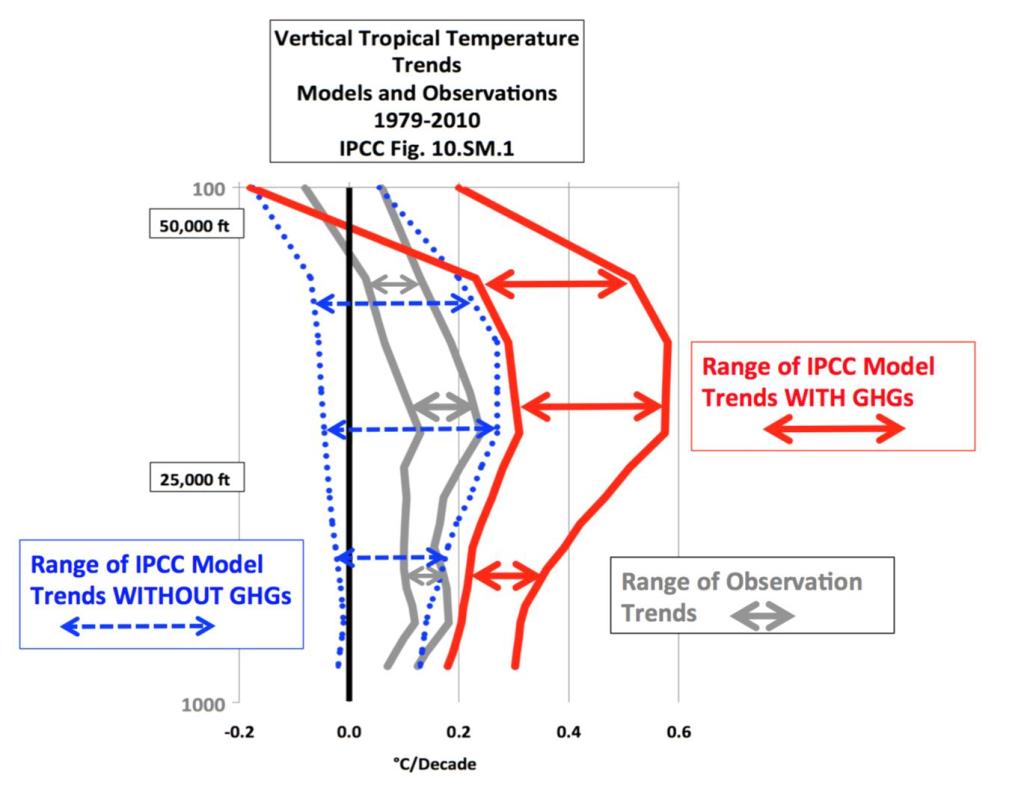
Figure 5. Simplification of IPCC AR5 shown above in Fig. 4. The colored lines represent the range of results for the models and observations. The trends here represent trends at different levels of the tropical atmosphere from the surface up to 50,000 ft. The gray lines are the bounds for the range of observations, the blue for the range of IPCC model results without extra GHGs and the red for IPCC model results with extra GHGs.The key point displayed is the lack of overlap between the GHG model results (red) and the observations (gray). The nonGHG model runs (blue) overlap the observations almost completely.

IPCC Assessment Reports show that the IPCC climate models performed best versus observations when they did not include extra GHGs and this result can be demonstrated with a statistical model as well.

Full explanation at Warming from CO2 Unlikely

For more on measurements and science see Data, Facts and Information


Autumnal Climate Change 2017


geese-in-v-formation

Seeing a lot more of this lately, along with hearing the geese  honking. And in the next month or so, we expect that trees around here will lose their leaves. It definitely is climate change of the seasonal variety.

Interestingly, the science on this is settled: It is all due to reduction of solar energy because of the shorter length of days (LOD). The trees drop their leaves and go dormant because of less sunlight, not because of lower temperatures. The latter is an effect, not the cause.

Of course, the farther north you go, the more remarkable the seasonal climate change. St. Petersburg, Russia has their balmy “White Nights” in June when twilight is as dark as it gets, followed by the cold, dark winter and a chance to see the Northern Lights.

And as we have been monitoring, the Arctic ice has been melting from sunlight in recent months, but will now begin to build again in the darkness to its maximum in March.

We can also expect in January and February for another migration of millions of Canadians (nicknamed “snowbirds”) to fly south in search of a summer-like climate to renew their memories and hopes. As was said to me by one man in Saskatchewan (part of the Canadian wheat breadbasket region): “Around here we have Triple-A farmers: April to August, and then Arizona.” Here’s what he was talking about: Quartzsite Arizona annually hosts 1.5M visitors, mostly between November and March.

Of course, this is just North America. Similar migrations occur in Europe, and in the Southern Hemisphere, the climates are changing in the opposite direction, Springtime currently. Since it is so obviously the sun causing this seasonal change, the question arises: Does the sunlight vary on longer than annual timescales?

The Solar-Climate Debate

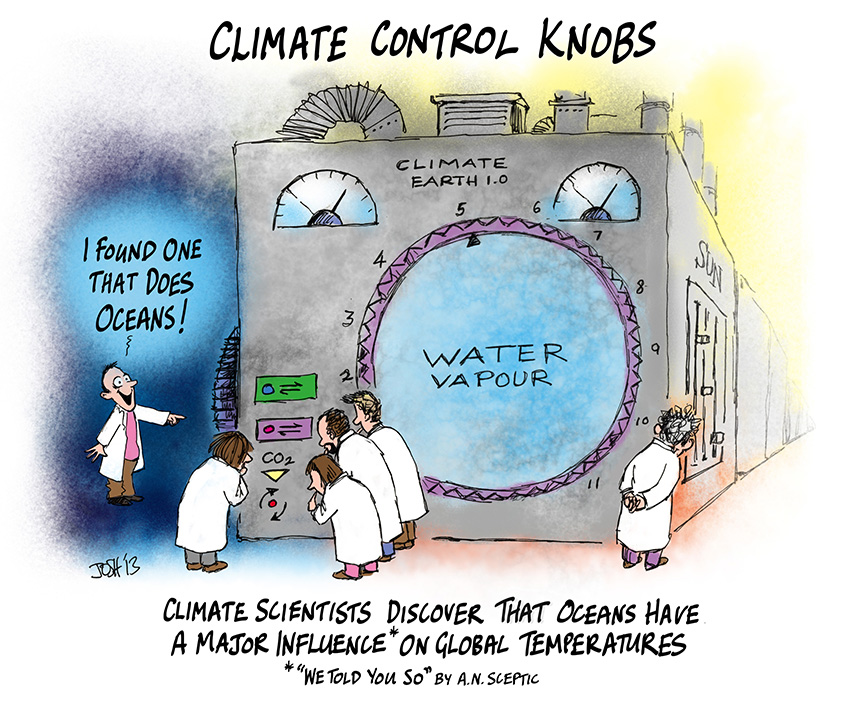
And therein lies a great, enduring controversy between those (like the IPCC) who dismiss the sun as a driver of multi-Decadal climate change, and those who see a connection between solar cycles and Earth’s climate history. One side can be accused of ignoring the sun because of a prior commitment to CO2 as the climate “control knob”.

The other side is repeatedly denounced as “cyclomaniacs” in search of curve-fitting patterns to prove one or another thesis. It is also argued that a claim of 60-year cycles can not be validated with only 150 years or so of reliable data. That point has weight, but it is usually made by those on the CO2 bandwagon despite temperature and CO2 trends correlating for only 2 decades during the last century.

One scientist in this field is Nicola Scafetta, who presents the basic concept this way:

“The theory is very simple in words. The solar system is characterized by a set of specific gravitational oscillations due to the fact that the planets are moving around the sun. Everything in the solar system tends to synchronize to these frequencies beginning with the sun itself. The oscillating sun then causes equivalent cycles in the climate system. Also the moon acts on the climate system with its own harmonics. In conclusion we have a climate system that is mostly made of a set of complex cycles that mirror astronomical cycles. Consequently it is possible to use these harmonics to both approximately hindcast and forecast the harmonic component of the climate, at least on a global scale. This theory is supported by strong empirical evidences using the available solar and climatic data.”

He goes on to say:

“The global surface temperature record appears to be made of natural specific oscillations with a likely solar/astronomical origin plus a noncyclical anthropogenic contribution during the last decades. Indeed, because the boundary condition of the climate system is regulated also by astronomical harmonic forcings, the astronomical frequencies need to be part of the climate signal in the same way the tidal oscillations are regulated by soli-lunar harmonics.”

He has concluded that “at least 60% of the warming of the Earth observed since 1970 appears to be induced by natural cycles which are present in the solar system.” For the near future he predicts a stabilization of global temperature and cooling until 2030-2040.


For more see Scafetta vs. IPCC: Dueling Climate Theories

A Deeper, but Accessible Presentation of Solar-Climate Theory

I have found this presentation by Ian Wilson to be persuasive while honestly considering all of the complexities involved.

The author raises the question: What if there is a third factor that not only drives the variations in solar activity that we see on the Sun but also drives the changes that we see in climate here on the Earth?

The linked article is quite readable by a general audience, and comes to a similar conclusion as Scafetta above: There is a connection, but it is not simple cause and effect. And yes, length of day (LOD) is a factor beyond the annual cycle.

Click to access IanwilsonForum2008.pdf

It is fair to say that we are still at the theorizing stage of understanding a solar connection to earth’s climate. And at this stage, investigators look for correlations in the data and propose theories (explanations) for what mechanisms are at work. Interestingly, despite the lack of interest from the IPCC, solar and climate variability is a very active research field these days.

A summary of recent studies is provided at NoTricksZone: Since 2014, 400 Scientific Papers Affirm A Strong Sun-Climate Link

Ian Wilson has much more to say at his blog: http://astroclimateconnection.blogspot.com.au/

Once again, it appears that the world is more complicated than a simple cause and effect model suggests.

Fluctuations in observed global temperatures can be explained by a combination of oceanic and solar cycles.  See engineering analysis from first principles Quantifying Natural Climate Change.

For everything there is a season, a time for every purpose under heaven.

What has been will be again, what has been done will be done again;
there is nothing new under the sun.
(Ecclesiastes 3:1 and 1:9)

Original post in 2015 included this commentary with Dr. Arnd Bernaerts

ArndB comments:

Fine writing, Ron, well done!
No doubt the sun is the by far the most important factor for not living on a globe with temperatures down to minus 200°C. That makes me hesitating to comment on „solar and climate variability” or “the sun drives climate” (currently at NTZ – link above), but today merely requesting humbly that the claimed correlation should be based at least on some evidence showing that the sun has ever caused a significant climatic shift during the last one million years, which was not only a bit air temperature variability due to solar cycles that necessarily occur in correlation with the intake and release of solar-radiation by the oceans and seas.

Interestingly the UK MetOffice just released a report (Sept.2015, pages 21) titled:
“Big Changes Underway in the Climate System?” by attributing the most possible and likely changes to the current status of El Niño, PDO, and AMO, and – of course – carbon dioxide -, and a bit speculation on less sun-energy (see following excerpt at link)

Click to access Changes_In_The_Climate_System.pdf

From p. 13: “It is well established that trace gases such as carbon dioxide warm our planet through the “greenhouse effect”. These gases are relatively transparent to incoming sunlight, but trap some of the longer-wavelength radiation emitted by the Earth. However, other factors, both natural and man-made, can also change global temperatures. For example, a cooling could be caused by a downturn of the amount of energy received from the sun, or an increase in the sunlight reflected back to space by aerosol particles in the atmosphere. Aerosols increase temporarily after volcanic eruptions, but are also generated by pollution such as sulphur dioxide from factories.
These “external” factors are imposed on the climate system and may also affect the ENSO, PDO and AMO variations……

My Reply:

Thanks Arnd for engaging in this topic.

My view is that the ocean makes the climate by means of its huge storage of solar energy, and the fluctuations, oscillations in the processes of distributing that energy globally and to the poles. In addition, the ocean is the most affected by any variation in the incoming solar energy, both by the sun outputting more or less, and also by clouds and aerosols blocking incoming radiation more or less (albedo or brightness variability).  See Nature’s Sunscreen

The oscillations you mention, including the present El Nino (and Blob) phenomenon, show natural oceanic variability over years and decades. Other ocean cycles occur over multi-decadal and centennial scales, and are still being analyzed.

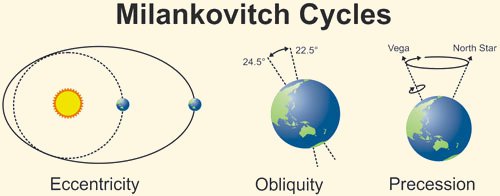
At the other end of the scale, I am persuaded that the earth switches between the “hot house” and the “ice house” mainly due to orbital cycles, which are an astronomical phenomenon. These are strong enough to overwhelm the moderating effect of the ocean thermal flywheel.

The debate centers on the extent to which solar activity has contributed to climate change over the last 3000 years of our current interglacial period, including current solar cycles.


Warming from CO2 Unlikely

Figure 5. Simplification of IPCC AR5 shown above in Fig. 4. The colored lines represent the range of results for the models and observations. The trends here represent trends at different levels of the tropical atmosphere from the surface up to 50,000 ft. The gray lines are the bounds for the range of observations, the blue for the range of IPCC model results without extra GHGs and the red for IPCC model results with extra GHGs.The key point displayed is the lack of overlap between the GHG model results (red) and the observations (gray). The nonGHG model runs (blue) overlap the observations almost completely. 

A recent post at Friends of Science alerted me to an important proof against the CO2 global warming claim. It was included in John Christy’s testimony 29 Mar 2017 at the House Committee on Science, Space and Technology. The text below is from that document which can be accessed here. (My bolds)

Main Point: IPCC Assessment Reports show that the IPCC climate models performed best versus observations when they did not include extra GHGs and this result can be demonstrated with a statistical model as well.

(5)  A simple statistical model that passed the same “scientific-method” test

The IPCC climate models performed best versus observations when they did not include extra GHGs and this result can be demonstrated with a statistical model as well. I was coauthor of a report which produced such an analysis (Wallace, J., J. Christy, and J. D’Aleo, “On the existence of a ‘Tropical Hot Spot’ & the validity of the EPA’s CO2 Endangerment Finding – Abridged Research Report”, August 2016 (Available here ).

In this report we examine annual estimates from many sources of global and tropical deep-layer temperatures since 1959 and since 1979 utilizing explanatory variables that did not include rising CO2 concentrations. We applied the model to estimates of global and tropical temperature from the satellite and balloon sources, individually, shown in Fig. 2 above. The explanatory variables are those that have been known for decades such as indices of El Nino-Southern Oscillation (ENSO), volcanic activity, and a solar activity (e.g. see Christy and McNider, 1994, “Satellite greenhouse signal”, Nature, 367, 27Jan). [One of the ENSO explanatory variables was the accumulated MEI (Multivariate ENSO Index, see https://www.esrl.noaa.gov/psd/enso/mei/) in which the index was summed through time to provide an indication of its accumulated impact. This “accumulated-MEI” was shown to be a potential factor in global temperatures by Spencer and Braswell, 2014 (“The role of ENSO in global ocean temperature changes during 1955-2011 simulated with a 1D climate model”, APJ.Atmos.Sci. 50(2), 229-237, DOI:10.1007/s13143-014- 001-z.) Interestingly, later work has shown that this “accumulated-MEI” has virtually the same impact as the accumulated solar index, both of which generally paralleled the rise in temperatures through the 1980s and 1990s and the slowdown in the 21st century. Thus our report would have the same conclusion with or without the “accumulated-MEI.”]

The basic result of this report is that the temperature trend of several datasets since 1979 can be explained by variations in the components that naturally affect the climate, just as the IPCC inadvertently indicated in Fig. 5 above. The advantage of the simple statistical treatment is that the complicated processes such as clouds, ocean-atmosphere interaction, aerosols, etc., are implicitly incorporated by the statistical relationships discovered from the actual data. Climate models attempt to calculate these highly non-linear processes from imperfect parameterizations (estimates) whereas the statistical model directly accounts for them since the bulk atmospheric temperature is the response-variable these processes impact. It is true that the statistical model does not know what each sub-process is or how each might interact with other processes. But it also must be made clear: it is an understatement to say that no IPCC climate model accurately incorporates all of the non-linear processes that affect the system. I simply point out that because the model is constrained by the ultimate response variable (bulk temperature), these highly complex processes are included.

The fact that this statistical model explains 75-90 percent of the real annual temperature variability, depending on dataset, using these influences (ENSO, volcanoes, solar) is an indication the statistical model is useful. In addition, the trends produced from this statistical model are not statistically different from the actual data (i.e. passing the “scientific-method” trend test which assumes the natural factors are not influenced by increasing GHGs). This result promotes the conclusion that this approach achieves greater scientific (and policy) utility than results from elaborate climate models which on average fail to reproduce the real world’s global average bulk temperature trend since 1979.

The over-warming of the atmosphere by the IPCC models relates to a problem the IPCC AR5 encountered elsewhere. In trying to determine the climate sensitivity, which is how sensitive the global temperature is relative to increases in GHGs, the IPCC authors chose not to give a best estimate. [A high climate sensitivity is a foundational component of the last Administration’s Social Cost of Carbon.] The reason? … climate models were showing about twice the sensitivity to GHGs than calculations based on real, empirical data. I would encourage this committee, and our government in general, to consider empirical data, not climate model output, when dealing with environmental regulations.

Summary

Planning requires assumptions because no one has knowledge of the future, only informed opinions.  Christy makes the case that our assumptions should be based on empirical data rather than models that are driven by theoretical assumptions.  When the CO2 sensitivity assumption is removed from climate models they come much closer to observed temperature measurements.  Statistical analysis shows that at least 75% of observed warming comes from factors other than CO2.  That analysis also correlates with the accumulated effects of oceanic circulations, principally the ENSO index.

Impaired Climate Vision

We are entering the season where governments, especially the US are reviewing and finalizing Climate Assessments.  Whenever citizens or decision makers are presented with an assessment and recommendations, it is important to take the stance of a “reasonable person.”  That means one applies critical intelligence by asking if assertions are well-founded and logical.

In starting to read the draft Climate Assessment reports, it strikes me that the difference between alarmists and others is not so much in the data or facts, but in the perspective through which one sees and interprets the information.  From experience the last few years, I suggest that readers of these reports need to be alert for two errors that crop up often.  The general impairments are stated below followed by some examples for illustration.

  1. CO2 Alarm is Myopic: Claiming CO2 causes dangerous global warming is too simplistic. CO2 is but one factor among many other forces and processes interacting to make weather and climate.

Myopia is a failure of perception by focusing on one near thing to the exclusion of the other realities present, thus missing the big picture. For example: “Not seeing the forest for the trees.” AKA “tunnel vision.”

2. CO2 Alarm is Lopsided: CO2 forcing is too small to have the overblown effect claimed for it. Other factors are orders of magnitude larger than the potential of CO2 to influence the climate system.

Lopsided

Lop-sided refers to a failure in judging values, whereby someone lacking in sense of proportion, places great weight on a factor which actually has a minor influence compared to other forces. For example: “Making a mountain out of a mole hill.”

Correcting for Myopia and/or Lop-sidedness

Example of Greenland Ice Sheet

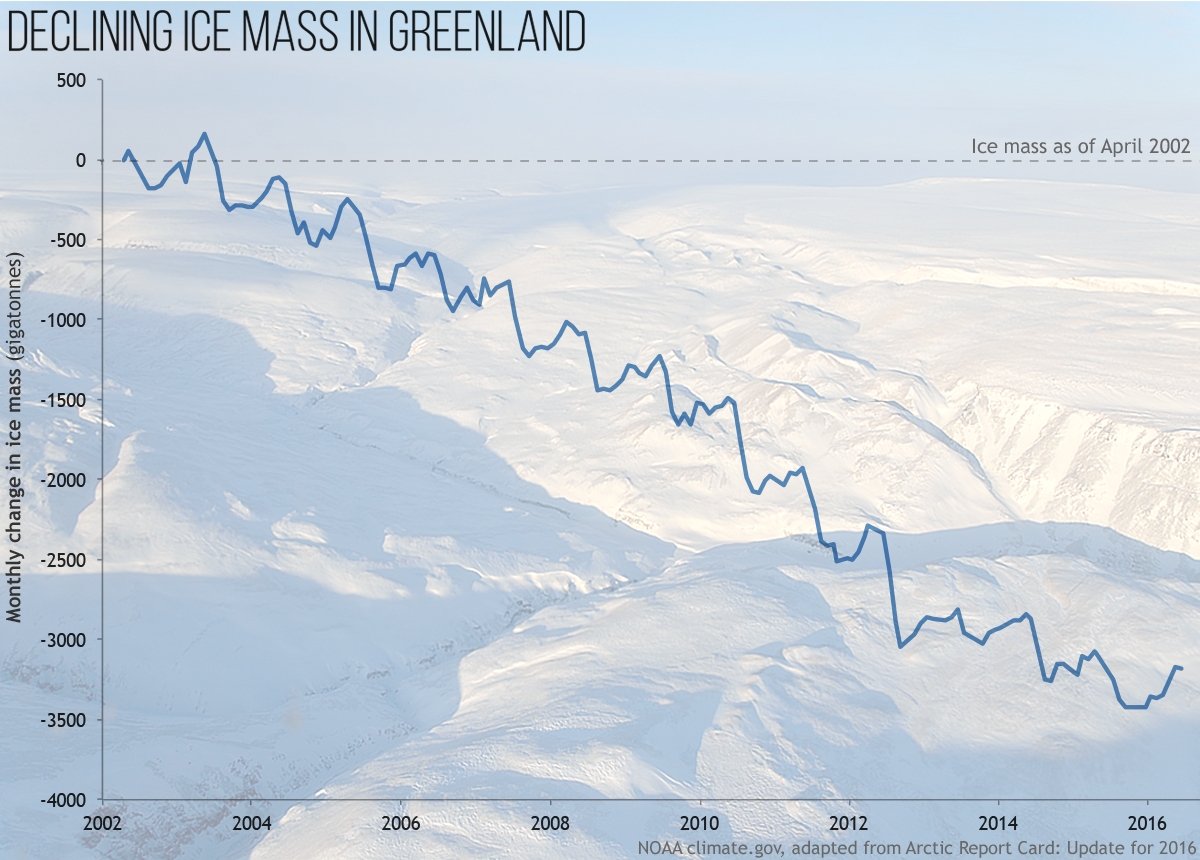
It was recently suggested to me that we should all be concerned about the Greenland ice sheet melting resulting in dangerous rising sea levels.  The evidence presented came from US climate.gov in the form of this chart.

On the NOAA page where it appears, they explain:

The ups and downs in the graph track the accumulation of snow in the cold season and the melting of the ice sheet in the warm season. The Arctic Report Card: Update for 2016 reported that between April 2015 and April 2016, Greenland lost approximately 191 gigatonnes of ice, roughly the same amount that was lost between April 2014 and April 2015. Though the April 2015–April 2016 mass loss was lower than the average April-to-April decline over the entire observation period, it continued the long-term melt trend: approximately 269 gigatonnes per year from 2002 to 2016.

Now that NOAA graph needs to be understood in context.  That means looking at the data in the largest relevant scope (test for myopia) and checking that conclusions are in proportion (not lop-sided) compared to the base reality.

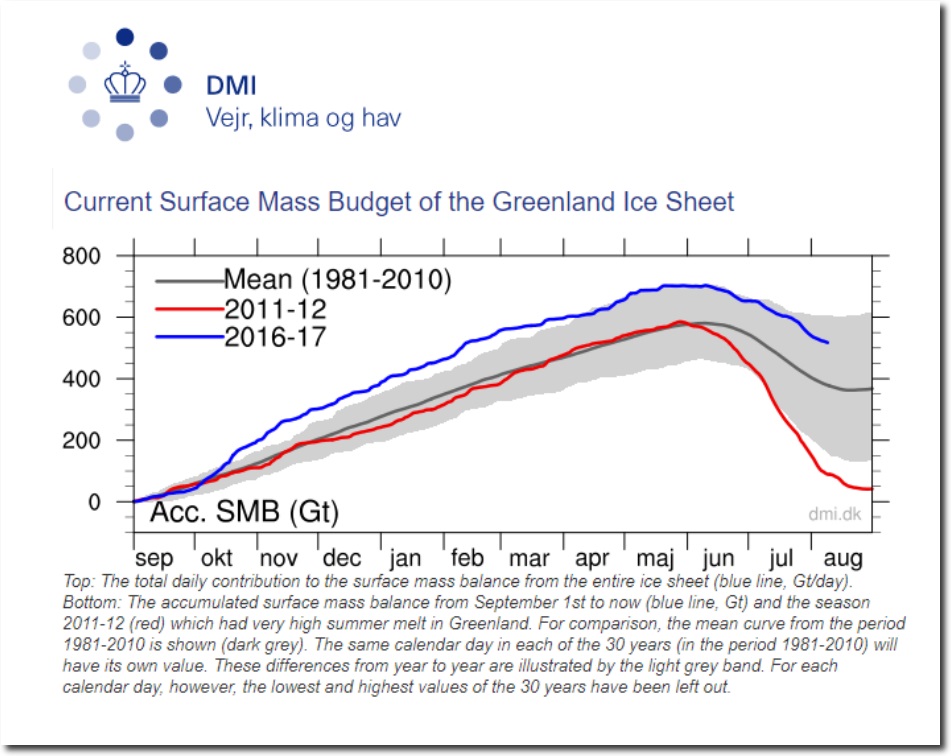
First, it turns out that the years since 2002 are not representative.  From DMI (Danish Meteorological Institute Aerial photos from Greenland topple climate models

Between 1985 and 1992, Greenland experienced a large loss of ice mass because of dynamic ice-mass loss. But the glaciers stabilised and there was no dynamic ice-mass loss for more than ten years.

This loss started again in 2004 and has continued until today.

“We can see that the dynamic ice-mass loss is not accelerating constantly, as we had believed,” says Shfaqat Abbas Khan, a senior researcher at DTU Space – the National Space Institute.

“It is only periodically that the ice disappears as rapidly as is happening today. We expect that the reduction in Greenland’s ice mass due to the dynamic ice-mass loss will ease over the next couple of years and will reach zero again.”

And sure enough Greenland is making a surplus of ice this year

But the call for concern is also lop-sided in the context of the actual massiveness of Greenland’s ice sheet which has persisted for millennia. (That’s why they go there for ice cores.)

Doing the numbers: Greenland area 2.1 10^6 km2 80% ice cover, 1500 m thick in average- That is 2.5 Million Gton. Simplified to 1 km3 = 1 Gton

200 Gton is 0.008 % of that mass.

Annual snowfall: From the Lost Squadron, we know at that particular spot, the ice increase since 1942 – 1990 was 1.5 m/year ( Planes were found 75 m below surface)
Assume that yearly precipitation is 100 mm / year over the entire surface.
That is 168000 Gton. Yes, Greenland is Big!

Inflow = 168,000Gton. Outflow is 168,200 Gton.

So if that 200 Gton rate continued, an assumption not warranted by observations above, that ice loss would result in a 1% loss of Greenland ice in 800 years.

Seen in the proper perspective, there is no reason for panic.

Example: Movement of Ecological Life Zones

I have been referred to studies in places like Arizona finding that certain species are moving to higher altitudes because of warming to their native habitat.  The research seems solid and I do not doubt either that climate zones shift over time or that plant and animal life adapt.  But how serious is the problem?  The US Southwest has warmed in recent decades, while the US Southeast has cooled.  What is the global story on changing climate zones?

188767-004-6bde1150

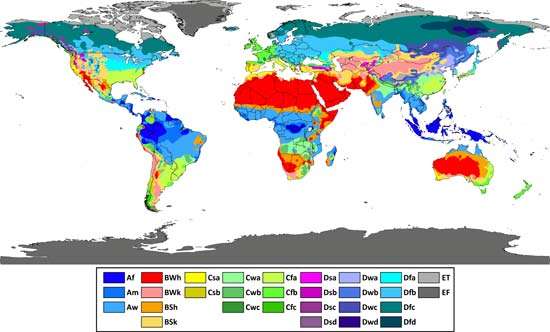
Köppen climate zones as they appear in the 21st Century.

Fortunately we have a well-established framework classifying climate zones based upon temperature and precipitation patterns.  And researchers have addressed this question in this paper: Using the Köppen classification to quantify climate variation and change: An example for 1901–2010  By Deliang Chen and Hans Weiteng Chen Department of Earth Sciences, University of Gothenburg, Sweden

Hans Chen has built an excellent interactive website (here): The purpose of this website is to share information about the Köppen climate classification, and provide data and high-resolution figures from the paper Chen and Chen, 2013: Using the Köppen classification to quantify climate variation and change: An example for 1901–2010 (pdf). A synopsis is at my post Data vs. Models #4: Climates Changing.

Briefly, for this discussion, Chen and Chen presented tables and charts showing that most places have had at least one entire year with temperatures and/or precipitation atypical for that climate. It is much more unusual for abnormal weather to persist for ten years running. At 30-years and more the zones are quite stable, such that is there is little movement at the boundaries with neighboring zones.  Over time, there is variety in zonal changes, albeit within a small range of overall variation.

A Final Example: Rising Temperatures

A tv show in Australia illustrated how vision is impaired on this subject.  A typical graph was used to claim warming is alarming.  It came from the NASA Goddard Institute of Space Studies (GISS):

The graph shows no pause whatsoever.  This is accomplished by lowering the 1998 El Nino spike relative to 2015 El Nino. To see what is going on, here is a helpful chart from Dr. Ole Humlum at Climate4you.

It shows that indeed, GISS is showing 1998 peak lower than several years since, especially 2002, 2010 and 2016. In contrast, the satellite record is dominated by 1998, and may still be in that position once La Nina takes hold. The differences arise because satellites measure air temperature in the lower troposphere, while GISS combines records from land stations with sea surface temperatures (SSTs) to fabricate a global average anomaly, including adjusting, gridding and infilling to make the estimate of Global Mean Temperatures and compare to a 30-year average.

An insight into the adjustments is displayed below.  Dr. Humlum demonstrates that GISS is an unstable temperature record.

Dr. Humlum:

Based on the above it is not possible to conclude which of the above five databases represents the best estimate on global temperature variations. The answer to this question remains elusive. All five databases are the result of much painstaking work, and they all represent admirable attempts towards establishing an estimate of recent global temperature changes. At the same time it should however be noted, that a temperature record which keeps on changing the past hardly can qualify as being correct. (my bold)

All of these charts also suffer from lop-sidedness.  Considering the range of temperatures experienced by most Americans in a typical year, the following graph is more representative.

Why did GISS ignore the platinum standard satellite temperature dataset?  Why should the current graph be believed when it differs from previous ones, and maybe the next one?  Was not the 1C warming since 1850 a boon for civilization and the biosphere?  Should we wish for it to get cooler and start the slide into the next ice age?

Summary

There are a great many claims assembled in these Climate Assessments, all of them in support of policies like the Paris accord.  Reasonable people need to test for myopia and maintain a sense of proportion in order not to be taken in.

Eemian and Holocene Climates


Hansen is publishing a new paper in support of the children suing the government for not fighting climate change. In it he claims temps now are higher than the Holocene and matching the Eemian, so we should expect comparable sea levels.

Paper is here:
http://www.earth-syst-dynam.net/8/577/2017/

Abstract. Global temperature is a fundamental climate metric highly correlated with sea level, which implies that keeping shorelines near their present location requires keeping global temperature within or close to its preindustrial Holocene range. However, global temperature excluding short-term variability now exceeds +1 °C relative to the 1880–1920 mean and annual 2016 global temperature was almost +1.3 °C. We show that global temperature has risen well out of the Holocene range and Earth is now as warm as it was during the prior (Eemian) interglacial period, when sea level reached 6–9 m higher than today. Further, Earth is out of energy balance with present atmospheric composition, implying that more warming is in the pipeline, and we show that the growth rate of greenhouse gas climate forcing has accelerated markedly in the past decade. The rapidity of ice sheet and sea level response to global temperature is difficult to predict, but is dependent on the magnitude of warming. Targets for limiting global warming thus, at minimum, should aim to avoid leaving global temperature at Eemian or higher levels for centuries. Such targets now require negative emissions, i.e., extraction of CO2 from the air. If phasedown of fossil fuel emissions begins soon, improved agricultural and forestry practices, including reforestation and steps to improve soil fertility and increase its carbon content, may provide much of the necessary CO2 extraction. In that case, the magnitude and duration of global temperature excursion above the natural range of the current interglacial (Holocene) could be limited and irreversible climate impacts could be minimized. In contrast, continued high fossil fuel emissions today place a burden on young people to undertake massive technological CO2 extraction if they are to limit climate change and its consequences. Proposed methods of extraction such as bioenergy with carbon capture and storage (BECCS) or air capture of CO2 have minimal estimated costs of USD 89–535 trillion this century and also have large risks and uncertain feasibility. Continued high fossil fuel emissions unarguably sentences young people to either a massive, implausible cleanup or growing deleterious climate impacts or both. (my bolds)

The image at the top shows that the Eemian climate was very different due to orbital mechanics, which were nothing like today.  And as Rud points out, the rise in sea levels took thousands of years at a rate similar to today: 2 mm a year.

In addition, Hansen et al. appear to have erased not only the Medieval Warming period, but also the Roman and Minoan periods before them.   Perhaps they are using 2016 temps as a trampoline for their claims, even though we are already well down from that El Nino event.

Hansen et al. are going over the top, exaggerating even beyond IPCC in order to proclaim Waterworld is at hand.

It seems to me that the kind of rise Hansen is looking comes after an ice age freezes lots of water, resulting in a very low baseline.  In the graph below, you can see the beginning of the Holocene around 14 thousand years ago, and then the rise slowed down to the present rate around 6000 years ago.

More information is available here:
https://wattsupwiththat.com/2015/06/01/ice-core-data-shows-the-much-feared-2c-climate-tipping-point-has-already-occurred/

For more on children’s crusade against global warming see:  Climate War Human Shields


Climate Biorhythms

Human Biorhythms

The question–whether monitoring biorhythm cycles can actually make a difference in people’s lives–has been studied since the 1960s, when the writings of George S. Thommen popularized the idea.

Several companies began experimenting and although the Japanese were the first nation to apply biorhythms on a large scale, the Swiss were the first to see and realize the benefits of biorhythms in reducing accidents.

Hans Frueh invented the Bio-Card and Bio-Calculator, and Swiss municipal and national authorities appear to have been applying biorhythms for many years before the Japanese experiments. Swissair, which reportedly had been studying the critical days of its pilots for almost a decade previously, did not allow either a pilot or a co-pilot experiencing a critical day to fly with another experiencing the same kind of instability. Reportedly, Swissair had no accidents on those flights where biorhythm had been applied.

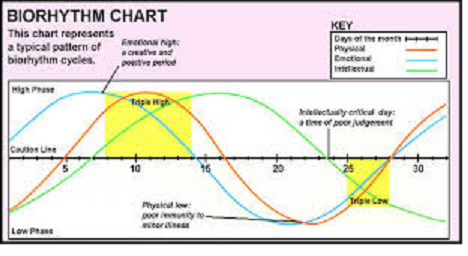
Most biorhythm models use three cycles: a 23-day physical cycle, a 28-day emotional cycle, and a 33-day intellectual cycle.[8] Each of these cycles varies between high and low extremes sinusoidally, with days where the cycle crosses the zero line described as “critical days” of greater risk or uncertainty.

The numbers from +100% (maximum) to -100% (minimum) indicate where on each cycle the rhythms are on a particular day. In general, a rhythm at 0% is crossing the midpoint and is thought to have no real impact on your life, whereas a rhythm at +100% (at the peak of that cycle) would give you an edge in that area, and a rhythm at -100% (at the bottom of that cycle) would make life more difficult in that area. There is no particular meaning to a day on which your rhythms are all high or all low, except the obvious benefits or hindrances that these rare extremes are thought to have on your life.

Human Biorhythms are not proven

Various attempts have been made to validate this biorhythm model with inconclusive results. It is fair to say that this particular definition of physical, emotional, and intellectual cycles has not been proven. I do not myself subscribe to it nor have ever attempted to follow it. My point is mainly to draw an analogy. What if fluctuations in global temperatures are the combined results from multiple cycles of varying lengths?

milankovitch_cycles

What About Climate Biorhythms

At the longer end, we have astronomical cycles on millennial scales, and at the shorter end, we have seasonal cycles. In between there are a dozen or so oceanic cycles, such as ENSO, AMO, and AMOC, that have multi-decadal phases. Then there are solar cycles, ranging from basic quasi-11 year sunspot cycles, to other centennial maxs and mins. AARI scientists have documented a quasi-60 year cycle in Arctic ice extents. ETH Zurich has a solar radiation database showing an atmospheric sunscreen that alternatively dims or brightens the incoming sunshine over decades (see Nature’s Sunscreen).

It could be that observed warming and cooling periods occur when several more powerful cycles coincide in their phases. For example, we are at the moment anticipating an unusually quiet solar cycle, a Pacific Decadal Oscillation (PDO) negative phase, a cooler North Atlantic (AMO), and possibly a dimming period. Will that coincidence result in temperatures dropping? Was the Little Ice Age caused and then ended after 1850 by such a coincidence of climate biorhythms?

Summary

Our knowledge of these cycles is confounded by not yet untangling them to see individual periodicities, as a basis for probing into their interactions and combined influences.  Until that day, we should refrain from picking on one thing, like CO2, as though it were a control knob for the whole climate.

Planetary Warming: Back to Basics

which20moons20have20atmospheres

It is often said we must rely on projections from computer simulations of earth’s climate since we have no other earth on which to experiment. That is not actually true since we have observations upon a number of planetary objects in our solar system that also have atmospheres.

This is brought home by a paper, published recently in the journal “Environment Pollution and Climate Change,” written by Ned Nikolov, a Ph.D. in physical science, and Karl Zeller, retired Ph.D. research meteorologist. (title is link to paper).  H/T to Tallbloke for posting on this (here) along with comments by one of the authors.

New Insights on the Physical Nature of the Atmospheric Greenhouse Effect Deduced from an Empirical Planetary Temperature Model

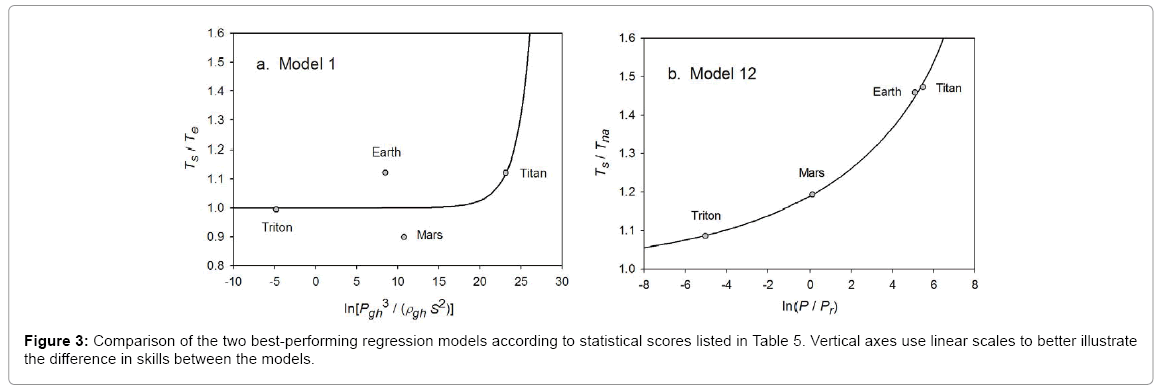
Nikolov and Zeller have written before on this topic, but this paper takes advantage of data from recent decades of space exploration as well as improved observatories. It is thorough, educational and makes a convincing case that a planet’s surface temperatures can be predicted from two variables: distance from the sun, and the atmospheric mass. This post provides some excerpts and exhibits as a synopsis, hopefully to encourage reading the paper itself.

Abstract

A recent study has revealed that the Earth’s natural atmospheric greenhouse effect is around 90 K or about 2.7 times stronger than assumed for the past 40 years. A thermal enhancement of such a magnitude cannot be explained with the observed amount of outgoing infrared long-wave radiation absorbed by the atmosphere (i.e. ≈ 158 W m-2), thus requiring a re-examination of the underlying Greenhouse theory.

We present here a new investigation into the physical nature of the atmospheric thermal effect using a novel empirical approach toward predicting the Global Mean Annual near-surface equilibrium Temperature (GMAT) of rocky planets with diverse atmospheres. Our method utilizes Dimensional Analysis (DA) applied to a vetted set of observed data from six celestial bodies representing a broad range of physical environments in our Solar System, i.e. Venus, Earth, the Moon, Mars, Titan (a moon of Saturn), and Triton (a moon of Neptune).

Twelve relationships (models) suggested by DA are explored via non-linear regression analyses that involve dimensionless products comprised of solar irradiance, greenhouse-gas partial pressure/density and total atmospheric pressure/density as forcing variables, and two temperature ratios as dependent variables. One non-linear regression model is found to statistically outperform the rest by a wide margin.

Venus is a furnace of a planet, with a noxious atmosphere bearing a pressure 90 times that on Earth. Courtesy NASA/JPL

Above: Venusian Atmosphere

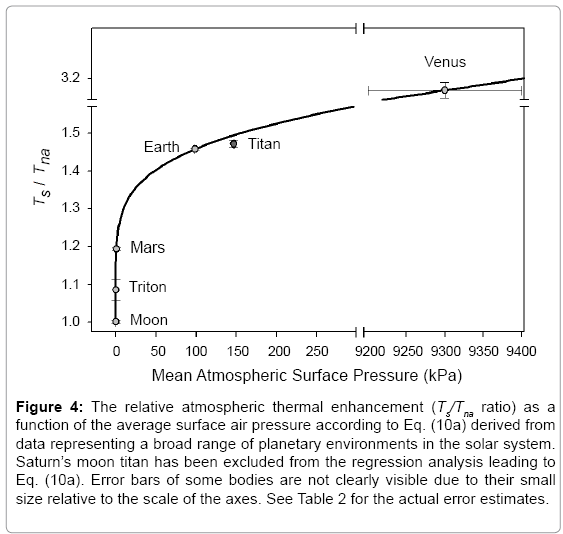
Our analysis revealed that GMATs of rocky planets with tangible atmospheres and a negligible geothermal surface heating can accurately be predicted over a broad range of conditions using only two forcing variables: top-of-the-atmosphere solar irradiance and total surface atmospheric pressure. The hereto discovered interplanetary pressure-temperature relationship is shown to be statistically robust while describing a smooth physical continuum without climatic tipping points.

This continuum fully explains the recently discovered 90 K thermal effect of Earth’s atmosphere. The new model displays characteristics of an emergent macro-level thermodynamic relationship heretofore unbeknown to science that has important theoretical implications. A key entailment from the model is that the atmospheric ‘greenhouse effect’ currently viewed as a radiative phenomenon is in fact an adiabatic (pressure-induced) thermal enhancement analogous to compression heating and independent of atmospheric composition. (my bold)

Earth Atmosphere Density and Temperature Profile

Consequently, the global down-welling long-wave flux presently assumed to drive Earth’s surface warming appears to be a product of the air temperature set by solar heating and atmospheric pressure. In other words, the so-called ‘greenhouse back radiation’ is globally a result of the atmospheric thermal effect rather than a cause for it. (my bold)

Our empirical model has also fundamental implications for the role of oceans, water vapour, and planetary albedo in global climate. Since produced by a rigorous attempt to describe planetary temperatures in the context of a cosmic continuum using an objective analysis of vetted observations from across the Solar System, these findings call for a paradigm shift in our understanding of the atmospheric ‘greenhouse effect’ as a fundamental property of climate.

The research effort demonstrates sound scientific research: data and sources are fully explained, the pattern analysis is replicable, and the conclusions set forth in a logical manner. Alternative hypotheses were explored and rejected in favor of one explaining observations to near perfection, and also showing applicability to other cases.
Equation (10a) implies that GMATs of rocky planets can be calculated as a product of two quantities: the planet’s average surface temperature in the absence of an atmosphere (Tna, K) and a nondimensional factor (Ea ≥ 1.0) quantifying the relative thermal effect of the atmosphere.
As an example of technical descriptions, consider how the paper describes issues relating to the calculation of Tna.

For bodies with tangible atmospheres (such as Venus, Earth, Mars, Titan and Triton), one must calculate Tna using αe=0.132 and ηe=0.00971, which assumes a Moon-like airless reference surface in accordance with our pre-analysis premise. For bodies with tenuous atmospheres (such as Mercury, the Moon, Calisto and Europa), Tna should be calculated from Eq. (4a) (or Eq. 4b respectively if S>0.15 W m-2 and/or Rg ≈ 0 W m-2) using the body’s observed values of Bond albedo αe and ground heat storage fraction ηe.

In the context of this model, a tangible atmosphere is defined as one that has significantly modified the optical and thermo-physical properties of a planet’s surface compared to an airless environment and/or noticeably impacted the overall planetary albedo by enabling the formation of clouds and haze. A tenuous atmosphere, on the other hand, is one that has not had a measurable influence on the surface albedo and regolith thermos-physical properties and is completely transparent to shortwave radiation.

The need for such delineation of atmospheric masses when calculating Tna arises from the fact that Eq. (10a) accurately describes RATEs of planetary bodies with tangible atmospheres over a wide range of conditions without explicitly accounting for the observed large differences in albedos (i.e., from 0.235 to 0.90) while assuming constant values of αe and ηe for the airless equivalent of these bodies. One possible explanation for this counterintuitive empirical result is that atmospheric pressure alters the planetary albedo and heat storage properties of the surface in a way that transforms these parameters from independent controllers of the global temperature in airless bodies to intrinsic byproducts of the climate system itself in worlds with appreciable atmospheres. In other words, once atmospheric pressure rises above a certain level, the effects of albedo and ground heat storage on GMAT become implicitly accounted for by Eq. (11). (my bold)

Significance

Equation (10b) describes the long-term (30 years) equilibrium GMATs of planetary bodies and does not predict inter-annual global temperature variations caused by intrinsic fluctuations of cloud albedo and/or ocean heat uptake. Thus, the observed 0.82 K rise of Earth’s global temperature since 1880 is not captured by our model, since this warming was likely not the result of an increased atmospheric pressure. Recent analyses of observed dimming and brightening periods worldwide [97-99] suggest that the warming over the past 130 years might have been caused by a decrease in global cloud cover and a subsequent increased absorption of solar radiation by the surface. Similarly, the mega shift of Earth’s climate from a ‘hothouse’ to an ‘icehouse’ evident in the sedimentary archives over the past 51 My cannot be explained by Eq. (10b) unless caused by a large loss of atmospheric mass and a corresponding significant drop in surface air pressure since the early Eocene.

Role of greenhouse gases from the new model perspective

Our analysis revealed a poor relationship between GMAT and the amount of greenhouse gases in planetary atmospheres across a broad range of environments in the Solar System (Figures 1-3 and Table 5). This is a surprising result from the standpoint of the current Greenhouse theory, which assumes that an atmosphere warms the surface of a planet (or moon) via trapping of radiant heat by certain gases controlling the atmospheric infrared optical depth [4,9,10]. The atmospheric opacity to LW radiation depends on air density and gas absorptivity, which in turn are functions of total pressure, temperature, and greenhouse-gas concentrations [9]. Pressure also controls the broadening of infrared absorption lines in individual gases. Therefore, the higher the pressure, the larger the infrared optical depth of an atmosphere, and the stronger the expected greenhouse effect would be. According to the present climate theory, pressure only indirectly affects global surface temperature through the atmospheric infrared opacity and its presumed constraint on the planet’s LW emission to Space [9,107].

The artificial decoupling between radiative and convective heat-transfer processes adopted in climate models leads to mathematically and physically incorrect solutions with regard to surface temperature. The LW radiative transfer in a real climate system is intimately intertwined with turbulent convection/advection as both transport mechanisms occur simultaneously. Since convection (and especially the moist one) is orders of magnitude more efficient in transferring energy than LW radiation [3,4], and because heat preferentially travels along the path of least resistance, a properly coupled radiative-convective algorithm of energy exchange will produce quantitatively and qualitatively different temperature solutions in response to a changing atmospheric composition than the ones obtained by current climate models. Specifically, a correctly coupled convective-radiative system will render the surface temperature insensitive to variations in the atmospheric infrared optical depth, a result indirectly supported by our analysis as well. This topic requires further investigation beyond the scope of the present study. (my bold)

The direct effect of atmospheric pressure on the global surface temperature has received virtually no attention in climate science thus far. However, the results from our empirical data analysis suggest that it deserves a serious consideration in the future.

How did Saturn’s moon Titan secure an atmosphere when no other moons in the solar system did? The answer lies largely in its size and location. Here, Titan as imaged in May 2005 by the Cassini spacecraft from about 900,000 miles away. Photo credit: Courtesy NASA/JPL/Space Science Institute

Physical nature of the atmospheric ‘greenhouse effect’

According to Eq. (10b), the heating mechanism of planetary atmospheres is analogous to a gravity-controlled adiabatic compression acting upon the entire surface. This means that the atmosphere does not function as an insulator reducing the rate of planet’s infrared cooling to space as presently assumed [9,10], but instead adiabatically boosts the kinetic energy of the lower troposphere beyond the level of solar input through gas compression. Hence, the physical nature of the atmospheric ‘greenhouse effect’ is a pressure-induced thermal enhancement independent of atmospheric composition. (my bold)

This mechanism is fundamentally different from the hypothesized ‘trapping’ of LW radiation by atmospheric trace gases first proposed in the 19th century and presently forming the core of the Greenhouse climate theory. However, a radiant-heat trapping by freely convective gases has never been demonstrated experimentally. We should point out that the hereto deduced adiabatic (pressure-controlled) nature of the atmospheric thermal effect rests on an objective analysis of vetted planetary observations from across the Solar System and is backed by proven thermodynamic principles, while the ‘trapping’ of LW radiation by an unconstrained atmosphere surmised by Fourier, Tyndall and Arrhenius in the 1800s was based on a theoretical conjecture. The latter has later been coded into algorithms that describe the surface temperature as a function of atmospheric infrared optical depth (instead of pressure) by artificially decoupling radiative transfer from convective heat exchange. Note also that the Ideal Gas Law (PV=nRT) forming the basis of atmospheric physics is indifferent to the gas chemical composition. (my bold)

Climate stability

Our semi-empirical model (Equations 4a, 10b and 11) suggests that, as long as the mean annual TOA solar flux and the total atmospheric mass of a planet are stationary, the equilibrium GMAT will remain stable. Inter-annual and decadal variations of global temperature forced by fluctuations of cloud cover, for example, are expected to be small compared to the magnitude of the background atmospheric warming because of strong negative feedbacks limiting the albedo changes. This implies a relatively stable climate for a planet such as Earth absent significant shifts in the total atmospheric mass and the planet’s orbital distance to the Sun. Hence, planetary climates appear to be free of tipping points, i.e., functional states fostering rapid and irreversible changes in the global temperature as a result of hypothesized positive feedbacks thought to operate within the system. In other words, our results suggest that the Earth’s climate is well buffered against sudden changes.

The hypothesis that a freely convective atmosphere could retain (trap) radiant heat due its opacity has remained undisputed since its introduction in the early 1800s even though it was based on a theoretical conjecture that has never been proven experimentally. It is important to note in this regard that the well-documented enhanced absorption of thermal radiation by certain gases does not imply an ability of such gases to trap heat in an open atmospheric environment. This is because, in gaseous systems, heat is primarily transferred (dissipated) by convection (i.e., through fluid motion) rather than radiative exchange.  (my bold)

If gases of high LW absorptivity/emissivity such as CO2, methane and water vapor were indeed capable of trapping radiant heat, they could be used as insulators. However, practical experience has taught us that thermal radiation losses can only be reduced by using materials of very low IR absorptivity/emissivity and correspondingly high thermal reflectivity such as aluminum foil. These materials are known among engineers at NASA and in the construction industry as radiant barriers [129]. It is also known that high-emissivity materials promote radiative cooling. Yet, all climate models proposed since 1800s were built on the premise that the atmosphere warms Earth by limiting radiant heat losses of the surface through to the action of IR absorbing gases aloft.

If a trapping of radiant heat occurred in Earth’s atmosphere, the same mechanism should also be expected to operate in the atmospheres of other planetary bodies. Thus, the Greenhouse concept should be able to mathematically describe the observed variation of average planetary surface temperatures across the Solar System as a continuous function of the atmospheric infrared optical depth and solar insolation. However, to our knowledge, such a continuous description (model) does not exist. 

Summary

The planetary temperature model consisting of Equations (4a), (10b), (11) has several fundamental theoretical implications, i.e.,
• The ‘greenhouse effect’ is not a radiative phenomenon driven by the atmospheric infrared optical depth as presently believed, but a pressure-induced thermal enhancement analogous to adiabatic heating and independent of atmospheric composition;
• The down-welling LW radiation is not a global driver of surface warming as hypothesized for over 100 years but a product of the near-surface air temperature controlled by solar heating and atmospheric pressure;
• The albedo of planetary bodies with tangible atmospheres is not an independent driver of climate but an intrinsic property (a byproduct) of the climate system itself. This does not mean that the cloud albedo cannot be influenced by external forcing such as solar wind or galactic cosmic rays. However, the magnitude of such influences is expected to be small due to the stabilizing effect of negative feedbacks operating within the system. This novel understanding explains the observed remarkable stability of planetary albedos;
• The equilibrium surface temperature of a planet is bound to remain stable (i.e., within ± 1 K) as long as the atmospheric mass and the TOA mean solar irradiance are stationary. Hence, Earth’s climate system is well buffered against sudden changes and has no tipping points;
• The proposed net positive feedback between surface temperature and the atmospheric infrared opacity controlled by water vapor appears to be a model artifact resulting from a mathematical decoupling of the radiative-convective heat transfer rather than a physical reality.

Update July 13, 2017

Michael Lewis pointed to a link on this subject in his comment below.  Reading again the discussion thread, I appreciated again this point by point response from Kristian to Tim Folkerts so I am adding it to the post. (To be clear, T_e means emission temperature (same as Tna in the article above, while T_s means surface temperature.)

Kristian says:

August 4, 2016 at 9:24 AM

Tim Folkerts says, August 3, 2016 at 3:33 PM:
“In any case, it seems we both agree that the atmosphere has some warming effect.”
That’s quite obvious. You only need to compare Earth’s T_s with the Moon’s.

“I agree that the mass itself plays a role. Mass creates thermal inertia to even out temperature swings. The mass of the atmosphere (and oceans) also allows convection to carry energy from warmer areas to cooler areas, which further reduces variations. By themselves, these could do no more than bring T_s UP TOWARD T_e.”
True.

“I see no physics that would explain mass itself raising T_s ABOVE T_e.”
Just as the radiative properties of gaseous molecules are also not able – all by themselves – to raise a planet’s T_s above its T_e. No, both mass and radiative properties are needed.

“To get above T_e we need something to change the outgoing thermal radiation, eg GHGs at a high enough altitude to be significantly cooler than the surface.”
Yes, but then we also need an air column above the solar-heated surface that can have such a “high enough altitude” in the first place. We also need that altitude to be cooler on average than the surface. IOW, we need mass. A certain gas density/pressure (molecular interaction). And we need fluid dynamics.

“So the key factor is ALTITUDE here (with some definite dependence of the concentrations of the GHGs as well).”
No. There is no dependence on the CONCENTRATION/CONTENT of IR-active constituents in an atmosphere. An atmosphere definitely needs to be IR active (although it’s evidently not enough) for a planet’s T_s to become higher than its T_e. It also needs to be IR active to be able to adequately rid itself of its absorbed energy from the surface (radiatively AND non-radiatively transferred) and directly from the Sun. But once it’s IR active, there is no dependence on the degree of activity. Because then the atmosphere has become stably convectively operative. And all that matters from then on is atmospheric MASS and SOLAR INPUT (TSI and global albedo).

“You say that atmospheric mass seems to force. Do you think that mass alone without GHGs could force temperatures higher than T_e?”
No. Just like “GHGs” alone could also not force T_s higher than T_e. You need both.
* * *
So I say: There IS a “GHE”. But it’s ultimately massively caused. The radiative properties are simply a tool. A means to an end. And there definitely ISN’T an “anthropogenically enhanced GHE” (AGW). It cannot happen.


Climate Reductionism


Reductionists are those who take one theory or phenomenon to be reducible to some other theory or phenomenon. For example, a reductionist regarding mathematics might take any given mathematical theory to be reducible to logic or set theory. Or, a reductionist about biological entities like cells might take such entities to be reducible to collections of physico-chemical entities like atoms and molecules.
Definition from The Internet Encyclopedia of Philosophy

Some of you may have seen this recent article: Divided Colorado: A Sister And Brother Disagree On Climate Change

The reporter describes a familiar story to many of us.  A single skeptic (the brother) is holding out against his sister and rest of the family who accept global warming/climate change. And of course, after putting some of their interchanges into the text, the reporter then sides against the brother by taking the word of a climate expert. From the article:

“CO2 absorbs infrared heat in certain wavelengths and those measurements were made first time — published — when Abraham Lincoln was president of the United States,” says Scott Denning, a professor of atmospheric science at Colorado State University. “Since that time, those measurements have been repeated by better and better instruments around the world.”

CO2, or carbon dioxide, has increased over time, scientists say, because of human activity. It’s a greenhouse gas that’s contributing to global warming.

“We know precisely how the molecule wiggles and waggles, and what the quantum interactions between the electrons are that cause everyone one of these little absorption lines,” he says. “And there’s just no wiggle room around it — CO2 absorbs heat, heat warms things up, so adding CO2 to the atmosphere will warm the climate.”

Denning says that most of the CO2 we see added to the atmosphere comes from humans — mostly through burning coal, oil and gas, which, as he puts it, is “indirectly caused by us.”

When looking at the scientific community, Denning says it’s united, as far as he knows.

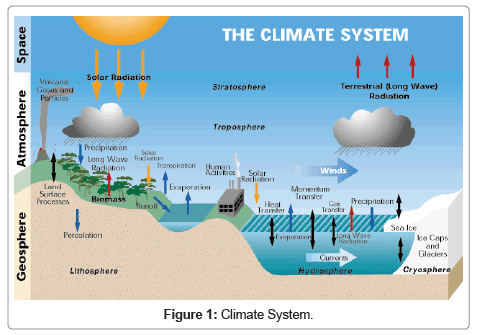
earth-science-climatic-change-Climate-System-3-114-g001

A Case Study of Climate Reductionism

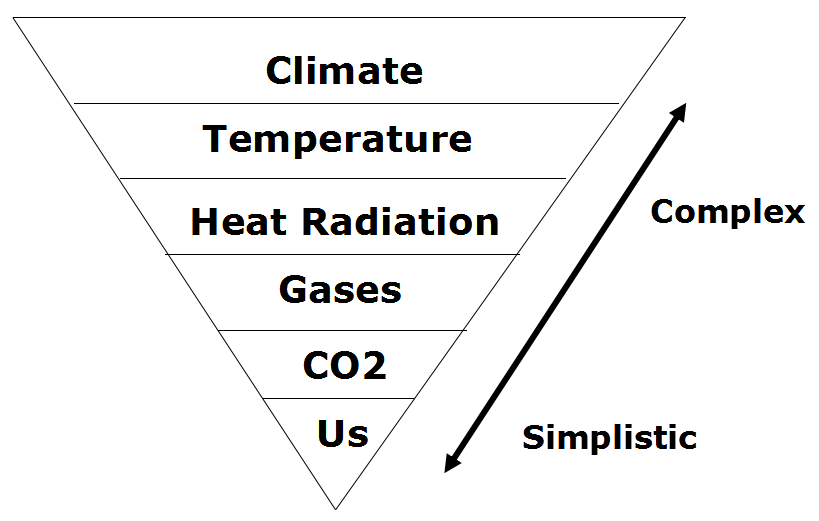
Denning’s comments, supported by several presentations at his website demonstrate how some scientists (all those known to Denning) engage in a classic form of reductionism.

The full complexity of earth’s climate includes many processes, some poorly understood, but known to have effects orders of magnitude greater than the potential of CO2 warming. The case for global warming alarm rests on simplifying away everything but the predetermined notion that humans are warming the planet. It goes like this:

Our Complex Climate

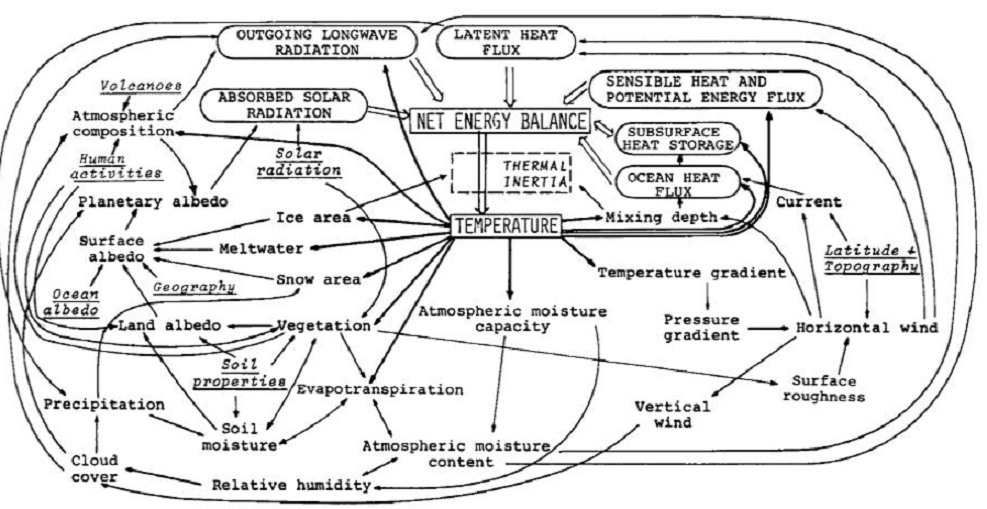
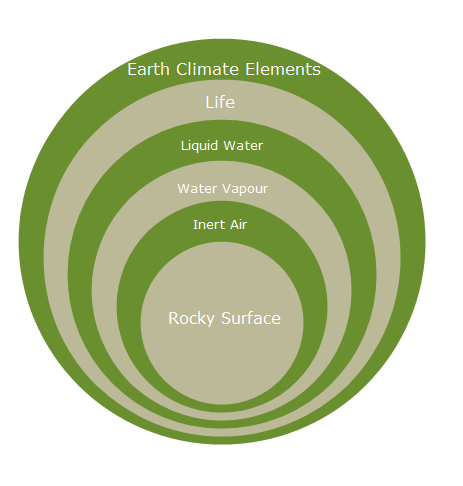
Earth’s climate is probably the most complicated natural phenomenon ever studied. Not only are there many processes, but they also interact and influence each other over various timescales, causing lagged effects and multiple cycling. This diagram illustrates some of the climate elements and interactions between them.

Flows and Feedbacks for Climate Models

The Many Climate Dimensions

Further, measuring changes in the climate goes far beyond temperature as a metric. Global climate indices, like the European dataset include 12 climate dimensions with 74 tracking measures. The set of climate dimensions include:

  • Sunshine
  • Pressure
  • Humidity
  • Cloudiness
  • Wind
  • Rain
  • Snow
  • Drought
  • Temperature
  • Heat
  • Cold

And in addition there are compound measures combining temperature and precipitation. While temperature is important, climate is much more than that.  With this reduction, all other dimensions are swept aside, and climate change is simplified down to global warming as seen in temperature measurements.

Climate Thermodynamics: Weather is the Climate System at work.

Another distortion is the notion that weather is bad or good, depending on humans finding it favorable. In fact, all that we call weather are the ocean and atmosphere acting to resolve differences in temperatures, humidities and pressures. It is the natural result of a rotating, irregular planetary surface mostly covered with water and illuminated mostly at its equator.

The sun warms the surface, but the heat escapes very quickly by convection so the build-up of heat near the surface is limited. In an incompressible atmosphere, it would *all* escape, and you’d get no surface warming. But because air is compressible, and because gases warm up when they’re compressed and cool down when allowed to expand, air circulating vertically by convection will warm and cool at a certain rate due to the changing atmospheric pressure.

Climate science has been obsessed with only a part of the system, namely the atmosphere and radiation, in order to focus attention on the non-condensing IR active gases. The climate is framed as a 3D atmosphere above a 2D surface. That narrow scope leaves out the powerful non-radiative heat transfer mechanisms that dominate the lower troposphere, and the vast reservoir of thermal energy deep in the oceans.

As Dr. Robert E Stevenson writes, it could have been different:

“As an oceanographer, I’d been around the world, once or twice, and I was rather convinced that I knew the factors that influenced the Earth’s climate. The oceans, by virtue of their enormous density and heat-storage capacity, are the dominant influence on our climate. It is the heat budget and the energy that flows into and out of the oceans that basically determines the mean temperature of the global atmosphere. These interactions, plus evaporation, are quite capable of canceling the slight effect of man-produced CO2.”

The troposphere is dominated by powerful heat transfer mechanisms: conduction, convection and evaporation, as well as physical kinetic movements.  All this is ignored in order to focus on radiative heat transfer, a bit player except at the top of the atmosphere.

There’s More than the Atmosphere

Once the world of climate is greatly reduced down to radiation of infrared frequencies, yet another set of blinders is applied. The most important source of radiation is of course the sun. Solar radiation in the short wave (SW) range is what we see and what heats up the earth’s surface, particularly the oceans. In addition solar radiation includes infrared, some absorbed in the atmosphere and some at the surface. The ocean is also a major source of heat into the atmosphere since its thermal capacity is 1000 times what the air can hold. The heat transfer from ocean to air is both by way of evaporation (latent heat) and also by direct contact at the sea surface (conduction).

Yet conventional climate science dismisses the sun as a climate factor saying that its climate input is unvarying. That ignores significant fluctuations in parts of the light range, for example ultraviolet, and also solar effects such as magnetic fields and cosmic rays. Also disregarded is solar energy varying due to cloud fluctuations. The ocean is also dismissed as a source of climate change despite obvious ocean warming and cooling cycles ranging from weeks to centuries. The problem is such oscillations are not well understood or predictable, so can not be easily modeled.

With the sun and the earth’s surface and ocean dismissed, the only consideration left is the atmosphere.

The Gorilla Greenhouse Gas

Thus climate has been reduced down to heat radiation passing through the atmosphere comprised of gases. One of the biggest reductions then comes from focusing on CO2 rather than H20. Of all the gases that are IR-active, water is the most prevalent and covers more of the spectrum.

The diagram below gives you the sense of proportion.

The Role of CO2

We come now to the role of CO2 in “trapping heat” and making the world warmer. The theory is that CO2 acts like a blanket by absorbing and re-radiating heat that would otherwise escape into space. By delaying the cooling while solar energy comes in constantly, CO2 is presumed to cause a buildup of heat resulting in warmer temperatures.

How the Atmosphere Processes Heat

There are 3 ways that heat (Infrared or IR radiation) passes from the surface to space.

1) A small amount of the radiation leaves directly, because all gases in our air are transparent to IR of 10-14 microns (sometimes called the “atmospheric window.” This pathway moves at the speed of light, so no delay of cooling occurs.

2) Some radiation is absorbed and re-emitted by IR active gases up to the tropopause. Calculations of the free mean path for CO2 show that energy passes from surface to tropopause in less than 5 milliseconds. This is almost speed of light, so delay is negligible. H2O is so variable across the globe that its total effects are not measurable. In arid places, like deserts, we see that CO2 by itself does not prevent the loss of the day’s heat after sundown.

3) The bulk gases of the atmosphere, O2 and N2, are warmed by conduction and convection from the surface. They also gain energy by collisions with IR active gases, some of that IR coming from the surface, and some absorbed directly from the sun. Latent heat from water is also added to the bulk gases. O2 and N2 are slow to shed this heat, and indeed must pass it back to IR active gases at the top of the troposphere for radiation into space.

In a parcel of air each molecule of CO2 is surrounded by 2500 other molecules, mostly O2 and N2. In the lower atmosphere, the air is dense and CO2 molecules energized by IR lose it to surrounding gases, slightly warming the entire parcel. Higher in the atmosphere, the air is thinner, and CO2 molecules can emit IR into space. Surrounding gases resupply CO2 with the energy it lost, which leads to further heat loss into space.

This third pathway has a significant delay of cooling, and is the reason for our mild surface temperature, averaging about 15C. Yes, earth’s atmosphere produces a buildup of heat at the surface. The bulk gases, O2 and N2, trap heat near the surface, while IR active gases, mainly H20 and CO2, provide the radiative cooling at the top of the atmosphere. Near the top of the atmosphere you will find the -18C temperature.

Sources of CO2

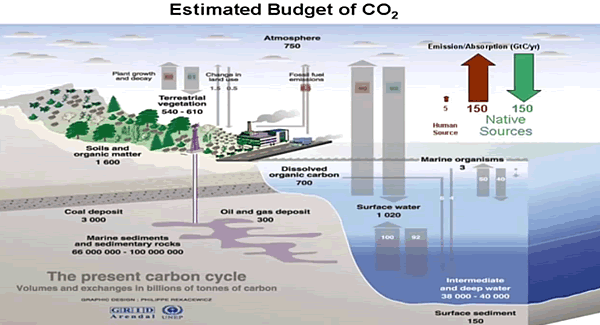
Note the size of the human emissions next to the red arrow.

A final reduction comes down to how much of the CO2 in the atmosphere is there because of us. Alarmists/activists say any increase in CO2 is 100% man-made, and would be more were it not for natural CO2 sinks, namely the ocean and biosphere. The claim overlooks the fact that those sinks are also sources of CO2 and the flux from the land and sea is an order of magnitude higher than estimates of human emissions. In fact, our few Gigatons of carbon are lost within the error range of estimating natural emissions. Insects produce far more CO2 than humans do by all our activity, including domestic animals.

Why Climate Reductionism is Dangerous

Reducing the climate in this fashion reaches its logical conclusion in the Activist notion of the “450 Scenario.”  Since Cancun, IPCC is asserting that global warming is capped at 2C by keeping CO2 concentration below 450 ppm. From Summary for Policymakers (SPM) AR5

Emissions scenarios leading to CO2-equivalent concentrations in 2100 of about 450 ppm or lower are likely to maintain warming below 2°C over the 21st century relative to pre-industrial levels. These scenarios are characterized by 40 to 70% global anthropogenic GHG emissions reductions by 2050 compared to 2010, and emissions levels near zero or below in 2100.

Thus is born the “450 Scenario” by which governments can be focused upon reducing human emissions without any reference to temperature measurements, which are troublesome and inconvenient. Almost everything in the climate world has been erased, and “Fighting Climate Change” is now code to mean accounting for fossil fuel emissions.

Conclusion

All propagandists begin with a kernel of truth, in this case the fact everything acting in the world has an effect on everything else. Edward Lorenz brought this insight to bear on the climate system in a ground breaking paper he presented in 1972 entitled: “Predictability: Does the Flap of a Butterfly’s Wings in Brazil Set Off a Tornado in Texas?”  Everything does matter and has an effect. Obviously humans impact on the climate in places where we build cities and dams, clear forests and operate farms. And obviously we add some CO2 when we burn fossil fuels.

But it is wrong to ignore the major dominant climate realities in order to exaggerate a small peripheral factor for the sake of an agenda. It is wrong to claim that IR active gases somehow “trap” heat in the air when they immediately emit any energy absorbed, if not already lost colliding with another molecule. No, it is the bulk gases, N2 and O2, making up the mass of the atmosphere, together with the ocean delaying the cooling and giving us the mild and remarkably stable temperatures that we enjoy. And CO2 does its job by radiating the heat into space.

Since we do little to cause it, we can’t fix it by changing what we do. The climate will not stop changing because we put a price on carbon. And the sun will rise despite the cock going on strike to protest global warming.

Footnote: For a deeper understanding of the atmospheric physics relating to CO2 and climate, I have done a guide and synopsis of Murry Salby’s latest textbook on the subject:  Fearless Physics from Dr. Salby

Scafetta vs. IPCC: Dueling Climate Theories

In one corner, Darth Vader, the Prince of CO2, filling the air with the overwhelming sound of his poison breath. Opposing him, Luke Skywalker, a single skeptic armed only with facts and logic.

OK, that’s over the top, but it’s what came to mind while reading a new paper by Nicola Scafetta in which he goes up against the IPCC empire. And Star Wars came to mind since Scafetta’s theory involves astronomical cycles. The title below links to the text, which is well worth reading.  Some excerpts follow in italics with my bolds. H/T GWPF

CMIP5 General Circulation Models versus a Semi-Empirical Model Based on Natural Oscillations

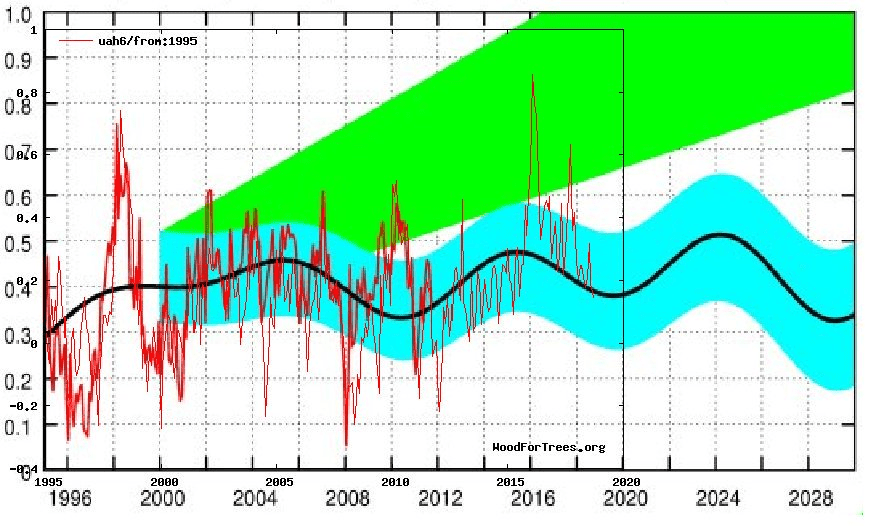
Updated 2019:  Graph Comparing Scafetta Model with UAHv6

H/T Tallbloke for providing this image:

scafetta and UAH1995to2018

Green area is range of forecasts from CMIP5 models.  Turquoise  area is forecast from Scafetta astronomical climate model.

Scafetta comes out swinging: From the Abstract

Since 1850 the global surface temperature has warmed by about 0.9 oC. The CMIP5 computer climate models adopted by the IPCC have projected that the global surface temperature could rise by 2-5 oC from 2000 to 2100 for anthropogenic reasons. These projections are currently used to justify expensive mitigation policies to reduce the emission of anthropogenic greenhouse gases such as CO2.

However, recent scientific research has pointed out that the IPCC climate models fail to properly reconstruct the natural variability of the climate. Indeed, advanced techniques of analysis have revealed that the natural variability of the climate is made of several oscillations spanning from the decadal to the millennial scales (e.g. with periods of about 9.1, 10.4, 20, 60, 115, 1000 years and others). These oscillations likely have an astronomical origin.

In this short review I briefly summarize some of the main reasons why the AGWT should be questioned. In addition, I show that an alternative interpretation of climate change based on the evidences that a significant part of it is due to specific natural oscillations is possible. A modeling based on such interpretation agrees better with the climatic comprehensive picture deduced from the data.

The Missing Hot-Spot

It has been observed that for the last decades climate models predict a hot-spot, that is, a significant warming of a band of the upper troposphere 10 km over the tropics and the equator. The presence of this hot-spot is quite important because it would indicate that the water-vapor feedback to radiative forcing would be correctly reproduced by the models.

However, this predicted hot-spot has never been found in the tropospheric temperature records [20,21]. This could only be suggesting either that both the temperature records obtained with satellite measures and balloons have been poorly handled or that the models severely fail to properly simulate the water-vapor feedback. In the latter case, the flaw of the models would be fatal because the water-vapor feedback is the most important among the climate feedbacks.

Without a strong feedback response from water vapor the models would only predict a moderate climate sensitivity to radiative forcing of about 1.2 oC for CO2 doubling instead of about 3 oC. Figure 8 compares the observed temperature trend in the troposphere versus the climate model predictions: from Ref. [21]. The difference between the two record sets is evident.

scafettafig8

Figure 8. Comparison between observed temperature trend in the troposphere (green-blue) versus the climate model predictions (red). From Ref. [21].

Observations Favor Scafetta’s Model Over GCM Models

I have proposed that the global surface temperature record could be reconstructed from the decadal to the millennial scale using a minimum of 6 harmonics at 9.1, 10.4, 20, 60, 115 and 983 years plus a anthropogenic and volcano contribution that can be evaluated from the CMIP5 GCM outputs reduced by half because, as discussed above, the real climate sensitivity to radiative forcing appears to be about half of what assumed by the current climate models. The figure highlights the better performance of the solar–astronomical semi-empirical model versus the CMIP5 models. This is particularly evident since 2000, as shown in the inserts.

scafettavscmip

Figure 12 [A] The four CMIP5 ensemble average projections versus the HadCRUT4 GST record (black). [B] The solar– astronomical semi-empirical model. From Ref. [4] Left axis shows temperature anomalies in degrees Celsius.

Forecast Validation

In 2011 I prepared a global surface temperature forecast based on a simplified climate model based on four natural oscillations (9.1, 10.4, 20 and 60 year) plus an estimate of a realistic anthropogenic contribution [25]: for example, see Refs. [33,34,35] referring to the 60-year cycle. Figure 13 compares my 2011 forecast (red curve) against the global surface temperature record I used in 2011 (HadCUT3, blue curve) and a modern global surface temperature record updated at June/2016 (RSS MSU record, black line, http://www.remss.com/measurements/upper-air-temperature).

The RSS MSU record, which is a global surface temperature estimate using satellite measurements, was linearly rescaled to fit the original HadCUT3 global surface temperature record for optimal comparison. Other global temperature reconstructions perform similarly. Note that the HadCUT3 has been dismissed in 2014. Figure 13 also shows in green a schematic representation of the IPCC GCMs prediction since 2000 [25].

scafettaforecast082016

Left axis shows temperature anomalies in degrees Celsius.

Figure 13. Comparison of the forecast (red-yellow curve) made in Scafetta (2011) [25] against (1) the temperature record used in 2011 (HadCRUT3, blue curve), (2) the IPCC climate model projections since 2000 (green area), (3) a recent global temperature record (RSS MSU record, black line, linearly re-scaled to match the HadCRUT3 from 1979 to 2014). The temperature record has followed Scafetta’s forecast better than the IPCC ones. In 2015-2016 there was a strong El-Nino Pacific Ocean natural warming that caused the observed temperature peak.

Summary

The considerations emerging from these findings yield to the conclusion that the IPCC climate models severely overestimate the anthropogenic climatic warming by about two times. I have finally proposed a semi-empirical climate model calibrated to reconstruct the natural climatic variability since Medieval times. I have shown that this model projects a very moderate warming until 2040 and a warming less than 2 oC from 2000 to 2100 using the same anthropogenic emission scenarios used by the CMIP5 models: see Figure 12.

This result suggests that climatic adaptation policies, which are less expensive than the mitigation ones, could be sufficient to address most of the consequences of a climatic change during the 21st century. Similarly, fossil fuels, which have contributed significantly to the development of our societies, can still be used to fulfill our energy necessities until equally efficient alternative energy sources could be determined and developed.

Scafetta Briefly Explains the Harmonic oscillation theory

“The theory is very simple in words. The solar system is characterized by a set of specific gravitational oscillations due to the fact that the planets are moving around the sun. Everything in the solar system tends to synchronize to these frequencies beginning with the sun itself. The oscillating sun then causes equivalent cycles in the climate system. Also the moon acts on the climate system with its own harmonics. In conclusion we have a climate system that is mostly made of a set of complex cycles that mirror astronomical cycles. Consequently it is possible to use these harmonics to both approximately hindcast and forecast the harmonic component of the climate, at least on a global scale. This theory is supported by strong empirical evidences using the available solar and climatic data.”

Update Nov. 20, 2017.  Scafetta graph to June 2017

cooling-vs-warming-forecasts-scafetta-2017

From Natural climate variability, part 2: Interpretation of the post 2000
temperature standstill, Scafetta et al. 2017

Footnote: Scafetta is not alone.  Dr. Norman Page has a new paper going into detail about forecasting climate by means of  solar-astronomical patterns.

The coming cooling: Usefully accurate climate forecasting for policy makers

Climate Debate Is On

Senator Malcolm Roberts:
ON CLIMATE, CSIRO LACKS EMPIRICAL PROOF

H/t Jo Nova

Finally, a public airing of empirical flaws in consensus climate science. Senator Malcolm Roberts is doing Australia and the entire world a service by applying critical intelligence to IPCC climate science as espoused by CSIRO, Australia’s climate agency.

The scientific debate between Roberts et al. and CSIRO is documented in depth for all to peruse at Climate Change – One Nation’s response to CSIRO  (here).

Overview:

Senator Malcolm Roberts in his maiden speech asserted that CSIRO had no empirical evidence that human emissions of CO2 caused any significant global warming.  A meeting was arranged between CSIRO and Senator Roberts’ staff where CSIRO presented their empirical evidence.  The linked document is a detailed review of that empirical evidence and has raised many questions, as well as indicating some points of agreement.

Excerpts below with images suggest that finally we have an intensive and worthwhile debate about the state of climate science, and a reasonable assessment of uncertainties in our present levels of human understanding of climate operations. Statements and images below are only examples of the extensive commentary and numerous exhibits provided.

CSIRO: Carbon dioxide is a greenhouse gas.

The natural greenhouse effect makes the planet habitable: the average temperature of the earth is 33°C warmer than it would be in the absence of greenhouse gases.

The laws of physics and direct measurements confirm that carbon dioxide is a greenhouse gas.

Roberts: Accepted that CO2 is a Greenhouse Gas if that just means it absorbs long wave infra-red radiation.

We will not contest the use of the term greenhouse effect but are unaware of any evidence that the atmosphere behaves similarly to a physical greenhouse. Some reasons for our hesitation follow.

The Greenhouse effect, as a product of back radiation heating against the thermal gradient and in violation of Fourier’s Law, is yet to be confirmed by explicitly relevant and controlled experiment.

CSIRO: Carbon dioxide concentrations in the atmosphere have increased.

Atmospheric carbon dioxide levels have increased by more than 40% since pre-industrial times

Roberts: Accepted that CO2 levels have risen since 1800 but this benefits plants and animals.

Annual atmospheric CO2 background level from 1856 to 2008 compared to SST (Kaplan, KNMI); red line, CO2 MBL reconstruction from 1826 to 1959 (Beck 2010); CO2 1960-2008: (Mauna Loa); blue line, annual SST (Kaplan) from 1856 -2003; SST= sea surface temperature

Increase in dry weight of major crop plants when atmospheric CO2 concentrations are raised. The data presented is based on large numbers of scientific studies.

CSIRO: The extra carbon dioxide in the atmosphere comes from human activities.

CO2 in the atmosphere has increased as human emissions have increased (the two are correlated).

Roberts: It is accepted that much of the recent extra CO2 probably comes from human activities but the CSIRO evidence does not seem to support the implied certainty.


These estimates of CO2 sinks are not empirical evidence and will more likely be revised as more data comes in from the Orbiting Carbon Observatory 2 satellite system

Deriving an average CO2 concentration for the whole world may be as controversial as the temperature average.

CSIRO: The additional carbon dioxide added to the atmosphere by human activities has enhanced the greenhouse effect: less energy is leaving the top of the atmosphere in the wavelengths absorbed by carbon dioxide and other greenhouse gases.

Roberts: The evidence provided doesn’t seem to support the stated conclusion.

The IRIS instrument was 1970 and the IMG instrument 1997. There is only the slightest change in methane and no significant change in CO2. [link]. This would seem be be empirical evidence that CO2 has no effect on brightness temperature.

Decadal variations in atmospheric water vapor.

Even a two percent variation in atmospheric water vapor will equal the total amount of supposed greenhouse effect of all human CO2 production.

CSIRO: The earth has warmed.

Graph: Global Surface temperature vs Time 1900 – 2015 increasing 1°C per century

Roberts: independent replication of experiment, observation and analysis is a vital part of the scientific method.

Maximum temperature is generally considered a better measure of regional temp variability and this allows better comparison with the following graph.

A trend of 0.44°C per century is indicated.
The reanalysis tried to be free of arbitrary adjustments and the trend per century was reduced from 0.88°C to 0.44°C.  The methodology of the reanalysis is explained in the attachment to this point.

CSIRO Graph: Ocean Heat Content increasing since 1975

Roberts: Accepted that the earth has warmed since the Little Ice Age but is still cooler than the Roman Warm Period and much cooler than the Holocene Thermal Maximum.

Pacific Ocean Heat Content is at the lowest for 8,000 years


We show that water masses linked to North Pacific and Antarctic intermediate waters were warmer by 2.1°C and 1.5°C, respectively, during the middle Holocene Thermal Maximum than over the past century. Both water masses were ~0.9°C warmer during the Medieval Warm period than during the Little Ice Age and ~0.65° warmer than in recent decades.”

CSIRO: Observed changes in the climate system are consistent with an enhanced greenhouse effect. Other forcings (e.g. volcanoes, the sun, internal variability) cannot explain the magnitude, timing and distribution of observed trends.

Roberts:  While there is strong correlation between CO2 and temperature when looking at the four last ice ages, CO2 does not appear to lead temperature. Looking at shorter timescales the correlation disappears and in the short satellite age data there appears to be no correlation with any greenhouse effect, enhanced or otherwise.

CO2 and temperature swings post 1850 show some correlation and some divergence

CO2 and temperature swings in the satellite age show little short term correlation


El Nino temperatures correlate well with satellite temperatures

CSIRO: Models can reproduce the record of global averaged temperature if we include the effects of increased greenhouse gas forcing, but cannot do so with natural forcings alone.


Roberts: It is the model predictions that seem to be inconsistent with the observed changes which rather disqualifies the models as a basis for expensive action.

Only the Russian model INM-CM4.0 can approximately reproduce the record of global averaged temperatures since 1977.

Summary — On the topic of dangerous warming from fossil fuel emissions

MR: Well, Greg Hunt – and I’m looking at Alex here, not for an explanation but just to emphasise that Greg Hunt in particular has said that his climate policies rely entirely on the CSIRO, the Bureau of Meteorology and the IPCC. And so he’s saying, we will end up in danger unless we do something to cut the use of hydrocarbon fuels. And so, if he relies upon the CSIRO’s advice, is that where he’s getting his imminent danger from?
CSIRO said that the interpretation of danger is up to the Australian public, and the Minister

MR: So, the Minister has drawn those conclusions. ….. independent of the CSIRO. You’ve presented him with the temperature changes and the causal analysis and he’s gone: Oh my God, we’ve got to do something.
CSIRO said it’s probably best to ask the Minister if he’s done that.

MR: Okay.
Ministerial Adviser indicated that the Minister would be happy to have a conversation about that and advised that’s definitely a conversation for the Minister not for the CSIRO.

MR: Sure. Okay. So, the CSIRO just presents the data and leaves the policy decisions to the Ministers?
CSIRO confirmed that is correct.