Desire for Power Hiding Behind Health and Climate Concerns

Theodore Dalrymple writes at Epoch Times The Desire for Power Hiding Behind Health and Climate Concerns.  Excerpts in italics with my bolds.

There is a threat of creeping totalitarianism in western societies that comes from health and climate activists. Who (except unfeeling monsters) could possibly be against the saving of human life or the preservation of the planet from future catastrophe? Often the two strands of redemptive enthusiasm go together: after all, environmental degradation is hardly good for health.

Since almost all human activities have health or environmental consequences, especially bad ones, it follows that those who want to preserve either human health or the environment, or both, have an almost infinitely expansible justification for interfering in our lives, indeed they have it to the nth degree.

These days, much medical research that is published in the general medical journals such as the Lancet or the New England Journal of Medicine is epidemiological rather than experimental.

It finds associations between factor a (shall we say, the consumption of bananas) and illness x (shall we say, Alzheimer’s disease).

Once an association is found that is unlikely to have arisen by chance (unlikely, that is, but not impossible), an hypothesis is put forward as to why the eating of bananas should conduce to the development of Alzheimer’s disease. Before long, the statistical association and its alleged explanation leaks out into the press or social media, and people start to be afraid of bananas. The more enthusiastic and less sceptical of the epidemiologists begin to call for banana controls: anti-banana propaganda, extra taxes on bananas, no bananas on sale within a hundred yards of anywhere there might be a child, and so on.

And of course, a reduction in the demand for bananas will assist those tropical countries large parts of which are given over to environmentally-degrading banana monoculture. Banana republics are not called bananas republics for nothing.

Often in the medical literature, the statistical associations are weak: someone who consumes a is, say, 1.2 times more likely to develop disease x than someone who does not. This is described as being a statistically significant increase in risk, but it is not significant in any other humanly important way, especially where the initial risk of contracting the disease is very low in any case. These caveats are often, even usually, missing from not only the scientific literature itself, but from the reports of it that filter into the general public’s awareness.

Not infrequently, sweeping policy changes are proposed on the basis of weak evidence which not only is likely to be superseded in time by new research (though dietary recommendations for the most part they are not very different from those recommended by physicians such as Dr. George Cheyne in the first half of the eighteenth century), but which fail to take into account that health, while an important consideration, is not an all-important consideration, and sometimes must be balanced against others.

For example, it would be easy to reduce the fatal road accident rate to zero by forbidding everyone to leave his house, but this might not be a wise prohibition. Sport is one of the most frequent causes of injury in the western world, yet sport is encouraged because of its other (alleged) benefits.

Good Intentions a Smokescreen

Supposed good intentions are often a smokescreen for an almost sadistic desire to exercise power, or at least influence. A writer of editorials for the influential British newspaper, the Observer, Sonia Sodha, has suggested, for example, that meat should be rationed. She suggests such a measure not because there is a shortage of meat, but because the environmental cost of producing it is too great.

She opposes a tax on it to lower consumption because raising the price would affect the poor more than the rich. The only other solution is to ration it, so that everyone has access to an equal, but small, quantity.

The author is honest enough to admit that she is a hypocrite in the sense that, while she strongly believes meat consumption should decrease in order to save the planet, she will continue to eat it in her accustomed quantities so long as it is available to her. She needs a dictator to get her to do the right thing.

The really striking thing in her article is that she does not consider the kind of apparatus that would be necessary to ration a commodity such as meat. Someone would have to set the ration and many people would have to enforce it.

Evidently, she has never heard of or experienced black markets; nor does she seem to be aware that, where a bureaucracy allocates or distributes goods and services, especially when they are in short supply, privilege flourishes rather than withers.

Nor does she acknowledge that meat is far from the only commodity with a high environmental cost, and that the argument for the rationing of meat could be used for the rationing of many, if not most or even all, commodities.

What the author is proposing, then, implicitly or explicitly, is a kind of communism, in which an administrative class under the direction of an even smaller class of enlightened and informed individuals doles out to the populace what it thinks it ought to have—for its own ultimate good, of course.

The author is certainly intelligent enough to realize that this is the implication or corollary of what she writes (and, to do her justice, she writes very clearly), so one must conclude that a society in which a great deal, if not everything, is rationed first in the name of protecting the environment and second in the name of social justice is one that would be pleasing to her—at least to contemplate in the abstract, if not actually to live in.

That this drastic and very far-reaching scheme is based upon evidence that is itself far from rock-solid or indisputable would probably not worry her very much, because the end result (the theoretical end result, that is, not the end result in practice) is one which she desires a priori: in other words, first the policy, and then the evidence to justify it.

As it happens, more and more young people in western countries are turning to vegetarianism by means of persuasion. I have no objection to this; I think on balance that it is probably a good thing. But no giant state apparatus was necessary to bring this about. It is a change that has welled up from below, not imposed from the top down, and requires no corrupting means of coercion to enforce.

Theodore Dalrymple is a retired doctor. He is contributing editor of the City Journal of New York and the author of 30 books, including “Life at the Bottom.” His latest book is “Embargo and Other Stories.”

Arctic Flash Freezing in November


After concerns over lackluster ice recovery in October, November is seeing ice roaring back.  The image above shows the last 10 days adding sea ice at an average rate of 215k km2 per day.  The Russian shelf seas on the right have filled with ice in this period.  On the CanAm side, Beaufort at the top left is iced over, Canadian Archipelago (center left) is frozen, and Baffin Bay is filling from the north down.  Hudson Bay (far left) has grown fast ice around the edges.  A background post is reprinted below, showing that in just 10 days, 2020 has added as much ice as an average 30-day November.

Some years ago reading a thread on global warming at WUWT, I was struck by one person’s comment: “I’m an actuary with limited knowledge of climate metrics, but it seems to me if you want to understand temperature changes, you should analyze the changes, not the temperatures.” That rang bells for me, and I applied that insight in a series of Temperature Trend Analysis studies of surface station temperature records. Those posts are available under this heading. Climate Compilation Part I Temperatures

This post seeks to understand Arctic Sea Ice fluctuations using a similar approach: Focusing on the rates of extent changes rather than the usual study of the ice extents themselves. Fortunately, Sea Ice Index (SII) from NOAA provides a suitable dataset for this project. As many know, SII relies on satellite passive microwave sensors to produce charts of Arctic Ice extents going back to 1979.  The current Version 3 has become more closely aligned with MASIE, the modern form of Naval ice charting in support of Arctic navigation. The SII User Guide is here.

There are statistical analyses available, and the one of interest (table below) is called Sea Ice Index Rates of Change (here). As indicated by the title, this spreadsheet consists not of monthly extents, but changes of extents from the previous month. Specifically, a monthly value is calculated by subtracting the average of the last five days of the previous month from this month’s average of final five days. So the value presents the amount of ice gained or lost during the present month.

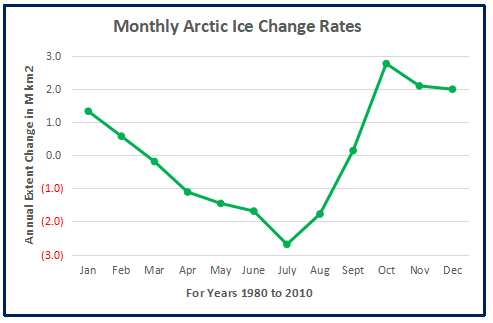
These monthly rates of change have been compiled into a baseline for the period 1980 to 2010, which shows the fluctuations of Arctic ice extents over the course of a calendar year. Below is a graph of those averages of monthly changes during the baseline period. Those familiar with Arctic Ice studies will not be surprised at the sine wave form. December end is a relatively neutral point in the cycle, midway between the September Minimum and March Maximum.

The graph makes evident the six spring/summer months of melting and the six autumn/winter months of freezing.  Note that June-August produce the bulk of losses, while October-December show the bulk of gains. Also the peak and valley months of March and September show very little change in extent from beginning to end.

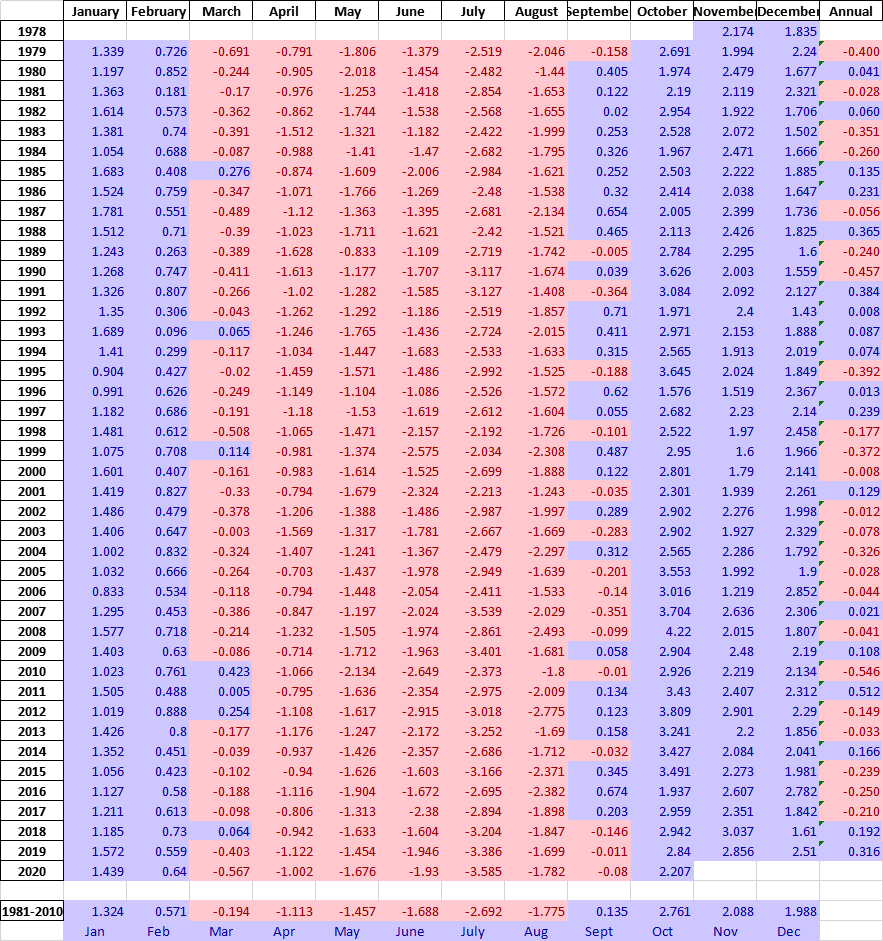
The table of monthly data reveals the variability of ice extents over the last 4 decades.

Table 1 Monthly Arctic Ice rates of Extent Changes in M km2. Months with losses in pink, months with gains in blue.

The values in January show changes from the end of the previous December, and by summing twelve consecutive months we can calculate an annual rate of change for the years 1979 to 2019.

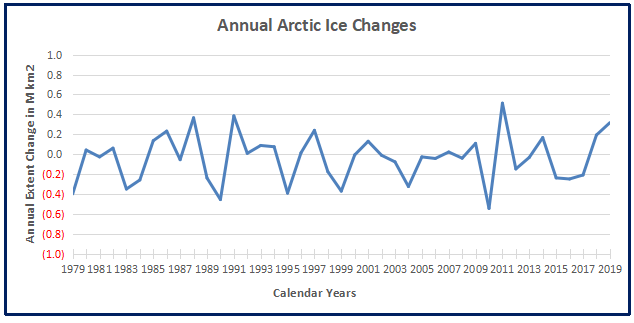
As many know, there has been a decline of Arctic ice extent over these 40 years, averaging 40k km2 per year. But year over year, the changes shift constantly between gains and losses.

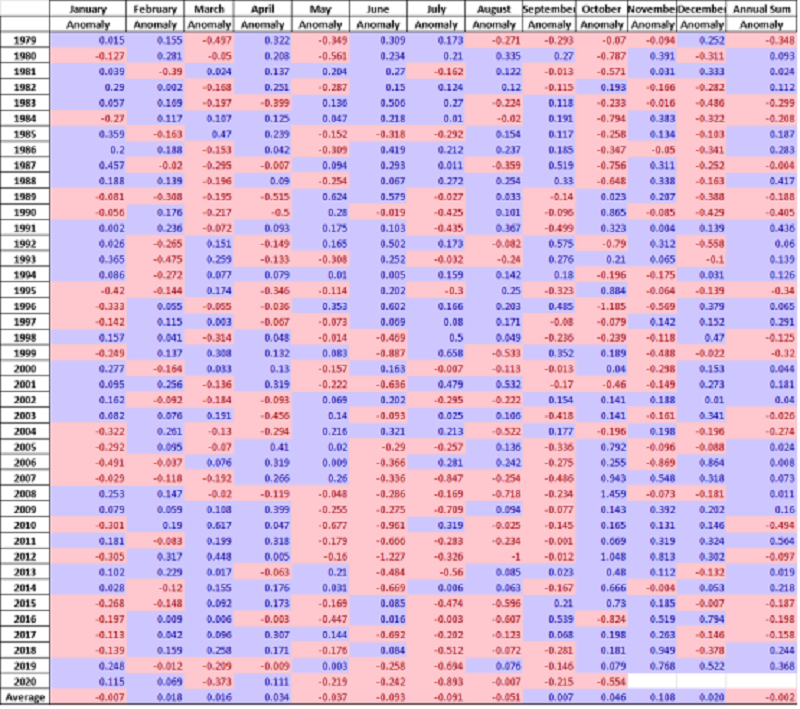
Moreover, it seems random as to which months are determinative for a given year. For example, much ado has been printed about October 2020 being slower than expected to refreeze and add ice extents. As it happens in this dataset, October has the highest rate of adding ice. The table below shows the variety of monthly rates in the record as anomalies from the 1980-2010 baseline. In this exhibit a red cell is a negative anomaly (less than baseline for that month) and blue is positive (higher than baseline).

Note that the  +/ –  rate anomalies are distributed all across the grid, sequences of different months in different years, with gains and losses offsetting one another.  Yes, October 2020 recorded a lower than average gain, but higher than 2016. The loss in July 2020 was the largest of the year, during the hot Siberian summer.  The bottom line presents the average anomalies for each month over the period 1979-2020.  Note the rates of gains and losses mostly offset, and the average of all months in the bottom right cell is virtually zero.

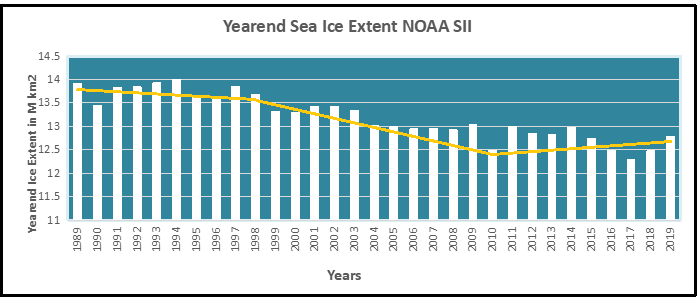
A final observation: The graph below shows the Yearend Arctic Ice Extents for the last 30 years.

Note: SII daily extents file does not provide complete values prior to 1988.

Year-end Arctic ice extents (last 5 days of December) show three distinct regimes: 1989-1998, 1998-2010, 2010-2019. The average year-end extent 1989-2010 is 13.4M km2. In the last decade, 2009 was 13.0M km2, and ten years later, 2019 was 12.8M km2. So for all the the fluctuations, the net loss was 200k km2, or 1.5%. Talk of an Arctic ice death spiral is fanciful.

These data show a noisy, highly variable natural phenomenon. Clearly, unpredictable factors are in play, principally water structure and circulation, atmospheric circulation regimes, and also incursions and storms. And in the longer view, today’s extents are not unusual.


Illustration by Eleanor Lutz shows Earth’s seasonal climate changes. If played in full screen, the four corners present views from top, bottom and sides. It is a visual representation of scientific datasets measuring Arctic ice extents.

SCOTUS Goes Full Nanny State

Seeking some comic relief from the US election fiasco, I turned to Babylon Bee and found this satirical piece skewering leftist fears about the US Supreme Court with ACB confirmed. (Just this week Pelosi declared that ACB is an “illegitimate” justice”.)  Give the BB writers credit for flipping leftist control-freak behavior into rulings constraining personal rights and freedoms, but in the opposite direction.

The article is Frightening: Here Are The 23 SCOTUS Decisions Handed Down Since ACB Was Sworn In.  Excerpts in italics with my bolds.

Since Amy Coney Barrett was confirmed to the Supreme Court, she and the other judges have wasted no time in remaking America in their image. This is what we were warned about. In only two days, 23 landmark cases have been decided by the new conservative Supreme Court. God help us all.

  • United States v. Trump, 6-3 ruling — Determined that Trump has already won reelection
  • Walsh v. Dweedlestein, 5-4 ruling — We are to be a theocracy under God
  • United States v. Trump, 5-4 ruling — Trump is now the Galactic Emperor Of Man
  • Acosta v. Elisha, 9-0 ruling — All journalists shall be thrown into a pit with a she-bear
  • Gorka v. Kagan, 5-4 ruling — All justices must now wear MAGA hats
  • Subway v. Hebrew National, 6-3 ruling — A hotdog is now legally classified as a sandwich
  • Amazon v. Smith, 6-3 ruling — Die Hard is now legally classified as a Christmas movie
  • Gates v. Cook, 7-2 ruling — .GIF must now be pronounced with a hard “G”
  • American Airlines v. Moore, 6-3 ruling — The person in the middle seat of an airplane gets both armrests
  • Casey v. Brown, 6-3 ruling — Washing your feet in the shower is unconstitutional
  • United States v. West, 5-4 ruling — The dress is blue and black
  • United States v. Barrett, 6-3 ruling — All women must have at least 7 children
  • Papa Johns v. Tony’s, 5-4 ruling — All pizzas must now have pineapple on top
  • United States v. Silverman, 9-0 ruling — Annoying celebrity videos telling you to vote are now illegal
  • Bartolli v. Xanderatrix, 5-4 ruling — Single women are now limited to only 3 cats
  • Taco Bell v. Chad, 9-0 ruling — All Taco Bells must put the Crunchwrap back on the dollar menu
  • United States v. Trump, 5-4 ruling — Everyone must have a Christopher Columbus Statue in their yard
  • LaPierre v. Morgan, 6-3 ruling — Gun ownership is now mandatory
  • United States v. Crystal Marina, 9-0 ruling — Grants McConnell Protected Status as an endangered turtle
  • United States v. Trump, 6-3 ruling — All faces on Mt. Rushmore must now be replaced by Trump
  • Babylon Bee v. Facebook, 9-0 ruling — Babylon Bee no longer allowed to tell jokes about AOC
  • Burger King v. Carson, 5-4 ruling — “Impossible Meat” now illegal
  • Thomas v. Breyer, 8-1 ruling — In favor of stealing Justice Breyer’s milk money and shutting him in a locker

Amazing. Let’s see what they come up with next week!

There’s more:

Experts Call For 15 Days Of Counting To Flatten The Curve Of Votes For Trump

Fox News Calls Arizona For Biden After 1 Vote Counted

Miracle: Ballot Counter Turns 5 Biden Votes Into 5,000


Stalin’s Wisdom

John Daniel Davidson writes at The Federalist Yes, Democrats Are Trying To Steal The Election In Michigan, Wisconsin, And Pennsylvania Excerpts in italics with my bolds.

In the three Midwest battleground states, vote counting irregularities persist in an election that will be decided on razor-thin margins.

As of this writing, it appears that Democratic Party machines in Michigan, Wisconsin, and Pennsylvania are trying to steal the election.

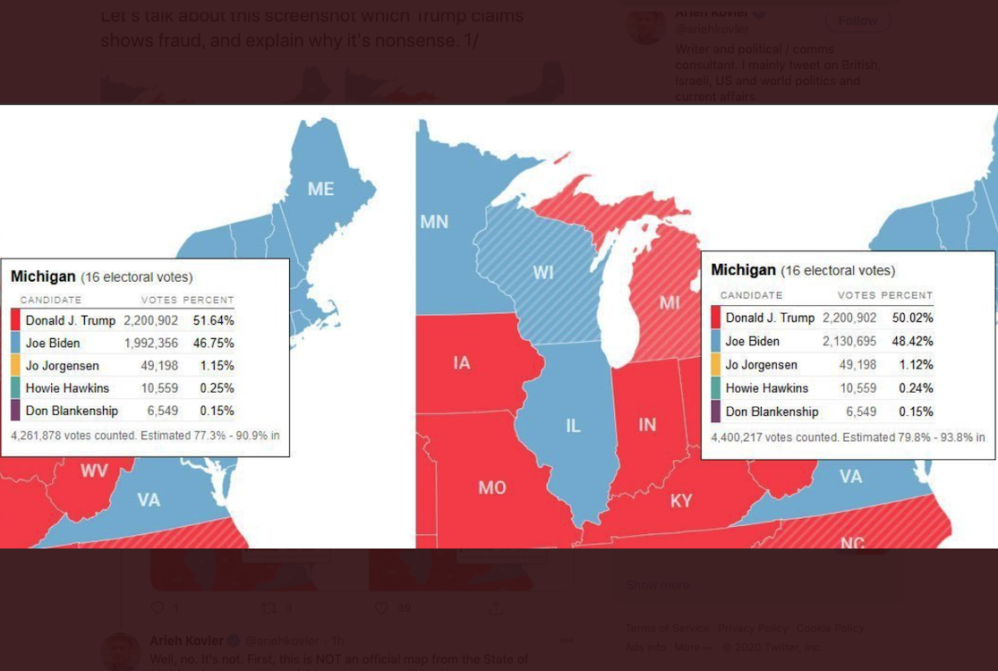
Something strange happened in the dead of the night. In both Michigan and Wisconsin, vote dumps early Wednesday morning showed 100 percent of the votes going for Biden and zero percent—that’s zero, so not even one vote—for Trump.

In Michigan, Biden somehow got 138,339 votes and Trump got none, zero, in an overnight vote-dump.

When my Federalist colleague Sean Davis noted this, Twitter was quick to censor his tweet, even though all he had done was compare two sets of vote totals on the New York Times website. And he wasn’t the only one who noticed—although on Wednesday it appeared that anyone who noted the Biden vote dump in Michigan was getting censored by Twitter.

It turns out, the vote dump was the result of an alleged typo, an extra zero that had been tacked onto Biden’s vote total in Shiawassee County, Michigan. It seems the error was discovered only because Davis and other Twitter users noted how insane and suspicious the vote totals looked, and demanded an investigation that uncovered what was either a typo or an incredibly clumsy attempt to boost Biden’s vote count.

There was also something suspicious about the vote reporting in Antrim County, Michigan, where Trump beat Hillary Clinton by 30 points in 2016. Initial vote totals there showed Biden ahead of Trump by 29 points, a result that can’t possibly be accurate, as plenty of journalists noted.

Then another mysterious all-Biden vote dump happened in Wisconsin. Biden miraculously overcame a 4.1-point Trump lead in the middle of the night thanks to vote dumps in which he got—you guessed it—100 percent of the votes and Trump got zero.

Unless election officials in Michigan and Wisconsin can explain the overnight vote-dumps and, in Michigan, the “typo” that appeared to benefit Biden, and Pennsylvania officials can explain their rationale for counting ballots with no postmark, the only possible conclusion one can come to right now is that Democrats are trying to steal the election in the Midwest.

US Conflicted over Green Energy

Joel Kotkin writes at Real Clear Energy Democrats’ Energy Dilemma.  Excerpts in italics with my bolds.

The biggest challenge facing a putative first-term Joe Biden administration and the Democratic Party may lie with energy policy, where gentry and green wishful thinking confront the daily realities of millions of middle- and working-class Americans.

Democrats could choose a climate policy that allows for gradual change – for example, transitioning from coal to natural gas – and consider the feasibility of smaller and safer nuclear plants, while keeping the productive economy afloat. But Biden, despite some wriggling about fracking on private land, just last week committed himself to the gradual eradication of the fossil fuel industry. His running mate, Senator Kamala Harris, is beloved by California’s extremist greens.

Already, in anticipation of a Democratic sweep, utilities are putting some natural gas projects on hold – threatening a powerful growth engine in places like Pennsylvania and Ohio. If Biden continues to embrace the basic thrust of the Green New Deal, if not its full-bore socialist program, the impact could be devastating for manufacturing areas that compete with China, which depend largely on natural gas, coal, and nuclear power to keep costs down. These state economies cannot fantasize, as some do in California, that the resulting social costs will be paid for by the wealthy digerati; lacking sufficient numbers of the rich and famous, these states will be hit hard, and fast.

If, as seems likely, victorious Democrats enact legislation broadly derived from the Green New Deal, major blowback – and economic disruption – seems inevitable. Biden and Harris have been almost comically inconsistent in their statements about fracking, but they’re certainly hostile to it: if they win the White House and pursue a ban, it would likely drive higher prices for energy, reduce national energy self-sufficiency, and cause massive job loss among a large number of Americans, particularly in key states like Ohio and Pennsylvania.

The critical gentry-green alliance

Energy effects so many other things – our daily bills, whether an employer locates in our town, our already-frayed economic mobility – and is thus a far broader issue, in terms of its consequences, than, say, abortion or race reparations, which often appeal to limited, albeit passionate, constituencies. Energy policy is certain to fracture the Democrats along ideological, class, and geographic lines.

In the past, Democrats tried to appeal to workers and communities connected to the oil and gas industries. Over the past decade or so, these constituencies have generally expanded; they tend to be unionized and well-paid. Yet today, organizations like the Oil, Chemical and Atomic Workers, once a militantly left union, have far less influence on Democratic politics, while the Sierra Club and its allies among the tech oligarchs and, increasingly on Wall Street, have much more.

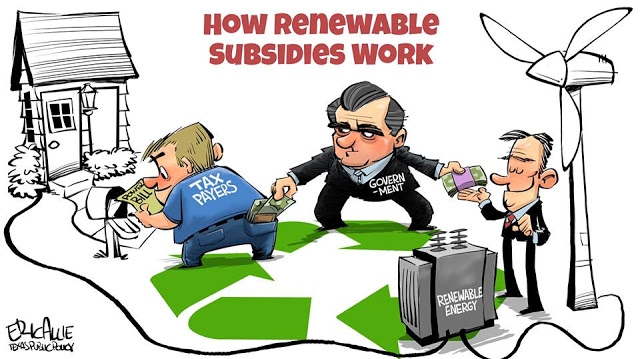
You don’t have to be Karl Marx to see the reasons why financial and tech moguls support a restrictive energy regime despite the challenges posed by the high cost and intermittent nature of renewable energy. Being “green” is great if you make such stupendous profits that a few million more dollars in energy costs won’t make much difference to your bottom line. And besides, both Wall Street and the tech moguls have become heavy investors in “green” energy schemes that, due to subsidies and tax breaks, guarantee virtually assured profits.

The “Brahmin left” – as economist Thomas Picketty puts it – benefits politically and economically from centrally imposed scarcity, under the pretext of “human survival.” These interests – notably the tech elites – have lined up massively behind Biden’s exceedingly well-funded campaign. Long before they settled on Biden, Kamala Harris, as California attorney general, was an aggressive enforcer of California’s often-draconian climate and planning laws.

Class warfare by other means

In adopting an ultra-green perspective, Democrats have made a choice to favor their backers among the fantastically rich and on Wall Street, who can use green investments to correct their increasingly low standing among the masses. Get rich, go green – and preen. Tech elites and their Wall Street allies – as opposed to populists like Bernie Sanders and Elizabeth Warren – were clear winners of the Democratic primaries.

Whatever its derivation, the green energy agenda doesn’t harmonize easily with the notion of Democrats as the “party of the people.” It represents a direct threat to the party’s once-vital working-class base. In the past, Democratic voters came in large part from the working class. Today, Democrats do better among well-educated “knowledge workers” and the prestigious companies that employ them. This leads some progressives to believe that white working-class voters are no longer critical to the party’s chances.

This voting bloc is shrinking, true, but it still constitutes as much as 44 percent of the electorate, Democratic strategist Ruy Teixeira points out. These voters provided a critical boost to President Obama’s electoral success and later to Donald Trump’s. Teixeira argues that the Democratic focus on cultural and green issues, as opposed to more lunch-bucket concerns, has limited appeal to the working class. Certainly extreme environmental policies, as seen in California, hurt poor and minority populations – and electric-car production and solar plants pose their own, though rarely reported, environmental problems.

Middle- and working-class voters may say that they want a cleaner climate – and most do want something done about climate change – but generally, they consider environmental issues low priority, and they tend to be skeptical of the costs associated with ambitious programs like the Green New Deal. Democrats may feel that minorities will support anything the party proposes as long as racism is invoked, but “people of color” are also people with their own economic interests and families to support.

Today, barely 58% of all working-class Americans are white. According to a 2016 Economic Policy Institute study, nonwhites will become the majority of the working class by 2032. In Green New Deal states like California, policies have increased “energy poverty” and taken away good blue-collar jobs, particularly for the heavily Latino working class.

Regional challenge

Energy policy is unlikely to turn California and most coastal states red (unless you’re using the traditional political meaning of that color). The potential havoc is clearer, though, in parts of the country where low energy prices and production are primary elements of the economy. One can only imagine the damage to the Democratic Party when, despite promises to the contrary, Biden and his presumed heir Harris eventually find a way to “ban” through regulations fracking in places like Texas, North Dakota, Ohio, West Virginia, and Pennsylvania. In Texas alone, by some estimates, 1 million jobs would be lost. Overall, according to a Chamber of Commerce report, a full ban would cost 14 million jobs, far more than the 8 million lost in the Great Recession.

The effects will be particularly severe in the Rust Belt, still the fulcrum of American politics. Trump may be underperforming in high-end suburbs, but he’s still doing well in once-Democratic parts of the Midwest, such as Minnesota’s mining country. Beyond the extractive industries, far bigger sectors – logistics, agriculture, and manufacturing – would face serious problems with intermittent and expensive “green energy,” as a recent MIT report suggests. These policies have already been tied to persistent blackouts in California that forced the Golden State to depend on imported energy and delayed its planned decommissioning of gas plants.

These realities may not be enough to save Donald Trump at the polls, but over time, they could further alienate voters in a broad swath of states that generally determine the country’s political future. Ultimately, the test for Joe Biden, and his party, lies in the old union slogan: “Which side are you on?” If Democrats adhere blindly to California’s Ecotopian absolutism, glasses may clink at Davos, on Wall Street, and in San Francisco, but “the party of the people” will surrender its historic legacy – perhaps permanently.

Clueless Covid Policies

In recent months, some demonstrators in Quebec have denounced what they consider government fear campaigns over COVID-19. The new measures included a mandatory rule on wearing masks during demonstrations. (Graham Hughes/The Canadian Press)

A previous post discussed how policymakers are imposing draconian restrictions on their citizens in a misguided attempt to stop viral infections.  The basic fallacy is this:

It seems that certain disease experts genuinely believe that they can game the reproduction rate of the virus to get it below 1, and thereby create a mathematical result that will make the virus go away.

This seems to be their goal and the metric by which they measure whether and to what extent they have achieved it. The problem is that the reproduction rate (very difficult to discern precisely) is an effect – a measurement of an evolved condition – not a cause.

Previous Post Covid Coercion in Quebec
Update:  Quebec is one example of a world wide problem:  See COVID-19 Is Also a Crisis for Democracy and Human Rights

The coronavirus pandemic began as a global health crisis. It spawned an economic crisis. Now COVID-19 is also fueling a crisis for democracy and human rights.

Leaders around the world are using the virus as cover to reduce transparency, increase surveillance, arrest dissidents, repress marginalized populations, embezzle public resources, restrict media, and undermine fair elections.


What is the Emergency Requiring Virtual Quarantine of Healthy People?

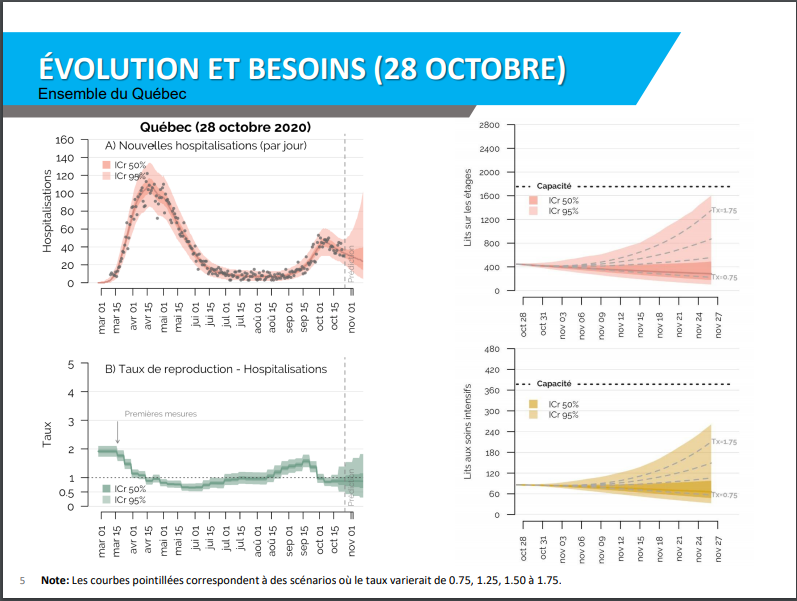
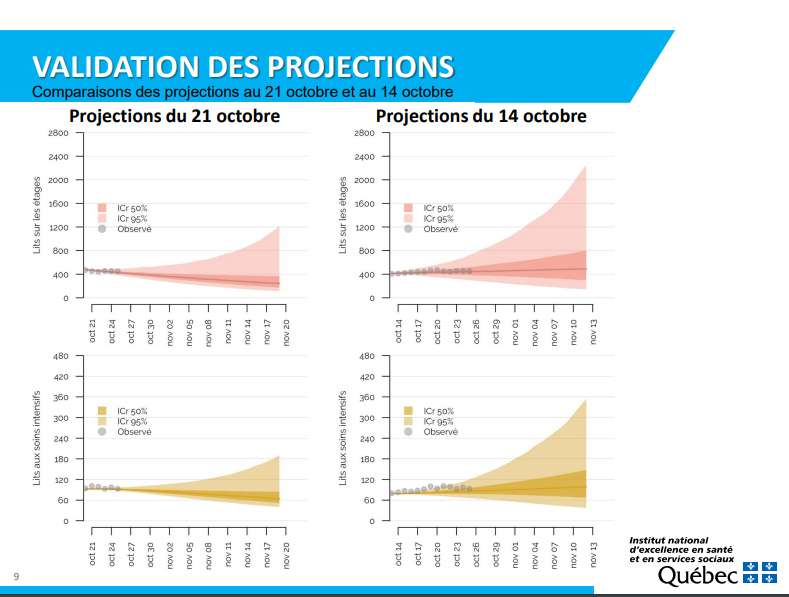
Each Friday the Quebec health research institute (INESSS) provides a statistical update of the Covid19 situation with projections regarding the key concern:  Capacity of the system to care for actual Covid cases requiring in-hospital treatment. Here is the latest information from October 28, 2020.

On the left is the history of Covid hospitalizations in Quebec to end of September.  Note admissions peaked in April around 120 per day, then dropped to 20 a day June to September.  A “second wave” was feared but the graph shows only a bump up to 50 mid October falling already.  As of Oct. 28, Quebec reported 439 people in hospital out of covid bed capacity of 1750.  In addition 88 were in ICUs out of a capacity of 380. At a 30/day new admissions rate, and assuming an average length of stay of 12 days, the net of covid beds occupied should not increase and more likely would go down.  So the projections on the right side have a wide range, but show declining numbers of Covid patients in hospital.  And as the lower right shows, demand for ICU capacity is is also expected to diminish.

On September 24, INESSS authorities said (here):

In Quebec, the hospitalization rate for COVID-19 patients has dropped sharply since the beginning of the pandemic. During the first wave, about 13 per cent of cases ended up in hospital. From Aug. 10 to Sept. 6, the rate was just 5 per cent. At a technical briefing on Wednesday, researchers and officials from Quebec’s institute of excellence in health and social services (INESSS) projected that the rate for COVID-19 patients in early September would fall again to 3.8 per cent.

The drop can be explained by the relative youth of Quebeckers contracting the virus in its second wave and their relative lack of comorbidities. By contrast, in the spring, the virus tore through long-term care homes in the province, killing 4,914 elderly residents.

As a result of this shift, Quebec will not exceed its hospital capacity of about 2,000 beds in the next four weeks, according to the INESSS projections. But officials warned that a faster spread of the virus caused by careless behaviour could still put pressure on the health care system.

Above is the outlook for October from INESSS.  For both ICU and covid hospital beds observations are tracking a forecast showing slight increases.  It appears that the precautionary principle is being applied without regard for the costs of locking down: social, economic and personal well-being seem not to be part of the equation.

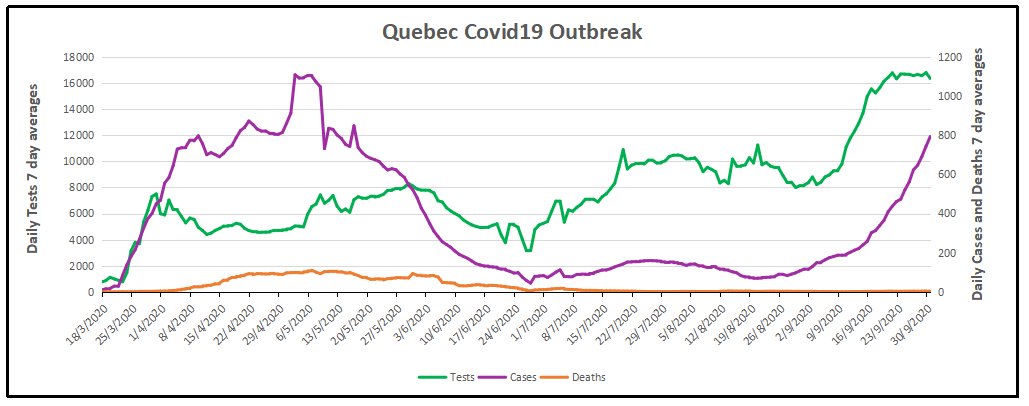
Quebec Situation Update October 1, 2020

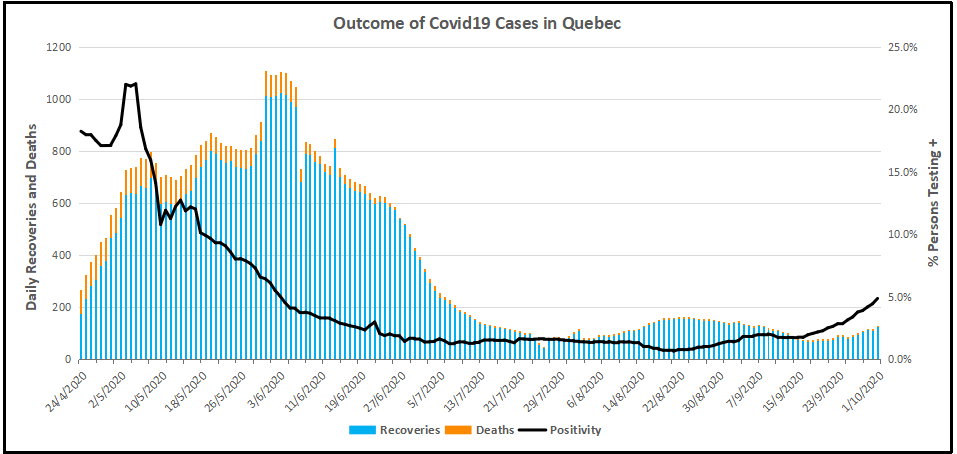
Note that testing has quadrupled since July and the number of new cases followed, especially in the last month.  Meanwhile daily deaths are unchanged at less than five a day, compared to Quebec losing 186 lives every day from all causes..  Recoveries are not reported to the public, perhaps due to the large number of people testing positive but without symptoms or only mild illness and no professional treatment.  The graph below estimates recoveries assuming that people not dying 28 days after a positive test can be counted as cured or in recovery.

Recoveries are the number of people testing positive (misleadingly termed “cases”) minus deaths 28 days later.  Obviously, the death rate was high early on, and now is barely visible.  Meanwhile the Positivity rate (% of people testing positive out of all subjects) went down to 1% for several months before rising recently.  Since there is a lag of 28 days, we don’t yet see the outcome of the rise in positives along with the increased testing.

Summary

Premier Legault and his medical advisors had done well up to now. The first goal was to prevent deaths, and that has been achieved. 186 Quebecers die every day from all causes, and now about 5 are dying having tested positive for SARS CV2. The other goal was to prevent overwhelming the health care system with Covid cases. This too is under control. On October 1, there were 276 patients hospitalized with covid, plus 46 in ICUs. The capacity is 1750 beds and 370 ICU beds. Since July there have been about 20 new admissions daily, offset by recoveries released from hospital.

Unfortunately, now the authorities have spooked themselves and applied a lockdown at the wrong time. Their goal has shifted to stopping new positives, which have increased because testing has quadrupled and positivity rates gone up from 1% to 5%. These are younger people who are not getting sick and certainly not dying from the virus. As many epidemiologists have said, you won’t get rid of this virus, you live with it by getting herd immunity, which leaves too few susceptible people for the virus to spread. If you kill off all the PME businesses and put people out of work, poverty and social decay will kill people, not to mention the interruption of medical treatments which save those with the real deadly diseases: cancers, heart, arteries, lungs, and so on.

Arctic October Pent-up Ice Recovery

Some years ago reading a thread on global warming at WUWT, I was struck by one person’s comment: “I’m an actuary with limited knowledge of climate metrics, but it seems to me if you want to understand temperature changes, you should analyze the changes, not the temperatures.” That rang bells for me, and I applied that insight in a series of Temperature Trend Analysis studies of surface station temperature records. Those posts are available under this heading. Climate Compilation Part I Temperatures

This post seeks to understand Arctic Sea Ice fluctuations using a similar approach: Focusing on the rates of extent changes rather than the usual study of the ice extents themselves. Fortunately, Sea Ice Index (SII) from NOAA provides a suitable dataset for this project. As many know, SII relies on satellite passive microwave sensors to produce charts of Arctic Ice extents going back to 1979.  The current Version 3 has become more closely aligned with MASIE, the modern form of Naval ice charting in support of Arctic navigation. The SII User Guide is here.

There are statistical analyses available, and the one of interest (table below) is called Sea Ice Index Rates of Change (here). As indicated by the title, this spreadsheet consists not of monthly extents, but changes of extents from the previous month. Specifically, a monthly value is calculated by subtracting the average of the last five days of the previous month from this month’s average of final five days. So the value presents the amount of ice gained or lost during the present month.

These monthly rates of change have been compiled into a baseline for the period 1980 to 2010, which shows the fluctuations of Arctic ice extents over the course of a calendar year. Below is a graph of those averages of monthly changes during the baseline period. Those familiar with Arctic Ice studies will not be surprised at the sine wave form. December end is a relatively neutral point in the cycle, midway between the September Minimum and March Maximum.

The graph makes evident the six spring/summer months of melting and the six autumn/winter months of freezing.  Note that June-August produce the bulk of losses, while October-December show the bulk of gains. Also the peak and valley months of March and September show very little change in extent from beginning to end.

The table of monthly data reveals the variability of ice extents over the last 4 decades.

Table 1 Monthly Arctic Ice rates of Extent Changes in M km2. Months with losses in pink, months with gains in blue.

The values in January show changes from the end of the previous December, and by summing twelve consecutive months we can calculate an annual rate of change for the years 1979 to 2019.

As many know, there has been a decline of Arctic ice extent over these 40 years, averaging 40k km2 per year. But year over year, the changes shift constantly between gains and losses.

Moreover, it seems random as to which months are determinative for a given year. For example, much ado has been printed about October 2020 being slower than expected to refreeze and add ice extents. As it happens in this dataset, October has the highest rate of adding ice. The table below shows the variety of monthly rates in the record as anomalies from the 1980-2010 baseline. In this exhibit a red cell is a negative anomaly (less than baseline for that month) and blue is positive (higher than baseline).

Note that the  +/ –  rate anomalies are distributed all across the grid, sequences of different months in different years, with gains and losses offsetting one another.  Yes, October 2020 recorded a lower than average gain, but higher than 2016. The loss in July 2020 was the largest of the year, during the hot Siberian summer.  The bottom line presents the average anomalies for each month over the period 1979-2020.  Note the rates of gains and losses mostly offset, and the average of all months in the bottom right cell is virtually zero.

A final observation: The graph below shows the Yearend Arctic Ice Extents for the last 30 years.

Note: SII daily extents file does not provide complete values prior to 1988.

Year-end Arctic ice extents (last 5 days of December) show three distinct regimes: 1989-1998, 1998-2010, 2010-2019. The average year-end extent 1989-2010 is 13.4M km2. In the last decade, 2009 was 13.0M km2, and ten years later, 2019 was 12.8M km2. So for all the the fluctuations, the net loss was 200k km2, or 1.5%. Talk of an Arctic ice death spiral is fanciful.

These data show a noisy, highly variable natural phenomenon. Clearly, unpredictable factors are in play, principally water structure and circulation, atmospheric circulation regimes, and also incursions and storms. And in the longer view, today’s extents are not unusual.


Illustration by Eleanor Lutz shows Earth’s seasonal climate changes. If played in full screen, the four corners present views from top, bottom and sides. It is a visual representation of scientific datasets measuring Arctic ice extents.