Beware the Green Bubble Popping

David P. Goldman writes at Asia Times Green bubbles threaten to pop stock markets.  Excerpts in italics with my bolds.

Magical US thinking of a Green agenda financed by endless amounts of printing-press money will only end in tears

Prices for all energy commodities jumped during the past month, some by record margins, as a global energy shortage set off a scramble for gas, coal and oil. Brent crude has doubled in the past year, Newcastle coal has quadrupled, and Netherlands natural has risen seven-fold.  There are many small reasons for the global energy squeeze, and one big one:

Investment in hydrocarbons has collapsed under pressure from the Green agenda adopted by international consensus.

Energy investment in the United States has dwindled as large institutional investors boycott fossil fuel investments. China’s critical electricity shortage is the result of draconian regulation of coal mining, exacerbated by Beijing’s punitive ban on Australian coal imports.
The idea is fanciful that the world can re-direct US$100 trillion in capital investment during the next 30 years to reduce carbon emissions to zero by 2050, as the International Energy Agency has proposed. . . To put in context what this number implies, the entire free cash flow of the world’s private corporations would barely make up a third of the Global Reset investment budget.

The political pressure of the Green agenda has virtually wiped out investment in the US oil and gas industry. Capital expenditures for US exploration and development companies during 2021 (and projected for 2022) are only a fifth of the 2015 peak of $150 billion.

Meanwhile, oil and gas companies are sitting on mountains of cash. The free cash flow of the oil and gas industry will rise to $50 billion next year, the highest on record. In 2015 the oil and gas industry showed negative free cash flow because it borrowed to expand production.

Now oil and gas companies are paying down debt and returning cash to shareholders rather than take hydrocarbons out of the ground.

Virtually the whole of the world’s political elite has signed on to the carbon neutrality agenda, including the government of China, which appears to believe that support for carbon neutrality (which China has pledged by 2060) will mitigate hostility to China in the West.

But the energy market suggests that the hard reality of supply constraints will overwhelm the Green agenda before it gets started.

The cost of shelter, which comprises about two-fifths of the US Consumer Price Index, continues to rise at a record pace in the United States. This hasn’t turned up in the official data, because it takes time for old rental leases to expire and new leases to be written.

But several additional percentage points of inflation are now programmed into US inflation for the next two years.

As the Fed forced down the “real” interest rate, by reducing its overnight rate to zero and by purchasing hundreds of billions of dollars in TIPS, investors were forced into stocks.

At some point, the Fed’s game is going to come to an end. The magical thinking of a green agenda financed by endless amounts of printing-press money will be followed by a nasty hangover. Rates will rise and the asset bubble will pop.

Exactly when that will happen is beyond anyone’s capacity to forecast, but the unpleasant September in US equity markets was a foretaste of what we can expect.

A worker installs polycrystalline silicon solar panels as terrestrial photovoltaic power project starts on November 17, 2015 in Yantai, China. Photo: Getty


Why Merck Dissed Its Own Invention Ivermectin

Update: Oct. 2  The Dr. Yo video has been blocked.
“This video has been removed for violating YouTube’s Community Guidelines.”

The video Is New COVID Drug Molnupiravir Better than Ivermectin? can be seen here:

https://odysee.com/@yodoctoryo:d/is-new-covid-drug-molnupiravir-better:9

Reuters reports October 1, 2021 Merck pill seen as ‘a huge advance’, raises hope of preventing COVID-19 deathsExcerpts in italics with my bolds.

  • Co will seek U.S. approval for pill as soon as possible
  • If approved, would be 1st oral antiviral COVID-19 drug
  • Merck shares rally, some vaccine makers fall
  • U.S govt agreed to buy 1.7 mln courses at $700 each

An antiviral pill developed by U.S. drugmaker Merck & Co (MRK.N) could half the chances of dying or being hospitalized for those most at risk of contracting severe COVID-19, with experts hailing it as a potential breakthrough in how the virus is treated.

If it gets authorization, molnupiravir, which is designed to introduce errors into the genetic code of the virus, would be the first oral antiviral medication for COVID-19.

“An oral antiviral that can impact hospitalization risk to such a degree would be game changing,” said Amesh Adalja, senior scholar at the Johns Hopkins Center for Health Security.

“This is going to change the dialogue around how to manage COVID-19,” Merck Chief Executive Robert Davis told Reuters.

Existing treatments are “cumbersome and logistically challenging to administer. A simple oral pill would be the opposite of that,” Adalja added.

The results from the Phase III trial, which sent Merck shares up more than 9%, were so strong that the study is being stopped early at the recommendation of outside monitors.
(considered unethical to withhold it from placebo group)

Merck says it can deliver 10MM doses of the new drug, called Molnupiravir, by the end of the year, by which it should be approved by the FDA and possibly foreign regulators as well (the wheels of bureaucracy are reportedly turning as quickly as they can). Merck is submitting an emergency application for authorization of the drug, and we may see it in use during the next two weeks. The regimen is 2 pills a day for 5 days, and it’s most helpful within 5 days of infection.

[Comment:  Does that pill and regimen sound familiar?   It should, it’s called Ivermectin.]

The back story comes from Blaze Media Merck rejects ivermectin for COVID treatment after getting $1.2 billion gov’t contract for expensive, unproven drug.  Excerpts in italics with my bolds.

On Feb. 4, 2021 Merck came out with a shocking statement warning against the use of ivermectin to treat COVID. The statement claimed there was “no scientific basis for a potential therapeutic effect against COVID-19 from pre-clinical studies” and that there was “a concerning lack of safety data in the majority of studies.”

This was quite a bizarre assertion given that 59 studies, including 30 randomized controlled trials, have shown the drug to be extremely effective at all stages of the virus.

The statement regarding safety concerns was even more ludicrous given that nearly 4 billion doses of this drug have been dispensed for parasitic ailments, it won the Nobel prize, and it is listed among the WHO’s most essential drugs. There is no logical reason why someone would somehow begin experiencing dangerous side effects if he happens to use ivermectin for COVID instead of for scabies or river blindness.

Nonetheless, Merck’s statement served as a strong blow to the use of ivermectin, because Merck was a large dispenser of this drug. After all, why would the company dump on its own drug?

Well, now we have an answer. On June 9, Merck announced that it had entered into a procurement agreement. Merck will receive approximately $1.2 billion to supply approximately 1.7 million courses of molnupiravir to the United States government. Molnupiravir is a new drug Merck is currently evaluating in a Phase 3 clinical trials to serve as the wonder drug to treat COVID. The estimated cost of the drug per treatment is $700!

So now we can understand why the company would swap out its own drug that has already been proven safe and effective for something new and experimental. Without the government sending a penny to Merck, I can buy a lifesaving dose of ivermectin for just $26 through GoodRX.

Comparing Molnupiravir and Ivermectin

What is particularly disturbing is that it appears that molnupiravir contains some of the same molecular qualities as ivermectin, which makes you wonder if Merck knows that ivermectin is effective and just sought a more expensive drug that could be marketed as exclusive and new for COVID, thereby justifying another budget blowout by Washington policymakers.

One of several antiviral qualities to ivermectin is that it disrupts viral RNA-dependent RNA polymerase (RdRp) enzymes. Two Italian doctors in a study published in Nature described the process as follows:

The RdRP residing in nsp12 is the centerpiece of the coronavirus replication and transcription complex and has been suggested as a promising drug target as it is a crucial enzyme in the virus life cycle both for replication of the viral genome but also for transcription of subgenomic mRNAs (sgRNAs) [34]. Ivermectin binds to the viral rdrp and disrupts it. The highly efficient binding of ivermectin to nsp14 confirms its role in inhibiting viral replication and assembly. It is well known that nsp14 is essential in transcription and replication.

Dr. Pierre Kory, the president of Frontline Covid19 Critical Care Alliance and one of the most prominent advocates of ivermectin, believes that the new drug developed by Merck acts in a similar way.

Dr. Syed Mobeen, who hosts a daily medical show and often hosts Dr. Kory for discussions about COVID treatment, told me that “it seems that molnupiravir is a copy of one of Ivermectin’s mechanisms.”

“This mechanism is to disrupt the SARS-COV-2 virus’ RNA-dependent RNA polymerase (RdRp) enzyme,” said Dr. Mobeen, who runs a medical education center. “Copying this mechanism will give Merck a way to earn from an existing cheap drug’s action by relabeling it; however, I believe that molnupiravir will continue to be less effective as studies show that ivermectin has more mechanisms to disrupt the SARS-COV-2 replication and spread.

Hence, ivermectin will continue to be a superior choice over molnupirivir or other RdRp disrupters.”

Summary:

Thus, with ivermectin,  a non-invasive, cheap, and safe drug that doesn’t require one to lock down or wear a mask, we could largely solve the problem. Why would the medical establishment not take yes for an answer?

Now we know, in the case of Merck, there are 1.2 billion reasons why not. For some of the larger special interests, that number is exponentially higher and is all backed by the Fed’s printing press and guaranteed by the media they have paid and influenced. Welcome to science and medicine.


Plentiful Arctic Ice Sept. 2021

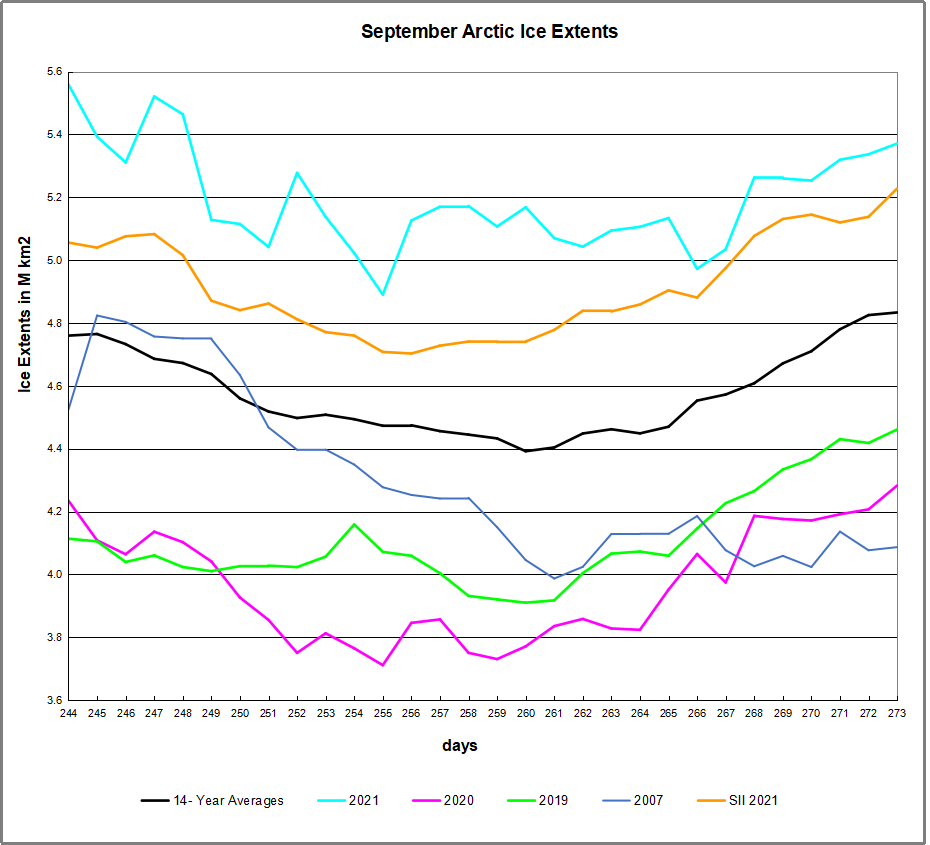
September daily extents are now fully reported and the 2021 September monthly results can be compared with those of the previous 14 years.  MASIE showed 2021 at 5.2M km2  and SII was close behind, reaching 4.9M for the month.  Analysis below shows that the 2021 Minimum was 1/2 Wadham ( 1M km2) higher than the 14 year average, and 1¼ Wadhams more than 2007

In August, 4.4M km2 was the median estimate for the September monthly average extent from the SIPN (Sea Ice Prediction Network) who use the reports from SII (Sea Ice Index), the NASA team satellite product from passive microwave sensors. The SII actual ice extent was 1/2 Wadham higher.

The graph below shows September comparisons through day 273 (Sept. 30).

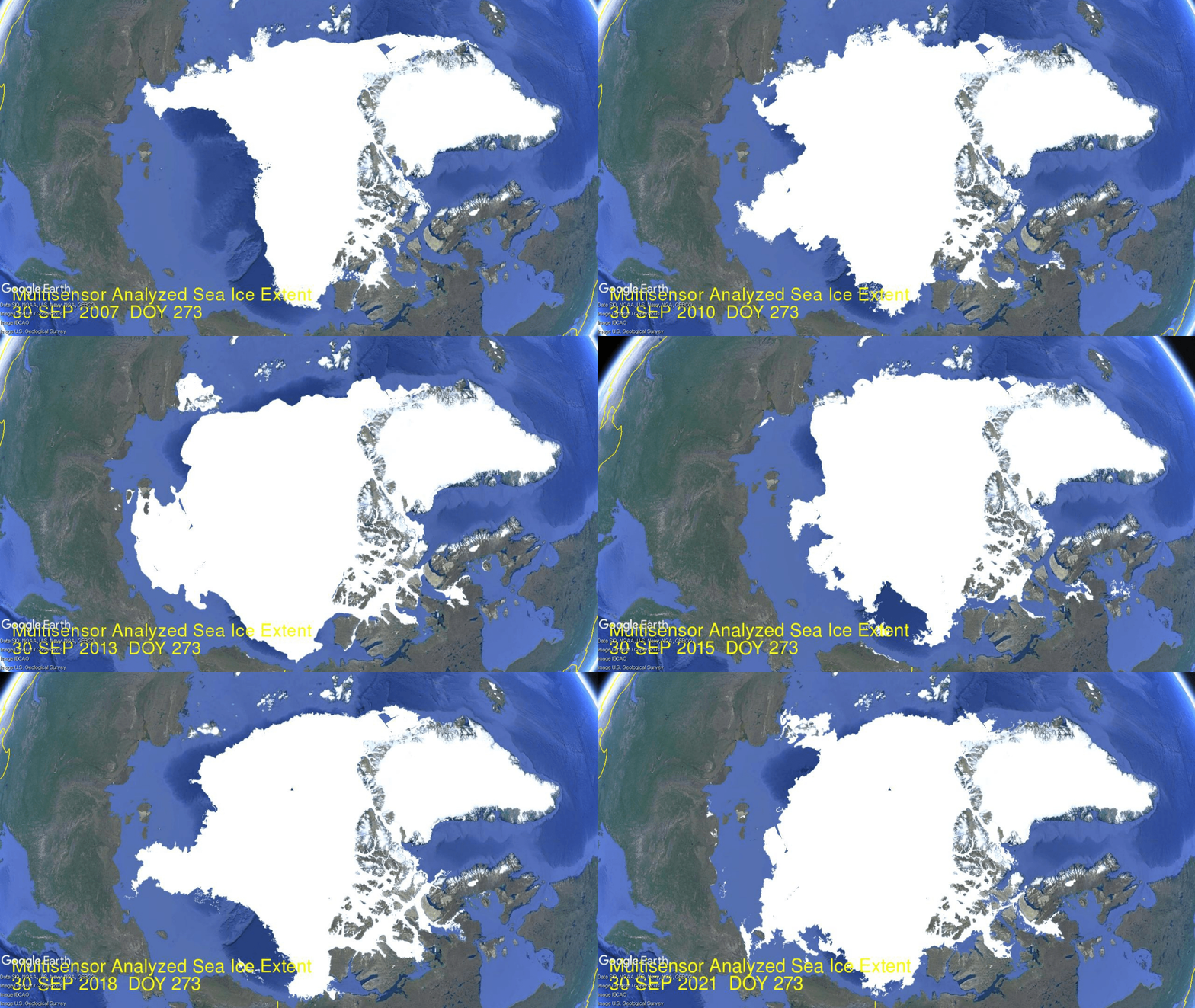
Note that both MASIE and SII started the month higher than average, hit bottom earlier and then increased the surplus. SII tracked much lower up to ~400k km2 less than MASIE before ending just 143k km2 down.  The other years, 2007, 2019 and 2020 were much lower than average. The animation below shows the ice extents for day 273 each of the last 15 years.

The table shows ice extents in the regions for 2021, 14 year averages and 2007 for day 273. Averages refer to 2007 through 2020 inclusive.

Region 2021273 Day 273 Average 2021-Ave. 2007273 2021-2007
 (0) Northern_Hemisphere 5371075 4879409 491666 4086883 1284192
 (1) Beaufort_Sea 776885 542936 233948 498743 278142
 (2) Chukchi_Sea 485260 189321 295939 51 485209
 (3) East_Siberian_Sea 416429 299075 117355 311 416118
 (4) Laptev_Sea 58277 150394 -92117 235245 -176967
 (5) Kara_Sea 71952 23909 48043 15367 56585
 (6) Barents_Sea 18 15305 -15287 4851 -4833
 (7) Greenland_Sea 124689 241619 -116930 353210 -228522
 (8) Baffin_Bay_Gulf_of_St._Lawrence 59581 52823 6758 42247 17334
 (9) Canadian_Archipelago 441822 391718 50104 307135 134687
 (10) Hudson_Bay 2260 3832 -1572 1936 323
 (11) Central_Arctic 2932779 2967366 -34586 2626511 306268

Deficits in Laptev and Greenland Seas are more than offset by surpluses in Beaufort, Chukchi, and East Siberian Seas.  Extents in Kara and Canadian Archipelago are also well above average.   Overall, the NH ice extent is surplus by 492k km2 or 10% over 14 year average.

Summary

Earlier observations showed that Arctic ice extents were low in the 1940s, grew thereafter up to a peak in 1977, before declining.  That decline was gentle until 1996 which started a decade of multi-year ice loss through the Fram Strait.  There was also a major earthquake under the north pole in that period.  In any case, the effects and the decline ceased in 2007, 30 years after the previous peak.  Now we have a plateau in ice extents, which could be the precursor of a growing phase of the quasi-60 year Arctic ice oscillation.

For context, note that the average maximum has been 15M, so on average the extent shrinks to 30% of the March high before growing back the following winter.  In 2021 about 35% of the March maximum was retained, so the melt season losses were considerably less than in the past.

Background 

A commenter previously asked, where do they get their data? The answer is primarily from NIC’s Interactive Multisensor Snow and Ice Mapping System (IMS). From the documentation, the multiple sources feeding IMS are:

Platform(s) AQUA, DMSP, DMSP 5D-3/F17, GOES-10, GOES-11, GOES-13, GOES-9, METEOSAT, MSG, MTSAT-1R, MTSAT-2, NOAA-14, NOAA-15, NOAA-16, NOAA-17, NOAA-18, NOAA-N, RADARSAT-2, SUOMI-NPP, TERRA

Sensor(s): AMSU-A, ATMS, AVHRR, GOES I-M IMAGER, MODIS, MTSAT 1R Imager, MTSAT 2 Imager, MVIRI, SAR, SEVIRI, SSM/I, SSMIS, VIIRS

Summary: IMS Daily Northern Hemisphere Snow and Ice Analysis

The National Oceanic and Atmospheric Administration / National Environmental Satellite, Data, and Information Service (NOAA/NESDIS) has an extensive history of monitoring snow and ice coverage.Accurate monitoring of global snow/ice cover is a key component in the study of climate and global change as well as daily weather forecasting.

The Polar and Geostationary Operational Environmental Satellite programs (POES/GOES) operated by NESDIS provide invaluable visible and infrared spectral data in support of these efforts. Clear-sky imagery from both the POES and the GOES sensors show snow/ice boundaries very well; however, the visible and infrared techniques may suffer from persistent cloud cover near the snowline, making observations difficult (Ramsay, 1995). The microwave products (DMSP and AMSR-E) are unobstructed by clouds and thus can be used as another observational platform in most regions. Synthetic Aperture Radar (SAR) imagery also provides all-weather, near daily capacities to discriminate sea and lake ice. With several other derived snow/ice products of varying accuracy, such as those from NCEP and the NWS NOHRSC, it is highly desirable for analysts to be able to interactively compare and contrast the products so that a more accurate composite map can be produced.

The Satellite Analysis Branch (SAB) of NESDIS first began generating Northern Hemisphere Weekly Snow and Ice Cover analysis charts derived from the visible satellite imagery in November, 1966. The spatial and temporal resolutions of the analysis (190 km and 7 days, respectively) remained unchanged for the product’s 33-year lifespan.

As a result of increasing customer needs and expectations, it was decided that an efficient, interactive workstation application should be constructed which would enable SAB to produce snow/ice analyses at a higher resolution and on a daily basis (~25 km / 1024 x 1024 grid and once per day) using a consolidated array of new as well as existing satellite and surface imagery products. The Daily Northern Hemisphere Snow and Ice Cover chart has been produced since February, 1997 by SAB meteorologists on the IMS.

Another large resolution improvement began in early 2004, when improved technology allowed the SAB to begin creation of a daily ~4 km (6144×6144) grid. At this time, both the ~4 km and ~24 km products are available from NSIDC with a slight delay. Near real-time gridded data is available in ASCII format by request.

In March 2008, the product was migrated from SAB to the National Ice Center (NIC) of NESDIS. The production system and methodology was preserved during the migration. Improved access to DMSP, SAR, and modeled data sources is expected as a short-term from the migration, with longer term plans of twice daily production, GRIB2 output format, a Southern Hemisphere analysis, and an expanded suite of integrated snow and ice variable on horizon.

http://www.natice.noaa.gov/ims/ims_1.html

Footnote

Some people unhappy with the higher amounts of ice extent shown by MASIE continue to claim that Sea Ice Index is the only dataset that can be used. This is false in fact and in logic. Why should anyone accept that the highest quality picture of ice day to day has no shelf life, that one year’s charts can not be compared with another year?

MASIE is rigorous, reliable, serves as calibration for satellite products, and continues the long and honorable tradition of naval ice charting using modern technologies. More on this at my post Support MASIE Arctic Ice Dataset