Mild Land and Ocean Air Temps October 2021

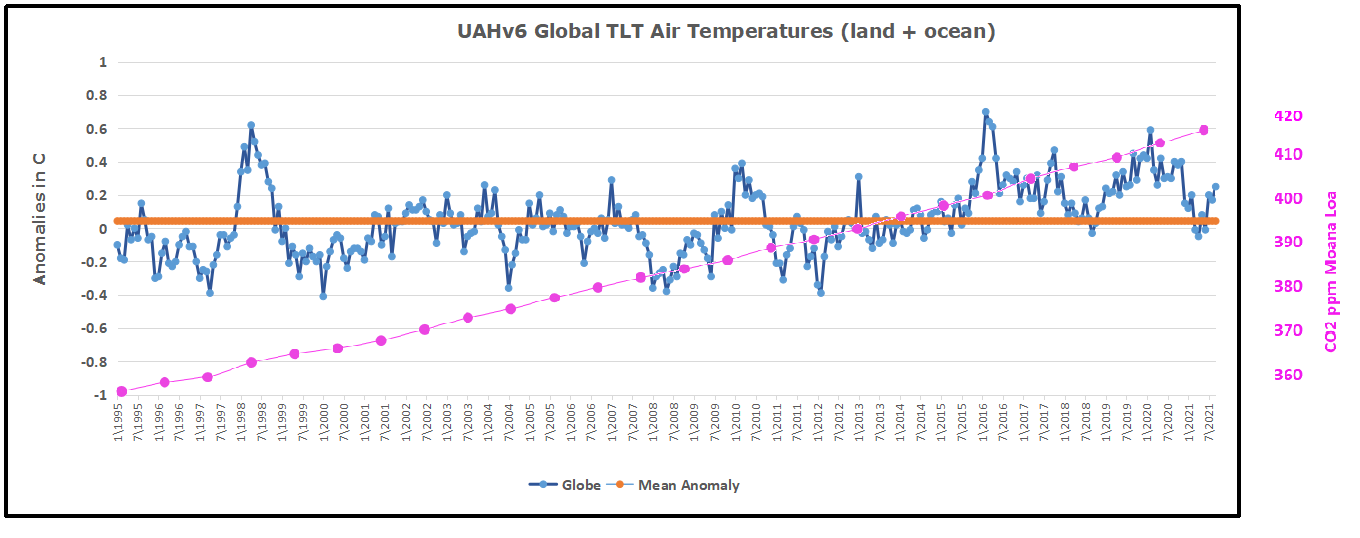
The post below updates the UAH (U. of Alabama in Huntsville) record of air temperatures over land and ocean.  But as an overview consider how rapid cooling  recently completely overcame the warming from the last 3 El Ninos (1998, 2010 and 2016).  The UAH record shows that the effects of the last one were gone as of March 2021. (UAH baseline is now 1991-2020). For reference I added an overlay of CO2 annual concentrations as measured at Mauna Loa. While temperatures fluctuated up and down ending flat, CO2 went up steadily by ~55 ppm by 2020, a 15% increase.
Furthermore, going back to previous warmings prior to the satellite record shows that the entire rise of 0.8C since 1947 is due to oceanic, not human activity.
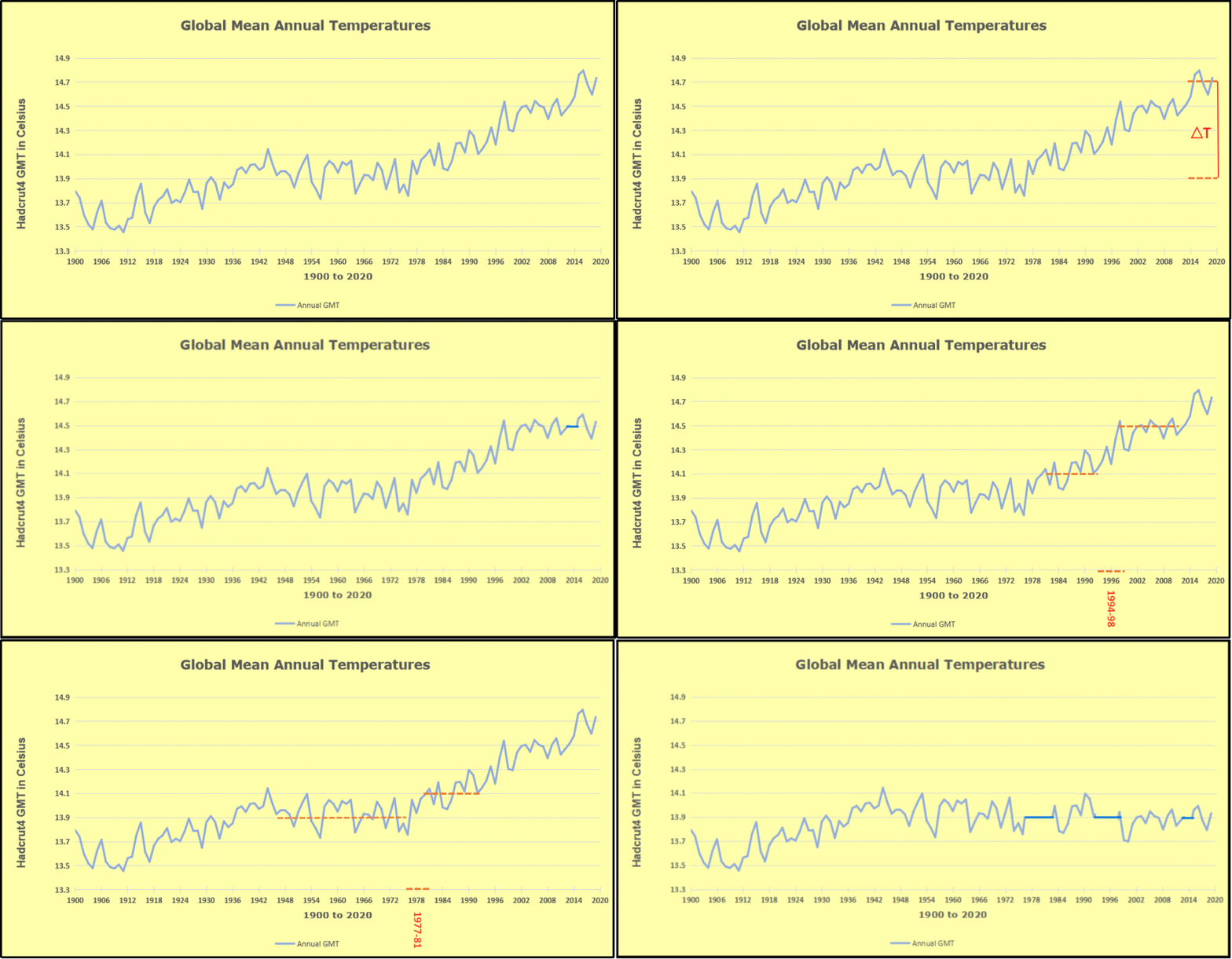
gmt-warming-events

The animation is an update of a previous analysis from Dr. Murry Salby.  These graphs use Hadcrut4 and include the 2016 El Nino warming event.  The exhibit shows since 1947 GMT warmed by 0.8 C, from 13.9 to 14.7, as estimated by Hadcrut4.  This resulted from three natural warming events involving ocean cycles. The most recent rise 2013-16 lifted temperatures by 0.2C.  Previously the 1997-98 El Nino produced a plateau increase of 0.4C.  Before that, a rise from 1977-81 added 0.2C to start the warming since 1947.

Importantly, the theory of human-caused global warming asserts that increasing CO2 in the atmosphere changes the baseline and causes systemic warming in our climate.  On the contrary, all of the warming since 1947 was episodic, coming from three brief events associated with oceanic cycles. 

October Update Mild Ocean and Land Air Temps 

banner-blog

With apologies to Paul Revere, this post is on the lookout for cooler weather with an eye on both the Land and the Sea.  While you will hear a lot about 2020 temperatures matching 2016 as the highest ever, that spin ignores how fast has the cooling set in.  The UAH data analyzed below shows that warming from the last El Nino was fully dissipated with chilly temperatures setting in all regions.  The peak NH summer month of July saw some warming most pronounced in the SH, then reversed by cooling in August and September. Now in October there is an upward tick with milder temperatures.

UAH has updated their tlt (temperatures in lower troposphere) dataset for October.  Previously I have done posts on their reading of ocean air temps as a prelude to updated records from HADSST3. This month also has a separate graph of land air temps because the comparisons and contrasts are interesting as we contemplate possible cooling in coming months and years. 

Note:  UAH has shifted their baseline from 1981-2010 to 1991-2020 beginning with January 2021.  In the charts below, the trends and fluctuations remain the same but the anomaly values change with the baseline reference shift. Data for lower troposphere is here .

Presently sea surface temperatures (SST) are the best available indicator of heat content gained or lost from earth’s climate system.  Enthalpy is the thermodynamic term for total heat content in a system, and humidity differences in air parcels affect enthalpy.  Measuring water temperature directly avoids distorted impressions from air measurements.  In addition, ocean covers 71% of the planet surface and thus dominates surface temperature estimates.  Eventually we will likely have reliable means of recording water temperatures at depth.

Recently, Dr. Ole Humlum reported from his research that air temperatures lag 2-3 months behind changes in SST.  Thus the cooling oceans now portend cooling land air temperatures to follow.  He also observed that changes in CO2 atmospheric concentrations lag behind SST by 11-12 months.  This latter point is addressed in a previous post Who to Blame for Rising CO2?

After a technical enhancement to HadSST3 delayed updates Spring 2020, May resumed a pattern of HadSST updates toward the following month end.  For comparison we can look at lower troposphere temperatures (TLT) from UAHv6 which are now posted for October.  The temperature record is derived from microwave sounding units (MSU) on board satellites like the one pictured above. Recently there was a change in UAH processing of satellite drift corrections, including dropping one platform which can no longer be corrected. The graphs below are taken from the new and current dataset.

The UAH dataset includes temperature results for air above the oceans, and thus should be most comparable to the SSTs. There is the additional feature that ocean air temps avoid Urban Heat Islands (UHI).  The graph below shows monthly anomalies for ocean temps since January 2015.
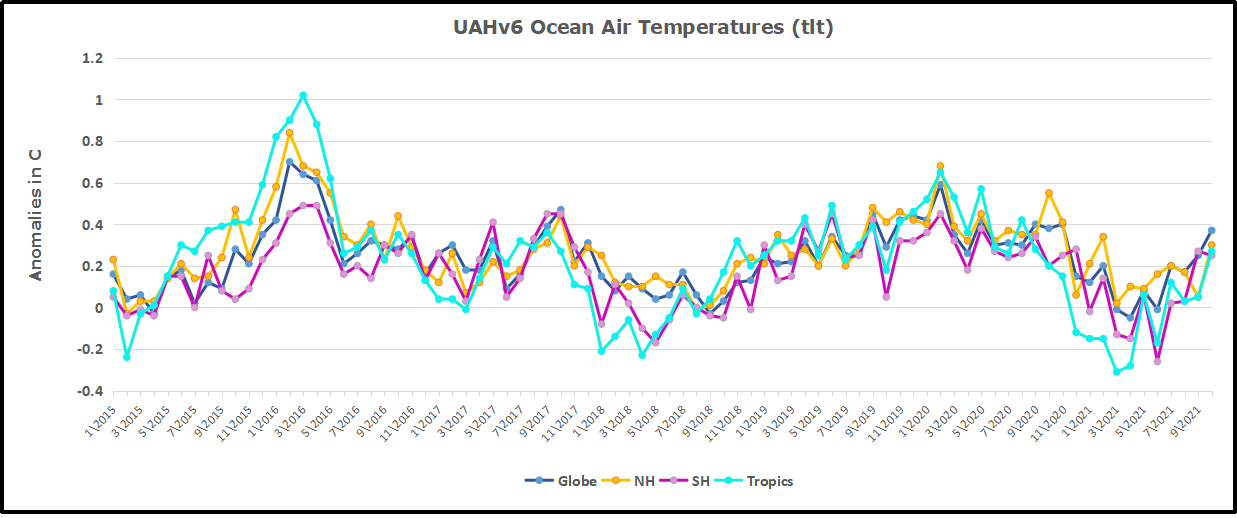
In Jan-March 2021 SH dropped sharply, pulling the Global anomaly down with SH matching the coldest in this period. March drops in the Tropics and NH made those regions at their coldest since 01/2015.  In June 2021 despite an uptick in NH, the Global anomaly dropped back down due to a record low in SH along with a Tropical cooling.  The summer warm pulse in NH was mild this year, with NH peaking in July, pulling up Global anomaly slightly with an assist from the Tropics.  Now in October the Global anomaly is up due to both the Tropics and NH, though the latter is 0.3C lower than October a year ago.

Land Air Temperatures Tracking Downward in Seesaw Pattern

We sometimes overlook that in climate temperature records, while the oceans are measured directly with SSTs, land temps are measured only indirectly.  The land temperature records at surface stations sample air temps at 2 meters above ground.  UAH gives tlt anomalies for air over land separately from ocean air temps.  The graph updated for October is below.

Here we have fresh evidence of the greater volatility of the Land temperatures, along with extraordinary departures by SH land.  Land temps are dominated by NH with a 2021 spike in February, followed by cooling down to April.  Then NH land warmed with a second NH spike peaking in July. Note how cold have been SH land temperatures in 2021, with two lows in Jan. and again in July.  Then SH  and the Tropics spiked upward, raising the Global land anomaly.  And now NH has ticked upward matching its peak last October.

The Bigger Picture UAH Global Since 1995
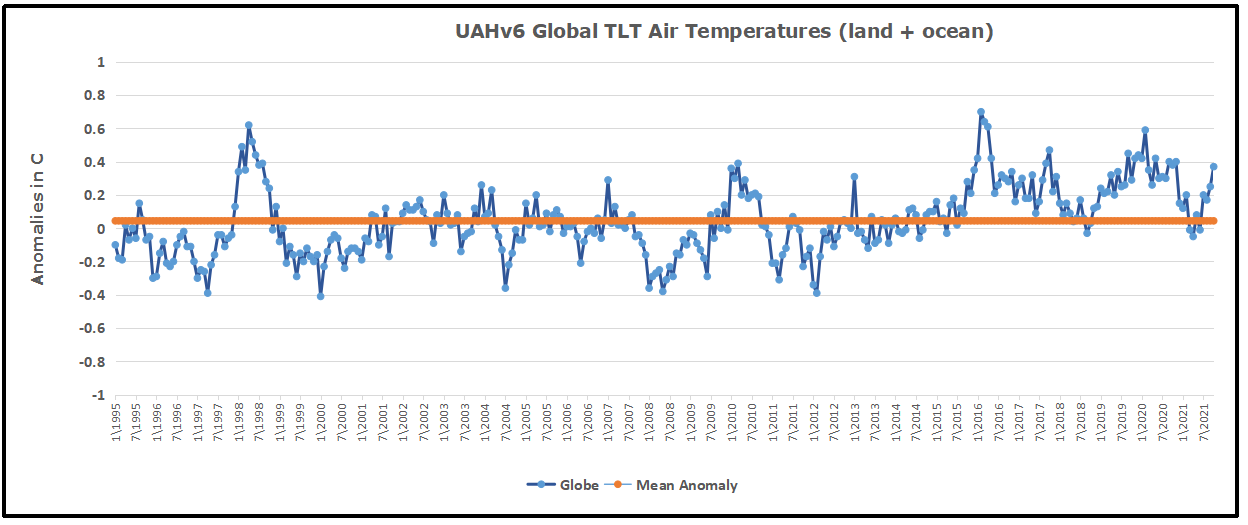
The chart shows monthly anomalies starting 01/1995 to present.  The average anomaly is 0.04, since this period is the same as the new baseline, lacking only the first 4 years.  1995 was chosen as an ENSO neutral year.  The graph shows the 1998 El Nino after which the mean resumed, and again after the smaller 2010 event. The 2016 El Nino matched 1998 peak and in addition NH after effects lasted longer, followed by the NH warming 2019-20, with temps having returned again to the mean March-June, with an uptick in July-October.

TLTs include mixing above the oceans and probably some influence from nearby more volatile land temps.  Clearly NH and Global land temps have been dropping in a seesaw pattern, more than 1C lower than the 2016 peak.  Since the ocean has 1000 times the heat capacity as the atmosphere, that cooling is a significant driving force.  TLT measures started the recent cooling later than SSTs from HadSST3, but are now showing the same pattern.  It seems obvious that despite the three El Ninos, their warming has not persisted, and without them it would probably have cooled since 1995.  Of course, the future has not yet been written.
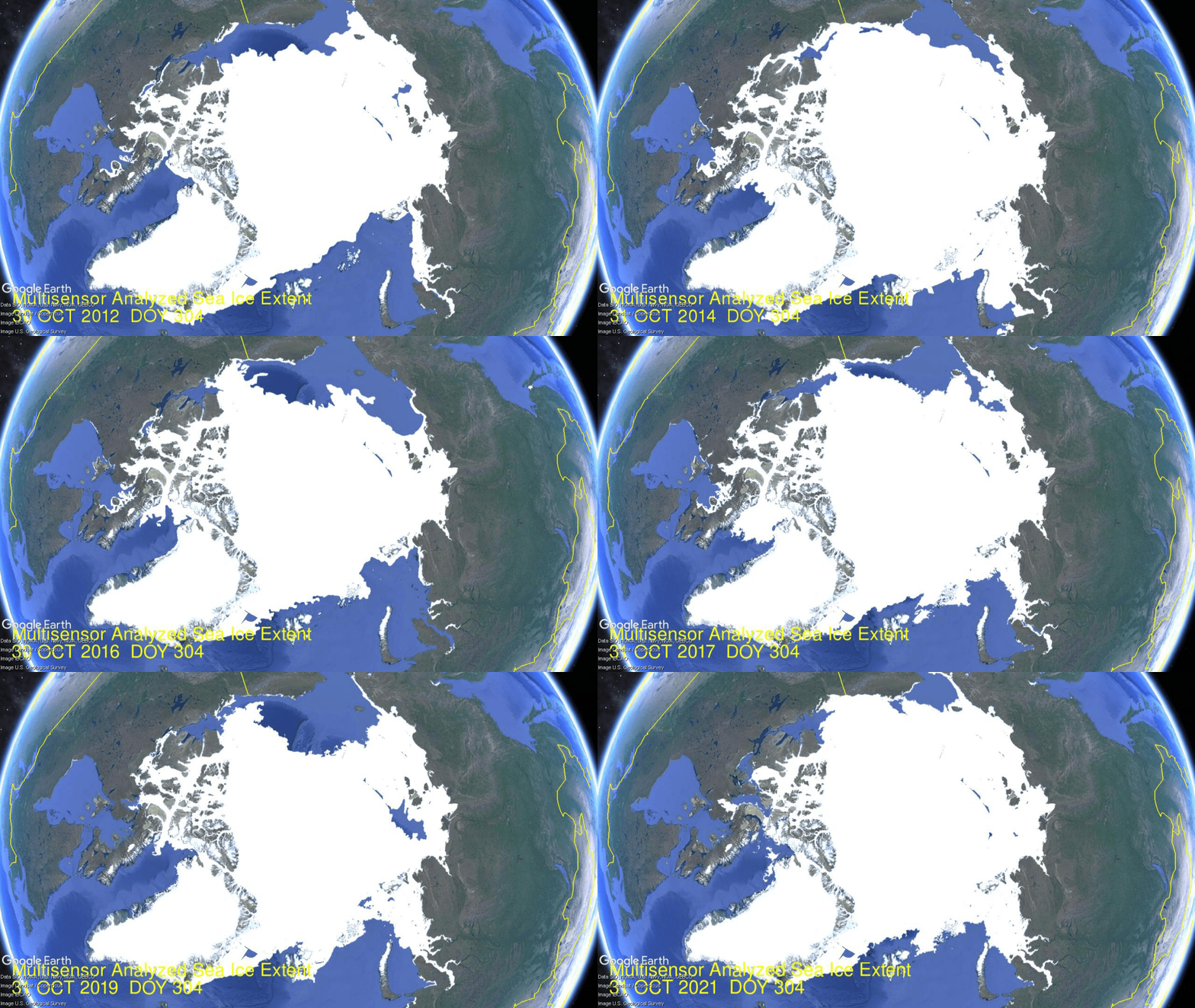


Arctic Ice Abounds October 2021


The animation shows Arctic ice extents on day 304 (end of October) for the years 2012 through yesterday 2021.  Note the variability from year to year on the CanAm (left side) with the Beaufort Sea at the top, Canadian Archipelago center left, and Baffin Bay, lower left between Greenland and Newfoundland. More noticeable are the Russian shelf seas fluctuations on the right side.  Some years, like 2020, there is still open water, but this year those seas are frozen over, including from the top Chukchi, East Siberian, Laptev, and Kara Seas down to bottom right.

The graph below shows October daily ice extents for 2021 compared to 14 year averages, and some years of note.

The black line shows during October on average Arctic ice extents increase ~3.4M km2 from ~4.9M km2 up to ~8.3M km2.  The 2021 cyan MASIE line started the month ~500k km2 above average and on day 304 retained a surplus of ~160k km2.  The Sea Ice Index in orange (SII from NOAA) started with the same deficit, then lagged behind in the last two weeks, before ending ~100k km2 lower than MASIE. 2019 and 2020 were well below average at this stage of the ice recovery.

Why is this important?  All the claims of global climate emergency depend on dangerously higher temperatures, lower sea ice, and rising sea levels.  The lack of additional warming is documented in a post Adios, Global Warming

The lack of acceleration in sea levels along coastlines has been discussed also.  See USCS Warnings of Coastal Flooding

Also, a longer term perspective is informative:

post-glacial_sea_levelThe table below shows the distribution of Sea Ice on day 304 across the Arctic Regions, on average, this year and 2020.

Region 2021304 Day 304 Average 2021-Ave. 2020304 2021-2020
 (0) Northern_Hemisphere 8528046 8369146 158900 6954249 1573797
 (1) Beaufort_Sea 982244 946489 35755 1044967 -62723
 (2) Chukchi_Sea 659384 436299 223085 369981 289403
 (3) East_Siberian_Sea 1086959 909416 177543 373761 713197
 (4) Laptev_Sea 894716 831110 63606 283776 610940
 (5) Kara_Sea 626536 444754 181781 269583 356952
 (6) Barents_Sea 55711 77133 -21422 14206 41505
 (7) Greenland_Sea 360759 415579 -54820 463525 -102766
 (8) Baffin_Bay_Gulf_of_St._Lawrence 107176 269121 -161945 232788 -125611
 (9) Canadian_Archipelago 557042 788762 -231720 802238 -245196
 (10) Hudson_Bay 5061 82352 -77292 73773 -68712
 (11) Central_Arctic 3160959 3158164 2794 3023876 137083

The overall surplus to average is 159k km2, (2%).  Note large surpluses of ice in BCE (Beaufort, Chukchi and East Siberian seas).  as well as in Laptev and Kara on the Russian coast. The main deficits to average are in Baffin Bay and CAA, more than offset by surpluses elsewhere. Note that 2021 ice extent exceeds that of 2020 by 1.6M km2, most of the difference being in East Siberian, Laptev and Kara Seas.

bathymetric_map_arctic_ocean

Illustration by Eleanor Lutz shows Earth’s seasonal climate changes. If played in full screen, the four corners present views from top, bottom and sides. It is a visual representation of scientific datasets measuring Arctic ice extents.

The Imaginary Leap to “Climate Crisis”

Nowadays human imagination is serving slavery and division, rather than the freedom and peace John Lennon envisioned.  At the very moment when we should be celebrating so much progress over human suffering, instead elites and celebrities are mobilizing to destroy individual rights and freedoms.  Michael Hart in his book preface describes the flight of imagination bringing the world to this moment of climate fear and division.  Excerpts in italics with my bolds.

Imagine a movement so bent on achieving its political objectives that it is willing to corrupt science to meet them. Imagine governments around the globe, first adopting and then promoting this official science for more than two generations. Imagine that they are willing to use their regulatory power to implement a massive program of social engineering in order to “save” the planet. Imagine the United Nations leading this movement and insisting that a global effort is required.

Imagine the movement’s leaders believing that people around the globe must change their eating, heating, cooling, lighting, toilet, transportation, manufacturing, entertainment, even housing habits and reject values that are critical to their prosperity, happiness, and welfare, confident that humans can adapt and revert to simpler, more primitive, more local life-styles, have fewer children, and embrace lives presumed to be more in harmony with nature.

Imagine thousands of scientists engaged at public expense in developing a convincing rationale for this unprecedented project. Imagine that these scientists are willing to compromise their integrity in pursuit of the role of a single factor that they insist controls the most complex and chaotic earth system, a molecule–carbon dioxide–that is literally the building block of all of life. Imagine that they believe that by reducing its miniscule–.04 percent–presence in the atmosphere, the planet will cool and climate will stabilize at an optimum level, a level seen only in microseconds of geological time.

Imagine scientists who dismiss the work of hundreds of their colleagues and believe that their work must be suppressed. Imagine a scientific movement dominated by greedy grant farmers and cheered on by the media, insisting that there is no further need to study the science and that governments need to start implementing its preferred policy of worldwide social engineering.

Imagine that many leaders of this movement believe that the world’s population needs to be thinned down to a billion people within a generation or two. Imagine that some of the movement’s most revered leaders, even as they advocate that ordinary people must curb their consumption and live simpler lives, pursue lifestyles that consume more energy and other commodities in a year than an ordinary family of four would need over its lifetime.

Imagine a movement whose leaders habitually dissemble and mislead and justify this on the claimed greater good they are pursuing. Imagine politicians, civil servants, scientists,activists, and the media flying from one exotic location to another as they plan what must be done to coerce changes in our lifestyles, even to the point of sacrificing human freedom and democracy.

Most thoughtful people would conclude that only Hollywood could come up with such a bizarre plot. A little more thinking, however, and they might connect the dots. There is such a movement, and it has demanded our attention for more than thirty years. It has devoured hundreds of billions of dollars in public money and has inserted its menacing tentacles into every aspect of modern life. The UN and all its organs are the leading force behind it, but most governments of the world support it in one way or another. Elites, the media, and even religious leaders, have embraced it, even though they seem poorly informed and ignore its demands while urging others to adopt sharply reduced lifestyles.

The public face of this science, climate science, is part of a worrying new trend: the emergence of “official” or consensus science. In this perversion of real science, policy becomes the goal of scientific enquiry rather than its result. Over the last thirty years and more, public policy has focused increasingly on dealing with risks to health, safety, and the environment. Much of that policy ostensibly relies on scientific findings. In their decision making, governments increasingly look to scientists and have resorted to funding science that meets their political need for certainty.

Consensus on controversial issues is critical to governments. Ever since Rachel Carson published Silent Spring in 1962, activists have stood ready to convince governments of all manner of risks to humanity and nature, and scientists have obliged by reporting findings that satisfy activist political needs. Once governments acquiesce, it is critical that scientists not undermine their decisions with awkward new findings. Public policy is not easily reversed. The result is a potential monster spewing out more and more regulations, presumably making us safer and healthier and safeguarding the environment, but also substituting social for personal responsibility, reducing freedom and choice, and creating an ever larger, more costly, and intrusive public footprint.

For many years it seemed that the public agreed that there was a need to take action to control the globe’s climate, but that support has steadily eroded as people have begun to realize the enormity of what is being demanded, the flimsy ground on which this demand is based, and the impact of what would need to be imposed. Public support has declined further as sceptical scientists have pointed out more and more problems with the underlying scientific hypothesis, as engineers have indicated the extent to which purported energy substitutes are not up to the job, and as economists have calculated the enormous costs and minimal benefits. Only general scientific illiteracy has kept the project afloat.

While the primary movement is withering on the vine, its effects linger for generations. Governments may never meet the primary objectives of the global warming movement, but they have succeeded in embedding many of its tentacles into public regulatory policies and programs. Multiple interests have become dependent on these policies and will fight to maintain them, including thousands of officials whose careers are wedded to them. As so often happens in public policy, the unintended and harmful consequences become accepted practice, despite their costs and annoyance.

The world will be a better place:
♦ when governments agree to tame this monster and refocus their energies on issues within their competence;

♦ when religious leaders and other elites accept that they have fallen prey to a movement whose motives are much darker and more damaging than they realize;

♦ and when the media adopt a more balanced approach and provide the public with the critical assessment that is often missing from their reporting.

It is time for all three to accept that the UN is pursuing a path that can only result in a less prosperous and more divided world.

Background from previous post:  On the Hubris of Climatism

Canadian Michael Hart speaks out on climatism in his new book, Hubris: The Troubling Science, Economics, and Politics of Climate Change (link to interview with Hart at Tallbloke’s Talkshop)

The wide-ranging interview contains many insights, including this one that IMO gets at a deep, underlying motive:

Alarm over a changing climate leading to malign results is in many ways the product of the hunger for stability and direction in a post-Christian world. Humans have a deep, innate need for a transcendent authority. Having rejected the precepts of Christianity, people in the advanced economies of the West are turning to other forms of authority. Putting aside those who cynically exploit the issue for their own gain – from scientists and politicians to UN leaders and green businesses – most activists are deeply committed to a secular, statist, anti-human, earth-centric set of beliefs which drives their claims of a planet in imminent danger from human activity.

To them, a planet with fewer people is the ultimate goal, achievable only through centralized direction and control. As philosopher of science Jeffrey Foss points out, “Environmental science conceives and expresses humankind’s relationship to nature in a manner that is – as a matter of observable fact – religious.” It “prophesies an environmental apocalypse. It tells us that the reason we confront apocalypse is our own environmental sinfulness. Our sin is one of impurity. We have fouled a pure, ‘pristine’ nature with our dirty household and industrial wastes. The apocalypse will take the form of an environmental backlash, a payback for our sins. … environmental scientists tell people what they must do to be blameless before nature.”

Hart says that unfortunately society has gone a long way down the wrong road, but the outcome can be changed.

I remain cautiously optimistic. Popular support for climate change action peaked a few years ago. In Europe, which has gone furthest in implementing climate change policies, politicians are beginning to look for ways to moderate earlier initiatives. In North America, rhetoric has far outstripped actions while the Obama administration has relied on stealth to implement its climate change agenda. At the same time, climate change has added to the momentum of the broader secularization of society and the pursuit of anti-human policies and programs. We are, sadly, farther down that road than we have ever been before.

Again, it will take a determined effort by people of faith and conscience to convince our political leaders that they have been gulled by a political movement exploiting fear of climate change to push a utopian, humanist agenda that most people would find abhorrent. As it now stands, politicians are throwing money that they do not have at a problem that does not exist in order to finance solutions that make no difference. The time has come to call a halt to this nonsense and focus on real issues that pose real dangers. In a world beset by war, terrorism, and continuing third-world poverty, there are far more important things on which political leaders need to focus.

Read the first chapter here:

https://www.academia.edu/29923495/_Hubris_The_Troubling_Science_Economics_and_Politics_of_Climate_Change_by_Michael_Hart_Chapter_One_here_interview_by_Margaret_Wente_of_Globe_and_Mail_my_comment