Parliamentary Budget Officer Yves Giroux on Parliament Hill in Ottawa in 2020. PHOTO BY ADRIAN WYLD/THE CANADIAN PRESS FILES
The Parliamentary Budget Officer (PBO)recently released a report on the effects of greenhouse gas emissions on Canadian GDPgrowth over the next 80 years. I’ve written previously about the recent economics literature investigating the link (or lack thereof) between global warming and economic growth. It’s a fascinating topic and I’ve been actively working with on it one of our PhD students for several years. While I would quibble with some aspects of the PBO report, the overall conclusions are not out of line with mainstream thinking on the topic.
Which is why the findings are so astonishing and radical compared
to what the government has been saying.
The PBO estimated what would happen to the Canadian economy between now and 2100 if temperatures and precipitation change as expected due to greenhouse gases. The report’s authors consider two scenarios — first, if emission-reduction policies stall at today’s levels and nobody complies with their Paris commitments and, second, if countries comply with all their Paris commitments in full and on time. Under the first scenario Canada’s GDP in 2100 will be 6.6 per cent smaller than it otherwise would be.
Let’s pause there for a moment: 6.6 per cent after 80 years is a very small number. Canada has set out ambitious economic growth plans based on high levels of immigration and continued efforts to boost productivity and income. Suppose this results in two per cent real GDP growth from 2021 to 2100. That would mean Canada’s economy will grow by 388 per cent over those 80 years.
According to the PBO, if we do nothing about global warming,
it will instead grow by about 381 per cent.
In other words, the PBO projects that the impact of climate change will be small relative to other drivers, including population change, technology and many other aspects of socioeconomic development. Where have I heard that before?
In the UN Intergovernmental Panel on Climate Change’s 5th Assessment Report, released in 2013, that’s where. In the Working Group II volume, Chapter 10, the report concluded: “For most economic sectors the impact of climate change will be small relative to the impacts of other drivers. Changes in population, age, income, technology, relative prices, lifestyle, regulation, governance, and many other aspects of socioeconomic development will have an impact on the supply and demand of economic goods and services that is large relative to the impact of climate change.”
Yes, you read that right. The IPCC concluded, not very long ago, that while greenhouse gases have warmed the climate and will continue to do so, the effects will be small compared to pretty much every other driver of change in the century ahead. This is the opposite of an “emergency” or “crisis.”
Then the PBO asked what would change if everyone meets their Paris targets. Instead of being 6.6 per cent smaller in 2100, it estimates the economy will be 5.8 per cent smaller. In other words, the benefit attributable to the Paris agenda is that the economy will be 0.8 per cent larger 80 years from now. This is a minuscule difference.
And we have to ask: what if the policies cost more than 0.8 per cent of GDP? We can be absolutely certain that they will. In a studyElmira Aliakbari and I coauthored last year for the Fraser Institute, we showed that just the carbon tax alone, which won’t suffice to get us to the Paris target, will cause GDP to shrink by at least twice that amount by 2030. Our GDP loss estimates were in line with many other studies done inside and outside of government for comparable-size emission cuts under the Kyoto Protocol 20 years ago.
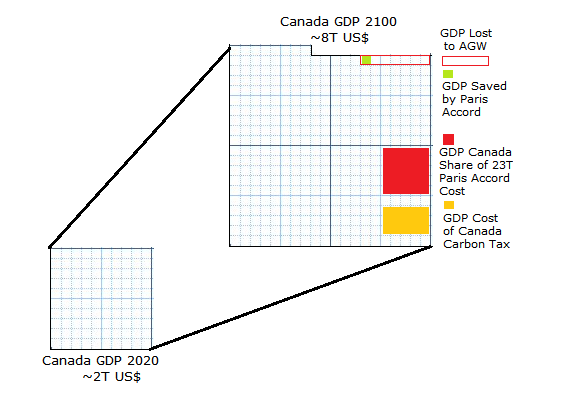
Projection Parameters:
Canada GDP grows at 2% yearly compounded to 2100 = 388%
Effects of AGW reduce 2100 GDP by 7%
Fulfilling Paris Accord raises 2100 GDP by 1%
Canada share of $21T Paris Accord cost, est. $500B
Cost of Canada Carbon Tax est.1.8% GDP by 2030, 14% by 2100
The PBO, based on advice from Environment and Climate Change Canada, the federal department in charge, worked on the assumption that Canada will warm (on average) by 2.5 degrees Celsius compared to today. I think that’s an overestimate but, as before, let’s assume it’s true. Its analysis says that the result will be that Canada’s economy grows (on average) not by 2.0 per cent a year but by 1.983 per cent per year, a difference less than a rounding error in the national economic accounts. And if we incur the enormous costs of complying with Paris, the economic benefit will be that we grow on average by 1.986 per cent instead, three one-thousands of a per cent more. At the cost of policies that will take orders of magnitude more off our growth rate.
One of the annoying bits of jargon that goes around climate policy circles is the phrase “the cost of inaction.” As in, “we have to do something, doing nothing is not an option, the cost of inaction is too large.” The cost of inaction is the foregone benefit of the action, and according to the PBO, it’s not large at all. In fact, it’s tiny. Because compared to everything else we’ll deal with this century, the impacts of climate change will be small.
That is the radical but correct conclusion of experts at both the IPCC and the PBO.
It’s time government leaders started paying attention.
Ross McKitrick is a professor of economics at the University of Guelph and senior fellow of the Fraser Institute.
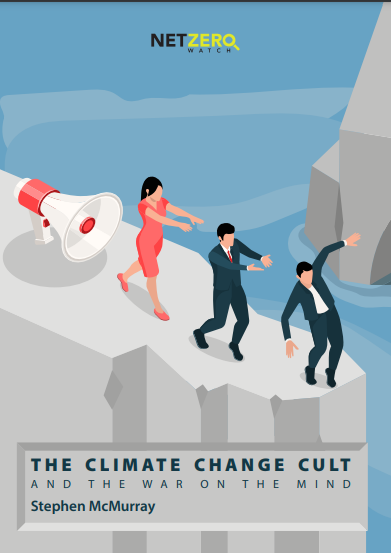
As the eco-zealot group Just Stop Oil continue to break the law and cause mayhem, it is perhaps time to investigate who is pulling the strings of this and other fake grassroots movements. Even a cursory glance will make it clear that the people behind them are not everyday members of the public but a group of highly influential American billionaires.
The Climate Emergency Fund
According to the Just Stop Oil website, their main source of backing is the Climate Emergency Fund. The three founding members of this group, who also fund Extinction Rebellion, are Aileen Getty from the Getty oil family, Rory Kennedy, daughter of Senator Robert Kennedy, and philanthropist Trevor Neilson. All three own houses on Malibu beach, which is odd as disciples of the climate cult claim that sea levels are rising dramatically, and you would therefore assume that seafront real estate would be a bad investment.
Most of the focus has been on Getty but it is Neilson who has the most interesting background. After university he worked as an intern in the White House when Bill Clinton was president. Later he worked for the then newly formed Bill and Melinda Gates Foundation as Director of Communications, and also acted as the Gates’ personal spokesman.
In 2002 Neilson was a co-founder of DATA (Debt, AIDs, Trade, Africa) with Bill Gates, Bono and George Soros. DATA was allegedly created to help ease poverty in Africa, seek debt relief for African countries and help fight AIDs. They also claimed to want to end hunger in Africa, an idea that is interesting since climate activists want to reduce carbon dioxide which is essential to all plant life; any reduction would clearly reduce the amount of food crops, causing more hunger rather than alleviating it. Neilson was also a member of the Clinton Global Initiative, the Council of Foreign Relations, and was one of the Young Global Leaders for the World Economic Forum. In other words, he is a friend to all the usual globalist suspects who are pushing the green agenda for their own ends.
If we move on to current advisory board members of the Climate Emergency Fund, we see more of the usual themes and ideologies that have nothing to do with the climate but are warmly embraced by the climate crisis zealots. Stephen Kretzmann founded Oil Change, an organisation pressing for the end of oil production. He is a supporter of the Marxist Black Lives Matter movement. On the Oil Change website he writes an article that promotes BLM and trots out extremist left-wing tropes.
Another on the advisory board of the Climate Emergency Fund is Bich Ngoc Cao. She is also on the board of left-wing news site Mother Jones. The site denigrated Moms for Liberty, a group who have fought against their children being indoctrinated by gender and LGBTQ ideology in schools, calling them ‘Moms against libraries’ and ‘book-banning bathroom-police’, because they want to remove inappropriate sexual material from school libraries and keep single-sex bathroom spaces. Bich Ngoc Cao is also on the Board of Library Commissioners for the city of Los Angeles.
Bill McKibben is another CEF advisory board member who compares climate issues to racism, and uses the death of George Floyd to make his point.
The executive director of the Climate Emergency Fund (CEF) is Margaret Klein Salamon, an American in her mid-thirties. She is a clinical psychologist and therefore has been involved with vulnerable people suffering high levels of stress and anxiety. In her role in climate activism, she appears to be using her experience to frighten vulnerable people. She is the founder of Climate Awakening, which, according to her page on the CEF site, is ‘a project to unleash the power of climate emotions through scalable small group conversations’.
However, if you go on to the Climate Awakening website, on the first page it says, ‘Share your climate terror, grief, and rage with people who understand. Join a Climate Emotions Conversation – a small group sharing & listening session about the climate emergency.’ Below that there is a screen with images of three young people and the words: ‘What are you FEELING about climate emergency? Make sure to name the emotions (fear, grief, anger, despair, isolation)’.
Salamon also had an article in Psychology Today where, as ‘The Climate Psychologist’, she gave ‘relationship advice for the Climate Emergency’. A reader asked: “How can I tell my partner I am afraid to have children? …Why would I want to bring a child into this world, right now? Imagining the future they would grow up in fills me with terror.” Part of Salamon’s reply reads as follows:
“Let me be clear; despite widespread denial of the Climate Emergency and how it will affect our society, your worries are in fact based in the reality of what the global scientific community is telling us, and you have every right to feel that way.”
So again, a woman is saying she is terrified, and Salamon, rather than relieving her terror, says she is right to feel that way. Salamon then tries to get her involved in climate action groups instead of talking to her partner.
This is typical of the behaviour of a cult. Feed on the person’s fear, tell them the fear is real and not to listen to what their family say and ultimately try to recruit them into the cult as well. One of the sites she advises people who are terrified of climate change to go to is the Good Grief Network. They introduce themselves as a group who only want to care for you amid the chaos all around. They will then get you in a group of like-minded people to expose you to groupthink. When you have all bonded, they will strip you of all your preconceived ideas and mould you into their reality. They will then fill the void left by destroying any prior belief system you had, with their own worldview.
In their ten-step programme to ‘Personal Resilience & Empowerment in a Chaotic Climate’, the first step is, yet again, to tell you to be very afraid and ‘accept the severity of the predicament’. Step 8 is the most disturbing: ‘Grieve the harm I have caused.’ Telling you that you are to blame for some of the ‘harm’ increases your fear by making you feel guilty. If you feel guilt then you will desperately want to make up for your actions and will do whatever you are told to do to achieve that, namely to go on and traumatise other people by telling them the world is about to end.
The Psychologists
If you think Margaret Klein Salamon is an oddity amongst psychologists, think again. Many are now boarding the climate crisis gravy train. Dr Gareth Morgan, a clinical psychologist from Leicester University, is an Extinction Rebellion supporter because “as many professionals have observed, climate activism should be seen as central to our professional identities if we truly take on board the science that indicates climate breakdown presents the biggest threat to human health worldwide.’ Once again extreme left-wing bias appears to cloud his judgement. He opines, ‘while the same colonial and neoliberal ideologies that support racism and inequity also prop up the unfettered capitalism that is threatening all life on Earth.’
The Climate Psychology Alliance wishes to use their expertise in the field of psychology to nudge people into believing in their worldview of impending climate-induced doom. The group is overtly stating that ‘facts’ aren’t really persuading people that the climate crisis is real and that they need use psychology to pressure us all to become true believers. Most telling though, is when they say it can’t be ‘positivist’ psychology, based on empirical evidence, but that a deeper type of psychology is to be used. In other words, ignore the facts of the situation and use mind manipulation techniques and fear to convert the non-believers. They even say that climate anxiety is a good thing.
It is not just individuals these groups want to target, but corporations as well. An organisation called Climate Psychologists offers consultancy courses to companies. They aren’t just offering support to employees traumatised by the ‘climate crisis’, but are using behavioural change programmes and ‘ethical nudging.‘ They are telling employers how to subtly manipulate the minds of their employees to believe in the climate emergency. This is reminiscent of the government’s SPI-B Behavioural Insights team, which used psychology to terrify people into accepting Covid lockdowns.
Indeed, there is direct evidence that the government is using the tactics they developed during Covid to coerce us all into believing the climate crisis narrative. On October 12 this year, the House of LordsEnvironment and Climate Change Committee published a report entitled In our Hands: Behaviour change for climate and environmental goals. It is a sinister document, in which the government openly states that all aspects of our life need to be managed to lessen the impact of climate change, and that mind control techniques, very similar to the ones used to force the public into acquiescing to Covid lockdowns, need to be used against the population. Sir Patrick Vallance, one of the architects of the disastrous Covid policy, was a witness. He told the committee: ‘The reality is that behaviour change is a part of reaching Net Zero. It is unarguable.’
So every government department will be required to use psychology as a weapon against the public, to ensure we behave in line with what the climate alarmists demand. It is clear from this that not only are all government departments to be targeted, but the private business sector as well, even if it is not in their financial interest to do so.
This sounds suspiciously like Klaus Schwab’s infamous statement that Covid offered a window of opportunity to bring about the Great Reset. To emphasise just how much they want to control the minutiae of daily life, one of the key points the committee make is:
Priority behaviour change policies are needed in the areas of travel, heating, diet and consumption to enable the public to adopt and use green technologies and products and reduce carbon-intensive consumption.
Therefore, you will be told what to eat, where you are allowed to go and how you are allowed to get there. Another key point clearly states that they will tax and legislate you into compliance:
Information is not enough to change behaviour; the Government needs to play a stronger role in shaping the environment in which the public acts, through appropriately sequenced measures including regulation, taxation and development of infrastructure.
But it is not just businesses they are trying to use to make you change your behaviour. They also want to use charities and religious institutions to control the minds of the masses. When referring to the various levers of change the government could use, they identify ‘regulatory and financial (dis)incentives which alter the availability and affordability of options.’ This suggests that the government would be prepared deliberately to create scarcity and make certain things unaffordable. Does that sound familiar with relation to the current energy crisis?
They appear to have no sense of irony when speaking of clear messaging and open information during the pandemic, and seem to think that propaganda, lies, data manipulation and censorship is actually truth and transparency. It is evident that the climate alarmists, with the backing of billionaires, psychologists and the government, are waging a war on the minds of the people to bring about the Great Reset dystopia.
They have the power and the money on their side, but clearly, having to resort to mind control techniques, they don’t have the truth. As George Orwell is reputed to have said: ‘In the time of universal deceit, telling the truth is a revolutionary act.’ It’s time we all became revolutionaries, because the truth is that it is not the climate crisis that is the biggest threat to our wellbeing, but the climate crisis alarmists who want to remove the last vestiges of our freedom and plunge us into a never-ending Dark Age.
The advertising proverb says it all: “The large print giveth, and the small print taketh away.”
Unfortunately, climate science is rife with this. A research announcement is released and the same text appears in media articles everywhere, the only difference being who can attach the scariest headline. One list of things claimed to be caused by global warming numbers 883, including many head scratchers. http://www.numberwatch.co.uk/warmlist.htm
For example: species extinctions.
WWF claims “The rapid loss of species we are seeing today is estimated by experts to be between 1,000 and 10,000 times higher than the natural extinction rate. MSNBC laments the “fact” that 100,000 species of flora and fauna will no longer be with us by next Christmas. And yet, WWF also estimates the number of identified unique species to be between 1.4 to 1.8 million, an uncertainty of 400,000. As someone said, “Anytime extinctions are claimed, ask for the names.”
How many species on Earth? Eight million, seven hundred thousand species! (Give or take 1.3 million.)
That is a new, estimated total number of species on Earth—the most precise calculation ever offered—with 6.5 million species found on land and 2.2 million dwelling in the ocean depths.
Until now, the number of species on Earth was said to fall somewhere within the large range of 3 and 100 million.
The new study, published yesterday in the open access journal PLoS Biology, says a staggering 86% of all species on land and 91% of those in the seas have yet to be discovered, described and catalogued.
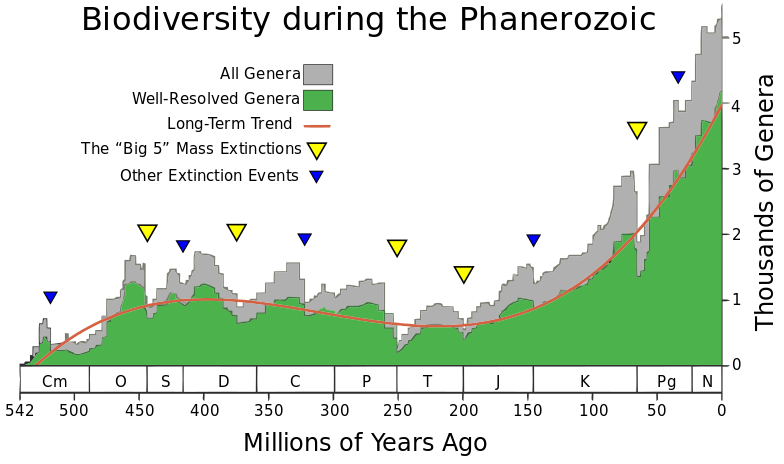
They know that 99.9% of all species that ever existed on Earth are now extinct. They know that in the last 540 million years there have been five events in which more than half of the planet’s “animal genera” have died off. (They have not been able to link all of these events to the activities of Big Oil yet, but they’re working on it.) They know we are in the midst of Sixth Great Mass Extinction that the “experts” say is more destructive that the Cretaceous-Tertiary extinction that wiped out the dinosaurs.
Source: Phanerozoic_Biodiversity.png Author: SVG version by Albert Mestre
Animals and plants are seemingly disappearing faster than at any time since the dinosaurs died out, 66m years ago. The death knell tolls for life on Earth. Rhinos will soon be gone unless we defend them, Mexico’s final few Vaquita porpoises are drowning in fishing nets, and in America, Franklin trees survive only in parks and gardens.
Yet the survivors are taking advantage of new opportunities created by humans. Many are spreading into new parts of the world, adapting to new conditions, and even evolving into new species. In some respects, diversity is actually increasing in the human epoch, the Anthropocene. It is these biological gains that I contemplate in a new book, Inheritors of the Earth: How Nature is Thriving in an Age of Extinction, in which I argue that it is no longer credible for us to take a loss-only view of the world’s biodiversity.
Entirely new species have even come into existence. The “apple fly” has evolved in North America, thanks to European colonials bringing fruit trees to the New World. And house sparrows mated with Mediterranean “Spanish” sparrows somewhere on an Italian farm. Their descendants represent a brand new species, the Italian sparrow. Life on Earth is no longer the same as it was before humans arrived on the scene.
There is no doubt that the rate at which species are dying out is very high, and we could well be in for a “Big Sixth” mass extinction. This represents a loss of biological diversity. Yet, we also know that the Big Five mass extinctions of the past half billion years ultimately led to increases in diversity. Could this happen again? It seems so, because the current rate at which new animals and plants (such as the apple fly, the Italian sparrow and Oxford ragwort) are coming into existence is unusually high – and it may be the highest ever. We are already on the verge of Genesis Number Six – a million or so years from now, the world could end up supporting more species, not fewer, as a consequence of the evolution of Homo sapiens.
China Practicing Sun Tzu’s Art of War?
Beyond the exaggeration and fear-mongering featured in all these UN gatherings, there are particular reasons to be skeptical of this Biodiversity COP15 in Montreal. For one thing, it serves as a platform for Virtue-Signaler-in-Chief, Justin Trudeau, to burnish his social justice warrior creds. And for another thing, there’s a devious collaboration with China’s despot. Terry Glavin explains in his National Post article Trudeau Liberals too eager to buy into China’s green ‘co-operation’. Excerpts in italics with my bolds.
No country has cooperated with China on environmental issues more enthusiastically and obsequiously than Canada
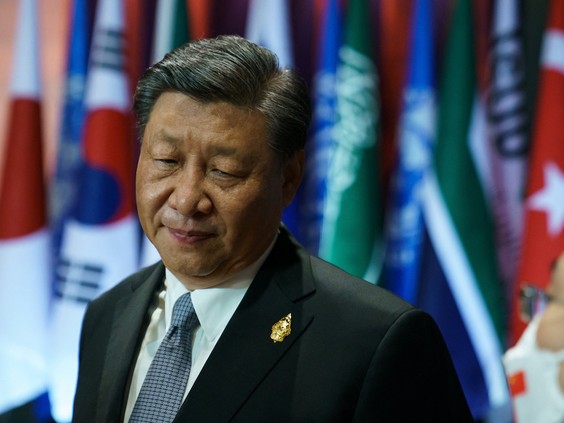
China’s President Xi Jinping
As at least 10,000 delegates and observers from more than 190 countries gather in Montreal for the Convention of the Parties’ biodiversity summit this week, it’s difficult not to be dreary about the summit’s prospects for reversing the alarming trends that continue to push the earth’s animal and plant species over extinction’s cliff edge.
It’s not all bad news. But it’s pretty bad. And with Beijing as the co-host with Canada, it’s hard not to be at least a bit cynical about the whole thing.
The conference in Montreal was supposed to be convened two years ago in Kunming, China, but COVID-19 got in the way, so now the event is being held in Canada owing to the Trudeau government’s decision to oblige the Chinese. In the lead-up to Kunming, the United Nations’ Global Biodiversity Outlook prepared a report card on how the world had progressed by then on the 20 biodiversity targets set 10 years earlier when the parties met in Aichi, Japan. It’s pretty grim reading.
Of the 20 Aichi targets, none were met. Of the 60 “elements” within the targets, only seven were achieved and 13 registered no progress at all. The UN couldn’t figure out what was going on with a couple elements, but there was progress in 38 elements.
Numerical analyses don’t illuminate much on a global scale, but that’s the scale the COP15 gathering in Montreal is dealing with. The rate of global deforestation had slowed by a third over that decade, but overfishing has accelerated, and wetlands continued to vanish. Still, harmful invasive species were eradicated from islands in 200 projects. Also to the good: 44 per cent of the critical areas of the world identified as particularly rich in species diversity ended up with some degree of protection, up from 29 per cent identified at the Aichi gathering.
It doesn’t help to be cynical about these things but Beijing is, after all, in the wheelhouse here.
The hollowest banality you’ll hear when it comes to China is the one about how, sure, the Chinese Communist Party might be a world-devouring rogue state that we have to protect ourselves from, but gosh, we do have to get along with Chinese strongman Xi Jinping when it comes to big-picture challenges like the impact of climate change on human well-being and global biodiversity.
The way that platitude is put in Ottawa’s recently-unveiled Indo-Pacific Strategy: China may well be “an increasingly disruptive global power,” but “China’s sheer size and influence makes co-operation necessary to address some of the world’s existential pressures, such as climate change and biodiversity loss, global health and nuclear proliferation.”
And fair enough. It makes sense. But the thing is, we’ve been co-operating like crazy already, all along. No country has co-operated with China on environmental issues more enthusiastically and obsequiously than Canada. How’s that been working out? For all its much-lauded investments in electric cars and solar panels, China had given the green light to 8.63 gigawatts (GW) of coal-fired power in the first quarter of this year. China now emits more greenhouse gases than the entire developed-world output, combined.
Hindsight is 20/20, as they say, but it’s hard to put your finger on a folly more obvious now than the 1981 decision by Pierre Trudeau’s government to rejig the Canadian International Development Agency’s eligibility requirements so as to allow China to qualify as a foreign-aid recipient. Within a year, CIDA’s role in China was fashioned to suit the purposes of the trade lobby, and that’s how CIDA was run in China until the agency was folded into Global Affairs in 2013.
China has used its “developing country” pretensions to evade a variety of the multilateral environmental and climate change obligations that burden “First World” countries. The result has been that in the existential challenge of global warming, you’d never know it but the greenhouse gas output from Europe and North America have pretty much flatlined over the past quarter of a century, while China’s output has quadrupled.
LULUCF refers to emissions from land use and forestry, which can be in addition or subtraction.
China has been at the forefront of assertions that it is the developed economies’ job to bear the greater costs of climate change mitigation, owing to the legacy of the Industrial Revolution. There’s a case to be made for that, but according to the University of Oxford’s Our World in Data project, the volume of carbon dioxide China has pumped into the atmosphere over the past eight years exceeds the two-century output of the United Kingdom, where the Industrial Revolution began.
So perhaps, yes, “China’s sheer size and influence makes co-operation necessary,” but Canada has never shied away from co-operating. Canada never stopped co-operating, in just the way Beijing wanted, long after CIDA was folded up.
Conclusion
Many know of the Latin phrase “caveat emptor,” meaning “Let the buyer beware”.
When it comes to UN climate science, remember also “caveat lector”–”Let the reader beware”.
The 1991 blockbuster movie revolved around meek, silent victims preyed upon by malevolent believers in their warped, twisted view of the world. A comparison can be drawn between how today’s conservative thinkers and politicians respond to advocates of the pernicious global warming/climate change ideology. Instead of challenging and pushing back against CO2 hysteria, and speaking out with a rational climate perspective, Republicans in the US, and Conservatives in Canada and elsewhere are meek and silent lambs in the face of this energy slaughter. Worse, when they do speak it is to usually to pander and try to appease offering proposals for things like carbon taxes or other non-remedies for a non-problem, essentially ceding the case to leftists.
So to be more constructive, let’s consider what should be proposed by political leaders regarding climate, energy and the environment. IMO these should be the pillars:
♦ Climate change is real, but not an emergency.
♦ We must use our time to adapt to future climate extremes.
♦ We must transition to a diversified energy platform.
♦ We must safeguard our air and water from industrial pollutants.
For those not familiar, Climate Intelligence (CLINTEL) is an independent foundation that operates in the fields of climate change and climate policy. CLINTEL was founded in 2019 by emeritus professor of geophysics Guus Berkhout and science journalist Marcel Crok. Their 1000+ members are signatories of a declaration There is No Climate Emergency
A global network of 900 scientists and professionals has prepared this urgent message. Climate science should be less political, while climate policies should be more scientific. Scientists should openly address uncertainties and exaggerations in their predictions of global warming, while politicians should dispassionately count the real costs as well as the imagined benefits of their policy measures.
One example of a national energy and environment strategy is provided by Clintel for The Netherlands. The document is Clintel’s Integrated Energy Vision. Excerpts in italics with my bolds.
Preamble
We all agree in CLINTEL that: – There is no climate emergency. We have ample time to improve our climate models (for a better understanding of the factors that regulate the climate) and to search for better adaptation technologies.
– The influence of CO2 on global warming is overestimated and its influence on greening is underestimated (even worse, it is often ignored). Nobody knows what the optimum value of atmospheric CO2 concentration is, but from a geological point of view we may conclude that we live in a time with historical low concentrations. Again, there is no climate emergency.
– There is an energy emergency. Decarbonisation policies – in terms of the current energy transition are most destructive. They do much more harm than good. These energy policies must be terminated immediately.
– The new generation (III and IV) nuclear power plants ought to get all our attention. These plants promise low-priced, reliable, safe and clean energy. In combination with natural gas nuclear energy is a ‘No Regret Solution’. Wind and solar energy are at most niche technologies. Their contribution is and will stay marginal.
With respect to the energy transition, CLINTEL emphasises that there exists not something as a global uniform energy system. Every country needs a tailor-made energy system depending on its geography, mineral resources, development phase, industrial specialization, population density, etc. For instance, The Netherlands – being a very densely populated country and being severely divided on the CO2 issue – it looks like the new generation of nuclear power plants may function as a breakthrough in the political process:
Part I shows that current Dutch energy policy – having the ambition to reduce CO₂ emissions as much as 49% by 2030 – is based on panic and shall lead to immense additional costs and a drastically deteriorated living environment. Below, we will propose an inspiring long-term energy vision that fits our (and many other) country’s needs, is based on scientific facts, and aimed at a prosperous future for everyone. A positive vision that replaces the gloom and doom predictions of the climate models. A vision with a hopeful perspective for the future.
A Guiding Vision for the Future
It is well known that high-risk, capital-intensive decisions should be based on a policy that is as insensitive as possible about the way the future will unfold. We have called it a No Regret Policy. It represents a long-term policy, implemented by taking small steps, and continuously adapted to what is happening in reality. CLINTEL has drawn up a No Regret Energy Policy, especially aimed at the Dutch energy transition.
The proposed NRE policy is insensitive for the impact that CO₂ might or might not have on climate change (dominant or marginal). In addition it is insensitive for what role the future electricity grid will play and for what the best mobility energy option will be. An extra bonus of the NRE policy is that the Netherlands’ energy supply will become less dependent on Russian natural gas and Middle Eastern oil.
CLINTEL’s proposal consists of three main elements:
1. Introduction of nuclear energy If we base ourselves on the most up-to-date insights in energy supply, and we look at our four objectives as well as to our ‘no regret demands’, then nuclear energy is the only choice that meets these needs:
• No CO₂ emissions (mandatory requirement in the climate policy in force) as well as excellent controlled waste treatment (pollution requirement) • High safety level (safety requirement) • Demand-driven, reliable and affordable (prosperity requirement) • High energy density (environmental requirement)
About the last entry, please compare a medium-sized 500 MW nuclear power plant with a medium wind turbine park of 4 MW full load. For this reactor, we will need a terrain of approximately 1 km², for the wind farm approx. 300 km². In addition, a nuclear power plant delivers guaranteed for at least 60 years power with low operational costs. Wind turbines on the other hand deliver unreliable power with high operational costs for a maximum of 25 years. Solar panels aren’t performing any better. Moreover, the corresponding inverter (from direct current to alternating current) only lasts about 10 years.
2. Transforming green electrons into green molecules
Transport and storage of much larger than the current quantities of electrical energy is technically difficult and economically unattractive. Every physicist will say: Don’t do it! The real alternative is that with a large supply of cheap and reliable electrical energy we can afford to transform this energy into any desired molecular clean energy carrier, in the form of synthetic gas and synthetic oil.
There are attractive candidates with an appropriate energy density, such as methanol (CH3OH), ammonia (NH3) and hydrogen (H2), or a combination. These truly green energy carriers can be used safely and affordably be stored and transported using the existing infrastructure (bear in mind that 100% H2 is very aggressive and highly flammable, so there is still a lot of work to be done before this energy carrier can be implemented safely at a large scale).
Oil companies should not be tempted by substantial public subsidies to participate in solar fields and wind farms. Instead, they should concentrate on production, transport and distribution of green molecules (green gas, green oil), so do what they are good at. Plans to store surplus CO₂ underground may turn out to be a silly activity. Oil companies, be critical before starting such an activity at a large scale.
3. Hybrid applications
With the supply of truly clean electricity and truly clean energy carriers, optimal choices can be made without large and expensive grid reinforcements and polluting battery packs. Examples:
Interestingly, for each application there also is a hybrid solution (fossil-fuel molecules combined with green molecules and/or green molecules combined with green electrons). Here are also great opportunities to meet the ever-growing need for potable water. After all, it is bad for the soil if we keep on pumping up groundwater (e.g. soil desiccation, and soil subsidence). This can be done much better if we link our energy policy to our drinking water policy.
NRE policy excludes burning of biomass (‘the most stupid policy of all times’) and includes sun and wind as niches only. Batteries are only used for low-power applications, as in the information sector. Natural gas and natural oil are primarily still raw materials for the industry. ‘Saying goodbye to ‘natural’ gas, is utterly silly. Any CO₂ tax is even more silly.
Nuclear energy is proposed as the only truly sustainable solution. To start with, nuclear power will have to take over the energy and heat supply from existing power plants that have almost reached the end of their technical and/or economic lifespan. Next are the energy applications proposed by CLINTEL being part of this vision. The present nuclear technology works with enriched uranium. Breeder reactors on uranium and thorium will in the long run take over the role of these traditional nuclear reactors. Hopefully, nuclear fusion will follow. The Netherlands will, together with other countries, have to participate in research and development efforts, thus acknowledging the importance of a 100% clean, reliable and affordable global energy supply for the foreseeable future.
Footnote: US Republicans Get Behind a Six-Point Plan
Innovation and creating jobs is just part of who we are. And thanks to innovation, America has reduced its emissions by more than any other country in the last 20 years. We did this through new American technology, research at the Department of Energy, and strong bipartisan support.
We need to double down and get more American innovations to market.
♦ Modernize Permitting
We need to build cleaner, faster. Clean energy and grid modernization present tremendous economic opportunities, but burdensome and outdated regulations mean that new projects take five years on average to come online.
We have to move faster by enacting common sense reforms to the permitting process.
♦ Bring American Industry Back
American manufacturing is the cleanest in the world with the highest environmental standards. Unfortunately, countries like China and Russia don’t have the same standards.
We can restore American manufacturing leadership in industries like steel and concrete by strengthening our own supply chains and eliminating dependence from countries that don’t meet our environmental standards.
♦ Unleash American Resource Independence
A new industrial revolution is going to require an enormous amount of resources like lithium, copper, cobalt, graphite, and nickel. Currently, we are too dependent on countries like China to supply our needs.
This dependence increases emissions and handicaps American businesses. We have to make it easier to safely supply manufacturers with American-made materials and employ American workers.
♦ Make Our Communities More Resilient
As conservatives, we plan ahead. When it comes to natural disasters, an ounce of prevention is worth a pound of cure. One dollar invested now equals six dollars after the disaster.
We can help take common sense measures and make sound investments that make our communities and farms more resistant to natural disasters like floods, fires and droughts.
♦ Use Natural Solutions
Crop production depends on access to healthy soil, adequate water supplies and predictable weather conditions, all of which are more difficult to manage as the climate changes.
Natural climate solutions – planting trees and farming practices that improve soil health – have a major impact on reducing carbon emissions while making forests and farms more resilient to floods and fires. They are also profitable.
Toward a Congressional Resolution
The current world political climate is shame-and-blame in order to gain approvals for drastic reduction of CO2. Thus pressure is applied to political officials at every level to show their colors on acting to “fight climate change.” The so-called Zero Carbon notion is widely and naively proclaimed as the way forward. It seems timely to propose an alternative resolution.
There is no place to hide these days, and politicians who have a rational position on climate science had better legislate on the issue. A common sense legislative motion could read something like this (followed by supporting documentation and references).
Whereas, Extent of global sea ice is within the range of historical variability;
Whereas, Populations of polar bears are generally growing;
Whereas, Sea levels have been slowly rising at the same rate since the Little Ice Age ended 150 years ago;
Whereas, Oceans will not become acidic due to buffering from extensive mineral deposits and marine life is well adapted to pH fluctuations that do occur;
Whereas, Extreme weather events have not increased in recent decades and such events are more associated to periods of cooling rather than warming;
Whereas, Cold spells, not heat waves, are the greater threat to human life and prosperity;
Therefore, This chamber agrees that climate is variable and prudent public officials should plan for future periods both colder and warmer than the present. Two principle objectives will be robust infrastructure and reliable, affordable energy.
Comment:
The underlying issue is the assumption that the future can only be warmer than the present. Once you accept the notion that CO2 makes the earth’s surface warmer (an unproven conjecture), then temperatures can only go higher since CO2 keeps rising. The present plateau in temperatures is inconvenient, but actual cooling would directly contradict the CO2 doctrine. Some excuses can be fabricated for a time, but an extended period of cooling undermines the whole global warming mantra.
It’s not a matter of fearing a new ice age. That will come eventually, according to our planet’s history, but the warning will come from increasing ice extent in the Northern Hemisphere. Presently infrastructures in many places are not ready to meet a return of 1950s weather, let alone something unprecedented.
Public policy must include preparations for cooling since that is the greater hazard. Cold harms the biosphere: plants, animals and humans. And it is expensive and energy intensive to protect life from the ravages of cold. Society can not afford to be in denial about the prospect of the current temperature plateau ending with cooling.
Those who oppose economically destructive “climate” policies – like those promoted by the Biden administration and at the recent United Nations COP27 conference – will continue to fail to stop the advance of these policies so long as they continue to accept the false claim that warming of the planet and carbon dioxide emissions are harmful.
They are not. On balance, global warming and CO2 emission are beneficial.
Before getting to why that is, however, it is crucial to understand why accepting the false climate claim is so harmful.
When the destructiveness of climate policies is shown, the response is that the policies nevertheless are necessary to address what President Biden refers to as the “existential threat” of global warming and increased CO2 emissions.
When it is noted that these climate policies will at most microscopically and insignificantly reduce temperatures and CO2 emissions, climate policy mandarins push for even more draconian policies.
The result has been that since the 1990s, climate policies have become increasingly destructive and wasteful. Even worse, their continued intensification appears unlikely to be stopped until the public and policymakers are persuaded that global warming and CO2 emissions are not harmful. As Margaret Thatcher famously said: “First you win the argument, then you win the vote.”
To win this argument, it is necessary to focus on the scientific facts.
A warming planet saves lives.
Analyses of millions of deaths in recent decades in numerous countries, published in the British medical journal The Lancet, show that cooler temperatures killed nine times (July 2021 study) to seventeen times (In May 2015 study) more people than warmer temperatures. The planet’s recent modest warming (by 1.00 degree Celsius on average since 1880, as calculated by NASA) thus has been saving millions of lives.
A 2015 study by 22 scientists from around the world found that cold kills over 17 times more people than heat.
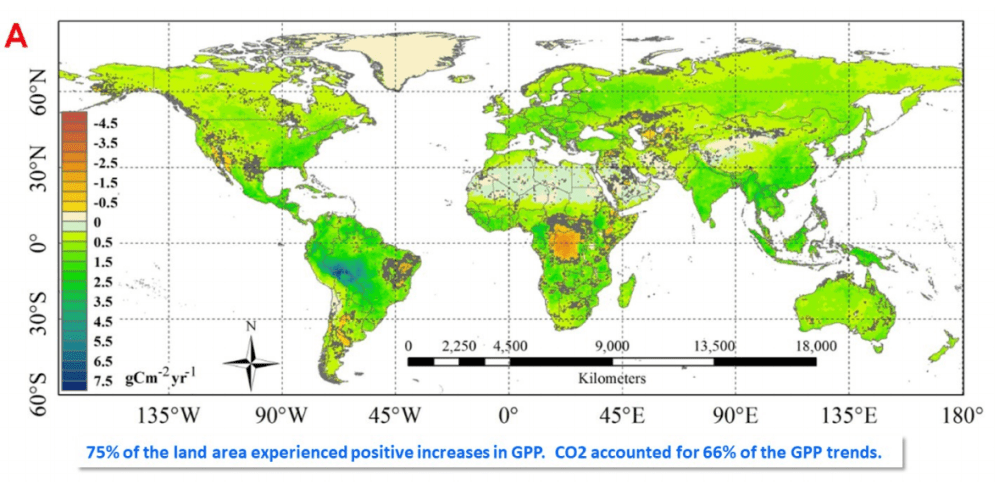
CO2 emissions do not pollute and instead are environmentally beneficial.
In 2017, over 300 scientists, including Richard Lindzen of MIT and William Happer of Princeton, signed a statement that made this point: “carbon dioxide is not a pollutant. To the contrary, there is clear evidence that increased atmospheric carbon dioxide is environmentally helpful to food crops and other plants that nourish all life. It is plant food, not poison.” Every one of us, indeed, also exhales carbon dioxide with every breath.
Spatial pattern of trends in Gross Primary Production (1982- 2015). Source: Sun et al. 2018.
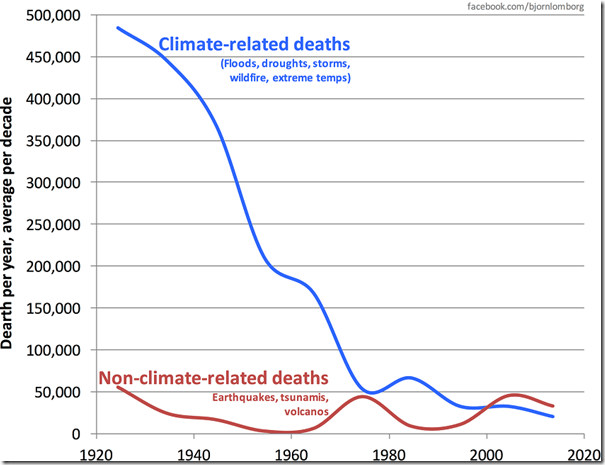
Since 1920, deaths each year from natural disasters have decreased by over 90 percent.
And this happened, data from EM-DAT – The International Disaster Database presented by The University of Oxford show, not only as the planet has warmed, but as world population has quadrupled.
Global warming has not increased hurricanes.
A NOAA report, updated on November 28, 2022, states that “there is essentially no long-term trend in hurricane counts. The evidence for an upward trend is even weaker if we look at U.S. landfalling hurricanes, which even show a slight negative trend beginning from 1900 or from the late 1800s.”
The same report sums it up in bold: “We conclude that the historical Atlantic hurricane data at this stage do not provide compelling evidence for a substantial greenhouse warming-induced century-scale increase in: frequency of tropical storms, hurricanes, or major hurricanes, or in the proportion of hurricanes that become major hurricanes.”
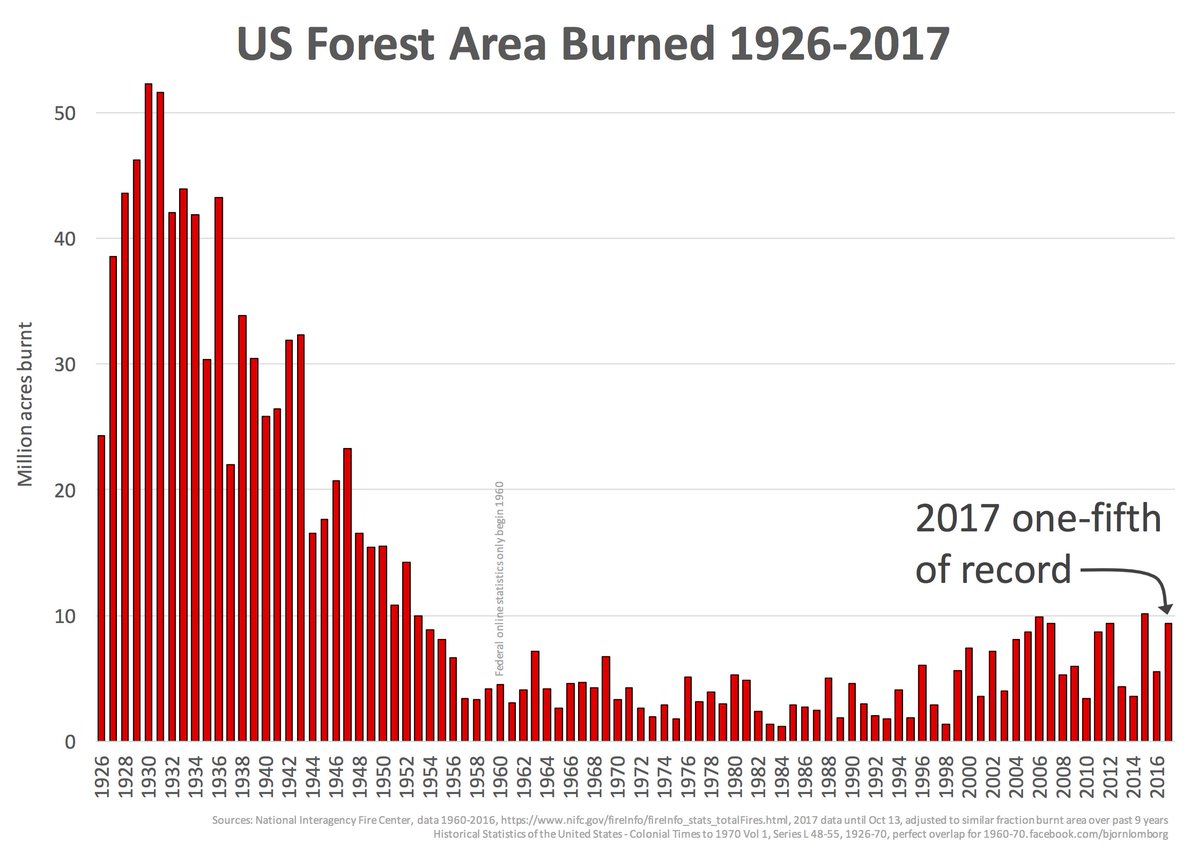
Global warming also does not increase land burned by fires.
As environmental statistician Bjorn Lomberg has shown using data from the Journal of Geophysical Research: Biogeosciences, Remote Sensing of Environment, and Earth’s Future, the percentage of global land burned per year in 1905-2021 has been declining.
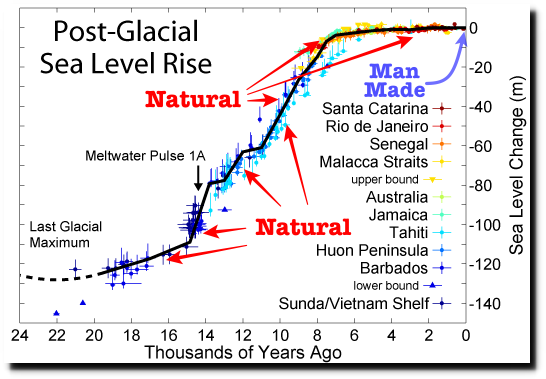
Sea levels are rising – but only by a small fraction of an inch each year.
An EPA report updated on August 1, 2022, states: “When averaged over all of the world’s oceans, absolute sea level has risen at an average rate of 0.06 inches per year from 1880 to 2013,” including a slightly increased rate since 1993 of “0.12 to 0.14 inches per year.”
The UN climate models that President Biden, John Kerry, and other climate doomsters use to predict future global temperatures are so speculative and unreliable that they have been unable even to reproduce the 20th century’s temperature changes. This is a key point in the must-read book by Obama Department of Energy Under Secretary for Science Steven Koonin, Unsettled: What Climate Science Tells Us, What It Doesn’t, and Why It Matters.
These kinds of facts should persuade the public and policymakers to stop accepting the false claim that global warming and CO2 emissions are harmful.
When this false claim is no longer widely accepted, policymakers will stop imposing climate policies that particularly impoverish the world’s poor.
They will stop holding international boondoggles like COP27 and that demand vast climate-related foreign aid programs.
They will stop spending hundreds of billions of dollars on domestic climate sinkholes.
And they will stop using purported “social cost of carbon” factors (even though the true social cost of carbon is zero) to regulatorily restrict domestic fossil fuel production, transportation, and use.
Jordan Peterson recently spoke with Piers Morgan on this topic (and related matters) in the video above. Below is a lightly edited abridged transcript for those who prefer reading. (PM is Piers Morgan and JP is Jordan Peterson). Excerpts in italics with my bolds and added images.
PM: Jordan, it’s good to see you again. I was absolutely astonished (maybe I shouldn’t have been) by the reaction to our last interview worldwide. The sheer volume of people that watched the whole interview–the way the clips were disseminated on tick tock, on Facebook and on Twitter–it was a really interesting Insight actually into a whole world that doesn’t even involve conventional television anymore
JP: Well I’m still continually surprised about it but I think it shows that there’s really no way that Legacy TV in some real sense can compete with the absolutely wide open Frontier of online video distribution, where the cost is low and people can access it everywhere. It’s fundamentally the consequence of a Technological Revolution, and there’s all sorts of good things about that. And one of those would be the ability to widely disperse complex and sophisticated information, which YouTube has been particularly good at in the long form.
But it’s also problematic in that it produces all sorts of alterations and social behavior, and some of them very dangerous, many of which we’re only just beginning to understand.
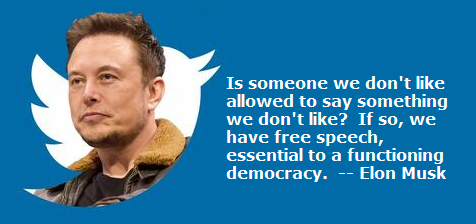
PM: Right, Elon Musk has just bought Twitter and it’s creating a huge furor obviously, in many different ways. He’s admitted he’s going to do lots of things in the next few months and may get some wrong and have to try something else. And he’s going to try and work out a way of making a sustainable business model. But also he wants to bring back what he perceives to be genuine free speech on the platform. Is it possible Jordan, do you think that he can do that or are we now so entrenched in tribalism, particularly on social media that it’s almost impossible.
JP: Well you couldn’t have picked a better day to talk about this with me because I just got a paper sent to me by Jonathan Haidt. He didn’t write the paper but it’s published in a journal called Personality and Individual Differences. And it’s an examination of the personality traits associated with, let’s say, excessive and self-promoting internet usage. And if you don’t mind I’d like to read you a couple of the descriptions of what the people found, because it’s so absolutely spot on and relevant.
I don’t think we are descending into tribalism, but what’s happening in the virtualization of the world is enabling people who behave in a particular anti-social way in a self-aggrandizing and self-promoting anti-social way. I’ll just read you the descriptions that are taken directly from this paper. So it was an actual study of online Behavior.
Women characterized by high self-centered antagonism, neurotic narcissism, Machiavellian views Machiavellian tactics. So that’s manipulation, meanness, dis-inhibition, physical sadism and indirect sadism used Instagram for a longer time and more frequently than did men.
Honesty, humility and conscientiousness was associated with a shorter Facebook usage time
Women high in agenic extroversion, so that’s manipulative self-promotion and indirect sadism, used Facebook for a longer time and more frequently than men.
I’ve thought for a while that as we virtualize the world, we’re enabling the small percentage of people (it’s usually about three percent in general populations) who use manipulation and reputation savaging and denigration and self-promotion.
So the genuinely Psychopathic types dominate the social conversation and spew their poisonous and manipulative Venom into the public domain. And not only with no fear of being stopped and no inhibition, which is almost all applied socially but also being monetized and promoted by the people who run the social media channels.
Every society in history has had to contend with a small percentage of people
who will utilize all the benefits of society only for themselves.
They had to contend with the fact that those people if not brought under control can demolish the structure of the entire society. I think the polarization that we’re feeling is a consequence of their untrammeled expression online, Instagram, Facebook and in online comment forums like Twitter.
PM: That stuff you read out seemed to be gender specific to women but presumably also applies in other ways to men as well on social media
JP: Oh yes, I think the reason that it applied in this study in women is because Instagram involves heavy use of images. And there are reasons to assume because of that it attracts women who are directed towards short-term impulsive mating strategies, another sign of impulsive anti-social and Psychopathic Behavior.
I think you’d see the same thing in men. In fact I’ve been talking to psychologists, great psychologists to make sure that I’m on the right track about those who post repeatedly, say in online forums, especially in relationship to comments. And you certainly see that same pattern of sadism, machiavellianism psychopathy and narcissism characterizing with the Men who who are also incentivized to use what used to be classic female anti-social strategies to advance themselves in the reputational hierarchy.
PM: But the bottom line is: there is a small percentage of people generating a vast amount of noise. What impact is that having on society, do you think?
JP: Well I think it it skews our perceptions of what normal people are like. We assume what we’re getting when you sample the world, when you’re walking through it, you you assume that you’re getting an unbiased representation of the things going on around you. And when you’re on an online platform and reading comments, you also think you’re seeing something like a sample of public opinion.
But it’s not you know. Because if 10 strangers came up you randomly in the street, then you’d have a bit of a sample of what people randomly think. But online behavior online isn’t random and the people who post aren’t aren’t precisely normal
I have been talking with Jonathan Haidt and Jean Twenge about this. And they might know more about it than anybody else in the world. It’s pretty clear to them that the people who are dominating online comment sections, and especially true of the people who post anonymously, and there’s other markers for for this sort of behavior as well. They dominate the political discourse
What’s happening in some sense is that we have a new form of pollution, that’s also corporate sponsored, and it’s pollution of the domain of public discourse.
The pollution occurs because the social media companies are either enabling or failing to control those known in the popular parlance as Trolls. But they’re not comical trolls you know, using derision in some cute way and and having their say in the Free Speech domain. They’re really poisonous individuals and they’re poisoning the entire domain.
PM:What can Elon Musk do about it, if you were advising him on this? I mean ironically at the moment you’re not on Twitter? Would you do you want to come back now that musk is in charge? Secondly what would you advise him to do about this issue of the trolls and so on?
JP: Well I’m going to be talking of precisely this to some of the political people over the next few weeks. I’ve discussed this with twangy and height to make sure that I’m not off on a personal tangent. The first thing I would say: There’s no excuse for including the anonymous posters with the real human beings. Social media platforms who have a certain reach, maybe a million subscribers, whatever figure is appropriate, should be required to implement known customer laws. And that the genuine verified human beings who are posting and are willing to abide by their words with their personal reputation should be put in one comment section. And then the online Anonymous cowardly narcissistic pathological troll demons who are polluting the public discourse should be put in a different comment section. So if you want to go to hell and visit the troll demons and see what they have. Dispute you can, but otherwise you can be among the normal human beings engaged in normal civil human discourse. That would separate the bloody Psychopaths from the bulk of decent normal people. You know 97 percent of people aren’t Psychopathic and so we are talking about a small minority here, but they have the upper hand.
Look it’s often the case that people in the industry that you’re in, and this would be true for politics and journalism, as well anything with a public face, are more likely to be extroverted and also more likely to be somewhat disagreeable. And those those personality traits can tilt you towards a style of callous exploitation. But there are other personality factors like conscientiousness that mediate against that. And so people who are hard-working and reliable, for example, aren’t parasitic in the same way that the classic psychopath would be.
So it’s complicated and it isn’t the case that extroversion and even a certain degree of disagreeableness in and of themselves are dangerous. But they lead like everybody’s led to Temptation in the direction that’s in accordance with their temperament. And the fact that you are a public-facing person and that you like that would tilt you in one direction of potential temptation.
But that’s not necessarily diagnostic. It probably is the case that politics and journalism and entertainment attract a disproportionate number of machiavellians and Psychopaths because of the of the status that goes along with those Enterprises. But it’s not diagnostic: it doesn’t mean that if you’re in that industry and you’ve had a long career that you are one. That’s also another marker for failure or for lack of psychopathy because in the normal world, Psychopaths exploit and they get a reputation for doing so quite quickly, and then people avoid them and stop working with them. So it doesn’t work over the medium to long run as a general rule.
PM: Jordan, let’s talk about Donald Trump. What is he is he a narcissist, a sociopath, a psychopath, all of those things, none of them?
JP: I don’t think he’s a psychopath because he’s been successful in repeated Enterprises over long periods of time, and he has a variety of people who are remain intensely loyal to him. Now he’s definitely extroverted to a very great degree, and he’s definitely disagreeable. So that gives him some of the traits that are associated with those personality features.
But from what I’ve been able to understand, he’s also very conscientious and hardworking, for example. So that’s a real mitigating factor. I think it’s very easy to demonize someone that you don’t approve of. Certainly Trump is being subject to more demonization than any political leader in the west that I can remember in my entire lifetime, including Richard Nixon.
So that’s also set him back on his heels and made him somewhat embattled and defensive, which I don’t think did any great things for for his personality.
So I think it’s a mistake to assume that that Trump is a psychopath. I think it’s a big mistake to assume that someone potent is a psychopath. T he evidence suggests that you don’t want to throw those labels around casually. And you know, how could it be Trump was Psychopathic, since he did a pretty good job of keeping the United States clear of War for four years. That’s pretty damn remarkable, and he did have a big hand in promoting the Abraham Peace Accords, also pretty remarkable.
Those aren’t the sorts of things that you would expect from the psychopath. He also seems to have a pretty good hand with the working class. So I I don’t think those are reasonable diagnostic labels to place on someone.
Whether or not Donald Trump should be president, it would be good for Americans to sort out in the public sphere debated intensely and subject to an election. It might be very interesting to see him put himself forward on the Republican ticket. If I had my druthers, and I say this I hope with due care, I would rather see someone like DeSantis step forward, who shares some of that forthright strength let’s say that characterizes Trump at his best. But seems to be a more cautious administrator and a less divisive figure. Because Trump, for whatever virtues he might have, and I think he has the virtues of a Washington Outsider, I think that his behavior in the political realm raises the political temperature to a dangerous degree.
PM: There’s somebody else who may well have presidential Ambitions and has been the subject of a lot of negativity: Meghan Markle. Prince Harry’s wife. She seems to perennially play the victim, the female victim of all outrages, and your name got dragged into this. Let’s take a listen to what she said.
Raise your hand if you’ve ever been called crazy or hysterical. Or what about nuts, insane, out of your mind, completely irrational. I don’t think that men can control crazy women. The use of these labels has been drilled into us from movies and TV, from friends and family and even from random strangers. And the fact is no one wants this label.
What did you make of that Jordan–to be suddenly appearing on Meghan Markle’s podcast as a villain?
JP: The first thing: I’m calling women crazy. Well the first thing I make of it is that her voice drips with the same falsehood as does the voice of Kamala Harris. It’s this sanctimonious, full compassionate talking down to her audience, and trying to be sure that we’re all really on the same compassionate page here. And we’re all being victimized by terrible forces that are arrayed against us. And none of that’s really fair.
You played a bit of a clip from me talking to Camille Paglia the literary critic. I do believe that it is very difficult to control female anti-social Behavior of the type that’s been pilloried as hysterical. And there is no shortage of clinical evidence to support precisely that. It’s very difficult for women to control female anti-social behavior. And females who are anti-social exhibit that feminine pattern of reputation savaging under the guise of Compassionate Care.
It’s extraordinarily destructive and so I stand by my words. And I do think it scales online because you can use an anonymous reputation savaging to unbelievably great effect online with absolutely no punishment for your sins so to speak. That is certainly one of the things that’s contributing to so-called Cancel Culture, and there’s no shortage of that coming from the female side.
Now men can engage in exactly the same strategies and they do so online and that’s enabled. It’s definitely seen with men which I’ve said before. And I do believe the ever-present threat of the potential for physical violence keeps men from doing that to each other most of the time in person. But all that disappears online, which means that those who are prone to do such things: to use corrosive and denigrating derision, for example, and reputation savaging can have a free hand at it. And that includes no shortage of women. And women are very often the targets of that behavior from their own fellows so to speak.
PM: We’ve talked about Trump and Meghan Markle. I wanted to just ask you again about Elon Musk, what you thought of him as a character?
JP: Well I know people who know him very well and have worked with him very closely and these are very solid people; extremely competent and extremely creative and they’re admirers of Musk. I talked with my brother-in-law Jim Keller who’s one of the world’s great chip engineers and he worked very closely with Musk for years. He believes that in many ways Musk is exactly what you’d think he was. He’s a genius, a Visionary genius; but he’s also someone who’s very very good at implementing. He’s very good at running companies as you can tell because he has a multitude of impossibly successful companies. And so he goes into a company and he cleans house and puts things in order and makes things work efficiently.
Maybe he can do that with Twitter. I hope he can because Musk is doing all sorts of things that appear to be useful and difficult and it would be a catastrophe to see him derailed in his efforts. I dipped into Twitter this morning. It instantly struck me the same way I was struck the last time I was on Twitter. It’s such a den of pathology that I think using it is psychologically damaging. If it’s possible for Musk to get the the trolls under control (and they’re not trolls, they’re Psychopathic Machiavellian sadistic narcissists), then it’s possible that the platform might be useful. I like to share information and I like to follow people to see what they were up to; A lot of the people that I’ve met over the years. But man it’s a snake pit
PM:Should people be compelled to wear poppies for example, and I guess this goes to the wider thing about General displays of signaling your virtue in any way that you choose. Should anyone be compelled to whatever the cause whether it’s a black Square on Instagram when George Floyd died, or a poppy for Armistice Day or so on.
JP: I think that that compulsion especially in matters of public policy is a sign of bad policy. If you can’t get people on board voluntarily by motivating them with the proper story, then you’re a poor leader. So I certainly would be opposed to anything approximating legal compulsion. Now we use social compulsion frequently to produce consensus and to enforce it. that’s never going to go away and there’s some utility in that.
But my general take on the world Is that people should be allowed to go to hell in a hand basket pretty much any way they choose once they’re adults, although they might be encouraged not to do that and invited not to do that. But I’m not a fan of compulsion for any reason, it is a sign of bad policy. If you and I can’t play together voluntarily, then we don’t have a very good relationship and it’s not going to be efficient and productive forced to continue.
Americans have discovered the way in which fear of collective disapproval breeds self-censorship and silence, which impoverish public life and creative work. The double life one ends up leading—one where there is a growing gap between one’s public and private selves—eventually begins to feel oppressive. For a significant portion of Soviet intelligentsia (artists, doctors, scientists), the burden of leading this double life played an important role in their deciding to emigrate.
Those who join in the hounding face their own hazards. The more loyalty you pledge to a group that expects you to participate in rituals of collective demonization, the more it will ask of you and the more you, too, will feel controlled. How much of your own autonomy as a thinking, feeling person are you willing to sacrifice to the collective? What inner compromises are you willing to make for the sake of being part of the group? Which personal relationships are you willing to give up?
The practice of collective condemnation feels like an assertion of a culture that ultimately tramples on the individual and creates an oppressive society. Whether that society looks like Soviet Russia, or Orwell’s Nineteen Eighty-Four, or Castro’s Cuba, or today’s China, or something uniquely 21st-century American, the failure of institutions and individuals to stand up to mob rule is no longer an option we can afford.
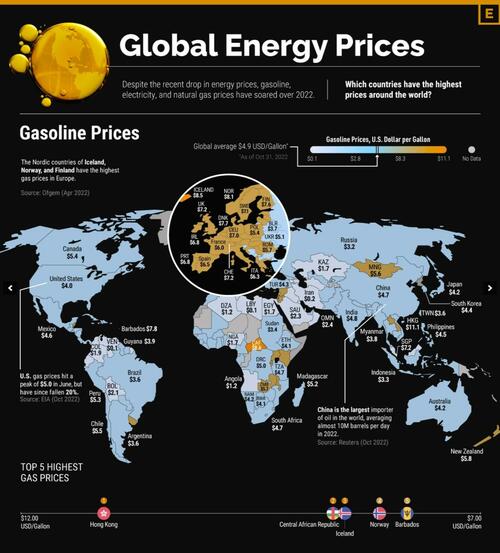
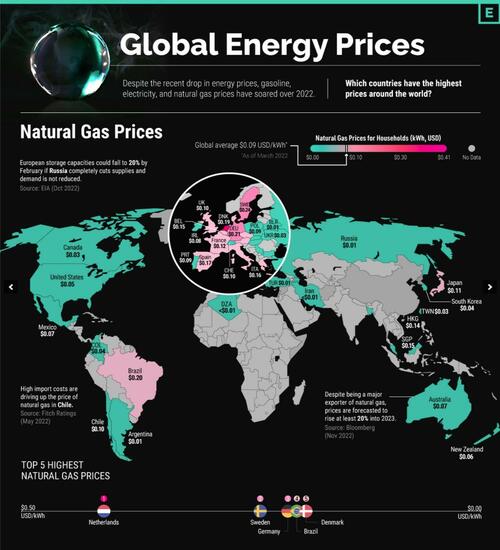
Current global maps of energy prices show western nations, especially in Europe have begun bleeding their economies and societies by self-imposed misguided climate policies. Tyler Durden reports at zerohedge Mapped: Global Energy Prices By Country. Excerpts in italics with my bolds.
For some countries, energy prices hit historic levels in 2022.
Gasoline, electricity, and natural gas prices skyrocketed as Russia’s invasion of Ukraine ruptured global energy supply chains. Households and businesses are facing higher energy bills amid extreme price volatility. Uncertainty surrounding the war looms large, and winter heating costs are projected to soar.
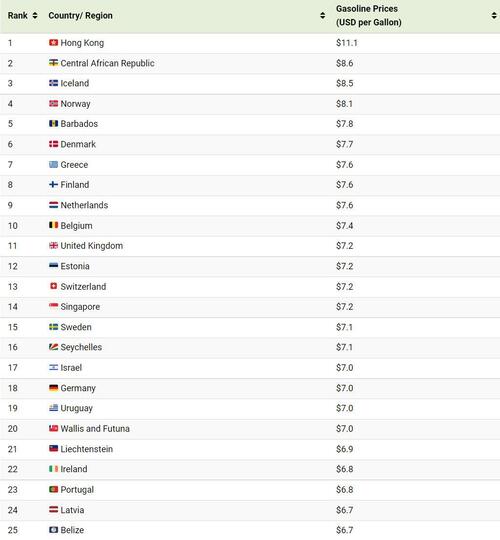
Which countries and regions pay the most for a gallon of gas?
Source: GlobalPetrolPrices.com. As of October 31, 2022. Represents average household prices.
At an average $11.10 per gallon, households in Hong Kong pay the highest for gasoline in the world—more than double the global average. Both high gas taxes and steep land costs are primary factors behind high gas prices.
Like Hong Kong, the Central African Republic has high gas costs, at $8.60 per gallon. As a net importer of gasoline, the country has faced increased price pressures since the war in Ukraine.
Households in Iceland, Norway, and Denmark face the highest gasoline costs in Europe. Overall, Europe has seen inflation hit 10% in September, driven by the energy crisis.
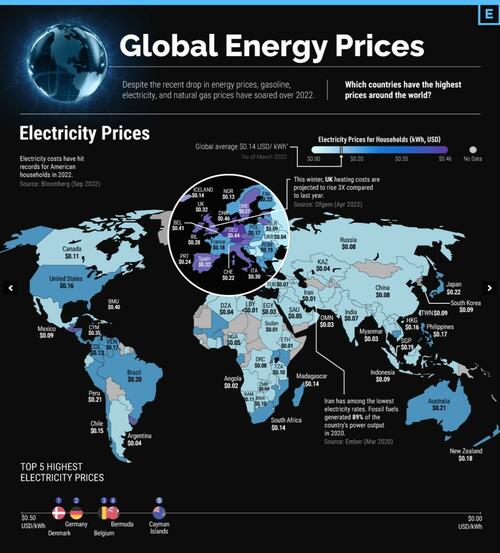
2. Global Energy Prices: Electricity
Extreme volatility is also being seen in electricity prices.
The majority of the highest household electricity prices are in Europe, where Denmark, Germany, and Belgium’s prices are about double that of France and Greece. For perspective, electricity prices in many countries in Europe are more than twice or three times the global average of $0.14 per kilowatt-hour.
Over the first quarter of 2022, household electricity prices in the European Union jumped 32% compared to the year before.
Source: GlobalPetrolPrices.com. As of March 31, 2022. Represents average household prices.
In the U.S., consumer electricity prices have increased nearly 16% annually compared to September last year, the highest increase in over four decades, fueling higher inflation.
However, households are more sheltered from the impact of Russian supply disruptions due to the U.S. being a net exporter of energy.
3. Global Energy Prices: Natural Gas
Eight of the 10 highest natural gas prices globally fall in Europe, with the Netherlands at the top. Overall, European natural gas prices have spiked sixfold in a year since the invasion of Ukraine.
Source: GlobalPetrolPrices.com. As of March 31, 2022. Represents average household prices.
The good news is that the fall season has been relatively warm, which has helped European natural gas demand drop 22% in October compared to last year. This helps reduce the risk of gas shortages transpiring later in the winter.
Outside of Europe, Brazil has the fourth highest natural gas prices globally, despite producing about half of supply domestically. High costs of cooking gas have been especially challenging for low-income families, which became a key political issue in the run-up to the presidential election in October.
Meanwhile, Singapore has the highest natural gas prices in Asia as the majority is imported via tankers or pipelines, leaving the country vulnerable to price shocks.
Increasing Competition
By December, all seaborne crude oil shipments from Russia to Europe will come to a halt, likely pushing up gasoline prices into the winter and 2023.
Concerningly, analysis from the EIA shows that European natural gas storage capacities could sink to 20% by February if Russia completely shuts off its supply and demand is not reduced.
As Europe seeks out alternatives to Russian energy, higher demand could increase global competition for fuel sources, driving up prices for energy in the coming months ahead.
Still, there is some room for optimism: the World Bank projects energy prices will decline 11% in 2023 after the 60% rise seen after the war in Ukraine in 2022.
Background Post G7 Ministers Pledge Energy Hari-Kari
Recognising that accelerating the international clean energy transition and phasing out continued global investment in the unabated fossil fuel sector is essential to keep a limit of 1.5 °C temperature rise within reach, we commit to end new direct public support for the international unabated fossil fuel energy sector by the end of 2022, except in limited circumstances clearly defined by each country that are consistent with a 1.5 °C warming limit and the goals of the Paris Agreement. (pg. 33)
We note with concern the scale of private finance currently still supporting non-Paris aligned activities especially in the fossil fuel sector. (pg. 22)
We are thus further strengthened in our resolve to accelerate the clean energy transition towards a net zero emissions future by 2050, while also keeping energy security and affordability at the core of our action, including through the rapid expansion of low-carbon and renewable energies and an increase in energy efficiency. (pg. 29)
In this regard, we acknowledge the IEA net zero scenario which suggests that G7 economies invest at least US$1.3 trillion in renewable energy including tripling investments in clean power and electricity networks between 2021 and 2030. (pg. 31)
We confirm our strong financial commitments for the market ramp-up of low-carbon and renewable hydrogen and its derivatives, thereby signalling an irreversible shift towards a world economy based on low carbon and renewable energy sources. (pg. 31)
In view of the Russian attack on Ukraine, financial support for companies and citizens affected by severely rising prices for fossil fuels is now on the political agenda for several countries. Nevertheless, we aim for our relief measures to be temporary and targeted and we reaffirm our commitment to the elimination of inefficient fossil fuel subsidies by 2025. (pg. 32)
We also highlight that we have ended new direct government support for unabated international thermal coal-fired power generation by the end of 2021, including through Official Development Assistance, export finance, investment, and financial and trade promotion support. (pg. 33)
We commit to increase national efforts to decarbonise building heating and cooling systems by using appropriate policy tools, including regulations and incentives, with the ultimate objective of transitioning away from fossil fuels. (pg. 37)
This will also guide our approach in public finance institutions and on the boards of MDBs and bilateral DFIs. We therefore call on other major economies, the MDBs and bilateral DFIs, multilateral funds, public banks and relevant agencies to also adopt these commitments. We commit to review our progress against our commitments. (pg. 33)
(Note: Multilateral Development Banks (MDBs), Development finance institution (DFIs)
See also Michael Kelly on Energy Utopias and Engineering Realities synopsis Kelly’s Climate Clarity
 Ross McKitrick reports at Financial Post The Parliamentary Budget Officer just debunked climate alarmism, This is the opposite of an ’emergency’ or ‘crisis’. Excerpts in italics with my bolds and added images.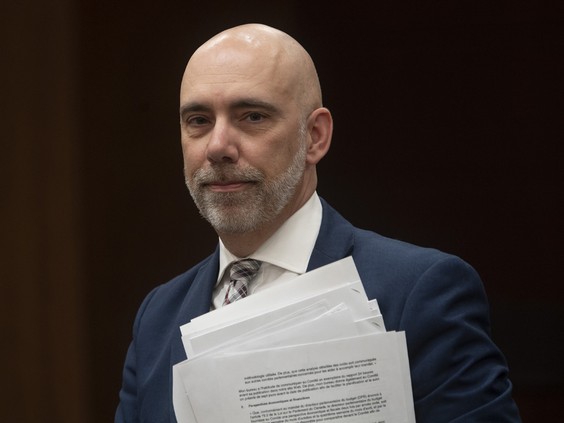






























 Science Matters