Climate Policies Like LSD Fantasies

Andrew I. Fillat & Henry Miller explain at Washington Examiner  Climate policies range from inanity to insanity.  Excerpts in italics with my bolds and added images.

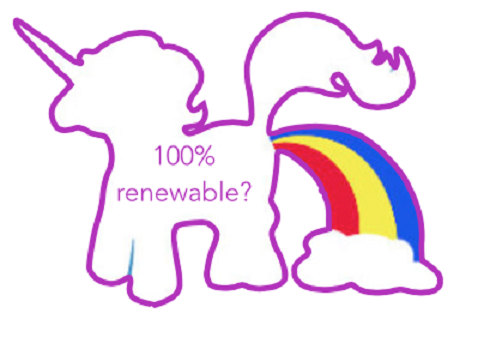
The “war” on fossil fuels by activists and bureaucrats is much like how people describe an LSD trip: exhilarating, completely unreal, and possibly dangerous. This is evident from a simple analysis of what it would take to satisfy today’s demand for electricity in the absence of further electrifying transportation, industry, residences, and everything else.

Current domestic demand is 4 billion megawatt hours (MWh, the consumption of 1,000 watts of power for one hour), or 6.6 million MWh per day. Our generating capacity consists of 38% gas-fired, 22% coal-fired, 19% nuclear, 9.2% wind, 6.3% hydropower, 2.8% solar, and 1.7% other. We would need, therefore, to replace 2.4 billion MWh (gas and coal) with wind or solar.

Source: U.S. Energy Information Administration

A typical wind turbine generates two megawatts and occupies nearly two acres, or about one megawatt per acre. Solar is similar at one and one-third megawatt per acre. A megawatt creates 8,750 MWh annually. However, wind and solar are only 40% productive on average (due to calm, clouds, and nights). And wind and solar are both land hogs: Generating 2.4 billion MWh would consume 750,000 acres for either technology. To put that in context, the state of Rhode Island occupies 1 million acres.

We would need about 375,000 new wind turbines (up from 3,000 per year now)
at $3 million each, or more than $1 trillion. At $400,000 per acre of solar panels,
that cost is about $3 trillion.

This doesn’t take into account land cost and maintenance or the price escalation for raw materials required for the fabrication of the turbines and solar panels due to increased demand. It also ignores the greenhouse gas emissions from the mining itself.

The killer is backup.

With the decommissioning of fossil fuels, the only practical solution for calm, clouds, and nighttime is batteries. But at $151,000 per MWh for utility-scale batteries, the cost to provide only one day (6.6 MwH) of backup is about $1 trillion. The 2021 West Texas wind farm freeze suggests that a reasonable backup capacity is probably four days. And building these batteries would exacerbate raw materials shortages.

Our calculations are for the U.S. alone, and since we account for about 16% of global greenhouse gas emissions and electricity generation is only a quarter of that, the very best case is a 4% reduction in global greenhouse emissions. Meanwhile, China and India have nearly 10 times the number of coal-fired power plants as the U.S. and continue to build while we decommission ours. They will dwarf any emissions reductions we make while growing their economies as we strangle ours with expensive and limited energy.

Moreover, all of this is before the increased demand in power to electrify cars, factories, homes, and businesses further, which in turn will require upgrading the entire electrical grid — trillions of dollars more to upgrade transmission and connection facilities as well as still more wind or solar.

Just a fraction of the money wasted on the current LSD trip would be far better invested in “geoengineering” mitigation of the effects of climate change, which have never proved to be remotely as dire as the prophets of Armageddon have predicted. They might include, for example, projects such as reforestation; the Amazon provides 20% of the world’s oxygen while consuming carbon dioxide.

The true insanity, however, is ignoring very real opportunities for small-scale nuclear power. That clean source of energy is on the cusp of a major revolution in availability, cost reduction, and safety, if only we put aside our irrational fears. Our Navy has operated more than 150 nuclear-powered vessels for decades without incident.

Energy policies that would devastate our economy in the pursuit of
marginally relevant benefits at monumental cost are truly dangerous
to our way of life, global standing, and national security.
They should be short-circuited or discharged.

Andrew I. Fillat spent his career in technology venture capital and information technology companies. He is also the co-inventor of relational databases. Henry I. Miller, a physician and molecular biologist, is the Glenn Swogger distinguished fellow at the American Council on Science and Health. They were undergraduates together at MIT.

Fed Models Weather, Fails at Bank Stress Testing

Mish reports on the US Federal Reserve’s latest incompetence at his blog The Fed Models the Weather Although It Can’t Even Stress Test Treasuries.  Excerpt in italics with my bolds. H/T Tyler Durden

The Fed has conducted a “pilot climate scenario analysis exercise”.
Let’s take a peek inside this laughable event.

On January 10, Fed Chairman said the Fed ‘will not be a climate policymaker’. 

Under guise that it’s just a stress test model and not a policy setting model, the Fed announced details on its Pilot Climate Scenario Risk Analysis Program on January 17.

As described in the instruction document released today, the six largest U.S. banks will analyze the impact of scenarios for both physical and transition risks related to climate change on specific assets in their portfolios. To support the exercise’s goals of deepening understanding of climate risk-management practices and building capacity to identify, measure, monitor, and manage climate-related financial risks, the Board will gather qualitative and quantitative information over the course of the pilot, including details on governance and risk management practices, measurement methodologies, risk metrics, data challenges, and lessons learned.

“The Fed has narrow, but important, responsibilities regarding climate-related financial risks – to ensure that banks understand and manage their material risks, including the financial risks from climate change,” Vice Chair for Supervision Michael S. Barr said. “The exercise we are launching today will advance the ability of supervisors and banks to analyze and manage emerging climate-related financial risks.”

Climate Results Are In

Please consider the WSJ report The Fed’s Climate Studies Are Full of Hot Air by David Barker.

This year the Fed is forcing big banks to produce complex reports on their climate vulnerability in a “pilot project” that is sure to expand and might lead to lending restrictions. A query of the Fed’s listing of recent publications returns hundreds of research papers, press releases and policy statements related to climate change.

With all this effort, one might hope the Fed would produce high-quality research on climate change. But I took a close look at two Fed studies on the subject and found shockingly poor analysis. These studies on the effect of temperature on U.S. and world economic growth are cited without a hint of skepticism and widely lavished with media attention.

Recently I published a critique of a study from the Federal Reserve Board claiming that a year of above-normal temperatures in countries around the world makes economic contraction more likely. The original study used sophisticated statistical techniques but failed to report that its primary finding was statistically insignificant. My request to the study’s author for computer code to reproduce the paper’s results went unanswered.

I managed to write the code from scratch and exactly replicate the results, allowing me to run additional tests that the author didn’t report. The author’s primary result—that temperature has a bigger effect in bad than in good economic times—turned out to be statistically insignificant. Additional analysis showed that there is no reliable effect of temperature on growth at all.

There are two main reasons why the Fed study appeared at first to show a statistically significant effect of temperatures on economic growth. First, each country in the sample had equal weight in the analysis. China had the same weight as St. Vincent though China’s population is 13,000 times as large. Equal weighting means that some small countries with unusual histories of economic growth greatly influenced the results.

The paper’s results disappeared when countries like Rwanda and Equatorial Guinea—which had economic catastrophes and bonanzas unrelated to climate change—were omitted. Omitting similar countries representing less than 1% of world gross domestic product was enough to eliminate the paper’s result.

The only thing to learn from the Fed’s research is that climate propaganda is spreading fast, and when it comes to climate, academic economists are no more deserving of trust than are other supposed scientists and experts. The Fed’s time would be better spent on more urgent matters, like improving its botched regulation of the banking system.

The author, David Barker, has taught economics and finance at the University of Chicago and the University of Iowa and worked as an economist at the Federal Reserve Bank of New York. He has a doctorate in economics from the University of Chicago.

Hoot of the Day

♦  The Fed cannot even model US Treasuries. Its stress-free test would have failed to identify the imploded Silicon Valley Bank as a problem

♦  Yet, for political reasons, the Fed is now attempting to stress test the weather.

♦  To get the desired results, the Fed study gave St. Vincent, Rwanda, and Equatorial Guinea the same weight as China and the United States. 

♦  The Fed should throw this nonsense in the garbage and stress test commercial real estate, interest rates, accelerated QT, and things that it has clearly neglected. 

See Also Financial Systems Have Little Risk from Climate

Mish:  One of my readers accurately commented, that “Modeling the impact of bad climate policy would be more useful.”  Of course that presumes the Fed has any idea just how bad, and inflationary, our climate policy is.


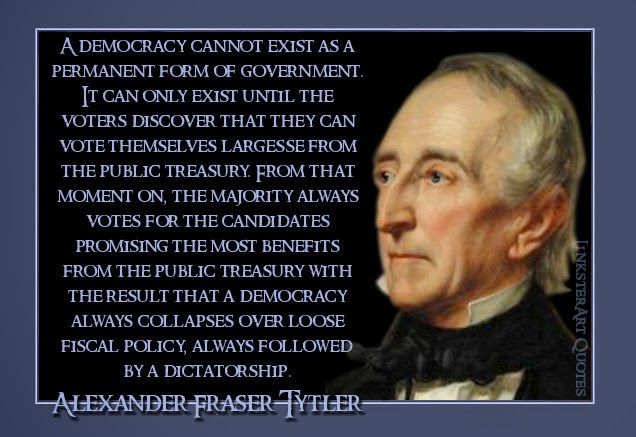
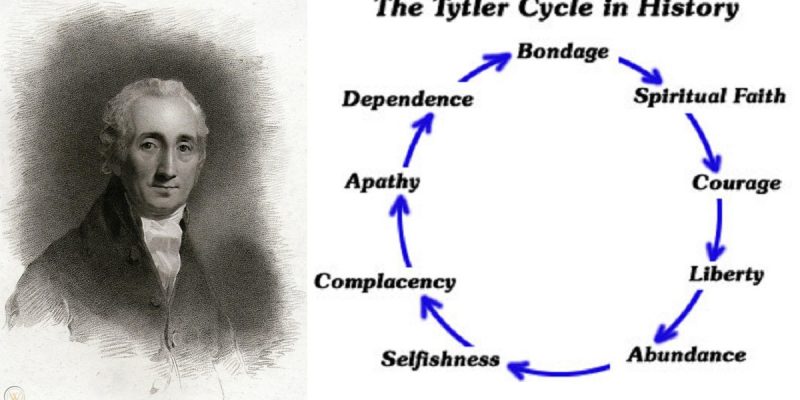
Postscript on Cycle of Democracies:


More Bilge from Pseudo-Scientific American

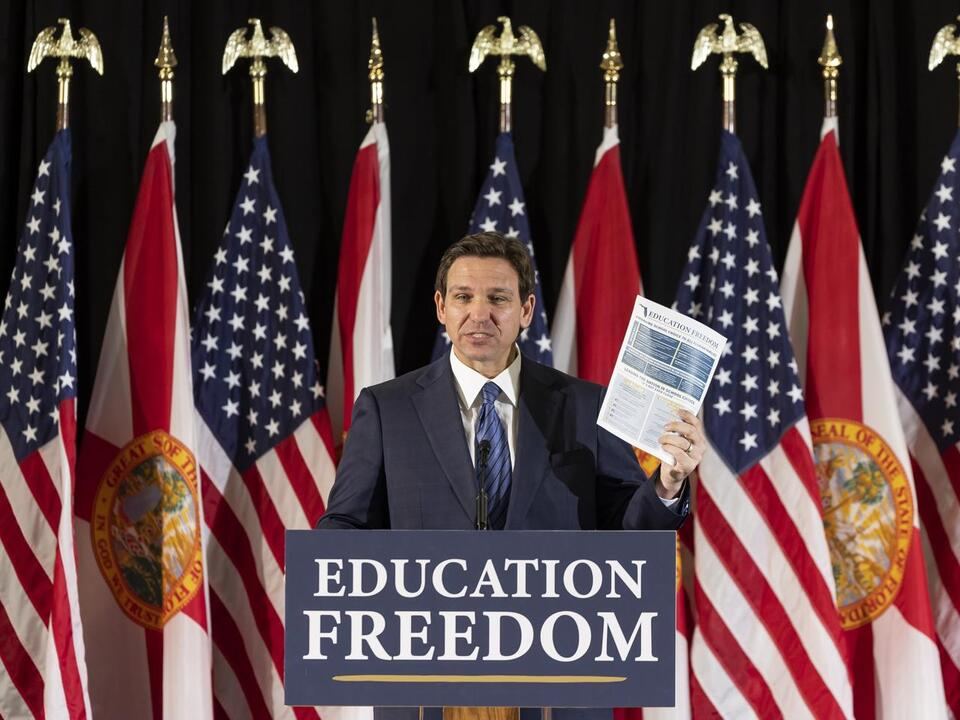
David Catron reports at the American Spectator Scientific American Compares DeSantis to Mussolini.  Those who thought Desantis would not attract Trump-like media trash talking should pay more attention to bilge like the latest from Political Scientific American. Excerpts in italics with my bolds and added images.

Florida’s governor is a “fascist” for listening to voter concerns
about leftist indoctrination in schools.

It is hardly breaking news that many once-trustworthy science and medical publications have been infected by leftist ideology. One of the worst cases involved the Lancet, which published an editorial in May of 2020 that openly urged American voters to replace then-President Trump. Sadly, this disease has continued to metastasize. The latest outbreak just appeared in Scientific American, which published an opinion piece on Friday claiming that the education policies of Florida Gov. Ron DeSantis “mirror past fascist strategies in ways that are disquieting for American democracy.”

The author is Eden McLean, an associate professor of modern European history at Auburn University. She admits that “fascism” is frequently misapplied but exonerates herself of that sin as follows: “Nonetheless, highlighting the parallels between the ambitions of DeSantis and those of the fascist dictator Benito Mussolini exposes the shared threat to democracy.” McLean’s academic work focuses on the period of the last century during which authoritarian regimes rose to power in Italy, Germany, and Spain. All three used public education to reinforce their rule, but McLean uses the Italian model to denounce DeSantis:

At the heart of fascist political strategy was the expansion of state control over public and private life under the facades of popular support and common good. Mussolini may have been legally appointed as Italy’s prime minister in 1922, but by 1927 all political parties had been banned or absorbed into his Fascist Party. At the Ministry of Education, Mussolini appointed nine ministers over 21 years. Only five had teaching experience but, more importantly, all but one (who quit after six months) were devoted party members who did little to question Mussolini’s directives.

What “parallels” does McLean see here? She graciously allows that DeSantis hasn’t banned any political parties, yet detects something sinister in the way he exercises his duty under the state constitution to appoint the members of the Board of Education: “In Florida, as in more than a dozen other states, the governor appoints all members to the Board of Education.” If so many other governors do the same thing, what’s the problem? At length she reveals the secret: “Florida’s current Board of Education includes three lawyers, one doctor, two business executives and just one teacher (who was appointed in March).”

McLean clearly doesn’t know that, until recently, the makeup of the Florida School Board was typical of what she once would have found throughout the country. The idea was that school boards should be representative of the communities they serve. The notion that they should be dominated by “educators” is an artifact of the systematic infiltration of school boards by the teachers unions. What DeSantis has been doing with his appointments is precisely the opposite of fascism.

He is returning control of Florida’s schools to parents and students
who want education rather than leftist indoctrination. 

McLean disapproves:  First, it means a small number of people rely on their personal priorities for a child’s education to determine school curricula for all students. The dependence on individual perspectives as much as knowledge grounded in research and expertise leads to an increasing conflation of faith with science, memory with history, and dogmatism with truth. Second, the unwillingness to provide students with subject-appropriate, expert-developed materials that introduce them to new ideas limits their ability to assess sources for reliability and accuracy.

What McLean fails to mention about our expert-heavy education system
is its abysmal results.

The most recent National Assessment of Educational Progress (NAEP), also known as the Nation’s Report Card, indicated that large percentages of American students are functionally illiterate in math and reading. Fully 38 percent of eighth-grade students are below basic achievement levels in math and 30 percent are below basic achievement levels in reading. The NAEP attributes this to COVID-19. As Forbes reports, however, the pandemic merely exacerbated a problem that first beset our education system in 2009.

As to McLean’s charge that DeSantis refuses to provide students with “subject-appropriate, expert-developed materials,” he is simply doing what worried parents have been begging the “experts” to doexpunging leftist dogma, pseudoscience, and revisionist history from the public schools. As he put it in his second inaugural address, “We must ensure school systems are responsive to parents and to students, not partisan interest groups.” This is obviously what the voters of Florida want, as his record-breaking reelection confirmed. For McLean, this overwhelming support for DeSantis constitutes an ominous message.

She solemnly advises her readers, “We must not stop at simply denouncing DeSantis’s efforts as ‘fascist’; to do so sidesteps their homegrown roots and minimizes their full danger.” For McLean, permitting parents to democratically elect a governor who actually listens to them presents enormous peril: “Being part of a democratic republic — embracing our pluralistic society — requires diverse views and their educated assessment.” She assumes that, if Florida’s voters disagree with her, it must be due to bigotry and ignorance.

This leaves one remaining question unanswered:
What the hell happened to Scientific American?

The Less It Warms, the Louder Is Zero Carbon Push

The post below updates the UAH record of air temperatures over land and ocean. Each month and year exposes again the growing disconnect between the real world and the Zero Carbon zealots.  It is as though the anti-hydrocarbon band wagon hopes to drown out the data contradicting their justification for the Great Energy Transition.  

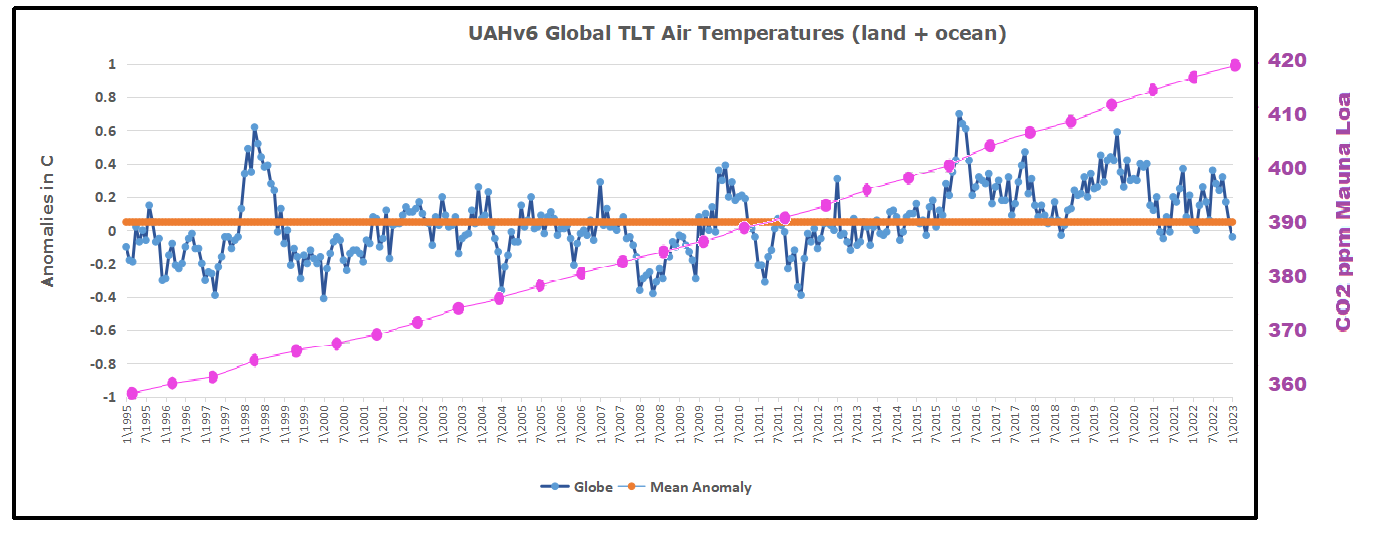
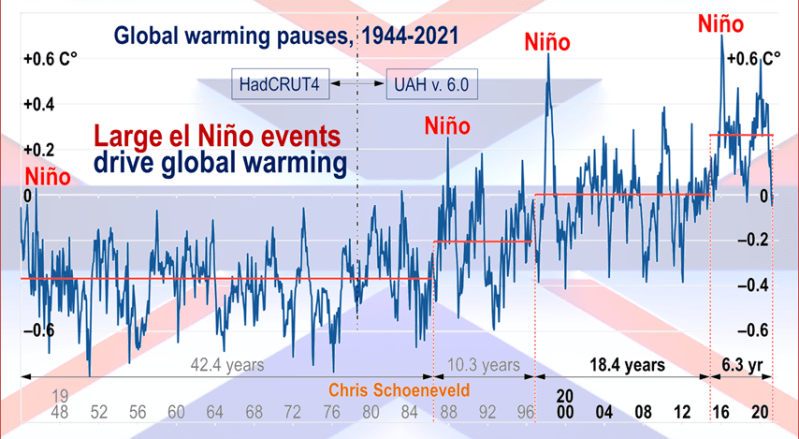
As an overview consider how recent rapid cooling  completely overcame the warming from the last 3 El Ninos (1998, 2010 and 2016).  The UAH record shows that the effects of the last one were gone as of April 2021, again in November 2021, and in February and June 2022  Now at year end 2022 and continuing into 2023 global temp anomaly is matching or lower than average since 1995, an ENSO neutral year. (UAH baseline is now 1991-2020).

For reference I added an overlay of CO2 annual concentrations as measured at Mauna Loa.  While temperatures fluctuated up and down ending flat, CO2 went up steadily by ~60 ppm, a 15% increase.

Furthermore, going back to previous warmings prior to the satellite record shows that the entire rise of 0.8C since 1947 is due to oceanic, not human activity.

gmt-warming-events

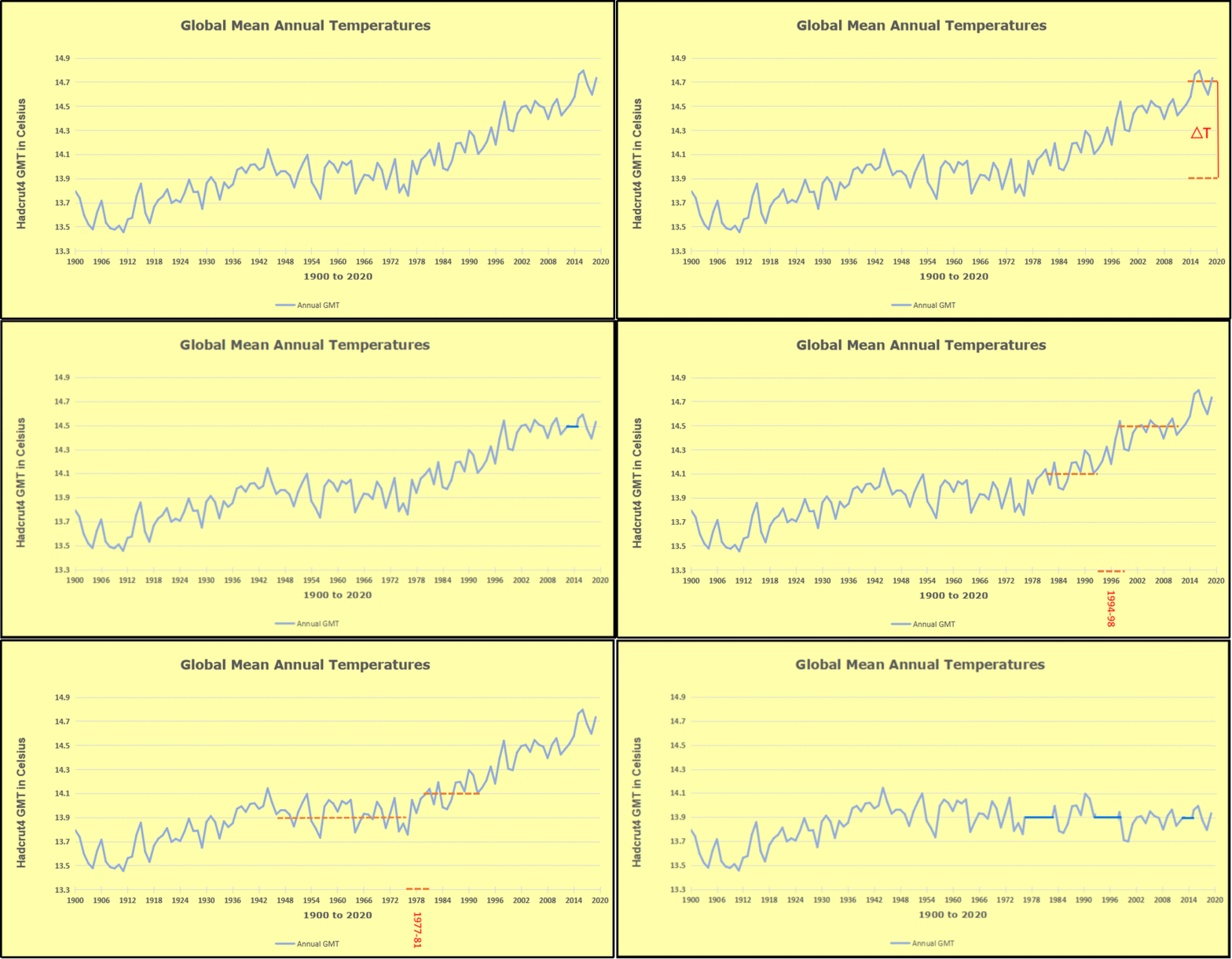
The animation is an update of a previous analysis from Dr. Murry Salby.  These graphs use Hadcrut4 and include the 2016 El Nino warming event.  The exhibit shows since 1947 GMT warmed by 0.8 C, from 13.9 to 14.7, as estimated by Hadcrut4.  This resulted from three natural warming events involving ocean cycles. The most recent rise 2013-16 lifted temperatures by 0.2C.  Previously the 1997-98 El Nino produced a plateau increase of 0.4C.  Before that, a rise from 1977-81 added 0.2C to start the warming since 1947.

Importantly, the theory of human-caused global warming asserts that increasing CO2 in the atmosphere changes the baseline and causes systemic warming in our climate.  On the contrary, all of the warming since 1947 was episodic, coming from three brief events associated with oceanic cycles. 

Update August 3, 2021

Chris Schoeneveld has produced a similar graph to the animation above, with a temperature series combining HadCRUT4 and UAH6. H/T WUWT

image-8


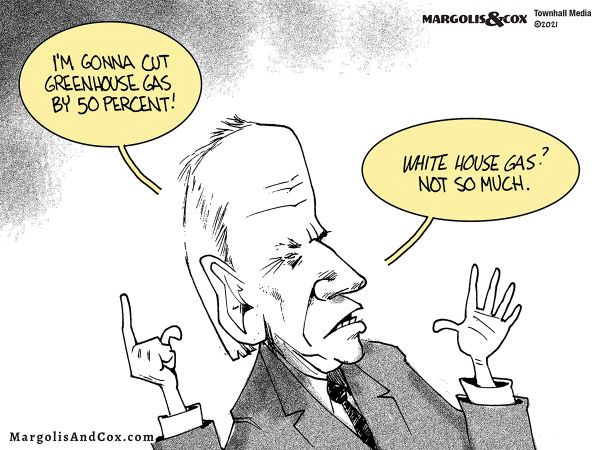
mc_wh_gas_web20210423124932

See Also Worst Threat: Greenhouse Gas or Quiet Sun?

March 2023 Update  Land and Sea Temps Little Changed

banner-blog

With apologies to Paul Revere, this post is on the lookout for cooler weather with an eye on both the Land and the Sea.  While you will hear a lot about 2020-21 temperatures matching 2016 as the highest ever, that spin ignores how fast the cooling set in.  The UAH data analyzed below shows that warming from the last El Nino was fully dissipated with chilly temperatures in all regions. After a warming blip in 2022, land and ocean temps dropped again with 2023 starting below the mean since 1995.

UAH has updated their tlt (temperatures in lower troposphere) dataset for March 2023. Posts on their reading of ocean air temps this month came ahead of updated records from HadSST4.  I have previously posted on SSTs using HadSST4  Oceans Stay Cool February 2023. This month also has a separate graph of land air temps because the comparisons and contrasts are interesting as we contemplate possible cooling in coming months and years. Sometimes air temps over land diverge from ocean air changes.  For example in February, Tropical ocean temps alone moved upward, while temps in all land regions rebounded after hitting bottom..

Note:  UAH has shifted their baseline from 1981-2010 to 1991-2020 beginning with January 2021.  In the charts below, the trends and fluctuations remain the same but the anomaly values change with the baseline reference shift.

Presently sea surface temperatures (SST) are the best available indicator of heat content gained or lost from earth’s climate system.  Enthalpy is the thermodynamic term for total heat content in a system, and humidity differences in air parcels affect enthalpy.  Measuring water temperature directly avoids distorted impressions from air measurements.  In addition, ocean covers 71% of the planet surface and thus dominates surface temperature estimates.  Eventually we will likely have reliable means of recording water temperatures at depth.

Recently, Dr. Ole Humlum reported from his research that air temperatures lag 2-3 months behind changes in SST.  Thus the cooling oceans now portend cooling land air temperatures to follow.  He also observed that changes in CO2 atmospheric concentrations lag behind SST by 11-12 months.  This latter point is addressed in a previous post Who to Blame for Rising CO2?

After a change in priorities, updates are now exclusive to HadSST4.  For comparison we can also look at lower troposphere temperatures (TLT) from UAHv6 which are now posted for March.  The temperature record is derived from microwave sounding units (MSU) on board satellites like the one pictured above. Recently there was a change in UAH processing of satellite drift corrections, including dropping one platform which can no longer be corrected. The graphs below are taken from the revised and current dataset.

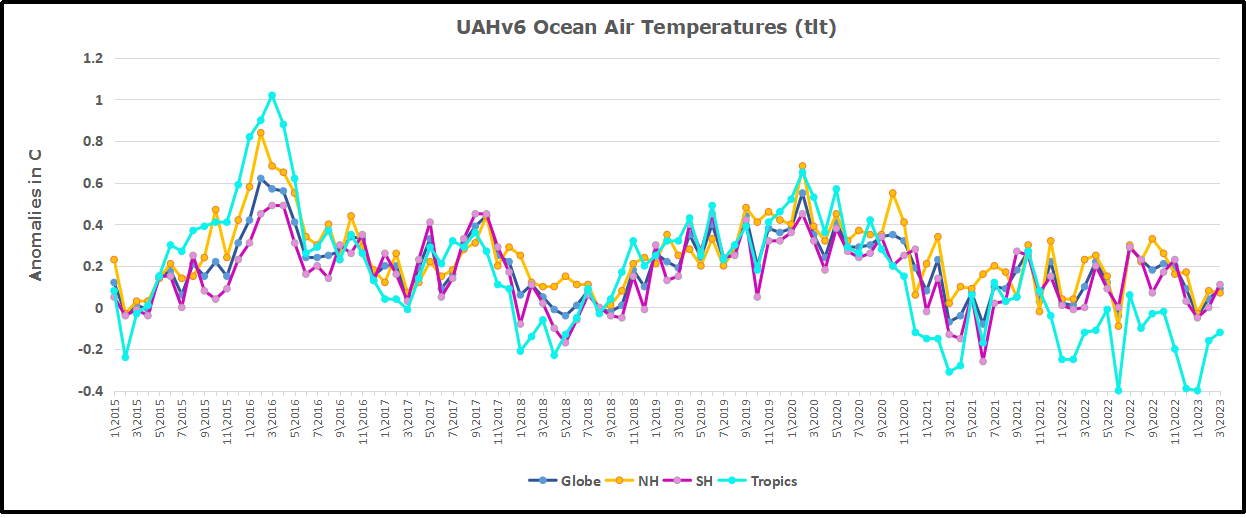
The UAH dataset includes temperature results for air above the oceans, and thus should be most comparable to the SSTs. There is the additional feature that ocean air temps avoid Urban Heat Islands (UHI).  The graph below shows monthly anomalies for ocean air temps since January 2015.

Note 2020 was warmed mainly by a spike in February in all regions, and secondarily by an October spike in NH alone. In 2021, SH and the Tropics both pulled the Global anomaly down to a new low in April. Then SH and Tropics upward spikes, along with NH warming brought Global temps to a peak in October.  That warmth was gone as November 2021 ocean temps plummeted everywhere. After an upward bump 01/2022 temps reversed and plunged downward in June.  After an upward spike in July, ocean air everywhere cooled in August and also in September.   After sharp cooling everywhere in January 2023, all regions were into negative territory. Now in February and March, an uptick in the Tropics led to a small rise globally slightly above zero.

Land Air Temperatures Tracking Downward in Seesaw Pattern

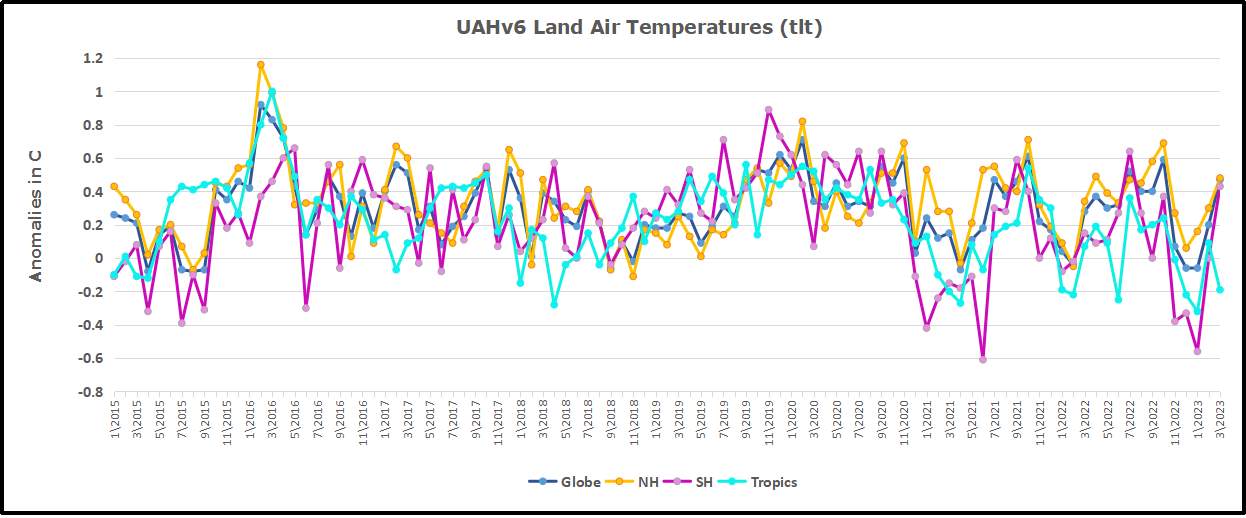
We sometimes overlook that in climate temperature records, while the oceans are measured directly with SSTs, land temps are measured only indirectly.  The land temperature records at surface stations sample air temps at 2 meters above ground.  UAH gives tlt anomalies for air over land separately from ocean air temps.  The graph updated for March is below.

Here we have fresh evidence of the greater volatility of the Land temperatures, along with extraordinary departures by SH land.  Land temps are dominated by NH with a 2021 spike in January,  then dropping before rising in the summer to peak in October 2021. As with the ocean air temps, all that was erased in November with a sharp cooling everywhere.  After a summer 2022 NH spike, land temps dropped everywhere, and in January, further cooling in SH and Tropics offset by an uptick in NH.  Now in February and March both SH and Tropics along with NH pulled up the Global land anomaly.

The Bigger Picture UAH Global Since 1980

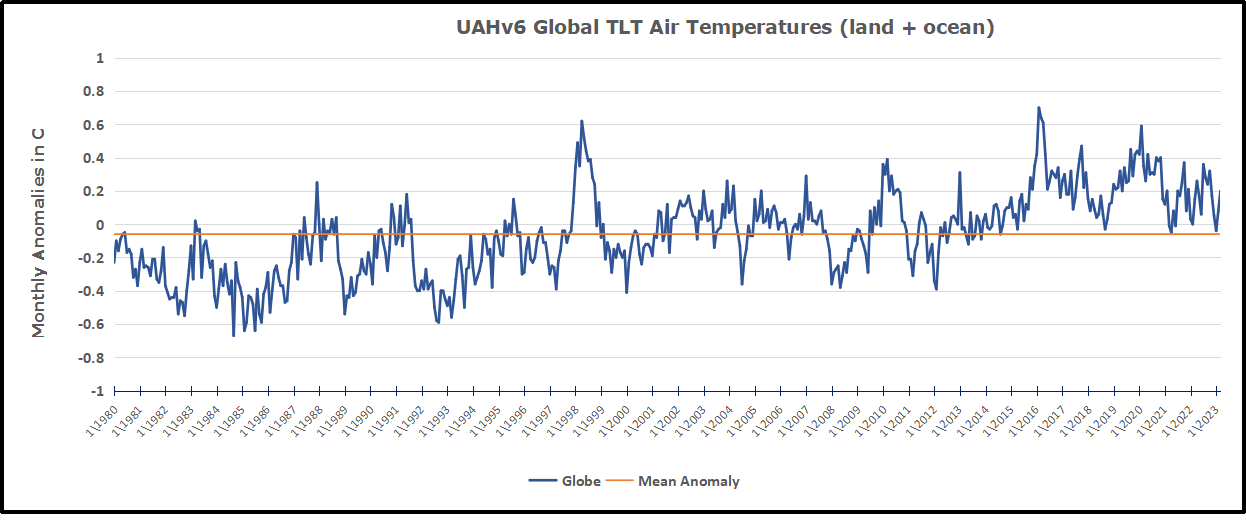
The chart shows monthly Global anomalies starting 01/1980 to present.  The average monthly anomaly is -0.06, for this period of more than four decades.  The graph shows the 1998 El Nino after which the mean resumed, and again after the smaller 2010 event. The 2016 El Nino matched 1998 peak and in addition NH after effects lasted longer, followed by the NH warming 2019-20.   An upward bump in 2021 was reversed with temps having returned close to the mean as of 2/2022.  March and April brought warmer Global temps, later reversed, and with the sharp drops in Nov., Dec. and January 2023 temps, there was no increase over 1980. Now in February and March there is a slight rebound over zero.

TLTs include mixing above the oceans and probably some influence from nearby more volatile land temps.  Clearly NH and Global land temps have been dropping in a seesaw pattern, nearly 1C lower than the 2016 peak.  Since the ocean has 1000 times the heat capacity as the atmosphere, that cooling is a significant driving force.  TLT measures started the recent cooling later than SSTs from HadSST3, but are now showing the same pattern.  It seems obvious that despite the three El Ninos, their warming has not persisted, and without them it would probably have cooled since 1995.  Of course, the future has not yet been written.


Why Kids Are Not OK

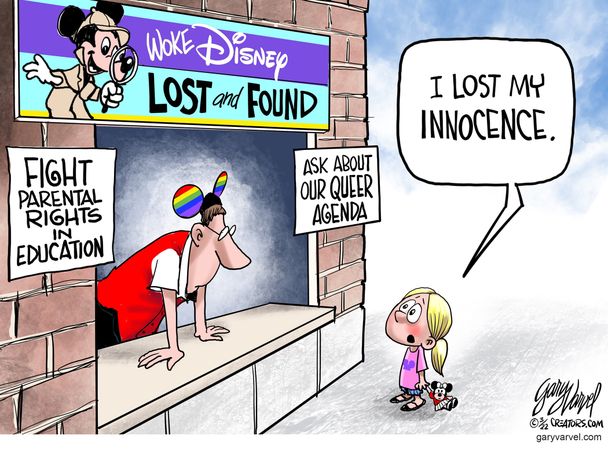
Bruce Abramson explains in his Real Clear Wire article Pity the Child.  Excerpts in italics with my bolds and added images.  H/T Tyler Durden

A Review of “Stolen Youth” by Karol Markowicz and Bethany Mandel

About a decade ago, toddler son in tow, I found myself in a playground for the first time in 35 years. It was not what I remembered. The colors were far more vibrant. Plastic had replaced wood and metal. Sharp edges had been rounded, chains and hinges softened. Cushioned ground had replaced the asphalt.

What struck me most, however, was that it was full of adults. It seemed that every child had a minder within arms length. I was perplexed. I knew why I was there—my son was still a bit wobbly. Many of the kids appeared to be about 6-8 years old. Why did they need minders?

I soon learned the two cardinal rules of contemporary playgrounds (or at the very least, playgrounds on Manhattan’s Upper West Side): One, your child may not get hurt. Two, your child may not hurt another child. Violate the first rule, and you’re negligent. Violate the second and you’re antisocial—borderline criminal. Also, and just for good measure, “hurt” is given the broadest possible definition to include potentially hurtful language.

The stories about fragile college snowflakes crumbling in the face
of microaggressions and provocative ideas suddenly made sense.
Children raised in a cocoon will demand similar protection
when they begin to think of themselves as adults.

That initial shock was hardly the end of my education. I soon learned the corollary to the playground rules: Today’s children never learn to engage in disintermediated play. The natural, if often rough, society of 3-to-5 years olds never gets to form. When my son hit that age, I was stunned to have other kids approach me to report that he was being annoying. When I was a child, running to a parent was the equivalent of a 911 call. We might have approached with a message like “your kid is bleeding” or “we think he broke something,” but annoying? That was like calling the Fire Department because you couldn’t find the remote.

It became clear to me that we had destroyed childhood. While the “advances” in parenting of the past fifty years undoubtedly contained some gems, the net effect was a disaster. As with so much else in life, human instincts honed over the millennia were far superior to decades of expert advice.

Then things got really bad. Though few recognized it as such at the time, the decision to shutter much of the world in March 2020 unraveled the entire socioeconomic fabric of modern life. As anyone who has ever studied or worked with any complex system can confirm, nothing ever restarts quite as it was before a shutdown.

American society was hardly the exception. The hibernation derailed every pre-existing positive trend and accelerated all the negative. The restart, unfolding in uneven fits-and-starts over the course of two years, introduced an entirely new sociology. Though its precise contours are still taking shape, a few things are clear: Woke reigns supreme and children are expendable.

While most Americans are still digesting the changes, a few brave souls flew into action. Bethany Mandel and Karol Markowicz moved quickly to chronicle the attacks on our children, ring the alarm, and call for action.

Stolen Youth is a disturbing read.
Every page bristles with details of the attack on our children.

The combined impact of these attacks is clear: There is a large, organized, well-funded movement, drawing together media, professional organizations, teachers unions, corporations, universities, and government officials committed to destroying and indoctrinating our children. Its methods are brutal and clear: It promotes psychological instability and fragility. It teaches children to ignore their emerging common sense, their parents, and timeless ethics in favor of expert pronouncements and trendy social constructs. It deconstructs language to detach negative words from their underlying concepts then reapplies them to entirely different concepts consistent with indoctrination.

The authors divvied up the chapters, perhaps each claiming the atrocities they dread the most. Markowicz, an émigré from the former Soviet Union, opens the book with a reminder of what it means to live in a totalitarian society. Spoiler alert: We’re heading there fast.

She then moves into the various ways that the woke weaponized Covid—both the virus and the shutdowns—to convince our children that they are little more than viral vectors safe only in isolation. Mandel picks up that baton a few chapters later in her broader consideration of woke pediatrics.

That discussion incorporates one of the book’s most chilling quotes. It comes courtesy of the Federation of State Medical Boards which, on July 29, 2021, threatened disciplinary action, “including the suspension or revocation of the medical licenses” of any physician who shared any information or opinion about Covid vaccines that was not “factual, scientifically grounded, and consensus-driven.”

Those first two qualifiers are unobjectionable. The third gives the game away. What does it mean for something to be “consensus-driven?” Consensus among who, and for how long? Those of us who’ve been paying attention know how it works. A few well-connected prestigious and/or governmental “experts” determine what they would like everyone to believe. They then condition funding, promotion, and even licensure on acceptance. Unsurprisingly, given the choice between: (a) Promoting the emerging consensus, keeping your job, and securing funding; or (b) Retaining integrity, getting fired, and becoming unemployable, most professionals choose (a).

Voila! Instant overwhelming consensus,
which must now be imposed, obeyed, and unquestioned.

The medical establishment, long known for its imperious nature, was unusually open in tipping its hand. As the authors show, however, its practice is hardly novel. Consensus-driven expertise emanating from schools, libraries, media, and entertainment teaches our colorblind children to develop a hyperfocus on race and sexualizes the pre-sexual. The woke teach our children to become racist and sexually confused, blame traditional American mores for racism and repression, and claim the mantle of expertise needed to “fix” the problem.

The entire process is designed to keep today’s kids off-balance.

Covid taught them to fear normal social interactions. Critical Race Theory teaches them to distrust their neighbors. Gender theory teaches them to question their bodies. The woke package combines to externalize our children’s problems and teaches them to see themselves as victims. It preaches looking outward to assign blame rather than looking inward to find solutions.

As Markowicz and Mandel put the pieces together, it becomes clear that the woke juggernaut cannot be contained by critiquing its views of race and gender. Those are but two of the more prominent avenues of attack in an all-out assault. The woke are operating in a total moral inversion: compassion for some hypothetical, distant member of society and contempt for those closest to us. It’s a perfect prescription for totalitarian tyranny: Absolute trust in the emanations of disembodied expert authority and disrespect for parental authority. The woke are teaching our children to despise and disrespect family, God, nation, and even their own biology.

Why target the children? First, as Markowicz notes in her chapter on “Child Soldiers,” because kids are useful. Put a disturbed child—say, Greta Thunberg—in front of your movement, and only the very callous will attack. That tactic is hardly new—there’s a reason we’ve long talked about “poster children”—though the woke do seem to have turned it into an art form. Second, because childhood is when we shape our beliefs and our tastes.

Convince a generation that it’s fragile, off-balance, angry, victimized, and oppressed,
and very few of its members will ever break out.

Stolen Youth is one of the clearest articulations yet of the woke drive to destroy American society and Western Civilization. That it’s starting with our children is hardly novel for an ideological movement. The question we must now face is whether we can alert enough adults to the danger to repel it before it is truly too late.

Stolen Youth rings the alarm bells. I only hope that they’re loud enough
to have the desired—and necessary—effect.


Inside the Carbon Cult

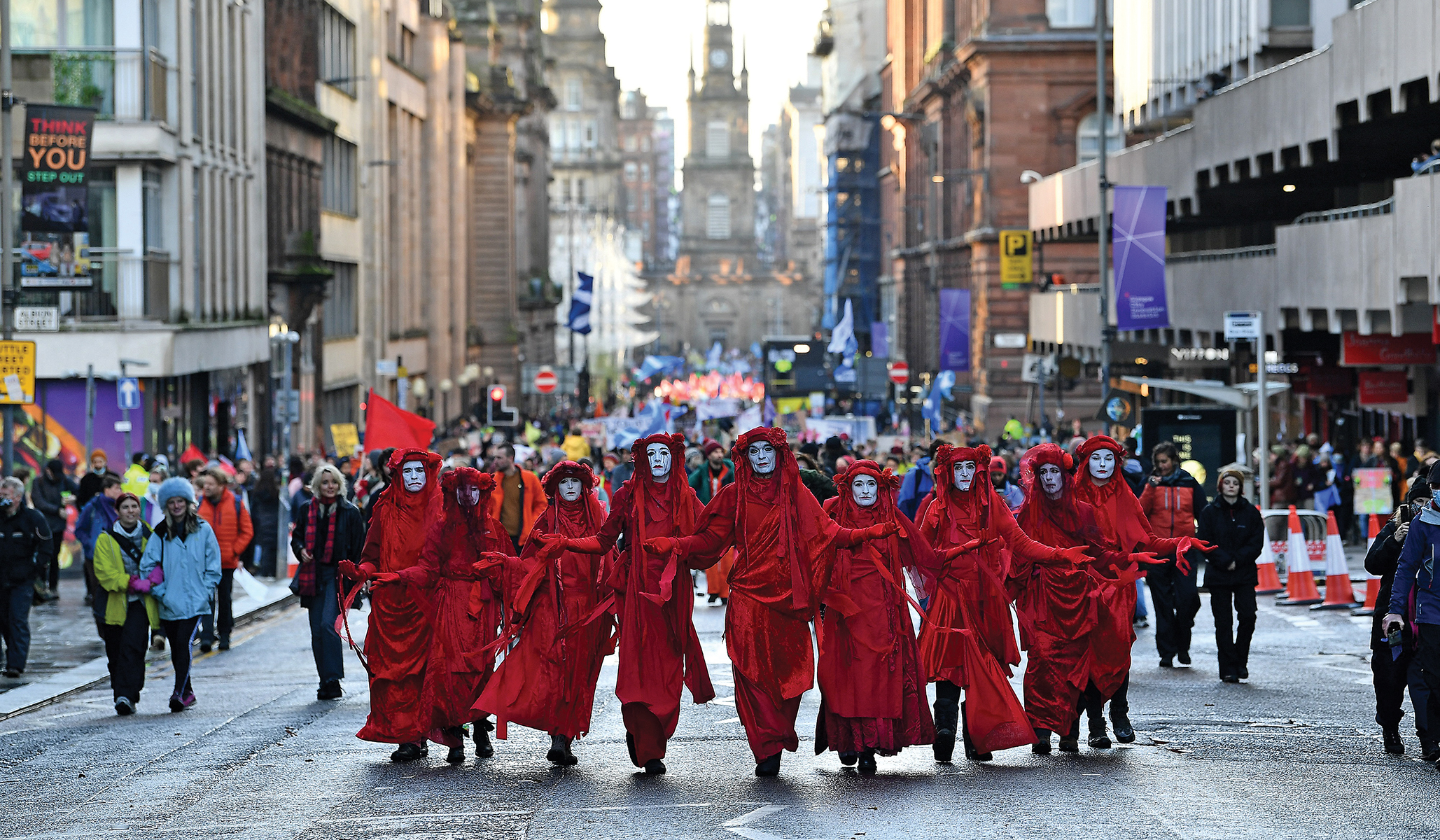
In Glasgow, members of an activist troupe protest climate change.(Ben Stansall/AFP via Getty Images)

Kevin D. Williamson has written a study on this topic, subtitled:

Reports on the religious character of the environmental movement

Below in italics with my bolds is the excerpted Introduction and at the end a link to the entire pdf. H/T Competitive Enterprise Institute.

This is not a religious book in the sense of its being meant to convey a religious message or for people of a particular religion—it is a book containing three journalistic reports about a religion, or a sort of religion, that emerged from and then subsumed the environmental movement. Today, that movement is a kind of cult and not a political movement at all, if it ever was one. Those who profess one of the Abrahamic faiths have a religious interest in idolatry because it perverts religion and leads religion to inhuman ends—Norman Podhoretz, in his very interesting book The Prophets, describes the ancient Israelite “war on idolatry” as a matter that is not exclusively otherworldly but very much rooted in a campaign against the ghastly social practices associated with idolatry: cannibalism, child sacrifice, etc.

And if idolatry makes a hash of religion, it is, if anything, even more of a menace
to the practice of politics, which is my subject.

I suspect that some of you may object to the term idolatry here, or to the description of the environmental movement as a kind of cult—that some readers may regard these as rhetorical excesses. All that I have to say in my defense is that this is a factual and literal account of what I have seen and heard in reporting about the environmental movement, in the actual explicit religious ceremonies that were conducted in and around the United Nations climate conference in Glasgow in 2021, in my conversations with such figures as the “voluntary human extinction” activist who calls himself Les U. Knight, in my conversations with those who object to clean and economical nuclear power on grounds that are, even when not accompanied by pseudo- religious Gaia rhetoric, fundamentally metaphysical. What is at work is a kind of sophomoric, cartoon puritanism that regards modernity—and, in particular, the extent and pattern of consumption in the modern developed world— as sinful. One need not squint too much to recognize very old Christian (or even Stoic) aversion to “luxury” in these denunciations.

Indeed, we need only take the true believers at their word. As scientists have been searching for economic, abundant, and environmentally responsible sources of energy to support human flourishing, the environmentalists have resisted and abominated these efforts: Amory Lovins of Friends of the Earth declared that “it would be little short of disastrous for us to discover a source of clean, cheap, abundant energy”—and please note there the inclusion of clean—while Population Bomb author Paul Ehrlich famously opined that “giving society cheap, abundant energy at this point would be the equivalent of giving an idiot child a machine gun.” Professor Ehrlich gives up the game with “at this point”—meaning, of course, in our fallen, postlapsarian state.

It was, of course, inevitable that Professor Ehrlich— who has been spectacularly wrong about practically every prediction he has made in his lucrative career as a secular, Malthusian prophet—should be back in the news at the same time scientists were announcing a breakthrough in nuclear fusion research. Professor Ehrlich, recently seen on 60 Minutes (which still exists!) and elsewhere, downplays the recent advance in fusion on the grounds that current patterns of human living are “unsustainable.” Professor Ehrlich has been giving the same interview for decade and decades—advances in energy production will not matter because “the world will have long since succumbed to overpopulation, famine,” and other ills, as he insisted in an interview published by the Los Angeles Times—in 1989— not long after insisting that the United Kingdom would be ravished by famine no later than the year 2000. 

End-of- days stories have long been a staple of religions and cults of many different kinds and characters, of course, and the environmental movement is fundamentally eschatological in its orientation, by turns utopian and apocalyptic. It is at the moment more apocalyptic than utopian, but that is a reflection of a broader trend in our politics and our society. The Western world, in particular, the English-speaking Western world, has been fervently praying for its own demise for a generation. Future historians will note the prevalence of zombie-apocalypse stories in our time—The Walking Dead has recently concluded its main series but will be supplemented by numerous spinoffs, while one of the most intensely anticipated television series of 2023 is The Last of Us, an adaptation of a video game that is based on yet another variation of the zombie-apocalypse theme—but beyond zombie-apocalypse stories we have alien-invasion- apocalypse stories, and, precisely to our point here, eco-apocalypse stories by the dozen (The Day After Tomorrow, Snowpiercer, Waterworld, Interstellar, Wall-E).

What these stories have in common is not the particular source of anxiety, though environmental concerns are interlaced into many stories: The Last of Us is a zombie story, but the zombies are produced by global warming, which allows a particular fungus to colonize and control human brains. (One shared article of faith that is present not only in zombie movies but also from campy, anencephalic or macrocephalic aliens of Mars Attacks! and Independence Day—the enemy is the brain.) What they have in common, rather, is a two-sided fascination with social collapse, both the negative aspects—the inevitable suffering—and the positive—the possibility of a return to innocence and a shared born-against experience that retroactively sanctifies that suffering. 

Which is to say, what we have here is the old mythological cycle
of suffering, death,and rebirth told at the social level
rather than at the level of individual hero or martyr.

None of this is to say that there are not real environmental challenges in front of us. These are real, and they deserve serious attention. But here in the third decade of the benighted 21st century, the environmental movement is not about that. It is an apocalyptic-fantasy cult. Of course there are people who think of themselves as adherents of that movement who are doing real work in science and policy, in much the same way that the alchemists and magicians of the medieval period laid the foundations for much of modern science, including a great deal of chemistry and astronomy. The two phenomena are by no means mutually exclusive.

But if you want to understand why there has been so frustratingly little meaningful progress in environmental policy in the United States, the United Kingdom, and the European Union in the past 30 years or so, then understanding the cultic character of the environmental movement is essential. The real environmental-policy debate should be, not to put too fine a point on it, boring, though by no means simple—a largely technical matter of understanding tradeoffs and drawing up policies that attempt to balance competing goods (environmental, recreational, economic, social, etc.) and putting those policies to the test of democratic accountability. None of this is easy in a connected and global world—prohibit the use of coal in the United States and you might end up increasing worldwide coal-related greenhouse-gas emissions as relatively dirty power plants in China and India take up the slack in consumption—but none of it ought to present a Manichean conflict, either.

Demagoguery is an old and obvious factor in all political discourse, but there is at work here something deeper than mere political opportunism, and that is the invariable human need, sometimes subtly realized, to rewrite complex stories as simple stories, replacing real-world complexity with the anaesthetizing simplicity of heroes and villains. We have been here before, of course. Consider Robert Wiebe’s anthropology of bureaucracy in the Progressive Era in The Search for Order:

The sanguine followers of the bureaucratic way constructed their world on a comfortable set of assumptions. While they shaded many of the old moral absolutes, they still thought in terms of normal and abnormal. Rationality and peace, decent living conditions and equal opportunity, they considered “natural”; passion and violence, slums and deprivation, were “unnatural.” Knowledge, they were convinced, was power, specifically the power to guide men into the future. Consequently, these hopeful people also exposed themselves to the shock of bloody catastrophe. In contrast to the predetermined stages of the idealists, however, bureaucratic thought had made indeterminate process central to its approach. Presupposing the unexpected, its adherents were most resilient just where the idealists were most brittle.

Of course, the assumptions described by Wiebe are precisely backward:
It is deprivation and violence that are natural, peace and plenty that are unnatural.

As Thomas Sowell famously observed, poverty has no causes— prosperity has causes, while poverty is the natural state of human affairs, present and effective ex nihilo. But the conflation of the natural and the desirable is always with us: Like most Americans, I treasure our national parks and have spent many enjoyable days in them, but it is difficult to think of any environment anywhere on Earth that is less natural than Yellowstone, the highly artificial environment that is the product of planning and policy, for instance in the programmatic introduction of grey wolves and other species.

To subscribe to a genuinely natural view of the world and man’s place in it, as opposed to a quasi-religious environmental dualism, is to understand man as integral part of nature, in which case you might think of Midtown Manhattan as a less artificial and more organic environment than Yellowstone, its features and patterns considerably more spontaneous than what one finds in a diligently managed nature preserve. If, on the other hand, you understand the natural world and the wild places in it principally as a paradisiac spiritual counterpoint to the fallen state of man as represented in our urban and technological civilization, then you cannot make any kind of reasonable tradeoff calculation when it comes to, say, drilling for gas in the Arctic, which must be regarded not as a poor policy choice but as a profanation, a “violation” of that which is “pristine” and “sacred”—words that one commonly hears applied to the Arctic National Wildlife Refuge and to many less exalted swamps and swathes of tundra.

For myself, what I want is a boring environmental policy, one that is, in Wiebe’s terms, less brittle and more resilient, one that in “presupposing the unexpected” is able to account for developments that complicate our environmental policies by enmeshing them in other policies that they also complicate. For example, try putting yourself in the position of a responsible policy analyst in 1968, when Ehrlich’s Population Bomb hit the shelves. In 1968, it would have been very difficult to imagine the subsequent transformation of China into a modern economic power—and even more difficult to imagine that this development would be not entirely and unqualifiedly good for the world, given the resources it has put at the disposal of what today must be regarded as history’s most encompassing and sophisticated police state. (So far.)

But instead of a political discourse that can take such developments on their own terms
and put them into a context of competing goods and tradeoffs,
we end up instead with a parade of Great Satans.

For the environmental cultists, the Great Satan is Exxon; for certain self-described nationalists in the United States, the Great Satan is the Chinese Communist Party; the strangely durable Marxists and the neo-nationalists on the Right have, with utter predictability, converged on their choice of Great Satans, these being transnational “elites.” And so the religious appetite is satisfied through politics, including, in a particularly intense way, through environmental politics. To take one example that seems very obvious to me, the United States and much of the rest of the world, including the developing world, would be much better off on practically every applicable metric if there were wider and more sophisticated deployment of nuclear power, which is not a panacea by any means, but is a reliable, economical, and effectively zero-emissions way to produce electricity at utility scale. The case against nuclear power might be described, in generous terms, as “moral” or “pseudo-religious” but might be described more accurately as “superstitious.” But maybe that kind of metaphysical primitivism is to be expected from a political movement whose economic agenda includes a great deal of physical primitivism as well: In the neo-Neolithic future of their dreams, there won’t be much to do in the evenings except bark at the moon, so one may as well try to imbue it with some transcendent meaning.

The environment matters. So do property rights, trade, development, agriculture, medicine, energy, the rule of law, democracy, and the uncountable other constituent elements of human flourishing. A reasonable environmental policy can work with that, but a spiritualized and cultic environmental policy cannot. I hope these reports will help to make it clear just how real the choice between these two kinds of environmentalism is.

Kevin D. Williamson
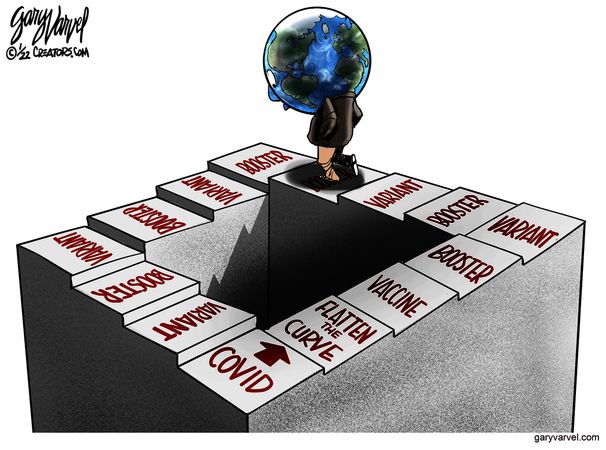
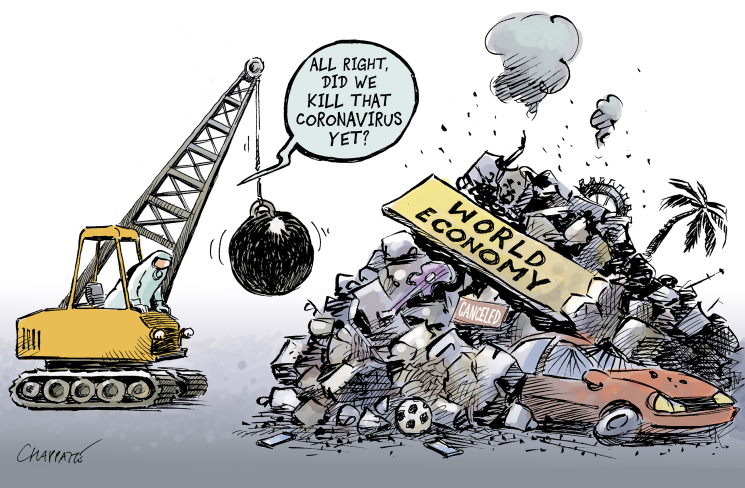
Nine Elements Shared by Climate and Covid

Two Sides of the Same Coin

Ramesh Thakur writes at Brownstone Institute Beware Catastrophizing Climate Models and Activists.  Excerpts in italics with my bolds and added images.

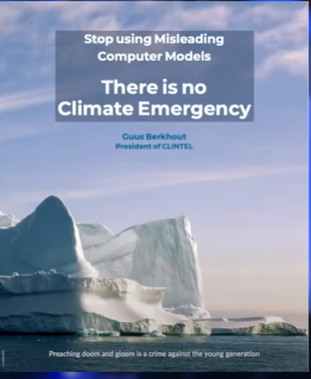
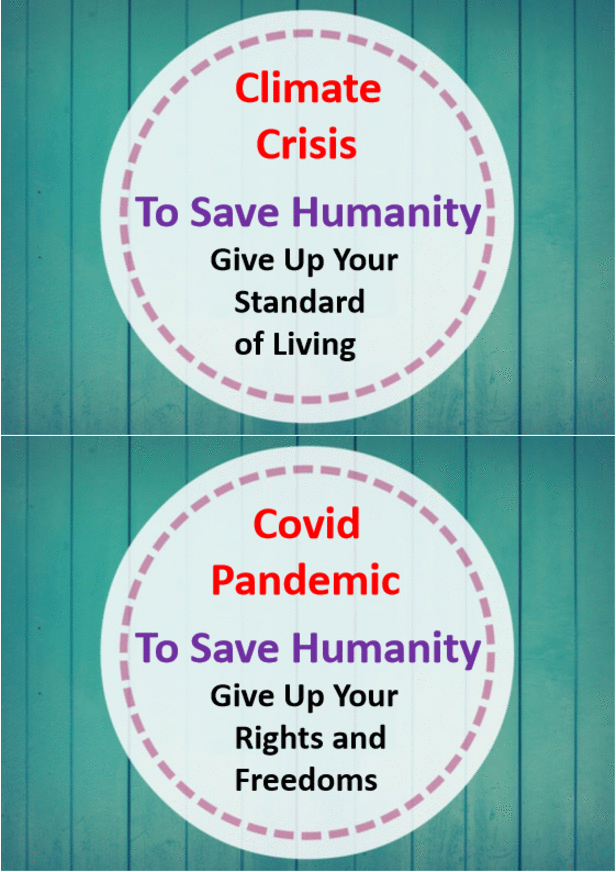
All true believers of The Science™ of climate change have taken careful note of the lessons offered by the coronavirus pandemic during 2020–22 for managing the ‘climate emergency.’ The two agendas share nine items in common that should leave us worried, very worried.

1. Elites’ Hypocrisy

The first is the revolting spectacle of the hypocrisy of the exalted elites who preach to the deplorables the proper etiquette of abstinence to deal with the emergency, and their own insouciant exemption from a restrictive lifestyle. Most recently we witnessed the surreal spectacle of Britain’s Parliament interrogating disgraced former Prime Minister Boris Johnson on allegations that he serially broke the lockdown rules he had imposed on everyone else—but not questioning the anti-scientific stupidity of the rules themselves. Possibly the most notorious American example was California Governor Gavin Newsom and his cronies dining maskless in the appropriately named French Laundry restaurant at a time when this was verboten, being served by fully masked staff.

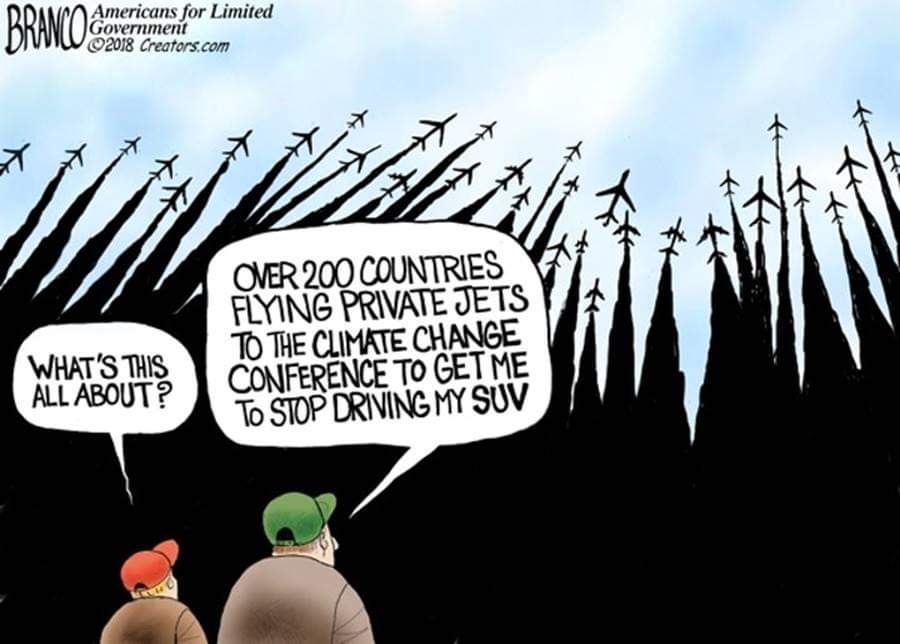
Similarly, Prince Harry, Meghan Markle, Al Gore, and John Kerry have all been widely mocked for jetting around the world to warn people about global warming. I wonder if anyone has done a calculation of the total carbon footprint of each annual Davos gathering where CEOs, prime ministers and presidents, and celebrities fly in on private jets, are driven around in gas-guzzling limousines and preach to us on the critical urgency of reducing emissions? I understand the hookers do quite well during that week, so perhaps there is a silver lining.

2. Data Challenged Models

A second common element between Covid and climate change is the mismatch between models that inform policy and data that contradict the models. The long track record of abysmally wrong catastrophist predictions on infectious diseases from the Pied Piper of Pandemic Porn, Professor Neil Ferguson, is if anything exceeded by the failures of climate change alarmist predictions. The most recent example of the drum roll of “The end is nigh and this is absolutely your last chance to avert the end of the world from climate collapse” is yet another Chicken Little Sixth Assessment Report from the indefatigable Intergovernmental Panel on Climate Change (IPCC).

At some point the IPCC morphed from a team of scientists into activists.

“There is a rapidly closing window of opportunity to secure a liveable and sustainable future for all,” the report warns us. UN Secretary-General Antonio Guterres called it a “survival guide for humanity.” But a one-time climate action journalist-turned-sceptic, Michael Shellenberger, described the UN as a “Climate Disinformation Threat Actor.”

Calls for urgent climate action based on the language of “edging towards ‘tipping points” have been made over many years. Atmospheric scientists and former IPCC members Richard McNider and John Christy note that climate modeling forecasts have “always overstated the degree to which the Earth is warming compared with what we see in the real climate.” A few examples:

♦  In 1982, UNEP Executive Director Mostafa Tolba warned of an irreversible environmental catastrophe by 2000 without immediate urgent action.
♦  In 2004, a Pentagon report warned that by 2020, major European cities would be submerged by rising seas, Britain would be facing a Siberian climate and the world would be caught up in mega-droughts, famine and widespread rioting.
♦  In 2007, IPCC chair Rajendra Pachauri declared: “If there’s no action before 2012, that’s too late.”
♦  Most hilariously, in Montana the Glacier National Park installed “Goodbye to the glaciers” plaques, warning: “Computer models indicate the glaciers will all be gone by the year 2020.” Come 2020, all 29 glaciers were still there but the signs were gone, taken down by embarrassed park authorities.

3. No Dissent Allowed

Third, the rapidly consolidating Censorship Industrial Complex covered both agendas until Elon Musk began releasing the Twitter Files to expose what was happening. This refers to the extraordinary censorship and suppression of dissenting voices, with extensive and possibly illegal collusion between governments and Big Tech—and, in the case of the pandemic, also Big Pharma and academia.

Even truth was no defence, for example with accounts of vaccine injuries, if their effect was to promote narrative scepticism. The social media Big Tech censored, suppressed, shadow banned and slapped labels of “false,” “misleading,” “lacking context” etc. to content at variance with the single source ministries of truth. “Fact-checking” was weaponized using fresh young graduates—with no training, skills or capacity to sift between authentic and junk science—to put such judgmental stamps on pronouncements from world-leading experts in their field.

4. We Want You to Panic

Fourth, an important explanation for the spread of Covid and climate catastrophism is the promotion of fear and panic in the population as a means to spur drastic political action. Both agendas have been astonishingly successful.

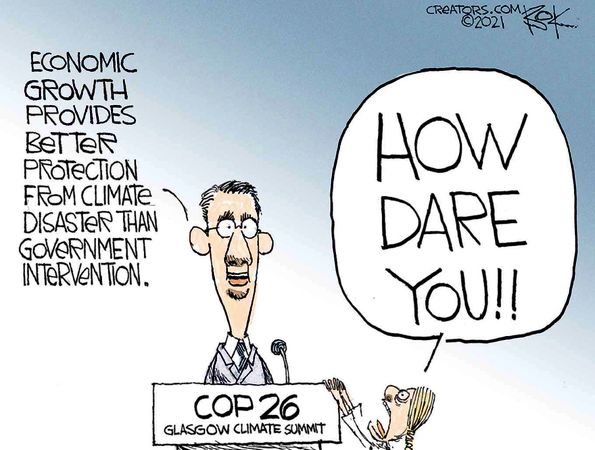
Polls have consistently shown the hugely exaggerated beliefs about the scale of the Covid threat. On climate change, the gap between the stringent actions required, the commitments made and the actual record thus far is used to create panic. The notion that we are already doomed promotes a culture of hopelessness and despair best epitomized by Greta Thunberg’s anguished cry: “How dare you” steal my dreams and childhood with empty words.”

5. Only Trust Science Authorities

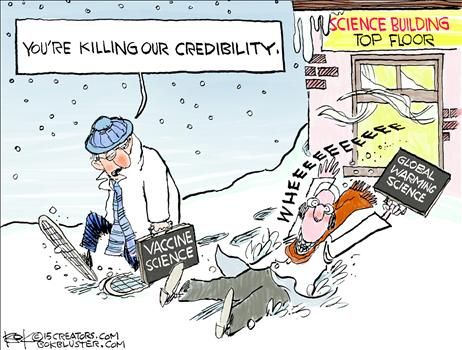
A fifth common theme is the appeal to scientific authority. For this to work, scientific consensus is crucial. Yet, driven by intellectual curiosity, questioning existing knowledge is the very essence of the scientific enterprise. For the claim to scientific consensus to be broadly accepted, therefore, supporting evidence must be exaggerated, contrary evidence discredited, sceptical voices stilled and dissenters ridiculed and marginalized. This has happened in both agendas: just ask Jay Bhattacharya on one and Bjorn Lomborg on the other.

6. Government Empowers Itself

A sixth shared element is the enormous expansion of powers for the nanny state that bosses citizens and businesses because governments know best and can pick winners and losers. Growing state control over private activities is justified by being framed as minor and temporary inconveniences in the moral crusade to save Granny and the world.

Yet in both agendas, policy interventions have over-promised and under-delivered. The beneficial effects of interventions are exaggerated, optimistic forecasts are made and potential costs and downsides are discounted. Lockdowns were supposedly required for only 2-3 weeks to flatten the curve and vaccines, we were promised, would help us return to pre-Covid normalcy without being mandatory. Similarly, for decades we have been promised that renewables are getting less expensive and energy will get cheaper and more plentiful.

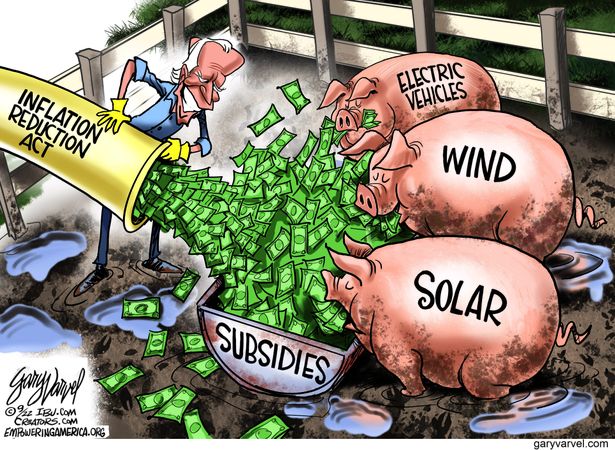
Yet increased subsidies are still needed, energy prices keep rising,
and energy supply gets less reliable and more intermittent.

7. Self-Inflicted Damage

Seventh, the moral framing has also been used to discount massive economic self-harm. Alongside the substantial and lasting economic damage caused by savage lockdowns to businesses and the long-term consequences of a massive printing of money, the obstinate persistence of excess deaths is painful proof of collective public health self-harm.

Similarly, the world has never been healthier, wealthier, better educated, and more connected than today. Energy intensity played a critical role in driving agricultural and industrial production that underpin the health infrastructure and comfortable living standards for large numbers of people worldwide. High income countries enjoy incomparably better health standards and outcomes because of their national wealth.

8. Elites Thrive at Others’ Expense

Eighth, government policies in both agendas have served to greatly widen economic inequalities within and among nations with fat profits for Big Pharma and rent-seeking Green Energy. A lot of money was said to be required to keep Mahatma Gandhi in the style of poverty he demanded. Similarly, a lot of money is required to support Covid and climate policy magical thinking where governments can solve all problems by throwing more money that must neither be earned nor repaid.

In the triumph of luxury politics, the costs of the rich suffused in the golden glow of virtue are borne by the poor. Should a billion more Chinese and Indians have stayed poor and destitute over the last four decades, so Westerners could feel virtuous-green? Alternatively, for post-industrial societies, climate action will require cutbacks to living standards as subsidies rise, power prices go up, reliability comes down and jobs are lost.

Attempts to assess the balance of costs and benefits of Covid and climate policies are shouted down as immoral and evil, putting profits before lives. But neither health nor climate policy can dictate economic, development, energy and other policies. All governments work to balance multiple competing policy priorities. What is the sweet spot that ensures reliable, affordable and clean energy security without big job losses? Or the sweet spot of affordable, accessible and efficient public health delivery that does not compromise the nation’s ability to educate its young, look after the elderly and vulnerable and ensure decent jobs and life opportunities for families?

9. Global Bureaucrats Gut National Sovereignty

The final common element is the subordination of state-based decision-making to international technocrats. This is best exemplified in the proliferation of the global climate change bureaucracies and the promise—threat?—of a new global pandemic treaty whose custodian will be a mighty World Health Organisation.

In both cases, the dedicated international bureaucracy will have a powerful
vested interest in ongoing climate crises and serially repeating pandemics.


Prog Jihadists Crossing Bridges. Going Too Far?

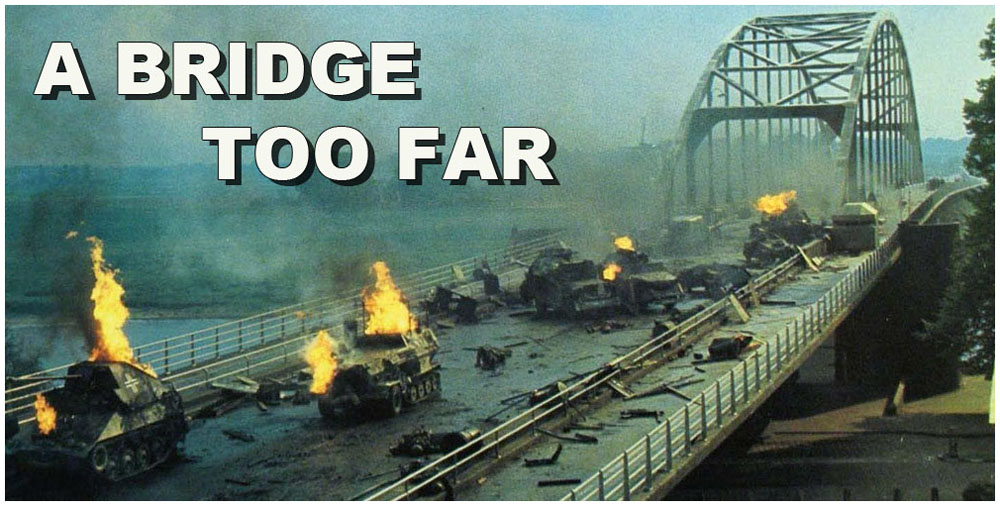
Based on a non-fiction book of the same name by historian Cornelius Ryan, A Bridge Too Far is a 1977 epic war film depicting Operation Market Garden, a failed Allied operation using paratroopers to secure three bridges over three key rivers in Nazi-occupied Netherlands during World War II.  The phrase has come to mean “a long shot”, or an overly ambitious plan.

America’s institutions currently have been invaded increasingly by Progressive Jihadists, i.e. true believers in global socialist ideology under the guise of rainbow flags and DIE protocols.  So far, it has been a cultural warfare, with educational and governmental institutions surrendering with token, or no resistance.  However, since the Washington D.C. takeover by the prog regime (so-called Biden administration) more often firearms are involved, as symbolized by the military perimeter around the US Capital lest anyone object to the new governance.

More than 25,000 troops from across the country were dispatched to the US capital on January 13, 2021.

Some of this move to kinetic warfare was evident in the 2020 Antifa insurrections in places like Portland and Seattle.  Guns are also used by criminals in blue cities like Chicago, NYC and SF.  As well the fentanyl trade at the Southern US border is empowered by guns. But a new bridge was just crossed in Nashville, Tennessee, when a transgender soldier fired 150 bullets inside a Christian school, murdering six innocents, including three children, two teachers and the principal.  That terrorist event followed Tennessee laws enacted in March protecting children against drag shows and from gender transition surgery and treatments.

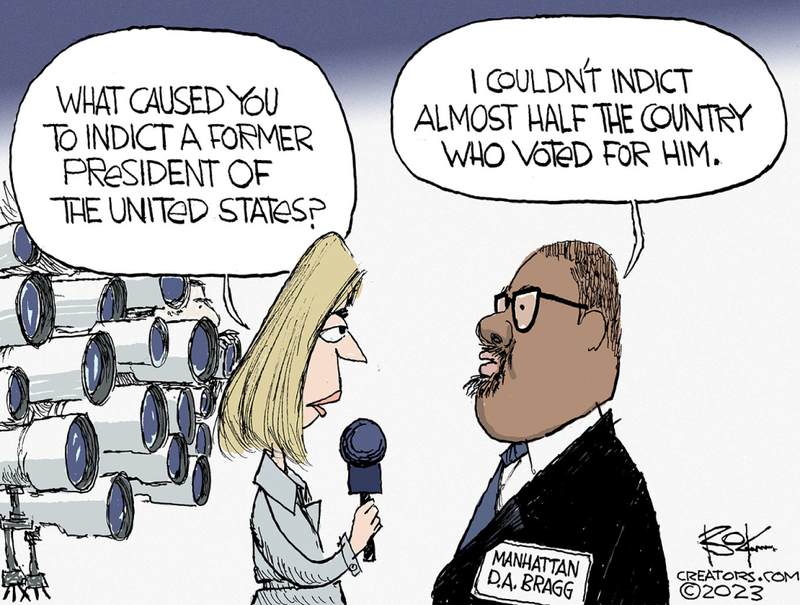
Another bridge was crossed with the Trumped-up indictment of the former President in NYC.  It signifies that the Justice System has also been taken over and put into service of the prog ideology.  Like Sharia law imposed anywhere in the world that Islam prevails, now US Federal Justice distinguishes between true believers (the Ummah) who enjoy full citizenship rights, versus the infidels (Kafir) who, if allowed to co-exist at all, are an underclass with few privileges other than working in service of their overlords.  In Manhattan, as in other blue states,  people who are the right skin color, gender, or sexual preference are not prosecuted for felonies like stealing, vandalism, battery, or even murder, while the Kafir-in-Chief, Donald Trump (“Rich old white guy”–DA Bragg) is arrested on imaginary charges.

How far can they go with these perversions against American heritage and ideals?  One answer comes from Arkansas where Brandon Meeks writes Middle Americans at American Mind.  Go Brandon!  Excerpts in italics with my bolds and added images.

What might it actually look like to represent the real interests and values of most voters?

One reason I rarely venture into the realm of American politics is because I am not in the habit of going places I do not belong, much less where I am not wanted. And I am as out of place among both Republicans and Democrats as a country ham at a synagogue.

I see no value in hitching my wagon to an elephant with neither sense of direction nor recollection of where he came from. Neither do I welcome the prospect of hooking myself to an ass that can’t plow in a straight line and tries to bite me at every turn.

I’d wager that I’m not the only one who thinks this way. In fact, if there exist out there any politicians with the pie-eyed hope of unifying the country behind a saner program than what’s currently on offer, they might do well to think about how people like me see the world.

I can’t remember the last time I trusted a politician of any stripe. Most are so crooked that when they die, the undertaker will have to screw them into the ground with a torque wrench. Ninety-nine point nine percent of them, blue and red, should be handed a pink slip and told to get further and smell better.

One party prides itself on being “conservative,” while having nothing to conserve but the madness of five minutes ago. The other gloats about being “progressive,” which seems to mean careening off the edge of a cliff like a gaggle of over-eager lemmings. Neither sounds very appealing to me.

I was born into a family of traditionalist Southern Democrats—a breed of political animal that has gone the way of the Dodo Bird in my lifetime. I live in a red state that was once a blue state. But this is because the Democratic Party sold its soul to the Devil and now worships at the blackened altar of Molech. It certainly isn’t because the folks in Toad Suck, Arkansas finally got around to reading Hayek or started subscribing to National Review.

I know this isn’t true everywhere, but in some ways my state
still feels like it is peopled by that extinct species of Democrat.
But then again, I don’t live in America: I live in Arkansas.

When I was growing up, folks in our family went to church on Sundays, to work on Mondays, and to union meetings on Thursdays. They believed in the sacred nature of the traditional family, the supremacy of the Christian religion and its outworking in society, the inviolability of the First Amendment, and the necessity of the Second Amendment to protect all of that.

We were taught that honorable folks worked hard to earn a living and that the government should only help if and when they couldn’t. Republicans were encouraging everyone to pull themselves up by their bootstraps, but we understood that it’s mighty hard to do that when the straps rotted off months ago during a long hard winter. Even so, the business of government was to give those people a leg up—never a hand out.

In much of the South, the New Deal was viewed as a late answer to the Reconstruction question. At the time, half-measures laden with problems seemed better than none. Folks too poor to make it could at least get by on surplus commodities. Those too proud to stand in line at the courthouse or the national guard armory for peanut butter and cheese could slip over and get it from a relative with a little less shame.

While this describes many in general, it describes my great-grandmother in particular. “We weren’t really all that political,” she said, “but we were hungry, and Roosevelt was sending the bread.” “That’s not ‘conservative,’” some will say. Perhaps not. But if it hadn’t been for such measures, my family wouldn’t have been “conserved” at all.

Does this make me “fiscally liberal”? Not necessarily. I seem to be for less ludicrous spending than either major party. For instance, I am not in favor of bailing out banksters, funding sexual re-education seminars with public money at either the state or local level, or footing the bill for foreign wars. In other words: I don’t belong.

So for politicians or interest groups hoping to earn the allegiance of anyone like me: don’t ask me to do anything “for my party.” Tell me to do it for my family. Am I “patriotic”? Who knows. I figure my patriotism is like bursitis: it flares up a couple times a year, usually in hot weather. I love my home and try to love my neighbor, but if you’re asking if I think we need to spread the gospel of Exxon Mobil to the four corners of the world, then no. If that’s what patriotism really is then I’m the erstwhile Queen of the Hottentots.

I haven’t watched the news (except for the local weather) since 2020. If you put a gun to my head and said, “Name six popular political pundits or I’m pulling the trigger,” there’s a good chance I’d be conversing with St. Peter in a matter of minutes. Somehow I suspect that being under-informed after that fashion is preferable to being ill-informed by partisan hacks.

But there’s one thing about which I am certain—whatever it is that Washington is doing now isn’t working. Neither the Democrats nor the Republicans seem to know beans from apple butter about how to run a country, but both seem adept at being able to run one into the ground.

What few proposals I have to offer seem both simple and impossible.

Republicans should concern themselves with protecting our republic and the laws and lives which constitute it, rather than faceless corporations, technocracies, or some divinized notion of The Market. Democrats should heed once again the voices of all the people, eschewing exotic ideological experiments in order to embrace the totality of Americans from sea to shining sea.

Though I am not altogether sanguine about the future of party politics (at least the major parties as they exist at present), I haven’t yet stocked the basement with dry beans and powdered milk against an impending Armageddon. I still have faith in ordinary Americans. I am hoping against hope that common, workaday men and women will assert their right to live in reality and insist on a politics to match. For one thing, there are so many of us. For another thing, God loves us.

There is enough discontent and hunger at the local level to make me feel that a constituency exists to support a program of patriotism and virtue against the venal manias of our elite uniparty. Any national leader who can give that constituency the drive and direction they need will have my vote. If such a leader should prove himself, we have a fighting chance.

As it stands, I belong to neither the Democrats nor the Republicans. I belong to God, my family, and to the Arkansas dirt forever mingled with my own blood. But without any trace of irony, I think it is precisely that kind of sentiment that can make a person a decent American. By the grace of God, there might still be quite a lot of us out there.


Black DIE Director Fired, Not Divisive Enough

More unimaginable news reported by Tabia Lee at Compact: A Black DEI Director Canceled by DEI.  Excerpts in italics with my bolds and added images.  Thanks to Tabia Lee for revealing how toxic this ideology and its adherents have become.

This month, I was fired from my position as faculty director for the Office of Equity, Social Justice, and Multicultural Education at De Anza Community College in Cupertino, Calif.—a position I had held for two years. This wasn’t an unexpected development. From the beginning, my colleagues and supervisors had made clear their opposition to the approach I brought to the job. Although I was able to advance some positive initiatives, I did so in the face of constant obstruction.

What made me persona non grata? On paper, I was a good fit for the job. I am a black woman with decades of experience teaching in public schools and leading workshops on diversity, equity, inclusion, and antiracism. At the Los Angeles Unified School District, I established a network to help minority teachers attain National Board Certification. I designed and facilitated numerous teacher trainings and developed a civic-education program that garnered accolades from the LAUSD Board of Education.

My crime at De Anza was running afoul of the tenets of critical social justice,
a worldview that understands knowledge as relative and tied to
unequal identity-based power dynamics that must be exposed and dismantled.

This, I came to recognize, was the unofficial but strictly enforced ideological orthodoxy of De Anza—as it is at many other educational institutions. When I interviewed for the job in August 2021, there was no indication that I would be required to adhere to this particular vision of social justice. On the contrary, I was informed during the interview process that the office I would be working in had been alienating some faculty with a “too-woke” approach that involved “calling people out.” (After I was hired, this sentiment was echoed by many faculty, staff, and administrators I spoke to.) I told the hiring committee that I valued open dialogue and viewpoint diversity. Given their decision to hire me, I imagined I would find broad support for the vision I had promised to bring to my new role. I was wrong.

From the beginning, efforts to obstruct my work were framed in terms that might seem bizarre to those outside certain academic spaces. For instance, simply attempting to set an agenda for meetings caused my colleagues to accuse me of “whitespeaking,” “whitesplaining,” and reinforcing “white supremacy”—accusations I had never faced before. I was initially baffled, but as I attended workshops led by my officemates and promoted by my supervising dean, I repeatedly encountered a presentation slide titled “Characteristics of White-Supremacy Culture” that denounced qualities like “sense of urgency” and “worship of the written word.” Written meeting agendas apparently checked both boxes.

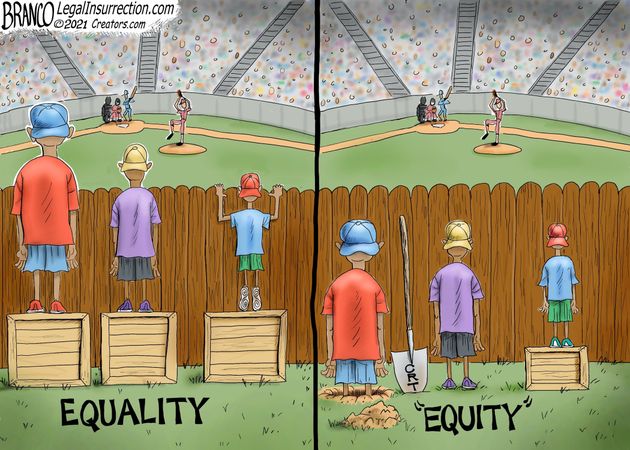
As I attended more events and spoke with more people, I realized that the institutional redefinition of familiar terms wasn’t limited to “white supremacy.” Race, racism, equality, and equity, I discovered, meant different things to my coworkers and supervising dean than they did to me. One of my officemates displayed a graphic of apples dropping to the ground from a tree, with the explanation that “equity means everybody gets some of the apples”; my officemates and supervising dean praised him for this “accurate definition.” When I pointed out that this definition seemed to focus solely on equality of outcomes, without any attention to equality of opportunity or power, it was made clear this perspective wasn’t welcome. “Equity” and “equality,” for my colleagues, were separate and even opposed concepts, and as one of them told me, the aspiration to equality was “a thing of the past.”

Having recognized these differences, I attempted to use them as starting points for dialogue. In the workshops I led, I sought to make space for people to share their own definitions of various concepts and then to identify common points of reference that we could rally around, even as we acknowledged and accepted differences of perspective.  Without editorializing, I gave participants time to notice the differences between the perspectives. We then came together and shared things that these two seemingly divergent philosophies had in common. The aim was to enable a conversation between two perspectives that I already saw at play in divisions on campus about how to approach issues of race.

When I was evaluated as part of the tenure process, some of my evaluators objected to such efforts to identify points of commonality between divergent viewpoints. They also objected to such views being presented at all. One evaluator, who described herself as a “third-wave antiracist,” aligning her with Kendi’s philosophy, made clear that the way I had presented her worldview was deeply offensive. Another evaluator objected to my presentation of “dangerous ideas” drawn from the scholarship of Sheena Mason, whose theory of “racelessness” presents race as something that can be overcome.

A dogmatic understanding of social justice shaped organizational and hiring practices.
Anything short of lockstep adherence to critical social justice was impermissible.

“Criticism” was only supposed to go in one direction. Contextualizing my colleagues’ views and comparing them to other approaches to the same issues, much less criticizing them, was “dangerous”; my supposed failure to “accept criticism” was, simply put, a refusal to accept without question the dogmas these colleagues saw as beyond criticism.

The conflicts were not limited to my tenure-review process. At every turn, I experienced strident opposition when I deviated from the accepted line. When I brought Jewish speakers to campus to address anti-Semitism and the Holocaust, some of my critics branded me a “dirty Zionist” and a “right-wing extremist.” When I formed the Heritage Month Workgroup, bringing together community members to create a multifaith holiday and heritage month calendar, the De Anza student government voted to support this effort. However, my officemates and dean explained to me that such a project was unacceptable, because it didn’t focus on “decentering whiteness.”

No White Crackers Wanted Here.

This sort of dynamic, where single individuals present themselves as speaking for entire groups, is part and parcel of the critical-social-justice approach. It allows individuals to present their ideological viewpoints as unassailable, since they supposedly represent the experience of the entire identity group to which they belong. Hence, any criticism can be framed as an attack on the group.

For those within the critical-social-justice-ideological complex, asking questions, encouraging other people to ask questions, and considering multiple perspectives—all of these things, which should be central to academic work, are an existential danger. The advocates of critical social justice emphasize oppression and tribalistic identity, and believe that a just society must ensure equality of outcomes; this is in contrast to a classical social-justice approach, which focuses on freedom and individuality, understands knowledge as objective and tied to agency and free will, and believes that a just society emphasizes equality of opportunity. The monoculture of critical social justice needs to suppress this alternative worldview and insulate itself from criticism so its advocates can maintain their dominant position. Protection of orthodoxy supersedes all else: collegiality, professionalism, the truth.

If certain ideologues have their way, compelled speech will become an even more common aspect of university life. Faculty and staff will be obligated to declare their gender pronouns and to use gender-neutral terms like “Latinx” and “Filipinx,” even as many members of the groups in question view these terms as expressions of cultural and linguistic imperialism. Soon enough, we may also be formally required to start all classes and meetings with land acknowledgments, regardless of how empty a gesture this may seem to living members of tribal nations. [Note: What is a Land Acknowledgement? These are increasingly common ritual comments at post-secondary institutions. Often spoken at the beginning of a public event, they are a formal way of recognizing the Indigenous stewards of a specific territory, their ancestors, and communities.]

As my experience shows, questioning the reigning orthodoxies does carry many risks. But the alternative is worse. Authoritarian ideologies advance through a reliance on intimidation and the compliance of the majority, which cowers in silence—instead of speaking up. Engaging in civil discourse and ensuring that multiple perspectives are presented are crucial, if we want to preserve the components of education that ideologues are seeking to destroy.

Beware the Ice of March 2023

Previous posts showed 2023 Arctic Ice did break the 15M km2 ceiling early March peaking just two days after the 17 year average. So there is plenty of Arctic drift ice for sailers to be aware. The graph above shows that the March monthly average has varied little since 2007, typically around the SII average of 14.7 M km2.  Of course there are regional differences as described later on.

Dr. Judah Cohen at AER summarizes the situation:

If you can believe it, the major disruption of the polar vortex (PV) and is referred to as a major sudden stratospheric warming (SSW) from mid-February is still influencing the weather even into April. Relatively cold temperatures have become more widespread across Northern Europe and should continue. Northern Asia has been surprisingly quite mild but colder temperatures are predicted across Siberia for April (see Figures 6 and 9). Across North America it seems to be more what you see is what you get, no end in sight of the pattern that began in November – cold west and mild east.

The High pressure areas were forecast to warm over the Pacific Arctic basins, and extending over to the European side, while the cold Low area is presently extending down into North America, bringing some snow and freezing rain on April 1 in Montreal (no joke). There’s also ice for Montrealers to beware. The effect on Arctic Ice extents is shown in the animation below:

Over the last 31 days, there were gains and then losses, mostly in the Pacific basins.  Okhotsk upper left lost 360k km2 (now at 90% of max) while Bering lower left lost 135k m2 to be 60% of max.  Baffin Bay lower right lost 420k km2 over the same period.  Meanwhile, Greenland Sea center right gained 70k km2 to reach 105% of its max.  The effect on NH total ice extents is presented in the graph below.

The graph above shows ice extent through March comparing 2023 MASIE reports with the 17-year average, other recent years and with SII.  After surpassing average on day 64, 2023 ice extents dropped sharply and at March end matched both 2018 and 2021.  SII showed lower extents throughout, but ended with a small deficit to MASIE.

The table below shows the distribution of sea ice across the Arctic regions.

Region 2023090 Day 90 Average 2023-Ave. 2018090 2023-2018
 (0) Northern_Hemisphere 14393146 14613608  -220462  14456459 -63313 
 (1) Beaufort_Sea 1070966 1070154  812  1069836 1131 
 (2) Chukchi_Sea 966006 964029  1977  964121 1885 
 (3) East_Siberian_Sea 1087137 1086163  974  1087137
 (4) Laptev_Sea 897845 897010  835  897845
 (5) Kara_Sea 933984 919079  14905  934790 -806 
 (6) Barents_Sea 718169 651091  67078  790204 -72034 
 (7) Greenland_Sea 816301 650261  166039  533694 282607 
 (8) Baffin_Bay_Gulf_of_St._Lawrence 1202833 1402909  -200077  1380945 -178112 
 (9) Canadian_Archipelago 854843 853082  1760  853109 1734 
 (10) Hudson_Bay 1260903 1254610  6293  1259857 1047 
 (11) Central_Arctic 3248013 3233036  14977  3202650 45363 
 (12) Bering_Sea 505101 724369  -219269  277469 227632 
 (13) Baltic_Sea 60959 62776  -1818  99317 -38359 
(14) Sea_of_Okhotsk 763690 834337  -70647  1097524 -333834 

Overall NH extent March 31 was below average by 220k km2, or 1.5%.  The two major deficits are Bering Sea and Baffin Bay, partly offset by a surplus in Greenland Sea.  The onset of spring melt is as usual in most regions.