This Summer Celebrate Our Warm Climate

Legacy and social media keep up a constant drumbeat of warnings about a degree or two of planetary warming without any historical context for considering the significance of the alternative.  A poem of Robert Frost comes to mind as some applicable wisdom:

The diagram at the top shows how grateful we should be for living in today’s climate instead of a glacial icehouse. (H/T Raymond Inauen)  For most of its history Earth has been frozen rather than the mostly green place it is today.  And the reference is to the extent of the North American ice sheet during the Last Glacial Maximum (LGM).

For further context consider that geologists refer to our time as a “Severe Icehouse World”, among the various conditions in earth’s history, as diagramed by paleo climatologist Christopher Scotese. Referring to the Global Mean Temperatures, it appears after many decades, we are slowly rising to “Icehouse World”, which would seem to be a good thing.

Instead of fear mongering over a bit of warming, we should celebrate our good fortune, and do our best for humanity and the biosphere.  Matthew Ridley takes it from there in a previous post. Excerpts in italics with my bolds and added images.

Background from previous post The Goodness of Global Warming

LAI refers to Leaf Area Index.

As noted in other posts here, warming comes and goes and a cooling period may now be ensuing. See No Global Warming, Chilly January Land and Sea.  Matt Ridley provides a concise and clear argument to celebrate any warming that comes to our world in his Spiked article Why global warming is good for us.  Excerpts in italics with my bolds and added images.

Climate change is creating a greener, safer planet.

Global warming is real. It is also – so far – mostly beneficial. This startling fact is kept from the public by a determined effort on the part of alarmists and their media allies who are determined to use the language of crisis and emergency. The goal of Net Zero emissions in the UK by 2050 is controversial enough as a policy because of the pain it is causing. But what if that pain is all to prevent something that is not doing net harm?

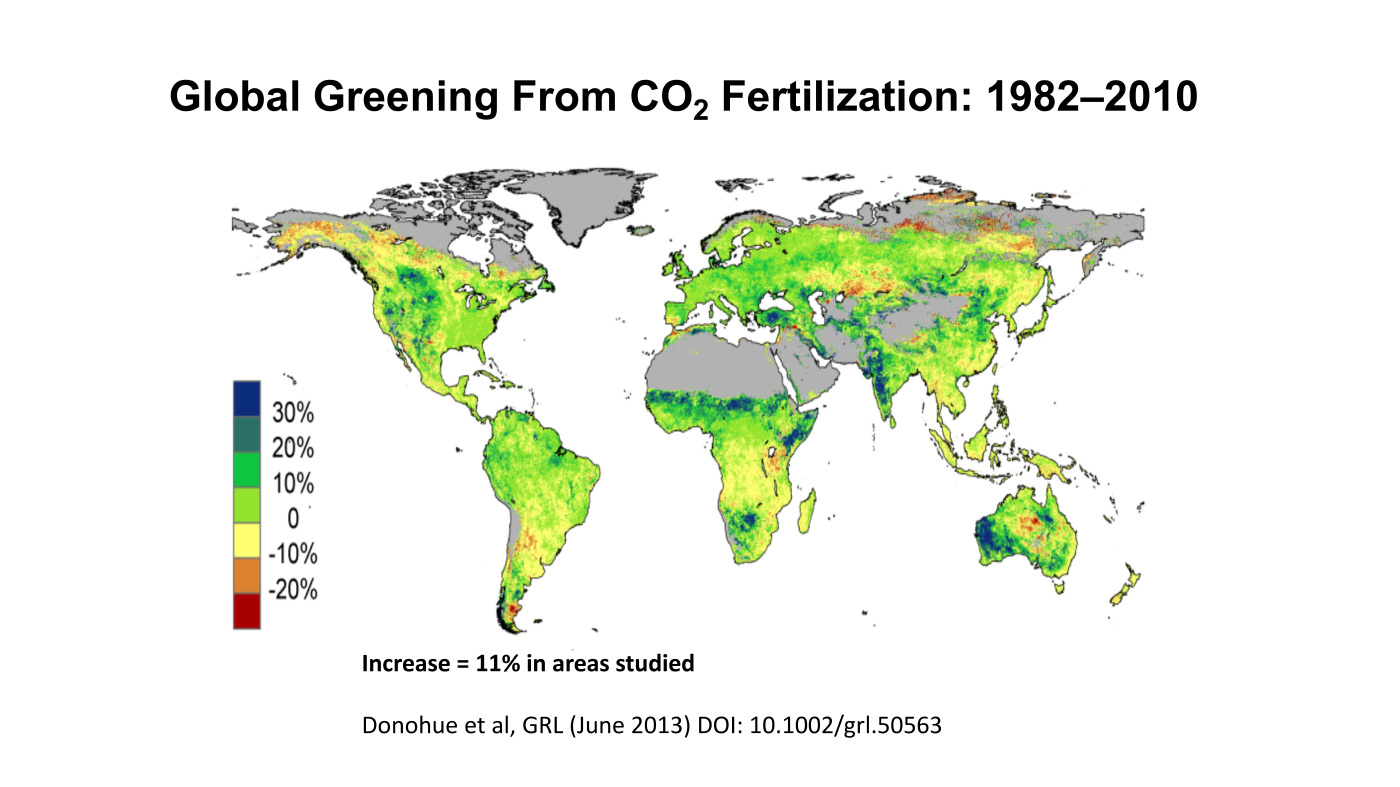
The biggest benefit of emissions is global greening, the increase year after year of green vegetation on the land surface of the planet. Forests grow more thickly, grasslands more richly and scrub more rapidly. This has been measured using satellites and on-the-ground recording of plant-growth rates. It is happening in all habitats, from tundra to rainforest. In the four decades since 1982, as Bjorn Lomborg points out, NASA data show that global greening has added 618,000 square kilometres of extra green leaves each year, equivalent to three Great Britains. You read that right: every year there’s more greenery on the planet to the extent of three Britains. I bet Greta Thunberg did not tell you that.

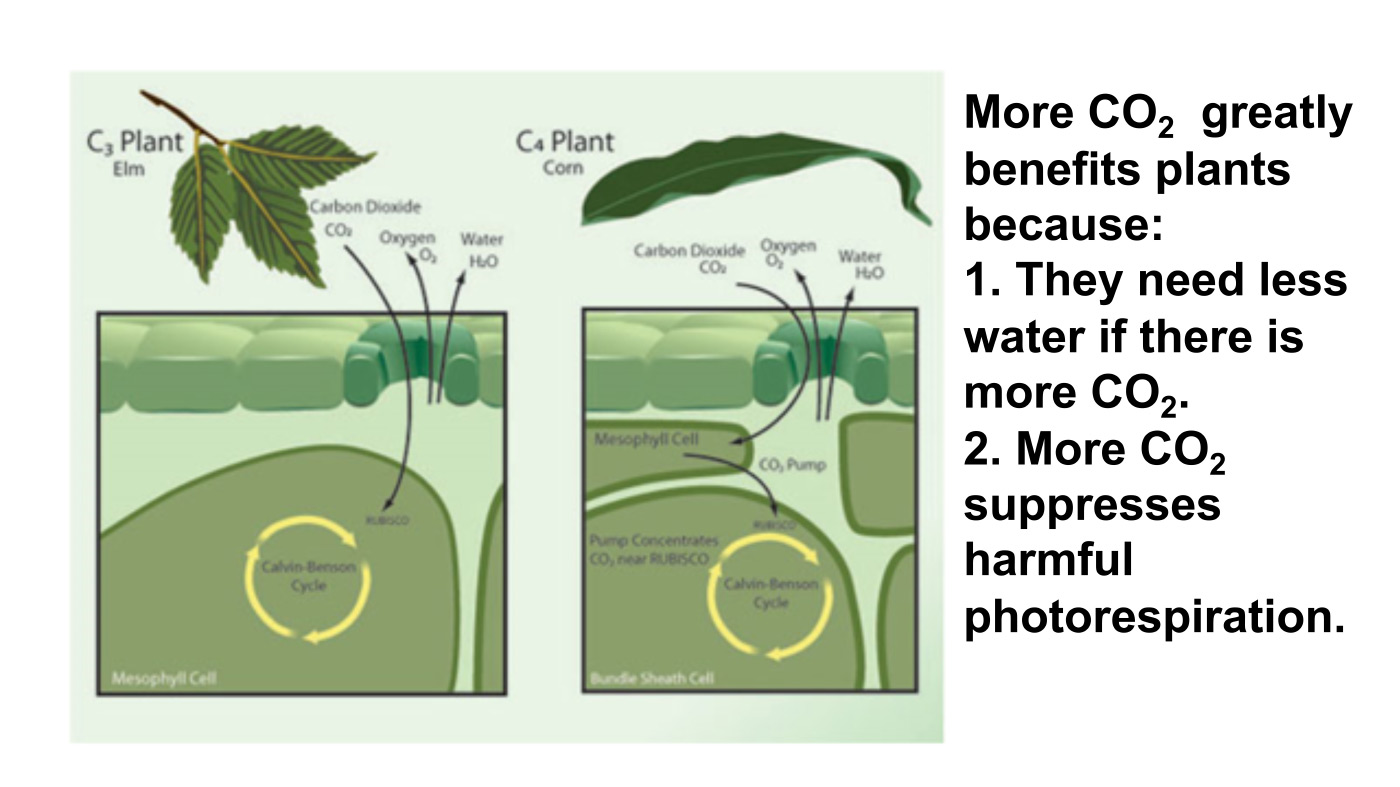
The cause of this greening? Although tree planting, natural reforestation, slightly longer growing seasons and a bit more rain all contribute, the big cause is something else. All studies agree that by far the largest contributor to global greening – responsible for roughly half the effect – is the extra carbon dioxide in the air. In 40 years, the proportion of the atmosphere that is CO2 has gone from 0.034 per cent to 0.041 per cent. That may seem a small change but, with more ‘food’ in the air, plants don’t need to lose as much water through their pores (‘stomata’) to acquire a given amount of carbon. So dry areas, like the Sahel region of Africa, are seeing some of the biggest improvements in greenery. Since this is one of the poorest places on the planet, it is good news that there is more food for people, goats and wildlife.

But because good news is no news, green pressure groups and environmental correspondents in the media prefer to ignore global greening. Astonishingly, it merited no mentions on the BBC’s recent Green Planet series, despite the name. Or, if it is mentioned, the media point to studies suggesting greening may soon cease. These studies are based on questionable models, not data (because data show the effect continuing at the same pace). On the very few occasions when the BBC has mentioned global greening it is always accompanied by a health warning in case any viewer might glimpse a silver lining to climate change – for example, ‘extra foliage helps slow climate change, but researchers warn this will be offset by rising temperatures’.

Another bit of good news is on deaths. We’re against them, right? A recent study shows that rising temperatures have resulted in half a million fewer deaths in Britain over the past two decades. That is because cold weather kills about ’20 times as many people as hot weather’, according to the study, which analyses ‘over 74million deaths in 384 locations across 13 countries’. This is especially true in a temperate place like Britain, where summer days are rarely hot enough to kill. So global warming and the unrelated phenomenon of urban warming relative to rural areas, caused by the retention of heat by buildings plus energy use, are both preventing premature deaths on a huge scale.

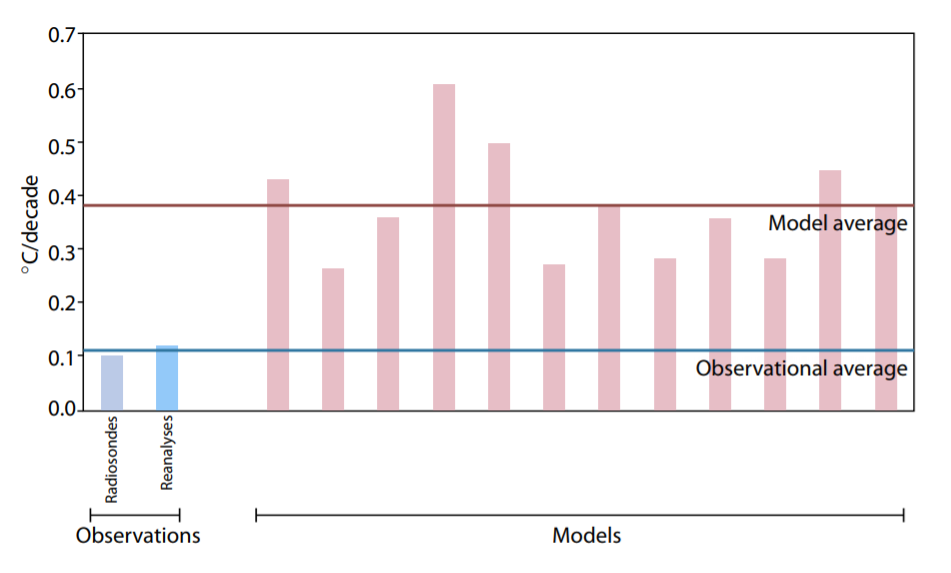
Figure 8: Warming in the tropical troposphere according to the CMIP6 models.
Trends 1979–2014 (except the rightmost model, which is to 2007), for 20°N–20°S, 300–200 hPa.  Source John Christy


Summer temperatures in the US are changing at half the rate of winter temperatures and daytimes are warming 20 per cent slower than nighttimes. A similar pattern is seen in most countries. Tropical nations are mostly experiencing very slow, almost undetectable daytime warming (outside cities), while Arctic nations are seeing quite rapid change, especially in winter and at night. Alarmists love to talk about polar amplification of average climate change, but they usually omit its inevitable flip side: that tropical temperatures (where most poor people live) are changing more slowly than the average.

My Mind is Made Up, Don’t Confuse Me with the Facts. H/T Bjorn Lomborg, WUWT

But are we not told to expect more volatile weather as a result of climate change? It is certainly assumed that we should. Yet there’s no evidence to suggest weather volatility is increasing and no good theory to suggest it will. The decreasing temperature differential between the tropics and the Arctic may actually diminish the volatility of weather a little.


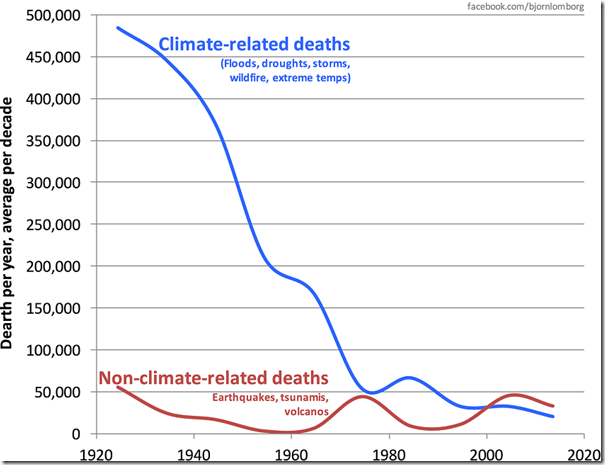
Indeed, as the Intergovernmental Panel on Climate Change (IPCC) repeatedly confirms, there is no clear pattern of storms growing in either frequency or ferocity, droughts are decreasing slightly and floods are getting worse only where land-use changes (like deforestation or building houses on flood plains) create a problem. Globally, deaths from droughts, floods and storms are down by about 98 per cent over the past 100 years – not because weather is less dangerous but because shelter, transport and communication (which are mostly the products of the fossil-fuel economy) have dramatically improved people’s ability to survive such natural disasters.

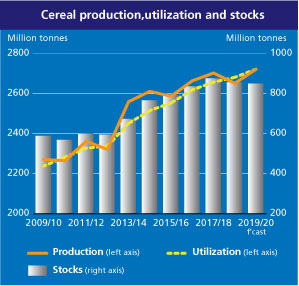
The effect of today’s warming (and greening) on farming is, on average, positive: crops can be grown farther north and for longer seasons and rainfall is slightly heavier in dry regions. We are feeding over seven billion people today much more easily than we fed three billion in the 1960s, and from a similar acreage of farmland. Global cereal production is on course to break its record this year, for the sixth time in 10 years.

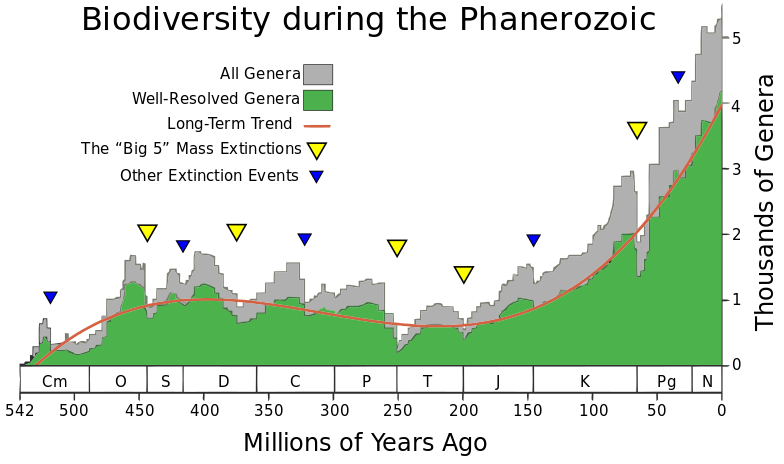
Nature, too, will do generally better in a warming world. There are more species in warmer climates, so more new birds and insects are arriving to breed in southern England than are disappearing from northern Scotland. Warmer means wetter, too: 9,000 years ago, when the climate was warmer than today, the Sahara was green. Alarmists like to imply that concern about climate change goes hand in hand with concern about nature generally. But this is belied by the evidence. Climate policies often harm wildlife: biofuels compete for land with agriculture, eroding the benefits of improved agricultural productivity and increasing pressure on wild land; wind farms kill birds and bats; and the reckless planting of alien sitka spruce trees turns diverse moorland into dark monoculture.

Meanwhile, real environmental issues are ignored or neglected because of the obsession with climate. With the help of local volunteers I have been fighting to protect the red squirrel in Northumberland for years. The government does literally nothing to help us, while it pours money into grants for studying the most far-fetched and minuscule possible climate-change impacts. Invasive alien species are the main cause of species extinction worldwide (like grey squirrels driving the red to the margins), whereas climate change has yet to be shown to have caused a single species to die out altogether anywhere.

Source: Phanerozoic_Biodiversity.png Author: SVG version by Albert Mestre

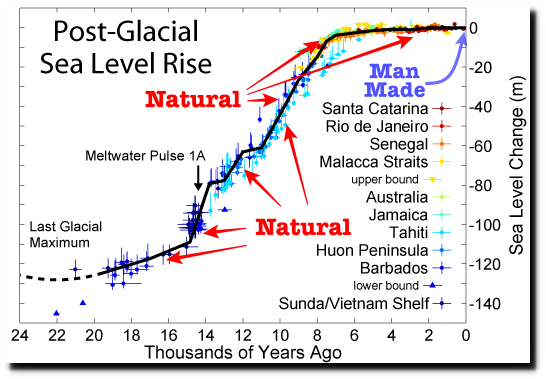
Of course, climate change does and will bring problems as well as benefits. Rapid sea-level rise could be catastrophic. But whereas the sea level shot up between 10,000 and 8,000 years ago, rising by about 60 metres in two millennia, or roughly three metres per century, today the change is nine times slower: three millimetres a year, or a foot per century, and with not much sign of acceleration. Countries like the Netherlands and Vietnam show that it is possible to gain land from the sea even in a world where sea levels are rising. The land area of the planet is actually increasing, not shrinking, thanks to siltation and reclamation.

Environmentalists don’t get donations or invitations to appear on the telly if they say moderate things. To stand up and pronounce that ‘climate change is real and needs to be tackled, but it’s not happening very fast and other environmental issues are more urgent’ would be about as popular as an MP in Oliver Cromwell’s parliament declaring, ‘The evidence for God is looking a bit weak, and I’m not so very sure that fornication really is a sin’. And I speak as someone who has made several speeches on climate in parliament.

No wonder we don’t hear about the good news on climate change.


Oceans Warming Uptick July 2024

The best context for understanding decadal temperature changes comes from the world’s sea surface temperatures (SST), for several reasons:

  • The ocean covers 71% of the globe and drives average temperatures;
  • SSTs have a constant water content, (unlike air temperatures), so give a better reading of heat content variations;
  • Major El Ninos have been the dominant climate feature in recent years.

HadSST is generally regarded as the best of the global SST data sets, and so the temperature story here comes from that source. Previously I used HadSST3 for these reports, but Hadley Centre has made HadSST4 the priority, and v.3 will no longer be updated.  HadSST4 is the same as v.3, except that the older data from ship water intake was re-estimated to be generally lower temperatures than shown in v.3.  The effect is that v.4 has lower average anomalies for the baseline period 1961-1990, thereby showing higher current anomalies than v.3. This analysis concerns more recent time periods and depends on very similar differentials as those from v.3 despite higher absolute anomaly values in v.4.  More on what distinguishes HadSST3 and 4 from other SST products at the end. The user guide for HadSST4 is here.

The Current Context

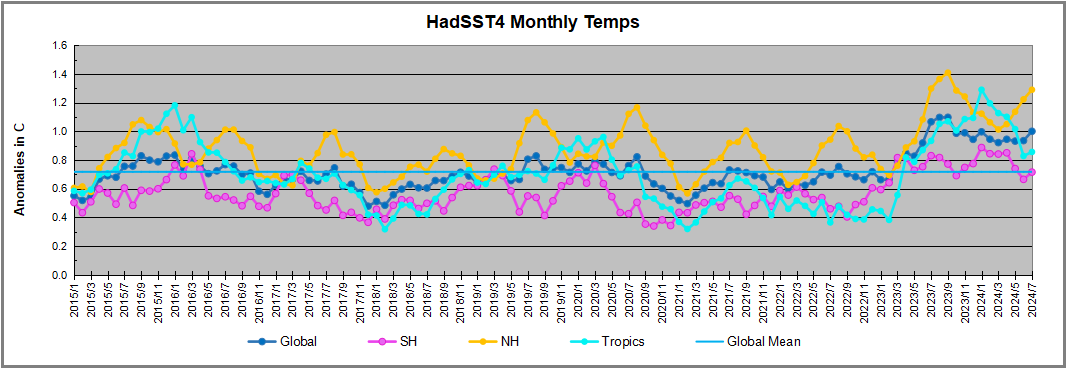
The chart below shows SST monthly anomalies as reported in HadSST4 starting in 2015 through July 2024.  A global cooling pattern is seen clearly in the Tropics since its peak in 2016, joined by NH and SH cycling downward since 2016, followed by rising temperatures in 2023 and 2024.

Note that in 2015-2016 the Tropics and SH peaked in between two summer NH spikes.  That pattern repeated in 2019-2020 with a lesser Tropics peak and SH bump, but with higher NH spikes. By end of 2020, cooler SSTs in all regions took the Global anomaly well below the mean for this period.  

Then in 2022, another strong NH summer spike peaked in August, but this time both the Tropic and SH were countervailing, resulting in only slight Global warming, later receding to the mean.   Oct./Nov. temps dropped  in NH and the Tropics took the Global anomaly below the average for this period. After an uptick in December, temps in January 2023 dropped everywhere, strongest in NH, with the Global anomaly further below the mean since 2015.

Then came El Nino as shown by the upward spike in the Tropics since January 2023, the anomaly nearly tripling from 0.38C to 1.09C.  In September 2023, all regions rose, especially NH up from 0.70C to 1.41C, pulling up the global anomaly to a new high for this period. By December, NH cooled to 1.1C and the Global anomaly down to 0.94C from its peak of 1.10C, despite slight warming in SH and Tropics.

In January 2024 both Tropics and SH rose, resulting in Global Anomaly going higher. Since then Tropics have cooled from a  peak of 1.29C down to 0.84C.  SH also dropped down from 0.89C to 0.65C. NH lost ~0.4C as of March 2024, but has risen 0.2C over April to June. Despite that upward NH bump, the Global SST anomaly cooled further.  Now in July there was a warming uptick in all regions, bringing the global anomaly up to match January 2024. The NH anomaly is now matching July 2023. The next months will reveal the strength of 2024 NH warming spike, which could rise to the 2023 level or recede.

Comment:

The climatists have seized on this unusual warming as proof their Zero Carbon agenda is needed, without addressing how impossible it would be for CO2 warming the air to raise ocean temperatures.  It is the ocean that warms the air, not the other way around.  Recently Steven Koonin had this to say about the phonomenon confirmed in the graph above:

El Nino is a phenomenon in the climate system that happens once every four or five years.  Heat builds up in the equatorial Pacific to the west of Indonesia and so on.  Then when enough of it builds up it surges across the Pacific and changes the currents and the winds.  As it surges toward South America it was discovered and named in the 19th century  It iswell understood at this point that the phenomenon has nothing to do with CO2.

Now people talk about changes in that phenomena as a result of CO2 but it’s there in the climate system already and when it happens it influences weather all over the world.   We feel it when it gets rainier in Southern California for example.  So for the last 3 years we have been in the opposite of an El Nino, a La Nina, part of the reason people think the West Coast has been in drought.

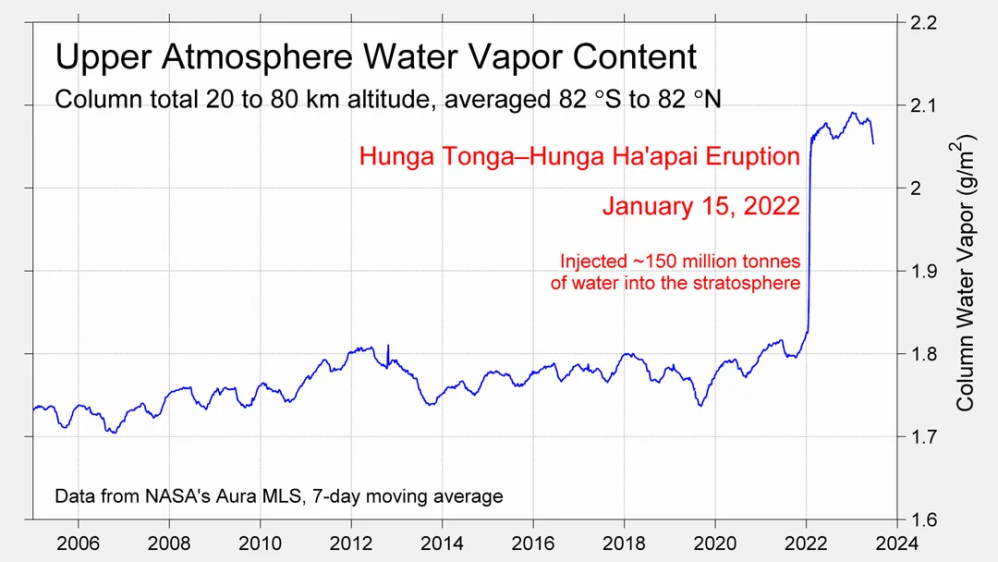
It has now shifted in the last months to an El Nino condition that warms the globe and is thought to contribute to this Spike we have seen. But there are other contributions as well.  One of the most surprising ones is that back in January of 2022 an enormous underwater volcano went off in Tonga and it put up a lot of water vapor into the upper atmosphere. It increased the upper atmosphere of water vapor by about 10 percent, and that’s a warming effect, and it may be that is contributing to why the spike is so high.

A longer view of SSTs

To enlarge, open image in new tab.

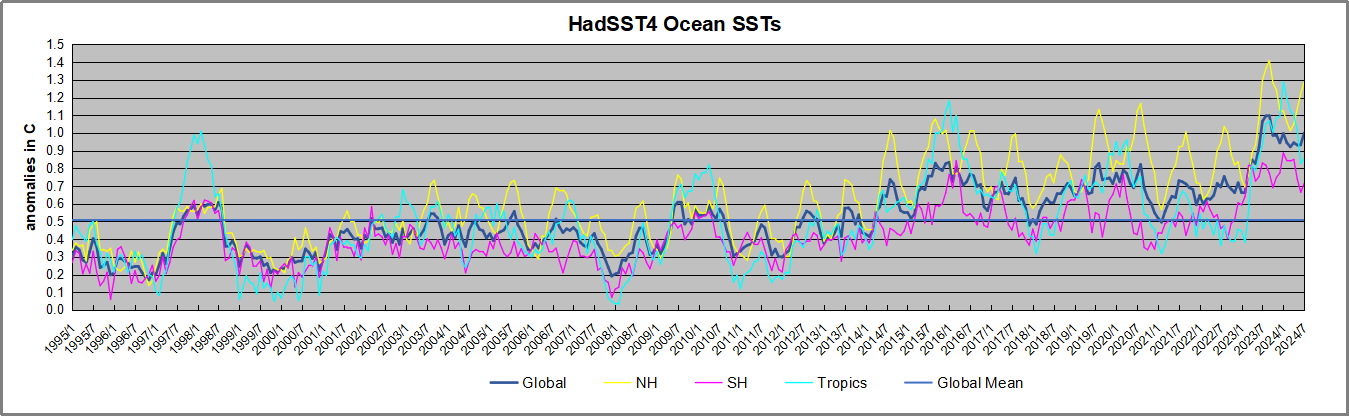
The graph above is noisy, but the density is needed to see the seasonal patterns in the oceanic fluctuations.  Previous posts focused on the rise and fall of the last El Nino starting in 2015.  This post adds a longer view, encompassing the significant 1998 El Nino and since.  The color schemes are retained for Global, Tropics, NH and SH anomalies.  Despite the longer time frame, I have kept the monthly data (rather than yearly averages) because of interesting shifts between January and July. 1995 is a reasonable (ENSO neutral) starting point prior to the first El Nino. 

The sharp Tropical rise peaking in 1998 is dominant in the record, starting Jan. ’97 to pull up SSTs uniformly before returning to the same level Jan. ’99. There were strong cool periods before and after the 1998 El Nino event. Then SSTs in all regions returned to the mean in 2001-2. 

SSTS fluctuate around the mean until 2007, when another, smaller ENSO event occurs. There is cooling 2007-8,  a lower peak warming in 2009-10, following by cooling in 2011-12.  Again SSTs are average 2013-14.

Now a different pattern appears.  The Tropics cooled sharply to Jan 11, then rise steadily for 4 years to Jan 15, at which point the most recent major El Nino takes off.  But this time in contrast to ’97-’99, the Northern Hemisphere produces peaks every summer pulling up the Global average.  In fact, these NH peaks appear every July starting in 2003, growing stronger to produce 3 massive highs in 2014, 15 and 16.  NH July 2017 was only slightly lower, and a fifth NH peak still lower in Sept. 2018.

The highest summer NH peaks came in 2019 and 2020, only this time the Tropics and SH were offsetting rather adding to the warming. (Note: these are high anomalies on top of the highest absolute temps in the NH.)  Since 2014 SH has played a moderating role, offsetting the NH warming pulses. After September 2020 temps dropped off down until February 2021.  In 2021-22 there were again summer NH spikes, but in 2022 moderated first by cooling Tropics and SH SSTs, then in October to January 2023 by deeper cooling in NH and Tropics.  

Then in 2023 the Tropics flipped from below to well above average, while NH produced a summer peak extending into September higher than any previous year.  Despite El Nino driving the Tropics January 2024 anomaly higher than 1998 and 2016 peaks, following months cooled in all regions, and the Tropics continued cooling in April, May and June along with SH dropping, suggesting that the peak might be reached, though now in July NH warming has again pulled the global anomaly higher.

What to make of all this? The patterns suggest that in addition to El Ninos in the Pacific driving the Tropic SSTs, something else is going on in the NH.  The obvious culprit is the North Atlantic, since I have seen this sort of pulsing before.  After reading some papers by David Dilley, I confirmed his observation of Atlantic pulses into the Arctic every 8 to 10 years.

Contemporary AMO Observations

Through January 2023 I depended on the Kaplan AMO Index (not smoothed, not detrended) for N. Atlantic observations. But it is no longer being updated, and NOAA says they don’t know its future.  So I find that ERSSTv5 AMO dataset has current data.  It differs from Kaplan, which reported average absolute temps measured in N. Atlantic.  “ERSST5 AMO  follows Trenberth and Shea (2006) proposal to use the NA region EQ-60°N, 0°-80°W and subtract the global rise of SST 60°S-60°N to obtain a measure of the internal variability, arguing that the effect of external forcing on the North Atlantic should be similar to the effect on the other oceans.”  So the values represent sst anomaly differences between the N. Atlantic and the Global ocean.

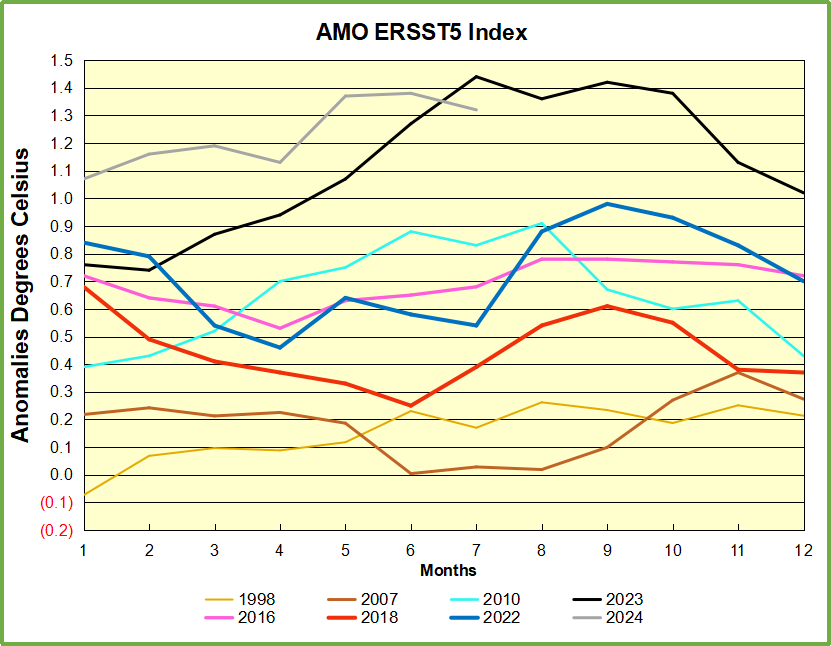
The chart above confirms what Kaplan also showed.  As August is the hottest month for the N. Atlantic, its variability, high and low, drives the annual results for this basin.  Note also the peaks in 2010, lows after 2014, and a rise in 2021. Now in 2023 the peak was holding at 1.4C before declining.  An annual chart below is informative:

Note the difference between blue/green years, beige/brown, and purple/red years.  2010, 2021, 2022 all peaked strongly in August or September.  1998 and 2007 were mildly warm.  2016 and 2018 were matching or cooler than the global average.  2023 started out slightly warm, then rose steadily to an  extraordinary peak in July.  August to October were only slightly lower, but by December cooled by ~0.4C.

Now in 2024 the AMO anomaly started higher than any previous year, then leveled off for two months declining slightly into April.  Remarkably, May shows an upward leap putting this on a higher track than 2023, and rising slightly higher in June.  In July 2024 the anomaly declined and is now lower than the peak reached in 2023.

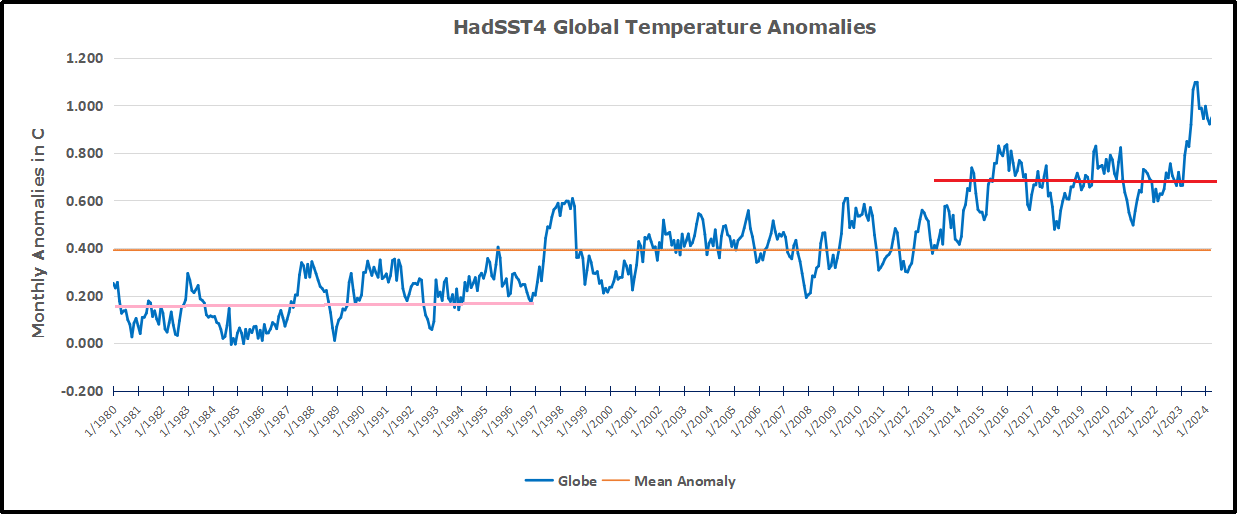
The pattern suggests the ocean may be demonstrating a stairstep pattern like that we have also seen in HadCRUT4. 

The purple line is the average anomaly 1980-1996 inclusive, value 0.18.  The orange line the average 1980-202404, value 0.39, also for the period 1997-2012. The red line is 2013-202404, value 0.66. As noted above, these rising stages are driven by the combined warming in the Tropics and NH, including both Pacific and Atlantic basins.

See Also:

2024 El Nino Collapsing

Curiosity:  Solar Coincidence?

The news about our current solar cycle 25 is that the solar activity is hitting peak numbers now and higher  than expected 1-2 years in the future.  As livescience put it:  Solar maximum could hit us harder and sooner than we thought. How dangerous will the sun’s chaotic peak be?  Some charts from spaceweatherlive look familar to these sea surface temperature charts.

Summary

The oceans are driving the warming this century.  SSTs took a step up with the 1998 El Nino and have stayed there with help from the North Atlantic, and more recently the Pacific northern “Blob.”  The ocean surfaces are releasing a lot of energy, warming the air, but eventually will have a cooling effect.  The decline after 1937 was rapid by comparison, so one wonders: How long can the oceans keep this up? And is the sun adding forcing to this process?

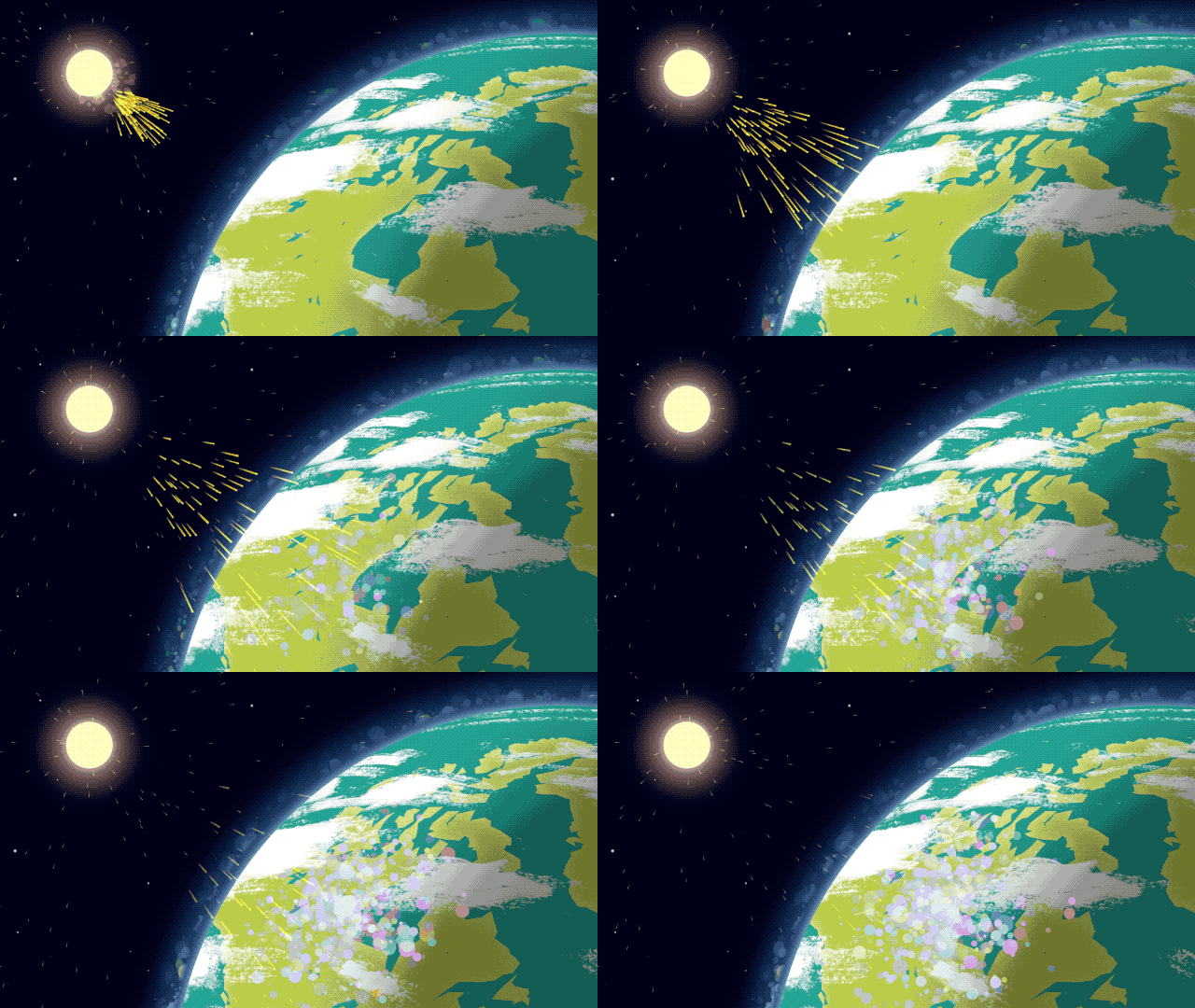
Space weather impacts the ionosphere in this animation. Credits: NASA/GSFC/CIL/Krystofer Kim

Footnote: Why Rely on HadSST4

HadSST is distinguished from other SST products because HadCRU (Hadley Climatic Research Unit) does not engage in SST interpolation, i.e. infilling estimated anomalies into grid cells lacking sufficient sampling in a given month. From reading the documentation and from queries to Met Office, this is their procedure.

HadSST4 imports data from gridcells containing ocean, excluding land cells. From past records, they have calculated daily and monthly average readings for each grid cell for the period 1961 to 1990. Those temperatures form the baseline from which anomalies are calculated.

In a given month, each gridcell with sufficient sampling is averaged for the month and then the baseline value for that cell and that month is subtracted, resulting in the monthly anomaly for that cell. All cells with monthly anomalies are averaged to produce global, hemispheric and tropical anomalies for the month, based on the cells in those locations. For example, Tropics averages include ocean grid cells lying between latitudes 20N and 20S.

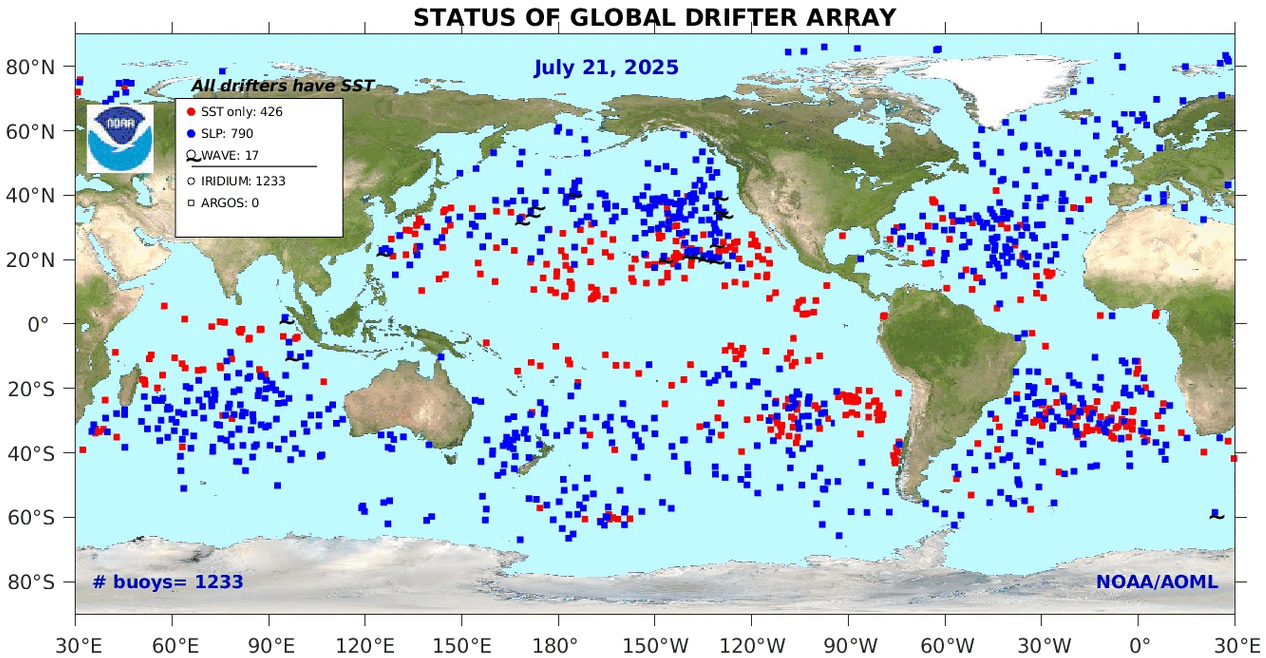
Gridcells lacking sufficient sampling that month are left out of the averaging, and the uncertainty from such missing data is estimated. IMO that is more reasonable than inventing data to infill. And it seems that the Global Drifter Array displayed in the top image is providing more uniform coverage of the oceans than in the past.

uss-pearl-harbor-deploys-global-drifter-buoys-in-pacific-ocean

USS Pearl Harbor deploys Global Drifter Buoys in Pacific Ocean


July 2024 the Hottest Ever? Not So Fast!

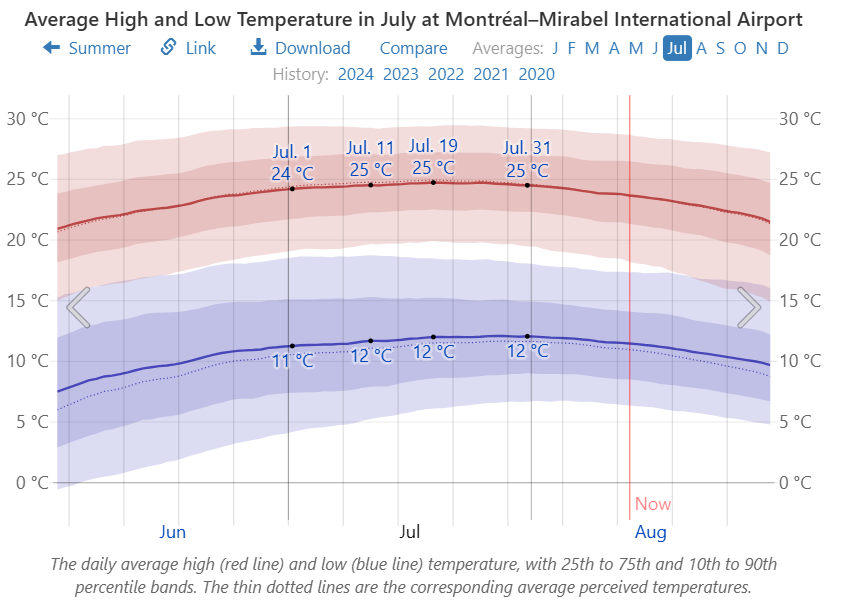
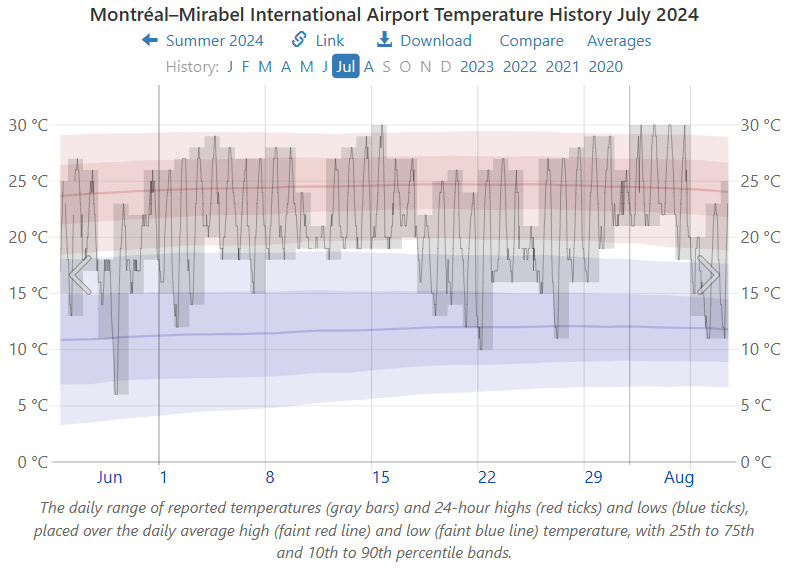
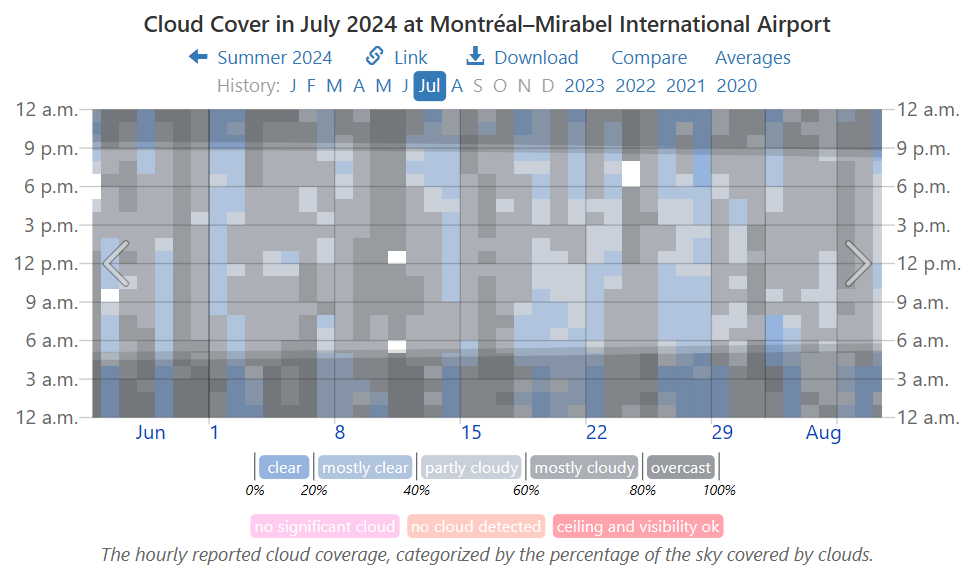
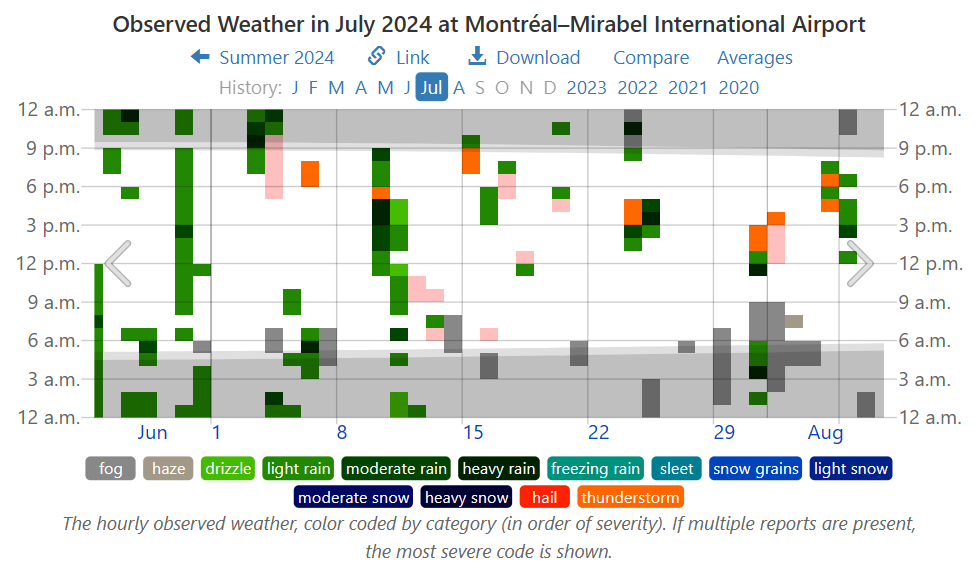
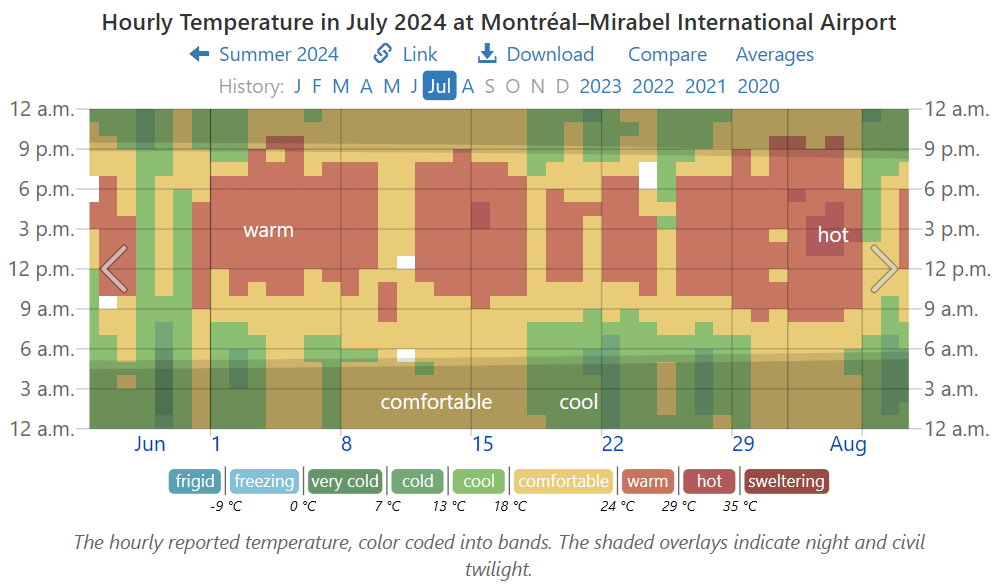
For sure you’ve seen the headlines declaring 2024 likely to be the Hottest year ever.  If you’re like me, your response is: That’s not the way it’s going down where I live.  Fortunately there is a website that allows anyone to check their personal experience with the weather station data nearby.  weatherspark.com provides data summaries for you to judge what’s going on in weather history where you live.  In my case a modern weather station is a few miles away July 2024 Weather History at Montréal–Mirabel International Airport  The story about July 2024 is evident below in charts and graphs from this site.  There’s a map that allows you to find your locale.

First, consider above the norms for July from the period 1980 to 2016.

Then, there’s July 2024 compared to the normal observations.

The graph shows July had some warm days, some cool days and overall was pretty normal.  But since climate is more than temperature, consider cloudiness.

Woah!  Most of the month was cloudy, which in summer means blocking the warming sun from hitting the surface.   And with all those clouds, let’s look at precipitation:

So, there were sixteen days when it rained, including five days of thunderstorms with heavy rainfall. Given what we know about the hydrology cycles, that means a lot of heat removed upward from the surface.

So the implications for July temperatures in my locale.

There you have it before your eyes. Mostly warm days for the
peak summer month, with exactly one brief hot afternoon.
Otherwise comfortable and cool, and a couple of hot
afternoons in first week of August.

Summary:

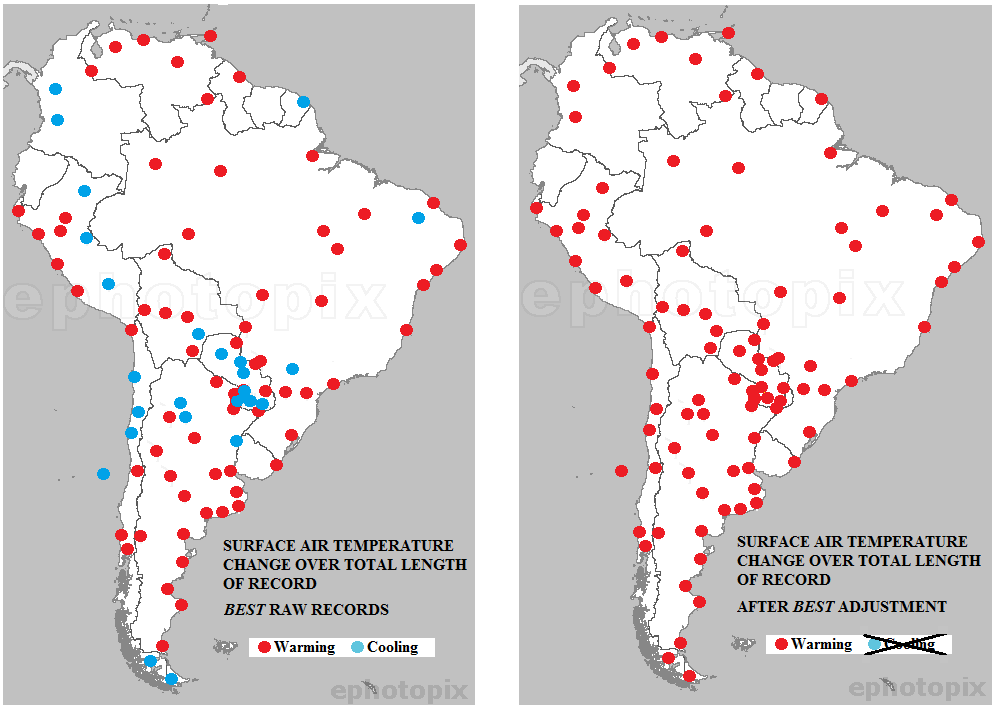
Claims of hottest this or that month or year are based on averages of averages of temperatures, which in principle is an intrinsic quality and distinctive to a locale.  The claim involves selecting some places and time periods where warming appears, while ignoring other places where it has been cooling.

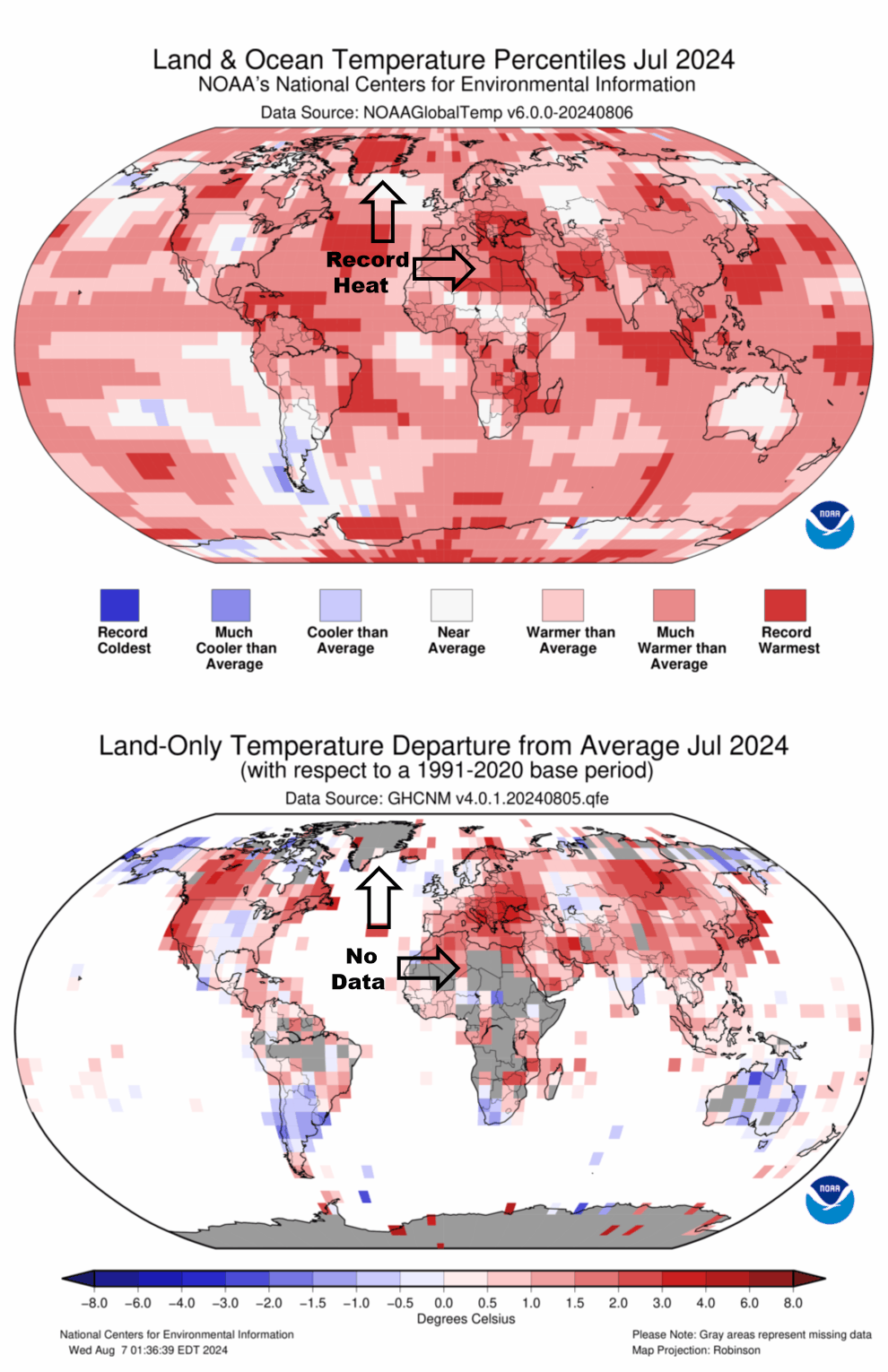
Remember:  They want you to panic.  Before doing so, check out what the data says in your neck of the woods.  For example, NOAA declared that “July 2024 was the warmest ever recorded for the globe.”


Yes, IPCC, Our Climate Responds to Our Sun

John Gideon Hartnett writes at Spectator Australia The sun is in control of our oceans. Text is from John Ray at his blog, excerpts in italics with my bolds and added images.

In recent years, there has been observed an increase in ocean temperature. Those who adhere to the Climate Change version of events say that the oceans are getting warmer because of trapped carbon dioxide (CO2) in the atmosphere causing a massive greenhouse effect leading to boiling oceans.

Well, anyone who has a brain knows that the oceans are not boiling, but let’s assume that is just hyperbole. When actual research – when actual measurements were taken – reality turns out to be the exact opposite.

New research shows that the temperature of our oceans are controlled by incident radiation from the Sun. Who would have guessed?

And as a consequence of the oceans warming, dissolved carbon dioxide gas is released due to reduced is solubility in ocean water. This means the warming of the oceans would lead (or cause) an increase in CO2 concentration in the atmosphere.  One of the researchers in the study wrote on X.com:

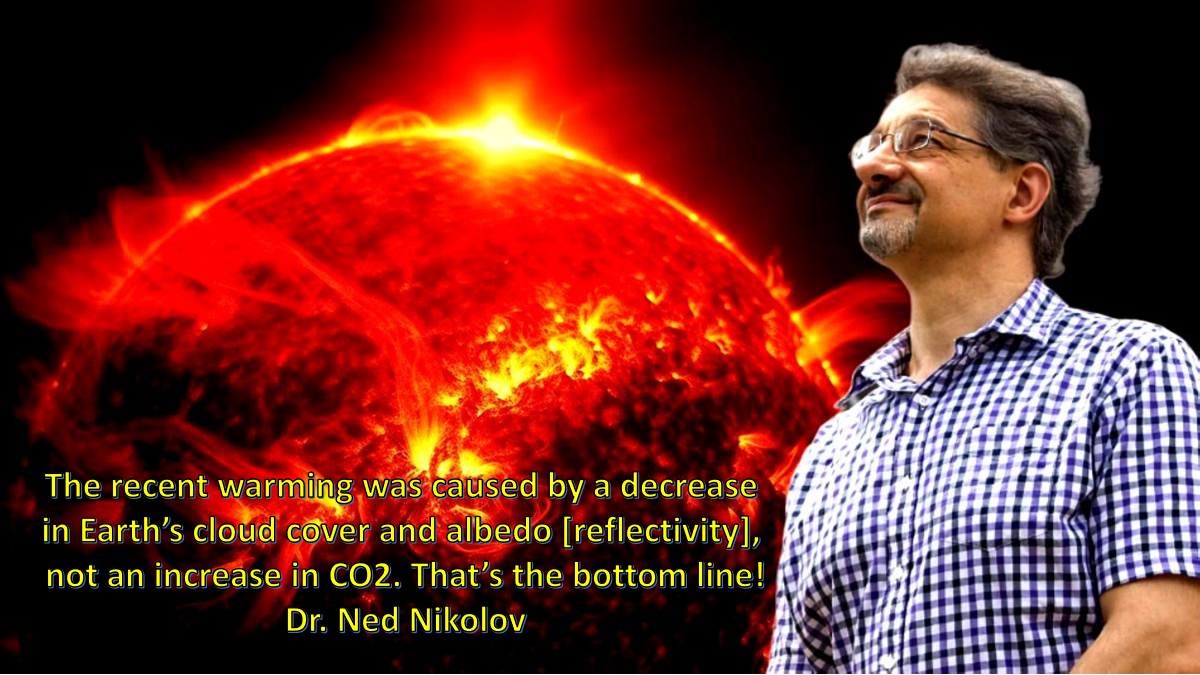
A decrease in cloud cover and albedo means more short wavelength (SW) solar radiation reaches the oceans. Albedo is the reflectivity of the Earth. Lower albedo means more sunlight reaching the land and oceans and more warming by the Sun.

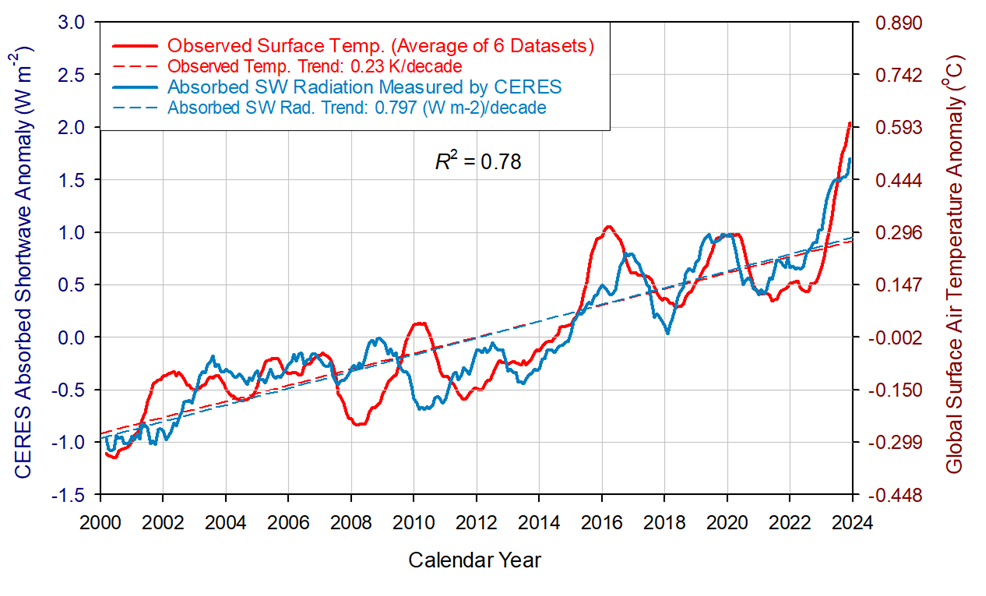
Figure 8. Comparison between observed global temperature anomalies and CERES-reported changes in the Earth’s absorbed solar flux. The two data series representing 13-month running means are highly correlated with the absorbed SW flux explaining 78% of the temperature variation (R2 = 0.78). The global temperature lags the absorbed solar radiation between 0 and 9 months, which indicates that climate change in the 21st Century was driven by solar forcing.

I mean to say that this is so obvious. The Sun heats Earth’s surface of which 71% is covered by the oceans! Basic physics!

The energy from the Sun powers all life on the planet and causes all Earth changes. Every second, the Earth receives the equivalent energy of 42 megatons of TNT in radiation from the Sun. That cannot be ignored. 

Climate Change, the ideological movement which I prefer to call a cult, views all evidence through the lens of their religious belief that the Earth is warmed by human activity. That activity releases carbon dioxide gas, which has been observed to be increasing. Their belief is that CO2 traps heat in a giant greenhouse effect. That is the dogma anyway. And I must add, we all are the carbon they want to eliminate.

But how much of that observed increase in CO2 is actually from natural causes and not from human activity? At least 94 per cent is. This new evidence now suggests it could be even more than that.

If the oceans emit CO2 gas following changes in the water temperature, which this research shows is due to the amount (flux) of solar radiation reaching the surface, then more CO2 comes from natural causes.

It is basic physics that as you heat water the dissolved gases are released due to a decrease in gas solubility. This means as the solar flux increases CO2 gas is released from the warmer ocean water.

Thus an ocean temperature increase leads to an increase in CO2 in the atmosphere, and not the other way around.

Space weather impacts the ionosphere in this animation. Credits: NASA/GSFC/CIL/Krystofer Kim

Update: Woke Tyranny Vs. Jordan Peterson

Jordan Peterson writes at National Post this update on his battle against censoring bureaucrats  I will see this contemptible ‘re-education’ process through to its absurd end.  Excerpts in italics with my bolds and added images.

Having failed to persuade the Supreme Court, I am going
to see what constraints are put on my speech,
and I am going to make it as public as possible.

On Thursday, my attempt to defend myself against the ideologues and petty tyrants that now occupy so many positions of authority in Canada came to an end — or I finally got what I deserve, due to my incautious verbal utterances, depending on your stance. I am (still) a licensed psychologist in Ontario, and was once a full professor of psychology at the University of Toronto. Back in 2016, both of those occupations basically came to an end, when I had the temerity to object to the idiot legislation passed by our jackanapes prime minister, Justin Trudeau, the worst leader Canada has ever had, and a contender for the worst in the western world. His moralizing compatriots decided at the time that it was a good idea to rejig the very definition of sex — what could go wrong with that? — and to simultaneously compel everyone to accept that redesignation, on pain of law.

But we have become such fools in Canada, moralizing blindly and pridefully while inverting our traditions and perverting our legal system. Who cares? Why die on that hill? People asked me such things when I said very publicly that I would rather rot in jail than use the bloody pronouns demanded of me by people too stupid to understand what they were doing — the outright metastatic communists of the progressive liberals and the minor moralizing tyrants of the elite liberal bureaucracy. I care. Why? Because I could see where all this idiocy was headed, as clear as day. I told the arrogant fools in the Canadian Senate (and a hostile and dismissive bunch they were) that confusing young people about their sexual identity would lead to an epidemic of gender dysphoria among young women, and that is precisely what has happened.

I use social media regularly — and well. I have literally tens of millions of people who subscribe to my various channels, and hundreds of millions who listen to and watch my YouTube videos and their derivatives. I have used those channels to voice my thoughts about such affairs of sex and gender, criticizing the ideologues who are practising their evil craft on the most vulnerable members of society. I believe that the ”transing” of minors is: first, a crime against humanity (as the involuntary sterilization of human beings is so defined by the United Nations); and second, the worst moral crime that the medical community has ever committed.

There were some people, out there in the wide world, who objected to my tweets. The College of Psychologists of Ontario has a convenient complaint portal on its website that anyone, anywhere can use to inform and carp about my behaviour (and that of other psychologists) for any reason at any time. This is true whether they were one of my clients or not — or even knew anyone who had been one of my clients. Such complaint processes regarding professional conduct have been weaponized by the Machiavellian left, experts as they are at the kind of covert warfare that characterizes those with so-called Cluster B psychopathology: the histrionic, borderline, narcissistic antisocial types who use gossip and reputation destruction to carve their destructive swath through their own lives, the lives of others and the general social world.

So they submitted their complaints, electronically, at no cost to themselves, with no risk of public exposure, and to my detriment. The College of Psychologists of Ontario is duty-bound to investigate every complaint, no matter how trivial or falsely motivated, and then to decide what to pursue.

Unfortunately, that body has also been taken over by the same ideological types, and at least a small coterie of them (and it is so often now exactly that small coterie) have decided that holding my clinical license hostage, attempting to destroy my reputation and subjecting me to tremendous legal expenses (I have already spent more than $1 million defending myself against this lawfare), insanity-making stress and interference with my livelihood is something well worth doing, given that I have had the constant temerity to inform the public — as is my duty — about just what the hell is transpiring on the psychological front. Hence the series of complaints that have been upheld by this delightful board, even after my insistence that all of this is politically motivated, as it is, culminating in the college’s decision to subject me to indefinite “re-education,” at my own expense, at the hands of one of their so-called social media experts (a professional designation that in no way even exists), until I have learned whatever lesson I am supposed to learn, which I suppose is to hold my bloody tongue.

I objected to such cavalier and ideologically motivated treatment at the hands of an ideologically captured and essentially anonymous accusatory mob, and pushed my objections through the provincial court of appeal, which rejected them, to the Supreme Court itself, which did the same thing as its provincial counterpart on Aug. 8. I am now subject to the re-education process, and have no further appeal. I have no idea how this charade is going to play itself out.

Who is going to teach me? What am I supposed to learn? Do not fool yourself into thinking that there is any precedent to this, or any plan. It is all being made up by the subterranean prosecutors who are pushing their ideological agenda. Where will it end? I cannot say, but I can tell you this:

Canadians once again have a very hard choice in front of them. The Supreme Court has essentially decided (or, more accurately, failed to take responsibility and therefore decided by default) that the much-vaunted Charter of Rights and Freedoms can be completely ignored by the regulatory bodies that license professionals in Canada. There are two conclusions that must be drawn in the aftermath of this decision. The first is that the Charter itself is not worth the paper it is written on. If comparatively low-level bureaucrats can suspend its most important provisions, more or less at will, it is a document with no real force whatsoever. I suspected as much when it was implemented back in the 1980s, and it is certainly the case that my worst suspicions have been justified.

Worse, however, is the clear consequence for professionals and those they serve in Canada. My fellow citizens: it is now a legal requirement in your sad state for the lawyers, engineers, teachers, physicians, psychologists and social workers who serve you — often in your hours of most desperate need — to lie to you, in order to ensure they are not transgressing against the ideological assumptions of those who fly the flag of the radical left. This means that if you have a child in psychological trouble, for example, you will not get the truth from the professionals whose counsel you may be driven to seek. The same applies to lawyers — and even more so to the physicians who will now be more likely to castrate and slice off breasts and sterilize when children present themselves with the typical confusion of adolescence.

Why believe me? If I was in the position of the average Canadian, I would be unlikely to do so. Here is the terrible conundrum such individuals now find themselves in: either Jordan B. Peterson is an unreliable purveyor of paranoid fantasies, and rude to boot, or the entire Liberal party, Justin Trudeau, the higher education system itself (and let us not forget about the appalling K-12 leftist teacher-led propaganda venture) has become unreliable to the point of inviable corruption.

It is much easier to believe the former.
Unfortunately, the former is not true.

I am merely saying publicly, however badly, what all my cowardly, craven, lying colleagues know full well to be true: that all this “gender-affirming” nonsense is not only a lie, but a foul, dangerous lie; that the overwhelming majority of children with so-called gender dysphoria will grow out of it by the time they are adults; and that the course of action with the least possible damage is the right response to such confusion. The right response is anything but the identity transformation, puberty blockers, hormonal interventions and grotesque and brutal surgical procedures that are far too often recommended by those who should, and likely do, know better.

Why are all the professionals — psychological, legal and medical — going along with this madness? Because they do not want to suffer the same fate — loss of employment, loss of practice, complex legal entanglement, severe stress, unsustainable financial expense — that has come to visit my family and me. So they lie through their teeth, to ensure the demented propositions of the radicals can remain unchallenged, and their destructive and increasingly deadly ideology can continue its propagation through our once-great institutions.

Here’s where we are, Canucks. To reiterate: on Aug. 8, your Supreme Court determined that professionals practising in your country cannot rely on the most fundamental document of our polity — the Charter of Rights and Freedoms — to protect them against the nonsense-purveyors of the idiot left. If your professionals cannot speak their minds, not only can they not do their jobs, but their fate indicates yours. If lawyers, physicians, psychologists, engineers and other highly skilled, licensed people have to lie in order to maintain their standing — to ensure their livelihoods, to maintain their reputations, to stay free of the long and increasingly corrupt hand of the law — what makes you think you have any chance whatsoever to maintain a relationship with the truth?

I really do not have an iron in this fire, practically speaking. I could escape to the United States (an increasingly tempting alternative), or tell the college to go to perdition and renounce the professional license that I am more and more embarrassed to have, given the stunning cowardice of my compatriots, and which I really do not use in any case, because working as a practising psychologist has become something untenable for me. But I am instead going to see this contemptible process through to what will almost certainly be its absurd end. I am going to find out just what sort of person will step forward to “re-educate” me. I am going to see what constraints are put on my movement, and the sound of my tongue, while all that unfolds, and I am going to make it as public as possible.

But in the meantime, my fellow citizens, you might consider awakening from your slumber. The Canada of today is not what it was 20 years ago — even 10 — and its new configuration is not one that will bring you the benefits to which you have become accustomed. We now live in a land — not least courtesy of Bill C-16, which I warned you about, to my great peril — where it is potentially illegal to insist that a man is a man and a woman is a woman, or to object to the castration and mutilation of children. We now live in a land where the federal government is essentially in opposition to the economic engine of the land (dependent as we are, for better or worse, on the resource economy). We are poorer than our American cousins.

Our real estate costs have spiralled out of control.
Our borders are open.
Our leader is a juvenile narcissist.
Our finances are a mess. And,
Our Charter of Rights is not worth the ink that was spilled in its production.


Put Climate Insanity Behind Us

Conrad Black writes at National Post Time for the climate insanity to stop.  Excerpts in italics with my bolds and added images.

We have been racing to destroy our standard of living
to avert a crisis that never materialized

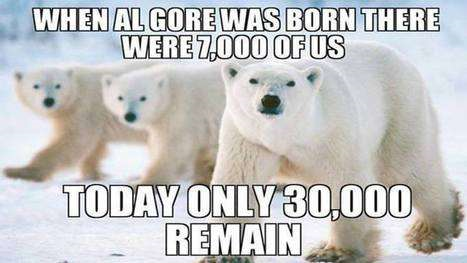
We must by now be getting reasonably close the point where there is a consensus for re-examining the issue of climate change and related subjects. For decades, those of us who had our doubts were effectively shut down by the endless deafening repetition, as if from the massed choir of an operatic catechism school, of the alleged truism: “98 per cent of scientists agree …” (that the world is coming to an end in a few years if we don’t abolish the combustion engine). Decades have gone by in which the polar bears were supposed to become extinct because of the vanishing polar ice cap, the glaciers were supposed to have melted in the rising heat and the impact of melting ice would raise ocean levels to the point that Pacific islands, such as former U.S. vice-president Al Gore’s oratorical dreamworld, the Pacific island state of Tuvalu, would only be accessible to snorkelers. There has been no progress toward any of this. Ocean levels have not risen appreciably, nothing has been submerged and the polar bear population has risen substantially.

A large part of the problem has been the fanaticism of the alarmist forces. This has not been one of those issues where people may equably disagree. There was a spontaneous campaign to denigrate those of us who were opposed to taking drastic and extremely expensive economic steps to reduce carbon emissions on the basis of existing evidence: we could not be tolerated as potentially sensible doubters; we were labelled “deniers,” a reference to Holocaust-deniers who would sweep evidence of horrible atrocities under the rug. For our own corrupt or perverse motives, we were promoting the destruction of the world and unimaginable human misery. There has been climate hysteria like other panics in history, such as those recounted in Charles MacKay’s “Extraordinary Popular Delusions and the Madness of Crowds,” particularly the 1630’s tulip mania, in which a single tulip bulb briefly sold for the current equivalent of $25,000.

In western Europe, and particularly in the United States, where the full panic of climate change prevailed, the agrarian and working echelons of society have rebelled against the onerous financial penalties of the war on carbon emissions. There have been movements in some countries to suppress the population of cows because of the impact of their flatulence on the composition of the atmosphere. This has created an alliance of convenience between the environmental extremists and the dietary authoritarians as they take dead aim at the joint targets of carbon emissions and obesity. Germany, which should be the most powerful and exemplary of Europe’s nations, has blundered headlong into the climate crisis by conceding political power to militant Greens. It has shut down its advanced and completely safe nuclear power program, the ultimate efficient fuel, and has flirted with abolishing leisure automobile drives on the weekends.

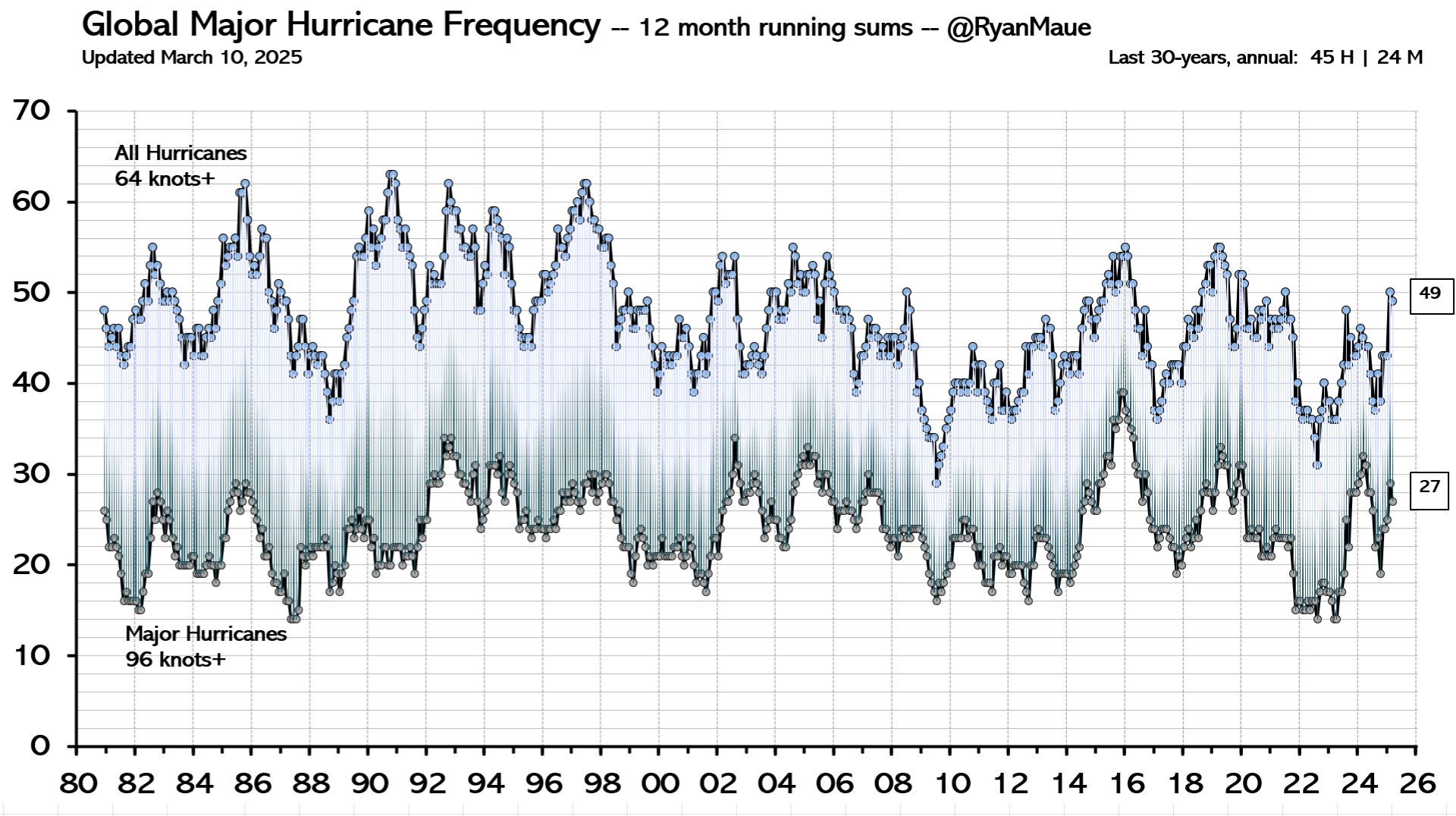
Claims that tropical storms have become more frequent are rebutted by meticulously recorded statistics. Claims that forest fires are more frequent and extensive have also been shown not to be true. My own analysis, which is based on observations and makes no pretense to scientific research, as I have had occasion to express here before, is that the honourable, if often tiresome, conservation movement, the zealots of Greenpeace and the Sierra Club, were suddenly displaced as organizers and leaders of the environmental movement by the international left, which was routed in the Cold War. Their western sympathizers demonstrated a genius for improvisation that none of us who knew them in the Cold War would have imagined that they possessed, and they took over the environmental bandwagon and converted it into a battering ram against capitalism in the name of saving the planet.

Everyone dislikes pollution and wants the cleanest air and water possible. All conscientious people want the cleanest environment that’s economically feasible. We should also aspire to the highest attainable level of accurate information before we embark on, or go any further with, drastic and hideously expensive methods of replacing fossil fuels. Large-scale disruptions to our ways of life at immense cost to consumers and taxpayers, mainly borne by those who can least easily afford it, are a mistake. We can all excuse zeal in a sincerely embraced cause, but it is time to de-escalate this discussion from its long intemperate nature of hurling thunderbolts back and forth, and instead focus on serious research that will furnish a genuine consensus. I think this was essentially what former prime minister Stephen Harper and former environment minister John Baird were advocating in what they called a ”Canadian solution” to the climate question. Since then, our policy has been fabricated by fanatics, including the prime minister, who do not wish to be confused by the facts. The inconvenient truth is now the truth that inconveniences them.

Western Europe has effectively abandoned its net-zero carbon emission goals; the world is not deteriorating remotely as quickly as Al Gore, King Charles, Tony Blair and the Liberal Party of Canada predicted. Some of the largest polluters — China, India and Russia — do not seem to care about any of this. Canada should lead the world toward a rational consensus with intensified research aiming at finding an appropriate response to the challenge. What we have had is faddishness and public frenzy. Historians will wonder why the West made war on its own standard of living in pursuit of a wild fantasy, and no immediate chance of accomplishing anything useful. We have been cheered on by the under-developed world because they seek reparations from the advanced countries, although some of them are among the worst climate offenders. It is insane. Canada should help lead the patient back to sanity.

Postscript:

So to be more constructive, let’s consider what should be proposed by political leaders regarding climate, energy and the environment.  IMO these should be the pillars:

♦  Climate change is real, but not an emergency.

♦  We must use our time to adapt to future climate extremes.

♦  We must transition to a diversified energy platform.

♦  We must safeguard our air and water from industrial pollutants.

A Rational Climate Policy

This is your brain on climate alarm. Just say N0!

Scottish Wind Power from Diesel Generators

John Gideon Hartnett writes at Spectator Australia Another climate myth busted  explaining how the Scottish public was scammed about their virtuous green wind power by the public authority.  Excerpts in italics with my bolds and added images from post by John Ray at his blog.

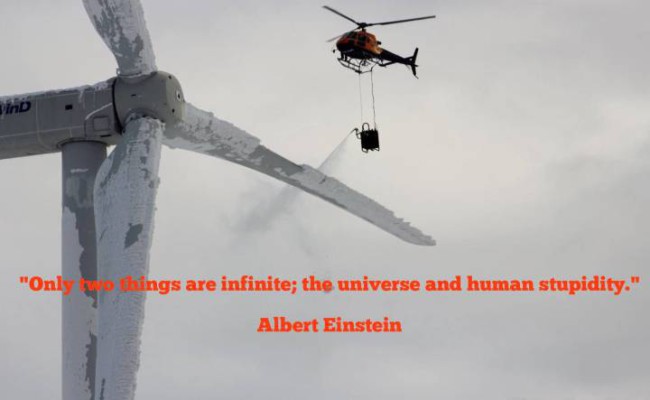
What I like to call ‘climate cult’ wind farms expose the myth that wind can replace hydrocarbon fuels for power generation. The following story is typical of the problems associated with using wind turbines to generate electricity in a cold environment.

Apparently, diesel-fuelled generators are being used to power some wind turbines as a way of de-icing them in cold weather, that is, to keep them rotating. Also, it appears that the wind turbines have been drawing electric power directly from the grid instead of supplying it to the grid.

Scotland’s wind turbines have been secretly using fossil fuels.

The revelation is now fueling environmental, health and safety concerns, especially since the diesel-generated turbines were running for up to six hours a day.

Scottish Power said the company was forced to hook up 71 windmills to the fossil fuel supply after a fault on its grid. The move was an attempt to keep the turbines warm and working during the cold month of December.

South Scotland Labor MSP Colin Smyth said regardless of the reasons, using diesel to deice faulty turbines is “environmental madness”.  Source: Straight Arrow News

Charging system for Teslas at Davos WEF meeting.

Nevertheless, those pushing these technologies are so blind to the physical realities of the world that they are prepared to ignore failures while pretending to efficiently generate electricity. I say ‘failures’ because wind energy was put out of service the day the Industrial Revolution was fired up (pun intended) with carbon-based fuels, from petroleum and coal. And in the case of modern wind turbines, they do not always generate electricity; they sometimes consume it from the grid.

Green energy needs the hydrocarbon-based fuel it claims to replace.

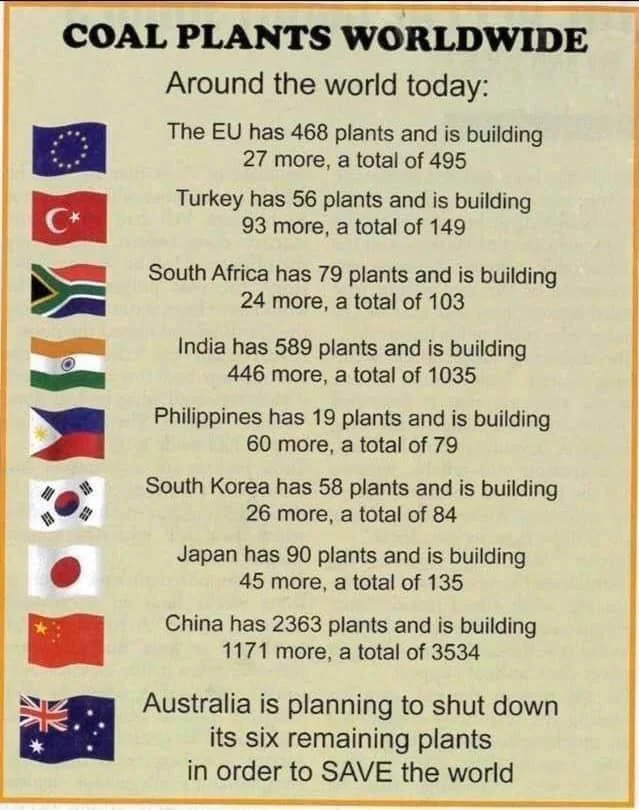
Hydrocarbon-based fuels were provided providentially by the Creator of this planet for our use. That includes coal, which has been demonised in the Western press as some sort of evil. But those who run that line must have forgotten to tell China, because they build two coal-fired power stations every other week. No other source of non-nuclear power is as reliable for baseload generation.

How will wind turbines work in a globally cooling climate as Earth heads into a grand solar minimum and temperatures plummet? This case from Scotland may give us a hint. As cloud cover increases with cooler weather, and more precipitation occurs, how will solar perform? It won’t.
The two worst choices for electricity generation in cold, wet, and stormy environments are solar and wind. Solar is obvious. No sun means no power generation. But you might think wind is a much better choice under those conditions.

However, wind turbine rotors have to be shut down if the wind becomes too strong and/or rapidly changes in strength. They are shut down when too much ice forms or when there is insufficient wind. And now we have learned in Scotland they just turn on the diesel generators when that happens or they draw power directly from the grid.

Where are all the real engineers? Were they fired?

In regards to wind turbines going forward, once their presence in the market has destroyed all the coal or natural gas electricity generators, how are they going to keep the rotors turning and the lights on?

These devices are based on a rotating shaft with a massive bearing, that suffers massive frictional forces. In this case, only a high-quality heavy-duty oil can lubricate this system and I am sure it would need to be regularly replaced.

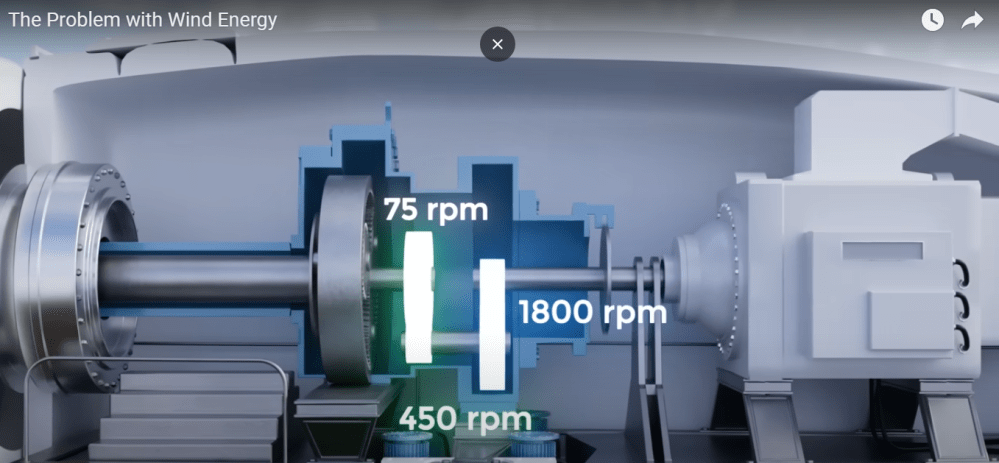
Wind turbine gearbox accelerates blade rotor (left) up to 1800 rpm output to electical generator (right)

Massive amounts of carbon-based oil are needed for the lubrication of all gears and bearings in a wind turbine system, which is mechanical in its nature. In 2019, wind turbine applications were estimated to consume around 80 per cent of the total supply of synthetic lubricants. Synthetic lubricants are manufactured using chemically modified petroleum components rather than whole crude oil. These are used in the wind turbine gearboxes, generator bearings, and open gear systems such as pitch and yaw gears.

Now we also know that icing causes the rotors to stop turning so diesel power has to be used to keep the bearings warm during cold weather. The diesel generator is needed to get the blades turning on start-up to overcome the limiting friction of the bearing or when the speed of the rotor drops too low.

In this case in Scotland, 71 windmills on the farm were supplied with diesel power. Each windmill has its own diesel generator. Just think of that.

What about the manufacturing of these windmills?

The blades are made from tons of fibreglass. Manufacturing fibreglass requires the mining of silica sand, limestone, kaolin clay, dolomite, and other minerals, which requires diesel-driven machines. These minerals are melted in a furnace at high temperatures (around 1,400°C) to produce the glass. Where does that heat come from? Not solar or wind power, that is for sure. The resin in the fibreglass comes from alcohol or petroleum-based manufacturing processes.

The metal structure is made from steel that requires tons of coking coal (carbon) essential to make pig iron, which is made from iron ore in a blast furnace at temperatures up to 2,200°C. The coal and iron ore is mined from the ground with giant diesel-powered machines and trucks. The steel is made with pig iron and added carbon in another furnace powered by massive electric currents. Carbon is a critical element in steel making, as it reacts with iron to form the desired steel alloy. None of this comes from wind and solar power.

Wind turbine power generation is inherently intermittent and unreliable.
It can hardly called green as the wind turbines require enormous
amounts of hydrocarbons in their manufacture and continued operation.


Biden Climate Policies the Greatest Financial Risk

Will Hild writes at Real Clear Policy The Biden Administration Proves Itself Wrong on ‘Climate Risk’.  The report shows how the feds’ own numbers prove their net zero policies pose a far greater financial risk than the climate itself. Excerpts in italics with my bolds and added images.

Environmental activists and left-leaning political bodies have long argued that climate risk is a form of financial risk, constantly pressuring blue states and the Biden Administration to make the issue a central part of their agendas. Recently, a group of those states has started suing oil and gas companies directly in their state courts. California, for example, claims that oil companies have colluded for decades to keep clean energy unavailable. Such lawsuits are ludicrous, and my organization, Consumers’ Research, filed an amicus brief at the Supreme Court supporting an effort to stop this litigation abuse that drives up consumer costs.

These harmful suits are driven in part by the idea that climate risks are inherently financial risks. However, evidence from the Biden Administration’s own study on climate risk shows that these risks are grossly exaggerated and immaterial. In an attempt to justify its radical and onerous climate policies, the Administration inadvertently exposed the fraud behind the environmental movement.

Soon after taking office, President Biden issued an executive order asking executive agencies to assess “the climate-related financial risk, including both physical and transition risks, to … the stability of the U.S. financial system.” Agency officials quickly responded to the order. Treasury Secretary Yellen announced that “climate change is an emerging and increasing threat to U.S. financial stability.” The FDIC declared that climate risk endangered the banking system. The SEC issued controversial climate risk disclosure rules, which impose massive regulatory burdens on Americans.

The problem with these new rules is that the Administration lacked
sufficient evidence to show that “climate-related financial risk” existed.

The SEC and Secretary Yellen relied on a Biden Administration report issued in 2021 by the Financial Stability Oversight Council. However, the report itself admitted that there were “gaps” in the evidence needed to support its speculative assertion that climate change would “likely” present shocks to the financial system. 

John H. Cochrane, a respected Stanford professor, slammed the Biden Administration’s “climate-related financial risk” assertions and highlighted that the Administration has not shown any serious threat to the financial system. “Financial regulators may only act if they think financial stability is at risk,” but “there is absolutely nothing in even the most extreme scientific speculations” to support the type of risk that would allow financial regulators to intervene. [See my synopsis Financial Systems Have Little Risk from Climate]

In response to criticism, the Biden Administration came up with an idea to manufacture its own evidence.  If the Federal Reserve created scenarios in which banks must simulate extreme “physical” and “transition” climate risks, these custom-designed scenarios could show a large impact to the financial system just like federal “stress tests” for banks.

To ensure that the “stresses” were sufficiently severe,
the Biden Administration manipulated the scenarios
to ensure as much stress as possible. 

For example, for “physical risk,” major banks had to simulate the effect of a storm-of-two-centuries-sized hurricane smashing into the heavily populated Northeast United States with no insurance coverage available to pay for the damage.  For “transition risk,” the government demanded a simulation in which “stringent climate policies are introduced immediately,” without any chance for banks to prepare for such policies, along with rapidly rising carbon prices. 

Despite these attempts to make the climate risk as extreme as possible, the tests utterly failed to demonstrate any significant effect.  The Administration’s study demonstrated that even under some of the most extreme climate scenarios imaginable, the probability of default on loans only increased by half a percentage point or less.   In contrast, federal bank stress tests involving true financial stresses, such as a severe recession, have resulted in probabilities of default jumping by 20 to 40 times that amount or more, leading to hundreds of billions in losses. 

The climate analyses also revealed the expected costs
of the Biden Administration’s quixotic net zero quest. 

The Biden Administration employed scenarios from the Network of Central Banks and Supervisors for Greening the Financial System (NGFS). Those climate scenarios envision the cost of carbon emissions steadily rising and reaching over $400 per ton by 2050.  Given that the average American emits about 16 tons of carbon a year, the Biden Administration’s hand-picked climate scenarios would cost the average American around $125k between now and 2050 in government mandated carbon fees.

Thus, the Biden Administration’s own bank stress test proved that climate risk is not a material financial risk, and that the biggest financial risk at issue is that the Administration’s net-zero policies would result in massive financial losses for everyday Americans. The Biden Administration should stop using lies to support their burdensome policies, and blue states should drop their punitive lawsuits against oil and gas companies.  Otherwise, the result of both efforts will be to inflict high costs on everyday Americans without any benefit.


Ruinous Folly of CO2 Pricing

Dr. Lars Schernikau is an energy economist explaining why CO2 pricing (also falsely called “carbon pricing”) is a terrible idea fit only for discarding.  His blog article is The Dilemma of Pricing CO2.  Excerpts below in italics with my bolds and added images.

1.Understanding CO₂ pricing
2.Economic and environmental impact
3.Global economic impact
4.Alternative solutions
5.Conclusion
6.Additional comments and notes
7.References

Introduction

As an energy economist I am confronted daily with questions about the “energy transition” away from conventional fuels. As we know, the discussion about the “energy transition” stems from concerns about climatic changes.

The source of climatic changes is a widely discussed issue, with numerous policies and measures proposed to mitigate its impact. One such measure is the current and future pricing of carbon dioxide (CO₂) emissions. The logic followed is that if human CO₂ emissions are reduced, future global temperatures will be measurably lower, extreme weather events will be reduced, and sea-levels will rise less or stop rising all together.

Although intended to reduce greenhouse gases, this approach has sparked considerable debate. In this blog post I discuss the controversial topic of CO₂ pricing, examining its economic and environmental ramifications.

However, this article is not about the causes of climatic changes, nor is it about the negative or positive effects of a warming planet and higher atmospheric CO₂ concentrations. It is also not about the scientifically undisputed fact that we don’t know how much warming CO₂ causes (a list of recent academic research on CO₂’s climate sensitivity can be found at the end of this blog).

Nor do I unpack the undisputed and IPCC confirmed fact that each additional ton of CO₂ in the atmosphere has less warming effect than the previous ton as the climate sensitivity of CO₂ is a logarithmic function irrespective of us not knowing what that climate sensitivity is. I also don’t discuss the NASA satellite confirmed greening of the world over the past decades partially driven by higher atmopheric CO₂ concentrations (see sources inc Chen et al. 2024).

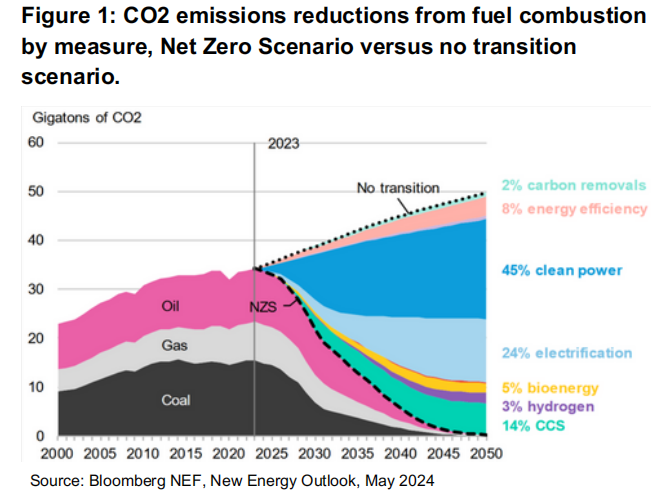
Instead, this blog post is about the environmental and economic “sense”, or lack thereof, of pricing CO₂ emissions as currently practiced in most OECD countries and increasingly seen in developing nations. It is about the “none-sense” of measuring practically all human activity with a “CO₂ footprint”, often mistakenly called “carbon footprint”, and having nearly every organization set claims for current or future “Net-Zero” (Figure 1).

1.Understanding CO₂ Pricing

CO₂ pricing aims to internalize the external costs of CO₂ emissions, thereby encouraging businesses and individuals to reduce their “carbon footprint”. The concept is straightforward: by assigning a cost to CO₂ emissions, it becomes financially advantageous to emit less CO₂.

However, this simplistic view overlooks
significant complexities and unintended consequences.

Our entire existence is based on drawing from nature (“renewable” or not), so the “Net-Zero” discussion ignores a fundamental requirement for our survival. I agree that it should be our aim to reduce the environmental footprint as much as possible but only if our lives, health, and wealth don’t deteriorate as a result.

Now, I am sure, some readers and many “activists” may disagree, which I respect but, at a global level, find unrealistic. However, I would assume that most agree that no-one’s life ought to be harmed or shortened for the sake of reducing the environmental impact made. Otherwise, there is little room for a conversation.

BloombergNEFs “New Energy Outlook” from May 2024 should possibly be called “CO₂ Outlook”, as there is little to be found about energy and its economics but rather all about CO₂ emissions and the so called “Net-Zero” (Figure 1), which is in line with media, government, and educational focus on primarily carbon dioxide emissions.

2.Economic and Environmental Impacts

One of the primary criticisms of CO₂ pricing is that it addresses only one environmental externality while ignoring others. This narrow focus can lead to economic distortions, as it fails to account for the full spectrum of environmental and social impacts. For instance, while CO₂ pricing might reduce emissions, it can also drive-up energy costs, disproportionately affecting lower-income populations and hindering economic development in lesser developed countries.

It is by now undisputed amongst energy economists that, large-scale “Net-Zero” intermittent and unpredictable wind and solar power generation increases the total or “full” cost of electricity, primarily because of their low energy density, intermittency, inherent net energy and raw material inefficiency, mounting integration costs for power grids, and the need for a drastic overbuild installation system plus an overbuild backup/storage system because of their intermittency.

CO₂ pricing can also result in environmental trade-offs. For example, the shift towards “renewable” energy sources like wind and solar, incentivized by CO₂ pricing, has its own set of environmental impacts, including land use, resource extraction, energy footprint, and energy storage challenges.

When BloombergNEF (Figure 1) displays
how clean power and electrification
will directly reduce CO₂ emissions to zero,
then they are clearly mistaken.

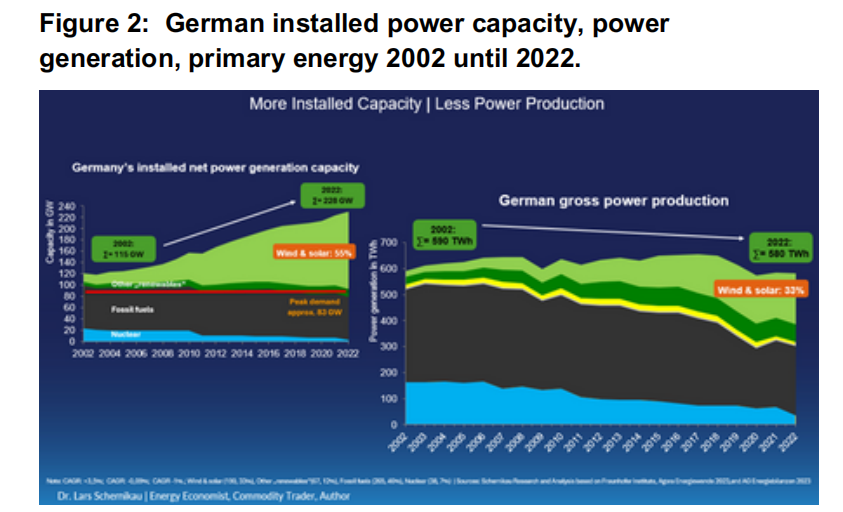
My native country Germany provides a notable example of the complexities involved in transitioning to “renewable” energy. The country has invested heavily in wind and solar power, leading to the highest electricity costs among larger nations. Germany’s installed wind and solar capacity is now twice the total peak power demand. This variable “renewable” wind and solar power capacity now produces about a third of the country’s electricity and contributes about 6% to Germany’s primary energy supply (Figure 2).

Sources: Schernikau based on Fraunhofer, Agora, AG Energiebilanzen. See also www.unpopular-truth.com/graphs.

3.Global Economic Implications

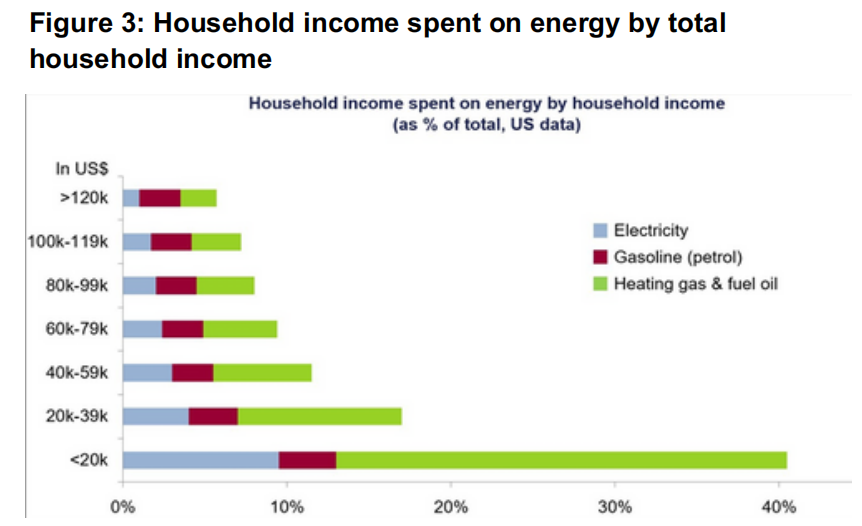
Higher energy costs, obviously and undisputedly, hurt less affluent people and stifles the development of poorer nations (Figure 3). Thus, a move to more expensive wind and solar energy has “human externalities”. The less fortunate will be “starved of” energy as they wouldn’t be able to afford it, leading to literal reduction in life expectancy.

Source: Eschenbach 2017; Figure 38 in Book “The Unpopular Truth… about Electricity and the Future of Energy”

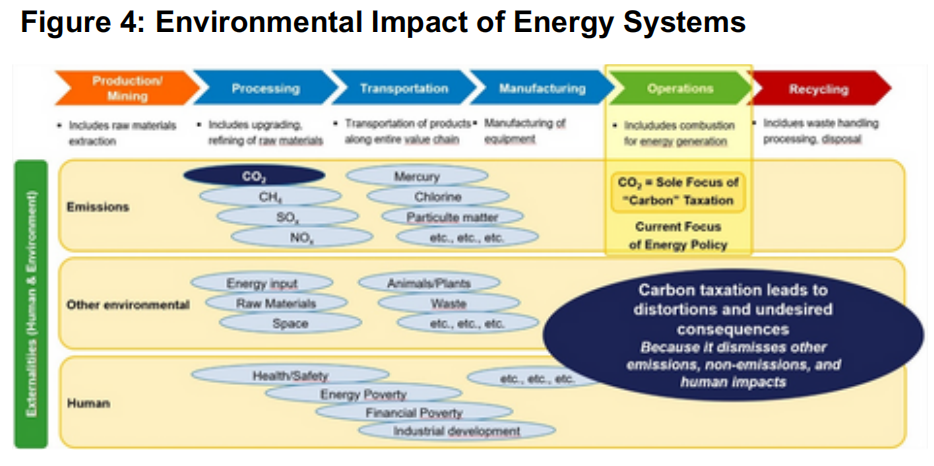
CO₂ pricing typically focuses only on emissions during operation,
neglecting significant environmental and economic costs
incurred during other stages or by the entire system.

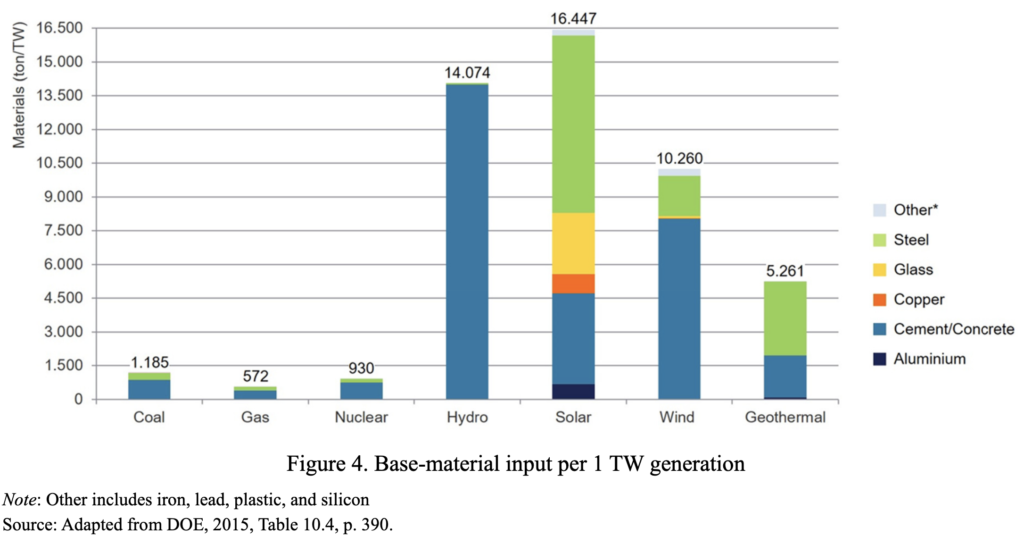
For instance, the production of solar panels involves substantial energy and raw material inputs. Today there is not one single solar panel that is produced without coal. Similarly, the manufacturing and transportation processes of wind turbines and electric vehicles are energy-intensive and environmentally impactful. These stages are rarely accounted for in CO₂ pricing schemes, leading to a distorted view of their true environmental footprint. Also not accounted for are:

a) the required overbuild,
b) short and long duration energy storage,
c) backup facilities, or
d) larger network integration and transmission infrastructure.

Source: Schernikau, adapted from Figure 39 in Book “The Unpopular Truth… about Electricity and the Future of Energy“

Figure 4 illustrates how virtually all CO₂ pricing or taxation happens only at the stage of “operation” or combustion. How else could a “Net-Zero” label be assigned to a solar panel produced from coal and minerals extracted in Africa with diesel-run equipment, transported to China on a vessel powered by fuel-oil, and processed with heat and electricity from coal- or gas-fired power partially using forced labour? All this energy-intensive activity and not a single kilogram of CO₂ is taxed (see my recent article on this subject here) The same applies to wind turbines, hydro power, biofuel, or electric vehicles.

It turns out, CO₂ tax is basically just a means to redistribute wealth, with the collecting agency (government) deciding where the funds go. Yes, a CO₂ tax does incentivize industry to reduce CO₂ emissions at their taxed operations only, but this comes at a cost to economies, the environment, and often people. . . Any economist will confirm that pricing one externality but not others leads to economic distortions and, many would say, worse environmental impacts.

4.Alternative Approaches

Distortion, in this case, is just another word for unintended consequences to the environment, our economies, and the people. Pricing CO₂ only during combustion but failing to price methane, raw material and recycling, inefficiency, or embodied energy, or energy shortages, or land requirement, or greening from CO₂… will cause undesirable outcomes. The world will be worse off economically and environmentally.

Protest if you must, but let me offer a simple example. The leaders of the Western world seem to have united around abandoning coal immediately, because it is the highest CO₂ emitter during combustion (UN 2019). Instead, demanding reliable and affordable energy, Bangladesh, Pakistan, Germany, and so many more nations have embraced liquified natural gas (LNG) as a “bridge” fuel to replace coal. This “switch” is taking place despite questions about LNG’s impact on the environment, including the “climate”. This policy, supported by almost all large consultancies, indirectly caused blackouts affecting over 150 million people in Bangladesh in October 2022 (Reuters and Bloomberg).

So, the world is embarking on an expensive venture
to replace as much coal as possible with
more expensive liquified natural gas LNG.

On top of that, wind and solar are given preference. For example, the IEA recently confirmed that 2024 sparks the first year where investments in solar outstrip the combined investments in all other power generation technologies. As a result, energy costs go up, dependencies increase, lights go off, and, as per the UN’s IPCC, the “climate gets worse.”

Now imagine what would happen if we would truly take into account all environmental and human impacts, both negative and positive, along the entire value chain of energy production, transportation, processing, generation, consumption, and disposal… we would all be surprised! You would look at fossil fuels and certainly nuclear through different eyes. Instead we should simply incentivize resource and energy efficiency which will truly make a positive difference!

From Schernikau et al. 2022.

5.Conclusion

No matter what your view on climate change is, pricing CO₂ is harmful… why?
Answer: … because pricing one externality but not others leads to economic and environmental distortions…causing human suffering.

That is why, even considering the entire value chain, I do not support any CO₂ pricing.. That is why I fight for environmental and economic justice so we can, by avoiding energy starvation and resulting poverty, make a truly positive difference not only for ourselves but also for future generations to come.. . We need INvestment in, not DIvestment from 80% of our energy supply to rationalize our energy systems and to allow people and the planet to flourish.

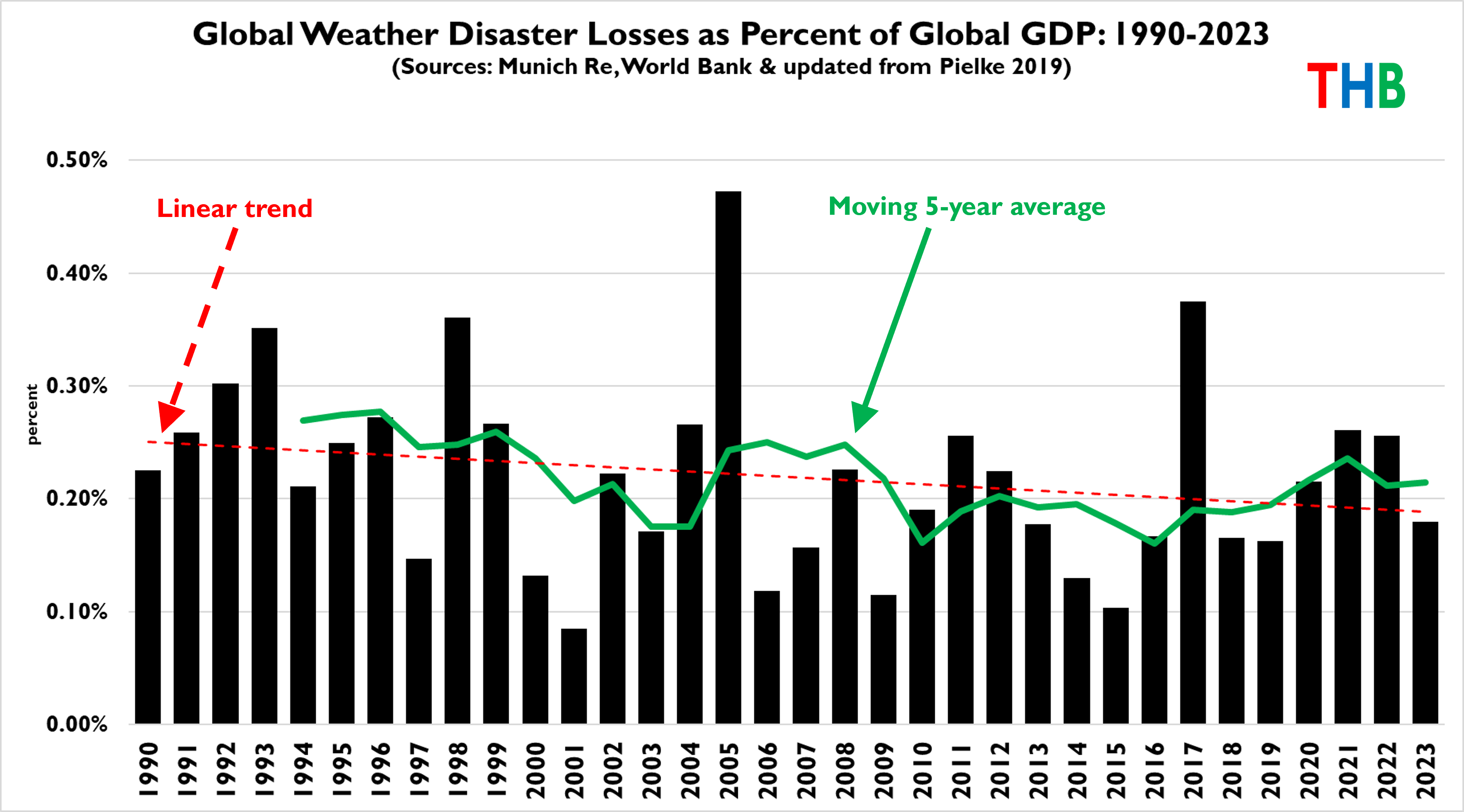
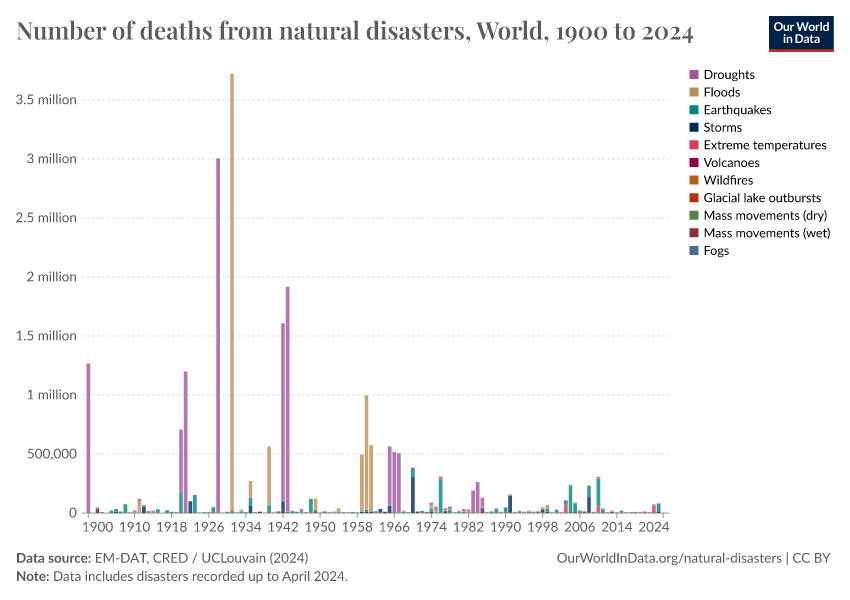
I strongly support increasing adaptation efforts, which have already been successful in drastically reducing the death rate and GDP adjusted financial damage from natural disasters during the past
100 years (OurWorldInData, Pielke 2022, Economist).


Experimental Proof Nil Warming from GHGs

Thomas Allmendinger is a Swiss physicist educated at Zurich ETH whose practical experience is in the fields of radiology and elemental particles physics.  His complete biography is here.

His independent research and experimental analyses of greenhouse gas (GHG) theory over the last decade led to several published studies, including the latest summation The Real Origin of Climate Change and the Feasibilities of Its Mitigation, 2023, at Atmospheric and Climate Sciences journal. The paper is a thorough and detailed discussion of which I provide here a synopsis of his methods, findings and conclusions. Excerpts are in italics with my bolds and added images.

Abstract

The actual treatise represents a synopsis of six important previous contributions of the author, concerning atmospheric physics and climate change. Since this issue is influenced by politics like no other, and since the greenhouse-doctrine with CO2 as the culprit in climate change is predominant, the respective theory has to be outlined, revealing its flaws and inconsistencies.

But beyond that, the author’s own contributions are focused and deeply discussed. The most eminent one concerns the discovery of the absorption of thermal radiation by gases, leading to warming-up, and implying a thermal radiation of gases which depends on their pressure. This delivers the final evidence that trace gases such as CO2 don’t have any influence on the behaviour of the atmosphere, and thus on climate.

But the most useful contribution concerns the method which enables to determine the solar absorption coefficient βs of coloured opaque plates. It delivers the foundations for modifying materials with respect to their capability of climate mitigation. Thereby, the main influence is due to the colouring, in particular of roofs which should be painted, preferably light-brown (not white, from aesthetic reasons).

It must be clear that such a drive for brightening-up the World would be the only chance of mitigating the climate, whereas the greenhouse doctrine, related to CO2, has to be abandoned. However, a global climate model with forecasts cannot be aspired to since this problem is too complex, and since several climate zones exist.

Background

The alleged proof for the correctness of this theory was delivered 25 years later by an article in the Scientific American of the year 1982 [4]. Therein, the measurements of C.D. Keeling were reported which had been made at two remote locations, namely at the South Pole and in Hawaii, and according to which a continuous rise of the atmospheric CO2-concentration from 316 to 336 ppm had been detected between the years 1958 and 1978 (cf. Figure 1), suggesting coherence between the CO2 concentration and the average global temperature.

But apart from the fact that these CO2-concentrations are quite minor (400 ppm = 0.04%), and that a constant proportion between the atmospheric CO2-concentration and the average global temperature could not be asserted over a longer period, it should be borne in mind that this conclusion was an analogous one, and not a causal one, since solely a temporal coincidence existed. Rather, other influences could have been effective which happened simultaneously, in particular the increasing urbanisation, influencing the structure and the coloration of large parts of Earth surface.

However, this contingency was, and still is, categorically excluded. Solely the two possibilities are considered as explanation of the climate change: either the anthropogenic influence due to CO2-production, or a natural one which cannot be influenced. A third influence, the one suggested here, namely the one of colours, is a priori excluded, even though nobody denies the influence of colouring on the surface temperature of Earth and the existence of urban heat islands, and although an increase of winds and storms cannot be explained by the greenhouse theory.

However, already well in advance institutions were founded which aimed at mitigating climate change through political measures. Thereby, climate change was equated with the industrial CO2 production, although physical evidence for such a relation was not given. It was just a matter of belief. In this regard, in 1992 the UNFCCC (United Nations Framework Convention on Climate Change) was founded, supported by the IPCC (Intergovernmental Panel on Climate Change). In advance, side by the side with the UNO, numerous so-called COPs (Conferences on the Parties) were hold: the first one in 1985 in Berlin, the most popular one in 1997 in Kyoto, and the most important one in 2015 in Paris, leading to a climate convention which was signed by representatives of 195 nations. Thereby, numerous documents were compiled, altogether more than 40,000. But actually these documents didn’t fulfil the standards of scientific publications since they were not peer reviewed.

Subsequently, intensive research activities emerged, accompanied by a flood of publications, and culminating in several text books. Several climate models were presented with different scenarios and diverging long-term forecasts. Thereby, the fact was disregarded that indeed no global climate exists but solely a plurality of climates, or rather of micro-climates and at best of climate-zones, and that the Latin word “clima” (as well as the English word “clime”) means “region”. Moreover, an average global temperature is not really defined and thus not measurable because the temperature-differences are immense, for instance with regard to the geographic latitude, the altitude, the distinct conditions over sea and over land, and not least between the seasons and between day and night. Moreover, the term “climate” implicates rain and snow as well as winds and storms which, in the long-term, are not foreseeable. In particular, it should be realized that atmospheric processes are energetically determined, whereto the temperature contributes only a part.

2. The Historical Inducement for the Greenhouse Theory and Their Flaws

The scientific literature about the greenhouse theory is so extensive that it is difficult to find a clearly outlined and consistent description. Nevertheless, the publications of James E. Hansen [5] and of V. Ramanathan et al. [6] may be considered as authoritative. Moreover, the textbooks [7] [8] and [9] are worth mentioning. Therein it is assumed that Earth surface, which is heated up by sun irradiation, emits thermal radiation into the atmosphere, warming it up due to heat absorption by “greenhouse gases” such as CO2 and CH4. Thereby, counter-radiation occurs which induces a so-called radiative transfer. This aspect involved the rise of numerous theories (e.g. [10] [11] [12]). But the co-existence of theories is in contrast to the scientific principle that for each phenomenon solely one explanation or theory is admissible.

Already simple thoughts may lead one to question this theory. For instance: Supposing the present CO2-concentration of approx. 400 ppm (parts per million) = 0.04%, one should wonder how the temperature of the atmosphere can depend on such an extremely low gas amount, and why this component can be the predominant or even the sole cause for the atmospheric temperature. This would actually mean that the temperature would be situated near the absolute zero of −273˚C if the air would contain no CO2 or other greenhouse gases.

Indeed, no special physical knowledge is needed in order to realize that this theory cannot be correct. However, the fact that it has settled in the public mind, becoming an important political issue, requires a more detailed investigation of the measuring methods and their results which delivered the foundations of this theory, and why misinterpretations arose. Thereto, the two subsequent points have to be particularly considered: The first point concerns the photometrical measurements on gases in the electromagnetic range of thermal radiation which initially Tyndall had carried out in the 1860s [13], and which had been expanded to IR-measurements evaluated by Plass nineteen years later [14]. The second point concerns the application of the Stefan/Boltzmann-law on the Earth-atmosphere system firstly made by Arrhenius in 1896 [2], and more or less adopted by modern atmospheric physics. Both approaches are deficient and would question the greenhouse theory without requiring the author’s own approaches.

2.1 The Photometric and IR-Measurement Methods for CO2

By variation of the wave length and measuring the respective absorption, the spectrum of a substance can be evaluated. This IR-spectroscopic method is widely used in order to characterize organic chemical substances and chemical bonds, usually in solution. But even there this method is not suited for quantitative measurements, i.e. the absorption of the IR-active substance is not proportional to its concentration as the Beer-Lambert law predicts. It probably will even less be the case in the gaseous phase and, all the more, at high pressures which were applied in order to imitate the large distances in the atmosphere in the range of several (up to 10) kilometres. Thereby it is disregarded that the pressure of the atmosphere depends on the altitude above sea level, which prohibits the assumption of a linear progress.

Moreover, it is disregarded that at IR-spectrographs the effective radiation intensity is not known, and that in the atmosphere a gas mixture exists where the CO2 amounts solely to a little extent, whereas for the spectroscopic measurements pure CO2 was used. Nevertheless, in the text books for atmospheric physics the Beer-Lambert law is frequently mentioned, however without delivering concrete numerical results about the absorbed radiation.

In both cases solely the absorption degree of the radiation was determined, i.e. the decrease of the radiation intensity due to its run through a gas, but never its heating-up, that means its temperature increase. Instead, it was assumed that a gas is necessarily warmed up when it absorbs thermal radiation. According to this assumption, pure air, or rather a 4:1 mixture of nitrogen and oxygen, is expected to be not warmed up when it is thermally irradiated since it is IR-spectroscopically inactive, in contrast to pure CO2.

However, no physical formula exists which would allow to calculate such an effect, and no respective empirical evidence was given so far. Rather, the measurements which were recently performed by the author delivered converse, surprising results.

2.2. The Impact of Solar Radiation onto the Earth Surface and Its Reflexion

Besides, a further error is implicated in the usual greenhouse theory. It results from the fact that the atmosphere is only partly warmed up by direct solar radiation. In addition, it is warmed up indirectly, namely via Earth surface which is warmed up due to solar irradiation, and which transmits the absorbed heat to the atmosphere either by thermal conduction or by thermal radiation. Moreover, air convection contributes a considerable part. This process is called Anthropogenic Heat Flux (AHF). It has recently been discussed by Lindgren [16]. However, herewith a more fundamental view is outlined.

The thermal radiation corresponds to the radiative emission of a so-called “black body”. Such a body is defined as a body which entirely absorbs electromagnetic radiation in the range from IR to UV light. Likewise, it emits electromagnetic radiation all the more as its temperature grows. Its radiative behaviour is formulated by the law of Stefan and Boltzmann. . . According to this law, the radiation wattage Φ of a black body is proportional to the fourth power of its absolute temperature. Usually, this wattage is related to the area, exhibiting the dimension W/m2.

This formula does not allow making a statement about the wave-length or the frequency of the emitted light. This is only possible by means of Max Planck’s formula which was published in 1900. According to that, the frequencies of the emitted light tend to be the higher the temperature is. At low temperatures, only heat is emitted, i.e. IR-radiation. At higher temperatures the body begins to glow: first of all in red, and later in white, a mixture of different colours. Finally, UV-radiation emerges. The emission spectrum of the sun is in quite good accordance with Planck’s emission spectrum for approx. 6000 K.
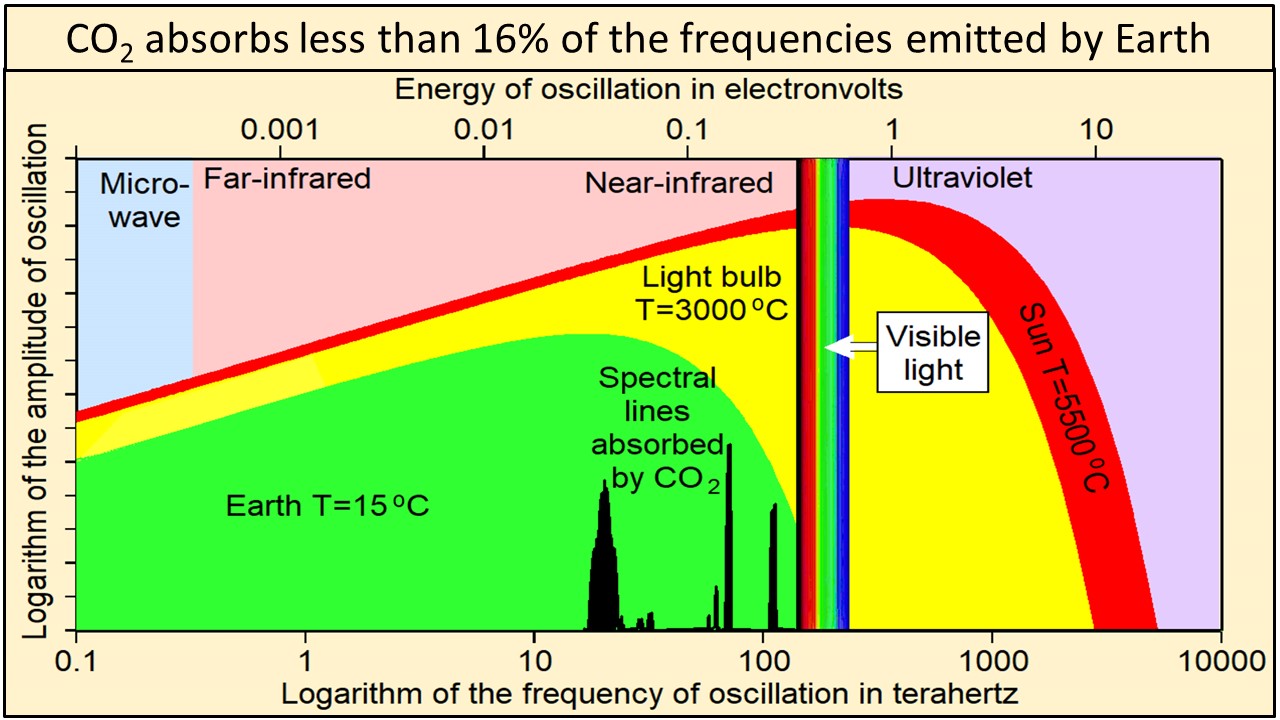
Black co2 absorption lines are not to scale.

This model can be applied on Earth surface considering it as a coloured opaque body: On one side, with respect to its thermal emission, it behaves like a black body fulfilling the Stefan/Boltzmann-law. On the other side, it adsorbs only a part βs of the incident solar light, converting it into heat, whereas the complementary part is reflected. However, the intensity of the incident solar light on Earth surface, Φsurface, is not identically equal with its extra-terrestrial intensity beyond the atmosphere, but depends on the sea level since the atmosphere absorbs a part of the sunlight. Remarkably, the atmosphere behaves like a black body, too, but solely with respect to the emission: On one side, it radiates inwards to the Earth surface, and on the other side, it radiates outwards in the direction of the rest of the atmosphere.

However, this method implies three considerable snags:
•  Firstly, TEarth means the constant limiting temperature of the Earth surface which is attained when the sun had constantly shone onto the same parcel and with the same intensity. But this is never the case, except at thin plates which are thermally insulated at the bottom and at the sides, since the position of the sun changes permanently.

•  Secondly, this formula does not allow making a statement about the rate of the warming up-process, which depends on the heat capacity of the involved plate, too. This is solely possible using the author’s approach (see Chapter 3). Nevertheless, it is often attempted (e.g. in [35]), not least within radiative transfer approaches.

•  Thirdly, it is principally impossible to determine the absolute values of the solar reflection coefficient αs with an Albedometer or a similar apparatus, because the intensity of the incident solar light is independent of the distance to the surface, whereas the intensity of the reflected light depends on it. Thus, the herewith obtained values depend on the distance from Earth surface where the apparatus is positioned. So they are not unambiguous but only relative.

In the modern approach of Hansen et al. [5] the Earth is apprehended as a coherent black body, disregarding its segmentation in a solid and a gaseous part, and thus disregarding the contact area between Earth surface and the atmosphere where the reflexion of the sunlight takes place. As a consequence, in Equation (4b) the expression with Tair disappears, whereas a total Earth temperature appears which is not definable and not determinable. This approach has been widely adopted in the textbooks, even though it is wrong (see also [15]).

Altogether, the matter of fact was neglected that the proportionality of the radiation intensity to the absolute temperature to the fourth is solely valid if a constant equilibrium is attained. In contrast, the subsequently described method enables the direct detection of the colour dependent solar absorption coefficient βs = 1 –αs using well-defined plates. Furthermore, the time/temperature-courses are mathematically modelled up to the limiting temperatures. Finally, relative field measurements are possible based on these results.

3. The Measurement of Solar Absorption-Coefficients with Coloured Plates

Within the here described and in [20] published lab-like method, not the reflected but the absorbed sun radiation was determined, namely by measuring the temperature courses of coloured quadratic plates (10 × 10 × 2 cm3) when sunlight of known intensity came vertically onto these plates. The temperatures of the plates were determined by mercury thermometers, while the intensity of the sunlight was measured by an electronic “Solarmeter” (KIMO SL 100). The plates were embedded in Styrofoam and covered with a thin transparent foil acting as an outer window in order to minimize erratic cooling by atmospheric turbulence (Figure 5). Their heat capacities were taken from literature values. The colours as well as the plate material were varied. Aluminium was used as a reference material, being favourable due to its high heat capacity which entails a low heating rate and a homogeneous heat distribution. For comparison, additional measurements were made by wooden plates, bricks and natural stones. For enabling a permanent optimal orientation towards the sun, six plate-modules were positioned on an adjustable panel (Figure 6).
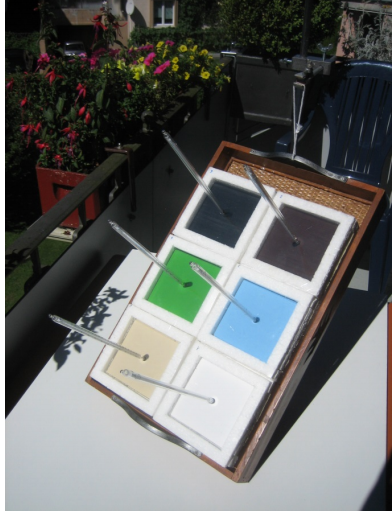
The evaluation of the curves of Figure 7 yielded the colour specific solar absorption-coefficients βs rendered in Figure 9. They were independent of the plate material. Remarkably, the value for green was relatively high.
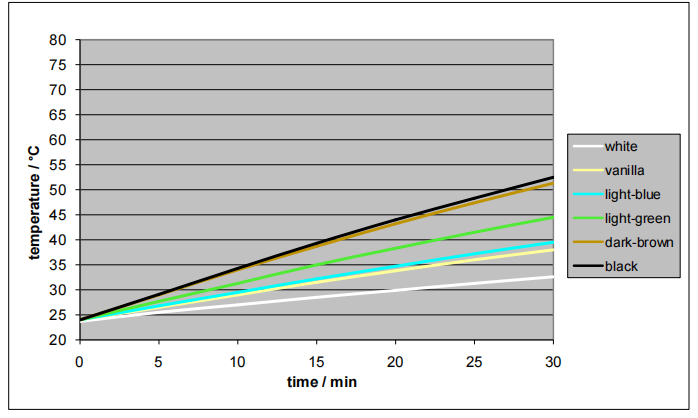
Figure 7. Warming-up of aluminium plates at 1040 W/m2 [20].
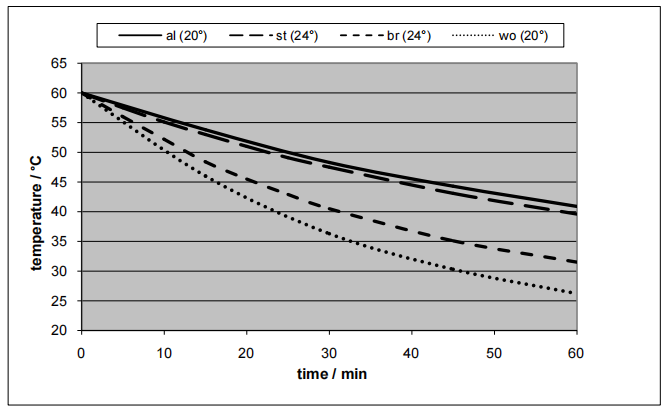
If the sunlight irradiation and thus the warming-up process would be continued, finally constant limiting temperatures are attained. However, when 20 mm thick aluminium plates are used, the hereto needed time would be too long, exceeding the constantly available sunshine period during a day. Instead, separate cooling-down experiments were made, allowing a mathematical modelling of the whole process including the determination of the limiting temperatures.

Figure 10. Cooling-down of different materials (in brackets: ambient temperature) [20]. al = aluminium 20 mm; st = stone 20.5 mm; br = brick 14.5 mm; wo = wood 17.5 mm.

These limiting temperature values are in good accordance with the empirical values reported in [24] and with the Stefan/Boltzmann-values. As obvious from the respective diagrams in Figure 11 and Figure 12, the limiting temperatures are independent of the plate-materials, whereas the heating rates strongly depend on them.  In principal, it is also possible to model combined heating-up and cooling-down processes [20]. However, this presumes constant environmental conditions which normally do not exist.

4. Thermal Gas Absorption Measurements

If the warming-up behaviour of gases has to be determined by temperature measurements, interference by the walls of the gas vessel should be regarded since they exhibit a significantly higher heat capacity than the gas does, which implicates a slower warming-up rate. Since solid materials absorb thermal radiation stronger than gases do, the risk exists that the walls of the vessel are directly warmed up by the radiation, and that they subsequently transfer the heat to the gas. And finally, even the thin glass-walls of the thermometers may disturb the measurements by absorbing thermal radiation.

By these reasons, quadratic tubes with a relatively large profile (20 cm) were used which consisted of 3 cm thick plates from Styrofoam, and which were covered at the ends by thin plastic foils. In order to measure the temperature course along the tube, mercury-thermometers were mounted at three positions (beneath, in the middle, and atop) whose tips were covered with aluminium foils. The test gases were supplied from steel cylinders being equipped with reducing valves. They were introduced by a connecter during approx. one hour, because the tube was not gastight and not enough consistent for an evacuation. The filling process was monitored by means of a hygrometer since the air, which had to be replaced, was slightly humid. Afterwards, the tube was optimized by attaching adhesive foils and thin aluminium foils (see Figure 13). The equipment and the results are reported in [21].

Figure 13. Solar-tube, adjustable to the sun [21].

The initial measurements were made outdoor with twin-tubes in the presence of solar light. One tube was filled with air, and the other one with carbon-dioxide. Thereby, the temperature increased within a few minutes by approx. ten degrees till constant limiting temperatures were attained, namely simultaneously at all positions. Surprisingly, this was the case in both tubes, thus also in the tube which was filled with ambient air. Already this result delivered the proof that the greenhouse theory cannot be true. Moreover, it gave rise to investigate the phenomenon more thoroughly by means of artificial, better defined light.

Figure 14. Heat-radiation tube with IR-spot [21].

Accordingly, the subsequent experiments were made using IR-spots with wattages of 50 W, 100 W and 150W which are normally employed for terraria (Figure 14). Particularly the IR-spot with 150 W lead to a considerably higher temperature increase of the included gas than it was the case when sunlight was applied, since its ratio of thermal radiation was higher. Thereby, variable impacts such as the nature of the gas could be evaluated.

Due to the results with IR-spots at different gases (air, carbon-dioxide, the noble gases argon, neon and helium), essential knowledge could be gained. In each case, the irradiated gas warmed up until a stable limiting temperature was attained. Analogously to the case of irradiated coloured solid plates, the temperature increased until the equilibrium state was attained where the heat absorption rate was identically equal with the heat emission rate.

Figure 15. Time/temperature-curves for different gases [21] (150 W-spot, medium thermometer-position).

As evident from the diagram in Figure 15, the initial observation made with sunlight was approved that pure carbon-dioxide was warmed up almost to the same degree as air does (whereby ambient air only scarcely differed from a 4:1 mixture between nitrogen and oxygen). Moreover, noble gases absorb thermal radiation, too. As subsequently outlined, a theoretical explanation could be found thereto.

Interpretation of the Results

Comparison of the results obtained by the IR-spots, on the one hand, and those obtained with solar radiation, on the other hand, corroborated the conclusion that comparatively short-wave IR-radiation was involved (namely between 0.9 and 1.9 μm). However, subsequent measurements with a hotplate (<90˚C), placed at the bottom of the heat-radiation tube ([15], Figure 16), yielded that long-wave thermal radiation (which is expected at bodies with lower temperatures such as Earth surface) induces also temperature increase of air and of carbon-dioxide, cf. Figure 17.

Thus, the herewith discovered absorption effect at gases proceeds over a relatively wide wave-length range, in contrast to the IR-spectroscopic measurements where only narrow absorption bands appear. This effect is not exceptional, i.e. it occurs at all gases, also at noble gases, and leads to a significant temperature increase, even though it is spectroscopically not detectable. This temperature increase overlays an eventual temperature increase due to the specific IR-absorption since the intensity ratio of the latter one is very small.

This may be explained as follows: In any case, an oscillation of particles, induced by thermal radiation, acts a part. But whereas in the case of the specific IR-absorption the nuclei inside the molecules are oscillating along the chemical bond (which must be polar), in the relevant case here the electronic shell inside the atoms, or rather the electron orbit, is oscillating implicating oscillation energy. Obviously, this oscillation energy can be converted into kinetic translation energy of the entire atoms which correlates to the gas temperature, and vice versa.

5. The Altitude-Paradox of the Atmospheric Temperature

The statement that it’s colder in the mountains than in the lowlands is trivial. Not trivial is the attempt to explain this phenomenon since the reason is not readily evident. The usual explanation is given by the fact that rising air cools down since it expands due to the decreasing air-pressure. However, this cannot be true in the case of plateaus, far away from hillsides which engender ascending air streams. It appears virtually paradoxical in view of the fact that the intensity of the sun irradiation is much greater in the mountains than in the lowlands, in particular with respect to its UV-amount. Thereby, the intensity decrease is due to the scattering and the absorption of sunlight within the atmosphere, not only within the IR-range but also in the whole remaining spectral area. If such an absorption, named Raleigh-scattering, didn’t occur, the sky would not be blue but black.

However, the direct absorption of sunlight is not the only factor which determines the temperature of the atmosphere. Its warming-up via Earth surface,which is warmed up due to absorbed sun-irradiation, is even more important. Thereby, the heat transfer occurs partly by heat conduction and air convection, and partly by thermal radiation. But there is an additional factor which has to be regarded: namely the thermal radiation of the atmosphere. It runs on the one hand towards Earth (as counter-radiation), and on the other hand towards Space. Thus the situation becomes quite complicated, all the more the formal treatment based on the Stefan/Boltzmann-relation would require limiting equilibrated temperature conditions. But in particular, that relation does not reveal an influence of the atmospheric pressure which obviously acts a considerable part.

In order to study the dependency on the atmospheric pressure, it would be desirable solely varying the pressure, whereas the other terms remain constant by varying the altitude of the measuring station above sea level which implicates a variation of the intensity of the sunlight and of the ambient atmosphere temperature, too. The here reported measurements were made at two locations in Switzerland, namely at Glattbrugg (close to Zürich), 430 m above sea level, and at the top of the Furka pass, 2430 m above sea level. Using the barometric height formula, the respective atmospheric pressures were approx. 0.948 and 0.748 bar.  At any position, two measurements were made in the same space of time.
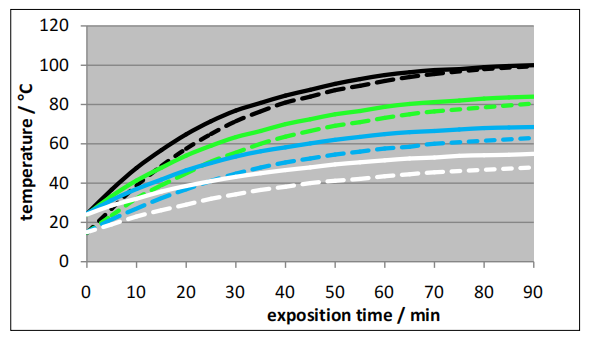
Figure 18. Comparison of the temperature courses during two measurements [24] (continuous lines: Glattbrugg; dotted lines: Furka).

Figure 18 renders the data of one measurement pair. Obviously, the limiting temperatures were not ideally attained within 90 minutes. Moreover, the evaluation of the data didn’t provide strictly invariant values for A. But this is reasonable in view of the fact that the sunlight intensity was not entirely constant during that period, and that its spectrum depends on the altitude over sea level. Nevertheless, for the atmospheric emission constant A an approximate value of 22W·m−2• bar−1• K−0.5 could be found.

These findings indeed confirm that in a way a greenhouse-effect occurs, since the atmosphere thermally radiates back to Earth surface. But this radiation has  nothing to do with trace gases such as CO2. It rather depends on the atmospheric pressure which diminishes at higher altitudes.

If the oxygen content of the air would be considerably reduced, a general reduction of the atmospheric pressure and, as a consequence, of the temperature would proceed. This may be an explanation for the appearance of glacial periods. However, other explanations are possible, in particular the temporary decrease of the sun activity.

Over all it can be stated that climate change cannot be explained by ominous greenhouse gases such as CO2, but mainly by artificial alterations of Earth surface, particularly in urban areas by darkening and by enlargement of the surface (so-called roughness). These urban alterations are not least due to the enormous global population growth, but also to the character of modern buildings tending to get higher and higher, and employing alternative materials such as concrete and glass. As a consequence, respective measures have to be focussed, firstly mentioning the previous work, and then applying the here presented method.

7. Conclusions

The herewith summarized work of the author concerns atmospheric physics with respect to climate change, comprising three specific and interrelated points based on several previous publications: The first one consists in a critical discussion and refutation of the customary greenhouse theory; the second one outlines the method for measuring the thermal-radiative behaviour of gases; and the third one describes a lab-like method for the characterization of the solar-reflective behaviour of solid opaque bodies, in particular for the determination of the colour-specific solar absorption coefficients.

As to the first point, three main flaws were revealed:

•  Firstly, the insufficiency of photometric methods in order to determine the heating-up of gases in the presence of thermal radiation;
•  Secondly, the lack of  causal relationship between the CO2-concentration in the atmosphere and the average global temperature, based on the reasoning that the empiric simultaneous increase of its concentration and of the global temperature would prove a causal relationship instead of an analogous one; and
•  Thirdly, the inadmissible application of the Stefan/Boltzmann-law to the entire Earth (including the atmosphere) versus Space, instead of the application onto the boundary between the Earth surface and the atmosphere.

As to the second point, the discovery has to be taken into account according to which every gas is warmed up when it is thermally irradiated, even noble gases, attaining a limiting temperature where the absorption of radiation is in equilibrium with the emitted radiation. In particular, pure CO2 behaves similarly to pure air. Applying kinetic gas theory, a dependency of the emission intensity on the pressure, on the root of the absolute temperature, and on the particle size could be found and theoretically explained by oscillation of the electron shell.

As to the third point not only a lab-like measuring method for the colour dependent solar absorption coefficient βs was developed, but also a mathematical modelling of the time/temperature-course where coloured opaque plates are irradiated by sunlight. Thereby, the (colour-dependent) warming-up and the (colour-independent) cooling-down are detected separately. Likewise, a limiting temperature occurs where the intensity of the absorbed solar light is identical equal with the intensity of the emitted thermal radiation. In the absence of wind-convection, the so-called heat transfer coefficient B is invariant. Its value was empirically evaluated, amounting to approx. 9 W·m−2•K−1.

Finally, the theoretically suggested dependency of the atmospheric thermal radiation intensity on the atmospheric pressure could be empirically verified by measurements at different altitudes, namely in Glattbrugg (430 m above sea level and on the top of the Furka-pass (2430 m above sea level), both in Switzerland, delivering a so-called atmospheric emission constant A ≈ 22 W·m−2•bar−1•K−0.5. It explained the altitude-paradox of the atmospheric temperature and delivered the definitive evidence that the atmospheric behavior, and thus the climate, does not depend on trace gases such as CO2. However, the atmosphere thermally reradiates indeed, leading to something similar to a Greenhouse effect. But this effect is solely due to the atmospheric pressure.

Therefore, and also considering the results of Seim and Olsen [23], the customary greenhouse doctrine assuming CO2 as the culprit in climate change has to be abandoned and instead replaced by the here recommended concept of improving the albedo by brightening parts of the Earth surface, particularly in cities, unless fatal consequences will be hazarded.
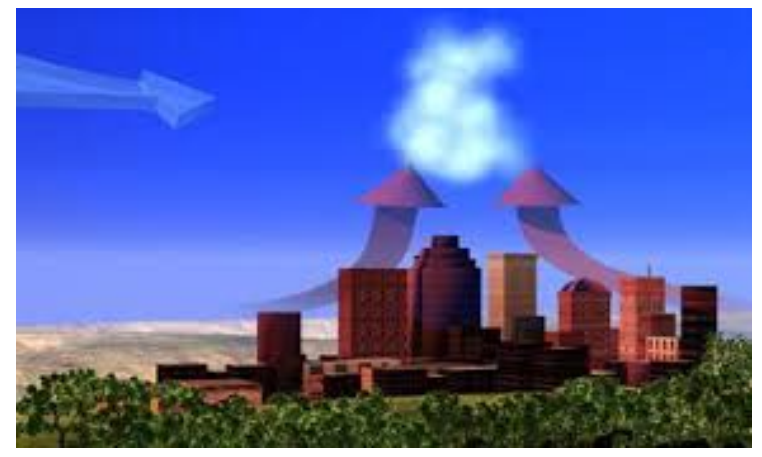
Figure 24. Up-winds induced by an urban heat island.