
At American Greatness, Leslie Matthews reviews a new book by geologist Gregory Wrightstone: A Very Convenient Warming. Excerpts with my bolds and added images.
Climate doomerism rests on far shakier ground
than its confidence would suggest.
Few books arrive with a thesis as deliberately provocative as its title. Gregory Wrightstone’s A Very Convenient Warming: How Modest Warming and More CO₂ Are Benefiting Humanity sets out to invert nearly every assumption underlying the modern climate conversation, and it does so armed less with rhetoric than with charts, ice core data, and centuries of documented harvests. A working geologist and executive director of the CO2 Coalition, Wrightstone builds his case on a canvas that stretches from the Carboniferous swamps to next year’s crop yields, and the sheer scale of that canvas is what gives the book its persuasive force.

Rather than opening with alarm, Wrightstone opens with arithmetic. Across the past 600 million years, he calculates, atmospheric CO₂ averaged roughly 2,600 parts per million, nearly seven times the concentration measured today and two and a half times the worst-case scenario the IPCC projects for the year 2100. Framed against that backdrop, today’s 420 parts per million looks less like a crisis and more like a modest recovery from what he calls a long era of carbon starvation, one that bottomed out near 182 parts per million during recent glacial advances, close to the 150 ppm threshold below which most land plants cannot survive at all.

Explaining what drove this decline is where the book’s account of sequestration becomes essential. Two mechanisms did most of the work, by Wrightstone’s reckoning. Roughly 80 percent of removed carbon became calcium carbonate rock, chiefly limestone, precipitated from saturated ocean water or built from the accumulated shells and skeletons of marine life. The remaining 20 percent took a slower, stranger path: algae and, later, lignin-rich trees died and were buried before microbial life had evolved the enzymes needed to decompose them, entombing carbon in what would eventually become coal, oil, and natural gas. Wrightstone leans on this history to reframe fossil fuels themselves, describing coal and oil as nothing more exotic than ancient sunlight, captured by photosynthesis and stored underground until combustion returns it to circulation.

Once that premise is established, the numbers Wrightstone marshals against the “unprecedented CO₂” narrative start to compound. Since the Industrial Revolution, atmospheric concentration has risen roughly 140 parts per million, from about 280 to 420, yet even that increase, he notes, still sits far below the 2,600 parts per million average of Earth’s deeper history and considerably below the levels present during most of the eras when complex life flourished.

If CO₂ truly functioned as the control knob of planetary temperature, as Wrightstone puts it, the geologic record ought to show the two moving in lockstep. Instead, he lines up four separate comparisons, each spanning a different length of time, and each one undercuts the correlation rather than confirming it. Between 1943 and 1976, even as postwar industrial output pushed emissions sharply upward, global temperature fell for 33 consecutive years, a cooling trend severe enough that many scientists of the era were predicting the onset of a new ice age rather than a warming one.
 Reaching back further, the Central England Temperature record, the oldest continuous instrumental series in existence, shows roughly the first 250 years of post-Little Ice Age warming occurring while CO₂ levels remained at historic lows. The Medieval Warm Period presents a similar puzzle: comparable warmth occurred with concentrations some 140 parts per million below today’s figure. And looking across the full 8,000 years of the Holocene, Wrightstone finds temperatures gradually declining while CO₂ rose, an inversion he labels the Holocene Conundrum.
None of these four windows, spanning decades on one end and millennia on the other, produces the tight correlation the prevailing narrative would predict. Wrightstone instead points to Pacific Ocean cycles, particularly the El Niño Southern Oscillation, as tracking short-term temperature swings far more closely than carbon dioxide concentration ever does, a pattern he illustrates by charting El Niño events directly against satellite temperature records going back to 1950.
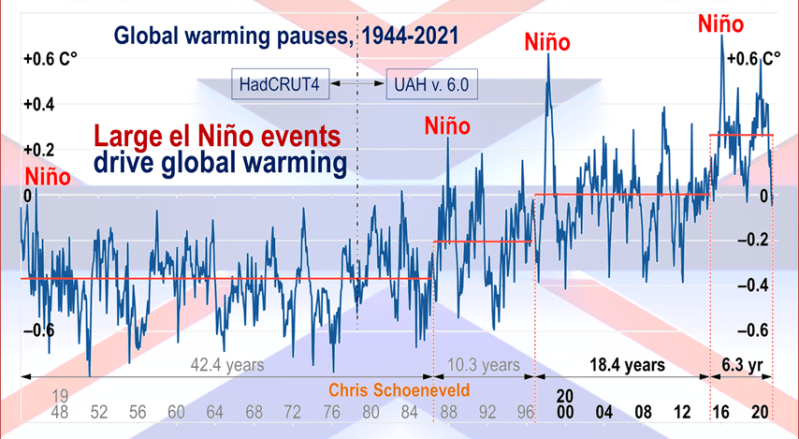
Wrightstone extends this skepticism to the computer models underpinning most climate policy, and here the book turns to harder arithmetic still. Citing the analysis of economist Ross McKitrick and atmospheric scientist John Christy, he reports that the models used in the latest IPCC assessment predicted warming of 0.42 degrees Celsius per decade, while satellite measurements actually recorded 0.17 degrees, an overprediction of roughly two and a half times.

If natural variability accounts for even half of the warming actually observed, he notes, the models’ error balloons to a factor of five. He adds that recent estimates of climate sensitivity indicate that the temperature rise expected from a doubling of CO₂ runs as low as 0.5 to less than 1.0 degrees Celsius, well beneath the assumptions baked into most model runs. Further, he cites Nobel laureate John Clauser’s contention that the models systematically underestimate the cooling effect of cloud cover, an error Clauser believes runs nearly twice as strong as the warming attributed to CO₂ itself.
 The financial stakes Wrightstone attaches to this modeling gap are considerable. He calculates that achieving net zero emissions would cost roughly $275 trillion between 2021 and 2050, or about $9.8 trillion annually, a full tenth of global GDP. Running those figures through the MAGICC climate model, he finds that even a complete elimination of industrialized nations’ emissions starting in 2010 would avert only 0.28 degrees Celsius of warming by 2100, an outcome he prices at roughly $131 trillion for every tenth of a degree Fahrenheit avoided.

Having questioned both the mechanism and the models, Wrightstone turns to the historical record itself, and here the book’s argument sharpens into its most vivid form. Civilizations, he contends, have consistently suffered during cold periods and flourished during warm ones, a pattern he traces across nearly five millennia. His central illustration is the Greek Dark Ages, ushered in when temperatures across Europe fell 1 to 2 degrees Celsius at the close of the Minoan Warm Period around the thirteenth century B.C. Within roughly a century, the Hittite, Mycenaean, Minoan, and Canaanite civilizations had all collapsed, an episode historian David Kaniewski attributes to abrupt climate change that triggered region-wide crop failures and unsustainable conditions. Trade, art, and architecture receded across the region for four centuries or more, and Wrightstone extends the same pattern forward to the Dark Ages of the fifth through ninth centuries and to the Little Ice Age, both marked by famine and demographic collapse rather than the abundance he associates with the intervening warm periods.

Crucially, the book does not treat warmth above today’s alarm thresholds as theoretical. A 2020 study from the University of Barcelona, led by researcher Isabel Cacho, reconstructed Mediterranean temperatures across the last 2,000 years and identified the Roman period as the warmest stretch of that entire span, with conditions persisting for roughly 500 years. That warming, Wrightstone notes, exceeded the 1.5-degree Celsius threshold the IPCC treats as a point of no return, yet it produced no stagnation whatsoever. Instead, it coincided with the zenith of the Roman Empire and the Han Dynasty, an era so hospitable that olive trees grew in Germany’s Rhine Valley and wine grapes ripened as far north as Hadrian’s Wall, cultivation impossible in either location under today’s cooler climate. Sea level evidence corroborates the reconstruction: Pevensey Castle, once a coastal fortification of the Saxon Shore, now sits 1.5 kilometers inland, the submerged coastline having receded as the planet cooled again during the subsequent Little Ice Age.
 Building on that historical foundation, Wrightstone devotes his closing chapters to cataloguing tangible benefits he attributes to rising CO₂ and modest warming. Because carbon dioxide is the essential raw material of photosynthesis, he argues that today’s still comparatively low concentrations continue to constrain plant growth and that recent increases have measurably improved agricultural yields worldwide. On natural disasters, he turns the conventional narrative on its head entirely. Citing direct correspondence with a database manager at the Centre for Research on the Epidemiology of Disasters, he reports that the apparent rise in recorded disasters between the 1970s and late 1990s reflected an expanding global reporting network rather than any actual increase in events, a distortion the organization itself later acknowledged. Once that reporting bias is corrected, the same data show disaster counts declining roughly ten percent since 2000, while global disaster deaths per decade have fallen more than ninety percent, from an average of 54,000 in the 1920s to about 4,500 in the most recent decade covered in the book.

My Mind is Made Up, Don’t Confuse Me with the Facts. H/T Bjorn Lomborg, WUWT
Wrightstone writes for a general readership, and the book largely succeeds at making paleoclimatology, carbon cycle chemistry, and climate modeling approachable without collapsing into oversimplification, aided by more than ninety charts drawn from ice cores, historical temperature series, and disaster databases. It should be read, however, with a clear sense of where it comes from. Wrightstone leads an organization explicitly dedicated to challenging the mainstream scientific consensus on climate change, and that mission shapes which studies he foregrounds and which he leaves aside. Still, judged on its own terms, the book assembles a genuinely substantial body of historical and empirical evidence, not merely assertion, for the claim that the relationship between carbon dioxide, temperature, and human flourishing is considerably less settled than the prevailing public narrative admits. For readers weary of forecasts of imminent catastrophe, Wrightstone’s accumulated evidence, spanning 600 million years of geology and two millennia of documented history alike, makes a strong case that climate doomerism rests on far shakier ground than its confidence would suggest.

One comment