Just this morning (Tuesday, April 22, 2022), in the New York Times’ “the Morning” online report, a guy named David Leonhardt writes with apparent amazement that “Coronavirus cases have risen in major cities. Hospitalizations have not.” Imagine that.
Leonhardt goes on to note that despite the long list of members of Congress and other public servants recently diagnosed with COVID-19, none of them, even our superannuated speaker of the House, appears to have got very sick from it. To his credit, he supplements this observation with some charts that clearly show the disconnect between current cases (which are rising) and hospitalizations (which remain flat).
So far, so good. But then he gives his explanation for this trend. That’s where the spin and outright dishonesty of the COVID-forever left — led by the Times — continue apace.To what does David the Lionhearted, the Gray Lady’s intrepid knight of the keyboard du jour, attribute these positive trends? He reports what (supposedly) “many experts believe”:
♦ Vaccines and booster shots are effective and universally available to Americans who are at least 12. (Covid [sic] continues to be overwhelmingly mild among children). ♦ Treatments — like Evusheld for the immunocompromised and Paxlovid for vulnerable people who get infected — are increasingly available. ♦ Tens of millions of Americans have already been infected with the virus, providing them with at least some immunity.
Two key points should be drawn from this list of explanations.
First, an absolutely central reason for the good news about COVID-19 has been deliberately omitted.
As any truly knowledgeable and honest doctor or virologist — provided you can find one these days — will tell you, viruses such as SARS-CoV-2 mutate like crazy and evolve rapidly and in a predictable manner. In short, these viruses consistently mutate to become more transmissible and less virulent. Why do they evolve in this way? For the same reason all organisms evolve: to benefit their own propagation and survival.
When a new virus is first introduced to a host species, the initial interaction is often not pretty. The virus may struggle to spread between individuals, endangering its survival, and it may invoke severe illness in its host, even killing it, thereby endangering both species’ survival.
Moving slowly and painstakingly from one home to another, while burning down the one in which you currently reside, is no way to survive. So the virus mutates and evolves into a milder form that spreads more readily yet sickens the host less.
In essence, the perfect respiratory virus is the common cold. It infects its host but makes the host sick enough only to sneeze the virus’s progeny at everyone around. It spreads like wildfire, but it doesn’t burn down its own house in the process.
Runny nose coronvirus family
Not for nothing, but what do the other coronaviruses in general circulation among humans cause? That’s right: symptoms of the common cold. This is almost certainly the final common pathway for SARS-CoV-2.
As a practicing physician, trained before schools of public health veered to the left of gender studies departments, I have been saying this since the summer of 2020.
Meanwhile, panic pornographers ranging from Anthony Fauci to Times newsboy Leonhardt’s “experts” have latched onto that first trait of viral evolution (increased transmissibility) while deliberately downplaying, or even denying the second (reduced virulence). Why?
Because they want to foment all the fear that increased transmissibility promotes, yet allow none of the hope and perspective about the virus that acknowledging reduced virulence would bring.
Second, several systematic lies are embedded in the three explanations that are given.
The second lesson to take from Leonhardt’s list is this: as the facts become too obvious to support their false narrative, leftists perform the propagandistic equivalent of a “tactical retreat,” covering their tracks with false and misleading explanations.
Leonhardt writes that “vaccines are effective and readily available.” Effective at what?
At stopping the virus in its tracks, as the Times and Fauci claimed for months? Nope. At preventing persons from contracting COVID-19, as they also claimed? Well, obviously not, since every one of those politicians has been vaccinated and boosted to the hilt. At reducing severity of disease? Well, then what happened to the vaunted “pandemic of the unvaccinated”? Based on the data curves Leonhardt provides, the unvaccinated aren’t going to the ICU these days, either.
Leonhardt touts Evusheld and Paxlovid as “increasingly available,” a total non sequitur in the absence of any data supporting their role in the current trends, which he does not provide. He completely ignores any cheap, repurposed early treatments, despite — or more likely because of — the growing mountains of data supporting their effectiveness.
Finally, Leonhardt blatantly understates the effect of natural immunity, both by lowballing the number of previously infected Americans (it’s in the hundreds of millions, Dave, not tens) and by the deeply misleading statement that prior infection produces “at least some immunity” (Natural immunity is far superior to vaccine-related immunity.)
Here is the reality, the plain fact that Fauci and Leonhardt’s “many experts” will never admit: SARS-CoV-2 is evolving and adapting to coexist with us. The COVID-forever left remains as toxic and destructive as ever.
Climate hysteria is like a seasonal sickness. Each year a contagion of anxiety and fear is created by disinformation going viral in both legacy and social media in the run up to the autumnal COP, most recently Glasgow last November. Now that climatists have put themselves at the controls of the formidable US federal government, the public has been hugely hosed with alarms. Springtime brings Earth Day, when the distress signals typically go full tilt. So individuals need to inoculate themselves against the false claims, in order to build some herd immunity against the nonsense the media continues to promulgate. This post is offered as a means to that end.
Media Climate Hype is a Cover Up
Back in 2015 in the run up to Paris COP, French mathematicians published a thorough critique of the raison d’etre of the whole crusade. They said:
Fighting Global Warming is Absurd, Costly and Pointless.
Absurd because of no reliable evidence that anything unusual is happening in our climate.
Costly because trillions of dollars are wasted on immature, inefficient technologies that serve only to make cheap, reliable energy expensive and intermittent.
Pointless because we do not control the weather anyway.
The prestigious Société de Calcul Mathématique (Society for Mathematical Calculation) issued a detailed 195-page White Paper presenting a blistering point-by-point critique of the key dogmas of global warming. The synopsis with links to the entire document is at COP Briefing for Realists
Even without attending to their documentation, you can tell they are right because all the media climate hype is concentrated against those three points.
Finding: Nothing unusual is happening with our weather and climate. Hype: Every metric or weather event is “unprecedented,” or “worse than we thought.”
Finding: Proposed solutions will cost many trillions of dollars for little effect or benefit. Hype: Zero carbon will lead the world to do the right thing. Anyway, the planet must be saved at any cost.
Finding: Nature operates without caring what humans do or think. Hype: Any destructive natural event is blamed on humans burning fossil fuels.
How the Media Throws Up Flak to Defend False Suppositions
The Absurd Media: Climate is Dangerous Today, Yesterday It was Ideal.
Billions of dollars have been spent researching any and all negative effects from a warming world: Everything from Acne to Zika virus. A recent Climate Report repeats the usual litany of calamities to be feared and avoided by submitting to IPCC demands. The evidence does not support these claims. An example:
It is scientifically established that human activities produce GHG emissions, which accumulate in the atmosphere and the oceans, resulting in warming of Earth’s surface and the oceans, acidification of the oceans, increased variability of climate, with a higher incidence of extreme weather events, and other changes in the climate.
Moreover, leading experts believe that there is already more than enough excess heat in the climate system to do severe damage and that 2C of warming would have very significant adverse effects, including resulting in multi-meter sea level rise.
Experts have observed an increased incidence of climate-related extreme weather events, including increased frequency and intensity of extreme heat and heavy precipitation events and more severe droughts and associated heatwaves. Experts have also observed an increased incidence of large forest fires; and reduced snowpack affecting water resources in the western U.S. The most recent National Climate Assessment projects these climate impacts will continue to worsen in the future as global temperatures increase.
Alarming Weather and Wildfires
But: Weather is not more extreme.
And Wildfires were worse in the past. But: Sea Level Rise is not accelerating.
Litany of Changes
Seven of the ten hottest years on record have occurred within the last decade; wildfires are at an all-time high, while Arctic Sea ice is rapidly diminishing.
We are seeing one-in-a-thousand-year floods with astonishing frequency.
When it rains really hard, it’s harder than ever.
We’re seeing glaciers melting, sea level rising.
The length and the intensity of heatwaves has gone up dramatically.
Plants and trees are flowering earlier in the year. Birds are moving polewards.
We’re seeing more intense storms.
But: Arctic Ice has not declined since 2007.
But: All of these are within the range of past variability.In fact our climate is remarkably stable, compared to the range of daily temperatures during a year where I live.
And many aspects follow quasi-60 year cycles.
The Impractical Media: Money is No Object in Saving the Planet.
Here it is blithely assumed that the court can rule the seas to stop rising, heat waves to cease, and Arctic ice to grow (though why we would want that is debatable). All this will be achieved by leaving fossil fuels in the ground and powering civilization with windmills and solar panels. While admitting that our way of life depends on fossil fuels, they ignore the inadequacy of renewable energy sources at their present immaturity.
An Example: The choice between incurring manageable costs now and the incalculable, perhaps even irreparable, burden Youth Plaintiffs and Affected Children will face if Defendants fail to rapidly transition to a non-fossil fuel economy is clear. While the full costs of the climate damages that would result from maintaining a fossil fuel-based economy may be incalculable, there is already ample evidence concerning the lower bound of such costs, and with these minimum estimates, it is already clear that the cost of transitioning to a low/no carbon economy are far less than the benefits of such a transition. No rational calculus could come to an alternative conclusion. Defendants must act with all deliberate speed and immediately cease the subsidization of fossil fuels and any new fossil fuel projects, and implement policies to rapidly transition the U.S. economy away from fossil fuels.
But CO2 relation to Temperature is Inconsistent.
But: The planet is greener because of rising CO2.
But: Modern nations (G20) depend on fossil fuels for nearly 90% of their energy.
But: Renewables are not ready for prime time.
People need to know that adding renewables to an electrical grid presents both technical and economic challenges. Experience shows that adding intermittent power more than 10% of the baseload makes precarious the reliability of the supply. South Australia is demonstrating this with a series of blackouts when the grid cannot be balanced. Germany got to a higher % by dumping its excess renewable generation onto neighboring countries until the EU finally woke up and stopped them. Texas got up to 29% by dumping onto neighboring states, and some like Georgia are having problems.
But more dangerous is the way renewables destroy the economics of electrical power. Seasoned energy analyst Gail Tverberg writes:
In fact, I have come to the rather astounding conclusion that even if wind turbines and solar PV could be built at zero cost, it would not make sense to continue to add them to the electric grid in the absence of very much better and cheaper electricity storage than we have today. There are too many costs outside building the devices themselves. It is these secondary costs that are problematic. Also, the presence of intermittent electricity disrupts competitive prices, leading to electricity prices that are far too low for other electricity providers, including those providing electricity using nuclear or natural gas. The tiny contribution of wind and solar to grid electricity cannot make up for the loss of more traditional electricity sources due to low prices.
The Irrational Media: Whatever Happens in Nature is Our Fault.
An Example:
Other potential examples include agricultural losses. Whether or not insurance reimburses farmers for their crops, there can be food shortages that lead to higher food prices (that will be borne by consumers, that is, Youth Plaintiffs and Affected Children). There is a further risk that as our climate and land use pattern changes, disease vectors may also move (e.g., diseases formerly only in tropical climates move northward).36 This could lead to material increases in public health costs
But: Actual climate zones are local and regional in scope, and they show little boundary change.
But: Ice cores show that it was warmer in the past, not due to humans.
The hype is produced by computer programs designed to frighten and distract children and the uninformed. For example, there was mention above of “multi-meter” sea level rise. It is all done with computer models. For example, below is San Francisco. More at USCS Warnings of Coastal Floodings
In addition, there is no mention that GCMs projections are running about twice as hot as observations.
Omitted is the fact GCMs correctly replicate tropospheric temperature observations only when CO2 warming is turned off.
Figure 5. Simplification of IPCC AR5 shown above in Fig. 4. The colored lines represent the range of results for the models and observations. The trends here represent trends at different levels of the tropical atmosphere from the surface up to 50,000 ft. The gray lines are the bounds for the range of observations, the blue for the range of IPCC model results without extra GHGs and the red for IPCC model results with extra GHGs.The key point displayed is the lack of overlap between the GHG model results (red) and the observations (gray). The nonGHG model runs (blue) overlap the observations almost completely.
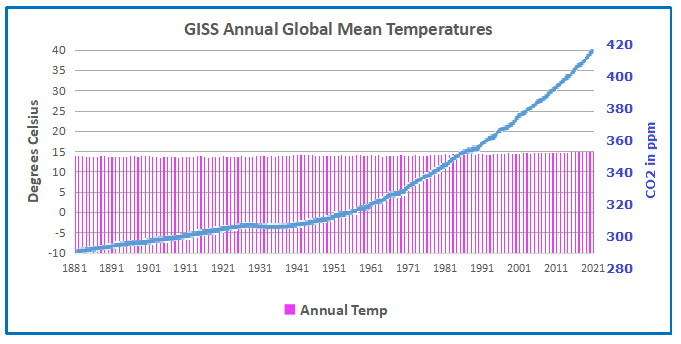
In the effort to proclaim scientific certainty, neither the media nor IPCC discuss the lack of warming since the 1998 El Nino, despite two additional El Ninos in 2010 and 2016.
Further they exclude comparisons between fossil fuel consumption and temperature changes. The legal methodology for discerning causation regarding work environments or medicine side effects insists that the correlation be strong and consistent over time, and there be no confounding additional factors. As long as there is another equally or more likely explanation for a set of facts, the claimed causation is unproven. Such is the null hypothesis in legal terms: Things happen for many reasons unless you can prove one reason is dominant.
Finally, advocates and IPCC are picking on the wrong molecule. The climate is controlled not by CO2 but by H2O. Oceans make climate through the massive movement of energy involved in water’s phase changes from solid to liquid to gas and back again. From those heat transfers come all that we call weather and climate: Clouds, Snow, Rain, Winds, and Storms.
Esteemed climate scientist Richard Lindzen ended a very fine recent presentation with this description of the climate system:
I haven’t spent much time on the details of the science, but there is one thing that should spark skepticism in any intelligent reader. The system we are looking at consists in two turbulent fluids interacting with each other. They are on a rotating planet that is differentially heated by the sun. A vital constituent of the atmospheric component is water in the liquid, solid and vapor phases, and the changes in phase have vast energetic ramifications. The energy budget of this system involves the absorption and reemission of about 200 watts per square meter. Doubling CO2 involves a 2% perturbation to this budget. So do minor changes in clouds and other features, and such changes are common. In this complex multifactor system, what is the likelihood of the climate (which, itself, consists in many variables and not just globally averaged temperature anomaly) is controlled by this 2% perturbation in a single variable? Believing this is pretty close to believing in magic. Instead, you are told that it is believing in ‘science.’ Such a claim should be a tip-off that something is amiss. After all, science is a mode of inquiry rather than a belief structure.
Summary: From this we learn three things:
Climate warms and cools without any help from humans.
Warming is good and cooling is bad. The hypothetical warming from CO2 would be a good thing.
As earth day approaches, activist groups have amplified their predictions of an impending environmental disaster. A brief survey of the evidence shows that the situation isn’t nearly as dire as they claim.
Earth Day is just around the corner. Activists outfits like Environmental Working Group (EWG) are using the run-up to this annual celebration to promote fear of pesticides and, for some reason, the musings of Michelle Pfeiffer. Let’s use the time a little more wisely and consider just two examples that illustrate how much progress we’ve made in promoting human flourishing and protecting the environment.
The point of this exercise, to plagiarize myself from this time last year, is to remind the world that doomsday isn’t inevitable. As we deploy more resources to solve the very real environmental problems we face, life on this planet gets better.
Let’s start with a well-established theory from economics known as the Environmental Kuznets Curve (EKC): economic growth is initially accompanied by increased pollution. Over time, however, we acquire enough resources to invest in technologies that promote sustainability. As the authors of a 2020 study noted:
The EKC literature suggests that economic growth may affect environmental welfare through three different channels: scale effects, composition effects and technique effects. The growth of the economic scale would result in a proportional growth in environmental pollution, and the changes in the industrial structure would lead to the reduction of pollution intensity.
Further economic growth causes technological progress through which dirty and obsolete technologies are replaced by upgraded and cleaner technologies that improve environmental quality.
That’s a foundational point worth remembering because EWG and its ideological allies would have you believe the opposite conclusion, that our “exploitation” of earth’s resources is inherently destructive.
Evidence from all over the world exposes the folly of such thinking.
Let’s consider some examples.
Cleaner air than ever before
To enlarge, double-click image or open in new tab.
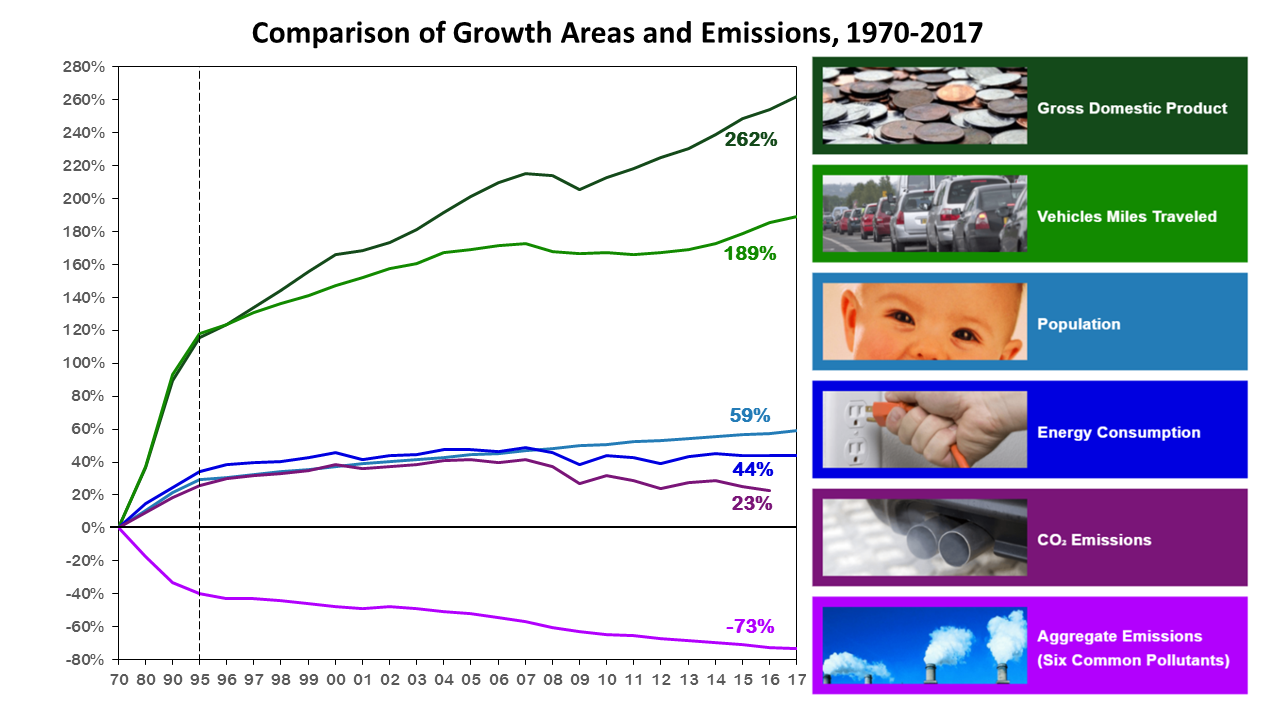
Since 1970, the EPA notes, the combined emissions of six common pollutants have plummeted by almost 80 percent, facilitating “dramatic improvements in the quality of the air that we breathe,” the agency added. To get more specific:
Between 1990 and 2020, national concentrations of air pollutants improved 73 percent for carbon monoxide, 86 percent for lead (from 2010), 61 percent for annual nitrogen dioxide, 25 percent for ozone, 26 percent for 24-hour coarse particle concentrations, 41 percent for annual fine particles (from 2000), and 91 percent for sulfur dioxide.
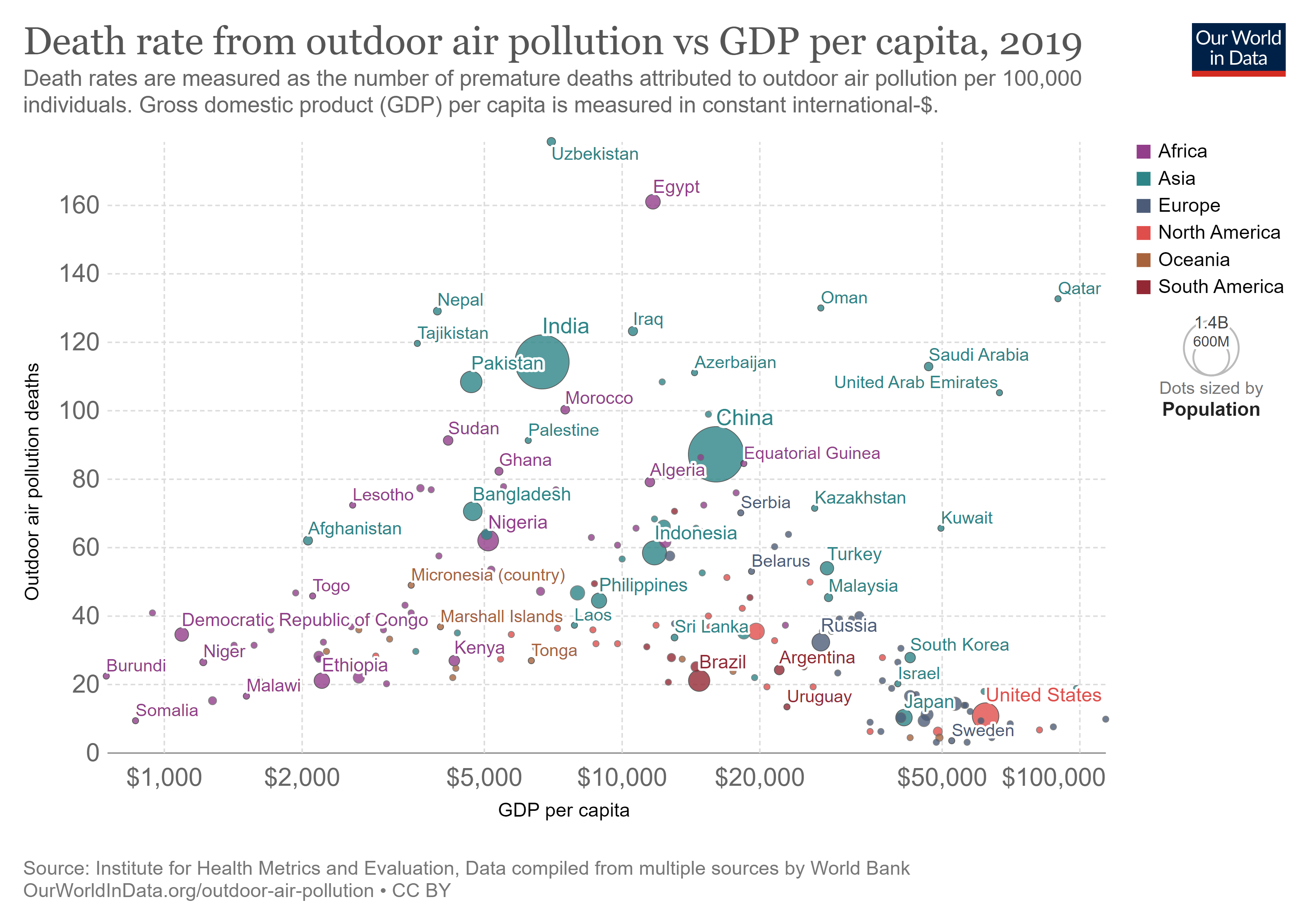
The EPA attempted to pat itself on the back by attributing these declines to its regulatory actions. But that analysis is incomplete. [Unmentioned was the fact consumption of clean-burning natural gas increased 23% during the same period these pollutants declined.] Meaningful environmental protection efforts don’t come cheap; wealthy countries are usually the only ones with the resources to reduce pollution. There’s a tight correlation between a nation’s GDP and the number of deaths attributed to outdoor pollution.
To enlarge, double-click image or open in new tab.
Our World in Data drew two very important observations out of these numbers; both point to the importance of economic growth as a weapon against pollution. Death rates tend to be lowest in the poorest and wealthiest countries. Nations with higher death rates, India, for instance, are often emerging economies that haven’t yet turned their attention to pollution reduction. There are some outliers to this trend, of course. Certain countries have high rates of pollution but low rates of respiratory mortality, Our World Data also explained:
Countries such as Qatar, Saudi Arabia, Oman, Kuwait, and the UAE have a comparably lower risk of premature death, despite high levels of pollution. They do, however, have a significantly higher GDP per capita than their neighbors … Overall health, wellbeing and healthcare/medical standards in these nations significantly reduce the risk of mortality from respiratory illness.
Sustainable food production increasing
In response to critics of animal agriculture, I’ve recently noted that the environmental footprint of food production is significantly smaller in developed countries. The trend is similar whether we consider the amount of land dedicated to farming or the use of inputs like fertilizers and pesticides. Even looking at agricultural carbon emissions, the ultimate boogeyman these days, we can see that economic growth fuels important reductions. Our World in Data helpfully noted that.
We see a very strong rich-poor country divide. High-income countries tend to have energy-intensive industry or service-based economies. Food systems can contribute as little as 10% to total emissions.
Another way to verify this trend is to consider the environmental impacts of local vs. global food production. The latter invites the use of technological innovations and economies of scale that offset the emissions farmers inevitably generate. Policies that unnecessarily restrict access to tools like biotech crops depress crop yields and force more land into food production, further boosting carbon emissions.
Conclusion
There are more examples of economic growth driving increases in sustainability, but the point is clear: our planet gets “greener” as we get wealthier. The warnings that we’re running out of time “to restore nature and build a healthy planet” will grow more shrill as Earth Day approaches. Just remember to take the doomsday predictions with a grain of salt and reflect on the tremendous progress we’ve made in living sustainably.
In an era of rising geopolitical tensions, it is folly
to let Wall Street determine the nation’s energy policy.
As the West grapples with the energy implications of a hostile Sino-Russian alliance, the steering group of the Net-Zero Asset Owner Alliance, whose members manage over $10.4 trillion of assets, issued a statement urging Western governments not to sacrifice climate goals for energy security. “The world is still heading for an excess of fossil fuel-based energy use that will vastly exceed the carbon budget needed to meet the 1.5° Celsius Paris agreement goal. This trend must be halted,” the United Nations-backed alliance said in its April 8 statement, arguing that “the national security argument for accelerating the net-zero transition has strengthened considerably.”
What, one might ask, is the standing of asset managers to opine on national security matters? They have no expertise in this domain. It turns out that their understanding of the economics of energy policy is defective, too.
The Net-Zero Asset Owner Alliance claims that development of new oil and gas reserves will lock in fossil fuel subsidies, exacerbating market distortions. In fact, the International Energy Agency (IEA) in its 2021 net-zero report states that under its net-zero pathway, tax revenues from oil and gas retail sales fall by about 40% over the next twenty years. “Managing this decline will require long-term fiscal planning and budget reforms,” the IEA warns. Similarly, Britain’s Office of Budget Responsibility estimates that net zero policies will result in the loss of tax receipts representing 1.6% of GDP. So much for the fossil fuel subsidy myth.
If fossil fuels were heavily subsidized, eliminating them would mean fossil fuel subsidies disappear. Instead, it’s tax revenues that would melt away to zero.
The net-zero investors cite figures for the decline in solar and wind energy costs. These numbers are based on so-called levelized cost of energy (LCOE), a metric that aims to measure a plant’s lifetime costs. Wind and solar power are intermittent, but LCOE metrics exclude the costs of intermittency, which increase the more wind and solar are put on the grid. Because wind and solar output responds to weather and not to demand, the value of this output declines the more installed wind and solar capacity is available. It was for these reasons that MIT professor of economics Paul Joskow concluded in a foundational 2011 paper that using LCOE metrics to compare intermittent and dispatchable generating technologies, such as coal and natural gas, is a “meaningless exercise.” [ See proper energy costing here: Cutting Through the Fog of Renewable Power Costs ]
Wind and solar investors don’t need to understand the economics of the grid to make money – they are shielded from the intermittency costs their investments inflict on the rest of the grid, which is one reason why their views on energy policy can be taken with a pinch of salt. Their economic illiteracy does, however, make it easy for them to subscribe to the green fairy tale of 100% renewables. They’re not responsible for keeping the lights on – that depends on traditional power plants staying fueled up and ready to spin, which is what Germany can’t do without Russian gas. Adopt the net-zero alliance’s call for no new fossil-fuel investment, and the cost of energy is bound to spiral. And if the lights go out, politicians – not woke investors – get the blame.
Investors’ opinions on energy and national security would matter less if they didn’t have political power. Bloomberg opinion writer Matt Levine argues that asset managers of giant funds form a parallel system of government that exercises overlapping legislative powers with those of governments. These government-by-asset-managers, as Levine calls them, tell companies to do things they think are good for society as a whole, “making big collective decisions about how society should be run, not just business decisions but also decisions about the environment and workers’ rights and racial inequality and other controversial political topics.”
Foremost among these areas is climate policy. Although the Biden administration has set a net-zero goal, Congress has not legislated it, and it lacks the force of law. The absence of legislation passed by democratically accountable legislators, however, presents no barrier to government-by-asset-managers legislating climate policy for the companies in which they invest. “Investors are making net zero commitments for themselves and demanding that companies issue greenhouse gas reduction targets and transition plans for meeting those targets,” says the Reverend Kirsten Snow Spalding of the not-for-profit Ceres Investor Network on Climate Risk and Sustainability.
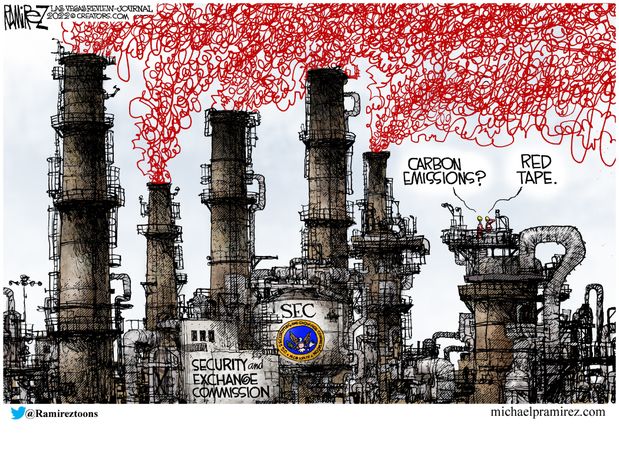
Neither Spalding nor the Net-Zero Asset Owner Alliance make a case that forcing net-zero targets on companies will boost investor returns, demonstrating that this is not about investors’ traditional concerns – making money – but about pursuing politics by other means. In this, the Securities and Exchange Commission (SEC) is working hand in glove with woke climate investors. Commenting on the SEC’s newly proposed rule on climate-risk disclosure, Spalding says that for investors who have committed zero emissions by 2050, “this draft rule is absolutely critical.”
Unlike elected politicians, woke climate investors are not accountable for the effects of their climate policies: They exercise power without responsibility. This arrangement weakens America’s ability to respond to the geopolitical challenges of a revanchist Russia and an expansionist China. “We are on a war footing – an emergency,” Energy Secretary Jennifer Granholm declared at the CERA energy conference in Houston last month. “We have to responsibly increase short-term supply where we can right now to stabilize the market and to minimize harm to American families.” Addressing oil executives in the audience, Granholm told them: “I hope your investors are saying these words to you as well: In this moment of crisis, we need more supply . . . right now, we need oil and gas production to rise to meet current demand.”
As Granholm suggested, woke investors have been trying to do the opposite. Despite the war in Ukraine, there has been no let-up in investor pressure on oil and gas companies to scale down their operations. Whatever criticisms might be made of the Biden administration’s handling of the war in Ukraine, it is responsible for taking the awesome decisions that war involves. Investors, by contrast, have no responsibility for the nation’s security and America’s ability to lead the West. By helping investors impose their desired energy policies on American oil and gas companies, the SEC is undermining the national security prerogatives of the Biden administration and eroding America’s ability to meet the challenges of a dangerous world. The SEC is playing in a domain that it has no business being in.
At Wall Street Journal Opinion Paul Gigot interviews Marty Makary about the state of covid in the US and how CDC keeps making mistakes. A transcript of the video is provided below in italics with my bolds. Further on there are excerpts from the Federal court ruling CDC’s transportation mask mandate unconstitutional.
Gigot: Under fire for its handling of the Covid19 pandemic, the Center for Disease Control and Prevention Director Rochelle Walensky announced plans this week to revamp the embattled agency saying in an email quote it is time to step back and strategically position CDC to support the future of public health. Since the pandemic began more than two years ago, the agency has come under increasing criticism for its response, from initial delays developing a coronavirus test, to the agency’s often unclear guidanceon masking, isolation and quarantine and now booster shots.
Let’s bring in Dr. Marty Makary. He’s a professor at the John Hopkins Schools of Medicine and a Fox News contributor. Welcome Doctor. Look, what do you make of this plan to revamp the CDC. It’s hard for me to recall an agency that was supposed to meet a crisis, I mean this agency was designed for that. And yet their reputation is in tatters. What do they need to do?
Makary: Well many of the problems are structural, but they have 21,000 employees and an $11 billion budget. It’s not the fault of the 21,000 employees that they ignored natural immunity. It’s not a structural problem that the CDC closed schools. That was a leadership problem. These are bad decisions: not spacing out the two doses and focusing of the first dose; not warning the country of the pandemic, and limiting testing in such a way that we couldn’t really follow this thing early on. These are problems of leadership. Not problems with the structure.
And I think there’s an attempt now to say: Hey, we’re going to something to fix the problem, even though it’s not the direct fix.
Gigot: OK, so you mean they’re going to try to rearrange the bureaucratic furniture. But I thought that the CDC of all agencies was supposed to (pardon the cliche): Follow the Science. Are you saying that they let politics supersede the Science?
Makary: Well right now that is the growing perception among medical professionals. If you look at the way the CDC rules their own expert advisory committee. You know the CDC was designed to help us eradicate and take care of cholera and malaria and polio and smallpox. What they’re doing now is getting involved in evictions. They’re adjudicating on every aspect of American life including how kids wear a cloth mask in school.
They fund studies which are so highly flawed they would not be peer reviewed in any respected journal. But they published them in their own journal called MMWR. And then cite their own flawed research. So this has become a farce. And in the medical community many of us have been saying: This is not the scientific process and ignoring natural immunity was a big deal. For this head of the CDC to ignore natural immunity is like the head of NASA believe the earth is flat.
Gigot: OK, so what about this new variant that’s spreading. You have a big breakout in Washington DC. A super spreader event at the Gridiron dinner involved a lot of politicians. Should we be more concerned about this new variant than we’ve been led to believe?
Makary: We should think of it as a bad flu season. It’s going around. It’s more ubiquitous than influenza. Now the infection fatality rate in an analysis publish about two weeks ago and Financial Times showed that it is now officially lower than that of influenza in a typical flu season. So we shouldn’t be alarmed by should recognize this as an infection that is ubiquitous, inevitable in most people. And those who avoided BA1 are probably getting the more contagious BA2.
It is definitely going up. We’re seeing cases go up in the Northeast primarily, somewhat in Florida. But if you’re following cases using the CDC’s numbers like you were following a stock price on a ticker, you’re not going to see those increases because most people are using home testing. The key is we are not seeing a surge in hospitalization. That should always be the ultimate indicator of how we’re doing.
Gigot: OK. There’s been controversy as well over the second booster shot and whether to get it. CDC was leaning in the direction for certain that individuals above a certain age and immuno compromised to get it. What do you think of that decision?
Makary: Well, it was not based on any compelling data. We finally got the data after the FDA authorized th second booster. It was published Tuesday in the New England Journal of Medicine. Not very convincing. It showed that if you boost an entire population with a second booster, the added benefit is a very slight: 1 in 42,000 people in the population have risk reduction in severe illness not hospitalizations, but those who develop real symptoms. That’s why the editor of the New England Journal has said before the committee, he doesn’t see compelling data. This FDA bypassed their own experts to ream through this authorization.
And it’s very odd. They gave Pfizer more than they applied for. Pfizer asked to authorize for people over 65, and it was granted for everyone over 50. And while they put this through in supersonic speed they are still sitting on covaxin and novavax, (traditional vaccines) and covaxin has better coverage against variants. And we’re going to get the omicron specific vaccine data reading out is a few weeks. Many people have been saying, wait for that, then get the second booster and an omicron specific vaccine.
Gigot: Suppose I am over 60 years old and I’ve had two shots and then a booster, and then came down with Covid, one of these breakthrough cases. A lot of people I know have had exactly that pattern. Do you need a booster in those circumstances?
Makary: No, there’s no compelling reason, and boosters do have rare but real side effects. We’ve seen reports of ringing in the ears, and you can’t keep pumping boosters in people every 3 to 6 months in perpetuity because we are seeing that protection only lasts a matter of weeks. That was the study in the New England Journal. It really was sustained for about six weeks and the time followed. So no, natural immunity and hybrid immunity is very powerful and for now there’s no scientific data to support getting a booster after having convalescent infection.
Gigot: Thanks Dr. Makary, appreciate it.
Federal Court Overturns CDC’s Transportation Mask Mandate
Excerpts from Brownstone Institute report in italics below with my bolds
Within the past two years, the CDC has found within § 264(a) the power to shut down the cruise ship industry, stop landlords from evicting tenants who have not paid their rent, and require that persons using public conveyances wear masks. Courts have concluded that the first two of these measures exceeded the CDC’s statutory authority under §264. …
No court has yet ruled on the legality of the third. At first blush, it appears more closely related to the powers granted in§ 264(a) than either the sail order or the eviction moratorium. But after rigorous statutory analysis, the Court concludes that§ 264(a) does not authorize the CDC to issue the Mask Mandate….
As the list of actions suggest, the federal government’s use of the quarantine power has been traditionally limited to localized disease elimination measures applied to individuals and objects suspected of carrying disease…. Though the government once conceded that § 264(a) merely “consolidates and codifies” this history, see id., it now finds a power that extends far beyond it to population-wide preventative measures like near-universal mask requirements that apply even in settings with little nexus to interstate disease spread, like city buses and Ubers. Such a definition reverses the import of history as well as the roles of the States and the federal government….
The opposite of conditional release is “detention” or “quarantine.” Anyone who refuses to comply with the condition of mask wearing is – in a sense – detained or partially quarantined by exclusion from a conveyance or transportation hub under authority of the Mask Mandate. They are forcibly removed from their airplane seats, denied boarding at the bus steps, and turned away at the train station doors-all on the suspicion that they will spread a disease. Indeed, the Mask Mandate enlists local governments, airport employees, flight attendants, and even ride-sharing drivers to enforce these removal measures.
The CDC issued the mandate in February 2021, almost two weeks after the President called for a mandate, eleven months after the President had declared COVID-19 a national emergency, and almost thirteen months since the Secretary of Health and Human Services had declared a public health emergency. This history suggests that the CDC itself did not find the passage of time particularly serious….
Although a closer question than the failure to properly invoke the good cause exception, the Mask Mandate fails this reasoned-explanation standard. Beyond the primary decision to impose a mask requirement, the Mask Mandate provides little or no explanation for the CDC’s choices. Specifically, the CDC omits explanation for rejecting alternatives and for its system of exceptions. And there are many, such that the overall efficiency of masking on airplanes or other conveyances could reasonably be questioned.
In sum, irrespective of whether the CDC made a good or accurate decision, it needed to explain why it acted as it did. Since the CDC did not explain its decision to compromise the effectiveness of its Mandate by including exceptions or its decision to limit those exceptions, the Court cannot conclude that the CDC “articulated a ‘rational connection between the facts found and the choices made.”
[T]he Mandate exceeded the CDC’s statutory authority, improperly invoked the good cause exception to notice and comment rulemaking, and failed to adequately explain its decisions. Because “our system does not permit agencies to act unlawfully even in pursuit of desirable ends,” the Court declares unlawful and vacates the Mask Mandate.
Today’s topsy turvy world has turned the classic Pink Floyd admonition inside out, with teachers and others grooming kids for inappropriate sexual behavior without any moral context. Helen Roy explains at American Mind Groomergate. Excerpts in italics with my bolds and added images.
Say the word. Scare the establishment.
When I was a child, there was a girl I knew whose father was well-known amongst us girls to show his penis at sleepovers. In retrospect, even aside from our loud murmuring, signs of abuse were everywhere. But the man was fairly prominent in evangelical circles, and a talented musician. Other adults cheered him on in public. Other adults permitted and promoted the idea that his house was a good place for sleepovers. Maybe these other adults were completely ignorant, maybe they were in denial, maybe they didn’t care, maybe they thought it was normal, or maybe they were playing a popularity game in a toxic social system of their own.
Either way, prepubescent girls were being molested for years. And those who weren’t being molested were learning their sexual dignity didn’t matter, which undoubtedly paved the way for poor sexual decisionmaking in the future. Perhaps if these parents would have been called out by other parents for their active participation in the grooming exercise, they would have realized their culpability in the matter.
But back then, much like today, many people didn’t like to call groomers out.
Abuse remained in the shadows, under the cover of adult reputation. The difference now is that the culture of harm and perversity has been institutionalized across America. What was once seen as an indiscretion is now an industry.
And so, last week, as if triggered by some kind of underground bat signal, several familiar faces of Conservative Inc. simultaneously released op-eds and Twitter threads insisting that use of the term “groomer” in the context of fighting LGBT indoctrination in schools was very, very bad indeed.
In their view, the epithet is unfair, even immoral, because some take it as an unsubstantiated accusation of active pedophilia. “You may not be aware,” as David French lectured, “but right-wing media is swarming with allegations that anyone who, for example, opposes Florida’s House Bill 1557 (the bill misleadingly termed the ‘Don’t Say Gay’ bill by Democrats and many in the media) is either a ‘groomer’ or in league with groomers.”
Why any self-identified conservative would make defending groomers’ honor their first priority in this debate is a mystery for another day. But strictly on the merits, their conclusion is wrong because their premise is wrong. Grooming is a complicated system of behavior. What is it?
Most basically, to groom is to prepare or train someone else for a particular activity.
In the current political context, “grooming” certainly—and accurately—connotes sexually inappropriate ends, especially as its most recent usage was entirely swept up in the #MeToo movement. Even as grooming discourse reached its apparent zenith a few years ago, rape was not always the intended or actual end of the story. Rather, it was understood that to be a groomer was to actively participate in the broader system of manipulation. Ghislaine Maxwell and similar “recruiters” may not have been doing the raping, but they were all certainly engaged in grooming. Active participation does not imply full knowledge of the system itself; whether you’re a groomer or not does not rely on your own self-awareness. Orchestrated by the ill-intentioned, grooming is often facilitated by good country people, unaware that the cliches they’ve adopted as life mantras are actually deeply damaging to themselves and the people around them.
Love is love, Miss Whatever exclaims, as she caringly simulates anal sex on a teddy bear to a classroom full of five-year-olds.
In the David French version of reality, where drag queen story hour is considered a blessing of liberty, a rainbow flag in preschool is merely a neutral object, misplaced by well-intentioned people who definitely don’t have any negative intentions for your children whatsoever. How do we know this? Because they’ve never explained their intentions. We must give everyone, especially our self-proclaimed enemies, the benefit of the doubt. Stated aims are to be believed as true intentions despite any evidence to the contrary. So, conservatives should bite their tongues. It’s just not fair to suggest that their behavior, no matter how thoroughly it greases the wheels for sexual misconduct and confusion, is grooming. Don’t believe your lying eyes, and definitely don’t say groomer.
I’d like to offer some encouragement for anyone who, as a result of has-been NeverTrump countersignalling, now finds themselves reticent about using the term “groomer” in the general political sense that current usage implies: use it.
Use it because it’s true. As I’ve just explained, people can be groomers without themselves wanting to rape children.
Use it because it’s effective. The culture war is a real war, and a very particular type of war at that: an insurgency.
On one side, you have the institutions; on the other, a merry band of loosely organized rebels. Insurgency is characterized by asymmetry. Because they lack the institutional power, insurgents must rely on guerilla tactics in order to make any progress whatsoever. These tactics, in a war of language and law, boil down to political incorrectness. Political incorrectness, especially the word “groomer,” offends the enemy while galvanizing friends. Powerful memes such as this rarely conform to the tastes of bourgeois sensibilities.
Use it because they disapprove.
One of the first requirements of submission to transgender ideology (or any totalitarian regime, really) is mandated speech. Recall the Jordan Peterson phenomenon circa 2015: Canadian professor comes under fire for resisting the enactment of a bill requiring the use of preferred pronouns; failure to comply was punishable by termination of employment. Fundamentally, the modus operandi of this movement is in the manipulation of reality through language. “Here’s a more palatable way to say this,” has become a favored tactic of those who manage the decline into unreality. If only as an act of resistance to this familiar tendency, this slippery slope we’ve been gaslit into denying, say the unspeakable words. The moment we stop is the moment we lose them forever.
And if we don’t use “groomer”, we lose this moment, too—and all that comes after. Midwit middle managers, bureaucrats, and journalists, whose life mission is to keep the establishment and their establishment career afloat, know that forcing their opposition to adopt their own sensibilities is an act of political castration.
If you want to win on parents right, you must refuse
to be groomed for establishment’s eunuch class.
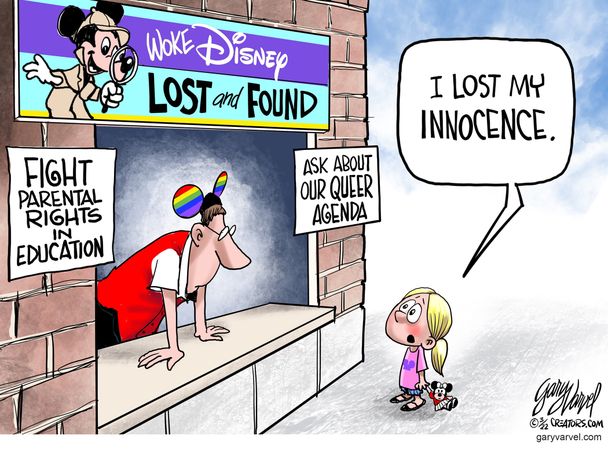
For many years, I made my living writing TV shows for Disney. I was proud of my work, considering it a privilege to make kids laugh all over the world. But in light of Disney’s disastrous embrace of pro-pedophilia policies, I’m glad that I grew disillusioned with kids’ TV and walked away from the field.
Every kids’ TV writer knows that when crafting a story, you have to be careful about “modeling behavior.”
Whatever kids see, they imitate, so you should “model” positive traits in your scripts, particularly when writing for pre-schoolers. Imagine inserting a pint-size Larry David character in your story who is obnoxious, argumentative, and sneaky. Inevitably, you’d get back notes from the story editor telling you to revamp the script to avoid modeling negative behavior.
So Disney’s recent commitment to “add queerness” wherever possible can’t be explained as just trying to teach tolerance and inclusivity. The executives know that by showing “queerness,” they are modeling queerness and encouraging kids to imitate that behavior.
Parents are now furious about Disney’s woke agenda to sexualize children, and they’re organizing and protesting. Will their consumer boycotts of Disney’s products and theme parks have a long-term impact on Disney’s bottom line? It’s too soon to tell, but Disney’s hostility to traditional family values is not winning it friends, and its brand magic seems to be evaporating.
Footnote: Math Homework in Missouri
This is math homework from a public school district in Missouri. How does this help kids learn algebra, exactly? No wonder China is winning…
The horrific events in Shanghai continue to shock the world with images of a beleaguered population entirely at the mercy of a soulless bureaucratic regime.
But the medical bureaucrats closer to home refuse to draw the unavoidable conclusions from that terrible example, while continuingto suggest that lockdowns remain a vital tool in the federal government’s bag of tricks. As a case in point, Dr. Anthony Fauci recently spoke with MSNBC’s Andrea Mitchell to discuss the latest developments involving the COVID-19 pandemic.
When asked by Mitchell about the situation in Shanghai, Fauci waffled, refusing to condemn the lockdowns and even seeming to repeat the discredited canard that China’s draconian lockdowns had somehow enabled them to handle the pandemic “better than almost anybody else.”
“How concerning is the outbreak in China?” Mitchell asked. “We see the lockdown in Shanghai and the State Department now ordering families out, all non-essential workers out of Shanghai.”
“Well, China has a number of problems,” Fauci replied, “two of which are that their complete lockdown, which was their approach, the strictest lockdown that you’d never be able to implement in the United States, although that prevents the spread of infection, and remember early on they were saying—and, I think, accurately—that they were doing better than almost anybody else. But lockdown has its consequences. You use lockdowns to get people vaccinated, so that when you open up, you won’t have a surge of infections, because you’re dealing with an immunologically naive population to the virus.”
That lockdowns were meant to be used to get people vaccinated must come as a surprise to most of us, given that lockdowns were implemented for nearly a year before a vaccine even existed, and were originally sold as a means to “slow the spread.” Regardless, although observing that lockdowns do indeed have “consequences,” Fauci would not condemn the practice, and even seemed to lament that China’s draconian quarantine practices could not be implemented here at home. He also refused to comment on the moral odiousness and human toll of such measures.
Meanwhile,the situation in Shanghai, a city of 25 million that has been forced into strict lockdown since mid-March, is reaching a boiling point. The terrified, starving population has displayed a rare spirit, taking to the streets by the thousands to protest the government quarantines and the lack of food.
#Shanghai's Pudong New Area, massive number of starving civilians broke through the barriers & took to the streets to protest for their civil rights they didn't know existed. A scene closely resembled the 2 millions+ protests in HK 2019-20 Democracy Movements. pic.twitter.com/TOY8jEAu9v
In something that seems lifted straight from a dystopian science fiction film, like 1984 or Blade Runner, videos on social media show how drones patrol the skies, imploring the people to stay inside and “control [their] soul’s desire for freedom,” and people are reportedly even fined directly from their CBDC digital yuan accounts (a kind of state-controlled cryptocurrency) if they venture onto their balconies without a mask. Meanwhile, “dog robots” patrol the streets, barking orders at civilians to stay inside as seen in posted videos.
China: 25m people in lockdown in Shanghai. Policed by drones that have facial recognition and give orders. People who go out on their balconies without masks are fined directly from their CBDC accounts. People screaming from their windows#China#coronavirus#chinalockdownpic.twitter.com/1YnsnaGj2f
— The Voice Of Citizens (@tVoiceOfCitizen) April 10, 2022
Lockdown in Shanghai: dog robots announce that nobody is allowed to leave the house. Drones fly around, come right up to you when they spot you outside and tell you to go back inside.pic.twitter.com/rLCVzHM8zP
Shanghai has been reporting north of 20,000 new COVID cases a day, and the situation has strained the local authorities’ ability to find space for quarantine centers. Worse, reports indicate that people are required to wait for the delivery of water and food supplies, which is overwhelming the food distribution and delivery networks as supplies run low. Anger is widespread, and people have taken to the streets against the strict orders of the ruling Communist Party to demand redress of their myriad wrongs—prompting Shanghai to promise to ease restrictions.
In what are perhaps the most disturbing images from Shanghai, what seem to be police forces in hazmat suits can be seen assaulting and arresting angry civilians on the streets.
#Shanghai Angry local residents took to the streets to protest against communist regime over the use of their schools as quarantine concentration camps. Massive protesters arrested. Crowds were screaming in agony, people shouted "why captured the elderly, let them go".
As the apocryphal Chinese curse says: “May you live in interesting times.” The people of Shanghai are learning this the hard way. We can only hope that those American admirers of the CCP’s “Zero COVID” policy are unable to enforce the same tactics here in the United States.
Footnote:
Remember that the Truckers demand was to end the “covid emergency.” This kind of tyranny is still possible when a new “emergency” can be declared at any time without legal recourse.
Note also: China is moving to lockdown Hong Kong and Guangzhou, places known for political dissidents.
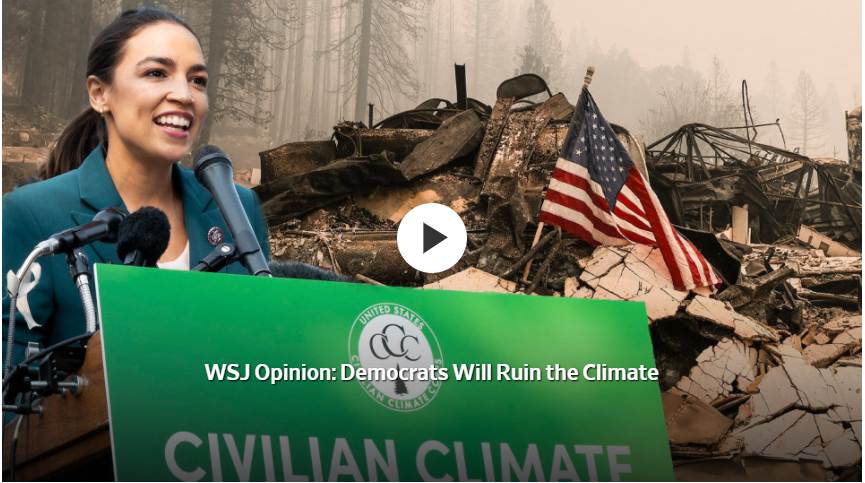
Wonder Land: Democrats have wrecked the cities and the border. Why would climate policy be any different? Images: Zuma Press/Getty Images Composite: Mark Kelly Link to video is below
Jason De Sena Trennert writes at WSJ Opinion Climate-Change ‘Solutions’ That Are Worse Than the Problem. Excerpts in italics with my bolds and added images H/T John Ray (here)
The political assault on fossil fuels comes at the expense
of the poor, peace, and the environment.
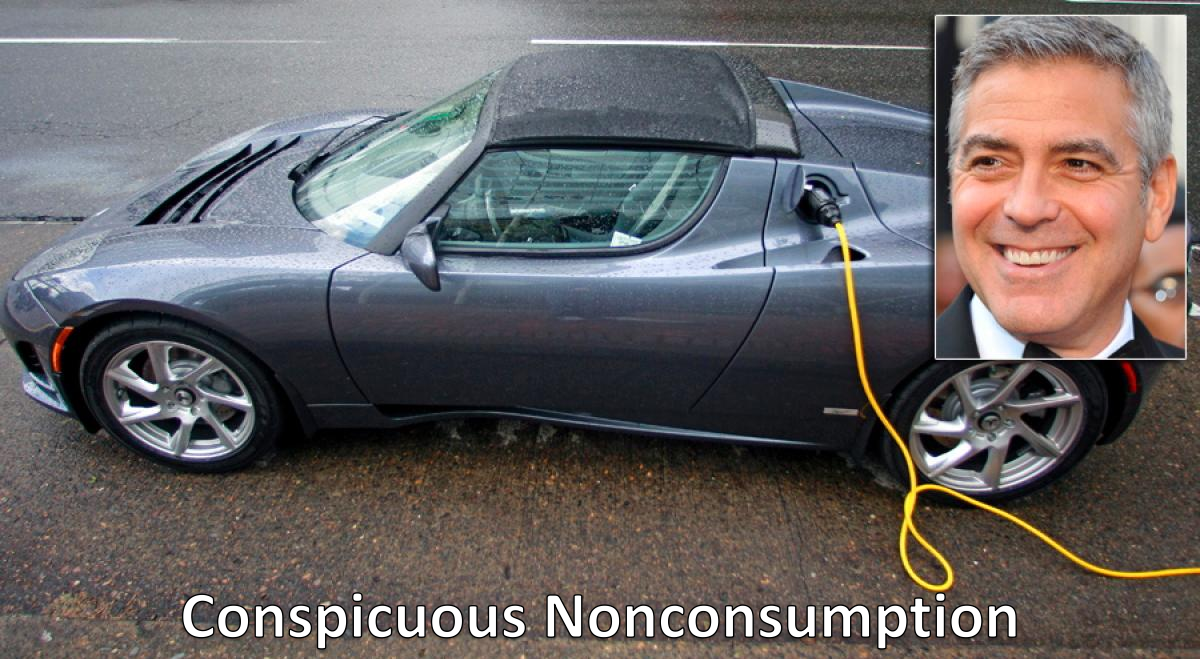
If you can afford a Tesla, you probably find it hard to imagine that there are some 3.5 billion people on Earth who have no reasonably reliable access to electricity. Even less obvious may be the way rich countries’ pursuit of carbon neutrality at almost any cost limits economic opportunities for the world’s poor and poses serious geopolitical risks to the West.
Anyone on an investment committee has likely spent untold amounts of time discussing ways to mitigate the impact of climate change, but they’ve likely never heard anyone state one simple and incontrovertible fact: The widespread exploration and production of fossil fuels that started in Titusville, Pa., not quite 170 years ago, has done more to benefit the lives of ordinary people than any other technological advance in history.
Before fossil fuels, people relied on burning biomass, such as timber or manure, which was a far dirtier and much less efficient source of energy. Fossil fuels let people heat their homes in the winter, reducing the risk of death from exposure. Fossil-fuel-based fertilizers greatly increased crop yields, reducing starvation and malnutrition. Before the advent of the automobile, the ability for many people to venture far from their hometown was an unfathomable dream. Oil- and coal-burning transportation opened up access to education, commerce, professional opportunities, and vital services such as medicine. There has been, and remains, a strong correlation between the use of fossil fuels and life expectancy.
Limiting the availability of fossil fuels in the name of climate activism would cut off many of the world’s poor from these benefits. Climate activists worry about a potential “existential crisis” decades down the road, but poor people, really poor people, face an existential crisis every day. Even for those who aren’t among humanity’s most unfortunate, rising energy prices force serious economic trade-offs. Purposely eschewing America and Europe’s own natural resources increases costs to consumers, raises the cost of doing business, and limits economic growth. Viewed with this in mind, the debate over emissions seems like an upper-class problem.
If Chinese belligerence and increasing authoritarianism over the past two years have taught us anything, it is that no amount of trade and international cooperation will instill what are generally considered to be Western values in other civilizations who have no real desire to adopt them. Trusting China to do anything other than what is directly in its own best interests, especially when it comes to the trade-offs between economic development and climate issues, would seem to be in direct conflict with history and common sense—and it poses serious geopolitical risks to the international democratic order. The war in Ukraine has emphasized how leaving European and American fossil fuels in the ground can put the West at the will of dictators, increasing the risk of atrocities, war or even the use of weapons of mass destruction.
An easing of regulations on drilling in the U.S. and easier regulations on liquefied natural gas exports to flood the global market with oil and natural gas would do far more than any sanctions to stop Vladimir Putin’s barbarism.
The climate-change solutions the West is pursuing also pose a danger to the environment. The lodestar of the environmental movement today appears to be electric vehicles. One would be hard-pressed to find a product more dependent on resources from extractive materials. An electric car requires almost four times as much copper as an automobile powered by an internal combustion engine. The widely accepted goal of having 30% of the world’s vehicle sales be electric by 2030 would require enormous investments in mining industries that are decidedly not eco-friendly.
And whatever emission cuts America and Europe manage to make by forcing electric vehicles and other inefficient technology on consumers will be negated by emissions from other nations. Regimes like Russia and China won’t put aside their geopolitical ambitions for climate activism; developing countries like India won’t sacrifice economic development and their peoples’ well-being in the hope it’ll slow global warming.
Sadly, environmentalism has grown into a secular religion in which reasonable debate is regarded as heresy.
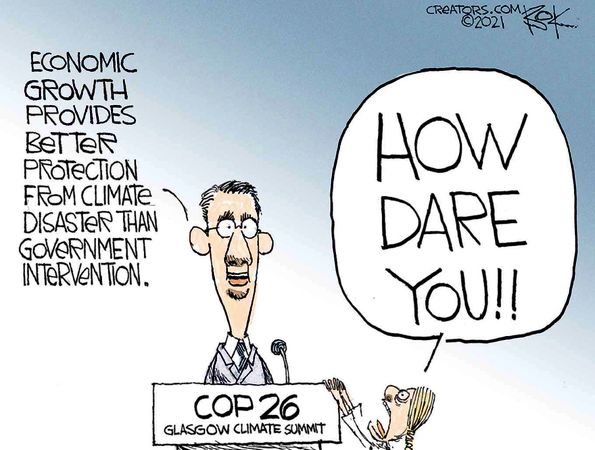
But if politicians and voters can approach climate change with an open mind, they’ll see that economic growth is likely to solve the issue without heavy-handed government intervention. History has shown that free markets produce incredible leaps in human ingenuity. The greater access the world has to all sorts of energy sources, the faster humanity will discover new technologies that are more environmentally friendly. Rationing fossil fuels would only retard the process of decreasing carbon emissions and cost lives in the process.
Tesla’s billionaire CEO Elon Musk, who submitted a $43 billion bid to buy Twitter on Thursday, said later in the day at a TED conference in Vancouver that he has “sufficient assets” to buy the social media company and already has a “Plan B” ready if the board decides to reject his offer.
KEY FACTS
♦ “I can do it if possible,” Musk said at the conference when asked if he could actually afford to buy Twitter, adding that he has “sufficient assets” to carry out such a deal, amid doubts that he has enough liquidity given almost all his wealth is tied up in SpaceX and Tesla stock.
♦ The Tesla billionaire also said that he “has a Plan B” if Twitter’s board of directors, which will meet to discuss his attempted acquisition, reject his offer.
♦ The comments notably contrast with what Musk said earlier in filings with the Securities and Exchange Commission, when he described his $43 billion takeover bid for Twitter as his “best and final offer.”
♦ Musk reiterated that he wants to buy the social media platform as it has become the “de facto town square” and it remains imperative for there to be “an inclusive arena for free speech” in society.
♦ “I don’t care about the economics at all,” Musk responded when asked about making money on Twitter, adding that he wants to convert the platform to an open-source algorithm where users could review the code, instead of “having tweets sort of be mysteriously promoted and demoted with no insight.”
Musk’s bid to buy Twitter was met with mixed reactions from Wall Street analysts on Thursday. Some experts are adamant that Twitter will have a hard time rejecting the $43 billion offer or that this is just the beginning of a hostile takeover battle. Others remain highly skeptical, with some analysts calling Musk’s latest moves a “distraction” from challenges at Tesla.
An unlikely coalition is challenging the U.S. Environmental Protection Agency’s (EPA) revised fuel economy rules.
At issue is a revised fleetwide. corporate average fuel economy (CAFE) standard of 55 miles per gallon in model year 2026. The shortened timeline for the much higher fuel economy forces automakers to reduce their fleets’ carbon dioxide emissions by 22.6 percent more than previous rules required.
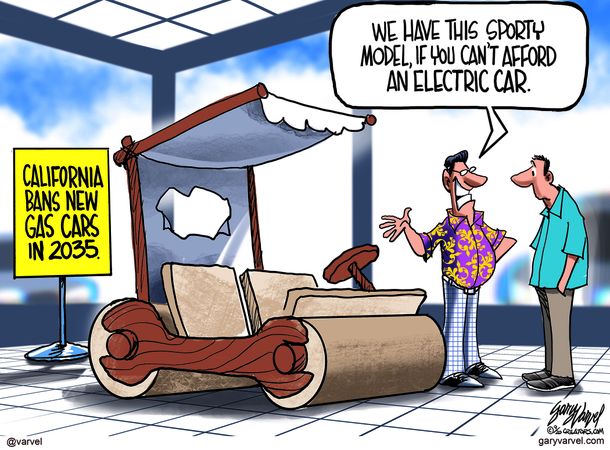
Sixteen states, plus groups representing the fossil fuel and ethanol industries in 15 states, are challenging the Biden EPA’s emissions rules. They argue the EPA’s new standards effectively mandate a national transition from internal combustion powered vehicles to electric vehicles starting in 2026.
Farmers, Drillers, Attorneys General
A mix of corn and soybean growers associations from the states of Illinois, Indiana, Iowa, Michigan, Minnesota, North Dakota, Ohio, and South Dakota joined with Diamond Alternative Energy in one of the lawsuits filed to block the EPA’s new rules.
In addition, Texas Attorney General Ken Paxton filed a lawsuit on behalf of Texas, joined by the states of Alabama, Alaska, Arkansas, Indiana, Kentucky, Louisiana, Mississippi, Missouri, Montana, Nebraska, Ohio, Oklahoma, South Carolina, and Utah. Arizona filed a separate lawsuit to block the rules.
The Competitive Enterprise Institute (CEI), along with additional petitioners such as the Domestic Energy Producers Alliance, a nationwide coalition of 39 associations representing the oil and gas industry, also filed a lawsuit to block the new standards.
Essentially an EV Mandate
The lawsuit filed by representatives of various states’ biofuel associations argues the new standard is an unauthorized de facto mandate forcing people to use electric vehicles.
“Through the final rule, EPA seeks to unilaterally alter the transportation mix in the United States, without congressional authorization and without adequately considering the vast greenhouse gas reduction benefits provided by renewable fuels,” the complaint states.
CEI and its co-petitioners make a similar argument in their filing by lead attorney Devin Watkins, saying the rules exceed the agency’s authority.
“EPA is trying to transform the motor vehicle market from gas-powered to electric vehicles by making gas-powered cars more expensive,” Watkins’ petition states.
Ambitious or Unworkable?
The EPA’s new standard and timeline are unrealistic because the mass adoption of electric vehicles and construction of the infrastructure needed to support and power them won’t magically appear overnight, says Paul Driessen, a senior policy advisor with the Committee For A Constructive Tomorrow, which co-publishes Environment & Climate News.
“It’s vital to remember that President Joe Biden, Rep. Alexandria Ocasio-Cortez (D-NY), and other climate-focused activists aren’t talking about just replacing current fossil fuel vehicle use or electricity generation,” said Driessen. “They also want to convert home and office heating, cooking, and water heating to electricity; convert factories from coal and gas to running on wind- and solar-generated electricity; and have massive battery modules as backup power for windless, sunless days.
“That means nearly doubling existing U.S. electricity generation, and doing all of it with intermittent, unreliable, weather-dependent power generation systems,” said Driessen. “It means millions of onshore and offshore wind turbines, billions of solar panels, billions of 1,000-pound battery modules, and thousands of new transformers, covering tens of millions of acres, all powered by wind and sunshine, and all connected via thousands of miles of new transmission lines to power users all across America.”
‘It Is a Pipedream’
Electrifying the transportation system and in fact the entire U.S. economy is a fool’s errand, doomed to fail while placing an unnecessary burden on the public, says Driessen.
“They expect, hope, and fantasize this will somehow work, that a massively stressed power grid never built or tested before will be able to handle huge, sudden electricity surges and cutoffs due to wind and sunlight cooperating with demand only incidentally, failing minutes, hours, or days at a time and crashing repeatedly and catastrophically,” said Driessen.
“It is a pipedream that has failed everywhere it’s been tried on much tinier scales than what they intend to impose on us,” said Driessen. “Think of Texas two winters ago, and South Australia a few years ago, multiplied a thousand times over. We’re going to be asked to accept having electricity for every aspect of our industry, hospitals, and lives, when it’s available instead of when we need it.”
It’s ‘MAGIC’
There is no way the United States can get the needed raw materials and do the infrastructure transformation required by the EPA’s and other agencies’ new rules implementing Biden’s “whole of government approach” to fighting climate change, says Driessen.
“Just getting the metals, minerals, plastics, concrete, and other raw materials to create this system will take mining at scales unprecedented in human history,” said Driessen. “Team Biden seems to think this will just happen, under a government-mandated program you could call Materials Acquisition for Global Industrial Change, abbreviated MAGIC.
“This new, unworkable system would totally bankrupt America,” said Driessen. “Energy analyst David Wojick, Ph.D. calculates that building a battery system to back up just New York City’s current peak electricity needs, not counting new electric cars or future growth, for one week of no wind or sunshine would cost $3 trillion! For all of New York State, it would cost $8 trillion. And that’s just New York.”

 To what does David the Lionhearted, the Gray Lady’s intrepid knight of the keyboard du jour, attribute these positive trends? He reports what (supposedly) “many experts believe”:




 But: Sea Level Rise is not accelerating.

















 Science Matters