Climatist Logic Fail


Abe Greenwald writes in the Commentary The Paris Climate Discord Not in my wallet. Excerpts in italics with my bolds.

Global-warming activists predicted that Donald Trump’s withdrawal from the Paris agreement on climate change would claim innocent lives. Trump pulled out over a year ago, and the death toll from the American snub stands at zero. In France, however, violent protests against President Emmanuel Macron’s efforts to mitigate climate change have killed one person and injured 227.

On Saturday, French mobs were protesting a tax hike on fuel. And they, not Macron, are directly to blame for the death and destruction. But the fact that these massive demonstrations happened at all—that they involved some 283,000 protestors—shows how little anyone really worries about climate change.

Macron is trying to get France off of fossil fuels. The French government recently raised diesel taxes by seven euro cents and had planned to raise the gasoline tax by four euro cents. But it turns out that people—not just Americans—care deeply about melting ice caps and rising sea levels only under specific circumstances. Namely, when they can be blamed on the greed and stupidity of their political enemies. They find that they suddenly care a lot less when addressing climate change means shelling out a few extra euro cents. So the French came out in droves, lit bonfires, tore up some buildings, blocked streets, and chanted slogans.

Last year, Trump fought back against critics of the Paris withdrawal by saying, “I was elected to represent the citizens of Pittsburgh, not Paris.” But he might have represented the citizens of Paris, too. “We no longer know what kind of car to buy, petrol, diesel, electric, who knows?” said one protester interviewed by the Guardian. “I have a little diesel van, and I don’t have the money to buy a new one, especially as I’m about to retire. We have the feeling those from the countryside are forgotten.

Another protestor said that “the fuel tax was just the final straw.” He went on: “All we can do is show that people are angry, that they are not alone and that they can do something about it. I hope there is no violence, but people are angry. I can understand why, for years they have voted for things and nothing has changed for them.” The protestors, known as gilets jaunes, for their signature yellow vests, enjoy 79-percent support among the French working class, according to IFOP.

Meanwhile, as Parisians turn against the core ideas of the Paris agreement, Americans are worked up over the Trump administration’s seeming indifference to a new U.S. government report on climate change. The Fourth National Climate Assessment was prepared by “300 leading scientists,” according to CNN. And like all sober scientific documents, it’s packed to the gills with apocalyptic predictions for the coming century.

The U.S. economy could lose 10 percent of its GDP; crops will shrink, much ocean life will die off, and more people will have less food. Illness will spread, pollution will get worse, floods and wildfires will increase, and, naturally, many people will die. Now, imagine the public response in our own low-trust, grievance-obsessed nation if the Trump administration actually instituted a policy that required every American to pay up to keep that theoretical future at bay.

There’s a curious contradiction in climate activism. On the one hand, we’re told that the effects of climate change are already happening all around us—that we no longer have to wait for signs of devastation. On the other hand, huge resources swing into action to lay out disaster-movie scenarios of a dystopian future. If the effects of climate change are already so evident, why go to all the trouble of scaring us about what’s going to happen? Maybe because even sympathetic people don’t really believe—in their marrow—that anything alarming is currently happening. If they did, perhaps they’d give up their cars and shrink their lifestyles on the spot. But as it stands, they scream for government intervention and then protest when called to share in the cost.

Arctic Breaks Ice Ceiling


slider-glassceiling

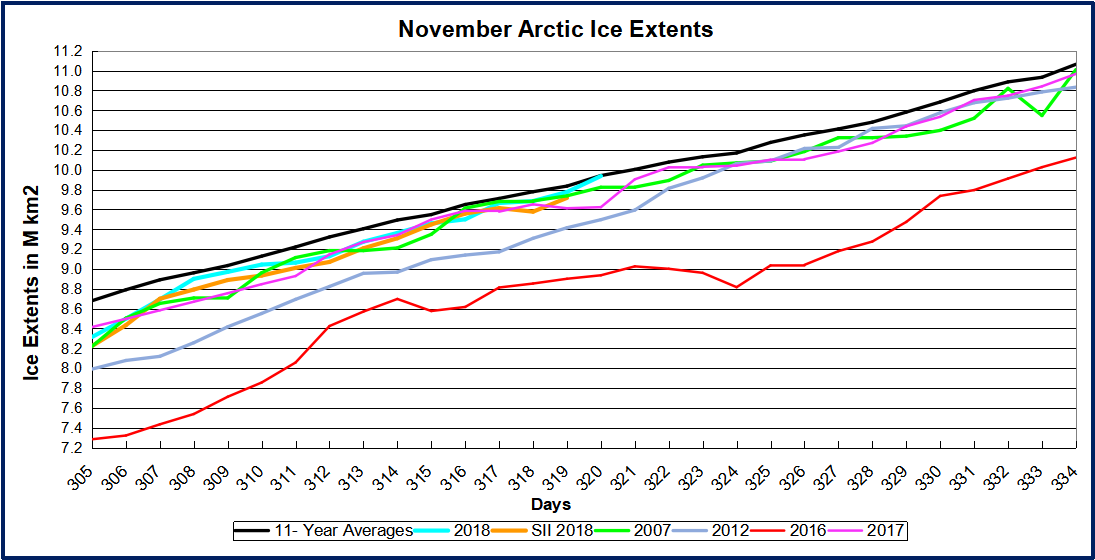
The remarkable growth of Arctic ice extent continues with a new development yesterday, as shown by the graph below.
Arctic2018330

Note that as of day 330, Nov. 26, 2018, Arctic ice extent exceeds the 11 year average reached at month end.  At 11.08M km2, it is 400k km2 above the average for day 330.  It also matches 2013 (not shown) with only 2014 slightly higher in the last decade.


Dr. Judah Cohen at AER posted yesterday on the difficulties forecasting this winter’s coming months.  Excerpts in italics with my bolds.

In my opinion troposphere-stratosphere coupling is now in full gear and is having a significant impact on the large-scale circulation of the atmosphere. The relatively active vertical transfer of energy from the troposphere to the stratosphere is repeatedly perturbing the stratospheric PV though it is not of sufficient magnitude to force a significant PV disruption but only minor disruptions. Still the stratospheric PV is predicted to be continuously displaced from the North Pole towards northwest Eurasia. The displacement of the stratospheric PV south of its normal position is allowing the stratospheric PV to grab milder temperatures from more southern latitudes and sling shot it from across Asia towards Eastern Siberia and Alaska, where the warming temperatures are building ridging/positive geopotential height anomalies in the stratosphere centered near Alaska. This is resulting in northerly flow between the Alaskan ridge and stratospheric PV on the North Atlantic side of the Arctic from central Siberia to eastern North America. We have seen the same flow already mimicked or repeated in the troposphere during the month of November contributing to an overall cold month of November in the Eastern US.

As far as the winter as a whole, I believe that the behavior of the stratospheric PV is critical. The vertical atmospheric energy transfer looks active to me for the foreseeable future. This could lead to a significant or major stratospheric PV as early as the second half of December and extending into early January. If a large stratospheric PV disruption were to occur in the late December and early January timeframe this would be almost ideal in contributing to an overall cold winter for the usual favored regions across the NH mid-latitudes, but each event is unique. Any delay in a significant stratospheric PV disruption would lead to an extended period of volatile weather and increase the odds for an overall mild winter especially if the stratospheric PV strengthens and becomes circular in shape. There is the scenario where the vertical energy transfer remains active, the stratospheric PV is perturbed but no significant disruptions occur and the Eastern US still experiences a cold winter ala winter 2013/14 and is described in our new paper: Kretschmer et al. 2018, but more on the paper in a future blog.


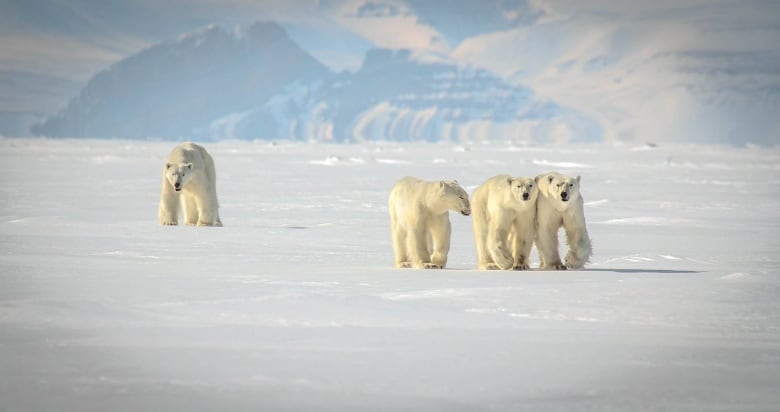
Meanwhile, in Nunavut, it is a great time to be a polar bear, even more of them than people want.


Don’t Base Policies on Climate Hysteria

Noah Rothman writes at Commentary: Climate Hysterics and Their Advocates
Satisfying histrionics never solved anything. Excerpts in italics with my bolds.

Exhuming this [fourth National Climate Assessment] report from its early grave, NBC’s “Meet the Press” focused on it extensively—probing lawmakers about the issue and devoting a panel segment to the political implications of its findings. American Enterprise Institute scholar Danielle Pletka attracted an unusual amount of attention for her remarks on the subject. In a brief soliloquy, she said that she doesn’t believe “we can have any doubt” about the existence of climate change, though we can join the scientific community in speculating about the precise degree to which human activity contributes to that change.

Pletka went on to note mitigating phenomena that, in her view, don’t receive due attention. The last two years were typified by the “biggest drop in global temperatures that we have had since the 1980s,” she said. Pletka added that carbon dioxide emissions in the U.S. are declining even after America pulled out of the Paris accords, and American industry has shifted away from burning so-called “dirty coal,” unlike its European counterparts.

The AEI scholar’s critics noted that extreme temperature fluctuation doesn’t tell us much about the climate, which is fair. But “dirty coal” burning in America is declining at a terminal rate despite the loosening regulatory climate, and the United States has led the world in CO2 emissions reductions even without a non-binding international treaty compelling it to do so. Pletka observed in closing that this was the work of industry, consumer preference, and capitalist innovation, and not oppressive central planning (which is entirely correct).

“We shouldn’t be hysterical” about the problem of climate change, Pletka concluded. You’d think she shot someone’s dog on live television.

On Twitter, investigative reporter Alex Kotch insisted that this “non-scientist” perspective was advanced in service to “the biggest fossil fuel polluters in the world, Koch Industries.” Attorney Max Kennerly contended that it was “inexcusable” to allow Pletka to opine at all on this subject. “This is PR for polluters, not journalism,” he barked. “This is crazy,” ABC News analyst Matt Dowd said. “Balance shouldn’t be the goal, truth should.” “People tune in to be informed not be subjected to propaganda,” former Think Progress founder Judd Legum tweeted. Former Vermont Gov. Howard Dean, Hawaii Sen. Brian Schatz, and controversial climatologist Michael Mann all attacked the network for giving Pletka a platform to discuss climate as it relates to public policy.

There was no such outrage over the response from Pletka’s counterpart, New York Times columnist and fellow “non-scientist” Helene Cooper, which tells you all you need to know about this ginned-up controversy. “I actually think we should be hysterical,” she said. “I think anybody who has children or anybody who can imagine having children and grandchildren, how can you look at them and think this is the kind of world that through our own inaction and our inability to do something, that we’re going to leave them?”

It’s a struggle to think of a long-term public policy crisis that was mitigated by mass hysteria, which is perhaps why Pletka’s many detractors can’t explain why Cooper’s brand of lay advocacy is more acceptable than her counterpart’s. Cooper also said that it was time for the political class to “force corporate leadership” to do something about climate change, demonstrating that she either hadn’t heard a word Pletka said or couldn’t refute her claims. But none of the usual suspects have expressed so much as a hint of disapproval over the gauzy sentimentalism and histrionics expressed by Cooper. That sort of dilettantism serves their purposes.

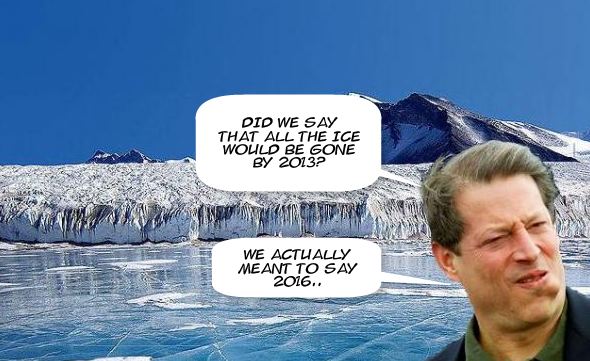
For Pletka’s detractors, the likely source of consternation wasn’t her professional expertise but her refusal to accept a straight-line projection at face value. That is, however, the only prudent course considering how many climate-related prognostications have not panned out. In 1990, the Intergovernmental Panel on Climate Change’s First Assessment Report’s predictions related to rates of warming and temperature changes were erroneous. The IPCC’s 2001 assessment that climate change would reduce the severity of snow storms did not materialize. The Arctic should be ice-free by now if climate scientists’ predictions were always accurate. As Abe Greenwald noted just last week, the scientific consensus around the rate of oceanic warming was successfully challenged not by the deliberate process of peer review but by a freelancing skeptic with time enough to critically parse the data. Given the failure of these near-term predictions to manifest, it’s only reasonable not to lend too much credence to a projection that takes us nearly 100 years into the future.

You might see now why some advocates prefer hysteria to caution and skepticism, and why those who shatter the serenity of the echo chamber are so valuable.

See also: The Problem with Climate Chicken Littles

Climate Tipping Points Quiz

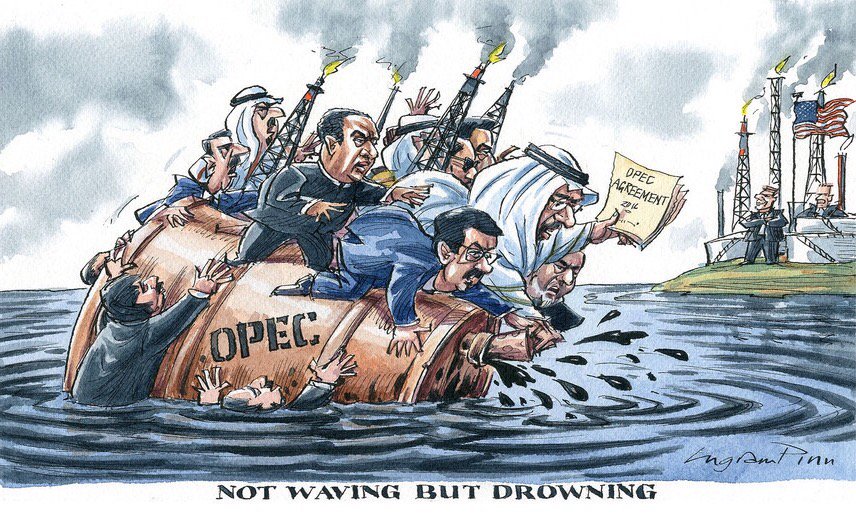
OPEC: The Walking Dead

America is fracking away and has become the world’s greatest oil producer.  Investor’s Business Daily has the story  How Fracking Turned OPEC Into The Walking Dead Excerpts in italics with my bolds.

The river of oil now hitting the market from U.S. fracking has stunned global energy markets. The U.S. has already leapfrogged both Russia and Saudi Arabia as the No. 1 producer. Will U.S. oil lead to OPEC’s demise?

For the first time since World War II, the U.S. is on the verge of being a net oil exporter — something that, just five years ago, would have been considered impossible.

This, of course, has caught the 28-nation Organization of Petroleum Exporting Countries by surprise. Even just a few years ago, the consensus was that fracking and its related technologies would add a decent amount of oil to the market, but nothing like what’s happening now.

Can OPEC Cut Enough?

Now, as OPEC prepares to meet on December 6, its original hope of major output cuts to bolster prices has become a problem. A suddenly booming and opportunistic U.S. oil industry is raising output faster — and producing oil more cheaply — than its competitors. Prices are plunging.

As Javier Blas of Bloomberg notes, U.S. oil output is rising at its fastest pace in 98 years. Meanwhile, both Russia and the Saudis are also pumping at record levels. The U.S. is tipping the scale. Since 2010 in the West Texas Permian Oil Basin alone, some 114,000 new wells have been drilled, bringing millions of barrels of new oil to the market. Other parts of the U.S. are undergoing the same transformation.

That’s bad for OPEC.

“The U.S. energy surge presents OPEC with one of the biggest challenges of its 60-year history,” wrote Blas. “If Saudi Arabia and its allies cut production … higher prices would allow shale to steal market share. But because the Saudis need higher crude prices to make money than U.S. producers, OPEC can’t afford to let prices fall.”

Fracking = Plunging Prices

Yet that’s exactly what oil prices are doing. On November 1, West Texas Intermediate crude traded at $65 a barrel. Today, it’s barely above $50, a nearly 19% drop.

Yes, plunging oil prices might signal concerns over the global economy, or over President Trump’s trade fight with China, or over the election of a Democratic Congress, or perhaps all three. But the fact is, the U.S. is producing enormous amounts of oil today.

One thing history has shown is that so-called cartels such as OPEC have an easy time finding agreement when prices rise, and end up bickering and backstabbing when prices fall. OPEC is definitely in the latter mode right now. Adding to its woes, the Department of Justice is looking into recent bipartisan antitrust legislation to curb OPEC’s market clout.

Are we seeing the final days of OPEC? Thanks to fracking, even if OPEC continues as the walking dead, it will likely never again have the clout it once had.

Kid’s Climate Lawsuit Update Nov. 24


img

Updated Nov 23, 2018

As of Friday, Oregon District Court Judge Aiken has given into the Supreme Court suggestion and defendant’s request that a stay for interlocutory appeal be accepted by the lower court.  The Order by Judge Aiken is here The key excerpt is in italics with my bolds.

This Court stands by its prior rulings on jurisdictional and merits issues, as well as its belief that this case would be better served by further factual development at trial. The Court has, however, reviewed the record and takes particular note of the recent orders issued by the United States Supreme Court on July 30, 2018, and November 2, 2018, as well as the extraordinary Order of the United States Court of Appeals for the Ninth Circuit in United States v. USDC-ORE, Case No. 18-73014 issued on November 8, 2018. At this time, the Court finds sufficient cause to revisit the question of interlocutory appeal as to its previous orders, and upon reconsideration, the Court finds that each of the factors outlined in § 1292(b) have been met regarding the previously mentioned orders. Thus, this Court now exercises its discretion and immediately certifies this case for interlocutory appeal. The Court does not make this decision lightly. Accordingly, this case is STAYED pending a decision by the Ninth Circuit Court of Appeals.

This means activity in preparation for an estimated 50 day trial is suspended while the higher Court of Appeals considers whether the lawsuit is out of bounds.  See Background below.

Background from Previous Post on Nov. 5

As predicted in an earlier post (reprinted at the end), US lawyers are following the Supreme’s lead by again asking the Ninth Circuit Court of Appeals to dismiss the case.  At the same time, one motion filed at the Oregon District Court asks for a stay of proceedings there pending a ruling by the Appeals Court.  Another motion asks the Oregon court to again consider narrowing the scope of the lawsuit.  The documents can be accessed at Columbia’s climate litigation website for Juliana vs. United States  Some excerpts in italics with my bolds, followed by the Nov. 2 post.

From Petition to Court of Appeals:

If the district court grants certification and stays all proceedings, as the Supreme Court has signaled that it should, it will obviate the need for this Court’s intervention by way of mandamus. If, however, the district court declines to grant certification (despite the Supreme Court’s clear guidance to the contrary), this Court would need to intervene to provide the pretrial appellate review contemplated by the Supreme Court. 

To be clear, the government hopes that this Court’s intervention through extraordinary relief will not be necessary. The government is doing everything in its power to persuade the district court to follow the Supreme Court’s guidance and to certify its decisions for interlocutory appeal. But if the district court declines to do so, this Court should intervene to provide the relief that the Supreme Court has expressly stated “may be available in” this Court — and that is plainly warranted given the fundamental defects in Plaintiffs’ action. ECF No. 416, at 2.

Previous Post Nov. 2, 2018:  Supremes Kick Kids Lawsuit Down the Road

Last night the US Supreme justices refused the federal government’s petition to end the Oregon district court case. The media headlines will say this action allows the case to start, but that is not what happened. The real story concerns procedural hurdles and comes from Scotusblog, not from the green industry PR department (when did yellow journalism change colors?).

Everyone knows this issue will eventually come to the Supreme Court for a ruling. Some judges in black robes will take the heat for telling the truth about the case’s fatal legal flaws. So the Supremes will allow (not prevent) the lower courts to do their job to declare the suit out of bounds. All the while they know any lower ruling will be appealed by the losing side to the top later on.

As you will see, there are probably two more procedural maneuvers before the case can proceed to address the merits, or lack thereof. Yesterday, the Supremes noted that the Ninth District Court of Appeals twice refused the fed’s petition on grounds that no longer pertain. Thus, they suggest that the Ninth take a third kick at this can, perhaps this time actually engaging the issues.

If, as everyone expects, the Ninth follows their San Francisco-based leftist leanings and summarily grants no relief, then the feds can come back to the Supremes having no longer any recourse at lower levels. BTW, two Supreme Justices said they were ready now to grant the federal petition as it stands.

Amy Howe writes truthfully Justices refuse to block climate-change trial. Excerpts below in italics with my bolds.

Tonight the Supreme Court declined to intervene to block the trial in a lawsuit filed by a group of children and teenagers who have asked a federal district court in Oregon to order the federal government to prepare and put in place a plan to phase out fossil-fuel emissions. Although the justices’ ruling formally cleared the way for a trial in the case to go forward, the court stressed that the government may be able to get the relief that it is seeking in the U.S. Court of Appeals for the 9th Circuit, and it did not foreclose the possibility that the government could return to the Supreme Court yet again.

Text of Supreme Court Order ORDER IN PENDING CASE

This afternoon’s order was the latest chapter in the climate-change lawsuit, which was originally filed in 2015, during the Obama administration. The plaintiffs contend that the federal government’s conduct has led to a “dangerous climate system,” in conflict with their constitutional right to a “climate system capable of sustaining human life.”

The federal government first came to the Supreme Court in the case last summer, asking the justices to block discovery and a trial until the U.S. Court of Appeals for the 9th Circuit could rule on the government’s request to have the case dismissed or, at the very least, put on hold. But the justices declined to step in, describing the government’s request as “premature.” At the same time, the justices acknowledged that the plaintiffs’ claims are “striking” and that there are “substantial grounds for difference of opinion” on whether those claims belong in court at all; they also emphasized that the district court should “take these concerns into account in assessing the burdens of discovery and trial, as well as the desirability of a prompt ruling on” other motions that the government had filed seeking dismissal of the plaintiffs’ claims.

With a trial looming, the government returned to the Supreme Court again last week, complaining that the district court had declined to “meaningfully narrow” the scope of the case. It asked the justices to either end the lawsuit altogether or, at a minimum, review the district court’s rulings allowing the case to go forward. Chief Justice John Roberts, who at the time handled emergency requests from the geographic area that includes Oregon, agreed to put discovery and the trial on hold temporarily to give the plaintiffs an opportunity to respond to the government’s application.

In their response, the plaintiffs urged the justices to allow the trial to go forward. They noted that most pretrial fact-finding had already been completed, with the only remaining discovery “extremely limited.” The only harm that the government has cited to justify putting the trial on hold, the plaintiffs argued, is that it would otherwise be required to “participate in the normal process of trial and await appellate consideration until after final judgment” – which, in the plaintiffs’ view, is an “ordinary” burden rather than the kind of irreparable harm necessitating emergency relief. By contrast, they suggested, stopping the trial now “will disrupt the integrity of the judiciary’s role as a check on the political branches and will irreparably harm these children.” Indeed, the plaintiffs asserted, discovery and a trial are essential because the district court can’t decide the questions presented by their lawsuit, involving the plaintiffs’ legal right to bring the lawsuit and the allocation of power between the different branches of government, until the facts have been better developed.

In a reply brief, the federal government pushed back, telling the justices that it had made every possible effort in the lower courts to avoid reaching this point, but had been unsuccessful. The government emphasized that what the plaintiffs are asking the federal courts to do is extraordinary, “nothing less than a complete transformation of the American energy system – including the abandonment of fossil fuels.” Such a request, the government continued, “has no place in federal court,” so that granting the government a reprieve from the upcoming trial would “preserve the judiciary’s essential role under the Constitution.”

The government added that, contrary to the plaintiffs’ assurances, the prospect winning on appeal after an “extensive” trial had already taken place would provide little comfort to the government, because of the enormous amount of resources that would have to be devoted to pretrial preparations and the trial itself.

In an unsigned three-page order issued tonight, the Supreme Court explained that it would block the proceedings in the district court only if the government were likely to prevail on its request for an order of the Supreme Court, in particular, requiring the district court to dismiss the case. But the government cannot meet that standard, the justices continued, because it may be able to get the relief that it is seeking in the 9th Circuit. The court acknowledged that the 9th Circuit has twice turned down requests from the government to order the district court to dismiss the case, but it reasoned that the 9th Circuit did so because of the prospect that the plaintiffs’ claims against the government might eventually be dismissed through more conventional avenues. The justices concluded that those “reasons are, to a large extent, no longer pertinent” with a 50-day trial – which had been scheduled for October 29 – looming.

The court therefore denied the federal government’s request to keep the trial on hold “without prejudice” – that is, leaving open the possibility that the dispute could return to the Supreme Court again. The justices’ earlier order putting the trial on hold temporarily, to give them time to consider the government’s request, is terminated. Justices Clarence Thomas and Neil Gorsuch indicated that they would have granted the government’s request.

Background from previous post Supreme Justice Grants Stay of Kids Lawsuit

On Friday, Chief Justice Roberts stayed the discovery and trial of Juliana vs. US, pending responses from the plaintiffs to issues raised by the defense.  Report from The News Review in italics with my bolds.

The U.S. Supreme Court on Friday granted a stay in the climate trial, Juliana v. United States, pending a response from the plaintiffs.

The Department of Justice asked the Supreme Court on Tuesday to dismiss the case brought by 21 young plaintiffs Thursday.

In a news release issued Friday afternoon, Meg Ward with Our Children’s Trust said the plaintiff’s legal team is working on its response, which it will file Monday.

The Supreme Court order states a response is due by Oct. 24.

Julia Olson, one of the lawyers representing the young plaintiffs, said the prosecution is confident that once the court receives the response the trial will proceed.

“As the Supreme Court has recognized in innumerable cases, review of constitutional questions is better done on a full record where the evidence is presented and weighed by the trier of fact,” Olson said in a news release.

The lawsuit alleges the federal government has violated young people’s constitutional rights through policies that have caused a dangerous climate.

They have said their generation bears the brunt of climate change and that the government has an obligation to protect natural resources for present and future generations.

The young people say government officials have known for more than 50 years that carbon pollution from fossil fuels was causing climate change and that policies on oil and gas deprive them of life, liberty and property. They also say the government has failed to protect natural resources as a “public trust” for future generations.

The lawsuit wants a court to order the government to stop permitting and authorizing fossil fuels, quickly phase out carbon dioxide emissions to a certain level by 2100 and develop a national climate recovery plan.

The Trump administration got a temporary reprieve on the case after also asking the 9th U.S. Circuit Court of Appeals, which rejected the request in July.

“The latest attempt to get the U.S. Supreme Court to stop the trial does not appear to be based on any new evidence or arguments. The only new element is an additional Supreme Court justice,” said Melissa Scanlan, a professor at Vermont Law School, who is not involved in the case.

Kavanaugh replaced the more moderate Anthony Kennedy.

Scanlan said the Trump administration is trying to avoid “what they’re expecting to be a 50-day trial focused on climate disruption.” The trial in Eugene was expected to wrap up in January.

CNN added this:

Solicitor General Noel Francisco asked the justice to stop any further discovery and the pending trial while the government appeals the lower court opinion.

In his filing, Francisco lambasted the suit, calling it “an attempt to redirect federal environmental and energy policies through the courts rather than through the political process, by asserting a new and unsupported fundamental due process right to certain climate conditions.”

Francisco’s language echoes some of the remarks Attorney General Jeff Sessions made before the conservative Heritage Foundation on Monday. “Judicial activism is therefore a threat to our representative government and the liberty it secures,” Sessions said. “In effect, activist advocates want judges who will do for them what they have been unable to achieve at the ballot box. It is fundamentally undemocratic.”

The filings may be welcomed by some of the justices but they also put others in an uncomfortable position, and there’s a risk of going to the well too often.

“The Supreme Court unquestionably has the authority to provide the extraordinary relief the government is seeking in these cases,” said Steve Vladeck, CNN Supreme Court analyst and professor at the University of Texas School of Law.

“That said, it tends to exercise that authority sparingly,” he added,” and there’s reason to wonder if the government, by repeatedly asking for such unusual relief, might be perceived by at least some of the justices as the boy who cried wolf.”

The text of the  US filing is PETITION FOR A WRIT OF MANDAMUS Contents:

Reasons for granting the petition

A. The government has a clear and indisputable
right to relief from the district court’s refusal to
dismiss this fundamentally misguided suit

1. The district court clearly and indisputably
erred by exercising jurisdiction over the suit
2. The district court clearly and indisputably
erred by allowing the claims to proceed
outside the binding framework of the APA
3. The district court clearly and indisputably
erred by allowing the claims to proceed on the
merits

B. The government has no other adequate means to
attain relief from a fundamentally misguided and
improper trial

C. Mandamus relief is appropriate under the
circumstances

Excerpt from page 26:

Remarkably, the district court rooted its recognition of a fundamental due process right to “a climate system capable of sustaining human life,” App., infra, 141a, in this Court’s recognition of a fundamental right to samesex marriage in Obergefell v. Hodges, 135 S. Ct. 2584 (2015). There is no relationship, however, between a distinctly personal and circumscribed right to same-sex marriage and the alleged right to a climate system capable of sustaining human life that apparently would run indiscriminately to every individual in the United States. The right recognized by the district court has no relationship to any right as “fundamental as a matter of history and tradition” as the right to marry recognized in Obergefell. Id. at 2602.

Background from previous post Supremes Looking at Kids Lawsuit

An Oregon liberal judge is determined to put climate change on trial in Juliana vs US, scheduled to start on October 29, 2018.  But now another pitfall stands in the way.  The Trump administration has asked the Supreme Court to review the legitimacy of the scope of the kids’ claims they have a right to an unchanging favorable climate provided to them by the federal government.  Here is the update from Scotusblog by Amy Howe Government returns in climate change lawsuit  Excerpts in italics with my bolds.

In July, the Supreme Court declined to intervene in a lawsuit filed by a group of 21 children and teenagers who allege that they have a constitutional right to a “climate system capable of sustaining human life.” The justices rejected the federal government’s request to block discovery and a trial until the U.S. Court of Appeals for the 9th Circuit could rule on the government’s petition seeking to have the case dismissed or, at a minimum, to block discovery and the trial temporarily. Today the Trump administration returned to the Supreme Court, asking it once again to put discovery and the trial – now scheduled for the end of October – on hold.

The case was originally filed in 2015 against the Obama administration. The plaintiffs argue that the federal government’s actions are causing a “dangerous climate system,” and they have asked a federal district court in Oregon to order various federal agencies to prepare and implement a remedial plan to phase out fossil-fuel emissions.

When the government asked the justices to step in over the summer, they rejected the request, which they described as “premature.” But the justices also seemed to express some skepticism about the “breadth” of the plaintiffs’ claims, calling them “striking” and observing that there are “substantial grounds for difference of opinion” on whether those claims belong in court at all. The justices instructed the district court to “take these concerns into account in assessing the burdens of discovery and trial, as well as the desirability of a prompt ruling on the” federal government’s other pending motions, which could result in dismissal of some or all of the plaintiffs’ claims.

The government is now back at the court, telling the justices that earlier this week the district court “declined to meaningfully narrow” the plaintiffs’ claims, instead rejecting various government motions that would have ended the case. The government is now asking the court to order the district court to “end this profoundly misguided suit” or, at the very least, review the district court’s rulings allowing the case to go forward; moreover, the government again urges, the Supreme Court should put discovery and the trial on hold while it considers these requests. There would be no real harm to the plaintiffs from doing so, the government stresses, because the plaintiffs are claiming that they have been harmed by the cumulative effects of carbon dioxide emissions over several decades.

The government’s request, signed by U.S. solicitor general Noel Francisco, goes to Chief Justice John Roberts, who currently serves as the circuit justice for the 9th Circuit. Roberts can act on the government’s application immediately or refer it to the full court.

Economist Joseph Stiglitz writes of climate change: “There is a point at which, once this harm occurs, it cannot be undone at any reasonable cost or in any reasonable period of time. Based on the best available science, our country is close to approaching that point.” Credit: Win McNamee/Getty Images

For an insight into the claims being made on behalf of the kids, here is a reprint of a previous post analyzing a brief filed by an IPCC insider.

Climatists Make Their Case by Omitting Facts

One of the world’s top economists has written an expert court report that forcefully supports a group of children and young adults who have sued the federal government for failing to act on climate change. (Source: Inside Climate News  here) Excerpts in italics with my bolds.

Stiglitz, a Columbia University economics professor and former World Bank chief economist, concludes that increasing global warming will have huge costs on society and that a fossil fuel-based system “is causing imminent, significant, and irreparable harm to the Youth Plaintiffs and Affected Children more generally.” He explains in a footnote that his analysis also examines impacts on “as-yet-unborn youth, the so-called future generations.”

But, he says, acting on climate change now—by imposing a carbon tax and cutting fossil fuel subsidies, among other steps—is still manageable and would have net-negative costs. He argues that if the government were to pursue clean energy sources and energy-smart technologies, “the net benefits of a policy change outweigh the net costs of such a policy change.”

“Defendants must act with all deliberate speed and immediately cease the subsidization of fossil fuels and any new fossil fuel projects, and implement policies to rapidly transition the U.S. economy away from fossil fuels,” Stiglitz writes. “This urgent action is not only feasible, the relief requested will benefit the economy.”

Stiglitz has been examining the economic impact of global warming for many years. He was a lead author of the 1995 report of the UN’s Intergovernmental Panel on Climate Change, an authoritative assessment of climate science that won the IPCC the 2007 Nobel Peace Prize, shared with Al Gore.

The Stiglitz expert report submitted to the court is here.

An Example of Intentional Omissions

Since this is a legal proceeding, Stiglitz wrote a brief telling the plaintiffs’ side of the story. In a scientific investigation, parties would assert theories attempting to explain all of the evidence at hand. Legal theories have no such requirement to incorporate all the facts, but rather present conclusions informed by the evidence deemed strongest and most pertinent to one party’s interests.

While the Pope accuses us with the Sin of Emissions, we counter with the Sins of Omissions by him and his fellow activists.

Let’s consider the Stiglitz brief according to the three suppositions comprising the Climatist (Activists and Alarmists) position. Climate change is a bundle that depends on all three assertions to be true.

Supposition 1: Humans make the climate warmer.

As an economist, Stiglitz defers to the IPCC on this scientific point, with references to reports by those deeply involved and committed to Paris Accord and other UN climate programs. In the recent California District Court case (Cities suing Big Oil companies), both sides in a similar vein stipulated their acceptance of IPCC reports as authoritative regarding global warming/climate change.

Skeptical observers must attend to the nuances of what is referenced and what is hidden or omitted in these testimonies. For example, Chevron’s attorney noted that IPCC’s reports express various opinions over time as to human influence on the climate. They noted that even today, the expected temperature effect from doubling CO2 ranges widely from 1.5C to 4.5C. No mention is made that several more recent estimates from empirical data (rather than GCMs) are at the low end or lower.

In addition, there is no mention that GCMs projections are running about twice as hot as observations. Omitted is the fact GCMs correctly replicate tropospheric temperature observations only when CO2 warming is turned off. In the effort to proclaim scientific certainty, neither Stiglitz nor IPCC discuss the lack of warming since the 1998 El Nino, despite two additional El Ninos in 2010 and 2016.

Figure 5. Simplification of IPCC AR5 shown above in Fig. 4. The colored lines represent the range of results for the models and observations. The trends here represent trends at different levels of the tropical atmosphere from the surface up to 50,000 ft. The gray lines are the bounds for the range of observations, the blue for the range of IPCC model results without extra GHGs and the red for IPCC model results with extra GHGs.The key point displayed is the lack of overlap between the GHG model results (red) and the observations (gray). The nonGHG model runs (blue) overlap the observations almost completely.

Further they exclude comparisons between fossil fuel consumption and temperature changes. The legal methodology for discerning causation regarding work environments or medicine side effects insists that the correlation be strong and consistent over time, and there be no confounding additional factors. As long as there is another equally or more likely explanation for a set of facts, the claimed causation is unproven. Such is the null hypothesis in legal terms: Things happen for many reasons unless you can prove one reason is dominant.

Finally, Stiglitz and IPCC are picking on the wrong molecule. The climate is controlled not by CO2 but by H20. Oceans make climate through the massive movement of energy involved in water’s phase changes from solid to liquid to gas and back again. From those heat transfers come all that we call weather and climate: Clouds, Snow, Rain, Winds, and Storms.

Esteemed climate scientist Richard Lindzen ended a very fine recent presentation with this description of the climate system:

I haven’t spent much time on the details of the science, but there is one thing that should spark skepticism in any intelligent reader. The system we are looking at consists in two turbulent fluids interacting with each other. They are on a rotating planet that is differentially heated by the sun. A vital constituent of the atmospheric component is water in the liquid, solid and vapor phases, and the changes in phase have vast energetic ramifications. The energy budget of this system involves the absorption and reemission of about 200 watts per square meter. Doubling CO2 involves a 2% perturbation to this budget. So do minor changes in clouds and other features, and such changes are common. In this complex multifactor system, what is the likelihood of the climate (which, itself, consists in many variables and not just globally averaged temperature anomaly) is controlled by this 2% perturbation in a single variable? Believing this is pretty close to believing in magic. Instead, you are told that it is believing in ‘science.’ Such a claim should be a tip-off that something is amiss. After all, science is a mode of inquiry rather than a belief structure.

Supposition 2: The Warming is Dangerous

Billions of dollars have been spent researching any and all negative effects from a warming world: Everything from Acne to Zika virus. Stiglitz links to a recent Climate Report that repeats the usual litany of calamities to be feared and avoided by submitting to IPCC demands. The evidence does not support these claims.

Stiglitz: It is scientifically established that human activities produce GHG emissions, which accumulate in the atmosphere and the oceans, resulting in warming of Earth’s surface and the oceans, acidification of the oceans, increased variability of climate, with a higher incidence of extreme weather events, and other changes in the climate.

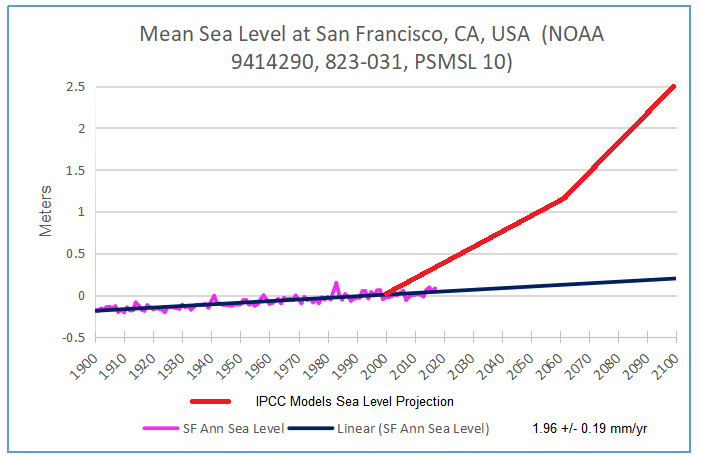
Moreover, leading experts believe that there is already more than enough excess heat in the climate system to do severe damage and that 2C of warming would have very significant adverse effects, including resulting in multi-meter sea level rise.

Experts have observed an increased incidence of climate-related extreme weather events, including increased frequency and intensity of extreme heat and heavy precipitation events and more severe droughts and associated heatwaves. Experts have also observed an increased incidence of large forest fires; and reduced snowpack affecting water resources in the western U.S. The most recent National Climate Assessment projects these climate impacts will continue to worsen in the future as global temperatures increase.

Alarming Weather and Wildfires

But: Weather is not more extreme.
And Wildfires were worse in the past.
But: Sea Level Rise is not accelerating.
Litany of Changes

Seven of the ten hottest years on record have occurred within the last decade; wildfires are at an all-time high, while Arctic Sea ice is rapidly diminishing.

We are seeing one-in-a-thousand-year floods with astonishing frequency.

When it rains really hard, it’s harder than ever.

We’re seeing glaciers melting, sea level rising.

The length and the intensity of heatwaves has gone up dramatically.

Plants and trees are flowering earlier in the year. Birds are moving polewards.

We’re seeing more intense storms.

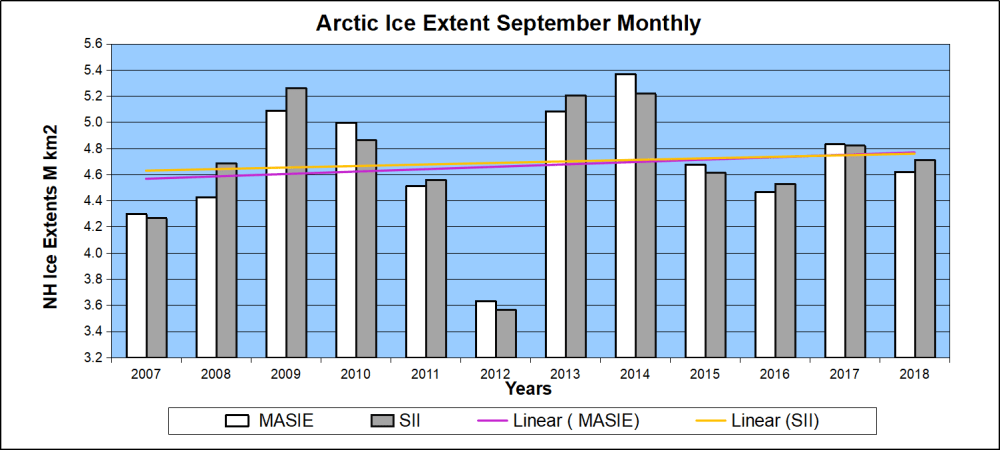
But: Arctic Ice has not declined since 2007.
arctic-sept-2007-to-20181

But: All of these are within the range of past variability.

In fact our climate is remarkably stable.
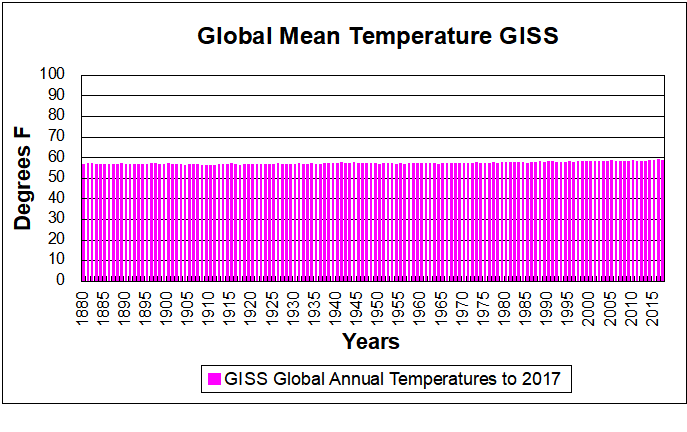
And many aspects follow quasi-60 year cycles.

Climate is Changing the Weather

Stiglitz:  Other potential examples include agricultural losses. Whether or not insurance
reimburses farmers for their crops, there can be food shortages that lead to higher food
prices (that will be borne by consumers, that is, Youth Plaintiffs and Affected Children).
There is a further risk that as our climate and land use pattern changes, disease vectors
may also move (e.g., diseases formerly only in tropical climates move northward).36 This
could lead to material increases in public health costs

But: Actual climate zones are local and regional in scope, and they show little boundary change.


But: Ice cores show that it was warmer in the past, not due to humans.

Supposition 3:  Government Can Stop it!

Here it is blithely assumed that the court can rule the seas to stop rising, heat waves to cease, and Arctic ice to grow (though why we would want that is debatable).  All this will be achieved by leaving fossil fuels in the ground and powering civilization with windmills and solar panels.  While admitting that our way of life depends on fossil fuels, they ignore the inadequacy of renewable energy sources at their present immaturity.

Stiglitz: Conclusion
The choice between incurring manageable costs now and the incalculable, perhaps even
irreparable, burden Youth Plaintiffs and Affected Children will face if Defendants fail to
rapidly transition to a non-fossil fuel economy is clear. While the full costs of the climate
damages that would result from maintaining a fossil fuel-based economy may be
incalculable, there is already ample evidence concerning the lower bound of such costs,
and with these minimum estimates, it is already clear that the cost of transitioning to a
low/no carbon economy are far less than the benefits of such a transition. No rational
calculus could come to an alternative conclusion. Defendants must act with all deliberate
speed and immediately cease the subsidization of fossil fuels and any new fossil fuel
projects, and implement policies to rapidly transition the U.S. economy away from fossil
fuels.

But CO2 relation to Temperature is Inconsistent.

But: The planet is greener because of rising CO2.

But: Modern nations (G20) depend on fossil fuels for nearly 90% of their energy.

But: Renewables are not ready for prime time.

People need to know that adding renewables to an electrical grid presents both technical and economic challenges.  Experience shows that adding intermittent power more than 10% of the baseload makes precarious the reliability of the supply.  South Australia is demonstrating this with a series of blackouts when the grid cannot be balanced.  Germany got to a higher % by dumping its excess renewable generation onto neighboring countries until the EU finally woke up and stopped them. Texas got up to 29% by dumping onto neighboring states, and some like Georgia are having problems.

But more dangerous is the way renewables destroy the economics of electrical power.  Seasoned energy analyst Gail Tverberg writes:

In fact, I have come to the rather astounding conclusion that even if wind turbines and solar PV could be built at zero cost, it would not make sense to continue to add them to the electric grid in the absence of very much better and cheaper electricity storage than we have today. There are too many costs outside building the devices themselves. It is these secondary costs that are problematic. Also, the presence of intermittent electricity disrupts competitive prices, leading to electricity prices that are far too low for other electricity providers, including those providing electricity using nuclear or natural gas. The tiny contribution of wind and solar to grid electricity cannot make up for the loss of more traditional electricity sources due to low prices.

These issues are discussed in more detail in the post Climateers Tilting at Windmills

Footnote regarding mention of “multi-meter” sea level rise.  It is all done with computer models.  For example, below is San Francisco.  More at USCS Warnings of Coastal Floodings
sf-ca-past-projected

dilbert-sins-of-omission-and-comission

Arctic Ice Keeps Coming


iceman-cometh

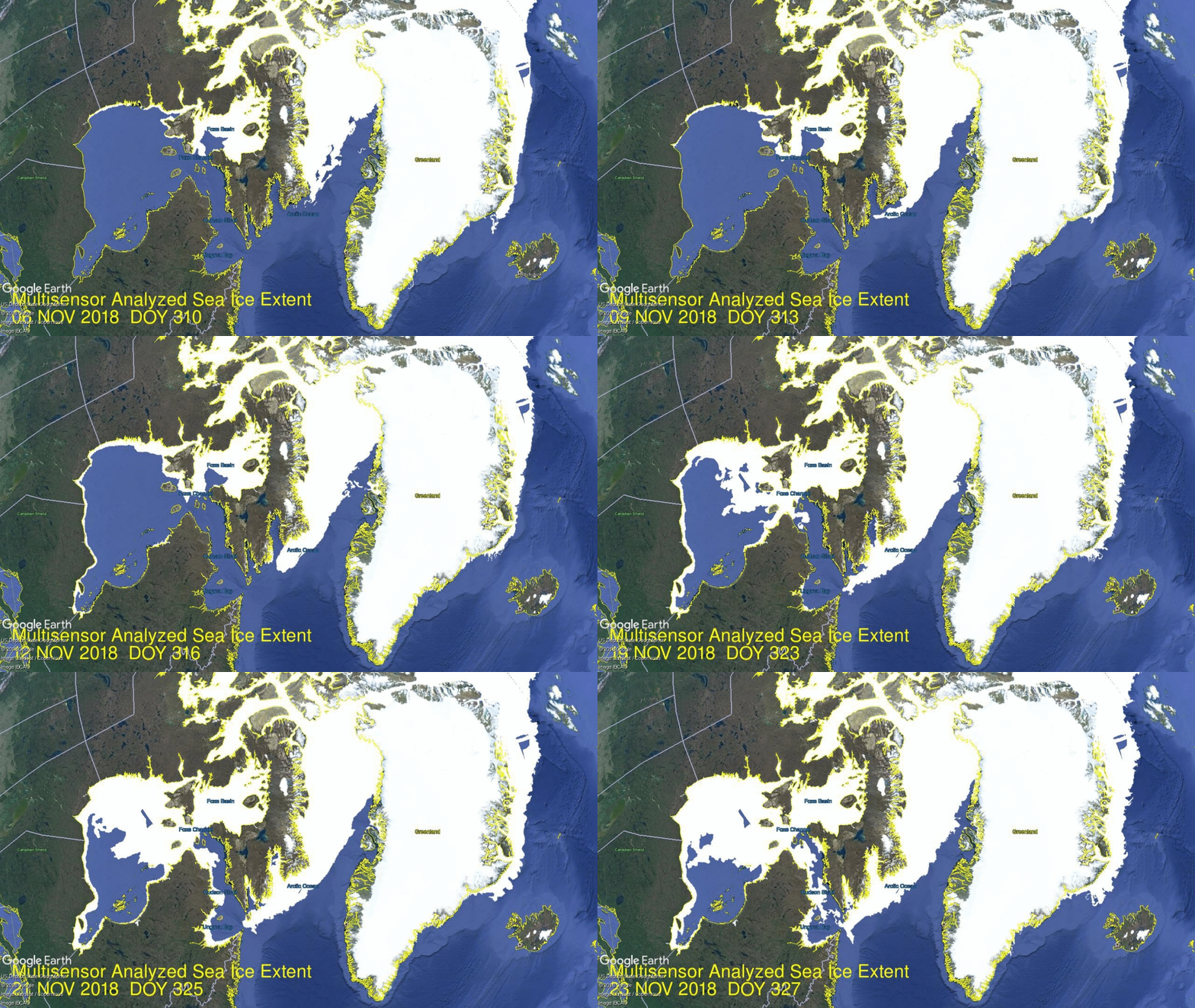
Despite the feverish reporting that last summer was hell, and that hot is now the “new normal,” the Arctic ice man is hard at work.  In reality, Arctic ice is spreading everywhere.  The image below shows how quickly Hudson Bay froze over in recent days.

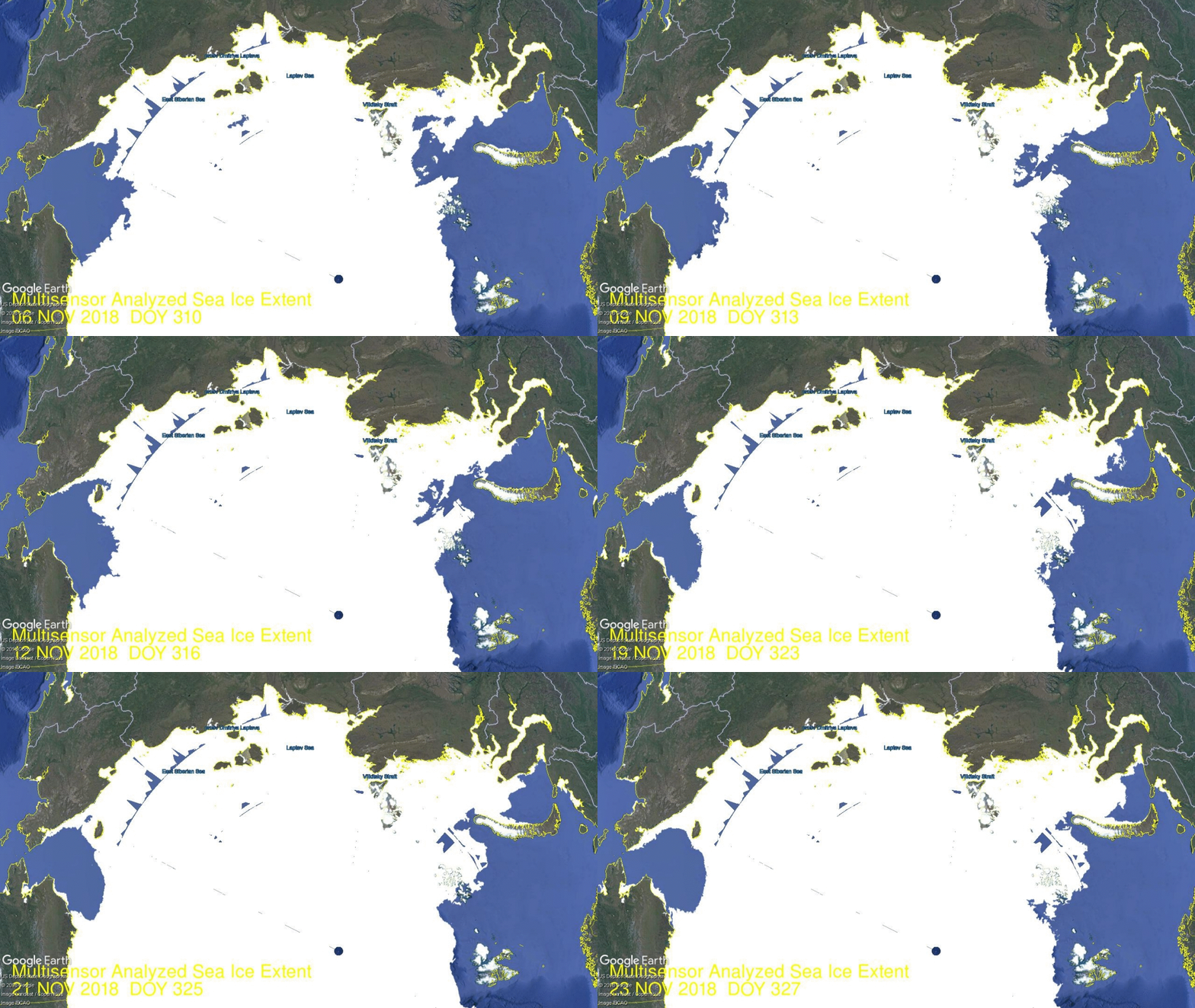
Baffin Bay in the center next to Greenland is extending south and added 250k km2.  Hudson Bay on the left added 700k km2, now at 73% of maximum, with both east and west coastlines freezing all the way down into James Bay.

On the Eurasian side, on the left margin Chukchi is closing in.  On the right side Kara has added 300k km2 of ice extent, now at 85% of maximum

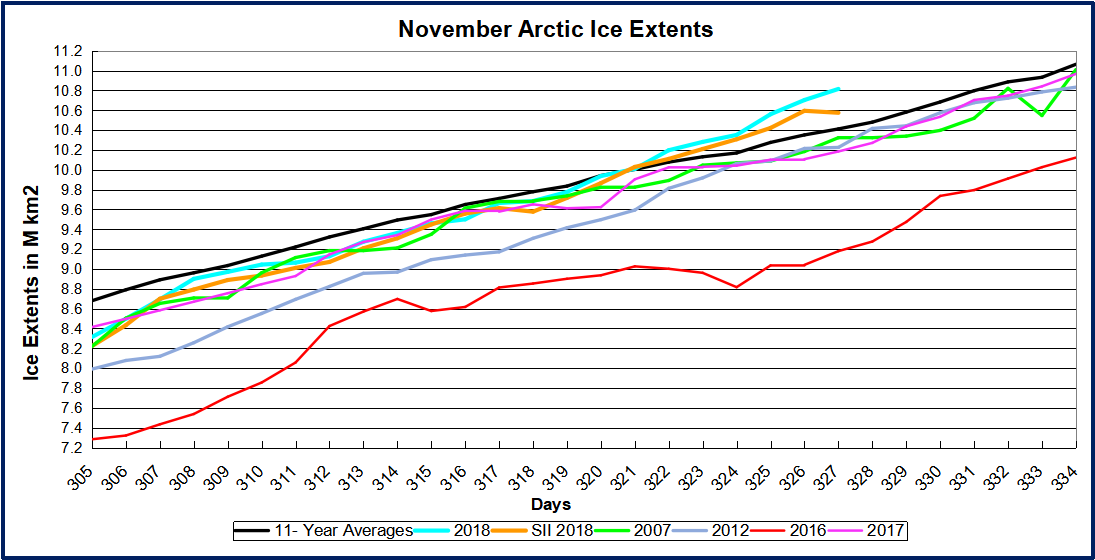
The graph below shows 2018 is now exceeding the 11-year average after being down in October.

MASIE is showing  10.8M km2 ice extent, 400k km2 greater than the average for day 327, Nov. 23.  SII is slightly lower, while 2007 is almost 500k km2 lower. In fact, in the past decade, only two years, 2013 and 2015, had more ice than 2018 at this date.

Region 2018327 Day 327
Average
2018-Ave. 2007327 2018-2007
 (0) Northern_Hemisphere 10815225 10412198 403027 10323881 491344
 (1) Beaufort_Sea 1070498 1068397 2100 1053320 17177
 (2) Chukchi_Sea 624371 744131 -119760 655458 -31087
 (3) East_Siberian_Sea 1087137 1077862 9275 1055561 31576
 (4) Laptev_Sea 897845 897263 582 897845 0
 (5) Kara_Sea 795273 712636 82637 784601 10672
 (6) Barents_Sea 133731 197266 -63536 137195 -3464
 (7) Greenland_Sea 453657 518028 -64371 589509 -135852
 (8) Baffin_Bay_Gulf_of_St._Lawrence 786601 615297 171304 585929 200672
 (9) Canadian_Archipelago 853337 851790 1547 852556 781
 (10) Hudson_Bay 916266 406475 509791 494237 422029
 (11) Central_Arctic 3142574 3186697 -44124 3151036 -8462

Small deficits in Chukchi, Greenland and Barents Seas are more than offset by surpluses in Kara Sea, Baffin and Hudson Bays. Note Hudson Bay is more than twice the average for this date.

Meanwhile, in Nunavut, it is a great time to be a polar bear, even more of them than people want.


Is this cold the “New Normal?”

Update Regulatory Backfire

Update Nov. 22, 2018

With the Democrats taking control of the US House of Representatives, we can expect attempts to again “fight climate change” by means of counter productive regulations.  This post explains why such policies are ineffective and produce unintended consequences, with results worse than doing nothing.

Background:  Heisenberg Uncertainty

In the sub-atomic domain of quantum mechanics, Werner Heisenberg, a German physicist, determined that our observations have an effect on the behavior of quanta (quantum particles).

The Heisenberg uncertainty principle states that it is impossible to know simultaneously the exact position and momentum of a particle. That is, the more exactly the position is determined, the less known the momentum, and vice versa. This principle is not a statement about the limits of technology, but a fundamental limit on what can be known about a particle at any given moment. This uncertainty arises because the act of measuring affects the object being measured. The only way to measure the position of something is using light, but, on the sub-atomic scale, the interaction of the light with the object inevitably changes the object’s position and its direction of travel.

Now skip to the world of governance and the effects of regulation. A similar finding shows that the act of regulating produces reactive behavior and unintended consequences contrary to the desired outcomes.

An article at Financial Times explains about Energy Regulations Unintended Consequences  Excerpts below with my bolds.

Goodhart’s Law Regarding Policy Effects

Goodhart’s Law holds that “any observed statistical regularity will tend to collapse once pressure is placed upon it for control purposes”. Originally coined by the economist Charles Goodhart as a critique of the use of money supply measures to guide monetary policy, it has been adopted as a useful concept in many other fields. The general principle is that when any measure is used as a target for policy, it becomes unreliable. It is an observable phenomenon in healthcare, in financial regulation and, it seems, in energy efficiency standards.

When governments set efficiency regulations such as the US Corporate Average Fuel Economy standards for vehicles, they are often what is called “attribute-based”, meaning that the rules take other characteristics into consideration when determining compliance. The Cafe standards, for example, vary according to the “footprint” of the vehicle: the area enclosed by its wheels. In Japan, fuel economy standards are weight-based. Like all regulations, fuel economy standards create incentives to game the system, and where attributes are important, that can mean finding ways to exploit the variations in requirements. There have long been suspicions that the footprint-based Cafe standards would encourage manufacturers to make larger cars for the US market, but a paper this week from Koichiro Ito of the University of Chicago and James Sallee of the University of California Berkeley provided the strongest evidence yet that those fears are likely to be justified.

Mr Ito and Mr Sallee looked at Japan’s experience with weight-based fuel economy standards, which changed in 2009, and concluded that “the Japanese car market has experienced a notable increase in weight in response to attribute-based regulation”. In the US, the Cafe standards create a similar pressure, but expressed in terms of size rather than weight. Mr Ito suggested that in Ford’s decision to end almost all car production in North America to focus on SUVs and trucks, “policy plays a substantial role”. It is not just that manufacturers are focusing on larger models; specific models are also getting bigger. Ford’s move, Mr Ito wrote, should be seen as an “alarm bell” warning of the flaws in the Cafe system. He suggests an alternative framework with a uniform standard and tradeable credits, as a more effective and lower-cost option. With the Trump administration now reviewing fuel economy and emissions standards, and facing challenges from California and many other states, the vehicle manufacturers appear to be in a state of confusion. An elegant idea for preserving plans for improving fuel economy while reducing the cost of compliance could be very welcome.

The paper is The Economics of Attribute-Based Regulation: Theory and Evidence from Fuel-Economy Standards Koichiro Ito, James M. Sallee NBER Working Paper No. 20500.  The authors explain:

An attribute-based regulation is a regulation that aims to change one characteristic of a product related to the externality (the “targeted characteristic”), but which takes some other characteristic (the “secondary attribute”) into consideration when determining compliance. For example, Corporate Average Fuel Economy (CAFE) standards in the United States recently adopted attribute-basing. Figure 1 shows that the new policy mandates a fuel-economy target that is a downward-sloping function of vehicle “footprint”—the square area trapped by a rectangle drawn to connect the vehicle’s tires.  Under this schedule, firms that make larger vehicles are allowed to have lower fuel economy. This has the potential benefit of harmonizing marginal costs of regulatory compliance across firms, but it also creates a distortionary incentive for automakers to manipulate vehicle footprint.

Attribute-basing is used in a variety of important economic policies. Fuel-economy regulations are attribute-based in China, Europe, Japan and the United States, which are the world’s four largest car markets. Energy efficiency standards for appliances, which allow larger products to consume more energy, are attribute-based all over the world. Regulations such as the Clean Air Act, the Family Medical Leave Act, and the Affordable Care Act are attribute-based because they exempt some firms based on size. In all of these examples, attribute-basing is designed to provide a weaker regulation for products or firms that will find compliance more difficult.

Summary from Heritage Foundation study Fuel Economy Standards Are a Costly Mistake Excerpt with my bolds.

The CAFE standards are not only an extremely inefficient way to reduce carbon dioxide emission but will also have a variety of unintended consequences.

For example, the post-2010 standards apply lower mileage requirements to vehicles with larger footprints. Thus, Whitefoot and Skerlos argued that there is an incentive to increase the size of vehicles.

Data from the first few years under the new standard confirm that the average footprint, weight, and horsepower of cars and trucks have indeed all increased since 2008, even as carbon emissions fell, reflecting the distorted incentives.

Manufacturers have found work-arounds to thwart the intent of the regulations. For example, the standards raised the price of large cars, such as station wagons, relative to light trucks. As a result, automakers created a new type of light truck—the sport utility vehicle (SUV)—which was covered by the lower standard and had low gas mileage but met consumers’ needs. Other automakers have simply chosen to miss the thresholds and pay fines on a sliding scale.

Another well-known flaw in CAFE standards is the “rebound effect.” When consumers are forced to buy more fuel-efficient vehicles, the cost per mile falls (since their cars use less gas) and they drive more. This offsets part of the fuel economy gain and adds congestion and road repair costs. Similarly, the rising price of new vehicles causes consumers to delay upgrades, leaving older vehicles on the road longer.

In addition, the higher purchase price of cars under a stricter CAFE standard is likely to force millions of households out of the new-car market altogether. Many households face credit constraints when borrowing money to purchase a car. David Wagner, Paulina Nusinovich, and Esteban Plaza-Jennings used Bureau of Labor Statistics data and typical finance industry debt-service-to-income ratios and estimated that 3.1 million to 14.9 million households would not have enough credit to purchase a new car under the 2025 CAFE standards.[34] This impact would fall disproportionately on poorer households and force the use of older cars with higher maintenance costs and with fuel economy that is generally lower than that of new cars.

CAFE standards may also have redistributed corporate profits to foreign automakers and away from Ford, General Motors (GM), and Chrysler (the Big Three), because foreign-headquartered firms tend to specialize in vehicles that are favored under the new standards.[35] 

Conclusion

CAFE standards are costly, inefficient, and ineffective regulations. They severely limit consumers’ ability to make their own choices concerning safety, comfort, affordability, and efficiency. Originally based on the belief that consumers undervalued fuel economy, the standards have morphed into climate control mandates. Under any justification, regulation gives the desires of government regulators precedence over those of the Americans who actually pay for the cars. Since the regulators undervalue the well-being of American consumers, the policy outcomes are predictably harmful.


The Problem with Climate Chicken Littles

Michael Walsh writes The Late Great (Again) Planet Earth in PJ Media. Excerpts in italics with my bolds. (Indented text is from George Monbiot, infamous alarmist).

Unexamined Premises

George Monbiot, the man who gave his name to the term “moonbat,” is back, like some hair-shirted lunatic screaming on a street corner, saying that we’re all doomed:

It was a moment of the kind that changes lives. At a press conference held by climate activists Extinction Rebellion last week, two of us journalists pressed the organisers on whether their aims were realistic. They have called, for example, for UK carbon emissions to be reduced to net zero by 2025. Wouldn’t it be better, we asked, to pursue some intermediate aims?

A young woman called Lizia Woolf stepped forward. She hadn’t spoken before, but the passion, grief and fury of her response was utterly compelling. “What is it that you are asking me as a 20-year-old to face and to accept about my future and my life? … This is an emergency. We are facing extinction. When you ask questions like that, what is it you want me to feel?” We had no answer.

Softer aims might be politically realistic, but they are physically unrealistic. Only shifts commensurate with the scale of our existential crises have any prospect of averting them. Hopeless realism, tinkering at the edges of the problem, got us into this mess. It will not get us out.

Now that there is some prime moonbattery, even by Monbiot’s soaring standards. What a 20-year-old female knows about anything is moot, but her notion that she is “facing extinction” is beyond delusional; in fact, it’s the product of having her head stuffed with the most self-evidently arrant nonsense of the modern era: “climate change.”

Since at least 1970, when the not-yet-late great Hal Lindsey told us we were all going to die in The Late Great Planet Earth, snake-oil salesmen and Chicken Littles around the world have joined forces to convince the rubes and the suckers that the Earth is, so to speak, on her last legs unless we do something right now. Lindsey’s book employed Bible “prophecy” to limn our destruction at the hands of the Antichrist and the return of Jesus sometime in the 1980s.

Well, you can’t go wrong betting against religious crackpots, and while the climate-change freaks are ostensibly secular, their approach to their unalterable dogma has all the hallmarks of a particularly nutty faith. Never mind that the data to which they so fearfully cling is either bogus or misinterpreted; combine that with the natural human tendency to think that the world as we know it began, and will end, with us — that everything is, to use one of their favorite words, “unprecedented” (if you pay no attention to history) — and you have a rich field for superstition wedded to calls for (what else?) immediate governmental action.

How Have Predictions on Catastrophic Climate Change Held Up Over the Last 30 Years?

So this was a bummer:

Researchers with UC San Diego’s Scripps Institution of Oceanography and Princeton University recently walked back scientific findings published last month that showed oceans have been heating up dramatically faster than previously thought as a result of climate change.

In a paper published Oct. 31 in the journal Nature, researchers found that ocean temperatures had warmed 60 percent more than outlined by the United Nation’s Intergovernmental Panel on Climate Change. However, the conclusion came under scrutiny after mathematician Nic Lewis, a critic of the scientific consensus around human-induced warming, posted a critique of the paper on the blog of Judith Curry, another well-known critic.

“The findings of the … paper were peer reviewed and published in the world’s premier scientific journal and were given wide coverage in the English-speaking media,” Lewis wrote. “Despite this, a quick review of the first page of the paper was sufficient to raise doubts as to the accuracy of its results.”

Co-author Ralph Keeling, climate scientist at the Scripps Institution of Oceanography, took full blame and thanked Lewis for alerting him to the mistake. “When we were confronted with his insight it became immediately clear there was an issue there,” he said. “We’re grateful to have it be pointed out quickly so that we could correct it quickly.”

Keeling said they have since redone the calculations, finding the ocean is still likely warmer than the estimate used by the IPCC. However, that increase in heat has a larger range of probability than initially thought — between 10 percent and 70 percent, as other studies have already found.

In other words, never mind. But that won’t stop the moonbats from flapping ever more vigorously. I just shoveled six inches of global warming off my patio here in rural New England, while California continues to burn — but all weather and weather-related events are of a piece with the Unified Field Theory of Everything: evil mankind (white, male, middle-aged) is killing Mother Gaia. Hence, the calls for “environmental justice,” which like all modified forms of “justice” equals punishment and payback.

Guru Monbiot again:

Public figures talk and act as if environmental change will be linear and gradual. But the Earth’s systems are highly complex, and complex systems do not respond to pressure in linear ways. When these systems interact (because the world’s atmosphere, oceans, land surface and lifeforms do not sit placidly within the boxes that make study more convenient), their reactions to change become highly unpredictable. Small perturbations can ramify wildly. Tipping points are likely to remain invisible until we have passed them. We could see changes of state so abrupt and profound that no continuity can be safely assumed.

Only one of the many life support systems on which we depend – soils, aquifers, rainfall, ice, the pattern of winds and currents, pollinators, biological abundance and diversity – need fail for everything to slide. For example, when Arctic sea ice melts beyond a certain point, the positive feedbacks this triggers (such as darker water absorbing more heat, melting permafrost releasing methane, shifts in the polar vortex) could render runaway climate breakdown unstoppable. When the Younger Dryas period ended 11,600 years ago, temperatures rose 10C within a decade.

Okay, George, who’s to blame?

The oligarchic control of wealth, politics, media and public discourse explains the comprehensive institutional failure now pushing us towards disaster. Think of Donald Trump and his cabinet of multi-millionaires; the influence of the Koch brothers in funding rightwing organisations; the Murdoch empire and its massive contribution to climate science denial; or the oil and motor companies whose lobbying prevents a faster shift to new technologies.

Sort of gives the game away, doesn’t it?

Two tasks need to be performed simultaneously: throwing ourselves at the possibility of averting collapse, as Extinction Rebellion is doing, slight though this possibility may appear; and preparing ourselves for the likely failure of these efforts, terrifying as this prospect is. Both tasks require a complete revision of our relationship with the living planet.

Because we cannot save ourselves without contesting oligarchic control, the fight for democracy and justice and the fight against environmental breakdown are one and the same. Do not allow those who have caused this crisis to define the limits of political action. Do not allow those whose magical thinking got us into this mess to tell us what can and cannot be done.

In other words, the sky is falling so we need nothing short of a Leftist political revolution to save ourselves, and even then it may be too late. As I often say on Twitter, I never take political advice from small children, and certainly not from 20-year-old hysterics. Besides, the world has weathered worse patches than this before: (from Harvard professor Michael McCormick )

Bubonic plague, famine, war and flu pandemics have made some periods of human history infamous for death and suffering but one year stands above the rest in terms of misery; 536 AD. According to research from a Harvard professor, it is a prime candidate for the unfortunate accolade of the worst year in the entirety of recorded history.

Europe, the Middle East, and parts of Asia were plunged into 18 months of solid darkness by a mysterious fog. It caused snowfall in China, continental-scale crop failure, extreme drought, famine and disease throughout most of the northern hemisphere. The bleak year was triggered by a cataclysmic Icelandic eruption, scientists say, and was an ominous omen for a bleak century of suffering and death.

The eerie fog created a drab world with darkness residing over the northern hemisphere for 18 months, with an unrelenting dusk persevering through day and night. Effects on the climate were so severe that the Irish chronicles tell of ‘a failure of bread from the years 536–539’. Temperatures in the summer of 536 fell between 1.5°C (2.7°F) and 2.5°C (4.5°F), initiating the coldest decade in the past 2,300 years.

And nary an SUV or a fossil fuel to blame, unless you count wood and turf. The blackout seems to have been caused (as subsequent, similar events like the 1816 “year without a summer” were) by a volcanic eruption, this one in Iceland. Amazing what climatological havoc Gaia can wreak when she puts her mind to it.

God knows whom or what the poor sods living in the ruins of the Roman Empire in the 6th century blamed for the weather — probably God, possible cow farts — but today’s True Believers no longer believe in God; rather, they believe in Man, as both the root of all evil and the last best hope of Earth, if only Man would have the decency to kill himself. Or at least kill the conservatives, so that poor little Lizia Woolf may thrive without fear of imminent extinction or another Orson Welles documentary.

See Also Climate Horror Show


Culture War: Victimhood Vs. Honor and Dignity

Bradley Campbell writes insightfully at Quillette The Free Speech Crisis Is Worse than People Think  Excerpts in italics with my bolds.

A new moral culture

If you were a time traveler from 10 years ago—maybe even five years ago—you’d probably have trouble following some of that. What’s a microaggression? What’s woke? And how could a New York Times op-ed lead to that kind of uproar on campus? But if you’ve been around, and if you’ve been following the happenings on American college campuses, you’re familiar by now with conflicts like this and the new moral terminology guiding the campus activists. In the last few years we’ve seen professors such as Nicholas Christakis at Yale and Brett Weinstein at Evergreen State College surrounded by angry, cursing students, with Christakis and his wife, Erika Christakis, soon leaving their positions as the masters of one of Yale’s residential colleges and Weinstein and his wife, Heather Heying, leaving Evergreen entirely. We’ve heard about microaggressions, said to be small slights that over time do great harm to disadvantaged groups; trigger warnings, which some students demand before they are exposed to course material that might be disturbing; and safe spaces, where people can go to be free of ideas that challenge leftist identity politics. We’ve heard claims that speech that offends campus activists is actually violence, and we’ve seen activists use actual violence to stop it —and to defend this as self-defense—when administrators fail to do so.

These are all signs of a new moral culture. In our book The Rise of Victimhood Culture: Microaggressions, Safe Spaces, and the New Culture Wars, Jason Manning and I discuss how a new culture of victimhood differs from cultures of honor and dignity, and we discuss how the new culture threatens the mission of the university.

In honor cultures men want to appear formidable. A reputation for bravery, for being willing and capable of handling conflicts through violence, is important. In a society like the pre-Civil War American South, for example, a gentleman who allowed himself or his family members to be injured or insulted might be thought a coward, someone with no honor, and lose his social standing. To avoid this, men sometimes fought duels. In honor cultures men are sensitive even to minor slights, but they handle such offenses themselves, possibly with violence.

In dignity cultures, though, people have worth regardless of their reputations. Because an insult doesn’t take away your worth, your dignity, you can ignore others’ insults. For serious injuries you can go to the police or use the courts. In dignity cultures, then, people aren’t as sensitive to slights—they’re encouraged to have thick skins—and they’re not as likely to handle offenses themselves, certainly not violently—they’re encouraged to appeal to the proper authorities.

microagressions

But the new culture of victimhood combines sensitivity to slight with appeal to authority. Those who embrace it see themselves as fighting oppression, and even minor offenses can be worthy of attention and action. Slights, insults, and sometimes even arguments or evidence might further victimize an oppressed group, and authorities must deal with them. You could call this social justice culture since those who embrace it are pursuing a vision of social justice. But we call it victimhood culture because being recognized as a victim of oppression now confers a kind of moral status, in much the same way that being recognized for bravery did in honor cultures.

Like dignity culture, though, victimhood culture is a moral culture. Moral concerns and moral emotions inspire the campus activists. Their behaviors might appear immoral to those who don’t share their moral assumptions, but it would be a mistake to think the activists see it that way, or to think they’re in some way hypocritical or insincere. Recognizing their moral concerns helps us understand better what Greg Lukianoff and Jonathan Haidt call vindictive protectiveness, whereby activists are simultaneously protective toward some people and vindictive toward others. This is not a contradiction, but rather a consequence of seeing the world through the lens of oppression. Just as in an honor culture people show respect for the honorable and disdain toward the cowardly, in a victimhood culture people have empathy for victims of oppression and wrath toward their oppressors.

The optimistic critics are right about a lot, but their optimism seems like wishful thinking. The “grievance studies” that Lindsay, Pluckrose, and Boghossian targeted are still entrenched in the universities, and those sympathetic to the fields simply dismissed the hoax as pointing to the vulnerabilities of peer review generally. Meanwhile, people come up with novel ways to undermine the norms of scholarship in the name of social justice.

grievance studies

And what about free speech and academic freedom? The recent attacks on Abrams at Sarah Lawrence College, and the initial failure of the college president to condemn them and support Abrams, are as egregious as any of the others, especially considering the actual content of his op-ed.

What about microaggressions? The term has continued to spread. Just in 2018 are some of the ways administrators have continued to fly off the rails a bit:

  • The National Science Foundation gave a grant to researchers at Iowa State University to study microaggressions in engineering programs.
  • The University of Utah placed posters of microaggression statements around campus to raise awareness.
  • At the University of Buffalo, microaggressions were the theme of the bullying prevention center’s annual conference.
  • At Harvard University’s School of Public Health, students are now asked on course evaluation forms about microaggressions. Last Spring, in 43 of the 138 courses evaluated, at least one student reported hearing “verbal or nonverbal slights/insults.” Administrators said they were investigating the seven professors whose courses received three or more such reports.

And even while activists and administrators concern themselves with possible minor slights against those they perceive as victims, they engage in or tolerate insults and hate speech directed toward those they perceive as oppressors. There was the professor who said that a white college student tortured and killed by the North Koreans for allegedly stealing a poster “got what he deserved,” and that he was just like the other “young, white, clueless, rich males” she teaches. Another professor from Rutgers wrote on Facebook, “I now hate white people.” And after a group of Stanford students put “no crackers” on their community’s residential bus, a staff member defended them, saying, “I hope we have no crackers here.”

What’s more, victimhood culture is already spreading beyond the universities, making the case for pessimism even stronger. Corporations and government agencies, even NASA, have begun doing their own microaggression training. In Multnomah County, Oregon, a recent contract between the county and the municipal workers union guaranteed that “the County and union won’t tolerate any form of ‘microaggression.’” And the Times recently hired Sarah Jeong to its editorial board despite her history of tweeting slurs against whites and men—things like “#CancelWhitePeople” and “White men are bullshit,” the kind of things that are common among campus activists but were not previously part of the mainstream. And while the Times did distance itself from the tweets, writers at Vox and other left-of-center outlets defended them. Ezra Klein, for example, said tweets like “#CancelWhitePeople” are simply calls for people to challenge the dominant power structure. And Zack Beauchamp says that “White men are bullshit” is a way of pointing out the existence of a power structure favoring white men.

Of course, the danger of pessimism is that it leads to despair, which isn’t really warranted either. For one thing, none of us have a crystal ball. The critical optimists could be right. Maybe things will turn around. Or maybe our efforts are ultimately doomed, but are helping preserve the academy for a little while longer. For all the problems with universities, they’re still doing a lot of good. The natural sciences continue on, not yet wholly captured by the identitarian Left, and as bad as the attacks on scholarship and free speech are in the social sciences and humanities, they aren’t all pervasive. The randomness of the attacks is part of the problem, making them difficult to avoid even if one tries to comply with the latest leftist orthodoxy. But the randomness also means that even the most maverick thinkers aren’t attacked as a matter of course. Part of what’s strange about the Abrams incident is that he’s been writing similar things for some time without incident. At universities all over the country, people are discussing and debating ideas — with more trepidation, perhaps, but it’s usually still possible to do so. If there’s any chance of preserving that, even temporarily, we should do so. We’re unlikely to be successful, but it makes sense to try.

As we try, though, we need to recognize what we’re up against. Misunderstanding victimhood culture has led critics of its various manifestations to underestimate its strength.  One reason victimhood culture is strong is that those who embrace it are sincere and zealous. Simply condemning them, or worse, calling them names or trying to trigger them, won’t help anything. Neither will simply ignoring them until things get out of hand, as at Sarah Lawrence University. If you want to save the academy, you’ll need to start by offering an alternative moral vision.

Bradley Campbell is an associate professor of sociology at California State University, Los Angeles.

In the video, Two incompatible sacred values in American universities” by Jon Haidt, Hayek Lecture Series, he addresses the sacredness of victimhood directly starting about 25 minutes into the talk.

Arctic Update: Hell Freezing Over

The title of this post is over the top, but was provoked by the repeated claims last summer earth was going to hell right now.  For example,

The world’s summer of hell.  Hot, hot, hot: Summer of extremes setting heat records around the world, July 2018, CBC

Summer 2018: On the highway to hell? August 2018, Beyond Ratings

Earth at risk of becoming ‘hothouse’ if tipping point reached, if we can’t stop it we’re in a hell of a mess..August 2018, CNN

The Summer of Hell.  Climate change is here and we are living in its embers.  August 2018 The Week (US)

Meanwhile, back in reality, Arctic ice is spreading everywhere.  The image below shows the European side in the last two weeks:

Laptev and East Siberian in the middle are frozen solid. On the right Kara has added 400k km2 ice extent up to 700k km2, 75% of March maximum.  Below is the freezing proceeding on the Canadian side.

Baffin Bay in the center next to Greenland is extending south and added 300k km2.  Hudson Bay on the left added 400k km2, with the western coastline freezing all the way down into James Bay.  The graph below shows 2018 is matching the 11-year average after being down in October.

Both MASIE and SII have 9.9M km2 ice extents matching the average for day 320, Nov. 16.  2007, 2012 and 2017 all recovered from their September lows, while 2016 was much slower to refreeze.

Region 2018320 Day 320 
Average
2018-Ave. 2007320 2018-2007
 (0) Northern_Hemisphere 9937017 9942096 -5078 9824193 112824
 (1) Beaufort_Sea 1069588 1064590 4999 1059182 10406
 (2) Chukchi_Sea 615028 667249 -52222 519486 95541
 (3) East_Siberian_Sea 1085198 1077597 7601 1055581 29617
 (4) Laptev_Sea 897845 897648 197 897845 0
 (5) Kara_Sea 701192 655668 45524 774297 -73105
 (6) Barents_Sea 65798 167138 -101340 149482 -83684
 (7) Greenland_Sea 378273 482289 -104016 533946 -155672
 (8) Baffin_Bay_Gulf_of_St._Lawrence 711715 555346 156369 545899 165816
 (9) Canadian_Archipelago 853337 851902 1435 852539 798
 (10) Hudson_Bay 426092 261863 164228 244531 181560
 (11) Central_Arctic 3107467 3186378 -78911 3163043 -55576

Deficits in Chukchi, Greenland and Barents Seas are offset by surpluses in Kara Sea, Baffin and Hudson Bays.

Meanwhile, in Nunavut, it is a great time to be a polar bear, even more of them than people want.

When Hell Freezes Over (Eagles Reunion Tour)