Ocean SSTs Tepid in November

globpopThe best context for understanding decadal temperature changes comes from the world’s sea surface temperatures (SST), for several reasons:

  • The ocean covers 71% of the globe and drives average temperatures;
  • SSTs have a constant water content, (unlike air temperatures), so give a better reading of heat content variations;
  • A major El Nino was the dominant climate feature in recent years.

HadSST is generally regarded as the best of the global SST data sets, and so the temperature story here comes from that source, the latest version being HadSST3.  More on what distinguishes HadSST3 from other SST products at the end.

The Current Context

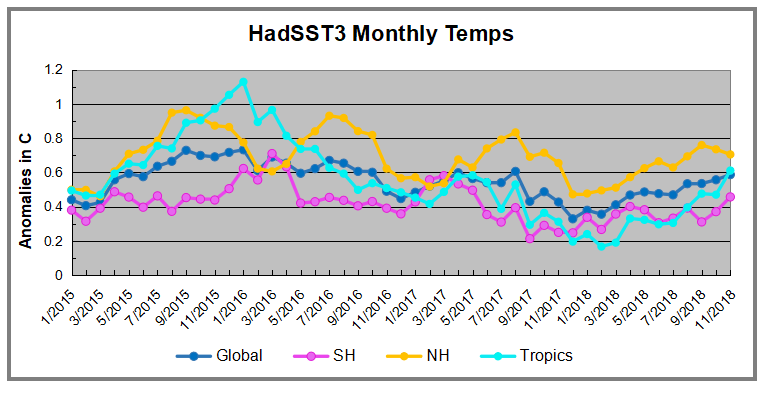
The chart below shows SST monthly anomalies as reported in HadSST3 starting in 2015 through November 2018.

Hadsst112018

A global cooling pattern is seen clearly in the Tropics since its peak in 2016, joined by NH and SH cycling downward since 2016.  2018 started with slow warming after the low point of December 2017, led by steadily rising NH, which peaked in September and cooled the last 2 months.  The Tropics have risen steadily since July, and along with a bump in SH pulled the Global anomaly up slightly the last 2 months.

The November Global anomaly is higher than 2017 but still lower than 2015.  Similarly, NH, SH and the Tropics are all slightly higher than 2017, but still lower than 11/2015. The rise in the Tropics is likely due to the weak El Nino, maybe also affecting the SH.

Note that higher temps in 2015 and 2016 were first of all due to a sharp rise in Tropical SST, beginning in March 2015, peaking in January 2016, and steadily declining back below its beginning level. Secondly, the Northern Hemisphere added three bumps on the shoulders of Tropical warming, with peaks in August of each year.  A fourth NH bump was lower and peaked in September 2018.  Also, note that the global release of heat was not dramatic, due to the Southern Hemisphere offsetting the Northern one.

A longer view of SSTs

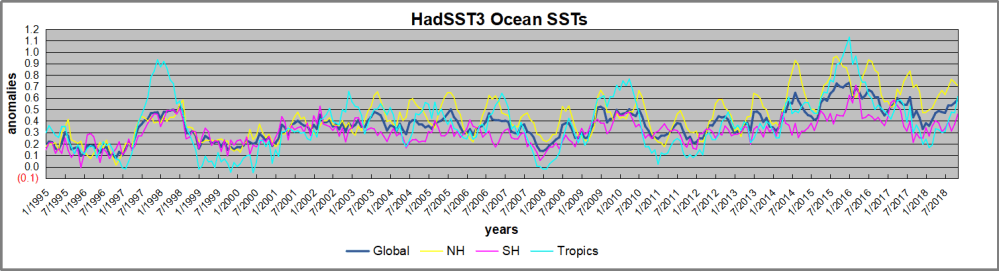
The graph below  is noisy, but the density is needed to see the seasonal patterns in the oceanic fluctuations.  Previous posts focused on the rise and fall of the last El Nino starting in 2015.  This post adds a longer view, encompassing the significant 1998 El Nino and since.  The color schemes are retained for Global, Tropics, NH and SH anomalies.  Despite the longer time frame, I have kept the monthly data (rather than yearly averages) because of interesting shifts between January and July.

Hadsst95to112018

Open image in new tab to enlarge.

1995 is a reasonable starting point prior to the first El Nino.  The sharp Tropical rise peaking in 1998 is dominant in the record, starting Jan. ’97 to pull up SSTs uniformly before returning to the same level Jan. ’99.  For the next 2 years, the Tropics stayed down, and the world’s oceans held steady around 0.2C above 1961 to 1990 average.

Then comes a steady rise over two years to a lesser peak Jan. 2003, but again uniformly pulling all oceans up around 0.4C.  Something changes at this point, with more hemispheric divergence than before. Over the 4 years until Jan 2007, the Tropics go through ups and downs, NH a series of ups and SH mostly downs.  As a result the Global average fluctuates around that same 0.4C, which also turns out to be the average for the entire record since 1995.

2007 stands out with a sharp drop in temperatures so that Jan.08 matches the low in Jan. ’99, but starting from a lower high. The oceans all decline as well, until temps build peaking in 2010.

Now again a different pattern appears.  The Tropics cool sharply to Jan 11, then rise steadily for 4 years to Jan 15, at which point the most recent major El Nino takes off.  But this time in contrast to ’97-’99, the Northern Hemisphere produces peaks every summer pulling up the Global average.  In fact, these NH peaks appear every July starting in 2003, growing stronger to produce 3 massive highs in 2014, 15 and 16, with July 2017 only slightly lower.  Note also that starting in 2014 SH plays a moderating role, offsetting the NH warming pulses. (Note: these are high anomalies on top of the highest absolute temps in the NH.)

What to make of all this? The patterns suggest that in addition to El Ninos in the Pacific driving the Tropic SSTs, something else is going on in the NH.  The obvious culprit is the North Atlantic, since I have seen this sort of pulsing before.  After reading some papers by David Dilley, I confirmed his observation of Atlantic pulses into the Arctic every 8 to 10 years.

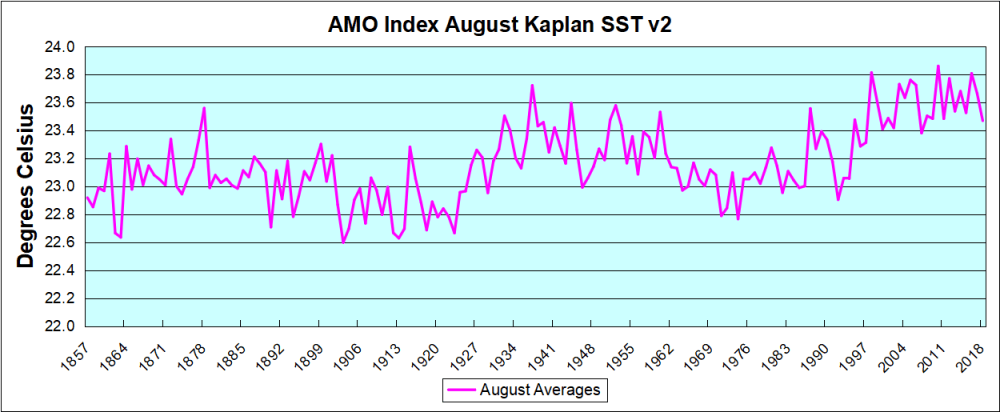
But the peaks coming nearly every summer in HadSST require a different picture.  Let’s look at August, the hottest month in the North Atlantic from the Kaplan dataset.
AMO August 2018

The AMO Index is from from Kaplan SST v2, the unaltered and untrended dataset. By definition, the data are monthly average SSTs interpolated to a 5×5 grid over the North Atlantic basically 0 to 70N. The graph shows warming began after 1992 up to 1998, with a series of matching years since. Because the N. Atlantic has partnered with the Pacific ENSO recently, let’s take a closer look at some AMO years in the last 2 decades.

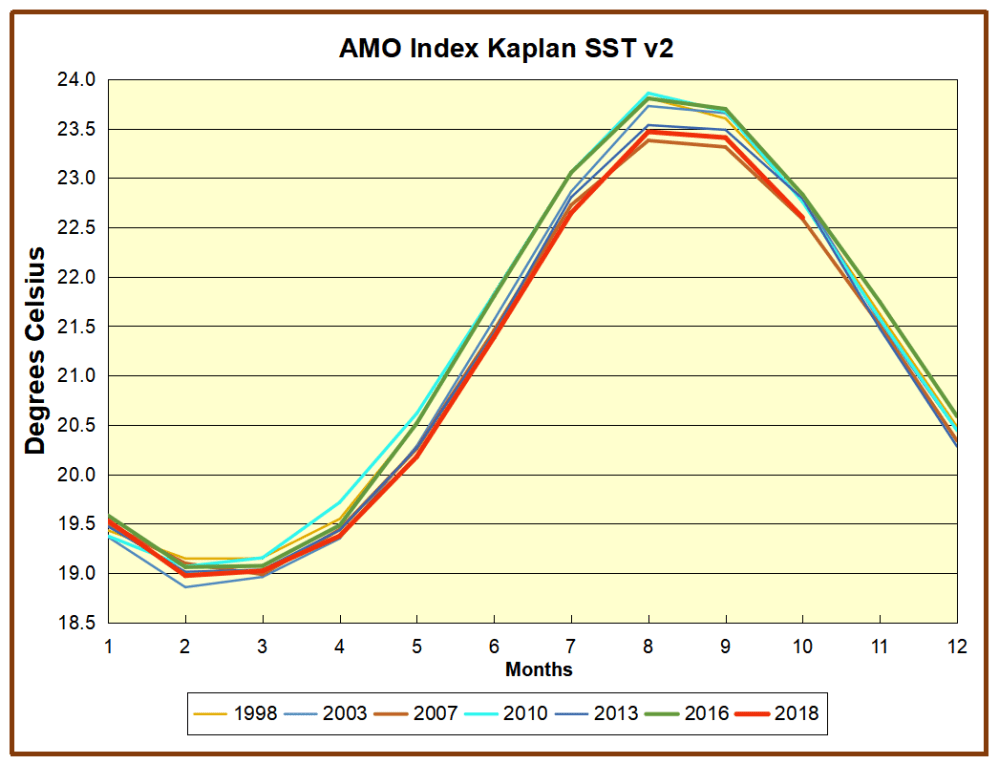
AMO decade 102018

This graph shows monthly AMO temps for some important years. The Peak years were 1998, 2010 and 2016, with the latter emphasized as the most recent. The other years show lesser warming, with 2007 emphasized as the coolest in the last 20 years. Note the red 2018 line is at the bottom of all these tracks. Most recently October 2018 is 0.29C lower than October 2016, and is the coolest October since 2011.

Summary

The oceans are driving the warming this century.  SSTs took a step up with the 1998 El Nino and have stayed there with help from the North Atlantic, and more recently the Pacific northern “Blob.”  The ocean surfaces are releasing a lot of energy, warming the air, but eventually will have a cooling effect.  The decline after 1937 was rapid by comparison, so one wonders: How long can the oceans keep this up? If the pattern of recent years continues, NH SST anomalies will likely cool in coming months.  Once again, ENSO will probably determine the outcome.

Postscript:

In the most recent GWPF 2017 State of the Climate report, Dr. Humlum made this observation:

“It is instructive to consider the variation of the annual change rate of atmospheric CO2 together with the annual change rates for the global air temperature and global sea surface temperature (Figure 16). All three change rates clearly vary in concert, but with sea surface temperature rates leading the global temperature rates by a few months and atmospheric CO2 rates lagging 11–12 months behind the sea surface temperature rates.”

Footnote: Why Rely on HadSST3

HadSST3 is distinguished from other SST products because HadCRU (Hadley Climatic Research Unit) does not engage in SST interpolation, i.e. infilling estimated anomalies into grid cells lacking sufficient sampling in a given month. From reading the documentation and from queries to Met Office, this is their procedure.

HadSST3 imports data from gridcells containing ocean, excluding land cells. From past records, they have calculated daily and monthly average readings for each grid cell for the period 1961 to 1990. Those temperatures form the baseline from which anomalies are calculated.

In a given month, each gridcell with sufficient sampling is averaged for the month and then the baseline value for that cell and that month is subtracted, resulting in the monthly anomaly for that cell. All cells with monthly anomalies are averaged to produce global, hemispheric and tropical anomalies for the month, based on the cells in those locations. For example, Tropics averages include ocean grid cells lying between latitudes 20N and 20S.

Gridcells lacking sufficient sampling that month are left out of the averaging, and the uncertainty from such missing data is estimated. IMO that is more reasonable than inventing data to infill. And it seems that the Global Drifter Array displayed in the top image is providing more uniform coverage of the oceans than in the past.

uss-pearl-harbor-deploys-global-drifter-buoys-in-pacific-ocean

USS Pearl Harbor deploys Global Drifter Buoys in Pacific Ocean


November Arctic Ice Recovery

HB2018320to338Eighteen Days in Hudson Bay are shown in the above animation.  In the lower center, Hudson Bay more than doubled its ice extent up to 1.07M km2, 85% of maximum.  Just to the northeast, Hudson Strait and Ungava Bay are almost frozen over, with Baffin Bay reaching down.  At the top right you can see Greenland Sea ice reaching out toward Iceland.

The remarkable growth of Arctic ice extent in November 2018 overcame the October deficit,  went 400k km2 over the 11 year average and exceeded all but one year in the last decade. The graph below compares the last 12 November ice extents.


Arctic Nov 2007 to 2018

The monthly average of all November days shows 2018 matching the 11 year average, slightly higher than 2007, and 1M km2 greater than 2016.  The graph below shows the daily growth of ice extents throughout November, on average and for some important years.
Arctic2018334

2018 ice growth slowed so that it only slightly exceeded the 11 year average at month end.  At 11.15M km2, it was higher than other recent years, 1M km2 greater than 2016.

Dr. Judah Cohen at AER  posted on Dec. 3 explaining the November dynamics.  Excerpts in italics with my bolds.

figurei_12032018

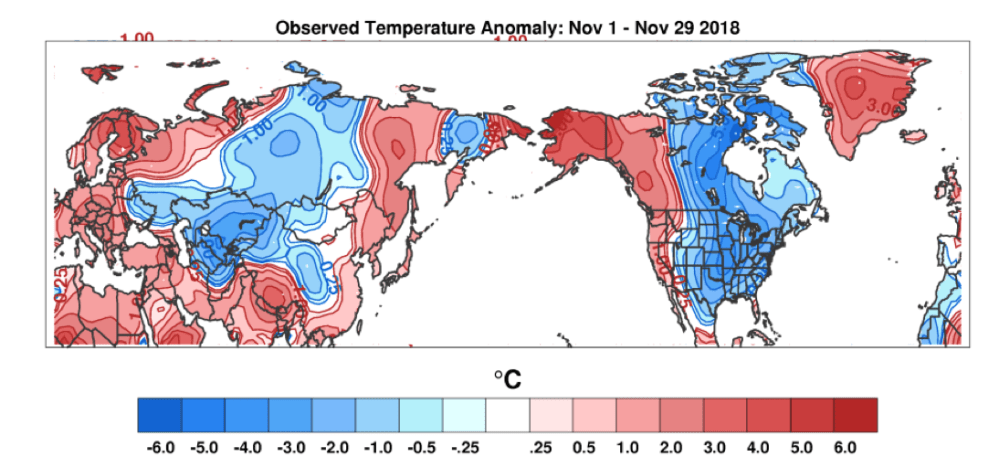
Figure i. Observed surface temperature anomalies 1-29 November 2019.

In the month of November there were two distinct pulses of vertical energy transfer from the troposphere to the stratosphere that resulted in a perturbation of the stratospheric PV and a displacement of the PV towards Eurasia with an elongation towards eastern North America and a warming centered near Alaska and Northwestern Canada. However, those pulses were not simply absorbed by the polar stratosphere but in large part ricocheted or reflected off the stratospheric PV and back into the troposphere. So that in large part forced a similar pattern in the troposphere that it did in the stratosphere. The vertical energy transfer and the subsequent boomerang back down creating a similar pattern in both the stratosphere in troposphere happens very quickly over a matter of days. The tropospheric pattern of ridging near Alaska and western Canada with troughing in eastern North America and the northerly flow between the two atmospheric features delivered a relatively cold November to Eastern Canada and the Eastern US (see Figure i).

But now we have a new month and still more active vertical energy transfer as indicated by the red shading in Figure 11. For the first half of December there are predicted two or three distinct vertical energy pulses. But what is missing so far for the month of December is any blue shading, these waves are not being reflected or ricocheting off the stratospheric PV but are almost completely being absorbed in the stratosphere. This wave energy should therefore have a bigger and more lasting impact on the stratospheric PV. From Figure 10 we can already see hints of this. For the first time this fall and now winter 2018/2019 the polar cap heights are predicted to be above normal in the middle stratosphere. But my expectation is that this latest perturbation of the stratospheric PV will be evolving for weeks and not days and the peak will likely occur either in late December or early January. Also the eventual impact on the troposphere will be weeks and not days.

But because there is no reflecting or returning signal from the stratosphere what is dominating the troposphere is the thermal advection or the migration of air masses across the NH. As I discussed last week and again today this transport of heat is usually characterized by a cold East Asia and western North America and a mild eastern North America and if you look at Figures 3, 6 and 8 this is generally the temperature pattern that is being predicted over the next two weeks with the focus of the cold across Siberia, East Asia and Alaska. Eastern North America is predicted to turn much milder starting next week. I am not as sure what is the impact for Europe during active vertical energy transfer and I thought maybe mild but the forecast for Europe is vacillating between mild and cold but turning milder across Northern Europe.

Meanwhile, in Nunavut, it is a great time to be a polar bear, even more of them than people want.


November Cooling by Land, or Cooling by Sea?

banner-blog

With apologies to Paul Revere, this post is on the lookout for cooler weather with an eye on both the Land and the Sea.  UAH has updated their tlt (temperatures in lower troposphere) dataset for November.   Previously I have done posts on their reading of ocean air temps as a prelude to updated records from HADSST3. This month I will add a separate graph of land air temps because the comparisons and contrasts are interesting as we contemplate possible cooling in coming months and years.

Presently sea surface temperatures (SST) are the best available indicator of heat content gained or lost from earth’s climate system.  Enthalpy is the thermodynamic term for total heat content in a system, and humidity differences in air parcels affect enthalpy.  Measuring water temperature directly avoids distorted impressions from air measurements.  In addition, ocean covers 71% of the planet surface and thus dominates surface temperature estimates.  Eventually we will likely have reliable means of recording water temperatures at depth.

Recently, Dr. Ole Humlum reported from his research that air temperatures lag 2-3 months behind changes in SST.  He also observed that changes in CO2 atmospheric concentrations lag behind SST by 11-12 months.  This latter point is addressed in a previous post Who to Blame for Rising CO2?

The November update to HadSST3 will appear later this month, but in the meantime we can look at lower troposphere temperatures (TLT) from UAHv6 which are already posted for November. The temperature record is derived from microwave sounding units (MSU) on board satellites like the one pictured above.

The UAH dataset includes temperature results for air above the oceans, and thus should be most comparable to the SSTs. There is the additional feature that ocean air temps avoid Urban Heat Islands (UHI).  The graph below shows monthly anomalies for ocean temps since January 2015.

UAH Oceans 201811

Open image in new tab to enlarge.

The anomalies over the entire ocean dropped to the same value, 0.12C  in August (Tropics were 0.13C).  Warming in previous months was erased, and September added very little warming back. In October and November, NH and the Tropics rose, joined by SH last month, resulting in a warming bump.

As of November 2018, NH ocean air temps are matching all Novembers since 2013.  Global and SH this year are the lowest November since 2015.  OTOH ocean air temps in the Tropics are the highest November since 2015.

Land Air Temperatures Plunged in September, Rose in October, Then Plunged Again

We sometimes overlook that in climate temperature records, while the oceans are measured directly with SSTs, land temps are measured only indirectly.  The land temperature records at surface stations record air temps at 2 meters above ground.  UAH gives tlt anomalies for air over land separately from ocean air temps.  The graph updated for November is below.UAH Land 201811

The greater volatility of the Land temperatures is evident, and also the dominance of NH, which has twice as much land area as SH.  Note how global peaks mirror NH peaks.  In November air over SH and the Tropical land surfaces rose, while NH fell sharply pulling the global anomaly down.  For the moment, UAH shows ocean and land temps moving in opposite directions, though still well below the peaks in 2015 and 2016.

Postscript:  NH Continents Drive  Variability in Temperature Anomalies

Clive Best provides this animation of recent monthly temperature anomalies which demonstrates how most variability in anomalies occur over northern continents.

Summary

TLTs include mixing above the oceans and probably some influence from nearby more volatile land temps.  It is striking to now see NH and Global land temps dropping in a mixed fashion.  TLT measures started the recent cooling later than SSTs from HadSST3, but are now showing the same pattern.  It seems obvious that despite the three El Ninos, their warming has not persisted, and without them it would probably have cooled since 1995.  Of course, the future has not yet been written.


Fighting Carbon Taxes


Memo To Congress: French Riots Show Why U.S. Carbon Tax Should Be A Non-Starter
is an Editorial at Investor’s Business Daily Excerpts in italics with my bolds.

French Riots: They call themselves the “Gilets Jaunes,” or yellow vests, in French. They’re mostly young, male and extremely angry, and they’ve been marching in the streets and rioting in Paris and elsewhere, protesting yet another bunch of taxes on gasoline in the government’s never-ending battle against global warming. Who says no one cares about climate change?

If you think of the French as people who will suffer any indignity in the name of more government, think again. Many young French, watching their standards of living decline under a socialist president’s high taxes, are fed up. This latest round of taxes on already outrageous fuel prices was the proverbial straw breaking a dromedary’s back.

“A protest against rising taxes and the high cost of living turned into a riot in the French capital, as activists wearing yellow jackets torched cars, smashed windows, looted stores and tagged the Arc de Triomphe with multi-colored graffiti,” the AP reported of Saturday’s riots.

Some 263 people were injured, including dozens of police, and the government made hundreds of arrests, after an estimated 36,000 people took to the streets on Saturday. Even unions are upset, seeing possible damage to the economy from the demonstrations. They’ve asked the socialist regime to reverse course.

No such luck.

French Riots: A Tax Revolt

Socialist President Emannuel Macron was booed when he showed up to quell the demonstrations. His spokesman, meanwhile, threatened that “all options” are on the table to stop the French riots.

Macron’s prime minister Edouard Philippe even canceled his trip to a global warming conference in Poland. That’s something, given that France’s leaders constantly claim global warming is humankind’s most serious threat. Apparently, French riots rank higher.

No, we’re not happy people are rioting. But governments must understand they can’t just jam things down people’s throats, and expect them to like it. No one asked Macron to raise energy taxes. Macron and his government did it because, to them, globalism is more important than satisfying the demands of their own citizens. It’s that simple.

Today, among all OECD nations, France has the second-highest rates of taxation. Only Denmark ranks higher. So people are fed up.

Nor is it just a “French thing.” Macron is among a growing number of European leftist leaders who want to foist the anti-climate change agenda on their citizens as part of this new globalism. But this isn’t kumbaya, feel-good globalism; it’s one that will feature few if any individual rights, lots of taxes, shrinking standards of living, no real freedom, and little joy.

EU Über Alles

Across the border in Germany, soon-to-be-former German Chancellor Angela Merkel recently said that, on behalf of climate change and migration, “Countries must give up their sovereignty … in an orderly fashion of course.”  “Orderly,” by the way, is a German euphemism for “by force, if needed.”

For those who don’t know, Macron and Merkel are the two strongest leaders in the EU. Their goal, stated outright, is to use the threat of global warming and unbridled migration to wrest control of their nations from their own people — whom they demonize as “populists” — and give it instead to the European Union.  The EU’s record of economic incompetence, absurd regulation, excessive taxation, preening corruption and, increasingly, totalitarian behavior, are troubling to say the least.

Not everyone’s buying in to this mandatory globalism. Both Switzerland and Italy have announced they’ll not attend an EU meeting next month to adopt the U.N.’s new legal guidelines on migration. One big reason: The U.N. has now declared criticism of its pro-immigration policies “hate speech.” Yes, that’s how far we’ve come.

Carbon Tax, Coming Our Way.  Should we care?

Yes, because leftists here have the same things in mind for all of us. The scientific holes in the climate change religion are enormous. Literally thousands of engineers, scientists, academics and Nobel Prize winners have criticized the flawed science behind the theory that we inevitably face disastrous over-heating of the planet.

Yet, some in Congress — including some Republicans — are eager to saddle Americans with a massive new “carbon tax.” It’s the modern equivalent of the medieval church granting indulgences for sins. For a fee, of course. Pay us, and your sins will be remitted.

The idea is that Americans will accept a high tax on energy if it’s “rebated” on an equal basis to everyone. That way, we get less global warming gas emitted into our atmosphere, while reducing the scourge of unequal income. Win-win!

Except, as we’ve noted repeatedly in the past, that’s not how it works.

“The superficial purpose, of course, is to make carbon-based fossil fuels more expensive to use,” we wrote back in April. “But fossil fuels are a blessing, not a curse. They are in large part responsible for the record growth in the global economy in the past two centuries and especially over the last 18 years, helping to pull literally hundreds of millions of once-destitute people out of poverty.

We wouldn’t change a word of that. And the idea of “rebates” is absurd. The U.S. would always be one election away from “rebates” turning into just another tax-grab by Congress for badly needed “climate remediation” or some other hokey purpose. Meanwhile, businesses affected by carbon taxes would hire fewer workers and invest less. It’s a recipe for French-style stagnation.

Climate Change, Climate Yawn

Our just-released IBD/TIPP Poll shows what Americans think about all this. Just 17% ranked climate change as No. 1 or No. 2 on their list of priorities for the new Congress. Even so, some in Congress seek literally trillions of dollars in new taxes that will distort energy markets and hand rebates to those who don’t even pay the taxes.

If no one likes the idea, why would Congress push it so hard? It’s called “redistribution,” and it’s yet another socialist idea that will make people miserable. Ask France.

The U.S. shouldn’t travel down France’s road. Americans aren’t stupid. They won’t accept a massive new tax to prevent a threat they don’t really believe in. We wonder: What will our Congress do if faced with mass demonstrations?

Like many politicians, Macron suffers from impaired vision, and perhaps brain rot from disinformation.  Corrections are needed and are available to the willing.  See Impaired Climate Vision

The Rotting Stops in Denmark

The red marker is Lindholm island .

Denmark will not accept and attempt to integrate unwelcome migrants, according to this report Denmark Plans to Isolate Unwanted Migrants on a Small Island Excerpts in italics with my  bolds.

COPENHAGEN — Denmark plans to house the country’s most unwelcome foreigners in a most unwelcoming place: a tiny, hard-to-reach island that now holds the laboratories, stables and crematory of a center for researching contagious animal diseases.

As if to make the message clearer, one of the two ferries that serve the island is called the Virus.  “They are unwanted in Denmark, and they will feel that,” the immigration minister, Inger Stojberg, wrote on Facebook.

On Friday, the center-right government and the right-wing Danish People’s Party announced an agreement to house as many as 100 people on Lindholm Island — foreigners who have been convicted of crimes and rejected asylum seekers who cannot be returned to their home countries.

The 17-acre island, in an inlet of the Baltic Sea, lies about two miles from the nearest shore, and ferry service is infrequent. Foreigners will be required to report at the island center daily, and face imprisonment if they do not.  “We’re going to minimize the number of ferry departures as much as at all possible,” Martin Henriksen, a spokesman for the Danish People’s Party on immigration, told TV 2. “We’re going to make it as cumbersome and expensive as possible.”

The deal allocates about $115 million over four years for immigrant facilities on the island, which are scheduled to open in 2021.  The finance minister, Kristian Jensen, who led the negotiations, said the island was not a prison, but added that anyone placed there would have to sleep there.

Louise Holck, deputy executive director of The Danish Institute for Human Rights, said her organization would watch the situation “very closely” for possible violations of Denmark’s international obligations.
The agreement was reached as part of the annual budget negotiations. Each year, the Danish People’s Party demands restrictions on immigrants or refugees in return for its votes on a budget.

In Denmark, as in much of Europe, the surge in migration from the Middle East and Africa in 2015 and 2016 prompted a populist, nativist backlash.

The government has vowed to push immigration law to the limits of international conventions on human rights.  Legal experts said it was too early to tell whether the Lindholm Island project would cross those boundaries, constituting illegal confinement. They said it resembled an Italian government project that was struck down in 1980 by the European Court of Human Rights.

The Lindholm Island plan furthers the government’s policy of motivating failed asylum seekers to leave the country by making their lives intolerable.  Asylum seekers with criminal records are not allowed to work in Denmark. Rejected asylum seekers who cannot be deported are given accommodations where they cannot prepare their own meals, food and an allowance of about $1.20 per day, which is withheld if they fail to cooperate with the authorities.

A former immigration minister, Birthe Ronn Hornbech, called the island project “a joke” and a blunder comparable to a soccer player scoring a goal for the opposing team.  “Nothing will become of this proposal,” she wrote in her newspaper column.

Many foreigners who have been denied asylum cannot be deported to their home countries for fear of abuse or persecution, or simply because those countries refuse to take them back. Hundreds lingering in two deportation centers refuse to leave — a challenge for a government that has promised to get rid of those who have no legal right to remain in Denmark.

Some have held out for more than a decade despite a steady deterioration in living conditions. An independent study by a former prison director now working for the rights group Helsinki Citizens’ Assembly found conditions in one of the deportation centers to be comparable to those in some prisons, or worse.

Prime Minister Lars Lokke Rasmussen said last month that the government’s aim in receiving refugees would no longer be to integrate them, but to host them until they can return to their countries of origin.“It’s not easy to ask families to go home, if they’ve actually settled,” he told a meeting of his party. “But it is the morally right thing. We should not make refugees immigrants.”

This summer, a ban on face coverings was introduced and quickly nicknamed “the burqa ban” as it followed a debate on the Islamic garment seen by some as “un-Danish.” This month, Parliament is expected to pass legislation requiring immigrants who want to obtain citizenship to shake hands with officials as part of the naturalization ceremony — though some Muslims insist that they cannot shake hands with someone of the opposite sex.

The government contends that hand shakes are “a basic Danish value.”

Washing Methane Away: Atmospheric Chemistry

The good news comes from NASA published at Science Daily Greenhouse gas ‘detergent’ recycles itself in atmosphere.  The study explains how the atmosphere functions as a methane sink, and why the process is resilient and handles whatever CH4 is emitted.  Scientists had worried that the atmospheric capacity to wash away methane might decay over time, but that fear turns out to be unfounded. Excerpts in italics with my bolds.

Summary:
A simple molecule in the atmosphere that acts as a ‘detergent’ to break down methane and other greenhouse gases has been found to recycle itself to maintain a steady global presence in the face of rising emissions, according to new research. Understanding its role in the atmosphere is critical for determining the lifetime of methane, a powerful contributor to climate change.


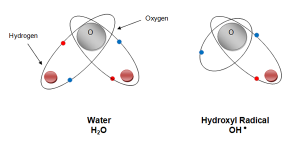
The hydroxyl (OH) radical, a molecule made up of one hydrogen atom, one oxygen atom with a free (or unpaired) electron is one of the most reactive gases in the atmosphere and regularly breaks down other gases, effectively ending their lifetimes. In this way OH is the main check on the concentration of methane, a potent greenhouse gas that is second only to carbon dioxide in contributing to increasing global temperatures.

With the rise of methane emissions into the atmosphere, scientists historically thought that might cause the amount of hydroxyl radicals to be used up on the global scale and, as a result, extend methane’s lifetime, currently estimated to be nine years. However, in addition to looking globally at primary sources of OH and the amount of methane and other gases it breaks down, this new research takes into account secondary OH sources, recycling that happens after OH breaks down methane and reforms in the presence of other gases, which has been observed on regional scales before.

“OH concentrations are pretty stable over time,” said atmospheric chemist and lead author Julie Nicely at NASA’s Goddard Space Flight Center in Greenbelt, Maryland. “When OH reacts with methane it doesn’t necessarily go away in the presence of other gases, especially nitrogen oxides (NO and NO2). The break down products of its reaction with methane react with NO or NO2 to reform OH. So OH can recycle back into the atmosphere.”

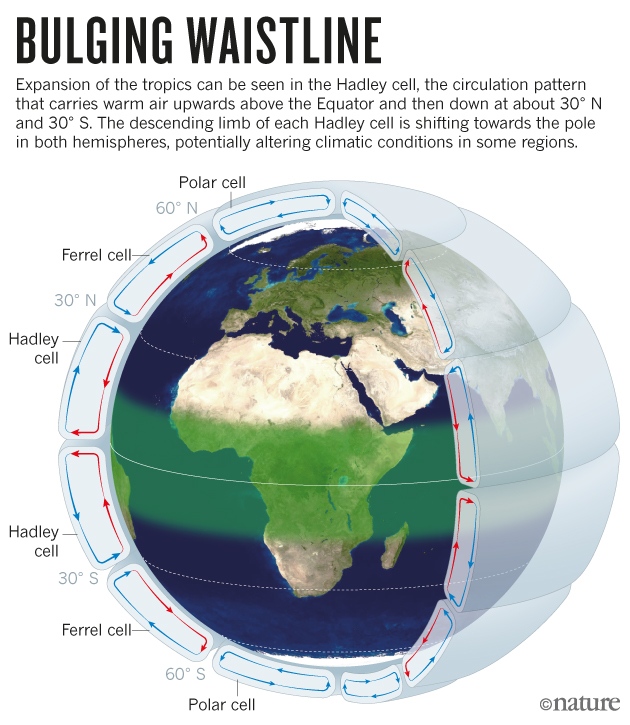
OH in the atmosphere also forms when ultraviolet sunlight reaches the lower atmosphere and reacts with water vapor (H2O) and ozone (O3) to form two OH molecules. Over the tropics, water vapor and ultraviolet sunlight are plentiful. The tropics, which span the region of Earth to either side of the equator, have shown some evidence of widening farther north and south of their current range, possibly due to rising temperatures affecting air circulation patterns. This means that the tropical region primed for creating OH will potentially increase over time, leading to a higher amount of OH in the atmosphere. This tropical widening process is slow, however, expanding only 0.5 to 1 degree in latitude every 10 years. But the small effect may still be important, according to Nicely.

She and her team found that, individually, the tropical widening effect and OH recycling through reactions with other gases each comprise a relatively small source of OH, but together they essentially replace the OH used up in the breaking down of methane.

“The absence of a trend in global OH is surprising,” said atmospheric chemist Tom Hanisco at Goddard who was not involved in the research. “Most models predict a ‘feedback effect’ between OH and methane. In the reaction of OH with methane, OH is also removed. The increase in NO2 and other sources of OH, such as ozone, cancel out this expected effect.” But since this study looks at the past thirty-five years, it’s not guaranteed that as the atmosphere continues to evolve with global climate change that OH levels will continue to recycle in the same way into the future, he said.

Ultimately, Nicely views the results as a way to fine-tune and update the assumptions that are made by researchers and climate modelers who describe and predict how OH and methane interact throughout the atmosphere. “This could add clarification on the question of will methane concentrations continue rising in the future? Or will they level off, or perhaps even decrease? This is a major question regarding future climate that we really don’t know the answer to,” she said.

Abstract from AGU publication Changes in Global Tropospheric OH Expected as a Result of Climate Change Over the Last Several Decades  Julie M. Nicely
The oxidizing capacity of the troposphere is controlled primarily by the abundance of hydroxyl radical (OH). The global mean concentration of tropospheric OH, [OH]TROP (the burden of OH in the global troposphere appropriate for calculating the lifetime of methane) inferred from measurements of methyl chloroform has remained relatively constant during the past several decades despite rising levels of methane that should have led to a decline.

Here we examine other factors that may have affected [OH]TROP such as the changing values of stratospheric ozone, rising tropospheric H2O, varying burden of NOx (=NO+NO2), rising temperatures, and widening of the climatological tropics due to expansion of the Hadley cell. Our analysis suggests the positive trends in [OH]TROP due to H2O, NOx, and overhead O3, and tropical expansion are large enough (Δ [OH]TROP = +0.95 ± 0.18%/decade) to counter almost all of the expected decrease in [OH]TROP due to rising methane (Δ [OH]TROP = −1.01 ± 0.05%/decade) over the period 1980 to 2015, while variations in temperature contribute almost no trend (Δ [OH]TROP = −0.02 ± 0.02%/decade) in [OH]TROP. The approximated impact of Hadley cell expansion on [OH]TROP is also a small but not insignificant factor partially responsible for the steadiness of tropospheric oxidizing capacity over the past several decades, which free‐running models likely do not capture.

Slowing expanding tropical regions seems like a good thing all around.


Sunday Comics Dec. 2.

A roundup of cartoons that caught my eye this week.  H/T PatriotPost and commonsenseevaluation.

French Fries

Global Warming Virtue

The Global Warming Experience


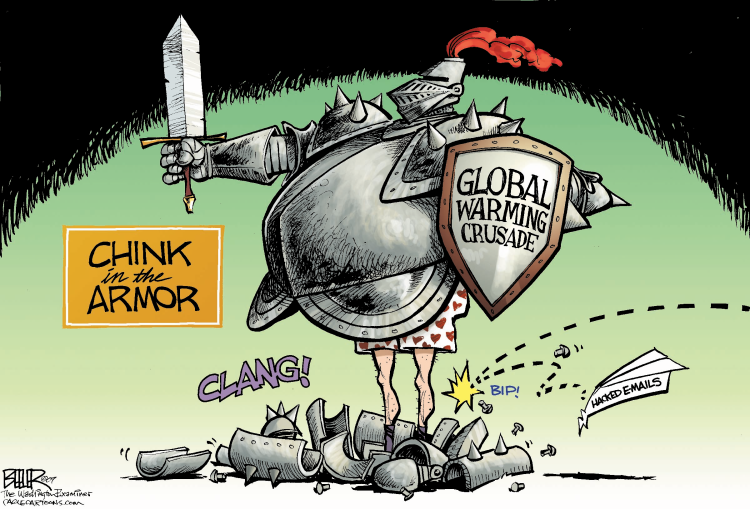
The UN Crusade

US Thanksgiving

From Way Out There


Whoa! I’ve been Bot-censored.

Today someone linked to one of my posts on a thread at reddit:

slinkydink2 14 hours ago
·
More grammatical errors and an emoji face. Am I talking to a 9 year old? Consensus is not science. It’s an opinion. The scientific theory has not been and cannot be applied to your global warning bullshit.

Spez: Even though I know you won’t read it (or understand it if you do) here’s an article from last month saying the models are bullshit and that Solar activity is the largest factor.

https://rclutz.wordpress.com/2018/10/22/2018-update-best-climate-model-inmcm5/

That was followed by:

13 hours ago
Your comment was automatically removed because you linked to an anti-Trump domain. Please use archive.is or a google cache for this domain so we do not give them any undeserved clicks.

I am a bot, and this action was performed automatically. Please contact the moderators of this subreddit if you have any questions or concerns.

The censorship statement was presented this way:

Wow! So much for free speech on the internet.  And the irony for being censored as an anti-Trump domain, which itself seems like a spoof.  The content referring to climate sources does ring true as climatist suppression of alternate information and views.  Apparently, you are an idiot if you know too much and see through the alarmist house of cards.

Katawice COP24 Briefing for Realists

czestochowska

The Black Madonna of Częstochowa is just nearby.

The upcoming COP24 will be dramatic with the host country Poland resolute on continuing to burn coal.  Comments by the Polish Minister of Environment have been aimed at lowering expectations in advance of the meeting, in stark contrast to the recent over-the-top IPCC SR15 climate horror movie.  See UN Horror Show

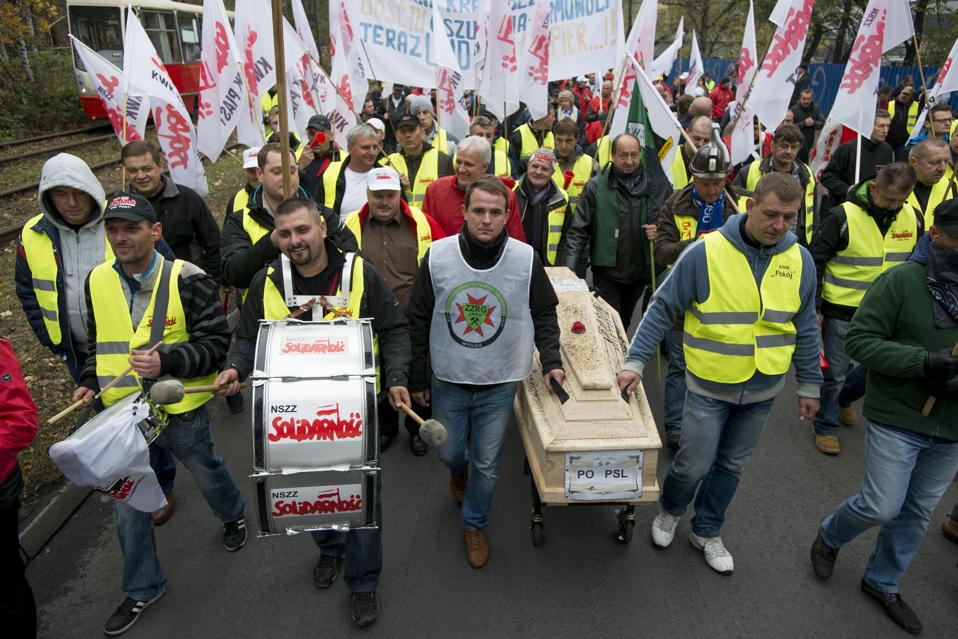
Polish coal miners 2015 protest against liquidation of Polish coal mines. Note the vests like those now seen all over France.

In addition, Brazil is canceling their invitation to host next year’s COP 25.  Considering the obstacles along with the location, COP24 could be considered a “Hail Mary” gathering.  Three years ago French Mathematicians spoke out prior to COP21 in Paris, and their words provide a rational briefing for COP24 beginning in Katawice this weekend. In a nutshell:

Fighting Global Warming is Absurd, Costly and Pointless.

  • Absurd because of no reliable evidence that anything unusual is happening in our climate.
  • Costly because trillions of dollars are wasted on immature, inefficient technologies that serve only to make cheap, reliable energy expensive and intermittent.
  • Pointless because we do not control the weather anyway.

The prestigious Société de Calcul Mathématique (Society for Mathematical Calculation) issued a detailed 195-page White Paper that presents a blistering point-by-point critique of the key dogmas of global warming. The synopsis is blunt and extremely well documented.  Here are extracts from the opening statements of the first three chapters of the SCM White Paper with my bolds and images.

Sisyphus at work.

Chapter 1: The crusade is absurd
There is not a single fact, figure or observation that leads us to conclude that the world‘s climate is in any way ‘disturbed.’ It is variable, as it has always been, but rather less so now than during certain periods or geological eras. Modern methods are far from being able to accurately measure the planet‘s global temperature even today, so measurements made 50 or 100 years ago are even less reliable. Concentrations of CO2 vary, as they always have done; the figures that are being released are biased and dishonest. Rising sea levels are a normal phenomenon linked to upthrust buoyancy; they are nothing to do with so-called global warming. As for extreme weather events — they are no more frequent now than they have been in the past. We ourselves have processed the raw data on hurricanes….

Chapter 2: The crusade is costly
Direct aid for industries that are completely unviable (such as photovoltaics and wind turbines) but presented as ‘virtuous’ runs into billions of euros, according to recent reports published by the Cour des Comptes (French Audit Office) in 2013. But the highest cost lies in the principle of ‘energy saving,’ which is presented as especially virtuous. Since no civilization can develop when it is saving energy, ours has stopped developing: France now has more than three million people unemployed — it is the price we have to pay for our virtue….

Chapter 3: The crusade is pointless
Human beings cannot, in any event, change the climate. If we in France were to stop all industrial activity (let’s not talk about our intellectual activity, which ceased long ago), if we were to eradicate all trace of animal life, the composition of the atmosphere would not alter in any measurable, perceptible way. To explain this, let us make a comparison with the rotation of the planet: it is slowing down. To address that, we might be tempted to ask the entire population of China to run in an easterly direction. But, no matter how big China and its population are, this would have no measurable impact on the Earth‘s rotation.

Full text in pdf format is available in English at link below:

The battle against global warming: an absurd, costly and pointless crusade
White Paper drawn up by the Société de Calcul Mathématique SA
(Mathematical Modelling Company, Corp.)

cg565e788a82606

A Second report was published in 2016 entitled: Global Warming and Employment, which analyzes in depth the economic destruction from ill-advised climate change policies.

The two principal themes are that jobs are disappearing and that the destructive forces are embedded in our societies.

Jobs are Disappearing discusses issues such as:

The State is incapable of devising and implementing an industrial policy.

The fundamental absurdity of the concept of sustainable development

Biofuels an especially absurd policy leading to ridiculous taxes and job losses.

EU policy to reduce greenhouse gas emissions by 40% drives jobs elsewhere while being pointless: the planet has never asked for it, is completely unaware of it, and will never notice it!

The War against the Car and Road Maintenance undercuts economic mobility while destroying transportation sector jobs.

Solar and wind energy are weak, diffuse, and inconsistent, inadequate to power modern civilization.

Food production activities are attacked as being “bad for the planet.”

So-called Green jobs are entirely financed by subsidies.

The Brutalizing Whip discusses the damages to public finances and to social wealth and well-being, including these topics:

Taxes have never been so high

The Government is borrowing more and more

Dilapidated infrastructure

Instead of job creation, Relocations and Losses

The wastefulness associated with the new forms of energy

Return to the economy of an underdeveloped country

What is our predicament?
Four Horsemen are bringing down our societies:

  • The Ministry of Ecology (climate and environment);
  • Journalists;
  • Scientists;
  • Corporation Environmentalist Departments.

Steps required to recover from this demise:

  • Go back to the basic rules of research.
  • Go back to the basic rules of law
  • Do not trust international organizations
  • Leave the planet alone
  • Beware of any premature optimism

Conclusion

Climate Lemmings

The real question is this: how have policymakers managed to make such absurd decisions, to blinker themselves to such a degree, when so many means of scientific investigation are available? The answer is simple: as soon as something is seen as being green, as being good for the planet, all discussion comes to an end and any scientific analysis becomes pointless or counterproductive. The policymakers will not listen to anyone or anything; they take all sorts of hasty, contradictory, damaging and absurd decisions. When will they finally be held to account?


Footnote:

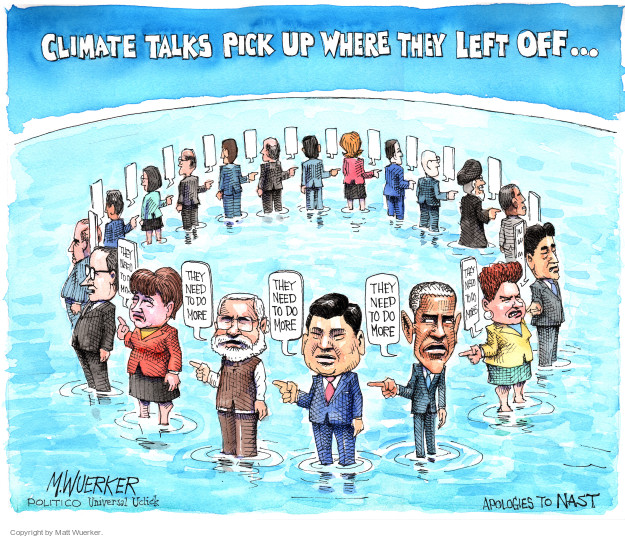
The above cartoon image of climate talks includes water rising over politicians’ feet.  But actual observations made in Fiji (presiding over talks last year in Bonn) show sea levels are stable (link below).

Fear Not For Fiji

In 2016 SCM issued a report Global Temperatures Available data and critical analysis

It is a valuable description of the temperature metrics and issues regarding climate analysis.   They conclude:

None of the information on global temperatures is of any scientific value, and it should not
be used as a basis for any policy decisions. It is perfectly clear that:

  • there are far too few temperature sensors to give us a picture of the planet’s temperature;
  • we do not know what such a temperature might mean because nobody has given it
    any specific physical significance;
  • the data have been subject to much dissimulation and manipulation. There is a
    clear will not to mention anything that might be reassuring, and to highlight things
    that are presented as worrying;
  • despite all this, direct use of the available figures does not indicate any genuine
    trend towards global warming!

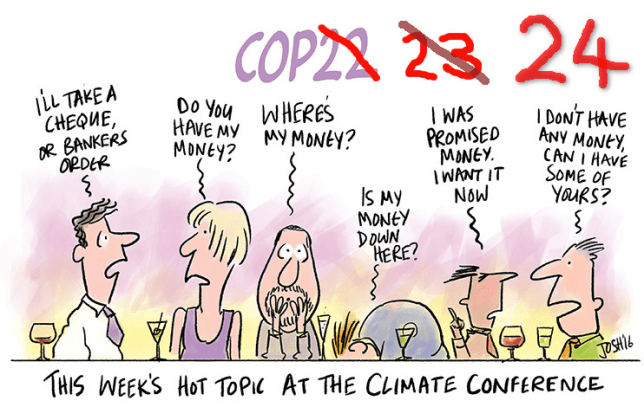
cop-wheres-my-money

What is Populism?

Christopher Caldwell writes an article What is Populism? at Claremont Review of Books. Excerpts in italics with my bolds.

Le monde, the French newspaper of record, admitted last summer that readers had been complaining about the indiscriminate way its journalists flung around the word “populist.” It seemed to describe dozens of European and American political actors with nothing in common except the contempt in which Le Monde held them. The meaning of “populist” was nonetheless easy to decode. A dispatch in that same edition of Le Monde, about a new political alliance between populist governments in Italy, Austria, and Hungary, was titled: “Europe’s hard right lays down the law against migrants.” To call someone a populist is to insinuate that he is a fascist, but tentatively enough to spare the accuser the responsibility of supplying proof. If one sees things as Le Monde does, this is a good thing: populism is an extremism-in-embryo that needs to be named in order that it might better be fought. Others, though, will see populism as an invention of the very establishmentarians who claim to be fighting it, an empty word that allows them to shut down with taboos any political idea that they cannot defeat with arguments. In Europe, populism is becoming the great which-side-are-you-on question of our time.

Whatever populism is, it is prospering across Europe. By late September, in the wake of Chemnitz, support for the AfD had risen to 18% nationwide, placing the party level with the once-colossal Social Democrats as the country’s second largest, behind Merkel’s Christian Democratic Union (CDU). In Hungary, Viktor Orbán’s Fidesz Party has held roughly two thirds of the seats in the country’s national assembly since regaining control in 2010. Italy’s two populist parties—the Five Star Movement and the League—were mocked when they came together to form a coalition last May. After four months of pursuing a hard line on migration, their government has become one of the most popular in Italy since the Second World War. Between the two of them, the parties had the support of 64% of the public by early October.

Populist movements, however, even when strong, can be checked by social convention and threats of ostracism. Few call themselves populist. In Sweden, the anti-immigration Sweden Democrats took 18% of the vote at elections in September but at their own demonstrations their supporters are sometimes outnumbered, and always outshouted, by activists massing in the name of anti-racism or anti-fascism. That populists have a hard time seizing and holding public platforms is a problem for the movement. It may mean, though, that sympathy for populism runs deeper than it appears to. The decision of Britain’s voters to withdraw from the European Union in a 2016 referendum won only narrowly, with a 52-48 margin in favor of the Leave option. But when London’s Independent asked Britons days before the vote how the results would make them feel, 44% said they would be “delighted” with a Leave vote, while only 28% said that about Remain. There seems to be more support for populism in citizens’ inmost hearts than on the Letters to the Editor page.

Migration and Merkel

Europe has entered a period of demographic, institutional, and ideological convulsion. Mass migration is the focus of populist concern. After World War II, Europe’s countries, while not ethnically homogeneous, all had stable populations of European descent. The need to rebuild spurred many countries in wrecked northern Europe to import workers—primarily from southern Italy, Portugal, and what was then Yugoslavia. A boom ensued that intensified the short-term need for labor, and brought new workers from further afield. Turks and Moroccans came. Decolonization and war untethered vast populations from their Pakistani, Algerian, and Indonesian homelands. Soon storefronts were being converted into mosques. Europeans learned words like “couscous,” “Ramadan,” and “jihad.”

Europeans assumed migration would end when their own need for migrant labor did. That was naïve. Middle Easterners and North Africans simply liked Europe better. What is more, at roughly this time European women stopped bearing babies, to the point where the population of native Italians was projected to fall by a quarter, from 60 million to 45, before the middle of the 21st century. This had society-transforming consequences. By the beginning of this century there were tens of millions of Muslims living in western European lands where there had never been any. Now minarets towered over the urban neighborhoods where those storefront mosques had been, cities (including London) came under the control of ethnic political machines, and Islam replaced Christianity as the main source of religious zeal, if not yet as the professed belief of the largest number of residents.

The change riled Europeans. In virtually every western European land, when pollsters ask members of the public to list their country’s most pressing problems, immigration ranks either first or second. But it seemed no one could do anything about it. The values that European elites proclaimed—a mix of post-Holocaust repentance and emulation of American civil-rights institutions—made it seem hypocritical and xenophobic to regulate the country’s frontiers in any way at all. Europe no longer had the conviction to say “no” to anyone making a reasonable case for political asylum, and no longer had the will to deport even those whose petitions were deemed unreasonable. One of these was Daniel Hillig’s alleged murderer Yousif Abdullah, who had accumulated a long criminal record in his three years in Europe. Abdullah’s own asylum application had been rejected, and then reopened on a technicality.

Episodes of terrorism and crime do shift thinking in a populist direction. If there was a moment when public sentiment about mass migration began to swing, as if on a hinge, it came in the days after New Years’ Eve 2015-16. Hundreds of women reported having been sexually assaulted by gangs of immigrants in the center of Cologne that night, but police took such pains to play down the attacks that news of the disorder did not reach newspapers for days. Notoriously, the city’s mayor advised women to avoid such unpleasantness in the future by keeping suspicious-looking men “at arm’s length.”

Still, the ultimate impetus for populism among native Europeans probably lies not in any individual incident but in the prospect, more vivid with every passing year, of demographic decline and even extinction. By this decade, several countries had lost control of their borders—above all, Sweden, where almost a third of babies are born to foreign mothers. The Pew Research Center recently projected that Sweden will be 30% Muslim by mid-century if refugee flows continue and 21% Muslim even if they stop altogether.

The wave of migration from the Arab and Muslim world may be as nothing compared to what awaits. Sub-Saharan Africa is now seeing the largest population explosion any region has undergone in the history of the planet. By 2050, Africa is expected to double its population to 2.5 billion. That increment of 1.25 billion young people is roughly twice the present population of Europe. At mid-century, Africa will still be the poorest place on earth, but it will be the richest in young men of military age. Until 2017 charitable rescue ships were transporting hundreds, sometimes thousands, of African migrants across the Mediterranean to Italy daily. These provide the merest foretaste of the population pressures that await.

Merkel’s invitation to Syrian migrants in 2015 was a detonator. Suddenly Germany had a million-odd Syrians, Pakistanis, Iraqis, and Afghanis on its soil—culturally alien, hard to employ, and making claims for the admission of millions more wives, children, and siblings. Germans were thus forced to choose between (a) welcoming an even larger second wave of dependent family members, and (b) damage control. This would mean stepping up expulsions, revoking longstanding rules on family reunification, and overturning various longstanding taboos against discussing Germany’s national interest and ethnic identity. Germans have opted for (b). They have shifted their votes from establishment parties (not just Merkel’s Christian Democrats but also the Social Democrats) to radical ones (not just the AfD but also the post-Communist Left party).

New Problems, New Solutions

In Italy, interior minister Matteo Salvini has become one of the most popular politicians in Europe by turning his party, the League, from a regional separatist group into a nationwide anti-immigration force. For years now, foreign non-governmental organizations (NGOs) have been chartering boats to mount extensive rescue operations of African migrants adrift in the Mediterranean. Salvini derided these efforts as taxi services to deliver migrants from the North African coast. Extraordinary maps published by the New York Times in June 2017, which showed rescue operations moving steadily closer to the port of Tripoli as humanitarian operations increased, provide considerable justification for Salvini’s view. But he went further. Salvini accused humanitarians of acting as go-betweens for two mafias: one that trafficked humans in Africa, and another that scammed Italy’s social-welfare system in Europe. He then closed Italy’s ports to such rescue vessels—first foreign-registered ones, then Italian ones. The result is that Salvini, called an “extremist” in many newspapers in the run-up to elections last March, now commands the support of 60% of Italians.

European leaders have assailed Salvini in the name of their values, none more volubly than French President Emmanuel Macron. In early June, when Salvini refused landing rights to 629 migrants aboard the German rescue ship Aquarius, Macron denounced him as irresponsible, cynical, and extremist. Salvini replied that, if Macron cared so much about European values, perhaps he could take some of the migrants himself. Macron did not. Indeed, when the same ship, the Aquarius, made for the French port of Marseille in late September with only 58 migrants aboard, Macron’s government denied it authorization to dock. In mid-October, newspapers across Europe reported that French authorities had apprehended African illegal migrants in the Hautes-Alpes region, driven them across the Italian border in a police van, and dropped them off in the woods.

The debate between Salvini and Macron revealed something formulaic and flawed in the latter’s way of thinking. Macron and his globalist allies sometimes acted as if the problems of human conflict had been solved by the Western “values,” and as if history were done presenting contingencies and surprises. That made it easy to “build a legacy” or win an honorable “place in history.” All one had to do was consult these values and order correctly from a menu of historical roles. With the rise of Salvini, the European Union’s economic commissioner Pierre Moscovici warned of “little Mussolinis” in the continent’s politics, and Luxembourg’s Minister of Foreign Affairs Jean Asselborn accused Salvini of using “fascist methods and tones”—which presumably made Moscovici and Asselborn the Winston Churchill and Franklin Roosevelt of our times.

Populists, by contrast, argued that today’s events are not a replay of the 1930s—they are today’s events. “What people call ‘right-wing populism,’ ‘the new right,’ or ‘a return to nationalism,’” wrote Frank Böckelmann, editor of the contrarian German quarterly Tumult, “is only a reaction to specific new conditions.” That is the way Salvini saw it: he was just reacting pragmatically to problems as they came up. He wanted Italy to include in every trade deal it signs with a developing-world country a “repatriation clause” linking economic ties to a willingness to take back migrants. “I think I am paid by my citizens to help our youth to have the babies they used to have a few years ago,” Salvini said, “and not import the best of African youth to replace the Europeans who, for economic reasons, don’t have many children.”

Was this reasonable or was it racist? In matters of identity politics, the two adjectives can describe the same action. National identity is maintained by preferring one’s own people to others. This proposition sounds obvious and uncontroversial when you are saying, for example, that Italy’s destiny is a matter for Italians alone to decide—and not for Frenchmen to meddle in, even Frenchmen as powerful as Macron. It is perfectly innocent to prefer Italians to French people in that case. But is it okay to prefer Italians to Africans? Europeans are less comfortable answering “yes” to that question. When a boatload of migrants steams into a Sicilian harbor, and the law calls for them to be sent back to Libya, and thence to Chad or Niger, and they sue to stay, politicians who assert European values begin to hem and haw. But if one cannot argue against interlopers on behalf of fellow citizens, then the long history of Italy will soon come to an end. At least that is how the populists see it.

Class and Competition

The establishment view reflects a difference not just of ideology but also of class. Perhaps because he is yet a political novice, Macron has been vocal on the subject of human inequality. He is in favor of it. The president’s role in French life should be “Jupiterian,” he argued, while describing those who collected welfare as “illiterates” (illettrés) and “freeloaders” (fainéants). Like Matteo Renzi, the pro-business former prime minister whose center-left party was ousted by Italy’s populist coalition, Macron has behaved as if business were all: entrepreneurs and captains of industry are the only modern heroes. Cutting taxes, delaying retirements, and permitting Sunday shopping are the highest achievements to which a sensible politician could aspire. At the opening of Station F, a clearinghouse for high-tech start-ups, Macron found the name appropriate, because this would be the place that determined the entrepreneurs’ worth. “A station,” he said, meaning a railway station, “is a place where you run into people who succeed and people who are nothing.”

It was in this vein that historian Anne Applebaum, writing in the Atlantic, lamented the rise of two populist parties in Central Europe: Orbán’s Fidesz in Hungary, and Jaroslaw Kaczyński’s Law and Justice party (PiS) in Poland. Applebaum, attentive and logical in all her books about Eastern Europe, showed little perspective or sense of context in writing about contemporary political clashes. She denounced the Polish and Hungarian upstarts as a threat to democracy, comparing them to Lenin’s Bolsheviks, Hitler’s Germany, and Apartheid South Africa.

Ceding Authority

All across the West, the intelligent, credentialed people who held the commanding heights of the economy were making the same mistake. They viewed the rise of populism as a misunderstanding or a glitch. Ashoka Mody, a gifted macroeconomist at the International Monetary Fund, cautioned against reading too much into the 2016 referendum on which Renzi had staked his political career: “Italians rejected the changes to the electoral system,” Mody wrote, “not because they had thought very deeply about the changes proposed but, rather, because the referendum gave them an opportunity to vent their economic and political frustrations.”

If such votes are only a “venting of frustrations,” then they don’t mean anything, and they certainly contain no specific instructions that deserve to be heeded. Last June, when Salvini began to change Italy’s immigration policies, Carlotta Sami, spokeswoman for the United Nations High Commission on Refugees, voiced her objections: “Using migration in an instrumental way for a political objective is irresponsible,” she said in an interview, “because this reflects immediately not only on the lives of migrant and refugees, but also on the lives of the hosting communities of the Italians, pitting the one against the others.”

The verb “instrumentalize,” meaning “to make a political issue of,” is multinational shop talk. It is used to mark off an area of policy where public opinion has no legitimate role, and is therefore unwelcome. The duly elected constitutional government of Italy should step aside from making policy for Italy—Mrs. Sami will handle it! One might predict that no one would put up with such effrontery. In fact most people are willing to cede authority to judges and multinational bodies for as long as things are going well.

Where does this willingness to cede authority come from? Its sources run deep. Sociologist Norbert Elias, in his 1965 study The Established and the Outsiders, described the “monopoly on the means of orientation” that Brahmins in India held, just by virtue of being Brahmins. Most elitism is like this. To say that progressive elites control things is not a conspiracy theory, it is a tautology—they control the culture by definition.

Similarly, populists are wrong by definition. They usually internalize the idea of their inferiority and immorality. An establishment, as Elias sees it, always offers an alternative that the public can passively fall back on. Outsiders and populists do not. They will be subject to a “paralyzing apathy” unless a leader is there to light a fire under them. The challenge is keeping it lit. Hence the importance of Salvini’s social media videos and Donald Trump’s tweets. Constant motion is of the essence. One can see the difference between successful populist governments (such as Salvini’s) that act quickly, bringing rapid change; and unsuccessful ones (such as Trump’s over his first year-and-a-half) that do not, permitting all the playing pieces to roll back down the unlevel board into their pre-election positions.

A Democracy Movement

Margaret Canovan, one of the most sensitive academic analysts of populism, has described it as something that “haunts even the most firmly established democracies.” It would be more accurate to say that populism haunts especially the most firmly established democracies. It arises in democracies that are so built-out and specialized that a class of sophisticated political initiates is required to run them effectively. Any such class will be tempted to nudge the system to produce results more in line with what it sees as society’s needs. These “needs” may grow hard to distinguish from that class’s “values.”

Americans, living in the home of modern judicial review, will understand that judges are often guilty of trying to correct electoral results that don’t correspond to insider thinking. The civil rights laws of the 1960s, for example, have been interpreted to require transgender bathrooms, regardless of how democratic majorities might feel about them. Certain western European democracies work under analogous constraints. In Italy, both investigative magistrates (the equivalent of federal prosecutors) and adjudicative magistrates (the equivalent of federal judges) are members of the judiciary branch, and the bench, for the most part, operates as a self-perpetuating guild. Judges, not legislators or executives, appoint and approve judicial hires. Like Americans, Italians had plausible 20th-century reasons for enhancing the prerogatives of judges. Americans wanted to smash segregation. Italians wanted to ensure—in the wake of Mussolini, fascism, and defeat—that no prosecutor working on behalf of a strongman would use his office to throw political opponents in jail.

the-unelected
As it turned out, allowing the judiciary to be “independent” in this way was an even bigger risk. For, in Italy as in the United States, the judiciary is both a powerful regulatory body and a subset of what we now call the One Percent. Italian lawyers and judges, like our own, have a cultural affinity with intellectuals and progressive politicians. The result is that, when conservative governments come to power, the judiciary joins the opposition. Silvio Berlusconi, the madcap media billionaire who after 1994 became the longest-serving postwar Italian prime minister, was in and out of courtrooms for long-ago business irregularities for the whole two decades he was in or near power. He was convicted of tax fraud in 2013 and banned from politics for six years, until 2019.

Since the new League-Five Star coalition took power in mid-2018, Italy’s situation has paralleled that of the United States even more closely, with judges seeking ingenious ways to thwart a government they oppose on ideological grounds. A Genovese judge threatened to seize the League’s entire €49-million treasury, for an embezzlement case that antedates Salvini’s takeover of the party. After Salvini delayed the disembarkation of 177 Eritreans who had arrived aboard the Italian Coast Guard boat Diciotti, a prosecutor in Agrigento indicted him for kidnapping.

Where the United States is unloved among European populists, it is sometimes as the source of such judicial chicanery. American forces wrote or inspired a number of postwar constitutions, including the German Grundgesetz, which contains guarantees that many blame for the country’s impending “dissolution” by migration. “It is high time,” writes Frank Böckelmann, “for a constitution that is of the German people and for the German people.” For another thing, the United States tax code provides the model for various activist foundations that have left governments feeling surveilled and threatened in their sovereignty. That has been particularly so in Hungary, which in recent months has moved to close the Hungarian-born billionaire George Soros’s charities and to shutter a university he founded.

Orbán’s philosophy has been described in Western headlines as an attack on democracy. It is more accurately described as a passionate defense of his own vision of democracy. Orbán’s vision is different from the one that prevails in the West today. It is closer to the understanding of democracy that prevailed in the United States 60 years ago. For Orbán, democracy is when a sovereign people votes and chooses its destiny. Period. A democratic republic need not be liberal, or neutral as to values. It can favor Christianity or patriotism, if it so chooses, and it can even proudly call such choices “illiberal,” as Orbán did in a 2014 speech.

The detractors of Orbán-style democracy consider democracy a set of progressive outcomes that democracies tend to choose, and may even have chosen at some time in the past. If a progressive law or judicial ruling or executive order coincides with the “values” of experts, a kind of mystical ratification results, and the outcome is what the builders of the European Union call an acquis—something permanent, unassailable, and constitutional-seeming. If a democratic majority were to overturn, say, a country’s membership in the European Union, or a state’s laws establishing gay marriage, that outcome would be called “undemocratic.” Of course it would be no such thing. What would be threatened in this case would be somebody’s values, not everyone’s democracy.

That is our problem. Liberalism and democracy have come into conflict. “Populist” is what those loyal to the former call those loyal to the latter.

See Also Patriotism vs. Multiculturalism