Tropics Lead Ocean Cooling

July Sea Surface Temperatures (SSTs) are now available, and we can see further ocean cooling led by plummeting temps in the  Tropics and SH, continuing the downward trajectory from the previous 12 months.

HadSST is generally regarded as the best of the global SST data sets, and so the temperature story here comes from that source, the latest version being HadSST3.

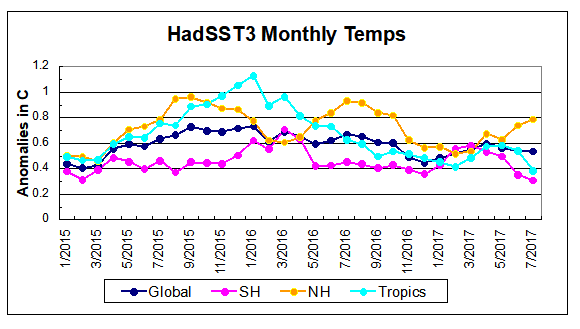
The chart below shows the last two years of SST monthly anomalies as reported in HadSST3 including July 2017.

In May despite a slight rise in the Tropics, declines in both hemispheres and globally caused SST cooling to resume after an upward bump in April.  Now in July a large drop is showing both in the Tropics and in SH, declining the last 4 months.  Meanwhile the NH is peaking in July as usual, but well down from the previous July.  The net of all this is a slightly lower Global anomaly but with likely additional future cooling led by the Tropics and also SH hitting new lows for this period.

Note that higher temps in 2015 and 2016 were first of all due to a sharp rise in Tropical SST, beginning in March 2015, peaking in January 2016, and steadily declining back to its beginning level. Secondly, the Northern Hemisphere added two bumps on the shoulders of Tropical warming, with peaks in August of each year. Also, note that the global release of heat was not dramatic, due to the Southern Hemisphere offsetting the Northern one. Note that Global anomaly for July 2017 matches closely to April 2015.  However,  SH and the Tropics are lower now and trending down compared to an upward trend in 2015.

We have seen lots of claims about the temperature records for 2016 and 2015 proving dangerous man made warming.  At least one senator stated that in a confirmation hearing.  Yet HadSST3 data for the last two years show how obvious is the ocean’s governing of global average temperatures.

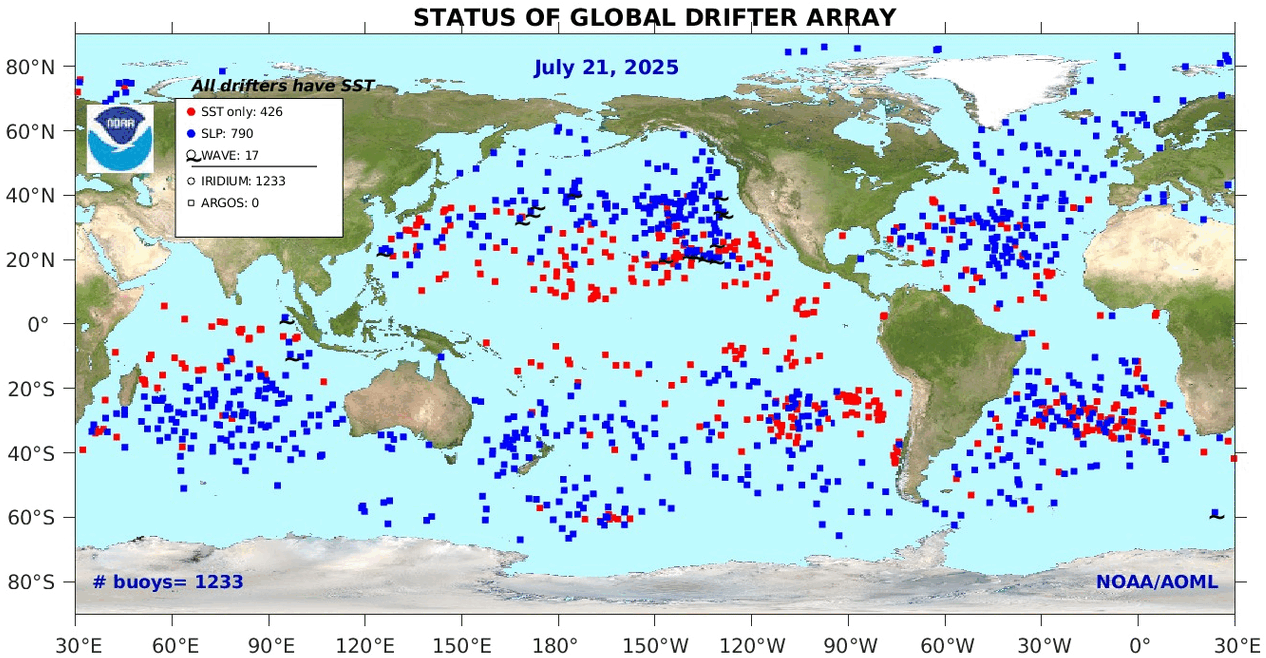
USS Pearl Harbor deploys Global Drifter Buoys in Pacific Ocean

The best context for understanding these two years comes from the world’s sea surface temperatures (SST), for several reasons:

  • The ocean covers 71% of the globe and drives average temperatures;
  • SSTs have a constant water content, (unlike air temperatures), so give a better reading of heat content variations;
  • A major El Nino was the dominant climate feature these years.

Solar energy accumulates massively in the ocean and is variably released during circulation events.


Gamechanger: DC Appeals Court Denies EPA Climate Rules

A major clarification came today from the DC Court of Appeals ordering EPA (and thus the Executive Branch Bureaucracy) to defer to Congress regarding regulation of substances claimed to cause climate change.  While the issue and arguments are somewhat obscure, the clarity of the ruling is welcome.  Basically, the EPA under Obama attempted to use ozone-depleting authority to regulate HFCs, claiming them as greenhouse gases.  The judges decided that was a stretch too far.

The Court Decision August 8, 2017

The EPA enacted the rule in question in 2015, responding to research showing hydroflourocarbons, or HFCs, contribute to climate change.

The D.C. Circuit Court of Appeals’ 2-1 decision said EPA does not have the authority to enact a 2015 rule-making ending the use of hydrofluorocarbons commonly found in spray cans, automobile air conditioners and refrigerators. The three-judge panel said that because HFCs are not ozone-depleting substances, the EPA could not use a section of the Clean Air Act targeting those chemicals to ban HFCs.

“Indeed, before 2015, EPA itself maintained that Section 612 did not grant authority to require replacement of non ozone-depleting substances such as HFCs,” the court wrote.

“EPA’s novel reading of Section 612 is inconsistent with the statute as written. Section 612 does not require (or give EPA authority to require) manufacturers to replace non ozone-depleting substances such as HFCs,” said the opinion, written by Judge Brett Kavanaugh.

Contextual Background from the Court Document On Petitions for Review of Final Action by the United States Environmental Protection Agency  Excerpts below (my bolds)

In 1987, the United States signed the Montreal Protocol. The Montreal Protocol is an international agreement that has been ratified by every nation that is a member of the United Nations. The Protocol requires nations to regulate the production and use of certain ozone-depleting substances.

As a result, in the 1990s and 2000s, many businesses stopped using ozone-depleting substances in their products. Many businesses replaced those ozone-depleting substances with HFCs. HFCs became prevalent in many products. HFCs have served as propellants in aerosol spray cans, as refrigerants in air conditioners and refrigerators, and as blowing agents that create bubbles in foams.

In 2013, President Obama announced that EPA would seek to reduce emissions of HFCs because HFCs contribute to climate change.

Consistent with the Climate Action Plan, EPA promulgated a Final Rule in 2015 that moved certain HFCs from the list of safe substitutes to the list of prohibited substitutes. . .In doing so, EPA prohibited the use of certain HFCs in aerosols, motor vehicle air conditioners, commercial refrigerators, and foams – even if manufacturers of those products had long since replaced ozonedepleting substances with HFCs. Id. at 42,872-73.

Therefore, under the 2015 Rule, manufacturers that used those HFCs in their products are no longer allowed to do so. Those manufacturers must replace the HFCs with other substances that are on the revised list of safe substitutes.

In the 2015 Rule, EPA relied on Section 612 of the Clean Air Act as its source of statutory authority. EPA said that Section 612 allows EPA to “change the listing status of a particular substitute” based on “new information.” Id. at 42,876. EPA indicated that it had new information about HFCs: Emerging research demonstrated that HFCs were greenhouse gases that contribute to climate change. See id. at 42,879. EPA therefore concluded that it had statutory authority to move HFCs from the list of safe substitutes to the list of prohibited substitutes. Because HFCs are now prohibited substitutes, EPA claimed that it could also require the replacement of HFCs under Section 612(c) of the Clean Air Act even though HFCs are not ozone-depleting substances.

EPA’s current reading stretches the word “replace”  beyond its ordinary meaning. . .
Under EPA’s current interpretation of the word “replace,” manufacturers would continue to “replace” an ozone-depleting substance with a substitute even 100 years or more from now. EPA would thereby have indefinite authority to regulate a manufacturer’s use of that substitute. That boundless interpretation of EPA’s authority under Section 612(c) borders on the absurd.

In any event, the legislative history strongly supports our conclusion that Section 612(c) does not grant EPA continuing authority to require replacement of non-ozone-depleting substitutes.. . In short, although Congress contemplated giving EPA broad authority under Title VI to regulate the replacement of substances that contribute to climate change, Congress ultimately declined.

However, EPA’s authority to regulate ozone-depleting substances under Section 612 and other statutes does not give EPA authority to order the replacement of substances that are not ozone depleting but that contribute to climate change. Congress has not yet enacted general climate change legislation. Although we understand and respect EPA’s overarching effort to fill that legislative void and regulate HFCs, EPA may act only as authorized by Congress. Here, EPA has tried to jam a square peg (regulating non-ozone depleting substances that may contribute to climate change) into a round hole (the existing statutory landscape).

The Supreme Court cases that have dealt with EPA’s efforts to address climate change have taught us two lessons that are worth repeating here. See, e.g., Utility Air Regulatory Group v. EPA, 134 S. Ct. 2427 (2014). First, EPA’s well intentioned policy objectives with respect to climate change do not on their own authorize the agency to regulate. The agency must have statutory authority for the regulations it wants to issue. Second, Congress’s failure to enact general climate change legislation does not authorize EPA to act. Under the Constitution, congressional inaction does not license an agency to take matters into its own hands, even to solve a pressing policy issue such as climate change.

Footnote:  Looks like some judges found their big boy pants and applied US constitutional separation of powers against runaway executive climate actions.  Would such a decision have come without a skeptical President?

Could this be the first breach in the wall of unproven, unwarranted, federally funded climate activism?

Water rushes over damaged primary spillway at Oroville Dam in Northern California

Decoding Climate News


Definition of “Fake News”: When reporters state their own opinions instead of bearing witness to observed events.

Journalism professor David Blackall provides a professional context for investigative reporting I’ve been doing on this blog, along with other bloggers interested in science and climate change/global warming. His peer reviewed paper is Environmental Reporting in a Post Truth World. The excerpts below show his advice is good not only for journalists but for readers.  h/t GWPF, Pierre Gosselin

Overview: The Grand Transnational Narrative

The dominance of a ‘grand transnational narrative’ in environmental discourse (Mittal, 2012) over other human impacts, like deforestation, is problematic and is partly due to the complexities and overspecialization of climate modelling. A strategy for learning, therefore, is to instead focus on the news media: it is easily researched and it tends to act ‘as one driving force’, providing citizens with ‘piecemeal information’, making it impossible to arrive at an informed position about science, society and politics (Marisa Dispensa et al., 2003). After locating problematic news narratives, Google Scholar can then be employed to locate recent scientific papers that examine, verify or refute news media discourse.

The science publication Nature Climate Change this year, published a study demonstrating Earth this century warmed substantially less than computer-generated climate models predict.

Unfortunately for public knowledge, such findings don’t appear in the news. Sea levels too have not been obeying the ‘grand transnational narrative’ of catastrophic global warming. Sea levels around Australia 2011–2012 were measured with the most significant drops in sea levels since measurements began. . .The 2015–2016 El-Niño, a natural phenomenon, drove sea levels around Indonesia to low levels such that coral reefs were bleaching. The echo chamber of news repeatedly fails to report such phenomena and yet many studies continue to contradict mainstream news discourse.

facebook2bnew2blike2bbuttons2bfinal-970-80I will be arguing that a number of narratives need correction, and while I accept that the views I am about to express are not universally held, I believe that the scientific evidence does support them.

The Global Warming/Climate Change Narrative

The primary narrative in need of correction is that global warming alone (Lewis, 2016), which induces climate change (climate disruption), is due to the increase in global surface temperatures caused by atmospheric greenhouse gases. Instead, there are many factors arising from human land use (Pielke et al., 2016), which it could be argued are responsible for climate change, and some of these practices can be mitigated through direct public action.

Global warming is calculated by measuring average surface temperatures over time. While it is easy to argue that temperatures are increasing, it cannot be argued, as some models contend, that the increases are uniform throughout the global surface and atmosphere. Climate science is further problematized by its own scientists, in that computer modelling, as one component of this multi-faceted science, is privileged over other disciplines, like geology.

Scientific uncertainty arises from ‘simulations’ of climate because computer models are failing to match the actual climate. This means that computer models are unreliable in making predictions.

Published in the eminent journal Nature (Ma, et. al., 2017), ‘Theory of chaotic orbital variations confirmed by Cretaceous geological evidence’, provides excellent stimulus material for student news writing. The paper discusses the severe wobbles in planetary orbits, and these affect climate. The wobbles are reflected in geological records and show that the theoretical climate models are not rigorously confirmed by these radioisotopically calibrated and anchored geological data sets. Yet popular discourse presents Earth as harmonious: temperatures, sea levels and orbital patterns all naturally balanced until global warming affects them, a mythical construct. Instead, the reality is natural variability, the interactions of which are yet to be measured or discovered (Berger, 2013).

In such a (media) climate, it is difficult for the assertion to be made that there might be other sources, than a nontoxic greenhouse gas called carbon dioxide (CO2), that could be responsible for ‘climate disruption’. A healthy scientific process would allow such a proposition. Contrary to warming theory, CO2 levels have increased, but global average temperatures remain steady. The global average temperature increased from 1983 to 1998; then, it flat-lined for nearly 20 years. James Hansen’s Hockey Stick graph, with soaring and catastrophic temperatures, simply did not materialize.

As Keenan et al. (2016) found through using global carbon budget estimates, ground, atmospheric and satellite observations, and multiple global vegetation models that there is also now a pause in the growth rate of atmospheric CO2. They attribute this to increases in terrestrial sinks over the last decade, where forests consume the rising atmospheric CO2 and rapidly grow—the net effect being a slowing in the rate of warming from global respiration.

Contrary to public understanding, higher temperatures in cities are due to a phenomenon known as the ‘urban heat effect’ (Taha, 1997; Yuan & Bauer, 2007). Engines, air conditioners, heaters and heat absorbing surfaces like bitumen radiate heat energy in urban areas, but this is not due to the greenhouse effect. Problematic too are data sets like ocean heat temperatures, sea-ice thickness and glaciers: all of which are varied, some have not been measured or there are insignificant measurement time spans for the data to be reliable.

Contrary to news media reports, some glaciers throughout the world (Norway [Chinn et al., 2005] and New Zealand [Purdie et al., 2008]) are growing, while others shrink (Paul et al., 2007).

Conclusion

This is clearly a contentious topic. There are many agendas at play, with careers at stake. My view represents one side of the debate: it is one I strongly believe in, and is, I contend, supported by the science around deforestation, on the ground, rather than focusing almost entirely on atmosphere. However, as a journalism educator, I also recognize that my view, along with others, must be open to challenge, both within the scientific community and in the court of public opinion.

As a journalism educator, it is my responsibility to provide my students with the research skills they need to question—and test—the arguments put forward by the key players in any debate. Given the complexity of the climate warming debate, and the contested nature of the science that underpins both sides, this will provide challenges well into the future. It is a challenge our students should relish, particularly in an era when they are constantly being bombarded with ‘fake news’ and so-called ‘alternative facts’.

To do so, they need to understand the science. If they don’t, they need to at least understand the key players in the debate and what is motivating them. They need to be prepared to question these people and to look beyond their arguments to the agendas that may be driving them. If they don’t, we must be reconciled to a future in which ‘fake news’ becomes the norm.

Examples of my investigative reports are in Data Vs. Models posts listed at Climate Whack-a-Mole

See also Yellow Climate Journalism

Renewables Hypocrisy

Update August 18, 2017 at the bottom

Charles McConnell explains the emptiness of this recent popular virtue signaling.  His article in WSJ is City Pledges for ‘100% Renewable Energy’ Are 99% Misleading
The power grid is built on fossil fuels, and there’s no way to designate certain electrons as guilt free. Entire article reprinted below (my bolds and images)

Dozens of cities have made a misleading pledge: that they will move to 100% renewable energy so as to power residents’ lives without emitting a single puff of carbon. At a meeting of the U.S. Conference of Mayors in late June, leaders unanimously adopted a resolution setting a “community-wide target” of 100% clean power by 2035. Mayors from Portland, Ore., to Los Angeles to Miami Beach have signed on to these goals.

States are getting in the game, too. Two years ago Hawaii pledged that its electricity would be entirely renewable by 2045. The California Senate recently passed a bill setting the same goal, while moving up the state’s timeline to get half its electricity from renewables from 2030 to 2025.

Let’s not get carried away. Although activists herald these pledges as major environmental accomplishments, they’re more of a marketing gimmick. Use my home state of Texas as an example. The Electric Reliability Council of Texas oversees 90% of the state’s electricity generation and distribution. Texas generates more wind and solar power than any other state. Yet more than 71% of the council’s total electricity still comes from coal and natural gas.

The trick is that there’s no method to designate electrons on the grid as originating from one source or another. Power generated by fossil fuels and wind turbines travels together over poles and underground wires before reaching cities, homes and businesses. No customer can use power from wind and solar farms exclusively.

So how do cities make this 100% renewable claim while still receiving regular electricity from the grid? They pay to generate extra renewable energy that they then sell on the market. If they underwrite enough, they can claim to have offset whatever carbon-generated electricity they use. The proceeds from the sale go back to the city and are put toward its electric bill.

In essence, these cities are buying a “renewable” label to put on the regular power they’re using. Developers of wind and solar farms win because they can use mayoral commitments to finance their projects, which probably are already subsidized by taxpayers.

But the game would never work without complete confidence in the reliability of the grid, which is dependent on a strategy of “all of the above,” generating power from sources that include coal, natural gas, nuclear, wind and solar.

The mayor of Georgetown, Texas, announced earlier this year that his city had reached its goal of 100% renewable electricity. But in a 2015 article announcing the pledge, he acknowledged what would happen if solar and wind were not able to cover the city’s needs: “The Texas grid operator, the Electric Reliability Council of Texas, will ensure generation is available to meet demand.”

Two years ago the mayor of Denton, Texas, announced a plan to go 70% renewable, while calling a target of 100% unrealistic. “One of the challenges of renewable energy is that it’s so hard to predict,” he said. “You don’t know exactly when the sun is going to shine or when the wind is going to blow. To maintain that reliable power, you must have backup power.”

There is no denying that wind and solar power are important to a balanced energy portfolio. But coal is the bedrock of affordable electricity, and it will remain so, no matter how much wishful thinking by environmental activists. Coal is abundant and reliable. Unlike wind and solar, coal generation can be dialed up and down in response to market conditions and to satisfy demand.

The headline-grabbing 100% renewable pledges intentionally overlook these facts. Fossil fuels are not only the largest and most critical component of the energy portfolio, they are the foundation upon which renewable power must stand. Wind and solar generators ride free into the electric grid on the backs of fossil generators that have installed and paid for the infrastructure on which all Americans depend. The rise of renewable generation is made possible by fossil fuels, not despite them.

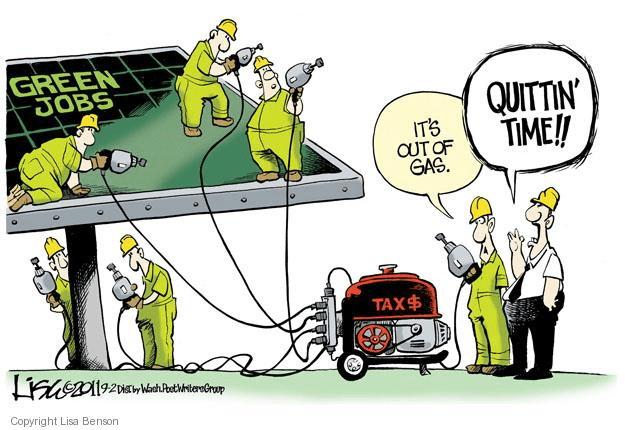
green-jobs

We should celebrate the growth of renewables, but not with false and misleading claims. What’s needed is transparency and a shared objective to provide consumers with the most reliable, resilient and affordable energy available.

Mr. McConnell, executive director of the Energy and Environment Initiative at Rice University, was an assistant secretary of energy, 2011-13.

Update August 18, 2017

People need to know that adding renewables to an electrical grid presents both technical and economic challenges.  Experience shows that adding intermittent power more than 10% of the baseload makes precarious the reliability of the supply.  South Australia is demonstrating this with a series of blackouts when the grid cannot be balanced.  Germany got to a higher % by dumping its excess renewable generation onto neighboring countries until the EU finally woke up and stopped them. Texas got up to 29% by dumping onto neighboring states, and some like Georgia are having problems.

But more dangerous is the way renewables destroy the economics of electrical power.  Seasoned energy analyst Gail Tverberg writes:

In fact, I have come to the rather astounding conclusion that even if wind turbines and solar PV could be built at zero cost, it would not make sense to continue to add them to the electric grid in the absence of very much better and cheaper electricity storage than we have today. There are too many costs outside building the devices themselves. It is these secondary costs that are problematic. Also, the presence of intermittent electricity disrupts competitive prices, leading to electricity prices that are far too low for other electricity providers, including those providing electricity using nuclear or natural gas. The tiny contribution of wind and solar to grid electricity cannot make up for the loss of more traditional electricity sources due to low prices.

These issues are discussed in more detail in the post Climateers Tilting at Windmills

Why the US letter re. Paris Accord

August 5, 2017 Update to Climate Law post

Media are reporting on the State Department letter informing the UN that the US will be withdrawing from the Paris Accord.  Some climatists are encouraged that the three-year waiting period is acknowledged and that the next president could return to the fold.  Others are disappointed that the Trump administration is not more assertive against both the accord and the United Nations Framework Convention on Climate Change (UNFCCC) itself.

Everyone should breathe through the nose and recognize the game and the stakes.  Paris agreement is not binding and is without penalties (except for blame and shame).  So following the protocol costs the US nothing, and does provide some opportunities.  As the world’s leader in actually reducing CO2 emissions, the US wants and needs to be at the table to convince others to follow the US example.  There is also 1 billion US$ from Obama put into the green fund that could be disbursed in accordance with US current priorities regarding energy and climate.

But the most important reason for this letter is to document that the Paris accord does not have legal authority for and within the United States.  Putting the US intent in writing is necessary to deter legal claims to hold the US accountable to Paris terms and conditions.  The post below explains why Paris accord is so important to legal climate actions around the world.

Climate Activists storm the bastion of Exxon Mobil, here seen without their shareholder disguises.

On the same day POTUS announced US withdrawal from Paris accord, a majority of Exxon Mobil shareholders approved a resolution asking management to assess the value of corporate assets considering a global move toward a low-carbon future. Here is the resolution, filed by the New York State Comptroller:

RESOLVED: Shareholders request that, beginning in 2018, ExxonMobil publish an annual assessment of the long-term portfolio impacts of technological advances and global climate change policies, at reasonable cost and omitting proprietary information. The assessment can be incorporated into existing reporting and should analyze the impacts on ExxonMobil’s oil and gas reserves and resources under a scenario in which reduction in demand results from carbon restrictions and related rules or commitments adopted by governments consistent with the globally agreed upon 2 degree target. This reporting should assess the resilience of the company’s full portfolio of reserves and resources through 2040 and beyond, and address the financial risks associated with such a scenario.

Background:

This century climatists woke up to their losing the battle for public opinion for onerous and costly reductions to fossil fuel usage. They turned toward the legal system to achieve their agenda, and the field of Climate Law has become another profession corrupted by climate cash, along side of Climate Medicine.

In addition to numerous court lawsuits, and also civil disobedience cases, there has been a concerted, well-funded and organized divestment move against companies supplying fossil fuels to consumers. The intention is to at least tie up in red tape Big Oil, indeed Small Oil as well. The real hope is to weaken energy producers by depriving them of investors to the point that reserves are left in the ground, as desired by such activists as 350.org.

In 2016 virtually the same resolution was dismissed by shareholders with only 38% approving. The difference this year was the switch by BlackRock Inc. and Vanguard Group, two of the world’s largest asset managers. As reported by Fox News (here):

Investment products such as exchange-traded funds that track the performance of indexes often come at a lower cost than traditional mutual funds and have gathered assets at a clip in recent years. That growth has given firms like BlackRock and Vanguard increasing sway on shareholder votes. But the firms in turn have come under activist pressure to take stances on issues such as climate disclosure.

When BlackRock sided with Exxon and against a similar proposal at the company’s annual meeting a year ago, it faced backlash from investors and environmental activists. This year BlackRock said the disclosure of climate risks would be among its key engagement priorities with senior executives.

Exxon Mobil board must now show they are taking this proposal seriously, and activists will be looking for company assets to be “stress tested” with the hope that the shares become more risky. At the very least, management will have to put more time and energy into opining on various scenarios of uncertain content and probabilities relating to the wish dreams of climatists.

Balancing on a cascade of suppositions.

We can look into the climate activist mental frame thanks to documents supporting the current strategy using the legal system to implement actions against fossil fuel consumption.

For example, there is this recent text explaining the shareholder proposal tabled at ExxonMobil annual meeting. From Attorney Sanford Lewis:

The Proposal states:

“RESOLVED: Shareholders request that by 2017 ExxonMobil publish an annual assessment of long term portfolio impacts of public climate change policies, at reasonable cost and omitting proprietary information. The assessment can be incorporated into existing reporting and should analyze the impacts on ExxonMobil’s oil and gas reserves and resources under a scenario in which reduction in demand results from carbon restrictions and related rules or commitments adopted by governments consistent with the globally agreed upon 2 degree target. The reporting should assess the resilience of the company’s full portfolio of reserves and resources through 2040 and beyond and address the financial risks associated with such a scenario.

Now let’s unbundle the chain of suppositions that comprise this proposal.

  • Supposition 1: A 2C global warming target is internationally agreed.
  • Supposition 2: Carbon Restrictions are enacted by governments to comply with the target.
  • Supposition 3: Demand for oil and gas products is reduced due to restrictions
  • Supposition 4: Oil and gas assets become uneconomic for lack of demand.
  • Supposition 5: Company net worth declines by depressed assets and investors lose value.

1.Suppose an International Agreement to limit global warming to 2C.

From the supporting statement to the above proposal, Sanford Lewis provides these assertions:

Recognizing the severe and pervasive economic and societal risks associated with a warming climate, global governments have agreed that increases in global temperature should be held below 2 degrees Celsius from pre-industrial levels (Cancun Agreement).

Failing to meet the 2 degree goal means, according to scientists, that the world will face massive coastal flooding, increasingly severe weather events, and deepening climate disruption. It will impose billions of dollars in damage on the global economy, and generate an increasing number of climate refugees worldwide.

Climate change and the risks it is generating for companies have become major concerns for investors. These concerns have been magnified by the 21st Session of the Conference of the Parties (COP 21) in Paris, where 195 global governments agreed to restrict greenhouse gas (GHG) emissions to no more than 2 degrees Celsius from pre-industrial levels and submitted plans to begin achieving the necessary GHG emission reductions. In the agreement, signatories also acknowledged the need to strive to keep global warming to 1.5 degrees, recognizing current and projected harms to low lying islands.

Yet a careful reading of UN agreements shows commitment is exaggerated:
David Campbell (here):

Neither 2°C nor any other specific target has ever been agreed at the UN climate change negotiations.

Article 2 of the Paris Agreement in fact provides only that it ‘aims to strengthen the global response to the threat of climate change … including by the holding the increase to well below 2°C’. This is an expression, not of setting a concrete limit, but merely of an aspiration to set such a limit. It is true that Article 2 is expressed in a deplorably equivocatory and convoluted language which fails to convey this vital point, indeed it obscures it. But nevertheless that is what Article 2 means.

Dieter Helm (here):

Nothing of substance has been achieved in the last quarter of a century despite all the efforts and political capital that has been applied. The Paris Agreement follows on from Kyoto. The pledges – in the unlikely event they are met – will not meet the 2C target, shipping and aviation are excluded, and the key developing countries (China and India) are not committed to capping their emission for at least another decade and a half (or longer in India’s case)

None of the pledges is, in any event, legally binding. For this reason, the Paris Agreement can be regarded as the point at which the UN negotiating approach turned effectively away from a top down approach, and instead started to rely on a more country driven and hence bottom up one.

Paul Spedding:

The international community is unlikely to agree any time soon on a global mechanism for putting a price on carbon emissions.

2: Suppose Governments enact restrictions that limit use of fossil fuels.

Despite the wishful thinking in the first supposition, the activists proceed on the basis of aspirations and reporting accountability. Sanford Lewis:

Although the reduction goals are not set forth in an enforceable agreement, the parties put mechanisms in place for transparent reporting by countries and a ratcheting mechanism every five years to create accountability for achieving these goals. U.N. Secretary General Ban Ki-moon summarized the Paris Agreement as follows: “The once Unthinkable [global action on climate change] has become the Unstoppable.”

Now we come to an interesting bait and switch. Since Cancun, IPCC is asserting that global warming is capped at 2C by keeping CO2 concentration below 450 ppm. From Summary for Policymakers (SPM) AR5

Emissions scenarios leading to CO2-equivalent concentrations in 2100 of about 450 ppm or lower are likely to maintain warming below 2°C over the 21st century relative to pre-industrial levels. These scenarios are characterized by 40 to 70% global anthropogenic GHG emissions reductions by 2050 compared to 2010, and emissions levels near zero or below in 2100.

Thus is born the “450 Scenario” by which governments can be focused upon reducing emissions without any reference to temperature measurements, which are troublesome and inconvenient.

Sanford Lewis:

Within the international expert community, “2 degree” is generally used as shorthand for a low carbon scenario under which CO2 concentrations in the earth’s atmosphere are stabilized at a level of 450 parts per million (ppm) or lower, representing approximately an 80% reduction in greenhouse gas emissions from current levels, which according to certain computer simulations would be likely to limit warming to 2 degrees Celsius above pre-industrial levels and is considered by some to reduce the likelihood of significant adverse impacts based on analyses of historical climate variability. Company Letter, page 4.

Clever as it is to substitute a 450 ppm target for 2C, the mathematics are daunting. Joe Romm:

We’re at 30 billion tons of carbon dioxide emissions a year — rising 3.3% per year — and we have to average below 18 billion tons a year for the entire century if we’re going to stabilize at 450 ppm. We need to peak around 2015 to 2020 at the latest, then drop at least 60% by 2050 to 15 billion tons (4 billion tons of carbon), and then go to near zero net carbon emissions by 2100.

And the presumed climate sensitivity to CO2 is hypothetical and unsupported by observations:

3.Suppose that demand for oil and gas products is reduced by the high costs imposed on such fuels.

Sanford Lewis:

ExxonMobil recognized in its 2014 10-K that “a number of countries have adopted, or are considering adoption of, regulatory frameworks to reduce greenhouse gas emissions,” and that such policies, regulations, and actions could make its “products more expensive, lengthen project implementation timelines and reduce demand for hydrocarbons,” but ExxonMobil has not presented any analysis of how its portfolio performs under a 2 degree scenario.

Moreover, the Company’s current use of a carbon proxy price, which it asserts as its means of calculating climate policy impacts, merely amplifies and reflects its optimistic assessments of national and global climate policies. The Company Letter notes that ExxonMobil is setting an internal price as high as $80 per ton; in contrast, the 2014 Report notes a carbon price of $1000 per ton to achieve the 450 ppm (2 degree scenario) and the Company reportedly stated during the recent Paris climate talks that a 1.5 degree scenario would require a carbon price as high as $2000 per ton within the next hundred years.

Peter Trelenberg, manager of environmental policy and planning at Exxon Mobil reportedly told the Houston Chronicle editorial board: Trimming carbon emissions to the point that average temperatures would rise roughly 1.6 degrees Celsius – enabling the planet to avoid dangerous symptoms of carbon pollution – would bring costs up to $2,000 a ton of CO2. That translates to a $20 a gallon boost to pump prices by the end of this century… .

Even those who think emissions should be capped somehow see through the wishful thinking in these numbers. Dieter Helm:

The combination of the shale revolution and the ending of the commodity super cycle probably point to a period of low prices for sometime to come. This is unfortunate timing for current decarbonisation policies, many of which are predicated on precisely the opposite happening – high and rising prices, rendering current renewables economic. Low oil prices, cheap coal, and falling gas prices, and their impacts on driving down wholesale electricity prices, are the new baseline against which to consider policy interventions.

With existing technologies, it is a matter of political will, and the ability to bring the main polluters on board, as to whether the envelope will be breached. There are good reasons to doubt that any top down agreement will work sufficiently well to achieve it.

The end of fossil fuels is not about to happen anytime soon, and will not be caused by running out of any of them. There is more than enough to fry the planet several times over, and technological progress in the extraction of fossil fuels has recently been at least as fast as for renewables. We live in an age of fossil fuel abundance.

We also live in a world where fossil fuel prices have fallen, and where the common assumption that prices will bounce back, and that the cycle of fossil fuel prices will not only reassert itself but also continue on a rising trend, may be seriously misguided. It is plausible to at least argue that the oil price may never regain its peaks in 1979 and 2008 again.

A world with stable or falling fossil fuel prices turns the policy assumptions of the last decade or so on their heads. Instead of assuming that rising prices would ease the transition to low carbon alternatives, many of the existing technologies will probably need permanent subsidies. Once the full system costs are incorporated, current generation wind (especially offshore) and current generation solar may be out of the market except in special locations for the foreseeable future. In any event, neither can do much to address the sheer scale of global emissions.

Primary Energy Demand Projection

4.Suppose oil and gas reserves are stranded for lack of demand.

Sanford Lewis:

Achievement of even a 2 degree goal requires net zero global emissions to be attained by 2100. Achieving net zero emissions this century means that the vast majority of fossil fuel reserves cannot be burned. As noted by Mark Carney, the President of the Bank of England, the carbon budget associated with meeting the 2 degree goal will “render the vast majority of reserves ‘stranded’ – oil, gas, and coal that will be literally unburnable without expensive carbon capture technology, which itself alters fossil fuel economics.”

A concern expressed by some of our stakeholders is whether such a “low carbon scenario” could impact ExxonMobil’s reserves and operations – i.e., whether this would result in unburnable proved reserves of oil and natural gas.

Decisions to abandon reserves are not as simple or have the effects as desired by activists.

Financial Post (here):

The 450 Scenario is not the IEA’s central scenario. At this point, government policies to limit GHG emissions are not stringent enough to stimulate this level of change. However, for discussion purposes let’s use the IEA’s 450 Scenario to examine the question of stranded assets in crude oil investing. Would some oil reserves be “stranded” under the IEA’s scenario of demand reversal?

A considerable amount of new oil projects must be developed to offset the almost 80 per cent loss in legacy production by 2040. This continued need for new oil projects for the next few decades and beyond means that the majority of the value of oil reserves on the books of public companies must be realized, and will not be “stranded”.

While most of these reserves will be developed, could any portion be stranded in this scenario? The answer is surely “yes.” In any industry a subset of the inventory that is comprised of inferior products will be susceptible to being marginalized when there is declining demand for goods. In a 450 ppm world, inferior products in the oil business will be defined by higher cost and higher carbon intensity.

5.Suppose shareholders fear declining company net worth.

Now we come to the underlying rationale for this initiative.

Paul Spedding:

Commodity markets have repeatedly proved vulnerable to expectations that prices will fall. Given the political pressure to mitigate the impact of climate change, smart investors will be watching closely for indications of policies that will lead to a drop in demand and the possibility that their assets will become financially stranded.

Equity markets are famously irrational, and if energy company shareholders can be spooked into selling off, a death spiral can be instigated. So far though, investors are smarter than they are given credit.

Bloomberg:

Fossil-fuel divestment has been a popular issue in recent years among college students, who have protested at campuses around the country. Yet even with the movement spreading to more than 1,000 campuses, only a few dozen schools have placed some restrictions on their commitments to the energy sector. Cornell University, Massachusetts Institute of Technology and Harvard University are among the largest endowments to reject demands to divest.

Stanford Board of Trustees even said:

As trustees, we are convinced that the global community must develop effective alternatives to fossil fuels at sufficient scale, so that fossil fuels will not continue to be extracted and used at the present rate. Stanford is deeply engaged in finding alternatives through its research. However, despite the progress being made, at the present moment oil and gas remain integral components of the global economy, essential to the daily lives of billions of people in both developed and emerging economies. Moreover, some oil and gas companies are themselves working to advance alternative energy sources and develop other solutions to climate change. The complexity of this picture does not allow us to conclude that the conditions for divestment outlined in the Statement on Investment Responsibility have been met.

Update:  Universities are not the exception in finding the alarmist case unconvincing, according to a survey:

Almost half of the world’s top 500 investors are failing to act on climate change — an increase of 6 percent from 236 in 2014, according to a report Monday by the Asset Owners Disclosure Project, which surveys global companies on their climate change risk and management.

The Abu Dhabi Investment Authority, Japan Post Insurance Co Ltd., Kuwait Investment Authority and China’s SAFE Investment Company, are the four biggest funds that scored zero in the survey. The 246 “laggards” identified as not acting hold $14 trillion in assets, the report said.

Summary

Alarmists have failed to achieve their goals through political persuasion and elections. So they are turning to legal and financial tactics. Their wishful thinking appears as an improbable chain of events built upon a Paris agreement without substance.

Last word to David Campbell:

International policy has so far been based on the premise that mitigation is the wisest course, but it is time for those committed to environmental intervention to abandon the idea of mitigation in favour of adaptation to climate change’s effects.

For more on adapting vs. mitigating, see Adapting Works, Mitigating Fails
EventChain

CO2 Destroys Food Nutrition! Not.

Ok, my post title is over the top, exaggerating the certainty of my finding. And the moldy bread was the scariest image of spoiling food I could find. But I was provoked by the media awash with alarmist headlines:

Elevated Carbon Dioxide Levels Rob Crops Of Nutrients

Increasing CO2 threatens human nutrition

In an earlier post Researchers Against CO2 I reported on one line of research claiming crops suffer from more CO2 (against loads of studies showing how much plants love CO2). This is a more recent, more subtle attack, claiming the plants grow bigger all right, but the grains have less protein, and less micronutrients like iron and zinc. And of course, the remedy is for everyone to fulfill their Paris commitment to stop any further warming.


As with other alarming impacts, the evidence is much more nuanced, and the implications are not as dire as the headlines shout. And the countermeasures are practical and do not require global treaties. Many alarming reports have appeared in the last two years, a recent example being:

Elevated Carbon Dioxide Levels Rob Crops Of Nutrients
Some crops grown at elevated carbon dioxide levels have less zinc and iron.

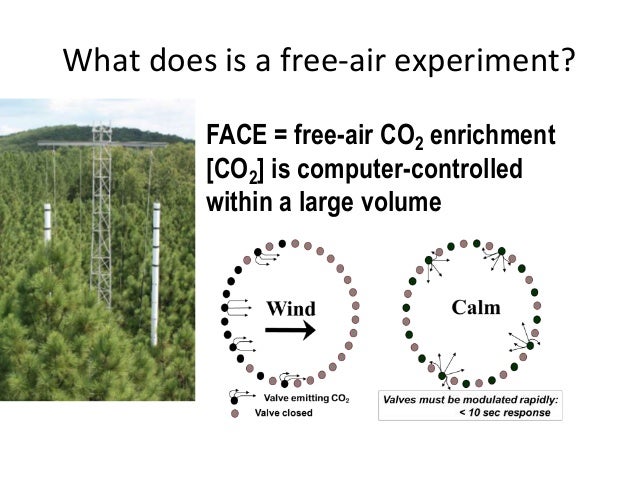
The carbon dioxide levels in all of the included FACE experiments were around 550 parts per million, which is the projected atmospheric carbon dioxide level around the year 2050. For comparison, the carbon dioxide concentration at the start of the Industrial Revolution in the 18th century was 280 ppm, and April 2014 was the first time that global carbon dioxide levels climbed above 400 ppm for an entire month.

When the team analyzed their data, the results showed a significant decrease in the concentrations of zinc and iron as well as protein in wheat and rice cultivars. For example, zinc, iron, and protein concentrations in wheat grains grown at the FACE sites were reduced by about 9 percent, 5 percent, and 6 percent respectively, compared with wheat grown at ambient carbon dioxide. If people consumed more food to make up for the drop in nutrients there could be other health consequences, including increased obesity, Myers posited. “The ratio of nutrients to calories in the food is really important.”

Zinc and iron were also significantly reduced in legumes such as soybeans and field peas in the study, although protein was not.

Note that the reductions are small assuming the projected 2050 CO2 levels. It is also the case that other researchers see other factors at work. For example, Lieffering et al. 2004 (my bolds)

The impact of elevated CO2 on the elemental concentrations of field-grown rice grains

We analysed the elemental concentrations of archived grain samples collected from temperate rice crops grown under free-air CO2 enrichment (FACE) conditions. Like in the pot experiments, in our study elevated CO2 increased biomass and grain production and decreased grain N concentrations.

In contrast however, we found no changes in the concentrations of any of the other elements analysed. We thought it is likely that dilution was observed in the pot studies because nutrient supplies were limiting, primarily because of the small rooting volumes. In contrast, our experiment was conducted under field conditions, with highly fertile soils and large rooting volumes leading to plentiful nutrient supplies (especially micro-elements).

The root production response under elevated CO2 was more than twice the aboveground biomass response; we hypothesised that if this led to a greater relative nutrient uptake capacity, elemental uptake may have matched the increase in aboveground biomass and hence no change in concentration would be detected.

We conclude that a dilution of elements in the grain is not a foregone conclusion under elevated CO2: where elements are in plentiful supply and uptake rates can match increases in yield, no dilution will be detected.


A study by Saman Seneweera theorized about the mechanism that may be operating in nutrient-deficient grains. (my bolds)

Effects of elevated CO2 on plant growth and nutrient partitioning of rice (Oryza sativa L.) at rapid tillering and physiological maturity 

However, the biochemical mechanisms of reduction in grain protein content at elevated CO2 are still unknown. Biochemical make-up of the plant was changed when plants were exposed to elevated CO2 for long periodlargely as a result of increases in photosynthetic nitrogen use efficiency. . . It is established that small-grained cereals like barley, wheat and rice may mobilize up to 90% of the nitrogen from the vegetative plant parts during grain filling; hence, overall less N investment in the plant at elevated CO2 could be the primary cause for reduction in grain protein concentration at elevated CO2.

In this experiment, no difference was found in grain macronutrients such as P, K, Mg and Ca . This experiment was quite different to other experiments as this study was conducted under sand culture up to grain maturity. In most of the other experiments where grain macronutrients concentration are studied, a large reduction in nutrients such as K, Mg and Ca has been reported, suggesting that this may be due to the restricted rooting volume.  However, Lieffering et al. 2004 reported no differences in grain macronutrients under elevated CO2 under field condition with rice.

Both the experiments, ours with a constant supply of macro and micronutrients, and the Lieffering et al. experiment, were conducted under flooded conditions where availability of these nutrients is relatively higher as submergence enhanced the nutrient availability. However, when wheat was grown under dry land conditions (FACE experiment), this reduction in micro and macronutrient concentration was significant at elevated CO2. It is likely that macro and micronutrient management is required to maintain grain quality under elevated CO2.

Summary

Once again, in the real world, many factors other than CO2 influence the nutritional value of crops. And most of them can be managed as part of ongoing agricultural adaptation to changing circumstances.

The authors suggest that some of the nutritional deficits they observed could be counteracted through breeding programs that select for decreased sensitivity to carbon dioxide. For example, their results showed that zinc and iron varied substantially across different rice strains.

David Wolfe, a plant and soil ecologist at Cornell University in Ithaca, New York, said that in addition to reducing carbon dioxide admissions, other strategies include breeding for crops that take up more iron and zinc from the soil in elevated carbon dioxide conditions, or to diversify crops to include protein-rich legumes such as beans and peas or iron-rich spinach. The food industry could also fortify salts or other foods with iron and zinc, Myers added.

MIT False Climate Alarm


From MIT News, Deadly heat waves could hit South Asia this century
Without action, climate change could devastate a region home to one-fifth of humanity, study finds.

The key claim is:

The effects of unchecked temperature rise would extend beyond the health concerns associated with being outside in high temperatures. With workers unable to stay outdoors for extended periods of time, the region’s economy and agricultural output would decline, experts say. “With the disruption to the agricultural production, it doesn’t need to be the heat wave itself that kills people,” says study author Elfatih Eltahir, a professor of civil and environmental engineering at the Massachusetts Institute of Technology, in a press release. “Production will go down, so potentially everyone will suffer.”

Matthew E. Kahn , Professor of Economics at USC explains why climate scientists should not be trusted when doing economic forecasts. His essay is An MIT Engineer Discusses Economic Issues Related to Climate Change Adaptation

What does economics have to say about this prediction of economic outcomes out 83 years from now?
“Deadly heat waves projected in the densely populated agricultural regions of South Asia”

1. Note that there are no general equilibrium effects. If the South Asian economy (i.e India) is closed to international trade, then agriculture prices will go up as production contracts, farmers could actually be richer if demand is inelastic.

2. There is no storage and no savings in his “economy”. If heat waves are predictable, won’t people save $ for the hot summers? This paper by Donaldson et. al. shows that capital markets in India’s rural areas play a key role in allowing for consumption risk smoothing. This MIT engineer is colleagues with Rob Townsend and should talk to Rob about his 1994 Econometrica.

3. There is no urban air conditioned sector for people to migrate to.

4. If the South Asian economy is open to international trade, then urban consumers will import from other regions during hot summers and won’t face price increases. In this case, local farmers will bear the incidence of hot summers. To reduce their exposure to such income risk, they should send a child to the city to work and the child will remit $ back to the country side. Read Mobarak’s co-authored Econometrica from Bangladesh for an optimistic preview of the region’s future.

5. There is no innovation in the agricultural sector to allow the South Asian farmers to cope with extreme heat. Neither human capital increases, nor world innovations diffusing to South Asia plays a role in helping these individuals to cope.

6. I could not find a discussion of farmer choice of what to grow and the discrete choice margin of adjustment to more heat resistant crops (see Mendelsohn’s many papers).

A quick look at the 47 references of the paper reveals that no economics research is cited. That’s interesting on several levels.

Despite being out of their field Eltahir et al. went on to proclaim their activism (my bolds):

In South Asia, a region of deep poverty where one-fifth of the world’s people live, new research suggests that by the end of this century climate change could lead to summer heat waves with levels of heat and humidity that exceed what humans can survive without protection.

There is still time to avert such severe warming if measures are implemented now to reduce the most dire consequences of global warming. However, under business-as-usual scenarios, without significant reductions in carbon emissions, the study shows these deadly heat waves could begin within as little as a few decades to strike regions of India, Pakistan, and Bangladesh, including the fertile Indus and Ganges river basins that produce much of the region’s food supply.

Researchers note that the disastrous scenario could be avoided if countries meet their commitments to keep temperatures from rising more than 2°C (3.6°F) by 2100. That goal, embedded in the 2015 Paris Agreement on climate change, will likely be difficult to meet without increasingly ambitious efforts to reduce greenhouse gas emissions.

The new findings, based on detailed computer simulations using the best available global circulation models, are described this week in the journal Science Advances, in a paper by Elfatih Eltahir, a professor of civil and environmental engineering at MIT; Eun Soon Im, a former researcher at the Singapore-MIT Alliance for Research and Technology and now a professor at the Hong Kong University of Science and Technology; and Jeremy Pal, a professor at Loyola Marymount University in Los Angeles.

It is a familiar story:  Climatists can not contemplate, let alone analyze how humans adapt to changing circumstances.  They are totally focused on reducing CO2 emissions, even though these have been greening the planet in recent decades.

See Also Adapting Works, Mitigation Fails


How Trustworthy are SSTs?

Roger Andrews as promised has published his analysis of SST (Sea Surface Temperatures) datasets, based on some years of research. The essay is Making the Measurements Match the Models – Part 2: Sea Surface Temperatures and well worth a look.

Some years ago while reading to get up to speed on climate science, I was struck by a Roger Pielke Sr. comment. He said that surface temperatures are serving as a proxy for changes in heat content of the earth climate system, which is the real concern.  And air temperatures are contaminated by fluctuations in water content, such that a degree difference in the humid tropics involves much more additional heat than does the same change in extremely dry polar air.

For those who want to see the math, here it is from the Engineering Toolbox.

The enthalpy of humid air at 25C with specific moisture content x = 0.0203 kg/kg (saturation), can be calculated as 76.9 (kJ/kg). . .The same calculation for moist air at 20C gives a heat capacity of 58.2, so the 5C increase requires 18.7 kj/kg for moist air vs. 5.0 kj/kg for dry air, or a ratio of 1:3.7. Similar ratios apply at all air temperatures above 0C. Subzero air, like that in the Arctic most of the year, shows little difference in heat content between dry or saturated, since cold air doesn’t hold much water vapor. See Arctic Amplication?

One implication is that polar air temperatures lacking moisture are 2-3 times more volatile, leading to the “Arctic Amplication” effect. Even so, a thorough look into weather station records around the Arctic circle undermines fears on that account. See Arctic Warming Unalarming.

The larger point made by Pielke Sr. was that a much better proxy for global warming or cooling is provided by SSTs. Measuring temperature changes in the water itself is a much better idea, giving a more exact indication of changes in heat content. There is also the point that SSTs cover 71% of the planet surface.

Andrews knows well the difficulties in assembling SST datasets, including the bucket era and the engine intake era. He addresses directly the problematic WWII measurements, suggesting they can simply be excluded as bad data without affecting the pattern. He also compares the International Comprehensive Ocean-Atmosphere Data Set (ICOADS) raw global SST series used to generate the global HadSST3 series, which is the most widely cited of the currently-published SST series.

There he finds that prior to 1940, there was systematic warming adjustments making HadSST temps higher than ICOADS. He attributes this to the long-standing belief that Night Marine Air Temperatures (NMATs) should synchronize with SSTs. That assumes that air moisture over the water should be fairly consistent from one location to another, and that marine air would be in thermal equilibrium with the water.

But apparently no studies have proven that assumption. I know of one empirical study of the ocean-air interface which shows considerable fluctuation in both the heat exchange and evaporation rates. See Empirical Evidence: Oceans Make Climate

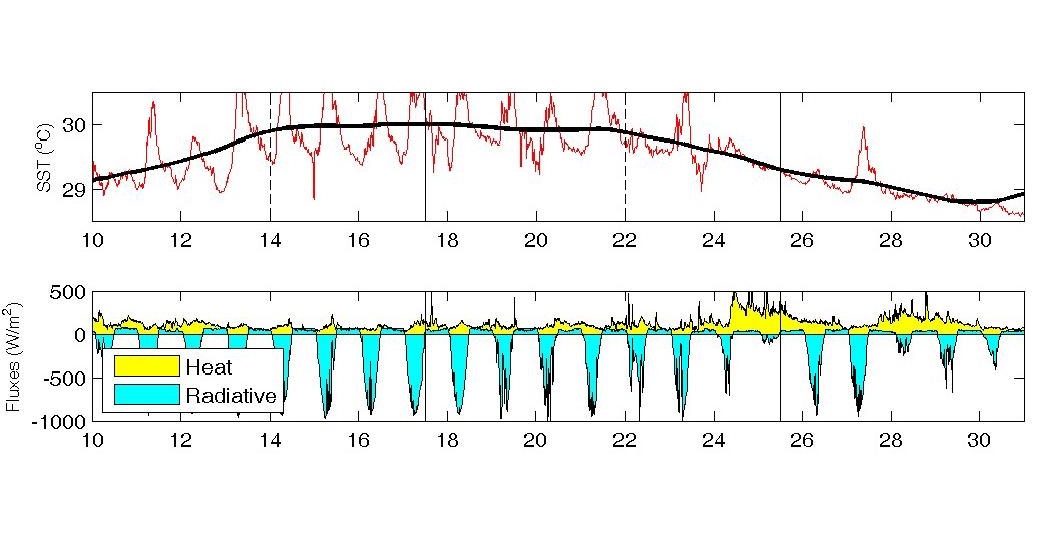
The graph displays measures of heat flux in the sub-tropics during a 21-day period in November. Shortwave solar energy shown above in green labeled radiative is stored in the upper 200 meters of the ocean. The upper panel shows the rise in SST (Sea Surface Temperature) due to net incoming energy. The yellow shows latent heat cooling the ocean, (lowering SST) and transferring heat upward, driving convection. From An Investigation of Turbulent Heat Exchange in the Subtropics James B. Edson

Thanks to Roger’s work on this, we can conclude that SSTs prior to 1950 have issues, but can be encouraged that HadSST3 since then is reasonably consistent with the raw data. And in the future the ARGO record will become long enough for us to follow the trends.

USS Pearl Harbor deploys Global Drifter Buoys in Pacific Ocean

Summary

The best context for understanding global temperature effects in recent years comes from the world’s sea surface temperatures (SST), for several reasons:

  • The ocean covers 71% of the globe and drives average temperatures;
  • SSTs have a constant water content, (unlike air temperatures), so give a better reading of heat content variations;
  • Major El Ninos have been the dominant climate features these decades.

Solar energy accumulates massively in the ocean and is variably released during circulation events.


Arctic Heart Beat

We are about 50 days away from the annual Arctic ice extent minimum, which typically occurs on or about day 260 (mid September). Some take any year’s slightly lower minimum as proof that Arctic ice is dying, but the image below shows day 260 over the last 10 years. The Arctic heart is beating clear and strong.

Click on image to enlarge.

Over this decade, the Arctic ice minimum has not declined, but looks like fluctuations around a plateau since 2007. By mid-September, all the peripheral seas have turned to water, and the residual ice shows up in a few places. The table below indicates where we can expect to find ice this next September.

Arctic Regions 2007 2010 2012 2014 2015 2016 Average
Central Arctic Sea 2.67 3.16 2.64 2.98 2.93 2.92 2.91
BCE 0.50 1.08 0.31 1.38 0.89 0.52 0.87
LKB 0.29 0.24 0.02 0.19 0.05 0.28 0.17
Greenland & CAA 0.56 0.41 0.41 0.55 0.46 0.45 0.46
B&H Bays 0.03 0.03 0.02 0.02 0.10 0.03 0.03
NH Total 4.05 4.91 3.40 5.13 4.44 4.20 4.45

BCE (Beaufort, Chukchi and East Siberian) on the Asian side are quite variable as the largest source of ice other than the Central Arctic itself.   Greenland Sea and CAA (Canadian Arctic Archipelago) together hold almost 0.5M km2 of ice at minimum, fairly consistently.   LKB are the European seas of Laptev, Kara and Barents, a smaller source of ice, but a difference maker some years, as Laptev was in 2016.  Baffin and Hudson Bays are almost inconsequential.

For context, note that the average maximum has been 15M, so on average the extent shrinks to 30% of the March high before growing back the following winter.


Reasoning About Climate

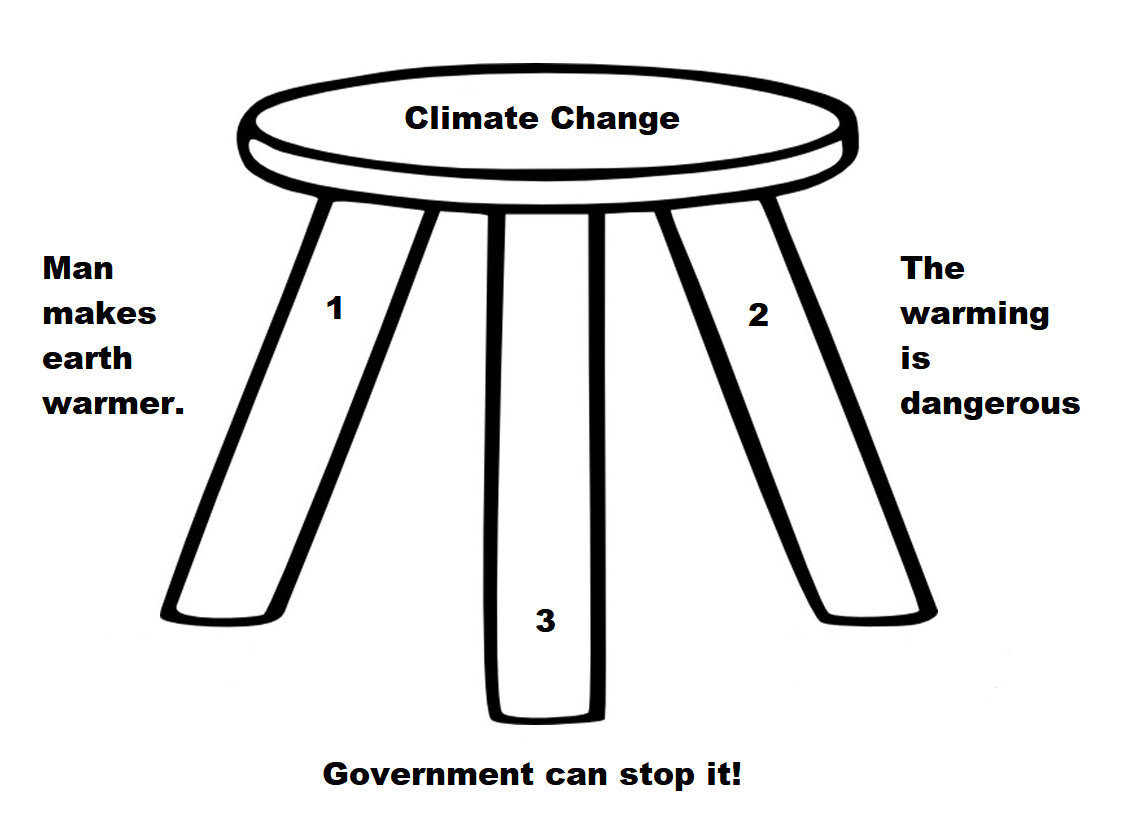
As the stool above shows, the climate change package sits on three premises. The first is the science bit, consisting of an unproven claim that observed warming is caused by humans burning fossil fuels. The second part rests on impact studies from billions of research dollars spent uncovering any and all possible negatives from warming. And the third leg is climate policies showing how governments can “fight climate change.”

It is refreshing to see more and more articles by people reasoning about climate change/global warming and expressing rational positions. Increasingly, analysts are unbundling the package and questioning not only the science, but also pointing out positives from CO2 and warming. And as this post shows, essays are challenging the policy proposals advanced by climate activists. David R. Henderson and John H. Cochrane published at WSJ on July 30, 2017 Climate Change Isn’t the End of the World  Even if world temperatures rise, the appropriate policy response is still an open question.  Complete text below (my Bolds)

Climate change is often misunderstood as a package deal: If global warming is “real,” both sides of the debate seem to assume, the climate lobby’s policy agenda follows inexorably.

It does not. Climate policy advocates need to do a much better job of quantitatively analyzing economic costs and the actual, rather than symbolic, benefits of their policies. Skeptics would also do well to focus more attention on economic and policy analysis.

To arrive at a wise policy response, we first need to consider how much economic damage climate change will do. Current models struggle to come up with economic costs consummate with apocalyptic political rhetoric. Typical costs are well below 10% of gross domestic product in the year 2100 and beyond.

That’s a lot of money—but it’s a lot of years, too. Even 10% less GDP in 100 years corresponds to 0.1 percentage point less annual GDP growth. Climate change therefore does not justify policies that cost more than 0.1 percentage point of growth. If the goal is 10% more GDP in 100 years, pro-growth tax, regulatory and entitlement reforms would be far more effective.

Yes, the costs are not evenly spread. Some places will do better and some will do worse. The American South might be a worse place to grow wheat; Southern Canada might be a better one. In a century, Miami might find itself in approximately the same situation as the Dutch city of Rotterdam today.

Rotterdam–Ninety years thriving behind dikes and dams.

But spread over a century, the costs of moving and adapting are not as imposing as they seem. Rotterdam’s dikes are expensive, but not prohibitively so. Most buildings are rebuilt about every 50 years. If we simply stopped building in flood-prone areas and started building on higher ground, even the costs of moving cities would be bearable. Migration is costly. But much of the world’s population moved from farms to cities in the 20th century. Allowing people to move to better climates in the 21st will be equally possible. Such investments in climate adaptation are small compared with the investments we will regularly make in houses, businesses, infrastructure and education.

And economics is the central question—unlike with other environmental problems such as chemical pollution. Carbon dioxide hurts nobody’s health. It’s good for plants. Climate change need not endanger anyone. If it did—and you do hear such claims—then living in hot Arizona rather than cool Maine, or living with Louisiana’s frequent floods, would be considered a health catastrophe today.

Global warming is not the only risk our society faces. Even if science tells us that climate change is real and man-made, it does not tell us, as President Obama asserted, that climate change is the greatest threat to humanity. Really? Greater than nuclear explosions, a world war, global pandemics, crop failures and civil chaos?

No. Healthy societies do not fall apart over slow, widely predicted, relatively small economic adjustments of the sort painted by climate analysis. Societies do fall apart from war, disease or chaos. Climate policy must compete with other long-term threats for always-scarce resources.

Facing this reality, some advocate that we buy some “insurance.” Sure, they argue, the projected economic cost seems small, but it could turn out to be a lot worse. But the same argument applies to any possible risk. If you buy overpriced insurance against every potential danger, you soon run out of money. You can sensibly insure only when the premium is in line with the risk—which brings us back where we started, to the need for quantifying probabilities, costs, benefits and alternatives. And uncertainty goes both ways. Nobody forecast fracking, or that it would make the U.S. the world’s carbon-reduction leader. Strategic waiting is a rational response to a slow-moving uncertain peril with fast-changing technology.

Global warming is not even the obvious top environmental threat. Dirty water, dirty air and insect-borne diseases are a far greater problem today for most people world-wide. Habitat loss and human predation are a far greater problem for most animals. Elephants won’t make it to see a warmer climate. Ask them how they would prefer to spend $1 trillion—subsidizing high-speed trains or a human-free park the size of Montana.

Then, we need to know what effect proposed policies have and at what cost. Scientific, quantifiable or even vaguely plausible cause-and-effect thinking are missing from much advocacy for policies to reduce carbon emissions. The Intergovernmental Panel on Climate Change’s “scientific” recommendations, for example, include “reduced gender inequality & marginalization in other forms,” “provisioning of adequate housing,” “cash transfers” and “awareness raising & integrating into education.” Even if some of these are worthy goals, they are not scientifically valid, cost-benefit-tested policies to cool the planet.

Climate policy advocates’ apocalyptic vision demands serious analysis, and mushy thinking undermines their case. If carbon emissions pose the greatest threat to humanity, it follows that the costs of nuclear power—waste disposal and the occasional meltdown—might be bearable. It follows that the costs of genetically modified foods and modern pesticides, which can feed us with less land and lower carbon emissions, might be bearable. It follows that if the future of civilization is really at stake, adaptation or geo-engineering should not be unmentionable. And it follows that symbolic, ineffective, political grab-bag policies should be intolerable.

Climate science, impacts and policies also appear as a house of cards.

Mr. Henderson is a research fellow with the Hoover Institution and an economics professor at the Naval Postgraduate School. Mr. Cochrane is a senior fellow of the Hoover Institution and an adjunct scholar of the Cato Institute.

More about Climate Policy Failures

Speaking Climate Truth to Policymakers

Climate Policies Failure, the Movie

Climatists Wrong-Footed