Can’t See Forests for the Theory

Warming alarmists see no good coming out of rising CO2 and the current climate optimum, and their warnings extend to forests as well. So in love with their theory of global warming, they cannot see the forests as they are, and as documented in numerous research studies.

Claim: Forest growth is diminished by higher CO2 and warmer summers.
Fact: CO2 increases have improved forest health.

Claim: Forest areas will be hard-hit by future droughts.
Fact: No trend in droughts is discernible.

Claim: Warmer temperatures increase damage from pests and pathogens.
Fact: Enhanced CO2 is making forests more resilient to diseases and infestations.

Claim: Old growth forests will not sequester CO2 as young forests do.
Fact: Rising CO2 has given new life even to aging forests.

Basic Vegetation Biology (from Bill Illis here)

Almost ALL C3 pathway vegetation (trees, bushes, wheat, rice and 95% of all plants) are CO2-starved except in extremely high rainfall environments like tropical rain-forests. They need to keep their CO2-absorbing stomata more open to get the CO2 they need but this also leads to more loss of water through evapotranspiration.

As rainfall gets lower and lower, the 95% of plants that are C3 suffer more and more until they cannot even grow anymore. In low rainfall and low CO2, these plants are done, and the C4 pathway grasses take over. The C4 grasses are more efficient at absorbing CO2 so do not require as much rainfall. Even 10 inches per year is enough.

But take anywhere on the planet where grasses are dominant, it is because rainfall is too low for trees and bushes, combined with CO2 being too low.

Now ramp-up CO2 and the trees do better in these regions. In fact, they do better absolutely everywhere. Now ramp-up precipitation as well, as should happen in a warmer world, and we have forests everywhere and they grow better everywhere.

Go back to the little ice age, when temperatures were lower and precipitation was lower and CO2 was lower, all plants grew at a lower rate and C3 crops like vegetables, wheat and rice probably failed regularly and people died of starvation.

In the ice ages, when all these numbers were even far lower, our ancestors lived off the grassland herbivores because there were no trees or bushes and no fruit, nuts, wheat, or berries to be found. But there were lots of grass-eating herbivores like the Auroch which was the ancestor of today’s cattle. Our ice age ancestors were mainly meat-eaters.

Forests are Increasingly Healthy

Physiological and ecological factors influencing recent trends in United States forest health responses to climate change
Craig Loehle, Craig Idso, T. Bently Wigley

Highlights
• We review information on US forest health in response to climate change.
• We found that trees are tolerant of rising temperatures and have responded to rising carbon dioxide.
• No long-term trends in US drought have been found in the literature.
• CO2 tends to inhibit forest pests and pathogens.
• Projections of forest response to climate change are highly variable.

Abstract:
The health of United States forests is of concern for biodiversity conservation, ecosystem services, forest commercial values, and other reasons. Climate change, rising concentrations of CO2 and some pollutants could plausibly have affected forest health and growth rates over the past 150 years and may affect forests in the future. Multiple factors must be considered when assessing present and future forest health. Factors undergoing change include temperature, precipitation (including flood and drought), CO2 concentration, N deposition, and air pollutants. Secondary effects include alteration of pest and pathogen dynamics by climate change.

We provide a review of these factors as they relate to forest health and climate change. We find that plants can shift their optimum temperature for photosynthesis, especially in the presence of elevated CO2, which also increases plant productivity. No clear national trend to date has been reported for flood or drought or their effects on forests except for a current drought in the US Southwest. Additionally, elevated CO2 increases water use efficiency and protects plants from drought. Pollutants can reduce plant growth but concentrations of major pollutants such as ozone have declined modestly. Ozone damage in particular is lessened by rising CO2. No clear trend has been reported for pathogen or insect damage but experiments suggest that in many cases rising CO2 enhances plant resistance to both agents.

There is strong evidence from the United States and globally that forest growth has been increasing over recent decades to the past 100+ years. Future prospects for forests are not clear because different models produce divergent forecasts. However, forest growth models that incorporate more realistic physiological responses to rising CO2 are more likely to show future enhanced growth. Overall, our review suggests that United States forest health has improved over recent decades and is not likely to be impaired in at least the next few decades.

Carbon Sequestration

On the specific issue of aging forests losing their ability to absorb CO2, extensive research is reviewed at CO2 Science (here)

As important as are these facts about trees, however, there’s an even more important fact that comes into play in the case of forests and their ability to sequester carbon over long periods of time. This little-acknowledged piece of information is the fact that it is the forest itself – conceptualized as a huge super-organism, if you will – that is the unit of primary importance when it comes to determining the ultimate amount of carbon that can be sequestered on a unit area of land. And it when it comes to elucidating this concept, it seems that a lot of climate alarmists and political opportunists can’t seem to see the forest for the trees that comprise it.

That this difference in perspective can have enormous consequences was demonstrated quite clearly by Cary et al. (2001), who noted that most models of forest carbon sequestration wrongly assume that “age-related growth trends of individual trees and even-aged, monospecific stands can be extended to natural forests.” When they compared the predictions of such models against real-world data gathered from northern Rocky Mountain subalpine forests that ranged in age from 67 to 458 years, for example, they found that aboveground net primary productivity in 200-year-old natural stands was almost twice as great as that of modeled stands, and that the difference between the two increased linearly throughout the entire sampled age range.

The answer is rather simple. For any tree of age 250 years or more, the greater portion of its life (at least two-thirds of it) was spent in an atmosphere of much-reduced CO2 content. Up until 1920, for example, the air’s CO2 concentration had never been above 300 ppm throughout the entire lives of such trees, whereas it is currently 400 ppm or 33% higher. And for older trees, even greater portions  of their lives were spent in air of even lower CO2 concentration. Hence, the “intervention” that has given new life to old trees and allows them to “live long and prosper,” would appear to be the aerial fertilization effect produced by the flooding of the air with the CO2 that resulted from the Industrial Revolution and that is currently being maintained by its ever-expanding aftermath (Idso, 1995).

Based on these many observations, as well as the results of the study of Greenep et al. (2003) – which strongly suggested, in their words, that “the capacity for enhanced photosynthesis in trees growing in elevated CO2 is unlikely to be lost in subsequent generations” – it would appear that earth’s forests will remain strong sinks for atmospheric carbon far beyond the date at which the world’s climate alarmists have proclaimed they would have given back to the atmosphere most of the carbon they had removed from it over their existence to that point in time. And subsequent reports have validated this assessment.

Summary

No doubt that forests are threatened by the human race, but it has nothing to do with CO2, which trees love. Urban and agricultural encroachments can and do cause loss of forest habitats. Pests and pathogens come and go in cycles, and their impacts can be mitigated by proper forest management.

The 2015 Global Forest Resources Assessment was encouraged by the reduced rate of deforestation and the increasing quality and extent of forest management practices in many countries.

Too bad so much effort and funding is wasted on IPCC circuses.

Footnote:

For More on the Link between Forests and Precipitation see Here Comes the Rain Again

Fear Not CO2: The Real Chemistry

David Ellard provides a thorough and timely explanation of the carbon cycle from first principles. His essay meets the standard for all speeches or papers: “A presentation should be like a woman’s dress–long enough to cover the subject but short enough to be interesting.” (OK I’m dated and not PC: the long enough part is passé).

Since the subject is to describe the carbon dioxide fluxes and atmospheric residence timescales, the essay is necessarily long. It is made more lengthy by the need to untangle confusions, deceptions and obfuscations of CO2 science by IPCC partisans pushing CO2 alarms. To completely remove the wool from your eyes takes a full reading and pondering. I will attempt a synopsis here to encourage interested parties to take the lesson for themselves. The experience reminded me of college classes I took majoring in Organic Chemistry, though in those days CO2 was anything but contentious.

Several posts here (links below) have danced around Ellard’s subject, but his exposition is the real deal. Getting to the bottom of this issue, he explains how Henry’s law works regarding CO2 in the real world, makes an important distinction between CO2 molecules and ions, and factors in an accounting of the CO2 output from rising populations of humans and animals.

Some Highlights from Carbon Dioxide, A tale of two timescales from the blog Energy Matters

From the Executive Summary

One of the most controversial topics in understanding the build-up of carbon dioxide in the atmosphere is the question of timescales – the effect of the build-up depends not only on the amounts being released by human(-related) activities but also on how long the gas stays in the atmosphere.

In fact much of the controversy/confusion stems from the fact that there are two relevant timescales, one which determines how the amount of carbon dioxide in the atmosphere equilibrates with other reservoirs (notably physical exchange with the oceans, and biological exchange via photosynthesis and respiration), and another which determines the exchange of carbon atoms.

By analysing the amounts of a marker carbon isotope (carbon-13) it is possible to calculate these two timescales. The timescale for the amount of carbon dioxide is approximately twenty years, a significantly shorter timescale than often claimed (e.g. by the IPCC). From these figures, we can also deduce that the increased carbon dioxide in the atmosphere since the industrial revolution has led to a noticeable increase in the photosynthetic rate of the Earth’s plants and green algae (about 8%). This has clear implications for the on-going discussions on the costs, and indeed benefits, of increasing carbon dioxide levels.

The reasons why the IPCC’s (and others’) estimates of carbon dioxide timescales in the atmosphere are overestimated are analysed – notably because no account is taken of changes in net respiration rates (ever more people, and domesticated animals, and animal pests that depend on them), because hydrocarbon usage by UN member states is underreported (quite possibly for reasons of political prestige), and finally because the models ignore the key empirical evidence (the carbon-13 isotope measurements).

Excerpts from Ellard’s Article

The purpose of this post is to try and explain the nature of the two timescales, and pin down using actual physical measurements (rather than computer games) the size of both.

What Henry’s Law is telling us, then, is that when we add molecules of carbon dioxide to the atmosphere, these molecules will ultimately partition themselves (leaving aside the effects of the biota) in an approximately fixed ratio between atmosphere and ocean (the solvent).

Three questions arise: what is the dilution of carbon dioxide in the oceans? what does ‘ultimately’ mean? and what actually is the value of the fixed ratio?  In order of asking: very dilute (the oceans are approximately 500 times undersaturated in molecular carbon dioxide), it depends on the mixing processes both within and between the atmosphere and ocean (discussed further on), and:

To rephrase then, for every six molecules of CO2 that are introduced into the atmosphere, five of the six (again ignoring biological processes) will end up in the oceans, only one of them will hang around in the air.  Not only that but, as noted above, molecular CO2 is a very dilute solute in the oceans. At current rates, it would take tens of thousands of years for mankind to achieve saturation.The partition ratio 1:5 will continue to apply for the foreseeable future!

The basic take home fact is that the ‘dissolved inorganic carbon’ or DIC in the world’s oceans is, in principle, a mixture of molecular carbon dioxide and dissolved carbonates. What is the ratio of molecular to ionic carbon dioxide? The smart among you will already have guessed: there is approximately 9 times as much ionic CO2 dissolved in the oceans as molecular. Only the latter is in Henry’s Law equilibrium with CO2 in the atmosphere. Hence the different ratios of 1:5 (atmospheric:molecular dissolved CO2) and 1:50 (atmospheric:molecular plus ionic dissolved CO2 i.e. DIC).

[fig.2 Schematic of ocean-atmosphere physical exchange]

So we can now recap. Before the exchange the atmosphere contained ten surplus marked molecules of carbon dioxide. After the exchange, there were still nine surplus molecules in the atmosphere, but none of them contained the marker! The ocean gained a single extra molecule of carbon dioxide but gained an extra nine atoms of marked carbon (and lost nine unmarked ones).

Since the industrial revolution, the human population of this planet has exploded. Not just humans though. We also have caused an explosion in the number of domestic animals, sheep, pigs, cows and chickens and the like. And not just the intended results of human food production. There are a myriad rats, cockroaches, potato blight funguses and the like out there which depend for their existence on our (unintended) generosity. They are also all busy respiring carbon dioxide into the atmosphere, thanks to us.

We have to take this into account, as well as any changes in photosynthetic fluxes (which have the opposite tendency, to reduce atmospheric carbon dioxide). I would need a whole other post to discuss this in detail, but I am simply going to assume that one third of the ‘excess’ carbon dioxide is not of hydrocarbon origin. The crucial point is that this excess CO2 will not have the distinctive carbon-13 marking. Its carbon-13 profile will be almost identical to (well, pretty similar to, we will ignore the difference for simplicity) that already in the atmosphere.

So we are going to calculate the carbon dioxide adjustment timescale as a function of the deep ocean-surface mixing timescale but reduce the result by a third to take into account non-hydrocarbon anthropogenic CO2 emissions. If you object to this piece of fudging, by all means feel free to do the calculation without it.

If you plot a graph of this using values of the deep ocean-surface mixing timescale of between, say, 0 and 100 years (which really should cover all eventualities), the value of the adjustment timescale varies between 16 and 23 years. Let’s take a happy median, thus:

The current concentration of carbon dioxide in the atmosphere is 400 ppmv and is increasing by 2 ppmv/year. If the atmospheric adjustment timescale is 20 years then it means the oceans and biota are together absorbing 5 ppmv/year of the excess. Three quarters of this absorption is due to the increase in productivity of the biota and one quarter to the Henry’s Law re-equilibration in the oceans.

So we can say that for every seven molecules of CO2 put into the air by mankind, of which just under five are from burning hydrocarbons, two accumulate there, one and a bit is dissolved into the oceans and just under four are reabsorbed by the biota via increased photosynthetic productivity.

Conclusion

But to my mind the most striking result, if we bring the carbon-13 isotope evidence fully to bear, is the increase in photosynthesis that must have taken place over the course of the twentieth century. The Henry’s Law equilibration between atmosphere and oceans is simply too slow to get rid of much of mankind’s excess CO2. The fact that there is not a lot more of this CO2 still lingering in the atmosphere (and therefore that the proportion which is hydrocarbon-derived is not even smaller) shows us that the donkey work of mopping up (most of) the excess has been carried out by the biota – all the phytoplankton, trees, grasses and algae that give wide areas of our planet’s surface its distinctive green colour.

Bio – David Ellard

David Ellard studied Natural Sciences at Kings College Cambridge with specialisations in mathematical and atmospheric chemistry.

Since then he has worked over twenty years in the European Commission in Brussels in various science/technology/law-related areas, notably responsible for the Commission’s proposed directive on the patentability of computer-implemented inventions.

My Footnote

Many thanks to David Ellard for this clear and readable treatise on established CO2 science, which still applies despite climate activists attempting to unsettle it.  Before anyone takes a stand on CO2 and global warming, be sure to remove the wool from over your eyes.

Other Reading on CO2 and the Carbon Cycle

Much Ado About CO2

Carbon Sense and Nonsense

Basics of Ocean Acidification


Arctic Plateau Continues

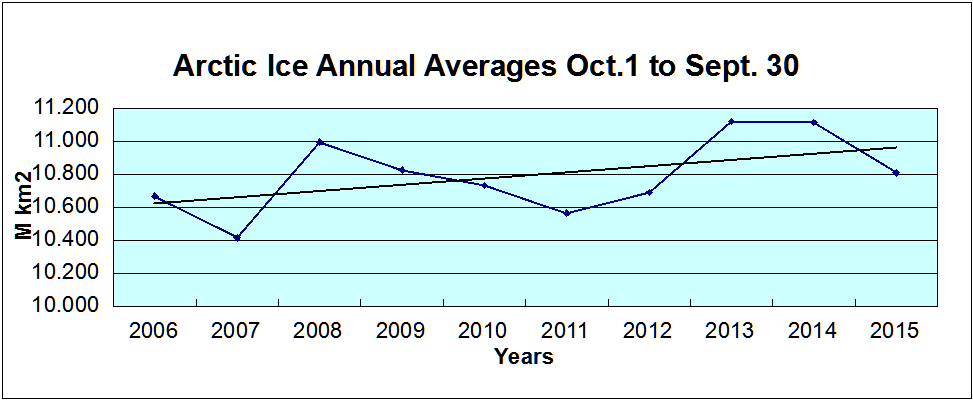
A year ago MASIE results showed clearly that the decline of ice prior to 2007 had stabilized and increased a bit.  The graph below displays the plateau of annual average ice extents based on October 1 to September 30.  In 2 weeks we can add 2016 and see how the trend changes.

arctic-ice-ann-to-sept30

The monthly average extent for September is the climate statistic, since daily reports vary greatly due to weather, ice movements and darkening conditions, just some of the factors making it difficult to measure anything in the Arctic.

Halfway through September, we can compare extents for day 260, the average day for annual minimums. The table below shows MASIE extents in M km2 on day 260 for significant years in the last decade.

Arctic Regions 2007 2012 2014 2015 2016
Central Arctic Sea 2.67 2.64 2.98 2.93 2.92
BCE 0.5 0.31 1.38 0.89 0.52
Greenland & CAA 0.56 0.41 0.55 0.46 0.45
Bits & Pieces 0.32 0.04 0.22 0.15 0.31
NH Total 4.05 3.4 5.13 4.44 4.20

The main difference between 2007 and 2016 is more ice in Central Arctic. 2015 is slightly higher because of BCE (Beaufort, Chukchi, E. Siberian combined), though the Bits and Pieces are higher now, most of it in Laptev this year.

The rate of refreezing in the next 2 weeks should keep 2016 well ahead of 2007. The average gain of ice from now to Sept. 30 is 32k km2 per day, or 412k km2 added to the day 260 extent. In 2007 the rate was the decade’s lowest: only 3k per day for 41k km2 added by end of Sept. Last year 2015 was one of the fastest recoveries, almost twice the average.

Conclusion

It looks likely that 2016 September extent average will finish higher than 2007 and close to 2008 and 2011.  It is unlikely to catch 2015.  But who knows?

No one knows what will happen to Arctic ice.

Except maybe the polar bears.

And they are not talking.

Except, of course, to the admen from Coca-Cola

Killing the Energy Goose

golden-goose

Aesop’s Fable of The Man and the Golden Eggs

A man had a hen that laid a golden egg for him each and every day. The man was not satisfied with this daily profit, and instead he foolishly grasped for more. Expecting to find a treasure inside, the man slaughtered the hen. When he found that the hen did not have a treasure inside her after all, he remarked to himself, ‘While chasing after hopes of a treasure, I lost the profit I held in my hands!’

The Moral: People often grasp for more than they need and thus lose the little they have.

Energy is the Golden Goose of Modern Society

Poverty and energy scarcity are obviously tied together.

Access to cleaner and affordable energy options is essential for improving the livelihoods of the poor in developing countries. The link between energy and poverty is demonstrated by the fact that the poor in developing countries constitute the bulk of an estimated 2.7 billion people relying on traditional biomass for cooking and the overwhelming majority of the 1.4 billion without access to grid electricity. Most of the people still reliant on traditional biomass live in Africa and South Asia.

The relationship is, in many respects, a vicious cycle in which people who lack access to cleaner and affordable energy are often trapped in a re-enforcing cycle of deprivation, lower incomes and the means to improve their living conditions while at the same time using significant amounts of their very limited income on expensive and unhealthy forms of energy that provide poor and/or unsafe services.  Energy, Poverty, and Development

The moral of this modern story is very clear. Where energy is scarce and expensive, people’s labor is cheap and they live in poverty. Where energy is reliable and cheap, people are paid well to work and they have a better life.

Golden Eggs Aplenty in the US

From Shale Revolution Keeps Growing, Sept. 12, 2016, Corpus Christi Caller Times

Consider that in the near blink of an eye natural gas has overtaken coal as the country’s largest fuel for electricity generation. Coal generated more than 50 percent of U.S. power just a decade ago. Today, it produces just a third of our electricity and is poised to fall further.

Second, our same supply of low-cost gas is leading a manufacturing resurgence. Along the Gulf Coast and in shale fields in Pennsylvania and Ohio huge manufacturing facilities — be they steel or chemical plants — are now either entering production or are under construction. Chemical producers who use natural gas as the building blocks for their products can now make the same products here for a fraction of what they can overseas.

The American Chemistry Council, the trade association for the nation’s chemical companies, now reports that nearly 270 new chemical projects are in play, totaling $170 billion in investment. Roughly 60 percent of that investment is coming directly from overseas. Affordable, abundant natural gas is proving decisively positive for U.S. manufacturing. Jobs and investment that once slipped away are now returning. (my bold)

And last, but not least, we are on the verge of becoming one of the world’s largest natural gas exporters. Just a few years ago, America was poised to become a major natural gas importer. It has been a remarkable turn of events.

The Illusory Treasure of Fighting Climate Change

Meanwhile in jurisdictions grasping for the moral treasure of reducing CO2, governments are starving or poisoning the Energy Goose and the suffering is only beginning. Exhibit A is oil-rich Alberta Canada where provincial policies have halved business investment in just 2 years.

barrel-poison-7388531rev

Barry Cooper explains in this article published today in the Calgary Herald NDP climate policies are bearing their inevitable poisoned fruit

Contrary to what many NDP supporters, and many of my colleagues believe, businesses are more likely to respond to government policies than to set them. One of the responses to egregiously irresponsible policies is to invest elsewhere.

The Birn report did not discuss the scientific premises of anthropogenic climate warming, nor the prudence of attempting to regulate GHG emissions. What matters are the consequences of policy choices by Canadian and U.S. governments for Alberta and Saskatchewan.

Here are some pertinent facts.

The interdependence of North American economies and the familiar 10-to-one ratio between the two countries means that Canada must always adjust its policies to American realities. That ratio applies to global CO2 emissions (16 per cent for the U.S.; 1.7 per cent for Canada, of which the oilsands’ contribution is minuscule) as well as to GDP and much else. Canadian CO2 emissions are comparable to those of Texas. The big difference is how that CO2 is generated.

Coal is the largest source of American CO2, mostly from electricity generation, followed by transportation and industry. In Canada, industry — from fertilizer manufacturing to mining, smelting and pulp production — is the largest emitter, followed by transportation and then electricity generation. The main reason for this difference is that in B.C. and Laurentian Canada, hydroelectricity is the chief source of power. Prairie rivers furnish great fishing opportunities, but few electrons.

Since CO2 from American coal plants alone are double those from the entire Canadian economy, they have been the focus of U.S. policies. Replacing coal-generation with natural gas has been made easier by low natural gas prices, partly the result of innovative shale-gas exploitation.

In Canada, things are different. Because more than 80 per cent of Canadian electricity is generated by non-emitting sources, other sectors must be targeted to achieve levels of emission reductions comparable to the Americans’. The cost, however, is bound to be higher: here, cheap gas hardly matters.

This is what makes carbon taxes so attractive to Canadian governments. They can’t go after coal plants, because there are so few left, so they go after the entire economy. Alberta’s carbon tax and Ontario’s cap-and-trade policy mean that over two-thirds of Canadian emissions will be covered by next year.

Big-government Liberals, socialists and members of the green cult will rejoice that we are saving the planet. However, the costs of the new NEP — the national emissions policy — achieved by carbon-tax harmonization, will introduce more incentives for investment in places where anthropogenic climate change is not an unquestioned public policy dogma.

Because the Prairie petroleum industry competes globally for both capital and markets, parochial Canadian climate policies add to costs and induce investors abroad. And they make no difference at all to global GHG emissions.

That is one reason why energy investment in Alberta is half 2014 levels. No wonder Finance Minister Joe Ceci is sad. The consequences of his own policies are bearing their inevitably poisoned fruit.

Barry Cooper is a professor of political science at the University of Calgary.

Footnote:

Former Canadian PM Stephen Harper (from Alberta) based his climate change policy on the realities mentioned in the article.  His administration was committed to matching US energy policies on a sector by sector basis.  Since the US went after coal, so did Canada.  The US has not done anything about oil and gas, so neither should Canada.

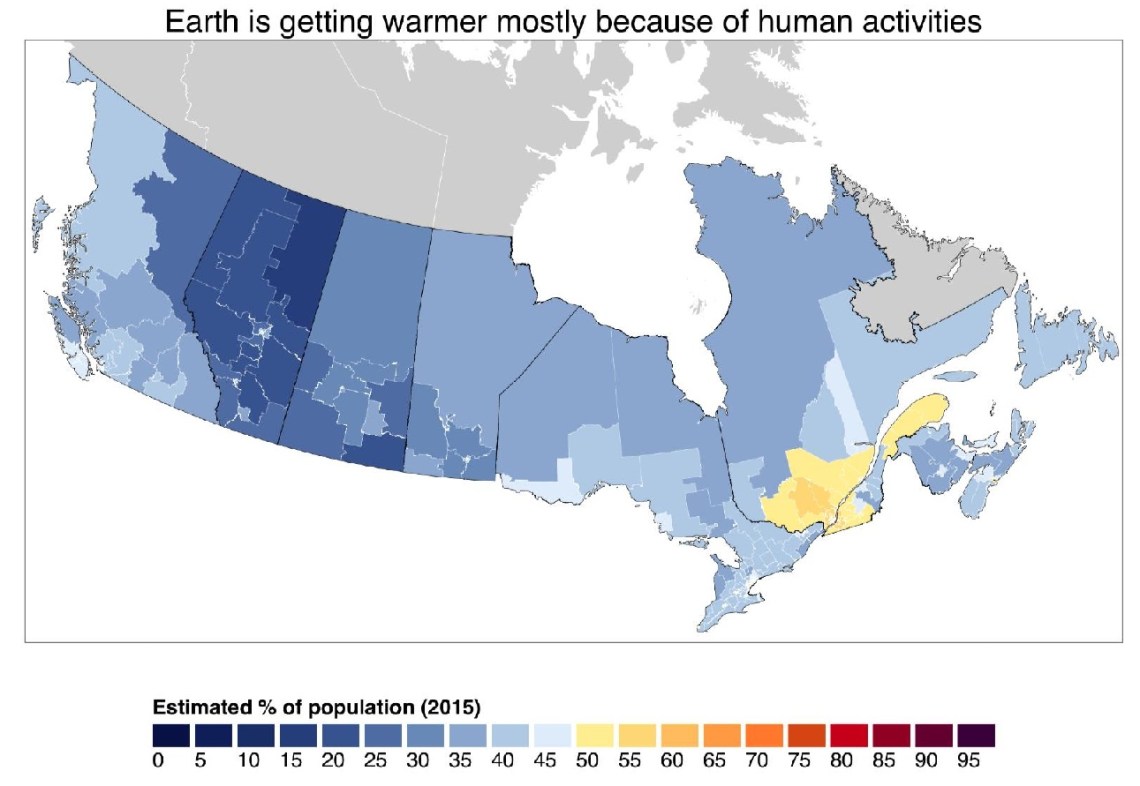
The ruling NDP party are on thin ice because Albertans are mostly skeptical of global warming claims.  A recent Canadian survey shows the % of people whose beliefs would support what the administration is doing.  That’s right: Alberta is the dark blue province in the map.

More on survey of Canadian attitudes toward global warming:      https://rclutz.wordpress.com/2016/02/25/uncensored-canadians-view-global-warming/

More on toxic effects from Green energy policies:  https://rclutz.wordpress.com/2016/08/01/electrical-madness-in-green-ontario/

Background on Alberta oilsands:  https://rclutz.wordpress.com/2015/11/07/brer-canada-and-the-tar-baby/

Postscript:  Alberta is ahead of Ontario in the Golden Goose Killing Race, with electricity rates now among the highest in North America.  But Ontario’s rates are rising faster.


It’s not Hotter, it’s Milder.

Again this week I got an email from a friend linking to an alarmist website claiming (among other things) 2015 the Hottest Year Ever, August 2016 the Hottest Month Ever, 16 Hottest Months in a row, The Earth is Burning!
My reply:
Calm down and breathe through your nose. Be not afraid.
You have been misinformed, and I will tell you how and why.

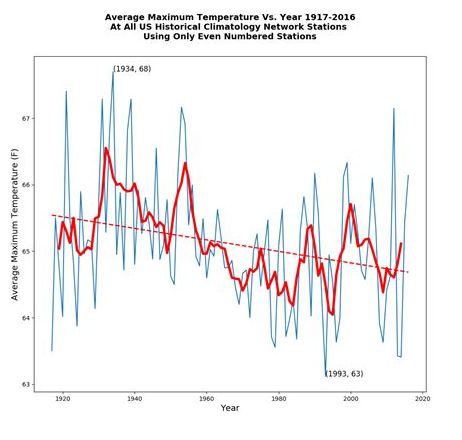
1. “Hotter” does not describe a long period when daily highs are falling, not rising. That’s right, generally the temperature records are showing a decline over time in the maximums recorded at the weather stations.

For example look at results from USHCN (US Historical Climate Network) for the trend of daily maximums since 1930.

Source: Tony Heller, Real Climate Science

It is clear that measurements of actual afternoon highs are trending down in most places, and lower much more strongly than the few increases.  Below the same results displayed geographically.


2. Temperature averages over decades show great climate stability, not change. The calculated trends are in fractions of a degree Celsius, well within the error range of the instruments.

Alarmists favor the dataset from GISS, a part of NASA. They fabricate estimates of an hypothetical Global Mean Temperature not from satellites, but by taking weather station records and performing various statistical manipulations, including adjusting, deleting, infilling, gridding, weighting, homogenizing, and averaging.

Out of all that processing they produce estimates of annual GMTs, which can not be attributed to any actual observation. More importantly, the dataset is unstable–past history, for example the 1930s, appears in GISS graphs with different values this year than last, and different again from 5 and 10 years ago. As Dr. Ole Humlum commented: A temperature record which keeps on changing the past hardly can qualify as being correct.

Below is shown GISS estimates in the context of human experience of daily and seasonal temperature variability.

3. The planet has a vast array of climates, each of which has it’s own experience of changing weather and longer term patterns. That is evident in the first chart above. It is also the case that generally as daily highs have been falling, daily lows (minimums) have been rising more strongly, resulting in slightly increasing daily averages. That is the basis for claiming hottest years and months.

This phenomenon is widespread around the world, as demonstrated by studies reported here at this blog under the category Temperature Trend Analysis. For example, Analyzing Temperature Change using World Class Stations.

In addition, 70% of the GISS surface temperatures are from SSTs (sea surface temperatures), meaning that ocean cycles like El Nino dominate the results. Short-term variations recently derive from changes in the Pacific basin, the largest of the world’s oceans.

Because climates are local and plural, any general statement about warming or cooling does not necessarily apply to the place where you live.

Summary

The next time you read or are told the world is getting hotter, you should respond along these lines.

“You have been misinformed. It is not getting hotter, it has become milder. The temperature records show fewer extremes of highs and lows, milder Winters, earlier Springs and later Autumns. The longer growing seasons are producing bumper crops almost every year.

Instead of complaining about hotter weather, we should enjoy the bounty of harvests Nature is providing to us.”


The 2016 harvest is shaping up to be a whopper, according to Western Canada’s largest elevator companies.

The 2016 harvest is shaping up to be a whopper, according to Western Canada’s largest elevator companies.

Footnote:

Another post Arctic Warming Unalarming reports on in depth analysis of 118 weather stations around the Arctic Circle, where so-called “Arctic amplification” should be evident.  The conclusions:

The Arctic has warmed at the same rate as Europe over the past two centuries. . . The warming has not occurred at a steady rate. . .During the 1900s, all four (Arctic) regions experienced increasing temperatures until about 1940. Temperatures then decreased by about 1 °C over the next 50 years until rising in the 1990s.

For the period 1820–2014, the trends for the January, July and annual temperatures are 1.0, 0.0 and 0.7 °C per century, respectively. . . Much of the warming trends found during 1820 to 2014 occurred in the late 1990s, and the data show temperatures leveled off after 2000. (my bold).

So, consistent with statements above: No increase in July temperatures, some warming overall due mostly to January.

Climate Policies Gouge the Masses

There is still no empirical proof from the real world that burning fossil fuels causes temperatures to rise, despite those claiming the “Science is Settled”.

“There is no scientific proof that human emissions of carbon dioxide are the dominant cause of the minor warming of the Earth’s atmosphere over the past 100 years. If there were such a proof it would be written down for all to see. No actual proof, as it is understood in science, exists.”
Patrick Moore, co-founder of Greenpeace, Senate Testimony 2014

Beyond the lack of scientific support for the claims, there is the further problem with the proposed and already enacted climate policies intending to reduce carbon emissions and lower future warming. The policies themselves are ill-advised even if scientific proof existed.

David R. Henderson, public policy economist at the Stanford Hoover Institution, puts the issue this way:

Claims that human-caused global warming will raise average temperatures by 2o C to 5o C over the next 100 years and cause serious harm to society are controversial. However, assuming that global warming will be a big problem, there are two important questions: (1) What should be done about it? and (2) When should it be done?

Hypothetical: Assuming global warming is real and caused by fossil fuel emissions, what should we do about it?

Proposition #1: Put a price on Carbon by taxing it.

Henderson comments:
But carbon already has a price, or, more exactly, multiple prices. Natural gas has a price; oil has a price; coal has a price. And their prices are related to the valuable carbon component of those fuels because it’s carbon that makes those fuels valuable. Just as there’s no such thing as a free lunch, carbon is not free.

So why does Professor Gordon claim that taxing carbon means “putting a price on carbon?”
I can only speculate because I don’t know him, but here’s what I’m willing to bet dollars to doughnuts on: he calls a tax a price in order to lull the reader into thinking that it’s not a tax. Later in the piece he admits that it’s a tax but in his first mention, which sets the stage, he doesn’t.

Proposition #2: A carbon tax simply replaces complex regulations.

Henderson:
If a carbon tax is implemented, it will likely be on top of the extensive regulation Canadians now contend with. Who’s offering to end regulation on carbon usage? Who’s offering to legalize certain kinds of incandescent light bulbs? Who’s offering to end the government’s mandates on energy efficiency in cars, trucks, washers, driers, refrigerators, air conditioners and other appliances? Who’s offering to get rid of expensive, market-distorting subsidies to solar and wind power? Anyone? Anyone? 

As economists well know, adding to the price of energy functions as a regressive consumption tax, with greatest impacts on poor families who have the least amount of discretionary income.

Hypothetical: Assuming global warming is real and caused by fossil fuel emissions, when should we do something about it?

Proposition 3#: Acting now is cheaper than delaying.

Here’s where Henderson really shines, dissecting the phoney economics underlying climate policies, and revealing the reverse Robin Hood effect of mitigation proposals. For in fact, economists know that we are richer today than our forefathers, and it is likely future generations will be richer than us. The whole point of using discount rates in cost/benefit studies is to recognize the advantages of building wealth today while delaying spending until later.

Henderson:

The two main approaches are to make major adjustments now or gradually through time to reduce warming or mitigate its effects. Thus, thinking about efforts to combat global warming requires comparing costs today with potential benefits 100 years or more in the future. Immediate Action versus Waiting. Acting now might slow global warming so that major adjustments will not be needed later.

But there are two huge disadvantages. First, actions today will be based on current technology. Because technology will almost certainly improve, solutions implemented in the future are likely to be more efficient — more effective per unit of cost. By comparison, solutions implemented today would use cruder, more expensive technology.

Second, money spent now to offset global warming could instead be invested in ways that would increase national income and wealth, creating more options to deal with any future negative effects of a warmer world. Future generations will likely be wealthier than present generations, just as the people living today are wealthier than past generations. Imposing large costs today to create environmental benefits for future generations would sacrifice current potential consumption for people in the future who will almost certainly have higher living standards.

What is the right Discount Rate for Taxing Carbon

There is much debate about what discount rate to use when comparing environmental costs and benefits.  Generally, the more one values today’s dollars over tomorrow’s, the higher is one’s discount rate.  At one extreme, an infinitely high discount rate would imply that we place almost no value on future consumption.  Conversely, using a discount rate of zero means that benefits today are no more valuable than benefits 100 years from now..

However, the choice of which discount rate to use is not about the weight given to the well-being of future generations but about opportunity costs. Investments people make today are likely to increase the wealth of their descendants, giving future generations greater resources to exercise their preferences regarding environmental protection.

The higher the rate of return that can be earned by investing a dollar today, the more wealth future generations are deprived of if the money is spent now.  Thus, Kevin Murphy of the University of Chicago argues that we should use the market interest rate as the discount rate because that is the opportunity cost of climate mitigation. Interestingly, even Stern’s own model assumes that people 200 years from now will have real incomes that are more than 10 times incomes today.  This means that if the government taxes people today explicitly or through regulations to reduce climate change 200 years from now, the government will be taxing the poor to help the rich. 

How does using the interest rate as the discount rate work in practice?  Imagine that the damage from continued use of CO2-emitting fossil fuels is $300 per ton of emissions 100 years from now.  In 100 years, a $300 per ton tax on carbon emissions would reflect their social cost.  What this tax should be in the intervening years depends upon the interest rate that could be earned if money were invested.

Thus, beginning today, at a 6 percent interest rate, a tax of 88 cents per ton would pay the social costs of one ton of emissions in a century.  If the tax were implemented 80 years from now, the rate would be $93.54 per ton.  To put these numbers in perspective, a $1.00 tax per ton of carbon translates into a one-third cent per gallon tax on gasoline. On that basis:

  • A $300 per ton carbon tax 100 years from now would be equivalent to a tax of three-tenths of a cent per gallon today at an interest rate of 6 percent.
  • It would be two cents per gallon at an interest rate of 4 percent. 

Today, the actual federal tax is 18.4 cents per gallon.  Thus, if the correct carbon tax 100 years from now is $300, this implies that the gasoline tax today is much higher than the rate required to reflect the social costs of global warming, regardless of whether the right interest rate is 6 percent or 4 percent.

Conclusion.

If the government limits carbon emissions now through taxes or direct caps, it is taxing the poor today to benefit wealthier future generations. Perversely, such limits would also deprive future generations of the additional capital that would accumulate if the money were invested in the market instead of being used to combat climate change.

David R. Henderson is a research fellow with the Hoover Institution (here). He is also an associate professor of economics at the Naval Postgraduate School in Monterey, California.

Henderson’s writing focuses on public policy. His specialty is in making economic issues and analyses clear and interesting to general audiences. Two themes emerge from his writing: (1) that the unintended consequences of government regulation and spending are usually worse than the problems they are supposed to solve and (2) that freedom and free markets work to solve people’s problems.

Quotations from David Henderson come from these sources:

A carbon tax is not a ‘price’

Climate Economists Base Their Alarm on Their Own Ethical Judgments

Climate Change: Should We Tax the Poor to Help the Rich?

extortion2

Global Warming Extortion

Arctic Ice Minimum?


20160912google1

Imargery date refers to Google Earth capture of land forms. Ice extents are for Sept. 11, 2016 from MASIE. Click on image to zoom in.

Northabout picked her way through drift ice in the channel and is now at the mouth of Baffin Bay.  The Nunavut gauntlet is behind them, but they will seek a port soon with a storm forecasted in coming days.  Serenity exited some days ago, did some sight-seeing in Baffin Bay and is visiting ports in Greenland.

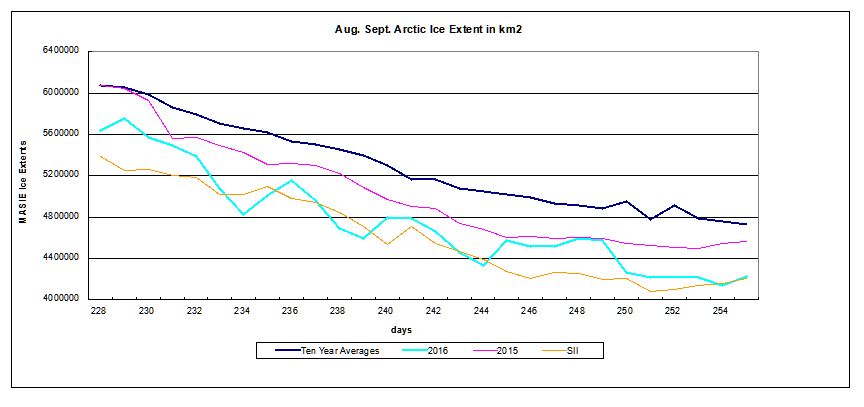
MASIE images of Arctic ice show a plateau in extent for the first 5 days of September, then a drop to ~4.2M where it has remained except for a further one-day dip on day 254. On average the lowest extent shows on day 260, but it varies a lot, from day 254 in 2009 to day 270 in 2007. So weather makes a difference each year. 2016 is uncertain because a storm is forecast in the days ahead (according to Northabout crew) and the effect on ice extent is unknown.

The decline of ice extent is shown below since August 15 (August being the month of greatest loss of ice).

masie-2016-day255

It is too early to say the annual minimum occurred on Sept. 10, but all the sensitive seas are showing increases yesterday.  Ice extents this month are 340k km2 less than last year.  SII is showing ~200k km2 less ice than MASIE in Sept. The table below shows ice extents in the regions for day 255:

Region 2016255 2015255 Difference
 (0) Northern_Hemisphere 4224212 4563954 -339742
 (1) Beaufort_Sea 184884 484260 -299376
 (2) Chukchi_Sea 273471 173544 99927
 (3) East_Siberian_Sea 159549 263598 -104049
 (4) Laptev_Sea 310839 69273 241566
 (5) Kara_Sea 1723 1869 -146
 (6) Barents_Sea 0 18 -18
 (7) Greenland_Sea 161931 222061 -60131
 (8) Baffin_Bay_Gulf_of_St._Lawrence 18475 57705 -39230
 (9) Canadian_Archipelago 232146 267573 -35427
 (10) Hudson_Bay 0 56252 -56252
 (11) Central_Arctic 2880143 2966659 -86516

Surpluses in Chukchi and Laptev somewhat offset deficits in Beaufort and E. Siberian seas.  Baffin and Hudson Bays are much lower this year, but they have little left to lose compared to 2015.  The most significant issue is Central Arctic being lower than last year, which may yet produce a lower September monthly minimum.  Time will tell.

Summary of Year To Date

Someone asked how the annual average ice extent was coming along this year, so I crunched the numbers.

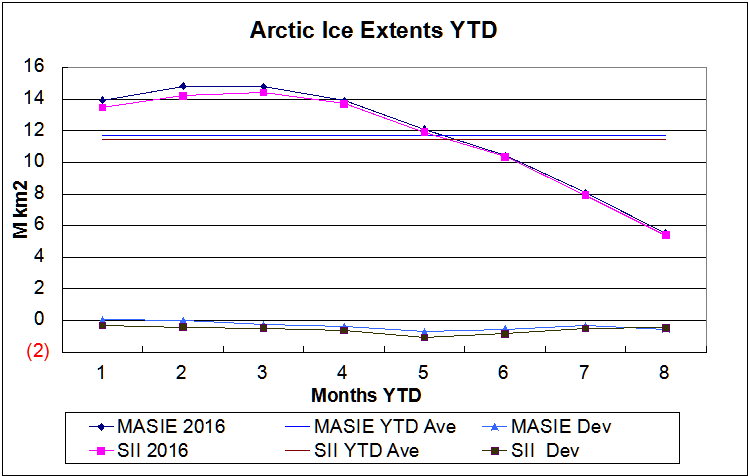
The graph summarizes the changing extents of Arctic ice as measured by two primary datasets: MASIE (Multi-sensor Analyzed Sea Ice Extent) and SII (Sea Ice Index -solely from satellite passive microwave sensors).

Arctic ice YTD Aug

Measured in M km2, the two highest lines are the monthly average extents reported for the first 8 months of 2016. The two horizontal lines show the YTD average from the 8 months. At the bottom are the deviations from 10 yr. Averages for each month (from each dataset).

It is clear that MASIE was reporting slightly more ice early on, and then the two estimates have been close together since. The deviation below average grew up through May, with SII reporting 1M km2 deficit. As of August, both MASIE and SII are showing ice extent down about 0.5M km2.

The 10 yr. Averages of extents for the YTD (8 months) are exactly 12M km2 in both datasets. So Masie YTD is ~3% below average and SII YTD is ~5% down.

Summary

There will be much to do about Arctic ice death spirals in the weeks ahead as 2016 continues to show lower extents. Most likely the September average will be lower than last year, an event lasting perhaps 2-3 weeks before refreezing brings it back over last year’s minimum. Only someone pushing an agenda would claim such a short phenomenon contained within a single month of the year shows the climate is changing.

For more on making sense of Arctic Ice graphs see Ice House of Mirrors

For those who want to see numbers, the table is below.

Monthly 2006-2015 2016 2006-2015 2016 2016 2016-10yr Ave 2016-10yr Ave
Averages MASIE MASIE SII SII SII Deficit MASIE SII
Jan 13.872 13.922 13.780 13.472 -0.450 0.049 -0.308
Feb 14.785 14.804 14.632 14.210 -0.593 0.019 -0.422
Mar 15.008 14.769 14.886 14.405 -0.364 -0.239 -0.481
Apr 14.308 13.917 14.307 13.694 -0.223 -0.391 -0.613
May 12.767 12.086 12.960 11.900 -0.186 -0.681 -1.060
June 10.952 10.419 11.192 10.353 -0.066 -0.533 -0.839
July 8.401 8.067 8.421 7.920 -0.147 -0.334 -0.501
Aug 6.066 5.531 5.838 5.390 -0.141 -0.535 -0.448
YTD Ave. 12.020 11.689 12.002 11.418 -0.271 -0.331 -0.584

September Minimum Outlook

Historically, where will ice be remaining when Arctic melting stops? Over the last 10 years, on average MASIE shows the annual minimum occurring about day 260. Of course in a given year, the daily minimum varies slightly a few days +/- from that.

For comparison, here are sea ice extents reported from 2007, 2012, 2014 and 2015 for day 260:

Arctic Regions 2007 2012 2014 2015
Central Arctic Sea 2.67 2.64 2.98 2.93
BCE 0.50 0.31 1.38 0.89
Greenland & CAA 0.56 0.41 0.55 0.46
Bits & Pieces 0.32 0.04 0.22 0.15
NH Total 4.05 3.40 5.13 4.44

Notes: Extents are in M km2.  BCE region includes Beaufort, Chukchi and Eastern Siberian seas. Greenland Sea (not the ice sheet). Canadian Arctic Archipelago (CAA).  Locations of the Bits and Pieces vary.

As the table shows, low NH minimums come mainly from ice losses in Central Arctic and BCE.  The great 2012 cyclone hit both in order to set the recent record. The recovery since 2012 shows in 2014, with some dropoff last year, mostly in BCE.

Summary

We are nearing the end of the melt season, and the resulting minimum will depend upon the vagaries of weather between now and September 16 or so.  Early on, 2016 was slightly higher than 2015 in March, lower in May and narrowing the gap late June and late July. Note: 2016 melt season is starting without the Blob, with El Nino over, and a cold blob in the North Atlantic.  The AO has been hovering around neutral, now possibly indicating cloud cover reducing the pace of melting.

Meanwhile we can watch and appreciate the beauty of the changing ice conditions.

Arctic sea ice in summer 2015. This photo was made during an expedition of the German research icebreaker Polarstern into the central Arctic Ocean. Credit: Stefan Hendricks

Footnote:  Regarding the colder than normal water in the North Atlantic

A 2016 article for EOS is entitled Atlantic Sea Ice Could Grow in the Next Decade

Changing ocean circulation in the North Atlantic could lead to winter sea ice coverage remaining steady and even growing in select regions.

The researchers analyzed simulations from the Community Earth System Model, modeling both atmosphere and ocean circulation. They found that decadal-scale trends in Arctic winter sea ice extent are largely explained by changes in ocean circulation rather than by large-scale external factors like anthropogenic warming. (my bold)

From the Abstract of Yeager et al.

We present evidence that the extreme negative trends in Arctic winter sea-ice extent in the late 1990s were a predictable consequence of the preceding decade of persistent positive winter North Atlantic Oscillation (NAO) conditions and associated spin-up of the thermohaline circulation (THC). Initialized forecasts made with the Community Earth System Model decadal prediction system indicate that relatively low rates of North Atlantic Deep Water formation in recent years will result in a continuation of a THC spin-down that began more than a decade ago. Consequently, projected 10-year trends in winter Arctic winter sea-ice extent seem likely to be much more positive than has recently been observed, with the possibility of actual decadal growth in Atlantic sea-ice in the near future. (my bold)

Rare Common Climate Sense

common-sense

We are so used to seeing in the media baffle-gab and gibberish  on the topic of climate change. Journalists throw around expressions that torture language, logic and science. Examples, among many others:

“battling climate change”
“unprecedented hot temperatures”
“carbon polluters”
“ocean acidification”
“heat-trapping gases”
“man-made storms”
“arctic death spiral”

So it is with surprise and delight that I can report today on that rarest of events: An impressive expression of common sense regarding climate, and from an important US federal agency at that.

It seems that a division of NOAA (National Oceanic and Atmospheric Administration) decided that some populations of whales were no longer endangered.

The National Marine Fisheries Service, a division of the National Oceanic and Atmospheric Administration, decided Wednesday that nine out of 14 populations of the whale no longer required protections under the law despite growing concerns about global warming.

Of course, environmental activists pushed back, claiming global warming threatens them.

The fisheries service in publishing the decision Thursday in the Federal Register said it was confronted repeatedly before the decision by environmental and conservation groups who said it wasn’t taking global warming seriously enough in proposing to take the whales off the list.

Common Sense on Climate

But the agency said it wasn’t going to speculate on what could happen, warning that it would not be goaded into judging the effects of global warming above what the science shows.

“We cannot merely speculate that climate change and ocean acidification contribute significantly to the extinction risk of any humpback whale [populations], but must base our listing determinations on evidence sufficient to indicate that a particular effect is likely to lead to particular biological responses at the species level,” the agency said in its final response to the climate critics.

The agency said it “evaluated the effects of climate change and ocean acidification on each humpback whale [group], as discussed in our proposed rule, but found no basis to conclude they contribute significantly to extinction risk for most [whales], now or in the foreseeable future,” according to the agency.
(Source: Obama beats back climate change advocates with whale decision)

Given this administration’s penchant to use regulations in the service of climate activism, I doubt that Obama himself had anything to do with this.  More likely, it was overlooked or considered not worth the fight.

Summary

It is good to see there are still some scientists within NOAA who have not forgotten their oceanography. Even more striking, they contend that decisions be based on the world as it is, rather than upon the world as we fear it might become.

We can only hope that their superiors in the chain of command would wake up and speak up for reason and against fear. Though it could be they will be made to walk the plank if Hillary becomes captain of the ship of state.

NOAA climate modelers discover a control knob for oceans.

For More on Extinctions and Ocean pH see:  Headlines Claim, But Details Deny


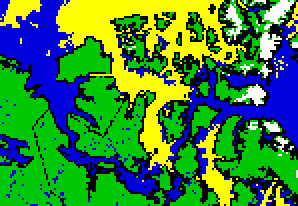
Northabout Racing Against Refreezing

20160909google1

Imagery dat refers to Google Earth capture of land forms. Ice extents are for Sept. 8, 2016 from MASIE. Click on image to zoom in.

As I have said before, I wish the sailors safe passage even though they have been misled by climate alarmists.  Their adventure is life-threatening, though not unprecedented.  More than 200 NWP crossings are recorded since 1906, but who knows whether 2017 or beyond will have as much open water as this year.

From the ship’s log:

N69 02 W 101 30 pressure 1006, water1.7C, Air 2C 0500 UTC 9 Sept local time 22.00 8 Sept, Queen Maud Gulf

A winters start. Low cloud base and dark skies. We slowly edged our way past Cambridge Bay into Queen Maud Gulf, surely named by Amundsen.

Cambridge Bay is the last place we could really over winter the boat so I hope we don’t have to retrace our steps.

We knew Polar Bound was coming our way, many months ago. Skippered by a legend in High Latitude Sailing, David Scott Cowper. He has forgotten what we haven’t even learnt yet. Firstly, he was shown up on our AIS, as we got closer to each other, it was a surreal moment. Two Englishmen chatting away over the radio waves, in the North West Passage. No other boat or Nationality around.

Mad dogs and Englishmen came into my thoughts.

What a shame, David was heading to Cambridge Bay for breakfast and invited us to join him, very unfortunately we are in a race against time before the freeze . Also, we need to get to Baffin Bay before a big storm, don’t tell the ladies that ! Hopefully, we will be in harbour by then.

So, the rest of the day was skirting Islands with big cliffs, until this evening. Now making our way up Victoria Strait, water temps plummeted but the skies have cleared to give beautiful stars. A really clear sky, I can’t think of another night like it. Our Ice Charts show 1/10 ice. As Steve pointed out so sagely, doesn’t sound much, but if you have one large chunk in your way in the dark, it’s going to dent your boat !

I have started to twitch at the thought. The last Ice in the sea at night was the Chukchi sea before Point Barrow, we have all had nightmares ever since.

David

Background on the Polar Ocean Challenge

Update August 14, 2016

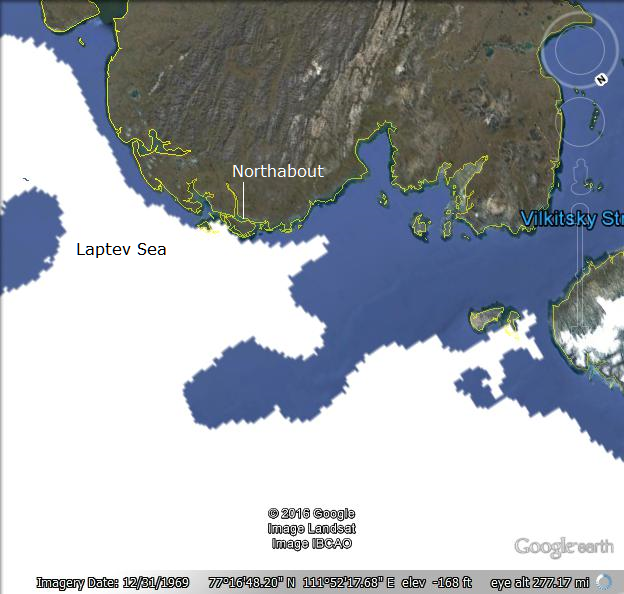
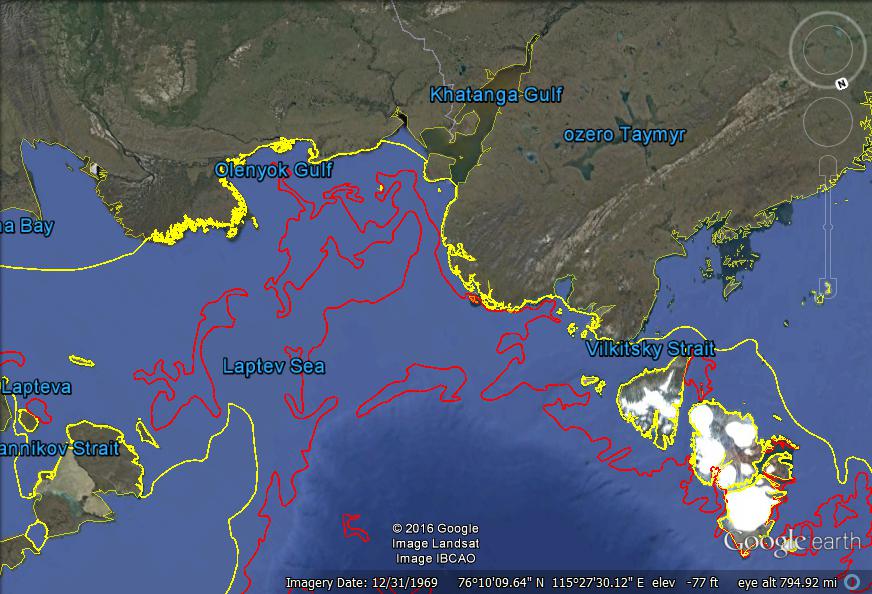
It appears that Northabout has found a way around the Laptev wall, and is close to finding open water.  Below the Google Earth image of ice edges from NIC shows how the strait has opened up along with navigable shore lines.

Aug13googleRev

Imagery date refers to Google Earth capture of land forms. Ice edges are provided by MASIE for August 13, 2016.

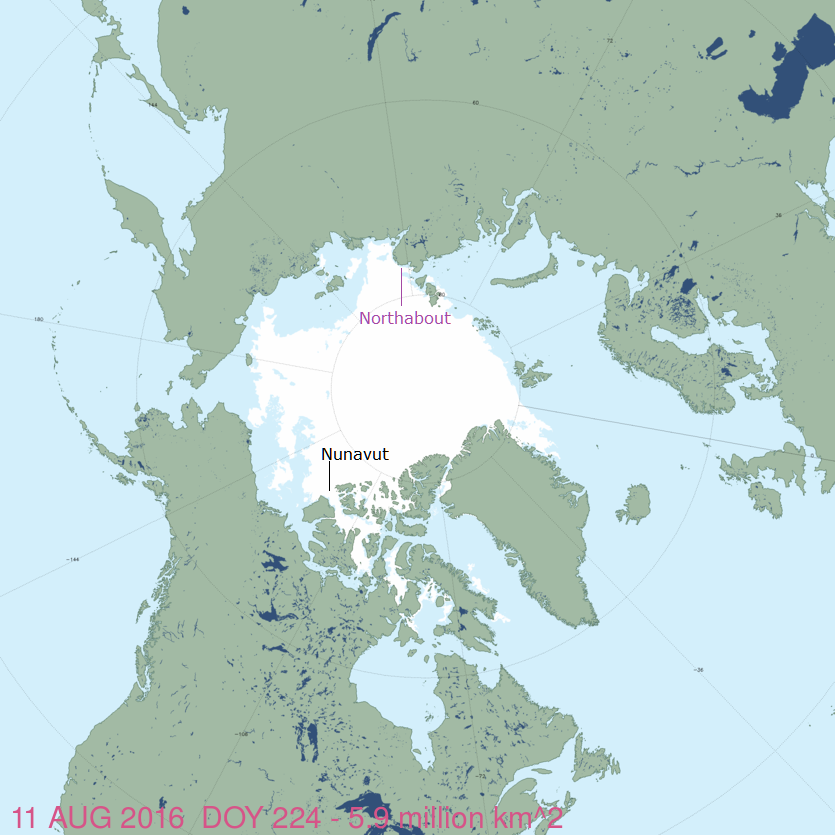
The Big Picture from August 11, 2016.

masie_August 11rev

The Polar Ocean Challenge involves the sailing ship Northabout circumnavigating the North Pole counterclockwise starting from Bristol UK. The chart above from MASIE shows the two choke points in the itinerary: The Laptev Wall of ice at the beginning and the Nunavut Gauntlet of ice at the end. The image shows If Northabout can get past Laptev, it is relatively clear sailing all the way to Beaufort where Nunavut awaits.

20160809en

The above chart from AARI shows how Northabout has passed through the strait from Kara into Laptev and is in a holding pattern up against the wall.  Caleb has some great photos (here) of the views from the deck, along with some comments respecting the explorers despite their being misled by global warming theorists.

20160809enBaffin

Above is the latest chart from AARI showing the present ice situation at the other end of the trip, the Nunavut Gauntlet.  The white part is without data since the Russians are focused on their side of the ocean, but it does show heavy ice in Beaufort Sea on the right,  Within Nunavut, Parry Channel is well blocked, but with some water around the edges.  If and when Northabout gets here, no one knows what they will face.  They are counting on the passage opening this year, unlike previous years.

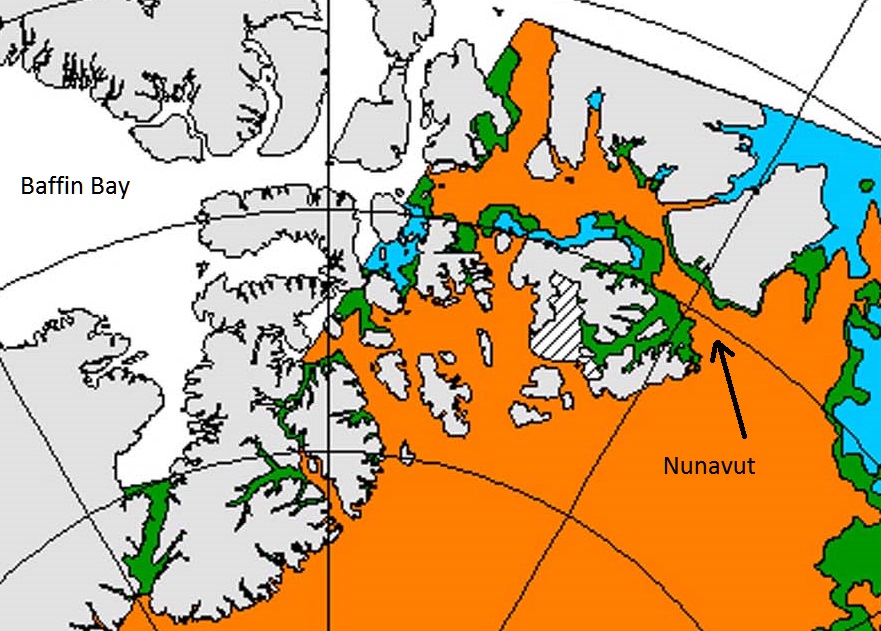
An image of the ice and snow extents from NOAA by way of National Ice Center (NIC)

A closeup of Nunavut from that chart shows they have a chance by using the southern route, skipping all but the eastern end of Parry Channel, provided the ice is better not worse than now when they approach.

cursnow_alaskaNOAAnunavut

Footnote:

Another view of the Arctic is available from NIC using Google Earth.  The daily shapefile can be downloaded, and it then opens in Google Earth, which allows you to browse and zoom in on regions of interest.  Here is an image from this source:

20160812google

Note: Imagery date is Google Earth capture of land masses. Ice edges are 20160812 from NIC.


Climateers Tilting at Windmills


windmills

Don Quixote ( “don key-ho-tee” ) in Cervantes’ famous novel charged at some windmills claiming they were enemies, and is celebrated in the English language by two idioms:

Tilting at Windmills–meaning attacking imaginary enemies, and

Quixotic (“quick-sottic”)–meaning striving for visionary ideals.

It is clear that climateers are similary engaged in some kind of heroic quest, like modern-day Don Quixotes. The only differences: They imagine a trace gas in the air is the enemy, and that windmills are our saviours.

Why the Quest to Mitigate Global Warming is Quixotic


Roger Andrews at Energy Matters puts into context the whole mission to reduce carbon emissions. You only have to look at the G20 countries, who have 64% of the global population and use 80% of the world’s energy. The introduction to his essay, Electricity and energy in the G20:

While governments fixate on cutting emissions from the electricity sector, the larger problem of cutting emissions from the non-electricity sector is generally ignored. In this post I present data from the G20 countries, which between them consume 80% of the world’s energy, summarizing the present situation. The results show that the G20 countries obtain only 41.5% of their total energy from electricity and the remaining 58.5% dominantly from oil, coal and gas consumed in the non-electric sector (transportation, industrial processes, heating etc). So even if they eventually succeed in obtaining all their electricity from low-carbon sources they would still be getting more than half their energy from high-carbon sources if no progress is made in decarbonizing their non-electric sectors.

The whole article is enlightening, and shows how much our civilization depends on fossil fuels, even when other sources are employed. The final graph is powerful (thermal refers to burning of fossil fuels):

Figure 12: Figure 9 with Y-scale expanded to 100% and thermal generation included, illustrating the magnitude of the problem the G20 countries still face in decarbonizing their energy sectors.

The requirement is ultimately to replace the red-shaded bars with shades of dark blue, light blue or green – presumably dominantly light blue because nuclear is presently the only practicable solution.

Summary

There is another way. Adaptation means accepting the time-honored wisdom that weather and climates change in ways beyond our control. The future will have periods both cooler and warmer than the present and we must prepare for both contingencies. Colder conditions are the greater threat to human health and prosperity.  The key priorities are robust infrastructures and reliable, affordable energy.

Footnote:

This video shows Don Quixote might have more success against modern windmills.