Arctic Ships Past Halfway
20160828google1

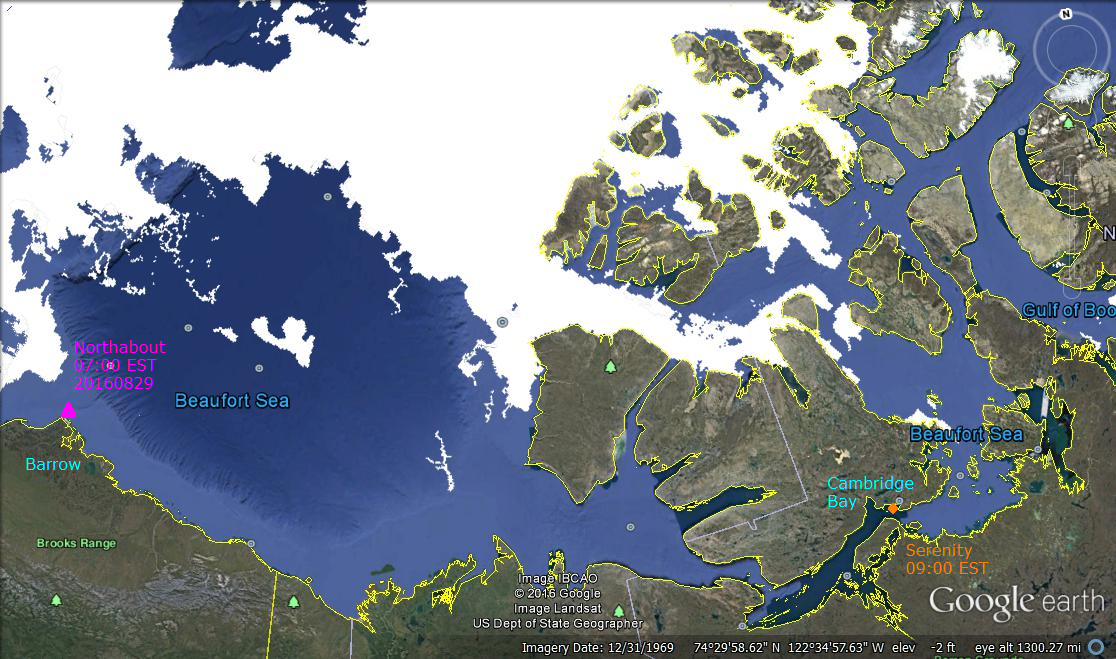
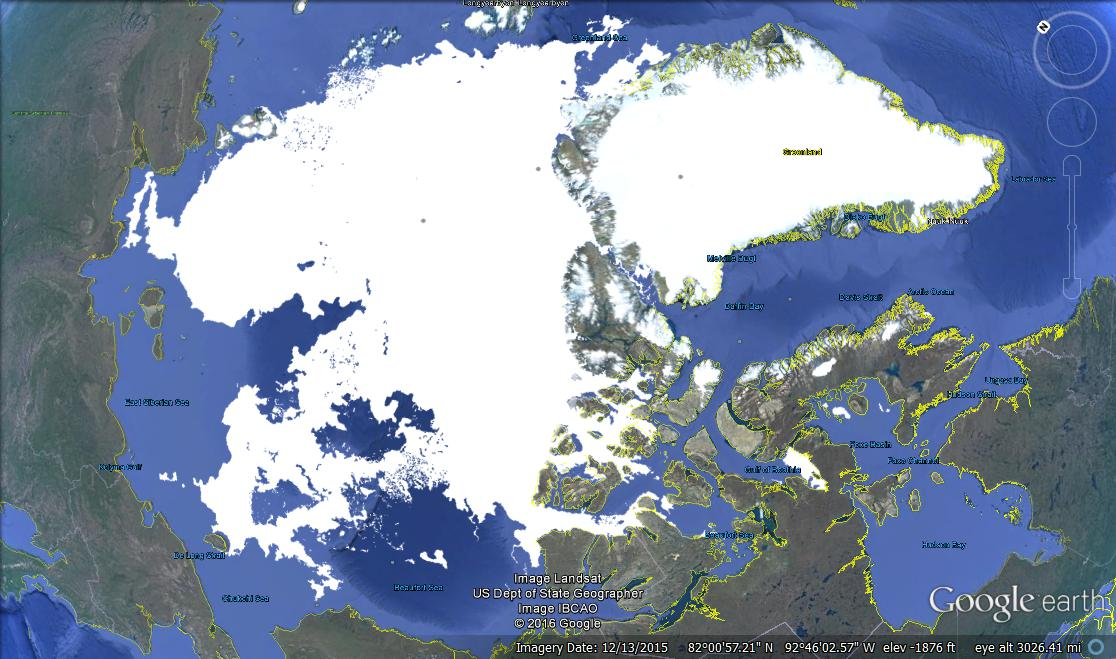
Imagery date refers to Google Earth capture of land forms. Ice extent is for August 27, 2016 from MASIE. Click to zoom in.

Today the tracking shows Northabout is in port at Barrow Alaska, having completed the North East Passage,and preparing for NWP. Serenity is ahead of them, soon to be in port at Cambridge Bay Nunavut.

The man in charge of Serenity, Capt. Birger Vorland, has spent 38 years at sea. Vorland, who is originally from Norway, says the Northwest Passage has special meaning.

“My countryman, Roald Amundsen, did the first transit here between 1903 and 1906,” Vorland says. “We’re going to do it in 32 days and in a lot more comfort.”

The official record of transits through the North West Passage is kept at the Scott Polar Research Institute (here).  The listing begins with that first transit by Amundsen and provides details of the 236 crossings recorded through 2015.  13 ships passed through the NWP last year, and the highest number was 29 in 2013.

Cambridge Bay is partway through the NWP and will be home for the new Canadian High Arctic Research Station, pictured in the foreground above. The CHARS campus is expected to be operational in July of 2017 and fully complete by March of 2018.

The image also shows that the southern route through the Archipelago is mostly open water at this time, and the outlook is good for both Serenity and Northabout to achieve their itineraries. The most interesting section of the Nunavut gauntlet lie just ahead of Serenity’s position.

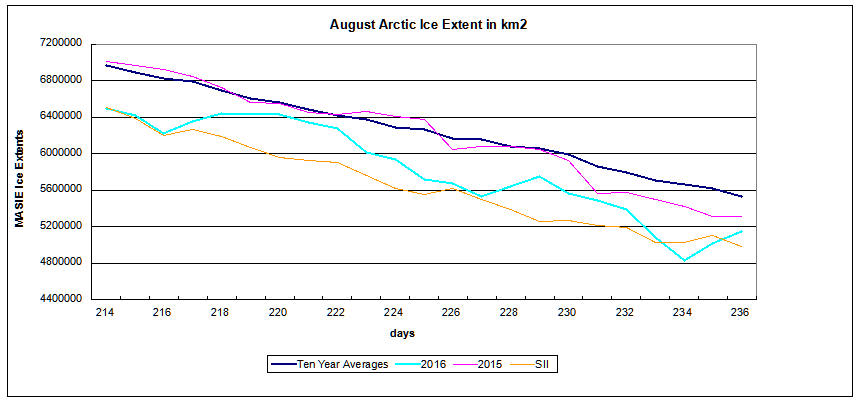
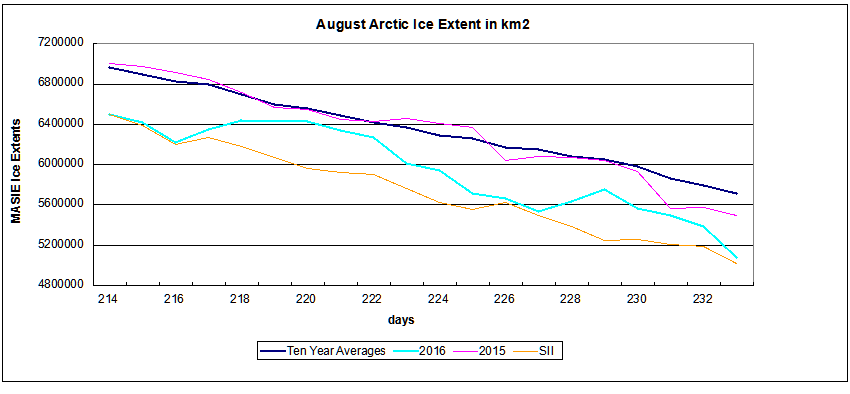
Arctic ice extents are declining as usual approaching the last 2-3 weeks of the annual melt season.  Estimates are fluctuating a lot due both to drift ice moving around, and also the difficulty of measuring under cloudy and darkening conditions.  The after effects of the recent sizable Arctic cyclone appear in the chart below.
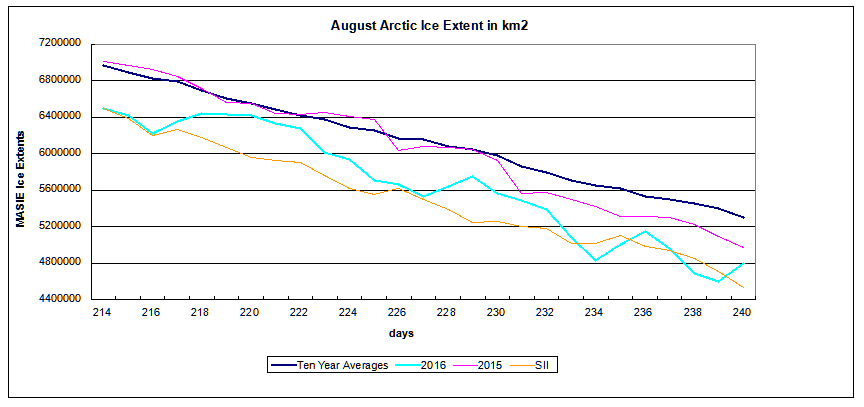
MASIE 2016 day240

The table below compares 2015 and 2016 at day 240.  This year is slightly lower, largely due to Beaufort Sea.  Losses elsewhere in Baffin Bay, Greenland Sea, Hudson Bay and E. Siberian are more than offset by surpluses in Chukchi, Laptev and Central Arctic.  Note that several seas that are down provide more open water for the ships exploring NWP this year.

Presently 2016 ice decline is running 3 days ahead of 2015.

Region 2016240 2015240 Difference
 (0) Northern_Hemisphere 4799401 4972160 -172759
 (1) Beaufort_Sea 325257 597329 -272072
 (2) Chukchi_Sea 418423 289433 128991
 (3) East_Siberian_Sea 237311 332785 -95474
 (4) Laptev_Sea 405208 81071 324137
 (5) Kara_Sea 28704 10133 18571
 (6) Barents_Sea 0 701 -701
 (7) Greenland_Sea 120256 207476 -87220
 (8) Baffin_Bay_Gulf_of_St._Lawrence 20965 140815 -119850
 (9) Canadian_Archipelago 258978 301788 -42810
 (10) Hudson_Bay 7308 67369 -60061
 (11) Central_Arctic 2976412 2942427 33984

For more context on Arctic ice extent see Arctic Ice Watch July 31.  For background on Polar Ocean Challenge see Laptev Wall and Nunavut Gauntlet.  For those who wish to browse Arctic ice in Google Earth, the procedure is simple.  Go to MASIE homepage and download the kmz file.  Clicking on the file should open it in Google Earth (presuming it is on your computer.) Then you can browse, zoom in and out, and take images.

Celebrity Serenity

I was once told by a fellow cruise passenger not to call our ship a boat.  He said in the Navy they knew if you were in a boat it meant something awful had happened to your ship.

The Good Ship Northabout




Pesky Australian Alarmists

Those pesky Australian alarmists sure do like to exaggerate. First they sold everyone that the “Science is Settled. Fossil fuels are warming the planet dangerously.” The government said: “We accept your report, thank you for your service,” and followed up with a plan to downsize the climate research unit (CSIRO).

Then came their loud public outcry: “You can’t do that. There is so much we don’t know and have to study. We need those jobs.”  So the government walked back that plan.

Now Australian scientists figure to build on their success by writing an open letter to the Prime Minister urging action to “fight climate change.”  And, no surprise, Exhibit A is the threat to the Great Barrier Reef. Trouble is, once again they are exaggerating and hoping no one will notice. The bluff is being called by people who visit and dive the reefs every day.

April 2016 Observations

New research found about 68 per cent of reefs from Cairns to Lizard Island had varying levels of coral bleaching, but most of it likened to sunburn on a human body where the coral glows pink before fully recovering.

Latest findings by the Reef and Rainforest Research Centre give hope about the resilience of the living wonder after scientists this week revealed 93 per cent of the 2300km-long reef system was in the grip of a mass bleaching event.

Great Barrier Reef as seen by Activists. (Later Greenpeace admitted the image is a storm-damaged reef in the Philippines).

“It’s the Great White Lie,” said Col McKenzie, chief executive of the Association of Marine Park Tourism Operators. “It’s not dead, white and dying. It’s under stress but it will bounce back.’’

Coral bleaching is linked to high water temperatures of the latest El Niño weather system, where stressed coral polyps eject their photosynthetic zooxanthellae and, in extreme cases, the living colony will appear totally white. Skeletons are covered in algae.

The RRRC report found on the 126 key tourists sites there was, on average, 35 per cent coral cover – about one-third unbleached – and, on average, only 2.5 per cent of the coral had died because of bleaching.  “We think there is a much lower level of severely bleached corals. To say 80 per cent of the reef will die is catastrophising the situation,’’ RRRC director Sheriden Morris said. Source: Great Barrier Reef: Signs of recovery despite major coral bleaching, The Courier-Mail, Brisbane

That was in April.  In June Alarmists doubled down on their deceit by excommunicating one of their own for calling them out on their exaggerations (here):

An Australian university recently censured marine scientist Paul Ridd for “failing to act in a collegial way and in the academic spirit of the institution,” because he questioned popular claims among environmentalists about coral reefs and global warming.  Background post Circling the Climate Wagons

Great Barrier Reef photographed by Ronald Hanko June 16, 2016.

Updated Observations of Great Barrier Reef

In April 2016 the reef bleaching from El Nino was at its peak and occasioned widespread alarms. Now this week we have an observational update

Great Barrier Reef tourist operators found less than 5 percent of the natural wonder has died off from “bleaching,” despite claims from scientists that most of the reef had been killed off by the effects of global warming.  “Scientists had written off that entire northern section as a complete white-out,’’ Chris Eade, owner of the diving boat Spirit Of Freedom, told The Courier-Mail in an interview.

“We expected the worst,” Eade said. “But it is in tremendous condition, most of it is pristine, the rest is in full recovery. It shows the resilience of the reef.”

“It wasn’t until we got underwater that we could get a true picture of what percentage of reef was bleached,’’ Craig Stephens, who manages Mike Ball Dive Expeditions, told The Courier-Mail.

Stephens has surveyed the reef and compared his findings to a similar survey he did 20 years ago. He found almost no change between what he saw back then and today.

“Coral mortality in the outer shelf reefs north of Lizard Island was between one and five per cent,” according to findings exclusively obtained by The Courier-Mail. This stands in sharp contrast to reports from April of 50 percent bleaching in the northern section of the reef.

“The discrepancy is phenomenal. It is so wrong. Everywhere we have been we have found healthy reefs,” Stephens said.

Conclusion

Down under the alarmist icon is the Great Barrier Reef. In the North of course, it is the Arctic Polar Bear.

Serenity in Nunavut

20160827google1

Imagery date refers to Google Earth capture of land forms. Ice extent is for August 26, 2016 from MASIE. Click to zoom in.

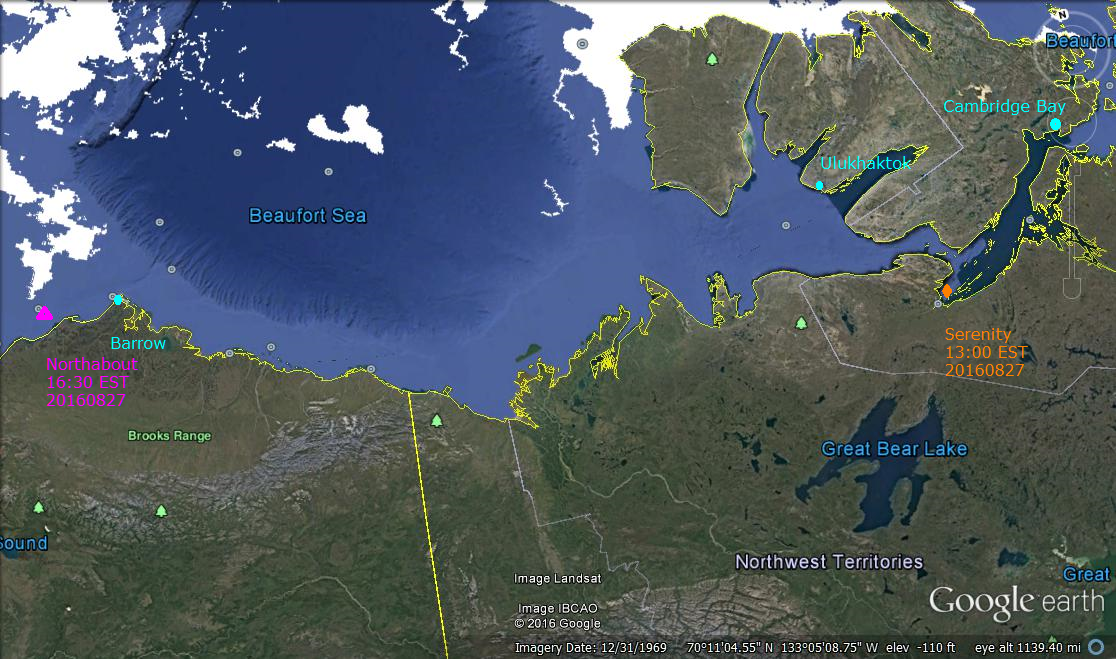
Cruise liner Serenity spent yesterday at Ulukhaktok and is at sea today, apparently paying a visit to the Kugluktuk waterfall just inside Nunavut.  I say apparently because the ship is not identified by name but there is nowhere else she could be on the way to her next port, Cambridge Bay.

Kugluktuk – ᖁᕐᓗᖅᑐᖅ – ‘Place of moving water’ (population 1400)

Kugluktuk is the westernmost community in Nunavut. It is located north of the Arctic Circle on the Canadian mainland at the mouth of the Coppermine River where it feeds into Coronation Gulf, which is part of the Northwest Passage. Situated near the border with the Northwest Territories, the scenic valley of the Coppermine River was an ancient source of copper for the Inuit people.

It has a unique microclimate that extends a narrow band of stunted boreal forest trees northwards toward the Arctic Ocean. Kugluktuk enjoys constant 24-hour sunshine from May 27 to July 17. The average temperature in Kugluktuk is the warmest in Nunavut, sometimes rising to 30°C in the summer. Winter temperatures range from -15°C to -40°C.

‘Kugluktuk’ means ‘place of moving water’ and the root word ‘kugluk’ means ‘waterfall.’ Upriver from this hospitable hamlet is the beautiful Kugluk cascade, also known as Bloody Falls, an ancient fishing and hunting location that is now a territorial park of historic cultural importance.

Meanwhile Northabout has made good progress and is approaching Barrow, Alaska, making her way between some ice and the shoreline.

The bigger picture below shows that the southern route through the Archipelago is mostly open water at this time, and the outlook is good for both Serenity and Northabout to achieve their itineraries.

20160827google2

For more context on Arctic ice extent see Arctic Ice Watch July 31.  For background on Polar Ocean Challenge see Laptev Wall and Nunavut Gauntlet.  For those who wish to browse Arctic ice in Google Earth, the procedure is simple.  Go to MASIE homepage and download the kmz file.  Clicking on the file should open it in Google Earth (presuming it is on your computer.) Then you can browse, zoom in and out, and take images.

Celebrity Serenity

I was once told by a fellow cruise passenger not to call our ship a boat.  He said in the Navy they knew if you were in a boat it meant something awful had happened to your ship.

The Good Ship Northabout


Update Aug. 26 Yes PM Pokes Fun at Climatism

Update May 12, 2017

This video seems to work for everyone:

Update Aug. 26, 2016 Below

In Feb. 2016 I posted this:

A humorous look at why the global warming campaign and the triumphal Paris COP make sense.

Yes Minister explains it all in an episode from 2013.

h/t to Peter S.

This is an all-too-realistic portrayal of political climatism today.

Update Aug. 26, 2016

Yesterday I realized that BBC had blocked the viewing of the video.  So I sought and found the subtitles for Yes Prime Minister 2013, Episode 6, “A Tsar is Born”.  That final episode for the series began with the dialogue in yesterday’s post Climate Alarms LOL.

Today I provide the dialogue that formed the episode conclusion, and which was the content of the blocked video.

The Characters are:

Sir Humphrey Appleby
Cabinet Secretary

Jim Hacker
Prime Minister

Claire Sutton
Special Policy Adviser

Bernard Woolley
Principal Private Secretary to the Prime Minister

(Dialogue beginning at 20:16 of “A Tsar is Born”)

Humphrey I have returned with the answer to all your problems.
Global warming.

Jim I thought you were against it?

Humphrey Everybody’s against it, Prime Minister.
I suddenly realised that is the beauty of it.
We can get a unanimous agreement with all of our European partners
to do something about it.

Jim But how can we do something about
something that isn’t happening?

Humphrey It’s much easier to solve an
imaginary problem than a real one.

Jim You believe it’s real?

Humphrey Do you? I don’t know.

Jim Neither do I. Haven’t got the faintest idea!

Humphrey But it doesn’t matter what we think.
If everyone else thinks it’s real, they’ll all want to stop it.
So long as it doesn’t cost too much.
So the question now is, what are we going to do about it?

Jim But if it isn’t happening, what can we do about it?

Humphrey Oh, there’s so much we can do, Prime Minister.
We can impose taxes, we can stiffen European rules about
carbon emissions, rubbish disposal.

We can make massive investments in wind turbines.
We can, in fact, Prime Minister, under your leadership, agree to save the world.

Jim Well, I like that!
But Russia, India, China, Brazil, they’ll never cooperate.

Humphrey They don’t have to. We simply ask them to review their emissions policy.

Jim And will they?

Humphrey Yes. And then they’ll decide not to change it.
So we’ll set up a series of international conferences.
Meanwhile, Prime Minister, you can talk about the future of the planet.

Jim Yes.

Humphrey You can look statesmanlike.
And it’ll be 50 years before anybody can possibly prove you’re wrong.
And you can explain away anything you said before by saying the computer models were flawed.

Jim The voters will love me!

Humphrey You’ll have more government expenditure.

Jim Yes. How will we pay for it? We’re broke.

Humphrey We impose a special global warming tax on fuel now,
but we phase in the actual expenditure gradually. Say, over 50 years?
That will get us out of the hole for now.

Bernard The Germans will be pleased.
They have a big green movement.

Claire And we can even get the progs on board!

Bernard As long as they get more benefits than everyone else.

Jim My broadcast is on Sunday morning.

Humphrey You have a day to get the conference to agree.

Jim That’s not a problem.
The delegates will be desperate for something to announce
when they get home.
There is one problem.
Nothing will have actually been achieved.

Humphrey It will sound as though it has.
So people will think it has.
That’s all that matters!

(Later following the BBC interview, beginning 27:34)

Bernard Oh, magnificent, Prime Minister!

Humphrey I think you got away with it, Jim,
but the cabinet will have been pretty surprised.
We’ll have to square them fast.

Jim Bubbles!

Humphrey We’re not there yet.
After that interview, you’ll need to announce some pretty impressive action.

Jim An initiative.

Humphrey Yes.

Claire A working party?

Humphrey Bit lightweight.

Bernard A taskforce?

Humphrey Not sure.

Jim Do we have enough in the kitty?

Claire It could be one of those initiatives that you announce
but never actually spend the money.

Jim Great. Like the one on child poverty.

Bernard Maybe it should be a government committee?

Jim Well what about a Royal Commission?

Humphrey Yes!
It won’t report for three years, and if we put the right people
on it, they’ll never agree about anything important.

Jim Right! A Royal Commission!
No, wait a minute, that makes it sound as if we think
it’s important but not urgent.

Claire Well, what about a Global Warming Tsar?

Jim Fine! Would that do it?

Humphrey No, I think it might need a bit more than that, Prime Minister.
It’ll mean announcing quite a big unit, and an impressive salary for that Tsar,
to show how much importance you place upon him.

Jim No problem. Who would it be?

Humphrey Ah, well, it can’t be a political figure.
That would be too divisive.
It has to be somebody impartial.

Jim You mean a judge?

Humphrey No, somebody from the real world.
Somebody who knows how to operate the levers of power,
to engage the gears of the Whitehall machine,
to drive the engine of government.

Jim That’s quite a tall order.
Anybody got any ideas?

Humphrey… Could you?

Bernard Oh!

Humphrey Yes, Prime Minister.

The End.

Footnote

CO2 hysteria is addictive. Here’s what it does to your brain:

Just say No!


Climate Alarms LOL

We skeptics enjoyed immensely the expert satire of Yes Prime Minister directed at the foibles of climate hysteria.  That clip was available at my post Laughing at Climate Change.  (That video is also now blocked, but I have added the transcript (here).

Now we find there was another even more skewering into the soft underbelly of the beast.  H/T Global Warming Policy Foundation (here).

“Computer models are no different from fashion models: seductive, unreliable, easily corrupted, and they lead sensible people to make fools of themselves.” –Jim Hacker, Yes, Prime Minister

The video was blocked by BBC in my country (Canada), but GWPF helpfully provides the transcript of the juicy bits:

Later in Act One, Scene Two
The phone rings. They all look at it.

Claire Hello? It’s the BBC again. I see. Thanks. (She hangs up.) Piling on the agony. A big new story about global warming has just broken, they’re adding that to the Sunday programme too. Global warming computer models have been proved wrong.

Humphrey How shocking!

Claire The new models show that it’s even worse than previously thought. Much more severe. And happening faster.

Jim Is that supposed to be my fault too?

Claire Everything is at the moment. They want to know why the government is dragging its feet on CO2 emission controls.

Jim (losing it) Do we have to deal with that tonight? As well as …(much has gone wrong for Jim earlier in the play)… Is there anything else, anything else we can pile on me tonight? Oh yes! Global bloody warming, thank you very much!

Claire It’s just that they’re going to add it to the catalogue of your failures. (He gives her a look.) Alleged failures, I mean.

Humphrey Meanwhile, may I suggest that you don’t worry too much about global warming?

Jim Right. I can’t do anything about that tonight, can I?

Humphrey Tell me, how do they know we’re all going to drown in years when the weather forecast was so wrong last Friday?

Jim Because all the scientists agree.

Humphrey So they say. So do the computer models. I know. But why should global warming computer models be any more accurate than financial ones?

Jim Um…

Humphrey Wall Street computer models were designed to prove sub­prime mortgage derivatives were low risk. These computer models are designed to show global warming is getting worse.

Jim Come off it, Humphrey.

Humphrey Remember mad cow disease? Computer models for that proved that we’d be dying in our hundreds of thousands by now. The only thing is, virtually nobody died, did they? Same with the salmonella-in-eggs computer models. Same with swine flu.

Jim You’re suggesting … what, exactly?

Humphrey Global-Warming models leave out nearly all the other possible causes except CO2. And then they say ‘Look, CO2 has caused all this climate change.’

Jim What other causes are there?

Humphrey If the earth were actually getting warmer, one might start by looking at the sun. Solar activity, water vapour, cosmic rays, sunspots, underwater volcanoes –

Jim If? The world is getting hotter, the science is overwhelming, everyone knows that.

Humphrey There’s been no rise in temperature since 1998.

Jim Really? But it was rising, wasn’t it?

Humphrey From 1975 to 1998, yes, absolutely.

Jim That’s what I mean.

Humphrey But it fell from 1940 to 1975. Even though that was a heavily industrialised period, when CO2 shot up. And overall the temperature isn’t rising at all: the hottest year in the twentieth century was 1934.

Jim I read that two thousand five hundred top climate scientists contributed to the last IPCC survey and they all agreed that man­made global warming is a proven fact and trapped greenhouse gases are the cause.

Humphrey Nearly fifty of them agreed. The others didn’t, actually. But their views were left out of the summaries given to the press.

Claire Haven’t you seen that film of the melting icebergs in the Antarctic?

Humphrey Yes. Beautiful, aren’t they?

Claire That’s caused by CO2.

Humphrey No, that’s caused by warm water masses from the Pacific.

Claire Why are the polar bears becoming extinct?

Humphrey Are they?

Claire The computer models say they are.

Humphrey But the people who actually go and count them have found more than there were thirty years ago.

Jim For heaven’s sake, Humphrey! If it’s all such nonsense why does everyone believe it?

Humphrey (amused) Hard to understand, I agree. But some scientists believe it, lots of others want the billions of pounds you can get for research that seems to show that global warming is caused by greenhouse gases, and most of the scientists who disagree can’t get published. Journalists love shock­horror stories, governments want to look virtuous to the voters, lefties want a way to rubbish big oil, and it makes the tree-huggers, whale-savers, anti-capitalists and everyone at the BBC feel holier than thou and warm and fuzzy inside. What’s not to like?

Jim Why hasn’t anyone else said all this?

Humphrey They have. No one wants to hear it.

Jim So wind farms don’t make sense?

Humphrey (chuckles) They certainly do, for all the businessmen who are getting enormous government grants for them. But there isn’t enough wind to be practical. The total output of all the UK wind turbines put together is one-fifth of one decent sized coal-fired power station.

Claire You don’t believe in global warming?

Humphrey My job is not to believe or disbelieve. My job is to weigh up arguments and produce answers. That’s what the Civil Service is for.

Jim I really think you must be misinformed somewhere. Al Gore got the Nobel Peace Prize for his work on global Warming.

Humphrey So did Dr Kissinger for his work on the Vietnam War.

Jim has no answer to that.

Jim You think it’s all a scam? I can’t get my head around this.

Humphrey For some people it’s a scam. For most, it’s just the greatest outbreak of collective hysteria since the witchcraft trials in the seventeenth century.

Footnote:

Apologies to anyone who didn’t know LOL is an internet reference meaning “Laughing Out Loud.”  Apparently that number includes Vladimir Putin who recently ended an interview with LOL, but he meant “Look Out Latvia.”

PS Further Wit and Wisdom from Sir Humphrey

Opposition’s about asking all the questions.
And government is about not answering them.

The less you intend to do about something, the more you have to keep talking about it.

“Open government” is a contradiction in terms. You can be open or you can have government.

Citizens don’t have a right to know, theirs is a right to be ignorant. Knowledge only means complicity and guilt, ignorance has a certain dignity.

If people don’t know what you’re doing, they don’t know what you are doing wrong.

“Under consideration” means we’ve lost the file. “Under active consideration” means we’re trying to find it.

Serenity Nearing Ulukhaktok Aug. 25

Ulukhaktok

Cruise liner Serenity is nearing its first port of call in the Northwest Passage just outside Nunavut.

Ulukhaktok NWT (population ~450) means “Place one finds material to make ulus.”

Ulu cutting tool made of steel with whale bone handle.

The place name comes from a time when these tools were made of sharpened slate, apparently plentiful in the area.

The ULU (OO-loo) is an extremely versatile cutting tool crafted by the Native Alaskan people over five thousand years ago. The knife was primarily used by Inuit women for skinning and cleaning fish and has played an important role in the survival of the Arctic people. Blades were originally made of polished slate and given a bone, ivory or wood handle. The handles were often inscribed with distinctive designs or markings exclusive to the maker of the knife.

Today, Inuit and people from all walks of life continue to use the versatile ULU as their primary cutting tool, despite the wide availability of other knife designs. Because the center of force is concentrated directly over the middle of the blade, it creates twice the direct downward force compared to that of conventional cutlery (where the force is behind the center of the blade). 


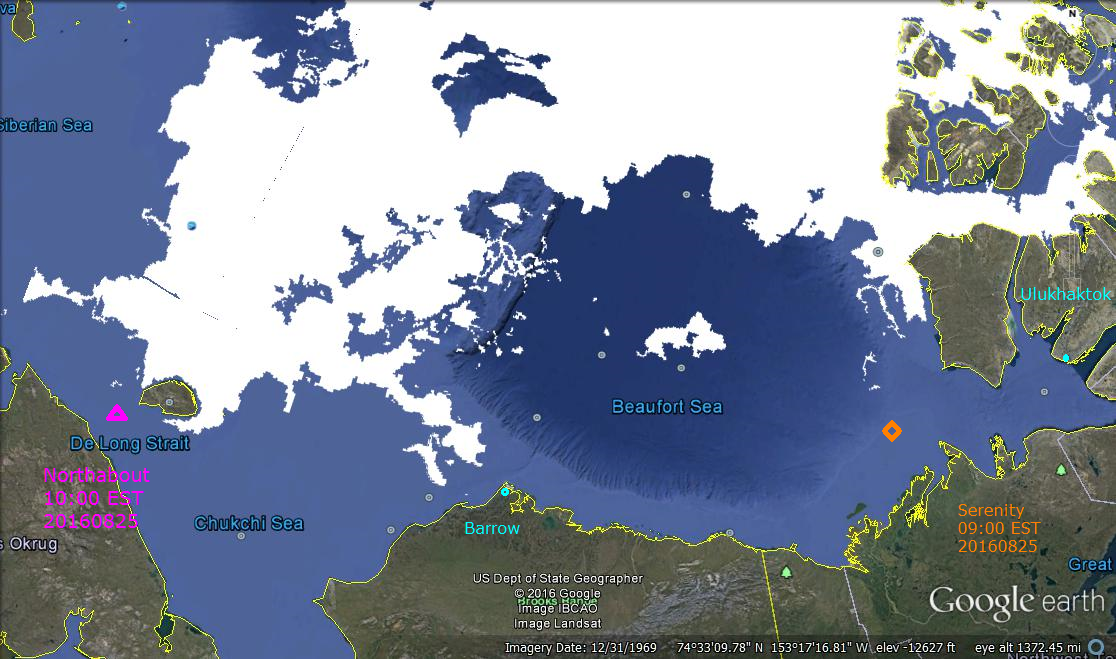
Today’s MASIE ice chart shows ice extent hovering around 5M km2 following the recent cyclone with variability mostly in BCE region (Beaufort, Chukchi, E. Siberian seas).  This happens to be the location of two ships exploring the ice extent: Northabout (Polar Ocean Challenge) and Serenity (Celebrity Cruiseliner).

20160825google1

Imagery date refers to Google Earth capture of land forms. Ice edges are August 24, 2016 from MASIE. Click to zoom in.

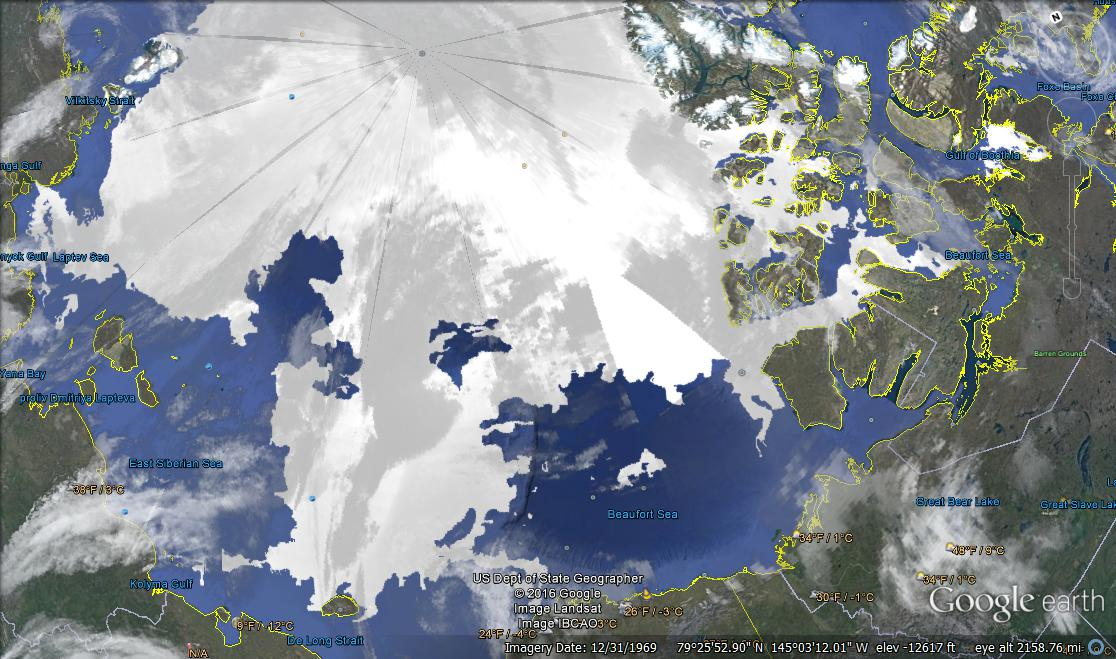
As the image shows, Northabout has passed the ice tongue but has to go further south before proceeding longitudinally. Serenity negotiated an icy area, before passing Barrow and soon approaching Ulukhaktok.  The bigger picture below shows that the southern route through the Archipelago is open at this time, but that can change in the days to come.

20160824google2

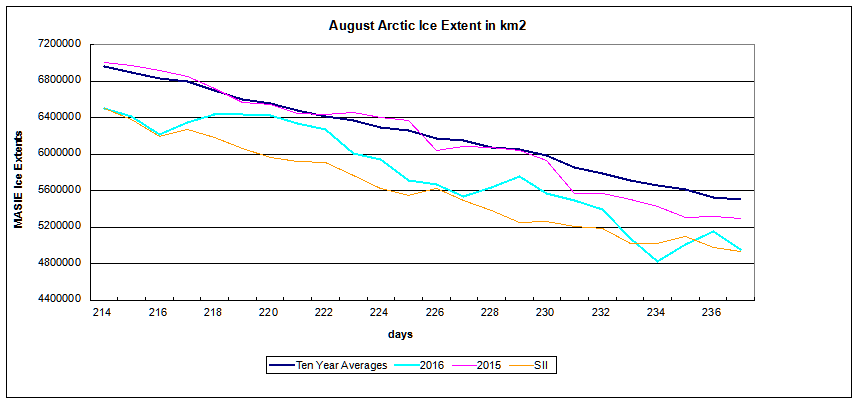
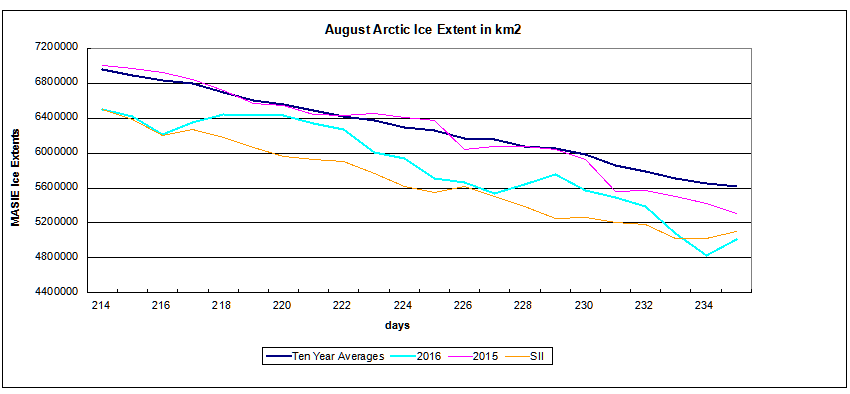
The Arctic Cyclone operating near the north pole has compressed the ice extents, The graph below shows the results: Overall ice extent which had recently stabilized lost 924k km2 in just 5 days. 472k km2 was lost in BCE (Beaufort, Chukchi and East Siberian seas) and another 139k km2 in CAA (Canadian Arctic Archipelago).

In the last 2 days MASIE shows an overall recovery of 323k km2, with 216k m2 in the BCE region.  The graph below shows the indices converging.

MASIE 2016 day237


For more context on Arctic ice extent see Arctic Ice Watch July 31.  For background on Polar Ocean Challenge see Laptev Wall and Nunavut Gauntlet.  For those who wish to browse Arctic ice in Google Earth, the procedure is simple.  Go to MASIE homepage and download the kmz file.  Clicking on the file should open it in Google Earth (presuming it is on your computer.) Then you can browse, zoom in and out, and take images.

Celebrity Serenity

I was once told by a fellow cruise passenger not to call our ship a boat.  He said in the Navy they knew if you were in a boat it meant something awful had happened to your ship.

The Good Ship Northabout


Aug.24 Update Arctic Ice Recovery and Ships

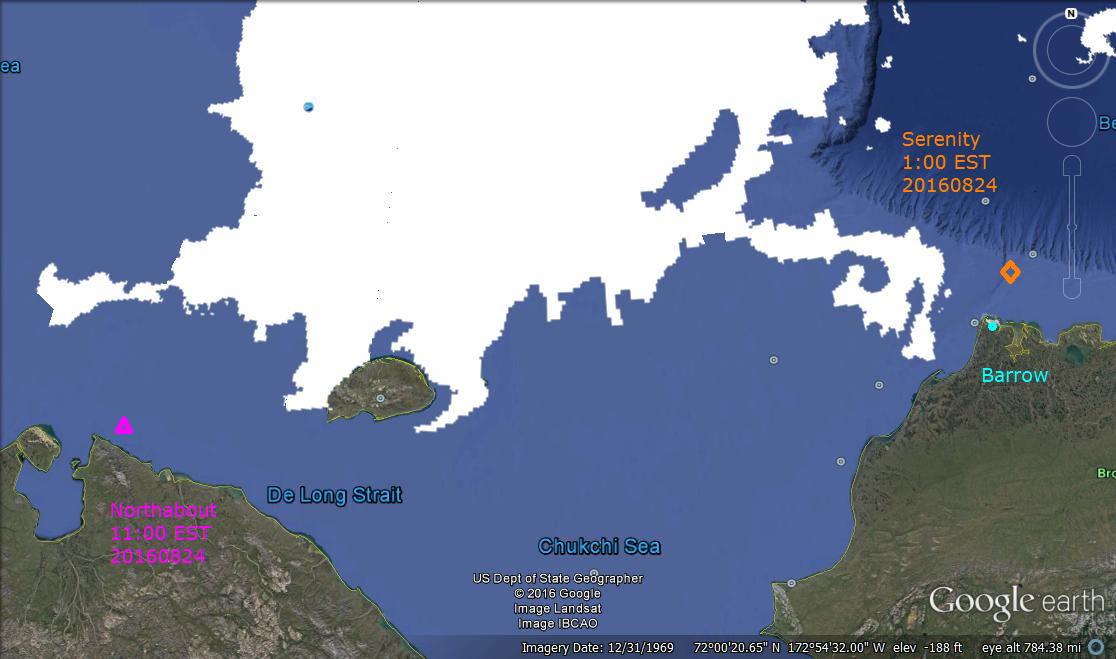
Today’s MASIE ice chart shows more recovery of ice extent following the recent cyclone, mostly in BCE region (Beaufort, Chukchi, E. Siberian seas).  This happens to be the location of two ships exploring the ice extent: Northabout (Polar Ocean Challenge) and Serenity (Celebrity Cruiseliner).

20160824google1

Imagery date refers to Google Earth capture of land forms. Ice edges are August 23, 2016 from MASIE. Click to zoom in.

As the image shows, Northabout has passed the ice tongue and can proceed to cross longitudinally. Serenity has also passed through an icy area, now above Barrow with open water ahead.  The bigger picture below shows that the southern route through the Archipelago is open at this time, but that can change in the days to come.

20160824google2

The Arctic Cyclone operating near the north pole has compressed the ice extents, The graph below shows the results: Overall ice extent which had recently stabilized lost 924k km2 in just 5 days. 472k km2 was lost in BCE (Beaufort, Chukchi and East Siberian seas) and another 139k km2 in CAA (Canadian Arctic Archipelago).

In the last 2 days MASIE shows an overall recovery of 323k km2, with 216k m2 in the BCE region.  The graph below shows the indices converging.

MASIE 2016 day236

For more context on Arctic ice extent see Arctic Ice Watch July 31.  For background on Polar Ocean Challenge see Laptev Wall and Nunavut Gauntlet.  For those who wish to browse Arctic ice in Google Earth, the procedure is simple.  Go to MASIE homepage and download the kmz file.  Clicking on the file should open it in Google Earth (presuming it is on your computer.) Then you can browse, zoom in and out, and take images.

Celebrity Serenity

I was once told by a fellow cruise passenger not to call our ship a boat.  He said in the Navy they knew if you were in a boat it meant something awful had happened to your ship.

The Good Ship Northabout


Update Aug.23 Arctic Ice, Cyclone and Ships

Today’s MASIE ice chart shows some recovery of ice extent, mostly in BCE region (Beaufort, Chukchi, E. Siberian seas).  This happens to be the location of two ships exploring the ice extent: Northabout (Polar Ocean Challenge) and Serenity (Celebrity Cruiseliner).

20160823google1

Imagery date refers to Google Earth capture of land forms. Ice edges are August 22, 2016 from MASIE. Click to zoom in.

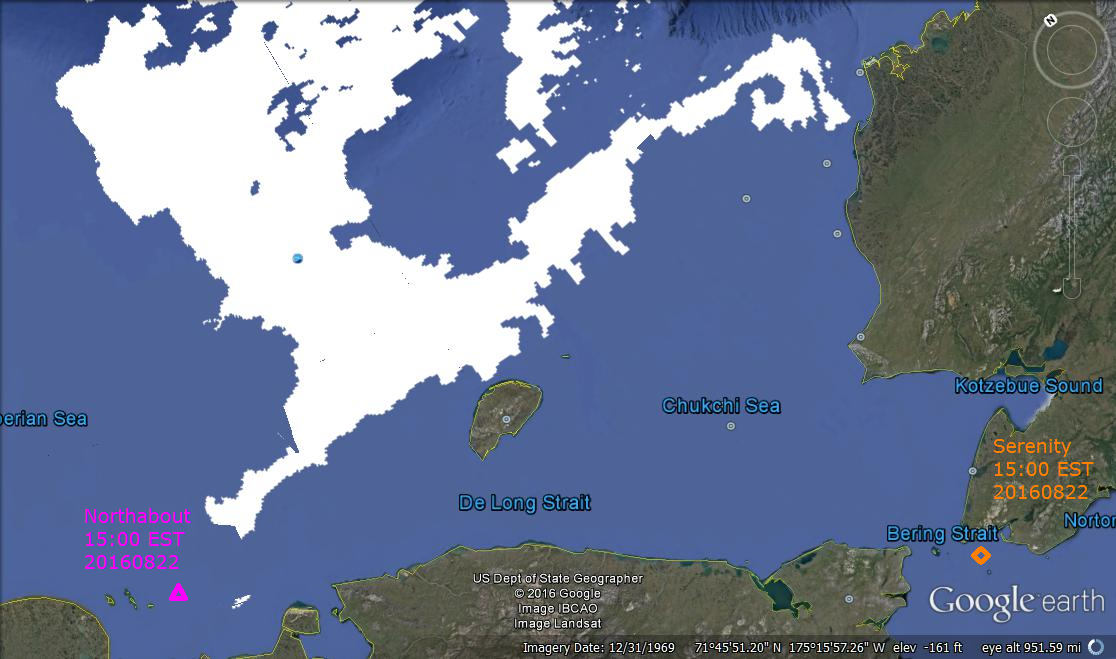
As the image shows, Northabout has moved close to shore due to a tongue of ice extending south, while Serenity has passed through the Bering Strait, heading towards Barrow, but with some ice ahead.  The pictured ice edges are from yesterday, but show a line of ice that could threaten the Beaufort passage.  That is especially an issue for Northabout, a small sailing boat foregoing any assistance from icebreakers.

The cyclone is winding down, but who knows what and where the ice will be.

Background

Image from The Great Arctic Cyclone of 2016: After Four Years, a Summer Sequel at Jeff Masters blog.

The Arctic Cyclone operating near the north pole has compressed the ice extents, The graph below shows the results: Overall ice extent which had recently stabilized lost 672k km2 in just 4 days. 300k km2 was lost in BCE (Beaufort, Chukchi and East Siberian seas) and another 100k km2 in CAA (Canadian Arctic Archipelago).  SII had been running ~200k km2 below MASIE and they are now close, with both showing an uptick yesterday.

MASIE 2016 day235


That is good news for the Northabout, and also for Serenity, the cruiseship scheduled to use the Northwest Passage. Of course, it will be not so good if they are caught directly in the winds and ice movements.

20160821google2

Imagery date refers to Google Earth capture of land forms. Ice extent is 20160820 from MASIE. Click on image to zoom in.


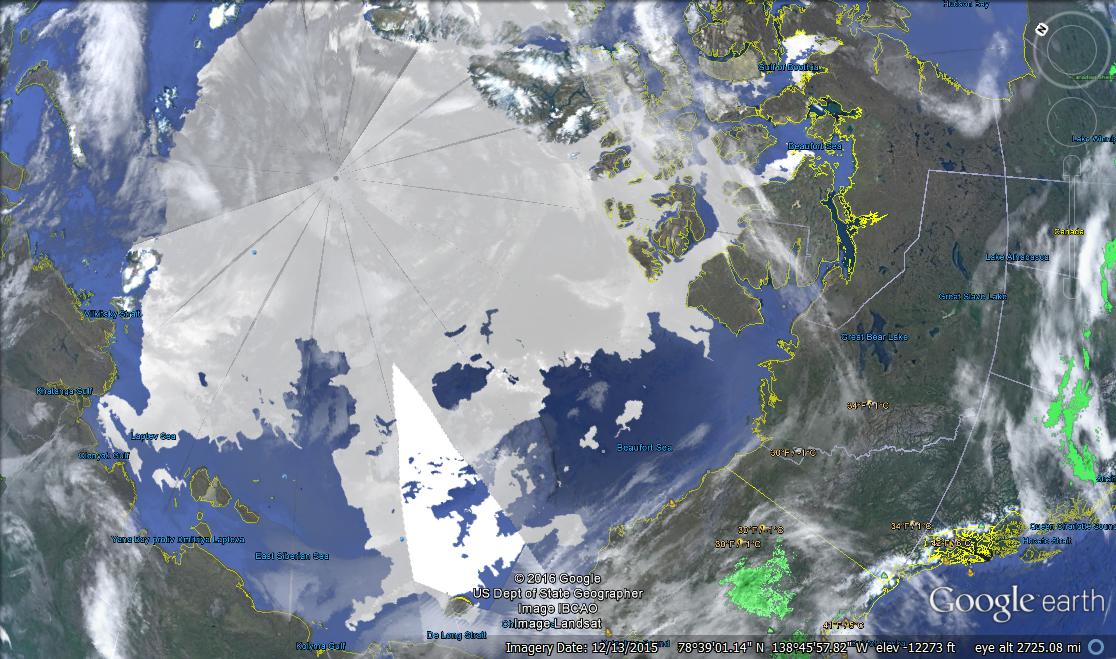
The Big Picture of Arctic land, ocean, ice and clouds.

20160821google3

For more context on Arctic ice extent see Arctic Ice Watch July 31.  For those who wish to browse Arctic ice in Google Earth, the procedure is simple.  Go to MASIE homepage and download the kmz file.  Clicking on the file should open it in Google Earth (presuming it is on your computer.) Then you can browse, zoom in and out, and take images.


Celebrity Serenity

I was once told by a fellow cruise passenger not to call our ship a boat.  He said in the Navy they knew if you were in a boat it meant something awful had happened to your ship.

The Good Ship Northabout


Power (and $) to the People

Donald Trump was half right when speaking recently in Montana, saying that people should have the say whether to frack or not in their backyard.

“I’m in favor of fracking, but I think that voters should have a big say in it. I mean, there’s some areas, maybe, that don’t want to have fracking, and I think if the voters are voting for it that’s up to them.”

UK Prime Minister has got it all right when she announced that the wealth will be shared with residents receiving checks directly if they choose to go with the extraction. Green and anti-fossil fuel activists are scrambling to denounce her move as “bribery” while ignoring their own undemocratic posture.  They worry about losing their power to stop progress when the discourse changes from “Not In My Back Yard” (NIMBY) to “Please In My Back Yard” (PIMBY).

A £1 billion shale wealth fund unveiled by former chancellor George Osborne in November will set aside up to 10 per cent of the tax proceeds from fracking to benefit the communities hosting wells.

But now the Prime Minister is amending the scheme so the money can go direct to residents rather than being given to councils or community trusts to spend, as Mr Osborne planned.

It is expected that the new fund could deliver as much as £10 million to each community where wells are sited.

Speaking ahead of the launch of a consultation on the fund, Mrs May said she wanted to make sure that individuals benefit personally from economic decisions.

She indicated that the model could be applied to other Government programmes, such as the Community Infrastructure Levy charge on property development in England and Wales.

“The Government I lead will always be driven by the interests of the many – ordinary families for whom life is harder than many people in politics realise,” said Mrs May. “As I said on my first night as Prime Minister, when we take the big calls, we’ll think not of the powerful but of you. This announcement is an example of putting those principles into action.”
Source: Fracking payments: Households in line for cash under Government plans Shropshire Star

Summary

Margaret Thatcher and Ronald Reagan don’t get enough credit for leading the free world to out-prosper the socialist block, thereby leading to the iron curtain collapsing, and eventually to economic reforms even in places like China and Cuba.

Today we are facing a growing tyranny of unelected bureaucrats at the EU and the UN whose power and resources are committed to a statist, left-wing agenda, using climate hysteria as justification.

Theresa May looks to be up for the fight. But will the next US President be a willing partner against entrenched special interests, activists and rent-seekers, or will it be someone beholden to them and to the status quo?


Update Aug.22: Arctic Ice, Cyclone and Ships

Today’s MASIE ice chart shows further compression and also shifting locations of sea ice in the BCE region (Beaufort, Chukchi, E. Siberian seas).  This happens to be the location of two ships exploring the ice extent: Northabout (Polar Ocean Challenge) and Serenity (Celebrity Cruiseliner).

20160822google2

Imagery date refers to Google Earth capture of land forms. Ice edges are for August 21, 2016 from MASIE. Click on image to zoom in.

As the image shows, Northabout is contending with a tongue of ice extending south toward the shoreline, while Serenity in on her way through the Bering Strait.  The pictured ice edges are from yesterday, but show a line of ice that could threaten the Beaufort passage.  That is especially an issue for Northabout, a small sailing boat foregoing any assistance from icebreakers.

The cyclone is expected to weaken later this week, but who knows what and where the ice will be.

Background from August 21

Image from The Great Arctic Cyclone of 2016: After Four Years, a Summer Sequel at Jeff Masters blog.

The Arctic Cyclone operating near the north pole is starting to compress the ice extents, The graph below shows the results: Overall ice extent which had recently stabilized lost 672k km2 in just the last 4 days. 300k km2 was lost in BCE (Beaufort, Chukchi and East Siberian seas) and another 100k km2 in CAA (Canadian Arctic Archipelago).  SII had been running ~200k km2 below MASIE and they are now a match.

MASIE 2016 day233

That is good news for the Northabout, and also for Serenity, the cruiseship scheduled to use the Northwest Passage. Of course, it will be not so good if they are caught directly in the winds and ice movements.

20160821google2

Imagery date refers to Google Earth capture of land forms. Ice extent is 20160820 from MASIE. Click on image to zoom in.


The Big Picture of Arctic land, ocean, ice and clouds.

20160821google3

For more context on Arctic ice extent see Arctic Ice Watch July 31.  For those who wish to browse Arctic ice in Google Earth, the procedure is simple.  Go to MASIE homepage and download the kmz file.  Clicking on the file should open it in Google Earth (presuming it is on your computer.) Then you can browse, zoom in and out, and take images.