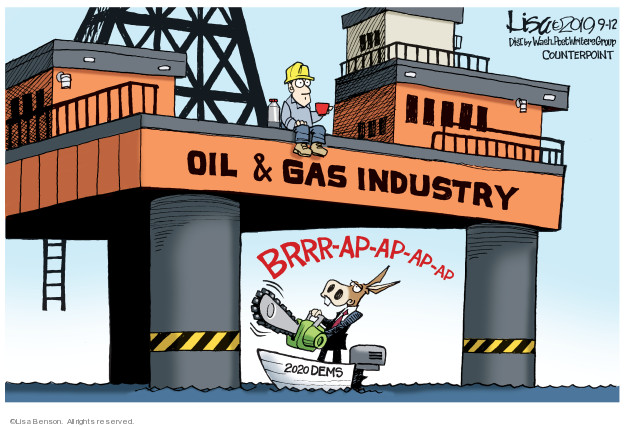
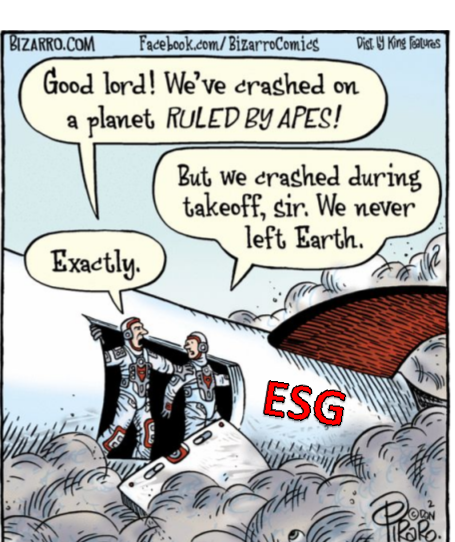
Top Ten Reasons Trump Won

The best list comes from an independent overseas observer. David Farrar of New Zealand wrote two posts at his Kiwiblog.  Below are excerpts of the highlights, in italics with my bolds and added images. (H/T Jim Rose). His extended discussion with many examples can be accessed at this link 10 Reasons Why Trump Won.

Overview

Before I cover the ten points, I will cover an important point by way of an introduction as it overlays all these reasons and that is that a big reason why Donald Trump won and won convincingly is because of a series of unique skills that Trump brings to the table. For his opponents they are character flaws but to his supporters they are features not bugs:

* His phenomenal resilience in the face of a wall of overwhelming hostility and opposition from the his opponents, media, governing elites (some from his own party). . . Any other candidate would’ve given up.

* His work ethic. Trump thrives on an average of only 4 hours sleep a night and has energy that belies his age. Trump held 80 rallies since the US Labor Day.

* His personal wealth not only helped top up his campaign during fund-raising lulls but he was able to pay millions to a large team of lawyers to defend himself in the various court cases.

* His phenomenal political instincts combine with a great sense of humour. Trump is a genuinely funny guy, but he also responds to events on the fly with the aplomb of the most seasoned pol.

* Much is made of Trump’s aggression, his inartful speaking style and partisan, personal barbs at his opponents. To millions of Americans, sick of being lectured to and abused by governing elites, Trump abrasiveness and forceful personality is seen as essential to getting the job of draining the swamp done. Media and governing elites all over the globe hate Trump for this trait but tens of millions of voters see him as the last hope to actually get things done, break some eggs, crack heads in Washington DC and to stand up to the Putin’s, Xi’s Khamenei’s and Jung Ill’s of this world.

1.Harris and Waltz were poor candidates

Rather than turning to its bench of seasoned, experienced, media-savvy operatives, the woke DEI obsessed Democrat elites felt the optics of skipping over the sitting Vice President Harris as a woman of colour would be too devastating to the liberal base of the party and so they opted for Kamala in the hopes that their superior war chest and wall to wall favourable media coverage would cover for her manifest deficiencies. The gamble didn’t pay off because her failings couldn’t be hidden. They include:

* She ran an awful campaign for the Democratic nomination in 2019/2020 with faltering debate performances and a grab bag of far left policy positions that became frequent fodder for Trump campaign ads.

* She came across as scripted and inauthentic with her every public word crafted by her handlers. . . Teleprompters were used in seemingly ‘spontaneous’ town halls, questions and questioners were screened and known in advance and every voter interaction was choreographed, often poorly.

* Her few interviews, almost exclusively on Democrat friendly venues like CNN and The View, went poorly.

* She talked confidently of what she would do as President to solve the big problems like the cost-of-living crisis and the border crisis and when confronted as to why she hadn’t done anything about these pressing voter concerns over the almost 4 prior years as VP, she descended into yet more word salad circular answers.

* Her rallies were the definition of astroturf. Unlike Trump’s huge rallies that were packed to the gunnels with ordinary unscreened voters, Kamala’s rallies were often by invitation and held in locations small enough to create an illusion of a large full crowd. Many had paid attendees who, crisscrossed the country as professional rally attendees.

* The Harris campaign tried to run on joy, “brat summer”, happy vibes and a New Way Forward when she was an integral part of the poorly run Biden Harris Administration.

* Vice Presidential picks are usually not too impactful with the top of the ticket hoping to do no harm with the pick. In this election, Trump’s selection of JD Vance enhanced his candidacy and Harris’ choice of Tim Waltz diminished hers. . .Waltz proved to be almost as bad in interviews as Harris, being stumped a few times. And the mismatch between him and Vance became painfully obvious during the single VP debate that was one of the most one-sided debate victories in favour of Vance of this type of contest in a generation.

2. “It’s the economy stupid.”

The massive printing of money that began with Covid and accelerated with all the Green New Deal spending boondoggles had the predictable effect of driving up inflation. The Biden Administration’s war on traditional energy (cancelling the Keystone XL pipeline, cancelling new oil and gas leases on Federal land and the EV mandates) all had the effect of scaling back the massive domestic energy boom under Trump’s first term causing a rise in energy prices, a process accelerated by the war in Ukraine and the uncertainty in the Middle East. This had the effect of driving up grocery prices in leaps not seen since the high inflation of the ‘70’s and a substantial increase in prices of petrol at the pump. . . increasing numbers of Americans were struggling to make ends meet and suffered a decline in their standard of living.

The American dream of home ownership for the rising generation became a more distant and unreachable goal. For the first time since the formation of the Republic in the 18th century, Gen Z became the first generation of young American adults to face a country less prosperous and with fewer economic opportunities than the previous generation. . . We had a race between an incumbent (Harris) and a challenger who had recently been President in the previous term and the economic juxtaposition proved to be electorally damaging for Harris.

3 . The weeping sore of the open border = rising crime

This was a hot button issue that sailed somewhat under the radar for the first two years of Biden Harris until the cumulative numbers of illegal immigrants crossing the border reached a critical mass in cities and towns across America. For many years, the problems of illegal immigration were largely confined to the border states of CA, AZ, NM and TX. Trump worked hard to seal the border with a raft of policies: ending catch and release, the ‘stay in Mexico’ policy for asylum seekers, no benefits for migrants and building sections of a border wall. The net effect was, by the end of his Presidency in 2020, that the US had the lowest number of illegal border incursions in a generation.

Biden ended all that on almost Day 1 of his Presidency reversing a raft of effective Trump Executive Orders essentially throwing open the border. Asylum seekers could enter and then be given a court date years hence and then be released with no repercussions for failing to appear.

The impact of this steady stream of illegals, many being young men of military age, into many more northern cities led to pressure on resources usually only seen in border states, a very visible presence on streets and in places like parks and swimming pools but most significantly, because of zero vetting of unsuitable migrants, a surge in violent crime that saw a string of high profile rapes and murders of innocent usually women at the hands of criminal illegals who had been previously convicted of serious crimes in their home countries. . .The straw that broke the camel’s backs was the reports of violent Venezuelan gangs taking over whole apartment complexes in middle class suburbs like Aurora in Denver Colorado and other cities like LA and Seattle and of organised Chilean gangs of professional thieves robbing wealthy homes in Scottsdale, Arizona.

Trump and Vance hammered these huge negative impacts of illegal immigration relentlessly at every opportunity and the promise of a mass deportation of illegals beginning with the high-profile criminals wreaking havoc across cities and towns across America. At first the Democrats tried to gaslight the electorate that there was no border crisis, then they tried a bait and switch with RINO Republicans on a border bill that was amnesty lite and offered only a minuscule improvement in numbers of illegals.

And then blame Trump and the GOP for not properly securing the border until Harris, finally sensing the electoral damage the open border was causing her party, became all bullish and strong on the border vowing to do as the new President what she never did as Biden’s VP despite being appointed by him as the Border Czar. It was too little too late and Trump’s extreme sounding solution to the problems caused by illegal migrants began to resonate with more and more voters.

4. Trump is winning the cultural war

The Democrat Party and liberal elites are obsessed with abortion and trans gender rights. Many liberal and never-Trump commentators made much about how pro-choice Democrat candidates in the 2022 mid-terms and subsequent special elections overperformed, and this signaled somehow the overturning of Roe v Wade was the secret sleeper issue that would propel Kamala to victory. The problem was the left, as they often do, over egged the abortion pudding with a drumbeat of inflammatory rhetoric. . . Pro-choice candidates and media would then straight up lie repeatedly about all three of these points: they banged on endlessly about Trumps’ planned abortion ban, they mischaracterized the overturning of Roe v Wade, and they denied that pregnancies were terminated weeks prior to birth or even after birth. Trump drained the venom out of the abortion stinger such that it was not the decisive factor in 2024 that it was in 2022.

The left’s obsession with trans rights was personified by Harris when she bragged that when she was Attorney General of California, she arranged for the State to pay for trans gender surgeries for inmates. As more and more biological men who benefited from male puberty chose to transition and compete in women’s sports and to invade women only spaces like bathrooms, changing rooms and refuges, gradually this became the pointy end of the cultural war between traditional views on sexuality and the progressive left. . . The New York Times just reported that the most potent and effective of all the political ads that the Trump campaign ran was the one where Harris bragged about trans gender surgery for prisoners and illegals with the tag line Harris: They/Them – Trump: You!

The 2024 election gave voters the opportunity to use their silent majority electoral muscle to end what America by an out of touch elite. A vote for Trump was seen as a vote for a return to sanity and normalcy in the cultural wars.

5. The impact of a free Twitter

In the run up to the 2020 election and in its aftermath, the Democrats and governing elites were able to augment their overwhelming sympathetic support of the mainstream broadcast media with indirect ability, through the intervention of the FBI and other government agencies, to silence the voices of critics through the major social media platforms: Facebook, Instagram, Twitter, You Tube, Tik Tok and Snapchat. This meant that information that might be politically damaging to the left (such as the release of Hunter Biden’s laptop just prior to the 2020 election and the accusations of fraud in the same election) could be ruthlessly suppressed. The cutting edge of this suppression was Twitter 1.0 because it was the social media space most frequented by the politically active and influential media, celebrity and businesspeople. . . This was election interference at its most effective and sinister because post 2020 election polling showed that, had the truth of the laptop been allowed to disseminate and not be blocked by mainstream and social media, a significant minority of Biden voters might have changed their vote.

When Elon Musk bought Twitter in the summer of 2022, he not only fired the woke compliant left leaning management team but 75% of the whole work force and repositioned Twitter 2.0, renamed “X”, as a more neutral public square on social media. He engaged the services of prominent left leaning journalist Matt Taibbi who he allowed to pour over the files and, in a series of posts called the Twitter Files, revealed the extraordinary efforts undertaken by the Biden campaign then Administration to suppress any information critical of things like the Biden family corruption, Hunter’s laptop and 2020 election fraud as all this was deemed as dis or misinformation. Musk spent time removing the various algorithms that were embedded to screen for ‘misinformation’ and he restored the accounts of high profile Biden critics like Trump and even controversial figures like Alex Jones.

A raft of high profile conservative influencers who were suspended from Twitter were restored then allowed to tweet and post without restriction through the run up to the 2024 campaign. Twitter/X became the favoured platform for numerous releases of information that were restricted or never covered by the other social media platforms and the MSM.

Breaking news of a controversial nature that would either be ignored by legacy media or suppressed by all other platforms can now be done freely on Twitter where, contrary to the naysayers that predicted that Twitter 2.0 would fail, it has increased its reach and viewership even more since becoming a genuine free speech platform. Musk’s decision to liberate Twitter has had a profound impact on the type of dialogue that could be had in the run up to the 2024 election and it became impossible for Harris and the Democrats to silence their critics in the way they were successfully able to during the 2020 election.

6. Greatly improved Republican ground game

There are four areas where Republican efforts more closely matched or even exceeded those of the Democrats whereas in all four, GOP campaigns in 2020 were significantly outspent and outsmarted:

Media spending. Trump was outspent by Clinton by 3:1 in 2016 and by Biden 5:1 in 2020. Whilst Trump closed the gap in 2020 somewhat with free publicity from his controversial statements (something that is called earned media), the volume of Democrat material disseminated to voters was vastly more in 2020. In 2024 this gap was significantly narrowed to the point where, allowing for Trump’s natural publicity seeking antics, it is fair to say there was virtual parity for the first time in many election cycles,

Ballot harvesting. There are legal variations as to the extent of ballot harvesting that can be done depending on relevant state law but regardless of that, in 2020 Republican campaigns engaged in zero ballot harvesting. That changed dramatically in 2024. Both the formal Trump campaign and various offshoots such as Charlie Kirk’s Turning Point Action and Scott Pressler hired hundreds of young people across most of the swing states to actively chase ballots. This was encouraging low propensity voters to register and vote early in states that allowed it and the chasing of high propensity voters on election day to ensure they voted. Each used sophisticated Apps that fed from real data from state election offices that identify voters yet to cast a vote by party affiliation where allowed. These groups wrung out 10,000’s of votes many of them from people who had either never voted or rarely voted. The most dramatic example of this was Pressler’s efforts just in Pennsylvania where he and his team registered 180,000 Amish! The Amish traditionally don’t vote but regulatory overreach by the Democrat administration in Pennsylvania in seizing and destroying raw milk so upset the Amish that they were propelled into political activism and voted en mass for Trump.

Campus outreach. Charlie Kirk, as a young 30-year-old articulate and knowledgeable debater, had for years visited large university campuses across America but in the run up to 2024, he ramped up his efforts. Often all it involved was setting up a TPUSA tent and advertising that he was there to answer any questions from student voters with a particular emphasis on Harris or non-committed voters. Kirk’s exchanges are legendary and as the swell of support for Trump grew, these events attracted thousands of students each time and Kirk gave away 1,000s of MAGA hats each time at literally hundreds of events over the years. Exit polls show that Trump made huge inroads into the Gen Z vote and won a plurality of Gen Z males, and this result was largely because of Charlie Kirk’s efforts, and this campus outreached was barely matched by the Democrats.

Defensive lawfare. Trump’s campaign in 2020 ran out of money 3 weeks out from the election for anything other than his huge rallies. Media advertising almost dried up and there was no money to pay lawyers to defend the vote from illegal actions by mostly Democrat election officials at the state and county level. In contrast, in 2024 a vast sum was spent recruiting hundreds of lawyers and hundreds of thousands of poll watchers and these lawyers were judiciously deployed in battleground states and were phenomenally successful. Various incidents cropped up in the weeks leading up to the election and on the day itself from shutting down early voting lines too early, to deliberately malfunctioning machines to barring Republican poll watchers. The lawyers were specific to each states’ election laws and swiftly intervened and the threat of legal action was often enough to get a behaviour change and when legal action made it to court, the well documented evidence was almost always sufficient to have a capricious and incorrect ruling or procedure overturned or aligned with state law. .  .Whilst there was undoubtedly fraud in places on November 5th, this time it was far less impactful because of the aggressive defensive lawfare waged by the Trump campaign.

7. The fall of legacy media and the rise of alternative media

Donald Trump began labeling the mainstream media as fake news pretty early into his 2016 campaign. Since then, he has gone a step further and often called the MSM “the enemy of the people”. It has been known for many decades that the world’s legacy media generally have a liberal left leaning bias. For many years institutions like the big 3 US networks, Canada’s CBC, Britain’s BBC, Australia’s ABC and NZ’s TVNZ and RNZ journalists tried hard to hide their biases and reported the news in a more neutral and professional way.

But as time has gone by and as journalism schools have been churning out more and more ideologically activist and more overtly political graduates, the newsrooms of legacy media globally have become more openly biased and more nakedly partisan. Parties and politicians from the right are subjected to more slanted coverage, more hostile questioning and way more investigative scrutiny whilst favoured candidates and parties on the left increasingly face limited scrutiny, soft ball questions and outright suppression of news stories that might make them look bad.

But when Donald Trump came onto the political stage, he provoked a veritable firestorm of MSM opposition that has intensified and not abated. The MSM have rushed to cover hoax after hoax that initially made Trump look bad (I covered a bunch of these here). The US corporate media peddled the lies that Trump only won in 2016 with the help of Russia, they gleefully published lies of the 51 Democrat friendly intelligence experts who claimed Hunter Biden’s laptop was Russian disinformation and they lied about the origin of Covid and pilloried and banned people who said the virus originated from the Wuhan Institute of Virology. All these lies were eventually uncovered and debunked, but the media have continued to peddle any lie that makes Trump look bad. In the current Presidential campaign, this is but a sample of the massive anti-Trump pro-Kamala skewering that has occurred on MSM outlets:

* During the ABC sponsored debate between Trump and Harris, ABC executives agreed in advance to limit certain types of questions to Harris and stayed away from all ‘no-go’ topics as suggested by the Harris campaign. Trump was only asked questions of concern to Democrats and was subjected to attempts at real time fact checking by the moderators whilst ABC agreed in advance to no fact checking of Harris. It was obvious to even the most nonpartisan observer that Trump was debating not just Harris but the moderators as well.

* Harris’ 60 Minutes interview reached a new low of the MSM putting their thumb on the scales when they replaced a long rambling word salad nonsensical answer that Harris gave to a question posed about the administration’s response to the Gaza war with a more simple and rational answer that she gave in another part of the interview. That is extreme journalistic malpractice AND election interference that will have profound repercussions for CBS once Trump changes the partisan makeup on the FCC and FEC.

* The MSM are notorious for amplifying outlier polls that favoured Harris. Perhaps the most egregious example of this was the famous Des Moines Register poll by Ann Seltzer, considered by many as the gold standard of polls. Whilst Seltzer had a prior track record that has been pretty accurate, any polling expert could’ve told you that a poll showing Harris up 3 in Iowa when all other polls had Trump up by 7 to 10% (and the fact that Trump won Iowa by 11% and 8% in 2016 and 2020 and eventually won in 2024 by 13%!) was a dramatic outlier. But in the heat of the campaign with Trump tied in national polls and slightly up in swing state polls, the prospect of a hidden Harris blue wave was too tempting to pass up and so this poll was blasted from legacy media rooftops (and was even given prominence from our esteemed site owner Mr. Farrar perhaps because of his well-publicised disdain for DJT). The pollsters who picked Trump’s eventual result were ignored and even scoffed at. The pushing of outlier polls is a deliberate conservative voter suppression tactic engaged in on a regular basis by the MSM.

People aren’t stupid, they can see this bias and they react accordingly.

What has been the impact of the media’s descent from neutral, a-political, down the middle reporting to slanted, ideologically driven coverage and outright hostility to the GOP candidate for the most powerful office in the world?

* Gradual but accelerating ratings and subscription declines – more on that later.

* Decline in profitability – MSM newspapers like the Washington Post have laid off hundreds and look at the closing of TV3 and layoffs at TVNZ and Stuff in New Zealand.

* Slump in public trust as indicated in polls that show the MSM polling worse than Congress.

* A widespread belief that the MSM are biased against Trump and protecting Kamala has inevitably led to a rise in viewership of alternative media.

Into the void left by the increasing partisan legacy media has stepped a variety of conservative commentators who have been able to rack up substantial views and social media impressions that have come to swamp who views the legacy media. Many of the people I am about to mention have podcasts and shows that they broadcast from their websites, Twitter, Rumble and even mainstream social media platforms that regularly match and exceed even the major network news shows and far exceed equivalent shows on CNN and MSNBC. The biggest players on this list have audiences that vastly outstrip even the biggest MSM shows or podcasts.

Trump became very adept at using new media despite his age. His youngest son Barron, who is an 18-year-old college student in New York, mingles with all the big conservative Gen Z and Millennial influencers from the so-called Manosphere including Theo Von, the Nelk Boys, Adin Ross, Andrew Schulz and Shawn Ryan. Trump appeared on all their shows each with millions of views and came across as natural and funny to huge audiences of disaffected young males. Of course, the grand poohbah of the Manasphere is former UFC executive Joe Rogan whose centrist Spotify show has the biggest reach of any podcast in the world, each with an average viewing audience of 16 million. Trump’s famous 3-hour unscripted riff with Rogan where Rogan asked whatever questions he wanted (and Trump answered without ducking and diving) garnered across Spotify, You Tube and Twitter almost 100 million views! These appearances helped propel Trump to dominating the under 30 male vote in a way that Harris couldn’t come close.

The net effect of all of this: the Trump hating MSM are losing their grip on the narrative. Whilst they still have some influence, they are increasingly becoming a liberal echo chamber religiously watched mostly by left leaning true believers whilst Independents and right leaning folk are consuming their news from alternative sources that increasingly have a far greater reach then the legacy media. This played a vital role in Trump’s victory and his decisive win will only accelerate this decline unless the MSM return to their roots in reporting unbiased straight news and let go of the politically slanted advocacy that poses for news.

8. The proliferation of global conflicts

Trump is the first President in 40 years to not commence a new war. Reagan invaded Grenada, Bush 1 fought the Gulf War, Clinton attacked the former Yugoslavia, Bush 2 invaded Iraq and Afghanistan, Obama toppled Gaddafi and Biden has sent hundreds of billions to fund Ukraine. Trump withdrew troops from Iraq and laid the plans (that were massively cocked up by Biden) for an orderly withdrawal from Afghanistan. Trump negotiated and signed the Abraham Peace Accords ushering unprecedented diplomatic rapprochements between Israel and various Arab nations. Trump defused the escalating nuclear tension with North Korea all while getting NATO countries to pay their fair share of military expenditures.

More significantly is what Putin didn’t do during Trump’s 4 years. Under Obama he invaded Crimea and Georgia and under Biden, he invaded Ukraine. Putin made no territorial incursions under Trump. There was relative stability in the Middle East from 2017 to 2021. There is no way Hamas would’ve attempted their brazen infiltration into southern Israel under Trump and yet their actions under Biden have sparked the most prolonged and bloody conflict in Gaza and such tension and military retaliatory action with Iran as to see the whole region on the brink of war.

Biden’ poor handling of the Ukraine war, for a while, saw the very real threat of US and NATO boots on the ground in an escalation of the war between Ukraine and Russia. And if that isn’t enough, the Chinese also sensed Biden’s weakness and have threatened the sovereignty of Taiwan in a way that Xi never remotely attempted when Trump was in power.

The supreme irony in all this is that in 2016, the Democrats said that Trump would plunge the US into global wars and that his warmongering would lead to an unstable world. The truth was the opposite happened – Trump presided over a period of relative peace and only used US military muscle selectively to quickly destroy the ISIS Caliphate in Syria and Iraq, a task that eluded Obama for 8 years. It is Biden and his weakness as a leader that sees the world on fire and on the brink of something akin to WW3 and it is Trump who was and will be again the candidate for peace. The prospect of America’s sons fighting in the midst of a Slavic conflict thousands of miles from home was a motivation for some voters to hold their nose and vote for the man who sends mean Tweets.

In the two days since Trump was elected, Zelenskyy has called him, Putin has scheduled a call, Hamas is saying it will end the war, Qatar has asked Hamas’ leadership to leave and I’m guessing the Chinese won’t be trying any drills where they encircle the whole island of Taiwan any time soon.

9. The RFK Jr – Tulsi Gabbard coalition

I covered the positive political impact of RFK Jr’s endorsement here. Trump has brought into his inner circle three high profile Democrats: JFK Jr from the closest America gets to a political royal family, Tulsi Gabbard who once was deputy chair of the Democrat National Committee and ran for the Democratic nomination for President in 2020 and Elon Musk who publicly backed and donated to Democrat politicians for years. Each of these people brought key constituencies to Trump’s cause and, perhaps more importantly, they gave permission for centrists and moderate Democrats, disgusted by their own party’s decent into left wing identity politics but turned off by Trump’s bombastic and at times arrogant persona, to vote for Trump.

Joe Rogan (and many others) made the case that voting for Trump is not just about Trump but you’re voting for Tulsi, for RFK Jr and for the thousands of political appointees that will implement the policies that resonate with an actual majority of voters. Trump drove the Cheney’s, Mitt Romney and Adam Kinzinger to support Kamala and in exchange, he got Kennedy, Musk and Gabbard. I think that’s an awesome winning exchange and in the end, so did voters.

10. The lawfare and the assassination attempts against Trump backfired.

I covered this topic more extensively in these two posts. In summary, Trump’s opponents thought they had him on the ropes with all the various indictments when in actual fact, the politically motivated lawfare against Trump worked in his favour. When Fulton County District Attorney Fani Willis insisted Trump be arraigned in person at the County Jail in a seedy inner city part of Atlanta, Trump’s defiant mug shot became a viral sensation but, much more significantly, it helped cement Trump’s record level of black male support that helped propel him to victory in Michigan, Pennsylvania and Georgia. The footage of thousands of poor blacks lining the streets to the jail to cheer Trump as he exited the arraignment went viral in the African American community.

I don’t need to overstate the political impact of the two assassination attempts, most particularly the July 13th attempt at the rally in Butler, PA. The photo of a bloodied Trump with his raised pumped fist under a huge American flag ranks up there with the shot of Churchill’s VE Day speech to a monstrous crowd in London, the flag raising at Iwo Jima, John Kennedy Jr saluting his Dad JFK at his funeral, the fleeing Vietnamese refugees from the My Lai massacre in 1968 or the lone protestor holding up the tanks on Tiananmen Square. Trump’s pugnacious and defiant response reinforced his image as the ultimate alpha male in the eyes of millions and, whilst not intended nor sought after, became a major electoral plus for him.

Conclusion

Whilst the electoral magnitude of Trump’s victory is not on the same scale as the two Reagan victories in 1980 and 1984 (489 to 49 and 525 to 13) nor the Nixon 1972 49 state sweep, nonetheless it will go down as one of the greatest comebacks in US political history given the unique nature of Trump and his experiences. His defeat in 2020 was shrouded in controversy with allegations (credible IMO) of election fraud that were of a magnitude that, in his mind and in the mind of many supporters, cost him the election. The events of January 6, 2021, came to overshadow and dominate Trump’s prospects with unprecedented levels of negative publicity aimed at Trump as his opponents sought to blame him for the events at the Capitol that day. He faced two impeachments, he was the subject of two Special Counsel enquiries, he was indicted 94 times on politically motivated charges (many of which will now melt away now that he has won and the rest will be reversed or die in appellate courts), the state of New York tried to bankrupt him and seize key properties, he has faced the most unrelenting media opposition of any politician, he faced two assassination attempts that came close to succeeding, frankly any other person would’ve given up. He faced a wall of negative media coverage of his campaign and fawning sycophantic coverage of his opponent, and countless attempts yet again at electoral fraud and he faced down the lot AND WON and won convincingly. It is a feat that may never be equaled in the annals of US political history!


Both US and Canadian Media Misunderstand America

David Polansky is an American living in Canada (as am I) and expresses very clearly the frustration I share with him.  His National Post article is Neither Canadian nor U.S. media understand America. Excerpts in italics with my bolds and added images.

The great novelist Saul Bellow once wrote: “I have developed a certain sympathy with Canada. It’s no easy thing to share a border with the USA. Canada’s chief entertainment — it has no choice — is to watch (from a gorgeous setting) what happens in our country. The disaster is that there is no other show.”

Unfortunately, despite countless hours of American media consumption,
many Canadians understand their neighbor surprisingly poorly.

The latest program to capture attention here, as elsewhere, was of course the U.S. general election, which Donald Trump won for a second time, much to the consternation of the pundit class in particular.

Now, my own life has taken the inverse trajectory of Bellow’s, having been born in the United States and subsequently moved to Canada, and I have reflected over the years upon both the differences between the two countries, and how each appears to the other. And a recurring theme I’ve noticed is the particular way that Canadian political commentators consistently misapprehend their southern neighbor.

Part of the reason for this goes beyond ordinary errors of judgment. The commentariat class here heavily derives its understanding of American political developments from its U.S counterparts in the media complex and is thus twice removed from political reality when those same counterparts prove deficient in anticipating and accounting for events.

Many decades ago, the literary scholar Lionel Trilling described conservatism as merely “a series of irritable mental gestures.” Something like this could be applied to many of the reactions to Trump’s presidential victory this week — particularly those which aim their ire not just at Trump or his inner circle, but at Americans in general.

And this last line of criticism is particularly appealing to Canadian pundits, as it affords them the opportunity to indulge in a passive-aggressive form of nationalist preening (“oh, the Americans are at it again”) otherwise rarely available to them.

Meanwhile, the incessant reliance of pundits on “fascism” and “populism” as explanations for Trump’s continued success have proven emotionally satisfying at the cost of real analysis, as it prevents people from recognizing the democratic nature of Trump’s appeal. It has also led these critics to disregard the ways in which ordinary democracy is perfectly capable of procuring undesirable outcomes on its own.

It is not particularly helpful to blame election outcomes on oligarchy when Trump handily won the popular vote as well as the electoral vote, nor can the by-now instinctive reference to racial supremacism and bigotry account for his unprecedented gains among non-white voters of nearly all backgrounds.

Acknowledging these realities hardly requires endorsing him; none of this means that political observers are obliged to like or admire Trump. But it does mean that they cannot in good faith blame his political success on extra or anti-democratic factors. It is only the false belief that all desirable things must go together, such that democracy cannot be democracy if it produces unwelcome outcomes, that leads people to think this way.

Finally, it must be said that what Machiavelli would call “tumults”— that is tempestuous democratic political commotion — have long been a feature of the U.S. political landscape; and while not wholly positive, these have also contributed in complex ways to that country’s unique dynamism. That this aspect of American political life is not entirely to Canadian tastes is perfectly understandable (nor are Canadians alone in this regard), but it is a consistent mistake that outsiders make in pathologizing political tendencies that lie outside the boundaries of acceptable behavior in one’s own country. That these same dynamics are not much-loved (or well understood) by America’s own media and academic elites is yet another filter that obscures clear-sighted observation from across the border.

Meanwhile, the worst thing Canadians could do now is treat American politics as a foil for their own situation at home. For, within Canada itself, we will likely see an impulse to react to events in the United States not simply as matters of concern for foreign policy, but as though they required a domestic political response. This would be a mistake, partly because Trump is, of course, not a Canadian political figure, nor is there such a thing as “Trumpism” here in any meaningful sense. But also, because Canada presently faces serious political and economic challenges of its own, none of which are causally related to developments within the United States, despite their proximity. Indeed, at a time when Canada’s economy is performing worse than Italy’s or Spain’s, there will likely be strong incentives for pundits and politicians to fight pretend culture wars against phantom American threats as a distraction from the difficult and serious business of actually governing.

This impulse should be resisted at all costs. But if past is precedent, the Great American Show, broadcast in every household in blazing 4k resolution, will continue to overwhelm attempts at sober and reasoned consideration of real political issues at hand.


At a Climate Policy Tipping-point

UCP members voted in favor of a resolution to “recognize the importance of CO2 to life and Alberta’s prosperity.” Credit: Danielle Paradis [Participants numbered over 6000]

Joe Oliver explains at National Post We’re at a climate policy turning-point.  Excerpts in italics with my bolds and added images.  Much as the term “tipping-point” is overused regarding physical and natural systems, it is relevant to socio-political systems.  Oliver’s article was written before the US election vote between two candidates with completely opposite climate/energy positions.  It was a few days after an important vote in energy rich Alberta affirming the vital role of hydrocarbons. [See Alberta: “CO2 Gas of Life, Not Pollutant!” Media Outrage Ensues]

Across Europe and North America, voters are increasingly skeptical
of climate alarmism and worried about the high cost of net-zero policies

Climate alarmism is facing daunting scientific, economic and political challenges to its credibility with the public and its influence on government policy in Europe, the United States and Canada. It may finally have reached an historic turning point.

The public is constantly warned about a dangerous surge in warming since the late 1970s due to increased man-made GHG emissions. But a recent peer-reviewed article by five academicians with expertise in oceanography, mathematics and statistics contradicts that conventional wisdom. They find no statistically significant change in the warming rate beyond the 1970s — even though emissions have risen 121 per cent since then, from 24 billion metric tonnes in 1970 to 53 billion in 2023.

They are not alone. John F. Clauser, 2022 winner of the Nobel Prize for physics, is one of 1,960 scientists and professionals from around the world, including 146 Canadians, who have signed the Clintel World Climate Declaration, whose central message is that there is no climate emergency.

These results pose two basic challenges to the core beliefs of climate alarmists.

♦  If warming has not accelerated in the past half century, where is the crisis? And,
♦  If a doubling of GHG emissions is supposed to directly impact temperatures, why have temperatures not shot up?

The latter question also applies to the 1970’s, when go-to experts and the mainstream media were hyperventilating about a return to an Ice Age, though GHG emissions had doubled in the previous 30 years.

Meanwhile, European economic growth has stalled, in large part due to the high cost of energy, which makes industry uncompetitive and drives energy-dependent companies to the United States. Germany, now the sick man of Europe, is de-industrializing, a direct result of former chancellor Angela Merkel’s reckless abandonment of nuclear energy and her country’s consequent reliance on Russian gas. The German automotive sector is also in crisis, the loser in a failed bet on EVs.

Tellingly, the issue of climate change has been virtually absent
from the American presidential campaign, even though the
two candidates have opposing views on the subject.

Donald Trump has made some headway condemning Kamala Harris for senseless green policies that damage the economy and hurt American workers. The one climate issue that has been high-profile is fracking. In a dramatic reversal from her position in 2019, Harris now supports it, which is important in Pennsylvania, a state crucial to her election chances. If she wins, she will back subsidies for renewables and discourage fossil fuel development. If Trump wins, it will be “Drill, baby, drill,” a rejection of climate alarmism and a retreat from the so-called Inflation Reduction Act, all of which would reverberate globally.

Although most Canadians claim to be concerned about global warming, it is no longer high on their priority list and they were never prepared to pay much to deal with it, in any case. Axing Ottawa’s key climate policy, the carbon tax, has become a powerful vote-winner for Conservatives across the country. Ontario Minister of Energy and Electrification Stephen Lecce has come out in favour of every source of energy to produce electricity, including nuclear for base load and natural gas to back up wind and solar. Without gas, the province would suffer from brownouts and blackouts, ballooning costs and an uncompetitive industrial sector.

Despite all this, Canadian politicians are not yet ready to acknowledge publicly three increasingly evident realities that contradict climate orthodoxy:

    • Net zero is unattainable without devastating economic and social costs — and may be unattainable, period.
    • Canada cannot on its own make a discernible difference to the global climate. And, therefore,
    • Climate policies are mainly an extremely expensive form of virtue-signaling.

The federal Liberals, blinded by catastrophism and the appeal of big-government solutions, will not retreat from their crushingly costly climate program. But they almost certainly will be gone within a year, though their death throes seem interminable. A new Conservative government should focus on adaptation and research, which are effective and affordable ways to deal with extreme weather and moderately rising temperatures.

Yes, those are Trillions of US$ they are projecting to spend.

Though the signs are encouraging it is still too early to be sure we have reached peak climate alarmism. But the time is coming when common sense and rationality re-emerge — first gradually and then probably suddenly. One day we will look back with deep regret and wonder how collective madness captured the Western world and caused it to sacrifice hundreds of trillions of dollars to a false idol.


10/2024 Update Recent Warming Spike Drives Rise in CO2

Previously I have demonstrated that changes in atmospheric CO2 levels follow changes in Global Mean Temperatures (GMT) as shown by satellite measurements from University of Alabama at Huntsville (UAH). That background post is reprinted later below.

My curiosity was piqued by the remarkable GMT spike starting in January 2023 and rising to a peak in April 2024.  I also became aware that UAH has recalibrated their dataset due to a satellite drift that can no longer be corrected. The values since 2020 have shifted slightly in version 6.1, as shown in my report yesterday UAH October 2024: NH and Tropics Lead Global Cooling.

In this post, I test the premise that temperature changes are predictive of changes in atmospheric CO2 concentrations.  The chart above shows the two monthly datasets: CO2 levels in blue reported at Mauna Loa, and Global temperature anomalies in purple reported by UAHv6.1, both up to October 2024. Would such a sharp increase in temperature be reflected in rising CO2 levels, according to the successful mathematical forecasting model?

The answer is yes: that temperature spike results
in a corresponding CO2 spike as expected.

Above are UAH temperature anomalies compared to CO2 monthly changes year over year.

Changes in monthly CO2 synchronize with temperature fluctuations, which for UAH are anomalies now referenced to the 1991-2020 period. CO2 differentials are calculated for the present month by subtracting the value for the same month in the previous year (for example October 2024 minus October 2023).   Temp anomalies are calculated by comparing the present month with the baseline month. Note the recent CO2 upward spike and drop following the temperature spike and drop.

The final proof that CO2 follows temperature due to stimulation of natural CO2 reservoirs is demonstrated by the ability to calculate CO2 levels since 1979 with a simple mathematical formula:

For each subsequent year, the CO2 level for each month was generated

CO2  this month this year = a + b × Temp this month this year  + CO2 this month last year

The values for a and b are constants applied to all monthly temps, and are chosen to scale the forecasted CO2 level for comparison with the observed value. Here is the result of those calculations.

In the chart calculated CO2 levels correlate with observed CO2 levels at 0.9987 out of 1.0000.  This mathematical generation of CO2 atmospheric levels is only possible if they are driven by temperature-dependent natural sources, and not by human emissions which are small in comparison, rise steadily and monotonically.  For a more detailed look at the recent fluxes, here are the results since 2015, an ENSO neutral year.

For this recent period, the calculated CO2 values match the annual lows, while some annual generated values of CO2 are slightly higher or lower than observed at other months of the year. Still the correlation for this period is 0.9928.

Key Point

Changes in CO2 follow changes in global temperatures on all time scales, from last month’s observations to ice core datasets spanning millennia. Since CO2 is the lagging variable, it cannot logically be the cause of temperature, the leading variable. It is folly to imagine that by reducing human emissions of CO2, we can change global temperatures, which are obviously driven by other factors.

Background Post Temperature Changes Cause CO2 Changes, Not the Reverse

This post is about proving that CO2 changes in response to temperature changes, not the other way around, as is often claimed.  In order to do  that we need two datasets: one for measurements of changes in atmospheric CO2 concentrations over time and one for estimates of Global Mean Temperature changes over time.

Climate science is unsettling because past data are not fixed, but change later on.  I ran into this previously and now again in 2021 and 2022 when I set out to update an analysis done in 2014 by Jeremy Shiers (discussed in a previous post reprinted at the end).  Jeremy provided a spreadsheet in his essay Murray Salby Showed CO2 Follows Temperature Now You Can Too posted in January 2014. I downloaded his spreadsheet intending to bring the analysis up to the present to see if the results hold up.  The two sources of data were:

Temperature anomalies from RSS here:  http://www.remss.com/missions/amsu

CO2 monthly levels from NOAA (Mauna Loa): https://www.esrl.noaa.gov/gmd/ccgg/trends/data.html

Changes in CO2 (ΔCO2)

Uploading the CO2 dataset showed that many numbers had changed (why?).

The blue line shows annual observed differences in monthly values year over year, e.g. June 2020 minus June 2019 etc.  The first 12 months (1979) provide the observed starting values from which differentials are calculated.  The orange line shows those CO2 values changed slightly in the 2020 dataset vs. the 2014 dataset, on average +0.035 ppm.  But there is no pattern or trend added, and deviations vary randomly between + and -.  So last year I took the 2020 dataset to replace the older one for updating the analysis.

Now I find the NOAA dataset starting in 2021 has almost completely new values due to a method shift in February 2021, requiring a recalibration of all previous measurements.  The new picture of ΔCO2 is graphed below.

The method shift is reported at a NOAA Global Monitoring Laboratory webpage, Carbon Dioxide (CO2) WMO Scale, with a justification for the difference between X2007 results and the new results from X2019 now in force.  The orange line shows that the shift has resulted in higher values, especially early on and a general slightly increasing trend over time.  However, these are small variations at the decimal level on values 340 and above.  Further, the graph shows that yearly differentials month by month are virtually the same as before.  Thus I redid the analysis with the new values.

Global Temperature Anomalies (ΔTemp)

The other time series was the record of global temperature anomalies according to RSS. The current RSS dataset is not at all the same as the past.

Here we see some seriously unsettling science at work.  The purple line is RSS in 2014, and the blue is RSS as of 2020.  Some further increases appear in the gold 2022 rss dataset. The red line shows alterations from the old to the new.  There is a slight cooling of the data in the beginning years, then the three versions mostly match until 1997, when systematic warming enters the record.  From 1997/5 to 2003/12 the average anomaly increases by 0.04C.  After 2004/1 to 2012/8 the average increase is 0.15C.  At the end from 2012/9 to 2013/12, the average anomaly was higher by 0.21. The 2022 version added slight warming over 2020 values.

RSS continues that accelerated warming to the present, but it cannot be trusted.  And who knows what the numbers will be a few years down the line?  As Dr. Ole Humlum said some years ago (regarding Gistemp): “It should however be noted, that a temperature record which keeps on changing the past hardly can qualify as being correct.”

Given the above manipulations, I went instead to the other satellite dataset UAH version 6. UAH has also made a shift by changing its baseline from 1981-2010 to 1991-2020.  This resulted in systematically reducing the anomaly values, but did not alter the pattern of variation over time.  For comparison, here are the two records with measurements through December 2023.

Comparing UAH temperature anomalies to NOAA CO2 changes.

Here are UAH temperature anomalies compared to CO2 monthly changes year over year.

Changes in monthly CO2 synchronize with temperature fluctuations, which for UAH are anomalies now referenced to the 1991-2020 period.  As stated above, CO2 differentials are calculated for the present month by subtracting the value for the same month in the previous year (for example June 2022 minus June 2021).   Temp anomalies are calculated by comparing the present month with the baseline month.

The final proof that CO2 follows temperature due to stimulation of natural CO2 reservoirs is demonstrated by the ability to calculate CO2 levels since 1979 with a simple mathematical formula:

For each subsequent year, the co2 level for each month was generated

CO2  this month this year = a + b × Temp this month this year  + CO2 this month last year

Jeremy used Python to estimate a and b, but I used his spreadsheet to guess values that place for comparison the observed and calculated CO2 levels on top of each other.

In the chart calculated CO2 levels correlate with observed CO2 levels at 0.9986 out of 1.0000.  This mathematical generation of CO2 atmospheric levels is only possible if they are driven by temperature-dependent natural sources, and not by human emissions which are small in comparison, rise steadily and monotonically.

Comment:  UAH dataset reported a sharp warming spike starting mid year, with causes speculated but not proven.  In any case, that surprising peak has not yet driven CO2 higher, though it might,  but only if it persists despite the likely cooling already under way.

Previous Post:  What Causes Rising Atmospheric CO2?

nasa_carbon_cycle_2008-1

This post is prompted by a recent exchange with those reasserting the “consensus” view attributing all additional atmospheric CO2 to humans burning fossil fuels.

The IPCC doctrine which has long been promoted goes as follows. We have a number over here for monthly fossil fuel CO2 emissions, and a number over there for monthly atmospheric CO2. We don’t have good numbers for the rest of it-oceans, soils, biosphere–though rough estimates are orders of magnitude higher, dwarfing human CO2.  So we ignore nature and assume it is always a sink, explaining the difference between the two numbers we do have. Easy peasy, science settled.

What about the fact that nature continues to absorb about half of human emissions, even while FF CO2 increased by 60% over the last 2 decades? What about the fact that in 2020 FF CO2 declined significantly with no discernable impact on rising atmospheric CO2?

These and other issues are raised by Murray Salby and others who conclude that it is not that simple, and the science is not settled. And so these dissenters must be cancelled lest the narrative be weakened.

The non-IPCC paradigm is that atmospheric CO2 levels are a function of two very different fluxes. FF CO2 changes rapidly and increases steadily, while Natural CO2 changes slowly over time, and fluctuates up and down from temperature changes. The implications are that human CO2 is a simple addition, while natural CO2 comes from the integral of previous fluctuations.  Jeremy Shiers has a series of posts at his blog clarifying this paradigm. See Increasing CO2 Raises Global Temperature Or Does Increasing Temperature Raise CO2 Excerpts in italics with my bolds.

The following graph which shows the change in CO2 levels (rather than the levels directly) makes this much clearer.

Note the vertical scale refers to the first differential of the CO2 level not the level itself. The graph depicts that change rate in ppm per year.

There are big swings in the amount of CO2 emitted. Taking the mean as 1.6 ppmv/year (at a guess) there are +/- swings of around 1.2 nearly +/- 100%.

And, surprise surprise, the change in net emissions of CO2 is very strongly correlated with changes in global temperature.

This clearly indicates the net amount of CO2 emitted in any one year is directly linked to global mean temperature in that year.

For any given year the amount of CO2 in the atmosphere will be the sum of

  • all the net annual emissions of CO2
  • in all previous years.

For each year the net annual emission of CO2 is proportional to the annual global mean temperature.

This means the amount of CO2 in the atmosphere will be related to the sum of temperatures in previous years.

So CO2 levels are not directly related to the current temperature but the integral of temperature over previous years.

The following graph again shows observed levels of CO2 and global temperatures but also has calculated levels of CO2 based on sum of previous years temperatures (dotted blue line).

Summary:

The massive fluxes from natural sources dominate the flow of CO2 through the atmosphere.  Human CO2 from burning fossil fuels is around 4% of the annual addition from all sources. Even if rising CO2 could cause rising temperatures (no evidence, only claims), reducing our emissions would have little impact.

Atmospheric CO2 Math

Ins: 4% human, 96% natural
Outs: 0% human, 98% natural.
Atmospheric storage difference: +2%
(so that: Ins = Outs + Atmospheric storage difference)

Balance = Atmospheric storage difference: 2%, of which,
Humans: 2% X 4% = 0.08%
Nature: 2% X 96 % = 1.92%

Ratio Natural:Human =1.92% : 0.08% = 24 : 1

Resources
For a possible explanation of natural warming and CO2 emissions see Little Ice Age Warming Recovery May be Over
Resources:

CO2 Fluxes, Sources and Sinks

Who to Blame for Rising CO2?

Fearless Physics from Dr. Salby

UAH October 2024: NH and Tropics Lead Global Cooling

The post below updates the UAH record of air temperatures over land and ocean. Each month and year exposes again the growing disconnect between the real world and the Zero Carbon zealots.  It is as though the anti-hydrocarbon band wagon hopes to drown out the data contradicting their justification for the Great Energy Transition.  Yes, there was warming from an El Nino buildup coincidental with North Atlantic warming, but no basis to blame it on CO2.  

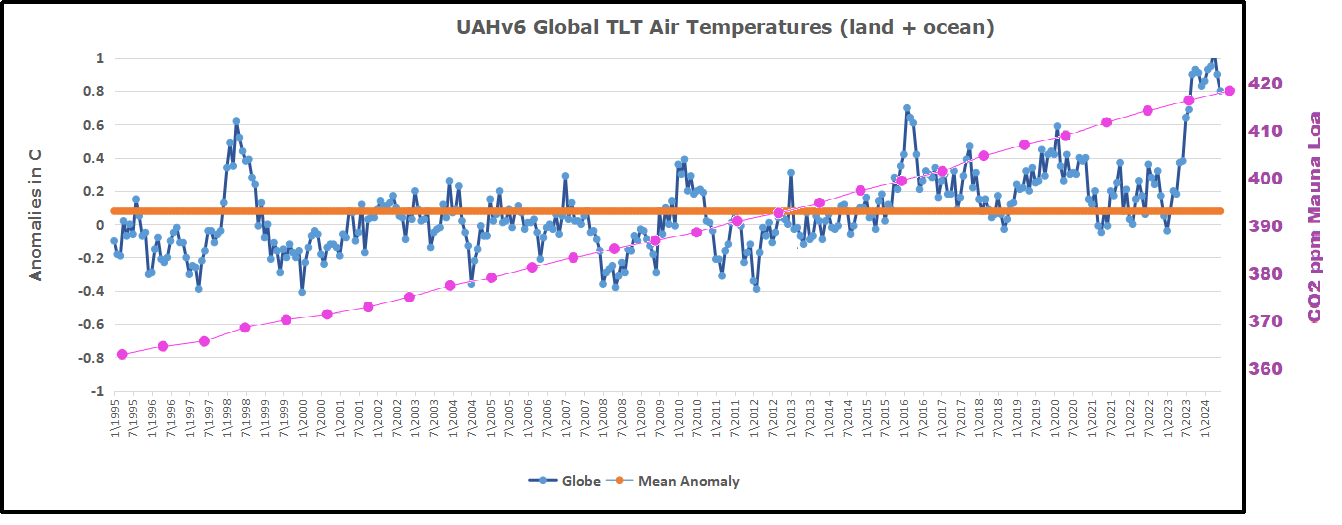
As an overview consider how recent rapid cooling  completely overcame the warming from the last 3 El Ninos (1998, 2010 and 2016).  The UAH record shows that the effects of the last one were gone as of April 2021, again in November 2021, and in February and June 2022  At year end 2022 and continuing into 2023 global temp anomaly matched or went lower than average since 1995, an ENSO neutral year. (UAH baseline is now 1991-2020). Now we have had an usual El Nino warming spike of uncertain cause, unrelated to steadily rising CO2 and now moderating.

For reference I added an overlay of CO2 annual concentrations as measured at Mauna Loa.  While temperatures fluctuated up and down ending flat, CO2 went up steadily by ~60 ppm, a 15% increase.

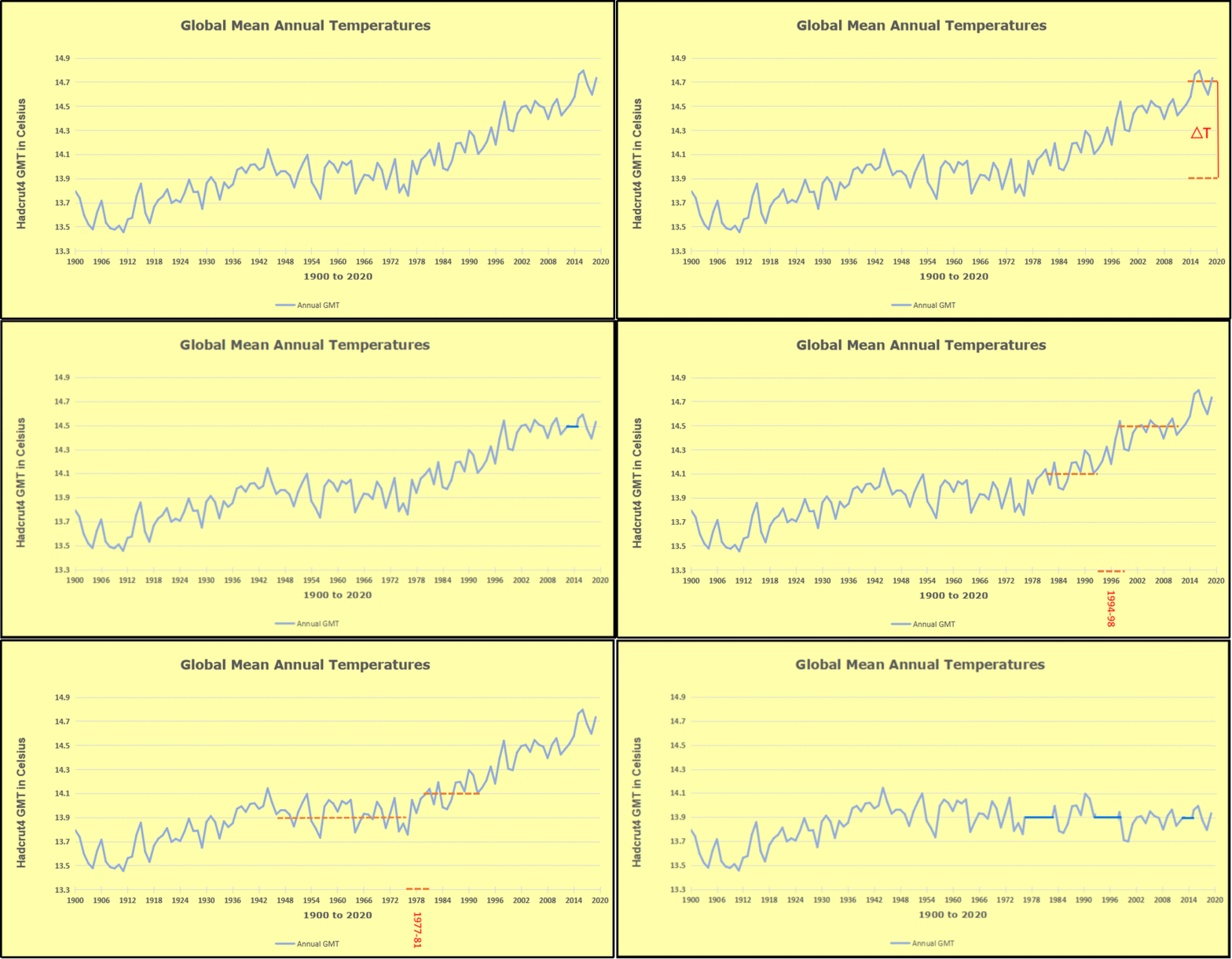
Furthermore, going back to previous warmings prior to the satellite record shows that the entire rise of 0.8C since 1947 is due to oceanic, not human activity.

gmt-warming-events

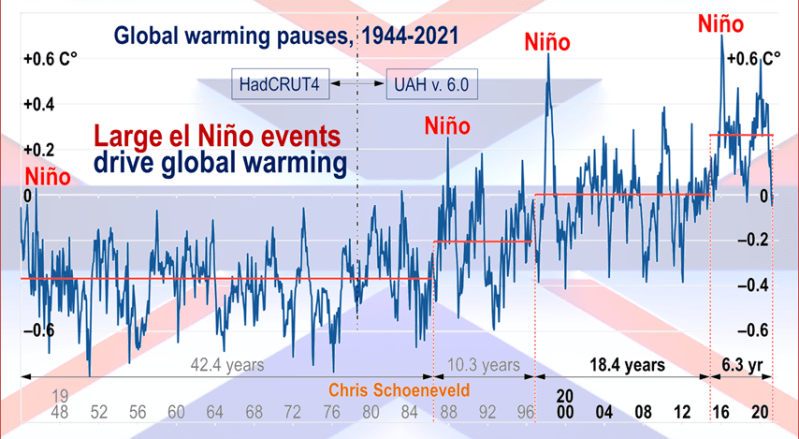
The animation is an update of a previous analysis from Dr. Murry Salby.  These graphs use Hadcrut4 and include the 2016 El Nino warming event.  The exhibit shows since 1947 GMT warmed by 0.8 C, from 13.9 to 14.7, as estimated by Hadcrut4.  This resulted from three natural warming events involving ocean cycles. The most recent rise 2013-16 lifted temperatures by 0.2C.  Previously the 1997-98 El Nino produced a plateau increase of 0.4C.  Before that, a rise from 1977-81 added 0.2C to start the warming since 1947.

Importantly, the theory of human-caused global warming asserts that increasing CO2 in the atmosphere changes the baseline and causes systemic warming in our climate.  On the contrary, all of the warming since 1947 was episodic, coming from three brief events associated with oceanic cycles. And now in 2024 we have seen an amazing episode with a temperature spike driven by ocean air warming in all regions, along with rising NH land temperatures, now oscillating near its peak.
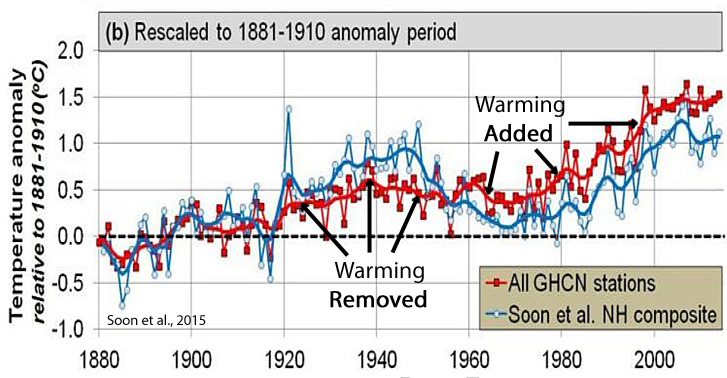
Chris Schoeneveld has produced a similar graph to the animation above, with a temperature series combining HadCRUT4 and UAH6. H/T WUWT

image-8


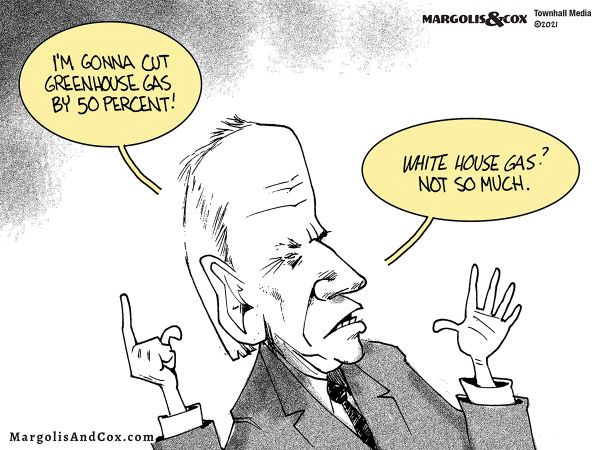
mc_wh_gas_web20210423124932

See Also Worst Threat: Greenhouse Gas or Quiet Sun?

October 2024 Global Cooling Led by NH and Tropics Ocean and Land Tempsbanner-blog

With apologies to Paul Revere, this post is on the lookout for cooler weather with an eye on both the Land and the Sea.  While you heard a lot about 2020-21 temperatures matching 2016 as the highest ever, that spin ignores how fast the cooling set in.  The UAH data analyzed below shows that warming from the last El Nino had fully dissipated with chilly temperatures in all regions. After a warming blip in 2022, land and ocean temps dropped again with 2023 starting below the mean since 1995.  Spring and Summer 2023 saw a series of warmings, continuing into October, followed by cooling. 

UAH has updated their TLT (temperatures in lower troposphere) dataset for October 2024. Due to one satellite drifting more than can be corrected, the dataset has been recalibrated and retitled as version 6.1 Graphs here contain this updated 6.1 data.  Posts on their reading of ocean air temps this month are ahead of the update from HadSST4.  I posted last month on SSTs using Ocean Cooling Resumes September 2024.  These posts have a separate graph of land air temps because the comparisons and contrasts are interesting as we contemplate possible cooling in coming months and years.

Sometimes air temps over land diverge from ocean air changes. In July 2024 all oceans were unchanged except for Tropical warming, while all land regions rose slightly. In August we saw a warming leap in SH land, slight Land cooling elsewhere, a dip in Tropical Ocean temp and slightly elsewhere.  September showed a dramatic drop in SH land, overcome by a greater NH land increase. Now in October, ocean and land temps in both NH and Tropics dropped, pulling the global anomaly down.

Note:  UAH has shifted their baseline from 1981-2010 to 1991-2020 beginning with January 2021.   v6.1 data was recalibrated also starting with 2021. In the charts below, the trends and fluctuations remain the same but the anomaly values changed with the baseline reference shift.

Presently sea surface temperatures (SST) are the best available indicator of heat content gained or lost from earth’s climate system.  Enthalpy is the thermodynamic term for total heat content in a system, and humidity differences in air parcels affect enthalpy.  Measuring water temperature directly avoids distorted impressions from air measurements.  In addition, ocean covers 71% of the planet surface and thus dominates surface temperature estimates.  Eventually we will likely have reliable means of recording water temperatures at depth.

Recently, Dr. Ole Humlum reported from his research that air temperatures lag 2-3 months behind changes in SST.  Thus cooling oceans portend cooling land air temperatures to follow.  He also observed that changes in CO2 atmospheric concentrations lag behind SST by 11-12 months.  This latter point is addressed in a previous post Who to Blame for Rising CO2?

After a change in priorities, updates are now exclusive to HadSST4.  For comparison we can also look at lower troposphere temperatures (TLT) from UAHv6.1 which are now posted for October.  The temperature record is derived from microwave sounding units (MSU) on board satellites like the one pictured above. Recently there was a change in UAH processing of satellite drift corrections, including dropping one platform which can no longer be corrected. The graphs below are taken from the revised and current dataset.

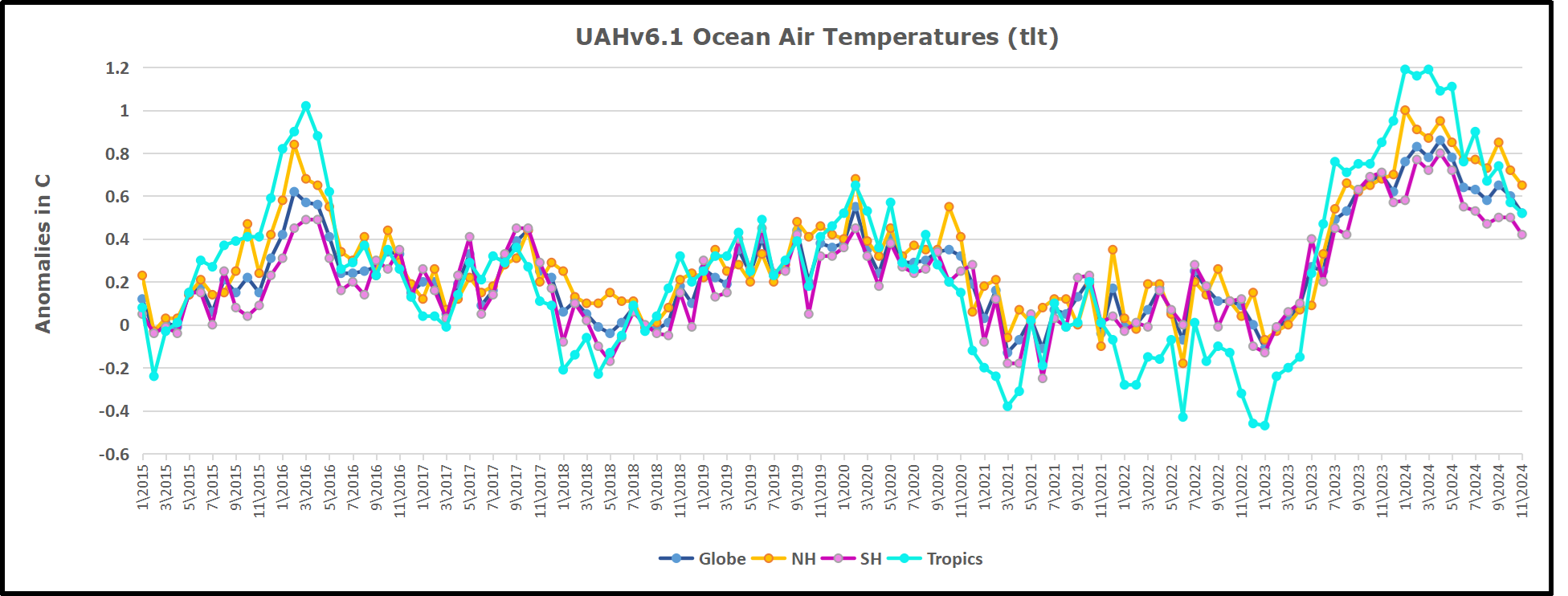
The UAH dataset includes temperature results for air above the oceans, and thus should be most comparable to the SSTs. There is the additional feature that ocean air temps avoid Urban Heat Islands (UHI).  The graph below shows monthly anomalies for ocean air temps since January 2015.

In 2021-22, SH and NH showed spikes up and down while the Tropics cooled dramatically, with some ups and downs, but hitting a new low in January 2023. At that point all regions were more or less in negative territory. 

After sharp cooling everywhere in January 2023, there was a remarkable spiking of Tropical ocean temps from -0.5C up to + 1.2C in January 2024.  The rise was matched by other regions in 2024, such that the Global anomaly peaked at 0.95C in May, Since then the Tropics have cooled down to 0.6C, and the Global anomaly as well as NH dropped down to 0.7C in October.

Land Air Temperatures Tracking in Seesaw Pattern

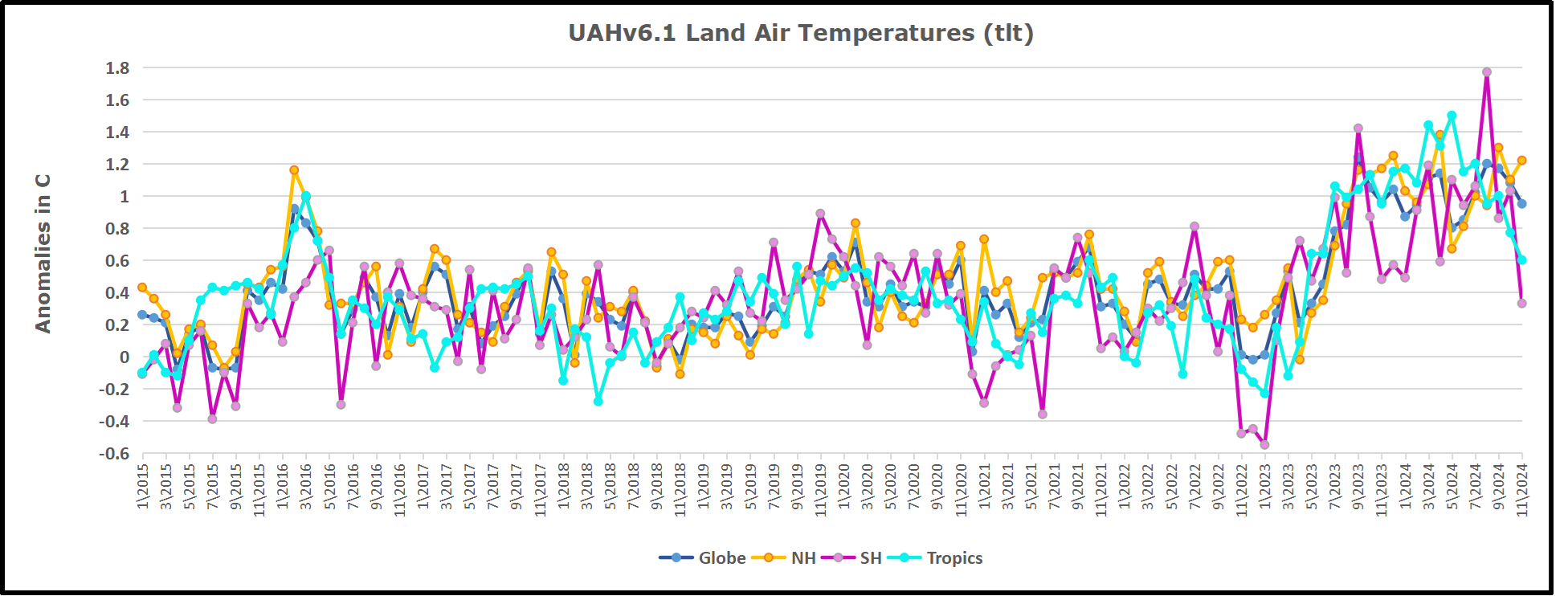
We sometimes overlook that in climate temperature records, while the oceans are measured directly with SSTs, land temps are measured only indirectly.  The land temperature records at surface stations sample air temps at 2 meters above ground.  UAH gives tlt anomalies for air over land separately from ocean air temps.  The graph updated for October is below.

Here we have fresh evidence of the greater volatility of the Land temperatures, along with extraordinary departures by SH land.  The seesaw pattern in Land temps is similar to ocean temps 2021-22, except that SH is the outlier, hitting bottom in January 2023. Then exceptionally SH goes from -0.6C up to 1.4C in September 2023 and 1.8C in  August 2024, with a large drop in between.  Now in October, NH and the Tropics have pulled the Global Land anomaly down despite a bump in SH land temps.

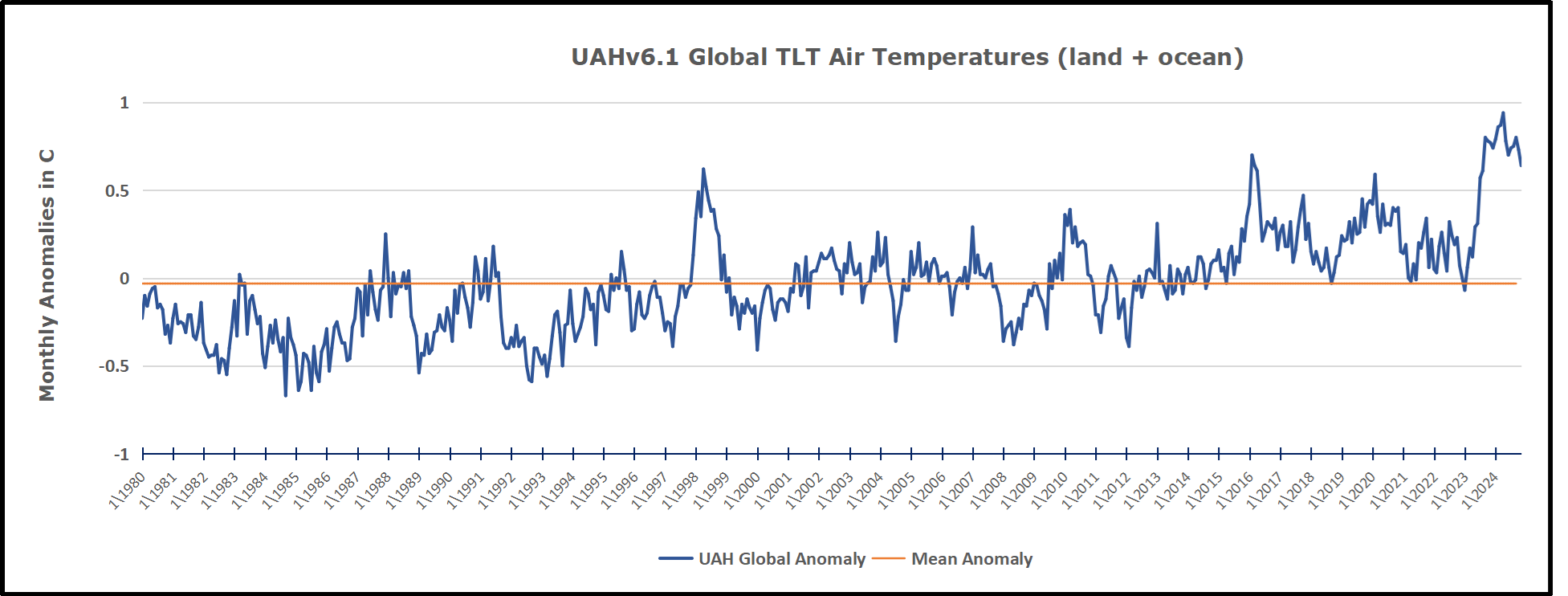
The Bigger Picture UAH Global Since 1980

The chart shows monthly Global Land and Ocean anomalies starting 01/1980 to present.  The average monthly anomaly is -0.03, for this period of more than four decades.  The graph shows the 1998 El Nino after which the mean resumed, and again after the smaller 2010 event. The 2016 El Nino matched 1998 peak and in addition NH after effects lasted longer, followed by the NH warming 2019-20.   An upward bump in 2021 was reversed with temps having returned close to the mean as of 2/2022.  March and April brought warmer Global temps, later reversed

With the sharp drops in Nov., Dec. and January 2023 temps, there was no increase over 1980. Then in 2023 the buildup to the October/November peak exceeded the sharp April peak of the El Nino 1998 event. It also surpassed the February peak in 2016. In 2024 March and April took the Global anomaly to a new peak of 0.94C.  The cool down started with May dropping to 0.90C, and in June a further decline to 0.80C.  Now in October that temp is down to 0.7C.

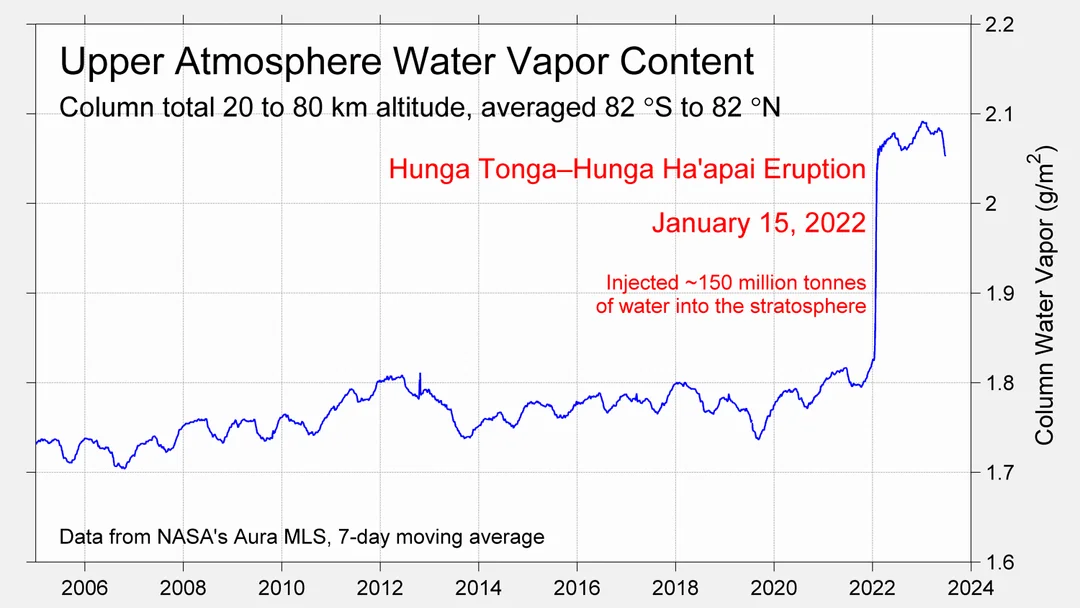
The graph reminds of another chart showing the abrupt ejection of humid air from Hunga Tonga eruption.

TLTs include mixing above the oceans and probably some influence from nearby more volatile land temps.  Clearly NH and Global land temps have been dropping in a seesaw pattern, nearly 1C lower than the 2016 peak.  Since the ocean has 1000 times the heat capacity as the atmosphere, that cooling is a significant driving force.  TLT measures started the recent cooling later than SSTs from HadSST4, but are now showing the same pattern. Despite the three El Ninos, their warming had not persisted prior to 2023, and without them it would probably have cooled since 1995.  Of course, the future has not yet been written.
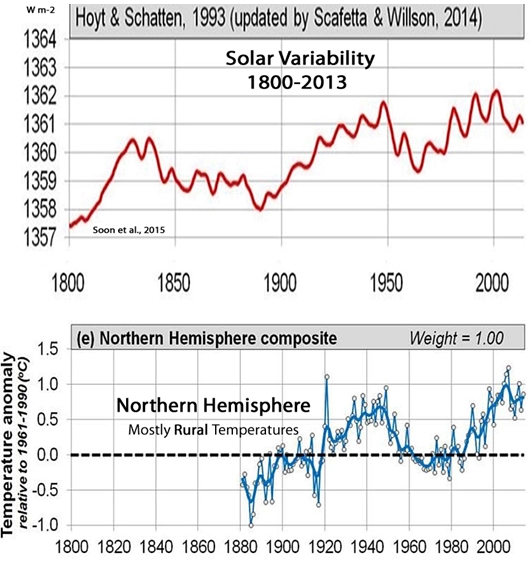
 

Alberta: “CO2 Gas of Life, Not Pollutant!” Media Outrage Ensues

Actually I discovered this news by way of Desmog whose report was in the spirit of Greta’s reaction to disbelief in CO2 hysteria.  Alberta Conservatives Pass Climate Denial Resolution 12 to Celebrate CO2 Pollution.  Excerpts in italics with my bolds.

UCP pledges to abandon the province’s net zero targets,
and remove the designation of CO2 as a pollutant.

UCP members voted in favor of a resolution to “recognize the importance of CO2 to life and Alberta’s prosperity.” Credit: Danielle Paradis [Participants numbered over 6000]

Alberta’s United Conservative Party has passed a resolution to rebrand carbon dioxide — the chief gas whose overabundance in Earth’s atmosphere is causing the climate emergency — in a brazen display of climate science denial that harkens back to the 1990s fossil fuel industry playbook.
Resolution 12, which falls under the “environmental stewardship and emissions reduction” area of the policy discussion, will “recognize the importance of CO2 to life and Alberta’s prosperity.” 

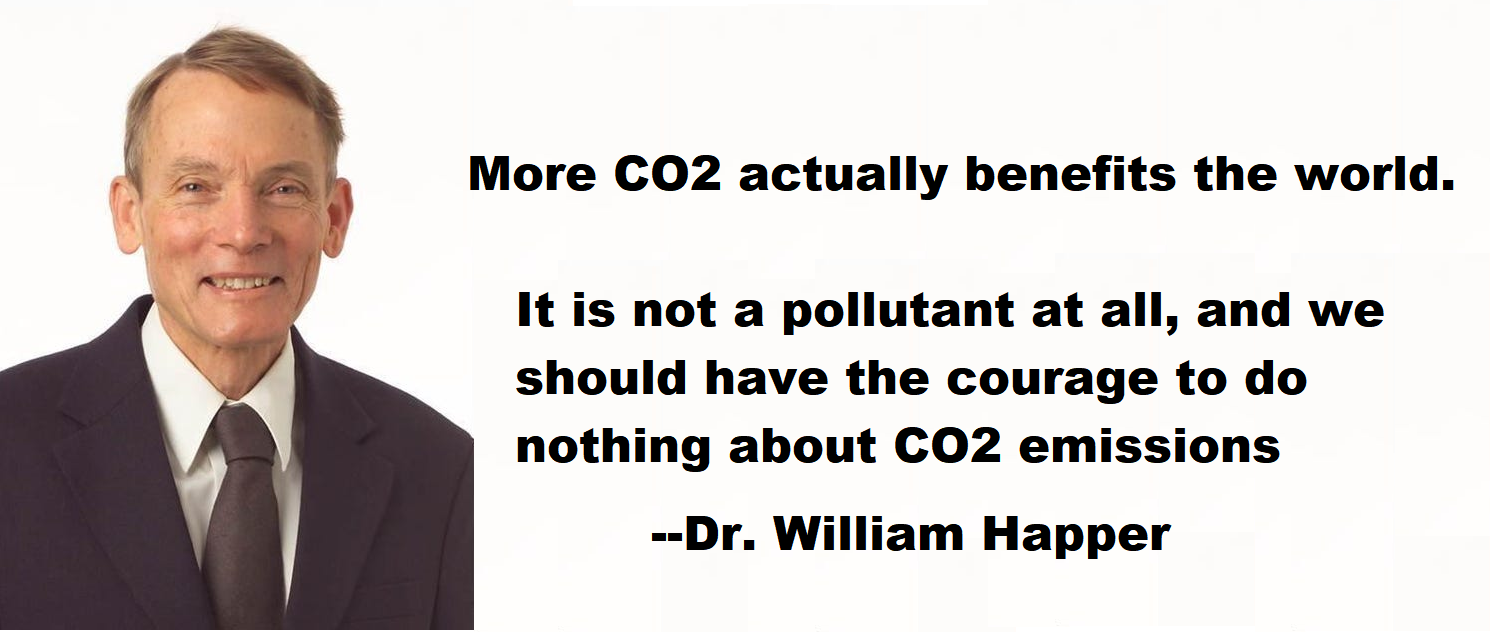
In approving the resolution, the UCP resolved to abandon the province’s net zero targets, remove the designation of CO2 as a pollutant, and further “recognize that CO2 is a foundational nutrient for all life on Earth.”

“We must prioritize policies that protect our economy and our way of life. CO2 is an essential nutrient for mass, driving growth and boosting plant production. According to the CO2 Coalition, higher CO2 levels have led to healthier crops and improved food security worldwide,” said a UCP member speaking in favour of the policy who cited the notorious CO2 Coalition

The resolution passed by a wide majority. 

Background

I searched in vain for any news report citing reasons favoring such a resolution.  Instead, the journalists repeated the activist mantras, like lemmings impervious to any POV not proscribed by the canon.  Before getting into that content, let’s remember that this political party is faithful to its constituents.

In 2015 Canadians were asked for their candid views of global warming/climate change.  The two principle questions were:

1. “From what you’ve read and heard, is there solid evidence that the average temperature on earth has been getting warmer over the past four decades?”

2. [If yes, solid evidence] “Is the earth getting warmer mostly because of human activity such as burning fossil fuels or mostly because of natural patterns in the earth’s environment?”

The responses were quite diverse, to the pollsters’ surprise, yet Trudeau claimed the results justified his push for a carbon tax and other measures to regulate and reduce CO2 emissions.  Buried in the supporting documents, and ignored by him and the media was this finding:

This process did determine a survey result about the size of the population who believes warming is happening and mostly caused by humans.  Everything else is subject to interpretation, including how much is due to land use, urbanization or fossil fuel emissions.  The solid finding is displayed in the diagram above.  Yes, the map shows I am living in a hotbed of global warming believers around Montreal; well, it is 55%, as high as it gets in Canada. Yet Trudeau went on to impose his anti-hydrocarbon agenda despite most of the nation opposed to the idea. More to the point, that dark blue province in the west is none other than Alberta.  Clearly, their common sense skepticism of climate alarm is not a recent position. [For more on that survey see Uncensored: Canadians View Global Warming]

The Offenses Taken by Warmists from Alberta’s Resolve

1. Media reports repeated the claim that CO2 is a pollutant because it has caused rising temperatures.  For example, from Desmog:

Carbon dioxide is the gas principally responsible for exacerbating the greenhouse effect, the consequence of which is global warming. Whereas carbon is a foundational building block of life on Earth, carbon dioxide is an asphyxiating gas whose atmospheric proportions are so high they’re disrupting the normal function of the carbon cycle.

That reference to “greenhouse effect” ignores the fact that changes in CO2 follow changes in global temperatures on all time scales, from last month’s observations to ice core datasets spanning millennia. Since CO2 is the lagging variable, it cannot logically be the cause of temperature, the leading variable. It is folly to imagine that by reducing human emissions of CO2, we can change global temperatures, which are obviously driven by other factors. [See Mid 2024 More Proof Temp Changes Drive CO2 Changes]

It also exaggerates the importance of the trace gas CO2 upon planetary heat transfers dominated by H2O.

The asphyxiating  label denies scientific knowledge about the properties of CO2 in our environment.

2. Advocates also disputed that CO2 is the “gas of life”, claiming that CO2 diminishes rather than enriches plant life.  For example, again from Desmog:

In the “rationale” section of the resolution, the United Conservative Party document argues that “CO2 is a nutrient foundational to all life on Earth.”

While plants need both light and carbon dioxide to thrive, the over-supply of CO2 in recent decades is leading to plants being deprived of their nutrients. One biologist was quoted in a 2017 Politico article describing this as akin to “the greatest injection of carbohydrates into the biosphere in human history,” and that injection is diluting the nutrients in the food supply.

Firstly, there is no doubt more CO2 is good for plants.  That’s why operators of greenhouses for growing them add CO2 up to three or four times our present 420 ppm.

Experiments have confirmed the botanical principle of limiting factors. At present concentrations, rising CO2 always increases plant productivity unless another factor is sub-optimal and constrains growth. The researchers, aided and abetted by the media are spinning this to say more CO2 is not good for plants. In reality, the lack of phosphorus or other nutrients is not the fault of CO2, and will not be enhanced by somehow reducing CO2. [See CO2 Destroys Food Nutrition! Not.]

3. And media reports added the fear of extreme weather events, attributing them to CO2 emissions.  Again from Desmog:

As the principal driver of the climate crisis and global warming, increasing CO2 levels will exacerbate droughts, wildfires, and floods, among other disasters, in turn resulting in loss of life and major disruptions to global supply chains. The consequent economic disturbances and their aftereffects will worsen the affordability crisis and result in increasingly negative economic outcomes for all, not just Albertans. Rather than stimulate Alberta’s agricultural sector, climate change will destroy it, and the evidence this is already happening is quite clear.

This is again the doomsday litany that rising CO2 will destroy life as we know it.  None of the data support that narrative.  Just one of many examples of facts vs. fears is the above showing how droughts and flooding have always happened.  These events are within the past range of variability and have not increased with rising CO2.  Rather than show more such graphs, this video is a brief realistic summary of our climate circumstances.

Summary

Albertans are wise and courageous to take their position, and have many experts who share their understanding.


Washington State Revolt Against “Electrify Everything”

Gas stoves are the thin edge of the wedge.

Megan K. Jacobson explains the fight and what’s at stake at msn A Washington State Revolt Against the Gas-Stove Grabbers.  Excerpts in italics with my bolds and added images.

Environmentalists have waged a campaign against natural gas, but users of this efficient, low-emission fuel are fighting back. A wide range of industry groups are backing Washington state’s Initiative 2066 to protect the right to choose natural gas.

By 2030, Washington is supposed to reduce carbon emissions to 45% below 1990 levels—one of its many overlapping climate goals. The state’s most recent energy plan declares that the cheapest route to meeting Olympia’s climate targets is to switch many uses of oil and gas to electric sources. Last year the Building Code Council amended the state energy code to make it prohibitively costly to install gas appliances in new buildings. In March the Legislature passed a law allowing the state’s largest natural-gas and electricity utility, Puget Sound Energy, to pass the costs of going green onto consumers and mandating the utility files a plan “to achieve all cost-effective electrification of end uses currently served by natural gas.”

To the Washington Hospitality Association and the Building
Industry Association of Washington, Initiative 2066’s cosponsors,
this sounded like an economic wrecking ball.

Anthony Anton, CEO of the hospitality association, says 84% of the restaurateurs he represents rely on natural gas. Remodeling to go electric is a “massive cost at a time where operators just can’t afford it,” he says. Some say the quality of their product would suffer, as some cooking methods, such as stir-frying, are difficult to perform on lower-heat electrical stoves. Most of the association’s members are very small businesses with substantial debt from Covid lockdowns.

The building association worries the new energy code will raise the state’s already high housing costs, locking out potential buyers. The code requires that new buildings meet a certain environmental “score.” Without the points from an electric heat pump, a builder will have to make up the difference with other green measures that run between $15,000 and $20,000 in a single-family home. “Every time they raise the price $1,000, it prices out another 500 Washington families,” says Greg Lane, the association’s executive vice president.

Dozens of varied industry groups support Initiative 2066. Each has its own reasons. The Washington Denturist Association worries about the expense of switching from propane- or gas-based equipment and a lack of reliable power. Most members are small businesses and it’s a good path for immigrant dentists whose credentials don’t carry over to the U.S.

The Washington State Tree Fruit Association (of which my paternal grandfather’s company, Apple King, is a member) is concerned about rising costs of refrigeration to keep produce fresh. A sudden power outage could be catastrophic for the state’s apple industry. Trade regulations for its top two export markets require that fruit be constantly refrigerated at a specific temperature for as long as 90 days.

The state’s cheapest energy plan would almost double electricity demand in Washington by 2050, putting an unprecedented strain on the grid. The only real option is to increase wind and solar generation, since the state’s plentiful hydroelectric capacity can’t do more without potentially threatening salmon. Wind and solar tend to falter in Washington in the winter, when energy demand peaks.

Consumers would also suffer in Washington’s green utopia. Everything from a haircut to a ballgame would become more expensive as the price of electricity rises. Climate advocates argue that Washingtonians will recoup their costs over time thanks to efficiency gains. But a 2021 report from Home Innovation Labs estimates that recovering the cost of a heat-pump installation could take 47 to 49 years. It’s worse for existing gas customers. The Building Industry Association of Washington estimates that switching from natural gas to electricity in a single-family home would cost as much as $70,000. Heat pumps also tend to fail in the sort of frigid weather that hits rural Washington in winter.

Proponents of electrification insist that technology will improve over time. But if they’re really confident that green energy will be the best option for consumers and businesses, then Initiative 2066 is no threat. Washington voters should ask why climate advocates still see it as one.

Advance Briefing for COP29 Baku 2024

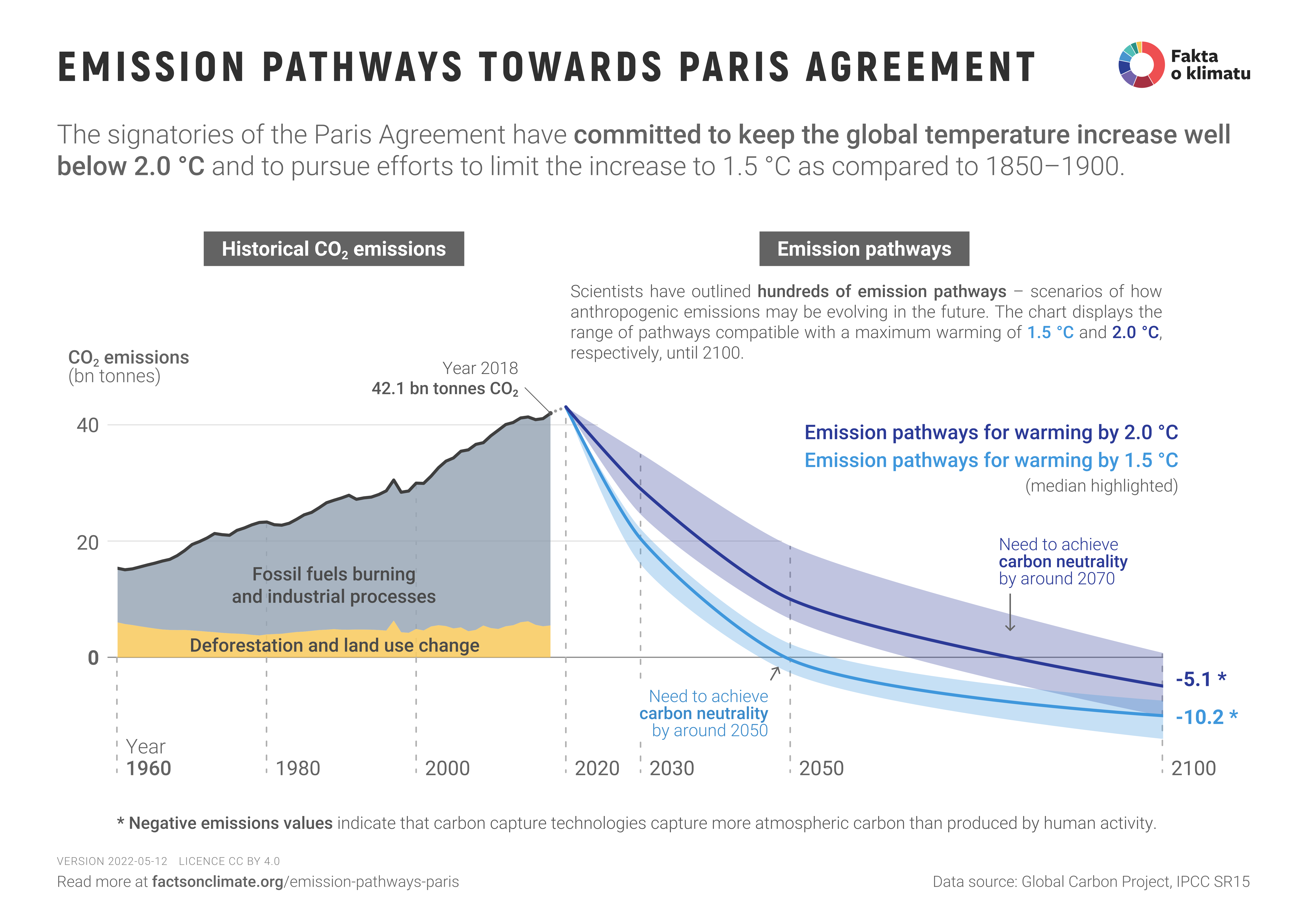
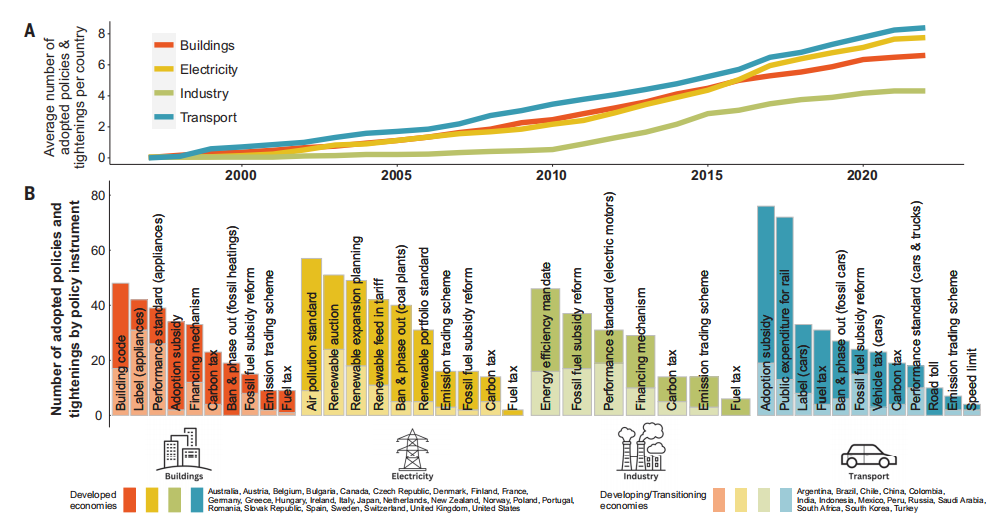
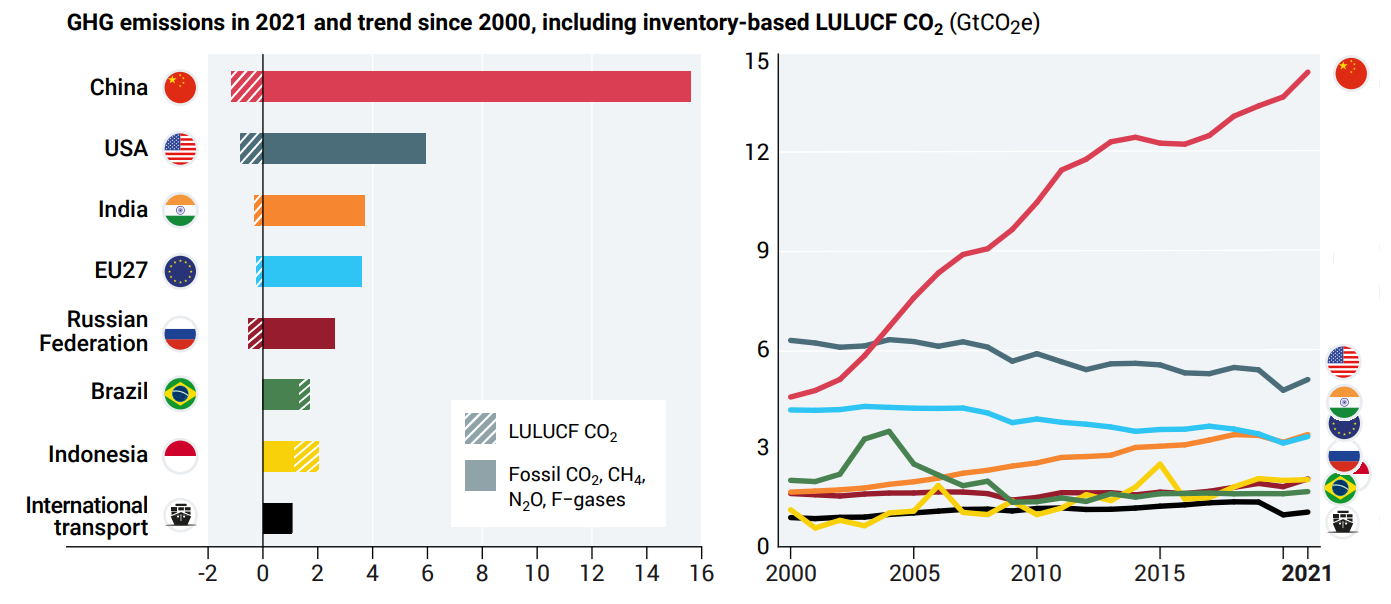
Overview from CFR. COP29 Summit in Baku: What to Expect  Excerpts in italics with my bolds and added images.

Negotiators from across the globe will gather in Baku, Azerbaijan, for the twenty-ninth annual UN climate change conference on November 11. COP29 marks the midpoint of the “COP Presidencies Troika,” a collaborative effort between the United Arab Emirates (UAE, host to COP28) and Brazil (host to COP30 in 2025) aimed at accelerating progress toward the 1.5°C goal. Unlike COP28 in Dubai last year, which hosted a record hundred thousand attendees, COP29 will be smaller, with Baku expected to host around fifty thousand participants. 

The selection of Azerbaijan as the host country has raised concerns about the credibility and integrity of the COP process. COP29 marks the third time a significant fossil fuel-producing country has hosted the conference, and the second time in two years. Azerbaijani President Ilham Aliyev has announced plans to increase gas production in part to satisfy European Union (EU) demands and referred to the country’s oil and gas reserves as “a gift from God.” 

What’s on the Agenda–Three Pledges Are Proposed

Reducing emissions and increasing green energy. The presidency has put forward a series of commitments for investing in renewable energy, such as a Global Energy Storage and Grids Pledge, which aims to enhance energy infrastructure and storage capabilities worldwide, an ambitious Hydrogen Declaration, and a Declaration on Reducing Methane from Organic Waste. With the Green Digital Action Declaration, COP29 leadership seeks to reduce emissions in the information and communication sectors. The agenda, however, makes no direct mention of a transition from fossil fuels.

Building climate resilience. The COP presidency has put forth a climate initiative for farmers and a declaration calling for integrated approaches to combating climate threats to water basins and ecosystems. Additionally, Baku aims to present the Initiative on Human Development for Climate Resilience, which focuses on education, skills, health, and well-being, and the COP29 Multisectoral Actions Pathways (MAP) Declaration that aims to enhance urban climate resilience.  

New climate finance targets. Nations are expected to replace the previous $100 billion annual commitment to developing countries from the 2009 Copenhagen Accord. The new target, known as the New Collective Quantified Goal (NCQG), will be under discussion at November’s COP and is intended to take effect from 2025 onwards. A 2022 report [PDF] by the Independent High-level Expert Group on Climate Finance found that developing countries need around $1 trillion per year by 2025, and $2.4 trillion by 2030 to meet their climate finance needs.  Among the most contentious issues that remain are how much money developed nations will provide, and who should provide climate finance. 

Yes, those are Trillions of US$ they are projecting to spend.

My Comments

Since there is a big push on climate funding, maybe they could get to the bottom of this:

Maybe donors are put off by no one knowing who gets the money and for what it is spent.  And while they are investigating, how about understanding Energy Return on Investment (EROI): you know, the notion that an energy project is worth doing if the energy produced is greater than energy spent. The windmills in the logo at the top reminded me of this:

Why a COP Briefing?

Actually, climate hysteria is like a seasonal sickness.  Each year a contagion of anxiety and fear is created by disinformation going viral in both legacy and social media in the run up to the annual autumnal COP.  Since the climatists have put themselves at the controls of the formidable US federal government, we can expect the public will be hugely hosed with alarms over the next few weeks.  Before the distress signals go full tilt, individuals need to inoculate themselves against the false claims, in order to build some herd immunity against the nonsense the media will promulgate. This post is offered as a means to that end.

Media Climate Hype is a Cover Up

Back in 2015 in the run up to Paris COP, French mathematicians published a thorough critique of the raison d’etre of the whole crusade. They said:

Fighting Global Warming is Absurd, Costly and Pointless.

  • Absurd because of no reliable evidence that anything unusual is happening in our climate.
  • Costly because trillions of dollars are wasted on immature, inefficient technologies that serve only to make cheap, reliable energy expensive and intermittent.
  • Pointless because we do not control the weather anyway.

The prestigious Société de Calcul Mathématique (Society for Mathematical Calculation) issued a detailed 195-page White Paper presenting a blistering point-by-point critique of the key dogmas of global warming. The synopsis with links to the entire document is at COP Briefing for Realists

Even without attending to their documentation, you can tell they are right because all the media climate hype is concentrated against those three points.

Finding: Nothing unusual is happening with our weather and climate.
Hype: Every metric or weather event is “unprecedented,” or “worse than we thought.”

Finding: Proposed solutions will cost many trillions of dollars for little effect or benefit.
Hype: Zero carbon will lead the world to do the right thing.  Anyway, the planet must be saved at any cost.

Finding: Nature operates without caring what humans do or think.
Hype: Any destructive natural event is blamed on humans burning fossil fuels.

How the Media Throws Up Flak to Defend False Suppositions

The Absurd Media:  Climate is Dangerous Today, Yesterday It was Ideal.

Billions of dollars have been spent researching any and all negative effects from a warming world: Everything from Acne to Zika virus.  A recent Climate Report repeats the usual litany of calamities to be feared and avoided by submitting to IPCC demands. The evidence does not support these claims. An example:

 It is scientifically established that human activities produce GHG emissions, which accumulate in the atmosphere and the oceans, resulting in warming of Earth’s surface and the oceans, acidification of the oceans, increased variability of climate, with a higher incidence of extreme weather events, and other changes in the climate.

Moreover, leading experts believe that there is already more than enough excess heat in the climate system to do severe damage and that 2C of warming would have very significant adverse effects, including resulting in multi-meter sea level rise.

Experts have observed an increased incidence of climate-related extreme weather events, including increased frequency and intensity of extreme heat and heavy precipitation events and more severe droughts and associated heatwaves. Experts have also observed an increased incidence of large forest fires; and reduced snowpack affecting water resources in the western U.S. The most recent National Climate Assessment projects these climate impacts will continue to worsen in the future as global temperatures increase.

Alarming Weather and Wildfires

But: Weather is not more extreme.


And Wildfires were worse in the past.
But: Sea Level Rise is not accelerating.

post-glacial_sea_level

Litany of Changes

Seven of the ten hottest years on record have occurred within the last decade; wildfires are at an all-time high, while Arctic Sea ice is rapidly diminishing.

We are seeing one-in-a-thousand-year floods with astonishing frequency.

When it rains really hard, it’s harder than ever.

We’re seeing glaciers melting, sea level rising.

The length and the intensity of heatwaves has gone up dramatically.

Plants and trees are flowering earlier in the year. Birds are moving polewards.

We’re seeing more intense storms.

But: Arctic Ice has not declined since 2007.

But: All of these are within the range of past variability.In fact our climate is remarkably stable, compared to the range of daily temperatures during a year where I live.

And many aspects follow quasi-60 year cycles.

The Impractical Media:  Money is No Object in Saving the Planet.

Here it is blithely assumed that the UN can rule the seas to stop rising, heat waves to cease, and Arctic ice to grow (though why we would want that is debatable).  All this will be achieved by leaving fossil fuels in the ground and powering civilization with windmills and solar panels.  While admitting that our way of life depends on fossil fuels, they ignore the inadequacy of renewable energy sources at their present immaturity.

An Example:
The choice between incurring manageable costs now and the incalculable, perhaps even irreparable, burden Youth Plaintiffs and Affected Children will face if Defendants fail to rapidly transition to a non-fossil fuel economy is clear. While the full costs of the climate damages that would result from maintaining a fossil fuel-based economy may be incalculable, there is already ample evidence concerning the lower bound of such costs, and with these minimum estimates, it is already clear that the cost of transitioning to a low/no carbon economy are far less than the benefits of such a transition. No rational calculus could come to an alternative conclusion. Defendants must act with all deliberate speed and immediately cease the subsidization of fossil fuels and any new fossil fuel projects, and implement policies to rapidly transition the U.S. economy away from fossil fuels.

But CO2 relation to Temperature is Inconsistent.

But: The planet is greener because of rising CO2.

But: Modern nations (G20) depend on fossil fuels for nearly 90% of their energy.

But: Renewables are not ready for prime time.

People need to know that adding renewables to an electrical grid presents both technical and economic challenges.  Experience shows that adding intermittent power more than 10% of the baseload makes precarious the reliability of the supply.  South Australia is demonstrating this with a series of blackouts when the grid cannot be balanced.  Germany got to a higher % by dumping its excess renewable generation onto neighboring countries until the EU finally woke up and stopped them. Texas got up to 29% by dumping onto neighboring states, and some like Georgia are having problems.

But more dangerous is the way renewables destroy the economics of electrical power.  Seasoned energy analyst Gail Tverberg writes:

In fact, I have come to the rather astounding conclusion that even if wind turbines and solar PV could be built at zero cost, it would not make sense to continue to add them to the electric grid in the absence of very much better and cheaper electricity storage than we have today. There are too many costs outside building the devices themselves. It is these secondary costs that are problematic. Also, the presence of intermittent electricity disrupts competitive prices, leading to electricity prices that are far too low for other electricity providers, including those providing electricity using nuclear or natural gas. The tiny contribution of wind and solar to grid electricity cannot make up for the loss of more traditional electricity sources due to low prices.

These issues are discussed in more detail in the post Climateers Tilting at Windmills

The Irrational Media:  Whatever Happens in Nature is Our Fault.

An Example:

Other potential examples include agricultural losses. Whether or not insurance
reimburses farmers for their crops, there can be food shortages that lead to higher food
prices (that will be borne by consumers, that is, Youth Plaintiffs and Affected Children).
There is a further risk that as our climate and land use pattern changes, disease vectors
may also move (e.g., diseases formerly only in tropical climates move northward).36 This
could lead to material increases in public health costs

But: Actual climate zones are local and regional in scope, and they show little boundary change.

But: Ice cores show that it was warmer in the past, not due to humans.

The hype is produced by computer programs designed to frighten and distract children and the uninformed.  For example, there was mention above of “multi-meter” sea level rise.  It is all done with computer models.  For example, below is San Francisco.  More at USCS Warnings of Coastal Floodings

In addition, there is no mention that GCMs projections are running about twice as hot as observations.

Omitted is the fact GCMs correctly replicate tropospheric temperature observations only when CO2 warming is turned off.

Figure 5. Simplification of IPCC AR5 shown above in Fig. 4. The colored lines represent the range of results for the models and observations. The trends here represent trends at different levels of the tropical atmosphere from the surface up to 50,000 ft. The gray lines are the bounds for the range of observations, the blue for the range of IPCC model results without extra GHGs and the red for IPCC model results with extra GHGs.The key point displayed is the lack of overlap between the GHG model results (red) and the observations (gray). The nonGHG model runs (blue) overlap the observations almost completely.

In the effort to proclaim scientific certainty, neither the media nor IPCC discuss the lack of warming since the 1998 El Nino, despite two additional El Ninos in 2010 and 2016.

Further they exclude comparisons between fossil fuel consumption and temperature changes. The legal methodology for discerning causation regarding work environments or medicine side effects insists that the correlation be strong and consistent over time, and there be no confounding additional factors. As long as there is another equally or more likely explanation for a set of facts, the claimed causation is unproven. Such is the null hypothesis in legal terms: Things happen for many reasons unless you can prove one reason is dominant.

Finally, advocates and IPCC are picking on the wrong molecule. The climate is controlled not by CO2 but by H20. Oceans make climate through the massive movement of energy involved in water’s phase changes from solid to liquid to gas and back again. From those heat transfers come all that we call weather and climate: Clouds, Snow, Rain, Winds, and Storms.

Esteemed climate scientist Richard Lindzen ended a very fine recent presentation with this description of the climate system:

I haven’t spent much time on the details of the science, but there is one thing that should spark skepticism in any intelligent reader. The system we are looking at consists in two turbulent fluids interacting with each other. They are on a rotating planet that is differentially heated by the sun. A vital constituent of the atmospheric component is water in the liquid, solid and vapor phases, and the changes in phase have vast energetic ramifications. The energy budget of this system involves the absorption and reemission of about 200 watts per square meter. Doubling CO2 involves a 2% perturbation to this budget. So do minor changes in clouds and other features, and such changes are common. In this complex multifactor system, what is the likelihood of the climate (which, itself, consists in many variables and not just globally averaged temperature anomaly) is controlled by this 2% perturbation in a single variable? Believing this is pretty close to believing in magic. Instead, you are told that it is believing in ‘science.’ Such a claim should be a tip-off that something is amiss. After all, science is a mode of inquiry rather than a belief structure.

Summary:  From this we learn three things:

Climate warms and cools without any help from humans.

Warming is good and cooling is bad.

The hypothetical warming from CO2 would be a good thing.


Mann’s AMOC Collapse Hoax

Dr. Kevin E. Trenberth, a distinguished scholar at the National Center for Atmospheric Research, commented on this movie: “I don’t recall a lot except that the whole science was incredibly wrong,”, “one does not get an ice age out of global warming.”

Likely you’ve heard the recent and previous warnings from Mann and friends about the ocean conveyor belt (including the Gulf Stream) slowing down and freezing us all.  With the COP gathering next month, something scary must be proclaimed, and Global Freezing is it, replacing Global Boiling earlier this year. The declaration signed by Mann and 43 other scientists was Open Letter by Climate Scientists to the Nordic Council of Ministers, Reykjavik, October 2024. Preface:

“We, the undersigned, are scientists working in the field of climate research and feel it is urgent to draw the attention of the Nordic Council of Ministers to the serious risk of a major ocean circulation change in the Atlantic. A string of scientific studies in the past few years suggests that this risk has so far been greatly underestimated. Such an ocean circulation change would have devastating and irreversible impacts especially for Nordic countries, but also for other parts of the world.”


“Given the increasing evidence for a higher risk of an AMOC collapse, we believe it is of critical importance that Arctic tipping point risks, in particular the AMOC risk, are taken seriously in governance and policy. Even with a medium likelihood of occurrence, given that the outcome would be catastrophic and impacting the entire world for centuries to come, we believe more needs to be done to minimize this risk.”

The Warning is based on Fear, not Facts

1.  The AMOC has been stable for the last four decades.

Florida Current transport observations reveal four decades of steady state Volkov et al 2024

Abstract

The potential weakening of the Atlantic Meridional Overturning Circulation (AMOC) in response to anthropogenic forcing, suggested by climate models, is at the forefront of scientific debate. A key AMOC component, the Florida Current (FC), has been measured using submarine cables between Florida and the Bahamas at 27°N nearly continuously since 1982. A decrease in the FC strength could be indicative of the AMOC weakening. Here, we reassess motion-induced voltages measured on a submarine cable and reevaluate the overall trend in the inferred FC transport. We find that the cable record beginning in 2000 requires a correction for the secular change in the geomagnetic field. This correction removes a spurious trend in the record, revealing that the FC has remained remarkably stable. The recomputed AMOC estimates at ~26.5°N result in a significantly weaker negative trend than that which is apparent in the AMOC time series obtained with the uncorrected FC transports.

Fig. 1: The Western Boundary Time Series
observing network in the Straits of Florida.

The network consists of the submarine telecommunications cable between West Palm Beach and Grand Bahama Island (cyan curve), ship sections across the Florida Current (FC) at 27°N with in situ measurements at nine stations (white circles), two bottom pressure gauges on both sides of the FC at 27°N (yellow stars), and along-track satellite altimetry measurements (magenta dotted line). CTD Conductivity-Temperature-Depth, LADCP Lowered Acoustic Doppler Current Profiler, XBT expendable bathythermograph.

Fig. 6: Florida Current (FC) volume transports corrected for
the secular change in the Earth’s Magnetic Field (EMF).

a The time series of the daily FC volume transport: (blue) not corrected for the secular change in the EMF, (red) corrected for the secular change in the EMF. The linear trends of the FC transport not corrected and corrected for the EMF are shown by the blue and red lines, respectively. b The differences between the cable and ship section transport for the cable data (blue squares) not corrected for the EMF and (red circles) corrected for the EMF. The linear trends of the differences (ΔT) not corrected and corrected for the EMF are shown by the blue and red lines, respectively.

Fig. 2: The Florida Current volume transport.

Daily transport estimates from the cable record (black; prior to corrections applied in this study); estimates from the Pegasus (orange diamonds) and Pegasus in dropsonde mode (Pegasus-DM; light blue circles) sections; estimates from the dropsonde sections (blue circles); and estimates from the Lowered Acoustic Doppler Current Profiler (LADCP) sections (red circles). The linear trends for 1982–2023, 1982–1998, and 2000–2023 periods are shown by the orange, cyan, and magenta lines, respectively.

2.  Paleo records show past AMOC changes due to seafloor shifts not climate change.

Controlling factors for the global meridional overturning circulation: A lesson from the Paleozoic, Yuan et al. 2024.

Abstract

The global meridional overturning circulation (GMOC) is important for redistributing heat and, thus, determining global climate, but what determines its strength over Earth’s history remains unclear. On the basis of two sets of climate simulations for the Paleozoic characterized by a stable GMOC direction, our research reveals that GMOC strength primarily depends on continental configuration while climate variations have a minor impact. In the mid- to high latitudes, the volume of continents largely dictates the speed of westerly winds, which in turn controls upwelling and the strength of the GMOC. At low latitudes, open seaways also play an important role in the strength of the GMOC. An open seaway in one hemisphere allows stronger westward ocean currents, which support higher sea surface heights (SSH) in this hemisphere than that in the other. The meridional SSH gradient drives a stronger cross-equatorial flow in the upper ocean, resulting in a stronger GMOC. This latter finding enriches the current theory for GMOC.

On the basis of a series of simulations for the Paleozoic, we find that the GMOC is primarily controlled by:

  • freshwater input into ocean;
  • wind-driven Ekman pumping in the midlatitudes, and
  • SH anomaly in low latitudes.

The latter two factors are especially important for the strength of the GMOC and are highly related to continental configuration. Our major conclusions find validation through Paleozoic climate simulations using the HadCM3 model by Valdes et al. (53, 67) and a non-IPCC class model, FOAM, by Pohl et al. (52) (figs. S17 and S18). This last study by Pohl et al. (52) also pointed out the unfortunate absence of proxy data for validating the direction and magnitude of the Paleozoic GMOC.

Controlling factors for the global
meridional overturning
circulation

Fig. 5. Schematic of controlling factors for the GMOC during the Paleozoic. The schematic is based on the situation for 400 Ma. Three main factors are shown, the less net precipitation in the south SH; the strong westerlies, ocean surface current, and Ekman upwelling in the midlatitude region in NH; the SSH anomaly and associated pressure anomaly in the low-latitude region.

Although there has been tremendous interest in understanding the mechanisms that govern the MOC, surface topography in the westerlies region and the presence of an open seaway in the low-latitude region were previously largely overlooked. Our study thus draws attention to how the evolution of continents in these two regions affects the strength of MOC. Our study indicates that the traditional theory for MOC misses an important element, that is, the influence of a low-latitude seaway. Previous studies either did not have such a seaway (1, 34, 43) or had a partial seaway that connected the present-day Atlantic Ocean and Pacific Ocean only (32–34). Their focus was mostly on the strength of the AMOC and mechanism invoked generally involved freshwater and salinity only (32, 33, 68), while as demonstrated above, a fully open low-latitude seaway affects the MOC in a fundamentally different way.

3.  AMOC alarm presupposes Arctic “Amplification” of Global Warming

Activist scientists claim the Arctic is warming up to five times faster than lower latitudes.  This is based on models projecting scarce temperature records great distances over the Arctic ocean drift sea ice.  There are three flaws in the arctic warming claim (from Arctic “Amplification” Not What You Think)

a. Arctic Amplification is an artifact of Temperature Anomalies

Clive Best provides this animation of recent monthly temperature anomalies which demonstrates how most variability in anomalies occur over northern continents.

b. Arctic Surface Stations Records Show Ordinary Warming

Locations of 118 arctic stations examined in this study and compared to observations at 50 European stations whose records averaged 200 years and in a few cases extend to the early 1700s.

The paper is: Arctic temperature trends from the early nineteenth century to the present W. A. van Wijngaarden, Theoretical & Applied Climatology (2015).  My synopsis: Arctic Warming Unalarming

c. Arctic Warmth Comes from Meridional Heat Transport, not CO2

4.  Hypothesis that rising CO2 will collapse the AMOC is flawed.

The “AMOC is collapsing” narrative goes like this:

Ocean circulation is driven by density differences, which depend on the salinity and the temperature of the water. Cold, salty water is heavier than warm, fresh water. When flowing water reaches Greenland, it becomes very cold and salty, causing it to sink and flow south, where the water warms and rises closer to the surface again. Some compare the process to a conveyor belt going around and around.

This graphic shows a highly simplified schematic of the Atlantic Meridional Overturning Circulation (AMOC) against a backdrop of the sea surface temperature trend since 1993 from the Copernicus Climate Change Service (https://climate.copernicus.eu/). Image credit: Ruijian Gou. > High res figure.

Changing the salinity of the water messes up the way the water flows. That’s why the melting of the Greenland ice sheets is a big problem: It’s injecting a ton of freshwater into the ocean far north, where the water is usually very salty. The more freshwater, the weaker the circulation—not to mention that atmospheric temperatures are also increasing, which also makes water lighter. The new study shows that if the density dynamics change enough, the conveyor belt will eventually stop moving, aka “collapse.” That means it won’t transport any water, saline, or heat across the globe.

So the scenario is that supposed amplified Arctic warming will cause iceberg calving and glacial melting, and the freshwater will slow and eventually stop the AMOC.  Firstly, the above study shows seafloor configuration has greater impact than salinity changing.  Secondly, the spread of freshwater is not so simple.

Role of the Labrador Current in the Atlantic Meridional Overturning Circulation response to greenhouse warming, Shan et al. 2024

Abstract

Anthropogenic warming is projected to enhance Arctic freshwater exportation into the Labrador Sea. This extra freshwater may weaken deep convection and contribute to the Atlantic Meridional Overturning Circulation (AMOC) decline. Here, by analyzing an unprecedented high-resolution climate model simulation for the 21st century, we show that the Labrador Current strongly restricts the lateral spread of freshwater from the Arctic Ocean into the open ocean such that the freshwater input has a limited role in weakening the overturning circulation. In contrast, in the absence of a strong Labrador Current in a climate model with lower resolution, the extra freshwater is allowed to spread into the interior region and eventually shut down deep convection in the Labrador Sea. Given that the Labrador Sea overturning makes a significant contribution to the AMOC in many climate models, our results suggest that the AMOC decline during the 21st century could be overestimated in these models due to the poorly resolved Labrador Current.

5.  The “Tipping Point” scare is unscientific.

Uncertainties too large to predict tipping times of major Earth system components from historical data, Ben-Yami et al. 2024

Abstract

One way to warn of forthcoming critical transitions in Earth system components is using observations to detect declining system stability. It has also been suggested to extrapolate such stability changes into the future and predict tipping times. Here, we argue that the involved uncertainties are too high to robustly predict tipping times. We raise concerns regarding

(i) the modeling assumptions underlying any extrapolation of historical results into the future,

(ii) the representativeness of individual Earth system component time series, and

(iii) the impact of uncertainties and preprocessing of used observational datasets, with focus on nonstationary observational coverage and gap filling.

We explore these uncertainties in general and specifically for the example of the Atlantic Meridional Overturning Circulation. We argue that even under the assumption that a given Earth system component has an approaching tipping point, the uncertainties are too large to reliably estimate tipping times by extrapolating historical information.

“The conclusions of this study are certainly in line with my understanding of the current state of the art,” says Gavin Schmidt, a climate scientist and professor at Columbia University and the director of NASA’s Goddard Institute for Space Studies (GISS). Schmidt was not involved in the new work, but has extensively researched climate variability and systems like AMOC.

I have not been impressed by previous or recent efforts to predict upcoming tipping points in either AMOC or ice sheets — there is more going on than just patterns in time series and we still don’t have sufficiently complex and calibrated models to have a robust idea of what will happen,” says Gavin Schmidt, director of NASA’s GISS.

Footnote

In researching for this post I discovered an informative website Ocean to Climate  Science news & articles on topics related to ocean and climate by oceanographer Sang-Ki Lee.  Some additional examples of studies for further reading on this issue are below.

Gulf Stream’s fate to be decided by climate ‘tug-of-war’

A stable Atlantic Meridional Overturning Circulation in a changing North Atlantic Ocean since the 1990s

Detectability of an AMOC Decline in Current and Projected Climate Changes

Global surface warming enhanced by weak Atlantic overturning circulation

Nonstationarity of the Atlantic Meridional Overturning Circulation’s Fingerprint on Sea Surface Temperature


Fear + Ignorance = Climate Alarm

Mark C. Ross explains the syndrome in his American Thinker article Fear plus ignorance equals climate change.  Excerpts in italics with my bolds and added images.

Weather is inherently mysterious. Multiple forces, such as wind, clouds, seasonal and day-night cycles, and air pressure are constantly interacting and causing continuous chaos. In the aftermath of two particularly destructive hurricanes, the fear-mongers are bloviating to the max over the catastrophic effects on the climate caused by human existence.

And yet there is no discernible trend toward either more storms or more intense hurricanes compiled over more than beyond the last century. (This chart by NOAA was especially easy to find.) Thus far, the decade of the 1940s saw the most seriously intense storms. Being historical data, this brings to mind a modification of Santayana’s famous adage: when people are ignorant of their history, they make it really easy for demagogues to lie to them about it.

Rather than human consumption of fossil fuels, two other factors are mostly relevant when it comes to the damage wrought by hurricanes: the path they take and the development of infrastructure within that path. Out on the open sea, a hurricane may damage a few ships, but when one goes over a population center…well, you know, it just happened.

What determines the path is largely chaotic. Go figure. There’s this weird thing called the jet stream, which is sort of the result of the Earth’s continuous rotation within a tenuous atmospheric envelope. Becoming known to American aviators during World War 2, the particular details of the jet stream were kept as a military secret well into the mid-twentieth century. Ocean currents and surface temperatures are also involved. Early forecasts of hurricane paths are typically all over the map. As the time frame compresses, they tend to become more accurate, but not always.

Then there’s the “atypically” warm weather that sometimes happens in early autumn. We just had some of that, along with offshore winds and seriously elevated fire danger. In the olden days, this was called “Indian summer.” Back in 1919, Victor Herbert even wrote a song by that name. Maybe I’m just a cynic, but I’m expecting the fear-mongers to start pandering to the general public’s pervasive ignorance of earth science to cause panic over yet another routine weather event.

There are three scientific disciplines that are especially useful when looking at weather and climate of the distant past: geology; paleontology; and tree ring analysis, known as dendrochronology. Geology shows us the impact glaciers have had on the Earth’s surface. Paleontology shows us the now extinct life forms that thrived under previous environmental conditions. Dendrochronology shows us a preserved record of ancient weather conditions such as year-to-year rainfall and temperature.

How warm would the weather have to be for giant reptiles to flourish all over the Earth? Pretty warm, it seems. There is some work afoot to show that dinosaurs may have been warm-blooded. Good luck with that. Birds are the first known warm-blooded animals, and they evolved from reptiles and still tend to have scales on their legs. Mammals are also warm-blooded. Enormously large mammals such as wooly mammoths were common during the last ice age, the Pleistocene. Having a large size is especially beneficial for warm-blooded animals in cold climates, since surface area of the outer skin increases much more slowly than the actual body mass, making the large animal significantly more thermally efficient than a smaller one.

But why is the blatant climate change hoax still being promoted? There are two different reasons. The first is held among the true believers: humans are evil. They recklessly continue to damage the Earth’s biosphere, just for trivial benefits and without the slightest concern for the consequences of their actions. The other is political: fear can be a terrific motivator but is not all that conducive to good decision-making. That’s fine, too. The wannabe mega-state tyrants l-o-v-e to deal with fear and poor decision-making. How else can they effectively enslave the masses so as to fulfill their objectives?

And what are these objectives? Taking control of everything comes to mind. The evil players in politics are mostly after control. The rest of us just want to have the streets swept and the criminals pulled away from the rest of us. The term Statist should replace Marxist in this dialogue. Absolute government authority should overcome the self-direction of the individual — since so many among us are not really attuned to proper functionality in the modern world.

Socialism was already in the works when Karl Marx got involved. I like to say that a communist is an angry socialist. Marx injected class struggle into the quest for ownership of the means of production. Thus, the USA was a tough sell for Marxism since we are a particularly socially mobile society. The late, great Walter E. Williams would often say that the ranks of the one-percenters were constantly changing — since new ones would rise up, while others would blow it and fall away. The “Old World,” by contrast, is littered with caste systems and other forms of enforced social order.

Back to Caddell’s “elite gentry” — their desires are in mortal conflict with the aspirations of just plain folks. Or as Lincoln said, “God must love the common man, for he made so many of them.” To some, populism is a dirty word. To others, it is a path into the future. It can mean different things to different people. I like to use the term personal freedom. We can do what we want — as long as we don’t interfere with the freedom of others. But to others, “freedom” is a dirty word.

See Also:  Help For Those Alarmed About the Climate

This is your brain on climate alarm.  Just say No!