Bering Ice March Madness

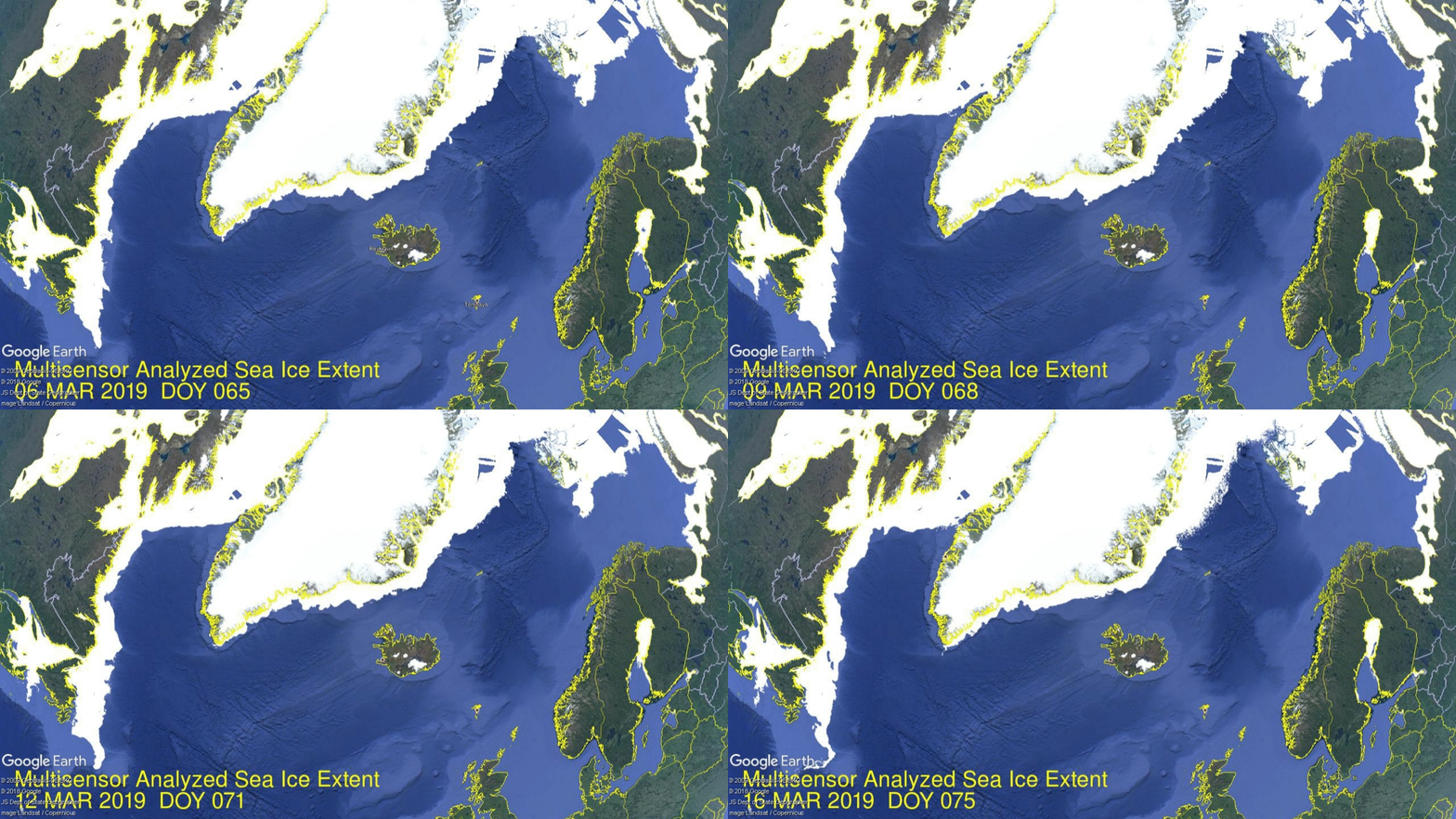
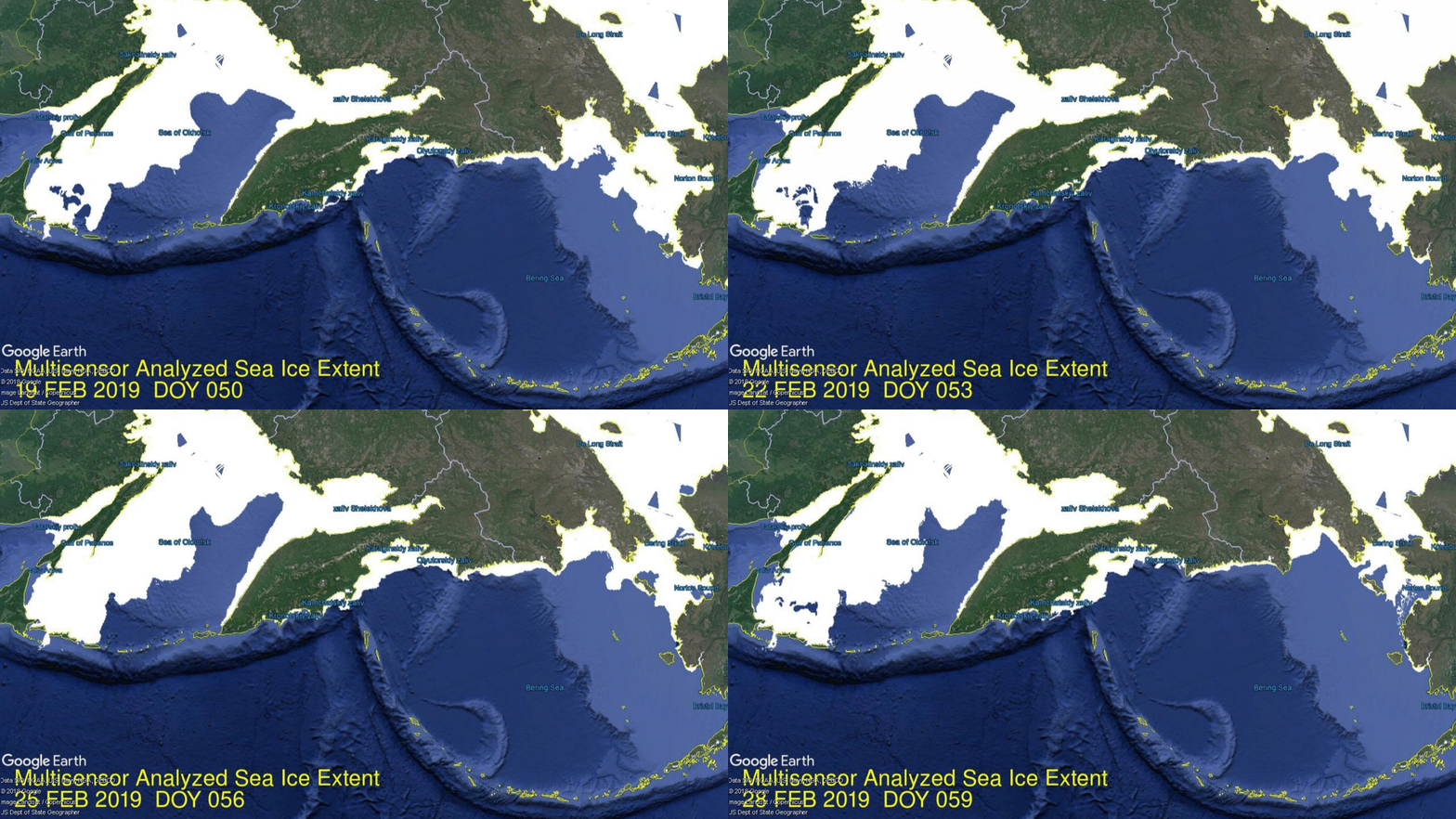
In February the media breathlessly told us that Bering Sea ice has melted away, and thus Arctic ice is doomed.  Now we see that reports of the demise were premature.  More surprising than the early retreat, Bering ice roared back in the last two weeks, and continues to grow even after the overall NH ice extent peaked

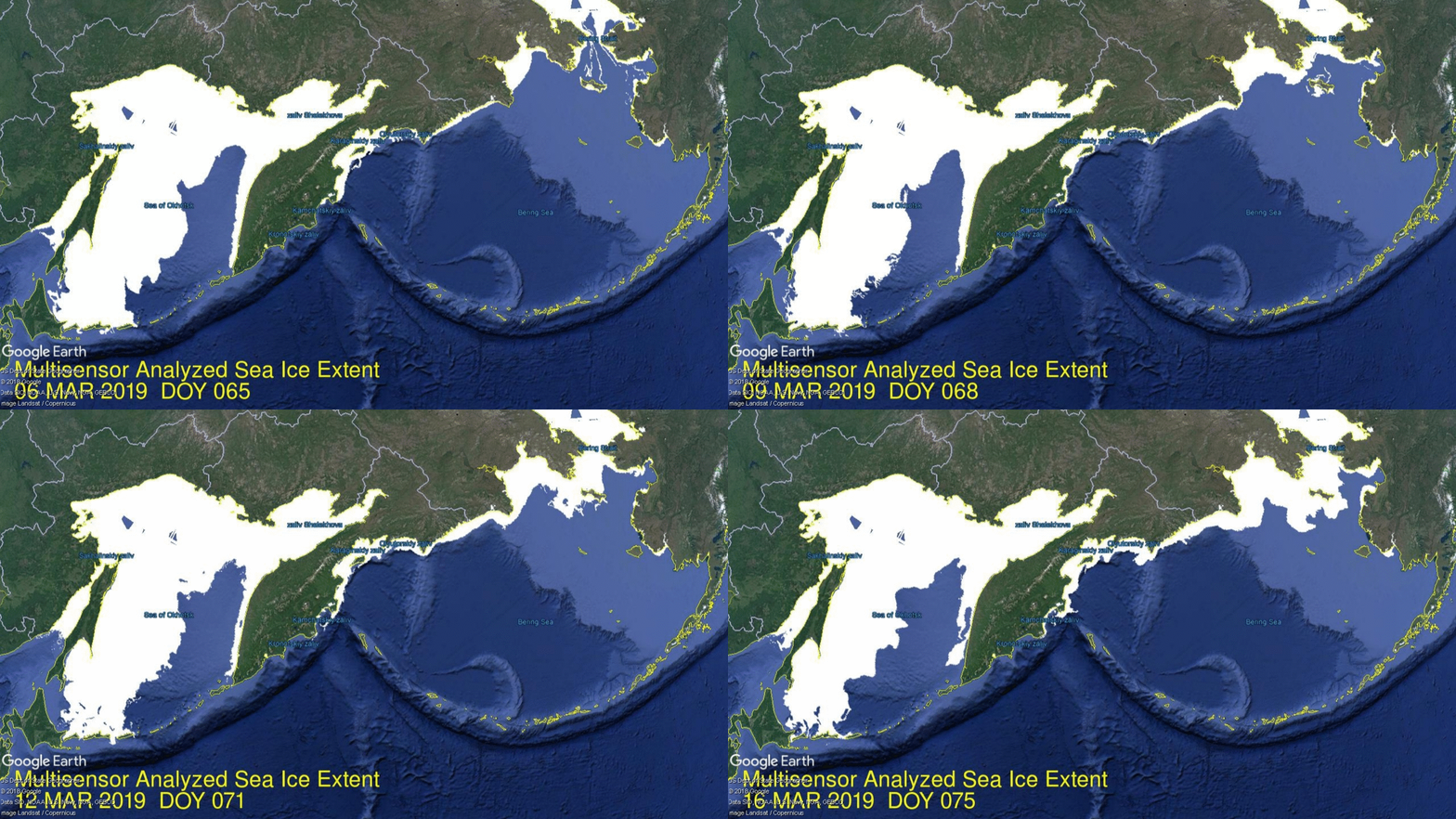
Two Weeks of Growing Bering Ice: The above image shows the last two weeks of dramatic ice growth in Bering with only minor melting in Okhotsk. Bering Sea on the right more than doubled, adding 250k km2 and effectively sealing off Chukchi inside the Arctic.  Meanwhile on the left Okhotsk ice seesawed, ending up 150k km2 lower, but still at 88% of 2019 maximum.
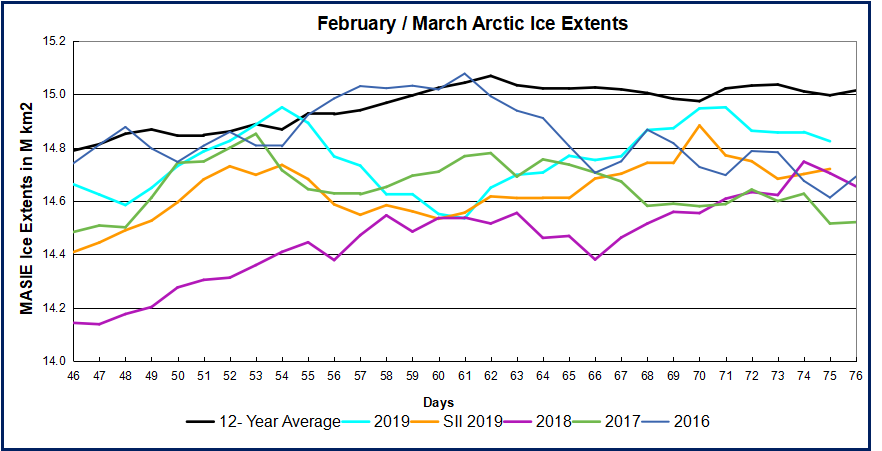
The graph below shows March progress in ice extent peaking and beginning the melt season. As noted before, the month started with a sharp increase nearly reaching average and 15M km2. After March 12, ice declined steadily as is normal after mid-March.  2019 extent is running lower than the 12 year average, but slightly higher than other recent years.  SII is showing about 100k km2 less ice than MASIE.

The table below shows the distribution of ice in the various Arctic basins.

Region 2019082 Day 082 
Average
2019-Ave. 2018082 2019-2018
 (0) Northern_Hemisphere 14600645 14891081 -290436 14511954 88692
 (1) Beaufort_Sea 1070291 1070115 176 1070445 -154
 (2) Chukchi_Sea 966006 965595 411 966006 0
 (3) East_Siberian_Sea 1087137 1086844 293 1087137 0
 (4) Laptev_Sea 897845 897552 293 897845 0
 (5) Kara_Sea 926462 917591 8871 934807 -8344
 (6) Barents_Sea 681050 653698 27352 720725 -39675
 (7) Greenland_Sea 552178 642867 -90689 539109 13069
 (8) Baffin_Bay_Gulf_of_St._Lawrence 1431122 1509559 -78437 1346761 84361
 (9) Canadian_Archipelago 853337 852881 456 853109 229
 (10) Hudson_Bay 1260903 1255967 4937 1260838 66
 (11) Central_Arctic 3227734 3227309 426 3158495 69240
 (12) Bering_Sea 446151 773234 -327083 345861 100291
 (13) Baltic_Sea 41886 87497 -45611 135848 -93962
 (14) Sea_of_Okhotsk 1150521 933366 217155 1183119 -32598

The table shows how 2019 is 290k km2 or 2% below the 12-year average.  Most basins are matching average extent, including Barents Sea edging slightly ahead of average.  Greenland Sea and Baffin Bay are below average. Despite recent gains, Bering ice is 327k km2 in deficit to average, nearly the difference in overall NH extent.  Meanwhile Okhotsk is 217k km2 surplus to average, partially offsetting Bering.


Arctic March Heart Beat

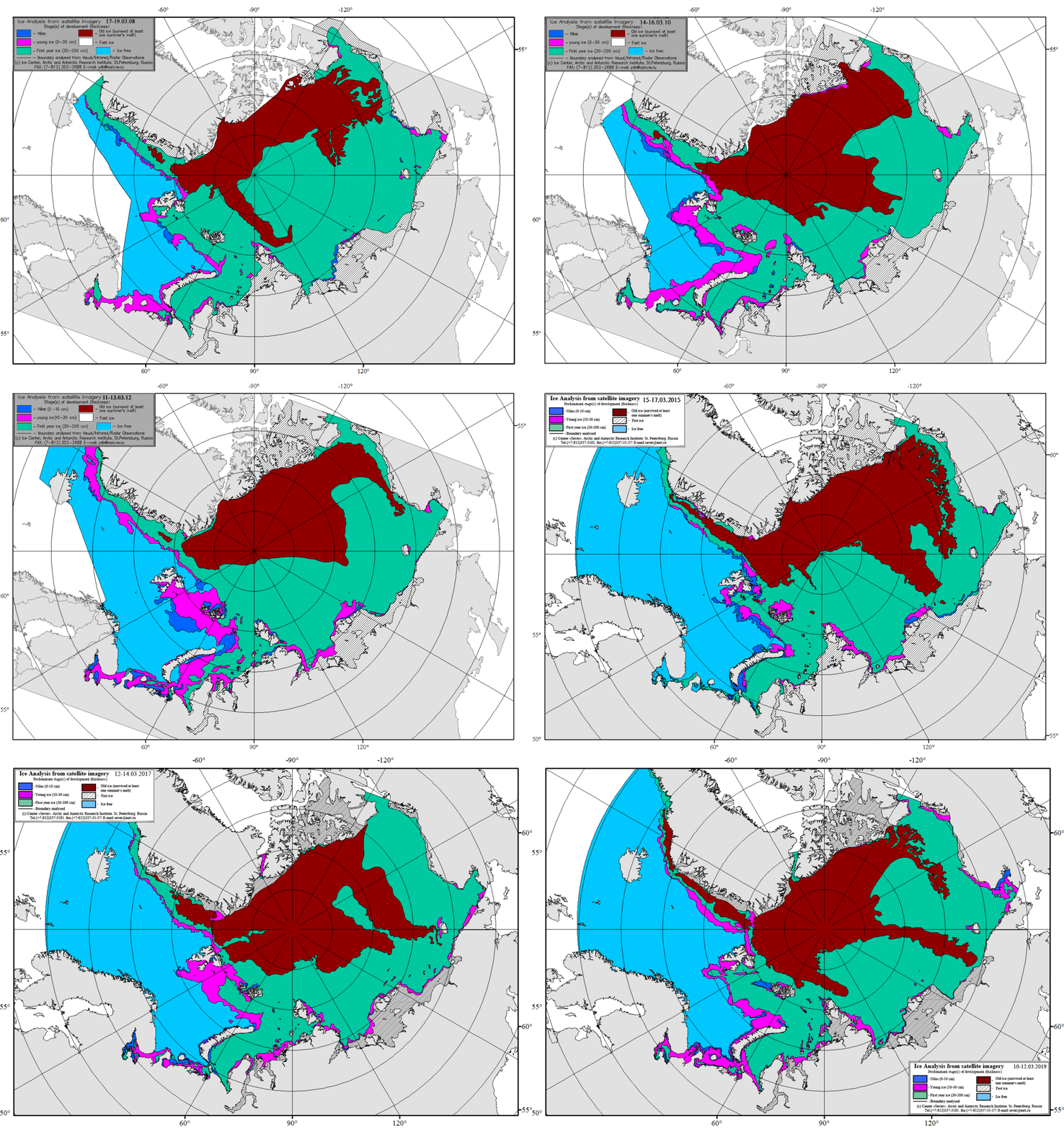
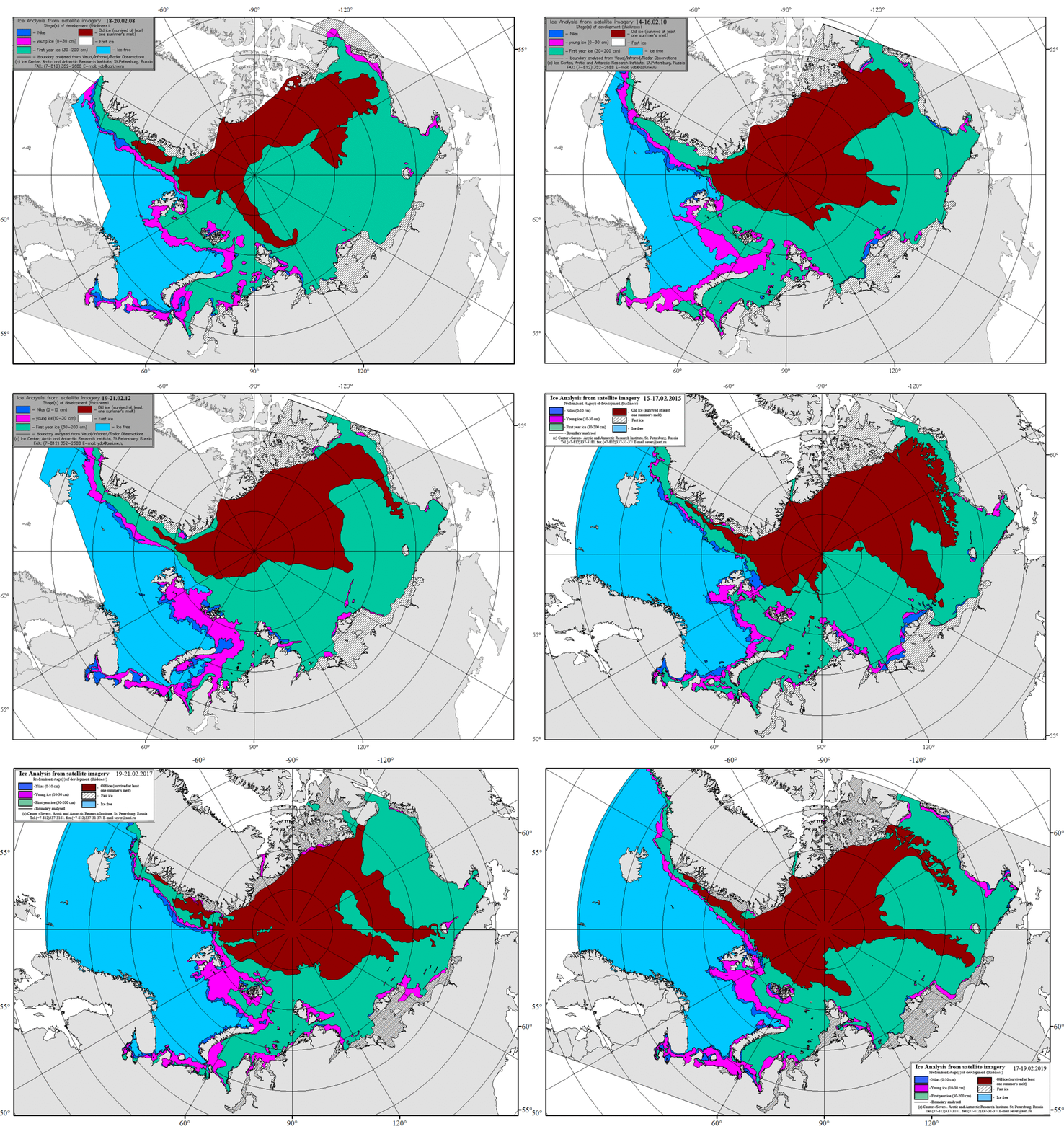
Above are ice charts from AARI, St. Petersburg for the annual maximum weeks in Mid-March, 2008 to 2019 inclusive. The brown color signifies Old Ice that survived at least one summer’s melt season.  The Arctic heart is beating clear and strong. Note differences between diminished years like 2012 and 2013 compared to more robust recent years.

For context, note that the average daily maximum has been ~15M, so on average the extent shrinks to 30% of the March daily high before growing back the following winter.


Arctic Ice Marching 2019

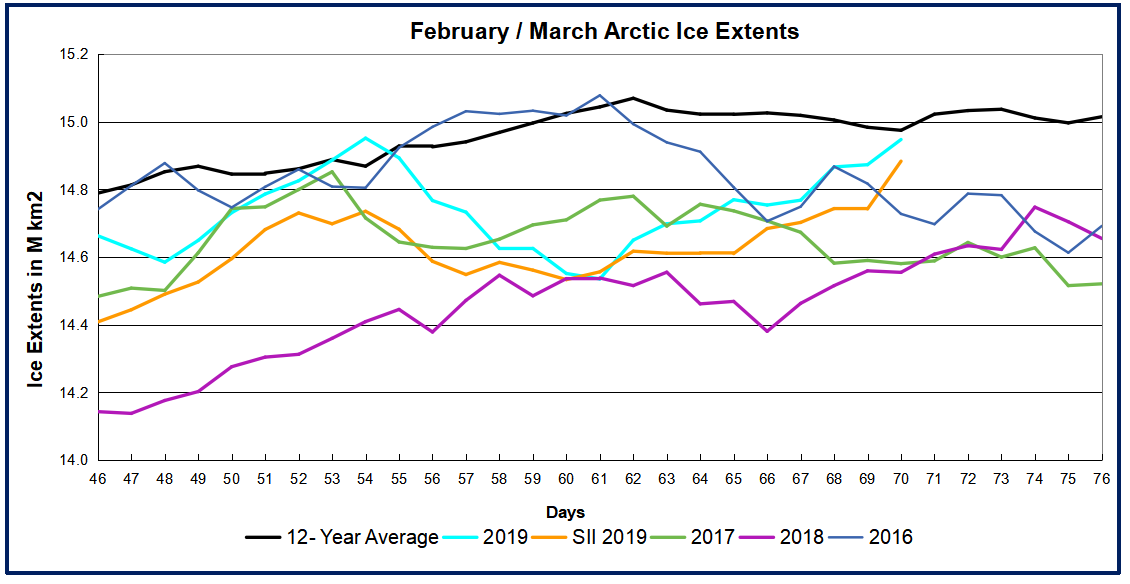
A previous post discussed 15M km2 as the average maximum threshold for March arctic ice extents.The graph shows 2019 exceeded the previous two years, but now it appears to fall just short.  On day 61, March 2, 2016 peaked well above 15M, and did not reach that level again. The graph shows 2017 peaked early and then descended into the Spring melt.  2018 started much lower, gained steadily before peaking on day 74, 250k km2 below average. 2019 has been exceptional, surging early to surpass average on day 54, then declined for a week, before re-surging to virtually tie the average extent on day 70.  Day 71 extent matched the earlier peak, then retreated and is now unlikely to go higher after day 75.

Presently, on day 75 2019 is 1% below the 12 year average (2007 to 2018 inclusive) and slightly higher than the preceding three years.

As reported previously, the action is mostly in the Pacific basins.  The last 10 days show Bering on the right recovering from its minimum to add back 230k km2.  Meanwhile Okhotsk on the left lost 120k km2, so the combined gain was not enough for NH to reach the threshold.  On the Atlantic side, ice extents held firm, with Barents higher than in recent years.

Note on the left the ice has pushed well south of Newfoundland.  On the right Barents ice is holding onto Svalbard, and Kara remains at its maximum.

The table below shows the distribution of ice over the various Arctic basins compared to average and to last year.

Region 2019075 Day 075
Average
2019-Ave. 2018075 2019-2018
 (0) Northern_Hemisphere 14823898 14996207 -172310 14704038 119860
 (1) Beaufort_Sea 1070498 1070200 297 1070445 53
 (2) Chukchi_Sea 965766 966002 -236 966006 -240
 (3) East_Siberian_Sea 1087137 1087134 3 1087137 0
 (4) Laptev_Sea 897845 897842 3 897845 0
 (5) Kara_Sea 934746 917400 17346 934970 -224
 (6) Barents_Sea 777137 618675 158462 718542 58595
 (7) Greenland_Sea 549834 616633 -66799 533408 16426
 (8) Baffin_Bay_Gulf_of_St._Lawrence 1561378 1593403 -32025 1480294 81084
 (9) Canadian_Archipelago 853337 852783 555 853109 229
 (10) Hudson_Bay 1260903 1257469 3434 1260838 66
 (11) Central_Arctic 3235099 3218575 16524 3167361 67738
 (12) Bering_Sea 371625 802103 -430478 432417 -60791
 (13) Baltic_Sea 54792 82770 -27978 125618 -70826
 (14) Sea_of_Okhotsk 1194159 995230 198928 1159963 34196

The table shows that except for Bering, Arctic ice extents are firm almost everywhere.  Barents, Kara and Okhotsk are well above average, but not enough to offset the deficit of Bering ice, even with the recent recovery.

Typically, Arctic ice extent loses 67 to 70% of the March maximum by mid September, before recovering the ice in building toward the next March.

Drift ice in Okhotsk Sea at sunrise.


Arctic Ice High Jump March 2019

For ice extent in the Arctic, the bar is set at 15M km2. The average in the last 12 years occurs on day 62 at 15.07M before descending. Most years are able to clear 15M, but in the five previous years only 2014 and 2016 ice extents cleared the bar at 15M km2; the others came up short.

On day 61, March 2, 2016 peaked well above 15M, and did not reach that level again. The graph shows 2017 peaked early and then descended into the Spring melt.  2018 started much lower, gained steadily before peaking on day 74, 250k km2 below average. 2019 has been exceptional, surging early to surpass average on day 54, then declined for a week, before re-surging to virtually tie the average extent on day 70.  One final push in the next few days could go over the top.

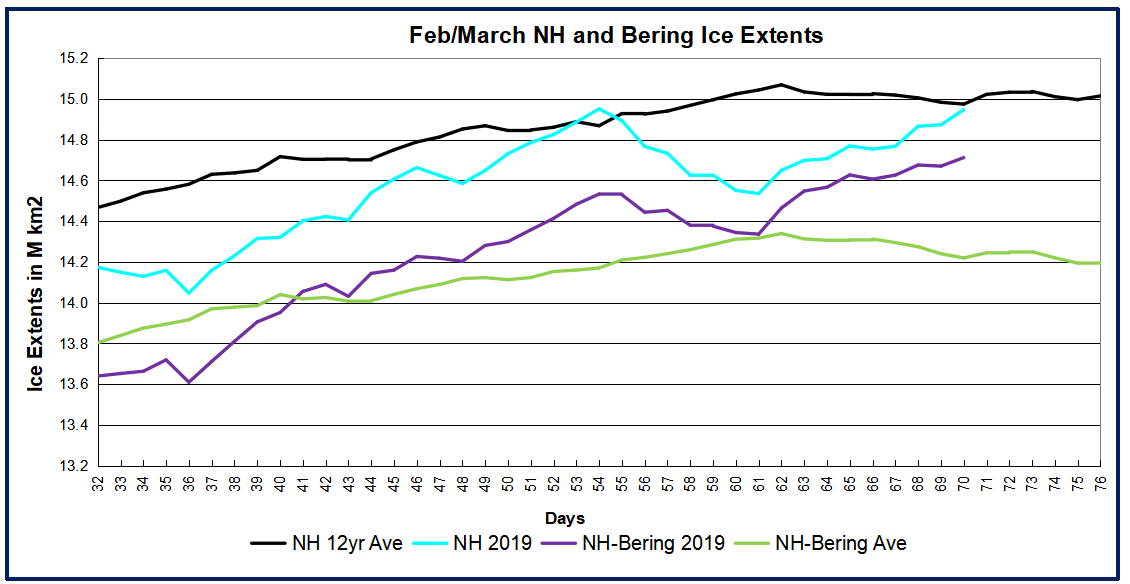
As reported previously, Bering Sea is a big part of the story this year.  The graph above shows NH ice extents from mid-February to mid-March with and without Bering ice.  The gap between black and green lines shows that Bering contributed about 700k km2 to the NH average, increasing to 800k km2 by the end of this period.  However, 2019 started with about 500k km2 from Bering.  The gap between the cyan and purple lines shows Bering ice declined down to 140k km2, before adding back 100k km2 in the last 3 days. Meanwhile, Okhotsk Sea next door gained steadily and is now holding above average ice extents.  Except for Bering, 2019 ice extents are well above the 12 year average (2007 to 2018 inclusive).

Typically, Arctic ice extent loses 67 to 70% of the March maximum by mid September, before recovering the ice in building toward the next March.

What will the ice do this year?  Where will 2019 rank in the annual Arctic Ice High Jump competition?

Drift ice in Okhotsk Sea at sunrise.


Bering Ice Lost and Found

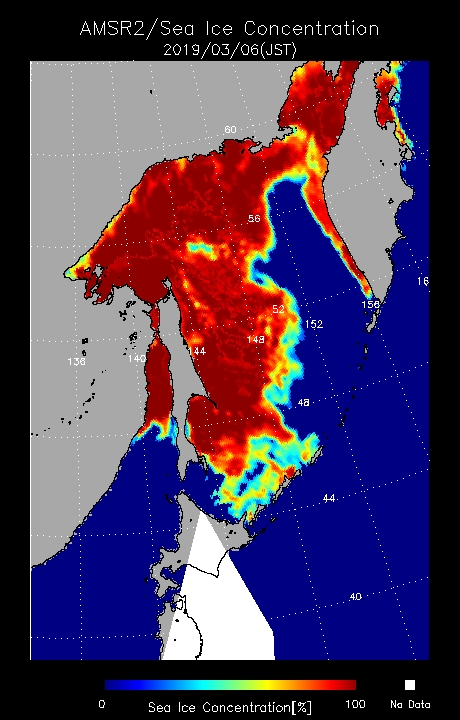
2019/03/06 GCOM-W/AMSR2 [Okhotsk] Sea Ice Concentration Source: JAXA. Note Hokkaido Island, Japan, under the white triangle tip.

This week has news reports frightened about the early melting of ice in Bering Sea.  This post is to reassure everyone that the lost ice has been found, most of it just next door in Okhotsk sea.

The Pacific basins of Bering and Okhotsk display opposing ice patterns this year.

The last two weeks saw open water growing on the right in Bering Sea, now down to 140k km2, one-fourth of its maximum extent.  Meanwhile, Okhotsk on the left grew steadily, now pressing down on Hokkaido Island, producing the southernmost Arctic Ice to be found. The graph below shows how 2019 compares to the 12 year average, after taking the Bering anomaly out of the picture.

The chart runs from mid-February to mid-March, showing how 2019 NH ice extent peaked above average on day 54, declined for a week, then rose again recently.  The effect of Bering ice loss appears in the gaps between NH extents with and without Bering ice.  Note that the black and green lines show Bering has contributed about 700k km2 to the overall total, and that increases to 800k km2 by day 76.

2019 NH included about 500k km2 from Bering on day 32, but the Bering extent has steadily decreased, now only 140k km2.  Thus 2019 w/o Bering is 270k km2 greater than NH average w/o Bering at this time, with another 10 days or so for additional ice to form.

The table below shows ice extents in the various basins on day 64.

Region 2019064 Day 064 
Average
2019-Ave. 2018064 2019-2018
 (0) Northern_Hemisphere 14706623 15022070 -315447 14461393 245231
 (1) Beaufort_Sea 1070498 1070200 297 1070445 53
 (2) Chukchi_Sea 943452 965931 -22479 965161 -21709
 (3) East_Siberian_Sea 1087137 1087133 4 1087120 18
 (4) Laptev_Sea 897845 897842 3 897845 0
 (5) Kara_Sea 934558 927864 6694 934055 503
 (6) Barents_Sea 781551 642119 139431 598121 183430
 (7) Greenland_Sea 553335 639443 -86108 548263 5072
 (8) Baffin_Bay_Gulf_of_St._Lawrence 1575867 1538064 37803 1610374 -34507
 (9) Canadian_Archipelago 853337 853037 300 853109 229
 (10) Hudson_Bay 1260903 1259978 925 1260838 66
 (11) Central_Arctic 3246782 3218361 28421 3150790 95993
 (12) Bering_Sea 140439 716013 -575574 286010 -145571
 (13) Baltic_Sea 64749 106825 -42077 166155 -101407
 (14) Sea_of_Okhotsk 1285797 1063174 222622 1008051 277746

The Bering deficit is 575k km2 or just 20% of the 12 year average.  Surpluses in Okhotsk, Baffin, Central Arctic and Barents do not completely offset, so the NH total is 315k km2 or 2% below average.

Taking a boat trip from Hokkaido Island to see Okhotsk drift ice is a big tourist attraction, as seen in the short video below.  Al Gore had them worried back then, but not now.

Drift ice in Okhotsk Sea at sunrise.

Pacific Ice Seesaw Feb. 2019


10 Days in Pacific Arctic:
The above image shows the pacific ice seesaw returning at the end of February.  Bering Sea on the right was at 95% of 2018 maximum and then lost  180k km2 in ten days, now at 65 % of max.  Meanwhile on the left Okhotsk Sea gained 70k km2, and is now 106% of 2018 maximum.

The graph below shows February progress in ice extent recovery.As noted before, the month started with a slight decline, then ice grew rapidly for 18 days peaking on day 54 above the 12 yr. average, and above the previous two years.  Then ice retreated the last five days with the February monthly average ending  240k km2 or 2% below average. SII lags MASIE by ~100k km2 for the month.

The next two weeks will show whether 2019 is maxed out, or whether the ice extent catches up to the average which flatlines over that period.

The table below shows the distribution of ice in the various Arctic basins.

Region 2019059 Day 059 
Average
2019-Ave. 2018059 2019-2018
 (0) Northern_Hemisphere 14625288 15006867 -381579 14485052 140236
 (1) Beaufort_Sea 1070498 1070200 297 1070445 53
 (2) Chukchi_Sea 960221 965872 -5651 965971 -5750
 (3) East_Siberian_Sea 1087137 1087133 4 1087120 18
 (4) Laptev_Sea 897845 897842 3 897845 0
 (5) Kara_Sea 931672 929289 2383 922905 8767
 (6) Barents_Sea 684894 625620 59274 544938 139956
 (7) Greenland_Sea 513404 628938 -115534 473064 40340
 (8) Baffin_Bay_Gulf_of_St._Lawrence 1570308 1539346 30962 1786606 -216298
 (9) Canadian_Archipelago 853337 853036 302 853109 229
 (10) Hudson_Bay 1260903 1260611 293 1260838 66
 (11) Central_Arctic 3231172 3213214 17958 3065181 165991
 (12) Bering_Sea 250169 710647 -460479 336065 -85896
 (13) Baltic_Sea 39687 110466 -70780 123280 -83594
 (14) Sea_of_Okhotsk 1260392 1067746 192646 1069898 190494

The table shows how 2019 is matching the 12-year average almost everywhere.  Barents Sea has caught up and edged ahead of average, and much higher than last year.  Greenland Sea is below average but higher than 2018.  The overall deficit is due to Bering ice down 460k km2 to average, only partially offset by a surplus of 193k km2 in Okhotsk.

cg524a47d218458

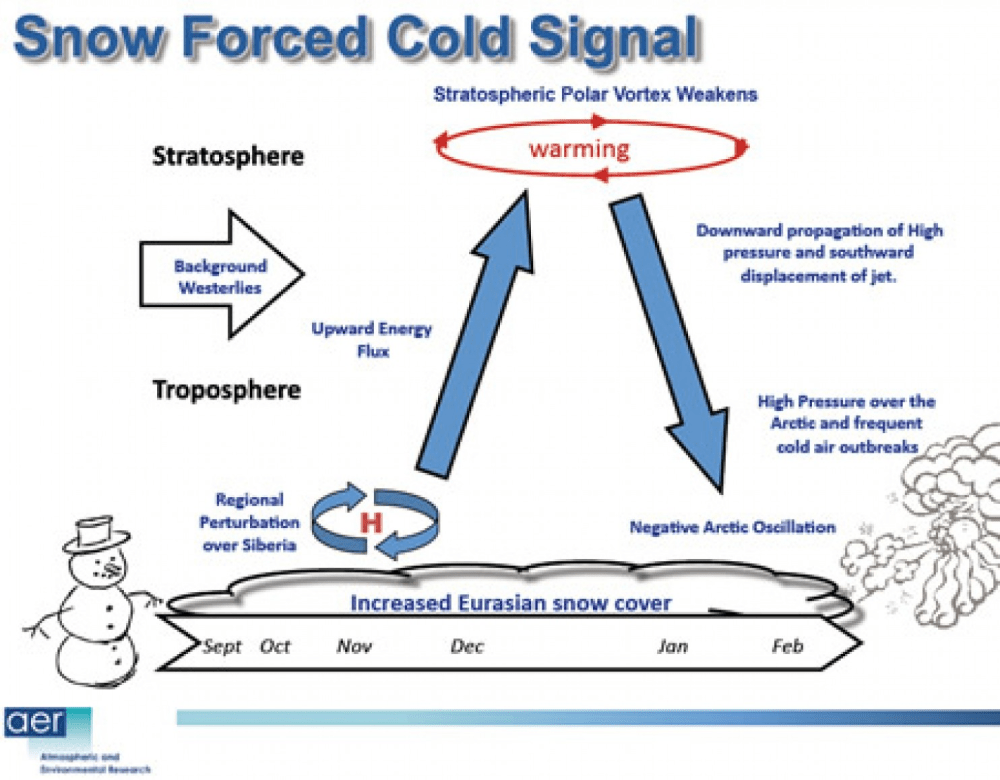
Footnote:  At his AER blog  Arctic Oscillation and Polar Vortex Analysis and Forecasts Dr. Judah Cohen writes on Feb. 25 regarding this cold winter in the Arctic. Excerpts in italics with my bolds.

As I have written many times in the blog this fall and winter season the influence of a significant stratospheric PV disruption typically lasts on the order of four to eight weeks. It certainly looks like the PV split from early January has gone the distance and has persisted for a full eight weeks or possibly even a little longer. Based on the latest polar cap geopotential heights (PCHs) forecast the whole event is winding down over the next week or so. Therefore, I think that we can start to draft the obituary for this event.

The stratosphere-troposphere coupling differed from last year’s PV split and other previous similar events but certainly not all. Though the “dripping” of warm PCHs occurred periodically, there were long gaps between “drips” where the tropospheric PCHs even turned cold for an appreciable period. Also, the AO and NAO never turned strongly negative nor was there any persistent period where both indices remained in negative territory. This is in strong contrast to last winter. As I wrote in last week’s blog, I think at least part of the reason might be the relatively cold central Arctic this winter compared with the last several winters where the Arctic was near or at record warm.

Though despite what could be considered atypical or less traditional stratosphere-troposphere coupling following the stratospheric PV split, I would argue there were still some impressive impacts on the weather. Maybe those impacts were more discernable and more impressive across North America than Eurasia, but both continents had record cold and snow.

So, what to expect as the stratosphere-troposphere coupling event wraps up. For Europe, temperatures are already mild and with the AO predicted to remain positive and could potentially turn even more strongly positive if the cold PCHs couple all the way to the surface, it is hard for me to see a return to any kind of prolonged cold this month. Across North America it is more complicated. Cold temperatures are predicted to be expansive across the continent and even record cold is possible over the next week or so. In addition, snow cover is relatively extensive and, in many locations, unusually deep especially on either side of the US-Canadian border. I don’t expect the cold air across in North America to simply disappear anytime soon, but if the if the cold PCHs couple all the way to the surface, this would favor the cold temperatures being mostly confined to western North America. I also feel that circulation and temperature anomalies in the stratosphere suggest a relatively cold western North America and relatively mild eastern North America especially Eastern US. And despite the cold start to March in the Eastern US the models are predicting a return to mild conditions by the middle of March.


On Sea Ice Thickness

ice Charts from AARI showing ice extents by duration. Appearing in brown is Multi-year ice (surviving at least one melt season).

At the recent post Arctic Ice Surpasses 2018 Maximum, I was asked about measures of sea ice thickness and estimates of volume, combining extents (or concentrations) with thickness.  My response:

Agencies like DMI produce model-driven estimates of Arctic sea ice thickness. I limit my analysis to extents because they are observation-driven.

DMI says this:  “The figures are based on calculations using the DMI operational coupled ocean- and sea-ice model HYCOM-CICE. The total sea-ice volume is a product of the sea-ice concentration and its thickness.”

“Today, the sea-ice concentration is in general well estimated using satellite products, while the sea-ice thickness is poorly known. The model gives a realistic estimate of the total amount of sea-ice within the Arctic.” (concentration means extent). FWIW, DMI estimates of Arctic thickness have increased over the last decade.

It’s a complicated business to get remote signals of thickness, which varies with drifting and compaction from storms and currents.  Another way to get at the issue appears in the animation above with AARI ice charts.  They are derived from satellite imagery, configured so that the brown color represents multi-year ice that survived at least one melt season.   The animation shows the last 11 years had some low years, especially 2008, 2009 and 2013, with higher years since.  And obviously the locations of older ice are variable.

Of course there are other sea ice volume modelled products such PIOMAS.  For an insight into how complicated is estimating sea ice thickness from remote sensors see this article Estimating Arctic sea ice thickness and volume using CryoSat-2 radar altimeter data

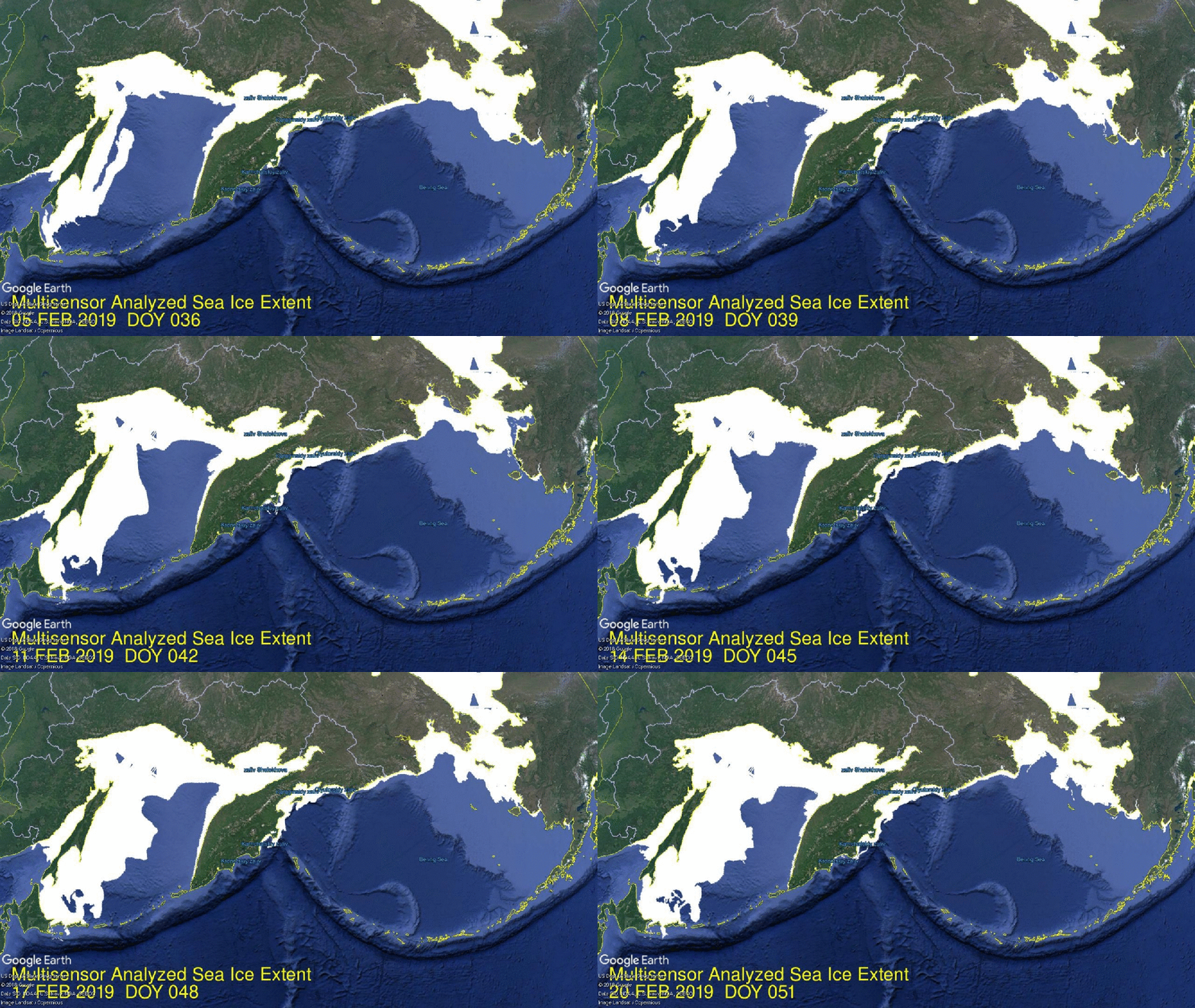
Arctic Ice Surpasses 2018 Maximum

Atlan2019036to051
Sea Ice Extends on the Atlantic Side: 
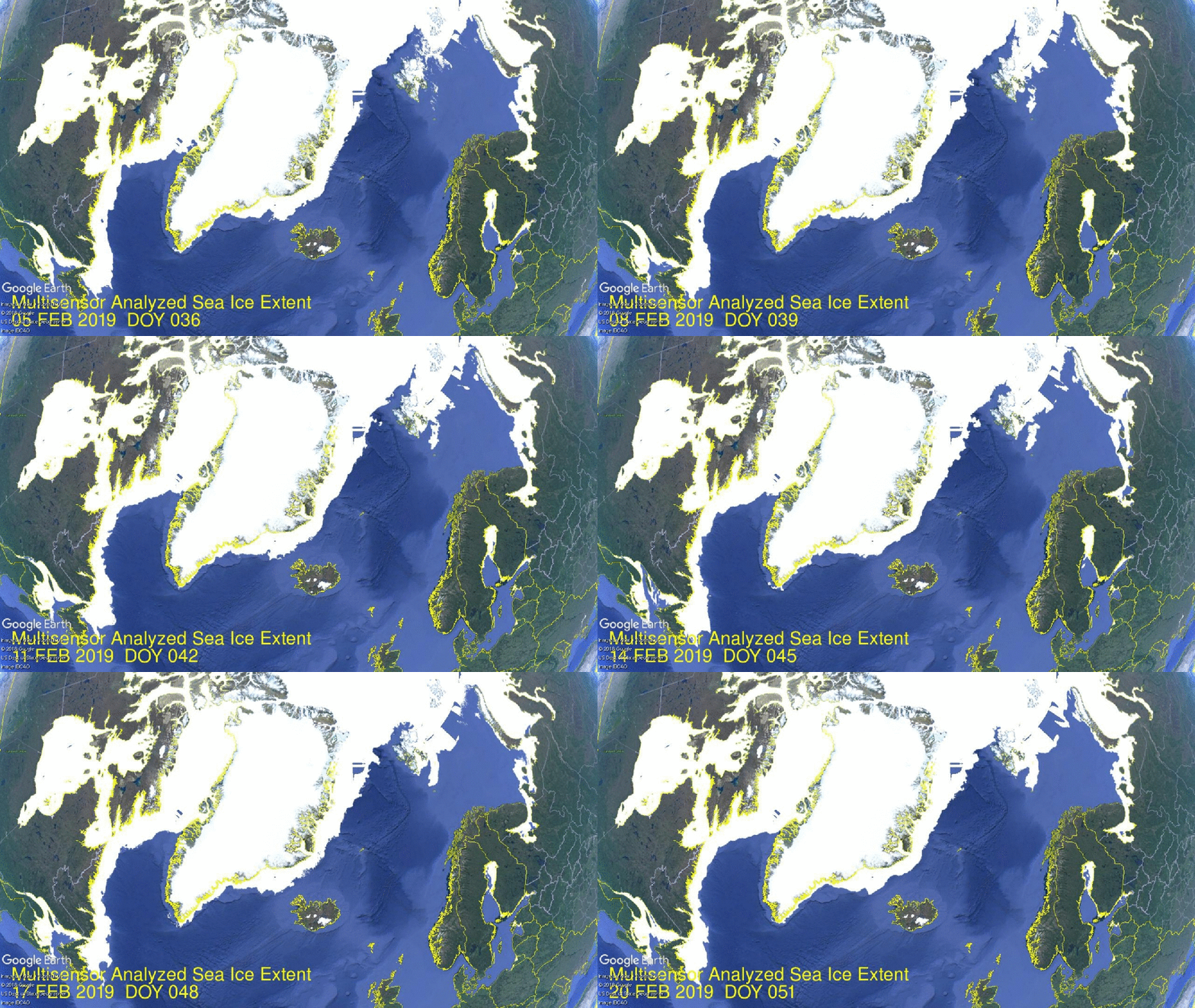
The animation above shows the last two weeks on the Atlantic side, with Kara achieving its annual maximum and Barents growing ice up to 86% of its max last March. In the upper right the ice solidifies down to Svalbard and fast ice forms along the mainland.  On the left, Baffin ice thickens along the Labrador coast and  a large mass forms along Newfoundland. The Gulf of St. Lawrence is nearly iced over.  Below is the ice recovery on the Pacific side.

BerOk2019036to051

Bering on the right retreats and then recovers to stay at 95% of its 2018 maximum.  Meanwhile Okhotsk on the left shows a surge of sea ice, gaining almost 400k km2 over these two weeks.  Bering is well below the 12 year average, while Okhotsk has already passed its 2018 maximum and is 22% above the 12 year average.

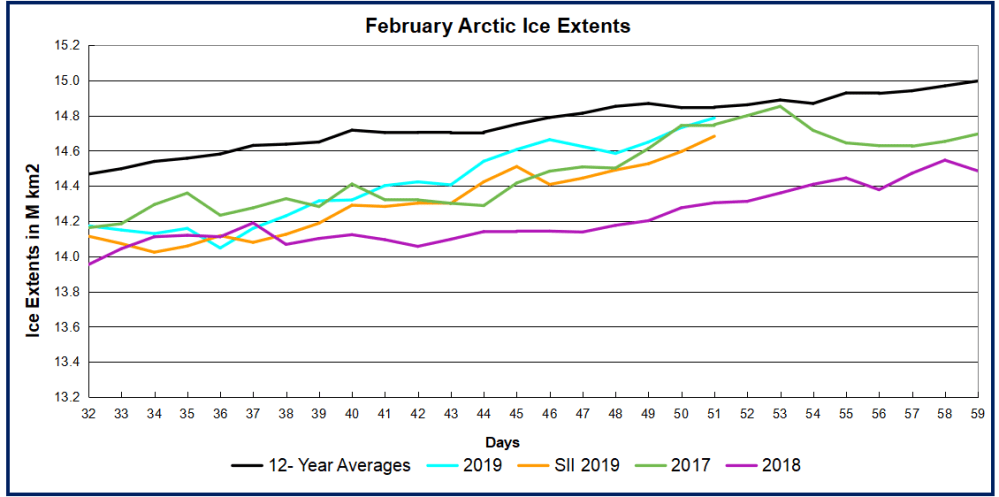
The graph below shows February progress in ice extent recovery.
ArcticIce2019051

2019 ice extents declined slightly to start the month, then grew rapidly in the last two weeks to nearly match the 12-year average (2007 to 2018 inclusive).  SII lags MASIE by 100k km2 at this date. 2019 is presently matching 2017, and has nearly 500k km2 more ice than 2018.

Interestingly, 2019 extent has already surpassed 14.75 M km2, the 2018 maximum reached on day 74.  Note in the graph that 2017 peaks on day 53, the maximum extent that year.  The average maximum is 15.07 M km2 on day 62, so 2019 has 11 days more to reach that level.

The table below shows the distribution of ice in the various Arctic basins.

Region 2019051 Day 051 
Average
2019-Ave. 2018051 2019-2018
 (0) Northern_Hemisphere 14785938 14847524 -61587 14303929 482009
 (1) Beaufort_Sea 1070498 1070200 297 1070445 53
 (2) Chukchi_Sea 965972 964755 1217 955104 10868
 (3) East_Siberian_Sea 1087137 1087133 4 1087120 18
 (4) Laptev_Sea 897845 897842 3 897845 0
 (5) Kara_Sea 934970 920340 14629 917650 17319
 (6) Barents_Sea 685511 606250 79261 537870 147642
 (7) Greenland_Sea 564543 619655 -55112 440813 123730
 (8) Baffin_Bay_Gulf_of_St._Lawrence 1527391 1487134 40257 1731868 -204477
 (9) Canadian_Archipelago 853337 853036 302 853109 229
 (10) Hudson_Bay 1260903 1260717 186 1260838 66
 (11) Central_Arctic 3239858 3210652 29205 3154998 84860
 (12) Bering_Sea 428805 724586 -295781 211528 217277
 (13) Baltic_Sea 54788 107524 -52735 85965 -31177
 (14) Sea_of_Okhotsk 1194028 977205 216823 1059514 134514

The table shows how 2019 is matching the 12-year average almost everywhere.  Barents has edged 13% ahead of average, and is much higher than last year.  The slight overall deficit is mainly due to Bering ice down nearly 300k km2 to average, only partly offset by the surplus in Okhotsk and Central Arctic.

cg524a47d218458

Footnote:  At his AER blog  Arctic Oscillation and Polar Vortex Analysis and Forecasts Dr. Judah Cohen writes on February 18 regarding this cold winter in the Arctic and NH.  Excerpts in italics with my bolds.

screen-shot-2019-02-18-at-1.21.38-pm

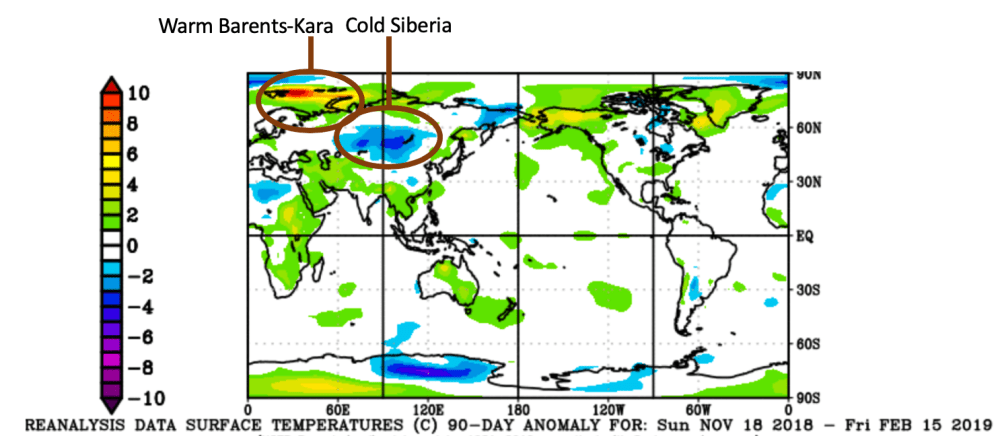
Figure ii. Analysis of surface temperature anomalies ffrom 18 November 2018 until 15 February 2019. Taken from https://www.esrl.noaa.gov/psd/map/clim/glbcir_rnl.shtml.

This winter once again we had what I would refer to as a highly anomalous stratospheric PV split but not as extreme as 2009 and the temperature anomalies for the winter, or certainly post the PV split are probably not going to look that terribly different from 2009. The largest negative departures are likely to be in western North America and Siberia. I will show the winter temperature anomalies with the AER forecast posted in November and from the dynamical models but for today’s blog a quick and dirty surface temperature plot from NOAA will do (Figure ii). The most striking temperature anomalies are what I would consider as a couplet – strong positive temperature anomalies in the Barents-Kara Seas and strong negative temperature anomalies in Siberia. This temperature couplet has been the most consistent feature of Northern Hemisphere winters of probably the past 15-20 years. This gets to the heart of the debate does Arctic change influence mid-latitude weather. I think I have been as emphatic as anybody on the planet that the answer is yes, and this winter will only strengthen my conviction. The other continental region that is likely to have negative departures is Canada and since the PV spit the largest negative departures are centered in Western Canada.

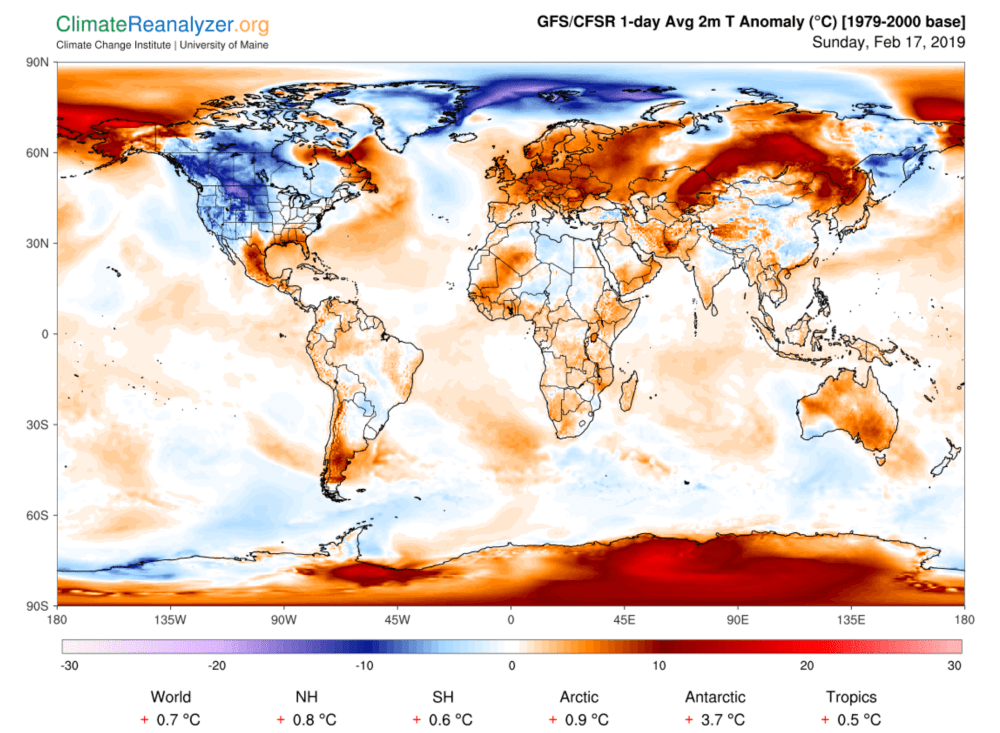
figureiii_02182019

Since November, I have consistently stated that the largest sea ice anomalies and consequently the largest positive atmospheric temperature anomalies will be in the Barents-Kara Seas. I have also discussed how surprising I find it how cold the remainder of the Arctic has been this winter. As an example, I show in Figure iii the global temperature anomalies from yesterday February 17th the https://climatereanalyzer.org/. The Arctic positive temperature departure is 0.9°C equal to the NH and global temperature departure. This is a far cry from recent winters when the Arctic has warmed at a rate six times the rate of the remainder of the globe. Ironically the globe is currently experiencing Antarctic amplification and not Arctic amplification contrary to expectations.

My thoughts about March haven’t changed much since last week. The stratosphere has worked well as a predictor of North American temperature anomalies and for the most part they seem to support a continuation of cold temperatures focused in western North America. Despite this it is my own experience that cold air focused in western North America tends to shift east with time especially in the late winter. Therefore, based on this empirical observation I was expecting possibly a return to more sustained cold in the eastern US as winter winds down. This is now being predicted by both the GFS and ECMWF models. It is my experience that models may be too quick to predict a pattern change but they are often correct in anticipating the pattern change. But even assuming the eastern US turns colder, will it persist for more than just a few days? My confidence in such an outcome would increase if the Arctic finally warms something that has not really happened so far this winter.


Icy Arctic January 2019

eur2019016to028
Kara and Barents Seas Chilling Out: 
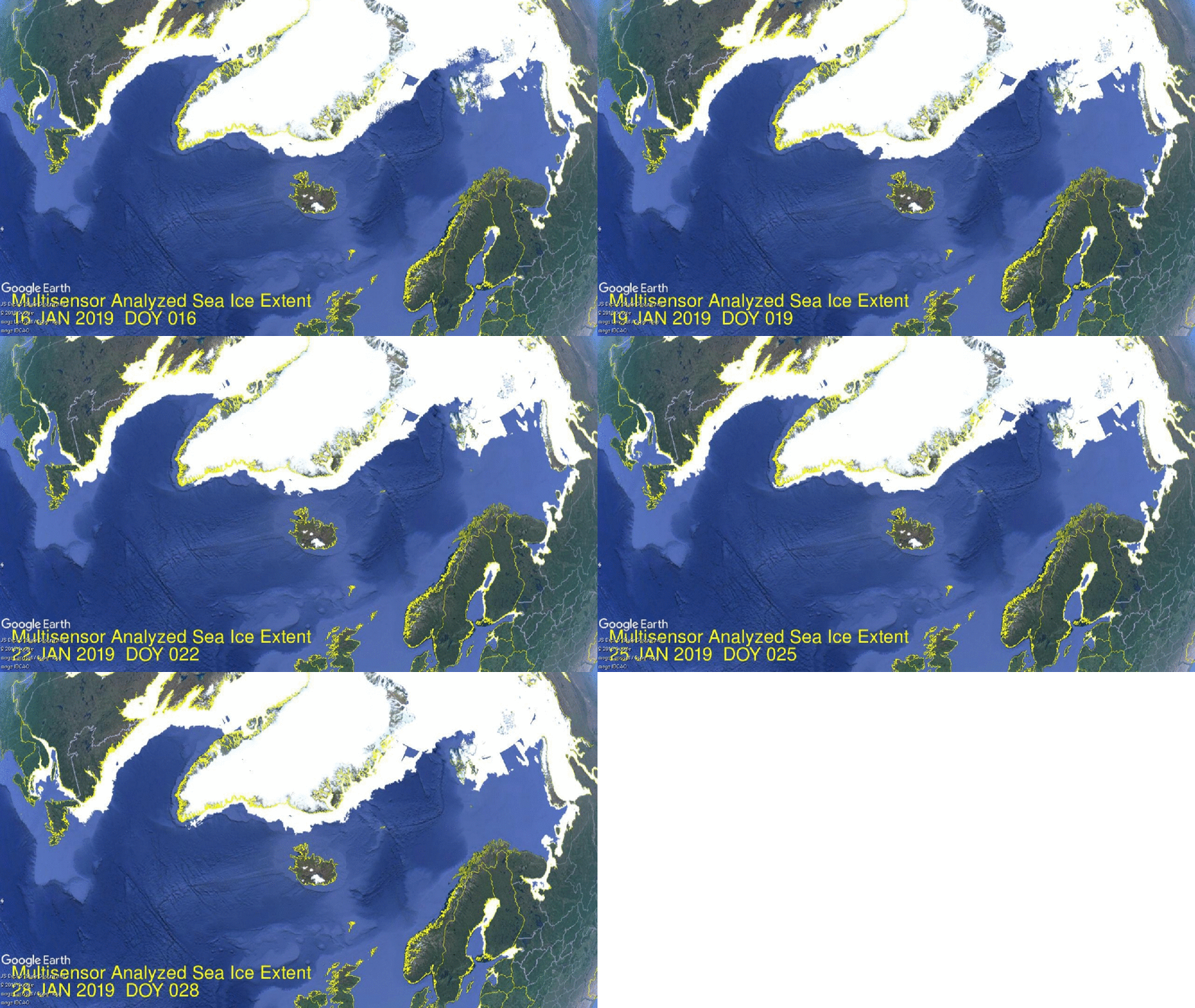
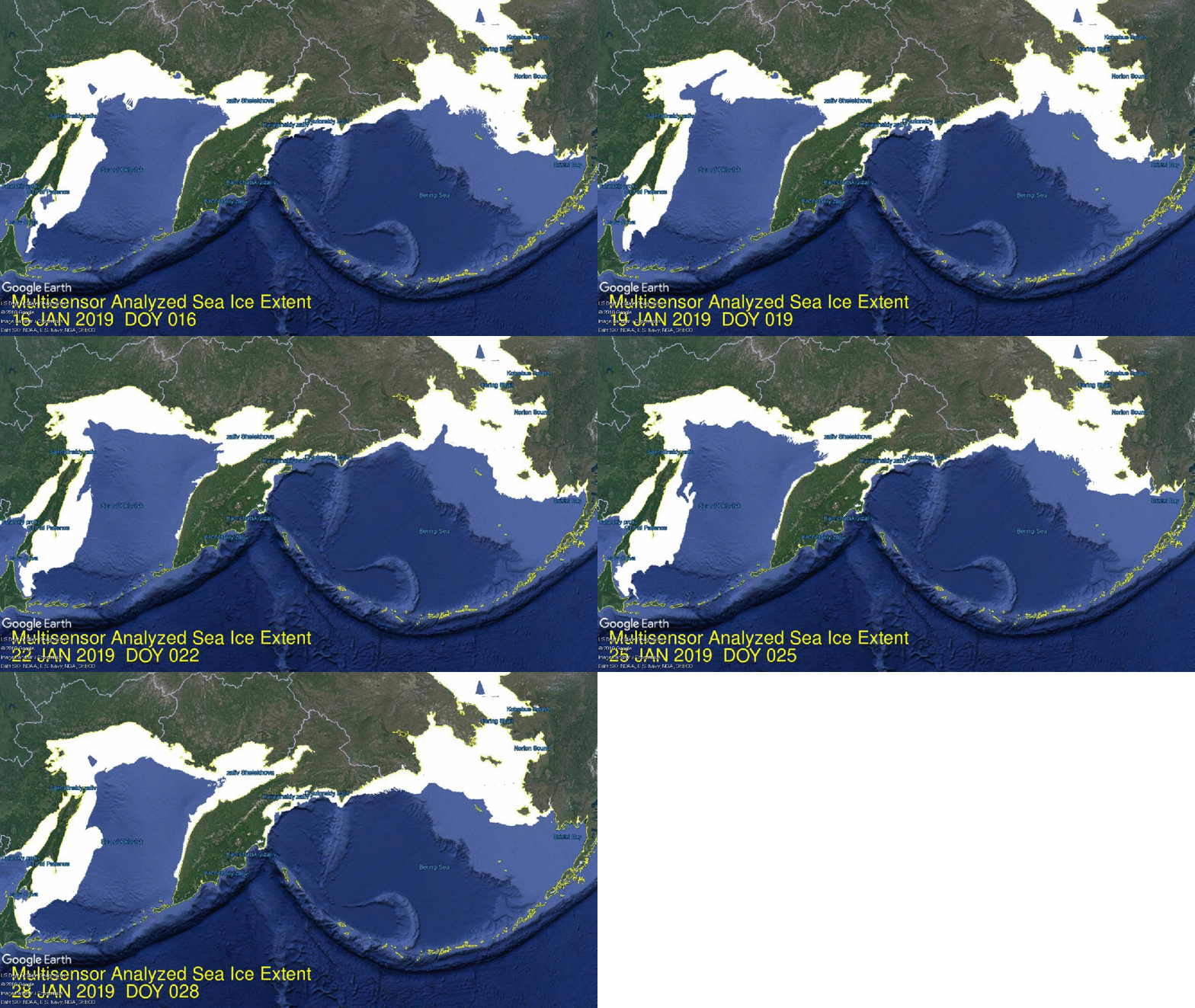
The animation above shows the last two weeks on the Atlantic side, with Kara achieving its annual maximum and Barents growing ice up to 75% of its max last March. Those two regions are the last to cool down this year. In the upper right the ice solidifies next to Svalbard and fast ice forms along the mainland. Icing begins in the Baltic.  In the center Greenland Sea ice reaches out toward Iceland.  On the left, Baffin ice thickens along the Labrador coast and is filling the Gulf of St. Lawrence.  Below is the ice recovery on the Pacific side.
alsk2019016to028

As we will see in the numbers below, Bering on the right has 100k km2 more ice now than  a year ago, though still lagging the 12-year average.  Okhotsk on the left is almost average and is reaching well south in its basin.

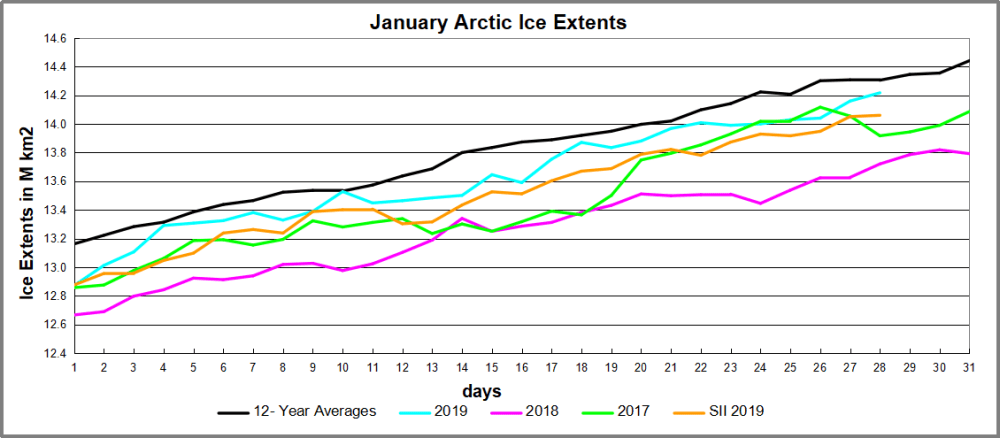
The graph below shows January progress in ice extent recovery.
arcticice2019028

2019 ice extents are tracking slightly lower than the 12-year average (2007 to 2018 inclusive).  SII lags MASIE by 157k km2 at this date. 2019 presently has 300k km2 more ice than 2017, and 500k km2 more ice than 2018

The table below shows the distribution of ice in the various Arctic basins.

Region 2019028 Day 029 
Average
2019-Ave. 2018028 2019-2018
 (0) Northern_Hemisphere 14216967 14304896 -87929 13720485 496482
 (1) Beaufort_Sea 1070498 1070200 297 1070445 53
 (2) Chukchi_Sea 966006 965999 7 965971 35
 (3) East_Siberian_Sea 1087137 1087133 4 1087120 18
 (4) Laptev_Sea 897845 897842 3 897845 0
 (5) Kara_Sea 935023 904103 30921 864752 70271
 (6) Barents_Sea 594754 552640 42114 448388 146366
 (7) Greenland_Sea 559919 588686 -28767 502182 57738
 (8) Baffin_Bay_Gulf_of_St._Lawrence 1355417 1335964 19453 1357109 -1693
 (9) Canadian_Archipelago 853337 853036 302 853109 229
 (10) Hudson_Bay 1260903 1259599 1305 1260838 66
 (11) Central_Arctic 3206769 3208914 -2145 3176440 30330
 (12) Bering_Sea 557702 657897 -100194 414234 143468
 (13) Baltic_Sea 84454 79993 4462 37674 46780
 (14) Sea_of_Okhotsk 765952 777348 -11397 718922 47030

The table shows how 2019 is matching the 12-year average almost everywhere.  Barents and Kara Seas have caught up and edged ahead of average, and are much higher than last year.  The slight overall deficit is due to Bering ice down 100k km2 to average, while being 143k km2 more than last year.

cg524a47d218458

Footnote:  At his AER blog  Arctic Oscillation and Polar Vortex Analysis and Forecasts Dr. Judah Cohen writes yesterday on this cold winter in the Arctic. Excerpts in italics with my bolds.

The Arctic has warmed at least as twice as fast as any other region of the globe and the accelerating warming of the Arctic relative to the rest of the globe but especially the Northern Hemisphere (NH) mid-latitudes is known as Arctic amplification. The cause of Arctic amplification is surprisingly complex and not well understood but the cause is at least partially related to Arctic sea ice and snow cover melt. Certainly, heading into this winter, I was very confident that we would observe an anomalously warm Arctic this winter especially coming off of last winter where the Arctic was record warm (see Figure i) and sea ice was record low extent.

But the Arctic was surprisingly cold last summer that prevented a new record low minimum for sea ice extent in September. Since then it has been at least strategically cold in regions across the Arctic this fall and winter that allowed sea ice to grow more extensive this winter in the Arctic basin compared to recent winters except in the Barents-Kara Seas. But even more surprising to me has been how cold the Arctic has consistently been this winter, especially when compared to recent winters. The only region in the Arctic Ocean basin that has been consistently warm is the Barents-Kara Seas.


Arctic Icing on All Sides Now


2019 with bears
With the usual fits and starts, the Arctic has now frozen solid in the central and Russian basins, and ice extents are recovering on all sides, Pacific, European and Canadian.  The laggards have been Kara and Barents Seas, but progress there is shown below.
barents2019001to018

Kara on the left is virtually iced over, while Barents ice has reached out to claim the eastern coast of Svalbard in the center.  On the right Greenland Sea ice is extending toward Iceland. Compared to 2018 March maximums, Kara is 99%, Greenland Sea is 98% and Barents is 60% of maximum. The image below shows 2019 ice recovery on the Canadian side.
baffin2019001to018

Upper left is Greenland sea ice reaching toward Iceland.  In the center Baffin Bay is growing ice southward down the Greenland coast.  On the right, ice extent has grown along Labrador to touch Newfoundland, and start filling in the Gulf of St. Lawrence. Baffin Bay/Gulf St. Lawrence is now 70% of 2018 March max, which was one of the higher extent years for that basin. Finally we return below to the Pacific ice recovery.
berok2019001to018

As reported previously, ice extent has rebounded here coinciding with the dissipating warm water Blob in North Pacific.  Bering Sea on the right started first and is now 17% greater than maximum last March.  Okhotsk sea ice has picked up the pace and is now 58% of March max.

arcticice2019018

In January, 2018 ice extents tracked the 12 year average (2007 to 2018 inclusive), at times pausing and then surging.  SII 2019 is showing slightly less ice, averaging 100k km2 lower.  As of yesterday, this year has gained about 500k km2 more ice than either 2017 or 2018.

algore_ice_gone_by_2013